
Xuan Bi Teapills Ingredients & Drug Interactions
by Plum Flower
What is this page for?
First and foremost: checking Xuan Bi Teapills against your medications. The heart of this page is the interaction checker and the full interaction report — how this product’s ingredients may interact with prescription and over-the-counter medicines you may be taking.
Around that, we add a pharmacist’s high-level view of the product as a whole — what’s inside, the evidence for its stated use, how transparent the label is, and what safety data exists — so you can see the full picture in one place. It’s educational information from our licensed clinical databases and the clinical staff at HelloPharmacist — not medical advice — and we don’t sell or endorse products. Our editorial policy
Xuan Bi Teapills is a dietary supplement by Plum Flower with 10 active ingredients. Its ingredients are commonly taken for liver and digestive complaints, fever and inflammation, anxiety, restlessness, and trouble sleeping.Based on those ingredients, 1,222 medications have a known interaction with it, the most serious rated moderate. The ingredients most likely to interact are Phellodendron chinense Bark Extract, Atractylodes lancea Rhizome Extract, Pinellia ternata Rhizome Extract. Use the checker below to test your specific medication, or read the full HelloPharmacist Interaction Report.
Check Your Meds Against Xuan Bi Teapills by Plum Flower
Ask about any prescription or over-the-counter medication and we check it for interactions with Xuan Bi Teapills by Plum Flower — and tell you which ingredient is responsible.
AI summaries are generated from our interaction database for education only — always confirm with your pharmacist. How we use AI
Ask the Pharmacist
A licensed pharmacist will answer your question by email — free, usually within 24 hours.
Got it — thank you!
A licensed pharmacist will answer within 24 hours. Keep an eye on your email (worth checking spam, just in case).
HelloPharmacist Scorecard of Xuan Bi Teapills by Plum Flower
Our pharmacy team’s full take, with four database checks built into the cards below — a summary of what is known, not a grade of the product itself.
What’s inside
Low disclosure
Xuan Bi Teapills contains 10 ingredients listed as a proprietary extract blend plus individual extracts: gardenia fruit, pinellia rhizome, atractylodes rhizome, phellodendron bark, akebia stem, stephania root, achyranthes root, forsythia fruit, apricot seed, and Job's tears seed. Most are traditional Asian botanical extracts; the product also contains inactive ingredients — maltose, magnesium silicate, activated charcoal, and china wax — which serve as binders and fillers.
The active ingredients work together in the traditional formula, though our data shows insufficient evidence to establish effectiveness for the conditions these herbs have been used for (anxiety, depression, diabetes, and other conditions). The dose and potency depend on the extraction method and concentration in the final tablet.
Does it work?
Couldn't assess
The evidence we hold rates all the measured effectiveness claims for these ingredients as insufficient — meaning we don't have reliable data proving they work for anxiety, depression, diabetes, dementia, high blood pressure, flu, appetite, cold, diarrhea, high cholesterol, or bronchiolitis. That doesn't mean the formula doesn't help, only that scientific evidence for these uses hasn't been established in our data.
How safe is it?
Well-documented data
Safety data for most ingredients in this blend are limited. Pinellia, the sedating ingredient, contains ephedrine alkaloids that may raise blood pressure, speed your heart, and in rare cases cause heart attack or stroke — it's also toxic if raw and not properly processed.
Phellodendron and several other herbs should be avoided in pregnancy and while breastfeeding; the data advises against use due to lack of safety information or potential harm to the baby. Gardenia has rare case reports of blue-gray skin discoloration after very long-term use (7 years in one case).
Atractylodes may cause allergic reaction, nausea, or dry mouth. Forsythia safety data are limited.
Apricot seed is generally well tolerated from the fruit itself, but supplements and kernels are concerning.
Meds to double-check
Moderate interaction found
Check before taking if you use sedating medications (benzodiazepines, barbiturates, antihistamines, other CNS depressants), blood pressure drugs, blood thinners or antiplatelet agents, diabetes medications, theophylline, dextromethorphan, chlorzoxazone, diltiazem, medications processed by CYP2D6, CYP2C9, or CYP3A4 pathways in your liver, metformin, or azithromycin. We could not check three ingredients — akebia, stephania, and achyranthes — so interaction data for those are not available.
The bottom line
Scorecard at a glanceFormula with limited ingredient disclosure with no assessable stated purpose. Moderate medication interactions have been identified, and safety information is well characterized.
This is a traditional multi-ingredient formula — talk with your pharmacist before starting, especially if you take sedatives, blood pressure meds, blood thinners, diabetes drugs, or anything your liver metabolizes. It's not for pregnancy or breastfeeding.
If you have a bleeding disorder or upcoming surgery, flag it first.
Educational only — not medical advice; always confirm with your pharmacist. Our editorial policy · How we use AI
Assessment coverage: 7 of 10 active ingredients matched to our full ingredient reviews (monographs). Based on the product label dated Sep 25, 2025.
This Scorecard evaluates available label information, ingredient evidence, and known medication-safety considerations. It does not independently verify product identity, purity, potency, contamination, or manufacturing quality. How these ratings are computed
General information
Key facts about Xuan Bi Teapills, straight from the product label.
| Brand | Plum Flower |
|---|---|
| Barcode (UPC) | 739934820186 |
| Net contents | 1.2 Ounce(s); 34 Gram(s); 200 Pill(s) |
| Market status | On market |
| Date entered into DSLD | Sep 25, 2025 |
| DSLD ID | 336525 |
| Product type | Botanical |
| Supplement form | Tablet Or Pill |
| Dietary claims / uses | All Other |
| Intended target group(s) | Adult (18 - 50 Years), Women (not pregnant or lactating) |
Everything in this section is reproduced from the manufacturer’s own product label — it’s the label speaking, not HelloPharmacist. We show it so you can see exactly what the maker states; we don’t verify or endorse those statements.
Supplement Facts
The label details for Xuan Bi Teapills by Plum Flower, sourced from the NIH Dietary Supplement Label Database.
Supplement Facts
| Ingredient | Amount | % DV |
|---|---|---|
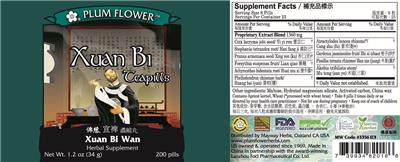
| Proprietary Extract Blend | 1360 mg | -- |
| Gardenia jasminoides Fruit Extract | 0 NP | -- |
| Pinellia ternata Rhizome Extract | 0 NP | -- |
| Atractylodes lancea Rhizome Extract | 0 NP | -- |
| Phellodendron chinense Bark Extract | 0 NP | -- |
| Akebia trifoliata Stem Extract | 0 NP | -- |
| Stephania tetrandra Root Extract | 0 NP | -- |
| Achyranthes bidentata Root Extract | 0 NP | -- |
| Forsythia suspensa Fruit Extract | 0 NP | -- |
| Prunus armeniaca Seed Extract | 0 NP | -- |
| Coix lachryma jobi Seed Extract | 0 NP | -- |
Other ingredients: Maltose, Magnesium Silicate, Hydrated, Carbon, Activated, China Wax
Tap any ingredient to jump to its full detail below.
These statements are the manufacturer’s wording, reproduced from the product label — the label is saying it, not HelloPharmacist. We don’t verify or endorse them.
General Statements
Xuan Bi Wan
Foci Pharmaceutical 1929
FDA Statement of Identity
Herbal Supplement
Precautions
Wheat (Processed with wheat bran).
Not for use during pregnancy.
Keep out of reach of children.
Suggested/Recommended/Usage/Directions
Take 8 pills 3 times daily or as directed by your health care practitioner.
Seals/Symbols
Plum Flower Guarantee Sourced Sustainably FDA Registered cGMP Compliant Made at a cGMP certified facility Lab tested Quality Verified Species Verified
Formulation
US owned & operated since 1969. Made in China in partnership with the award winning Lanzhou Foci Pharmaceutical Co. Ltd.
Is this label outdated? Report a formula or label change and our pharmacy team will review it.
Xuan Bi Teapills by Plum Flower label
The label scan from the NIH Dietary Supplement Label Database. Tap to enlarge.
Label images are published by the NIH Dietary Supplement Label Database for the version of this product on file. Always read your actual product label.
View the full label (PDF)The Ingredients in Xuan Bi Teapills by Plum Flower
These are the 10 active ingredients this product is made of. Select any to open its full monograph.
Serving size8 Pill(s) Dosage formTablet Or Pill Servings per container25 Amounts shown are per serving.
Most supplement products combine several ingredients, and a medication can interact with the product through any one of them. Each ingredient below shows whether it has known drug interactions.
Proprietary Extract Blend
- › Gardenia jasminoides Fruit Extract
- › Pinellia ternata Rhizome Extract
- › Atractylodes lancea Rhizome Extract
- › Phellodendron chinense Bark Extract
- › Akebia trifoliata Stem Extract
- › Stephania tetrandra Root Extract
- › Achyranthes bidentata Root Extract
- › Forsythia suspensa Fruit Extract
- › Prunus armeniaca Seed Extract
- › Coix lachryma jobi Seed Extract
Other (inactive) ingredients: Maltose, Magnesium Silicate, Hydrated, Carbon, Activated, China Wax. These complete the product’s ingredient list but are not active constituents.
Xuan Bi Teapills by Plum Flower Drug Interactions
HelloPharmacist Interaction Report
Xuan Bi Teapills by Plum Flower contains multiple ingredients with documented interactions.
The most serious concern is Pinellia ternata, which can strengthen the effects of sedating medications (CNS depressants) — including benzodiazepines like lorazepam and alprazolam, barbiturates, and other sleep or anxiety drugs. Animal evidence shows it increases drowsiness and sleeping time, and these are Moderate-severity interactions.
Read the full breakdown — every affected drug type, severity by severity
Phellodendron chinense poses several Moderate-severity risks: it may lower blood pressure too much if you're already on blood pressure medication, could make you more sedated if you take CNS depressants, and may interact with medications broken down by your liver (drugs processed by the CYP2D6, CYP2C9, and CYP3A4 pathways), causing them to build up. It also carries a Moderate risk with blood thinners and antiplatelet drugs (like aspirin or warfarin), and with diabetes medications — it may increase low blood sugar (hypoglycemia) risk.
Additionally, phellodendron may amplify metformin's effects.
Job's tears (Coix lachryma jobi) can boost absorption and effects of several medications including theophylline, dextromethorphan, chlorzoxazone, and diltiazem — all Moderate-severity. It also raises the risk of low blood sugar with diabetes drugs.
Atractylodes and gardenia carry Moderate interactions with blood thinners and stimulant laxatives respectively. Forsythia has Moderate risk with blood thinners and Minor risk with the antibiotic azithromycin.
Altogether, these interactions span 1,210 individual medications.
We could not check Akebia trifoliata, Stephania tetrandra, and Achyranthes bidentata — we hold no data for them. Before starting this product, run your exact medications through the checker on this page.
Check your own medications below · Editorial policy · How we use AI
Want to check YOUR meds against Xuan Bi Teapills?
Ask about interactions with your drugs in plain English — “Can I take it with lisinopril?” — and we find you the answer in seconds, ingredient by ingredient.
Go to the checkerIngredients driving the most interactions
Individual Drug Interactions
The ingredients in Xuan Bi Teapills interact with 1,222 drugs. Click any drug to see the details.
6 of the 10 ingredients in Xuan Bi Teapills interact with drugs. Each result below shows which ingredient is responsible. Phellodendron chinense Bark Extract Atractylodes lancea Rhizome Extract Pinellia ternata Rhizome Extract Coix lachryma jobi Seed Extract Forsythia suspensa Fruit Extract Gardenia jasminoides Fruit Extract
Ado-trastuzumab EmtansineKadcyla
How Ado-trastuzumab Emtansine interacts with Xuan Bi Teapills — through 2 ingredients. Tap an ingredient for the detail:
Phellodendron Chinense Bark ExtractCytochrome P450 3a4 (cyp3a4) Substrates Moderate
Interaction Summary
Theoretically, phellodendron might increase serum levels of drugs metabolized by CYP3A4.
Read the full Phellodendron Chinense Bark Extract + Ado-trastuzumab Emtansine interactionAtractylodes Lancea Rhizome ExtractCytochrome P450 3a4 (cyp3a4) Substrates Minor
Interaction Summary
Theoretically, atractylodes might increase the levels of CYP3A4 substrates.
Read the full Atractylodes Lancea Rhizome Extract + Ado-trastuzumab Emtansine interactionAbciximabReoPro
How Abciximab interacts with Xuan Bi Teapills — through 3 ingredients. Tap an ingredient for the detail:
Forsythia Suspensa Fruit ExtractAnticoagulant/antiplatelet Drugs Moderate
Interaction Summary
Theoretically, taking forsythia with anticoagulant or antiplatelet drugs might increase the risk of bleeding due to decreased platelet aggregation.
Read the full Forsythia Suspensa Fruit Extract + Abciximab interactionPhellodendron Chinense Bark ExtractAnticoagulant/antiplatelet Drugs Moderate
Interaction Summary
Theoretically, phellodendron might increase the risk of bleeding when used with anticoagulant or antiplatelet drugs.
Read the full Phellodendron Chinense Bark Extract + Abciximab interactionAtractylodes Lancea Rhizome ExtractAnticoagulant/antiplatelet Drugs Moderate
Interaction Summary
Theoretically, atractylodes might increase the risk of bleeding when used concomitantly with anticoagulant and antiplatelet drugs.
Read the full Atractylodes Lancea Rhizome Extract + Abciximab interactionAbemaciclibVerzenio
How Abemaciclib interacts with Xuan Bi Teapills — through 2 ingredients. Tap an ingredient for the detail:
Phellodendron Chinense Bark ExtractCytochrome P450 3a4 (cyp3a4) Substrates Moderate
Interaction Summary
Theoretically, phellodendron might increase serum levels of drugs metabolized by CYP3A4.
Read the full Phellodendron Chinense Bark Extract + Abemaciclib interactionAtractylodes Lancea Rhizome ExtractCytochrome P450 3a4 (cyp3a4) Substrates Minor
Interaction Summary
Theoretically, atractylodes might increase the levels of CYP3A4 substrates.
Read the full Atractylodes Lancea Rhizome Extract + Abemaciclib interactionAbiraterone
How Abiraterone interacts with Xuan Bi Teapills — through 2 ingredients. Tap an ingredient for the detail:
Phellodendron Chinense Bark ExtractCytochrome P450 3a4 (cyp3a4) Substrates Moderate
Interaction Summary
Theoretically, phellodendron might increase serum levels of drugs metabolized by CYP3A4.
Read the full Phellodendron Chinense Bark Extract + Abiraterone interactionAtractylodes Lancea Rhizome ExtractCytochrome P450 3a4 (cyp3a4) Substrates Minor
Interaction Summary
Theoretically, atractylodes might increase the levels of CYP3A4 substrates.
Read the full Atractylodes Lancea Rhizome Extract + Abiraterone interactionAbiraterone AcetateYonsa, Zytiga
How Abiraterone Acetate interacts with Xuan Bi Teapills — through 2 ingredients. Tap an ingredient for the detail:
Phellodendron Chinense Bark ExtractCytochrome P450 3a4 (cyp3a4) Substrates Moderate
Interaction Summary
Theoretically, phellodendron might increase serum levels of drugs metabolized by CYP3A4.
Read the full Phellodendron Chinense Bark Extract + Abiraterone Acetate interactionAtractylodes Lancea Rhizome ExtractCytochrome P450 3a4 (cyp3a4) Substrates Minor
Interaction Summary
Theoretically, atractylodes might increase the levels of CYP3A4 substrates.
Read the full Atractylodes Lancea Rhizome Extract + Abiraterone Acetate interactionAbrocitinibCibinqo
How Abrocitinib interacts with Xuan Bi Teapills — through 3 ingredients. Tap an ingredient for the detail:
Atractylodes Lancea Rhizome ExtractAnticoagulant/antiplatelet Drugs Moderate
Interaction Summary
Theoretically, atractylodes might increase the risk of bleeding when used concomitantly with anticoagulant and antiplatelet drugs.
Read the full Atractylodes Lancea Rhizome Extract + Abrocitinib interactionPhellodendron Chinense Bark ExtractAnticoagulant/antiplatelet Drugs, Cytochrome P450 2c9 (cyp2c9) Substrates Moderate
Interaction Summary
Theoretically, phellodendron might increase the risk of bleeding when used with anticoagulant or antiplatelet drugs.
Read the full Phellodendron Chinense Bark Extract + Abrocitinib interactionForsythia Suspensa Fruit ExtractAnticoagulant/antiplatelet Drugs Moderate
Interaction Summary
Theoretically, taking forsythia with anticoagulant or antiplatelet drugs might increase the risk of bleeding due to decreased platelet aggregation.
Read the full Forsythia Suspensa Fruit Extract + Abrocitinib interactionAcalabrutinibCalquence
How Acalabrutinib interacts with Xuan Bi Teapills — through 2 ingredients. Tap an ingredient for the detail:
Phellodendron Chinense Bark ExtractCytochrome P450 3a4 (cyp3a4) Substrates Moderate
Interaction Summary
Theoretically, phellodendron might increase serum levels of drugs metabolized by CYP3A4.
Read the full Phellodendron Chinense Bark Extract + Acalabrutinib interactionAtractylodes Lancea Rhizome ExtractCytochrome P450 3a4 (cyp3a4) Substrates Minor
Interaction Summary
Theoretically, atractylodes might increase the levels of CYP3A4 substrates.
Read the full Atractylodes Lancea Rhizome Extract + Acalabrutinib interactionAcarboseGlucobay, Prandase, Precose
How Acarbose interacts with Xuan Bi Teapills — through 2 ingredients. Tap an ingredient for the detail:
Phellodendron Chinense Bark ExtractAntidiabetes Drugs Moderate
Interaction Summary
Theoretically, phellodendron may increase the risk of hypoglycemia when taken with antidiabetes drugs.
Read the full Phellodendron Chinense Bark Extract + Acarbose interactionCoix Lachryma Jobi Seed ExtractAntidiabetes Drugs Moderate
Interaction Summary
Preliminary evidence shows that constituents of Job's tears might have hypoglycemic effects.
Read the full Coix Lachryma Jobi Seed Extract + Acarbose interactionAcebutololRhotral, Sectral
How Acebutolol interacts with Xuan Bi Teapills — through 1 ingredient. Tap an ingredient for the detail:
Phellodendron Chinense Bark ExtractAntihypertensive Drugs Moderate
Interaction Summary
Theoretically, phellodendron might have additive effects with antihypertensive drugs.
Read the full Phellodendron Chinense Bark Extract + Acebutolol interactionAcenocoumarolSintrom
How Acenocoumarol interacts with Xuan Bi Teapills — through 3 ingredients. Tap an ingredient for the detail:
Forsythia Suspensa Fruit ExtractAnticoagulant/antiplatelet Drugs Moderate
Interaction Summary
Theoretically, taking forsythia with anticoagulant or antiplatelet drugs might increase the risk of bleeding due to decreased platelet aggregation.
Read the full Forsythia Suspensa Fruit Extract + Acenocoumarol interactionAtractylodes Lancea Rhizome ExtractAnticoagulant/antiplatelet Drugs Moderate
Interaction Summary
Theoretically, atractylodes might increase the risk of bleeding when used concomitantly with anticoagulant and antiplatelet drugs.
Read the full Atractylodes Lancea Rhizome Extract + Acenocoumarol interactionPhellodendron Chinense Bark ExtractAnticoagulant/antiplatelet Drugs Moderate
Interaction Summary
Theoretically, phellodendron might increase the risk of bleeding when used with anticoagulant or antiplatelet drugs.
Read the full Phellodendron Chinense Bark Extract + Acenocoumarol interactionAcepromazineAtravet
How Acepromazine interacts with Xuan Bi Teapills — through 2 ingredients. Tap an ingredient for the detail:
Pinellia Ternata Rhizome ExtractCns Depressants Moderate
Interaction Summary
Evidence from animal research shows that a Pinellia ternata preparation decreases activity and increases sleeping time.
Read the full Pinellia Ternata Rhizome Extract + Acepromazine interactionPhellodendron Chinense Bark ExtractCns Depressants Moderate
Interaction Summary
Theoretically, phellodendron might increase the sedative effects of CNS depressants.
Read the full Phellodendron Chinense Bark Extract + Acepromazine interactionAcetaminophen, AspirinGemnisyn
How Acetaminophen, Aspirin interacts with Xuan Bi Teapills — through 3 ingredients. Tap an ingredient for the detail:
Atractylodes Lancea Rhizome ExtractCytochrome P450 1a2 (cyp1a2) Substrates, Anticoagulant/antiplatelet Drugs Moderate
Interaction Summary
Theoretically, atractylodes might decrease the levels of CYP1A2 substrates.
Read the full Atractylodes Lancea Rhizome Extract + Acetaminophen, Aspirin interactionPhellodendron Chinense Bark ExtractAnticoagulant/antiplatelet Drugs Moderate
Interaction Summary
Theoretically, phellodendron might increase the risk of bleeding when used with anticoagulant or antiplatelet drugs.
Read the full Phellodendron Chinense Bark Extract + Acetaminophen, Aspirin interactionForsythia Suspensa Fruit ExtractAnticoagulant/antiplatelet Drugs Moderate
Interaction Summary
Theoretically, taking forsythia with anticoagulant or antiplatelet drugs might increase the risk of bleeding due to decreased platelet aggregation.
Read the full Forsythia Suspensa Fruit Extract + Acetaminophen, Aspirin interactionAcetaminophen, Aspirin, CaffeineExcedrin, Excedrin Extra Strength, Excedrin Migraine
How Acetaminophen, Aspirin, Caffeine interacts with Xuan Bi Teapills — through 3 ingredients. Tap an ingredient for the detail:
Atractylodes Lancea Rhizome ExtractAnticoagulant/antiplatelet Drugs, Cytochrome P450 1a2 (cyp1a2) Substrates +1 Moderate
Interaction Summary
Theoretically, atractylodes might increase the risk of bleeding when used concomitantly with anticoagulant and antiplatelet drugs.
Read the full Atractylodes Lancea Rhizome Extract + Acetaminophen, Aspirin, Caffeine interactionPhellodendron Chinense Bark ExtractAnticoagulant/antiplatelet Drugs, Cytochrome P450 3a4 (cyp3a4) Substrates Moderate
Interaction Summary
Theoretically, phellodendron might increase the risk of bleeding when used with anticoagulant or antiplatelet drugs.
Read the full Phellodendron Chinense Bark Extract + Acetaminophen, Aspirin, Caffeine interactionForsythia Suspensa Fruit ExtractAnticoagulant/antiplatelet Drugs Moderate
Interaction Summary
Theoretically, taking forsythia with anticoagulant or antiplatelet drugs might increase the risk of bleeding due to decreased platelet aggregation.
Read the full Forsythia Suspensa Fruit Extract + Acetaminophen, Aspirin, Caffeine interactionAcetaminophen, ButalbitalAxocet, Bancap, Bucet, Butex Forte, Esgic CF, Orbivan CF +5 more
How Acetaminophen, Butalbital interacts with Xuan Bi Teapills — through 2 ingredients. Tap an ingredient for the detail:
Pinellia Ternata Rhizome ExtractBarbiturates Moderate
Interaction Summary
Evidence from animal research shows that a Pinellia ternata preparation decreases activity and increases sleeping time.
Read the full Pinellia Ternata Rhizome Extract + Acetaminophen, Butalbital interactionAtractylodes Lancea Rhizome ExtractCytochrome P450 1a2 (cyp1a2) Substrates Minor
Interaction Summary
Theoretically, atractylodes might decrease the levels of CYP1A2 substrates.
Read the full Atractylodes Lancea Rhizome Extract + Acetaminophen, Butalbital interactionAcetaminophen, Butalbital, CaffeineEsgic, Esgic Plus, Fiogesic, Fioricet, Repan, Tecnal +1 more
How Acetaminophen, Butalbital, Caffeine interacts with Xuan Bi Teapills — through 3 ingredients. Tap an ingredient for the detail:
Pinellia Ternata Rhizome ExtractBarbiturates Moderate
Interaction Summary
Evidence from animal research shows that a Pinellia ternata preparation decreases activity and increases sleeping time.
Read the full Pinellia Ternata Rhizome Extract + Acetaminophen, Butalbital, Caffeine interactionPhellodendron Chinense Bark ExtractCytochrome P450 3a4 (cyp3a4) Substrates Moderate
Interaction Summary
Theoretically, phellodendron might increase serum levels of drugs metabolized by CYP3A4.
Read the full Phellodendron Chinense Bark Extract + Acetaminophen, Butalbital, Caffeine interactionAtractylodes Lancea Rhizome ExtractCytochrome P450 1a2 (cyp1a2) Substrates, Cytochrome P450 3a4 (cyp3a4) Substrates Minor
Interaction Summary
Theoretically, atractylodes might decrease the levels of CYP1A2 substrates.
Read the full Atractylodes Lancea Rhizome Extract + Acetaminophen, Butalbital, Caffeine interactionAcetaminophen, Butalbital, Caffeine, CodeineEsgic with Codeine, Fioricet w/ Codeine
How Acetaminophen, Butalbital, Caffeine, Codeine interacts with Xuan Bi Teapills — through 3 ingredients. Tap an ingredient for the detail:
Pinellia Ternata Rhizome ExtractBarbiturates, Cns Depressants Moderate
Interaction Summary
Evidence from animal research shows that a Pinellia ternata preparation decreases activity and increases sleeping time.
Read the full Pinellia Ternata Rhizome Extract + Acetaminophen, Butalbital, Caffeine, Codeine interactionPhellodendron Chinense Bark ExtractCns Depressants, Cytochrome P450 2d6 (cyp2d6) Substrates +1 Moderate
Interaction Summary
Theoretically, phellodendron might increase the sedative effects of CNS depressants.
Read the full Phellodendron Chinense Bark Extract + Acetaminophen, Butalbital, Caffeine, Codeine interactionAtractylodes Lancea Rhizome ExtractCytochrome P450 3a4 (cyp3a4) Substrates, Cytochrome P450 1a2 (cyp1a2) Substrates Minor
Interaction Summary
Theoretically, atractylodes might increase the levels of CYP3A4 substrates.
Read the full Atractylodes Lancea Rhizome Extract + Acetaminophen, Butalbital, Caffeine, Codeine interactionAcetaminophen, Butalbital, CodeineBancap w/ Codeine
How Acetaminophen, Butalbital, Codeine interacts with Xuan Bi Teapills — through 3 ingredients. Tap an ingredient for the detail:
Pinellia Ternata Rhizome ExtractCns Depressants Moderate
Interaction Summary
Evidence from animal research shows that a Pinellia ternata preparation decreases activity and increases sleeping time.
Read the full Pinellia Ternata Rhizome Extract + Acetaminophen, Butalbital, Codeine interactionPhellodendron Chinense Bark ExtractCns Depressants, Cytochrome P450 2d6 (cyp2d6) Substrates Moderate
Interaction Summary
Theoretically, phellodendron might increase the sedative effects of CNS depressants.
Read the full Phellodendron Chinense Bark Extract + Acetaminophen, Butalbital, Codeine interactionAtractylodes Lancea Rhizome ExtractCytochrome P450 1a2 (cyp1a2) Substrates Minor
Interaction Summary
Theoretically, atractylodes might decrease the levels of CYP1A2 substrates.
Read the full Atractylodes Lancea Rhizome Extract + Acetaminophen, Butalbital, Codeine interactionAcetaminophen, Butalbital, Codeine PhosphatePhrenilin #3
How Acetaminophen, Butalbital, Codeine Phosphate interacts with Xuan Bi Teapills — through 3 ingredients. Tap an ingredient for the detail:
Pinellia Ternata Rhizome ExtractCns Depressants Moderate
Interaction Summary
Evidence from animal research shows that a Pinellia ternata preparation decreases activity and increases sleeping time.
Read the full Pinellia Ternata Rhizome Extract + Acetaminophen, Butalbital, Codeine Phosphate interactionPhellodendron Chinense Bark ExtractCytochrome P450 2d6 (cyp2d6) Substrates, Cns Depressants Moderate
Interaction Summary
Theoretically, phellodendron might increase serum levels of drugs metabolized by CYP2D6.
Read the full Phellodendron Chinense Bark Extract + Acetaminophen, Butalbital, Codeine Phosphate interactionAtractylodes Lancea Rhizome ExtractCytochrome P450 1a2 (cyp1a2) Substrates Minor
Interaction Summary
Theoretically, atractylodes might decrease the levels of CYP1A2 substrates.
Read the full Atractylodes Lancea Rhizome Extract + Acetaminophen, Butalbital, Codeine Phosphate interactionAcetaminophen, Caffeine, Chlorpheniramine, Hydrocodone, PhenylephrineHycomine Compound
How Acetaminophen, Caffeine, Chlorpheniramine, Hydrocodone, Phenylephrine interacts with Xuan Bi Teapills — through 3 ingredients. Tap an ingredient for the detail:
Phellodendron Chinense Bark ExtractCns Depressants, Cytochrome P450 2d6 (cyp2d6) Substrates +1 Moderate
Interaction Summary
Theoretically, phellodendron might increase the sedative effects of CNS depressants.
Read the full Phellodendron Chinense Bark Extract + Acetaminophen, Caffeine, Chlorpheniramine, Hydrocodone, Phenylephrine interactionPinellia Ternata Rhizome ExtractCns Depressants Moderate
Interaction Summary
Evidence from animal research shows that a Pinellia ternata preparation decreases activity and increases sleeping time.
Read the full Pinellia Ternata Rhizome Extract + Acetaminophen, Caffeine, Chlorpheniramine, Hydrocodone, Phenylephrine interactionAtractylodes Lancea Rhizome ExtractCytochrome P450 1a2 (cyp1a2) Substrates, Cytochrome P450 3a4 (cyp3a4) Substrates Minor
Interaction Summary
Theoretically, atractylodes might decrease the levels of CYP1A2 substrates.
Read the full Atractylodes Lancea Rhizome Extract + Acetaminophen, Caffeine, Chlorpheniramine, Hydrocodone, Phenylephrine interactionAcetaminophen, Caffeine, CodeineGesic C15, Gesic C30, Gesic C8, Lenoltec 1, Lenoltec 2, Lenoltec 3 +1 more
How Acetaminophen, Caffeine, Codeine interacts with Xuan Bi Teapills — through 3 ingredients. Tap an ingredient for the detail:
Phellodendron Chinense Bark ExtractCytochrome P450 3a4 (cyp3a4) Substrates, Cns Depressants +1 Moderate
Interaction Summary
Theoretically, phellodendron might increase serum levels of drugs metabolized by CYP3A4.
Read the full Phellodendron Chinense Bark Extract + Acetaminophen, Caffeine, Codeine interactionPinellia Ternata Rhizome ExtractCns Depressants Moderate
Interaction Summary
Evidence from animal research shows that a Pinellia ternata preparation decreases activity and increases sleeping time.
Read the full Pinellia Ternata Rhizome Extract + Acetaminophen, Caffeine, Codeine interactionAtractylodes Lancea Rhizome ExtractCytochrome P450 1a2 (cyp1a2) Substrates, Cytochrome P450 3a4 (cyp3a4) Substrates Minor
Interaction Summary
Theoretically, atractylodes might decrease the levels of CYP1A2 substrates.
Read the full Atractylodes Lancea Rhizome Extract + Acetaminophen, Caffeine, Codeine interactionAcetaminophen, Caffeine, Codeine, SalicylamideCodalan No.1, Codalan No.2, Codalan No.3
How Acetaminophen, Caffeine, Codeine, Salicylamide interacts with Xuan Bi Teapills — through 3 ingredients. Tap an ingredient for the detail:
Phellodendron Chinense Bark ExtractCytochrome P450 2d6 (cyp2d6) Substrates, Cytochrome P450 3a4 (cyp3a4) Substrates +1 Moderate
Interaction Summary
Theoretically, phellodendron might increase serum levels of drugs metabolized by CYP2D6.
Read the full Phellodendron Chinense Bark Extract + Acetaminophen, Caffeine, Codeine, Salicylamide interactionPinellia Ternata Rhizome ExtractCns Depressants Moderate
Interaction Summary
Evidence from animal research shows that a Pinellia ternata preparation decreases activity and increases sleeping time.
Read the full Pinellia Ternata Rhizome Extract + Acetaminophen, Caffeine, Codeine, Salicylamide interactionAtractylodes Lancea Rhizome ExtractCytochrome P450 3a4 (cyp3a4) Substrates, Cytochrome P450 1a2 (cyp1a2) Substrates Minor
Interaction Summary
Theoretically, atractylodes might increase the levels of CYP3A4 substrates.
Read the full Atractylodes Lancea Rhizome Extract + Acetaminophen, Caffeine, Codeine, Salicylamide interactionAcetaminophen, Caffeine, DihydrocodeineDHC Plus, Panlor DC, Panlor SS
How Acetaminophen, Caffeine, Dihydrocodeine interacts with Xuan Bi Teapills — through 3 ingredients. Tap an ingredient for the detail:
Phellodendron Chinense Bark ExtractCns Depressants, Cytochrome P450 3a4 (cyp3a4) Substrates +1 Moderate
Interaction Summary
Theoretically, phellodendron might increase the sedative effects of CNS depressants.
Read the full Phellodendron Chinense Bark Extract + Acetaminophen, Caffeine, Dihydrocodeine interactionPinellia Ternata Rhizome ExtractCns Depressants Moderate
Interaction Summary
Evidence from animal research shows that a Pinellia ternata preparation decreases activity and increases sleeping time.
Read the full Pinellia Ternata Rhizome Extract + Acetaminophen, Caffeine, Dihydrocodeine interactionAtractylodes Lancea Rhizome ExtractCytochrome P450 3a4 (cyp3a4) Substrates, Cytochrome P450 1a2 (cyp1a2) Substrates Minor
Interaction Summary
Theoretically, atractylodes might increase the levels of CYP3A4 substrates.
Read the full Atractylodes Lancea Rhizome Extract + Acetaminophen, Caffeine, Dihydrocodeine interactionAcetaminophen, Caffeine, IsomethepteneMigralam
How Acetaminophen, Caffeine, Isometheptene interacts with Xuan Bi Teapills — through 2 ingredients. Tap an ingredient for the detail:
Phellodendron Chinense Bark ExtractCytochrome P450 3a4 (cyp3a4) Substrates Moderate
Interaction Summary
Theoretically, phellodendron might increase serum levels of drugs metabolized by CYP3A4.
Read the full Phellodendron Chinense Bark Extract + Acetaminophen, Caffeine, Isometheptene interactionAtractylodes Lancea Rhizome ExtractCytochrome P450 3a4 (cyp3a4) Substrates, Cytochrome P450 1a2 (cyp1a2) Substrates Minor
Interaction Summary
Theoretically, atractylodes might increase the levels of CYP3A4 substrates.
Read the full Atractylodes Lancea Rhizome Extract + Acetaminophen, Caffeine, Isometheptene interactionAcetaminophen, Caffeine, PyrilamineMidol Max Strength Menstrual
How Acetaminophen, Caffeine, Pyrilamine interacts with Xuan Bi Teapills — through 2 ingredients. Tap an ingredient for the detail:
Phellodendron Chinense Bark ExtractCytochrome P450 3a4 (cyp3a4) Substrates Moderate
Interaction Summary
Theoretically, phellodendron might increase serum levels of drugs metabolized by CYP3A4.
Read the full Phellodendron Chinense Bark Extract + Acetaminophen, Caffeine, Pyrilamine interactionAtractylodes Lancea Rhizome ExtractCytochrome P450 1a2 (cyp1a2) Substrates, Cytochrome P450 3a4 (cyp3a4) Substrates Minor
Interaction Summary
Theoretically, atractylodes might decrease the levels of CYP1A2 substrates.
Read the full Atractylodes Lancea Rhizome Extract + Acetaminophen, Caffeine, Pyrilamine interactionAcetaminophen, Chlorpheniramine Maleate, Dextromethorphan HbrVicks Formula 44M Cough, Cold & Flu Relief
How Acetaminophen, Chlorpheniramine Maleate, Dextromethorphan Hbr interacts with Xuan Bi Teapills — through 3 ingredients. Tap an ingredient for the detail:
Phellodendron Chinense Bark ExtractCytochrome P450 2d6 (cyp2d6) Substrates, Dextromethorphan (robitussin Dm, Others) +1 Moderate
Interaction Summary
Theoretically, phellodendron might increase serum levels of drugs metabolized by CYP2D6.
Read the full Phellodendron Chinense Bark Extract + Acetaminophen, Chlorpheniramine Maleate, Dextromethorphan Hbr interactionCoix Lachryma Jobi Seed ExtractDextromethorphan (robitussin Dm, Others) Moderate
Interaction Summary
Animal research suggests that Job's tears might enhance absorption of dextromethorphan in the small intestine.
Read the full Coix Lachryma Jobi Seed Extract + Acetaminophen, Chlorpheniramine Maleate, Dextromethorphan Hbr interactionAtractylodes Lancea Rhizome ExtractCytochrome P450 1a2 (cyp1a2) Substrates, Cytochrome P450 3a4 (cyp3a4) Substrates Minor
Interaction Summary
Theoretically, atractylodes might decrease the levels of CYP1A2 substrates.
Read the full Atractylodes Lancea Rhizome Extract + Acetaminophen, Chlorpheniramine Maleate, Dextromethorphan Hbr interactionAcetaminophen, Chlorpheniramine, Codeine, PhenylephrineColrex
How Acetaminophen, Chlorpheniramine, Codeine, Phenylephrine interacts with Xuan Bi Teapills — through 3 ingredients. Tap an ingredient for the detail:
Phellodendron Chinense Bark ExtractCytochrome P450 2d6 (cyp2d6) Substrates, Cns Depressants +1 Moderate
Interaction Summary
Theoretically, phellodendron might increase serum levels of drugs metabolized by CYP2D6.
Read the full Phellodendron Chinense Bark Extract + Acetaminophen, Chlorpheniramine, Codeine, Phenylephrine interactionPinellia Ternata Rhizome ExtractCns Depressants Moderate
Interaction Summary
Evidence from animal research shows that a Pinellia ternata preparation decreases activity and increases sleeping time.
Read the full Pinellia Ternata Rhizome Extract + Acetaminophen, Chlorpheniramine, Codeine, Phenylephrine interactionAtractylodes Lancea Rhizome ExtractCytochrome P450 3a4 (cyp3a4) Substrates, Cytochrome P450 1a2 (cyp1a2) Substrates Minor
Interaction Summary
Theoretically, atractylodes might increase the levels of CYP3A4 substrates.
Read the full Atractylodes Lancea Rhizome Extract + Acetaminophen, Chlorpheniramine, Codeine, Phenylephrine interactionAcetaminophen, Chlorpheniramine, DextromethorphanCoricidin II Extra Strength Cold and Flu
How Acetaminophen, Chlorpheniramine, Dextromethorphan interacts with Xuan Bi Teapills — through 3 ingredients. Tap an ingredient for the detail:
Phellodendron Chinense Bark ExtractCytochrome P450 2d6 (cyp2d6) Substrates, Cytochrome P450 3a4 (cyp3a4) Substrates +1 Moderate
Interaction Summary
Theoretically, phellodendron might increase serum levels of drugs metabolized by CYP2D6.
Read the full Phellodendron Chinense Bark Extract + Acetaminophen, Chlorpheniramine, Dextromethorphan interactionCoix Lachryma Jobi Seed ExtractDextromethorphan (robitussin Dm, Others) Moderate
Interaction Summary
Animal research suggests that Job's tears might enhance absorption of dextromethorphan in the small intestine.
Read the full Coix Lachryma Jobi Seed Extract + Acetaminophen, Chlorpheniramine, Dextromethorphan interactionAtractylodes Lancea Rhizome ExtractCytochrome P450 1a2 (cyp1a2) Substrates, Cytochrome P450 3a4 (cyp3a4) Substrates Minor
Interaction Summary
Theoretically, atractylodes might decrease the levels of CYP1A2 substrates.
Read the full Atractylodes Lancea Rhizome Extract + Acetaminophen, Chlorpheniramine, Dextromethorphan interactionAcetaminophen, Chlorpheniramine, Dextromethorphan HydrobromideCoricidin HBP Maximum Strength Flu
How Acetaminophen, Chlorpheniramine, Dextromethorphan Hydrobromide interacts with Xuan Bi Teapills — through 3 ingredients. Tap an ingredient for the detail:
Phellodendron Chinense Bark ExtractCytochrome P450 2d6 (cyp2d6) Substrates, Dextromethorphan (robitussin Dm, Others) +1 Moderate
Interaction Summary
Theoretically, phellodendron might increase serum levels of drugs metabolized by CYP2D6.
Read the full Phellodendron Chinense Bark Extract + Acetaminophen, Chlorpheniramine, Dextromethorphan Hydrobromide interactionCoix Lachryma Jobi Seed ExtractDextromethorphan (robitussin Dm, Others) Moderate
Interaction Summary
Animal research suggests that Job's tears might enhance absorption of dextromethorphan in the small intestine.
Read the full Coix Lachryma Jobi Seed Extract + Acetaminophen, Chlorpheniramine, Dextromethorphan Hydrobromide interactionAtractylodes Lancea Rhizome ExtractCytochrome P450 3a4 (cyp3a4) Substrates, Cytochrome P450 1a2 (cyp1a2) Substrates Minor
Interaction Summary
Theoretically, atractylodes might increase the levels of CYP3A4 substrates.
Read the full Atractylodes Lancea Rhizome Extract + Acetaminophen, Chlorpheniramine, Dextromethorphan Hydrobromide interactionAcetaminophen, Chlorpheniramine, Dextromethorphan, PhenylpropanolamineMulti Symptom Cold Relief
How Acetaminophen, Chlorpheniramine, Dextromethorphan, Phenylpropanolamine interacts with Xuan Bi Teapills — through 3 ingredients. Tap an ingredient for the detail:
Phellodendron Chinense Bark ExtractDextromethorphan (robitussin Dm, Others), Cytochrome P450 2d6 (cyp2d6) Substrates +1 Moderate
Interaction Summary
Theoretically, phellodendron may increase serum levels of dextromethorphan.
Read the full Phellodendron Chinense Bark Extract + Acetaminophen, Chlorpheniramine, Dextromethorphan, Phenylpropanolamine interactionCoix Lachryma Jobi Seed ExtractDextromethorphan (robitussin Dm, Others) Moderate
Interaction Summary
Animal research suggests that Job's tears might enhance absorption of dextromethorphan in the small intestine.
Read the full Coix Lachryma Jobi Seed Extract + Acetaminophen, Chlorpheniramine, Dextromethorphan, Phenylpropanolamine interactionAtractylodes Lancea Rhizome ExtractCytochrome P450 3a4 (cyp3a4) Substrates, Cytochrome P450 1a2 (cyp1a2) Substrates Minor
Interaction Summary
Theoretically, atractylodes might increase the levels of CYP3A4 substrates.
Read the full Atractylodes Lancea Rhizome Extract + Acetaminophen, Chlorpheniramine, Dextromethorphan, Phenylpropanolamine interactionAcetaminophen, Chlorpheniramine, Dextromethorphan, PseudoephedrineChildren's Tylenol Cold Plus Cough, Tylenol Cold Ex Strength
How Acetaminophen, Chlorpheniramine, Dextromethorphan, Pseudoephedrine interacts with Xuan Bi Teapills — through 3 ingredients. Tap an ingredient for the detail:
Coix Lachryma Jobi Seed ExtractDextromethorphan (robitussin Dm, Others) Moderate
Interaction Summary
Animal research suggests that Job's tears might enhance absorption of dextromethorphan in the small intestine.
Read the full Coix Lachryma Jobi Seed Extract + Acetaminophen, Chlorpheniramine, Dextromethorphan, Pseudoephedrine interactionPhellodendron Chinense Bark ExtractDextromethorphan (robitussin Dm, Others), Cytochrome P450 3a4 (cyp3a4) Substrates +1 Moderate
Interaction Summary
Theoretically, phellodendron may increase serum levels of dextromethorphan.
Read the full Phellodendron Chinense Bark Extract + Acetaminophen, Chlorpheniramine, Dextromethorphan, Pseudoephedrine interactionAtractylodes Lancea Rhizome ExtractCytochrome P450 1a2 (cyp1a2) Substrates, Cytochrome P450 3a4 (cyp3a4) Substrates Minor
Interaction Summary
Theoretically, atractylodes might decrease the levels of CYP1A2 substrates.
Read the full Atractylodes Lancea Rhizome Extract + Acetaminophen, Chlorpheniramine, Dextromethorphan, Pseudoephedrine interactionEach ingredient & the kinds of drugs it affects
For each ingredient in Xuan Bi Teapills with known interactions, here are the types of medications they can affect. Open any type for the detail — or search your exact drug in the checker above.
Phellodendron chinense Bark Extract
Anticoagulant/Antiplatelet Drugs
Theoretically, phellodendron might increase the risk of bleeding when used with anticoagulant or antiplatelet drugs.
Phellodendron contains berberine. In vitro and in vivo research suggest that berberine can inhibit platelet aggregation. Theoretically, phellodendron might also inhibit platelet aggregation.
Antidiabetes Drugs
Theoretically, phellodendron may increase the risk of hypoglycemia when taken with antidiabetes drugs.
Phellodendron contains berberine. Clinical research shows that berberine may lower blood glucose levels. Theoretically, phellodendron might also lower blood glucose levels.
Antihypertensive Drugs
Theoretically, phellodendron might have additive effects with antihypertensive drugs.
Phellodendron contains berberine. Animal research suggests that berberine can have hypotensive effects. Also, a clinical study suggests that taking berberine in combination with amlodipine can lower systolic and diastolic blood pressure when compared with amlodipine alone. Theoretically, phellodendron might also reduce blood pressure.
Cns Depressants
Theoretically, phellodendron might increase the sedative effects of CNS depressants.
Phellodendron contains berberine. Animal research suggests that berberine may have sedative effects. Theoretically, phellodendron might also have CNS depressants effects.
Cyclosporine (Neoral, Sandimmune)
Theoretically, phellodendron might increase blood levels of cyclosporine.
Phellodendron contains berberine. Preliminary clinical research shows that berberine can reduce metabolism of cyclosporine and increase serum levels, likely through inhibition of cytochrome P450 3A4 (CYP3A4), which metabolizes cyclosporine. Theoretically, phellodendron might also reduce the metabolism of cyclosporine.
Cytochrome P450 2C9 (Cyp2C9) Substrates
Theoretically, phellodendron might increase serum levels of drugs metabolized by CYP2C9.
Phellodendron contains berberine. Preliminary clinical research shows that berberine can inhibit CYP2C9. Theoretically, phellodendron might also inhibit CYP2C9.
Cytochrome P450 2D6 (Cyp2D6) Substrates
Theoretically, phellodendron might increase serum levels of drugs metabolized by CYP2D6.
Phellodendron contains berberine. In vitro research and preliminary clinical evidence show that berberine can inhibit CYP2D6. Theoretically, phellodendron might also inhibit CYP2D6.
Cytochrome P450 3A4 (Cyp3A4) Substrates
Theoretically, phellodendron might increase serum levels of drugs metabolized by CYP3A4.
Phellodendron contains berberine. In vitro research and preliminary clinical research show that berberine moderately inhibits CYP3A4. Theoretically, phellodendron might also inhibit CYP3A4.
Dextromethorphan (Robitussin Dm, Others)
Theoretically, phellodendron may increase serum levels of dextromethorphan.
Phellodendron contains berberine. Preliminary clinical research shows that berberine can inhibit cytochrome P450 2D6 (CYP2D6) activity and reduce the metabolism of dextromethorphan. Theoretically, phellodendron may also inhibit the metabolism of dextromethorphan.
Losartan (Cozaar)
Theoretically, phellodendron might reduce the therapeutic effects of losartan by decreasing its conversion to its active form.
Phellodendron contains berberine. Preliminary clinical research suggests that berberine can inhibit cytochrome P450 2C9 (CYP2C9) activity and reduce metabolism of losartan. Theoretically, phellodendron might also inhibit the metabolism of losartan.
Metformin (Glucophage)
Theoretically, phellodendron might increase the therapeutic and adverse effects of metformin.
Phellodendron contains berberine. In vitro and animal studies show that berberine can increase the systemic exposure and half-life of metformin, potentially increasing metformin's effects and side effects. This interaction seems to be most apparent when berberine is administered 2 hours prior to metformin. Taking berberine and metformin at the same time does not appear to increase systemic exposure to metformin. It is unclear if phellodendron might have this same effect.
Midazolam (Versed)
Theoretically, phellodendron might reduce metabolism of midazolam, which might increase the risk of severe adverse effects.
Phellodendron contains berberine. Preliminary clinical research shows that berberine can inhibit cytochrome P450 3A4 (CYP3A4) activity and reduce metabolism of midazolam. Theoretically, phellodendron might also inhibit the metabolism of midazolam.
Pentobarbital (Nembutal)
Theoretically, phellodendron might increase the sedative effect of pentobarbital.
Phellodendron contains berberine. Animal research shows that berberine can prolong pentobarbital-induced sleeping time. Theoretically, phellodendron might increase the sedative effects of pentobarbital.
Tacrolimus (Prograf)
Theoretically, phellodendron might increase blood levels of tacrolimus.
Phellodendron contains berberine. In a 16-year-old patient with idiopathic nephrotic syndrome who was being treated with tacrolimus 6.5 mg twice daily, intake of berberine 200 mg three times daily increased the blood concentration of tacrolimus from 8 to 22 ng/mL. Following a reduction of the tacrolimus dose to 3 mg daily, blood levels of tacrolimus decreased to 12 ng/mL. It is unclear if phellodendron might have this same effect.
Atractylodes lancea Rhizome Extract
Anticoagulant/Antiplatelet Drugs
Theoretically, atractylodes might increase the risk of bleeding when used concomitantly with anticoagulant and antiplatelet drugs.
Laboratory research suggests that atractylenolides II and III, constituents of atractylodes, reduce platelet activation. So far, this has not been shown in humans.
Aromatase Inhibitors
Theoretically, atractylodes may have an additive effect when used with other aromatase inhibitors.
Laboratory research suggests that atractylodes and its constituents exhibit aromatase inhibitor effects.
Hexobarbital
Theoretically, taking atractylodes may prolong the therapeutic and adverse effects of hexobarbital.
In animals, atractylodes has been shown to prolong the effects of hexobarbital. These effects have not been shown in humans.
Cytochrome P450 1A2 (Cyp1A2) Substrates
Theoretically, atractylodes might decrease the levels of CYP1A2 substrates.
In animals, atractylodes administered at high doses has been shown to induce CYP1A2 activity. This effect has not been shown in humans.
Cytochrome P450 3A4 (Cyp3A4) Substrates
Theoretically, atractylodes might increase the levels of CYP3A4 substrates.
In animals, atractylodes administered at high doses has been shown to inhibit CYP3A1 activity, which is a homolog to the human CYP3A4 enzyme. This effect has not been shown in humans.
Pinellia ternata Rhizome Extract
Barbiturates
Evidence from animal research shows that a Pinellia ternata preparation decreases activity and increases sleeping time. Theoretically, Pinellia ternata can potentiate the therapeutic effect of barbiturates. Some of these sedative medications include pentobarbital (Nembutal), phenobarbital (Luminal), secobarbital (Seconal), and others.
Benzodiazepines
Evidence from animal research shows that a Pinellia ternata preparation decreases activity and increases sleeping time. Theoretically, Pinellia ternata can potentiate the therapeutic effect of benzodiazepines. Some benzodiazepines include lorazepam (Ativan), alprazolam (Xanax), diazepam (Valium), midazolam (Versed), and others.
Cns Depressants
Evidence from animal research shows that a Pinellia ternata preparation decreases activity and increases sleeping time. Theoretically, Pinellia ternata can potentiate the therapeutic effect of CNS depressants. Some of these medications include antihistamines, barbiturates, benzodiazepines, tricyclic antidepressants, and others.
Coix lachryma jobi Seed Extract
Antidiabetes Drugs
Preliminary evidence shows that constituents of Job's tears might have hypoglycemic effects. Theoretically, concomitant use with drugs that decrease blood glucose levels might increase the risk of hypoglycemia. Some antidiabetes drugs include glimepiride (Amaryl), glyburide (DiaBeta, Glynase PresTab, Micronase), insulin, pioglitazone (Actos), rosiglitazone (Avandia), chlorpropamide (Diabinese), glipizide (Glucotrol), tolbutamide (Orinase), and others.
Chlorzoxazone (Parafon Forte, Paraflex)
Animal research suggests that Job's tears might enhance absorption of chlorzoxazone in the small intestine. Single dose and short-term oral administration of Job's tears bran ethanolic extract along with oral administration of a five-drug cocktail containing chlorzoxazone increases chlorzoxazone peak plasma concentration and area under the plasma concentration-time curve (AUC) without altering major cytochrome P450 activities in the liver. This effect has not been reported in humans.
Dextromethorphan (Robitussin Dm, Others)
Animal research suggests that Job's tears might enhance absorption of dextromethorphan in the small intestine. Single dose oral administration of Job's tears bran ethanolic extract along with oral administration of a five-drug cocktail containing dextromethorphan increases dextromethorphan area under the plasma concentration-time curve (AUC) without altering major cytochrome P450 activities in the liver. This effect has not been reported in humans.
Diltiazem (Cardizem, Others)
Animal research suggests that Job's tears might enhance absorption of diltiazem in the small intestine. Single dose oral administration of Job's tears bran ethanolic extract along with oral administration of a five-drug cocktail containing diltiazem increases diltiazem peak plasma concentration and area under the plasma concentration-time curve (AUC) without altering major cytochrome P450 activities in the liver. This effect has not been reported in humans.
Theophylline
Animal research suggests that Job's tears might enhance absorption of theophylline in the small intestine. Single dose and short-term oral administration of Job's tears bran ethanolic extract along with oral administration of a five-drug cocktail containing theophylline increases theophylline peak plasma concentration and area under the plasma concentration-time curve (AUC) without altering major cytochrome P450 activities in the liver. This effect has not been reported in humans.
Forsythia suspensa Fruit Extract
Anticoagulant/Antiplatelet Drugs
Theoretically, taking forsythia with anticoagulant or antiplatelet drugs might increase the risk of bleeding due to decreased platelet aggregation. Forsythia might reduce platelet aggregation by inhibiting platelet activating factor. Some of these drugs include aspirin, clopidogrel (Plavix), dalteparin (Fragmin), enoxaparin (Lovenox), heparin, ticlopidine (Ticlid), warfarin (Coumadin), and others.
Azithromycin (Zithromax)
Theoretically, taking forsythia with azithromycin might increase the risk of adverse effects. Animal research in rats shows that taking a single dose of forsythia with azithromycin decreases the clearance and increases the area under the curve of both forsythiaside, a constituent of forsythia, and azithromycin. The mechanism of this interaction is not well understood.
Gardenia jasminoides Fruit Extract
Stimulant Laxatives
Theoretically, gardenia might increase the effects and adverse effects of stimulant laxatives.
Animal research shows that geniposide, a glucoside found in gardenia fruit, may function as a laxative and cause diarrhea when taken orally.
Brand information
Manufacturer and brand details for Xuan Bi Teapills, from the product label.
Plum Flower
- Name
- Mayway Herbs
- City
- Oakland
- State
- CA
- Web Address
- plumflowerherbs.com
Xuan Bi Teapills by Plum Flower: Common Questions
Does Xuan Bi Teapills by Plum Flower interact with any medications?
How can one product interact with so many drugs?
Where does this information come from?
Can I take this while pregnant or breastfeeding?
What is pinellia and why does it make you drowsy?
Does this product actually work for the conditions it's used for?
What are the main side effects?
Why can't you check three of the ingredients?
I'm on metformin for diabetes — is this safe with that?
Written and reviewed by the HelloPharmacist editorial staff. Our editorial policy
Not sure if Xuan Bi Teapills is safe with your meds?
Our pharmacists answer your medication & supplement questions — free.
Label information is sourced from the NIH Dietary Supplement Label Database and reflects the product version on file; always read your actual product label. This page is for education only and is not a substitute for professional medical advice. Confirm with your pharmacist or doctor before combining supplements and medications.
The Full Monographs Behind Xuan Bi Teapills’s Ingredients
Every ingredient we hold a full HelloPharmacist monograph for — uses, evidence, safety, and the complete interaction list.
Gardenia
Interacts with 21 drugsGardenia fruit has a long history in traditional Chinese medicine and is also used as a natural food coloring. While early lab and animal studies are interesting, strong human evidence for i...
Read the full Gardenia monograph → Herb & supplement monographPinellia Ternata
Interacts with 256 drugsPinellia ternata is a tuber used in traditional Chinese medicine, most often for nausea, vomiting, and phlegmy coughs, and almost always as part of multi-herb formulas. The raw plant is toxi...
Read the full Pinellia Ternata monograph → Herb & supplement monographAtractylodes
Interacts with 801 drugsAtractylodes is a root used for centuries in traditional Chinese, Japanese, and Thai medicine, mostly for digestive complaints and fatigue, often as part of multi-herb formulas. Modern resea...
Read the full Atractylodes monograph → Herb & supplement monographPhellodendron
Interacts with 1,160 drugsPhellodendron is a traditional Chinese medicine bark (Huang Bai) that contains berberine and other plant compounds with antimicrobial and anti-inflammatory activity in lab studies. Human evi...
Read the full Phellodendron monograph → Herb & supplement monographForsythia
Interacts with 123 drugsForsythia is a traditional Chinese herb, used mainly for cold and flu symptoms and as part of multi-herb formulas. Most evidence comes from laboratory, animal, and traditional use rather tha...
Read the full Forsythia monograph → Herb & supplement monographApricot
Apricot is a nutritious fruit that provides fiber, potassium, and vitamins A and C, and it is safe and healthy to eat as part of a normal diet. There is little strong evidence that apricot f...
Read the full Apricot monograph → Herb & supplement monographJob's Tears
Interacts with 128 drugsJob's Tears is a grain-like seed long used as a food and in traditional medicine, especially in East Asia. While it is generally safe as a food and is being studied for possible effects on m...
Read the full Job's Tears monograph →Sources & How We Checked
Xuan Bi Teapills's label data comes from the NIH Dietary Supplement Label Database; the ingredient interaction data is from the Natural Medicines database, reviewed by our pharmacists.
- NIH Dietary Supplement Label Database (DSLD) — The official product label on file for this supplement.
- Natural Medicines (Therapeutic Research Center) — Evidence-graded clinical reference behind the ingredient interaction data.
Content is written and reviewed by licensed HelloPharmacist pharmacists. See our data sources and editorial standards for how this information is built and checked.
The 44 references behind this product’s interaction data
Every citation that drives the interaction findings for this product’s ingredients, from the evidence-graded Natural Medicines (TRC Healthcare) database. Open an ingredient to browse its citations — links open the study on PubMed or the publisher’s site.
Gardenia 5 references
- Kubo, Y., Nonaka, S., and Yoshida, H. Allergic contact dermatitis from gardenia fruit. Contact Dermatitis 1990;22(2):65-7. PubMed
- Yamauchi, K., Fujimoto, N., Kuwano, S., Inouye, H., and Inoue, K. The mechanism of purgative action of geniposide, an iridoid glucoside of the fruit of Gardenia, in mice. Planta Med 1976;30(1):39-47.
- Paulsen, E., Skov, P. S., and Andersen, K. E. Immediate skin and mucosal symptoms from pot plants and vegetables in gardeners and greenhouse workers. Contact Dermatitis 1998;39(4):166-170. PubMed
- Mizawa M, Andoh T, Shimizu T. Gardenia fruit-related blue-gray skin pigmentation. JAMA Dermatol. 2020. PubMed
- Tong T, Fu J, Kong Y. Recurrent Abdominal Pain in a 61-Year-Old Woman. Gastroenterology 2023;164(6):887-890. PubMed
Pinellia Ternata 4 references
- Kim SH, Jeong H, Kim YK, et al. IgE-mediated occupational asthma induced by herbal medicine, Bahna (Pinellia ternata). Clin Exp Allergy 2000;31:779-81.
- FDA, HHS. Final rule declaring dietary supplements containing ephedrine alkaloids adulterated because they present an unreasonable risk. Fed Regist 2004;69:6787-6854.
- Lin S, Nie B, Yao G, Yang H, Ye R, Yuan Z. Pinellia ternata (Thunb.) makino preparation promotes sleep by increasing REM sleep. Nat Prod Res. 2019;33(22):3326-3329. PubMed
- Lin YH, Chen C, Zhao X, et al. Efficacy and Safety of Banxia Formulae for Insomnia: A Systematic Review and Meta-Analysis of High-Quality Randomized Controlled Trials. Evid Based Complement Alternat Med 2021;2021:8833168. PubMed
Atractylodes 6 references
- Liu Y, Jia Z, Dong L, et al. A randomized pilot study of atractylenolide I on gastric cancer cachexia patients. Evid Based Complement Alternat Med 2008;5:337-44. PubMed
- Chen Y, Yang W, Guo L, Wu X, Zhang T, Liu J, Zhang J. Atractylodes lactone compounds inhibit platelet activation. Platelets. 2017 Mar;28(2):194-202. PubMed
- Jiang H, Shi J, Li Y. Screening for compounds with aromatase inhibiting activities from Atractylodes macrocephala Koidz. Molecules. 2011 Apr 14;16(4):3146-51. PubMed
- Koonrungsesomboon N, Na-Bangchang K, Karbwang J. Therapeutic potential and pharmacological activities of Atractylodes lancea (Thunb.) DC. Asian Pac J Trop Med. 2014 Jun;7(6):421-8. PubMed
- Li L, Tang LY, Man GC, Yeung BH, Lau CB, Leung PC, Wang CC. Potential reproductive toxicity of Largehead Atractylodes Rhizome, the most commonly used Chinese medicine for threatened miscarriage. Hum Reprod. 2011 Dec;26(12):3280-8. PubMed
- Muhamad N, Plengsuriyakarn T, Na-Bangchang K. Atractylodes lancea for cholangiocarcinoma: Modulatory effects on CYP1A2 and CYP3A1 and pharmacokinetics in rats and biodistribution in mice. PLoS One 2022;17(11):e0277614. PubMed
Phellodendron 22 references
- Chan E. Displacement of bilirubin from albumin by berberine. Biol Neonate 1993;63:201-8. PubMed
- Janbaz KH, Gilani AH. Studies on preventive and curative effects of berberine on chemical-induced hepatotoxicity in rodents. Fitoterapia 2000;71:25-33.. PubMed
- Wu X, Li Q, Xin H, Yu A, Zhong M. Effects of berberine on the blood concentration of cyclosporin A in renal transplanted recipients: clinical and pharmacokinetic study. Eur J Clin Pharmacol 2005;61:567-72. PubMed
- Garrison R, Chambliss WG. Effect of a proprietary Magnolia and Phellodendron extract on weight management: a pilot, double-blind, placebo-controlled clinical trial. Altern Ther Health Med 2006;12:50-4.
- Zhang Y, Li X, Zou D, et al. Treatment of type 2 diabetes and dyslipidemia with the natural plant alkaloid berberine. J Clin Endocrinol Metab 2008;93:2559-65. PubMed
- Budzinski JW, Foster BC, Vandenhoek S, Arnason JT. An in vitro evaluation of human cytochrome P450 3A4 inhibition by selected commercial herbal extracts and tinctures. Phytomedicine 2000;7:273-82. PubMed
- Chatterjee P, Franklin MR. Human cytochrome p450 inhibition and metabolic-intermediate complex formation by goldenseal extract and its methylenedioxyphenyl components. Drug Metab Dispos 2003;31:1391-7. PubMed
- Shanbhag, S. M., Kulkarni, H. J., and Gaitonde, B. B. Pharmacological actions of berberine on the central nervous system. Jpn.J Pharmacol 1970;20(4):482-487. PubMed
- Wu, J. F. and Liu, T. P. [Effects of berberine on platelet aggregation and plasma levels of TXB2 and 6-keto-PGF1 alpha in rats with reversible middle cerebral artery occlusion]. Yao Xue.Xue.Bao. 1995;30(2):98-102.
- Peng, W. H., Hsieh, M. T., and Wu, C. R. Effect of long-term administration of berberine on scopolamine-induced amnesia in rats. Jpn J Pharmacol 1997;74(3):261-266. DOI
- Sabir M and Bhide NK. Study of some pharmacological actions of berberine. Ind J Physiol & Pharmac 1971;15(3):111-132.
- Tripathi YB and Shukla SD. Berberis artistata inhibits PAF induced aggregation of rabbit platelets. Phytotherapy Research 1996;10:628-630.
- Yin, J., Xing, H., and Ye, J. Efficacy of berberine in patients with type 2 diabetes mellitus. Metabolism 2008;57(5):712-717. PubMed
- Zhang, H., Wei, J., Xue, R., Wu, J. D., Zhao, W., Wang, Z. Z., Wang, S. K., Zhou, Z. X., Song, D. Q., Wang, Y. M., Pan, H. N., Kong, W. J., and Jiang, J. D. Berberine lowers blood glucose in type 2 diabetes mellitus patients through increasing insulin re
- Guo, Y., Chen, Y., Tan, Z. R., Klaassen, C. D., and Zhou, H. H. Repeated administration of berberine inhibits cytochromes P450 in humans. Eur J Clin Pharmacol 2012;68(2):213-217. PubMed
- Wei, W., Zhao, H., Wang, A., Sui, M., Liang, K., Deng, H., Ma, Y., Zhang, Y., Zhang, H., and Guan, Y. A clinical study on the short-term effect of berberine in comparison to metformin on the metabolic characteristics of women with polycystic ovary syndro
- Hermann, R. and von, Richter O. Clinical evidence of herbal drugs as perpetrators of pharmacokinetic drug interactions. Planta Med 2012;78(13):1458-1477. PubMed
- Chun YT, Yip TT, Lau KL, and et al. A biochemical study on the hypotensive effect of berberine in rats. Gen Pharmac 1979;10:177-182. PubMed
- Hou Q, Han W, Fu X. Pharmacokinetic interaction between tacrolimus and berberine in a child with idiopathic nephrotic syndrome. Eur J Clin Pharmacol 2013;69(10):1861-2. PubMed
- Lan J, Zhao Y, Dong F, et al. Meta-analysis of the effect and safety of berberine in the treatment of type 2 diabetes mellitus, hyperlipemia and hypertension. J Ethnopharmacol. 2015;161:69-81. PubMed
- Kalman DS, Feldman S, Feldman R, et al. Effect of a proprietary magnolia and phellodendron extract on stress levels in healthy women: a pilot, double-blind, placebo-controlled clinical trial. Nutr J 2008;7:11.
- Lyu Y, Zhang Y, Yang M, et al. Pharmacokinetic interactions between metformin and berberine in rats: Role of oral administration sequences and microbiota. Life Sci. 2019;235:116818. PubMed
Forsythia 3 references
- Kong XT, Fang HT, Jiang GQ, et al. Treatment of acute bronchiolitis with Chinese herbs. Arch Dis Child 1993;68:468-71. PubMed
- Iwakami S, Wu JB, Ebizuka Y, Sankawa U. Platelet activating factor (PAF) antagonists contained in medicinal plants: lignans and sesquiterpenes. Chem Pharm Bull (Tokyo) 1992;40:1196-8. PubMed
- Li XG, Ni J, Shen S, Wang XP, Tian JC. Pharmacokinetic interaction of Forsythia suspensa extract and azithromycin injection after single and co-intravenous administration in rats. Chin J Nat Med 2020;18(3):234-240. PubMed
Apricot 1 reference
- Dietary Supplements - What You Need to Know — NIH Office of Dietary Supplements Source
Job's Tears 3 references
- Chiang W, Cheng C, Chiang M, Chung KT. Effects of dehulled adlay on the culture count of some microbiota and their metabolism in the gastrointestinal tract of rats. J Agric Food Chem 2000;48:829-32. PubMed
- Yu YM, Chang WC, Liu CS, Tsai CM. Effect of young barley leaf extract and adlay on plasma lipids and LDL oxidation in hyperlipidemic smokers. Biol Pharm Bull 2004;27:802-5. PubMed
- Yao HT, Lin JH, Liu YT, Li ML, Chiang W. Food-Drug Interaction between the Adlay Bran Oil and Drugs in Rats. Nutrients 2019;11(10):2473. PubMed
Parts of this content are provided by the Therapeutic Research Center, LLC.
DISCLAIMER: Currently this does not check for drug-drug interactions. This is not an all-inclusive comprehensive list of potential interactions and is for informational purposes only. Not all interactions are known or well-reported in the scientific literature, and new interactions are continually being reported. Input is needed from a qualified healthcare provider including a pharmacist before starting any therapy. Application of clinical judgment is necessary.
© 2021 Therapeutic Research Center, LLC