
Breathe Light Ingredients & Drug Interactions
What is this page for?
First and foremost: checking Breathe Light against your medications. The heart of this page is the interaction checker and the full interaction report — how this product’s ingredients may interact with prescription and over-the-counter medicines you may be taking.
Around that, we add a pharmacist’s high-level view of the product as a whole — what’s inside, the evidence for its stated use, how transparent the label is, and what safety data exists — so you can see the full picture in one place. It’s educational information from our licensed clinical databases and the clinical staff at HelloPharmacist — not medical advice — and we don’t sell or endorse products. Our editorial policy
Breathe Light is a dietary supplement by Red Moon Herbs with 4 active ingredients. Its ingredients are commonly taken for enlarged prostate (bph) symptoms, seasonal allergies, joint pain and arthritis.Based on those ingredients, 164 medications have a known interaction with it, the most serious rated moderate. The ingredients most likely to interact are Nettle, Fresh, Goldenrod, Fresh. Use the checker below to test your specific medication, or read the full HelloPharmacist Interaction Report.
Check Your Meds Against Breathe Light by Red Moon Herbs
Ask about any prescription or over-the-counter medication and we check it for interactions with Breathe Light by Red Moon Herbs — and tell you which ingredient is responsible.
AI summaries are generated from our interaction database for education only — always confirm with your pharmacist. How we use AI
Ask the Pharmacist
A licensed pharmacist will answer your question by email — free, usually within 24 hours.
Got it — thank you!
A licensed pharmacist will answer within 24 hours. Keep an eye on your email (worth checking spam, just in case).
HelloPharmacist Scorecard of Breathe Light by Red Moon Herbs
Our pharmacy team’s full take, with four database checks built into the cards below — a summary of what is known, not a grade of the product itself.
What’s inside
Low disclosure
Breathe Light contains 4 active ingredients in a proprietary blend: fresh stinging nettle, fresh goldenrod, fresh ground ivy, and plantain (fresh). The blend is delivered in liquid form with water and alcohol as inactive ingredients.
Stinging nettle is traditionally used for allergies and joint comfort; goldenrod for urinary tract support; and ground ivy and plantain for respiratory wellness.
Does it work?
Moderate evidence
The evidence for these ingredients is limited. For stinging nettle, we have possibly effective evidence for diabetes; for the other uses listed (hay fever, anemia, asthma, prostate, and gum health), the evidence is insufficient to rate.
Goldenrod's effectiveness for prostate, dental plaque, kidney stones, and urinary tract infections is similarly not established in the data we hold. Ground ivy's evidence for sunburn is insufficient.
We don't have effectiveness data on file for plantain.
How safe is it?
Well-documented data
Stinging nettle and goldenrod are generally well tolerated when used as directed, though quality varies by product. The most common side effects from stinging nettle taken by mouth are constipation or diarrhea; fresh plant contact causes itching, rash, and stinging.
Rare case reports describe serious liver injury. Goldenrod may cause allergic contact dermatitis in sensitive people; environmental exposure has triggered asthma and rhinitis in one case.
Ground ivy is well tolerated in limited studies, though it may cause skin itching or stinging at first. Stinging nettle is not recommended in pregnancy due to traditional concerns about effects on the uterus, and safety during breastfeeding hasn't been established.
Goldenrod should be avoided in pregnancy and breastfeeding due to insufficient safety data. Ground ivy is likely unsafe in pregnancy and should be avoided while breastfeeding.
We don't have pregnancy or breastfeeding safety data on file for plantain.
Meds to double-check
Moderate interaction found
Before taking Breathe Light, double-check your medications if you take a blood thinner like warfarin, diabetes drugs, water pills (diuretics), or lithium. Stinging nettle interacts with all of these; goldenrod interacts with diuretics.
Your dose or monitoring may need to change.
The bottom line
Scorecard at a glanceFormula with limited ingredient disclosure with some supporting evidence behind its ingredients' uses. Moderate medication interactions have been identified, and safety information is well characterized.
If you take diabetes medications, blood thinners, lithium, or diuretics, check with your pharmacist before starting Breathe Light. Stinging nettle and goldenrod can affect how these drugs work.
Pregnant women and those breastfeeding should talk with their doctor first — safety data are limited and some ingredients carry traditional cautions.
Educational only — not medical advice; always confirm with your pharmacist. Our editorial policy · How we use AI
Assessment coverage: 3 of 4 active ingredients matched to our full ingredient reviews (monographs). Based on the product label dated Dec 21, 2024.
This Scorecard evaluates available label information, ingredient evidence, and known medication-safety considerations. It does not independently verify product identity, purity, potency, contamination, or manufacturing quality. How these ratings are computed
General information
Key facts about Breathe Light, straight from the product label.
| Brand | Red Moon Herbs |
|---|---|
| Barcode (UPC) | 857999002030 |
| Net contents | 1 Fluid Ounce(s); 30 mL |
| Market status | On market |
| Date entered into DSLD | Dec 21, 2024 |
| DSLD ID | 319270 |
| Product type | Botanical |
| Supplement form | Liquid |
| Dietary claims / uses | All Other |
| Intended target group(s) | Adult (18 - 50 Years), Children (All), Women (not pregnant or lactating), Infants/Baby (0 - 1 Year), Seniors/Mature (>50 Years) |
Everything in this section is reproduced from the manufacturer’s own product label — it’s the label speaking, not HelloPharmacist. We show it so you can see exactly what the maker states; we don’t verify or endorse those statements.
Supplement Facts
The label details for Breathe Light by Red Moon Herbs, sourced from the NIH Dietary Supplement Label Database.
Supplement Facts
| Ingredient | Amount | % DV |
|---|---|---|
| Proprietary Blend | 0 NP | -- |
| Nettle, Fresh | 0 NP | -- |
| Goldenrod, Fresh | 0 NP | -- |
| Ground Ivy, Fresh | 0 NP | -- |
| Plantain, Fresh | 0 NP | -- |
Other ingredients: Water, Alcohol
Tap any ingredient to jump to its full detail below.
These statements are the manufacturer’s wording, reproduced from the product label — the label is saying it, not HelloPharmacist. We don’t verify or endorse them.
Suggested/Recommended/Usage/Directions
Suggest use: Shake well. Take 50-75 drops 1-3 times daily
Precautions
Not to be used during pregnancy.
Consult expert medical advice before use.
FDA Statement of Identity
Dietary Supplement
Formulation
Fresh Appalachian extracts for the whole family
Formula
Fresh Appalachian extracts for the whole family
General Statements
Red Moon Herbs Est. 1994
Is this label outdated? Report a formula or label change and our pharmacy team will review it.
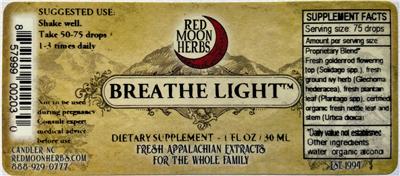
Breathe Light by Red Moon Herbs label
The label scan from the NIH Dietary Supplement Label Database. Tap to enlarge.
Label images are published by the NIH Dietary Supplement Label Database for the version of this product on file. Always read your actual product label.
View the full label (PDF)The Ingredients in Breathe Light by Red Moon Herbs
These are the 4 active ingredients this product is made of. Select any to open its full monograph.
Serving size50 Drop(s) Dosage formLiquid Amounts shown are per serving.
Most supplement products combine several ingredients, and a medication can interact with the product through any one of them. Each ingredient below shows whether it has known drug interactions.
Proprietary Blend
- › Nettle, Fresh
- › Goldenrod, Fresh
- › Ground Ivy, Fresh
- › Plantain, Fresh
Other (inactive) ingredients: Water, Alcohol. These complete the product’s ingredient list but are not active constituents.
Breathe Light by Red Moon Herbs Drug Interactions
HelloPharmacist Interaction Report
Breathe Light by Red Moon Herbs contains several ingredients with documented interactions.
The most serious concern is stinging nettle's effect on blood thinners (anticoagulants) like warfarin. Stinging nettle contains vitamin K, which when taken in large amounts can interfere with how warfarin works — potentially reducing its protective effect against clots.
Read the full breakdown — every affected drug type, severity by severity
Stinging nettle also interacts with diabetes medications, water pills (diuretics), and lithium. With diabetes drugs, it may lower blood sugar additively.
With diuretics, it may increase fluid loss. With lithium, it might reduce how your kidneys clear the drug, raising lithium levels — your dose may need adjustment.
Goldenrod has a Moderate interaction with diuretic drugs; it may boost both their effects and side effects. Ground ivy carries no documented interactions in our data.
We don't hold interaction information for plantain.
Altogether, these interactions span 163 individual medications. Use the medication checker on this page to look up your exact drugs before you start.
Check your own medications below · Editorial policy · How we use AI
Want to check YOUR meds against Breathe Light?
Ask about interactions with your drugs in plain English — “Can I take it with lisinopril?” — and we find you the answer in seconds, ingredient by ingredient.
Go to the checkerIngredients driving the most interactions
Individual Drug Interactions
The ingredients in Breathe Light interact with 164 drugs. Click any drug to see the details.
2 of the 4 ingredients in Breathe Light interact with drugs. Each result below shows which ingredient is responsible. Nettle, Fresh Goldenrod, Fresh
AcarboseGlucobay, Prandase, Precose
How Acarbose interacts with Breathe Light — through 1 ingredient. Tap an ingredient for the detail:
Nettle, FreshAntidiabetes Drugs Moderate
Interaction Summary
Theoretically, stinging nettle might have additive effects with antidiabetes drugs.
Read the full Nettle, Fresh + Acarbose interactionAcetaminophen, Caffeine, PyrilamineMidol Max Strength Menstrual
How Acetaminophen, Caffeine, Pyrilamine interacts with Breathe Light — through 2 ingredients. Tap an ingredient for the detail:
Goldenrod, FreshDiuretic Drugs Moderate
Interaction Summary
Theoretically, goldenrod might increase the effects and adverse effects of diuretic drugs.
Read the full Goldenrod, Fresh + Acetaminophen, Caffeine, Pyrilamine interactionNettle, FreshDiuretic Drugs Moderate
Interaction Summary
Theoretically, combining stinging nettle with diuretic drugs may have additive effects.
Read the full Nettle, Fresh + Acetaminophen, Caffeine, Pyrilamine interactionAcetaminophen, Pamabrom, PyrilamineMidol Max Strength PMS, Pamprin, Pamprin ES
How Acetaminophen, Pamabrom, Pyrilamine interacts with Breathe Light — through 2 ingredients. Tap an ingredient for the detail:
Goldenrod, FreshDiuretic Drugs Moderate
Interaction Summary
Theoretically, goldenrod might increase the effects and adverse effects of diuretic drugs.
Read the full Goldenrod, Fresh + Acetaminophen, Pamabrom, Pyrilamine interactionNettle, FreshDiuretic Drugs Moderate
Interaction Summary
Theoretically, combining stinging nettle with diuretic drugs may have additive effects.
Read the full Nettle, Fresh + Acetaminophen, Pamabrom, Pyrilamine interactionAcetazolamideAk-Zol, Diamox
How Acetazolamide interacts with Breathe Light — through 2 ingredients. Tap an ingredient for the detail:
Goldenrod, FreshDiuretic Drugs Moderate
Interaction Summary
Theoretically, goldenrod might increase the effects and adverse effects of diuretic drugs.
Read the full Goldenrod, Fresh + Acetazolamide interactionNettle, FreshDiuretic Drugs Moderate
Interaction Summary
Theoretically, combining stinging nettle with diuretic drugs may have additive effects.
Read the full Nettle, Fresh + Acetazolamide interactionAcetohexamideDymelor
How Acetohexamide interacts with Breathe Light — through 1 ingredient. Tap an ingredient for the detail:
Nettle, FreshAntidiabetes Drugs Moderate
Interaction Summary
Theoretically, stinging nettle might have additive effects with antidiabetes drugs.
Read the full Nettle, Fresh + Acetohexamide interactionAlbiglutideTanzeum
How Albiglutide interacts with Breathe Light — through 1 ingredient. Tap an ingredient for the detail:
Nettle, FreshAntidiabetes Drugs Moderate
Interaction Summary
Theoretically, stinging nettle might have additive effects with antidiabetes drugs.
Read the full Nettle, Fresh + Albiglutide interactionAlogliptinNesina
How Alogliptin interacts with Breathe Light — through 1 ingredient. Tap an ingredient for the detail:
Nettle, FreshAntidiabetes Drugs Moderate
Interaction Summary
Theoretically, stinging nettle might have additive effects with antidiabetes drugs.
Read the full Nettle, Fresh + Alogliptin interactionAlogliptin, MetforminKazano
How Alogliptin, Metformin interacts with Breathe Light — through 1 ingredient. Tap an ingredient for the detail:
Nettle, FreshAntidiabetes Drugs Moderate
Interaction Summary
Theoretically, stinging nettle might have additive effects with antidiabetes drugs.
Read the full Nettle, Fresh + Alogliptin, Metformin interactionAlogliptin, PioglitazoneOseni
How Alogliptin, Pioglitazone interacts with Breathe Light — through 1 ingredient. Tap an ingredient for the detail:
Nettle, FreshAntidiabetes Drugs Moderate
Interaction Summary
Theoretically, stinging nettle might have additive effects with antidiabetes drugs.
Read the full Nettle, Fresh + Alogliptin, Pioglitazone interactionAmiloride, HydrochlorothiazideAmil-Co, Amilzide, Moduret 25, Moduretic
How Amiloride, Hydrochlorothiazide interacts with Breathe Light — through 2 ingredients. Tap an ingredient for the detail:
Goldenrod, FreshDiuretic Drugs Moderate
Interaction Summary
Theoretically, goldenrod might increase the effects and adverse effects of diuretic drugs.
Read the full Goldenrod, Fresh + Amiloride, Hydrochlorothiazide interactionNettle, FreshDiuretic Drugs Moderate
Interaction Summary
Theoretically, combining stinging nettle with diuretic drugs may have additive effects.
Read the full Nettle, Fresh + Amiloride, Hydrochlorothiazide interactionAmmonium ChlorideAmmonium Chloride
How Ammonium Chloride interacts with Breathe Light — through 2 ingredients. Tap an ingredient for the detail:
Goldenrod, FreshDiuretic Drugs Moderate
Interaction Summary
Theoretically, goldenrod might increase the effects and adverse effects of diuretic drugs.
Read the full Goldenrod, Fresh + Ammonium Chloride interactionNettle, FreshDiuretic Drugs Moderate
Interaction Summary
Theoretically, combining stinging nettle with diuretic drugs may have additive effects.
Read the full Nettle, Fresh + Ammonium Chloride interactionAntidiabetes, Dipeptidyl Peptidase-4 (dpp-iv) InhibitorGlyxambi
How Antidiabetes, Dipeptidyl Peptidase-4 (dpp-iv) Inhibitor interacts with Breathe Light — through 1 ingredient. Tap an ingredient for the detail:
Nettle, FreshAntidiabetes Drugs Moderate
Interaction Summary
Theoretically, stinging nettle might have additive effects with antidiabetes drugs.
Read the full Nettle, Fresh + Antidiabetes, Dipeptidyl Peptidase-4 (dpp-iv) Inhibitor interactionAtenolol, ChlortalidoneAtenixCo, Tenoret 50, Totaretic
How Atenolol, Chlortalidone interacts with Breathe Light — through 2 ingredients. Tap an ingredient for the detail:
Goldenrod, FreshDiuretic Drugs Moderate
Interaction Summary
Theoretically, goldenrod might increase the effects and adverse effects of diuretic drugs.
Read the full Goldenrod, Fresh + Atenolol, Chlortalidone interactionNettle, FreshDiuretic Drugs Moderate
Interaction Summary
Theoretically, combining stinging nettle with diuretic drugs may have additive effects.
Read the full Nettle, Fresh + Atenolol, Chlortalidone interactionAtenolol, ChlorthalidoneTenoretic
How Atenolol, Chlorthalidone interacts with Breathe Light — through 2 ingredients. Tap an ingredient for the detail:
Goldenrod, FreshDiuretic Drugs Moderate
Interaction Summary
Theoretically, goldenrod might increase the effects and adverse effects of diuretic drugs.
Read the full Goldenrod, Fresh + Atenolol, Chlorthalidone interactionNettle, FreshDiuretic Drugs Moderate
Interaction Summary
Theoretically, combining stinging nettle with diuretic drugs may have additive effects.
Read the full Nettle, Fresh + Atenolol, Chlorthalidone interactionAzilsartan, ChlorthalidoneEdarbyclor
How Azilsartan, Chlorthalidone interacts with Breathe Light — through 2 ingredients. Tap an ingredient for the detail:
Goldenrod, FreshDiuretic Drugs Moderate
Interaction Summary
Theoretically, goldenrod might increase the effects and adverse effects of diuretic drugs.
Read the full Goldenrod, Fresh + Azilsartan, Chlorthalidone interactionNettle, FreshDiuretic Drugs Moderate
Interaction Summary
Theoretically, combining stinging nettle with diuretic drugs may have additive effects.
Read the full Nettle, Fresh + Azilsartan, Chlorthalidone interactionBenazepril, HydrochlorothiazideLotensin HCT
How Benazepril, Hydrochlorothiazide interacts with Breathe Light — through 2 ingredients. Tap an ingredient for the detail:
Goldenrod, FreshDiuretic Drugs Moderate
Interaction Summary
Theoretically, goldenrod might increase the effects and adverse effects of diuretic drugs.
Read the full Goldenrod, Fresh + Benazepril, Hydrochlorothiazide interactionNettle, FreshDiuretic Drugs Moderate
Interaction Summary
Theoretically, combining stinging nettle with diuretic drugs may have additive effects.
Read the full Nettle, Fresh + Benazepril, Hydrochlorothiazide interactionBendroflumethiazideAprinox, Naturetin, Neo-NaClex
How Bendroflumethiazide interacts with Breathe Light — through 2 ingredients. Tap an ingredient for the detail:
Goldenrod, FreshDiuretic Drugs Moderate
Interaction Summary
Theoretically, goldenrod might increase the effects and adverse effects of diuretic drugs.
Read the full Goldenrod, Fresh + Bendroflumethiazide interactionNettle, FreshDiuretic Drugs Moderate
Interaction Summary
Theoretically, combining stinging nettle with diuretic drugs may have additive effects.
Read the full Nettle, Fresh + Bendroflumethiazide interactionBendroflumethiazide, NadololCorzide
How Bendroflumethiazide, Nadolol interacts with Breathe Light — through 2 ingredients. Tap an ingredient for the detail:
Goldenrod, FreshDiuretic Drugs Moderate
Interaction Summary
Theoretically, goldenrod might increase the effects and adverse effects of diuretic drugs.
Read the full Goldenrod, Fresh + Bendroflumethiazide, Nadolol interactionNettle, FreshDiuretic Drugs Moderate
Interaction Summary
Theoretically, combining stinging nettle with diuretic drugs may have additive effects.
Read the full Nettle, Fresh + Bendroflumethiazide, Nadolol interactionBendroflumethiazide, PotassiumCentyl K, Neo-NaClex-K
How Bendroflumethiazide, Potassium interacts with Breathe Light — through 2 ingredients. Tap an ingredient for the detail:
Goldenrod, FreshDiuretic Drugs Moderate
Interaction Summary
Theoretically, goldenrod might increase the effects and adverse effects of diuretic drugs.
Read the full Goldenrod, Fresh + Bendroflumethiazide, Potassium interactionNettle, FreshDiuretic Drugs Moderate
Interaction Summary
Theoretically, combining stinging nettle with diuretic drugs may have additive effects.
Read the full Nettle, Fresh + Bendroflumethiazide, Potassium interactionBendroflumethiazide, Rauwolfia SerpentinaRauzide
How Bendroflumethiazide, Rauwolfia Serpentina interacts with Breathe Light — through 2 ingredients. Tap an ingredient for the detail:
Goldenrod, FreshDiuretic Drugs Moderate
Interaction Summary
Theoretically, goldenrod might increase the effects and adverse effects of diuretic drugs.
Read the full Goldenrod, Fresh + Bendroflumethiazide, Rauwolfia Serpentina interactionNettle, FreshDiuretic Drugs Moderate
Interaction Summary
Theoretically, combining stinging nettle with diuretic drugs may have additive effects.
Read the full Nettle, Fresh + Bendroflumethiazide, Rauwolfia Serpentina interactionBenzthiazideExna
How Benzthiazide interacts with Breathe Light — through 2 ingredients. Tap an ingredient for the detail:
Goldenrod, FreshDiuretic Drugs Moderate
Interaction Summary
Theoretically, goldenrod might increase the effects and adverse effects of diuretic drugs.
Read the full Goldenrod, Fresh + Benzthiazide interactionNettle, FreshDiuretic Drugs Moderate
Interaction Summary
Theoretically, combining stinging nettle with diuretic drugs may have additive effects.
Read the full Nettle, Fresh + Benzthiazide interactionBisoprolol, HydrochlorothiazideZiac
How Bisoprolol, Hydrochlorothiazide interacts with Breathe Light — through 2 ingredients. Tap an ingredient for the detail:
Goldenrod, FreshDiuretic Drugs Moderate
Interaction Summary
Theoretically, goldenrod might increase the effects and adverse effects of diuretic drugs.
Read the full Goldenrod, Fresh + Bisoprolol, Hydrochlorothiazide interactionNettle, FreshDiuretic Drugs Moderate
Interaction Summary
Theoretically, combining stinging nettle with diuretic drugs may have additive effects.
Read the full Nettle, Fresh + Bisoprolol, Hydrochlorothiazide interactionBumetanideBurinex
How Bumetanide interacts with Breathe Light — through 2 ingredients. Tap an ingredient for the detail:
Goldenrod, FreshDiuretic Drugs Moderate
Interaction Summary
Theoretically, goldenrod might increase the effects and adverse effects of diuretic drugs.
Read the full Goldenrod, Fresh + Bumetanide interactionNettle, FreshDiuretic Drugs Moderate
Interaction Summary
Theoretically, combining stinging nettle with diuretic drugs may have additive effects.
Read the full Nettle, Fresh + Bumetanide interactionBumetanide, PotassiumBurinex K
How Bumetanide, Potassium interacts with Breathe Light — through 2 ingredients. Tap an ingredient for the detail:
Goldenrod, FreshDiuretic Drugs Moderate
Interaction Summary
Theoretically, goldenrod might increase the effects and adverse effects of diuretic drugs.
Read the full Goldenrod, Fresh + Bumetanide, Potassium interactionNettle, FreshDiuretic Drugs Moderate
Interaction Summary
Theoretically, combining stinging nettle with diuretic drugs may have additive effects.
Read the full Nettle, Fresh + Bumetanide, Potassium interactionCaffeine, Potassium Salicylate, SalicylamideTrim-Elim
How Caffeine, Potassium Salicylate, Salicylamide interacts with Breathe Light — through 2 ingredients. Tap an ingredient for the detail:
Goldenrod, FreshDiuretic Drugs Moderate
Interaction Summary
Theoretically, goldenrod might increase the effects and adverse effects of diuretic drugs.
Read the full Goldenrod, Fresh + Caffeine, Potassium Salicylate, Salicylamide interactionNettle, FreshDiuretic Drugs Moderate
Interaction Summary
Theoretically, combining stinging nettle with diuretic drugs may have additive effects.
Read the full Nettle, Fresh + Caffeine, Potassium Salicylate, Salicylamide interactionCanagliflozinInvokana
How Canagliflozin interacts with Breathe Light — through 1 ingredient. Tap an ingredient for the detail:
Nettle, FreshAntidiabetes Drugs Moderate
Interaction Summary
Theoretically, stinging nettle might have additive effects with antidiabetes drugs.
Read the full Nettle, Fresh + Canagliflozin interactionCanagliflozin, MetforminInvokamet
How Canagliflozin, Metformin interacts with Breathe Light — through 1 ingredient. Tap an ingredient for the detail:
Nettle, FreshAntidiabetes Drugs Moderate
Interaction Summary
Theoretically, stinging nettle might have additive effects with antidiabetes drugs.
Read the full Nettle, Fresh + Canagliflozin, Metformin interactionCanagliflozin, Metformin HydrochlorideInvokamet XR
How Canagliflozin, Metformin Hydrochloride interacts with Breathe Light — through 1 ingredient. Tap an ingredient for the detail:
Nettle, FreshAntidiabetes Drugs Moderate
Interaction Summary
Theoretically, stinging nettle might have additive effects with antidiabetes drugs.
Read the full Nettle, Fresh + Canagliflozin, Metformin Hydrochloride interactionCandesartan Cilexetil, HydrochlorothiazideAtacand HCT
How Candesartan Cilexetil, Hydrochlorothiazide interacts with Breathe Light — through 2 ingredients. Tap an ingredient for the detail:
Goldenrod, FreshDiuretic Drugs Moderate
Interaction Summary
Theoretically, goldenrod might increase the effects and adverse effects of diuretic drugs.
Read the full Goldenrod, Fresh + Candesartan Cilexetil, Hydrochlorothiazide interactionNettle, FreshDiuretic Drugs Moderate
Interaction Summary
Theoretically, combining stinging nettle with diuretic drugs may have additive effects.
Read the full Nettle, Fresh + Candesartan Cilexetil, Hydrochlorothiazide interactionCaptopril, HydrochlorothiazideAcezide, Capozide
How Captopril, Hydrochlorothiazide interacts with Breathe Light — through 2 ingredients. Tap an ingredient for the detail:
Goldenrod, FreshDiuretic Drugs Moderate
Interaction Summary
Theoretically, goldenrod might increase the effects and adverse effects of diuretic drugs.
Read the full Goldenrod, Fresh + Captopril, Hydrochlorothiazide interactionNettle, FreshDiuretic Drugs Moderate
Interaction Summary
Theoretically, combining stinging nettle with diuretic drugs may have additive effects.
Read the full Nettle, Fresh + Captopril, Hydrochlorothiazide interactionEach ingredient & the kinds of drugs it affects
For each ingredient in Breathe Light with known interactions, here are the types of medications they can affect. Open any type for the detail — or search your exact drug in the checker above.
Nettle, Fresh
Antidiabetes Drugs
Theoretically, stinging nettle might have additive effects with antidiabetes drugs.
Clinical research shows that stinging nettle might decrease blood glucose levels in patients with diabetes.
Diuretic Drugs
Theoretically, combining stinging nettle with diuretic drugs may have additive effects.
Animal research suggests that the above ground parts and roots of stinging nettle may have a diuretic effect.
Lithium
Theoretically, stinging nettle might reduce excretion and increase levels of lithium.
Animal research suggests that stinging nettle has diuretic and natriuretic properties, which could alter the excretion of lithium. The dose of lithium might need to be decreased.
Warfarin (Coumadin)
There is some concern that stinging nettle might decrease the effects of anticoagulant drugs such as warfarin.
Stinging nettle contains a significant amount of vitamin K. When taken in large quantities, this might interfere with the activity of warfarin.
Goldenrod, Fresh
Diuretic Drugs
Theoretically, goldenrod might increase the effects and adverse effects of diuretic drugs.
In vitro and animal research suggests that goldenrod has diuretic effects.
Brand information
Manufacturer and brand details for Breathe Light, from the product label.
Red Moon Herbs
See all Red Moon Herbs products- Name
- Red Moon Herbs
- City
- Candler
- State
- NC
- Phone Number
- 888-929-0777
- Web Address
- redmoonherbs.com
Breathe Light by Red Moon Herbs: Common Questions
Does Breathe Light by Red Moon Herbs interact with any medications?
How can one product interact with so many drugs?
Where does this information come from?
Can I take Breathe Light if I'm on warfarin?
Is this safe during pregnancy?
Can I use this while breastfeeding?
What's the most common side effect?
Does this actually work for breathing or cough?
Is there any ingredient you couldn't check for interactions?
Written and reviewed by the HelloPharmacist editorial staff. Our editorial policy
Not sure if Breathe Light is safe with your meds?
Our pharmacists answer your medication & supplement questions — free.
Label information is sourced from the NIH Dietary Supplement Label Database and reflects the product version on file; always read your actual product label. This page is for education only and is not a substitute for professional medical advice. Confirm with your pharmacist or doctor before combining supplements and medications.
The Full Monographs Behind Breathe Light’s Ingredients
Every ingredient we hold a full HelloPharmacist monograph for — uses, evidence, safety, and the complete interaction list.
Stinging Nettle
Interacts with 164 drugsStinging nettle is a common plant used as food and in traditional medicine, most often for prostate symptoms, allergies, and joint pain. The evidence is mixed and mostly preliminary, so it i...
Read the full Stinging Nettle monograph → Herb & supplement monographGoldenrod
Interacts with 75 drugsGoldenrod is a flowering plant traditionally used as an herbal diuretic and for urinary tract health. Human evidence is limited, and while it is generally well tolerated, people with certain...
Read the full Goldenrod monograph → Herb & supplement monographGround Ivy
Ground ivy is a creeping plant in the mint family that has a long history of folk use for coughs, digestive problems, and urinary complaints. Modern human studies are lacking, so its benefit...
Read the full Ground Ivy monograph →Sources & How We Checked
Breathe Light's label data comes from the NIH Dietary Supplement Label Database; the ingredient interaction data is from the Natural Medicines database, reviewed by our pharmacists.
- NIH Dietary Supplement Label Database (DSLD) — The official product label on file for this supplement.
- Natural Medicines (Therapeutic Research Center) — Evidence-graded clinical reference behind the ingredient interaction data.
Content is written and reviewed by licensed HelloPharmacist pharmacists. See our data sources and editorial standards for how this information is built and checked.
The 31 references behind this product’s interaction data
Every citation that drives the interaction findings for this product’s ingredients, from the evidence-graded Natural Medicines (TRC Healthcare) database. Open an ingredient to browse its citations — links open the study on PubMed or the publisher’s site.
Stinging Nettle 23 references
- Monographs on the medicinal uses of plant drugs. Exeter, UK: European Scientific Co-op Phytother, 1997.
- Newall CA, Anderson LA, Philpson JD. Herbal Medicine: A Guide for Healthcare Professionals. London, UK: The Pharmaceutical Press, 1996.
- The Review of Natural Products by Facts and Comparisons. St. Louis, MO: Wolters Kluwer Co., 1999.
- Schulz V, Hansel R, Tyler VE. Rational Phytotherapy: A Physician's Guide to Herbal Medicine. Terry C. Telger, transl. 3rd ed. Berlin, GER: Springer, 1998.
- Leung AY, Foster S. Encyclopedia of Common Natural Ingredients Used in Food, Drugs and Cosmetics. 2nd ed. New York, NY: John Wiley & Sons, 1996.
- Brinker F. Herb Contraindications and Drug Interactions. 2nd ed. Sandy, OR: Eclectic Medical Publications, 1998.
- Mittman P. Randomized, double-blind study of freeze-dried Urtica dioica in the treatment of allergic rhinitis. Planta Med 1990;56:44-7.
- Vontobel HP, Herzog R, Rutishauser G, Kres H. [Results of a double-blind study on the effectiveness of ERU (extractum radicis Urticae) capsules in conservative treatment of benign prostatic hyperplasia]. (Abstract). Urologe A 1985;24:49-51.
- Randall C, Randall H, Dobbs F, et al. Randomized controlled trial of nettle sting for treatment of base-of-thumb pain. J R Soc Med 2000;93:305-9. PubMed
- Caliskaner Z, Karaayvaz M, Ozturk S. Misuse of a herb: stinging nettle (Urtica urens) induced severe tongue oedema. Complement Ther Med 2004;12:57-8. PubMed
- Krzeski, T., Kazon, M., Borkowski, A., Witeska, A., and Kuczera, J. Combined extracts of Urtica dioica and Pygeum africanum in the treatment of benign prostatic hyperplasia: double-blind comparison of two doses. Clin Ther 1993;15(6):1011-1020.
- Randall, C., Meethan, K., Randall, H., and Dobbs, F. Nettle sting of Urtica dioica for joint pain--an exploratory study of this complementary therapy. Complement Ther Med 1999;7(3):126-131. PubMed
- Tahri, A., Yamani, S., Legssyer, A., Aziz, M., Mekhfi, H., Bnouham, M., and Ziyyat, A. Acute diuretic, natriuretic and hypotensive effects of a continuous perfusion of aqueous extract of Urtica dioica in the rat. J Ethnopharmacol 2000;73(1-2):95-100. PubMed
- Sahin, M., Yilmaz, H., Gursoy, A., Demirel, A. N., Tutuncu, N. B., and Guvener, N. D. Gynaecomastia in a man and hyperoestrogenism in a woman due to ingestion of nettle (Urtica dioica). N.Z.Med.J. 2007;120(1265):U2803.
- Randall, C., Dickens, A., White, A., Sanders, H., Fox, M., and Campbell, J. Nettle sting for chronic knee pain: a randomised controlled pilot study. Complement Ther.Med. 2008;16(2):66-72. PubMed
- Rayburn, K., Fleischbein, E., Song, J., Allen, B., Kundert, M., Leiter, C., and Bush, T. Stinging nettle cream for osteoarthritis. Altern.Ther.Health Med. 2009;15(4):60-61.
- Oliver, F., Amon, E. U., Breathnach, A., Francis, D. M., Sarathchandra, P., Black, A. K., and Greaves, M. W. Contact urticaria due to the common stinging nettle (Urtica dioica)-- histological, ultrastructural and pharmacological studies. Clin Exp Dermato PubMed
- Kulze, A. and Greaves, M. Contact urticaria caused by stinging nettles. Br.J Dermatol. 1988;119(2):269-270. PubMed
- Patten G. Medicinal plant review: Urtica. Aust J Med Herbalism 1993;5(1):5-13.
- Maor D, Little M. Skin contact with a stinging tree requiring intensive care unit admission. Contact Dermatitis. 2017 Nov;77(5):335-37. PubMed
- Easton L, Vaid S, Nagel AK, Venci JV, Fortuna RJ. Stinging Nettle (Urtica dioica): An Unusual Case of Galactorrhea. Am J Case Rep 2021;22:e933999. PubMed
- Niazi B, Ahmed K, Ahmed M, Ali S, Song K, Elias S. Drug-Induced Liver Injury from Herbal Liver Detoxification Tea. Case Rep Gastroenterol 2022;16(3):612-617. PubMed
- Nnamani I, Tolu-Akinnawo O, Dufera RR, Akintunde A, Maliakkal B. Tinospora cordifolia (Guduchi/Giloy)-Induced Liver Injury: A Case Review. Cureus 2023;15(5):e39793. PubMed
Goldenrod 6 references
- Robbers JE, Tyler VE. Tyler's Herbs of Choice: The Therapeutic Use of Phytomedicinals. New York, NY: The Haworth Herbal Press, 1999.
- Uter, W., Nohle, M., Randerath, B., and Schwanitz, H. J. Occupational contact urticaria and late-phase bronchial asthma caused by compositae pollen in a florist. Am J Contact Dermat. 2001;12(3):182-184. DOI
- Chodera, A., Dabrowska, K., Sloderbach, A., Skrzypczak, L., and Budzianowski, J. [Effect of flavonoid fractions of Solidago virgaurea L on diuresis and levels of electrolytes]. Acta Pol.Pharm 1991;48(5-6):35-37.
- Chodera, A., Dabrowska, K., Bobkiewicz-Kozlowska, T., Tkaczyk, J., Skrzypczak, L., and Budzianowski, J. [Effect of leiocarposide on experimental urinary calculi in rats]. Acta Pol.Pharm 1988;45(2):181-186.
- Chodera, A., Dabrowska, K., Skrzypczak, L., and Budzianowski, J. [Further studies on the diuretic effect of leiocarposide]. Acta Pol.Pharm 1986;43(5):499-503.
- Chodera, A., Dabrowska, K., Senczuk, M., Wasik-Olejnik, A., Skrzypczak, L., Budzianowski, J., and Ellnain-Wojtaszek, M. [Diuretic effect of the glycoside from a plant of the Solidago L. genus]. Acta Pol.Pharm 1985;42(2):199-204.
Ground Ivy 2 references
- Newall CA, Anderson LA, Philpson JD. Herbal Medicine: A Guide for Healthcare Professionals. London, UK: The Pharmaceutical Press, 1996.
- Ha JH, Kang WH, Lee JO, et al. Clinical evaluation of the depigmenting effect of Glechoma Hederacea extract by topical treatment for 8 weeks on UV-induced pigmentation in Asian skin. Eur J Dermatol. 2011;21(2):218-22. PubMed
Parts of this content are provided by the Therapeutic Research Center, LLC.
DISCLAIMER: Currently this does not check for drug-drug interactions. This is not an all-inclusive comprehensive list of potential interactions and is for informational purposes only. Not all interactions are known or well-reported in the scientific literature, and new interactions are continually being reported. Input is needed from a qualified healthcare provider including a pharmacist before starting any therapy. Application of clinical judgment is necessary.
© 2021 Therapeutic Research Center, LLC