
Jian Ya Wan BPSure 200 mg Ingredients & Drug Interactions
What is this page for?
First and foremost: checking Jian Ya Wan BPSure 200 mg against your medications. The heart of this page is the interaction checker and the full interaction report — how this product’s ingredients may interact with prescription and over-the-counter medicines you may be taking.
Around that, we add a pharmacist’s high-level view of the product as a whole — what’s inside, the evidence for its stated use, how transparent the label is, and what safety data exists — so you can see the full picture in one place. It’s educational information from our licensed clinical databases and the clinical staff at HelloPharmacist — not medical advice — and we don’t sell or endorse products. Our editorial policy
Jian Ya Wan BPSure 200 mg is a dietary supplement by Guang Ci Tang with 11 active ingredients. Its ingredients are commonly taken for kidney and adrenal support, anemia and blood building (traditional), inflammatory conditions.Based on those ingredients, 1,303 medications have a known interaction with it, the most serious rated major. The ingredients most likely to interact are Chinese Salvia Rhizome, Root Extract, Chinese Skullcap root extract, Tree Peony Root Bark Extract. Use the checker below to test your specific medication, or read the full HelloPharmacist Interaction Report.
Check Your Meds Against Jian Ya Wan BPSure 200 mg by Guang Ci Tang
Ask about any prescription or over-the-counter medication and we check it for interactions with Jian Ya Wan BPSure 200 mg by Guang Ci Tang — and tell you which ingredient is responsible.
AI summaries are generated from our interaction database for education only — always confirm with your pharmacist. How we use AI
Ask the Pharmacist
A licensed pharmacist will answer your question by email — free, usually within 24 hours.
Got it — thank you!
A licensed pharmacist will answer within 24 hours. Keep an eye on your email (worth checking spam, just in case).
HelloPharmacist Scorecard of Jian Ya Wan BPSure 200 mg by Guang Ci Tang
Our pharmacy team’s full take, with four database checks built into the cards below — a summary of what is known, not a grade of the product itself.
What’s inside
Low disclosure
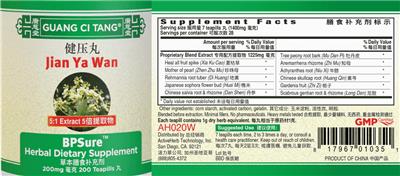
Jian Ya Wan BPSure contains 11 ingredients, most in extract form as part of a proprietary blend. The checked active components include rehmannia root tuber extract, tree peony root bark extract, gardenia fruit extract, Chinese skullcap root extract, Japanese sophora flower bud extract, scabrous gentian rhizome and root extract, as well as achyranthes root, Chinese salvia rhizome, anemarrhena rhizome, mother of pearl, and heal all fruit spike extract.
The product also contains inactive ingredients: corn starch, activated carbon, and gelatin (a capsule binder).
Does it work?
Moderate evidence
The data we hold shows insufficient reliable evidence to rate most of the ingredients in this product for their intended uses. Rehmannia root is rated possibly effective for chronic kidney disease, but evidence for its other traditional uses — including diabetes and diabetic kidney disease — is not established in our data.
For the remaining checked ingredients, effectiveness ratings are either absent from our records or marked insufficient. We cannot make a claim about how well this product works based on the evidence available to us.
How safe is it?
Well-documented data
Rehmannia, tree peony, gardenia, Chinese skullcap, Japanese sophora, and scabrous gentian are all used in traditional medicine but have limited human safety data. Tree peony is generally well tolerated for short-term use; common oral side effects reported in a small number of trial participants include belly pain, loose stool, loss of appetite, and nausea.
One case report tied a warfarin patient's bleeding to a brand switch of a Chinese herbal product containing peony. Chinese skullcap seems well tolerated overall, though abdominal pain, constipation, loose stool, nausea, and vomiting have been reported in some people.
Gardenia has very limited safety information; topically, allergic skin rash can occur. One older case report described blue-gray skin pigmentation after 7 years of continuous use of a product containing gardenia.
Japanese sophora flower is also generally well tolerated, but the seed is possibly unsafe long-term due to risk of swelling (edema) and, in rare cases, death. Gentian can upset the stomach, especially at high doses or in combination with other herbs.
Meds to double-check
Major interaction found
Before taking this product, check with your pharmacist if you're on blood thinners or antiplatelet drugs (such as warfarin or aspirin), blood pressure medications, diabetes medications, liver-processed prescription drugs, hormone replacement therapy, birth control pills, caffeine supplements, stimulant laxatives, lithium, antithyroid drugs, or any medication for an overactive thyroid. No interactions are documented for achyranthes root, Chinese salvia, anemarrhena, mother of pearl, or heal all fruit spike extract — we hold no data for these ingredients.
The bottom line
Scorecard at a glanceFormula with limited ingredient disclosure with some supporting evidence behind its ingredients' uses. Major medication interactions have been identified, and safety information is well characterized.
This traditional formula may appeal to people interested in Chinese herbal medicine, but the evidence for what it does is not established in our data. If you take any medications — especially blood thinners, blood pressure pills, diabetes drugs, or hormonal birth control — talk with your pharmacist before adding this product.
Safety data are limited for most ingredients, and several carry real risks of interaction.
Educational only — not medical advice; always confirm with your pharmacist. Our editorial policy · How we use AI
Assessment coverage: 7 of 11 active ingredients matched to our full ingredient reviews (monographs). Based on the product label dated Oct 24, 2024.
This Scorecard evaluates available label information, ingredient evidence, and known medication-safety considerations. It does not independently verify product identity, purity, potency, contamination, or manufacturing quality. How these ratings are computed
General information
Key facts about Jian Ya Wan BPSure 200 mg, straight from the product label.
| Brand | Guang Ci Tang |
|---|---|
| Barcode (UPC) | 817967010351 |
| Net contents | 200 Teapill(s) |
| Market status | On market |
| Date entered into DSLD | Oct 24, 2024 |
| DSLD ID | 320368 |
| Product type | Other Combinations |
| Supplement form | Other (e.g. Tea Bag) |
| Dietary claims / uses | All Other |
| Intended target group(s) | Adult (18 - 50 Years) |
Everything in this section is reproduced from the manufacturer’s own product label — it’s the label speaking, not HelloPharmacist. We show it so you can see exactly what the maker states; we don’t verify or endorse those statements.
Supplement Facts
The label details for Jian Ya Wan BPSure 200 mg by Guang Ci Tang, sourced from the NIH Dietary Supplement Label Database.
Supplement Facts
| Ingredient | Amount | % DV |
|---|---|---|
| Proprietary Blend Extract | 1225 mg | -- |
| Achyranthes Root Extract | 0 NP | -- |
| Rehmannia Root Tuber Extract | 0 NP | -- |
| Chinese Salvia Rhizome, Root Extract | 0 NP | -- |
| Tree Peony Root Bark Extract | 0 NP | -- |
| Gardenia fruit extract | 0 NP | -- |
| Anemarrhena Rhizome Extract | 0 NP | -- |
| Chinese Skullcap root extract | 0 NP | -- |
| Japanese Sophora Flower Bud Extract | 0 NP | -- |
| Mother of Pearl | 0 NP | -- |
| Scabrous Gentian Rhizome, Root Extract | 0 NP | -- |
| Heal All Fruit Spike Extract | 0 NP | -- |
Other ingredients: Corn Starch, Carbon, Activated, Gelatin
Tap any ingredient to jump to its full detail below.
These statements are the manufacturer’s wording, reproduced from the product label — the label is saying it, not HelloPharmacist. We don’t verify or endorse them.
Formulation
5:1 Extract Blended before extraction.
No pharmaceuticals. Heavy metal tested.
Product of China
FDA Statement of Identity
Herbal Dietary Supplement
Formula
Each teapill contains 1 g dry herb equivalent.
Minimal fillers.
Suggested/Recommended/Usage/Directions
Suggested use 7 teapills each time, 2 to 3 times a day, or consult a health care practitioner.
Precautions
Keep out of reach of children.
Seals/Symbols
GMP Certified
Is this label outdated? Report a formula or label change and our pharmacy team will review it.
Jian Ya Wan BPSure 200 mg by Guang Ci Tang label
The label scan from the NIH Dietary Supplement Label Database. Tap to enlarge.
Label images are published by the NIH Dietary Supplement Label Database for the version of this product on file. Always read your actual product label.
View the full label (PDF)The Ingredients in Jian Ya Wan BPSure 200 mg by Guang Ci Tang
These are the 11 active ingredients this product is made of. Select any to open its full monograph.
Serving size7 Teapill(s) Dosage formOther (e.g. Tea Bag) Servings per container28 Amounts shown are per serving.
Most supplement products combine several ingredients, and a medication can interact with the product through any one of them. Each ingredient below shows whether it has known drug interactions.
Proprietary Blend Extract
- › Achyranthes Root Extract
- › Rehmannia Root Tuber Extract
- › Chinese Salvia Rhizome, Root Extract
- › Tree Peony Root Bark Extract
- › Gardenia fruit extract
- › Anemarrhena Rhizome Extract
- › Chinese Skullcap root extract
- › Japanese Sophora Flower Bud Extract
- › Mother of Pearl
- › Scabrous Gentian Rhizome, Root Extract
- › Heal All Fruit Spike Extract
Other (inactive) ingredients: Corn Starch, Carbon, Activated, Gelatin. These complete the product’s ingredient list but are not active constituents.
Jian Ya Wan BPSure 200 mg by Guang Ci Tang Drug Interactions
HelloPharmacist Interaction Report
Jian Ya Wan BPSure by Guang Ci Tang contains several ingredients with documented interactions with medications.
The most serious involves tree peony root bark extract, which may increase the risk of bleeding when combined with blood thinners and antiplatelet drugs (such as warfarin and aspirin) — a Moderate-severity interaction based on lab evidence of antiplatelet effects, though human reports remain limited.
Read the full breakdown — every affected drug type, severity by severity
Other Moderate-severity interactions span several drug categories. Rehmannia root may lower blood pressure when used with blood pressure medications, and may lower blood sugar when taken with diabetes drugs.
Chinese skullcap root interacts with blood pressure drugs, diabetes drugs, blood thinners, and a number of other medication types processed by your liver. Tree peony also affects liver-processed drugs and may interfere with hormone replacement therapy and birth control pills.
Gardenia fruit may increase the effects of stimulant laxatives. Japanese sophora flower bud may slow how your body clears caffeine.
Scabrous gentian root may add to the blood-pressure-lowering effect of antihypertensive drugs.
Altogether, these interactions span 1,259 individual medications. We could not check achyranthes root, Chinese salvia rhizome, anemarrhena rhizome, mother of pearl, or heal all fruit spike extract — we hold no data for these ingredients.
Before you start this product, run your exact medications through the checker on this page, especially any blood thinners, blood pressure drugs, diabetes drugs, or hormonal contraceptives.
Check your own medications below · Editorial policy · How we use AI
Want to check YOUR meds against Jian Ya Wan BPSure 200 mg?
Ask about interactions with your drugs in plain English — “Can I take it with lisinopril?” — and we find you the answer in seconds, ingredient by ingredient.
Go to the checkerIngredients driving the most interactions
Individual Drug Interactions
The ingredients in Jian Ya Wan BPSure 200 mg interact with 1,303 drugs. Click any drug to see the details.
7 of the 11 ingredients in Jian Ya Wan BPSure 200 mg interact with drugs. Each result below shows which ingredient is responsible. Chinese Salvia Rhizome, Root Extract Chinese Skullcap root extract Tree Peony Root Bark Extract Rehmannia Root Tuber Extract Scabrous Gentian Rhizome, Root Extract Japanese Sophora Flower Bud Extract Gardenia fruit extract
AbciximabReoPro
How Abciximab interacts with Jian Ya Wan BPSure 200 mg — through 3 ingredients. Tap an ingredient for the detail:
Chinese Salvia Rhizome, Root ExtractAnticoagulant/antiplatelet Drugs Major
Interaction Summary
Theoretically, danshen may increase the risk of bleeding if used with anticoagulant or antiplatelet drugs.
Read the full Chinese Salvia Rhizome, Root Extract + Abciximab interactionTree Peony Root Bark ExtractAnticoagulant/antiplatelet Drugs Moderate
Interaction Summary
Theoretically, combining peony with anticoagulant or antiplatelet drugs might increase the risk of bleeding.
Read the full Tree Peony Root Bark Extract + Abciximab interactionChinese Skullcap Root ExtractAnticoagulant/antiplatelet Drugs Moderate
Interaction Summary
Theoretically, Baikal skullcap might increase the risk of bleeding when used concomitantly with anticoagulant and antiplatelet drugs.
Read the full Chinese Skullcap Root Extract + Abciximab interactionAbrocitinibCibinqo
How Abrocitinib interacts with Jian Ya Wan BPSure 200 mg — through 3 ingredients. Tap an ingredient for the detail:
Chinese Salvia Rhizome, Root ExtractCytochrome P450 2c9 (cyp2c9) Substrates, Anticoagulant/antiplatelet Drugs Major
Interaction Summary
Theoretically, danshen may increase the levels and clinical effects of drugs metabolized by CYP2C9.
Read the full Chinese Salvia Rhizome, Root Extract + Abrocitinib interactionTree Peony Root Bark ExtractAnticoagulant/antiplatelet Drugs Moderate
Interaction Summary
Theoretically, combining peony with anticoagulant or antiplatelet drugs might increase the risk of bleeding.
Read the full Tree Peony Root Bark Extract + Abrocitinib interactionChinese Skullcap Root ExtractAnticoagulant/antiplatelet Drugs, Cytochrome P450 2c19 (cyp2c19) Substrates Moderate
Interaction Summary
Theoretically, Baikal skullcap might increase the risk of bleeding when used concomitantly with anticoagulant and antiplatelet drugs.
Read the full Chinese Skullcap Root Extract + Abrocitinib interactionAcenocoumarolSintrom
How Acenocoumarol interacts with Jian Ya Wan BPSure 200 mg — through 3 ingredients. Tap an ingredient for the detail:
Chinese Salvia Rhizome, Root ExtractAnticoagulant/antiplatelet Drugs Major
Interaction Summary
Theoretically, danshen may increase the risk of bleeding if used with anticoagulant or antiplatelet drugs.
Read the full Chinese Salvia Rhizome, Root Extract + Acenocoumarol interactionTree Peony Root Bark ExtractAnticoagulant/antiplatelet Drugs Moderate
Interaction Summary
Theoretically, combining peony with anticoagulant or antiplatelet drugs might increase the risk of bleeding.
Read the full Tree Peony Root Bark Extract + Acenocoumarol interactionChinese Skullcap Root ExtractAnticoagulant/antiplatelet Drugs Moderate
Interaction Summary
Theoretically, Baikal skullcap might increase the risk of bleeding when used concomitantly with anticoagulant and antiplatelet drugs.
Read the full Chinese Skullcap Root Extract + Acenocoumarol interactionAcetaminophen, AspirinGemnisyn
How Acetaminophen, Aspirin interacts with Jian Ya Wan BPSure 200 mg — through 3 ingredients. Tap an ingredient for the detail:
Chinese Salvia Rhizome, Root ExtractCytochrome P450 2e1 (cyp2e1) Substrates, Aspirin +3 Major
Interaction Summary
Theoretically, danshen may increase the levels and clinical effects of drugs metabolized by CYP2E1.
Read the full Chinese Salvia Rhizome, Root Extract + Acetaminophen, Aspirin interactionTree Peony Root Bark ExtractCytochrome P450 1a2 (cyp1a2) Substrates, Anticoagulant/antiplatelet Drugs Moderate
Interaction Summary
Theoretically, use of peony may increase the levels and clinical effects of drugs metabolized by CYP1A2.
Read the full Tree Peony Root Bark Extract + Acetaminophen, Aspirin interactionChinese Skullcap Root ExtractCytochrome P450 1a2 (cyp1a2) Substrates, Anticoagulant/antiplatelet Drugs Moderate
Interaction Summary
Theoretically, Baikal skullcap may increase levels of drugs metabolized by CYP1A2 enzymes.
Read the full Chinese Skullcap Root Extract + Acetaminophen, Aspirin interactionAcetaminophen, Aspirin, CaffeineExcedrin, Excedrin Extra Strength, Excedrin Migraine
How Acetaminophen, Aspirin, Caffeine interacts with Jian Ya Wan BPSure 200 mg — through 4 ingredients. Tap an ingredient for the detail:
Chinese Salvia Rhizome, Root ExtractCytochrome P450 1a2 (cyp1a2) Substrates, Cytochrome P450 3a4 (cyp3a4) Substrates +4 Major
Interaction Summary
Theoretically, danshen may increase the levels and clinical effects of drugs metabolized by CYP1A2.
Read the full Chinese Salvia Rhizome, Root Extract + Acetaminophen, Aspirin, Caffeine interactionChinese Skullcap Root ExtractAnticoagulant/antiplatelet Drugs, Cytochrome P450 1a2 (cyp1a2) Substrates Moderate
Interaction Summary
Theoretically, Baikal skullcap might increase the risk of bleeding when used concomitantly with anticoagulant and antiplatelet drugs.
Read the full Chinese Skullcap Root Extract + Acetaminophen, Aspirin, Caffeine interactionTree Peony Root Bark ExtractAnticoagulant/antiplatelet Drugs, Cytochrome P450 3a4 (cyp3a4) Substrates +1 Moderate
Interaction Summary
Theoretically, combining peony with anticoagulant or antiplatelet drugs might increase the risk of bleeding.
Read the full Tree Peony Root Bark Extract + Acetaminophen, Aspirin, Caffeine interactionJapanese Sophora Flower Bud ExtractCaffeine Moderate
Interaction Summary
Theoretically, pagoda tree might reduce the clearance of caffeine.
Read the full Japanese Sophora Flower Bud Extract + Acetaminophen, Aspirin, Caffeine interactionAcetaminophen, IbuprofenCombogesic
How Acetaminophen, Ibuprofen interacts with Jian Ya Wan BPSure 200 mg — through 3 ingredients. Tap an ingredient for the detail:
Chinese Salvia Rhizome, Root ExtractCytochrome P450 1a2 (cyp1a2) Substrates, Cytochrome P450 2c9 (cyp2c9) Substrates +3 Major
Interaction Summary
Theoretically, danshen may increase the levels and clinical effects of drugs metabolized by CYP1A2.
Read the full Chinese Salvia Rhizome, Root Extract + Acetaminophen, Ibuprofen interactionChinese Skullcap Root ExtractCytochrome P450 1a2 (cyp1a2) Substrates, Anticoagulant/antiplatelet Drugs Moderate
Interaction Summary
Theoretically, Baikal skullcap may increase levels of drugs metabolized by CYP1A2 enzymes.
Read the full Chinese Skullcap Root Extract + Acetaminophen, Ibuprofen interactionTree Peony Root Bark ExtractCytochrome P450 1a2 (cyp1a2) Substrates, Anticoagulant/antiplatelet Drugs Moderate
Interaction Summary
Theoretically, use of peony may increase the levels and clinical effects of drugs metabolized by CYP1A2.
Read the full Tree Peony Root Bark Extract + Acetaminophen, Ibuprofen interactionAcetylsalicylic AcidEntrophen
How Acetylsalicylic Acid interacts with Jian Ya Wan BPSure 200 mg — through 3 ingredients. Tap an ingredient for the detail:
Chinese Salvia Rhizome, Root ExtractAnticoagulant/antiplatelet Drugs, Aspirin Major
Interaction Summary
Theoretically, danshen may increase the risk of bleeding if used with anticoagulant or antiplatelet drugs.
Read the full Chinese Salvia Rhizome, Root Extract + Acetylsalicylic Acid interactionChinese Skullcap Root ExtractAnticoagulant/antiplatelet Drugs Moderate
Interaction Summary
Theoretically, Baikal skullcap might increase the risk of bleeding when used concomitantly with anticoagulant and antiplatelet drugs.
Read the full Chinese Skullcap Root Extract + Acetylsalicylic Acid interactionTree Peony Root Bark ExtractAnticoagulant/antiplatelet Drugs Moderate
Interaction Summary
Theoretically, combining peony with anticoagulant or antiplatelet drugs might increase the risk of bleeding.
Read the full Tree Peony Root Bark Extract + Acetylsalicylic Acid interactionAlteplase, TpaActilyse, Activase
How Alteplase, Tpa interacts with Jian Ya Wan BPSure 200 mg — through 3 ingredients. Tap an ingredient for the detail:
Chinese Salvia Rhizome, Root ExtractAnticoagulant/antiplatelet Drugs Major
Interaction Summary
Theoretically, danshen may increase the risk of bleeding if used with anticoagulant or antiplatelet drugs.
Read the full Chinese Salvia Rhizome, Root Extract + Alteplase, Tpa interactionChinese Skullcap Root ExtractAnticoagulant/antiplatelet Drugs Moderate
Interaction Summary
Theoretically, Baikal skullcap might increase the risk of bleeding when used concomitantly with anticoagulant and antiplatelet drugs.
Read the full Chinese Skullcap Root Extract + Alteplase, Tpa interactionTree Peony Root Bark ExtractAnticoagulant/antiplatelet Drugs Moderate
Interaction Summary
Theoretically, combining peony with anticoagulant or antiplatelet drugs might increase the risk of bleeding.
Read the full Tree Peony Root Bark Extract + Alteplase, Tpa interactionAluminum Hydroxide, Aspirin, Codeine Phosphate, Magnesium HydroxideAscriptin Codeine #2
How Aluminum Hydroxide, Aspirin, Codeine Phosphate, Magnesium Hydroxide interacts with Jian Ya Wan BPSure 200 mg — through 3 ingredients. Tap an ingredient for the detail:
Chinese Salvia Rhizome, Root ExtractAnticoagulant/antiplatelet Drugs, Aspirin Major
Interaction Summary
Theoretically, danshen may increase the risk of bleeding if used with anticoagulant or antiplatelet drugs.
Read the full Chinese Salvia Rhizome, Root Extract + Aluminum Hydroxide, Aspirin, Codeine Phosphate, Magnesium Hydroxide interactionChinese Skullcap Root ExtractAnticoagulant/antiplatelet Drugs, Cns Depressants Moderate
Interaction Summary
Theoretically, Baikal skullcap might increase the risk of bleeding when used concomitantly with anticoagulant and antiplatelet drugs.
Read the full Chinese Skullcap Root Extract + Aluminum Hydroxide, Aspirin, Codeine Phosphate, Magnesium Hydroxide interactionTree Peony Root Bark ExtractAnticoagulant/antiplatelet Drugs Moderate
Interaction Summary
Theoretically, combining peony with anticoagulant or antiplatelet drugs might increase the risk of bleeding.
Read the full Tree Peony Root Bark Extract + Aluminum Hydroxide, Aspirin, Codeine Phosphate, Magnesium Hydroxide interactionAluminum Hydroxide, Aspirin, Magnesium HydroxideAscriptin
How Aluminum Hydroxide, Aspirin, Magnesium Hydroxide interacts with Jian Ya Wan BPSure 200 mg — through 3 ingredients. Tap an ingredient for the detail:
Chinese Salvia Rhizome, Root ExtractAspirin, Anticoagulant/antiplatelet Drugs Major
Interaction Summary
Theoretically, danshen may increase the levels of aspirin and the risk of bleeding.
Read the full Chinese Salvia Rhizome, Root Extract + Aluminum Hydroxide, Aspirin, Magnesium Hydroxide interactionTree Peony Root Bark ExtractAnticoagulant/antiplatelet Drugs Moderate
Interaction Summary
Theoretically, combining peony with anticoagulant or antiplatelet drugs might increase the risk of bleeding.
Read the full Tree Peony Root Bark Extract + Aluminum Hydroxide, Aspirin, Magnesium Hydroxide interactionChinese Skullcap Root ExtractAnticoagulant/antiplatelet Drugs Moderate
Interaction Summary
Theoretically, Baikal skullcap might increase the risk of bleeding when used concomitantly with anticoagulant and antiplatelet drugs.
Read the full Chinese Skullcap Root Extract + Aluminum Hydroxide, Aspirin, Magnesium Hydroxide interactionAnacaulase-bcdbNexoBrid
How Anacaulase-bcdb interacts with Jian Ya Wan BPSure 200 mg — through 3 ingredients. Tap an ingredient for the detail:
Chinese Salvia Rhizome, Root ExtractAnticoagulant/antiplatelet Drugs Major
Interaction Summary
Theoretically, danshen may increase the risk of bleeding if used with anticoagulant or antiplatelet drugs.
Read the full Chinese Salvia Rhizome, Root Extract + Anacaulase-bcdb interactionTree Peony Root Bark ExtractAnticoagulant/antiplatelet Drugs Moderate
Interaction Summary
Theoretically, combining peony with anticoagulant or antiplatelet drugs might increase the risk of bleeding.
Read the full Tree Peony Root Bark Extract + Anacaulase-bcdb interactionChinese Skullcap Root ExtractAnticoagulant/antiplatelet Drugs Moderate
Interaction Summary
Theoretically, Baikal skullcap might increase the risk of bleeding when used concomitantly with anticoagulant and antiplatelet drugs.
Read the full Chinese Skullcap Root Extract + Anacaulase-bcdb interactionAnagrelideAgrylin
How Anagrelide interacts with Jian Ya Wan BPSure 200 mg — through 3 ingredients. Tap an ingredient for the detail:
Chinese Salvia Rhizome, Root ExtractAnticoagulant/antiplatelet Drugs, Cytochrome P450 1a2 (cyp1a2) Substrates Major
Interaction Summary
Theoretically, danshen may increase the risk of bleeding if used with anticoagulant or antiplatelet drugs.
Read the full Chinese Salvia Rhizome, Root Extract + Anagrelide interactionTree Peony Root Bark ExtractAnticoagulant/antiplatelet Drugs, Cytochrome P450 1a2 (cyp1a2) Substrates Moderate
Interaction Summary
Theoretically, combining peony with anticoagulant or antiplatelet drugs might increase the risk of bleeding.
Read the full Tree Peony Root Bark Extract + Anagrelide interactionChinese Skullcap Root ExtractAnticoagulant/antiplatelet Drugs, Cytochrome P450 1a2 (cyp1a2) Substrates Moderate
Interaction Summary
Theoretically, Baikal skullcap might increase the risk of bleeding when used concomitantly with anticoagulant and antiplatelet drugs.
Read the full Chinese Skullcap Root Extract + Anagrelide interactionAnisindioneMiradon
How Anisindione interacts with Jian Ya Wan BPSure 200 mg — through 3 ingredients. Tap an ingredient for the detail:
Chinese Salvia Rhizome, Root ExtractAnticoagulant/antiplatelet Drugs Major
Interaction Summary
Theoretically, danshen may increase the risk of bleeding if used with anticoagulant or antiplatelet drugs.
Read the full Chinese Salvia Rhizome, Root Extract + Anisindione interactionChinese Skullcap Root ExtractAnticoagulant/antiplatelet Drugs Moderate
Interaction Summary
Theoretically, Baikal skullcap might increase the risk of bleeding when used concomitantly with anticoagulant and antiplatelet drugs.
Read the full Chinese Skullcap Root Extract + Anisindione interactionTree Peony Root Bark ExtractAnticoagulant/antiplatelet Drugs Moderate
Interaction Summary
Theoretically, combining peony with anticoagulant or antiplatelet drugs might increase the risk of bleeding.
Read the full Tree Peony Root Bark Extract + Anisindione interactionAntithrombin IiiThrombate III
How Antithrombin Iii interacts with Jian Ya Wan BPSure 200 mg — through 3 ingredients. Tap an ingredient for the detail:
Chinese Salvia Rhizome, Root ExtractAnticoagulant/antiplatelet Drugs Major
Interaction Summary
Theoretically, danshen may increase the risk of bleeding if used with anticoagulant or antiplatelet drugs.
Read the full Chinese Salvia Rhizome, Root Extract + Antithrombin Iii interactionChinese Skullcap Root ExtractAnticoagulant/antiplatelet Drugs Moderate
Interaction Summary
Theoretically, Baikal skullcap might increase the risk of bleeding when used concomitantly with anticoagulant and antiplatelet drugs.
Read the full Chinese Skullcap Root Extract + Antithrombin Iii interactionTree Peony Root Bark ExtractAnticoagulant/antiplatelet Drugs Moderate
Interaction Summary
Theoretically, combining peony with anticoagulant or antiplatelet drugs might increase the risk of bleeding.
Read the full Tree Peony Root Bark Extract + Antithrombin Iii interactionApixabanEliquis
How Apixaban interacts with Jian Ya Wan BPSure 200 mg — through 3 ingredients. Tap an ingredient for the detail:
Chinese Salvia Rhizome, Root ExtractP-glycoprotein Substrates, Cytochrome P450 3a4 (cyp3a4) Substrates +1 Major
Interaction Summary
Danshen might alter the levels of drugs cleared by p-glycoprotein.
Read the full Chinese Salvia Rhizome, Root Extract + Apixaban interactionTree Peony Root Bark ExtractAnticoagulant/antiplatelet Drugs, Cytochrome P450 3a4 (cyp3a4) Substrates Moderate
Interaction Summary
Theoretically, combining peony with anticoagulant or antiplatelet drugs might increase the risk of bleeding.
Read the full Tree Peony Root Bark Extract + Apixaban interactionChinese Skullcap Root ExtractP-glycoprotein Substrates, Anticoagulant/antiplatelet Drugs Moderate
Interaction Summary
Theoretically, Baikal skullcap might increase levels of drugs transported by P-glycoprotein.
Read the full Chinese Skullcap Root Extract + Apixaban interactionArgatrobanArgatroban
How Argatroban interacts with Jian Ya Wan BPSure 200 mg — through 3 ingredients. Tap an ingredient for the detail:
Chinese Salvia Rhizome, Root ExtractAnticoagulant/antiplatelet Drugs Major
Interaction Summary
Theoretically, danshen may increase the risk of bleeding if used with anticoagulant or antiplatelet drugs.
Read the full Chinese Salvia Rhizome, Root Extract + Argatroban interactionTree Peony Root Bark ExtractAnticoagulant/antiplatelet Drugs Moderate
Interaction Summary
Theoretically, combining peony with anticoagulant or antiplatelet drugs might increase the risk of bleeding.
Read the full Tree Peony Root Bark Extract + Argatroban interactionChinese Skullcap Root ExtractAnticoagulant/antiplatelet Drugs Moderate
Interaction Summary
Theoretically, Baikal skullcap might increase the risk of bleeding when used concomitantly with anticoagulant and antiplatelet drugs.
Read the full Chinese Skullcap Root Extract + Argatroban interactionAspirinAngettes 75, ASA, Asaphen, Aspirin, Caprin, Cartia +8 more
How Aspirin interacts with Jian Ya Wan BPSure 200 mg — through 3 ingredients. Tap an ingredient for the detail:
Chinese Salvia Rhizome, Root ExtractAspirin, Anticoagulant/antiplatelet Drugs Major
Interaction Summary
Theoretically, danshen may increase the levels of aspirin and the risk of bleeding.
Read the full Chinese Salvia Rhizome, Root Extract + Aspirin interactionChinese Skullcap Root ExtractAnticoagulant/antiplatelet Drugs Moderate
Interaction Summary
Theoretically, Baikal skullcap might increase the risk of bleeding when used concomitantly with anticoagulant and antiplatelet drugs.
Read the full Chinese Skullcap Root Extract + Aspirin interactionTree Peony Root Bark ExtractAnticoagulant/antiplatelet Drugs Moderate
Interaction Summary
Theoretically, combining peony with anticoagulant or antiplatelet drugs might increase the risk of bleeding.
Read the full Tree Peony Root Bark Extract + Aspirin interactionAspirin, Aluminum Hydroxide, Codeine Phosphate, Magnesium HydroxideAscriptin Codeine #3
How Aspirin, Aluminum Hydroxide, Codeine Phosphate, Magnesium Hydroxide interacts with Jian Ya Wan BPSure 200 mg — through 3 ingredients. Tap an ingredient for the detail:
Chinese Salvia Rhizome, Root ExtractAnticoagulant/antiplatelet Drugs, Aspirin Major
Interaction Summary
Theoretically, danshen may increase the risk of bleeding if used with anticoagulant or antiplatelet drugs.
Read the full Chinese Salvia Rhizome, Root Extract + Aspirin, Aluminum Hydroxide, Codeine Phosphate, Magnesium Hydroxide interactionTree Peony Root Bark ExtractAnticoagulant/antiplatelet Drugs Moderate
Interaction Summary
Theoretically, combining peony with anticoagulant or antiplatelet drugs might increase the risk of bleeding.
Read the full Tree Peony Root Bark Extract + Aspirin, Aluminum Hydroxide, Codeine Phosphate, Magnesium Hydroxide interactionChinese Skullcap Root ExtractAnticoagulant/antiplatelet Drugs Moderate
Interaction Summary
Theoretically, Baikal skullcap might increase the risk of bleeding when used concomitantly with anticoagulant and antiplatelet drugs.
Read the full Chinese Skullcap Root Extract + Aspirin, Aluminum Hydroxide, Codeine Phosphate, Magnesium Hydroxide interactionAspirin, ButalbitalAxotal
How Aspirin, Butalbital interacts with Jian Ya Wan BPSure 200 mg — through 3 ingredients. Tap an ingredient for the detail:
Chinese Salvia Rhizome, Root ExtractAspirin, Anticoagulant/antiplatelet Drugs Major
Interaction Summary
Theoretically, danshen may increase the levels of aspirin and the risk of bleeding.
Read the full Chinese Salvia Rhizome, Root Extract + Aspirin, Butalbital interactionTree Peony Root Bark ExtractAnticoagulant/antiplatelet Drugs Moderate
Interaction Summary
Theoretically, combining peony with anticoagulant or antiplatelet drugs might increase the risk of bleeding.
Read the full Tree Peony Root Bark Extract + Aspirin, Butalbital interactionChinese Skullcap Root ExtractAnticoagulant/antiplatelet Drugs Moderate
Interaction Summary
Theoretically, Baikal skullcap might increase the risk of bleeding when used concomitantly with anticoagulant and antiplatelet drugs.
Read the full Chinese Skullcap Root Extract + Aspirin, Butalbital interactionAspirin, Butalbital, CaffeineFiorinal
How Aspirin, Butalbital, Caffeine interacts with Jian Ya Wan BPSure 200 mg — through 4 ingredients. Tap an ingredient for the detail:
Chinese Salvia Rhizome, Root ExtractCytochrome P450 1a2 (cyp1a2) Substrates, Anticoagulant/antiplatelet Drugs +2 Major
Interaction Summary
Theoretically, danshen may increase the levels and clinical effects of drugs metabolized by CYP1A2.
Read the full Chinese Salvia Rhizome, Root Extract + Aspirin, Butalbital, Caffeine interactionChinese Skullcap Root ExtractAnticoagulant/antiplatelet Drugs, Cytochrome P450 1a2 (cyp1a2) Substrates Moderate
Interaction Summary
Theoretically, Baikal skullcap might increase the risk of bleeding when used concomitantly with anticoagulant and antiplatelet drugs.
Read the full Chinese Skullcap Root Extract + Aspirin, Butalbital, Caffeine interactionTree Peony Root Bark ExtractAnticoagulant/antiplatelet Drugs, Cytochrome P450 1a2 (cyp1a2) Substrates +1 Moderate
Interaction Summary
Theoretically, combining peony with anticoagulant or antiplatelet drugs might increase the risk of bleeding.
Read the full Tree Peony Root Bark Extract + Aspirin, Butalbital, Caffeine interactionJapanese Sophora Flower Bud ExtractCaffeine Moderate
Interaction Summary
Theoretically, pagoda tree might reduce the clearance of caffeine.
Read the full Japanese Sophora Flower Bud Extract + Aspirin, Butalbital, Caffeine interactionAspirin, Butalbital, Caffeine, Codeine PhosphateFiorinal w/ Codeine
How Aspirin, Butalbital, Caffeine, Codeine Phosphate interacts with Jian Ya Wan BPSure 200 mg — through 4 ingredients. Tap an ingredient for the detail:
Chinese Salvia Rhizome, Root ExtractCytochrome P450 1a2 (cyp1a2) Substrates, Cytochrome P450 3a4 (cyp3a4) Substrates +2 Major
Interaction Summary
Theoretically, danshen may increase the levels and clinical effects of drugs metabolized by CYP1A2.
Read the full Chinese Salvia Rhizome, Root Extract + Aspirin, Butalbital, Caffeine, Codeine Phosphate interactionTree Peony Root Bark ExtractCytochrome P450 3a4 (cyp3a4) Substrates, Anticoagulant/antiplatelet Drugs +1 Moderate
Interaction Summary
Theoretically, use of peony may increase the levels and clinical effects of drugs metabolized by CYP3A4.
Read the full Tree Peony Root Bark Extract + Aspirin, Butalbital, Caffeine, Codeine Phosphate interactionJapanese Sophora Flower Bud ExtractCaffeine Moderate
Interaction Summary
Theoretically, pagoda tree might reduce the clearance of caffeine.
Read the full Japanese Sophora Flower Bud Extract + Aspirin, Butalbital, Caffeine, Codeine Phosphate interactionChinese Skullcap Root ExtractCns Depressants, Anticoagulant/antiplatelet Drugs +1 Moderate
Interaction Summary
Theoretically, Baikal skullcap might cause additive therapeutic and adverse effects when used concomitantly with drugs with sedative properties.
Read the full Chinese Skullcap Root Extract + Aspirin, Butalbital, Caffeine, Codeine Phosphate interactionAspirin, Butalbital, Caffeine, PhenacetinMarnal
How Aspirin, Butalbital, Caffeine, Phenacetin interacts with Jian Ya Wan BPSure 200 mg — through 4 ingredients. Tap an ingredient for the detail:
Chinese Salvia Rhizome, Root ExtractAnticoagulant/antiplatelet Drugs, Aspirin +2 Major
Interaction Summary
Theoretically, danshen may increase the risk of bleeding if used with anticoagulant or antiplatelet drugs.
Read the full Chinese Salvia Rhizome, Root Extract + Aspirin, Butalbital, Caffeine, Phenacetin interactionTree Peony Root Bark ExtractCytochrome P450 1a2 (cyp1a2) Substrates, Anticoagulant/antiplatelet Drugs +1 Moderate
Interaction Summary
Theoretically, use of peony may increase the levels and clinical effects of drugs metabolized by CYP1A2.
Read the full Tree Peony Root Bark Extract + Aspirin, Butalbital, Caffeine, Phenacetin interactionJapanese Sophora Flower Bud ExtractCaffeine Moderate
Interaction Summary
Theoretically, pagoda tree might reduce the clearance of caffeine.
Read the full Japanese Sophora Flower Bud Extract + Aspirin, Butalbital, Caffeine, Phenacetin interactionChinese Skullcap Root ExtractCytochrome P450 1a2 (cyp1a2) Substrates, Anticoagulant/antiplatelet Drugs Moderate
Interaction Summary
Theoretically, Baikal skullcap may increase levels of drugs metabolized by CYP1A2 enzymes.
Read the full Chinese Skullcap Root Extract + Aspirin, Butalbital, Caffeine, Phenacetin interactionAspirin, CaffeineAnacin
How Aspirin, Caffeine interacts with Jian Ya Wan BPSure 200 mg — through 4 ingredients. Tap an ingredient for the detail:
Chinese Salvia Rhizome, Root ExtractCytochrome P450 3a4 (cyp3a4) Substrates, Cytochrome P450 1a2 (cyp1a2) Substrates +2 Major
Interaction Summary
Danshen might alter the levels and clinical effects of drugs metabolized by CYP3A4.
Read the full Chinese Salvia Rhizome, Root Extract + Aspirin, Caffeine interactionChinese Skullcap Root ExtractAnticoagulant/antiplatelet Drugs, Cytochrome P450 1a2 (cyp1a2) Substrates Moderate
Interaction Summary
Theoretically, Baikal skullcap might increase the risk of bleeding when used concomitantly with anticoagulant and antiplatelet drugs.
Read the full Chinese Skullcap Root Extract + Aspirin, Caffeine interactionTree Peony Root Bark ExtractCytochrome P450 3a4 (cyp3a4) Substrates, Anticoagulant/antiplatelet Drugs +1 Moderate
Interaction Summary
Theoretically, use of peony may increase the levels and clinical effects of drugs metabolized by CYP3A4.
Read the full Tree Peony Root Bark Extract + Aspirin, Caffeine interactionJapanese Sophora Flower Bud ExtractCaffeine Moderate
Interaction Summary
Theoretically, pagoda tree might reduce the clearance of caffeine.
Read the full Japanese Sophora Flower Bud Extract + Aspirin, Caffeine interactionAspirin, Caffeine, Codeine PhosphateAnacin w/ Codeine
How Aspirin, Caffeine, Codeine Phosphate interacts with Jian Ya Wan BPSure 200 mg — through 4 ingredients. Tap an ingredient for the detail:
Chinese Salvia Rhizome, Root ExtractCytochrome P450 1a2 (cyp1a2) Substrates, Anticoagulant/antiplatelet Drugs +2 Major
Interaction Summary
Theoretically, danshen may increase the levels and clinical effects of drugs metabolized by CYP1A2.
Read the full Chinese Salvia Rhizome, Root Extract + Aspirin, Caffeine, Codeine Phosphate interactionTree Peony Root Bark ExtractCytochrome P450 1a2 (cyp1a2) Substrates, Anticoagulant/antiplatelet Drugs +1 Moderate
Interaction Summary
Theoretically, use of peony may increase the levels and clinical effects of drugs metabolized by CYP1A2.
Read the full Tree Peony Root Bark Extract + Aspirin, Caffeine, Codeine Phosphate interactionJapanese Sophora Flower Bud ExtractCaffeine Moderate
Interaction Summary
Theoretically, pagoda tree might reduce the clearance of caffeine.
Read the full Japanese Sophora Flower Bud Extract + Aspirin, Caffeine, Codeine Phosphate interactionChinese Skullcap Root ExtractCns Depressants, Cytochrome P450 1a2 (cyp1a2) Substrates +1 Moderate
Interaction Summary
Theoretically, Baikal skullcap might cause additive therapeutic and adverse effects when used concomitantly with drugs with sedative properties.
Read the full Chinese Skullcap Root Extract + Aspirin, Caffeine, Codeine Phosphate interactionAspirin, Caffeine, Dihydrocodeine BitartrateSynalgos DC
How Aspirin, Caffeine, Dihydrocodeine Bitartrate interacts with Jian Ya Wan BPSure 200 mg — through 4 ingredients. Tap an ingredient for the detail:
Chinese Salvia Rhizome, Root ExtractCytochrome P450 3a4 (cyp3a4) Substrates, Aspirin +2 Major
Interaction Summary
Danshen might alter the levels and clinical effects of drugs metabolized by CYP3A4.
Read the full Chinese Salvia Rhizome, Root Extract + Aspirin, Caffeine, Dihydrocodeine Bitartrate interactionChinese Skullcap Root ExtractCns Depressants, Anticoagulant/antiplatelet Drugs +1 Moderate
Interaction Summary
Theoretically, Baikal skullcap might cause additive therapeutic and adverse effects when used concomitantly with drugs with sedative properties.
Read the full Chinese Skullcap Root Extract + Aspirin, Caffeine, Dihydrocodeine Bitartrate interactionTree Peony Root Bark ExtractAnticoagulant/antiplatelet Drugs, Cytochrome P450 1a2 (cyp1a2) Substrates +1 Moderate
Interaction Summary
Theoretically, combining peony with anticoagulant or antiplatelet drugs might increase the risk of bleeding.
Read the full Tree Peony Root Bark Extract + Aspirin, Caffeine, Dihydrocodeine Bitartrate interactionJapanese Sophora Flower Bud ExtractCaffeine Moderate
Interaction Summary
Theoretically, pagoda tree might reduce the clearance of caffeine.
Read the full Japanese Sophora Flower Bud Extract + Aspirin, Caffeine, Dihydrocodeine Bitartrate interactionAspirin, Caffeine, Dover's PwdAcedoval, Dovacet
How Aspirin, Caffeine, Dover's Pwd interacts with Jian Ya Wan BPSure 200 mg — through 4 ingredients. Tap an ingredient for the detail:
Chinese Salvia Rhizome, Root ExtractCytochrome P450 1a2 (cyp1a2) Substrates, Anticoagulant/antiplatelet Drugs +2 Major
Interaction Summary
Theoretically, danshen may increase the levels and clinical effects of drugs metabolized by CYP1A2.
Read the full Chinese Salvia Rhizome, Root Extract + Aspirin, Caffeine, Dover's Pwd interactionChinese Skullcap Root ExtractAnticoagulant/antiplatelet Drugs, Cytochrome P450 1a2 (cyp1a2) Substrates Moderate
Interaction Summary
Theoretically, Baikal skullcap might increase the risk of bleeding when used concomitantly with anticoagulant and antiplatelet drugs.
Read the full Chinese Skullcap Root Extract + Aspirin, Caffeine, Dover's Pwd interactionTree Peony Root Bark ExtractCytochrome P450 3a4 (cyp3a4) Substrates, Anticoagulant/antiplatelet Drugs +1 Moderate
Interaction Summary
Theoretically, use of peony may increase the levels and clinical effects of drugs metabolized by CYP3A4.
Read the full Tree Peony Root Bark Extract + Aspirin, Caffeine, Dover's Pwd interactionJapanese Sophora Flower Bud ExtractCaffeine Moderate
Interaction Summary
Theoretically, pagoda tree might reduce the clearance of caffeine.
Read the full Japanese Sophora Flower Bud Extract + Aspirin, Caffeine, Dover's Pwd interactionAspirin, Caffeine, HydrocodoneDamason-P
How Aspirin, Caffeine, Hydrocodone interacts with Jian Ya Wan BPSure 200 mg — through 4 ingredients. Tap an ingredient for the detail:
Chinese Salvia Rhizome, Root ExtractCytochrome P450 1a2 (cyp1a2) Substrates, Cytochrome P450 3a4 (cyp3a4) Substrates +2 Major
Interaction Summary
Theoretically, danshen may increase the levels and clinical effects of drugs metabolized by CYP1A2.
Read the full Chinese Salvia Rhizome, Root Extract + Aspirin, Caffeine, Hydrocodone interactionTree Peony Root Bark ExtractCytochrome P450 1a2 (cyp1a2) Substrates, Cytochrome P450 3a4 (cyp3a4) Substrates +1 Moderate
Interaction Summary
Theoretically, use of peony may increase the levels and clinical effects of drugs metabolized by CYP1A2.
Read the full Tree Peony Root Bark Extract + Aspirin, Caffeine, Hydrocodone interactionChinese Skullcap Root ExtractCns Depressants, Cytochrome P450 1a2 (cyp1a2) Substrates +1 Moderate
Interaction Summary
Theoretically, Baikal skullcap might cause additive therapeutic and adverse effects when used concomitantly with drugs with sedative properties.
Read the full Chinese Skullcap Root Extract + Aspirin, Caffeine, Hydrocodone interactionJapanese Sophora Flower Bud ExtractCaffeine Moderate
Interaction Summary
Theoretically, pagoda tree might reduce the clearance of caffeine.
Read the full Japanese Sophora Flower Bud Extract + Aspirin, Caffeine, Hydrocodone interactionAspirin, Caffeine, Isobutylallylbarbituric Acid, PhenacetinLanorinal
How Aspirin, Caffeine, Isobutylallylbarbituric Acid, Phenacetin interacts with Jian Ya Wan BPSure 200 mg — through 4 ingredients. Tap an ingredient for the detail:
Chinese Salvia Rhizome, Root ExtractAnticoagulant/antiplatelet Drugs, Aspirin +2 Major
Interaction Summary
Theoretically, danshen may increase the risk of bleeding if used with anticoagulant or antiplatelet drugs.
Read the full Chinese Salvia Rhizome, Root Extract + Aspirin, Caffeine, Isobutylallylbarbituric Acid, Phenacetin interactionTree Peony Root Bark ExtractAnticoagulant/antiplatelet Drugs, Cytochrome P450 3a4 (cyp3a4) Substrates +1 Moderate
Interaction Summary
Theoretically, combining peony with anticoagulant or antiplatelet drugs might increase the risk of bleeding.
Read the full Tree Peony Root Bark Extract + Aspirin, Caffeine, Isobutylallylbarbituric Acid, Phenacetin interactionJapanese Sophora Flower Bud ExtractCaffeine Moderate
Interaction Summary
Theoretically, pagoda tree might reduce the clearance of caffeine.
Read the full Japanese Sophora Flower Bud Extract + Aspirin, Caffeine, Isobutylallylbarbituric Acid, Phenacetin interactionChinese Skullcap Root ExtractAnticoagulant/antiplatelet Drugs, Cytochrome P450 1a2 (cyp1a2) Substrates Moderate
Interaction Summary
Theoretically, Baikal skullcap might increase the risk of bleeding when used concomitantly with anticoagulant and antiplatelet drugs.
Read the full Chinese Skullcap Root Extract + Aspirin, Caffeine, Isobutylallylbarbituric Acid, Phenacetin interactionAspirin, Caffeine, OrphenadrineInvagesic, Invagesic Forte, Norgesic, Norgesic Forte, Orphengesic, Orphengesic Forte
How Aspirin, Caffeine, Orphenadrine interacts with Jian Ya Wan BPSure 200 mg — through 4 ingredients. Tap an ingredient for the detail:
Chinese Salvia Rhizome, Root ExtractCytochrome P450 1a2 (cyp1a2) Substrates, Cytochrome P450 3a4 (cyp3a4) Substrates +2 Major
Interaction Summary
Theoretically, danshen may increase the levels and clinical effects of drugs metabolized by CYP1A2.
Read the full Chinese Salvia Rhizome, Root Extract + Aspirin, Caffeine, Orphenadrine interactionChinese Skullcap Root ExtractAnticoagulant/antiplatelet Drugs, Cytochrome P450 1a2 (cyp1a2) Substrates Moderate
Interaction Summary
Theoretically, Baikal skullcap might increase the risk of bleeding when used concomitantly with anticoagulant and antiplatelet drugs.
Read the full Chinese Skullcap Root Extract + Aspirin, Caffeine, Orphenadrine interactionTree Peony Root Bark ExtractCytochrome P450 1a2 (cyp1a2) Substrates, Cytochrome P450 3a4 (cyp3a4) Substrates +1 Moderate
Interaction Summary
Theoretically, use of peony may increase the levels and clinical effects of drugs metabolized by CYP1A2.
Read the full Tree Peony Root Bark Extract + Aspirin, Caffeine, Orphenadrine interactionJapanese Sophora Flower Bud ExtractCaffeine Moderate
Interaction Summary
Theoretically, pagoda tree might reduce the clearance of caffeine.
Read the full Japanese Sophora Flower Bud Extract + Aspirin, Caffeine, Orphenadrine interactionAspirin, Caffeine, Phenacetin, PropoxypheneMargesic Comp. 65
How Aspirin, Caffeine, Phenacetin, Propoxyphene interacts with Jian Ya Wan BPSure 200 mg — through 4 ingredients. Tap an ingredient for the detail:
Chinese Salvia Rhizome, Root ExtractCytochrome P450 1a2 (cyp1a2) Substrates, Anticoagulant/antiplatelet Drugs +2 Major
Interaction Summary
Theoretically, danshen may increase the levels and clinical effects of drugs metabolized by CYP1A2.
Read the full Chinese Salvia Rhizome, Root Extract + Aspirin, Caffeine, Phenacetin, Propoxyphene interactionTree Peony Root Bark ExtractAnticoagulant/antiplatelet Drugs, Cytochrome P450 1a2 (cyp1a2) Substrates +1 Moderate
Interaction Summary
Theoretically, combining peony with anticoagulant or antiplatelet drugs might increase the risk of bleeding.
Read the full Tree Peony Root Bark Extract + Aspirin, Caffeine, Phenacetin, Propoxyphene interactionJapanese Sophora Flower Bud ExtractCaffeine Moderate
Interaction Summary
Theoretically, pagoda tree might reduce the clearance of caffeine.
Read the full Japanese Sophora Flower Bud Extract + Aspirin, Caffeine, Phenacetin, Propoxyphene interactionChinese Skullcap Root ExtractCns Depressants, Anticoagulant/antiplatelet Drugs +1 Moderate
Interaction Summary
Theoretically, Baikal skullcap might cause additive therapeutic and adverse effects when used concomitantly with drugs with sedative properties.
Read the full Chinese Skullcap Root Extract + Aspirin, Caffeine, Phenacetin, Propoxyphene interactionEach ingredient & the kinds of drugs it affects
For each ingredient in Jian Ya Wan BPSure 200 mg with known interactions, here are the types of medications they can affect. Open any type for the detail — or search your exact drug in the checker above.
Chinese Salvia Rhizome, Root Extract
Anticoagulant/Antiplatelet Drugs
Theoretically, danshen may increase the risk of bleeding if used with anticoagulant or antiplatelet drugs.
Danshen has been reported to have antithrombotic effects. Animal research also suggests that taking a danshen combination formula with clopidogrel exhibits a synergistic increase in antiplatelet aggregation and prolongation of coagulation time when compared with either taken alone.
Digoxin (Lanoxin)
Theoretically, using danshen with digoxin might increase the risk of adverse effects.
Danshen has structural and pharmacological similarities to cardiac glycosides.
Amlodipine (Norvasc)
Theoretically, taking danshen in combination with amlodipine may decrease the clinical effects of amlodipine.
In animal research, taking danshen orally in combination with amlodipine reduced blood levels of amlodipine by about 52%. This may have been due to induction of cytochrome P450 3A4 (CYP3A4) by danshen, which has been demonstrated in vitro. So far, this interaction has not been reported in humans.
Antihypertensive Drugs
Theoretically, taking danshen with antihypertensive drugs might increase the risk of hypotension.
Animal research suggests that danshen can produce dose-dependent hypotensive effects. Furthermore, concomitant use with captopril appears to potentiate this effect.
Aspirin
Theoretically, danshen may increase the levels of aspirin and the risk of bleeding.
Research in healthy adult males shows that taking a combination of danshen and kudzu with aspirin increases plasma aspirin area under the curve by approximately 3.4-fold. Animal research also shows that taking a combination of danshen and kudzu (danshen-gegen formula) with aspirin increases maximal blood levels of aspirin and salicylic acid by approximately 4-fold and 3.7-fold, respectively, without impacting blood loss. Taking danshen increases the antiplatelet activity of aspirin and might increase the side effects of aspirin.
Clopidogrel (Plavix)
Theoretically, danshen may increase the risk of bleeding if taken with clopidogrel.
Clopidogrel is an antiplatelet prodrug that is metabolized by carboxyl esterase 1 (CES1) to an inactive metabolite. Animal research shows that a danshen combination formula decreases the activity of CES1, decreasing levels of the inactive metabolite in the blood and possibly increasing levels of the active metabolite. Animal research also suggests that taking a danshen combination formula with clopidogrel exhibits a synergistic increase in antiplatelet aggregation and prolongation of coagulation time when compared with either taken alone.
Cytochrome P450 1A2 (Cyp1A2) Substrates
Theoretically, danshen may increase the levels and clinical effects of drugs metabolized by CYP1A2.
In vitro research shows that danshen tincture and various constituents of danshen inhibit the activity of CYP1A2. However, this activity has not been shown in humans when theophylline, a CYP1A2 substrate, was used as a target drug.
Cytochrome P450 2C9 (Cyp2C9) Substrates
Theoretically, danshen may increase the levels and clinical effects of drugs metabolized by CYP2C9.
In vitro research shows that various constituents of danshen inhibit the activity of CYP2C9. So far, this interaction has not been reported in humans.
Cytochrome P450 2E1 (Cyp2E1) Substrates
Theoretically, danshen may increase the levels and clinical effects of drugs metabolized by CYP2E1.
In vitro research shows that various constituents of danshen inhibit the activity of CYP2E1. So far, this interaction has not been reported in humans.
Cytochrome P450 3A4 (Cyp3A4) Substrates
Danshen might alter the levels and clinical effects of drugs metabolized by CYP3A4.
Preliminary clinical research in healthy males shows that the administration of danshen for 10-14 days induces intestinal CYP3A4 and increases the clearance of midazolam, a CYP3A4 substrate. The maximum concentration of midazolam was decreased by 31% to 67%, and drug levels were decreased by 27% to 80%. However, a single dose of danshen has the opposite effect, increasing maximum concentrations of midazolam by 87%.
Fexofenadine (Allegra)
Danshen might increase the levels and clinical effects of fexofenadine.
Pharmacokinetic research in healthy volunteers shows that taking danshen extract 1 gram three times daily for 10 days prior to receiving fexofenadine 60 mg increases peak levels of fexofenadine, a p-glycoprotein substrate, by 27.4% and area under the curve (AUC) by 37.2%.
Glucuronidated Drugs
Theoretically, danshen might affect the levels and clinical effects of drugs requiring glucuronidation.
In vitro research shows that danshen induces the expression of glucuronosyltransferases. However, it also inhibits the activity of glucuronosyltransferases, including various members of the 1A and 2B families. The extent of inhibition of a specific glucuronosyltransferase seems to be dependent on whether or not the danshen is processed via 'sweating'. This type of processing may affect the levels of constituents in danshen that alter glucuronosyltransferase activity. So far, this interaction has not been reported in humans.
Midazolam (Versed)
Danshen might alter the levels and clinical effects of midazolam.
Preliminary clinical research in healthy males shows that the administration of danshen for 10-14 days induces intestinal CYP3A4 and increases midazolam clearance. The maximum concentration was decreased by 31% to 67%, and drug levels were decreased by 27% to 80%. However, a single dose of danshen has the opposite effect, increasing maximum concentrations of midazolam by 87%.
P-Glycoprotein Substrates
Danshen might alter the levels of drugs cleared by p-glycoprotein.
Pharmacokinetic research in healthy volunteers suggests that danshen might affect p-glycoprotein activity. Taking danshen extract 1 gram three times daily for 10 days prior to receiving fexofenadine 60 mg increases peak levels of fexofenadine, a p-glycoprotein substrate, by 27.4% and area under the curve (AUC) by 37.2%.
Rosuvastatin (Crestor)
Theoretically, danshen might increase the levels and clinical effects of rosuvastatin.
Animal research shows that a single dose of danshen increases levels of rosuvastatin at least 2-fold, possibly by increasing absorption and/or decreasing elimination. So far, this interaction has not been reported in humans.
Warfarin (Coumadin)
Theoretically, danshen may increase the risk of bleeding if used with warfarin.
There have been several case reports of increased international normalized ratio (INR) after concomitant use of danshen and warfarin. Elevations in INR have occurred as early as 3-5 days after start of danshen. However, a clinical trial in adults taking warfarin with stable INR found that the addition of compound danshen dripping pills, containing danshen extract, Panax notoginseng, and borneol, 270 mg three times daily for 4 weeks did not alter INR levels or the average required warfarin dose when compared to baseline. These findings are consistent with animal research, which found no change in warfarin pharmacokinetics with the use of danshen. Other research in healthy adult males also shows that taking a combination of danshen and kudzu with warfarin does not increases plasma warfarin area under the curve, but may reduce plasma soluble thrombomodulin levels. However, other research shows that danshen might increase the rate of absorption and decrease the elimination rate of warfarin. Also, research in healthy adult males shows that taking a combination of danshen and kudzu with warfarin increases plasma area under the curve of danshensu, a constituent of danshen, by approximately 29.5-fold. Danshen should be used cautiously in patients taking warfarin.
Chinese Skullcap root extract
Anticoagulant/Antiplatelet Drugs
Theoretically, Baikal skullcap might increase the risk of bleeding when used concomitantly with anticoagulant and antiplatelet drugs.
Preliminary clinical research suggests that taking capsules containing a combination of astragalus, goldthread, and Baikal skullcap daily for 4 weeks inhibits platelet aggregation; the effect seems to be similar to that of aspirin 50 mg daily. It is unclear if this effect is due to Baikal skullcap, other ingredients, or the combination.
Antidiabetes Drugs
Theoretically, concomitant use of Baikal skullcap with antidiabetes drugs might enhance blood glucose lowering effects.
Baicalein, a constituent of Baikal skullcap, has alpha-glucosidase inhibitory activity in vitro. Animal research also suggests that Baikal skullcap enhances the antidiabetic effects of metformin. However, in a small human study, taking Baikal skullcap extract did not enhance the antidiabetic effects of metformin, although it did modestly lower glucose levels during an oral glucose tolerance test (OGTT). Until more is known, use cautiously.
Antihypertensive Drugs
Theoretically, concomitant use of Baikal skullcap with antihypertensive drugs might have additive effects and increase the risk of hypotension.
Animal research suggests that baicalein, a constituent of Baikal skullcap, might lower blood pressure.
Antithyroid Drugs
Theoretically, concomitant use of Baikal skullcap and antithyroid drugs may result in additive activity and increase the risk of hypothyroidism.
In an animal hyperthyroid model, Baikal skullcap improved levels of triiodothyronine (T3), thyroxine (T4), and thyroid stimulating hormone (TSH). The clinical significance of this effect is unclear.
Cytochrome P450 1A2 (Cyp1A2) Substrates
Theoretically, Baikal skullcap may increase levels of drugs metabolized by CYP1A2 enzymes.
In vitro evidence suggests that constituents of Baikal skullcap inhibit the activity of CYP1A2. This effect has not been reported in humans.
Cytochrome P450 2C19 (Cyp2C19) Substrates
Theoretically, Baikal skullcap might increase levels of drugs metabolized by CYP2C19 enzymes.
In vitro evidence suggest that wogonin, a constituent of Baikal skullcap, modestly inhibits the activity of CYP2C19 enzymes. This effect has not been reported in humans.
Estrogens
Theoretically, concomitant use of large amounts of Baikal skullcap might interfere with hormone replacement therapy, due to competition for estrogen receptors.
In vitro evidence suggests that Baikal skullcap has estrogenic activity.
Lithium
Theoretically, Baikal skullcap might reduce lithium excretion and increase serum levels of lithium.
Baikal skullcap is thought to have diuretic properties, which may reduce lithium excretion. The dose of lithium might need to be decreased.
Alcohol (Ethanol)
Theoretically, Baikal skullcap might potentiate the sedative effects of alcohol.
In vitro and animal research suggests that Baikal skullcap binds to GABA-A receptors and causes sedation. Theoretically, Baikal skullcap might potentiate the sedative effects of alcohol. Preliminary clinical research has not identified clinically relevant sedation after use of Baikal skullcap; however, a thorough evaluation of safety outcomes has not been conducted.
Cns Depressants
Theoretically, Baikal skullcap might cause additive therapeutic and adverse effects when used concomitantly with drugs with sedative properties.
In vitro and animal research suggests that Baikal skullcap binds to GABA-A receptors and causes sedation. Theoretically, Baikal skullcap might cause additive therapeutic and adverse effects when used concomitantly with drugs with sedative properties. Preliminary clinical research has not identified clinically relevant sedation after use of Baikal skullcap; however, a thorough evaluation of safety outcomes has not been conducted.
Organic Anion-Transporting Polypeptide Substrates (Oatp)
Theoretically, Baikal skullcap might alter the levels and clinical effects of OATP substrates.
Some pharmacokinetic research shows that baicalin, a constituent of Baikal skullcap, can decrease plasma levels of rosuvastatin. The mechanism is thought to involve stimulation of the activity of the organic anion-transporting polypeptide 1B1 (OATP1B1), which transports rosuvastatin into the liver. This decreases plasma levels of the drug, but increases levels at the site of action in the liver. The degree to which rosuvastatin levels are affected depends on the OATP1B1 haplotype of the individual. Baikal skullcap might also affect other OATP1B1 substrates.
P-Glycoprotein Substrates
Theoretically, Baikal skullcap might increase levels of drugs transported by P-glycoprotein.
In vitro and animal research suggests that baicalein, oroxylin A, and wogonin, constituents of Baikal skullcap, can inhibit P-glycoprotein. This effect has not been reported in humans.
Tree Peony Root Bark Extract
Anticoagulant/Antiplatelet Drugs
Theoretically, combining peony with anticoagulant or antiplatelet drugs might increase the risk of bleeding.
In vitro research suggests that peony might have antiplatelet, anticoagulant, and antithrombotic effects.
Clozapine (Clozaril)
Theoretically, peony might increase the levels and clinical effects of clozapine.
In vitro research shows that peony suppresses the metabolism of clozapine via weak-to-moderate inhibitory effects on cytochromes P450 (CYP) 1A2 and CYP3A4. This effect has not been reported in humans.
Contraceptive Drugs
Theoretically, peony might interfere with contraceptive drugs due to competition for estrogen receptors.
In vitro and animal research shows that peony extract has estrogenic activity. Concomitant use might also increase the risk for estrogen-related adverse effects.
Cytochrome P450 1A2 (Cyp1A2) Substrates
Theoretically, use of peony may increase the levels and clinical effects of drugs metabolized by CYP1A2.
In vitro research shows that peony suppresses the metabolism of clozapine via weak-to-moderate inhibitory effects on CYP1A2 and CYP3A4. This effect has not been reported in humans.
Cytochrome P450 3A4 (Cyp3A4) Substrates
Theoretically, use of peony may increase the levels and clinical effects of drugs metabolized by CYP3A4.
In vitro research shows that peony suppresses the metabolism of clozapine via weak-to-moderate inhibitory effects on CYP1A2 and CYP3A4. This effect has not been reported in humans.
Estrogens
Theoretically, concomitant use of large amounts of peony might interfere with hormone replacement therapy and/or increase the risk for estrogen-related adverse effects.
In vitro and animal research shows that peony extract has estrogenic activity. Theoretically, peony might compete for estrogen receptors and/or cause additive estrogenic effects.
Phenytoin (Dilantin)
Theoretically, peony might reduce the levels and clinical effects of phenytoin.
Animal research shows that taking peony root reduces levels of phenytoin. Some researchers suggest that peony root might affect cytochrome P450 (CYP) 2C9, which metabolizes phenytoin. However, preliminary research in humans shows that peony root does not alter levels of losartan (Cozaar), which is also metabolized by CYP2C9.
Rehmannia Root Tuber Extract
Antidiabetes Drugs
Theoretically, rehmannia might increase the risk of hypoglycemia when taken with antidiabetes drugs.
Animal research shows that rehmannia may have hypoglycemic effects.
Antihypertensive Drugs
Theoretically, rehmannia might increase the risk of hypotension when taken with antihypertensive drugs.
Animal research shows that rehmannia may have hypotensive effects. Laboratory research shows that formulations of dried and processed rehmannia root inhibit angiotensin-converting enzyme (ACE).
Scabrous Gentian Rhizome, Root Extract
Antihypertensive Drugs
Theoretically, taking gentian with antihypertensive drugs might increase the risk of hypotension.
In vitro research shows that gentian can cause vasodilation and lower blood pressure.
Japanese Sophora Flower Bud Extract
Caffeine
Theoretically, pagoda tree might reduce the clearance of caffeine.
Pagoda tree contains genistein. Taking genistein 1 gram daily for 14 days seems to inhibit caffeine clearance and metabolism in healthy females. This effect has been attributed to inhibition of the cytochrome P450 1A2 (CYP1A2) enzyme, which is involved in caffeine metabolism. It is unclear if this effect occurs with the lower amounts of genistein found in pagoda tree.
Gardenia fruit extract
Stimulant Laxatives
Theoretically, gardenia might increase the effects and adverse effects of stimulant laxatives.
Animal research shows that geniposide, a glucoside found in gardenia fruit, may function as a laxative and cause diarrhea when taken orally.
Brand information
Manufacturer and brand details for Jian Ya Wan BPSure 200 mg, from the product label.
Guang Ci Tang
See all Guang Ci Tang products- Name
- ActiveHerb Technology, Inc.
- City
- San Diego
- State
- CA
- ZipCode
- 92121
- Phone Number
- (888) 805-4372
Jian Ya Wan BPSure 200 mg by Guang Ci Tang: Common Questions
Does Jian Ya Wan BPSure 200 mg by Guang Ci Tang interact with any medications?
How can one product interact with so many drugs?
Where does this information come from?
Is it safe to take this while pregnant or breastfeeding?
What are the most common side effects?
Can this help with diabetes?
Can this help with blood pressure?
What is mother of pearl in this product?
Does this product have any fillers?
Written and reviewed by the HelloPharmacist editorial staff. Our editorial policy
Not sure if Jian Ya Wan BPSure 200 mg is safe with your meds?
Our pharmacists answer your medication & supplement questions — free.
Label information is sourced from the NIH Dietary Supplement Label Database and reflects the product version on file; always read your actual product label. This page is for education only and is not a substitute for professional medical advice. Confirm with your pharmacist or doctor before combining supplements and medications.
The Full Monographs Behind Jian Ya Wan BPSure 200 mg’s Ingredients
Every ingredient we hold a full HelloPharmacist monograph for — uses, evidence, safety, and the complete interaction list.
Rehmannia
Interacts with 258 drugsRehmannia is a root used for centuries in Traditional Chinese Medicine, often to 'tonify' the kidneys and support energy or blood health. Human evidence for most modern uses is limited, so i...
Read the full Rehmannia monograph → Herb & supplement monographDanshen
Interacts with 1,060 drugsDanshen is a root used in traditional Chinese medicine, mainly for heart and circulation problems. Some early research is promising, but the evidence is not strong enough to confirm it works...
Read the full Danshen monograph → Herb & supplement monographPeony
Interacts with 813 drugsPeony root is a traditional Chinese medicine herb often used for menstrual problems, cramps, and inflammation, frequently as part of combination formulas. Human evidence for most uses is lim...
Read the full Peony monograph → Herb & supplement monographGardenia
Interacts with 21 drugsGardenia fruit has a long history in traditional Chinese medicine and is also used as a natural food coloring. While early lab and animal studies are interesting, strong human evidence for i...
Read the full Gardenia monograph → Herb & supplement monographBaikal Skullcap
Interacts with 948 drugsBaikal skullcap is a traditional Chinese herb (Huang Qin) used for inflammation, allergies, and infections, with active compounds like baicalin and baicalein studied mostly in the lab. Human...
Read the full Baikal Skullcap monograph → Herb & supplement monographPagoda Tree
Interacts with 29 drugsPagoda Tree (Styphnolobium japonicum, also called the Japanese pagoda tree) is a traditional Asian medicinal plant best known as a natural source of the flavonoid rutin. While it has a long...
Read the full Pagoda Tree monograph → Herb & supplement monographGentian
Interacts with 172 drugsGentian is a very bitter root traditionally used to stimulate appetite and ease mild digestive complaints, often as part of "bitters" before meals. The evidence is mostly traditional and pre...
Read the full Gentian monograph →Sources & How We Checked
Jian Ya Wan BPSure 200 mg's label data comes from the NIH Dietary Supplement Label Database; the ingredient interaction data is from the Natural Medicines database, reviewed by our pharmacists.
- NIH Dietary Supplement Label Database (DSLD) — The official product label on file for this supplement.
- Natural Medicines (Therapeutic Research Center) — Evidence-graded clinical reference behind the ingredient interaction data.
Content is written and reviewed by licensed HelloPharmacist pharmacists. See our data sources and editorial standards for how this information is built and checked.
The 92 references behind this product’s interaction data
Every citation that drives the interaction findings for this product’s ingredients, from the evidence-graded Natural Medicines (TRC Healthcare) database. Open an ingredient to browse its citations — links open the study on PubMed or the publisher’s site.
Rehmannia 3 references
- Zhang R, Zhou J, Jia Z, et al. Hypoglycemic effect of Rehmannia glutinosa oligosaccharide in hyperglycemic and alloxan-induced diabetic rats and its mechanism. J Ethnopharmacol 2004;90:39-43. PubMed
- Zhang RX, Li MX, Jia ZP. Rehmannia glutinosa: review of botany, chemistry and pharmacology. J Ethnopharmacol 2008;117(2):199-214. PubMed
- Chao CH, Hsu JL, Chen MF, et al. Anti-hypertensive effects of Radix Rehmanniae and its active ingredients. Nat Prod Res. 2020;34(11):1547-1552.
Danshen 28 references
- McGuffin M, Hobbs C, Upton R, Goldberg A, eds. American Herbal Products Association's Botanical Safety Handbook. Boca Raton, FL: CRC Press, LLC 1997.
- Yu CM, Chan JC, Sanderson JE. Chinese herbs and warfarin potentiation by danshen. J Intern Med 1997;241:337-9. PubMed
- Tam LS, et al. Warfarin interacions with Chinese traditional medicines: danshen and methyl salicylate medicated oil. Aust N Z J Med 1995;25:258.
- Chan TY. Interaction between warfarin and danshen (Salvia miltiorrhiza). Ann Pharmacother 2001;35:501-4. DOI
- Chan TY. Drug interactions as a cause of overanticoagulation and bleedings in Chinese patients receiving warfarin. Int J Clin Pharmacol Ther 1998;36:403-5.
- Izzat MB, Yim APC, El-Zufari MH. A taste of Chinese medicine! Ann Thorac Surg 1998;66:941-2. PubMed
- Heck AM, DeWitt BA, Lukes AL. Potential interactions between alternative therapies and warfarin. Am J Health Syst Pharm 2000;57:1221-7. DOI
- Wahed A, Dasgupta A. Positive and negative in vitro interference of Chinese medicine dan shen in serum digoxin measurement. Elimination of interference by monitoring free digoxin concentration. Am J Clin Pathol 2001;116:403-408. PubMed
- Wu B, Liu M, Zhang S. Dan Shen agents for acute ischaemic stroke. Cochrane Database Syst Rev 2007;(2):CD004295. PubMed
- Qiu F, Wang G, Zhang R, Sun J, et al. Effect of danshen extract on the activity of CYP3A4 in healthy volunteers. Br J Clin Pharmacol 2010;69:656-62. PubMed
- Li CP, Yung KH, and Chiu KW. Hypotensive action of Salvia miltiorrhiza cell culture extract. American Journal of Chinese Medicine 1990;18(3-4):157-166.
- Chu Y, Zhang L, Wang XY, Guo JH, Guo ZX, Ma XH. The effect of Compound Danshen Dripping Pills, a Chinese herb medicine, on the pharmacokinetics and pharmacodynamics of warfarin in rats. J Ethnopharmacol. 2011 Oct 11;137(3):1457-61. PubMed
- Ma S, Ju W, Dai G, Zhao W, Cheng X, Fang Z, Tan H, Wang X. Synergistic effects of clopidogrel and fufang danshen dripping pills by modulation of the metabolism target and pharmacokinetics. Evid Based Complement Alternat Med. 2014;2014:789142. PubMed
- Qiu F, Jiang J, Ma Y, Wang G, Gao C, Zhang X, Zhang L, Liu S, He M, Zhu L, Ye Y, Li Q, Miao P. Opposite Effects of Single-Dose and Multidose Administration of the Ethanol Extract of Danshen on CYP3A in Healthy Volunteers. Evid Based Complement Alternat Me PubMed
- Qiu F, Zeng J, Liu S, He M, Zhu L, Ye Y, Miao P, Shen S, Jiang J. Effects of danshen ethanol extract on the pharmacokinetics of fexofenadine in healthy volunteers. Evid Based Complement Alternat Med. 2014;2014:473213. PubMed
- Wang X, Cheung CM, Lee WY, Or PM, Yeung JH. Major tanshinones of Danshen (Salvia miltiorrhiza) exhibit different modes of inhibition on human CYP1A2, CYP2C9, CYP2E1 and CYP3A4 activities in vitro. Phytomedicine. 2010 Sep;17(11):868-75. PubMed
- Wang X, Yeung JH. Investigation of cytochrome P450 1A2 and 3A inhibitory properties of Danshen tincture. Phytomedicine. 2012 Feb 15;19(3-4):348-54. PubMed
- Wen JH, Xiong YQ. The effect of herbal medicine danshensu and ursolic acid on pharmacokinetics of rosuvastatin in rats. Eur J Drug Metab Pharmacokinet. 2011 Dec;36(4):205-11. PubMed
- Zhang Z, Ge B, Zhou L, Lam TN, Zuo Z. Induction of liver cytochrome P450s by Danshen-Gegen formula is the leading cause for its pharmacokinetic interactions with warfarin. J Ethnopharmacol. 2014 Jul 3;154(3):672-86. PubMed
- Zhou X, Chan K, Yeung JH. Herb-drug interactions with Danshen (Salvia miltiorrhiza): a review on the role of cytochrome P450 enzymes. Drug Metabol Drug Interact. 2012 Mar 2;27(1):9-18.
- Zhou L, Wang S, Zhang Z, Lau BS, Fung KP, Leung PC, Zuo Z. Pharmacokinetic and pharmacodynamic interaction of Danshen-Gegen extract with warfarin and aspirin. J Ethnopharmacol. 2012 Sep 28;143(2):648-55. PubMed
- Lv C, Liu C, Yao Z, et al. The clinical pharmacokinetics and pharmacodynamics of warfarin when combined with compound danshen: a case study for combined treatment of coronary heart diseases with atrial fibrillation. Front Pharmacol. 2017 Nov 21;8:826. PubMed
- Yin QS, Chen L, Mi RH, Ai H, Yin JJ, Liu XJ, Wei XD. Efficacy and safety of danshen compound tablets in preventing thalidomide-associated thromboembolism in patients with multiple myeloma: a multicenter retrospective study. Med Sci Monit. 2016 Oct 20;22:3 PubMed
- Zhang H, Han X, Li Y, Li H, Guo X. Effects of danshen tablets on pharmacokinetics of amlodipine in rats. Pharm Biol. 2019;57(1):306-309. PubMed
- Zhang Y, Yang M, Ho NJ, et al. Is it safe to take Radix Salvia Miltiorrhiza - Radix Pueraria Lobate product with warfarin and aspirin? A pilot study in healthy human subjects. J Ethnopharmacol. 2020 Nov 15;262:113151. PubMed
- Ma XJ, Duan WH, Zhang Y, et al. Combination of activating blood circulation and detoxifying Chinese medicines played an anti-inflammatory role in unstable angina patients after percutaneous coronary intervention: A multicenter, open-labeled, randomized co
- Liu J, Shi Y, Wu C, et al. Comparison of sweated and non-sweated ethanol extracts of Salvia miltiorrhiza Bge. (Danshen) effects on human and rat hepatic UDP-glucuronosyltransferase and preclinic herb-drug interaction potential evaluation. Curr Drug Metab
- Zheng D, Zhang W, Hou M, et al. Evaluation of herb-drug interactions between compound Danshen dripping pills and clopidogrel based on the pharmacokinetics and pharmacodynamics in rats. Biomed Chromatogr. 2023;37(9):e5684. PubMed
Peony 15 references
- Chen LC, Chou MH, Lin MF, Yang LL. Effects of Paeoniae Radix, a traditional Chinese medicine, on the pharmacokinetics of phenytoin. J Clin Pharm Ther 2001;26:271-8. PubMed
- Guo TL, Zhou XW. [Clinical observations on the treatment of the gestational hypertension syndrome with Angelica and Paeonia powder]. Zhong Xi Yi Jie He Za Zhi 1986;6:714-6, 707.
- Xie HJ, Yasar U, Sandberg M, Rane A. Paeoniae Radix, a traditional Chinese medicine, and CYP2C9 activity. J Clin Pharm Ther 2002;27:229-30. . PubMed
- Harada M, Suzuki M, Ozaki Y. Effect of Japanese Angelica root and peony root on uterine contraction in the rabbit in situ. J Pharmacobiodyn 1984;7:304-11. PubMed
- Anon. Monograph. Peony (Paeonia spp). Alt Med Rev 2001;6:495-9.
- Bruynzeel DP. Contact Dermatitis Due to Paeonia (Peony). Contact Dermatitis 1989; 20:152-3..
- Bian, X., Xu, Y., Zhu, L., Gao, P., Liu, X., Liu, S., Qian, M., Gai, M., Yang, J., and Wu, Y. Prevention of maternal-fetal blood group incompatibility with traditional Chinese herbal medicine. Chin Med J (Engl.) 1998;111(7):585-587.
- Wong, A. L. and Chan, T. Y. Interaction between warfarin and the herbal product quilinggao. Ann Pharmacother 2003;37(6):836-838.
- Cai Y, Yuan Q, Xu K, et al. Assessment of the therapeutic effect of total glycosides of peony for juvenile idiopathic arthritis: a systematic review and meta-analysis. Evid Based Complement Alternat Med 2016;2016:8292486.
- Koo YK, Kim JM, Koo JY, et al. Platelet anti-aggregatory and blood anti-coagulant effects of compounds isolated from Paeonia lactiflora and Paeonia suffruticosa. Pharmazie 2010;65(8):624-8.
- Wang W, Tian DD, Zheng B, et al. Peony-glycyrrhiza decoction, an herbal preparation, inhibits clozapine metabolism via cytochrome P450s, but not flavin-containing monooxygenase in in vitro models. Drug Metab Dispos 2015;43(7):1147-53. PubMed
- Zhou Y, Jin L, Kong F, et al. Clinical and immunological consequences of total glucosides of paeony treatment in Sjögren's syndrome: A randomized controlled pilot trial. Int Immunopharmacol. 2016 Oct;39:314-319. doi: 10.1016/j.intimp.2016.08.006. PubMed
- Zhu Q, Qi X, Wu Y, Wang K. Clinical study of total glucosides of paeony for the treatment of diabetic kidney disease in patients with diabetes mellitus. Int Urol Nephrol. 2016 Nov;48(11):1873-1880. doi: 10.1007/s11255-016-1345-5. PubMed
- Xu Y, Li X, Chen T, et al. Radix Paeoniae Alba increases serum estrogen level and up-regulates estrogen receptor expression in uterus and vagina of immature/ovariectomized mice. Phytother Res. 2019;33(1):117-29. [RETRACTED].
- Liu X, Li X, Li X, et al. The efficacy and safety of total glucosides of peony in the treatment of primary Sjögren's syndrome: a multi-center, randomized, double-blinded, placebo-controlled clinical trial. Clin Rheumatol. 2019;38(3):657-64. Erratum i
Gardenia 5 references
- Kubo, Y., Nonaka, S., and Yoshida, H. Allergic contact dermatitis from gardenia fruit. Contact Dermatitis 1990;22(2):65-7. PubMed
- Yamauchi, K., Fujimoto, N., Kuwano, S., Inouye, H., and Inoue, K. The mechanism of purgative action of geniposide, an iridoid glucoside of the fruit of Gardenia, in mice. Planta Med 1976;30(1):39-47.
- Paulsen, E., Skov, P. S., and Andersen, K. E. Immediate skin and mucosal symptoms from pot plants and vegetables in gardeners and greenhouse workers. Contact Dermatitis 1998;39(4):166-170. PubMed
- Mizawa M, Andoh T, Shimizu T. Gardenia fruit-related blue-gray skin pigmentation. JAMA Dermatol. 2020. PubMed
- Tong T, Fu J, Kong Y. Recurrent Abdominal Pain in a 61-Year-Old Woman. Gastroenterology 2023;164(6):887-890. PubMed
Baikal Skullcap 34 references
- Huang KC. The pharmacology of Chinese herbs. 2nd ed. New York, NY: CRC Press LLC. 1999;385-6, 400-1.
- Hui KM, Wang XH, Xue H. Interaction of flavones from the roots of Scutellaria baicalensis with the benzodiazepine site. Planta Med 2000;66:91-3.
- Liao JF, Wang HH, Chen MC, et al. Benzodiazepine binding site-interactive flavones from Scutellaria baicalensis root. Planta Med 1998;64:571-2.
- Nishioka T, Kawabata J, Aoyama Y. Baicalein, an alpha-glucosidase inhibitor from Scutellaria baicalensis. J Nat Prod 1998;61:1413-5.
- Zhang CZ, Wang SX, Zhang Y, et al. In vitro estrogenic activities of Chinese medicinal plants traditionally used for the management of menopausal symptoms. J Ethnopharmacol 2005;98:295-300. PubMed
- Fan L, Zhang W, Guo D, et al. The effect of herbal medicine baicalin on pharmacokinetics of rosuvastatin, substrate of organic anion-transporting polypeptide 1B1. Clin Pharmacol Ther 2007;83:471-6. PubMed
- Chen C, Mireles RJ, Campbell SD, et al. Differential interaction of 3-hydroxy-3-methylglutaryl-CoA reductase inhibitors with ABCB1, ABCC2, and OATP1B1. Drug Metab Dispos 2005;33:537-46. PubMed
- Pasanen MK, Fredrikson H, Neuvonen PJ, Niemi M. Different effects of SLCO1B1 polymorphism on the pharmacokinetics of atorvastatin and rosuvastatin. Clin Pharmacol Ther 2007;82:726-33. PubMed
- Konig J, Seithel A, Gradhand U, Fromm MF. Pharmacogenomics of human OATP transporters. Naunyn-Schmiedeberg Arch Pharmacol 2006;372:432-43. PubMed
- Chalasani N, Vuppalanchi R, Navarro V, et al. Acute liver injury due to flavocoxid (Limbrel), a medical food for osteoarthritis: a case series. Ann Intern Med 2012;156:857-60. PubMed
- Reichenbach S, Juni P. Medical food and food supplements: not always as safe as generally assumed. Ann Intern Med 2012;156:894-5. PubMed
- Huang, W. M., Yan, J., and Xu, J. [Clinical and experimental study on inhibitory effect of sanhuang mixture on platelet aggregation]. Zhongguo Zhong.Xi.Yi.Jie.He.Za Zhi. 1995;15(8):465-467.
- Kim, B. R., Kim, D. H., Park, R., Kwon, K. B., Ryu, D. G., Kim, Y. C., Kim, N. Y., Jeong, S., Kang, B. K., and Kim, K. S. Effect of an extract of the root of Scutellaria baicalensis and its flavonoids on aflatoxin B1 oxidizing cytochrome P450 enzymes. Pl PubMed
- Lee, Y., Yeo, H., Liu, S. H., Jiang, Z., Savizky, R. M., Austin, D. J., and Cheng, Y. C. Increased anti-P-glycoprotein activity of baicalein by alkylation on the A ring. J Med Chem 10-21-2004;47(22):5555-5566. PubMed
- Huang, Y., Tsang, S. Y., Yao, X., and Chen, Z. Y. Biological properties of baicalein in cardiovascular system. Curr Drug Targets.Cardiovasc.Haematol.Disord 2005;5(2):177-184. PubMed
- Lee, E., Enomoto, R., Suzuki, C., Ohno, M., Ohashi, T., Miyauchi, A., Tanimoto, E., Maeda, K., Hirano, H., Yokoi, T., and Sugahara, C. Wogonin, a plant flavone, potentiates etoposide-induced apoptosis in cancer cells. Ann N Y Acad Sci 2007;1095:521-526. PubMed
- Waisundara, V. Y., Hsu, A., Huang, D., and Tan, B. K. Scutellaria baicalensis enhances the anti-diabetic activity of metformin in streptozotocin-induced diabetic Wistar rats. Am J Chin Med 2008;36(3):517-540.
- Go, W. J., Ryu, J. H., Qiang, F., and Han, H. K. Evaluation of the flavonoid oroxylin A as an inhibitor of P-glycoprotein-mediated cellular efflux. J Nat Prod 2009;72(9):1616-1619. PubMed
- Linnebur, S. A., Rapacchietta, O. C., and Vejar, M. Hepatotoxicity associated with chinese skullcap contained in Move Free Advanced dietary supplement: two case reports and review of the literature. Pharmacotherapy 2010;30(7):750, 258e-750, 262e. PubMed
- Enomoto, R., Koshiba, C., Suzuki, C., and Lee, E. Wogonin potentiates the antitumor action of etoposide and ameliorates its adverse effects. Cancer Chemother.Pharmacol 2011;67(5):1063-1072. PubMed
- Chang, H. H., Yi, P. L., Cheng, C. H., Lu, C. Y., Hsiao, Y. T., Tsai, Y. F., Li, C. L., and Chang, F. C. Biphasic effects of baicalin, an active constituent of Scutellaria baicalensis Georgi, in the spontaneous sleep-wake regulation. J Ethnopharmacol. 5- PubMed
- Li, T., Li, N., Guo, Q., Ji, H., Zhao, D., Xie, S., Li, X., Qiu, Z., Han, D., Chen, X., and You, Q. Inhibitory effects of wogonin on catalytic activity of cytochrome P450 enzyme in human liver microsomes. Eur J Drug Metab Pharmacokinet. 6-29-2011; PubMed
- Lin H, Zhou J, Lin K, et al. Efficacy of Scutellaria baicalensis for the treatment of hand, foot, and mouth disease associated with encephalitis in patients infected with EV71: a multicenter, retrospective analysis. Biomed Res Int 2016;2016:5697571.
- Papafragkakis C, Ona MA, Reddy M, Anand S. Acute hepatitis after ingestion of a preparation of Chinese skullcap and black catechu for joint pain. Case Reports Heptal 2016;2016:4356749. PubMed
- Kim M, Lee BC. Therapeutic effect of Scutellaria baicalensis on L-thyroxine-induced hyperthyroidism rats. Evid Based Complement Alternat Med. 2019;2019:3239649.
- Braude MR, Bassily R. Drug-induced liver injury secondary to Scutellaria baicalensis (Chinese skullcap). Intern Med J. 2019;49(4):544-546. PubMed
- Shin NR, Gu N, Choi HS, Kim H. Combined effects of Scutellaria baicalensis with metformin on glucose tolerance of patients with type 2 diabetes via gut microbiota modulation. Am J Physiol Endocrinol Metab. 2020;318(1):E52-E61.
- Li WJ, Bao J, Zheng DC, et al. Treatments of Peyronie's disease with Scutellaria baicalensis and surgery according to the disease course: a single-center retrospective study of 261 patients. Ann Palliat Med. 2021 Mar;10(3):2979-2989. PubMed
- Adam T, Bursztejn AC, Schmutz JL. Facial eczema from a sunscreen: Scutellaria baicalensis, a novel allergen beginning to attract attention. Contact Dermatitis. 2020 Apr;82(4):253-254.
- Luna-Bastante L, Gatica-Ortega ME, Pastor-Nieto MA, et al. Allergic contact dermatitis to Tinosorb S, Scutellaria baicalensis, and other emerging allergens in cosmetics. Contact Dermatitis. 2020 May;82(5):307-309.
- US Food and Drug Administration (FDA). FDA Alerts Consumers About Potentially Life-Threatening Health Problems Linked to Limbrel. December 19, 2017. Available at: https://www.fda.gov/food/alerts-advisories-safety-information/fda-alerts-consumers-about-pot
- Li L, Gao H, Lou K, et al. Safety, tolerability, and pharmacokinetics of oral baicalein tablets in healthy Chinese subjects: A single-center, randomized, double-blind, placebo-controlled multiple-ascending-dose study. Clin Transl Sci 2021;14(5):2017-2024. PubMed
- Badaoui A. Allergic contact dermatitis to resveratrol and Scutellaria baicalensis root extract in a cosmetic product. Contact Dermatitis 2022.
- Nogami T, Arai M. Incidence of Herb-induced Liver Injury Caused by Kampo Formulae Containing Scutellariae Radix. Tokai J Exp Clin Med 2022;47(3):94-98.
Pagoda Tree 2 references
- Gruenwald J, Brendler T, Jaenicke C. PDR for Herbal Medicines. 1st ed. Montvale, NJ: Medical Economics Company, Inc., 1998.
- Chen, Y., Xiao, C. Q., He, Y. J., Chen, B. L., Wang, G., Zhou, G., Zhang, W., Tan, Z. R., Cao, S., Wang, L. P., and Zhou, H. H. Genistein alters caffeine exposure in healthy female volunteers. Eur.J Clin.Pharmacol. 2011;67(4):347-353. PubMed
Gentian 5 references
- Neubauer N, Marz RW. Placebo-controlled, randomized, double-blind, clincal trial with Sinupret sugar coated tablets on the basis of a therapy with antibiotics and decongestant nasal drops in acute sinusitis. Phytomedicine 1994;1:177-81.
- Marz RW, Ismail C, Popp MA. Action profile and efficacy of a herbal combination preparation for the treatment of sinusitis. Wien Med Wochenschr 1999;149:202-8.
- Uncini Manganelli RE, Chericoni S, Baragatti B. Ethnopharmacobotany in Tuscany: plants used as antihypertensives. Fitoterapia 2000;71:S95-100. PubMed
- Baragatti B, Calderone V, Testai L, et al. Vasodilator activity of crude methanolic extract of Gentiana kokiana Perr. et Song. (Gentianaceae). J Ethnopharmacol 2002;79:369-72. PubMed
- Sanatani M, Younus J, Stitt L, et al. Tolerability of the combination of ginger (Zingiber officinalis), gentian (Gentiana lutea) and turmeric (Curcuma longa) in patients with cancer-associated anorexia. J Complement Integr Med. 2015;12(1):57-60.
Parts of this content are provided by the Therapeutic Research Center, LLC.
DISCLAIMER: Currently this does not check for drug-drug interactions. This is not an all-inclusive comprehensive list of potential interactions and is for informational purposes only. Not all interactions are known or well-reported in the scientific literature, and new interactions are continually being reported. Input is needed from a qualified healthcare provider including a pharmacist before starting any therapy. Application of clinical judgment is necessary.
© 2021 Therapeutic Research Center, LLC