
Kidney Boost Non-Alcohol Ingredients & Drug Interactions
by Hawaii Pharm
What is this page for?
First and foremost: checking Kidney Boost Non-Alcohol against your medications. The heart of this page is the interaction checker and the full interaction report — how this product’s ingredients may interact with prescription and over-the-counter medicines you may be taking.
Around that, we add a pharmacist’s high-level view of the product as a whole — what’s inside, the evidence for its stated use, how transparent the label is, and what safety data exists — so you can see the full picture in one place. It’s educational information from our licensed clinical databases and the clinical staff at HelloPharmacist — not medical advice — and we don’t sell or endorse products. Our editorial policy
Kidney Boost Non-Alcohol is a dietary supplement by Hawaii Pharm with 6 active ingredients. Its ingredients are commonly taken for kidney stones, gallstones, liver support.Based on those ingredients, 1,179 medications have a known interaction with it, the most serious rated moderate. The ingredients most likely to interact are Chanca Piedra Leaf Extract, Dry, Uva Ursi Herb Extract, Dry, Cranberry Berry Extract, Dry. Use the checker below to test your specific medication, or read the full HelloPharmacist Interaction Report.
Check Your Meds Against Kidney Boost Non-Alcohol by Hawaii Pharm
Ask about any prescription or over-the-counter medication and we check it for interactions with Kidney Boost Non-Alcohol by Hawaii Pharm — and tell you which ingredient is responsible.
AI summaries are generated from our interaction database for education only — always confirm with your pharmacist. How we use AI
Ask the Pharmacist
A licensed pharmacist will answer your question by email — free, usually within 24 hours.
Got it — thank you!
A licensed pharmacist will answer within 24 hours. Keep an eye on your email (worth checking spam, just in case).
HelloPharmacist Scorecard of Kidney Boost Non-Alcohol by Hawaii Pharm
Our pharmacy team’s full take, with four database checks built into the cards below — a summary of what is known, not a grade of the product itself.
What’s inside
Low disclosure
Kidney Boost Non-Alcohol contains six active ingredients. The product's core is a proprietary extract blend, with the remaining five actives being chanca piedra leaf extract, cranberry berry extract, dandelion root extract, horsetail herb extract, uva ursi herb extract, and usnea thallus extract.
Each is included as a dry extract form. The product also contains two inactive ingredients: glycerin and water, which serve as the liquid base.
Does it work?
Moderate evidence
The evidence for this product's ingredients is mixed and mostly limited. Chanca piedra is possibly effective for kidney stones, but likely ineffective for hepatitis B.
Cranberry is possibly effective for urinary tract infections (UTIs). For the other ingredients—dandelion, horsetail, and uva ursi—we have insufficient reliable evidence to rate their effectiveness for the conditions they're traditionally used for.
Usnea's effectiveness is not established in our data either. If you're taking this for a specific condition, talk with your pharmacist about what the current evidence actually supports.
How safe is it?
Well-documented data
Short-term use of these ingredients appears generally well tolerated in many people, but long-term safety data are limited for most of them. The most common side effects reported across the ingredients are mild: abdominal pain, nausea, vomiting, diarrhea, and stomach discomfort.
Uva ursi can be toxic at high doses (20 grams or more of dried herb), causing serious symptoms like convulsions and delirium, and should be used short-term only. Usnea's oral form may carry a risk of liver damage linked to its usnic acid component, though topical use is generally safer.
Horsetail contains thiaminase and may cause thiamine (vitamin B1) deficiency with prolonged use. Several ingredients can trigger allergic reactions in sensitive people, especially those with pollen sensitivities or Asteraceae family allergies (dandelion, ragweed, daisies, etc.).
Meds to double-check
Moderate interaction found
Check with your pharmacist before taking this product if you're on blood thinners or antiplatelet drugs (warfarin, aspirin, clopidogrel), cholesterol or blood pressure medications (especially atorvastatin or nifedipine), lithium, diuretics (water pills), diabetes medications, or HIV antiretrovirals (efavirenz, zidovudine, lamivudine). These are moderate-severity interactions documented in our data.
No interactions are documented for usnea.
The bottom line
Scorecard at a glanceFormula with limited ingredient disclosure with some supporting evidence for its stated purpose. Moderate medication interactions have been identified, and safety information is well characterized.
This product may help with kidney stones or UTIs, but the evidence is limited and mixed. If you take any blood thinners, blood pressure drugs, lithium, diuretics, diabetes medications, or HIV antiretrovirals, you need to check your exact medications with the tool on this page before starting.
Avoid long-term use without your doctor's supervision, and don't use it if you're pregnant or breastfeeding. Talk to your pharmacist—the interactions are real and personalized advice matters here.
Educational only — not medical advice; always confirm with your pharmacist. Our editorial policy · How we use AI
Assessment coverage: 6 of 6 active ingredients matched to our full ingredient reviews (monographs). Based on the product label dated Jul 24, 2025.
This Scorecard evaluates available label information, ingredient evidence, and known medication-safety considerations. It does not independently verify product identity, purity, potency, contamination, or manufacturing quality. How these ratings are computed
General information
Key facts about Kidney Boost Non-Alcohol, straight from the product label.
| Brand | Hawaii Pharm |
|---|---|
| Barcode (UPC) | 840253661180 |
| Net contents | 4 Fluid Ounce(s); 120 mL |
| Market status | On market |
| Date entered into DSLD | Jul 24, 2025 |
| DSLD ID | 331922 |
| Product type | Botanical |
| Supplement form | Liquid |
| Dietary claims / uses | All Other, Structure/Function |
| Intended target group(s) | Adult (18 - 50 Years), Gluten Free |
Everything in this section is reproduced from the manufacturer’s own product label — it’s the label speaking, not HelloPharmacist. We show it so you can see exactly what the maker states; we don’t verify or endorse those statements.
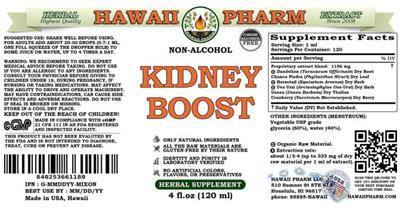
Supplement Facts
The label details for Kidney Boost Non-Alcohol by Hawaii Pharm, sourced from the NIH Dietary Supplement Label Database.
Supplement Facts
| Ingredient | Amount | % DV |
|---|---|---|
| Proprietary Extract Blend | 1156 mg | -- |
| Chanca Piedra Leaf Extract, Dry | 0 NP | -- |
| Cranberry Berry Extract, Dry | 0 NP | -- |
| Dandelion Root Extract, Dry | 0 NP | -- |
| Horsetail Herb Extract, Dry | 0 NP | -- |
| Uva Ursi Herb Extract, Dry | 0 NP | -- |
| Usnea Thallus Extract, Dry | 0 NP | -- |
Other ingredients: Glycerin, Water
Tap any ingredient to jump to its full detail below.
These statements are the manufacturer’s wording, reproduced from the product label — the label is saying it, not HelloPharmacist. We don’t verify or endorse them.
Brand IP Statement(s)
Hawaii Pharm Herbal extract Highest quality since 2008
Suggested/Recommended/Usage/Directions
Suggested use: Shake well before using. For adults add about 20-30 drops (0.7-1 mL, one full squeeze of the dropper bulb) to some juice or water, up to 4 times a day.
Precautions
Warning: We recommend to seek expert medical advice before taking.
Do not use if you are allergic to any ingredients.
Consult your physician before giving to children under 18, during pregnancy, if nursing or taking medications.
Consult your physician before giving to children under 18, during pregnancy, if nursing or taking medications. Keep out of the reach of children!
May affect the ability to drive and operate machinery. May have contraindications, can cause side effects and adverse reactions. Do not use if seal is broken or missing.
Storage
Store in a cool dry place.
Seals/Symbols
cGMP Made in compliance with cGMP 21 CFR 111 in an FDA registered and inspected facility.
USA Made in United States of America
FDA Disclaimer Statement
This product has not been evaluated by the FDA and is not intended to diagnose, treat, cure or prevent any disease.
Formulation
Made in USA, Hawaii
C2H5OH Alcohol Free All the raw materials are gluten-free by their nature No artificial colors, flavors, or preservatives
Only natural ingredients
Identity and purity is laboratory verified
FDA Statement of Identity
Herbal Supplement
General Statements
Scan this QR-code to get 15% discount on your next purchase limited time deal
Extraction rate: about 1/3-4 (up to 333 mg of dry raw material per 1 mL of extract).
Is this label outdated? Report a formula or label change and our pharmacy team will review it.
Kidney Boost Non-Alcohol by Hawaii Pharm label
The label scan from the NIH Dietary Supplement Label Database. Tap to enlarge.
Label images are published by the NIH Dietary Supplement Label Database for the version of this product on file. Always read your actual product label.
View the full label (PDF)The Ingredients in Kidney Boost Non-Alcohol by Hawaii Pharm
These are the 6 active ingredients this product is made of. Select any to open its full monograph.
Serving size0.7 mL Dosage formLiquid Servings per container120 Amounts shown are per serving.
Most supplement products combine several ingredients, and a medication can interact with the product through any one of them. Each ingredient below shows whether it has known drug interactions.
Proprietary Extract Blend
Other (inactive) ingredients: Glycerin, Water. These complete the product’s ingredient list but are not active constituents.
Kidney Boost Non-Alcohol by Hawaii Pharm Drug Interactions
HelloPharmacist Interaction Report
Kidney Boost Non-Alcohol by Hawaii Pharm contains six active ingredients, five of which have documented interactions with medications.
The most serious concern is with chanca piedra, which carries moderate-severity interactions across multiple drug categories. Chanca piedra may increase the risk of bleeding when combined with blood thinners or antiplatelet drugs (like warfarin or aspirin), and it can theoretically affect how your liver processes certain medications, either speeding up or slowing down their breakdown depending on the drug.
Read the full breakdown — every affected drug type, severity by severity
The product also contains cranberry and dandelion, both of which interact with blood thinners and related medications. Cranberry may raise levels of drugs like atorvastatin (a cholesterol medication) and nifedipine (a blood pressure drug), which could increase side effects.
Horsetail may lower the effectiveness of HIV medications (NRTIs like efavirenz). All five checked ingredients can interact with diuretics, lithium, and blood sugar medications—sometimes raising levels, sometimes lowering them.
Uva ursi may slow the metabolism of several drug classes. Usnea was not checked; we hold no interaction data for it.
Additionally, dandelion contains high potassium and may cause dangerous potassium levels when taken with certain water pills. Altogether, these interactions span 1,163 individual medications.
Before you start this product, search your exact medications in the tool on this page.
Check your own medications below · Editorial policy · How we use AI
Want to check YOUR meds against Kidney Boost Non-Alcohol?
Ask about interactions with your drugs in plain English — “Can I take it with lisinopril?” — and we find you the answer in seconds, ingredient by ingredient.
Go to the checkerIngredients driving the most interactions
Individual Drug Interactions
The ingredients in Kidney Boost Non-Alcohol interact with 1,179 drugs. Click any drug to see the details.
5 of the 6 ingredients in Kidney Boost Non-Alcohol interact with drugs. Each result below shows which ingredient is responsible. Chanca Piedra Leaf Extract, Dry Uva Ursi Herb Extract, Dry Cranberry Berry Extract, Dry Dandelion Root Extract, Dry Horsetail Herb Extract, Dry
Ado-trastuzumab EmtansineKadcyla
How Ado-trastuzumab Emtansine interacts with Kidney Boost Non-Alcohol — through 3 ingredients. Tap an ingredient for the detail:
Chanca Piedra Leaf Extract, DryCytochrome P450 3a4 (cyp3a4) Substrates Moderate
Interaction Summary
Theoretically, use of chanca piedra might increase the levels and clinical effects of CYP3A4 substrates.
Read the full Chanca Piedra Leaf Extract, Dry + Ado-trastuzumab Emtansine interactionUva Ursi Herb Extract, DryCytochrome P450 3a4 (cyp3a4) Substrates Moderate
Interaction Summary
Theoretically, uva ursi may decrease the metabolism of CYP3A4 substrates.
Read the full Uva Ursi Herb Extract, Dry + Ado-trastuzumab Emtansine interactionCranberry Berry Extract, DryCytochrome P450 3a4 (cyp3a4) Substrates Moderate
Interaction Summary
Theoretically, cranberry might increase the levels and adverse effects of CYP3A4 substrates.
Read the full Cranberry Berry Extract, Dry + Ado-trastuzumab Emtansine interactionAbacavir Sulfate, Dolutegravir, LamivudineTriumeq
How Abacavir Sulfate, Dolutegravir, Lamivudine interacts with Kidney Boost Non-Alcohol — through 1 ingredient. Tap an ingredient for the detail:
Horsetail Herb Extract, DryNucleoside Reverse Transcriptase Inhibitors (nrtis) Moderate
Interaction Summary
Theoretically, horsetail might decrease the levels and clinical effects of NRTIs.
Read the full Horsetail Herb Extract, Dry + Abacavir Sulfate, Dolutegravir, Lamivudine interactionAbacavir, LamivudineEpzicom
How Abacavir, Lamivudine interacts with Kidney Boost Non-Alcohol — through 1 ingredient. Tap an ingredient for the detail:
Horsetail Herb Extract, DryNucleoside Reverse Transcriptase Inhibitors (nrtis) Moderate
Interaction Summary
Theoretically, horsetail might decrease the levels and clinical effects of NRTIs.
Read the full Horsetail Herb Extract, Dry + Abacavir, Lamivudine interactionAbciximabReoPro
How Abciximab interacts with Kidney Boost Non-Alcohol — through 2 ingredients. Tap an ingredient for the detail:
Dandelion Root Extract, DryAnticoagulant/antiplatelet Drugs Moderate
Interaction Summary
Theoretically, taking dandelion root along with anticoagulant or antiplatelet drugs might increase the risk of bruising and bleeding.
Read the full Dandelion Root Extract, Dry + Abciximab interactionChanca Piedra Leaf Extract, DryAnticoagulant/antiplatelet Drugs Moderate
Interaction Summary
Theoretically, chanca piedra might increase the risk of bleeding when used concomitantly with anticoagulant/antiplatelet drugs.
Read the full Chanca Piedra Leaf Extract, Dry + Abciximab interactionAbemaciclibVerzenio
How Abemaciclib interacts with Kidney Boost Non-Alcohol — through 3 ingredients. Tap an ingredient for the detail:
Uva Ursi Herb Extract, DryCytochrome P450 3a4 (cyp3a4) Substrates Moderate
Interaction Summary
Theoretically, uva ursi may decrease the metabolism of CYP3A4 substrates.
Read the full Uva Ursi Herb Extract, Dry + Abemaciclib interactionChanca Piedra Leaf Extract, DryCytochrome P450 3a4 (cyp3a4) Substrates Moderate
Interaction Summary
Theoretically, use of chanca piedra might increase the levels and clinical effects of CYP3A4 substrates.
Read the full Chanca Piedra Leaf Extract, Dry + Abemaciclib interactionCranberry Berry Extract, DryCytochrome P450 3a4 (cyp3a4) Substrates Moderate
Interaction Summary
Theoretically, cranberry might increase the levels and adverse effects of CYP3A4 substrates.
Read the full Cranberry Berry Extract, Dry + Abemaciclib interactionAbiraterone
How Abiraterone interacts with Kidney Boost Non-Alcohol — through 3 ingredients. Tap an ingredient for the detail:
Cranberry Berry Extract, DryCytochrome P450 3a4 (cyp3a4) Substrates Moderate
Interaction Summary
Theoretically, cranberry might increase the levels and adverse effects of CYP3A4 substrates.
Read the full Cranberry Berry Extract, Dry + Abiraterone interactionUva Ursi Herb Extract, DryCytochrome P450 3a4 (cyp3a4) Substrates Moderate
Interaction Summary
Theoretically, uva ursi may decrease the metabolism of CYP3A4 substrates.
Read the full Uva Ursi Herb Extract, Dry + Abiraterone interactionChanca Piedra Leaf Extract, DryCytochrome P450 3a4 (cyp3a4) Substrates Moderate
Interaction Summary
Theoretically, use of chanca piedra might increase the levels and clinical effects of CYP3A4 substrates.
Read the full Chanca Piedra Leaf Extract, Dry + Abiraterone interactionAbiraterone AcetateYonsa, Zytiga
How Abiraterone Acetate interacts with Kidney Boost Non-Alcohol — through 3 ingredients. Tap an ingredient for the detail:
Chanca Piedra Leaf Extract, DryCytochrome P450 3a4 (cyp3a4) Substrates Moderate
Interaction Summary
Theoretically, use of chanca piedra might increase the levels and clinical effects of CYP3A4 substrates.
Read the full Chanca Piedra Leaf Extract, Dry + Abiraterone Acetate interactionCranberry Berry Extract, DryCytochrome P450 3a4 (cyp3a4) Substrates Moderate
Interaction Summary
Theoretically, cranberry might increase the levels and adverse effects of CYP3A4 substrates.
Read the full Cranberry Berry Extract, Dry + Abiraterone Acetate interactionUva Ursi Herb Extract, DryCytochrome P450 3a4 (cyp3a4) Substrates Moderate
Interaction Summary
Theoretically, uva ursi may decrease the metabolism of CYP3A4 substrates.
Read the full Uva Ursi Herb Extract, Dry + Abiraterone Acetate interactionAbrocitinibCibinqo
How Abrocitinib interacts with Kidney Boost Non-Alcohol — through 4 ingredients. Tap an ingredient for the detail:
Chanca Piedra Leaf Extract, DryAnticoagulant/antiplatelet Drugs Moderate
Interaction Summary
Theoretically, chanca piedra might increase the risk of bleeding when used concomitantly with anticoagulant/antiplatelet drugs.
Read the full Chanca Piedra Leaf Extract, Dry + Abrocitinib interactionUva Ursi Herb Extract, DryCytochrome P450 2c19 (cyp2c19) Substrates Moderate
Interaction Summary
Theoretically, uva ursi may decrease the metabolism of CYP2C19 substrates.
Read the full Uva Ursi Herb Extract, Dry + Abrocitinib interactionDandelion Root Extract, DryAnticoagulant/antiplatelet Drugs Moderate
Interaction Summary
Theoretically, taking dandelion root along with anticoagulant or antiplatelet drugs might increase the risk of bruising and bleeding.
Read the full Dandelion Root Extract, Dry + Abrocitinib interactionCranberry Berry Extract, DryCytochrome P450 2c9 (cyp2c9) Substrates Minor
Interaction Summary
Theoretically, cranberry might increase the levels and adverse effects of CYP2C9 substrates.
Read the full Cranberry Berry Extract, Dry + Abrocitinib interactionAcalabrutinibCalquence
How Acalabrutinib interacts with Kidney Boost Non-Alcohol — through 3 ingredients. Tap an ingredient for the detail:
Cranberry Berry Extract, DryCytochrome P450 3a4 (cyp3a4) Substrates Moderate
Interaction Summary
Theoretically, cranberry might increase the levels and adverse effects of CYP3A4 substrates.
Read the full Cranberry Berry Extract, Dry + Acalabrutinib interactionUva Ursi Herb Extract, DryP-glycoprotein Substrates, Cytochrome P450 3a4 (cyp3a4) Substrates Moderate
Interaction Summary
Theoretically, uva ursi may alter the levels of drugs transported by P-glycoprotein.
Read the full Uva Ursi Herb Extract, Dry + Acalabrutinib interactionChanca Piedra Leaf Extract, DryCytochrome P450 3a4 (cyp3a4) Substrates Moderate
Interaction Summary
Theoretically, use of chanca piedra might increase the levels and clinical effects of CYP3A4 substrates.
Read the full Chanca Piedra Leaf Extract, Dry + Acalabrutinib interactionAcarboseGlucobay, Prandase, Precose
How Acarbose interacts with Kidney Boost Non-Alcohol — through 3 ingredients. Tap an ingredient for the detail:
Dandelion Root Extract, DryAntidiabetes Drugs Moderate
Interaction Summary
Theoretically, dandelion might increase the risk for hypoglycemia when used with antidiabetes drugs.
Read the full Dandelion Root Extract, Dry + Acarbose interactionHorsetail Herb Extract, DryAntidiabetes Drugs Moderate
Interaction Summary
Theoretically, taking horsetail with antidiabetes drugs might increase the risk of hypoglycemia.
Read the full Horsetail Herb Extract, Dry + Acarbose interactionChanca Piedra Leaf Extract, DryAntidiabetes Drugs Minor
Interaction Summary
Theoretically, concomitant use with antidiabetes drugs might affect glucose control and increase the risk of hypoglycemia.
Read the full Chanca Piedra Leaf Extract, Dry + Acarbose interactionAcenocoumarolSintrom
How Acenocoumarol interacts with Kidney Boost Non-Alcohol — through 2 ingredients. Tap an ingredient for the detail:
Chanca Piedra Leaf Extract, DryAnticoagulant/antiplatelet Drugs Moderate
Interaction Summary
Theoretically, chanca piedra might increase the risk of bleeding when used concomitantly with anticoagulant/antiplatelet drugs.
Read the full Chanca Piedra Leaf Extract, Dry + Acenocoumarol interactionDandelion Root Extract, DryAnticoagulant/antiplatelet Drugs Moderate
Interaction Summary
Theoretically, taking dandelion root along with anticoagulant or antiplatelet drugs might increase the risk of bruising and bleeding.
Read the full Dandelion Root Extract, Dry + Acenocoumarol interactionAcetaminophenChildren's Tylenol, Children's Tylenol Meltaways, Tylenol, Tylenol Ex Strength
How Acetaminophen interacts with Kidney Boost Non-Alcohol — through 3 ingredients. Tap an ingredient for the detail:
Dandelion Root Extract, DryCytochrome P450 1a2 (cyp1a2) Substrates, Glucuronidated Drugs Moderate
Interaction Summary
Theoretically, dandelion might increase levels of drugs metabolized by CYP1A2.
Read the full Dandelion Root Extract, Dry + Acetaminophen interactionUva Ursi Herb Extract, DryGlucuronidated Drugs Moderate
Interaction Summary
Theoretically, uva ursi may increase levels of drugs metabolized by glucuronidation.
Read the full Uva Ursi Herb Extract, Dry + Acetaminophen interactionChanca Piedra Leaf Extract, DryCytochrome P450 1a2 (cyp1a2) Substrates Moderate
Interaction Summary
Theoretically, chanca piedra might reduce the levels and clinical effects of CYP1A2 substrates.
Read the full Chanca Piedra Leaf Extract, Dry + Acetaminophen interactionAcetaminophen, AspirinGemnisyn
How Acetaminophen, Aspirin interacts with Kidney Boost Non-Alcohol — through 3 ingredients. Tap an ingredient for the detail:
Chanca Piedra Leaf Extract, DryCytochrome P450 1a2 (cyp1a2) Substrates, Anticoagulant/antiplatelet Drugs Moderate
Interaction Summary
Theoretically, chanca piedra might reduce the levels and clinical effects of CYP1A2 substrates.
Read the full Chanca Piedra Leaf Extract, Dry + Acetaminophen, Aspirin interactionUva Ursi Herb Extract, DryGlucuronidated Drugs Moderate
Interaction Summary
Theoretically, uva ursi may increase levels of drugs metabolized by glucuronidation.
Read the full Uva Ursi Herb Extract, Dry + Acetaminophen, Aspirin interactionDandelion Root Extract, DryGlucuronidated Drugs, Anticoagulant/antiplatelet Drugs +1 Moderate
Interaction Summary
Theoretically, dandelion might increase the clearance of drugs that are UDP-glucuronosyltransferase substrates.
Read the full Dandelion Root Extract, Dry + Acetaminophen, Aspirin interactionAcetaminophen, Aspirin, CaffeineExcedrin, Excedrin Extra Strength, Excedrin Migraine
How Acetaminophen, Aspirin, Caffeine interacts with Kidney Boost Non-Alcohol — through 4 ingredients. Tap an ingredient for the detail:
Dandelion Root Extract, DryCytochrome P450 1a2 (cyp1a2) Substrates, Glucuronidated Drugs +1 Moderate
Interaction Summary
Theoretically, dandelion might increase levels of drugs metabolized by CYP1A2.
Read the full Dandelion Root Extract, Dry + Acetaminophen, Aspirin, Caffeine interactionChanca Piedra Leaf Extract, DryCytochrome P450 3a4 (cyp3a4) Substrates, Cytochrome P450 1a2 (cyp1a2) Substrates +1 Moderate
Interaction Summary
Theoretically, use of chanca piedra might increase the levels and clinical effects of CYP3A4 substrates.
Read the full Chanca Piedra Leaf Extract, Dry + Acetaminophen, Aspirin, Caffeine interactionCranberry Berry Extract, DryCytochrome P450 3a4 (cyp3a4) Substrates Moderate
Interaction Summary
Theoretically, cranberry might increase the levels and adverse effects of CYP3A4 substrates.
Read the full Cranberry Berry Extract, Dry + Acetaminophen, Aspirin, Caffeine interactionUva Ursi Herb Extract, DryGlucuronidated Drugs, Cytochrome P450 3a4 (cyp3a4) Substrates Moderate
Interaction Summary
Theoretically, uva ursi may increase levels of drugs metabolized by glucuronidation.
Read the full Uva Ursi Herb Extract, Dry + Acetaminophen, Aspirin, Caffeine interactionAcetaminophen, Brompheniramine, PhenylpropanolamineDimetapp Cold and Flu
How Acetaminophen, Brompheniramine, Phenylpropanolamine interacts with Kidney Boost Non-Alcohol — through 3 ingredients. Tap an ingredient for the detail:
Chanca Piedra Leaf Extract, DryCytochrome P450 1a2 (cyp1a2) Substrates Moderate
Interaction Summary
Theoretically, chanca piedra might reduce the levels and clinical effects of CYP1A2 substrates.
Read the full Chanca Piedra Leaf Extract, Dry + Acetaminophen, Brompheniramine, Phenylpropanolamine interactionUva Ursi Herb Extract, DryGlucuronidated Drugs Moderate
Interaction Summary
Theoretically, uva ursi may increase levels of drugs metabolized by glucuronidation.
Read the full Uva Ursi Herb Extract, Dry + Acetaminophen, Brompheniramine, Phenylpropanolamine interactionDandelion Root Extract, DryCytochrome P450 1a2 (cyp1a2) Substrates, Glucuronidated Drugs Moderate
Interaction Summary
Theoretically, dandelion might increase levels of drugs metabolized by CYP1A2.
Read the full Dandelion Root Extract, Dry + Acetaminophen, Brompheniramine, Phenylpropanolamine interactionAcetaminophen, ButalbitalAxocet, Bancap, Bucet, Butex Forte, Esgic CF, Orbivan CF +5 more
How Acetaminophen, Butalbital interacts with Kidney Boost Non-Alcohol — through 3 ingredients. Tap an ingredient for the detail:
Dandelion Root Extract, DryGlucuronidated Drugs, Cytochrome P450 1a2 (cyp1a2) Substrates Moderate
Interaction Summary
Theoretically, dandelion might increase the clearance of drugs that are UDP-glucuronosyltransferase substrates.
Read the full Dandelion Root Extract, Dry + Acetaminophen, Butalbital interactionUva Ursi Herb Extract, DryGlucuronidated Drugs Moderate
Interaction Summary
Theoretically, uva ursi may increase levels of drugs metabolized by glucuronidation.
Read the full Uva Ursi Herb Extract, Dry + Acetaminophen, Butalbital interactionChanca Piedra Leaf Extract, DryCytochrome P450 1a2 (cyp1a2) Substrates Moderate
Interaction Summary
Theoretically, chanca piedra might reduce the levels and clinical effects of CYP1A2 substrates.
Read the full Chanca Piedra Leaf Extract, Dry + Acetaminophen, Butalbital interactionAcetaminophen, Butalbital, CaffeineEsgic, Esgic Plus, Fiogesic, Fioricet, Repan, Tecnal +1 more
How Acetaminophen, Butalbital, Caffeine interacts with Kidney Boost Non-Alcohol — through 4 ingredients. Tap an ingredient for the detail:
Chanca Piedra Leaf Extract, DryCytochrome P450 1a2 (cyp1a2) Substrates, Cytochrome P450 3a4 (cyp3a4) Substrates Moderate
Interaction Summary
Theoretically, chanca piedra might reduce the levels and clinical effects of CYP1A2 substrates.
Read the full Chanca Piedra Leaf Extract, Dry + Acetaminophen, Butalbital, Caffeine interactionUva Ursi Herb Extract, DryGlucuronidated Drugs, Cytochrome P450 3a4 (cyp3a4) Substrates Moderate
Interaction Summary
Theoretically, uva ursi may increase levels of drugs metabolized by glucuronidation.
Read the full Uva Ursi Herb Extract, Dry + Acetaminophen, Butalbital, Caffeine interactionDandelion Root Extract, DryCytochrome P450 1a2 (cyp1a2) Substrates, Glucuronidated Drugs Moderate
Interaction Summary
Theoretically, dandelion might increase levels of drugs metabolized by CYP1A2.
Read the full Dandelion Root Extract, Dry + Acetaminophen, Butalbital, Caffeine interactionCranberry Berry Extract, DryCytochrome P450 3a4 (cyp3a4) Substrates Moderate
Interaction Summary
Theoretically, cranberry might increase the levels and adverse effects of CYP3A4 substrates.
Read the full Cranberry Berry Extract, Dry + Acetaminophen, Butalbital, Caffeine interactionAcetaminophen, Butalbital, Caffeine, CodeineEsgic with Codeine, Fioricet w/ Codeine
How Acetaminophen, Butalbital, Caffeine, Codeine interacts with Kidney Boost Non-Alcohol — through 4 ingredients. Tap an ingredient for the detail:
Cranberry Berry Extract, DryCytochrome P450 3a4 (cyp3a4) Substrates Moderate
Interaction Summary
Theoretically, cranberry might increase the levels and adverse effects of CYP3A4 substrates.
Read the full Cranberry Berry Extract, Dry + Acetaminophen, Butalbital, Caffeine, Codeine interactionUva Ursi Herb Extract, DryCytochrome P450 3a4 (cyp3a4) Substrates, Glucuronidated Drugs Moderate
Interaction Summary
Theoretically, uva ursi may decrease the metabolism of CYP3A4 substrates.
Read the full Uva Ursi Herb Extract, Dry + Acetaminophen, Butalbital, Caffeine, Codeine interactionDandelion Root Extract, DryGlucuronidated Drugs, Cytochrome P450 1a2 (cyp1a2) Substrates Moderate
Interaction Summary
Theoretically, dandelion might increase the clearance of drugs that are UDP-glucuronosyltransferase substrates.
Read the full Dandelion Root Extract, Dry + Acetaminophen, Butalbital, Caffeine, Codeine interactionChanca Piedra Leaf Extract, DryCytochrome P450 1a2 (cyp1a2) Substrates, Cytochrome P450 3a4 (cyp3a4) Substrates Moderate
Interaction Summary
Theoretically, chanca piedra might reduce the levels and clinical effects of CYP1A2 substrates.
Read the full Chanca Piedra Leaf Extract, Dry + Acetaminophen, Butalbital, Caffeine, Codeine interactionAcetaminophen, Butalbital, CodeineBancap w/ Codeine
How Acetaminophen, Butalbital, Codeine interacts with Kidney Boost Non-Alcohol — through 3 ingredients. Tap an ingredient for the detail:
Dandelion Root Extract, DryGlucuronidated Drugs, Cytochrome P450 1a2 (cyp1a2) Substrates Moderate
Interaction Summary
Theoretically, dandelion might increase the clearance of drugs that are UDP-glucuronosyltransferase substrates.
Read the full Dandelion Root Extract, Dry + Acetaminophen, Butalbital, Codeine interactionUva Ursi Herb Extract, DryGlucuronidated Drugs Moderate
Interaction Summary
Theoretically, uva ursi may increase levels of drugs metabolized by glucuronidation.
Read the full Uva Ursi Herb Extract, Dry + Acetaminophen, Butalbital, Codeine interactionChanca Piedra Leaf Extract, DryCytochrome P450 1a2 (cyp1a2) Substrates Moderate
Interaction Summary
Theoretically, chanca piedra might reduce the levels and clinical effects of CYP1A2 substrates.
Read the full Chanca Piedra Leaf Extract, Dry + Acetaminophen, Butalbital, Codeine interactionAcetaminophen, Butalbital, Codeine PhosphatePhrenilin #3
How Acetaminophen, Butalbital, Codeine Phosphate interacts with Kidney Boost Non-Alcohol — through 3 ingredients. Tap an ingredient for the detail:
Uva Ursi Herb Extract, DryGlucuronidated Drugs Moderate
Interaction Summary
Theoretically, uva ursi may increase levels of drugs metabolized by glucuronidation.
Read the full Uva Ursi Herb Extract, Dry + Acetaminophen, Butalbital, Codeine Phosphate interactionDandelion Root Extract, DryCytochrome P450 1a2 (cyp1a2) Substrates, Glucuronidated Drugs Moderate
Interaction Summary
Theoretically, dandelion might increase levels of drugs metabolized by CYP1A2.
Read the full Dandelion Root Extract, Dry + Acetaminophen, Butalbital, Codeine Phosphate interactionChanca Piedra Leaf Extract, DryCytochrome P450 1a2 (cyp1a2) Substrates Moderate
Interaction Summary
Theoretically, chanca piedra might reduce the levels and clinical effects of CYP1A2 substrates.
Read the full Chanca Piedra Leaf Extract, Dry + Acetaminophen, Butalbital, Codeine Phosphate interactionAcetaminophen, Caffeine, Chlorpheniramine, Hydrocodone, PhenylephrineHycomine Compound
How Acetaminophen, Caffeine, Chlorpheniramine, Hydrocodone, Phenylephrine interacts with Kidney Boost Non-Alcohol — through 4 ingredients. Tap an ingredient for the detail:
Dandelion Root Extract, DryGlucuronidated Drugs, Cytochrome P450 1a2 (cyp1a2) Substrates Moderate
Interaction Summary
Theoretically, dandelion might increase the clearance of drugs that are UDP-glucuronosyltransferase substrates.
Read the full Dandelion Root Extract, Dry + Acetaminophen, Caffeine, Chlorpheniramine, Hydrocodone, Phenylephrine interactionChanca Piedra Leaf Extract, DryCytochrome P450 3a4 (cyp3a4) Substrates, Cytochrome P450 1a2 (cyp1a2) Substrates Moderate
Interaction Summary
Theoretically, use of chanca piedra might increase the levels and clinical effects of CYP3A4 substrates.
Read the full Chanca Piedra Leaf Extract, Dry + Acetaminophen, Caffeine, Chlorpheniramine, Hydrocodone, Phenylephrine interactionCranberry Berry Extract, DryCytochrome P450 3a4 (cyp3a4) Substrates Moderate
Interaction Summary
Theoretically, cranberry might increase the levels and adverse effects of CYP3A4 substrates.
Read the full Cranberry Berry Extract, Dry + Acetaminophen, Caffeine, Chlorpheniramine, Hydrocodone, Phenylephrine interactionUva Ursi Herb Extract, DryGlucuronidated Drugs, Cytochrome P450 3a4 (cyp3a4) Substrates Moderate
Interaction Summary
Theoretically, uva ursi may increase levels of drugs metabolized by glucuronidation.
Read the full Uva Ursi Herb Extract, Dry + Acetaminophen, Caffeine, Chlorpheniramine, Hydrocodone, Phenylephrine interactionAcetaminophen, Caffeine, CodeineGesic C15, Gesic C30, Gesic C8, Lenoltec 1, Lenoltec 2, Lenoltec 3 +1 more
How Acetaminophen, Caffeine, Codeine interacts with Kidney Boost Non-Alcohol — through 4 ingredients. Tap an ingredient for the detail:
Uva Ursi Herb Extract, DryCytochrome P450 3a4 (cyp3a4) Substrates, Glucuronidated Drugs Moderate
Interaction Summary
Theoretically, uva ursi may decrease the metabolism of CYP3A4 substrates.
Read the full Uva Ursi Herb Extract, Dry + Acetaminophen, Caffeine, Codeine interactionChanca Piedra Leaf Extract, DryCytochrome P450 1a2 (cyp1a2) Substrates, Cytochrome P450 3a4 (cyp3a4) Substrates Moderate
Interaction Summary
Theoretically, chanca piedra might reduce the levels and clinical effects of CYP1A2 substrates.
Read the full Chanca Piedra Leaf Extract, Dry + Acetaminophen, Caffeine, Codeine interactionDandelion Root Extract, DryGlucuronidated Drugs, Cytochrome P450 1a2 (cyp1a2) Substrates Moderate
Interaction Summary
Theoretically, dandelion might increase the clearance of drugs that are UDP-glucuronosyltransferase substrates.
Read the full Dandelion Root Extract, Dry + Acetaminophen, Caffeine, Codeine interactionCranberry Berry Extract, DryCytochrome P450 3a4 (cyp3a4) Substrates Moderate
Interaction Summary
Theoretically, cranberry might increase the levels and adverse effects of CYP3A4 substrates.
Read the full Cranberry Berry Extract, Dry + Acetaminophen, Caffeine, Codeine interactionAcetaminophen, Caffeine, Codeine, SalicylamideCodalan No.1, Codalan No.2, Codalan No.3
How Acetaminophen, Caffeine, Codeine, Salicylamide interacts with Kidney Boost Non-Alcohol — through 4 ingredients. Tap an ingredient for the detail:
Cranberry Berry Extract, DryCytochrome P450 3a4 (cyp3a4) Substrates Moderate
Interaction Summary
Theoretically, cranberry might increase the levels and adverse effects of CYP3A4 substrates.
Read the full Cranberry Berry Extract, Dry + Acetaminophen, Caffeine, Codeine, Salicylamide interactionUva Ursi Herb Extract, DryCytochrome P450 3a4 (cyp3a4) Substrates, Glucuronidated Drugs Moderate
Interaction Summary
Theoretically, uva ursi may decrease the metabolism of CYP3A4 substrates.
Read the full Uva Ursi Herb Extract, Dry + Acetaminophen, Caffeine, Codeine, Salicylamide interactionDandelion Root Extract, DryCytochrome P450 1a2 (cyp1a2) Substrates, Glucuronidated Drugs Moderate
Interaction Summary
Theoretically, dandelion might increase levels of drugs metabolized by CYP1A2.
Read the full Dandelion Root Extract, Dry + Acetaminophen, Caffeine, Codeine, Salicylamide interactionChanca Piedra Leaf Extract, DryCytochrome P450 1a2 (cyp1a2) Substrates, Cytochrome P450 3a4 (cyp3a4) Substrates Moderate
Interaction Summary
Theoretically, chanca piedra might reduce the levels and clinical effects of CYP1A2 substrates.
Read the full Chanca Piedra Leaf Extract, Dry + Acetaminophen, Caffeine, Codeine, Salicylamide interactionAcetaminophen, Caffeine, DihydrocodeineDHC Plus, Panlor DC, Panlor SS
How Acetaminophen, Caffeine, Dihydrocodeine interacts with Kidney Boost Non-Alcohol — through 4 ingredients. Tap an ingredient for the detail:
Dandelion Root Extract, DryGlucuronidated Drugs, Cytochrome P450 1a2 (cyp1a2) Substrates Moderate
Interaction Summary
Theoretically, dandelion might increase the clearance of drugs that are UDP-glucuronosyltransferase substrates.
Read the full Dandelion Root Extract, Dry + Acetaminophen, Caffeine, Dihydrocodeine interactionChanca Piedra Leaf Extract, DryCytochrome P450 3a4 (cyp3a4) Substrates, Cytochrome P450 1a2 (cyp1a2) Substrates Moderate
Interaction Summary
Theoretically, use of chanca piedra might increase the levels and clinical effects of CYP3A4 substrates.
Read the full Chanca Piedra Leaf Extract, Dry + Acetaminophen, Caffeine, Dihydrocodeine interactionCranberry Berry Extract, DryCytochrome P450 3a4 (cyp3a4) Substrates Moderate
Interaction Summary
Theoretically, cranberry might increase the levels and adverse effects of CYP3A4 substrates.
Read the full Cranberry Berry Extract, Dry + Acetaminophen, Caffeine, Dihydrocodeine interactionUva Ursi Herb Extract, DryGlucuronidated Drugs, Cytochrome P450 3a4 (cyp3a4) Substrates Moderate
Interaction Summary
Theoretically, uva ursi may increase levels of drugs metabolized by glucuronidation.
Read the full Uva Ursi Herb Extract, Dry + Acetaminophen, Caffeine, Dihydrocodeine interactionAcetaminophen, Caffeine, IsomethepteneMigralam
How Acetaminophen, Caffeine, Isometheptene interacts with Kidney Boost Non-Alcohol — through 4 ingredients. Tap an ingredient for the detail:
Uva Ursi Herb Extract, DryCytochrome P450 3a4 (cyp3a4) Substrates, Glucuronidated Drugs Moderate
Interaction Summary
Theoretically, uva ursi may decrease the metabolism of CYP3A4 substrates.
Read the full Uva Ursi Herb Extract, Dry + Acetaminophen, Caffeine, Isometheptene interactionChanca Piedra Leaf Extract, DryCytochrome P450 1a2 (cyp1a2) Substrates, Cytochrome P450 3a4 (cyp3a4) Substrates Moderate
Interaction Summary
Theoretically, chanca piedra might reduce the levels and clinical effects of CYP1A2 substrates.
Read the full Chanca Piedra Leaf Extract, Dry + Acetaminophen, Caffeine, Isometheptene interactionDandelion Root Extract, DryCytochrome P450 1a2 (cyp1a2) Substrates, Glucuronidated Drugs Moderate
Interaction Summary
Theoretically, dandelion might increase levels of drugs metabolized by CYP1A2.
Read the full Dandelion Root Extract, Dry + Acetaminophen, Caffeine, Isometheptene interactionCranberry Berry Extract, DryCytochrome P450 3a4 (cyp3a4) Substrates Moderate
Interaction Summary
Theoretically, cranberry might increase the levels and adverse effects of CYP3A4 substrates.
Read the full Cranberry Berry Extract, Dry + Acetaminophen, Caffeine, Isometheptene interactionAcetaminophen, Caffeine, PyrilamineMidol Max Strength Menstrual
How Acetaminophen, Caffeine, Pyrilamine interacts with Kidney Boost Non-Alcohol — through 5 ingredients. Tap an ingredient for the detail:
Cranberry Berry Extract, DryCytochrome P450 3a4 (cyp3a4) Substrates Moderate
Interaction Summary
Theoretically, cranberry might increase the levels and adverse effects of CYP3A4 substrates.
Read the full Cranberry Berry Extract, Dry + Acetaminophen, Caffeine, Pyrilamine interactionChanca Piedra Leaf Extract, DryDiuretic Drugs, Cytochrome P450 1a2 (cyp1a2) Substrates +1 Moderate
Interaction Summary
Theoretically, concomitant use of chanca piedra with diuretics might increase diuresis.
Read the full Chanca Piedra Leaf Extract, Dry + Acetaminophen, Caffeine, Pyrilamine interactionUva Ursi Herb Extract, DryCytochrome P450 3a4 (cyp3a4) Substrates, Glucuronidated Drugs Moderate
Interaction Summary
Theoretically, uva ursi may decrease the metabolism of CYP3A4 substrates.
Read the full Uva Ursi Herb Extract, Dry + Acetaminophen, Caffeine, Pyrilamine interactionDandelion Root Extract, DryGlucuronidated Drugs, Cytochrome P450 1a2 (cyp1a2) Substrates Moderate
Interaction Summary
Theoretically, dandelion might increase the clearance of drugs that are UDP-glucuronosyltransferase substrates.
Read the full Dandelion Root Extract, Dry + Acetaminophen, Caffeine, Pyrilamine interactionHorsetail Herb Extract, DryDiuretic Drugs Moderate
Interaction Summary
Theoretically, taking horsetail with diuretic drugs might increase potassium loss and the risk of hypokalemia.
Read the full Horsetail Herb Extract, Dry + Acetaminophen, Caffeine, Pyrilamine interactionAcetaminophen, Chlorpheniramine Maleate, Dextromethorphan HbrVicks Formula 44M Cough, Cold & Flu Relief
How Acetaminophen, Chlorpheniramine Maleate, Dextromethorphan Hbr interacts with Kidney Boost Non-Alcohol — through 4 ingredients. Tap an ingredient for the detail:
Chanca Piedra Leaf Extract, DryCytochrome P450 1a2 (cyp1a2) Substrates, Cytochrome P450 3a4 (cyp3a4) Substrates Moderate
Interaction Summary
Theoretically, chanca piedra might reduce the levels and clinical effects of CYP1A2 substrates.
Read the full Chanca Piedra Leaf Extract, Dry + Acetaminophen, Chlorpheniramine Maleate, Dextromethorphan Hbr interactionDandelion Root Extract, DryGlucuronidated Drugs, Cytochrome P450 1a2 (cyp1a2) Substrates Moderate
Interaction Summary
Theoretically, dandelion might increase the clearance of drugs that are UDP-glucuronosyltransferase substrates.
Read the full Dandelion Root Extract, Dry + Acetaminophen, Chlorpheniramine Maleate, Dextromethorphan Hbr interactionCranberry Berry Extract, DryCytochrome P450 3a4 (cyp3a4) Substrates Moderate
Interaction Summary
Theoretically, cranberry might increase the levels and adverse effects of CYP3A4 substrates.
Read the full Cranberry Berry Extract, Dry + Acetaminophen, Chlorpheniramine Maleate, Dextromethorphan Hbr interactionUva Ursi Herb Extract, DryGlucuronidated Drugs, Cytochrome P450 3a4 (cyp3a4) Substrates Moderate
Interaction Summary
Theoretically, uva ursi may increase levels of drugs metabolized by glucuronidation.
Read the full Uva Ursi Herb Extract, Dry + Acetaminophen, Chlorpheniramine Maleate, Dextromethorphan Hbr interactionAcetaminophen, Chlorpheniramine, Codeine, PhenylephrineColrex
How Acetaminophen, Chlorpheniramine, Codeine, Phenylephrine interacts with Kidney Boost Non-Alcohol — through 4 ingredients. Tap an ingredient for the detail:
Uva Ursi Herb Extract, DryGlucuronidated Drugs, Cytochrome P450 3a4 (cyp3a4) Substrates Moderate
Interaction Summary
Theoretically, uva ursi may increase levels of drugs metabolized by glucuronidation.
Read the full Uva Ursi Herb Extract, Dry + Acetaminophen, Chlorpheniramine, Codeine, Phenylephrine interactionChanca Piedra Leaf Extract, DryCytochrome P450 1a2 (cyp1a2) Substrates, Cytochrome P450 3a4 (cyp3a4) Substrates Moderate
Interaction Summary
Theoretically, chanca piedra might reduce the levels and clinical effects of CYP1A2 substrates.
Read the full Chanca Piedra Leaf Extract, Dry + Acetaminophen, Chlorpheniramine, Codeine, Phenylephrine interactionDandelion Root Extract, DryCytochrome P450 1a2 (cyp1a2) Substrates, Glucuronidated Drugs Moderate
Interaction Summary
Theoretically, dandelion might increase levels of drugs metabolized by CYP1A2.
Read the full Dandelion Root Extract, Dry + Acetaminophen, Chlorpheniramine, Codeine, Phenylephrine interactionCranberry Berry Extract, DryCytochrome P450 3a4 (cyp3a4) Substrates Moderate
Interaction Summary
Theoretically, cranberry might increase the levels and adverse effects of CYP3A4 substrates.
Read the full Cranberry Berry Extract, Dry + Acetaminophen, Chlorpheniramine, Codeine, Phenylephrine interactionAcetaminophen, Chlorpheniramine, DextromethorphanCoricidin II Extra Strength Cold and Flu
How Acetaminophen, Chlorpheniramine, Dextromethorphan interacts with Kidney Boost Non-Alcohol — through 4 ingredients. Tap an ingredient for the detail:
Cranberry Berry Extract, DryCytochrome P450 3a4 (cyp3a4) Substrates Moderate
Interaction Summary
Theoretically, cranberry might increase the levels and adverse effects of CYP3A4 substrates.
Read the full Cranberry Berry Extract, Dry + Acetaminophen, Chlorpheniramine, Dextromethorphan interactionUva Ursi Herb Extract, DryGlucuronidated Drugs, Cytochrome P450 3a4 (cyp3a4) Substrates Moderate
Interaction Summary
Theoretically, uva ursi may increase levels of drugs metabolized by glucuronidation.
Read the full Uva Ursi Herb Extract, Dry + Acetaminophen, Chlorpheniramine, Dextromethorphan interactionDandelion Root Extract, DryGlucuronidated Drugs, Cytochrome P450 1a2 (cyp1a2) Substrates Moderate
Interaction Summary
Theoretically, dandelion might increase the clearance of drugs that are UDP-glucuronosyltransferase substrates.
Read the full Dandelion Root Extract, Dry + Acetaminophen, Chlorpheniramine, Dextromethorphan interactionChanca Piedra Leaf Extract, DryCytochrome P450 3a4 (cyp3a4) Substrates, Cytochrome P450 1a2 (cyp1a2) Substrates Moderate
Interaction Summary
Theoretically, use of chanca piedra might increase the levels and clinical effects of CYP3A4 substrates.
Read the full Chanca Piedra Leaf Extract, Dry + Acetaminophen, Chlorpheniramine, Dextromethorphan interactionAcetaminophen, Chlorpheniramine, Dextromethorphan HydrobromideCoricidin HBP Maximum Strength Flu
How Acetaminophen, Chlorpheniramine, Dextromethorphan Hydrobromide interacts with Kidney Boost Non-Alcohol — through 4 ingredients. Tap an ingredient for the detail:
Chanca Piedra Leaf Extract, DryCytochrome P450 1a2 (cyp1a2) Substrates, Cytochrome P450 3a4 (cyp3a4) Substrates Moderate
Interaction Summary
Theoretically, chanca piedra might reduce the levels and clinical effects of CYP1A2 substrates.
Read the full Chanca Piedra Leaf Extract, Dry + Acetaminophen, Chlorpheniramine, Dextromethorphan Hydrobromide interactionDandelion Root Extract, DryGlucuronidated Drugs, Cytochrome P450 1a2 (cyp1a2) Substrates Moderate
Interaction Summary
Theoretically, dandelion might increase the clearance of drugs that are UDP-glucuronosyltransferase substrates.
Read the full Dandelion Root Extract, Dry + Acetaminophen, Chlorpheniramine, Dextromethorphan Hydrobromide interactionCranberry Berry Extract, DryCytochrome P450 3a4 (cyp3a4) Substrates Moderate
Interaction Summary
Theoretically, cranberry might increase the levels and adverse effects of CYP3A4 substrates.
Read the full Cranberry Berry Extract, Dry + Acetaminophen, Chlorpheniramine, Dextromethorphan Hydrobromide interactionUva Ursi Herb Extract, DryCytochrome P450 3a4 (cyp3a4) Substrates, Glucuronidated Drugs Moderate
Interaction Summary
Theoretically, uva ursi may decrease the metabolism of CYP3A4 substrates.
Read the full Uva Ursi Herb Extract, Dry + Acetaminophen, Chlorpheniramine, Dextromethorphan Hydrobromide interactionEach ingredient & the kinds of drugs it affects
For each ingredient in Kidney Boost Non-Alcohol with known interactions, here are the types of medications they can affect. Open any type for the detail — or search your exact drug in the checker above.
Chanca Piedra Leaf Extract, Dry
Anticoagulant/Antiplatelet Drugs
Theoretically, chanca piedra might increase the risk of bleeding when used concomitantly with anticoagulant/antiplatelet drugs.
In vitro research suggests that methyl brevifolincarboxylate, a constituent isolated from chanca piedra, can inhibit platelet aggregation. This effect has not been reported in humans.
Cytochrome P450 1A2 (Cyp1A2) Substrates
Theoretically, chanca piedra might reduce the levels and clinical effects of CYP1A2 substrates.
In vitro research shows that chanca piedra extract increases CYP1A2 activity. Theoretically, chanca piedra might increase metabolism of CYP1A2 substrates and lower serum concentrations. This interaction has not been reported in humans.
Cytochrome P450 3A4 (Cyp3A4) Substrates
Theoretically, use of chanca piedra might increase the levels and clinical effects of CYP3A4 substrates.
In vitro research shows that chanca piedra extract inhibits CYP3A4. Theoretically, chanca piedra might increase the levels of CYP3A4 substrates. This interaction has not been reported in humans.
Diuretic Drugs
Theoretically, concomitant use of chanca piedra with diuretics might increase diuresis.
Some preliminary clinical research in adults with hypertension shows that chanca piedra has diuretic properties. However, higher quality research in adults with kidney stones shows taking chanca piedra does not increase urine volume when compared with placebo. Until more is known, use cautiously in patients taking diuretic drugs.
Lithium
Theoretically, chanca piedra might reduce excretion and increase levels of lithium.
Some preliminary clinical research in adults with hypertension shows that chanca piedra has diuretic properties. However, higher quality research in adults with kidney stones shows that taking chanca piedra does not increase urine volume when compared with placebo. Until more is known, use cautiously in patients taking lithium. The dose of lithium might need to be decreased.
Norepinephrine (Levophed)
Theoretically, chanca piedra may reduce the effects of norepinephrine.
Animal research suggests that methyl brevifolincarboxylate, a constituent isolated from chanca piedra, can reverse blood vessel contraction caused by norepinephrine.
Antidiabetes Drugs
Theoretically, concomitant use with antidiabetes drugs might affect glucose control and increase the risk of hypoglycemia.
Animal research suggests that chanca piedra can have hypoglycemic effects. However, a small clinical study in adults with diabetes shows that chanca piedra extract 25 grams orally daily for 1 week does not lower fasting or postprandial blood glucose levels.
Antihypertensive Drugs
Theoretically, concomitant use of chanca piedra with antihypertensive drugs might have additive blood pressure lowering effects.
Animal research suggests that chanca piedra can decrease blood pressure. However, this effect was not observed in most hypertensive patients treated with chanca piedra for 10 days.
Uva Ursi Herb Extract, Dry
Cytochrome P450 2C19 (Cyp2C19) Substrates
Theoretically, uva ursi may decrease the metabolism of CYP2C19 substrates.
In vitro, uva ursi appears to inhibit cytochrome CYP2C19. This effect has not been reported in humans.
Cytochrome P450 3A4 (Cyp3A4) Substrates
Theoretically, uva ursi may decrease the metabolism of CYP3A4 substrates.
In vitro, uva ursi appears to inhibit CYP3A4. This effect has not been reported in humans.
Glucuronidated Drugs
Theoretically, uva ursi may increase levels of drugs metabolized by glucuronidation.
In vitro, uva ursi extract appears to strongly inhibit UDP-glucuronosyltransferase (UGT) 1A1 (UGT1A1). However, uva ursi extract does not appear to inhibit UGT1A1 in animal models. This effect has not been reported in humans.
Lithium
Theoretically, uva ursi may increase lithium levels, necessitating a decrease in dose.
Uva ursi may have diuretic properties. Diuretics may increase lithium reabsorption with sodium in the proximal tubule of the kidney. Theoretically, uva ursi might reduce excretion and increase levels of lithium.
Urinary Acidifying Agents
Effects of uva ursi in the urinary tract may be reduced by urinary acidifying agents.
Uva ursi seems to work best in alkaline urine. Theoretically, taking uva ursi with medications known to acidify the urine may decrease any effects of uva ursi on the urinary tract.
P-Glycoprotein Substrates
Theoretically, uva ursi may alter the levels of drugs transported by P-glycoprotein.
In vitro, uva ursi appears to inhibit the multi-drug transporter protein, P-glycoprotein. This effect has not been reported in humans.
Cranberry Berry Extract, Dry
Atorvastatin (Lipitor)
Theoretically, cranberry might increase levels and adverse effects of atorvastatin.
In one case report, a patient taking atorvastatin experienced upper back pain, rhabdomyolysis, and abnormal liver function after drinking cranberry juice 16 ounces daily for 2 weeks. Theoretically, this may have been caused by inhibition of cytochrome P450 3A4 (CYP3A4) enzymes by cranberry juice, as atorvastatin is a CYP3A4 substrate. Creatinine kinase and liver enzymes normalized within 2 weeks of stopping cranberry juice. Patients taking atorvastatin should avoid large quantities of cranberry juice.
Cytochrome P450 3A4 (Cyp3A4) Substrates
Theoretically, cranberry might increase the levels and adverse effects of CYP3A4 substrates.
A case of upper back pain, rhabdomyolysis, and abnormal liver function has been reported for a patient taking atorvastatin, a CYP3A4 substrate, in combination with cranberry juice 16 ounces daily for 2 weeks. Creatinine kinase and liver enzymes normalized within 2 weeks of stopping cranberry juice. Also, animal research suggests that cranberry juice, administered intraduodenally 30 minutes prior to nifedipine, a CYP3A4 substrate, inhibits nifedipine metabolism and increases the area under the concentration-time curve by 1.6-fold compared to control.
Nifedipine (Procardia)
Theoretically, cranberry might increase the levels and adverse effects of nifedipine.
Animal research suggests that cranberry juice, administered intraduodenally 30 minutes prior to nifedipine treatment, inhibits nifedipine metabolism and increases the area under the concentration-time curve by 1.6-fold compared to control. This interaction has not been reported in humans.
Warfarin (Coumadin)
Theoretically, cranberry might increase the levels and adverse effects of warfarin. However, research is conflicting.
There is contradictory evidence about the effect of cranberry juice on warfarin. Case reports have linked cranberry juice consumption to increases in the international normalized ratio (INR) in patients taking warfarin, resulting in severe spontaneous bleeding and excessive postoperative bleeding. Daily consumption of cranberry sauce for one week has also been linked to an increase in INR in one case report. In a small study in healthy young males, taking a high dose of 3 grams of cranberry juice concentrate capsules, equivalent to 57 grams of fruit daily, for 2 weeks produced a 30% increase in the area under the INR-time curve after a single 25-mg dose of warfarin. However, 3 very small clinical studies in patients stabilized on warfarin reported that cranberry juice 250 mL once or twice daily for 7 days (27% cranberry juice or pure cranberry juice) or 240 mL once daily for 14 days does not significantly increase INR or affect plasma warfarin levels. The reasons for these discrepant findings are unclear. It is possible that the form and dose of cranberry may play a role, as cranberry extracts and juices contain different constituents. Additionally, an in vitro study evaluating 5 different cranberry juices found varying effects, with only a cranberry concentrate, and not diluted cranberry juices, inhibiting CYP2C9. However, this concentrate did not inhibit CYP2C9 activity in humans.
Cytochrome P450 2C9 (Cyp2C9) Substrates
Theoretically, cranberry might increase the levels and adverse effects of CYP2C9 substrates. However, research is conflicting.
There is contradictory evidence about the effect of cranberry on CYP2C9 enzymes. In vitro evidence suggests that flavonoids in cranberry inhibit CYP2C9 enzymes. However, clinical research shows that cranberry juice does not significantly affect the levels, metabolism, or elimination of the CYP2C9 substrates flurbiprofen or diclofenac. Also, in patients stabilized on warfarin, drinking cranberry juice 250 mL daily for 7 days does not significantly increase the anticoagulant activity of warfarin, a CYP2C9 substrate. Additional pharmacokinetic research shows that cranberry juice does not increase peak plasma concentrations or area under the concentration-time curve of warfarin.
Diclofenac (Voltaren, Others)
Theoretically, cranberry might modestly increase the levels and adverse effects of diclofenac.
In vitro evidence suggests that cranberry juice inhibits diclofenac metabolism by human liver microsomes. However, drinking cranberry juice does not seem to affect diclofenac metabolism in humans.
Dandelion Root Extract, Dry
Anticoagulant/Antiplatelet Drugs
Theoretically, taking dandelion root along with anticoagulant or antiplatelet drugs might increase the risk of bruising and bleeding.
In vitro research suggests that dandelion root inhibits platelet aggregation.
Antidiabetes Drugs
Theoretically, dandelion might increase the risk for hypoglycemia when used with antidiabetes drugs.
Laboratory research suggests that dandelion extract may have moderate alpha-glucosidase inhibitor activity and might also increase insulin secretion. Also, in a case report, a 58-year-old woman with type 2 diabetes who was being treated with insulin developed hypoglycemia 2 weeks after beginning to eat salads containing dandelion.
Cytochrome P450 1A2 (Cyp1A2) Substrates
Theoretically, dandelion might increase levels of drugs metabolized by CYP1A2.
Laboratory research suggests that dandelion might inhibit CYP1A2. So far, this interaction has not been reported in humans. However, until more is known, watch for an increase in the levels of drugs metabolized by CYP1A2 in patients taking dandelion.
Glucuronidated Drugs
Theoretically, dandelion might increase the clearance of drugs that are UDP-glucuronosyltransferase substrates.
There is some preliminary evidence that dandelion might induce UDP-glucuronosyltransferase, a phase II enzyme.
Lithium
Theoretically, through diuretic effects, dandelion might reduce excretion and increase levels of lithium.
Animal research suggests that dandelion has diuretic properties. As diuretics can increase serum lithium levels, the dose of lithium might need to be decreased when taken with dandelion.
Potassium-Sparing Diuretics
Theoretically, dandelion might increase the risk of hyperkalemia when taken with potassium-sparing diuretics.
Dandelion contains significant amounts of potassium.
Quinolone Antibiotics
Theoretically, dandelion might lower fluoroquinolone levels.
Animal research shows that dandelion reduces absorption of ciprofloxacin and can lower levels by 73%. However, this effect has not been reported in humans.
Horsetail Herb Extract, Dry
Antidiabetes Drugs
Theoretically, taking horsetail with antidiabetes drugs might increase the risk of hypoglycemia.
Equisetum myriochaetum has demonstrated hypoglycemic activity in clinical research. In an animal diabetic model, Equisetum giganteum had hypoglycemic effects. It is unclear whether other horsetail species have hypoglycemic effects.
Diuretic Drugs
Theoretically, taking horsetail with diuretic drugs might increase potassium loss and the risk of hypokalemia.
Laboratory research shows that various species of horsetail have diuretic properties. Due to its diuretic effects, there has been concern that taking horsetail along with potassium-depleting diuretics might increase the risk for hypokalemia. However, pharmacokinetic research in humans shows that taking horsetail 900 mg daily for 4 days does not affect urinary excretion of electrolytes, including potassium and sodium, despite having a diuretic effect similar to taking hydrochlorothiazide 25 mg daily. It is unclear if taking horsetail for a longer duration would affect electrolyte levels. Until more is known, use with caution.
Efavirenz (Sustiva)
Theoretically, horsetail might decrease the levels and clinical effects of efavirenz.
In two case reports, patients were found to have detectable viral loads when taking horsetail-containing supplements along with an antiretroviral regimen that included efavirenz. In one case, the antiretroviral regimen included zidovudine, lamivudine, and efavirenz; in the other case, the regimen consisted of emtricitabine, tenofovir disoproxil fumarate, and efavirenz. One month after discontinuing horsetail, the viral loads became undetectable in both cases. The exact mechanism of this interaction is unknown. It is also unclear if this interaction is specific to efavirenz or if it is related to various components of antiretroviral therapy.
Lithium
Theoretically, horsetail might increase the levels and adverse effects of lithium.
Animal research suggests that horsetail has diuretic properties. Theoretically, due to these potential diuretic effects, horsetail might reduce excretion and increase levels of lithium. The dose of lithium might need to be decreased.
Nucleoside Reverse Transcriptase Inhibitors (Nrtis)
Theoretically, horsetail might decrease the levels and clinical effects of NRTIs.
In two case reports, patients were found to have detectable viral loads when taking horsetail-containing supplements along with an antiretroviral therapy. In one case, the antiretroviral regimen included zidovudine, lamivudine, and efavirenz; in the other case, the regimen consisted of emtricitabine, tenofovir disoproxil fumarate, and efavirenz. One month after discontinuing the supplement, the viral loads became undetectable in both cases. The exact mechanism of these interactions is unknown. It is also unclear if these interactions are specific to NRTIs or if they are related to various components of antiretroviral therapy.
Brand information
Manufacturer and brand details for Kidney Boost Non-Alcohol, from the product label.
Hawaii Pharm
See all Hawaii Pharm products- Name
- Hawaii Pharm LLC
- Street Address
- 510 Sumner St. Ste. 613
- City
- Honolulu
- State
- HI
- ZipCode
- 96817
- Phone Number
- 888-854-2924
- Web Address
- hawaiipharm.com
Kidney Boost Non-Alcohol by Hawaii Pharm: Common Questions
Does Kidney Boost Non-Alcohol by Hawaii Pharm interact with any medications?
How can one product interact with so many drugs?
Where does this information come from?
Is this safe to use while pregnant or breastfeeding?
What is chanca piedra used for in this product?
Can this cause diarrhea or stomach upset?
Is this a substitute for treating a urinary tract infection with antibiotics?
What happens if I take too much of this product?
Does this product have any fillers or other ingredients?
Written and reviewed by the HelloPharmacist editorial staff. Our editorial policy
Not sure if Kidney Boost Non-Alcohol is safe with your meds?
Our pharmacists answer your medication & supplement questions — free.
Label information is sourced from the NIH Dietary Supplement Label Database and reflects the product version on file; always read your actual product label. This page is for education only and is not a substitute for professional medical advice. Confirm with your pharmacist or doctor before combining supplements and medications.
The Full Monographs Behind Kidney Boost Non-Alcohol’s Ingredients
Every ingredient we hold a full HelloPharmacist monograph for — uses, evidence, safety, and the complete interaction list.
Chanca Piedra
Interacts with 1,022 drugsChanca piedra is a tropical herb traditionally used as a 'stone breaker' for kidney and gallstones, and for liver and urinary health. Human evidence for these uses is limited and mostly smal...
Read the full Chanca Piedra monograph → Herb & supplement monographCranberry
Interacts with 714 drugsCranberry is best known for helping to prevent repeated urinary tract infections (UTIs) in some people, and the evidence here is moderate but mixed. It is not a reliable treatment for an act...
Read the full Cranberry monograph → Herb & supplement monographDandelion
Interacts with 457 drugsDandelion is a common plant used in food and traditional medicine, often promoted as a natural 'water pill' and digestive aid. Human evidence for these uses is very limited, so its benefits...
Read the full Dandelion monograph → Herb & supplement monographHorsetail
Interacts with 188 drugsHorsetail is a traditional herb most often used as a mild diuretic and for hair, nail, and bone support, but high-quality human evidence is limited. It can cause thiamine (vitamin B1) loss w...
Read the full Horsetail monograph → Herb & supplement monographUva Ursi
Interacts with 804 drugsUva ursi is a traditional herb used mainly for urinary tract infections, and its leaves contain a compound called arbutin that may have antimicrobial effects in the urine. Evidence in people...
Read the full Uva Ursi monograph → Herb & supplement monographUsnea
Usnea is a lichen used in traditional herbal medicine, mainly for sore throats, skin infections, and as a general antimicrobial. Laboratory studies suggest its main compound, usnic acid, can...
Read the full Usnea monograph →Sources & How We Checked
Kidney Boost Non-Alcohol's label data comes from the NIH Dietary Supplement Label Database; the ingredient interaction data is from the Natural Medicines database, reviewed by our pharmacists.
- NIH Dietary Supplement Label Database (DSLD) — The official product label on file for this supplement.
- Natural Medicines (Therapeutic Research Center) — Evidence-graded clinical reference behind the ingredient interaction data.
Content is written and reviewed by licensed HelloPharmacist pharmacists. See our data sources and editorial standards for how this information is built and checked.
The 110 references behind this product’s interaction data
Every citation that drives the interaction findings for this product’s ingredients, from the evidence-graded Natural Medicines (TRC Healthcare) database. Open an ingredient to browse its citations — links open the study on PubMed or the publisher’s site.
Chanca Piedra 18 references
- Brinker F. Herb Contraindications and Drug Interactions. 2nd ed. Sandy, OR: Eclectic Medical Publications, 1998.
- Srividya N, Periwal S. Diuretic, hypotensive and hypoglycaemic effect of Phyllanthus amarus. Indian J Exp Biol 1995; 33:861-4.
- Rao, M. V. and Alice, K. M. Contraceptive effects of Phyllanthus amarus in female mice. Phytother.Res 2001;15(3):265-267.
- Moshi, M. J., Lutale, J. J., Rimoy, G. H., Abbas, Z. G., Josiah, R. M., and Swai, A. B. The effect of Phyllanthus amarus aqueous extract on blood glucose in non-insulin dependent diabetic patients. Phytother.Res 2001;15(7):577-580.
- Nishiura, J. L., Campos, A. H., Boim, M. A., Heilberg, I. P., and Schor, N. Phyllanthus niruri normalizes elevated urinary calcium levels in calcium stone forming (CSF) patients. Urol.Res 2004;32(5):362-366. PubMed
- Iizuka, T., Moriyama, H., and Nagai, M. Vasorelaxant effects of methyl brevifolincarboxylate from the leaves of Phyllanthus niruri. Biol.Pharm.Bull. 2006;29(1):177-179. PubMed
- Adeneye, A. A., Amole, O. O., and Adeneye, A. K. Hypoglycemic and hypocholesterolemic activities of the aqueous leaf and seed extract of Phyllanthus amarus in mice. Fitoterapia 2006;77(7-8):511-514. PubMed
- Iizuka, T., Nagai, M., Taniguchi, A., Moriyama, H., and Hoshi, K. Inhibitory effects of methyl brevifolincarboxylate isolated from Phyllanthus niruri L. on platelet aggregation. Biol.Pharm.Bull. 2007;30(2):382-384. PubMed
- Amaechina, F. C. and Omogbai, E. K. Hypotensive effect of aqueous extract of the leaves of Phyllanthus amarus Schum and Thonn (Euphorbiaceae). Acta Pol.Pharm. 2007;64(6):547-552.
- Okoli, C. O., Obidike, I. C., Ezike, A. C., Akah, P. A., and Salawu, O. A. Studies on the possible mechanisms of antidiabetic activity of extract of aerial parts of Phyllanthus niruri. Pharm.Biol. 2011;49(3):248-255.
- Moshi MJ, Uiso FC Mahunnah RL et al. A study of the effect of Phyllanthus amarus extracts on blood glucose in rabbits. International Journal of Pharmacognosy 1997;35(3):167-173. DOI
- Kumar NG, Nair AN Raghunandanan VR et al. Hypoglycaemic effect of Phyllanthus niruri leaves in rabbits. Kerala Journal of Veterinary Science 1989;20(1):77-80.
- Navarro M, Coussio J Hnatyszyn O et al. Hypoglycemic Effect of an Aqueous Extract of Phyllanthus sellowianus ("sarandi blanco") in C57BL/Ks mice. Acta Farmaceutica Bonaerense 2004;23:520-523.
- Etta HE, Udoh PB Asuquo BO et al. Effect of Phyllanthus amarus on breeding efficiency of female albino rats. Global Journal of Agricultural Sciences 2007;215-217. DOI
- Etta H. Effects of Phyllanthus amarus on litter traits in albino rats. Scientific Research and Essays 2008;370-372.
- Pucci ND, Marchini GS, Mazzucchi E, et al. Effect of phyllanthus niruri on metabolic parameters of patients with kidney stone: a perspective for disease prevention. Int Braz J Urol 2018;44(4):758-64. PubMed
- Sowjanya K, Girish C, Bammigatti C, Prasanna Lakshmi NC. Efficacy of Phyllanthus niruri on improving liver functions in patients with alcoholic hepatitis: A double-blind randomized controlled trial. Indian J Pharmacol 2021;53(6):448-456. PubMed
- Husain I, Abdulrahman B, Dale OR, et al. Interaction of Phyllanthus amarus extract and its lignans with human xenobiotic receptors, drug metabolizing enzymes and drug transporters. J Ethnopharmacol 2025;339:119142. PubMed
Cranberry 33 references
- Anon. Possible interaction between warfarin and cranberry juice. Current Problems in Pharmacovigilance 2003;29:8. PubMed
- Greenblatt DJ, von Moltke LL, Perloff ES, et al. Interaction of flurbiprofen with cranberry juice, grape juice, tea, and fluconazole: in vitro and clinical studies. Clin Pharmacol Ther 2006;79:125-33. PubMed
- Hodek P, Trefil P, Stiborova M. Flavonoids-potent and versatile biologically active compounds interacting with cytochromes P450. Chem Biol Interact 2002;139:1-21.. PubMed
- Grant P. Warfarin and cranberry juice: An interaction? J Heart Valve Dis 2004;13:25-6.
- Suvarna R, Pirmohamed M, Henderson L. Possible interaction between warfarin and cranberry juice. BMJ 2003;327:1454. PubMed
- Li Z, Seeram NP, Carpenter CL, et al. Cranberry does not affect prothrombin time in male subjects on warfarin. J Am Diet Assoc 2006;106:2057-61. PubMed
- Lilja JJ, Backman JT, Neuvonen PJ. Effects of daily ingestion of cranberry juice on the pharmacokinetics of warfarin, tizanidine, and midazolam - probes of CYP2C9, CYP1A2 and CYP3A4. Clin Pharmacol The 2007:81:833-9. PubMed
- Wing DA, Rumney PJ, Preslicka CW, Chung JH. Daily cranberry juice for the prevention of asymptomatic bacteriuria in pregnancy: a randomized, controlled pilot study. J Urol 2008;180:1367-72. PubMed
- Mohammed Abdul MI, Jiang X, Williams KM, et al. Pharmacodynamic interaction of warfarin with cranberry but not with garlic in healthy subjects. Br J Pharmacol 2008;154:1691-700. PubMed
- McMurdo MET, Argo I, Phillips G, et al. Cranberry or trimethoprim for the prevention of recurrently urinary tract infections? A randomized controlled trial in older women. J Antimicrob Chemother 2009;63:389-95.
- Mergenhagen KA, Sherman O. Elevated International Normalized Ratio after concurrent ingestion of cranberry sauce and warfarin. Am J Health-Syst Pharm 2008;65:2113-6. PubMed
- Ansell J, McDonough M, Zhao Y, et al. The absence of an interaction between warfarin and cranberry juice: a randomized, double-blind trial. J Clin Pharmacol 2009;49:824-30. PubMed
- Haber SL, Cauthon KA, Raney EC. Cranberry and warfarin interaction: a case report and review of the literature. Consult Pharm 2012;27:58-65. PubMed
- Hamann GL, Campbell JD, George CM. Warfarin-cranberry juice interaction. Ann Pharmacother 2011;45:e17. PubMed
- Roberts D, Flanagan P. Case report: Cranberry juice and warfarin. Home Healthc Nurse 2011;29:92-7.
- Garcia-Calatayud, S., Larreina Cordoba, J. J., and Lozano De La Torre MJ. [Severe cranberry juice poisoning]. An.Esp.Pediatr. 2002;56(1):72-73.
- Patel, D. A., Gillespie, B., Sobel, J. D., Leaman, D., Nyirjesy, P., Weitz, M. V., and Foxman, B. Risk factors for recurrent vulvovaginal candidiasis in women receiving maintenance antifungal therapy: results of a prospective cohort study. Am J Obstet.Gy PubMed
- Isele, H. [Fatal bleeding under warfarin plus cranberry juice. Is it due to salicylic acid?]. MMW.Fortschr.Med 3-11-2004;146(11):13.
- Linsenmeyer, T. A., Harrison, B., Oakley, A., Kirshblum, S., Stock, J. A., and Millis, S. R. Evaluation of cranberry supplement for reduction of urinary tract infections in individuals with neurogenic bladders secondary to spinal cord injury. A prospecti
- McMurdo, M. E., Bissett, L. Y., Price, R. J., Phillips, G., and Crombie, I. K. Does ingestion of cranberry juice reduce symptomatic urinary tract infections in older people in hospital? A double-blind, placebo-controlled trial. Age Ageing 2005;34(3):256- PubMed
- Sylvan, L. and Justice, N. P. Possible interaction between warfarin and cranberry juice. Am Fam.Physician 9-15-2005;72(6):1000.
- Niklasson, A. and Andren, L. [Interaction between Waran and cranberry juice]. Lakartidningen 3-15-2006;103(11):853-854.
- Rindone, J. P. and Murphy, T. W. Warfarin-cranberry juice interaction resulting in profound hypoprothrombinemia and bleeding. Am J Ther 2006;13(3):283-284. PubMed
- Uesawa, Y. and Mohri, K. Effects of cranberry juice on nifedipine pharmacokinetics in rats. J Pharm Pharmacol 2006;58(8):1067-1072. PubMed
- Valentova, K., Stejskal, D., Bednar, P., Vostalova, J., Cihalik, C., Vecerova, R., Koukalova, D., Kolar, M., Reichenbach, R., Sknouril, L., Ulrichova, J., and Simanek, V. Biosafety, antioxidant status, and metabolites in urine after consumption of dried
- Royer, D. J., George, J. N., and Terrell, D. R. Thrombocytopenia as an adverse effect of complementary and alternative medicines, herbal remedies, nutritional supplements, foods, and beverages. Eur J Haematol 2010;84(5):421-429. PubMed
- Stapleton, A. E., Dziura, J., Hooton, T. M., Cox, M. E., Yarova-Yarovaya, Y., Chen, S., and Gupta, K. Recurrent urinary tract infection and urinary Escherichia coli in women ingesting cranberry juice daily: a randomized controlled trial. Mayo.Clin.Proc. PubMed
- Doad GJ, Kabange W. Cranberry juice, atorvastatin and back pain. J Med Assoc Ga 2014;103(1):14.
- Griffiths AP, Beddall A, Pegler S. Fatal haemopericardium and gastrointestinal haemorrhage due to possible interaction of cranberry juice with warfarin. J R Soc Promot Health 2008;128(6):324-6. PubMed
- Mellen CK, Ford M, Rindone JP. Effect of high-dose cranberry juice on the pharmacodynamics of warfarin in patients. Br J Clin Pharmacol 2010;70(1):139-42. PubMed
- Ushijima K, Tsuruoka S, Tsuda H, Hasegawa G, Obi Y, Kaneda T, Takahashi M, Maekawa T, Sasaki T, Koshimizu TA, Fujimura A. Cranberry juice suppressed the diclofenac metabolism by human liver microsomes, but not in healthy human subjects. Br J Clin Pharmaco PubMed
- Ngo N, Brantley SJ, Carrizosa DR, et al. The warfarin-cranberry juice interaction revisited: A systematic in vitro-in vivo evaluation. J Exp Pharmacol. 2010;2010(2):83-91.
- Williams G, Stothart CI, Hahn D, Stephens JH, Craig JC, Hodson EM. Cranberries for preventing urinary tract infections. Cochrane Database Syst Rev 2023;11(11):CD001321. PubMed
Dandelion 27 references
- Maliakal PP, Wanwimolruk S. Effect of herbal teas on hepatic drug metabolizing enzymes in rats. J Pharm Pharmacol 2001;53:1323-9. PubMed
- Williams CA, Goldstone F, Greenham J. Flavonoids, cinnamic acids and coumarins from the different tissues and medicinal preparations of Taraxacum officinale. Phytochemistry 1996;42:121-7. PubMed
- Hussain Z, Waheed A, Qureshi RA, et al. The effect of medicinal plants of Islamabad and Murree region of Pakistan on insulin secretion from INS-1 cells. Phytother Res 2004;18:73-7. PubMed
- Racz-Kotilla E, Racz G, Solomon A. The action of Taraxacum officinale extracts on the body weight and diuresis of laboratory animals. Planta Med 1974;26:212-7. PubMed
- Zhu M, Wong PY, Li RC. Effects of taraxacum mongolicum on the bioavailability and disposition of ciprofloxacin in rats. J Pharm Sci 1999;88:632-4. PubMed
- Jovanovic M, Mimica-Dukic N, Poljacki M, Boza P. Erythema multiforme due to contact with weeds: a recurrence after patch testing. Contact Dermatitis 2003;48:17-25. PubMed
- Chivato T, Juan F, Montoro A, Laguna R. Anaphylaxis induced by ingestion of a pollen compound. J Investig Allergol Clin Immunol 1996;6:208-9.
- Cohen SH, Yunginger JW, Rosenberg N, Fink JN. Acute allergic reaction after composite pollen ingestion. J Allergy Clin Immunol 1979;64:270-4. PubMed
- Lovell CR, Rowan M. Dandelion dermatitis. Contact Dermatitis 1991;25:185-8. PubMed
- Agarwal SC, Crook JR, Pepper CB. Herbal remedies -- how safe are they? A case report of polymorphic ventricular tachycardia/ventricular fibrillation induced by herbal medication used for obesity. Int J Cardiol 2006;106:260-1. PubMed
- Martín-Muñoz MF, Bartolome B, Caminoa M, et al. Bee pollen: a dangerous food for allergic children. Identification of responsible allergens. Allergol Immunopathol (Madr) 2010;38:263-5. PubMed
- Neef H, Cilli F, Declerck PJ, et al. Platelet anti-aggregating activity of Taraxacum officinale Weber. Phytotherapy Research 1996;10:s138-s140.
- Cuzzolin L, Zaffani S, and Benoni G. Safety implications regarding use of phytomedicines. Eur.J Clin Pharmacol. 2006;62:37-42. PubMed
- Posadzki, P., Watson, L. K., and Ernst, E. Adverse effects of herbal medicines: an overview of systematic reviews. Clin Med 2013;13(1):7-12. PubMed
- Wakelin, S. H., Marren, P., Young, E., and Shaw, S. Compositae sensitivity and chronic hand dermatitis in a seven-year-old boy. Br J Dermatol 1997;137(2):289-291. PubMed
- Ingber, A. Seasonal allergic contact dermatitis from Taraxacum officinale (dandelion) in an Israeli florist. Contact Dermatitis 2000;43(1):49.
- Rodriguez, B., Rodriguez, A., de Barrio, M., Tornero, P., and Baeza, M. L. Asthma induced by canary food mix. Allergy Asthma Proc. 2003;24(4):265-268.
- Syhaieva, I. A. [Efficiency of specific immunotherapy in treatment of patients with seasonal allergic rhinitis]. Lik.Sprava. 2006;(1-2):51-53.
- Catania, M. A., Oteri, A., Caiello, P., Russo, A., Salvo, F., Giustini, E. S., Caputi, A. P., and Polimeni, G. Hemorrhagic cystitis induced by an herbal mixture. South.Med.J. 2010;103(1):90-92. PubMed
- Goksu, E., Eken, C., Karadeniz, O., and Kucukyilmaz, O. First report of hypoglycemia secondary to dandelion (Taraxacum officinale) ingestion. Am J Emerg.Med 2010;28(1):111-112. PubMed
- Fernandez-Gonzalez, D., Gonzalez-Parrado, Z., Vega-Maray, A. M., Valencia-Barrera, R. M., Camazon-Izquierdo, B., De, Nuntiis P., and Mandrioli, P. Platanus pollen allergen, Pla a 1: quantification in the atmosphere and influence on a sensitizing populati
- Liang, K. L., Su, M. C., Shiao, J. Y., Wu, S. H., Li, Y. H., and Jiang, R. S. Role of pollen allergy in Taiwanese patients with allergic rhinitis. J Formos.Med Assoc. 2010;109(12):879-885. PubMed
- Yang, Y., Zhao, Y., Wang, C. S., Wang, X. D., and Zhang, L. [Prevalence of sensitization to aeroallergens in 10 030 patients with allergic rhinitis]. Zhonghua Er.Bi Yan.Hou Tou.Jing.Wai Ke Za Zhi 2011;46(11):914-920.
- Davies, M. G. and Kersey, P. J. Contact allergy to yarrow and dandelion. Contact Dermatitis 1986;14(4):256-257. PubMed
- Collins JM and Miller DR. Dandelion green bezoar following antrectomy and vagotomy - case report. J Kansas Med Soc 1966;67(6):303-304.
- Moriarty B, Pinney JH, Owen-Casey MP, Rustin MH, Deroide F, Laing C, Davenport A. Digital necrosis from dandelion tea. Br J Dermatol. 2013 Jul;169(1):227-30. PubMed
- Onal S, Timur S, Okutucu B, Zihnioglu F. Inhibition of alphaglucosidase by aqueous extracts of some potent antidiabetic medicinal herbs. Prep Biochem Biotechnol 2005;35:29-36.
Horsetail 14 references
- Sudan BJ. Seborrhoeic dermatitis induced by nicotine of horsetails (Equisetum arvense L.). Contact Dermatitis 1985;13:201-2.
- Perez Gutierrez RM, Laguna GY, Walkowski A. Diuretic activity of Mexican equisetum. J Ethnopharmacol 1985;14:269-72. PubMed
- Lemus I, Garcia R, Erazo S, et al. Diuretic activity of an Equisetum bogotense tea (Platero herb): evaluation in healthy volunteers. J Ethnopharmacol 1996;54:55-8. PubMed
- Revilla MC, Andrade-Cetto A, Islas S, Wiedenfeld H. Hypoglycemic effect of Equisetum myriochaetum aerial parts on type 2 diabetic patients. J Ethnopharmacol 2002;81:117-20. PubMed
- Tiktinskii, O. L. and Bablumian, I. A. [Therapeutic action of Java tea and field horsetail in uric acid diathesis]. Urol.Nefrol.(Mosk) 1983;3(1):47-50.
- Henderson JA, Evans EV, and McIntosh RA. The antithiamine action of Equisetum. J Amer Vet Med Assoc 1952;120:375-378.
- Carneiro DM, Freire RC, Honório TC, Zoghaib I, Cardoso FF, Tresvenzol LM, de Paula JR, Sousa AL, Jardim PC, da Cunha LC. Randomized, Double-Blind Clinical Trial to Assess the Acute Diuretic Effect of Equisetum arvense (Field Horsetail) in Healthy Voluntee
- Klnçalp S, Ekiz F, Basar Ö, Coban S, Yüksel O. Equisetum arvense (Field Horsetail)-induced liver injury. Eur J Gastroenterol Hepatol. 2012 Feb;24(2):213-4. PubMed
- Ortega García JA, Angulo MG, Sobrino-Najul EJ, Soldin OP, Mira AP, Martínez-Salcedo E, Claudio L. Prenatal exposure of a girl with autism spectrum disorder to 'horsetail' (Equisetum arvense) herbal remedy and alcohol: a case report. J Med Case Rep. 2011 M PubMed
- Cordova E, Morganti L, Rodriguez C. Possible Drug-Herb Interaction between Herbal Supplement Containing Horsetail (Equisetum arvense) and Antiretroviral Drugs. J Int Assoc Provid AIDS Care. 2017;16(1):11-13.
- García Gavilán MD, Moreno García AM, Rosales Zabal JM, Navarro Jarabo JM, Sánchez Cantos A. Case of drug-induced acute pancreatitis produced by horsetail infusions. Rev Esp Enferm Dig. 2017 Apr;109(4):301-304. PubMed
- Vieira GT, de Oliveira TT, Carneiro MAA, et al. Antidiabetic effect of Equisetum giganteum L. extract on alloxan-diabetic rabbit. J Ethnopharmacol. 2020;260:112898. PubMed
- Health Canada. Organism-Equisetum arvense. Available at: http://webprod.hc-sc.gc.ca/nhpid-bdipsn/ingredReq.do?id=6117&lang=eng. Accessed 21-July 2021.
- Bates D, Duong TB, Kheyson S, Moore K. Hyponatremia Secondary to Decreased Oral Intake and SIADH and Possibly Exacerbated by Horsetail (Equisetum arvense). Can J Hosp Pharm 2021;74(4):386-389. PubMed
Uva Ursi 8 references
- Newall CA, Anderson LA, Philpson JD. Herbal Medicine: A Guide for Healthcare Professionals. London, UK: The Pharmaceutical Press, 1996.
- Schulz V, Hansel R, Tyler VE. Rational Phytotherapy: A Physician's Guide to Herbal Medicine. Terry C. Telger, transl. 3rd ed. Berlin, GER: Springer, 1998.
- Brinker F. Herb Contraindications and Drug Interactions. 2nd ed. Sandy, OR: Eclectic Medical Publications, 1998.
- Wang L, Del Priore LV. Bull's-eye maculopathy secondary to herbal toxicity from uva ursi. Am J Ophthalmol 2004;137:1135-7. PubMed
- Beaux, D., Fleurentin, J., and Mortier, F. Effect of extracts of Orthosiphon stamineus Benth, Hieracium pilosella L., Sambucus nigra L. and Arctostaphylos uva-ursi (L.) Spreng. in rats. Phytother.Res 1999;13(3):222-225.
- de Arriba SG, Naser B, Nolte KU. Risk assessment of free hydroquinone derived from Arctostaphylos Uva-ursi folium herbal preparations. Int J Toxicol. 2013;32(6):442-453.
- Park JB, Kim D, Min JS, et al. Identification and characterization of in vitro inhibitors against UDP-glucuronosyltransferase 1A1 in uva-ursi extracts and evaluation of in vivo uva-ursi-drug interactions. Food Chem Toxicol. 2018;120:651-661. PubMed
- Chauhan B, Yu C, Krantis A, et al. In vitro activity of uva-ursi against cytochrome P450 isoenzymes and P-glycoprotein. Can J Physiol Pharmacol. 2007;85(11):1099-107.
Usnea 10 references
- Favreau JT, Ryu Ml, Braunstein G, et al. Severe hepatotoxicity associated with the dietary supplement LipoKinetix. Ann Intern Med 2002;136:590-5. PubMed
- Ingolfsdottir K. Usnic acid. Phytochemistry 2002;61:729-36.
- Scirpa, P., Scambia, G., Masciullo, V., Battaglia, F., Foti, E., Lopez, R., Villa, P., Malecore, M., and Mancuso, S. [A zinc sulfate and usnic acid preparation used as post-surgical adjuvant therapy in genital lesions by Human Papillomavirus]. Minerva Gin
- Mitchell, J. C. Allergy to lichens. Allergic contact dermatitis from usnic acid produced by lichenized fungi. Arch Dermatol 1965;92(2):142-146.
- Durazo, F. A., Lassman, C., Han, S. H., Saab, S., Lee, N. P., Kawano, M., Saggi, B., Gordon, S., Farmer, D. G., Yersiz, H., Goldstein, R. L., Ghobrial, M., and Busuttil, R. W. Fulminant liver failure due to usnic acid for weight loss. Am.J Gastroenterol. PubMed
- Neff, G. W., Reddy, K. R., Durazo, F. A., Meyer, D., Marrero, R., and Kaplowitz, N. Severe hepatotoxicity associated with the use of weight loss diet supplements containing ma huang or usnic acid. J Hepatol. 2004;41(6):1062-1064. PubMed
- Hsu, L. M., Huang, Y. S., Chang, F. Y., and Lee, S. D. 'Fat burner' herb, usnic Acid, induced acute hepatitis in a family. J Gastroenterol.Hepatol. 2005;20(7):1138-1139. PubMed
- Arneborn, P., Jansson, A., and Bottiger, Y. [Acute hepatitis in a woman after intake of slimming pills bought via Internet]. Lakartidningen 7-11-2005;102(28-29):2071-2072.
- Sanchez, W., Maple, J. T., Burgart, L. J., and Kamath, P. S. Severe hepatotoxicity associated with use of a dietary supplement containing usnic acid. Mayo Clin Proc 2006;81(4):541-544. PubMed
- Rafanelli, S., Bacchilega, R., Stanganelli, I., and Rafanelli, A. Contact dermatitis from usnic acid in vaginal ovules. Contact Dermatitis 1995;33(4):271-272. PubMed
Parts of this content are provided by the Therapeutic Research Center, LLC.
DISCLAIMER: Currently this does not check for drug-drug interactions. This is not an all-inclusive comprehensive list of potential interactions and is for informational purposes only. Not all interactions are known or well-reported in the scientific literature, and new interactions are continually being reported. Input is needed from a qualified healthcare provider including a pharmacist before starting any therapy. Application of clinical judgment is necessary.
© 2021 Therapeutic Research Center, LLC