
Prostate Complex by Professional Botanicals Ingredients, Side Effects and Drug Interactions
Dietary Supplement Capsule Other Combinations
UPC 8 98175 00189 8 Match it to the barcode on your bottle

Medically reviewed by Dr. Brian Staiger, PharmD, BCPS
Also reviewed by the HelloPharmacist Editorial Team
Updated Details about this page
- Label on file from the NIH Dietary Supplement Label Database, dated May 23, 2024.
- The interaction, evidence and safety records come from the Natural Medicines database, which we license, read against this label by our own system; the pharmacy team’s sections are written from those records.
- Dr. Brian Staiger, PharmD, BCPS, is a clinical pharmacist and pharmacotherapy specialist.
- Editorial policy Our sources
AI is used only to summarize verified clinical information, never the open internet. Our AI policy
Summary: The HelloPharmacist Team’s Take
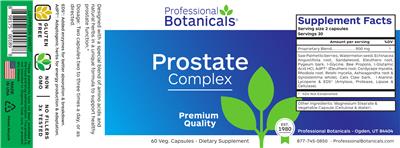
- Form
- Capsule
- Serving Size
- 2 Capsules
- Servings
- 30 per container
- Container Holds
- 60 Veg. Capsules
- What is Prostate Complex?A supplement from Professional Botanicals with 14 active ingredients, in capsule form.
- Active Ingredients 8 plant ingredients such as Saw Palmetto, Watermelon and Echinacea angustifolia, 3 amino acids and 3 others: Saw PalmettoWatermelonEchinacea angustifoliaSandalwoodEleutheroPygeumL-GlycineBee PropolisL-Glutamic Acid HydrochlorideAdPTCat's ClawL-Alanine 14 active ingredients. Each one can interact with drugs or cause side effects on its own, so we check every one. And 2 more, in the Supplement Facts
- Drug Interactions 1,516 drugs have a documented interaction with this supplement; the most serious is rated moderate. Of those, 1,073 are single drugs and 443 are combination products (two or more drugs in one), each listed under its own name. Based on the 12 of its 14 ingredients we could check. Ask your pharmacist first if you take a drug in any of these categories, the most serious of the 36 on record:
- Moderate · 645 drugs
- Moderate · 372 drugs
- Moderate · 248 drugs
- Moderate · 202 drugs
- Possible Side EffectsStomach upset 7 ingredientsNausea 6 ingredientsHeadache 3 ingredientsDizziness 2 ingredientsRednessTrouble sleeping +11 moreCombined from nine of its 14 active ingredients. Not studied in this exact product.
- Well documented Why
Does Prostate Complex work?
What It Is Marketed For
Healthy prostate function support
From the claims on the product’s label.
The Closest Use the Research Grades
Pygeum
Good studies support it.
Its ingredients have research behind other uses too:
- Transurethral resection of the prostate (TURP) Saw Palmetto
- Eleuthero
- Glycine
These grades are for each ingredient, not this exact product, and never a promise it will work for you.
What the research says- Low Why
- AllergensNone of its ingredient names point to a major food allergen
- Barcode (UPC)8 98175 00189 8Match it to the barcode on your bottle to be sure this is your product. Not your product? Search for it here
Who Might Consider It
- People looking for healthy prostate function support, which is what it is marketed for. The closest use the research grades is benign prostatic hyperplasia (BPH), rated Likely Effective.
- People who want it for transurethral resection of the prostate (TURP), genital herpes or schizophrenia: the other uses with research behind them. See each grade
- Prostate Complex may interest men looking into botanicals for prostate concerns, though the ratings for its key ingredients are mixed and several have insufficient data.
Who Should Be Careful
- If you take blood thinners, blood pressure or blood sugar medicines, sedatives, immunosuppressants, or thyroid hormone, be careful and talk it over with your own doctor or pharmacist first.
- If you are pregnant, breastfeeding, or have kidney or liver disease, get personalized advice from your own healthcare provider before using it.
More Before You Take It Show both answersHide Pregnancy and Breastfeeding The Label’s Directions
-
Pregnant or breastfeeding?
- Pregnancy and Breastfeeding Saw Palmetto
- ! When used orally.
- Pregnancy White Sandalwood
- ! When used orally in medicinal amounts; sandalwood is reported to have abortifacient effects; avoid using.
- Breastfeeding White Sandalwood
- Insufficient reliable information available; avoid using amounts greater than those found in foods.
- Pregnancy Cat's Claw
- ! When used orally.
- Breastfeeding Cat's Claw
- Insufficient reliable information available; avoid using.
-
How does the label say to take it?
“Dosage: Two capsules two to three times a day, or as directed.”
The maker’s words. Your pharmacist or doctor may advise differently.
Everything the label says
From the label dated May 23, 2024: 12 of its 14 active ingredients were checked against our records; the other two are not in them yet. A summary of what is known, not a grade or a test of the product. How these ratings are computed
Ask Anything About This Supplement
Name a drug you take, or ask about side effects, ingredients or pregnancy.
AI answers come from this label and our own records, never the open internet. AI can make mistakes, so always check with your doctor or pharmacist. How we use AI
Ask the Pharmacist
A licensed pharmacist will answer your question by email — free, as soon as they can.
Got it — thank you!
A licensed pharmacist will answer as soon as they can. Keep an eye on your email (worth checking spam, just in case).
What’s Inside Prostate Complex by Professional Botanicals
14 Active Ingredients, Each Checked on Its Own
A supplement is often several ingredients in one bottle, and each one can interact with drugs or cause side effects on its own. We check every one of them against our records.
And 6 more, each with its own card below.
The label gives an exact amount for 0 of its 14 active ingredients. 14 are inside one proprietary blend, “Proprietary Blend”, and the label gives one total for it, not how much of each ingredient is in it.
- 0 state an exact amount
- 14 have no amount of their own
- Proprietary Blend 900 mg in total · 14 ingredients, no amount for each
This rates what the label tells you, not the quality of the product.
Supplement Facts
| Amount Per Serving | % Daily Value | |
|---|---|---|
| Proprietary Blend | 900 mg | † |
| Saw Palmetto | † | |
| Watermelon | † | |
| Echinacea angustifolia | † | |
| Sandalwood | † | |
| Eleuthero | † | |
| Pygeum | † | |
| L-Glycine | † | |
| Bee Propolis | † | |
| L-Glutamic Acid Hydrochloride | † | |
| AdPT | † | |
| Eleuthero | † | |
| Cordyceps | † | |
| Rhodiola | † | |
| Reishi | † | |
| Ashwagandha | † | |
| Gynostemma | † | |
| Cat's Claw | † | |
| L-Alanine | † | |
| Lycopene | † | |
| EDS | † | |
| Amylase | † | |
| Protease | † | |
| Lipase | † | |
| Cellulase | † | |
Other ingredients: Magnesium Stearate, Cellulose, Water
† Daily Value not established.
Daily Values for adults and children 4 or more years of age.
As the label prints it, from the NIH Dietary Supplement Label Database.
Each Ingredient and Its Drug Interactions
Tap one for more about it and its full guide. A drug can interact with this supplement through any one of them.
Prostate Complex contains 22 ingredients in total.
- Its active ingredients include amino acids such as L-alanine, L-glycine, and L-glutamic acid hydrochloride, digestive enzymes (amylase, protease, lipase, and cellulase), and botanicals such as saw palmetto, pygeum, reishi, ashwagandha, and rhodiola.
-
Proprietary Blend 900 mg The label also includes three proprietary blends (Proprietary Blend, AdPT, and EDS), whose component ingredients are listed individually. 14 ingredients inside it, each checked on its own
- Saw Palmetto 174 drugs
- Watermelon
- Echinacea angustifolia 818 drugs
- Sandalwood 1 drug
- Eleuthero 1,141 drugs
- Pygeum
- L-Glycine 1 drug
- Bee Propolis 923 drugs
- L-Glutamic Acid Hydrochloride
- AdPT
- Cat's Claw 964 drugs
- L-Alanine
- Lycopene 122 drugs
- EDS
Other Ingredients (Inactive)
The capsule or tablet itself, fillers, coatings and flavors. Not part of the drug interaction check; the allergen check below reads them.
- Magnesium Stearate
- Cellulose
- Water
Allergens in Prostate Complex
None of its ingredient names point to a major food allergen.
Not named in the ingredients
- Milk
- Egg
- Fish
- Shellfish
- Tree nuts
- Peanuts
- Wheat or other gluten grains
- Soy
- Sesame
- Made without, the label says“Gluten free · Non GMO · No fillers 3x tested”
From the label text and ingredient names on file; we do not test products. With a serious allergy, check your bottle and ask the maker or your pharmacist.
What the Label Says
The maker’s own words, from the label. We do not verify or endorse them.
- Formulation
-
“Gluten free Non GMO No fillers 3x tested”
“Premium quality”
2 more from the label
“Designed with a special blend of amino acids and natural herbs in a unique formula to support healthy prostate function.”
“EDS: Added enzymes for better absorption & breakdown. AdPT: Adaptogenic herbs for energy production & adaptation.”
- Seals and symbols
-
“Made in USA”
- General statements
-
“2 Please recycle”
- Brand IP Statement(s)
-
“Professional Botanicals est. 1980”
- FDA Statement of Identity
-
“Dietary Supplement”
The Prostate Complex Label on File
The label scan on file at the NIH Dietary Supplement Label Database, dated May 2024. Always read the label on the bottle you have.
Product Facts
- Brand
- Professional Botanicals
- Barcode (UPC)
- 898175001898
- Net contents
- 60 Veg. Capsules
- Market status
- On market
- Date entered into DSLD
- May 23, 2024
- DSLD ID
- 308963
- Product type
- Other Combinations
- Supplement form
- Capsule
- Dietary claims / uses
- Nutrient, All Other, Structure/Function
- Intended target group(s)
- Adult Male (18-50 Years), Seniors/Mature (>50 Years) - Men ONLY, Gluten Free
Is this label outdated? Report a formula or label change and our pharmacy team will review it.
Prostate Complex by Professional Botanicals Side Effects
Why this rating?
We look for three kinds of safety information on each ingredient: side effects reported in studies, a pregnancy and breastfeeding rating, and a safety write-up from our pharmacy team. Of the 17 ingredients we could check, 16 have side-effect reports, all 17 have a pregnancy rating and all 17 have a safety write-up.
So this rates how much is known, not whether Prostate Complex is right for you.
Reported with ten of its ingredients
- Most often
- Stomach upset, nausea, headache, dizziness, redness and trouble sleeping
- !Rare but serious
- Acute kidney injury and severe allergic reactions in sensitive individuals See details
HelloPharmacist Team Summary: Prostate Complex by Professional Botanicals Side Effects
For many people, Prostate Complex is generally well tolerated, though its many ingredients make the picture more complicated.
- The side effects you are most likely to notice are upset stomach, nausea, and loose stools or diarrhea, which are reported for several of its digestive enzymes and botanicals.
- Drowsiness, dizziness, and trouble sleeping have also been reported, from ingredients like glycine, ashwagandha, rhodiola, and reishi, so see how it affects you before driving.
- Rare but serious reactions include allergic reactions and liver problems, so if you notice signs of either, call your doctor right away.
- If you are pregnant, breastfeeding, or manage diabetes, a bleeding disorder, or blood pressure, and you take any blood thinning or blood pressure medicine, talk it over with your own doctor or pharmacist before starting.
Side Effects, Ingredient by Ingredient
A supplement’s side effects come from its ingredients. Here is what is reported with each one.
Saw Palmetto
Most reported
- Stomach upset
- Nausea
- Dizziness
- Headache
Echinacea
Most reported
- Stomach upset
- Nausea
- Unpleasant taste
White Sandalwood
Most reported
- Redness
- Itching
- Rash
Eleuthero
Most reported
- Trouble sleeping
- Nervousness or feeling jittery
- Headache
- Stomach upset
Pygeum
Most reported
- Nausea
- Stomach upset
- Diarrhea
Glycine
Most reported
- Upset stomach
- Nausea
- Soft stools
- Drowsiness
Propolis
Most reported
- Mouth irritation or sores with lozenges, sprays, or mouthwashes
- Upset stomach
Cat's Claw
Most reported
- Headache
- Dizziness
- Nausea
- Upset stomach
Alpha-alanine
Most reported
- Nausea
- Loose stools
Lycopene has side-effect reports, but no list of the most common ones. Read them in the Lycopene guide
Prostate Complex Warnings: Who Should Be Careful
Prostate Complex has 14 active ingredients, and each can carry warnings of its own. We checked the ten in our ingredient guides, and each warning below names the ingredient it comes from. Watermelon, L-Glutamic Acid Hydrochloride and AdPT and one more are not in our guides yet, so ask your pharmacist about them. If any of these apply to you, talk to your doctor or pharmacist before you start it.
- Saw Palmetto1 warning below
- Echinacea3 warnings below
- White Sandalwood2 warnings below
- Eleuthero1 warning below
- Pygeum2 warnings below
- Glycine2 warnings below
- Propolis3 warnings below
- Cat's Claw3 warnings below
- Alpha-alanine3 warnings below
- Lycopene1 warning below
- WatermelonNot in our guides yet
- L-Glutamic Acid HydrochlorideNot in our guides yet
- AdPTNot in our guides yet
- EdsNot in our guides yet
-
Bleeding Problems or Surgery
- EleutheroUse caution or talk to your doctor first if you have high blood pressure, a heart condition, diabetes, a hormone-sensitive condition, an autoimmune disease, or a bleeding disorder, or if you are scheduled for surgery.
- Cat's ClawPeople with bleeding disorders, low blood pressure, or kidney problems should also use care.
- Cat's ClawAlways tell your pharmacist or doctor about any supplements you take, especially before surgery or if you have a chronic health condition.
- LycopenePeople with health conditions, those scheduled for surgery, and anyone taking medications should check with a pharmacist or doctor before starting a supplement.
-
Diabetes or Low Blood Sugar
- Alpha-alaninePeople with diabetes or blood sugar problems should be especially careful, since alanine can affect blood sugar and glucagon.
-
Liver Disease
- GlycinePeople with kidney or liver disease should be cautious and check with a doctor first, since these organs handle amino acids and protein.
- Alpha-alaninePeople with kidney or liver disease should talk to their doctor before taking any amino acid supplement, because these organs help process protein and amino acids.
-
Kidney Disease or Kidney Stones
- White SandalwoodPeople with kidney problems should be especially cautious, since some traditional uses involve the urinary tract.
-
Autoimmune Conditions
- EchinaceaPeople with autoimmune conditions or weakened immune systems should talk to their doctor before using echinacea, since its effects on the immune system are not well understood.
- Cat's ClawBecause it may affect the immune system, people with autoimmune conditions (such as lupus or multiple sclerosis) and those who have had an organ transplant should be especially cautious and check with their doctor first.
-
Allergies
- EchinaceaPeople with asthma or a history of allergies should be especially careful.
- PropolisPeople who are allergic to bees, bee stings, or other bee products (such as honey) may be more likely to react to propolis.
- PropolisIf you have asthma or known allergies, talk to your doctor or pharmacist before using propolis.
-
Children
- EchinaceaSafety in young children is also uncertain, so check with a pediatrician first.
- White SandalwoodAlways check with a pharmacist or doctor before using sandalwood as a remedy, and keep oils away from children and pets.
- PropolisSafety in young children has also not been well established, so check with a pediatrician first.
-
If You Take Other Drugs
- PygeumIf you have a chronic health condition or take prescription medicines, check with your pharmacist or doctor before starting pygeum.
- Alpha-alanineAs with any supplement, choose products from reputable brands and check with your pharmacist or doctor before starting, especially if you have a health condition or take medicines.
-
Other Cautions
- Saw PalmettoStill, it should be used with care, and you should talk to your doctor or pharmacist first.
- PygeumAnyone with urinary symptoms should be evaluated by a healthcare provider first, because conditions like prostate cancer can cause similar symptoms and need proper diagnosis.
- GlycineGetting glycine from normal foods is not a concern; this caution is about concentrated supplements.
-
Pregnant or Breastfeeding
Each ingredient’s rating for pregnancy and for breastfeeding, and what it covers.
Pregnancy and Breastfeeding The record rates both the same
-
When used orally.
Saw palmetto has hormonal activity; avoid using.
Pregnancy
-
When used orally in medicinal amounts; sandalwood is reported to have abortifacient effects; avoid using.
Breastfeeding
-
Insufficient reliable information available; avoid using amounts greater than those found in foods.
Show 8 more ingredients
Pregnancy
-
When used orally.
There is concern that cat's claw might be unsafe based on its traditional use as a contraceptive; avoid using.
Breastfeeding
-
Insufficient reliable information available; avoid using.
Pregnancy
-
When used orally, short-term.
There is preliminary evidence that mothers can safely use echinacea in the form of E. purpurea or E. angustifolia solid dosage forms, 250-1000 mg daily, or tinctures, up to 30 drops daily, for 5 days to 7 days during the first trimester without adversely affecting the fetus.
There is insufficient reliable information available about the safety of echinacea when used for longer than 7 days.
Breastfeeding
-
Insufficient reliable information available; avoid using.
Pregnancy and Breastfeeding The record rates both the same
-
Insufficient reliable information available; avoid using.
Pregnancy and Breastfeeding The record rates both the same
-
Insufficient reliable information available; avoid using.
Pregnancy and Breastfeeding The record rates both the same
-
Insufficient reliable information available; avoid using.
Pregnancy
-
Insufficient reliable information available; avoid using.
Breastfeeding
-
When used orally and appropriately during lactation.
Propolis 300 mg daily has been used for 4-10 months in one clinical study with no apparent adverse effects to nursing infants.
Pregnancy and Breastfeeding The record rates both the same
-
When used in amounts commonly found in foods.
There is insufficient reliable information available about the safety of using larger amounts as medicine during pregnancy or lactation.
Pregnancy
-
When consumed in amounts commonly found in foods.
There is insufficient reliable information available about the safety of lycopene supplements during pregnancy.
Small, low-quality clinical studies have shown conflicting results about the safety of using lycopene 2-4 mg daily during pregnancy.
Breastfeeding
-
When consumed in amounts commonly found in foods.
There is insufficient reliable information available about the safety of lycopene supplements during lactation; avoid using in amounts greater than those typically found in foods.
Our pharmacy team’s notes
- EchinaceaEchinacea is rated Possibly Safe in pregnancy.
- Lycopene is rated Likely Safe in pregnancy and lactation, and L-alanine is rated Likely Safe in pregnancy and lactation.
- Ashwagandha, eleuthero, rhodiola, reishi, cordyceps, protease, and pygeum carry avoid notes in pregnancy in their safety data.
- Saw palmetto and sandalwood are rated Likely Unsafe in pregnancy, and gynostemma and cat's claw are rated Possibly Unsafe.
Ratings and the words beside them are from the Natural Medicines database, which we license.
-
Rare but Serious Side Effects
-
!
Saw Palmetto
Rare reports have linked saw palmetto to liver or pancreas problems, though a direct cause is not well established.
-
!
Echinacea
The most important risk is an allergic reaction, which can include rash, itching, swelling, or trouble breathing.
Orally: Severe allergic reactions and hepatitis have been reported.
-
!
White Sandalwood
The most common side effect is skin irritation or allergic reactions, such as redness, itching, or rash, especially with undiluted essential oil.
Orally: Acute kidney injury.
-
!
Pygeum
Serious side effects appear to be uncommon, but because long-term and large studies are limited, the full safety picture is not fully known.
-
!
Glycine
Serious reactions appear to be rare.
-
!
Propolis
Most people who use propolis do not have serious problems.
Orally: Severe allergic reactions in sensitive individuals.
-
!
Cat's Claw
Rarely, more serious problems such as allergic reactions, kidney irritation, or changes in blood pressure have been reported.
-
!
Alpha-alanine
Serious side effects have not been well documented, but that is partly because high-quality safety studies are lacking.
-
!
Lycopene
Serious side effects are rare.
-
!
Our pharmacy team on Prostate Complex
Rare but serious problems are linked to allergic reactions and,, to liver problems with ashwagandha and reishi.
When to get help: a serious allergic reaction, with trouble breathing or swelling of the face, lips or throat, needs emergency care: call 911. For any other side effect that worries you, call your doctor or pharmacist.
These reports describe each ingredient, not studies of this exact product. Not medical advice: a side effect you notice after starting a supplement is worth a word with your pharmacist or doctor.
Prostate Complex by Professional Botanicals Drug Interactions
We checked all 14 active ingredients in this supplement against every drug in our records. A drug can interact with it through any one of them. Four of them are not in our interaction records yet.
A moderate interaction on record
2 of 3, on a scale from Minor or none to Major.Why this rating?
We rate this by the most serious interaction on record, not by how many there are. For White Sandalwood, Jiaogulan, Propolis, Cat's Claw and Lycopene, the most serious is rated moderate, which means it calls for caution, and sometimes monitoring or a change in timing or dose. Some involve kinds of drugs where a small change can matter, such as blood thinners, transplant drugs and diabetes drugs.
1,517 drugs are on the full list. What matters is whether one you take is on it, so check yours with the interaction checker on this page.
From the HelloPharmacist Team
Put every ingredient together and a few things stand out.
- Prostate Complex by Professional Botanicals does interact with some medications, through its glycine, eleuthero, lycopene, ashwagandha, gynostemma, cordyceps, rhodiola, reishi, saw palmetto, sandalwood, bee propolis, echinacea, and cat's claw content.
- The most serious interaction on record is Moderate: ashwagandha may increase the risk of liver damage when taken with hepatotoxic drugs (medicines that can harm the liver).
- Other drug types with Moderate interactions include blood thinners (anticoagulants and antiplatelet drugs), where eleuthero, lycopene, and saw palmetto may raise bleeding risk, and warfarin, where propolis may reduce its effect.
Eight of its 14 active ingredients have drug interactions on record. The ones below matter most.
- Interacts with
- 1,141 drugs
- Most serious
- Moderate
- Most of its records involve Cytochrome P450 3A4 (CYP3A4) Substrates, P-glycoprotein Substrates and Cytochrome P450 2D6 (CYP2D6) Substrates.
- Interacts with
- 964 drugs
- Most serious
- Moderate
- Most of its records involve Cytochrome P450 3A4 (CYP3A4) Substrates, Antihypertensive Drugs and Anticoagulant/Antiplatelet Drugs.
- Interacts with
- 923 drugs
- Most serious
- Moderate
- Most of its records involve Cytochrome P450 3A4 (CYP3A4) Substrates, Cytochrome P450 2D6 (CYP2D6) Substrates and Cytochrome P450 1A2 (CYP1A2) Substrates.
Show three more ingredients
- Interacts with
- 818 drugs
- Most serious
- Moderate
- Most of its records involve Cytochrome P450 3A4 (CYP3A4) Substrates, Cytochrome P450 1A2 (CYP1A2) Substrates and Immunosuppressants.
- Interacts with
- 174 drugs
- Most serious
- Moderate
- Most of its records involve Anticoagulant/Antiplatelet Drugs, Estrogens and Contraceptive Drugs.
- Interacts with
- 122 drugs
- Most serious
- Moderate
- Most of its records involve Anticoagulant/Antiplatelet Drugs.
And two more ingredients with records, each in the cards below.
Summarized by the HelloPharmacist pharmacy team from the interaction records below. How it is written How we use AI
Why Prostate Complex Interacts, Ingredient by Ingredient
A product interacts through its ingredients. Each card: how many drugs, the most serious rating, and the kinds of drugs it affects most (tap a kind for what it means).
The ingredients driving the most interactions
-
Eleuthero 1,141 drugs
Most serious: Moderate10 interaction records on file
The kinds of drugs it affects most
- 645 drugs
- 202 drugs
- 193 drugs
- 186 drugs
Every Eleuthero drug interaction, 10 records The Eleuthero records cite 24 references, listed in the Eleuthero guide.
-
Cat's Claw 964 drugs
Most serious: Moderate6 interaction records on file
The kinds of drugs it affects most
- 645 drugs
- 172 drugs
- 122 drugs
- 121 drugs
Every Cat's Claw drug interaction, 6 records The Cat's Claw records cite 16 references, listed in the Cat's Claw guide.
-
Bee Propolis 923 drugs
Most serious: Moderate8 interaction records on file
The kinds of drugs it affects most
- 645 drugs
- 193 drugs
- 186 drugs
- 122 drugs
Every Propolis drug interaction, 8 records The Propolis records cite 22 references, listed in the Propolis guide.
-
Echinacea angustifolia 818 drugs
Most serious: Moderate12 interaction records on file
The kinds of drugs it affects most
- 645 drugs
- 186 drugs
- 121 drugs
- 29 drugs
Every Echinacea drug interaction, 12 records The Echinacea records cite 51 references, listed in the Echinacea guide.
-
Saw Palmetto 174 drugs
Most serious: Moderate3 interaction records on file
The kinds of drugs it affects most
- 122 drugs
- 41 drugs
- 30 drugs
Every Saw Palmetto drug interaction, 3 records The Saw Palmetto records cite 22 references, listed in the Saw Palmetto guide.
-
Lycopene 122 drugs
Most serious: Moderate1 interaction record on file
The kinds of drugs it affects most
- 122 drugs
Every Lycopene drug interaction, 1 record The Lycopene records cite 10 references, listed in the Lycopene guide.
-
Sandalwood 1 drug
Most serious: Moderate1 interaction record on file
The kinds of drugs it affects most
- 1 drug
Every White Sandalwood drug interaction, 1 record The White Sandalwood records cite 5 references, listed in the White Sandalwood guide.
-
L-Glycine 1 drug
Most serious: Moderate1 interaction record on file
The kinds of drugs it affects most
- Clozapine (Clozaril) 1 drug
Every Glycine drug interaction, 1 record The Glycine records cite 5 references, listed in the Glycine guide.
The Breakdown by Severity
Each drug counted once, at its most serious rating. Tap a tile to list those drugs.
Find Your Drug
Type a drug or brand name to see whether it is on the list.
- Only drugs with a documented interaction are listed, the most serious first.
- A drug with no known interaction is not listed, but searching its name tells you so.
- Open a drug to see which ingredient is responsible. Of those, 1,073 are single drugs and 443 are combination products (two or more drugs in one), each listed under its own name.
-
Niacin (prescription Drug)Niacor, Niaspan Moderate
The ingredient responsible:
-
Ashwagandha Moderate Niacin (prescription Drug) is in the Hepatotoxic Drugs category.
Theoretically, taking ashwagandha with hepatotoxic drugs might increase the risk of liver damage.
The full Ashwagandha + Niacin (prescription Drug) interaction
-
-
EltrombopagAlvaiz, Promacta, Revolade Moderate
The ingredient responsible:
-
Ashwagandha Moderate Eltrombopag is in the Hepatotoxic Drugs category.
Theoretically, taking ashwagandha with hepatotoxic drugs might increase the risk of liver damage.
The full Ashwagandha + Eltrombopag interaction
-
-
LapatinibTykerb Moderate
The 6 ingredients responsible:
-
Echinacea Angustifolia Moderate Lapatinib is in the Cytochrome P450 3A4 (CYP3A4) Substrates category.
Echinacea may induce hepatic CYP3A4 and inhibit intestinal CYP3A4.
The full Echinacea Angustifolia + Lapatinib interaction -
Bee Propolis Moderate Lapatinib is in the Cytochrome P450 3A4 (CYP3A4) Substrates category.
Theoretically, high doses of propolis might increase blood levels of drugs metabolized by CYP3A4.
The full Bee Propolis + Lapatinib interaction -
Cat's Claw Moderate Lapatinib is in the Cytochrome P450 3A4 (CYP3A4) Substrates category.
Theoretically, cat's claw might increase or decrease the levels and effects of drugs metabolized by CYP3A4.
The full Cat's Claw + Lapatinib interaction -
Eleuthero Minor Lapatinib is in the Cytochrome P450 3A4 (CYP3A4) Substrates category.
Theoretically, eleuthero might increase levels of drugs metabolized by CYP3A4.
The full Eleuthero + Lapatinib interaction -
Rhodiola Minor Lapatinib is in the Cytochrome P450 3A4 (CYP3A4) Substrates category.
Theoretically, rhodiola might increase levels of drugs metabolized by CYP3A4.
The full Rhodiola + Lapatinib interaction -
Ashwagandha Minor Lapatinib is in the Cytochrome P450 3A4 (CYP3A4) Substrates category.
Theoretically, ashwagandha might decrease the levels and clinical effects of CYP3A4 substrates.
The full Ashwagandha + Lapatinib interaction
-
-
IvacaftorKalydeco Moderate
The 6 ingredients responsible:
-
Echinacea Angustifolia Moderate Ivacaftor is in the Cytochrome P450 3A4 (CYP3A4) Substrates category.
Echinacea may induce hepatic CYP3A4 and inhibit intestinal CYP3A4.
The full Echinacea Angustifolia + Ivacaftor interaction -
Bee Propolis Moderate Ivacaftor is in the Cytochrome P450 3A4 (CYP3A4) Substrates category.
Theoretically, high doses of propolis might increase blood levels of drugs metabolized by CYP3A4.
The full Bee Propolis + Ivacaftor interaction -
Cat's Claw Moderate Ivacaftor is in the Cytochrome P450 3A4 (CYP3A4) Substrates category.
Theoretically, cat's claw might increase or decrease the levels and effects of drugs metabolized by CYP3A4.
The full Cat's Claw + Ivacaftor interaction -
Ashwagandha Minor Ivacaftor is in the Cytochrome P450 3A4 (CYP3A4) Substrates category.
Theoretically, ashwagandha might decrease the levels and clinical effects of CYP3A4 substrates.
The full Ashwagandha + Ivacaftor interaction -
Eleuthero Minor Ivacaftor is in the Cytochrome P450 3A4 (CYP3A4) Substrates category.
Theoretically, eleuthero might increase levels of drugs metabolized by CYP3A4.
The full Eleuthero + Ivacaftor interaction -
Rhodiola Minor Ivacaftor is in the Cytochrome P450 3A4 (CYP3A4) Substrates category.
Theoretically, rhodiola might increase levels of drugs metabolized by CYP3A4.
The full Rhodiola + Ivacaftor interaction
-
-
ArgatrobanArgatroban Moderate
The 8 ingredients responsible:
-
Cordyceps Moderate Argatroban is in the Anticoagulant/Antiplatelet Drugs category.
Theoretically, cordyceps may increase the risk of bleeding when used with antiplatelet or anticoagulant drugs.
The full Cordyceps + Argatroban interaction -
Cat's Claw Moderate Argatroban is in the Anticoagulant/Antiplatelet Drugs category.
Theoretically, cat's claw may increase the risk of bleeding if used with anticoagulant or antiplatelet drugs.
The full Cat's Claw + Argatroban interaction -
Bee Propolis Moderate Argatroban is in the Anticoagulant/Antiplatelet Drugs category.
Theoretically, propolis might increase the risk of bleeding when taken with antiplatelet or anticoagulant drugs.
The full Bee Propolis + Argatroban interaction -
Lycopene Moderate Argatroban is in the Anticoagulant/Antiplatelet Drugs category.
Theoretically, taking lycopene with anticoagulant or antiplatelet drugs might increase the risk of bleeding.
The full Lycopene + Argatroban interaction -
Reishi Moderate Argatroban is in the Anticoagulant/Antiplatelet Drugs category.
Theoretically, high doses of reishi mushroom might increase the risk of bleeding.
The full Reishi + Argatroban interaction -
Gynostemma Moderate Argatroban is in the Anticoagulant/Antiplatelet Drugs category.
Theoretically, jiaogulan might increase the risk of bleeding when taken with anticoagulant or antiplatelet drugs.
The full Gynostemma + Argatroban interaction -
Eleuthero Moderate Argatroban is in the Anticoagulant/Antiplatelet Drugs category.
Theoretically, eleuthero may have antiplatelet effects and may increase the risk of bleeding if used with anticoagulant or antiplatelet drugs.
The full Eleuthero + Argatroban interaction -
Saw Palmetto Moderate Argatroban is in the Anticoagulant/Antiplatelet Drugs category.
Saw palmetto might increase the risk of bleeding with anticoagulant or antiplatelet drugs.
The full Saw Palmetto + Argatroban interaction
-
-
Nusinersen SodiumSpinraza Moderate
The 8 ingredients responsible:
-
Reishi Moderate Nusinersen Sodium is in the Anticoagulant/Antiplatelet Drugs category.
Theoretically, high doses of reishi mushroom might increase the risk of bleeding.
The full Reishi + Nusinersen Sodium interaction -
Eleuthero Moderate Nusinersen Sodium is in the Anticoagulant/Antiplatelet Drugs category.
Theoretically, eleuthero may have antiplatelet effects and may increase the risk of bleeding if used with anticoagulant or antiplatelet drugs.
The full Eleuthero + Nusinersen Sodium interaction -
Gynostemma Moderate Nusinersen Sodium is in the Anticoagulant/Antiplatelet Drugs category.
Theoretically, jiaogulan might increase the risk of bleeding when taken with anticoagulant or antiplatelet drugs.
The full Gynostemma + Nusinersen Sodium interaction -
Saw Palmetto Moderate Nusinersen Sodium is in the Anticoagulant/Antiplatelet Drugs category.
Saw palmetto might increase the risk of bleeding with anticoagulant or antiplatelet drugs.
The full Saw Palmetto + Nusinersen Sodium interaction -
Bee Propolis Moderate Nusinersen Sodium is in the Anticoagulant/Antiplatelet Drugs category.
Theoretically, propolis might increase the risk of bleeding when taken with antiplatelet or anticoagulant drugs.
The full Bee Propolis + Nusinersen Sodium interaction -
Lycopene Moderate Nusinersen Sodium is in the Anticoagulant/Antiplatelet Drugs category.
Theoretically, taking lycopene with anticoagulant or antiplatelet drugs might increase the risk of bleeding.
The full Lycopene + Nusinersen Sodium interaction -
Cordyceps Moderate Nusinersen Sodium is in the Anticoagulant/Antiplatelet Drugs category.
Theoretically, cordyceps may increase the risk of bleeding when used with antiplatelet or anticoagulant drugs.
The full Cordyceps + Nusinersen Sodium interaction -
Cat's Claw Moderate Nusinersen Sodium is in the Anticoagulant/Antiplatelet Drugs category.
Theoretically, cat's claw may increase the risk of bleeding if used with anticoagulant or antiplatelet drugs.
The full Cat's Claw + Nusinersen Sodium interaction
-
-
Quinine SulfateQuinamm, Quinine Sulfate Moderate
The 6 ingredients responsible:
-
Cat's Claw Moderate Quinine Sulfate is in the Cytochrome P450 3A4 (CYP3A4) Substrates category.
Theoretically, cat's claw might increase or decrease the levels and effects of drugs metabolized by CYP3A4.
The full Cat's Claw + Quinine Sulfate interaction -
Echinacea Angustifolia Moderate Quinine Sulfate is in the Cytochrome P450 3A4 (CYP3A4) Substrates category.
Echinacea may induce hepatic CYP3A4 and inhibit intestinal CYP3A4.
The full Echinacea Angustifolia + Quinine Sulfate interaction -
Bee Propolis Moderate Quinine Sulfate is in the Cytochrome P450 3A4 (CYP3A4) Substrates category.
Theoretically, high doses of propolis might increase blood levels of drugs metabolized by CYP3A4.
The full Bee Propolis + Quinine Sulfate interaction -
Ashwagandha Minor Quinine Sulfate is in the Cytochrome P450 3A4 (CYP3A4) Substrates category.
Theoretically, ashwagandha might decrease the levels and clinical effects of CYP3A4 substrates.
The full Ashwagandha + Quinine Sulfate interaction -
Eleuthero Minor Quinine Sulfate is in the Cytochrome P450 3A4 (CYP3A4) Substrates category.
Theoretically, eleuthero might increase levels of drugs metabolized by CYP3A4.
The full Eleuthero + Quinine Sulfate interaction -
Rhodiola Minor Quinine Sulfate is in the Cytochrome P450 3A4 (CYP3A4) Substrates category.
Theoretically, rhodiola might increase levels of drugs metabolized by CYP3A4.
The full Rhodiola + Quinine Sulfate interaction
-
-
TiboloneLivial Moderate
The ingredient responsible:
-
Saw Palmetto Moderate Tibolone is in the Estrogens category.
Saw palmetto might reduce the effectiveness of estrogens.
The full Saw Palmetto + Tibolone interaction
-
-
PropiomazineLargon Moderate
The 2 ingredients responsible:
-
Ashwagandha Moderate Propiomazine is in the CNS Depressants category.
Theoretically, taking ashwagandha might increase the sedative effects of CNS depressants.
The full Ashwagandha + Propiomazine interaction -
Rhodiola Minor Propiomazine is in the CNS Depressants category.
Theoretically, rhodiola might increase the risk of adverse effects when taken with CNS depressants.
The full Rhodiola + Propiomazine interaction
-
-
LidocaineDilocaine, Duo-Trach Kit, Lidoderm, Lidoject-1, Lidoject-2 and 5 more Moderate
The 6 ingredients responsible:
-
Bee Propolis Moderate Lidocaine is in these Cytochrome P450 3A4 (CYP3A4) Substrates, Cytochrome P450 2D6 (CYP2D6) Substrates categories.
Theoretically, high doses of propolis might increase blood levels of drugs metabolized by CYP3A4.
The full Bee Propolis + Lidocaine interaction -
Cat's Claw Moderate Lidocaine is in the Cytochrome P450 3A4 (CYP3A4) Substrates category.
Theoretically, cat's claw might increase or decrease the levels and effects of drugs metabolized by CYP3A4.
The full Cat's Claw + Lidocaine interaction -
Echinacea Angustifolia Moderate Lidocaine is in the Cytochrome P450 3A4 (CYP3A4) Substrates category.
Echinacea may induce hepatic CYP3A4 and inhibit intestinal CYP3A4.
The full Echinacea Angustifolia + Lidocaine interaction -
Rhodiola Minor Lidocaine is in the Cytochrome P450 3A4 (CYP3A4) Substrates category.
Theoretically, rhodiola might increase levels of drugs metabolized by CYP3A4.
The full Rhodiola + Lidocaine interaction -
Ashwagandha Minor Lidocaine is in the Cytochrome P450 3A4 (CYP3A4) Substrates category.
Theoretically, ashwagandha might decrease the levels and clinical effects of CYP3A4 substrates.
The full Ashwagandha + Lidocaine interaction -
Eleuthero Minor Lidocaine is in these Cytochrome P450 3A4 (CYP3A4) Substrates, Cytochrome P450 2D6 (CYP2D6) Substrates categories.
Theoretically, eleuthero might increase levels of drugs metabolized by CYP3A4.
The full Eleuthero + Lidocaine interaction
-
-
BudenosidePulmicort Flexhaler, Pulmicort Turbuhaler Moderate
The 6 ingredients responsible:
-
Bee Propolis Moderate Budenoside is in the Cytochrome P450 3A4 (CYP3A4) Substrates category.
Theoretically, high doses of propolis might increase blood levels of drugs metabolized by CYP3A4.
The full Bee Propolis + Budenoside interaction -
Echinacea Angustifolia Moderate Budenoside is in the Cytochrome P450 3A4 (CYP3A4) Substrates category.
Echinacea may induce hepatic CYP3A4 and inhibit intestinal CYP3A4.
The full Echinacea Angustifolia + Budenoside interaction -
Cat's Claw Moderate Budenoside is in the Cytochrome P450 3A4 (CYP3A4) Substrates category.
Theoretically, cat's claw might increase or decrease the levels and effects of drugs metabolized by CYP3A4.
The full Cat's Claw + Budenoside interaction -
Ashwagandha Minor Budenoside is in the Cytochrome P450 3A4 (CYP3A4) Substrates category.
Theoretically, ashwagandha might decrease the levels and clinical effects of CYP3A4 substrates.
The full Ashwagandha + Budenoside interaction -
Eleuthero Minor Budenoside is in the Cytochrome P450 3A4 (CYP3A4) Substrates category.
Theoretically, eleuthero might increase levels of drugs metabolized by CYP3A4.
The full Eleuthero + Budenoside interaction -
Rhodiola Minor Budenoside is in the Cytochrome P450 3A4 (CYP3A4) Substrates category.
Theoretically, rhodiola might increase levels of drugs metabolized by CYP3A4.
The full Rhodiola + Budenoside interaction
-
-
IdelalisibZydelig Moderate
The 6 ingredients responsible:
-
Bee Propolis Moderate Idelalisib is in the Cytochrome P450 3A4 (CYP3A4) Substrates category.
Theoretically, high doses of propolis might increase blood levels of drugs metabolized by CYP3A4.
The full Bee Propolis + Idelalisib interaction -
Echinacea Angustifolia Moderate Idelalisib is in the Cytochrome P450 3A4 (CYP3A4) Substrates category.
Echinacea may induce hepatic CYP3A4 and inhibit intestinal CYP3A4.
The full Echinacea Angustifolia + Idelalisib interaction -
Cat's Claw Moderate Idelalisib is in the Cytochrome P450 3A4 (CYP3A4) Substrates category.
Theoretically, cat's claw might increase or decrease the levels and effects of drugs metabolized by CYP3A4.
The full Cat's Claw + Idelalisib interaction -
Rhodiola Minor Idelalisib is in the Cytochrome P450 3A4 (CYP3A4) Substrates category.
Theoretically, rhodiola might increase levels of drugs metabolized by CYP3A4.
The full Rhodiola + Idelalisib interaction -
Ashwagandha Minor Idelalisib is in the Cytochrome P450 3A4 (CYP3A4) Substrates category.
Theoretically, ashwagandha might decrease the levels and clinical effects of CYP3A4 substrates.
The full Ashwagandha + Idelalisib interaction -
Eleuthero Minor Idelalisib is in the Cytochrome P450 3A4 (CYP3A4) Substrates category.
Theoretically, eleuthero might increase levels of drugs metabolized by CYP3A4.
The full Eleuthero + Idelalisib interaction
-
-
MavacamtenCamzyos Moderate
The 6 ingredients responsible:
-
Bee Propolis Moderate Mavacamten is in these Cytochrome P450 3A4 (CYP3A4) Substrates, Cytochrome P450 2C19 (CYP2C19) Substrates categories.
Theoretically, high doses of propolis might increase blood levels of drugs metabolized by CYP3A4.
The full Bee Propolis + Mavacamten interaction -
Echinacea Angustifolia Moderate Mavacamten is in the Cytochrome P450 3A4 (CYP3A4) Substrates category.
Echinacea may induce hepatic CYP3A4 and inhibit intestinal CYP3A4.
The full Echinacea Angustifolia + Mavacamten interaction -
Cat's Claw Moderate Mavacamten is in the Cytochrome P450 3A4 (CYP3A4) Substrates category.
Theoretically, cat's claw might increase or decrease the levels and effects of drugs metabolized by CYP3A4.
The full Cat's Claw + Mavacamten interaction -
Eleuthero Minor Mavacamten is in the Cytochrome P450 3A4 (CYP3A4) Substrates category.
Theoretically, eleuthero might increase levels of drugs metabolized by CYP3A4.
The full Eleuthero + Mavacamten interaction -
Rhodiola Minor Mavacamten is in the Cytochrome P450 3A4 (CYP3A4) Substrates category.
Theoretically, rhodiola might increase levels of drugs metabolized by CYP3A4.
The full Rhodiola + Mavacamten interaction -
Ashwagandha Minor Mavacamten is in the Cytochrome P450 3A4 (CYP3A4) Substrates category.
Theoretically, ashwagandha might decrease the levels and clinical effects of CYP3A4 substrates.
The full Ashwagandha + Mavacamten interaction
-
-
NadroparinFraxiparine Moderate
The 8 ingredients responsible:
-
Bee Propolis Moderate Nadroparin is in the Anticoagulant/Antiplatelet Drugs category.
Theoretically, propolis might increase the risk of bleeding when taken with antiplatelet or anticoagulant drugs.
The full Bee Propolis + Nadroparin interaction -
Cat's Claw Moderate Nadroparin is in the Anticoagulant/Antiplatelet Drugs category.
Theoretically, cat's claw may increase the risk of bleeding if used with anticoagulant or antiplatelet drugs.
The full Cat's Claw + Nadroparin interaction -
Cordyceps Moderate Nadroparin is in the Anticoagulant/Antiplatelet Drugs category.
Theoretically, cordyceps may increase the risk of bleeding when used with antiplatelet or anticoagulant drugs.
The full Cordyceps + Nadroparin interaction -
Lycopene Moderate Nadroparin is in the Anticoagulant/Antiplatelet Drugs category.
Theoretically, taking lycopene with anticoagulant or antiplatelet drugs might increase the risk of bleeding.
The full Lycopene + Nadroparin interaction -
Saw Palmetto Moderate Nadroparin is in the Anticoagulant/Antiplatelet Drugs category.
Saw palmetto might increase the risk of bleeding with anticoagulant or antiplatelet drugs.
The full Saw Palmetto + Nadroparin interaction -
Eleuthero Moderate Nadroparin is in the Anticoagulant/Antiplatelet Drugs category.
Theoretically, eleuthero may have antiplatelet effects and may increase the risk of bleeding if used with anticoagulant or antiplatelet drugs.
The full Eleuthero + Nadroparin interaction -
Reishi Moderate Nadroparin is in the Anticoagulant/Antiplatelet Drugs category.
Theoretically, high doses of reishi mushroom might increase the risk of bleeding.
The full Reishi + Nadroparin interaction -
Gynostemma Moderate Nadroparin is in the Anticoagulant/Antiplatelet Drugs category.
Theoretically, jiaogulan might increase the risk of bleeding when taken with anticoagulant or antiplatelet drugs.
The full Gynostemma + Nadroparin interaction
-
-
Asparaginase Erwinia Chrysanthemi (recombinant)-rywnRylaze Moderate
The ingredient responsible:
-
Ashwagandha Moderate Asparaginase Erwinia Chrysanthemi (recombinant)-rywn is in the Hepatotoxic Drugs category.
Theoretically, taking ashwagandha with hepatotoxic drugs might increase the risk of liver damage.
The full Ashwagandha + Asparaginase Erwinia Chrysanthemi (recombinant)-rywn interaction
-
-
DarolutamideNubeqa Moderate
The 6 ingredients responsible:
-
Rhodiola Moderate Darolutamide is in these Cytochrome P450 3A4 (CYP3A4) Substrates, P-glycoprotein Substrates categories.
Theoretically, rhodiola might increase levels of drugs metabolized by CYP3A4.
The full Rhodiola + Darolutamide interaction -
Bee Propolis Moderate Darolutamide is in the Cytochrome P450 3A4 (CYP3A4) Substrates category.
Theoretically, high doses of propolis might increase blood levels of drugs metabolized by CYP3A4.
The full Bee Propolis + Darolutamide interaction -
Eleuthero Moderate Darolutamide is in these Cytochrome P450 3A4 (CYP3A4) Substrates, P-glycoprotein Substrates categories.
Theoretically, eleuthero might increase levels of drugs metabolized by CYP3A4.
The full Eleuthero + Darolutamide interaction -
Cat's Claw Moderate Darolutamide is in the Cytochrome P450 3A4 (CYP3A4) Substrates category.
Theoretically, cat's claw might increase or decrease the levels and effects of drugs metabolized by CYP3A4.
The full Cat's Claw + Darolutamide interaction -
Echinacea Angustifolia Moderate Darolutamide is in the Cytochrome P450 3A4 (CYP3A4) Substrates category.
Echinacea may induce hepatic CYP3A4 and inhibit intestinal CYP3A4.
The full Echinacea Angustifolia + Darolutamide interaction -
Ashwagandha Minor Darolutamide is in the Cytochrome P450 3A4 (CYP3A4) Substrates category.
Theoretically, ashwagandha might decrease the levels and clinical effects of CYP3A4 substrates.
The full Ashwagandha + Darolutamide interaction
-
-
Donepezil (patch)Adlarity Moderate
The 6 ingredients responsible:
-
Echinacea Angustifolia Moderate Donepezil (patch) is in the Cytochrome P450 3A4 (CYP3A4) Substrates category.
Echinacea may induce hepatic CYP3A4 and inhibit intestinal CYP3A4.
The full Echinacea Angustifolia + Donepezil (patch) interaction -
Cat's Claw Moderate Donepezil (patch) is in the Cytochrome P450 3A4 (CYP3A4) Substrates category.
Theoretically, cat's claw might increase or decrease the levels and effects of drugs metabolized by CYP3A4.
The full Cat's Claw + Donepezil (patch) interaction -
Bee Propolis Moderate Donepezil (patch) is in these Cytochrome P450 2D6 (CYP2D6) Substrates, Cytochrome P450 3A4 (CYP3A4) Substrates categories.
Theoretically, high doses of propolis might increase blood levels of drugs metabolized by CYP2D6.
The full Bee Propolis + Donepezil (patch) interaction -
Ashwagandha Minor Donepezil (patch) is in the Cytochrome P450 3A4 (CYP3A4) Substrates category.
Theoretically, ashwagandha might decrease the levels and clinical effects of CYP3A4 substrates.
The full Ashwagandha + Donepezil (patch) interaction -
Rhodiola Minor Donepezil (patch) is in the Cytochrome P450 3A4 (CYP3A4) Substrates category.
Theoretically, rhodiola might increase levels of drugs metabolized by CYP3A4.
The full Rhodiola + Donepezil (patch) interaction -
Eleuthero Minor Donepezil (patch) is in these Cytochrome P450 2D6 (CYP2D6) Substrates, Cytochrome P450 3A4 (CYP3A4) Substrates categories.
Theoretically, eleuthero might increase levels of drugs metabolized by CYP2D6.
The full Eleuthero + Donepezil (patch) interaction
-
-
AxitinibInlyta Moderate
The 6 ingredients responsible:
-
Bee Propolis Moderate Axitinib is in the Cytochrome P450 3A4 (CYP3A4) Substrates category.
Theoretically, high doses of propolis might increase blood levels of drugs metabolized by CYP3A4.
The full Bee Propolis + Axitinib interaction -
Cat's Claw Moderate Axitinib is in the Cytochrome P450 3A4 (CYP3A4) Substrates category.
Theoretically, cat's claw might increase or decrease the levels and effects of drugs metabolized by CYP3A4.
The full Cat's Claw + Axitinib interaction -
Echinacea Angustifolia Moderate Axitinib is in the Cytochrome P450 3A4 (CYP3A4) Substrates category.
Echinacea may induce hepatic CYP3A4 and inhibit intestinal CYP3A4.
The full Echinacea Angustifolia + Axitinib interaction -
Eleuthero Minor Axitinib is in the Cytochrome P450 3A4 (CYP3A4) Substrates category.
Theoretically, eleuthero might increase levels of drugs metabolized by CYP3A4.
The full Eleuthero + Axitinib interaction -
Ashwagandha Minor Axitinib is in the Cytochrome P450 3A4 (CYP3A4) Substrates category.
Theoretically, ashwagandha might decrease the levels and clinical effects of CYP3A4 substrates.
The full Ashwagandha + Axitinib interaction -
Rhodiola Minor Axitinib is in the Cytochrome P450 3A4 (CYP3A4) Substrates category.
Theoretically, rhodiola might increase levels of drugs metabolized by CYP3A4.
The full Rhodiola + Axitinib interaction
-
-
Ethinyl EstradiolEstinyl Moderate
The 7 ingredients responsible:
-
Eleuthero Moderate Ethinyl Estradiol is in these P-glycoprotein Substrates, Cytochrome P450 1A2 (CYP1A2) Substrates, Cytochrome P450 3A4 (CYP3A4) Substrates categories.
Theoretically, eleuthero might increase levels of P-glycoprotein substrates.
The full Eleuthero + Ethinyl Estradiol interaction -
Echinacea Angustifolia Moderate Ethinyl Estradiol is in these Cytochrome P450 3A4 (CYP3A4) Substrates, Cytochrome P450 1A2 (CYP1A2) Substrates categories.
Echinacea may induce hepatic CYP3A4 and inhibit intestinal CYP3A4.
The full Echinacea Angustifolia + Ethinyl Estradiol interaction -
Saw Palmetto Moderate Ethinyl Estradiol is in the Estrogens category.
Saw palmetto might reduce the effectiveness of estrogens.
The full Saw Palmetto + Ethinyl Estradiol interaction -
Cat's Claw Moderate Ethinyl Estradiol is in the Cytochrome P450 3A4 (CYP3A4) Substrates category.
Theoretically, cat's claw might increase or decrease the levels and effects of drugs metabolized by CYP3A4.
The full Cat's Claw + Ethinyl Estradiol interaction -
Bee Propolis Moderate Ethinyl Estradiol is in these Cytochrome P450 1A2 (CYP1A2) Substrates, Cytochrome P450 3A4 (CYP3A4) Substrates categories.
Theoretically, high doses of propolis might increase blood levels of drugs metabolized by CYP1A2.
The full Bee Propolis + Ethinyl Estradiol interaction -
Rhodiola Moderate Ethinyl Estradiol is in these P-glycoprotein Substrates, Cytochrome P450 3A4 (CYP3A4) Substrates, Cytochrome P450 1A2 (CYP1A2) Substrates categories.
Theoretically, rhodiola might increase levels of P-glycoprotein substrates.
The full Rhodiola + Ethinyl Estradiol interaction -
Ashwagandha Minor Ethinyl Estradiol is in these Cytochrome P450 3A4 (CYP3A4) Substrates, Cytochrome P450 1A2 (CYP1A2) Substrates categories.
Theoretically, ashwagandha might decrease the levels and clinical effects of CYP3A4 substrates.
The full Ashwagandha + Ethinyl Estradiol interaction
-
-
Nintedanib EsylateOfev Moderate
The 11 ingredients responsible:
-
Saw Palmetto Moderate Nintedanib Esylate is in the Anticoagulant/Antiplatelet Drugs category.
Saw palmetto might increase the risk of bleeding with anticoagulant or antiplatelet drugs.
The full Saw Palmetto + Nintedanib Esylate interaction -
Rhodiola Moderate Nintedanib Esylate is in these Cytochrome P450 3A4 (CYP3A4) Substrates, P-glycoprotein Substrates categories.
Theoretically, rhodiola might increase levels of drugs metabolized by CYP3A4.
The full Rhodiola + Nintedanib Esylate interaction -
Gynostemma Moderate Nintedanib Esylate is in the Anticoagulant/Antiplatelet Drugs category.
Theoretically, jiaogulan might increase the risk of bleeding when taken with anticoagulant or antiplatelet drugs.
The full Gynostemma + Nintedanib Esylate interaction -
Bee Propolis Moderate Nintedanib Esylate is in these Cytochrome P450 3A4 (CYP3A4) Substrates, Anticoagulant/Antiplatelet Drugs categories.
Theoretically, high doses of propolis might increase blood levels of drugs metabolized by CYP3A4.
The full Bee Propolis + Nintedanib Esylate interaction -
Reishi Moderate Nintedanib Esylate is in the Anticoagulant/Antiplatelet Drugs category.
Theoretically, high doses of reishi mushroom might increase the risk of bleeding.
The full Reishi + Nintedanib Esylate interaction -
Cordyceps Moderate Nintedanib Esylate is in the Anticoagulant/Antiplatelet Drugs category.
Theoretically, cordyceps may increase the risk of bleeding when used with antiplatelet or anticoagulant drugs.
The full Cordyceps + Nintedanib Esylate interaction -
Cat's Claw Moderate Nintedanib Esylate is in these Cytochrome P450 3A4 (CYP3A4) Substrates, Anticoagulant/Antiplatelet Drugs categories.
Theoretically, cat's claw might increase or decrease the levels and effects of drugs metabolized by CYP3A4.
The full Cat's Claw + Nintedanib Esylate interaction -
Lycopene Moderate Nintedanib Esylate is in the Anticoagulant/Antiplatelet Drugs category.
Theoretically, taking lycopene with anticoagulant or antiplatelet drugs might increase the risk of bleeding.
The full Lycopene + Nintedanib Esylate interaction
And through 3 more ingredients, each with its own page:
- Eleuthero Moderate
- Echinacea Angustifolia Moderate
- Ashwagandha Minor
-
-
NateglinideStarlix Moderate
The 6 ingredients responsible:
-
Reishi Moderate Nateglinide is in the Antidiabetes Drugs category.
Theoretically, reishi mushroom might have additive effects with antidiabetes drugs.
The full Reishi + Nateglinide interaction -
Ashwagandha Moderate Nateglinide is in the Antidiabetes Drugs category.
Theoretically, taking ashwagandha with antidiabetes drugs might increase the risk of hypoglycemia.
The full Ashwagandha + Nateglinide interaction -
Gynostemma Moderate Nateglinide is in the Antidiabetes Drugs category.
Theoretically, jiaogulan might increase the risk of hypoglycemia when taken with antidiabetes drugs.
The full Gynostemma + Nateglinide interaction -
Bee Propolis Moderate Nateglinide is in the Cytochrome P450 2C9 (CYP2C9) Substrates category.
Theoretically, high doses of propolis might increase blood levels of drugs metabolized by CYP2C9.
The full Bee Propolis + Nateglinide interaction -
Eleuthero Moderate Nateglinide is in these Cytochrome P450 2C9 (CYP2C9) Substrates, Antidiabetes Drugs categories.
Theoretically, eleuthero might increase levels of drugs metabolized by CYP2C9.
The full Eleuthero + Nateglinide interaction -
Rhodiola Moderate Nateglinide is in these Antidiabetes Drugs, Cytochrome P450 2C9 (CYP2C9) Substrates categories.
Theoretically, taking rhodiola with antidiabetes drugs might increase the risk of hypoglycemia.
The full Rhodiola + Nateglinide interaction
-
-
Inhaled InsulinExubera Moderate
The 5 ingredients responsible:
-
Ashwagandha Moderate Inhaled Insulin is in the Antidiabetes Drugs category.
Theoretically, taking ashwagandha with antidiabetes drugs might increase the risk of hypoglycemia.
The full Ashwagandha + Inhaled Insulin interaction -
Reishi Moderate Inhaled Insulin is in the Antidiabetes Drugs category.
Theoretically, reishi mushroom might have additive effects with antidiabetes drugs.
The full Reishi + Inhaled Insulin interaction -
Gynostemma Moderate Inhaled Insulin is in the Antidiabetes Drugs category.
Theoretically, jiaogulan might increase the risk of hypoglycemia when taken with antidiabetes drugs.
The full Gynostemma + Inhaled Insulin interaction -
Rhodiola Moderate Inhaled Insulin is in the Antidiabetes Drugs category.
Theoretically, taking rhodiola with antidiabetes drugs might increase the risk of hypoglycemia.
The full Rhodiola + Inhaled Insulin interaction -
Eleuthero Moderate Inhaled Insulin is in the Antidiabetes Drugs category.
Theoretically, eleuthero might have additive effects when used with antidiabetes drugs.
The full Eleuthero + Inhaled Insulin interaction
-
-
TetracyclineAchromycin, Achromycin V, Nor-Tet, Robitet, Sumycin and 7 more Moderate
The 3 ingredients responsible:
-
Eleuthero Moderate Tetracycline is in the P-glycoprotein Substrates category.
Theoretically, eleuthero might increase levels of P-glycoprotein substrates.
The full Eleuthero + Tetracycline interaction -
Rhodiola Moderate Tetracycline is in the P-glycoprotein Substrates category.
Theoretically, rhodiola might increase levels of P-glycoprotein substrates.
The full Rhodiola + Tetracycline interaction -
Ashwagandha Moderate Tetracycline is in the Hepatotoxic Drugs category.
Theoretically, taking ashwagandha with hepatotoxic drugs might increase the risk of liver damage.
The full Ashwagandha + Tetracycline interaction
-
-
RanolazineAspruzyo, Ranexa Moderate
The 6 ingredients responsible:
-
Rhodiola Moderate Ranolazine is in these P-glycoprotein Substrates, Cytochrome P450 3A4 (CYP3A4) Substrates categories.
Theoretically, rhodiola might increase levels of P-glycoprotein substrates.
The full Rhodiola + Ranolazine interaction -
Eleuthero Moderate Ranolazine is in these P-glycoprotein Substrates, Cytochrome P450 3A4 (CYP3A4) Substrates categories.
Theoretically, eleuthero might increase levels of P-glycoprotein substrates.
The full Eleuthero + Ranolazine interaction -
Echinacea Angustifolia Moderate Ranolazine is in the Cytochrome P450 3A4 (CYP3A4) Substrates category.
Echinacea may induce hepatic CYP3A4 and inhibit intestinal CYP3A4.
The full Echinacea Angustifolia + Ranolazine interaction -
Cat's Claw Moderate Ranolazine is in the Cytochrome P450 3A4 (CYP3A4) Substrates category.
Theoretically, cat's claw might increase or decrease the levels and effects of drugs metabolized by CYP3A4.
The full Cat's Claw + Ranolazine interaction -
Bee Propolis Moderate Ranolazine is in the Cytochrome P450 3A4 (CYP3A4) Substrates category.
Theoretically, high doses of propolis might increase blood levels of drugs metabolized by CYP3A4.
The full Bee Propolis + Ranolazine interaction -
Ashwagandha Minor Ranolazine is in the Cytochrome P450 3A4 (CYP3A4) Substrates category.
Theoretically, ashwagandha might decrease the levels and clinical effects of CYP3A4 substrates.
The full Ashwagandha + Ranolazine interaction
-
-
TiclopidineTiclid, Ticlopidine Moderate
The 8 ingredients responsible:
-
Bee Propolis Moderate Ticlopidine is in the Anticoagulant/Antiplatelet Drugs category.
Theoretically, propolis might increase the risk of bleeding when taken with antiplatelet or anticoagulant drugs.
The full Bee Propolis + Ticlopidine interaction -
Lycopene Moderate Ticlopidine is in the Anticoagulant/Antiplatelet Drugs category.
Theoretically, taking lycopene with anticoagulant or antiplatelet drugs might increase the risk of bleeding.
The full Lycopene + Ticlopidine interaction -
Cordyceps Moderate Ticlopidine is in the Anticoagulant/Antiplatelet Drugs category.
Theoretically, cordyceps may increase the risk of bleeding when used with antiplatelet or anticoagulant drugs.
The full Cordyceps + Ticlopidine interaction -
Cat's Claw Moderate Ticlopidine is in the Anticoagulant/Antiplatelet Drugs category.
Theoretically, cat's claw may increase the risk of bleeding if used with anticoagulant or antiplatelet drugs.
The full Cat's Claw + Ticlopidine interaction -
Reishi Moderate Ticlopidine is in the Anticoagulant/Antiplatelet Drugs category.
Theoretically, high doses of reishi mushroom might increase the risk of bleeding.
The full Reishi + Ticlopidine interaction -
Saw Palmetto Moderate Ticlopidine is in the Anticoagulant/Antiplatelet Drugs category.
Saw palmetto might increase the risk of bleeding with anticoagulant or antiplatelet drugs.
The full Saw Palmetto + Ticlopidine interaction -
Gynostemma Moderate Ticlopidine is in the Anticoagulant/Antiplatelet Drugs category.
Theoretically, jiaogulan might increase the risk of bleeding when taken with anticoagulant or antiplatelet drugs.
The full Gynostemma + Ticlopidine interaction -
Eleuthero Moderate Ticlopidine is in the Anticoagulant/Antiplatelet Drugs category.
Theoretically, eleuthero may have antiplatelet effects and may increase the risk of bleeding if used with anticoagulant or antiplatelet drugs.
The full Eleuthero + Ticlopidine interaction
-
-
SirolimusRapamune Moderate
The 8 ingredients responsible:
-
Cordyceps Moderate Sirolimus is in the Immunosuppressants category.
Theoretically, concurrent use of cordyceps might interfere with immunosuppressive therapy.
The full Cordyceps + Sirolimus interaction -
Cat's Claw Moderate Sirolimus is in these Immunosuppressants, Cytochrome P450 3A4 (CYP3A4) Substrates categories.
Theoretically, cat's claw might interfere with immunosuppressive therapy.
The full Cat's Claw + Sirolimus interaction -
Gynostemma Moderate Sirolimus is in the Immunosuppressants category.
Theoretically, jiaogulan might decrease the effectiveness of immunosuppressive therapy.
The full Gynostemma + Sirolimus interaction -
Bee Propolis Moderate Sirolimus is in the Cytochrome P450 3A4 (CYP3A4) Substrates category.
Theoretically, high doses of propolis might increase blood levels of drugs metabolized by CYP3A4.
The full Bee Propolis + Sirolimus interaction -
Eleuthero Moderate Sirolimus is in these P-glycoprotein Substrates, Cytochrome P450 3A4 (CYP3A4) Substrates, Immunosuppressants categories.
Theoretically, eleuthero might increase levels of P-glycoprotein substrates.
The full Eleuthero + Sirolimus interaction -
Echinacea Angustifolia Moderate Sirolimus is in these Cytochrome P450 3A4 (CYP3A4) Substrates, Immunosuppressants categories.
Echinacea may induce hepatic CYP3A4 and inhibit intestinal CYP3A4.
The full Echinacea Angustifolia + Sirolimus interaction -
Ashwagandha Moderate Sirolimus is in these Immunosuppressants, Cytochrome P450 3A4 (CYP3A4) Substrates categories.
Theoretically, taking ashwagandha might decrease the effects of immunosuppressants.
The full Ashwagandha + Sirolimus interaction -
Rhodiola Moderate Sirolimus is in these Cytochrome P450 3A4 (CYP3A4) Substrates, Immunosuppressants, P-glycoprotein Substrates categories.
Theoretically, rhodiola might increase levels of drugs metabolized by CYP3A4.
The full Rhodiola + Sirolimus interaction
-
-
MoexiprilUnivasc Moderate
The 4 ingredients responsible:
-
Rhodiola Moderate Moexipril is in the Antihypertensive Drugs category.
Theoretically, taking rhodiola with antihypertensive drugs might increase the risk of hypotension.
The full Rhodiola + Moexipril interaction -
Reishi Moderate Moexipril is in the Antihypertensive Drugs category.
Theoretically, concurrent use of reishi mushroom with antihypertensive drugs might increase the risk of hypotension.
The full Reishi + Moexipril interaction -
Ashwagandha Moderate Moexipril is in the Antihypertensive Drugs category.
Theoretically, taking ashwagandha with antihypertensive drugs might increase the risk of hypotension.
The full Ashwagandha + Moexipril interaction -
Cat's Claw Moderate Moexipril is in the Antihypertensive Drugs category.
Theoretically, taking cat's claw with antihypertensive drugs might increase the risk of hypotension.
The full Cat's Claw + Moexipril interaction
-
-
UrokinaseAbbokinase Moderate
The 8 ingredients responsible:
-
Reishi Moderate Urokinase is in the Anticoagulant/Antiplatelet Drugs category.
Theoretically, high doses of reishi mushroom might increase the risk of bleeding.
The full Reishi + Urokinase interaction -
Gynostemma Moderate Urokinase is in the Anticoagulant/Antiplatelet Drugs category.
Theoretically, jiaogulan might increase the risk of bleeding when taken with anticoagulant or antiplatelet drugs.
The full Gynostemma + Urokinase interaction -
Lycopene Moderate Urokinase is in the Anticoagulant/Antiplatelet Drugs category.
Theoretically, taking lycopene with anticoagulant or antiplatelet drugs might increase the risk of bleeding.
The full Lycopene + Urokinase interaction -
Cordyceps Moderate Urokinase is in the Anticoagulant/Antiplatelet Drugs category.
Theoretically, cordyceps may increase the risk of bleeding when used with antiplatelet or anticoagulant drugs.
The full Cordyceps + Urokinase interaction -
Bee Propolis Moderate Urokinase is in the Anticoagulant/Antiplatelet Drugs category.
Theoretically, propolis might increase the risk of bleeding when taken with antiplatelet or anticoagulant drugs.
The full Bee Propolis + Urokinase interaction -
Cat's Claw Moderate Urokinase is in the Anticoagulant/Antiplatelet Drugs category.
Theoretically, cat's claw may increase the risk of bleeding if used with anticoagulant or antiplatelet drugs.
The full Cat's Claw + Urokinase interaction -
Eleuthero Moderate Urokinase is in the Anticoagulant/Antiplatelet Drugs category.
Theoretically, eleuthero may have antiplatelet effects and may increase the risk of bleeding if used with anticoagulant or antiplatelet drugs.
The full Eleuthero + Urokinase interaction -
Saw Palmetto Moderate Urokinase is in the Anticoagulant/Antiplatelet Drugs category.
Saw palmetto might increase the risk of bleeding with anticoagulant or antiplatelet drugs.
The full Saw Palmetto + Urokinase interaction
-
-
CarteololCartrol, Ocupress Moderate
The 4 ingredients responsible:
-
Cat's Claw Moderate Carteolol is in the Antihypertensive Drugs category.
Theoretically, taking cat's claw with antihypertensive drugs might increase the risk of hypotension.
The full Cat's Claw + Carteolol interaction -
Rhodiola Moderate Carteolol is in the Antihypertensive Drugs category.
Theoretically, taking rhodiola with antihypertensive drugs might increase the risk of hypotension.
The full Rhodiola + Carteolol interaction -
Reishi Moderate Carteolol is in the Antihypertensive Drugs category.
Theoretically, concurrent use of reishi mushroom with antihypertensive drugs might increase the risk of hypotension.
The full Reishi + Carteolol interaction -
Ashwagandha Moderate Carteolol is in the Antihypertensive Drugs category.
Theoretically, taking ashwagandha with antihypertensive drugs might increase the risk of hypotension.
The full Ashwagandha + Carteolol interaction
-
-
TofacitinibXeljanz, Xeljanz XR Moderate
The 8 ingredients responsible:
-
Ashwagandha Moderate Tofacitinib is in these Cytochrome P450 3A4 (CYP3A4) Substrates, Immunosuppressants categories.
Theoretically, ashwagandha might decrease the levels and clinical effects of CYP3A4 substrates.
The full Ashwagandha + Tofacitinib interaction -
Echinacea Angustifolia Moderate Tofacitinib is in these Immunosuppressants, Cytochrome P450 3A4 (CYP3A4) Substrates categories.
Echinacea has immunostimulant activity which may interfere with immunosuppressant therapy.
The full Echinacea Angustifolia + Tofacitinib interaction -
Rhodiola Moderate Tofacitinib is in these Immunosuppressants, Cytochrome P450 3A4 (CYP3A4) Substrates categories.
Theoretically, rhodiola use might interfere with immunosuppressive therapy.
The full Rhodiola + Tofacitinib interaction -
Gynostemma Moderate Tofacitinib is in the Immunosuppressants category.
Theoretically, jiaogulan might decrease the effectiveness of immunosuppressive therapy.
The full Gynostemma + Tofacitinib interaction -
Bee Propolis Moderate Tofacitinib is in these Cytochrome P450 2C19 (CYP2C19) Substrates, Cytochrome P450 3A4 (CYP3A4) Substrates categories.
Theoretically, high doses of propolis might increase blood levels of drugs metabolized by CYP2C19.
The full Bee Propolis + Tofacitinib interaction -
Cat's Claw Moderate Tofacitinib is in these Immunosuppressants, Cytochrome P450 3A4 (CYP3A4) Substrates categories.
Theoretically, cat's claw might interfere with immunosuppressive therapy.
The full Cat's Claw + Tofacitinib interaction -
Cordyceps Moderate Tofacitinib is in the Immunosuppressants category.
Theoretically, concurrent use of cordyceps might interfere with immunosuppressive therapy.
The full Cordyceps + Tofacitinib interaction -
Eleuthero Moderate Tofacitinib is in these Immunosuppressants, Cytochrome P450 3A4 (CYP3A4) Substrates categories.
Theoretically, eleuthero might interfere with immunosuppressive drugs because of its immunostimulant activity.
The full Eleuthero + Tofacitinib interaction
-
Does It Work? Prostate Complex by Professional Botanicals
How it rates in the research so far, then each ingredient on its own. A grade is the research so far, never an endorsement.
What It Is Marketed For
Healthy prostate function support
From the claims on the product’s label.
Closest match for what it is marketed for
Pygeum for benign prostatic hyperplasia (BPH)
Good studies support it.
Our pharmacy team’s notes on this supplement
- For prostate concerns, the ratings are mixed.
- Other ratings include ashwagandha for insomnia and stress, gynostemma for diabetes, bee propolis for mouth sores and cold sores, and glycine for schizophrenia, each rated Possibly Effective.
The Evidence, Ingredient by Ingredient
Each card holds our notes on one ingredient, then its uses graded effective, likely effective or possibly effective.
Saw Palmetto
Our pharmacy team’s notes on Saw Palmetto
- Saw palmetto is rated Possibly Effective for transurethral resection of the prostate (a surgical procedure) but Possibly Ineffective for BPH itself.
Research suggests a benefit for
- Transurethral resection of the prostate (TURP)
Echinacea
From our Echinacea guide
- The most common reason people use echinacea is for the common cold and other upper respiratory infections.
- Research on this has been done for many years, but the results are mixed and not very strong.
No use is graded effective, likely effective or possibly effective for it yet.
Every graded use, in the Echinacea guideWhite Sandalwood
From our White Sandalwood guide
- People commonly use white sandalwood for relaxation, stress relief, soothing the skin, meditation, and as a traditional remedy for minor urinary discomfort.
- It is important to know that these uses come mostly from tradition and from laboratory or animal studies, not from large, high-quality human trials.
No use is graded effective, likely effective or possibly effective for it yet.
Every graded use, in the White Sandalwood guideEleuthero
From our Eleuthero guide
- Eleuthero is popular, but high-quality human evidence for most of its uses is limited and the results are mixed.
Research suggests a benefit for
- Genital herpes
Pygeum
Our pharmacy team’s notes on Pygeum
- Pygeum is rated Likely Effective for benign prostatic hyperplasia (BPH, an enlarged prostate).
Research suggests a benefit for
- Benign prostatic hyperplasia (BPH) (the use on its label)
Glycine
From our Glycine guide
- The most studied use of glycine is for sleep quality.
- A few small studies suggest that taking glycine before bed may help some people fall asleep more easily and feel less tired during the day.
Research suggests a benefit for
- Schizophrenia
Propolis
From our Propolis guide
- Propolis is popular as a natural remedy, but for most uses the scientific evidence is limited or preliminary.
- Much of the research comes from laboratory or animal studies, or from small human trials.
Research suggests a benefit for
- Diabetes and oral mucositis
Not counted here: one graded use is for Propolis injected or put on the skin (herpes labialis (cold sores)), not for a product like this one.
Every graded use, in the Propolis guideCat's Claw
From our Cat's Claw guide
- People use cat's claw for many reasons, but the scientific evidence is limited for nearly all of them.
No use is graded effective, likely effective or possibly effective for it yet.
Every graded use, in the Cat's Claw guideAlpha-alanine
Our pharmacy team’s notes on Alpha-alanine
- Lipase, L-alanine, and several other ingredients have Insufficient Reliable Evidence To Rate for the conditions listed.
No use is graded effective, likely effective or possibly effective for it yet.
Every graded use, in the Alpha-alanine guideLycopene
From our Lycopene guide
- People most often use lycopene hoping to support heart health and prostate health, and as a general antioxidant.
- Population studies have linked diets high in tomatoes and lycopene with a lower risk of some chronic diseases, but these studies cannot prove that lycopene itself is the reason.
Not counted here: one graded use is for a condition treated by a doctor or in a hospital (prostate cancer).
Every graded use, in the Lycopene guideThe grades are the Natural Medicines database’s, which we license; tap a grade for what it means. They are about each ingredient, not this exact product.
About Professional Botanicals
Manufacturer and brand details for Prostate Complex, from the product label.
Professional Botanicals has 89 products in our supplement database, all of them on the market, with labels on file since 2019. Our database is built from the NIH’s Dietary Supplement Label Database and our pharmacy team’s own additions, so it covers the labels filed there, not every product the brand sells.
- Name
- Professional Botanicals
- City
- Ogden
- State
- UT
- ZipCode
- 84404
- Phone Number
- 877-745-0850
- Web Address
- ProfessionalBotanicals.com
Prostate Complex by Professional Botanicals: Common Questions
Does Prostate Complex by Professional Botanicals interact with any drugs?
What are the side effects of Prostate Complex by Professional Botanicals?
Who should be careful taking Prostate Complex by Professional Botanicals?
Can Prostate Complex by Professional Botanicals affect the liver?
Can Prostate Complex by Professional Botanicals affect the kidneys?
Does Prostate Complex by Professional Botanicals contain any common allergens?
Is Prostate Complex by Professional Botanicals gluten free?
How can Prostate Complex by Professional Botanicals interact with so many drugs?
Where does the information about Prostate Complex by Professional Botanicals come from?
Does pygeum work for an enlarged prostate?
Can I take Prostate Complex by Professional Botanicals during pregnancy?
Does ashwagandha help with sleep?
Does lycopene help with prostate cancer?
Written and reviewed by the HelloPharmacist Editorial Team. Our editorial policy
Still Have a Question About Prostate Complex?
Our pharmacists answer drug and supplement questions, free, by email.
Label information is sourced from the NIH Dietary Supplement Label Database and reflects the product version on file; always read your actual product label. This page is for education only and is not a substitute for professional medical advice. Confirm with your pharmacist or doctor before combining supplements and drugs.
Who Reviews This Page
The pharmacist behind it, and how it is checked.
Dr. Brian Staiger, PharmD, BCPS
Clinical pharmacist and founder of HelloPharmacist
A licensed pharmacist for more than 13 years, he built the system behind this page: it reads the label on file, matches each active ingredient to its record in the Natural Medicines database, checks those records against every drug we cover, and our pharmacy team writes the take and the interaction summary from those records.
- 13+ Years in PharmacyRetail and clinical pharmacy, medication safety and healthcare administration.
- Board Certified (BCPS)A pharmacotherapy specialist, certified by the Board of Pharmacy Specialties.
- Herbalist TrainingCertificates in medical ethnobotany, for the herbs and supplements people take.
Where This Page Comes From
Prostate Complex’s label data comes from the NIH Dietary Supplement Label Database; the ingredient interaction data is from the Natural Medicines database, reviewed by our pharmacists.
- NIH Dietary Supplement Label Database (DSLD)
- The official product label on file for this supplement.
- Natural Medicines (Therapeutic Research Center)
- The evidence-graded clinical reference behind the ingredient interaction, evidence and safety records, which we license.
- HelloPharmacist Editorial Team
- Content is reviewed by the HelloPharmacist Editorial Team, the pharmacists on our staff and those we contract. See our data sources and editorial standards for how this information is built and checked.
- The Pharmacy Team’s Take and Summaries
- Generated from HelloPharmacist’s pharmacist-curated databases and editorial rules. Clinical methodology reviewed by Dr. Brian Staiger, PharmD, BCPS. Last generated Oct 30, 2026. How we use AI
- The ratings in the Quick Summary
- They summarize available label information, ingredient evidence and known drug-safety records: a summary of what is known, not a grade of the product itself. They do not verify product identity, purity, potency, contamination or manufacturing quality. How these ratings are computed
The References Behind the Interaction Records
Every citation the ingredients’ records rest on is listed in that ingredient’s guide, in context: Saw Palmetto, 22 references; Echinacea, 51 references; White Sandalwood, 5 references; Eleuthero, 24 references; Pygeum, 3 references; Glycine, 5 references; Propolis, 22 references; Cordyceps, 14 references; Rhodiola, 13 references; Reishi Mushroom, 17 references; Ashwagandha, 32 references; Jiaogulan, 8 references; Cat's Claw, 16 references; Alpha-alanine, 2 references; Lycopene, 10 references; Proteolytic Enzymes (Proteases), 3 references; Lipase, 1 reference .
Parts of this content are provided by the Therapeutic Research Center, LLC.
DISCLAIMER: Currently this does not check for drug-drug interactions. This is not an all-inclusive comprehensive list of potential interactions and is for informational purposes only. Not all interactions are known or well-reported in the scientific literature, and new interactions are continually being reported. Input is needed from a qualified healthcare provider including a pharmacist before starting any therapy. Application of clinical judgment is necessary.
© 2021 Therapeutic Research Center, LLC
Keep Exploring
- Supplement interaction checkerCheck any supplement or product against your drugs
- Drug–drug interactionsCheck two or more of your drugs against each other
- Browse drugs A to ZEvery drug we have checked against herbs and supplements
- NDC and pricing lookupFind a drug’s NDCs, packaging and costs
- Ask a pharmacistA free, personal answer from our licensed team