
Cardiovascular Protector Ingredients & Drug Interactions
by Ron Teeguarden's Dragon Herbs
What is this page for?
First and foremost: checking Cardiovascular Protector against your medications. The heart of this page is the interaction checker and the full interaction report — how this product’s ingredients may interact with prescription and over-the-counter medicines you may be taking.
Around that, we add a pharmacist’s high-level view of the product as a whole — what’s inside, the evidence for its stated use, how transparent the label is, and what safety data exists — so you can see the full picture in one place. It’s educational information from our licensed clinical databases and the clinical staff at HelloPharmacist — not medical advice — and we don’t sell or endorse products. Our editorial policy
Cardiovascular Protector is a dietary supplement by Ron Teeguarden's Dragon Herbs with 6 active ingredients. Its ingredients are commonly taken for immune support, colds and flu, upper respiratory infections.Based on those ingredients, 1,221 medications have a known interaction with it, the most serious rated major. The ingredients most likely to interact are Salvia Root Extract, Astragalus root extract, Notoginseng Root Extract. Use the checker below to test your specific medication, or read the full HelloPharmacist Interaction Report.
Check Your Meds Against Cardiovascular Protector by Ron Teeguarden's Dragon Herbs
Ask about any prescription or over-the-counter medication and we check it for interactions with Cardiovascular Protector by Ron Teeguarden's Dragon Herbs — and tell you which ingredient is responsible.
AI summaries are generated from our interaction database for education only — always confirm with your pharmacist. How we use AI
Ask the Pharmacist
A licensed pharmacist will answer your question by email — free, usually within 24 hours.
Got it — thank you!
A licensed pharmacist will answer within 24 hours. Keep an eye on your email (worth checking spam, just in case).
HelloPharmacist Scorecard of Cardiovascular Protector by Ron Teeguarden's Dragon Herbs
Our pharmacy team’s full take, with four database checks built into the cards below — a summary of what is known, not a grade of the product itself.
What’s inside
Low disclosure
This product contains 6 ingredients, four of which we can identify: Astragalus root extract, Dang Gui (Dong Quai) root extract, Salvia root extract, Ligusticum rhizome extract, Chinese Hawthorn leaf extract, and Notoginseng root extract. One of these—Proprietary Extract Formula—is a blend whose components are listed separately.
The other inactive ingredients are pullulan polysaccharide, rice powder, bamboo extract powder, and rice extract blend, which function as fillers and capsule material.
Does it work?
Moderate evidence
The evidence we hold does not establish that any of these ingredients are effective for cardiovascular health or any other condition. Astragalus is rated with insufficient reliable evidence for angina, asthma, anemia, and other conditions.
Dang Gui has insufficient evidence for iron deficiency anemia, osteoporosis, and coronary heart disease. Hawthorn carries insufficient evidence for angina, arrhythmia, cardiovascular disease, and anxiety.
Because this product is marketed for cardiovascular support, you should know that the data we hold does not confirm its benefits for that purpose.
How safe is it?
Well-documented data
Astragalus is generally well tolerated in short-term use in healthy adults, though human safety data is limited. Dang Gui is generally well tolerated orally and may cause burping and flatulence; it also increases bleeding risk and makes skin sensitive to sunlight.
Hawthorn appears well tolerated in studies but requires medical supervision if you have a heart condition. Rare reports include multiorgan hypersensitivity reactions with acute kidney failure, and palpitations or circulation failure in heart failure patients.
During pregnancy, avoid astragalus and hawthorn—there isn't enough safety data. Dang Gui should also be avoided in pregnancy as it may stimulate the uterus and affect bleeding.
For breastfeeding, astragalus and hawthorn lack adequate safety information and should be avoided; Dang Gui has no safety data and should be avoided as well. We hold no pregnancy or breastfeeding data for Salvia, Ligusticum, or Notoginseng.
Meds to double-check
Major interaction found
Check with your pharmacist before starting this product if you take warfarin or other blood thinners (bleeding risk—Major severity); nitrates or phosphodiesterase-5 inhibitors like sildenafil (dangerous blood pressure drop—Major severity); beta-blockers, calcium channel blockers, or anticoagulants (added effects or bleeding—Moderate); immunosuppressants, lithium, cyclophosphamide, or antidiabetes drugs (interference or toxicity—Moderate); or estrogens or hormone replacement therapy (reduced hormone effects—Moderate). No interactions are documented for Salvia, Ligusticum, or Notoginseng, as we hold no data on those ingredients.
The bottom line
Scorecard at a glanceFormula with limited ingredient disclosure with some supporting evidence for its stated purpose. Major medication interactions have been identified, and safety information is well characterized.
If you take any heart medications, blood thinners, immunosuppressants, lithium, antidiabetes drugs, or hormone therapy, you need to check your exact medications with the tool on this page—this product has significant interactions. Even if you're not on medications, hawthorn and the other ingredients require medical supervision if you have an existing heart condition, and they're not recommended in pregnancy or breastfeeding.
Educational only — not medical advice; always confirm with your pharmacist. Our editorial policy · How we use AI
Assessment coverage: 5 of 6 active ingredients matched to our full ingredient reviews (monographs). Based on the product label dated Jul 25, 2024.
This Scorecard evaluates available label information, ingredient evidence, and known medication-safety considerations. It does not independently verify product identity, purity, potency, contamination, or manufacturing quality. How these ratings are computed
General information
Key facts about Cardiovascular Protector, straight from the product label.
| Brand | Ron Teeguarden's Dragon Herbs |
|---|---|
| Barcode (UPC) | 679372002600 |
| Net contents | 100 Vegetarian Capsule(s) |
| Market status | On market |
| Date entered into DSLD | Jul 25, 2024 |
| DSLD ID | 316859 |
| Product type | Botanical |
| Supplement form | Capsule |
| Dietary claims / uses | All Other, Structure/Function |
| Intended target group(s) | Adult (18 - 50 Years) |
Everything in this section is reproduced from the manufacturer’s own product label — it’s the label speaking, not HelloPharmacist. We show it so you can see exactly what the maker states; we don’t verify or endorse those statements.
Supplement Facts
The label details for Cardiovascular Protector by Ron Teeguarden's Dragon Herbs, sourced from the NIH Dietary Supplement Label Database.
Supplement Facts
| Ingredient | Amount | % DV |
|---|---|---|
| Astragalus root extract | 0 NP | -- |
| Proprietary Extract Formula | 1500 mg | -- |
| Dang Gui Root Extract | 0 NP | -- |
| Salvia Root Extract | 0 NP | -- |
| Ligusticum Rhizome Extract | 0 NP | -- |
| Chinese Hawthorn Leaf Extract | 0 NP | -- |
| Notoginseng Root Extract | 0 NP | -- |
Other ingredients: Pullulan Polysaccharide, Rice, Powder, Bamboo Extract, Powder, Rice extract Blend
Tap any ingredient to jump to its full detail below.
These statements are the manufacturer’s wording, reproduced from the product label — the label is saying it, not HelloPharmacist. We don’t verify or endorse them.
FDA Disclaimer Statement
These statements have not been evaluated by the FDA. This product is not intended to diagnose, treat, cure or prevent any disease.
Formula
This is a premium formulation made from the finest Chinese herbs.
Cardiovascular Protector 500 mg each
Pullulan caps - 100% natural, water-soluble polysaccharide produced through a fermentation process; vegetable origin; non-GMO; no starch, preservatives or chemical modifications; gluten free.
Formulation
This formulation is extremely safe and effective.
Pullulan caps - 100% natural, water-soluble polysaccharide produced through a fermentation process; vegetable origin; non-GMO; no starch, preservatives or chemical modifications; gluten free.
Brand IP Statement(s)
Ron Teeguarden's Dragon Herbs Health Deserves Cultivation
FDA Statement of Identity
Dietary Supplement
Suggested/Recommended/Usage/Directions
Directions: Take 3 capsules, 2 times per day or as directed by a healthcare professional.
Precautions
Keep out of the reach of children.
Is this label outdated? Report a formula or label change and our pharmacy team will review it.
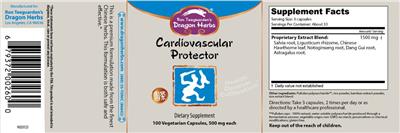
Cardiovascular Protector by Ron Teeguarden's Dragon Herbs label
The label scan from the NIH Dietary Supplement Label Database. Tap to enlarge.
Label images are published by the NIH Dietary Supplement Label Database for the version of this product on file. Always read your actual product label.
View the full label (PDF)The Ingredients in Cardiovascular Protector by Ron Teeguarden's Dragon Herbs
These are the 6 active ingredients this product is made of. Select any to open its full monograph.
Serving size3 Capsule(s) Dosage formCapsule Servings per container33 Amounts shown are per serving.
Most supplement products combine several ingredients, and a medication can interact with the product through any one of them. Each ingredient below shows whether it has known drug interactions.
Proprietary Extract Formula
- › Astragalus root extract
- › Dang Gui Root Extract
- › Salvia Root Extract
- › Ligusticum Rhizome Extract
- › Chinese Hawthorn Leaf Extract
- › Notoginseng Root Extract
Other (inactive) ingredients: Pullulan Polysaccharide, Rice, Powder, Bamboo Extract, Powder, Rice extract Blend. These complete the product’s ingredient list but are not active constituents.
Cardiovascular Protector by Ron Teeguarden's Dragon Herbs Drug Interactions
HelloPharmacist Interaction Report
Cardiovascular Protector by Ron Teeguarden's Dragon Herbs contains several ingredients with documented interactions with medications.
The most serious concern involves Dang Gui Root Extract and warfarin (a blood thinner)—case reports show it can increase bleeding risk, and one patient's blood thinning marker jumped significantly after four weeks of use.
Read the full breakdown — every affected drug type, severity by severity
Hawthorn Leaf Extract carries two Major-severity interactions: with nitrates (heart medications that dilate blood vessels) and with phosphodiesterase-5 inhibitors like sildenafil, both of which could cause excessive blood vessel relaxation and unsafe drops in blood pressure. It also interacts Moderately with beta-blockers, calcium channel blockers, and blood thinners—all common heart medications—by potentially adding to their effects or raising bleeding risk.
Astragalus Root Extract interacts Moderately with immunosuppressants (which it may counteract), lithium (a mood stabilizer it may concentrate in your body), cyclophosphamide (a chemotherapy drug with conflicting data), and antidiabetes drugs (raising low blood sugar risk). Dang Gui Root Extract also has a Moderate interaction with estrogens, including hormone replacement therapy.
We could not check Salvia Root Extract, Ligusticum Rhizome Extract, or Notoginseng Root Extract—no interaction data is on file for them. Altogether, these interactions span 432 individual medications.
Run your exact medications through the search tool on this page before starting.
Check your own medications below · Editorial policy · How we use AI
Want to check YOUR meds against Cardiovascular Protector?
Ask about interactions with your drugs in plain English — “Can I take it with lisinopril?” — and we find you the answer in seconds, ingredient by ingredient.
Go to the checkerIngredients driving the most interactions
Individual Drug Interactions
The ingredients in Cardiovascular Protector interact with 1,221 drugs. Click any drug to see the details.
5 of the 6 ingredients in Cardiovascular Protector interact with drugs. Each result below shows which ingredient is responsible. Salvia Root Extract Astragalus root extract Notoginseng Root Extract Chinese Hawthorn Leaf Extract Dang Gui Root Extract
AbciximabReoPro
How Abciximab interacts with Cardiovascular Protector — through 3 ingredients. Tap an ingredient for the detail:
Salvia Root ExtractAnticoagulant/antiplatelet Drugs Major
Interaction Summary
Theoretically, danshen may increase the risk of bleeding if used with anticoagulant or antiplatelet drugs.
Read the full Salvia Root Extract + Abciximab interactionDang Gui Root ExtractAnticoagulant/antiplatelet Drugs Moderate
Interaction Summary
Theoretically, dong quai may increase the risk of bleeding when used with anticoagulant or antiplatelet drugs; however, research is conflicting.
Read the full Dang Gui Root Extract + Abciximab interactionChinese Hawthorn Leaf ExtractAnticoagulant/antiplatelet Drugs Moderate
Interaction Summary
Theoretically, hawthorn may increase the risk of bleeding if used with anticoagulant or antiplatelet drugs.
Read the full Chinese Hawthorn Leaf Extract + Abciximab interactionAbrocitinibCibinqo
How Abrocitinib interacts with Cardiovascular Protector — through 4 ingredients. Tap an ingredient for the detail:
Salvia Root ExtractAnticoagulant/antiplatelet Drugs, Cytochrome P450 2c9 (cyp2c9) Substrates Major
Interaction Summary
Theoretically, danshen may increase the risk of bleeding if used with anticoagulant or antiplatelet drugs.
Read the full Salvia Root Extract + Abrocitinib interactionChinese Hawthorn Leaf ExtractAnticoagulant/antiplatelet Drugs Moderate
Interaction Summary
Theoretically, hawthorn may increase the risk of bleeding if used with anticoagulant or antiplatelet drugs.
Read the full Chinese Hawthorn Leaf Extract + Abrocitinib interactionDang Gui Root ExtractAnticoagulant/antiplatelet Drugs Moderate
Interaction Summary
Theoretically, dong quai may increase the risk of bleeding when used with anticoagulant or antiplatelet drugs; however, research is conflicting.
Read the full Dang Gui Root Extract + Abrocitinib interactionAstragalus Root ExtractImmunosuppressants Moderate
Interaction Summary
Theoretically, astragalus might interfere with immunosuppressive therapy.
Read the full Astragalus Root Extract + Abrocitinib interactionAcenocoumarolSintrom
How Acenocoumarol interacts with Cardiovascular Protector — through 3 ingredients. Tap an ingredient for the detail:
Salvia Root ExtractAnticoagulant/antiplatelet Drugs Major
Interaction Summary
Theoretically, danshen may increase the risk of bleeding if used with anticoagulant or antiplatelet drugs.
Read the full Salvia Root Extract + Acenocoumarol interactionDang Gui Root ExtractAnticoagulant/antiplatelet Drugs Moderate
Interaction Summary
Theoretically, dong quai may increase the risk of bleeding when used with anticoagulant or antiplatelet drugs; however, research is conflicting.
Read the full Dang Gui Root Extract + Acenocoumarol interactionChinese Hawthorn Leaf ExtractAnticoagulant/antiplatelet Drugs Moderate
Interaction Summary
Theoretically, hawthorn may increase the risk of bleeding if used with anticoagulant or antiplatelet drugs.
Read the full Chinese Hawthorn Leaf Extract + Acenocoumarol interactionAcetaminophen, AspirinGemnisyn
How Acetaminophen, Aspirin interacts with Cardiovascular Protector — through 4 ingredients. Tap an ingredient for the detail:
Salvia Root ExtractCytochrome P450 2e1 (cyp2e1) Substrates, Aspirin +3 Major
Interaction Summary
Theoretically, danshen may increase the levels and clinical effects of drugs metabolized by CYP2E1.
Read the full Salvia Root Extract + Acetaminophen, Aspirin interactionNotoginseng Root ExtractCytochrome P450 1a2 (cyp1a2) Substrates, Aspirin Moderate
Interaction Summary
Theoretically, taking Panax notoginseng might reduce the levels and clinical effects of CYP1A2 substrates.
Read the full Notoginseng Root Extract + Acetaminophen, Aspirin interactionChinese Hawthorn Leaf ExtractAnticoagulant/antiplatelet Drugs Moderate
Interaction Summary
Theoretically, hawthorn may increase the risk of bleeding if used with anticoagulant or antiplatelet drugs.
Read the full Chinese Hawthorn Leaf Extract + Acetaminophen, Aspirin interactionDang Gui Root ExtractAnticoagulant/antiplatelet Drugs Moderate
Interaction Summary
Theoretically, dong quai may increase the risk of bleeding when used with anticoagulant or antiplatelet drugs; however, research is conflicting.
Read the full Dang Gui Root Extract + Acetaminophen, Aspirin interactionAcetaminophen, Aspirin, CaffeineExcedrin, Excedrin Extra Strength, Excedrin Migraine
How Acetaminophen, Aspirin, Caffeine interacts with Cardiovascular Protector — through 4 ingredients. Tap an ingredient for the detail:
Salvia Root ExtractCytochrome P450 2e1 (cyp2e1) Substrates, Aspirin +4 Major
Interaction Summary
Theoretically, danshen may increase the levels and clinical effects of drugs metabolized by CYP2E1.
Read the full Salvia Root Extract + Acetaminophen, Aspirin, Caffeine interactionDang Gui Root ExtractAnticoagulant/antiplatelet Drugs Moderate
Interaction Summary
Theoretically, dong quai may increase the risk of bleeding when used with anticoagulant or antiplatelet drugs; however, research is conflicting.
Read the full Dang Gui Root Extract + Acetaminophen, Aspirin, Caffeine interactionChinese Hawthorn Leaf ExtractAnticoagulant/antiplatelet Drugs Moderate
Interaction Summary
Theoretically, hawthorn may increase the risk of bleeding if used with anticoagulant or antiplatelet drugs.
Read the full Chinese Hawthorn Leaf Extract + Acetaminophen, Aspirin, Caffeine interactionNotoginseng Root ExtractCytochrome P450 1a2 (cyp1a2) Substrates, Aspirin +1 Moderate
Interaction Summary
Theoretically, taking Panax notoginseng might reduce the levels and clinical effects of CYP1A2 substrates.
Read the full Notoginseng Root Extract + Acetaminophen, Aspirin, Caffeine interactionAcetaminophen, IbuprofenCombogesic
How Acetaminophen, Ibuprofen interacts with Cardiovascular Protector — through 4 ingredients. Tap an ingredient for the detail:
Salvia Root ExtractAnticoagulant/antiplatelet Drugs, Cytochrome P450 2e1 (cyp2e1) Substrates +3 Major
Interaction Summary
Theoretically, danshen may increase the risk of bleeding if used with anticoagulant or antiplatelet drugs.
Read the full Salvia Root Extract + Acetaminophen, Ibuprofen interactionNotoginseng Root ExtractCytochrome P450 1a2 (cyp1a2) Substrates Moderate
Interaction Summary
Theoretically, taking Panax notoginseng might reduce the levels and clinical effects of CYP1A2 substrates.
Read the full Notoginseng Root Extract + Acetaminophen, Ibuprofen interactionDang Gui Root ExtractAnticoagulant/antiplatelet Drugs Moderate
Interaction Summary
Theoretically, dong quai may increase the risk of bleeding when used with anticoagulant or antiplatelet drugs; however, research is conflicting.
Read the full Dang Gui Root Extract + Acetaminophen, Ibuprofen interactionChinese Hawthorn Leaf ExtractAnticoagulant/antiplatelet Drugs Moderate
Interaction Summary
Theoretically, hawthorn may increase the risk of bleeding if used with anticoagulant or antiplatelet drugs.
Read the full Chinese Hawthorn Leaf Extract + Acetaminophen, Ibuprofen interactionAcetylsalicylic AcidEntrophen
How Acetylsalicylic Acid interacts with Cardiovascular Protector — through 4 ingredients. Tap an ingredient for the detail:
Salvia Root ExtractAspirin, Anticoagulant/antiplatelet Drugs Major
Interaction Summary
Theoretically, danshen may increase the levels of aspirin and the risk of bleeding.
Read the full Salvia Root Extract + Acetylsalicylic Acid interactionDang Gui Root ExtractAnticoagulant/antiplatelet Drugs Moderate
Interaction Summary
Theoretically, dong quai may increase the risk of bleeding when used with anticoagulant or antiplatelet drugs; however, research is conflicting.
Read the full Dang Gui Root Extract + Acetylsalicylic Acid interactionChinese Hawthorn Leaf ExtractAnticoagulant/antiplatelet Drugs Moderate
Interaction Summary
Theoretically, hawthorn may increase the risk of bleeding if used with anticoagulant or antiplatelet drugs.
Read the full Chinese Hawthorn Leaf Extract + Acetylsalicylic Acid interactionNotoginseng Root ExtractAspirin Moderate
Interaction Summary
Theoretically, taking Panax notoginseng concomitantly with aspirin may increase the risk of adverse effects from both products.
Read the full Notoginseng Root Extract + Acetylsalicylic Acid interactionAlteplase, TpaActilyse, Activase
How Alteplase, Tpa interacts with Cardiovascular Protector — through 3 ingredients. Tap an ingredient for the detail:
Salvia Root ExtractAnticoagulant/antiplatelet Drugs Major
Interaction Summary
Theoretically, danshen may increase the risk of bleeding if used with anticoagulant or antiplatelet drugs.
Read the full Salvia Root Extract + Alteplase, Tpa interactionChinese Hawthorn Leaf ExtractAnticoagulant/antiplatelet Drugs Moderate
Interaction Summary
Theoretically, hawthorn may increase the risk of bleeding if used with anticoagulant or antiplatelet drugs.
Read the full Chinese Hawthorn Leaf Extract + Alteplase, Tpa interactionDang Gui Root ExtractAnticoagulant/antiplatelet Drugs Moderate
Interaction Summary
Theoretically, dong quai may increase the risk of bleeding when used with anticoagulant or antiplatelet drugs; however, research is conflicting.
Read the full Dang Gui Root Extract + Alteplase, Tpa interactionAluminum Hydroxide, Aspirin, Codeine Phosphate, Magnesium HydroxideAscriptin Codeine #2
How Aluminum Hydroxide, Aspirin, Codeine Phosphate, Magnesium Hydroxide interacts with Cardiovascular Protector — through 4 ingredients. Tap an ingredient for the detail:
Salvia Root ExtractAspirin, Anticoagulant/antiplatelet Drugs Major
Interaction Summary
Theoretically, danshen may increase the levels of aspirin and the risk of bleeding.
Read the full Salvia Root Extract + Aluminum Hydroxide, Aspirin, Codeine Phosphate, Magnesium Hydroxide interactionDang Gui Root ExtractAnticoagulant/antiplatelet Drugs Moderate
Interaction Summary
Theoretically, dong quai may increase the risk of bleeding when used with anticoagulant or antiplatelet drugs; however, research is conflicting.
Read the full Dang Gui Root Extract + Aluminum Hydroxide, Aspirin, Codeine Phosphate, Magnesium Hydroxide interactionChinese Hawthorn Leaf ExtractAnticoagulant/antiplatelet Drugs Moderate
Interaction Summary
Theoretically, hawthorn may increase the risk of bleeding if used with anticoagulant or antiplatelet drugs.
Read the full Chinese Hawthorn Leaf Extract + Aluminum Hydroxide, Aspirin, Codeine Phosphate, Magnesium Hydroxide interactionNotoginseng Root ExtractAspirin Moderate
Interaction Summary
Theoretically, taking Panax notoginseng concomitantly with aspirin may increase the risk of adverse effects from both products.
Read the full Notoginseng Root Extract + Aluminum Hydroxide, Aspirin, Codeine Phosphate, Magnesium Hydroxide interactionAluminum Hydroxide, Aspirin, Magnesium HydroxideAscriptin
How Aluminum Hydroxide, Aspirin, Magnesium Hydroxide interacts with Cardiovascular Protector — through 4 ingredients. Tap an ingredient for the detail:
Salvia Root ExtractAnticoagulant/antiplatelet Drugs, Aspirin Major
Interaction Summary
Theoretically, danshen may increase the risk of bleeding if used with anticoagulant or antiplatelet drugs.
Read the full Salvia Root Extract + Aluminum Hydroxide, Aspirin, Magnesium Hydroxide interactionNotoginseng Root ExtractAspirin Moderate
Interaction Summary
Theoretically, taking Panax notoginseng concomitantly with aspirin may increase the risk of adverse effects from both products.
Read the full Notoginseng Root Extract + Aluminum Hydroxide, Aspirin, Magnesium Hydroxide interactionDang Gui Root ExtractAnticoagulant/antiplatelet Drugs Moderate
Interaction Summary
Theoretically, dong quai may increase the risk of bleeding when used with anticoagulant or antiplatelet drugs; however, research is conflicting.
Read the full Dang Gui Root Extract + Aluminum Hydroxide, Aspirin, Magnesium Hydroxide interactionChinese Hawthorn Leaf ExtractAnticoagulant/antiplatelet Drugs Moderate
Interaction Summary
Theoretically, hawthorn may increase the risk of bleeding if used with anticoagulant or antiplatelet drugs.
Read the full Chinese Hawthorn Leaf Extract + Aluminum Hydroxide, Aspirin, Magnesium Hydroxide interactionAnacaulase-bcdbNexoBrid
How Anacaulase-bcdb interacts with Cardiovascular Protector — through 3 ingredients. Tap an ingredient for the detail:
Salvia Root ExtractAnticoagulant/antiplatelet Drugs Major
Interaction Summary
Theoretically, danshen may increase the risk of bleeding if used with anticoagulant or antiplatelet drugs.
Read the full Salvia Root Extract + Anacaulase-bcdb interactionChinese Hawthorn Leaf ExtractAnticoagulant/antiplatelet Drugs Moderate
Interaction Summary
Theoretically, hawthorn may increase the risk of bleeding if used with anticoagulant or antiplatelet drugs.
Read the full Chinese Hawthorn Leaf Extract + Anacaulase-bcdb interactionDang Gui Root ExtractAnticoagulant/antiplatelet Drugs Moderate
Interaction Summary
Theoretically, dong quai may increase the risk of bleeding when used with anticoagulant or antiplatelet drugs; however, research is conflicting.
Read the full Dang Gui Root Extract + Anacaulase-bcdb interactionAnagrelideAgrylin
How Anagrelide interacts with Cardiovascular Protector — through 4 ingredients. Tap an ingredient for the detail:
Salvia Root ExtractCytochrome P450 1a2 (cyp1a2) Substrates, Anticoagulant/antiplatelet Drugs Major
Interaction Summary
Theoretically, danshen may increase the levels and clinical effects of drugs metabolized by CYP1A2.
Read the full Salvia Root Extract + Anagrelide interactionChinese Hawthorn Leaf ExtractAnticoagulant/antiplatelet Drugs Moderate
Interaction Summary
Theoretically, hawthorn may increase the risk of bleeding if used with anticoagulant or antiplatelet drugs.
Read the full Chinese Hawthorn Leaf Extract + Anagrelide interactionDang Gui Root ExtractAnticoagulant/antiplatelet Drugs Moderate
Interaction Summary
Theoretically, dong quai may increase the risk of bleeding when used with anticoagulant or antiplatelet drugs; however, research is conflicting.
Read the full Dang Gui Root Extract + Anagrelide interactionNotoginseng Root ExtractCytochrome P450 1a2 (cyp1a2) Substrates Moderate
Interaction Summary
Theoretically, taking Panax notoginseng might reduce the levels and clinical effects of CYP1A2 substrates.
Read the full Notoginseng Root Extract + Anagrelide interactionAnisindioneMiradon
How Anisindione interacts with Cardiovascular Protector — through 3 ingredients. Tap an ingredient for the detail:
Salvia Root ExtractAnticoagulant/antiplatelet Drugs Major
Interaction Summary
Theoretically, danshen may increase the risk of bleeding if used with anticoagulant or antiplatelet drugs.
Read the full Salvia Root Extract + Anisindione interactionDang Gui Root ExtractAnticoagulant/antiplatelet Drugs Moderate
Interaction Summary
Theoretically, dong quai may increase the risk of bleeding when used with anticoagulant or antiplatelet drugs; however, research is conflicting.
Read the full Dang Gui Root Extract + Anisindione interactionChinese Hawthorn Leaf ExtractAnticoagulant/antiplatelet Drugs Moderate
Interaction Summary
Theoretically, hawthorn may increase the risk of bleeding if used with anticoagulant or antiplatelet drugs.
Read the full Chinese Hawthorn Leaf Extract + Anisindione interactionAntithrombin IiiThrombate III
How Antithrombin Iii interacts with Cardiovascular Protector — through 3 ingredients. Tap an ingredient for the detail:
Salvia Root ExtractAnticoagulant/antiplatelet Drugs Major
Interaction Summary
Theoretically, danshen may increase the risk of bleeding if used with anticoagulant or antiplatelet drugs.
Read the full Salvia Root Extract + Antithrombin Iii interactionChinese Hawthorn Leaf ExtractAnticoagulant/antiplatelet Drugs Moderate
Interaction Summary
Theoretically, hawthorn may increase the risk of bleeding if used with anticoagulant or antiplatelet drugs.
Read the full Chinese Hawthorn Leaf Extract + Antithrombin Iii interactionDang Gui Root ExtractAnticoagulant/antiplatelet Drugs Moderate
Interaction Summary
Theoretically, dong quai may increase the risk of bleeding when used with anticoagulant or antiplatelet drugs; however, research is conflicting.
Read the full Dang Gui Root Extract + Antithrombin Iii interactionApixabanEliquis
How Apixaban interacts with Cardiovascular Protector — through 3 ingredients. Tap an ingredient for the detail:
Salvia Root ExtractP-glycoprotein Substrates, Anticoagulant/antiplatelet Drugs +1 Major
Interaction Summary
Danshen might alter the levels of drugs cleared by p-glycoprotein.
Read the full Salvia Root Extract + Apixaban interactionDang Gui Root ExtractAnticoagulant/antiplatelet Drugs Moderate
Interaction Summary
Theoretically, dong quai may increase the risk of bleeding when used with anticoagulant or antiplatelet drugs; however, research is conflicting.
Read the full Dang Gui Root Extract + Apixaban interactionChinese Hawthorn Leaf ExtractAnticoagulant/antiplatelet Drugs Moderate
Interaction Summary
Theoretically, hawthorn may increase the risk of bleeding if used with anticoagulant or antiplatelet drugs.
Read the full Chinese Hawthorn Leaf Extract + Apixaban interactionArgatrobanArgatroban
How Argatroban interacts with Cardiovascular Protector — through 3 ingredients. Tap an ingredient for the detail:
Salvia Root ExtractAnticoagulant/antiplatelet Drugs Major
Interaction Summary
Theoretically, danshen may increase the risk of bleeding if used with anticoagulant or antiplatelet drugs.
Read the full Salvia Root Extract + Argatroban interactionDang Gui Root ExtractAnticoagulant/antiplatelet Drugs Moderate
Interaction Summary
Theoretically, dong quai may increase the risk of bleeding when used with anticoagulant or antiplatelet drugs; however, research is conflicting.
Read the full Dang Gui Root Extract + Argatroban interactionChinese Hawthorn Leaf ExtractAnticoagulant/antiplatelet Drugs Moderate
Interaction Summary
Theoretically, hawthorn may increase the risk of bleeding if used with anticoagulant or antiplatelet drugs.
Read the full Chinese Hawthorn Leaf Extract + Argatroban interactionAspirinAngettes 75, ASA, Asaphen, Aspirin, Caprin, Cartia +8 more
How Aspirin interacts with Cardiovascular Protector — through 4 ingredients. Tap an ingredient for the detail:
Salvia Root ExtractAnticoagulant/antiplatelet Drugs, Aspirin Major
Interaction Summary
Theoretically, danshen may increase the risk of bleeding if used with anticoagulant or antiplatelet drugs.
Read the full Salvia Root Extract + Aspirin interactionNotoginseng Root ExtractAspirin Moderate
Interaction Summary
Theoretically, taking Panax notoginseng concomitantly with aspirin may increase the risk of adverse effects from both products.
Read the full Notoginseng Root Extract + Aspirin interactionChinese Hawthorn Leaf ExtractAnticoagulant/antiplatelet Drugs Moderate
Interaction Summary
Theoretically, hawthorn may increase the risk of bleeding if used with anticoagulant or antiplatelet drugs.
Read the full Chinese Hawthorn Leaf Extract + Aspirin interactionDang Gui Root ExtractAnticoagulant/antiplatelet Drugs Moderate
Interaction Summary
Theoretically, dong quai may increase the risk of bleeding when used with anticoagulant or antiplatelet drugs; however, research is conflicting.
Read the full Dang Gui Root Extract + Aspirin interactionAspirin, Aluminum Hydroxide, Codeine Phosphate, Magnesium HydroxideAscriptin Codeine #3
How Aspirin, Aluminum Hydroxide, Codeine Phosphate, Magnesium Hydroxide interacts with Cardiovascular Protector — through 4 ingredients. Tap an ingredient for the detail:
Salvia Root ExtractAnticoagulant/antiplatelet Drugs, Aspirin Major
Interaction Summary
Theoretically, danshen may increase the risk of bleeding if used with anticoagulant or antiplatelet drugs.
Read the full Salvia Root Extract + Aspirin, Aluminum Hydroxide, Codeine Phosphate, Magnesium Hydroxide interactionDang Gui Root ExtractAnticoagulant/antiplatelet Drugs Moderate
Interaction Summary
Theoretically, dong quai may increase the risk of bleeding when used with anticoagulant or antiplatelet drugs; however, research is conflicting.
Read the full Dang Gui Root Extract + Aspirin, Aluminum Hydroxide, Codeine Phosphate, Magnesium Hydroxide interactionNotoginseng Root ExtractAspirin Moderate
Interaction Summary
Theoretically, taking Panax notoginseng concomitantly with aspirin may increase the risk of adverse effects from both products.
Read the full Notoginseng Root Extract + Aspirin, Aluminum Hydroxide, Codeine Phosphate, Magnesium Hydroxide interactionChinese Hawthorn Leaf ExtractAnticoagulant/antiplatelet Drugs Moderate
Interaction Summary
Theoretically, hawthorn may increase the risk of bleeding if used with anticoagulant or antiplatelet drugs.
Read the full Chinese Hawthorn Leaf Extract + Aspirin, Aluminum Hydroxide, Codeine Phosphate, Magnesium Hydroxide interactionAspirin, ButalbitalAxotal
How Aspirin, Butalbital interacts with Cardiovascular Protector — through 4 ingredients. Tap an ingredient for the detail:
Salvia Root ExtractAnticoagulant/antiplatelet Drugs, Aspirin Major
Interaction Summary
Theoretically, danshen may increase the risk of bleeding if used with anticoagulant or antiplatelet drugs.
Read the full Salvia Root Extract + Aspirin, Butalbital interactionChinese Hawthorn Leaf ExtractAnticoagulant/antiplatelet Drugs Moderate
Interaction Summary
Theoretically, hawthorn may increase the risk of bleeding if used with anticoagulant or antiplatelet drugs.
Read the full Chinese Hawthorn Leaf Extract + Aspirin, Butalbital interactionDang Gui Root ExtractAnticoagulant/antiplatelet Drugs Moderate
Interaction Summary
Theoretically, dong quai may increase the risk of bleeding when used with anticoagulant or antiplatelet drugs; however, research is conflicting.
Read the full Dang Gui Root Extract + Aspirin, Butalbital interactionNotoginseng Root ExtractAspirin Moderate
Interaction Summary
Theoretically, taking Panax notoginseng concomitantly with aspirin may increase the risk of adverse effects from both products.
Read the full Notoginseng Root Extract + Aspirin, Butalbital interactionAspirin, Butalbital, CaffeineFiorinal
How Aspirin, Butalbital, Caffeine interacts with Cardiovascular Protector — through 4 ingredients. Tap an ingredient for the detail:
Salvia Root ExtractAnticoagulant/antiplatelet Drugs, Cytochrome P450 3a4 (cyp3a4) Substrates +2 Major
Interaction Summary
Theoretically, danshen may increase the risk of bleeding if used with anticoagulant or antiplatelet drugs.
Read the full Salvia Root Extract + Aspirin, Butalbital, Caffeine interactionNotoginseng Root ExtractCytochrome P450 1a2 (cyp1a2) Substrates, Aspirin +1 Moderate
Interaction Summary
Theoretically, taking Panax notoginseng might reduce the levels and clinical effects of CYP1A2 substrates.
Read the full Notoginseng Root Extract + Aspirin, Butalbital, Caffeine interactionChinese Hawthorn Leaf ExtractAnticoagulant/antiplatelet Drugs Moderate
Interaction Summary
Theoretically, hawthorn may increase the risk of bleeding if used with anticoagulant or antiplatelet drugs.
Read the full Chinese Hawthorn Leaf Extract + Aspirin, Butalbital, Caffeine interactionDang Gui Root ExtractAnticoagulant/antiplatelet Drugs Moderate
Interaction Summary
Theoretically, dong quai may increase the risk of bleeding when used with anticoagulant or antiplatelet drugs; however, research is conflicting.
Read the full Dang Gui Root Extract + Aspirin, Butalbital, Caffeine interactionAspirin, Butalbital, Caffeine, Codeine PhosphateFiorinal w/ Codeine
How Aspirin, Butalbital, Caffeine, Codeine Phosphate interacts with Cardiovascular Protector — through 4 ingredients. Tap an ingredient for the detail:
Salvia Root ExtractAnticoagulant/antiplatelet Drugs, Cytochrome P450 1a2 (cyp1a2) Substrates +2 Major
Interaction Summary
Theoretically, danshen may increase the risk of bleeding if used with anticoagulant or antiplatelet drugs.
Read the full Salvia Root Extract + Aspirin, Butalbital, Caffeine, Codeine Phosphate interactionDang Gui Root ExtractAnticoagulant/antiplatelet Drugs Moderate
Interaction Summary
Theoretically, dong quai may increase the risk of bleeding when used with anticoagulant or antiplatelet drugs; however, research is conflicting.
Read the full Dang Gui Root Extract + Aspirin, Butalbital, Caffeine, Codeine Phosphate interactionChinese Hawthorn Leaf ExtractAnticoagulant/antiplatelet Drugs Moderate
Interaction Summary
Theoretically, hawthorn may increase the risk of bleeding if used with anticoagulant or antiplatelet drugs.
Read the full Chinese Hawthorn Leaf Extract + Aspirin, Butalbital, Caffeine, Codeine Phosphate interactionNotoginseng Root ExtractCytochrome P450 1a2 (cyp1a2) Substrates, Aspirin +1 Moderate
Interaction Summary
Theoretically, taking Panax notoginseng might reduce the levels and clinical effects of CYP1A2 substrates.
Read the full Notoginseng Root Extract + Aspirin, Butalbital, Caffeine, Codeine Phosphate interactionAspirin, Butalbital, Caffeine, PhenacetinMarnal
How Aspirin, Butalbital, Caffeine, Phenacetin interacts with Cardiovascular Protector — through 4 ingredients. Tap an ingredient for the detail:
Salvia Root ExtractAspirin, Anticoagulant/antiplatelet Drugs +2 Major
Interaction Summary
Theoretically, danshen may increase the levels of aspirin and the risk of bleeding.
Read the full Salvia Root Extract + Aspirin, Butalbital, Caffeine, Phenacetin interactionChinese Hawthorn Leaf ExtractAnticoagulant/antiplatelet Drugs Moderate
Interaction Summary
Theoretically, hawthorn may increase the risk of bleeding if used with anticoagulant or antiplatelet drugs.
Read the full Chinese Hawthorn Leaf Extract + Aspirin, Butalbital, Caffeine, Phenacetin interactionDang Gui Root ExtractAnticoagulant/antiplatelet Drugs Moderate
Interaction Summary
Theoretically, dong quai may increase the risk of bleeding when used with anticoagulant or antiplatelet drugs; however, research is conflicting.
Read the full Dang Gui Root Extract + Aspirin, Butalbital, Caffeine, Phenacetin interactionNotoginseng Root ExtractCytochrome P450 1a2 (cyp1a2) Substrates, Aspirin +1 Moderate
Interaction Summary
Theoretically, taking Panax notoginseng might reduce the levels and clinical effects of CYP1A2 substrates.
Read the full Notoginseng Root Extract + Aspirin, Butalbital, Caffeine, Phenacetin interactionAspirin, CaffeineAnacin
How Aspirin, Caffeine interacts with Cardiovascular Protector — through 4 ingredients. Tap an ingredient for the detail:
Salvia Root ExtractCytochrome P450 1a2 (cyp1a2) Substrates, Anticoagulant/antiplatelet Drugs +2 Major
Interaction Summary
Theoretically, danshen may increase the levels and clinical effects of drugs metabolized by CYP1A2.
Read the full Salvia Root Extract + Aspirin, Caffeine interactionChinese Hawthorn Leaf ExtractAnticoagulant/antiplatelet Drugs Moderate
Interaction Summary
Theoretically, hawthorn may increase the risk of bleeding if used with anticoagulant or antiplatelet drugs.
Read the full Chinese Hawthorn Leaf Extract + Aspirin, Caffeine interactionNotoginseng Root ExtractCytochrome P450 1a2 (cyp1a2) Substrates, Aspirin +1 Moderate
Interaction Summary
Theoretically, taking Panax notoginseng might reduce the levels and clinical effects of CYP1A2 substrates.
Read the full Notoginseng Root Extract + Aspirin, Caffeine interactionDang Gui Root ExtractAnticoagulant/antiplatelet Drugs Moderate
Interaction Summary
Theoretically, dong quai may increase the risk of bleeding when used with anticoagulant or antiplatelet drugs; however, research is conflicting.
Read the full Dang Gui Root Extract + Aspirin, Caffeine interactionAspirin, Caffeine, Codeine PhosphateAnacin w/ Codeine
How Aspirin, Caffeine, Codeine Phosphate interacts with Cardiovascular Protector — through 4 ingredients. Tap an ingredient for the detail:
Salvia Root ExtractCytochrome P450 3a4 (cyp3a4) Substrates, Anticoagulant/antiplatelet Drugs +2 Major
Interaction Summary
Danshen might alter the levels and clinical effects of drugs metabolized by CYP3A4.
Read the full Salvia Root Extract + Aspirin, Caffeine, Codeine Phosphate interactionChinese Hawthorn Leaf ExtractAnticoagulant/antiplatelet Drugs Moderate
Interaction Summary
Theoretically, hawthorn may increase the risk of bleeding if used with anticoagulant or antiplatelet drugs.
Read the full Chinese Hawthorn Leaf Extract + Aspirin, Caffeine, Codeine Phosphate interactionDang Gui Root ExtractAnticoagulant/antiplatelet Drugs Moderate
Interaction Summary
Theoretically, dong quai may increase the risk of bleeding when used with anticoagulant or antiplatelet drugs; however, research is conflicting.
Read the full Dang Gui Root Extract + Aspirin, Caffeine, Codeine Phosphate interactionNotoginseng Root ExtractCytochrome P450 1a2 (cyp1a2) Substrates, Aspirin +1 Moderate
Interaction Summary
Theoretically, taking Panax notoginseng might reduce the levels and clinical effects of CYP1A2 substrates.
Read the full Notoginseng Root Extract + Aspirin, Caffeine, Codeine Phosphate interactionAspirin, Caffeine, Dihydrocodeine BitartrateSynalgos DC
How Aspirin, Caffeine, Dihydrocodeine Bitartrate interacts with Cardiovascular Protector — through 4 ingredients. Tap an ingredient for the detail:
Salvia Root ExtractCytochrome P450 1a2 (cyp1a2) Substrates, Cytochrome P450 3a4 (cyp3a4) Substrates +2 Major
Interaction Summary
Theoretically, danshen may increase the levels and clinical effects of drugs metabolized by CYP1A2.
Read the full Salvia Root Extract + Aspirin, Caffeine, Dihydrocodeine Bitartrate interactionNotoginseng Root ExtractCytochrome P450 1a2 (cyp1a2) Substrates, Aspirin +1 Moderate
Interaction Summary
Theoretically, taking Panax notoginseng might reduce the levels and clinical effects of CYP1A2 substrates.
Read the full Notoginseng Root Extract + Aspirin, Caffeine, Dihydrocodeine Bitartrate interactionChinese Hawthorn Leaf ExtractAnticoagulant/antiplatelet Drugs Moderate
Interaction Summary
Theoretically, hawthorn may increase the risk of bleeding if used with anticoagulant or antiplatelet drugs.
Read the full Chinese Hawthorn Leaf Extract + Aspirin, Caffeine, Dihydrocodeine Bitartrate interactionDang Gui Root ExtractAnticoagulant/antiplatelet Drugs Moderate
Interaction Summary
Theoretically, dong quai may increase the risk of bleeding when used with anticoagulant or antiplatelet drugs; however, research is conflicting.
Read the full Dang Gui Root Extract + Aspirin, Caffeine, Dihydrocodeine Bitartrate interactionAspirin, Caffeine, Dover's PwdAcedoval, Dovacet
How Aspirin, Caffeine, Dover's Pwd interacts with Cardiovascular Protector — through 4 ingredients. Tap an ingredient for the detail:
Salvia Root ExtractCytochrome P450 3a4 (cyp3a4) Substrates, Cytochrome P450 1a2 (cyp1a2) Substrates +2 Major
Interaction Summary
Danshen might alter the levels and clinical effects of drugs metabolized by CYP3A4.
Read the full Salvia Root Extract + Aspirin, Caffeine, Dover's Pwd interactionDang Gui Root ExtractAnticoagulant/antiplatelet Drugs Moderate
Interaction Summary
Theoretically, dong quai may increase the risk of bleeding when used with anticoagulant or antiplatelet drugs; however, research is conflicting.
Read the full Dang Gui Root Extract + Aspirin, Caffeine, Dover's Pwd interactionNotoginseng Root ExtractCytochrome P450 1a2 (cyp1a2) Substrates, Aspirin +1 Moderate
Interaction Summary
Theoretically, taking Panax notoginseng might reduce the levels and clinical effects of CYP1A2 substrates.
Read the full Notoginseng Root Extract + Aspirin, Caffeine, Dover's Pwd interactionChinese Hawthorn Leaf ExtractAnticoagulant/antiplatelet Drugs Moderate
Interaction Summary
Theoretically, hawthorn may increase the risk of bleeding if used with anticoagulant or antiplatelet drugs.
Read the full Chinese Hawthorn Leaf Extract + Aspirin, Caffeine, Dover's Pwd interactionAspirin, Caffeine, HydrocodoneDamason-P
How Aspirin, Caffeine, Hydrocodone interacts with Cardiovascular Protector — through 4 ingredients. Tap an ingredient for the detail:
Salvia Root ExtractAnticoagulant/antiplatelet Drugs, Aspirin +2 Major
Interaction Summary
Theoretically, danshen may increase the risk of bleeding if used with anticoagulant or antiplatelet drugs.
Read the full Salvia Root Extract + Aspirin, Caffeine, Hydrocodone interactionNotoginseng Root ExtractCytochrome P450 1a2 (cyp1a2) Substrates, Aspirin +1 Moderate
Interaction Summary
Theoretically, taking Panax notoginseng might reduce the levels and clinical effects of CYP1A2 substrates.
Read the full Notoginseng Root Extract + Aspirin, Caffeine, Hydrocodone interactionDang Gui Root ExtractAnticoagulant/antiplatelet Drugs Moderate
Interaction Summary
Theoretically, dong quai may increase the risk of bleeding when used with anticoagulant or antiplatelet drugs; however, research is conflicting.
Read the full Dang Gui Root Extract + Aspirin, Caffeine, Hydrocodone interactionChinese Hawthorn Leaf ExtractAnticoagulant/antiplatelet Drugs Moderate
Interaction Summary
Theoretically, hawthorn may increase the risk of bleeding if used with anticoagulant or antiplatelet drugs.
Read the full Chinese Hawthorn Leaf Extract + Aspirin, Caffeine, Hydrocodone interactionAspirin, Caffeine, Isobutylallylbarbituric Acid, PhenacetinLanorinal
How Aspirin, Caffeine, Isobutylallylbarbituric Acid, Phenacetin interacts with Cardiovascular Protector — through 4 ingredients. Tap an ingredient for the detail:
Salvia Root ExtractCytochrome P450 1a2 (cyp1a2) Substrates, Anticoagulant/antiplatelet Drugs +2 Major
Interaction Summary
Theoretically, danshen may increase the levels and clinical effects of drugs metabolized by CYP1A2.
Read the full Salvia Root Extract + Aspirin, Caffeine, Isobutylallylbarbituric Acid, Phenacetin interactionDang Gui Root ExtractAnticoagulant/antiplatelet Drugs Moderate
Interaction Summary
Theoretically, dong quai may increase the risk of bleeding when used with anticoagulant or antiplatelet drugs; however, research is conflicting.
Read the full Dang Gui Root Extract + Aspirin, Caffeine, Isobutylallylbarbituric Acid, Phenacetin interactionNotoginseng Root ExtractCytochrome P450 1a2 (cyp1a2) Substrates, Aspirin +1 Moderate
Interaction Summary
Theoretically, taking Panax notoginseng might reduce the levels and clinical effects of CYP1A2 substrates.
Read the full Notoginseng Root Extract + Aspirin, Caffeine, Isobutylallylbarbituric Acid, Phenacetin interactionChinese Hawthorn Leaf ExtractAnticoagulant/antiplatelet Drugs Moderate
Interaction Summary
Theoretically, hawthorn may increase the risk of bleeding if used with anticoagulant or antiplatelet drugs.
Read the full Chinese Hawthorn Leaf Extract + Aspirin, Caffeine, Isobutylallylbarbituric Acid, Phenacetin interactionAspirin, Caffeine, OrphenadrineInvagesic, Invagesic Forte, Norgesic, Norgesic Forte, Orphengesic, Orphengesic Forte
How Aspirin, Caffeine, Orphenadrine interacts with Cardiovascular Protector — through 4 ingredients. Tap an ingredient for the detail:
Salvia Root ExtractCytochrome P450 3a4 (cyp3a4) Substrates, Aspirin +2 Major
Interaction Summary
Danshen might alter the levels and clinical effects of drugs metabolized by CYP3A4.
Read the full Salvia Root Extract + Aspirin, Caffeine, Orphenadrine interactionDang Gui Root ExtractAnticoagulant/antiplatelet Drugs Moderate
Interaction Summary
Theoretically, dong quai may increase the risk of bleeding when used with anticoagulant or antiplatelet drugs; however, research is conflicting.
Read the full Dang Gui Root Extract + Aspirin, Caffeine, Orphenadrine interactionChinese Hawthorn Leaf ExtractAnticoagulant/antiplatelet Drugs Moderate
Interaction Summary
Theoretically, hawthorn may increase the risk of bleeding if used with anticoagulant or antiplatelet drugs.
Read the full Chinese Hawthorn Leaf Extract + Aspirin, Caffeine, Orphenadrine interactionNotoginseng Root ExtractCytochrome P450 1a2 (cyp1a2) Substrates, Aspirin +1 Moderate
Interaction Summary
Theoretically, taking Panax notoginseng might reduce the levels and clinical effects of CYP1A2 substrates.
Read the full Notoginseng Root Extract + Aspirin, Caffeine, Orphenadrine interactionAspirin, Caffeine, Phenacetin, PropoxypheneMargesic Comp. 65
How Aspirin, Caffeine, Phenacetin, Propoxyphene interacts with Cardiovascular Protector — through 4 ingredients. Tap an ingredient for the detail:
Salvia Root ExtractCytochrome P450 1a2 (cyp1a2) Substrates, Cytochrome P450 3a4 (cyp3a4) Substrates +2 Major
Interaction Summary
Theoretically, danshen may increase the levels and clinical effects of drugs metabolized by CYP1A2.
Read the full Salvia Root Extract + Aspirin, Caffeine, Phenacetin, Propoxyphene interactionNotoginseng Root ExtractCytochrome P450 1a2 (cyp1a2) Substrates, Aspirin +1 Moderate
Interaction Summary
Theoretically, taking Panax notoginseng might reduce the levels and clinical effects of CYP1A2 substrates.
Read the full Notoginseng Root Extract + Aspirin, Caffeine, Phenacetin, Propoxyphene interactionDang Gui Root ExtractAnticoagulant/antiplatelet Drugs Moderate
Interaction Summary
Theoretically, dong quai may increase the risk of bleeding when used with anticoagulant or antiplatelet drugs; however, research is conflicting.
Read the full Dang Gui Root Extract + Aspirin, Caffeine, Phenacetin, Propoxyphene interactionChinese Hawthorn Leaf ExtractAnticoagulant/antiplatelet Drugs Moderate
Interaction Summary
Theoretically, hawthorn may increase the risk of bleeding if used with anticoagulant or antiplatelet drugs.
Read the full Chinese Hawthorn Leaf Extract + Aspirin, Caffeine, Phenacetin, Propoxyphene interactionEach ingredient & the kinds of drugs it affects
For each ingredient in Cardiovascular Protector with known interactions, here are the types of medications they can affect. Open any type for the detail — or search your exact drug in the checker above.
Salvia Root Extract
Anticoagulant/Antiplatelet Drugs
Theoretically, danshen may increase the risk of bleeding if used with anticoagulant or antiplatelet drugs.
Danshen has been reported to have antithrombotic effects. Animal research also suggests that taking a danshen combination formula with clopidogrel exhibits a synergistic increase in antiplatelet aggregation and prolongation of coagulation time when compared with either taken alone.
Digoxin (Lanoxin)
Theoretically, using danshen with digoxin might increase the risk of adverse effects.
Danshen has structural and pharmacological similarities to cardiac glycosides.
Amlodipine (Norvasc)
Theoretically, taking danshen in combination with amlodipine may decrease the clinical effects of amlodipine.
In animal research, taking danshen orally in combination with amlodipine reduced blood levels of amlodipine by about 52%. This may have been due to induction of cytochrome P450 3A4 (CYP3A4) by danshen, which has been demonstrated in vitro. So far, this interaction has not been reported in humans.
Antihypertensive Drugs
Theoretically, taking danshen with antihypertensive drugs might increase the risk of hypotension.
Animal research suggests that danshen can produce dose-dependent hypotensive effects. Furthermore, concomitant use with captopril appears to potentiate this effect.
Aspirin
Theoretically, danshen may increase the levels of aspirin and the risk of bleeding.
Research in healthy adult males shows that taking a combination of danshen and kudzu with aspirin increases plasma aspirin area under the curve by approximately 3.4-fold. Animal research also shows that taking a combination of danshen and kudzu (danshen-gegen formula) with aspirin increases maximal blood levels of aspirin and salicylic acid by approximately 4-fold and 3.7-fold, respectively, without impacting blood loss. Taking danshen increases the antiplatelet activity of aspirin and might increase the side effects of aspirin.
Clopidogrel (Plavix)
Theoretically, danshen may increase the risk of bleeding if taken with clopidogrel.
Clopidogrel is an antiplatelet prodrug that is metabolized by carboxyl esterase 1 (CES1) to an inactive metabolite. Animal research shows that a danshen combination formula decreases the activity of CES1, decreasing levels of the inactive metabolite in the blood and possibly increasing levels of the active metabolite. Animal research also suggests that taking a danshen combination formula with clopidogrel exhibits a synergistic increase in antiplatelet aggregation and prolongation of coagulation time when compared with either taken alone.
Cytochrome P450 1A2 (Cyp1A2) Substrates
Theoretically, danshen may increase the levels and clinical effects of drugs metabolized by CYP1A2.
In vitro research shows that danshen tincture and various constituents of danshen inhibit the activity of CYP1A2. However, this activity has not been shown in humans when theophylline, a CYP1A2 substrate, was used as a target drug.
Cytochrome P450 2C9 (Cyp2C9) Substrates
Theoretically, danshen may increase the levels and clinical effects of drugs metabolized by CYP2C9.
In vitro research shows that various constituents of danshen inhibit the activity of CYP2C9. So far, this interaction has not been reported in humans.
Cytochrome P450 2E1 (Cyp2E1) Substrates
Theoretically, danshen may increase the levels and clinical effects of drugs metabolized by CYP2E1.
In vitro research shows that various constituents of danshen inhibit the activity of CYP2E1. So far, this interaction has not been reported in humans.
Cytochrome P450 3A4 (Cyp3A4) Substrates
Danshen might alter the levels and clinical effects of drugs metabolized by CYP3A4.
Preliminary clinical research in healthy males shows that the administration of danshen for 10-14 days induces intestinal CYP3A4 and increases the clearance of midazolam, a CYP3A4 substrate. The maximum concentration of midazolam was decreased by 31% to 67%, and drug levels were decreased by 27% to 80%. However, a single dose of danshen has the opposite effect, increasing maximum concentrations of midazolam by 87%.
Fexofenadine (Allegra)
Danshen might increase the levels and clinical effects of fexofenadine.
Pharmacokinetic research in healthy volunteers shows that taking danshen extract 1 gram three times daily for 10 days prior to receiving fexofenadine 60 mg increases peak levels of fexofenadine, a p-glycoprotein substrate, by 27.4% and area under the curve (AUC) by 37.2%.
Glucuronidated Drugs
Theoretically, danshen might affect the levels and clinical effects of drugs requiring glucuronidation.
In vitro research shows that danshen induces the expression of glucuronosyltransferases. However, it also inhibits the activity of glucuronosyltransferases, including various members of the 1A and 2B families. The extent of inhibition of a specific glucuronosyltransferase seems to be dependent on whether or not the danshen is processed via 'sweating'. This type of processing may affect the levels of constituents in danshen that alter glucuronosyltransferase activity. So far, this interaction has not been reported in humans.
Midazolam (Versed)
Danshen might alter the levels and clinical effects of midazolam.
Preliminary clinical research in healthy males shows that the administration of danshen for 10-14 days induces intestinal CYP3A4 and increases midazolam clearance. The maximum concentration was decreased by 31% to 67%, and drug levels were decreased by 27% to 80%. However, a single dose of danshen has the opposite effect, increasing maximum concentrations of midazolam by 87%.
P-Glycoprotein Substrates
Danshen might alter the levels of drugs cleared by p-glycoprotein.
Pharmacokinetic research in healthy volunteers suggests that danshen might affect p-glycoprotein activity. Taking danshen extract 1 gram three times daily for 10 days prior to receiving fexofenadine 60 mg increases peak levels of fexofenadine, a p-glycoprotein substrate, by 27.4% and area under the curve (AUC) by 37.2%.
Rosuvastatin (Crestor)
Theoretically, danshen might increase the levels and clinical effects of rosuvastatin.
Animal research shows that a single dose of danshen increases levels of rosuvastatin at least 2-fold, possibly by increasing absorption and/or decreasing elimination. So far, this interaction has not been reported in humans.
Warfarin (Coumadin)
Theoretically, danshen may increase the risk of bleeding if used with warfarin.
There have been several case reports of increased international normalized ratio (INR) after concomitant use of danshen and warfarin. Elevations in INR have occurred as early as 3-5 days after start of danshen. However, a clinical trial in adults taking warfarin with stable INR found that the addition of compound danshen dripping pills, containing danshen extract, Panax notoginseng, and borneol, 270 mg three times daily for 4 weeks did not alter INR levels or the average required warfarin dose when compared to baseline. These findings are consistent with animal research, which found no change in warfarin pharmacokinetics with the use of danshen. Other research in healthy adult males also shows that taking a combination of danshen and kudzu with warfarin does not increases plasma warfarin area under the curve, but may reduce plasma soluble thrombomodulin levels. However, other research shows that danshen might increase the rate of absorption and decrease the elimination rate of warfarin. Also, research in healthy adult males shows that taking a combination of danshen and kudzu with warfarin increases plasma area under the curve of danshensu, a constituent of danshen, by approximately 29.5-fold. Danshen should be used cautiously in patients taking warfarin.
Astragalus root extract
Antidiabetes Drugs
Theoretically, taking astragalus with antidiabetes drugs might increase the risk of hypoglycemia.
Clinical research in humans shows that astragalus might have hypoglycemic effects. Theoretically, taking astragalus, especially in combination with other hypoglycemic agents, might increase the risk of hypoglycemia.
Cyclophosphamide
Theoretically, astragalus might interfere with cyclophosphamide therapy.
Evidence regarding the effect of astragalus on immunosuppression caused by cyclophosphamide is conflicting. Some animal research suggests that astragalus reverses cyclophosphamide-induced immunosuppression. However, other animal research shows no effect.
Immunosuppressants
Theoretically, astragalus might interfere with immunosuppressive therapy.
Astragalus seems to stimulate immune function. Theoretically, taking astragalus might decrease the effects of immunosuppressive therapy.
Lithium
Theoretically, astragalus might increase levels and adverse effects of lithium.
Animal research suggests that astragalus has diuretic properties. Theoretically, due to this diuretic effect, astragalus might reduce excretion and increase levels of lithium.
Notoginseng Root Extract
Aspirin
Theoretically, taking Panax notoginseng concomitantly with aspirin may increase the risk of adverse effects from both products.
Animal research shows that taking Panax notoginseng extract with aspirin increases blood levels of salicylic acid by approximately 50% and blood levels of Panax notoginseng by 75% to 196%. This effect may be due to increased absorption of both products.
Caffeine
Theoretically, taking Panax notoginseng may decrease the levels and clinical effects of caffeine.
Animal research shows that administering Panax notoginseng intravenously for 7 days before intraperitoneal injection of caffeine can decrease maximal blood levels of caffeine by 37%. This interaction is attributed to the ability of Panax notoginseng to increase the activity of cytochrome P450 1A2 (CYP1A2) enzymes.
Cytochrome P450 1A2 (Cyp1A2) Substrates
Theoretically, taking Panax notoginseng might reduce the levels and clinical effects of CYP1A2 substrates.
Animal research shows that administering Panax notoginseng intravenously for 7 days before intraperitoneal injection of caffeine can decrease maximal blood levels of caffeine by 37%. This interaction was attributed to the ability of Panax notoginseng to increase the activity of CYP1A2.
Warfarin (Coumadin)
Theoretically, taking Panax notoginseng concomitantly with warfarin may increase the risk of bleeding.
Animal research shows that taking Panax notoginseng concomitantly with warfarin increases plasma warfarin levels, prothrombin time, and international normalized ratio when compared with control. In vitro research also suggests that Panax notoginseng may downregulate expression of cytochrome P450 3A4 enzymes, which may affect warfarin metabolism.
Chinese Hawthorn Leaf Extract
Nitrates
Theoretically, concomitant use might cause additive coronary vasodilatory effects.
Some evidence shows that hawthorn might lower blood pressure due to vasodilatory effects.
Phosphodiesterase-5 Inhibitors
Theoretically, concomitant use might result in additive vasodilation and hypotension.
Hawthorn might inhibit PDE-5 and cause vasodilation.
Anticoagulant/Antiplatelet Drugs
Theoretically, hawthorn may increase the risk of bleeding if used with anticoagulant or antiplatelet drugs.
In vitro and animal research shows that hawthorn can inhibit platelet aggregation. However, its effect in humans is unclear. One observational study shows that patients taking hawthorn shortly before undergoing coronary artery bypass graft (CABG) surgery or valve replacement surgery have a 10% incidence of postoperative bleeding, compared with 1% in those who never consumed hawthorn extract. However, clinical research shows that taking a specific preparation of dried hawthorn leaves and flowers (Crataesor, Soria Natural Lab) 800 mg three times daily for 15 days does not affect platelet aggregation or levels of thromboxane B2, the metabolite of thromboxane A2, in healthy humans.
Beta-Blockers
Theoretically, concomitant use might cause additive effects on blood pressure and heart rate.
Some evidence shows that hawthorn might lower blood pressure and heart rate.
Calcium Channel Blockers
Theoretically, concomitant use might cause additive coronary vasodilation and hypotensive effects.
Some evidence shows that hawthorn might lower blood pressure due to vasodilatory effects.
Digoxin (Lanoxin)
Theoretically, hawthorn might potentiate the effects and adverse effects of digoxin.
Hawthorn appears to improve cardiac output; however, hawthorn does not appear to affect digoxin pharmacokinetics. Case reports suggest that at least one species of hawthorn root extract (Crataegus mexicana) may produce adverse effects similar to digoxin and can cross-react with digoxin assays, leading to falsely elevated plasma digoxin levels.
Dang Gui Root Extract
Warfarin (Coumadin)
Dong quai may increase the risk of bleeding when used with warfarin.
Case reports suggest that concomitant use of dong quai with warfarin can increase the anticoagulant effects of warfarin and increase the risk of bleeding. In one case, after 4 weeks of taking dong quai 565 mg once or twice daily, the international normalized ratio (INR) increased to 4.9. The INR normalized 4 weeks after discontinuation of dong quai.
Anticoagulant/Antiplatelet Drugs
Theoretically, dong quai may increase the risk of bleeding when used with anticoagulant or antiplatelet drugs; however, research is conflicting.
Animal studies suggest that dong quai has antithrombin activity and inhibits platelet aggregation due to its coumarin components. Additionally, some case reports in humans suggest that dong quai can increase the anticoagulant effects of warfarin. However, clinical research in healthy adults shows that taking 1 gram of dong quai root daily for 3 weeks does not significantly inhibit platelet aggregation or cause bleeding. Until more is known, use dong quai with caution in patients taking antiplatelet/anticoagulant drugs.
Estrogens
Theoretically, dong quai may reduce the effects of estrogens.
Dong quai has estrogenic effects. Theoretically, concomitant use of large amounts of dong quai might interfere with hormone replacement therapy due to competition for estrogen receptors.
Brand information
Manufacturer and brand details for Cardiovascular Protector, from the product label.
Ron Teeguarden's Dragon Herbs
See all Ron Teeguarden's Dragon Herbs products- Name
- Ron Teeguarden's Dragon Herbs
- City
- Los Angeles
- State
- CA
- ZipCode
- 90036
- Phone Number
- (888) 558-6642
- Web Address
- www.dragonherbs.com
Cardiovascular Protector by Ron Teeguarden's Dragon Herbs: Common Questions
Does Cardiovascular Protector by Ron Teeguarden's Dragon Herbs interact with any medications?
How can one product interact with so many drugs?
Where does this information come from?
Can I take this if I'm on blood thinners like warfarin?
Is this safe to take during pregnancy or while breastfeeding?
What does Hawthorn do in this formula?
I have heart failure. Is this safe for me?
Does this have fillers or other inactive ingredients?
What is Dang Gui used for?
Written and reviewed by the HelloPharmacist editorial staff. Our editorial policy
Not sure if Cardiovascular Protector is safe with your meds?
Our pharmacists answer your medication & supplement questions — free.
Label information is sourced from the NIH Dietary Supplement Label Database and reflects the product version on file; always read your actual product label. This page is for education only and is not a substitute for professional medical advice. Confirm with your pharmacist or doctor before combining supplements and medications.
The Full Monographs Behind Cardiovascular Protector’s Ingredients
Every ingredient we hold a full HelloPharmacist monograph for — uses, evidence, safety, and the complete interaction list.
Astragalus
Interacts with 208 drugsAstragalus is a root used for centuries in traditional Chinese medicine, mainly to support the immune system and help the body cope with stress. While early studies are interesting, strong h...
Read the full Astragalus monograph → Herb & supplement monographDong Quai
Interacts with 163 drugsDong Quai is a traditional Chinese herb often called "female ginseng" and is mostly used for menstrual and menopausal complaints. High-quality scientific evidence that it works for these use...
Read the full Dong Quai monograph → Herb & supplement monographDanshen
Interacts with 1,059 drugsDanshen is a root used in traditional Chinese medicine, mainly for heart and circulation problems. Some early research is promising, but the evidence is not strong enough to confirm it works...
Read the full Danshen monograph → Herb & supplement monographHawthorn
Interacts with 191 drugsHawthorn is a plant traditionally used for heart-related complaints, and some studies suggest it may modestly help symptoms of mild heart failure when added to standard care. However, the ev...
Read the full Hawthorn monograph → Herb & supplement monographPanax Notoginseng
Interacts with 207 drugsPanax notoginseng (sanqi or tienchi ginseng) is a traditional Chinese herb most often used to help with bleeding, bruising, and circulation. Human evidence for these uses is limited and most...
Read the full Panax Notoginseng monograph →Sources & How We Checked
Cardiovascular Protector's label data comes from the NIH Dietary Supplement Label Database; the ingredient interaction data is from the Natural Medicines database, reviewed by our pharmacists.
- NIH Dietary Supplement Label Database (DSLD) — The official product label on file for this supplement.
- Natural Medicines (Therapeutic Research Center) — Evidence-graded clinical reference behind the ingredient interaction data.
Content is written and reviewed by licensed HelloPharmacist pharmacists. See our data sources and editorial standards for how this information is built and checked.
The 100 references behind this product’s interaction data
Every citation that drives the interaction findings for this product’s ingredients, from the evidence-graded Natural Medicines (TRC Healthcare) database. Open an ingredient to browse its citations — links open the study on PubMed or the publisher’s site.
Astragalus 13 references
- Upton R, ed. Astragalus Root: Analytical, quality control, and therapeutic monograph. Santa Cruz, CA: American Herbal Pharmacopoeia. 1999:1-25.
- Khoo KS, Ang PT. Extract of astragalus membranaceus and ligustrum lucidum does not prevent cyclophosphamide-induced myelosuppression. Singapore Med J 1995;36:387-90.
- Chu DT, Wong WL, Mavligit GM. Immunotherapy with Chinese medicinal herbs. II. Reversal of cyclophosphamide-induced immune suppression by administration of fractionated Astragalus membranaceus in vivo. J Clin Lab Immunol 1988;25:125-9.
- Sun Y, Hersh EM, Lee SL, et al. Preliminary observations on the effects of the Chinese medicinal herbs Astragalus membranaceus and Ligustrum lucidum on lymphocyte blastogenic responses. J Biol Response Mod 1983;2:227-37..
- Ma J, Peng A, Lin S. Mechanisms of the therapeutic effect of astragalus membranaceus on sodium and water retention in experimental heart failure. Chin Med J (Engl) 1998;111:17-23.
- Matkovic Z, Zivkovic V, Korica M, et al. Efficacy and safety of Astragalus membranaceus in the treatment of patients with seasonal allergic rhinitis. Phytother Res 2010;24:175-81.
- Zhang, J. G., Yang, N., He, H., Wei, G. H., Gao, D. S., Wang, X. L., Wang, X. Z., and Song, G. Y. [Effect of Astragalus injection on plasma levels of apoptosis-related factors in aged patients with chronic heart failure.]. Chin J Integr.Med 2005;11(3):18 PubMed
- Chen, H. W., Lin, I. H., Chen, Y. J., Chang, K. H., Wu, M. H., Su, W. H., Huang, G. C., and Lai, Y. L. A novel infusible botanically-derived drug, PG2, for cancer-related fatigue: a phase II double-blind, randomized placebo-controlled study. Clin Invest PubMed
- Tian H, Lu J, He H, et al.The effect of Astragalus as an adjuvant treatment in type 2 diabetes mellitus: A (preliminary) meta-analysis. J Ethnopharmacol. 2016;191:206-215. doi: 10.1016/j.jep.2016.05.062. PubMed
- Hong KF, Liu PY, Zhang W, Gui DK, Xu YH. The Efficacy and Safety of Astragalus as an Adjuvant Treatment for Type 2 Diabetes Mellitus: A Systematic Review and Meta-Analysis. J Integr Complement Med 2023. PubMed
- Chan KW, Kwong ASK, Tsui PN, et al. Add-on astragalus in type 2 diabetes and chronic kidney disease: A multi-center, assessor-blind, randomized controlled trial. Phytomedicine 2024;130:155457. PubMed
- Han X, Yu T, Chen X, Du Z, Yu M, Xiong J. Effect of Astragalus membranaceus on left ventricular remodeling in HFrEF: a systematic review and meta-analysis. Front Pharmacol 2024;15:1345797. PubMed
- Jing P, Hongzheng H, Zhenqi WU, Meijuan Z, Zuojing LI, Gang C. Long-term efficacy and safety of Huangqi ()-based Traditional Chinese Medicine in diabetic peripheral neuropathy: a Meta-analysis of randomized controlled trials. J Tradit Chin Med 2024;44(2):
Dong Quai 19 references
- Hirata JD, Swiersz LM, Zell B, et al. Does dong quai have estrogenic effects in postmenopausal women? A double-blind, placebo-controlled trial. Fertil Steril 1997;68:981-6. PubMed
- Page RL II, Lawrence JD. Potentiation of warfarin by dong quai. Pharmacotherapy 1999;19:870-6. PubMed
- Heck AM, DeWitt BA, Lukes AL. Potential interactions between alternative therapies and warfarin. Am J Health Syst Pharm 2000;57:1221-7. DOI
- Eagon PK, Elm MS, Hunter DS, et al. Medicinal herbs: modulation of estrogen action. Era of Hope Mtg, Dept Defense; Breast Cancer Res Prog, Atlanta, GA 2000;Jun 8-11.
- Dr. Duke's Phytochemical and Ethnobotanical Databases. Available at: http://www.ars-grin.gov/duke/.
- Amato P, Christophe S, Mellon PL. Estrogenic activity of herbs commonly used as remedies for menopausal symptoms. Menopause 2002;9:145-50. PubMed
- Shi M, Chang L, He G. [Stimulating action of Carthamus tinctorius L., Angelica sinensis (Oliv.) Diels and Leonurus sibiricus L. on the uterus]. Zhongguo Zhong Yao Za Zhi 1995;20:173-5, 192.
- Hoult JR, Paya M. Pharmacological and biochemical actions of simple coumarins: natural products with therapeutic potential. Gen Pharmacol 1996;27:713-22.. PubMed
- Cheong JL, Bucknall R. Retinal vein thrombosis associated with a herbal phytoestrogen preparation in a susceptible patient. Postgrad Med J 2005;81:266-7.. PubMed
- Chang CJ, Chiu JH, Tseng LM, et al. Modulation of HER2 expression by ferulic acid on human breast cancer MCF7 cells. Eur J Clin Invest 2006;36:588-96. PubMed
- Chuang CH, Doyle P, Wang JD, et al. Herbal medicines used during the first trimester and major congenital malformations: an analysis of data from a pregnancy cohort study. Drug Saf 2006;29:537-48. PubMed
- Lau CBS, Ho TCY, Chan TWL, Kim SCF. Use of dong quai (Angelica sinensis) to treat peri- and postmenopausal symptoms in women with breast cancer: is it appropriate? Menopause 2005;12:734-40.
- Ellis GR, Stephens MR. Untitled (photograph and a brief case report). BMJ 1999;319:650.
- Nambiar, S., Schwartz, R. H., and Constantino, A. Hypertension in mother and baby linked to ingestion of Chinese herbal medicine. West J Med 1999;171(3):152.
- Lee, S. K., Cho, H. K., Cho, S. H., Kim, S. S., Nahm, D. H., and Park, H. S. Occupational asthma and rhinitis caused by multiple herbal agents in a pharmacist. Ann.Allergy Asthma Immunol. 2001;86(4):469-474. PubMed
- Xu, J. and Li, G. [Observation on short-term effects of Angelica injection on chronic obstructive pulmonary disease patients with pulmonary hypertension]. Zhongguo Zhong Xi Yi Jie He Za Zhi 2000;20(3):187-189.
- Scott, G. N. and Elmer, G. W. Update on natural product--drug interactions. Am J Health Syst.Pharm 2-15-2002;59(4):339-347. PubMed
- Circosta, C., Pasquale, R. D., Palumbo, D. R., Samperi, S., and Occhiuto, F. Estrogenic activity of standardized extract of Angelica sinensis. Phytother.Res. 2006;20(8):665-669.
- Fung FY, Wong WH, Ang SK, et al. A randomized, double-blind, placebo- controlled study on the anti-haemostatic effects of Curcuma longa, Angelica sinensis and Panax ginseng. Phytomedicine. 2017;32:88-96. PubMed
Danshen 28 references
- McGuffin M, Hobbs C, Upton R, Goldberg A, eds. American Herbal Products Association's Botanical Safety Handbook. Boca Raton, FL: CRC Press, LLC 1997.
- Yu CM, Chan JC, Sanderson JE. Chinese herbs and warfarin potentiation by danshen. J Intern Med 1997;241:337-9. PubMed
- Tam LS, et al. Warfarin interacions with Chinese traditional medicines: danshen and methyl salicylate medicated oil. Aust N Z J Med 1995;25:258.
- Chan TY. Interaction between warfarin and danshen (Salvia miltiorrhiza). Ann Pharmacother 2001;35:501-4. DOI
- Chan TY. Drug interactions as a cause of overanticoagulation and bleedings in Chinese patients receiving warfarin. Int J Clin Pharmacol Ther 1998;36:403-5.
- Izzat MB, Yim APC, El-Zufari MH. A taste of Chinese medicine! Ann Thorac Surg 1998;66:941-2. PubMed
- Heck AM, DeWitt BA, Lukes AL. Potential interactions between alternative therapies and warfarin. Am J Health Syst Pharm 2000;57:1221-7. DOI
- Wahed A, Dasgupta A. Positive and negative in vitro interference of Chinese medicine dan shen in serum digoxin measurement. Elimination of interference by monitoring free digoxin concentration. Am J Clin Pathol 2001;116:403-408. PubMed
- Wu B, Liu M, Zhang S. Dan Shen agents for acute ischaemic stroke. Cochrane Database Syst Rev 2007;(2):CD004295. PubMed
- Qiu F, Wang G, Zhang R, Sun J, et al. Effect of danshen extract on the activity of CYP3A4 in healthy volunteers. Br J Clin Pharmacol 2010;69:656-62. PubMed
- Li CP, Yung KH, and Chiu KW. Hypotensive action of Salvia miltiorrhiza cell culture extract. American Journal of Chinese Medicine 1990;18(3-4):157-166.
- Chu Y, Zhang L, Wang XY, Guo JH, Guo ZX, Ma XH. The effect of Compound Danshen Dripping Pills, a Chinese herb medicine, on the pharmacokinetics and pharmacodynamics of warfarin in rats. J Ethnopharmacol. 2011 Oct 11;137(3):1457-61. PubMed
- Ma S, Ju W, Dai G, Zhao W, Cheng X, Fang Z, Tan H, Wang X. Synergistic effects of clopidogrel and fufang danshen dripping pills by modulation of the metabolism target and pharmacokinetics. Evid Based Complement Alternat Med. 2014;2014:789142. PubMed
- Qiu F, Jiang J, Ma Y, Wang G, Gao C, Zhang X, Zhang L, Liu S, He M, Zhu L, Ye Y, Li Q, Miao P. Opposite Effects of Single-Dose and Multidose Administration of the Ethanol Extract of Danshen on CYP3A in Healthy Volunteers. Evid Based Complement Alternat Me PubMed
- Qiu F, Zeng J, Liu S, He M, Zhu L, Ye Y, Miao P, Shen S, Jiang J. Effects of danshen ethanol extract on the pharmacokinetics of fexofenadine in healthy volunteers. Evid Based Complement Alternat Med. 2014;2014:473213. PubMed
- Wang X, Cheung CM, Lee WY, Or PM, Yeung JH. Major tanshinones of Danshen (Salvia miltiorrhiza) exhibit different modes of inhibition on human CYP1A2, CYP2C9, CYP2E1 and CYP3A4 activities in vitro. Phytomedicine. 2010 Sep;17(11):868-75. PubMed
- Wang X, Yeung JH. Investigation of cytochrome P450 1A2 and 3A inhibitory properties of Danshen tincture. Phytomedicine. 2012 Feb 15;19(3-4):348-54. PubMed
- Wen JH, Xiong YQ. The effect of herbal medicine danshensu and ursolic acid on pharmacokinetics of rosuvastatin in rats. Eur J Drug Metab Pharmacokinet. 2011 Dec;36(4):205-11. PubMed
- Zhang Z, Ge B, Zhou L, Lam TN, Zuo Z. Induction of liver cytochrome P450s by Danshen-Gegen formula is the leading cause for its pharmacokinetic interactions with warfarin. J Ethnopharmacol. 2014 Jul 3;154(3):672-86. PubMed
- Zhou X, Chan K, Yeung JH. Herb-drug interactions with Danshen (Salvia miltiorrhiza): a review on the role of cytochrome P450 enzymes. Drug Metabol Drug Interact. 2012 Mar 2;27(1):9-18.
- Zhou L, Wang S, Zhang Z, Lau BS, Fung KP, Leung PC, Zuo Z. Pharmacokinetic and pharmacodynamic interaction of Danshen-Gegen extract with warfarin and aspirin. J Ethnopharmacol. 2012 Sep 28;143(2):648-55. PubMed
- Lv C, Liu C, Yao Z, et al. The clinical pharmacokinetics and pharmacodynamics of warfarin when combined with compound danshen: a case study for combined treatment of coronary heart diseases with atrial fibrillation. Front Pharmacol. 2017 Nov 21;8:826. PubMed
- Yin QS, Chen L, Mi RH, Ai H, Yin JJ, Liu XJ, Wei XD. Efficacy and safety of danshen compound tablets in preventing thalidomide-associated thromboembolism in patients with multiple myeloma: a multicenter retrospective study. Med Sci Monit. 2016 Oct 20;22:3 PubMed
- Zhang H, Han X, Li Y, Li H, Guo X. Effects of danshen tablets on pharmacokinetics of amlodipine in rats. Pharm Biol. 2019;57(1):306-309. PubMed
- Zhang Y, Yang M, Ho NJ, et al. Is it safe to take Radix Salvia Miltiorrhiza - Radix Pueraria Lobate product with warfarin and aspirin? A pilot study in healthy human subjects. J Ethnopharmacol. 2020 Nov 15;262:113151. PubMed
- Ma XJ, Duan WH, Zhang Y, et al. Combination of activating blood circulation and detoxifying Chinese medicines played an anti-inflammatory role in unstable angina patients after percutaneous coronary intervention: A multicenter, open-labeled, randomized co
- Liu J, Shi Y, Wu C, et al. Comparison of sweated and non-sweated ethanol extracts of Salvia miltiorrhiza Bge. (Danshen) effects on human and rat hepatic UDP-glucuronosyltransferase and preclinic herb-drug interaction potential evaluation. Curr Drug Metab
- Zheng D, Zhang W, Hou M, et al. Evaluation of herb-drug interactions between compound Danshen dripping pills and clopidogrel based on the pharmacokinetics and pharmacodynamics in rats. Biomed Chromatogr. 2023;37(9):e5684. PubMed
Hawthorn 25 references
- Tauchert M. Efficacy and safety of crataegus extract WS 1442 in comparison with placebo in patients with chronic stable New York Heart Association class-III heart failure. Am Heart J 2002;143:910-5. PubMed
- Pittler MH, Schmidt K, Ernst E. Hawthorn extract for treating chronic heart failure: meta-analysis of randomized trials. Am J Med 2003;114:665-74.. PubMed
- Chang Q, Zuo Z, Harrison F, Chow MS. Hawthorn. J Clin Pharmacol 2002;42:605-12.
- Holubarsch CJ, Colucci WS, Meinertz T, et al. The efficacy and safety of Crataegus extract WS 1442 in patients with heart failure: the SPICE trial. Eur J Heart Fail 2008;10:1255-63. PubMed
- Pittler MH, Guo R, and Ernst E. Hawthorn extract for treating chronic heart failure. Cochrane.Database.Syst Rev 2008:CD005312. PubMed
- Zick SM, Vautaw BM, Gillespie B, Aaronson KD. Hawthorn Extract Randomized Blinded Chronic Heart Failure (HERB CHF) trial. Eur J Heart Fail. 2009;11:990-99. PubMed
- Werner NS, Duschek S, and Schandry R. D-camphor-crataegus berry extract combination increases blood pressure and cognitive functioning in the elderly - a randomized, placebo controlled double blind study. Phytomedicine. 2009;16:1077-82. PubMed
- Dalli E, Colomer E, Tormos MC, et al. Crataegus laevigata decreases neutrophil elastase and has hypolipidemic effect: a randomized, double-blind, placebo-controlled trial. Phytomedicine. 6-15-2011;18:769-75. PubMed
- Maek-a-nantawat W, Phonrat B, Dhitavat J, et al. Safety and efficacy of CKBM-A01, a Chinese herbal medicine, among asymptomatic HIV patients. Southeast Asian J Trop.Med Public Health 2009;40:494-501.
- Asher GN, Viera AJ, Weaver MA, et al. Effect of hawthorn standardized extract on flow mediated dilation in prehypertensive and mildly hypertensive adults: a randomized, controlled cross-over trial. BMC.Complement Altern.Med 2012;12:26. PubMed
- Walker AF, Marakis G, Simpson E, et al. Hypotensive effects of hawthorn for patients with diabetes taking prescription drugs: a randomised controlled trial. Br J Gen.Pract 2006;56:437-43.
- Daniele C, Mazzanti G, Pittler MH, et al. Adverse-event profile of Crataegus spp.: a systematic review. Drug Saf 2006;29:523-35. PubMed
- Tankanow R, Tamer HR, Streetman DS, et al. Interaction study between digoxin and a preparation of hawthorn (Crataegus oxyacantha). J.Clin.Pharmacol. 2003;43:637-42. DOI
- Tauchert, M., Gildor, A., and Lipinski, J. [High-dose Crataegus extract WS 1442 in the treatment of NYHA stage II heart failure]. Herz 1999;24(6):465-474.
- Horoz, M., Gok, E., Genctoy, G., Ozcan, T., Olmaz, R., Akca, M., Kiykim, A., and Gurses, I. Crataegus orientalis associated multiorgan hypersensitivity reaction and acute renal failure. Intern.Med 2008;47(23):2039-2042. PubMed
- Dalli, E., Valles, J., Cosin-Sales, J., Santos, M. T., Moscardo, A., Milara, J., and Sotillo, J. F. Effects of hawthorn (Crataegus laevigata) on platelet aggregation in healthy volunteers. Thromb.Res 2011;128(4):398-400. PubMed
- Rogov VD. [Toxiderma due to the fruits of the hawthorn]. Vestn Dermatol Venerol 1984;7(7):46-47.
- Loew D, Albrecht M, and Podzuweit H. Efficacy and tolerability of a Hawthorn preparation in patients with heart failure Stage I and II according to NYHA - a surveillance study. Phytomedicine 1996;3(Suppl 1):92.
- Rababa'h AM, Altarabsheh SE, Haddad O, Deo SV, Obeidat Y, Al-Azzam S. Hawthorn Herb Increases the Risk of Bleeding after Cardiac Surgery: An Evidence-Based Approach. Heart Surg Forum 2016;19(4):E175-9. PubMed
- Shatoor AS, Soliman H, Al-Hashem F, Gamal BE, Othman A, El-Menshaw N. Effect of hawthorn (Crataegus aronia syn. Azarolus (L)) on platelet function in albino wistar rats. Thromb Res 2012;130(1):75-80. PubMed
- Vibes J, Lasserre B, Gleye J, Declume C. Inhibition of thromboxane A2 biosynthesis in vitro by the main components of Crataegus oxyacantha (hawthorn) flower heads. Prostaglandins Leukot Essent Fatty Acids 1994;50(4):173-5. PubMed
- Rogers KL, Grice ID, Griffiths LR. Inhibition of platelet aggregation and 5-HT release by extracts of Australian plants used traditionally as headache treatments. Eur J Pharm Sci 2000;9(4):355-63. PubMed
- Zhou CC, Huang XX, Gao PY, et al. Two new compounds from Crataegus pinnatifida and their antithrombotic activities. J Asian Nat Prod Res 2014;16(2):169-74.
- Palmer KG, Lebin JA, Cronin MT, Mazor SS, Burns RA. Crataegus mexicana (Tejocote) Exposure Associated with Cardiotoxicity and a Falsely Elevated Digoxin Level. J Med Toxicol. 2019;15(4):295-298. PubMed
- Espinosa J, Bassett R, Lucerna A, Finn D. Hawthorne root (Crataegus mexicana) toxicity. Am J Emerg Med. 2024;78:242.e5-242.e6. PubMed
Panax Notoginseng 15 references
- Huang KC. The Pharmacology of Chinese Herbs. 2nd ed. New York, NY: CRC Press, LLC 1999:101-102.
- Bensky D, Gamble A, Kaptchuk T. Chinese Herbal Medicine Materia Medica. Seattle, WA: Eastland Press, 1996:359-60.
- Chan LY, Chiu PY, Lau TK. An in-vitro study of ginsenoside Rb(1)-induced teratogenicity using a whole rat embryo culture model. Hum Reprod 2003;18:2166-8..
- Du XF, Yin XP, Zhang GL, Shi HJ, Shao MH. Interstitial granulomatous drug reaction to a Chinese herb extract. Eur J Dermatol. 2012 May-Jun;22(3):419-20. PubMed
- Liu R, Qin M, Hang P, Liu Y, Zhang Z, Liu G. Effects of Panax notoginseng saponins on the activities of CYP1A2, CYP2C9, CYP2D6 and CYP3A4 in rats in vivo. Phytother Res. 2012 Aug;26(8):1113-8.
- Shang Q, Xu H, Liu Z, Chen K, Liu J. Oral Panax notoginseng Preparation for Coronary Heart Disease: A Systematic Review of Randomized Controlled Trials. Evid Based Complement Alternat Med. 2013;2013:940125.
- Tian Z, Pang H, Du S, Lu Y, Zhang L, Wu H, Guo S, Wang M, Zhang Q. Effect of Panax notoginseng saponins on the pharmacokinetics of aspirin in rats. J Chromatogr B Analyt Technol Biomed Life Sci. 2017 Jan 1;1040:136-143. PubMed
- Xu D, Huang P, Yu Z, Xing DH, Ouyang S, Xing G. Efficacy and Safety of Panax notoginseng Saponin Therapy for Acute Intracerebral Hemorrhage, Meta-Analysis, and Mini Review of Potential Mechanisms of Action. Front Neurol. 2015 Jan 7;5:274. PubMed
- Yang X, Xiong X, Wang J. Sanqi panax notoginseng injection for angina pectoris. Evid Based Complement Alternat Med. 2014;2014:963208. PubMed
- Yin Z, Ma L, Xu J, Xia J, Luo D. Pustular drug eruption due to Panax notoginseng saponins. Drug Des Devel Ther. 2014 Jul 16;8:957-61. PubMed
- Song H, Wang P, Liu J, Wang C. Panax notoginseng Preparations for Unstable Angina Pectoris: A Systematic Review and Meta-Analysis. Phytother Res. 2017 Jun 20.
- Tian Z, Pang H, Zhang Q, et al. Effect of aspirin on the pharmacokinetics and absorption of panax notoginsengsaponins. J Chromatogr B Analyt Technol Biomed Life Sci. 2018 Jan 2;1074-75.
- Li C, Xu T, Zhou P, et al. Post-marketing safety surveillance and re-evaluation of Xueshuantong injection. BMC Complement Altern Med. 2018;18(1):277. PubMed
- Liu L, Shen XJ, Xue LJ, Yao SK, Zhu JY. Submucosal hematoma with a wide range of lesions, severe condition and atypical clinical symptoms: A case report. World J Clin Cases 2021;9(20):5683-5688. PubMed
- Qian J, Chen W, Wu J, et al. Effects and Mechanism of Action of Panax notoginseng Saponins on the Pharmacokinetics of Warfarin. Eur J Drug Metab Pharmacokinet 2022;47(3):331-342. PubMed
Parts of this content are provided by the Therapeutic Research Center, LLC.
DISCLAIMER: Currently this does not check for drug-drug interactions. This is not an all-inclusive comprehensive list of potential interactions and is for informational purposes only. Not all interactions are known or well-reported in the scientific literature, and new interactions are continually being reported. Input is needed from a qualified healthcare provider including a pharmacist before starting any therapy. Application of clinical judgment is necessary.
© 2021 Therapeutic Research Center, LLC