
Herbal Laxative Ingredients & Drug Interactions
What is this page for?
First and foremost: checking Herbal Laxative against your medications. The heart of this page is the interaction checker and the full interaction report — how this product’s ingredients may interact with prescription and over-the-counter medicines you may be taking.
Around that, we add a pharmacist’s high-level view of the product as a whole — what’s inside, the evidence for its stated use, how transparent the label is, and what safety data exists — so you can see the full picture in one place. It’s educational information from our licensed clinical databases and the clinical staff at HelloPharmacist — not medical advice — and we don’t sell or endorse products. Our editorial policy
Herbal Laxative is a dietary supplement by Organic India with 3 active ingredients. Its ingredients are commonly taken for diarrhea and dysentery, indigestion and other digestive complaints, constipation.Based on those ingredients, 1,046 medications have a known interaction with it, the most serious rated moderate. The ingredients most likely to interact are Bael Tree Leaf Extract, Garden Cress. Use the checker below to test your specific medication, or read the full HelloPharmacist Interaction Report.
Check Your Meds Against Herbal Laxative by Organic India
Ask about any prescription or over-the-counter medication and we check it for interactions with Herbal Laxative by Organic India — and tell you which ingredient is responsible.
AI summaries are generated from our interaction database for education only — always confirm with your pharmacist. How we use AI
Ask the Pharmacist
A licensed pharmacist will answer your question by email — free, usually within 24 hours.
Got it — thank you!
A licensed pharmacist will answer within 24 hours. Keep an eye on your email (worth checking spam, just in case).
HelloPharmacist Scorecard of Herbal Laxative by Organic India
Our pharmacy team’s full take, with four database checks built into the cards below — a summary of what is known, not a grade of the product itself.
What’s inside
Full disclosure
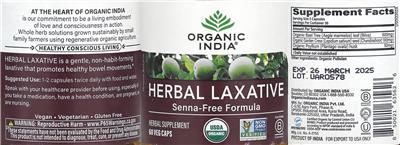
Organic India's Herbal Laxative contains three active ingredients: Psyllium, Bael Tree Leaf Extract, and Garden Cress. The product also contains pullulan, an inactive ingredient used as a capsule material.
Psyllium is a bulk-forming fiber often used to support digestive regularity, while Bael Tree Leaf Extract and Garden Cress are traditional herbal extracts included for their purported effects on digestion and bowel function.
Does it work?
Not established
The evidence on file does not establish effectiveness for the conditions listed. Bael Tree Leaf Extract shows insufficient reliable evidence to rate for asthma and shigellosis (a type of food-borne infection).
Garden Cress similarly has insufficient reliable evidence to rate for asthma, diabetes, hemorrhoids, high blood pressure, and lactation support. This means the research either isn't robust enough or isn't available in our data to confirm how well these ingredients work for those purposes.
How safe is it?
Well-documented data
The safety picture is mixed. Bael Tree Leaf Extract: the ripe fruit is eaten as food, but concentrated supplements lack strong safety data.
Large amounts may cause gastrointestinal upset and constipation. Garden Cress is generally safe in food amounts, but concentrated seed supplements have limited safety data; large amounts might cause similar digestive effects.
Psyllium safety data is not on file here. Neither Bael nor Garden Cress should be used medicinally during pregnancy or breastfeeding — traditional sources and lack of reliable safety data suggest avoiding them in these situations.
Meds to double-check
Moderate interaction found
Before taking this product, check with your pharmacist if you use antihypertensive drugs (blood pressure meds), anticoagulants or antiplatelet drugs (blood thinners), antidiabetes drugs, diuretics (water pills), lithium, theophylline, cholinergic drugs, or drugs metabolized by CYP1A2 or CYP3A4 liver enzymes — all carry Moderate or Minor interaction risks with the checked ingredients here.
The bottom line
Scorecard at a glanceFully disclosed formula with no established evidence rating for its marketed use. Moderate medication interactions have been identified, and safety information is well characterized.
This product combines ingredients with documented interactions affecting over 1,000 medications, so it's not one to start without checking your exact prescriptions first. If you take blood pressure medications, blood thinners, diabetes drugs, diuretics, lithium, or any medication broken down by your liver, run them through our interaction checker before use.
Talk to your pharmacist about whether this product is right for you and your current regimen.
Educational only — not medical advice; always confirm with your pharmacist. Our editorial policy · How we use AI
Assessment coverage: 2 of 3 active ingredients matched to our full ingredient reviews (monographs). Based on the product label dated Mar 25, 2025.
This Scorecard evaluates available label information, ingredient evidence, and known medication-safety considerations. It does not independently verify product identity, purity, potency, contamination, or manufacturing quality. How these ratings are computed
General information
Key facts about Herbal Laxative, straight from the product label.
| Brand | Organic India |
|---|---|
| Barcode (UPC) | 850021635626 |
| Net contents | 60 Veg Cap(s) |
| Market status | On market |
| Date entered into DSLD | Mar 25, 2025 |
| DSLD ID | 327598 |
| Product type | Botanical |
| Supplement form | Capsule |
| Dietary claims / uses | All Other, Structure/Function |
| Intended target group(s) | Vegan, Vegetarian, Adult (18 - 50 Years), Kosher, Organic, Halal |
Everything in this section is reproduced from the manufacturer’s own product label — it’s the label speaking, not HelloPharmacist. We show it so you can see exactly what the maker states; we don’t verify or endorse those statements.
Supplement Facts
The label details for Herbal Laxative by Organic India, sourced from the NIH Dietary Supplement Label Database.
Supplement Facts
| Ingredient | Amount | % DV |
|---|---|---|
| Psyllium | 50 mg | -- |
| Bael Tree Leaf Extract | 600 mg | -- |
| Garden Cress | 100 mg | -- |
Other ingredients: Pullulan
Tap any ingredient to jump to its full detail below.
These statements are the manufacturer’s wording, reproduced from the product label — the label is saying it, not HelloPharmacist. We don’t verify or endorse them.
General Statements
At the heart of Organic India is our commitment to be a living embodiment of live and consciousness in action. Whole herb solutions grown sustainably by small family farmers using regenerative organic agriculture. Healthy Conscious Living
Mfg.Lic.No. A-2755
Formulation
Herbal Laxative is a gentle, non-habit-forming laxative that promotes healthy bowel movements.
Vegan Vegetarian
Gluten free
Senna-free formula
USDA Organic
Non GMO Project Verified nongmoproject.org
Control Union Certified NPOP/NAB/0010 Certified Organic by Control Union-CU 801983. Product produced and processed according to NPOP standard of India & USDA-NOP www.controlunion.com
Product of India For export to USA only
Suggested/Recommended/Usage/Directions
Suggested use: 1-2 capsules twice daily with food and water.
Precautions
Speak with your healthcare provider before using, especially if you take a medication, have a health condition, are pregnant, or are nursing.
Warning: Reproductive Harm - www.P65Warnings.ca.gov.
FDA Disclaimer Statement
These statements have not been evaluated by the Food and Drug Administration. This product is not intended to diagnose, treat, cure, or prevent any disease.
FDA Statement of Identity
Herbal Supplement
Seals/Symbols
USDA Organic Non GMO Project Verified nongmoproject.org Certified B Corporation
Control Union Certified NPOP/NAB/0010
Halal Jamiat Ulama Halal Foundation OU (Kosher)
Formula
OU (Kosher)
Halal Jamiat Ulama Halal Foundation
Is this label outdated? Report a formula or label change and our pharmacy team will review it.
Herbal Laxative by Organic India label
The label scan from the NIH Dietary Supplement Label Database. Tap to enlarge.
Label images are published by the NIH Dietary Supplement Label Database for the version of this product on file. Always read your actual product label.
View the full label (PDF)The Ingredients in Herbal Laxative by Organic India
These are the 3 active ingredients this product is made of. Select any to open its full monograph.
Serving size1 Capsule(s) Dosage formCapsule Servings per container30 Amounts shown are per serving.
Most supplement products combine several ingredients, and a medication can interact with the product through any one of them. Each ingredient below shows whether it has known drug interactions.
Psyllium
Bael Tree Leaf Extract
Interacts with821 drugs
Bael is a fruit-bearing tree long used in traditional Indian (Ayurvedic) medicine, mostly for digestive problems like diarrhea and indigestion. Modern...
Bael Tree Leaf Extract monograph & interactionsGarden Cress
Interacts with398 drugs
Garden cress is a nutritious leafy herb and seed used widely in cooking and traditional medicine, providing vitamins, minerals, and fiber. While it ha...
Garden Cress monograph & interactionsOther (inactive) ingredients: Pullulan. These complete the product’s ingredient list but are not active constituents.
Herbal Laxative by Organic India Drug Interactions
HelloPharmacist Interaction Report
Organic India's Herbal Laxative contains three ingredients, two of which have documented interactions with medications.
The most serious concern is Garden Cress, which interacts with a broad range of drug types at Moderate severity.
Read the full breakdown — every affected drug type, severity by severity
Bael Tree Leaf Extract can lower blood sugar levels and theoretically increase the risk of low blood sugar (hypoglycemia) when combined with antidiabetes drugs like glimepiride — blood glucose monitoring and possible dose adjustments may be needed. It also has Moderate-severity interactions with cholinergic drugs (used for memory problems and certain muscle conditions), where it may add to their effects and cause cholinergic side effects.
Additionally, Bael shows Minor interactions with drugs broken down by two liver enzymes (CYP1A2 and CYP3A4 substrates), meaning it might raise their blood levels; these include some antidepressants, anti-nausea drugs, and cholesterol medications, though human evidence is limited.
Garden Cress has a broader profile: Moderate interactions with antihypertensive drugs (blood pressure medications), antidiabetes drugs, diuretics (water pills), lithium, theophylline (an asthma/COPD medication), anticoagulants and antiplatelet drugs (blood thinners), and two specific drugs, amlodipine and carbamazepine. Most of these interactions involve added effects — for instance, Garden Cress may increase the blood-pressure-lowering effect of antihypertensives or lower blood sugar further with diabetes drugs.
It may also increase potassium loss when taken with diuretics.
We were unable to check Psyllium for interactions. Altogether, these interactions span 1,032 individual medications.
Use the medication checker on this page to verify your exact drugs before starting this product.
Check your own medications below · Editorial policy · How we use AI
Want to check YOUR meds against Herbal Laxative?
Ask about interactions with your drugs in plain English — “Can I take it with lisinopril?” — and we find you the answer in seconds, ingredient by ingredient.
Go to the checkerIngredients driving the most interactions
Individual Drug Interactions
The ingredients in Herbal Laxative interact with 1,046 drugs. Click any drug to see the details.
2 of the 3 ingredients in Herbal Laxative interact with drugs. Each result below shows which ingredient is responsible. Bael Tree Leaf Extract Garden Cress
AbciximabReoPro
How Abciximab interacts with Herbal Laxative — through 1 ingredient. Tap an ingredient for the detail:
Garden CressAnticoagulant/antiplatelet Drugs Moderate
Interaction Summary
Theoretically, garden cress seed may increase the risk of bleeding if used with anticoagulant or antiplatelet drugs.
Read the full Garden Cress + Abciximab interactionAbrocitinibCibinqo
How Abrocitinib interacts with Herbal Laxative — through 1 ingredient. Tap an ingredient for the detail:
Garden CressAnticoagulant/antiplatelet Drugs Moderate
Interaction Summary
Theoretically, garden cress seed may increase the risk of bleeding if used with anticoagulant or antiplatelet drugs.
Read the full Garden Cress + Abrocitinib interactionAcarboseGlucobay, Prandase, Precose
How Acarbose interacts with Herbal Laxative — through 2 ingredients. Tap an ingredient for the detail:
Garden CressAntidiabetes Drugs Moderate
Interaction Summary
Theoretically, taking garden cress with antidiabetes drugs might increase the risk of hypoglycemia.
Read the full Garden Cress + Acarbose interactionBael Tree Leaf ExtractAntidiabetes Drugs Moderate
Interaction Summary
Evidence from animal research suggests that extracts of bael seed and leaf can reduce blood glucose levels.
Read the full Bael Tree Leaf Extract + Acarbose interactionAcebutololRhotral, Sectral
How Acebutolol interacts with Herbal Laxative — through 1 ingredient. Tap an ingredient for the detail:
Garden CressAntihypertensive Drugs Moderate
Interaction Summary
Theoretically, taking garden cress with antihypertensive drugs might increase the risk of hypotension.
Read the full Garden Cress + Acebutolol interactionAcenocoumarolSintrom
How Acenocoumarol interacts with Herbal Laxative — through 1 ingredient. Tap an ingredient for the detail:
Garden CressAnticoagulant/antiplatelet Drugs Moderate
Interaction Summary
Theoretically, garden cress seed may increase the risk of bleeding if used with anticoagulant or antiplatelet drugs.
Read the full Garden Cress + Acenocoumarol interactionAcetaminophen, AspirinGemnisyn
How Acetaminophen, Aspirin interacts with Herbal Laxative — through 2 ingredients. Tap an ingredient for the detail:
Garden CressAnticoagulant/antiplatelet Drugs Moderate
Interaction Summary
Theoretically, garden cress seed may increase the risk of bleeding if used with anticoagulant or antiplatelet drugs.
Read the full Garden Cress + Acetaminophen, Aspirin interactionBael Tree Leaf ExtractCytochrome P450 1a2 (cyp1a2) Substrates Minor
Interaction Summary
Bael extract and its constituent marmesinin inhibited cytochrome P450 1A2 (CYP1A2) activity in vitro.
Read the full Bael Tree Leaf Extract + Acetaminophen, Aspirin interactionAcetaminophen, Aspirin, CaffeineExcedrin, Excedrin Extra Strength, Excedrin Migraine
How Acetaminophen, Aspirin, Caffeine interacts with Herbal Laxative — through 2 ingredients. Tap an ingredient for the detail:
Garden CressAnticoagulant/antiplatelet Drugs Moderate
Interaction Summary
Theoretically, garden cress seed may increase the risk of bleeding if used with anticoagulant or antiplatelet drugs.
Read the full Garden Cress + Acetaminophen, Aspirin, Caffeine interactionBael Tree Leaf ExtractCytochrome P450 1a2 (cyp1a2) Substrates, Cytochrome P450 3a4 (cyp3a4) Substrates Minor
Interaction Summary
Bael extract and its constituent marmesinin inhibited cytochrome P450 1A2 (CYP1A2) activity in vitro.
Read the full Bael Tree Leaf Extract + Acetaminophen, Aspirin, Caffeine interactionAcetaminophen, Caffeine, PyrilamineMidol Max Strength Menstrual
How Acetaminophen, Caffeine, Pyrilamine interacts with Herbal Laxative — through 2 ingredients. Tap an ingredient for the detail:
Garden CressDiuretic Drugs Moderate
Interaction Summary
Theoretically, taking garden cress with diuretic drugs might increase the risk of hypokalemia.
Read the full Garden Cress + Acetaminophen, Caffeine, Pyrilamine interactionBael Tree Leaf ExtractCytochrome P450 3a4 (cyp3a4) Substrates, Cytochrome P450 1a2 (cyp1a2) Substrates Minor
Interaction Summary
Bael and its constituents marmelosin and marmesinin inhibited cytochrome P450 3A4 (CYP3A4) activity in vitro.
Read the full Bael Tree Leaf Extract + Acetaminophen, Caffeine, Pyrilamine interactionAcetaminophen, IbuprofenCombogesic
How Acetaminophen, Ibuprofen interacts with Herbal Laxative — through 2 ingredients. Tap an ingredient for the detail:
Garden CressAnticoagulant/antiplatelet Drugs Moderate
Interaction Summary
Theoretically, garden cress seed may increase the risk of bleeding if used with anticoagulant or antiplatelet drugs.
Read the full Garden Cress + Acetaminophen, Ibuprofen interactionBael Tree Leaf ExtractCytochrome P450 1a2 (cyp1a2) Substrates Minor
Interaction Summary
Bael extract and its constituent marmesinin inhibited cytochrome P450 1A2 (CYP1A2) activity in vitro.
Read the full Bael Tree Leaf Extract + Acetaminophen, Ibuprofen interactionAcetaminophen, Pamabrom, PyrilamineMidol Max Strength PMS, Pamprin, Pamprin ES
How Acetaminophen, Pamabrom, Pyrilamine interacts with Herbal Laxative — through 2 ingredients. Tap an ingredient for the detail:
Garden CressDiuretic Drugs Moderate
Interaction Summary
Theoretically, taking garden cress with diuretic drugs might increase the risk of hypokalemia.
Read the full Garden Cress + Acetaminophen, Pamabrom, Pyrilamine interactionBael Tree Leaf ExtractCytochrome P450 1a2 (cyp1a2) Substrates Minor
Interaction Summary
Bael extract and its constituent marmesinin inhibited cytochrome P450 1A2 (CYP1A2) activity in vitro.
Read the full Bael Tree Leaf Extract + Acetaminophen, Pamabrom, Pyrilamine interactionAcetazolamideAk-Zol, Diamox
How Acetazolamide interacts with Herbal Laxative — through 1 ingredient. Tap an ingredient for the detail:
Garden CressDiuretic Drugs, Antihypertensive Drugs Moderate
Interaction Summary
Theoretically, taking garden cress with diuretic drugs might increase the risk of hypokalemia.
Read the full Garden Cress + Acetazolamide interactionAcetohexamideDymelor
How Acetohexamide interacts with Herbal Laxative — through 2 ingredients. Tap an ingredient for the detail:
Garden CressAntidiabetes Drugs Moderate
Interaction Summary
Theoretically, taking garden cress with antidiabetes drugs might increase the risk of hypoglycemia.
Read the full Garden Cress + Acetohexamide interactionBael Tree Leaf ExtractAntidiabetes Drugs Moderate
Interaction Summary
Evidence from animal research suggests that extracts of bael seed and leaf can reduce blood glucose levels.
Read the full Bael Tree Leaf Extract + Acetohexamide interactionAcetylcholineMiochol-E
How Acetylcholine interacts with Herbal Laxative — through 1 ingredient. Tap an ingredient for the detail:
Bael Tree Leaf ExtractCholinergic Drugs Moderate
Interaction Summary
Bael leaf extract shows acetylcholinesterase (AChE) inhibitory activity in vitro.
Read the full Bael Tree Leaf Extract + Acetylcholine interactionAcetylsalicylic AcidEntrophen
How Acetylsalicylic Acid interacts with Herbal Laxative — through 1 ingredient. Tap an ingredient for the detail:
Garden CressAnticoagulant/antiplatelet Drugs Moderate
Interaction Summary
Theoretically, garden cress seed may increase the risk of bleeding if used with anticoagulant or antiplatelet drugs.
Read the full Garden Cress + Acetylsalicylic Acid interactionAlbiglutideTanzeum
How Albiglutide interacts with Herbal Laxative — through 2 ingredients. Tap an ingredient for the detail:
Bael Tree Leaf ExtractAntidiabetes Drugs Moderate
Interaction Summary
Evidence from animal research suggests that extracts of bael seed and leaf can reduce blood glucose levels.
Read the full Bael Tree Leaf Extract + Albiglutide interactionGarden CressAntidiabetes Drugs Moderate
Interaction Summary
Theoretically, taking garden cress with antidiabetes drugs might increase the risk of hypoglycemia.
Read the full Garden Cress + Albiglutide interactionAliskirenTekturna
How Aliskiren interacts with Herbal Laxative — through 2 ingredients. Tap an ingredient for the detail:
Garden CressAntihypertensive Drugs Moderate
Interaction Summary
Theoretically, taking garden cress with antihypertensive drugs might increase the risk of hypotension.
Read the full Garden Cress + Aliskiren interactionBael Tree Leaf ExtractCytochrome P450 3a4 (cyp3a4) Substrates Minor
Interaction Summary
Bael and its constituents marmelosin and marmesinin inhibited cytochrome P450 3A4 (CYP3A4) activity in vitro.
Read the full Bael Tree Leaf Extract + Aliskiren interactionAlogliptinNesina
How Alogliptin interacts with Herbal Laxative — through 2 ingredients. Tap an ingredient for the detail:
Garden CressAntidiabetes Drugs Moderate
Interaction Summary
Theoretically, taking garden cress with antidiabetes drugs might increase the risk of hypoglycemia.
Read the full Garden Cress + Alogliptin interactionBael Tree Leaf ExtractCytochrome P450 3a4 (cyp3a4) Substrates, Antidiabetes Drugs Moderate
Interaction Summary
Bael and its constituents marmelosin and marmesinin inhibited cytochrome P450 3A4 (CYP3A4) activity in vitro.
Read the full Bael Tree Leaf Extract + Alogliptin interactionAlogliptin, MetforminKazano
How Alogliptin, Metformin interacts with Herbal Laxative — through 2 ingredients. Tap an ingredient for the detail:
Bael Tree Leaf ExtractAntidiabetes Drugs Moderate
Interaction Summary
Evidence from animal research suggests that extracts of bael seed and leaf can reduce blood glucose levels.
Read the full Bael Tree Leaf Extract + Alogliptin, Metformin interactionGarden CressAntidiabetes Drugs Moderate
Interaction Summary
Theoretically, taking garden cress with antidiabetes drugs might increase the risk of hypoglycemia.
Read the full Garden Cress + Alogliptin, Metformin interactionAlogliptin, PioglitazoneOseni
How Alogliptin, Pioglitazone interacts with Herbal Laxative — through 2 ingredients. Tap an ingredient for the detail:
Garden CressAntidiabetes Drugs Moderate
Interaction Summary
Theoretically, taking garden cress with antidiabetes drugs might increase the risk of hypoglycemia.
Read the full Garden Cress + Alogliptin, Pioglitazone interactionBael Tree Leaf ExtractAntidiabetes Drugs, Cytochrome P450 3a4 (cyp3a4) Substrates Moderate
Interaction Summary
Evidence from animal research suggests that extracts of bael seed and leaf can reduce blood glucose levels.
Read the full Bael Tree Leaf Extract + Alogliptin, Pioglitazone interactionAlteplase, TpaActilyse, Activase
How Alteplase, Tpa interacts with Herbal Laxative — through 1 ingredient. Tap an ingredient for the detail:
Garden CressAnticoagulant/antiplatelet Drugs Moderate
Interaction Summary
Theoretically, garden cress seed may increase the risk of bleeding if used with anticoagulant or antiplatelet drugs.
Read the full Garden Cress + Alteplase, Tpa interactionAluminum Hydroxide, Aspirin, Codeine Phosphate, Magnesium HydroxideAscriptin Codeine #2
How Aluminum Hydroxide, Aspirin, Codeine Phosphate, Magnesium Hydroxide interacts with Herbal Laxative — through 1 ingredient. Tap an ingredient for the detail:
Garden CressAnticoagulant/antiplatelet Drugs Moderate
Interaction Summary
Theoretically, garden cress seed may increase the risk of bleeding if used with anticoagulant or antiplatelet drugs.
Read the full Garden Cress + Aluminum Hydroxide, Aspirin, Codeine Phosphate, Magnesium Hydroxide interactionAluminum Hydroxide, Aspirin, Magnesium HydroxideAscriptin
How Aluminum Hydroxide, Aspirin, Magnesium Hydroxide interacts with Herbal Laxative — through 1 ingredient. Tap an ingredient for the detail:
Garden CressAnticoagulant/antiplatelet Drugs Moderate
Interaction Summary
Theoretically, garden cress seed may increase the risk of bleeding if used with anticoagulant or antiplatelet drugs.
Read the full Garden Cress + Aluminum Hydroxide, Aspirin, Magnesium Hydroxide interactionAmbenonium ChlorideMytelase
How Ambenonium Chloride interacts with Herbal Laxative — through 1 ingredient. Tap an ingredient for the detail:
Bael Tree Leaf ExtractCholinergic Drugs Moderate
Interaction Summary
Bael leaf extract shows acetylcholinesterase (AChE) inhibitory activity in vitro.
Read the full Bael Tree Leaf Extract + Ambenonium Chloride interactionAmbrisentanLetairis, Volibris
How Ambrisentan interacts with Herbal Laxative — through 2 ingredients. Tap an ingredient for the detail:
Garden CressAntihypertensive Drugs Moderate
Interaction Summary
Theoretically, taking garden cress with antihypertensive drugs might increase the risk of hypotension.
Read the full Garden Cress + Ambrisentan interactionBael Tree Leaf ExtractCytochrome P450 3a4 (cyp3a4) Substrates Minor
Interaction Summary
Bael and its constituents marmelosin and marmesinin inhibited cytochrome P450 3A4 (CYP3A4) activity in vitro.
Read the full Bael Tree Leaf Extract + Ambrisentan interactionAmifampridineRuzurgi
How Amifampridine interacts with Herbal Laxative — through 1 ingredient. Tap an ingredient for the detail:
Bael Tree Leaf ExtractCholinergic Drugs Moderate
Interaction Summary
Bael leaf extract shows acetylcholinesterase (AChE) inhibitory activity in vitro.
Read the full Bael Tree Leaf Extract + Amifampridine interactionAmifampridine PhosphateFirdapse
How Amifampridine Phosphate interacts with Herbal Laxative — through 1 ingredient. Tap an ingredient for the detail:
Bael Tree Leaf ExtractCholinergic Drugs Moderate
Interaction Summary
Bael leaf extract shows acetylcholinesterase (AChE) inhibitory activity in vitro.
Read the full Bael Tree Leaf Extract + Amifampridine Phosphate interactionAmilorideAmilamont, Midamor
How Amiloride interacts with Herbal Laxative — through 1 ingredient. Tap an ingredient for the detail:
Garden CressAntihypertensive Drugs Moderate
Interaction Summary
Theoretically, taking garden cress with antihypertensive drugs might increase the risk of hypotension.
Read the full Garden Cress + Amiloride interactionAmiloride, HydrochlorothiazideAmil-Co, Amilzide, Moduret 25, Moduretic
How Amiloride, Hydrochlorothiazide interacts with Herbal Laxative — through 1 ingredient. Tap an ingredient for the detail:
Garden CressAntihypertensive Drugs, Diuretic Drugs Moderate
Interaction Summary
Theoretically, taking garden cress with antihypertensive drugs might increase the risk of hypotension.
Read the full Garden Cress + Amiloride, Hydrochlorothiazide interactionAmlodipineNorliqva
How Amlodipine interacts with Herbal Laxative — through 2 ingredients. Tap an ingredient for the detail:
Garden CressAntihypertensive Drugs, Amlodipine (norvasc) Moderate
Interaction Summary
Theoretically, taking garden cress with antihypertensive drugs might increase the risk of hypotension.
Read the full Garden Cress + Amlodipine interactionBael Tree Leaf ExtractCytochrome P450 3a4 (cyp3a4) Substrates Minor
Interaction Summary
Bael and its constituents marmelosin and marmesinin inhibited cytochrome P450 3A4 (CYP3A4) activity in vitro.
Read the full Bael Tree Leaf Extract + Amlodipine interactionAmlodipine BenzoateKaterzia
How Amlodipine Benzoate interacts with Herbal Laxative — through 2 ingredients. Tap an ingredient for the detail:
Garden CressAmlodipine (norvasc), Antihypertensive Drugs Moderate
Interaction Summary
Theoretically, taking garden cress seeds with amlodipine might increase the risk of hypotension.
Read the full Garden Cress + Amlodipine Benzoate interactionBael Tree Leaf ExtractCytochrome P450 3a4 (cyp3a4) Substrates Minor
Interaction Summary
Bael and its constituents marmelosin and marmesinin inhibited cytochrome P450 3A4 (CYP3A4) activity in vitro.
Read the full Bael Tree Leaf Extract + Amlodipine Benzoate interactionEach ingredient & the kinds of drugs it affects
For each ingredient in Herbal Laxative with known interactions, here are the types of medications they can affect. Open any type for the detail — or search your exact drug in the checker above.
Bael Tree Leaf Extract
Antidiabetes Drugs
Evidence from animal research suggests that extracts of bael seed and leaf can reduce blood glucose levels. Theoretically, bael might have additive effects with antidiabetes drugs and increase the risk of hypoglycemia. Monitor blood glucose levels closely. Dose adjustments might be necessary.
Some antidiabetes drugs include glimepiride (Amaryl), glyburide (DiaBeta, Glynase PresTab, Micronase), insulin, pioglitazone (Actos), rosiglitazone (Avandia), and others.
Cholinergic Drugs
Bael leaf extract shows acetylcholinesterase (AChE) inhibitory activity in vitro. Theoretically, bael might have additive effects with cholinergic drugs and increase the risk of cholinergic side effects.
Cholinergic drugs include bethanechol (Urecholine), donepezil (Aricept), echothiophate (Phospholine Iodide), edrophonium (Enlon, Reversol, Tensilon), neostigmine (Prostigmin), physostigmine (Antilirium), pyridostigmine (Mestinon, Regonol), succinylcholine (Anectine, Quelicin), and tacrine (Cognex).
Cytochrome P450 1A2 (Cyp1A2) Substrates
Bael extract and its constituent marmesinin inhibited cytochrome P450 1A2 (CYP1A2) activity in vitro. So far, this interaction has not been reported in humans. Theoretically, bael might increase levels of drugs metabolized by CYP1A2.
Some drugs metabolized by CYP1A2 include amitriptyline (Elavil), haloperidol (Haldol), ondansetron (Zofran), propranolol (Inderal), theophylline (Theo-Dur, others), verapamil (Calan, Isoptin, others), and others. Use bael cautiously or avoid in patients taking these drugs.
Cytochrome P450 3A4 (Cyp3A4) Substrates
Bael and its constituents marmelosin and marmesinin inhibited cytochrome P450 3A4 (CYP3A4) activity in vitro. So far, this interaction has not been reported in humans. Theoretically, bael might increase levels of drugs metabolized by CYP3A4.
Some drugs metabolized by CYP3A4 include lovastatin (Mevacor), ketoconazole (Nizoral), itraconazole (Sporanox), fexofenadine (Allegra), triazolam (Halcion), and numerous others. Use bael cautiously or avoid in patients taking these drugs.
Garden Cress
Amlodipine (Norvasc)
Theoretically, taking garden cress seeds with amlodipine might increase the risk of hypotension.
Animal research indicates that giving garden cress seeds with amlodipine increases maximum concentrations of amlodipine by 83%. Blood pressure was also reduced when compared with amlodipine alone. However, the area under the curve was not significantly affected.
Anticoagulant/Antiplatelet Drugs
Theoretically, garden cress seed may increase the risk of bleeding if used with anticoagulant or antiplatelet drugs.
Animal research suggests that garden cress seed extract can increase bleeding time when used in combination with the antiplatelet agent clopidogrel. This has not been shown in humans and it is unclear if garden cress seed itself has anticoagulant or antiplatelet effects.
Antidiabetes Drugs
Theoretically, taking garden cress with antidiabetes drugs might increase the risk of hypoglycemia.
Evidence from animal research suggests that an extract of garden cress can reduce blood glucose levels. This has not been shown in humans.
Antihypertensive Drugs
Theoretically, taking garden cress with antihypertensive drugs might increase the risk of hypotension.
Garden cress has shown hypotensive effects in animal research and increases levels and effects of the antihypertensive medications amlodipine and losartan. This has not been shown in humans.
Carbamazepine (Tegretol)
Theoretically, garden cress might increase the absorption rate of carbamazepine and result in blood concentrations outside of the therapeutic window.
Animal research shows that taking garden cress seed daily for 8 days prior to a single dose of carbamazepine does not significantly affect maximum concentrations or area under the curve of carbamazepine. However, the absorption rate is increased, with a 50% reduction (2 hours) in time to peak concentration, resulting in increased plasma levels within 3 hours of dosing and then decreased plasma levels from 5-12 hours after dosing. This has not been shown in humans.
Clopidogrel (Plavix)
Theoretically, taking garden cress seed with clopidogrel might prolong bleeding.
Animal research shows that taking garden cress seed daily for 2 weeks prior to a single dose of clopidogrel does not affect the pharmacokinetics of clopidogrel. However, bleeding time was increased by 7%. This has not been shown in humans and the mechanism of action is unclear.
Diuretic Drugs
Theoretically, taking garden cress with diuretic drugs might increase the risk of hypokalemia.
Evidence from animal research suggests that garden cress has diuretic effects and can increase the urinary excretion of potassium. This has not been shown in humans. Initiation of potassium supplementation or an increase in potassium supplement dose may be necessary for some patients.
Gliclazide (Diamicron, Others)
Theoretically, taking garden cress seed with gliclazide might increase the risk of hypoglycemia.
Evidence from animal research suggests that garden cress seed increases the area under the curve of a single dose of gliclazide by approximately 70%. However, there was no statistically significant effect on maximum concentrations of gliclazide or on the effects of gliclazide on blood glucose. This has not been shown in humans.
Lithium
Theoretically, garden cress might reduce excretion and increase levels of lithium due to diuretic effects.
Animal research suggests that garden cress has diuretic properties.
Losartan (Cozaar)
Theoretically, garden cress seed might have additive hypotensive effects when used with losartan.
Animal research suggests that giving garden cress seed extract for two weeks before a single dose of losartan increases levels of plasma losartan by at least 2.4-fold and potentiates its blood pressure-lowering effects. Maximum concentrations of losartan were not significantly affected. So far, this interaction has not been reported in humans.
Metoprolol (Toprol)
Theoretically, garden cress seed might have additive hypotensive effects when used with metoprolol.
Animal research shows that garden cress seed for 2 weeks decreases systolic and diastolic blood pressure by 9% and 32%, respectively, when administered alone, and by 15% and 33%, respectively, when given with metoprolol 10 mg/kg. So far, this interaction has not been reported in humans.
Phenytoin (Dilantin)
Theoretically, garden cress might increase levels and side effects of phenytoin.
Animal research shows that garden cress seed for 1 week increases maximum concentrations and the area under the curve of a single dose of phenytoin by 16% and 49%, respectively. This seems to be related to decreased clearance. So far, this interaction has not been reported in humans.
Sildenafil (Viagra)
Theoretically, concurrent use of sildenafil and L-arginine might reduce levels and therapeutic effects of sildenafil.
Animal research shows that garden cress seed for 1 week reduces maximum concentrations and the area under the curve of a single dose of sildenafil by 40% and 51%, respectively. So far, this interaction has not been reported in humans.
Theophylline
Theoretically, concurrent use of sildenafil and theophylline might increase levels and adverse effects of theophylline.
Animal research shows that garden cress can increase theophylline concentrations by approximately 37%. It is hypothesized that this increase is due to possible inhibition of cytochrome P450 (CYP) 1A2. So far, this interaction has not been reported in humans.
Brand information
Manufacturer and brand details for Herbal Laxative, from the product label.
Organic India
See all Organic India products- Name
- Organic India Pvt. Ltd.
- Street Address
- C-5/10, Agro Park Phase-II UPSIDC Industrial Area, Kursi Road
- City
- Barabanki
- State
- Uttar Pradesh
- ZipCode
- 225302
Herbal Laxative by Organic India: Common Questions
Does Herbal Laxative by Organic India interact with any medications?
How can one product interact with so many drugs?
Where does this information come from?
Can I take this if I'm pregnant or breastfeeding?
What's psyllium, and why is it in here?
What are the main side effects I should watch for?
Does this product actually work for constipation or IBS?
Is this safe if I take blood pressure medication?
What if I take a diabetes medication?
Written and reviewed by the HelloPharmacist editorial staff. Our editorial policy
Not sure if Herbal Laxative is safe with your meds?
Our pharmacists answer your medication & supplement questions — free.
Label information is sourced from the NIH Dietary Supplement Label Database and reflects the product version on file; always read your actual product label. This page is for education only and is not a substitute for professional medical advice. Confirm with your pharmacist or doctor before combining supplements and medications.
The Full Monographs Behind Herbal Laxative’s Ingredients
Every ingredient we hold a full HelloPharmacist monograph for — uses, evidence, safety, and the complete interaction list.
Bael
Interacts with 821 drugsBael is a fruit-bearing tree long used in traditional Indian (Ayurvedic) medicine, mostly for digestive problems like diarrhea and indigestion. Modern human evidence for its medicinal benefi...
Read the full Bael monograph → Herb & supplement monographGarden Cress
Interacts with 398 drugsGarden cress is a nutritious leafy herb and seed used widely in cooking and traditional medicine, providing vitamins, minerals, and fiber. While it has a long history of use for digestion, b...
Read the full Garden Cress monograph →Sources & How We Checked
Herbal Laxative's label data comes from the NIH Dietary Supplement Label Database; the ingredient interaction data is from the Natural Medicines database, reviewed by our pharmacists.
- NIH Dietary Supplement Label Database (DSLD) — The official product label on file for this supplement.
- Natural Medicines (Therapeutic Research Center) — Evidence-graded clinical reference behind the ingredient interaction data.
Content is written and reviewed by licensed HelloPharmacist pharmacists. See our data sources and editorial standards for how this information is built and checked.
The 19 references behind this product’s interaction data
Every citation that drives the interaction findings for this product’s ingredients, from the evidence-graded Natural Medicines (TRC Healthcare) database. Open an ingredient to browse its citations — links open the study on PubMed or the publisher’s site.
Bael 7 references
- Gruenwald J, Brendler T, Jaenicke C. PDR for Herbal Medicines. 1st ed. Montvale, NJ: Medical Economics Company, Inc., 1998.
- Sabu, M. C. and Kuttan, R. Antidiabetic activity of Aegle marmelos and its relationship with its antioxidant properties. Indian J Physiol Pharmacol 2004;48(1):81-88.
- Kesari, A. N., Gupta, R. K., Singh, S. K., Diwakar, S., and Watal, G. Hypoglycemic and antihyperglycemic activity of Aegle marmelos seed extract in normal and diabetic rats. J Ethnopharmacol 10-11-2006;107(3):374-379. PubMed
- Haider, R., Khan, A. K., Aziz, K. M., Chowdhury, A., and Kabir, I. Evaluation of indigenous plants in the treatment of acute shigellosis. Trop.Geogr.Med 1991;43(3):266-270.
- Asaduzzaman M, Uddin MJ, Kader MA, et al. In vitro acetylcholinesterase inhibitory activity and the antioxidant properties of Aegle marmelos leaf extract: implications for the treatment of Alzheimer's disease. Psychogeriatrics. 2014;14(1):1-10.
- Yugandhar P, Rao KM, Sengupta K. A novel herbal composition containing extracts of Boswellia serrata gum resin and Aegle marmelos fruit alleviates symptoms of asthma in a placebo controlled double-blind clinical study. Phytother Res. 2018;32(1):140-150.
- Manda VK, Avula B, Chittiboyina AG, Khan IA, Walker LA, Khan SI. Inhibition of CYP3A4 and CYP1A2 by Aegle marmelos and its constituents. Xenobiotica. 2016;46(2):117-25.
Garden Cress 12 references
- Eddouks, M. and Maghrani, M. Effect of Lepidium sativum L. on renal glucose reabsorption and urinary TGF-beta 1 levels in diabetic rats. Phytother.Res 2008;22(1):1-5.
- Maghrani, M, Zeggwagh, NA, Michel, JB, and Eddouks, M. Antihypertensive effect of <it>Lepidium sativum</it> L. in spontaneously hypertensive rats. Journal of Ethnopharmacology (Ireland) 2005;100:193-197.
- Al-Jenoobi FI, Ahad A, Mahrous GM, Al-Mohizea AM, AlKharfy KM, Al-Suwayeh SA. Effects of fenugreek, garden cress, and black seed on theophylline pharmacokinetics in beagle dogs. Pharm Biol 2015;53(2):296-300. PubMed
- Alkharfy KM, Al-Jenoobi FI, Alam MA, et al. Lepidium sativum but not Nigella sativa affects carbamazepine disposition in an animal model. Drug Metab Lett 2013;7:47-51. PubMed
- Chen X, Yuan H, Shi F, Zhu Y. Effect of garden cress in reducing blood glucose, improving blood lipids, and reducing oxidative stress in a mouse model of diabetes induced by a high-fat diet and streptozotocin. J Sci Food Agric 2020;100(5):2074-2081. PubMed
- Alkharfy K, Jan B, Alotaibi K, et al. Clopidogrel-herb Interactions: A Pharmacokinetic and Pharmacodynamic Assessment in a Rat Model. Curr Drug Metab 2021;22(12):969-977. PubMed
- Bin Jardan YA, Ahad A, Raish M, Alam MA, Al-Mohizea AM, Al-Jenoobi FI. Effects of garden cress, fenugreek and black seed on the pharmacodynamics of metoprolol: an herb-drug interaction study in rats with hypertension. Pharm Biol 2021;59(1):1088-1097. PubMed
- Ramadan S, Hegab AM, Al-Awthan YS, Al-Duais MA, Tayel AA, Al-Saman MA. Comparison of the efficiency of Lepidium sativum, Ficus carica, and Punica granatum methanolic extracts in relieving hyperglycemia and hyperlipidemia of streptozotocin-induced diabetic
- I Al-Suwaydani A, Alam MA, Raish M, A Bin Jardan Y, Ahad A, I Al-Jenoobi F. Effect of C. cyminum and L. sativum on pharmacokinetics and pharmacodynamics of antidiabetic drug gliclazide. Curr Drug Metab 2022;23(10):842-849.
- Alam MA, Bin Jardan YA, Raish M, Al-Mohizea AM, Ahad A, Al-Jenoobi FI. Herb-drug interaction: pharmacokinetics and pharmacodynamics of anti-hypertensive drug amlodipine besylate in presence of Lepidium sativum and Curcuma longa. Xenobiotica 2022;52(2):177
- Ahad A, Raish M, Abdelrahman IA, et al. Changes in pharmacokinetics and pharmacodynamics of losartan in experimental diseased rats treated with Curcuma longa and Lepidium sativum. Pharmaceuticals (Basel) 2022;16(1):33. PubMed
- Doghmane A, Aouacheri O, Laouaichia R, Saka S. The investigation of the efficacy ratio of cress seeds supplementation to moderate hyperglycemia and hepatotoxicity in streptozotocin-induced diabetic rats. J Diabetes Metab Disord 2021;20(1):447-459. PubMed
Parts of this content are provided by the Therapeutic Research Center, LLC.
DISCLAIMER: Currently this does not check for drug-drug interactions. This is not an all-inclusive comprehensive list of potential interactions and is for informational purposes only. Not all interactions are known or well-reported in the scientific literature, and new interactions are continually being reported. Input is needed from a qualified healthcare provider including a pharmacist before starting any therapy. Application of clinical judgment is necessary.
© 2021 Therapeutic Research Center, LLC