
Longevity Support Pack by Douglas Laboratories Ingredients, Side Effects and Drug Interactions
Dietary Supplement Other Combinations
UPC 3 10539 03316 6 Match it to the barcode on your bottle

Medically reviewed by Dr. Brian Staiger, PharmD, BCPS
Also reviewed by the HelloPharmacist Editorial Team
Updated Details about this page
- Label on file from the NIH Dietary Supplement Label Database, dated Jun 25, 2012.
- The interaction, evidence and safety records come from the Natural Medicines database, which we license, read against this label by our own system; the pharmacy team’s sections are written from those records.
- Dr. Brian Staiger, PharmD, BCPS, is a clinical pharmacist and pharmacotherapy specialist.
- Editorial policy Our sources
AI is used only to summarize verified clinical information, never the open internet. Our AI policy
Summary: The HelloPharmacist Team’s Take
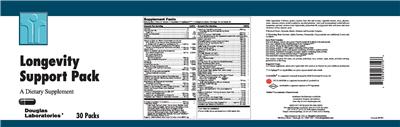
- Serving Size
- 1 Pack
- Servings
- 30 per container
- Container Holds
- 30 Packs
What’s in it, whether it interacts with your drugs, its side effects, whether it works, and what our pharmacists would want you to know before you start it.
- What is Longevity Support Pack?A supplement from Douglas Laboratories with 64 active ingredients.
- Active Ingredients 14 vitamins, 12 minerals, 14 plant ingredients such as Olive juice, Muscadine grape and Blueberry, 1 probiotic, 1 enzyme, 2 amino acids, 3 fats and oils, 1 source of fiber and 16 others: Vitamin A 7500 IUVitamin C Complex 1700 mgVitamin D3 200 IUVitamin E 607 IUThiamine 50 mgRiboflavin 25 mgNiacin/Niacinamide 95 mgVitamin B-6 Complex 50 mgFolic Acid 400 mcgVitamin b-12 125 mcgBiotin 150 mcgPantothenic Acid 250 mg 64 active ingredients. Each one can interact with drugs or cause side effects on its own, so we check every one. And 52 more, in the Supplement Facts
- Drug Interactions 1,752 drugs have a documented interaction with this supplement; the most serious is rated major. Of those, 1,250 are single drugs and 502 are combination products (two or more drugs in one), each listed under its own name. Based on the 54 of its 64 ingredients we could check. Ask your pharmacist first if you take a drug in any of these categories, the most serious of the 139 on record:
- RetinoidsMajor · 9 drugs
- EphedrineMajor · 8 drugs
- Levodopa/
Carbidopa (Sinemet) Major · 6 drugs - Atorvastatin (Lipitor)Major · 3 drugs
- Possible Side EffectsUpset stomach 22 ingredientsNausea 21 ingredientsDiarrhea 13 ingredientsHeadache 13 ingredientsGas 11 ingredientsBloating 8 ingredients +56 moreCombined from 37 of its 64 active ingredients. Not studied in this exact product.
- Well documented Why
Does Longevity Support Pack work?
Strong This product doesn't appear to be marketed for a specific use, so we graded its ingredients' overall clinical evidence instead.It is not marketed for one specific use, so this is what its ingredients have been studied for, strongest research first:
- Vitamin A deficiency Vitamin A
- Vitamin C deficiency Vitamin C
- Rickets Vitamin D
- Ataxia with vitamin E deficiency (AVED) Vitamin E
- Vitamin D
- Vitamin E deficiency Vitamin E
These grades are for each ingredient, not this exact product, and never a promise it will work for you.
And 29 more graded uses, in what the research says- Full Why
- AllergensIts ingredient list names fish and wheat or other gluten grains
- Barcode (UPC)3 10539 03316 6Match it to the barcode on your bottle to be sure this is your product. Not your product? Search for it here
Who Might Consider It
- People who want it for vitamin A deficiency, vitamin C deficiency, rickets, ataxia with vitamin E deficiency (AVED) or another graded use: the uses with research behind them. See each grade
- This is a broad-spectrum supplement targeting multiple aspects of aging and health.
Who Should Be Careful
- If you're on any prescription medications — especially blood thinners, seizure drugs, diabetes or heart medications, antibiotics, cancer drugs, or thyroid medications — you'll need to check each of your medications against the interactions listed before taking this product.
- Talk with your doctor or pharmacist about whether it's right for you and whether any dose adjustments are needed for your current drugs.
More Before You Take It Show the answerHide Pregnancy and Breastfeeding
-
Pregnant or breastfeeding?
- Pregnancy Zinc
- ! When used orally in doses exceeding the UL.
- Breastfeeding Zinc
- ! When used orally in doses exceeding the UL.
- Pregnancy Manganese
- ! Amounts in foods and prenatal vitamins are appropriate, but avoid extra high-dose supplements unless advised.
- Breastfeeding Manganese
- ! When used orally in excessive doses.
- Pregnancy Alpha-lipoic Acid
- ! There is not enough reliable safety information, so it is best to avoid during pregnancy.
- Breastfeeding Alpha-lipoic Acid
- Insufficient reliable information available; avoid using.
From the label dated Jun 25, 2012: 54 of its 64 active ingredients were checked against our records; the other ten are not in them yet. A summary of what is known, not a grade or a test of the product. How these ratings are computed
Ask Anything About This Supplement
Name a drug you take, or ask about side effects, ingredients or pregnancy.
AI answers come from this label and our own records, never the open internet. AI can make mistakes, so always check with your doctor or pharmacist. How we use AI
Ask the Pharmacist
A licensed pharmacist will answer your question by email — free, as soon as they can.
Got it — thank you!
A licensed pharmacist will answer as soon as they can. Keep an eye on your email (worth checking spam, just in case).
What’s Inside Longevity Support Pack by Douglas Laboratories
64 Active Ingredients, Each Checked on Its Own
A supplement is often several ingredients in one bottle, and each one can interact with drugs or cause side effects on its own. We check every one of them against our records.
- Vitamin ADrug interactions on record, most serious: Major
- Vitamin C ComplexDrug interactions on record, most serious: Moderate
- Vitamin D3Drug interactions on record, most serious: Moderate
- Vitamin EDrug interactions on record, most serious: Moderate
- ThiamineNo drug interactions on record
- RiboflavinDrug interactions on record, most serious: Moderate
- Niacin/NiacinamideNot in our interaction records yet
- Vitamin B-6 ComplexDrug interactions on record, most serious: Moderate
And 56 more, each with its own card below.
Why this rating?
The label gives an exact amount for every one of its 64 active ingredients, so you know how much of each you get in each serving. This rates what the label tells you, not the quality of the product.
Supplement Facts
Other ingredients: Cellulose, gelatin, Vegetable Stearate, Silica, Glycerin, Water, Rosemary extract, Mixed Tocopherols, Ascorbyl Palmitate, Citric Acid, Hydroxypropyl Methylcellulose, Medium Chain Triglycerides, Polysorbate 80, Polyglycerol Fatty Acid Esters, Citrus Oil extract
† Daily Value not established.
Daily Values for adults and children 4 or more years of age.
As the label prints it, from the NIH Dietary Supplement Label Database.
Each Ingredient and Its Drug Interactions
Tap one for more about it and its full guide. A drug can interact with this supplement through any one of them.
The active components include B vitamins (thiamine, riboflavin, folic acid, biotin, pantothenic acid), minerals (manganese, chromium, zinc, iodine), omega-3 fatty acids (eicosapentaenoic acid and docosahexaenoic acid), amino acids (L-methionine, glutamic acid), plant extracts and compounds (bromelain, rutin, gamma-tocopherol, zeaxanthin, blueberry, hesperidin, spirulina, rose hips, green tea extract, lemon bioflavonoids), vitamin D3, inositol, and supporting ingredients like rosemary extract and mixed tocopherols.
- This is a comprehensive formulation designed to support overall wellness and longevity.
-
Vitamin A 7500 IU Interacts with 389 drugs
Form on the label: natural Beta-Carotene, Vitamin A Palmitate
Vitamin A is an essential nutrient important for vision, skin, immune function, and growth.
- Most people get enough from a balanced diet, and supplements are mainly useful for correcting a true deficiency.
- Because vitamin A is fat-soluble and can build up to harmful levels, more is not better, and high doses are especially risky in pregnancy.
The full Vitamin A guide: uses, dosage and safety Every Vitamin A drug interaction
-
Vitamin C Complex 1700 mg Interacts with 207 drugs
Form on the label: Ascorbic Acid, Ascorbyl Palmitate, Calcium Ascorbate, Magnesium Ascorbate
Vitamin C (ascorbic acid) is an essential nutrient your body needs but cannot make, so you must get it from food or supplements.
- It's important for immune function, collagen, and acts as an antioxidant, but taking large doses doesn't prevent colds for most people and may cause stomach upset.
- Most people get enough from a balanced diet, so check with your pharmacist or doctor before taking high-dose supplements.
The full Vitamin C guide: uses, dosage and safety Every Vitamin C drug interaction
-
Vitamin D3 200 IU Interacts with 717 drugs
Vitamin D is a fat-soluble vitamin that helps your body absorb calcium and is important for healthy bones, muscles, and immune function.
- Many people, especially those with low sun exposure, benefit from supplementation, but more is not always better and very high doses can be harmful.
- Ask your pharmacist or doctor whether a blood test and supplement make sense for you.
The full Vitamin D guide: uses, dosage and safety Every Vitamin D drug interaction
-
Vitamin E 607 IU Interacts with 766 drugs
Form on the label: D-Alpha-Tocopheryl, Mixed Tocopherols
Vitamin E is an essential fat-soluble vitamin and antioxidant that most people get in adequate amounts from a normal diet.
- Supplements can help correct a true deficiency, but high-dose vitamin E has not been clearly proven to prevent heart disease or cancer and may carry risks.
- Talk to your pharmacist or doctor before taking high doses.
The full Vitamin E guide: uses, dosage and safety Every Vitamin E drug interaction
- Gamma-Tocopherol 280 mg 766 drugs
- Beta and Delta-tocopherols 40 mg 766 drugs
-
Thiamine 50 mg Interacts with 3 drugs
Thiamine (vitamin B1) is an essential nutrient your body needs to turn food into energy and to keep your nerves and heart healthy.
- Most people get enough from food, but supplements are clearly useful for deficiency, certain medical conditions, and people with heavy alcohol use.
- Talk with your pharmacist or doctor before starting it, especially if you have a chronic illness.
The full Thiamine guide: uses, dosage and safety Every Thiamine drug interaction
-
Riboflavin 25 mg Interacts with 20 drugs
Riboflavin (vitamin B2) is an essential nutrient your body needs to turn food into energy and to keep skin, eyes, and nerves healthy.
- It is generally very safe at typical doses, and the strongest evidence supports its use for treating deficiency, with some supportive (but not definitive) evidence for preventing migraines.
The full Riboflavin guide: uses, dosage and safety Every Riboflavin drug interaction
-
Niacin/Niacinamide 95 mg We know this ingredient, but hold no drug interaction record for it yet, so it was not checked
-
Vitamin B-6 Complex 50 mg Interacts with 210 drugs
Form on the label: Pyridoxal 5-Phosphate, Pyridoxine Hydrochloride
Vitamin B6 (pyridoxine) is an essential water-soluble vitamin that your body needs for metabolism, brain function, and making red blood cells.
- It is best known for helping with pregnancy-related nausea and may help some people with PMS, but taking very high doses for long periods can cause nerve damage.
- Get most of your B6 from food, and check with a pharmacist or doctor before taking high-dose supplements.
The full Vitamin B6 guide: uses, dosage and safety Every Vitamin B6 drug interaction
-
Folic Acid 400 mcg Interacts with 40 drugs
Folic acid is the man-made form of vitamin B9 and is one of the most well-studied supplements, especially for preventing serious birth defects when taken before and during early pregnancy.
- It is widely available, inexpensive, and generally safe at recommended doses, but you should still check with your pharmacist or doctor about the right amount for you.
The full Folic Acid guide: uses, dosage and safety Every Folic Acid drug interaction
-
Vitamin b-12 125 mcg Not in our interaction records yet, so it was not checked
Form on the label: Cyanocobalamin/Methylcobalamin Complex
-
Biotin 150 mcg No known drug interactions
Biotin (vitamin B7) is a water-soluble vitamin your body needs to turn food into energy and to support healthy hair, skin, and nails.
- Most people get plenty from a normal diet, and true deficiency is rare.
- Supplements are widely sold for hair and nail health, but solid evidence for these benefits is limited in people who are not deficient, and high doses can interfere with certain lab tests.
-
Pantothenic Acid 250 mg No known drug interactions
Form on the label: D-Calcium Pantothenate
Pantothenic acid is vitamin B5, an essential nutrient your body uses to turn food into energy.
- True deficiency is very rare because it is found in nearly all foods, and most people meet their needs through diet.
- Supplements are generally considered safe, but evidence that extra amounts treat acne, high cholesterol, or other conditions is limited.
-
Calcium 250 mg Interacts with 168 drugs
Form on the label: Calcium Ascorbate, Calcium Citrate
Calcium is an essential mineral your body needs for strong bones, nerve signaling, and muscle function, and supplements can help fill gaps when diet falls short.
- Most people do best getting calcium from food, and supplements should be used at the lowest dose needed.
- Talk to your pharmacist or doctor before starting, especially if you have kidney problems or take other medicines.
The full Calcium guide: uses, dosage and safety Every Calcium drug interaction
-
Iodine 100 mcg Interacts with 23 drugs
Form on the label: Kelp
Iodine is an essential mineral your body needs to make thyroid hormones, and most people get enough from iodized salt, dairy, and seafood.
- Supplements help when you are truly deficient, but taking too much can harm the thyroid, so high-dose products should only be used under medical supervision.
The full Iodine guide: uses, dosage and safety Every Iodine drug interaction
-
Magnesium Complex 250 mg Interacts with 298 drugs
Form on the label: Magnesium Ascorbate, Magnesium Aspartate
Magnesium is an essential mineral your body needs for muscles, nerves, blood pressure, and many other functions, and supplements are useful for preventing or correcting deficiency.
- Some other uses, like easing constipation or preventing migraines, have reasonable support, while uses for sleep and anxiety are less proven.
- It is generally safe for most healthy people at recommended amounts, but talk to your pharmacist or doctor before starting, especially if you have kidney problems.
The full Magnesium guide: uses, dosage and safety Every Magnesium drug interaction
-
Zinc 13 mg Interacts with 67 drugs
Form on the label: Zinc Amino Acid Chelate
Zinc is an essential mineral that your body needs for immune function, wound healing, taste, and smell.
- Most people get enough from food, but supplements can help correct or prevent a deficiency.
- Taking too much zinc for too long can cause harm, so check with a pharmacist or doctor before using high-dose supplements.
The full Zinc guide: uses, dosage and safety Every Zinc drug interaction
-
Selenium 100 mcg Interacts with 321 drugs
Form on the label: Selenium Krebs Cycle Chelate
Selenium is an essential trace mineral your body needs in small amounts for thyroid function, antioxidant defense, and immune health.
- Most people who eat a varied diet get enough, and supplements are mainly useful for those who are deficient.
- Because too much selenium can be toxic, stick to recommended amounts and check with your pharmacist or doctor before supplementing.
The full Selenium guide: uses, dosage and safety Every Selenium drug interaction
-
Copper 1 mg Interacts with 31 drugs
Form on the label: Copper Amino Acid Chelate
Copper is an essential trace mineral your body needs in small amounts for making red blood cells, supporting nerves and bones, and helping enzymes work.
- Most people get enough copper from food, and supplements are mainly useful for diagnosed deficiency.
- Too much copper can be harmful, so do not take high doses without medical advice.
The full Copper guide: uses, dosage and safety Every Copper drug interaction
-
Manganese 5 mg Interacts with 83 drugs
Manganese is an essential trace mineral your body needs in small amounts for bone formation, metabolism, and antioxidant defense, and most people get enough from a normal diet.
- Supplements may help if you have a genuine deficiency, but too much can be harmful—especially to the nervous system—so do not take high doses without guidance from a pharmacist or doctor.
The full Manganese guide: uses, dosage and safety Every Manganese drug interaction
-
Chromium 100 mcg Interacts with 178 drugs
Chromium is an essential trace mineral involved in how the body handles sugar and fat.
- Some studies suggest it may modestly help blood sugar control in certain people with type 2 diabetes, but results are mixed and the effect on weight loss is small and uncertain.
- For most healthy people who eat a varied diet, supplements are not needed; check with your pharmacist or doctor before starting.
The full Chromium guide: uses, dosage and safety Every Chromium drug interaction
-
Molybdenum 50 mcg No known drug interactions
Form on the label: Molybdenum Krebs Complex
Molybdenum is an essential trace mineral your body needs in tiny amounts to help certain enzymes work.
- Most people get enough from a normal diet, so supplements are rarely needed unless a doctor identifies a true deficiency.
- At normal dietary amounts it is considered safe, but high-dose supplements should be used cautiously and under professional guidance.
-
Potassium 50 mg Interacts with 62 drugs
Form on the label: Potassium Aspartate Complex
Potassium is an essential mineral your body needs for nerve signals, muscle function, and a steady heartbeat, and most people get enough from a balanced diet rich in fruits and vegetables.
- Potassium supplements can help when blood levels are truly low, but too much potassium can be dangerous, especially for people with kidney problems.
- Always talk with your pharmacist or doctor before taking a potassium supplement.
The full Potassium guide: uses, dosage and safety Every Potassium drug interaction
-
N-Acetyl L-Cysteine / L-Cysteine 575 mg A blend: its ingredients are checked one by one where the label lists them
-
Proprietary Blend 700 mg A blend: its ingredients are checked one by one where the label lists them
Form on the label: Apricot, Blackberry, Carrot, Celery, Cranberry, Grape, Kale, OxyPhyte standardized White Tea extract, Oxyphyte(R) Fruit Blend, Pineapple, Radish, Spinach, VitaBlue Wild Blueberry extract
-
Organic, cold-pressed, extra virgin Tunisian olive oil 500 mg No known drug interactions
Olive comes from the same tree that gives us olives and olive oil, and its leaf and fruit contain antioxidant compounds like oleuropein and hydroxytyrosol.
- Olive oil as part of a Mediterranean diet is well-studied for heart health, but supplements made from olive leaf or fruit extract have less solid evidence.
- Talk to your pharmacist or doctor before starting any supplement, especially if you have health conditions or take medications.
-
Ultra-Pure Fish Oil Concentrate 250 mg Two ingredients inside it, each checked on its own
- Eicosapentaenoic Acid 95 mg
- Docosahexaenoic Acid 50 mg
-
Avocado Oil 250 mg Interacts with 88 drugs
Avocado is a nutritious fruit rich in healthy monounsaturated fats, fiber, and potassium, and eating it as part of a balanced diet may support heart health.
- A specific extract called avocado/soybean unsaponifiables (ASU) has been studied for osteoarthritis, but evidence is mixed.
- As a food it is very safe for most people; talk to your pharmacist or doctor before using concentrated supplements.
The full Avocado guide: uses, dosage and safety Every Avocado drug interaction
-
Olive juice extract 200 mg No known drug interactions
Form on the label: Hydroxytyrosol, Polyphenols
Olive comes from the same tree that gives us olives and olive oil, and its leaf and fruit contain antioxidant compounds like oleuropein and hydroxytyrosol.
- Olive oil as part of a Mediterranean diet is well-studied for heart health, but supplements made from olive leaf or fruit extract have less solid evidence.
- Talk to your pharmacist or doctor before starting any supplement, especially if you have health conditions or take medications.
-
Natural Coenzyme Q10 100 mg Interacts with 198 drugs
CoQ10 is a vitamin-like substance your body makes naturally that helps cells produce energy and acts as an antioxidant.
- It is generally well tolerated and is most studied for heart conditions, statin-related muscle symptoms, and migraine prevention, though the strength of the evidence varies.
- Talk with your pharmacist or doctor before starting it, especially if you take heart or blood pressure medicines.
The full Coenzyme Q10 guide: uses, dosage and safety Every Coenzyme Q10 drug interaction
-
Alpha-Lipoic Acid 100 mg Interacts with 263 drugs
Alpha-lipoic acid (ALA) is an antioxidant made naturally by the body and found in small amounts in foods.
- It is most studied for diabetic nerve pain, where some evidence suggests it may help, but evidence for most other uses is limited.
- It is generally well tolerated, but talk to your pharmacist or doctor before using it, especially if you have diabetes or thyroid problems.
The full Alpha-lipoic Acid guide: uses, dosage and safety Every Alpha-lipoic Acid drug interaction
-
Muscadine grape powder 100 mg Interacts with 912 drugs
Grapes and grape products like grape seed extract contain antioxidant compounds such as resveratrol and proanthocyanidins that may support heart and blood vessel health.
- While the food is healthy and generally safe, the supplement evidence for treating specific conditions is mostly limited or preliminary.
- Talk with your pharmacist or doctor before starting a grape supplement.
The full Grape guide: uses, dosage and safety Every Grape drug interaction
-
Betaine 57 mg We know this ingredient, but hold no drug interaction record for it yet, so it was not checked
Form on the label: Betaine HCl
-
Blueberry 50 mg Interacts with 88 drugs
Blueberries are a nutritious fruit rich in antioxidants called anthocyanins, and eating them as part of a balanced diet is healthy and safe for most people.
- Concentrated supplements are marketed for heart, brain, and blood sugar health, but the evidence is mostly early and not strong enough to promise specific benefits.
- Enjoy blueberries as food, and talk to your pharmacist before using high-dose extracts.
The full Blueberry guide: uses, dosage and safety Every Blueberry drug interaction
-
Garlic 50 mg Interacts with 991 drugs
Garlic is a common food and supplement that may modestly help with blood pressure and cholesterol, though the evidence is mixed and effects are usually small.
- It is generally safe in food amounts, but concentrated supplements can cause stomach upset, breath and body odor, and a higher risk of bleeding.
- Talk with your pharmacist or doctor before taking garlic supplements, especially if you take other medicines.
The full Garlic guide: uses, dosage and safety Every Garlic drug interaction
-
Broccoli 50 mg Interacts with 187 drugs
Broccoli is a nutritious cruciferous vegetable rich in fiber, vitamins, and plant compounds like sulforaphane that have drawn scientific interest for health benefits.
- Eating broccoli as food is safe and healthy for most people, but concentrated supplements and extracts are less studied and benefits are not firmly proven.
- Talk to your pharmacist or doctor before using broccoli supplements, especially in high doses.
The full Broccoli guide: uses, dosage and safety Every Broccoli drug interaction
-
Cauliflower 50 mg Interacts with 186 drugs
Cauliflower is a nutritious cruciferous vegetable that provides vitamin C, fiber, and plant compounds called glucosinolates.
- As a food it is healthy and safe for most people, but there is no strong proof that cauliflower supplements treat or prevent any specific disease.
- Enjoy it as part of a balanced diet rather than relying on pills.
The full Cauliflower guide: uses, dosage and safety Every Cauliflower drug interaction
-
Spirulina 50 mg Interacts with 327 drugs
Blue-green algae are nutrient-rich aquatic microorganisms (such as spirulina and Klamath Lake algae) taken as a supplement for energy, nutrition, and general wellness.
- Evidence for most health claims is limited, and some products can be contaminated with toxins or heavy metals, so quality testing matters.
- Talk to your pharmacist or doctor before using, especially during pregnancy or breastfeeding.
The full Blue-green Algae guide: uses, dosage and safety Every Blue-green Algae drug interaction
-
Chlorella 50 mg Interacts with 337 drugs
Chlorella is a nutrient-rich freshwater green algae taken as a supplement for general wellness, immune support, and 'detox.' Some small studies suggest possible benefits for cholesterol, blood pressure, and immune markers, but the overall evidence is limited and not strong.
- It is generally well tolerated, but quality varies and it should be avoided during pregnancy and breastfeeding unless a doctor approves.
The full Chlorella guide: uses, dosage and safety Every Chlorella drug interaction
-
Green Papaya extract 50 mg Interacts with 92 drugs
Papaya is a tropical fruit that is nutritious and generally safe to eat as food, and it contains an enzyme called papain used as a digestive aid and meat tenderizer.
- Papaya leaf extract is being studied for raising platelet counts in dengue fever, but most other supplement uses have limited human evidence.
- Talk to your pharmacist or doctor before using concentrated papaya supplements, and avoid unripe (green) papaya and papaya seed products in pregnancy.
The full Papaya guide: uses, dosage and safety Every Papaya drug interaction
-
Rose Hips 50 mg Interacts with 213 drugs
Rose hip is the vitamin C–rich fruit of the wild rose, used traditionally for colds and joint pain.
- A standardized rose hip powder has some research support for easing osteoarthritis symptoms, but evidence for most other uses is limited.
- It is generally well tolerated as a food, but talk with your pharmacist or doctor before using it as a supplement.
The full Rose Hip guide: uses, dosage and safety Every Rose Hip drug interaction
-
Lemon Bioflavonoids 50 mg Interacts with 1 drug
Lemon is a common citrus fruit that is a good source of vitamin C and citric acid, and it is widely used in food, drinks, and home remedies.
- While it can support hydration and a healthy diet, most claimed medicinal benefits are not strongly proven.
- As a food, lemon is very safe for most people, but concentrated essential oils and extracts call for more caution.
The full Lemon guide: uses, dosage and safety Every Lemon drug interaction
-
Inositol 50 mg Interacts with 86 drugs
Inositol is a sugar alcohol made naturally in the body and found in many foods, and it is sold as a supplement (often myo-inositol) mainly for PCOS, mood, and metabolic concerns.
- The strongest evidence is for PCOS-related symptoms, while support for other uses is more limited.
- It is generally well tolerated, but talk with your pharmacist or doctor before starting it, especially if you are pregnant or have a health condition.
The full Inositol guide: uses, dosage and safety Every Inositol drug interaction
-
Choline 30 mg Interacts with 16 drugs
Form on the label: Choline Bitartrate, Choline Citrate
Choline is an essential nutrient your body needs for liver function, brain health, and nerve signaling, and many people get enough from foods like eggs, meat, and fish.
- Supplements may help people who are deficient or who have higher needs (such as during pregnancy), but they are not proven cure-alls and very high doses can cause side effects.
- Check with your pharmacist or doctor before starting a supplement.
The full Choline guide: uses, dosage and safety Every Choline drug interaction
-
Mixed Tocotrienols 25 mg Interacts with 122 drugs
Form on the label: Palm
Tocotrienols are a less common form of vitamin E with strong antioxidant activity studied mostly for cholesterol, liver, and heart health.
- Early research is interesting but far from conclusive, and a standard dose is not established.
- They are generally well tolerated, but talk with your pharmacist or doctor before using them, especially during pregnancy or if you take blood thinners.
The full Tocotrienols guide: uses, dosage and safety Every Tocotrienols drug interaction
-
PABA 25 mg We know this ingredient, but hold no drug interaction record for it yet, so it was not checked
-
Green Tea extract 25 mg Interacts with 1,294 drugs
Green tea is a popular beverage rich in antioxidants called catechins, and drinking it in normal amounts is considered safe for most people.
- Concentrated green tea extracts are a different story—they may help modestly with weight or heart health for some, but high doses have been linked to rare liver problems.
- Talk to your pharmacist or doctor before taking green tea supplements, especially if you have liver concerns or are pregnant.
The full Green Tea guide: uses, dosage and safety Every Green Tea drug interaction
-
Sprouted Barley juice 25 mg Interacts with 1 drug
Barley is a nutritious whole grain that is a good source of soluble fiber called beta-glucan, which has solid evidence for modestly lowering LDL ('bad') cholesterol when eaten regularly.
- It is safe as a food for most people, but those with celiac disease or gluten sensitivity should avoid it since it contains gluten.
- Talk to your pharmacist or doctor before using concentrated barley supplements, especially if you have a health condition.
The full Barley guide: uses, dosage and safety Every Barley drug interaction
-
Wheat Grass juice 25 mg No known drug interactions
Couch grass is a common lawn weed whose rhizome has long been used in traditional European herbal medicine, mainly for urinary and bladder complaints.
- High-quality human studies are lacking, so its benefits are largely unproven.
- It is generally considered well tolerated, but you should talk to a pharmacist or doctor before using it, especially if you have kidney or heart problems.
-
Beet extract 25 mg Interacts with 863 drugs
Beet, especially beetroot juice, is a nitrate-rich food that may modestly lower blood pressure and slightly improve exercise performance in some people.
- It is generally safe as a food, but supplement effects are modest and not a substitute for prescribed treatment, so talk with your pharmacist or doctor before relying on it.
The full Beet guide: uses, dosage and safety Every Beet drug interaction
-
Apple Pectin 25 mg Interacts with 23 drugs
Pectin is a natural soluble fiber found in fruits like apples and citrus, and it is widely used in foods and as a fiber supplement.
- It may modestly help with cholesterol, blood sugar, and digestive regularity, but evidence for many supplement claims is limited.
- It is generally well tolerated, though it can cause gas and bloating, especially when first starting.
The full Pectin guide: uses, dosage and safety Every Pectin drug interaction
-
Red Wine Proanthocyanidins/Pine Bark Extract 25 mg We know this ingredient, but hold no drug interaction record for it yet, so it was not checked
-
Pomegranate extract 25 mg Interacts with 924 drugs
Form on the label: punicosides
Pomegranate is a nutrient-rich fruit that is high in antioxidants and is widely enjoyed as food and juice.
- Early research suggests it may support heart health and blood pressure, but the evidence is still limited and not strong enough to call it a proven treatment.
- As a food it is generally safe, but talk to your pharmacist or doctor before using concentrated extracts, especially if you are pregnant, breastfeeding, or take medications.
The full Pomegranate guide: uses, dosage and safety Every Pomegranate drug interaction
-
Bromelain 25 mg Interacts with 141 drugs
Bromelain is a group of protein-digesting enzymes from pineapple that people take mainly for inflammation, swelling, and sinus problems.
- Some early studies are promising, but the overall evidence is limited and far from conclusive.
- It is generally well tolerated short-term, but pregnant and breastfeeding people should avoid it, and anyone with a pineapple allergy or bleeding concerns should check with a pharmacist first.
The full Bromelain guide: uses, dosage and safety Every Bromelain drug interaction
-
Hesperidin 18 mg Interacts with 703 drugs
Hesperidin is a flavonoid found in citrus fruits that is often combined with diosmin and used for vein and circulation problems like hemorrhoids and varicose veins.
- Some evidence supports these uses, but data for many other claims is limited.
- It is generally well tolerated, but pregnant and breastfeeding people should avoid it because safety has not been established.
The full Hesperidin guide: uses, dosage and safety Every Hesperidin drug interaction
-
Broccoli concentrate 15 mg Interacts with 187 drugs
Form on the label: Glucoraphanin
Broccoli is a nutritious cruciferous vegetable rich in fiber, vitamins, and plant compounds like sulforaphane that have drawn scientific interest for health benefits.
- Eating broccoli as food is safe and healthy for most people, but concentrated supplements and extracts are less studied and benefits are not firmly proven.
- Talk to your pharmacist or doctor before using broccoli supplements, especially in high doses.
The full Broccoli guide: uses, dosage and safety Every Broccoli drug interaction
-
Rutin 13 mg Interacts with 86 drugs
Rutin is a plant flavonoid (often taken from buckwheat or citrus) that people use mainly for blood vessel and circulation problems like varicose veins and hemorrhoids.
- The evidence is limited and mostly preliminary, so it should not replace proven treatments.
- It is generally well tolerated, but talk to your pharmacist or doctor before starting it, especially if you are pregnant or breastfeeding.
The full Rutin guide: uses, dosage and safety Every Rutin drug interaction
-
Glutamic Acid 10 mg We know this ingredient, but hold no drug interaction record for it yet, so it was not checked
Form on the label: Glutamic Acid Hydrochloride
-
L-Methionine 6 mg No known drug interactions
Methionine is an essential amino acid that your body needs for protein building and many basic chemical reactions.
- Most people get enough from a normal diet, and supplements are generally not needed unless directed by a healthcare provider.
- High doses can cause side effects, so talk to your pharmacist or doctor before using methionine supplements.
-
Lutein 3 mg No known drug interactions
Lutein is a plant-based antioxidant pigment that concentrates in the eye, and the best evidence suggests it (often combined with zeaxanthin) may help slow progression of age-related macular degeneration in certain people.
- For most other eye and health claims, the evidence is limited or mixed.
- It is generally well tolerated, but talk to your pharmacist or doctor before starting it, especially during pregnancy or breastfeeding.
-
Lycopene 5 mg Interacts with 122 drugs
Form on the label: LYC-O-MATO(R)
Lycopene is a red plant pigment and antioxidant found mainly in tomatoes and other red fruits.
- Eating lycopene-rich foods is linked with possible heart and prostate benefits, but evidence from supplements is mixed and far from conclusive.
- For most people, getting lycopene from food is a safe and reasonable choice; talk to your pharmacist before taking high-dose supplements.
The full Lycopene guide: uses, dosage and safety Every Lycopene drug interaction
-
Boron 0.75 mg No known drug interactions
Form on the label: Boron Aspartate, Boron Citrate
Boron is a trace mineral found in many plant foods and sold as a supplement, mainly promoted for bone, joint, and hormone health.
- The human evidence for most of these uses is limited or preliminary, and most people get enough boron from a normal diet.
- It appears generally safe in low amounts, but high doses can be toxic, so check with your pharmacist or doctor before using it.
-
Zeaxanthin 0.5 mg Interacts with 86 drugs
Zeaxanthin is a carotenoid pigment that, along with lutein, concentrates in the macula of the eye and may help support long-term eye health.
- The strongest evidence relates to slowing progression of advanced age-related macular degeneration when combined with other nutrients, while many other uses remain unproven.
- It is generally well tolerated, but talk to your pharmacist or doctor before starting any supplement.
The full Zeaxanthin guide: uses, dosage and safety Every Zeaxanthin drug interaction
-
Trace Elements 50 mcg A blend: its ingredients are checked one by one where the label lists them
Form on the label: Sea Vegetation
-
Vanadium 25 mcg Interacts with 208 drugs
Form on the label: Vanadium Krebs Cycle Chelates
Vanadium is a trace mineral found in tiny amounts in food, and people get plenty from a normal diet.
- Supplement claims for diabetes, weight, and athletic performance are not well proven, and higher doses can be toxic.
- Most people do not need to supplement it, and you should check with your doctor or pharmacist before using it.
The full Vanadium guide: uses, dosage and safety Every Vanadium drug interaction
Other Ingredients (Inactive)
The capsule or tablet itself, fillers, coatings and flavors. Not part of the drug interaction check; the allergen check below reads them.
- Cellulose
- Gelatin
- Vegetable Stearate
- Silica
- Glycerin
- Water
- Rosemary extract
- Mixed Tocopherols
- Ascorbyl Palmitate
- Citric Acid
- Hydroxypropyl Methylcellulose
- Medium Chain Triglycerides
- Polysorbate 80
- Polyglycerol Fatty Acid Esters
- Citrus Oil extract
Allergens in Longevity Support Pack
Its ingredient list names fish and wheat or other gluten grains.
Named on this label
- FishIn the ingredients: Ultra-Pure Fish Oil Concentrate, Gelatin (Bovine, Fish)
- Wheat or other gluten grainsIn the ingredients: Sprouted Barley juice, Wheat Grass juice
- Gelatin (animal-derived)In the ingredients: Gelatin (Bovine, Fish)
Not named in the ingredients
- Milk
- Egg
- Shellfish
- Tree nuts
- Peanuts
- Soy
- Sesame
- Made without, the label says“This product contains NO yeast, soy protein, milk/dairy, corn, sodium, sugar, starch, artificial coloring, preservatives or flavoring.”
From the label text and ingredient names on file; we do not test products. With a serious allergy, check your bottle and ask the maker or your pharmacist.
What the Label Says
The maker’s own words, from the label. We do not verify or endorse them.
- FDA Statement of Identity
-
“A Dietary Supplement”
- Seals and symbols
-
“Lyc-O-Mato(R) Tomato Lycopene Complex”
“OxyPhyte(R)”
- General
-
“Formula #64967”
- Brand IP Statement(s)
-
“A Caplique(TM) is a liquid filled, two piece capsule sealed with a band.”
“HIDROX(R) is a registered trademark licensed by DSM Nutritional Products AG. LYC-O-MATO(R) is a registered trademark of LycoRed Ltd. OxyPhyte(R) is a registered trademark of RFI Ingredients. VitaBlue(TM) is a trademark of FutureCeuticals.”
- Storage
-
“For optimal storage conditions, store in a cool, dry place. (59(0)-77(0)F/15(0)-25(0)C) (35-65% relative humidity)”
- Formulation
-
“Each Pack Contains: Four oval shaped, coated, olive green Ultra Preventive(R) X tablets with dark specks Two clear, reddish-brown Mediterranean Forte Capliques(TM) One yellow, oblong Tri-En-All 400 softgel capsule One natural, gelatin C-1000 capsule containing white powder One natural, gelatin Lipoic Acid capsule containing off-white to yellow powder One natural, vegetarian N-Acetyl L-Cysteine capsule containing white powder. One natural, rust colored FruiTEA-Max(TM) vegetarian capsule One semi-solid orange Citrus Solu-Q Caplique(TM)”
The Longevity Support Pack Label on File
The label scan on file at the NIH Dietary Supplement Label Database, dated June 2012. Always read the label on the bottle you have.
Product Facts
- Brand
- Douglas Laboratories
- Barcode (UPC)
- 310539033166
- Net contents
- 30 Packs
- Market status
- On market
- Date entered into DSLD
- Jun 25, 2012
- DSLD ID
- 10041
- Product type
- Other Combinations
- Dietary claims / uses
- All Other
- Intended target group(s)
- Adult (18 - 50 Years), Dairy Free, Sugar Free
Is this label outdated? Report a formula or label change and our pharmacy team will review it.
Longevity Support Pack by Douglas Laboratories Side Effects
Why this rating?
We look for three kinds of safety information on each ingredient: side effects reported in studies, a pregnancy and breastfeeding rating, and a safety write-up from our pharmacy team. Of the 52 ingredients we could check, 49 have side-effect reports, all 52 have a pregnancy rating and all 52 have a safety write-up.
So this rates how much is known, not whether Longevity Support Pack is right for you.
Reported with 50 of its ingredients
- Most often
- Upset stomach, nausea, diarrhea, headache, gas and bloating
- !Rare but serious
- Bleeding, hemorrhagic stroke and cardiovascular complications See details
HelloPharmacist Team Summary: Longevity Support Pack by Douglas Laboratories Side Effects
Most ingredients in this pack are generally well tolerated at typical supplement doses.
- Thiamine, riboflavin, biotin, and pantothenic acid are very safe, with excess removed in the urine.
- Zinc is well tolerated below 40 mg daily but can cause nausea, diarrhea, and metallic taste, especially at higher doses; long-term high doses raise the risk of copper deficiency.
- Vitamin D3 is safe at recommended amounts but high doses over time can cause toxicity with symptoms of elevated blood calcium.
- Chromium, manganese, and iodine are safer at normal dietary amounts but high-dose supplements may pose risks and require medical supervision.
Side Effects, Ingredient by Ingredient
A supplement’s side effects come from its ingredients. Here is what is reported with each one.
Vitamin C
Most reported
- Upset stomach, nausea, or stomach cramps
- Diarrhea
- Heartburn
- Headache
Riboflavin
Most reported
- Diarrhea
- Increase in urination
Vitamin B6
Most reported
- Abdominal pain
- Allergic reactions
- Headache
- Heartburn
- Loss of appetite
- Nausea
- Somnolence
- Vomiting
From the Natural Medicines database, which we license.
Every reported effect, in the Vitamin B6 guideFolic Acid
Most reported
- Stomach upset
- Nausea
- Bloating
- Gas
Our pharmacy team’s notes
- Folic acid is generally safe at recommended doses but can cause abdominal cramps, diarrhea, and rash at higher doses (5 mg daily), and confusion, irritability, and impaired judgment at very high doses (15 mg daily).
Biotin
Most reported
- Stomach upset
- Nausea
- Digestive discomfort
Calcium
Most reported
- Constipation
- Gas
- Bloating
Iodine
Most reported
- Metallic taste in the mouth
- Stomach upset, nausea, or diarrhea
- Burning in the mouth, throat, or stomach with strong liquid forms
- Headache
Magnesium
Most reported
- Diarrhea
- Nausea
- Stomach cramping
- Bloating
Zinc
Most reported
- Nausea
- Stomach upset
- Vomiting
- Metallic taste
Selenium
Most reported
- Gastric discomfort
- Headache
- Rash
From the Natural Medicines database, which we license.
Every reported effect, in the Selenium guideChromium
Most reported
- Headache
- Dizziness
- Nausea
- Stomach upset
Potassium
Most reported
- Stomach upset
- Nausea
- Vomiting
- Gas
Olive
Most reported
- Stomach upset
- Nausea
- Headache
Coenzyme Q10
Most reported
- Upset stomach or nausea
- Diarrhea or loss of appetite
- Heartburn
- Headache or dizziness
Alpha-lipoic Acid
Most reported
- Nausea or upset stomach
- Heartburn
- Skin rash or itching
- A change in body odor
Grape
Most reported
- Headache
- Dizziness
- Upset stomach
- Nausea
Blueberry
Most reported
- Gas
- Bloating
- Loose stools
Garlic
Most reported
- Bad breath
- Body odor
- Heartburn
- Upset stomach
Blue-green Algae
Most reported
- Nausea
- Stomach upset
- Diarrhea
- Headache
Chlorella
Most reported
- Nausea
- Gas
- Bloating
- Stomach cramps
Papaya
Most reported
- Nausea
- Vomiting from papaya leaf extract
From the Natural Medicines database, which we license.
Every reported effect, in the Papaya guideRose Hip
Most reported
- Stomach upset
- Nausea
- Diarrhea
- Heartburn
Lemon
Most reported
- Tooth enamel erosion
- Mouth or lip irritation
- Heartburn
- Upset stomach
Inositol
Most reported
- Nausea
- Gas
- Bloating
- Stomach upset
Choline
Most reported
- A fishy body odor
- Nausea, stomach upset, or diarrhea
- Sweating
- Drop in blood pressure or dizziness (mainly at very high doses)
Tocotrienols
Most reported
- Stomach upset
- Nausea
- Headache
Green Tea
Most reported
- Trouble sleeping or feeling jittery
- Nervousness or anxiety
- Upset stomach or nausea, especially on an empty stomach
- Headache
Barley
Most reported
- Gas
- Bloating
- Changes in bowel habits
Beet
Most reported
- Pink urine
- Sometimes red stools after eating beets
Pectin
Most reported
- Gas
- Bloating
- Cramping
- Loose stools or diarrhea
Pomegranate
Most reported
- Diarrhea
- Flatulence
From the Natural Medicines database, which we license.
Every reported effect, in the Pomegranate guideBromelain
Most reported
- Nausea or upset stomach
- Diarrhea
- Vomiting
Hesperidin
Most reported
- Stomach upset
- Nausea
- Diarrhea
- Headache
Rutin
Most reported
- Headache
- Upset stomach
- Gas
- Rash
Methionine
Most reported
- Nausea
- Vomiting
- Drowsiness
- Irritability
Boron
Most reported
- Anorexia
- Dermatitis
- Erythema
- Indigestion
From the Natural Medicines database, which we license.
Every reported effect, in the Boron guideVanadium
Most reported
- Gastrointestinal adverse effects
- Including abdominal discomfort
- Diarrhea
- Flatulence
- Nausea
From the Natural Medicines database, which we license.
Every reported effect, in the Vanadium guideVitamin A, Vitamin D, Vitamin E, Thiamine, Pantothenic Acid, Copper, Manganese, Molybdenum, Avocado, Broccoli and Lycopene have side-effect reports, but no list of the most common ones. Read them in each guide: Vitamin A, Vitamin D, Vitamin E, Thiamine, Pantothenic Acid, Copper, Manganese, Molybdenum, Avocado, Broccoli, Lycopene.
We have no side-effect reports for Cauliflower.
Longevity Support Pack Warnings: Who Should Be Careful
Longevity Support Pack has 64 active ingredients, and each can carry warnings of its own. We checked the 54 in our ingredient guides, and each warning below names the ingredient it comes from. Niacin/Niacinamide, Vitamin b-12 and N-Acetyl L-Cysteine / L-Cysteine and seven more are not in our guides yet, so ask your pharmacist about them. If any of these apply to you, talk to your doctor or pharmacist before you start it.
- Vitamin A2 warnings below
- Vitamin C3 warnings below
- Vitamin D2 warnings below
- Vitamin E3 warnings below
- Thiamine2 warnings below
- Riboflavin1 warning below
- Vitamin B62 warnings below
- Folic Acid2 warnings below
- Biotin1 warning below
- Pantothenic Acid3 warnings below
- Calcium3 warnings below
- Iodine2 warnings below
- Magnesium3 warnings below
- Zinc2 warnings below
- Selenium1 warning below
- Copper3 warnings below
- Manganese3 warnings below
- Chromium3 warnings below
- Molybdenum3 warnings below
- Potassium2 warnings below
- Olive2 warnings below
- Avocado2 warnings below
- Coenzyme Q102 warnings below
- Alpha-lipoic Acid3 warnings below
- Grape2 warnings below
- Blueberry2 warnings below
- Garlic3 warnings below
- Broccoli3 warnings below
- Cauliflower3 warnings below
- Blue-green Algae3 warnings below
- Chlorella3 warnings below
- Papaya2 warnings below
- Rose Hip2 warnings below
- Lemon2 warnings below
- Inositol2 warnings below
- Choline2 warnings below
- Tocotrienols3 warnings below
- Green Tea3 warnings below
- Barley3 warnings below
- Couch Grass3 warnings below
- Beet2 warnings below
- Pectin2 warnings below
- Pomegranate3 warnings below
- Bromelain3 warnings below
- HesperidinNo warnings in its guide
- Rutin1 warning below
- Methionine3 warnings below
- Lutein1 warning below
- Lycopene1 warning below
- Boron3 warnings below
- Zeaxanthin3 warnings below
- Vanadium3 warnings below
- Niacin/NiacinamideNot in our guides yet
- Vitamin b-12Not in our guides yet
- N-Acetyl L-Cysteine / L-CysteineNot in our guides yet
- Proprietary BlendNot in our guides yet
- Ultra-Pure Fish Oil ConcentrateNot in our guides yet
- BetaineNot in our guides yet
- PabaNot in our guides yet
- Red Wine Proanthocyanidins/Pine Bark ExtractNot in our guides yet
- Glutamic AcidNot in our guides yet
- Trace ElementsNot in our guides yet
-
Bleeding Problems or Surgery
- Vitamin EThe concern is mainly with high-dose supplements taken over a long time, which may increase the risk of bleeding and, in some studies, has been linked to other risks.
- Coenzyme Q10People with low blood pressure, those scheduled for surgery, or anyone with a chronic health condition should talk with a healthcare provider before starting CoQ10.
- GrapeWho should be cautious: People with bleeding disorders, those taking blood-thinning medicines, and anyone scheduled for surgery should talk to a healthcare provider before using concentrated grape supplements, since some grape compounds may affect blood clotting.
- BlueberryIf you have a medical condition or take medicine that affects blood sugar or blood clotting, talk with your pharmacist or doctor before using blueberry supplements.
Show 12 more
- GarlicBecause garlic may slow blood clotting, use caution if you have a bleeding disorder or are scheduled for surgery.
- GarlicIf you are taking blood thinners or other medicines, check with your pharmacist before starting a garlic supplement.
- CauliflowerPeople who take blood thinners or who have been told to watch their vitamin K intake should keep their cauliflower consumption fairly steady from day to day, since cruciferous vegetables contain vitamin K.
- ChlorellaPeople who are sensitive to vitamin K changes (for example, those on blood thinners) should talk to a pharmacist first.
- PapayaAlways tell your pharmacist or doctor about any supplements you take, especially before surgery or if you have a medical condition.
- TocotrienolsBecause tocotrienols are a form of vitamin E, high intake of vitamin E in general has been linked to an increased risk of bleeding.
- TocotrienolsPeople with bleeding disorders, those taking blood-thinning medicines, or anyone scheduled for surgery should be cautious and check with a healthcare professional.
- Green TeaThe same goes for people with bleeding disorders or those preparing for surgery.
- BromelainBleeding risk: Bromelain may affect how the blood clots.
- RutinPeople with bleeding disorders, those scheduled for surgery, and anyone with a chronic health condition should check with a pharmacist or doctor before using rutin.
- LycopenePeople with health conditions, those scheduled for surgery, and anyone taking medications should check with a pharmacist or doctor before starting a supplement.
- Vitamin EVitamin E (gamma-tocopherol) at high doses increases bleeding risk.
-
Diabetes or Low Blood Sugar
- ChromiumPeople with diabetes should monitor their blood sugar closely, since chromium may affect blood sugar levels.
- OliveIf you have low blood pressure or take medicine that lowers blood pressure or blood sugar, use caution, since olive supplements might add to those effects.
- Coenzyme Q10Because it may affect blood pressure or blood sugar in some people, monitoring may be needed.
- Alpha-lipoic AcidBecause ALA may lower blood sugar, people with diabetes or those taking blood-sugar-lowering medicines should monitor closely and talk to their healthcare provider.
Show 4 more
- Alpha-lipoic AcidPeople with a history of low blood sugar should be cautious.
- InositolBecause it can affect insulin and blood sugar signaling, people with diabetes or blood sugar problems should monitor closely and talk with their healthcare provider.
- BarleyBecause barley fiber can lower blood sugar, people with diabetes should monitor their levels.
- VanadiumPeople with diabetes should be especially careful, since vanadium may affect blood sugar and is often combined with other treatments.
-
Blood Pressure
- PotassiumPeople who should be especially careful or avoid potassium supplements unless a doctor directs them include those with kidney disease, people taking certain blood pressure or heart medicines that raise potassium, and those with conditions affecting adrenal or hormone function.
- BeetPeople with low blood pressure should be aware that beets may lower it further.
-
Liver Disease
- Vitamin APeople with liver disease, those who drink alcohol heavily, and people taking other vitamin A-related medicines should be especially careful and talk with a clinician first.
- CopperPeople with liver disease should also be cautious, since the liver handles copper.
- ManganesePeople who should be especially careful include those with liver disease (the liver helps clear manganese), people receiving long-term intravenous (IV) nutrition, and anyone with high environmental exposure, such as certain industrial or welding work.
- ChromiumStill, taking high doses or using it for a long time may carry risks, and some case reports have linked very high intakes to kidney or liver problems.
Show 5 more
- ChromiumPeople with kidney disease or liver disease should be especially careful and talk to a doctor before using chromium.
- Blue-green AlgaePeople with autoimmune conditions, liver disease, or a metabolic disorder called phenylketonuria (PKU) should be especially cautious and check with a doctor first.
- CholinePeople with liver or kidney conditions, or certain rare metabolic disorders, should talk to a healthcare provider before taking choline supplements.
- Green TeaPeople with liver disease should be especially careful and check with a healthcare provider first.
- MethionineThose with liver or kidney disease should also be careful and check with a doctor first.
-
Kidney Disease or Kidney Stones
- Vitamin CVery high doses (often several grams a day) are more likely to cause side effects and may raise the risk of kidney stones in some people.
- Vitamin CPeople with kidney disease, a history of kidney stones, or a condition called hemochromatosis (iron overload) should be cautious and talk to a doctor before taking high doses.
- Vitamin DPeople with certain conditions should be careful, including those with high blood calcium, kidney disease, kidney stones, or sarcoidosis.
- Vitamin B6People with kidney problems or other chronic conditions should talk to a clinician before using supplements.
Show 12 more
- Pantothenic AcidPeople with kidney problems or other chronic health conditions should talk with a pharmacist or doctor before taking high-dose supplements.
- CalciumTaking very high amounts over a long time can raise the risk of kidney stones in some people and may cause too much calcium in the blood.
- CalciumPeople with kidney disease, kidney stones, parathyroid problems, or high blood calcium should talk with a doctor before taking calcium supplements.
- MagnesiumThe biggest safety concern is in people with kidney disease, because damaged kidneys cannot remove extra magnesium, which can build up to dangerous levels.
- MagnesiumIf you have kidney problems, do not take magnesium supplements unless your doctor tells you to.
- MolybdenumPeople with kidney problems should be especially cautious, since the kidneys help remove excess molybdenum from the body.
- AvocadoPeople with kidney problems who must limit potassium should be aware that avocado is high in potassium.
- Rose HipPeople with a history of kidney stones may want to be cautious, since vitamin C can increase oxalate levels in some individuals.
- Couch GrassBecause it may act as a diuretic, people who take water pills or who have heart or kidney disease should be cautious and check with a healthcare professional first.
- BeetPeople with a history of kidney stones may want to be careful, because beets contain oxalates, which can contribute to certain types of stones.
- BoronPeople with kidney problems should be especially careful, because the kidneys clear boron from the body.
- VanadiumPeople with kidney problems should avoid supplements, since the kidneys clear vanadium from the body.
-
Heart Conditions
- CalciumSome research has raised questions about whether high-dose calcium supplements could affect heart health, so it is wise to avoid taking more than you need and to favor calcium from food when possible.
- MagnesiumPeople with heart conduction problems or certain bowel conditions should also be cautious.
- Green TeaBecause green tea contains caffeine, people who are sensitive to caffeine, have heart rhythm problems, anxiety, or trouble sleeping should be cautious.
-
Stomach or Bowel Problems
- ZincPeople with digestive disorders, those who drink heavily, and people on restrictive diets are more likely to be low in zinc and may need supplements.
- GarlicPeople with stomach or digestive problems may find garlic irritating.
- LemonPeople with acid reflux, heartburn, or stomach ulcers may find that lemon makes symptoms worse.
- PectinBecause pectin absorbs water and forms a gel, take it with plenty of fluid to lower the risk of it swelling and causing a blockage, particularly if you have trouble swallowing or have a narrowed digestive tract.
- PectinPeople with bowel conditions should talk to a doctor before using fiber supplements.
-
Thyroid Conditions
- IodinePeople with existing thyroid conditions such as Hashimoto's disease, Graves' disease, thyroid nodules, or thyroid cancer should be especially careful and only take iodine under a doctor's guidance.
- IodineAlways talk to a pharmacist or doctor before starting an iodine supplement, especially if you take high doses or have a thyroid condition.
- BroccoliPeople with thyroid problems may want to be mindful, since very large amounts of cruciferous vegetables contain compounds (goitrogens) that could affect the thyroid, especially if iodine intake is low.
- CauliflowerPeople with thyroid problems sometimes worry about cruciferous vegetables, but normal food amounts are generally fine; talk with your doctor if you have a thyroid condition and eat large quantities.
-
Autoimmune Conditions
- ChlorellaPeople with autoimmune conditions should be cautious, since chlorella may affect the immune system.
-
Allergies
- AvocadoIf you have a known latex allergy, use caution.
- BlueberryPeople with allergies to blueberries or related berries should avoid them.
- ChlorellaThose who are sensitive to iodine, mold, or who have a history of allergies should also be careful.
- PapayaPeople who are allergic to papaya, papain, or latex (there can be cross-reactions with latex allergy) should avoid it.
Show 4 more
- Rose HipPeople who are sensitive or allergic to roses or related plants should also be careful.
- BarleyPeople with celiac disease, gluten sensitivity, or a wheat/barley allergy should avoid it.
- PomegranatePeople with allergies to pomegranate should avoid it.
- BromelainAllergies: People allergic to pineapple should avoid bromelain.
-
Iron Deficiency or Anemia
- Folic AcidAnyone with a history of anemia should have the cause checked rather than just taking folic acid on their own.
- ManganeseChildren and people with iron deficiency may also absorb more manganese.
-
Children
- Blue-green AlgaeChildren should not take these supplements unless a healthcare provider recommends it.
- Couch GrassDo not give couch grass to children without medical advice.
-
If You Take Other Drugs
- ThiamineAlways tell your pharmacist or doctor about all supplements you take, especially if you have a chronic health condition or take prescription medicines.
- Pantothenic AcidIf you have a medical condition or take medications, it is always wise to check first.
- MolybdenumAlways talk with a pharmacist or doctor before starting a molybdenum supplement, especially if you have a health condition or take other medicines.
- OliveAlways talk with a pharmacist or doctor before adding a new supplement, especially if you have a health condition or take regular medications.
Show 5 more
- GrapeAlways check with your pharmacist or doctor before starting any new supplement, especially if you have a health condition or take other medicines.
- CauliflowerAs always, check with a pharmacist or doctor before using concentrated cauliflower supplements, especially if you have a health condition or take medication.
- PomegranateIf you have a chronic health condition or take prescription medications, talk with your pharmacist or doctor before using pomegranate supplements.
- MethionineAlways talk with a pharmacist or doctor before starting methionine, especially if you take other medicines or have a health condition.
- VanadiumAlways talk to your pharmacist or doctor before starting vanadium, especially if you have a health condition or take other medicines.
-
Other Cautions
- Vitamin AWhen in doubt, choose food sources and your prenatal vitamin, and check with a pharmacist or doctor.
- Vitamin CPeople with a rare condition called G6PD deficiency should also use caution with very high doses.
- Vitamin DIf you have any of these, talk to your doctor before supplementing.
- Vitamin EPeople with certain health conditions should check with a doctor first.
Show 25 more
- ThiamineGetting the recommended amount is important, but you should not take high-dose supplements without your provider's advice.
- RiboflavinIf you are thinking about higher-dose supplements (for example, for migraine), check with your provider first.
- Vitamin B6Avoid high doses.
- Folic AcidOne important caution: high doses of folic acid can mask a vitamin B12 deficiency.
- BiotinAnyone with an existing medical condition, or who is having lab work done, should check with a pharmacist or doctor first.
- Pantothenic AcidThere is not enough safety information on very high-dose supplements, so avoid those unless your doctor recommends them.
- ZincAnyone considering high-dose or long-term zinc should talk to a pharmacist or doctor first.
- CopperPeople with Wilson's disease, a genetic condition that causes copper to build up in the body, must avoid copper supplements and may need to limit copper in their diet.
- MolybdenumPeople with gout or high uric acid levels should also be careful, because very high intakes have been linked to increased uric acid in some reports.
- PotassiumSupplements are different and require more caution, because they can raise blood potassium quickly.
- Alpha-lipoic AcidStill, several groups should be careful.
- BroccoliThe safety of concentrated extracts is not established, so caution is advised.
- LemonWhen in doubt, talk with your pharmacist or doctor before using lemon products for a health purpose.
- InositolAs with any supplement, choose reputable brands, and let your pharmacist or doctor know what you are taking, especially if you have an existing health condition.
- CholineAnyone with a known body odor (fishy smell) reaction to choline should avoid high doses.
- Couch GrassPeople with conditions where extra fluid intake must be limited should also be careful.
- PomegranateThese parts should not be used in concentrated forms without professional guidance.
- BromelainStill, some people should be careful.
- MethioninePeople with certain inherited disorders that affect how the body handles amino acids (such as homocystinuria) should avoid methionine supplements.
- LuteinIf you have an eye condition, do not use lutein as a replacement for proper medical care.
- BoronHowever, boron can be toxic at high doses, so it should not be taken in large amounts.
- BoronStaying within that limit is important, and you should not take more than the product label recommends without medical advice.
- ZeaxanthinPeople who smoke or have smoked should be careful with high-dose carotenoid supplements in general, because some research with a different carotenoid (beta-carotene) raised concerns about lung cancer risk in smokers.
- ZeaxanthinIf you smoke, talk to your doctor or pharmacist before taking carotenoid supplements.
- ZeaxanthinTo be safe, it is best to use caution and check with your healthcare provider before taking a supplement.
-
What the Label Warns
- “KEEP OUT OF REACH OF CHILDREN.”
- “Tamper resistant package, do not use if outer seal is missing.”
The maker’s wording, from the product label.
-
Pregnant or Breastfeeding
Each ingredient’s rating for pregnancy and for breastfeeding, and what it covers.
Pregnancy
-
When used orally and appropriately.
Zinc is safe in amounts that do not exceed the tolerable upper intake level (UL) of 34 mg daily during pregnancy in those 14-18 years of age and 40 mg daily in those 19-50 years of age.
-
When used orally in doses exceeding the UL.
Breastfeeding
-
When used orally and appropriately.
Zinc is safe in amounts that do not exceed the tolerable upper intake level (UL) of 34 mg daily during lactation in those 14-18 years of age, and 40 mg daily for those 19-50 years of age.
-
When used orally in doses exceeding the UL.
Higher doses can cause zinc-induced copper deficiency in nursing infants.
Pregnancy
-
Amounts in foods and prenatal vitamins are appropriate, but avoid extra high-dose supplements unless advised.
Breastfeeding
-
When used orally and appropriately.
Manganese is safe when used in doses below the tolerable upper intake level (UL) of 11 mg daily during pregnancy or lactation in those aged 19 or older.
However, those under 19 years of age should limit doses to less than 9 mg daily.
-
When used orally in excessive doses.
Doses over the UL are associated with a greater risk of toxicity.
Additionally, observational research shows that adults with higher blood manganese levels have greater odds of delivering low birth weight or small for gestational age (SGA) male, but not female, infants.
1 more rating for Manganese used another way
This supplement is taken by mouth. This rating is for Manganese given another way.
-
When inhaled at moderate doses, long-term.
Manganese salts can cross the placenta, and animal research suggests that large amounts of manganese may be teratogenic.
Show 50 more ingredients
Pregnancy
-
There is not enough reliable safety information, so it is best to avoid during pregnancy.
Breastfeeding
-
Insufficient reliable information available; avoid using.
Pregnancy and Breastfeeding The record rates both the same
-
When used orally or intramuscularly and appropriately.
Vitamin A, as pre-formed vitamin A (retinol or retinyl ester), is safe during pregnancy and lactation when used in doses less than 10,000 IU (3000 mcg) per day in adults 19 years of age and older and 2800 mcg daily in those 14-18 years of age.
4 more points on this rating
- Vitamin A is available in two different forms: pre-formed vitamin A (retinol or retinyl ester) and provitamin A (carotenoids).
- The safety concerns associated with high vitamin A intake occur with pre-formed vitamin A only.
- Some supplements contain vitamin A in both pre-formed and provitamin A forms.
- For these supplements, the amount of pre-formed vitamin A should be used as the reference amount to determine safety.
-
When used orally or intramuscularly in excessive doses.
Daily intake of greater than 10,000 IU (3000 mcg) can cause fetal malformations.
4 more points on this rating
- Excessive dietary intake of vitamin A has also been associated with teratogenicity.
- The first trimester of pregnancy seems to be the critical period for susceptibility to vitamin A-associated birth defects such as craniofacial abnormalities and abnormalities of the central nervous system.
- Pregnant patients should monitor their intake of pre-formed vitamin A (retinol or retinyl ester).
- This form of vitamin A is found in several foods including animal products, particularly fish and animal liver, some fortified breakfast cereals, and dietary supplements.
Pregnancy and Breastfeeding The record rates both the same
-
When used orally and appropriately.
-
When used orally in excessive doses.
Tell patients over age 19 not to use doses exceeding the UL of 2000 mg daily when pregnant or breast-feeding and for those 14-18 years of age not to use doses exceeding 1800 mg daily when pregnant or breast-feeding.
2 more points on this rating
- Higher doses can cause osmotic diarrhea and gastrointestinal upset.
- Large doses of vitamin C during pregnancy can also cause newborn scurvy; avoid using.
Pregnancy
-
When used orally and appropriately.
Vitamin D is safe when used in doses below the tolerable upper intake level (UL) of 4000 IU (100 mcg) daily.
-
When used orally in excessive amounts.
Tell patients not to use doses above the tolerable upper intake level (UL) of 4000 IU (100 mcg) daily.
Hypercalcemia during pregnancy due to excessive vitamin D intake can lead to several fetal adverse effects, including suppression of parathyroid hormone, hypocalcemia, tetany, seizures, aortic valve stenosis, retinopathy, and mental and/or physical developmental delay.
Breastfeeding
-
When used orally and appropriately.
Vitamin D is safe when used in doses below the tolerable upper intake level (UL) of 4000 IU (100 mcg) daily.
-
When used orally in excessive amounts.
Tell patients not to use doses above the tolerable upper intake level (UL) of 4000 IU (100 mcg) daily.
Pregnancy
-
When used orally and appropriately.
The tolerable upper intake level (UL) during pregnancy is 800 mg for those 14-18 years of age and 1000 mg for those 19 years and older.
6 more points on this rating
- However, maternal supplementation is not generally recommended unless dietary vitamin E falls below the RDA.
- No serious adverse effects were reported with oral intake of 400 IU per day starting at weeks 9-22 of pregnancy in healthy patients or those at high risk for pre-eclampsia, or with 600-900 IU daily during the last two months of pregnancy.
- However, some preliminary evidence suggests that taking vitamin E supplements might be harmful when taken in early pregnancy.
- A case-control study found that taking a vitamin E supplement during the first 8 weeks of pregnancy is associated with a 1.7-9-fold increase in odds of congenital heart defects.
- However, the exact amount of vitamin E consumed during pregnancy in this study is unclear.
- Until more is known, advise patients to avoid taking a vitamin E supplement in early pregnancy unless needed for an appropriate medical indication.
Breastfeeding
-
When used orally in amounts that do not exceed the tolerable upper intake level (UL).
The UL during lactation is 800 mg for those 14-18 years of age and 1000 mg for those 19 years and older.
-
When used orally in amounts that exceed the UL due to increased risk of adverse effects.
Pregnancy
-
When used orally and appropriately.
A special sustained-release product providing vitamin B6 (pyridoxine) 75 mg daily is FDA-approved for use in pregnancy.
3 more points on this rating
- Vitamin B6 (pyridoxine) is also considered a first-line treatment for nausea and vomiting in pregnancy by the American College of Obstetrics and Gynecology.
- However, it should not be used long-term or without medical supervision and close monitoring.
- The tolerable upper intake level (UL) refers to vitamin B6 in the form of pyridoxine and is 80 mg daily for those aged 14-18 years and 100 mg daily for 19 years and older.
-
When used orally in excessive doses.
There is some concern that high-dose maternal vitamin B6 (pyridoxine) can cause neonatal seizures.
Breastfeeding
-
When used orally in doses not exceeding the tolerable upper intake level (UL) of vitamin B6 in the form of pyridoxine 80 mg daily for those aged 14-18 years and 100 mg daily for those 19 years and older.
The recommended dietary allowance (RDA) in lactating women is 2 mg daily.
There is insufficient reliable information available about the safety of vitamin B6 when used in higher doses in breast-feeding women.
Pregnancy and Breastfeeding The record rates both the same
-
When used orally and appropriately.
The World Health Organization (WHO) recommends prescribing oral calcium supplementation 1.5-2 grams daily during pregnancy to those with low dietary calcium intake to prevent pre-eclampsia.
-
When used orally in excessive doses.
The Institute of Medicine sets the same daily tolerable upper intake level (UL) for calcium according to age independent of pregnancy status: 9-18 years, 3000 mg; 19-50 years, 2500 mg.
2 more points on this rating
- Doses over these amounts might increase the risk of neonatal hypocalcemia-induced seizures possibly caused by transient neonatal hypoparathyroidism in the setting of excessive calcium supplementation during pregnancy, especially during the third trimester.
- Neonatal hypocalcemia is a risk factor for neonatal seizures.
Pregnancy and Breastfeeding The record rates both the same
-
When used orally and appropriately.
Iodine is safe in amounts that do not exceed the tolerable upper intake level (UL) of 1100 mcg daily in those 18 years and older or 900 mcg daily in those 14-18 years of age.
Iodine needs increase during pregnancy and lactation and adequate intakes should begin as soon as a patient is aware of the pregnancy, or earlier in areas of potential deficiency.
-
When used orally in doses exceeding the UL.
Higher intake can cause thyroid dysfunction.
2 more points on this rating
- Also, higher intakes during pregnancy cause increased iodine levels in breast milk and infant blood samples.
- Higher iodine intake during pregnancy has also been associated with an increased risk of congenital hypothyroidism and reduced mental and physical development in the offspring.
1 more rating for Iodine used another way
This supplement is taken by mouth. This rating is for Iodine given another way.
-
When used topically as a 2% solution.
Iodine is an FDA-approved prescription product.
Pregnancy and Breastfeeding The record rates both the same
-
When used orally and appropriately.
Magnesium is safe for those pregnant and breast-feeding when used in doses below the tolerable upper intake level (UL) of 350 mg daily.
-
When used orally in excessive doses.
Tell patients to avoid exceeding the tolerable upper intake level (UL) of 350 mg daily.
Taking magnesium orally in higher doses can cause diarrhea.
2 more ratings for Magnesium used another way
This supplement is taken by mouth. These ratings are for Magnesium given another way.
-
When prescription magnesium sulfate is given intramuscularly and intravenously prior to delivery for up to 5 days.
However, due to potential adverse effects associated with intravenous and intramuscular magnesium, use during pregnancy is limited to patients with specific conditions such as severe pre-eclampsia or eclampsia.
5 more points on this rating
- There is some evidence that intravenous magnesium can increase fetal mortality and adversely affect neurological and skeletal development.
- However, a more recent analysis of clinical research shows that increased risk of fetal mortality seems to occur only in the studies where antenatal magnesium is used for tocolysis and not for fetal neuroprotection or pre-eclampsia/eclampsia.
- Furthermore, antenatal magnesium does not seem to be associated with increased risk of necrotizing enterocolitis in preterm infants.
- There is also concern that magnesium increases the risk of maternal adverse events.
- A meta-analysis of clinical research shows that magnesium sulfate might increase the risk of maternal adverse events, especially in Hispanic mothers compared to other racial and ethnic groups.
-
When prescription magnesium sulfate is given intramuscularly and intravenously prior to delivery for longer than 5 days.
Maternal exposure to magnesium for longer than 5-7 days is associated with an increase in neonatal bone abnormalities such as osteopenia and fractures.
The U.S. Food and Drug Administration (FDA) recommends that magnesium injection not be given for longer than 5-7 days.
Pregnancy
-
When used orally and appropriately.
Selenium appears to be safe when used short-term in amounts that do not exceed the tolerable upper intake level (UL) of 400 mcg daily; however, there is concern that long-term use might not be safe.
-
When used orally in excessive doses.
Doses above 400 mcg daily may cause significant toxicity.
Breastfeeding
-
When used orally and appropriately.
Selenium appears to be safe when used short-term in amounts that do not exceed the tolerable upper intake level (UL) of 400 mcg daily when taken short-term; however, there is concern that long-term use might not be safe.
-
When used orally in excessive doses.
Doses above 400 mcg daily may cause significant toxicity.
-
When used orally in HIV-positive women.
Selenium supplementation in HIV-positive women not taking highly active antiretroviral therapy may increase HIV-1 levels in breast milk.
Pregnancy and Breastfeeding The record rates both the same
-
When used orally and appropriately.
Copper is safe in amounts that do not exceed the tolerable upper intake level (UL) of 8 mg daily for those 14-18 years of age or 10 mg daily for those 19 years and older.
-
When used orally in doses exceeding the UL.
Higher intake can cause liver damage.
Pregnancy
-
When used orally and appropriately.
Molybdenum crosses the placenta by passive diffusion and is exchanged freely between the mother and fetus.
However, molybdenum is safe when used in amounts that do not exceed the Tolerable Upper Intake Level (UL) of 1.7 mg/day for women 14 to 18 years, or 2 mg/day for women 19 years of age and older.
-
When used orally in high doses.
Molybdenum might not be safe during pregnancy when used in doses exceeding the UL of 1.7 mg/day for women 14 to 18 years, or 2 mg/day for women 19 and older.
Breastfeeding
-
When used orally and appropriately.
Molybdenum is safe when used in amounts that do not exceed the Tolerable Upper Intake Level (UL) of 2 mg/day for breast-feeding women 19 years of age or older, or 1.7 mg/day for breast-feeding women ages 14 to 18 years.
-
When used orally in high doses.
Molybdenum might not be safe when used in doses exceeding the UL of 2 mg/day for breast-feeding women 19 or older, or 1.7 mg/day for breast-feeding women ages 14 to 18 years.
Pregnancy
-
There is not enough reliable safety data, so it is best to avoid unless your doctor advises otherwise.
Breastfeeding
-
Insufficient reliable information available; avoid using.
Pregnancy
-
When used orally in amounts commonly found in foods.
-
When used orally in medicinal amounts.
Garlic is reported to have abortifacient activity.
4 more points on this rating
- One study also suggests that garlic constituents are distributed to the amniotic fluid after a single dose of garlic.
- However, there are no published reports of garlic adversely affecting pregnancy.
- In clinical research, garlic 800 mg daily was used during the third trimester of pregnancy with no reported adverse outcomes.
- There is insufficient reliable information available about the safety of topical garlic during pregnancy.
Breastfeeding
-
When used orally in amounts commonly found in foods.
-
When used orally in amounts greater than those found in foods.
Several small studies suggest that garlic constituents are secreted in breast milk, and that nursing infants of mothers consuming garlic are prone to extended nursing.
There is insufficient reliable information available about the safety of topical garlic during lactation.
Pregnancy
-
When the ripe fruit is consumed in amounts commonly found in foods.
-
When the unripe fruit containing papaya latex is used orally; avoid using.
There is some concern that crude papain, a constituent of papaya latex, is teratogenic and embryotoxic; however, this might be due to extraneous substances rather than papain.
2 more points on this rating
- Some evidence also suggests that high doses of papaya seed extract have abortifacient activity and can adversely affect fetal development.
- Theoretically, eating large amounts of papaya seeds may have similar effects.
Breastfeeding
-
When the ripe fruit is consumed in amounts commonly found in foods.
There is insufficient reliable information available about the safety of using papaya medicinally; avoid using.
Pregnancy
-
When used orally in moderate amounts.
Due to the caffeine content of green tea, pregnant patients should closely monitor their intake to ensure moderate consumption.
12 more points on this rating
- Fetal blood concentrations of caffeine approximate maternal concentrations.
- The use of caffeine during pregnancy is controversial; however, moderate consumption has not been associated with clinically important adverse fetal effects.
- In some studies consuming amounts over 200 mg daily is associated with a significantly increased risk of miscarriage.
- This increased risk may be most likely to occur in those with genotypes that confer a slow rate of caffeine metabolism.
- According to a review by Health Canada, and a subsequent large meta-analysis conducted in the US, most healthy pregnant patients can safely consume doses up to 300 mg daily without an increased risk of spontaneous abortion, stillbirth, preterm birth, fetal growth retardation, or congenital malformations.
- Advise keeping caffeine consumption below 300 mg daily.
- This is similar to the amount of caffeine in about 6 cups of green tea.
- Keep in mind that only the amount of ADDED caffeine must be stated on product labels.
- The amount of caffeine found in ingredients such as green tea, which naturally contains caffeine, does not need to be provided.
- This can make it difficult to determine the total amount of caffeine in a given product.
- Based on animal models, green tea extract catechins are also transferred to the fetus, but in amounts 50-100 times less than maternal concentrations.
- The potential impact of these catechins on the human fetus is not known, but animal models suggest that the catechins are not teratogenic.
-
When used orally in amounts providing more than 300 mg caffeine daily.
Caffeine from green tea crosses the placenta, producing fetal blood concentrations similar to maternal levels.
16 more points on this rating
- Consumption of caffeine in amounts over 300 mg daily is associated with a significantly increased risk of miscarriage in some studies.
- Advise keeping caffeine consumption from all sources below 300 mg daily.
- This is similar to the amount of caffeine in about 6 cups of green tea.
- High maternal doses of caffeine throughout pregnancy have also resulted in symptoms of caffeine withdrawal in newborn infants.
- High doses of caffeine have also been associated with spontaneous abortion, premature delivery, and low birth weight.
- However, some research has also found that intrauterine exposure to even modest amounts of caffeine, based on maternal blood levels during the first trimester, is associated with a shorter stature in children ages 4-8 years.
- Keep in mind that only the amount of ADDED caffeine must be stated on product labels.
- The amount of caffeine found in ingredients such as green tea, which naturally contains caffeine, does not need to be provided.
- This can make it difficult to determine the total amount of caffeine in a given product.
- There is also concern that consuming large amounts of green tea might have antifolate activity and potentially increase the risk of folic acid deficiency-related birth defects.
- Catechins in green tea inhibit the enzyme dihydrofolate reductase in vitro.
- This enzyme is responsible for converting folic acid to its active form.
- Preliminary evidence suggests that increasing maternal green tea consumption is associated with increased risk of spina bifida.
- Also, evidence from epidemiological research suggests that serum folate levels in pregnant patients with high green tea intake (57.3 mL per 1000 kcal) are decreased compared to participants who consume moderate or low amounts of green tea.
- More evidence is needed to determine the safety of using green tea during pregnancy.
- For now, advise pregnant patients to avoid consuming large quantities of green tea.
Breastfeeding
-
When used orally in moderate amounts.
Due to the caffeine content of green tea, nursing parents should closely monitor caffeine intake.
Breast milk concentrations of caffeine are thought to be approximately 50% of maternal serum concentrations.
-
When used orally in large amounts.
Consumption of green tea might cause irritability and increased bowel activity in nursing infants.
There is insufficient reliable information available about the safety of green tea extracts when applied topically during breast-feeding.
Pregnancy
-
When used orally in amounts commonly found in foods.
-
When barley sprouts are consumed in relatively high doses.
Excessive amounts of barley sprouts should not be consumed during pregnancy.
Breastfeeding
-
Insufficient reliable information available; avoid using.
Pregnancy
-
Beet as a food is fine, but concentrated supplements lack safety data, so use caution.
Breastfeeding
-
There is insufficient reliable information available about the safety of beets used medicinally during pregnancy and breast-feeding.
Pregnancy and Breastfeeding The record rates both the same
-
When used orally and appropriately.
Boron is safe in amounts that do not exceed the UL during pregnancy or lactation, which is 20 mg daily in those 19-50 years of age or 17 mg daily for those 14-18 years of age.
-
When used orally in doses exceeding the UL.
Higher doses might impair growth and cause adverse effects in the developing fetus.
1 more rating for Boron used another way
This supplement is taken by mouth. This rating is for Boron given another way.
-
When used vaginally.
Intravaginal boric acid has been associated with a 2.7- to 2.8-fold increased risk of birth defects when used during the first 4 months of pregnancy.
Pregnancy
-
When used orally in amounts found in foods.
-
When used orally in medicinal amounts.
Epidemiological research has found that increased urinary levels of vanadium are associated with an increased risk of both term and preterm premature rupture of membranes (PROM).
4 more points on this rating
- When comparing tertiles of urinary vanadium levels, patients in the middle tertile had 1.66 times the risk of term PROM when compared with the lowest tertile, and those in the highest tertile had 3.75 times the risk.
- For preterm PROM (rupture prior to 37 weeks' gestation), those in the highest tertile had an 8.14 times increased risk when compared with those in the lowest tertile.
- Epidemiological research has also found that higher prenatal serum levels of vanadium are associated with impaired fetal growth, particularly in male newborns.
- The risk appears greatest with vanadium exposure in the second trimester.
Breastfeeding
-
When used orally in amounts found in foods.
There is insufficient reliable information available about the safety of vanadium when used in amounts greater than those typically found in foods; avoid using.
Pregnancy and Breastfeeding The record rates both the same
-
Insufficient reliable information available; stick with amounts commonly found in foods.
Pregnancy and Breastfeeding The record rates both the same
-
Insufficient reliable information available; avoid using in amounts exceeding those commonly found in foods.
Pregnancy and Breastfeeding The record rates both the same
-
Insufficient reliable information available; avoid using in greater amounts than found in foods.
Pregnancy and Breastfeeding The record rates both the same
-
Insufficient reliable information available; avoid using.
Some blue-green algae products, specifically those of the species Aphanizomenon flos-aquae, have been found to contain low amounts of beta-methylamino-L-alanine (BMAA).
BMAA is associated with neurodegenerative diseases, and breast milk has been shown to be a potential source of BMAA exposure in infants.
Pregnancy
-
When used orally and appropriately in medicinal amounts for up to approximately 28 weeks.
A commercially available chlorella supplement (Sun Chlorella A, Sun Chlorella Corp.) has been safely used in doses of 6 grams daily, starting during the 12-18th week of gestation and continuing until delivery.
Breastfeeding
-
Insufficient reliable information available; avoid using.
Pregnancy and Breastfeeding The record rates both the same
-
There is insufficient reliable information available about the safety of rose hip when used orally or topically in medicinal amounts; avoid using in amounts greater than those found in foods.
Pregnancy and Breastfeeding The record rates both the same
-
Insufficient reliable information available.
Avoid using in amounts greater than those typically found in foods.
Pregnancy
-
When used orally and appropriately, short-term.
Myo-inositol has been used with apparent safety in amounts up to 4000 mg daily during pregnancy.
Breastfeeding
-
Insufficient reliable information available; avoid using.
Breast milk is rich in endogenous inositol; however, the effects of exogenously administered inositol are not known.
Pregnancy and Breastfeeding The record rates both the same
-
Insufficient reliable information available; avoid using.
Pregnancy and Breastfeeding The record rates both the same
-
Insufficient reliable information available; avoid using.
Pregnancy and Breastfeeding The record rates both the same
-
Insufficient reliable information available; avoid using.
Pregnancy and Breastfeeding The record rates both the same
-
When used orally in dietary amounts of 1.4 mg daily.
A tolerable upper intake level (UL) has not been established for healthy individuals.
Pregnancy and Breastfeeding The record rates both the same
-
When used orally and appropriately in dietary amounts.
A tolerable upper intake level (UL) has not been established.
Pregnancy and Breastfeeding The record rates both the same
-
When used orally and appropriately.
Folic acid 300-400 mcg is commonly used during pregnancy for prevention of neural tube defects.
3 more points on this rating
- Miscarriage rates and negative impacts on fetal growth have not been shown to increase with peri-conception supplemental folic acid intakes of 4 mg per day.
- However, other research shows that taking more than 5 mg per day during pregnancy may reduce development of cognitive, emotional, and motor skills in infants.
- Also, the tolerable upper intake level (UL) of folic acid for pregnant or lactating women is 800 mcg daily for those 14-18 years of age and 1000 mcg daily for those 19 years and older.
-
When L-5-methyltetrahydrofolate (L-5-MTHF), the reduced form of folate, is used orally and appropriately, short-term.
L-5-MTHF has been used with apparent safety at a dose of 416 mcg daily for 16 weeks during lactation.
Compared to folic acid, this form seems to further increase the folate concentration of red blood cells, but not breast milk.
Pregnancy and Breastfeeding The record rates both the same
-
When used orally and appropriately.
Biotin has been safely used at the adequate intake (AI) dose of 30 mcg daily during pregnancy and 35 mcg daily during lactation.
2 more points on this rating
- It has also been used in supplemental doses of up to 300 mcg daily.
- A tolerable upper intake level (UL) has not been established.
Pregnancy
-
When used orally and appropriately.
The daily adequate intake (AI) during pregnancy is 6 mg.
Breastfeeding
-
When used orally and appropriately.
The daily adequate intake (AI) during lactation is 7 mg.
Pregnancy
-
When used orally and appropriately in amounts not exceeding adequate intake (AI) levels.
The AI for pregnancy is 28 mcg daily for those 14-18 years of age and 30 mcg daily for those 19-50 years of age.
-
When used orally in amounts exceeding the adequate intake (AI) levels.
There is some evidence that patients with gestational diabetes can safely use chromium in doses of 4-8 mcg/kg; however, patients should not take chromium supplements during pregnancy without medical supervision.
Breastfeeding
-
When used orally and appropriately in amounts not exceeding adequate intake (AI) levels.
The AI for lactation is 44 mcg daily for those 14-18 years of age and 45 mcg daily for those 19-50 years of age.
2 more points on this rating
- Chromium supplements do not seem to increase normal chromium concentration in human breast milk.
- There is insufficient reliable information available about the safety of chromium when used in higher amounts while breast-feeding.
Pregnancy and Breastfeeding The record rates both the same
-
When used orally in dietary amounts of 40-80 mEq daily.
A tolerable upper intake level (UL) has not been established for healthy individuals.
Pregnancy and Breastfeeding The record rates both the same
-
When used orally in amounts commonly found in foods.
There is insufficient reliable information available about the safety of medicinal amounts during pregnancy and breast-feeding; avoid using in amounts greater than what is commonly found in foods.
Pregnancy and Breastfeeding The record rates both the same
-
When used orally in amounts commonly found in foods.
There is insufficient reliable information available about the safety of blueberry for medicinal use; avoid using.
Pregnancy and Breastfeeding The record rates both the same
-
When used orally in food amounts.
There is insufficient reliable information available about the safety of broccoli when used in medicinal amounts during pregnancy and lactation; avoid using.
Pregnancy and Breastfeeding The record rates both the same
-
When used orally and appropriately.
Choline is safe when taken in doses below the tolerable upper intake level (UL), which is 3 grams daily during pregnancy and lactation in those up to 18 years of age and 3.5 grams daily for those 19 years and older.
There is insufficient reliable information available about the safety of choline used in higher doses during pregnancy and lactation.
Pregnancy and Breastfeeding The record rates both the same
-
When used in amounts commonly found in foods.
Pectin has Generally Recognized as Safe (GRAS) status in the US.
-
When used orally in medicinal amounts.
Pregnancy and Breastfeeding The record rates both the same
-
When the fruit or fruit juice is consumed orally and appropriately.
There is insufficient reliable information available regarding the safety of using other forms of pomegranate or other parts of the plant during pregnancy or lactation; avoid using.
Pregnancy and Breastfeeding The record rates both the same
-
When used orally in amounts found in foods.
-
When used orally in doses of up to 100 mg daily for 30 days in combination with diosmin.
Some evidence suggests that taking this combination may be associated with placental insufficiency when used during the third trimester of pregnancy; however, the combination does not seem to induce fetal abnormalities, retard fetal growth, increase the risk of intrauterine death, or affect birth weight.
Also, when breastfeeding, this combination does not seem to affect infant growth or feeding.
Pregnancy and Breastfeeding The record rates both the same
-
When used orally in amounts commonly found in foods.
There is insufficient reliable information available about the use of supplemental rutin; avoid amounts greater than those found in foods.
Pregnancy and Breastfeeding The record rates both the same
-
When used orally in amounts commonly found in food.
There is insufficient reliable information available about the safety of methionine in medical doses during pregnancy and lactation; avoid using.
Pregnancy and Breastfeeding The record rates both the same
-
When used orally and appropriately in amounts found in foods.
The high end of dietary lutein intake ranges from 6.9-11.7 mg/day.
Pregnancy
-
When consumed in amounts commonly found in foods.
There is insufficient reliable information available about the safety of lycopene supplements during pregnancy.
Small, low-quality clinical studies have shown conflicting results about the safety of using lycopene 2-4 mg daily during pregnancy.
Breastfeeding
-
When consumed in amounts commonly found in foods.
There is insufficient reliable information available about the safety of lycopene supplements during lactation; avoid using in amounts greater than those typically found in foods.
Pregnancy and Breastfeeding The record rates both the same
-
When used orally and appropriately in amounts found in foods.
Zeaxanthin is found in breast milk and levels correlate with infant status.
2 more points on this rating
- Supplementation during pregnancy increases zeaxanthin levels in cord blood and infant skin.
- There is insufficient reliable information available about the safety of supplemental zeaxanthin.
Our pharmacy team’s notes
- Bromelain, hesperidin, and spirulina should be avoided or used with caution during pregnancy — safety data are insufficient or the risk outweighs benefits.
- Several ingredients — rose hips, lemon bioflavonoids, and blueberry as supplements — have limited long-term safety data in pregnancy and breastfeeding.
Ratings and the words beside them are from the Natural Medicines database, which we license. Where it has no rating, the rating and note are our pharmacy team’s.
-
Rare but Serious Side Effects
-
!
Vitamin A
Very high single doses can cause more sudden symptoms like severe headache, blurred vision, and vomiting.
Orally: In very high doses, vitamin A can cause pseudotumor cerebri, pain, liver toxicity, coma, and even death.
-
!
Vitamin C
Rare but more serious concerns with very high or long-term high doses include kidney stones and, in people with iron-overload conditions, too much iron buildup.
Orally: There have been rare case reports of carotid inner wall thickening after large doses of vitamin C.
-
!
Vitamin D
In severe cases, very high calcium can harm the kidneys and heart.
Orally or intramuscularly: Excessive doses can lead to vitamin D toxicity with symptoms of hypercalcemia, and also sometimes azotemia and anemia.
-
!
Vitamin E
The most serious concern with high doses is an increased risk of bleeding, including, in rare cases, bleeding in the brain (hemorrhagic stroke).
Orally: Bleeding, hemorrhagic stroke, cardiovascular complications.
-
!
Thiamine
Serious reactions are very uncommon.
-
!
Riboflavin
Serious side effects are uncommon.
-
!
Vitamin B6
Orally or by injection: Sensory neuropathy (high doses).
Orally: Liver cirrhosis, hepatocellular carcinoma (high doses of pyridoxal-5'-phosphate).
-
!
Folic Acid
Allergic reactions are uncommon but possible.
Orally: Cancer (long-term use), cardiovascular complications, liver injury, seizures.
Allergic reactions such as bronchospasm and anaphylactic shock.
-
!
Biotin
Serious side effects are rare.
-
!
Pantothenic Acid
Serious reactions are uncommon.
-
!
Calcium
Taking too much calcium can lead to more serious problems such as kidney stones or high blood calcium (hypercalcemia), which can cause nausea, confusion, excessive thirst, frequent urination, and an irregular heartbeat.
Orally: Case reports have raised concerns about calciphylaxis and kidney stones.
-
!
Iodine
More serious effects from too much iodine include thyroid problems (either overactive or underactive thyroid), thyroid swelling, and rarely allergic reactions.
Hypersensitivity reactions such as anaphylaxis and angioedema.
-
!
Magnesium
Rare but serious side effects happen mostly with very high doses or in people with poor kidney function.
With toxic doses, loss of reflexes and respiratory depression can occur. High doses in pregnancy can increase risk of neonatal mortality and neurological defects.
-
!
Zinc
Very high single doses can cause more serious stomach symptoms.
Orally: There have been cases of acute renal tubular necrosis, interstitial nephritis, neurological complications, severe vomiting, and sideroblastic anemia after zinc overdose.
-
!
Selenium
In severe cases of overdose, more serious effects on the nervous system, kidneys, and heart can occur.
Orally: Excessive ingestion has led to cases of multi-organ failure and death.
-
!
Copper
Very large single doses can cause serious copper poisoning, which is a medical emergency.
-
!
Manganese
Very high or prolonged intake of manganese can cause a serious condition affecting the brain and nervous system called manganism, with symptoms that can resemble Parkinson's disease—such as tremor, muscle stiffness, slowed movement, balance problems, and mood or memory changes.
High-dose manganese has been associated with Parkinson-like symptoms and liver damage in rare cases.
Neurotoxicity, including Parkinson-like extrapyramidal symptoms, when used in high doses.
-
!
Chromium
Rare but more serious problems, such as kidney or liver injury, have been reported mostly with high doses.
Orally: Rare cases of kidney and liver damage, rhabdomyolysis, and thrombocytopenia have been reported.
-
!
Potassium
The most serious risk is high blood potassium (hyperkalemia).
High potassium levels can cause arrhythmia, heart block, hypotension, and mental confusion.
-
!
Olive
Allergic reactions are rare but possible, especially in people sensitive to olive tree pollen.
-
!
Avocado
Some people may experience allergic reactions, which can range from mild itching to, rarely, more serious reactions—especially in people with a latex allergy.
Orally: Avocado may lead to allergic cross-sensitivity in latex sensitive patients. While rare, avocado can cause acute food protein-induced enterocolitis syndrome (FPIES), a food hypersensitivity reaction characterized by excessive vomiting and diarrhea. Avocado may also exhibit cross-reactivity with corn and banana.
-
!
Coenzyme Q10
Serious side effects are rare.
-
!
Alpha-lipoic Acid
More serious effects are rare.
Orally: Case reports have raised concerns about insulin autoimmune syndrome (IAS).
-
!
Grape
Some people may have an allergic reaction to grapes or grape products, which can rarely be serious.
Orally: Anaphylaxis to grape skin has been reported.
-
!
Blueberry
Allergic reactions are uncommon but possible.
-
!
Garlic
Some people develop skin irritation or a rash when handling raw garlic, and allergic reactions are possible.
Orally: Some case reports raise concerns about increased risk of bleeding with garlic.
-
!
Broccoli
Allergic reactions to broccoli are uncommon but possible.
-
!
Blue-green Algae
More serious problems are usually linked to contaminated products.
-
!
Chlorella
Some people may have allergic reactions, including skin rash or, rarely, more serious breathing problems.
Orally: Anaphylaxis.
-
!
Papaya
Allergic reactions can occur, ranging from itching and rash to, rarely, more serious reactions.
Orally: Severe allergic reactions.
-
!
Rose Hip
Allergic reactions are uncommon but possible.
-
!
Lemon
Allergic reactions to citrus are uncommon but possible.
-
!
Tocotrienols
As with any oil-based supplement, an allergic reaction is possible.
-
!
Green Tea
A rare but serious concern with concentrated green tea extract supplements is liver damage.
Green tea extract is generally well tolerated as a beverage but concentrated extracts have rarely been linked to liver injury.
Orally: Hepatotoxicity, hypokalemia, and thrombotic thrombocytopenic purpura have been reported rarely.
-
!
Barley
Seek emergency care for any signs of a serious allergic reaction.
-
!
Couch Grass
As with many herbs, some people could experience stomach upset or an allergic reaction, especially those sensitive to grasses.
-
!
Beet
Orally: Hypocalcemia and kidney damage when ingested in large amounts.
-
!
Pectin
Allergic reactions are rare but possible, especially in people allergic to the fruit source.
Allergic reactions, including anaphylaxis, in sensitive individuals.
-
!
Pomegranate
Allergic reactions are uncommon but can happen and may include itching, swelling, hives, or trouble breathing.
-
!
Bromelain
Less commonly, people may notice changes in heart rate or, rarely, allergic reactions.
-
!
Hesperidin
Allergic reactions are possible, especially in people sensitive to citrus.
-
!
Rutin
Serious side effects appear to be uncommon, but allergic reactions are possible with any supplement.
-
!
Methionine
Cerebral edema, hepatic encephalopathy. In infants, intravenous methionine has been linked to liver toxicity.
-
!
Lutein
Serious side effects are rare.
-
!
Lycopene
Serious side effects are rare.
-
!
Boron
Very high or toxic amounts of boron can lead to more serious problems such as headache, restlessness, tremors, and other signs of poisoning.
-
!
Zeaxanthin
Zeaxanthin is usually well tolerated, and serious side effects are uncommon at typical supplement amounts.
-
!
Vanadium
Higher doses or long-term use may lead to more serious problems, and very high intakes can be toxic, possibly affecting the kidneys and other organs.
Orally: Kidney damage, when taken long-term at high doses.
When to get help: a serious allergic reaction, with trouble breathing or swelling of the face, lips or throat, needs emergency care: call 911. For any other side effect that worries you, call your doctor or pharmacist.
These reports describe each ingredient, not studies of this exact product. Not medical advice: a side effect you notice after starting a supplement is worth a word with your pharmacist or doctor.
Longevity Support Pack by Douglas Laboratories Drug Interactions
We checked all 64 active ingredients in this supplement against every drug in our records. A drug can interact with it through any one of them. Ten of them are not in our interaction records yet.
A major interaction on record
3 of 3, on a scale from Minor or none to Major.Why this rating?
We rate this by the most serious interaction on record, not by how many there are. For Iodine, Manganese, Rutin, Inositol and Garlic, the most serious is rated major, which means the combination is best avoided, or used only under close supervision. Some involve kinds of drugs where a small change can matter, such as blood thinners, transplant drugs and cancer treatments.
1,753 drugs are on the full list. What matters is whether one you take is on it, so check yours with the interaction checker on this page.
44 of its 64 active ingredients have drug interactions on record. The ones below matter most.
- Interacts with
- 1,294 drugs
- Most serious
- Major
- The most serious interaction is with green tea extract and nadolol — green tea reduces nadolol levels by roughly 85%, substantially weakening this blood pressure medication's effects.
- Other Major-severity interactions involve green tea with ephedrine (risk of dangerous stimulant effects like heart attack or stroke) and atorvastatin (green tea cuts atorvastatin levels by about 24%).
- Interacts with
- 991 drugs
- Most serious
- Moderate
- Most of its records involve Cytochrome P450 3A4 (CYP3A4) Substrates, Antihypertensive Drugs and Anticoagulant/Antiplatelet Drugs.
- Interacts with
- 924 drugs
- Most serious
- Moderate
- Most of its records involve Cytochrome P450 3A4 (CYP3A4) Substrates, Cytochrome P450 2D6 (CYP2D6) Substrates and Antihypertensive Drugs.
Show three more ingredients
- Interacts with
- 912 drugs
- Most serious
- Moderate
- Most of its records involve Cytochrome P450 3A4 (CYP3A4) Substrates, Cytochrome P450 2D6 (CYP2D6) Substrates and Cytochrome P450 1A2 (CYP1A2) Substrates.
- Interacts with
- 863 drugs
- Most serious
- Moderate
- Most of its records involve Cytochrome P450 3A4 (CYP3A4) Substrates, Cytochrome P450 1A2 (CYP1A2) Substrates and Antihypertensive Drugs.
- Interacts with
- 766 drugs
- Most serious
- Moderate
- Most of its records involve Cytochrome P450 3A4 (CYP3A4) Substrates, Anticoagulant/Antiplatelet Drugs and Alkylating Agents.
And 38 more ingredients with records, each in the cards below.
From the HelloPharmacist Team
The big picture, once every ingredient is counted together.
- Moderate-severity interactions span many medication types: antidiabetes drugs (from zeaxanthin, inositol, chromium, rutin, blueberry, and spirulina — theoretically raising the risk of low blood sugar); seizure medications (folic acid may reverse the effects of phenobarbital, phenytoin, and primidone); cancer drugs (folic acid and methotrexate, capecitabine, 5-fluorouracil); antibiotics (tetracyclines with riboflavin, manganese, bromelain, and zinc; quinolones with manganese and zinc; cephalexin with zinc); blood thinners and antiplatelet drugs (gamma-tocopherol, bromelain, hesperidin, spirulina, and rose hips); heart medications (vitamin D3 with thiazide diuretics, verapamil, diltiazem, digoxin; hesperidin with verapamil and diltiazem); antiretrovirals (zinc with ritonavir and integrase inhibitors); and thyroid drugs (iodine with lithium, antithyroid drugs, and amiodarone).
- Minor interactions involve chromium with NSAIDs and aspirin, blueberry with flurbiprofen and buspirone, and rose hip with aspirin and warfarin.
- Check your exact medications with the search tool below before starting this product.
Summarized by the HelloPharmacist pharmacy team from the interaction records below. How it is written How we use AI
Why Longevity Support Pack Interacts, Ingredient by Ingredient
A product interacts through its ingredients. Each card: how many drugs, the most serious rating, and the kinds of drugs it affects most (tap a kind for what it means).
The ingredients driving the most interactions
-
Green Tea extract 1,294 drugs
Most serious: Major58 interaction records on file
The kinds of drugs it affects most
- 645 drugs
- 372 drugs
- 202 drugs
- 172 drugs
Every Green Tea drug interaction, 58 records The Green Tea records cite 219 references, listed in the Green Tea guide.
-
Garlic 991 drugs
Most serious: Moderate12 interaction records on file
The kinds of drugs it affects most
- 645 drugs
- 172 drugs
- 122 drugs
- 86 drugs
Every Garlic drug interaction, 12 records The Garlic records cite 155 references, listed in the Garlic guide.
-
Pomegranate extract 924 drugs
Most serious: Moderate9 interaction records on file
The kinds of drugs it affects most
- 645 drugs
- 193 drugs
- 172 drugs
- 112 drugs
Every Pomegranate drug interaction, 9 records The Pomegranate records cite 27 references, listed in the Pomegranate guide.
-
Muscadine grape powder 912 drugs
Most serious: Moderate10 interaction records on file
The kinds of drugs it affects most
- 645 drugs
- 193 drugs
- 186 drugs
- 122 drugs
Every Grape drug interaction, 10 records The Grape records cite 35 references, listed in the Grape guide.
-
Beet extract 863 drugs
Most serious: Moderate3 interaction records on file
The kinds of drugs it affects most
- 645 drugs
- 186 drugs
- 172 drugs
Every Beet drug interaction, 3 records The Beet records cite 11 references, listed in the Beet guide.
-
Vitamin E 766 drugs
Most serious: Moderate8 interaction records on file
The kinds of drugs it affects most
- 645 drugs
- 122 drugs
- 24 drugs
- Antitumor Antibiotics 15 drugs
Every Vitamin E drug interaction, 8 records The Vitamin E records cite 64 references, listed in the Vitamin E guide.
-
Vitamin D3 717 drugs
Most serious: Moderate8 interaction records on file
The kinds of drugs it affects most
- 645 drugs
- 56 drugs
- Aluminum 14 drugs
- Atorvastatin (Lipitor) 3 drugs
Every Vitamin D drug interaction, 8 records The Vitamin D records cite 25 references, listed in the Vitamin D guide.
-
Hesperidin 703 drugs
Most serious: Moderate7 interaction records on file
The kinds of drugs it affects most
- 248 drugs
- 202 drugs
- 172 drugs
- 122 drugs
Every Hesperidin drug interaction, 7 records The Hesperidin records cite 15 references, listed in the Hesperidin guide.
-
Vitamin A 389 drugs
Most serious: Major4 interaction records on file
The kinds of drugs it affects most
- 372 drugs
- 20 drugs
- Retinoids 9 drugs
- 2 drugs
Every Vitamin A drug interaction, 4 records The Vitamin A records cite 31 references, listed in the Vitamin A guide.
-
Chlorella 337 drugs
Most serious: Moderate2 interaction records on file
The kinds of drugs it affects most
- 335 drugs
- 2 drugs
Every Chlorella drug interaction, 2 records The Chlorella records cite 13 references, listed in the Chlorella guide.
-
Spirulina 327 drugs
Most serious: Moderate3 interaction records on file
The kinds of drugs it affects most
- 122 drugs
- 121 drugs
- 86 drugs
Every Blue-green Algae drug interaction, 3 records The Blue-green Algae records cite 22 references, listed in the Blue-green Algae guide.
-
Selenium 321 drugs
Most serious: Moderate6 interaction records on file
The kinds of drugs it affects most
- 122 drugs
- 121 drugs
- 49 drugs
- 30 drugs
Every Selenium drug interaction, 6 records The Selenium records cite 36 references, listed in the Selenium guide.
-
Magnesium Complex 298 drugs
Most serious: Major16 interaction records on file
The kinds of drugs it affects most
- 122 drugs
- Skeletal Muscle Relaxants 36 drugs
- 23 drugs
- 22 drugs
Every Magnesium drug interaction, 16 records The Magnesium records cite 84 references, listed in the Magnesium guide.
-
Alpha-Lipoic Acid 263 drugs
Most serious: Moderate5 interaction records on file
The kinds of drugs it affects most
- 122 drugs
- 86 drugs
- 24 drugs
- 16 drugs
Every Alpha-lipoic Acid drug interaction, 5 records The Alpha-lipoic Acid records cite 48 references, listed in the Alpha-lipoic Acid guide.
-
Rose Hips 213 drugs
Most serious: Moderate8 interaction records on file
The kinds of drugs it affects most
- 122 drugs
- 41 drugs
- 35 drugs
- 24 drugs
Every Rose Hip drug interaction, 8 records The Rose Hip records cite 24 references, listed in the Rose Hip guide.
-
Vitamin B-6 Complex 210 drugs
Most serious: Moderate5 interaction records on file
The kinds of drugs it affects most
- 172 drugs
- Phenobarbital (Luminal) 28 drugs
- Phenytoin (Dilantin) 5 drugs
- 5 drugs
Every Vitamin B6 drug interaction, 5 records The Vitamin B6 records cite 33 references, listed in the Vitamin B6 guide.
-
Vanadium 208 drugs
Most serious: Moderate2 interaction records on file
The kinds of drugs it affects most
- 122 drugs
- 86 drugs
Every Vanadium drug interaction, 2 records The Vanadium records cite 15 references, listed in the Vanadium guide.
-
Vitamin C Complex 207 drugs
Most serious: Moderate13 interaction records on file
The kinds of drugs it affects most
- 69 drugs
- 41 drugs
- 35 drugs
- 24 drugs
Every Vitamin C drug interaction, 13 records The Vitamin C records cite 51 references, listed in the Vitamin C guide.
-
natural Coenzyme Q10 198 drugs
Most serious: Moderate3 interaction records on file
The kinds of drugs it affects most
- 172 drugs
- 24 drugs
- 2 drugs
Every Coenzyme Q10 drug interaction, 3 records The Coenzyme Q10 records cite 40 references, listed in the Coenzyme Q10 guide.
-
Broccoli 187 drugs
Most serious: Moderate2 interaction records on file
The kinds of drugs it affects most
- 186 drugs
- 1 drug
Every Broccoli drug interaction, 2 records The Broccoli records cite 5 references, listed in the Broccoli guide.
-
Cauliflower 186 drugs
Most serious: Moderate1 interaction record on file
The kinds of drugs it affects most
- 186 drugs
Every Cauliflower drug interaction, 1 record The Cauliflower records cite 9 references, listed in the Cauliflower guide.
-
Chromium 178 drugs
Most serious: Moderate5 interaction records on file
The kinds of drugs it affects most
- 89 drugs
- 86 drugs
- 35 drugs
- 13 drugs
Every Chromium drug interaction, 5 records The Chromium records cite 54 references, listed in the Chromium guide.
-
Calcium 168 drugs
Most serious: Major18 interaction records on file
The kinds of drugs it affects most
- 56 drugs
- 22 drugs
- 21 drugs
- 20 drugs
Every Calcium drug interaction, 18 records The Calcium records cite 62 references, listed in the Calcium guide.
-
Bromelain 141 drugs
Most serious: Moderate2 interaction records on file
The kinds of drugs it affects most
- 122 drugs
- 20 drugs
Every Bromelain drug interaction, 2 records The Bromelain records cite 19 references, listed in the Bromelain guide.
-
Mixed Tocotrienols 122 drugs
Most serious: Minor1 interaction record on file
The kinds of drugs it affects most
- 122 drugs
Every Tocotrienols drug interaction, 1 record The Tocotrienols records cite 4 references, listed in the Tocotrienols guide.
-
Lycopene 122 drugs
Most serious: Moderate1 interaction record on file
The kinds of drugs it affects most
- 122 drugs
Every Lycopene drug interaction, 1 record The Lycopene records cite 10 references, listed in the Lycopene guide.
-
Green Papaya extract 92 drugs
Most serious: Moderate4 interaction records on file
The kinds of drugs it affects most
- 86 drugs
- 3 drugs
- 2 drugs
- Amiodarone (Cordarone) 1 drug
Every Papaya drug interaction, 4 records The Papaya records cite 14 references, listed in the Papaya guide.
-
Avocado Oil 88 drugs
Most serious: Moderate2 interaction records on file
The kinds of drugs it affects most
- 86 drugs
- 2 drugs
Every Avocado drug interaction, 2 records The Avocado records cite 16 references, listed in the Avocado guide.
-
Blueberry 88 drugs
Most serious: Minor3 interaction records on file
The kinds of drugs it affects most
- 86 drugs
- Buspirone (BuSpar) 1 drug
- Flurbiprofen (Ansaid, others) 1 drug
Every Blueberry drug interaction, 3 records The Blueberry records cite 7 references, listed in the Blueberry guide.
-
Inositol 86 drugs
Most serious: Moderate1 interaction record on file
The kinds of drugs it affects most
- 86 drugs
Every Inositol drug interaction, 1 record The Inositol records cite 14 references, listed in the Inositol guide.
-
Rutin 86 drugs
Most serious: Moderate1 interaction record on file
The kinds of drugs it affects most
- 86 drugs
Every Rutin drug interaction, 1 record The Rutin records cite 2 references, listed in the Rutin guide.
-
Zeaxanthin 86 drugs
Most serious: Moderate1 interaction record on file
The kinds of drugs it affects most
- 86 drugs
Every Zeaxanthin drug interaction, 1 record The Zeaxanthin records cite 5 references, listed in the Zeaxanthin guide.
-
Manganese 83 drugs
Most serious: Moderate3 interaction records on file
The kinds of drugs it affects most
- 45 drugs
- 21 drugs
- 20 drugs
Every Manganese drug interaction, 3 records The Manganese records cite 21 references, listed in the Manganese guide.
-
Zinc 67 drugs
Most serious: Moderate10 interaction records on file
The kinds of drugs it affects most
- 21 drugs
- 20 drugs
- Bictegravir/Emtricitabine/Tenofovir Alafenamide (Biktarvy) 13 drugs
- Ritonavir (Norvir) 7 drugs
Every Zinc drug interaction, 10 records The Zinc records cite 88 references, listed in the Zinc guide.
-
Potassium 62 drugs
Most serious: Moderate3 interaction records on file
The kinds of drugs it affects most
- 23 drugs
- 23 drugs
- 17 drugs
Every Potassium drug interaction, 3 records The Potassium records cite 12 references, listed in the Potassium guide.
-
Folic Acid 40 drugs
Most serious: Moderate7 interaction records on file
The kinds of drugs it affects most
- Phenobarbital (Luminal) 28 drugs
- Phenytoin (Dilantin) 5 drugs
- 5-Fluorouracil 2 drugs
- 2 drugs
Every Folic Acid drug interaction, 7 records The Folic Acid records cite 56 references, listed in the Folic Acid guide.
-
Copper 31 drugs
Most serious: Moderate2 interaction records on file
The kinds of drugs it affects most
- 30 drugs
- Penicillamine (Cuprimine, Depen) 1 drug
Every Copper drug interaction, 2 records The Copper records cite 11 references, listed in the Copper guide.
-
Iodine 23 drugs
Most serious: Moderate4 interaction records on file
The kinds of drugs it affects most
- 16 drugs
- Antithyroid Drugs 5 drugs
- Amiodarone (Cordarone) 1 drug
- 1 drug
Every Iodine drug interaction, 4 records The Iodine records cite 29 references, listed in the Iodine guide.
-
Apple Pectin 23 drugs
Most serious: Moderate3 interaction records on file
The kinds of drugs it affects most
- 20 drugs
- Lovastatin (Mevacor) 2 drugs
- 1 drug
Every Pectin drug interaction, 3 records The Pectin records cite 11 references, listed in the Pectin guide.
-
Riboflavin 20 drugs
Most serious: Moderate1 interaction record on file
The kinds of drugs it affects most
- 20 drugs
Every Riboflavin drug interaction, 1 record The Riboflavin records cite 5 references, listed in the Riboflavin guide.
-
Choline 16 drugs
Most serious: Minor1 interaction record on file
The kinds of drugs it affects most
- Atropine 16 drugs
Every Choline drug interaction, 1 record The Choline records cite 15 references, listed in the Choline guide.
-
Thiamine 3 drugs
Most serious: Minor1 interaction record on file
The kinds of drugs it affects most
- Trimethoprim (Proloprim) 3 drugs
Every Thiamine drug interaction, 1 record The Thiamine records cite 7 references, listed in the Thiamine guide.
-
Lemon Bioflavonoids 1 drug
Most serious: Minor1 interaction record on file
The kinds of drugs it affects most
- Itraconazole (Sporanox) 1 drug
Every Lemon drug interaction, 1 record The Lemon records cite 2 references, listed in the Lemon guide.
-
sprouted Barley juice 1 drug
Most serious: Moderate1 interaction record on file
The kinds of drugs it affects most
- Triclabendazole (Egaten) 1 drug
Every Barley drug interaction, 1 record The Barley records cite 15 references, listed in the Barley guide.
The Breakdown by Severity
Each drug counted once, at its most serious rating. Tap a tile to list those drugs.
Find Your Drug
Type a drug or brand name to see whether it is on the list.
- Only drugs with a documented interaction are listed, the most serious first.
- A drug with no known interaction is not listed, but searching its name tells you so.
- Open a drug to see which ingredient is responsible. Of those, 1,250 are single drugs and 502 are combination products (two or more drugs in one), each listed under its own name.
-
AtorvastatinAtorvaliq Major
The 8 ingredients responsible:
-
Green Tea Extract Major Atorvastatin is in these Cytochrome P450 3A4 (CYP3A4) Substrates, Organic Anion-transporting Polypeptide Substrates (OATP), Hepatotoxic Drugs categories.
Green tea is unlikely to produce clinically significant changes in the levels and clinical effects of CYP3A4 substrates.
The full Green Tea Extract + Atorvastatin interaction -
Beet Extract Moderate Atorvastatin is in the Cytochrome P450 3A4 (CYP3A4) Substrates category.
Theoretically, beet might increase the levels of CYP3A4 substrates.
The full Beet Extract + Atorvastatin interaction -
Garlic Moderate Atorvastatin is in the Cytochrome P450 3A4 (CYP3A4) Substrates category.
Theoretically, garlic products containing allicin might induce intestinal CYP3A4 and inhibit hepatic CYP3A4.
The full Garlic + Atorvastatin interaction -
Beta And Delta-tocopherols Moderate Atorvastatin is in the Cytochrome P450 3A4 (CYP3A4) Substrates category.
Theoretically, vitamin E might induce metabolism of CYP3A4, possibly reducing the levels CYP3A4 substrates.
The full Beta And Delta-tocopherols + Atorvastatin interaction -
Vitamin A Moderate Atorvastatin is in the Hepatotoxic Drugs category.
Theoretically, taking high doses of vitamin A in combination with other potentially hepatotoxic drugs might increase the risk of liver disease.
The full Vitamin A + Atorvastatin interaction -
Muscadine Grape Powder Moderate Atorvastatin is in the Cytochrome P450 3A4 (CYP3A4) Substrates category.
It is unclear if grape seed extract inhibits or induces CYP3A4; research is conflicting.
The full Muscadine Grape Powder + Atorvastatin interaction -
Vitamin D3 Moderate Atorvastatin is in the Cytochrome P450 3A4 (CYP3A4) Substrates category.
Vitamin D might reduce absorption of atorvastatin.
The full Vitamin D3 + Atorvastatin interaction -
Pomegranate Extract Minor Atorvastatin is in the Cytochrome P450 3A4 (CYP3A4) Substrates category.
Theoretically, pomegranate might increase levels of drugs metabolized by CYP3A4, but most research suggests this interaction is unlikely to be clinically significant.
The full Pomegranate Extract + Atorvastatin interaction
-
-
IsotretinoinAbsorica, Accutane, Amnesteem, Claravis, Roaccutane and 1 more Major
The 2 ingredients responsible:
-
Vitamin A Major Isotretinoin is in the Retinoids category.
Concomitant use of retinoids with vitamin A supplements might produce supratherapeutic vitamin A levels.
The full Vitamin A + Isotretinoin interaction -
Chlorella Moderate Isotretinoin is in the Photosensitizing Drugs category.
Theoretically, chlorella might have additive effects with photosensitizing drugs.
The full Chlorella + Isotretinoin interaction
-
-
Atorvastatin CalciumLipitor Major
The 8 ingredients responsible:
-
Green Tea Extract Major Atorvastatin Calcium is in these Hepatotoxic Drugs, Organic Anion-transporting Polypeptide Substrates (OATP), Cytochrome P450 3A4 (CYP3A4) Substrates categories.
Theoretically, concomitant use might have additive adverse hepatotoxic effects.
The full Green Tea Extract + Atorvastatin Calcium interaction -
Vitamin D3 Moderate Atorvastatin Calcium is in the Cytochrome P450 3A4 (CYP3A4) Substrates category.
Vitamin D might reduce absorption of atorvastatin.
The full Vitamin D3 + Atorvastatin Calcium interaction -
Vitamin A Moderate Atorvastatin Calcium is in the Hepatotoxic Drugs category.
Theoretically, taking high doses of vitamin A in combination with other potentially hepatotoxic drugs might increase the risk of liver disease.
The full Vitamin A + Atorvastatin Calcium interaction -
Garlic Moderate Atorvastatin Calcium is in the Cytochrome P450 3A4 (CYP3A4) Substrates category.
Theoretically, garlic products containing allicin might induce intestinal CYP3A4 and inhibit hepatic CYP3A4.
The full Garlic + Atorvastatin Calcium interaction -
Beet Extract Moderate Atorvastatin Calcium is in the Cytochrome P450 3A4 (CYP3A4) Substrates category.
Theoretically, beet might increase the levels of CYP3A4 substrates.
The full Beet Extract + Atorvastatin Calcium interaction -
Beta And Delta-tocopherols Moderate Atorvastatin Calcium is in the Cytochrome P450 3A4 (CYP3A4) Substrates category.
Theoretically, vitamin E might induce metabolism of CYP3A4, possibly reducing the levels CYP3A4 substrates.
The full Beta And Delta-tocopherols + Atorvastatin Calcium interaction -
Muscadine Grape Powder Moderate Atorvastatin Calcium is in the Cytochrome P450 3A4 (CYP3A4) Substrates category.
It is unclear if grape seed extract inhibits or induces CYP3A4; research is conflicting.
The full Muscadine Grape Powder + Atorvastatin Calcium interaction -
Pomegranate Extract Minor Atorvastatin Calcium is in the Cytochrome P450 3A4 (CYP3A4) Substrates category.
Theoretically, pomegranate might increase levels of drugs metabolized by CYP3A4, but most research suggests this interaction is unlikely to be clinically significant.
The full Pomegranate Extract + Atorvastatin Calcium interaction
-
-
LevodopaInbrija, Larodopa Major
The 2 ingredients responsible:
-
Magnesium Complex Major
Magnesium can reduce the bioavailability of levodopa/carbidopa.
The full Magnesium Complex + Levodopa interaction -
Vitamin B-6 Complex Minor
Vitamin B6 may increase the metabolism of levodopa when taken alone, but not when taken in conjunction with carbidopa.
The full Vitamin B-6 Complex + Levodopa interaction
-
-
BexaroteneTargretin Major
The 8 ingredients responsible:
-
Vitamin A Major Bexarotene is in the Retinoids category.
Concomitant use of retinoids with vitamin A supplements might produce supratherapeutic vitamin A levels.
The full Vitamin A + Bexarotene interaction -
Garlic Moderate Bexarotene is in the Cytochrome P450 3A4 (CYP3A4) Substrates category.
Theoretically, garlic products containing allicin might induce intestinal CYP3A4 and inhibit hepatic CYP3A4.
The full Garlic + Bexarotene interaction -
Beta And Delta-tocopherols Moderate Bexarotene is in the Cytochrome P450 3A4 (CYP3A4) Substrates category.
Theoretically, vitamin E might induce metabolism of CYP3A4, possibly reducing the levels CYP3A4 substrates.
The full Beta And Delta-tocopherols + Bexarotene interaction -
Muscadine Grape Powder Moderate Bexarotene is in the Cytochrome P450 3A4 (CYP3A4) Substrates category.
It is unclear if grape seed extract inhibits or induces CYP3A4; research is conflicting.
The full Muscadine Grape Powder + Bexarotene interaction -
Beet Extract Moderate Bexarotene is in the Cytochrome P450 3A4 (CYP3A4) Substrates category.
Theoretically, beet might increase the levels of CYP3A4 substrates.
The full Beet Extract + Bexarotene interaction -
Vitamin D3 Minor Bexarotene is in the Cytochrome P450 3A4 (CYP3A4) Substrates category.
Vitamin D might induce CYP3A4 enzymes and reduce the bioavailability of CYP3A4 substrates.
The full Vitamin D3 + Bexarotene interaction -
Green Tea Extract Minor Bexarotene is in the Cytochrome P450 3A4 (CYP3A4) Substrates category.
Green tea is unlikely to produce clinically significant changes in the levels and clinical effects of CYP3A4 substrates.
The full Green Tea Extract + Bexarotene interaction -
Pomegranate Extract Minor Bexarotene is in the Cytochrome P450 3A4 (CYP3A4) Substrates category.
Theoretically, pomegranate might increase levels of drugs metabolized by CYP3A4, but most research suggests this interaction is unlikely to be clinically significant.
The full Pomegranate Extract + Bexarotene interaction
-
-
DolutegravirTivicay Major
The 3 ingredients responsible:
-
Calcium Major
Calcium seems to reduce levels of dolutegravir.
The full Calcium + Dolutegravir interaction -
Green Tea Extract Moderate Dolutegravir is in the P-glycoprotein Substrates category.
Green tea might increase the levels and adverse effects of P-glycoprotein (P-gp) substrates.
The full Green Tea Extract + Dolutegravir interaction -
Hesperidin Moderate Dolutegravir is in the P-glycoprotein Substrates category.
Theoretically, hesperidin might inhibit P-glycoprotein-mediated drug efflux and potentially increase levels of drugs that are substrates of P-glycoprotein.
The full Hesperidin + Dolutegravir interaction
-
-
TretinoinAltreno, Renova, Retin-A, Vesanoid Major
The 2 ingredients responsible:
-
Vitamin A Major Tretinoin is in the Retinoids category.
Concomitant use of retinoids with vitamin A supplements might produce supratherapeutic vitamin A levels.
The full Vitamin A + Tretinoin interaction -
Chlorella Moderate Tretinoin is in the Photosensitizing Drugs category.
Theoretically, chlorella might have additive effects with photosensitizing drugs.
The full Chlorella + Tretinoin interaction
-
-
CeftriaxoneRocephin Major
The ingredient responsible:
-
Calcium Major
Co-administration of intravenous calcium and ceftriaxone can result in precipitation of a ceftriaxone-calcium salt in the lungs and kidneys.
The full Calcium + Ceftriaxone interaction
-
-
NadololCorgard, Nadolol Major
The 7 ingredients responsible:
-
Green Tea Extract Major
Green tea seems to reduce the levels and clinical effects of nadolol.
The full Green Tea Extract + Nadolol interaction -
Garlic Moderate Nadolol is in the Antihypertensive Drugs category.
Theoretically, taking garlic with antihypertensive drugs might increase the risk of hypotension.
The full Garlic + Nadolol interaction -
Hesperidin Moderate Nadolol is in the Antihypertensive Drugs category.
Theoretically, taking hesperidin with antihypertensive drugs might increase the risk of hypotension.
The full Hesperidin + Nadolol interaction -
Vitamin B-6 Complex Moderate Nadolol is in the Antihypertensive Drugs category.
Theoretically, vitamin B6 may have additive effects when used with antihypertensive drugs.
The full Vitamin B-6 Complex + Nadolol interaction -
Pomegranate Extract Moderate Nadolol is in the Antihypertensive Drugs category.
Theoretically, taking pomegranate with antihypertensive drugs might increase the risk of hypotension.
The full Pomegranate Extract + Nadolol interaction -
Beet Extract Minor Nadolol is in the Antihypertensive Drugs category.
Beet and beetroot contain nitrates, which can cause vasodilation, potentially leading to lower blood pressure.
The full Beet Extract + Nadolol interaction -
Natural Coenzyme Q10 Minor Nadolol is in the Antihypertensive Drugs category.
Theoretically, coenzyme Q10 might have additive effects with antihypertensive drugs.
The full Natural Coenzyme Q10 + Nadolol interaction
-
-
AcitretinSoriatane Major
The 2 ingredients responsible:
-
Vitamin A Major Acitretin is in the Retinoids category.
Concomitant use of retinoids with vitamin A supplements might produce supratherapeutic vitamin A levels.
The full Vitamin A + Acitretin interaction -
Chlorella Moderate Acitretin is in the Photosensitizing Drugs category.
Theoretically, chlorella might have additive effects with photosensitizing drugs.
The full Chlorella + Acitretin interaction
-
-
EtretinateTegison Major
The 2 ingredients responsible:
-
Vitamin A Major Etretinate is in the Retinoids category.
Concomitant use of retinoids with vitamin A supplements might produce supratherapeutic vitamin A levels.
The full Vitamin A + Etretinate interaction -
Chlorella Moderate Etretinate is in the Photosensitizing Drugs category.
Theoretically, chlorella might have additive effects with photosensitizing drugs.
The full Chlorella + Etretinate interaction
-
-
ElvitegravirVitekta Major
The 8 ingredients responsible:
-
Calcium Major
Calcium seems to reduce levels of elvitegravir.
The full Calcium + Elvitegravir interaction -
Muscadine Grape Powder Moderate Elvitegravir is in the Cytochrome P450 3A4 (CYP3A4) Substrates category.
It is unclear if grape seed extract inhibits or induces CYP3A4; research is conflicting.
The full Muscadine Grape Powder + Elvitegravir interaction -
Beta And Delta-tocopherols Moderate Elvitegravir is in the Cytochrome P450 3A4 (CYP3A4) Substrates category.
Theoretically, vitamin E might induce metabolism of CYP3A4, possibly reducing the levels CYP3A4 substrates.
The full Beta And Delta-tocopherols + Elvitegravir interaction -
Garlic Moderate Elvitegravir is in the Cytochrome P450 3A4 (CYP3A4) Substrates category.
Theoretically, garlic products containing allicin might induce intestinal CYP3A4 and inhibit hepatic CYP3A4.
The full Garlic + Elvitegravir interaction -
Beet Extract Moderate Elvitegravir is in the Cytochrome P450 3A4 (CYP3A4) Substrates category.
Theoretically, beet might increase the levels of CYP3A4 substrates.
The full Beet Extract + Elvitegravir interaction -
Green Tea Extract Minor Elvitegravir is in the Cytochrome P450 3A4 (CYP3A4) Substrates category.
Green tea is unlikely to produce clinically significant changes in the levels and clinical effects of CYP3A4 substrates.
The full Green Tea Extract + Elvitegravir interaction -
Pomegranate Extract Minor Elvitegravir is in the Cytochrome P450 3A4 (CYP3A4) Substrates category.
Theoretically, pomegranate might increase levels of drugs metabolized by CYP3A4, but most research suggests this interaction is unlikely to be clinically significant.
The full Pomegranate Extract + Elvitegravir interaction -
Vitamin D3 Minor Elvitegravir is in the Cytochrome P450 3A4 (CYP3A4) Substrates category.
Vitamin D might induce CYP3A4 enzymes and reduce the bioavailability of CYP3A4 substrates.
The full Vitamin D3 + Elvitegravir interaction
-
-
CarbidopaLodosyn Major
The ingredient responsible:
-
Magnesium Complex Major
Magnesium can reduce the bioavailability of levodopa/carbidopa.
The full Magnesium Complex + Carbidopa interaction
-
-
TazaroteneArazlo, Avage, Fabior, Tazorotene, Zorac Major
The 2 ingredients responsible:
-
Vitamin A Major Tazarotene is in the Retinoids category.
Concomitant use of retinoids with vitamin A supplements might produce supratherapeutic vitamin A levels.
The full Vitamin A + Tazarotene interaction -
Chlorella Moderate Tazarotene is in the Photosensitizing Drugs category.
Theoretically, chlorella might have additive effects with photosensitizing drugs.
The full Chlorella + Tazarotene interaction
-
-
AlitretinoinPanretin Major
The 2 ingredients responsible:
-
Vitamin A Major Alitretinoin is in the Retinoids category.
Concomitant use of retinoids with vitamin A supplements might produce supratherapeutic vitamin A levels.
The full Vitamin A + Alitretinoin interaction -
Chlorella Moderate Alitretinoin is in the Photosensitizing Drugs category.
Theoretically, chlorella might have additive effects with photosensitizing drugs.
The full Chlorella + Alitretinoin interaction
-
-
Carbidopa and LevodopaDhivy, Rytary, Sinemet, Sinemet CR Major
The 2 ingredients responsible:
-
Magnesium Complex Major
Magnesium can reduce the bioavailability of levodopa/carbidopa.
The full Magnesium Complex + Carbidopa and Levodopa interaction -
Vitamin B-6 Complex Minor Carbidopa and Levodopa is in the Levodopa category.
Vitamin B6 may increase the metabolism of levodopa when taken alone, but not when taken in conjunction with carbidopa.
The full Vitamin B-6 Complex + Carbidopa and Levodopa interaction
-
-
Ezetimibe and AtorvastatinLiptruzet Major
The 8 ingredients responsible:
-
Green Tea Extract Major It contains atorvastatin, the drug this record is about. Ezetimibe and Atorvastatin is in these Organic Anion-transporting Polypeptide Substrates (OATP), Cytochrome P450 3A4 (CYP3A4) Substrates, Hepatotoxic Drugs categories.
Theoretically, green tea might reduce the absorption of organic anion-transporting polypeptide (OATP) substrates.
The full Green Tea Extract + Ezetimibe and Atorvastatin interaction -
Beta And Delta-tocopherols Moderate Ezetimibe and Atorvastatin is in the Cytochrome P450 3A4 (CYP3A4) Substrates category.
Theoretically, vitamin E might induce metabolism of CYP3A4, possibly reducing the levels CYP3A4 substrates.
The full Beta And Delta-tocopherols + Ezetimibe and Atorvastatin interaction -
Vitamin D3 Moderate It contains atorvastatin, the drug this record is about. Ezetimibe and Atorvastatin is in the Cytochrome P450 3A4 (CYP3A4) Substrates category.
Vitamin D might induce CYP3A4 enzymes and reduce the bioavailability of CYP3A4 substrates.
The full Vitamin D3 + Ezetimibe and Atorvastatin interaction -
Beet Extract Moderate Ezetimibe and Atorvastatin is in the Cytochrome P450 3A4 (CYP3A4) Substrates category.
Theoretically, beet might increase the levels of CYP3A4 substrates.
The full Beet Extract + Ezetimibe and Atorvastatin interaction -
Vitamin A Moderate Ezetimibe and Atorvastatin is in the Hepatotoxic Drugs category.
Theoretically, taking high doses of vitamin A in combination with other potentially hepatotoxic drugs might increase the risk of liver disease.
The full Vitamin A + Ezetimibe and Atorvastatin interaction -
Muscadine Grape Powder Moderate Ezetimibe and Atorvastatin is in the Cytochrome P450 3A4 (CYP3A4) Substrates category.
It is unclear if grape seed extract inhibits or induces CYP3A4; research is conflicting.
The full Muscadine Grape Powder + Ezetimibe and Atorvastatin interaction -
Garlic Moderate Ezetimibe and Atorvastatin is in the Cytochrome P450 3A4 (CYP3A4) Substrates category.
Theoretically, garlic products containing allicin might induce intestinal CYP3A4 and inhibit hepatic CYP3A4.
The full Garlic + Ezetimibe and Atorvastatin interaction -
Pomegranate Extract Minor Ezetimibe and Atorvastatin is in the Cytochrome P450 3A4 (CYP3A4) Substrates category.
Theoretically, pomegranate might increase levels of drugs metabolized by CYP3A4, but most research suggests this interaction is unlikely to be clinically significant.
The full Pomegranate Extract + Ezetimibe and Atorvastatin interaction
-
-
Ephedrine, Phenobarbital, Potassium Iodide, and TheophyllineMudrane, Quadrinal Major
The 5 ingredients responsible:
-
Green Tea Extract Major It contains phenobarbital and ephedrine, the drugs these records are about. Ephedrine, Phenobarbital, Potassium Iodide, and Theophylline is in these Stimulant Drugs, Theophylline categories.
Theoretically, concomitant use might increase stimulant adverse effects.
The full Green Tea Extract + Ephedrine, Phenobarbital, Potassium Iodide, and Theophylline interaction -
Hesperidin Moderate Ephedrine, Phenobarbital, Potassium Iodide, and Theophylline is in the CNS Depressants category.
Theoretically, concomitant use with CNS depressants may cause additive sedative effects.
The full Hesperidin + Ephedrine, Phenobarbital, Potassium Iodide, and Theophylline interaction -
Selenium Moderate Ephedrine, Phenobarbital, Potassium Iodide, and Theophylline is in the Barbiturates category.
Theoretically, selenium might prolong the sedating effects of barbiturates.
The full Selenium + Ephedrine, Phenobarbital, Potassium Iodide, and Theophylline interaction -
Folic Acid Moderate It contains phenobarbital, the drug this record is about.
Folic acid might have antagonistic effects on phenobarbital and increase the risk for seizures.
The full Folic Acid + Ephedrine, Phenobarbital, Potassium Iodide, and Theophylline interaction -
Vitamin B-6 Complex Moderate It contains phenobarbital, the drug this record is about.
High doses of vitamin B6 may reduce the levels and clinical effects of phenobarbital.
The full Vitamin B-6 Complex + Ephedrine, Phenobarbital, Potassium Iodide, and Theophylline interaction
-
-
Cobicistat, Elvitegravir, Emtricitabine, and Tenofovir Alafenamide FumarateGenvoya Major
The 12 ingredients responsible:
-
Calcium Major It contains elvitegravir, the drug this record is about.
Calcium seems to reduce levels of elvitegravir.
The full Calcium + Cobicistat, Elvitegravir, Emtricitabine, and Tenofovir Alafenamide Fumarate interaction -
Muscadine Grape Powder Moderate Cobicistat, Elvitegravir, Emtricitabine, and Tenofovir Alafenamide Fumarate is in the Cytochrome P450 3A4 (CYP3A4) Substrates category.
It is unclear if grape seed extract inhibits or induces CYP3A4; research is conflicting.
The full Muscadine Grape Powder + Cobicistat, Elvitegravir, Emtricitabine, and Tenofovir Alafenamide Fumarate interaction -
Garlic Moderate Cobicistat, Elvitegravir, Emtricitabine, and Tenofovir Alafenamide Fumarate is in the Cytochrome P450 3A4 (CYP3A4) Substrates category.
Theoretically, garlic products containing allicin might induce intestinal CYP3A4 and inhibit hepatic CYP3A4.
The full Garlic + Cobicistat, Elvitegravir, Emtricitabine, and Tenofovir Alafenamide Fumarate interaction -
Hesperidin Moderate Cobicistat, Elvitegravir, Emtricitabine, and Tenofovir Alafenamide Fumarate is in the P-glycoprotein Substrates category.
Theoretically, hesperidin might inhibit P-glycoprotein-mediated drug efflux and potentially increase levels of drugs that are substrates of P-glycoprotein.
The full Hesperidin + Cobicistat, Elvitegravir, Emtricitabine, and Tenofovir Alafenamide Fumarate interaction -
Beta And Delta-tocopherols Moderate Cobicistat, Elvitegravir, Emtricitabine, and Tenofovir Alafenamide Fumarate is in the Cytochrome P450 3A4 (CYP3A4) Substrates category.
Theoretically, vitamin E might induce metabolism of CYP3A4, possibly reducing the levels CYP3A4 substrates.
The full Beta And Delta-tocopherols + Cobicistat, Elvitegravir, Emtricitabine, and Tenofovir Alafenamide Fumarate interaction -
Beet Extract Moderate Cobicistat, Elvitegravir, Emtricitabine, and Tenofovir Alafenamide Fumarate is in the Cytochrome P450 3A4 (CYP3A4) Substrates category.
Theoretically, beet might increase the levels of CYP3A4 substrates.
The full Beet Extract + Cobicistat, Elvitegravir, Emtricitabine, and Tenofovir Alafenamide Fumarate interaction -
Green Tea Extract Moderate Cobicistat, Elvitegravir, Emtricitabine, and Tenofovir Alafenamide Fumarate is in these Cytochrome P450 3A4 (CYP3A4) Substrates, Hepatotoxic Drugs, P-glycoprotein Substrates categories.
Green tea is unlikely to produce clinically significant changes in the levels and clinical effects of CYP3A4 substrates.
The full Green Tea Extract + Cobicistat, Elvitegravir, Emtricitabine, and Tenofovir Alafenamide Fumarate interaction -
Zinc Moderate
Theoretically, zinc might decrease levels of bictegravir/emtricitabine/tenofovir alafenamide by reducing its absorption.
The full Zinc + Cobicistat, Elvitegravir, Emtricitabine, and Tenofovir Alafenamide Fumarate interaction
And through 4 more ingredients, each with its own page:
- Vitamin A Moderate
- Magnesium Complex Moderate
- Pomegranate Extract Minor
- Vitamin D3 Minor
-
-
Benserazide and LevodopaMadopar, Prolopa Major
The 2 ingredients responsible:
-
Magnesium Complex Major
Magnesium can reduce the bioavailability of levodopa/carbidopa.
The full Magnesium Complex + Benserazide and Levodopa interaction -
Vitamin B-6 Complex Minor Benserazide and Levodopa is in the Levodopa category.
Vitamin B6 may increase the metabolism of levodopa when taken alone, but not when taken in conjunction with carbidopa.
The full Vitamin B-6 Complex + Benserazide and Levodopa interaction
-
-
Elvitegravir, Cobicistat, Emtricitabine, and Tenofovir Disoproxil FumarateStribild Major
The 11 ingredients responsible:
-
Calcium Major It contains elvitegravir, the drug this record is about.
Calcium seems to reduce levels of elvitegravir.
The full Calcium + Elvitegravir, Cobicistat, Emtricitabine, and Tenofovir Disoproxil Fumarate interaction -
Beet Extract Moderate Elvitegravir, Cobicistat, Emtricitabine, and Tenofovir Disoproxil Fumarate is in the Cytochrome P450 3A4 (CYP3A4) Substrates category.
Theoretically, beet might increase the levels of CYP3A4 substrates.
The full Beet Extract + Elvitegravir, Cobicistat, Emtricitabine, and Tenofovir Disoproxil Fumarate interaction -
Beta And Delta-tocopherols Moderate Elvitegravir, Cobicistat, Emtricitabine, and Tenofovir Disoproxil Fumarate is in the Cytochrome P450 3A4 (CYP3A4) Substrates category.
Theoretically, vitamin E might induce metabolism of CYP3A4, possibly reducing the levels CYP3A4 substrates.
The full Beta And Delta-tocopherols + Elvitegravir, Cobicistat, Emtricitabine, and Tenofovir Disoproxil Fumarate interaction -
Muscadine Grape Powder Moderate Elvitegravir, Cobicistat, Emtricitabine, and Tenofovir Disoproxil Fumarate is in the Cytochrome P450 3A4 (CYP3A4) Substrates category.
It is unclear if grape seed extract inhibits or induces CYP3A4; research is conflicting.
The full Muscadine Grape Powder + Elvitegravir, Cobicistat, Emtricitabine, and Tenofovir Disoproxil Fumarate interaction -
Vitamin A Moderate Elvitegravir, Cobicistat, Emtricitabine, and Tenofovir Disoproxil Fumarate is in the Hepatotoxic Drugs category.
Theoretically, taking high doses of vitamin A in combination with other potentially hepatotoxic drugs might increase the risk of liver disease.
The full Vitamin A + Elvitegravir, Cobicistat, Emtricitabine, and Tenofovir Disoproxil Fumarate interaction -
Magnesium Complex Moderate
Magnesium might decrease levels of bictegravir/emtricitabine/tenofovir alafenamide by reducing its absorption.
The full Magnesium Complex + Elvitegravir, Cobicistat, Emtricitabine, and Tenofovir Disoproxil Fumarate interaction -
Zinc Moderate
Theoretically, zinc might decrease levels of bictegravir/emtricitabine/tenofovir alafenamide by reducing its absorption.
The full Zinc + Elvitegravir, Cobicistat, Emtricitabine, and Tenofovir Disoproxil Fumarate interaction -
Green Tea Extract Moderate Elvitegravir, Cobicistat, Emtricitabine, and Tenofovir Disoproxil Fumarate is in these Cytochrome P450 3A4 (CYP3A4) Substrates, Hepatotoxic Drugs categories.
Green tea is unlikely to produce clinically significant changes in the levels and clinical effects of CYP3A4 substrates.
The full Green Tea Extract + Elvitegravir, Cobicistat, Emtricitabine, and Tenofovir Disoproxil Fumarate interaction
And through 3 more ingredients, each with its own page:
- Garlic Moderate
- Pomegranate Extract Minor
- Vitamin D3 Minor
-
-
Ephedrine, Guaifenesin, Phenobarbital, and TheophyllineMudrane GG Major
The 9 ingredients responsible:
-
Green Tea Extract Major It contains phenobarbital and ephedrine, the drugs these records are about. Ephedrine, Guaifenesin, Phenobarbital, and Theophylline is in these Theophylline, Stimulant Drugs categories.
Theoretically, green tea might increase the levels and adverse effects of theophylline.
The full Green Tea Extract + Ephedrine, Guaifenesin, Phenobarbital, and Theophylline interaction -
Cauliflower Moderate Ephedrine, Guaifenesin, Phenobarbital, and Theophylline is in the Cytochrome P450 1A2 (CYP1A2) Substrates category.
Preliminary clinical evidence suggests that eating cruciferous vegetables, including broccoli, cauliflower, daikon radish sprouts, and cabbage, can increase cytochrome P450 1A2 (CYP1A2) activity by 14% to 27%.
The full Cauliflower + Ephedrine, Guaifenesin, Phenobarbital, and Theophylline interaction -
Broccoli Concentrate Moderate Ephedrine, Guaifenesin, Phenobarbital, and Theophylline is in the Cytochrome P450 1A2 (CYP1A2) Substrates category.
Theoretically, broccoli might reduce the levels and effects of drugs metabolized by CYP1A2.
The full Broccoli Concentrate + Ephedrine, Guaifenesin, Phenobarbital, and Theophylline interaction -
Selenium Moderate Ephedrine, Guaifenesin, Phenobarbital, and Theophylline is in the Barbiturates category.
Theoretically, selenium might prolong the sedating effects of barbiturates.
The full Selenium + Ephedrine, Guaifenesin, Phenobarbital, and Theophylline interaction -
Folic Acid Moderate It contains phenobarbital, the drug this record is about.
Folic acid might have antagonistic effects on phenobarbital and increase the risk for seizures.
The full Folic Acid + Ephedrine, Guaifenesin, Phenobarbital, and Theophylline interaction -
Hesperidin Moderate Ephedrine, Guaifenesin, Phenobarbital, and Theophylline is in the CNS Depressants category.
Theoretically, concomitant use with CNS depressants may cause additive sedative effects.
The full Hesperidin + Ephedrine, Guaifenesin, Phenobarbital, and Theophylline interaction -
Vitamin B-6 Complex Moderate It contains phenobarbital, the drug this record is about.
High doses of vitamin B6 may reduce the levels and clinical effects of phenobarbital.
The full Vitamin B-6 Complex + Ephedrine, Guaifenesin, Phenobarbital, and Theophylline interaction -
Muscadine Grape Powder Moderate Ephedrine, Guaifenesin, Phenobarbital, and Theophylline is in the Cytochrome P450 1A2 (CYP1A2) Substrates category.
Theoretically, grape juice might reduce the levels of CYP1A2 substrates.
The full Muscadine Grape Powder + Ephedrine, Guaifenesin, Phenobarbital, and Theophylline interaction
And through 1 more ingredient, each with its own page:
- Beet Extract Minor
-
-
Ephedrine, Phenobarbital, and TheophyllineTedral Major
The 5 ingredients responsible:
-
Green Tea Extract Major It contains phenobarbital and ephedrine, the drugs these records are about. Ephedrine, Phenobarbital, and Theophylline is in these Stimulant Drugs, Theophylline categories.
Theoretically, green tea might reduce the effects of phenobarbital and increase the risk for convulsions.
The full Green Tea Extract + Ephedrine, Phenobarbital, and Theophylline interaction -
Vitamin B-6 Complex Moderate It contains phenobarbital, the drug this record is about.
High doses of vitamin B6 may reduce the levels and clinical effects of phenobarbital.
The full Vitamin B-6 Complex + Ephedrine, Phenobarbital, and Theophylline interaction -
Selenium Moderate Ephedrine, Phenobarbital, and Theophylline is in the Barbiturates category.
Theoretically, selenium might prolong the sedating effects of barbiturates.
The full Selenium + Ephedrine, Phenobarbital, and Theophylline interaction -
Folic Acid Moderate It contains phenobarbital, the drug this record is about.
Folic acid might have antagonistic effects on phenobarbital and increase the risk for seizures.
The full Folic Acid + Ephedrine, Phenobarbital, and Theophylline interaction -
Hesperidin Moderate Ephedrine, Phenobarbital, and Theophylline is in the CNS Depressants category.
Theoretically, concomitant use with CNS depressants may cause additive sedative effects.
The full Hesperidin + Ephedrine, Phenobarbital, and Theophylline interaction
-
-
Tretinoin and Benzoyl PeroxideTwyneo Major
The 2 ingredients responsible:
-
Vitamin A Major Tretinoin and Benzoyl Peroxide is in the Retinoids category.
Concomitant use of retinoids with vitamin A supplements might produce supratherapeutic vitamin A levels.
The full Vitamin A + Tretinoin and Benzoyl Peroxide interaction -
Chlorella Moderate Tretinoin and Benzoyl Peroxide is in the Photosensitizing Drugs category.
Theoretically, chlorella might have additive effects with photosensitizing drugs.
The full Chlorella + Tretinoin and Benzoyl Peroxide interaction
-
-
Dyphylline, Ephedrine, Guaifenesin, and PhenobarbitalLufyllin-EPG Major
The 5 ingredients responsible:
-
Green Tea Extract Major It contains phenobarbital, the drug this record is about. Dyphylline, Ephedrine, Guaifenesin, and Phenobarbital is in these Stimulant Drugs, Ephedrine categories.
Theoretically, concomitant use might increase stimulant adverse effects.
The full Green Tea Extract + Dyphylline, Ephedrine, Guaifenesin, and Phenobarbital interaction -
Vitamin B-6 Complex Moderate It contains phenobarbital, the drug this record is about.
High doses of vitamin B6 may reduce the levels and clinical effects of phenobarbital.
The full Vitamin B-6 Complex + Dyphylline, Ephedrine, Guaifenesin, and Phenobarbital interaction -
Selenium Moderate Dyphylline, Ephedrine, Guaifenesin, and Phenobarbital is in the Barbiturates category.
Theoretically, selenium might prolong the sedating effects of barbiturates.
The full Selenium + Dyphylline, Ephedrine, Guaifenesin, and Phenobarbital interaction -
Folic Acid Moderate It contains phenobarbital, the drug this record is about.
Folic acid might have antagonistic effects on phenobarbital and increase the risk for seizures.
The full Folic Acid + Dyphylline, Ephedrine, Guaifenesin, and Phenobarbital interaction -
Hesperidin Moderate Dyphylline, Ephedrine, Guaifenesin, and Phenobarbital is in the CNS Depressants category.
Theoretically, concomitant use with CNS depressants may cause additive sedative effects.
The full Hesperidin + Dyphylline, Ephedrine, Guaifenesin, and Phenobarbital interaction
-
-
Levodopa and CarbidopaDuodopa Major
The 2 ingredients responsible:
-
Magnesium Complex Major
Magnesium can reduce the bioavailability of levodopa/carbidopa.
The full Magnesium Complex + Levodopa and Carbidopa interaction -
Vitamin B-6 Complex Minor
Vitamin B6 may increase the metabolism of levodopa when taken alone, but not when taken in conjunction with carbidopa.
The full Vitamin B-6 Complex + Levodopa and Carbidopa interaction
-
-
Carbetapentane Tannate, Chlorpheniramine Tannate, Ephedrine Tannate, and Phenylephrine TannateQuadratuss, Ry Tuss, Rynatuss, Tri Tannate Plus Major
The 8 ingredients responsible:
-
Green Tea Extract Major Carbetapentane Tannate, Chlorpheniramine Tannate, Ephedrine Tannate, and Phenylephrine Tannate is in these Cytochrome P450 3A4 (CYP3A4) Substrates, Stimulant Drugs, Ephedrine categories.
Green tea is unlikely to produce clinically significant changes in the levels and clinical effects of CYP3A4 substrates.
The full Green Tea Extract + Carbetapentane Tannate, Chlorpheniramine Tannate, Ephedrine Tannate, and Phenylephrine Tannate interaction -
Muscadine Grape Powder Moderate Carbetapentane Tannate, Chlorpheniramine Tannate, Ephedrine Tannate, and Phenylephrine Tannate is in the Cytochrome P450 3A4 (CYP3A4) Substrates category.
It is unclear if grape seed extract inhibits or induces CYP3A4; research is conflicting.
The full Muscadine Grape Powder + Carbetapentane Tannate, Chlorpheniramine Tannate, Ephedrine Tannate, and Phenylephrine Tannate interaction -
Beet Extract Moderate Carbetapentane Tannate, Chlorpheniramine Tannate, Ephedrine Tannate, and Phenylephrine Tannate is in the Cytochrome P450 3A4 (CYP3A4) Substrates category.
Theoretically, beet might increase the levels of CYP3A4 substrates.
The full Beet Extract + Carbetapentane Tannate, Chlorpheniramine Tannate, Ephedrine Tannate, and Phenylephrine Tannate interaction -
Garlic Moderate Carbetapentane Tannate, Chlorpheniramine Tannate, Ephedrine Tannate, and Phenylephrine Tannate is in the Cytochrome P450 3A4 (CYP3A4) Substrates category.
Theoretically, garlic products containing allicin might induce intestinal CYP3A4 and inhibit hepatic CYP3A4.
The full Garlic + Carbetapentane Tannate, Chlorpheniramine Tannate, Ephedrine Tannate, and Phenylephrine Tannate interaction -
Beta And Delta-tocopherols Moderate Carbetapentane Tannate, Chlorpheniramine Tannate, Ephedrine Tannate, and Phenylephrine Tannate is in the Cytochrome P450 3A4 (CYP3A4) Substrates category.
Theoretically, vitamin E might induce metabolism of CYP3A4, possibly reducing the levels CYP3A4 substrates.
The full Beta And Delta-tocopherols + Carbetapentane Tannate, Chlorpheniramine Tannate, Ephedrine Tannate, and Phenylephrine Tannate interaction -
Chlorella Moderate Carbetapentane Tannate, Chlorpheniramine Tannate, Ephedrine Tannate, and Phenylephrine Tannate is in the Photosensitizing Drugs category.
Theoretically, chlorella might have additive effects with photosensitizing drugs.
The full Chlorella + Carbetapentane Tannate, Chlorpheniramine Tannate, Ephedrine Tannate, and Phenylephrine Tannate interaction -
Pomegranate Extract Minor Carbetapentane Tannate, Chlorpheniramine Tannate, Ephedrine Tannate, and Phenylephrine Tannate is in the Cytochrome P450 3A4 (CYP3A4) Substrates category.
Theoretically, pomegranate might increase levels of drugs metabolized by CYP3A4, but most research suggests this interaction is unlikely to be clinically significant.
The full Pomegranate Extract + Carbetapentane Tannate, Chlorpheniramine Tannate, Ephedrine Tannate, and Phenylephrine Tannate interaction -
Vitamin D3 Minor Carbetapentane Tannate, Chlorpheniramine Tannate, Ephedrine Tannate, and Phenylephrine Tannate is in the Cytochrome P450 3A4 (CYP3A4) Substrates category.
Vitamin D might induce CYP3A4 enzymes and reduce the bioavailability of CYP3A4 substrates.
The full Vitamin D3 + Carbetapentane Tannate, Chlorpheniramine Tannate, Ephedrine Tannate, and Phenylephrine Tannate interaction
-
-
Bendroflumethiazide and NadololCorzide Major
The 10 ingredients responsible:
-
Green Tea Extract Major It contains nadolol, the drug this record is about. Bendroflumethiazide and Nadolol is in the Diuretic Drugs category.
Theoretically, using green tea with diuretic drugs might increase the risk of hypokalemia.
The full Green Tea Extract + Bendroflumethiazide and Nadolol interaction -
Calcium Moderate Bendroflumethiazide and Nadolol is in the Thiazide Diuretics category.
Taking calcium along with thiazides might increase the risk of hypercalcemia and renal failure.
The full Calcium + Bendroflumethiazide and Nadolol interaction -
Garlic Moderate Bendroflumethiazide and Nadolol is in the Antihypertensive Drugs category.
Theoretically, taking garlic with antihypertensive drugs might increase the risk of hypotension.
The full Garlic + Bendroflumethiazide and Nadolol interaction -
Vitamin B-6 Complex Moderate Bendroflumethiazide and Nadolol is in the Antihypertensive Drugs category.
Theoretically, vitamin B6 may have additive effects when used with antihypertensive drugs.
The full Vitamin B-6 Complex + Bendroflumethiazide and Nadolol interaction -
Hesperidin Moderate Bendroflumethiazide and Nadolol is in the Antihypertensive Drugs category.
Theoretically, taking hesperidin with antihypertensive drugs might increase the risk of hypotension.
The full Hesperidin + Bendroflumethiazide and Nadolol interaction -
Pomegranate Extract Moderate Bendroflumethiazide and Nadolol is in the Antihypertensive Drugs category.
Theoretically, taking pomegranate with antihypertensive drugs might increase the risk of hypotension.
The full Pomegranate Extract + Bendroflumethiazide and Nadolol interaction -
Chlorella Moderate Bendroflumethiazide and Nadolol is in the Photosensitizing Drugs category.
Theoretically, chlorella might have additive effects with photosensitizing drugs.
The full Chlorella + Bendroflumethiazide and Nadolol interaction -
Vitamin D3 Moderate Bendroflumethiazide and Nadolol is in the Thiazide Diuretics category.
Theoretically, taking thiazide diuretics and high-dose vitamin D can increase the risk of hypercalcemia.
The full Vitamin D3 + Bendroflumethiazide and Nadolol interaction
And through 2 more ingredients, each with its own page:
- Beet Extract Minor
- Natural Coenzyme Q10 Minor
-
-
Aminophylline, Amobarbital, and EphedrineAmesec Major
The 3 ingredients responsible:
-
Green Tea Extract Major Aminophylline, Amobarbital, and Ephedrine is in these Stimulant Drugs, Ephedrine categories.
Theoretically, concomitant use might increase stimulant adverse effects.
The full Green Tea Extract + Aminophylline, Amobarbital, and Ephedrine interaction -
Selenium Moderate Aminophylline, Amobarbital, and Ephedrine is in the Barbiturates category.
Theoretically, selenium might prolong the sedating effects of barbiturates.
The full Selenium + Aminophylline, Amobarbital, and Ephedrine interaction -
Hesperidin Moderate Aminophylline, Amobarbital, and Ephedrine is in the CNS Depressants category.
Theoretically, concomitant use with CNS depressants may cause additive sedative effects.
The full Hesperidin + Aminophylline, Amobarbital, and Ephedrine interaction
-
-
Ephedrine, Hydroxyzine, and TheophyllineAmi Rax, Marax Major
The 6 ingredients responsible:
-
Green Tea Extract Major It contains ephedrine, the drug this record is about. Ephedrine, Hydroxyzine, and Theophylline is in these Stimulant Drugs, Theophylline categories.
Theoretically, concomitant use might increase stimulant adverse effects.
The full Green Tea Extract + Ephedrine, Hydroxyzine, and Theophylline interaction -
Muscadine Grape Powder Moderate Ephedrine, Hydroxyzine, and Theophylline is in the Cytochrome P450 1A2 (CYP1A2) Substrates category.
Theoretically, grape juice might reduce the levels of CYP1A2 substrates.
The full Muscadine Grape Powder + Ephedrine, Hydroxyzine, and Theophylline interaction -
Broccoli Concentrate Moderate Ephedrine, Hydroxyzine, and Theophylline is in the Cytochrome P450 1A2 (CYP1A2) Substrates category.
Theoretically, broccoli might reduce the levels and effects of drugs metabolized by CYP1A2.
The full Broccoli Concentrate + Ephedrine, Hydroxyzine, and Theophylline interaction -
Cauliflower Moderate Ephedrine, Hydroxyzine, and Theophylline is in the Cytochrome P450 1A2 (CYP1A2) Substrates category.
Preliminary clinical evidence suggests that eating cruciferous vegetables, including broccoli, cauliflower, daikon radish sprouts, and cabbage, can increase cytochrome P450 1A2 (CYP1A2) activity by 14% to 27%.
The full Cauliflower + Ephedrine, Hydroxyzine, and Theophylline interaction -
Chlorella Moderate Ephedrine, Hydroxyzine, and Theophylline is in the Photosensitizing Drugs category.
Theoretically, chlorella might have additive effects with photosensitizing drugs.
The full Chlorella + Ephedrine, Hydroxyzine, and Theophylline interaction -
Beet Extract Minor Ephedrine, Hydroxyzine, and Theophylline is in the Cytochrome P450 1A2 (CYP1A2) Substrates category.
Theoretically, beet might decrease the levels and clinical effects of CYP1A2 substrates.
The full Beet Extract + Ephedrine, Hydroxyzine, and Theophylline interaction
-
Does It Work? Longevity Support Pack by Douglas Laboratories
How it rates in the research so far, then each ingredient on its own. A grade is the research so far, never an endorsement.
This product doesn't appear to be marketed for a specific use, so we graded its ingredients' overall clinical evidence instead.
Why this rating?
It is not marketed for one specific use, so we looked at what its ingredients have been studied for instead.
The strongest: Magnesium is graded “Effective” for constipation. That means strong studies support it.
We did not count sideroblastic anemia, hypocalcemia, hypomagnesemia and familial hypophosphatemia: they are treated by a doctor or in a hospital.
Our pharmacy team’s notes on this supplement
- The evidence for effectiveness varies significantly across the ingredients.
- The evidence supporting this product as a "longevity" supplement specifically is not established.
The Evidence, Ingredient by Ingredient
Each card holds our notes on one ingredient, then its uses graded effective, likely effective or possibly effective.
Vitamin A
From our Vitamin A guide
- The strongest, best-supported use of vitamin A is correcting or preventing a deficiency.
- In people who are truly low in vitamin A, supplementing clearly helps prevent problems like night blindness and supports normal growth and immune function.
Research suggests a benefit for
- Vitamin A deficiency
- Ulcerative colitis, postpartum complications, oral leukoplakia, retinitis pigmentosa, measles and night vision
Not counted here: three graded uses are for Vitamin A injected or put on the skin (aging skin, bronchopulmonary dysplasia and wrinkled skin), not for a product like this one.
Every graded use, in the Vitamin A guideVitamin C
From our Vitamin C guide
- Preventing and treating scurvy: This is the clearest, best-proven use.
- Scurvy is a disease caused by vitamin C deficiency.
Research suggests a benefit for
- Vitamin C deficiency
- Hypercholesterolemia, hypertension, cataracts, exercise-induced respiratory infections, anemia of chronic disease, complex regional pain syndrome and nitrate tolerance
Not counted here: two graded uses are for Vitamin C injected or put on the skin (wrinkled skin and laser skin resurfacing), not for a product like this one. Four more are for conditions treated by a doctor or in a hospital (atrial fibrillation, lead toxicity, bowel preparation and others).
Every graded use, in the Vitamin C guideVitamin D
From our Vitamin D guide
- The strongest and clearest reason to take vitamin D is to prevent or correct a deficiency.
- People with low blood levels can develop soft or weak bones (rickets in children, osteomalacia in adults), and supplements clearly help in these cases.
Research suggests a benefit for
- Rickets, vitamin D deficiency and osteomalacia
- Osteoporosis and corticosteroid-induced osteoporosis
- Allergic rhinitis (hay fever), coronavirus disease 2019 (COVID-19) and dental caries
Not counted here: one graded use is for Vitamin D injected or put on the skin (psoriasis), not for a product like this one. Four more are for conditions treated by a doctor or in a hospital (familial hypophosphatemia, renal osteodystrophy, hypoparathyroidism and others).
And 2 more graded uses, in the Vitamin D guideVitamin E
From our Vitamin E guide
- Vitamin E is best known as an antioxidant, and many people take it for general health.
- However, the science behind most supplement uses is mixed or weak.
Research suggests a benefit for
- Ataxia with vitamin E deficiency (AVED) and vitamin E deficiency
- Dysmenorrhea, premenstrual syndrome (PMS), exercise-induced muscle damage, tardive dyskinesia, intraventricular hemorrhage and nitrate tolerance
Not counted here: two graded uses are for conditions treated by a doctor or in a hospital (Alzheimer disease and beta-thalassemia).
And 2 more graded uses, in the Vitamin E guideThiamine
From our Thiamine guide
- Thiamine is clearly effective for treating and preventing thiamine deficiency.
- This is its most established and important use.
Research suggests a benefit for
- Thiamine deficiency
- Dysmenorrhea
Not counted here: one graded use is for Thiamine injected or put on the skin (wernicke-Korsakoff syndrome (WKS)), not for a product like this one.
Every graded use, in the Thiamine guideRiboflavin
From our Riboflavin guide
- The clearest and best-supported use of riboflavin is to prevent or treat riboflavin deficiency.
- People most at risk include those with poor diets, certain digestive or absorption problems, alcohol use disorder, or some inherited conditions.
Research suggests a benefit for
- Ariboflavinosis
- Migraine headache and hyperhomocysteinemia
Vitamin B6
From our Vitamin B6 guide
- Morning sickness (nausea and vomiting in pregnancy): This is one of the better-supported uses.
- Vitamin B6 is commonly recommended by doctors, sometimes combined with the medication doxylamine, to help reduce nausea.
Research suggests a benefit for
- Vitamin B6 deficiency
- Hyperhomocysteinemia
- Premenstrual syndrome (PMS), kidney stones (nephrolithiasis), pregnancy-induced nausea and vomiting and antipsychotic-induced hyperprolactinemia
Not counted here: one graded use is for Vitamin B6 injected or put on the skin (pyridoxine-dependent epilepsy), not for a product like this one. One more is for a condition treated by a doctor or in a hospital (sideroblastic anemia).
Every graded use, in the Vitamin B6 guideFolic Acid
From our Folic Acid guide
- The strongest and most accepted use of folic acid is preventing neural tube defects (such as spina bifida) when taken before conception and during early pregnancy.
- The evidence here is very strong, and this is why folic acid is recommended for people who can become pregnant.
Research suggests a benefit for
- Folate deficiency
- Neural tube birth defects
- Depression, vitiligo and oral clefts
Not counted here: one graded use is for Folic Acid injected or put on the skin (phenytoin-induced gingival hyperplasia), not for a product like this one. Four more are for conditions treated by a doctor or in a hospital (methotrexate toxicity, kidney failure, congenital heart disease and others).
Every graded use, in the Folic Acid guideBiotin
Our pharmacy team’s notes on Biotin
- Biotin is likely effective for biotin deficiency.
Research suggests a benefit for
- Biotin deficiency
Pantothenic Acid
From our Pantothenic Acid guide
- The main, well-accepted use of pantothenic acid is to prevent or treat a deficiency of the vitamin.
- However, deficiency is extremely rare because the vitamin is so widely available in food.
Research suggests a benefit for
- Pantothenic acid deficiency
Calcium
From our Calcium guide
- Calcium is most strongly supported for preventing and treating calcium deficiency and for supporting bone health.
- Getting enough calcium, often along with vitamin D, is widely recommended to help maintain bone strength and lower the risk of bone thinning (osteoporosis), especially in older adults and postmenopausal women.
Research suggests a benefit for
- Dyspepsia
- Osteoporosis, premenstrual syndrome (PMS), corticosteroid-induced osteoporosis and hyperparathyroidism
- Hypertension, pregnancy-induced hypertension and rickets
Not counted here: one graded use is for Calcium injected or put on the skin (hyperkalemia), not for a product like this one. Four more are for conditions treated by a doctor or in a hospital (hypocalcemia, kidney failure, colorectal cancer and others).
And 3 more graded uses, in the Calcium guideIodine
From our Iodine guide
- The strongest and best-proven use of iodine is to prevent and treat iodine deficiency.
- When people do not get enough iodine, supplements clearly help restore healthy thyroid function and support normal brain development in children.
Research suggests a benefit for
- Radiation exposure and iodine deficiency
- Periodontitis, fibrocystic breast disease, thyroid nodules and thyroid storm
Not counted here: four graded uses are for Iodine injected or put on the skin (venous leg ulcers, diabetic foot ulcers, conjunctivitis and others), not for a product like this one. One more is for a condition treated by a doctor or in a hospital (postoperative infection).
Every graded use, in the Iodine guideMagnesium
From our Magnesium guide
- The strongest reason to take magnesium is to prevent or correct a deficiency.
- People at higher risk include those with poorly controlled diabetes, long-term alcohol use, certain digestive diseases, or those taking medicines that lower magnesium.
Not counted here: five graded uses are for Magnesium injected or put on the skin (seizures, torsades de pointes, vasospastic angina and others), not for a product like this one. Six more are for conditions treated by a doctor or in a hospital (hypomagnesemia, pre-eclampsia, bowel preparation and others).
Every graded use, in the Magnesium guideZinc
From our Zinc guide
- The strongest reason to take zinc is to treat or prevent a zinc deficiency.
- Deficiency is well documented and clearly responds to zinc, so this use is supported by good evidence.
Not counted here: three graded uses are for Zinc injected or put on the skin (gingivitis, herpes labialis (cold sores) and pressure ulcers), not for a product like this one. Five more are for conditions treated by a doctor or in a hospital (Wilson disease, acrodermatitis enteropathica, low birth weight and others).
Every graded use, in the Zinc guideSelenium
From our Selenium guide
- Selenium is best known and best supported as a treatment for true selenium deficiency.
- When someone is genuinely low in selenium, supplementing clearly helps restore healthy levels.
Not counted here: one graded use is for a condition treated by a doctor or in a hospital (pre-eclampsia).
Every graded use, in the Selenium guideCopper
From our Copper guide
- The clearest, best-supported use of copper supplements is to treat or prevent copper deficiency.
- Deficiency is rare but can occur in people with certain digestive conditions, those who have had weight-loss (bariatric) surgery, people fed only through an IV for long periods, or people taking very high doses of zinc, which can lower copper levels.
No use is graded effective, likely effective or possibly effective for it yet.
Every graded use, in the Copper guideManganese
From our Manganese guide
- Manganese is clearly necessary for health because it helps run several important enzymes in the body.
- Correcting a true manganese deficiency is the one situation where supplementing is genuinely useful—but real deficiency is rare in people eating a normal diet.
No use is graded effective, likely effective or possibly effective for it yet.
Every graded use, in the Manganese guideChromium
From our Chromium guide
- The most studied use of chromium is for blood sugar control in type 2 diabetes.
- Some studies suggest it may modestly improve blood sugar levels or insulin sensitivity, especially in people who are low in chromium or have poorly controlled diabetes.
No use is graded effective, likely effective or possibly effective for it yet.
Every graded use, in the Chromium guideMolybdenum
From our Molybdenum guide
- The clearest and best-supported use of molybdenum is to treat or prevent molybdenum deficiency, which is uncommon and usually only seen in specific medical situations, such as long-term nutrition given through a vein (total parenteral nutrition) or certain rare genetic disorders.
No use is graded effective, likely effective or possibly effective for it yet.
Every graded use, in the Molybdenum guidePotassium
From our Potassium guide
- This can happen with certain water pills (diuretics), prolonged vomiting or diarrhea, or some medical conditions.
Not counted here: two graded uses are for conditions treated by a doctor or in a hospital (hypokalemia and stroke).
Every graded use, in the Potassium guideOlive
From our Olive guide
- The strongest evidence for olive is actually for olive oil as part of a healthy diet.
- A Mediterranean-style diet rich in olive oil has been linked in many studies to better heart health, including healthier cholesterol and blood pressure.
No use is graded effective, likely effective or possibly effective for it yet.
Every graded use, in the Olive guideAvocado
From our Avocado guide
- People use avocado and its extracts for several reasons, but the strength of the evidence varies a lot depending on the use.
No use is graded effective, likely effective or possibly effective for it yet.
Every graded use, in the Avocado guideCoenzyme Q10
From our Coenzyme Q10 guide
- People take CoQ10 for many reasons, but the strength of the evidence differs from one use to another.
Not counted here: two graded uses are for conditions treated by a doctor or in a hospital (congestive heart failure (CHF) and myocardial infarction (MI)).
Every graded use, in the Coenzyme Q10 guideAlpha-lipoic Acid
From our Alpha-lipoic Acid guide
- The strongest evidence for ALA is for diabetic neuropathy (nerve pain, tingling, and numbness caused by diabetes).
- Several studies, including some using injectable forms, suggest it may reduce these symptoms.
No use is graded effective, likely effective or possibly effective for it yet.
Every graded use, in the Alpha-lipoic Acid guideGrape
From our Grape guide
- People use grape and grape seed extract for many reasons, but the strength of the scientific evidence varies a lot depending on the use.
No use is graded effective, likely effective or possibly effective for it yet.
Every graded use, in the Grape guideBlueberry
From our Blueberry guide
- Blueberries are valued mostly as a nutrient-rich food.
- They provide vitamin C, fiber, and plant compounds called anthocyanins, which give them their deep color and antioxidant properties.
No use is graded effective, likely effective or possibly effective for it yet.
Every graded use, in the Blueberry guideGarlic
From our Garlic guide
- Garlic is one of the most studied herbal supplements, but the results are mixed and most benefits appear modest.
No use is graded effective, likely effective or possibly effective for it yet.
Every graded use, in the Garlic guideBroccoli
From our Broccoli guide
- Broccoli is a healthy food that provides fiber, vitamin C, vitamin K, folate, and beneficial plant compounds.
- Diets high in vegetables, including cruciferous vegetables like broccoli, are linked with better overall health.
Not counted here: one graded use is for a condition treated by a doctor or in a hospital (colorectal cancer).
Every graded use, in the Broccoli guideCauliflower
From our Cauliflower guide
- People mainly value cauliflower as a healthy, low-calorie food rather than as a medicine.
- As part of a diet rich in vegetables, it can help you get vitamin C, fiber, vitamin K, folate, and antioxidants.
No use is graded effective, likely effective or possibly effective for it yet.
Every graded use, in the Cauliflower guideBlue-green Algae
From our Blue-green Algae guide
- People use blue-green algae for many reasons, including general nutrition, more energy, antioxidant support, immune health, cholesterol and blood sugar control, and weight management.
- It is important to know that popular use does not mean a benefit is proven.
No use is graded effective, likely effective or possibly effective for it yet.
Every graded use, in the Blue-green Algae guideChlorella
From our Chlorella guide
- Chlorella is popular, but solid scientific proof for most of its uses is limited.
- Many studies are small, short, or of low quality, so results should be viewed with caution.
No use is graded effective, likely effective or possibly effective for it yet.
Every graded use, in the Chlorella guidePapaya
From our Papaya guide
- Papaya is popular for many uses, but the strength of the scientific evidence varies a lot, and for most uses it is limited.
No use is graded effective, likely effective or possibly effective for it yet.
Every graded use, in the Papaya guideRose Hip
From our Rose Hip guide
- The strongest evidence is for osteoarthritis.
- Several studies of a specific standardized rose hip powder suggest it may modestly reduce joint pain and stiffness in some people.
Not counted here: one graded use is for a condition treated by a doctor or in a hospital (postoperative pain).
Every graded use, in the Rose Hip guideLemon
From our Lemon guide
- Lemon is popular for many reasons, but the strength of the scientific evidence varies a lot depending on the use.
No use is graded effective, likely effective or possibly effective for it yet.
Every graded use, in the Lemon guideInositol
From our Inositol guide
- PCOS: This is the use with the most supporting research.
- Several studies suggest myo-inositol may help improve some markers tied to PCOS, such as insulin sensitivity, hormone balance, and menstrual regularity.
Not counted here: one graded use is for a condition treated by a doctor or in a hospital (preterm labor).
Every graded use, in the Inositol guideCholine
From our Choline guide
- Choline is best understood as a nutrient your body genuinely needs.
- Getting too little over time can harm the liver and other organs.
No use is graded effective, likely effective or possibly effective for it yet.
Every graded use, in the Choline guideTocotrienols
From our Tocotrienols guide
- Tocotrienols have been studied for several conditions, but for most uses the evidence is limited or preliminary.
- Many studies are small, short, or done in the lab or in animals rather than in large groups of people.
No use is graded effective, likely effective or possibly effective for it yet.
Every graded use, in the Tocotrienols guideGreen Tea
From our Green Tea guide
- People use green tea for a wide range of reasons, but the strength of the evidence varies a lot depending on the use.
Not counted here: one graded use is for Green Tea injected or put on the skin (human papillomavirus (HPV)), not for a product like this one. Two more are for conditions treated by a doctor or in a hospital (endometrial cancer and ovarian cancer).
Every graded use, in the Green Tea guideBarley
From our Barley guide
- The strongest evidence for barley is for lowering cholesterol.
- The soluble fiber (beta-glucan) in barley can modestly reduce total and LDL ('bad') cholesterol when eaten regularly as part of a healthy diet.
No use is graded effective, likely effective or possibly effective for it yet.
Every graded use, in the Barley guideCouch Grass
From our Couch Grass guide
- People most often use couch grass for urinary tract complaints, such as mild irritation of the bladder, frequent urination, and to help 'flush' the urinary system.
- It has also been used traditionally for kidney 'gravel' or stones, and sometimes for coughs and sore throats.
No use is graded effective, likely effective or possibly effective for it yet.
Every graded use, in the Couch Grass guideBeet
From our Beet guide
- Blood pressure: This is the most studied use.
- Some research suggests that beetroot juice may cause a small, short-term drop in blood pressure, likely from its nitrate content.
No use is graded effective, likely effective or possibly effective for it yet.
Every graded use, in the Beet guidePectin
From our Pectin guide
- Pectin is a soluble fiber, and like other soluble fibers it has some support for certain uses.
- There is moderate evidence that soluble fibers, including pectin, can help lower LDL ("bad") cholesterol modestly when taken regularly as part of the diet.
No use is graded effective, likely effective or possibly effective for it yet.
Every graded use, in the Pectin guidePomegranate
From our Pomegranate guide
- Pomegranate has been studied for several health conditions, but for most uses the evidence is limited or mixed.
- It should not be thought of as a proven treatment for any disease.
No use is graded effective, likely effective or possibly effective for it yet.
Every graded use, in the Pomegranate guideBromelain
From our Bromelain guide
- Bromelain is popularly used for a range of conditions, but the scientific evidence behind most of these uses is limited or mixed.
- More high-quality research is needed before strong conclusions can be made.
No use is graded effective, likely effective or possibly effective for it yet.
Every graded use, in the Bromelain guideHesperidin
From our Hesperidin guide
- The best-studied use of hesperidin is for problems with veins and circulation.
- When combined with diosmin, it has been studied for hemorrhoids, varicose veins, and chronic venous insufficiency (swelling and discomfort in the legs from weak vein circulation).
No use is graded effective, likely effective or possibly effective for it yet.
Every graded use, in the Hesperidin guideRutin
From our Rutin guide
- People most often take rutin hoping to support healthy blood vessels and improve circulation.
- Common reasons include varicose veins, chronic venous insufficiency, hemorrhoids, leg swelling, and easy bruising.
No use is graded effective, likely effective or possibly effective for it yet.
Every graded use, in the Rutin guideMethionine
From our Methionine guide
- People take methionine for several reasons, but the strength of the evidence varies a lot depending on the use.
No use is graded effective, likely effective or possibly effective for it yet.
Every graded use, in the Methionine guideLutein
From our Lutein guide
- Lutein is most studied for eye health.
- The strongest evidence comes from large studies on age-related macular degeneration (AMD), where lutein and zeaxanthin were part of supplement formulas that may help slow progression in people who already have a certain stage of the disease.
No use is graded effective, likely effective or possibly effective for it yet.
Every graded use, in the Lutein guideLycopene
From our Lycopene guide
- People most often use lycopene hoping to support heart health and prostate health, and as a general antioxidant.
- Population studies have linked diets high in tomatoes and lycopene with a lower risk of some chronic diseases, but these studies cannot prove that lycopene itself is the reason.
Not counted here: one graded use is for a condition treated by a doctor or in a hospital (prostate cancer).
Every graded use, in the Lycopene guideBoron
From our Boron guide
- Boron is popularly used for several conditions, but for most of them the evidence in humans is limited or preliminary.
Not counted here: two graded uses are for Boron injected or put on the skin (radiation dermatitis and vaginal candidiasis), not for a product like this one.
Every graded use, in the Boron guideZeaxanthin
From our Zeaxanthin guide
- The best-studied use of zeaxanthin is for age-related macular degeneration (AMD).
- Large eye-health research projects have tested zeaxanthin together with lutein and other nutrients (like vitamins C and E, zinc, and copper).
No use is graded effective, likely effective or possibly effective for it yet.
Every graded use, in the Zeaxanthin guideVanadium
From our Vanadium guide
- People take vanadium for several reasons, but the evidence is generally weak.
No use is graded effective, likely effective or possibly effective for it yet.
Every graded use, in the Vanadium guideThe grades are the Natural Medicines database’s, which we license; tap a grade for what it means. They are about each ingredient, not this exact product.
About Douglas Laboratories
Manufacturer and brand details for Longevity Support Pack, from the product label.
Douglas Laboratories has 1,484 products in our supplement database, 1,332 of them on the market, with labels on file since 2011. Our database is built from the NIH’s Dietary Supplement Label Database and our pharmacy team’s own additions, so it covers the labels filed there, not every product the brand sells.
- Name
- Douglas Laboratories
- Street Address
- 600 Boyce Road
- City
- Pittsburgh
- State
- PA
- ZipCode
- 15205
- Web Address
- www.douglaslabs.com
Longevity Support Pack by Douglas Laboratories: Common Questions
Does Longevity Support Pack by Douglas Laboratories interact with any drugs?
What are the side effects of Longevity Support Pack by Douglas Laboratories?
Who should be careful taking Longevity Support Pack by Douglas Laboratories?
Can Longevity Support Pack by Douglas Laboratories affect the liver?
Can Longevity Support Pack by Douglas Laboratories affect the kidneys?
Does Longevity Support Pack by Douglas Laboratories contain any common allergens?
How can Longevity Support Pack by Douglas Laboratories interact with so many drugs?
Where does the information about Longevity Support Pack by Douglas Laboratories come from?
Does Longevity Support Pack by Douglas Laboratories contain any ingredients I should avoid if I'm pregnant?
Can I take Longevity Support Pack by Douglas Laboratories while breastfeeding?
Does Longevity Support Pack by Douglas Laboratories work for anti-aging or longevity?
Can I take Longevity Support Pack by Douglas Laboratories every day long-term?
Written and reviewed by the HelloPharmacist Editorial Team. Our editorial policy
Still Have a Question About Longevity Support Pack?
Our pharmacists answer drug and supplement questions, free, by email.
Label information is sourced from the NIH Dietary Supplement Label Database and reflects the product version on file; always read your actual product label. This page is for education only and is not a substitute for professional medical advice. Confirm with your pharmacist or doctor before combining supplements and drugs.
Who Reviews This Page
The pharmacist behind it, and how it is checked.
Dr. Brian Staiger, PharmD, BCPS
Clinical pharmacist and founder of HelloPharmacist
A licensed pharmacist for more than 13 years, he built the system behind this page: it reads the label on file, matches each active ingredient to its record in the Natural Medicines database, checks those records against every drug we cover, and our pharmacy team writes the take and the interaction summary from those records.
- 13+ Years in PharmacyRetail and clinical pharmacy, medication safety and healthcare administration.
- Board Certified (BCPS)A pharmacotherapy specialist, certified by the Board of Pharmacy Specialties.
- Herbalist TrainingCertificates in medical ethnobotany, for the herbs and supplements people take.
Where This Page Comes From
Longevity Support Pack’s label data comes from the NIH Dietary Supplement Label Database; the ingredient interaction data is from the Natural Medicines database, reviewed by our pharmacists.
- NIH Dietary Supplement Label Database (DSLD)
- The official product label on file for this supplement.
- Natural Medicines (Therapeutic Research Center)
- The evidence-graded clinical reference behind the ingredient interaction, evidence and safety records, which we license.
- HelloPharmacist Editorial Team
- Content is reviewed by the HelloPharmacist Editorial Team, the pharmacists on our staff and those we contract. See our data sources and editorial standards for how this information is built and checked.
- The Pharmacy Team’s Take and Summaries
- Generated from HelloPharmacist’s pharmacist-curated databases and editorial rules. Clinical methodology reviewed by Dr. Brian Staiger, PharmD, BCPS. Last generated Aug 27, 2026. How we use AI
- The ratings in the Quick Summary
- They summarize available label information, ingredient evidence and known drug-safety records: a summary of what is known, not a grade of the product itself. They do not verify product identity, purity, potency, contamination or manufacturing quality. How these ratings are computed
The References Behind the Interaction Records
Every citation the ingredients’ records rest on is listed in that ingredient’s guide, in context: Vitamin A, 31 references; Vitamin C, 51 references; Vitamin D, 25 references; Vitamin E, 64 references; Thiamine, 7 references; Riboflavin, 5 references; Vitamin B6, 33 references; Folic Acid, 56 references; Biotin, 4 references; Pantothenic Acid, 11 references; Calcium, 62 references; Iodine, 29 references; Magnesium, 84 references; Zinc, 88 references; Selenium, 36 references; Copper, 11 references; Manganese, 21 references; Chromium, 54 references; Molybdenum, 8 references; Potassium, 12 references; Olive, 2 references; Avocado, 16 references; Coenzyme Q10, 40 references; Alpha-lipoic Acid, 48 references; Grape, 35 references; Blueberry, 7 references; Garlic, 155 references; Broccoli, 5 references; Cauliflower, 9 references; Blue-green Algae, 22 references; Chlorella, 13 references; Papaya, 14 references; Rose Hip, 24 references; Lemon, 2 references; Inositol, 14 references; Choline, 15 references; Tocotrienols, 4 references; Green Tea, 219 references; Barley, 15 references; Beet, 11 references; Pectin, 11 references; Pomegranate, 27 references; Bromelain, 19 references; Hesperidin, 15 references; Rutin, 2 references; Methionine, 12 references; Lutein, 2 references; Lycopene, 10 references; Boron, 6 references; Zeaxanthin, 5 references; Vanadium, 15 references .
Parts of this content are provided by the Therapeutic Research Center, LLC.
DISCLAIMER: Currently this does not check for drug-drug interactions. This is not an all-inclusive comprehensive list of potential interactions and is for informational purposes only. Not all interactions are known or well-reported in the scientific literature, and new interactions are continually being reported. Input is needed from a qualified healthcare provider including a pharmacist before starting any therapy. Application of clinical judgment is necessary.
© 2021 Therapeutic Research Center, LLC
Keep Exploring
- Supplement interaction checkerCheck any supplement or product against your drugs
- Drug–drug interactionsCheck two or more of your drugs against each other
- Browse drugs A to ZEvery drug we have checked against herbs and supplements
- NDC and pricing lookupFind a drug’s NDCs, packaging and costs
- Ask a pharmacistA free, personal answer from our licensed team