
ParaFight Glycerite Ingredients & Drug Interactions
What is this page for?
First and foremost: checking ParaFight Glycerite against your medications. The heart of this page is the interaction checker and the full interaction report — how this product’s ingredients may interact with prescription and over-the-counter medicines you may be taking.
Around that, we add a pharmacist’s high-level view of the product as a whole — what’s inside, the evidence for its stated use, how transparent the label is, and what safety data exists — so you can see the full picture in one place. It’s educational information from our licensed clinical databases and the clinical staff at HelloPharmacist — not medical advice — and we don’t sell or endorse products. Our editorial policy
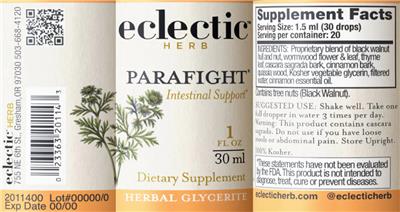
ParaFight Glycerite is a dietary supplement by Eclectic Herb with 9 active ingredients. Its ingredients are commonly taken for constipation (laxative), dry skin (moisturizer), dry, irritated eyes.Based on those ingredients, 1,293 medications have a known interaction with it, the most serious rated moderate. The ingredients most likely to interact are Cascara Sagrada, Cinnamon, Thyme. Use the checker below to test your specific medication, or read the full HelloPharmacist Interaction Report.
Check Your Meds Against ParaFight Glycerite by Eclectic Herb
Ask about any prescription or over-the-counter medication and we check it for interactions with ParaFight Glycerite by Eclectic Herb — and tell you which ingredient is responsible.
AI summaries are generated from our interaction database for education only — always confirm with your pharmacist. How we use AI
Ask the Pharmacist
A licensed pharmacist will answer your question by email — free, usually within 24 hours.
Got it — thank you!
A licensed pharmacist will answer within 24 hours. Keep an eye on your email (worth checking spam, just in case).
HelloPharmacist Scorecard of ParaFight Glycerite by Eclectic Herb
Our pharmacy team’s full take, with four database checks built into the cards below — a summary of what is known, not a grade of the product itself.
What’s inside
Low disclosure
ParaFight Glycerite contains 9 ingredients, with glycerin as the base liquid. The active herbal components — cinnamon, thyme, cascara sagrada, cinnamon essential oil, black walnut extract, wormwood, and quassia wood — are blended together in proprietary proportions.
Glycerin itself is a humectant and osmotic laxative that draws water into the bowel; the herbs are traditionally used as digestive and antimicrobial agents, though the product label itself doesn't claim what condition it targets.
Does it work?
Strong evidence
The evidence for this product's effectiveness is not established in our data. Glycerin is likely effective for constipation and possibly effective for athletic performance, but the individual herbs in this blend — cinnamon, thyme, cascara sagrada, black walnut, wormwood, and quassia — all carry ratings of insufficient reliable evidence for their traditional uses, meaning we don't have solid clinical proof they work for their intended purposes.
How safe is it?
Well-documented data
Glycerin is generally well tolerated in normal amounts but can cause bloating, diarrhea, nausea, vomiting, dizziness, and headache, especially in larger doses. Cascara sagrada carries real long-term safety concerns: it can lead to electrolyte loss, and the product facts advise against use during pregnancy and breastfeeding.
Wormwood contains thujone, a neurotoxin that can cause muscle aches, nausea, vomiting, kidney toxicity, and seizures at high doses, and it's unsafe in pregnancy. Black walnut has limited human safety data and should be avoided in pregnancy and while nursing.
Thyme is generally well tolerated as a food or tea but carries incomplete safety data for medicinal doses. Cinnamon in large amounts raises liver-function concerns due to coumarin content, though clinical trials at typical doses didn't show liver injury.
Quassia can irritate the digestive tract and should be avoided in pregnancy and breastfeeding.
Meds to double-check
Moderate interaction found
Before taking ParaFight Glycerite, check with your pharmacist if you take anticonvulsants (seizure medications) — wormwood may reduce their effect. Also double-check if you're on blood thinners like warfarin, diabetes medications, diuretics, digoxin (a heart drug), corticosteroids, hormone replacement therapy, acid-reflux drugs (H2-blockers, antacids, or PPIs), or any anticholinergic or cholinergic medications.
These are the drug types with documented Moderate or Minor interactions with ingredients in this product.
The bottom line
Scorecard at a glanceFormula with limited ingredient disclosure with clinical evidence supporting its stated purpose. Moderate medication interactions have been identified, and safety information is well characterized.
This is a multi-herb product with documented interactions across a wide range of medications — especially seizure drugs, blood thinners, diabetes medications, diuretics, and heart medications. If you take any prescription drugs, check each one with the tool below before use.
The long-term safety of cascara sagrada and wormwood is a concern; talk to your pharmacist or doctor before starting, particularly if you're pregnant, nursing, or managing a chronic condition.
Educational only — not medical advice; always confirm with your pharmacist. Our editorial policy · How we use AI
Assessment coverage: 8 of 9 active ingredients matched to our full ingredient reviews (monographs). Based on the product label dated Sep 25, 2024.
This Scorecard evaluates available label information, ingredient evidence, and known medication-safety considerations. It does not independently verify product identity, purity, potency, contamination, or manufacturing quality. How these ratings are computed
General information
Key facts about ParaFight Glycerite, straight from the product label.
| Brand | Eclectic Herb |
|---|---|
| Barcode (UPC) | 023363201143 |
| Net contents | 1 Fluid Ounce(s); 30 mL |
| Market status | On market |
| Date entered into DSLD | Sep 25, 2024 |
| DSLD ID | 316854 |
| Product type | Other Combinations |
| Supplement form | Liquid |
| Dietary claims / uses | All Other, Structure/Function |
| Intended target group(s) | Adult (18 - 50 Years), Kosher |
Everything in this section is reproduced from the manufacturer’s own product label — it’s the label speaking, not HelloPharmacist. We show it so you can see exactly what the maker states; we don’t verify or endorse those statements.
Supplement Facts
The label details for ParaFight Glycerite by Eclectic Herb, sourced from the NIH Dietary Supplement Label Database.
Supplement Facts
| Ingredient | Amount | % DV |
|---|---|---|
| Glycerin | 0 NP | -- |
| Proprietary Blend | 0 NP | -- |
| Cinnamon | 0 NP | -- |
| Thyme | 0 NP | -- |
| Water, Filtered | 0 NP | -- |
| Cascara Sagrada | 0 NP | -- |
| Cinnamon Essential Oil | 0 NP | -- |
| Black Walnut extract | 0 NP | -- |
| Wormwood | 0 NP | -- |
| Quassia Wood | 0 NP | -- |
Tap any ingredient to jump to its full detail below.
These statements are the manufacturer’s wording, reproduced from the product label — the label is saying it, not HelloPharmacist. We don’t verify or endorse them.
Formulation
Intestinal support Herbal glycerite
FDA Statement of Identity
Dietary Supplement
Suggested/Recommended/Usage/Directions
Suggested use: Shake well. Take one full dropper in water 3 times per day.
Precautions
Warning: This product contains cascara sagrada.
Do not use if you have loose stools or abdominal pain.
Contains tree nuts (black walnut).
Storage
Store upright.
Formula
100% Kosher
FDA Disclaimer Statement
These statements have not been evaluated by the FDA. This product is not intended to diagnose, treat, cure or prevent any disease.
General Statements
@eclecticherb
Is this label outdated? Report a formula or label change and our pharmacy team will review it.
ParaFight Glycerite by Eclectic Herb label
The label scan from the NIH Dietary Supplement Label Database. Tap to enlarge.
Label images are published by the NIH Dietary Supplement Label Database for the version of this product on file. Always read your actual product label.
View the full label (PDF)The Ingredients in ParaFight Glycerite by Eclectic Herb
These are the 9 active ingredients this product is made of. Select any to open its full monograph.
Serving size1.5 mL Dosage formLiquid Servings per container20 Amounts shown are per serving.
Most supplement products combine several ingredients, and a medication can interact with the product through any one of them. Each ingredient below shows whether it has known drug interactions.
Proprietary Blend
- › Glycerin
- › Cinnamon
- › Thyme
- › Water, Filtered
- › Cascara Sagrada
- › Cinnamon Essential Oil
- › Black Walnut extract
- › Wormwood
- › Quassia Wood
ParaFight Glycerite by Eclectic Herb Drug Interactions
HelloPharmacist Interaction Report
ParaFight Glycerite by Eclectic Herb contains several herbs that interact with medications.
The most serious concern is Wormwood, which can interfere with anticonvulsant drugs (seizure medications) at a Moderate severity level — thujone, a compound in wormwood, has convulsant properties that may reduce how well these drugs work.
Read the full breakdown — every affected drug type, severity by severity
Cascara Sagrada carries Moderate-severity interactions with corticosteroids, diuretics, blood thinners like warfarin (Coumadin), and the heart medication digoxin (Lanoxin), mainly because it's a stimulant laxative that can cause electrolyte loss and increase bleeding risk. It also has Minor interactions with CYP3A4 substrates (a large group of drugs processed by your liver).
Thyme has Moderate interactions with hormone replacement therapy (estrogens), blood thinners, and certain nerve-related medications (anticholinergic and cholinergic drugs), though most of these are theoretical and not yet observed in people. Both forms of cinnamon in this product — the plain ingredient and the essential oil — interact Moderately with diabetes medications and drugs that affect the liver.
Quassia Wood carries Moderate interactions with diabetes medications, diuretics, and digoxin, plus Minor interactions with acid-reflux medications (H2-blockers, antacids, and PPIs). Black Walnut has no documented interactions.
Glycerin, the main ingredient, has no interactions documented in our data. We could not check Filtered Water.
Altogether, these interactions span 1,272 individual medications. Use the search tool below to check your exact medications before starting this product.
Check your own medications below · Editorial policy · How we use AI
Want to check YOUR meds against ParaFight Glycerite?
Ask about interactions with your drugs in plain English — “Can I take it with lisinopril?” — and we find you the answer in seconds, ingredient by ingredient.
Go to the checkerIngredients driving the most interactions
Individual Drug Interactions
The ingredients in ParaFight Glycerite interact with 1,293 drugs. Click any drug to see the details.
5 of the 9 ingredients in ParaFight Glycerite interact with drugs. Each result below shows which ingredient is responsible. Cascara Sagrada Cinnamon Thyme Quassia Wood Wormwood
6-mercaptopurinePurinethol
How 6-mercaptopurine interacts with ParaFight Glycerite — through 1 ingredient. Tap an ingredient for the detail:
Cinnamon Essential OilHepatotoxic Drugs Moderate
Interaction Summary
Theoretically, large doses of cassia cinnamon might cause additive effects when used with hepatotoxic drugs.
Read the full Cinnamon Essential Oil + 6-mercaptopurine interactionAbacavir Sulfate, Dolutegravir, LamivudineTriumeq
How Abacavir Sulfate, Dolutegravir, Lamivudine interacts with ParaFight Glycerite — through 1 ingredient. Tap an ingredient for the detail:
Cinnamon Essential OilHepatotoxic Drugs Moderate
Interaction Summary
Theoretically, large doses of cassia cinnamon might cause additive effects when used with hepatotoxic drugs.
Read the full Cinnamon Essential Oil + Abacavir Sulfate, Dolutegravir, Lamivudine interactionAbacavir, LamivudineEpzicom
How Abacavir, Lamivudine interacts with ParaFight Glycerite — through 1 ingredient. Tap an ingredient for the detail:
Cinnamon Essential OilHepatotoxic Drugs Moderate
Interaction Summary
Theoretically, large doses of cassia cinnamon might cause additive effects when used with hepatotoxic drugs.
Read the full Cinnamon Essential Oil + Abacavir, Lamivudine interactionAbciximabReoPro
How Abciximab interacts with ParaFight Glycerite — through 1 ingredient. Tap an ingredient for the detail:
ThymeAnticoagulant/antiplatelet Drugs Moderate
Interaction Summary
Theoretically, thyme leaf extract might have additive effects with anticoagulant or antiplatelet drugs.
Read the full Thyme + Abciximab interactionAbiraterone
How Abiraterone interacts with ParaFight Glycerite — through 2 ingredients. Tap an ingredient for the detail:
Cinnamon Essential OilHepatotoxic Drugs Moderate
Interaction Summary
Theoretically, large doses of cassia cinnamon might cause additive effects when used with hepatotoxic drugs.
Read the full Cinnamon Essential Oil + Abiraterone interactionCascara SagradaCytochrome P450 3a4 (cyp3a4) Substrates Minor
Interaction Summary
Theoretically, cascara sagrada might decrease the effects of CYP3A4 substrates.
Read the full Cascara Sagrada + Abiraterone interactionAbiraterone AcetateYonsa, Zytiga
How Abiraterone Acetate interacts with ParaFight Glycerite — through 2 ingredients. Tap an ingredient for the detail:
Cinnamon Essential OilHepatotoxic Drugs Moderate
Interaction Summary
Theoretically, large doses of cassia cinnamon might cause additive effects when used with hepatotoxic drugs.
Read the full Cinnamon Essential Oil + Abiraterone Acetate interactionCascara SagradaCytochrome P450 3a4 (cyp3a4) Substrates Minor
Interaction Summary
Theoretically, cascara sagrada might decrease the effects of CYP3A4 substrates.
Read the full Cascara Sagrada + Abiraterone Acetate interactionAbrocitinibCibinqo
How Abrocitinib interacts with ParaFight Glycerite — through 1 ingredient. Tap an ingredient for the detail:
ThymeAnticoagulant/antiplatelet Drugs Moderate
Interaction Summary
Theoretically, thyme leaf extract might have additive effects with anticoagulant or antiplatelet drugs.
Read the full Thyme + Abrocitinib interactionAcarboseGlucobay, Prandase, Precose
How Acarbose interacts with ParaFight Glycerite — through 2 ingredients. Tap an ingredient for the detail:
Cinnamon Essential OilAntidiabetes Drugs, Hepatotoxic Drugs Moderate
Interaction Summary
Theoretically, cassia cinnamon may have additive effects with antidiabetes drugs.
Read the full Cinnamon Essential Oil + Acarbose interactionQuassia WoodAntidiabetes Drugs Moderate
Interaction Summary
In animals, quassia extract reduced levels of fasting glucose.
Read the full Quassia Wood + Acarbose interactionAcebutololRhotral, Sectral
How Acebutolol interacts with ParaFight Glycerite — through 1 ingredient. Tap an ingredient for the detail:
Cinnamon Essential OilHepatotoxic Drugs Moderate
Interaction Summary
Theoretically, large doses of cassia cinnamon might cause additive effects when used with hepatotoxic drugs.
Read the full Cinnamon Essential Oil + Acebutolol interactionAcenocoumarolSintrom
How Acenocoumarol interacts with ParaFight Glycerite — through 1 ingredient. Tap an ingredient for the detail:
ThymeAnticoagulant/antiplatelet Drugs Moderate
Interaction Summary
Theoretically, thyme leaf extract might have additive effects with anticoagulant or antiplatelet drugs.
Read the full Thyme + Acenocoumarol interactionAcepromazineAtravet
How Acepromazine interacts with ParaFight Glycerite — through 1 ingredient. Tap an ingredient for the detail:
ThymeAnticholinergic Drugs Moderate
Interaction Summary
Theoretically, concurrent use of anticholinergic drugs and thyme essential oil might reduce the effects of anticholinergic drugs.
Read the full Thyme + Acepromazine interactionAcetaminophenChildren's Tylenol, Children's Tylenol Meltaways, Tylenol, Tylenol Ex Strength
How Acetaminophen interacts with ParaFight Glycerite — through 1 ingredient. Tap an ingredient for the detail:
Cinnamon Essential OilHepatotoxic Drugs Moderate
Interaction Summary
Theoretically, large doses of cassia cinnamon might cause additive effects when used with hepatotoxic drugs.
Read the full Cinnamon Essential Oil + Acetaminophen interactionAcetaminophen, AspirinGemnisyn
How Acetaminophen, Aspirin interacts with ParaFight Glycerite — through 2 ingredients. Tap an ingredient for the detail:
Cinnamon Essential OilHepatotoxic Drugs Moderate
Interaction Summary
Theoretically, large doses of cassia cinnamon might cause additive effects when used with hepatotoxic drugs.
Read the full Cinnamon Essential Oil + Acetaminophen, Aspirin interactionThymeAnticoagulant/antiplatelet Drugs Moderate
Interaction Summary
Theoretically, thyme leaf extract might have additive effects with anticoagulant or antiplatelet drugs.
Read the full Thyme + Acetaminophen, Aspirin interactionAcetaminophen, Aspirin, CaffeineExcedrin, Excedrin Extra Strength, Excedrin Migraine
How Acetaminophen, Aspirin, Caffeine interacts with ParaFight Glycerite — through 3 ingredients. Tap an ingredient for the detail:
ThymeAnticoagulant/antiplatelet Drugs Moderate
Interaction Summary
Theoretically, thyme leaf extract might have additive effects with anticoagulant or antiplatelet drugs.
Read the full Thyme + Acetaminophen, Aspirin, Caffeine interactionCinnamon Essential OilHepatotoxic Drugs Moderate
Interaction Summary
Theoretically, large doses of cassia cinnamon might cause additive effects when used with hepatotoxic drugs.
Read the full Cinnamon Essential Oil + Acetaminophen, Aspirin, Caffeine interactionCascara SagradaCytochrome P450 3a4 (cyp3a4) Substrates Minor
Interaction Summary
Theoretically, cascara sagrada might decrease the effects of CYP3A4 substrates.
Read the full Cascara Sagrada + Acetaminophen, Aspirin, Caffeine interactionAcetaminophen, Brompheniramine, PhenylpropanolamineDimetapp Cold and Flu
How Acetaminophen, Brompheniramine, Phenylpropanolamine interacts with ParaFight Glycerite — through 1 ingredient. Tap an ingredient for the detail:
Cinnamon Essential OilHepatotoxic Drugs Moderate
Interaction Summary
Theoretically, large doses of cassia cinnamon might cause additive effects when used with hepatotoxic drugs.
Read the full Cinnamon Essential Oil + Acetaminophen, Brompheniramine, Phenylpropanolamine interactionAcetaminophen, ButalbitalAxocet, Bancap, Bucet, Butex Forte, Esgic CF, Orbivan CF +5 more
How Acetaminophen, Butalbital interacts with ParaFight Glycerite — through 1 ingredient. Tap an ingredient for the detail:
Cinnamon Essential OilHepatotoxic Drugs Moderate
Interaction Summary
Theoretically, large doses of cassia cinnamon might cause additive effects when used with hepatotoxic drugs.
Read the full Cinnamon Essential Oil + Acetaminophen, Butalbital interactionAcetaminophen, Butalbital, CaffeineEsgic, Esgic Plus, Fiogesic, Fioricet, Repan, Tecnal +1 more
How Acetaminophen, Butalbital, Caffeine interacts with ParaFight Glycerite — through 2 ingredients. Tap an ingredient for the detail:
Cinnamon Essential OilHepatotoxic Drugs Moderate
Interaction Summary
Theoretically, large doses of cassia cinnamon might cause additive effects when used with hepatotoxic drugs.
Read the full Cinnamon Essential Oil + Acetaminophen, Butalbital, Caffeine interactionCascara SagradaCytochrome P450 3a4 (cyp3a4) Substrates Minor
Interaction Summary
Theoretically, cascara sagrada might decrease the effects of CYP3A4 substrates.
Read the full Cascara Sagrada + Acetaminophen, Butalbital, Caffeine interactionAcetaminophen, Butalbital, Caffeine, CodeineEsgic with Codeine, Fioricet w/ Codeine
How Acetaminophen, Butalbital, Caffeine, Codeine interacts with ParaFight Glycerite — through 2 ingredients. Tap an ingredient for the detail:
Cinnamon Essential OilHepatotoxic Drugs Moderate
Interaction Summary
Theoretically, large doses of cassia cinnamon might cause additive effects when used with hepatotoxic drugs.
Read the full Cinnamon Essential Oil + Acetaminophen, Butalbital, Caffeine, Codeine interactionCascara SagradaCytochrome P450 3a4 (cyp3a4) Substrates Minor
Interaction Summary
Theoretically, cascara sagrada might decrease the effects of CYP3A4 substrates.
Read the full Cascara Sagrada + Acetaminophen, Butalbital, Caffeine, Codeine interactionAcetaminophen, Butalbital, CodeineBancap w/ Codeine
How Acetaminophen, Butalbital, Codeine interacts with ParaFight Glycerite — through 1 ingredient. Tap an ingredient for the detail:
Cinnamon Essential OilHepatotoxic Drugs Moderate
Interaction Summary
Theoretically, large doses of cassia cinnamon might cause additive effects when used with hepatotoxic drugs.
Read the full Cinnamon Essential Oil + Acetaminophen, Butalbital, Codeine interactionAcetaminophen, Butalbital, Codeine PhosphatePhrenilin #3
How Acetaminophen, Butalbital, Codeine Phosphate interacts with ParaFight Glycerite — through 1 ingredient. Tap an ingredient for the detail:
Cinnamon Essential OilHepatotoxic Drugs Moderate
Interaction Summary
Theoretically, large doses of cassia cinnamon might cause additive effects when used with hepatotoxic drugs.
Read the full Cinnamon Essential Oil + Acetaminophen, Butalbital, Codeine Phosphate interactionAcetaminophen, Caffeine, Chlorpheniramine, Hydrocodone, PhenylephrineHycomine Compound
How Acetaminophen, Caffeine, Chlorpheniramine, Hydrocodone, Phenylephrine interacts with ParaFight Glycerite — through 3 ingredients. Tap an ingredient for the detail:
Cinnamon Essential OilHepatotoxic Drugs Moderate
Interaction Summary
Theoretically, large doses of cassia cinnamon might cause additive effects when used with hepatotoxic drugs.
Read the full Cinnamon Essential Oil + Acetaminophen, Caffeine, Chlorpheniramine, Hydrocodone, Phenylephrine interactionThymeAnticholinergic Drugs Moderate
Interaction Summary
Theoretically, concurrent use of anticholinergic drugs and thyme essential oil might reduce the effects of anticholinergic drugs.
Read the full Thyme + Acetaminophen, Caffeine, Chlorpheniramine, Hydrocodone, Phenylephrine interactionCascara SagradaCytochrome P450 3a4 (cyp3a4) Substrates Minor
Interaction Summary
Theoretically, cascara sagrada might decrease the effects of CYP3A4 substrates.
Read the full Cascara Sagrada + Acetaminophen, Caffeine, Chlorpheniramine, Hydrocodone, Phenylephrine interactionAcetaminophen, Caffeine, CodeineGesic C15, Gesic C30, Gesic C8, Lenoltec 1, Lenoltec 2, Lenoltec 3 +1 more
How Acetaminophen, Caffeine, Codeine interacts with ParaFight Glycerite — through 2 ingredients. Tap an ingredient for the detail:
Cinnamon Essential OilHepatotoxic Drugs Moderate
Interaction Summary
Theoretically, large doses of cassia cinnamon might cause additive effects when used with hepatotoxic drugs.
Read the full Cinnamon Essential Oil + Acetaminophen, Caffeine, Codeine interactionCascara SagradaCytochrome P450 3a4 (cyp3a4) Substrates Minor
Interaction Summary
Theoretically, cascara sagrada might decrease the effects of CYP3A4 substrates.
Read the full Cascara Sagrada + Acetaminophen, Caffeine, Codeine interactionAcetaminophen, Caffeine, Codeine, SalicylamideCodalan No.1, Codalan No.2, Codalan No.3
How Acetaminophen, Caffeine, Codeine, Salicylamide interacts with ParaFight Glycerite — through 2 ingredients. Tap an ingredient for the detail:
Cinnamon Essential OilHepatotoxic Drugs Moderate
Interaction Summary
Theoretically, large doses of cassia cinnamon might cause additive effects when used with hepatotoxic drugs.
Read the full Cinnamon Essential Oil + Acetaminophen, Caffeine, Codeine, Salicylamide interactionCascara SagradaCytochrome P450 3a4 (cyp3a4) Substrates Minor
Interaction Summary
Theoretically, cascara sagrada might decrease the effects of CYP3A4 substrates.
Read the full Cascara Sagrada + Acetaminophen, Caffeine, Codeine, Salicylamide interactionAcetaminophen, Caffeine, DihydrocodeineDHC Plus, Panlor DC, Panlor SS
How Acetaminophen, Caffeine, Dihydrocodeine interacts with ParaFight Glycerite — through 2 ingredients. Tap an ingredient for the detail:
Cinnamon Essential OilHepatotoxic Drugs Moderate
Interaction Summary
Theoretically, large doses of cassia cinnamon might cause additive effects when used with hepatotoxic drugs.
Read the full Cinnamon Essential Oil + Acetaminophen, Caffeine, Dihydrocodeine interactionCascara SagradaCytochrome P450 3a4 (cyp3a4) Substrates Minor
Interaction Summary
Theoretically, cascara sagrada might decrease the effects of CYP3A4 substrates.
Read the full Cascara Sagrada + Acetaminophen, Caffeine, Dihydrocodeine interactionAcetaminophen, Caffeine, IsomethepteneMigralam
How Acetaminophen, Caffeine, Isometheptene interacts with ParaFight Glycerite — through 2 ingredients. Tap an ingredient for the detail:
Cinnamon Essential OilHepatotoxic Drugs Moderate
Interaction Summary
Theoretically, large doses of cassia cinnamon might cause additive effects when used with hepatotoxic drugs.
Read the full Cinnamon Essential Oil + Acetaminophen, Caffeine, Isometheptene interactionCascara SagradaCytochrome P450 3a4 (cyp3a4) Substrates Minor
Interaction Summary
Theoretically, cascara sagrada might decrease the effects of CYP3A4 substrates.
Read the full Cascara Sagrada + Acetaminophen, Caffeine, Isometheptene interactionAcetaminophen, Caffeine, PyrilamineMidol Max Strength Menstrual
How Acetaminophen, Caffeine, Pyrilamine interacts with ParaFight Glycerite — through 4 ingredients. Tap an ingredient for the detail:
Cinnamon Essential OilHepatotoxic Drugs Moderate
Interaction Summary
Theoretically, large doses of cassia cinnamon might cause additive effects when used with hepatotoxic drugs.
Read the full Cinnamon Essential Oil + Acetaminophen, Caffeine, Pyrilamine interactionQuassia WoodDiuretic Drugs Moderate
Interaction Summary
Overuse of quassia might compound diuretic-induced potassium loss.
Read the full Quassia Wood + Acetaminophen, Caffeine, Pyrilamine interactionCascara SagradaDiuretic Drugs, Cytochrome P450 3a4 (cyp3a4) Substrates Moderate
Interaction Summary
Theoretically, cascara sagrada might increase the risk of hypokalemia when taken with diuretic drugs.
Read the full Cascara Sagrada + Acetaminophen, Caffeine, Pyrilamine interactionThymeAnticholinergic Drugs Moderate
Interaction Summary
Theoretically, concurrent use of anticholinergic drugs and thyme essential oil might reduce the effects of anticholinergic drugs.
Read the full Thyme + Acetaminophen, Caffeine, Pyrilamine interactionAcetaminophen, Chlorpheniramine Maleate, Dextromethorphan HbrVicks Formula 44M Cough, Cold & Flu Relief
How Acetaminophen, Chlorpheniramine Maleate, Dextromethorphan Hbr interacts with ParaFight Glycerite — through 3 ingredients. Tap an ingredient for the detail:
ThymeAnticholinergic Drugs Moderate
Interaction Summary
Theoretically, concurrent use of anticholinergic drugs and thyme essential oil might reduce the effects of anticholinergic drugs.
Read the full Thyme + Acetaminophen, Chlorpheniramine Maleate, Dextromethorphan Hbr interactionCinnamon Essential OilHepatotoxic Drugs Moderate
Interaction Summary
Theoretically, large doses of cassia cinnamon might cause additive effects when used with hepatotoxic drugs.
Read the full Cinnamon Essential Oil + Acetaminophen, Chlorpheniramine Maleate, Dextromethorphan Hbr interactionCascara SagradaCytochrome P450 3a4 (cyp3a4) Substrates Minor
Interaction Summary
Theoretically, cascara sagrada might decrease the effects of CYP3A4 substrates.
Read the full Cascara Sagrada + Acetaminophen, Chlorpheniramine Maleate, Dextromethorphan Hbr interactionAcetaminophen, Chlorpheniramine, Codeine, PhenylephrineColrex
How Acetaminophen, Chlorpheniramine, Codeine, Phenylephrine interacts with ParaFight Glycerite — through 3 ingredients. Tap an ingredient for the detail:
ThymeAnticholinergic Drugs Moderate
Interaction Summary
Theoretically, concurrent use of anticholinergic drugs and thyme essential oil might reduce the effects of anticholinergic drugs.
Read the full Thyme + Acetaminophen, Chlorpheniramine, Codeine, Phenylephrine interactionCinnamon Essential OilHepatotoxic Drugs Moderate
Interaction Summary
Theoretically, large doses of cassia cinnamon might cause additive effects when used with hepatotoxic drugs.
Read the full Cinnamon Essential Oil + Acetaminophen, Chlorpheniramine, Codeine, Phenylephrine interactionCascara SagradaCytochrome P450 3a4 (cyp3a4) Substrates Minor
Interaction Summary
Theoretically, cascara sagrada might decrease the effects of CYP3A4 substrates.
Read the full Cascara Sagrada + Acetaminophen, Chlorpheniramine, Codeine, Phenylephrine interactionAcetaminophen, Chlorpheniramine, DextromethorphanCoricidin II Extra Strength Cold and Flu
How Acetaminophen, Chlorpheniramine, Dextromethorphan interacts with ParaFight Glycerite — through 3 ingredients. Tap an ingredient for the detail:
ThymeAnticholinergic Drugs Moderate
Interaction Summary
Theoretically, concurrent use of anticholinergic drugs and thyme essential oil might reduce the effects of anticholinergic drugs.
Read the full Thyme + Acetaminophen, Chlorpheniramine, Dextromethorphan interactionCinnamon Essential OilHepatotoxic Drugs Moderate
Interaction Summary
Theoretically, large doses of cassia cinnamon might cause additive effects when used with hepatotoxic drugs.
Read the full Cinnamon Essential Oil + Acetaminophen, Chlorpheniramine, Dextromethorphan interactionCascara SagradaCytochrome P450 3a4 (cyp3a4) Substrates Minor
Interaction Summary
Theoretically, cascara sagrada might decrease the effects of CYP3A4 substrates.
Read the full Cascara Sagrada + Acetaminophen, Chlorpheniramine, Dextromethorphan interactionAcetaminophen, Chlorpheniramine, Dextromethorphan HydrobromideCoricidin HBP Maximum Strength Flu
How Acetaminophen, Chlorpheniramine, Dextromethorphan Hydrobromide interacts with ParaFight Glycerite — through 3 ingredients. Tap an ingredient for the detail:
Cinnamon Essential OilHepatotoxic Drugs Moderate
Interaction Summary
Theoretically, large doses of cassia cinnamon might cause additive effects when used with hepatotoxic drugs.
Read the full Cinnamon Essential Oil + Acetaminophen, Chlorpheniramine, Dextromethorphan Hydrobromide interactionThymeAnticholinergic Drugs Moderate
Interaction Summary
Theoretically, concurrent use of anticholinergic drugs and thyme essential oil might reduce the effects of anticholinergic drugs.
Read the full Thyme + Acetaminophen, Chlorpheniramine, Dextromethorphan Hydrobromide interactionCascara SagradaCytochrome P450 3a4 (cyp3a4) Substrates Minor
Interaction Summary
Theoretically, cascara sagrada might decrease the effects of CYP3A4 substrates.
Read the full Cascara Sagrada + Acetaminophen, Chlorpheniramine, Dextromethorphan Hydrobromide interactionEach ingredient & the kinds of drugs it affects
For each ingredient in ParaFight Glycerite with known interactions, here are the types of medications they can affect. Open any type for the detail — or search your exact drug in the checker above.
Cascara Sagrada
Corticosteroids
Theoretically, cascara sagrada might increase the risk of hypokalemia when taken with corticosteroids.
Cascara sagrada has stimulant laxative effects, and long-term use has been associated with hypokalemia.
Digoxin (Lanoxin)
Theoretically, cascara sagrada might cause hypokalemia, potentially increasing the risk of digoxin toxicity.
Cascara sagrada has stimulant laxative effects, and long-term use has been associated with hypokalemia.
Diuretic Drugs
Theoretically, cascara sagrada might increase the risk of hypokalemia when taken with diuretic drugs.
Cascara sagrada has stimulant laxative effects, and long-term use has been associated with hypokalemia.
Stimulant Laxatives
Theoretically, cascara sagrada might have additive adverse effects when taken with stimulant laxatives.
Cascara sagrada has stimulant laxative effects and might compound fluid and electrolyte losses when taken with stimulant laxatives.
Warfarin (Coumadin)
Theoretically, cascara sagrada might increase the risk of bleeding when taken with warfarin.
Cascara sagrada has stimulant laxative effects. In some people, cascara sagrada can cause diarrhea. Diarrhea can increase the effects of warfarin, increase international normalized ratio (INR), and increase the risk of bleeding.
Cytochrome P450 3A4 (Cyp3A4) Substrates
Theoretically, cascara sagrada might decrease the effects of CYP3A4 substrates.
In vitro research suggests that cascara sagrada can induce CYP3A4 enzymes, albeit to a much lower degree than rifampin, a known CYP3A4 inducer.
Cinnamon
Antidiabetes Drugs
Theoretically, cassia cinnamon may have additive effects with antidiabetes drugs.
Cassia cinnamon may lower blood glucose levels, and have additive effects in patients treated with antidiabetic agents. Dose adjustments to diabetes medications might be necessary.
Hepatotoxic Drugs
Theoretically, large doses of cassia cinnamon might cause additive effects when used with hepatotoxic drugs.
There is some concern that ingesting large amounts of cassia cinnamon for an extended duration might cause hepatotoxicity in some people. Cassia cinnamon contains coumarin, which can cause hepatotoxicity in animal models. In humans, very high doses of coumarin from 50-7000 mg/day can result in hepatotoxicity that resolves when coumarin use is discontinued. Lower amounts might also cause liver problems in sensitive people, such as those with liver disease or those taking potentially hepatotoxic agents.
Thyme
Anticholinergic Drugs
Theoretically, concurrent use of anticholinergic drugs and thyme essential oil might reduce the effects of anticholinergic drugs.
In vitro evidence suggests that thyme essential oil and specific essential oil constituents like thymohydroquinone and carvacrol can inhibit acetylcholinesterase (AChE). However, this effect has not been observed in humans.
Anticoagulant/Antiplatelet Drugs
Theoretically, thyme leaf extract might have additive effects with anticoagulant or antiplatelet drugs.
In vitro and animal research suggests that thyme leaf extract has antiplatelet effects. However, this effect has not been observed in humans.
Cholinergic Drugs
Theoretically, concurrent use of cholinergic drugs and thyme essential oil might cause additive cholinergic effects.
In vitro evidence suggests that thyme essential oil and specific essential oil constituents like thymohydroquinone and carvacrol can inhibit acetylcholinesterase (AChE). However, this effect has not been observed in humans.
Estrogens
Theoretically, thyme might competitively inhibit the effects of estrogen replacement therapy.
In vitro research shows that thyme has estrogen receptor-binding activity and phytoestrogen content. However, this effect has not been observed in humans.
Quassia Wood
Antidiabetes Drugs
In animals, quassia extract reduced levels of fasting glucose. Theoretically, quassia might have additive effects when used with antidiabetes drugs. This might increase the risk of hypoglycemia in some patients. Monitor blood glucose levels closely.
Some antidiabetes drugs include glimepiride (Amaryl), glyburide (DiaBeta, Glynase PresTab, Micronase), insulin, metformin (Glucophage), pioglitazone (Actos), rosiglitazone (Avandia), and others.
Digoxin (Lanoxin)
Theoretically, concomitant use with cardiac medications might increase the risk of therapeutic and adverse effects.
Diuretic Drugs
Overuse of quassia might compound diuretic-induced potassium loss. There is some concern that people taking quassia along with potassium depleting diuretics might have an increased risk for hypokalemia. Initiation of potassium supplementation or an increase in potassium supplement dose may be necessary for some patients.
Some diuretics that can deplete potassium include chlorothiazide (Diuril), chlorthalidone (Thalitone), furosemide (Lasix), and hydrochlorothiazide (HCTZ, Hydrodiuril, Microzide), and others.
Antacids
Theoretically, due to reports that quassia increases stomach acid, quassia might decrease the effectiveness of antacids.
H2-Blockers
Theoretically, due to reports that quassia increases stomach acid, quassia might decrease the effectiveness of H2-blockers. The H2 blockers include cimetidine (Tagamet), ranitidine (Zantac), nizatidine (Axid), and famotidine (Pepcid).
Proton Pump Inhibitors (Ppis)
Theoretically, due to reports that quassia increases stomach acid, quassia might decrease the effectiveness of PPIs. PPIs include omeprazole (Prilosec), lansoprazole (Prevacid), rabeprazole (Aciphex), pantoprazole (Protonix), and esomeprazole (Nexium).
Wormwood
Anticonvulsants
Theoretically, taking wormwood might interfere with the effects of anticonvulsant drugs.
Thujone, a constituent of wormwood, has convulsant effects.
Brand information
Manufacturer and brand details for ParaFight Glycerite, from the product label.
Eclectic Herb
See all Eclectic Herb products- Name
- Eclectic Herb
- Street Address
- 755 NE 6th St.
- City
- Gresham
- State
- Oregon
- ZipCode
- 97030
- Phone Number
- 503.668.4120
- Web Address
- www.eclecticherb.com
ParaFight Glycerite by Eclectic Herb: Common Questions
Does ParaFight Glycerite by Eclectic Herb interact with any medications?
How can one product interact with so many drugs?
Where does this information come from?
Is this safe to take while pregnant?
Can I take this while breastfeeding?
What does glycerin do in this product?
Why is cascara sagrada in a supplement if it has so many warnings?
Does this product actually work for what it's supposed to do?
Written and reviewed by the HelloPharmacist editorial staff. Our editorial policy
Not sure if ParaFight Glycerite is safe with your meds?
Our pharmacists answer your medication & supplement questions — free.
Label information is sourced from the NIH Dietary Supplement Label Database and reflects the product version on file; always read your actual product label. This page is for education only and is not a substitute for professional medical advice. Confirm with your pharmacist or doctor before combining supplements and medications.
The Full Monographs Behind ParaFight Glycerite’s Ingredients
Every ingredient we hold a full HelloPharmacist monograph for — uses, evidence, safety, and the complete interaction list.
Glycerol
Glycerol (glycerin) is a sweet, syrupy compound made naturally in the body and widely used in foods, skin products, and medicines. It is well established as a laxative and a skin and eye moi...
Read the full Glycerol monograph → Herb & supplement monographCassia Cinnamon
Interacts with 442 drugsCassia cinnamon is the common, inexpensive cinnamon used in cooking, and it is also taken as a supplement, most often for blood sugar support. The evidence for its health benefits is mixed a...
Read the full Cassia Cinnamon monograph → Herb & supplement monographThyme
Interacts with 379 drugsThyme is a common kitchen herb that has long been used for coughs, sore throats, and digestive complaints. It is generally safe in the amounts found in food, and some cough products that com...
Read the full Thyme monograph → Herb & supplement monographCascara Sagrada
Interacts with 745 drugsCascara sagrada is a stimulant laxative made from the aged bark of a Pacific Northwest tree, used mainly for short-term relief of constipation. Because it can cause cramping, dehydration, an...
Read the full Cascara Sagrada monograph → Herb & supplement monographBlack Walnut
Black walnut is a tree whose green hulls are traditionally used as a natural antiparasitic and digestive remedy, but solid human evidence for these uses is lacking. It contains a compound ca...
Read the full Black Walnut monograph → Herb & supplement monographWormwood
Interacts with 50 drugsWormwood is a very bitter herb traditionally used to stimulate appetite and ease digestion, and it has early research interest in Crohn's disease. It contains thujone, which can be toxic in...
Read the full Wormwood monograph → Herb & supplement monographQuassia
Interacts with 198 drugsQuassia is a tropical wood known for its very bitter taste, traditionally used as a digestive bitter and as a folk remedy for parasites and head lice. Human evidence for these uses is limite...
Read the full Quassia monograph →Sources & How We Checked
ParaFight Glycerite's label data comes from the NIH Dietary Supplement Label Database; the ingredient interaction data is from the Natural Medicines database, reviewed by our pharmacists.
- NIH Dietary Supplement Label Database (DSLD) — The official product label on file for this supplement.
- Natural Medicines (Therapeutic Research Center) — Evidence-graded clinical reference behind the ingredient interaction data.
Content is written and reviewed by licensed HelloPharmacist pharmacists. See our data sources and editorial standards for how this information is built and checked.
The 76 references behind this product’s interaction data
Every citation that drives the interaction findings for this product’s ingredients, from the evidence-graded Natural Medicines (TRC Healthcare) database. Open an ingredient to browse its citations — links open the study on PubMed or the publisher’s site.
Glycerol 8 references
- McEvoy GK, ed. AHFS Drug Information. Bethesda, MD: American Society of Health-System Pharmacists, 1998.
- Wagner DR. Hyperhydrating with glycerol: implications for athletic performance. J Am Diet Assoc 1999;99:207-12. PubMed
- Yu YL, Kumana CR, Lauder IJ, et al. Treatment of acute cortical infarct with intravenous glycerol. A double-blind, placebo-controlled randomized trial. Stroke 1993;24:1119-24. PubMed
- Frei A, Cottier C, Wunderlich P, Ludin E. Glycerol and dextran combined in the therapy of acute stroke. A placebo-controlled, double-blind trial with a planned interim analysis. Stroke 1987;18:373-9. PubMed
- Balaskas E, Szepietowski JC, Bessis D, Ioannides D, Ponticelli C, Ghienne C, Taberly A, Dupuy P. Randomized, double-blind study with glycerol and paraffin in uremic xerosis. Clin J Am Soc Nephrol. 2011 Apr;6(4):748-52. PubMed
- Blanchet-Bardon C, Tadini G, Machado Matos M, Delarue A. Association of glycerol and paraffin in the treatment of ichthyosis in children: an international, multicentric, randomized, controlled, double-blind study. J Eur Acad Dermatol Venereol. 2012 Aug;26 PubMed
- Kajita N, Kanamori K, Yamamoto S, Yoshida K. Generalized Urticaria Caused by a Glycerin Enema in an Infant. J Investig Allergol Clin Immunol 2022;32(4):318-319. PubMed
- Suzuki R, Fukuyama K, Miyazaki Y, Namiki T. Contact urticaria syndrome and protein contact dermatitis caused by glycerin enema. JAAD Case Reports. 2016;2:108-10. PubMed
Cassia Cinnamon 20 references
- Electronic Code of Federal Regulations. Title 21. Part 182 -- Substances Generally Recognized As Safe. Available at: https://www.accessdata.fda.gov/scripts/cdrh/cfdocs/cfcfr/CFRSearch.cfm?CFRPart=182
- Khan A, Safdar M, Ali Khan M, et al. Cinnamon improves glucose and lipids of people with type 2 diabetes. Diabetes Care 2003;26:3215-8. PubMed
- De Benito V, Alzaga R. Occupational allergic contact dermatitis from cassia (Chinese cinnamon) as a flavouring agent in coffee. Contact Dermatitis 1999;40:165. PubMed
- Drake TE, Maibach HI. Allergic contact dermatitis and stomatitis caused by a cinnamic aldehyde-flavored toothpaste. Arch Dermatol 1976;112:202-3.
- Press release. Cinnamon capsules to reduce blood sugar are medicinal products! Efficacy has not been scientifically proven - some products contain high levels of coumarin. Federal Institute of Risk Assessment (BfM), Germany, November 11, 2006. Available a
- Felter SP, Vassallo JD, Carlton BD, Daston GP. A safety assessment of coumarin taking into account species-specificity of toxicokinetics. Food Chem Toxicol 2006;44:462-75. PubMed
- Crawford P. Effectiveness of cinnamon for lowering hemoglobin A1C in patients with type 2 diabetes: a randomized, controlled trial. J Am Board Fam Med 2009;22:507-12. PubMed
- Akilen, R., Tsiami, A., Devendra, D., and Robinson, N. Glycated haemoglobin and blood pressure-lowering effect of cinnamon in multi-ethnic Type 2 diabetic patients in the UK: a randomized, placebo-controlled, double-blind clinical trial. Diabet.Med. 2010; PubMed
- Lu T, Sheng H Wu J Cheng Y Zhu J Chen Y. Cinnamon extract improves fasting blood glucose and glycosylated hemoglobin level in Chinese patients with type 2 diabetes. Nutr Res. 2012;32(6):408-412. PubMed
- Choi, J., Lee, K. T., Ka, H., Jung, W. T., Jung, H. J., and Park, H. J. Constituents of the essential oil of the Cinnamomum cassia stem bark and the biological properties. Arch Pharm Res 2001;24(5):418-423.
- Altschuler JA, Casella SJ, MacKenzie TA, Curtis KM. The effect of cinnamon on A1C among adolescents with type 1 diabetes. Diabetes Care 2007;30(4):813-6. PubMed
- Stoecker BR, Zhan Z, Luo R, et al. Cinnamon extract lowers blood glucose in hyperglycemic subjects. FASEB J. 2010;22:722.1 (Abstract only). DOI
- Admani S, Hill H, Jacob SE. Cinnamon Sugar Scrub Dermatitis: "Natural" Is Not Always Best. Pediatr Dermatol. 2017;34(1):e42-e43. PubMed
- Isaac-Renton M, Li MK, Parsons LM. Cinnamon spice and everything not nice: many features of intraoral allergy to cinnamic aldehyde. Dermatitis. 2015;26(3):116-21. PubMed
- Vandersall A, Katta R. Eyelid dermatitis as a manifestation of systemic contact dermatitis to cinnamon. Dermatitis. 2015 Jul-Aug;26(4):189. PubMed
- Wickenberg J, Lindstedt S, Nilsson J, Hlebowicz J. Cassia cinnamon does not change the insulin sensitivity or the liver enzymes in subjects with impaired glucose tolerance. Nutr J 2014 Sep 24;13:96. PubMed
- Brancheau D, Patel B, Zughaib M. Do cinnamon supplements cause acute hepatitis? Am J Case Rep 2015;16:250-4. PubMed
- Shekarchizadeh-Esfahani P, Heydarpour F, Izadi F, Jalili C. The effect of cinnamon supplementation on liver enzymes in adults: A systematic review and meta-analysis of randomized controlled trials. Complement Ther Med 2021;58:102699. PubMed
- Bernaola J, Valverde-Monge M, Otal-Buesa M, Cullen D, Heras-Mendaza F. Cinnamon allergic contact cheilitis. Contact Dermatitis 2023;88(5):418-419. PubMed
- Patel K, Howard M, Tate B. Cheilitis caused by allergic contact dermatitis to cinnamon in chai tea: A case report. Contact Dermatitis 2023;88(3):239-240. PubMed
Thyme 18 references
- Zava DT, Dollbaum CM, Blen M. Estrogen and progestin bioactivity of foods, herbs, and spices. Proc Soc Exp Biol Med 1998;217:369-78. PubMed
- Electronic Code of Federal Regulations. Title 21. Part 182 -- Substances Generally Recognized As Safe. Available at: https://www.accessdata.fda.gov/scripts/cdrh/cfdocs/cfcfr/CFRSearch.cfm?CFRPart=182
- Okazaki K, Kawazoe K, Takaishi Y. Human platelet aggregation inhibitors from thyme (Thymus vulgaris L.). Phytother Res 2002;16:398-9. .
- Spiewak R, Skorska C, Dutkiewicz J. Occupational airborne contact dermatitis caused by thyme dust. Contact Dermatitis 2001;44:235-9. . PubMed
- Ernst E, Marz R, Sieder C. A controlled multi-centre study of herbal versus synthetic secretolytic drugs for acute bronchitis. Phytomedicine 1997;4:287-93. PubMed
- Yamamoto J, Yamada K, Naemura A, et al. Testing various herbs for antithrombotic effect. Nutrition 2005;21(5):580-7. PubMed
- Tognolini, M., Barocelli, E., Ballabeni, V., Bruni, R., Bianchi, A., Chiavarini, M., and Impicciatore, M. Comparative screening of plant essential oils: phenylpropanoid moiety as basic core for antiplatelet activity. Life Sci. 2-23-2006;78(13):1419-1432. PubMed
- Mackiewicz, B., Skorska, C., Dutkiewicz, J., Michnar, M., Milanowski, J., Prazmo, Z., Krysinska-Traczyk, E., and Cisak, E. Allergic alveolitis due to herb dust exposure. Ann Agric Environ Med 1999;6(2):167-170.
- Martinez-Gonzalez, M. C., Goday Bujan, J. J., Martinez, Gomez W., and Fonseca, Capdevila E. Concomitant allergic contact dermatitis due to Rosmarinus officinalis (rosemary) and Thymus vulgaris (thyme). Contact Dermatitis 2007;56(1):49-50.
- Jukic, M., Politeo, O., Maksimovic, M., Milos, M., and Milos, M. In vitro acetylcholinesterase inhibitory properties of thymol, carvacrol and their derivatives thymoquinone and thymohydroquinone. Phytother.Res 2007;21(3):259-261.
- Marzian, O. [Treatment of acute bronchitis in children and adolescents. Non-interventional postmarketing surveillance study confirms the benefit and safety of a syrup made of extracts from thyme and ivy leaves]. MMW.Fortschr.Med 6-28-2007;149(27-28 Suppl
- Cuzzolin, L. and Benoni, G. Attitudes and knowledge toward natural products safety in the pharmacy setting: an Italian study. Phytother.Res 2009;23(7):1018-1023. PubMed
- Berova, N., Stransky, L., and Krasteva, M. Studies on contact dermatitis in stomatological staff. Dermatol.Monatsschr. 1990;176(1):15-18.
- Smeenk, G., Kerckhoffs, H. P., and Schreurs, P. H. Contact allergy to a reaction product in Hirudoid cream: an example of compound allergy. Br.J Dermatol. 1987;116(2):223-231.
- Le Roy, R., Grosshans, E., and Foussereau, J. [Investigation of contact allergies in 100 cases of ulcus cruris (author's transl)]. Derm.Beruf.Umwelt. 1981;29(6):168-170.
- Lorenzi, S., Placucci, F., Vincenzi, C., Bardazzi, F., and Tosti, A. Allergic contact dermatitis due to thymol. Contact Dermatitis 1995;33(6):439-440. PubMed
- Bahadoran P, Rokni FK, Fahami F. Investigating the therapeutic effect of vaginal cream containing garlic and thyme compared to clotrimazole cream for the treatment of mycotic vaginitis. Iran J Nurs Midwifery Res 2010;15(Suppl 1):343-9.
- Erol S, Aydin B, Dilli D, Okumus N, Zenciroglu A, Gündüz M. An interesting newborn case of fructose 1-6 diphosphatase deficiency triggered after thyme juice ingestion. Clin Lab. 2014;60(1):151-3. PubMed
Cascara Sagrada 9 references
- Blumenthal M, ed. The Complete German Commission E Monographs: Therapeutic Guide to Herbal Medicines. Trans. S. Klein. Boston, MA: American Botanical Council, 1998.
- Newall CA, Anderson LA, Philpson JD. Herbal Medicine: A Guide for Healthcare Professionals. London, UK: The Pharmaceutical Press, 1996.
- Brinker F. Herb Contraindications and Drug Interactions. 2nd ed. Sandy, OR: Eclectic Medical Publications, 1998.
- Covington TR, et al. Handbook of Nonprescription Drugs. 11th ed. Washington, DC: American Pharmaceutical Association, 1996.
- Nusko G, Schneider B, Schneider I, et al. Anthranoid laxative use is not a risk factor for colorectal neoplasia: results of a prospective case control study. Gut 2000;46:651-5. PubMed
- Nadir A, Reddy D, Van Thiel DH. Cascara-sagrada induced intrahepatic cholestasis causing portal hypertension: case report and review of herbal hepatotoxicity. Am J Gastroenterol 2000;95:3634-7. PubMed
- Nakasone ES, Tokeshi J. A serendipitous find: a case of cholangiocarcinoma identified incidentally after acute liver injury due to cascara sagrada ingestion. Hawaii J Med Public Health 2015;74(6):200-2.
- Cirillo C, Capasso R. Constipation and botanical medicines: an overview. Phytother Res 2015;29(10):1488-93. PubMed
- Mazzari ALDA, Lacerda MG, Milton FA, et al. In vitro effects of European and Latin-American medicinal plants in CYP3A4 gene expression, glutathione levels, and P-glycoprotein activity. Front Pharmacol 2022;13:826395. PubMed
Black Walnut 3 references
- Blumenthal M, ed. The Complete German Commission E Monographs: Therapeutic Guide to Herbal Medicines. Trans. S. Klein. Boston, MA: American Botanical Council, 1998.
- McGuffin M, Hobbs C, Upton R, Goldberg A, eds. American Herbal Products Association's Botanical Safety Handbook. Boca Raton, FL: CRC Press, LLC 1997.
- Food and Drug Administration. Food Allergen Labeling and Consumer Protection Act of 2004 (FALCPA); Public Law 108-282, Title II. Accessed on May 19, 2021. Available at: https://www.fda.gov/food/food-allergensgluten-free-guidance-documents-regulatory-infor
Wormwood 10 references
- Weisbord SD, Soule JB, Kimmel PL. Poison on line-acute renal failure caused by oil of wormwood purchased through the internet. N Engl J Med 1997;337:825-7. PubMed
- Gambelunghe C, Melai P. Absinthe: enjoying a new popularity among young people? Forensic Sci Int 2002;130:183-6.
- Hold KM, Sirisoma NS, Casida JE. Detoxification of alpha- and beta-Thujones (the active ingredients of absinthe): site specificity and species differences in cytochrome P450 oxidation in vitro and in vivo. Chem Res Toxicol 2001;14:589-95.
- Lachenmeier DW, Walch SG, Padosch SA, Kroner LU. Absinthe--a review. Crit Rev Food Sci Nutr 2006;46:365-77.
- Padosch SA, Lachenmeier DW, Kroner LU. Absinthism: a fictitious 19th century syndrome with present impact. Subst Abuse Treat Prev Policy 2006;1:14. PubMed
- Lachenmeier DW, Emmert J, Kuballa T, Sartor G. Thujone--cause of absinthism? Forensic Sci Int 2006;158:1-8. PubMed
- Dettling, A., Grass, H., Schuff, A., Skopp, G., Strohbeck-Kuehner, P., and Haffner, H. T. Absinthe: attention performance and mood under the influence of thujone. J Stud.Alcohol 2004;65(5):573-581. PubMed
- Benezet-Mazuecos, J. and de la Fuente, A. Electrocardiographic findings after acute absinthe intoxication. Int J Cardiol. 11-10-2006;113(2):e48-e50. PubMed
- El Makrini NI, Hassam B. Artemisia absinthium: burning plant! Pan Afr Med J. 2016 Jan 22;23:10. PubMed
- Kocaoglu C, Ozel A. Persistent metabolic acidosis and severe diarrhoea due to Artemisia absinthium poisoning. J Pak Med Assoc. 2014 Sep;64(9):1081-3.
Quassia 8 references
- Newall CA, Anderson LA, Philpson JD. Herbal Medicine: A Guide for Healthcare Professionals. London, UK: The Pharmaceutical Press, 1996.
- Robbers JE, Speedie MK, Tyler VE. Pharmacognosy and Pharmacobiotechnology. Baltimore, MD: Williams & Wilkins, 1996.
- Gruenwald J, Brendler T, Jaenicke C. PDR for Herbal Medicines. 1st ed. Montvale, NJ: Medical Economics Company, Inc., 1998.
- Brinker F. Herb Contraindications and Drug Interactions. 2nd ed. Sandy, OR: Eclectic Medical Publications, 1998.
- Jensen O, Nielsen AO, Bjerregaard P. Pediculosis capitis treated with quassia tincture. Acta Derm Venereol 1978;58:557-9. DOI
- Diehl C, Ferrari A. Efficacy of topical 4% Quassia amara gel in facial seborrheic dermatitis:a randomized, double-blind, comparative study. J Drugs Dermatol. 2013;12(3):312-5.
- Ferrari A, Diehl C. Evaluation of the efficacy and tolerance of a topical gel with 4% quassia extract in the treatment of rosacea. J Clin Pharmacol. 2012;52(1):84-8. PubMed
- Husain GM, Singh PN, Singh RK, Kumar V. Antidiabetic activity of standardized extract of Quassia amara in nicotinamide-streptozotocin-induced diabetic rats. Phytother Res. 2011;25(12):1806-12.
Parts of this content are provided by the Therapeutic Research Center, LLC.
DISCLAIMER: Currently this does not check for drug-drug interactions. This is not an all-inclusive comprehensive list of potential interactions and is for informational purposes only. Not all interactions are known or well-reported in the scientific literature, and new interactions are continually being reported. Input is needed from a qualified healthcare provider including a pharmacist before starting any therapy. Application of clinical judgment is necessary.
© 2021 Therapeutic Research Center, LLC