
Second Wind by IVL Ingredients, Side Effects and Drug Interactions
Dietary Supplement Capsule Other Combinations

Medically reviewed by Dr. Brian Staiger, PharmD, BCPS
Also reviewed by the HelloPharmacist Editorial Team
Updated Details about this page
- Label on file from the NIH Dietary Supplement Label Database, dated Jul 25, 2024.
- The interaction, evidence and safety records come from the Natural Medicines database, which we license, read against this label by our own system; the pharmacy team’s sections are written from those records.
- Dr. Brian Staiger, PharmD, BCPS, is a clinical pharmacist and pharmacotherapy specialist.
- Editorial policy Our sources
AI is used only to summarize verified clinical information, never the open internet. Our AI policy
Summary: The HelloPharmacist Team’s Take
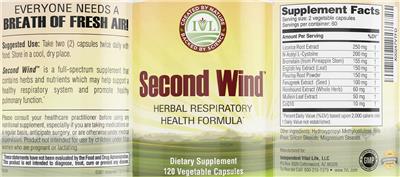
- Form
- Capsule
- Serving Size
- 2 Vegetable Capsules
- Servings
- 60 per container
- Container Holds
- 120 Vegetable Capsules
What’s in it, whether it interacts with your drugs, its side effects, whether it works, and what our pharmacists would want you to know before you start it.
- What is Second Wind?A supplement from IVL with nine active ingredients, in capsule form.
- Active Ingredients 6 plant ingredients such as Licorice Root, English Ivy Leaf and Pleurisy, 1 enzyme and 2 others: Licorice Root Extract 250 mgN-Acetyl L-Cysteine 200 mgBromelain 155 mgEnglish Ivy Leaf Extract 150 mgPleurisy, Powder 150 mgFenugreek Seed Extract 100 mgHorehound Whole Herb Extract 60 mgMullein Leaf Extract 50 mgCoenzyme Q-10 10 mg Nine active ingredients. Each one can interact with drugs or cause side effects on its own, so we check every one. The full Supplement Facts
- Drug Interactions 1,235 drugs have a documented interaction with this supplement; the most serious is rated major. Of those, 821 are single drugs and 414 are combination products (two or more drugs in one), each listed under its own name. Based on the 8 of its 9 ingredients we could check. Ask your pharmacist first if you take a drug in any of these categories, the most serious of the 31 on record:
- NitroglycerinMajor · 1 drug
- Moderate · 645 drugs
- Moderate · 202 drugs
- Moderate · 193 drugs
- Possible Side EffectsDiarrhea 5 ingredientsNausea 4 ingredientsStomach upset 4 ingredientsVomiting 3 ingredientsHeadache 2 ingredientsHigh blood pressure +9 moreCombined from seven of its nine active ingredients. Not studied in this exact product.
- Well documented Why
Does Second Wind work?
What It Is Marketed For
Respiratory system and pulmonary function support
From the claims on the product’s label.
The Closest Use the Research Grades
N-Acetyl Cysteine (NAC)
Some studies support it, but the evidence isn’t conclusive.
Its ingredients have stronger research for other uses:
- Coenzyme Q10 deficiency Coenzyme Q10
- N-Acetyl Cysteine (NAC)
- Fenugreek
- N-Acetyl Cysteine (NAC)
- Fenugreek
- Migraine headache Coenzyme Q10
These grades are for each ingredient, not this exact product, and never a promise it will work for you.
And 10 more graded uses, in what the research says- Full Why
- AllergensNone of its ingredient names point to a major food allergen, and the label text we have carries no allergen statement
Who Might Consider It
- People looking for respiratory system and pulmonary function support, which is what it is marketed for. The closest use the research grades is chronic obstructive pulmonary disease (COPD), rated Possibly Effective.
- People who want it for coenzyme Q10 deficiency, hyperlipidemia, diabetes, influenza or another graded use: the other uses with research behind them. See each grade
- Second Wind may be of interest to people who want a multi-ingredient herbal capsule with some ingredients that have better-studied uses.
Who Should Be Careful
- People who take blood thinners, blood pressure medicines, diabetes drugs, or nitroglycerin, or who have heart, kidney, or blood pressure conditions, should be especially careful.
- If you are pregnant or breastfeeding, it is best to talk it over with your own doctor or pharmacist before starting.
More Before You Take It Show both answersHide Pregnancy and Breastfeeding The Label’s Directions
-
Pregnant or breastfeeding?
- Pregnancy Licorice
- ! When used orally.
- Breastfeeding Licorice
- Insufficient reliable information available; avoid using.
- Pregnancy Fenugreek
- ! When used orally in amounts greater than those found in food.
- Breastfeeding Fenugreek
- When used orally to stimulate lactation, short-term.
- Pregnancy White Horehound
- ! When used orally; white horehound might have abortifacient effect, or stimulate menstrual flow and the uterus.
- Breastfeeding White Horehound
- There is insufficient reliable information available about the safety of oral use during lactation; avoid amounts greater than those commonly found in foods.
-
How does the label say to take it?
“Suggested use: Take two (2) capsules twice daily with food.”
The maker’s words. Your pharmacist or doctor may advise differently.
Everything the label says
From the label dated Jul 25, 2024: 8 of its 9 active ingredients were checked against our records; the other one is not in them yet. A summary of what is known, not a grade or a test of the product. How these ratings are computed
Ask Anything About This Supplement
Name a drug you take, or ask about side effects, ingredients or pregnancy.
AI answers come from this label and our own records, never the open internet. AI can make mistakes, so always check with your doctor or pharmacist. How we use AI
Ask the Pharmacist
A licensed pharmacist will answer your question by email — free, usually within 24 hours.
Got it — thank you!
A licensed pharmacist will answer within 24 hours. Keep an eye on your email (worth checking spam, just in case).
What’s Inside Second Wind by IVL
Nine Active Ingredients, Each Checked on Its Own
A supplement is often several ingredients in one bottle, and each one can interact with drugs or cause side effects on its own. We check every one of them against our records.
- Licorice Root ExtractDrug interactions on record, most serious: Moderate
- N-Acetyl L-CysteineDrug interactions on record, most serious: Major
- BromelainDrug interactions on record, most serious: Moderate
- English Ivy Leaf ExtractDrug interactions on record, most serious: Moderate
- Pleurisy, PowderNot in our interaction records yet
- Fenugreek Seed ExtractDrug interactions on record, most serious: Moderate
- Horehound Whole Herb ExtractDrug interactions on record, most serious: Moderate
- Mullein Leaf ExtractNo drug interactions on record
And 1 more, each with its own card below.
Why this rating?
The label gives an exact amount for every one of its nine active ingredients, so you know how much of each you get in each serving. This rates what the label tells you, not the quality of the product.
Supplement Facts
| Amount Per Serving | % Daily Value | |
|---|---|---|
| Licorice Root Extract | 250 mg | † |
| N-Acetyl L-Cysteine | 200 mg | † |
| Bromelain | 155 mg | † |
| English Ivy Leaf Extract | 150 mg | † |
| Pleurisy, Powder | 150 mg | † |
| Fenugreek Seed Extract | 100 mg | † |
| Horehound Whole Herb Extract | 60 mg | † |
| Mullein Leaf Extract | 50 mg | † |
| Coenzyme Q-10 | 10 mg | † |
Other ingredients: Hydroxypropyl Methylcellulose, Rice Flour, Silicon Dioxide, Magnesium Stearate
† Daily Value not established.
Daily Values for adults and children 4 or more years of age.
As the label prints it, from the NIH Dietary Supplement Label Database.
Each Ingredient and Its Drug Interactions
Tap one for more about it and its full guide. A drug can interact with this supplement through any one of them.
Second Wind is a capsule with nine active ingredients: licorice root extract, N-acetyl cysteine, coenzyme Q10, bromelain, fenugreek seed extract, English ivy leaf extract, mullein leaf extract, pleurisy powder, and horehound whole herb extract.
- Each one is studied for different uses, and the effectiveness section below explains what the evidence shows for each.
-
Licorice Root Extract 250 mg Interacts with 1,041 drugs
Licorice root is a traditional remedy used for sore throats, coughs, and digestive complaints, but solid human evidence is limited for most uses.
- Regular licorice contains glycyrrhizin, which can raise blood pressure and lower potassium when taken in large amounts or for a long time, so deglycyrrhizinated (DGL) products are often preferred.
- Talk to your pharmacist or doctor before using it, especially if you have high blood pressure, heart, or kidney problems.
The full Licorice guide: uses, dosage and safety Every Licorice drug interaction
-
N-Acetyl L-Cysteine 200 mg Interacts with 294 drugs
N-acetyl cysteine (NAC) is a supplement form of the amino acid cysteine and a building block for the antioxidant glutathione.
- It has well-established prescription uses for acetaminophen overdose and thinning mucus, but evidence for many over-the-counter uses is still limited.
- It is generally well tolerated, but you should check with a pharmacist or doctor before starting it.
The full N-Acetyl Cysteine (NAC) guide: uses, dosage and safety Every N-Acetyl Cysteine (NAC) drug interaction
-
Bromelain 155 mg Interacts with 141 drugs
Form on the label: Pineapple
Bromelain is a group of protein-digesting enzymes from pineapple that people take mainly for inflammation, swelling, and sinus problems.
- Some early studies are promising, but the overall evidence is limited and far from conclusive.
- It is generally well tolerated short-term, but pregnant and breastfeeding people should avoid it, and anyone with a pineapple allergy or bleeding concerns should check with a pharmacist first.
The full Bromelain guide: uses, dosage and safety Every Bromelain drug interaction
-
English Ivy Leaf Extract 150 mg Interacts with 400 drugs
English ivy leaf extract is most commonly used in cough and cold syrups to help loosen mucus and ease coughing, and it is a popular ingredient in many European herbal products.
- Some research suggests it may help with certain coughs, but the evidence is still limited and mixed.
- The raw plant is poisonous if eaten and can irritate skin, so only use properly prepared commercial products and check with your pharmacist first.
The full English Ivy guide: uses, dosage and safety Every English Ivy drug interaction
-
Pleurisy, Powder 150 mg We know this ingredient, but hold no drug interaction record for it yet, so it was not checked
-
Fenugreek Seed Extract 100 mg Interacts with 389 drugs
Fenugreek is a common kitchen spice that is also taken as a supplement, mainly for blood sugar, cholesterol, and to support breast milk production.
- Some early research is encouraging for blood sugar, but overall the evidence is mixed and far from settled.
- It is generally well tolerated as food, but talk with your pharmacist or doctor before using it as a supplement, especially if you are pregnant.
The full Fenugreek guide: uses, dosage and safety Every Fenugreek drug interaction
-
Horehound Whole Herb Extract 60 mg Interacts with 258 drugs
White horehound is a traditional bitter herb used mainly for coughs, sore throats, and mild digestive complaints, and it is a common flavoring in old-fashioned cough drops.
- Solid human evidence supporting these uses is limited, so view it as a folk remedy rather than a proven treatment.
- Talk to your pharmacist or doctor before using it, and avoid it during pregnancy.
The full White Horehound guide: uses, dosage and safety Every White Horehound drug interaction
-
Mullein Leaf Extract 50 mg Interacts with 122 drugs
Mullein is a traditional herbal remedy most often used as a tea or syrup to soothe coughs, sore throats, and respiratory irritation.
- High-quality human studies are lacking, so its benefits are not well proven, but it is generally considered low-risk for short-term use in healthy adults.
- Talk to your pharmacist or doctor before using it, especially if you are pregnant, breastfeeding, or have a medical condition.
The full Mullein guide: uses, dosage and safety Every Mullein drug interaction
-
Coenzyme Q-10 10 mg Interacts with 198 drugs
CoQ10 is a vitamin-like substance your body makes naturally that helps cells produce energy and acts as an antioxidant.
- It is generally well tolerated and is most studied for heart conditions, statin-related muscle symptoms, and migraine prevention, though the strength of the evidence varies.
- Talk with your pharmacist or doctor before starting it, especially if you take heart or blood pressure medicines.
The full Coenzyme Q10 guide: uses, dosage and safety Every Coenzyme Q10 drug interaction
Other Ingredients (Inactive)
The capsule or tablet itself, fillers, coatings and flavors. Not part of the drug interaction check; the allergen check below reads them.
- Hydroxypropyl Methylcellulose
- Rice Flour
- Silicon Dioxide
- Magnesium Stearate
Allergens in Second Wind
None of its ingredient names point to a major food allergen, and the label text we have carries no allergen statement.
Not named in the ingredients
- Milk
- Egg
- Fish
- Shellfish
- Tree nuts
- Peanuts
- Wheat or other gluten grains
- Soy
- Sesame
From the label text and ingredient names on file; we do not test products. With a serious allergy, check your bottle and ask the maker or your pharmacist.
What the Label Says
The maker’s own words, from the label. We do not verify or endorse them.
- General statements
-
“Everyone needs a breath of fresh air!”
- Storage
-
“Store in a cool, dry place.”
- Brand IP Statement(s)
-
“IVL Created by Nature Backed by Science”
“Copyright 2021 Independent Vital Life LLC”
- Formulation
-
“Herbal respiratory health formula”
“Second Wind is a full-spectrum supplement that contains herbs and nutrients which may help support a healthy respiratory system and promote healthy pulmonary function.”
- FDA Statement of Identity
-
“Dietary Supplement”
- Seals and symbols
-
“GMP Sourced from a GMP Certified Facility 100% Satisfaction Guarantee”
The Second Wind Label on File
The label scan on file at the NIH Dietary Supplement Label Database, dated July 2024. Always read the label on the bottle you have.
Product Facts
- Brand
- IVL
- Barcode (UPC)
- X00247VTFD
- Net contents
- 120 Vegetable Capsules
- Market status
- On market
- Date entered into DSLD
- Jul 25, 2024
- DSLD ID
- 307019
- Product type
- Other Combinations
- Supplement form
- Capsule
- Dietary claims / uses
- All Other, Structure/Function
- Intended target group(s)
- Adult (18 - 50 Years), Women (not pregnant or lactating)
Is this label outdated? Report a formula or label change and our pharmacy team will review it.
Second Wind by IVL Side Effects
Why this rating?
We look for three kinds of safety information on each ingredient: side effects reported in studies, a pregnancy and breastfeeding rating, and a safety write-up from our pharmacy team. All three are on file for each of the eight ingredients we could check.
So this rates how much is known, not whether Second Wind is right for you.
Reported with eight of its ingredients
- Most often
- Diarrhea, nausea, stomach upset, vomiting, headache and high blood pressure
- !Rare but serious
- Bronchospasm and shock See details
HelloPharmacist Team Summary: Second Wind by IVL Side Effects
Most of the ingredients in Second Wind are generally well tolerated at typical doses, but the ones you are most likely to notice are stomach upset, nausea, and diarrhea.
- Because dizziness has been reported with coenzyme Q10, see how Second Wind affects you before driving.
- The rare but serious concern comes from licorice root, where high blood pressure and low potassium can lead to irregular heartbeats, so call your doctor if you notice any heart symptoms.
- Talk with your own doctor or pharmacist before starting if you have high or low blood pressure, heart or kidney disease, diabetes, or if you are pregnant or breastfeeding.
Side Effects, Ingredient by Ingredient
A supplement’s side effects come from its ingredients. Here is what is reported with each one.
Licorice
Most reported
- High blood pressure
- Low potassium
- Fluid retention and swelling
- Headache
N-Acetyl Cysteine (NAC)
Most reported
- Nausea
- Vomiting
- Diarrhea
- Stomach upset
Bromelain
Most reported
- Nausea or upset stomach
- Diarrhea
- Vomiting
English Ivy
Most reported
- Stomach upset
- Nausea
- Vomiting
- Diarrhea
Fenugreek
Most reported
- Gas
- Bloating
- Diarrhea
- Stomach upset
Mullein
Most reported
- Throat
- Skin irritation
- Stomach upset
Coenzyme Q10
Most reported
- Upset stomach or nausea
- Diarrhea or loss of appetite
- Heartburn
- Headache or dizziness
White Horehound has side-effect reports, but no list of the most common ones. Read them in the White Horehound guide
Second Wind Warnings: Who Should Be Careful
Second Wind has nine active ingredients, and each can carry warnings of its own. We checked the eight in our ingredient guides, and each warning below names the ingredient it comes from. Pleurisy, Powder is not in our guides yet, so ask your pharmacist about it. If any of these apply to you, talk to your doctor or pharmacist before you start it.
- Licorice3 warnings below
- N-Acetyl Cysteine (NAC)3 warnings below
- Bromelain3 warnings below
- English Ivy3 warnings below
- Fenugreek3 warnings below
- White Horehound3 warnings below
- Mullein2 warnings below
- Coenzyme Q102 warnings below
- Pleurisy, PowderNot in our guides yet
-
Bleeding Problems or Surgery
- N-Acetyl Cysteine (NAC)Those with a history of stomach ulcers or bleeding disorders should also use care.
- BromelainBleeding risk: Bromelain may affect how the blood clots.
- Coenzyme Q10People with low blood pressure, those scheduled for surgery, or anyone with a chronic health condition should talk with a healthcare provider before starting CoQ10.
-
Diabetes or Low Blood Sugar
- FenugreekPeople with diabetes should monitor their blood sugar closely, since fenugreek may lower it.
- White HorehoundPeople with diabetes should be cautious, since the herb may affect blood sugar.
- Coenzyme Q10Because it may affect blood pressure or blood sugar in some people, monitoring may be needed.
-
Blood Pressure
- LicoriceThe bigger concern is with glycyrrhizin-containing licorice taken in large amounts or for a long time, which can raise blood pressure, lower potassium, and stress the heart.
- LicoricePeople who should be especially cautious or avoid glycyrrhizin-containing licorice include those with high blood pressure, heart disease, kidney disease, low potassium, or hormone-sensitive conditions.
-
Heart Conditions
- White HorehoundPeople with heart rhythm problems, stomach or intestinal ulcers, or any chronic condition should check with a healthcare provider first.
-
Allergies
- BromelainAllergies: People allergic to pineapple should avoid bromelain.
- English IvyPeople with allergies to plants in the ivy family (Araliaceae) should be cautious.
- MulleinPeople with allergies to plants in the same family may be more likely to react.
-
Children
- English IvyChildren should only use products made specifically for children and only under guidance from a healthcare provider.
- MulleinChildren, older adults, and people with chronic health conditions should check with a pharmacist or doctor before using it.
-
If You Take Other Drugs
- N-Acetyl Cysteine (NAC)However, you should talk with a pharmacist or doctor before starting it, especially if you have a health condition or take other medicines.
- English IvyAlways talk to a pharmacist or doctor before starting any herbal product, especially if you have a chronic health condition or take other medicines.
-
Other Cautions
- LicoriceDGL products avoid most of these risks because the glycyrrhizin has been removed.
- N-Acetyl Cysteine (NAC)People with asthma should be cautious, as inhaled forms can sometimes trigger airway tightening.
- BromelainStill, some people should be careful.
- FenugreekAs a concentrated supplement, it is usually well tolerated by most adults, but a few groups should be careful.
-
What the Label Warns
- “Please consult your healthcare practitioner before using any nutritional supplement, especially if you are taking medications on a regular basis, anticipate surgery, or are otherwise under medical supervision. Product not intended for use by children under 18 or women who are pregnant or lactating.”
- “Product not intended for use by children under 18 or women who are pregnant or lactating.”
The maker’s wording, from the product label.
-
Pregnant or Breastfeeding
Each ingredient’s rating for pregnancy and for breastfeeding, and what it covers.
Pregnancy
-
When used orally.
Licorice has abortifacient, estrogenic, and steroid effects.
4 more points on this rating
- It can also cause uterine stimulation.
- Heavy consumption of licorice, equivalent to 500 mg of glycyrrhizin per week (about 250 grams of licorice per week), during pregnancy seems to increase the risk of delivery before gestational age of 38 weeks.
- Furthermore, high intake of glycyrrhizin, at least 500 mg per week, during pregnancy is associated with increased salivary cortisol levels in the child by the age of 8 years.
- This suggests that high intake of licorice during pregnancy may increase hypothalamic-pituitary-adrenocortical axis activity in the child; avoid using.
Breastfeeding
-
Insufficient reliable information available; avoid using.
Pregnancy
-
When used orally in amounts greater than those found in food.
Fenugreek has potential oxytoxic and uterine stimulant activity.
3 more points on this rating
- There are case reports of congenital malformations, including hydrocephalus, anencephaly, cleft palate, and spina bifida, after consumption of fenugreek seeds during pregnancy.
- Consumption of fenugreek immediately prior to delivery may cause the neonate to have unusual body odor.
- Although this does not appear to cause long-term sequelae, it may be misdiagnosed as maple syrup urine disease.
Breastfeeding
-
When used orally to stimulate lactation, short-term.
Although most available clinical studies lack safety testing in the lactating parent or infant, some evidence suggests that taking fenugreek 1725 mg three times daily orally for 21 days does not cause negative side effects in the infant.
Show 6 more ingredients
Pregnancy
-
When used orally; white horehound might have abortifacient effect, or stimulate menstrual flow and the uterus.
There is insufficient reliable information available about the safety of topical use during pregnancy; avoid using.
Breastfeeding
-
There is insufficient reliable information available about the safety of oral use during lactation; avoid amounts greater than those commonly found in foods.
There is insufficient reliable information available about the safety of topical use during lactation; avoid using.
Pregnancy
-
There is not enough reliable safety data, so it is best to avoid unless your doctor advises otherwise.
Breastfeeding
-
Insufficient reliable information available; avoid using.
Pregnancy
-
When used orally, intratracheally, intravenously, or by inhalation.
N-acetyl cysteine crosses the placenta, but has not been associated with adverse effects to the fetus.
However, N-acetyl cysteine should only be used in pregnancy when clearly indicated, such as in cases of acetaminophen toxicity.
Breastfeeding
-
Insufficient reliable information available; avoid using.
Pregnancy and Breastfeeding The record rates both the same
-
Insufficient reliable information available; avoid using.
Pregnancy
-
Insufficient reliable information available; avoid using.
A small retrospective study suggests that taking English ivy leaf extract at an unknown dose or duration during pregnancy is not associated with changes in pregnancy duration, the rate of preterm birth, infant health complications, or infant deaths.
However, due to its small size, retrospective design, and insufficient information regarding dose and duration, further research is needed to determine the safety of English ivy during pregnancy.
Breastfeeding
-
Insufficient reliable information available; avoid using.
Pregnancy and Breastfeeding The record rates both the same
-
Insufficient reliable information available; avoid using.
Our pharmacy team’s notes
- LicoriceIts pregnancy rating is Unsafe, and it is best avoided in pregnancy.
- FenugreekFenugreek is rated Possibly Safe for lactation.
- Fenugreek and white horehound are both rated Likely Unsafe in pregnancy.
- NAC is rated Possibly Safe in pregnancy, but our pharmacists say supplement use in pregnancy has not been well studied.
- For breastfeeding, our pharmacists advise avoiding licorice, bromelain, English ivy, mullein, and white horehound, and advise caution with coenzyme Q10.
Ratings and the words beside them are from the Natural Medicines database, which we license. Where it has no rating, the rating and note are our pharmacy team’s.
-
Rare but Serious Side Effects
-
!
Licorice
In serious cases, low potassium and blood pressure changes can lead to irregular heartbeats or other heart problems.
Our pharmacists say it is generally fine in small food amounts, but glycyrrhizin can cause serious problems with high doses or long-term use.
Orally: Case reports have raised concerns about acute renal failure, cardiac arrest, cardiac arrhythmias, hypertension, hypokalemia, muscle weakness, paralysis, pseudohyperaldosteronism, and seizure associated with long-term use or large amounts of licorice containing glycyrrhizin.
-
!
N-Acetyl Cysteine (NAC)
Orally: Chest tightness, hemoptysis, and palpitations have been reported.
-
!
Bromelain
Less commonly, people may notice changes in heart rate or, rarely, allergic reactions.
-
!
English Ivy
Allergic reactions are possible.
-
!
Fenugreek
Less commonly, fenugreek can cause allergic reactions, especially in people allergic to other legumes.
All ROA: Severe allergic reactions including angioedema, bronchospasm, and shock.
-
!
White Horehound
Allergic reactions are possible, especially in people sensitive to plants in the mint family.
-
!
Mullein
Allergic reactions are possible but uncommon.
-
!
Coenzyme Q10
Serious side effects are rare.
When to get help: a serious allergic reaction, with trouble breathing or swelling of the face, lips or throat, needs emergency care: call 911. For any other side effect that worries you, call your doctor or pharmacist.
These reports describe each ingredient, not studies of this exact product. Not medical advice: a side effect you notice after starting a supplement is worth a word with your pharmacist or doctor.
Second Wind by IVL Drug Interactions
We checked all nine active ingredients in this supplement against every drug in our records. A drug can interact with it through any one of them. Pleurisy, Powder is not in our interaction records yet.
A major interaction on record
3 of 3, on a scale from Minor or none to Major.Why this rating?
We rate this by the most serious interaction on record, not by how many there are. For English Ivy, Mullein, Fenugreek, Licorice and White Horehound, the most serious is rated major, which means the combination is best avoided, or used only under close supervision. Some involve kinds of drugs where a small change can matter, such as blood thinners, diabetes drugs and heart-rhythm drugs.
1,236 drugs are on the full list. What matters is whether one you take is on it, so check yours with the interaction checker on this page.
Eight of its nine active ingredients have drug interactions on record. The ones below matter most. We have no interaction records for Pleurisy, Powder.
- Interacts with
- 258 drugs
- Most serious
- Moderate
- Antihypertensive (blood pressure) drugs are Moderate with NAC and white horehound, which may add to blood pressure lowering.
- Interacts with
- 122 drugs
- Most serious
- Minor
- Milder listings include tetracycline antibiotics and mullein's blood-thinning effect.
- Interacts with
- 1,041 drugs
- Most serious
- Moderate
- Most of its records involve Cytochrome P450 3A4 (CYP3A4) Substrates, P-glycoprotein Substrates and Cytochrome P450 1A2 (CYP1A2) Substrates.
Show three more ingredients
- Interacts with
- 400 drugs
- Most serious
- Moderate
- Most of its records involve Cytochrome P450 2D6 (CYP2D6) Substrates, Cytochrome P450 1A2 (CYP1A2) Substrates and Cytochrome P450 2C19 (CYP2C19) Substrates.
- Interacts with
- 389 drugs
- Most serious
- Moderate
- Most of its records involve Antihypertensive Drugs, Anticoagulant/Antiplatelet Drugs and Antidiabetes Drugs.
- Interacts with
- 294 drugs
- Most serious
- Major
- Most of its records involve Antihypertensive Drugs, Anticoagulant/Antiplatelet Drugs and Activated Charcoal.
And two more ingredients with records, each in the cards below.
From the HelloPharmacist Team
Our pharmacy team’s read on the supplement as a whole.
- Second Wind from IVL can interact with medications through its licorice root, N-acetyl cysteine (NAC), coenzyme Q10, bromelain, fenugreek, English ivy, mullein, and white horehound ingredients.
- The most serious interaction is a Major one between NAC and nitroglycerin: when nitroglycerin is given intravenously or through a skin patch, NAC can cause severe low blood pressure (hypotension) and intolerable headaches.
- Warfarin, a blood thinner (anticoagulant), is rated Moderate with licorice, CoQ10, and fenugreek.
Summarized by the HelloPharmacist pharmacy team from the interaction records below. How it is written How we use AI
Why Second Wind Interacts, Ingredient by Ingredient
A product interacts through its ingredients. Each card: how many drugs, the most serious rating, and the kinds of drugs it affects most (tap a kind for what it means).
The ingredients driving the most interactions
-
Licorice Root Extract 1,041 drugs
Most serious: Moderate18 interaction records on file
The kinds of drugs it affects most
- 645 drugs
- 202 drugs
- 186 drugs
- 172 drugs
Every Licorice drug interaction, 18 records The Licorice records cite 94 references, listed in the Licorice guide.
-
English Ivy Leaf Extract 400 drugs
Most serious: Moderate4 interaction records on file
The kinds of drugs it affects most
- 193 drugs
- 186 drugs
- 72 drugs
- 42 drugs
Every English Ivy drug interaction, 4 records The English Ivy records cite 14 references, listed in the English Ivy guide.
-
Fenugreek Seed Extract 389 drugs
Most serious: Moderate9 interaction records on file
The kinds of drugs it affects most
- 172 drugs
- 122 drugs
- 86 drugs
- 7 drugs
Every Fenugreek drug interaction, 9 records The Fenugreek records cite 32 references, listed in the Fenugreek guide.
-
N-Acetyl L-Cysteine 294 drugs
Most serious: Major5 interaction records on file
The kinds of drugs it affects most
- 172 drugs
- 122 drugs
- Activated Charcoal 2 drugs
- Chloroquine (Aralen) 2 drugs
Every N-Acetyl Cysteine (NAC) drug interaction, 5 records The N-Acetyl Cysteine (NAC) records cite 86 references, listed in the N-Acetyl Cysteine (NAC) guide.
-
Horehound Whole Herb Extract 258 drugs
Most serious: Moderate2 interaction records on file
The kinds of drugs it affects most
- 172 drugs
- 86 drugs
Every White Horehound drug interaction, 2 records The White Horehound records cite 8 references, listed in the White Horehound guide.
-
Coenzyme Q-10 198 drugs
Most serious: Moderate3 interaction records on file
The kinds of drugs it affects most
- 172 drugs
- 24 drugs
- 2 drugs
Every Coenzyme Q10 drug interaction, 3 records The Coenzyme Q10 records cite 40 references, listed in the Coenzyme Q10 guide.
-
Bromelain 141 drugs
Most serious: Moderate2 interaction records on file
The kinds of drugs it affects most
- 122 drugs
- 20 drugs
Every Bromelain drug interaction, 2 records The Bromelain records cite 19 references, listed in the Bromelain guide.
-
Mullein Leaf Extract 122 drugs
Most serious: Minor1 interaction record on file
The kinds of drugs it affects most
- 122 drugs
Every Mullein drug interaction, 1 record The Mullein records cite 2 references, listed in the Mullein guide.
The Breakdown by Severity
Each drug counted once, at its most serious rating. Tap a tile to list those drugs.
Find Your Drug
Type a drug or brand name to see whether it is on the list.
- Only drugs with a documented interaction are listed, the most serious first.
- A drug with no known interaction is not listed, but searching its name tells you so.
- Open a drug to see which ingredient is responsible. Of those, 821 are single drugs and 414 are combination products (two or more drugs in one), each listed under its own name.
-
Trazodone HclTrazorel Moderate
The 2 ingredients responsible:
-
English Ivy Leaf Extract Moderate Trazodone Hcl is in the Cytochrome P450 2D6 (CYP2D6) Substrates category.
Theoretically, English ivy might increase the levels of drugs metabolized by CYP2D6.
The full English Ivy Leaf Extract + Trazodone Hcl interaction -
Licorice Root Extract Moderate Trazodone Hcl is in the Cytochrome P450 3A4 (CYP3A4) Substrates category.
Theoretically, licorice might increase or decrease levels of drugs metabolized by CYP3A4.
The full Licorice Root Extract + Trazodone Hcl interaction
-
-
Esterified EstrogensEstratab, Menest Moderate
The ingredient responsible:
-
Licorice Root Extract Moderate Esterified Estrogens is in these Estrogens, Cytochrome P450 3A4 (CYP3A4) Substrates categories.
Theoretically, licorice might increase or decrease the effects of estrogen therapy.
The full Licorice Root Extract + Esterified Estrogens interaction
-
-
DapsoneAczone, Avlosulfon, Dapsone Moderate
The ingredient responsible:
-
Licorice Root Extract Moderate Dapsone is in the Cytochrome P450 3A4 (CYP3A4) Substrates category.
Theoretically, licorice might increase or decrease levels of drugs metabolized by CYP3A4.
The full Licorice Root Extract + Dapsone interaction
-
-
AcenocoumarolSintrom Moderate
The 4 ingredients responsible:
-
Bromelain Moderate Acenocoumarol is in the Anticoagulant/Antiplatelet Drugs category.
Bromelain may have antiplatelet effects and may increase the risk of bleeding if used with anticoagulant or antiplatelet drugs.
The full Bromelain + Acenocoumarol interaction -
N-Acetyl L-Cysteine Moderate Acenocoumarol is in the Anticoagulant/Antiplatelet Drugs category.
Theoretically, N-acetyl cysteine might increase the risk of bleeding when taken with anticoagulant or antiplatelet drugs.
The full N-Acetyl L-Cysteine + Acenocoumarol interaction -
Fenugreek Seed Extract Moderate Acenocoumarol is in the Anticoagulant/Antiplatelet Drugs category.
Theoretically, fenugreek might have additive effects when used with anticoagulant or antiplatelet drugs.
The full Fenugreek Seed Extract + Acenocoumarol interaction -
Mullein Leaf Extract Minor Acenocoumarol is in the Anticoagulant/Antiplatelet Drugs category.
Lab tests on extracts from different parts of common and dense-flowered mullein plants show that they do have some blood-thinning effects, as they increase the time it takes for blood to clot.
The full Mullein Leaf Extract + Acenocoumarol interaction
-
-
MinocyclineAcnamino MR, Aknemin, Amzeeq, Arestin Miscrosperes, Dynacin and 7 more Moderate
The 5 ingredients responsible:
-
Fenugreek Seed Extract Moderate Minocycline is in the Anticoagulant/Antiplatelet Drugs category.
Theoretically, fenugreek might have additive effects when used with anticoagulant or antiplatelet drugs.
The full Fenugreek Seed Extract + Minocycline interaction -
N-Acetyl L-Cysteine Moderate Minocycline is in the Anticoagulant/Antiplatelet Drugs category.
Theoretically, N-acetyl cysteine might increase the risk of bleeding when taken with anticoagulant or antiplatelet drugs.
The full N-Acetyl L-Cysteine + Minocycline interaction -
Licorice Root Extract Moderate Minocycline is in the P-glycoprotein Substrates category.
Theoretically, licorice might decrease the absorption of P-glycoprotein substrates.
The full Licorice Root Extract + Minocycline interaction -
Bromelain Moderate Minocycline is in these Anticoagulant/Antiplatelet Drugs, Tetracycline Antibiotics categories.
Bromelain may have antiplatelet effects and may increase the risk of bleeding if used with anticoagulant or antiplatelet drugs.
The full Bromelain + Minocycline interaction -
Mullein Leaf Extract Minor Minocycline is in the Anticoagulant/Antiplatelet Drugs category.
Lab tests on extracts from different parts of common and dense-flowered mullein plants show that they do have some blood-thinning effects, as they increase the time it takes for blood to clot.
The full Mullein Leaf Extract + Minocycline interaction
-
-
DapagliflozinFarxiga Moderate
The 2 ingredients responsible:
-
Horehound Whole Herb Extract Moderate Dapagliflozin is in the Antidiabetes Drugs category.
Evidence from animal research suggests that white horehound might lower blood glucose.
The full Horehound Whole Herb Extract + Dapagliflozin interaction -
Fenugreek Seed Extract Moderate Dapagliflozin is in the Antidiabetes Drugs category.
Theoretically, fenugreek seed might have additive hypoglycemic effects when used with antidiabetes drugs.
The full Fenugreek Seed Extract + Dapagliflozin interaction
-
-
Codeine PhosphateCodeine Moderate
The ingredient responsible:
-
English Ivy Leaf Extract Moderate Codeine Phosphate is in the Cytochrome P450 2D6 (CYP2D6) Substrates category.
Theoretically, English ivy might increase the levels of drugs metabolized by CYP2D6.
The full English Ivy Leaf Extract + Codeine Phosphate interaction
-
-
AlogliptinNesina Moderate
The 4 ingredients responsible:
-
Fenugreek Seed Extract Moderate Alogliptin is in the Antidiabetes Drugs category.
Theoretically, fenugreek seed might have additive hypoglycemic effects when used with antidiabetes drugs.
The full Fenugreek Seed Extract + Alogliptin interaction -
English Ivy Leaf Extract Moderate Alogliptin is in the Cytochrome P450 2C8 (CYP2C8) Substrates category.
Theoretically, English ivy might increase the levels of drugs metabolized by CYP2C8.
The full English Ivy Leaf Extract + Alogliptin interaction -
Horehound Whole Herb Extract Moderate Alogliptin is in the Antidiabetes Drugs category.
Evidence from animal research suggests that white horehound might lower blood glucose.
The full Horehound Whole Herb Extract + Alogliptin interaction -
Licorice Root Extract Moderate Alogliptin is in these Cytochrome P450 3A4 (CYP3A4) Substrates, Cytochrome P450 2C8 (CYP2C8) Substrates categories.
Theoretically, licorice might increase or decrease levels of drugs metabolized by CYP3A4.
The full Licorice Root Extract + Alogliptin interaction
-
-
AcarboseGlucobay, Prandase, Precose Moderate
The 2 ingredients responsible:
-
Horehound Whole Herb Extract Moderate Acarbose is in the Antidiabetes Drugs category.
Evidence from animal research suggests that white horehound might lower blood glucose.
The full Horehound Whole Herb Extract + Acarbose interaction -
Fenugreek Seed Extract Moderate Acarbose is in the Antidiabetes Drugs category.
Theoretically, fenugreek seed might have additive hypoglycemic effects when used with antidiabetes drugs.
The full Fenugreek Seed Extract + Acarbose interaction
-
-
IndapamideLozide, Lozol Moderate
The 5 ingredients responsible:
-
Horehound Whole Herb Extract Moderate Indapamide is in the Antihypertensive Drugs category.
Evidence from animal research suggests that taking white horehound extract lowers blood pressure.
The full Horehound Whole Herb Extract + Indapamide interaction -
Licorice Root Extract Moderate Indapamide is in these Diuretic Drugs, Antihypertensive Drugs categories.
Theoretically, concomitant use of licorice with diuretic drugs might increase the risk of hypokalemia.
The full Licorice Root Extract + Indapamide interaction -
N-Acetyl L-Cysteine Moderate Indapamide is in the Antihypertensive Drugs category.
Theoretically, N-acetyl cysteine might increase the risk of hypotension when taken with antihypertensive drugs.
The full N-Acetyl L-Cysteine + Indapamide interaction -
Coenzyme Q-10 Minor Indapamide is in the Antihypertensive Drugs category.
Theoretically, coenzyme Q10 might have additive effects with antihypertensive drugs.
The full Coenzyme Q-10 + Indapamide interaction -
Fenugreek Seed Extract Minor Indapamide is in the Antihypertensive Drugs category.
Fenugreek may also have an additive effect on blood pressure-lowering medications.
The full Fenugreek Seed Extract + Indapamide interaction
-
-
BromocriptineParlodel Moderate
The ingredient responsible:
-
Licorice Root Extract Moderate Bromocriptine is in the Cytochrome P450 3A4 (CYP3A4) Substrates category.
Theoretically, licorice might increase or decrease levels of drugs metabolized by CYP3A4.
The full Licorice Root Extract + Bromocriptine interaction
-
-
EdoxabanSavaysa Moderate
The 4 ingredients responsible:
-
Bromelain Moderate Edoxaban is in the Anticoagulant/Antiplatelet Drugs category.
Bromelain may have antiplatelet effects and may increase the risk of bleeding if used with anticoagulant or antiplatelet drugs.
The full Bromelain + Edoxaban interaction -
N-Acetyl L-Cysteine Moderate Edoxaban is in the Anticoagulant/Antiplatelet Drugs category.
Theoretically, N-acetyl cysteine might increase the risk of bleeding when taken with anticoagulant or antiplatelet drugs.
The full N-Acetyl L-Cysteine + Edoxaban interaction -
Fenugreek Seed Extract Moderate Edoxaban is in the Anticoagulant/Antiplatelet Drugs category.
Theoretically, fenugreek might have additive effects when used with anticoagulant or antiplatelet drugs.
The full Fenugreek Seed Extract + Edoxaban interaction -
Mullein Leaf Extract Minor Edoxaban is in the Anticoagulant/Antiplatelet Drugs category.
Lab tests on extracts from different parts of common and dense-flowered mullein plants show that they do have some blood-thinning effects, as they increase the time it takes for blood to clot.
The full Mullein Leaf Extract + Edoxaban interaction
-
-
HydrocortisoneAlkindi Sprinkle, Alphaderm, Calmurid HC, Carmol HC cream, Cortef and 9 more Moderate
The ingredient responsible:
-
Licorice Root Extract Moderate Hydrocortisone is in these Cytochrome P450 3A4 (CYP3A4) Substrates, Corticosteroids, P-glycoprotein Substrates categories.
Theoretically, licorice might increase or decrease levels of drugs metabolized by CYP3A4.
The full Licorice Root Extract + Hydrocortisone interaction
-
-
Codeine SulfateCodeine Sulfate Moderate
The ingredient responsible:
-
English Ivy Leaf Extract Moderate Codeine Sulfate is in the Cytochrome P450 2D6 (CYP2D6) Substrates category.
Theoretically, English ivy might increase the levels of drugs metabolized by CYP2D6.
The full English Ivy Leaf Extract + Codeine Sulfate interaction
-
-
Zolpidem TartrateAmbien Moderate
The ingredient responsible:
-
Licorice Root Extract Moderate Zolpidem Tartrate is in the Cytochrome P450 3A4 (CYP3A4) Substrates category.
Theoretically, licorice might increase or decrease levels of drugs metabolized by CYP3A4.
The full Licorice Root Extract + Zolpidem Tartrate interaction
-
-
MethylprednisoloneMedrol, Medrol Dosepak Moderate
The ingredient responsible:
-
Licorice Root Extract Moderate Methylprednisolone is in these Cytochrome P450 3A4 (CYP3A4) Substrates, Corticosteroids, P-glycoprotein Substrates categories.
Theoretically, licorice might increase or decrease levels of drugs metabolized by CYP3A4.
The full Licorice Root Extract + Methylprednisolone interaction
-
-
ZopicloneApo-Zopiclone, Co Zopiclone, Dom-Zopiclone, Imovane, Mylan-Zopiclone and 2 more Moderate
The 2 ingredients responsible:
-
Licorice Root Extract Moderate Zopiclone is in these Cytochrome P450 3A4 (CYP3A4) Substrates, Cytochrome P450 2C8 (CYP2C8) Substrates categories.
Theoretically, licorice might increase or decrease levels of drugs metabolized by CYP3A4.
The full Licorice Root Extract + Zopiclone interaction -
English Ivy Leaf Extract Moderate Zopiclone is in the Cytochrome P450 2C8 (CYP2C8) Substrates category.
Theoretically, English ivy might increase the levels of drugs metabolized by CYP2C8.
The full English Ivy Leaf Extract + Zopiclone interaction
-
-
ProgesteroneMilprosa Moderate
The ingredient responsible:
-
Licorice Root Extract Moderate Progesterone is in the Cytochrome P450 3A4 (CYP3A4) Substrates category.
Theoretically, licorice might increase or decrease levels of drugs metabolized by CYP3A4.
The full Licorice Root Extract + Progesterone interaction
-
-
AtomoxetineStrattera Moderate
The ingredient responsible:
-
English Ivy Leaf Extract Moderate Atomoxetine is in the Cytochrome P450 2D6 (CYP2D6) Substrates category.
Theoretically, English ivy might increase the levels of drugs metabolized by CYP2D6.
The full English Ivy Leaf Extract + Atomoxetine interaction
-
-
MethadoneDolophine Moderate
The 2 ingredients responsible:
-
Licorice Root Extract Moderate Methadone is in the Cytochrome P450 3A4 (CYP3A4) Substrates category.
Theoretically, licorice might increase or decrease levels of drugs metabolized by CYP3A4.
The full Licorice Root Extract + Methadone interaction -
English Ivy Leaf Extract Moderate Methadone is in the Cytochrome P450 2D6 (CYP2D6) Substrates category.
Theoretically, English ivy might increase the levels of drugs metabolized by CYP2D6.
The full English Ivy Leaf Extract + Methadone interaction
-
-
LoratadineClaritin Moderate
The ingredient responsible:
-
Licorice Root Extract Moderate Loratadine is in the Cytochrome P450 3A4 (CYP3A4) Substrates category.
Theoretically, licorice might increase or decrease levels of drugs metabolized by CYP3A4.
The full Licorice Root Extract + Loratadine interaction
-
-
Testosterone EnanthateXyosted Moderate
The ingredient responsible:
-
Licorice Root Extract Moderate Testosterone Enanthate is in the Cytochrome P450 3A4 (CYP3A4) Substrates category.
Theoretically, licorice might increase or decrease levels of drugs metabolized by CYP3A4.
The full Licorice Root Extract + Testosterone Enanthate interaction
-
-
OxycodoneOxecta, OxyContin, OxyIR, OxyNeo, Percolone and 1 more Moderate
The ingredient responsible:
-
English Ivy Leaf Extract Moderate Oxycodone is in the Cytochrome P450 2D6 (CYP2D6) Substrates category.
Theoretically, English ivy might increase the levels of drugs metabolized by CYP2D6.
The full English Ivy Leaf Extract + Oxycodone interaction
-
-
Simvastatin/ezetimibeVytorin Moderate
The ingredient responsible:
-
Licorice Root Extract Moderate Simvastatin/ezetimibe is in the Cytochrome P450 3A4 (CYP3A4) Substrates category.
Theoretically, licorice might increase or decrease levels of drugs metabolized by CYP3A4.
The full Licorice Root Extract + Simvastatin/ezetimibe interaction
-
-
HydrocodoneHydrocodone, Zohydro ER Moderate
The 2 ingredients responsible:
-
English Ivy Leaf Extract Moderate Hydrocodone is in the Cytochrome P450 2D6 (CYP2D6) Substrates category.
Theoretically, English ivy might increase the levels of drugs metabolized by CYP2D6.
The full English Ivy Leaf Extract + Hydrocodone interaction -
Licorice Root Extract Moderate Hydrocodone is in the Cytochrome P450 3A4 (CYP3A4) Substrates category.
Theoretically, licorice might increase or decrease levels of drugs metabolized by CYP3A4.
The full Licorice Root Extract + Hydrocodone interaction
-
-
Antithrombin IiiThrombate III Moderate
The 4 ingredients responsible:
-
N-Acetyl L-Cysteine Moderate Antithrombin Iii is in the Anticoagulant/Antiplatelet Drugs category.
Theoretically, N-acetyl cysteine might increase the risk of bleeding when taken with anticoagulant or antiplatelet drugs.
The full N-Acetyl L-Cysteine + Antithrombin Iii interaction -
Bromelain Moderate Antithrombin Iii is in the Anticoagulant/Antiplatelet Drugs category.
Bromelain may have antiplatelet effects and may increase the risk of bleeding if used with anticoagulant or antiplatelet drugs.
The full Bromelain + Antithrombin Iii interaction -
Fenugreek Seed Extract Moderate Antithrombin Iii is in the Anticoagulant/Antiplatelet Drugs category.
Theoretically, fenugreek might have additive effects when used with anticoagulant or antiplatelet drugs.
The full Fenugreek Seed Extract + Antithrombin Iii interaction -
Mullein Leaf Extract Minor Antithrombin Iii is in the Anticoagulant/Antiplatelet Drugs category.
Lab tests on extracts from different parts of common and dense-flowered mullein plants show that they do have some blood-thinning effects, as they increase the time it takes for blood to clot.
The full Mullein Leaf Extract + Antithrombin Iii interaction
-
-
GlyburideAlbert Glyburide, Diabeta, Glycron, Glynase, Glynase PresTab and 2 more Moderate
The 3 ingredients responsible:
-
Horehound Whole Herb Extract Moderate Glyburide is in the Antidiabetes Drugs category.
Evidence from animal research suggests that white horehound might lower blood glucose.
The full Horehound Whole Herb Extract + Glyburide interaction -
Fenugreek Seed Extract Moderate Glyburide is in the Antidiabetes Drugs category.
Theoretically, fenugreek seed might have additive hypoglycemic effects when used with antidiabetes drugs.
The full Fenugreek Seed Extract + Glyburide interaction -
Licorice Root Extract Moderate Glyburide is in the Cytochrome P450 2C9 (CYP2C9) Substrates category.
Theoretically, licorice might increase or decrease levels of drugs metabolized by CYP2C9.
The full Licorice Root Extract + Glyburide interaction
-
-
AbrocitinibCibinqo Moderate
The 6 ingredients responsible:
-
N-Acetyl L-Cysteine Moderate Abrocitinib is in the Anticoagulant/Antiplatelet Drugs category.
Theoretically, N-acetyl cysteine might increase the risk of bleeding when taken with anticoagulant or antiplatelet drugs.
The full N-Acetyl L-Cysteine + Abrocitinib interaction -
Bromelain Moderate Abrocitinib is in the Anticoagulant/Antiplatelet Drugs category.
Bromelain may have antiplatelet effects and may increase the risk of bleeding if used with anticoagulant or antiplatelet drugs.
The full Bromelain + Abrocitinib interaction -
Fenugreek Seed Extract Moderate Abrocitinib is in the Anticoagulant/Antiplatelet Drugs category.
Theoretically, fenugreek might have additive effects when used with anticoagulant or antiplatelet drugs.
The full Fenugreek Seed Extract + Abrocitinib interaction -
Licorice Root Extract Moderate Abrocitinib is in these Cytochrome P450 2C9 (CYP2C9) Substrates, Cytochrome P450 2C19 (CYP2C19) Substrates categories.
Theoretically, licorice might increase or decrease levels of drugs metabolized by CYP2C9.
The full Licorice Root Extract + Abrocitinib interaction -
English Ivy Leaf Extract Moderate Abrocitinib is in the Cytochrome P450 2C19 (CYP2C19) Substrates category.
Theoretically, English ivy might increase the levels of drugs metabolized by CYP2C19.
The full English Ivy Leaf Extract + Abrocitinib interaction -
Mullein Leaf Extract Minor Abrocitinib is in the Anticoagulant/Antiplatelet Drugs category.
Lab tests on extracts from different parts of common and dense-flowered mullein plants show that they do have some blood-thinning effects, as they increase the time it takes for blood to clot.
The full Mullein Leaf Extract + Abrocitinib interaction
-
-
NebivololBystolic, Nebilet Moderate
The 6 ingredients responsible:
-
Horehound Whole Herb Extract Moderate Nebivolol is in the Antihypertensive Drugs category.
Evidence from animal research suggests that taking white horehound extract lowers blood pressure.
The full Horehound Whole Herb Extract + Nebivolol interaction -
N-Acetyl L-Cysteine Moderate Nebivolol is in the Antihypertensive Drugs category.
Theoretically, N-acetyl cysteine might increase the risk of hypotension when taken with antihypertensive drugs.
The full N-Acetyl L-Cysteine + Nebivolol interaction -
Licorice Root Extract Moderate Nebivolol is in the Antihypertensive Drugs category.
Theoretically, licorice might reduce the effects of antihypertensive drugs.
The full Licorice Root Extract + Nebivolol interaction -
English Ivy Leaf Extract Moderate Nebivolol is in the Cytochrome P450 2D6 (CYP2D6) Substrates category.
Theoretically, English ivy might increase the levels of drugs metabolized by CYP2D6.
The full English Ivy Leaf Extract + Nebivolol interaction -
Coenzyme Q-10 Minor Nebivolol is in the Antihypertensive Drugs category.
Theoretically, coenzyme Q10 might have additive effects with antihypertensive drugs.
The full Coenzyme Q-10 + Nebivolol interaction -
Fenugreek Seed Extract Minor Nebivolol is in the Antihypertensive Drugs category.
Fenugreek may also have an additive effect on blood pressure-lowering medications.
The full Fenugreek Seed Extract + Nebivolol interaction
-
-
NorgestrelOrval 21, Ovrette Moderate
The ingredient responsible:
-
Licorice Root Extract Moderate Norgestrel is in the Cytochrome P450 3A4 (CYP3A4) Substrates category.
Theoretically, licorice might increase or decrease levels of drugs metabolized by CYP3A4.
The full Licorice Root Extract + Norgestrel interaction
-
Does It Work? Second Wind by IVL
How it rates in the research so far, then each ingredient on its own. A grade is the research so far, never an endorsement.
What It Is Marketed For
Respiratory system and pulmonary function support
From the claims on the product’s label.
Closest match for what it is marketed for
N-Acetyl Cysteine (NAC) for chronic obstructive pulmonary disease (COPD)
Some studies support it, but the evidence isn’t conclusive.
Four uses we did not count
- Cystic fibrosis: it is treated by a doctor or in a hospital.
- Atelectasis, bronchitis and acute respiratory distress syndrome (ARDS): the research is for the ingredient used a different way than this product, such as by injection.
Our pharmacy team’s notes on this supplement
- The ratings vary a lot by ingredient.
- For English ivy, mullein, horehound, and bromelain, the rating is Insufficient Reliable Evidence To Rate for every condition listed.
- We have no effectiveness rating for pleurisy powder.
The Evidence, Ingredient by Ingredient
Each card holds our notes on one ingredient, then its uses graded effective, likely effective or possibly effective.
Licorice
From our Licorice guide
- People use licorice for many reasons, but for most of them the scientific evidence in humans is limited or not strong.
Not counted here: two graded uses are for Licorice injected or put on the skin (atopic dermatitis (eczema) and canker sores), not for a product like this one.
Every graded use, in the Licorice guideN-Acetyl Cysteine (NAC)
From our N-Acetyl Cysteine (NAC) guide
- The strongest evidence for NAC comes from its prescription uses.
- It is a proven, life-saving treatment for acetaminophen overdose when given quickly, and it is well established as a medicine that helps break up thick mucus in some breathing conditions.
Research suggests a benefit for
- Chronic obstructive pulmonary disease (COPD) (the use on its label), hyperlipidemia, influenza, autism spectrum disorder, contrast induced nephropathy and hyperhomocysteinemia
Not counted here: five graded uses are for N-Acetyl Cysteine (NAC) injected or put on the skin (bronchitis, atelectasis, myocardial infarction (MI) and others), not for a product like this one. Four more are for conditions treated by a doctor or in a hospital (acetaminophen poisoning, angina, ifosfamide (Ifex) toxicity and others).
Every graded use, in the N-Acetyl Cysteine (NAC) guideBromelain
From our Bromelain guide
- Bromelain is popularly used for a range of conditions, but the scientific evidence behind most of these uses is limited or mixed.
- More high-quality research is needed before strong conclusions can be made.
No use is graded effective, likely effective or possibly effective for it yet.
Every graded use, in the Bromelain guideEnglish Ivy
From our English Ivy guide
- Some clinical studies, mostly done in Europe and often in children, suggest that ivy leaf extract may help loosen mucus and reduce coughing.
No use is graded effective, likely effective or possibly effective for it yet.
Every graded use, in the English Ivy guideFenugreek
Our pharmacy team’s notes on Fenugreek
- Fenugreek is Possibly Effective for sexual dysfunction, dysmenorrhea, and diabetes.
Research suggests a benefit for
- Diabetes, dysmenorrhea and sexual dysfunction
White Horehound
From our White Horehound guide
- White horehound is most often used as a remedy for coughs, sore throats, and chest congestion.
- It is thought to act as an expectorant, meaning it may help loosen mucus so it is easier to cough up.
No use is graded effective, likely effective or possibly effective for it yet.
Every graded use, in the White Horehound guideMullein
From our Mullein guide
- It is also used traditionally for earaches (often combined with garlic in ear-drop oils) and applied to the skin for minor irritation.
No use is graded effective, likely effective or possibly effective for it yet.
Every graded use, in the Mullein guideCoenzyme Q10
From our Coenzyme Q10 guide
- People take CoQ10 for many reasons, but the strength of the evidence differs from one use to another.
Research suggests a benefit for
- Coenzyme Q10 deficiency
- Migraine headache, diabetic neuropathy, multiple sclerosis (MS), fibromyalgia, muscular dystrophy, Peyronie disease and ischemia-reperfusion injury
Not counted here: two graded uses are for conditions treated by a doctor or in a hospital (congestive heart failure (CHF) and myocardial infarction (MI)).
Every graded use, in the Coenzyme Q10 guideThe grades are the Natural Medicines database’s, which we license; tap a grade for what it means. They are about each ingredient, not this exact product.
About IVL
Manufacturer and brand details for Second Wind, from the product label.
IVL has 47 products in our supplement database, 45 of them on the market, with labels on file since 2021. Our database is built from the NIH’s Dietary Supplement Label Database and our pharmacy team’s own additions, so it covers the labels filed there, not every product the brand sells.
- Name
- Independent Vital Life, LLC
- Street Address
- PO Box 3520
- City
- Cottonwood
- State
- AZ
- ZipCode
- 86326
- Phone Number
- 800-218-1379
- Web Address
- www.IVL.com
Second Wind by IVL: Common Questions
Does Second Wind by IVL interact with any drugs?
What are the side effects of Second Wind by IVL?
Who should be careful taking Second Wind by IVL?
How can Second Wind by IVL interact with so many drugs?
Where does the information about Second Wind by IVL come from?
Is Second Wind by IVL considered safe during pregnancy?
What is coenzyme Q10 used for?
Does deglycyrrhizinated licorice (DGL) avoid the licorice risks?
Written and reviewed by the HelloPharmacist Editorial Team. Our editorial policy
Still Have a Question About Second Wind?
Our pharmacists answer drug and supplement questions, free, by email.
Label information is sourced from the NIH Dietary Supplement Label Database and reflects the product version on file; always read your actual product label. This page is for education only and is not a substitute for professional medical advice. Confirm with your pharmacist or doctor before combining supplements and drugs.
Who Reviews This Page
The pharmacist behind it, and how it is checked.
Dr. Brian Staiger, PharmD, BCPS
Clinical pharmacist and founder of HelloPharmacist
A licensed pharmacist for more than 13 years, he built the system behind this page: it reads the label on file, matches each active ingredient to its record in the Natural Medicines database, checks those records against every drug we cover, and our pharmacy team writes the take and the interaction summary from those records.
- 13+ Years in PharmacyRetail and clinical pharmacy, medication safety and healthcare administration.
- Board Certified (BCPS)A pharmacotherapy specialist, certified by the Board of Pharmacy Specialties.
- Herbalist TrainingCertificates in medical ethnobotany, for the herbs and supplements people take.
Where This Page Comes From
Second Wind’s label data comes from the NIH Dietary Supplement Label Database; the ingredient interaction data is from the Natural Medicines database, reviewed by our pharmacists.
- NIH Dietary Supplement Label Database (DSLD)
- The official product label on file for this supplement.
- Natural Medicines (Therapeutic Research Center)
- The evidence-graded clinical reference behind the ingredient interaction, evidence and safety records, which we license.
- HelloPharmacist Editorial Team
- Content is reviewed by the HelloPharmacist Editorial Team, the pharmacists on our staff and those we contract. See our data sources and editorial standards for how this information is built and checked.
- The Pharmacy Team’s Take and Summaries
- Generated from HelloPharmacist’s pharmacist-curated databases and editorial rules. Clinical methodology reviewed by Dr. Brian Staiger, PharmD, BCPS. Last generated Oct 30, 2026. How we use AI
- The ratings in the Quick Summary
- They summarize available label information, ingredient evidence and known drug-safety records: a summary of what is known, not a grade of the product itself. They do not verify product identity, purity, potency, contamination or manufacturing quality. How these ratings are computed
The References Behind the Interaction Records
Every citation the ingredients’ records rest on is listed in that ingredient’s guide, in context: Licorice, 94 references; N-Acetyl Cysteine (NAC), 86 references; Bromelain, 19 references; English Ivy, 14 references; Fenugreek, 32 references; White Horehound, 8 references; Mullein, 2 references; Coenzyme Q10, 40 references .
Parts of this content are provided by the Therapeutic Research Center, LLC.
DISCLAIMER: Currently this does not check for drug-drug interactions. This is not an all-inclusive comprehensive list of potential interactions and is for informational purposes only. Not all interactions are known or well-reported in the scientific literature, and new interactions are continually being reported. Input is needed from a qualified healthcare provider including a pharmacist before starting any therapy. Application of clinical judgment is necessary.
© 2021 Therapeutic Research Center, LLC
Keep Exploring
- Supplement interaction checkerCheck any supplement or product against your drugs
- Drug–drug interactionsCheck two or more of your drugs against each other
- Browse drugs A to ZEvery drug we have checked against herbs and supplements
- NDC and pricing lookupFind a drug’s NDCs, packaging and costs
- Ask a pharmacistA free, personal answer from our licensed team