
Thuja Ingredients & Drug Interactions
by Herbs Etc.
What is this page for?
First and foremost: checking Thuja against your medications. The heart of this page is the interaction checker and the full interaction report — how this product’s ingredients may interact with prescription and over-the-counter medicines you may be taking.
Around that, we add a pharmacist’s high-level view of the product as a whole — what’s inside, the evidence for its stated use, how transparent the label is, and what safety data exists — so you can see the full picture in one place. It’s educational information from our licensed clinical databases and the clinical staff at HelloPharmacist — not medical advice — and we don’t sell or endorse products. Our editorial policy
Thuja is a dietary supplement by Herbs Etc. with 1 active ingredient. Its ingredients are commonly taken for warts and skin growths, respiratory and immune support, cold and upper respiratory symptoms.Based on those ingredients, 576 medications have a known interaction with it, the most serious rated moderate. The ingredients most likely to interact are fresh Thuja. Use the checker below to test your specific medication, or read the full HelloPharmacist Interaction Report.
Check Your Meds Against Thuja by Herbs Etc.
Ask about any prescription or over-the-counter medication and we check it for interactions with Thuja by Herbs Etc. — and tell you which ingredient is responsible.
AI summaries are generated from our interaction database for education only — always confirm with your pharmacist. How we use AI
Ask the Pharmacist
A licensed pharmacist will answer your question by email — free, usually within 24 hours.
Got it — thank you!
A licensed pharmacist will answer within 24 hours. Keep an eye on your email (worth checking spam, just in case).
HelloPharmacist Scorecard of Thuja by Herbs Etc.
Our pharmacy team’s full take, with four database checks built into the cards below — a summary of what is known, not a grade of the product itself.
What’s inside
Low disclosure
This product contains one active ingredient: fresh thuja, a plant used traditionally in herbal medicine. The liquid form also contains 40% grain alcohol and purified water as inactive ingredients.
Does it work?
Couldn't assess
The evidence we hold does not establish that thuja is effective for treating the common cold. The data shows insufficient reliable evidence to rate it for that use.
How safe is it?
Well-documented data
Thuja carries real safety concerns, especially in larger doses. The plant contains thujone, a neurotoxin that in high amounts has been linked to headache, restlessness, seizures, stomach upset, vomiting, abdominal pain, diarrhea, and in severe cases liver damage, kidney damage, and death.
Skin contact with thuja plants can also cause a contact rash on the hands in some people. Thuja should not be used in pregnancy — the safety data rates it likely unsafe because it has traditionally been used to stimulate the uterus and bring on menstruation.
It's also rated likely unsafe while breastfeeding, and there isn't enough data to know whether it's safe to pass to a nursing infant.
Meds to double-check
Moderate interaction found
Check with your pharmacist before using this product if you take seizure threshold lowering drugs (such as certain anesthetics), anticonvulsants, or immunosuppressants. These are all rated Moderate severity interactions, and thuja may increase seizure risk or reduce how well your medications work.
The bottom line
Scorecard at a glanceFormula with limited ingredient disclosure with no assessable stated purpose. Moderate medication interactions have been identified, and safety information is well characterized.
Thuja is not established to work for colds and carries significant safety red flags, especially around seizures and immune suppression. If you take seizure threshold lowering drugs, anticonvulsants, or immunosuppressants, you should avoid this product.
Do not use it if you're pregnant or breastfeeding. Talk to your pharmacist before starting.
Educational only — not medical advice; always confirm with your pharmacist. Our editorial policy · How we use AI
Assessment coverage: 1 of 1 active ingredient matched to our full ingredient reviews (monographs). Based on the product label dated Sep 25, 2015.
This Scorecard evaluates available label information, ingredient evidence, and known medication-safety considerations. It does not independently verify product identity, purity, potency, contamination, or manufacturing quality. How these ratings are computed
General information
Key facts about Thuja, straight from the product label.
| Brand | Herbs Etc. |
|---|---|
| Net contents | 8 fl. Oz.; 236 mL |
| Market status | On market |
| Date entered into DSLD | Sep 25, 2015 |
| DSLD ID | 50678 |
| Product type | Botanical |
| Supplement form | Liquid |
| Dietary claims / uses | No Claim |
| Intended target group(s) | Adult (18 - 50 Years) |
Everything in this section is reproduced from the manufacturer’s own product label — it’s the label speaking, not HelloPharmacist. We show it so you can see exactly what the maker states; we don’t verify or endorse those statements.
Supplement Facts
The label details for Thuja by Herbs Etc., sourced from the NIH Dietary Supplement Label Database.
Supplement Facts
| Ingredient | Amount | % DV |
|---|---|---|
| fresh Thuja | 0 NP | -- |
Other ingredients: 40% Grain Alcohol, purified Water
Tap any ingredient to jump to its full detail below.
These statements are the manufacturer’s wording, reproduced from the product label — the label is saying it, not HelloPharmacist. We don’t verify or endorse them.
General Statements
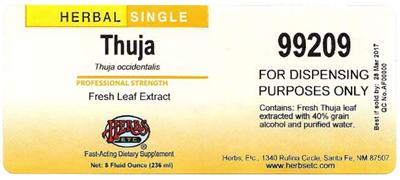
Professional strength
Fresh leaf extract
For dispensing purposes only
Herbal Single
FDA Statement of Identity
Fast-Acting Dietary Supplement
General
99209
Formula
Thuja occidentalis
Is this label outdated? Report a formula or label change and our pharmacy team will review it.
Thuja by Herbs Etc. label
The label scan from the NIH Dietary Supplement Label Database. Tap to enlarge.
Label images are published by the NIH Dietary Supplement Label Database for the version of this product on file. Always read your actual product label.
View the full label (PDF)The Ingredients in Thuja by Herbs Etc.
This is the 1 active ingredient this product is made of. Select it to open its full monograph.
Serving size0 Not Present Dosage formLiquid Amounts shown are per serving.
Fresh Thuja
Interacts with576 drugs
Thuja, also called northern white cedar or arborvitae, is a tree whose leaf and oil have a long history in folk and homeopathic medicine, especially f...
Fresh Thuja monograph & interactionsOther (inactive) ingredients: 40% Grain Alcohol, Purified Water. These complete the product’s ingredient list but are not active constituents.
Thuja by Herbs Etc. Drug Interactions
HelloPharmacist Interaction Report
Thuja by Herbs Etc. has documented interactions with medications that affect how your nervous system handles seizures and with drugs that suppress your immune system.
Read the full breakdown — every affected drug type, severity by severity
The main concern is seizure threshold lowering drugs — that's anesthetics and a range of other medications. Thuja contains thujone, a compound that can be toxic to nerves.
In theory, if you're taking a drug that lowers your seizure threshold, thuja could tip the balance and increase your seizure risk. This is rated Moderate severity, and the guidance is to avoid thuja entirely if you take these drugs.
Thuja may also stimulate your immune system, which could work against immunosuppressant medications — drugs like cyclosporine, tacrolimus, and mycophenolate that are meant to calm your immune response down. If these drugs become less effective, your transplant or autoimmune condition could suffer.
This is also Moderate severity.
Anticonvulsants (seizure prevention drugs) face a similar theoretical risk: thujone might lower the seizure threshold and make them less effective. Altogether, these interactions span 571 individual medications.
Before you start this product, run your exact medications through the interaction checker on this page.
Check your own medications below · Editorial policy · How we use AI
Want to check YOUR meds against Thuja?
Ask about interactions with your drugs in plain English — “Can I take it with lisinopril?” — and we find you the answer in seconds, ingredient by ingredient.
Go to the checkerIngredients driving the most interactions
Individual Drug Interactions
The ingredients in Thuja interact with 576 drugs. Click any drug to see the details.
1 of the 1 ingredient in Thuja interact with drugs. Each result below shows which ingredient is responsible. fresh Thuja
6-mercaptopurinePurinethol
How 6-mercaptopurine interacts with Thuja — through 1 ingredient. Tap an ingredient for the detail:
Fresh ThujaImmunosuppressants Moderate
Interaction Summary
Thuja might stimulate immune function.
Read the full Fresh Thuja + 6-mercaptopurine interactionAbrocitinibCibinqo
How Abrocitinib interacts with Thuja — through 1 ingredient. Tap an ingredient for the detail:
Fresh ThujaImmunosuppressants Moderate
Interaction Summary
Thuja might stimulate immune function.
Read the full Fresh Thuja + Abrocitinib interactionAcetaminophen, Brompheniramine, PhenylpropanolamineDimetapp Cold and Flu
How Acetaminophen, Brompheniramine, Phenylpropanolamine interacts with Thuja — through 1 ingredient. Tap an ingredient for the detail:
Fresh ThujaSeizure Threshold Lowering Drugs Moderate
Interaction Summary
Thuja products can contains significant amounts of thujone, a neurotoxin.
Read the full Fresh Thuja + Acetaminophen, Brompheniramine, Phenylpropanolamine interactionAcetaminophen, Butalbital, Caffeine, CodeineEsgic with Codeine, Fioricet w/ Codeine
How Acetaminophen, Butalbital, Caffeine, Codeine interacts with Thuja — through 1 ingredient. Tap an ingredient for the detail:
Fresh ThujaSeizure Threshold Lowering Drugs Moderate
Interaction Summary
Thuja products can contains significant amounts of thujone, a neurotoxin.
Read the full Fresh Thuja + Acetaminophen, Butalbital, Caffeine, Codeine interactionAcetaminophen, Butalbital, CodeineBancap w/ Codeine
How Acetaminophen, Butalbital, Codeine interacts with Thuja — through 1 ingredient. Tap an ingredient for the detail:
Fresh ThujaSeizure Threshold Lowering Drugs Moderate
Interaction Summary
Thuja products can contains significant amounts of thujone, a neurotoxin.
Read the full Fresh Thuja + Acetaminophen, Butalbital, Codeine interactionAcetaminophen, Butalbital, Codeine PhosphatePhrenilin #3
How Acetaminophen, Butalbital, Codeine Phosphate interacts with Thuja — through 1 ingredient. Tap an ingredient for the detail:
Fresh ThujaSeizure Threshold Lowering Drugs Moderate
Interaction Summary
Thuja products can contains significant amounts of thujone, a neurotoxin.
Read the full Fresh Thuja + Acetaminophen, Butalbital, Codeine Phosphate interactionAcetaminophen, Caffeine, Chlorpheniramine, Hydrocodone, PhenylephrineHycomine Compound
How Acetaminophen, Caffeine, Chlorpheniramine, Hydrocodone, Phenylephrine interacts with Thuja — through 1 ingredient. Tap an ingredient for the detail:
Fresh ThujaSeizure Threshold Lowering Drugs Moderate
Interaction Summary
Thuja products can contains significant amounts of thujone, a neurotoxin.
Read the full Fresh Thuja + Acetaminophen, Caffeine, Chlorpheniramine, Hydrocodone, Phenylephrine interactionAcetaminophen, Caffeine, CodeineGesic C15, Gesic C30, Gesic C8, Lenoltec 1, Lenoltec 2, Lenoltec 3 +1 more
How Acetaminophen, Caffeine, Codeine interacts with Thuja — through 1 ingredient. Tap an ingredient for the detail:
Fresh ThujaSeizure Threshold Lowering Drugs Moderate
Interaction Summary
Thuja products can contains significant amounts of thujone, a neurotoxin.
Read the full Fresh Thuja + Acetaminophen, Caffeine, Codeine interactionAcetaminophen, Caffeine, Codeine, SalicylamideCodalan No.1, Codalan No.2, Codalan No.3
How Acetaminophen, Caffeine, Codeine, Salicylamide interacts with Thuja — through 1 ingredient. Tap an ingredient for the detail:
Fresh ThujaSeizure Threshold Lowering Drugs Moderate
Interaction Summary
Thuja products can contains significant amounts of thujone, a neurotoxin.
Read the full Fresh Thuja + Acetaminophen, Caffeine, Codeine, Salicylamide interactionAcetaminophen, Caffeine, DihydrocodeineDHC Plus, Panlor DC, Panlor SS
How Acetaminophen, Caffeine, Dihydrocodeine interacts with Thuja — through 1 ingredient. Tap an ingredient for the detail:
Fresh ThujaSeizure Threshold Lowering Drugs Moderate
Interaction Summary
Thuja products can contains significant amounts of thujone, a neurotoxin.
Read the full Fresh Thuja + Acetaminophen, Caffeine, Dihydrocodeine interactionAcetaminophen, Chlorpheniramine Maleate, Dextromethorphan HbrVicks Formula 44M Cough, Cold & Flu Relief
How Acetaminophen, Chlorpheniramine Maleate, Dextromethorphan Hbr interacts with Thuja — through 1 ingredient. Tap an ingredient for the detail:
Fresh ThujaSeizure Threshold Lowering Drugs Moderate
Interaction Summary
Thuja products can contains significant amounts of thujone, a neurotoxin.
Read the full Fresh Thuja + Acetaminophen, Chlorpheniramine Maleate, Dextromethorphan Hbr interactionAcetaminophen, Chlorpheniramine, Codeine, PhenylephrineColrex
How Acetaminophen, Chlorpheniramine, Codeine, Phenylephrine interacts with Thuja — through 1 ingredient. Tap an ingredient for the detail:
Fresh ThujaSeizure Threshold Lowering Drugs Moderate
Interaction Summary
Thuja products can contains significant amounts of thujone, a neurotoxin.
Read the full Fresh Thuja + Acetaminophen, Chlorpheniramine, Codeine, Phenylephrine interactionAcetaminophen, Chlorpheniramine, DextromethorphanCoricidin II Extra Strength Cold and Flu
How Acetaminophen, Chlorpheniramine, Dextromethorphan interacts with Thuja — through 1 ingredient. Tap an ingredient for the detail:
Fresh ThujaSeizure Threshold Lowering Drugs Moderate
Interaction Summary
Thuja products can contains significant amounts of thujone, a neurotoxin.
Read the full Fresh Thuja + Acetaminophen, Chlorpheniramine, Dextromethorphan interactionAcetaminophen, Chlorpheniramine, Dextromethorphan HydrobromideCoricidin HBP Maximum Strength Flu
How Acetaminophen, Chlorpheniramine, Dextromethorphan Hydrobromide interacts with Thuja — through 1 ingredient. Tap an ingredient for the detail:
Fresh ThujaSeizure Threshold Lowering Drugs Moderate
Interaction Summary
Thuja products can contains significant amounts of thujone, a neurotoxin.
Read the full Fresh Thuja + Acetaminophen, Chlorpheniramine, Dextromethorphan Hydrobromide interactionAcetaminophen, Chlorpheniramine, Dextromethorphan, PhenylpropanolamineMulti Symptom Cold Relief
How Acetaminophen, Chlorpheniramine, Dextromethorphan, Phenylpropanolamine interacts with Thuja — through 1 ingredient. Tap an ingredient for the detail:
Fresh ThujaSeizure Threshold Lowering Drugs Moderate
Interaction Summary
Thuja products can contains significant amounts of thujone, a neurotoxin.
Read the full Fresh Thuja + Acetaminophen, Chlorpheniramine, Dextromethorphan, Phenylpropanolamine interactionAcetaminophen, Chlorpheniramine, Dextromethorphan, PseudoephedrineChildren's Tylenol Cold Plus Cough, Tylenol Cold Ex Strength
How Acetaminophen, Chlorpheniramine, Dextromethorphan, Pseudoephedrine interacts with Thuja — through 1 ingredient. Tap an ingredient for the detail:
Fresh ThujaSeizure Threshold Lowering Drugs Moderate
Interaction Summary
Thuja products can contains significant amounts of thujone, a neurotoxin.
Read the full Fresh Thuja + Acetaminophen, Chlorpheniramine, Dextromethorphan, Pseudoephedrine interactionAcetaminophen, Chlorpheniramine, Guaifenesin, Phenylephrine, SalicylamideRhinogesic GG
How Acetaminophen, Chlorpheniramine, Guaifenesin, Phenylephrine, Salicylamide interacts with Thuja — through 1 ingredient. Tap an ingredient for the detail:
Fresh ThujaSeizure Threshold Lowering Drugs Moderate
Interaction Summary
Thuja products can contains significant amounts of thujone, a neurotoxin.
Read the full Fresh Thuja + Acetaminophen, Chlorpheniramine, Guaifenesin, Phenylephrine, Salicylamide interactionAcetaminophen, Chlorpheniramine, PhenylephrineAlka-Seltzer PLUS, Histex SR, Protid
How Acetaminophen, Chlorpheniramine, Phenylephrine interacts with Thuja — through 1 ingredient. Tap an ingredient for the detail:
Fresh ThujaSeizure Threshold Lowering Drugs Moderate
Interaction Summary
Thuja products can contains significant amounts of thujone, a neurotoxin.
Read the full Fresh Thuja + Acetaminophen, Chlorpheniramine, Phenylephrine interactionAcetaminophen, Chlorpheniramine, Phenylephrine, SalicylamideRhinogesic, Rhinogesic JR
How Acetaminophen, Chlorpheniramine, Phenylephrine, Salicylamide interacts with Thuja — through 1 ingredient. Tap an ingredient for the detail:
Fresh ThujaSeizure Threshold Lowering Drugs Moderate
Interaction Summary
Thuja products can contains significant amounts of thujone, a neurotoxin.
Read the full Fresh Thuja + Acetaminophen, Chlorpheniramine, Phenylephrine, Salicylamide interactionAcetaminophen, Chlorpheniramine, PhenylpropanolamineAlumadrine, Conex, Sinadrin Max Strength, Sinulin
How Acetaminophen, Chlorpheniramine, Phenylpropanolamine interacts with Thuja — through 1 ingredient. Tap an ingredient for the detail:
Fresh ThujaSeizure Threshold Lowering Drugs Moderate
Interaction Summary
Thuja products can contains significant amounts of thujone, a neurotoxin.
Read the full Fresh Thuja + Acetaminophen, Chlorpheniramine, Phenylpropanolamine interactionAcetaminophen, Chlorpheniramine, Phenylpropanolamine, OpiumHista-Derfule
How Acetaminophen, Chlorpheniramine, Phenylpropanolamine, Opium interacts with Thuja — through 1 ingredient. Tap an ingredient for the detail:
Fresh ThujaSeizure Threshold Lowering Drugs Moderate
Interaction Summary
Thuja products can contains significant amounts of thujone, a neurotoxin.
Read the full Fresh Thuja + Acetaminophen, Chlorpheniramine, Phenylpropanolamine, Opium interactionAcetaminophen, Chlorpheniramine, Phenylpropanolamine, PhenyltoloxamineNorel Plus
How Acetaminophen, Chlorpheniramine, Phenylpropanolamine, Phenyltoloxamine interacts with Thuja — through 1 ingredient. Tap an ingredient for the detail:
Fresh ThujaSeizure Threshold Lowering Drugs Moderate
Interaction Summary
Thuja products can contains significant amounts of thujone, a neurotoxin.
Read the full Fresh Thuja + Acetaminophen, Chlorpheniramine, Phenylpropanolamine, Phenyltoloxamine interactionAcetaminophen, Chlorpheniramine, PseudoephedrineAlka-Seltzer PLUS Liquid Gels, Children's Tylenol Cold, Codimal, Comtrex, Extra Strength Tylenol Allergy Sinus, Lorsin +3 more
How Acetaminophen, Chlorpheniramine, Pseudoephedrine interacts with Thuja — through 1 ingredient. Tap an ingredient for the detail:
Fresh ThujaSeizure Threshold Lowering Drugs Moderate
Interaction Summary
Thuja products can contains significant amounts of thujone, a neurotoxin.
Read the full Fresh Thuja + Acetaminophen, Chlorpheniramine, Pseudoephedrine interactionAcetaminophen, Chlorzoxazone, CodeineAcetazone Forte C8, Parafon Forte C8
How Acetaminophen, Chlorzoxazone, Codeine interacts with Thuja — through 1 ingredient. Tap an ingredient for the detail:
Fresh ThujaSeizure Threshold Lowering Drugs Moderate
Interaction Summary
Thuja products can contains significant amounts of thujone, a neurotoxin.
Read the full Fresh Thuja + Acetaminophen, Chlorzoxazone, Codeine interactionAcetaminophen, CodeineTylenol No.3, Tylenol w/ Codeine
How Acetaminophen, Codeine interacts with Thuja — through 1 ingredient. Tap an ingredient for the detail:
Fresh ThujaSeizure Threshold Lowering Drugs Moderate
Interaction Summary
Thuja products can contains significant amounts of thujone, a neurotoxin.
Read the full Fresh Thuja + Acetaminophen, Codeine interactionAcetaminophen, Codeine, DoxylamineMersyndol
How Acetaminophen, Codeine, Doxylamine interacts with Thuja — through 1 ingredient. Tap an ingredient for the detail:
Fresh ThujaSeizure Threshold Lowering Drugs Moderate
Interaction Summary
Thuja products can contains significant amounts of thujone, a neurotoxin.
Read the full Fresh Thuja + Acetaminophen, Codeine, Doxylamine interactionAcetaminophen, Codeine, MethocarbamolAcetaminophen, Codeine, Methocarbamol, Robaxacet 8
How Acetaminophen, Codeine, Methocarbamol interacts with Thuja — through 1 ingredient. Tap an ingredient for the detail:
Fresh ThujaSeizure Threshold Lowering Drugs Moderate
Interaction Summary
Thuja products can contains significant amounts of thujone, a neurotoxin.
Read the full Fresh Thuja + Acetaminophen, Codeine, Methocarbamol interactionAcetaminophen, Dexbrompheniramine, PseudoephedrineSinadrin Plus
How Acetaminophen, Dexbrompheniramine, Pseudoephedrine interacts with Thuja — through 1 ingredient. Tap an ingredient for the detail:
Fresh ThujaSeizure Threshold Lowering Drugs Moderate
Interaction Summary
Thuja products can contains significant amounts of thujone, a neurotoxin.
Read the full Fresh Thuja + Acetaminophen, Dexbrompheniramine, Pseudoephedrine interactionAcetaminophen, Dextromethorphan, Doxylamine, PseudoephedrineVicks NyQuil
How Acetaminophen, Dextromethorphan, Doxylamine, Pseudoephedrine interacts with Thuja — through 1 ingredient. Tap an ingredient for the detail:
Fresh ThujaSeizure Threshold Lowering Drugs Moderate
Interaction Summary
Thuja products can contains significant amounts of thujone, a neurotoxin.
Read the full Fresh Thuja + Acetaminophen, Dextromethorphan, Doxylamine, Pseudoephedrine interactionAcetaminophen, DiphenhydramineTylenol PM, Tylenol PM Ex Strength
How Acetaminophen, Diphenhydramine interacts with Thuja — through 1 ingredient. Tap an ingredient for the detail:
Fresh ThujaSeizure Threshold Lowering Drugs Moderate
Interaction Summary
Thuja products can contains significant amounts of thujone, a neurotoxin.
Read the full Fresh Thuja + Acetaminophen, Diphenhydramine interactionEach ingredient & the kinds of drugs it affects
For each ingredient in Thuja with known interactions, here are the types of medications it can affect. Open any type for the detail — or search your exact drug in the checker above.
fresh Thuja
Anticonvulsants
Thuja products can contain thujone, which might lower the seizure threshold. Theoretically, this could decrease the effectiveness of anticonvulsants drugs.
Immunosuppressants
Thuja might stimulate immune function. Theoretically, taking thuja might decrease the effects of immunosuppressive therapy. Immunosuppressant drugs include azathioprine (Imuran), basiliximab (Simulect), cyclosporine (Neoral, Sandimmune), daclizumab (Zenapax), muromonab-CD3 (OKT3, Orthoclone OKT3), mycophenolate (CellCept), tacrolimus (FK506, Prograf), sirolimus (Rapamune), prednisone (Deltasone, Orasone), and other corticosteroids (glucocorticoids).
Seizure Threshold Lowering Drugs
Thuja products can contains significant amounts of thujone, a neurotoxin. Theoretically, patients taking drugs that lower the seizure threshold might be at greater risk of seizure if they also take thuja. Advise patients taking these drugs to avoid thuja products. Some drugs that lower the seizure threshold include anesthetics (propofol, others), antiarrhythmics (mexiletine), antibiotics (amphotericin, penicillin, cephalosporins, imipenem), antidepressants (bupropion, others), antihistamines (cyproheptadine, others), immunosuppressants (cyclosporine), narcotics (fentanyl, others), stimulants (methylphenidate), theophylline, and others.
Brand information
Manufacturer and brand details for Thuja, from the product label.
Herbs Etc.
- Name
- Herbs, Etc.
- Street Address
- 1340 Rufina Circle
- City
- Santa Fe
- State
- NM
- ZipCode
- 87507
- Web Address
- www.herbsetc.com
Thuja by Herbs Etc.: Common Questions
Does Thuja by Herbs Etc. interact with any medications?
How can one product interact with so many drugs?
Where does this information come from?
Can I take thuja if I'm pregnant?
Is thuja safe while breastfeeding?
What are the side effects of thuja?
Does thuja work for colds?
Why does thuja interact with seizure drugs?
Written and reviewed by the HelloPharmacist editorial staff. Our editorial policy
Not sure if Thuja is safe with your meds?
Our pharmacists answer your medication & supplement questions — free.
Label information is sourced from the NIH Dietary Supplement Label Database and reflects the product version on file; always read your actual product label. This page is for education only and is not a substitute for professional medical advice. Confirm with your pharmacist or doctor before combining supplements and medications.
The Full Monographs Behind Thuja’s Ingredients
Every ingredient we hold a full HelloPharmacist monograph for — uses, evidence, safety, and the complete interaction list.
Sources & How We Checked
Thuja's label data comes from the NIH Dietary Supplement Label Database; the ingredient interaction data is from the Natural Medicines database, reviewed by our pharmacists.
- NIH Dietary Supplement Label Database (DSLD) — The official product label on file for this supplement.
- Natural Medicines (Therapeutic Research Center) — Evidence-graded clinical reference behind the ingredient interaction data.
Content is written and reviewed by licensed HelloPharmacist pharmacists. See our data sources and editorial standards for how this information is built and checked.
The 10 references behind this product’s interaction data
Every citation that drives the interaction findings for this product’s ingredients, from the evidence-graded Natural Medicines (TRC Healthcare) database. Open an ingredient to browse its citations — links open the study on PubMed or the publisher’s site.
Thuja 10 references
- Leung AY, Foster S. Encyclopedia of Common Natural Ingredients Used in Food, Drugs and Cosmetics. 2nd ed. New York, NY: John Wiley & Sons, 1996.
- McGuffin M, Hobbs C, Upton R, Goldberg A, eds. American Herbal Products Association's Botanical Safety Handbook. Boca Raton, FL: CRC Press, LLC 1997.
- Millet Y, Jouglard J, Steinmetz MD, et al. Toxicity of some essential plant oils. Clinical and experimental study. Clin Toxicol 1981;18:1485-98. PubMed
- Gohla SH, Haubeck HD, Neth RD. Mitogenic activity of high molecular polysaccharide fractions isolated from the Cupressaceae Thuja occidentale L. I. Macrophage-dependent induction of CD-4-positive T-helper (Th+) lymphocytes. Leukemia 1988;2:528-33.
- Fetrow CW, Avila JR. Professional's Handbook of Complementary & Alternative Medicines. 1st ed. Springhouse, PA: Springhouse Corp., 1999.
- Henneicke-von Zepelin H, Hentschel C, Schnitker J, et al. Efficacy and safety of a fixed combination phytomedicine in the treatment of the common cold (acute viral respiratory tract infection): results of a randomised, double blind, placebo-controlled, m
- Naser, B., Bodinet, C., Tegtmeier, M., and Lindequist, U. Thuja occidentalis (Arbor vitae): A Review of its Pharmaceutical, Pharmacological and Clinical Properties. Evid.Based Complement Alternat.Med 2005;2(1):69-78.
- Patel R, Alavi F, Ortega S, Matela A. Herb-Induced Liver Injury by Cimicifuga racemosa and Thuja occidentalis Herbal Medications for Fertility. Case Rep Gastrointest Med 2021;2021:8858310. PubMed
- Ambooken B, Thomas M, Jisha KT. Papillary Eccrine Adenoma in a 5-year-old Girl Altered by Application of Thuja Ointment. J Cutan Aesthet Surg 2020;13(4):370-371. PubMed
- Badaoui A, Fougerousse AC. Contact dermatitis to linalool and limonene: Unusual sources of exposure. Ann Dermatol Venereol 2023;150(2):167-168. PubMed
Parts of this content are provided by the Therapeutic Research Center, LLC.
DISCLAIMER: Currently this does not check for drug-drug interactions. This is not an all-inclusive comprehensive list of potential interactions and is for informational purposes only. Not all interactions are known or well-reported in the scientific literature, and new interactions are continually being reported. Input is needed from a qualified healthcare provider including a pharmacist before starting any therapy. Application of clinical judgment is necessary.
© 2021 Therapeutic Research Center, LLC