
Ultimate BCAA Grape by BodyTech Elite Ingredients, Side Effects and Drug Interactions
Dietary Supplement Powder Other Combinations
UPC 7 66536 02233 5 Match it to the barcode on your bottle

Medically reviewed by Dr. Brian Staiger, PharmD, BCPS
Also reviewed by the HelloPharmacist Editorial Team
Updated Details about this page
- Label on file from the NIH Dietary Supplement Label Database, dated Jul 24, 2019.
- The interaction, evidence and safety records come from the Natural Medicines database, which we license, read against this label by our own system; the pharmacy team’s sections are written from those records.
- Dr. Brian Staiger, PharmD, BCPS, is a clinical pharmacist and pharmacotherapy specialist.
- Editorial policy Our sources
AI is used only to summarize verified clinical information, never the open internet. Our AI policy
Summary: The HelloPharmacist Team’s Take
- Form
- Powder
- Serving Size
- 15.6 g
- Servings
- 30 per container
- Container Holds
- 16.5 oz.; 468 g
What’s in it, whether it interacts with your drugs, its side effects, whether it works, and what our pharmacists would want you to know before you start it.
- What is Ultimate BCAA Grape?A supplement from BodyTech Elite with 13 active ingredients, in powder form.
- Active Ingredients 2 vitamins, 3 minerals, 1 plant ingredient, 4 amino acids and 3 others: Vitamin C 60 mgVitamin B6 0.6 mgChloride 300 mgSodium 200 mgPotassium 150 mgL-Leucine 3500 mgL-Isoleucine 1750 mgL-Valine 1750 mgL-Citrulline DL-Malate 1500 mgGlycine 1000 mgTaurine 1000 mgCoconut water powder 500 mg 13 active ingredients. Each one can interact with drugs or cause side effects on its own, so we check every one. And 1 more, in the Supplement Facts
- Drug Interactions 635 drugs have a documented interaction with this supplement; the most serious is rated major. Of those, 353 are single drugs and 282 are combination products (two or more drugs in one), each listed under its own name. Based on the 9 of its 13 ingredients we could check. Ask your pharmacist first if you take a drug in any of these categories, the most serious of the 34 on record:
- NitroglycerinMajor · 1 drug
- Moderate · 172 drugs
- Moderate · 122 drugs
- Moderate · 41 drugs
- Possible Side EffectsNausea 7 ingredientsUpset stomach 6 ingredientsHeadache 4 ingredientsDiarrhea 3 ingredientsVomiting 3 ingredientsDrowsiness 2 ingredients +15 moreReported for eight of its 13 active ingredients. Not studied in this exact product.
- Well documented Why
Does Ultimate BCAA Grape work?
What It Is Marketed For
- Muscle protein synthesis
- Recovery
- Electrolyte replenishment
From the claims on the product’s label.
The Closest Use the Research Grades
Potassium
Strong studies support it.
Its ingredients have research behind other uses too:
- L-Citrulline
- Glycine
- Hepatitis Taurine
- Amphotericin B nephrotoxicity Sodium
These grades are for each ingredient, not this exact product, and never a promise it will work for you.
What the research says- Full Why
- AllergensThe label says it contains tree nuts
- Barcode (UPC)7 66536 02233 5Match it to the barcode on your bottle to be sure this is your product. Not your product? Search for it here
Who Might Consider It
- People looking for muscle protein synthesis, recovery, and electrolyte replenishment, which is what it is marketed for. The closest use the research grades is hypokalemia, rated Effective.
- People who want it for athletic performance, schizophrenia, hepatitis or amphotericin B nephrotoxicity: the other uses with research behind them. See each grade
- Adults who are looking into a grape amino acid powder with vitamins and minerals may want to read the full breakdown first.
- Talk the decision over with your own doctor or pharmacist before you start.
Who Should Be Careful
- People taking nitroglycerin, blood pressure medicines, blood thinners, warfarin, lithium, potassium-raising drugs, or clozapine should be especially careful, as should anyone with kidney or liver disease, anyone who is pregnant, and anyone who is breastfeeding.
More Before You Take It Show both answersHide Pregnancy and Breastfeeding The Label’s Directions
-
Pregnant or breastfeeding?
- Pregnancy and Breastfeeding Vitamin C
- ! When used orally in excessive doses.
- Pregnancy Vitamin B6
- ! When used orally in excessive doses.
- Breastfeeding Vitamin B6
- When used orally in doses not exceeding the tolerable upper intake level (UL) of vitamin B6 in the form of pyridoxine 80 mg daily for those aged 14-18 years and 100 mg daily for those 19 years and older.
- Pregnancy and Breastfeeding Sodium
- ! When used orally in higher doses.
-
How does the label say to take it?
“Directions: Mix one (1) scoop (15.6g) with 12 oz. of water. Shake well and consume during exercise on training days, or throughout the day on non-training days.”
The maker’s words. Your pharmacist or doctor may advise differently.
Everything the label says
From the label dated Jul 24, 2019: 9 of its 13 active ingredients were checked against our records; the other four are not in them yet. A summary of what is known, not a grade or a test of the product. How these ratings are computed
Ask Anything About This Supplement
Name a drug you take, or ask about side effects, ingredients or pregnancy.
AI answers come from this label and our own records, never the open internet. AI can make mistakes, so always check with your doctor or pharmacist. How we use AI
Ask the Pharmacist
A licensed pharmacist will answer your question by email — free, usually within 24 hours.
Got it — thank you!
A licensed pharmacist will answer within 24 hours. Keep an eye on your email (worth checking spam, just in case).
What’s Inside Ultimate BCAA Grape by BodyTech Elite
13 Active Ingredients, Each Checked on Its Own
A supplement is often several ingredients in one bottle, and each one can interact with drugs or cause side effects on its own. We check every one of them against our records.
- Vitamin CDrug interactions on record, most serious: Moderate
- Vitamin B6Drug interactions on record, most serious: Moderate
- ChlorideNot in our interaction records yet
- SodiumDrug interactions on record, most serious: Moderate
- PotassiumDrug interactions on record, most serious: Moderate
- L-LeucineNot in our interaction records yet
- L-IsoleucineNot in our interaction records yet
- L-ValineNot in our interaction records yet
And 5 more, each with its own card below.
Why this rating?
The label gives an exact amount for every one of its 13 active ingredients, so you know how much of each you get in each serving. This rates what the label tells you, not the quality of the product.
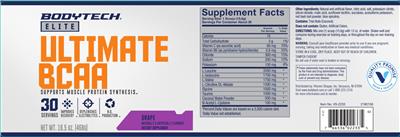
Supplement Facts
| Amount Per Serving | % Daily Value | |
|---|---|---|
| Calories | 15 Calories | † |
| Total Carbohydrates | 3 g | 1% |
| Vitamin C | 60 mg | 70% |
| Vitamin B6 | 0.6 mg | 35% |
| Chloride | 300 mg | 15% |
| Sodium | 200 mg | 10% |
| Potassium | 150 mg | 4% |
| L-Leucine | 3500 mg | † |
| L-Isoleucine | 1750 mg | † |
| L-Valine | 1750 mg | † |
| L-Citrulline DL-Malate | 1500 mg | † |
| Glycine | 1000 mg | † |
| Taurine | 1000 mg | † |
| Coconut water powder | 500 mg | † |
| N-Acetyl L-Cysteine | 100 mg | † |
Other ingredients: Natural and Artificial flavor, Citric Acid, Salt, Potassium Citrate, Silicon Dioxide, Malic Acid, Sunflower Lecithin, Sucralose, Acesulfame Potassium, Red Beet root powder, Blue Spirulina
† Daily Value not established.
Daily Values for adults and children 4 or more years of age.
As the label prints it, from the NIH Dietary Supplement Label Database.
Each Ingredient and Its Drug Interactions
Tap one for more about it and its full guide. A drug can interact with this supplement through any one of them.
Ultimate BCAA Grape contains 13 active ingredients: vitamin B6, sodium, potassium, glycine, L-leucine, L-isoleucine, taurine, L-valine, vitamin C, coconut water powder, N-acetyl L-cysteine, chloride, and L-citrulline DL-malate.
-
Vitamin C 60 mg Interacts with 207 drugs
Form on the label: Ascorbic Acid
Vitamin C (ascorbic acid) is an essential nutrient your body needs but cannot make, so you must get it from food or supplements.
- It's important for immune function, collagen, and acts as an antioxidant, but taking large doses doesn't prevent colds for most people and may cause stomach upset.
- Most people get enough from a balanced diet, so check with your pharmacist or doctor before taking high-dose supplements.
The full Vitamin C guide: uses, dosage and safety Every Vitamin C drug interaction
-
Vitamin B6 0.6 mg Interacts with 210 drugs
Form on the label: Pyridoxine Hydrochloride
Vitamin B6 (pyridoxine) is an essential water-soluble vitamin that your body needs for metabolism, brain function, and making red blood cells.
- It is best known for helping with pregnancy-related nausea and may help some people with PMS, but taking very high doses for long periods can cause nerve damage.
- Get most of your B6 from food, and check with a pharmacist or doctor before taking high-dose supplements.
The full Vitamin B6 guide: uses, dosage and safety Every Vitamin B6 drug interaction
-
Chloride 300 mg We know this ingredient, but hold no drug interaction record for it yet, so it was not checked
-
Sodium 200 mg Interacts with 205 drugs
Sodium is an essential mineral and electrolyte your body needs to balance fluids, support nerves, and help muscles work.
- Most people in modern diets get more than enough—often too much—from food, so supplements are rarely needed except for specific medical reasons like dehydration or low blood sodium.
- Talk to your doctor or pharmacist before deliberately adding sodium, especially if you have high blood pressure, heart, or kidney problems.
The full Sodium guide: uses, dosage and safety Every Sodium drug interaction
-
Potassium 150 mg Interacts with 62 drugs
Potassium is an essential mineral your body needs for nerve signals, muscle function, and a steady heartbeat, and most people get enough from a balanced diet rich in fruits and vegetables.
- Potassium supplements can help when blood levels are truly low, but too much potassium can be dangerous, especially for people with kidney problems.
- Always talk with your pharmacist or doctor before taking a potassium supplement.
The full Potassium guide: uses, dosage and safety Every Potassium drug interaction
-
L-Leucine 3500 mg We know this ingredient, but hold no drug interaction record for it yet, so it was not checked
-
L-Isoleucine 1750 mg We know this ingredient, but hold no drug interaction record for it yet, so it was not checked
-
L-Valine 1750 mg We know this ingredient, but hold no drug interaction record for it yet, so it was not checked
-
L-Citrulline DL-Malate 1500 mg Interacts with 178 drugs
L-citrulline is an amino acid that the body turns into L-arginine to help make nitric oxide, which relaxes blood vessels and may improve blood flow.
- It is popular for exercise performance and circulation, but the evidence is mixed and most benefits are modest.
- It appears generally well tolerated, but talk to your pharmacist or doctor before starting, especially if you have a health condition or are pregnant.
The full L-Citrulline guide: uses, dosage and safety Every L-Citrulline drug interaction
-
Glycine 1000 mg Interacts with 1 drug
Glycine is a non-essential amino acid your body makes on its own and that also appears in protein-rich foods.
- It is most studied for improving sleep quality, where early research is promising but limited, and it appears generally well tolerated at common doses.
- Talk with your pharmacist or doctor before starting it, especially if you take other medicines or have a health condition.
The full Glycine guide: uses, dosage and safety Every Glycine drug interaction
-
Taurine 1000 mg Interacts with 173 drugs
Taurine is an amino acid your body makes naturally and that you also get from animal foods.
- It is widely used in energy drinks and sports supplements, and short-term use appears generally safe for most adults, though the evidence for many claimed benefits is mixed or limited.
- Talk with your pharmacist or doctor before taking it regularly, especially if you have a health condition or take medications.
The full Taurine guide: uses, dosage and safety Every Taurine drug interaction
-
Coconut water powder 500 mg Interacts with 86 drugs
Coconut is a nutritious tropical food enjoyed as oil, water, milk, and flesh, and it is generally safe to eat in normal food amounts.
- While some uses (like skin moisturizing and hydration) have reasonable support, many health claims for coconut oil are weak or unproven, and coconut oil is high in saturated fat.
- Talk with your pharmacist or doctor before using coconut products in large or medicinal amounts.
The full Coconut guide: uses, dosage and safety Every Coconut drug interaction
-
N-Acetyl L-Cysteine 100 mg Interacts with 294 drugs
N-acetyl cysteine (NAC) is a supplement form of the amino acid cysteine and a building block for the antioxidant glutathione.
- It has well-established prescription uses for acetaminophen overdose and thinning mucus, but evidence for many over-the-counter uses is still limited.
- It is generally well tolerated, but you should check with a pharmacist or doctor before starting it.
The full N-Acetyl Cysteine (NAC) guide: uses, dosage and safety Every N-Acetyl Cysteine (NAC) drug interaction
Other Ingredients (Inactive)
The capsule or tablet itself, fillers, coatings and flavors. Not part of the drug interaction check; the allergen check below reads them.
- Natural and Artificial flavor
- Citric Acid
- Salt
- Potassium Citrate
- Silicon Dioxide
- Malic Acid
- Sunflower Lecithin
- Sucralose
- Acesulfame Potassium
- Red Beet root powder
- Blue Spirulina
Allergens in Ultimate BCAA Grape
The label says it contains tree nuts.
Named on this label
- Tree nutsThe label says it contains it
Not named in the ingredients
- Milk
- Egg
- Fish
- Shellfish
- Peanuts
- Wheat or other gluten grains
- Soy
- Sesame
- The label’s allergen statement“Contains: Tree Nuts (Coconut)”
- Made without, the label says“Does not contain: Gluten, artificial colors.”
From the label text and ingredient names on file; we do not test products. With a serious allergy, check your bottle and ask the maker or your pharmacist.
What the Label Says
The maker’s own words, from the label. We do not verify or endorse them.
- General statements
-
“Supports muscle protein synthesis 30 servings Improves recovery Replenishes electrolytes N.O. Production”
“Naturally & artificially flavored”
“Visit www.bodytech.com or call 1-800-223-1216 for more information and to reorder.”
- FDA Statement of Identity
-
“Dietary Supplement”
- Storage
-
“Store in a cool, dry place.”
- Seals and symbols
-
“Quality Promise Tested & Trusted”
The Ultimate BCAA Grape Label on File
The label scan on file at the NIH Dietary Supplement Label Database, dated July 2019. Always read the label on the bottle you have.
Product Facts
- Brand
- BodyTech Elite
- Barcode (UPC)
- 766536022335
- Net contents
- 16.5 oz.; 468 g
- Market status
- On market
- Date entered into DSLD
- Jul 24, 2019
- DSLD ID
- 204862
- Product type
- Other Combinations
- Supplement form
- Powder
- Dietary claims / uses
- All Other, Structure/Function
- Intended target group(s)
- Adult (18 - 50 Years), Gluten Free
Is this label outdated? Report a formula or label change and our pharmacy team will review it.
Ultimate BCAA Grape by BodyTech Elite Side Effects
Why this rating?
We look for three kinds of safety information on each ingredient: side effects reported in studies, a pregnancy and breastfeeding rating, and a safety write-up from our pharmacy team. All three are on file for each of the nine ingredients we could check.
So this rates how much is known, not whether Ultimate BCAA Grape is right for you.
Reported with nine of its ingredients
- Most often
- Nausea, upset stomach, headache, diarrhea, vomiting and drowsiness
- !Rare but serious
- Sensory neuropathy (high doses), liver cirrhosis and worsened cardiovascular disease See details
HelloPharmacist Team Summary of Side Effects
Ultimate BCAA Grape is generally well tolerated, but several of its ingredients have reported stomach upset, nausea, and diarrhea, mainly from vitamin C, N-acetyl cysteine, and coconut water powder.
- Those are the side effects you are most likely to notice.
- The rare but serious concern is high blood potassium (hyperkalemia) from potassium, which can cause irregular heart rhythms and mental confusion, so call your doctor right away if you notice either.
- Drowsiness has been reported with glycine, so see how it affects you before driving.
- If you have kidney or liver disease, are pregnant or breastfeeding, or take any medicine listed above, talk with your own doctor or pharmacist before you start.
Side Effects, Ingredient by Ingredient
A supplement’s side effects come from its ingredients. Here is what is reported with each one.
Vitamin C
Most reported
- Upset stomach, nausea, or stomach cramps
- Diarrhea
- Heartburn
- Headache
Vitamin B6
Most reported
- Abdominal pain
- Allergic reactions
- Headache
- Heartburn
- Loss of appetite
- Nausea
- Somnolence
- Vomiting
From the Natural Medicines database, which we license.
Every reported effect, in the Vitamin B6 guidePotassium
Most reported
- Stomach upset
- Nausea
- Vomiting
- Gas
L-Citrulline
Most reported
- Stomach upset
- Bloating
- Headache
Glycine
Most reported
- Upset stomach
- Nausea
- Soft stools
- Drowsiness
Taurine
Most reported
- Stomach upset
- Nausea
- Headache
Coconut
Most reported
- Diarrhea
- Cramping
- Nausea
N-Acetyl Cysteine (NAC)
Most reported
- Nausea
- Vomiting
- Diarrhea
- Stomach upset
Sodium has side-effect reports on file, but no list of the most common ones. Read them in the Sodium guide
Ultimate BCAA Grape Warnings: Who Should Be Careful
Ultimate BCAA Grape has 13 active ingredients, and each can carry warnings of its own. We checked the nine in our ingredient guides, and each warning below names the ingredient it comes from. Chloride, L-Leucine and L-Isoleucine and one more are not in our guides yet, so ask your pharmacist about them. If any of these apply to you, talk to your doctor or pharmacist before you start it.
- Vitamin C4 warnings below
- Vitamin B62 warnings below
- Sodium3 warnings below
- Potassium2 warnings below
- L-Citrulline1 warning below
- Glycine2 warnings below
- Taurine1 warning below
- Coconut3 warnings below
- N-Acetyl Cysteine (NAC)3 warnings below
- ChlorideNot in our guides yet
- L-LeucineNot in our guides yet
- L-IsoleucineNot in our guides yet
- L-ValineNot in our guides yet
-
Bleeding Problems or Surgery
- N-Acetyl Cysteine (NAC)Those with a history of stomach ulcers or bleeding disorders should also use care.
-
Blood Pressure
- SodiumYou should be especially cautious with added sodium if you have high blood pressure, heart failure, kidney disease, or liver disease, or if your doctor has told you to follow a low-salt diet.
- PotassiumPeople who should be especially careful or avoid potassium supplements unless a doctor directs them include those with kidney disease, people taking certain blood pressure or heart medicines that raise potassium, and those with conditions affecting adrenal or hormone function.
- L-CitrullineBecause it can lower blood pressure and affect blood flow, people who take blood pressure medicines, have low blood pressure, or have heart or kidney problems should talk with a healthcare provider before using it.
- Too much sodium is linked to high blood pressure and heart strain, and high potassium levels from supplements can cause dangerous heart rhythm problems, especially in people with kidney disease.
-
Liver Disease
- GlycinePeople with kidney or liver disease should be cautious and check with a doctor first, since these organs handle amino acids and protein.
-
Kidney Disease or Kidney Stones
- Vitamin CVery high doses (often several grams a day) are more likely to cause side effects and may raise the risk of kidney stones in some people.
- Vitamin CPeople with kidney disease, a history of kidney stones, or a condition called hemochromatosis (iron overload) should be cautious and talk to a doctor before taking high doses.
- Vitamin B6People with kidney problems or other chronic conditions should talk to a clinician before using supplements.
- TaurinePeople with kidney problems, heart conditions, or other health issues should check with a doctor first, since their bodies may handle taurine differently.
- Vitamin CVitamin C is generally well tolerated, but doses above 2 grams daily are more likely to cause side effects and can raise kidney stone risk.
-
Heart Conditions
- CoconutPeople with high cholesterol or heart disease should talk with their doctor.
-
Allergies
- CoconutIn the U.S., coconut is classified as a tree nut for food-labeling purposes, though most people with tree nut allergies can still tolerate coconut.
- CoconutIf you have a known allergy, check with your doctor first.
-
If You Take Other Drugs
- N-Acetyl Cysteine (NAC)However, you should talk with a pharmacist or doctor before starting it, especially if you have a health condition or take other medicines.
-
Other Cautions
- Vitamin CPeople with a rare condition called G6PD deficiency should also use caution with very high doses.
- Vitamin B6Avoid high doses.
- PotassiumSupplements are different and require more caution, because they can raise blood potassium quickly.
- GlycineGetting glycine from normal foods is not a concern; this caution is about concentrated supplements.
- N-Acetyl Cysteine (NAC)People with asthma should be cautious, as inhaled forms can sometimes trigger airway tightening.
-
What the Label Warns
- “Warning: Consult your healthcare provider prior to use if you are pregnant, nursing, taking any medication or have any medical conditions.”
- “Keep out of reach of children.”
- “Tamper evident Do not use if outer seal is broken or missing.”
The maker’s wording, from the product label.
-
Pregnant or Breastfeeding
Each ingredient’s rating for pregnancy and for breastfeeding, and what it covers.
Pregnancy and Breastfeeding The record rates both the same
-
When used orally and appropriately.
-
When used orally in excessive doses.
Tell patients over age 19 not to use doses exceeding the UL of 2000 mg daily when pregnant or breast-feeding and for those 14-18 years of age not to use doses exceeding 1800 mg daily when pregnant or breast-feeding.
2 more points on this rating
- Higher doses can cause osmotic diarrhea and gastrointestinal upset.
- Large doses of vitamin C during pregnancy can also cause newborn scurvy; avoid using.
Pregnancy
-
When used orally and appropriately.
A special sustained-release product providing vitamin B6 (pyridoxine) 75 mg daily is FDA-approved for use in pregnancy.
3 more points on this rating
- Vitamin B6 (pyridoxine) is also considered a first-line treatment for nausea and vomiting in pregnancy by the American College of Obstetrics and Gynecology.
- However, it should not be used long-term or without medical supervision and close monitoring.
- The tolerable upper intake level (UL) refers to vitamin B6 in the form of pyridoxine and is 80 mg daily for those aged 14-18 years and 100 mg daily for 19 years and older.
-
When used orally in excessive doses.
There is some concern that high-dose maternal vitamin B6 (pyridoxine) can cause neonatal seizures.
Breastfeeding
-
When used orally in doses not exceeding the tolerable upper intake level (UL) of vitamin B6 in the form of pyridoxine 80 mg daily for those aged 14-18 years and 100 mg daily for those 19 years and older.
The recommended dietary allowance (RDA) in lactating women is 2 mg daily.
There is insufficient reliable information available about the safety of vitamin B6 when used in higher doses in breast-feeding women.
Show 7 more ingredients
Pregnancy and Breastfeeding The record rates both the same
-
When used orally and appropriately.
Sodium is safe in amounts that do not exceed the CDRR intake level of 2.3 grams daily.
-
When used orally in higher doses.
Higher intake can cause hypertension.
Also, both the highest and the lowest pre-pregnancy sodium quintile intakes are associated with an increased risk of hypertensive disorders of pregnancy, including gestational hypertension and pre-eclampsia, and the delivery of small for gestational age (SGA) infants when compared to the middle intake quintile.
Pregnancy and Breastfeeding The record rates both the same
-
Insufficient reliable information available; avoid using.
Pregnancy and Breastfeeding The record rates both the same
-
Insufficient reliable information available; avoid using.
Pregnancy
-
When used orally, intratracheally, intravenously, or by inhalation.
N-acetyl cysteine crosses the placenta, but has not been associated with adverse effects to the fetus.
However, N-acetyl cysteine should only be used in pregnancy when clearly indicated, such as in cases of acetaminophen toxicity.
Breastfeeding
-
Insufficient reliable information available; avoid using.
Pregnancy and Breastfeeding The record rates both the same
-
When used orally in dietary amounts of 40-80 mEq daily.
A tolerable upper intake level (UL) has not been established for healthy individuals.
Pregnancy and Breastfeeding The record rates both the same
-
When used in amounts found in foods.
There is insufficient reliable information available about the safety of taurine when used in medicinal amounts during pregnancy and lactation; avoid using.
Pregnancy and Breastfeeding The record rates both the same
-
When used orally in food amounts.
There is insufficient reliable information available about the safety of coconut when used in medicinal amounts during pregnancy and lactation; avoid use.
Our pharmacy team’s notes
- L-CitrullineOur safety notes for L-citrulline advise avoiding supplements during pregnancy and breastfeeding, although no formal pregnancy rating is on file.
- N-Acetyl Cysteine (NAC)N-acetyl cysteine is rated Possibly Safe in pregnancy.
- For pregnancy, potassium, taurine, and coconut water powder are rated Likely Safe.
Ratings and the words beside them are from the Natural Medicines database, which we license.
-
Rare but Serious Side Effects
-
!
Vitamin C
Rare but more serious concerns with very high or long-term high doses include kidney stones and, in people with iron-overload conditions, too much iron buildup.
Orally: There have been rare case reports of carotid inner wall thickening after large doses of vitamin C.
-
!
Vitamin B6
Orally or by injection: Sensory neuropathy (high doses).
Orally: Liver cirrhosis, hepatocellular carcinoma (high doses of pyridoxal-5'-phosphate).
-
!
Sodium
Rarely, a sudden large intake of salt—or a rapid change in blood sodium during treatment—can be very serious and even life-threatening.
Orally: Worsened cardiovascular disease, hypertension, kidney disease.
-
!
Potassium
The most serious risk is high blood potassium (hyperkalemia).
High potassium levels can cause arrhythmia, heart block, hypotension, and mental confusion.
-
!
L-Citrulline
Serious side effects appear to be rare.
-
!
Glycine
Serious reactions appear to be rare.
-
!
Taurine
Serious side effects are uncommon with taurine alone.
Orally: Hypersensitivity reactions in sensitive individuals. Case reports raise concerns for serious cardiovascular adverse effects, but these reports have involved energy drinks containing taurine and other ingredients. It is unclear if these adverse effects are due to taurine, other ingredients, or the combination.
-
!
N-Acetyl Cysteine (NAC)
Orally: Chest tightness, hemoptysis, and palpitations have been reported.
When to get help: a serious allergic reaction, with trouble breathing or swelling of the face, lips or throat, needs emergency care: call 911. For any other side effect that worries you, call your doctor or pharmacist.
These reports describe each ingredient, not studies of this exact product. Not medical advice: a side effect you notice after starting a supplement is worth a word with your pharmacist or doctor.
Ultimate BCAA Grape by BodyTech Elite Drug Interactions
We checked all 13 active ingredients in this supplement against every drug in our records. A drug can interact with it through any one of them. Four of them are not in our interaction records yet.
A major interaction on record
3 of 3, on a scale from Minor or none to Major.Why this rating?
We rate this by the most serious interaction on record, not by how many there are. For Potassium, Vitamin B6, Vitamin C, N-Acetyl Cysteine (NAC) and Taurine, the most serious is rated major, which means the combination is best avoided, or used only under close supervision. Some involve kinds of drugs where a small change can matter, such as blood thinners, cancer treatments and diabetes drugs.
635 drugs are on the full list. What matters is whether one you take is on it, so check yours with the interaction checker on this page.
Nine of its 13 active ingredients have drug interactions on record. The ones below matter most. We have no interaction records for Chloride, L-Leucine, L-Isoleucine and L-Valine.
- Interacts with
- 62 drugs
- Most serious
- Moderate
- Potassium-sparing diuretics, ACE inhibitors, and angiotensin receptor blockers (ARBs) raise the risk of high blood potassium (hyperkalemia) with potassium.
- Interacts with
- 294 drugs
- Most serious
- Major
- Its N-acetyl cysteine can increase the risk of low blood pressure and headaches when taken with intravenous or transdermal nitroglycerin.
- Interacts with
- 210 drugs
- Most serious
- Moderate
- Most of its records involve Antihypertensive Drugs, Phenobarbital (Luminal) and Phenytoin (Dilantin).
Show three more ingredients
- Interacts with
- 207 drugs
- Most serious
- Moderate
- Most of its records involve Acetaminophen (Tylenol, others), Estrogens and Aspirin.
- Interacts with
- 205 drugs
- Most serious
- Moderate
- Most of its records involve Antihypertensive Drugs, Corticosteroids and Sodium-containing Drugs.
- Interacts with
- 178 drugs
- Most serious
- Moderate
- Most of its records involve Antihypertensive Drugs and PHOSPHODIESTERASE-5 Inhibitors.
And three more ingredients with records, each in the cards below.
From the HelloPharmacist Team
Our pharmacy team’s read on the supplement as a whole.
- Ultimate BCAA Grape from BodyTech Elite can interact with several medications, and its most serious interaction is rated Major.
- Other ingredients with documented interactions include vitamin B6, sodium, potassium, glycine, taurine, vitamin C, coconut water powder, and L-citrulline DL-malate.
- Most of the remaining interactions are rated Moderate.
Summarized by the HelloPharmacist pharmacy team from the interaction records below. How it is written How we use AI
Why Ultimate BCAA Grape Interacts, Ingredient by Ingredient
A product interacts through its ingredients. Each card: how many drugs, the most serious rating, and the kinds of drugs it affects most (tap a kind for what it means).
The ingredients driving the most interactions
-
N-Acetyl L-Cysteine 294 drugs
Most serious: Major5 interaction records on file
The kinds of drugs it affects most
- 172 drugs
- 122 drugs
- Activated Charcoal 2 drugs
- Chloroquine (Aralen) 2 drugs
Every N-Acetyl Cysteine (NAC) drug interaction, 5 records The N-Acetyl Cysteine (NAC) records cite 86 references, listed in the N-Acetyl Cysteine (NAC) guide.
-
Vitamin B6 210 drugs
Most serious: Moderate5 interaction records on file
The kinds of drugs it affects most
- 172 drugs
- Phenobarbital (Luminal) 28 drugs
- Phenytoin (Dilantin) 5 drugs
- 5 drugs
Every Vitamin B6 drug interaction, 5 records The Vitamin B6 records cite 33 references, listed in the Vitamin B6 guide.
-
Vitamin C 207 drugs
Most serious: Moderate13 interaction records on file
The kinds of drugs it affects most
- 69 drugs
- 41 drugs
- 35 drugs
- 24 drugs
Every Vitamin C drug interaction, 13 records The Vitamin C records cite 51 references, listed in the Vitamin C guide.
-
Sodium 205 drugs
Most serious: Moderate7 interaction records on file
The kinds of drugs it affects most
- 172 drugs
- 23 drugs
- Sodium-containing Drugs 7 drugs
- Sodium Phosphates 2 drugs
Every Sodium drug interaction, 7 records The Sodium records cite 43 references, listed in the Sodium guide.
-
L-Citrulline DL-Malate 178 drugs
Most serious: Moderate2 interaction records on file
The kinds of drugs it affects most
- 172 drugs
- PHOSPHODIESTERASE-5 Inhibitors 7 drugs
Every L-Citrulline drug interaction, 2 records The L-Citrulline records cite 9 references, listed in the L-Citrulline guide.
-
Taurine 173 drugs
Most serious: Moderate2 interaction records on file
The kinds of drugs it affects most
- 172 drugs
- 1 drug
Every Taurine drug interaction, 2 records The Taurine records cite 21 references, listed in the Taurine guide.
-
Coconut water powder 86 drugs
Most serious: Minor1 interaction record on file
The kinds of drugs it affects most
- 86 drugs
Every Coconut drug interaction, 1 record The Coconut records cite 10 references, listed in the Coconut guide.
-
Potassium 62 drugs
Most serious: Moderate3 interaction records on file
The kinds of drugs it affects most
- 23 drugs
- 23 drugs
- 17 drugs
Every Potassium drug interaction, 3 records The Potassium records cite 12 references, listed in the Potassium guide.
-
Glycine 1 drug
Most serious: Moderate1 interaction record on file
The kinds of drugs it affects most
- Clozapine (Clozaril) 1 drug
Every Glycine drug interaction, 1 record The Glycine records cite 5 references, listed in the Glycine guide.
The Breakdown by Severity
Each drug counted once, at its most serious rating. Tap a tile to list those drugs.
Find Your Drug
Type a drug or brand name to see whether it is on the list.
- Only drugs with a documented interaction are listed, the most serious first.
- A drug with no known interaction is not listed, but searching its name tells you so.
- Open a drug to see which ingredient is responsible. Of those, 353 are single drugs and 282 are combination products (two or more drugs in one), each listed under its own name.
-
NitroglycerinGonitro, Nitro Time, Nitro-Bid, Nitrocine Timecaps, Nitrogard and 8 more Major
The ingredient responsible:
-
N-Acetyl L-Cysteine Major
N-acetyl cysteine can increase the risk for hypotension and headaches when taken with intravenous or transdermal nitroglycerin.
The full N-Acetyl L-Cysteine + Nitroglycerin interaction
-
-
ApixabanEliquis Moderate
The ingredient responsible:
-
N-Acetyl L-Cysteine Moderate Apixaban is in the Anticoagulant/Antiplatelet Drugs category.
Theoretically, N-acetyl cysteine might increase the risk of bleeding when taken with anticoagulant or antiplatelet drugs.
The full N-Acetyl L-Cysteine + Apixaban interaction
-
-
LevothyroxineEltroxin, Estre, Euthyrox, Levo-T, Levolet and 6 more Moderate
The ingredient responsible:
-
Vitamin C Moderate
Vitamin C can increase levothyroxine absorption.
The full Vitamin C + Levothyroxine interaction
-
-
WarfarinWarfarin Moderate
The 2 ingredients responsible:
-
N-Acetyl L-Cysteine Moderate Warfarin is in the Anticoagulant/Antiplatelet Drugs category.
Theoretically, N-acetyl cysteine might increase the risk of bleeding when taken with anticoagulant or antiplatelet drugs.
The full N-Acetyl L-Cysteine + Warfarin interaction -
Vitamin C Moderate
High-dose vitamin C might reduce the levels and effectiveness of warfarin.
The full Vitamin C + Warfarin interaction
-
-
AmlodipineNorliqva Moderate
The 5 ingredients responsible:
-
Vitamin B6 Moderate Amlodipine is in the Antihypertensive Drugs category.
Theoretically, vitamin B6 may have additive effects when used with antihypertensive drugs.
The full Vitamin B6 + Amlodipine interaction -
N-Acetyl L-Cysteine Moderate Amlodipine is in the Antihypertensive Drugs category.
Theoretically, N-acetyl cysteine might increase the risk of hypotension when taken with antihypertensive drugs.
The full N-Acetyl L-Cysteine + Amlodipine interaction -
Taurine Moderate Amlodipine is in the Antihypertensive Drugs category.
Theoretically, taurine might increase the risk of hypotension when taken with antihypertensive drugs.
The full Taurine + Amlodipine interaction -
L-Citrulline Dl-malate Moderate Amlodipine is in the Antihypertensive Drugs category.
Theoretically, concomitant use of L-citrulline with antihypertensive drugs might have additive effects and increase the chance of hypotension.
The full L-Citrulline Dl-malate + Amlodipine interaction -
Sodium Moderate Amlodipine is in the Antihypertensive Drugs category.
Theoretically, a high intake of dietary sodium might reduce the effectiveness of antihypertensive drugs.
The full Sodium + Amlodipine interaction
-
-
ClopidogrelPlavix Moderate
The ingredient responsible:
-
N-Acetyl L-Cysteine Moderate Clopidogrel is in the Anticoagulant/Antiplatelet Drugs category.
Theoretically, N-acetyl cysteine might increase the risk of bleeding when taken with anticoagulant or antiplatelet drugs.
The full N-Acetyl L-Cysteine + Clopidogrel interaction
-
-
AspirinAngettes 75, ASA, Asaphen, Aspirin, Caprin and 9 more Moderate
The 2 ingredients responsible:
-
N-Acetyl L-Cysteine Moderate Aspirin is in the Anticoagulant/Antiplatelet Drugs category.
Theoretically, N-acetyl cysteine might increase the risk of bleeding when taken with anticoagulant or antiplatelet drugs.
The full N-Acetyl L-Cysteine + Aspirin interaction -
Vitamin C Minor
Acidification of the urine by vitamin C might increase aspirin levels.
The full Vitamin C + Aspirin interaction
-
-
Losartan PotassiumCozaar Moderate
The 6 ingredients responsible:
-
L-Citrulline Dl-malate Moderate Losartan Potassium is in the Antihypertensive Drugs category.
Theoretically, concomitant use of L-citrulline with antihypertensive drugs might have additive effects and increase the chance of hypotension.
The full L-Citrulline Dl-malate + Losartan Potassium interaction -
N-Acetyl L-Cysteine Moderate Losartan Potassium is in the Antihypertensive Drugs category.
Theoretically, N-acetyl cysteine might increase the risk of hypotension when taken with antihypertensive drugs.
The full N-Acetyl L-Cysteine + Losartan Potassium interaction -
Potassium Moderate Losartan Potassium is in the Angiotensin Receptor Blockers (ARBs) category.
Using ARBs with high doses of potassium increases the risk of hyperkalemia.
The full Potassium + Losartan Potassium interaction -
Vitamin B6 Moderate Losartan Potassium is in the Antihypertensive Drugs category.
Theoretically, vitamin B6 may have additive effects when used with antihypertensive drugs.
The full Vitamin B6 + Losartan Potassium interaction -
Sodium Moderate Losartan Potassium is in the Antihypertensive Drugs category.
Theoretically, a high intake of dietary sodium might reduce the effectiveness of antihypertensive drugs.
The full Sodium + Losartan Potassium interaction -
Taurine Moderate Losartan Potassium is in the Antihypertensive Drugs category.
Theoretically, taurine might increase the risk of hypotension when taken with antihypertensive drugs.
The full Taurine + Losartan Potassium interaction
-
-
RivaroxabanXarelto Moderate
The ingredient responsible:
-
N-Acetyl L-Cysteine Moderate Rivaroxaban is in the Anticoagulant/Antiplatelet Drugs category.
Theoretically, N-acetyl cysteine might increase the risk of bleeding when taken with anticoagulant or antiplatelet drugs.
The full N-Acetyl L-Cysteine + Rivaroxaban interaction
-
-
Warfarin SodiumCoumadin, Panwarfin, Sofarin Moderate
The 2 ingredients responsible:
-
Vitamin C Moderate
High-dose vitamin C might reduce the levels and effectiveness of warfarin.
The full Vitamin C + Warfarin Sodium interaction -
N-Acetyl L-Cysteine Moderate Warfarin Sodium is in the Anticoagulant/Antiplatelet Drugs category.
Theoretically, N-acetyl cysteine might increase the risk of bleeding when taken with anticoagulant or antiplatelet drugs.
The full N-Acetyl L-Cysteine + Warfarin Sodium interaction
-
-
MetoprololLopressor, Toprol XL Moderate
The 5 ingredients responsible:
-
Vitamin B6 Moderate Metoprolol is in the Antihypertensive Drugs category.
Theoretically, vitamin B6 may have additive effects when used with antihypertensive drugs.
The full Vitamin B6 + Metoprolol interaction -
Taurine Moderate Metoprolol is in the Antihypertensive Drugs category.
Theoretically, taurine might increase the risk of hypotension when taken with antihypertensive drugs.
The full Taurine + Metoprolol interaction -
Sodium Moderate Metoprolol is in the Antihypertensive Drugs category.
Theoretically, a high intake of dietary sodium might reduce the effectiveness of antihypertensive drugs.
The full Sodium + Metoprolol interaction -
N-Acetyl L-Cysteine Moderate Metoprolol is in the Antihypertensive Drugs category.
Theoretically, N-acetyl cysteine might increase the risk of hypotension when taken with antihypertensive drugs.
The full N-Acetyl L-Cysteine + Metoprolol interaction -
L-Citrulline Dl-malate Moderate Metoprolol is in the Antihypertensive Drugs category.
Theoretically, concomitant use of L-citrulline with antihypertensive drugs might have additive effects and increase the chance of hypotension.
The full L-Citrulline Dl-malate + Metoprolol interaction
-
-
IbuprofenAdvil, Arthrofen, Brufen, Brufen Retard, Calodor and 15 more Moderate
The ingredient responsible:
-
N-Acetyl L-Cysteine Moderate Ibuprofen is in the Anticoagulant/Antiplatelet Drugs category.
Theoretically, N-acetyl cysteine might increase the risk of bleeding when taken with anticoagulant or antiplatelet drugs.
The full N-Acetyl L-Cysteine + Ibuprofen interaction
-
-
TadalafilCialis, Tadliq Moderate
The ingredient responsible:
-
L-Citrulline Dl-malate Moderate Tadalafil is in the PHOSPHODIESTERASE-5 Inhibitors category.
Theoretically, concurrent use of phosphodiesterase-5 (PDE-5) inhibitors and L-citrulline might result in additive vasodilation.
The full L-Citrulline Dl-malate + Tadalafil interaction
-
-
PrednisoneCortan, Deltasone, Meticorten, Orasone, Prednicen-M and 3 more Moderate
The ingredient responsible:
-
Sodium Moderate Prednisone is in the Corticosteroids category.
Concomitant use of mineralocorticoids and some glucocorticoids with sodium supplements might increase the risk of hypernatremia.
The full Sodium + Prednisone interaction
-
-
PropranololAngilol, Bedranol SR, Beta Prograne, Half Beta Prograne, Half-Inderal LA and 7 more Moderate
The 5 ingredients responsible:
-
Sodium Moderate Propranolol is in the Antihypertensive Drugs category.
Theoretically, a high intake of dietary sodium might reduce the effectiveness of antihypertensive drugs.
The full Sodium + Propranolol interaction -
Taurine Moderate Propranolol is in the Antihypertensive Drugs category.
Theoretically, taurine might increase the risk of hypotension when taken with antihypertensive drugs.
The full Taurine + Propranolol interaction -
N-Acetyl L-Cysteine Moderate Propranolol is in the Antihypertensive Drugs category.
Theoretically, N-acetyl cysteine might increase the risk of hypotension when taken with antihypertensive drugs.
The full N-Acetyl L-Cysteine + Propranolol interaction -
L-Citrulline Dl-malate Moderate Propranolol is in the Antihypertensive Drugs category.
Theoretically, concomitant use of L-citrulline with antihypertensive drugs might have additive effects and increase the chance of hypotension.
The full L-Citrulline Dl-malate + Propranolol interaction -
Vitamin B6 Moderate Propranolol is in the Antihypertensive Drugs category.
Theoretically, vitamin B6 may have additive effects when used with antihypertensive drugs.
The full Vitamin B6 + Propranolol interaction
-
-
NaproxenAleve, Anaprox, Anaprox DS, Arthroxen, EC-Naprosyn and 8 more Moderate
The ingredient responsible:
-
N-Acetyl L-Cysteine Moderate Naproxen is in the Anticoagulant/Antiplatelet Drugs category.
Theoretically, N-acetyl cysteine might increase the risk of bleeding when taken with anticoagulant or antiplatelet drugs.
The full N-Acetyl L-Cysteine + Naproxen interaction
-
-
LisinoprilPrinivil, Qbrelis, Zestril Moderate
The 6 ingredients responsible:
-
Sodium Moderate Lisinopril is in the Antihypertensive Drugs category.
Theoretically, a high intake of dietary sodium might reduce the effectiveness of antihypertensive drugs.
The full Sodium + Lisinopril interaction -
N-Acetyl L-Cysteine Moderate Lisinopril is in the Antihypertensive Drugs category.
Theoretically, N-acetyl cysteine might increase the risk of hypotension when taken with antihypertensive drugs.
The full N-Acetyl L-Cysteine + Lisinopril interaction -
Taurine Moderate Lisinopril is in the Antihypertensive Drugs category.
Theoretically, taurine might increase the risk of hypotension when taken with antihypertensive drugs.
The full Taurine + Lisinopril interaction -
L-Citrulline Dl-malate Moderate Lisinopril is in the Antihypertensive Drugs category.
Theoretically, concomitant use of L-citrulline with antihypertensive drugs might have additive effects and increase the chance of hypotension.
The full L-Citrulline Dl-malate + Lisinopril interaction -
Potassium Moderate Lisinopril is in the ACE Inhibitors (ACEIs) category.
Using ACEIs with high doses of potassium increases the risk of hyperkalemia.
The full Potassium + Lisinopril interaction -
Vitamin B6 Moderate Lisinopril is in the Antihypertensive Drugs category.
Theoretically, vitamin B6 may have additive effects when used with antihypertensive drugs.
The full Vitamin B6 + Lisinopril interaction
-
-
Amlodipine BesylateNorvasc Moderate
The 5 ingredients responsible:
-
Vitamin B6 Moderate Amlodipine Besylate is in the Antihypertensive Drugs category.
Theoretically, vitamin B6 may have additive effects when used with antihypertensive drugs.
The full Vitamin B6 + Amlodipine Besylate interaction -
N-Acetyl L-Cysteine Moderate Amlodipine Besylate is in the Antihypertensive Drugs category.
Theoretically, N-acetyl cysteine might increase the risk of hypotension when taken with antihypertensive drugs.
The full N-Acetyl L-Cysteine + Amlodipine Besylate interaction -
Sodium Moderate Amlodipine Besylate is in the Antihypertensive Drugs category.
Theoretically, a high intake of dietary sodium might reduce the effectiveness of antihypertensive drugs.
The full Sodium + Amlodipine Besylate interaction -
Taurine Moderate Amlodipine Besylate is in the Antihypertensive Drugs category.
Theoretically, taurine might increase the risk of hypotension when taken with antihypertensive drugs.
The full Taurine + Amlodipine Besylate interaction -
L-Citrulline Dl-malate Moderate Amlodipine Besylate is in the Antihypertensive Drugs category.
Theoretically, concomitant use of L-citrulline with antihypertensive drugs might have additive effects and increase the chance of hypotension.
The full L-Citrulline Dl-malate + Amlodipine Besylate interaction
-
-
Levothyroxine SodiumErmez, Thyquidity, Tirosint-Sol Moderate
The ingredient responsible:
-
Vitamin C Moderate
Vitamin C can increase levothyroxine absorption.
The full Vitamin C + Levothyroxine Sodium interaction
-
-
EstrogenEstrogen Moderate
The ingredient responsible:
-
Vitamin C Moderate Estrogen is in the Estrogens category.
Vitamin C might increase blood levels of estrogens.
The full Vitamin C + Estrogen interaction
-
-
BisoprololZebeta Moderate
The 5 ingredients responsible:
-
Taurine Moderate Bisoprolol is in the Antihypertensive Drugs category.
Theoretically, taurine might increase the risk of hypotension when taken with antihypertensive drugs.
The full Taurine + Bisoprolol interaction -
N-Acetyl L-Cysteine Moderate Bisoprolol is in the Antihypertensive Drugs category.
Theoretically, N-acetyl cysteine might increase the risk of hypotension when taken with antihypertensive drugs.
The full N-Acetyl L-Cysteine + Bisoprolol interaction -
Vitamin B6 Moderate Bisoprolol is in the Antihypertensive Drugs category.
Theoretically, vitamin B6 may have additive effects when used with antihypertensive drugs.
The full Vitamin B6 + Bisoprolol interaction -
L-Citrulline Dl-malate Moderate Bisoprolol is in the Antihypertensive Drugs category.
Theoretically, concomitant use of L-citrulline with antihypertensive drugs might have additive effects and increase the chance of hypotension.
The full L-Citrulline Dl-malate + Bisoprolol interaction -
Sodium Moderate Bisoprolol is in the Antihypertensive Drugs category.
Theoretically, a high intake of dietary sodium might reduce the effectiveness of antihypertensive drugs.
The full Sodium + Bisoprolol interaction
-
-
BendamustineBelrapzo, Treanda, Vivimusta Moderate
The ingredient responsible:
-
Vitamin C Moderate Bendamustine is in the Alkylating Agents category.
Theoretically, antioxidant effects of vitamin C might reduce the effectiveness of alkylating agents.
The full Vitamin C + Bendamustine interaction
-
-
MinoxidilLoniten, Minoxidil, Rogaine Moderate
The 5 ingredients responsible:
-
Taurine Moderate Minoxidil is in the Antihypertensive Drugs category.
Theoretically, taurine might increase the risk of hypotension when taken with antihypertensive drugs.
The full Taurine + Minoxidil interaction -
Vitamin B6 Moderate Minoxidil is in the Antihypertensive Drugs category.
Theoretically, vitamin B6 may have additive effects when used with antihypertensive drugs.
The full Vitamin B6 + Minoxidil interaction -
Sodium Moderate Minoxidil is in the Antihypertensive Drugs category.
Theoretically, a high intake of dietary sodium might reduce the effectiveness of antihypertensive drugs.
The full Sodium + Minoxidil interaction -
L-Citrulline Dl-malate Moderate Minoxidil is in the Antihypertensive Drugs category.
Theoretically, concomitant use of L-citrulline with antihypertensive drugs might have additive effects and increase the chance of hypotension.
The full L-Citrulline Dl-malate + Minoxidil interaction -
N-Acetyl L-Cysteine Moderate Minoxidil is in the Antihypertensive Drugs category.
Theoretically, N-acetyl cysteine might increase the risk of hypotension when taken with antihypertensive drugs.
The full N-Acetyl L-Cysteine + Minoxidil interaction
-
-
DexamethasoneDecadron, Dexone, Dextenza, Dexycu, Hemady and 2 more Moderate
The ingredient responsible:
-
Sodium Moderate Dexamethasone is in the Corticosteroids category.
Concomitant use of mineralocorticoids and some glucocorticoids with sodium supplements might increase the risk of hypernatremia.
The full Sodium + Dexamethasone interaction
-
-
SpironolactoneAldactone, Carospir, Spiroton Moderate
The 6 ingredients responsible:
-
Potassium Moderate Spironolactone is in the Potassium-sparing Diuretics category.
Concomitant use increases the risk of hyperkalemia.
The full Potassium + Spironolactone interaction -
Vitamin B6 Moderate Spironolactone is in the Antihypertensive Drugs category.
Theoretically, vitamin B6 may have additive effects when used with antihypertensive drugs.
The full Vitamin B6 + Spironolactone interaction -
Taurine Moderate Spironolactone is in the Antihypertensive Drugs category.
Theoretically, taurine might increase the risk of hypotension when taken with antihypertensive drugs.
The full Taurine + Spironolactone interaction -
L-Citrulline Dl-malate Moderate Spironolactone is in the Antihypertensive Drugs category.
Theoretically, concomitant use of L-citrulline with antihypertensive drugs might have additive effects and increase the chance of hypotension.
The full L-Citrulline Dl-malate + Spironolactone interaction -
Sodium Moderate Spironolactone is in the Antihypertensive Drugs category.
Theoretically, a high intake of dietary sodium might reduce the effectiveness of antihypertensive drugs.
The full Sodium + Spironolactone interaction -
N-Acetyl L-Cysteine Moderate Spironolactone is in the Antihypertensive Drugs category.
Theoretically, N-acetyl cysteine might increase the risk of hypotension when taken with antihypertensive drugs.
The full N-Acetyl L-Cysteine + Spironolactone interaction
-
-
ValsartanDiovan, Prexxartan Moderate
The 6 ingredients responsible:
-
N-Acetyl L-Cysteine Moderate Valsartan is in the Antihypertensive Drugs category.
Theoretically, N-acetyl cysteine might increase the risk of hypotension when taken with antihypertensive drugs.
The full N-Acetyl L-Cysteine + Valsartan interaction -
Taurine Moderate Valsartan is in the Antihypertensive Drugs category.
Theoretically, taurine might increase the risk of hypotension when taken with antihypertensive drugs.
The full Taurine + Valsartan interaction -
L-Citrulline Dl-malate Moderate Valsartan is in the Antihypertensive Drugs category.
Theoretically, concomitant use of L-citrulline with antihypertensive drugs might have additive effects and increase the chance of hypotension.
The full L-Citrulline Dl-malate + Valsartan interaction -
Sodium Moderate Valsartan is in the Antihypertensive Drugs category.
Theoretically, a high intake of dietary sodium might reduce the effectiveness of antihypertensive drugs.
The full Sodium + Valsartan interaction -
Potassium Moderate Valsartan is in the Angiotensin Receptor Blockers (ARBs) category.
Using ARBs with high doses of potassium increases the risk of hyperkalemia.
The full Potassium + Valsartan interaction -
Vitamin B6 Moderate Valsartan is in the Antihypertensive Drugs category.
Theoretically, vitamin B6 may have additive effects when used with antihypertensive drugs.
The full Vitamin B6 + Valsartan interaction
-
-
Omega-3 Fatty Acids (prescription Drug)Lovaza Moderate
The ingredient responsible:
-
N-Acetyl L-Cysteine Moderate Omega-3 Fatty Acids (prescription Drug) is in the Anticoagulant/Antiplatelet Drugs category.
Theoretically, N-acetyl cysteine might increase the risk of bleeding when taken with anticoagulant or antiplatelet drugs.
The full N-Acetyl L-Cysteine + Omega-3 Fatty Acids (prescription Drug) interaction
-
-
TelmisartanMicardis Moderate
The 6 ingredients responsible:
-
Taurine Moderate Telmisartan is in the Antihypertensive Drugs category.
Theoretically, taurine might increase the risk of hypotension when taken with antihypertensive drugs.
The full Taurine + Telmisartan interaction -
L-Citrulline Dl-malate Moderate Telmisartan is in the Antihypertensive Drugs category.
Theoretically, concomitant use of L-citrulline with antihypertensive drugs might have additive effects and increase the chance of hypotension.
The full L-Citrulline Dl-malate + Telmisartan interaction -
N-Acetyl L-Cysteine Moderate Telmisartan is in the Antihypertensive Drugs category.
Theoretically, N-acetyl cysteine might increase the risk of hypotension when taken with antihypertensive drugs.
The full N-Acetyl L-Cysteine + Telmisartan interaction -
Sodium Moderate Telmisartan is in the Antihypertensive Drugs category.
Theoretically, a high intake of dietary sodium might reduce the effectiveness of antihypertensive drugs.
The full Sodium + Telmisartan interaction -
Potassium Moderate Telmisartan is in the Angiotensin Receptor Blockers (ARBs) category.
Using ARBs with high doses of potassium increases the risk of hyperkalemia.
The full Potassium + Telmisartan interaction -
Vitamin B6 Moderate Telmisartan is in the Antihypertensive Drugs category.
Theoretically, vitamin B6 may have additive effects when used with antihypertensive drugs.
The full Vitamin B6 + Telmisartan interaction
-
-
EffientPrasugrel Moderate
The ingredient responsible:
-
N-Acetyl L-Cysteine Moderate Effient is in the Anticoagulant/Antiplatelet Drugs category.
Theoretically, N-acetyl cysteine might increase the risk of bleeding when taken with anticoagulant or antiplatelet drugs.
The full N-Acetyl L-Cysteine + Effient interaction
-
-
Candesartan CilexetilAmias, Atacand Moderate
The 6 ingredients responsible:
-
Sodium Moderate Candesartan Cilexetil is in the Antihypertensive Drugs category.
Theoretically, a high intake of dietary sodium might reduce the effectiveness of antihypertensive drugs.
The full Sodium + Candesartan Cilexetil interaction -
Taurine Moderate Candesartan Cilexetil is in the Antihypertensive Drugs category.
Theoretically, taurine might increase the risk of hypotension when taken with antihypertensive drugs.
The full Taurine + Candesartan Cilexetil interaction -
L-Citrulline Dl-malate Moderate Candesartan Cilexetil is in the Antihypertensive Drugs category.
Theoretically, concomitant use of L-citrulline with antihypertensive drugs might have additive effects and increase the chance of hypotension.
The full L-Citrulline Dl-malate + Candesartan Cilexetil interaction -
Potassium Moderate Candesartan Cilexetil is in the Angiotensin Receptor Blockers (ARBs) category.
Using ARBs with high doses of potassium increases the risk of hyperkalemia.
The full Potassium + Candesartan Cilexetil interaction -
Vitamin B6 Moderate Candesartan Cilexetil is in the Antihypertensive Drugs category.
Theoretically, vitamin B6 may have additive effects when used with antihypertensive drugs.
The full Vitamin B6 + Candesartan Cilexetil interaction -
N-Acetyl L-Cysteine Moderate Candesartan Cilexetil is in the Antihypertensive Drugs category.
Theoretically, N-acetyl cysteine might increase the risk of hypotension when taken with antihypertensive drugs.
The full N-Acetyl L-Cysteine + Candesartan Cilexetil interaction
-
Does It Work? Ultimate BCAA Grape by BodyTech Elite
How it rates in the research so far, then each ingredient on its own. A grade is the research so far, never an endorsement.
What It Is Marketed For
- Muscle protein synthesis
- Recovery
- Electrolyte replenishment
From the claims on the product’s label.
Closest match for what it is marketed for
Potassium for hypokalemia
Strong studies support it.
Our pharmacy team’s notes on this supplement
- Effectiveness ratings apply to each ingredient separately, not to the product as a whole.
- Taurine is Possibly Ineffective for obesity, and L-citrulline is Possibly Ineffective for sarcopenia.
The Evidence, Ingredient by Ingredient
Each card holds our notes on one ingredient, then its uses graded effective, likely effective or possibly effective.
L-Citrulline
From our L-Citrulline guide
- L-citrulline is best known as a workout supplement.
- Some studies suggest it may modestly improve exercise performance and reduce muscle soreness after intense activity, but results are mixed and the effects tend to be small.
Research suggests a benefit for
- Athletic performance
Glycine
From our Glycine guide
- The most studied use of glycine is for sleep quality.
- A few small studies suggest that taking glycine before bed may help some people fall asleep more easily and feel less tired during the day.
Research suggests a benefit for
- Schizophrenia
Taurine
From our Taurine guide
- Taurine is popular, but the science behind many of its uses is still developing.
Research suggests a benefit for
- Hepatitis
Not counted here: one graded use is for a condition treated by a doctor or in a hospital (congestive heart failure (CHF)).
Every graded use, in the Taurine guideCoconut
From our Coconut guide
- People use coconut products for many reasons, but the strength of the evidence varies a lot depending on the use.
No use is graded effective, likely effective or possibly effective for it yet.
Every graded use, in the Coconut guideSodium
From our Sodium guide
- Sodium is genuinely needed for normal body function, so the question is usually about how much, not whether it works.
Research suggests a benefit for
- Amphotericin B nephrotoxicity
Not counted here: one graded use is for Sodium injected or put on the skin (cystic fibrosis), not for a product like this one.
Every graded use, in the Sodium guidePotassium
From our Potassium guide
- The clearest, best-supported use of potassium is to prevent or correct low potassium levels (hypokalemia).
- This can happen with certain water pills (diuretics), prolonged vomiting or diarrhea, or some medical conditions.
Research suggests a benefit for
- Hypokalemia (the use on its label)
- Hypertension and kidney stones (nephrolithiasis)
- Cardiovascular disease (CVD)
Not counted here: one graded use is for a condition treated by a doctor or in a hospital (stroke).
Every graded use, in the Potassium guideN-Acetyl Cysteine (NAC)
From our N-Acetyl Cysteine (NAC) guide
- The strongest evidence for NAC comes from its prescription uses.
- It is a proven, life-saving treatment for acetaminophen overdose when given quickly, and it is well established as a medicine that helps break up thick mucus in some breathing conditions.
Research suggests a benefit for
- Hyperlipidemia, influenza, chronic obstructive pulmonary disease (COPD), autism spectrum disorder, contrast induced nephropathy and hyperhomocysteinemia
Not counted here: five graded uses are for N-Acetyl Cysteine (NAC) injected or put on the skin (bronchitis, atelectasis, myocardial infarction (MI) and others), not for a product like this one. Four more are for conditions treated by a doctor or in a hospital (acetaminophen poisoning, angina, ifosfamide (Ifex) toxicity and others).
Every graded use, in the N-Acetyl Cysteine (NAC) guideVitamin C
From our Vitamin C guide
- Preventing and treating scurvy: This is the clearest, best-proven use.
- Scurvy is a disease caused by vitamin C deficiency.
Research suggests a benefit for
- Vitamin C deficiency
- Hypercholesterolemia, hypertension, cataracts, exercise-induced respiratory infections, anemia of chronic disease, complex regional pain syndrome and nitrate tolerance
Not counted here: two graded uses are for Vitamin C injected or put on the skin (wrinkled skin and laser skin resurfacing), not for a product like this one. Four more are for conditions treated by a doctor or in a hospital (atrial fibrillation, lead toxicity, bowel preparation and others).
Every graded use, in the Vitamin C guideVitamin B6
From our Vitamin B6 guide
- Morning sickness (nausea and vomiting in pregnancy): This is one of the better-supported uses.
- Vitamin B6 is commonly recommended by doctors, sometimes combined with the medication doxylamine, to help reduce nausea.
Research suggests a benefit for
- Vitamin B6 deficiency
- Hyperhomocysteinemia
- Premenstrual syndrome (PMS), kidney stones (nephrolithiasis), pregnancy-induced nausea and vomiting and antipsychotic-induced hyperprolactinemia
Not counted here: one graded use is for Vitamin B6 injected or put on the skin (pyridoxine-dependent epilepsy), not for a product like this one. One more is for a condition treated by a doctor or in a hospital (sideroblastic anemia).
Every graded use, in the Vitamin B6 guideThe grades are the Natural Medicines database’s, which we license; tap a grade for what it means. They are about each ingredient, not this exact product.
About BodyTech Elite
Manufacturer and brand details for Ultimate BCAA Grape, from the product label.
BodyTech Elite has 16 products in our supplement database, all of them on the market, with labels on file since 2019. Our database is built from the NIH’s Dietary Supplement Label Database and our pharmacy team’s own additions, so it covers the labels filed there, not every product the brand sells.
- Name
- Vitamin Shoppe, Inc.
- City
- Secaucus
- State
- NJ
- ZipCode
- 07094
- Phone Number
- 1-800-223-1216
- Web Address
- www.bodytech.com
Ultimate BCAA Grape by BodyTech Elite: Common Questions
Does Ultimate BCAA Grape by BodyTech Elite interact with any drugs?
What are the side effects of Ultimate BCAA Grape by BodyTech Elite?
Who should be careful taking Ultimate BCAA Grape by BodyTech Elite?
Can Ultimate BCAA Grape by BodyTech Elite affect the liver?
Can Ultimate BCAA Grape by BodyTech Elite affect the kidneys?
Does Ultimate BCAA Grape by BodyTech Elite contain any common allergens?
Is Ultimate BCAA Grape by BodyTech Elite gluten free?
How can Ultimate BCAA Grape by BodyTech Elite interact with so many drugs?
Where does the information about Ultimate BCAA Grape by BodyTech Elite come from?
Can I take Ultimate BCAA Grape by BodyTech Elite while pregnant?
What is taurine used for?
Does glycine help with schizophrenia?
Does vitamin C help prevent respiratory infections?
Are L-leucine, L-isoleucine, and L-valine checked for interactions?
Written and reviewed by the HelloPharmacist Editorial Team. Our editorial policy
Still Have a Question About Ultimate BCAA Grape?
Our pharmacists answer drug and supplement questions, free, by email.
Label information is sourced from the NIH Dietary Supplement Label Database and reflects the product version on file; always read your actual product label. This page is for education only and is not a substitute for professional medical advice. Confirm with your pharmacist or doctor before combining supplements and drugs.
Who Reviews This Page
The pharmacist behind it, and how it is checked.
Dr. Brian Staiger, PharmD, BCPS
Clinical pharmacist and founder of HelloPharmacist
A licensed pharmacist for more than 13 years, he built the system behind this page: it reads the label on file, matches each active ingredient to its record in the Natural Medicines database, checks those records against every drug we cover, and our pharmacy team writes the take and the interaction summary from those records.
- 13+ Years in PharmacyRetail and clinical pharmacy, medication safety and healthcare administration.
- Board Certified (BCPS)A pharmacotherapy specialist, certified by the Board of Pharmacy Specialties.
- Herbalist TrainingCertificates in medical ethnobotany, for the herbs and supplements people take.
Where This Page Comes From
Ultimate BCAA Grape’s label data comes from the NIH Dietary Supplement Label Database; the ingredient interaction data is from the Natural Medicines database, reviewed by our pharmacists.
- NIH Dietary Supplement Label Database (DSLD)
- The official product label on file for this supplement.
- Natural Medicines (Therapeutic Research Center)
- The evidence-graded clinical reference behind the ingredient interaction, evidence and safety records, which we license.
- HelloPharmacist Editorial Team
- Content is reviewed by the HelloPharmacist Editorial Team, the pharmacists on our staff and those we contract. See our data sources and editorial standards for how this information is built and checked.
- The Pharmacy Team’s Take and Summaries
- Generated from HelloPharmacist’s pharmacist-curated databases and editorial rules. Clinical methodology reviewed by Dr. Brian Staiger, PharmD, BCPS. Last generated Oct 31, 2026. How we use AI
- The ratings in the Quick Summary
- They summarize available label information, ingredient evidence and known drug-safety records: a summary of what is known, not a grade of the product itself. They do not verify product identity, purity, potency, contamination or manufacturing quality. How these ratings are computed
The References Behind the Interaction Records
Every citation the ingredients’ records rest on is listed in that ingredient’s guide, in context: Vitamin C, 51 references; Vitamin B6, 33 references; Sodium, 43 references; Potassium, 12 references; L-Citrulline, 9 references; Glycine, 5 references; Taurine, 21 references; Coconut, 10 references; N-Acetyl Cysteine (NAC), 86 references .
Parts of this content are provided by the Therapeutic Research Center, LLC.
DISCLAIMER: Currently this does not check for drug-drug interactions. This is not an all-inclusive comprehensive list of potential interactions and is for informational purposes only. Not all interactions are known or well-reported in the scientific literature, and new interactions are continually being reported. Input is needed from a qualified healthcare provider including a pharmacist before starting any therapy. Application of clinical judgment is necessary.
© 2021 Therapeutic Research Center, LLC
Keep Exploring
- Supplement interaction checkerCheck any supplement or product against your drugs
- Drug–drug interactionsCheck two or more of your drugs against each other
- Browse drugs A to ZEvery drug we have checked against herbs and supplements
- NDC and pricing lookupFind a drug’s NDCs, packaging and costs
- Ask a pharmacistA free, personal answer from our licensed team