
Daily Greens Plus Ingredients & Drug Interactions
by Thorne
What is this page for?
First and foremost: checking Daily Greens Plus against your medications. The heart of this page is the interaction checker and the full interaction report — how this product’s ingredients may interact with prescription and over-the-counter medicines you may be taking.
Around that, we add a pharmacist’s high-level view of the product as a whole — what’s inside, the evidence for its stated use, how transparent the label is, and what safety data exists — so you can see the full picture in one place. It’s educational information from our licensed clinical databases and the clinical staff at HelloPharmacist — not medical advice — and we don’t sell or endorse products. Our editorial policy
Daily Greens Plus is a dietary supplement by Thorne with 21 active ingredients. Its ingredients are commonly taken for constipation, diarrhea, high cholesterol.Based on those ingredients, 2,318 medications have a known interaction with it, the most serious rated major. The ingredients most likely to interact are Dietary Fiber, Matcha, Quercetin Phytosome. Use the checker below to test your specific medication, or read the full HelloPharmacist Interaction Report.
Check Your Meds Against Daily Greens Plus by Thorne
Ask about any prescription or over-the-counter medication and we check it for interactions with Daily Greens Plus by Thorne — and tell you which ingredient is responsible.
AI summaries are generated from our interaction database for education only — always confirm with your pharmacist. How we use AI
Ask the Pharmacist
A licensed pharmacist will answer your question by email — free, usually within 24 hours.
Got it — thank you!
A licensed pharmacist will answer within 24 hours. Keep an eye on your email (worth checking spam, just in case).
HelloPharmacist Scorecard of Daily Greens Plus by Thorne
Our pharmacy team’s full take, with four database checks built into the cards below — a summary of what is known, not a grade of the product itself.
What’s inside
Full disclosure
Daily Greens Plus contains 28 active and inactive ingredients. The active ingredients include biotin (a B vitamin), zinc, vitamin D, and a range of herbal extracts and powders: rhodiola root, trans-resveratrol, nicotinamide riboside, reishi, eleuthero, matcha (green tea), maitake, lion's mane, spearmint, glutathione, moringa, chaga, ashwagandha (NooGandha), lemon balm (Relissa), pomegranate extract, quercetin phytosome, plus several mushroom and greens blends.
The inactive ingredients (fillers and binders) include olive oil powder, flavor, citric acid, and monk fruit concentrate.
Does it work?
Moderate evidence
The evidence for what this product can do varies widely by ingredient. Biotin is likely effective for biotin deficiency, and vitamin D is effective for rickets, osteomalacia, renal bone disease, and familial hypophosphatemia.
Zinc is effective for zinc deficiency and likely effective for Wilson disease. Beyond those, the ingredients carry ratings of 'possibly effective' or 'insufficient evidence'—meaning the research either suggests a benefit but isn't conclusive, or we simply don't have enough data yet.
Ashwagandha appears possibly effective for insomnia and anxiety. Green tea (matcha) is likely effective for human papillomavirus (HPV).
Most other ingredients—including the mushroom extracts, rhodiola, resveratrol, nicotinamide riboside, and pomegranate—lack sufficient evidence or show mixed results for their intended uses. If you're buying this product for a specific health goal, ask your pharmacist whether the ingredient backing that claim has solid evidence.
How safe is it?
Well-documented data
Most of these ingredients are generally well tolerated at the amounts typically used. Biotin is considered safe even at high doses because excess is removed in urine.
Zinc is safe below 40 mg daily for adults but can cause nausea, diarrhea, and a metallic taste at higher doses; very high long-term doses raise concern for copper deficiency. Vitamin D is safe at recommended doses but can cause toxicity (with symptoms like high blood calcium) if taken in excessive amounts over time.
Matcha and green tea are generally well tolerated as a beverage but concentrated extracts in high doses have rarely caused liver injury. Ashwagandha, rhodiola, resveratrol, nicotinamide riboside, and the mushroom extracts are generally well tolerated short-term, but long-term safety data are limited.
Several ingredients—rhodiola, resveratrol, nicotinamide riboside, reishi, maitake, lion's mane, chaga, and ashwagandha—should be avoided during pregnancy and breastfeeding because there isn't enough safety information. Lemon balm is possibly safe in pregnancy but caution is advised while breastfeeding.
Biotin amounts from food and normal supplements are considered safe in pregnancy, though high-dose supplements warrant a doctor's input. Pomegranate is possibly safe in pregnancy in food amounts.
Matcha/green tea should be used cautiously during pregnancy; caffeine passes into breast milk, so intake should be moderate.
Meds to double-check
Major interaction found
Before taking Daily Greens Plus, double-check the following medication types with our search tool, starting with the most serious: beta-blockers like nadolol, statins (particularly atorvastatin), ephedrine or other stimulants, blood thinners (anticoagulants/antiplatelets) including warfarin, blood-pressure medications (antihypertensives, ACE inhibitors, calcium-channel blockers like verapamil and diltiazem), heart medications (digoxin), antibiotic classes (quinolones, tetracyclines, cephalosporins, penicillamine), diabetes medications, thyroid hormones, sedatives and CNS depressants (barbiturates, benzodiazepines), liver-metabolized drugs (CYP3A4, CYP2C9, CYP2C19, CYP1A2, CYP2D6, and CYP2E1 substrates), anticonvulsants (phenytoin, valproate, ethosuximide, felbamate), immune-suppressing drugs, HIV medications (integrase inhibitors, protease inhibitors, nevirapine), cancer drugs (cisplatin, mitoxantrone), and monoamine oxidase inhibitors (MAOIs). If you take any of these, search each one below before you start.
The bottom line
Scorecard at a glanceFully disclosed formula with some supporting evidence for its stated purpose. Major medication interactions have been identified, and safety information is well characterized.
This is a broad-spectrum greens and adaptogen blend—useful if you're looking for general nutritional support with biotin, zinc, and vitamin D, plus herbal ingredients traditionally used for stress, immunity, and energy. However, the heavy interaction load means you need to check every prescription medication you take against our tool before starting, especially blood-pressure drugs, blood thinners, diabetes medications, and anything your liver metabolizes.
If you're pregnant or breastfeeding, talk with your doctor or pharmacist first, since several ingredients have insufficient safety data in these groups. The green tea (matcha) deserves special attention if you take a beta-blocker, statin, or stimulant.
Educational only — not medical advice; always confirm with your pharmacist. Our editorial policy · How we use AI
Assessment coverage: 26 of 29 active ingredients matched to our full ingredient reviews (monographs). Based on the product label dated Feb 23, 2025.
This Scorecard evaluates available label information, ingredient evidence, and known medication-safety considerations. It does not independently verify product identity, purity, potency, contamination, or manufacturing quality. How these ratings are computed
General information
Key facts about Daily Greens Plus, straight from the product label.
| Brand | Thorne |
|---|---|
| Barcode (UPC) | 693749014225 |
| Net contents | 7.2 Ounce(s); 204 Gram(s) |
| Market status | On market |
| Date entered into DSLD | Feb 23, 2025 |
| DSLD ID | 326161 |
| Product type | Other Combinations |
| Supplement form | Powder |
| Dietary claims / uses | All Other, Structure/Function |
| Intended target group(s) | Adult (18 - 50 Years), Women (not pregnant or lactating), Gluten Free |
Everything in this section is reproduced from the manufacturer’s own product label — it’s the label speaking, not HelloPharmacist. We show it so you can see exactly what the maker states; we don’t verify or endorse those statements.
Supplement Facts
The label details for Daily Greens Plus by Thorne, sourced from the NIH Dietary Supplement Label Database.
Supplement Facts
| Ingredient | Amount | % DV |
|---|---|---|
| Dietary Fiber | 1 Gram(s) | 2% |
| Protein | 2 Gram(s) | 4% |
| Biotin | 4 mg | 13333% |
| Mushroom Blend | 0 NP | -- |
| Calories | 20 Calorie(s) | -- |
| Total Carbohydrate | 2 Gram(s) | 1% |
| Zinc | 5 mg | 45% |
| Vitamin D | 25 mcg | 125% |
| Rhodiola root extract | 100 mg | -- |
| Trans-Resveratrol | 100 mg | -- |
| Nicotinamide Riboside Hydrogen Malate | 100 mg | -- |
| Greens Blend | 0 NP | -- |
| Reishi Mushroom | 100 mg | -- |
| Eleuthero Root Extract | 50 mg | -- |
| Spirulina | 1 Gram(s) | -- |
| Matcha | 1 Gram(s) | -- |
| Maitake Mushroom | 100 mg | -- |
| Lion's Mane Mushroom | 300 mg | -- |
| Spearmint | 100 mg | -- |
| Antioxidant Blend | 0 NP | -- |
| Adaptogen Blend | 0 NP | -- |
| Glutathione, Reduced | 175 mg | -- |
| Moringa, Powder | 500 mg | -- |
| Watermelon, Powder | 500 mg | -- |
| Chaga Mushroom | 250 mg | -- |
| NooGandha | 225 mg | -- |
| Relissa | 100 mg | -- |
| Pomegranate Whole Fruit Extract | 100 mg | -- |
| Quercetin Phytosome | 100 mg | -- |
| Ubiqsome | 50 mg | -- |
| Betaine Anhydrous | 21 mg | -- |
| Shiitake Mushroom | 100 mg | -- |
| Ginger Extract | 250 mg | -- |
| Kelp, Powder | 500 mg | -- |
| Zynamite | 140 mg | -- |
| Solarplast | 100 mg | -- |
Other ingredients: Olive Oil, Powder, Flavor, Citric Acid, Monk Fruit concentrate
Tap any ingredient to jump to its full detail below.
These statements are the manufacturer’s wording, reproduced from the product label — the label is saying it, not HelloPharmacist. We don’t verify or endorse them.
Formulation
Foundational Stress Energy Healthy aging Immune support
Gluten free
Suggested/Recommended/Usage/Directions
Suggested Use: Shake product before each use. Mix 1 level scoop with at least 12 ounces of water or preferred beverage daily or as recommended by your health-care practitioner.
Precautions
Tamper Evident: Use only if bottle is sealed.
Warning: If pregnant, nursing, or trying to conceive, do not use this product.
Warning for California Residents Only: Consuming this product can expose you to chemicals, including lead, which is known to the State of California to cause birth defects or other reproductive harm. For more information go to www.P65Warnings.ca.gov/food.
Product contains caffeine: Matcha provides approximately 35 mg of caffeine per serving.
Storage
Store tightly sealed in a cool, dry place.
General Statements
T Exclusive
Seals/Symbols
Manufactured in the USA using US & imported ingredients
Brand IP Statement(s)
TRAACS is a registered trademark of Albion International, Inc. Zynamite is a registered trademark of Nektium Pharma SL. Patents and patents pending. Solarplast is a registered trademark of Deerland Probiotics & Enzymes, Inc. NooGandha is a registered trademark of Specnova, LLC. Relissa is a trademark of Indena S.p.A. Ubiqsome is a registered trademark of Indena S.p.A. Purefruit Select is a trademark of Tate and Lyle Ingredients Americas, LLC.
FDA Disclaimer Statement
This statement has not been evaluated by the Food and Drug Administration. This product is not intended to diagnose, treat, cure, or prevent any disease.
Formula
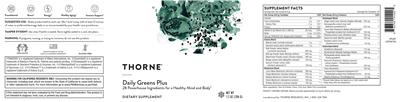
28 powerhouse ingredients for a healthy mind and body
FDA Statement of Identity
Dietary Supplement
Is this label outdated? Report a formula or label change and our pharmacy team will review it.
Daily Greens Plus by Thorne label
The label scan from the NIH Dietary Supplement Label Database. Tap to enlarge.
Label images are published by the NIH Dietary Supplement Label Database for the version of this product on file. Always read your actual product label.
View the full label (PDF)The Ingredients in Daily Greens Plus by Thorne
These are the 21 active ingredients this product is made of. Select any to open its full monograph.
Serving size6.8 Gram(s) Dosage formPowder Servings per container30 Amounts shown are per serving.
Most supplement products combine several ingredients, and a medication can interact with the product through any one of them. Each ingredient below shows whether it has known drug interactions.
Dietary Fiber
Interacts with2,025 drugs
Black psyllium is a soluble-fiber supplement made from the seeds of a Plantago plant, used mostly to ease constipation and support digestive health. I...
Dietary Fiber monograph & interactionsProtein
Biotin
No knowninteractions
Biotin (vitamin B7) is a water-soluble vitamin your body needs to turn food into energy and to support healthy hair, skin, and nails. Most people get...
Biotin monograph & interactionsMushroom Blend
Interacts with260 drugs
Maitake is an edible mushroom long used as food and in traditional Japanese medicine, and it is being studied for possible immune, blood sugar, and bl...
Mushroom Blend monograph & interactionsZinc
Interacts with67 drugs
Zinc is an essential mineral that your body needs for immune function, wound healing, taste, and smell. Most people get enough from food, but suppleme...
Zinc monograph & interactionsVitamin D
Interacts with715 drugs
Vitamin D is a fat-soluble vitamin that helps your body absorb calcium and is important for healthy bones, muscles, and immune function. Many people,...
Vitamin D monograph & interactionsGreens Blend
- › Spirulina
- › Matcha
- › Moringa, Powder
- › Watermelon, Powder
- › Kelp, Powder
- › Zynamite
- › Solarplast
Antioxidant Blend
Adaptogen Blend
Interacts with327 drugs
Jiaogulan is a climbing vine used in traditional Chinese medicine as an adaptogen and for heart, blood sugar, and cholesterol support. Early human and...
Adaptogen Blend monograph & interactionsOther (inactive) ingredients: Olive Oil, Powder, Flavor, Citric Acid, Monk Fruit concentrate. These complete the product’s ingredient list but are not active constituents.
Daily Greens Plus by Thorne Drug Interactions
HelloPharmacist Interaction Report
Daily Greens Plus by Thorne has documented interactions with a substantial number of medications.
The most serious concern is with matcha (green tea), which contains Major-severity interactions with three drug types: it can reduce levels of the beta-blocker nadolol by roughly 85%, increase stimulant risks with ephedrine, and reduce atorvastatin (a cholesterol medication) levels by about 24%.
Read the full breakdown — every affected drug type, severity by severity
Several other ingredients carry Moderate-severity interactions. Zinc reduces absorption of quinolone and tetracycline antibiotics, cephalexin, and penicillamine—all of which require timing separations.
Vitamin D at high doses poses risks with thiazide diuretics, heart medications like verapamil and digoxin, and the statin atorvastatin. Rhodiola, resveratrol, nicotinamide riboside, and multiple mushroom extracts (reishi, maitake, lion's mane, chaga) each interact with blood-pressure drugs, blood thinners, diabetes medications, and immune-suppressing drugs.
Ashwagandha (in the NooGandha ingredient) interacts with sedatives, benzodiazepines, blood-pressure and diabetes medications, thyroid hormones, and drugs processed by the liver. Lemon balm (Relissa) and pomegranate also carry interactions with CNS depressants and other major drug classes.
Additionally, eleuthero root extract (ginseng) interacts with midazolam (reducing its effect by roughly 44%), blood-thinners like warfarin, diabetes and heart medications, and monoamine oxidase inhibitors (MAOIs). Altogether, these interactions span 1,698 individual medications.
Several ingredients in this product—spirulina and watermelon powder—we could not check; the blended ingredients (Mushroom Blend, Greens Blend, Antioxidant Blend, Adaptogen Blend) are listed as individual components elsewhere in the facts, so their interactions are covered. Use the medication checker below to verify your exact drugs before starting.
Check your own medications below · Editorial policy · How we use AI
Want to check YOUR meds against Daily Greens Plus?
Ask about interactions with your drugs in plain English — “Can I take it with lisinopril?” — and we find you the answer in seconds, ingredient by ingredient.
Go to the checkerIngredients driving the most interactions
Individual Drug Interactions
The ingredients in Daily Greens Plus interact with 2,318 drugs. Click any drug to see the details.
14 of the 21 ingredients in Daily Greens Plus interact with drugs. Each result below shows which ingredient is responsible. Dietary Fiber Matcha Quercetin Phytosome Pomegranate Whole Fruit Extract Moringa, Powder Trans-Resveratrol Vitamin D Spirulina Adaptogen Blend Mushroom Blend Ubiqsome Nicotinamide Riboside Hydrogen Malate Solarplast Zinc
Aminophylline, Amobarbital, EphedrineAmesec
How Aminophylline, Amobarbital, Ephedrine interacts with Daily Greens Plus — through 7 ingredients. Tap an ingredient for the detail:
MatchaEphedrine, Stimulant Drugs Major
Interaction Summary
Theoretically, concomitant use might increase the risk for stimulant adverse effects.
Read the full Matcha + Aminophylline, Amobarbital, Ephedrine interactionEleuthero Root ExtractStimulant Drugs Moderate
Interaction Summary
Theoretically, taking Panax ginseng with stimulant drugs might increase the risk of adverse stimulant effects.
Read the full Eleuthero Root Extract + Aminophylline, Amobarbital, Ephedrine interactionNoogandhaCns Depressants Moderate
Interaction Summary
Theoretically, taking ashwagandha might increase the sedative effects of CNS depressants.
Read the full Noogandha + Aminophylline, Amobarbital, Ephedrine interactionSpearmintCns Depressants Moderate
Interaction Summary
Theoretically, spearmint might alter the sedative effects of CNS depressants.
Read the full Spearmint + Aminophylline, Amobarbital, Ephedrine interactionRelissaCns Depressants Moderate
Interaction Summary
Theoretically, concomitant use of lemon balm might have additive effects with CNS depressant drugs.
Read the full Relissa + Aminophylline, Amobarbital, Ephedrine interactionDietary FiberOral Drugs Minor
Interaction Summary
Theoretically, psyllium might increase, decrease, or have no effect on the absorption of oral drugs.
Read the full Dietary Fiber + Aminophylline, Amobarbital, Ephedrine interactionRhodiola Root ExtractCns Depressants Minor
Interaction Summary
Theoretically, rhodiola might increase the risk of adverse effects when taken with CNS depressants.
Read the full Rhodiola Root Extract + Aminophylline, Amobarbital, Ephedrine interactionAtorvastatinAtorvaliq
How Atorvastatin interacts with Daily Greens Plus — through 12 ingredients. Tap an ingredient for the detail:
MatchaCytochrome P450 3a4 (cyp3a4) Substrates, Organic Anion-transporting Polypeptide Substrates (oatp) +2 Major
Interaction Summary
Green tea is unlikely to produce clinically significant changes in the levels and clinical effects of CYP3A4 substrates.
Read the full Matcha + Atorvastatin interactionQuercetin PhytosomeOrganic Anion-transporting Polypeptide Substrates (oatp), Cytochrome P450 3a4 (cyp3a4) Substrates Moderate
Interaction Summary
Theoretically, concomitant use might increase the effects and adverse effects of OATP substrates.
Read the full Quercetin Phytosome + Atorvastatin interactionEleuthero Root ExtractCytochrome P450 3a4 (cyp3a4) Substrates Moderate
Interaction Summary
Theoretically, Panax ginseng might increase or decrease levels of drugs metabolized by CYP3A4.
Read the full Eleuthero Root Extract + Atorvastatin interactionSpearmintHepatotoxic Drugs Moderate
Interaction Summary
Theoretically, high doses of spearmint might increase the risk of liver damage when taken with hepatotoxic drugs.
Read the full Spearmint + Atorvastatin interactionGinger ExtractCytochrome P450 3a4 (cyp3a4) Substrates Moderate
Interaction Summary
Ginger might increase or decrease the levels of CYP3A4 substrates.
Read the full Ginger Extract + Atorvastatin interactionTrans-resveratrolCytochrome P450 3a4 (cyp3a4) Substrates Moderate
Interaction Summary
Theoretically, resveratrol might increase levels of drugs metabolized by CYP3A4.
Read the full Trans-resveratrol + Atorvastatin interactionMoringa, PowderCytochrome P450 3a4 (cyp3a4) Substrates Moderate
Interaction Summary
Theoretically, moringa might increase or decrease levels of CYP3A4 substrates.
Read the full Moringa, Powder + Atorvastatin interactionVitamin DCytochrome P450 3a4 (cyp3a4) Substrates, Atorvastatin (lipitor) Moderate
Interaction Summary
Vitamin D might induce CYP3A4 enzymes and reduce the bioavailability of CYP3A4 substrates.
Read the full Vitamin D + Atorvastatin interactionNoogandhaCytochrome P450 3a4 (cyp3a4) Substrates, Hepatotoxic Drugs Moderate
Interaction Summary
Theoretically, ashwagandha might decrease the levels and clinical effects of CYP3A4 substrates.
Read the full Noogandha + Atorvastatin interactionDietary FiberOral Drugs Minor
Interaction Summary
Theoretically, psyllium might increase, decrease, or have no effect on the absorption of oral drugs.
Read the full Dietary Fiber + Atorvastatin interactionRhodiola Root ExtractCytochrome P450 3a4 (cyp3a4) Substrates Minor
Interaction Summary
Theoretically, rhodiola might increase levels of drugs metabolized by CYP3A4.
Read the full Rhodiola Root Extract + Atorvastatin interactionPomegranate Whole Fruit ExtractCytochrome P450 3a4 (cyp3a4) Substrates Minor
Interaction Summary
Theoretically, pomegranate might increase levels of drugs metabolized by CYP3A4, but most research suggests this interaction is unlikely to be clinically significant.
Read the full Pomegranate Whole Fruit Extract + Atorvastatin interactionAtorvastatin CalciumLipitor
How Atorvastatin Calcium interacts with Daily Greens Plus — through 12 ingredients. Tap an ingredient for the detail:
MatchaHepatotoxic Drugs, Cytochrome P450 3a4 (cyp3a4) Substrates +2 Major
Interaction Summary
Theoretically, concomitant use might have additive adverse hepatotoxic effects.
Read the full Matcha + Atorvastatin Calcium interactionNoogandhaCytochrome P450 3a4 (cyp3a4) Substrates, Hepatotoxic Drugs Moderate
Interaction Summary
Theoretically, ashwagandha might decrease the levels and clinical effects of CYP3A4 substrates.
Read the full Noogandha + Atorvastatin Calcium interactionSpearmintHepatotoxic Drugs Moderate
Interaction Summary
Theoretically, high doses of spearmint might increase the risk of liver damage when taken with hepatotoxic drugs.
Read the full Spearmint + Atorvastatin Calcium interactionQuercetin PhytosomeCytochrome P450 3a4 (cyp3a4) Substrates, Organic Anion-transporting Polypeptide Substrates (oatp) Moderate
Interaction Summary
Theoretically, concomitant use might alter the effects and adverse effects of CYP3A4 substrates.
Read the full Quercetin Phytosome + Atorvastatin Calcium interactionTrans-resveratrolCytochrome P450 3a4 (cyp3a4) Substrates Moderate
Interaction Summary
Theoretically, resveratrol might increase levels of drugs metabolized by CYP3A4.
Read the full Trans-resveratrol + Atorvastatin Calcium interactionVitamin DCytochrome P450 3a4 (cyp3a4) Substrates, Atorvastatin (lipitor) Moderate
Interaction Summary
Vitamin D might induce CYP3A4 enzymes and reduce the bioavailability of CYP3A4 substrates.
Read the full Vitamin D + Atorvastatin Calcium interactionEleuthero Root ExtractCytochrome P450 3a4 (cyp3a4) Substrates Moderate
Interaction Summary
Theoretically, Panax ginseng might increase or decrease levels of drugs metabolized by CYP3A4.
Read the full Eleuthero Root Extract + Atorvastatin Calcium interactionMoringa, PowderCytochrome P450 3a4 (cyp3a4) Substrates Moderate
Interaction Summary
Theoretically, moringa might increase or decrease levels of CYP3A4 substrates.
Read the full Moringa, Powder + Atorvastatin Calcium interactionGinger ExtractCytochrome P450 3a4 (cyp3a4) Substrates Moderate
Interaction Summary
Ginger might increase or decrease the levels of CYP3A4 substrates.
Read the full Ginger Extract + Atorvastatin Calcium interactionDietary FiberOral Drugs Minor
Interaction Summary
Theoretically, psyllium might increase, decrease, or have no effect on the absorption of oral drugs.
Read the full Dietary Fiber + Atorvastatin Calcium interactionRhodiola Root ExtractCytochrome P450 3a4 (cyp3a4) Substrates Minor
Interaction Summary
Theoretically, rhodiola might increase levels of drugs metabolized by CYP3A4.
Read the full Rhodiola Root Extract + Atorvastatin Calcium interactionPomegranate Whole Fruit ExtractCytochrome P450 3a4 (cyp3a4) Substrates Minor
Interaction Summary
Theoretically, pomegranate might increase levels of drugs metabolized by CYP3A4, but most research suggests this interaction is unlikely to be clinically significant.
Read the full Pomegranate Whole Fruit Extract + Atorvastatin Calcium interactionBendroflumethiazide, NadololCorzide
How Bendroflumethiazide, Nadolol interacts with Daily Greens Plus — through 11 ingredients. Tap an ingredient for the detail:
MatchaDiuretic Drugs, Nadolol (corgard) Major
Interaction Summary
Theoretically, using green tea with diuretic drugs might increase the risk of hypokalemia.
Read the full Matcha + Bendroflumethiazide, Nadolol interactionQuercetin PhytosomeAntihypertensive Drugs Moderate
Interaction Summary
Theoretically, taking quercetin with antihypertensive drugs might increase the risk of hypotension.
Read the full Quercetin Phytosome + Bendroflumethiazide, Nadolol interactionPomegranate Whole Fruit ExtractAntihypertensive Drugs Moderate
Interaction Summary
Theoretically, taking pomegranate with antihypertensive drugs might increase the risk of hypotension.
Read the full Pomegranate Whole Fruit Extract + Bendroflumethiazide, Nadolol interactionNoogandhaAntihypertensive Drugs Moderate
Interaction Summary
Theoretically, taking ashwagandha with antihypertensive drugs might increase the risk of hypotension.
Read the full Noogandha + Bendroflumethiazide, Nadolol interactionVitamin DThiazide Diuretics Moderate
Interaction Summary
Theoretically, taking thiazide diuretics and high-dose vitamin D can increase the risk of hypercalcemia.
Read the full Vitamin D + Bendroflumethiazide, Nadolol interactionRhodiola Root ExtractAntihypertensive Drugs Moderate
Interaction Summary
Theoretically, taking rhodiola with antihypertensive drugs might increase the risk of hypotension.
Read the full Rhodiola Root Extract + Bendroflumethiazide, Nadolol interactionMaitake MushroomAntihypertensive Drugs Moderate
Interaction Summary
Theoretically, combining maitake mushroom with antihypertensive drugs might increase the risk of hypotension.
Read the full Maitake Mushroom + Bendroflumethiazide, Nadolol interactionReishi MushroomAntihypertensive Drugs Moderate
Interaction Summary
Theoretically, concurrent use of reishi mushroom with antihypertensive drugs might increase the risk of hypotension.
Read the full Reishi Mushroom + Bendroflumethiazide, Nadolol interactionNicotinamide Riboside Hydrogen MalateAntihypertensive Drugs Minor
Interaction Summary
Theoretically, nicotinamide riboside may have additive effects with antihypertensive drugs, potentially increasing the risk for hypotension.
Read the full Nicotinamide Riboside Hydrogen Malate + Bendroflumethiazide, Nadolol interactionUbiqsomeAntihypertensive Drugs Minor
Interaction Summary
Theoretically, coenzyme Q10 might have additive effects with antihypertensive drugs.
Read the full Ubiqsome + Bendroflumethiazide, Nadolol interactionDietary FiberOral Drugs Minor
Interaction Summary
Theoretically, psyllium might increase, decrease, or have no effect on the absorption of oral drugs.
Read the full Dietary Fiber + Bendroflumethiazide, Nadolol interactionCarbetapentane Tannate, Chlorpheniramine Tannate, Ephedrine Tannate, Phenylephrine TannateQuadratuss, Ry Tuss, Rynatuss, Tri Tannate Plus
How Carbetapentane Tannate, Chlorpheniramine Tannate, Ephedrine Tannate, Phenylephrine Tannate interacts with Daily Greens Plus — through 11 ingredients. Tap an ingredient for the detail:
MatchaStimulant Drugs, Ephedrine +1 Major
Interaction Summary
Theoretically, concomitant use might increase stimulant adverse effects.
Read the full Matcha + Carbetapentane Tannate, Chlorpheniramine Tannate, Ephedrine Tannate, Phenylephrine Tannate interactionQuercetin PhytosomeCytochrome P450 3a4 (cyp3a4) Substrates Moderate
Interaction Summary
Theoretically, concomitant use might alter the effects and adverse effects of CYP3A4 substrates.
Read the full Quercetin Phytosome + Carbetapentane Tannate, Chlorpheniramine Tannate, Ephedrine Tannate, Phenylephrine Tannate interactionTrans-resveratrolCytochrome P450 3a4 (cyp3a4) Substrates Moderate
Interaction Summary
Theoretically, resveratrol might increase levels of drugs metabolized by CYP3A4.
Read the full Trans-resveratrol + Carbetapentane Tannate, Chlorpheniramine Tannate, Ephedrine Tannate, Phenylephrine Tannate interactionGinger ExtractCytochrome P450 3a4 (cyp3a4) Substrates Moderate
Interaction Summary
Ginger might increase or decrease the levels of CYP3A4 substrates.
Read the full Ginger Extract + Carbetapentane Tannate, Chlorpheniramine Tannate, Ephedrine Tannate, Phenylephrine Tannate interactionMoringa, PowderCytochrome P450 3a4 (cyp3a4) Substrates Moderate
Interaction Summary
Theoretically, moringa might increase or decrease levels of CYP3A4 substrates.
Read the full Moringa, Powder + Carbetapentane Tannate, Chlorpheniramine Tannate, Ephedrine Tannate, Phenylephrine Tannate interactionEleuthero Root ExtractStimulant Drugs, Cytochrome P450 3a4 (cyp3a4) Substrates Moderate
Interaction Summary
Theoretically, taking Panax ginseng with stimulant drugs might increase the risk of adverse stimulant effects.
Read the full Eleuthero Root Extract + Carbetapentane Tannate, Chlorpheniramine Tannate, Ephedrine Tannate, Phenylephrine Tannate interactionRhodiola Root ExtractCytochrome P450 3a4 (cyp3a4) Substrates Minor
Interaction Summary
Theoretically, rhodiola might increase levels of drugs metabolized by CYP3A4.
Read the full Rhodiola Root Extract + Carbetapentane Tannate, Chlorpheniramine Tannate, Ephedrine Tannate, Phenylephrine Tannate interactionPomegranate Whole Fruit ExtractCytochrome P450 3a4 (cyp3a4) Substrates Minor
Interaction Summary
Theoretically, pomegranate might increase levels of drugs metabolized by CYP3A4, but most research suggests this interaction is unlikely to be clinically significant.
Read the full Pomegranate Whole Fruit Extract + Carbetapentane Tannate, Chlorpheniramine Tannate, Ephedrine Tannate, Phenylephrine Tannate interactionDietary FiberOral Drugs Minor
Interaction Summary
Theoretically, psyllium might increase, decrease, or have no effect on the absorption of oral drugs.
Read the full Dietary Fiber + Carbetapentane Tannate, Chlorpheniramine Tannate, Ephedrine Tannate, Phenylephrine Tannate interactionVitamin DCytochrome P450 3a4 (cyp3a4) Substrates Minor
Interaction Summary
Vitamin D might induce CYP3A4 enzymes and reduce the bioavailability of CYP3A4 substrates.
Read the full Vitamin D + Carbetapentane Tannate, Chlorpheniramine Tannate, Ephedrine Tannate, Phenylephrine Tannate interactionNoogandhaCytochrome P450 3a4 (cyp3a4) Substrates, Serotonergic Drugs Minor
Interaction Summary
Theoretically, ashwagandha might decrease the levels and clinical effects of CYP3A4 substrates.
Read the full Noogandha + Carbetapentane Tannate, Chlorpheniramine Tannate, Ephedrine Tannate, Phenylephrine Tannate interactionDyphylline, Ephedrine, Guaifenesin, PhenobarbitalLufyllin-EPG
How Dyphylline, Ephedrine, Guaifenesin, Phenobarbital interacts with Daily Greens Plus — through 7 ingredients. Tap an ingredient for the detail:
MatchaStimulant Drugs, Phenobarbital (luminal) +1 Major
Interaction Summary
Theoretically, concomitant use might increase stimulant adverse effects.
Read the full Matcha + Dyphylline, Ephedrine, Guaifenesin, Phenobarbital interactionEleuthero Root ExtractStimulant Drugs Moderate
Interaction Summary
Theoretically, taking Panax ginseng with stimulant drugs might increase the risk of adverse stimulant effects.
Read the full Eleuthero Root Extract + Dyphylline, Ephedrine, Guaifenesin, Phenobarbital interactionSpearmintCns Depressants Moderate
Interaction Summary
Theoretically, spearmint might alter the sedative effects of CNS depressants.
Read the full Spearmint + Dyphylline, Ephedrine, Guaifenesin, Phenobarbital interactionRelissaCns Depressants Moderate
Interaction Summary
Theoretically, concomitant use of lemon balm might have additive effects with CNS depressant drugs.
Read the full Relissa + Dyphylline, Ephedrine, Guaifenesin, Phenobarbital interactionNoogandhaCns Depressants Moderate
Interaction Summary
Theoretically, taking ashwagandha might increase the sedative effects of CNS depressants.
Read the full Noogandha + Dyphylline, Ephedrine, Guaifenesin, Phenobarbital interactionDietary FiberOral Drugs Minor
Interaction Summary
Theoretically, psyllium might increase, decrease, or have no effect on the absorption of oral drugs.
Read the full Dietary Fiber + Dyphylline, Ephedrine, Guaifenesin, Phenobarbital interactionRhodiola Root ExtractCns Depressants Minor
Interaction Summary
Theoretically, rhodiola might increase the risk of adverse effects when taken with CNS depressants.
Read the full Rhodiola Root Extract + Dyphylline, Ephedrine, Guaifenesin, Phenobarbital interactionEphedrine, Guaifenesin (otc Drug)Ephedrine Formula 400, Ephedrine Plus Tabs
How Ephedrine, Guaifenesin (otc Drug) interacts with Daily Greens Plus — through 3 ingredients. Tap an ingredient for the detail:
MatchaStimulant Drugs, Ephedrine Major
Interaction Summary
Theoretically, concomitant use might increase stimulant adverse effects.
Read the full Matcha + Ephedrine, Guaifenesin (otc Drug) interactionEleuthero Root ExtractStimulant Drugs Moderate
Interaction Summary
Theoretically, taking Panax ginseng with stimulant drugs might increase the risk of adverse stimulant effects.
Read the full Eleuthero Root Extract + Ephedrine, Guaifenesin (otc Drug) interactionDietary FiberOral Drugs Minor
Interaction Summary
Theoretically, psyllium might increase, decrease, or have no effect on the absorption of oral drugs.
Read the full Dietary Fiber + Ephedrine, Guaifenesin (otc Drug) interactionEphedrine, Guaifenesin, Phenobarbital, TheophyllineMudrane GG
How Ephedrine, Guaifenesin, Phenobarbital, Theophylline interacts with Daily Greens Plus — through 10 ingredients. Tap an ingredient for the detail:
MatchaPhenobarbital (luminal), Ephedrine +2 Major
Interaction Summary
Theoretically, green tea might reduce the effects of phenobarbital and increase the risk for convulsions.
Read the full Matcha + Ephedrine, Guaifenesin, Phenobarbital, Theophylline interactionEleuthero Root ExtractStimulant Drugs Moderate
Interaction Summary
Theoretically, taking Panax ginseng with stimulant drugs might increase the risk of adverse stimulant effects.
Read the full Eleuthero Root Extract + Ephedrine, Guaifenesin, Phenobarbital, Theophylline interactionTrans-resveratrolCytochrome P450 1a2 (cyp1a2) Substrates Moderate
Interaction Summary
Theoretically, resveratrol might increase levels of drugs metabolized by CYP1A2.
Read the full Trans-resveratrol + Ephedrine, Guaifenesin, Phenobarbital, Theophylline interactionNoogandhaCytochrome P450 1a2 (cyp1a2) Substrates, Cns Depressants Moderate
Interaction Summary
Theoretically, ashwagandha might decrease the levels and clinical effects of CYP1A2 substrates.
Read the full Noogandha + Ephedrine, Guaifenesin, Phenobarbital, Theophylline interactionRelissaCns Depressants Moderate
Interaction Summary
Theoretically, concomitant use of lemon balm might have additive effects with CNS depressant drugs.
Read the full Relissa + Ephedrine, Guaifenesin, Phenobarbital, Theophylline interactionSpearmintCns Depressants Moderate
Interaction Summary
Theoretically, spearmint might alter the sedative effects of CNS depressants.
Read the full Spearmint + Ephedrine, Guaifenesin, Phenobarbital, Theophylline interactionRhodiola Root ExtractCytochrome P450 1a2 (cyp1a2) Substrates, Cns Depressants Minor
Interaction Summary
Theoretically, rhodiola might increase levels of drugs metabolized by CYP1A2.
Read the full Rhodiola Root Extract + Ephedrine, Guaifenesin, Phenobarbital, Theophylline interactionDietary FiberOral Drugs Minor
Interaction Summary
Theoretically, psyllium might increase, decrease, or have no effect on the absorption of oral drugs.
Read the full Dietary Fiber + Ephedrine, Guaifenesin, Phenobarbital, Theophylline interactionMoringa, PowderCytochrome P450 1a2 (cyp1a2) Substrates Minor
Interaction Summary
Theoretically, moringa might decrease the levels and clinical effects of CYP1A2 substrates.
Read the full Moringa, Powder + Ephedrine, Guaifenesin, Phenobarbital, Theophylline interactionGinger ExtractCytochrome P450 1a2 (cyp1a2) Substrates Minor
Interaction Summary
Theoretically, ginger might increase the levels of CYP1A2 substrates.
Read the full Ginger Extract + Ephedrine, Guaifenesin, Phenobarbital, Theophylline interactionEphedrine, Hydroxyzine, TheophyllineAmi Rax, Marax
How Ephedrine, Hydroxyzine, Theophylline interacts with Daily Greens Plus — through 8 ingredients. Tap an ingredient for the detail:
MatchaStimulant Drugs, Theophylline +1 Major
Interaction Summary
Theoretically, concomitant use might increase stimulant adverse effects.
Read the full Matcha + Ephedrine, Hydroxyzine, Theophylline interactionEleuthero Root ExtractStimulant Drugs Moderate
Interaction Summary
Theoretically, taking Panax ginseng with stimulant drugs might increase the risk of adverse stimulant effects.
Read the full Eleuthero Root Extract + Ephedrine, Hydroxyzine, Theophylline interactionTrans-resveratrolCytochrome P450 1a2 (cyp1a2) Substrates Moderate
Interaction Summary
Theoretically, resveratrol might increase levels of drugs metabolized by CYP1A2.
Read the full Trans-resveratrol + Ephedrine, Hydroxyzine, Theophylline interactionGinger ExtractCytochrome P450 1a2 (cyp1a2) Substrates Minor
Interaction Summary
Theoretically, ginger might increase the levels of CYP1A2 substrates.
Read the full Ginger Extract + Ephedrine, Hydroxyzine, Theophylline interactionNoogandhaCytochrome P450 1a2 (cyp1a2) Substrates Minor
Interaction Summary
Theoretically, ashwagandha might decrease the levels and clinical effects of CYP1A2 substrates.
Read the full Noogandha + Ephedrine, Hydroxyzine, Theophylline interactionRhodiola Root ExtractCytochrome P450 1a2 (cyp1a2) Substrates Minor
Interaction Summary
Theoretically, rhodiola might increase levels of drugs metabolized by CYP1A2.
Read the full Rhodiola Root Extract + Ephedrine, Hydroxyzine, Theophylline interactionMoringa, PowderCytochrome P450 1a2 (cyp1a2) Substrates Minor
Interaction Summary
Theoretically, moringa might decrease the levels and clinical effects of CYP1A2 substrates.
Read the full Moringa, Powder + Ephedrine, Hydroxyzine, Theophylline interactionDietary FiberOral Drugs Minor
Interaction Summary
Theoretically, psyllium might increase, decrease, or have no effect on the absorption of oral drugs.
Read the full Dietary Fiber + Ephedrine, Hydroxyzine, Theophylline interactionEphedrine, Phenobarbital, Potassium Iodide, TheophyllineMudrane, Quadrinal
How Ephedrine, Phenobarbital, Potassium Iodide, Theophylline interacts with Daily Greens Plus — through 7 ingredients. Tap an ingredient for the detail:
MatchaPhenobarbital (luminal), Ephedrine +2 Major
Interaction Summary
Theoretically, green tea might reduce the effects of phenobarbital and increase the risk for convulsions.
Read the full Matcha + Ephedrine, Phenobarbital, Potassium Iodide, Theophylline interactionEleuthero Root ExtractStimulant Drugs Moderate
Interaction Summary
Theoretically, taking Panax ginseng with stimulant drugs might increase the risk of adverse stimulant effects.
Read the full Eleuthero Root Extract + Ephedrine, Phenobarbital, Potassium Iodide, Theophylline interactionNoogandhaCns Depressants Moderate
Interaction Summary
Theoretically, taking ashwagandha might increase the sedative effects of CNS depressants.
Read the full Noogandha + Ephedrine, Phenobarbital, Potassium Iodide, Theophylline interactionSpearmintCns Depressants Moderate
Interaction Summary
Theoretically, spearmint might alter the sedative effects of CNS depressants.
Read the full Spearmint + Ephedrine, Phenobarbital, Potassium Iodide, Theophylline interactionRelissaCns Depressants Moderate
Interaction Summary
Theoretically, concomitant use of lemon balm might have additive effects with CNS depressant drugs.
Read the full Relissa + Ephedrine, Phenobarbital, Potassium Iodide, Theophylline interactionDietary FiberOral Drugs Minor
Interaction Summary
Theoretically, psyllium might increase, decrease, or have no effect on the absorption of oral drugs.
Read the full Dietary Fiber + Ephedrine, Phenobarbital, Potassium Iodide, Theophylline interactionRhodiola Root ExtractCns Depressants Minor
Interaction Summary
Theoretically, rhodiola might increase the risk of adverse effects when taken with CNS depressants.
Read the full Rhodiola Root Extract + Ephedrine, Phenobarbital, Potassium Iodide, Theophylline interactionEphedrine, Phenobarbital, TheophyllineTedral
How Ephedrine, Phenobarbital, Theophylline interacts with Daily Greens Plus — through 7 ingredients. Tap an ingredient for the detail:
MatchaStimulant Drugs, Theophylline +2 Major
Interaction Summary
Theoretically, concomitant use might increase stimulant adverse effects.
Read the full Matcha + Ephedrine, Phenobarbital, Theophylline interactionRelissaCns Depressants Moderate
Interaction Summary
Theoretically, concomitant use of lemon balm might have additive effects with CNS depressant drugs.
Read the full Relissa + Ephedrine, Phenobarbital, Theophylline interactionSpearmintCns Depressants Moderate
Interaction Summary
Theoretically, spearmint might alter the sedative effects of CNS depressants.
Read the full Spearmint + Ephedrine, Phenobarbital, Theophylline interactionNoogandhaCns Depressants Moderate
Interaction Summary
Theoretically, taking ashwagandha might increase the sedative effects of CNS depressants.
Read the full Noogandha + Ephedrine, Phenobarbital, Theophylline interactionEleuthero Root ExtractStimulant Drugs Moderate
Interaction Summary
Theoretically, taking Panax ginseng with stimulant drugs might increase the risk of adverse stimulant effects.
Read the full Eleuthero Root Extract + Ephedrine, Phenobarbital, Theophylline interactionDietary FiberOral Drugs Minor
Interaction Summary
Theoretically, psyllium might increase, decrease, or have no effect on the absorption of oral drugs.
Read the full Dietary Fiber + Ephedrine, Phenobarbital, Theophylline interactionRhodiola Root ExtractCns Depressants Minor
Interaction Summary
Theoretically, rhodiola might increase the risk of adverse effects when taken with CNS depressants.
Read the full Rhodiola Root Extract + Ephedrine, Phenobarbital, Theophylline interactionEzetimibe, AtorvastatinLiptruzet
How Ezetimibe, Atorvastatin interacts with Daily Greens Plus — through 12 ingredients. Tap an ingredient for the detail:
MatchaHepatotoxic Drugs, Organic Anion-transporting Polypeptide Substrates (oatp) +2 Major
Interaction Summary
Theoretically, concomitant use might have additive adverse hepatotoxic effects.
Read the full Matcha + Ezetimibe, Atorvastatin interactionQuercetin PhytosomeOrganic Anion Transporter 1 (oat1) Substrates, Organic Anion-transporting Polypeptide Substrates (oatp) +1 Moderate
Interaction Summary
Theoretically, concomitant use might increase the effects and adverse effects of OAT1 substrates.
Read the full Quercetin Phytosome + Ezetimibe, Atorvastatin interactionEleuthero Root ExtractCytochrome P450 3a4 (cyp3a4) Substrates Moderate
Interaction Summary
Theoretically, Panax ginseng might increase or decrease levels of drugs metabolized by CYP3A4.
Read the full Eleuthero Root Extract + Ezetimibe, Atorvastatin interactionGinger ExtractCytochrome P450 3a4 (cyp3a4) Substrates Moderate
Interaction Summary
Ginger might increase or decrease the levels of CYP3A4 substrates.
Read the full Ginger Extract + Ezetimibe, Atorvastatin interactionNoogandhaCytochrome P450 3a4 (cyp3a4) Substrates, Hepatotoxic Drugs Moderate
Interaction Summary
Theoretically, ashwagandha might decrease the levels and clinical effects of CYP3A4 substrates.
Read the full Noogandha + Ezetimibe, Atorvastatin interactionVitamin DCytochrome P450 3a4 (cyp3a4) Substrates, Atorvastatin (lipitor) Moderate
Interaction Summary
Vitamin D might induce CYP3A4 enzymes and reduce the bioavailability of CYP3A4 substrates.
Read the full Vitamin D + Ezetimibe, Atorvastatin interactionSpearmintHepatotoxic Drugs Moderate
Interaction Summary
Theoretically, high doses of spearmint might increase the risk of liver damage when taken with hepatotoxic drugs.
Read the full Spearmint + Ezetimibe, Atorvastatin interactionTrans-resveratrolCytochrome P450 3a4 (cyp3a4) Substrates Moderate
Interaction Summary
Theoretically, resveratrol might increase levels of drugs metabolized by CYP3A4.
Read the full Trans-resveratrol + Ezetimibe, Atorvastatin interactionMoringa, PowderCytochrome P450 3a4 (cyp3a4) Substrates Moderate
Interaction Summary
Theoretically, moringa might increase or decrease levels of CYP3A4 substrates.
Read the full Moringa, Powder + Ezetimibe, Atorvastatin interactionDietary FiberOral Drugs Minor
Interaction Summary
Theoretically, psyllium might increase, decrease, or have no effect on the absorption of oral drugs.
Read the full Dietary Fiber + Ezetimibe, Atorvastatin interactionRhodiola Root ExtractCytochrome P450 3a4 (cyp3a4) Substrates Minor
Interaction Summary
Theoretically, rhodiola might increase levels of drugs metabolized by CYP3A4.
Read the full Rhodiola Root Extract + Ezetimibe, Atorvastatin interactionPomegranate Whole Fruit ExtractCytochrome P450 3a4 (cyp3a4) Substrates Minor
Interaction Summary
Theoretically, pomegranate might increase levels of drugs metabolized by CYP3A4, but most research suggests this interaction is unlikely to be clinically significant.
Read the full Pomegranate Whole Fruit Extract + Ezetimibe, Atorvastatin interactionNadololCorgard, Nadolol
How Nadolol interacts with Daily Greens Plus — through 10 ingredients. Tap an ingredient for the detail:
MatchaNadolol (corgard) Major
Interaction Summary
Green tea seems to reduce the levels and clinical effects of nadolol.
Read the full Matcha + Nadolol interactionQuercetin PhytosomeAntihypertensive Drugs Moderate
Interaction Summary
Theoretically, taking quercetin with antihypertensive drugs might increase the risk of hypotension.
Read the full Quercetin Phytosome + Nadolol interactionReishi MushroomAntihypertensive Drugs Moderate
Interaction Summary
Theoretically, concurrent use of reishi mushroom with antihypertensive drugs might increase the risk of hypotension.
Read the full Reishi Mushroom + Nadolol interactionNoogandhaAntihypertensive Drugs Moderate
Interaction Summary
Theoretically, taking ashwagandha with antihypertensive drugs might increase the risk of hypotension.
Read the full Noogandha + Nadolol interactionPomegranate Whole Fruit ExtractAntihypertensive Drugs Moderate
Interaction Summary
Theoretically, taking pomegranate with antihypertensive drugs might increase the risk of hypotension.
Read the full Pomegranate Whole Fruit Extract + Nadolol interactionRhodiola Root ExtractAntihypertensive Drugs Moderate
Interaction Summary
Theoretically, taking rhodiola with antihypertensive drugs might increase the risk of hypotension.
Read the full Rhodiola Root Extract + Nadolol interactionMaitake MushroomAntihypertensive Drugs Moderate
Interaction Summary
Theoretically, combining maitake mushroom with antihypertensive drugs might increase the risk of hypotension.
Read the full Maitake Mushroom + Nadolol interactionUbiqsomeAntihypertensive Drugs Minor
Interaction Summary
Theoretically, coenzyme Q10 might have additive effects with antihypertensive drugs.
Read the full Ubiqsome + Nadolol interactionDietary FiberOral Drugs Minor
Interaction Summary
Theoretically, psyllium might increase, decrease, or have no effect on the absorption of oral drugs.
Read the full Dietary Fiber + Nadolol interactionNicotinamide Riboside Hydrogen MalateAntihypertensive Drugs Minor
Interaction Summary
Theoretically, nicotinamide riboside may have additive effects with antihypertensive drugs, potentially increasing the risk for hypotension.
Read the full Nicotinamide Riboside Hydrogen Malate + Nadolol interaction6-mercaptopurinePurinethol
How 6-mercaptopurine interacts with Daily Greens Plus — through 11 ingredients. Tap an ingredient for the detail:
MatchaHepatotoxic Drugs Moderate
Interaction Summary
Theoretically, concomitant use might have additive adverse hepatotoxic effects.
Read the full Matcha + 6-mercaptopurine interactionNoogandhaHepatotoxic Drugs, Immunosuppressants Moderate
Interaction Summary
Theoretically, taking ashwagandha with hepatotoxic drugs might increase the risk of liver damage.
Read the full Noogandha + 6-mercaptopurine interactionSpearmintHepatotoxic Drugs Moderate
Interaction Summary
Theoretically, high doses of spearmint might increase the risk of liver damage when taken with hepatotoxic drugs.
Read the full Spearmint + 6-mercaptopurine interactionShiitake MushroomImmunosuppressants Moderate
Interaction Summary
Theoretically, taking shiitake mushroom might decrease the effects of immunosuppressive therapy.
Read the full Shiitake Mushroom + 6-mercaptopurine interactionAdaptogen BlendImmunosuppressants Moderate
Interaction Summary
Theoretically, jiaogulan might decrease the effectiveness of immunosuppressive therapy.
Read the full Adaptogen Blend + 6-mercaptopurine interactionLion's Mane MushroomImmunosuppressants Moderate
Interaction Summary
Theoretically, concurrent use of lion's mane mushroom might interfere with immunosuppressive therapy.
Read the full Lion's Mane Mushroom + 6-mercaptopurine interactionChaga MushroomImmunosuppressants Moderate
Interaction Summary
Theoretically, chaga might interfere with immunosuppressive therapy.
Read the full Chaga Mushroom + 6-mercaptopurine interactionEleuthero Root ExtractImmunosuppressants Moderate
Interaction Summary
Theoretically, Panax ginseng use might interfere with immunosuppressive therapy.
Read the full Eleuthero Root Extract + 6-mercaptopurine interactionSpirulinaImmunosuppressants Moderate
Interaction Summary
Theoretically, concurrent use of blue-green algae might interfere with immunosuppressive therapy.
Read the full Spirulina + 6-mercaptopurine interactionRhodiola Root ExtractImmunosuppressants Moderate
Interaction Summary
Theoretically, rhodiola use might interfere with immunosuppressive therapy.
Read the full Rhodiola Root Extract + 6-mercaptopurine interactionDietary FiberOral Drugs Minor
Interaction Summary
Theoretically, psyllium might increase, decrease, or have no effect on the absorption of oral drugs.
Read the full Dietary Fiber + 6-mercaptopurine interactionAdo-trastuzumab EmtansineKadcyla
How Ado-trastuzumab Emtansine interacts with Daily Greens Plus — through 10 ingredients. Tap an ingredient for the detail:
Eleuthero Root ExtractCytochrome P450 3a4 (cyp3a4) Substrates Moderate
Interaction Summary
Theoretically, Panax ginseng might increase or decrease levels of drugs metabolized by CYP3A4.
Read the full Eleuthero Root Extract + Ado-trastuzumab Emtansine interactionTrans-resveratrolCytochrome P450 3a4 (cyp3a4) Substrates Moderate
Interaction Summary
Theoretically, resveratrol might increase levels of drugs metabolized by CYP3A4.
Read the full Trans-resveratrol + Ado-trastuzumab Emtansine interactionMoringa, PowderCytochrome P450 3a4 (cyp3a4) Substrates Moderate
Interaction Summary
Theoretically, moringa might increase or decrease levels of CYP3A4 substrates.
Read the full Moringa, Powder + Ado-trastuzumab Emtansine interactionGinger ExtractCytochrome P450 3a4 (cyp3a4) Substrates Moderate
Interaction Summary
Ginger might increase or decrease the levels of CYP3A4 substrates.
Read the full Ginger Extract + Ado-trastuzumab Emtansine interactionQuercetin PhytosomeCytochrome P450 3a4 (cyp3a4) Substrates Moderate
Interaction Summary
Theoretically, concomitant use might alter the effects and adverse effects of CYP3A4 substrates.
Read the full Quercetin Phytosome + Ado-trastuzumab Emtansine interactionMatchaCytochrome P450 3a4 (cyp3a4) Substrates Minor
Interaction Summary
Green tea is unlikely to produce clinically significant changes in the levels and clinical effects of CYP3A4 substrates.
Read the full Matcha + Ado-trastuzumab Emtansine interactionNoogandhaCytochrome P450 3a4 (cyp3a4) Substrates Minor
Interaction Summary
Theoretically, ashwagandha might decrease the levels and clinical effects of CYP3A4 substrates.
Read the full Noogandha + Ado-trastuzumab Emtansine interactionRhodiola Root ExtractCytochrome P450 3a4 (cyp3a4) Substrates Minor
Interaction Summary
Theoretically, rhodiola might increase levels of drugs metabolized by CYP3A4.
Read the full Rhodiola Root Extract + Ado-trastuzumab Emtansine interactionVitamin DCytochrome P450 3a4 (cyp3a4) Substrates Minor
Interaction Summary
Vitamin D might induce CYP3A4 enzymes and reduce the bioavailability of CYP3A4 substrates.
Read the full Vitamin D + Ado-trastuzumab Emtansine interactionPomegranate Whole Fruit ExtractCytochrome P450 3a4 (cyp3a4) Substrates Minor
Interaction Summary
Theoretically, pomegranate might increase levels of drugs metabolized by CYP3A4, but most research suggests this interaction is unlikely to be clinically significant.
Read the full Pomegranate Whole Fruit Extract + Ado-trastuzumab Emtansine interactionAbacavir Sulfate, Dolutegravir, LamivudineTriumeq
How Abacavir Sulfate, Dolutegravir, Lamivudine interacts with Daily Greens Plus — through 4 ingredients. Tap an ingredient for the detail:
SpearmintHepatotoxic Drugs Moderate
Interaction Summary
Theoretically, high doses of spearmint might increase the risk of liver damage when taken with hepatotoxic drugs.
Read the full Spearmint + Abacavir Sulfate, Dolutegravir, Lamivudine interactionMatchaHepatotoxic Drugs Moderate
Interaction Summary
Theoretically, concomitant use might have additive adverse hepatotoxic effects.
Read the full Matcha + Abacavir Sulfate, Dolutegravir, Lamivudine interactionNoogandhaHepatotoxic Drugs Moderate
Interaction Summary
Theoretically, taking ashwagandha with hepatotoxic drugs might increase the risk of liver damage.
Read the full Noogandha + Abacavir Sulfate, Dolutegravir, Lamivudine interactionDietary FiberOral Drugs Minor
Interaction Summary
Theoretically, psyllium might increase, decrease, or have no effect on the absorption of oral drugs.
Read the full Dietary Fiber + Abacavir Sulfate, Dolutegravir, Lamivudine interactionAbacavir, LamivudineEpzicom
How Abacavir, Lamivudine interacts with Daily Greens Plus — through 4 ingredients. Tap an ingredient for the detail:
MatchaHepatotoxic Drugs Moderate
Interaction Summary
Theoretically, concomitant use might have additive adverse hepatotoxic effects.
Read the full Matcha + Abacavir, Lamivudine interactionSpearmintHepatotoxic Drugs Moderate
Interaction Summary
Theoretically, high doses of spearmint might increase the risk of liver damage when taken with hepatotoxic drugs.
Read the full Spearmint + Abacavir, Lamivudine interactionNoogandhaHepatotoxic Drugs Moderate
Interaction Summary
Theoretically, taking ashwagandha with hepatotoxic drugs might increase the risk of liver damage.
Read the full Noogandha + Abacavir, Lamivudine interactionDietary FiberOral Drugs Minor
Interaction Summary
Theoretically, psyllium might increase, decrease, or have no effect on the absorption of oral drugs.
Read the full Dietary Fiber + Abacavir, Lamivudine interactionAbametapirXeglyze
How Abametapir interacts with Daily Greens Plus — through 1 ingredient. Tap an ingredient for the detail:
MatchaCytochrome P450 1a2 (cyp1a2) Inhibitors Moderate
Interaction Summary
Theoretically, concomitant use might increase the levels and adverse effects of caffeine.
Read the full Matcha + Abametapir interactionAbciximabReoPro
How Abciximab interacts with Daily Greens Plus — through 10 ingredients. Tap an ingredient for the detail:
Eleuthero Root ExtractAnticoagulant/antiplatelet Drugs Moderate
Interaction Summary
Although Panax ginseng has shown antiplatelet effects in the laboratory, it is unlikely to increase the risk of bleeding if used with anticoagulant or antiplatelet drugs.
Read the full Eleuthero Root Extract + Abciximab interactionAdaptogen BlendAnticoagulant/antiplatelet Drugs Moderate
Interaction Summary
Theoretically, jiaogulan might increase the risk of bleeding when taken with anticoagulant or antiplatelet drugs.
Read the full Adaptogen Blend + Abciximab interactionTrans-resveratrolAnticoagulant/antiplatelet Drugs Moderate
Interaction Summary
Resveratrol may have antiplatelet effects and may increase the risk of bleeding if used with anticoagulant or antiplatelet drugs.
Read the full Trans-resveratrol + Abciximab interactionGinger ExtractAnticoagulant/antiplatelet Drugs Moderate
Interaction Summary
Ginger may have antiplatelet effects and may increase the risk of bleeding if used with anticoagulant or antiplatelet drugs.
Read the full Ginger Extract + Abciximab interactionMatchaAnticoagulant/antiplatelet Drugs Moderate
Interaction Summary
Theoretically, green tea may increase the risk of bleeding if used with anticoagulant or antiplatelet drugs.
Read the full Matcha + Abciximab interactionChaga MushroomAnticoagulant/antiplatelet Drugs Moderate
Interaction Summary
Theoretically, chaga may increase the risk of bleeding if used with anticoagulant or antiplatelet drugs.
Read the full Chaga Mushroom + Abciximab interactionLion's Mane MushroomAnticoagulant/antiplatelet Drugs Moderate
Interaction Summary
Theoretically, lion's mane mushroom may increase the risk of bleeding when used with anticoagulant/antiplatelet drugs.
Read the full Lion's Mane Mushroom + Abciximab interactionSpirulinaAnticoagulant/antiplatelet Drugs Moderate
Interaction Summary
Theoretically, spirulina blue-green algae might increase the risk of bleeding if used with other anticoagulant or antiplatelet drugs.
Read the full Spirulina + Abciximab interactionReishi MushroomAnticoagulant/antiplatelet Drugs Moderate
Interaction Summary
Theoretically, high doses of reishi mushroom might increase the risk of bleeding.
Read the full Reishi Mushroom + Abciximab interactionDietary FiberOral Drugs Minor
Interaction Summary
Theoretically, psyllium might increase, decrease, or have no effect on the absorption of oral drugs.
Read the full Dietary Fiber + Abciximab interactionAbemaciclibVerzenio
How Abemaciclib interacts with Daily Greens Plus — through 11 ingredients. Tap an ingredient for the detail:
Eleuthero Root ExtractCytochrome P450 3a4 (cyp3a4) Substrates Moderate
Interaction Summary
Theoretically, Panax ginseng might increase or decrease levels of drugs metabolized by CYP3A4.
Read the full Eleuthero Root Extract + Abemaciclib interactionTrans-resveratrolCytochrome P450 3a4 (cyp3a4) Substrates Moderate
Interaction Summary
Theoretically, resveratrol might increase levels of drugs metabolized by CYP3A4.
Read the full Trans-resveratrol + Abemaciclib interactionGinger ExtractCytochrome P450 3a4 (cyp3a4) Substrates Moderate
Interaction Summary
Ginger might increase or decrease the levels of CYP3A4 substrates.
Read the full Ginger Extract + Abemaciclib interactionMoringa, PowderCytochrome P450 3a4 (cyp3a4) Substrates Moderate
Interaction Summary
Theoretically, moringa might increase or decrease levels of CYP3A4 substrates.
Read the full Moringa, Powder + Abemaciclib interactionQuercetin PhytosomeCytochrome P450 3a4 (cyp3a4) Substrates Moderate
Interaction Summary
Theoretically, concomitant use might alter the effects and adverse effects of CYP3A4 substrates.
Read the full Quercetin Phytosome + Abemaciclib interactionVitamin DCytochrome P450 3a4 (cyp3a4) Substrates Minor
Interaction Summary
Vitamin D might induce CYP3A4 enzymes and reduce the bioavailability of CYP3A4 substrates.
Read the full Vitamin D + Abemaciclib interactionNoogandhaCytochrome P450 3a4 (cyp3a4) Substrates Minor
Interaction Summary
Theoretically, ashwagandha might decrease the levels and clinical effects of CYP3A4 substrates.
Read the full Noogandha + Abemaciclib interactionDietary FiberOral Drugs Minor
Interaction Summary
Theoretically, psyllium might increase, decrease, or have no effect on the absorption of oral drugs.
Read the full Dietary Fiber + Abemaciclib interactionRhodiola Root ExtractCytochrome P450 3a4 (cyp3a4) Substrates Minor
Interaction Summary
Theoretically, rhodiola might increase levels of drugs metabolized by CYP3A4.
Read the full Rhodiola Root Extract + Abemaciclib interactionPomegranate Whole Fruit ExtractCytochrome P450 3a4 (cyp3a4) Substrates Minor
Interaction Summary
Theoretically, pomegranate might increase levels of drugs metabolized by CYP3A4, but most research suggests this interaction is unlikely to be clinically significant.
Read the full Pomegranate Whole Fruit Extract + Abemaciclib interactionMatchaCytochrome P450 3a4 (cyp3a4) Substrates Minor
Interaction Summary
Green tea is unlikely to produce clinically significant changes in the levels and clinical effects of CYP3A4 substrates.
Read the full Matcha + Abemaciclib interactionAbiraterone
How Abiraterone interacts with Daily Greens Plus — through 12 ingredients. Tap an ingredient for the detail:
MatchaCytochrome P450 3a4 (cyp3a4) Substrates, Hepatotoxic Drugs +1 Moderate
Interaction Summary
Green tea is unlikely to produce clinically significant changes in the levels and clinical effects of CYP3A4 substrates.
Read the full Matcha + Abiraterone interactionTrans-resveratrolCytochrome P450 3a4 (cyp3a4) Substrates Moderate
Interaction Summary
Theoretically, resveratrol might increase levels of drugs metabolized by CYP3A4.
Read the full Trans-resveratrol + Abiraterone interactionEleuthero Root ExtractCytochrome P450 3a4 (cyp3a4) Substrates Moderate
Interaction Summary
Theoretically, Panax ginseng might increase or decrease levels of drugs metabolized by CYP3A4.
Read the full Eleuthero Root Extract + Abiraterone interactionNoogandhaCytochrome P450 3a4 (cyp3a4) Substrates, Hepatotoxic Drugs Moderate
Interaction Summary
Theoretically, ashwagandha might decrease the levels and clinical effects of CYP3A4 substrates.
Read the full Noogandha + Abiraterone interactionSpearmintHepatotoxic Drugs Moderate
Interaction Summary
Theoretically, high doses of spearmint might increase the risk of liver damage when taken with hepatotoxic drugs.
Read the full Spearmint + Abiraterone interactionGinger ExtractCytochrome P450 3a4 (cyp3a4) Substrates Moderate
Interaction Summary
Ginger might increase or decrease the levels of CYP3A4 substrates.
Read the full Ginger Extract + Abiraterone interactionMoringa, PowderCytochrome P450 3a4 (cyp3a4) Substrates Moderate
Interaction Summary
Theoretically, moringa might increase or decrease levels of CYP3A4 substrates.
Read the full Moringa, Powder + Abiraterone interactionQuercetin PhytosomeCytochrome P450 3a4 (cyp3a4) Substrates Moderate
Interaction Summary
Theoretically, concomitant use might alter the effects and adverse effects of CYP3A4 substrates.
Read the full Quercetin Phytosome + Abiraterone interactionVitamin DCytochrome P450 3a4 (cyp3a4) Substrates Minor
Interaction Summary
Vitamin D might induce CYP3A4 enzymes and reduce the bioavailability of CYP3A4 substrates.
Read the full Vitamin D + Abiraterone interactionDietary FiberOral Drugs Minor
Interaction Summary
Theoretically, psyllium might increase, decrease, or have no effect on the absorption of oral drugs.
Read the full Dietary Fiber + Abiraterone interactionPomegranate Whole Fruit ExtractCytochrome P450 3a4 (cyp3a4) Substrates Minor
Interaction Summary
Theoretically, pomegranate might increase levels of drugs metabolized by CYP3A4, but most research suggests this interaction is unlikely to be clinically significant.
Read the full Pomegranate Whole Fruit Extract + Abiraterone interactionRhodiola Root ExtractCytochrome P450 3a4 (cyp3a4) Substrates Minor
Interaction Summary
Theoretically, rhodiola might increase levels of drugs metabolized by CYP3A4.
Read the full Rhodiola Root Extract + Abiraterone interactionAbiraterone AcetateYonsa, Zytiga
How Abiraterone Acetate interacts with Daily Greens Plus — through 12 ingredients. Tap an ingredient for the detail:
Quercetin PhytosomeCytochrome P450 3a4 (cyp3a4) Substrates Moderate
Interaction Summary
Theoretically, concomitant use might alter the effects and adverse effects of CYP3A4 substrates.
Read the full Quercetin Phytosome + Abiraterone Acetate interactionEleuthero Root ExtractCytochrome P450 3a4 (cyp3a4) Substrates Moderate
Interaction Summary
Theoretically, Panax ginseng might increase or decrease levels of drugs metabolized by CYP3A4.
Read the full Eleuthero Root Extract + Abiraterone Acetate interactionMatchaCytochrome P450 3a4 (cyp3a4) Substrates, Hepatotoxic Drugs Moderate
Interaction Summary
Green tea is unlikely to produce clinically significant changes in the levels and clinical effects of CYP3A4 substrates.
Read the full Matcha + Abiraterone Acetate interactionTrans-resveratrolCytochrome P450 3a4 (cyp3a4) Substrates Moderate
Interaction Summary
Theoretically, resveratrol might increase levels of drugs metabolized by CYP3A4.
Read the full Trans-resveratrol + Abiraterone Acetate interactionMoringa, PowderCytochrome P450 3a4 (cyp3a4) Substrates Moderate
Interaction Summary
Theoretically, moringa might increase or decrease levels of CYP3A4 substrates.
Read the full Moringa, Powder + Abiraterone Acetate interactionSpearmintHepatotoxic Drugs Moderate
Interaction Summary
Theoretically, high doses of spearmint might increase the risk of liver damage when taken with hepatotoxic drugs.
Read the full Spearmint + Abiraterone Acetate interactionNoogandhaHepatotoxic Drugs, Cytochrome P450 3a4 (cyp3a4) Substrates Moderate
Interaction Summary
Theoretically, taking ashwagandha with hepatotoxic drugs might increase the risk of liver damage.
Read the full Noogandha + Abiraterone Acetate interactionGinger ExtractCytochrome P450 3a4 (cyp3a4) Substrates Moderate
Interaction Summary
Ginger might increase or decrease the levels of CYP3A4 substrates.
Read the full Ginger Extract + Abiraterone Acetate interactionDietary FiberOral Drugs Minor
Interaction Summary
Theoretically, psyllium might increase, decrease, or have no effect on the absorption of oral drugs.
Read the full Dietary Fiber + Abiraterone Acetate interactionVitamin DCytochrome P450 3a4 (cyp3a4) Substrates Minor
Interaction Summary
Vitamin D might induce CYP3A4 enzymes and reduce the bioavailability of CYP3A4 substrates.
Read the full Vitamin D + Abiraterone Acetate interactionRhodiola Root ExtractCytochrome P450 3a4 (cyp3a4) Substrates Minor
Interaction Summary
Theoretically, rhodiola might increase levels of drugs metabolized by CYP3A4.
Read the full Rhodiola Root Extract + Abiraterone Acetate interactionPomegranate Whole Fruit ExtractCytochrome P450 3a4 (cyp3a4) Substrates Minor
Interaction Summary
Theoretically, pomegranate might increase levels of drugs metabolized by CYP3A4, but most research suggests this interaction is unlikely to be clinically significant.
Read the full Pomegranate Whole Fruit Extract + Abiraterone Acetate interactionAbrocitinibCibinqo
How Abrocitinib interacts with Daily Greens Plus — through 15 ingredients. Tap an ingredient for the detail:
Ginger ExtractCytochrome P450 2c9 (cyp2c9) Substrates, Anticoagulant/antiplatelet Drugs Moderate
Interaction Summary
Theoretically, ginger might increase the levels of CYP2C9 substrates.
Read the full Ginger Extract + Abrocitinib interactionTrans-resveratrolAnticoagulant/antiplatelet Drugs, Cytochrome P450 2c19 (cyp2c19) Substrates Moderate
Interaction Summary
Resveratrol may have antiplatelet effects and may increase the risk of bleeding if used with anticoagulant or antiplatelet drugs.
Read the full Trans-resveratrol + Abrocitinib interactionEleuthero Root ExtractAnticoagulant/antiplatelet Drugs, Immunosuppressants Moderate
Interaction Summary
Although Panax ginseng has shown antiplatelet effects in the laboratory, it is unlikely to increase the risk of bleeding if used with anticoagulant or antiplatelet drugs.
Read the full Eleuthero Root Extract + Abrocitinib interactionSpirulinaAnticoagulant/antiplatelet Drugs, Immunosuppressants Moderate
Interaction Summary
Theoretically, spirulina blue-green algae might increase the risk of bleeding if used with other anticoagulant or antiplatelet drugs.
Read the full Spirulina + Abrocitinib interactionReishi MushroomAnticoagulant/antiplatelet Drugs Moderate
Interaction Summary
Theoretically, high doses of reishi mushroom might increase the risk of bleeding.
Read the full Reishi Mushroom + Abrocitinib interactionQuercetin PhytosomeCytochrome P450 2c9 (cyp2c9) Substrates Moderate
Interaction Summary
Theoretically, concomitant use might increase the levels and adverse effects of CYP2C9 substrates.
Read the full Quercetin Phytosome + Abrocitinib interactionAdaptogen BlendImmunosuppressants, Anticoagulant/antiplatelet Drugs Moderate
Interaction Summary
Theoretically, jiaogulan might decrease the effectiveness of immunosuppressive therapy.
Read the full Adaptogen Blend + Abrocitinib interactionMatchaAnticoagulant/antiplatelet Drugs Moderate
Interaction Summary
Theoretically, green tea may increase the risk of bleeding if used with anticoagulant or antiplatelet drugs.
Read the full Matcha + Abrocitinib interactionShiitake MushroomImmunosuppressants Moderate
Interaction Summary
Theoretically, taking shiitake mushroom might decrease the effects of immunosuppressive therapy.
Read the full Shiitake Mushroom + Abrocitinib interactionRhodiola Root ExtractCytochrome P450 2c9 (cyp2c9) Substrates, Immunosuppressants Moderate
Interaction Summary
Theoretically, rhodiola might increase levels of drugs metabolized by CYP2C9.
Read the full Rhodiola Root Extract + Abrocitinib interactionNoogandhaImmunosuppressants Moderate
Interaction Summary
Theoretically, taking ashwagandha might decrease the effects of immunosuppressants.
Read the full Noogandha + Abrocitinib interactionChaga MushroomImmunosuppressants, Anticoagulant/antiplatelet Drugs Moderate
Interaction Summary
Theoretically, chaga might interfere with immunosuppressive therapy.
Read the full Chaga Mushroom + Abrocitinib interactionLion's Mane MushroomImmunosuppressants, Anticoagulant/antiplatelet Drugs Moderate
Interaction Summary
Theoretically, concurrent use of lion's mane mushroom might interfere with immunosuppressive therapy.
Read the full Lion's Mane Mushroom + Abrocitinib interactionPomegranate Whole Fruit ExtractCytochrome P450 2c9 (cyp2c9) Substrates Minor
Interaction Summary
Theoretically, pomegranate might increase levels of drugs metabolized by CYP2C9.
Read the full Pomegranate Whole Fruit Extract + Abrocitinib interactionDietary FiberOral Drugs Minor
Interaction Summary
Theoretically, psyllium might increase, decrease, or have no effect on the absorption of oral drugs.
Read the full Dietary Fiber + Abrocitinib interactionAcalabrutinibCalquence
How Acalabrutinib interacts with Daily Greens Plus — through 11 ingredients. Tap an ingredient for the detail:
Moringa, PowderCytochrome P450 3a4 (cyp3a4) Substrates, P-glycoprotein Substrates Moderate
Interaction Summary
Theoretically, moringa might increase or decrease levels of CYP3A4 substrates.
Read the full Moringa, Powder + Acalabrutinib interactionEleuthero Root ExtractCytochrome P450 3a4 (cyp3a4) Substrates Moderate
Interaction Summary
Theoretically, Panax ginseng might increase or decrease levels of drugs metabolized by CYP3A4.
Read the full Eleuthero Root Extract + Acalabrutinib interactionGinger ExtractCytochrome P450 3a4 (cyp3a4) Substrates, P-glycoprotein Substrates Moderate
Interaction Summary
Ginger might increase or decrease the levels of CYP3A4 substrates.
Read the full Ginger Extract + Acalabrutinib interactionTrans-resveratrolCytochrome P450 3a4 (cyp3a4) Substrates Moderate
Interaction Summary
Theoretically, resveratrol might increase levels of drugs metabolized by CYP3A4.
Read the full Trans-resveratrol + Acalabrutinib interactionQuercetin PhytosomeCytochrome P450 3a4 (cyp3a4) Substrates, P-glycoprotein Substrates Moderate
Interaction Summary
Theoretically, concomitant use might alter the effects and adverse effects of CYP3A4 substrates.
Read the full Quercetin Phytosome + Acalabrutinib interactionRhodiola Root ExtractP-glycoprotein Substrates, Cytochrome P450 3a4 (cyp3a4) Substrates Moderate
Interaction Summary
Theoretically, rhodiola might increase levels of P-glycoprotein substrates.
Read the full Rhodiola Root Extract + Acalabrutinib interactionMatchaP-glycoprotein Substrates, Cytochrome P450 3a4 (cyp3a4) Substrates Moderate
Interaction Summary
Green tea might increase the levels and adverse effects of P-glycoprotein (P-gp) substrates.
Read the full Matcha + Acalabrutinib interactionDietary FiberOral Drugs Minor
Interaction Summary
Theoretically, psyllium might increase, decrease, or have no effect on the absorption of oral drugs.
Read the full Dietary Fiber + Acalabrutinib interactionVitamin DCytochrome P450 3a4 (cyp3a4) Substrates Minor
Interaction Summary
Vitamin D might induce CYP3A4 enzymes and reduce the bioavailability of CYP3A4 substrates.
Read the full Vitamin D + Acalabrutinib interactionPomegranate Whole Fruit ExtractCytochrome P450 3a4 (cyp3a4) Substrates Minor
Interaction Summary
Theoretically, pomegranate might increase levels of drugs metabolized by CYP3A4, but most research suggests this interaction is unlikely to be clinically significant.
Read the full Pomegranate Whole Fruit Extract + Acalabrutinib interactionNoogandhaCytochrome P450 3a4 (cyp3a4) Substrates Minor
Interaction Summary
Theoretically, ashwagandha might decrease the levels and clinical effects of CYP3A4 substrates.
Read the full Noogandha + Acalabrutinib interactionAcarboseGlucobay, Prandase, Precose
How Acarbose interacts with Daily Greens Plus — through 16 ingredients. Tap an ingredient for the detail:
MatchaHepatotoxic Drugs, Antidiabetes Drugs Moderate
Interaction Summary
Theoretically, concomitant use might have additive adverse hepatotoxic effects.
Read the full Matcha + Acarbose interactionEleuthero Root ExtractAntidiabetes Drugs Moderate
Interaction Summary
Theoretically, taking Panax ginseng with antidiabetes drugs might increase the risk of hypoglycemia.
Read the full Eleuthero Root Extract + Acarbose interactionChaga MushroomAntidiabetes Drugs Moderate
Interaction Summary
Theoretically, taking chaga with antidiabetes drugs might increase the risk of hypoglycemia.
Read the full Chaga Mushroom + Acarbose interactionLion's Mane MushroomAntidiabetes Drugs Moderate
Interaction Summary
Theoretically, lion's mane mushroom may have additive effects when used with antidiabetes drugs.
Read the full Lion's Mane Mushroom + Acarbose interactionAdaptogen BlendAntidiabetes Drugs Moderate
Interaction Summary
Theoretically, jiaogulan might increase the risk of hypoglycemia when taken with antidiabetes drugs.
Read the full Adaptogen Blend + Acarbose interactionQuercetin PhytosomeAntidiabetes Drugs Moderate
Interaction Summary
Theoretically, concomitant use of quercetin and antidiabetes drugs might increase the risk of hypoglycemia.
Read the full Quercetin Phytosome + Acarbose interactionSolarplastAntidiabetes Drugs Moderate
Interaction Summary
There are claims that spinach leaves have hypoglycemic effects.
Read the full Solarplast + Acarbose interactionMaitake MushroomAntidiabetes Drugs Moderate
Interaction Summary
Theoretically, combining maitake mushroom with antidiabetes drugs might increase the risk of hypoglycemia.
Read the full Maitake Mushroom + Acarbose interactionSpearmintHepatotoxic Drugs Moderate
Interaction Summary
Theoretically, high doses of spearmint might increase the risk of liver damage when taken with hepatotoxic drugs.
Read the full Spearmint + Acarbose interactionNoogandhaAntidiabetes Drugs, Hepatotoxic Drugs Moderate
Interaction Summary
Theoretically, taking ashwagandha with antidiabetes drugs might increase the risk of hypoglycemia.
Read the full Noogandha + Acarbose interactionReishi MushroomAntidiabetes Drugs Moderate
Interaction Summary
Theoretically, reishi mushroom might have additive effects with antidiabetes drugs.
Read the full Reishi Mushroom + Acarbose interactionSpirulinaAntidiabetes Drugs Moderate
Interaction Summary
Theoretically, taking blue-green algae with antidiabetes drugs might increase the risk of hypoglycemia.
Read the full Spirulina + Acarbose interactionRhodiola Root ExtractAntidiabetes Drugs Moderate
Interaction Summary
Theoretically, taking rhodiola with antidiabetes drugs might increase the risk of hypoglycemia.
Read the full Rhodiola Root Extract + Acarbose interactionGinger ExtractAntidiabetes Drugs Moderate
Interaction Summary
Theoretically, taking ginger with antidiabetes drugs might increase the risk of hypoglycemia.
Read the full Ginger Extract + Acarbose interactionDietary FiberOral Drugs Minor
Interaction Summary
Theoretically, psyllium might increase, decrease, or have no effect on the absorption of oral drugs.
Read the full Dietary Fiber + Acarbose interactionMoringa, PowderAntidiabetes Drugs Minor
Interaction Summary
Theoretically, moringa might have additive effects when used with antidiabetes drugs; however, research is conflicting.
Read the full Moringa, Powder + Acarbose interactionAcebutololRhotral, Sectral
How Acebutolol interacts with Daily Greens Plus — through 11 ingredients. Tap an ingredient for the detail:
MatchaHepatotoxic Drugs Moderate
Interaction Summary
Theoretically, concomitant use might have additive adverse hepatotoxic effects.
Read the full Matcha + Acebutolol interactionQuercetin PhytosomeAntihypertensive Drugs Moderate
Interaction Summary
Theoretically, taking quercetin with antihypertensive drugs might increase the risk of hypotension.
Read the full Quercetin Phytosome + Acebutolol interactionReishi MushroomAntihypertensive Drugs Moderate
Interaction Summary
Theoretically, concurrent use of reishi mushroom with antihypertensive drugs might increase the risk of hypotension.
Read the full Reishi Mushroom + Acebutolol interactionSpearmintHepatotoxic Drugs Moderate
Interaction Summary
Theoretically, high doses of spearmint might increase the risk of liver damage when taken with hepatotoxic drugs.
Read the full Spearmint + Acebutolol interactionMaitake MushroomAntihypertensive Drugs Moderate
Interaction Summary
Theoretically, combining maitake mushroom with antihypertensive drugs might increase the risk of hypotension.
Read the full Maitake Mushroom + Acebutolol interactionRhodiola Root ExtractAntihypertensive Drugs Moderate
Interaction Summary
Theoretically, taking rhodiola with antihypertensive drugs might increase the risk of hypotension.
Read the full Rhodiola Root Extract + Acebutolol interactionPomegranate Whole Fruit ExtractAntihypertensive Drugs Moderate
Interaction Summary
Theoretically, taking pomegranate with antihypertensive drugs might increase the risk of hypotension.
Read the full Pomegranate Whole Fruit Extract + Acebutolol interactionNoogandhaHepatotoxic Drugs, Antihypertensive Drugs Moderate
Interaction Summary
Theoretically, taking ashwagandha with hepatotoxic drugs might increase the risk of liver damage.
Read the full Noogandha + Acebutolol interactionDietary FiberOral Drugs Minor
Interaction Summary
Theoretically, psyllium might increase, decrease, or have no effect on the absorption of oral drugs.
Read the full Dietary Fiber + Acebutolol interactionNicotinamide Riboside Hydrogen MalateAntihypertensive Drugs Minor
Interaction Summary
Theoretically, nicotinamide riboside may have additive effects with antihypertensive drugs, potentially increasing the risk for hypotension.
Read the full Nicotinamide Riboside Hydrogen Malate + Acebutolol interactionUbiqsomeAntihypertensive Drugs Minor
Interaction Summary
Theoretically, coenzyme Q10 might have additive effects with antihypertensive drugs.
Read the full Ubiqsome + Acebutolol interactionAcenocoumarolSintrom
How Acenocoumarol interacts with Daily Greens Plus — through 10 ingredients. Tap an ingredient for the detail:
Adaptogen BlendAnticoagulant/antiplatelet Drugs Moderate
Interaction Summary
Theoretically, jiaogulan might increase the risk of bleeding when taken with anticoagulant or antiplatelet drugs.
Read the full Adaptogen Blend + Acenocoumarol interactionMatchaAnticoagulant/antiplatelet Drugs Moderate
Interaction Summary
Theoretically, green tea may increase the risk of bleeding if used with anticoagulant or antiplatelet drugs.
Read the full Matcha + Acenocoumarol interactionGinger ExtractAnticoagulant/antiplatelet Drugs Moderate
Interaction Summary
Ginger may have antiplatelet effects and may increase the risk of bleeding if used with anticoagulant or antiplatelet drugs.
Read the full Ginger Extract + Acenocoumarol interactionEleuthero Root ExtractAnticoagulant/antiplatelet Drugs Moderate
Interaction Summary
Although Panax ginseng has shown antiplatelet effects in the laboratory, it is unlikely to increase the risk of bleeding if used with anticoagulant or antiplatelet drugs.
Read the full Eleuthero Root Extract + Acenocoumarol interactionTrans-resveratrolAnticoagulant/antiplatelet Drugs Moderate
Interaction Summary
Resveratrol may have antiplatelet effects and may increase the risk of bleeding if used with anticoagulant or antiplatelet drugs.
Read the full Trans-resveratrol + Acenocoumarol interactionLion's Mane MushroomAnticoagulant/antiplatelet Drugs Moderate
Interaction Summary
Theoretically, lion's mane mushroom may increase the risk of bleeding when used with anticoagulant/antiplatelet drugs.
Read the full Lion's Mane Mushroom + Acenocoumarol interactionChaga MushroomAnticoagulant/antiplatelet Drugs Moderate
Interaction Summary
Theoretically, chaga may increase the risk of bleeding if used with anticoagulant or antiplatelet drugs.
Read the full Chaga Mushroom + Acenocoumarol interactionReishi MushroomAnticoagulant/antiplatelet Drugs Moderate
Interaction Summary
Theoretically, high doses of reishi mushroom might increase the risk of bleeding.
Read the full Reishi Mushroom + Acenocoumarol interactionSpirulinaAnticoagulant/antiplatelet Drugs Moderate
Interaction Summary
Theoretically, spirulina blue-green algae might increase the risk of bleeding if used with other anticoagulant or antiplatelet drugs.
Read the full Spirulina + Acenocoumarol interactionDietary FiberOral Drugs Minor
Interaction Summary
Theoretically, psyllium might increase, decrease, or have no effect on the absorption of oral drugs.
Read the full Dietary Fiber + Acenocoumarol interactionAcepromazineAtravet
How Acepromazine interacts with Daily Greens Plus — through 6 ingredients. Tap an ingredient for the detail:
NoogandhaCns Depressants Moderate
Interaction Summary
Theoretically, taking ashwagandha might increase the sedative effects of CNS depressants.
Read the full Noogandha + Acepromazine interactionRelissaCns Depressants Moderate
Interaction Summary
Theoretically, concomitant use of lemon balm might have additive effects with CNS depressant drugs.
Read the full Relissa + Acepromazine interactionSpearmintCns Depressants Moderate
Interaction Summary
Theoretically, spearmint might alter the sedative effects of CNS depressants.
Read the full Spearmint + Acepromazine interactionRhodiola Root ExtractCns Depressants Minor
Interaction Summary
Theoretically, rhodiola might increase the risk of adverse effects when taken with CNS depressants.
Read the full Rhodiola Root Extract + Acepromazine interactionMatchaPhenothiazines Minor
Interaction Summary
Theoretically, phenothiazines might increase the levels and adverse effects of caffeine.
Read the full Matcha + Acepromazine interactionDietary FiberOral Drugs Minor
Interaction Summary
Theoretically, psyllium might increase, decrease, or have no effect on the absorption of oral drugs.
Read the full Dietary Fiber + Acepromazine interactionAcetaminophenChildren's Tylenol, Children's Tylenol Meltaways, Tylenol, Tylenol Ex Strength
How Acetaminophen interacts with Daily Greens Plus — through 8 ingredients. Tap an ingredient for the detail:
NoogandhaHepatotoxic Drugs, Cytochrome P450 1a2 (cyp1a2) Substrates Moderate
Interaction Summary
Theoretically, taking ashwagandha with hepatotoxic drugs might increase the risk of liver damage.
Read the full Noogandha + Acetaminophen interactionTrans-resveratrolCytochrome P450 1a2 (cyp1a2) Substrates, Cytochrome P450 2e1 (cyp2e1) Substrates Moderate
Interaction Summary
Theoretically, resveratrol might increase levels of drugs metabolized by CYP1A2.
Read the full Trans-resveratrol + Acetaminophen interactionMatchaHepatotoxic Drugs Moderate
Interaction Summary
Theoretically, concomitant use might have additive adverse hepatotoxic effects.
Read the full Matcha + Acetaminophen interactionSpearmintHepatotoxic Drugs Moderate
Interaction Summary
Theoretically, high doses of spearmint might increase the risk of liver damage when taken with hepatotoxic drugs.
Read the full Spearmint + Acetaminophen interactionDietary FiberOral Drugs Minor
Interaction Summary
Theoretically, psyllium might increase, decrease, or have no effect on the absorption of oral drugs.
Read the full Dietary Fiber + Acetaminophen interactionGinger ExtractCytochrome P450 1a2 (cyp1a2) Substrates Minor
Interaction Summary
Theoretically, ginger might increase the levels of CYP1A2 substrates.
Read the full Ginger Extract + Acetaminophen interactionMoringa, PowderCytochrome P450 1a2 (cyp1a2) Substrates Minor
Interaction Summary
Theoretically, moringa might decrease the levels and clinical effects of CYP1A2 substrates.
Read the full Moringa, Powder + Acetaminophen interactionRhodiola Root ExtractCytochrome P450 1a2 (cyp1a2) Substrates Minor
Interaction Summary
Theoretically, rhodiola might increase levels of drugs metabolized by CYP1A2.
Read the full Rhodiola Root Extract + Acetaminophen interactionAcetaminophen, AspirinGemnisyn
How Acetaminophen, Aspirin interacts with Daily Greens Plus — through 15 ingredients. Tap an ingredient for the detail:
Ginger ExtractCytochrome P450 1a2 (cyp1a2) Substrates, Anticoagulant/antiplatelet Drugs Moderate
Interaction Summary
Theoretically, ginger might increase the levels of CYP1A2 substrates.
Read the full Ginger Extract + Acetaminophen, Aspirin interactionAdaptogen BlendAnticoagulant/antiplatelet Drugs Moderate
Interaction Summary
Theoretically, jiaogulan might increase the risk of bleeding when taken with anticoagulant or antiplatelet drugs.
Read the full Adaptogen Blend + Acetaminophen, Aspirin interactionQuercetin PhytosomeOrganic Anion Transporter 3 (oat3) Substrates, Organic Anion Transporter 1 (oat1) Substrates Moderate
Interaction Summary
Theoretically, concomitant use might increase the effects and adverse effects of OAT3 substrates.
Read the full Quercetin Phytosome + Acetaminophen, Aspirin interactionEleuthero Root ExtractAnticoagulant/antiplatelet Drugs Moderate
Interaction Summary
Although Panax ginseng has shown antiplatelet effects in the laboratory, it is unlikely to increase the risk of bleeding if used with anticoagulant or antiplatelet drugs.
Read the full Eleuthero Root Extract + Acetaminophen, Aspirin interactionTrans-resveratrolCytochrome P450 1a2 (cyp1a2) Substrates, Cytochrome P450 2e1 (cyp2e1) Substrates +1 Moderate
Interaction Summary
Theoretically, resveratrol might increase levels of drugs metabolized by CYP1A2.
Read the full Trans-resveratrol + Acetaminophen, Aspirin interactionSpirulinaAnticoagulant/antiplatelet Drugs Moderate
Interaction Summary
Theoretically, spirulina blue-green algae might increase the risk of bleeding if used with other anticoagulant or antiplatelet drugs.
Read the full Spirulina + Acetaminophen, Aspirin interactionReishi MushroomAnticoagulant/antiplatelet Drugs Moderate
Interaction Summary
Theoretically, high doses of reishi mushroom might increase the risk of bleeding.
Read the full Reishi Mushroom + Acetaminophen, Aspirin interactionNoogandhaCytochrome P450 1a2 (cyp1a2) Substrates, Hepatotoxic Drugs Moderate
Interaction Summary
Theoretically, ashwagandha might decrease the levels and clinical effects of CYP1A2 substrates.
Read the full Noogandha + Acetaminophen, Aspirin interactionChaga MushroomAnticoagulant/antiplatelet Drugs Moderate
Interaction Summary
Theoretically, chaga may increase the risk of bleeding if used with anticoagulant or antiplatelet drugs.
Read the full Chaga Mushroom + Acetaminophen, Aspirin interactionLion's Mane MushroomAnticoagulant/antiplatelet Drugs Moderate
Interaction Summary
Theoretically, lion's mane mushroom may increase the risk of bleeding when used with anticoagulant/antiplatelet drugs.
Read the full Lion's Mane Mushroom + Acetaminophen, Aspirin interactionSpearmintHepatotoxic Drugs Moderate
Interaction Summary
Theoretically, high doses of spearmint might increase the risk of liver damage when taken with hepatotoxic drugs.
Read the full Spearmint + Acetaminophen, Aspirin interactionMatchaAnticoagulant/antiplatelet Drugs, Hepatotoxic Drugs Moderate
Interaction Summary
Theoretically, green tea may increase the risk of bleeding if used with anticoagulant or antiplatelet drugs.
Read the full Matcha + Acetaminophen, Aspirin interactionRhodiola Root ExtractCytochrome P450 1a2 (cyp1a2) Substrates Minor
Interaction Summary
Theoretically, rhodiola might increase levels of drugs metabolized by CYP1A2.
Read the full Rhodiola Root Extract + Acetaminophen, Aspirin interactionDietary FiberOral Drugs Minor
Interaction Summary
Theoretically, psyllium might increase, decrease, or have no effect on the absorption of oral drugs.
Read the full Dietary Fiber + Acetaminophen, Aspirin interactionMoringa, PowderCytochrome P450 1a2 (cyp1a2) Substrates Minor
Interaction Summary
Theoretically, moringa might decrease the levels and clinical effects of CYP1A2 substrates.
Read the full Moringa, Powder + Acetaminophen, Aspirin interactionEach ingredient & the kinds of drugs it affects
For each ingredient in Daily Greens Plus with known interactions, here are the types of medications they can affect. Open any type for the detail — or search your exact drug in the checker above.
Dietary Fiber
Carbamazepine (Tegretol)
Theoretically, black psyllium might reduce the effects of carbamazepine and increase the risk for convulsions.
Theoretically, black psyllium might reduce carbamazepine absorption. A preliminary study using blond psyllium reported decreased carbamazepine bioavailability due to binding of the drug to psyllium, as well as reduction of available fluid in the gut for dissolution of the drug. This interaction may also occur with black psyllium.
Lithium
Theoretically, taking black psyllium at the same time as lithium might reduce lithium absorption.
The fiber in black psyllium might reduce lithium absorption and plasma levels. Some case reports describe a reduction in plasma lithium levels with concomitant administration of blond psyllium. This was reversed when psyllium was stopped. This interaction may also occur with black psyllium.
Metformin (Glucophage)
Theoretically, black psyllium might increase the therapeutic and adverse effects of metformin.
Animal research shows that concurrent consumption of blond psyllium with metformin slows and increases the absorption of metformin. This interaction may also occur with black psyllium. To avoid changes in absorption, take psyllium 30-60 minutes after metformin.
Olanzapine (Zyprexa)
Theoretically, taking black psyllium at the same time as olanzapine might reduce olanzapine absorption.
The fiber in black psyllium might decrease the absorption of olanzapine. A single case report describes a reduction in the effectiveness of olanzapine when it was concomitantly administered with an unspecified type of psyllium 3 grams orally twice daily. This effect was reversed when psyllium was stopped.
Digoxin (Lanoxin)
Theoretically, taking black psyllium at the same time as digoxin might reduce digoxin absorption and decrease digoxin levels.
Psyllium might bind digoxin in the gut. However, some clinical evidence suggests that psyllium does not impact digoxin absorption.
Ethinyl Estradiol
Theoretically, taking black psyllium at the same time as ethinyl estradiol might alter levels of estradiol.
Concurrent use of blond psyllium with ethinyl estradiol results in a slight increase in the extent of ethinyl estradiol absorption and a slower rate of absorption. This is unlikely to be clinically significant.
Oral Drugs
Theoretically, psyllium might increase, decrease, or have no effect on the absorption of oral drugs.
Psyllium seems to have variable effects on drug absorption. To avoid changes in absorption, take psyllium 30-60 minutes after oral medications. Animal research shows that blond psyllium delays and increases the absorption of metformin and ethinyl estradiol. Case reports and animal research suggest that blond psyllium might reduce absorption of lithium, digoxin, olanzapine, and carbamazepine. Finally, some pharmacokinetic studies show that psyllium does not affect the absorption of levothyroxine or warfarin. Although many of these studies evaluated blond psyllium, the fiber content in black psyllium may have similar effects.
Matcha
Atorvastatin (Lipitor)
Green tea extract seems to reduce the levels and clinical effects of atorvastatin.
In healthy humans, taking green tea extract 300 mg or 600 mg along with atorvastatin reduces plasma levels of atorvastatin by approximately 24%. The elimination of atorvastatin is not affected. Atorvastatin is a substrate of organic anion-transporting polypeptides (OATPs). Research shows that two of the major catechins found in green tea, epicatechin gallate (ECG) and epigallocatechin gallate (EGCG), inhibit OATPs. Some OATPs are expressed in the small intestine and are responsible for the uptake of drugs and other compounds, which may have resulted in reduced plasma levels of atorvastatin. It is not clear if drinking green tea alters the absorption of atorvastatin.
Ephedrine
Theoretically, concomitant use might increase the risk for stimulant adverse effects.
Green tea contains caffeine. There is evidence that using ephedrine with caffeine might increase the risk of serious life-threatening or debilitating adverse effects such as hypertension, myocardial infarction, stroke, seizures, and death.
Nadolol (Corgard)
Green tea seems to reduce the levels and clinical effects of nadolol.
Preliminary clinical research shows that green tea consumption reduces plasma concentrations of nadolol. Compared to a control group, both peak levels and total drug exposure (AUC) of nadolol were reduced by approximately 85% in subjects who drank green tea daily for two weeks. Drinking green tea with nadolol also significantly reduced nadolol's systolic blood pressure lowering effect. Other clinical research shows that a single dose of green tea can affect plasma nadolol levels for at least one hour. Green tea catechins have been shown to inhibit organic anion transporting polypeptides (OATP), one of which, OATP1A2, is involved in the uptake of nadolol in the intestine The interaction is thought to be due primarily to the epigallocatechin gallate (EGCG) content of green tea.
5-Fluorouracil
Theoretically, high doses of green tea might increase the effects and side effects of 5-fluorouracil.
Animal research shows that taking green tea in amounts equivalent to about 6 cups daily in humans for 4 weeks prior to receiving a single injection of 5-fluorouracil increases the maximum plasma levels of 5-fluorouracil by about 2.5-fold and the area under the curve by 425%.
Adenosine (Adenocard)
Theoretically, green tea might decrease the vasodilatory effects of adenosine and interfere with its use prior to stress testing.
Green tea contains caffeine. Caffeine is a competitive inhibitor of adenosine at the cellular level. However, caffeine doesn't seem to affect supplemental adenosine because high interstitial levels of adenosine overcome the antagonistic effects of caffeine. It is recommended that methylxanthines and methylxanthine-containing products be stopped 24 hours prior to pharmacological stress tests. However, methylxanthines appear more likely to interfere with dipyridamole (Persantine) than adenosine-induced stress testing.
Anticoagulant/Antiplatelet Drugs
Theoretically, green tea may increase the risk of bleeding if used with anticoagulant or antiplatelet drugs.
Conflicting reports exist regarding the effect of green tea on bleeding risk when used with anticoagulant or antiplatelet drugs; however, most evidence suggests that drinking green tea in moderate amounts is unlikely to cause a significant interaction. Green tea contains small amounts of vitamin K, approximately 7 mcg per cup. Some case reports have associated the antagonism of warfarin with the vitamin K content of green tea. However, these reports are rare, and very large doses of green tea (about 8-16 cups daily) appear to be needed to cause these effects. Furthermore, the catechins and caffeine in green tea are reported to have antiplatelet activity.
Beta-Adrenergic Agonists
Green tea contains caffeine. Theoretically, concomitant use of large amounts of caffeine might increase cardiac inotropic effects of beta-agonists.
Bortezomib (Velcade)
Theoretically, green tea might interfere with the effects of bortezomib.
In vitro research shows that green tea polyphenols, such as epigallocatechin gallate (EGCG), interact with bortezomib and block its proteasome inhibitory action. This prevents the induction of cell death in multiple myeloma or glioblastoma cancer cell lines. Advise patients taking bortezomib, not to take green tea.
Carbamazepine (Tegretol)
Theoretically, green tea might reduce the effects of carbamazepine and increase the risk for convulsions.
Green tea contains caffeine. Animal research suggests that taking caffeine can lower the anticonvulsant effects of carbamazepine and can induce seizures when taken in doses above 400 mg/kg. Human research has shown that taking caffeine 300 mg in three divided doses along with carbamazepine 200 mg reduces the bioavailability of carbamazepine by 32% and prolongs the plasma half-life of carbamazepine 2-fold in healthy individuals.
Celiprolol (Celicard)
Theoretically, green tea might reduce the levels and clinical effects of celiprolol.
In a small human study, taking green tea daily for 4 days appears to decrease blood and urine levels of celiprolol by at least 98%. This interaction is possibly due to the inhibition of organic anion transporting polypeptide (OATP). Green tea catechins have been shown to inhibit organic anion transporting polypeptides (OATP), one of which, OATP1A2, is found in the intestine The interaction is thought to be due primarily to the epigallocatechin gallate (EGCG) content of green tea.
Cimetidine (Tagamet)
Theoretically, concomitant use might increase the effects and adverse effects of caffeine in green tea.
Green tea contains caffeine. Cimetidine can reduce caffeine clearance by 31% to 42%.
Clozapine (Clozaril)
Theoretically, green tea might increase the levels and adverse effects of clozapine and acutely exacerbate psychotic symptoms.
Animal research suggests that, although green tea extract does not affect the elimination of clozapine, it delays the time to reach peak concentration and reduces the peak plasma levels. Also, concomitant administration of green tea and clozapine might theoretically cause acute exacerbation of psychotic symptoms due to the caffeine in green tea. Caffeine can increase the effects and toxicity of clozapine. Caffeine doses of 400-1000 mg daily inhibit clozapine metabolism. Clozapine is metabolized by cytochrome P450 1A2 (CYP1A2). Researchers speculate that caffeine might inhibit CYP1A2. However, there is no reliable evidence that caffeine affects CYP1A2. There is also speculation that genetic factors might make some patients be more sensitive to the interaction between clozapine and caffeine.
Contraceptive Drugs
Theoretically, concomitant use might increase the effects and adverse effects of caffeine found in green tea.
Green tea contains caffeine. Oral contraceptives can decrease caffeine clearance by 40% to 65%.
Cytochrome P450 1A2 (Cyp1A2) Inhibitors
Theoretically, concomitant use might increase the levels and adverse effects of caffeine.
Green tea contains caffeine. Caffeine is metabolized by cytochrome P450 1A2 (CYP1A2),. Theoretically, drugs that inhibit CYP1A2 may decrease the clearance rate of caffeine from green tea and increase caffeine levels.
Dipyridamole (Persantine)
Theoretically, green tea might decrease the vasodilatory effects of dipyridamole and interfere with its use prior to stress testing.
Green tea contains caffeine. Caffeine might inhibit dipyridamole-induced vasodilation. It is recommended that methylxanthines and methylxanthine-containing products be stopped 24 hours prior to pharmacological stress tests. Methylxanthines appear more likely to interfere with dipyridamole (Persantine) than adenosine-induced stress testing.
Disulfiram (Antabuse)
Theoretically, disulfiram might increase the risk of adverse effects from caffeine.
In human research, disulfiram decreases the clearance and increases the half-life of caffeine.
Diuretic Drugs
Theoretically, using green tea with diuretic drugs might increase the risk of hypokalemia.
Green tea contains caffeine. In excessive amounts, caffeine can reduce potassium levels due to stimulation of the sodium-potassium pump. Diuretics can also cause lower potassium levels.
Estrogens
Theoretically, estrogens might increase the levels and adverse effects of caffeine.
Green tea contains caffeine. Estrogen inhibits caffeine metabolism.
Ethosuximide (Zarontin)
Theoretically, green tea might reduce the effects of ethosuximide and increase the risk for convulsions.
Green tea contains caffeine. Animal research suggests that caffeine 92.4 mg/kg can decrease the anticonvulsant activity of ethosuximide. However, this effect has not been reported in humans.
Felbamate (Felbatol)
Theoretically, green tea might reduce the effects of felbamate and increase the risk for convulsions.
Green tea contains caffeine. Animal research suggests that a high dose of caffeine 161.7 mg/kg can decreases the anticonvulsant activity of felbamate. However, this effect has not been reported in humans.
Fexofenadine (Allegra)
Green tea can decrease blood levels of fexofenadine.
Clinical research shows that green tea can significantly decrease blood levels and excretion of fexofenadine. Taking green tea extract with a dose of fexofenadine decreased bioavailability of fexofenadine by about 30%. In vitro, green tea inhibits the cellular accumulation of fexofenadine by inhibiting the organic anion transporting polypeptide (OATP) drug transporter. Research shows that two of the major catechins found in green tea, epicatechin gallate (ECG) and epigallocatechin gallate (EGCG), inhibit OATPs, specifically OATP1A2, OATP1B1, and OATP2B1. In addition, green tea has been shown to reduce the absorption of some drugs that are OATP substrates.
Flutamide (Eulexin)
Theoretically, green tea might increase the levels and adverse effects of flutamide.
Green tea contains caffeine. In vitro evidence suggests that caffeine can inhibit the metabolism of flutamide. Theoretically, concomitant use of caffeine and flutamide might increase serum concentrations of flutamide and increase the risk adverse effects.
Fluvoxamine (Luvox)
Theoretically, fluvoxamine might increase the levels and adverse effects of caffeine.
Green tea contains caffeine. Fluvoxamine reduces caffeine metabolism.
Hepatotoxic Drugs
Theoretically, concomitant use might have additive adverse hepatotoxic effects.
Green tea extract supplements have been linked to several cases of hepatotoxicity and might have additive hepatotoxic effects with other drugs..
Imatinib (Gleevec)
Theoretically, green tea might reduce the levels and clinical effects of imatinib.
In animal research, a single dose of green tea extract reduces the area under the curve (AUC) of imatinib by up to approximately 64% and its main metabolite N-desmethyl imatinib by up to approximately 81%. This interaction has not been shown in humans. The mechanism of action is unclear but may involve multiple pathways.
Quercetin Phytosome
Antidiabetes Drugs
Theoretically, concomitant use of quercetin and antidiabetes drugs might increase the risk of hypoglycemia.
Clinical research suggests that a combination of quercetin, myricetin, and chlorogenic acid reduce levels of fasting glucose in patients with type 2 diabetes, including those already taking antidiabetes agents. The effect of quercetin alone is unknown.
Antihypertensive Drugs
Theoretically, taking quercetin with antihypertensive drugs might increase the risk of hypotension.
Quercetin can modestly decrease blood pressure in people with mild hypertension. Theoretically, it might have additive blood pressure lowering effects when used with antihypertensive drugs.
Cyclosporine (Neoral, Sandimmune)
Theoretically, concomitant use might increase the levels and adverse effects of cyclosporine.
A small study in healthy volunteers shows that pretreatment with quercetin increases plasma levels and prolongs the half-life of a single dose of cyclosporine, possibly due to inhibition of p-glycoprotein or cytochrome P450 3A4 (CYP3A4), which metabolizes cyclosporin.
Cytochrome P450 2C8 (Cyp2C8) Substrates
Theoretically, concomitant use might increase the levels and adverse effects of CYP2C8 substrates.
In vitro research shows that quercetin inhibits CYP2C8. Inhibition of paclitaxel (Taxol) metabolism via CYP2C8 has been reported in vitro. However, a small study in humans found no effect of quercetin on rosiglitazone (Avandia), which is also a CYP2C8 substrate.
Cytochrome P450 2C9 (Cyp2C9) Substrates
Theoretically, concomitant use might increase the levels and adverse effects of CYP2C9 substrates.
A small clinical study in healthy volunteers shows that taking quercetin 500 mg twice daily for 10 days prior to taking diclofenac, a CYP2C9 substrate, increases diclofenac plasma levels by 75% and prolongs the half-life by 32.5%. Animal research also shows that pretreatment with quercetin increases plasma levels and prolongs the half-life of losartan (Cozaar), a substrate of CYP2C9. Furthermore, laboratory research shows that quercetin inhibits CYP2C9.
Cytochrome P450 2D6 (Cyp2D6) Substrates
Theoretically, concomitant use might increase the levels and adverse effects of CYP2D6 substrates.
In vitro research show that quercetin inhibits CYP2D6. This effect has not been reported in humans.
Cytochrome P450 3A4 (Cyp3A4) Substrates
Theoretically, concomitant use might alter the effects and adverse effects of CYP3A4 substrates.
A small clinical study in healthy volunteers shows that pretreatment with quercetin increases plasma levels and prolongs the half-life of a single dose of cyclosporine (Neoral, Sandimmune), a substrate of CYP3A4. Animal research also shows that pretreatment with quercetin increases plasma levels and prolongs the half-life of losartan (Cozaar) and quetiapine (Seroquel), substrates of CYP3A4. Other laboratory research also shows that quercetin inhibits CYP3A4. However, one clinical study shows that quercetin can increase the metabolism of midazolam, a substrate of CYP3A4, and decrease serum concentrations of midazolam by about 24% in some healthy individuals, suggesting possible induction of CYP3A4.
Diclofenac (Voltaren, Others)
Theoretically, concomitant use might increase the levels and adverse effects of diclofenac.
A small clinical study in healthy volunteers shows that taking quercetin 500 mg twice daily for 10 days prior to taking diclofenac increases diclofenac plasma levels by 75% and prolongs the half-life by 32.5%. This is thought to be due to inhibition of CYP2C9 by quercetin.
Losartan (Cozaar)
Theoretically, concomitant use might increase the effects and adverse effects of losartan and decrease the effects of its active metabolite.
Animal research shows that pretreatment with quercetin increases plasma levels and prolongs the half-life of losartan (Cozaar) while decreasing plasma levels of losartan's active metabolite. This metabolite, which is around 10-fold more potent than losartan, is the result of cytochrome P450 (CYP) 2C9- and CYP3A4-mediated transformation of losartan. Additionally, in vitro research shows that quercetin may inhibit P-glycoprotein-mediated efflux of losartan from the intestines, resulting in increased absorption of losartan. These results suggest that concomitant use of quercetin and losartan might increase systemic exposure to losartan while also decreasing plasma concentrations of losartan's active and more potent metabolite.
Midazolam (Versed)
Theoretically, concomitant use might decrease the levels and effects of midazolam.
A small clinical study in healthy volunteers shows that quercetin can increase the metabolism of midazolam, with a decrease in AUC of about 24%.
Mitoxantrone
Theoretically, quercetin might increase the effects and adverse effects of mitoxantrone.
In vitro research shows that quercetin increases the intracellular accumulation and cytotoxicity of mitoxantrone, possibly through inhibition of breast cancer resistance protein (BCRP), of which mitoxantrone is a substrate. So far, this interaction has not been reported in humans.
Organic Anion Transporter 1 (Oat1) Substrates
Theoretically, concomitant use might increase the effects and adverse effects of OAT1 substrates.
In vitro research shows that quercetin is a strong non-competitive inhibitor of OAT1, with half-maximal inhibitory concentration (IC50) values less than 10 mcM. So far, this interaction has not been reported in humans.
Organic Anion Transporter 3 (Oat3) Substrates
Theoretically, concomitant use might increase the effects and adverse effects of OAT3 substrates.
In vitro research shows that quercetin is a strong non-competitive inhibitor of OAT3, with half-maximal inhibitory concentration (IC50) values as low as 0.75 mcM. So far, this interaction has not been reported in humans.
Organic Anion-Transporting Polypeptide Substrates (Oatp)
Theoretically, concomitant use might increase the effects and adverse effects of OATP substrates.
In vitro evidence shows that quercetin can inhibit organic anion-transporting peptide (OATP) 1B1-mediated uptake of estrone-3-sulfate and pravastatin. Furthermore, clinical research in healthy males shows that intake of quercetin along with pravastatin increases the AUC of pravastatin by 24%, prolongs its half-life by 14%, and decreases its apparent clearance by 18%, suggesting that quercetin modestly inhibits the uptake of pravastatin in hepatic cells.
P-Glycoprotein Substrates
Theoretically, concomitant use might alter the effects and adverse effects of P-glycoprotein substrates.
There is preliminary evidence that quercetin inhibits the gastrointestinal P-glycoprotein efflux pump, which might increase the bioavailability and serum levels of drugs transported by the pump. A small study in healthy volunteers reported that pretreatment with quercetin increased bioavailability and plasma levels after a single dose of cyclosporine (Neoral, Sandimmune). Also, two small studies have shown that quercetin might decrease the absorption of talinolol, a substrate transported by the gastrointestinal P-glycoprotein efflux pump. However, in another small study, several days of quercetin treatment did not significantly affect the pharmacokinetics of saquinavir (Invirase). The reason for these discrepancies is not entirely clear. Until more is known, use quercetin cautiously in combination with P-glycoprotein substrates.
Pravastatin (Pravachol)
Theoretically, concomitant use might increase the effects and adverse effects of pravastatin.
In vitro evidence shows that quercetin can inhibit OATP 1B1-mediated uptake of pravastatin. Also, preliminary clinical research in healthy males shows that intake of quercetin along with pravastatin increases the maximum concentration of pravastatin by 24%, prolongs its half-life by 14%, and decreases its apparent clearance by 18%, suggesting that quercetin modestly inhibits the uptake of pravastatin in hepatic cells.
Prazosin (Minipress)
Theoretically, quercetin might increase the effects and adverse effects of prazosin.
In vitro research shows that quercetin inhibits the transcellular efflux of prazosin, possibly through inhibition of breast cancer resistance protein (BCRP), of which prazosin is a substrate. BCRP is an ATP-binding cassette efflux transporter in the intestines, kidneys, and liver. So far, this interaction has not been reported in humans.
Quetiapine (Seroquel)
Theoretically, concomitant use might increase the effects and adverse effects of quetiapine.
Animal research shows that pretreatment with quercetin can increase plasma levels of quetiapine and prolong its clearance, possibly due to inhibition of cytochrome P450 3A4 (CYP3A4) by quercetin. Additionally, the brain-to-plasma ratio of quetiapine concentrations increased, possibly due to inhibition of P-glycoprotein at the blood-brain barrier. This interaction has not been reported in humans.
Quinolone Antibiotics
Theoretically, concomitant use might inhibit the effects of quinolone antibiotics.
In vitro, quercetin binds to the DNA gyrase site on bacteria, which may interfere with the activity of quinolone antibiotics.
Sulfasalazine (Azulfidine)
Theoretically, quercetin might increase the effects and adverse effects of sulfasalazine.
Animal research shows that quercetin increases the maximum serum concentration (Cmax) and area under the curve (AUC) of sulfasalazine, possibly through inhibition of breast cancer resistance protein (BCRP), of which sulfasalazine is a substrate. So far, this interaction has not been reported in humans.
Warfarin (Coumadin)
Theoretically, quercetin may increase the risk of bleeding if used with warfarin.
Animal and in vitro studies show that quercetin might increase serum levels of warfarin. Quercetin and warfarin have the same human serum albumin (HSA) binding site, and in vitro research shows that quercetin has stronger affinity for the HSA binding site and can theoretically displace warfarin, causing higher serum levels of warfarin. Animal research shows that taking quercetin for 2 weeks before initiating warfarin increases the maximum serum level of warfarin by 30%, the half-life by 10%, and the overall exposure by 63% when compared with control. Concomitant administration of quercetin and warfarin, without quercetin pre-treatment, also increased these measures, but to a lesser degree. Researchers theorize that inhibition of CYP3A4 by quercetin may explain these effects. So far, this interaction has not been reported in humans.
Pomegranate Whole Fruit Extract
Ace Inhibitors (Aceis)
Theoretically, taking pomegranate with ACEIs might increase the risk of adverse effects.
Pomegranate juice is thought to have ACE inhibitor-like effects.
Antihypertensive Drugs
Theoretically, taking pomegranate with antihypertensive drugs might increase the risk of hypotension.
Consuming pomegranate juice can modestly lower blood pressure.
Cytochrome P450 2D6 (Cyp2D6) Substrates
Theoretically, pomegranate might increase levels of drugs metabolized by CYP2D6.
In vitro, pomegranate juice inhibits CYP2D6. However, the clinical significance of this potential interaction in humans is not known.
Rosuvastatin (Crestor)
Theoretically, taking pomegranate with rosuvastatin might increase the risk of adverse effects.
In one case, a patient taking rosuvastatin 5 mg every other day in combination with ezetimibe 10 mg daily developed rhabdomyolysis after drinking pomegranate juice 200 mL twice weekly for 3 weeks. This patient had a history of elevated creatine kinase levels while not receiving any statin treatment. This suggests a possible underlying myopathy and predisposition to rhabdomyolysis.
Warfarin (Coumadin)
Theoretically, pomegranate might increase warfarin levels and increase the risk of bleeding. Also, discontinuing regular consumption of pomegranate juice might decrease warfarin levels.
In one case report, a patient had a stable, therapeutic bleeding time, as measured by international normalized ratio (INR), while taking warfarin in combination with pomegranate juice 2-3 times per week. The patient became subtherapeutic within about 10 days after discontinuing pomegranate juice, which required a warfarin dose increase. In another case report, a patient with a stable INR for over one year presented with an INR of 14. The patient noted no changes to medications or diet but did report consuming around 3 liters of pomegranate juice over the previous week. The patient's INR stabilized upon moderation of pomegranate juice consumption. The mechanism of this potential interaction is unclear.
Carbamazepine (Tegretol)
Theoretically, taking pomegranate with carbamazepine might increase the risk of adverse effects, although research suggests this interaction is unlikely to be clinically significant.
Animal research shows that pomegranate juice may inhibit cytochrome P450 3A4 (CYP3A4) metabolism of carbamazepine and increase levels of carbamazepine by 1.5 times without prolonging the elimination half-life. This suggests that pomegranate juice inhibits intestinal CYP3A4, but might not inhibit hepatic CYP3A4. However, some human research suggests that pomegranate does not significantly inhibit CYP3A4 drug metabolism in humans.
Cytochrome P450 2C9 (Cyp2C9) Substrates
Theoretically, pomegranate might increase levels of drugs metabolized by CYP2C9.
Some animal and in vitro research shows that pomegranate juice inhibits intestinal, but not hepatic, CYP2C9 isoenzyme activity. However, clinical research shows that neither pomegranate juice nor pomegranate extract have a significant effect on CYP2C9 activity in humans.
Cytochrome P450 3A4 (Cyp3A4) Substrates
Theoretically, pomegranate might increase levels of drugs metabolized by CYP3A4, but most research suggests this interaction is unlikely to be clinically significant.
Pomegranate contains several polyphenols that have individually been shown to inhibit CYP3A4. However, there is contradictory evidence about the effect of whole pomegranate juice on CYP3A4 activity. In vitro, pomegranate juice significantly inhibits the CYP3A4 enzyme, with comparable inhibition to grapefruit juice. In an animal model, pomegranate juice inhibits CYP3A4 metabolism of carbamazepine and increases levels of carbamazepine by 1.5 times; however, in human volunteers, drinking a single glass of pomegranate juice 240 mL or taking 200 mL daily for 2 weeks does not significantly affect levels of the CYP3A4 substrate midazolam after oral or intravenous administration. Another study in healthy volunteers shows that consuming pomegranate juice 300 mL three times daily for three days also does not significantly affect levels of simvastatin, a CYP3A4 substrate This suggests that pomegranate is unlikely to significantly affect levels of CYP3A4 substrates in humans.
Tolbutamide (Orinase)
Theoretically, pomegranate might increase levels of tolbutamide, although research suggests this interaction is unlikely to be clinically significant.
Animal research shows that pomegranate juice inhibits the cytochrome P450 2C9 (CYP2C9) metabolism of tolbutamide. Pomegranate juice increased tolbutamide levels by 1.2 times without prolonging the elimination half-life. This suggests that pomegranate juice inhibits intestinal CYP2C9, but might not inhibit hepatic CYP2C9. Despite this evidence, clinical research shows that neither pomegranate juice nor pomegranate extract have a significant effect on CYP2C9 activity in humans. This interaction does not appear to be clinically significant in humans.
Moringa, Powder
Cytochrome P450 3A4 (Cyp3A4) Substrates
Theoretically, moringa might increase or decrease levels of CYP3A4 substrates.
Some in vitro research suggests that moringa inhibits cytochrome P450 3A4 (CYP3A4). However, other in vitro research suggests that moringa extract induces CYP3A4 enzymes. A pharmacokinetic study in patients with HIV shows no change in the pharmacokinetics of nevirapine, which is partially metabolized by CYP3A4, when administered concomitantly with moringa leaf powder 1.85 grams daily for 14 days.
Levothyroxine (Synthroid, Others)
Theoretically, moringa leaf can antagonize the effects of levothyroxine.
Animal research suggests that moringa aqueous leaf extract might reduce serum triiodothyronine (T3) concentrations by inhibiting the peripheral conversion of thyroxine (T4) to T3.
P-Glycoprotein Substrates
Theoretically, moringa leaf extract might increase the levels and clinical effects of P-glycoprotein substrates.
In vitro research shows that moringa leaf extract inhibits renal P-glycoprotein transport activity. So far, this reaction has not been reported in humans.
Antidiabetes Drugs
Theoretically, moringa might have additive effects when used with antidiabetes drugs; however, research is conflicting.
Animal research shows that moringa can lower blood glucose levels. However, research in humans has not shown consistent blood glucose lowering effects.
Cytochrome P450 1A2 (Cyp1A2) Substrates
Theoretically, moringa might decrease the levels and clinical effects of CYP1A2 substrates.
In vitro research shows that moringa extract induces CYP1A2 enzymes.
Nevirapine (Viramune)
Moringa leaf is unlikely to have a clinically significant interaction with nevirapine.
Nevirapine is partially metabolized by cytochrome P450 3A4 (CYP3A4). In vitro evidence suggests that moringa inhibits CYP3A4. However, a pharmacokinetic study in patients with HIV shows no change in nevirapine pharmacokinetics when administered concomitantly with moringa leaf powder 1.85 grams daily for 14 days.
Trans-Resveratrol
Anticoagulant/Antiplatelet Drugs
Resveratrol may have antiplatelet effects and may increase the risk of bleeding if used with anticoagulant or antiplatelet drugs.
Resveratrol seems to have antiplatelet effects.
Cytochrome P450 1A2 (Cyp1A2) Substrates
Theoretically, resveratrol might increase levels of drugs metabolized by CYP1A2.
In vitro research shows that resveratrol can inhibit CYP1A2 enzymes. However, this interaction has not been reported in humans.
Cytochrome P450 2C19 (Cyp2C19) Substrates
Theoretically, resveratrol might increase levels of drugs metabolized by CYP2C19.
In vitro research shows that resveratrol can inhibit CYP2C19 enzymes. However, this interaction has not been reported in humans.
Cytochrome P450 2E1 (Cyp2E1) Substrates
Resveratrol might increase levels of drugs metabolized by CYP2E1.
In vitro research suggests that resveratrol inhibits CYP2E1 isoenzyme. Also, a pharmacokinetic study shows that taking resveratrol 500 mg daily for 10 days prior to taking a single dose of chlorzoxazone 250 mg increases the maximum concentration of chlorzoxazone by about 54%, the area under the curve of chlorzoxazone by about 72%, and the half-life of chlorzoxazone by about 35%. Chlorzoxazone is used as a probe drug for CYP2E1.
Cytochrome P450 3A4 (Cyp3A4) Substrates
Theoretically, resveratrol might increase levels of drugs metabolized by CYP3A4.
In vitro research shows that resveratrol can inhibit the CYP3A4 enzyme. However, clinical research shows that taking resveratrol 3000 mg daily for 8 weeks does not necessitate dose adjustments to medications metabolized by CYP3A4.
Vitamin D
Aluminum
Vitamin D might increase aluminum absorption and toxicity, but this has only been reported in people with renal failure.
The protein that transports calcium across the intestinal wall can also bind and transport aluminum. This protein is stimulated by vitamin D, which may therefore increase aluminum absorption. This mechanism may contribute to increased aluminum levels and toxicity in people with renal failure, when they take vitamin D and aluminum-containing phosphate binders chronically.
Atorvastatin (Lipitor)
Vitamin D might reduce absorption of atorvastatin.
A small, low-quality clinical study shows that taking vitamin D reduces levels of atorvastatin and its active metabolites by up to 55%. However, while atorvastatin levels decreased, total cholesterol, low-density lipoprotein (LDL) cholesterol, and high-density lipoprotein (HDL) cholesterol levels did not substantially change. Atorvastatin is metabolized in the gut by CYP3A4 enzymes, and researchers theorized that vitamin D might induce CYP3A4, causing reduced levels of atorvastatin. However, this proposed mechanism was not specifically studied.
Calcipotriene (Dovonex)
Taking calcipotriene with vitamin D increases the risk for hypercalcemia.
Calcipotriene is a vitamin D analog used topically for psoriasis. It can be absorbed in sufficient amounts to cause systemic effects, including hypercalcemia. Theoretically, combining calcipotriene with vitamin D supplements might increase the risk of hypercalcemia.
Digoxin (Lanoxin)
Theoretically, hypercalcemia induced by high-dose vitamin D can increase the risk of arrhythmia from digoxin.
High doses of vitamin D can cause hypercalcemia. Hypercalcemia increases the risk of fatal cardiac arrhythmias with digoxin. Avoid vitamin D doses above the tolerable upper intake level (4000 IU daily for adults) and monitor serum calcium levels in people taking vitamin D and digoxin concurrently.
Diltiazem (Cardizem, Others)
Theoretically, hypercalcemia induced by high-dose vitamin D can reduce the therapeutic effects of diltiazem for arrhythmia.
High doses of vitamin D can cause hypercalcemia. Hypercalcemia can reduce the effectiveness of verapamil in atrial fibrillation. Theoretically this could also occur with diltiazem. Avoid vitamin D doses above the tolerable upper intake level (4000 IU daily for adults) and monitor serum calcium levels in people taking vitamin D and diltiazem concurrently.
Thiazide Diuretics
Theoretically, taking thiazide diuretics and high-dose vitamin D can increase the risk of hypercalcemia.
Thiazide diuretics decrease urinary calcium excretion, which could lead to hypercalcemia if vitamin D supplements are taken concurrently. This has been reported in people being treated with vitamin D for hypoparathyroidism, and also in elderly people with normal parathyroid function who were taking a thiazide, vitamin D, and calcium-containing antacids daily.
Verapamil (Calan, Others)
Hypercalcemia induced by high-dose vitamin D can reduce the therapeutic effects of verapamil for arrhythmia.
Hypercalcemia due to high doses of vitamin D can reduce the effectiveness of verapamil in atrial fibrillation. Avoid vitamin D doses above the tolerable upper intake level (4000 IU daily for adults) and monitor serum calcium levels in people taking vitamin D and verapamil concurrently.
Cytochrome P450 3A4 (Cyp3A4) Substrates
Vitamin D might induce CYP3A4 enzymes and reduce the bioavailability of CYP3A4 substrates.
There is some concern that vitamin D might induce CYP3A4. In vitro research suggests that vitamin D induces CYP3A4 transcription. Additionally, observational research has found that increased UV light exposure and serum vitamin D levels are associated with decreased serum levels of CYP3A4 substrates such as tacrolimus and sirolimus, while no association between UV light exposure or vitamin D levels and levels of mycophenolic acid, a non-CYP3A4 substrate, was found. A small, low-quality clinical study shows that taking vitamin D reduces levels of the CYP3A4 substrate atorvastatin and its active metabolites by up to 55%; however, the clinical effects of atorvastatin were not reduced. While researchers theorized that vitamin D might induce CYP3A4, this proposed mechanism was not specifically studied.
Spirulina
Anticoagulant/Antiplatelet Drugs
Theoretically, spirulina blue-green algae might increase the risk of bleeding if used with other anticoagulant or antiplatelet drugs. However, this is unlikely.
Spirulina blue-green algae have shown antiplatelet and anticoagulant effects in vitro. However, one preliminary study in 24 patients receiving spirulina blue-green algae 2.3 grams daily for 2 weeks showed no effect on platelet activation or measures of clotting time.
Antidiabetes Drugs
Theoretically, taking blue-green algae with antidiabetes drugs might increase the risk of hypoglycemia.
Human research shows that spirulina blue-green algae can have hypoglycemic effects in patients with diabetes, at least some of whom were using antidiabetes drugs. However, blue-green algae does not seem to improve glycated hemoglobin (HbA1c) levels in patients with diabetes. A meta-analysis of animal studies also suggests that spirulina blue-green algae have hypoglycemic effects.
Immunosuppressants
Theoretically, concurrent use of blue-green algae might interfere with immunosuppressive therapy.
Blue-green algae have been shown to stimulate the immune system.
Adaptogen Blend
Anticoagulant/Antiplatelet Drugs
Theoretically, jiaogulan might increase the risk of bleeding when taken with anticoagulant or antiplatelet drugs.
In vitro research suggests that jiaogulan has antiplatelet effects.
Antidiabetes Drugs
Theoretically, jiaogulan might increase the risk of hypoglycemia when taken with antidiabetes drugs.
Clinical research shows that jiaogulan can lower blood glucose levels.
Immunosuppressants
Theoretically, jiaogulan might decrease the effectiveness of immunosuppressive therapy.
Clinical and animal studies suggest that jiaogulan can stimulate the immune system.
Mushroom Blend
Antidiabetes Drugs
Theoretically, combining maitake mushroom with antidiabetes drugs might increase the risk of hypoglycemia.
Clinical research shows that taking maitake mushroom polysaccharide (MMP) can lower blood glucose levels in patients with types 2 diabetes.
Antihypertensive Drugs
Theoretically, combining maitake mushroom with antihypertensive drugs might increase the risk of hypotension.
Animal research shows that maitake mushroom can lower blood pressure.
Warfarin (Coumadin)
There is limited evidence that maitake mushroom may increase the anticoagulant effects of warfarin.
In a case report, a patient previously stabilized on warfarin developed an elevated international normalized ratio (INR) of 5.1 after taking maitake mushroom (Grifron-Pro Maitake D-Fraction) 1 drop/kg daily in three divided doses for one week. The elevated INR resolved after holding warfarin for two days, then reducing the dose by 11%. It is thought that the beta-glucan constituent of maitake mushroom might cause warfarin dissociation from proteins, resulting in increased free warfarin levels and increased warfarin effects.
Ubiqsome
Alkylating Agents
Coenzyme Q10 has antioxidant effects. Theoretically, this may reduce the activity of chemotherapy drugs that generate free radicals.
Theoretically, antioxidants such as coenzyme Q10 might protect tumor cells from chemotherapeutic agents that work by inducing oxidative stress, such as alkylating agents (e.g., cyclophosphamide) and radiation therapy. The clinical importance of this interaction is unknown.
Warfarin (Coumadin)
Coenzyme Q10 is chemically similar to menaquinone and might have vitamin K-like procoagulant effects, which could decrease the effects of warfarin.
Concomitant use of coenzyme Q10 and warfarin might reduce the anticoagulant effects of warfarin. Four cases of decreased warfarin efficacy thought to be due to coenzyme Q10 have been reported. However, there is some preliminary clinical research that suggests coenzyme Q10 might not significantly decrease the effects of warfarin in patients who have a stable INR.
Antihypertensive Drugs
Theoretically, coenzyme Q10 might have additive effects with antihypertensive drugs.
Some clinical research shows that coenzyme Q10 can significantly lower blood pressure, although other studies have shown conflicting results.
Nicotinamide Riboside Hydrogen Malate
Antihypertensive Drugs
Theoretically, nicotinamide riboside may have additive effects with antihypertensive drugs, potentially increasing the risk for hypotension.
One small clinical study suggests that nicotinamide riboside can modestly reduce blood pressure in hypertensive patients. However, other clinical research did not find a reduction in blood pressure when compared with control.
Solarplast
Antidiabetes Drugs
There are claims that spinach leaves have hypoglycemic effects. Evidence from clinical research suggests that consumption of a spinach-rich meal reduces post-meal blood glucose levels. Theoretically, spinach might have additive effects with antidiabetes drugs and increase the risk of hypoglycemia. Monitor blood glucose levels closely. Dose adjustments might be necessary. Some antidiabetes drugs include glimepiride (Amaryl), glyburide (DiaBeta, Glynase PresTab, Micronase), insulin, pioglitazone (Actos), rosiglitazone (Avandia), and others.
Warfarin (Coumadin)
Spinach contains vitamin K, which can interfere with the activity of warfarin.
In human research, although eating spinach with one meal does not result in coagulation test results outside the therapeutic range, daily consumption for one week necessitates dose adjustment of warfarin. Individuals using anticoagulants should consume a consistent daily amount of spinach to maintain the effect of anticoagulant therapy.
Zinc
Bictegravir/Emtricitabine/Tenofovir Alafenamide (Biktarvy)
Theoretically, zinc might decrease levels of bictegravir/emtricitabine/tenofovir alafenamide by reducing its absorption.
Advise patients that bictegravir/emtricitabine/tenofovir alafenamide should be taken at least 2 hours before or 6 hours after zinc containing products.
Cephalexin (Keflex)
Zinc might decrease cephalexin levels by chelating with cephalexin in the gut and preventing its absorption.
A pharmacokinetic study shows that zinc sulfate 250 mg taken concomitantly with cephalexin 500 mg decreases peak levels of cephalexin by 31% and reduces the exposure to cephalexin by 27%. Also, taking zinc sulfate 3 hours before cephalexin decreases peak levels of cephalexin by 11% and reduces the exposure to cephalexin by 18%. By decreasing cephalexin levels, zinc might increase the risk of treatment failure. This effect does not occur when zinc is taken 3 hours after the cephalexin dose. To avoid an interaction, advise patients take zinc sulfate 3 hours after taking cephalexin.
Cisplatin (Platinol-Aq)
Theoretically, zinc might interfere with the therapeutic effects of cisplatin.
Animal research suggests that zinc stimulates tumor cell production of the protein metallothionein, which binds and inactivates cisplatin. It is not known whether zinc supplements or high dietary zinc intake can cause clinically significant interference with cisplatin therapy. Cisplatin might also increase zinc excretion.
Integrase Inhibitors
Theoretically, taking zinc along with integrase inhibitors might decrease the levels and clinical effects of these drugs.
Zinc is a divalent cation. Pharmacokinetic studies have shown that other divalent cations such as calcium and iron can decrease blood levels of the integrase inhibitor dolutegravir through chelation.
Penicillamine (Cuprimine, Depen)
Zinc might reduce the levels and clinical effects of penicillamine.
By forming an insoluble complex with penicillamine, zinc interferes with penicillamine absorption and activity. Zinc supplements reduce the efficacy of low-dose penicillamine (0.5-1 gram/day), but do not seem to affect higher doses (1-2.75 gram/day), provided dosing times are separated. Advise patients to take zinc and penicillamine at least 2 hours apart.
Quinolone Antibiotics
Zinc can decrease the levels and clinical effects of quinolones antibiotics.
Quinolones form complexes with zinc in the gastrointestinal tract, reducing absorption of both the quinolone and zinc if taken at the same time. Advise patients to take these drugs at least 2 hours before, or 4-6 hours after, zinc supplements.
Ritonavir (Norvir)
Zinc modestly reduces levels of ritonavir.
Clinical research shows that zinc might reduce serum ritonavir levels by chelating with ritonavir in the gut and preventing its absorption. In patients with HIV, ritonavir is taken with atazanavir to prevent the metabolism and increase the effects of atazanavir. A pharmacokinetic study shows that, in patients being treated with atazanavir/ritonavir, co-administration of zinc sulfate (Solvazinc tablets) 125 mg as a single dose or as multiple daily doses for 2 weeks reduces plasma levels of ritonavir by about 16%. However, atazanavir levels still remains high enough to prevent HIV virus replication. Therefore, the decrease in ritonavir levels is not likely to be clinically significant.
Tetracycline Antibiotics
Zinc might reduce levels of tetracycline antibiotics.
Tetracyclines form complexes with zinc in the gastrointestinal tract, which can reduce absorption of both the tetracycline and zinc when taken at the same time. Taking zinc sulfate 200 mg with tetracycline reduces absorption of the antibiotic by 30% to 40%. Demeclocycline and minocycline cause a similar interaction. However, doxycycline does not seem to interact significantly with zinc. Advise patients to take tetracyclines at least 2 hours before, or 4-6 hours after, zinc supplements to avoid any interactions.
Amiloride (Midamor)
Amiloride can modestly reduce zinc excretion and increase zinc levels.
Clinical research shows that amiloride can reduce urinary zinc excretion, especially at doses of 10 mg per day or more. This zinc-sparing effect can help to counteract zinc losses caused by thiazide diuretics, but it is unlikely to cause zinc toxicity at usual amiloride doses. The other potassium-sparing diuretics, spironolactone (Aldactone) and triamterene (Dyrenium), do not seem to have a zinc-sparing effect.
Atazanavir (Reyataz)
Zinc modestly reduces levels of atazanavir, although this effect does not seem to be clinically significant.
Clinical research shows that zinc might decrease serum atazanavir levels by chelating with atazanavir in the gut and preventing its absorption. Although a single dose of zinc sulfate (Solvazinc tablets) 125 mg orally does not affect atazanavir concentrations in patients being treated with atazanavir/ritonavir, co-administration of zinc sulfate 125 mg daily for 2 weeks reduces plasma levels of atazanavir by about 22% in these patients. However, despite this decrease, atazanavir levels still remain at high enough concentrations for the prevention of HIV virus replication.
Brand information
Manufacturer and brand details for Daily Greens Plus, from the product label.
Daily Greens Plus by Thorne: Common Questions
Does Daily Greens Plus by Thorne interact with any medications?
How can one product interact with so many drugs?
Where does this information come from?
Does this product have side effects?
Is this safe to take while pregnant?
Can I take this if I'm breastfeeding?
What is biotin, and what does it do in this formula?
Does this product actually work for energy or immune support?
Can I take this with my other supplements?
Written and reviewed by the HelloPharmacist editorial staff. Our editorial policy
Not sure if Daily Greens Plus is safe with your meds?
Our pharmacists answer your medication & supplement questions — free.
Label information is sourced from the NIH Dietary Supplement Label Database and reflects the product version on file; always read your actual product label. This page is for education only and is not a substitute for professional medical advice. Confirm with your pharmacist or doctor before combining supplements and medications.
The Full Monographs Behind Daily Greens Plus’s Ingredients
Every ingredient we hold a full HelloPharmacist monograph for — uses, evidence, safety, and the complete interaction list.
Black Psyllium
Interacts with 2,025 drugsBlack psyllium is a soluble-fiber supplement made from the seeds of a Plantago plant, used mostly to ease constipation and support digestive health. It is best known and most studied for rel...
Read the full Black Psyllium monograph → Herb & supplement monographBiotin
Biotin (vitamin B7) is a water-soluble vitamin your body needs to turn food into energy and to support healthy hair, skin, and nails. Most people get plenty from a normal diet, and true defi...
Read the full Biotin monograph → Herb & supplement monographMaitake Mushroom
Interacts with 260 drugsMaitake is an edible mushroom long used as food and in traditional Japanese medicine, and it is being studied for possible immune, blood sugar, and blood pressure effects. The human evidence...
Read the full Maitake Mushroom monograph → Herb & supplement monographReishi Mushroom
Interacts with 375 drugsReishi is a traditional Asian mushroom widely used to support the immune system and overall wellness. Human evidence for most of its claimed benefits is limited or low-quality, so it should...
Read the full Reishi Mushroom monograph → Herb & supplement monographLion's Mane Mushroom
Interacts with 327 drugsLion's mane is an edible mushroom that is popular as a 'nootropic' for memory, focus, and nerve health, but solid human evidence is still limited and early. It is generally well tolerated as...
Read the full Lion's Mane Mushroom monograph → Herb & supplement monographChaga
Interacts with 327 drugsChaga is a fungus that grows mostly on birch trees and is used as a tea or supplement, mainly for immune and antioxidant support. Human evidence for its benefits is very limited, and it may...
Read the full Chaga monograph → Herb & supplement monographShiitake Mushroom
Interacts with 312 drugsShiitake is a popular edible mushroom that is nutritious and safe to eat as food for most people. Some of its extracts (like lentinan and AHCC) have been studied as immune support, mainly al...
Read the full Shiitake Mushroom monograph → Herb & supplement monographZinc
Interacts with 67 drugsZinc is an essential mineral that your body needs for immune function, wound healing, taste, and smell. Most people get enough from food, but supplements can help correct or prevent a defici...
Read the full Zinc monograph → Herb & supplement monographVitamin D
Interacts with 715 drugsVitamin D is a fat-soluble vitamin that helps your body absorb calcium and is important for healthy bones, muscles, and immune function. Many people, especially those with low sun exposure,...
Read the full Vitamin D monograph → Herb & supplement monographBlue-green Algae
Interacts with 327 drugsBlue-green algae are nutrient-rich aquatic microorganisms (such as spirulina and Klamath Lake algae) taken as a supplement for energy, nutrition, and general wellness. Evidence for most heal...
Read the full Blue-green Algae monograph → Herb & supplement monographGreen Tea
Interacts with 1,293 drugsGreen tea is a popular beverage rich in antioxidants called catechins, and drinking it in normal amounts is considered safe for most people. Concentrated green tea extracts are a different s...
Read the full Green Tea monograph → Herb & supplement monographMoringa
Interacts with 869 drugsMoringa is a nutrient-rich plant whose leaves are widely used as a food and supplement, especially in parts of the world where malnutrition is common. Early research hints at possible benefi...
Read the full Moringa monograph → Herb & supplement monographSpinach
Interacts with 88 drugsSpinach is a nutrient-dense leafy green that is a healthy part of a balanced diet, providing vitamins, minerals, fiber, and antioxidants. While it is very safe as a food, concentrated supple...
Read the full Spinach monograph → Herb & supplement monographResveratrol
Interacts with 822 drugsResveratrol is a plant compound found in red grapes, berries, and peanuts that is popular for heart health, anti-aging, and antioxidant support. While lab and animal studies are promising, s...
Read the full Resveratrol monograph → Herb & supplement monographNicotinamide Riboside
Interacts with 172 drugsNicotinamide riboside (NR) is a form of vitamin B3 that the body converts into NAD+, a molecule involved in cellular energy and repair. Early human studies show it can reliably raise NAD+ le...
Read the full Nicotinamide Riboside monograph → Herb & supplement monographGlutathione
Glutathione is a powerful antioxidant your body makes naturally, and many people take it as a supplement hoping for skin, detox, or anti-aging benefits. However, strong human evidence is lim...
Read the full Glutathione monograph → Herb & supplement monographPomegranate
Interacts with 922 drugsPomegranate is a nutrient-rich fruit that is high in antioxidants and is widely enjoyed as food and juice. Early research suggests it may support heart health and blood pressure, but the evi...
Read the full Pomegranate monograph → Herb & supplement monographQuercetin
Interacts with 1,169 drugsQuercetin is a plant flavonoid with antioxidant and anti-inflammatory properties found in many common foods and sold as a supplement. While early research is interesting for allergies, blood...
Read the full Quercetin monograph → Herb & supplement monographCoenzyme Q10
Interacts with 198 drugsCoQ10 is a vitamin-like substance your body makes naturally that helps cells produce energy and acts as an antioxidant. It is generally well tolerated and is most studied for heart condition...
Read the full Coenzyme Q10 monograph → Herb & supplement monographBetaine Anhydrous
Betaine anhydrous (also called trimethylglycine) is a compound found in foods like beets, spinach, and whole grains, and is sold as a supplement and as a prescription medicine for a rare gen...
Read the full Betaine Anhydrous monograph → Herb & supplement monographJiaogulan
Interacts with 327 drugsJiaogulan is a climbing vine used in traditional Chinese medicine as an adaptogen and for heart, blood sugar, and cholesterol support. Early human and animal studies are promising for some u...
Read the full Jiaogulan monograph → Herb & supplement monographRhodiola
Interacts with 1,271 drugsRhodiola is an herb traditionally used to fight fatigue and help the body cope with stress. Some small studies suggest it may modestly reduce fatigue and improve mood, but the evidence is li...
Read the full Rhodiola monograph → Herb & supplement monographPanax Ginseng
Interacts with 1,130 drugsPanax ginseng is a popular traditional herb used to boost energy, ease stress, and support overall wellness, though scientific evidence is mixed and mostly preliminary. It is generally well...
Read the full Panax Ginseng monograph → Herb & supplement monographSpearmint
Interacts with 579 drugsSpearmint is a common culinary mint that is generally safe in food and tea amounts. Early research suggests possible benefits for digestion, mild hormone-related issues (such as excess facia...
Read the full Spearmint monograph → Herb & supplement monographAshwagandha
Interacts with 1,372 drugsAshwagandha is an Ayurvedic herb most often taken to help with stress, anxiety, and sleep, and some small studies suggest it may help, though the evidence is still limited. It is generally w...
Read the full Ashwagandha monograph → Herb & supplement monographLemon Balm
Interacts with 264 drugsLemon balm is a gentle, lemon-scented mint-family herb traditionally used to ease stress, support sleep, and calm digestion, and topically for cold sores. Early studies are promising but gen...
Read the full Lemon Balm monograph → Herb & supplement monographGinger
Interacts with 1,007 drugsGinger is a widely used culinary spice with a long history in traditional medicine, and it has the strongest evidence for helping with nausea and vomiting, including from motion sickness, pr...
Read the full Ginger monograph →Sources & How We Checked
Daily Greens Plus's label data comes from the NIH Dietary Supplement Label Database; the ingredient interaction data is from the Natural Medicines database, reviewed by our pharmacists.
- NIH Dietary Supplement Label Database (DSLD) — The official product label on file for this supplement.
- Natural Medicines (Therapeutic Research Center) — Evidence-graded clinical reference behind the ingredient interaction data.
Content is written and reviewed by licensed HelloPharmacist pharmacists. See our data sources and editorial standards for how this information is built and checked.
The 864 references behind this product’s interaction data
Every citation that drives the interaction findings for this product’s ingredients, from the evidence-graded Natural Medicines (TRC Healthcare) database. Open an ingredient to browse its citations — links open the study on PubMed or the publisher’s site.
Black Psyllium 18 references
- McGuffin M, Hobbs C, Upton R, Goldberg A, eds. American Herbal Products Association's Botanical Safety Handbook. Boca Raton, FL: CRC Press, LLC 1997.
- Gruenwald J, Brendler T, Jaenicke C. PDR for Herbal Medicines. 1st ed. Montvale, NJ: Medical Economics Company, Inc., 1998.
- Covington TR, et al. Handbook of Nonprescription Drugs. 11th ed. Washington, DC: American Pharmaceutical Association, 1996.
- Etman M. Effect of a bulk forming laxative on the bioavailablility of carbamazepine in man. Drug Dev Ind Pharm 1995;21:1901-6.
- Perlman BB. Interaction between lithium salts and ispaghula husk. Lancet 1990;335:416.
- Vaswani SK, Hamilton RG, Valentine MD, Adkinson NF. Psyllium laxative-induced anaphylaxis, asthma, and rhinitis. Allergy 1996;51:266-8. PubMed
- Lantner RR, Espiritu BR, Zumerchik P, Tobin MC. Anaphylaxis following ingestion of a psyllium-containing cereal. JAMA 1990;264:2534-6. DOI
- Kaplan MJ. Anaphylactic reaction to "Heartwise." N Engl J Med 1990;323:1072-3. DOI
- Nordstrom M, Melander A, Robertsson E, Steen B. Influence of wheat bran and of a bulk-forming ispaghula cathartic on the bioavailability of digoxin in geriatric in-patients. Drug Nutr Interact 1987;5:67-9..
- Robinson DS, Benjamin DM, McCormack JJ. Interaction of warfarin and nonsystemic gastrointestinal drugs. Clin Pharmacol Ther 1971;12:491-5. PubMed
- Garcia JJ, Fernandez N, Diez MJ, et al. Influence of two dietary fibers in the oral bioavailability and other pharmacokinetic parameters of ethinyloestradiol. Contraception 2000;62:253-7. PubMed
- Fernandez N, Lopez C, Díez R, et al. Drug interactions with the dietary fiber Plantago ovata husk. Expert Opin Drug Metab Toxicol 2012;8(11):1377-86.
- Semen plantaginis in: WHO Monographs on Selected Medicinal Plants, volume 1. World Health Organization, Geneva, 1999. Available at http://apps.who.int/medicinedocs/en/d/Js2200e/. Accessed November 26, 1026.
- Code of Federal Regulations, Title 21 (21CFR 101.17). Food labeling warning, notice, and safe handling statements. Available at www.ecfr.gov/cgi-bin/text-idx?SID=20f647d3b74161501f46564b915b4048&mc=true&node=se21.2.101_117&rgn=div8. Accessed December 3, 2
- Code of Federal Regulations, Title 21 (21CFR 201.319). Specific labeling requirements - water-soluble gums, hydrophilic gums, and hydrophilic mucilloids. Available at www.accessdata.fda.gov/scripts/cdrh/cfdocs/cfcfr/CFRSearch.cfm?fr=201.319. Accessed Dece
- Diez R, Garcia JJ, Diez MJ, Sierra M, Sahagun AM, Fernandez N. Influence of Plantago ovata husk (dietary fiber) on the bioavailability and other pharmacokinetic parameters of metformin in diabetic rabbits. BMC Complement Altern Med. 2017 Jun 7;17(1):298. PubMed
- Chiu AC, Sherman SI. Effects of pharmacological fiber supplements on levothyroxine absorption. Thyroid. 1998;8(8):667-71. PubMed
- Merrick C, Madden CA, Capurso NA. A Case of Blunted Orally Disintegrating Olanzapine Effect Due to Coadministered Psyllium. J Clin Psychiatry 2021;82(2):20cr13633. PubMed
Biotin 4 references
- Debourdeau PM, Djezzar S, Estival JL, et al. Life-threatening eosinophilic pleuropericardial effusion related to vitamins B5 and H. Ann Pharmacother 2001;35:424-6. DOI
- Food and Nutrition Board, Institute of Medicine. Dietary Reference Intakes for Thiamin, Riboflavin, Niacin, Vitamin B6, Folate, Vitamin B12, Pantothenic Acid, Biotin, and Choline (2000). Washington, DC: National Academy Press, 2000. Available at: http://b
- Mock DM, Quirk JG, Mock NI. Marginal biotin deficiency during normal pregnancy. Am J Clin Nutr 2002;75:295-9. PubMed
- Sedel F, Papeix C, Bellanger A, Touitou V, Lebrun-Frenay C, Galanaud D, et al. High doses of biotin in chronic progressive multiple sclerosis: a pilot study.Mult Scler Relat Disord. 2015;4(2):159-69. doi: 10.1016/j.msard.2015.01.005. PubMed
Maitake Mushroom 8 references
- Kabir Y, Kimura S. Dietary mushrooms reduce blood pressure in spontaneously hypertensive rats (SHR). J Nutr Sci Vitaminol (Tokyo) 1989;35:91-4. PubMed
- Kabir Y, Yamaguchi M, Kimura S. Effect of shiitake (Lentinus edodes) and maitake (Grifola frondosa) mushrooms on blood pressure and plasma lipids of spontaneously hypertensive rats. J Nutr Sci Vitaminol (Tokyo) 1987;33:341-6. PubMed
- Konno S, Tortorelis DG, Fullerton SA, et al. A possible hypoglycaemic effect of maitake mushroom on Type 2 diabetic patients. Diabet Med 2001;18:1010. PubMed
- Chen JT, Tominaga K, Sato Y, et al. Maitake mushroom (Grifola frondosa) extract induces ovulation in patients with polycystic ovary syndrome: a possible monotherapy and a combination therapy after failure with first-line clomiphene citrate. J Altern Compl
- Hanselin MR, Vande Griend JP, Linnebur SA. INR elevation with maitake extract in combination with warfarin. Ann Pharmacother 2010;44:223-4. PubMed
- Talpur, N. A., Echard, B. W., Fan, A. Y., Jaffari, O., Bagchi, D., and Preuss, H. G. Antihypertensive and metabolic effects of whole Maitake mushroom powder and its fractions in two rat strains. Mol.Cell Biochem. 2002;237(1-2):129-136. PubMed
- Deng, G., Lin, H., Seidman, A., Fornier, M., D'Andrea, G., Wesa, K., Yeung, S., Cunningham-Rundles, S., Vickers, A. J., and Cassileth, B. A phase I/II trial of a polysaccharide extract from Grifola frondosa (Maitake mushroom) in breast cancer patients: i
- Wesa KM, Cunningham-Rundles S, Klimek VM, et al. Maitake mushroom extract in myelodysplastic syndromes (MDS): a phase II study. Cancer Immunol Immunother 2015;64(2):237-47. PubMed
Zinc 88 references
- Barceloux DG. Zinc. J Toxicol Clin Toxicol 1999;37:279-92.
- Eby GA, Davis DR, Halcomb WW. Reduction in duration of common colds by zinc gluconate lozenges in a double-blind study. Antimicrob Agents Chemother 1984;25:20-4. DOI
- Smith DS, Helzner EC, Nuttall CE Jr, et al. Failure of zinc gluconate in treatment of acute upper respiratory tract infections. Antimicrob Agents Chemother 1989;33:646-8. PubMed
- Blondeau JM. Expanded activity and utility of the new fluoroquinolones: a review. Clin Ther 1999;21:3-40. PubMed
- Reyes AJ, Olhaberry JV, Leary WP, et al. Urinary zinc excretion, diuretics, zinc deficiency and some side-effects of diuretics. S Afr Med J 1983;64:936-41.
- Kugelmas M. Preliminary observation: oral zinc sulfate replacement is effective in treating muscle cramps in cirrhotic patients. J Am Coll Nutr 2000;19:13-5. PubMed
- Hebel SK, ed. Drug Facts and Comparisons. 52nd ed. St. Louis: Facts and Comparisons, 1998.
- Chan S, Gerson B, Subramaniam S. The role of copper, molybdenum, selenium, and zinc in nutrition and health. Clin Lab Med 1998;18:673-85. DOI
- Brewer GJ, Yuzbasiyan-Gurkan V, Johnson V, et al. Treatment of Wilson's disease with zinc: XI. Interaction with other anticopper agents. J Am Coll Nutr 1993;12:26-30. PubMed
- Fosmire GJ. Zinc toxicity. Am J Clin Nutr 1990;51:225-7.
- Lomaestro BM, Bailie GR. Absorption interactions with fluoroquinolones. 1995 update. Drug Saf 1995;12:314-33. PubMed
- Hansten PD, Horn JR. Drug Interactions Analysis and Management. Vancouver, WA: Applied Therapeutics Inc., 1997 and updates.
- Seelig MS. Auto-immune complications of D-penicillamine - A possible result of zinc and magnesium depletion and of pyridoxine inactivation. J Am Coll Nutr 1982;1:207-14. PubMed
- Neuvonen PJ. Interactions with the absorption of tetracyclines. Drugs 1976;11:45-54.. PubMed
- Hirt M, Nobel S, Barron E. Zinc nasal gel for the treatment of common cold symptoms: A double-blind, placebo-controlled trial. Ear Nose Throat J 2000;79:778-82.. DOI
- Simkin PA. Oral zinc sulphate in rheumatoid arthritis. Lancet 1976;2:539-42. PubMed
- Wray D. A double-blind trial of systemic zinc sulfate in recurrent aphthous stomatitis. Oral Surg Oral Med Oral Pathol 1982;53:469-72. PubMed
- Douglas RM, Miles HB, Moore BW, et al. Failure of effervescent zinc acetate lozenges to alter the course of upper respiratory tract infections in Australian adults. Antimicrob Agents Chemother 1987;31:1263-5. PubMed
- Lagiou P, Wuu J, Trichopoulou A, et al. Diet and benign prostatic hyperplasia: a study in Greece. Urology 1999;54:284-90. PubMed
- Ewing CI, Gibbs AC, Ashcroft C, David TJ. Failure of oral zinc supplementation in atopic eczema. Eur J Clin Nutr 1991;45:507-10.
- Food and Nutrition Board, Institute of Medicine. Dietary Reference Intakes for Vitamin A, Vitamin K, Arsenic, Boron, Chromium, Copper, Iodine, Iron, Manganese, Molybdenum, Nickel, Silicon, Vanadium, and Zinc. Washington, DC: National Academy Press, 2002.
- Age-Related Eye Disease Study Research Group. A randomized, placebo-controlled, clinical trial of high-dose supplementation with vitamins C and E, beta carotene, and zinc for age-related macular degeneration and vision loss. AREDS report no. 8. Arch Oph
- Greenberg JE, Lynn M, Kirsner RS, et al. Mucocutaneous pigmented macule as a result of zinc deposition. J Cutan Pathol 2002;29:613-5. PubMed
- Godfrey HR, Godfrey NJ, Godfrey JC, Riley D. A randomized clinical trial on the treatment of oral herpes with topical zinc oxide/glycine. Altern Ther Health Med 2001;7:49-56.
- Turner RB. Ineffectiveness of intranasal zinc gluconate for prevention of experimental rhinovirus colds. Clin Infect Dis 2001;33:1865-70. PubMed
- Belongia EA, Berg R, Liu K. A randomized trial of zinc nasal spray for the treatment of upper respiratory illness in adults. Am J Med 2001;111:103-8. PubMed
- Mossad SB. Effect of zincum gluconicum nasal gel on the duration and symptom severity of the common cold in otherwise healthy adults. QJM 2003;96:35-43. DOI
- Leitzmann MF, Stampfer MJ, Wu K, et al. Zinc supplement use and risk of prostate cancer. J Natl Cancer Inst 2003;95:1004-7.. PubMed
- Jafek BW, Linschoten M, Murrow BW. Zicam Induced Anosmia. American Rhinologic Society 49th Annual Fall Scientific Meeting abstract. Orlando, Florida. September 20, 2003. http://app.american-rhinologic.org/programs/2003ARSFallProgram071503.pdf (Accessed 24
- Uebayashi H, Hatanaka T, Kanemura F, Tonosaki K. Acute anosmia in the mouse: behavioral discrimination among the four basic taste substances. Physiol Behav 2001;72:291-6.. PubMed
- Barrett S. Zicam Marketers Sued. United States District Court Western District of Michigan Southern Division, Filed October 14, 2003, Case No. 4:03CV0146.
- Bilici M, Yildirim F, Kandil S, et al. Double-blind, placebo-controlled study of zinc sulfate in the treatment of attention deficit hyperactivity disorder. Prog Neuropsychopharmacol Biol Psychiatry 2004;28:181-90.. PubMed
- Polk RE, Healy DP, Sahai J, et al. Effect of ferrous sulfate and multivitamins with zinc on absorption of ciprofloxacin in normal volunteers. Antimicrob Agents Chemother 1989;33:1841-4. PubMed
- Mery C, Delrieu F, Ghozlan R, et al. Controlled trial of D-penicillamine in rheumatoid arthritis. Dose effect and the role of zinc. Scand J Rheumatol 1976;5:241-7. PubMed
- Penttila O, Hurme H, Neuvonen PJ. Effect of zinc sulfate on the absorption of tetracycline and doxycycline in man. Eur J Clin Pharmacol 1975;9:131-4.
- Kondo Y, Yamagata K, Satoh M, et al. Optimal administration schedule of cisplatin for bladder tumor with minimal induction of metallothionein. J Urol 2003;170:2467-70. PubMed
- Doz F, Berens ME, Deschepper CF, et al. Experimental basis for increasing the therapeutic index of cis-diamminedicarboxylatocyclobutaneplatinum(II) in brain tumor therapy by a high-zinc diet. Cancer Chemother Pharmacol 1992;29:219-26.
- Wester PO. Urinary zinc excretion during treatment with different diuretics. Acta Med Scand 1980;208:209-12. PubMed
- Golik A, Modai D, Weissgarten J, et al. Hydrochlorothiazide-amiloride causes excessive urinary zinc excretion. Clin Pharmacol Ther 1987;42:42-4. PubMed
- Leary WP, Reyes AJ, Van der Byl K. Urinary magnesium and zinc excretion after two different single doses of amiloride in healthy adults. Curr Ther Res 1983;34:205-16.
- McBride K, Slotnick B, Margolis FL. Does intranasal application of zinc sulfate produce anosmia in the mouse? An olfactometric and anatomical study. Chem Senses 2003;28:659-70. PubMed
- Burd GD. Morphological study of the effects of intranasal zinc sulfate irrigation on the mouse olfactory epithelium and olfactory bulb. Microsc Res Tech 1993;24:195-213. PubMed
- Ducray A, Bondier JR, Michel G, et al. Recovery following peripheral destruction of olfactory neurons in young and adult mice. Eur J Neurosci 2002;15:1907-17. PubMed
- Mayer AD, Rosenblatt JS. Peripheral olfactory deafferentation of the primary olfactory system in rats using ZnSO4 nasal spray with special reference to maternal behavior. Physiol Behav 1993;53:587-92. PubMed
- DeCook CA, Hirsch AR. Anosmia due to inhalational zinc: a case report (abstract). Chem Senses 2000;25:659.
- Tisdall FF, Brown A, Defries RD. Persistent anosmia following zinc sulfate nasal spraying. JPed 1938;18:60-2. DOI
- Lawson KA, Wright ME, Subar A, et al. Multivitamin use and risk of prostate cancer in the National Institutes of Health-AARP Diet and Health Study. J Natl Cancer Inst 2007;99:754-64. PubMed
- Public Health Advisory. Loss of sense of smell with intranasal cold remedies containing zinc. U.S. Food and Drug Administration, June 16, 2009. Available at: http://www.fda.gov/Drugs/DrugSafety/PublicHealthAdvisories/ucm166059.htm (Accessed 16 June 2009)
- Dooren JC. FDA warns against use of Zicam. The Wall Street Journal, June 16, 2009. Available at: http://online.wsj.com/article/SB124516778692319231.html#mod=djemHL?mg=com-wsj (Accessed 16 June 2009).
- Alexander TH, Davidson TM. Intranasal zinc and anosmia: the zinc-induced anosmia syndrome. Laryngoscope 2006;116:217-20.
- Health Canada / GlaxoSmithKline Consumer Healthcare. Association of long-term, excessive use of zinc-containing Poli-Grip products with myeloneuropathy and blood dyscrasias. February 18, 2010. Available at: http://hc-sc.gc.ca/dhp-mps/alt_formats/pdf/medef
- GlaxoSmithKline Consumer Advisory. GlaxoSmithKline (GSK) warns about a potential health risk associated with long-term, excessive use of GSK's zinc-containing denture adhesives Super Polygrip Original, Ultra Fresh and Extra Care. February 18, 2010. Availa
- Science M, Johnstone J, Roth DE, et al. Zinc for the treatment of the common cold: a systematic review and meta-analysis of randomized controlled trials. CMAJ 2012;184:E551-61. PubMed
- Castilla-Higuero, L., Romero-Gomez, M., Suarez, E., and Castro, M. Acute hepatitis after starting zinc therapy in a patient with presymptomatic Wilson's disease. Hepatology 2000;32(4 Pt 1):877. PubMed
- Sharquie, K. E., Najim, R. A., Farjou, I. B., and Al Timimi, D. J. Oral zinc sulphate in the treatment of acute cutaneous leishmaniasis. Clin.Exp.Dermatol. 2001;26(1):21-26. PubMed
- Dreno, B., Moyse, D., Alirezai, M., Amblard, P., Auffret, N., Beylot, C., Bodokh, I., Chivot, M., Daniel, F., Humbert, P., Meynadier, J., and Poli, F. Multicenter randomized comparative double-blind controlled clinical trial of the safety and efficacy of
- Moore, R. Bleeding gastric erosion after oral zinc sulphate. Br.Med J 3-25-1978;1(6115):754. PubMed
- Jafek, B. W., Linschoten, M. R., and Murrow, B. W. Anosmia after intranasal zinc gluconate use. Am J Rhinol. 2004;18(3):137-141. DOI
- Simonart, T. and de, Maertelaer, V. Systemic treatments for cutaneous warts: a systematic review. J Dermatolog.Treat. 2012;23(1):72-77. PubMed
- Cochran, R. J., Tucker, S. B., and Flannigan, S. A. Topical zinc therapy for acne vulgaris. Int.J Dermatol. 1985;24(3):188-190. DOI
- Morgan, A. A. Bleeding gastric erosion after oral zinc sulphate. Br.Med.J. 5-13-1978;1(6122):1283-1284. PubMed
- Murphy, J. V. Intoxication following ingestion of elemental zinc. JAMA 6-22-1970;212(12):2119-2120.
- Lang, C. J., Rabas-Kolominsky, P., Engelhardt, A., Kobras, G., and Konig, H. J. Fatal deterioration of Wilson's disease after institution of oral zinc therapy. Arch Neurol. 1993;50(10):1007-1008. PubMed
- Fjellner, B. Drug-induced lupus erythematosus aggravated by oral zinc therapy. Acta Derm.Venereol. 1979;59(4):368-370. DOI
- Varas Lorenzo, M. J. Zinc acexamate and ranitidine in the short- and mid-term management of gastroduodenal ulcers. Curr Ther Res 21986;39:19-29.
- Bosch, F. and Jimenez, E. Post-marketing surveillance of zinc acexamate in peptic ulcer treatment. Clin Trials J 1990;27:301-312.
- DeCook, C. A. and Hirsch, A. R. Anosmia due to inhalational zinc: a case report (abstract). Chem Senses 2000;25:659.
- Crown LA, May JA. Zinc toxicity: denture adhesives, bone marrow failure and polyneuropathy. Tenn Med. 2012 Feb;105(2):39-40, 42.
- Dadamio J, Van Tournout M, Teughels W, Dekeyser C, Coucke W, Quirynen M. Efficacy of different mouthrinse formulations in reducing oral malodour: a randomized clinical trial. J Clin Periodontol. 2013 May;40(5):505-13. PubMed
- Moyle G, Else L, Jackson A, Back D, Yapa MH, Seymour N, Ringner-Nackter L, Karolia Z, Gazzard B, Boffito M. Coadministration of atazanavir-ritonavir and zinc sulfate: impact on hyperbilirubinemia and pharmacokinetics. Antimicrob Agents Chemother. 2013 Aug PubMed
- Zittel S, Ufer F, Gerloff C, Münchau A, Rosenkranz M. Severe myelopathy after denture cream use--is copper deficiency or excess zinc the cause? Clin Neurol Neurosurg. 2014 Jun;121:17-8. PubMed
- Jalloh MA, Gregory PJ, Hein D, et al. Dietary supplement interactions with antiretrovirals: a systematic review. Int J STD AIDS. 2017 Jan;28(1):4-15. PubMed
- Guidelines for the Use of Antiretroviral Agents in HIV-1-Infected Adults and Adolescents: Drug Interactions between Integrase Inhibitors and Other Drugs. AIDSinfo. July 14, 2016. Available at: https://aidsinfo.nih.gov/guidelines/html/1/adult-and-adolescen
- Ding Y, Jia YY, Li F, et al. The effect of staggered administration of zinc sulfate on the pharmacokinetics of oral cephalexin. Br J Clin Pharmacol. 2012 Mar;73(3):422-7. PubMed
- Fallah R, Sabbaghzadegan S, Karbasi SA, Binesh F. Efficacy of zinc sulfate supplement on febrile seizure recurrence prevention in children with normal serum zinc level: A randomised clinical trial. Nutrition. 2015;31(11-12):1358-61. PubMed
- Lazzerini M, Wanzira H. Oral zinc for treating diarrhoea in children. Cochrane Database Syst Rev. 2016;12:CD005436. PubMed
- Mahmoud AM, Al-Alem U, Dabbous F, et al. Zinc intake and risk of prostate cancer: Case-control study and meta-analysis. PLoS One. 2016;11(11):e0165956. PubMed
- Nagraj SK, George RP, Shetty N, Levenson D, Ferraiolo DM, Shrestha A. Interventions for managing taste disturbances. Cochrane Database Syst Rev. 2017 Dec 20;12(12):CD010470. PubMed
- Yee BE, Richards P, Sui JY, Marsch AF. Serum zinc levels and efficacy of zinc treatment in acne vulgaris: A systematic review and meta-analysis. Dermatol Ther. 2020:e14252. PubMed
- Janyajirawong R, Vilaichone RK, Sethasine S. Efficacy of zinc supplement in minimal hepatic encephalopathy: A prospective, randomized controlled study (Zinc-MHE Trial). Asian Pac J Cancer Prev 2021;22(9):2879-2887. PubMed
- Nakano M, Nakamura Y, Miyazaki A, Takahashi J. Zinc pharmacotherapy for elderly osteoporotic patients with zinc deficiency in a clinical setting. Nutrients 2021;13(6):1814. PubMed
- Tolino E, Skroza N, Mambrin A, et al. An open-label study comparing oral zinc to lymecycline in the treatment of acne vulgaris. J Clin Aesthet Dermatol 2021;14(5):56-58.
- Hunter J, Arentz S, Goldenberg J, et al. Zinc for the prevention or treatment of acute viral respiratory tract infections in adults: a rapid systematic review and meta-analysis of randomised controlled trials. BMJ Open. 2021;11(11):e047474. PubMed
- Yamazaki K, Kageyama H, Fujiyama T, Ito T, Urano S, Honda T. A case of systemic contact dermatitis due to zinc supplements. Int J Dermatol 2022. PubMed
- Magham K, Han J, Eilbert W, Bunney EB. Severe copper deficiency anemia caused by zinc supplement use. Am J Emerg Med 2023;72:222. PubMed
- Sivakumar RR, Chinnaiah Govindareddy D, Sahoo J, Bobby Z, Chinnakali P. Effect of daily zinc supplementation for 12 weeks on serum thyroid auto-antibody levels in children and adolescents with autoimmune thyroiditis - a randomized controlled trial. J Pedi PubMed
- AlDhasee O, AlMalki H, AlKharashi N, AlJeraisy N, Al Deeb M. Acute zinc sulfate overdose: clinical presentation and management. BMJ Case Rep 2025;18(1):e263899. PubMed
- US Food and Drug Administration (FDA). Biktarvy Prescribing Information. October 2024. Available at: https://www.accessdata.fda.gov/drugsatfda_docs/label/2024/210251Orig1s020lbl.pdf. Accessed July 16, 2025.
Vitamin D 26 references
- McEvoy GK, ed. AHFS Drug Information. Bethesda, MD: American Society of Health-System Pharmacists, 1998.
- Tatro DS, ed. Drug Interactions Facts. Facts and Comparisons Inc., St. Louis, MO. 1999.
- Koutkia P, Chen TC, Holick MF. Vitamin D intoxication associated with an over-the-counter supplement. N Engl J Med 2001;345:66-7. PubMed
- Bar-Or D, Yoel G. Calcium and calciferol antagonize effect of verapamil in atrial fibrillation. Br Med J 1981;282:1585-6.
- Demontis R, Leflon A, Fournier A, et al. 1 alpha(OH) vitamin D3 increases plasma aluminum in hemodialyzed patients taking AI(OH)3. Clin Nephrol 1986;26:146-9.
- Crowe M, Wollner L, Griffiths RA. Hypercalcemia following vitamin D and thiazide therapy in the elderly. Practitioner 1984;228:312-3.
- Parfitt AM. Thiazide-induced hypercalcemia in vitamin D-treated hypoparathyroidism. Ann Intern Med 1972;77:557-63. PubMed
- Thiazide diuretics and the risk of osteoporosis. Pharmacist's Letter/Prescriber's Letter 2003;19(11):191105.
- Moon J. The role of vitamin D in toxic metal absorption. J Am Coll Nutr 1994;13:559-64.
- Demontis R, Reissi D, Noel C, et al. Indirect clinical evidence that 1alphaOH vitamin D<SUB>3</SUB> increases the intestinal absorption of aluminum. Clin Nephrol 1989;31:123-7.
- Adler AJ, Berlyne GM. Duodenal aluminum absorption in the rat: effect of vitamin D. Am J Physiol 1985;249:G209-13. PubMed
- Schwartz JB. Effects of vitamin D supplementation in atorvastatin-treated patients: A new drug interaction with an unexpected consequence. Clin Pharmacol Ther 2009;85:198-203. PubMed
- Dietary reference intakes for calcium and vitamin D. Institute of Medicine, November 30, 2010. Available at: http://www.iom.edu/~/media/Files/Report%20Files/2010/Dietary-Reference-Intakes-for-Calcium-and-Vitamin-D/Vitamin%20D%20and%20Calcium%202010%20Repo
- Cox KA, Dunn MA. Aluminum toxicity alters the regulation of calbindin-D28k protein and mRNA expression in chick intestine. J Nutr 2001;131:2007-13. PubMed
- Escribano, J., Balaguer, A., Pagone, F., Feliu, A., and Roque, I. Figuls. Pharmacological interventions for preventing complications in idiopathic hypercalciuria. Cochrane.Database.Syst.Rev. 2009;(1):CD004754. PubMed
- Carlton, S., Clopton, D., and Cappuzzo, K. A. Vitamin D deficiency: appropriate replenishment therapies and the effects of vitamin D toxicity. Consult Pharm 2010;25(3):171-177. PubMed
- Wang, H., Xia, N., Yang, Y., and Peng, D. Q. Influence of vitamin D supplementation on plasma lipid profiles: a meta-analysis of randomized controlled trials. Lipids Health Dis. 2012;11:42. PubMed
- Turner AN, Carr Reese P, Fields KS, Anderson J, Ervin M, Davis JA, Fichorova RN, Roberts MW, Klebanoff MA, Jackson RD. A blinded, randomized controlled trial of high-dose vitamin D supplementation to reduce recurrence of bacterial vaginosis. Am J Obstet G PubMed
- Weiner M, Epstein FH. Signs and symptoms of electrolyte disorders. Yale J Biol Med. 1970;43(2):76-109.
- Lappe J, Watson P, Travers-Gustafson D, Recker R, Garland C, Gorham E, Baggerly K, McDonnell SL. Effect of Vitamin D and Calcium Supplementation on Cancer Incidence in Older Women: A Randomized Clinical Trial. JAMA. 2017 Mar 28;317(12):1234-1243. PubMed
- Roth DE, Leung M, Mesfin E, Qamar H, Watterworth J, Papp E. Vitamin D supplementation during pregnancy: state of the evidence from a systematic review of randomised trials. BMJ. 2017;359:j5237. PubMed
- Murai IH, Fernandes AL, Sales LP, et al. Effect of a single high dose of vitamin D3 on hospital length of stay in patients with moderate to severe COVID-19: A randomized clinical trial. JAMA. 2021.
- Wang Z, Schuetz EG, Xu Y, Thummel KE. Interplay between vitamin D and the drug metabolizing enzyme CYP3A4. J Steroid Biochem Mol Biol 2013;136:54-8. PubMed
- Doyle D, Browne U, Brickley A, Murphy D. Vitamin D-induced hypercalcaemia and acute kidney injury in sarcoidosis. BMJ Case Rep 2023;16(1):e250580. PubMed
- Williamson A, Martineau AR, Sheikh A, Jolliffe D, Griffiths CJ. Vitamin D for the management of asthma. Cochrane Database Syst Rev 2023;2(2):CD011511. PubMed
- Kinesya E, Santoso D, Gde Arya N, et al. Vitamin D as adjuvant therapy for diabetic foot ulcers: Systematic review and meta-analysis approach. Clin Nutr ESPEN 2023;54:137-143. PubMed
Rhodiola 13 references
- Kim SH, Hyun SH, Choung SY. Antioxidative effects of Cinnamomi cassiae and Rhodiola rosea extracts in liver of diabetic mice. Biofactors 2006;26:209-19.
- Kwon YI, Jang HD, Shetty K. Evaluation of Rhodiola crenulata and Rhodiola rosea for management of type II diabetes and hypertension. Asia Pac J Clin Nutr 2006;15:425-32.
- Bystritsky A, Kerwin L, Feusner JD. A pilot study of Rhodiola rosea (Rhodax) for generalized anxiety disorder (GAD). J Altern Complement Med 2008;14:175-80.
- Shevtsov VA, Zholus BI, Shervarly VI, et al. A randomized trial of two different doses of a SHR-5 Rhodiola rosea extract versus placebo and control of capacity for mental work. Phytomedicine 2003;10:95-105. PubMed
- Apostolidis E, Kwon YI, Shetty K. Potential of cranberry-based herbal synergies for diabetes and hypertension management. Asia Pac J Clin Nutr 2006;15:433-41.
- Hellum BH, Tosse A, Hoybakk K, et al. Potent in vitro inhibition of CYP3A4 and P-glycoprotein by Rhodiola rosea. Planta Med 2010;76:331-8.
- Skopriska-Rozewska E, Wojcik R, Siwicki AK, et al. The effect of Rhodiola quadrifida extracts on cellular immunity in mice and rats. Pol J Vet Sci 2008;11:105-11.
- Mishra KP, Chanda S, Shukla K, Ganju L. Adjuvant effect of aqueous extract of Rhodiola imbricate rhizome on the immune responses to tetanus toxoid and ovalbumin in rats. Immunopharmacol Immunotoxicol 2010;32:141-6.
- Li HX, Sze SC, Tong Y, Ng TB. Production of Th1- and Th2-dependent cytokines induced by the Chinese medicine herb, Rhodiola algida, on human peripheral blood monocytes. J Ethnopharmacol 2009;123:257-66. PubMed
- Mishra KP, Ganju L, Chanda S, et al. Aqueous extract of Rhodiola imbricate rhizome stimulates Toll-like receptor 4, granzyme-B and Th1 cytokines in vitro. Immunobiology 2009;214:27-31.
- Thu OK, Nilsen OG, Hellum B. In vitro inhibition of cytochrome P-450 activities and quantification of constituents in a selection of commercial Rhodiola rosea products. Pharm Bio. 2016 Dec;54(12):3249-3256.
- Thu OK, Spigset O, Nilsen OG, Hellum B. Effect of commercial Rhodiola rosea on CYP enzyme activity in humans. Eur J Clin Pharmacol. 2016 Mar;72(3):295-300. PubMed
- Woron J, Siwek M. Unwanted effects of psychotropic drug interactions with medicinal products and diet supplements containing plant extracts. Psychiatr Pol 2018;52(6):983-96. PubMed
Resveratrol 24 references
- Soleas GJ, Diamandis EP, Goldberg DM. Resveratrol: a molecule whose time has come? And gone? Clin Biochem 1997;30:91-113.
- Pace-Asciak CR, Rounova O, Hahn SE, et al. Wines and grape juices as modulators of platelet aggregation in healthy human subjects. Clin Chim Acta 1996;246:163-82. PubMed
- Bertelli AA, Giovannini L, Bernini W, et al. Antiplatelet activity of cis-resveratrol. Drugs Exp Clin Res 1996;22:61-3.
- Pace-Asciak CR, Hahn S, Diamandis EP, et al. The red wine phenolics trans-resveratrol and quercetin block human platelet aggregation and eicosanoid synthesis: implications for protection against coronary heart disease. Clin Chim Acta 1995;235:207-19.
- Bertelli A, Bertelli AA, Gozzini A, Giovannini L. Plasma and tissue resveratrol concentrations and pharmacological activity. Drugs Exp Clin Res 1998;24:133-8.
- Bertelli AA, Giovannini L, Giannessi D, et al. Antiplatelet activity of synthetic and natural resveratrol in red wine. Int J Tissue React 1995;17:1-3.
- Piver B, Berthou F, Dreano Y, Lucas D. Inhibition of CYP3A, CYP1A and CYP2E1 activities by resveratrol and other non volatile red wine components. Toxicol Lett 2001;125:83-91. PubMed
- Chang, T. K., Chen, J., and Lee, W. B. Differential inhibition and inactivation of human CYP1 enzymes by trans-resveratrol: evidence for mechanism-based inactivation of CYP1A2. J.Pharmacol.Exp.Ther. 2001;299(3):874-882.
- Dobrydneva, Y., Williams, R. L., and Blackmore, P. F. trans-Resveratrol inhibits calcium influx in thrombin-stimulated human platelets. Br.J.Pharmacol. 1999;128(1):149-157.
- Kirk, R. I., Deitch, J. A., Wu, J. M., and Lerea, K. M. Resveratrol decreases early signaling events in washed platelets but has little effect on platalet in whole food. Blood Cells Mol.Dis. 2000;26(2):144-150.
- Zbikowska, H. M. and Olas, B. Antioxidants with carcinostatic activity (resveratrol, vitamin E and selenium) in modulation of blood platelet adhesion. J Physiol Pharmacol. 2000;51(3):513-520.
- Olas, B., Wachowicz, B., Saluk-Juszczak, J., and Zielinski, T. Effect of resveratrol, a natural polyphenolic compound, on platelet activation induced by endotoxin or thrombin. Thromb.Res 8-15-2002;107(3-4):141-145. PubMed
- Yu, C., Shin, Y. G., Kosmeder, J. W., Pezzuto, J. M., and van Breemen, R. B. Liquid chromatography/tandem mass spectrometric determination of inhibition of human cytochrome P450 isozymes by resveratrol and resveratrol-3-sulfate. Rapid Commun.Mass Spectro PubMed
- Ma, Z. H. and Ma, Q. Y. Resveratrol: a medical drug for acute pancreatitis. World J Gastroenterol. 6-7-2005;11(21):3171-3174. PubMed
- la, Porte C., Voduc, N., Zhang, G., Seguin, I., Tardiff, D., Singhal, N., and Cameron, D. W. Steady-State pharmacokinetics and tolerability of trans-resveratrol 2000 mg twice daily with food, quercetin and alcohol (ethanol) in healthy human subjects. Cli PubMed
- Brown, V. A., Patel, K. R., Viskaduraki, M., Crowell, J. A., Perloff, M., Booth, T. D., Vasilinin, G., Sen, A., Schinas, A. M., Piccirilli, G., Brown, K., Steward, W. P., Gescher, A. J., and Brenner, D. E. Repeat dose study of the cancer chemopreventive
- Pendurthi, U. R., Williams, J. T., and Rao, L. V. Resveratrol, a polyphenolic compound found in wine, inhibits tissue factor expression in vascular cells : A possible mechanism for the cardiovascular benefits associated with moderate consumption of wine. PubMed
- Chachay VS, Macdonald GA, Martin JH, Whitehead JP, O'Moore-Sullivan TM, Lee P, Franklin M, Klein K, Taylor PJ, Ferguson M, Coombes JS, Thomas GP, Cowin GJ, Kirkpatrick CM, Prins JB, Hickman IJ. Resveratrol does not benefit patients with nonalcoholic fatty
- Bedada SK, Neerati P. Resveratrol Pretreatment Affects CYP2E1 Activity of Chlorzoxazone in Healthy Human Volunteers. Phytother Res. 2016;30(3):463-8. PubMed
- Lin CT, Sun XY, Lin AX. Supplementation with high-dose trans-resveratrol improves ultrafiltration in peritoneal dialysis patients: a prospective, randomized, double-blind study. Ren Fail. 2016;38(2):214-21. PubMed
- Li Q, Yang G, Xu H, Tang S, Lee WY. Effects of resveratrol supplementation on bone quality: a systematic review and meta-analysis of randomized controlled trials. BMC Complement Med Ther 2021;21(1):214. PubMed
- McCreary MR, Schnell PM, Rhoda DA. Randomized double-blind placebo-controlled proof-of-concept trial of resveratrol for outpatient treatment of mild coronavirus disease (COVID-19). Sci Rep 2022;12(1):10978. PubMed
- Abdelhaleem IA, Brakat AM, Adayel HM, Asla MM, Rizk MA, Aboalfetoh AY. The effects of resveratrol on glycemic control and cardiometabolic parameters in patients with T2DM: A systematic review and meta-analysis. Med Clin (Barc) 2022;158(12):576-585. PubMed
- Badaoui A. Allergic contact dermatitis to resveratrol and Scutellaria baicalensis root extract in a cosmetic product. Contact Dermatitis 2022.
Nicotinamide Riboside 7 references
- Martens CR, Denman BA, Mazzo MR, et al. Chronic nicotinamide riboside supplementation is well-tolerated and elevates NAD+ in healthy middle-aged and older adults. Nat Commun 2018;9(1):1286. PubMed
- Dollerup OL, Christensen B, Svart M, et al. A randomized placebo-controlled clinical trial of nicotinamide riboside in obese men: safety, insulin-sensitivity, and lipid-mobilizing effects. Am J Clin Nutr 2018;108(2):343-53. PubMed
- Dellinger RW, Santos SR, Morris M, et al. Repeat dose NRPT (nicotinamide riboside and pterostilbene) increases NAD+ levels in humans safety and sustainably: a randomized, double-blind, placebo-controlled study. NPJ J Aging Mech Dis 2017;3:17.
- Conze D, Brenner C, Kruger CL. Safety and metabolism of long-term administration of NIAGEN (nicotinamide riboside chloride) in a randomized, double-blind, placebo-controlled clinical trial of healthy overweight adults. Sci Rep 2019;9(1):9772. PubMed
- Remie CME, Roumans KHM, Moonen MPB, et al. Nicotinamide riboside supplementation alters body composition and skeletal muscle acetylcarnitine concentrations in healthy obese humans. Am J Clin Nutr. 2020;112(2):413-426. PubMed
- Turck D, Castenmiller J, de Henauw S, et al. Safety of nicotinamide riboside chloride as a novel food pursuant to Regulation (EU) 2015/2283 and bioavailability of nicotinamide from this source, in the context of Directive 2002/46/EC. EFSA J. 2019;17(8):e0
- EFSA Panel on Nutrition, Novel Foods and Food Allergens (NDA), Turck D, et al. Extension of use of nicotinamide riboside chloride as a novel food pursuant to Regulation (EU) 2015/2283. EFSA J 2021;19(11):e06843.
See these in context on the Nicotinamide Riboside monograph →
Reishi Mushroom 17 references
- McGuffin M, Hobbs C, Upton R, Goldberg A, eds. American Herbal Products Association's Botanical Safety Handbook. Boca Raton, FL: CRC Press, LLC 1997.
- Tao J, Feng KY. Experimental and clinical studies on inhibitory effect of ganoderma lucidum on platelet aggregation. J Tongji Med Univ 1990;10:240-3. PubMed
- Singh AB, Gupta SK, Pereira BM, Prakash D. Sensitization to Ganoderma lucidum in patients with respiratory allergy in India. Clin Exp Allergy 1995;25:440-7.
- Lee SY, Rhee HM. Cardiovascular effects of mycelium extract of Ganoderma lucidum: inhibition of sympathetic outflow as a mechanism of its hypotensive action. Chem Pharm Bull (Tokyo) 1990;38:1359-64. PubMed
- Kwok Y, Ng KFJ, Li, CCF, et al. A prospective, randomized, double-blind, placebo-controlled study of the platelet and global hemostatic effects of Ganoderma lucidum (Ling-Zhi) in healthy volunteers. Anesth Analg 2005;101:423-6. PubMed
- Wanmuang, H., Leopairut, J., Kositchaiwat, C., Wananukul, W., and Bunyaratvej, S. Fatal fulminant hepatitis associated with Ganoderma lucidum (Lingzhi) mushroom powder. J Med Assoc Thai. 2007;90(1):179-181.
- Seto, S. W., Lam, T. Y., Tam, H. L., Au, A. L., Chan, S. W., Wu, J. H., Yu, P. H., Leung, G. P., Ngai, S. M., Yeung, J. H., Leung, P. S., Lee, S. M., and Kwan, Y. W. Novel hypoglycemic effects of Ganoderma lucidum water-extract in obese/diabetic (+db/+db
- Chu, T. T., Benzie, I. F., Lam, C. W., Fok, B. S., Lee, K. K., and Tomlinson, B. Study of potential cardioprotective effects of Ganoderma lucidum (Lingzhi): results of a controlled human intervention trial. Br.J.Nutr. 2012;107(7):1017-1027.
- Jin, X., Ruiz, Beguerie J., Sze, D. M., and Chan, G. C. Ganoderma lucidum (Reishi mushroom) for cancer treatment. Cochrane.Database.Syst.Rev. 2012;6:CD007731.
- Kabir, Y., Kimura, S., and Tamura, T. Dietary effect of Ganoderma lucidum mushroom on blood pressure and lipid levels in spontaneously hypertensive rats (SHR). J Nutr Sci Vitaminol.(Tokyo) 1988;34(4):433-438. PubMed
- Kanmatsuse, K., Kajiwara, N., Hayashi, K., Shimogaichi, S., Fukinbara, I., Ishikawa, H., and Tamura, T. [Studies on Ganoderma lucidum. I. Efficacy against hypertension and side effects]. Yakugaku Zasshi 1985;105(10):942-947. PubMed
- Gao, Y., Lan, J., Dai, X., Ye, J., and Zhou, S. A Phase I/II Study of Ling Zhi Mushroom Ganoderma lucidum(W.Curt: Fr.) Lloyd (Aphyllophoromycetideae) Extract in Patients with Type II Diabetes Mellitus. International Journal of Medicinal Mushrooms 2004;6. DOI
- Jin H, Zhang G, Cao X, and et al. Treatment of hypertension by linzhi combined with hypotensor and its effects on arterial, arteriolar and capillary pressure and microcirculation. In: Niimi H, Xiu RJ, Sawada T, and et al. Microcirculatory Approach to Asi
- Klupp NL, Chang D, Hawke F, Kiat H, Cao H, Grant SJ, Bensoussan A. Ganoderma lucidum mushroom for the treatment of cardiovascular risk factors. Cochrane Database Syst Rev. 2015 Feb 17;2:CD007259. PubMed
- Zhao H, Zhang Q, Zhao L, Huang X, Wang J, Kang X. Spore Powder of Ganoderma lucidum Improves Cancer-Related Fatigue in Breast Cancer Patients Undergoing Endocrine Therapy: A Pilot Clinical Trial. Evid Based Complement Alternat Med. 2012;2012:809614.
- Pazzi F, Adsuar JC, Domínguez-Muñoz FJ, García-Gordillo MA, Gusi N, Collado-Mateo D. Ganoderma lucidum effects on mood and health-related quality of life in women with fibromyalgia. Healthcare (Basel) 2020;8(4):520. PubMed
- Kogure T, Koiwai A, Fukushi D, et al. Hypereosinophilia with hepatic nodule formation caused by Ganoderma lucidum. Intern Med 2021;60(24):3897-3903.
Panax Ginseng 66 references
- Scaglione F, Cattaneo G, Alessandria M, Cogo R. Efficacy and safety of the standardized Ginseng extract G115 for potentiating vaccination against the influenza syndrome and protection against the common cold. Drugs Exp Clin Res 1996;22:65-72.
- Palmer BV, Montgomery AC, Monteiro JC, et al. Gin Seng and mastalgia [letter]. BMJ 1978;1:1284. PubMed
- Hopkins MP, Androff L, Benninghoff AS. Ginseng face cream and unexplained vaginal bleeding. Am J Obstet Gynecol 1988;159:1121-2. PubMed
- Greenspan EM. Ginseng and vaginal bleeding [letter]. JAMA 1983;249:2018.
- Gonzalez-Seijo JC, Ramos YM, Lastra I. Manic episode and ginseng: Report of a possible case. J Clin Psychopharmacol 1995;15:447-8.
- Dega H, Laporte JL, Frances C, et al. Ginseng as a cause of Stevens-Johnson syndrome. Lancet 1996;347:1344.
- Hamid S, Rojter S, Vierling J. Protracted cholestatic hepatitis after the use of Prostata. Ann Intern Med 1997;127:169-70.
- Shader RI, Greenblatt DJ. Phenelzine and the dream machine-ramblings and reflections. J Clin Psychopharmacol 1985;5:65. PubMed
- Jones BD, Runikis AM. Interaction of ginseng with phenelzine. J Clin Psychopharmacol 1987;7:201-2. PubMed
- Janetzky K, Morreale AP. Probable interaction between warfarin and ginseng. Am J Health Syst Pharm 1997;54:692-3. PubMed
- Becker BN. Ginseng-induced diuretic resistance. JAMA 1996;276:606-7. PubMed
- Gurley BJ, Gardner SF, Hubbard MA. Clinical assessment of potential cytochrome P450-mediated herb-drug interactions. AAPS Ann Mtg & Expo Indianapolis, IN: 2000; Oct 29 - Nov 2:presentation #3460.
- Park HJ, Lee JH, Song YB, Park KH. Effects of dietary supplementation of lipophilic fraction from Panax ginseng on cGMP and cAMP in rat platelets and on blood coagulation. Biol Pharm Bull 1996;19:1434-9. PubMed
- Zhu M, Chan KW, Ng LS, et al. Possible influences of ginseng on the pharmacodynamics of warfarin in rats. J Pharm Pharmacol 1999;51:175-80.
- Choi HK, Jung GW, Moon KH, et al. Clinical study of SS-Cream in patients with lifelong premature ejaculation. Urology 2000;55:257-61. PubMed
- Shin HR, Kim JY, Yun TK, et al. The cancer-preventive potential of Panax ginseng: a review of human and experimental evidence. Cancer Causes Control 2000;11:565-76. PubMed
- Siegel RK. Ginseng Abuse Syndrome. JAMA 1979;241:1614-5. DOI
- Palop-Larrea V, Gonzalvez-Perales JL, Catalan-Oliver C, et al. Metrorrhagia and ginseng. Ann Pharmacother 2000;34:1347-8. PubMed
- Caron MF, Hotsko AL, Robertson S, et al. Electrocardiographic and hemodynamic effects of Panax ginseng. Ann Pharmacother 2002;36:758-63..
- Eagon PK, Elm MS, Hunter DS, et al. Medicinal herbs: modulation of estrogen action. Era of Hope Mtg, Dept Defense; Breast Cancer Res Prog, Atlanta, GA 2000;Jun 8-11.
- Chan LY, Chiu PY, Lau TK. An in-vitro study of ginsenoside Rb(1)-induced teratogenicity using a whole rat embryo culture model. Hum Reprod 2003;18:2166-8..
- Gurley BJ, Gardner SF, Hubbard MA, et al. Cytochrome P450 phenotypic ratios for predicting herb-drug interactions in humans. Clin Pharmacol Ther 2002;72:276-87.. PubMed
- Wiklund IK, Mattsson LA, Lindgren R, et al. Effects of a standardized ginseng extract on quality of life and physiological parameters in symptomatic postmenopausal women: a double-blind, placebo-controlled trial. Int J Clin Pharmacol Res 1999;19:89-99..
- Hammond TG, Whitworth JA. Adverse reactions to ginseng [letter]. Med J Aust 1981;1:492.. PubMed
- Punnonen R, Lukola A. Oestrogen-like effect of ginseng. Br Med J 1980;281:1110.. PubMed
- Lee YJ, Jin YR, Lim WC, et al. Ginsenoside-Rb1 acts as a weak phytoestrogen in MCF-7 human breast cancer cells. Arch Pharm Res 2003;26:58-63.. PubMed
- Xu QF, Fang XL, Chen DF. Pharmacokinetics and bioavailability of ginsenoside Rb1 and Rg1 from Panax notoginseng in rats. J Ethnopharmacol 2003;84:187-92. PubMed
- Jiang X, Williams KM, Liauw WS, et al. Effect of St John's wort and ginseng on the pharmacokinetics and pharmacodynamics of warfarin in healthy subjects. Br J Clin Pharmacol 2004;57:592-9. PubMed
- Yun YP, Do JH, Ko SR, et al. Effects of Korean red ginseng and its mixed prescription on the high molecular weight dextran-induced blood stasis in rats and human platelet aggregation. J Ethnopharmacol 2001;77:259-64. PubMed
- Wiwanikit V, Taungjarwinai W. A case report of suspected ginseng allergy. Medscape General Medicine 6 (3), 2004. Available at: www.medscape.com/viewarticle/482833 (Accessed 17 September 2004).
- Kabalak AA, Soyal OB, Urfalioglu A, et al. Menometrorrhagia and tachyarrhythmia after using oral and topical ginseng. J Womens Health (Larchmt) 2004;13:830-3. PubMed
- Jiang X, Blair EY, McLachlan AJ. Investigation of the effects of herbal medicines on warfarin response in healthy subjects: a population pharmacokinetic-pharmacodynamic modeling approach. J Clin Pharmacol 2006;46:1370-8. PubMed
- Lee SH, Ahn YM, Ahn SY, et al. Interaction between warfarin and Panax ginseng in ischemic stroke patients. J Altern Complement Med 2008;14:715-721.
- Smith M, Lin KM, and Zheng YP. PIII-89 an open trial of nifedipine-herb interactions: Nifedipine with St. John's wort, ginseng or ginkgo biloba. Clin Pharm Ther 2001;69:P86.
- Mateo-Carrasco, H., Galvez-Contreras, M. C., Fernandez-Gines, F. D., and Nguyen, T. V. Elevated liver enzymes resulting from an interaction between Raltegravir and Panax ginseng: a case report and brief review. Drug Metabol.Drug Interact. 2012;27(3):171-1
- Oh, K. J., Chae, M. J., Lee, H. S., Hong, H. D., and Park, K. Effects of Korean red ginseng on sexual arousal in menopausal women: placebo-controlled, double-blind crossover clinical study. J Sex Med 2010;7(4 Pt 1):1469-1477. PubMed
- Kim, T. H., Jeon, S. H., Hahn, E. J., Paek, K. Y., Park, J. K., Youn, N. Y., and Lee, H. L. Effects of tissue-cultured mountain ginseng (Panax ginseng CA Meyer) extract on male patients with erectile dysfunction. Asian J Androl 2009;11(3):356-361. PubMed
- Hu, Z., Yang, X., Ho, P. C., Chan, S. Y., Heng, P. W., Chan, E., Duan, W., Koh, H. L., and Zhou, S. Herb-drug interactions: a literature review. Drugs 2005;65(9):1239-1282. PubMed
- Zhang, R., Jie, J., Zhou, Y., Cao, Z., and Li, W. Long-term effects of Panax ginseng on disposition of fexofenadine in rats in vivo. Am J Chin Med 2009;37(4):657-667.
- Lee, Y. H., Lee, B. K., Choi, Y. J., Yoon, I. K., Chang, B. C., and Gwak, H. S. Interaction between warfarin and Korean red ginseng in patients with cardiac valve replacement. Int J Cardiol. 11-19-2010;145(2):275-276. PubMed
- Liu, P., Yin, H., Xu, Y., Zhang, Z., Chen, K., and Li, Y. Effects of ginsenoside Rg1 on postimplantation rat and mouse embryos cultured in vitro. Toxicol In Vitro 2006;20(2):234-238. PubMed
- Liu, P., Xu, Y., Yin, H., Wang, J., Chen, K., and Li, Y. Developmental toxicity research of ginsenoside Rb1 using a whole mouse embryo culture model. Birth Defects Res B Dev Reprod Toxicol 2005;74(2):207-209. PubMed
- Gurley, B. J., Gardner, S. F., Hubbard, M. A., Williams, D. K., Gentry, W. B., Cui, Y., and Ang, C. Y. Clinical assessment of effects of botanical supplementation on cytochrome P450 phenotypes in the elderly: St John's wort, garlic oil, Panax ginseng and DOI
- Wesnes KA, Faleni RA, Hefting NR, and et al. The cognitive, subjective, and physical effects of a Ginkgo biloba/Panax ginseng combination in healthy volunteers with neurasthenic complaints. Psychopharmacol Bull 1997;33(4):677-683.
- Martínez-Mir I, Rubio E, Morales-Olivas FJ, Palop-Larrea V. Transient ischemic attack secondary to hypertensive crisis related to Panax ginseng. Ann Pharmacother 2004;38(11):1970.
- Kakisaka Y, Ohara T, Tozawa H, Sato S, Katayama S, Suzuki T, Hino-Fukuyo N, Kure S. Panax ginseng: a newly identified cause of gynecomastia. Tohoku J Exp Med 2012;228(2):143-5. PubMed
- Malati CY, Robertson SM, Hunt JD, Chairez C, Alfaro RM, Kovacs JA, Penzak SR. Influence of Panax ginseng on cytochrome P450 (CYP)3A and P-glycoprotein (P-gp) activity in healthy participants. J Clin Pharmacol 2012;52(6):932-9.
- Sen A. Orobuccolingual dyskinesia after long-term use of black cohosh and ginseng. J Neuropsychiatry Clin Neurosci 2013 Fall;25(4):E50. PubMed
- Oh MR, Park SH, Kim SY, Back HI, Kim MG, Jeon JY, Ha KC, Na WT, Cha YS, Park BH, Park TS, Chae SW. Postprandial glucose-lowering effects of fermented red ginseng in subjects with impaired fasting glucose or type 2 diabetes: a randomized, double-blind, pla
- Kim HG, Cho JH, Yoo SR, Lee JS, Han JM, Lee NH, Ahn YC, Son CG. Antifatigue effects of Panax ginseng C.A. Meyer: a randomised, double-blind, placebo-controlled trial. PLoS One 2013;8(4):e61271. PubMed
- Rhee MY, Kim YS, Bae JH, Nah DY, Kim YK, Lee MM, Kim HY. Effect of Korean red ginseng on arterial stiffness in subjects with hypertension. J Altern Complement Med 2011;17(1):45-9.
- Bilgi N, Bell K, Ananthakrishnan AN, Atallah E. Imatinib and Panax ginseng: a potential interaction resulting in liver toxicity. Ann Pharmacother 2010;44(5):926-8.
- Jalloh MA, Gregory PJ, Hein D, et al. Dietary supplement interactions with antiretrovirals: a systematic review. Int J STD AIDS. 2017 Jan;28(1):4-15. PubMed
- Shah SA, Occiano A, Nguyen TA, et al. Electrocardiographic and blood pressure effects of energy drinks and panax ginseng in healthy volunteers: a randomized clinical trial. Int J Cardiol. 2016 Sep 1;218:318-23. PubMed
- Yang L, Li CL, Tsai TH. Preclinical Herb-Drug Pharmacokinetic Interaction of Panax ginseng Extract and Selegiline in Freely Moving Rats. ACS Omega. 2020;5(9):4682-4688.
- Shen L, Gwak SR, Joo JC, et al. Effectiveness and safety of Panax ginseng extract on hepatic dysfunction: A randomized, double-blind, placebo-controlled clinical trial. Evid Based Complement Alternat Med. 2020;2020:2689565.
- Kim Y, Jo JJ, Cho P, et al. Characterization of red ginseng-drug interaction by CYP3A activity increased in high dose administration in mice. Biopharm Drug Dispos. 2020;41(7):295-306. PubMed
- Bessell E, Fuller NR, Markovic TP, et al. Effects of a-cyclodextrin on cholesterol control and hydrolyzed ginseng extract on glycemic control in people with prediabetes: a randomized clinical trial. JAMA Netw Open 2020 Nov 2;3(11):e2023491.
- Lee SR, Hur K, Cho S. Subcorneal pustular dermatosis as a cause of pityriasis amiantacea in a young child. JAAD Case Rep 2021;18:40-44. PubMed
- Liu J, Chang D, Cordato D, et al. A pilot randomized controlled trial of WeiNaoKang (SaiLuoTong) in treating vascular dementia. Aging Med (Milton). 2022;5(4):246-256. PubMed
- Shin D, Yoon BI, Bang S, et al. Safety and Efficacy Assessment of Red Ginseng Oil (RXGIN) in Men with Lower Urinary Tract Symptoms in a Randomized, Double-Blind, Placebo-Controlled Trial. World J Mens Health 2023. PubMed
- Shin MB, Kim SA, Lee S, et al. Pharmacokinetic Comparison of Ginsenosides between Fermented and Non-Fermented Red Ginseng in Healthy Volunteers. Pharmaceutics 2022;14(12):2807. PubMed
- Gao J, Shi J, Ma X, et al. Effects of ginseng berry saponins from panax ginseng on glucose metabolism of patients with prediabetes: A randomized, double-blinded, placebo-controlled, crossover trial. Phytomedicine 2024;132:155842. PubMed
- Cho SK, Song YJ, Han JY, Kim HW, Nam E, Sung YK. Effectiveness of Korean Red Ginseng on fatigue in patients with rheumatic diseases: a randomized, double-blind, placebo-controlled study. Korean J Intern Med 2024;39(4):680-690. PubMed
- Arabi SM, Shahraki-Jazinaki M, Nayyerabadi M, et al. The Effect of Ginseng Supplementation on Lipid Profile: GRADE-assessed Systematic Review and Dose-response Meta-analysis of Randomized Controlled Trials. Curr Pharm Des 2024;30(26):2047-205. PubMed
- Zeng X, Zhou X, Zhang A, et al. Pityriasis Rosea-Like Eruption following anti-fatigue traditional herbs: Aconitum carmichaelii Debx and Panax Ginseng suspected. BMC Complement Med Ther 2024;24(1):248. PubMed
Blue-green Algae 22 references
- Jensen GS, Ginsberg DJ, Huerta P, et al. Consumption of Aphanizomenon flos-aquae has rapid effects on the circulation and function of immune cells in humans. A novel approach to nutritional mobilization of the immune system. JANA 2000;2:50-6.
- Iwasa M, Yamamoto M, Tanaka Y, et al. Spirulina-associated hepatotoxicity. Am J Gastroenterol 2002;97:3212-13. PubMed
- Hayashi O, Katoh T, Okuwaki Y. Enhancement of antibody production in mice by dietary Spirulina platensis. J Nutr Sci Vitaminol (Tokyo) 1994;40:431-41.. PubMed
- Vitale S, Miller NR, Mejico LJ, et al. A randomized, placebo-controlled, crossover clinical trial of super blue-green algae in patients with essential blepharospasm or Meige syndrome. Am J Ophthalmol 2004;138:18-32. PubMed
- Mani UV, Desai S, Iyer U. Studies on the long-term effect of spirulina supplementation on serum lipid profile and glycated proteins in NIDDM patients. J Nutraceut 2000;2(3):25-32. DOI
- Chiu HF, Yang SP, Kuo YL, et al. Mechanisms involved in the antiplatelet effect of C-phycocyanin. Br J Nutr 2006;95:435-40. PubMed
- Hsiao G, Chou PH, Shen MY, et al. C-phycocyanin, a very potent and novel platelet aggregation inhibitor from Spirulina platensis. J Agric Food Chem 2005;53:7734-40.
- Katz M, Levine AA, Kol-Degani H, Kav-Venaki L. A compound herbal preparation (CHP) in the treatment of children with ADHD: a randomized controlled trial. J Atten Disord 2010;14:281-91. PubMed
- Madhyastha, H. K., Radha, K. S., Sugiki, M., Omura, S., and Maruyama, M. Purification of c-phycocyanin from Spirulina fusiformis and its effect on the induction of urokinase-type plasminogen activator from calf pulmonary endothelial cells. Phytomedicine PubMed
- Mazokopakis, E. E., Karefilakis, C. M., Tsartsalis, A. N., Milkas, A. N., and Ganotakis, E. S. Acute rhabdomyolysis caused by Spirulina (Arthrospira platensis). Phytomedicine. 2008;15(6-7):525-527. PubMed
- Halidou, Doudou M., Degbey, H., Daouda, H., Leveque, A., Donnen, P., Hennart, P., and Dramaix-Wilmet, M. [The effect of spiruline during nutritional rehabilitation: systematic review]. Rev.Epidemiol.Sante Publique 2008;56(6):425-431.
- Konno, T., Umeda, Y., Umeda, M., Kawachi, I., Oyake, M., and Fujita, N. [A case of inflammatory myopathy with widely skin rash following use of supplements containing Spirulina]. Rinsho Shinkeigaku 2011;51(5):330-333. PubMed
- Le TM, Knulst AC, Röckmann H. Anaphylaxis to Spirulina confirmed by skin prick test with ingredients of Spirulina tablets. Food Chem Toxicol 2014;74:309-10. PubMed
- Rzymski P, Niedzielski P, Kaczmarek N, Jurczak T, Klimaszyk P. The multidisciplinary approach to safety and toxicity assessment of microalgae-based food supplements following clinical cases of poisoning. Harmful Algae 2015;46:34-42. DOI
- Petrus M, Culerrier R, Campistron M, et al. First case report of anaphylaxis to spirulin: identification of phycocyanin as responsible allergen. Allergy 2010;65(7):924-5. PubMed
- Marles RJ, Barrett ML, Barnes J, et al. United States Pharmacopeia safety evaluation of spirulina. Crit Rev Food Sci Nutr 2011;51(7):593-604. PubMed
- Majdoub H, Ben Mansour M, Chaubet F, et al. Anticoagulant activity of a sulfated polysaccharide from the green alga Arthrospira platensis. Biochim Biophys Acta 2009;1790(10):1377-81. PubMed
- Cha BG, Kwak HW, Park AR, et al. Structural characteristics and biological performance of silk fibroin nanofiber containing microalgae spirulina extract. Biopolymers 2014;101(4):307-18. PubMed
- Jensen GS, Drapeau C, Lenninger M, Benson KF. Clinical safety of a high dose of phycocyanin-enriched aqueous extract from Arthrospira (Spirulina) platensis: results from a randomized, double-Blind, placebo-controlled study with a focus on anticoagulant ac
- Hamedifard Z, Milajerdi A, Reiner Z, Taghizadeh M, Kolahdooz F, Asemi Z. The effects of spirulina on glycemic control and serum lipoproteins in patients with metabolic syndrome and related disorders: A systematic review and meta-analysis of randomized con
- Moradi S, Zobeiri M, Feizi A, Clark CCT, Entezari MH. The effects of spirulina (Arthrospira platensis) supplementation on anthropometric indices, blood pressure, sleep quality, mental health, fatigue status and quality of life in patients with ulcerative
- Ghanbari F, Amerizadeh A, Behshood P, Moradi S, Asgary S. Effect of microalgae arthrospira on biomarkers of glycemic control and glucose metabolism: a systematic Review and meta-analysis. Curr Probl Cardiol 2022;47(10):100942. PubMed
Green Tea 219 references
- McEvoy GK, ed. AHFS Drug Information. Bethesda, MD: American Society of Health-System Pharmacists, 1998.
- Harder S, Fuhr U, Staib AH, Wolff T. Ciprofloxacin-caffeine: a drug interaction established using in vivo and in vitro investigations. Am J Med 1989;87:89S-91S. PubMed
- Carbo M, Segura J, De la Torre R, et al. Effect of quinolones on caffeine disposition. Clin Pharmacol Ther 1989;45:234-40. PubMed
- Healy DP, Polk RE, Kanawati L, et al. Interaction between oral ciprofloxacin and caffeine in normal volunteers. Antimicrob Agents Chemother 1989;33:474-8. PubMed
- Mester R, Toren P, Mizrachi I, et al. Caffeine withdrawal increases lithium blood levels. Biol Psychiatry 1995;37:348-50. PubMed
- Jefferson JW. Lithium tremor and caffeine intake: two cases of drinking less and shaking more. J Clin Psychiatry 1988;49:72-3.
- Mitscher LA, Mitscher LA, Jung M, Shankel D, et al. Chemoprotection: a review of the potential therapeutic antioxidant properties of green tea (Camellia sinensis) and certain of its constituents. Med Res Rev 1997;17:327-65.
- Joeres R, Klinker H, Heusler H, et al. Influence of mexiletine on caffeine elimination. Pharmacol Ther 1987;33:163-9. PubMed
- Vahedi K, Domingo V, Amarenco P, Bousser MG. Ischemic stroke in a sportsman who consumed MaHuang extract and creatine monohydrate for bodybuilding. J Neurol Neurosurg Psychiatr 2000;68:112-3.
- Wakabayashi K, Kono S, Shinchi K, et al. Habitual coffee consumption and blood pressure: A study of self-defense officials in Japan. Eur J Epidemiol 1998;14:669-73. PubMed
- Hodgson JM, Puddey IB, Burke V, et al. Effects on blood pressure of drinking green and black tea. J Hypertens 1999;17:457-63. PubMed
- Booth SL, Madabushi HT, Davidson KW, et al. Tea and coffee brews are not dietary sources of vitamin K-1 (phylloquinone). J Am Diet Assoc 1995;95:82-3. PubMed
- Lou FQ, Zhang MF, Zhang XG, et al. A study on tea-pigment in prevention of atherosclerosis. Chin Med J (Engl) 1989;102:579-83.
- Graham HN. Green tea composition, consumption, and polyphenol chemistry. Prev Med 1992;21:334-50. PubMed
- Rapuri PB, Gallagher JC, Kinyamu HK, Ryschon KL. Caffeine intake increases the rate of bone loss in elderly women and interacts with vitamin D receptor genotypes. Am J Clin Nutr 2001;74:694-700. PubMed
- The National Toxicology Program (NTP). Caffeine. Center for the Evaluation of Risks to Human Reproduction (CERHR). Available at: http://cerhr.niehs.nih.gov/common/caffeine.html.
- Klebanoff MA, Levine RJ, DerSimonian R, et al. Maternal serum paraxanthine, a caffeine metabolite, and the risk of spontaneous abortion. N Engl J Med 1999;341:1639-44. PubMed
- Eskenazi B. Caffeine—filtering the facts. N Engl J Med 1999;341:1688-9. PubMed
- Fernandes O, Sabharwal M, Smiley T, et al. Moderate to heavy caffeine consumption during pregnancy and relationship to spontaneous abortion and abnormal fetal growth: a meta-analysis. Reprod Toxicol 1998;12:435-44. PubMed
- Pollock BG, Wylie M, Stack JA, et al. Inhibition of caffeine metabolism by estrogen replacement therapy in postmenopausal women. J Clin Pharmacol 1999;39:936-40. PubMed
- Dews PB, Curtis GL, Hanford KJ, O'Brien CP. The frequency of caffeine withdrawal in a population-based survey and in a controlled, blinded pilot experiment. J Clin Pharmacol 1999;39:1221-32. PubMed
- FDA. Proposed rule: dietary supplements containing ephedrine alkaloids. Available at: www.verity.fda.gov (Accessed 25 January 2000).
- Weisburger JH. Tea and health: the underlying mechanisms. Proc Soc Exp Biol Med 1999;220:271-5. PubMed
- Taylor JR, Wilt VM. Probable antagonism of warfarin by green tea. Ann Pharmacother 1999;33:426-8. PubMed
- Briggs GB, Freeman RK, Yaffe SJ. Drugs in Pregnancy and Lactation. 5th ed. Philadelphia, PA: Lippincott Williams & Wilkins; 1998.
- Hagg S, Spigset O, Mjorndal T, Dahlqvist R. Effect of caffeine on clozapine pharmacokinetics in healthy volunteers. Br J Clin Pharmacol 2000;49:59-63. PubMed
- Watson JM, Jenkins EJ, Hamilton P, et al. Influence of caffeine on the frequency and perception of hypoglycemia in free-living patients with type 1 diabetes. Diabetes Care 2000;23:455-9. PubMed
- Lloyd T, Johnson-Rollings N, Eggli DF, et al. Bone status among postmenopausal women with different habitual caffeine intakes: a longitudinal investigation. J Am Coll Nutr 2000;19:256-61. PubMed
- American Academy of Pediatrics. The transfer of drugs and other chemicals into human milk. Pediatrics 2001;108:776-89. PubMed
- Heck AM, DeWitt BA, Lukes AL. Potential interactions between alternative therapies and warfarin. Am J Health Syst Pharm 2000;57:1221-7. DOI
- Sinclair CJ, Geiger JD. Caffeine use in sports. A pharmacological review. J Sports Med Phys Fitness 2000;40:71-9.
- Haller CA, Benowitz NL. Adverse cardiovascular and central nervous system events associated with dietary supplements containing ephedra alkaloids. N Engl J Med 2000;343:1833-8. PubMed
- Ali M, Afzal M. A potent inhibitor of thrombin stimulated platelet thromboxane formation from unprocessed tea. Prostaglandins Leukot Med 1987;27:9-13. PubMed
- Ardlie NG, Glew G, Schultz BG, Schwartz CJ. Inhibition and reversal of platelet aggregation by methyl xanthines. Thromb Diath Haemorrh 1967;18:670-3. DOI
- Ferrini RL, Barrett-Connor E. Caffeine intake and endogenous sex steroid levels in postmenopausal women. The Rancho Bernardo Study. Am J Epidemiol 1996:144:642-4. PubMed
- Pisters KM, Newman RA, Coldman B, et al. Phase I trial of oral green tea extract in adult patients with solid tumors. J Clin Oncol 2001;19:1830-8. PubMed
- Haller CA, Jacob P 3rd, Benowitz NL. Pharmacology of ephedra alkaloids and caffeine after single-dose dietary supplement use. Clin Pharmacol Ther 2002;71:421-32. PubMed
- Bell DG, Jacobs I, Ellerington K. Effect of caffeine and ephedrine ingestion on anaerobic exercise performance. Med Sci Sports Exerc 2001;33:1399-403. PubMed
- Horner NK, Lampe JW. Potential mechanisms of diet therapy for fibrocystic breast conditions show inadequate evidence of effectiveness. J Am Diet Assoc 2000;100:1368-80. PubMed
- Bracken MB, Triche EW, Belanger K, et al. Association of maternal caffeine consumption with decrements in fetal growth. Am J Epidemiol 2003;157:456-66.. PubMed
- McGowan JD, Altman RE, Kanto WP Jr. Neonatal withdrawal symptoms after chronic maternal ingestion of caffeine. South Med J 1988;81:1092-4.. PubMed
- Nehlig A, Debry G. Consequences on the newborn of chronic maternal consumption of coffee during gestation and lactation: a review. J Am Coll Nutr 1994;13:6-21.. PubMed
- Massey LK. Is caffeine a risk factor for bone loss in the elderly? Am J Clin Nutr 2001;74:569-70. PubMed
- Kockler DR, McCarthy MW, Lawson CL. Seizure activity and unresponsiveness after hydroxycut ingestion. Pharmacotherapy 2001;21:647-51.. PubMed
- Nix D, Zelenitsky S, Symonds W, et al. The effect of fluconazole on the pharmacokinetics of caffeine in young and elderly subjects. Clin Pharmacol Ther 1992;51:183. DOI
- Ahn WS, Yoo J, Huh SW, et al. Protective effects of green tea extracts (polyphenon E and EGCG) on human cervical lesions. Eur J Cancer Prev 2003;12:383-90. PubMed
- Infante S, Baeza ML, Calvo M, et al. Anaphylaxis due to caffeine. Allergy 2003;58:681-2. PubMed
- Massey LK, Whiting SJ. Caffeine, urinary calcium, calcium metabolism and bone. J Nutr 1993;123:1611-4. PubMed
- Shirai T, Hayakawa H, Akiyama J, et al. Food allergy to green tea. J Allergy Clin Immunol 2003;112:805-6. PubMed
- Jatoi A, Ellison N, Burch PA, et al. A phase II trial of green tea in the treatment of patients with androgen independent metastatic prostate carcinoma. Cancer 2003;97:1442-6.. PubMed
- Nawrot P, Jordan S, Eastwood J, et al. Effects of caffeine on human health. Food Addit Contam 2003;20:1-30. PubMed
- May DC, Jarboe CH, VanBakel AB, Williams WM. Effects of cimetidine on caffeine disposition in smokers and nonsmokers. Clin Pharmacol Ther 1982;31:656-61. PubMed
- Brown NJ, Ryder D, Branch RA. A pharmacodynamic interaction between caffeine and phenylpropanolamine. Clin Pharmacol Ther 1991;50:363-71. PubMed
- Sanderink GJ, Bournique B, Stevens J, et al. Involvement of human CYP1A isoenzymes in the metabolism and drug interactions of riluzole in vitro. Pharmacol Exp Ther 1997;282:1465-72. DOI
- Wahllander A, Paumgartner G. Effect of ketoconazole and terbinafine on the pharmacokinetics of caffeine in healthy volunteers. Eur J Clin Pharmacol 1989;37:279-83. PubMed
- Carrillo JA, Benitez J. Clinically significant pharmacokinetic interactions between dietary caffeine and medications. Clin Pharmacokinet 2000;39:127-53. PubMed
- Underwood DA. Which medications should be held before a pharmacologic or exercise stress test? Cleve Clin J Med 2002;69:449-50. PubMed
- Aqel RA, Zoghbi GJ, Trimm JR, et al. Effect of caffeine administered intravenously on intracoronary-administered adenosine-induced coronary hemodynamics in patients with coronary artery disease. Am J Cardiol 2004;93:343-6. PubMed
- Zheng XM, Williams RC. Serum caffeine levels after 24-hour abstention: clinical implications on dipyridamole (201)Tl myocardial perfusion imaging. J Nucl Med Technol 2002;30:123-7.
- Institute of Medicine. Caffeine for the Sustainment of Mental Task Performance: Formulations for Military Operations. Washington, DC: National Academy Press, 2001. Available at: http://books.nap.edu/books/0309082587/html/index.html. DOI
- Dews PB, O'Brien CP, Bergman J. Caffeine: behavioral effects of withdrawal and related issues. Food Chem Toxicol 2002;40:1257-61. PubMed
- Beach CA, Mays DC, Guiler RC, et al. Inhibition of elimination of caffeine by disulfiram in normal subjects and recovering alcoholics. Clin Pharmacol Ther 1986;39:265-70. PubMed
- Yang YC, Lu FH, Wu JS, et al. The protective effect of habitual tea consumption on hypertension. Arch Intern Med 2004 26;164:1534-40. PubMed
- Son DJ, Cho MR, Jin YR, et al. Antiplatelet effect of green tea catechins: a possible mechanism through arachidonic acid pathway. Prostaglandins Leukot Essent Fatty Acids 2004;71:25-31. PubMed
- Juliano LM, Griffiths RR. A critical review of caffeine withdrawal: empirical validation of symptoms and signs, incidence, severity, and associated features. Psychopharmacology (Berl) 2004;176:1-29. PubMed
- Winkelmayer WC, Stampfer MJ, Willett WC, Curhan GC. Habitual caffeine intake and the risk of hypertension in women. JAMA 2005;294:2330-5. PubMed
- Raaska K, Raitasuo V, Laitila J, Neuvonen PJ. Effect of caffeine-containing versus decaffeinated coffee on serum clozapine concentrations in hospitalised patients. Basic Clin Pharmacol Toxicol 2004;94:13-8. DOI
- Forrest WH Jr, Bellville JW, Brown BW Jr. The interaction of caffeine with pentobarbital as a nighttime hypnotic. Anesthesiology 1972;36:37-41. PubMed
- Lake CR, Rosenberg DB, Gallant S, et al. Phenylpropanolamine increases plasma caffeine levels. Clin Pharmacol Ther 1990;47:675-85. PubMed
- Bonkovsky HL. Hepatotoxicity associated with supplements containing Chinese green tea (Camellia sinensis). Ann Intern Med 2006;144:68-71.
- Gloro R, Hourmand-Ollivier I, Mosquet B, et al. Fulminant hepatitis during self-medication with hydroalcoholic extract of green tea. Eur J Gastroenterol Hepatol 2005;17:1135-7. PubMed
- Donovan JL, Chavin KD, Devane CL, et al. Green tea (Camellia sinensis) extract does not alter cytochrome P450 3A4 or 2D6 activity in healthy volunteers. Drug Metab Dispos 2004;32:906-8. PubMed
- Chu KO, Wang CC, Chu CY, et al. Pharmacokinetic studies of green tea catechins in maternal plasma and fetuses in rats. J Pharm Sci 2006;95:1372-81. PubMed
- Isbrucker RA, Edwards JA, Wolz E, et al. Safety studies on epigallocatechin gallate (EGCG) preparations. Part 3: teratogenicity and reproductive toxicity studies in rats. Food Chem Toxicol 2006;44:651-61. PubMed
- Navarro-Peran E, Cabezas-Herrera J, Garcia-Canovas F, et al. The antifolate activity of tea catechins. Cancer Res 2005;65:2059-64. PubMed
- Jimenez-Saenz M, Martinez-Sanchez, MDC. Acute hepatitis associated with the use of green tea infusions. J Hepatol 2006;44:616-9. PubMed
- Bradley Pharmaceuticals. Veregen Prescribing Information. October 2006.
- Correa A, Stolley A, Liu Y. Prenatal tea consumption and risks of anencephaly and spina bifida. Ann Epidemiol 2000;10:476-7. PubMed
- Weng X, Odouli R, Li DK. Maternal caffeine consumption during pregnancy and the risk of miscarriage: a prospective cohort study. Am J Obstet Gynecol 2008;198:279.e1-8. PubMed
- Savitz DA, Chan RL, Herring AH, et al. Caffeine and miscarriage risk. Epidemiology 2008;19:55-62. PubMed
- Golden ED, Lam PY, Kardosh A, et al. Green tea polyphenols block the anticancer effects of bortezomib and other boronic acid-based proteasome inhibitors. Blood 2009;113:5927-37. PubMed
- Misaka S, Yatabe J, Muller F, et al. Green Tea Ingestion Greatly Reduces Plasma Concentrations of Nadolol in Healthy Subjects. Clin Pharmacol Ther 2014. [Epub ahead of print]. PubMed
- Roth M, Timmermann BN, Hagenbuch B. Interactions of green tea catechins with organic anion-transporting polypeptides. Drug Metab Dispos 2011;39:920-6. PubMed
- Kato Y, Miyazaki T, Kano T, et al. Involvement of influx and efflux transport systems in gastrointestinal absorption of celiprolol. J Pharm Sci 2009;98:2529-39. PubMed
- Chan, H. T., So, L. T., Li, S. W., Siu, C. W., Lau, C. P., and Tse, H. F. Effect of herbal consumption on time in therapeutic range of warfarin therapy in patients with atrial fibrillation. J.Cardiovasc.Pharmacol. 2011;58(1):87-90. PubMed
- Nishikawa, M., Ariyoshi, N., Kotani, A., Ishii, I., Nakamura, H., Nakasa, H., Ida, M., Nakamura, H., Kimura, N., Kimura, M., Hasegawa, A., Kusu, F., Ohmori, S., Nakazawa, K., and Kitada, M. Effects of continuous ingestion of green tea or grape seed extrac
- Shet, M. S., McPhaul, M., Fisher, C. W., Stallings, N. R., and Estabrook, R. W. Metabolism of the antiandrogenic drug (Flutamide) by human CYP1A2. Drug Metab Dispos. 1997;25(11):1298-1303.
- Staib, A. H., Stille, W., Dietlein, G., Shah, P. M., Harder, S., Mieke, S., and Beer, C. Interaction between quinolones and caffeine. Drugs 1987;34 Suppl 1:170-174. PubMed
- Stille, W., Harder, S., Mieke, S., Beer, C., Shah, P. M., Frech, K., and Staib, A. H. Decrease of caffeine elimination in man during co-administration of 4-quinolones. J.Antimicrob.Chemother. 1987;20(5):729-734. PubMed
- Fuhr, U., Strobl, G., Manaut, F., Anders, E. M., Sorgel, F., Lopez-de-Brinas, E., Chu, D. T., Pernet, A. G., Mahr, G., Sanz, F., and . Quinolone antibacterial agents: relationship between structure and in vitro inhibition of the human cytochrome P450 isof
- Kot, M. and Daniel, W. A. Effect of diethyldithiocarbamate (DDC) and ticlopidine on CYP1A2 activity and caffeine metabolism: an in vitro comparative study with human cDNA-expressed CYP1A2 and liver microsomes. Pharmacol Rep. 2009;61(6):1216-1220. PubMed
- Gasior, M., Borowicz, K., Buszewicz, G., Kleinrok, Z., and Czuczwar, S. J. Anticonvulsant activity of phenobarbital and valproate against maximal electroshock in mice during chronic treatment with caffeine and caffeine discontinuation. Epilepsia 1996;37(3 PubMed
- Jankiewicz, K., Chroscinska-Krawczyk, M., Blaszczyk, B., and Czuczwar, S. J. [Caffeine and antiepileptic drugs: experimental and clinical data]. Przegl.Lek. 2007;64(11):965-967.
- Luszczki, J. J., Zuchora, M., Sawicka, K. M., Kozinska, J., and Czuczwar, S. J. Acute exposure to caffeine decreases the anticonvulsant action of ethosuximide, but not that of clonazepam, phenobarbital and valproate against pentetrazole-induced seizures i
- Chroscinska-Krawczyk, M., Jargiello-Baszak, M., Walek, M., Tylus, B., and Czuczwar, S. J. Caffeine and the anticonvulsant potency of antiepileptic drugs: experimental and clinical data. Pharmacol.Rep. 2011;63(1):12-18. PubMed
- Vaz, J., Kulkarni, C., David, J., and Joseph, T. Influence of caffeine on pharmacokinetic profile of sodium valproate and carbamazepine in normal human volunteers. Indian J.Exp.Biol. 1998;36(1):112-114.
- Gasior, M., Swiader, M., Przybylko, M., Borowicz, K., Turski, W. A., Kleinrok, Z., and Czuczwar, S. J. Felbamate demonstrates low propensity for interaction with methylxanthines and Ca2+ channel modulators against experimental seizures in mice. Eur.J Phar PubMed
- Mohiuddin, M., Azam, A. T., Amran, M. S., and Hossain, M. A. In vive effects of gliclazide and metformin on the plasma concentration of caffeine in healthy rats. Pak.J Biol Sci 5-1-2009;12(9):734-737.
- Mays, D. C., Camisa, C., Cheney, P., Pacula, C. M., Nawoot, S., and Gerber, N. Methoxsalen is a potent inhibitor of the metabolism of caffeine in humans. Clin.Pharmacol.Ther. 1987;42(6):621-626. PubMed
- Wojcikowski, J. and Daniel, W. A. Perazine at therapeutic drug concentrations inhibits human cytochrome P450 isoenzyme 1A2 (CYP1A2) and caffeine metabolism--an in vitro study. Pharmacol Rep. 2009;61(5):851-858. PubMed
- Daniel, W. A., Syrek, M., Rylko, Z., and Kot, M. Effects of phenothiazine neuroleptics on the rate of caffeine demethylation and hydroxylation in the rat liver. Pol.J Pharmacol 2001;53(6):615-621.
- Norager, C. B., Jensen, M. B., Weimann, A., and Madsen, M. R. Metabolic effects of caffeine ingestion and physical work in 75-year old citizens. A randomized, double-blind, placebo-controlled, cross-over study. Clin Endocrinol (Oxf) 2006;65(2):223-228. PubMed
- Wang, X. and Yeung, J. H. Effects of the aqueous extract from Salvia miltiorrhiza Bunge on caffeine pharmacokinetics and liver microsomal CYP1A2 activity in humans and rats. J Pharm Pharmacol 2010;62(8):1077-1083.
- Kot M, Daniel WA. Caffeine as a marker substrate for testing cytochrome P450 activity in human and rat. Pharmacol Rep 2008;60:789-97.
- Kjaerstad MB, Nielsen F, Nohr-Jensen L, et al. Systemic uptake of miconazole during vaginal suppository use and effect on CYP1A2 and CYP3A4 associated enzyme activities in women. Eur J Clin Pharmacol 2010;66:1189-97. PubMed
- Goh BC, Reddy NJ, Dandamudi UB, et al. An evaluation of the drug interaction potential of pazopanib, an oral vascular endothelial growth factor receptor tyrosine kinase inhibitor, using a modified Cooperstown 5+1 cocktail in patients with advanced solid t
- Chen Y, Kang Z, Yan J, et al. Liu wei di huang wan, a well-known traditional Chinese medicine induces CYP1A2 while suppressing CYP2A6 and N-acetyltransferase 2 acivities in man. J Ethnopharmacol 2010;132:213-8.
- Suzuki S, Murayama Y, Sugiyama E, et al. Estimating pediatric doses of drugs metabolized by cytochrome P450 (CYP) isozymes, based on physiological liver development and serum protein levels. Yakugaku Zasshi 2010;130:613-20. PubMed
- Chien CF, Wu YT, Lee WC, et al. Herb-drug interaction of Andrographis paniculata extract and andrographolide on the pharmacokinetics of theophylline in rats. Chem Biol Interact 2010;184:458-65. PubMed
- Mills BM, Zaya MJ, Walters RR, et al. Current cytochrome P450 phenotyping methods applied to metabolic drug -drug interaction prediction in dogs. Drug Metab Dispos 2010;38:396-404. PubMed
- Turpault S, Brian W, Van Horn R, et al. Pharmacokinetic assessment of a five-probe cocktail for CYPs 1A2, 2C9, 2C19, 2D6, and 3A. Br J Clin Pharmacol 2009;68:928-35. PubMed
- Filimonova AA, Ziganshina LE, Ziganshin AU, Chichirov AA. On the possibility of patient phenotyping on the basis of cytochrome p-450 1A2 isoenzyme activity using caffeine as the test substrate. Eksp Klin Farmakol 2009;72:61-5.
- Jenkins J, Williams D, Deng Y, et al. Eltrombopag, an oral thrombopoietin receptor agonist, has no impact on the pharmacokinetic profile of probe drugs for cytochrome P450 isoenzymes CYP3A4, CYP1A2, CYP2C9 and CYP2C19 in healthy men: a cocktail analysis.
- Chow, H. H., Cai, Y., Hakim, I. A., Crowell, J. A., Shahi, F., Brooks, C. A., Dorr, R. T., Hara, Y., and Alberts, D. S. Pharmacokinetics and safety of green tea polyphenols after multiple-dose administration of epigallocatechin gallate and polyphenon E i
- Gross, G., Meyer, K. G., Pres, H., Thielert, C., Tawfik, H., and Mescheder, A. A randomized, double-blind, four-arm parallel-group, placebo-controlled Phase II/III study to investigate the clinical efficacy of two galenic formulations of Polyphenon E in
- Stockfleth, E., Beti, H., Orasan, R., Grigorian, F., Mescheder, A., Tawfik, H., and Thielert, C. Topical Polyphenon E in the treatment of external genital and perianal warts: a randomized controlled trial. Br.J Dermatol. 2008;158(6):1329-1338.
- Smits, P., Temme, L., and Thien, T. The cardiovascular interaction between caffeine and nicotine in humans. Clin Pharmacol Ther 1993;54(2):194-204. PubMed
- MacKenzie, T., Comi, R., Sluss, P., Keisari, R., Manwar, S., Kim, J., Larson, R., and Baron, J. A. Metabolic and hormonal effects of caffeine: randomized, double-blind, placebo-controlled crossover trial. Metabolism 2007;56(12):1694-1698. PubMed
- Lopez-Garcia, E., Rodriguez-Artalejo, F., Rexrode, K. M., Logroscino, G., Hu, F. B., and van Dam, R. M. Coffee consumption and risk of stroke in women. Circulation 3-3-2009;119(8):1116-1123. PubMed
- Zhang, W., Lopez-Garcia, E., Li, T. Y., Hu, F. B., and van Dam, R. M. Coffee consumption and risk of cardiovascular diseases and all-cause mortality among men with type 2 diabetes. Diabetes Care 2009;32(6):1043-1045. PubMed
- Moisey, L. L., Robinson, L. E., and Graham, T. E. Consumption of caffeinated coffee and a high carbohydrate meal affects postprandial metabolism of a subsequent oral glucose tolerance test in young, healthy males. Br.J Nutr. 2010;103(6):833-841. PubMed
- Chroscinska-Krawczyk, M., Ratnaraj, N., Patsalos, P. N., and Czuczwar, S. J. Effect of caffeine on the anticonvulsant effects of oxcarbazepine, lamotrigine and tiagabine in a mouse model of generalized tonic-clonic seizures. Pharmacol Rep. 2009;61(5):819 PubMed
- Simmonds, M. J., Minahan, C. L., and Sabapathy, S. Caffeine improves supramaximal cycling but not the rate of anaerobic energy release. Eur.J Appl Physiol 2010;109(2):287-295. PubMed
- Buscemi, S., Verga, S., Batsis, J. A., Donatelli, M., Tranchina, M. R., Belmonte, S., Mattina, A., Re, A., and Cerasola, G. Acute effects of coffee on endothelial function in healthy subjects. Eur.J Clin Nutr. 2010;64(5):483-489. PubMed
- Rigato, I., Blarasin, L., and Kette, F. Severe hypokalemia in 2 young bicycle riders due to massive caffeine intake. Clin J Sport Med. 2010;20(2):128-130. PubMed
- Ernest, D., Chia, M., and Corallo, C. E. Profound hypokalaemia due to Nurofen Plus and Red Bull misuse. Crit Care Resusc. 2010;12(2):109-110. DOI
- Conen, D., Chiuve, S. E., Everett, B. M., Zhang, S. M., Buring, J. E., and Albert, C. M. Caffeine consumption and incident atrial fibrillation in women. Am J Clin Nutr 2010;92(3):509-514. PubMed
- Reis, J. P., Loria, C. M., Steffen, L. M., Zhou, X., van, Horn L., Siscovick, D. S., Jacobs, D. R., Jr., and Carr, J. J. Coffee, decaffeinated coffee, caffeine, and tea consumption in young adulthood and atherosclerosis later in life: the CARDIA study. A PubMed
- Clausen, T. Hormonal and pharmacological modification of plasma potassium homeostasis. Fundam.Clin Pharmacol 2010;24(5):595-605. PubMed
- Gronroos, N. N. and Alonso, A. Diet and risk of atrial fibrillation - epidemiologic and clinical evidence -. Circ.J 2010;74(10):2029-2038. PubMed
- Perera, V., Gross, A. S., and McLachlan, A. J. Caffeine and paraxanthine HPLC assay for CYP1A2 phenotype assessment using saliva and plasma. Biomed.Chromatogr. 2010;24(10):1136-1144. PubMed
- Orozco-Gregorio, H., Mota-Rojas, D., Bonilla-Jaime, H., Trujillo-Ortega, M. E., Becerril-Herrera, M., Hernandez-Gonzalez, R., and Villanueva-Garcia, D. Effects of administration of caffeine on metabolic variables in neonatal pigs with peripartum asphyxia PubMed
- Izzo, A. A. and Ernst, E. Interactions between herbal medicines and prescribed drugs: an updated systematic review. Drugs 2009;69(13):1777-1798. PubMed
- Laurie, S. A., Miller, V. A., Grant, S. C., Kris, M. G., and Ng, K. K. Phase I study of green tea extract in patients with advanced lung cancer. Cancer Chemother.Pharmacol. 2005;55(1):33-38. PubMed
- Chiu, A. E., Chan, J. L., Kern, D. G., Kohler, S., Rehmus, W. E., and Kimball, A. B. Double-blinded, placebo-controlled trial of green tea extracts in the clinical and histologic appearance of photoaging skin. Dermatol Surg. 2005;31(7 Pt 2):855-860. PubMed
- Javaid, A. and Bonkovsky, H. L. Hepatotoxicity due to extracts of Chinese green tea (Camellia sinensis): a growing concern. J Hepatol 2006;45(2):334-335. PubMed
- Martinez-Sierra, C., Rendon, Unceta P., and Martin, Herrera L. [Acute hepatitis after green tea ingestion]. Med Clin (Barc.) 6-17-2006;127(3):119.
- Molinari, M., Watt, K. D., Kruszyna, T., Nelson, R., Walsh, M., Huang, W. Y., Nashan, B., and Peltekian, K. Acute liver failure induced by green tea extracts: case report and review of the literature. Liver Transpl. 2006;12(12):1892-1895. PubMed
- Chow, H. H., Hakim, I. A., Vining, D. R., Crowell, J. A., Cordova, C. A., Chew, W. M., Xu, M. J., Hsu, C. H., Ranger-Moore, J., and Alberts, D. S. Effects of repeated green tea catechin administration on human cytochrome P450 activity. Cancer Epidemiol.B PubMed
- Federico, A., Tiso, A., and Loguercio, C. A case of hepatotoxicity caused by green tea. Free Radic.Biol Med 8-1-2007;43(3):474. PubMed
- Sarma, D. N., Barrett, M. L., Chavez, M. L., Gardiner, P., Ko, R., Mahady, G. B., Marles, R. J., Pellicore, L. S., Giancaspro, G. I., and Low, Dog T. Safety of green tea extracts : a systematic review by the US Pharmacopeia. Drug Saf 2008;31(6):469-484. PubMed
- Engdal, S. and Nilsen, O. G. In vitro inhibition of CYP3A4 by herbal remedies frequently used by cancer patients. Phytother.Res. 2009;23(7):906-912.
- Bergman, J. and Schjott, J. Hepatitis caused by Lotus-f3? Basic Clin Pharmacol.Toxicol. 2009;104(5):414-416. PubMed
- Kalus, U., Kiesewetter, H., and Radtke, H. Effect of CYSTUS052 and green tea on subjective symptoms in patients with infection of the upper respiratory tract. Phytother.Res. 2010;24(1):96-100.
- Tatti, S., Stockfleth, E., Beutner, K. R., Tawfik, H., Elsasser, U., Weyrauch, P., and Mescheder, A. Polyphenon E: a new treatment for external anogenital warts. Br.J Dermatol. 2010;162(1):176-184.
- Tsao, A. S., Liu, D., Martin, J., Tang, X. M., Lee, J. J., El-Naggar, A. K., Wistuba, I., Culotta, K. S., Mao, L., Gillenwater, A., Sagesaka, Y. M., Hong, W. K., and Papadimitrakopoulou, V. Phase II randomized, placebo-controlled trial of green tea extra
- Liatsos, G. D., Moulakakis, A., Ketikoglou, I., and Klonari, S. Possible green tea-induced thrombotic thrombocytopenic purpura. Am.J Health Syst.Pharm. 4-1-2010;67(7):531-534. PubMed
- Josic, J., Olsson, A. T., Wickeberg, J., Lindstedt, S., and Hlebowicz, J. Does green tea affect postprandial glucose, insulin and satiety in healthy subjects: a randomized controlled trial. Nutr.J. 2010;9:63. PubMed
- Miller, R. J., Jackson, K. G., Dadd, T., Mayes, A. E., Brown, A. L., and Minihane, A. M. The impact of the catechol-O-methyltransferase genotype on the acute responsiveness of vascular reactivity to a green tea extract. Br.J.Nutr. 2011;105(8):1138-1144.
- Rohde, J., Jacobsen, C., and Kromann-Andersen, H. [Toxic hepatitis triggered by green tea]. Ugeskr.Laeger 1-17-2011;173(3):205-206.
- Tzellos, T. G., Sardeli, C., Lallas, A., Papazisis, G., Chourdakis, M., and Kouvelas, D. Efficacy, safety and tolerability of green tea catechins in the treatment of external anogenital warts: a systematic review and meta-analysis. J.Eur.Acad.Dermatol.Ve PubMed
- Otera, H., Tada, K., Sakurai, T., Hashimoto, K., and Ikeda, A. Hypersensitivity pneumonitis associated with inhalation of catechin-rich green tea extracts. Respiration 2011;82(4):388-392. PubMed
- Yellapu, R. K., Mittal, V., Grewal, P., Fiel, M., and Schiano, T. Acute liver failure caused by 'fat burners' and dietary supplements: a case report and literature review. Can.J.Gastroenterol. 2011;25(3):157-160. PubMed
- Karth, A., Holoshitz, N., Kavinsky, C. J., Trohman, R., and McBride, B. F. A case report of atrial fibrillation potentially induced by hydroxycut: a multicomponent dietary weight loss supplement devoid of sympathomimetic amines. J.Pharm.Pract. 2010;23(3) PubMed
- Hsu, C. H., Liao, Y. L., Lin, S. C., Tsai, T. H., Huang, C. J., and Chou, P. Does supplementation with green tea extract improve insulin resistance in obese type 2 diabetics? A randomized, double-blind, and placebo-controlled clinical trial. Altern.Med.R
- Zheng XX, Xu YL, Li SH, et al. Green tea intake lowers fasting serum total and LDL cholesterol in adults: a meta-analysis of 14 randomized controlled trials. Am.J.Clin.Nutr. 2011;94:601-610. PubMed
- Miller, R. J., Jackson, K. G., Dadd, T., Mayes, A. E., Brown, A. L., Lovegrove, J. A., and Minihane, A. M. The impact of the catechol-O-methyltransferase genotype on vascular function and blood pressure after acute green tea ingestion. Mol.Nutr.Food Res.
- Bogdanski, P., Suliburska, J., Szulinska, M., Stepien, M., Pupek-Musialik, D., and Jablecka, A. Green tea extract reduces blood pressure, inflammatory biomarkers, and oxidative stress and improves parameters associated with insulin resistance in obese, h
- Jurgens, T. M., Whelan, A. M., Killian, L., Doucette, S., Kirk, S., and Foy, E. Green tea for weight loss and weight maintenance in overweight or obese adults. Cochrane.Database.Syst.Rev. 2012;12:CD008650. PubMed
- Sakamoto, O., Saita, N., Yamasaki, H., Tamanoi, M., and Ando, M. Pulmonary granulomatosis caused by aspirated green tea. Chest 1994;106(1):308-309. PubMed
- Jiménez-Encarnación E, Ríos G, Muñoz-Mirabal A, Vilá LM. Euforia-induced acute hepatitis in a patient with scleroderma. BMJ Case Rep 2012;2012. PubMed
- Choi JS, Burm JP. Effects of oral epigallocatechin gallate on the pharmacokinetics of nicardipine in rats. Arch Pharm Res. 2009 Dec;32(12):1721-5. PubMed
- Chung JH, Choi DH, Choi JS. Effects of oral epigallocatechin gallate on the oral pharmacokinetics of verapamil in rats. Biopharm Drug Dispos. 2009 Mar;30(2):90-3. PubMed
- Crew KD, Brown P, Greenlee H, Bevers TB, Arun B, Hudis C, McArthur HL, Chang J, Rimawi M, Vornik L, Cornelison TL, Wang A, Hibshoosh H, Ahmed A, Terry MB, Santella RM, Lippman SM, Hershman DL. Phase IB randomized, double-blinded, placebo-controlled, dose
- Dryden GW, Lam A, Beatty K, Qazzaz HH, McClain CJ. A pilot study to evaluate the safety and efficacy of an oral dose of (-)-epigallocatechin-3-gallate-rich polyphenon E in patients with mild to moderate ulcerative colitis. Inflamm Bowel Dis. 2013 Aug;19(9 PubMed
- Gallo E, Maggini V, Berardi M, Pugi A, Notaro R, Talini G, Vannozzi G, Bagnoli S, Forte P, Mugelli A, Annese V, Firenzuoli F, Vannacci A. Is green tea a potential trigger for autoimmune hepatitis? Phytomedicine. 2013 Oct 15;20(13):1186-9. PubMed
- Liu K, Zhou R, Wang B, Chen K, Shi LY, Zhu JD, Mi MT. Effect of green tea on glucose control and insulin sensitivity: a meta-analysis of 17 randomized controlled trials. Am J Clin Nutr. 2013 Aug;98(2):340-8. PubMed
- Onakpoya I, Spencer E, Heneghan C, Thompson M. The effect of green tea on blood pressure and lipid profile: a systematic review and meta-analysis of randomized clinical trials. Nutr Metab Cardiovasc Dis. 2014 Aug;24:823-36. PubMed
- Patel SS, Beer S, Kearney DL, Phillips G, Carter BA. Green tea extract: a potential cause of acute liver failure. World J Gastroenterol. 2013 Aug 21;19(31):5174-7. PubMed
- Pillukat MH, Bester C, Hensel A, Lechtenberg M, Petereit F, Beckebaum S, Müller KM, Schmidt HH. Concentrated green tea extract induces severe acute hepatitis in a 63-year-old woman--a case report with pharmaceutical analysis. J Ethnopharmacol. 2014 Aug 8; PubMed
- Schönthal AH. Adverse effects of concentrated green tea extracts. Mol Nutr Food Res. 2011 Jun;55(6):874-85. PubMed
- Shiraishi M, Haruna M, Matsuzaki M, Ota E, Murayama R, Murashima S. Association between the serum folate levels and tea consumption during pregnancy. Biosci Trends. 2010 Oct;4(5):225-30.
- Jang EH, Choi JY, Park CS, Lee SK, Kim CE, Park HJ, Kang JS, Lee JW, Kang JH. Effects of green tea extract administration on the pharmacokinetics of clozapine in rats. J Pharm Pharmacol. 2005 Mar;57(3):311-6. PubMed
- Trudel D, Labbé DP, Araya-Farias M, Doyen A, Bazinet L, Duchesne T, Plante M, Grégoire J, Renaud MC, Bachvarov D, Têtu B, Bairati I. A two-stage, single-arm, phase II study of EGCG-enriched green tea drink as a maintenance therapy in women with advanced s
- Zheng XX, Xu YL, Li SH, Hui R, Wu YJ, Huang XH. Effects of green tea catechins with or without caffeine on glycemic control in adults: a meta-analysis of randomized controlled trials. Am J Clin Nutr. 2013 Apr;97(4):750-62. PubMed
- Caldeira D, Martins C, Alves LB, Pereira H, Ferreira JJ, Costa J. Caffeine does not increase the risk of atrial fibrillation: a systematic review and meta-analysis of observational studies. Heart. 2013;99(19):1383-9. doi: 10.1136/heartjnl-2013-303950. Re PubMed
- Cheng M, Hu Z, Lu X, Huang J, Gu D. Caffeine intake and atrial fibrillation incidence: dose response meta-analysis of prospective cohort studies. Can J Cardiol. 2014 Apr;30(4):448-54. doi: 10.1016/j.cjca.2013.12.026. Epub 2014 2. Review. PubMed
- van der Hoeven N, Visser I, Schene A, van den Born BJ. Severe hypertension related to caffeinated coffee and tranylcypromine: a case report. Ann Intern Med. 2014 May 6;160(9):657-8. doi: 10.7326/L14-5009-8. No abstract available. PubMed
- Dixit S, Stein PK, Dewland TA, Dukes JW, Vittinghoff E, Heckbert SR, Marcus GM. Consumption of Caffeinated Products and Cardiac Ectopy. J Am Heart Assoc. 2016 26;5(1). pii: e002503. doi: 10.1161/JAHA.115.002503. PubMed
- Health Canada. Health Product Info Watch. October 2016; 5-6. Available at: http://www.hc-sc.gc.ca/dhp-mps/medeff/bulletin/hpiw-ivps_2016-10-eng.php#a15.
- Green Tea Extract-Containing Natural Health Products - Rare Risk of Serious Liver Injury. Recalls & alerts. November 15, 2017. http://healthycanadians.gc.ca/recall-alert-rappel-avis/hc-sc/2017/65100a-eng.php. Accessed November 10, 2017.
- Mazzanti G, Di Sotto A, Vitalone A. Hepatotoxicity of green tea: an update. Arch Toxicol. 2015;89(8):1175-91. PubMed
- Isomura T, Suzuki S, Origasa H, et al. Liver-related safety assessment of green tea extracts in humans: a systematic review of randomized controlled trials. Eur J Clin Nutr. 2016;70(11):1221-1229. PubMed
- Drug Record: Green Tea (Camellia Sinesis). LiverTox: National Institutes of Health, U.S. Department of Health & Human Services, March 2014. https://livertox.nlm.nih.gov//GreenTea.htm. Accessed November 20, 2017.
- Yates AA, Erdman JW Jr, Shao A, Dolan LC, Griffiths JC. Bioactive nutrients - Time for tolerable upper intake levels to address safety. Regul Toxicol Pharmacol. 2017;84:94-101. PubMed
- Younes M, Aggett P, Aguilar F, et al. EFSA Panel on Food Additives and Nutrient Sources added to Food (ANS). Scientific opinion on the safety of green tea catechins. EFSA Journal 2018;16(4):5239. PubMed
- Zuchinali P, Riberio PA, Pimentel M, da Rosa PR, Zimerman LI, Rohde LE. Effect of caffeine on ventricular arrhythmia: a systematic review and meta-analysis of experimental and clinical studies. Europace 2016 Feb;18(2):257-66. PubMed
- Dostal AM, Samavat H, Bedell S, et al. The safety of green tea extract supplementation in postmenopausal women at risk for breast cancer: results of the Minnesota Green Tea Trial. Food Chem Toxicol. 2015 Sep;83:26-35. PubMed
- Shamekhi Z, Amani R, Habibagahi Z, Namjoyan F, Ghadiri A, Saki Malehi A. A Randomized, Double-blind, Placebo-controlled Clinical Trial Examining the Effects of Green Tea Extract on Systemic Lupus Erythematosus Disease Activity and Quality of Life. Phytoth PubMed
- Lagier D, Nee L, Guieu R, et al. Peri-operative oral caffeine does not prevent postoperative atrial fibrillation after heart valve surgery with cardiopulmonary bypass: a randomized controlled clinical trial. Eur J Anaesthesiol. 2018 Apr 26. [Epub ahead of DOI
- Voskoboinik A, Kalman JM, Kistler PM. Caffeine and arrhythmias: time to grind the data. JACC: Clin Electrophysiol. 2018;4(4):425-32. PubMed
- Chong SJ, Howard KA, Knox C. Hypokalaemia and drinking green tea: a literature review and report of 2 cases. BMJ Case Rep. 2016;2016. pii: bcr2016214425. PubMed
- Qiao J, Gu C, Shang W, et al. Effect of green tea on pharmacokinetics of 5-fluorouracil in rats and pharmacodynamics in human cell lines in vitro. Food Chem Toxicol. 2011;49(6):1410-5. PubMed
- Abe O, Ono T, Sato H, et al. Role of (-)-epigallocatechin gallate in the pharmacokinetic interaction between nadolol and green tea in healthy volunteers. Eur J Clin Pharmacol 2018;74(6):775-83. doi: 10.1007/s00228-018-2436-2. PubMed
- Wikoff D, Welsh BT, Henderson R, et al. Systematic review of the potential adverse effects of caffeine consumption in healthy adults, pregnant women, adolescents, and children. Food Chem Toxicol 2017;109:585-648. PubMed
- Nutescu EA, Shapiro NL, Ibrahim S, et al. Warfarin and its interactions with foods, herbs and other dietary supplements. Expert Opin Drug Saf. 2006;5(3):433-51. PubMed
- Abdelkawy KS, Abdelaziz RM, Abdelmageed AM, Donia AM, El-Khodary NM. Effects of green tea extract on atorvastatin pharmacokinetics in healthy volunteers. Eur J Drug Metab Pharmacokinet. 2020;45(3):351-360. PubMed
- Filippini T, Malavolti M, Borrelli F, et al. Green tea (Camellia sinensis) for the prevention of cancer. Cochrane Database Syst Rev. 2020;3(3):CD005004. PubMed
- Huang S, Xu Q, Liu L, et al. Effect of green tea and (-)-epigallocatechin gallate on the pharmacokinetics of rosuvastatin. Curr Drug Metab. 2020. PubMed
- Mahmoodi M, Hosseini R, Kazemi A, Ofori-Asenso R, Mazidi M, Mazloomi SM. Effects of green tea or green tea catechin on liver enzymes in healthy individuals and people with nonalcoholic fatty liver disease: A systematic review and meta-analysis of randomiz
- Misaka S, Abe O, Ono T, et al. Effects of single green tea ingestion on pharmacokinetics of nadolol in healthy volunteers. Br J Clin Pharmacol. 2020. PubMed
- Oketch-Rabah HA, Roe AL, Rider CV, et al. United States Pharmacopeia (USP) comprehensive review of the hepatotoxicity of green tea extracts. Toxicol Rep. 2020;7:386-402. PubMed
- Kim TE, Ha N, Kim Y, et al. Effect of epigallocatechin-3-gallate, major ingredient of green tea, on the pharmacokinetics of rosuvastatin in healthy volunteers. Drug Des Devel Ther. 2017;11:1409-1416. PubMed
- Misaka S, Ono Y, Uchida A, et al. Impact of green tea catechin ingestion on the pharmacokinetics of lisinopril in healthy volunteers. Clin Transl Sci. 2020. PubMed
- Darweesh RS, El-Elimat T, Zayed A, et al. The effect of grape seed and green tea extracts on the pharmacokinetics of imatinib and its main metabolite, N-desmethyl imatinib, in rats. BMC Pharmacol Toxicol. 2020;21(1):77. PubMed
- Sonoda J, Ogata K, Yoshikawa N, Sato K, Ikeda R, Shimodozono Y. Impact of green tea intake on the pharmacokinetics of celiprolol in healthy subjects. Int J Clin Pharmacol Ther. 2020. PubMed
- Kim S, Park TH, Kim WI, Park S, Kim JH, Cho MK. The effects of green tea on acne vulgaris: A systematic review and meta-analysis of randomized clinical trials. Phytother Res. 2021;35(1):374-383. PubMed
- Percevault S, Charpiat B, Lebossé F, Mabrut JY, Vial T, Colom M. Green tea and hepatoxicity: Two case reports. Therapie 2021. PubMed
- Kajita N, Miyama S, Kinoshita K, Yoshida K, Narita M. Green tea-induced anaphylaxis: The first pediatric case report. Allergol Int 2021;70(4):507-508. PubMed
- Zheng KH, Zhu K, Wactawski-Wende J, et al. Caffeine intake from coffee and tea and invasive breast cancer incidence among postmenopausal women in the Women's Health Initiative. Int J Cancer 2021;149(12):2032-2044. PubMed
- Wang S, Li X, Yang Y, et al. Does coffee, tea and caffeine consumption reduce the risk of incident breast cancer? A systematic review and network meta-analysis. Public Health Nutr 2021;24(18):6377-6389. PubMed
- Alshabi AM, Alkahtani SA, Shaikh IA, Habeeb MS. Caffeine modulates pharmacokinetic and pharmacodynamic profiles of pioglitazone in diabetic rats: Impact on therapeutics. Saudi Med J 2021;42(2):151-160. PubMed
- Gleason JL, Sundaram R, Mitro SD, et al. Association of maternal caffeine consumption during pregnancy with child growth. JAMA Netw Open. 2022;5(10):e2239609. PubMed
- Seufferlein T, Ettrich TJ, Menzler S, et al. Green tea extract to prevent colorectal adenomas, results of a randomized, placebo-controlled clinical trial. Am J Gastroenterol 2022;117(6):884-894. PubMed
- Teramoto M, Yamagishi K, Muraki I, Tamakoshi A, Iso H. Coffee and green tea consumption and cardiovascular disease mortality among people with and without hypertension. J Am Heart Assoc 2023;12(2):e026477. PubMed
- Veerman GDM, van der Werff SC, Koolen SLW, et al. The influence of green tea extract on nintedanib's bioavailability in patients with pulmonary fibrosis. Biomed Pharmacother 2022;151:113101. PubMed
- Misaka S, Ono Y, Taudte RV, et al. Exposure of fexofenadine, but not pseudoephedrine, is markedly decreased by green tea extract in healthy volunteers. Clin Pharmacol Ther 2022;112(3):627-634. PubMed
- Zhao H, Zhu W, Zhao X, et al. Efficacy of epigallocatechin-3-gallate in preventing dermatitis in patients with breast cancer receiving postoperative radiotherapy: A double-blind, placebo-controlled, phase 2 randomized clinical trial. JAMA Dermatol 2022;15 PubMed
- Pochet S, Lechon AS, Lescrainier C, et al. Herb-anticancer drug interactions in real life based on VigiBase, the WHO global database. Sci Rep 2022;12(1):14178. PubMed
Lion's Mane Mushroom 6 references
- Product information for <em>Niaspan</em>. Abbott Laboratories. North Chicago, IL 60064. April 2015.
- Liang B, Guo Z, Xie F, Zhao A. Antihyperglycemic and antihyperlipidemic activities of aqueous extract of Hericium erinaceus in experimental diabetic rats. BMC Complement Altern Med. 2013;13:253. PubMed
- Mori K, Inatomi S, Ouchi K, Azumi Y, Tuchida T. Improving effects of the mushroom Yamabushitake (Hericium erinaceus) on mild cognitive impairment: a double-blind placebo-controlled clinical trial. Phytother Res. 2009;23(3):367-72.
- Mori K, Kikuchi H, Obara Y, et al. Inhibitory effect of hericenone B from Hericium erinaceus on collagen-induced platelet aggregation. Phytomedicine. 2010;17(14):1082-5. PubMed
- Li IC, Chang HH, Lin CH, et al. Prevention of early Alzheimer's disease by erinacine A-enriched Hericium erinaceus mycelia pilot double-blind placebo-controlled study. Front Aging Neurosci 2020 Jun 3;12:155. doi: 10.3389/fnagi.2020.00155. PubMed
- Tian B, Liu R, Xu T, et al. Modulating effects of Hericium erinaceus polysaccharides on the immune response by regulating gut microbiota in cyclophosphamide-treated mice. J Sci Food Agric 2023;103(6):3050-3064.
See these in context on the Lion's Mane Mushroom monograph →
Spearmint 20 references
- Electronic Code of Federal Regulations. Title 21. Part 182 -- Substances Generally Recognized As Safe. Available at: https://www.accessdata.fda.gov/scripts/cdrh/cfdocs/cfcfr/CFRSearch.cfm?CFRPart=182
- Akdogan M, Ozguner M, Aydin G, Gokalp O. Investigation of biochemical and histopathological effects of Mentha piperita Labiatae and Mentha spicata Labiatae on liver tissue in rats. Hum Exp Toxicol 2004;23:21-8.
- Poon, T. S. and Freeman, S. Cheilitis caused by contact allergy to anethole in spearmint flavoured toothpaste. Australas.J Dermatol. 2006;47(4):300-301. PubMed
- Andersen, K. E. Contact allergy to toothpaste flavors. Contact Dermatitis 1978;4(4):195-198. PubMed
- de Sousa, D. P., Farias Nobrega, F. F., and de Almeida, R. N. Influence of the chirality of (R)-(-)- and (S)-(+)-carvone in the central nervous system: a comparative study. Chirality 5-5-2007;19(4):264-268.
- Larsen, W., Nakayama, H., Fischer, T., Elsner, P., Frosch, P., Burrows, D., Jordan, W., Shaw, S., Wilkinson, J., Marks, J., Jr., Sugawara, M., Nethercott, M., and Nethercott, J. Fragrance contact dermatitis: a worldwide multicenter investigation (Part II PubMed
- Guney, M., Oral, B., Karahanli, N., Mungan, T., and Akdogan, M. The effect of Mentha spicata Labiatae on uterine tissue in rats. Toxicol.Ind.Health 2006;22(8):343-348.
- Masumoto, Y., Morinushi, T., Kawasaki, H., Ogura, T., and Takigawa, M. Effects of three principal constituents in chewing gum on electroencephalographic activity. Psychiatry Clin.Neurosci. 1999;53(1):17-23. PubMed
- Bulat, R., Fachnie, E., Chauhan, U., Chen, Y., and Tougas, G. Lack of effect of spearmint on lower oesophageal sphincter function and acid reflux in healthy volunteers. Aliment.Pharmacol Ther. 1999;13(6):805-812. PubMed
- Francalanci, S., Sertoli, A., Giorgini, S., Pigatto, P., Santucci, B., and Valsecchi, R. Multicentre study of allergic contact cheilitis from toothpastes. Contact Dermatitis 2000;43(4):216-222. PubMed
- Bonamonte, D., Mundo, L., Daddabbo, M., and Foti, C. Allergic contact dermatitis from Mentha spicata (spearmint). Contact Dermatitis 2001;45(5):298.
- Tomson, N., Murdoch, S., and Finch, T. M. The dangers of making mint sauce. Contact Dermatitis 2004;51(2):92-93. PubMed
- Clayton, R. and Orton, D. Contact allergy to spearmint oil in a patient with oral lichen planus. Contact Dermatitis 2004;51(5-6):314-315. PubMed
- Dal Sacco, D., Gibelli, D., and Gallo, R. Contact allergy in the burning mouth syndrome: a retrospective study on 38 patients. Acta Derm.Venereol. 2005;85(1):63-64. PubMed
- Goncalves, J. C., Oliveira, Fde S., Benedito, R. B., de Sousa, D. P., de Almeida, R. N., and de Araujo, D. A. Antinociceptive activity of (-)-carvone: evidence of association with decreased peripheral nerve excitability. Biol Pharm Bull. 2008;31(5):1017- PubMed
- Ormerod, A. D. and Main, R. A. Sensitisation to "sensitive teeth" toothpaste. Contact Dermatitis 1985;13(3):192-193. PubMed
- Skrebova, N., Brocks, K., and Karlsmark, T. Allergic contact cheilitis from spearmint oil. Contact Dermatitis 1998;39(1):35. PubMed
- Damiani E, Aloia AM, Priore MG, et al. Allergy to mint (Mentha spicata). J Investig Allergol Clin Immunol 2012;22:309-10.
- Connelly AE, Tucker AJ, Tulk H, et al. High-rosmarinic acid spearmint tea in the management of knee osteoarthritis symptoms. J Med Food 2014;17:1361-7. PubMed
- Lasrado JA, Nieman KM, Fonseca BA, et al. Safety and tolerability of a dried aqueous spearmint extract. Regul Toxicol Pharmacol 2017;86:167-176. PubMed
Jiaogulan 8 references
- The Review of Natural Products by Facts and Comparisons. St. Louis, MO: Wolters Kluwer Co., 1999.
- Tan H, Liu ZL, Liu MJ. [Antithrombotic effect of Gynostemma pentaphyllum]. Zhingguo Zhong Xi Yi Jie He Za Zhi 1993;13:278-80.
- Chan LY, Chiu PY, Lau TK. An in-vitro study of ginsenoside Rb(1)-induced teratogenicity using a whole rat embryo culture model. Hum Reprod 2003;18:2166-8..
- Huyen VT, Phan DV, Thang P, Hoa NK, Ostenson CG. Gynostemma pentaphyllum Tea Improves Insulin Sensitivity in Type 2 Diabetic Patients. J Nutr Metab. 2013;2013:765383. doi: 10.1155/2013/765383.
- Li Y, Lin W, Huang J, Xie Y, Ma W. Anti-cancer effects of Gynostemma pentaphyllum (Thunb.) Makino (Jiaogulan). Chin Med. 2016 Sep 27;11:43. Review. PubMed
- Huyen VT, Phan DV, Thang P, Ky PT, Hoa NK, Ostenson CG. Antidiabetic effect of add-on Gynostemma pentaphyllum extract therapy with sulfonylureas in type 2 diabetic patients. Evid Based Complement Alternat Med 2012; 452313.
- Huyen VT, Phan DV, Thang P, Hoa NK, Ostenson CG. Antidiabetic effect of Gynostemma pentaphyllum tea in randomly assigned type 2 diabetic patients. Horm Metab Res. 2010;42(5):353-7.
- Rao A, Clayton P, Briskey D. The effect of an orally-dosed Gynostemma pentaphyllum extract (ActivAMP®) on body composition in overweight, adult men and women: a double-blind, randomised, placebo-controlled study. J Hum Nutr Diet 2021.
Glutathione 1 reference
- Marrades RM, Roca J, Barbera JA, et al. Nebulized glutathione induces bronchoconstriction in patients with mild asthma. Am J Respir Crit Care Med 1997;156(2 Pt 1):425-30. PubMed
Moringa 23 references
- Kar A, Choudhary BK, Bandyopadhyay NG. Comparative evaluation of hypoglycaemic activity of some Indian medicinal plants in alloxan diabetic rats. J Ethnopharmacol 2003;84:105-8. PubMed
- Tahiliani P, Kar A. Role of Moringa oleifera leaf extract in the regulation of thyroid hormone status in adult male and female rats. Pharmacol Res 2000;41:319-23. PubMed
- Jaiswal D, Kumar Rai P, Kumar A, et al. Effect of Moringa oleifera Lam. leaves aqueous extract therapy on hyperglycemic rats. J Ethnopharmcol 2009;123:392-6. PubMed
- Bour S, Visentin V, Prevot D, et al. Effects of oral administration of benzylamine on glucose tolerance and lipid metabolism in rats. J Physiol Biochem 2005;61:371-9. PubMed
- Iffiu-Soltesz Z, Wanecq E, Lomba A, et al. Chronic benzylamine administration in the drinking water improves glucose tolerance, reduces body weight gain and circulating cholesterol in high-fat diet-fed mice. Pharmacol Res 2010;61:355-63. PubMed
- Monera TG, Wolfe AR, Maponga CC, et al. Moringa oleifera leaf extracts inhibit 6beta-hydroxylation of testosterone by CYP3A4. J Infect Dev Ctries 2008;2:379-83.
- Estrella M, Mantaring J, David G, Taup M. A double blind, randomised controlled trial on the use of malunggay (Moringa oleifera) for augmentation of the volume of breastmilk among non-nursing mothers of preterm infants. Philipp J Pediatr 2000;49:3-6.
- Morton, J. F. The Horseradish Tree, Moringa Pterygosperma (Moringaceae) - a boon to arid lands? Economic Botany 1991;45:318-333. DOI
- Espinosa-Kuo CL. A Randomized Controlled Trial on the Use of Malunggay (Moringa oleifera) for Augmentation of the Volume of Breastmilk Among Mothers of Term Infants. Filipino Family Physician. 2005;43(1):26-33.
- King JS, Raguindin PFN, Dans LF. Moringa oleifera (Malunggay) as a Galactagogue for Breastfeeding Mothers: A Systematic Review and Meta-Analysis of Randomized Controlled Trials. Philipp J Pediatr 2013;61(2):34-42.
- Singh D, Choudhury S, Singh TU, Garg SK. Pharmacodynamics of uterotonic effect of Moringa oleifera flowers extract. J Vet Pharmcol Toxicol 2008;7(1-2):12-15.
- William F, Lakshminarayanan S, Chegu H. Effect of some Indian vegetables on the glucose and insulin response in diabetic subjects. International Journal of Food Sciences and Nutrition 1993;44(3): 191-195. DOI: 10.3109/09637489309017439 DOI
- Monera-Penduka TG, Maponga CC, Wolfe AR, Wiesner L, Morse GD, Nhachi CF. Effect of Moringa oleifera Lam. leaf powder on the pharmacokinetics of nevirapine in HIV-infected adults: a one sequence cross-over study. AIDS Res Ther. 2017;14:12. doi: 10.1186/s1 PubMed
- Witharana EWRA, Wijetunga WMGASTB, Wijesinghe SKJ. Stevens - Johnson syndrome (SJS) following murunga leaf (Moringa oleifera) consumption. Ceylon Med J 2018;63(4):188-9.
- Nur R, Demak IPK, Radhiah S, Rusydi M, Mantao E, Larasati RD. The effect of moringa leaf extracton increasing hemoglobin and bodyweight in post-disaster pregnant women. Enferm Clin. 2020;30 Suppl 4:79-82. DOI
- Taweerutchana R, Lumlerdkij N, Vannasaeng S, Akarasereenont P, Sriwijitkamol A. Effect of Moringa oleifera Leaf Capsules on Glycemic Control in Therapy-Naïve Type 2 Diabetes Patients: A Randomized Placebo Controlled Study. Evid Based Complement Alternat M
- Sumiaty, Tahir A, Burhanuddin B, Nurhaedar J, Veni H. The effect of moringa leaves on pregnancy on growth and morbidity of 6-11 month. Enferm Clin. 2020;30 Suppl 4:104-108. DOI
- Ulmy MN, Tahir A, Arsunan AA, Burhanuddin B, Veni H. Effect of moringa leaves during pregnancy on growth and morbidity in 0-5 months. Enferm Clin. 2020;30 Suppl 4:61-65. DOI
- Amaeze O, Marques ES, Wei W, et al. Evaluation of Nigerian Medicinal Plants Extract on Human P-glycoprotein and Cytochrome P450 Enzyme Induction: Implications for Herb-drug Interaction. Curr Drug Metab. 2021;22(14):1103-1113. PubMed
- Ebhohon E, Miller D. Moringa Oleifera leaf extract induced pulmonary embolism-a case report. Int J Emerg Med 2022;15(1):16. PubMed
- Basri H, Hadju V, Zulkifli A, Syam A, Indriasari R. Effect of Moringa oleifera supplementation during pregnancy on the prevention of stunted growth in children between the ages of 36 to 42 months. J Public Health Res 2021;10(2):2207.
- Haron MH, Dale O, Martin K, et al. Evaluation of the Herb-Drug Interaction Potential of Commonly Used Botanicals on the US Market with Regard to PXR- and AhR-Mediated Influences on CYP3A4 and CYP1A2. J Diet Suppl 2022. PubMed
- Amsler E, Mahevas T, Soria A, Barbaud A. Fixed food eruption to Moringa oleifera. Contact Dermatitis 2023;89(4):301-302.
Chaga 9 references
- Sun JE, Ao ZH, Lu ZM, et al. Antihyperglycemic and antilipidperoxidative effects of dry matter of culture broth of Inonotus obliquus in submerged culture on normal and alloxan-diabetes mice. J Ethnopharmacol 2008;118(1):7-13. PubMed
- Hyun KW, Jeong SC, Lee DH, et al. Isolation and characterization of a novel platelet aggregation inhibitory peptide from the medicinal mushroom, Inonotus obliquus. Peptides 2006;27(6):1173-8. PubMed
- Kim YO, Han SB, Lee HW, et al. Immuno-stimulating effect of the endo-polysaccharide produced by submerged culture of Inonotus obliquus. Life Sci 2005;77(19):2438-56. PubMed
- Kikuchi Y, Seta K, Ogawa Y, et al. Chaga mushroom-induced oxalate nephropathy. Clin Nephrol 2014;81(6):440-4. PubMed
- Lee S, Lee HY, Park Y, et al. Development of end stage renal disease after long-term ingestion of chaga mushroom: case report and review of literature. J Korean Med Sci. 2020;35(19):e122.
- Kwon O, Kim Y, Paek JH, et al. Chaga mushroom-induced oxalate nephropathy that clinically manifested as nephrotic syndrome: A case report. Medicine (Baltimore) 2022;101(10):e28997. PubMed
- Su L, Xin C, Yang J, et al. A polysaccharide from Inonotus obliquus ameliorates intestinal barrier dysfunction in mice with type 2 diabetes mellitus. Int J Biol Macromol 2022;214:312-323. PubMed
- Chen S, Ma Y, Li H, et al. Anti-diabetic e?ects of Inonotus obliquus extract in high fat diet combined streptozotocin-induced type 2 diabetic mice. Nutr Hosp 2022;39(6):1256-1263. PubMed
- Ye X, Wu K, Xu L, et al. Methanol extract of Inonotus obliquus improves type 2 diabetes mellitus through modifying intestinal flora. Front Endocrinol (Lausanne) 2023;13:1103972. PubMed
Ashwagandha 32 references
- McGuffin M, Hobbs C, Upton R, Goldberg A, eds. American Herbal Products Association's Botanical Safety Handbook. Boca Raton, FL: CRC Press, LLC 1997.
- Upton R, ed. Ashwagandha Root (Withania somnifera): Analytical, quality control, and therapuetic monograph. Santa Cruz, CA: American Herbal Pharmacopoeia 2000:1-25.
- Davis L, Kuttan G. Effect of Withania somnifera on cyclophosphamide-induced urotoxicity. Cancer Lett 2000;148:9-17. PubMed
- Davis L, Kuttan G. Suppressive effect of cyclophosphamide-induced toxicity by Withania somnifera extract in mice. J Ethnopharmacol 1998;62:209-14. PubMed
- Mishra LC, Singh BB, Dagenais S. Scientific basis for the therapeutic use of Withania somnifera (ashwagandha): a review. Altern Med Rev 2000;5:334-46. DOI
- Andallu B, Radhika B. Hypoglycemic, diuretic and hypocholesterolemic effect of winter cherry (Withania somnifera, Dunal) root. Indian J Exp Biol 2000;38:607-9.
- Kulkarni RR, Patki PS, Jog VP, et al. Treatment of osteoarthritis with a herbomineral formulation: a double-blind, placebo-controlled, cross-over study. J Ethnopharmacol 1991;33:91-5. PubMed
- Ahumada F, Aspee F, Wikman G, Hancke J. Withania somnifera exract. Its effects on arterial blood pressure in anaesthetized dogs. Phytother Res 1991;5:111-14.
- Panda S, Kar A. Withania somnifera and Bauhinia purpurea in the regulation of circulating thyroid hormone concentrations in female mice. J Ethnopharmacol 1999;67:233-39. PubMed
- Panda S, Kar A. Changes in thyroid hormone concentrations after administration of ashwagandha root extract to adult male mice. J Pharm Pharmacol 1998;50:1065-68. PubMed
- Sehgal, V. N., Verma, P., and Bhattacharya, S. N. Fixed-drug eruption caused by ashwagandha (Withania somnifera): a widely used Ayurvedic drug. Skinmed. 2012;10(1):48-49.
- Agnihotri AP, Sontakke SD, Thawani VR, Saoji A, Goswami VS. Effects of Withania somnifera in patients of schizophrenia: a randomized, double blind, placebo controlled pilot trial study. Indian J Pharmacol. 2013;45(4):417-8. PubMed
- Biswal BM, Sulaiman SA, Ismail HC, Zakaria H, Musa KI. Effect of Withania somnifera (Ashwagandha) on the development of chemotherapy-induced fatigue and quality of life in breast cancer patients. Integr Cancer Ther. 2013;12(4):312-22.
- Sharma AK, Basu I, Singh S. Efficacy and safety of Ashwagandha root extract in subclinical hypothyroid patients: a double-blind, randomized placebo-controlled trial. J Altern Complement Med. 2018 Mar;24(3):243-248. PubMed
- Durg S, Bavage S, Shivaram SB. Withania somnifera (Indian ginseng) in diabetes mellitus: A systematic review and meta-analysis of scientific evidence from experimental research to clinical application. Phytother Res. 2020;34(5):1041-1059.
- Björnsson HK, Björnsson ES, Avula B, et al. Ashwagandha-induced liver injury: A case series from Iceland and the US Drug-Induced Liver Injury Network. Liver Int. 2020;40(4):825-829. PubMed
- Tharakan A, Shukla H, Benny IR, Tharakan M, George L, Koshy S. Immunomodulatory Effect of Withania somnifera (Ashwagandha) Extract-A Randomized, Double-Blind, Placebo Controlled Trial with an Open Label Extension on Healthy Participants. J Clin Med 2021;1 PubMed
- Ireland PJ, Hardy T, Burt AD, Donnelly MC. Drug-induced hepatocellular injury due to herbal supplement ashwagandha. J R Coll Physicians Edinb. 2021;51(4):363-365. PubMed
- Kamal HI, Patel K, Brdak A, Heffernan J, Ahmad N. Ashwagandha as a unique cause of thyrotoxicosis presenting with supraventricular tachycardia. Cureus. 2022 Mar 25;14(3):e23494. PubMed
- Suryawanshi G, Abdallah M, Thomson M, Desai N, Chauhan A, Lim N. Ashwagandha-Associated Acute Liver Failure Requiring Liver Transplantation. Am J Ther 2023;30(1):e80-e83. PubMed
- Pusec CM, Wolsky R, Llerena C, Sura P. A Case of Supplement-Induced Hepatitis. Cureus 2022;14(10):e30433. PubMed
- Ajgaonkar A, Jain M, Debnath K. Efficacy and Safety of Ashwagandha (Withania somnifera) Root Extract for Improvement of Sexual Health in Healthy Women: A Prospective, Randomized, Placebo-Controlled Study. Cureus 2022;14(10):e30787. PubMed
- Haron MH, Dale O, Martin K, et al. Evaluation of the Herb-Drug Interaction Potential of Commonly Used Botanicals on the US Market with Regard to PXR- and AhR-Mediated Influences on CYP3A4 and CYP1A2. J Diet Suppl 2022. PubMed
- Lubarska M, Halasinski P, Hryhorowicz S, et al. Liver Dangers of Herbal Products: A Case Report of Ashwagandha-Induced Liver Injury. Int J Environ Res Public Health 2023;20(5):3921. PubMed
- Tóth M, Benedek AE, Longerich T, Seitz HK. Ashwagandha-induced acute liver injury: A case report. Clin Case Rep 2023;11(3):e7078.
- Bokan G, Glamocanin T, Mavija Z, et al. Herb-Induced Liver Injury by Ayurvedic Ashwagandha as Assessed for Causality by the Updated RUCAM: An Emerging Cause. Pharmaceuticals (Basel) 2023;16(8):1129. PubMed
- Patel PA, Sanborn E, Then R, Williams DM. Recurrent Reversible Cerebral Vasoconstriction Syndrome: A Report of Two Cases. Cureus 2023;15(8):e42992. PubMed
- Majeed M, Nagabhushanam K, Murali A, Vishwanathan DT, Mamidala RV, Mundkur L. A Standardized Withania somniferra (Linn.) Root Extract with Piperine Alleviates the Symptoms of Anxiety and Depression by Increasing Serotonin Levels: A Double-Blind, Randomize
- Philips CA, Valsan A, Theruvath AH, et al. Ashwagandha-induced liver injury-A case series from India and literature review. Hepatol Commun 2023;7(10):e0270. PubMed
- Hayashi M, Hamada H, Azuma SI, Hayashi K. Painless Thyroiditis by Withania somnifera (Ashwagandha). Cureus 2024;16(3):e55352. PubMed
- Vazirani S, Kothari A, Fujimoto J, Gomez M. Supplements Are Not a Synonym for Safe: Suspected Liver Injury From Ashwagandha. Fed Pract 2023;40(9):315-319. PubMed
- Patel M, Newell R, Hillier M, Ramalingam R. Herbal remedies as a potential cause of hypoadrenalism. Br J Hosp Med (Lond) 2024;85(6):1-4. PubMed
Lemon Balm 12 references
- Wolbling RH, Leonhardt K. Local therapy of herpes simplex with dried extract from Melissa officinalis. Phytomedicine 1994;1:25-31.
- Akhondzadeh S, Noroozian M, Mohammadi M, et al. Melissa officinalis extract in the treatment of patients with mild to moderate Alzheimer's disease: a double blind, randomised, placebo controlled trial. J Neurol Neurosurg Psychiatry 2003;74:863-6. PubMed
- Kennedy DO, Scholey AB, Tildesley NT, et al. Modulation of mood and cognitive performance following acute administration of Melissa officinalis (lemon balm). Pharmacol Biochem Behav 2002;72:953-64. PubMed
- Albrecht M, Berger W, Laux P, Schmidt U, et al. Psychopharmaka und Verkehrssicherheit. Der Einfluß von Euvegal® - Dragees forte auf die Fahrtüchtigkeit und Kombinationswirkungen mit Alkohol Z Allg Med 1995;71:1215-25.
- Herberg, KW. Nebenwirkungen pflanzlicher Beruhigungsmittel/ Leistung und Befinden nach Einnahme einer Baldrian-Hopfen-Kombination. Z.Allg Med 1996;72:234-240.
- Soulimani R, Fleurentin J, Mortier F, et al. Neurotropic action of the hydroalcoholic extract of Melissa officinalis in the mouse. Planta Med. 1991 Apr;57:105-9.
- Sourgens H, Winterhoff H, Gumbinger HG, et al. Antihormonal effects of plant extracts. TSH- and prolactin-suppressing properties of Lithospermum officinale and other plants. Planta Med. 1982 Jun;45:78-86. DOI
- Auf'mkolk M, Ingbar JC, Amir SM, et al. Inhibition by certain plant extracts of the binding and adenylate cyclase stimulatory effect of bovine thyrotropin in human thyroid membranes. Endocrinology. 1984 Aug;115:527-34. PubMed
- Santini F, Vitti P, Ceccarini G, et al. In vitro assay of thyroid disruptors affecting TSH-stimulated adenylate cyclase activity. J Endocrinol Invest. 2003 Oct;26:950-5. PubMed
- Alijaniha F, et al. Heart palpitation relief with Melissa officinalis leaf extract: double blind, randomized, placebo controlled trial of efficacy and safety. J Ethnopharmacol. 2015;164:378-384. doi: 10.1016/j.jep.2015.02.007. Epub 2015 Feb 11. PubMed
- Araj-Khodaei M, Noorbala AA, Yarani R, et al. A double-blind, randomized pilot study for comparison of Melissa officinalis L. and Lavandula angustifolia Mill. with Fluoxetine for the treatment of depression. BMC Complement Med Ther. 2020;20(1):207. PubMed
- Kucuk U, Pham M, Raza Raja MH, Saad Shaukat MH, Clark R. Transient complete atrioventricular block associated with herbal supplement use. S D Med 2023;76(7):311-313.
Pomegranate 27 references
- Igea JM, Cuesta J, Cuevas M, et al. Adverse reaction to pomegranate ingestion. Allergy 1991;46:472-4. DOI
- Gaig P, Bartolome B, Lleonart R, et al. Allergy to pomegranate (Punica granatum). Allergy 1999;54:287-8.
- Aviram M, Dornfeld L. Pomegranate juice consumption inhibits serum angiotensin converting enzyme activity and reduces systolic blood pressure. Atherosclerosis 2001;158:195-8. PubMed
- Valsecchi R, Reseghetti A, Leghissa P, et al. Immediate contact hypersensitivity to pomegranate. Contact Dermatitis 1998;38:44-5. PubMed
- Esmaillzadeh A, Tahbaz F, Gaieni I, et al. Concentrated pomegranate juice improves lipid profiles in diabetic patients with hyperlipidemia. J Med Food 2004;7:305-8. PubMed
- Aviram M, Rosenblat M, Gaitini D, et al. Pomegranate juice consumption for 3 years by patients with carotid artery stenosis reduces common carotid intima-media thickness, blood pressure and LDL oxidation. Clin Nutr 2004;23:423-33. DOI
- Hidaka M, Okumura M, Fujita K, et al. Effects of pomegranate juice on human cytochrome p450 3A (CYP3A) and carbamazepine pharmacokinetics in rats. Drug Metab Dispos 2005;33:644-8. PubMed
- Loren DJ, Seeram NP, Schulman RN, Holtzman DM. Maternal dietary supplementation with pomegranate juice is neuroprotective in an animal model of neonatal hypoxic-ischemic brain injury. Pediatr Res 2005;57:858-64. PubMed
- Kim ND, Mehta R, Yu W, et al. Chemopreventive and adjuvant therapeutic potential of pomegranate (Punica granatum) for human breast cancer. Breast Cancer Res Treat 2002;71:203-17. PubMed
- Sorokin AV, Duncan B, Panetta R, Thompson PD. Rhabdomyolysis associated with pomegranate juice consumption. Am J Cardiol 2006;98:705-6. PubMed
- Farkas D, Oleson LE, Zhao Y, et al. Pomegranate juice does not impair clearance of oral or intravenous midazolam, a probe for cytochrome P450-3A activity: comparison with grapefruit juice. J Clin Pharmacol 2007;47:286-94. PubMed
- Yeo C, Shon J, Liu K, et al. The effects of pomegranate juice on the pharmacokinetics of simvastatin in healthy Korean subjects (PI-63). Clin Pharmacol Ther 2006;79:23.
- Farkas D, Greenblatt DJ. Influence of fruit juices on drug disposition: discrepancies between in vitro and clinical studies. Expert Opin Drug Metab Toxicol 2008;4:381-93.
- Nagata M, Hidaka M, Sekiya H, et al. Effects of pomegranate juice on human cytochrome P450 2C9 and tolbutamide pharmacokinetics in rats. Drug Metab Dispos 2007;35:302-5. PubMed
- Komperda KE. Potential interaction between pomegranate juice and warfarin. Pharmacotherapy 2009;29:1002-6. PubMed
- Gangemi S, Mistrello G, Roncarolo D, et al. Pomegranate-dependent exercise-induced anaphylaxis. J Investig Allergol Clin Immunol 2008;18:491-2.
- Misaka S, Nakamura R, Uchida S, et al. Effect of 2 weeks' consumption of pomegranate juice on the pharmacokinetics of a single dose of midazolam: an open-label, randomized, single-center, 2-period crossover study in healthy Japanese volunteers. Clin Ther PubMed
- Jarvis S, Li C, Bogle RG. Possible interaction between pomegranate juice and warfarin. Emerg Med J 2010;27:74-5. PubMed
- Esmaillzadeh, A., Tahbaz, F., Gaieni, I., Alavi-Majd, H., and Azadbakht, L. Cholesterol-lowering effect of concentrated pomegranate juice consumption in type II diabetic patients with hyperlipidemia. Int J Vitam.Nutr Res 2006;76(3):147-151. PubMed
- Forest, C. P., Padma-Nathan, H., and Liker, H. R. Efficacy and safety of pomegranate juice on improvement of erectile dysfunction in male patients with mild to moderate erectile dysfunction: a randomized, placebo-controlled, double-blind, crossover study PubMed
- Wright, H. and Pipkin F. B. Pomegranates (Punica granatum), kiwifruit (Actinidia deliciosa) and blood pressure: a pilot study. Proceedings of the Nutrition Society 2008;67(8):1.
- Sohrab G, Sotoodeh G, Siasi F, et al. Effect of pomegranate juice consumption on blood pressure in type 2 diabetic patients. Iranian Journal of Endocrinology and Metabolism 2008;9:399-405, 470.
- Enrique E, Utz M, De Mateo JA, et al. Allergy to lipid transfer proteins: cross-reactivity among pomegranate, hazelnut, and peanut. Ann Allergy Asthma Immunol 2006;96(1):122-3. PubMed
- Hanley MJ, Masse G, Harmatz JS, et al. Pomegranate juice and pomegranate extract do not impair oral clearance of flurbiprofen in human volunteers: divergence from in vitro results. Clin Pharmacol Ther 2012;92(5):651-7. PubMed
- Paller CJ, Ye X, Wozniak PJ, et al. A randomized phase II study of pomegranate extract for men with rising PSA following initial therapy for localized prostate cancer. Prostate Cancer Prostatic Dis 2013;16(1):50-5. PubMed
- Park SJ, Yeo CW, Shim EJ, et al. Pomegranate juice does not affect the disposition of simvastatin in healthy subjects. Eur J Drug Metab Pharmacokinet 2016;41(4):339-44. PubMed
- Ross MM, Cherkerzian S, Mikulis ND, et al. A randomized controlled trial investigating the impact of maternal dietary supplementation with pomegranate juice on brain injury in infants with IUGR. Sci Rep. 2021;11(1):3569. PubMed
Quercetin 26 references
- Shoskes DA, Zeitlin SI, Shahed A, Rajfer J. Quercetin in men with category III chronic prostatitis: A preliminary prospective, double-blind, placebo-controlled trial. Urol 1999;54:960-3. PubMed
- Starvic B. Quercetin in our diet: from potent mutagen to probable anticarcinogen. Clin Biochem 1994;27:245-8. PubMed
- Ferry DR, Smith A, Malkhandi J, et al. Phase I clinical trial of the flavonoid quercetin: Pharmacokinetics and evidence for in vivo tyrosine kinase inhibition. Clin Cancer Res 1996;2:659-67..
- Obach RS. Inhibition of human cytochrome P450 enzymes by constituents of St. John's wort, an herbal preparation used in the treatment of depression. J Pharmacol Exp Ther 2000;294:88-95. DOI
- Edwards RL, Lyon T, Litwin SE, et al. Quercetin reduces blood pressure in hypertensive subjects. J Nutr 2007;137:2405-11.
- Kim KA, Park PW, Kim HK, et al. Effect of quercetin on the pharmacokinetics of rosiglitazone, a CYP2C8 substrate, in healthy subjects. J Clin Pharmacol 2005;45:941-6. PubMed
- DiCenzo R, Frerichs V, Larppanichpoonphol P, et al. Effect of quercetin on the plasma and intracellular concentrations of saquinavir in healthy adults. Pharmacotherapy 2006;26:1255-61. PubMed
- Choi JS, Choi BC, Choi KE. Effect of quercetin on the pharmacokinetics of oral cyclosporine. Am J Health Syst Pharm 2004;61:2406-9. PubMed
- Choi JS, Jo BW, Kim YC. Enhanced paclitaxel bioavailability after oral administration of paclitaxel or prodrug to rats pretreated with quercetin. Eur J Pharm Biopharm 2004;57:313-8. PubMed
- Vaclavikova R, Horsky S, Simek P, Gut I. Paclitaxel metabolism in rat and human liver microsomes is inhibited by phenolic antioxidants. Naunyn Schmiedebergs Arch Pharmacol 2003;368:200-9. PubMed
- Di Bari L, Ripoli S, Pradhan S, Salvadori P. Interactions between quercetin and warfarin for albumin binding: A new eye on food/drug interference. Chirality 2010;22:593-6. PubMed
- Lamson, D. W. and Brignall, M. S. Antioxidants and cancer, part 3: quercetin. Altern.Med.Rev. 2000;5(3):196-208.
- Duan KM, Wang SY, Ouyang W, Mao YM, Yang LJ. Effect of quercetin on CYP3A activity in Chinese healthy participants. J Clin Pharmacol 2012;52(6):940-6. PubMed
- Wang SY, Duan KM, Li Y, et al. Effect of quercetin on P-glycoprotein transport ability in Chinese healthy subjects. Eur J Clin Nutr 2013;67(4):390-4. PubMed
- Nguyen MA, Staubach P, Wolffram S, Langguth P. Effect of single-dose and short-term administration of quercetin on the pharmacokinetics of talinolol in humans - Implications for the evaluation of transporter-mediated flavonoid-drug interactions. Eur J Pha PubMed
- Wu LX, Guo CX, Chen WQ, et al. Inhibition of the organic anion-transporting polypeptide 1B1 by quercetin: an in vitro and in vivo assessment. Br J Clin Pharmacol 2012;73(5):750-7.
- Ahrens MJ, Thompson DL. Effect of emulin on blood glucose in type 2 diabetics. J Med Food. 2013;16(3):211-5. PubMed
- Larson A, Witman MA, Guo Y, et al. Acute, quercetin-induced reductions in blood pressure in hypertensive individuals are not secondary to lower plasma angiotensin-converting enzyme activity or endothelin-1: nitric oxide. Nutr Res. 2012;32(8):557-64. PubMed
- Bedada SK, Neerati P. Evaluation of the effect of quercetin treatment on CYP2C9 enzyme activity of diclofenac in healthy human volunteers. Phytother Res. 2018 Feb;32(2):305-311. doi: 10.1002/ptr.5978. PubMed
- Zhao Q, Wei J, Zhang H. Effects of quercetin on the pharmacokinetics of losartan and its metabolite EXP3174 in rats. Xenobiotica 2019;49(5):563-8. PubMed
- Bhutani P, Rajanna PK, Paul AT. Impact of quercetin on pharmacokinetics of quetiapine: insights from in-vivo studies in wistar rats. Xenobiotica. 2020:1-7.
- Li C, Wang X, Bi Y, et al. Potent Inhibitors of Organic Anion Transporters 1 and 3 From Natural Compounds and Their Protective Effect on Aristolochic Acid Nephropathy. Toxicol Sci. 2020;175(2):279-291. PubMed
- Ni Y, Duan Z, Zhou D, et al. Identification of Structural Features for the Inhibition of OAT3-Mediated Uptake of Enalaprilat by Selected Drugs and Flavonoids. Front Pharmacol. 2020;11:802. PubMed
- Song YK, Yoon JH, Woo JK, et al. Quercetin is a flavonoid breast cancer resistance protein inhibitor with an impact on the oral pharmacokinetics of sulfasalazine in rats. Pharmaceutics 2020;12(5):397. PubMed
- Ahmad E, Jahangir M, Ismail MA, et al. Influence of quercetin pretreatment on pharmacokinetics of warfarin in rats. Curr Drug Saf 2022. PubMed
- Nambiar A, Kellogg D 3rd, Justice J, et al. Senolytics dasatinib and quercetin in idiopathic pulmonary fibrosis: results of a phase I, single-blind, single-center, randomized, placebo-controlled pilot trial on feasibility and tolerability. EBioMedicine 20 PubMed
Coenzyme Q10 40 references
- Kamikawa T, Kobayashi A, Yamashita T, et al. Effects of coenzyme Q10 on exercise tolerance in chronic stable angina pectoris. Am J Cardiol 1985;56:247-51. PubMed
- Langsjoen P, Willis R, Folkers K. Treatment of essential hypertension with coenzyme Q10. Mol Aspects Med 1994;S265-72. PubMed
- Spigset O. Reduced effect of warfarin caused by ubidecarenone. Lancet 1994;334:1372-3. PubMed
- Singh RB, Niaz MA, Rastogi SS, et al. Effect of hydrosoluble coenzyme Q10 on blood pressures and insulin resistance in hypertensive patients with coronary artery disease. J Hum Hypertens 1999;13:203-8. PubMed
- Portakal O, Ozkaya O, Erden Inal M, et al. Coenzyme Q10 concentrations and antioxidant status in tissues of breast cancer patients. Clin Biochem 2000;33:279-84. PubMed
- Lund EL, Quistorff B, Spang-Thomsen M, Kristjansen PE. Effect of radiation therapy on small-cell lung cancer is reduced by ubiquinone intake. Folia Microbiol (Praha) 1998;43:505-6. PubMed
- Langsjoen PH, Langsjoen PH, Folkers K. Long-term efficacy and safety of coenzyme Q10 therapy for idiopathic dilated cardiomyopathy. Am J Cardiol 1990;65:521-3. PubMed
- Heck AM, DeWitt BA, Lukes AL. Potential interactions between alternative therapies and warfarin. Am J Health Syst Pharm 2000;57:1221-7. DOI
- Landbo C, Almdal TP. [Interaction between warfarin and coenzyme Q10]. Ugeskr Laeger 1998;160:3226-7.
- Baggio E, Gandini R, Plauncher AC, et al. Italian multicenter study on the safety and efficacy of coenzyme Q10 as adjunctive therapy in heart failure. CoQ10 Drug Surveillance Investigators. Mol Aspects Med 1994;15 Suppl:S287-94. PubMed
- Burke BE, Neuenschwander R, Olson RD. Randomized, double-blind, placebo-controlled trial of coenzyme Q10 in isolated systolic hypertension. South Med J 2001;94:1112-7. PubMed
- The Huntington Study Group. A randomized, placebo-controlled trial of coenzyme Q10 and remacemide in Huntington's disease. Neurology 2001;57:397-404.
- Hodgson JM, Watts GF, Playford DA, et al. Coenzyme Q10 improves blood pressure and glycaemic control: a controlled trial in subjects with type 2 diabetes. Eur J Clin Nutr 2002;56:1137-42. PubMed
- Singh RB, Neki NS, Kartikey K, et al. Effect of coenzyme Q10 on risk of atherosclerosis in patients with recent myocardial infarction. Mol Cell Biochem 2003;246:75-82. DOI
- Porterfield LM. Why did the response to warfarin change? RN 2000;63:107.
- Sandor PS, Di Clemente L, Coppola G, et al. Efficacy of coenzyme Q10 in migraine prophylaxis: A randomized controlled trial. Neurology 2005;64:713-5. PubMed
- Engelsen J, Nielsen JD, Winther K. Effect of coenzyme Q10 and Ginkgo biloba on warfarin dosage in stable, long-term warfarin treated outpatients. A randomised, double blind, placebo-crossover trial. Thromb Haemost 2002;87:1075-6. DOI
- Berman M, Erman A, Ben-Gal T, et al. Coenzyme Q10 in patients with end-stage heart failure awaiting cardiac transplantation: a randomized, placebo-controlled study. Clin Cardiol 2004;27:295–9. PubMed
- Storch A, Jost WH, Vieregge P, et al. Randomized, double-blind, placebo-controlled trial on symptomatic effects of coenzyme Q10 in Parkinson disease. Arch Neurol 2007;64:938-44. DOI
- Digiesi V, Cantini F, Oradei A, et al. Coenzyme Q10 in essential hypertension. Mol Aspects Med 1994;15 Suppl:s257-63. PubMed
- Yamagami T, Takagi M, Akagami H, et al. Effect of coenzyme Q10 on essential hypertension, a double blind controlled study. In: Folkers KA, Yamamura Y, eds. Biomedical and Clinical Aspects of Coenzyme Q, Vol. 5. Amsterdam: Elsevier Science Publications, 19
- Ho MJ, Bellusci A, Wright JM. Blood pressure lowering efficacy of coenzyme Q10 for primary hypertension (review). Cochrane Database Syst Rev 2009;(4):CD007435. PubMed
- Rosenfeldt, F. L., Haas, S. J., Krum, H., Hadj, A., Ng, K., Leong, J. Y., and Watts, G. F. Coenzyme Q10 in the treatment of hypertension: a meta-analysis of the clinical trials. J Hum.Hypertens. 2007;21(4):297-306. PubMed
- Stamelou, M., Reuss, A., Pilatus, U., Magerkurth, J., Niklowitz, P., Eggert, K. M., Krisp, A., Menke, T., Schade-Brittinger, C., Oertel, W. H., and Hoglinger, G. U. Short-term effects of coenzyme Q10 in progressive supranuclear palsy: a randomized, place DOI
- Keogh A, Fenton S, Leslie C, et al. Randomised double-blind, placebo-controlled trial of coenzyme Q, therapy in class II and III systolic heart failure. Heart Lung Circ. 2003;12:135-41.
- Gane, E. J., Weilert, F., Orr, D. W., Keogh, G. F., Gibson, M., Lockhart, M. M., Frampton, C. M., Taylor, K. M., Smith, R. A., and Murphy, M. P. The mitochondria-targeted anti-oxidant mitoquinone decreases liver damage in a phase II study of hepatitis C
- Lynch, D. R., Perlman, S. L., and Meier, T. A phase 3, double-blind, placebo-controlled trial of idebenone in friedreich ataxia. Arch Neurol. 2010;67(8):941-947. PubMed
- Young, J. M., Florkowski, C. M., Molyneux, S. L., McEwan, R. G., Frampton, C. M., Nicholls, M. G., Scott, R. S., and George, P. M. A randomized, double-blind, placebo-controlled crossover study of coenzyme Q10 therapy in hypertensive patients with the me
- Ishiyama, T., Morita, Y., Toyama, S., Yamagami, T., and Tsukamoto, N. A clinical study of the effect of coenzyme Q on congestive heart failure. Jpn.Heart J 1976;17(1):32-42. PubMed
- Matthews, P. M., Ford, B., Dandurand, R. J., Eidelman, D. H., O'Connor, D., Sherwin, A., Karpati, G., Andermann, F., and Arnold, D. L. Coenzyme Q10 with multiple vitamins is generally ineffective in treatment of mitochondrial disease. Neurology 1993;43(5
- Malm, C., Svensson, M., Sjoberg, B., Ekblom, B., and Sjodin, B. Supplementation with ubiquinone-10 causes cellular damage during intense exercise. Acta Physiol Scand. 1996;157(4):511-512. PubMed
- Singh, R. B., Wander, G. S., Rastogi, A., Shukla, P. K., Mittal, A., Sharma, J. P., Mehrotra, S. K., Kapoor, R., and Chopra, R. K. Randomized, double-blind placebo-controlled trial of coenzyme Q10 in patients with acute myocardial infarction. Cardiovasc. PubMed
- Digiesi V, Cantini F, and Brodbeck B. Effect of coenzyme Q10 on essential arterial hypertension. Current Therapeutic Research 1990;47(5):841-845.
- Parkinson Study Group QE3 Investigators, Beal MF, Oakes D, et al. A randomized clinical trial of high-dosage coenzyme Q10 in early Parkinson disease: no evidence of benefit. JAMA Neurol. 2014;71(5):543-52.
- Alehagen U, Johansson P, Bjornstedt M, et al. Cardiovascular mortality and N-terminal-proBNP reduced after combined selenium and coenzyme Q10 supplementation: A 5-year prospective randomized double-blind placebo-controlled trial among elderly Swedish citi
- Ho MJ, Li EC, Wright JM. Blood pressure lowering efficacy of coenzyme Q10 for primary hypertension. Cochrane Database Syst Rev. 2016 Mar 3;3:CD007435. doi: 10.1002/14651858.CD007435.pub3. PubMed
- Tabrizi R, Akbari M, Sharifi N, Lankarani KB, Moosazadeh M, Kolahdooz F, et al. The effects of coenzyme Q10 supplementation on blood pressures among patients with metabolic diseases: a systematic review and meta-analysis of randomized controlled trials. PubMed
- Tsai IC, Hsu CW, Chang CH, Tseng PT, Chang KV. Effectiveness of coenzyme Q10 supplementation for reducing fatigue: A systematic review and meta-analysis of randomized controlled trials. Front Pharmacol 2022;13:883251. PubMed
- Yaghini O, Hoseini N, Ghazavi MR, et al. A comparative study on the efficacy of coenzyme Q10 and amitriptyline in the prophylactic treatment of migraine headaches in children: A randomized controlled trial. Adv Biomed Res 2022;11:43. PubMed
- Hansen KS, Mogensen TH, Agergaard J, et al. High-dose coenzyme Q10 therapy versus placebo in patients with post COVID-19 condition: A randomized, phase 2, crossover trial. Lancet Reg Health Eur 2022. PubMed
Betaine Anhydrous 11 references
- Cystadane (betaine anhydrous for oral solution) Package insert. Orphan Medical, Inc. Minnetonka, MN. November 2005.
- Abdelmalek MF, Angulo P, Jorgensen RA, et al. Betaine, a promising new agent for patients with nonalcoholic steatohepatitis: results of a pilot study. Am J Gastroenterol 2001;96:2711-7.. PubMed
- Schwab U, Torronen A, Toppinen L, et al. Betaine supplementation decreases plasma homocysteine concentrations but does not affect body weight, body composition, or resting energy expenditure in human subjects. Am J Clin Nutr 2002;76:961-7. PubMed
- McGregor DO, Dellow WJ, Robson RA, et al. Betaine supplementation decreases post-methionine hyperhomocysteinemia in chronic renal failure. Kidney Int 2002;61:1040-6. PubMed
- Olthof MR, van Vliet T, Verhoef P, et al. Effect of homocysteine-lowering nutrients on blood lipids: results from four randomised, placebo-controlled studies in healthy humans. PloS Med 2005;2:e135. PubMed
- Knopman, D. and Patterson, M. An open-label, 24-week pilot study of the methyl donor betaine in Alzheimer disease patients. Alzheimer Dis.Assoc.Disord. 2001;15(3):162-165. PubMed
- Moat, S. J., Madhavan, A., Taylor, S. Y., Payne, N., Allen, R. H., Stabler, S. P., Goodfellow, J., McDowell, I. F., Lewis, M. J., and Lang, D. High- but not low-dose folic acid improves endothelial function in coronary artery disease. Eur J Clin Invest 2 PubMed
- Abdelmalek, M. F., Sanderson, S. O., Angulo, P., Soldevila-Pico, C., Liu, C., Peter, J., Keach, J., Cave, M., Chen, T., McClain, C. J., and Lindor, K. D. Betaine for nonalcoholic fatty liver disease: results of a randomized placebo-controlled trial. Hepa PubMed
- Ashtary-Larky D, Bagheri R, Ghanavati M, et al. Effects of betaine supplementation on cardiovascular markers: a systematic review and meta-analysis. Crit Rev Food Sci Nutr. 2021 Mar 25:1-18. PubMed
- Zawieja EE, Zawieja B, Chmurzynska A. Betaine supplementation moderately increases total cholesterol levels: a systematic review and meta-analysis. J Diet Suppl. 2021;18(1):105-117. PubMed
- Imbard A, Toumazi A, Magréault S, et al. Efficacy and pharmacokinetics of betaine in CBS and cblC deficiencies: a cross-over randomized controlled trial. Orphanet J Rare Dis 2022;17(1):417. PubMed
Shiitake Mushroom 67 references
- Hitosugi M, Kitamura O, Takatsu A, Yoshino Y. Autopsy case of duodenal obstruction from impacted mushroom. J Gastroenterol 1998;33:562-5. PubMed
- Hanada K, Hashimoto I. Flagellate mushroom (Shiitake) dermatitis and photosensitivity. Dermatol 1998;197:255-7. PubMed
- Levy AM, Kita H, Phillips SF, et al. Eosinophilia and gastrointestinal symptoms after ingestion of shiitake mushrooms. J Allergy Clin Immunol 1998;101:613-20. PubMed
- Murakami M, Kawabe K, Hosoi Y, et al. Decreased pulmonary perfusion in hypersensitivity pneumonitis caused by Shiitake mushroom spores. J Intern Med 1997;241:85-8. PubMed
- Matsui S, Nakazawa T, Umegae Y, Mori M. Hypersensitivity pneumonitis induced by Shiitake mushroom spores. Intern Med 1992;31:1204-6.
- Nakamura T. Shiitake (Lentinus edodes) dermatitis. Contact Dermatitis 1992;27:65-70.
- Ueda A, Obama K, Aoyama K, et al. Allergic contact dermatitis in shiitake (Lentinus edodes (Berk) Sing) growers. Contact Dermatitis 1992;26:228-33.
- Burikhanov, R. B., Wakame, K., Igarashi, Y., Wang, S., and Matsuzaki, S. Suppressive effect of active hexose correlated compound (AHCC) on thymic apoptosis induced by dexamethasone in the rat. Endocr.Regul. 2000;34(4):181-188.
- Gao, Y., Zhang, D., Sun, B., Fujii, H., Kosuna, K., and Yin, Z. Active hexose correlated compound enhances tumor surveillance through regulating both innate and adaptive immune responses. Cancer Immunol.Immunother. 2006;55(10):1258-1266. PubMed
- Ritz, B. W., Nogusa, S., Ackerman, E. A., and Gardner, E. M. Supplementation with active hexose correlated compound increases the innate immune response of young mice to primary influenza infection. J Nutr. 2006;136(11):2868-2873. PubMed
- Aviles, H., O'Donnell, P., Sun, B., and Sonnenfeld, G. Active hexose correlated compound (AHCC) enhances resistance to infection in a mouse model of surgical wound infection. Surg.Infect.(Larchmt.) 2006;7(6):527-535. PubMed
- Spierings, E. L., Fujii, H., Sun, B., and Walshe, T. A Phase I study of the safety of the nutritional supplement, active hexose correlated compound, AHCC, in healthy volunteers. J Nutr Sci Vitaminol.(Tokyo) 2007;53(6):536-539. PubMed
- Aviles, H., O'Donnell, P., Orshal, J., Fujii, H., Sun, B., and Sonnenfeld, G. Active hexose correlated compound activates immune function to decrease bacterial load in a murine model of intramuscular infection. Am J Surg. 2008;195(4):537-545. PubMed
- Ritz, B. W. Supplementation with active hexose correlated compound increases survival following infectious challenge in mice. Nutr.Rev. 2008;66(9):526-531. PubMed
- Terakawa, N., Matsui, Y., Satoi, S., Yanagimoto, H., Takahashi, K., Yamamoto, T., Yamao, J., Takai, S., Kwon, A. H., and Kamiyama, Y. Immunological effect of active hexose correlated compound (AHCC) in healthy volunteers: a double-blind, placebo-controll
- Mach, C. M., Fugii, H., Wakame, K., and Smith, J. Evaluation of active hexose correlated compound hepatic metabolism and potential for drug interactions with chemotherapy agents. J Soc Integr.Oncol. 2008;6(3):105-109.
- Wang, S., Welte, T., Fang, H., Chang, G. J., Born, W. K., O'Brien, R. L., Sun, B., Fujii, H., Kosuna, K., and Wang, T. Oral administration of active hexose correlated compound enhances host resistance to West Nile encephalitis in mice. J Nutr. 2009;139(3 PubMed
- Sumiyoshi, Y., Hashine, K., Kakehi, Y., Yoshimura, K., Satou, T., Kuruma, H., Namiki, S., and Shinohara, N. Dietary administration of mushroom mycelium extracts in patients with early stage prostate cancers managed expectantly: a phase II study. Jpn.J Cl PubMed
- Yin, Z., Fujii, H., and Walshe, T. Effects of active hexose correlated compound on frequency of CD4+ and CD8+ T cells producing interferon-gamma and/or tumor necrosis factor-alpha in healthy adults. Hum.Immunol. 2010;71(12):1187-1190.
- Lee, W. W., Lee, N., Fujii, H., and Kang, I. Active Hexose Correlated Compound promotes T helper (Th) 17 and 1 cell responses via inducing IL-1beta production from monocytes in humans. Cell Immunol. 2012;275(1-2):19-23.
- Daddaoua, A., Martinez-Plata, E., Ortega-Gonzalez, M., Ocon, B., Aranda, C. J., Zarzuelo, A., Suarez, M. D., de Medina, F. S., and Martinez-Augustin, O. The nutritional supplement Active Hexose Correlated Compound (AHCC) has direct immunomodulatory actio
- Roman, B. E., Beli, E., Duriancik, D. M., and Gardner, E. M. Short-term supplementation with active hexose correlated compound improves the antibody response to influenza B vaccine. Nutr Res. 2013;33(1):12-17. PubMed
- Uno, K., Kosuna, K., Sun, B., Fujii, H., Wakame, K., Chikumaru, S., Hosokawa, G., and Ueda, Y. Active Hexose Correlated Compound (AHCC) Improves Immunological Parameters and Performance Status of Patients with Solid Tumors. Biotherapy 2000;14(3):303-309.
- Ghoneum, M., Wimbley, M., Salem, F., McKlain, A., Attallah, N., and Gill, G. Immunomodulatory and anticancer effects of active hexose correlated compound (AHCC). Int J Immunother 1995;11:23-28.
- Thaiudom, S., Piyaniran, W., and Chutaputthi, A. A study of the efficacy of Active Hexose Correlated Compound (AHCC) in the treatment of chronic Hepatitis C patients at Phramongkutklao Hospital. The Medical News (Thailand) 2010;325:13-16.
- Smith, J. A., Hunter, R. J., Fujii, H., Wakame, K., and Wolf, J. Defining Synergistic Activity ofthe Combination of Active Hexose Correlated Compound (AHCC) with Liposomal Doxorubicin (Doxil). Presented at the 18th International Congress on Nutrition and
- Sia, G. M. and Candlish, J. K. Effects of shiitake (Lentinus edodes) extract on human neutrophils and the U937 monocytic cell line. Phytother.Res. 1999;13(2):133-137. DOI
- Fujiwara, K., Sato, T., Yonei, T., Genba, K., Nogami, N., and Yamadori, I. [A case of chronic hypersensitivity pneumonitis induced by shiitake mushroom spores]. Nihon Kokyuki.Gakkai Zasshi 2000;38(12):908-913.
- Lippert, U., Martin, V., Schwertfeger, C., Junghans, V., Ellinghaus, B., and Fuchs, T. Shiitake dermatitis. Br.J Dermatol. 2003;148(1):178-179.
- Lobanok, A. G., Babitskaia, V. G., Plenina, L. V., Puchkova, T. A., and Osadchaia, O. V. [Composition and biological activity of submerged mycelium of the xylotrophic basidiomycete Lentinus edodes]. Prikl.Biokhim.Mikrobiol. 2003;39(1):69-73. DOI
- Curnow, P. and Tam, M. Contact dermatitis to Shiitake mushroom. Australas.J.Dermatol. 2003;44(2):155-157. PubMed
- Mak, R. K. and Wakelin, S. H. Shiitake dermatitis: the first case reported from a European country. Br J Dermatol 2006;154(4):800-801. PubMed
- Sastre, J., Ibanez, M. D., Lopez, M., and Lehrer, S. B. Respiratory and immunological reactions among Shiitake (Lentinus edodes) mushroom workers. Clin.Exp.Allergy 1990;20(1):13-19.
- Liu, M., Li, J., Kong, F., Lin, J., and Gao, Y. Induction of immunomodulating cytokines by a new polysaccharide-peptide complex from culture mycelia of Lentinus edodes. Immunopharmacology 1998;40(3):187-198. PubMed
- Ade R, Sukut C, Wiser HJ, Shockman S, Buescher L. Shiitake dermatitis demonstrating Köebner phenomenon. Int J Dermatol. 2015;54(5):e179-81.
- Adler MJ, Larsen WG. Clinical variability of shiitake dermatitis. J Am Acad Dermatol. 2012 Oct;67(4):e140-1. PubMed
- Adriano AR, Acosta ML, Azulay DR, Quiroz CD, Talarico SR. Shiitake dermatitis: the first case reported in Brazil. An Bras Dermatol. 2013 May-Jun;88(3):417-9. PubMed
- Ampere A, Delhaes L, Soots J, Bart F, Wallaert B. Hypersensitivity pneumonitis induced by Shiitake mushroom spores. Med Mycol. 2012 Aug;50(6):654-7. PubMed
- Baran W, Batycka-Baran A, Maj J, Szepietowski JC. Shiitake dermatitis - now also in Poland. Acta Derm Venereol. 2015 Jan;95(1):102-3. PubMed
- Boels D, Landreau A, Bruneau C, et al. Shiitake dermatitis recorded by French Poison Control Centers - new case series with clinical observations. Clin Toxicol (Phila). 2014 Jul;52(6):625-8. PubMed
- Chu EY, Anand D, Dawn A, Elenitsas R, Adler DJ. Shiitake dermatitis: a report of 3 cases and review of the literature. Cutis. 2013 Jun;91(6):287-90.
- Corazza M, Zauli S, Ricci M, et al. Shiitake dermatitis: toxic or allergic reaction? J Eur Acad Dermatol Venereol. 2015 Jul;29(7):1449-51. PubMed
- Czarnecka AB, Kreft B, Marsch WCh. Flagellate dermatitis after consumption of Shiitake mushrooms. Postepy Dermatol Alergol. 2014 Jun;31(3):187-90. PubMed
- Dai X, Stanilka JM, Rowe CA, et al. Consuming Lentinula edodes (Shiitake) Mushrooms Daily Improves Human Immunity: A Randomized Dietary Intervention in Healthy Young Adults. J Am Coll Nutr. 2015;34(6):478-87.
- Hamer SE, Kulkarni K, Cohen SN. Shiitake dermatitis with oral ulceration and pustules. Clin Exp Dermatol. 2015 Apr;40(3):332-3. PubMed
- Hiernickel C, Metz S, Elsner P. Shiitake dermatitis: an impressive case report. J Dtsch Dermatol Ges. 2015 May;13(5):455-6. PubMed
- Karanovic S, George S, Topham E. Don't miss shiitake dermatitis: a case report. Br J Gen Pract. 2014 Aug;64(625):426-7. PubMed
- Kopp T, Mastan P, Mothes N, Tzaneva S, Stingl G, Tanew A. Systemic allergic contact dermatitis due to consumption of raw shiitake mushroom. Clin Exp Dermatol. 2009 Dec;34(8):e910-3. PubMed
- Lingström P, Zaura E, Hassan H, et al. The anticaries effect of a food extract (shiitake) in a short-term clinical study. J Biomed Biotechnol. 2012;2012:217164. PubMed
- Loo HV, Oon HH. Flagellate dermatitis following consumption of shiitake mushroom. Dermatol Reports. 2011 Oct 5;3(2):e21. PubMed
- Luber AJ, Ackerman LS. Flagellate shiitake mushroom dermatitis. Dermatol Online J. 2015 Aug 15;21(8). pii: 13030/qt7rm57553. DOI
- Mendonça CN, Silva PM, Avelleira JC, Nishimori FS, Cassia Fde F. Shiitake dermatitis. An Bras Dermatol. 2015 Mar-Apr;90(2):276-8.
- Netchiporouk E, Pehr K, Ben-Shoshan M, Billick RC, Sasseville D, Singer M. Pustular flagellate dermatitis after consumption of shiitake mushrooms. JAAD Case Rep. 2015 May 2;1(3):117-9. PubMed
- Nguyen AH, Gonzaga MI, Lim VM, Adler MJ, Mitkov MV, Cappel MA. Clinical features of shiitake dermatitis: a systematic review. Int J Dermatol. 2017 Jun;56(6):610-616. PubMed
- Poppe LM, Anders D, Kneitz H, Bröcker EB, Benoit S. Flagellate dermatitis caused by shiitake mushrooms. An Bras Dermatol. 2012 May-Jun;87(3):463-5. PubMed
- Pravettoni V, Primavesi L, Piantanida M. Shiitake mushroom (Lentinus edodes): a poorly known allergen in Western countries responsible for severe work-related asthma. Int J Occup Med Environ Health. 2014 Oct;27(5):871-4. PubMed
- Ricar J, Pizinger K, Cetkovska P. Shiitake dermatitis: a distinctive clinical entity. Int J Dermatol. 2013 Dec;52(12):1620-1. PubMed
- Shozushima M, Ohata K, Nonaka K, Matsuhashi N. Shiitake mushroom-induced ileus managed using double-balloon enteroscopy. Endoscopy. 2013;45 Suppl 2 UCTN:E437. PubMed
- Uslu U, Linkner RV. Shiitake mushroom dermatitis. Cutis. 2015 May;95(5):E11-2.
- Wang AS, Barr KL, Jagdeo J. Shiitake mushroom-induced flagellate erythema: A striking case and review of the literature. Dermatol Online J. 2013 Apr 15;19(4):5. DOI
- Tan J, Yuan K, Zuo J, et al. Two cases of small bowel obstruction due to a shiitake mushroom. Gastroenterol Rep (Oxf) 2019;7(4):298-300. doi: 10.1093/gastro/gox028. PubMed
- Boels D, Greillet C, Langrand J, et al. Shiitake dermatitis: experience of the Poison Control Centre Network in France from 2014 to 2019. Clin Toxicol (Phila) 2022. PubMed
- Miyagishima D, Inoue M, Kinjo K, et al. A case of bowel obstruction due to shiitake mushrooms: Diagnostic features on computed tomography. Intern Med 2022. PubMed
- Soga K, Mukai H, Kitae H. Management of shiitake mushroom-induced ileus using balloon enteroscopy. Dig Endosc 2022;34(4):e58-e59. PubMed
- Ma JY, Liu JW. Shiitake flagellate dermatitis. Mayo Clin Proc 2022;97(12):2192-2193. PubMed
- Booms A, Rashid Z, Al-Rubaie V, Bal A. Shiitake dermatitis: a case report of a rare mushroom-induced dermatitis in the United States. Int J Dermatol 2022. PubMed
- Sudy E, Urbina F. Shiitake dermatitis: clinical forms of presentation. Int J Dermatol 2023. PubMed
Ginger 64 references
- Fischer-Rasmussen W, Kjaer SK, Dahl C, Asping U. Ginger treatment of hyperemesis gravidarum. Eur J Obstet Gynecol Reprod Biol 1991;38:19-24. PubMed
- Jewell D, Young G. Interventions for nausea and vomiting in early pregnancy. Cochrane Database Syst Rev 2000;(2):CD000145. PubMed
- Vutyavanich T, Kraisarin T, Ruangsri R. Ginger for nausea and vomiting in pregnancy: randomized, double-masked, placebo-controlled trial. Obstet Gynecol 2001;97:577-82. DOI
- Backon J. Ginger in preventing nausea and vomiting of pregnancy; a caveat due to its thromboxane synthetase activity and effect on testosterone binding. Eur J Obstet Gynecol Reprod Biol 1991;42:163-4. PubMed
- Srivastava KC. Effect of onion and ginger consumption on platelet thromboxane production in humans. Prostaglandins Leukot Essent Fatty Acids 1989;35:183-5. PubMed
- Stewart JJ, Wood MJ, Wood CD, Mims ME. Effects of ginger on motion sickness susceptibility and gastric function. Pharmacology 1991;42:111-20. PubMed
- Smith C, Crowther C, Willson K, et al. A randomized controlled trial of ginger to treat nausea and vomiting in pregnancy. Obstet Gynecol 2004;103:639-45. PubMed
- Portnoi G, Chng LA, Karimi-Tabesh L, et al. Prospective comparative study of the safety and effectiveness of ginger for the treatment of nausea and vomiting in pregnancy. Am J Obstet Gynecol 2003;189:1374-7.. PubMed
- Wigler I, Grotto I, Caspi D, Yaron M. The effects of Zintona EC (a ginger extract) on symptomatic gonarthritis. Osteoarthritis Cartilage 2003;11:783-9. PubMed
- Ghayur MN, Gilani AH. Ginger lowers blood pressure through blockade of voltage-dependent calcium channels. J Cardiovasc Pharmacol 2005;45:74-80. PubMed
- Thomson M, Al-Qattan KK, Al-Sawan SM, et al. The use of ginger (Zingiber officinale Rosc.) as a potential anti-inflammatory and antithrombotic agent. Prostaglandins Leukot Essent Fatty Acids 2002;67:475-8. PubMed
- Kanerva L, Estlander T, Jolanki R. Occupational allergic contact dermatitis from spices. Contact Dermatitis 1996;35:157-62. PubMed
- Akhani SP, Vishwakarma SL, Goyal RK. Anti-diabetic activity of Zingiber officinale in streptozotocin-induced type I diabetic rats. J Pharm Pharmacol 2004;56:101-5.
- Kruth P, Brosi E, Fux R, et al. Ginger-associated overanticoagulation by phenprocoumon. Ann Pharmacother 2004;38:257-60. PubMed
- Jiang X, Williams KM, Liauw WS, et al. Effect of ginkgo and ginger on the pharmacokinetics and pharmacodynamics of warfarin in healthy subjects. Br J Clin Pharmacol 2005;59:425-32. PubMed
- Borrelli F, Capasso R, Aviello G, et al. Effectiveness and safety of ginger in the treatment of pregnancy-induced nausea and vomiting. Obstet Gynecol 2005;105:849-56. PubMed
- Smith C, Crowther C, Wilson K et al. A randomized controlled trial of ginger to treat nausea and vomiting in pregnancy. Obstet Gynecol 2004;103:639-45. PubMed
- Jiang X, Blair EY, McLachlan AJ. Investigation of the effects of herbal medicines on warfarin response in healthy subjects: a population pharmacokinetic-pharmacodynamic modeling approach. J Clin Pharmacol 2006;46:1370-8. PubMed
- Chittumma P, Kaewkiattikun K, Wiriyasiriwach B. Comparison of the effectiveness of ginger and vitamin B6 for treatment of nausea and vomiting in early pregnancy: a randomized double-blind controlled trial. J Med Assoc Thai 2007;90:15-20.
- Ozgoli G, Goli M, Moattar F. Comparison of effects of ginger, mefenamic acid, and ibuprofen on pain in women with primary dysmenorrhea. J Altern Complement Med 2009;15:129-32. PubMed
- Black CD, Herring MP, Hurley DJ, O'Connor PJ. Ginger (Zingiber officinale) reduces muscle pain caused by eccentric exercise. J Pain 2010;11:894-903. PubMed
- Heitmann K, Nordeng H, Holst L. Safety of ginger use in pregnancy: results from a large population-based cohort study. Eur J Clin Pharmacol 2012 Jun 17. PubMed
- Ryan JL, Heckler CE, Roscoe JA, et al. Ginger (Zingiber officinale) reduces acute chemotherapy-induced nausea: a URCC CCOP study of 576 patients. Support Care Cancer. 2012;20:1479-89. PubMed
- Backon J. Ginger as an antiemetic: possible side effects due to its thromboxane synthetase activity. Anaesthesia. 1991;46(8):705-6.. PubMed
- Abebe W. Herbal medication: potential for adverse interactions with analgesic drugs. J Clin Pharm Ther. 2002;27:391-401. PubMed
- Argento A, Tiraferri E, Marzaloni M. [Oral anticoagulants and medicinal plants. An emerging interaction]. Ann Ital Med Int. 2000;15:139-43.
- Young HY, Liao JC, Chang YS, et al. Synergistic effect of ginger and nifedipine on human platelet aggregation: a study in hypertensive patients and normal volunteers. Am J Chin Med. 2006;34:545-51. PubMed
- Greenway FL, Liu Z, Martin CK, et al. Safety and efficacy of NT, an herbal supplement, in treating human obesity. Int J Obes (Lond). 2006;30:1737-41. PubMed
- Shalansky S, Lynd L, Richardson K, et al. Risk of warfarin-related bleeding events and supratherapeutic international normalized ratios associated with complementary and alternative medicine: a longitudinal analysis. Pharmacotherapy. 2007;27:1237-47. PubMed
- Lesho EP, Saullo L, Udvari-Nagy S. A 76-year-old woman with erratic anticoagulation. Cleve Clin J Med. 2004;71:651-6. PubMed
- Okonta JM, Uboh M, Obonga WO. Herb-Drug Interaction: A Case Study of Effect of Ginger on the Pharmacokinetic of Metronidazole in Rabbit. Indian Journal of Pharmaceutical Sciences (India) 2008;70(230):232. PubMed
- Chiang HM, Chao PD, Hsiu SL, et al. Ginger significantly decreased the oral bioavailability of cyclosporine in rats. Am J Chin Med. 2006;34:845-55. PubMed
- Bhandari U, Kanojia R, Pillai KK. Effect of ethanolic extract of Zingiber officinale on dyslipidaemia in diabetic rats. J Ethnopharmacol. 2005;97:227-30. PubMed
- Ojewole JA. Analgesic, antiinflammatory and hypoglycaemic effects of ethanol extract of Zingiber officinale (Roscoe) rhizomes (Zingiberaceae) in mice and rats. Phytother Res. 2006;20:764-72.
- Al-Amin ZM, Thomson M, Al-Qattan KK, et al. Anti-diabetic and hypolipidaemic properties of ginger (Zingiber officinale) in streptozotocin-induced diabetic rats. Br J Nutr. 2006;96:660-6.
- Islam MS, Choi H. Comparative effects of dietary ginger (Zingiber officinale) and garlic (Allium sativum) investigated in a type 2 diabetes model of rats. J Med Food. 2008;11:152-9.
- Cady RK, Goldstein J, Nett R, et al. A double-blind placebo-controlled pilot study of sublingual feverfew and ginger (LipiGesic M) in the treatment of migraine. Headache 2011;51:1078-86.
- Futrell, J. M. and Rietschel, R. L. Spice allergy evaluated by results of patch tests. Cutis 1993;52(5):288-290.
- Sripramote, M. and Lekhyananda, N. A randomized comparison of ginger and vitamin B6 in the treatment of nausea and vomiting of pregnancy. J Med Assoc.Thai. 2003;86(9):846-853.
- Lohsiriwat, S., Rukkiat, M., Chaikomin, R., and Leelakusolvong, S. Effect of ginger on lower esophageal sphincter pressure. J.Med.Assoc.Thai. 2010;93(3):366-372.
- Liu, P. H. and Ho, H. L. Ginger and drug bezoar induced small bowel obstruction. J R.Coll.Surg.Edinb. 1983;28(6):397-398.
- Maghbooli M, Golipour F, Moghimi Esfandabadi A, Yousefi M. Comparison between the efficacy of ginger and sumatriptan in the ablative treatment of the common migraine. Phytother Res 2014;28(3):412-5. PubMed
- Mahluji S, Attari VE, Mobasseri M, Payahoo L, Ostadrahimi A, Golzari SE. Effects of ginger (Zingiber officinale) on plasma glucose level, HbA1c and insulin sensitivity in type 2 diabetic patients. Int J Food Sci Nutr 2013;64(6):682-6.
- Mozaffari-Khosravi H, Talaei B, Jalali BA, Najarzadeh A, Mozayan MR. The effect of ginger powder supplementation on insulin resistance and glycemic indices in patients with type 2 diabetes: a randomized, double-blind, placebo-controlled trial. Complement PubMed
- Paramdeep G. Efficacy and tolerability of ginger (Zingiber officinale) in patients of osteoarthritis of knee. Indian J Physiol Pharmacol 2013;57(2):177-83.
- Rahnama P, Montazeri A, Huseini HF, Kianbakht S, Naseri M. Effect of Zingiber officinale R. rhizomes (ginger) on pain relief in primary dysmenorrhea: a placebo randomized trial. BMC Complement Altern Med 2012;12:92. PubMed
- Viljoen E, Visser J, Koen N, Musekiwa A. A systematic review and meta-analysis of the effect and safety of ginger in the treatment of pregnancy-associated nausea and vomiting. Nutr J 2014;13:20. PubMed
- Bartels EM, Folmer VN, Bliddal H, et al. Efficacy and safety of ginger in osteoarthritis patients: a meta-analysis of randomized placebo-controlled trials. Osteoarthritis Cartilage. 2015;23(1):13-21. PubMed
- Choi JS, Han JY, Ahn HK, et al. Assessment of fetal and neonatal outcomes in the offspring of women who had been treated with dried ginger (Zingiberis rhizoma siccus) for a variety of illnesses during pregnancy. J Obstet Gynaecol. 2015;35(2):125-30.
- Marx W, McKavanagh D, McCarthy AL, Bird R, Ried K, Chan A, Isenring L. The effect of ginger (Zingiber officinale) on platelet aggregation: A systematic literature review. PLoS One. 2015;10(10):e0141119. PubMed
- Crichton M, Marshall S, Marx W, McCarthy AL, Isenring E. Efficacy of ginger (Zingiber officinale) in ameliorating chemotherapy-induced nausea and vomiting and chemotherapy-related outcomes: A systematic review update and meta-analysis. J Acad Nutr Diet. 2 PubMed
- Martins LB, Rodrigues AMDS, Monteze NM, et al. Double-blind placebo-controlled randomized clinical trial of ginger (Zingiber officinale Rosc.) in the prophylactic treatment of migraine. Cephalalgia. 2020;40(1):88-95.
- Martins LB, Rodrigues AMDS, Rodrigues DF, Dos Santos LC, Teixeira AL, Ferreira AVM. Double-blind placebo-controlled randomized clinical trial of ginger (Zingiber officinale Rosc.) addition in migraine acute treatment. Cephalalgia. 2019;39(1):68-76.
- Ahad A, Raish M, Bin Jardan YA, Alam MA, Al-Mohizea AM, Al-Jenoobi FI. Effect of Hibiscus sabdariffa and Zingiber officinale on the antihypertensive activity and pharmacokinetic of losartan in hypertensive rats. Xenobiotica. 2020:1-11.
- Okuhira H, Nakatani Y, Furukawa F, Kanazawa N. Anaphylaxis to ginger induced by herbal medicine. Allergol Int. 2020;69(1):159-160. PubMed
- Yamprasert R, Chanvimalueng W, Mukkasombut N, Itharat A. Ginger extract versus Loratadine in the treatment of allergic rhinitis: a randomized controlled trial. BMC Complement Med Ther. 2020;20(1):116. PubMed
- Ebrahimzadeh A, Ebrahimzadeh A, Mirghazanfari SM, Hazrati E, Hadi S, Milajerdi A. The effect of ginger supplementation on metabolic profiles in patients with type 2 diabetes mellitus: a systematic review and meta-analysis of randomized controlled trials. PubMed
- Alam MA, Bin Jardan YA, Alzenaidy B, et al. Effect of Hibiscus sabdariffa and Zingiber officinale on pharmacokinetics and pharmacodynamics of amlodipine. J Pharm Pharmacol 2021;73(9):1151-60.
- Akbarzadeh E, Heydari M, Atarzadeh F, Jaladat AM. Chronic dysuria following ginger (Zingiber officinale) use: a case report. Galen Med J 2018;7:e1086. DOI
- Haron MH, Dale O, Martin K, et al. Evaluation of the Herb-Drug Interaction Potential of Commonly Used Botanicals on the US Market with Regard to PXR- and AhR-Mediated Influences on CYP3A4 and CYP1A2. J Diet Suppl 2022. PubMed
- Rostamkhani H, Veisi P, Niknafs B, Jafarabadi MA, Ghoreishi Z. The effect of zingiber officinale on prooxidant-antioxidant balance and glycemic control in diabetic patients with ESRD undergoing hemodialysis: a double-blind randomized control trial. BMC Co PubMed
- Husain I, Dale OR, Idrisi M, et al. Evaluation of the Herb-Drug Interaction (HDI) Potential of Zingiber officinale and Its Major Phytoconstituents. J Agric Food Chem. 2023;71(19):7521-7534.
- Committee on Practice Bulletins-Obstetrics. ACOG Practice Bulletin No. 189: Nausea And Vomiting Of Pregnancy. Obstet Gynecol. 2018;131(1):e15-e30. PubMed
- Pochet S, Lechon AS, Lescrainier C, et al. Herb-anticancer drug interactions in real life based on VigiBase, the WHO global database. Sci Rep 2022;12(1):14178. PubMed
Spinach 6 references
- Brinker F. Herb Contraindications and Drug Interactions. 2nd ed. Sandy, OR: Eclectic Medical Publications, 1998.
- Karlson, B., Leijd, B., and Hellstrom, K. On the influence of vitamin K-rich vegetables and wine on the effectiveness of warfarin treatment. Acta Med Scand. 1986;220(4):347-350. PubMed
- Roller, E., Meller, S., Homey, B., Ruzicka, T., and Neumann, N. J. [Contact dermatitis caused by spinach, hedge mustard and chives]. Hautarzt 2003;54(4):374-375.
- Schuller, A., Morisset, M., Maadi, F., Kolopp Sarda, M. N., Fremont, S., Parisot, L., Kanny, G., and Moneret-Vautrin, D. A. Occupational asthma due to allergy to spinach powder in a pasta factory. Allergy 2005;60(3):408-409. PubMed
- Gustafsson, K., Asp, N. G., Hagander, B., and Nyman, M. Satiety effects of spinach in mixed meals: comparison with other vegetables. Int.J.Food Sci.Nutr. 1995;46(4):327-334. PubMed
- Schreiber, J., Muller, E., Becker, W. M., Zabel, P., Schlaak, M., and Amthor, M. [Spinach powder-induced exogenous allergic alveolitis]. Pneumologie 1998;52(1):61-65.
Parts of this content are provided by the Therapeutic Research Center, LLC.
DISCLAIMER: Currently this does not check for drug-drug interactions. This is not an all-inclusive comprehensive list of potential interactions and is for informational purposes only. Not all interactions are known or well-reported in the scientific literature, and new interactions are continually being reported. Input is needed from a qualified healthcare provider including a pharmacist before starting any therapy. Application of clinical judgment is necessary.
© 2021 Therapeutic Research Center, LLC