
Fat Burners by Universal Ingredients, Side Effects and Drug Interactions
Dietary Supplement Tablet or Pill Other Combinations
UPC 0 39442 04222 4 Match it to the barcode on your bottle

Medically reviewed by Dr. Brian Staiger, PharmD, BCPS
Also reviewed by the HelloPharmacist Editorial Team
Updated Details about this page
- Label on file from the NIH Dietary Supplement Label Database, dated Aug 24, 2016.
- The interaction, evidence and safety records come from the Natural Medicines database, which we license, read against this label by our own system; the pharmacy team’s sections are written from those records.
- Dr. Brian Staiger, PharmD, BCPS, is a clinical pharmacist and pharmacotherapy specialist.
- Editorial policy Our sources
AI is used only to summarize verified clinical information, never the open internet. Our AI policy
Summary: The HelloPharmacist Team’s Take
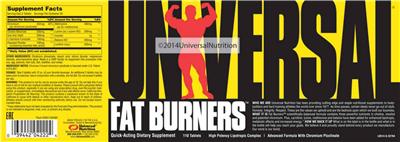
- Form
- Tablet or Pill
- Serving Size
- 2 Tablets
- Servings
- 55 per container
- Container Holds
- 110 Tablets
What’s in it, whether it interacts with your drugs, its side effects, whether it works, and what our pharmacists would want you to know before you start it.
- What is Fat Burners?A supplement from Universal with ten active ingredients, in tablet form.
- Active Ingredients 1 vitamin, 1 mineral, 2 plant ingredients, 2 amino acids, 1 fat or oil and 3 others: Chromium 50 mcgCholine Bitartrate 500 mgUva Ursi 500 mgL-Carnitine Fumarate 100 mgFlaxseed powder 100 mgMethionine 400 mgLysine 200 mgInositol 1 gBetaine HCl 400 mgLecithin 200 mg Ten active ingredients. Each one can interact with drugs or cause side effects on its own, so we check every one. The full Supplement Facts
- Drug Interactions 1,308 drugs have a documented interaction with this supplement; the most serious is rated moderate. Of those, 893 are single drugs and 415 are combination products (two or more drugs in one), each listed under its own name. Ask your pharmacist first if you take a drug in any of these categories, the most serious of the 23 on record:
- Moderate · 645 drugs
- Moderate · 182 drugs
- Moderate · 172 drugs
- Moderate · 124 drugs
- Possible Side EffectsNausea 9 ingredientsStomach upset 7 ingredientsDiarrhea 4 ingredientsA fishy body odor 2 ingredientsBloating 2 ingredientsDizziness 2 ingredients +16 moreReported for all ten of its active ingredients. Not studied in this exact product.
- Well documented Why
Does Fat Burners work?
Limited This product doesn't appear to be marketed for a specific use, so we graded its ingredients' overall clinical evidence instead.It is not marketed for one specific use, so this is what its ingredients have been studied for, strongest research first:
- L-carnitine deficiency L-Carnitine
- Inositol
- Neural tube birth defects Methionine
- Lysine
- Inositol
- L-Carnitine
These grades are for each ingredient, not this exact product, and never a promise it will work for you.
And 2 more graded uses, in what the research says- Full Why
- AllergensIts ingredient list names soy
- Barcode (UPC)0 39442 04222 4Match it to the barcode on your bottle to be sure this is your product. Not your product? Search for it here
Who Might Consider It
- People who want it for L-carnitine deficiency, metabolic syndrome, neural tube birth defects, herpes labialis (cold sores) or another graded use: the uses with research behind them. See each grade
- Fat Burners may appeal to people who want to explore a multi-ingredient supplement with some evidence behind a few of its parts, such as chromium for diabetes and L-carnitine for deficiency.
Who Should Be Careful
- People taking diabetes medicines, blood thinners, thyroid medicines, lithium, or blood pressure drugs should be especially careful.
- Anyone who is pregnant, breastfeeding, or has kidney, liver, or stomach problems should talk it over with their own doctor or pharmacist first.
More Before You Take It Show both answersHide Pregnancy and Breastfeeding The Label’s Directions
-
Pregnant or breastfeeding?
- Pregnancy Uva Ursi
- ! When used orally.
- Breastfeeding Uva Ursi
- Insufficient reliable information available; avoid using.
- Pregnancy Flaxseed
- ! When used orally.
- Breastfeeding Flaxseed
- Insufficient reliable information available; avoid using.
- Pregnancy L-Carnitine
- Insufficient reliable information available; avoid using.
- Breastfeeding L-Carnitine
- When used orally.
-
How does the label say to take it?
“Dosage: Take 2 tablets with 12 oz. of your favorite beverage. An additional 2 tablets may be taken prior to exercise. Use in conjunction with a sensible, low fat diet. Do not exceed 4 tablets per day.”
The maker’s words. Your pharmacist or doctor may advise differently.
Everything the label says
From the label dated Aug 24, 2016: all ten of its active ingredients were checked against our records. A summary of what is known, not a grade or a test of the product. How these ratings are computed
Ask Anything About This Supplement
Name a drug you take, or ask about side effects, ingredients or pregnancy.
AI answers come from this label and our own records, never the open internet. AI can make mistakes, so always check with your doctor or pharmacist. How we use AI
Ask the Pharmacist
A licensed pharmacist will answer your question by email — free, usually within 24 hours.
Got it — thank you!
A licensed pharmacist will answer within 24 hours. Keep an eye on your email (worth checking spam, just in case).
What’s Inside Fat Burners by Universal
Ten Active Ingredients, Each Checked on Its Own
A supplement is often several ingredients in one bottle, and each one can interact with drugs or cause side effects on its own. We check every one of them against our records.
- ChromiumDrug interactions on record, most serious: Moderate
- Choline BitartrateNo drug interactions on record
- Uva UrsiDrug interactions on record, most serious: Moderate
- L-Carnitine FumarateDrug interactions on record, most serious: Moderate
- Flaxseed powderDrug interactions on record, most serious: Moderate
- MethionineNo drug interactions on record
- LysineNo drug interactions on record
- InositolDrug interactions on record, most serious: Moderate
And 2 more, each with its own card below.
Why this rating?
The label gives an exact amount for every one of its ten active ingredients, so you know how much of each you get in each serving. This rates what the label tells you, not the quality of the product.
Supplement Facts
| Amount Per Serving | % Daily Value | |
|---|---|---|
| Chromium | 50 mcg | 42% |
| Choline Bitartrate | 500 mg | † |
| Uva Ursi | 500 mg | † |
| L-Carnitine Fumarate | 100 mg | † |
| Flaxseed powder | 100 mg | † |
| Methionine | 400 mg | † |
| Lysine | 200 mg | † |
| Inositol | 1 g | † |
| Betaine HCl | 400 mg | † |
| Lecithin | 200 mg | † |
Other ingredients: Dicalcium Phosphate, Stearic Acid, Silicon Dioxide, Magnesium Stearate, Pharmaceutical Glaze
† Daily Value not established.
Daily Values for adults and children 4 or more years of age.
As the label prints it, from the NIH Dietary Supplement Label Database.
Each Ingredient and Its Drug Interactions
Tap one for more about it and its full guide. A drug can interact with this supplement through any one of them.
Fat Burners contains 10 active ingredients: chromium, choline bitartrate, uva ursi, betaine HCl, L-carnitine fumarate, methionine, inositol, lecithin, lysine, and flaxseed powder.
- Each plays a different role, from chromium, which is involved in how the body handles blood sugar, to flaxseed, a source of fiber and lignans.
-
Chromium 50 mcg Interacts with 178 drugs
Form on the label: Chromium Picolinate
Chromium is an essential trace mineral involved in how the body handles sugar and fat.
- Some studies suggest it may modestly help blood sugar control in certain people with type 2 diabetes, but results are mixed and the effect on weight loss is small and uncertain.
- For most healthy people who eat a varied diet, supplements are not needed; check with your pharmacist or doctor before starting.
The full Chromium guide: uses, dosage and safety Every Chromium drug interaction
-
Choline Bitartrate 500 mg Interacts with 16 drugs
Choline is an essential nutrient your body needs for liver function, brain health, and nerve signaling, and many people get enough from foods like eggs, meat, and fish.
- Supplements may help people who are deficient or who have higher needs (such as during pregnancy), but they are not proven cure-alls and very high doses can cause side effects.
- Check with your pharmacist or doctor before starting a supplement.
The full Choline guide: uses, dosage and safety Every Choline drug interaction
-
Uva Ursi 500 mg Interacts with 804 drugs
Uva ursi is a traditional herb used mainly for urinary tract infections, and its leaves contain a compound called arbutin that may have antimicrobial effects in the urine.
- Evidence in people is limited, and because high doses or long-term use may be harmful to the liver and could be toxic, it should only be used short-term and with guidance from a healthcare professional.
- Avoid it during pregnancy and breastfeeding.
The full Uva Ursi guide: uses, dosage and safety Every Uva Ursi drug interaction
-
L-Carnitine Fumarate 100 mg Interacts with 19 drugs
L-carnitine is a compound your body makes naturally and also gets from foods like meat.
- It helps cells turn fat into energy, and supplements are most clearly useful for people with a true carnitine deficiency.
- For most other uses, like weight loss or boosting athletic performance, the evidence is mixed or limited, so talk with your pharmacist or doctor before trying it.
The full L-Carnitine guide: uses, dosage and safety Every L-Carnitine drug interaction
-
Flaxseed powder 100 mg Interacts with 597 drugs
Form on the label: Essential Fatty Acids
Flaxseed is a nutritious food rich in fiber, omega-3 fats (ALA), and plant compounds called lignans.
- It is most reliably helpful for constipation and may modestly lower cholesterol, but evidence for many other uses is mixed or limited.
- It is generally safe as a food, but talk to your pharmacist or doctor before using it as a supplement, especially if you are pregnant or breastfeeding.
The full Flaxseed guide: uses, dosage and safety Every Flaxseed drug interaction
-
Methionine 400 mg No known drug interactions
Form on the label: DL-Methionine
Methionine is an essential amino acid that your body needs for protein building and many basic chemical reactions.
- Most people get enough from a normal diet, and supplements are generally not needed unless directed by a healthcare provider.
- High doses can cause side effects, so talk to your pharmacist or doctor before using methionine supplements.
-
Lysine 200 mg Interacts with 1 drug
Form on the label: L-Lysine Hydrochloride
Lysine is an essential amino acid your body cannot make on its own, so it must come from food or supplements.
- People most often take extra lysine to try to prevent or shorten cold sores, but the evidence is mixed and far from conclusive.
- For most healthy people who eat enough protein, supplements are likely unnecessary, but they are generally considered low-risk at typical doses.
The full Lysine guide: uses, dosage and safety Every Lysine drug interaction
-
Inositol 1 g Interacts with 86 drugs
Inositol is a sugar alcohol made naturally in the body and found in many foods, and it is sold as a supplement (often myo-inositol) mainly for PCOS, mood, and metabolic concerns.
- The strongest evidence is for PCOS-related symptoms, while support for other uses is more limited.
- It is generally well tolerated, but talk with your pharmacist or doctor before starting it, especially if you are pregnant or have a health condition.
The full Inositol guide: uses, dosage and safety Every Inositol drug interaction
-
Betaine HCl 400 mg Interacts with 36 drugs
Betaine hydrochloride is a supplement used to temporarily increase stomach acid in people who may have low acid levels.
- Evidence for its benefits is limited and mostly based on tradition rather than strong clinical trials.
- It is not appropriate for everyone, and you should talk with a pharmacist or doctor before using it—especially if you have ulcers, take acid-reducing drugs, or have reflux.
The full Betaine Hydrochloride guide: uses, dosage and safety Every Betaine Hydrochloride drug interaction
-
Lecithin 200 mg No known drug interactions
Form on the label: Soy
Lecithin is a natural fatty substance found in foods and made by the body that is widely used as a supplement and food emulsifier.
- Evidence supporting most of its health claims is limited, though it is generally considered safe for most people when taken in normal amounts.
- Talk to your pharmacist or doctor before starting it, especially if you have allergies to soy or egg.
Other Ingredients (Inactive)
The capsule or tablet itself, fillers, coatings and flavors. Not part of the drug interaction check; the allergen check below reads them.
- Dicalcium Phosphate
- Stearic Acid
- Silicon Dioxide
- Magnesium Stearate
- Pharmaceutical Glaze
Allergens in Fat Burners
Its ingredient list names soy.
Named on this label
- SoyIn the ingredients: Lecithin (Soy)
Not named in the ingredients
- Milk
- Egg
- Fish
- Shellfish
- Tree nuts
- Peanuts
- Wheat or other gluten grains
- Sesame
- The label’s allergen statement“Made in a GMP facility on equipment that processes milk, soy, egg, peanuts, tree nuts, fish, shellfish, and wheat.”
From the label text and ingredient names on file; we do not test products. With a serious allergy, check your bottle and ask the maker or your pharmacist.
What the Label Says
The maker’s own words, from the label. We do not verify or endorse them.
- Brand IP Statement(s)
-
“Ingredient Notes: Chromax II brand chromium picolinate is licensed under U.S. Patent 4,315,927.”
“2014 Universal Nutrition”
- General statements
-
“Made proudly in the U.S.A.”
“High potency Lipotropic complex”
3 more from the label
“WHO WE ARE Universal Nutrition has been providing cutting edge and staple nutritional supplements to bodybuilders and hard training athletes the world over since 1977. As time passes, certain ideals never go out of style. Honesty. Integrity. Respect. These are the values we uphold and are the bedrock upon which we built our business.”
“HOW WE BACK IT UP What is on the label is in the bottle and what is in the bottle will help you reach your goals. We believe it and proudly stand behind every product we manufacture. Our word is our bond.”
“EAC”
- FDA Statement of Identity
-
“Quick-Acting Dietary Supplement”
- General
-
“L0514-G-32764”
- Formulation
-
“WHAT IT IS Fat Burners scientifically-balanced formula contains three powerful nutrients in choline, inositol and patented chromium. Plus, carnitine, lysine, methionine and betaine have been added for enhanced lipotropic, metabolic effects and increased energy.”
“Advanced formula with Chromium Picolinate”
The Fat Burners Label on File
The label scan on file at the NIH Dietary Supplement Label Database, dated August 2016. Always read the label on the bottle you have.
Product Facts
- Brand
- Universal
- Barcode (UPC)
- 039442042224
- Net contents
- 110 Tablets
- Market status
- On market
- Date entered into DSLD
- Aug 24, 2016
- DSLD ID
- 64253
- Product type
- Other Combinations
- Supplement form
- Tablet or Pill
- Dietary claims / uses
- All Other, Structure/Function
- Intended target group(s)
- Adult (18 - 50 Years)
Is this label outdated? Report a formula or label change and our pharmacy team will review it.
Fat Burners by Universal Side Effects
Why this rating?
We look for three kinds of safety information on each ingredient: side effects reported in studies, a pregnancy and breastfeeding rating, and a safety write-up from our pharmacy team. All three are on file for each of the ten ingredients we could check.
So this rates how much is known, not whether Fat Burners is right for you.
Reported with ten of its ingredients
- Most often
- Nausea, stomach upset, diarrhea, A fishy body odor, bloating and dizziness
- !Rare but serious
- Seizures, severe allergic reactions such as and cerebral edema See details
HelloPharmacist Team Summary of Side Effects
Most people tolerate the ingredients in Fat Burners fairly well, though you may notice stomach upset, nausea, or a fishy body odor, mostly from the choline, L-carnitine, and lecithin.
- Headaches and dizziness have also been reported with chromium and choline, so if you feel dizzy, see how it affects you before driving.
- The rare but serious effects to know about are kidney or liver problems with high-dose chromium and allergic reactions with flaxseed or lecithin; if you notice these, call your doctor right away.
- Please talk with your own doctor or pharmacist before starting, especially if you are pregnant, breastfeeding, have diabetes, or have kidney or liver disease.
Side Effects, Ingredient by Ingredient
A supplement’s side effects come from its ingredients. Here is what is reported with each one.
Chromium
Most reported
- Headache
- Dizziness
- Nausea
- Stomach upset
Choline
Most reported
- A fishy body odor
- Nausea, stomach upset, or diarrhea
- Sweating
- Drop in blood pressure or dizziness (mainly at very high doses)
Uva Ursi
Most reported
- Nausea
- Vomiting
- Stomach upset
L-Carnitine
Most reported
- Nausea, stomach upset, or cramping
- Diarrhea
- A fishy body odor, especially at higher doses
- Heartburn or a fishy taste
Flaxseed
Most reported
- Bloating, gas, and stomach cramps
- Loose stools or, if you don't drink enough water, constipation
Methionine
Most reported
- Nausea
- Vomiting
- Drowsiness
- Irritability
Lysine
Most reported
- Stomach pain
- Nausea
- Diarrhea
Inositol
Most reported
- Nausea
- Gas
- Bloating
- Stomach upset
Betaine Hydrochloride
Most reported
- Heartburn
- Nausea
- Stomach upset
Lecithin
Most reported
- Upset stomach or stomach pain
- Diarrhea or loose stools
- Nausea
- Feeling full or bloated
Fat Burners Warnings: Who Should Be Careful
Fat Burners has ten active ingredients, and each can carry warnings of its own. We checked all ten, and each warning below names the ingredient it comes from. If any of these apply to you, talk to your doctor or pharmacist before you start it.
- Chromium3 warnings below
- Choline2 warnings below
- Uva Ursi3 warnings below
- L-Carnitine3 warnings below
- Flaxseed1 warning below
- Methionine3 warnings below
- Lysine3 warnings below
- Inositol2 warnings below
- Betaine Hydrochloride3 warnings below
- Lecithin3 warnings below
-
Diabetes or Low Blood Sugar
- ChromiumPeople with diabetes should monitor their blood sugar closely, since chromium may affect blood sugar levels.
- InositolBecause it can affect insulin and blood sugar signaling, people with diabetes or blood sugar problems should monitor closely and talk with their healthcare provider.
-
Liver Disease
- ChromiumStill, taking high doses or using it for a long time may carry risks, and some case reports have linked very high intakes to kidney or liver problems.
- ChromiumPeople with kidney disease or liver disease should be especially careful and talk to a doctor before using chromium.
- CholinePeople with liver or kidney conditions, or certain rare metabolic disorders, should talk to a healthcare provider before taking choline supplements.
- Uva UrsiDo not use uva ursi if you have kidney disease or liver disease.
Show 2 more
- MethionineThose with liver or kidney disease should also be careful and check with a doctor first.
- LysinePeople with kidney disease or liver disease should be cautious and talk to their doctor before using amino acid supplements, since these organs help process them.
-
Kidney Disease or Kidney Stones
- L-CarnitineUse extra caution if you have kidney disease, since the body handles L-carnitine differently and waste products may build up.
-
Stomach or Bowel Problems
- Betaine HydrochlorideBecause it adds acid to the stomach, it can worsen or trigger problems in people with sensitive stomachs.
- Betaine HydrochlorideDo not use it if you have: a stomach or duodenal ulcer, gastritis, heartburn, or acid reflux, unless a doctor specifically advises it.
-
Seizure Disorders
- L-CarnitinePeople with a history of seizures should also be careful, as some reports link L-carnitine to more frequent seizures.
-
Allergies
- LecithinPeople with soy or egg allergies should choose a product made from a source they can tolerate, such as sunflower lecithin, or avoid it altogether.
-
Children
- Uva UrsiChildren should not take it.
-
If You Take Other Drugs
- MethionineAlways talk with a pharmacist or doctor before starting methionine, especially if you take other medicines or have a health condition.
- LecithinAs with any supplement, talk to your pharmacist or doctor before taking lecithin, especially if you have a medical condition or take other medicines.
-
Other Cautions
- CholineAnyone with a known body odor (fishy smell) reaction to choline should avoid high doses.
- Uva UrsiPeople with conditions sensitive to its astringent or irritant effects should also be cautious.
- L-CarnitinePeople with a real deficiency are often treated under medical supervision.
- FlaxseedAvoid raw or unripe flaxseed, which may contain natural compounds that release small amounts of cyanide.
Show 4 more
- MethioninePeople with certain inherited disorders that affect how the body handles amino acids (such as homocystinuria) should avoid methionine supplements.
- LysineTo be safe, avoid supplemental lysine unless your doctor recommends it.
- InositolAs with any supplement, choose reputable brands, and let your pharmacist or doctor know what you are taking, especially if you have an existing health condition.
- Betaine HydrochlorideBetaine hydrochloride should be used with caution.
-
What the Label Warns
- “Warning: This product is not for use by anyone under the age of 18.”
- “Do not take this if you have or are at risk for any medical condition or disease.”
- “Immediately discontinue use if any side effects occur.California Residents Proposition 65 Warning: This product contains a substance known to the State of California to cause birth defects or other reproductive harm.”
- “Keep out of reach of children.”
- “Athletes should consult with their sanctioning authority before use. Do not exceed recommended dose.”
- “Please consult with a physician before using this product, especially if you are using any prescription drug, over-the-counter medication, or supplements.”
- “Immediately discontinue use if any side effects occur.”
The maker’s wording, from the product label.
-
Pregnant or Breastfeeding
Each ingredient’s rating for pregnancy and for breastfeeding, and what it covers.
Pregnancy
-
When used orally.
Uva ursi can have oxytocic effects, increasing the speed of labor; avoid using.
Breastfeeding
-
Insufficient reliable information available; avoid using.
Pregnancy
-
When used orally.
Flaxseed can have mild estrogenic effects.
Theoretically, this might adversely affect pregnancy; however, there is no reliable clinical evidence about the effects of flaxseed on pregnancy outcomes.
Breastfeeding
-
Insufficient reliable information available; avoid using.
Show 8 more ingredients
Pregnancy
-
Insufficient reliable information available; avoid using.
Breastfeeding
-
When used orally.
Supplemental doses of L-carnitine have been given to infants in breast milk and formula with no reported adverse effects.
The effects of large doses used while nursing are unknown, but L-carnitine is secreted in the breast milk.
Pregnancy and Breastfeeding The record rates both the same
-
Insufficient reliable information available; avoid using.
Pregnancy
-
When used orally and appropriately, short-term.
Myo-inositol has been used with apparent safety in amounts up to 4000 mg daily during pregnancy.
Breastfeeding
-
Insufficient reliable information available; avoid using.
Breast milk is rich in endogenous inositol; however, the effects of exogenously administered inositol are not known.
Pregnancy and Breastfeeding The record rates both the same
-
Insufficient reliable information available; avoid using.
Pregnancy
-
When used orally and appropriately in amounts not exceeding adequate intake (AI) levels.
The AI for pregnancy is 28 mcg daily for those 14-18 years of age and 30 mcg daily for those 19-50 years of age.
-
When used orally in amounts exceeding the adequate intake (AI) levels.
There is some evidence that patients with gestational diabetes can safely use chromium in doses of 4-8 mcg/kg; however, patients should not take chromium supplements during pregnancy without medical supervision.
Breastfeeding
-
When used orally and appropriately in amounts not exceeding adequate intake (AI) levels.
The AI for lactation is 44 mcg daily for those 14-18 years of age and 45 mcg daily for those 19-50 years of age.
2 more points on this rating
- Chromium supplements do not seem to increase normal chromium concentration in human breast milk.
- There is insufficient reliable information available about the safety of chromium when used in higher amounts while breast-feeding.
Pregnancy and Breastfeeding The record rates both the same
-
When used orally and appropriately.
Choline is safe when taken in doses below the tolerable upper intake level (UL), which is 3 grams daily during pregnancy and lactation in those up to 18 years of age and 3.5 grams daily for those 19 years and older.
There is insufficient reliable information available about the safety of choline used in higher doses during pregnancy and lactation.
Pregnancy and Breastfeeding The record rates both the same
-
When used orally in amounts commonly found in food.
There is insufficient reliable information available about the safety of methionine in medical doses during pregnancy and lactation; avoid using.
Pregnancy and Breastfeeding The record rates both the same
-
When used orally in food amounts.
Lecithin has Generally Recognized As Safe (GRAS) status in the US.
There is insufficient reliable information available about the safety of medicinal amounts of lecithin during pregnancy or lactation; avoid using.
Our pharmacy team’s notes
- Uva UrsiUva ursi is rated Likely Unsafe in pregnancy, and its safety data advises against it.
- FlaxseedFlaxseed is rated Possibly Unsafe in pregnancy.
- For pregnancy and breastfeeding, the ratings differ by ingredient.
- Choline, methionine, and lecithin are rated Likely Safe in pregnancy and breastfeeding.
- For betaine HCl, lysine, and some others, we have no pregnancy or breastfeeding data.
Ratings and the words beside them are from the Natural Medicines database, which we license.
-
Rare but Serious Side Effects
-
!
Chromium
Rare but more serious problems, such as kidney or liver injury, have been reported mostly with high doses.
Chromium has rare reports of kidney and liver damage, mostly at high doses.
Orally: Rare cases of kidney and liver damage, rhabdomyolysis, and thrombocytopenia have been reported.
-
!
Uva Ursi
More serious concerns come with high doses or long-term use.
Orally: At high doses (20 grams of dried herb), uva ursi has been reported to cause collapse, convulsions, cyanosis, delirium, shortness of breath, and tinnitus. Very high doses of 30 grams or more may be fatal.
-
!
L-Carnitine
Seizures.
-
!
Flaxseed
Rarely, some people are allergic to flaxseed and could have a serious reaction.
Orally: Severe allergic reactions such as and anaphylaxis.
-
!
Methionine
Cerebral edema, hepatic encephalopathy. In infants, intravenous methionine has been linked to liver toxicity.
-
!
Lecithin
Allergic reactions are possible, particularly in people sensitive to soy or eggs.
-
!
Our pharmacy team on Fat Burners
Flaxseed and lecithin can cause serious allergic reactions in some people.
When to get help: a serious allergic reaction, with trouble breathing or swelling of the face, lips or throat, needs emergency care: call 911. For any other side effect that worries you, call your doctor or pharmacist.
These reports describe each ingredient, not studies of this exact product. Not medical advice: a side effect you notice after starting a supplement is worth a word with your pharmacist or doctor.
Fat Burners by Universal Drug Interactions
We checked all ten active ingredients in this supplement against every drug in our records. A drug can interact with it through any one of them.
A moderate interaction on record
2 of 3, on a scale from Minor or none to Major.Why this rating?
We rate this by the most serious interaction on record, not by how many there are. For Lysine, Inositol, Betaine Hydrochloride, Uva Ursi and Choline, the most serious is rated moderate, which means it calls for caution, and sometimes monitoring or a change in timing or dose. Some involve kinds of drugs where a small change can matter, such as blood thinners, diabetes drugs and lithium.
1,309 drugs are on the full list. What matters is whether one you take is on it, so check yours with the interaction checker on this page.
Eight of its ten active ingredients have drug interactions on record. The ones below matter most. We have no interaction records for Methionine and Lecithin.
- Interacts with
- 178 drugs
- Most serious
- Moderate
- Medication types rated Moderate include thyroid medicines like levothyroxine, which may be absorbed less well with chromium, and insulin, which may add to the low blood sugar risk with chromium.
- Minor-rated interactions involve NSAIDs and aspirin (which may raise chromium levels), atropine, H2-blockers, antacids, proton pump inhibitors (PPIs), 5-HT4 agonists, and P-glycoprotein substrates.
- Interacts with
- 804 drugs
- Most serious
- Moderate
- Lithium levels may rise with uva ursi, and some antibiotics, estrogens, and drugs cleared by the liver may also be affected.
- Interacts with
- 597 drugs
- Most serious
- Moderate
- Flaxseed may add to bleeding risk with anticoagulant and antiplatelet drugs, and may add to the blood pressure lowering of antihypertensives.
Show three more ingredients
- Interacts with
- 86 drugs
- Most serious
- Moderate
- Most of its records involve Antidiabetes Drugs.
- Interacts with
- 36 drugs
- Most serious
- Minor
- Most of its records involve Antacids, Proton Pump Inhibitors (PPIs) and H2-BLOCKERS.
- Interacts with
- 19 drugs
- Most serious
- Moderate
- Most of its records involve Thyroid Hormone, Warfarin (Coumadin) and Acenocoumarol (Sintrom).
And two more ingredients with records, each in the cards below.
From the HelloPharmacist Team
Stepping back from the single ingredients, here is the picture across the whole supplement.
- Fat Burners by Universal can interact with several medications, through its chromium, choline, uva ursi, betaine HCl, L-carnitine, lysine, inositol, and flaxseed powder content.
- The most serious interaction on record is rated Moderate: chromium and inositol may add to the blood sugar lowering of antidiabetes drugs, which can raise the risk of low blood sugar (hypoglycemia).
- Warfarin and acenocoumarol, both blood thinners (anticoagulants), may see stronger effects from L-carnitine.
Summarized by the HelloPharmacist pharmacy team from the interaction records below. How it is written How we use AI
Why Fat Burners Interacts, Ingredient by Ingredient
A product interacts through its ingredients. Each card: how many drugs, the most serious rating, and the kinds of drugs it affects most (tap a kind for what it means).
The ingredients driving the most interactions
-
Uva Ursi 804 drugs
Most serious: Moderate6 interaction records on file
The kinds of drugs it affects most
- 645 drugs
- 202 drugs
- 124 drugs
- 72 drugs
Every Uva Ursi drug interaction, 6 records The Uva Ursi records cite 8 references, listed in the Uva Ursi guide.
-
Flaxseed powder 597 drugs
Most serious: Moderate5 interaction records on file
The kinds of drugs it affects most
- 182 drugs
- 172 drugs
- 122 drugs
- 86 drugs
Every Flaxseed drug interaction, 5 records The Flaxseed records cite 37 references, listed in the Flaxseed guide.
-
Chromium 178 drugs
Most serious: Moderate5 interaction records on file
The kinds of drugs it affects most
- 89 drugs
- 86 drugs
- 35 drugs
- 13 drugs
Every Chromium drug interaction, 5 records The Chromium records cite 54 references, listed in the Chromium guide.
-
Inositol 86 drugs
Most serious: Moderate1 interaction record on file
The kinds of drugs it affects most
- 86 drugs
Every Inositol drug interaction, 1 record The Inositol records cite 14 references, listed in the Inositol guide.
-
Betaine HCl 36 drugs
Most serious: Minor3 interaction records on file
The kinds of drugs it affects most
- 16 drugs
- 14 drugs
- 6 drugs
Every Betaine Hydrochloride drug interaction, 3 records The Betaine Hydrochloride records cite 2 references, listed in the Betaine Hydrochloride guide.
-
L-Carnitine Fumarate 19 drugs
Most serious: Moderate3 interaction records on file
The kinds of drugs it affects most
- 16 drugs
- 2 drugs
- Acenocoumarol (Sintrom) 1 drug
Every L-Carnitine drug interaction, 3 records The L-Carnitine records cite 41 references, listed in the L-Carnitine guide.
-
Choline Bitartrate 16 drugs
Most serious: Minor1 interaction record on file
The kinds of drugs it affects most
- Atropine 16 drugs
Every Choline drug interaction, 1 record The Choline records cite 15 references, listed in the Choline guide.
-
Lysine 1 drug
Most serious: Minor1 interaction record on file
The kinds of drugs it affects most
- 5-HT4 Agonists 1 drug
Every Lysine drug interaction, 1 record The Lysine records cite 7 references, listed in the Lysine guide.
The Breakdown by Severity
Each drug counted once, at its most serious rating. Tap a tile to list those drugs.
Find Your Drug
Type a drug or brand name to see whether it is on the list.
- Only drugs with a documented interaction are listed, the most serious first.
- A drug with no known interaction is not listed, but searching its name tells you so.
- Open a drug to see which ingredient is responsible. Of those, 893 are single drugs and 415 are combination products (two or more drugs in one), each listed under its own name.
-
ApixabanEliquis Moderate
The 2 ingredients responsible:
-
Uva Ursi Moderate Apixaban is in these Cytochrome P450 3A4 (CYP3A4) Substrates, P-glycoprotein Substrates categories.
Theoretically, uva ursi may decrease the metabolism of CYP3A4 substrates.
The full Uva Ursi + Apixaban interaction -
Flaxseed Powder Moderate Apixaban is in the Anticoagulant/Antiplatelet Drugs category.
Theoretically, using flaxseed in combination with anticoagulant or antiplatelet drugs might have additive effects and increase the risk of bleeding.
The full Flaxseed Powder + Apixaban interaction
-
-
LevothyroxineEltroxin, Estre, Euthyrox, Levo-T, Levolet and 6 more Moderate
The 2 ingredients responsible:
-
L-Carnitine Fumarate Moderate Levothyroxine is in the Thyroid Hormone category.
Theoretically, L-carnitine might decrease the effectiveness of thyroid hormone replacement.
The full L-Carnitine Fumarate + Levothyroxine interaction -
Chromium Moderate
Chromium might bind levothyroxine in the intestinal tract and decrease levothyroxine absorption.
The full Chromium + Levothyroxine interaction
-
-
WarfarinWarfarin Moderate
The 3 ingredients responsible:
-
Uva Ursi Moderate Warfarin is in these Cytochrome P450 2C19 (CYP2C19) Substrates, Cytochrome P450 3A4 (CYP3A4) Substrates categories.
Theoretically, uva ursi may decrease the metabolism of CYP2C19 substrates.
The full Uva Ursi + Warfarin interaction -
Flaxseed Powder Moderate Warfarin is in the Anticoagulant/Antiplatelet Drugs category.
Theoretically, using flaxseed in combination with anticoagulant or antiplatelet drugs might have additive effects and increase the risk of bleeding.
The full Flaxseed Powder + Warfarin interaction -
L-Carnitine Fumarate Moderate
Theoretically, L-carnitine might increase the anticoagulant effects of warfarin.
The full L-Carnitine Fumarate + Warfarin interaction
-
-
AmlodipineNorliqva Moderate
The 2 ingredients responsible:
-
Flaxseed Powder Moderate Amlodipine is in the Antihypertensive Drugs category.
Theoretically, flaxseed might have additive effects when used with antihypertensive drugs and increase the risk of hypotension.
The full Flaxseed Powder + Amlodipine interaction -
Uva Ursi Moderate Amlodipine is in the Cytochrome P450 3A4 (CYP3A4) Substrates category.
Theoretically, uva ursi may decrease the metabolism of CYP3A4 substrates.
The full Uva Ursi + Amlodipine interaction
-
-
SertralineZoloft Moderate
The ingredient responsible:
-
Uva Ursi Moderate Sertraline is in the Cytochrome P450 3A4 (CYP3A4) Substrates category.
Theoretically, uva ursi may decrease the metabolism of CYP3A4 substrates.
The full Uva Ursi + Sertraline interaction
-
-
ClopidogrelPlavix Moderate
The 2 ingredients responsible:
-
Uva Ursi Moderate Clopidogrel is in the Cytochrome P450 3A4 (CYP3A4) Substrates category.
Theoretically, uva ursi may decrease the metabolism of CYP3A4 substrates.
The full Uva Ursi + Clopidogrel interaction -
Flaxseed Powder Moderate Clopidogrel is in the Anticoagulant/Antiplatelet Drugs category.
Theoretically, using flaxseed in combination with anticoagulant or antiplatelet drugs might have additive effects and increase the risk of bleeding.
The full Flaxseed Powder + Clopidogrel interaction
-
-
EscitalopramLexapro Moderate
The ingredient responsible:
-
Uva Ursi Moderate Escitalopram is in these Cytochrome P450 2C19 (CYP2C19) Substrates, Cytochrome P450 3A4 (CYP3A4) Substrates categories.
Theoretically, uva ursi may decrease the metabolism of CYP2C19 substrates.
The full Uva Ursi + Escitalopram interaction
-
-
AspirinAngettes 75, ASA, Asaphen, Aspirin, Caprin and 9 more Moderate
The 2 ingredients responsible:
-
Flaxseed Powder Moderate Aspirin is in the Anticoagulant/Antiplatelet Drugs category.
Theoretically, using flaxseed in combination with anticoagulant or antiplatelet drugs might have additive effects and increase the risk of bleeding.
The full Flaxseed Powder + Aspirin interaction -
Chromium Minor Aspirin is in the Nonsteroidal Anti-inflammatory Drugs (NSAIDs) category.
Theoretically, aspirin might increase chromium absorption.
The full Chromium + Aspirin interaction
-
-
Losartan PotassiumCozaar Moderate
The 2 ingredients responsible:
-
Flaxseed Powder Moderate Losartan Potassium is in the Antihypertensive Drugs category.
Theoretically, flaxseed might have additive effects when used with antihypertensive drugs and increase the risk of hypotension.
The full Flaxseed Powder + Losartan Potassium interaction -
Uva Ursi Moderate Losartan Potassium is in the Cytochrome P450 3A4 (CYP3A4) Substrates category.
Theoretically, uva ursi may decrease the metabolism of CYP3A4 substrates.
The full Uva Ursi + Losartan Potassium interaction
-
-
AtorvastatinAtorvaliq Moderate
The ingredient responsible:
-
Uva Ursi Moderate Atorvastatin is in these Cytochrome P450 3A4 (CYP3A4) Substrates, Glucuronidated Drugs categories.
Theoretically, uva ursi may decrease the metabolism of CYP3A4 substrates.
The full Uva Ursi + Atorvastatin interaction
-
-
RivaroxabanXarelto Moderate
The 2 ingredients responsible:
-
Uva Ursi Moderate Rivaroxaban is in these Cytochrome P450 3A4 (CYP3A4) Substrates, P-glycoprotein Substrates categories.
Theoretically, uva ursi may decrease the metabolism of CYP3A4 substrates.
The full Uva Ursi + Rivaroxaban interaction -
Flaxseed Powder Moderate Rivaroxaban is in the Anticoagulant/Antiplatelet Drugs category.
Theoretically, using flaxseed in combination with anticoagulant or antiplatelet drugs might have additive effects and increase the risk of bleeding.
The full Flaxseed Powder + Rivaroxaban interaction
-
-
MetforminGlucophage, Metformin Moderate
The 3 ingredients responsible:
-
Chromium Moderate Metformin is in the Antidiabetes Drugs category.
Theoretically, chromium may have additive effects with antidiabetic agents and increase the risk of hypoglycemia.
The full Chromium + Metformin interaction -
Inositol Moderate Metformin is in the Antidiabetes Drugs category.
Theoretically, taking inositol with antidiabetes drugs might increase the risk of hypoglycemia.
The full Inositol + Metformin interaction -
Flaxseed Powder Moderate Metformin is in the Antidiabetes Drugs category.
Theoretically, flaxseed might have additive effects when used with antidiabetes drugs and increase the risk for hypoglycemia.
The full Flaxseed Powder + Metformin interaction
-
-
Warfarin SodiumCoumadin, Panwarfin, Sofarin Moderate
The 3 ingredients responsible:
-
Flaxseed Powder Moderate Warfarin Sodium is in the Anticoagulant/Antiplatelet Drugs category.
Theoretically, using flaxseed in combination with anticoagulant or antiplatelet drugs might have additive effects and increase the risk of bleeding.
The full Flaxseed Powder + Warfarin Sodium interaction -
L-Carnitine Fumarate Moderate
Theoretically, L-carnitine might increase the anticoagulant effects of warfarin.
The full L-Carnitine Fumarate + Warfarin Sodium interaction -
Uva Ursi Moderate Warfarin Sodium is in these Cytochrome P450 2C19 (CYP2C19) Substrates, Cytochrome P450 3A4 (CYP3A4) Substrates categories.
Theoretically, uva ursi may decrease the metabolism of CYP2C19 substrates.
The full Uva Ursi + Warfarin Sodium interaction
-
-
TirzepatideMounjaro, Zepbound Moderate
The 3 ingredients responsible:
-
Flaxseed Powder Moderate Tirzepatide is in the Antidiabetes Drugs category.
Theoretically, flaxseed might have additive effects when used with antidiabetes drugs and increase the risk for hypoglycemia.
The full Flaxseed Powder + Tirzepatide interaction -
Chromium Moderate Tirzepatide is in the Antidiabetes Drugs category.
Theoretically, chromium may have additive effects with antidiabetic agents and increase the risk of hypoglycemia.
The full Chromium + Tirzepatide interaction -
Inositol Moderate Tirzepatide is in the Antidiabetes Drugs category.
Theoretically, taking inositol with antidiabetes drugs might increase the risk of hypoglycemia.
The full Inositol + Tirzepatide interaction
-
-
MetoprololLopressor, Toprol XL Moderate
The ingredient responsible:
-
Flaxseed Powder Moderate Metoprolol is in the Antihypertensive Drugs category.
Theoretically, flaxseed might have additive effects when used with antihypertensive drugs and increase the risk of hypotension.
The full Flaxseed Powder + Metoprolol interaction
-
-
IbuprofenAdvil, Arthrofen, Brufen, Brufen Retard, Calodor and 15 more Moderate
The 2 ingredients responsible:
-
Flaxseed Powder Moderate Ibuprofen is in the Anticoagulant/Antiplatelet Drugs category.
Theoretically, using flaxseed in combination with anticoagulant or antiplatelet drugs might have additive effects and increase the risk of bleeding.
The full Flaxseed Powder + Ibuprofen interaction -
Chromium Minor Ibuprofen is in the Nonsteroidal Anti-inflammatory Drugs (NSAIDs) category.
NSAIDs might increase chromium levels in the body.
The full Chromium + Ibuprofen interaction
-
-
SemaglutideOzempic, Rybelsus, Wegovy Moderate
The 3 ingredients responsible:
-
Flaxseed Powder Moderate Semaglutide is in the Antidiabetes Drugs category.
Theoretically, flaxseed might have additive effects when used with antidiabetes drugs and increase the risk for hypoglycemia.
The full Flaxseed Powder + Semaglutide interaction -
Inositol Moderate Semaglutide is in the Antidiabetes Drugs category.
Theoretically, taking inositol with antidiabetes drugs might increase the risk of hypoglycemia.
The full Inositol + Semaglutide interaction -
Chromium Moderate Semaglutide is in the Antidiabetes Drugs category.
Theoretically, chromium may have additive effects with antidiabetic agents and increase the risk of hypoglycemia.
The full Chromium + Semaglutide interaction
-
-
TadalafilCialis, Tadliq Moderate
The ingredient responsible:
-
Uva Ursi Moderate Tadalafil is in the Cytochrome P450 3A4 (CYP3A4) Substrates category.
Theoretically, uva ursi may decrease the metabolism of CYP3A4 substrates.
The full Uva Ursi + Tadalafil interaction
-
-
AmoxicillinAmix, Amoram, Amoxident, Amoxil Capsules, Amoxil Injection and 4 more Moderate
The ingredient responsible:
-
Flaxseed Powder Moderate Amoxicillin is in the Antibiotic Drugs category.
Theoretically, antibiotics might interfere with the metabolism of flaxseed constituents, which could potentially alter the effects of flaxseed.
The full Flaxseed Powder + Amoxicillin interaction
-
-
TestosteroneAndrogel, Andropatch, Delatestryl, Intrinsa, Natesto and 4 more Moderate
The ingredient responsible:
-
Uva Ursi Moderate Testosterone is in the Cytochrome P450 3A4 (CYP3A4) Substrates category.
Theoretically, uva ursi may decrease the metabolism of CYP3A4 substrates.
The full Uva Ursi + Testosterone interaction
-
-
PrednisoneCortan, Deltasone, Meticorten, Orasone, Prednicen-M and 3 more Moderate
The ingredient responsible:
-
Uva Ursi Moderate Prednisone is in these P-glycoprotein Substrates, Cytochrome P450 3A4 (CYP3A4) Substrates categories.
Theoretically, uva ursi may alter the levels of drugs transported by P-glycoprotein.
The full Uva Ursi + Prednisone interaction
-
-
AzithromycinAzasite, Zithromax, Zmax Moderate
The ingredient responsible:
-
Flaxseed Powder Moderate Azithromycin is in the Antibiotic Drugs category.
Theoretically, antibiotics might interfere with the metabolism of flaxseed constituents, which could potentially alter the effects of flaxseed.
The full Flaxseed Powder + Azithromycin interaction
-
-
AcetaminophenChildren's Tylenol, Children's Tylenol Meltaways, Tylenol, Tylenol Ex Strength Moderate
The ingredient responsible:
-
Uva Ursi Moderate Acetaminophen is in the Glucuronidated Drugs category.
Theoretically, uva ursi may increase levels of drugs metabolized by glucuronidation.
The full Uva Ursi + Acetaminophen interaction
-
-
AbemaciclibVerzenio Moderate
The ingredient responsible:
-
Uva Ursi Moderate Abemaciclib is in the Cytochrome P450 3A4 (CYP3A4) Substrates category.
Theoretically, uva ursi may decrease the metabolism of CYP3A4 substrates.
The full Uva Ursi + Abemaciclib interaction
-
-
PropranololAngilol, Bedranol SR, Beta Prograne, Half Beta Prograne, Half-Inderal LA and 7 more Moderate
The 2 ingredients responsible:
-
Uva Ursi Moderate Propranolol is in the Cytochrome P450 2C19 (CYP2C19) Substrates category.
Theoretically, uva ursi may decrease the metabolism of CYP2C19 substrates.
The full Uva Ursi + Propranolol interaction -
Flaxseed Powder Moderate Propranolol is in the Antihypertensive Drugs category.
Theoretically, flaxseed might have additive effects when used with antihypertensive drugs and increase the risk of hypotension.
The full Flaxseed Powder + Propranolol interaction
-
-
LamotrigineLamictal Moderate
The ingredient responsible:
-
Uva Ursi Moderate Lamotrigine is in the Glucuronidated Drugs category.
Theoretically, uva ursi may increase levels of drugs metabolized by glucuronidation.
The full Uva Ursi + Lamotrigine interaction
-
-
LetrozoleFemara Moderate
The ingredient responsible:
-
Uva Ursi Moderate Letrozole is in the Cytochrome P450 3A4 (CYP3A4) Substrates category.
Theoretically, uva ursi may decrease the metabolism of CYP3A4 substrates.
The full Uva Ursi + Letrozole interaction
-
-
NaproxenAleve, Anaprox, Anaprox DS, Arthroxen, EC-Naprosyn and 8 more Moderate
The 2 ingredients responsible:
-
Flaxseed Powder Moderate Naproxen is in the Anticoagulant/Antiplatelet Drugs category.
Theoretically, using flaxseed in combination with anticoagulant or antiplatelet drugs might have additive effects and increase the risk of bleeding.
The full Flaxseed Powder + Naproxen interaction -
Chromium Minor Naproxen is in the Nonsteroidal Anti-inflammatory Drugs (NSAIDs) category.
NSAIDs might increase chromium levels in the body.
The full Chromium + Naproxen interaction
-
-
LisinoprilPrinivil, Qbrelis, Zestril Moderate
The ingredient responsible:
-
Flaxseed Powder Moderate Lisinopril is in the Antihypertensive Drugs category.
Theoretically, flaxseed might have additive effects when used with antihypertensive drugs and increase the risk of hypotension.
The full Flaxseed Powder + Lisinopril interaction
-
-
ClonazepamCeberclon, Klonopin, Rivotril Moderate
The ingredient responsible:
-
Uva Ursi Moderate Clonazepam is in the Cytochrome P450 3A4 (CYP3A4) Substrates category.
Theoretically, uva ursi may decrease the metabolism of CYP3A4 substrates.
The full Uva Ursi + Clonazepam interaction
-
Does It Work? Fat Burners by Universal
How it rates in the research so far, then each ingredient on its own. A grade is the research so far, never an endorsement.
This product doesn't appear to be marketed for a specific use, so we graded its ingredients' overall clinical evidence instead.
Why this rating?
It is not marketed for one specific use, so we looked at what its ingredients have been studied for instead.
The strongest: Flaxseed is graded “Possibly Effective” for systemic lupus erythematosus (SLE) nephritis. That means some studies support it, but the evidence isn’t conclusive.
We did not count angina, congestive heart failure (CHF), kidney failure and preterm labor: they are treated by a doctor or in a hospital.
Our pharmacy team’s notes on this supplement
- Effectiveness varies widely across the ingredients.
- Other ratings are more limited.
- Uva ursi is rated Possibly Ineffective for urinary tract infections, and choline is rated Possibly Ineffective for athletic performance.
The Evidence, Ingredient by Ingredient
Each card holds our notes on one ingredient, then its uses graded effective, likely effective or possibly effective.
Inositol
From our Inositol guide
- PCOS: This is the use with the most supporting research.
- Several studies suggest myo-inositol may help improve some markers tied to PCOS, such as insulin sensitivity, hormone balance, and menstrual regularity.
Research suggests a benefit for
- Metabolic syndrome and polycystic ovary syndrome (PCOS)
Not counted here: one graded use is for a condition treated by a doctor or in a hospital (preterm labor).
Every graded use, in the Inositol guideCholine
From our Choline guide
- Choline is best understood as a nutrient your body genuinely needs.
- Getting too little over time can harm the liver and other organs.
No use is graded effective, likely effective or possibly effective for it yet.
Every graded use, in the Choline guideUva Ursi
From our Uva Ursi guide
- The most common use for uva ursi is for urinary tract infections (UTIs) and urinary discomfort.
- Laboratory studies suggest that compounds from the plant can have antibacterial effects in the urine, and it has a long history of traditional use for this purpose.
No use is graded effective, likely effective or possibly effective for it yet.
Every graded use, in the Uva Ursi guideMethionine
From our Methionine guide
- People take methionine for several reasons, but the strength of the evidence varies a lot depending on the use.
Research suggests a benefit for
- Neural tube birth defects
Betaine Hydrochloride
Our pharmacy team’s notes on Betaine Hydrochloride
- Many other uses, including betaine HCl, rest on insufficient reliable evidence to rate.
No use is graded effective, likely effective or possibly effective for it yet.
Every graded use, in the Betaine Hydrochloride guideLysine
From our Lysine guide
- The most popular reason people use lysine is for cold sores and other herpes outbreaks.
- Some small studies suggest lysine might help reduce how often outbreaks happen or how long they last, but the results are inconsistent.
Research suggests a benefit for
- Herpes labialis (cold sores)
Lecithin
Our pharmacy team’s notes on Lecithin
- Lecithin is rated Likely Ineffective for Alzheimer disease.
No use is graded effective, likely effective or possibly effective for it yet.
Every graded use, in the Lecithin guideL-Carnitine
From our L-Carnitine guide
- In these cases it is sometimes given as a prescription product.
Research suggests a benefit for
- L-carnitine deficiency
- Hyperlipidemia, myocarditis and valproic acid-induced toxicities
Not counted here: three graded uses are for conditions treated by a doctor or in a hospital (angina, congestive heart failure (CHF) and kidney failure).
Every graded use, in the L-Carnitine guideFlaxseed
From our Flaxseed guide
- Flaxseed is used for many reasons, but the strength of the evidence varies a lot depending on the use.
Research suggests a benefit for
- Diabetes, obesity, hypercholesterolemia, hypertension, constipation, systemic lupus erythematosus (SLE) nephritis and mastalgia
Chromium
Our pharmacy team’s notes on Chromium
- Chromium is rated Likely Effective for chromium deficiency and Possibly Effective for diabetes, but Possibly Ineffective for prediabetes, schizophrenia, and hypertension.
Research suggests a benefit for
- Chromium deficiency
- Diabetes
The grades are the Natural Medicines database’s, which we license; tap a grade for what it means. They are about each ingredient, not this exact product.
About Universal
Manufacturer and brand details for Fat Burners, from the product label.
Universal has 164 products in our supplement database, 158 of them on the market, with labels on file since 2012. Our database is built from the NIH’s Dietary Supplement Label Database and our pharmacy team’s own additions, so it covers the labels filed there, not every product the brand sells.
- Name
- Universal Nutrition
- City
- New Brunswick
- State
- New Jersey
- ZipCode
- 08901
- Phone Number
- 800-872-0101
- Web Address
- www.UniversalUSA.com
Fat Burners by Universal: Common Questions
Does Fat Burners by Universal interact with any drugs?
What are the side effects of Fat Burners by Universal?
Who should be careful taking Fat Burners by Universal?
Can Fat Burners by Universal affect the liver?
Can Fat Burners by Universal affect the kidneys?
Does Fat Burners by Universal contain any common allergens?
How can Fat Burners by Universal interact with so many drugs?
Where does the information about Fat Burners by Universal come from?
Does chromium work for diabetes?
Is uva ursi effective for urinary tract infections?
Is lysine effective for cold sores?
Written and reviewed by the HelloPharmacist Editorial Team. Our editorial policy
Still Have a Question About Fat Burners?
Our pharmacists answer drug and supplement questions, free, by email.
Label information is sourced from the NIH Dietary Supplement Label Database and reflects the product version on file; always read your actual product label. This page is for education only and is not a substitute for professional medical advice. Confirm with your pharmacist or doctor before combining supplements and drugs.
Who Reviews This Page
The pharmacist behind it, and how it is checked.
Dr. Brian Staiger, PharmD, BCPS
Clinical pharmacist and founder of HelloPharmacist
A licensed pharmacist for more than 13 years, he built the system behind this page: it reads the label on file, matches each active ingredient to its record in the Natural Medicines database, checks those records against every drug we cover, and our pharmacy team writes the take and the interaction summary from those records.
- 13+ Years in PharmacyRetail and clinical pharmacy, medication safety and healthcare administration.
- Board Certified (BCPS)A pharmacotherapy specialist, certified by the Board of Pharmacy Specialties.
- Herbalist TrainingCertificates in medical ethnobotany, for the herbs and supplements people take.
Where This Page Comes From
Fat Burners’s label data comes from the NIH Dietary Supplement Label Database; the ingredient interaction data is from the Natural Medicines database, reviewed by our pharmacists.
- NIH Dietary Supplement Label Database (DSLD)
- The official product label on file for this supplement.
- Natural Medicines (Therapeutic Research Center)
- The evidence-graded clinical reference behind the ingredient interaction, evidence and safety records, which we license.
- HelloPharmacist Editorial Team
- Content is reviewed by the HelloPharmacist Editorial Team, the pharmacists on our staff and those we contract. See our data sources and editorial standards for how this information is built and checked.
- The Pharmacy Team’s Take and Summaries
- Generated from HelloPharmacist’s pharmacist-curated databases and editorial rules. Clinical methodology reviewed by Dr. Brian Staiger, PharmD, BCPS. Last generated Oct 31, 2026. How we use AI
- The ratings in the Quick Summary
- They summarize available label information, ingredient evidence and known drug-safety records: a summary of what is known, not a grade of the product itself. They do not verify product identity, purity, potency, contamination or manufacturing quality. How these ratings are computed
The References Behind the Interaction Records
Every citation the ingredients’ records rest on is listed in that ingredient’s guide, in context: Chromium, 54 references; Choline, 15 references; Uva Ursi, 8 references; L-Carnitine, 41 references; Flaxseed, 37 references; Methionine, 12 references; Lysine, 7 references; Inositol, 14 references; Betaine Hydrochloride, 2 references; Lecithin, 9 references .
Parts of this content are provided by the Therapeutic Research Center, LLC.
DISCLAIMER: Currently this does not check for drug-drug interactions. This is not an all-inclusive comprehensive list of potential interactions and is for informational purposes only. Not all interactions are known or well-reported in the scientific literature, and new interactions are continually being reported. Input is needed from a qualified healthcare provider including a pharmacist before starting any therapy. Application of clinical judgment is necessary.
© 2021 Therapeutic Research Center, LLC
Keep Exploring
- Supplement interaction checkerCheck any supplement or product against your drugs
- Drug–drug interactionsCheck two or more of your drugs against each other
- Browse drugs A to ZEvery drug we have checked against herbs and supplements
- NDC and pricing lookupFind a drug’s NDCs, packaging and costs
- Ask a pharmacistA free, personal answer from our licensed team