
Full Breath Ingredients & Drug Interactions
What is this page for?
First and foremost: checking Full Breath against your medications. The heart of this page is the interaction checker and the full interaction report — how this product’s ingredients may interact with prescription and over-the-counter medicines you may be taking.
Around that, we add a pharmacist’s high-level view of the product as a whole — what’s inside, the evidence for its stated use, how transparent the label is, and what safety data exists — so you can see the full picture in one place. It’s educational information from our licensed clinical databases and the clinical staff at HelloPharmacist — not medical advice — and we don’t sell or endorse products. Our editorial policy
Full Breath is a dietary supplement by Organic India with 4 active ingredients. Its ingredients are commonly taken for cough and bronchitis, asthma symptoms, loosening mucus (expectorant).Based on those ingredients, 1,039 medications have a known interaction with it, the most serious rated moderate. The ingredients most likely to interact are Pippali, Pushkarmool, organic Krishna Tulsi. Use the checker below to test your specific medication, or read the full HelloPharmacist Interaction Report.
Check Your Meds Against Full Breath by Organic India
Ask about any prescription or over-the-counter medication and we check it for interactions with Full Breath by Organic India — and tell you which ingredient is responsible.
AI summaries are generated from our interaction database for education only — always confirm with your pharmacist. How we use AI
Ask the Pharmacist
A licensed pharmacist will answer your question by email — free, usually within 24 hours.
Got it — thank you!
A licensed pharmacist will answer within 24 hours. Keep an eye on your email (worth checking spam, just in case).
HelloPharmacist Scorecard of Full Breath by Organic India
Our pharmacy team’s full take, with four database checks built into the cards below — a summary of what is known, not a grade of the product itself.
What’s inside
Full disclosure
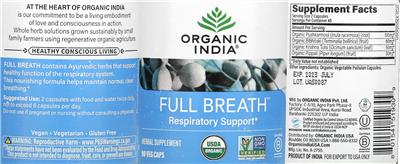
Full Breath contains four active ingredients. Three of them — pushkarmool (elecampane root), organic Krishna tulsi (holy basil), and pippali (Indian long pepper) — are traditional herbs used in Ayurvedic medicine.
The fourth, bibhitaki, we couldn't check the data on. The product also contains an organic vegetable pullulan capsule as its inactive ingredient.
Does it work?
Not established
The effectiveness evidence for Full Breath's ingredients isn't established in the data we hold. Pushkarmool has insufficient evidence for cough and acne.
Holy basil is rated insufficient evidence for generalized anxiety disorder, asthma, headache, respiratory infections, dental plaque, and diabetes. Indian long pepper is also rated insufficient evidence for bronchitis, asthma, cancer, cardiovascular disease, and liver disease.
This doesn't mean these herbs don't work — it means clinical trials haven't yet proven their benefit in a reliable way.
How safe is it?
Well-documented data
Holy basil appears generally well tolerated short-term, though long-term safety data are limited. The most common side effects in studies were loose stools and nausea in a small number of trial participants.
Pushkarmool is generally used in small amounts but can cause allergic reactions and stomach upset; large doses may cause vomiting and diarrhea. Some people sensitive to the ragweed family (which includes chrysanthemums, marigolds, and daisies) may develop allergic contact dermatitis.
Indian long pepper as a food spice is likely fine, but concentrated supplement doses lack strong safety data, and piperine — a key compound in it — can change how your body absorbs other substances. For pregnancy and breastfeeding: pushkarmool is rated likely unsafe during pregnancy and the safety data advise against use while breastfeeding.
Holy basil is rated possibly unsafe in pregnancy and should be avoided while breastfeeding. Indian long pepper should be avoided at medicinal doses during pregnancy and breastfeeding.
There isn't enough safety data on file for bibhitaki in pregnancy or breastfeeding — talk with your doctor or pharmacist if you're pregnant, planning pregnancy, or breastfeeding.
Meds to double-check
Moderate interaction found
Before taking Full Breath, double-check with your doctor or pharmacist if you take blood thinners or antiplatelet drugs (warfarin, clopidogrel, aspirin at prescription doses) — holy basil and Indian long pepper may increase bleeding risk. Also watch if you take diabetes medications, heart drugs like propranolol or theophylline, pentobarbital or other sedatives, cyclosporine, or any medication broken down by the liver enzyme CYP3A4 (a huge class including many statins and cancer drugs).
No interactions are documented for bibhitaki because we hold no data for it.
The bottom line
Scorecard at a glanceFully disclosed formula with no established evidence rating for its marketed use. Moderate medication interactions have been identified, and safety information is well characterized.
Full Breath may appeal to people interested in traditional Ayurvedic respiratory support, but you'll want to be careful if you take blood thinners, diabetes medications, heart drugs, or anything your liver breaks down through the CYP3A4 pathway. It's especially important to check your exact medications before starting, and to talk it over with your doctor or pharmacist — they know your health history and can tell you whether this product is right for you.
Educational only — not medical advice; always confirm with your pharmacist. Our editorial policy · How we use AI
Assessment coverage: 3 of 4 active ingredients matched to our full ingredient reviews (monographs). Based on the product label dated Jul 21, 2022.
This Scorecard evaluates available label information, ingredient evidence, and known medication-safety considerations. It does not independently verify product identity, purity, potency, contamination, or manufacturing quality. How these ratings are computed
General information
Key facts about Full Breath, straight from the product label.
| Brand | Organic India |
|---|---|
| Barcode (UPC) | 801541519309 |
| Net contents | 90 Veg Cap(s) |
| Market status | On market |
| Date entered into DSLD | Jul 21, 2022 |
| DSLD ID | 268110 |
| Product type | Botanical |
| Supplement form | Capsule |
| Dietary claims / uses | All Other, Structure/Function |
| Intended target group(s) | Vegan, Vegetarian, Adult (18 - 50 Years), Kosher, Organic, Halal |
Everything in this section is reproduced from the manufacturer’s own product label — it’s the label speaking, not HelloPharmacist. We show it so you can see exactly what the maker states; we don’t verify or endorse those statements.
Supplement Facts
The label details for Full Breath by Organic India, sourced from the NIH Dietary Supplement Label Database.
Supplement Facts
| Ingredient | Amount | % DV |
|---|---|---|
| Pushkarmool | 510 mg | -- |
| organic Krishna Tulsi | 50 mg | -- |
| Bibhitaki | 60 mg | -- |
| Pippali | 30 mg | -- |
Other ingredients: organic Vegetable Pullulan Capsules
Tap any ingredient to jump to its full detail below.
These statements are the manufacturer’s wording, reproduced from the product label — the label is saying it, not HelloPharmacist. We don’t verify or endorse them.
General Statements
At the heart of organic India is our commitment to be a living embodiment of love and consciousness in action. Whole herb solutions grown sustainably by small family farmers using regenerative organic agriculture.
Mfg. Lic. No. A-2755
For export to USA only
Formula
Healthy conscious living Full Breath contains Ayurvedic herbs that support healthy function of the respiratory system. This nourishing formula helps maintain normal, clear breathing.
Halal Mumbai India Halal Committee Registration No. 0854
OU (Kosher)
Formulation
Vegan - Vegetarian
Gluten free
Respiratory Support
Certified Organic by Control Union-CU801983 Product produced and processed according to NPOP standard of India & USDA-NOP www.controlunion.com
Product of India
Non GMO
Precautions
Warning: Reproductive Harm - www.P65Warnings.ca.gov
Do not use if pregnant or nursing without consulting a physician.
FDA Disclaimer Statement
These statements have not been evaluated by the Food and Drug Administration. This product is not intended to diagnose, treat, cure, or prevent any disease.
FDA Statement of Identity
Herbal Supplement
Seals/Symbols
USDA Organic Non GMO Project Verified nongmoproject.org Certified B Corporation Control Union Certified NPOP/NAB/0010
Halal Mumbai India Halal Committee Registration No. 0854 OU (Kosher)
Suggested/Recommended/Usage/Directions
Suggested Use: 2 capsules with food and water twice daily, not to exceed 6 capsules per day.
Is this label outdated? Report a formula or label change and our pharmacy team will review it.
Full Breath by Organic India label
The label scan from the NIH Dietary Supplement Label Database. Tap to enlarge.
Label images are published by the NIH Dietary Supplement Label Database for the version of this product on file. Always read your actual product label.
View the full label (PDF)The Ingredients in Full Breath by Organic India
These are the 4 active ingredients this product is made of. Select any to open its full monograph.
Serving size2 Capsule(s) Dosage formCapsule Servings per container45 Amounts shown are per serving.
Most supplement products combine several ingredients, and a medication can interact with the product through any one of them. Each ingredient below shows whether it has known drug interactions.
Pushkarmool
Interacts with248 drugs
Elecampane is a traditional herb used mainly for coughs and other respiratory complaints, and as a bitter for digestion. Modern human evidence is very...
Pushkarmool monograph & interactionsOrganic Krishna Tulsi
Interacts with212 drugs
Holy basil (tulsi) is a traditional Ayurvedic herb most often used today for stress and general wellness, but the human evidence is mostly small and p...
Organic Krishna Tulsi monograph & interactionsBibhitaki
Pippali
Interacts with897 drugs
Indian long pepper (pippali) is a spice long used in Ayurvedic medicine and is best known for its piperine content, which may increase how well the bo...
Pippali monograph & interactionsOther (inactive) ingredients: Organic Vegetable Pullulan Capsules. These complete the product’s ingredient list but are not active constituents.
Full Breath by Organic India Drug Interactions
HelloPharmacist Interaction Report
Full Breath by Organic India interacts with medications through its pushkarmool (elecampane), Krishna tulsi (holy basil), and pippali (Indian long pepper) content.
The most serious interaction is with blood thinners and antiplatelet drugs — holy basil seed oil and Indian long pepper may both increase bleeding risk, a Moderate severity concern. Altogether, these interactions span 1,039 individual medications.
Read the full breakdown — every affected drug type, severity by severity
Indian long pepper carries the broadest drug interactions: it may raise blood levels of propranolol and theophylline, increase effects of certain diabetes drugs and blood thinners, and boost sedation with pentobarbital. It also affects how your body processes a large class of medications broken down by the enzyme CYP3A4 (including many statins, immunosuppressants, and cancer drugs), and it may raise levels of P-glycoprotein substrates — drugs your cells actively pump out.
Holy basil adds concerns with blood thinners, diabetes drugs, and pentobarbital. Pushkarmool may add sedative effects with CNS depressants (sleep aids, anxiety medications, pain relievers).
We could not check bibhitaki because we hold no data for it. Before you start Full Breath, run your exact medications through the search tool on this page, and talk with your doctor or pharmacist about whether it's right for you.
Check your own medications below · Editorial policy · How we use AI
Want to check YOUR meds against Full Breath?
Ask about interactions with your drugs in plain English — “Can I take it with lisinopril?” — and we find you the answer in seconds, ingredient by ingredient.
Go to the checkerIngredients driving the most interactions
Individual Drug Interactions
The ingredients in Full Breath interact with 1,039 drugs. Click any drug to see the details.
3 of the 4 ingredients in Full Breath interact with drugs. Each result below shows which ingredient is responsible. Pippali Pushkarmool organic Krishna Tulsi
Ado-trastuzumab EmtansineKadcyla
How Ado-trastuzumab Emtansine interacts with Full Breath — through 1 ingredient. Tap an ingredient for the detail:
PippaliCytochrome P450 3a4 (cyp3a4) Substrates Moderate
Interaction Summary
Theoretically, Indian long pepper might increase the effects and adverse effects of CYP3A4 substrates.
Read the full Pippali + Ado-trastuzumab Emtansine interactionAbciximabReoPro
How Abciximab interacts with Full Breath — through 2 ingredients. Tap an ingredient for the detail:
Organic Krishna TulsiAnticoagulant/antiplatelet Drugs Moderate
Interaction Summary
Theoretically, holy basil seed oil might increase the risk of bleeding when used with anticoagulant or antiplatelet drugs.
Read the full Organic Krishna Tulsi + Abciximab interactionPippaliAnticoagulant/antiplatelet Drugs Moderate
Interaction Summary
Theoretically, Indian long pepper might increase the risk of bleeding when taken with anticoagulant/antiplatelet drugs.
Read the full Pippali + Abciximab interactionAbemaciclibVerzenio
How Abemaciclib interacts with Full Breath — through 1 ingredient. Tap an ingredient for the detail:
PippaliCytochrome P450 3a4 (cyp3a4) Substrates Moderate
Interaction Summary
Theoretically, Indian long pepper might increase the effects and adverse effects of CYP3A4 substrates.
Read the full Pippali + Abemaciclib interactionAbiraterone
How Abiraterone interacts with Full Breath — through 1 ingredient. Tap an ingredient for the detail:
PippaliCytochrome P450 3a4 (cyp3a4) Substrates Moderate
Interaction Summary
Theoretically, Indian long pepper might increase the effects and adverse effects of CYP3A4 substrates.
Read the full Pippali + Abiraterone interactionAbiraterone AcetateYonsa, Zytiga
How Abiraterone Acetate interacts with Full Breath — through 1 ingredient. Tap an ingredient for the detail:
PippaliCytochrome P450 3a4 (cyp3a4) Substrates Moderate
Interaction Summary
Theoretically, Indian long pepper might increase the effects and adverse effects of CYP3A4 substrates.
Read the full Pippali + Abiraterone Acetate interactionAbrocitinibCibinqo
How Abrocitinib interacts with Full Breath — through 2 ingredients. Tap an ingredient for the detail:
PippaliAnticoagulant/antiplatelet Drugs Moderate
Interaction Summary
Theoretically, Indian long pepper might increase the risk of bleeding when taken with anticoagulant/antiplatelet drugs.
Read the full Pippali + Abrocitinib interactionOrganic Krishna TulsiAnticoagulant/antiplatelet Drugs Moderate
Interaction Summary
Theoretically, holy basil seed oil might increase the risk of bleeding when used with anticoagulant or antiplatelet drugs.
Read the full Organic Krishna Tulsi + Abrocitinib interactionAcalabrutinibCalquence
How Acalabrutinib interacts with Full Breath — through 1 ingredient. Tap an ingredient for the detail:
PippaliP-glycoprotein Substrates, Cytochrome P450 3a4 (cyp3a4) Substrates Moderate
Interaction Summary
Theoretically, Indian long pepper might increase levels of P-glycoprotein substrates.
Read the full Pippali + Acalabrutinib interactionAcarboseGlucobay, Prandase, Precose
How Acarbose interacts with Full Breath — through 2 ingredients. Tap an ingredient for the detail:
Organic Krishna TulsiAntidiabetes Drugs Moderate
Interaction Summary
Theoretically, holy basil might increase the risk of hypoglycemia when taken with antidiabetes drugs.
Read the full Organic Krishna Tulsi + Acarbose interactionPippaliAntidiabetes Drugs Moderate
Interaction Summary
Theoretically, Indian long pepper might increase the risk of hypoglycemia when taken with antidiabetes drugs.
Read the full Pippali + Acarbose interactionAcenocoumarolSintrom
How Acenocoumarol interacts with Full Breath — through 2 ingredients. Tap an ingredient for the detail:
PippaliAnticoagulant/antiplatelet Drugs Moderate
Interaction Summary
Theoretically, Indian long pepper might increase the risk of bleeding when taken with anticoagulant/antiplatelet drugs.
Read the full Pippali + Acenocoumarol interactionOrganic Krishna TulsiAnticoagulant/antiplatelet Drugs Moderate
Interaction Summary
Theoretically, holy basil seed oil might increase the risk of bleeding when used with anticoagulant or antiplatelet drugs.
Read the full Organic Krishna Tulsi + Acenocoumarol interactionAcepromazineAtravet
How Acepromazine interacts with Full Breath — through 1 ingredient. Tap an ingredient for the detail:
PushkarmoolCns Depressants Moderate
Interaction Summary
Theoretically, elecampane may cause additive sedative effects when taken with CNS depressants.
Read the full Pushkarmool + Acepromazine interactionAcetaminophen, AspirinGemnisyn
How Acetaminophen, Aspirin interacts with Full Breath — through 2 ingredients. Tap an ingredient for the detail:
Organic Krishna TulsiAnticoagulant/antiplatelet Drugs Moderate
Interaction Summary
Theoretically, holy basil seed oil might increase the risk of bleeding when used with anticoagulant or antiplatelet drugs.
Read the full Organic Krishna Tulsi + Acetaminophen, Aspirin interactionPippaliAnticoagulant/antiplatelet Drugs Moderate
Interaction Summary
Theoretically, Indian long pepper might increase the risk of bleeding when taken with anticoagulant/antiplatelet drugs.
Read the full Pippali + Acetaminophen, Aspirin interactionAcetaminophen, Aspirin, CaffeineExcedrin, Excedrin Extra Strength, Excedrin Migraine
How Acetaminophen, Aspirin, Caffeine interacts with Full Breath — through 2 ingredients. Tap an ingredient for the detail:
PippaliCytochrome P450 3a4 (cyp3a4) Substrates, Anticoagulant/antiplatelet Drugs Moderate
Interaction Summary
Theoretically, Indian long pepper might increase the effects and adverse effects of CYP3A4 substrates.
Read the full Pippali + Acetaminophen, Aspirin, Caffeine interactionOrganic Krishna TulsiAnticoagulant/antiplatelet Drugs Moderate
Interaction Summary
Theoretically, holy basil seed oil might increase the risk of bleeding when used with anticoagulant or antiplatelet drugs.
Read the full Organic Krishna Tulsi + Acetaminophen, Aspirin, Caffeine interactionAcetaminophen, Butalbital, CaffeineEsgic, Esgic Plus, Fiogesic, Fioricet, Repan, Tecnal +1 more
How Acetaminophen, Butalbital, Caffeine interacts with Full Breath — through 1 ingredient. Tap an ingredient for the detail:
PippaliCytochrome P450 3a4 (cyp3a4) Substrates Moderate
Interaction Summary
Theoretically, Indian long pepper might increase the effects and adverse effects of CYP3A4 substrates.
Read the full Pippali + Acetaminophen, Butalbital, Caffeine interactionAcetaminophen, Butalbital, Caffeine, CodeineEsgic with Codeine, Fioricet w/ Codeine
How Acetaminophen, Butalbital, Caffeine, Codeine interacts with Full Breath — through 2 ingredients. Tap an ingredient for the detail:
PippaliCytochrome P450 3a4 (cyp3a4) Substrates Moderate
Interaction Summary
Theoretically, Indian long pepper might increase the effects and adverse effects of CYP3A4 substrates.
Read the full Pippali + Acetaminophen, Butalbital, Caffeine, Codeine interactionPushkarmoolCns Depressants Moderate
Interaction Summary
Theoretically, elecampane may cause additive sedative effects when taken with CNS depressants.
Read the full Pushkarmool + Acetaminophen, Butalbital, Caffeine, Codeine interactionAcetaminophen, Butalbital, CodeineBancap w/ Codeine
How Acetaminophen, Butalbital, Codeine interacts with Full Breath — through 1 ingredient. Tap an ingredient for the detail:
PushkarmoolCns Depressants Moderate
Interaction Summary
Theoretically, elecampane may cause additive sedative effects when taken with CNS depressants.
Read the full Pushkarmool + Acetaminophen, Butalbital, Codeine interactionAcetaminophen, Butalbital, Codeine PhosphatePhrenilin #3
How Acetaminophen, Butalbital, Codeine Phosphate interacts with Full Breath — through 1 ingredient. Tap an ingredient for the detail:
PushkarmoolCns Depressants Moderate
Interaction Summary
Theoretically, elecampane may cause additive sedative effects when taken with CNS depressants.
Read the full Pushkarmool + Acetaminophen, Butalbital, Codeine Phosphate interactionAcetaminophen, Caffeine, Chlorpheniramine, Hydrocodone, PhenylephrineHycomine Compound
How Acetaminophen, Caffeine, Chlorpheniramine, Hydrocodone, Phenylephrine interacts with Full Breath — through 2 ingredients. Tap an ingredient for the detail:
PushkarmoolCns Depressants Moderate
Interaction Summary
Theoretically, elecampane may cause additive sedative effects when taken with CNS depressants.
Read the full Pushkarmool + Acetaminophen, Caffeine, Chlorpheniramine, Hydrocodone, Phenylephrine interactionPippaliCytochrome P450 3a4 (cyp3a4) Substrates Moderate
Interaction Summary
Theoretically, Indian long pepper might increase the effects and adverse effects of CYP3A4 substrates.
Read the full Pippali + Acetaminophen, Caffeine, Chlorpheniramine, Hydrocodone, Phenylephrine interactionAcetaminophen, Caffeine, CodeineGesic C15, Gesic C30, Gesic C8, Lenoltec 1, Lenoltec 2, Lenoltec 3 +1 more
How Acetaminophen, Caffeine, Codeine interacts with Full Breath — through 2 ingredients. Tap an ingredient for the detail:
PippaliCytochrome P450 3a4 (cyp3a4) Substrates Moderate
Interaction Summary
Theoretically, Indian long pepper might increase the effects and adverse effects of CYP3A4 substrates.
Read the full Pippali + Acetaminophen, Caffeine, Codeine interactionPushkarmoolCns Depressants Moderate
Interaction Summary
Theoretically, elecampane may cause additive sedative effects when taken with CNS depressants.
Read the full Pushkarmool + Acetaminophen, Caffeine, Codeine interactionAcetaminophen, Caffeine, Codeine, SalicylamideCodalan No.1, Codalan No.2, Codalan No.3
How Acetaminophen, Caffeine, Codeine, Salicylamide interacts with Full Breath — through 2 ingredients. Tap an ingredient for the detail:
PushkarmoolCns Depressants Moderate
Interaction Summary
Theoretically, elecampane may cause additive sedative effects when taken with CNS depressants.
Read the full Pushkarmool + Acetaminophen, Caffeine, Codeine, Salicylamide interactionPippaliCytochrome P450 3a4 (cyp3a4) Substrates Moderate
Interaction Summary
Theoretically, Indian long pepper might increase the effects and adverse effects of CYP3A4 substrates.
Read the full Pippali + Acetaminophen, Caffeine, Codeine, Salicylamide interactionAcetaminophen, Caffeine, DihydrocodeineDHC Plus, Panlor DC, Panlor SS
How Acetaminophen, Caffeine, Dihydrocodeine interacts with Full Breath — through 2 ingredients. Tap an ingredient for the detail:
PippaliCytochrome P450 3a4 (cyp3a4) Substrates Moderate
Interaction Summary
Theoretically, Indian long pepper might increase the effects and adverse effects of CYP3A4 substrates.
Read the full Pippali + Acetaminophen, Caffeine, Dihydrocodeine interactionPushkarmoolCns Depressants Moderate
Interaction Summary
Theoretically, elecampane may cause additive sedative effects when taken with CNS depressants.
Read the full Pushkarmool + Acetaminophen, Caffeine, Dihydrocodeine interactionAcetaminophen, Caffeine, IsomethepteneMigralam
How Acetaminophen, Caffeine, Isometheptene interacts with Full Breath — through 1 ingredient. Tap an ingredient for the detail:
PippaliCytochrome P450 3a4 (cyp3a4) Substrates Moderate
Interaction Summary
Theoretically, Indian long pepper might increase the effects and adverse effects of CYP3A4 substrates.
Read the full Pippali + Acetaminophen, Caffeine, Isometheptene interactionAcetaminophen, Caffeine, PyrilamineMidol Max Strength Menstrual
How Acetaminophen, Caffeine, Pyrilamine interacts with Full Breath — through 1 ingredient. Tap an ingredient for the detail:
PippaliCytochrome P450 3a4 (cyp3a4) Substrates Moderate
Interaction Summary
Theoretically, Indian long pepper might increase the effects and adverse effects of CYP3A4 substrates.
Read the full Pippali + Acetaminophen, Caffeine, Pyrilamine interactionAcetaminophen, Chlorpheniramine Maleate, Dextromethorphan HbrVicks Formula 44M Cough, Cold & Flu Relief
How Acetaminophen, Chlorpheniramine Maleate, Dextromethorphan Hbr interacts with Full Breath — through 1 ingredient. Tap an ingredient for the detail:
PippaliCytochrome P450 3a4 (cyp3a4) Substrates Moderate
Interaction Summary
Theoretically, Indian long pepper might increase the effects and adverse effects of CYP3A4 substrates.
Read the full Pippali + Acetaminophen, Chlorpheniramine Maleate, Dextromethorphan Hbr interactionAcetaminophen, Chlorpheniramine, Codeine, PhenylephrineColrex
How Acetaminophen, Chlorpheniramine, Codeine, Phenylephrine interacts with Full Breath — through 2 ingredients. Tap an ingredient for the detail:
PushkarmoolCns Depressants Moderate
Interaction Summary
Theoretically, elecampane may cause additive sedative effects when taken with CNS depressants.
Read the full Pushkarmool + Acetaminophen, Chlorpheniramine, Codeine, Phenylephrine interactionPippaliCytochrome P450 3a4 (cyp3a4) Substrates Moderate
Interaction Summary
Theoretically, Indian long pepper might increase the effects and adverse effects of CYP3A4 substrates.
Read the full Pippali + Acetaminophen, Chlorpheniramine, Codeine, Phenylephrine interactionAcetaminophen, Chlorpheniramine, DextromethorphanCoricidin II Extra Strength Cold and Flu
How Acetaminophen, Chlorpheniramine, Dextromethorphan interacts with Full Breath — through 1 ingredient. Tap an ingredient for the detail:
PippaliCytochrome P450 3a4 (cyp3a4) Substrates Moderate
Interaction Summary
Theoretically, Indian long pepper might increase the effects and adverse effects of CYP3A4 substrates.
Read the full Pippali + Acetaminophen, Chlorpheniramine, Dextromethorphan interactionAcetaminophen, Chlorpheniramine, Dextromethorphan HydrobromideCoricidin HBP Maximum Strength Flu
How Acetaminophen, Chlorpheniramine, Dextromethorphan Hydrobromide interacts with Full Breath — through 1 ingredient. Tap an ingredient for the detail:
PippaliCytochrome P450 3a4 (cyp3a4) Substrates Moderate
Interaction Summary
Theoretically, Indian long pepper might increase the effects and adverse effects of CYP3A4 substrates.
Read the full Pippali + Acetaminophen, Chlorpheniramine, Dextromethorphan Hydrobromide interactionAcetaminophen, Chlorpheniramine, Dextromethorphan, PhenylpropanolamineMulti Symptom Cold Relief
How Acetaminophen, Chlorpheniramine, Dextromethorphan, Phenylpropanolamine interacts with Full Breath — through 1 ingredient. Tap an ingredient for the detail:
PippaliCytochrome P450 3a4 (cyp3a4) Substrates Moderate
Interaction Summary
Theoretically, Indian long pepper might increase the effects and adverse effects of CYP3A4 substrates.
Read the full Pippali + Acetaminophen, Chlorpheniramine, Dextromethorphan, Phenylpropanolamine interactionAcetaminophen, Chlorpheniramine, Dextromethorphan, PseudoephedrineChildren's Tylenol Cold Plus Cough, Tylenol Cold Ex Strength
How Acetaminophen, Chlorpheniramine, Dextromethorphan, Pseudoephedrine interacts with Full Breath — through 1 ingredient. Tap an ingredient for the detail:
PippaliCytochrome P450 3a4 (cyp3a4) Substrates Moderate
Interaction Summary
Theoretically, Indian long pepper might increase the effects and adverse effects of CYP3A4 substrates.
Read the full Pippali + Acetaminophen, Chlorpheniramine, Dextromethorphan, Pseudoephedrine interactionAcetaminophen, Chlorpheniramine, Guaifenesin, Phenylephrine, SalicylamideRhinogesic GG
How Acetaminophen, Chlorpheniramine, Guaifenesin, Phenylephrine, Salicylamide interacts with Full Breath — through 1 ingredient. Tap an ingredient for the detail:
PippaliCytochrome P450 3a4 (cyp3a4) Substrates Moderate
Interaction Summary
Theoretically, Indian long pepper might increase the effects and adverse effects of CYP3A4 substrates.
Read the full Pippali + Acetaminophen, Chlorpheniramine, Guaifenesin, Phenylephrine, Salicylamide interactionAcetaminophen, Chlorpheniramine, PhenylephrineAlka-Seltzer PLUS, Histex SR, Protid
How Acetaminophen, Chlorpheniramine, Phenylephrine interacts with Full Breath — through 1 ingredient. Tap an ingredient for the detail:
PippaliCytochrome P450 3a4 (cyp3a4) Substrates Moderate
Interaction Summary
Theoretically, Indian long pepper might increase the effects and adverse effects of CYP3A4 substrates.
Read the full Pippali + Acetaminophen, Chlorpheniramine, Phenylephrine interactionEach ingredient & the kinds of drugs it affects
For each ingredient in Full Breath with known interactions, here are the types of medications they can affect. Open any type for the detail — or search your exact drug in the checker above.
Pippali
Anticoagulant/Antiplatelet Drugs
Theoretically, Indian long pepper might increase the risk of bleeding when taken with anticoagulant/antiplatelet drugs.
In vitro research shows that Indian long pepper extract inhibits platelet aggregation.
Antidiabetes Drugs
Theoretically, Indian long pepper might increase the risk of hypoglycemia when taken with antidiabetes drugs.
Animal research shows that piperine, a constituent of Indian long pepper, can reduce blood glucose levels. Monitor blood glucose levels closely. Dose adjustments might be necessary.
Cyclosporine (Neoral, Sandimmune)
Theoretically, Indian long pepper might increase the effects and adverse effects of cyclosporine.
In vitro research shows that piperine, a constituent of Indian long pepper, increases the bioavailability of cyclosporine.
Cytochrome P450 3A4 (Cyp3A4) Substrates
Theoretically, Indian long pepper might increase the effects and adverse effects of CYP3A4 substrates.
In vitro research shows that piperine, a constituent of Indian long pepper, inhibits CYP3A4.
Nevirapine (Viramune)
Theoretically, Indian long pepper might increase blood levels of nevirapine.
A small pharmacokinetic study shows that piperine, a constituent of Indian long pepper, increases the plasma concentration and systemic exposure of nevirapine. However, no adverse effects were associated with the elevated plasma levels of nevirapine.
P-Glycoprotein Substrates
Theoretically, Indian long pepper might increase levels of P-glycoprotein substrates.
In vitro research shows that piperine, a constituent of Indian long pepper, can inhibit P-glycoprotein.
Pentobarbital (Nembutal)
Theoretically, Indian long pepper might increase the sedative effects of pentobarbital.
Animal research shows that piperine, a constituent of Indian long pepper, can increase pentobarbitone-induced sleeping time.
Phenytoin (Dilantin)
Theoretically, Indian long pepper might increase blood levels of phenytoin.
A small pharmacokinetic study shows that piperine, a constituent of Indian long pepper, increases phenytoin serum levels and slows its elimination.
Propranolol (Inderal)
Theoretically, Indian long pepper might increase blood levels of propranolol.
A small pharmacokinetic study shows that piperine, a constituent of Indian long pepper, accelerates absorption and increases serum concentrations of propranolol.
Rifampin (Rifadin)
Theoretically, Indian long pepper might increase blood levels of rifampin.
Piperine, a constituent of Indian long pepper, seems to increase absorption and serum levels of rifampin.
Theophylline
Indian long pepper might increase blood levels of theophylline.
A small pharmacokinetic study shows that piperine, a constituent of Indian long pepper, increases serum concentrations and slows elimination of theophylline.
Amoxicillin (Amoxil, Trimox)
Theoretically, Indian long pepper might increase the effects and adverse effects of amoxicillin.
Evidence from animal research shows that piperine, a constituent of Indian long pepper, increases the plasma levels of amoxicillin when taken concomitantly.
Carbamazepine (Tegretol)
Theoretically, Indian long pepper might increase blood levels of carbamazepine.
A small pharmacokinetic study in patients taking carbamazepine 300 mg or 500 mg twice daily shows that a single 20 mg dose of purified piperine, which is a constituent of Indian long pepper, increases carbamazepine levels. Piperine may increase absorption by increasing blood flow to the GI tract, increasing the surface area of the small intestine, or by cytochrome P450 3A4 (CYP3A4) inhibition in the gut wall. Absorption was significantly increased by 7-10 mcg/mL/hour. The time to eliminate carbamazepine was also increased by 4-8 hours. Although carbamazepine levels were increased, this did not appear to increase side effects.
Cefotaxime (Claforan)
Theoretically, Indian long pepper might increase the effects and adverse effects of cefotaxime.
Animal research shows that piperine, a constituent of Indian long pepper, increases the plasma levels of cefotaxime when taken concomitantly.
Pushkarmool
Cns Depressants
Theoretically, elecampane may cause additive sedative effects when taken with CNS depressants.
Elecampane might have sedative effects.
organic Krishna Tulsi
Anticoagulant/Antiplatelet Drugs
Theoretically, holy basil seed oil might increase the risk of bleeding when used with anticoagulant or antiplatelet drugs.
Animal research shows that holy basil seed oil can prolong bleeding time, possibly due to inhibition of platelet aggregation. However, it is not known if this occurs in humans.
Antidiabetes Drugs
Theoretically, holy basil might increase the risk of hypoglycemia when taken with antidiabetes drugs.
Small clinical studies show that taking holy basil can decrease fasting blood glucose and other measures of glycemic control in patients with type 2 diabetes.
Pentobarbital (Nembutal)
Theoretically, holy basil seed oil might increase the sedative effects of pentobarbital.
Animal research shows that holy basil seed oil increases pentobarbitone-induced sleeping time. However, it is not known if this occurs in humans or if this applies to other barbiturates or sedatives.
Brand information
Manufacturer and brand details for Full Breath, from the product label.
Organic India
See all Organic India products- Name
- Organic India Pvt. Ltd.
- Street Address
- Factory: C-5/10, Agro Park Phase -II UPSIDC Industrial Area, Kursi Road
- City
- Barabanki
- State
- U.P.
- ZipCode
- 225302
Full Breath by Organic India: Common Questions
Does Full Breath by Organic India interact with any medications?
How can one product interact with so many drugs?
Where does this information come from?
What is pushkarmool, and why is it in this product?
I'm on blood thinners — is this product safe for me?
Can I take this if I'm pregnant or breastfeeding?
What are the most common side effects?
Does this product actually work for cough or asthma?
Written and reviewed by the HelloPharmacist editorial staff. Our editorial policy
Not sure if Full Breath is safe with your meds?
Our pharmacists answer your medication & supplement questions — free.
Label information is sourced from the NIH Dietary Supplement Label Database and reflects the product version on file; always read your actual product label. This page is for education only and is not a substitute for professional medical advice. Confirm with your pharmacist or doctor before combining supplements and medications.
The Full Monographs Behind Full Breath’s Ingredients
Every ingredient we hold a full HelloPharmacist monograph for — uses, evidence, safety, and the complete interaction list.
Elecampane
Interacts with 248 drugsElecampane is a traditional herb used mainly for coughs and other respiratory complaints, and as a bitter for digestion. Modern human evidence is very limited, so it should be seen as a folk...
Read the full Elecampane monograph → Herb & supplement monographHoly Basil
Interacts with 212 drugsHoly basil (tulsi) is a traditional Ayurvedic herb most often used today for stress and general wellness, but the human evidence is mostly small and preliminary. It is generally well tolerat...
Read the full Holy Basil monograph → Herb & supplement monographIndian Long Pepper
Interacts with 897 drugsIndian long pepper (pippali) is a spice long used in Ayurvedic medicine and is best known for its piperine content, which may increase how well the body absorbs certain other substances. Mod...
Read the full Indian Long Pepper monograph →Sources & How We Checked
Full Breath's label data comes from the NIH Dietary Supplement Label Database; the ingredient interaction data is from the Natural Medicines database, reviewed by our pharmacists.
- NIH Dietary Supplement Label Database (DSLD) — The official product label on file for this supplement.
- Natural Medicines (Therapeutic Research Center) — Evidence-graded clinical reference behind the ingredient interaction data.
Content is written and reviewed by licensed HelloPharmacist pharmacists. See our data sources and editorial standards for how this information is built and checked.
The 25 references behind this product’s interaction data
Every citation that drives the interaction findings for this product’s ingredients, from the evidence-graded Natural Medicines (TRC Healthcare) database. Open an ingredient to browse its citations — links open the study on PubMed or the publisher’s site.
Elecampane 5 references
- Newall CA, Anderson LA, Philpson JD. Herbal Medicine: A Guide for Healthcare Professionals. London, UK: The Pharmaceutical Press, 1996.
- McGuffin M, Hobbs C, Upton R, Goldberg A, eds. American Herbal Products Association's Botanical Safety Handbook. Boca Raton, FL: CRC Press, LLC 1997.
- Lamminpaa A, Estlander T, Jolanki R, Kanerva L. Occupational allergic contact dermatitis caused by decorative plants. Contact Dermatitis 1996;34:330-5. PubMed
- Pazzaglia, M., Venturo, N., Borda, G., and Tosti, A. Contact dermatitis due to a massage liniment containing Inula helenium extract. Contact Dermatitis 1995;33(4):267.
- Aalto-Korte, K., Alanko, K., Kuuliala, O., and Jolanki, R. Late reactions in patch tests: a 4-year review from a clinic of occupational dermatology. Contact Dermatitis 2007;56(2):81-86. PubMed
Holy Basil 8 references
- Agrawal P, Rai V, Singh RB. Randomized placebo-controlled, single blind trial of holy basil leaves in patients with noninsulin-dependent diabetes mellitus. Int J Clin Pharmacol Ther 1996;34:406-9.
- Sakina MR, Dandiya PC, Hamdard ME, Hameed A. Preliminary psychopharmacological evaluation of Ocimum sanctum leaf extract. J Ethnopharmacol 1990;28:143-50. PubMed
- Singh S, Rehan HM, Majumdar DK. Effect of Ocimum sanctum fixed oil on blood pressure, blood clotting time and pentobarbitone-induced sleeping time. J Ethnopharmacol 2001;78:139-43. PubMed
- Mondal, S., Varma, S., Bamola, V. D., Naik, S. N., Mirdha, B. R., Padhi, M. M., Mehta, N., and Mahapatra, S. C. Double-blinded randomized controlled trial for immunomodulatory effects of Tulsi (Ocimum sanctum Linn.) leaf extract on healthy volunteers. J PubMed
- Agarwal, P. and Nagesh, L. Comparative evaluation of efficacy of 0.2% Chlorhexidine, Listerine and Tulsi extract mouth rinses on salivary Streptococcus mutans count of high school children--RCT. Contemp.Clin Trials 2011;32(6):802-808. PubMed
- Vohora, S. B., Garg, S. K., and Chaudhury, R. R. Antifertility screening of plants. 3. Effect of six indigenous plants on early pregnancy in albino rats. Indian J Med Res 1969;57(5):893-899.
- Khanna S, Gupta SR, Grover JK. Effect of long term feeding of tulsi (Ocimum sanctum Linn) on reproductive performance of adult albino rats. Indian J Exp Biol 1986;24(5):302-4.
- Somasundaram G, Manimekalai K, Salwe KJ, Pandiamunian J. Evaluation of the antidiabetic effect of Ocimum sanctum in type 2 diabetes patients. Int J Life Sci Pharma Res 2012;2(3):75-81.
Indian Long Pepper 12 references
- Bano G, Amla V, Raina RK, et al. The effect of piperine on pharmacokinetics of phenytoin in healthy volunteers. Planta Med 1987;53:568-9. PubMed
- Bano G, et al. Effect of piperine on bioavailability and pharmacokinetics of propranolol and theophylline in healthy volunteers. Eur J Clin Pharmacol 1991;41;615-7. PubMed
- Bhardwaj RK, Glaeser H, Becquemont L, et al. Piperine, a major constituent of black pepper, inhibits human P-glycoprotein and CYP3A4. J Pharmacol Exp Ther 2002;302:645-50. PubMed
- Pattanaik S, Hota D, Prabhakar S, et al. Pharmacokinetic interaction of a single dose of piperine with steady-state carbamazepine in epilepsy patients. Phytother Res 2009;23:1281-6.
- Kasibhatta, R. and Naidu, M. U. Influence of piperine on the pharmacokinetics of nevirapine under fasting conditions: a randomised, crossover, placebo-controlled study. Drugs R.D. 2007;8(6):383-391. PubMed
- Mujumdar, A. M., Dhuley, J. N., Deshmukh, V. K., Raman, P. H., Thorat, S. L., and Naik, S. R. Effect of piperine on pentobarbitone induced hypnosis in rats. Indian J Exp.Biol. 1990;28(5):486-487.
- Panda, S. and Kar, A. Piperine lowers the serum concentrations of thyroid hormones, glucose and hepatic 5'D activity in adult male mice. Horm.Metab Res. 2003;35(9):523-526. PubMed
- Hiwale, A. R., Dhuley, J. N., and Naik, S. R. Effect of co-administration of piperine on pharmacokinetics of beta-lactam antibiotics in rats. Indian J Exp.Biol. 2002;40(3):277-281.
- Han, Y., Chin Tan, T. M., and Lim, L. Y. In vitro and in vivo evaluation of the effects of piperine on P-gp function and expression. Toxicol.Appl.Pharmacol. 8-1-2008;230(3):283-289. PubMed
- Sharma, P., Varma, M. V., Chawla, H. P., and Panchagnula, R. In situ and in vivo efficacy of peroral absorption enhancers in rats and correlation to in vitro mechanistic studies. Farmaco 2005;60(11-12):874-883. PubMed
- Zutshi, R. K., Singh, R., Zutshi, U., Johri, R. K., and Atal, C. K. Influence of piperine on rifampicin blood levels in patients of pulmonary tuberculosis. J Assoc.Physicians India 1985;33(3):223-224.
- Yadav V, Krishnan A, Vohora D. A systematic review on Piper longum L.: Bridging traditional knowledge and pharmacological evidence for future translational research. J Ethnopharmacol. 2020;247:112255. PubMed
Parts of this content are provided by the Therapeutic Research Center, LLC.
DISCLAIMER: Currently this does not check for drug-drug interactions. This is not an all-inclusive comprehensive list of potential interactions and is for informational purposes only. Not all interactions are known or well-reported in the scientific literature, and new interactions are continually being reported. Input is needed from a qualified healthcare provider including a pharmacist before starting any therapy. Application of clinical judgment is necessary.
© 2021 Therapeutic Research Center, LLC