
GlutaMed by NuMedica Ingredients, Side Effects and Drug Interactions
Dietary Supplement Powder Botanical With Nutrients
UPC 8 12527 01186 1 Match it to the barcode on your bottle

Medically reviewed by Dr. Brian Staiger, PharmD, BCPS
Also reviewed by the HelloPharmacist Editorial Team
Updated Details about this page
- Label on file from the NIH Dietary Supplement Label Database, dated Jan 23, 2025.
- The interaction, evidence and safety records come from the Natural Medicines database, which we license, read against this label by our own system; the pharmacy team’s sections are written from those records.
- Dr. Brian Staiger, PharmD, BCPS, is a clinical pharmacist and pharmacotherapy specialist.
- Editorial policy Our sources
AI is used only to summarize verified clinical information, never the open internet. Our AI policy
Summary: The HelloPharmacist Team’s Take
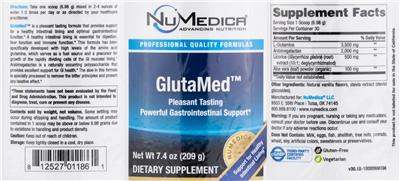
- Form
- Powder
- Serving Size
- 6.98 g
- Servings
- 30 per container
- Container Holds
- 7.4 Ounces; 209 g
What’s in it, whether it interacts with your drugs, its side effects, whether it works, and what our pharmacists would want you to know before you start it.
- What is GlutaMed?A supplement from NuMedica with four active ingredients, in powder form.
- Active Ingredients L-Glutamine 3500 mgArabinogalactan 2000 mgLicorice Root Extract 500 mgAloe Vera, Powder 100 mg Four active ingredients. Each one can interact with drugs or cause side effects on its own, so we check every one. The full Supplement Facts
- Drug Interactions 1,292 drugs have a documented interaction with this supplement; the most serious is rated major. Of those, 877 are single drugs and 415 are combination products (two or more drugs in one), each listed under its own name. Ask your pharmacist first if you take a drug in any of these categories, the most serious of the 23 on record:
- Major · 1 drug
- Moderate · 645 drugs
- Moderate · 202 drugs
- Moderate · 172 drugs
- Possible Side EffectsBloating 2 ingredientsGas 2 ingredientsStomach upsetHigh blood pressureNauseaLow potassium +3 moreReported for the ingredients we have records for, Glutamine, Larch Arabinogalactan and Licorice. Not studied in this exact product.
- Well documented Why
Does GlutaMed work?
What It Is Marketed For
Intestinal lining and gastrointestinal health support
From the claims on the product’s label.
The Closest Use the Research Grades
Aloe
Some studies support it, but the evidence isn’t conclusive.
Its ingredients have research behind other uses too:
- Critical illness (trauma) Glutamine
- Aloe
- Glutamine
- Aloe
These grades are for each ingredient, not this exact product, and never a promise it will work for you.
And 2 more graded uses, in what the research says- Full Why
- AllergensNone of its ingredient names point to a major food allergen
- Barcode (UPC)8 12527 01186 1Match it to the barcode on your bottle to be sure this is your product. Not your product? Search for it here
Who Might Consider It
- People looking for intestinal lining and gastrointestinal health support, which is what it is marketed for. The closest use the research grades is constipation, rated Possibly Effective.
- People who want it for critical illness (trauma), diabetes, pancreatitis, obesity or another graded use: the other uses with research behind them. See each grade
Who Should Be Careful
- GlutaMed may interest people who want L-glutamine, aloe, fiber, or licorice ingredients and who have reviewed their medications.
- Anyone taking digoxin, warfarin, diabetes medicines, diuretics, seizure medicines, or the other drug types listed should be especially careful.
- Pregnant or breastfeeding people should also talk it over with their own doctor or pharmacist before starting, along with anyone who has kidney, liver, heart, or bowel conditions.
More Before You Take It Show all three answersHide Its Ingredient Amounts vs. Other Supplements Pregnancy and Breastfeeding The Label’s Directions
-
How do its ingredient amounts compare with other supplements?
- L-Glutamine3500 mgMore than most of the 284 recent Glutamine products in our database that state an amount; 500 mg is the most common.
- Arabinogalactan2000 mgMore than 9 in 10 of the 191 recent Larch Arabinogalactan products in our database that state an amount; 50 mg is the most common.
- Licorice Root Extract500 mgMore than most of the 177 recent Licorice products in our database that state an amount; 50 mg is the most common.
- Aloe Vera, Powder100 mgIn the usual range for the 243 recent Aloe products in our database that state an amount; 50 mg is the most common.
A label’s amount is what the product holds, not a recommended dose.
See each comparison -
Pregnant or breastfeeding?
- Pregnancy Licorice
- ! When used orally.
- Breastfeeding Licorice
- Insufficient reliable information available; avoid using.
- Pregnancy Aloe
- ! When used orally.
- Breastfeeding Aloe
- ! When aloe preparations are used orally.
- Pregnancy and Breastfeeding Larch Arabinogalactan
- Insufficient reliable information available; avoid using.
-
How does the label say to take it?
“Directions: Take one scoop (6.98 g) mixed in 2-4 ounces of water 1-3 times per day or as directed by your healthcare practitioner.”
The maker’s words. Your pharmacist or doctor may advise differently.
Everything the label says
From the label dated Jan 23, 2025: all four of its active ingredients were checked against our records. A summary of what is known, not a grade or a test of the product. How these ratings are computed
Ask Anything About This Supplement
Name a drug you take, or ask about side effects, ingredients or pregnancy.
AI answers come from this label and our own records, never the open internet. AI can make mistakes, so always check with your doctor or pharmacist. How we use AI
Ask the Pharmacist
A licensed pharmacist will answer your question by email — free, usually within 24 hours.
Got it — thank you!
A licensed pharmacist will answer within 24 hours. Keep an eye on your email (worth checking spam, just in case).
What’s Inside GlutaMed by NuMedica
Four Active Ingredients, Each Checked on Its Own
A supplement is often several ingredients in one bottle, and each one can interact with drugs or cause side effects on its own. We check every one of them against our records.
Why this rating?
The label gives an exact amount for every one of its four active ingredients, so you know how much of each you get in each serving. This rates what the label tells you, not the quality of the product.
Supplement Facts
| Amount Per Serving | % Daily Value | |
|---|---|---|
| L-Glutamine | 3500 mg | † |
| Arabinogalactan | 2000 mg | † |
| Licorice Root Extract | 500 mg | † |
| Aloe Vera, Powder | 100 mg | † |
Other ingredients: Vanilla Flavor, Natural, organic Stevia extract
† Daily Value not established.
Daily Values for adults and children 4 or more years of age.
As the label prints it, from the NIH Dietary Supplement Label Database.
Each Ingredient and Its Drug Interactions
Tap one for more about it and its full guide. A drug can interact with this supplement through any one of them.
GlutaMed contains four active ingredients: L-glutamine, aloe vera powder, larch arabinogalactan, and licorice root extract.
- Arabinogalactan is described as a fiber, and aloe and licorice are plant-derived ingredients.
-
L-Glutamine 3500 mg L-glutamine is an amino acid that the body converts to glutamate, a chemical messenger in the brain. Interacts with 50 drugs
Glutamine is the most abundant amino acid in the body and is usually made in your muscles.
- A prescription form is FDA-approved to help reduce sickle cell disease complications, but for most popular uses such as muscle building, gut health, and immunity the evidence is limited or mixed.
- It is generally well tolerated in healthy people, but anyone with serious liver or kidney problems should check with a doctor first.
The full Glutamine guide: uses, dosage and safety Every Glutamine drug interaction
-
Arabinogalactan 2000 mg Interacts with 121 drugs
Larch arabinogalactan is a soluble fiber from larch trees that is mainly used as a prebiotic and for immune support.
- Early research is interesting but limited, and most claims are not yet firmly proven.
- It is generally well tolerated, but pregnant and breastfeeding people should be cautious and check with a healthcare provider first.
The full Larch Arabinogalactan guide: uses, dosage and safety Every Larch Arabinogalactan drug interaction
-
Licorice Root Extract 500 mg Interacts with 1,041 drugs
Form on the label: Glycyrrhiza glabra Root Extract
Licorice root is a traditional remedy used for sore throats, coughs, and digestive complaints, but solid human evidence is limited for most uses.
- Regular licorice contains glycyrrhizin, which can raise blood pressure and lower potassium when taken in large amounts or for a long time, so deglycyrrhizinated (DGL) products are often preferred.
- Talk to your pharmacist or doctor before using it, especially if you have high blood pressure, heart, or kidney problems.
The full Licorice guide: uses, dosage and safety Every Licorice drug interaction
-
Aloe Vera, Powder 100 mg Interacts with 461 drugs
Aloe vera gel is widely used on the skin for minor burns and irritation, and some research suggests it may help.
- Aloe latex (the yellow part) is a strong laxative that can cause cramping and is not considered safe for regular use.
- Talk to your pharmacist or doctor before taking aloe by mouth, and avoid oral aloe during pregnancy.
The full Aloe guide: uses, dosage and safety Every Aloe drug interaction
How Much of Each Ingredient Is in It, Compared With Other Supplements
Each bar is an amount that other recent supplements list for the same ingredient. The taller the bar, the more of them state it.
-
3,500 mg in a serving of this product
More than most products
- Most common amount
- 500 mg (about 13 in 100 products)
- Most products state
- 50 mg to 5,000 mg
- Compared with
- 284 recent products
-
2,000 mg in a serving of this product
More than 9 in 10 products
- Most common amount
- 50 mg (about 14 in 100 products)
- Most products state
- 20 mg to 1,000 mg
- Compared with
- 191 recent products
-
500 mg in a serving of this product
More than most products
- Most common amount
- 50 mg (about 18 in 100 products)
- Most products state
- 25 mg to 701 mg
- Compared with
- 177 recent products
-
100 mg in a serving of this product
In the usual range
- Most common amount
- 50 mg (about 19 in 100 products)
- Most products state
- 10 mg to 350 mg
- Compared with
- 243 recent products
Other Ingredients (Inactive)
The capsule or tablet itself, fillers, coatings and flavors. Not part of the drug interaction check; the allergen check below reads them.
- Vanilla Flavor, Natural
- Organic Stevia extract
Allergens in GlutaMed
None of its ingredient names point to a major food allergen.
Not named in the ingredients
- Milk
- Egg
- Fish
- Shellfish
- Tree nuts
- Peanuts
- Wheat or other gluten grains
- Soy
- Sesame
- Made without, the label says“Does not contain: Milk, eggs, fish, shellfish, tree nuts, peanuts, wheat, soy, artificial colors, sweeteners or preservatives. · Gluten-Free”
- Made without, the label says“Vegetarian”
From the label text and ingredient names on file; we do not test products. With a serious allergy, check your bottle and ask the maker or your pharmacist.
What the Label Says
The maker’s own words, from the label. We do not verify or endorse them.
- Formulation
-
“GlutaMed is a pleasant tasting formula that provides support for a healthy intestinal lining an optimal gastrointestinal function. A healthy intestinal lining is essential for digestion, liver function and immune function. This formula has been specifically developed with high levels of the amino acid glutamine, which serves as a fuel source and a precursor for growth of the rapidly deciding cells of the GI mucosal lining.”
“Professional quality formulas Pleasant tasting Powerful gastronintestinal support”
3 more from the label
“Support for healthy intestinal lining”
“Does not contain: Milk, eggs, fish, shellfish, tree nuts, peanuts, wheat, soy, artificial colors, sweeteners or preservatives. Gluten-Free”
“Arabinogalactan is a naturally occurring polysaccharide that provides excellent support for GI health. The aloe in the formula is specially processed to remove the bitter principles and prevent any laxative effect.”
- Storage
-
“Contents sold by weight, not volume. Some settling may occur during shipping and handling. The amount of product contained in 1 scoop may be above or below 6.98 grams due to variations in handling and product density.”
“Storage: Keep tightly closed in a cool, dry place.”
- Brand IP Statement(s)
-
“NuMedica Advancing Nutrition”
- FDA Statement of Identity
-
“Dietary Supplement”
- Seals and symbols
-
“cGMP Third-party Certified Facility”
The GlutaMed Label on File
The label scan on file at the NIH Dietary Supplement Label Database, dated January 2025. Always read the label on the bottle you have.
Product Facts
- Brand
- NuMedica
- Barcode (UPC)
- 812527011861
- Net contents
- 7.4 Ounces; 209 g
- Market status
- On market
- Date entered into DSLD
- Jan 23, 2025
- DSLD ID
- 323536
- Product type
- Botanical With Nutrients
- Supplement form
- Powder
- Dietary claims / uses
- All Other, Structure/Function
- Intended target group(s)
- Vegetarian, Adult (18 - 50 Years), Gluten Free
Is this label outdated? Report a formula or label change and our pharmacy team will review it.
GlutaMed by NuMedica Side Effects
Why this rating?
We look for three kinds of safety information on each ingredient: side effects reported in studies, a pregnancy and breastfeeding rating, and a safety write-up from our pharmacy team. All three are on file for each of the four ingredients we could check.
So this rates how much is known, not whether GlutaMed is right for you.
Reported with four of its ingredients
- Most often
- Bloating, gas, stomach upset, high blood pressure, nausea and low potassium
- !Rare but serious
- Reported with Glutamine, Larch Arabinogalactan, Licorice and Aloe See details
HelloPharmacist Team Summary of Side Effects
For most people, these ingredients are generally well tolerated, though stomach upset, nausea, bloating, and gas are the reported effects you are most likely to notice, mainly from L-glutamine and arabinogalactan.
- Rare but serious effects are worth knowing about: glycyrrhizin-containing licorice taken in large or long-term amounts can lower potassium and affect blood pressure, which can lead to irregular heartbeats.
- If you notice a racing or irregular heartbeat, call your doctor right away.
- Long-term oral aloe latex is also generally discouraged, so talk with your own doctor or pharmacist before starting, especially if you have heart, kidney, liver, or bowel conditions.
Side Effects, Ingredient by Ingredient
A supplement’s side effects come from its ingredients. Here is what is reported with each one.
Glutamine
Most reported
- Stomach upset
- Nausea
- Bloating
- Gas
Larch Arabinogalactan
Most reported
- Bloating
- Gas
- Stomach discomfort
Licorice
Most reported
- High blood pressure
- Low potassium
- Fluid retention and swelling
- Headache
Aloe has side-effect reports on file, but no list of the most common ones. Read them in the Aloe guide
GlutaMed Warnings: Who Should Be Careful
GlutaMed has four active ingredients, and each can carry warnings of its own. We checked all four, and each warning below names the ingredient it comes from. If any of these apply to you, talk to your doctor or pharmacist before you start it.
- Glutamine4 warnings below
- Larch Arabinogalactan3 warnings below
- Licorice3 warnings below
- Aloe1 warning below
-
Diabetes or Low Blood Sugar
- AloePeople with kidney problems, bowel conditions, or diabetes should be especially careful and check with a doctor or pharmacist before taking aloe by mouth.
-
Blood Pressure
- LicoriceThe bigger concern is with glycyrrhizin-containing licorice taken in large amounts or for a long time, which can raise blood pressure, lower potassium, and stress the heart.
- LicoricePeople who should be especially cautious or avoid glycyrrhizin-containing licorice include those with high blood pressure, heart disease, kidney disease, low potassium, or hormone-sensitive conditions.
-
Liver Disease
- GlutamineUse extra caution if you have kidney disease or liver disease, since these organs are involved in processing amino acids and the byproducts of protein.
- GlutamineL-glutamine is generally well tolerated in healthy adults, but people with kidney or liver disease should use it only under medical supervision.
-
Stomach or Bowel Problems
- Larch ArabinogalactanPeople with bowel conditions, those prone to bloating, or anyone with a weakened immune system should talk to a healthcare provider before starting it.
-
Seizure Disorders
- GlutaminePeople with a history of seizures or certain mental health conditions should also talk to a doctor first, because glutamine is related to glutamate, a chemical messenger in the brain.
-
Allergies
- Larch ArabinogalactanIf you have allergies to plant or tree products, introduce it cautiously.
-
If You Take Other Drugs
- Larch ArabinogalactanAlways check with a pharmacist or doctor before adding any new supplement, especially if you have a medical condition or take other medicines.
-
Other Cautions
- GlutaminePeople with these conditions should only take glutamine under the supervision of a healthcare provider.
- LicoriceDGL products avoid most of these risks because the glycyrrhizin has been removed.
-
What the Label Warns
- “Caution: Keep out of reach of children.”
- “Warning: If you are pregnant, nursing or taking any medications, consult your doctor before use.”
- “Discontinue use and consult your doctor if any adverse reactions occur.”
- “This product is not labeled for sale in the State of California.”
The maker’s wording, from the product label.
-
Pregnant or Breastfeeding
Each ingredient’s rating for pregnancy and for breastfeeding, and what it covers.
Pregnancy
-
When used orally.
Licorice has abortifacient, estrogenic, and steroid effects.
4 more points on this rating
- It can also cause uterine stimulation.
- Heavy consumption of licorice, equivalent to 500 mg of glycyrrhizin per week (about 250 grams of licorice per week), during pregnancy seems to increase the risk of delivery before gestational age of 38 weeks.
- Furthermore, high intake of glycyrrhizin, at least 500 mg per week, during pregnancy is associated with increased salivary cortisol levels in the child by the age of 8 years.
- This suggests that high intake of licorice during pregnancy may increase hypothalamic-pituitary-adrenocortical axis activity in the child; avoid using.
Breastfeeding
-
Insufficient reliable information available; avoid using.
Pregnancy
-
When used orally.
Anthraquinones present in aloe latex and aloe whole leaf extracts have irritant, cathartic, and possible mutagenic effects.
There are also anecdotal reports and evidence from animal research that anthraquinones or aloe whole leaf extracts might induce abortion and stimulate menstruation; avoid using.
Breastfeeding
-
When aloe preparations are used orally.
Cathartic and mutagenic anthraquinones present in aloe latex and aloe whole leaf extracts might pass into milk; avoid using.
Show 2 more ingredients
Pregnancy and Breastfeeding The record rates both the same
-
Insufficient reliable information available; avoid using.
Pregnancy and Breastfeeding The record rates both the same
-
When consumed in amounts commonly found in foods.
There is insufficient reliable information available about the safety of glutamine when used in larger amounts as medicine during pregnancy or lactation.
Our pharmacy team’s notes
- Larch ArabinogalactanNo pregnancy or lactation rating is on file for arabinogalactan, and our pharmacists say there is not enough safety data, so talk with your own doctor or pharmacist.
- LicoriceLicorice is rated unsafe in pregnancy because glycyrrhizin has been linked to harmful effects, so it is best avoided.
Ratings and the words beside them are from the Natural Medicines database, which we license.
-
Rare but Serious Side Effects
-
!
Glutamine
Serious reactions are uncommon.
-
!
Larch Arabinogalactan
Serious side effects appear to be uncommon, but allergic reactions are always possible with any supplement.
-
!
Licorice
In serious cases, low potassium and blood pressure changes can lead to irregular heartbeats or other heart problems.
Orally: Case reports have raised concerns about acute renal failure, cardiac arrest, cardiac arrhythmias, hypertension, hypokalemia, muscle weakness, paralysis, pseudohyperaldosteronism, and seizure associated with long-term use or large amounts of licorice containing glycyrrhizin.
-
!
Aloe
Long-term use of oral aloe latex has been linked to more serious harms and is generally discouraged.
Topical aloe is generally well tolerated, but oral aloe latex can cause serious side effects, and long-term oral use is generally discouraged.
Orally: Aloe latex is associated with serious adverse effects when taken in high doses or long-term. Cases of acute hepatitis due to a hypersensitivity reaction to aloe leaf extract has been reported.
When to get help: a serious allergic reaction, with trouble breathing or swelling of the face, lips or throat, needs emergency care: call 911. For any other side effect that worries you, call your doctor or pharmacist.
These reports describe each ingredient, not studies of this exact product. Not medical advice: a side effect you notice after starting a supplement is worth a word with your pharmacist or doctor.
GlutaMed by NuMedica Drug Interactions
We checked all four active ingredients in this supplement against every drug in our records. A drug can interact with it through any one of them.
A major interaction on record
3 of 3, on a scale from Minor or none to Major.Why this rating?
We rate this by the most serious interaction on record, not by how many there are. For Aloe, Glutamine, Licorice and Larch Arabinogalactan, the most serious is rated major, which means the combination is best avoided, or used only under close supervision. Some involve kinds of drugs where a small change can matter, such as blood thinners, seizure drugs and transplant drugs.
1,293 drugs are on the full list. What matters is whether one you take is on it, so check yours with the interaction checker on this page.
All four of its active ingredients have drug interactions on record: Glutamine, Larch Arabinogalactan, Licorice and Aloe.
- Interacts with
- 50 drugs
- Most serious
- Moderate
- Anticonvulsants (seizure medicines) may be less effective with L-glutamine (Moderate), though this has not been reported in humans.
- Interacts with
- 121 drugs
- Most serious
- Moderate
- Immunosuppressants, which calm the immune system, may be affected by arabinogalactan (Moderate).
- Interacts with
- 1,041 drugs
- Most serious
- Moderate
- Licorice may also reduce the effects of cisplatin and paclitaxel, and midazolam (Versed) levels may drop (Moderate).
- Interacts with
- 461 drugs
- Most serious
- Major
- The most serious interaction is rated Major and comes from the aloe.
- Aloe latex can increase the risk of toxicity from digoxin (Lanoxin), a heart medication called a cardiac glycoside, because it can deplete potassium.
- Blood thinners (anticoagulants) and antiplatelet drugs may increase bleeding risk with aloe (Moderate).
From the HelloPharmacist Team
Looking at the supplement as a whole rather than one ingredient at a time:
- GlutaMed from NuMedica interacts with medications through four of its ingredients: aloe vera, licorice root extract, L-glutamine, and arabinogalactan.
- Several other drug types are affected mainly by the aloe and licorice.
- Warfarin (Coumadin), a blood thinner, is affected by both aloe and licorice (Moderate): aloe-related diarrhea can increase its effects, while licorice may lower its levels.
Summarized by the HelloPharmacist pharmacy team from the interaction records below. How it is written How we use AI
Why GlutaMed Interacts, Ingredient by Ingredient
A product interacts through its ingredients. Each card: how many drugs, the most serious rating, and the kinds of drugs it affects most (tap a kind for what it means).
The ingredients driving the most interactions
-
Licorice Root Extract 1,041 drugs
Most serious: Moderate18 interaction records on file
The kinds of drugs it affects most
- 645 drugs
- 202 drugs
- 186 drugs
- 172 drugs
Every Licorice drug interaction, 18 records The Licorice records cite 94 references, listed in the Licorice guide.
-
Aloe Vera, Powder 461 drugs
Most serious: Major7 interaction records on file
The kinds of drugs it affects most
- 186 drugs
- 122 drugs
- 86 drugs
- 75 drugs
Every Aloe drug interaction, 7 records The Aloe records cite 41 references, listed in the Aloe guide.
-
Arabinogalactan 121 drugs
Most serious: Moderate1 interaction record on file
The kinds of drugs it affects most
- 121 drugs
Every Larch Arabinogalactan drug interaction, 1 record The Larch Arabinogalactan records cite 8 references, listed in the Larch Arabinogalactan guide.
-
L-Glutamine 50 drugs
Most serious: Moderate1 interaction record on file
The kinds of drugs it affects most
- 50 drugs
Every Glutamine drug interaction, 1 record The Glutamine records cite 11 references, listed in the Glutamine guide.
The Breakdown by Severity
Each drug counted once, at its most serious rating. Tap a tile to list those drugs.
Find Your Drug
Type a drug or brand name to see whether it is on the list.
- Only drugs with a documented interaction are listed, the most serious first.
- A drug with no known interaction is not listed, but searching its name tells you so.
- Open a drug to see which ingredient is responsible. Of those, 877 are single drugs and 415 are combination products (two or more drugs in one), each listed under its own name.
-
DigoxinDigitek, Lanoxicaps, Lanoxin Major
The 2 ingredients responsible:
-
Aloe Vera, Powder Major
Theoretically, aloe latex might increase the risk of adverse effects when taken with cardiac glycosides.
The full Aloe Vera, Powder + Digoxin interaction -
Licorice Root Extract Moderate Digoxin is in the P-glycoprotein Substrates category.
Theoretically, licorice might decrease the absorption of P-glycoprotein substrates.
The full Licorice Root Extract + Digoxin interaction
-
-
ApixabanEliquis Moderate
The 2 ingredients responsible:
-
Licorice Root Extract Moderate Apixaban is in these Cytochrome P450 3A4 (CYP3A4) Substrates, P-glycoprotein Substrates categories.
Theoretically, licorice might increase or decrease levels of drugs metabolized by CYP3A4.
The full Licorice Root Extract + Apixaban interaction -
Aloe Vera, Powder Moderate Apixaban is in the Anticoagulant/Antiplatelet Drugs category.
Theoretically, aloe gel might increase the risk of bleeding when taken with anticoagulant or antiplatelet drugs.
The full Aloe Vera, Powder + Apixaban interaction
-
-
WarfarinWarfarin Moderate
The 2 ingredients responsible:
-
Licorice Root Extract Moderate Warfarin is in these Cytochrome P450 2C19 (CYP2C19) Substrates, Cytochrome P450 2C9 (CYP2C9) Substrates, Cytochrome P450 2C8 (CYP2C8) Substrates and 2 more categories.
Theoretically, licorice might increase levels of drugs metabolized by CYP2C19.
The full Licorice Root Extract + Warfarin interaction -
Aloe Vera, Powder Moderate Warfarin is in these Anticoagulant/Antiplatelet Drugs, Cytochrome P450 1A2 (CYP1A2) Substrates categories.
Theoretically, aloe gel might increase the risk of bleeding when taken with anticoagulant or antiplatelet drugs.
The full Aloe Vera, Powder + Warfarin interaction
-
-
AmlodipineNorliqva Moderate
The ingredient responsible:
-
Licorice Root Extract Moderate Amlodipine is in these Cytochrome P450 3A4 (CYP3A4) Substrates, Antihypertensive Drugs categories.
Theoretically, licorice might increase or decrease levels of drugs metabolized by CYP3A4.
The full Licorice Root Extract + Amlodipine interaction
-
-
SertralineZoloft Moderate
The ingredient responsible:
-
Licorice Root Extract Moderate Sertraline is in the Cytochrome P450 3A4 (CYP3A4) Substrates category.
Theoretically, licorice might increase or decrease levels of drugs metabolized by CYP3A4.
The full Licorice Root Extract + Sertraline interaction
-
-
ClopidogrelPlavix Moderate
The 2 ingredients responsible:
-
Licorice Root Extract Moderate Clopidogrel is in these Cytochrome P450 3A4 (CYP3A4) Substrates, Cytochrome P450 1A2 (CYP1A2) Substrates, Cytochrome P450 2C9 (CYP2C9) Substrates categories.
Theoretically, licorice might increase or decrease levels of drugs metabolized by CYP3A4.
The full Licorice Root Extract + Clopidogrel interaction -
Aloe Vera, Powder Moderate Clopidogrel is in these Anticoagulant/Antiplatelet Drugs, Cytochrome P450 1A2 (CYP1A2) Substrates categories.
Theoretically, aloe gel might increase the risk of bleeding when taken with anticoagulant or antiplatelet drugs.
The full Aloe Vera, Powder + Clopidogrel interaction
-
-
EscitalopramLexapro Moderate
The ingredient responsible:
-
Licorice Root Extract Moderate Escitalopram is in these Cytochrome P450 3A4 (CYP3A4) Substrates, Cytochrome P450 2C19 (CYP2C19) Substrates categories.
Theoretically, licorice might increase or decrease levels of drugs metabolized by CYP3A4.
The full Licorice Root Extract + Escitalopram interaction
-
-
AspirinAngettes 75, ASA, Asaphen, Aspirin, Caprin and 9 more Moderate
The ingredient responsible:
-
Aloe Vera, Powder Moderate Aspirin is in the Anticoagulant/Antiplatelet Drugs category.
Theoretically, aloe gel might increase the risk of bleeding when taken with anticoagulant or antiplatelet drugs.
The full Aloe Vera, Powder + Aspirin interaction
-
-
Losartan PotassiumCozaar Moderate
The ingredient responsible:
-
Licorice Root Extract Moderate Losartan Potassium is in these Antihypertensive Drugs, Cytochrome P450 2C9 (CYP2C9) Substrates, Cytochrome P450 3A4 (CYP3A4) Substrates categories.
Theoretically, licorice might reduce the effects of antihypertensive drugs.
The full Licorice Root Extract + Losartan Potassium interaction
-
-
AtorvastatinAtorvaliq Moderate
The ingredient responsible:
-
Licorice Root Extract Moderate Atorvastatin is in the Cytochrome P450 3A4 (CYP3A4) Substrates category.
Theoretically, licorice might increase or decrease levels of drugs metabolized by CYP3A4.
The full Licorice Root Extract + Atorvastatin interaction
-
-
RivaroxabanXarelto Moderate
The 2 ingredients responsible:
-
Licorice Root Extract Moderate Rivaroxaban is in these P-glycoprotein Substrates, Cytochrome P450 3A4 (CYP3A4) Substrates categories.
Theoretically, licorice might decrease the absorption of P-glycoprotein substrates.
The full Licorice Root Extract + Rivaroxaban interaction -
Aloe Vera, Powder Moderate Rivaroxaban is in the Anticoagulant/Antiplatelet Drugs category.
Theoretically, aloe gel might increase the risk of bleeding when taken with anticoagulant or antiplatelet drugs.
The full Aloe Vera, Powder + Rivaroxaban interaction
-
-
MetforminGlucophage, Metformin Moderate
The ingredient responsible:
-
Aloe Vera, Powder Moderate Metformin is in the Antidiabetes Drugs category.
Aloe might increase the risk of hypoglycemia when taken with antidiabetes drugs.
The full Aloe Vera, Powder + Metformin interaction
-
-
Warfarin SodiumCoumadin, Panwarfin, Sofarin Moderate
The 2 ingredients responsible:
-
Aloe Vera, Powder Moderate Warfarin Sodium is in these Cytochrome P450 1A2 (CYP1A2) Substrates, Anticoagulant/Antiplatelet Drugs categories.
Theoretically, aloe latex might increase the risk of bleeding when taken with warfarin.
The full Aloe Vera, Powder + Warfarin Sodium interaction -
Licorice Root Extract Moderate Warfarin Sodium is in these Cytochrome P450 2C8 (CYP2C8) Substrates, Cytochrome P450 2C19 (CYP2C19) Substrates, Cytochrome P450 2C9 (CYP2C9) Substrates and 2 more categories.
Theoretically, licorice might increase levels of drugs metabolized by CYP2C8.
The full Licorice Root Extract + Warfarin Sodium interaction
-
-
TirzepatideMounjaro, Zepbound Moderate
The ingredient responsible:
-
Aloe Vera, Powder Moderate Tirzepatide is in the Antidiabetes Drugs category.
Aloe might increase the risk of hypoglycemia when taken with antidiabetes drugs.
The full Aloe Vera, Powder + Tirzepatide interaction
-
-
MetoprololLopressor, Toprol XL Moderate
The ingredient responsible:
-
Licorice Root Extract Moderate Metoprolol is in the Antihypertensive Drugs category.
Theoretically, licorice might reduce the effects of antihypertensive drugs.
The full Licorice Root Extract + Metoprolol interaction
-
-
IbuprofenAdvil, Arthrofen, Brufen, Brufen Retard, Calodor and 15 more Moderate
The 2 ingredients responsible:
-
Aloe Vera, Powder Moderate Ibuprofen is in the Anticoagulant/Antiplatelet Drugs category.
Theoretically, aloe gel might increase the risk of bleeding when taken with anticoagulant or antiplatelet drugs.
The full Aloe Vera, Powder + Ibuprofen interaction -
Licorice Root Extract Moderate Ibuprofen is in the Cytochrome P450 2C9 (CYP2C9) Substrates category.
Theoretically, licorice might increase or decrease levels of drugs metabolized by CYP2C9.
The full Licorice Root Extract + Ibuprofen interaction
-
-
SemaglutideOzempic, Rybelsus, Wegovy Moderate
The ingredient responsible:
-
Aloe Vera, Powder Moderate Semaglutide is in the Antidiabetes Drugs category.
Aloe might increase the risk of hypoglycemia when taken with antidiabetes drugs.
The full Aloe Vera, Powder + Semaglutide interaction
-
-
IvermectinMectizan, Sklice, Soolantra, Stromectol Moderate
The ingredient responsible:
-
Licorice Root Extract Moderate Ivermectin is in the P-glycoprotein Substrates category.
Theoretically, licorice might decrease the absorption of P-glycoprotein substrates.
The full Licorice Root Extract + Ivermectin interaction
-
-
TadalafilCialis, Tadliq Moderate
The ingredient responsible:
-
Licorice Root Extract Moderate Tadalafil is in the Cytochrome P450 3A4 (CYP3A4) Substrates category.
Theoretically, licorice might increase or decrease levels of drugs metabolized by CYP3A4.
The full Licorice Root Extract + Tadalafil interaction
-
-
TestosteroneAndrogel, Andropatch, Delatestryl, Intrinsa, Natesto and 4 more Moderate
The ingredient responsible:
-
Licorice Root Extract Moderate Testosterone is in the Cytochrome P450 3A4 (CYP3A4) Substrates category.
Theoretically, licorice might increase or decrease levels of drugs metabolized by CYP3A4.
The full Licorice Root Extract + Testosterone interaction
-
-
PrednisoneCortan, Deltasone, Meticorten, Orasone, Prednicen-M and 3 more Moderate
The 2 ingredients responsible:
-
Arabinogalactan Moderate Prednisone is in the Immunosuppressants category.
Theoretically, larch arabinogalactan might interfere with immunosuppression therapy due to immunostimulant effects.
The full Arabinogalactan + Prednisone interaction -
Licorice Root Extract Moderate Prednisone is in these P-glycoprotein Substrates, Corticosteroids, Cytochrome P450 3A4 (CYP3A4) Substrates categories.
Theoretically, licorice might decrease the absorption of P-glycoprotein substrates.
The full Licorice Root Extract + Prednisone interaction
-
-
FluoxetineProzac, Sarafem Moderate
The ingredient responsible:
-
Licorice Root Extract Moderate Fluoxetine is in the Cytochrome P450 2C9 (CYP2C9) Substrates category.
Theoretically, licorice might increase or decrease levels of drugs metabolized by CYP2C9.
The full Licorice Root Extract + Fluoxetine interaction
-
-
IsotretinoinAbsorica, Accutane, Amnesteem, Claravis, Roaccutane and 1 more Moderate
The ingredient responsible:
-
Licorice Root Extract Moderate Isotretinoin is in the Cytochrome P450 2C8 (CYP2C8) Substrates category.
Theoretically, licorice might increase levels of drugs metabolized by CYP2C8.
The full Licorice Root Extract + Isotretinoin interaction
-
-
AbemaciclibVerzenio Moderate
The ingredient responsible:
-
Licorice Root Extract Moderate Abemaciclib is in the Cytochrome P450 3A4 (CYP3A4) Substrates category.
Theoretically, licorice might increase or decrease levels of drugs metabolized by CYP3A4.
The full Licorice Root Extract + Abemaciclib interaction
-
-
PropranololAngilol, Bedranol SR, Beta Prograne, Half Beta Prograne, Half-Inderal LA and 7 more Moderate
The 2 ingredients responsible:
-
Licorice Root Extract Moderate Propranolol is in these Cytochrome P450 1A2 (CYP1A2) Substrates, Cytochrome P450 2C19 (CYP2C19) Substrates, Antihypertensive Drugs categories.
Theoretically, licorice might decrease the levels and clinical effects of CYP1A2 substrates.
The full Licorice Root Extract + Propranolol interaction -
Aloe Vera, Powder Minor Propranolol is in the Cytochrome P450 1A2 (CYP1A2) Substrates category.
Theoretically, aloe might decrease the levels and clinical effects of CYP1A2 substrates.
The full Aloe Vera, Powder + Propranolol interaction
-
-
LamotrigineLamictal Moderate
The ingredient responsible:
-
L-Glutamine Moderate Lamotrigine is in the Anticonvulsants category.
Theoretically, glutamine might antagonize the effects of anticonvulsant medications.
The full L-Glutamine + Lamotrigine interaction
-
-
BupropionAplenzin, Forfivo XL, Wellbutrin, Wellbutrin SR, Wellbutrin XL and 1 more Moderate
The ingredient responsible:
-
Licorice Root Extract Moderate Bupropion is in the Cytochrome P450 2B6 (CYP2B6) Substrates category.
Theoretically, licorice might increase levels of drugs metabolized by CYP2B6.
The full Licorice Root Extract + Bupropion interaction
-
-
LetrozoleFemara Moderate
The ingredient responsible:
-
Licorice Root Extract Moderate Letrozole is in the Cytochrome P450 3A4 (CYP3A4) Substrates category.
Theoretically, licorice might increase or decrease levels of drugs metabolized by CYP3A4.
The full Licorice Root Extract + Letrozole interaction
-
-
NaproxenAleve, Anaprox, Anaprox DS, Arthroxen, EC-Naprosyn and 8 more Moderate
The 2 ingredients responsible:
-
Aloe Vera, Powder Moderate Naproxen is in these Cytochrome P450 1A2 (CYP1A2) Substrates, Anticoagulant/Antiplatelet Drugs categories.
Theoretically, aloe might decrease the levels and clinical effects of CYP1A2 substrates.
The full Aloe Vera, Powder + Naproxen interaction -
Licorice Root Extract Moderate Naproxen is in these Cytochrome P450 2C9 (CYP2C9) Substrates, Cytochrome P450 1A2 (CYP1A2) Substrates categories.
Theoretically, licorice might increase or decrease levels of drugs metabolized by CYP2C9.
The full Licorice Root Extract + Naproxen interaction
-
-
LisinoprilPrinivil, Qbrelis, Zestril Moderate
The ingredient responsible:
-
Licorice Root Extract Moderate Lisinopril is in the Antihypertensive Drugs category.
Theoretically, licorice might reduce the effects of antihypertensive drugs.
The full Licorice Root Extract + Lisinopril interaction
-
Does It Work? GlutaMed by NuMedica
How it rates in the research so far, then each ingredient on its own. A grade is the research so far, never an endorsement.
What It Is Marketed For
Intestinal lining and gastrointestinal health support
From the claims on the product’s label.
Closest match for what it is marketed for
Aloe for constipation
Some studies support it, but the evidence isn’t conclusive.
The Evidence, Ingredient by Ingredient
Each card holds our notes on one ingredient, then its uses graded effective, likely effective or possibly effective.
Glutamine
From our Glutamine guide
- People use glutamine for many reasons, but the strength of the evidence varies a lot depending on the use.
Research suggests a benefit for
- Critical illness (trauma) and pancreatitis
Not counted here: three graded uses are for conditions treated by a doctor or in a hospital (HIV/AIDS-related wasting, sickle cell disease and postoperative recovery).
Every graded use, in the Glutamine guideLarch Arabinogalactan
Our pharmacy team’s notes on Larch Arabinogalactan
- Arabinogalactan has insufficient reliable evidence to rate for the common cold and hyperlipidemia.
No use is graded effective, likely effective or possibly effective for it yet.
Every graded use, in the Larch Arabinogalactan guideLicorice
From our Licorice guide
- People use licorice for many reasons, but for most of them the scientific evidence in humans is limited or not strong.
Not counted here: two graded uses are for Licorice injected or put on the skin (atopic dermatitis (eczema) and canker sores), not for a product like this one.
Every graded use, in the Licorice guideAloe
From our Aloe guide
- Aloe is used for many conditions, but the strength of the evidence varies a lot depending on the use.
Research suggests a benefit for
- Constipation (the use on its label), diabetes, obesity, oral submucous fibrosis and traumatic oral ulcers
Not counted here: five graded uses are for Aloe injected or put on the skin (acne, burns, psoriasis and others), not for a product like this one.
Every graded use, in the Aloe guideThe grades are the Natural Medicines database’s, which we license; tap a grade for what it means. They are about each ingredient, not this exact product.
About NuMedica
Manufacturer and brand details for GlutaMed, from the product label.
NuMedica has 152 products in our supplement database, all of them on the market, with labels on file since 2018. Our database is built from the NIH’s Dietary Supplement Label Database and our pharmacy team’s own additions, so it covers the labels filed there, not every product the brand sells.
- Name
- NuMedica LLC
- Street Address
- 9503 E. 55th Place
- City
- Tulsa
- State
- OK
- ZipCode
- 74145
- Phone Number
- 800.869.8100
- Web Address
- www.numedica.com
GlutaMed by NuMedica: Common Questions
Does GlutaMed by NuMedica interact with any drugs?
What are the side effects of GlutaMed by NuMedica?
Who should be careful taking GlutaMed by NuMedica?
Can GlutaMed by NuMedica affect the liver?
Can GlutaMed by NuMedica affect the kidneys?
Does GlutaMed by NuMedica contain any common allergens?
Is GlutaMed by NuMedica gluten free?
How can GlutaMed by NuMedica interact with so many drugs?
Where does the information about GlutaMed by NuMedica come from?
Is GlutaMed by NuMedica safe to use during pregnancy?
What is L-glutamine used for?
Does arabinogalactan help with colds?
What inactive ingredients are in GlutaMed by NuMedica?
Written and reviewed by the HelloPharmacist Editorial Team. Our editorial policy
Still Have a Question About GlutaMed?
Our pharmacists answer drug and supplement questions, free, by email.
Label information is sourced from the NIH Dietary Supplement Label Database and reflects the product version on file; always read your actual product label. This page is for education only and is not a substitute for professional medical advice. Confirm with your pharmacist or doctor before combining supplements and drugs.
Who Reviews This Page
The pharmacist behind it, and how it is checked.
Dr. Brian Staiger, PharmD, BCPS
Clinical pharmacist and founder of HelloPharmacist
A licensed pharmacist for more than 13 years, he built the system behind this page: it reads the label on file, matches each active ingredient to its record in the Natural Medicines database, checks those records against every drug we cover, and our pharmacy team writes the take and the interaction summary from those records.
- 13+ Years in PharmacyRetail and clinical pharmacy, medication safety and healthcare administration.
- Board Certified (BCPS)A pharmacotherapy specialist, certified by the Board of Pharmacy Specialties.
- Herbalist TrainingCertificates in medical ethnobotany, for the herbs and supplements people take.
Where This Page Comes From
GlutaMed’s label data comes from the NIH Dietary Supplement Label Database; the ingredient interaction data is from the Natural Medicines database, reviewed by our pharmacists.
- NIH Dietary Supplement Label Database (DSLD)
- The official product label on file for this supplement.
- Natural Medicines (Therapeutic Research Center)
- The evidence-graded clinical reference behind the ingredient interaction, evidence and safety records, which we license.
- HelloPharmacist Editorial Team
- Content is reviewed by the HelloPharmacist Editorial Team, the pharmacists on our staff and those we contract. See our data sources and editorial standards for how this information is built and checked.
- The Pharmacy Team’s Take and Summaries
- Generated from HelloPharmacist’s pharmacist-curated databases and editorial rules. Clinical methodology reviewed by Dr. Brian Staiger, PharmD, BCPS. Last generated Oct 31, 2026. How we use AI
- The ratings in the Quick Summary
- They summarize available label information, ingredient evidence and known drug-safety records: a summary of what is known, not a grade of the product itself. They do not verify product identity, purity, potency, contamination or manufacturing quality. How these ratings are computed
The References Behind the Interaction Records
Every citation the ingredients’ records rest on is listed in that ingredient’s guide, in context: Glutamine, 11 references; Larch Arabinogalactan, 8 references; Licorice, 94 references; Aloe, 41 references .
Parts of this content are provided by the Therapeutic Research Center, LLC.
DISCLAIMER: Currently this does not check for drug-drug interactions. This is not an all-inclusive comprehensive list of potential interactions and is for informational purposes only. Not all interactions are known or well-reported in the scientific literature, and new interactions are continually being reported. Input is needed from a qualified healthcare provider including a pharmacist before starting any therapy. Application of clinical judgment is necessary.
© 2021 Therapeutic Research Center, LLC
Keep Exploring
- Supplement interaction checkerCheck any supplement or product against your drugs
- Drug–drug interactionsCheck two or more of your drugs against each other
- Browse drugs A to ZEvery drug we have checked against herbs and supplements
- NDC and pricing lookupFind a drug’s NDCs, packaging and costs
- Ask a pharmacistA free, personal answer from our licensed team