
Prostatonic by Herbs Etc. Ingredients, Side Effects and Drug Interactions
Dietary Supplement Liquid Botanical
Prostatonic by Herbs Etc. is a dietary supplement with ten active ingredients, including Saw Palmetto, yarrow and Dong Quai. It is marketed for healthy prostate function.
UPC 7 65704 13001 8 Match it to the barcode on your bottle

Medically reviewed by Dr. Brian Staiger, PharmD, BCPS
Also reviewed by the HelloPharmacist Editorial Team
Updated Details about this page
- Label on file from the NIH Dietary Supplement Label Database, dated Nov 22, 2024.
- The interaction, evidence and safety records come from the Natural Medicines database, which we license, read against this label by our own system; the pharmacy team’s sections are written from those records.
- Dr. Brian Staiger, PharmD, BCPS, is a clinical pharmacist and pharmacotherapy specialist.
- Editorial policy Our sources
AI is used only to summarize verified clinical information, never the open internet. Our AI policy
Summary: The HelloPharmacist Team’s Take
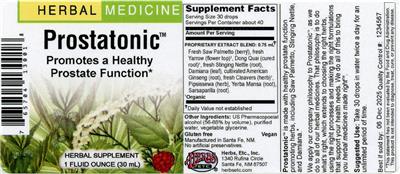
This summary is for Prostatonic by Herbs Etc.
- Form
- Liquid
- Serving Size
- 30 Drops
- Servings
- 40 per container
- Container Holds
- 1 Fluid Ounce; 30 mL
- What is Prostatonic?A supplement from Herbs Etc. with ten active ingredients, in liquid form.
- Active Ingredients Saw Palmetto Berry Extract, FreshYarrow Flower Top Extract, FreshDong Quai Cured Root ExtractStinging Nettle Root Extract, FreshDamiana leaf extractAmerican Ginseng Root ExtractCleavers Herb Extract, FreshPipsissewa Herb ExtractYerba Mansa Root ExtractSarsparilla root extract Ten active ingredients. Each one can interact with drugs or cause side effects on its own, so we check every one. The full Supplement Facts
- Drug Interactions 687 drugs have a documented interaction with this supplement; the most serious is rated major. Of those, 435 are single drugs and 252 are combination products (two or more drugs in one), each listed under its own name. Based on the 9 of its 10 ingredients we could check. Ask your pharmacist first if you take a drug in any of these categories, the most serious of the 11 on record:
- Major · 2 drugs
- Moderate · 248 drugs
- Moderate · 122 drugs
- Moderate · 121 drugs
- Possible Side EffectsStomach upset 7 ingredientsNausea 5 ingredientsHeadache 3 ingredientsBurpingDrowsinessGas +6 moreCombined from nine of its ten active ingredients. Not studied in this exact product.
- Well documented Why
Does Prostatonic work?
What It Is Marketed For
Healthy prostate function
From the claims on the product’s label.
The Closest Use the Research Grades
Saw Palmetto
The studies lean against a benefit.
Its ingredients have stronger research for other uses:
- Transurethral resection of the prostate (TURP) Saw Palmetto
- Stinging Nettle
- American Ginseng
These grades are for each ingredient, not this exact product, and never a promise it will work for you.
What the research says- AllergensNone of its ingredient names point to a major food allergen
- Barcode (UPC)7 65704 13001 8Match it to the barcode on your bottle to be sure this is your product. Not your product? Search for it here
Who Might Consider It
- People looking for healthy prostate function, which is what it is marketed for. For benign prostatic hyperplasia (BPH), the closest use the research grades, the studies lean against a benefit.
- People who want it for transurethral resection of the prostate (TURP), diabetes or upper respiratory tract infection (URTI): the other uses with research behind them. See each grade
- Prostatonic may be worth discussing with your doctor if you are considering a herbal product for prostate or urinary concerns, but the evidence for most of its ingredients is not established.
Who Should Be Careful
- If you take warfarin, other blood thinners, diabetes medicines, lithium, digoxin, sedatives, or hormone medicines, or are pregnant or breastfeeding, talk it over with your own doctor or pharmacist before using it.
- Anyone with prostate symptoms should have a proper medical evaluation rather than self-treating.
More Before You Take It Show both answersHide Pregnancy and Breastfeeding The Label’s Directions
-
Pregnant or breastfeeding?
- Pregnancy and Breastfeeding Saw Palmetto
- ! When used orally.
- Pregnancy Yarrow
- ! When used orally; yarrow is believed to be an abortifacient and affect the menstrual cycle.
- Breastfeeding Yarrow
- Insufficient reliable information available; avoid use.
- Pregnancy Stinging Nettle
- ! When used orally due to possible abortifacient and uterine-stimulant effects.
- Breastfeeding Stinging Nettle
- Insufficient reliable information available; avoid using.
-
How does the label say to take it?
“Suggested use: Take 30 drops in water twice a day for an unlimited period of time.”
The maker’s words. Your pharmacist or doctor may advise differently.
Everything the label says
From the label dated Nov 22, 2024: 9 of its 10 active ingredients were checked against our records; the other one is not in them yet. A summary of what is known, not a grade or a test of the product. How these ratings are computed
Ask Anything About This Supplement
Name a drug you take, or ask about side effects, ingredients or pregnancy.
There’s a lot of information about this supplement on this page! Ask anything in plain English for a quick answer drawn from it.
AI answers come from this label and our own records, never the open internet. AI can make mistakes, so always check with your doctor or pharmacist. How we use AI
Ask the Pharmacist
A licensed pharmacist will answer your question by email — free, as soon as they can.
Got it — thank you!
A licensed pharmacist will answer as soon as they can. Keep an eye on your email (worth checking spam, just in case).
What’s Inside Prostatonic by Herbs Etc.
Ten Active Ingredients
In the order the label lists them, each with its own card below.
The label gives an exact amount for 0 of its 10 active ingredients. Ten are inside one proprietary blend, “Proprietary Extract Blend”, and the label gives one total for it, not how much of each ingredient is in it.
- 0 state an exact amount
- 10 have no amount of their own
- Proprietary Extract Blend 0.75 mL in total · 10 ingredients, no amount for each
This rates what the label tells you, not the quality of the product.
Supplement Facts
Other ingredients: Alcohol, Water, Purified, Glycerine
† Daily Value not established.
Daily Values for adults and children 4 or more years of age.
As the label prints it, from the NIH Dietary Supplement Label Database.
Each Ingredient and Its Drug Interactions
Tap one for more about it and its full guide. A drug can interact with this supplement through any one of them.
Prostatonic is a liquid herbal product.
- The data we have on what each herb is used for comes mainly from the effectiveness ratings covered below.
-
Proprietary Extract Blend 0.75 mL Its active ingredients are damiana leaf extract, yarrow flower top extract, American ginseng root extract, pipsissewa herb extract, yerba mansa root extract, saw palmetto berry extract, dong quai root extract, stinging nettle root extract, cleavers herb extract, and sarsaparilla root extract, along with a proprietary extract blend that we cannot check as a whole. Ten ingredients inside it, each checked on its own
- Saw Palmetto Berry Extract, Fresh 174 drugs
- Yarrow Flower Top Extract, Fresh 1 drug
- Dong Quai Cured Root Extract 163 drugs
- Stinging Nettle Root Extract, Fresh 164 drugs
- Damiana leaf extract 86 drugs
- American Ginseng Root Extract 217 drugs
- Cleavers Herb Extract, Fresh
- Pipsissewa Herb Extract
- Yerba Mansa Root Extract 248 drugs
- Sarsparilla root extract 2 drugs
Other Ingredients (Inactive)
The capsule or tablet itself, fillers, coatings and flavors. Not part of the drug interaction check; the allergen check below reads them.
- Alcohol
- Water, Purified
- Glycerine
Allergens in Prostatonic
None of its ingredient names point to a major food allergen.
Not named in the ingredients
- Milk
- Egg
- Fish
- Shellfish
- Tree nuts
- Peanuts
- Wheat or other gluten grains
- Soy
- Sesame
- Made without, the label says“Gluten free · No artificial preservatives.”
- Made without, the label says“Vegan”
From the label text and ingredient names on file; we do not test products. With a serious allergy, check your bottle and ask the maker or your pharmacist.
What the Label Says
The maker’s own words, from the label. We do not verify or endorse them.
- Formulation
-
“Promotes a healthy prostate function”
“Gluten free No artificial preservatives.”
2 more from the label
“Manufactured in Santa Fe, NM.”
“Prostatonic is made with healthy prostate function promoting herbs, including Saw Palmetto, Stinging Nettle, and Damiana.”
- FDA Statement of Identity
-
“Herbal Supplement”
- General statements
-
“We apply our company philosophy to Prostatonic, as we do to all of our herbal medicines. That philosophy is to do what's right, which extends to choosing the right herbs, using the right processes, and making the right formulations that support your health needs. We do all of this to bring you herbal medicines made right.”
“Herbal medicine”
The Prostatonic Label on File
The label scan on file at the NIH Dietary Supplement Label Database, dated November 2024. Always read the label on the bottle you have.
Product Facts
- Brand
- Herbs Etc.
- Barcode (UPC)
- 765704130018
- Net contents
- 1 Fluid Ounce; 30 mL
- Market status
- On market
- Date entered into DSLD
- Nov 22, 2024
- DSLD ID
- 320880
- Product type
- Botanical
- Supplement form
- Liquid
- Dietary claims / uses
- All Other, Structure/Function
- Intended target group(s)
- Vegan, Vegetarian, Adult (18 - 50 Years), Gluten Free, Dairy Free
Is this label outdated? Report a formula or label change and our pharmacy team will review it.
HelloPharmacist Score Prostatonic by Herbs Etc.
Up to 10 points for research, amount, label and outside testing. Not a safety rating. How this one adds up
for benign prostatic hyperplasia (BPH)
It is marketed for healthy prostate function. There is no graded research on that exact use, so we scored the closest one: there is too little good research to say whether stinging nettle, one of its ingredients, helps with benign prostatic hyperplasia (BPH).
- Research0 of 5 points
- Amount0 of 2 points
- Label0 of 2 points
- Outside testing0 of 1 point
Major drug interactions. The score does not count drug interactions. Check them against any drugs you take. See them
How It Earns Its 0
Score: 0 out of 10. Unproven for benign prostatic hyperplasia (BPH).
Too little research on stinging nettle for benign prostatic hyperplasia (BPH).
Graded “Insufficient Reliable Evidence to Rate” in the Natural Medicines database, which we license. A related use, not the one it is marketed for, counts for at most 3 of 5 research points.
0 of 5 points
Amount
The label does not say how much stinging nettle is in it.
0 of 2 points
Label
It states the amount of none of its ten active ingredients; ten are inside blends that give only a total.
0 of 2 points
Outside testing
We found no mark from an outside testing program, such as USP Verified or NSF Certified, on the label we have on file.
0 of 1 point
Prostatonic by Herbs Etc. Side Effects
Why this rating?
We look for three kinds of safety information on each ingredient: side effects reported in studies, a pregnancy and breastfeeding rating, and a safety write-up from our pharmacy team. Of the nine ingredients we could check, eight have side-effect reports, all nine have a pregnancy rating and all nine have a safety write-up.
So this rates how much is known, not whether Prostatonic is right for you.
Reported with nine of its ingredients
- Most often
- Stomach upset, nausea, headache, burping, drowsiness and gas
- !Rare but serious
- Reported with Saw Palmetto, Dong Quai, Stinging Nettle, Damiana, American Ginseng, Yerba Mansa and Sarsaparilla See details
HelloPharmacist Team Summary: Prostatonic by Herbs Etc. Side Effects
Prostatonic is generally well tolerated in the reports we have, but you are most likely to notice stomach upset, nausea, or headache, and drowsiness has also been reported.
- Yarrow is the ingredient linked to drowsiness, so you may want to see how it affects you before driving.
- A rare but serious reaction worth knowing about is seizures, which have been reported with very large doses of damiana.
- If you notice a serious reaction, such as a seizure or an allergic reaction with skin rash or itching, call your doctor right away.
- Talk with your own doctor or pharmacist before starting if you have a bleeding disorder, are scheduled for surgery, have diabetes, or take any of the medication types listed above.
Side Effects, Ingredient by Ingredient
A supplement’s side effects come from its ingredients. Here is what is reported with each one.
Saw Palmetto
Most reported
- Stomach upset
- Nausea
- Dizziness
- Headache
Yarrow
Most reported
- Stomach upset
- Drowsiness
Dong Quai
Most reported
- Burping
- Flatulence
From the Natural Medicines database, which we license.
Every reported effect, in the Dong Quai guideStinging Nettle
Most reported
- Stomach upset
- Diarrhea
Damiana
Most reported
- Upset stomach
- Nausea
- Headache
American Ginseng
Most reported
- Headache
- Digestive upset, such as nausea or diarrhea
- Nervousness or restlessness
Pipsissewa
Most reported
- Stomach upset
- Nausea
- Skin irritation
Yerba Mansa
Most reported
- Stomach upset
- Nausea
- Mouth and throat irritation
Sarsaparilla
Most reported
- Stomach upset
- Digestive discomfort
Prostatonic Warnings: Who Should Be Careful
Prostatonic has ten active ingredients, and each can carry warnings of its own. We checked the nine in our ingredient guides, and each warning below names the ingredient it comes from. Cleavers Herb Extract, Fresh is not in our guides yet, so ask your pharmacist about it. If any of these apply to you, talk to your doctor or pharmacist before you start it.
- Saw Palmetto1 warning below
- Yarrow3 warnings below
- Dong Quai3 warnings below
- Stinging Nettle2 warnings below
- Damiana1 warning below
- American Ginseng2 warnings below
- Pipsissewa3 warnings below
- Yerba Mansa3 warnings below
- Sarsaparilla2 warnings below
- Cleavers Herb Extract, FreshNot in our guides yet
-
Bleeding Problems or Surgery
- YarrowUse caution if you have a bleeding disorder, are scheduled for surgery, or have gallbladder or liver problems.
- Dong QuaiDong Quai may increase the risk of bleeding, so people with bleeding disorders, those scheduled for surgery, or anyone taking blood thinners should be especially careful and talk to a doctor first.
- Dong QuaiIt may stimulate the uterus and affect bleeding, which could be harmful.
- American GinsengUse extra caution if you have diabetes (it may affect blood sugar), a hormone-sensitive condition, a bleeding disorder, or if you are scheduled for surgery.
-
Diabetes or Low Blood Sugar
- Stinging NettleWho should be cautious: People with kidney problems, low blood pressure, diabetes, or fluid-balance concerns should talk with a healthcare provider first, partly because of nettle's possible diuretic and blood-sugar effects.
-
Liver Disease
- PipsissewaPeople with kidney disease, liver problems, or chronic urinary conditions should be especially careful and talk with a healthcare provider before using it.
- Yerba MansaChildren, older adults, and people with liver or kidney disease or other chronic conditions should not use it without talking to a doctor or pharmacist first.
-
Kidney Disease or Kidney Stones
- SarsaparillaPeople with kidney problems should be cautious, since the saponins may irritate the kidneys in large amounts.
-
Hormone-Sensitive Conditions
- Dong QuaiAnyone with a hormone-sensitive condition should also check with their doctor before use.
-
Allergies
- YarrowPeople who are allergic to ragweed, chrysanthemums, marigolds, or other related plants may also react to yarrow and should avoid it.
-
Children
- PipsissewaChildren should not be given pipsissewa.
-
If You Take Other Drugs
- YarrowTalk with your pharmacist or doctor before starting it, especially if you take other medicines or have a chronic health condition.
- SarsaparillaIf you have any chronic health condition or take regular medications, check with your pharmacist or doctor before starting.
-
Other Cautions
- Saw PalmettoStill, it should be used with care, and you should talk to your doctor or pharmacist first.
- Stinging NettlePeople with prostate symptoms should get a proper medical evaluation rather than self-treating.
- American GinsengPeople with these conditions should speak with a healthcare provider first.
- PipsissewaHydroquinone can be irritating and, in large amounts, potentially harmful, so taking large doses or using the herb for long periods is not recommended.
Show 4 more
- Yerba MansaThis is one reason to avoid using concentrated forms or large amounts over a long period.
- DamianaDamiana is rated caution, as likely fine in food and tea amounts for most adults, though human safety data are limited.
- Yerba MansaYerba mansa is also rated caution, since human safety data are limited.
- Generally well tolerated is the fair description for saw palmetto and stinging nettle when used as directed, but both have caution notes.
-
Pregnant or Breastfeeding
Each ingredient’s rating for pregnancy and for breastfeeding, and what it covers.
Pregnancy and Breastfeeding The record rates both the same
-
When used orally.
Saw palmetto has hormonal activity; avoid using.
Pregnancy
-
When used orally; yarrow is believed to be an abortifacient and affect the menstrual cycle.
Breastfeeding
-
Insufficient reliable information available; avoid use.
Show 7 more ingredients
Pregnancy
-
When used orally due to possible abortifacient and uterine-stimulant effects.
Breastfeeding
-
Insufficient reliable information available; avoid using.
Pregnancy
-
Not enough safety information is available, so it is best avoided during pregnancy.
Breastfeeding
-
Insufficient reliable information is available; avoid using.
Pregnancy
-
When used orally.
Dong quai has uterine stimulant and relaxant effects; theoretically, it could adversely affect pregnancy.
Observational research has found that intake of An-Tai-Yin, an herbal combination product containing dong quai and parsley, during the first trimester is associated with an increased risk of congenital malformations of the musculoskeletal system, connective tissue, and eyes.
Breastfeeding
-
Insufficient reliable information available; avoid use.
Pregnancy
-
When used orally.
Ginsenoside Rb1, an active constituent of American ginseng, has teratogenic effects in animal models; avoid using.
Breastfeeding
-
Insufficient reliable information available; avoid using.
Pregnancy and Breastfeeding The record rates both the same
-
Insufficient reliable information available; avoid using.
Pregnancy and Breastfeeding The record rates both the same
-
Insufficient reliable information available; avoid using.
Pregnancy and Breastfeeding The record rates both the same
-
Insufficient reliable information available; avoid using.
Our pharmacy team’s notes
- Stinging NettleStinging nettle is rated likely unsafe in pregnancy.
Ratings and the words beside them are from the Natural Medicines database, which we license. Where it has no rating, the rating and note are our pharmacy team’s.
-
Rare but Serious Side Effects
-
!
Saw Palmetto
Rare reports have linked saw palmetto to liver or pancreas problems, though a direct cause is not well established.
-
!
Dong Quai
Allergic reactions are possible, especially in people allergic to other plants in the carrot/celery family.
-
!
Stinging Nettle
Some people may have an allergic reaction, including skin rash or itching.
-
!
Damiana
There have been rare reports of more serious reactions, including seizures, with very large doses.
-
!
American Ginseng
Allergic reactions are uncommon but possible.
-
!
Yerba Mansa
Applied to the skin, herbal washes can occasionally cause irritation or an allergic reaction.
-
!
Sarsaparilla
As with any plant product, allergic reactions are possible.
When to get help: a serious allergic reaction, with trouble breathing or swelling of the face, lips or throat, needs emergency care: call 911. For any other side effect that worries you, call your doctor or pharmacist.
These reports describe each ingredient, not studies of this exact product. Not medical advice: a side effect you notice after starting a supplement is worth a word with your pharmacist or doctor.
Prostatonic by Herbs Etc. Drug Interactions
We checked all ten active ingredients in this supplement against every drug in our records. A drug can interact with it through any one of them. Cleavers Herb Extract, Fresh is not in our interaction records yet.
A major interaction on record
3 of 3, on a scale from Minor or none to Major.Why this rating?
We rate this by the most serious interaction on record, not by how many there are. For Yarrow, Yerba Mansa, Sarsaparilla, Stinging Nettle and Damiana, the most serious is rated major, which means the combination is best avoided, or used only under close supervision. Some involve kinds of drugs where a small change can matter, such as blood thinners, transplant drugs and diabetes drugs.
687 drugs are on the full list. What matters is whether one you take is on it, so check yours with the interaction checker on this page.
From the HelloPharmacist Team
Stepping back from the single ingredients, here is the picture across the whole supplement.
- Prostatonic from Herbs Etc. can interact with several medications, through its damiana, yarrow, American ginseng, yerba mansa, saw palmetto, dong quai, stinging nettle, and sarsaparilla content.
- The most serious interaction is with warfarin (Major), a blood thinner (anticoagulant).
- American ginseng seems to reduce warfarin's effectiveness, with a significantly lower INR (a blood clotting test) in healthy people taking both.
Eight of its ten active ingredients have drug interactions on record. The ones below matter most. We have no interaction records for Cleavers Herb Extract, Fresh and Pipsissewa.
- Interacts with
- 163 drugs
- Most serious
- Major
- Dong quai may increase warfarin's anticoagulant effect and the risk of bleeding.
- Interacts with
- 164 drugs
- Most serious
- Moderate
- Diuretic drugs (water pills, Moderate) may have additive effects with stinging nettle.
- Interacts with
- 217 drugs
- Most serious
- Major
- Immunosuppressants (Moderate) may be less effective alongside American ginseng.
- MAO inhibitors (Moderate), a type of antidepressant, may interact with American ginseng, and case reports describe insomnia, headache, and tremors.
Show three more ingredients
- Interacts with
- 248 drugs
- Most serious
- Moderate
- CNS depressants (sedatives, Moderate) may add to sedation with yerba mansa.
- Interacts with
- 2 drugs
- Most serious
- Moderate
- Digoxin (Moderate) may carry a higher risk of heart toxicity with sarsaparilla because of possible potassium loss.
- Interacts with
- 174 drugs
- Most serious
- Moderate
- Most of its records involve Anticoagulant/Antiplatelet Drugs, Estrogens and Contraceptive Drugs.
And two more ingredients with records, each in the cards below.
Summarized by the HelloPharmacist pharmacy team from the interaction records below. How it is written How we use AI
Why Prostatonic Interacts, Ingredient by Ingredient
A product interacts through its ingredients. Each card: how many drugs, the most serious rating, and the kinds of drugs it affects most (tap a kind for what it means).
The ingredients driving the most interactions
-
Yerba Mansa Root Extract 248 drugs
Most serious: Moderate1 interaction record on file
The kinds of drugs it affects most
- 248 drugs
Every Yerba Mansa drug interaction, 1 record The Yerba Mansa records cite 1 reference, listed in the Yerba Mansa guide.
-
American Ginseng Root Extract 217 drugs
Most serious: Major4 interaction records on file
The kinds of drugs it affects most
- 121 drugs
- 86 drugs
- 9 drugs
- 2 drugs
Every American Ginseng drug interaction, 4 records The American Ginseng records cite 12 references, listed in the American Ginseng guide.
-
Saw Palmetto Berry Extract, Fresh 174 drugs
Most serious: Moderate3 interaction records on file
The kinds of drugs it affects most
- 122 drugs
- 41 drugs
- 30 drugs
Every Saw Palmetto drug interaction, 3 records The Saw Palmetto records cite 22 references, listed in the Saw Palmetto guide.
-
Stinging Nettle Root Extract, Fresh 164 drugs
Most serious: Moderate4 interaction records on file
The kinds of drugs it affects most
- 86 drugs
- 75 drugs
- 2 drugs
- 1 drug
Every Stinging Nettle drug interaction, 4 records The Stinging Nettle records cite 23 references, listed in the Stinging Nettle guide.
-
Dong Quai Cured Root Extract 163 drugs
Most serious: Major3 interaction records on file
The kinds of drugs it affects most
- 122 drugs
- 41 drugs
- 2 drugs
Every Dong Quai drug interaction, 3 records The Dong Quai records cite 19 references, listed in the Dong Quai guide.
-
Damiana leaf extract 86 drugs
Most serious: Moderate1 interaction record on file
The kinds of drugs it affects most
- 86 drugs
Every Damiana drug interaction, 1 record The Damiana records cite 2 references, listed in the Damiana guide.
-
Sarsparilla root extract 2 drugs
Most serious: Moderate2 interaction records on file
The kinds of drugs it affects most
- 1 drug
- 1 drug
Every Sarsaparilla drug interaction, 2 records The Sarsaparilla records cite 3 references, listed in the Sarsaparilla guide.
-
Yarrow Flower Top Extract, Fresh 1 drug
Most serious: Moderate1 interaction record on file
The kinds of drugs it affects most
- 1 drug
Every Yarrow drug interaction, 1 record The Yarrow records cite 8 references, listed in the Yarrow guide.
The Breakdown by Severity
Each drug counted once, at its most serious rating. Tap a tile to list those drugs.
Find Your Drug
Type a drug or brand name to see whether it is on the list.
- Only drugs with a documented interaction are listed, the most serious first.
- A drug with no known interaction is not listed, but searching its name tells you so.
- Open a drug to see which ingredient is responsible. Of those, 435 are single drugs and 252 are combination products (two or more drugs in one), each listed under its own name.
-
WarfarinWarfarin Major
The 4 ingredients responsible:
-
Dong Quai Cured Root Extract Major Warfarin is in the Anticoagulant/Antiplatelet Drugs category.
Theoretically, dong quai may increase the risk of bleeding when used with anticoagulant or antiplatelet drugs; however, research is conflicting.
The full Dong Quai Cured Root Extract + Warfarin interaction -
American Ginseng Root Extract Major
American ginseng seems to decrease the effectiveness of warfarin therapy.
The full American Ginseng Root Extract + Warfarin interaction -
Stinging Nettle Root Extract, Fresh Moderate
There is some concern that stinging nettle might decrease the effects of anticoagulant drugs such as warfarin.
The full Stinging Nettle Root Extract, Fresh + Warfarin interaction -
Saw Palmetto Berry Extract, Fresh Moderate Warfarin is in the Anticoagulant/Antiplatelet Drugs category.
Saw palmetto might increase the risk of bleeding with anticoagulant or antiplatelet drugs.
The full Saw Palmetto Berry Extract, Fresh + Warfarin interaction
-
-
Warfarin SodiumCoumadin, Panwarfin, Sofarin Major
The 4 ingredients responsible:
-
Dong Quai Cured Root Extract Major Warfarin Sodium is in the Anticoagulant/Antiplatelet Drugs category.
Theoretically, dong quai may increase the risk of bleeding when used with anticoagulant or antiplatelet drugs; however, research is conflicting.
The full Dong Quai Cured Root Extract + Warfarin Sodium interaction -
American Ginseng Root Extract Major
American ginseng seems to decrease the effectiveness of warfarin therapy.
The full American Ginseng Root Extract + Warfarin Sodium interaction -
Saw Palmetto Berry Extract, Fresh Moderate Warfarin Sodium is in the Anticoagulant/Antiplatelet Drugs category.
Saw palmetto might increase the risk of bleeding with anticoagulant or antiplatelet drugs.
The full Saw Palmetto Berry Extract, Fresh + Warfarin Sodium interaction -
Stinging Nettle Root Extract, Fresh Moderate
There is some concern that stinging nettle might decrease the effects of anticoagulant drugs such as warfarin.
The full Stinging Nettle Root Extract, Fresh + Warfarin Sodium interaction
-
-
ApixabanEliquis Moderate
The 2 ingredients responsible:
-
Dong Quai Cured Root Extract Moderate Apixaban is in the Anticoagulant/Antiplatelet Drugs category.
Theoretically, dong quai may increase the risk of bleeding when used with anticoagulant or antiplatelet drugs; however, research is conflicting.
The full Dong Quai Cured Root Extract + Apixaban interaction -
Saw Palmetto Berry Extract, Fresh Moderate Apixaban is in the Anticoagulant/Antiplatelet Drugs category.
Saw palmetto might increase the risk of bleeding with anticoagulant or antiplatelet drugs.
The full Saw Palmetto Berry Extract, Fresh + Apixaban interaction
-
-
ClopidogrelPlavix Moderate
The 2 ingredients responsible:
-
Saw Palmetto Berry Extract, Fresh Moderate Clopidogrel is in the Anticoagulant/Antiplatelet Drugs category.
Saw palmetto might increase the risk of bleeding with anticoagulant or antiplatelet drugs.
The full Saw Palmetto Berry Extract, Fresh + Clopidogrel interaction -
Dong Quai Cured Root Extract Moderate Clopidogrel is in the Anticoagulant/Antiplatelet Drugs category.
Theoretically, dong quai may increase the risk of bleeding when used with anticoagulant or antiplatelet drugs; however, research is conflicting.
The full Dong Quai Cured Root Extract + Clopidogrel interaction
-
-
AspirinAngettes 75, ASA, Asaphen, Aspirin, Caprin and 9 more Moderate
The 2 ingredients responsible:
-
Dong Quai Cured Root Extract Moderate Aspirin is in the Anticoagulant/Antiplatelet Drugs category.
Theoretically, dong quai may increase the risk of bleeding when used with anticoagulant or antiplatelet drugs; however, research is conflicting.
The full Dong Quai Cured Root Extract + Aspirin interaction -
Saw Palmetto Berry Extract, Fresh Moderate Aspirin is in the Anticoagulant/Antiplatelet Drugs category.
Saw palmetto might increase the risk of bleeding with anticoagulant or antiplatelet drugs.
The full Saw Palmetto Berry Extract, Fresh + Aspirin interaction
-
-
RivaroxabanXarelto Moderate
The 2 ingredients responsible:
-
Dong Quai Cured Root Extract Moderate Rivaroxaban is in the Anticoagulant/Antiplatelet Drugs category.
Theoretically, dong quai may increase the risk of bleeding when used with anticoagulant or antiplatelet drugs; however, research is conflicting.
The full Dong Quai Cured Root Extract + Rivaroxaban interaction -
Saw Palmetto Berry Extract, Fresh Moderate Rivaroxaban is in the Anticoagulant/Antiplatelet Drugs category.
Saw palmetto might increase the risk of bleeding with anticoagulant or antiplatelet drugs.
The full Saw Palmetto Berry Extract, Fresh + Rivaroxaban interaction
-
-
MetforminGlucophage, Metformin Moderate
The 3 ingredients responsible:
-
Stinging Nettle Root Extract, Fresh Moderate Metformin is in the Antidiabetes Drugs category.
Theoretically, stinging nettle might have additive effects with antidiabetes drugs.
The full Stinging Nettle Root Extract, Fresh + Metformin interaction -
Damiana Leaf Extract Moderate Metformin is in the Antidiabetes Drugs category.
Theoretically, taking damiana with antidiabetes drugs might increase the risk of hypoglycemia.
The full Damiana Leaf Extract + Metformin interaction -
American Ginseng Root Extract Moderate Metformin is in the Antidiabetes Drugs category.
Theoretically, taking American ginseng with antidiabetes drugs might increase the risk of hypoglycemia.
The full American Ginseng Root Extract + Metformin interaction
-
-
TirzepatideMounjaro, Zepbound Moderate
The 3 ingredients responsible:
-
American Ginseng Root Extract Moderate Tirzepatide is in the Antidiabetes Drugs category.
Theoretically, taking American ginseng with antidiabetes drugs might increase the risk of hypoglycemia.
The full American Ginseng Root Extract + Tirzepatide interaction -
Stinging Nettle Root Extract, Fresh Moderate Tirzepatide is in the Antidiabetes Drugs category.
Theoretically, stinging nettle might have additive effects with antidiabetes drugs.
The full Stinging Nettle Root Extract, Fresh + Tirzepatide interaction -
Damiana Leaf Extract Moderate Tirzepatide is in the Antidiabetes Drugs category.
Theoretically, taking damiana with antidiabetes drugs might increase the risk of hypoglycemia.
The full Damiana Leaf Extract + Tirzepatide interaction
-
-
IbuprofenAdvil, Arthrofen, Brufen, Brufen Retard, Calodor and 15 more Moderate
The 2 ingredients responsible:
-
Saw Palmetto Berry Extract, Fresh Moderate Ibuprofen is in the Anticoagulant/Antiplatelet Drugs category.
Saw palmetto might increase the risk of bleeding with anticoagulant or antiplatelet drugs.
The full Saw Palmetto Berry Extract, Fresh + Ibuprofen interaction -
Dong Quai Cured Root Extract Moderate Ibuprofen is in the Anticoagulant/Antiplatelet Drugs category.
Theoretically, dong quai may increase the risk of bleeding when used with anticoagulant or antiplatelet drugs; however, research is conflicting.
The full Dong Quai Cured Root Extract + Ibuprofen interaction
-
-
SemaglutideOzempic, Rybelsus, Wegovy Moderate
The 3 ingredients responsible:
-
American Ginseng Root Extract Moderate Semaglutide is in the Antidiabetes Drugs category.
Theoretically, taking American ginseng with antidiabetes drugs might increase the risk of hypoglycemia.
The full American Ginseng Root Extract + Semaglutide interaction -
Stinging Nettle Root Extract, Fresh Moderate Semaglutide is in the Antidiabetes Drugs category.
Theoretically, stinging nettle might have additive effects with antidiabetes drugs.
The full Stinging Nettle Root Extract, Fresh + Semaglutide interaction -
Damiana Leaf Extract Moderate Semaglutide is in the Antidiabetes Drugs category.
Theoretically, taking damiana with antidiabetes drugs might increase the risk of hypoglycemia.
The full Damiana Leaf Extract + Semaglutide interaction
-
-
PrednisoneCortan, Deltasone, Meticorten, Orasone, Prednicen-M and 3 more Moderate
The ingredient responsible:
-
American Ginseng Root Extract Moderate Prednisone is in the Immunosuppressants category.
Theoretically, American ginseng use might interfere with immunosuppressive therapy.
The full American Ginseng Root Extract + Prednisone interaction
-
-
AmphetamineAdensys XR-ODT, Adzenys ER, Dyanavel XR, Mydayis Moderate
The ingredient responsible:
-
American Ginseng Root Extract Moderate Amphetamine is in the Monoamine Oxidase Inhibitors (MAOIs) category.
Theoretically, American ginseng can interfere with MAOI therapy.
The full American Ginseng Root Extract + Amphetamine interaction
-
-
PregabalinLyrica, Lyrica CR Moderate
The ingredient responsible:
-
Yerba Mansa Root Extract Moderate Pregabalin is in the CNS Depressants category.
Theoretically, concomitant use might cause additive or prolonged sedative effects.
The full Yerba Mansa Root Extract + Pregabalin interaction
-
-
AmitriptylineElavil Moderate
The ingredient responsible:
-
Yerba Mansa Root Extract Moderate Amitriptyline is in the CNS Depressants category.
Theoretically, concomitant use might cause additive or prolonged sedative effects.
The full Yerba Mansa Root Extract + Amitriptyline interaction
-
-
LamotrigineLamictal Moderate
The ingredient responsible:
-
Yerba Mansa Root Extract Moderate Lamotrigine is in the CNS Depressants category.
Theoretically, concomitant use might cause additive or prolonged sedative effects.
The full Yerba Mansa Root Extract + Lamotrigine interaction
-
-
NaproxenAleve, Anaprox, Anaprox DS, Arthroxen, EC-Naprosyn and 8 more Moderate
The 2 ingredients responsible:
-
Saw Palmetto Berry Extract, Fresh Moderate Naproxen is in the Anticoagulant/Antiplatelet Drugs category.
Saw palmetto might increase the risk of bleeding with anticoagulant or antiplatelet drugs.
The full Saw Palmetto Berry Extract, Fresh + Naproxen interaction -
Dong Quai Cured Root Extract Moderate Naproxen is in the Anticoagulant/Antiplatelet Drugs category.
Theoretically, dong quai may increase the risk of bleeding when used with anticoagulant or antiplatelet drugs; however, research is conflicting.
The full Dong Quai Cured Root Extract + Naproxen interaction
-
-
ClonazepamCeberclon, Klonopin, Rivotril Moderate
The ingredient responsible:
-
Yerba Mansa Root Extract Moderate Clonazepam is in the CNS Depressants category.
Theoretically, concomitant use might cause additive or prolonged sedative effects.
The full Yerba Mansa Root Extract + Clonazepam interaction
-
-
GabapentinGralise, Neurontin Moderate
The ingredient responsible:
-
Yerba Mansa Root Extract Moderate Gabapentin is in the CNS Depressants category.
Theoretically, concomitant use might cause additive or prolonged sedative effects.
The full Yerba Mansa Root Extract + Gabapentin interaction
-
-
EstrogenEstrogen Moderate
The 2 ingredients responsible:
-
Dong Quai Cured Root Extract Moderate Estrogen is in the Estrogens category.
Theoretically, dong quai may reduce the effects of estrogens.
The full Dong Quai Cured Root Extract + Estrogen interaction -
Saw Palmetto Berry Extract, Fresh Moderate Estrogen is in the Estrogens category.
Saw palmetto might reduce the effectiveness of estrogens.
The full Saw Palmetto Berry Extract, Fresh + Estrogen interaction
-
-
AlprazolamNiravam, Xanax Moderate
The ingredient responsible:
-
Yerba Mansa Root Extract Moderate Alprazolam is in the CNS Depressants category.
Theoretically, concomitant use might cause additive or prolonged sedative effects.
The full Yerba Mansa Root Extract + Alprazolam interaction
-
-
DiazepamDiastat AcuDial, Valium, Valium injection, Valtoco Moderate
The ingredient responsible:
-
Yerba Mansa Root Extract Moderate Diazepam is in the CNS Depressants category.
Theoretically, concomitant use might cause additive or prolonged sedative effects.
The full Yerba Mansa Root Extract + Diazepam interaction
-
-
Omega-3 Fatty Acids (prescription Drug)Lovaza Moderate
The 2 ingredients responsible:
-
Saw Palmetto Berry Extract, Fresh Moderate Omega-3 Fatty Acids (prescription Drug) is in the Anticoagulant/Antiplatelet Drugs category.
Saw palmetto might increase the risk of bleeding with anticoagulant or antiplatelet drugs.
The full Saw Palmetto Berry Extract, Fresh + Omega-3 Fatty Acids (prescription Drug) interaction -
Dong Quai Cured Root Extract Moderate Omega-3 Fatty Acids (prescription Drug) is in the Anticoagulant/Antiplatelet Drugs category.
Theoretically, dong quai may increase the risk of bleeding when used with anticoagulant or antiplatelet drugs; however, research is conflicting.
The full Dong Quai Cured Root Extract + Omega-3 Fatty Acids (prescription Drug) interaction
-
-
SpironolactoneAldactone, Carospir, Spiroton Moderate
The ingredient responsible:
-
Stinging Nettle Root Extract, Fresh Moderate Spironolactone is in the Diuretic Drugs category.
Theoretically, combining stinging nettle with diuretic drugs may have additive effects.
The full Stinging Nettle Root Extract, Fresh + Spironolactone interaction
-
-
Metformin HydrochlorideRiomet ER Moderate
The 3 ingredients responsible:
-
American Ginseng Root Extract Moderate Metformin Hydrochloride is in the Antidiabetes Drugs category.
Theoretically, taking American ginseng with antidiabetes drugs might increase the risk of hypoglycemia.
The full American Ginseng Root Extract + Metformin Hydrochloride interaction -
Damiana Leaf Extract Moderate Metformin Hydrochloride is in the Antidiabetes Drugs category.
Theoretically, taking damiana with antidiabetes drugs might increase the risk of hypoglycemia.
The full Damiana Leaf Extract + Metformin Hydrochloride interaction -
Stinging Nettle Root Extract, Fresh Moderate Metformin Hydrochloride is in the Antidiabetes Drugs category.
Theoretically, stinging nettle might have additive effects with antidiabetes drugs.
The full Stinging Nettle Root Extract, Fresh + Metformin Hydrochloride interaction
-
-
TicagrelorBrilinta Moderate
The 2 ingredients responsible:
-
Saw Palmetto Berry Extract, Fresh Moderate Ticagrelor is in the Anticoagulant/Antiplatelet Drugs category.
Saw palmetto might increase the risk of bleeding with anticoagulant or antiplatelet drugs.
The full Saw Palmetto Berry Extract, Fresh + Ticagrelor interaction -
Dong Quai Cured Root Extract Moderate Ticagrelor is in the Anticoagulant/Antiplatelet Drugs category.
Theoretically, dong quai may increase the risk of bleeding when used with anticoagulant or antiplatelet drugs; however, research is conflicting.
The full Dong Quai Cured Root Extract + Ticagrelor interaction
-
-
Birth Control PillsBirth control pills Moderate
The ingredient responsible:
-
Saw Palmetto Berry Extract, Fresh Moderate Birth Control Pills is in the Contraceptive Drugs category.
Saw palmetto might reduce the effectiveness of contraceptive drugs.
The full Saw Palmetto Berry Extract, Fresh + Birth Control Pills interaction
-
-
TacrolimusAstagraf XL, Envarsus XR, Prograf (capsule), Prograf (injectable), Prograf XL and 1 more Moderate
The ingredient responsible:
-
American Ginseng Root Extract Moderate Tacrolimus is in the Immunosuppressants category.
Theoretically, American ginseng use might interfere with immunosuppressive therapy.
The full American Ginseng Root Extract + Tacrolimus interaction
-
-
AcetazolamideAk-Zol, Diamox Moderate
The 2 ingredients responsible:
-
Yerba Mansa Root Extract Moderate Acetazolamide is in the CNS Depressants category.
Theoretically, concomitant use might cause additive or prolonged sedative effects.
The full Yerba Mansa Root Extract + Acetazolamide interaction -
Stinging Nettle Root Extract, Fresh Moderate Acetazolamide is in the Diuretic Drugs category.
Theoretically, combining stinging nettle with diuretic drugs may have additive effects.
The full Stinging Nettle Root Extract, Fresh + Acetazolamide interaction
-
-
EffientPrasugrel Moderate
The 2 ingredients responsible:
-
Dong Quai Cured Root Extract Moderate Effient is in the Anticoagulant/Antiplatelet Drugs category.
Theoretically, dong quai may increase the risk of bleeding when used with anticoagulant or antiplatelet drugs; however, research is conflicting.
The full Dong Quai Cured Root Extract + Effient interaction -
Saw Palmetto Berry Extract, Fresh Moderate Effient is in the Anticoagulant/Antiplatelet Drugs category.
Saw palmetto might increase the risk of bleeding with anticoagulant or antiplatelet drugs.
The full Saw Palmetto Berry Extract, Fresh + Effient interaction
-
-
GlucoseIV Glucose Moderate
The 3 ingredients responsible:
-
Stinging Nettle Root Extract, Fresh Moderate Glucose is in the Antidiabetes Drugs category.
Theoretically, stinging nettle might have additive effects with antidiabetes drugs.
The full Stinging Nettle Root Extract, Fresh + Glucose interaction -
Damiana Leaf Extract Moderate Glucose is in the Antidiabetes Drugs category.
Theoretically, taking damiana with antidiabetes drugs might increase the risk of hypoglycemia.
The full Damiana Leaf Extract + Glucose interaction -
American Ginseng Root Extract Moderate Glucose is in the Antidiabetes Drugs category.
Theoretically, taking American ginseng with antidiabetes drugs might increase the risk of hypoglycemia.
The full American Ginseng Root Extract + Glucose interaction
-
Does It Work? Prostatonic by Herbs Etc.
What its ingredients have research behind, strongest first, then each ingredient on its own. A grade is the research so far, never an endorsement.
What the Research Supports
Each use one or more of its ingredients is graded for, strongest research first.
- Transurethral resection of the prostate (TURP) Saw Palmetto
- Stinging Nettle
- American Ginseng
HelloPharmacist Team Summary: Does Prostatonic by Herbs Etc. Work?
Saw palmetto has the most specific ratings here.
- It is possibly effective for outcomes around transurethral resection of the prostate (TURP, a prostate procedure), but possibly ineffective for benign prostatic hyperplasia (BPH, an enlarged prostate).
- American ginseng is possibly effective for upper respiratory tract infections, and stinging nettle is possibly effective for diabetes.
- Damiana, yarrow, pipsissewa, sarsaparilla, and dong quai have ratings only of insufficient reliable evidence to rate.
- We have no effectiveness ratings for yerba mansa, cleavers, or the proprietary extract blend, so the evidence for those is not established.
The Evidence, Ingredient by Ingredient
The detail behind the list above: our notes on each ingredient and its graded uses.
Saw Palmetto
From our Saw Palmetto guide
- The most studied use of saw palmetto is for benign prostatic hyperplasia (BPH), a common condition in which the prostate enlarges and causes urinary symptoms like a weak stream, dribbling, or needing to urinate often or at night.
Research suggests a benefit for
- Transurethral resection of the prostate (TURP)
Yarrow
From our Yarrow guide
- Yarrow is popularly used for wounds and minor bleeding, digestive upset, colds and fever, skin problems, and menstrual cramps.
- Most of these uses come from long-standing tradition rather than strong scientific proof.
No use is graded effective, likely effective or possibly effective for it yet.
Every graded use, in the Yarrow guideDong Quai
From our Dong Quai guide
- People most commonly use Dong Quai for menopause symptoms (like hot flashes), menstrual cramps, irregular periods, and PMS.
- It is also used as a general tonic for women's health and to support blood flow.
No use is graded effective, likely effective or possibly effective for it yet.
Every graded use, in the Dong Quai guideStinging Nettle
From our Stinging Nettle guide
- Nettle is popular for many conditions, but the strength of the scientific evidence is modest and uneven.
Research suggests a benefit for
- Diabetes
Damiana
From our Damiana guide
- Damiana is popular, but the science behind it is thin.
- Most claims come from traditional use, laboratory studies, and a small number of animal experiments rather than large, well-designed human trials.
No use is graded effective, likely effective or possibly effective for it yet.
Every graded use, in the Damiana guideAmerican Ginseng
From our American Ginseng guide
- American ginseng is popular, but the strength of the evidence varies a lot depending on the use.
Research suggests a benefit for
- Upper respiratory tract infection (URTI)
Pipsissewa
From our Pipsissewa guide
- People commonly use pipsissewa as a diuretic (to increase urine flow) and as a traditional remedy for urinary tract and bladder complaints, fluid retention, and mild inflammation.
- It has also been used in folk medicine for skin conditions and joint discomfort.
No use is graded effective, likely effective or possibly effective for it yet.
Every graded use, in the Pipsissewa guideYerba Mansa
From our Yerba Mansa guide
- Yerba mansa is traditionally used for sore throats, coughs, and respiratory congestion, for skin irritation, cuts, and wounds, for mouth and gum inflammation, and for various digestive and urinary complaints.
- It is also valued as a general antimicrobial in folk medicine.
No use is graded effective, likely effective or possibly effective for it yet.
Every graded use, in the Yerba Mansa guideSarsaparilla
From our Sarsaparilla guide
- Sarsaparilla has been used for many years for skin problems such as psoriasis, eczema, and other rashes, as well as for joint pain, arthritis, and as a general health tonic.
- Some people also take it hoping to boost athletic performance or testosterone.
No use is graded effective, likely effective or possibly effective for it yet.
Every graded use, in the Sarsaparilla guideThe grades are the Natural Medicines database’s, which we license; tap a grade for what it means. They are about each ingredient, not this exact product.
About Herbs Etc.
Manufacturer and brand details for Prostatonic, from the product label.
- Name
- Herbs, Etc., Inc.
- Street Address
- 1340 Rufina Circle
- City
- Santa Fe
- State
- NM
- ZipCode
- 87507
- Web Address
- www.herbsetc.com
Prostatonic by Herbs Etc.: Common Questions
Does Prostatonic by Herbs Etc. interact with any drugs?
What are the side effects of Prostatonic by Herbs Etc.?
Who should be careful taking Prostatonic by Herbs Etc.?
Can Prostatonic by Herbs Etc. affect the liver?
Does Prostatonic by Herbs Etc. contain any common allergens?
Is Prostatonic by Herbs Etc. gluten free?
How can Prostatonic by Herbs Etc. interact with so many drugs?
Where does the information about Prostatonic by Herbs Etc. come from?
Can I take Prostatonic by Herbs Etc. during pregnancy?
Does Prostatonic by Herbs Etc. work for prostate health?
Does American ginseng help with colds?
Written and reviewed by the HelloPharmacist Editorial Team. Our editorial policy
Still Have a Question About Prostatonic?
Our pharmacists answer drug and supplement questions, free, by email.
Label information is sourced from the NIH Dietary Supplement Label Database and reflects the product version on file; always read your actual product label. This page is for education only and is not a substitute for professional medical advice. Confirm with your pharmacist or doctor before combining supplements and drugs.
Who Reviews This Page
The pharmacist behind it, and how it is checked.
Dr. Brian Staiger, PharmD, BCPS
Clinical pharmacist and founder of HelloPharmacist
A licensed pharmacist for more than 13 years, he built the system behind this page: it reads the label on file, matches each active ingredient to its record in the Natural Medicines database, checks those records against every drug we cover, and our pharmacy team writes the take and the interaction summary from those records.
- 13+ Years in PharmacyRetail and clinical pharmacy, medication safety and healthcare administration.
- Board Certified (BCPS)A pharmacotherapy specialist, certified by the Board of Pharmacy Specialties.
- Herbalist TrainingCertificates in medical ethnobotany, for the herbs and supplements people take.
Where This Page Comes From
Prostatonic’s label data comes from the NIH Dietary Supplement Label Database; the ingredient interaction data is from the Natural Medicines database, reviewed by our pharmacists.
- NIH Dietary Supplement Label Database (DSLD)
- The official product label on file for this supplement.
- Natural Medicines (Therapeutic Research Center)
- The evidence-graded clinical reference behind the ingredient interaction, evidence and safety records, which we license.
- HelloPharmacist Editorial Team
- Content is reviewed by the HelloPharmacist Editorial Team, the pharmacists on our staff and those we contract. See our data sources and editorial standards for how this information is built and checked.
- The Pharmacy Team’s Take and Summaries
- Generated from HelloPharmacist’s pharmacist-curated databases and editorial rules. Clinical methodology reviewed by Dr. Brian Staiger, PharmD, BCPS. Last generated Oct 31, 2026. How we use AI
- The ratings in the Quick Summary
- They summarize available label information, ingredient evidence and known drug-safety records: a summary of what is known, not a grade of the product itself. They do not verify product identity, purity, potency, contamination or manufacturing quality. How these ratings are computed
The References Behind the Interaction Records
Every citation the ingredients’ records rest on is listed in that ingredient’s guide, in context: Saw Palmetto, 22 references; Yarrow, 8 references; Dong Quai, 19 references; Stinging Nettle, 23 references; Damiana, 2 references; American Ginseng, 12 references; Pipsissewa, 2 references; Yerba Mansa, 1 reference; Sarsaparilla, 3 references .
Parts of this content are provided by the Therapeutic Research Center, LLC.
DISCLAIMER: Currently this does not check for drug-drug interactions. This is not an all-inclusive comprehensive list of potential interactions and is for informational purposes only. Not all interactions are known or well-reported in the scientific literature, and new interactions are continually being reported. Input is needed from a qualified healthcare provider including a pharmacist before starting any therapy. Application of clinical judgment is necessary.
© 2021 Therapeutic Research Center, LLC
Keep Exploring
- Supplement interaction checkerCheck any supplement or product against your drugs
- Drug–drug interactionsCheck two or more of your drugs against each other
- Browse drugs A to ZEvery drug we have checked against herbs and supplements
- NDC and pricing lookupFind a drug’s NDCs, packaging and costs
- Ask a pharmacistA free, personal answer from our licensed team