
PX For Her by FINAFLEX Ingredients, Side Effects and Drug Interactions
Dietary Supplement Capsule Other Combinations
UPC 8 10020 72254 3 Match it to the barcode on your bottle

Medically reviewed by Dr. Brian Staiger, PharmD, BCPS
Also reviewed by the HelloPharmacist Editorial Team
Updated Details about this page
- Label on file from the NIH Dietary Supplement Label Database, dated Jul 24, 2025.
- The interaction, evidence and safety records come from the Natural Medicines database, which we license, read against this label by our own system; the pharmacy team’s sections are written from those records.
- Dr. Brian Staiger, PharmD, BCPS, is a clinical pharmacist and pharmacotherapy specialist.
- Editorial policy Our sources
AI is used only to summarize verified clinical information, never the open internet. Our AI policy
Summary: The HelloPharmacist Team’s Take
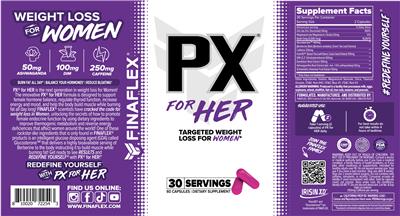
- Form
- Capsule
- Serving Size
- 2 Capsules
- Servings
- 30 per container
- Container Holds
- 60 Capsules
What’s in it, whether it interacts with your drugs, its side effects, whether it works, and what our pharmacists would want you to know before you start it.
- What is PX For Her?A supplement from FINAFLEX with ten active ingredients, in capsule form.
- Active Ingredients 1 vitamin, 2 minerals, 3 plant ingredients and 4 others: Zinc 50 mgMagnesium 50 mgBiotin 5 mgGlucosterone 450 mgCaffeine 250 mgIrisinXD 100 mg3,3'-Diindolymethane 100 mgDandelion Root Extract 100 mgAshwagandha Root Extract 50 mgSchisandra chinensis fruit extract 50 mg Ten active ingredients. Each one can interact with drugs or cause side effects on its own, so we check every one. The full Supplement Facts
- Drug Interactions 1,659 drugs have a documented interaction with this supplement; the most serious is rated major. Of those, 1,172 are single drugs and 487 are combination products (two or more drugs in one), each listed under its own name. Based on the 8 of its 10 ingredients we could check. Ask your pharmacist first if you take a drug in any of these categories, the most serious of the 83 on record:
- EphedrineMajor · 8 drugs
- Levodopa/
Carbidopa (Sinemet) Major · 6 drugs - Moderate · 645 drugs
- Moderate · 372 drugs
- Possible Side EffectsNausea 6 ingredientsStomach upset 6 ingredientsDiarrhea 3 ingredientsHeadache 2 ingredientsFeeling jitteryNervous +23 moreReported for eight of its ten active ingredients. Not studied in this exact product.
- Well documented Why
Does PX For Her work?
What It Is Marketed For
Weight loss and hormone balance for women
From the claims on the product’s label.
The Closest Use the Research Grades
Caffeine
Some studies support it, but the evidence isn’t conclusive.
Its ingredients have stronger research for other uses:
- Zinc deficiency Zinc
- Magnesium
- Magnesium
- Caffeine
- Mental alertness Caffeine
- Ashwagandha
These grades are for each ingredient, not this exact product, and never a promise it will work for you.
And 22 more graded uses, in what the research says- Full Why
- AllergensNone of its ingredient names point to a major food allergen
- Barcode (UPC)8 10020 72254 3Match it to the barcode on your bottle to be sure this is your product. Not your product? Search for it here
Who Might Consider It
- People looking for weight loss and hormone balance for women, which is what it is marketed for. The closest use the research grades is obesity, rated Possibly Effective.
- People who want it for zinc deficiency, constipation, dyspepsia, athletic performance or another graded use: the other uses with research behind them. See each grade
- PX For Her may be worth considering if you want its ingredients for their rated uses, such as zinc or magnesium for deficiency or digestive concerns, and you have checked your medications.
Who Should Be Careful
- People who take prescription drugs, have kidney disease, thyroid problems, heart conditions, or hormone-sensitive conditions, or are pregnant or breastfeeding should be careful.
- Talk it over with your own doctor or pharmacist before starting.
More Before You Take It Show both answersHide Pregnancy and Breastfeeding The Label’s Directions
-
Pregnant or breastfeeding?
- Pregnancy Zinc
- ! When used orally in doses exceeding the UL.
- Breastfeeding Zinc
- ! When used orally in doses exceeding the UL.
- Pregnancy and Breastfeeding Magnesium
- ! When used orally in excessive doses.
- Pregnancy Caffeine
- ! When used orally in amounts over 300 mg daily.
- Breastfeeding Caffeine
- ! When used orally in large amounts.
-
How does the label say to take it?
“Suggested use: Take 1 serving (2 capsules) of PX for Her Daily. For best results do not take with 4 hours of bedtime.”
The maker’s words. Your pharmacist or doctor may advise differently.
Everything the label says
From the label dated Jul 24, 2025: 8 of its 10 active ingredients were checked against our records; the other two are not in them yet. A summary of what is known, not a grade or a test of the product. How these ratings are computed
Ask Anything About This Supplement
Name a drug you take, or ask about side effects, ingredients or pregnancy.
AI answers come from this label and our own records, never the open internet. AI can make mistakes, so always check with your doctor or pharmacist. How we use AI
Ask the Pharmacist
A licensed pharmacist will answer your question by email — free, usually within 24 hours.
Got it — thank you!
A licensed pharmacist will answer within 24 hours. Keep an eye on your email (worth checking spam, just in case).
What’s Inside PX For Her by FINAFLEX
Ten Active Ingredients, Each Checked on Its Own
A supplement is often several ingredients in one bottle, and each one can interact with drugs or cause side effects on its own. We check every one of them against our records.
- ZincDrug interactions on record, most serious: Moderate
- MagnesiumDrug interactions on record, most serious: Major
- BiotinNo drug interactions on record
- GlucosteroneNot in our interaction records yet
- CaffeineDrug interactions on record, most serious: Major
- IrisinXDNot in our interaction records yet
- 3,3'-DiindolymethaneDrug interactions on record, most serious: Moderate
- Dandelion Root ExtractDrug interactions on record, most serious: Moderate
And 2 more, each with its own card below.
Why this rating?
The label gives an exact amount for every one of its ten active ingredients, so you know how much of each you get in each serving. This rates what the label tells you, not the quality of the product.
Supplement Facts
| Amount Per Serving | % Daily Value | |
|---|---|---|
| Zinc | 50 mg | 450% |
| Magnesium | 50 mg | 12% |
| Biotin | 5 mg | 16667% |
| Glucosterone | 450 mg | † |
| Caffeine | 250 mg | † |
| IrisinXD | 100 mg | † |
| 3,3'-Diindolymethane | 100 mg | † |
| Dandelion Root Extract | 100 mg | † |
| Ashwagandha Root Extract | 50 mg | † |
| Schisandra chinensis fruit extract | 50 mg | † |
Other ingredients: Gelatin, Magnesium Stearate, Silica, Titanium Dioxide, FD&C Red #40, FD&C Blue #1, FD&C red #3
† Daily Value not established.
Daily Values for adults and children 4 or more years of age.
As the label prints it, from the NIH Dietary Supplement Label Database.
Each Ingredient and Its Drug Interactions
Tap one for more about it and its full guide. A drug can interact with this supplement through any one of them.
PX For Her contains 10 active ingredients: biotin, zinc, magnesium, caffeine, 3,3'-diindolymethane, dandelion root extract, schisandra chinensis fruit extract, Glucosterone, IrisinXD, and ashwagandha root extract.
- Biotin's main use is rated biotin deficiency, zinc's as zinc deficiency, magnesium's as constipation and dyspepsia (indigestion), and caffeine as a stimulant that can affect mental alertness.
-
Zinc 50 mg Interacts with 67 drugs
Form on the label: Zinc Gluconate
Zinc is an essential mineral that your body needs for immune function, wound healing, taste, and smell.
- Most people get enough from food, but supplements can help correct or prevent a deficiency.
- Taking too much zinc for too long can cause harm, so check with a pharmacist or doctor before using high-dose supplements.
The full Zinc guide: uses, dosage and safety Every Zinc drug interaction
-
Magnesium 50 mg Interacts with 298 drugs
Form on the label: Magnesium Citrate
Magnesium is an essential mineral your body needs for muscles, nerves, blood pressure, and many other functions, and supplements are useful for preventing or correcting deficiency.
- Some other uses, like easing constipation or preventing migraines, have reasonable support, while uses for sleep and anxiety are less proven.
- It is generally safe for most healthy people at recommended amounts, but talk to your pharmacist or doctor before starting, especially if you have kidney problems.
The full Magnesium guide: uses, dosage and safety Every Magnesium drug interaction
-
Biotin 5 mg No known drug interactions
Biotin (vitamin B7) is a water-soluble vitamin your body needs to turn food into energy and to support healthy hair, skin, and nails.
- Most people get plenty from a normal diet, and true deficiency is rare.
- Supplements are widely sold for hair and nail health, but solid evidence for these benefits is limited in people who are not deficient, and high doses can interfere with certain lab tests.
-
Glucosterone 450 mg A blend: its ingredients are checked one by one where the label lists them
Form on the label: Berberine, Green Tea Leaf Extract
-
Caffeine 250 mg Interacts with 655 drugs
Caffeine is a natural stimulant found in coffee, tea, and many other plants and products.
- In moderate amounts it can boost alertness and reduce tiredness for most healthy adults, but too much can cause jitteriness, a racing heart, and sleep problems.
- Pregnant women and people with heart conditions or anxiety should be especially careful and check with a doctor or pharmacist.
The full Caffeine guide: uses, dosage and safety Every Caffeine drug interaction
-
IrisinXD 100 mg A blend: its ingredients are checked one by one where the label lists them
Form on the label: Cacao Seed Extract, Green Tea Leaf Extract
-
3,3'-Diindolymethane 100 mg Interacts with 269 drugs
Diindolylmethane (DIM) is a compound made when your body digests cruciferous vegetables, and it is sold as a supplement mainly for hormone balance and cancer prevention.
- Although early lab studies look interesting, strong human evidence is lacking for most of these uses.
- Talk with your pharmacist or doctor before taking DIM, especially if you have a hormone-sensitive condition.
The full Diindolylmethane guide: uses, dosage and safety Every Diindolylmethane drug interaction
-
Dandelion Root Extract 100 mg Interacts with 457 drugs
Dandelion is a common plant used in food and traditional medicine, often promoted as a natural 'water pill' and digestive aid.
- Human evidence for these uses is very limited, so its benefits are not well proven.
- It is generally considered safe as a food, but talk to your pharmacist or doctor before using concentrated supplements, especially if you have allergies or take other medicines.
The full Dandelion guide: uses, dosage and safety Every Dandelion drug interaction
-
Ashwagandha Root Extract 50 mg Interacts with 1,373 drugs
Form on the label: Withanolides
Ashwagandha is an Ayurvedic herb most often taken to help with stress, anxiety, and sleep, and some small studies suggest it may help, though the evidence is still limited.
- It is generally well tolerated for short-term use in healthy adults, but it should be avoided in pregnancy and used cautiously by people with thyroid or liver problems.
- Talk with your pharmacist or doctor before starting it.
The full Ashwagandha guide: uses, dosage and safety Every Ashwagandha drug interaction
-
Schisandra chinensis fruit extract 50 mg Interacts with 804 drugs
Schisandra is a traditional Chinese medicine berry used as an adaptogen for stress, fatigue, and liver support.
- Human evidence is limited and most claims are not well proven, but it appears reasonably well tolerated by most healthy adults when used short term.
- Pregnant and breastfeeding people should avoid it, and anyone with a health condition should check with a pharmacist or doctor first.
The full Schisandra guide: uses, dosage and safety Every Schisandra drug interaction
Other Ingredients (Inactive)
The capsule or tablet itself, fillers, coatings and flavors. Not part of the drug interaction check; the allergen check below reads them.
- Gelatin
- Magnesium Stearate
- Silica
- Titanium Dioxide
- FD&C Red #40
- FD&C Blue #1
- FD&C red #3
Allergens in PX For Her
None of its ingredient names point to a major food allergen.
Named on this label
- Gelatin (animal-derived)In the ingredients: Gelatin
Not named in the ingredients
- Milk
- Egg
- Fish
- Shellfish
- Tree nuts
- Peanuts
- Wheat or other gluten grains
- Soy
- Sesame
- The label’s allergen statement“Allergen Warning: Produced in a facility that processes milk, eggs, soybeans, wheat, shellfish, fish oil, tree nuts, sesame, and peanuts.”
From the label text and ingredient names on file; we do not test products. With a serious allergy, check your bottle and ask the maker or your pharmacist.
What the Label Says
The maker’s own words, from the label. We do not verify or endorse them.
- Formulation
-
“Weight loss for women Burn fat all day | Balance your hormones | Reduce bloating PX for HER is the next generation in weight loss for Women! The innovative PX for HER formula is designed to support female hormone balance, regulate thyroid function, increase energy and mood, and help the body build muscle while burning fat all day long! FINAFLEX scientists have cracked the code for weight loss in Women, unlocking the secrets of how to promote female endocrine function by using dietary ingredients to improve thermogenic metabolism and reverse energy deficiencies that affect women around the world!”
“Get ready to see RESULTS and REDEFINE YOURSELF with PX for HER! Redefine Yourself with PX for Her Targeted weight loss for women”
2 more from the label
“50 mg Ashwagandha 100 mg DIM 250 mg Caffeine One of these rockstar-like ingredients that is only found in FINAFLEX products is an intelligent glucose disposing agent (GDA) called Glucosterone that delivers a highly bioavailable serving of Berberine to the body instructing it to build muscle while burning fat!”
“Weight loss for women”
- General statements
-
“Find us online: Instagram Facebook TikTok YouTube www.FINAFLEX.com”
“Join the FINAFLEX Family”
- FDA Statement of Identity
-
“Dietary Supplement”
- Brand IP Statement(s)
-
“FINAFLEX #Redefine Yourself”
“IrisinXD and Glucosterone are trademarks of FINAFLEX.”
- Seals and symbols
-
“GMP Certified Good Manufacturing Practice U.S.A. Made Domestic & Imported Ingredients FDA Registered Facility”
- Storage
-
“Sold by capsule count, not volume. Store under cool, dry conditions, ideally 50-80 degrees F.”
The PX For Her Label on File
The label scan on file at the NIH Dietary Supplement Label Database, dated July 2025. Always read the label on the bottle you have.
Product Facts
- Brand
- FINAFLEX
- Barcode (UPC)
- 810020722543
- Net contents
- 60 Capsules
- Market status
- On market
- Date entered into DSLD
- Jul 24, 2025
- DSLD ID
- 333680
- Product type
- Other Combinations
- Supplement form
- Capsule
- Dietary claims / uses
- All Other, Structure/Function
- Intended target group(s)
- Women (not pregnant or lactating), Adult Female (18 - 50 Years)
Is this label outdated? Report a formula or label change and our pharmacy team will review it.
PX For Her by FINAFLEX Side Effects
Why this rating?
We look for three kinds of safety information on each ingredient: side effects reported in studies, a pregnancy and breastfeeding rating, and a safety write-up from our pharmacy team. All three are on file for each of the eight ingredients we could check.
So this rates how much is known, not whether PX For Her is right for you.
Reported with eight of its ingredients
- Most often
- Nausea, stomach upset, diarrhea, headache, feeling jittery and nervous
- !Rare but serious
- Liver problems, possible changes in thyroid function and drug rash with eosinophilia See details
HelloPharmacist Team Summary of Side Effects
Most people tolerate the zinc and magnesium in PX For Her well, but you may notice stomach upset, nausea, or digestive discomfort, mainly from zinc and magnesium.
- The caffeine may cause jitteriness, a racing heartbeat, or trouble sleeping, and the ashwagandha may make you drowsy, so see how it affects you before driving.
- Liver problems are rare but serious, and if you notice yellowing skin, dark urine, or unusual fatigue, call your doctor right away.
- Talk with your own doctor or pharmacist before starting if you have kidney disease, a thyroid condition, heart problems, or are pregnant or breastfeeding.
Side Effects, Ingredient by Ingredient
A supplement’s side effects come from its ingredients. Here is what is reported with each one.
Zinc
Most reported
- Nausea
- Stomach upset
- Vomiting
- Metallic taste
Magnesium
Most reported
- Diarrhea
- Nausea
- Stomach cramping
- Bloating
Biotin
Most reported
- Stomach upset
- Nausea
- Digestive discomfort
Caffeine
Most reported
- Feeling jittery, nervous, or anxious
- Racing or pounding heartbeat
- Trouble sleeping
- Upset stomach or heartburn
Diindolylmethane
Most reported
- Headache
- Nausea or upset stomach
- Gas or changes in bowel habits
- Darkening of the urine (a harmless color change some people notice)
Dandelion
Most reported
- Stomach upset, heartburn, or diarrhea
- Increased urination (from its possible diuretic effect)
Ashwagandha
Most reported
- Upset stomach, nausea, or diarrhea
- Drowsiness or sleepiness
- Headache
Schisandra
Most reported
- Heartburn or stomach upset
- Decreased appetite
- Nausea or stomach pain
- Skin rash (uncommon)
PX For Her Warnings: Who Should Be Careful
PX For Her has ten active ingredients, and each can carry warnings of its own. We checked the eight in our ingredient guides, and each warning below names the ingredient it comes from. Glucosterone and IrisinXD are not in our guides yet, so ask your pharmacist about them. If any of these apply to you, talk to your doctor or pharmacist before you start it.
- Zinc2 warnings below
- Magnesium4 warnings below
- Biotin1 warning below
- Caffeine2 warnings below
- Diindolylmethane2 warnings below
- Dandelion2 warnings below
- Ashwagandha2 warnings below
- Schisandra2 warnings below
- GlucosteroneNot in our guides yet
- IrisinXDNot in our guides yet
-
Bleeding Problems or Surgery
- DiindolylmethaneAlways tell your pharmacist or doctor about any supplements you take, especially before surgery or if you have a chronic medical condition.
- AshwagandhaPeople with autoimmune conditions or those scheduled for surgery should also check with their doctor first.
- SchisandraPeople scheduled for surgery and those taking prescription medicines should also check with a pharmacist before use.
-
Blood Pressure
- CaffeineBe cautious if you: have heart problems, high blood pressure, an irregular heartbeat, anxiety, panic attacks, trouble sleeping, stomach ulcers, or seizure disorders.
-
Liver Disease
- SchisandraUse extra caution and talk to a healthcare provider if you have liver disease, acid reflux or stomach ulcers, epilepsy, or a condition affected by hormones.
-
Kidney Disease or Kidney Stones
- MagnesiumThe biggest safety concern is in people with kidney disease, because damaged kidneys cannot remove extra magnesium, which can build up to dangerous levels.
- MagnesiumIf you have kidney problems, do not take magnesium supplements unless your doctor tells you to.
- DandelionWho should be cautious: People with gallbladder problems, blocked bile ducts, or kidney disease should talk to a doctor first, since dandelion may affect bile flow and fluid balance.
-
Heart Conditions
- MagnesiumPeople with heart conduction problems or certain bowel conditions should also be cautious.
-
Stomach or Bowel Problems
- ZincPeople with digestive disorders, those who drink heavily, and people on restrictive diets are more likely to be low in zinc and may need supplements.
-
Thyroid Conditions
- AshwagandhaUse caution if you have a thyroid condition, since ashwagandha may affect thyroid hormone levels.
-
Hormone-Sensitive Conditions
- DiindolylmethaneBecause DIM may affect hormone activity, people with hormone-sensitive conditions (such as certain breast, uterine, or prostate cancers, or endometriosis) should be especially careful and talk with their doctor first.
-
Children
- CaffeineChildren and teens should limit caffeine.
-
Other Cautions
- ZincAnyone considering high-dose or long-term zinc should talk to a pharmacist or doctor first.
- BiotinAnyone with an existing medical condition, or who is having lab work done, should check with a pharmacist or doctor first.
- DandelionBecause it may act as a mild diuretic, use caution if you are already taking water pills or have conditions affected by fluid loss.
-
What the Label Warns
- “Warning: Keep out of reach of children. Intended for healthy adults over 18.”
- “Do not use if pregnant or nursing. Consults a doctor or medical authority before use if you have a medical condition, a family history of health problems, or if you take other medicines or supplements.”
- “Do not exceed serving size. Stop use if you nave a bad reaction. Stop use after weeks Stop use 2 weeks before surgery. Do not combine with caffeine, stimulants, or alcohol. Consumer accepts all liability if used inconsistent with label. Do not discard desiccant.”
- “250 mg Caffeine per serving.”
- “California Prop 65 Warning: Lead - Cancer and Reproductive Harm www.P65Warnings.ca.gov”
The maker’s wording, from the product label.
-
Pregnant or Breastfeeding
Each ingredient’s rating for pregnancy and for breastfeeding, and what it covers.
Pregnancy
-
When used orally and appropriately.
Zinc is safe in amounts that do not exceed the tolerable upper intake level (UL) of 34 mg daily during pregnancy in those 14-18 years of age and 40 mg daily in those 19-50 years of age.
-
When used orally in doses exceeding the UL.
Breastfeeding
-
When used orally and appropriately.
Zinc is safe in amounts that do not exceed the tolerable upper intake level (UL) of 34 mg daily during lactation in those 14-18 years of age, and 40 mg daily for those 19-50 years of age.
-
When used orally in doses exceeding the UL.
Higher doses can cause zinc-induced copper deficiency in nursing infants.
Pregnancy and Breastfeeding The record rates both the same
-
When used orally and appropriately.
Magnesium is safe for those pregnant and breast-feeding when used in doses below the tolerable upper intake level (UL) of 350 mg daily.
-
When used orally in excessive doses.
Tell patients to avoid exceeding the tolerable upper intake level (UL) of 350 mg daily.
Taking magnesium orally in higher doses can cause diarrhea.
2 more ratings for Magnesium used another way
This supplement is taken by mouth. These ratings are for Magnesium given another way.
-
When prescription magnesium sulfate is given intramuscularly and intravenously prior to delivery for up to 5 days.
However, due to potential adverse effects associated with intravenous and intramuscular magnesium, use during pregnancy is limited to patients with specific conditions such as severe pre-eclampsia or eclampsia.
5 more points on this rating
- There is some evidence that intravenous magnesium can increase fetal mortality and adversely affect neurological and skeletal development.
- However, a more recent analysis of clinical research shows that increased risk of fetal mortality seems to occur only in the studies where antenatal magnesium is used for tocolysis and not for fetal neuroprotection or pre-eclampsia/eclampsia.
- Furthermore, antenatal magnesium does not seem to be associated with increased risk of necrotizing enterocolitis in preterm infants.
- There is also concern that magnesium increases the risk of maternal adverse events.
- A meta-analysis of clinical research shows that magnesium sulfate might increase the risk of maternal adverse events, especially in Hispanic mothers compared to other racial and ethnic groups.
-
When prescription magnesium sulfate is given intramuscularly and intravenously prior to delivery for longer than 5 days.
Maternal exposure to magnesium for longer than 5-7 days is associated with an increase in neonatal bone abnormalities such as osteopenia and fractures.
The U.S. Food and Drug Administration (FDA) recommends that magnesium injection not be given for longer than 5-7 days.
Show 6 more ingredients
Pregnancy
-
When used orally in amounts commonly found in foods.
Intakes of caffeine should be monitored during pregnancy.
10 more points on this rating
- Caffeine crosses the human placenta, but is not considered a teratogen.
- Fetal blood and tissue levels are similar to maternal concentrations.
- The use of caffeine during pregnancy is controversial; however, moderate consumption has not been associated with clinically important adverse fetal effects.
- In some studies consuming amounts over 200 mg daily is associated with a significantly increased risk of miscarriage.
- This increased risk seems to occur in those with genotypes that confer a slow rate of caffeine metabolism.
- According to a review by Health Canada, and a subsequent large meta-analysis conducted in the US, up to 300 mg daily can be consumed during pregnancy without an increased risk of spontaneous abortion, stillbirth, preterm birth, fetal growth retardation, or congenital malformations.
- However, observational research in a Norwegian cohort found that caffeine consumption is associated with a 16% increased odds of the baby being born small for gestational age when compared with no consumption.
- The same Norwegian cohort found that low to moderate caffeine consumption during pregnancy is not associated with changes in neurodevelopment in children up to 8 years of age.
- Advise patients to keep caffeine consumption below 300 mg daily during pregnancy.
- This is similar to the amount of caffeine in about 3 cups of coffee or tea.
-
When used orally in amounts over 300 mg daily.
Caffeine crosses the placenta, producing fetal blood concentrations similar to maternal levels.
8 more points on this rating
- Consumption of caffeine in amounts over 300 mg daily is associated with a significantly increased risk of miscarriage in some studies.
- Advise patients to keep caffeine consumption below 300 mg daily during pregnancy.
- This is similar to the amount of caffeine in about 3 cups of coffee or tea.
- Additionally, high doses of caffeine throughout pregnancy have resulted in symptoms of caffeine withdrawal in newborn infants.
- High doses of caffeine have also been associated with spontaneous abortion, premature delivery, and low birth weight.
- In a cohort of mother/infant pairs with a median maternal plasma caffeine level of 168.5 ng/mL (range 29.5-650.5 ng/mL) during pregnancy, birth weights and lengths were lower in the 4th quartile of caffeine intake compared with the 1st.
- By age 7, heights and weights were lower by 1.5 cm and 1.1 kg respectively.
- In another cohort of mother/infant pairs with higher maternal pregnancy plasma caffeine levels, median 625.5 ng/mL (range 86.2 to 1994.7 ng/mL), heights at age 8 were 2.2 cm lower, but there was no difference in weights.
Breastfeeding
-
When used orally in amounts commonly found in foods.
Caffeine intake should be closely monitored while breast-feeding.
During lactation, breast milk concentrations of caffeine are thought to be approximately 50% of serum concentrations and caffeine peaks in breastmilk approximately 1-2 hours after consumption.
-
When used orally in large amounts.
Caffeine is excreted slowly in infants and may accumulate.
Caffeine can cause sleep disturbances, irritability, and increased bowel activity in breast-fed infants exposed to caffeine.
Pregnancy
-
When used orally.
Some evidence suggests schisandra fruit is a uterine stimulant.
Breastfeeding
-
Insufficient reliable information available; avoid using.
Pregnancy and Breastfeeding The record rates both the same
-
Insufficient reliable information available; avoid using amounts greater than those in foods.
Pregnancy
-
There is insufficient reliable information available about the safety of oral ashwagandha when used during pregnancy.
Historically, ashwagandha has been linked to abortifacient effects; however, there are no reliable case reports of harm in pregnancy.
2 more points on this rating
- Although one clinical study in pregnant females in their second trimester reported no adverse events with use of ashwagandha 300 mg twice daily for 12 weeks, abortifacient activity, developmental outcomes, and fetal toxicity were not assessed.
- Until more is known about the safety of ashwagandha, avoid using during pregnancy.
Breastfeeding
-
Insufficient reliable information available; avoid using.
Pregnancy and Breastfeeding The record rates both the same
-
When used orally and appropriately.
Biotin has been safely used at the adequate intake (AI) dose of 30 mcg daily during pregnancy and 35 mcg daily during lactation.
2 more points on this rating
- It has also been used in supplemental doses of up to 300 mcg daily.
- A tolerable upper intake level (UL) has not been established.
Pregnancy and Breastfeeding The record rates both the same
-
When used orally in amounts commonly found in foods.
The typical diet supplies 2-24 mg of diindolylmethane daily.
There is insufficient reliable information available about the safety of diindolylmethane when used in amounts greater than those found in foods during pregnancy and lactation; avoid using.
Our pharmacy team’s notes
- Pregnancy ratings differ by ingredient.
- Zinc, magnesium, and caffeine each carry mixed pregnancy ratings, and dandelion and ashwagandha have no pregnancy data.
- If you are pregnant, breastfeeding, or planning to be, talk with your doctor about this product.
Ratings and the words beside them are from the Natural Medicines database, which we license.
-
Rare but Serious Side Effects
-
!
Zinc
Very high single doses can cause more serious stomach symptoms.
Orally: There have been cases of acute renal tubular necrosis, interstitial nephritis, neurological complications, severe vomiting, and sideroblastic anemia after zinc overdose.
-
!
Magnesium
Rare but serious side effects happen mostly with very high doses or in people with poor kidney function.
With toxic doses, loss of reflexes and respiratory depression can occur. High doses in pregnancy can increase risk of neonatal mortality and neurological defects.
-
!
Biotin
Serious side effects are rare.
-
!
Caffeine
Serious effects are rare but can happen with very high doses.
Caffeine is generally well tolerated in moderate amounts, but high doses can cause serious side effects.
Orally: Stroke has been reported rarely.
-
!
Diindolylmethane
Orally: Drug rash with eosinophilia and systemic symptoms (DRESS).
-
!
Dandelion
Rarely, serious allergic reactions can occur.
Orally: Anaphylaxis in sensitive individuals.
-
!
Ashwagandha
Rare but serious effects include liver problems and possible changes in thyroid function.
Orally: Some case reports raise concerns about acute hepatitis, acute liver failure, hepatic encephalopathy, the need for liver transplantation, and death due to liver failure with ashwagandha treatment.
-
!
Schisandra
Serious reactions are rare.
When to get help: a serious allergic reaction, with trouble breathing or swelling of the face, lips or throat, needs emergency care: call 911. For any other side effect that worries you, call your doctor or pharmacist.
These reports describe each ingredient, not studies of this exact product. Not medical advice: a side effect you notice after starting a supplement is worth a word with your pharmacist or doctor.
PX For Her by FINAFLEX Drug Interactions
We checked all ten active ingredients in this supplement against every drug in our records. A drug can interact with it through any one of them. Glucosterone and IrisinXD are not in our interaction records yet.
A major interaction on record
3 of 3, on a scale from Minor or none to Major.Why this rating?
We rate this by the most serious interaction on record, not by how many there are. For Schisandra, Dandelion, Ashwagandha, Caffeine and Zinc, the most serious is rated major, which means the combination is best avoided, or used only under close supervision. Some involve kinds of drugs where a small change can matter, such as blood thinners, transplant drugs and diabetes drugs.
1,660 drugs are on the full list. What matters is whether one you take is on it, so check yours with the interaction checker on this page.
Seven of its ten active ingredients have drug interactions on record. The ones below matter most. We have no interaction records for Biotin, Glucosterone and IrisinXD.
- Interacts with
- 1,373 drugs
- Most serious
- Moderate
- Most of its records involve Cytochrome P450 3A4 (CYP3A4) Substrates, Hepatotoxic Drugs and CNS Depressants.
- Interacts with
- 804 drugs
- Most serious
- Moderate
- Most of its records involve Cytochrome P450 3A4 (CYP3A4) Substrates, P-glycoprotein Substrates and Cytochrome P450 2C9 (CYP2C9) Substrates.
- Interacts with
- 655 drugs
- Most serious
- Major
- Most of its records involve Stimulant Drugs, Anticoagulant/Antiplatelet Drugs and Cytochrome P450 1A2 (CYP1A2) Inhibitors.
Show three more ingredients
- Interacts with
- 457 drugs
- Most serious
- Moderate
- Most of its records involve Cytochrome P450 1A2 (CYP1A2) Substrates, Glucuronidated Drugs and Anticoagulant/Antiplatelet Drugs.
- Interacts with
- 298 drugs
- Most serious
- Major
- Most of its records involve Anticoagulant/Antiplatelet Drugs, Skeletal Muscle Relaxants and Potassium-sparing Diuretics.
- Interacts with
- 269 drugs
- Most serious
- Moderate
- Most of its records involve Cytochrome P450 1A2 (CYP1A2) Substrates, Diuretic Drugs and Estrogens.
And one more ingredient with records, each in the cards below.
From the HelloPharmacist Team
Looking at the supplement as a whole rather than one ingredient at a time:
- PX For Her by FINAFLEX has documented interactions with medications through several of its ingredients: magnesium, caffeine, zinc, ashwagandha, schisandra, dandelion root, and 3,3'-diindolymethane.
- The most serious interactions are rated Major.
- Magnesium can reduce how much levodopa/carbidopa (Sinemet) your body absorbs, and caffeine combined with ephedrine can increase the risk of serious stimulant side effects.
Summarized by the HelloPharmacist pharmacy team from the interaction records below. How it is written How we use AI
Why PX For Her Interacts, Ingredient by Ingredient
A product interacts through its ingredients. Each card: how many drugs, the most serious rating, and the kinds of drugs it affects most (tap a kind for what it means).
The ingredients driving the most interactions
-
Ashwagandha Root Extract 1,373 drugs
Most serious: Moderate10 interaction records on file
The kinds of drugs it affects most
- 645 drugs
- 372 drugs
- 248 drugs
- 186 drugs
Every Ashwagandha drug interaction, 10 records The Ashwagandha records cite 32 references, listed in the Ashwagandha guide.
-
Schisandra chinensis fruit extract 804 drugs
Most serious: Moderate12 interaction records on file
The kinds of drugs it affects most
- 645 drugs
- 202 drugs
- 112 drugs
- 72 drugs
Every Schisandra drug interaction, 12 records The Schisandra records cite 26 references, listed in the Schisandra guide.
-
Caffeine 655 drugs
Most serious: Major41 interaction records on file
The kinds of drugs it affects most
- 172 drugs
- 122 drugs
- 90 drugs
- 86 drugs
Every Caffeine drug interaction, 41 records The Caffeine records cite 235 references, listed in the Caffeine guide.
-
Dandelion Root Extract 457 drugs
Most serious: Moderate7 interaction records on file
The kinds of drugs it affects most
- 186 drugs
- 124 drugs
- 122 drugs
- 86 drugs
Every Dandelion drug interaction, 7 records The Dandelion records cite 27 references, listed in the Dandelion guide.
-
Magnesium 298 drugs
Most serious: Major16 interaction records on file
The kinds of drugs it affects most
- 122 drugs
- Skeletal Muscle Relaxants 36 drugs
- 23 drugs
- 22 drugs
Every Magnesium drug interaction, 16 records The Magnesium records cite 84 references, listed in the Magnesium guide.
-
3,3'-Diindolymethane 269 drugs
Most serious: Moderate3 interaction records on file
The kinds of drugs it affects most
- 186 drugs
- 75 drugs
- 41 drugs
Every Diindolylmethane drug interaction, 3 records The Diindolylmethane records cite 14 references, listed in the Diindolylmethane guide.
-
Zinc 67 drugs
Most serious: Moderate10 interaction records on file
The kinds of drugs it affects most
- 21 drugs
- 20 drugs
- Bictegravir/Emtricitabine/Tenofovir Alafenamide (Biktarvy) 13 drugs
- Ritonavir (Norvir) 7 drugs
Every Zinc drug interaction, 10 records The Zinc records cite 88 references, listed in the Zinc guide.
The Breakdown by Severity
Each drug counted once, at its most serious rating. Tap a tile to list those drugs.
Find Your Drug
Type a drug or brand name to see whether it is on the list.
- Only drugs with a documented interaction are listed, the most serious first.
- A drug with no known interaction is not listed, but searching its name tells you so.
- Open a drug to see which ingredient is responsible. Of those, 1,172 are single drugs and 487 are combination products (two or more drugs in one), each listed under its own name.
-
LevodopaInbrija, Larodopa Major
The ingredient responsible:
-
Magnesium Major
Magnesium can reduce the bioavailability of levodopa/carbidopa.
The full Magnesium + Levodopa interaction
-
-
CarbidopaLodosyn Major
The ingredient responsible:
-
Magnesium Major
Magnesium can reduce the bioavailability of levodopa/carbidopa.
The full Magnesium + Carbidopa interaction
-
-
Carbidopa and LevodopaDhivy, Rytary, Sinemet, Sinemet CR Major
The ingredient responsible:
-
Magnesium Major
Magnesium can reduce the bioavailability of levodopa/carbidopa.
The full Magnesium + Carbidopa and Levodopa interaction
-
-
Aminophylline, Amobarbital, and EphedrineAmesec Major
The 2 ingredients responsible:
-
Caffeine Major Aminophylline, Amobarbital, and Ephedrine is in these Ephedrine, Stimulant Drugs categories.
Theoretically, concomitant use might increase the risk for stimulant adverse effects.
The full Caffeine + Aminophylline, Amobarbital, and Ephedrine interaction -
Ashwagandha Root Extract Moderate Aminophylline, Amobarbital, and Ephedrine is in the CNS Depressants category.
Theoretically, taking ashwagandha might increase the sedative effects of CNS depressants.
The full Ashwagandha Root Extract + Aminophylline, Amobarbital, and Ephedrine interaction
-
-
Ephedrine, Phenobarbital, and TheophyllineTedral Major
The 2 ingredients responsible:
-
Caffeine Major It contains phenobarbital and ephedrine, the drugs these records are about. Ephedrine, Phenobarbital, and Theophylline is in these Stimulant Drugs, Theophylline categories.
Theoretically, concomitant use might increase stimulant adverse effects.
The full Caffeine + Ephedrine, Phenobarbital, and Theophylline interaction -
Ashwagandha Root Extract Moderate Ephedrine, Phenobarbital, and Theophylline is in the CNS Depressants category.
Theoretically, taking ashwagandha might increase the sedative effects of CNS depressants.
The full Ashwagandha Root Extract + Ephedrine, Phenobarbital, and Theophylline interaction
-
-
Ephedrine, Phenobarbital, Potassium Iodide, and TheophyllineMudrane, Quadrinal Major
The 2 ingredients responsible:
-
Caffeine Major It contains phenobarbital and ephedrine, the drugs these records are about. Ephedrine, Phenobarbital, Potassium Iodide, and Theophylline is in these Theophylline, Stimulant Drugs categories.
Theoretically, caffeine might increase the levels and adverse effects of theophylline.
The full Caffeine + Ephedrine, Phenobarbital, Potassium Iodide, and Theophylline interaction -
Ashwagandha Root Extract Moderate Ephedrine, Phenobarbital, Potassium Iodide, and Theophylline is in the CNS Depressants category.
Theoretically, taking ashwagandha might increase the sedative effects of CNS depressants.
The full Ashwagandha Root Extract + Ephedrine, Phenobarbital, Potassium Iodide, and Theophylline interaction
-
-
Benserazide and LevodopaMadopar, Prolopa Major
The ingredient responsible:
-
Magnesium Major
Magnesium can reduce the bioavailability of levodopa/carbidopa.
The full Magnesium + Benserazide and Levodopa interaction
-
-
Carbetapentane Tannate, Chlorpheniramine Tannate, Ephedrine Tannate, and Phenylephrine TannateQuadratuss, Ry Tuss, Rynatuss, Tri Tannate Plus Major
The 3 ingredients responsible:
-
Caffeine Major Carbetapentane Tannate, Chlorpheniramine Tannate, Ephedrine Tannate, and Phenylephrine Tannate is in these Ephedrine, Stimulant Drugs categories.
Theoretically, concomitant use might increase the risk for stimulant adverse effects.
The full Caffeine + Carbetapentane Tannate, Chlorpheniramine Tannate, Ephedrine Tannate, and Phenylephrine Tannate interaction -
Schisandra Chinensis Fruit Extract Moderate Carbetapentane Tannate, Chlorpheniramine Tannate, Ephedrine Tannate, and Phenylephrine Tannate is in the Cytochrome P450 3A4 (CYP3A4) Substrates category.
Schisandra can increase the levels and clinical effects of drugs metabolized by CYP3A4.
The full Schisandra Chinensis Fruit Extract + Carbetapentane Tannate, Chlorpheniramine Tannate, Ephedrine Tannate, and Phenylephrine Tannate interaction -
Ashwagandha Root Extract Minor Carbetapentane Tannate, Chlorpheniramine Tannate, Ephedrine Tannate, and Phenylephrine Tannate is in these Cytochrome P450 3A4 (CYP3A4) Substrates, Serotonergic Drugs categories.
Theoretically, ashwagandha might decrease the levels and clinical effects of CYP3A4 substrates.
The full Ashwagandha Root Extract + Carbetapentane Tannate, Chlorpheniramine Tannate, Ephedrine Tannate, and Phenylephrine Tannate interaction
-
-
Ephedrine, Hydroxyzine, and TheophyllineAmi Rax, Marax Major
The 4 ingredients responsible:
-
Caffeine Major It contains ephedrine, the drug this record is about. Ephedrine, Hydroxyzine, and Theophylline is in these Stimulant Drugs, Theophylline categories.
Theoretically, concomitant use might increase stimulant adverse effects.
The full Caffeine + Ephedrine, Hydroxyzine, and Theophylline interaction -
Dandelion Root Extract Moderate Ephedrine, Hydroxyzine, and Theophylline is in the Cytochrome P450 1A2 (CYP1A2) Substrates category.
Theoretically, dandelion might increase levels of drugs metabolized by CYP1A2.
The full Dandelion Root Extract + Ephedrine, Hydroxyzine, and Theophylline interaction -
3,3'-diindolymethane Minor Ephedrine, Hydroxyzine, and Theophylline is in the Cytochrome P450 1A2 (CYP1A2) Substrates category.
Theoretically, diindolylmethane might lower serum levels of CYP1A2 substrates.
The full 3,3'-diindolymethane + Ephedrine, Hydroxyzine, and Theophylline interaction -
Ashwagandha Root Extract Minor Ephedrine, Hydroxyzine, and Theophylline is in the Cytochrome P450 1A2 (CYP1A2) Substrates category.
Theoretically, ashwagandha might decrease the levels and clinical effects of CYP1A2 substrates.
The full Ashwagandha Root Extract + Ephedrine, Hydroxyzine, and Theophylline interaction
-
-
Ephedrine, Guaifenesin, Phenobarbital, and TheophyllineMudrane GG Major
The 4 ingredients responsible:
-
Caffeine Major It contains phenobarbital and ephedrine, the drugs these records are about. Ephedrine, Guaifenesin, Phenobarbital, and Theophylline is in these Theophylline, Stimulant Drugs categories.
Theoretically, caffeine might increase the levels and adverse effects of theophylline.
The full Caffeine + Ephedrine, Guaifenesin, Phenobarbital, and Theophylline interaction -
Ashwagandha Root Extract Moderate Ephedrine, Guaifenesin, Phenobarbital, and Theophylline is in these Cytochrome P450 1A2 (CYP1A2) Substrates, CNS Depressants categories.
Theoretically, ashwagandha might decrease the levels and clinical effects of CYP1A2 substrates.
The full Ashwagandha Root Extract + Ephedrine, Guaifenesin, Phenobarbital, and Theophylline interaction -
Dandelion Root Extract Moderate Ephedrine, Guaifenesin, Phenobarbital, and Theophylline is in the Cytochrome P450 1A2 (CYP1A2) Substrates category.
Theoretically, dandelion might increase levels of drugs metabolized by CYP1A2.
The full Dandelion Root Extract + Ephedrine, Guaifenesin, Phenobarbital, and Theophylline interaction -
3,3'-diindolymethane Minor Ephedrine, Guaifenesin, Phenobarbital, and Theophylline is in the Cytochrome P450 1A2 (CYP1A2) Substrates category.
Theoretically, diindolylmethane might lower serum levels of CYP1A2 substrates.
The full 3,3'-diindolymethane + Ephedrine, Guaifenesin, Phenobarbital, and Theophylline interaction
-
-
Dyphylline, Ephedrine, Guaifenesin, and PhenobarbitalLufyllin-EPG Major
The 2 ingredients responsible:
-
Caffeine Major It contains phenobarbital, the drug this record is about. Dyphylline, Ephedrine, Guaifenesin, and Phenobarbital is in these Stimulant Drugs, Ephedrine categories.
Theoretically, concomitant use might increase stimulant adverse effects.
The full Caffeine + Dyphylline, Ephedrine, Guaifenesin, and Phenobarbital interaction -
Ashwagandha Root Extract Moderate Dyphylline, Ephedrine, Guaifenesin, and Phenobarbital is in the CNS Depressants category.
Theoretically, taking ashwagandha might increase the sedative effects of CNS depressants.
The full Ashwagandha Root Extract + Dyphylline, Ephedrine, Guaifenesin, and Phenobarbital interaction
-
-
Levodopa and CarbidopaDuodopa Major
The ingredient responsible:
-
Magnesium Major
Magnesium can reduce the bioavailability of levodopa/carbidopa.
The full Magnesium + Levodopa and Carbidopa interaction
-
-
Ephedrine and Guaifenesin (otc Drug)Ephedrine Formula 400, Ephedrine Plus Tabs Major
The ingredient responsible:
-
Caffeine Major Ephedrine and Guaifenesin (otc Drug) is in the Stimulant Drugs category.
Theoretically, concomitant use might increase stimulant adverse effects.
The full Caffeine + Ephedrine and Guaifenesin (otc Drug) interaction
-
-
Carbidopa, Levodopa, and EntacaponeStalevo Major
The 2 ingredients responsible:
-
Magnesium Major
Magnesium can reduce the bioavailability of levodopa/carbidopa.
The full Magnesium + Carbidopa, Levodopa, and Entacapone interaction -
Dandelion Root Extract Moderate Carbidopa, Levodopa, and Entacapone is in the Glucuronidated Drugs category.
Theoretically, dandelion might increase the clearance of drugs that are UDP-glucuronosyltransferase substrates.
The full Dandelion Root Extract + Carbidopa, Levodopa, and Entacapone interaction
-
-
ApixabanEliquis Moderate
The 5 ingredients responsible:
-
Schisandra Chinensis Fruit Extract Moderate Apixaban is in these Cytochrome P450 3A4 (CYP3A4) Substrates, P-glycoprotein Substrates categories.
Schisandra can increase the levels and clinical effects of drugs metabolized by CYP3A4.
The full Schisandra Chinensis Fruit Extract + Apixaban interaction -
Dandelion Root Extract Moderate Apixaban is in the Anticoagulant/Antiplatelet Drugs category.
Theoretically, taking dandelion root along with anticoagulant or antiplatelet drugs might increase the risk of bruising and bleeding.
The full Dandelion Root Extract + Apixaban interaction -
Caffeine Moderate Apixaban is in the Anticoagulant/Antiplatelet Drugs category.
Theoretically, caffeine may increase the risk of bleeding if used with anticoagulant or antiplatelet drugs.
The full Caffeine + Apixaban interaction -
Ashwagandha Root Extract Minor Apixaban is in the Cytochrome P450 3A4 (CYP3A4) Substrates category.
Theoretically, ashwagandha might decrease the levels and clinical effects of CYP3A4 substrates.
The full Ashwagandha Root Extract + Apixaban interaction -
Magnesium Minor Apixaban is in the Anticoagulant/Antiplatelet Drugs category.
Theoretically, magnesium may have antiplatelet effects, but the evidence is conflicting.
The full Magnesium + Apixaban interaction
-
-
LevothyroxineEltroxin, Estre, Euthyrox, Levo-T, Levolet and 6 more Moderate
The 2 ingredients responsible:
-
Ashwagandha Root Extract Moderate Levothyroxine is in the Thyroid Hormone category.
Ashwagandha might increase the effects and adverse effects of thyroid hormone.
The full Ashwagandha Root Extract + Levothyroxine interaction -
Magnesium Moderate
Magnesium might decrease levothyroxine levels by reducing its absorption.
The full Magnesium + Levothyroxine interaction
-
-
WarfarinWarfarin Moderate
The 6 ingredients responsible:
-
Schisandra Chinensis Fruit Extract Moderate Warfarin is in these Cytochrome P450 2C19 (CYP2C19) Substrates, Cytochrome P450 2C9 (CYP2C9) Substrates, Cytochrome P450 3A4 (CYP3A4) Substrates categories.
Theoretically, schisandra might increase the levels and clinical effects of CYP2C19 substrates.
The full Schisandra Chinensis Fruit Extract + Warfarin interaction -
Dandelion Root Extract Moderate Warfarin is in these Cytochrome P450 1A2 (CYP1A2) Substrates, Anticoagulant/Antiplatelet Drugs categories.
Theoretically, dandelion might increase levels of drugs metabolized by CYP1A2.
The full Dandelion Root Extract + Warfarin interaction -
Caffeine Moderate Warfarin is in the Anticoagulant/Antiplatelet Drugs category.
Theoretically, caffeine may increase the risk of bleeding if used with anticoagulant or antiplatelet drugs.
The full Caffeine + Warfarin interaction -
3,3'-diindolymethane Minor Warfarin is in the Cytochrome P450 1A2 (CYP1A2) Substrates category.
Theoretically, diindolylmethane might lower serum levels of CYP1A2 substrates.
The full 3,3'-diindolymethane + Warfarin interaction -
Magnesium Minor Warfarin is in the Anticoagulant/Antiplatelet Drugs category.
Theoretically, magnesium may have antiplatelet effects, but the evidence is conflicting.
The full Magnesium + Warfarin interaction -
Ashwagandha Root Extract Minor Warfarin is in these Cytochrome P450 1A2 (CYP1A2) Substrates, Cytochrome P450 3A4 (CYP3A4) Substrates categories.
Theoretically, ashwagandha might decrease the levels and clinical effects of CYP1A2 substrates.
The full Ashwagandha Root Extract + Warfarin interaction
-
-
AmlodipineNorliqva Moderate
The 3 ingredients responsible:
-
Ashwagandha Root Extract Moderate Amlodipine is in these Cytochrome P450 3A4 (CYP3A4) Substrates, Antihypertensive Drugs categories.
Theoretically, ashwagandha might decrease the levels and clinical effects of CYP3A4 substrates.
The full Ashwagandha Root Extract + Amlodipine interaction -
Magnesium Moderate Amlodipine is in the Calcium Channel Blockers category.
Magnesium can have additive effects with calcium channel blockers, although evidence is conflicting.
The full Magnesium + Amlodipine interaction -
Schisandra Chinensis Fruit Extract Moderate Amlodipine is in the Cytochrome P450 3A4 (CYP3A4) Substrates category.
Schisandra can increase the levels and clinical effects of drugs metabolized by CYP3A4.
The full Schisandra Chinensis Fruit Extract + Amlodipine interaction
-
-
SertralineZoloft Moderate
The 2 ingredients responsible:
-
Schisandra Chinensis Fruit Extract Moderate Sertraline is in the Cytochrome P450 3A4 (CYP3A4) Substrates category.
Schisandra can increase the levels and clinical effects of drugs metabolized by CYP3A4.
The full Schisandra Chinensis Fruit Extract + Sertraline interaction -
Ashwagandha Root Extract Minor Sertraline is in these Serotonergic Drugs, Cytochrome P450 3A4 (CYP3A4) Substrates categories.
Some animal studies have reported that ashwagandha can enhance serotonergic transmission by altering certain serotonin (5-HT) receptors.
The full Ashwagandha Root Extract + Sertraline interaction
-
-
ClopidogrelPlavix Moderate
The 6 ingredients responsible:
-
Schisandra Chinensis Fruit Extract Moderate Clopidogrel is in these Cytochrome P450 3A4 (CYP3A4) Substrates, Cytochrome P450 2C9 (CYP2C9) Substrates categories.
Schisandra can increase the levels and clinical effects of drugs metabolized by CYP3A4.
The full Schisandra Chinensis Fruit Extract + Clopidogrel interaction -
Dandelion Root Extract Moderate Clopidogrel is in these Cytochrome P450 1A2 (CYP1A2) Substrates, Anticoagulant/Antiplatelet Drugs categories.
Theoretically, dandelion might increase levels of drugs metabolized by CYP1A2.
The full Dandelion Root Extract + Clopidogrel interaction -
Caffeine Moderate Clopidogrel is in the Anticoagulant/Antiplatelet Drugs category.
Theoretically, caffeine may increase the risk of bleeding if used with anticoagulant or antiplatelet drugs.
The full Caffeine + Clopidogrel interaction -
Ashwagandha Root Extract Minor Clopidogrel is in these Cytochrome P450 1A2 (CYP1A2) Substrates, Cytochrome P450 3A4 (CYP3A4) Substrates categories.
Theoretically, ashwagandha might decrease the levels and clinical effects of CYP1A2 substrates.
The full Ashwagandha Root Extract + Clopidogrel interaction -
3,3'-diindolymethane Minor Clopidogrel is in the Cytochrome P450 1A2 (CYP1A2) Substrates category.
Theoretically, diindolylmethane might lower serum levels of CYP1A2 substrates.
The full 3,3'-diindolymethane + Clopidogrel interaction -
Magnesium Minor Clopidogrel is in the Anticoagulant/Antiplatelet Drugs category.
Theoretically, magnesium may have antiplatelet effects, but the evidence is conflicting.
The full Magnesium + Clopidogrel interaction
-
-
EscitalopramLexapro Moderate
The 3 ingredients responsible:
-
Schisandra Chinensis Fruit Extract Moderate Escitalopram is in these Cytochrome P450 2C19 (CYP2C19) Substrates, Cytochrome P450 3A4 (CYP3A4) Substrates categories.
Theoretically, schisandra might increase the levels and clinical effects of CYP2C19 substrates.
The full Schisandra Chinensis Fruit Extract + Escitalopram interaction -
Ashwagandha Root Extract Minor Escitalopram is in these Serotonergic Drugs, Cytochrome P450 3A4 (CYP3A4) Substrates categories.
Some animal studies have reported that ashwagandha can enhance serotonergic transmission by altering certain serotonin (5-HT) receptors.
The full Ashwagandha Root Extract + Escitalopram interaction -
Caffeine Minor Escitalopram is in the Cytochrome P450 1A2 (CYP1A2) Inhibitors category.
Theoretically, concomitant use might increase the levels and adverse effects of caffeine.
The full Caffeine + Escitalopram interaction
-
-
RosuvastatinCrestor, Ezallor Moderate
The ingredient responsible:
-
Ashwagandha Root Extract Moderate Rosuvastatin is in the Hepatotoxic Drugs category.
Theoretically, taking ashwagandha with hepatotoxic drugs might increase the risk of liver damage.
The full Ashwagandha Root Extract + Rosuvastatin interaction
-
-
AspirinAngettes 75, ASA, Asaphen, Aspirin, Caprin and 9 more Moderate
The 3 ingredients responsible:
-
Dandelion Root Extract Moderate Aspirin is in the Anticoagulant/Antiplatelet Drugs category.
Theoretically, taking dandelion root along with anticoagulant or antiplatelet drugs might increase the risk of bruising and bleeding.
The full Dandelion Root Extract + Aspirin interaction -
Caffeine Moderate Aspirin is in the Anticoagulant/Antiplatelet Drugs category.
Theoretically, caffeine may increase the risk of bleeding if used with anticoagulant or antiplatelet drugs.
The full Caffeine + Aspirin interaction -
Magnesium Minor Aspirin is in the Anticoagulant/Antiplatelet Drugs category.
Theoretically, magnesium may have antiplatelet effects, but the evidence is conflicting.
The full Magnesium + Aspirin interaction
-
-
Losartan PotassiumCozaar Moderate
The 2 ingredients responsible:
-
Schisandra Chinensis Fruit Extract Moderate Losartan Potassium is in these Cytochrome P450 3A4 (CYP3A4) Substrates, Cytochrome P450 2C9 (CYP2C9) Substrates categories.
Schisandra can increase the levels and clinical effects of drugs metabolized by CYP3A4.
The full Schisandra Chinensis Fruit Extract + Losartan Potassium interaction -
Ashwagandha Root Extract Moderate Losartan Potassium is in these Cytochrome P450 3A4 (CYP3A4) Substrates, Antihypertensive Drugs categories.
Theoretically, ashwagandha might decrease the levels and clinical effects of CYP3A4 substrates.
The full Ashwagandha Root Extract + Losartan Potassium interaction
-
-
AtorvastatinAtorvaliq Moderate
The 3 ingredients responsible:
-
Schisandra Chinensis Fruit Extract Moderate Atorvastatin is in the Cytochrome P450 3A4 (CYP3A4) Substrates category.
Schisandra can increase the levels and clinical effects of drugs metabolized by CYP3A4.
The full Schisandra Chinensis Fruit Extract + Atorvastatin interaction -
Dandelion Root Extract Moderate Atorvastatin is in the Glucuronidated Drugs category.
Theoretically, dandelion might increase the clearance of drugs that are UDP-glucuronosyltransferase substrates.
The full Dandelion Root Extract + Atorvastatin interaction -
Ashwagandha Root Extract Moderate Atorvastatin is in these Hepatotoxic Drugs, Cytochrome P450 3A4 (CYP3A4) Substrates categories.
Theoretically, taking ashwagandha with hepatotoxic drugs might increase the risk of liver damage.
The full Ashwagandha Root Extract + Atorvastatin interaction
-
-
RivaroxabanXarelto Moderate
The 5 ingredients responsible:
-
Caffeine Moderate Rivaroxaban is in the Anticoagulant/Antiplatelet Drugs category.
Theoretically, caffeine may increase the risk of bleeding if used with anticoagulant or antiplatelet drugs.
The full Caffeine + Rivaroxaban interaction -
Schisandra Chinensis Fruit Extract Moderate Rivaroxaban is in these P-glycoprotein Substrates, Cytochrome P450 3A4 (CYP3A4) Substrates categories.
Schisandra might increase the levels and clinical effects of P-glycoprotein substrates.
The full Schisandra Chinensis Fruit Extract + Rivaroxaban interaction -
Dandelion Root Extract Moderate Rivaroxaban is in the Anticoagulant/Antiplatelet Drugs category.
Theoretically, taking dandelion root along with anticoagulant or antiplatelet drugs might increase the risk of bruising and bleeding.
The full Dandelion Root Extract + Rivaroxaban interaction -
Magnesium Minor Rivaroxaban is in the Anticoagulant/Antiplatelet Drugs category.
Theoretically, magnesium may have antiplatelet effects, but the evidence is conflicting.
The full Magnesium + Rivaroxaban interaction -
Ashwagandha Root Extract Minor Rivaroxaban is in the Cytochrome P450 3A4 (CYP3A4) Substrates category.
Theoretically, ashwagandha might decrease the levels and clinical effects of CYP3A4 substrates.
The full Ashwagandha Root Extract + Rivaroxaban interaction
-
-
TirzepatideMounjaro, Zepbound Moderate
The 3 ingredients responsible:
-
Dandelion Root Extract Moderate Tirzepatide is in the Antidiabetes Drugs category.
Theoretically, dandelion might increase the risk for hypoglycemia when used with antidiabetes drugs.
The full Dandelion Root Extract + Tirzepatide interaction -
Ashwagandha Root Extract Moderate Tirzepatide is in the Antidiabetes Drugs category.
Theoretically, taking ashwagandha with antidiabetes drugs might increase the risk of hypoglycemia.
The full Ashwagandha Root Extract + Tirzepatide interaction -
Caffeine Minor Tirzepatide is in the Antidiabetes Drugs category.
Theoretically, taking caffeine with antidiabetes drugs might interfere with blood glucose control.
The full Caffeine + Tirzepatide interaction
-
-
MetforminGlucophage, Metformin Moderate
The 3 ingredients responsible:
-
Dandelion Root Extract Moderate Metformin is in the Antidiabetes Drugs category.
Theoretically, dandelion might increase the risk for hypoglycemia when used with antidiabetes drugs.
The full Dandelion Root Extract + Metformin interaction -
Ashwagandha Root Extract Moderate Metformin is in the Antidiabetes Drugs category.
Theoretically, taking ashwagandha with antidiabetes drugs might increase the risk of hypoglycemia.
The full Ashwagandha Root Extract + Metformin interaction -
Caffeine Minor Metformin is in the Antidiabetes Drugs category.
Theoretically, taking caffeine with antidiabetes drugs might interfere with blood glucose control.
The full Caffeine + Metformin interaction
-
-
Warfarin SodiumCoumadin, Panwarfin, Sofarin Moderate
The 6 ingredients responsible:
-
Schisandra Chinensis Fruit Extract Moderate Warfarin Sodium is in these Cytochrome P450 2C19 (CYP2C19) Substrates, Cytochrome P450 2C9 (CYP2C9) Substrates, Cytochrome P450 3A4 (CYP3A4) Substrates categories.
Theoretically, schisandra might decrease the levels and clinical effects of warfarin.
The full Schisandra Chinensis Fruit Extract + Warfarin Sodium interaction -
Dandelion Root Extract Moderate Warfarin Sodium is in these Cytochrome P450 1A2 (CYP1A2) Substrates, Anticoagulant/Antiplatelet Drugs categories.
Theoretically, dandelion might increase levels of drugs metabolized by CYP1A2.
The full Dandelion Root Extract + Warfarin Sodium interaction -
Caffeine Moderate Warfarin Sodium is in the Anticoagulant/Antiplatelet Drugs category.
Theoretically, caffeine may increase the risk of bleeding if used with anticoagulant or antiplatelet drugs.
The full Caffeine + Warfarin Sodium interaction -
Ashwagandha Root Extract Minor Warfarin Sodium is in these Cytochrome P450 1A2 (CYP1A2) Substrates, Cytochrome P450 3A4 (CYP3A4) Substrates categories.
Theoretically, ashwagandha might decrease the levels and clinical effects of CYP1A2 substrates.
The full Ashwagandha Root Extract + Warfarin Sodium interaction -
Magnesium Minor Warfarin Sodium is in the Anticoagulant/Antiplatelet Drugs category.
Theoretically, magnesium may have antiplatelet effects, but the evidence is conflicting.
The full Magnesium + Warfarin Sodium interaction -
3,3'-diindolymethane Minor Warfarin Sodium is in the Cytochrome P450 1A2 (CYP1A2) Substrates category.
Theoretically, diindolylmethane might lower serum levels of CYP1A2 substrates.
The full 3,3'-diindolymethane + Warfarin Sodium interaction
-
-
MetoprololLopressor, Toprol XL Moderate
The ingredient responsible:
-
Ashwagandha Root Extract Moderate Metoprolol is in the Antihypertensive Drugs category.
Theoretically, taking ashwagandha with antihypertensive drugs might increase the risk of hypotension.
The full Ashwagandha Root Extract + Metoprolol interaction
-
Does It Work? PX For Her by FINAFLEX
How it rates in the research so far, then each ingredient on its own. A grade is the research so far, never an endorsement.
What It Is Marketed For
Weight loss and hormone balance for women
From the claims on the product’s label.
Closest match for what it is marketed for
Caffeine for obesity
Some studies support it, but the evidence isn’t conclusive.
Our pharmacy team’s notes on this supplement
- Ratings vary a lot across this product.
- Other ratings are weaker.
The Evidence, Ingredient by Ingredient
Each card holds our notes on one ingredient, then its uses graded effective, likely effective or possibly effective.
Caffeine
From our Caffeine guide
- Alertness and fatigue: There is good evidence that caffeine can help you feel more awake and reduce the feeling of being tired, at least for a while.
- This is its most well-known and supported use.
Research suggests a benefit for
- Athletic performance and mental alertness
- Obesity (the use on its label), diabetes, memory and postdural puncture headache
Not counted here: one graded use is for Caffeine injected or put on the skin (bronchopulmonary dysplasia), not for a product like this one. Two more are for conditions treated by a doctor or in a hospital (neonatal apnea and postoperative headache).
Every graded use, in the Caffeine guideDiindolylmethane
From our Diindolylmethane guide
- DIM is popular for so-called estrogen balance, but the human evidence is limited.
- Most of what we know comes from laboratory and animal studies, with only a few small human trials.
No use is graded effective, likely effective or possibly effective for it yet.
Every graded use, in the Diindolylmethane guideDandelion
From our Dandelion guide
- Despite its long history, high-quality human evidence for dandelion is limited.
- Most claims come from traditional use, laboratory studies, or small animal experiments rather than large, well-designed trials in people.
No use is graded effective, likely effective or possibly effective for it yet.
Every graded use, in the Dandelion guideZinc
From our Zinc guide
- The strongest reason to take zinc is to treat or prevent a zinc deficiency.
- Deficiency is well documented and clearly responds to zinc, so this use is supported by good evidence.
Research suggests a benefit for
- Zinc deficiency
- Diabetes, coronavirus disease 2019 (COVID-19), acne, peptic ulcers, pneumonia, age-related macular degeneration (AMD) and child growth
Not counted here: three graded uses are for Zinc injected or put on the skin (gingivitis, herpes labialis (cold sores) and pressure ulcers), not for a product like this one. Five more are for conditions treated by a doctor or in a hospital (acrodermatitis enteropathica, low birth weight, sickle cell disease and others).
And 5 more graded uses, in the Zinc guideMagnesium
From our Magnesium guide
- The strongest reason to take magnesium is to prevent or correct a deficiency.
- People at higher risk include those with poorly controlled diabetes, long-term alcohol use, certain digestive diseases, or those taking medicines that lower magnesium.
Research suggests a benefit for
- Constipation and dyspepsia
- Diabetes, hypercholesterolemia, metabolic syndrome, osteoporosis and premenstrual syndrome (PMS)
Not counted here: five graded uses are for Magnesium injected or put on the skin (vasospastic angina, asthma, seizures and others), not for a product like this one. Six more are for conditions treated by a doctor or in a hospital (arrhythmia, cerebral palsy, colorectal cancer and others).
Every graded use, in the Magnesium guideAshwagandha
From our Ashwagandha guide
- People take ashwagandha for many reasons, but for most of these the evidence is limited or early.
Research suggests a benefit for
- Insomnia, stress and generalized anxiety disorder (GAD)
Schisandra
From our Schisandra guide
- People use schisandra for many reasons, but for most of these the scientific evidence in humans is limited, preliminary, or unclear.
- Much of what we know comes from laboratory studies, animal research, or small human trials.
No use is graded effective, likely effective or possibly effective for it yet.
Every graded use, in the Schisandra guideBiotin
Our pharmacy team’s notes on Biotin
- Biotin is Likely Effective for biotin deficiency.
- Possibly Ineffective for multiple sclerosis and seborrheic dermatitis, and it has insufficient reliable evidence for alopecia areata.
Research suggests a benefit for
- Biotin deficiency
The grades are the Natural Medicines database’s, which we license; tap a grade for what it means. They are about each ingredient, not this exact product.
About FINAFLEX
Manufacturer and brand details for PX For Her, from the product label.
FINAFLEX has 89 products in our supplement database, all of them on the market, with labels on file since 2014. Our database is built from the NIH’s Dietary Supplement Label Database and our pharmacy team’s own additions, so it covers the labels filed there, not every product the brand sells.
- Name
- FINAFLEX
- Street Address
- 3615 Francis Cir Suite 100
- City
- Alpharetta
- State
- GA
- ZipCode
- 30004
- Phone Number
- 888.678.7629
- Web Address
- www.FINAFLEX.com
PX For Her by FINAFLEX: Common Questions
Does PX For Her by FINAFLEX interact with any drugs?
What are the side effects of PX For Her by FINAFLEX?
Who should be careful taking PX For Her by FINAFLEX?
Can PX For Her by FINAFLEX affect the liver?
Can PX For Her by FINAFLEX affect the kidneys?
How can PX For Her by FINAFLEX interact with so many drugs?
Where does the information about PX For Her by FINAFLEX come from?
What is the biotin in PX For Her by FINAFLEX for?
Does magnesium in PX For Her by FINAFLEX help with constipation?
Does caffeine help with mental alertness?
Is schisandra safe to take during pregnancy?
Is biotin rated for use during pregnancy?
Written and reviewed by the HelloPharmacist Editorial Team. Our editorial policy
Still Have a Question About PX For Her?
Our pharmacists answer drug and supplement questions, free, by email.
Label information is sourced from the NIH Dietary Supplement Label Database and reflects the product version on file; always read your actual product label. This page is for education only and is not a substitute for professional medical advice. Confirm with your pharmacist or doctor before combining supplements and drugs.
Who Reviews This Page
The pharmacist behind it, and how it is checked.
Dr. Brian Staiger, PharmD, BCPS
Clinical pharmacist and founder of HelloPharmacist
A licensed pharmacist for more than 13 years, he built the system behind this page: it reads the label on file, matches each active ingredient to its record in the Natural Medicines database, checks those records against every drug we cover, and our pharmacy team writes the take and the interaction summary from those records.
- 13+ Years in PharmacyRetail and clinical pharmacy, medication safety and healthcare administration.
- Board Certified (BCPS)A pharmacotherapy specialist, certified by the Board of Pharmacy Specialties.
- Herbalist TrainingCertificates in medical ethnobotany, for the herbs and supplements people take.
Where This Page Comes From
PX For Her’s label data comes from the NIH Dietary Supplement Label Database; the ingredient interaction data is from the Natural Medicines database, reviewed by our pharmacists.
- NIH Dietary Supplement Label Database (DSLD)
- The official product label on file for this supplement.
- Natural Medicines (Therapeutic Research Center)
- The evidence-graded clinical reference behind the ingredient interaction, evidence and safety records, which we license.
- HelloPharmacist Editorial Team
- Content is reviewed by the HelloPharmacist Editorial Team, the pharmacists on our staff and those we contract. See our data sources and editorial standards for how this information is built and checked.
- The Pharmacy Team’s Take and Summaries
- Generated from HelloPharmacist’s pharmacist-curated databases and editorial rules. Clinical methodology reviewed by Dr. Brian Staiger, PharmD, BCPS. Last generated Oct 31, 2026. How we use AI
- The ratings in the Quick Summary
- They summarize available label information, ingredient evidence and known drug-safety records: a summary of what is known, not a grade of the product itself. They do not verify product identity, purity, potency, contamination or manufacturing quality. How these ratings are computed
The References Behind the Interaction Records
Every citation the ingredients’ records rest on is listed in that ingredient’s guide, in context: Zinc, 88 references; Magnesium, 84 references; Biotin, 4 references; Caffeine, 235 references; Diindolylmethane, 14 references; Dandelion, 27 references; Ashwagandha, 32 references; Schisandra, 26 references .
Parts of this content are provided by the Therapeutic Research Center, LLC.
DISCLAIMER: Currently this does not check for drug-drug interactions. This is not an all-inclusive comprehensive list of potential interactions and is for informational purposes only. Not all interactions are known or well-reported in the scientific literature, and new interactions are continually being reported. Input is needed from a qualified healthcare provider including a pharmacist before starting any therapy. Application of clinical judgment is necessary.
© 2021 Therapeutic Research Center, LLC
Keep Exploring
- Supplement interaction checkerCheck any supplement or product against your drugs
- Drug–drug interactionsCheck two or more of your drugs against each other
- Browse drugs A to ZEvery drug we have checked against herbs and supplements
- NDC and pricing lookupFind a drug’s NDCs, packaging and costs
- Ask a pharmacistA free, personal answer from our licensed team