
Chenopodium Oil Drug Interactions, Uses, Effectiveness, Safety & More
What is this page for?
First and foremost: how Chenopodium Oil interacts with medications. The heart of this page is the interaction list — every drug Chenopodium Oil is known to interact with, and how serious each one is.
But these pages have grown well beyond that into a full monograph — what Chenopodium Oil is, what people use it for and how strong the evidence is, its safety and side effects, and answers to the questions we’re asked most — written and reviewed by the clinical staff at HelloPharmacist. It’s educational information from our licensed clinical databases, not medical advice, and we don’t sell or endorse products. Our editorial policy
Check Chenopodium Oil against your medication
Add one medicationChenopodium Oil Drug Interactions: The Bottom Line
From the HelloPharmacist Editorial Team · Updated July 2026Based on the available evidence, the overall risk of a clinically significant Chenopodium Oil drug interaction appears low for most people, though one theme runs through the entire profile and is worth knowing about. None of the listed interactions are rated major, and every one of them traces back to a single shared concern rather than many separate problems.
The one concern that stands out involves photosensitizing drugs, meaning medicines that make the skin more sensitive to sunlight. Chenopodium plants have been linked with photosensitivity themselves, so combining the oil with these medicines could add to that effect and raise the chance of sunburn-like skin reactions. This is the best-supported issue in the profile, though the evidence behind it is still limited, so it calls for awareness rather than alarm.
Although hundreds of medications appear on the interaction list, they are all there for the same reason: each one can increase sun sensitivity on its own. The length of the list does not mean each combination is proven harmful. The concern is largely theoretical, and no interaction here reflects a documented serious harm in people.
Based on HelloPharmacist’s Chenopodium Oil interaction data and reviewed under our editorial standards.
Drugs that interact with Chenopodium Oil
335 medications have a known interaction with Chenopodium Oil, graded by severity. Select any drug for the full evidence-based detail.
Don’t want to scroll the list? Just ask.
Tell us the medications you take and we’ll check each one against Chenopodium Oil using our pharmacist-reviewed interaction data.
AI summaries are generated from our Chenopodium Oil interaction data for education only — always confirm with your pharmacist. How we use AI
No drugs match “”.
What Severity, Likelihood & Evidence Mean
Severity — How Serious It Can Be
- Major. Clinically significant; generally best avoided, or used only under direct professional supervision.
- Moderate. May need monitoring, a dose adjustment, or separating the times you take each one.
- Minor. Generally not clinically significant, but still worth noting and mentioning to your pharmacist.
- No known interaction. Checked against our sources with nothing documented — not the same as proven safety.
Likelihood — How Well It’s Documented
- Likely. Well-controlled human studies have demonstrated the likely existence of this interaction
- Probable. Interaction has not been documented in well-controlled studies, however, the interaction has been demonstrated in some small human studies or in controlled animal studies in conjunction with multiple case reports.
- Possible. Interaction has been documented in animal or in lab research, or the interaction has been documented in humans but is limited to case reports or conflicting clinical research exists
- Unlikely. Interaction has been demonstrated in animal or in lab research but has been shown not to occur in humans.
Where This Data Comes From
- Interaction records are evidence-graded and sourced from the Natural Medicines database (TRC Healthcare), the same reference used by pharmacists and hospitals.
- Each drug listed above links to the full report for that exact Chenopodium Oil combination — clinical detail, likelihood, evidence level, and citations.
- Content is reviewed by licensed HelloPharmacist pharmacists — see our data sources and editorial standards.
The kinds of drugs Chenopodium Oil affects
Every type of medication (drug category) Chenopodium Oil is known to interact with. Open any category for the detail — or search your exact drug in the checker above.
Photosensitizing Drugs
Theoretically, concomitant use of chenopodium oil with other photosensitizing drugs can increase the risk of adverse effects.
Chenopodium species are also associated with photosensitivity.
Chenopodium Oil: Uses, Safety & Side Effects
Chenopodium oil is a strong-smelling essential oil from the epazote plant that was historically used to treat intestinal worms. It contains ascaridole, a compound that is quite toxic, and overdoses have caused serious harm, so it is no longer recommended for internal use. Safer modern deworming medicines exist, so talk with a pharmacist or doctor before using this oil.
- Scientific name
- Dysphania ambrosioides
- Family
- Amaranthaceae
- Part used
- Essential oil from the leaves and seeds
- Common forms
- Essential oil; sometimes the leaf is used as a tea or culinary herb (epazote)
- Intestinal worms (roundworm, hookworm)
- Digestive upset and gas
- Respiratory complaints
- Skin conditions
- As a culinary seasoning (epazote leaf)
Popular and traditional uses — not proof it works. See “Uses & effectiveness” below for the evidence.
The oil contains ascaridole, which is toxic and has a narrow margin between an effective and a dangerous dose.
It may stimulate the uterus and is potentially toxic, so it should not be used during pregnancy.
Pregnancy & breastfeeding ratings are from Natural Medicines (Therapeutic Research Center). Safety guidance is general; always confirm with your pharmacist or doctor for your situation.
Overview
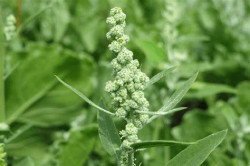
Chenopodium oil is an essential oil pressed or distilled from the leaves and seeds of Dysphania ambrosioides, a plant also known as epazote, American wormseed, Mexican tea, and goosefoot. The plant grows widely in Central and South America and has spread to many warm parts of the world.
The oil is a pale yellow to greenish liquid with a strong, pungent odor. Historically it was used as a remedy to expel intestinal worms, and the leaf itself is still used as a cooking herb in Mexican and Latin American dishes. The concentrated oil is very different from the cooking herb — it is far more potent and much more dangerous.
How it works
The main active compound in chenopodium oil is ascaridole, which can make up a large share of the oil. Ascaridole is thought to paralyze or kill intestinal worms, which is why the oil was used as a dewormer.
The same compound that makes it active against worms is also what makes it dangerous to people. Ascaridole can damage the nervous system and other organs if too much is absorbed. Other compounds in the oil may contribute to its antimicrobial effects seen in lab studies, but these laboratory findings do not prove the oil is safe or effective for treating infections in people.
Does Chenopodium Oil work?
How to read these evidence grades
Natural Medicines’ 7-point scale. We show each rating’s label word-for-word.
For Chenopodium Oil, current evidence isn’t strong enough to rate any specific use. The conditions it has been studied for are listed below.
Also studied for 1 condition — evidence insufficient to rate
Insufficient Reliable Evidence To Rate Intestinal parasite infection
Although there has been interest in using oral chenopodium oil for intestinal parasite infections, there is insufficient reliable information about the clinical effects of chenopodium oil for this purpose.
Source & disclaimer. Effectiveness ratings and evidence summaries are provided by Natural Medicines (Therapeutic Research Center) and shown as licensed. Where Natural Medicines hasn’t rated a use, HelloPharmacist’s pharmacists may add their own reviewed rating and evidence (each such entry is labeled). This is educational information, not medical advice — talk with your pharmacist or doctor before starting, stopping, or changing a supplement.
Safety & precautions
Chenopodium oil is considered toxic and is generally not recommended for internal use. The gap between a dose that might kill worms and a dose that can poison a person is very small. Serious poisonings, including deaths, have been reported in the past, especially in children.
Symptoms of poisoning can include nausea, vomiting, dizziness, headache, ringing in the ears, vision problems, seizures, and damage to the liver, kidneys, or nervous system. People with liver, kidney, or heart problems, and young children, are at especially high risk.
Pregnancy and breastfeeding: Avoid this oil entirely. It may stimulate the uterus and is potentially toxic, and its safety during breastfeeding has not been established. Because safer options exist, never self-treat with this oil — speak with a pharmacist or doctor first.
Side effects
Even at modest amounts the oil can cause nausea, vomiting, stomach cramps, dizziness, and headache. Larger amounts can cause more serious effects such as confusion, hearing or vision changes, seizures, breathing trouble, and organ damage.
Applied to the skin, the concentrated oil may cause irritation or allergic reactions. Because of these risks, the oil should not be used without medical supervision.
Chenopodium Oil: Reported Adverse Effects
Documented safety reports on Chenopodium Oil from the evidence-graded Natural Medicines (TRC Healthcare) database, shown word-for-word from the licensed record.
Orally, chenopodium oil is unsafe.
Most Common Adverse Effects:
Orally: Dizziness, headache, mucous membrane irritation, skin irritation, vertigo, vomiting.
Serious Adverse Effects (Rare):
Orally: Circulatory collapse, convulsions, deafness, death, kidney and liver damage, paralysis.
Cluster headache Neurologic/CNS
Orally, chenopodium oil affects the nervous system and can cause headache, vertigo/dizziness, temporary deafness, convulsions, circulatory collapse, paralysis, and death.
- Leung AY, Foster S. Encyclopedia of Common Natural Ingredients Used in Food, Drugs and Cosmetics. 2nd ed. New York, NY: John Wiley & Sons, 1996.
Nausea and vomiting Gastrointestinal
Orally, chenopodium oil can cause vomiting.
- Leung AY, Foster S. Encyclopedia of Common Natural Ingredients Used in Food, Drugs and Cosmetics. 2nd ed. New York, NY: John Wiley & Sons, 1996.
Adverse-effects data: Natural Medicines, Therapeutic Research Center
Dosing
There is no safe, established dose of chenopodium oil for any condition, and it is not recommended for self-treatment. The doses used historically as a dewormer were close to toxic levels, which is one reason it fell out of use.
If you are considering any product that contains this oil, read the label carefully and check with a pharmacist or doctor first. For intestinal worms, safer and more effective prescription and over-the-counter medicines are available.
Chenopodium Oil & Breastfeeding
© 2026 Therapeutic Research Center
Pregnancy & lactation ratings: Natural Medicines, Therapeutic Research Center
References & further reading
The 2 references that drive our Chenopodium Oil monograph and interaction data, from the evidence-graded Natural Medicines (TRC Healthcare) database. Citations with a link open the study on PubMed or the publisher’s site.
- Leung AY, Foster S. Encyclopedia of Common Natural Ingredients Used in Food, Drugs and Cosmetics. 2nd ed. New York, NY: John Wiley & Sons, 1996.
- Brinker F. Herb Contraindications and Drug Interactions. 2nd ed. Sandy, OR: Eclectic Medical Publications, 1998.
This information is for education only and is not a substitute for professional medical advice. Always check with your pharmacist or doctor before starting, stopping, or combining supplements and medications.
Parts of this content are provided by the Therapeutic Research Center, LLC.
DISCLAIMER: Currently this does not check for drug-drug interactions. This is not an all-inclusive comprehensive list of potential interactions and is for informational purposes only. Not all interactions are known or well-reported in the scientific literature, and new interactions are continually being reported. Input is needed from a qualified healthcare provider including a pharmacist before starting any therapy. Application of clinical judgment is necessary.
© 2021 Therapeutic Research Center, LLC
Brands that make products with Chenopodium Oil
1 brand in our database make a supplement containing Chenopodium Oil.
Supplement products with Chenopodium Oil
1 product in our database contain Chenopodium Oil. Open any to see its full ingredient list and every drug interaction we check.
Chenopodium Oil: Common Questions
What is Chenopodium Oil used for, and does it work?
Does Chenopodium Oil interact with prescription medications?
How are Chenopodium Oil interactions rated?
Is it safe to take Chenopodium Oil with my medications?
Where does this Chenopodium Oil interaction information come from?
What is Chenopodium Oil used for?
Is Chenopodium Oil safe to take?
Is the epazote I cook with the same as Chenopodium Oil?
Can I use Chenopodium Oil during pregnancy or while breastfeeding?
Written and reviewed by the HelloPharmacist editorial staff. Our editorial policy
Products that contain Chenopodium Oil
A rotating sample of real supplements in our database that list Chenopodium Oil — open any to see its full ingredients and every drug interaction we check.
Have a question about Chenopodium Oil?
Our pharmacists answer your medication & supplement questions — free.