
30 Day Night Slim Skinny Tea Ingredients & Drug Interactions
What is this page for?
First and foremost: checking 30 Day Night Slim Skinny Tea against your medications. The heart of this page is the interaction checker and the full interaction report — how this product’s ingredients may interact with prescription and over-the-counter medicines you may be taking.
Around that, we add a pharmacist’s high-level view of the product as a whole — what’s inside, the evidence for its stated use, how transparent the label is, and what safety data exists — so you can see the full picture in one place. It’s educational information from our licensed clinical databases and the clinical staff at HelloPharmacist — not medical advice — and we don’t sell or endorse products. Our editorial policy
30 Day Night Slim Skinny Tea is a dietary supplement by Totally Products with 24 active ingredients. Its ingredients are commonly taken for replacing fluids and electrolytes, preventing dehydration during exercise or illness, treating low blood sodium (under medical care).Based on those ingredients, 2,254 medications have a known interaction with it, the most serious rated major. The ingredients most likely to interact are Marshmallow, Dietary Fiber, Licorice. Use the checker below to test your specific medication, or read the full HelloPharmacist Interaction Report.
Check Your Meds Against 30 Day Night Slim Skinny Tea by Totally Products
Ask about any prescription or over-the-counter medication and we check it for interactions with 30 Day Night Slim Skinny Tea by Totally Products — and tell you which ingredient is responsible.
AI summaries are generated from our interaction database for education only — always confirm with your pharmacist. How we use AI
Ask the Pharmacist
A licensed pharmacist will answer your question by email — free, usually within 24 hours.
Got it — thank you!
A licensed pharmacist will answer within 24 hours. Keep an eye on your email (worth checking spam, just in case).
HelloPharmacist Scorecard of 30 Day Night Slim Skinny Tea by Totally Products
Our pharmacy team’s full take, with four database checks built into the cards below — a summary of what is known, not a grade of the product itself.
What’s inside
Low disclosure
This 22-ingredient tea contains several actives working together as a blend. Sodium and potassium are electrolytes; calcium supports bone health; iron carries oxygen in the blood.
Vitamin D regulates calcium absorption. Senna, rhubarb, cascara sagrada, and butternut are stimulant laxatives — they speed bowel movement.
Dandelion, rose hip, licorice, gotu kola, juniper, fennel, chia seed, spearmint, horsetail, bearberry, lemongrass, and marshmallow are herbal ingredients added for their traditional properties. Irish moss we could not check for interactions.
The product contains no inactive fillers.
Does it work?
Not established
The evidence for most ingredients is limited or not established in our data. Calcium is effective for kidney failure, dyspepsia (indigestion), low blood calcium, and high blood potassium; it's likely effective for osteoporosis.
Iron is effective for iron-deficiency anemia and anemia of chronic disease, and possibly effective for heart failure. Senna is likely effective for constipation.
Sodium is possibly effective for amphotericin B kidney toxicity. Vitamin D is effective for several bone and metabolic disorders.
Most other ingredients — dandelion, rose hip, licorice, gotu kola, juniper, fennel, spearmint, horsetail, bearberry, lemongrass, marshmallow, cascara sagrada, and butternut — have insufficient evidence or were rated as possibly ineffective for the conditions they're traditionally used for. Chia seed was rated possibly ineffective for weight and cholesterol.
The product's overall effectiveness for 'night slim' or weight loss is not established in the data we hold.
How safe is it?
Well-documented data
Sodium is essential in small amounts, but too much is linked to high blood pressure and heart strain; normal dietary sodium is fine, but avoid supplements or very high intake without medical advice. Potassium from food is safe, but supplements can cause dangerously high blood levels in people with kidney disease.
Calcium is well tolerated at recommended doses; high doses can cause constipation or, rarely, kidney stones. Iron is generally well tolerated when used appropriately; excess iron can be toxic.
Vitamin D is safe at recommended doses but can cause toxicity and weak bones if taken in very high doses over time. The laxative ingredients — senna, rhubarb, cascara sagrada, and butternut — are generally well tolerated short-term but can cause cramping, and long-term use can lead to potassium loss, electrolyte imbalances, and dependence.
Gotu kola has rare reports of liver toxicity. Licorice can cause serious side effects at high doses or with long-term use, including high blood pressure and low potassium.
Most other ingredients are generally well tolerated as food but have limited safety data at supplement doses.
Meds to double-check
Major interaction found
Before taking this tea, check with your pharmacist if you're on any of these: blood thinners like warfarin (senna, rhubarb, cascara sagrada, butternut, and rose hip can increase bleeding risk — Moderate severity); HIV medications dolutegravir or elvitegravir (calcium reduces their levels by up to 40% — Major severity); heart rhythm drugs like digoxin or diltiazem (laxatives and potassium can increase toxicity — Moderate); blood pressure medications including ACE inhibitors, ARBs, or thiazide diuretics (potassium, sodium, and vitamin D affect control — Moderate); potassium-sparing diuretics (potassium from this tea increases dangerously high blood levels — Moderate); levothyroxine or other thyroid medication (calcium and iron reduce absorption — Moderate); lithium (sodium, potassium, dandelion, rose hip, horsetail, and bearberry can alter levels — Moderate); or quinolone or tetracycline antibiotics (iron reduces absorption — Moderate). If you take any other medications metabolized by the liver, also let your pharmacist know — several ingredients may affect how your body processes them.
The bottom line
Scorecard at a glanceFormula with limited ingredient disclosure with no established evidence rating for its marketed use. Major medication interactions have been identified, and safety information is well characterized.
This product is a complex blend with 22 ingredients, many of which interact with common medications — especially blood thinners, heart drugs, blood pressure medications, and thyroid medication. If you take any prescription medication, particularly for the heart, blood pressure, antiretrovirals, or blood clotting, check your exact drugs with the tool on this page before starting.
The product's weight-loss effectiveness is not established. Talk to your pharmacist before using it.
Educational only — not medical advice; always confirm with your pharmacist. Our editorial policy · How we use AI
Assessment coverage: 23 of 23 active ingredients matched to our full ingredient reviews (monographs). Based on the product label dated Nov 22, 2024.
This Scorecard evaluates available label information, ingredient evidence, and known medication-safety considerations. It does not independently verify product identity, purity, potency, contamination, or manufacturing quality. How these ratings are computed
General information
Key facts about 30 Day Night Slim Skinny Tea, straight from the product label.
| Brand | Totally Products |
|---|---|
| Barcode (UPC) | 754436575907 |
| Net contents | 30 Tea Bag(s) |
| Market status | On market |
| Date entered into DSLD | Nov 22, 2024 |
| DSLD ID | 320780 |
| Product type | Botanical With Nutrients |
| Supplement form | Other (e.g. Tea Bag) |
| Dietary claims / uses | All Other, Structure/Function |
| Intended target group(s) | Children 4 or More Years of Age, Adult (18 - 50 Years), Kosher, Organic, Gluten Free |
Everything in this section is reproduced from the manufacturer’s own product label — it’s the label speaking, not HelloPharmacist. We show it so you can see exactly what the maker states; we don’t verify or endorse those statements.
Supplement Facts
The label details for 30 Day Night Slim Skinny Tea by Totally Products, sourced from the NIH Dietary Supplement Label Database.
Supplement Facts
| Ingredient | Amount | % DV |
|---|---|---|
| Calories | 230 Calorie(s) | -- |
| Total Carbohydrates | 37 Gram(s) | 13% |
| Sodium | 160 Gram(s) | 7% |
| Potassium | 235 mg | -- |
| Calcium | 260 mg | 20% |
| Iron | 8 mg | 45% |
| Total Sugars | 12 Gram(s) | 5% |
| Vitamin D | 2 mcg | 10% |
| Cholesterol | 0 Gram(s) | -- |
| Total Fat | 8 Gram(s) | 10% |
| Saturated Fat | 1 Gram(s) | 5% |
| Trans Fat | 0 Gram(s) | -- |
| Dietary Fiber | 4 Gram(s) | 14% |
| Protein | 3 Gram(s) | -- |
| Senna | 0 NP | -- |
| Rhubarb | 0 NP | -- |
| Dandelion | 0 NP | -- |
| Rose Hip | 0 NP | -- |
| Licorice | 0 NP | -- |
| Gotu Kola | 0 NP | -- |
| Irish Moss | 0 NP | -- |
| Juniper | 0 NP | -- |
| Fennel | 0 NP | -- |
| Chia Seed | 0 NP | -- |
| Spearmint | 0 NP | -- |
| Horsetail | 0 NP | -- |
| Bearberry | 0 NP | -- |
| Lemongrass | 0 NP | -- |
| Marshmallow | 0 NP | -- |
| Cascara Sagrada | 0 NP | -- |
| Butternut | 0 NP | -- |
Tap any ingredient to jump to its full detail below.
These statements are the manufacturer’s wording, reproduced from the product label — the label is saying it, not HelloPharmacist. We don’t verify or endorse them.
Formulation
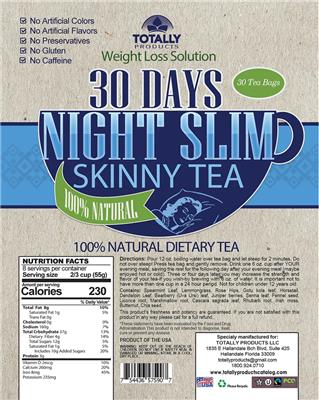
No artificial colors No artificial flavors No preservatives No gluten No caffeine
Weight loss solution 100% natural
Product of the USA
PCO Certified Organic
FDA Statement of Identity
100% Natural Dietary Tea
Suggested/Recommended/Usage/Directions
Directions: Pour 12 oz. boiling water over tea bag and let steep for 2 minutes. Do not over steep! Press tea bag and gently remove. Drink 6 oz. cup after your evening meal, saving the rest for the following day after your evening meal (maybe enjoyed hot or cold). Three or four days later you may increase the strength and flavor of your tea-if you wish-by brewing with 6 oz. of water.
Precautions
It is important not to have more than one cup in a 24 hour period. Do not use if safety deal is damaged or missing.
Not for children under 12 years old. Warning: Keep out of the reach of children.
Formula
Contains: Spearmint leaf, Lemongrass, Rose hips, Gotu kola leaf, Horsetail, Dandelion leaf, Bearberry (Uva Ursi) leaf, Juniper berries, Senna leaf, Fennel seed, Licorice root, Marshmallow root, Cascara sagrada leaf, Rhubarb root, Irish moss, Butternut, Chia seed.
Star-K (Kosher) OU (Kosher)
General Statements
This product's freshness and potency are guaranteed. If you are not satisfied with this product in any way please call for a full refund.
Please recycle.
FDA Disclaimer Statement
These statements have been evaluated by the Food and Drug Administration. This product is not intended to diagnose, treat, cure or prevent any disease.
Storage
Store in a cool, dry place.
Seals/Symbols
Manufactured in the USA Star-K (Kosher) OU (Kosher) PCO Certified Organic
Is this label outdated? Report a formula or label change and our pharmacy team will review it.
30 Day Night Slim Skinny Tea by Totally Products label
The label scan from the NIH Dietary Supplement Label Database. Tap to enlarge.
Label images are published by the NIH Dietary Supplement Label Database for the version of this product on file. Always read your actual product label.
View the full label (PDF)The Ingredients in 30 Day Night Slim Skinny Tea by Totally Products
These are the 24 active ingredients this product is made of. Select any to open its full monograph.
Serving size55 Gram(s) Dosage formOther (e.g. Tea Bag) Servings per container8 Amounts shown are per serving.
Most supplement products combine several ingredients, and a medication can interact with the product through any one of them. Each ingredient below shows whether it has known drug interactions.
Sodium
Interacts with205 drugs
Sodium is an essential mineral and electrolyte your body needs to balance fluids, support nerves, and help muscles work. Most people in modern diets g...
Sodium monograph & interactionsPotassium
Interacts with62 drugs
Potassium is an essential mineral your body needs for nerve signals, muscle function, and a steady heartbeat, and most people get enough from a balanc...
Potassium monograph & interactionsCalcium
Interacts with168 drugs
Calcium is an essential mineral your body needs for strong bones, nerve signaling, and muscle function, and supplements can help fill gaps when diet f...
Calcium monograph & interactionsIron
Interacts with80 drugs
Iron is an essential mineral your body needs to make hemoglobin and carry oxygen in the blood. Supplements are mainly useful for treating or preventin...
Iron monograph & interactionsVitamin D
Interacts with717 drugs
Vitamin D is a fat-soluble vitamin that helps your body absorb calcium and is important for healthy bones, muscles, and immune function. Many people,...
Vitamin D monograph & interactionsDietary Fiber
Interacts with2,025 drugs
Black psyllium is a soluble-fiber supplement made from the seeds of a Plantago plant, used mostly to ease constipation and support digestive health. I...
Dietary Fiber monograph & interactionsProtein
Senna
Interacts with140 drugs
Senna is a plant-based stimulant laxative that is widely used and generally effective for short-term relief of constipation. It is best used occasiona...
Senna monograph & interactionsRhubarb
Interacts with660 drugs
Rhubarb root has a long history of use as a laxative and in traditional Chinese medicine, and its edible stalks are a common food. Most medicinal clai...
Rhubarb monograph & interactionsDandelion
Interacts with457 drugs
Dandelion is a common plant used in food and traditional medicine, often promoted as a natural 'water pill' and digestive aid. Human evidence for thes...
Dandelion monograph & interactionsRose Hip
Interacts with213 drugs
Rose hip is the vitamin C–rich fruit of the wild rose, used traditionally for colds and joint pain. A standardized rose hip powder has some research s...
Rose Hip monograph & interactionsLicorice
Interacts with1,041 drugs
Licorice root is a traditional remedy used for sore throats, coughs, and digestive complaints, but solid human evidence is limited for most uses. Regu...
Licorice monograph & interactionsGotu Kola
Interacts with581 drugs
Gotu kola is a traditional Ayurvedic and Asian herb that people use for wound healing, circulation, skin problems, and as a calming or memory-supporti...
Gotu Kola monograph & interactionsIrish Moss
Interacts with22 drugs
Sea moss is a type of red seaweed that is naturally rich in iodine and several minerals, and it is popular as a 'whole-food' supplement. Strong human...
Irish Moss monograph & interactionsJuniper
Interacts with162 drugs
Juniper berry is a traditional herb best known for flavoring gin and for its folk use as a diuretic and digestive aid. Solid human evidence for its he...
Juniper monograph & interactionsFennel
Interacts with742 drugs
Fennel is a Mediterranean herb widely used as a food and spice, and traditionally taken for digestive complaints, colic, and menstrual cramps. Some sm...
Fennel monograph & interactionsChia Seed
No knowninteractions
Chia seeds are a nutritious whole food rich in fiber, plant-based omega-3 fats (ALA), and protein. They are generally safe as part of a healthy diet,...
Chia Seed monograph & interactionsSpearmint
Interacts with581 drugs
Spearmint is a common culinary mint that is generally safe in food and tea amounts. Early research suggests possible benefits for digestion, mild horm...
Spearmint monograph & interactionsHorsetail
Interacts with188 drugs
Horsetail is a traditional herb most often used as a mild diuretic and for hair, nail, and bone support, but high-quality human evidence is limited. I...
Horsetail monograph & interactionsBearberry
Interacts with804 drugs
Uva ursi is a traditional herb used mainly for urinary tract infections, and its leaves contain a compound called arbutin that may have antimicrobial...
Bearberry monograph & interactionsLemongrass
Interacts with710 drugs
Lemongrass is a fragrant tropical grass widely used as a cooking herb, a tea, and an aromatherapy oil. It is generally considered safe in the small am...
Lemongrass monograph & interactionsMarshmallow
Interacts with2,040 drugs
Marshmallow root is a traditional herb rich in soothing, gel-like fibers called mucilage, which is why it has long been used for coughs, sore throats,...
Marshmallow monograph & interactionsCascara Sagrada
Interacts with747 drugs
Cascara sagrada is a stimulant laxative made from the aged bark of a Pacific Northwest tree, used mainly for short-term relief of constipation. Becaus...
Cascara Sagrada monograph & interactionsButternut
Interacts with122 drugs
Butternut (Juglans cinerea) is a North American tree whose inner bark was traditionally used as a mild laxative and folk remedy. Modern scientific evi...
Butternut monograph & interactions30 Day Night Slim Skinny Tea by Totally Products Drug Interactions
HelloPharmacist Interaction Report
30 Day Night Slim Skinny Tea by Totally Products contains 22 ingredients, several of which interact with medications.
The most serious interaction involves calcium, which significantly reduces levels of two HIV medications: dolutegravir and elvitegravir — both Major severity — by up to 40%, potentially compromising their effectiveness. Patients on these antiretrovirals must separate doses by at least 2 hours before or 6 hours after calcium.
Read the full breakdown — every affected drug type, severity by severity
Multiple ingredients affect blood pressure control. Sodium can reduce the effectiveness of antihypertensive drugs and may interact with lithium, corticosteroids, and didanosine.
Potassium from this tea may increase the risk of dangerously high blood levels (hyperkalemia) when combined with potassium-sparing diuretics, ACE inhibitors, or ARBs — all Moderate severity. Vitamin D theoretically increases the risk of high calcium levels if you're on thiazide diuretics or certain heart rhythm medications.
Stimulant laxatives in this product — senna, rhubarb, cascara sagrada, and butternut — all share Moderate-severity interactions with blood thinners like warfarin, heart medications like digoxin, and potassium-depleting drugs like loop diuretics and corticosteroids. The laxative effect can cause diarrhea, which increases warfarin's blood-thinning action and raises bleeding risk.
These same ingredients also interact with other stimulant laxatives, compounding fluid and electrolyte loss.
Iron reduces absorption of several antibiotics (quinolones, tetracyclines), thyroid medication (levothyroxine), and bone-strengthening drugs (bisphosphonates) — all Moderate. Additional Moderate interactions exist with dandelion and liver-metabolized drugs, licorice and warfarin, and gotu kola with sedating medications.
Altogether, these interactions span 2,229 individual medications. Please check your exact medications with the tool on this page before starting.
Check your own medications below · Editorial policy · How we use AI
Want to check YOUR meds against 30 Day Night Slim Skinny Tea?
Ask about interactions with your drugs in plain English — “Can I take it with lisinopril?” — and we find you the answer in seconds, ingredient by ingredient.
Go to the checkerIngredients driving the most interactions
Individual Drug Interactions
The ingredients in 30 Day Night Slim Skinny Tea interact with 2,254 drugs. Click any drug to see the details.
22 of the 24 ingredients in 30 Day Night Slim Skinny Tea interact with drugs. Each result below shows which ingredient is responsible. Marshmallow Dietary Fiber Licorice Bearberry Cascara Sagrada Fennel Vitamin D Lemongrass Rhubarb Gotu Kola Spearmint Dandelion Rose Hip Sodium Horsetail Calcium Juniper Senna Butternut Iron Potassium Irish Moss
CeftriaxoneRocephin
How Ceftriaxone interacts with 30 Day Night Slim Skinny Tea — through 2 ingredients. Tap an ingredient for the detail:
CalciumCeftriaxone (rocephin) Major
Interaction Summary
Co-administration of intravenous calcium and ceftriaxone can result in precipitation of a ceftriaxone-calcium salt in the lungs and kidneys.
Read the full Calcium + Ceftriaxone interactionRhubarbNephrotoxic Drugs Moderate
Interaction Summary
Theoretically, long-term use of anthraquinones from rhubarb might increase the risk of nephrotoxicity when used with nephrotoxic drugs.
Read the full Rhubarb + Ceftriaxone interactionCobicistat, Elvitegravir, Emtricitabine, Tenofovir Alafenamide FumarateGenvoya
How Cobicistat, Elvitegravir, Emtricitabine, Tenofovir Alafenamide Fumarate interacts with 30 Day Night Slim Skinny Tea — through 14 ingredients. Tap an ingredient for the detail:
CalciumElvitegravir (vitekta), Bictegravir/emtricitabine/tenofovir Alafenamide (biktarvy) Major
Interaction Summary
Calcium seems to reduce levels of elvitegravir.
Read the full Calcium + Cobicistat, Elvitegravir, Emtricitabine, Tenofovir Alafenamide Fumarate interactionRhubarbNephrotoxic Drugs, Hepatotoxic Drugs Moderate
Interaction Summary
Theoretically, long-term use of anthraquinones from rhubarb might increase the risk of nephrotoxicity when used with nephrotoxic drugs.
Read the full Rhubarb + Cobicistat, Elvitegravir, Emtricitabine, Tenofovir Alafenamide Fumarate interactionLemongrassCytochrome P450 3a4 (cyp3a4) Substrates Moderate
Interaction Summary
Theoretically, lemongrass might decrease the metabolism of CYP3A4 substrates.
Read the full Lemongrass + Cobicistat, Elvitegravir, Emtricitabine, Tenofovir Alafenamide Fumarate interactionGotu KolaHepatotoxic Drugs Moderate
Interaction Summary
Theoretically, taking gotu kola with hepatotoxic drugs might have additive adverse effects.
Read the full Gotu Kola + Cobicistat, Elvitegravir, Emtricitabine, Tenofovir Alafenamide Fumarate interactionBearberryP-glycoprotein Substrates, Cytochrome P450 3a4 (cyp3a4) Substrates Moderate
Interaction Summary
Theoretically, uva ursi may alter the levels of drugs transported by P-glycoprotein.
Read the full Bearberry + Cobicistat, Elvitegravir, Emtricitabine, Tenofovir Alafenamide Fumarate interactionFennelCytochrome P450 3a4 (cyp3a4) Substrates Moderate
Interaction Summary
Theoretically, fennel might increase levels of drugs metabolized by CYP3A4.
Read the full Fennel + Cobicistat, Elvitegravir, Emtricitabine, Tenofovir Alafenamide Fumarate interactionHorsetailNucleoside Reverse Transcriptase Inhibitors (nrtis) Moderate
Interaction Summary
Theoretically, horsetail might decrease the levels and clinical effects of NRTIs.
Read the full Horsetail + Cobicistat, Elvitegravir, Emtricitabine, Tenofovir Alafenamide Fumarate interactionLicoriceP-glycoprotein Substrates, Cytochrome P450 3a4 (cyp3a4) Substrates Moderate
Interaction Summary
Theoretically, licorice might decrease the absorption of P-glycoprotein substrates.
Read the full Licorice + Cobicistat, Elvitegravir, Emtricitabine, Tenofovir Alafenamide Fumarate interactionSpearmintHepatotoxic Drugs Moderate
Interaction Summary
Theoretically, high doses of spearmint might increase the risk of liver damage when taken with hepatotoxic drugs.
Read the full Spearmint + Cobicistat, Elvitegravir, Emtricitabine, Tenofovir Alafenamide Fumarate interactionIronBictegravir/emtricitabine/tenofovir Alafenamide (biktarvy) Moderate
Interaction Summary
Iron might decrease levels of bictegravir/emtricitabine/tenofovir alafenamide by reducing its absorption when taken in a fasting state.
Read the full Iron + Cobicistat, Elvitegravir, Emtricitabine, Tenofovir Alafenamide Fumarate interactionDietary FiberOral Drugs Minor
Interaction Summary
Theoretically, psyllium might increase, decrease, or have no effect on the absorption of oral drugs.
Read the full Dietary Fiber + Cobicistat, Elvitegravir, Emtricitabine, Tenofovir Alafenamide Fumarate interactionCascara SagradaCytochrome P450 3a4 (cyp3a4) Substrates Minor
Interaction Summary
Theoretically, cascara sagrada might decrease the effects of CYP3A4 substrates.
Read the full Cascara Sagrada + Cobicistat, Elvitegravir, Emtricitabine, Tenofovir Alafenamide Fumarate interactionMarshmallowOral Drugs Minor
Interaction Summary
Theoretically, mucilage in marshmallow might impair absorption of oral drugs.
Read the full Marshmallow + Cobicistat, Elvitegravir, Emtricitabine, Tenofovir Alafenamide Fumarate interactionVitamin DCytochrome P450 3a4 (cyp3a4) Substrates Minor
Interaction Summary
Vitamin D might induce CYP3A4 enzymes and reduce the bioavailability of CYP3A4 substrates.
Read the full Vitamin D + Cobicistat, Elvitegravir, Emtricitabine, Tenofovir Alafenamide Fumarate interactionDolutegravirTivicay
How Dolutegravir interacts with 30 Day Night Slim Skinny Tea — through 8 ingredients. Tap an ingredient for the detail:
CalciumDolutegravir (tivicay) Major
Interaction Summary
Calcium seems to reduce levels of dolutegravir.
Read the full Calcium + Dolutegravir interactionDandelionGlucuronidated Drugs Moderate
Interaction Summary
Theoretically, dandelion might increase the clearance of drugs that are UDP-glucuronosyltransferase substrates.
Read the full Dandelion + Dolutegravir interactionBearberryGlucuronidated Drugs, P-glycoprotein Substrates Moderate
Interaction Summary
Theoretically, uva ursi may increase levels of drugs metabolized by glucuronidation.
Read the full Bearberry + Dolutegravir interactionLemongrassGlucuronidated Drugs Moderate
Interaction Summary
Theoretically, lemongrass might increase the clearance and decrease the levels of glucuronidated drugs.
Read the full Lemongrass + Dolutegravir interactionIronDolutegravir (tivicay) Moderate
Interaction Summary
Iron might decrease dolutegravir levels by reducing its absorption.
Read the full Iron + Dolutegravir interactionLicoriceP-glycoprotein Substrates Moderate
Interaction Summary
Theoretically, licorice might decrease the absorption of P-glycoprotein substrates.
Read the full Licorice + Dolutegravir interactionDietary FiberOral Drugs Minor
Interaction Summary
Theoretically, psyllium might increase, decrease, or have no effect on the absorption of oral drugs.
Read the full Dietary Fiber + Dolutegravir interactionMarshmallowOral Drugs Minor
Interaction Summary
Theoretically, mucilage in marshmallow might impair absorption of oral drugs.
Read the full Marshmallow + Dolutegravir interactionDolutegravir, Emtricitabine, Tenofovir AlafenamideDolutegravir, Emtricitabine, Tenofovir Alafenamide
How Dolutegravir, Emtricitabine, Tenofovir Alafenamide interacts with 30 Day Night Slim Skinny Tea — through 12 ingredients. Tap an ingredient for the detail:
CalciumDolutegravir (tivicay), Bictegravir/emtricitabine/tenofovir Alafenamide (biktarvy) Major
Interaction Summary
Calcium seems to reduce levels of dolutegravir.
Read the full Calcium + Dolutegravir, Emtricitabine, Tenofovir Alafenamide interactionBearberryP-glycoprotein Substrates, Glucuronidated Drugs Moderate
Interaction Summary
Theoretically, uva ursi may alter the levels of drugs transported by P-glycoprotein.
Read the full Bearberry + Dolutegravir, Emtricitabine, Tenofovir Alafenamide interactionIronDolutegravir (tivicay), Bictegravir/emtricitabine/tenofovir Alafenamide (biktarvy) Moderate
Interaction Summary
Iron might decrease dolutegravir levels by reducing its absorption.
Read the full Iron + Dolutegravir, Emtricitabine, Tenofovir Alafenamide interactionLemongrassGlucuronidated Drugs Moderate
Interaction Summary
Theoretically, lemongrass might increase the clearance and decrease the levels of glucuronidated drugs.
Read the full Lemongrass + Dolutegravir, Emtricitabine, Tenofovir Alafenamide interactionDandelionGlucuronidated Drugs Moderate
Interaction Summary
Theoretically, dandelion might increase the clearance of drugs that are UDP-glucuronosyltransferase substrates.
Read the full Dandelion + Dolutegravir, Emtricitabine, Tenofovir Alafenamide interactionRhubarbHepatotoxic Drugs, Nephrotoxic Drugs Moderate
Interaction Summary
Theoretically, concomitant use of rhubarb with potentially hepatotoxic drugs might increase the risk of developing liver damage.
Read the full Rhubarb + Dolutegravir, Emtricitabine, Tenofovir Alafenamide interactionGotu KolaHepatotoxic Drugs Moderate
Interaction Summary
Theoretically, taking gotu kola with hepatotoxic drugs might have additive adverse effects.
Read the full Gotu Kola + Dolutegravir, Emtricitabine, Tenofovir Alafenamide interactionLicoriceP-glycoprotein Substrates Moderate
Interaction Summary
Theoretically, licorice might decrease the absorption of P-glycoprotein substrates.
Read the full Licorice + Dolutegravir, Emtricitabine, Tenofovir Alafenamide interactionSpearmintHepatotoxic Drugs Moderate
Interaction Summary
Theoretically, high doses of spearmint might increase the risk of liver damage when taken with hepatotoxic drugs.
Read the full Spearmint + Dolutegravir, Emtricitabine, Tenofovir Alafenamide interactionHorsetailNucleoside Reverse Transcriptase Inhibitors (nrtis) Moderate
Interaction Summary
Theoretically, horsetail might decrease the levels and clinical effects of NRTIs.
Read the full Horsetail + Dolutegravir, Emtricitabine, Tenofovir Alafenamide interactionDietary FiberOral Drugs Minor
Interaction Summary
Theoretically, psyllium might increase, decrease, or have no effect on the absorption of oral drugs.
Read the full Dietary Fiber + Dolutegravir, Emtricitabine, Tenofovir Alafenamide interactionMarshmallowOral Drugs Minor
Interaction Summary
Theoretically, mucilage in marshmallow might impair absorption of oral drugs.
Read the full Marshmallow + Dolutegravir, Emtricitabine, Tenofovir Alafenamide interactionDolutegravir, RilpivirineJuluca
How Dolutegravir, Rilpivirine interacts with 30 Day Night Slim Skinny Tea — through 11 ingredients. Tap an ingredient for the detail:
CalciumDolutegravir (tivicay) Major
Interaction Summary
Calcium seems to reduce levels of dolutegravir.
Read the full Calcium + Dolutegravir, Rilpivirine interactionIronDolutegravir (tivicay) Moderate
Interaction Summary
Iron might decrease dolutegravir levels by reducing its absorption.
Read the full Iron + Dolutegravir, Rilpivirine interactionBearberryP-glycoprotein Substrates, Cytochrome P450 3a4 (cyp3a4) Substrates +1 Moderate
Interaction Summary
Theoretically, uva ursi may alter the levels of drugs transported by P-glycoprotein.
Read the full Bearberry + Dolutegravir, Rilpivirine interactionFennelCytochrome P450 3a4 (cyp3a4) Substrates Moderate
Interaction Summary
Theoretically, fennel might increase levels of drugs metabolized by CYP3A4.
Read the full Fennel + Dolutegravir, Rilpivirine interactionLemongrassGlucuronidated Drugs, Cytochrome P450 3a4 (cyp3a4) Substrates Moderate
Interaction Summary
Theoretically, lemongrass might increase the clearance and decrease the levels of glucuronidated drugs.
Read the full Lemongrass + Dolutegravir, Rilpivirine interactionDandelionGlucuronidated Drugs Moderate
Interaction Summary
Theoretically, dandelion might increase the clearance of drugs that are UDP-glucuronosyltransferase substrates.
Read the full Dandelion + Dolutegravir, Rilpivirine interactionLicoriceCytochrome P450 3a4 (cyp3a4) Substrates, P-glycoprotein Substrates Moderate
Interaction Summary
Theoretically, licorice might increase or decrease levels of drugs metabolized by CYP3A4.
Read the full Licorice + Dolutegravir, Rilpivirine interactionMarshmallowOral Drugs Minor
Interaction Summary
Theoretically, mucilage in marshmallow might impair absorption of oral drugs.
Read the full Marshmallow + Dolutegravir, Rilpivirine interactionDietary FiberOral Drugs Minor
Interaction Summary
Theoretically, psyllium might increase, decrease, or have no effect on the absorption of oral drugs.
Read the full Dietary Fiber + Dolutegravir, Rilpivirine interactionVitamin DCytochrome P450 3a4 (cyp3a4) Substrates Minor
Interaction Summary
Vitamin D might induce CYP3A4 enzymes and reduce the bioavailability of CYP3A4 substrates.
Read the full Vitamin D + Dolutegravir, Rilpivirine interactionCascara SagradaCytochrome P450 3a4 (cyp3a4) Substrates Minor
Interaction Summary
Theoretically, cascara sagrada might decrease the effects of CYP3A4 substrates.
Read the full Cascara Sagrada + Dolutegravir, Rilpivirine interactionElvitegravirVitekta
How Elvitegravir interacts with 30 Day Night Slim Skinny Tea — through 9 ingredients. Tap an ingredient for the detail:
CalciumElvitegravir (vitekta) Major
Interaction Summary
Calcium seems to reduce levels of elvitegravir.
Read the full Calcium + Elvitegravir interactionLicoriceCytochrome P450 3a4 (cyp3a4) Substrates Moderate
Interaction Summary
Theoretically, licorice might increase or decrease levels of drugs metabolized by CYP3A4.
Read the full Licorice + Elvitegravir interactionLemongrassCytochrome P450 3a4 (cyp3a4) Substrates Moderate
Interaction Summary
Theoretically, lemongrass might decrease the metabolism of CYP3A4 substrates.
Read the full Lemongrass + Elvitegravir interactionBearberryCytochrome P450 3a4 (cyp3a4) Substrates Moderate
Interaction Summary
Theoretically, uva ursi may decrease the metabolism of CYP3A4 substrates.
Read the full Bearberry + Elvitegravir interactionFennelCytochrome P450 3a4 (cyp3a4) Substrates Moderate
Interaction Summary
Theoretically, fennel might increase levels of drugs metabolized by CYP3A4.
Read the full Fennel + Elvitegravir interactionDietary FiberOral Drugs Minor
Interaction Summary
Theoretically, psyllium might increase, decrease, or have no effect on the absorption of oral drugs.
Read the full Dietary Fiber + Elvitegravir interactionMarshmallowOral Drugs Minor
Interaction Summary
Theoretically, mucilage in marshmallow might impair absorption of oral drugs.
Read the full Marshmallow + Elvitegravir interactionCascara SagradaCytochrome P450 3a4 (cyp3a4) Substrates Minor
Interaction Summary
Theoretically, cascara sagrada might decrease the effects of CYP3A4 substrates.
Read the full Cascara Sagrada + Elvitegravir interactionVitamin DCytochrome P450 3a4 (cyp3a4) Substrates Minor
Interaction Summary
Vitamin D might induce CYP3A4 enzymes and reduce the bioavailability of CYP3A4 substrates.
Read the full Vitamin D + Elvitegravir interactionElvitegravir, Cobicistat, Emtricitabine, Tenofovir Disoproxil FumarateStribild
How Elvitegravir, Cobicistat, Emtricitabine, Tenofovir Disoproxil Fumarate interacts with 30 Day Night Slim Skinny Tea — through 14 ingredients. Tap an ingredient for the detail:
CalciumElvitegravir (vitekta), Bictegravir/emtricitabine/tenofovir Alafenamide (biktarvy) Major
Interaction Summary
Calcium seems to reduce levels of elvitegravir.
Read the full Calcium + Elvitegravir, Cobicistat, Emtricitabine, Tenofovir Disoproxil Fumarate interactionIronBictegravir/emtricitabine/tenofovir Alafenamide (biktarvy) Moderate
Interaction Summary
Iron might decrease levels of bictegravir/emtricitabine/tenofovir alafenamide by reducing its absorption when taken in a fasting state.
Read the full Iron + Elvitegravir, Cobicistat, Emtricitabine, Tenofovir Disoproxil Fumarate interactionFennelCytochrome P450 3a4 (cyp3a4) Substrates Moderate
Interaction Summary
Theoretically, fennel might increase levels of drugs metabolized by CYP3A4.
Read the full Fennel + Elvitegravir, Cobicistat, Emtricitabine, Tenofovir Disoproxil Fumarate interactionBearberryCytochrome P450 3a4 (cyp3a4) Substrates Moderate
Interaction Summary
Theoretically, uva ursi may decrease the metabolism of CYP3A4 substrates.
Read the full Bearberry + Elvitegravir, Cobicistat, Emtricitabine, Tenofovir Disoproxil Fumarate interactionLicoriceCytochrome P450 3a4 (cyp3a4) Substrates Moderate
Interaction Summary
Theoretically, licorice might increase or decrease levels of drugs metabolized by CYP3A4.
Read the full Licorice + Elvitegravir, Cobicistat, Emtricitabine, Tenofovir Disoproxil Fumarate interactionSpearmintHepatotoxic Drugs Moderate
Interaction Summary
Theoretically, high doses of spearmint might increase the risk of liver damage when taken with hepatotoxic drugs.
Read the full Spearmint + Elvitegravir, Cobicistat, Emtricitabine, Tenofovir Disoproxil Fumarate interactionRhubarbHepatotoxic Drugs, Nephrotoxic Drugs Moderate
Interaction Summary
Theoretically, concomitant use of rhubarb with potentially hepatotoxic drugs might increase the risk of developing liver damage.
Read the full Rhubarb + Elvitegravir, Cobicistat, Emtricitabine, Tenofovir Disoproxil Fumarate interactionHorsetailNucleoside Reverse Transcriptase Inhibitors (nrtis) Moderate
Interaction Summary
Theoretically, horsetail might decrease the levels and clinical effects of NRTIs.
Read the full Horsetail + Elvitegravir, Cobicistat, Emtricitabine, Tenofovir Disoproxil Fumarate interactionLemongrassCytochrome P450 3a4 (cyp3a4) Substrates Moderate
Interaction Summary
Theoretically, lemongrass might decrease the metabolism of CYP3A4 substrates.
Read the full Lemongrass + Elvitegravir, Cobicistat, Emtricitabine, Tenofovir Disoproxil Fumarate interactionGotu KolaHepatotoxic Drugs Moderate
Interaction Summary
Theoretically, taking gotu kola with hepatotoxic drugs might have additive adverse effects.
Read the full Gotu Kola + Elvitegravir, Cobicistat, Emtricitabine, Tenofovir Disoproxil Fumarate interactionVitamin DCytochrome P450 3a4 (cyp3a4) Substrates Minor
Interaction Summary
Vitamin D might induce CYP3A4 enzymes and reduce the bioavailability of CYP3A4 substrates.
Read the full Vitamin D + Elvitegravir, Cobicistat, Emtricitabine, Tenofovir Disoproxil Fumarate interactionMarshmallowOral Drugs Minor
Interaction Summary
Theoretically, mucilage in marshmallow might impair absorption of oral drugs.
Read the full Marshmallow + Elvitegravir, Cobicistat, Emtricitabine, Tenofovir Disoproxil Fumarate interactionCascara SagradaCytochrome P450 3a4 (cyp3a4) Substrates Minor
Interaction Summary
Theoretically, cascara sagrada might decrease the effects of CYP3A4 substrates.
Read the full Cascara Sagrada + Elvitegravir, Cobicistat, Emtricitabine, Tenofovir Disoproxil Fumarate interactionDietary FiberOral Drugs Minor
Interaction Summary
Theoretically, psyllium might increase, decrease, or have no effect on the absorption of oral drugs.
Read the full Dietary Fiber + Elvitegravir, Cobicistat, Emtricitabine, Tenofovir Disoproxil Fumarate interaction6-mercaptopurinePurinethol
How 6-mercaptopurine interacts with 30 Day Night Slim Skinny Tea — through 5 ingredients. Tap an ingredient for the detail:
SpearmintHepatotoxic Drugs Moderate
Interaction Summary
Theoretically, high doses of spearmint might increase the risk of liver damage when taken with hepatotoxic drugs.
Read the full Spearmint + 6-mercaptopurine interactionGotu KolaHepatotoxic Drugs Moderate
Interaction Summary
Theoretically, taking gotu kola with hepatotoxic drugs might have additive adverse effects.
Read the full Gotu Kola + 6-mercaptopurine interactionRhubarbHepatotoxic Drugs Moderate
Interaction Summary
Theoretically, concomitant use of rhubarb with potentially hepatotoxic drugs might increase the risk of developing liver damage.
Read the full Rhubarb + 6-mercaptopurine interactionDietary FiberOral Drugs Minor
Interaction Summary
Theoretically, psyllium might increase, decrease, or have no effect on the absorption of oral drugs.
Read the full Dietary Fiber + 6-mercaptopurine interactionMarshmallowOral Drugs Minor
Interaction Summary
Theoretically, mucilage in marshmallow might impair absorption of oral drugs.
Read the full Marshmallow + 6-mercaptopurine interactionAdo-trastuzumab EmtansineKadcyla
How Ado-trastuzumab Emtansine interacts with 30 Day Night Slim Skinny Tea — through 6 ingredients. Tap an ingredient for the detail:
LemongrassCytochrome P450 3a4 (cyp3a4) Substrates Moderate
Interaction Summary
Theoretically, lemongrass might decrease the metabolism of CYP3A4 substrates.
Read the full Lemongrass + Ado-trastuzumab Emtansine interactionLicoriceCytochrome P450 3a4 (cyp3a4) Substrates Moderate
Interaction Summary
Theoretically, licorice might increase or decrease levels of drugs metabolized by CYP3A4.
Read the full Licorice + Ado-trastuzumab Emtansine interactionBearberryCytochrome P450 3a4 (cyp3a4) Substrates Moderate
Interaction Summary
Theoretically, uva ursi may decrease the metabolism of CYP3A4 substrates.
Read the full Bearberry + Ado-trastuzumab Emtansine interactionFennelCytochrome P450 3a4 (cyp3a4) Substrates Moderate
Interaction Summary
Theoretically, fennel might increase levels of drugs metabolized by CYP3A4.
Read the full Fennel + Ado-trastuzumab Emtansine interactionVitamin DCytochrome P450 3a4 (cyp3a4) Substrates Minor
Interaction Summary
Vitamin D might induce CYP3A4 enzymes and reduce the bioavailability of CYP3A4 substrates.
Read the full Vitamin D + Ado-trastuzumab Emtansine interactionCascara SagradaCytochrome P450 3a4 (cyp3a4) Substrates Minor
Interaction Summary
Theoretically, cascara sagrada might decrease the effects of CYP3A4 substrates.
Read the full Cascara Sagrada + Ado-trastuzumab Emtansine interactionAbacavir Sulfate, Dolutegravir, LamivudineTriumeq
How Abacavir Sulfate, Dolutegravir, Lamivudine interacts with 30 Day Night Slim Skinny Tea — through 6 ingredients. Tap an ingredient for the detail:
Gotu KolaHepatotoxic Drugs Moderate
Interaction Summary
Theoretically, taking gotu kola with hepatotoxic drugs might have additive adverse effects.
Read the full Gotu Kola + Abacavir Sulfate, Dolutegravir, Lamivudine interactionSpearmintHepatotoxic Drugs Moderate
Interaction Summary
Theoretically, high doses of spearmint might increase the risk of liver damage when taken with hepatotoxic drugs.
Read the full Spearmint + Abacavir Sulfate, Dolutegravir, Lamivudine interactionRhubarbHepatotoxic Drugs Moderate
Interaction Summary
Theoretically, concomitant use of rhubarb with potentially hepatotoxic drugs might increase the risk of developing liver damage.
Read the full Rhubarb + Abacavir Sulfate, Dolutegravir, Lamivudine interactionHorsetailNucleoside Reverse Transcriptase Inhibitors (nrtis) Moderate
Interaction Summary
Theoretically, horsetail might decrease the levels and clinical effects of NRTIs.
Read the full Horsetail + Abacavir Sulfate, Dolutegravir, Lamivudine interactionDietary FiberOral Drugs Minor
Interaction Summary
Theoretically, psyllium might increase, decrease, or have no effect on the absorption of oral drugs.
Read the full Dietary Fiber + Abacavir Sulfate, Dolutegravir, Lamivudine interactionMarshmallowOral Drugs Minor
Interaction Summary
Theoretically, mucilage in marshmallow might impair absorption of oral drugs.
Read the full Marshmallow + Abacavir Sulfate, Dolutegravir, Lamivudine interactionAbacavir, LamivudineEpzicom
How Abacavir, Lamivudine interacts with 30 Day Night Slim Skinny Tea — through 6 ingredients. Tap an ingredient for the detail:
HorsetailNucleoside Reverse Transcriptase Inhibitors (nrtis) Moderate
Interaction Summary
Theoretically, horsetail might decrease the levels and clinical effects of NRTIs.
Read the full Horsetail + Abacavir, Lamivudine interactionGotu KolaHepatotoxic Drugs Moderate
Interaction Summary
Theoretically, taking gotu kola with hepatotoxic drugs might have additive adverse effects.
Read the full Gotu Kola + Abacavir, Lamivudine interactionRhubarbHepatotoxic Drugs Moderate
Interaction Summary
Theoretically, concomitant use of rhubarb with potentially hepatotoxic drugs might increase the risk of developing liver damage.
Read the full Rhubarb + Abacavir, Lamivudine interactionSpearmintHepatotoxic Drugs Moderate
Interaction Summary
Theoretically, high doses of spearmint might increase the risk of liver damage when taken with hepatotoxic drugs.
Read the full Spearmint + Abacavir, Lamivudine interactionMarshmallowOral Drugs Minor
Interaction Summary
Theoretically, mucilage in marshmallow might impair absorption of oral drugs.
Read the full Marshmallow + Abacavir, Lamivudine interactionDietary FiberOral Drugs Minor
Interaction Summary
Theoretically, psyllium might increase, decrease, or have no effect on the absorption of oral drugs.
Read the full Dietary Fiber + Abacavir, Lamivudine interactionAbciximabReoPro
How Abciximab interacts with 30 Day Night Slim Skinny Tea — through 5 ingredients. Tap an ingredient for the detail:
Rose HipAnticoagulant/antiplatelet Drugs Moderate
Interaction Summary
Theoretically, rose hip might reduce the effectiveness of anticoagulant or antiplatelet drugs.
Read the full Rose Hip + Abciximab interactionDandelionAnticoagulant/antiplatelet Drugs Moderate
Interaction Summary
Theoretically, taking dandelion root along with anticoagulant or antiplatelet drugs might increase the risk of bruising and bleeding.
Read the full Dandelion + Abciximab interactionFennelAnticoagulant/antiplatelet Drugs Moderate
Interaction Summary
Theoretically, fennel might increase the risk of bleeding when used with antiplatelet or anticoagulant drugs.
Read the full Fennel + Abciximab interactionMarshmallowOral Drugs, Anticoagulant/antiplatelet Drugs Minor
Interaction Summary
Theoretically, mucilage in marshmallow might impair absorption of oral drugs.
Read the full Marshmallow + Abciximab interactionDietary FiberOral Drugs Minor
Interaction Summary
Theoretically, psyllium might increase, decrease, or have no effect on the absorption of oral drugs.
Read the full Dietary Fiber + Abciximab interactionAbemaciclibVerzenio
How Abemaciclib interacts with 30 Day Night Slim Skinny Tea — through 8 ingredients. Tap an ingredient for the detail:
LicoriceCytochrome P450 3a4 (cyp3a4) Substrates Moderate
Interaction Summary
Theoretically, licorice might increase or decrease levels of drugs metabolized by CYP3A4.
Read the full Licorice + Abemaciclib interactionBearberryCytochrome P450 3a4 (cyp3a4) Substrates Moderate
Interaction Summary
Theoretically, uva ursi may decrease the metabolism of CYP3A4 substrates.
Read the full Bearberry + Abemaciclib interactionFennelCytochrome P450 3a4 (cyp3a4) Substrates Moderate
Interaction Summary
Theoretically, fennel might increase levels of drugs metabolized by CYP3A4.
Read the full Fennel + Abemaciclib interactionLemongrassCytochrome P450 3a4 (cyp3a4) Substrates Moderate
Interaction Summary
Theoretically, lemongrass might decrease the metabolism of CYP3A4 substrates.
Read the full Lemongrass + Abemaciclib interactionMarshmallowOral Drugs Minor
Interaction Summary
Theoretically, mucilage in marshmallow might impair absorption of oral drugs.
Read the full Marshmallow + Abemaciclib interactionVitamin DCytochrome P450 3a4 (cyp3a4) Substrates Minor
Interaction Summary
Vitamin D might induce CYP3A4 enzymes and reduce the bioavailability of CYP3A4 substrates.
Read the full Vitamin D + Abemaciclib interactionCascara SagradaCytochrome P450 3a4 (cyp3a4) Substrates Minor
Interaction Summary
Theoretically, cascara sagrada might decrease the effects of CYP3A4 substrates.
Read the full Cascara Sagrada + Abemaciclib interactionDietary FiberOral Drugs Minor
Interaction Summary
Theoretically, psyllium might increase, decrease, or have no effect on the absorption of oral drugs.
Read the full Dietary Fiber + Abemaciclib interactionAbiraterone
How Abiraterone interacts with 30 Day Night Slim Skinny Tea — through 11 ingredients. Tap an ingredient for the detail:
LemongrassCytochrome P450 3a4 (cyp3a4) Substrates Moderate
Interaction Summary
Theoretically, lemongrass might decrease the metabolism of CYP3A4 substrates.
Read the full Lemongrass + Abiraterone interactionLicoriceCytochrome P450 3a4 (cyp3a4) Substrates Moderate
Interaction Summary
Theoretically, licorice might increase or decrease levels of drugs metabolized by CYP3A4.
Read the full Licorice + Abiraterone interactionSpearmintHepatotoxic Drugs Moderate
Interaction Summary
Theoretically, high doses of spearmint might increase the risk of liver damage when taken with hepatotoxic drugs.
Read the full Spearmint + Abiraterone interactionRhubarbHepatotoxic Drugs Moderate
Interaction Summary
Theoretically, concomitant use of rhubarb with potentially hepatotoxic drugs might increase the risk of developing liver damage.
Read the full Rhubarb + Abiraterone interactionGotu KolaHepatotoxic Drugs Moderate
Interaction Summary
Theoretically, taking gotu kola with hepatotoxic drugs might have additive adverse effects.
Read the full Gotu Kola + Abiraterone interactionFennelCytochrome P450 3a4 (cyp3a4) Substrates Moderate
Interaction Summary
Theoretically, fennel might increase levels of drugs metabolized by CYP3A4.
Read the full Fennel + Abiraterone interactionBearberryCytochrome P450 3a4 (cyp3a4) Substrates Moderate
Interaction Summary
Theoretically, uva ursi may decrease the metabolism of CYP3A4 substrates.
Read the full Bearberry + Abiraterone interactionVitamin DCytochrome P450 3a4 (cyp3a4) Substrates Minor
Interaction Summary
Vitamin D might induce CYP3A4 enzymes and reduce the bioavailability of CYP3A4 substrates.
Read the full Vitamin D + Abiraterone interactionMarshmallowOral Drugs Minor
Interaction Summary
Theoretically, mucilage in marshmallow might impair absorption of oral drugs.
Read the full Marshmallow + Abiraterone interactionCascara SagradaCytochrome P450 3a4 (cyp3a4) Substrates Minor
Interaction Summary
Theoretically, cascara sagrada might decrease the effects of CYP3A4 substrates.
Read the full Cascara Sagrada + Abiraterone interactionDietary FiberOral Drugs Minor
Interaction Summary
Theoretically, psyllium might increase, decrease, or have no effect on the absorption of oral drugs.
Read the full Dietary Fiber + Abiraterone interactionAbiraterone AcetateYonsa, Zytiga
How Abiraterone Acetate interacts with 30 Day Night Slim Skinny Tea — through 11 ingredients. Tap an ingredient for the detail:
BearberryCytochrome P450 3a4 (cyp3a4) Substrates Moderate
Interaction Summary
Theoretically, uva ursi may decrease the metabolism of CYP3A4 substrates.
Read the full Bearberry + Abiraterone Acetate interactionFennelCytochrome P450 3a4 (cyp3a4) Substrates Moderate
Interaction Summary
Theoretically, fennel might increase levels of drugs metabolized by CYP3A4.
Read the full Fennel + Abiraterone Acetate interactionLemongrassCytochrome P450 3a4 (cyp3a4) Substrates Moderate
Interaction Summary
Theoretically, lemongrass might decrease the metabolism of CYP3A4 substrates.
Read the full Lemongrass + Abiraterone Acetate interactionGotu KolaHepatotoxic Drugs Moderate
Interaction Summary
Theoretically, taking gotu kola with hepatotoxic drugs might have additive adverse effects.
Read the full Gotu Kola + Abiraterone Acetate interactionSpearmintHepatotoxic Drugs Moderate
Interaction Summary
Theoretically, high doses of spearmint might increase the risk of liver damage when taken with hepatotoxic drugs.
Read the full Spearmint + Abiraterone Acetate interactionLicoriceCytochrome P450 3a4 (cyp3a4) Substrates Moderate
Interaction Summary
Theoretically, licorice might increase or decrease levels of drugs metabolized by CYP3A4.
Read the full Licorice + Abiraterone Acetate interactionRhubarbHepatotoxic Drugs Moderate
Interaction Summary
Theoretically, concomitant use of rhubarb with potentially hepatotoxic drugs might increase the risk of developing liver damage.
Read the full Rhubarb + Abiraterone Acetate interactionMarshmallowOral Drugs Minor
Interaction Summary
Theoretically, mucilage in marshmallow might impair absorption of oral drugs.
Read the full Marshmallow + Abiraterone Acetate interactionVitamin DCytochrome P450 3a4 (cyp3a4) Substrates Minor
Interaction Summary
Vitamin D might induce CYP3A4 enzymes and reduce the bioavailability of CYP3A4 substrates.
Read the full Vitamin D + Abiraterone Acetate interactionCascara SagradaCytochrome P450 3a4 (cyp3a4) Substrates Minor
Interaction Summary
Theoretically, cascara sagrada might decrease the effects of CYP3A4 substrates.
Read the full Cascara Sagrada + Abiraterone Acetate interactionDietary FiberOral Drugs Minor
Interaction Summary
Theoretically, psyllium might increase, decrease, or have no effect on the absorption of oral drugs.
Read the full Dietary Fiber + Abiraterone Acetate interactionAbrocitinibCibinqo
How Abrocitinib interacts with 30 Day Night Slim Skinny Tea — through 7 ingredients. Tap an ingredient for the detail:
DandelionAnticoagulant/antiplatelet Drugs Moderate
Interaction Summary
Theoretically, taking dandelion root along with anticoagulant or antiplatelet drugs might increase the risk of bruising and bleeding.
Read the full Dandelion + Abrocitinib interactionRose HipAnticoagulant/antiplatelet Drugs Moderate
Interaction Summary
Theoretically, rose hip might reduce the effectiveness of anticoagulant or antiplatelet drugs.
Read the full Rose Hip + Abrocitinib interactionFennelAnticoagulant/antiplatelet Drugs Moderate
Interaction Summary
Theoretically, fennel might increase the risk of bleeding when used with antiplatelet or anticoagulant drugs.
Read the full Fennel + Abrocitinib interactionBearberryCytochrome P450 2c19 (cyp2c19) Substrates Moderate
Interaction Summary
Theoretically, uva ursi may decrease the metabolism of CYP2C19 substrates.
Read the full Bearberry + Abrocitinib interactionLicoriceCytochrome P450 2c19 (cyp2c19) Substrates, Cytochrome P450 2c9 (cyp2c9) Substrates Moderate
Interaction Summary
Theoretically, licorice might increase levels of drugs metabolized by CYP2C19.
Read the full Licorice + Abrocitinib interactionDietary FiberOral Drugs Minor
Interaction Summary
Theoretically, psyllium might increase, decrease, or have no effect on the absorption of oral drugs.
Read the full Dietary Fiber + Abrocitinib interactionMarshmallowOral Drugs, Anticoagulant/antiplatelet Drugs Minor
Interaction Summary
Theoretically, mucilage in marshmallow might impair absorption of oral drugs.
Read the full Marshmallow + Abrocitinib interactionAcalabrutinibCalquence
How Acalabrutinib interacts with 30 Day Night Slim Skinny Tea — through 8 ingredients. Tap an ingredient for the detail:
LicoriceCytochrome P450 3a4 (cyp3a4) Substrates, P-glycoprotein Substrates Moderate
Interaction Summary
Theoretically, licorice might increase or decrease levels of drugs metabolized by CYP3A4.
Read the full Licorice + Acalabrutinib interactionLemongrassCytochrome P450 3a4 (cyp3a4) Substrates Moderate
Interaction Summary
Theoretically, lemongrass might decrease the metabolism of CYP3A4 substrates.
Read the full Lemongrass + Acalabrutinib interactionFennelCytochrome P450 3a4 (cyp3a4) Substrates Moderate
Interaction Summary
Theoretically, fennel might increase levels of drugs metabolized by CYP3A4.
Read the full Fennel + Acalabrutinib interactionBearberryCytochrome P450 3a4 (cyp3a4) Substrates, P-glycoprotein Substrates Moderate
Interaction Summary
Theoretically, uva ursi may decrease the metabolism of CYP3A4 substrates.
Read the full Bearberry + Acalabrutinib interactionMarshmallowOral Drugs Minor
Interaction Summary
Theoretically, mucilage in marshmallow might impair absorption of oral drugs.
Read the full Marshmallow + Acalabrutinib interactionDietary FiberOral Drugs Minor
Interaction Summary
Theoretically, psyllium might increase, decrease, or have no effect on the absorption of oral drugs.
Read the full Dietary Fiber + Acalabrutinib interactionVitamin DCytochrome P450 3a4 (cyp3a4) Substrates Minor
Interaction Summary
Vitamin D might induce CYP3A4 enzymes and reduce the bioavailability of CYP3A4 substrates.
Read the full Vitamin D + Acalabrutinib interactionCascara SagradaCytochrome P450 3a4 (cyp3a4) Substrates Minor
Interaction Summary
Theoretically, cascara sagrada might decrease the effects of CYP3A4 substrates.
Read the full Cascara Sagrada + Acalabrutinib interactionAcarboseGlucobay, Prandase, Precose
How Acarbose interacts with 30 Day Night Slim Skinny Tea — through 8 ingredients. Tap an ingredient for the detail:
DandelionAntidiabetes Drugs Moderate
Interaction Summary
Theoretically, dandelion might increase the risk for hypoglycemia when used with antidiabetes drugs.
Read the full Dandelion + Acarbose interactionJuniperAntidiabetes Drugs Moderate
Interaction Summary
Theoretically, taking juniper berry with antidiabetes medications might cause additive hypoglycemia.
Read the full Juniper + Acarbose interactionHorsetailAntidiabetes Drugs Moderate
Interaction Summary
Theoretically, taking horsetail with antidiabetes drugs might increase the risk of hypoglycemia.
Read the full Horsetail + Acarbose interactionSpearmintHepatotoxic Drugs Moderate
Interaction Summary
Theoretically, high doses of spearmint might increase the risk of liver damage when taken with hepatotoxic drugs.
Read the full Spearmint + Acarbose interactionGotu KolaHepatotoxic Drugs Moderate
Interaction Summary
Theoretically, taking gotu kola with hepatotoxic drugs might have additive adverse effects.
Read the full Gotu Kola + Acarbose interactionRhubarbHepatotoxic Drugs Moderate
Interaction Summary
Theoretically, concomitant use of rhubarb with potentially hepatotoxic drugs might increase the risk of developing liver damage.
Read the full Rhubarb + Acarbose interactionMarshmallowOral Drugs Minor
Interaction Summary
Theoretically, mucilage in marshmallow might impair absorption of oral drugs.
Read the full Marshmallow + Acarbose interactionDietary FiberOral Drugs Minor
Interaction Summary
Theoretically, psyllium might increase, decrease, or have no effect on the absorption of oral drugs.
Read the full Dietary Fiber + Acarbose interactionAcebutololRhotral, Sectral
How Acebutolol interacts with 30 Day Night Slim Skinny Tea — through 7 ingredients. Tap an ingredient for the detail:
RhubarbHepatotoxic Drugs Moderate
Interaction Summary
Theoretically, concomitant use of rhubarb with potentially hepatotoxic drugs might increase the risk of developing liver damage.
Read the full Rhubarb + Acebutolol interactionSpearmintHepatotoxic Drugs Moderate
Interaction Summary
Theoretically, high doses of spearmint might increase the risk of liver damage when taken with hepatotoxic drugs.
Read the full Spearmint + Acebutolol interactionLicoriceAntihypertensive Drugs Moderate
Interaction Summary
Theoretically, licorice might reduce the effects of antihypertensive drugs.
Read the full Licorice + Acebutolol interactionGotu KolaHepatotoxic Drugs Moderate
Interaction Summary
Theoretically, taking gotu kola with hepatotoxic drugs might have additive adverse effects.
Read the full Gotu Kola + Acebutolol interactionSodiumAntihypertensive Drugs Moderate
Interaction Summary
Theoretically, a high intake of dietary sodium might reduce the effectiveness of antihypertensive drugs.
Read the full Sodium + Acebutolol interactionDietary FiberOral Drugs Minor
Interaction Summary
Theoretically, psyllium might increase, decrease, or have no effect on the absorption of oral drugs.
Read the full Dietary Fiber + Acebutolol interactionMarshmallowOral Drugs Minor
Interaction Summary
Theoretically, mucilage in marshmallow might impair absorption of oral drugs.
Read the full Marshmallow + Acebutolol interactionAcenocoumarolSintrom
How Acenocoumarol interacts with 30 Day Night Slim Skinny Tea — through 5 ingredients. Tap an ingredient for the detail:
Rose HipAnticoagulant/antiplatelet Drugs Moderate
Interaction Summary
Theoretically, rose hip might reduce the effectiveness of anticoagulant or antiplatelet drugs.
Read the full Rose Hip + Acenocoumarol interactionDandelionAnticoagulant/antiplatelet Drugs Moderate
Interaction Summary
Theoretically, taking dandelion root along with anticoagulant or antiplatelet drugs might increase the risk of bruising and bleeding.
Read the full Dandelion + Acenocoumarol interactionFennelAnticoagulant/antiplatelet Drugs Moderate
Interaction Summary
Theoretically, fennel might increase the risk of bleeding when used with antiplatelet or anticoagulant drugs.
Read the full Fennel + Acenocoumarol interactionMarshmallowOral Drugs, Anticoagulant/antiplatelet Drugs Minor
Interaction Summary
Theoretically, mucilage in marshmallow might impair absorption of oral drugs.
Read the full Marshmallow + Acenocoumarol interactionDietary FiberOral Drugs Minor
Interaction Summary
Theoretically, psyllium might increase, decrease, or have no effect on the absorption of oral drugs.
Read the full Dietary Fiber + Acenocoumarol interactionAcepromazineAtravet
How Acepromazine interacts with 30 Day Night Slim Skinny Tea — through 4 ingredients. Tap an ingredient for the detail:
SpearmintCns Depressants Moderate
Interaction Summary
Theoretically, spearmint might alter the sedative effects of CNS depressants.
Read the full Spearmint + Acepromazine interactionGotu KolaCns Depressants Moderate
Interaction Summary
Theoretically, taking gotu kola might increase the sedative effects of CNS depressants.
Read the full Gotu Kola + Acepromazine interactionMarshmallowOral Drugs Minor
Interaction Summary
Theoretically, mucilage in marshmallow might impair absorption of oral drugs.
Read the full Marshmallow + Acepromazine interactionDietary FiberOral Drugs Minor
Interaction Summary
Theoretically, psyllium might increase, decrease, or have no effect on the absorption of oral drugs.
Read the full Dietary Fiber + Acepromazine interactionAcetaminophenChildren's Tylenol, Children's Tylenol Meltaways, Tylenol, Tylenol Ex Strength
How Acetaminophen interacts with 30 Day Night Slim Skinny Tea — through 9 ingredients. Tap an ingredient for the detail:
Gotu KolaHepatotoxic Drugs Moderate
Interaction Summary
Theoretically, taking gotu kola with hepatotoxic drugs might have additive adverse effects.
Read the full Gotu Kola + Acetaminophen interactionBearberryGlucuronidated Drugs Moderate
Interaction Summary
Theoretically, uva ursi may increase levels of drugs metabolized by glucuronidation.
Read the full Bearberry + Acetaminophen interactionRhubarbHepatotoxic Drugs, Nephrotoxic Drugs Moderate
Interaction Summary
Theoretically, concomitant use of rhubarb with potentially hepatotoxic drugs might increase the risk of developing liver damage.
Read the full Rhubarb + Acetaminophen interactionSpearmintHepatotoxic Drugs Moderate
Interaction Summary
Theoretically, high doses of spearmint might increase the risk of liver damage when taken with hepatotoxic drugs.
Read the full Spearmint + Acetaminophen interactionDandelionGlucuronidated Drugs, Cytochrome P450 1a2 (cyp1a2) Substrates Moderate
Interaction Summary
Theoretically, dandelion might increase the clearance of drugs that are UDP-glucuronosyltransferase substrates.
Read the full Dandelion + Acetaminophen interactionLemongrassGlucuronidated Drugs Moderate
Interaction Summary
Theoretically, lemongrass might increase the clearance and decrease the levels of glucuronidated drugs.
Read the full Lemongrass + Acetaminophen interactionMarshmallowOral Drugs Minor
Interaction Summary
Theoretically, mucilage in marshmallow might impair absorption of oral drugs.
Read the full Marshmallow + Acetaminophen interactionLicoriceCytochrome P450 1a2 (cyp1a2) Substrates Minor
Interaction Summary
Theoretically, licorice might decrease the levels and clinical effects of CYP1A2 substrates.
Read the full Licorice + Acetaminophen interactionDietary FiberOral Drugs Minor
Interaction Summary
Theoretically, psyllium might increase, decrease, or have no effect on the absorption of oral drugs.
Read the full Dietary Fiber + Acetaminophen interactionAcetaminophen, AspirinGemnisyn
How Acetaminophen, Aspirin interacts with 30 Day Night Slim Skinny Tea — through 11 ingredients. Tap an ingredient for the detail:
DandelionCytochrome P450 1a2 (cyp1a2) Substrates, Anticoagulant/antiplatelet Drugs +1 Moderate
Interaction Summary
Theoretically, dandelion might increase levels of drugs metabolized by CYP1A2.
Read the full Dandelion + Acetaminophen, Aspirin interactionLemongrassGlucuronidated Drugs Moderate
Interaction Summary
Theoretically, lemongrass might increase the clearance and decrease the levels of glucuronidated drugs.
Read the full Lemongrass + Acetaminophen, Aspirin interactionBearberryGlucuronidated Drugs Moderate
Interaction Summary
Theoretically, uva ursi may increase levels of drugs metabolized by glucuronidation.
Read the full Bearberry + Acetaminophen, Aspirin interactionFennelAnticoagulant/antiplatelet Drugs Moderate
Interaction Summary
Theoretically, fennel might increase the risk of bleeding when used with antiplatelet or anticoagulant drugs.
Read the full Fennel + Acetaminophen, Aspirin interactionGotu KolaHepatotoxic Drugs Moderate
Interaction Summary
Theoretically, taking gotu kola with hepatotoxic drugs might have additive adverse effects.
Read the full Gotu Kola + Acetaminophen, Aspirin interactionRhubarbNephrotoxic Drugs, Hepatotoxic Drugs Moderate
Interaction Summary
Theoretically, long-term use of anthraquinones from rhubarb might increase the risk of nephrotoxicity when used with nephrotoxic drugs.
Read the full Rhubarb + Acetaminophen, Aspirin interactionSpearmintHepatotoxic Drugs Moderate
Interaction Summary
Theoretically, high doses of spearmint might increase the risk of liver damage when taken with hepatotoxic drugs.
Read the full Spearmint + Acetaminophen, Aspirin interactionRose HipAnticoagulant/antiplatelet Drugs, Aspirin Moderate
Interaction Summary
Theoretically, rose hip might reduce the effectiveness of anticoagulant or antiplatelet drugs.
Read the full Rose Hip + Acetaminophen, Aspirin interactionLicoriceCytochrome P450 1a2 (cyp1a2) Substrates Minor
Interaction Summary
Theoretically, licorice might decrease the levels and clinical effects of CYP1A2 substrates.
Read the full Licorice + Acetaminophen, Aspirin interactionMarshmallowOral Drugs, Anticoagulant/antiplatelet Drugs Minor
Interaction Summary
Theoretically, mucilage in marshmallow might impair absorption of oral drugs.
Read the full Marshmallow + Acetaminophen, Aspirin interactionDietary FiberOral Drugs Minor
Interaction Summary
Theoretically, psyllium might increase, decrease, or have no effect on the absorption of oral drugs.
Read the full Dietary Fiber + Acetaminophen, Aspirin interactionAcetaminophen, Aspirin, CaffeineExcedrin, Excedrin Extra Strength, Excedrin Migraine
How Acetaminophen, Aspirin, Caffeine interacts with 30 Day Night Slim Skinny Tea — through 13 ingredients. Tap an ingredient for the detail:
Rose HipAspirin, Anticoagulant/antiplatelet Drugs Moderate
Interaction Summary
Theoretically, rose hip might reduce the clearance of aspirin; however, its vitamin C content is likely too low to produce clinically significant effects.
Read the full Rose Hip + Acetaminophen, Aspirin, Caffeine interactionSpearmintHepatotoxic Drugs Moderate
Interaction Summary
Theoretically, high doses of spearmint might increase the risk of liver damage when taken with hepatotoxic drugs.
Read the full Spearmint + Acetaminophen, Aspirin, Caffeine interactionFennelAnticoagulant/antiplatelet Drugs, Cytochrome P450 3a4 (cyp3a4) Substrates Moderate
Interaction Summary
Theoretically, fennel might increase the risk of bleeding when used with antiplatelet or anticoagulant drugs.
Read the full Fennel + Acetaminophen, Aspirin, Caffeine interactionBearberryCytochrome P450 3a4 (cyp3a4) Substrates, Glucuronidated Drugs Moderate
Interaction Summary
Theoretically, uva ursi may decrease the metabolism of CYP3A4 substrates.
Read the full Bearberry + Acetaminophen, Aspirin, Caffeine interactionDandelionGlucuronidated Drugs, Cytochrome P450 1a2 (cyp1a2) Substrates +1 Moderate
Interaction Summary
Theoretically, dandelion might increase the clearance of drugs that are UDP-glucuronosyltransferase substrates.
Read the full Dandelion + Acetaminophen, Aspirin, Caffeine interactionLemongrassCytochrome P450 3a4 (cyp3a4) Substrates, Glucuronidated Drugs Moderate
Interaction Summary
Theoretically, lemongrass might decrease the metabolism of CYP3A4 substrates.
Read the full Lemongrass + Acetaminophen, Aspirin, Caffeine interactionLicoriceCytochrome P450 1a2 (cyp1a2) Substrates, Cytochrome P450 3a4 (cyp3a4) Substrates Moderate
Interaction Summary
Theoretically, licorice might decrease the levels and clinical effects of CYP1A2 substrates.
Read the full Licorice + Acetaminophen, Aspirin, Caffeine interactionGotu KolaHepatotoxic Drugs Moderate
Interaction Summary
Theoretically, taking gotu kola with hepatotoxic drugs might have additive adverse effects.
Read the full Gotu Kola + Acetaminophen, Aspirin, Caffeine interactionRhubarbHepatotoxic Drugs, Nephrotoxic Drugs Moderate
Interaction Summary
Theoretically, concomitant use of rhubarb with potentially hepatotoxic drugs might increase the risk of developing liver damage.
Read the full Rhubarb + Acetaminophen, Aspirin, Caffeine interactionMarshmallowAnticoagulant/antiplatelet Drugs, Oral Drugs Minor
Interaction Summary
Theoretically, marshmallow flower might have antiplatelet effects.
Read the full Marshmallow + Acetaminophen, Aspirin, Caffeine interactionVitamin DCytochrome P450 3a4 (cyp3a4) Substrates Minor
Interaction Summary
Vitamin D might induce CYP3A4 enzymes and reduce the bioavailability of CYP3A4 substrates.
Read the full Vitamin D + Acetaminophen, Aspirin, Caffeine interactionCascara SagradaCytochrome P450 3a4 (cyp3a4) Substrates Minor
Interaction Summary
Theoretically, cascara sagrada might decrease the effects of CYP3A4 substrates.
Read the full Cascara Sagrada + Acetaminophen, Aspirin, Caffeine interactionDietary FiberOral Drugs Minor
Interaction Summary
Theoretically, psyllium might increase, decrease, or have no effect on the absorption of oral drugs.
Read the full Dietary Fiber + Acetaminophen, Aspirin, Caffeine interactionAcetaminophen, Brompheniramine, PhenylpropanolamineDimetapp Cold and Flu
How Acetaminophen, Brompheniramine, Phenylpropanolamine interacts with 30 Day Night Slim Skinny Tea — through 9 ingredients. Tap an ingredient for the detail:
RhubarbNephrotoxic Drugs, Hepatotoxic Drugs Moderate
Interaction Summary
Theoretically, long-term use of anthraquinones from rhubarb might increase the risk of nephrotoxicity when used with nephrotoxic drugs.
Read the full Rhubarb + Acetaminophen, Brompheniramine, Phenylpropanolamine interactionBearberryGlucuronidated Drugs Moderate
Interaction Summary
Theoretically, uva ursi may increase levels of drugs metabolized by glucuronidation.
Read the full Bearberry + Acetaminophen, Brompheniramine, Phenylpropanolamine interactionSpearmintHepatotoxic Drugs Moderate
Interaction Summary
Theoretically, high doses of spearmint might increase the risk of liver damage when taken with hepatotoxic drugs.
Read the full Spearmint + Acetaminophen, Brompheniramine, Phenylpropanolamine interactionDandelionCytochrome P450 1a2 (cyp1a2) Substrates, Glucuronidated Drugs Moderate
Interaction Summary
Theoretically, dandelion might increase levels of drugs metabolized by CYP1A2.
Read the full Dandelion + Acetaminophen, Brompheniramine, Phenylpropanolamine interactionLemongrassGlucuronidated Drugs Moderate
Interaction Summary
Theoretically, lemongrass might increase the clearance and decrease the levels of glucuronidated drugs.
Read the full Lemongrass + Acetaminophen, Brompheniramine, Phenylpropanolamine interactionGotu KolaHepatotoxic Drugs Moderate
Interaction Summary
Theoretically, taking gotu kola with hepatotoxic drugs might have additive adverse effects.
Read the full Gotu Kola + Acetaminophen, Brompheniramine, Phenylpropanolamine interactionLicoriceCytochrome P450 1a2 (cyp1a2) Substrates Minor
Interaction Summary
Theoretically, licorice might decrease the levels and clinical effects of CYP1A2 substrates.
Read the full Licorice + Acetaminophen, Brompheniramine, Phenylpropanolamine interactionMarshmallowOral Drugs Minor
Interaction Summary
Theoretically, mucilage in marshmallow might impair absorption of oral drugs.
Read the full Marshmallow + Acetaminophen, Brompheniramine, Phenylpropanolamine interactionDietary FiberOral Drugs Minor
Interaction Summary
Theoretically, psyllium might increase, decrease, or have no effect on the absorption of oral drugs.
Read the full Dietary Fiber + Acetaminophen, Brompheniramine, Phenylpropanolamine interactionAcetaminophen, ButalbitalAxocet, Bancap, Bucet, Butex Forte, Esgic CF, Orbivan CF +5 more
How Acetaminophen, Butalbital interacts with 30 Day Night Slim Skinny Tea — through 9 ingredients. Tap an ingredient for the detail:
BearberryGlucuronidated Drugs Moderate
Interaction Summary
Theoretically, uva ursi may increase levels of drugs metabolized by glucuronidation.
Read the full Bearberry + Acetaminophen, Butalbital interactionRhubarbHepatotoxic Drugs, Nephrotoxic Drugs Moderate
Interaction Summary
Theoretically, concomitant use of rhubarb with potentially hepatotoxic drugs might increase the risk of developing liver damage.
Read the full Rhubarb + Acetaminophen, Butalbital interactionSpearmintHepatotoxic Drugs Moderate
Interaction Summary
Theoretically, high doses of spearmint might increase the risk of liver damage when taken with hepatotoxic drugs.
Read the full Spearmint + Acetaminophen, Butalbital interactionGotu KolaHepatotoxic Drugs Moderate
Interaction Summary
Theoretically, taking gotu kola with hepatotoxic drugs might have additive adverse effects.
Read the full Gotu Kola + Acetaminophen, Butalbital interactionLemongrassGlucuronidated Drugs Moderate
Interaction Summary
Theoretically, lemongrass might increase the clearance and decrease the levels of glucuronidated drugs.
Read the full Lemongrass + Acetaminophen, Butalbital interactionDandelionCytochrome P450 1a2 (cyp1a2) Substrates, Glucuronidated Drugs Moderate
Interaction Summary
Theoretically, dandelion might increase levels of drugs metabolized by CYP1A2.
Read the full Dandelion + Acetaminophen, Butalbital interactionDietary FiberOral Drugs Minor
Interaction Summary
Theoretically, psyllium might increase, decrease, or have no effect on the absorption of oral drugs.
Read the full Dietary Fiber + Acetaminophen, Butalbital interactionMarshmallowOral Drugs Minor
Interaction Summary
Theoretically, mucilage in marshmallow might impair absorption of oral drugs.
Read the full Marshmallow + Acetaminophen, Butalbital interactionLicoriceCytochrome P450 1a2 (cyp1a2) Substrates Minor
Interaction Summary
Theoretically, licorice might decrease the levels and clinical effects of CYP1A2 substrates.
Read the full Licorice + Acetaminophen, Butalbital interactionAcetaminophen, Butalbital, CaffeineEsgic, Esgic Plus, Fiogesic, Fioricet, Repan, Tecnal +1 more
How Acetaminophen, Butalbital, Caffeine interacts with 30 Day Night Slim Skinny Tea — through 12 ingredients. Tap an ingredient for the detail:
DandelionGlucuronidated Drugs, Cytochrome P450 1a2 (cyp1a2) Substrates Moderate
Interaction Summary
Theoretically, dandelion might increase the clearance of drugs that are UDP-glucuronosyltransferase substrates.
Read the full Dandelion + Acetaminophen, Butalbital, Caffeine interactionLemongrassGlucuronidated Drugs, Cytochrome P450 3a4 (cyp3a4) Substrates Moderate
Interaction Summary
Theoretically, lemongrass might increase the clearance and decrease the levels of glucuronidated drugs.
Read the full Lemongrass + Acetaminophen, Butalbital, Caffeine interactionLicoriceCytochrome P450 1a2 (cyp1a2) Substrates, Cytochrome P450 3a4 (cyp3a4) Substrates Moderate
Interaction Summary
Theoretically, licorice might decrease the levels and clinical effects of CYP1A2 substrates.
Read the full Licorice + Acetaminophen, Butalbital, Caffeine interactionBearberryGlucuronidated Drugs, Cytochrome P450 3a4 (cyp3a4) Substrates Moderate
Interaction Summary
Theoretically, uva ursi may increase levels of drugs metabolized by glucuronidation.
Read the full Bearberry + Acetaminophen, Butalbital, Caffeine interactionRhubarbNephrotoxic Drugs, Hepatotoxic Drugs Moderate
Interaction Summary
Theoretically, long-term use of anthraquinones from rhubarb might increase the risk of nephrotoxicity when used with nephrotoxic drugs.
Read the full Rhubarb + Acetaminophen, Butalbital, Caffeine interactionFennelCytochrome P450 3a4 (cyp3a4) Substrates Moderate
Interaction Summary
Theoretically, fennel might increase levels of drugs metabolized by CYP3A4.
Read the full Fennel + Acetaminophen, Butalbital, Caffeine interactionGotu KolaHepatotoxic Drugs Moderate
Interaction Summary
Theoretically, taking gotu kola with hepatotoxic drugs might have additive adverse effects.
Read the full Gotu Kola + Acetaminophen, Butalbital, Caffeine interactionSpearmintHepatotoxic Drugs Moderate
Interaction Summary
Theoretically, high doses of spearmint might increase the risk of liver damage when taken with hepatotoxic drugs.
Read the full Spearmint + Acetaminophen, Butalbital, Caffeine interactionVitamin DCytochrome P450 3a4 (cyp3a4) Substrates Minor
Interaction Summary
Vitamin D might induce CYP3A4 enzymes and reduce the bioavailability of CYP3A4 substrates.
Read the full Vitamin D + Acetaminophen, Butalbital, Caffeine interactionDietary FiberOral Drugs Minor
Interaction Summary
Theoretically, psyllium might increase, decrease, or have no effect on the absorption of oral drugs.
Read the full Dietary Fiber + Acetaminophen, Butalbital, Caffeine interactionMarshmallowOral Drugs Minor
Interaction Summary
Theoretically, mucilage in marshmallow might impair absorption of oral drugs.
Read the full Marshmallow + Acetaminophen, Butalbital, Caffeine interactionCascara SagradaCytochrome P450 3a4 (cyp3a4) Substrates Minor
Interaction Summary
Theoretically, cascara sagrada might decrease the effects of CYP3A4 substrates.
Read the full Cascara Sagrada + Acetaminophen, Butalbital, Caffeine interactionAcetaminophen, Butalbital, Caffeine, CodeineEsgic with Codeine, Fioricet w/ Codeine
How Acetaminophen, Butalbital, Caffeine, Codeine interacts with 30 Day Night Slim Skinny Tea — through 12 ingredients. Tap an ingredient for the detail:
SpearmintHepatotoxic Drugs, Cns Depressants Moderate
Interaction Summary
Theoretically, high doses of spearmint might increase the risk of liver damage when taken with hepatotoxic drugs.
Read the full Spearmint + Acetaminophen, Butalbital, Caffeine, Codeine interactionBearberryCytochrome P450 3a4 (cyp3a4) Substrates, Glucuronidated Drugs Moderate
Interaction Summary
Theoretically, uva ursi may decrease the metabolism of CYP3A4 substrates.
Read the full Bearberry + Acetaminophen, Butalbital, Caffeine, Codeine interactionLemongrassCytochrome P450 3a4 (cyp3a4) Substrates, Glucuronidated Drugs Moderate
Interaction Summary
Theoretically, lemongrass might decrease the metabolism of CYP3A4 substrates.
Read the full Lemongrass + Acetaminophen, Butalbital, Caffeine, Codeine interactionDandelionGlucuronidated Drugs, Cytochrome P450 1a2 (cyp1a2) Substrates Moderate
Interaction Summary
Theoretically, dandelion might increase the clearance of drugs that are UDP-glucuronosyltransferase substrates.
Read the full Dandelion + Acetaminophen, Butalbital, Caffeine, Codeine interactionLicoriceCytochrome P450 1a2 (cyp1a2) Substrates, Cytochrome P450 3a4 (cyp3a4) Substrates Moderate
Interaction Summary
Theoretically, licorice might decrease the levels and clinical effects of CYP1A2 substrates.
Read the full Licorice + Acetaminophen, Butalbital, Caffeine, Codeine interactionFennelCytochrome P450 3a4 (cyp3a4) Substrates Moderate
Interaction Summary
Theoretically, fennel might increase levels of drugs metabolized by CYP3A4.
Read the full Fennel + Acetaminophen, Butalbital, Caffeine, Codeine interactionRhubarbHepatotoxic Drugs, Nephrotoxic Drugs Moderate
Interaction Summary
Theoretically, concomitant use of rhubarb with potentially hepatotoxic drugs might increase the risk of developing liver damage.
Read the full Rhubarb + Acetaminophen, Butalbital, Caffeine, Codeine interactionGotu KolaHepatotoxic Drugs, Cns Depressants Moderate
Interaction Summary
Theoretically, taking gotu kola with hepatotoxic drugs might have additive adverse effects.
Read the full Gotu Kola + Acetaminophen, Butalbital, Caffeine, Codeine interactionMarshmallowOral Drugs Minor
Interaction Summary
Theoretically, mucilage in marshmallow might impair absorption of oral drugs.
Read the full Marshmallow + Acetaminophen, Butalbital, Caffeine, Codeine interactionVitamin DCytochrome P450 3a4 (cyp3a4) Substrates Minor
Interaction Summary
Vitamin D might induce CYP3A4 enzymes and reduce the bioavailability of CYP3A4 substrates.
Read the full Vitamin D + Acetaminophen, Butalbital, Caffeine, Codeine interactionDietary FiberOral Drugs Minor
Interaction Summary
Theoretically, psyllium might increase, decrease, or have no effect on the absorption of oral drugs.
Read the full Dietary Fiber + Acetaminophen, Butalbital, Caffeine, Codeine interactionCascara SagradaCytochrome P450 3a4 (cyp3a4) Substrates Minor
Interaction Summary
Theoretically, cascara sagrada might decrease the effects of CYP3A4 substrates.
Read the full Cascara Sagrada + Acetaminophen, Butalbital, Caffeine, Codeine interactionAcetaminophen, Butalbital, CodeineBancap w/ Codeine
How Acetaminophen, Butalbital, Codeine interacts with 30 Day Night Slim Skinny Tea — through 9 ingredients. Tap an ingredient for the detail:
Gotu KolaCns Depressants, Hepatotoxic Drugs Moderate
Interaction Summary
Theoretically, taking gotu kola might increase the sedative effects of CNS depressants.
Read the full Gotu Kola + Acetaminophen, Butalbital, Codeine interactionBearberryGlucuronidated Drugs Moderate
Interaction Summary
Theoretically, uva ursi may increase levels of drugs metabolized by glucuronidation.
Read the full Bearberry + Acetaminophen, Butalbital, Codeine interactionSpearmintCns Depressants, Hepatotoxic Drugs Moderate
Interaction Summary
Theoretically, spearmint might alter the sedative effects of CNS depressants.
Read the full Spearmint + Acetaminophen, Butalbital, Codeine interactionLemongrassGlucuronidated Drugs Moderate
Interaction Summary
Theoretically, lemongrass might increase the clearance and decrease the levels of glucuronidated drugs.
Read the full Lemongrass + Acetaminophen, Butalbital, Codeine interactionDandelionGlucuronidated Drugs, Cytochrome P450 1a2 (cyp1a2) Substrates Moderate
Interaction Summary
Theoretically, dandelion might increase the clearance of drugs that are UDP-glucuronosyltransferase substrates.
Read the full Dandelion + Acetaminophen, Butalbital, Codeine interactionRhubarbNephrotoxic Drugs, Hepatotoxic Drugs Moderate
Interaction Summary
Theoretically, long-term use of anthraquinones from rhubarb might increase the risk of nephrotoxicity when used with nephrotoxic drugs.
Read the full Rhubarb + Acetaminophen, Butalbital, Codeine interactionLicoriceCytochrome P450 1a2 (cyp1a2) Substrates Minor
Interaction Summary
Theoretically, licorice might decrease the levels and clinical effects of CYP1A2 substrates.
Read the full Licorice + Acetaminophen, Butalbital, Codeine interactionMarshmallowOral Drugs Minor
Interaction Summary
Theoretically, mucilage in marshmallow might impair absorption of oral drugs.
Read the full Marshmallow + Acetaminophen, Butalbital, Codeine interactionDietary FiberOral Drugs Minor
Interaction Summary
Theoretically, psyllium might increase, decrease, or have no effect on the absorption of oral drugs.
Read the full Dietary Fiber + Acetaminophen, Butalbital, Codeine interactionAcetaminophen, Butalbital, Codeine PhosphatePhrenilin #3
How Acetaminophen, Butalbital, Codeine Phosphate interacts with 30 Day Night Slim Skinny Tea — through 9 ingredients. Tap an ingredient for the detail:
BearberryGlucuronidated Drugs Moderate
Interaction Summary
Theoretically, uva ursi may increase levels of drugs metabolized by glucuronidation.
Read the full Bearberry + Acetaminophen, Butalbital, Codeine Phosphate interactionGotu KolaHepatotoxic Drugs, Cns Depressants Moderate
Interaction Summary
Theoretically, taking gotu kola with hepatotoxic drugs might have additive adverse effects.
Read the full Gotu Kola + Acetaminophen, Butalbital, Codeine Phosphate interactionSpearmintHepatotoxic Drugs, Cns Depressants Moderate
Interaction Summary
Theoretically, high doses of spearmint might increase the risk of liver damage when taken with hepatotoxic drugs.
Read the full Spearmint + Acetaminophen, Butalbital, Codeine Phosphate interactionRhubarbHepatotoxic Drugs, Nephrotoxic Drugs Moderate
Interaction Summary
Theoretically, concomitant use of rhubarb with potentially hepatotoxic drugs might increase the risk of developing liver damage.
Read the full Rhubarb + Acetaminophen, Butalbital, Codeine Phosphate interactionDandelionCytochrome P450 1a2 (cyp1a2) Substrates, Glucuronidated Drugs Moderate
Interaction Summary
Theoretically, dandelion might increase levels of drugs metabolized by CYP1A2.
Read the full Dandelion + Acetaminophen, Butalbital, Codeine Phosphate interactionLemongrassGlucuronidated Drugs Moderate
Interaction Summary
Theoretically, lemongrass might increase the clearance and decrease the levels of glucuronidated drugs.
Read the full Lemongrass + Acetaminophen, Butalbital, Codeine Phosphate interactionDietary FiberOral Drugs Minor
Interaction Summary
Theoretically, psyllium might increase, decrease, or have no effect on the absorption of oral drugs.
Read the full Dietary Fiber + Acetaminophen, Butalbital, Codeine Phosphate interactionMarshmallowOral Drugs Minor
Interaction Summary
Theoretically, mucilage in marshmallow might impair absorption of oral drugs.
Read the full Marshmallow + Acetaminophen, Butalbital, Codeine Phosphate interactionLicoriceCytochrome P450 1a2 (cyp1a2) Substrates Minor
Interaction Summary
Theoretically, licorice might decrease the levels and clinical effects of CYP1A2 substrates.
Read the full Licorice + Acetaminophen, Butalbital, Codeine Phosphate interactionEach ingredient & the kinds of drugs it affects
For each ingredient in 30 Day Night Slim Skinny Tea with known interactions, here are the types of medications they can affect. Open any type for the detail — or search your exact drug in the checker above.
Marshmallow
Lithium
Theoretically, due to potential diuretic effects, marshmallow might reduce excretion and increase levels of lithium.
Marshmallow is thought to have diuretic properties. To avoid lithium toxicity, the dose of lithium might need to be decreased when used with marshmallow.
Anticoagulant/Antiplatelet Drugs
Theoretically, marshmallow flower might have antiplatelet effects.
Animal research suggests that marshmallow flower extract has antiplatelet effects. However, the root and leaf of marshmallow, not the flower, are the plant parts most commonly found in dietary supplements. Theoretically, use of marshmallow flower with anticoagulant/antiplatelet drugs can have additive effects, and might increase the risk for bleeding in some patients.
Oral Drugs
Theoretically, mucilage in marshmallow might impair absorption of oral drugs.
Marshmallow contains mucilage which can affect oral drug absorption. To avoid changes in absorption, take marshmallow 30-60 minutes after oral medications.
Dietary Fiber
Carbamazepine (Tegretol)
Theoretically, black psyllium might reduce the effects of carbamazepine and increase the risk for convulsions.
Theoretically, black psyllium might reduce carbamazepine absorption. A preliminary study using blond psyllium reported decreased carbamazepine bioavailability due to binding of the drug to psyllium, as well as reduction of available fluid in the gut for dissolution of the drug. This interaction may also occur with black psyllium.
Lithium
Theoretically, taking black psyllium at the same time as lithium might reduce lithium absorption.
The fiber in black psyllium might reduce lithium absorption and plasma levels. Some case reports describe a reduction in plasma lithium levels with concomitant administration of blond psyllium. This was reversed when psyllium was stopped. This interaction may also occur with black psyllium.
Metformin (Glucophage)
Theoretically, black psyllium might increase the therapeutic and adverse effects of metformin.
Animal research shows that concurrent consumption of blond psyllium with metformin slows and increases the absorption of metformin. This interaction may also occur with black psyllium. To avoid changes in absorption, take psyllium 30-60 minutes after metformin.
Olanzapine (Zyprexa)
Theoretically, taking black psyllium at the same time as olanzapine might reduce olanzapine absorption.
The fiber in black psyllium might decrease the absorption of olanzapine. A single case report describes a reduction in the effectiveness of olanzapine when it was concomitantly administered with an unspecified type of psyllium 3 grams orally twice daily. This effect was reversed when psyllium was stopped.
Digoxin (Lanoxin)
Theoretically, taking black psyllium at the same time as digoxin might reduce digoxin absorption and decrease digoxin levels.
Psyllium might bind digoxin in the gut. However, some clinical evidence suggests that psyllium does not impact digoxin absorption.
Ethinyl Estradiol
Theoretically, taking black psyllium at the same time as ethinyl estradiol might alter levels of estradiol.
Concurrent use of blond psyllium with ethinyl estradiol results in a slight increase in the extent of ethinyl estradiol absorption and a slower rate of absorption. This is unlikely to be clinically significant.
Oral Drugs
Theoretically, psyllium might increase, decrease, or have no effect on the absorption of oral drugs.
Psyllium seems to have variable effects on drug absorption. To avoid changes in absorption, take psyllium 30-60 minutes after oral medications. Animal research shows that blond psyllium delays and increases the absorption of metformin and ethinyl estradiol. Case reports and animal research suggest that blond psyllium might reduce absorption of lithium, digoxin, olanzapine, and carbamazepine. Finally, some pharmacokinetic studies show that psyllium does not affect the absorption of levothyroxine or warfarin. Although many of these studies evaluated blond psyllium, the fiber content in black psyllium may have similar effects.
Licorice
Antihypertensive Drugs
Theoretically, licorice might reduce the effects of antihypertensive drugs.
In human research, licorice increases blood pressure in a dose-dependent manner.
Cisplatin (Platinol-Aq)
Theoretically, licorice might reduce the effects of cisplatin.
In animal research, licorice diminished the therapeutic efficacy of cisplatin.
Corticosteroids
Theoretically, concomitant use of licorice and corticosteroids might increase the side effects of corticosteroids.
Case reports suggest that concomitant use of licorice and oral corticosteroids, such as hydrocortisone, can potentiate the duration of activity and increase blood levels of corticosteroids. Additionally, in one case report, a patient with neurogenic orthostatic hypertension stabilized on fludrocortisone 0.1 mg twice daily developed pseudohyperaldosteronism after recent consumption of large amounts of black licorice.
Cytochrome P450 2B6 (Cyp2B6) Substrates
Theoretically, licorice might increase levels of drugs metabolized by CYP2B6.
In vitro research shows that licorice extract and glabridin, a licorice constituent, inhibit CYP2B6 isoenzymes. Licorice extract from the species G. uralensis seems to inhibit CYP2B6 isoenzymes to a greater degree than G. glabra extract in vitro. Theoretically, these species of licorice might increase levels of drugs metabolized by CYP2B6; however, these interactions have not yet been reported in humans.
Cytochrome P450 2C19 (Cyp2C19) Substrates
Theoretically, licorice might increase levels of drugs metabolized by CYP2C19.
In vitro, licorice extracts from the species G. glabra and G. uralensis inhibit CYP2C19 isoenzymes in vitro. Theoretically, these species of licorice might increase levels of drugs metabolized by CYP2C19; however, this interaction has not yet been reported in humans.
Cytochrome P450 2C8 (Cyp2C8) Substrates
Theoretically, licorice might increase levels of drugs metabolized by CYP2C8.
In vitro, licorice extract from the species G. glabra and G. uralensis inhibits CYP2C8 isoenzymes. Theoretically, these species of licorice might increase levels of drugs metabolized by CYP2C8; however, this interaction has not yet been reported in humans.
Cytochrome P450 2C9 (Cyp2C9) Substrates
Theoretically, licorice might increase or decrease levels of drugs metabolized by CYP2C9.
There is conflicting evidence about the effect of licorice on CYP2C9 enzyme activity. In vitro research shows that extracts from the licorice species G. glabra and G. uralensis moderately inhibit CYP2C9 isoenzymes. However, evidence from an animal model shows that licorice extract from the species G. uralensis can induce hepatic CYP2C9 activity. Until more is known, licorice should be used cautiously in people taking CYP2C9 substrates.
Cytochrome P450 3A4 (Cyp3A4) Substrates
Theoretically, licorice might increase or decrease levels of drugs metabolized by CYP3A4.
Pharmacokinetic research shows that the licorice constituent glycyrrhizin, taken in a dosage of 150 mg orally twice daily for 14 days, modestly decreases the area under the concentration-time curve of midazolam by about 20%. Midazolam is a substrate of CYP3A4, suggesting that glycyrrhizin modestly induces CYP3A4 activity. Animal research also shows that licorice extract from the species G. uralensis induces CYP3A4 activity. However, licorice extract from G. glabra species appear to inhibit CYP3A4-induced metabolism of testosterone in vitro. It is thought that the G. glabra inhibits CYP3A4 due to its constituent glabridin, which is a moderate CYP3A4 inhibitor in vitro and not present in other licorice species. Until more is known, licorice should be used cautiously in people taking CYP3A4 substrates.
Digoxin (Lanoxin)
Theoretically, concomitant use of licorice with digoxin might increase the risk of cardiac toxicity.
Overuse or misuse of licorice with cardiac glycoside therapy might increase the risk of cardiac toxicity due to potassium loss.
Diuretic Drugs
Theoretically, concomitant use of licorice with diuretic drugs might increase the risk of hypokalemia.
Overuse of licorice might compound diuretic-induced potassium loss. In one case report, a 72-year-old male with a past medical history of hypertension, type 2 diabetes, hyperlipidemia, arrhythmia, stroke, and hepatic dysfunction was hospitalized with severe hypokalemia and uncontrolled hypertension due to pseudohyperaldosteronism. This was thought to be provoked by concomitant daily consumption of a product containing 225 mg of glycyrrhizin, a constituent of licorice, and hydrochlorothiazide 12.5 mg for 1 month.
Estrogens
Theoretically, licorice might increase or decrease the effects of estrogen therapy.
Theoretically, licorice might interfere with estrogen therapy due to estrogenic and anti-estrogenic effects.
Loop Diuretics
Theoretically, loop diuretics might increase the mineralocorticoid effects of licorice.
Theoretically, loop diuretics might enhance the mineralocorticoid effects of licorice by inhibiting the enzyme that converts cortisol to cortisone; however, bumetanide (Bumex) does not appear to have this effect.
Midazolam (Versed)
Theoretically, licorice might decrease levels of midazolam.
In humans, the licorice constituent glycyrrhizin appears to moderately induce the metabolism of midazolam. This is likely due to induction of cytochrome P450 3A4 by licorice. Until more is known, licorice should be used cautiously in people taking midazolam.
P-Glycoprotein Substrates
Theoretically, licorice might decrease the absorption of P-glycoprotein substrates.
In vitro research shows that licorice can increase P-glycoprotein activity.
Paclitaxel (Abraxane, Onxol)
Theoretically, licorice might decrease plasma levels and clinical effects of paclitaxel.
Multiple doses of licorice taken concomitantly with paclitaxel might reduce the effectiveness of paclitaxel. Animal research shows that licorice 3 grams/kg given orally for 14 days before intravenous administration of paclitaxel decreases the exposure to paclitaxel and increases its clearance. Theoretically, this occurs because licorice induces cytochrome P450 3A4 enzymes, which metabolize paclitaxel. Notably, a single dose of licorice did not affect exposure or clearance of paclitaxel.
Warfarin (Coumadin)
Theoretically, licorice might decrease plasma levels and clinical effects of warfarin.
Licorice seems to increase metabolism and decrease levels of warfarin in animal models. This is likely due to induction of cytochrome P450 2C9 (CYP2C9) metabolism by licorice. Advise patients taking warfarin to avoid taking licorice.
Cytochrome P450 1A2 (Cyp1A2) Substrates
Theoretically, licorice might decrease the levels and clinical effects of CYP1A2 substrates.
In vitro research shows that licorice induces CYP1A2 enzymes.
Methotrexate (Trexall, Others)
Theoretically, licorice might increase levels of methotrexate.
Animal research suggests that intravenous administration of glycyrrhizin, a licorice constituent, and high-dose methotrexate may delay methotrexate excretion and increase systemic exposure, leading to transient elevations in liver enzymes and total bilirubin. This interaction has not yet been reported in humans.
Bearberry
Cytochrome P450 2C19 (Cyp2C19) Substrates
Theoretically, uva ursi may decrease the metabolism of CYP2C19 substrates.
In vitro, uva ursi appears to inhibit cytochrome CYP2C19. This effect has not been reported in humans.
Cytochrome P450 3A4 (Cyp3A4) Substrates
Theoretically, uva ursi may decrease the metabolism of CYP3A4 substrates.
In vitro, uva ursi appears to inhibit CYP3A4. This effect has not been reported in humans.
Glucuronidated Drugs
Theoretically, uva ursi may increase levels of drugs metabolized by glucuronidation.
In vitro, uva ursi extract appears to strongly inhibit UDP-glucuronosyltransferase (UGT) 1A1 (UGT1A1). However, uva ursi extract does not appear to inhibit UGT1A1 in animal models. This effect has not been reported in humans.
Lithium
Theoretically, uva ursi may increase lithium levels, necessitating a decrease in dose.
Uva ursi may have diuretic properties. Diuretics may increase lithium reabsorption with sodium in the proximal tubule of the kidney. Theoretically, uva ursi might reduce excretion and increase levels of lithium.
Urinary Acidifying Agents
Effects of uva ursi in the urinary tract may be reduced by urinary acidifying agents.
Uva ursi seems to work best in alkaline urine. Theoretically, taking uva ursi with medications known to acidify the urine may decrease any effects of uva ursi on the urinary tract.
P-Glycoprotein Substrates
Theoretically, uva ursi may alter the levels of drugs transported by P-glycoprotein.
In vitro, uva ursi appears to inhibit the multi-drug transporter protein, P-glycoprotein. This effect has not been reported in humans.
Cascara Sagrada
Corticosteroids
Theoretically, cascara sagrada might increase the risk of hypokalemia when taken with corticosteroids.
Cascara sagrada has stimulant laxative effects, and long-term use has been associated with hypokalemia.
Digoxin (Lanoxin)
Theoretically, cascara sagrada might cause hypokalemia, potentially increasing the risk of digoxin toxicity.
Cascara sagrada has stimulant laxative effects, and long-term use has been associated with hypokalemia.
Diuretic Drugs
Theoretically, cascara sagrada might increase the risk of hypokalemia when taken with diuretic drugs.
Cascara sagrada has stimulant laxative effects, and long-term use has been associated with hypokalemia.
Stimulant Laxatives
Theoretically, cascara sagrada might have additive adverse effects when taken with stimulant laxatives.
Cascara sagrada has stimulant laxative effects and might compound fluid and electrolyte losses when taken with stimulant laxatives.
Warfarin (Coumadin)
Theoretically, cascara sagrada might increase the risk of bleeding when taken with warfarin.
Cascara sagrada has stimulant laxative effects. In some people, cascara sagrada can cause diarrhea. Diarrhea can increase the effects of warfarin, increase international normalized ratio (INR), and increase the risk of bleeding.
Cytochrome P450 3A4 (Cyp3A4) Substrates
Theoretically, cascara sagrada might decrease the effects of CYP3A4 substrates.
In vitro research suggests that cascara sagrada can induce CYP3A4 enzymes, albeit to a much lower degree than rifampin, a known CYP3A4 inducer.
Fennel
Anticoagulant/Antiplatelet Drugs
Theoretically, fennel might increase the risk of bleeding when used with antiplatelet or anticoagulant drugs.
Animal research suggests that fennel oil has antithrombotic and antiplatelet effects.
Ciprofloxacin (Cipro)
Theoretically, fennel might decrease the levels and clinical effects of ciprofloxacin.
Animal research shows that fennel reduces ciprofloxacin bioavailability by nearly 50%, possibly due to the metal cations such as calcium, iron, and magnesium contained in fennel. This study also found that fennel increased tissue distribution and slowed elimination of ciprofloxacin.
Contraceptive Drugs
Theoretically, taking large amounts of fennel might decrease the effects of contraceptive drugs due to competition for estrogen receptors.
Some constituents of fennel have estrogenic activity.
Cytochrome P450 3A4 (Cyp3A4) Substrates
Theoretically, fennel might increase levels of drugs metabolized by CYP3A4.
In vitro research suggests that fennel inhibits CYP3A4 enzyme activity. This effect has not been reported in humans.
Estrogens
Theoretically, taking large amounts of fennel might interfere with hormone replacement therapy due to competition for estrogen receptors.
Some constituents of fennel have estrogenic activity.
Tamoxifen (Nolvadex)
Theoretically, taking large amounts of fennel might decrease the antiestrogenic effect of tamoxifen.
Some constituents of fennel have estrogenic activity, which may interfere with the antiestrogenic activity of tamoxifen.
Vitamin D
Aluminum
Vitamin D might increase aluminum absorption and toxicity, but this has only been reported in people with renal failure.
The protein that transports calcium across the intestinal wall can also bind and transport aluminum. This protein is stimulated by vitamin D, which may therefore increase aluminum absorption. This mechanism may contribute to increased aluminum levels and toxicity in people with renal failure, when they take vitamin D and aluminum-containing phosphate binders chronically.
Atorvastatin (Lipitor)
Vitamin D might reduce absorption of atorvastatin.
A small, low-quality clinical study shows that taking vitamin D reduces levels of atorvastatin and its active metabolites by up to 55%. However, while atorvastatin levels decreased, total cholesterol, low-density lipoprotein (LDL) cholesterol, and high-density lipoprotein (HDL) cholesterol levels did not substantially change. Atorvastatin is metabolized in the gut by CYP3A4 enzymes, and researchers theorized that vitamin D might induce CYP3A4, causing reduced levels of atorvastatin. However, this proposed mechanism was not specifically studied.
Calcipotriene (Dovonex)
Taking calcipotriene with vitamin D increases the risk for hypercalcemia.
Calcipotriene is a vitamin D analog used topically for psoriasis. It can be absorbed in sufficient amounts to cause systemic effects, including hypercalcemia. Theoretically, combining calcipotriene with vitamin D supplements might increase the risk of hypercalcemia.
Digoxin (Lanoxin)
Theoretically, hypercalcemia induced by high-dose vitamin D can increase the risk of arrhythmia from digoxin.
High doses of vitamin D can cause hypercalcemia. Hypercalcemia increases the risk of fatal cardiac arrhythmias with digoxin. Avoid vitamin D doses above the tolerable upper intake level (4000 IU daily for adults) and monitor serum calcium levels in people taking vitamin D and digoxin concurrently.
Diltiazem (Cardizem, Others)
Theoretically, hypercalcemia induced by high-dose vitamin D can reduce the therapeutic effects of diltiazem for arrhythmia.
High doses of vitamin D can cause hypercalcemia. Hypercalcemia can reduce the effectiveness of verapamil in atrial fibrillation. Theoretically this could also occur with diltiazem. Avoid vitamin D doses above the tolerable upper intake level (4000 IU daily for adults) and monitor serum calcium levels in people taking vitamin D and diltiazem concurrently.
Thiazide Diuretics
Theoretically, taking thiazide diuretics and high-dose vitamin D can increase the risk of hypercalcemia.
Thiazide diuretics decrease urinary calcium excretion, which could lead to hypercalcemia if vitamin D supplements are taken concurrently. This has been reported in people being treated with vitamin D for hypoparathyroidism, and also in elderly people with normal parathyroid function who were taking a thiazide, vitamin D, and calcium-containing antacids daily.
Verapamil (Calan, Others)
Hypercalcemia induced by high-dose vitamin D can reduce the therapeutic effects of verapamil for arrhythmia.
Hypercalcemia due to high doses of vitamin D can reduce the effectiveness of verapamil in atrial fibrillation. Avoid vitamin D doses above the tolerable upper intake level (4000 IU daily for adults) and monitor serum calcium levels in people taking vitamin D and verapamil concurrently.
Cytochrome P450 3A4 (Cyp3A4) Substrates
Vitamin D might induce CYP3A4 enzymes and reduce the bioavailability of CYP3A4 substrates.
There is some concern that vitamin D might induce CYP3A4. In vitro research suggests that vitamin D induces CYP3A4 transcription. Additionally, observational research has found that increased UV light exposure and serum vitamin D levels are associated with decreased serum levels of CYP3A4 substrates such as tacrolimus and sirolimus, while no association between UV light exposure or vitamin D levels and levels of mycophenolic acid, a non-CYP3A4 substrate, was found. A small, low-quality clinical study shows that taking vitamin D reduces levels of the CYP3A4 substrate atorvastatin and its active metabolites by up to 55%; however, the clinical effects of atorvastatin were not reduced. While researchers theorized that vitamin D might induce CYP3A4, this proposed mechanism was not specifically studied.
Lemongrass
Cytochrome P450 3A4 (Cyp3A4) Substrates
Theoretically, lemongrass might decrease the metabolism of CYP3A4 substrates.
Animal research shows that lemongrass and its constituent citral inhibit CYP3A4.
Glucuronidated Drugs
Theoretically, lemongrass might increase the clearance and decrease the levels of glucuronidated drugs.
Animal research shows that lemongrass and its constituent citral induce uridine diphosphoglucuronosyl transferase (UGT), the major phase 2 enzyme that is responsible for glucuronidation.
Pentobarbital (Nembutal)
Theoretically, lemongrass might increase the effects and adverse effects of pentobarbital.
Animal research shows that high doses of lemongrass essential oil increases sleep time and decreases time to fall asleep in animals administered pentobarbital.
Rhubarb
Corticosteroids
Theoretically, frequent and high doses of rhubarb might increase the risk of hypokalemia when taken with corticosteroids.
Rhubarb has stimulant laxative effects. Overuse of rhubarb might compound corticosteroid-induced potassium loss.
Cyclosporine (Neoral, Sandimmune)
Theoretically, taking rhubarb with cyclosporine might reduce cyclosporine levels.
Animal research shows that co-administration of rhubarb decoction 0.25 or 1 gram/kg with cyclosporine 2.5 mg/kg, decreases cyclosporine maximum plasma concentration and overall exposure levels when compared with taking cyclosporine alone. The authors theorize that rhubarb might reduce cyclosporine bioavailability by inducing of P-glycoprotein and/or cytochrome P450 3A4. However, since rhubarb was administered as a single oral dose and enzyme induction usually occurs after multiple doses, it is possible that cyclosporine absorption was actually reduced via rhubarb's stimulant laxative effects. Also, the composition of the rhubarb decoction was not described.
Digoxin (Lanoxin)
Theoretically, overuse of rhubarb might increase the risk of adverse effects when taken with digoxin.
Rhubarb has stimulant laxative effects. Overuse of rhubarb might cause potassium depletion, increasing the risk of digoxin toxicity.
Diuretic Drugs
Theoretically, frequent and high doses of rhubarb might increase the risk of hypokalemia.
Rhubarb has stimulant laxative effects. Overuse of rhubarb might cause potassium depletion and compound diuretic-induced potassium loss.
Hepatotoxic Drugs
Theoretically, concomitant use of rhubarb with potentially hepatotoxic drugs might increase the risk of developing liver damage.
Some animal research suggests that anthraquinones in rhubarb might have hepatotoxic effects. Also, rhubarb use has been linked to at least 24 cases of liver injury, although details on the dose of rhubarb and duration of use in these cases is unclear.
Nephrotoxic Drugs
Theoretically, long-term use of anthraquinones from rhubarb might increase the risk of nephrotoxicity when used with nephrotoxic drugs.
The anthraquinone constituents of rhubarb have been shown to induce nephrotoxicity in animal research. Additionally, in a case report, a 23-year old female presented with kidney failure after taking 6 tablets of a proprietary slimming agent (found to contain the anthraquinones emodin and aloe-emodin from rhubarb) daily for 6 weeks and then adding diclofenac 25 mg 4 times daily for 2 days. The authors postulate that the anthraquinone constituents of rhubarb contributed to the renal dysfunction, and the addition of diclofenac, a nephrotoxic drug, led to renal failure. Until more is known, advise patients to avoid taking rhubarb if they are taking other potentially nephrotoxic drugs.
Stimulant Laxatives
Theoretically, rhubarb might increase the risk for fluid and electrolyte loss when taken with other stimulant laxatives.
Rhubarb has stimulant laxative effects. Concomitant use with stimulant laxatives might compound fluid and electrolyte loss.
Warfarin (Coumadin)
Theoretically, excessive use of rhubarb might increase the risk of bleeding when taken with warfarin.
Rhubarb has stimulant laxative effects and can cause diarrhea. Diarrhea can increase the effects of warfarin, increase international normalized ratio (INR), and increase the risk of bleeding. Advise patients who take warfarin not to take excessive amounts of rhubarb.
Gotu Kola
Cns Depressants
Theoretically, taking gotu kola might increase the sedative effects of CNS depressants.
In vitro research suggests that gotu kola may have sedative effects via binding of GABA receptors.
Hepatotoxic Drugs
Theoretically, taking gotu kola with hepatotoxic drugs might have additive adverse effects.
There are at least four case reports of hepatotoxicity associated with the use of gotu kola. However, more information is needed to determine if gotu kola was the causative factor in these cases.
Spearmint
Cns Depressants
Theoretically, spearmint might alter the sedative effects of CNS depressants.
Animal research suggests that (-)-carvone, a major constituent of spearmint, has sedative effects. However, in humans, chewing spearmint-flavored gum induced arousal effects.
Hepatotoxic Drugs
Theoretically, high doses of spearmint might increase the risk of liver damage when taken with hepatotoxic drugs.
Animal research suggests that drinking spearmint tea for 30 days can increase markers of liver damage, including aspartate aminotransferase (AST) and alanine aminotransferase (ALT), and cause liver degeneration and necrosis, in a dose-dependent manner. This effect has not been reported in humans.
Dandelion
Anticoagulant/Antiplatelet Drugs
Theoretically, taking dandelion root along with anticoagulant or antiplatelet drugs might increase the risk of bruising and bleeding.
In vitro research suggests that dandelion root inhibits platelet aggregation.
Antidiabetes Drugs
Theoretically, dandelion might increase the risk for hypoglycemia when used with antidiabetes drugs.
Laboratory research suggests that dandelion extract may have moderate alpha-glucosidase inhibitor activity and might also increase insulin secretion. Also, in a case report, a 58-year-old woman with type 2 diabetes who was being treated with insulin developed hypoglycemia 2 weeks after beginning to eat salads containing dandelion.
Cytochrome P450 1A2 (Cyp1A2) Substrates
Theoretically, dandelion might increase levels of drugs metabolized by CYP1A2.
Laboratory research suggests that dandelion might inhibit CYP1A2. So far, this interaction has not been reported in humans. However, until more is known, watch for an increase in the levels of drugs metabolized by CYP1A2 in patients taking dandelion.
Glucuronidated Drugs
Theoretically, dandelion might increase the clearance of drugs that are UDP-glucuronosyltransferase substrates.
There is some preliminary evidence that dandelion might induce UDP-glucuronosyltransferase, a phase II enzyme.
Lithium
Theoretically, through diuretic effects, dandelion might reduce excretion and increase levels of lithium.
Animal research suggests that dandelion has diuretic properties. As diuretics can increase serum lithium levels, the dose of lithium might need to be decreased when taken with dandelion.
Potassium-Sparing Diuretics
Theoretically, dandelion might increase the risk of hyperkalemia when taken with potassium-sparing diuretics.
Dandelion contains significant amounts of potassium.
Quinolone Antibiotics
Theoretically, dandelion might lower fluoroquinolone levels.
Animal research shows that dandelion reduces absorption of ciprofloxacin and can lower levels by 73%. However, this effect has not been reported in humans.
Rose Hip
Alkylating Agents
Theoretically, the antioxidant effects of rose hip might reduce the effectiveness of alkylating agents but might also reduce the oxidative damage caused by certain alkylating agents.
Rose hip contains vitamin C. The use of antioxidants like vitamin C during chemotherapy is controversial. There is concern that antioxidants could reduce the activity of chemotherapy drugs that generate free radicals, such as cyclophosphamide, chlorambucil, carmustine, busulfan, and thiotepa. In contrast, some researchers theorize that antioxidants might make chemotherapy more effective by reducing oxidative stress that could interfere with apoptosis (cell death) of cancer cells. Further, some animal research suggests that the antioxidant effects of rose hip might attenuate cyclophosphamide-induced testicular toxicity. More evidence is needed to determine what effect, if any, antioxidants found in rose hip, such as vitamin C, have on the effectiveness and adverse effects of chemotherapy.
Aluminum
Theoretically, rose hip might increase the amount of aluminum absorbed from aluminum compounds.
Rose hip contains vitamin C. Theoretically, vitamin C increases the absorption of aluminum. Concomitant use might increase aluminum absorption, but the clinical significance of this is unknown. Administer rose hip two hours before or four hours after antacids.
Anticoagulant/Antiplatelet Drugs
Theoretically, rose hip might reduce the effectiveness of anticoagulant or antiplatelet drugs.
In vitro and animal research suggests that a constituent of rose hip, rugosin E, can induce platelet aggregation. This has not been shown in humans. Theoretically, concomitant use of rose hip might reduce the effectiveness of antiplatelet or anticoagulant drugs.
Antitumor Antibiotics
Theoretically, the antioxidant effects of rose hip might reduce the effectiveness of antitumor antibiotics.
Rose hip contains the antioxidant vitamin C. There is concern that antioxidants might reduce the activity of chemotherapy drugs that generate free radicals, such as antitumor antibiotics. In contrast, other researchers theorize that antioxidants might make antitumor antibiotic chemotherapy more effective by reducing oxidative stress that could interfere with apoptosis (cell death) of cancer cells. More evidence is needed to determine what effects, if any, antioxidants such as vitamin C have on antitumor antibiotic chemotherapy.
Estrogens
Theoretically, rose hip might increase blood levels of estrogens.
Rose hip contains vitamin C. Increases in plasma estrogen levels of up to 55% have occured under some circumstances when vitamin C is taken concurrently with oral contraceptives or hormone replacement therapy, including topical products. It is suggested that vitamin C prevents oxidation of estrogen in the tissues, regenerates oxidized estrogen, and reduces sulfate conjugation of estrogen in the gut wall. When tissue levels of vitamin C are high, these processes are already maximized and supplemental vitamin C does not have any effect on estrogen levels. However, increases in plasma estrogen levels may occur when women who are deficient in vitamin C take supplements.
Lithium
Theoretically, rose hip might increase blood levels of lithium.
Rose hip is thought to have diuretic properties. Theoretically, due to these potential diuretic effects, rose hip might reduce excretion and increase levels of lithium. The dose of lithium might need to be decreased.
Aspirin
Theoretically, rose hip might reduce the clearance of aspirin; however, its vitamin C content is likely too low to produce clinically significant effects.
Rose hip contains vitamin C. It has been suggested that acidification of the urine by vitamin C can decrease the urinary excretion of salicylates, increasing plasma salicylate levels. However, short-term use of up to 6 grams daily of vitamin C does not seem to affect urinary pH or salicylate excretion. The vitamin C content of rose hip is typically about 500 mg per 100 grams. Thus, a clinically significant interaction between rose hip and aspirin is unlikely.
Warfarin (Coumadin)
Theoretically, rose hip might reduce the effectiveness of warfarin; however, its vitamin C content is likely too low to produce clinically significant effects.
Rose hip contains vitamin C. High doses of vitamin C may reduce the response to warfarin, possibly by causing diarrhea and reducing warfarin absorption. This occurred in two people who took up to 16 grams daily of vitamin C, and resulted in decreased prothrombin time. Lower doses of 5-10 grams daily of vitamin C can also reduce warfarin absorption, but this does not seem to be clinically significant. The vitamin C content of rose hip is typically about 500 mg per 100 grams. Thus, a clinically significant interaction between rose hip and warfarin is unlikely.
Sodium
Antihypertensive Drugs
Theoretically, a high intake of dietary sodium might reduce the effectiveness of antihypertensive drugs.
High intake of dietary sodium can increase systolic and diastolic blood pressure. Also, high intake of sodium may necessitate increased use of antihypertensive medications to achieve blood pressure control in some patients, such as those with chronic kidney disease.
Corticosteroids
Concomitant use of mineralocorticoids and some glucocorticoids with sodium supplements might increase the risk of hypernatremia.
Mineralocorticoids and some glucocorticoids (corticosteroids) cause sodium retention. This effect is dose-related and depends on mineralocorticoid potency. It is most common with hydrocortisone, cortisone, and fludrocortisone, followed by prednisone and prednisolone.
Didanosine (Videx)
Concomitant use of didanosine with additional sodium from dietary or supplemental sources may increase the risk of hypernatremia.
Didanosine formulations contain a significant amount of sodium.
Lithium
Altering dietary intake of sodium might alter the levels and clinical effects of lithium.
High sodium intake can reduce plasma concentrations of lithium by increasing lithium excretion. Reducing sodium intake can significantly increase plasma concentrations of lithium and cause lithium toxicity in patients being treated with lithium carbonate. Stabilizing sodium intake is shown to reduce the percentage of patients with lithium level fluctuations above 0.8 mEq/L. Patients taking lithium should avoid significant alterations in their dietary intake of sodium.
Sodium Phosphates
Theoretically, concomitant use of sodium phosphate with sodium supplements might increase the risk of hypernatremia.
Use of high doses (> 45 mL in 24 hours) of sodium phosphate, such as those used for bowel cleansing before surgery, can lead to serious electrolyte disturbances, including hypernatremia. The risk of hypernatremia is highest in the elderly and people with other risk factors for electrolyte disturbances.
Sodium-Containing Drugs
Concomitant use of sodium-containing drugs with additional sodium from dietary or supplemental sources may increase the risk of hypernatremia and long-term sodium-related complications.
The Chronic Disease Risk Reduction (CDRR) intake level of 2.3 grams of sodium daily indicates the intake at which it is believed that chronic disease risk increases for the apparently healthy population. Some medications contain high quantities of sodium. When used in conjunction with sodium supplements or high-sodium diets, the CDRR may be exceeded. Additionally, concomitant use may increase the risk for hypernatremia; this risk is highest in the elderly and people with other risk factors for electrolyte disturbances.
Tolvaptan (Samsca)
Theoretically, concomitant use of tolvaptan with sodium might increase the risk of hypernatremia.
Tolvaptan is a vasopressin receptor 2 antagonist that is used to increase sodium levels in patients with hyponatremia. Patients taking tolvaptan should use caution with the use of sodium salts such as sodium chloride.
Horsetail
Antidiabetes Drugs
Theoretically, taking horsetail with antidiabetes drugs might increase the risk of hypoglycemia.
Equisetum myriochaetum has demonstrated hypoglycemic activity in clinical research. In an animal diabetic model, Equisetum giganteum had hypoglycemic effects. It is unclear whether other horsetail species have hypoglycemic effects.
Diuretic Drugs
Theoretically, taking horsetail with diuretic drugs might increase potassium loss and the risk of hypokalemia.
Laboratory research shows that various species of horsetail have diuretic properties. Due to its diuretic effects, there has been concern that taking horsetail along with potassium-depleting diuretics might increase the risk for hypokalemia. However, pharmacokinetic research in humans shows that taking horsetail 900 mg daily for 4 days does not affect urinary excretion of electrolytes, including potassium and sodium, despite having a diuretic effect similar to taking hydrochlorothiazide 25 mg daily. It is unclear if taking horsetail for a longer duration would affect electrolyte levels. Until more is known, use with caution.
Efavirenz (Sustiva)
Theoretically, horsetail might decrease the levels and clinical effects of efavirenz.
In two case reports, patients were found to have detectable viral loads when taking horsetail-containing supplements along with an antiretroviral regimen that included efavirenz. In one case, the antiretroviral regimen included zidovudine, lamivudine, and efavirenz; in the other case, the regimen consisted of emtricitabine, tenofovir disoproxil fumarate, and efavirenz. One month after discontinuing horsetail, the viral loads became undetectable in both cases. The exact mechanism of this interaction is unknown. It is also unclear if this interaction is specific to efavirenz or if it is related to various components of antiretroviral therapy.
Lithium
Theoretically, horsetail might increase the levels and adverse effects of lithium.
Animal research suggests that horsetail has diuretic properties. Theoretically, due to these potential diuretic effects, horsetail might reduce excretion and increase levels of lithium. The dose of lithium might need to be decreased.
Nucleoside Reverse Transcriptase Inhibitors (Nrtis)
Theoretically, horsetail might decrease the levels and clinical effects of NRTIs.
In two case reports, patients were found to have detectable viral loads when taking horsetail-containing supplements along with an antiretroviral therapy. In one case, the antiretroviral regimen included zidovudine, lamivudine, and efavirenz; in the other case, the regimen consisted of emtricitabine, tenofovir disoproxil fumarate, and efavirenz. One month after discontinuing the supplement, the viral loads became undetectable in both cases. The exact mechanism of these interactions is unknown. It is also unclear if these interactions are specific to NRTIs or if they are related to various components of antiretroviral therapy.
Calcium
Ceftriaxone (Rocephin)
Co-administration of intravenous calcium and ceftriaxone can result in precipitation of a ceftriaxone-calcium salt in the lungs and kidneys.
Avoid administering intravenous calcium in any form, such as parenteral nutrition or Lactated Ringers, within 48 hours of intravenous ceftriaxone. Case reports in neonates show that administering intravenous ceftriaxone and calcium can result in precipitation of a ceftriaxone-calcium salt in the lungs and kidneys. In several cases, neonates have died as a result of this interaction. So far there are no reports in adults; however, there is still concern that this interaction might occur in adults.
Dolutegravir (Tivicay)
Calcium seems to reduce levels of dolutegravir.
Advise patients to take dolutegravir either 2 hours before or 6 hours after taking calcium supplements. Pharmacokinetic research suggests that taking calcium carbonate 1200 mg concomitantly with dolutegravir 50 mg reduces plasma levels of dolutegravir by almost 40%. Calcium appears to decrease levels of dolutegravir through chelation.
Elvitegravir (Vitekta)
Calcium seems to reduce levels of elvitegravir.
Advise patients to take elvitegravir either 2 hours before or 2 hours after taking calcium supplements. Pharmacokinetic research suggests that taking calcium along with elvitegravir can reduce blood levels of elvitegravir through chelation.
Aluminum
Calcium citrate might increase aluminum absorption and toxicity. Other types of calcium do not increase aluminum absorption.
Calcium citrate can increase the absorption of aluminum when taken with aluminum hydroxide. The increase in aluminum levels may become toxic, particularly in individuals with kidney disease. However, the effect of calcium citrate on aluminum absorption is due to the citrate anion rather than calcium cation. Calcium acetate does not appear to increase aluminum absorption.
Bictegravir/Emtricitabine/Tenofovir Alafenamide (Biktarvy)
Calcium might decrease levels of bictegravir/emtricitabine/tenofovir alafenamide by reducing its absorption when taken in a fasting state.
Advise patients that bictegravir/emtricitabine/tenofovir alafenamide and calcium can be taken together if taken with food. However, if taken on an empty stomach, bictegravir/emtricitabine/tenofovir alafenamide should not be taken with, or 2 hours after, calcium containing products.
Bisphosphonates
Calcium reduces the absorption of bisphosphonates.
Advise patients to take bisphosphonates at least 30 minutes before calcium, but preferably at a different time of day. Calcium supplements decrease absorption of bisphosphonates.
Calcipotriene (Dovonex)
Taking calcipotriene with calcium might increase the risk for hypercalcemia.
Calcipotriene is a vitamin D analog used topically for psoriasis. It can be absorbed in sufficient amounts to cause systemic effects, including hypercalcemia. Theoretically, combining calcipotriene with calcium supplements might increase the risk of hypercalcemia.
Digoxin (Lanoxin)
Using intravenous calcium with digoxin might increase the risk of fatal cardiac arrhythmias.
Hypercalcemia increases the risk of fatal cardiac arrhythmias with digoxin. However, one retrospective analysis of clinical data suggests that intravenous calcium does not increase the risk of dysrhythmias or mortality in patients receiving digoxin.
Diltiazem (Cardizem, Others)
Theoretically, calcium may reduce the therapeutic effects of diltiazem.
Hypercalcemia can reduce the effectiveness of verapamil in atrial fibrillation. Theoretically, calcium might increase this risk of hypercalcemia and reduce the effectiveness of diltiazem.
Levothyroxine (Synthroid, Others)
Calcium seems to reduce the absorption and effectiveness of levothyroxine.
Advise patients to take levothyroxine and calcium supplements at least 4 hours apart. Calcium reduces levothyroxine absorption, probably by forming insoluble complexes. Calcium carbonate supplements reduce effectiveness of levothyroxine in patients with hypothyroidism.
Lithium
Theoretically, concomitant use of calcium and lithium may increase this risk of hypercalcemia.
Clinical research suggests that long-term use of lithium may cause hypercalcemia in 10% to 60% of patients. Theoretically, concomitant use of lithium and calcium supplements may further increase this risk.
Quinolone Antibiotics
Calcium seems to reduce the absorption of quinolone antibiotics.
Advise patients to take oral quinolones at least 2 hours before or 4-6 hours after calcium supplements or calcium-fortified foods. Taking calcium at the same time as oral quinolones can reduce quinolone absorption. Calcium binds to quinolones in the gut.
Raltegravir (Isentress)
Calcium may reduce levels of raltegravir.
Pharmacokinetic research shows that taking a single dose of calcium carbonate 3000 mg along with raltegravir 400 mg twice daily modestly decreases the mean area under the curve of raltegravir, but the decrease does not necessitate a dose adjustment of raltegravir. However, a case of elevated HIV-1 RNA levels and documented resistance to raltegravir has been reported for a patient taking calcium carbonate 1 gram three times daily plus vitamin D3 (cholecalciferol) 400 IU three times daily in combination with raltegravir 400 mg twice daily for 11 months. It is thought that calcium reduced raltegravir levels by chelation, leading to treatment failure.
Sotalol (Betapace)
Calcium seems to reduce the absorption of sotalol.
Advise patients to separate doses by at least 2 hours before or 4-6 hours after calcium. Calcium appears to reduce the absorption of sotalol, probably by forming insoluble complexes.
Tetracycline Antibiotics
Calcium seems to reduce the absorption of tetracycline antibiotics.
Advise patients to take oral tetracyclines at least 2 hours before, or 4-6 hours after calcium supplements. Taking calcium at the same time as oral tetracyclines can reduce tetracycline absorption. Calcium binds to tetracyclines in the gut.
Thiazide Diuretics
Taking calcium along with thiazides might increase the risk of hypercalcemia and renal failure.
Thiazides reduce calcium excretion by the kidneys. Using thiazides along with moderately large amounts of calcium carbonate increases the risk of milk-alkali syndrome (hypercalcemia, metabolic alkalosis, renal failure). Patients may need to have their serum calcium levels and/or parathyroid function monitored regularly.
Verapamil (Calan, Others)
Theoretically, calcium may reduce the therapeutic effects of verapamil.
Hypercalcemia can reduce the effectiveness of verapamil in atrial fibrillation. Theoretically, use of calcium supplements may increase this risk of hypercalcemia and reduce the effectiveness of verapamil.
Calcium Channel Blockers
Intravenous calcium may decrease the effects of calcium channel blockers; oral calcium is unlikely to have this effect.
Intravenous calcium is used to decrease the effects of calcium channel blockers in the management of overdose. Intravenous calcium gluconate has been used before intravenous verapamil (Isoptin) to prevent or reduce the hypotensive effects without affecting the antiarrhythmic effects. But there is no evidence that dietary or supplemental calcium when taken orally interacts with calcium channel blockers.
Juniper
Antidiabetes Drugs
Theoretically, taking juniper berry with antidiabetes medications might cause additive hypoglycemia.
Animal research shows that juniper berry can lower blood glucose.
Diuretic Drugs
Theoretically, juniper berry might increase the risk of adverse effects from diuretic drugs.
Juniper berry is thought to have mild diuretic effects.
Lithium
Theoretically, juniper berry might reduce lithium excretion and increase serum levels of lithium.
Juniper berry is thought to have mild diuretic effects.
Senna
Digoxin (Lanoxin)
Theoretically, senna might increase the risk of adverse effects when taken with digoxin.
Overuse/abuse of senna increases the risk of adverse effects from cardiac glycosides, such as digoxin, due to potassium depletion.
Diuretic Drugs
Theoretically, senna might increase the risk of hypokalemia when taken with diuretic drugs.
Overuse of senna might compound diuretic-induced potassium loss and increase the risk for hypokalemia.
Estrogens
Theoretically, taking senna may interfere with the absorption of exogenous estrogens.
Some preliminary clinical evidence suggests that senna reduces the absorption of estradiol and decreases serum concentrations of estrone and estrone sulfate by decreasing intestinal transit time.
Stimulant Laxatives
Theoretically, senna might increase the risk for fluid and electrolyte loss when taken with other stimulant laxatives.
Senna is a stimulant laxative; concomitant use with other stimulant laxatives might compound fluid and electrolyte loss.
Warfarin (Coumadin)
Theoretically, excessive use of senna might increase the effects of warfarin.
Senna has stimulant laxative effects and can cause diarrhea. Diarrhea can increase the effects of warfarin, increase international normalized ratio (INR), and increase the risk of bleeding. In one case report, excessive use of senna for 3 weeks resulted in diarrhea, bloody stools, and an elevated INR of 11.9.
Butternut
Corticosteroids
Butternut has stimulant laxative effects. Theoretically, concomitant use of corticosteroids with butternut can increase the risk of potassium depletion.
Digoxin (Lanoxin)
Butternut has stimulant laxative effects. Theoretically, potassium depletion associated with butternut might increase the risk of digoxin toxicity.
Diuretic Drugs
Butternut has stimulant laxative effects. Theoretically, overuse of butternut might compound diuretic-induced potassium loss. There is some concern that people receiving butternut along with potassium-depleting diuretics might be at an increased risk for hypokalemia.
Some diuretics that can deplete potassium include chlorothiazide (Diuril), chlorthalidone (Thalitone), furosemide (Lasix), hydrochlorothiazide (HCTZ, Hydrodiuril, Microzide), and others.
Stimulant Laxatives
Butternut has stimulant laxative effects. Concomitant use with stimulant laxative medications might compound fluid and electrolyte loss.
Warfarin (Coumadin)
Butternut has stimulant laxative effects. In some people butternut can cause diarrhea. Diarrhea can increase the effects of warfarin, increase international normalized ratio (INR), and increase the risk of bleeding. Advise patients who take warfarin not to take excessive amounts of butternut.
Iron
Bictegravir/Emtricitabine/Tenofovir Alafenamide (Biktarvy)
Iron might decrease levels of bictegravir/emtricitabine/tenofovir alafenamide by reducing its absorption when taken in a fasting state.
Advise patients that bictegravir/emtricitabine/tenofovir alafenamide and iron can be taken together if taken with food. However, if taken on an empty stomach, bictegravir/emtricitabine/tenofovir alafenamide should not be taken with, or 2 hours after, iron containing products.
Bisphosphonates
Iron reduces the absorption of bisphosphonates.
Advise patients that doses of bisphosphonates should be separated by at least two hours from doses of all other medications, including supplements such as iron. Divalent cations, including iron, can decrease absorption of bisphosphonates by forming insoluble complexes in the gastrointestinal tract.
Denosumab (Prolia, Others)
Administration of intravenous iron within one month of denosumab administration might increase the risk of severe hypophosphatemia and hypocalcemia.
A case of severe hypocalcemia (albumin corrected calcium 6.88 mg/dL, ionized calcium 3.68 mg/dL) and hypophosphatemia (<0.5 mg/dL) with respiratory acidosis, QT interval prolongation, and nonsustained ventricular tachycardia was reported in a 76-year-old male who had received an iron polymaltose infusion within 2 weeks of a subcutaneous injection of denosumab. Serum parathyroid hormone was also elevated (348 pg/mL). Subsequent iron infusions with iron polymaltose and ferric carboxymaltose were followed by transient hypophosphatemia, but without hypocalcemia. Additionally, a literature review describes 6 additional cases of hypophosphatemia and hypocalcemia in patients 52-92 years of age who had been administered intravenous iron as either ferric carboxymaltose or iron polymaltose and subcutaneous denosumab within 1-4 weeks of each other.
Dolutegravir (Tivicay)
Iron might decrease dolutegravir levels by reducing its absorption.
Advise patients to take dolutegravir at least 2 hours before or 6 hours after taking iron. Pharmacokinetic research shows that iron can decrease the absorption of dolutegravir from the gastrointestinal tract through chelation. When taken under fasting conditions, a single dose of ferrous fumarate 324 mg orally along with dolutegravir 50 mg reduces overall exposure to dolutegravir by 54%.
Integrase Inhibitors
Theoretically, taking iron along with integrase inhibitors might decrease the levels and clinical effects of these drugs.
Iron is a divalent cation. There is concern that iron may decrease the absorption of integrase inhibitors from the gastrointestinal tract through chelation. One pharmacokinetic study shows that iron can decrease blood levels of the specific integrase inhibitor dolutegravir through chelation. Also, other pharmacokinetic research shows that other divalent cations such as calcium can decrease the absorption and levels of some integrase inhibitors through chelation.
Levodopa
Iron might decrease levodopa levels by reducing its absorption.
Advise patients to separate doses of levodopa and iron as much as possible. There is some evidence in healthy people that iron forms chelates with levodopa, reducing the amount of levodopa absorbed by around 50%. The clinical significance of this hasn't been determined.
Levothyroxine (Synthroid, Others)
Iron might decrease levothyroxine levels by reducing its absorption.
Advise patients to separate levothyroxine and iron doses by at least 2 hours. Iron can decrease the absorption and efficacy of levothyroxine by forming insoluble complexes in the gastrointestinal tract.
Methyldopa (Aldomet)
Iron might decrease methyldopa levels by reducing its absorption.
Advise patients to separate methyldopa and iron doses by at least 2 hours. Iron can decrease the absorption of methyldopa from the gastrointestinal tract through chelation, resulting in increases in blood pressure.
Mycophenolate Mofetil (Cellcept)
Theoretically, iron might decrease mycophenolate mofetil levels by reducing its absorption.
Advise patients to take iron 4-6 hours before, or 2 hours after, mycophenolate mofetil. It has been suggested that a decrease of absorption is possible, probably by forming nonabsorbable chelates. However, mycophenolate pharmacokinetics are not affected by iron supplementation in available clinical research.
Penicillamine (Cuprimine, Depen)
Iron might decrease penicillamine levels by reducing its absorption.
Advise patients to separate penicillamine and iron doses by at least 2 hours. Oral iron supplements can reduce absorption of penicillamine by 30% to 70%, probably due to chelate formation. In people with Wilson's disease, this interaction has led to reduced efficacy of penicillamine.
Quinolone Antibiotics
Iron might decrease levels of quinolone antibiotics by reducing their absorption.
Advise patients to separate quinolone antibiotics and iron doses by at least 2 hours. Iron decreases the absorption of quinolones due to formation of insoluble complexes in the gastrointestinal tract.
Tetracycline Antibiotics
Iron might decrease levels of tetracycline antibiotics by reducing their absorption.
Advise patients to take iron at least 2 hours before or 4 hours after tetracycline antibiotics. Concomitant use can decrease absorption of tetracycline antibiotics from the gastrointestinal tract by 50% to 90%.
Chloramphenicol
Theoretically, taking chloramphenicol with iron might reduce the response to iron therapy in iron deficiency anemia.
Chloramphenicol interferes with erythrocyte maturation. However, since chloramphenicol isn't usually taken for prolonged periods, this isn't likely to be clinically significant.
Potassium
Ace Inhibitors (Aceis)
Using ACEIs with high doses of potassium increases the risk of hyperkalemia.
ACEIs block the actions of the renin-angiotensin-aldosterone system and reduce potassium excretion. Concomitant use of these drugs with potassium supplements increases the risk of hyperkalemia. However, concomitant use of these drugs with moderate dietary potassium intake (about 3775-5200 mg daily) does not increase serum potassium levels.
Angiotensin Receptor Blockers (Arbs)
Using ARBs with high doses of potassium increases the risk of hyperkalemia.
ARBs block the actions of the renin-angiotensin-aldosterone system and reduce potassium excretion. Concomitant use of these drugs with potassium supplements increases the risk of hyperkalemia. However, concomitant use of these drugs with moderate dietary potassium intake (about 3775-5200 mg daily) does not increase serum potassium levels.
Potassium-Sparing Diuretics
Concomitant use increases the risk of hyperkalemia.
Using potassium-sparing diuretics with potassium supplements increases the risk of hyperkalemia.
Irish Moss
Amiodarone (Cordarone)
Theoretically, combining sea moss with amiodarone might cause excessively high iodine levels.
Amiodarone contains 37.3% iodine and can increase iodine levels. Concomitant use with sea moss, which contains approximately 4-7 mcg of iodine per gram, might increase the risk of adverse effects from iodine, including altered thyroid function.
Antithyroid Drugs
Due to its iodine content, sea moss might alter the effects of antithyroid drugs.
Sea moss contains approximately 4-7 mcg of iodine per gram. Iodine in high doses has been reported to cause both hyperthyroidism and hypothyroidism, depending on the individual's past medical history. Taking sea moss could theoretically alter the effects of antithyroid drugs.
Thyroid Hormone
Due to its iodine content, sea moss might alter the effects of thyroid hormone.
Sea moss contains approximately 4-7 mcg of iodine per gram. Iodine in high doses has been reported to cause both hyperthyroidism and hypothyroidism, depending on the individual's past medical history. Taking sea moss could theoretically alter the effects of thyroid hormone.
Brand information
Manufacturer and brand details for 30 Day Night Slim Skinny Tea, from the product label.
Totally Products
See all Totally Products products- Name
- Totally Products LLC
- Street Address
- 1835 E Hallandale Bch Blvd, Suite 425
- City
- Hallandale
- State
- Florida
- ZipCode
- 33009
- Phone Number
- 1800.924.0710
- Web Address
- www.totallyproductscatalog.com
30 Day Night Slim Skinny Tea by Totally Products: Common Questions
Does 30 Day Night Slim Skinny Tea by Totally Products interact with any medications?
How can one product interact with so many drugs?
Where does this information come from?
Does this tea help with weight loss?
Is it safe to drink this tea every night?
What should I know about the potassium in this tea?
Will this interact with my blood thinner?
Can I use this while pregnant or breastfeeding?
What are the most common side effects I might feel?
Written and reviewed by the HelloPharmacist editorial staff. Our editorial policy
Not sure if 30 Day Night Slim Skinny Tea is safe with your meds?
Our pharmacists answer your medication & supplement questions — free.
Label information is sourced from the NIH Dietary Supplement Label Database and reflects the product version on file; always read your actual product label. This page is for education only and is not a substitute for professional medical advice. Confirm with your pharmacist or doctor before combining supplements and medications.
The Full Monographs Behind 30 Day Night Slim Skinny Tea’s Ingredients
Every ingredient we hold a full HelloPharmacist monograph for — uses, evidence, safety, and the complete interaction list.
Sodium
Interacts with 205 drugsSodium is an essential mineral and electrolyte your body needs to balance fluids, support nerves, and help muscles work. Most people in modern diets get more than enough—often too much—from...
Read the full Sodium monograph → Herb & supplement monographPotassium
Interacts with 62 drugsPotassium is an essential mineral your body needs for nerve signals, muscle function, and a steady heartbeat, and most people get enough from a balanced diet rich in fruits and vegetables. P...
Read the full Potassium monograph → Herb & supplement monographCalcium
Interacts with 168 drugsCalcium is an essential mineral your body needs for strong bones, nerve signaling, and muscle function, and supplements can help fill gaps when diet falls short. Most people do best getting...
Read the full Calcium monograph → Herb & supplement monographIron
Interacts with 80 drugsIron is an essential mineral your body needs to make hemoglobin and carry oxygen in the blood. Supplements are mainly useful for treating or preventing iron deficiency and iron-deficiency an...
Read the full Iron monograph → Herb & supplement monographVitamin D
Interacts with 717 drugsVitamin D is a fat-soluble vitamin that helps your body absorb calcium and is important for healthy bones, muscles, and immune function. Many people, especially those with low sun exposure,...
Read the full Vitamin D monograph → Herb & supplement monographBlack Psyllium
Interacts with 2,025 drugsBlack psyllium is a soluble-fiber supplement made from the seeds of a Plantago plant, used mostly to ease constipation and support digestive health. It is best known and most studied for rel...
Read the full Black Psyllium monograph → Herb & supplement monographSenna
Interacts with 140 drugsSenna is a plant-based stimulant laxative that is widely used and generally effective for short-term relief of constipation. It is best used occasionally and for only a few days at a time, s...
Read the full Senna monograph → Herb & supplement monographRhubarb
Interacts with 660 drugsRhubarb root has a long history of use as a laxative and in traditional Chinese medicine, and its edible stalks are a common food. Most medicinal claims are backed by limited or low-quality...
Read the full Rhubarb monograph → Herb & supplement monographDandelion
Interacts with 457 drugsDandelion is a common plant used in food and traditional medicine, often promoted as a natural 'water pill' and digestive aid. Human evidence for these uses is very limited, so its benefits...
Read the full Dandelion monograph → Herb & supplement monographRose Hip
Interacts with 213 drugsRose hip is the vitamin C–rich fruit of the wild rose, used traditionally for colds and joint pain. A standardized rose hip powder has some research support for easing osteoarthritis symptom...
Read the full Rose Hip monograph → Herb & supplement monographLicorice
Interacts with 1,041 drugsLicorice root is a traditional remedy used for sore throats, coughs, and digestive complaints, but solid human evidence is limited for most uses. Regular licorice contains glycyrrhizin, whic...
Read the full Licorice monograph → Herb & supplement monographGotu Kola
Interacts with 581 drugsGotu kola is a traditional Ayurvedic and Asian herb that people use for wound healing, circulation, skin problems, and as a calming or memory-supporting herb. Some early studies suggest poss...
Read the full Gotu Kola monograph → Herb & supplement monographSea Moss
Interacts with 22 drugsSea moss is a type of red seaweed that is naturally rich in iodine and several minerals, and it is popular as a 'whole-food' supplement. Strong human evidence for most of its health claims i...
Read the full Sea Moss monograph → Herb & supplement monographJuniper
Interacts with 162 drugsJuniper berry is a traditional herb best known for flavoring gin and for its folk use as a diuretic and digestive aid. Solid human evidence for its health benefits is limited, and it can irr...
Read the full Juniper monograph → Herb & supplement monographFennel
Interacts with 742 drugsFennel is a Mediterranean herb widely used as a food and spice, and traditionally taken for digestive complaints, colic, and menstrual cramps. Some small studies suggest possible benefit for...
Read the full Fennel monograph → Herb & supplement monographChia
Chia seeds are a nutritious whole food rich in fiber, plant-based omega-3 fats (ALA), and protein. They are generally safe as part of a healthy diet, and may modestly help with regularity an...
Read the full Chia monograph → Herb & supplement monographSpearmint
Interacts with 581 drugsSpearmint is a common culinary mint that is generally safe in food and tea amounts. Early research suggests possible benefits for digestion, mild hormone-related issues (such as excess facia...
Read the full Spearmint monograph → Herb & supplement monographHorsetail
Interacts with 188 drugsHorsetail is a traditional herb most often used as a mild diuretic and for hair, nail, and bone support, but high-quality human evidence is limited. It can cause thiamine (vitamin B1) loss w...
Read the full Horsetail monograph → Herb & supplement monographUva Ursi
Interacts with 804 drugsUva ursi is a traditional herb used mainly for urinary tract infections, and its leaves contain a compound called arbutin that may have antimicrobial effects in the urine. Evidence in people...
Read the full Uva Ursi monograph → Herb & supplement monographLemongrass
Interacts with 710 drugsLemongrass is a fragrant tropical grass widely used as a cooking herb, a tea, and an aromatherapy oil. It is generally considered safe in the small amounts used in food, but most of its clai...
Read the full Lemongrass monograph → Herb & supplement monographMarshmallow
Interacts with 2,040 drugsMarshmallow root is a traditional herb rich in soothing, gel-like fibers called mucilage, which is why it has long been used for coughs, sore throats, and stomach irritation. Evidence for th...
Read the full Marshmallow monograph → Herb & supplement monographCascara Sagrada
Interacts with 747 drugsCascara sagrada is a stimulant laxative made from the aged bark of a Pacific Northwest tree, used mainly for short-term relief of constipation. Because it can cause cramping, dehydration, an...
Read the full Cascara Sagrada monograph → Herb & supplement monographButternut
Interacts with 122 drugsButternut (Juglans cinerea) is a North American tree whose inner bark was traditionally used as a mild laxative and folk remedy. Modern scientific evidence supporting any of its uses is very...
Read the full Butternut monograph →Sources & How We Checked
30 Day Night Slim Skinny Tea's label data comes from the NIH Dietary Supplement Label Database; the ingredient interaction data is from the Natural Medicines database, reviewed by our pharmacists.
- NIH Dietary Supplement Label Database (DSLD) — The official product label on file for this supplement.
- Natural Medicines (Therapeutic Research Center) — Evidence-graded clinical reference behind the ingredient interaction data.
Content is written and reviewed by licensed HelloPharmacist pharmacists. See our data sources and editorial standards for how this information is built and checked.
The 552 references behind this product’s interaction data
Every citation that drives the interaction findings for this product’s ingredients, from the evidence-graded Natural Medicines (TRC Healthcare) database. Open an ingredient to browse its citations — links open the study on PubMed or the publisher’s site.
Sodium 40 references
- Garabedian-Ruffalo SM, Ruffalo RL. Drug and nutrient interactions. Am Fam Physician 1986;33:165-74.
- Food and Drug Administration Science Background: Safety of Sodium Phosphates Oral Solution. September 17, 2001. Available at: http://www.fda.gov/cder/drug/safety/sodiumphospate.htm
- Coton T, Mallaret C, Coilliot C, Carre D, Guisset M. Severe acute ulcerated gastritis induced by salt. Presse Med 2009;38(3):499-500. PubMed
- Frings-Meuthen P, Buehlmeier J, Baecker N, et al. High sodium chloride intake exacerbates immobilization-induced bone resorption and protein losses. J Appl Physiol 2011;111(2):537-542. PubMed
- Frings-Meuthen P, Baecker N, Heer M. Low-grade metabolic acidosis may be the cause of sodium chloride-induced exaggerated bone resorption. J Bone Miner Res 2008;23(4):517-524. PubMed
- Alam S, Johnson AG. A meta-analysis of randomised controlled trials (RCT) among healthy normotensive and essential hypertensive elderly patients to determine the effect of high salt (NaCl) diet of blood pressure. J Hum Hypertens 1999;13(6):367-74.
- Boudville N, Ward S, Benaroia M, House AA. Increased sodium intake correlates with greater use of antihypertensive agents by subjects with chronic kidney disease. Am J Hypertens 2005;18(10):1300-5. PubMed
- Bennett WM. Drug interactions and consequences of sodium restriction. Am J Clin Nutr 1997;65(2 Suppl):678S-681S. PubMed
- Okusa MD, Crystal LJ. Clinical manifestations and management of acute lithium intoxication. Am J Med 1994;97(4):383-9. PubMed
- Food and Nutrition Board, Institute of Medicine. Dietary reference intakes for water, potassium, sodium, chloride, and sulfate. Washington, DC: National Academy Press, 2005. Available at: http://www.nap.edu/openbook.php?record_id=10925. DOI
- D'Elia L, Rossi G, Ippolito R, Cappuccio FP, Strazzullo P. Habitual salt intake and risk of gastric cancer: a meta-analysis of prospective studies. Clin Nutr 2012;31(4):489-98. PubMed
- Goldsmith SR. Hyponatremia in heart failure: time for a trial. J Card Fail 2013;19(6):398-400. PubMed
- Willocks L, Brettle R, Keen J, Valentine C, Pinching AJ. Formulations of didanosine (ddI) and salt overload. Lancet 1992;339(8786):190.
- Chen L, Zhang Z, Chen W, Whelton PK, Appel LJ. Lower Sodium Intake and Risk of Headaches: Results From the Trial of Nonpharmacologic Interventions in the Elderly. Am J Public Health. 2016;106(7):1270-5. PubMed
- Cook NR, Appel LJ, Whelton PK. Lower levels of sodium intake and reduced cardiovascular risk. Circulation. 2014;129(9):981-9. PubMed
- Cook NR, Appel LJ, Whelton PK. Sodium Intake and All-Cause Mortality Over 20 Years in the Trials of Hypertension Prevention. J Am Coll Cardiol. 2016;68(15):1609-1617. PubMed
- Mente A, O'Donnell M, Rangarajan S, et al. Associations of urinary sodium excretion with cardiovascular events in individuals with and without hypertension: a pooled analysis of data from four studies. Lancet. 2016;388(10043):465-75. PubMed
- Moosavian SP, Haghighatdoost F, Surkan PJ, Azadbakht L. Salt and obesity: a systematic review and meta-analysis of observational studies. Int J Food Sci Nutr. 2017;68(3):265-277. PubMed
- O'Donnell M, Mente A, Rangarajan S, et al. Urinary sodium and potassium excretion, mortality, and cardiovascular events. N Engl J Med. 2014;371(7):612-23. DOI
- Poggio R, Gutierrez L, Matta MG, Elorriaga N, Irazola V, Rubinstein A. Daily sodium consumption and CVD mortality in the general population: systematic review and meta-analysis of prospective studies. Public Health Nutr. 2015;18(4):695-704. PubMed
- Stallings VA, Harrison M, Oria M; Committee to Review the Dietary Reference Intakes for Sodium and Potassium, Food and Nutrition Board, Health and Medicine Division, National Academies of Sciences, Engineering, and Medicine. Washington (DC): National Acad
- Mahtani KR, Heneghan C, Onakpoya I, et al. Reduced Salt Intake for Heart Failure: A Systematic Review. JAMA Intern Med. 2018 Dec 1;178(12):1693-1700. PubMed
- Yancy CW. Sodium Restriction in Heart Failure: Too Much Uncertainty-Do the Trials. JAMA Intern Med. 2018 Dec 1;178(12):1700-1701. PubMed
- He FJ, Campbell NRC, Ma Y, MacGregor GA, Cogswell ME, Cook NR. Errors in estimating usual sodium intake by the Kawasaki formula alter its relationship with mortality: implications for public health. Int J Epidemiol. 2018;47(6):1784-1795. PubMed
- Murthy K, Ondrey GJ, Malkani N, et al. THE EFFECTS OF HYPONATREMIA ON BONE DENSITY AND FRACTURES: A SYSTEMATIC REVIEW AND META-ANALYSIS. Endocr Pract. 2019;25(4):366-378. PubMed
- Messerli FH, Hofstetter L, Syrogiannouli L, et al. Sodium intake, life expectancy, and all-cause mortality. Eur Heart J 2021;42(21):2103-2112. PubMed
- Graudal NA, Hubeck-Graudal T, Jurgens G. Effects of low sodium diet versus high sodium diet on blood pressure, renin, aldosterone, catecholamines, cholesterol, and triglyceride. Cochrane Database Syst Rev 2020;12(12):CD004022. PubMed
- Giatti S, Santos RB, Aielo AN, et al. Association of sodium with obstructive sleep apnea. The ELSA-Brasil study. Ann Am Thorac Soc 2021;18(3):502-510. PubMed
- Nan X, Lu H, Wu J, et al. The interactive association between sodium intake, alcohol consumption and hypertension among elderly in northern China: a cross-sectional study. BMC Geriatr 2021;21(1):135. PubMed
- Kyozuka H, Fukusda T, Murata T, et al. Impact of preconception sodium intake on hypertensive disorders of pregnancy: The Japan Environment and Children's study. Pregnancy Hypertens 2021;23:66-72. PubMed
- Zhao L, Ogden CL, Yang Q, et al. Association of usual sodium intake with obesity among US children and adolescents, NHANES 2009-2016. Obesity (Silver Spring) 2021;29(3):587-594. PubMed
- Ma Y, He FJ, Sun Q, et al. 24-Hour urinary sodium and potassium excretion and cardiovascular risk. N Engl J Med 2022;386(3):252-263. PubMed
- Liu J, Yang X, Zhang P, et al. Association of urinary sodium excretion and left ventricular hypertrophy in people with type 2 diabetes mellitus: A cross-sectional study. Front Endocrinol (Lausanne) 2021;12:728493. PubMed
- Filippini T, Malavolti M, Whelton PK, Vinceti M. Sodium intake and risk of hypertension: A systematic review and dose-response meta-analysis of observational cohort studies. Curr Hypertens Rep 2022;24(5):133-144. PubMed
- Wang DD, Li Y, Nguyen XT, et al. Dietary sodium and potassium intake and risk of non-fatal cardiovascular diseases: The million veteran program. Nutrients 2022;14(5):1121. PubMed
- Kwak JH, Park CH, Eun CS, et al. The associations of dietary intake of high sodium and low zinc with gastric cancer mortality: A prospective cohort study in Korea. Nutr Cancer 2022;74(10):3501-3508. PubMed
- George S, Maiti R, Mishra BR, Jena M, Mohapatra D. Effect of regulated add-on sodium chloride intake on stabilization of serum lithium concentration in bipolar disorder: A randomized controlled trial. Bipolar Disord 2023;25(1):66-75. PubMed
- Zhou TL, Schütten MTJ, Kroon AA, et al. Urinary Sodium Excretion and Salt Intake Are Not Associated With Blood Pressure Variability in a White General Population. J Am Heart Assoc 2023;12(1):e026578. PubMed
- Gan L, Zhao B, Inoue-Choi M, et al. Sex-specific associations between sodium and potassium intake and overall and cause-specific mortality: a large prospective U.S. cohort study, systematic review, and updated meta-analysis of cohort studies. BMC Med 2024 PubMed
- Liu D, Tian Y, Wang R, et al. Sodium, potassium intake, and all-cause mortality: confusion and new findings. BMC Public Health 2024;24(1):180. PubMed
Potassium 12 references
- McEvoy GK, ed. AHFS Drug Information. Bethesda, MD: American Society of Health-System Pharmacists, 1998.
- Gennaro A. Remington: The Science and Practice of Pharmacy. 19th ed. Lippincott: Williams & Wilkins, 1996.
- Whelton PK, He J, Cutler JA, et al. Effects of oral potassium on blood pressure. Meta-analysis of randomized controlled clinical trials. JAMA 1997;277:1624-32. PubMed
- Phillips, C. O., Kashani, A., Ko, D. K., Francis, G., and Krumholz, H. M. Adverse effects of combination angiotensin II receptor blockers plus angiotensin-converting enzyme inhibitors for left ventricular dysfunction: a quantitative review of data from ra DOI
- Altieri, P. I., Herrero, C., Suero, R., and Ortiz, A. Bleeding duodenal ulcer in a patient taking slow-releasing potassium tablets. Bol.Asoc.Med P.R. 1977;69(8):276.
- Raf, L. E. Enteric-coated potassium chloride tablets and ulcer of the small intestine. Acta Chir Scand Suppl 1967;(374):1-87.
- Potassium chloride oral solution [package insert]. Allentown, PA: Lehigh Valley Technologies, Inc.; 2014.
- Potassium chloride injection [package insert]. Lake Forest, IL: Hospira Inc.; 2009.
- Patel RB, Tannenbaum S, Viana-Tejedor A, et al. Serum potassium levels, cardiac arrhythmias, and mortality following non-ST-elevation myocardial infarction or unstable angina: insights from MERLIN-TIMI 36. Eur Heart J Acute Cardiovasc Care 2017 Feb;6(1):1 PubMed
- Malta D, Arcand J, Ravindran A, Floras V, Allard JP, Newton GE. Adequate intake of potassium does not cause hyperkalemia in hypertensive individuals taking medications that antagonize the renin angiotensin aldosterone system. Am J Clin Nutr 2016 Oct;104(4 PubMed
- Keskin M, Kaya A, Tatlisu MA, et al. The effect of serum potassium level on in-hospital and long-term mortality in ST elevation myocardial infarction. Int J cardiol. 2016 Oct 15;221:505-10.
- Stallings VA, Harrison M, Oria M; Committee to Review the Dietary Reference Intakes for Sodium and Potassium, Food and Nutrition Board, Health and Medicine Division, National Academies of Sciences, Engineering, and Medicine. Washington (DC): National Acad
Calcium 62 references
- Shils M, Olson A, Shike M. Modern Nutrition in Health and Disease. 8th ed. Philadelphia, PA: Lea and Febiger, 1994.
- Hernandez-Avila M, Gonzalez-Cossio T, Hernandez-Avila JE, et al. Dietary calcium supplements to lower blood lead levels in lactating women: a randomized placebo-controlled trial. Epidemiology 2003;14:206-12.. PubMed
- Thys-Jacobs S, Ceccarelli S, Bierman A, et al. Calcium supplementation in premenstrual syndrome: a randomized crossover trial. J Gen Intern Med 1989;4:183-9. PubMed
- Maton PN, Burton ME. Antacids revisited: a review of their clinical pharmacology and recommended therapeutic use. Drugs 1999;57:855-70.
- Clemens JD, Feinstein AR. Calcium carbonate and constipation: a historical review of medical mythopoeia. Gastroenterology 1977;72:957-61. DOI
- Saunders D, Sillery J, Chapman R. Effect of calcium carbonate and aluminum hydroxide on human intestinal function. Dig Dis Sci 1988;33:409-13. PubMed
- Friedman PA, Bushinsky DA. Diuretic effects on calcium metabolism. Semin Nephrol 1999;19:551-6.
- Koo WK, Walters JC, Esterlitz J, et al. Maternal calcium supplementation and fetal bone mineralization. Obstet Gynecol 1999;94:577-82. DOI
- Raman L, Rajalakshmi K, Krishnamachari KAVR, et al. Effect of calcium supplementation to undernourished mothers during pregnancy on the bone density of the neonates. Am J Clin Nutr 1978; 31:466-9. DOI
- Murry JJ, Healy MD. Drug-mineral interactions: a new responsibility for the hospital dietician. J Am Diet Assoc 1991;91:66-73.
- Chan JM, Giovannucci E, Andersson SO, et al. Dairy products, calcium, phosphorous, vitamin D, and risk of prostate cancer. Cancer Causes Control 1998;9:559-66.
- Butner LE, Fulco PP, Feldman G, et al. Calcium carbonate-induced hypothyroidism. Ann Intern Med 2000:132:595. PubMed
- Schneyer CR. Calcium carbonate and reduction of levothyroxine efficacy. JAMA 1998;279:750. PubMed
- Moser LR, Smythe MA, Tisdale JE. The use of calcium salts in the prevention and management of verapamil-induced hypotension. Ann Pharmacother 2000;34:622-9. PubMed
- Singh N, Singh PN, Hershman JM. Effect of calcium carbonate on the absorption of levothyroxine. JAMA 2000;283:2822-5. PubMed
- Kahela P, Anttila M, Tikkanen R, Sundquist H. Effect of food, food constituents and fluid volume on the bioavailability of sotalol. Acta Pharmacol Toxicol (Copenh) 1979;44:7-12.. PubMed
- Pletz MW, Petzold P, Allen A, et al. Effect of calcium carbonate on bioavailability of orally administered gemifloxacin. Antimicrob Agents Chemother 2003;47:2158-60.. PubMed
- Bar-Or D, Yoel G. Calcium and calciferol antagonize effect of verapamil in atrial fibrillation. Br Med J 1981;282:1585-6.
- Decktor DL, Robinson M, Maton PN, et al. Effects of aluminum/magnesium hydroxide and calcium carbonate on esophageal and gastric pH in subjects with heartburn. Am J Ther 1995;2:546-52. PubMed
- Simoneau G. Absence of rebound effect with calcium carbonate. Eur J Drug Metab Pharmacokinet 1996;21:351-7. PubMed
- Peters ML, Leonard M, Licata AA. Role of alendronate and risedronate in preventing and treating osteoporosis. Cleve Clin J Med 2001;68:945-51. PubMed
- Bourke JF, Mumford R, Whittaker P, et al. The effects of topical calcipotriol on systemic calcium homeostasis in patients with chronic plaque psoriasis. J Am Acad Dermatol 1997;37:929-34.
- Gueguen L, Pointillart A. The bioavailability of dietary calcium. J Am Coll Nutr 2000;19:119s-136s. PubMed
- Vella A, Gerber TC, Hayes DL, Reeder GS. Digoxin, hypercalcaemia, and cardiac conduction. Postgrad Med J 1999;75:554-6. PubMed
- Bania TC, Blaufeux B, Hughes S, et al. Calcium and digoxin vs. calcium alone for severe verapamil toxicity. Acad Emerg Med 2000;7:1089-96. PubMed
- Tseng M, Breslow RA, Graubard BI, Ziegler RG. Dairy, calcium, and vitamin D intakes and prostate cancer risk in the National Health and Nutrition Examination Epidemiologic Follow-up Study cohort. Am J Clin Nutr 2005;81:1147-54. PubMed
- Weingarten MA, Zalmanovici A, Yaphe J. Dietary calcium supplementation for preventing colorectal cancer and adenomatous polyps. Cochrane Database Syst Rev 2004;(1):CD003548. PubMed
- Tavani A, Bertuccio P, Bosetti C, et al. Dietary intake of calcium, vitamin D, phosphorus and the risk of prostate cancer. Eur Urol 2005;48:27-33. PubMed
- Giovannucci E, Liu Y, Stampfer MJ, Willett WC. A prospective study of calcium intake and incident and fatal prostate cancer. Cancer Epidemiol Biomarkers Prev 2006;15:203-10. PubMed
- Rocephin (ceftriaxone) and calcium interaction. Pharmacist's Letter / Prescriber's Letter 2007;23(10):231005.
- Bolland MJ, Barber PA, Doughty RN, et al. Vascular events in healthy older women receiving calcium supplementation: randomised control trial. BMJ 2008;336:262-6.
- Bolland MJ, Avenell A, Baron JA, et al. Effect of calcium supplements on risk of myocardial infarction and cardiovascular events: meta-analysis. BMJ 2010;341:c3691. PubMed
- Calcium supplementation and vascular events. Pharmacist's Letter / Prescriber's Letter 2008;24(3):240306.
- Dietary reference intakes for calcium and vitamin D. Institute of Medicine, November 30, 2010. Available at: http://www.iom.edu/~/media/Files/Report%20Files/2010/Dietary-Reference-Intakes-for-Calcium-and-Vitamin-D/Vitamin%20D%20and%20Calcium%202010%20Repo
- Coburn JW, Mischel MG, Goodman WG, et al. Calcium citrate markedly enhances aluminum absorption from aluminum hydroxide. Am J Kidney Dis. 1991;17(6):708-11. PubMed
- Bradley JS, Wassel RT, Lee L, et al. Intravenous ceftriaxone and calcium in the neonate: assessing the risk for cardiopulmonary adverse events. Pediatrics. 2009;123(4):e609-13. PubMed
- Kays MB, Overholser BR, Mueller BA, et al. Effects of sevelamer hydrochloride and calcium acetate on the oral bioavailability of ciprofloxacin. Am J Kidney Dis. 2003;42(6):1253-9. PubMed
- Neuhofel, A. L., Wilton, J. H., Victory, J. M., Hejmanowsk, L. G., and Amsden, G. W. Lack of bioequivalence of ciprofloxacin when administered with calcium-fortified orange juice: a new twist on an old interaction. J Clin Pharmacol. 2002;42(4):461-466. DOI
- Dickinson, H. O., Nicolson, D. J., Cook, J. V., Campbell, F., Beyer, F. R., Ford, G. A., and Mason, J. Calcium supplementation for the management of primary hypertension in adults. Cochrane.Database.Syst.Rev. 2006;(2):CD004639. PubMed
- Jones, B. J. and Twomey, P. J. Requesting patterns for serum calcium concentration in patients on long-term lithium therapy. Int J Clin Pract. 2009;63(1):170-172. PubMed
- Levine, M., Nikkanen, H., and Pallin, D. J. The effects of intravenous calcium in patients with digoxin toxicity. J Emerg.Med. 2011;40(1):41-46. PubMed
- Castelo-Branco, C., Ciria-Recasens, M., Cancelo-Hidalgo, M. J., Palacios, S., Haya-Palazuelos, J., Carbonell-Abello, J., Blanch-Rubio, J., Martinez-Zapata, M. J., Manasanch, J., and Perez-Edo, L. Efficacy of ossein-hydroxyapatite complex compared with ca
- Li K, Kaaks R, Linseisen J, Rohrmann S. Associations of dietary calcium intake and calcium supplementation with myocardial infarction and stroke risk and overall cardiovascular mortality in the Heidelberg cohort of the European Prospective Investigation i
- Chung M, Tang AM, Fu Z. Calcium Intake and Cardiovascular Disease Risk: An Updated Systematic Review and Meta-analysis. Ann Intern Med. 2016 Oct 25. PubMed
- Nolan CR, Califano JR, Butzin CA. Influence of calcium acetate or calcium citrate on intestinal aluminum absorption. Kidney Int. 1990;38(5):937-41. PubMed
- Lewis JR, Radavelli-Bagatini S, Rejnmark L, et al. The effects of calcium supplementation on verified coronary heart disease hospitalization and death in postmenopausal women: a collaborative meta-analysis of randomized controlled trials. J Bone Miner Res PubMed
- Jalloh MA, Gregory PJ, Hein D, et al. Dietary supplement interactions with antiretrovirals: a systematic review. Int J STD AIDS. 2017 Jan;28(1):4-15. PubMed
- Lappe J, Watson P, Travers-Gustafson D, Recker R, Garland C, Gorham E, Baggerly K, McDonnell SL. Effect of Vitamin D and Calcium Supplementation on Cancer Incidence in Older Women: A Randomized Clinical Trial. JAMA. 2017 Mar 28;317(12):1234-1243. PubMed
- Grove ML, Cook D. Calcium and heart attacks. Doesn't apply to most calcium prescriptions. BMJ. 2010;341:c5003. PubMed
- Insentress [package insert]. Whitehouse Station, NJ: Merck Sharp & Dohme Corp.; 2014.
- Roberts JL, Kiser JJ, Hindman JT, Meditz AL. Virologic failure with a raltegravir-containing antiretroviral regimen and concomitant calcium administration. Pharmacotherapy 2011;31(10):298e-302e. DOI
- Vitekta [package insert]. Foster City, CA: Gilead Sciences, Inc.; 2014.
- Storan ER, O'Gorman SM, Murphy A, Laing M. Case Report of Calciphylaxis Secondary to Calcium and Vitamin D<sub>3</sub> Supplementation. J Cutan Med Surg. 2017;21(2):162-163. DOI
- Jenkins DJA, Spence JD, Giovannucci EL, et al. Supplemental vitamins and minerals for CVD prevention and treatment. J Am Coll Cardiol 2018;71(22):2570-84. PubMed
- Borkenhagen JF, Connor EL, Stafstrom CE. Neonatal hypocalcemic seizures due to excessive maternal calcium ingestion. Pediatr Neurol 2013;48(6):469-71. PubMed
- WHO recommendations on antenatal care for a positive pregnancy experience. Geneva: World Health Organization; 2016 (http://www.who.int/reproductivehealth/publications/maternal_perinatal_health/ anc-positive-pregnancy-experience/en/).
- Aune D, Navarro Rosenblatt DA, Chan DS, et al. Dairy products, calcium, and prostate cancer risk: a systematic review and meta-analysis of cohort studies. Am J Clin Nutr. 2015;101(1):87-117. PubMed
- Lan T, Park Y, Colditz GA, et al. Adolescent dairy product and calcium intake in relation to later prostate cancer risk and mortality in the NIH-AARP Diet and Health Study. Cancer Causes Control. 2020;31(10):891-904. PubMed
- Zhang Y, Li Y, Liu J, et al. Association of Vitamin D or Calcium Supplementation with Cardiovascular Outcomes and Mortality: A Meta-Analysis with Trial Sequential Analysis. J Nutr Health Aging 2021;25(2):263-270. PubMed
- Myung SK, Kim HB, Lee YJ, Choi YJ, Oh SW. Calcium Supplements and Risk of Cardiovascular Disease: A Meta-Analysis of Clinical Trials. Nutrients 2021;13(2):368. PubMed
- Hetaimish B. Neonatal Calcinosis Cutis After Treatment of Hypocalcemia with Calcium Gluconate: A Report of 2 Cases. Am J Case Rep 2024;25:e943397. PubMed
- US Food and Drug Administration (FDA). Biktarvy Prescribing Information. October 2024. Available at: https://www.accessdata.fda.gov/drugsatfda_docs/label/2024/210251Orig1s020lbl.pdf. Accessed July 16, 2025.
Iron 72 references
- McEvoy GK, ed. AHFS Drug Information. Bethesda, MD: American Society of Health-System Pharmacists, 1998.
- Bruner AB, Joffe A, Duggan AK, et al. Randomized study of cognitive effects of iron supplementation in non- anaemic iron-deficient adolescent girls. Lancet 1996;348:992-6.
- Ullen H, Augustsson K, Gustavsson C, Steineck G. Supplementary iron intake and risk of cancer: reversed causality? Cancer Lett 1997;114:215-6.
- Reunanen A, Takkunen H, Knekt P, et al. Body iron stores, dietary iron intake and coronary heart disease mortality. J Intern Med 1995;238:223-30. PubMed
- Lund EK, Wharf SG, Fairweather-Tait SJ, Johnson IT. Oral ferrous sulfate supplements increase the free radical-generating capacity of feces from healthy volunteers. Am J Clin Nutr 1999;69:250-5.
- Rehman A, Collis CS, Yang M, et al. The effects of iron and vitamin C co-supplementation on oxidative damage to DNA in healthy volunteers. Biochem Biophys Res Comm 1998;246:293-8. PubMed
- Klipstein-Grobusch K, Grobbee DE, den Breeijen JH, et al. Dietary iron and risk of myocardial infarction in the Rotterdam Study. Am J Epidemiol 1999;149:421-8. PubMed
- Hansten PD, Horn JR. Drug Interactions Analysis and Management. Vancouver, WA: Applied Therapeutics Inc., 1997 and updates.
- Tatro DS, ed. Drug Interactions Facts. Facts and Comparisons Inc., St. Louis, MO. 1999.
- Food and Nutrition Board, Institute of Medicine. Dietary Reference Intakes for Vitamin A, Vitamin K, Arsenic, Boron, Chromium, Copper, Iodine, Iron, Manganese, Molybdenum, Nickel, Silicon, Vanadium, and Zinc. Washington, DC: National Academy Press, 2002.
- Campbell N, Paddock V, Sundaram R. Alteration of methyldopa absorption, metabolism, and blood pressure control by ferrous sulfate and ferrous gluconate. Clin Pharmacol Ther 1988;43:381-6..
- Schumann K, Borch-Iohnsen B, Hentze MW, Marx JJ. Tolerable upper intakes for dietary iron set by the US Food and Nutrition Board (commentary). Am J Clin Nutr 2002;76:499-500. PubMed
- Tuomainen TP, Punnonen K, Nyyssonen K, Salonen JT. Association between body iron stores and the risk of acute myocardial infarction in men. Circulation 1998;97:1461-6.. PubMed
- Salonen JT, Nyyssonen K, Korpela H, et al. High stored iron levels are associated with excess risk of myocardial infarction in Eastern Finnish men. Circulation 1992;86:803-11.. PubMed
- Campbell NRC, Hasinoff B. Ferrous sulfate reduces levodopa bioavailability: Chelation as a possible mechanism. Clin Pharmacol Ther 1989;45:220-5.. PubMed
- Campbell NRC, Hasinoff BB, Stalts H, et al. Ferrous sulfate reduces thyroxine efficacy in patients with hypothyroidism. Ann Int Med 1992;117:1010-3.. PubMed
- Kiechl S, Willeit J, Egger G, et al. Body iron stores and the risk of carotid atherosclerosis: prospective results from the Bruneck study. Circulation 1997;96:3300-07. PubMed
- Comparison of oral iron supplements. Pharmacist's Letter / Prescriber's Letter 2008;24(8):240811.
- Tran T., Wax J. R., Philput C., Steinfeld J. D., Ingardia C. J. Intentional iron overdose in pregnancy--management and outcome. J Emerg Med 2000;18(2):225-228. PubMed
- Toblli J. E., Brignoli, R. Iron(III)-hydroxide polymaltose complex in iron deficiency anemia / review and meta-analysis. Arzneimittelforschung 2007;57(6A):431-438. PubMed
- Köpcke W., Sauerland M. C. Meta-analysis of efficacy and tolerability data on iron proteinsuccinylate in patients with iron deficiency anemia of different severity. Arzneimittelforschung 1995;45(11):1211-1216.
- Campbell N. R., Campbell R. R., Hasinoff B. B. Ferrous sulfate reduces methyldopa absorption: methyldopa: iron complex formation as a likely mechanism. Clin Invest Med 1990;13(6):329-332.
- Morii M., Ueno K., Ogawa A., Kato R., Yoshimura H., Wada K., Hashimoto H., Takada M., Tanaka K., Nakatani T., Shibakawa M. Impairment of mycophenolate mofetil absorption by iron ion. Clin Pharmacol Ther 2000;68(6):613-616. PubMed
- Gelone D. K., Park J. M., Lake K. D. Lack of an effect of oral iron administration on mycophenolic acid pharmacokinetics in stable renal transplant recipients. Pharmacotherapy 2007;27(9):1272-1278. PubMed
- Ducray P. S., Banken L., Gerber M., Boutouyrie B., Zandt H. Absence of an interaction between iron and mycophenolate mofetil absorption. Br J Clin Pharmacol 2006;62(4):492-495. PubMed
- Lorenz M., Wolzt M., Weigel G., Puttinger H., Hörl W. H., Födinger M., Speiser W., Sunder-Plassmann G. Ferrous sulfate does not affect mycophenolic acid pharmacokinetics in kidney transplant patients. Am J Kidney Dis 2004;43(6):1098-1103. PubMed
- Osman M. A., Patel R. B., Schuna A., Sundstrom W. R., Welling P. G. Reduction in oral penicillamine absorption by food, antacid, and ferrous sulfate. Clin Pharmacol Ther 1983;33(4):465-470. PubMed
- Michael, B., Coyne, D. W., Fishbane, S., Folkert, V., Lynn, R., Nissenson, A. R., Agarwal, R., Eschbach, J. W., Fadem, S. Z., Trout, J. R., Strobos, J., and Warnock, D. G. Sodium ferric gluconate complex in hemodialysis patients: adverse reactions compar
- Zhang, X., Ouyang, J., Wieczorek, R., and DeSoto, F. Iron medication-induced gastric mucosal injury. Pathol.Res Pract 2009;205(8):579-581. PubMed
- Barbieri, P. G. [To-day exposure to occupational carcinogens and their effects. The experience of the rubber industry, iron metallurgy, asphalt work and aviculture]. Epidemiol.Prev 2009;33(4-5 Suppl 2):94-105.
- Macedo, A. and Cardoso, S. [Routine iron supplementation in pregnancy]. Acta Med Port. 2010;23(5):785-792.
- Bastide, N. M., Pierre, F. H., and Corpet, D. E. Heme iron from meat and risk of colorectal cancer: a meta-analysis and a review of the mechanisms involved. Cancer Prev Res (Phila) 2011;4(2):177-184. PubMed
- Stevens, R. G. Iron and the risk of cancer. Med Oncol Tumor Pharmacother. 1990;7(2-3):177-181. PubMed
- van den, Hombergh J., Dalderop, E., and Smit, Y. Does iron therapy benefit children with severe malaria-associated anaemia? A clinical trial with 12 weeks supplementation of oral iron in young children from the Turiani Division, Tanzania. J.Trop.Pediatr. PubMed
- Liabeuf S, Gras V, Moragny J, et al. Ulceration of the oral mucosa following direct contact with ferrous sulfate in elderly patients: a case report and a review of the French National Pharmacovigilance Database. Clin Interv Aging. 2014 Apr 25;9:737-40. PubMed
- Qiao L, Feng Y. Intakes of heme iron and zinc and colorectal cancer incidence: a meta-analysis of prospective studies. Cancer Causes Control. 2013 Jun;24(6):1175-83. PubMed
- Jalloh MA, Gregory PJ, Hein D, et al. Dietary supplement interactions with antiretrovirals: a systematic review. Int J STD AIDS. 2017 Jan;28(1):4-15. PubMed
- Guidelines for the Use of Antiretroviral Agents in HIV-1-Infected Adults and Adolescents: Drug Interactions between Integrase Inhibitors and Other Drugs. AIDSinfo. July 14, 2016. Available at: https://aidsinfo.nih.gov/guidelines/html/1/adult-and-adolescen
- Song I, Borland J, Arya N, Wynne B, Piscitelli S. Pharmacokinetics of dolutegravir when administered with mineral supplements in healthy adult subjects. J Clin Pharmacol. 2015;55(5):490-6. PubMed
- Esan MO, Boele van Hensbroek M, Nkhoma E, et al. Iron supplementation in HIV infected Malawian children with anemia: a double-blind, randomized, controlled trial. Clin Inf Dis 2013;57(11):1626-34.doi:10.1093/cid/cit528. PubMed
- Zlotkin S, Newton S, Aimone AM, et al. Effect of iron fortification on malaria incidence in infants and young children in Ghana: a randomized trial. JAMA 2013;310(9):938-47. PubMed
- Khambalia AZ, Aimone A, Nagubandi P, et al. High maternal iron status, dietary iron intake and iron supplement use in pregnancy and risk of gestational diabetes mellitus: a prospective study and systematic review. Diabet Med. 2016;33(9):1211-21. PubMed
- Kinnunen TI, Luoto R, Helin A, Hemminki E. Supplemental iron intake and the risk of glucose intolerance in pregnancy: re-analysis of a randomised controlled trial in Finland. Matern Child Nutr. 2016;12(1):74-84.
- Low MS, Speedy J, Styles CE, De-Regil LM, Pasricha SR. Daily iron supplementation for improving anaemia, iron status and health in menstruating women. Cochrane Database Syst Rev. 2016;4:CD009747. PubMed
- Melit LE, Marginean CO, Mocanu S, Marginean MO. A rare case of iron-pill induced gastritis in a female teenager: A case report and a review of the literature. Medicine (Baltimore). 2017;96(30):e7550. PubMed
- Neuberger A, Okebe J, Yahav D, Paul M. Oral iron supplements for children in malaria-endemic areas. Cochrane Database Syst Rev. 2016;2:CD006589. PubMed
- Peña-Rosas JP, De-Regil LM, Gomez Malave H, Flores-Urrutia MC, Dowswell T. Intermittent oral iron supplementation during pregnancy. Cochrane Database Syst Rev. 2015;(10):CD009997. PubMed
- Brabin B, Gies S, Roberts SA, et al. Excess risk of preterm birth with periconceptional iron supplementation in a malaria endemic area: analysis of secondary data on birth outcomes in a double blind randomized controlled safety trial in Burkina Faso. Mala PubMed
- Kaundal R, Bhatia P, Jain A, et al. Randomized controlled trial of twice-daily versus alternate-day oral iron therapy in the treatment of iron-deficiency anemia. Ann Hematol 2020;99(1):57-63. PubMed
- Li N, Zhao G, Wu W, et al. The efficacy and safety of vitamin C for iron supplementation in adult patients with iron deficiency anemia: A randomized clinical trial. JAMA Netw Open. 2020;3(11):e2023644.<br> PubMed
- Houston BL, Hurrie D, Graham J, et al. Efficacy of iron supplementation on fatigue and physical capacity in non-anaemic iron-deficient adults: a systematic review of randomised controlled trials. BMJ Open. 2018;8(4):e019240. PubMed
- Koch RM, Tchernodrinski S, Principe DR. Case report: Rapid onset, ischemic-type gastritis after initiating oral iron supplementation. Front Med (Lausanne) 2022;9:1010897. PubMed
- Milman NT. Iron supplementation in pregnant Danish women revisited: Effects on prepartum and postpartum iron deficiency, anemia, serum erythropoietin; including iron status, erythropoietin and anthropometrics in newborns. A randomized, placebo-controlled
- Rogozinska E, Daru J, Nicolaides M, et al. Iron preparations for women of reproductive age with iron deficiency anaemia in pregnancy (FRIDA): a systematic review and network meta-analysis. Lancet Haematol 2021;8(7):e503-e512. PubMed
- Shah AA, Donovan K, Seeley C, et al. Risk of infection associated with administration of intravenous iron: A systematic review and meta-analysis. JAMA Netw Open 2021;4(11):e2133935. PubMed
- Gamad N, Saha PK, Sharma P, Suri V, Chakrabarti A, Saha L. A randomized controlled trial comparing the efficacy, tolerability, and cost of oral iron preparations in iron-deficiency anemia in pregnancy. J Obstet Gynaecol Res 2021;47(11):3828-3841. PubMed
- El-Hawy MA, Abd Al-Salam SA, Bahbah WA. Comparing oral iron bisglycinate chelate, lactoferrin, lactoferrin with iron and iron polymaltose complex in the treatment of children with iron deficiency anemia. Clin Nutr ESPEN 2021;46:367-371. PubMed
- Adams A, Scheckel B, Habsaoui A, et al. Intravenous iron versus oral iron versus no iron with or without erythropoiesis- stimulating agents (ESA) for cancer patients with anaemia: a systematic review and network meta-analysis. Cochrane Database Syst Rev 2 PubMed
- Kancherla K, Constantin H, Kanawati A, Graham E. Iron-induced Hypophosphatemic Osteomalacia-An Atypical Case of Bilateral Femoral Stress Fractures. J Am Acad Orthop Surg Glob Res Rev 2023;7(5):e22. PubMed
- Shi R, Marin JG, Beaulieu M. Skin staining following intravenous iron extravasation in a patient with chronic kidney disease: A case report. Can J Kidney Health Dis 2023;10:20543581231165705. PubMed
- Varandas C, Vieira J, Correia CJ, et al. Hypersensitivity reactions to iron products: 10-year experience in a Portuguese tertiary Centre. Eur Ann Allergy Clin Immunol 2023.
- Jara Vidal M, López García MC, Quílez Toboso RP. Kounis syndrome after intravenous iron administration. Med Clin (Barc) 2023. DOI
- Jara Vidal M, Ruiz de Assín Valverde A, Aznar Rodríguez S. Severe hypophospathemia secondary to intravenous iron. Med Clin (Barc) 2023. DOI
- Samões B, Silva B, Martins A, et al. Hypophosphatemic osteomalacia induced by intravenous iron therapy: a case report. Joint Bone Spine 2023;90(5):105586. PubMed
- Seng NW, Barco JB, Wong MH, et al. Hypophosphatemia related to intravenous iron therapy with ferric carboxymaltose: A case series. Transfus Med 2023. PubMed
- Fernandez-Flores A, Fernandez-Parrado M, Alzoghby-Abi Chaker J, Angulo AG. Axillary cutaneous hemosiderosis in a patient with hyperhidrosis, after intravenous iron infusion. Am J Dermatopathol 2023;45(7):463-465. PubMed
- Ye S, Grill V, Luo J, Nguyen HH. Concurrent Denosumab and Parenteral Iron Therapy Precipitating Severe Hypocalcemia and Hypophosphatemia. JCEM Case Rep 2024;2(2):luae005. PubMed
- Yerigeri K. Hemochromatosis in an Adult Female With Previous Iron Deficiency Anemia on Iron Supplementation. Cureus 2023;15(12):e50166. PubMed
- Meyers M, Salmon M, Libert I, Klášterský J. A meta-analysis on the risk of infection associated with intravenous iron therapy in cancer-associated anaemia: a double-edged sword?. Curr Opin Oncol 2024;36(4):223-232. PubMed
- Short V, Allen R, Earley CJ, et al. A randomized double-blind pilot study to evaluate the efficacy, safety, and tolerability of intravenous iron versus oral iron for the treatment of restless legs syndrome in patients with iron deficiency anemia. Am J Hem PubMed
- Bellos I, Frountzas M, Pergialiotis V. Comparative Risk of Hypophosphatemia Following the Administration of Intravenous Iron Formulations: A Network Meta-Analysis. Transfus Med Rev 2020;34(3):188-194. PubMed
- US Food and Drug Administration (FDA). Biktarvy Prescribing Information. October 2024. Available at: https://www.accessdata.fda.gov/drugsatfda_docs/label/2024/210251Orig1s020lbl.pdf. Accessed July 16, 2025.
Vitamin D 25 references
- McEvoy GK, ed. AHFS Drug Information. Bethesda, MD: American Society of Health-System Pharmacists, 1998.
- Tatro DS, ed. Drug Interactions Facts. Facts and Comparisons Inc., St. Louis, MO. 1999.
- Koutkia P, Chen TC, Holick MF. Vitamin D intoxication associated with an over-the-counter supplement. N Engl J Med 2001;345:66-7. PubMed
- Bar-Or D, Yoel G. Calcium and calciferol antagonize effect of verapamil in atrial fibrillation. Br Med J 1981;282:1585-6.
- Demontis R, Leflon A, Fournier A, et al. 1 alpha(OH) vitamin D3 increases plasma aluminum in hemodialyzed patients taking AI(OH)3. Clin Nephrol 1986;26:146-9.
- Crowe M, Wollner L, Griffiths RA. Hypercalcemia following vitamin D and thiazide therapy in the elderly. Practitioner 1984;228:312-3.
- Parfitt AM. Thiazide-induced hypercalcemia in vitamin D-treated hypoparathyroidism. Ann Intern Med 1972;77:557-63. PubMed
- Thiazide diuretics and the risk of osteoporosis. Pharmacist's Letter/Prescriber's Letter 2003;19(11):191105.
- Moon J. The role of vitamin D in toxic metal absorption. J Am Coll Nutr 1994;13:559-64.
- Demontis R, Reissi D, Noel C, et al. Indirect clinical evidence that 1alphaOH vitamin D<SUB>3</SUB> increases the intestinal absorption of aluminum. Clin Nephrol 1989;31:123-7.
- Adler AJ, Berlyne GM. Duodenal aluminum absorption in the rat: effect of vitamin D. Am J Physiol 1985;249:G209-13. PubMed
- Schwartz JB. Effects of vitamin D supplementation in atorvastatin-treated patients: A new drug interaction with an unexpected consequence. Clin Pharmacol Ther 2009;85:198-203. PubMed
- Dietary reference intakes for calcium and vitamin D. Institute of Medicine, November 30, 2010. Available at: http://www.iom.edu/~/media/Files/Report%20Files/2010/Dietary-Reference-Intakes-for-Calcium-and-Vitamin-D/Vitamin%20D%20and%20Calcium%202010%20Repo
- Cox KA, Dunn MA. Aluminum toxicity alters the regulation of calbindin-D28k protein and mRNA expression in chick intestine. J Nutr 2001;131:2007-13. PubMed
- Escribano, J., Balaguer, A., Pagone, F., Feliu, A., and Roque, I. Figuls. Pharmacological interventions for preventing complications in idiopathic hypercalciuria. Cochrane.Database.Syst.Rev. 2009;(1):CD004754. PubMed
- Carlton, S., Clopton, D., and Cappuzzo, K. A. Vitamin D deficiency: appropriate replenishment therapies and the effects of vitamin D toxicity. Consult Pharm 2010;25(3):171-177. PubMed
- Wang, H., Xia, N., Yang, Y., and Peng, D. Q. Influence of vitamin D supplementation on plasma lipid profiles: a meta-analysis of randomized controlled trials. Lipids Health Dis. 2012;11:42. PubMed
- Turner AN, Carr Reese P, Fields KS, Anderson J, Ervin M, Davis JA, Fichorova RN, Roberts MW, Klebanoff MA, Jackson RD. A blinded, randomized controlled trial of high-dose vitamin D supplementation to reduce recurrence of bacterial vaginosis. Am J Obstet G PubMed
- Weiner M, Epstein FH. Signs and symptoms of electrolyte disorders. Yale J Biol Med. 1970;43(2):76-109.
- Lappe J, Watson P, Travers-Gustafson D, Recker R, Garland C, Gorham E, Baggerly K, McDonnell SL. Effect of Vitamin D and Calcium Supplementation on Cancer Incidence in Older Women: A Randomized Clinical Trial. JAMA. 2017 Mar 28;317(12):1234-1243. PubMed
- Roth DE, Leung M, Mesfin E, Qamar H, Watterworth J, Papp E. Vitamin D supplementation during pregnancy: state of the evidence from a systematic review of randomised trials. BMJ. 2017;359:j5237. PubMed
- Murai IH, Fernandes AL, Sales LP, et al. Effect of a single high dose of vitamin D3 on hospital length of stay in patients with moderate to severe COVID-19: A randomized clinical trial. JAMA. 2021.
- Wang Z, Schuetz EG, Xu Y, Thummel KE. Interplay between vitamin D and the drug metabolizing enzyme CYP3A4. J Steroid Biochem Mol Biol 2013;136:54-8. PubMed
- Doyle D, Browne U, Brickley A, Murphy D. Vitamin D-induced hypercalcaemia and acute kidney injury in sarcoidosis. BMJ Case Rep 2023;16(1):e250580. PubMed
- Williamson A, Martineau AR, Sheikh A, Jolliffe D, Griffiths CJ. Vitamin D for the management of asthma. Cochrane Database Syst Rev 2023;2(2):CD011511. PubMed
Black Psyllium 18 references
- McGuffin M, Hobbs C, Upton R, Goldberg A, eds. American Herbal Products Association's Botanical Safety Handbook. Boca Raton, FL: CRC Press, LLC 1997.
- Gruenwald J, Brendler T, Jaenicke C. PDR for Herbal Medicines. 1st ed. Montvale, NJ: Medical Economics Company, Inc., 1998.
- Covington TR, et al. Handbook of Nonprescription Drugs. 11th ed. Washington, DC: American Pharmaceutical Association, 1996.
- Etman M. Effect of a bulk forming laxative on the bioavailablility of carbamazepine in man. Drug Dev Ind Pharm 1995;21:1901-6.
- Perlman BB. Interaction between lithium salts and ispaghula husk. Lancet 1990;335:416.
- Vaswani SK, Hamilton RG, Valentine MD, Adkinson NF. Psyllium laxative-induced anaphylaxis, asthma, and rhinitis. Allergy 1996;51:266-8. PubMed
- Lantner RR, Espiritu BR, Zumerchik P, Tobin MC. Anaphylaxis following ingestion of a psyllium-containing cereal. JAMA 1990;264:2534-6. DOI
- Kaplan MJ. Anaphylactic reaction to "Heartwise." N Engl J Med 1990;323:1072-3. DOI
- Nordstrom M, Melander A, Robertsson E, Steen B. Influence of wheat bran and of a bulk-forming ispaghula cathartic on the bioavailability of digoxin in geriatric in-patients. Drug Nutr Interact 1987;5:67-9..
- Robinson DS, Benjamin DM, McCormack JJ. Interaction of warfarin and nonsystemic gastrointestinal drugs. Clin Pharmacol Ther 1971;12:491-5. PubMed
- Garcia JJ, Fernandez N, Diez MJ, et al. Influence of two dietary fibers in the oral bioavailability and other pharmacokinetic parameters of ethinyloestradiol. Contraception 2000;62:253-7. PubMed
- Fernandez N, Lopez C, Díez R, et al. Drug interactions with the dietary fiber Plantago ovata husk. Expert Opin Drug Metab Toxicol 2012;8(11):1377-86.
- Semen plantaginis in: WHO Monographs on Selected Medicinal Plants, volume 1. World Health Organization, Geneva, 1999. Available at http://apps.who.int/medicinedocs/en/d/Js2200e/. Accessed November 26, 1026.
- Code of Federal Regulations, Title 21 (21CFR 101.17). Food labeling warning, notice, and safe handling statements. Available at www.ecfr.gov/cgi-bin/text-idx?SID=20f647d3b74161501f46564b915b4048&mc=true&node=se21.2.101_117&rgn=div8. Accessed December 3, 2
- Code of Federal Regulations, Title 21 (21CFR 201.319). Specific labeling requirements - water-soluble gums, hydrophilic gums, and hydrophilic mucilloids. Available at www.accessdata.fda.gov/scripts/cdrh/cfdocs/cfcfr/CFRSearch.cfm?fr=201.319. Accessed Dece
- Diez R, Garcia JJ, Diez MJ, Sierra M, Sahagun AM, Fernandez N. Influence of Plantago ovata husk (dietary fiber) on the bioavailability and other pharmacokinetic parameters of metformin in diabetic rabbits. BMC Complement Altern Med. 2017 Jun 7;17(1):298. PubMed
- Chiu AC, Sherman SI. Effects of pharmacological fiber supplements on levothyroxine absorption. Thyroid. 1998;8(8):667-71. PubMed
- Merrick C, Madden CA, Capurso NA. A Case of Blunted Orally Disintegrating Olanzapine Effect Due to Coadministered Psyllium. J Clin Psychiatry 2021;82(2):20cr13633. PubMed
Senna 42 references
- McGuffin M, Hobbs C, Upton R, Goldberg A, eds. American Herbal Products Association's Botanical Safety Handbook. Boca Raton, FL: CRC Press, LLC 1997.
- Brinker F. Herb Contraindications and Drug Interactions. 2nd ed. Sandy, OR: Eclectic Medical Publications, 1998.
- American Academy of Pediatrics. The transfer of drugs and other chemicals into human milk. Pediatrics 2001;108:776-89. PubMed
- Nusko G, Schneider B, Schneider I, et al. Anthranoid laxative use is not a risk factor for colorectal neoplasia: results of a prospective case control study. Gut 2000;46:651-5. PubMed
- Seybold U, Landauer N, Hillebrand S, Goebel FD. Senna-induced hepatitis in a poor metabolizer. Ann Intern Med 2004;141:650-1. PubMed
- Vanderperren B, Rizzo M, Angenot L, et al. Acute liver failure with renal impairment related to the abuse of senna anthraquinone glycosides. Ann Pharmacother 2005;39:1353-7. PubMed
- Xing JH, Soffer EE. Adverse effects of laxatives. Dis Colon Rectum 2001;44:1201-9. PubMed
- Prior J, White I. Tetany and clubbing in patient who ingested large quantities of senna. Lancet 1978;2:947. PubMed
- Langmead L, Rampton DS. Review article: herbal treatment in gastrointestinal and liver disease--benefits and dangers. Aliment Pharmacol Ther 2001;15:1239-52. PubMed
- Joo JS, Ehrenpreis ED, Gonzalez L, et al. Alterations in colonic anatomy induced by chronic stimulant laxatives: the cathartic colon revisited. J Clin Gastroenterol 1998;26:283-6. PubMed
- Godding EW. Laxatives and the special role of senna. Pharmacology 1988;36:230-6. PubMed
- van Os FH. Anthraquinone derivatives in vegetable laxatives. Pharmacology 1976;14:7-17. PubMed
- Sondheimer JM, Gervaise EP. Lubricant versus laxative in the treatment of chronic functional constipation of children: a comparative study. J Pediatr Gastroenterol Nutr 1982;1:223-6. DOI
- Perkin JM. Constipation in childhood: a controlled comparison between lactulose and standardized senna. Curr Med Res Opin 1977;4:540-3. PubMed
- Shelton MG. Standardized senna in the management of constipation in the puerperium: A clinical trial. S Afr Med J 1980;57:78-80.
- [No authors listed] Senna in the puerperium. Pharmacology 1992;44:23-5. PubMed
- Passmore AP, Davies KW, Flanagan PG, et al. A comparison of Agiolax and lactulose in elderly patients with chronic constipation. Pharmacology 1993;47:249-52. PubMed
- Passmore AP, Wilson-Davies K, Stoker C, Scott ME. Chronic constipation in long stay elderly patients: a comparison of lactulose and a senna-fibre combination. BMJ 1993;307:769-71. PubMed
- MacLennan WJ, Pooler AFWM. A comparison of sodium picosulphate ("Laxoberal") with standardised senna ("Senokot") in geriatric patients. Curr Med Res Opin. 1974;2:641-7. PubMed
- Kittisupamongkol W, Nilaratanakul V, Kulwichit W. Near-fatal bleeding, senna, and the opposite of lettuce. Lancet 2008;371:784. PubMed
- Prather CM. Pregnancy-related constipation. Curr Gastroenterol Rep 2004;6:402-4. PubMed
- Werthmann WM Jr, Krees SV. Quantitative excretion of Senokot in human breast milk. Med Ann Dist Columbia 1973;42:4-5.
- Hagemann TM. Gastrointestinal medications and breastfeeding. J Hum Lact 1998;14:259-62. PubMed
- Faber P, Strenge-Hesse A. Senna-containing laxatives: excretion in the breast milk? Geburtshilfe Frauenheilkd 1989;49:958-62.
- Faber P, Strenge-Hesse A. Relevance of rhein excretion into breast milk. Pharmacology 1988;36 Suppl 1:212-20. PubMed
- Duncan AS. Standardized senna as a laxative in the puerperium; a clinical assessment. Br Med J 1957;1:439-41. PubMed
- Stickel, F. and Schuppan, D. Herbal medicine in the treatment of liver diseases. Dig.Liver Dis. 2007;39(4):293-304. PubMed
- BALDWIN, W. F. CLINICAL STUDY OF SENNA ADMINISTRATION TO NURSING MOTHERS: ASSESSMENT OF EFFECTS ON INFANT BOWEL HABITS. Can.Med Assoc.J 9-14-1963;89:566-568. DOI
- Sonmez, A., Yilmaz, M. I., Mas, R., Ozcan, A., Celasun, B., Dogru, T., Taslipinar, A., and Kocar, I. H. Subacute cholestatic hepatitis likely related to the use of senna for chronic constipation. Acta Gastroenterol.Belg. 2005;68(3):385-387.
- Beuers, U., Spengler, U., and Pape, G. R. Hepatitis after chronic abuse of senna. Lancet 2-9-1991;337(8737):372-373. PubMed
- Lim, A. K., Hooke, D. H., and Kerr, P. G. Anorexia nervosa and senna misuse: nephrocalcinosis, digital clubbing and hypertrophic osteoarthropathy. Med J Aust. 1-21-2008;188(2):121-122. PubMed
- McLaughlin, A. F. Anorexia nervosa and senna misuse: nephrocalcinosis, digital clubbing and hypertrophic osteoarthropathy. Med J Aust. 9-15-2008;189(6):348. PubMed
- Soyuncu, S., Cete, Y., and Nokay, A. E. Portal vein thrombosis related to Cassia angustifolia. Clin.Toxicol.(Phila) 2008;46(8):774-777.
- Levine, D., Goode, A. W., and Wingate, D. L. Purgative abuse associated with reversible cachexia, hypogammaglobulinaemia, and finger clubbing. Lancet 4-25-1981;1(8226):919-920. PubMed
- Malmquist, J., Ericsson, B., Hulten-Nosslin, M. B., Jeppsson, J. O., and Ljungberg, O. Finger clubbing and aspartylglucosamine excretion in a laxative-abusing patient. Postgrad.Med J 1980;56(662):862-864. PubMed
- Lewis, S. J., Heaton, K. W., Oakey, R. E., and McGarrigle, H. H. Lower serum oestrogen concentrations associated with faster intestinal transit. Br.J Cancer 1997;76(3):395-400. PubMed
- Lewis, S. J., Oakey, R. E., and Heaton, K. W. Intestinal absorption of oestrogen: the effect of altering transit-time. Eur.J Gastroenterol.Hepatol. 1998;10(1):33-39. PubMed
- Vilanova-Sanchez A, Gasior AC, Toocheck N, et al. Are Senna based laxatives safe when used as long term treatment for constipation in children? J Pediatr Surg 2018;53(4):722-7. PubMed
- Cogley K, Echevarria A, Correa C, De la Torre-Mondragón L. Contact Burn with Blister Formation in Children Treated with Sennosides. Pediatr Dermatol 2017;34(2):e85-e88. PubMed
- Coskun Y, Yuksel I. Polyethylene glycol versus split high-dose senna for bowel preparation: A comparative prospective randomized study. J Gastroenterol Hepatol 2020;35(11):1923-1929.
- Haoudar A, Chekhlabi N, El Kettani C, Dini N. Acute Hepatitis and Pancytopenia in a Child With Chronic Abuse of Senna. Cureus 2021;13(1):e12436. PubMed
- Irazábal B, Sánchez de Vicente J, Galán C, et al. Anaphylaxis Due to Senna (Cassia angustifolia). J Investig Allergol Clin Immunol 2021;31(1):71-73. PubMed
Rhubarb 20 references
- Blumenthal M, ed. The Complete German Commission E Monographs: Therapeutic Guide to Herbal Medicines. Trans. S. Klein. Boston, MA: American Botanical Council, 1998.
- McGuffin M, Hobbs C, Upton R, Goldberg A, eds. American Herbal Products Association's Botanical Safety Handbook. Boca Raton, FL: CRC Press, LLC 1997.
- Gruenwald J, Brendler T, Jaenicke C. PDR for Herbal Medicines. 1st ed. Montvale, NJ: Medical Economics Company, Inc., 1998.
- Brinker F. Herb Contraindications and Drug Interactions. 2nd ed. Sandy, OR: Eclectic Medical Publications, 1998.
- Nusko G, Schneider B, Schneider I, et al. Anthranoid laxative use is not a risk factor for colorectal neoplasia: results of a prospective case control study. Gut 2000;46:651-5. PubMed
- Kwan TH, Tong MK, Leung KT, et al. Acute renal failure associated with prolonged intake of slimming pills containing anthraquinones. Hong Kong Med J 2006;12:394-7.
- Fairbairn JW. The anthraquinone laxatives. Biological assay and its relation to chemical structure. Pharmacology 1976;14:48-61. PubMed
- Siegers, C. P., Hertzberg-Lottin, E., Otte, M., and Schneider, B. Anthranoid laxative abuse--a risk for colorectal cancer? Gut 1993;34(8):1099-1101. PubMed
- Fan, J. G. Evaluating the efficacy and safety of Danning Pian in the short-term treatment of patients with non-alcoholic fatty liver disease: a multicenter clinical trial. Hepatobiliary.Pancreat.Dis.Int 2004;3(3):375-380.
- Yan, M., Zhang, L. Y., Sun, L. X., Jiang, Z. Z., and Xiao, X. H. Nephrotoxicity study of total rhubarb anthraquinones on Sprague Dawley rats using DNA microarrays. J Ethnopharmacol. 4-15-2006; PubMed
- Zhang, J. H., Li, L. S., and Zhang, M. Clinical effects of rheum and captopril on preventing progression of chronic renal failure. Chin Med J (Engl.) 1990;103(10):788-793.
- Mitsuma, T., Yokozawa, T., Oura, H., and Terasawa, K. [Rhubarb therapy in patients with chronic renal failure (Part 2)]. Nippon Jinzo Gakkai Shi 1987;29(2):195-207.
- Wu, C. X. [A preliminary study on the effect of a single Rheum officinale in heavy doses in the treatment of acute icteric hepatitis]. Zhong.Xi.Yi.Jie.He.Za Zhi.(Chinese Journal of Modern Developments in Traditional Medicine) 1984;4(2):88-89.
- Jiao, D. H. [Clinical research on the hemostatic effect of rhubarb on peptic ulcer with acute bleeding]. Zhong.Xi.Yi.Jie.He.Za Zhi.(Chinese Journal of Modern Developments in Traditional Medicine) 1984;4(10):597-600, 579.
- Jiao, D. H., Ma, Y. H., Chen, S. J., Liu, C. T., Shu, H. N., and Chu, C. M. Resume of 400 cases of acute upper digestive tract bleeding treated by rhubarb alone. Pharmacology 1980;20 Suppl 1:128-130.
- Zhang, JH, Yao, XD, Song, Y, and et al. [Long-term treating effects of rhubarb and captopril in delaying the progression of renal failure]. Chinese Kidney Disease Journal 1993;9(4):197-201.
- Rehman H, Begum W, Anjum F, Tabasum H, Zahid S. Effect of rhubarb (Rheum emodi) in primary dysmenorrhoea: a single-blind randomized controlled trial. J Complement Integr Med. 2015 Mar;12(1):61-9.
- Yu CP, Lin HJ, Lin SP, Shia CS, Chang PH, Hou YC, Hsieh YW. Rhubarb decreased the systemic exposure of cyclosporine, a probe substrate of P-glycoprotein and CYP 3A. Xenobiotica. 2016 Aug;46(8):677-82. PubMed
- Byeon JH, Kil JH, Ahn YC, Son CG. Systematic review of published data on herb induced liver injury. J Ethnopharmacol 2019;233:190-6. PubMed
- Zhao D, Feng SX, Zhang HJ, et al. Pharmacokinetics, tissue distribution and excretion of five rhubarb anthraquinones in rats after oral administration of effective fraction of anthraquinones from rheum officinale. Xenobiotica. 2021;51(8):916-925. PubMed
Dandelion 27 references
- Maliakal PP, Wanwimolruk S. Effect of herbal teas on hepatic drug metabolizing enzymes in rats. J Pharm Pharmacol 2001;53:1323-9. PubMed
- Williams CA, Goldstone F, Greenham J. Flavonoids, cinnamic acids and coumarins from the different tissues and medicinal preparations of Taraxacum officinale. Phytochemistry 1996;42:121-7. PubMed
- Hussain Z, Waheed A, Qureshi RA, et al. The effect of medicinal plants of Islamabad and Murree region of Pakistan on insulin secretion from INS-1 cells. Phytother Res 2004;18:73-7. PubMed
- Racz-Kotilla E, Racz G, Solomon A. The action of Taraxacum officinale extracts on the body weight and diuresis of laboratory animals. Planta Med 1974;26:212-7. PubMed
- Zhu M, Wong PY, Li RC. Effects of taraxacum mongolicum on the bioavailability and disposition of ciprofloxacin in rats. J Pharm Sci 1999;88:632-4. PubMed
- Jovanovic M, Mimica-Dukic N, Poljacki M, Boza P. Erythema multiforme due to contact with weeds: a recurrence after patch testing. Contact Dermatitis 2003;48:17-25. PubMed
- Chivato T, Juan F, Montoro A, Laguna R. Anaphylaxis induced by ingestion of a pollen compound. J Investig Allergol Clin Immunol 1996;6:208-9.
- Cohen SH, Yunginger JW, Rosenberg N, Fink JN. Acute allergic reaction after composite pollen ingestion. J Allergy Clin Immunol 1979;64:270-4. PubMed
- Lovell CR, Rowan M. Dandelion dermatitis. Contact Dermatitis 1991;25:185-8. PubMed
- Agarwal SC, Crook JR, Pepper CB. Herbal remedies -- how safe are they? A case report of polymorphic ventricular tachycardia/ventricular fibrillation induced by herbal medication used for obesity. Int J Cardiol 2006;106:260-1. PubMed
- Martín-Muñoz MF, Bartolome B, Caminoa M, et al. Bee pollen: a dangerous food for allergic children. Identification of responsible allergens. Allergol Immunopathol (Madr) 2010;38:263-5. PubMed
- Neef H, Cilli F, Declerck PJ, et al. Platelet anti-aggregating activity of Taraxacum officinale Weber. Phytotherapy Research 1996;10:s138-s140.
- Cuzzolin L, Zaffani S, and Benoni G. Safety implications regarding use of phytomedicines. Eur.J Clin Pharmacol. 2006;62:37-42. PubMed
- Posadzki, P., Watson, L. K., and Ernst, E. Adverse effects of herbal medicines: an overview of systematic reviews. Clin Med 2013;13(1):7-12. PubMed
- Wakelin, S. H., Marren, P., Young, E., and Shaw, S. Compositae sensitivity and chronic hand dermatitis in a seven-year-old boy. Br J Dermatol 1997;137(2):289-291. PubMed
- Ingber, A. Seasonal allergic contact dermatitis from Taraxacum officinale (dandelion) in an Israeli florist. Contact Dermatitis 2000;43(1):49.
- Rodriguez, B., Rodriguez, A., de Barrio, M., Tornero, P., and Baeza, M. L. Asthma induced by canary food mix. Allergy Asthma Proc. 2003;24(4):265-268.
- Syhaieva, I. A. [Efficiency of specific immunotherapy in treatment of patients with seasonal allergic rhinitis]. Lik.Sprava. 2006;(1-2):51-53.
- Catania, M. A., Oteri, A., Caiello, P., Russo, A., Salvo, F., Giustini, E. S., Caputi, A. P., and Polimeni, G. Hemorrhagic cystitis induced by an herbal mixture. South.Med.J. 2010;103(1):90-92. PubMed
- Goksu, E., Eken, C., Karadeniz, O., and Kucukyilmaz, O. First report of hypoglycemia secondary to dandelion (Taraxacum officinale) ingestion. Am J Emerg.Med 2010;28(1):111-112. PubMed
- Fernandez-Gonzalez, D., Gonzalez-Parrado, Z., Vega-Maray, A. M., Valencia-Barrera, R. M., Camazon-Izquierdo, B., De, Nuntiis P., and Mandrioli, P. Platanus pollen allergen, Pla a 1: quantification in the atmosphere and influence on a sensitizing populati
- Liang, K. L., Su, M. C., Shiao, J. Y., Wu, S. H., Li, Y. H., and Jiang, R. S. Role of pollen allergy in Taiwanese patients with allergic rhinitis. J Formos.Med Assoc. 2010;109(12):879-885. PubMed
- Yang, Y., Zhao, Y., Wang, C. S., Wang, X. D., and Zhang, L. [Prevalence of sensitization to aeroallergens in 10 030 patients with allergic rhinitis]. Zhonghua Er.Bi Yan.Hou Tou.Jing.Wai Ke Za Zhi 2011;46(11):914-920.
- Davies, M. G. and Kersey, P. J. Contact allergy to yarrow and dandelion. Contact Dermatitis 1986;14(4):256-257. PubMed
- Collins JM and Miller DR. Dandelion green bezoar following antrectomy and vagotomy - case report. J Kansas Med Soc 1966;67(6):303-304.
- Moriarty B, Pinney JH, Owen-Casey MP, Rustin MH, Deroide F, Laing C, Davenport A. Digital necrosis from dandelion tea. Br J Dermatol. 2013 Jul;169(1):227-30. PubMed
- Onal S, Timur S, Okutucu B, Zihnioglu F. Inhibition of alphaglucosidase by aqueous extracts of some potent antidiabetic medicinal herbs. Prep Biochem Biotechnol 2005;35:29-36.
Rose Hip 24 references
- Foster S, Tyler VE. Tyler's Honest Herbal: A Sensible Guide to the Use of Herbs and Related Remedies. 3rd ed., Binghamton, NY: Haworth Herbal Press, 1993.
- McEvoy GK, ed. AHFS Drug Information. Bethesda, MD: American Society of Health-System Pharmacists, 1998.
- Gruenwald J, Brendler T, Jaenicke C. PDR for Herbal Medicines. 1st ed. Montvale, NJ: Medical Economics Company, Inc., 1998.
- Back DJ, Breckenridge AM, MacIver M, et al. Interaction of ethinyloestradiol with ascorbic acid in man. Br Med J (Clin Res Ed) 1981;282:1516.
- Morris JC, Beeley L, Ballantine N. Interaction of ethinyloestradiol with ascorbic acid in man [letter]. Br Med J (Clin Res Ed) 1981;283:503.
- Labriola D, Livingston R. Possible interactions between dietary antioxidants and chemotherapy. Oncology 1999;13:1003-8.
- Hansten PD, Horn JR. Drug Interactions Analysis and Management. Vancouver, WA: Applied Therapeutics Inc., 1997 and updates.
- Food and Nutrition Board, Institute of Medicine. Dietary Reference Intakes for Vitamin C, Vitamin E, Selenium, and Carotenoids. Washington, DC: National Academy Press, 2000. Available at: http://www.nap.edu/books/0309069351/html/.
- Rosenthal G. Interaction of ascorbic acid and warfarin. JAMA 1971;215:1671. DOI
- Hume R, Johnstone JM, Weyers E. Interaction of ascorbic acid and warfarin. JAMA 1972;219:1479. DOI
- Smith EC, Skalski RJ, Johnson GC, Rossi GV. Interaction of ascorbic acid and warfarin. JAMA 1972;221:1166. DOI
- Mc Leod DC, Nahata MC. Inefficacy of ascorbic acid as a urinary acidifier (letter). N Engl J Med 1977;296:1413. DOI
- Hansten PD, Hayton WL. Effect of antacid and ascorbic acid on serum salicylate concentration. J Clin Pharmacol 1980;20:326-31. PubMed
- Vihtamaki T, Parantainen J, Koivisto AM, et al. Oral ascorbic acid increases plasma oestradiol during postmenopausal hormone replacement therapy. Maturitas 2002;42:129-35. PubMed
- Feetam CL, Leach RH, Meynell MJ. Lack of a clinically important interaction between warfarin and ascorbic acid. Toxicol Appl Pharmacol 1975;31:544-7. PubMed
- Weintraub M, Griner PF. Warfarin and ascorbic acid: lack of evidence for a drug interaction. Toxicol Appl Pharmacol 1974;28:53-6. PubMed
- Prasad KN. Rationale for using high-dose multiple dietary antioxidants as an adjunct to radiation therapy and chemotherapy. J Nutr 2004;134:3182S-3S. PubMed
- Conklin KA. Cancer chemotherapy and antioxidants. J Nutr 2004;134:3201S-3204S. PubMed
- Andersson U, Berger K, Hogberg A, et al. Effects of rose hip intake on risk markers of type 2 diabetes and cardiovascular disease: a randomized, double-blind, cross-over investigation in obese persons. Eur J Clin Nutr 2012;66:585-90. PubMed
- Rein, E., Kharazmi, A., and Winther, K. A herbal remedy, Hyben Vital (stand. powder of a subspecies of Rosa canina fruits), reduces pain and improves general wellbeing in patients with osteoarthritis--a double-blind, placebo-controlled, randomised trial. PubMed
- Winther, K., Apel, K., and Thamsborg, G. A powder made from seeds and shells of a rose-hip subspecies (Rosa canina) reduces symptoms of knee and hip osteoarthritis: a randomized, double-blind, placebo-controlled clinical trial. Scand J Rheumatol. 2005;34
- Teng, C. M., Kang, Y. F., Chang, Y. L., Ko, F. N., Yang, S. C., and Hsu, F. L. ADP-mimicking platelet aggregation caused by rugosin E, an ellagitannin isolated from Rosa rugosa Thunb. Thromb.Haemost. 1997;77(3):555-561. DOI
- Seifi M, Abbasalizadeh S, Mohammad-Alizadeh-Charandabi S, Khodaie L, Mirghafourvand M. The effect of Rosa (L. Rosa canina) on the incidence of urinary tract infection in the puerperium: a randomized placebo-controlled trial. Phytother Res 2018;32(1):76-83
- Parandin R, Ghowsi M, Dadbod A. Protective effects of hydroalcoholic extract of Rosa canina L. fruit on cyclophosphamide-induced testicular toxicity in mice. Avicenna J Phytomed 2023;13(1):7-17.
Licorice 92 references
- Farese RV Jr, Biglieri EG, Shackleton CH, et al. Licorice-induced hypermineralocorticoidism. N Engl J Med 1991;325:1223-7. PubMed
- Sigurjonsdottir HA, Ragnarsson J, Franzson L, Sigurdsson G. Is blood pressure commonly raised by moderate consumption of liquorice? J Hum Hypertens 1995;9:345-8.
- Armanini D, Lewicka S, Pratesi C, et al. Further studies on the mechanism of the mineralocorticoid action of licorice in humans. J Endocrinol Invest 1996;19:624-9. PubMed
- Zhang YD, Lorenzo B, Reidenberg MM. Inhibition of 11 beta hydroxysteroid dehydrogenase obtained from guinea pig kidney by furosemide, naringenin and some other compounds. J Steroid Biochem Mol Biol 1994;49:81-5.
- Strandberg TE, Jarvenpaa AL, Vanhanen H, McKeigue PM. Birth outcome in relation to licorice consumption during pregnancy. Am J Epidemiol 2001;153:1085-8. PubMed
- Sigurjonsdottir HA, Franzson L, Manhem K, et al. Liquorice-induced rise in blood pressure: a linear dose-response relationship. J Hum Hypertens 2001;15:549-52. PubMed
- Amato P, Christophe S, Mellon PL. Estrogenic activity of herbs commonly used as remedies for menopausal symptoms. Menopause 2002;9:145-50. PubMed
- Kent UM, Aviram M, Rosenblat M, Hollenberg PF. The licorice root derived isoflavan glabridin inhibits the activities of human cytochrome P450S 3A4, 2B6, and 2C9. Drug Metab Dispos 2002;30:709-15.. PubMed
- Yoshida S, Takayama Y. Licorice-induced hypokalemia as a treatable cause of dropped head syndrome. Clin Neurol Neurosurg 2003;105:286-7.. PubMed
- Strandberg TE, Andersson S, Jarvenpaa AL, et al. Preterm birth and licorice consumption during pregnancy. Am J Epidemiol 2002;156:803-5.. PubMed
- Hussain RM. The sweet cake that reaches parts other cakes can't! Postgrad Med J 2003;79:115-6.. PubMed
- Morris DJ, Davis E, Latif SA. Licorice, tobacco chewing, and hypertension. N Engl J Med 1990;322:849-50. PubMed
- Quinkler M, Stewart PM. Hypertension and the cortisol-cortisone shuttle. J Clin Endocrinol Metab 2003;88:2384-92. PubMed
- Westman EC, Guthrie GP. Licorice, tobacco chewing, and hypertension. N Engl J Med 1990;322:850. PubMed
- Mu Y, Zhang J, Zhang S, et al. Traditional Chinese medicines Wu Wei Zi (Schisandra chinensis Baill) and Gan Cao (Glycyrrhiza uralensis Fisch) activate pregnane X receptor and increase warfarin clearance in rats. J Pharmacol Exp Ther 2006;316:1369-77. PubMed
- Yasue H, Itoh T, Mizuno Y, Harada E. Severe hypokalemia, rhabdomyolysis, muscle paralysis, and respiratory impairment in a hypertensive patient taking herbal medicines containing licorice. Intern Med 2007;46:575-8. PubMed
- Brayley J, Jones J. Life-threatening hypokalemia associated with excessive licorice ingestion (letter). Am J Psychiatry 1994;151:617-8. PubMed
- de Klerk GJ, Nieuwenhuis G, Beutler JJ. Hypokalaemia and hypertension associated with use of liquorice flavoured chewing gum. BMJ 1997;314:731-2.
- Dellow EL, Unwin RJ, Honour JW. Pontefract cakes can be bad for you: refractory hypertension and liquorice excess. Nephol Dial Transplant 1999;14:218-20. PubMed
- Elinav E, Chajek-Shaul T. Licorice consumption causing severe hypokalemic paralysis. Mayo Clin Proc 2003;78:767-8. PubMed
- Eriksson JW, Carlberg B, Hillom V. Life-threatening ventricular tachycardia due to liquorice-induced hypokalemia. J Intern Med 1999;245:307-10.
- Janse A, van Iersel M, Hoefnagels WH, Olde Rikker MG. The old lady who liked liquorice: hypertension due to chronic intoxication in a memory-impaired patient. Neth J Med 2005;63:149-50.
- Lin SH, Yang SS, Chau T, Halperin ML. An unusual cause of hypokalemic paralysis: chronic licorice ingestion. Am J Med Sci 2003;325:153-6. PubMed
- van den Bosch AE, van der Klooster JM, Zuidgeest DM, et al. Severe hypokalemic paralysis and rhabdomyolysis due to ingestion of liquorice. Neth J Med 2005;63:146-8.
- van Uum SH. Liquorice and hypertension. Neth J Med 2005;63:119-20.
- Russo S, Mastropasqua M, Mosetti MA, et al. Low doses of liquorice can induce hypertension encephalopathy. Am J Nephrol 2000;20:145-8. PubMed
- Stormer FC, Reistad R, Alexander J. Glycyrrhizic acid in liquorice - evaluation of health hazard. Food Chem Toxicol 1993;31:303-12. PubMed
- Sontia B, Mooney J, Gaudet L, Touyz RM. Pseudohyperaldosteronism, liquorice, and hypertension. J Clin Hypertens (Greenwich) 2008;10:153-7. PubMed
- Francini-Pesenti F, Puato M, Piccoli A, Brocadello F. Liquorice-induced hypokalaemia and water retention in the absence of hypertension. Phytother Res 2008;22:563-5. PubMed
- Lapi F, Gallo E, Bernasconi S, et al. Myopathies associated with red yeast rice and liquorice: spontaneous reports from the Italian Surveillance System of Natural Health Products. Br J Clin Pharmacol 2008;66:572-4. PubMed
- Chen MF, Shimada F, Kato H, Yano S, Kanaoka M. Effect of glycyrrhizin on the pharmacokinetics of prednisolone following low dosage of prednisolone hemisuccinate. Endocrinol Jpn 1990;37:331-41. PubMed
- Teelucksingh S, Mackie AD, Burt D, McIntyre MA, Brett L, Edwards CR. Potentiation of hydrocortisone activity in skin by glycyrrhetinic acid. Lancet 1990;335(8697):1060-3. PubMed
- Heidemann HT, Kreuzfelder E. Hypokalemic rhabdomyolysis with myoglobinuria due to licorice ingestion and diuretic treatment. Klin Wochenschr 1983;61:303-5. PubMed
- Hukkanen J, Ukkola O, Savolainen MJ. Effects of low-dose liquorice alone or in combination with hydrochlorothiazide on the plasma potassium in healthy volunteers. Blood Press 2009;18:192-5. PubMed
- Bisogni V, Rossi GP, Calò LA. Apparent mineralcorticoid excess syndrome, an often forgotten or unrecognized cause of hypokalemia and hypertension: case report and appraisal of the pathophysiology. Blood Press. 2014 Jun;23(3):189-92. PubMed
- Dehours E, Vallé B, Rougé-Bugat ME, Florent B, Bounes V, Franchitto N. Suspected hypokalaemia following liquorice ingestion on board ship. J Telemed Telecare. 2013 Jun;19(4):227-8. PubMed
- Kormann R, Languille E, Amiot HM, Hertig A. Dying for a cup of tea. BMJ Case Rep. 2012 Oct 19;2012. PubMed
- Panduranga P, Al-Rawahi N. Licorice-induced severe hypokalemia with recurrent torsade de pointes. Ann Noninvasive Electrocardiol. 2013 Nov;18(6):593-6. PubMed
- Räikkönen K, Seckl JR, Heinonen K, Pyhälä R, Feldt K, Jones A, Pesonen AK, Phillips DI, Lahti J, Järvenpää AL, Eriksson JG, Matthews KA, Strandberg TE, Kajantie E. Maternal prenatal licorice consumption alters hypothalamic-pituitary-adrenocortical axis fu
- Robles BJ, Sandoval AR, Dardon JD, Blas CA. Lethal liquorice lollies (liquorice abuse causing pseudohyperaldosteronism). BMJ Case Rep. 2013 Sep 19;2013. PubMed
- Chamberlain, J. J. and Abolnik, I. Z. Pulmonary edema following a licorice binge. West J Med 1997;167(3):184-185.
- Barrella, M., Lauria, G., Quatrale, R., and Paolino, E. Hypokaliemic rhabdomyolysis associated with liquorice ingestion: report of an atypical case. Ital.J Neurol.Sci 1997;18(4):217-220. PubMed
- Fugh-Berman, A. Herb-drug interactions. Lancet 2000;355(9198):134-138. PubMed
- Hasegawa, J., Suyama, Y., Kinugawa, T., Morisawa, T., and Kishimoto, Y. Echocardiographic findings of the heart resembling dilated cardiomyopathy during hypokalemic myopathy due to licorice-induced pseudoaldosteronism. Cardiovasc.Drugs Ther 1998;12(6):59 PubMed
- van Rossum, T. G., Vulto, A. G., Hop, W. C., Brouwer, J. T., Niesters, H. G., and Schalm, S. W. Intravenous glycyrrhizin for the treatment of chronic hepatitis C: a double-blind, randomized, placebo-controlled phase I/II trial. J Gastroenterol Hepatol 199 PubMed
- Lozano, P., Flores, D., Martinez, S., Artigues, I., Rimbau, E. M., and Gomez, F. Upper limb ischemia induced by chronic licorice ingestion. J Cardiovasc.Surg (Torino) 2000;41(4):631-632.
- Brouwers, A. J. and van der, Meulen J. ['Licorice hypertension' also caused by licorice tea]. Ned.Tijdschr Geneeskd. 4-14-2001;145(15):744-747.
- van Rossum, T. G., Vulto, A. G., Hop, W. C., and Schalm, S. W. Glycyrrhizin-induced reduction of ALT in European patients with chronic hepatitis C. Am J Gastroenterol 2001;96(8):2432-2437. PubMed
- Sigurjonsdottir, H. A., Manhem, K., Axelson, M., and Wallerstedt, S. Subjects with essential hypertension are more sensitive to the inhibition of 11 beta-HSD by liquorice. J Hum Hypertens 2003;17(2):125-131.
- Shintani, S., Murase, H., Tsukagoshi, H., and Shiigai, T. Glycyrrhizin (licorice)-induced hypokalemic myopathy. Report of 2 cases and review of the literature. Eur Neurol 1992;32(1):44-51. PubMed
- Chen, M. F., Shimada, F., Kato, H., Yano, S., and Kanaoka, M. Effect of oral administration of glycyrrhizin on the pharmacokinetics of prednisolone. Endocrinol Jpn 1991;38(2):167-174. PubMed
- Lee, C. K., Park, K. K., Lim, S. S., Park, J. H., and Chung, W. Y. Effects of the licorice extract against tumor growth and cisplatin-induced toxicity in a mouse xenograft model of colon cancer. Biol Pharm Bull 2007;30(11):2191-2195. PubMed
- Isaia, G. C., Pellissetto, C., Ravazzoli, M., and Tamone, C. Acute adrenal crisis and hypercalcemia in a patient assuming high liquorice doses. Minerva Med 2008;99(1):91-94.
- Bocker, D. and Breithardt, G. [Induction of arrhythmia by licorice abuse]. Z Kardiol 1991;80(6):389-391.
- Tacconi, P., Paribello, A., Cannas, A., and Marrosu, M. G. Carpal tunnel syndrome triggered by excessive licorice consumption. J Peripher.Nerv.Syst. 2009;14(1):64-65. PubMed
- Tu, J. H., He, Y. J., Chen, Y., Fan, L., Zhang, W., Tan, Z. R., Huang, Y. F., Guo, D., Hu, D. L., Wang, D., and Hong-Hao Zhou. Effect of glycyrrhizin on the activity of CYP3A enzyme in humans. Eur J Clin Pharmacol 2010;66(8):805-810. PubMed
- Goultschin, J., Palmon, S., Shapira, L., Brayer, L., and Gedalia, I. Effect of glycyrrhizin-containing toothpaste on dental plaque reduction and gingival health in humans. A pilot study. J Clin Periodontol 1991;18(3):210-212. PubMed
- Scali, M., Pratesi, C., Zennaro, M. C., Zampollo, V., and Armanini, D. Pseudohyperaldosteronism from liquorice-containing laxatives. J Endocrinol Invest 1990;13(10):847-848. PubMed
- Chatterjee, N., Domoto-Reilly, K., Fecci, P. E., Schwamm, L. H., and Singhal, A. B. Licorice-associated reversible cerebral vasoconstriction with PRES. Neurology 2010;75(21):1939-1941. PubMed
- Imtiaz, K. E. Sweet root, bitter pill: liquorice-induced hyperaldosteronism. QJM 2011;104(12):1093-1095. PubMed
- van Beers, E. J., Stam, J., and van den Bergh, W. M. Licorice consumption as a cause of posterior reversible encephalopathy syndrome: a case report. Crit Care 2011;15(1):R64. PubMed
- MacKenzie, M. A., Hoefnagels, W. H., Jansen, R. W., Benraad, T. J., and Kloppenborg, P. W. The influence of glycyrrhetinic acid on plasma cortisol and cortisone in healthy young volunteers. J Clin Endocrinol Metab 1990;70(6):1637-1643. PubMed
- Bardhan, K. D., Cumberland, D. C., Dixon, R. A., and Holdsworth, C. D. Clinical trial of deglycyrrhizinised liquorice in gastric ulcer. Gut 1978;19(9):779-782. PubMed
- Koster, M. and David, G. K. Reversible severe hypertension due to licorice ingestion. N Engl J Med 1968;278(25):1381-1383. PubMed
- Corse, F. M., Galgani, S., Gasparini, C., Giacanelli, M., and Piazza, G. Acute hypokalemic myopathy due to chronic licorice ingestion: report of a case. Ital J Neurol Sci 1983;4(4):493-497. PubMed
- Berlango Jimenez A., Jimenez Murillo L., Montero Perez F. J., Munoz Avila J. A., Torres Murillo J., and Calderon de la Barca Gazquez J. M. [Acute rhabdomyolysis and tetraparesis secondary to hypokalemia due to ingested licorice]. An Med Interna 1995;12(1)
- Bernardi, M., D'Intino, P. E., Trevisani, F., Cantelli-Forti, G., Raggi, M. A., Turchetto, E., and Gasbarrini, G. Effects of prolonged ingestion of graded doses of licorice by healthy volunteers. Life Sci 1994;55(11):863-872. PubMed
- van der Zwan A. Hypertension encephalopathy after liquorice ingestion. Clin Neurol Neurosurg 1993;95(1):35-37. PubMed
- Werner, S., Brismar, K., and Olsson, S. Hyperprolactinaemia and liquorice. Lancet 2-10-1979;1(8111):319.
- Nishioka, K. and Seguchi, T. Contact allergy due to oil-soluble licorice extracts in cosmetic products. Contact Dermatitis 1999;40(1):56. PubMed
- Yoshino T, Yanagawa T, Watanabe K. Risk factors for pseudoaldosteronism with rhabdomyolysis caused by consumption of drugs containing licorice and differences between incidence of these conditions in Japan and other countries: case report and literature r
- Li G, Simmler C, Chen L, et al. Cytochrome P450 inhibition by three licorice species and fourteen licorice constituents. Eur J Pharm Sci. 2017;109:182-190. PubMed
- Li J, Fan X, Wang Q. Hypertensive crisis with 2 target organ impairment induced by glycyrrhizin: a case report. Medicine (Baltimore) 2018;97(11):e0073. PubMed
- Foster CA, Church KS, Poddar M, Van Uum SH, Spaic T. Licorice-induced hypertension: a case of pseudohyperaldosteronism due to jelly bean ingestion. Postgrad Med 2017;129(3):329-31. PubMed
- Gallacher SD, Tsokolas G, Dimitropoulos I. Liquorice-induced apparent mineralocorticoid excess presenting in the emergency department. Clin Med (Lond) 2017;17(1):43-5. PubMed
- Dai DW, Singh I, Hershman JM. Lozenge-induced hypermineralcorticoid state--a unique case of licorice lozenges resulting in hypertension and hypokalemia. J Clin Hypertens (Greenwich) 2016;18(2):159-60.
- O'Connell K, Kinsella J, McMahon C, Holian J, O'Riordan S. Posterior reversible encephalopathy syndrome (PRES) associated with liquorice consumption. Ir J Med Sci 2016;185(4):945-7. PubMed
- Hataya Y, Oba A, Yamashita T, Komatsu Y. Hyponatremia in an elderly patient due to isolated hypoaldosteronism occurring after licorice withdrawal. Intern Med 2017;56(2):175-9. PubMed
- Ha Y, Wang T, Li J, et al. Herb-Drug Interaction Potential of Licorice Extract and Paclitaxel: A Pharmacokinetic Study in Rats. Eur J Drug Metab Pharmacokinet. 2020;45(2):257-264. PubMed
- Edelman ER, Butala NM, Avery LL, Lundquist AL, Dighe AS. Case 30-2020: A 54-Year-Old Man with Sudden Cardiac Arrest. N Engl J Med. 2020;383(13):1263-1275. PubMed
- Wang H, Dong L, Qu F, et al. Effects of glycyrrhizin on the pharmacokinetics of nobiletin in rats and its potential mechanism. Pharm Biol. 2020 Dec;58(1):352-356. PubMed
- Attou R, Redant S, Honore PM, Preseau T, Hantson P, De Bels D. Liquorice intoxication can lead to cardiac arrest! Case Rep Emerg Med. 2020;2020:3727682. PubMed
- Benge E, Shah P, Yamaguchi L, Josef V. Trick or Treat? Licorice-Induced Hypokalemia: A Case Report. Cureus 2020;12(11):e11656. PubMed
- Abe K, Higurashi T, Takahashi M, et al. Concomitant Use of High-dose Methotrexate and Glycyrrhizin Affects Pharmacokinetics of Methotrexate, Resulting in Hepatic Toxicity. In Vivo 2021;35(4):2163-2169. PubMed
- Awad N, Makar G, Burroughs V, Ravi P, Burroughs SR. Licorice-induced apparent mineralocorticoid excess causing persistent hypertension and hypokalemia. Acta Endocrinol (Buchar) 2020;16(4):508-510. PubMed
- Patel P, Aknouk M, Dawson A, et al. How Much Is Too Much? Exploring Pseudohyperaldosteronism in Glycyrrhizic Acid Toxicity From Chronic Licorice Root Consumption. Cureus 2021;13(7):e16454. PubMed
- Fan ZJ, Liu JM, Li XX, et al. Glycyrrhizin-Induced Pseudohyperaldosteronism: A Case Report. Chin J Integr Med 2022. PubMed
- Gatica-Ortega ME, Pastor-Nieto MA. Allergic contact dermatitis to Glycyrrhiza inflata root extract in an anti-acne cosmetic product. Contact Dermatitis 2021;85(4):454-455.
- Wang JB, Huang A, Wang Y, et al. Corticosteroid plus glycyrrhizin therapy for chronic drug- or herb-induced liver injury achieves biochemical and histological improvements: a randomised open-label trial. Aliment Pharmacol Ther 2022;55(10):1297-1310. PubMed
- Puaratanaarunkon T, Washrawirul C, Chuenboonngarm N, Noppakun N, Asawanonda P, Kumtornrut C. Efficacy and safety of a facial serum containing snail secretion filtrate, Calendula officinalis, and Glycyrrhiza glaba root extract in the treatment of maskne: A
- Haron MH, Dale O, Martin K, et al. Evaluation of the Herb-Drug Interaction Potential of Commonly Used Botanicals on the US Market with Regard to PXR- and AhR-Mediated Influences on CYP3A4 and CYP1A2. J Diet Suppl 2022. PubMed
- Han EJ, Park JS. Lethal Arrhythmia Induced by Licorice. J Korean Med Sci 2023;38(12):e107. PubMed
Gotu Kola 18 references
- Newall CA, Anderson LA, Philpson JD. Herbal Medicine: A Guide for Healthcare Professionals. London, UK: The Pharmaceutical Press, 1996.
- Pointel JP, Boccalon H, Cloarec M, et al. Titrated extract of Centella asiatica (TECA) in the treatment of venous insufficiency of the lower limbs. Angiol 1987;38:46-50. PubMed
- Brinkhaus B, Lindner M, Schuppan D, Hahn EG. Chemical, pharmacological and clinical profile of the east Asian medical plant Centella asiatica. Phytomedicine 2000;7:427-48.
- Eun HC, Lee AY. Contact dermatitis due to madecassol. Contact Dermatitis 1985;13:310-3.. PubMed
- Hausen BM. Centella asiatica (Indian pennywort), an effective therapeutic but a weak sensitizer. Contact Dermatitis 1993;29:175-9..
- Bilbao I, Aguirre A, Zabala R, et al. Allergic contact dermatitis from butoxyethyl nicotinic acid and Centella asiatica extract. Contact Dermatitis 1995;33:435-6.
- Cesarone MR, Incandela L, De Sanctis MT, et al. Evaluation of treatment of diabetic microangiopathy with total triterpenic fraction of Centella asiatica: a clinical prospective randomized trial with a microcirculatory model. Angiology 2001;52 Suppl 2 DOI
- Bradwejn J, Zhou Y, Koszycki D, Shlik J. A double-blind, placebo-controlled study on the effects of Gotu Kola (Centella asiatica) on acoustic startle response in healthy subjects. J Clin Psychopharmacol 2000;20:680-4. PubMed
- Young GL, Jewell D. Creams for preventing stretch marks in pregnancy. Cochrane Database Syst Rev 2000;(2):CD000066. PubMed
- Jorge OA, Jorge AD. Hepatotoxicity associated with the ingestion of Centella asiatica. Rev Esp Enferm Dig 2005;97:115-24. PubMed
- Mallol J, Belda MA, Costa D, et al. Prophylaxis of striae gravidarum with a topical formulation. A double blind trial. Int J Cosmet Sci 1991;3:51-7.
- Izu, R., Aguirre, A., Gil, N., and Diaz-Perez, J. L. Allergic contact dermatitis from a cream containing Centella asiatica extract. Contact Dermatitis 1992;26(3):192-193.
- Santucci, B., Picardo, M., and Cristaudo, A. Contact dermatitis due to Centelase. Contact Dermatitis 1985;13(1):39. PubMed
- Vena, G. A. and Angelini, G. Contact allergy to Centelase. Contact Dermatitis 1986;15(2):108-109. PubMed
- Marastoni, F., Baldo, A., Redaelli, G., and Ghiringhelli, L. [Centella asiatica extract in venous pathology of the lower limbs and its evaluation as compared with tribenoside]. Minerva Cardioangiol. 1982;30(4):201-207.
- Danese, P., Carnevali, C., and Bertazzoni, M. G. Allergic contact dermatitis due to Centella asiatica extract. Contact Dermatitis 1994;31(3):201.
- Bilbao, I., Aguirre, A., Zabala, R., Gonzalez, R., Raton, J., and Diaz Perez, J. L. Allergic contact dermatitis from butoxyethyl nicotinic acid and Centella asiatica extract. Contact Dermatitis 1995;33(6):435-436.
- Dantuluri S, North-lewis P, Karthik SV. Gotu Kola induced hepatotoxicity in a child - need for caution with alternative remedies. Dig Liver Dis. 2011;43(6):500. PubMed
Sea Moss 3 references
- Darias-Rosales J, Rubio C, Gutiérrez ÁJ, Paz S, Hardisson A. Risk assessment of iodine intake from the consumption of red seaweeds (Palmaria palmata and Chondrus crispus). Environ Sci Pollut Res Int 2020;27(36):45737-45741. PubMed
- U.S. Department of Agriculture (USDA). Agricultural Research Service. FoodData Central. Seaweed, irishmoss, raw. April 2019. Available at: https://fdc.nal.usda.gov/fdc-app.html#/food-details/168456/nutrients. Accessed Aug. 30, 2022.
- Palmieri B, Vadalà M, Laurino C. Clinical effects of overwintered-stressed Chondrus Crispus and non-overwintered-stressed Chondrus crispus dietary supplementations. Asian J Med Sci. 2018; 9(6): 7-13. DOI
Juniper 7 references
- Newall CA, Anderson LA, Philpson JD. Herbal Medicine: A Guide for Healthcare Professionals. London, UK: The Pharmaceutical Press, 1996.
- The Review of Natural Products by Facts and Comparisons. St. Louis, MO: Wolters Kluwer Co., 1999.
- Brinker F. Herb Contraindications and Drug Interactions. 2nd ed. Sandy, OR: Eclectic Medical Publications, 1998.
- Robbers JE, Tyler VE. Tyler's Herbs of Choice: The Therapeutic Use of Phytomedicinals. New York, NY: The Haworth Herbal Press, 1999.
- Sanchez de Medina F, Gamez MJ, Jimenez I, et al. Hypoglycemic activity of juniper "berries." Planta Med 1994;60:197-200. PubMed
- Swanston-Flatt SK, Day C, Bailey CJ, Flatt PR. Traditional plant treatments for diabetes. Studies in normal and streptozotocin diabetic mice. Diabetologia 1990;33:462-4. PubMed
- Tammaro A, Adebanjo GAR, Chello C, et al. Bullous dermatitis caused by common juniper. Contact Dermatitis. 2020. PubMed
Fennel 17 references
- Leung AY, Foster S. Encyclopedia of Common Natural Ingredients Used in Food, Drugs and Cosmetics. 2nd ed. New York, NY: John Wiley & Sons, 1996.
- Brinker F. Herb Contraindications and Drug Interactions. 2nd ed. Sandy, OR: Eclectic Medical Publications, 1998.
- Zhu M, Wong PY, Li RC. Effect of oral administration of fennel (Foeniculum vulgare) on ciprofloxacin absorption and disposition in the rat. J Pharm Pharmacol 1999;51:1391-6.
- Gral N, Beani JC, Bonnot D, et al. [Plasma levels of psoralens after celery ingestion]. Ann Dermatol Venereol 1993;120:599-603.
- Burkhard PR, Burkhardt K, Haenggeli CA, Landis T. Plant-induced seizures: reappearance of an old problem. J Neurol 1999;246:667-70. PubMed
- Rosti L, Nardini A, Bettinelli ME, Rosti D. Toxic effects of a herbal tea mixture in two newborns. Acta Paediatrica 1994;83:683. PubMed
- Cuzzolin L, Zaffani S, and Benoni G. Safety implications regarding use of phytomedicines. Eur.J Clin Pharmacol. 2006;62:37-42. PubMed
- Tognolini, M., Ballabeni, V., Bertoni, S., Bruni, R., Impicciatore, M., and Barocelli, E. Protective effect of Foeniculum vulgare essential oil and anethole in an experimental model of thrombosis. Pharmacol.Res 2007;56(3):254-260. PubMed
- Subehan, Usia, T., Iwata, H., Kadota, S., and Tezuka, Y. Mechanism-based inhibition of CYP3A4 and CYP2D6 by Indonesian medicinal plants. J Ethnopharmacol. 5-24-2006;105(3):449-455. PubMed
- Tognolini, M., Barocelli, E., Ballabeni, V., Bruni, R., Bianchi, A., Chiavarini, M., and Impicciatore, M. Comparative screening of plant essential oils: phenylpropanoid moiety as basic core for antiplatelet activity. Life Sci. 2-23-2006;78(13):1419-1432. PubMed
- Subehan, Zaidi, S. F., Kadota, S., and Tezuka, Y. Inhibition on human liver cytochrome P450 3A4 by constituents of fennel (Foeniculum vulgare): identification and characterization of a mechanism-based inactivator. J Agric.Food Chem. 12-12-2007;55(25):101 PubMed
- LEVY, S. B. Bronchial asthma due to ingestion of fennel and fennel seed. Ann.Allergy 1948;6(4):415.
- Ottolenghi, A., De Chiara, A., Arrigoni, S., Terracciano, L., and De Amici, M. [Diagnosis of food allergy caused by fruit and vegetables in children with atopic dermatitis]. Pediatr Med Chir 1995;17(6):525-530.
- Trabace L, Tucci P, Ciuffreda L, et al. "Natural" relief of pregnancy-related symptoms and neonatal outcomes: above all do no harm. J Ethnopharmacol. 2015;174:396-402. PubMed
- Denaxa D, Arkwright PD. Fennel as a cause of immediate hypersensitivity to toothpaste. Ann Allergy Asthma Immunol. 2020;125(1):99-100. PubMed
- Lee HW, Ang L, Lee MS, Alimoradi Z, Kim E. Fennel for reducing pain in primary dysmenorrhea: a systematic review and meta-analysis of randomized controlled trials. Nutrients 2020;12(11):3438. PubMed
- Mathew T, John SK, Javali M, Vasireddy M, Nadig R, Sarma GRK. Substance use related cluster headache: A case series. Headache 2022;62(7):908-910. PubMed
Chia 12 references
- Kolonel LN, Nomura AM, Cooney RV. Dietary fat and prostate cancer: current status. J Natl Cancer Inst 1999;91:414-28. PubMed
- Ramon JM, Bou R, Romea S, et al. Dietary fat intake and prostate cancer risk: a case-control study in Spain. Cancer Causes Control 2000;11:679-85. PubMed
- De Stefani E, Deneo-Pellegrini H, Boffetta P, et al. Alpha-linolenic acid and risk of prostate cancer: a case-control study in Uruguay. Cancer Epidemiol Biomarkers Prev 2000;9:335-8.
- Giovannucci E, Rimm EB, Colditz GA, et al. A prospective study of dietary fat and risk of prostate cancer. J Natl Cancer Inst 1993;85:1571-9. PubMed
- Laaksonen DE, Laukkanen JA, Niskanen L, et al. Serum linoleic and total polyunsaturated fatty acids in relation to prostate and other cancers: a population-based cohort study. Int J Cancer 2004;111:444-50.. PubMed
- Leitzmann MF, Stampfer MJ, Michaud DS, et al. Dietary intake of n-3 and n-6 fatty acids and the risk of prostate cancer. Am J Clin Nutr 2004;80:204-16. PubMed
- Brouwer IA, Katan MB, Zock PL. Dietary alpha-linolenic acid is associated with reduced risk of fatal coronary heart disease, but increased prostate cancer risk: a meta-analysis. J Nutr 2004;134:919-22.
- Chavarro JE, Stampfer MJ, Li H, et al. A prospective study of polyunsaturated fatty acid levels in blood and prostate cancer risk. Cancer Epidemiol Biomarkers Prev 2007;16:1364-70. PubMed
- Brouwer IA, Geleijnse JM, Klaasen VM, Smit LA, Giltay EJ, de Goede J, Heijboer AC, Kromhout D, Katan MB. Effect of alpha linolenic acid supplementation on serum prostate specific antigen (PSA): results from the alpha omega trial. PLoS One. 2013 Dec 11;8(1 PubMed
- García Jiménez S, Pastor Vargas C, de las Heras M, Sanz Maroto A, Vivanco F, Sastre J. Allergen characterization of chia seeds (Salvia hispanica), a new allergenic food. J Investig Allergol Clin Immunol. 2015;25(1):55-6.
- Vuksan V, Jenkins AL, Brissette C, et al. Salba-chia (Salvia hispanica L.) in the treatment of overweight and obese patients with type 2 diabetes: a double-blind randomized controlled trial. Nutr Metab Cardiovasc Dis 2017;27(2):138-46. PubMed
- Zbinden-Foncea H, Ramos-Navarro C, Hevia-Larraín V, et al. Neither Chia Flour nor Whey Protein Supplementation Further Improves Body Composition or Strength Gains after a Resistance Training Program in Young Subjects with a Habitual High Daily Protein Int
Spearmint 20 references
- Electronic Code of Federal Regulations. Title 21. Part 182 -- Substances Generally Recognized As Safe. Available at: https://www.accessdata.fda.gov/scripts/cdrh/cfdocs/cfcfr/CFRSearch.cfm?CFRPart=182
- Akdogan M, Ozguner M, Aydin G, Gokalp O. Investigation of biochemical and histopathological effects of Mentha piperita Labiatae and Mentha spicata Labiatae on liver tissue in rats. Hum Exp Toxicol 2004;23:21-8.
- Poon, T. S. and Freeman, S. Cheilitis caused by contact allergy to anethole in spearmint flavoured toothpaste. Australas.J Dermatol. 2006;47(4):300-301. PubMed
- Andersen, K. E. Contact allergy to toothpaste flavors. Contact Dermatitis 1978;4(4):195-198. PubMed
- de Sousa, D. P., Farias Nobrega, F. F., and de Almeida, R. N. Influence of the chirality of (R)-(-)- and (S)-(+)-carvone in the central nervous system: a comparative study. Chirality 5-5-2007;19(4):264-268.
- Larsen, W., Nakayama, H., Fischer, T., Elsner, P., Frosch, P., Burrows, D., Jordan, W., Shaw, S., Wilkinson, J., Marks, J., Jr., Sugawara, M., Nethercott, M., and Nethercott, J. Fragrance contact dermatitis: a worldwide multicenter investigation (Part II PubMed
- Guney, M., Oral, B., Karahanli, N., Mungan, T., and Akdogan, M. The effect of Mentha spicata Labiatae on uterine tissue in rats. Toxicol.Ind.Health 2006;22(8):343-348.
- Masumoto, Y., Morinushi, T., Kawasaki, H., Ogura, T., and Takigawa, M. Effects of three principal constituents in chewing gum on electroencephalographic activity. Psychiatry Clin.Neurosci. 1999;53(1):17-23. PubMed
- Bulat, R., Fachnie, E., Chauhan, U., Chen, Y., and Tougas, G. Lack of effect of spearmint on lower oesophageal sphincter function and acid reflux in healthy volunteers. Aliment.Pharmacol Ther. 1999;13(6):805-812. PubMed
- Francalanci, S., Sertoli, A., Giorgini, S., Pigatto, P., Santucci, B., and Valsecchi, R. Multicentre study of allergic contact cheilitis from toothpastes. Contact Dermatitis 2000;43(4):216-222. PubMed
- Bonamonte, D., Mundo, L., Daddabbo, M., and Foti, C. Allergic contact dermatitis from Mentha spicata (spearmint). Contact Dermatitis 2001;45(5):298.
- Tomson, N., Murdoch, S., and Finch, T. M. The dangers of making mint sauce. Contact Dermatitis 2004;51(2):92-93. PubMed
- Clayton, R. and Orton, D. Contact allergy to spearmint oil in a patient with oral lichen planus. Contact Dermatitis 2004;51(5-6):314-315. PubMed
- Dal Sacco, D., Gibelli, D., and Gallo, R. Contact allergy in the burning mouth syndrome: a retrospective study on 38 patients. Acta Derm.Venereol. 2005;85(1):63-64. PubMed
- Goncalves, J. C., Oliveira, Fde S., Benedito, R. B., de Sousa, D. P., de Almeida, R. N., and de Araujo, D. A. Antinociceptive activity of (-)-carvone: evidence of association with decreased peripheral nerve excitability. Biol Pharm Bull. 2008;31(5):1017- PubMed
- Ormerod, A. D. and Main, R. A. Sensitisation to "sensitive teeth" toothpaste. Contact Dermatitis 1985;13(3):192-193. PubMed
- Skrebova, N., Brocks, K., and Karlsmark, T. Allergic contact cheilitis from spearmint oil. Contact Dermatitis 1998;39(1):35. PubMed
- Damiani E, Aloia AM, Priore MG, et al. Allergy to mint (Mentha spicata). J Investig Allergol Clin Immunol 2012;22:309-10.
- Connelly AE, Tucker AJ, Tulk H, et al. High-rosmarinic acid spearmint tea in the management of knee osteoarthritis symptoms. J Med Food 2014;17:1361-7. PubMed
- Lasrado JA, Nieman KM, Fonseca BA, et al. Safety and tolerability of a dried aqueous spearmint extract. Regul Toxicol Pharmacol 2017;86:167-176. PubMed
Horsetail 14 references
- Sudan BJ. Seborrhoeic dermatitis induced by nicotine of horsetails (Equisetum arvense L.). Contact Dermatitis 1985;13:201-2.
- Perez Gutierrez RM, Laguna GY, Walkowski A. Diuretic activity of Mexican equisetum. J Ethnopharmacol 1985;14:269-72. PubMed
- Lemus I, Garcia R, Erazo S, et al. Diuretic activity of an Equisetum bogotense tea (Platero herb): evaluation in healthy volunteers. J Ethnopharmacol 1996;54:55-8. PubMed
- Revilla MC, Andrade-Cetto A, Islas S, Wiedenfeld H. Hypoglycemic effect of Equisetum myriochaetum aerial parts on type 2 diabetic patients. J Ethnopharmacol 2002;81:117-20. PubMed
- Tiktinskii, O. L. and Bablumian, I. A. [Therapeutic action of Java tea and field horsetail in uric acid diathesis]. Urol.Nefrol.(Mosk) 1983;3(1):47-50.
- Henderson JA, Evans EV, and McIntosh RA. The antithiamine action of Equisetum. J Amer Vet Med Assoc 1952;120:375-378.
- Carneiro DM, Freire RC, Honório TC, Zoghaib I, Cardoso FF, Tresvenzol LM, de Paula JR, Sousa AL, Jardim PC, da Cunha LC. Randomized, Double-Blind Clinical Trial to Assess the Acute Diuretic Effect of Equisetum arvense (Field Horsetail) in Healthy Voluntee
- Klnçalp S, Ekiz F, Basar Ö, Coban S, Yüksel O. Equisetum arvense (Field Horsetail)-induced liver injury. Eur J Gastroenterol Hepatol. 2012 Feb;24(2):213-4. PubMed
- Ortega García JA, Angulo MG, Sobrino-Najul EJ, Soldin OP, Mira AP, Martínez-Salcedo E, Claudio L. Prenatal exposure of a girl with autism spectrum disorder to 'horsetail' (Equisetum arvense) herbal remedy and alcohol: a case report. J Med Case Rep. 2011 M PubMed
- Cordova E, Morganti L, Rodriguez C. Possible Drug-Herb Interaction between Herbal Supplement Containing Horsetail (Equisetum arvense) and Antiretroviral Drugs. J Int Assoc Provid AIDS Care. 2017;16(1):11-13.
- García Gavilán MD, Moreno García AM, Rosales Zabal JM, Navarro Jarabo JM, Sánchez Cantos A. Case of drug-induced acute pancreatitis produced by horsetail infusions. Rev Esp Enferm Dig. 2017 Apr;109(4):301-304. PubMed
- Vieira GT, de Oliveira TT, Carneiro MAA, et al. Antidiabetic effect of Equisetum giganteum L. extract on alloxan-diabetic rabbit. J Ethnopharmacol. 2020;260:112898. PubMed
- Health Canada. Organism-Equisetum arvense. Available at: http://webprod.hc-sc.gc.ca/nhpid-bdipsn/ingredReq.do?id=6117&lang=eng. Accessed 21-July 2021.
- Bates D, Duong TB, Kheyson S, Moore K. Hyponatremia Secondary to Decreased Oral Intake and SIADH and Possibly Exacerbated by Horsetail (Equisetum arvense). Can J Hosp Pharm 2021;74(4):386-389. PubMed
Uva Ursi 8 references
- Newall CA, Anderson LA, Philpson JD. Herbal Medicine: A Guide for Healthcare Professionals. London, UK: The Pharmaceutical Press, 1996.
- Schulz V, Hansel R, Tyler VE. Rational Phytotherapy: A Physician's Guide to Herbal Medicine. Terry C. Telger, transl. 3rd ed. Berlin, GER: Springer, 1998.
- Brinker F. Herb Contraindications and Drug Interactions. 2nd ed. Sandy, OR: Eclectic Medical Publications, 1998.
- Wang L, Del Priore LV. Bull's-eye maculopathy secondary to herbal toxicity from uva ursi. Am J Ophthalmol 2004;137:1135-7. PubMed
- Beaux, D., Fleurentin, J., and Mortier, F. Effect of extracts of Orthosiphon stamineus Benth, Hieracium pilosella L., Sambucus nigra L. and Arctostaphylos uva-ursi (L.) Spreng. in rats. Phytother.Res 1999;13(3):222-225.
- de Arriba SG, Naser B, Nolte KU. Risk assessment of free hydroquinone derived from Arctostaphylos Uva-ursi folium herbal preparations. Int J Toxicol. 2013;32(6):442-453.
- Park JB, Kim D, Min JS, et al. Identification and characterization of in vitro inhibitors against UDP-glucuronosyltransferase 1A1 in uva-ursi extracts and evaluation of in vivo uva-ursi-drug interactions. Food Chem Toxicol. 2018;120:651-661. PubMed
- Chauhan B, Yu C, Krantis A, et al. In vitro activity of uva-ursi against cytochrome P450 isoenzymes and P-glycoprotein. Can J Physiol Pharmacol. 2007;85(11):1099-107.
Lemongrass 2 references
- McGuffin M, Hobbs C, Upton R, Goldberg A, eds. American Herbal Products Association's Botanical Safety Handbook. Boca Raton, FL: CRC Press, LLC 1997.
- Li CC, Yu HF, Chang CH, Liu YT, Yao HT. Effects of lemongrass oil and citral on hepatic drug-metabolizing enzymes, oxidative stress, and acetaminophen toxicity in rats. J Food Drug Anal 2018;26(1):432-8. PubMed
Marshmallow 5 references
- Monographs on the medicinal uses of plant drugs. Exeter, UK: European Scientific Co-op Phytother, 1997.
- Leung AY, Foster S. Encyclopedia of Common Natural Ingredients Used in Food, Drugs and Cosmetics. 2nd ed. New York, NY: John Wiley & Sons, 1996.
- McGuffin M, Hobbs C, Upton R, Goldberg A, eds. American Herbal Products Association's Botanical Safety Handbook. Boca Raton, FL: CRC Press, LLC 1997.
- Brinker F. Herb Contraindications and Drug Interactions. 2nd ed. Sandy, OR: Eclectic Medical Publications, 1998.
- Hage-Sleiman R, Mroueh M, Daher CF. Pharmacological evaluation of aqueous extract of Althaea officinalis flower grown in Lebanon. Pharm Biol 2011;49(3):327-33.
Cascara Sagrada 9 references
- Blumenthal M, ed. The Complete German Commission E Monographs: Therapeutic Guide to Herbal Medicines. Trans. S. Klein. Boston, MA: American Botanical Council, 1998.
- Newall CA, Anderson LA, Philpson JD. Herbal Medicine: A Guide for Healthcare Professionals. London, UK: The Pharmaceutical Press, 1996.
- Brinker F. Herb Contraindications and Drug Interactions. 2nd ed. Sandy, OR: Eclectic Medical Publications, 1998.
- Covington TR, et al. Handbook of Nonprescription Drugs. 11th ed. Washington, DC: American Pharmaceutical Association, 1996.
- Nusko G, Schneider B, Schneider I, et al. Anthranoid laxative use is not a risk factor for colorectal neoplasia: results of a prospective case control study. Gut 2000;46:651-5. PubMed
- Nadir A, Reddy D, Van Thiel DH. Cascara-sagrada induced intrahepatic cholestasis causing portal hypertension: case report and review of herbal hepatotoxicity. Am J Gastroenterol 2000;95:3634-7. PubMed
- Nakasone ES, Tokeshi J. A serendipitous find: a case of cholangiocarcinoma identified incidentally after acute liver injury due to cascara sagrada ingestion. Hawaii J Med Public Health 2015;74(6):200-2.
- Cirillo C, Capasso R. Constipation and botanical medicines: an overview. Phytother Res 2015;29(10):1488-93. PubMed
- Mazzari ALDA, Lacerda MG, Milton FA, et al. In vitro effects of European and Latin-American medicinal plants in CYP3A4 gene expression, glutathione levels, and P-glycoprotein activity. Front Pharmacol 2022;13:826395. PubMed
Butternut 3 references
- Blumenthal M, ed. The Complete German Commission E Monographs: Therapeutic Guide to Herbal Medicines. Trans. S. Klein. Boston, MA: American Botanical Council, 1998.
- McGuffin M, Hobbs C, Upton R, Goldberg A, eds. American Herbal Products Association's Botanical Safety Handbook. Boca Raton, FL: CRC Press, LLC 1997.
- Brinker F. Herb Contraindications and Drug Interactions. 2nd ed. Sandy, OR: Eclectic Medical Publications, 1998.
Parts of this content are provided by the Therapeutic Research Center, LLC.
DISCLAIMER: Currently this does not check for drug-drug interactions. This is not an all-inclusive comprehensive list of potential interactions and is for informational purposes only. Not all interactions are known or well-reported in the scientific literature, and new interactions are continually being reported. Input is needed from a qualified healthcare provider including a pharmacist before starting any therapy. Application of clinical judgment is necessary.
© 2021 Therapeutic Research Center, LLC