
Chewable Probiotic by Windmill Ingredients, Side Effects and Drug Interactions
Dietary Supplement Tablet or Pill Other Combinations
Chewable Probiotic by Windmill is a Lactobacillus Acidophilus supplement with 37 other active ingredients.
UPC 0 35046 00119 3 Match it to the barcode on your bottle

Medically reviewed by Dr. Brian Staiger, PharmD, BCPS
Also reviewed by the HelloPharmacist Editorial Team
Updated Details about this page
- Label on file from the NIH Dietary Supplement Label Database, dated Jul 24, 2025.
- The interaction, evidence and safety records come from the Natural Medicines database, which we license, read against this label by our own system; the pharmacy team’s sections are written from those records.
- Dr. Brian Staiger, PharmD, BCPS, is a clinical pharmacist and pharmacotherapy specialist.
- Editorial policy Our sources
AI is used only to summarize verified clinical information, never the open internet. Our AI policy
Summary: The HelloPharmacist Team’s Take
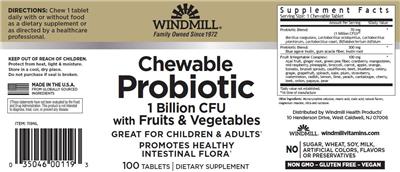
This summary is for Chewable Probiotic by Windmill
- Form
- Tablet or Pill
- Serving Size
- 1 Chewable Tablet
- Servings
- 100 per container
- Container Holds
- 100 Tablets
- What is Chewable Probiotic?A Lactobacillus Acidophilus supplement from Windmill with 37 other active ingredients, in tablet form.
- Active Ingredients 33 plant ingredients such as Acai, Ginger and Cranberry, 4 sources of fiber and 1 other: Probiotic Blend 70 mgBlue Agave InulinGum Acacia FiberInulinAcaiGingerGreen Pea FiberCranberryMangosteenRed RaspberryPineappleBroccoli 38 active ingredients. Each one can interact with drugs or cause side effects on its own, so we check every one. And 26 more, in the Supplement Facts
- Drug Interactions 2,238 drugs have a documented interaction with this supplement; the most serious is rated major. Of those, 1,677 are single drugs and 561 are combination products (two or more drugs in one), each listed under its own name. Based on the 30 of its 38 ingredients we could check. Ask your pharmacist first if you take a drug in any of these categories, the most serious of the 94 on record:
- Major · 645 drugs
- Major · 161 drugs
- Major · 47 drugs
- Major · 41 drugs
- Possible Side EffectsGas 8 ingredientsStomach upset 8 ingredientsBloating 6 ingredientsHeartburn 4 ingredientsLoose stools or 4 ingredientsNausea 4 ingredients +33 moreCombined from 21 of its 38 active ingredients. Not studied in this exact product.
- Well documented Why
Does Chewable Probiotic work?
It is not marketed for one specific use, so this is what its ingredients have been studied for, starting with Lactobacillus Acidophilus, its main ingredient:
- Lactobacillus Acidophilus
- Helicobacter pylori Lactobacillus Acidophilus
- Antibiotic-associated diarrhea Lactobacillus Acidophilus
- Inulin
- Ginger
- Cranberry
These grades are for each ingredient, not this exact product, and never a promise it will work for you.
And 4 more graded uses, in what the research says- AllergensNone of its ingredient names point to a major food allergen
- Barcode (UPC)0 35046 00119 3Match it to the barcode on your bottle to be sure this is your product. Not your product? Search for it here
Who Might Consider It
- People who want Lactobacillus Acidophilus, its main ingredient, for irritable bowel syndrome (IBS), helicobacter pylori or antibiotic-associated diarrhea: the uses with research behind it. See each grade
- This product may appeal to people who want a chewable probiotic with added fruit and vegetable ingredients, and some of its strains are rated possibly effective for IBS.
Who Should Be Careful
- Anyone taking blood thinners, diabetes medicines, insulin, or antibiotics should be careful and review it first.
- If you are pregnant, breastfeeding, have a weakened immune system, or take regular medications, talk it over with your own doctor or pharmacist before starting.
More Before You Take It Show both answersHide Pregnancy and Breastfeeding The Label’s Directions
-
Pregnant or breastfeeding?
- Pregnancy Lactobacillus Acidophilus
- When used orally and appropriately.
- Breastfeeding Lactobacillus Acidophilus
- There is insufficient reliable information available about the safety of Lactobacillus acidophilus during lactation.
- Pregnancy Red Raspberry
- ! When red raspberry leaf is used orally in medicinal amounts throughout pregnancy or for self-treatment.
- Breastfeeding Red Raspberry
- When the fruit is used orally in amounts commonly found in foods.
- Pregnancy Celery
- ! When celery oil or seeds are used orally in larger amounts; celery might have uterine stimulant or abortifacient effects.
- Breastfeeding Celery
- There is insufficient reliable information available about the safety of medicinal amounts of celery during lactation; avoid using.
-
How does the label say to take it?
“Directions: Chew 1 tablet daily with or without food as a dietary supplement or as directed by a healthcare professional.”
The maker’s words. Your pharmacist or doctor may advise differently.
Everything the label says
From the label dated Jul 24, 2025: 30 of its 38 active ingredients were checked against our records; the other eight are not in them yet. A summary of what is known, not a grade or a test of the product. How these ratings are computed
Ask Anything About This Supplement
Name a drug you take, or ask about side effects, ingredients or pregnancy.
There’s a lot of information about this supplement on this page! Ask anything in plain English for a quick answer drawn from it.
AI answers come from this label and our own records, never the open internet. AI can make mistakes, so always check with your doctor or pharmacist. How we use AI
Ask the Pharmacist
A licensed pharmacist will answer your question by email — free, as soon as they can.
Got it — thank you!
A licensed pharmacist will answer as soon as they can. Keep an eye on your email (worth checking spam, just in case).
What’s Inside Chewable Probiotic by Windmill
38 Active Ingredients
In the order the label lists them, each with its own card below.
- Probiotic Blend
- Blue Agave Inulin
- Gum Acacia Fiber
- Inulin
- Acai
- Ginger
- Green Pea Fiber
- Cranberry
- Mangosteen
- Red Raspberry
- Pineapple
- Broccoli
And 26 more, each with its own card below.
The label gives an exact amount for 1 of its 38 active ingredients. The other 37 are inside two proprietary blends, and the label gives one total for each, not how much of each ingredient is in it.
- 1 state an exact amount
- 37 have no amount of their own
- Prebiotic Blend 300 mg in total · 3 ingredients, no amount for each
- Fruit & Vegetable Complex 100 mg in total · 34 ingredients, no amount for each
This rates what the label tells you, not the quality of the product.
Supplement Facts
| Amount Per Serving | % Daily Value | |
|---|---|---|
| Probiotic Blend | 70 mg | † |
| Bacillus coagulans | † | |
| Lactobacillus acidophilus | † | |
| Lactobacillus plantarum | † | |
| Lactobacillus casei | † | |
| Bifidobacterium bifidum | † | |
| Prebiotic Blend | 300 mg | † |
| Blue Agave Inulin | † | |
| Gum Acacia Fiber | † | |
| Inulin | † | |
| Fruit & Vegetable Complex | 100 mg | † |
| Acai | † | |
| Ginger | † | |
| Green Pea Fiber | † | |
| Cranberry | † | |
| Mangosteen | † | |
| Red Raspberry | † | |
| Pineapple | † | |
| Broccoli | † | |
| Carrot | † | |
| Apple | † | |
| Orange | † | |
| Tomato | † | |
| Brussel Sprouts | † | |
| Cauliflower | † | |
| Beet | † | |
| Blueberry | † | |
| Celery | † | |
| Grape | † | |
| Grapefruit | † | |
| Spinach | † | |
| Kale | † | |
| Plum | † | |
| Strawberry | † | |
| Watermelon | † | |
| Radish | † | |
| Lemon | † | |
| Lime | † | |
| Peach | † | |
| Cantaloupe | † | |
| Cherry | † | |
| Leek | † | |
| Onion | † | |
| Papaya | † | |
| Pear | † | |
Other ingredients: Microcrystalline Cellulose, Stearic Acid, Malic Acid, Natural Flavors, Magnesium Stearate, Silica, Sucralose
† Daily Value not established.
Daily Values for adults and children 4 or more years of age.
As the label prints it, from the NIH Dietary Supplement Label Database.
Each Ingredient and Its Drug Interactions
Tap one for more about it and its full guide. A drug can interact with this supplement through any one of them.
Windmill Chewable Probiotic lists 42 ingredients.
- The probiotic strains are live microorganisms: Lactobacillus acidophilus, Bifidobacterium bifidum, Bacillus coagulans, Lactobacillus plantarum, and Lactobacillus casei, along with prebiotic and probiotic blends.
- The rest are food-derived plant ingredients such as ginger, acai, red raspberry, mangosteen, grape, carrot, and tomato, and we do not have dose amounts for them.
Show 1 more point
- Seven inactive other ingredients are also listed: microcrystalline cellulose, stearic acid, malic acid, natural flavors, magnesium stearate, silica, and sucralose.
-
Probiotic Blend 70 mg Interacts with 182 drugs
Lactobacillus acidophilus is a 'friendly' bacterium used as a probiotic to support gut and vaginal health.
- It is generally well tolerated in healthy people, and there is reasonable evidence it may help with certain types of diarrhea, but proof for many other uses is limited.
- People with weakened immune systems or serious illness should check with a doctor before using it.
The full Lactobacillus Acidophilus guide: uses, dosage and safety Every Lactobacillus Acidophilus drug interaction
- Bacillus coagulans 182 drugs
- Lactobacillus acidophilus 182 drugs
- Lactobacillus plantarum
- Lactobacillus casei
- Bifidobacterium bifidum 182 drugs
-
Prebiotic Blend 300 mg Three ingredients inside it, each checked on its own
- Blue Agave Inulin 86 drugs
- Gum Acacia Fiber 2,022 drugs
- Inulin 86 drugs
-
Fruit & Vegetable Complex 100 mg 34 ingredients inside it, each checked on its own
- Acai 89 drugs
- Ginger 1,008 drugs
- Green Pea Fiber
- Cranberry 714 drugs
- Mangosteen 125 drugs
- Red Raspberry 135 drugs
- Pineapple
- Broccoli 187 drugs
- Carrot
- Apple 300 drugs
- Orange 247 drugs
- Tomato
- Brussel Sprouts
- Cauliflower 186 drugs
- Beet 863 drugs
- Blueberry 88 drugs
- Celery 651 drugs
- Grape 912 drugs
- Grapefruit 991 drugs
- Spinach 88 drugs
- Kale
- Plum 122 drugs
- Strawberry 317 drugs
- Watermelon
- Radish 86 drugs
- Lemon 1 drug
- Lime 888 drugs
- Peach
- Cantaloupe
- Cherry
- Leek
- Onion 275 drugs
- Papaya 92 drugs
- Pear
Other Ingredients (Inactive)
The capsule or tablet itself, fillers, coatings and flavors. Not part of the drug interaction check; the allergen check below reads them.
- Microcrystalline Cellulose
- Stearic Acid
- Malic Acid
- Natural Flavors
- Magnesium Stearate
- Silica
- Sucralose
Allergens in Chewable Probiotic
None of its ingredient names point to a major food allergen.
Not named in the ingredients
- Milk
- Egg
- Fish
- Shellfish
- Tree nuts
- Peanuts
- Wheat or other gluten grains
- Soy
- Sesame
- Made without, the label says“No sugar, wheat, soy, milk, artificial colors, flavors or preservatives · Non GMO · Gluten free”
- Made without, the label says“Vegan”
From the label text and ingredient names on file; we do not test products. With a serious allergy, check your bottle and ask the maker or your pharmacist.
What the Label Says
The maker’s own words, from the label. We do not verify or endorse them.
- Storage
-
“Protect from heat, light & moisture. Store in a cool, dry place.”
- Formulation
-
“Made in the U.S.A. from globally sourced ingredients”
“Promotes healthy intestinal flora”
3 more from the label
“No sugar, wheat, soy, milk, artificial colors, flavors or preservatives Non GMO Gluten free”
“1 Billion CFU with fruits & vegetables”
“Great for children & adults”
- FDA Statement of Identity
-
“Dietary Supplement”
- Brand IP Statement(s)
-
“Windmill Family Owned Since 1972”
The Chewable Probiotic Label on File
The label scan on file at the NIH Dietary Supplement Label Database, dated July 2025. Always read the label on the bottle you have.
Product Facts
- Brand
- Windmill
- Barcode (UPC)
- 035046001193
- Net contents
- 100 Tablets
- Market status
- On market
- Date entered into DSLD
- Jul 24, 2025
- DSLD ID
- 333538
- Product type
- Other Combinations
- Supplement form
- Tablet or Pill
- Dietary claims / uses
- All Other, Structure/Function
- Intended target group(s)
- Vegan, Vegetarian, Adult (18 - 50 Years), Children (All), Gluten Free, Dairy Free
Is this label outdated? Report a formula or label change and our pharmacy team will review it.
HelloPharmacist Score Chewable Probiotic by Windmill
Up to 10 points for research, amount, label and outside testing. Not a safety rating. How this one adds up
for irritable bowel syndrome (IBS)
It is not marketed for one specific use, and only 9 of its 38 ingredients have research behind them. The strongest is some research on lactobacillus acidophilus for irritable bowel syndrome (IBS).
- Research3 of 5 points
- Amount1 of 2 points
- Label0 of 2 points
- Outside testing0 of 1 point
Major drug interactions. The score does not count drug interactions. Check them against any drugs you take. See them
How It Earns Its 4
Score: 4 out of 10. Preliminary for irritable bowel syndrome (IBS).
9 of its 38 ingredients have research behind them. The best graded use of each:
- Lactobacillus acidophilus: Possibly Effective for irritable bowel syndrome (IBS)
- Inulin: Possibly Effective for obesity
- Inulin: Possibly Effective for obesity
- Ginger: Possibly Effective for dysmenorrhea
- Cranberry: Possibly Effective for urinary tract infections (UTIs)
- Mangosteen: Possibly Effective for periodontitis
- Beet: Possibly Effective for athletic performance
- Grape: Possibly Effective for chronic venous insufficiency (CVI)
- And 1 more
With no one use on the label, research can earn up to 3 of 5 points. If at least half its ingredients had research, it could earn 4. Grades come from the Natural Medicines database, which we license.
3 of 5 points
Amount
It has more than one main ingredient, and we have nothing to compare their amounts with yet.
1 of 2 points
Label
It states the amount of one of its 38 active ingredients; 37 are inside blends that give only a total.
0 of 2 points
Outside testing
We found no mark from an outside testing program, such as USP Verified or NSF Certified, on the label we have on file.
0 of 1 point
Chewable Probiotic by Windmill Side Effects
Why this rating?
We look for three kinds of safety information on each ingredient: side effects reported in studies, a pregnancy and breastfeeding rating, and a safety write-up from our pharmacy team. Of the 31 ingredients we could check, 27 have side-effect reports, all 31 have a pregnancy rating and all 31 have a safety write-up.
So this rates how much is known, not whether Chewable Probiotic is right for you.
Reported with 30 of its ingredients
- Most often
- Gas, stomach upset, bloating, heartburn, loose stools or and nausea
- !Rare but serious
- Allergic reactions, including anaphylaxis and slow heart rate See details
HelloPharmacist Team Summary: Chewable Probiotic by Windmill Side Effects
Windmill Chewable Probiotic is generally well tolerated, though its ingredients vary in how well they have been studied.
- The side effects you are most likely to notice are gas, bloating, and stomach upset, reported with ingredients such as ginger, bifidum, and red raspberry.
- Dizziness and headache have been reported with grape, so if you feel either, see how it affects you before driving.
- Allergic reactions are rare but possible, and if you develop swelling, hives, or breathing trouble, call your doctor right away.
- Talk with your own doctor or pharmacist first if you have a bleeding disorder, kidney stones, gallstones, a weakened immune system, or are pregnant or breastfeeding.
Side Effects, Ingredient by Ingredient
A supplement’s side effects come from its ingredients. Here is what is reported with each one.
Bifidobacterium Bifidum
Most reported
- Gas
- Bloating
- Minor changes in bowel habits
Inulin
Most reported
- Gas and bloating
- Abdominal cramping or discomfort
- Loose stools or, less often, diarrhea
- A feeling of fullness or rumbling in the belly
Gum Arabic
Most reported
- Gas
- Bloating
- Feeling of fullness
- Stomach discomfort
Acai
Most reported
- Stomach upset
- Digestive changes
Ginger
Most reported
- Heartburn
- Stomach discomfort
- Gas
- Burping
Cranberry
Most reported
- Stomach upset
- Diarrhea
- Nausea
Mangosteen
Most reported
- Stomach upset
- Diarrhea
- Constipation
Red Raspberry
Most reported
- Nausea
- Loose stools
- Stomach upset
Apple
Most reported
- Bloating
- Flatulence
From the Natural Medicines database, which we license.
Every reported effect, in the Apple guideTomato
Most reported
- Heartburn or acid reflux due to acidity
- Digestive upset with very large amounts
Beet
Most reported
- Pink urine
- Sometimes red stools after eating beets
Blueberry
Most reported
- Gas
- Bloating
- Loose stools
Celery
Most reported
- Stomach upset or digestive discomfort
- Increased urination
- Skin rash or sun sensitivity
Grape
Most reported
- Headache
- Dizziness
- Upset stomach
- Nausea
Plum
Most reported
- Gas
- Bloating
- Stomach cramps
- Loose stools or diarrhea
Strawberry
Most reported
- Allergic reactions
- Digestive upset
Radish
Most reported
- Gas
- Bloating
- Stomach upset
Lemon
Most reported
- Tooth enamel erosion
- Mouth or lip irritation
- Heartburn
- Upset stomach
Lime
Most reported
- Heartburn or stomach upset from the acid
- Irritation of mouth sores or sensitive teeth
- Allergic reactions in people sensitive to citrus
Onion
Most reported
- Abdominal pain
- Heartburn
From the Natural Medicines database, which we license.
Every reported effect, in the Onion guidePapaya
Most reported
- Nausea
- Vomiting from papaya leaf extract
From the Natural Medicines database, which we license.
Every reported effect, in the Papaya guideLactobacillus Acidophilus, Bacillus Coagulans, Broccoli, Carrot, Sweet Orange, Grapefruit and Spinach have side-effect reports, but no list of the most common ones. Read them in each guide: Lactobacillus Acidophilus, Bacillus Coagulans, Broccoli, Carrot, Sweet Orange, Grapefruit, Spinach.
We have no side-effect reports for Cauliflower.
Chewable Probiotic Warnings: Who Should Be Careful
Chewable Probiotic has 38 active ingredients, and each can carry warnings of its own. We checked the 30 in our ingredient guides, and each warning below names the ingredient it comes from. Green Pea Fiber, Pineapple and Brussel Sprouts and five more are not in our guides yet, so ask your pharmacist about them. If any of these apply to you, talk to your doctor or pharmacist before you start it.
- Lactobacillus Acidophilus1 warning below
- Bacillus Coagulans3 warnings below
- Bifidobacterium Bifidum2 warnings below
- Inulin2 warnings below
- Gum Arabic2 warnings below
- Acai2 warnings below
- Ginger2 warnings below
- Cranberry3 warnings below
- Mangosteen2 warnings below
- Red Raspberry2 warnings below
- Broccoli3 warnings below
- Carrot2 warnings below
- Apple2 warnings below
- Sweet Orange2 warnings below
- Tomato1 warning below
- Cauliflower3 warnings below
- Beet2 warnings below
- Blueberry2 warnings below
- Celery2 warnings below
- Grape2 warnings below
- Grapefruit2 warnings below
- Spinach1 warning below
- Kale3 warnings below
- Plum2 warnings below
- Strawberry3 warnings below
- Radish3 warnings below
- Lemon2 warnings below
- Lime3 warnings below
- Onion3 warnings below
- Papaya2 warnings below
- Pear3 warnings below
- Green Pea FiberNot in our guides yet
- PineappleNot in our guides yet
- Brussel SproutsNot in our guides yet
- WatermelonNot in our guides yet
- PeachNot in our guides yet
- CantaloupeNot in our guides yet
- CherryNot in our guides yet
- LeekNot in our guides yet
-
Bleeding Problems or Surgery
- GingerUse extra caution if you have a bleeding disorder or are scheduled for surgery, since ginger may slightly affect blood clotting.
- MangosteenPeople with kidney problems, bleeding disorders, or who are scheduled for surgery should be especially cautious and check with a healthcare provider first.
- Red RaspberryPeople with hormone-sensitive conditions, those who are scheduled for surgery, or anyone with a chronic health problem should speak with a pharmacist or doctor before using red raspberry supplements.
- CauliflowerPeople who take blood thinners or who have been told to watch their vitamin K intake should keep their cauliflower consumption fairly steady from day to day, since cruciferous vegetables contain vitamin K.
Show 5 more
- BlueberryIf you have a medical condition or take medicine that affects blood sugar or blood clotting, talk with your pharmacist or doctor before using blueberry supplements.
- GrapeWho should be cautious: People with bleeding disorders, those taking blood-thinning medicines, and anyone scheduled for surgery should talk to a healthcare provider before using concentrated grape supplements, since some grape compounds may affect blood clotting.
- KalePeople who take certain blood thinners need to keep their vitamin K intake steady rather than suddenly eating much more or less (your pharmacist or doctor can guide you on this).
- OnionPeople scheduled for surgery may want to limit large medicinal doses beforehand because of possible effects on bleeding.
- PapayaAlways tell your pharmacist or doctor about any supplements you take, especially before surgery or if you have a medical condition.
-
Diabetes or Low Blood Sugar
- CranberryPeople with diabetes should choose unsweetened products, because cranberry juice cocktails can be high in added sugar.
-
Blood Pressure
- BeetPeople with low blood pressure should be aware that beets may lower it further.
-
Kidney Disease or Kidney Stones
- CranberryUse extra caution if you have a history of kidney stones, since cranberry contains oxalate and large amounts may not be ideal for stone-prone people.
- BeetPeople with a history of kidney stones may want to be careful, because beets contain oxalates, which can contribute to certain types of stones.
- CeleryKidney problems: Because of its diuretic effect and mineral content, people with kidney disease should talk to a doctor first.
- KaleKale also contains oxalates, which can contribute to kidney stones in people who are prone to them.
- PlumThose with kidney problems should be aware that plums and prunes contain potassium and may also contain oxalate, so talk to your doctor if you have been told to limit these.
-
Gallbladder Problems
- GingerPeople with gallstones should also check with a doctor, because ginger can increase the flow of bile.
- RadishPeople with gallstones or a blocked bile duct should be careful, because radish may increase bile flow and could worsen symptoms.
-
Stomach or Bowel Problems
- Bifidobacterium BifidumIf you have ongoing digestive symptoms, see a healthcare provider rather than relying on a supplement.
- InulinUse extra caution if you have irritable bowel syndrome (IBS) or other sensitive gut conditions, since inulin is a fermentable fiber (a FODMAP) that can worsen gas, bloating, and discomfort.
- Gum ArabicPeople with sensitive digestion or conditions like irritable bowel syndrome may want to start with a small amount.
- Sweet OrangePeople with citrus allergies, acid reflux, or sensitive stomachs may want to limit acidic citrus.
Show 2 more
- PlumPeople with conditions that are sensitive to high-fiber or high-sorbitol foods—such as irritable bowel syndrome—may notice more digestive symptoms.
- LemonPeople with acid reflux, heartburn, or stomach ulcers may find that lemon makes symptoms worse.
-
Thyroid Conditions
- BroccoliPeople with thyroid problems may want to be mindful, since very large amounts of cruciferous vegetables contain compounds (goitrogens) that could affect the thyroid, especially if iodine intake is low.
- CauliflowerPeople with thyroid problems sometimes worry about cruciferous vegetables, but normal food amounts are generally fine; talk with your doctor if you have a thyroid condition and eat large quantities.
- KaleKale is a goitrogenic vegetable, meaning very large amounts—especially raw—may affect thyroid function in people who are prone to thyroid problems or are low in iodine.
- RadishPeople with thyroid conditions may want to avoid eating very large amounts, since plants in this family contain compounds that can affect the thyroid in high amounts.
-
Allergies
- AcaiPeople with allergies to acai or related palm fruits should avoid it.
- CarrotPeople who are allergic to plants in the carrot family (such as celery, parsley, or mugwort pollen) may also react to carrots.
- ApplePeople with a known apple or birch pollen allergy should be careful, as apples can trigger oral allergy symptoms in sensitive individuals.
- BlueberryPeople with allergies to blueberries or related berries should avoid them.
Show 7 more
- StrawberryPeople with pollen allergies sometimes notice mouth itching when eating fresh strawberries.
- StrawberryIf you have a known allergy to strawberries or other berries, avoid them.
- LimePeople with citrus allergies should avoid it.
- OnionPeople who are allergic to onion or other allium plants (like garlic) should avoid it.
- PapayaPeople who are allergic to papaya, papain, or latex (there can be cross-reactions with latex allergy) should avoid it.
- PearPeople with birch pollen allergy may experience oral allergy syndrome (itching or tingling in the mouth) when eating raw pear.
- PearIf you have a known fruit allergy, be cautious.
-
Children
- Lactobacillus AcidophilusFor most healthy adults and children, L. acidophilus is considered safe and is widely used in foods and supplements.
- Bacillus CoagulansTalk to your pharmacist or doctor before starting, especially for children or anyone with a chronic health condition.
- PearPear is one of the safest foods you can eat and is suitable for most people, including children.
-
If You Take Other Drugs
- Gum ArabicAs with any supplement, talk to your pharmacist or doctor before starting, especially if you have a health condition or take medications.
- MangosteenAlways tell your pharmacist or doctor about any supplement you take, especially if you have a health condition or take medications.
- TomatoIf you have a medical condition or take medications, check with a healthcare professional before using supplements.
- CauliflowerAs always, check with a pharmacist or doctor before using concentrated cauliflower supplements, especially if you have a health condition or take medication.
Show 2 more
- GrapeAlways check with your pharmacist or doctor before starting any new supplement, especially if you have a health condition or take other medicines.
- GrapefruitWho should be cautious: Anyone taking regular medication should talk with a pharmacist or doctor before adding grapefruit or grapefruit supplements to their diet.
-
Other Cautions
- Bacillus CoagulansUse extra caution if you have a weakened immune system — for example, from chemotherapy, organ transplant, advanced illness, or HIV — or if you are seriously ill or hospitalized.
- Bacillus CoagulansIn rare cases, live bacteria can cause infections in people who are very vulnerable.
- Bifidobacterium BifidumHowever, people who are seriously ill, have weakened immune systems (for example from chemotherapy, HIV, or organ transplant), or who have central venous catheters should not take probiotics without medical supervision.
- InulinPeople following a low-FODMAP diet are usually advised to avoid it.
Show 15 more
- AcaiAlways talk with your pharmacist or doctor before starting any new supplement, especially if you have a medical condition.
- CranberryAs always, if you have UTI symptoms such as burning, urgency, fever, or back pain, see a healthcare provider rather than relying on cranberry alone.
- Red RaspberryStill, because high-quality safety studies are limited, caution is wise.
- BroccoliThe safety of concentrated extracts is not established, so caution is advised.
- AppleSwallowing a few whole seeds by accident is generally harmless, but you should not chew or eat large amounts of apple seeds.
- Sweet OrangeOrange essential oil is for external or aromatherapy use and should not be swallowed unless a qualified professional advises it.
- CeleryAlways check with your pharmacist or doctor before starting a celery supplement, especially if you have a medical condition.
- GrapefruitPeople with certain conditions affected by potassium should also check with their provider.
- SpinachConcentrated supplements and extracts are less studied, so use them with more caution and follow product labels.
- StrawberryAlways talk to your pharmacist or doctor before starting any new supplement, especially if you have a health condition.
- RadishConcentrated supplements, extracts, and large amounts of juice are less studied, so use more caution with these.
- LemonWhen in doubt, talk with your pharmacist or doctor before using lemon products for a health purpose.
- LimeConcentrated forms such as essential oil, strong extracts, or large supplement doses are less well studied and should be used with more caution.
- LimeWash lime off your skin and avoid sun on areas that touched lime.
- OnionConcentrated supplement doses have not been well studied, so it is safest to avoid them unless your doctor or pharmacist approves.
-
What the Label Warns
- “Keep out of reach of children.”
- “Do not purchase if seal is broken.”
The maker’s wording, from the product label.
-
Pregnant or Breastfeeding
Each ingredient’s rating for pregnancy and for breastfeeding, and what it covers.
Pregnancy
-
When used orally and appropriately.
A combination of Lactobacillus acidophilus, Lacticaseibacillus casei, and Bifidobacterium bifidum has been used with apparent safety for 6 weeks, starting at 24-28 weeks' gestation.
Breastfeeding
-
There is insufficient reliable information available about the safety of Lactobacillus acidophilus during lactation.
However, there are currently no reasons to expect safety concerns when used appropriately.
Pregnancy
-
When the fruit is used orally in amounts commonly found in foods.
-
When red raspberry leaf is used orally and appropriately in medicinal amounts during late pregnancy under the supervision of a healthcare provider.
Red raspberry leaf is used by nurse midwives to facilitate delivery.
2 more points on this rating
- There is some evidence that red raspberry leaf in doses of up to 2.4 grams daily, beginning at 32 weeks' gestation and continued until delivery, can be safely used for this purpose.
- Make sure patients do not use red raspberry leaf without the guidance of a healthcare professional.
-
When red raspberry leaf is used orally in medicinal amounts throughout pregnancy or for self-treatment.
Red raspberry leaf might have estrogenic effects.
2 more points on this rating
- These effects can adversely affect pregnancy.
- Tell pregnant patients not to use red raspberry leaf at any time during pregnancy without the close supervision of a healthcare provider.
Breastfeeding
-
When the fruit is used orally in amounts commonly found in foods.
There is insufficient reliable information available about the safety of red raspberry leaf; avoid using.
Show 29 more ingredients
Pregnancy
-
When celery oil or seeds are used orally in larger amounts; celery might have uterine stimulant or abortifacient effects.
Breastfeeding
-
There is insufficient reliable information available about the safety of medicinal amounts of celery during lactation; avoid using.
Pregnancy
-
Beet as a food is fine, but concentrated supplements lack safety data, so use caution.
Breastfeeding
-
There is insufficient reliable information available about the safety of beets used medicinally during pregnancy and breast-feeding.
Pregnancy
-
When the ripe fruit is consumed in amounts commonly found in foods.
-
When the unripe fruit containing papaya latex is used orally; avoid using.
There is some concern that crude papain, a constituent of papaya latex, is teratogenic and embryotoxic; however, this might be due to extraneous substances rather than papain.
2 more points on this rating
- Some evidence also suggests that high doses of papaya seed extract have abortifacient activity and can adversely affect fetal development.
- Theoretically, eating large amounts of papaya seeds may have similar effects.
Breastfeeding
-
When the ripe fruit is consumed in amounts commonly found in foods.
There is insufficient reliable information available about the safety of using papaya medicinally; avoid using.
Pregnancy and Breastfeeding The record rates both the same
-
Insufficient reliable information available; avoid using.
Pregnancy
-
When Bifidobacterium bifidum is used orally and appropriately, short-term.
A combination of B. bifidum, Lactobacillus acidophilus, and Lacticaseibacillus casei has been used with apparent safety for 6 weeks starting at 24-28 weeks' gestation.
Breastfeeding
-
There is insufficient reliable information available about the safety of Bifidobacterium bifidum during lactation.
However, there are currently no reasons to expect safety concerns when used appropriately.
Pregnancy and Breastfeeding The record rates both the same
-
Insufficient reliable information available; avoid using in amounts greater than those found in foods.
Pregnancy and Breastfeeding The record rates both the same
-
Insufficient reliable information available; avoid using.
Pregnancy and Breastfeeding The record rates both the same
-
Insufficient reliable information available; avoid using.
Pregnancy and Breastfeeding The record rates both the same
-
There is insufficient reliable information available about the safety of apple in amounts greater than those found in foods during pregnancy and lactation; avoid using.
Pregnancy and Breastfeeding The record rates both the same
-
Insufficient reliable information available; avoid using in greater amounts than found in foods.
Pregnancy and Breastfeeding The record rates both the same
-
There is insufficient reliable information available about the safety of using medicinal amounts of grapefruit during pregnancy and lactation; avoid using.
Pregnancy and Breastfeeding The record rates both the same
-
Insufficient reliable information available; avoid using amounts greater than those found in food.
Pregnancy and Breastfeeding The record rates both the same
-
Insufficient reliable information available; avoid very large doses.
Pregnancy and Breastfeeding The record rates both the same
-
Insufficient reliable information available.
Avoid using in amounts greater than those typically found in foods.
Pregnancy and Breastfeeding The record rates both the same
-
Insufficient reliable information available; avoid using in amounts greater than those typically found in foods.
Pregnancy and Breastfeeding The record rates both the same
-
Insufficient reliable information available; avoid using in amounts greater than used in foods.
Pregnancy and Breastfeeding The record rates both the same
-
When used orally in amounts commonly found in foods.
There is insufficient reliable information available about using inulin in medicinal amounts during pregnancy or lactation; avoid use.
Pregnancy
-
When consumed in the amounts typically found in foods.
Ginger is considered a first-line nonpharmacological treatment option for nausea in pregnancy by the American College of Obstetrics and Gynecology (ACOG).
However, it should not be used long-term or without medical supervision and close monitoring.
-
When used for medicinal purposes.
Despite some early reports of adverse effects and one observational study suggesting that taking dried ginger and other herbal supplements during the first 20 weeks of pregnancy marginally increased the chance of stillbirth, most research shows that ginger is unlikely to cause harm to the baby.
3 more points on this rating
- The risk for major malformations in infants of parents who took ginger when pregnant does not appear to be higher than the baseline rate of 1% to 3%.
- Also, other research suggests that ginger intake during various trimesters does not significantly affect the risk of spontaneous abortion, congenital malformations, stillbirth, perinatal death, preterm birth, low birth weight, or low Apgar scores.
- Ginger use has been associated with an increase in non-severe vaginal bleeding, including spotting, after week 17 of pregnancy.
Breastfeeding
-
When consumed in the amounts typically found in foods.
There is insufficient reliable information available about the safety of ginger when used for medicinal purposes; avoid amounts greater than those found in foods.
Pregnancy and Breastfeeding The record rates both the same
-
When consumed in amounts commonly found in the diet.
There is insufficient reliable information available about the safety of cranberry when used therapeutically during pregnancy or lactation; avoid using.
Pregnancy and Breastfeeding The record rates both the same
-
When used orally in food amounts.
There is insufficient reliable information available about the safety of broccoli when used in medicinal amounts during pregnancy and lactation; avoid using.
Pregnancy and Breastfeeding The record rates both the same
-
When used orally in amounts commonly found in food.
Carrot essential oil, extracts, and food additives have Generally Recognized as Safe (GRAS) status in the US.
There is insufficient reliable information available about the safety of carrot when used in medicinal amounts during pregnancy and lactation.
Pregnancy and Breastfeeding The record rates both the same
-
When sweet orange juice or fruit is used orally in amounts commonly found in foods.
Pregnancy and Breastfeeding The record rates both the same
-
When the tomato fruit or its products are consumed in typical food amounts.
There is insufficient reliable information available about the safety of tomato extracts when used during pregnancy or lactation; avoid using.
Pregnancy and Breastfeeding The record rates both the same
-
When used orally in amounts commonly found in foods.
There is insufficient reliable information available about the safety of blueberry for medicinal use; avoid using.
Pregnancy and Breastfeeding The record rates both the same
-
When used orally in amounts commonly found in foods.
There is insufficient reliable information available about the safety of medicinal amounts during pregnancy and breast-feeding; avoid using in amounts greater than what is commonly found in foods.
Pregnancy and Breastfeeding The record rates both the same
-
When used in amounts commonly found in foods; avoid medicinal amounts.
Pregnancy and Breastfeeding The record rates both the same
-
When used orally in amounts commonly found in foods.
There is insufficient reliable information available about the safety of kale when used orally in medicinal amounts; avoid use.
Pregnancy and Breastfeeding The record rates both the same
-
When used orally in food amounts.
There is insufficient reliable information available about the safety of strawberry for medicinal use in pregnancy and lactation; avoid using.
Pregnancy and Breastfeeding The record rates both the same
-
When consumed in amounts commonly found in foods.
Our pharmacy team’s notes
- Bacillus CoagulansFor Bacillus coagulans, pregnancy and breastfeeding data are missing, so there isn't enough data to know either way; talk with your doctor or pharmacist for personalized advice.
- Our pharmacists advise avoiding mangosteen supplement amounts during pregnancy and breastfeeding.
Ratings and the words beside them are from the Natural Medicines database, which we license. Where it has no rating, the rating and note are our pharmacy team’s.
-
Rare but Serious Side Effects
-
!
Lactobacillus Acidophilus
Serious side effects are rare.
Rare serious bloodstream infections have been reported in very vulnerable people, such as those with central venous catheters or weakened immune systems.
-
!
Bacillus Coagulans
Serious side effects are rare in healthy people.
-
!
Bifidobacterium Bifidum
Serious side effects are rare in healthy people.
-
!
Inulin
Orally: Anaphylaxis has occurred following consumption of foods high in inulin.
-
!
Gum Arabic
Serious side effects are rare, but allergic reactions are possible.
-
!
Acai
Allergic reactions are rare but possible, particularly in people sensitive to similar fruits or pollens.
-
!
Ginger
Rarely, some people may have an allergic reaction.
-
!
Mangosteen
Some people may have an allergic reaction, with symptoms like rash, itching, or swelling.
-
!
Red Raspberry
Allergic reactions are possible but uncommon.
-
!
Broccoli
Allergic reactions to broccoli are uncommon but possible.
-
!
Carrot
Some people may have an allergic reaction, especially those sensitive to related plants or certain pollens.
-
!
Apple
Serious allergic reactions are rare but possible.
Orally: Allergic reactions, including anaphylaxis. Ingestion of large amounts of apple seeds may cause cyanide poisoning, leading to death.
-
!
Sweet Orange
Allergic reactions to citrus are possible but uncommon.
-
!
Tomato
Orally: Bradycardia, diarrhea, respiratory disturbances, spasms, vomiting, and death with excessive consumption of tomatine, a glycoalkaloid found in tomato leaves and unripe green tomatoes.
-
!
Beet
Orally: Hypocalcemia and kidney damage when ingested in large amounts.
-
!
Blueberry
Allergic reactions are uncommon but possible.
-
!
Celery
Seek emergency care if you have signs of a serious allergic reaction, such as swelling of the face or throat, or difficulty breathing.
Orally: Anaphylaxis in sensitive individuals.
-
!
Grape
Some people may have an allergic reaction to grapes or grape products, which can rarely be serious.
Orally: Anaphylaxis to grape skin has been reported.
-
!
Grapefruit
The most serious risk does not come from grapefruit itself but from how it changes the way the body handles certain medicines.
Orally: Allergic reactions in sensitive individuals have been reported. When large quantities are consumed, arrhythmias, mineralocorticoid excess, QT prolongation, and pseudohyperaldosteronism have been reported. There is also some concern for increased breast cancer risk with grapefruit consumption.
-
!
Spinach
Orally: In infants under 4 months of age, methemoglobinemia has been reported.
Allergies in sensitive individuals.
-
!
Kale
Allergic reactions are rare.
-
!
Plum
Allergic reactions to plums are uncommon but possible, especially in people allergic to other stone fruits.
Orally: Allergic reactions. Consumption of dried plums or plum pits has been reported to cause bowel obstruction and esophageal perforation.
-
!
Strawberry
Possible issues include allergic reactions (itching, hives, swelling), mild digestive upset, or mouth tingling in sensitive people.
Orally: Allergic reactions in susceptible individuals.
-
!
Radish
Rarely, allergic reactions can be serious.
-
!
Lemon
Allergic reactions to citrus are uncommon but possible.
-
!
Onion
True onion allergy is uncommon but possible, and serious allergic reactions are rare.
Anaphylaxis in sensitive individuals.
-
!
Papaya
Allergic reactions can occur, ranging from itching and rash to, rarely, more serious reactions.
Orally: Severe allergic reactions.
-
!
Pear
Serious side effects are rare and are usually limited to allergic reactions in people who are sensitive to pear or related fruits.
When to get help: a serious allergic reaction, with trouble breathing or swelling of the face, lips or throat, needs emergency care: call 911. For any other side effect that worries you, call your doctor or pharmacist.
These reports describe each ingredient, not studies of this exact product. Not medical advice: a side effect you notice after starting a supplement is worth a word with your pharmacist or doctor.
Chewable Probiotic by Windmill Drug Interactions
We checked all 38 active ingredients in this supplement against every drug in our records. A drug can interact with it through any one of them. Eight of them are not in our interaction records yet.
A major interaction on record
3 of 3, on a scale from Minor or none to Major.Why this rating?
We rate this by the most serious interaction on record, not by how many there are. For Gum Arabic, Apple, Beet, Red Raspberry and Strawberry, the most serious is rated major, which means the combination is best avoided, or used only under close supervision. Some involve kinds of drugs where a small change can matter, such as blood thinners, transplant drugs and diabetes drugs.
2,239 drugs are on the full list. What matters is whether one you take is on it, so check yours with the interaction checker on this page.
From the HelloPharmacist Team
The big picture, once every ingredient is counted together.
- Windmill Chewable Probiotic can interact with several medications, through its probiotic strains (acidophilus, bifidum, and coagulans), ginger, acai, red raspberry, mangosteen, grape, radish, onion, cauliflower, strawberry, cranberry, broccoli, and spinach.
- Diabetes medicines and insulin (Moderate) can push blood sugar too low, which is called low blood sugar (hypoglycemia).
- Other Moderate-rated types include nifedipine, losartan, cyclosporine, midazolam, alprazolam, lithium, aspirin, atorvastatin, and the liver enzyme pathways (CYP and P-glycoprotein systems) that clear many drugs.
25 of its 38 active ingredients have drug interactions on record. The ones below matter most.
- Interacts with
- 182 drugs
- Most serious
- Moderate
- Antibiotics (Moderate) may kill the live probiotic organisms, so spacing doses matters.
- We could not check Lactobacillus plantarum, peach, leek, or Lactobacillus casei, and the prebiotic and probiotic blends are listed only by their individual components.
- Interacts with
- 1,008 drugs
- Most serious
- Moderate
- The most serious interaction on record involves blood thinners (anticoagulant and antiplatelet drugs), where ginger may raise bleeding risk, and that interaction is rated Moderate.
- Interacts with
- 2,022 drugs
- Most serious
- Moderate
- Most of its records involve Oral Drugs and Amoxicillin (Amoxil, Trimox).
Show three more ingredients
- Interacts with
- 991 drugs
- Most serious
- Major
- Most of its records involve Cytochrome P450 3A4 (CYP3A4) Substrates, P-glycoprotein Substrates and Cytochrome P450 1A2 (CYP1A2) Substrates.
- Interacts with
- 912 drugs
- Most serious
- Moderate
- Most of its records involve Cytochrome P450 3A4 (CYP3A4) Substrates, Cytochrome P450 2D6 (CYP2D6) Substrates and Cytochrome P450 1A2 (CYP1A2) Substrates.
- Interacts with
- 888 drugs
- Most serious
- Moderate
- Most of its records involve Cytochrome P450 3A4 (CYP3A4) Substrates and Photosensitizing Drugs.
And 19 more ingredients with records, each in the cards below.
Summarized by the HelloPharmacist pharmacy team from the interaction records below. How it is written How we use AI
Why Chewable Probiotic Interacts, Ingredient by Ingredient
A product interacts through its ingredients. Each card: how many drugs, the most serious rating, and the kinds of drugs it affects most (tap a kind for what it means).
The ingredients driving the most interactions
-
Gum Acacia Fiber 2,022 drugs
Most serious: Moderate2 interaction records on file
The kinds of drugs it affects most
- 2,022 drugs
- Amoxicillin (Amoxil, Trimox) 4 drugs
Every Gum Arabic drug interaction, 2 records The Gum Arabic records cite 9 references, listed in the Gum Arabic guide.
-
Ginger 1,008 drugs
Most serious: Moderate14 interaction records on file
The kinds of drugs it affects most
- 645 drugs
- 202 drugs
- 186 drugs
- 122 drugs
Every Ginger drug interaction, 14 records The Ginger records cite 65 references, listed in the Ginger guide.
-
Grapefruit 991 drugs
Most serious: Major62 interaction records on file
The kinds of drugs it affects most
- 645 drugs
- 202 drugs
- 186 drugs
- 161 drugs
Every Grapefruit drug interaction, 62 records The Grapefruit records cite 157 references, listed in the Grapefruit guide.
-
Grape 912 drugs
Most serious: Moderate10 interaction records on file
The kinds of drugs it affects most
- 645 drugs
- 193 drugs
- 186 drugs
- 122 drugs
Every Grape drug interaction, 10 records The Grape records cite 35 references, listed in the Grape guide.
-
Lime 888 drugs
Most serious: Moderate2 interaction records on file
The kinds of drugs it affects most
- 645 drugs
- 335 drugs
Every Lime drug interaction, 2 records The Lime records cite 18 references, listed in the Lime guide.
-
Beet 863 drugs
Most serious: Moderate3 interaction records on file
The kinds of drugs it affects most
- 645 drugs
- 186 drugs
- 172 drugs
Every Beet drug interaction, 3 records The Beet records cite 11 references, listed in the Beet guide.
-
Cranberry 714 drugs
Most serious: Moderate7 interaction records on file
The kinds of drugs it affects most
- 645 drugs
- 112 drugs
- Diclofenac (Voltaren, others) 5 drugs
- Atorvastatin (Lipitor) 3 drugs
Every Cranberry drug interaction, 7 records The Cranberry records cite 34 references, listed in the Cranberry guide.
-
Celery 651 drugs
Most serious: Moderate8 interaction records on file
The kinds of drugs it affects most
- 335 drugs
- 186 drugs
- 172 drugs
- 122 drugs
Every Celery drug interaction, 8 records The Celery records cite 48 references, listed in the Celery guide.
-
Strawberry 317 drugs
Most serious: Moderate2 interaction records on file
The kinds of drugs it affects most
- 202 drugs
- 122 drugs
Every Strawberry drug interaction, 2 records The Strawberry records cite 11 references, listed in the Strawberry guide.
-
Apple 300 drugs
Most serious: Major7 interaction records on file
The kinds of drugs it affects most
- 172 drugs
- 86 drugs
- 47 drugs
- Atenolol (Tenormin) 3 drugs
Every Apple drug interaction, 7 records The Apple records cite 16 references, listed in the Apple guide.
-
Onion 275 drugs
Most serious: Moderate5 interaction records on file
The kinds of drugs it affects most
- 122 drugs
- 86 drugs
- 70 drugs
- 35 drugs
Every Onion drug interaction, 5 records The Onion records cite 26 references, listed in the Onion guide.
-
Orange 247 drugs
Most serious: Major7 interaction records on file
The kinds of drugs it affects most
- 202 drugs
- 47 drugs
- 21 drugs
- Fexofenadine (Allegra) 2 drugs
Every Sweet Orange drug interaction, 7 records The Sweet Orange records cite 17 references, listed in the Sweet Orange guide.
-
Broccoli 187 drugs
Most serious: Moderate2 interaction records on file
The kinds of drugs it affects most
- 186 drugs
- 1 drug
Every Broccoli drug interaction, 2 records The Broccoli records cite 5 references, listed in the Broccoli guide.
-
Cauliflower 186 drugs
Most serious: Moderate1 interaction record on file
The kinds of drugs it affects most
- 186 drugs
Every Cauliflower drug interaction, 1 record The Cauliflower records cite 9 references, listed in the Cauliflower guide.
-
Probiotic Blend 182 drugs
Most serious: Moderate1 interaction record on file
The kinds of drugs it affects most
- 182 drugs
Every Lactobacillus Acidophilus drug interaction, 1 record The Lactobacillus Acidophilus records cite 18 references, listed in the Lactobacillus Acidophilus guide.
-
Red Raspberry 135 drugs
Most serious: Moderate2 interaction records on file
The kinds of drugs it affects most
- 122 drugs
- 13 drugs
Every Red Raspberry drug interaction, 2 records The Red Raspberry records cite 8 references, listed in the Red Raspberry guide.
-
Mangosteen 125 drugs
Most serious: Moderate2 interaction records on file
The kinds of drugs it affects most
- 122 drugs
- Donepezil (Aricept) 3 drugs
Every Mangosteen drug interaction, 2 records The Mangosteen records cite 6 references, listed in the Mangosteen guide.
-
Plum 122 drugs
Most serious: Moderate1 interaction record on file
The kinds of drugs it affects most
- 122 drugs
Every Plum drug interaction, 1 record The Plum records cite 10 references, listed in the Plum guide.
-
Papaya 92 drugs
Most serious: Moderate4 interaction records on file
The kinds of drugs it affects most
- 86 drugs
- 3 drugs
- 2 drugs
- Amiodarone (Cordarone) 1 drug
Every Papaya drug interaction, 4 records The Papaya records cite 14 references, listed in the Papaya guide.
-
Acai 89 drugs
Most serious: Moderate3 interaction records on file
The kinds of drugs it affects most
- 86 drugs
- Alogliptin (Nesina) 3 drugs
- Atorvastatin (Lipitor) 3 drugs
Every Acai drug interaction, 3 records The Acai records cite 3 references, listed in the Acai guide.
-
Blueberry 88 drugs
Most serious: Minor3 interaction records on file
The kinds of drugs it affects most
- 86 drugs
- Buspirone (BuSpar) 1 drug
- Flurbiprofen (Ansaid, others) 1 drug
Every Blueberry drug interaction, 3 records The Blueberry records cite 7 references, listed in the Blueberry guide.
-
Spinach 88 drugs
Most serious: Moderate2 interaction records on file
The kinds of drugs it affects most
- 86 drugs
- 2 drugs
Every Spinach drug interaction, 2 records The Spinach records cite 6 references, listed in the Spinach guide.
-
Blue Agave Inulin 86 drugs
Most serious: Minor1 interaction record on file
The kinds of drugs it affects most
- 86 drugs
Every Inulin drug interaction, 1 record The Inulin records cite 20 references, listed in the Inulin guide.
-
Radish 86 drugs
Most serious: Moderate1 interaction record on file
The kinds of drugs it affects most
- 86 drugs
Every Radish drug interaction, 1 record The Radish records cite 5 references, listed in the Radish guide.
-
Lemon 1 drug
Most serious: Minor1 interaction record on file
The kinds of drugs it affects most
- Itraconazole (Sporanox) 1 drug
Every Lemon drug interaction, 1 record The Lemon records cite 2 references, listed in the Lemon guide.
The Breakdown by Severity
Each drug counted once, at its most serious rating. Tap a tile to list those drugs.
Find Your Drug
Type a drug or brand name to see whether it is on the list.
- Only drugs with a documented interaction are listed, the most serious first.
- A drug with no known interaction is not listed, but searching its name tells you so.
- Open a drug to see which ingredient is responsible. Of those, 1,677 are single drugs and 561 are combination products (two or more drugs in one), each listed under its own name.
-
KetoconazoleNizoral Major
The 7 ingredients responsible:
-
Grapefruit Major Ketoconazole is in the Cytochrome P450 3A4 (CYP3A4) Substrates category.
Grapefruit juice can increase levels of drugs metabolized by CYP3A4.
The full Grapefruit + Ketoconazole interaction -
Gum Acacia Fiber Moderate Ketoconazole is in the Oral Drugs category.
Theoretically, gum arabic can alter the absorption of oral drugs due to its fiber content.
The full Gum Acacia Fiber + Ketoconazole interaction -
Lime Moderate Ketoconazole is in the Cytochrome P450 3A4 (CYP3A4) Substrates category.
Theoretically, high amounts of lime juice might increase levels of drugs metabolized by CYP3A4.
The full Lime + Ketoconazole interaction -
Grape Moderate Ketoconazole is in the Cytochrome P450 3A4 (CYP3A4) Substrates category.
It is unclear if grape seed extract inhibits or induces CYP3A4; research is conflicting.
The full Grape + Ketoconazole interaction -
Ginger Moderate Ketoconazole is in the Cytochrome P450 3A4 (CYP3A4) Substrates category.
Ginger might increase or decrease the levels of CYP3A4 substrates.
The full Ginger + Ketoconazole interaction -
Beet Moderate Ketoconazole is in the Cytochrome P450 3A4 (CYP3A4) Substrates category.
Theoretically, beet might increase the levels of CYP3A4 substrates.
The full Beet + Ketoconazole interaction -
Cranberry Moderate Ketoconazole is in the Cytochrome P450 3A4 (CYP3A4) Substrates category.
Theoretically, cranberry might increase the levels and adverse effects of CYP3A4 substrates.
The full Cranberry + Ketoconazole interaction
-
-
IvacaftorKalydeco Major
The 7 ingredients responsible:
-
Grapefruit Major Ivacaftor is in the Cytochrome P450 3A4 (CYP3A4) Substrates category.
Grapefruit juice can increase levels of drugs metabolized by CYP3A4.
The full Grapefruit + Ivacaftor interaction -
Beet Moderate Ivacaftor is in the Cytochrome P450 3A4 (CYP3A4) Substrates category.
Theoretically, beet might increase the levels of CYP3A4 substrates.
The full Beet + Ivacaftor interaction -
Gum Acacia Fiber Moderate Ivacaftor is in the Oral Drugs category.
Theoretically, gum arabic can alter the absorption of oral drugs due to its fiber content.
The full Gum Acacia Fiber + Ivacaftor interaction -
Ginger Moderate Ivacaftor is in the Cytochrome P450 3A4 (CYP3A4) Substrates category.
Ginger might increase or decrease the levels of CYP3A4 substrates.
The full Ginger + Ivacaftor interaction -
Cranberry Moderate Ivacaftor is in the Cytochrome P450 3A4 (CYP3A4) Substrates category.
Theoretically, cranberry might increase the levels and adverse effects of CYP3A4 substrates.
The full Cranberry + Ivacaftor interaction -
Grape Moderate Ivacaftor is in the Cytochrome P450 3A4 (CYP3A4) Substrates category.
It is unclear if grape seed extract inhibits or induces CYP3A4; research is conflicting.
The full Grape + Ivacaftor interaction -
Lime Moderate Ivacaftor is in the Cytochrome P450 3A4 (CYP3A4) Substrates category.
Theoretically, high amounts of lime juice might increase levels of drugs metabolized by CYP3A4.
The full Lime + Ivacaftor interaction
-
-
RanolazineAspruzyo, Ranexa Major
The 9 ingredients responsible:
-
Grapefruit Major Ranolazine is in these P-glycoprotein Substrates, Cytochrome P450 3A4 (CYP3A4) Substrates, QT Interval-prolonging Drugs categories.
Grapefruit juice does not seem to affect renal P-glycoprotein (P-gp).
The full Grapefruit + Ranolazine interaction -
Ginger Moderate Ranolazine is in these P-glycoprotein Substrates, Cytochrome P450 3A4 (CYP3A4) Substrates categories.
Ginger might increase the absorption and blood levels of P-glycoprotein (P-gp) substrates.
The full Ginger + Ranolazine interaction -
Orange Moderate Ranolazine is in the P-glycoprotein Substrates category.
Sweet orange juice seems to modulate P-glycoprotein (P-gp), which might affect the blood levels of P-gp substrates.
The full Orange + Ranolazine interaction -
Beet Moderate Ranolazine is in the Cytochrome P450 3A4 (CYP3A4) Substrates category.
Theoretically, beet might increase the levels of CYP3A4 substrates.
The full Beet + Ranolazine interaction -
Cranberry Moderate Ranolazine is in the Cytochrome P450 3A4 (CYP3A4) Substrates category.
Theoretically, cranberry might increase the levels and adverse effects of CYP3A4 substrates.
The full Cranberry + Ranolazine interaction -
Strawberry Moderate Ranolazine is in the P-glycoprotein Substrates category.
Theoretically, strawberry might increase levels of p-glycoprotein substrates.
The full Strawberry + Ranolazine interaction -
Grape Moderate Ranolazine is in the Cytochrome P450 3A4 (CYP3A4) Substrates category.
It is unclear if grape seed extract inhibits or induces CYP3A4; research is conflicting.
The full Grape + Ranolazine interaction -
Lime Moderate Ranolazine is in the Cytochrome P450 3A4 (CYP3A4) Substrates category.
Theoretically, high amounts of lime juice might increase levels of drugs metabolized by CYP3A4.
The full Lime + Ranolazine interaction
And through 1 more ingredient, each with its own page:
- Gum Acacia Fiber Moderate
-
-
Sumatriptan SuccinateImitrex, Onzetra Xsail, Zecuity, Zembrace Symtouch Major
The 2 ingredients responsible:
-
Grapefruit Major Sumatriptan Succinate is in the QT Interval-prolonging Drugs category.
Grapefruit or grapefruit juice, especially if consumed in large amounts, can cause additive QT interval prolongation when taken with QT interval-prolonging drugs, potentially increasing the risk of ventricular arrhythmias.
The full Grapefruit + Sumatriptan Succinate interaction -
Gum Acacia Fiber Moderate Sumatriptan Succinate is in the Oral Drugs category.
Theoretically, gum arabic can alter the absorption of oral drugs due to its fiber content.
The full Gum Acacia Fiber + Sumatriptan Succinate interaction
-
-
DarolutamideNubeqa Major
The 9 ingredients responsible:
-
Grapefruit Major Darolutamide is in these Cytochrome P450 3A4 (CYP3A4) Substrates, P-glycoprotein Substrates categories.
Grapefruit juice can increase levels of drugs metabolized by CYP3A4.
The full Grapefruit + Darolutamide interaction -
Ginger Moderate Darolutamide is in these Cytochrome P450 3A4 (CYP3A4) Substrates, P-glycoprotein Substrates categories.
Ginger might increase or decrease the levels of CYP3A4 substrates.
The full Ginger + Darolutamide interaction -
Orange Moderate Darolutamide is in the P-glycoprotein Substrates category.
Sweet orange juice seems to modulate P-glycoprotein (P-gp), which might affect the blood levels of P-gp substrates.
The full Orange + Darolutamide interaction -
Cranberry Moderate Darolutamide is in the Cytochrome P450 3A4 (CYP3A4) Substrates category.
Theoretically, cranberry might increase the levels and adverse effects of CYP3A4 substrates.
The full Cranberry + Darolutamide interaction -
Beet Moderate Darolutamide is in the Cytochrome P450 3A4 (CYP3A4) Substrates category.
Theoretically, beet might increase the levels of CYP3A4 substrates.
The full Beet + Darolutamide interaction -
Strawberry Moderate Darolutamide is in the P-glycoprotein Substrates category.
Theoretically, strawberry might increase levels of p-glycoprotein substrates.
The full Strawberry + Darolutamide interaction -
Gum Acacia Fiber Moderate Darolutamide is in the Oral Drugs category.
Theoretically, gum arabic can alter the absorption of oral drugs due to its fiber content.
The full Gum Acacia Fiber + Darolutamide interaction -
Grape Moderate Darolutamide is in the Cytochrome P450 3A4 (CYP3A4) Substrates category.
It is unclear if grape seed extract inhibits or induces CYP3A4; research is conflicting.
The full Grape + Darolutamide interaction
And through 1 more ingredient, each with its own page:
- Lime Moderate
-
-
VilazodoneViibryd Major
The 7 ingredients responsible:
-
Grapefruit Major Vilazodone is in these Cytochrome P450 2C19 (CYP2C19) Substrates, Cytochrome P450 3A4 (CYP3A4) Substrates categories.
Theoretically, grapefruit juice might increase levels of drugs metabolized by CYP2C19.
The full Grapefruit + Vilazodone interaction -
Gum Acacia Fiber Moderate Vilazodone is in the Oral Drugs category.
Theoretically, gum arabic can alter the absorption of oral drugs due to its fiber content.
The full Gum Acacia Fiber + Vilazodone interaction -
Ginger Moderate Vilazodone is in the Cytochrome P450 3A4 (CYP3A4) Substrates category.
Ginger might increase or decrease the levels of CYP3A4 substrates.
The full Ginger + Vilazodone interaction -
Lime Moderate Vilazodone is in the Cytochrome P450 3A4 (CYP3A4) Substrates category.
Theoretically, high amounts of lime juice might increase levels of drugs metabolized by CYP3A4.
The full Lime + Vilazodone interaction -
Beet Moderate Vilazodone is in the Cytochrome P450 3A4 (CYP3A4) Substrates category.
Theoretically, beet might increase the levels of CYP3A4 substrates.
The full Beet + Vilazodone interaction -
Grape Moderate Vilazodone is in these Cytochrome P450 2D6 (CYP2D6) Substrates, Cytochrome P450 3A4 (CYP3A4) Substrates categories.
Theoretically, grape seed extract may increase the levels of CYP2D6 substrates.
The full Grape + Vilazodone interaction -
Cranberry Moderate Vilazodone is in the Cytochrome P450 3A4 (CYP3A4) Substrates category.
Theoretically, cranberry might increase the levels and adverse effects of CYP3A4 substrates.
The full Cranberry + Vilazodone interaction
-
-
QuinineQualaquin Major
The 8 ingredients responsible:
-
Grapefruit Major Quinine is in the Cytochrome P450 3A4 (CYP3A4) Substrates category.
Grapefruit juice can increase levels of drugs metabolized by CYP3A4.
The full Grapefruit + Quinine interaction -
Gum Acacia Fiber Moderate Quinine is in the Oral Drugs category.
Theoretically, gum arabic can alter the absorption of oral drugs due to its fiber content.
The full Gum Acacia Fiber + Quinine interaction -
Ginger Moderate Quinine is in the Cytochrome P450 3A4 (CYP3A4) Substrates category.
Ginger might increase or decrease the levels of CYP3A4 substrates.
The full Ginger + Quinine interaction -
Lime Moderate Quinine is in these Cytochrome P450 3A4 (CYP3A4) Substrates, Photosensitizing Drugs categories.
Theoretically, high amounts of lime juice might increase levels of drugs metabolized by CYP3A4.
The full Lime + Quinine interaction -
Cranberry Moderate Quinine is in the Cytochrome P450 3A4 (CYP3A4) Substrates category.
Theoretically, cranberry might increase the levels and adverse effects of CYP3A4 substrates.
The full Cranberry + Quinine interaction -
Grape Moderate Quinine is in the Cytochrome P450 3A4 (CYP3A4) Substrates category.
It is unclear if grape seed extract inhibits or induces CYP3A4; research is conflicting.
The full Grape + Quinine interaction -
Beet Moderate Quinine is in the Cytochrome P450 3A4 (CYP3A4) Substrates category.
Theoretically, beet might increase the levels of CYP3A4 substrates.
The full Beet + Quinine interaction -
Celery Minor Quinine is in the Photosensitizing Drugs category.
Theoretically, celery might increase the risk of photosensitivity reactions when taken with photosensitizing drugs.
The full Celery + Quinine interaction
-
-
RiociguatAdempas Major
The 11 ingredients responsible:
-
Grapefruit Major Riociguat is in these P-glycoprotein Substrates, Cytochrome P450 3A4 (CYP3A4) Substrates categories.
Grapefruit juice does not seem to affect renal P-glycoprotein (P-gp).
The full Grapefruit + Riociguat interaction -
Gum Acacia Fiber Moderate Riociguat is in the Oral Drugs category.
Theoretically, gum arabic can alter the absorption of oral drugs due to its fiber content.
The full Gum Acacia Fiber + Riociguat interaction -
Grape Moderate Riociguat is in the Cytochrome P450 3A4 (CYP3A4) Substrates category.
It is unclear if grape seed extract inhibits or induces CYP3A4; research is conflicting.
The full Grape + Riociguat interaction -
Strawberry Moderate Riociguat is in the P-glycoprotein Substrates category.
Theoretically, strawberry might increase levels of p-glycoprotein substrates.
The full Strawberry + Riociguat interaction -
Lime Moderate Riociguat is in the Cytochrome P450 3A4 (CYP3A4) Substrates category.
Theoretically, high amounts of lime juice might increase levels of drugs metabolized by CYP3A4.
The full Lime + Riociguat interaction -
Ginger Moderate Riociguat is in these Cytochrome P450 3A4 (CYP3A4) Substrates, P-glycoprotein Substrates categories.
Ginger might increase or decrease the levels of CYP3A4 substrates.
The full Ginger + Riociguat interaction -
Beet Moderate Riociguat is in these Antihypertensive Drugs, Cytochrome P450 3A4 (CYP3A4) Substrates categories.
Beet and beetroot contain nitrates, which can cause vasodilation, potentially leading to lower blood pressure.
The full Beet + Riociguat interaction -
Apple Moderate Riociguat is in the Antihypertensive Drugs category.
Consuming apple juice with antihypertensive drugs might interfere with blood pressure control.
The full Apple + Riociguat interaction
And through 3 more ingredients, each with its own page:
The Riociguat drug page: uses, dosage and side effects -
-
RifampinRifadin, Rifadin Injection, Rimactane, Rofactor Major
The 12 ingredients responsible:
-
Apple Major Rifampin is in the Organic Anion-transporting Polypeptide Substrates (OATP) category.
Concomitant consumption of apple juice can significantly decrease oral absorption and blood levels of OATP substrates.
The full Apple + Rifampin interaction -
Grapefruit Major Rifampin is in these Organic Anion-transporting Polypeptide Substrates (OATP), Cytochrome P450 3A4 (CYP3A4) Substrates categories.
Grapefruit juice can decrease levels of drugs that are substrates of OATP.
The full Grapefruit + Rifampin interaction -
Orange Major Rifampin is in the Organic Anion-transporting Polypeptide Substrates (OATP) category.
Consuming sweet orange juice can decrease oral absorption of OATP substrates.
The full Orange + Rifampin interaction -
Lime Moderate Rifampin is in the Cytochrome P450 3A4 (CYP3A4) Substrates category.
Theoretically, high amounts of lime juice might increase levels of drugs metabolized by CYP3A4.
The full Lime + Rifampin interaction -
Grape Moderate Rifampin is in the Cytochrome P450 3A4 (CYP3A4) Substrates category.
It is unclear if grape seed extract inhibits or induces CYP3A4; research is conflicting.
The full Grape + Rifampin interaction -
Beet Moderate Rifampin is in the Cytochrome P450 3A4 (CYP3A4) Substrates category.
Theoretically, beet might increase the levels of CYP3A4 substrates.
The full Beet + Rifampin interaction -
Cranberry Moderate Rifampin is in the Cytochrome P450 3A4 (CYP3A4) Substrates category.
Theoretically, cranberry might increase the levels and adverse effects of CYP3A4 substrates.
The full Cranberry + Rifampin interaction -
Gum Acacia Fiber Moderate Rifampin is in the Oral Drugs category.
Theoretically, gum arabic can alter the absorption of oral drugs due to its fiber content.
The full Gum Acacia Fiber + Rifampin interaction
And through 4 more ingredients, each with its own page:
- Bifidobacterium Bifidum Moderate
- Bacillus Coagulans Moderate
- Ginger Moderate
- Lactobacillus Acidophilus Moderate
-
-
TrabectedinYondelis Major
The 6 ingredients responsible:
-
Grapefruit Major Trabectedin is in the Cytochrome P450 3A4 (CYP3A4) Substrates category.
Grapefruit juice can increase levels of drugs metabolized by CYP3A4.
The full Grapefruit + Trabectedin interaction -
Beet Moderate Trabectedin is in the Cytochrome P450 3A4 (CYP3A4) Substrates category.
Theoretically, beet might increase the levels of CYP3A4 substrates.
The full Beet + Trabectedin interaction -
Ginger Moderate Trabectedin is in the Cytochrome P450 3A4 (CYP3A4) Substrates category.
Ginger might increase or decrease the levels of CYP3A4 substrates.
The full Ginger + Trabectedin interaction -
Lime Moderate Trabectedin is in the Cytochrome P450 3A4 (CYP3A4) Substrates category.
Theoretically, high amounts of lime juice might increase levels of drugs metabolized by CYP3A4.
The full Lime + Trabectedin interaction -
Grape Moderate Trabectedin is in the Cytochrome P450 3A4 (CYP3A4) Substrates category.
It is unclear if grape seed extract inhibits or induces CYP3A4; research is conflicting.
The full Grape + Trabectedin interaction -
Cranberry Moderate Trabectedin is in the Cytochrome P450 3A4 (CYP3A4) Substrates category.
Theoretically, cranberry might increase the levels and adverse effects of CYP3A4 substrates.
The full Cranberry + Trabectedin interaction
-
-
NilotinibTasigna Major
The 7 ingredients responsible:
-
Grapefruit Major Nilotinib is in these Cytochrome P450 3A4 (CYP3A4) Substrates, QT Interval-prolonging Drugs categories.
Grapefruit juice can increase blood levels of nilotinib, potentially increasing the effects and adverse effects of nilotinib.
The full Grapefruit + Nilotinib interaction -
Lime Moderate Nilotinib is in the Cytochrome P450 3A4 (CYP3A4) Substrates category.
Theoretically, high amounts of lime juice might increase levels of drugs metabolized by CYP3A4.
The full Lime + Nilotinib interaction -
Grape Moderate Nilotinib is in the Cytochrome P450 3A4 (CYP3A4) Substrates category.
It is unclear if grape seed extract inhibits or induces CYP3A4; research is conflicting.
The full Grape + Nilotinib interaction -
Gum Acacia Fiber Moderate Nilotinib is in the Oral Drugs category.
Theoretically, gum arabic can alter the absorption of oral drugs due to its fiber content.
The full Gum Acacia Fiber + Nilotinib interaction -
Ginger Moderate Nilotinib is in the Cytochrome P450 3A4 (CYP3A4) Substrates category.
Ginger might increase or decrease the levels of CYP3A4 substrates.
The full Ginger + Nilotinib interaction -
Cranberry Moderate Nilotinib is in the Cytochrome P450 3A4 (CYP3A4) Substrates category.
Theoretically, cranberry might increase the levels and adverse effects of CYP3A4 substrates.
The full Cranberry + Nilotinib interaction -
Beet Moderate Nilotinib is in the Cytochrome P450 3A4 (CYP3A4) Substrates category.
Theoretically, beet might increase the levels of CYP3A4 substrates.
The full Beet + Nilotinib interaction
-
-
ProbucolLorelco Major
The 2 ingredients responsible:
-
Grapefruit Major Probucol is in the QT Interval-prolonging Drugs category.
Grapefruit or grapefruit juice, especially if consumed in large amounts, can cause additive QT interval prolongation when taken with QT interval-prolonging drugs, potentially increasing the risk of ventricular arrhythmias.
The full Grapefruit + Probucol interaction -
Gum Acacia Fiber Moderate Probucol is in the Oral Drugs category.
Theoretically, gum arabic can alter the absorption of oral drugs due to its fiber content.
The full Gum Acacia Fiber + Probucol interaction
-
-
AlmotriptanAlmogran, Axert Major
The 7 ingredients responsible:
-
Grapefruit Major Almotriptan is in the Cytochrome P450 3A4 (CYP3A4) Substrates category.
Grapefruit juice can increase levels of drugs metabolized by CYP3A4.
The full Grapefruit + Almotriptan interaction -
Gum Acacia Fiber Moderate Almotriptan is in the Oral Drugs category.
Theoretically, gum arabic can alter the absorption of oral drugs due to its fiber content.
The full Gum Acacia Fiber + Almotriptan interaction -
Lime Moderate Almotriptan is in the Cytochrome P450 3A4 (CYP3A4) Substrates category.
Theoretically, high amounts of lime juice might increase levels of drugs metabolized by CYP3A4.
The full Lime + Almotriptan interaction -
Grape Moderate Almotriptan is in the Cytochrome P450 3A4 (CYP3A4) Substrates category.
It is unclear if grape seed extract inhibits or induces CYP3A4; research is conflicting.
The full Grape + Almotriptan interaction -
Cranberry Moderate Almotriptan is in the Cytochrome P450 3A4 (CYP3A4) Substrates category.
Theoretically, cranberry might increase the levels and adverse effects of CYP3A4 substrates.
The full Cranberry + Almotriptan interaction -
Ginger Moderate Almotriptan is in the Cytochrome P450 3A4 (CYP3A4) Substrates category.
Ginger might increase or decrease the levels of CYP3A4 substrates.
The full Ginger + Almotriptan interaction -
Beet Moderate Almotriptan is in the Cytochrome P450 3A4 (CYP3A4) Substrates category.
Theoretically, beet might increase the levels of CYP3A4 substrates.
The full Beet + Almotriptan interaction
-
-
OxazepamSerax Major
The 2 ingredients responsible:
-
Grapefruit Major Oxazepam is in the Benzodiazepines category.
Grapefruit juice might increase blood levels of some oral benzodiazepines, potentially increasing the effects and adverse effects of these drugs.
The full Grapefruit + Oxazepam interaction -
Gum Acacia Fiber Moderate Oxazepam is in the Oral Drugs category.
Theoretically, gum arabic can alter the absorption of oral drugs due to its fiber content.
The full Gum Acacia Fiber + Oxazepam interaction
-
-
MavacamtenCamzyos Major
The 7 ingredients responsible:
-
Grapefruit Major Mavacamten is in these Cytochrome P450 3A4 (CYP3A4) Substrates, Cytochrome P450 2C19 (CYP2C19) Substrates categories.
Grapefruit juice can increase levels of drugs metabolized by CYP3A4.
The full Grapefruit + Mavacamten interaction -
Beet Moderate Mavacamten is in the Cytochrome P450 3A4 (CYP3A4) Substrates category.
Theoretically, beet might increase the levels of CYP3A4 substrates.
The full Beet + Mavacamten interaction -
Cranberry Moderate Mavacamten is in the Cytochrome P450 3A4 (CYP3A4) Substrates category.
Theoretically, cranberry might increase the levels and adverse effects of CYP3A4 substrates.
The full Cranberry + Mavacamten interaction -
Lime Moderate Mavacamten is in the Cytochrome P450 3A4 (CYP3A4) Substrates category.
Theoretically, high amounts of lime juice might increase levels of drugs metabolized by CYP3A4.
The full Lime + Mavacamten interaction -
Grape Moderate Mavacamten is in the Cytochrome P450 3A4 (CYP3A4) Substrates category.
It is unclear if grape seed extract inhibits or induces CYP3A4; research is conflicting.
The full Grape + Mavacamten interaction -
Ginger Moderate Mavacamten is in the Cytochrome P450 3A4 (CYP3A4) Substrates category.
Ginger might increase or decrease the levels of CYP3A4 substrates.
The full Ginger + Mavacamten interaction -
Gum Acacia Fiber Moderate Mavacamten is in the Oral Drugs category.
Theoretically, gum arabic can alter the absorption of oral drugs due to its fiber content.
The full Gum Acacia Fiber + Mavacamten interaction
-
-
AlfentanilAlfenta Major
The 7 ingredients responsible:
-
Grapefruit Major Alfentanil is in the Cytochrome P450 3A4 (CYP3A4) Substrates category.
Grapefruit juice can increase levels of drugs metabolized by CYP3A4.
The full Grapefruit + Alfentanil interaction -
Gum Acacia Fiber Moderate Alfentanil is in the Oral Drugs category.
Theoretically, gum arabic can alter the absorption of oral drugs due to its fiber content.
The full Gum Acacia Fiber + Alfentanil interaction -
Lime Moderate Alfentanil is in the Cytochrome P450 3A4 (CYP3A4) Substrates category.
Theoretically, high amounts of lime juice might increase levels of drugs metabolized by CYP3A4.
The full Lime + Alfentanil interaction -
Ginger Moderate Alfentanil is in the Cytochrome P450 3A4 (CYP3A4) Substrates category.
Ginger might increase or decrease the levels of CYP3A4 substrates.
The full Ginger + Alfentanil interaction -
Beet Moderate Alfentanil is in the Cytochrome P450 3A4 (CYP3A4) Substrates category.
Theoretically, beet might increase the levels of CYP3A4 substrates.
The full Beet + Alfentanil interaction -
Grape Moderate Alfentanil is in the Cytochrome P450 3A4 (CYP3A4) Substrates category.
It is unclear if grape seed extract inhibits or induces CYP3A4; research is conflicting.
The full Grape + Alfentanil interaction -
Cranberry Moderate Alfentanil is in the Cytochrome P450 3A4 (CYP3A4) Substrates category.
Theoretically, cranberry might increase the levels and adverse effects of CYP3A4 substrates.
The full Cranberry + Alfentanil interaction
-
-
Cocaine Hydrochloride (prescription Drug)Goprelto, Numbrin Major
The 6 ingredients responsible:
-
Grapefruit Major Cocaine Hydrochloride (prescription Drug) is in the Cytochrome P450 3A4 (CYP3A4) Substrates category.
Grapefruit juice can increase levels of drugs metabolized by CYP3A4.
The full Grapefruit + Cocaine Hydrochloride (prescription Drug) interaction -
Ginger Moderate Cocaine Hydrochloride (prescription Drug) is in the Cytochrome P450 3A4 (CYP3A4) Substrates category.
Ginger might increase or decrease the levels of CYP3A4 substrates.
The full Ginger + Cocaine Hydrochloride (prescription Drug) interaction -
Lime Moderate Cocaine Hydrochloride (prescription Drug) is in the Cytochrome P450 3A4 (CYP3A4) Substrates category.
Theoretically, high amounts of lime juice might increase levels of drugs metabolized by CYP3A4.
The full Lime + Cocaine Hydrochloride (prescription Drug) interaction -
Grape Moderate Cocaine Hydrochloride (prescription Drug) is in the Cytochrome P450 3A4 (CYP3A4) Substrates category.
It is unclear if grape seed extract inhibits or induces CYP3A4; research is conflicting.
The full Grape + Cocaine Hydrochloride (prescription Drug) interaction -
Beet Moderate Cocaine Hydrochloride (prescription Drug) is in the Cytochrome P450 3A4 (CYP3A4) Substrates category.
Theoretically, beet might increase the levels of CYP3A4 substrates.
The full Beet + Cocaine Hydrochloride (prescription Drug) interaction -
Cranberry Moderate Cocaine Hydrochloride (prescription Drug) is in the Cytochrome P450 3A4 (CYP3A4) Substrates category.
Theoretically, cranberry might increase the levels and adverse effects of CYP3A4 substrates.
The full Cranberry + Cocaine Hydrochloride (prescription Drug) interaction
-
-
AvacopanTavneos Major
The 7 ingredients responsible:
-
Grapefruit Major Avacopan is in the Cytochrome P450 3A4 (CYP3A4) Substrates category.
Grapefruit juice can increase levels of drugs metabolized by CYP3A4.
The full Grapefruit + Avacopan interaction -
Lime Moderate Avacopan is in the Cytochrome P450 3A4 (CYP3A4) Substrates category.
Theoretically, high amounts of lime juice might increase levels of drugs metabolized by CYP3A4.
The full Lime + Avacopan interaction -
Grape Moderate Avacopan is in the Cytochrome P450 3A4 (CYP3A4) Substrates category.
It is unclear if grape seed extract inhibits or induces CYP3A4; research is conflicting.
The full Grape + Avacopan interaction -
Beet Moderate Avacopan is in the Cytochrome P450 3A4 (CYP3A4) Substrates category.
Theoretically, beet might increase the levels of CYP3A4 substrates.
The full Beet + Avacopan interaction -
Cranberry Moderate Avacopan is in the Cytochrome P450 3A4 (CYP3A4) Substrates category.
Theoretically, cranberry might increase the levels and adverse effects of CYP3A4 substrates.
The full Cranberry + Avacopan interaction -
Ginger Moderate Avacopan is in the Cytochrome P450 3A4 (CYP3A4) Substrates category.
Ginger might increase or decrease the levels of CYP3A4 substrates.
The full Ginger + Avacopan interaction -
Gum Acacia Fiber Moderate Avacopan is in the Oral Drugs category.
Theoretically, gum arabic can alter the absorption of oral drugs due to its fiber content.
The full Gum Acacia Fiber + Avacopan interaction
-
-
EszopicloneLunesta Major
The 7 ingredients responsible:
-
Grapefruit Major Eszopiclone is in the Cytochrome P450 3A4 (CYP3A4) Substrates category.
Grapefruit juice can increase levels of drugs metabolized by CYP3A4.
The full Grapefruit + Eszopiclone interaction -
Gum Acacia Fiber Moderate Eszopiclone is in the Oral Drugs category.
Theoretically, gum arabic can alter the absorption of oral drugs due to its fiber content.
The full Gum Acacia Fiber + Eszopiclone interaction -
Grape Moderate Eszopiclone is in the Cytochrome P450 3A4 (CYP3A4) Substrates category.
It is unclear if grape seed extract inhibits or induces CYP3A4; research is conflicting.
The full Grape + Eszopiclone interaction -
Lime Moderate Eszopiclone is in the Cytochrome P450 3A4 (CYP3A4) Substrates category.
Theoretically, high amounts of lime juice might increase levels of drugs metabolized by CYP3A4.
The full Lime + Eszopiclone interaction -
Cranberry Moderate Eszopiclone is in the Cytochrome P450 3A4 (CYP3A4) Substrates category.
Theoretically, cranberry might increase the levels and adverse effects of CYP3A4 substrates.
The full Cranberry + Eszopiclone interaction -
Beet Moderate Eszopiclone is in the Cytochrome P450 3A4 (CYP3A4) Substrates category.
Theoretically, beet might increase the levels of CYP3A4 substrates.
The full Beet + Eszopiclone interaction -
Ginger Moderate Eszopiclone is in the Cytochrome P450 3A4 (CYP3A4) Substrates category.
Ginger might increase or decrease the levels of CYP3A4 substrates.
The full Ginger + Eszopiclone interaction
-
-
SunitinibSutent Major
The 7 ingredients responsible:
-
Grapefruit Major Sunitinib is in the Cytochrome P450 3A4 (CYP3A4) Substrates category.
Grapefruit juice can increase levels of drugs metabolized by CYP3A4.
The full Grapefruit + Sunitinib interaction -
Gum Acacia Fiber Moderate Sunitinib is in the Oral Drugs category.
Theoretically, gum arabic can alter the absorption of oral drugs due to its fiber content.
The full Gum Acacia Fiber + Sunitinib interaction -
Ginger Moderate Sunitinib is in the Cytochrome P450 3A4 (CYP3A4) Substrates category.
Ginger might increase or decrease the levels of CYP3A4 substrates.
The full Ginger + Sunitinib interaction -
Grape Moderate Sunitinib is in the Cytochrome P450 3A4 (CYP3A4) Substrates category.
It is unclear if grape seed extract inhibits or induces CYP3A4; research is conflicting.
The full Grape + Sunitinib interaction -
Cranberry Moderate Sunitinib is in the Cytochrome P450 3A4 (CYP3A4) Substrates category.
Theoretically, cranberry might increase the levels and adverse effects of CYP3A4 substrates.
The full Cranberry + Sunitinib interaction -
Beet Moderate Sunitinib is in the Cytochrome P450 3A4 (CYP3A4) Substrates category.
Theoretically, beet might increase the levels of CYP3A4 substrates.
The full Beet + Sunitinib interaction -
Lime Moderate Sunitinib is in the Cytochrome P450 3A4 (CYP3A4) Substrates category.
Theoretically, high amounts of lime juice might increase levels of drugs metabolized by CYP3A4.
The full Lime + Sunitinib interaction
-
-
EntrectinibRozlytrek Major
The 7 ingredients responsible:
-
Grapefruit Major Entrectinib is in these QT Interval-prolonging Drugs, Cytochrome P450 3A4 (CYP3A4) Substrates categories.
Grapefruit or grapefruit juice, especially if consumed in large amounts, can cause additive QT interval prolongation when taken with QT interval-prolonging drugs, potentially increasing the risk of ventricular arrhythmias.
The full Grapefruit + Entrectinib interaction -
Ginger Moderate Entrectinib is in the Cytochrome P450 3A4 (CYP3A4) Substrates category.
Ginger might increase or decrease the levels of CYP3A4 substrates.
The full Ginger + Entrectinib interaction -
Cranberry Moderate Entrectinib is in the Cytochrome P450 3A4 (CYP3A4) Substrates category.
Theoretically, cranberry might increase the levels and adverse effects of CYP3A4 substrates.
The full Cranberry + Entrectinib interaction -
Gum Acacia Fiber Moderate Entrectinib is in the Oral Drugs category.
Theoretically, gum arabic can alter the absorption of oral drugs due to its fiber content.
The full Gum Acacia Fiber + Entrectinib interaction -
Beet Moderate Entrectinib is in the Cytochrome P450 3A4 (CYP3A4) Substrates category.
Theoretically, beet might increase the levels of CYP3A4 substrates.
The full Beet + Entrectinib interaction -
Lime Moderate Entrectinib is in the Cytochrome P450 3A4 (CYP3A4) Substrates category.
Theoretically, high amounts of lime juice might increase levels of drugs metabolized by CYP3A4.
The full Lime + Entrectinib interaction -
Grape Moderate Entrectinib is in the Cytochrome P450 3A4 (CYP3A4) Substrates category.
It is unclear if grape seed extract inhibits or induces CYP3A4; research is conflicting.
The full Grape + Entrectinib interaction
-
-
MitapivatPyrukynd Major
The 7 ingredients responsible:
-
Grapefruit Major Mitapivat is in the Cytochrome P450 3A4 (CYP3A4) Substrates category.
Grapefruit juice can increase levels of drugs metabolized by CYP3A4.
The full Grapefruit + Mitapivat interaction -
Lime Moderate Mitapivat is in the Cytochrome P450 3A4 (CYP3A4) Substrates category.
Theoretically, high amounts of lime juice might increase levels of drugs metabolized by CYP3A4.
The full Lime + Mitapivat interaction -
Grape Moderate Mitapivat is in the Cytochrome P450 3A4 (CYP3A4) Substrates category.
It is unclear if grape seed extract inhibits or induces CYP3A4; research is conflicting.
The full Grape + Mitapivat interaction -
Ginger Moderate Mitapivat is in the Cytochrome P450 3A4 (CYP3A4) Substrates category.
Ginger might increase or decrease the levels of CYP3A4 substrates.
The full Ginger + Mitapivat interaction -
Cranberry Moderate Mitapivat is in the Cytochrome P450 3A4 (CYP3A4) Substrates category.
Theoretically, cranberry might increase the levels and adverse effects of CYP3A4 substrates.
The full Cranberry + Mitapivat interaction -
Beet Moderate Mitapivat is in the Cytochrome P450 3A4 (CYP3A4) Substrates category.
Theoretically, beet might increase the levels of CYP3A4 substrates.
The full Beet + Mitapivat interaction -
Gum Acacia Fiber Moderate Mitapivat is in the Oral Drugs category.
Theoretically, gum arabic can alter the absorption of oral drugs due to its fiber content.
The full Gum Acacia Fiber + Mitapivat interaction
-
-
IvabradineCoralan, Corlanor, Corlentor, Procoralan Major
The 7 ingredients responsible:
-
Grapefruit Major Ivabradine is in the Cytochrome P450 3A4 (CYP3A4) Substrates category.
Grapefruit juice can increase levels of drugs metabolized by CYP3A4.
The full Grapefruit + Ivabradine interaction -
Ginger Moderate Ivabradine is in the Cytochrome P450 3A4 (CYP3A4) Substrates category.
Ginger might increase or decrease the levels of CYP3A4 substrates.
The full Ginger + Ivabradine interaction -
Gum Acacia Fiber Moderate Ivabradine is in the Oral Drugs category.
Theoretically, gum arabic can alter the absorption of oral drugs due to its fiber content.
The full Gum Acacia Fiber + Ivabradine interaction -
Grape Moderate Ivabradine is in the Cytochrome P450 3A4 (CYP3A4) Substrates category.
It is unclear if grape seed extract inhibits or induces CYP3A4; research is conflicting.
The full Grape + Ivabradine interaction -
Lime Moderate Ivabradine is in the Cytochrome P450 3A4 (CYP3A4) Substrates category.
Theoretically, high amounts of lime juice might increase levels of drugs metabolized by CYP3A4.
The full Lime + Ivabradine interaction -
Cranberry Moderate Ivabradine is in the Cytochrome P450 3A4 (CYP3A4) Substrates category.
Theoretically, cranberry might increase the levels and adverse effects of CYP3A4 substrates.
The full Cranberry + Ivabradine interaction -
Beet Moderate Ivabradine is in the Cytochrome P450 3A4 (CYP3A4) Substrates category.
Theoretically, beet might increase the levels of CYP3A4 substrates.
The full Beet + Ivabradine interaction
-
-
RepotrectinibAugtyro Major
The 9 ingredients responsible:
-
Grapefruit Major Repotrectinib is in these P-glycoprotein Substrates, Cytochrome P450 3A4 (CYP3A4) Substrates categories.
Grapefruit juice does not seem to affect renal P-glycoprotein (P-gp).
The full Grapefruit + Repotrectinib interaction -
Lime Moderate Repotrectinib is in the Cytochrome P450 3A4 (CYP3A4) Substrates category.
Theoretically, high amounts of lime juice might increase levels of drugs metabolized by CYP3A4.
The full Lime + Repotrectinib interaction -
Gum Acacia Fiber Moderate Repotrectinib is in the Oral Drugs category.
Theoretically, gum arabic can alter the absorption of oral drugs due to its fiber content.
The full Gum Acacia Fiber + Repotrectinib interaction -
Cranberry Moderate Repotrectinib is in the Cytochrome P450 3A4 (CYP3A4) Substrates category.
Theoretically, cranberry might increase the levels and adverse effects of CYP3A4 substrates.
The full Cranberry + Repotrectinib interaction -
Orange Moderate Repotrectinib is in the P-glycoprotein Substrates category.
Sweet orange juice seems to modulate P-glycoprotein (P-gp), which might affect the blood levels of P-gp substrates.
The full Orange + Repotrectinib interaction -
Grape Moderate Repotrectinib is in the Cytochrome P450 3A4 (CYP3A4) Substrates category.
It is unclear if grape seed extract inhibits or induces CYP3A4; research is conflicting.
The full Grape + Repotrectinib interaction -
Ginger Moderate Repotrectinib is in these Cytochrome P450 3A4 (CYP3A4) Substrates, P-glycoprotein Substrates categories.
Ginger might increase or decrease the levels of CYP3A4 substrates.
The full Ginger + Repotrectinib interaction -
Strawberry Moderate Repotrectinib is in the P-glycoprotein Substrates category.
Theoretically, strawberry might increase levels of p-glycoprotein substrates.
The full Strawberry + Repotrectinib interaction
And through 1 more ingredient, each with its own page:
- Beet Moderate
-
-
ThioridazineMellaril Major
The 5 ingredients responsible:
-
Grapefruit Major Thioridazine is in these Cytochrome P450 2C19 (CYP2C19) Substrates, QT Interval-prolonging Drugs categories.
Theoretically, grapefruit juice might increase levels of drugs metabolized by CYP2C19.
The full Grapefruit + Thioridazine interaction -
Gum Acacia Fiber Moderate Thioridazine is in the Oral Drugs category.
Theoretically, gum arabic can alter the absorption of oral drugs due to its fiber content.
The full Gum Acacia Fiber + Thioridazine interaction -
Grape Moderate Thioridazine is in the Cytochrome P450 2D6 (CYP2D6) Substrates category.
Theoretically, grape seed extract may increase the levels of CYP2D6 substrates.
The full Grape + Thioridazine interaction -
Lime Moderate Thioridazine is in the Photosensitizing Drugs category.
Theoretically, topical lime oil might increase the risk of side effects when used along with photosensitizing drugs.
The full Lime + Thioridazine interaction -
Celery Minor Thioridazine is in the Photosensitizing Drugs category.
Theoretically, celery might increase the risk of photosensitivity reactions when taken with photosensitizing drugs.
The full Celery + Thioridazine interaction
-
-
IsradipineDynacirc CR Major
The 9 ingredients responsible:
-
Grapefruit Major Isradipine is in these QT Interval-prolonging Drugs, Cytochrome P450 3A4 (CYP3A4) Substrates, Calcium Channel Blockers categories.
Grapefruit or grapefruit juice, especially if consumed in large amounts, can cause additive QT interval prolongation when taken with QT interval-prolonging drugs, potentially increasing the risk of ventricular arrhythmias.
The full Grapefruit + Isradipine interaction -
Gum Acacia Fiber Moderate Isradipine is in the Oral Drugs category.
Theoretically, gum arabic can alter the absorption of oral drugs due to its fiber content.
The full Gum Acacia Fiber + Isradipine interaction -
Celery Moderate Isradipine is in the Antihypertensive Drugs category.
Theoretically, celery seed extract might have additive effects with antihypertensive drugs.
The full Celery + Isradipine interaction -
Grape Moderate Isradipine is in the Cytochrome P450 3A4 (CYP3A4) Substrates category.
It is unclear if grape seed extract inhibits or induces CYP3A4; research is conflicting.
The full Grape + Isradipine interaction -
Apple Moderate Isradipine is in the Antihypertensive Drugs category.
Consuming apple juice with antihypertensive drugs might interfere with blood pressure control.
The full Apple + Isradipine interaction -
Beet Moderate Isradipine is in these Antihypertensive Drugs, Cytochrome P450 3A4 (CYP3A4) Substrates categories.
Beet and beetroot contain nitrates, which can cause vasodilation, potentially leading to lower blood pressure.
The full Beet + Isradipine interaction -
Lime Moderate Isradipine is in the Cytochrome P450 3A4 (CYP3A4) Substrates category.
Theoretically, high amounts of lime juice might increase levels of drugs metabolized by CYP3A4.
The full Lime + Isradipine interaction -
Ginger Moderate Isradipine is in these Cytochrome P450 3A4 (CYP3A4) Substrates, Calcium Channel Blockers categories.
Ginger might increase or decrease the levels of CYP3A4 substrates.
The full Ginger + Isradipine interaction
And through 1 more ingredient, each with its own page:
- Cranberry Moderate
-
-
GuaifenesinAmibid LA, Bidex, Humibid LA, Mucinex, Muco-Fen 800 and 4 more Major
The 2 ingredients responsible:
-
Grapefruit Major
Grapefruit juice can increase blood levels of dextromethorphan, potentially increasing the effects and adverse effects of dextromethorphan.
The full Grapefruit + Guaifenesin interaction -
Gum Acacia Fiber Moderate Guaifenesin is in the Oral Drugs category.
Theoretically, gum arabic can alter the absorption of oral drugs due to its fiber content.
The full Gum Acacia Fiber + Guaifenesin interaction
-
-
MedroxyprogesteroneAmen, Depo-Provera, Depo-subQ Provera 104, Provera Major
The 7 ingredients responsible:
-
Grapefruit Major Medroxyprogesterone is in the Cytochrome P450 3A4 (CYP3A4) Substrates category.
Grapefruit juice can increase levels of drugs metabolized by CYP3A4.
The full Grapefruit + Medroxyprogesterone interaction -
Beet Moderate Medroxyprogesterone is in the Cytochrome P450 3A4 (CYP3A4) Substrates category.
Theoretically, beet might increase the levels of CYP3A4 substrates.
The full Beet + Medroxyprogesterone interaction -
Gum Acacia Fiber Moderate Medroxyprogesterone is in the Oral Drugs category.
Theoretically, gum arabic can alter the absorption of oral drugs due to its fiber content.
The full Gum Acacia Fiber + Medroxyprogesterone interaction -
Grape Moderate Medroxyprogesterone is in the Cytochrome P450 3A4 (CYP3A4) Substrates category.
It is unclear if grape seed extract inhibits or induces CYP3A4; research is conflicting.
The full Grape + Medroxyprogesterone interaction -
Cranberry Moderate Medroxyprogesterone is in the Cytochrome P450 3A4 (CYP3A4) Substrates category.
Theoretically, cranberry might increase the levels and adverse effects of CYP3A4 substrates.
The full Cranberry + Medroxyprogesterone interaction -
Lime Moderate Medroxyprogesterone is in the Cytochrome P450 3A4 (CYP3A4) Substrates category.
Theoretically, high amounts of lime juice might increase levels of drugs metabolized by CYP3A4.
The full Lime + Medroxyprogesterone interaction -
Ginger Moderate Medroxyprogesterone is in the Cytochrome P450 3A4 (CYP3A4) Substrates category.
Ginger might increase or decrease the levels of CYP3A4 substrates.
The full Ginger + Medroxyprogesterone interaction
-
-
PerampanelFycompa Major
The 10 ingredients responsible:
-
Grapefruit Major Perampanel is in these Cytochrome P450 1A2 (CYP1A2) Substrates, Cytochrome P450 2C19 (CYP2C19) Substrates, Cytochrome P450 2C9 (CYP2C9) Substrates and 1 more categories.
Theoretically, grapefruit juice might increase levels of drugs metabolized by CYP1A2.
The full Grapefruit + Perampanel interaction -
Broccoli Moderate Perampanel is in the Cytochrome P450 1A2 (CYP1A2) Substrates category.
Theoretically, broccoli might reduce the levels and effects of drugs metabolized by CYP1A2.
The full Broccoli + Perampanel interaction -
Ginger Moderate Perampanel is in these Cytochrome P450 3A4 (CYP3A4) Substrates, Cytochrome P450 1A2 (CYP1A2) Substrates, Cytochrome P450 2C9 (CYP2C9) Substrates categories.
Ginger might increase or decrease the levels of CYP3A4 substrates.
The full Ginger + Perampanel interaction -
Cauliflower Moderate Perampanel is in the Cytochrome P450 1A2 (CYP1A2) Substrates category.
Preliminary clinical evidence suggests that eating cruciferous vegetables, including broccoli, cauliflower, daikon radish sprouts, and cabbage, can increase cytochrome P450 1A2 (CYP1A2) activity by 14% to 27%.
The full Cauliflower + Perampanel interaction -
Cranberry Moderate Perampanel is in these Cytochrome P450 2C9 (CYP2C9) Substrates, Cytochrome P450 3A4 (CYP3A4) Substrates categories.
Theoretically, cranberry might increase the levels and adverse effects of CYP2C9 substrates.
The full Cranberry + Perampanel interaction -
Beet Moderate Perampanel is in these Cytochrome P450 1A2 (CYP1A2) Substrates, Cytochrome P450 3A4 (CYP3A4) Substrates categories.
Theoretically, beet might decrease the levels and clinical effects of CYP1A2 substrates.
The full Beet + Perampanel interaction -
Gum Acacia Fiber Moderate Perampanel is in the Oral Drugs category.
Theoretically, gum arabic can alter the absorption of oral drugs due to its fiber content.
The full Gum Acacia Fiber + Perampanel interaction -
Grape Moderate Perampanel is in these Cytochrome P450 1A2 (CYP1A2) Substrates, Cytochrome P450 3A4 (CYP3A4) Substrates, Cytochrome P450 2C9 (CYP2C9) Substrates categories.
Theoretically, grape juice might reduce the levels of CYP1A2 substrates.
The full Grape + Perampanel interaction
And through 2 more ingredients, each with its own page:
The Perampanel drug page: uses, dosage and side effects -
-
MoxifloxacinAvelox Major
The 9 ingredients responsible:
-
Apple Major Moxifloxacin is in the Organic Anion-transporting Polypeptide Substrates (OATP) category.
Concomitant consumption of apple juice can significantly decrease oral absorption and blood levels of OATP substrates.
The full Apple + Moxifloxacin interaction -
Orange Major Moxifloxacin is in these Organic Anion-transporting Polypeptide Substrates (OATP), Quinolone Antibiotics categories.
Consuming sweet orange juice can decrease oral absorption of OATP substrates.
The full Orange + Moxifloxacin interaction -
Grapefruit Major Moxifloxacin is in these QT Interval-prolonging Drugs, Organic Anion-transporting Polypeptide Substrates (OATP) categories.
Grapefruit or grapefruit juice, especially if consumed in large amounts, can cause additive QT interval prolongation when taken with QT interval-prolonging drugs, potentially increasing the risk of ventricular arrhythmias.
The full Grapefruit + Moxifloxacin interaction -
Bifidobacterium Bifidum Moderate Moxifloxacin is in the Antibiotic Drugs category.
Theoretically, taking Bifidobacterium.
The full Bifidobacterium Bifidum + Moxifloxacin interaction -
Bacillus Coagulans Moderate Moxifloxacin is in the Antibiotic Drugs category.
Theoretically, taking antibiotics with Bacillus coagulans might decrease the effectiveness of B.
The full Bacillus Coagulans + Moxifloxacin interaction -
Gum Acacia Fiber Moderate Moxifloxacin is in the Oral Drugs category.
Theoretically, gum arabic can alter the absorption of oral drugs due to its fiber content.
The full Gum Acacia Fiber + Moxifloxacin interaction -
Lactobacillus Acidophilus Moderate Moxifloxacin is in the Antibiotic Drugs category.
Theoretically, taking Lactobacillus acidophilus with antibiotic drugs might decrease the effectiveness of L.
The full Lactobacillus Acidophilus + Moxifloxacin interaction -
Lime Moderate Moxifloxacin is in the Photosensitizing Drugs category.
Theoretically, topical lime oil might increase the risk of side effects when used along with photosensitizing drugs.
The full Lime + Moxifloxacin interaction
And through 1 more ingredient, each with its own page:
- Celery Minor
-
Does It Work? Chewable Probiotic by Windmill
What its ingredients have research behind, strongest first, then each ingredient on its own. A grade is the research so far, never an endorsement.
What the Research Supports
Each use one or more of its ingredients is graded for, strongest research first.
- Lactobacillus Acidophilus, Bacillus Coagulans and Bifidobacterium Bifidum
- Inulin, Plum and Bacillus Coagulans
- Helicobacter pylori Lactobacillus Acidophilus
- Antibiotic-associated diarrhea Lactobacillus Acidophilus
- Inulin
- Inulin
- Ginger
- Ginger
- Pregnancy-induced nausea and vomiting Ginger
- Cranberry
- Mangosteen
- Beet
- Exercise-induced muscle soreness Beet
- Grape
- Respiratory tract infections Bifidobacterium Bifidum
HelloPharmacist Team Summary: Does Chewable Probiotic by Windmill Work?
Most of our ratings are either possibly effective or insufficient reliable evidence.
- Bifidobacterium bifidum is possibly effective for IBS and respiratory tract infections, and Bacillus coagulans is possibly effective for IBS and constipation.
- Ginger is possibly effective for nausea during pregnancy, painful periods (dysmenorrhea), and osteoarthritis, but possibly ineffective for exercise muscle soreness and chemotherapy-related nausea.
- Cranberry is possibly effective for urinary tract infections.
- Acai and strawberry are rated insufficient reliable evidence, and we have no overall rating for the product as a whole.
The Evidence, Ingredient by Ingredient
The detail behind the list above: our notes on each ingredient and its graded uses.
Lactobacillus Acidophilus
From our Lactobacillus Acidophilus guide
- The evidence for L. acidophilus varies depending on the condition, and results can also depend on the exact strain and dose used.
Research suggests a benefit for
- Irritable bowel syndrome (IBS), helicobacter pylori and antibiotic-associated diarrhea
Not counted here: one graded use is for Lactobacillus Acidophilus injected or put on the skin (bacterial vaginosis), not for a product like this one.
Every graded use, in the Lactobacillus Acidophilus guideInulin
From our Inulin guide
- Constipation and regularity: As a fiber, inulin can help soften stool and improve regularity for some people.
- The evidence here is moderate and inulin is a commonly used fiber supplement for this purpose.
Research suggests a benefit for
- Diabetes, obesity and constipation
Gum Arabic
From our Gum Arabic guide
- People use gum arabic for several reasons, but the strength of the evidence varies and is mostly limited.
No use is graded effective, likely effective or possibly effective for it yet.
Every graded use, in the Gum Arabic guideAcai
From our Acai guide
- Acai is marketed for many purposes, but the scientific evidence behind most of these claims is limited.
- As a whole food, acai provides fiber, healthy fats, and antioxidant compounds, which can be part of a healthy diet.
No use is graded effective, likely effective or possibly effective for it yet.
Every graded use, in the Acai guideGinger
From our Ginger guide
- The best-supported use of ginger is for nausea and vomiting.
- Several studies suggest it may help with motion sickness, nausea after surgery, nausea from chemotherapy (usually as an add-on to standard medicines), and morning sickness during pregnancy.
Research suggests a benefit for
- Osteoarthritis, dysmenorrhea and pregnancy-induced nausea and vomiting
Cranberry
From our Cranberry guide
- The main reason people use cranberry is to prevent urinary tract infections (UTIs), especially in women who get them often.
- Research here is moderate but mixed.
Research suggests a benefit for
- Urinary tract infections (UTIs)
Mangosteen
From our Mangosteen guide
- People take mangosteen for many reasons, including inflammation, immune support, skin health, and general wellness.
- Much of the excitement comes from laboratory studies showing that mangosteen xanthones have antioxidant and anti-inflammatory effects in test tubes and animals.
Research suggests a benefit for
- Periodontitis
Red Raspberry
From our Red Raspberry guide
- The most popular use of red raspberry leaf is as a pregnancy and labor tonic, with the idea that it may tone the uterus and ease delivery.
- A few small studies have looked at this, but the results are mixed and the overall evidence is weak.
No use is graded effective, likely effective or possibly effective for it yet.
Every graded use, in the Red Raspberry guideBroccoli
From our Broccoli guide
- Broccoli is a healthy food that provides fiber, vitamin C, vitamin K, folate, and beneficial plant compounds.
- Diets high in vegetables, including cruciferous vegetables like broccoli, are linked with better overall health.
Not counted here: one graded use is for a condition treated by a doctor or in a hospital (colorectal cancer).
Every graded use, in the Broccoli guideCarrot
From our Carrot guide
- The strongest reason to eat carrots is simply good nutrition.
- They reliably provide beta-carotene, fiber, potassium, and other nutrients as part of a healthy diet.
Research suggests a benefit for
- Vitamin A deficiency
Apple
From our Apple guide
- People eat apples and take apple-based products for many reasons, but it is important to separate the benefits of apples as a healthy food from claims made about concentrated supplements.
No use is graded effective, likely effective or possibly effective for it yet.
Every graded use, in the Apple guideSweet Orange
From our Sweet Orange guide
- People use sweet orange for many reasons, but the strength of the evidence varies a lot depending on the use.
No use is graded effective, likely effective or possibly effective for it yet.
Every graded use, in the Sweet Orange guideTomato
From our Tomato guide
- People use tomato and tomato-based supplements for several reasons, but the strength of the evidence varies a lot.
No use is graded effective, likely effective or possibly effective for it yet.
Every graded use, in the Tomato guideCauliflower
From our Cauliflower guide
- People mainly value cauliflower as a healthy, low-calorie food rather than as a medicine.
- As part of a diet rich in vegetables, it can help you get vitamin C, fiber, vitamin K, folate, and antioxidants.
No use is graded effective, likely effective or possibly effective for it yet.
Every graded use, in the Cauliflower guideBeet
From our Beet guide
- Blood pressure: This is the most studied use.
- Some research suggests that beetroot juice may cause a small, short-term drop in blood pressure, likely from its nitrate content.
Research suggests a benefit for
- Athletic performance and exercise-induced muscle soreness
Blueberry
From our Blueberry guide
- Blueberries are valued mostly as a nutrient-rich food.
- They provide vitamin C, fiber, and plant compounds called anthocyanins, which give them their deep color and antioxidant properties.
No use is graded effective, likely effective or possibly effective for it yet.
Every graded use, in the Blueberry guideCelery
From our Celery guide
- Celery has a long history in traditional medicine, but strong human research on celery supplements is limited.
No use is graded effective, likely effective or possibly effective for it yet.
Every graded use, in the Celery guideGrape
From our Grape guide
- People use grape and grape seed extract for many reasons, but the strength of the scientific evidence varies a lot depending on the use.
Research suggests a benefit for
- Chronic venous insufficiency (CVI)
Grapefruit
From our Grapefruit guide
- People use grapefruit and grapefruit products for many reasons, but strong scientific proof is limited for most of these uses.
No use is graded effective, likely effective or possibly effective for it yet.
Every graded use, in the Grapefruit guideSpinach
From our Spinach guide
- Spinach is most valued as a nutritious food.
- As part of a diet high in vegetables, it can contribute to overall health.
No use is graded effective, likely effective or possibly effective for it yet.
Every graded use, in the Spinach guideKale
From our Kale guide
- Most of the interest in kale comes from it being a very nutrient-dense food.
- It is a good source of vitamin K, vitamin C, vitamin A (as beta-carotene), folate, fiber, calcium, and potassium.
No use is graded effective, likely effective or possibly effective for it yet.
Every graded use, in the Kale guidePlum
From our Plum guide
- The most studied use of plum is for relieving constipation.
- There is reasonably good evidence from human studies that eating dried plums (prunes) can help soften stool and increase the number of bowel movements.
Research suggests a benefit for
- Constipation
Strawberry
From our Strawberry guide
- People commonly eat strawberries or take strawberry products for heart health, blood sugar support, antioxidant benefits, and skin or oral care.
- It is important to be honest about the evidence: most strong research looks at diets rich in fruits and berries overall, not at strawberry supplements by themselves.
No use is graded effective, likely effective or possibly effective for it yet.
Every graded use, in the Strawberry guideRadish
From our Radish guide
- People commonly use radish for digestion, to support the liver and gallbladder, for coughs and congestion, and as a source of antioxidants.
- Many of these uses come from traditional medicine rather than strong scientific proof.
No use is graded effective, likely effective or possibly effective for it yet.
Every graded use, in the Radish guideLemon
From our Lemon guide
- Lemon is popular for many reasons, but the strength of the scientific evidence varies a lot depending on the use.
No use is graded effective, likely effective or possibly effective for it yet.
Every graded use, in the Lemon guideLime
From our Lime guide
- Lime is a well-known source of vitamin C and plant compounds called flavonoids.
- Vitamin C is needed for normal immune function, skin health, and to prevent the deficiency disease scurvy.
No use is graded effective, likely effective or possibly effective for it yet.
Every graded use, in the Lime guideOnion
From our Onion guide
- Onion is popularly used for colds, coughs, heart health, blood sugar, and skin care.
- It is important to know that popular use does not mean proven.
Not counted here: one graded use is for Onion injected or put on the skin (scarring), not for a product like this one.
Every graded use, in the Onion guidePapaya
From our Papaya guide
- Papaya is popular for many uses, but the strength of the scientific evidence varies a lot, and for most uses it is limited.
No use is graded effective, likely effective or possibly effective for it yet.
Every graded use, in the Papaya guidePear
From our Pear guide
- Pear is mainly a healthy food rather than a proven medicine.
- Because pears contain fiber and water, eating them regularly may help support normal bowel movements and add to a fiber-rich diet, which is generally good for digestion.
No use is graded effective, likely effective or possibly effective for it yet.
Every graded use, in the Pear guideBacillus Coagulans
From our Bacillus Coagulans guide
- Research on Bacillus coagulans is growing, but for most uses the evidence is still limited or early.
- Results can also differ between products because different strains and doses are used.
Research suggests a benefit for
- Constipation and irritable bowel syndrome (IBS)
Bifidobacterium Bifidum
From our Bifidobacterium Bifidum guide
- Probiotics like B. bifidum are popularly used for a range of digestive concerns, but the strength of the evidence varies a lot depending on the condition and the exact strain used.
Research suggests a benefit for
- Respiratory tract infections and irritable bowel syndrome (IBS)
The grades are the Natural Medicines database’s, which we license; tap a grade for what it means. They are about each ingredient, not this exact product.
About Windmill
Manufacturer and brand details for Chewable Probiotic, from the product label.
Windmill has 151 products in our supplement database, 150 of them on the market, with labels on file since 2012. Our database is built from the NIH’s Dietary Supplement Label Database and our pharmacy team’s own additions, so it covers the labels filed there, not every product the brand sells.
- Name
- Windmill Health Products
- Street Address
- 10 Henderson Drive
- City
- West Caldwell
- State
- NJ
- ZipCode
- 07006
- Web Address
- windmillvitamins.com
Chewable Probiotic by Windmill: Common Questions
Does Chewable Probiotic by Windmill interact with any drugs?
What are the side effects of Chewable Probiotic by Windmill?
Who should be careful taking Chewable Probiotic by Windmill?
Can Chewable Probiotic by Windmill affect the kidneys?
Does Chewable Probiotic by Windmill contain any common allergens?
Is Chewable Probiotic by Windmill gluten free?
How can Chewable Probiotic by Windmill interact with so many drugs?
Where does the information about Chewable Probiotic by Windmill come from?
Does Chewable Probiotic by Windmill probiotic help with irritable bowel syndrome (IBS)?
What is ginger doing in Chewable Probiotic by Windmill?
Can I take Chewable Probiotic by Windmill while pregnant?
Is cranberry in Chewable Probiotic by Windmill useful for UTIs?
Will Chewable Probiotic by Windmill cause gas or bloating?
Written and reviewed by the HelloPharmacist Editorial Team. Our editorial policy
Still Have a Question About Chewable Probiotic?
Our pharmacists answer drug and supplement questions, free, by email.
Label information is sourced from the NIH Dietary Supplement Label Database and reflects the product version on file; always read your actual product label. This page is for education only and is not a substitute for professional medical advice. Confirm with your pharmacist or doctor before combining supplements and drugs.
Who Reviews This Page
The pharmacist behind it, and how it is checked.
Dr. Brian Staiger, PharmD, BCPS
Clinical pharmacist and founder of HelloPharmacist
A licensed pharmacist for more than 13 years, he built the system behind this page: it reads the label on file, matches each active ingredient to its record in the Natural Medicines database, checks those records against every drug we cover, and our pharmacy team writes the take and the interaction summary from those records.
- 13+ Years in PharmacyRetail and clinical pharmacy, medication safety and healthcare administration.
- Board Certified (BCPS)A pharmacotherapy specialist, certified by the Board of Pharmacy Specialties.
- Herbalist TrainingCertificates in medical ethnobotany, for the herbs and supplements people take.
Where This Page Comes From
Chewable Probiotic’s label data comes from the NIH Dietary Supplement Label Database; the ingredient interaction data is from the Natural Medicines database, reviewed by our pharmacists.
- NIH Dietary Supplement Label Database (DSLD)
- The official product label on file for this supplement.
- Natural Medicines (Therapeutic Research Center)
- The evidence-graded clinical reference behind the ingredient interaction, evidence and safety records, which we license.
- HelloPharmacist Editorial Team
- Content is reviewed by the HelloPharmacist Editorial Team, the pharmacists on our staff and those we contract. See our data sources and editorial standards for how this information is built and checked.
- The Pharmacy Team’s Take and Summaries
- Generated from HelloPharmacist’s pharmacist-curated databases and editorial rules. Clinical methodology reviewed by Dr. Brian Staiger, PharmD, BCPS. Last generated Oct 31, 2026. How we use AI
- The ratings in the Quick Summary
- They summarize available label information, ingredient evidence and known drug-safety records: a summary of what is known, not a grade of the product itself. They do not verify product identity, purity, potency, contamination or manufacturing quality. How these ratings are computed
The References Behind the Interaction Records
Every citation the ingredients’ records rest on is listed in that ingredient’s guide, in context: Lactobacillus Acidophilus, 18 references; Bacillus Coagulans, 30 references; Bifidobacterium Bifidum, 7 references; Inulin, 20 references; Gum Arabic, 9 references; Acai, 3 references; Ginger, 65 references; Cranberry, 34 references; Mangosteen, 6 references; Red Raspberry, 8 references; Broccoli, 5 references; Carrot, 14 references; Apple, 16 references; Sweet Orange, 17 references; Tomato, 3 references; Cauliflower, 9 references; Beet, 11 references; Blueberry, 7 references; Celery, 48 references; Grape, 35 references; Grapefruit, 157 references; Spinach, 6 references; Kale, 2 references; Plum, 10 references; Strawberry, 11 references; Radish, 5 references; Lemon, 2 references; Lime, 18 references; Onion, 26 references; Papaya, 14 references; Pear, 4 references .
Parts of this content are provided by the Therapeutic Research Center, LLC.
DISCLAIMER: Currently this does not check for drug-drug interactions. This is not an all-inclusive comprehensive list of potential interactions and is for informational purposes only. Not all interactions are known or well-reported in the scientific literature, and new interactions are continually being reported. Input is needed from a qualified healthcare provider including a pharmacist before starting any therapy. Application of clinical judgment is necessary.
© 2021 Therapeutic Research Center, LLC
Keep Exploring
- Supplement interaction checkerCheck any supplement or product against your drugs
- Drug–drug interactionsCheck two or more of your drugs against each other
- Browse drugs A to ZEvery drug we have checked against herbs and supplements
- NDC and pricing lookupFind a drug’s NDCs, packaging and costs
- Ask a pharmacistA free, personal answer from our licensed team