
Core Goldenrod Blend Ingredients & Drug Interactions
by Energetix
What is this page for?
First and foremost: checking Core Goldenrod Blend against your medications. The heart of this page is the interaction checker and the full interaction report — how this product’s ingredients may interact with prescription and over-the-counter medicines you may be taking.
Around that, we add a pharmacist’s high-level view of the product as a whole — what’s inside, the evidence for its stated use, how transparent the label is, and what safety data exists — so you can see the full picture in one place. It’s educational information from our licensed clinical databases and the clinical staff at HelloPharmacist — not medical advice — and we don’t sell or endorse products. Our editorial policy
Core Goldenrod Blend is a dietary supplement by Energetix with 11 active ingredients. Its ingredients are commonly taken for water retention and bloating, urinary and bladder support, digestive upset.Based on those ingredients, 1,242 medications have a known interaction with it, the most serious rated moderate. The ingredients most likely to interact are Uva-Ursi leaf extract, Fennel Seed Extract, Buchu Leaf Extract. Use the checker below to test your specific medication, or read the full HelloPharmacist Interaction Report.
Check Your Meds Against Core Goldenrod Blend by Energetix
Ask about any prescription or over-the-counter medication and we check it for interactions with Core Goldenrod Blend by Energetix — and tell you which ingredient is responsible.
AI summaries are generated from our interaction database for education only — always confirm with your pharmacist. How we use AI
Ask the Pharmacist
A licensed pharmacist will answer your question by email — free, usually within 24 hours.
Got it — thank you!
A licensed pharmacist will answer within 24 hours. Keep an eye on your email (worth checking spam, just in case).
HelloPharmacist Scorecard of Core Goldenrod Blend by Energetix
Our pharmacy team’s full take, with four database checks built into the cards below — a summary of what is known, not a grade of the product itself.
What’s inside
Low disclosure
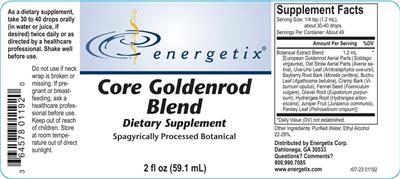
This blend contains 11 active herbal ingredients in liquid form. Parsley leaf extract, gravel root, cramp bark, goldenrod aerial parts, hydrangea root, buchu leaf, juniper fruit, fennel seed, uva-ursi leaf, oat straw, and bayberry root bark are the working ingredients.
The liquid also contains water and ethyl alcohol as inactive ingredients.
Does it work?
Leans against
The evidence supporting these ingredients is mixed and sparse. Fennel seed is possibly effective for period cramps (dysmenorrhea).
Oat straw has solid evidence — it's likely effective for high cholesterol (dyslipidemia) and heart disease risk. For most other uses — urinary tract infections, kidney stones, muscle cramps, bronchitis, and others — the evidence is insufficient to rate whether these ingredients work.
No effectiveness data is on file for gravel root, cramp bark, hydrangea, buchu, juniper, or bayberry.
How safe is it?
Well-documented data
At food and supplement doses, most of these herbs are generally well tolerated short-term. Oat is considered safe in food amounts during pregnancy and breastfeeding.
However, parsley in concentrated extract form may not be safe in large amounts — very high doses carry rare risks including hemolytic anemia and seizures. Gravel root is concerning: it contains liver-toxic compounds (pyrrolizidine alkaloids) and lacks adequate safety data; avoid during pregnancy and breastfeeding.
Cramp bark, goldenrod, hydrangea, buchu, juniper, fennel, uva-ursi, and bayberry all lack sufficient safety data in pregnancy and breastfeeding — the safety notes advise against use or note insufficient information. Juniper may irritate the kidneys with prolonged use.
Buchu traditionally is thought to affect the uterus. Fennel in large amounts has estrogenic activity.
Uva-ursi is generally well tolerated short-term but can be toxic at high doses or with prolonged use. Bayberry may cause stomach irritation and possible liver damage.
Meds to double-check
Moderate interaction found
Check before using if you take blood thinners or antiplatelet drugs like warfarin or aspirin (parsley and fennel both affect bleeding risk); diabetes or insulin medications (parsley, juniper, and oat straw may lower blood sugar); diuretics or water pills (multiple ingredients may interfere); lithium (gravel root, hydrangea, buchu, juniper, and uva-ursi all have diuretic effects that may raise lithium levels); birth control pills or hormone therapy (fennel has estrogenic effects); tamoxifen (fennel may interfere); ciprofloxacin antibiotic (fennel may reduce its effectiveness); or any drug metabolized by your liver, including many statins, antihistamines, and others (parsley, fennel, and uva-ursi may affect how your liver processes them).
The bottom line
Scorecard at a glanceFormula with limited ingredient disclosure with graded evidence leaning against its stated purpose. Moderate medication interactions have been identified, and safety information is well characterized.
This blend is a mixed herbal formula with limited evidence of effectiveness for most conditions. If you take any blood thinners, diabetes drugs, diuretics, lithium, birth control, or hormone therapy, you should check your exact medications with our interaction tool before starting.
Talk to your pharmacist or doctor first — several ingredients carry safety concerns in pregnancy, breastfeeding, or with prolonged use.
Educational only — not medical advice; always confirm with your pharmacist. Our editorial policy · How we use AI
Assessment coverage: 11 of 11 active ingredients matched to our full ingredient reviews (monographs). Based on the product label dated Jul 24, 2025.
This Scorecard evaluates available label information, ingredient evidence, and known medication-safety considerations. It does not independently verify product identity, purity, potency, contamination, or manufacturing quality. How these ratings are computed
General information
Key facts about Core Goldenrod Blend, straight from the product label.
Everything in this section is reproduced from the manufacturer’s own product label — it’s the label speaking, not HelloPharmacist. We show it so you can see exactly what the maker states; we don’t verify or endorse those statements.
Supplement Facts
The label details for Core Goldenrod Blend by Energetix, sourced from the NIH Dietary Supplement Label Database.
Supplement Facts
| Ingredient | Amount | % DV |
|---|---|---|
| Parsley Leaf Extract | 0 NP | -- |
| Botanical Extract Blend | 1.2 mL | -- |
| Gravel Root extract | 0 NP | -- |
| Cramp Bark Extract | 0 NP | -- |
| European Goldenrod aerial parts extract | 0 NP | -- |
| Hydrangea Root Extract | 0 NP | -- |
| Buchu Leaf Extract | 0 NP | -- |
| Juniper Fruit Extract | 0 NP | -- |
| Fennel Seed Extract | 0 NP | -- |
| Uva-Ursi leaf extract | 0 NP | -- |
| Oat Straw Aerial Parts Extract | 0 NP | -- |
| Bayberry Root Bark Extract | 0 NP | -- |
Other ingredients: Water, Purified, Ethyl Alcohol
Tap any ingredient to jump to its full detail below.
These statements are the manufacturer’s wording, reproduced from the product label — the label is saying it, not HelloPharmacist. We don’t verify or endorse them.
Suggested/Recommended/Usage/Directions
As a dietary supplement, take 30 to 40 drops orally (in water or juice, if desired) twice daily or as directed by a healthcare professional. Shake well before use.
Precautions
Do not use if neck wrap is broken or missing.
If pregnant or breast-feeding, ask a healthcare professional before use.
Keep out of reach of children.
Storage
Store at room temperature out of direct sunlight.
FDA Statement of Identity
Dietary Supplement
Formula
Spagyrically processed botanical
General Statements
Questions? Comments? 800.990.7085
Is this label outdated? Report a formula or label change and our pharmacy team will review it.
Core Goldenrod Blend by Energetix label
The label scan from the NIH Dietary Supplement Label Database. Tap to enlarge.
Label images are published by the NIH Dietary Supplement Label Database for the version of this product on file. Always read your actual product label.
View the full label (PDF)The Ingredients in Core Goldenrod Blend by Energetix
These are the 11 active ingredients this product is made of. Select any to open its full monograph.
Serving size1.2 mL Dosage formLiquid Servings per container49 Amounts shown are per serving.
Most supplement products combine several ingredients, and a medication can interact with the product through any one of them. Each ingredient below shows whether it has known drug interactions.
Botanical Extract Blend
Other (inactive) ingredients: Water, Purified, Ethyl Alcohol. These complete the product’s ingredient list but are not active constituents.
Core Goldenrod Blend by Energetix Drug Interactions
HelloPharmacist Interaction Report
Core Goldenrod Blend by Energetix is a liquid herbal supplement with 11 active ingredients, several of which interact with medications.
The most serious documented interaction involves parsley leaf extract and blood thinners (anticoagulants) like warfarin — parsley contains vitamin K, which may decrease warfarin's effectiveness, rated Moderate severity.
Read the full breakdown — every affected drug type, severity by severity
Parsley also has Moderate interactions with diabetes medications (risk of low blood sugar), diuretics (water pills), drugs metabolized by the liver enzyme CYP1A2, and a barbiturate sedative (pentobarbital), as well as a Minor interaction with aspirin. Gravel root extract may increase lithium levels if you take it for mood disorders.
Goldenrod, hydrangea, buchu, and juniper all have diuretic properties and may interact with lithium or water pills. Fennel seed extract may interfere with birth control pills, hormone replacement therapy, tamoxifen (a breast cancer drug), and the antibiotic ciprofloxacin.
Uva-ursi leaf may affect how your liver and kidneys process several drug types. Oat straw may increase the effect of diabetes medications and insulin, raising the risk of low blood sugar.
Cramp bark and bayberry have no documented interactions in our data. We could not check botanical extract blend because it's listed as a group container with components listed separately.
Altogether, these interactions span 1,221 individual medications. Please check your exact prescriptions with the search tool on this page before starting.
Check your own medications below · Editorial policy · How we use AI
Want to check YOUR meds against Core Goldenrod Blend?
Ask about interactions with your drugs in plain English — “Can I take it with lisinopril?” — and we find you the answer in seconds, ingredient by ingredient.
Go to the checkerIngredients driving the most interactions
Individual Drug Interactions
The ingredients in Core Goldenrod Blend interact with 1,242 drugs. Click any drug to see the details.
9 of the 11 ingredients in Core Goldenrod Blend interact with drugs. Each result below shows which ingredient is responsible. Uva-Ursi leaf extract Fennel Seed Extract Buchu Leaf Extract Parsley Leaf Extract Juniper Fruit Extract Gravel Root extract Oat Straw Aerial Parts Extract European Goldenrod aerial parts extract Hydrangea Root Extract
6-mercaptopurinePurinethol
How 6-mercaptopurine interacts with Core Goldenrod Blend — through 1 ingredient. Tap an ingredient for the detail:
Buchu Leaf ExtractHepatotoxic Drugs Moderate
Interaction Summary
Buchu contains pulegone, a known hepatotoxin.
Read the full Buchu Leaf Extract + 6-mercaptopurine interactionAdo-trastuzumab EmtansineKadcyla
How Ado-trastuzumab Emtansine interacts with Core Goldenrod Blend — through 2 ingredients. Tap an ingredient for the detail:
Uva-ursi Leaf ExtractCytochrome P450 3a4 (cyp3a4) Substrates Moderate
Interaction Summary
Theoretically, uva ursi may decrease the metabolism of CYP3A4 substrates.
Read the full Uva-ursi Leaf Extract + Ado-trastuzumab Emtansine interactionFennel Seed ExtractCytochrome P450 3a4 (cyp3a4) Substrates Moderate
Interaction Summary
Theoretically, fennel might increase levels of drugs metabolized by CYP3A4.
Read the full Fennel Seed Extract + Ado-trastuzumab Emtansine interactionAbacavir Sulfate, Dolutegravir, LamivudineTriumeq
How Abacavir Sulfate, Dolutegravir, Lamivudine interacts with Core Goldenrod Blend — through 1 ingredient. Tap an ingredient for the detail:
Buchu Leaf ExtractHepatotoxic Drugs Moderate
Interaction Summary
Buchu contains pulegone, a known hepatotoxin.
Read the full Buchu Leaf Extract + Abacavir Sulfate, Dolutegravir, Lamivudine interactionAbacavir, LamivudineEpzicom
How Abacavir, Lamivudine interacts with Core Goldenrod Blend — through 1 ingredient. Tap an ingredient for the detail:
Buchu Leaf ExtractHepatotoxic Drugs Moderate
Interaction Summary
Buchu contains pulegone, a known hepatotoxin.
Read the full Buchu Leaf Extract + Abacavir, Lamivudine interactionAbciximabReoPro
How Abciximab interacts with Core Goldenrod Blend — through 3 ingredients. Tap an ingredient for the detail:
Parsley Leaf ExtractAnticoagulant/antiplatelet Drugs Moderate
Interaction Summary
Theoretically, parsley might increase the risk of bleeding when taken with anticoagulant or antiplatelet drugs.
Read the full Parsley Leaf Extract + Abciximab interactionBuchu Leaf ExtractAnticoagulant/antiplatelet Drugs Moderate
Interaction Summary
Buchu may have antiplatelet effects.
Read the full Buchu Leaf Extract + Abciximab interactionFennel Seed ExtractAnticoagulant/antiplatelet Drugs Moderate
Interaction Summary
Theoretically, fennel might increase the risk of bleeding when used with antiplatelet or anticoagulant drugs.
Read the full Fennel Seed Extract + Abciximab interactionAbemaciclibVerzenio
How Abemaciclib interacts with Core Goldenrod Blend — through 2 ingredients. Tap an ingredient for the detail:
Uva-ursi Leaf ExtractCytochrome P450 3a4 (cyp3a4) Substrates Moderate
Interaction Summary
Theoretically, uva ursi may decrease the metabolism of CYP3A4 substrates.
Read the full Uva-ursi Leaf Extract + Abemaciclib interactionFennel Seed ExtractCytochrome P450 3a4 (cyp3a4) Substrates Moderate
Interaction Summary
Theoretically, fennel might increase levels of drugs metabolized by CYP3A4.
Read the full Fennel Seed Extract + Abemaciclib interactionAbiraterone
How Abiraterone interacts with Core Goldenrod Blend — through 3 ingredients. Tap an ingredient for the detail:
Fennel Seed ExtractCytochrome P450 3a4 (cyp3a4) Substrates Moderate
Interaction Summary
Theoretically, fennel might increase levels of drugs metabolized by CYP3A4.
Read the full Fennel Seed Extract + Abiraterone interactionUva-ursi Leaf ExtractCytochrome P450 3a4 (cyp3a4) Substrates Moderate
Interaction Summary
Theoretically, uva ursi may decrease the metabolism of CYP3A4 substrates.
Read the full Uva-ursi Leaf Extract + Abiraterone interactionBuchu Leaf ExtractHepatotoxic Drugs Moderate
Interaction Summary
Buchu contains pulegone, a known hepatotoxin.
Read the full Buchu Leaf Extract + Abiraterone interactionAbiraterone AcetateYonsa, Zytiga
How Abiraterone Acetate interacts with Core Goldenrod Blend — through 3 ingredients. Tap an ingredient for the detail:
Buchu Leaf ExtractHepatotoxic Drugs Moderate
Interaction Summary
Buchu contains pulegone, a known hepatotoxin.
Read the full Buchu Leaf Extract + Abiraterone Acetate interactionFennel Seed ExtractCytochrome P450 3a4 (cyp3a4) Substrates Moderate
Interaction Summary
Theoretically, fennel might increase levels of drugs metabolized by CYP3A4.
Read the full Fennel Seed Extract + Abiraterone Acetate interactionUva-ursi Leaf ExtractCytochrome P450 3a4 (cyp3a4) Substrates Moderate
Interaction Summary
Theoretically, uva ursi may decrease the metabolism of CYP3A4 substrates.
Read the full Uva-ursi Leaf Extract + Abiraterone Acetate interactionAbrocitinibCibinqo
How Abrocitinib interacts with Core Goldenrod Blend — through 4 ingredients. Tap an ingredient for the detail:
Buchu Leaf ExtractAnticoagulant/antiplatelet Drugs Moderate
Interaction Summary
Buchu may have antiplatelet effects.
Read the full Buchu Leaf Extract + Abrocitinib interactionParsley Leaf ExtractAnticoagulant/antiplatelet Drugs Moderate
Interaction Summary
Theoretically, parsley might increase the risk of bleeding when taken with anticoagulant or antiplatelet drugs.
Read the full Parsley Leaf Extract + Abrocitinib interactionFennel Seed ExtractAnticoagulant/antiplatelet Drugs Moderate
Interaction Summary
Theoretically, fennel might increase the risk of bleeding when used with antiplatelet or anticoagulant drugs.
Read the full Fennel Seed Extract + Abrocitinib interactionUva-ursi Leaf ExtractCytochrome P450 2c19 (cyp2c19) Substrates Moderate
Interaction Summary
Theoretically, uva ursi may decrease the metabolism of CYP2C19 substrates.
Read the full Uva-ursi Leaf Extract + Abrocitinib interactionAcalabrutinibCalquence
How Acalabrutinib interacts with Core Goldenrod Blend — through 2 ingredients. Tap an ingredient for the detail:
Fennel Seed ExtractCytochrome P450 3a4 (cyp3a4) Substrates Moderate
Interaction Summary
Theoretically, fennel might increase levels of drugs metabolized by CYP3A4.
Read the full Fennel Seed Extract + Acalabrutinib interactionUva-ursi Leaf ExtractP-glycoprotein Substrates, Cytochrome P450 3a4 (cyp3a4) Substrates Moderate
Interaction Summary
Theoretically, uva ursi may alter the levels of drugs transported by P-glycoprotein.
Read the full Uva-ursi Leaf Extract + Acalabrutinib interactionAcarboseGlucobay, Prandase, Precose
How Acarbose interacts with Core Goldenrod Blend — through 4 ingredients. Tap an ingredient for the detail:
Buchu Leaf ExtractHepatotoxic Drugs Moderate
Interaction Summary
Buchu contains pulegone, a known hepatotoxin.
Read the full Buchu Leaf Extract + Acarbose interactionJuniper Fruit ExtractAntidiabetes Drugs Moderate
Interaction Summary
Theoretically, taking juniper berry with antidiabetes medications might cause additive hypoglycemia.
Read the full Juniper Fruit Extract + Acarbose interactionParsley Leaf ExtractAntidiabetes Drugs Moderate
Interaction Summary
Theoretically, parsley might increase the risk of hypoglycemia when taken with antidiabetes drugs.
Read the full Parsley Leaf Extract + Acarbose interactionOat Straw Aerial Parts ExtractAntidiabetes Drugs Moderate
Interaction Summary
Theoretically, oats may have additive effects with antidiabetic agents and might increase the risk of hypoglycemia.
Read the full Oat Straw Aerial Parts Extract + Acarbose interactionAcebutololRhotral, Sectral
How Acebutolol interacts with Core Goldenrod Blend — through 1 ingredient. Tap an ingredient for the detail:
Buchu Leaf ExtractHepatotoxic Drugs Moderate
Interaction Summary
Buchu contains pulegone, a known hepatotoxin.
Read the full Buchu Leaf Extract + Acebutolol interactionAcenocoumarolSintrom
How Acenocoumarol interacts with Core Goldenrod Blend — through 3 ingredients. Tap an ingredient for the detail:
Fennel Seed ExtractAnticoagulant/antiplatelet Drugs Moderate
Interaction Summary
Theoretically, fennel might increase the risk of bleeding when used with antiplatelet or anticoagulant drugs.
Read the full Fennel Seed Extract + Acenocoumarol interactionParsley Leaf ExtractAnticoagulant/antiplatelet Drugs Moderate
Interaction Summary
Theoretically, parsley might increase the risk of bleeding when taken with anticoagulant or antiplatelet drugs.
Read the full Parsley Leaf Extract + Acenocoumarol interactionBuchu Leaf ExtractAnticoagulant/antiplatelet Drugs Moderate
Interaction Summary
Buchu may have antiplatelet effects.
Read the full Buchu Leaf Extract + Acenocoumarol interactionAcetaminophenChildren's Tylenol, Children's Tylenol Meltaways, Tylenol, Tylenol Ex Strength
How Acetaminophen interacts with Core Goldenrod Blend — through 3 ingredients. Tap an ingredient for the detail:
Buchu Leaf ExtractHepatotoxic Drugs Moderate
Interaction Summary
Buchu contains pulegone, a known hepatotoxin.
Read the full Buchu Leaf Extract + Acetaminophen interactionUva-ursi Leaf ExtractGlucuronidated Drugs Moderate
Interaction Summary
Theoretically, uva ursi may increase levels of drugs metabolized by glucuronidation.
Read the full Uva-ursi Leaf Extract + Acetaminophen interactionParsley Leaf ExtractCytochrome P450 1a2 (cyp1a2) Substrates Moderate
Interaction Summary
Theoretically, parsley might increase serum levels of CYP1A2 substrates.
Read the full Parsley Leaf Extract + Acetaminophen interactionAcetaminophen, AspirinGemnisyn
How Acetaminophen, Aspirin interacts with Core Goldenrod Blend — through 4 ingredients. Tap an ingredient for the detail:
Parsley Leaf ExtractCytochrome P450 1a2 (cyp1a2) Substrates, Anticoagulant/antiplatelet Drugs +1 Moderate
Interaction Summary
Theoretically, parsley might increase serum levels of CYP1A2 substrates.
Read the full Parsley Leaf Extract + Acetaminophen, Aspirin interactionBuchu Leaf ExtractAnticoagulant/antiplatelet Drugs, Hepatotoxic Drugs Moderate
Interaction Summary
Buchu may have antiplatelet effects.
Read the full Buchu Leaf Extract + Acetaminophen, Aspirin interactionUva-ursi Leaf ExtractGlucuronidated Drugs Moderate
Interaction Summary
Theoretically, uva ursi may increase levels of drugs metabolized by glucuronidation.
Read the full Uva-ursi Leaf Extract + Acetaminophen, Aspirin interactionFennel Seed ExtractAnticoagulant/antiplatelet Drugs Moderate
Interaction Summary
Theoretically, fennel might increase the risk of bleeding when used with antiplatelet or anticoagulant drugs.
Read the full Fennel Seed Extract + Acetaminophen, Aspirin interactionAcetaminophen, Aspirin, CaffeineExcedrin, Excedrin Extra Strength, Excedrin Migraine
How Acetaminophen, Aspirin, Caffeine interacts with Core Goldenrod Blend — through 4 ingredients. Tap an ingredient for the detail:
Parsley Leaf ExtractAspirin, Cytochrome P450 1a2 (cyp1a2) Substrates +1 Moderate
Interaction Summary
Theoretically, aspirin might increase the severity of allergic reactions to parsley.
Read the full Parsley Leaf Extract + Acetaminophen, Aspirin, Caffeine interactionUva-ursi Leaf ExtractCytochrome P450 3a4 (cyp3a4) Substrates, Glucuronidated Drugs Moderate
Interaction Summary
Theoretically, uva ursi may decrease the metabolism of CYP3A4 substrates.
Read the full Uva-ursi Leaf Extract + Acetaminophen, Aspirin, Caffeine interactionBuchu Leaf ExtractAnticoagulant/antiplatelet Drugs, Hepatotoxic Drugs Moderate
Interaction Summary
Buchu may have antiplatelet effects.
Read the full Buchu Leaf Extract + Acetaminophen, Aspirin, Caffeine interactionFennel Seed ExtractAnticoagulant/antiplatelet Drugs, Cytochrome P450 3a4 (cyp3a4) Substrates Moderate
Interaction Summary
Theoretically, fennel might increase the risk of bleeding when used with antiplatelet or anticoagulant drugs.
Read the full Fennel Seed Extract + Acetaminophen, Aspirin, Caffeine interactionAcetaminophen, Brompheniramine, PhenylpropanolamineDimetapp Cold and Flu
How Acetaminophen, Brompheniramine, Phenylpropanolamine interacts with Core Goldenrod Blend — through 3 ingredients. Tap an ingredient for the detail:
Uva-ursi Leaf ExtractGlucuronidated Drugs Moderate
Interaction Summary
Theoretically, uva ursi may increase levels of drugs metabolized by glucuronidation.
Read the full Uva-ursi Leaf Extract + Acetaminophen, Brompheniramine, Phenylpropanolamine interactionParsley Leaf ExtractCytochrome P450 1a2 (cyp1a2) Substrates Moderate
Interaction Summary
Theoretically, parsley might increase serum levels of CYP1A2 substrates.
Read the full Parsley Leaf Extract + Acetaminophen, Brompheniramine, Phenylpropanolamine interactionBuchu Leaf ExtractHepatotoxic Drugs Moderate
Interaction Summary
Buchu contains pulegone, a known hepatotoxin.
Read the full Buchu Leaf Extract + Acetaminophen, Brompheniramine, Phenylpropanolamine interactionAcetaminophen, ButalbitalAxocet, Bancap, Bucet, Butex Forte, Esgic CF, Orbivan CF +5 more
How Acetaminophen, Butalbital interacts with Core Goldenrod Blend — through 3 ingredients. Tap an ingredient for the detail:
Buchu Leaf ExtractHepatotoxic Drugs Moderate
Interaction Summary
Buchu contains pulegone, a known hepatotoxin.
Read the full Buchu Leaf Extract + Acetaminophen, Butalbital interactionUva-ursi Leaf ExtractGlucuronidated Drugs Moderate
Interaction Summary
Theoretically, uva ursi may increase levels of drugs metabolized by glucuronidation.
Read the full Uva-ursi Leaf Extract + Acetaminophen, Butalbital interactionParsley Leaf ExtractCytochrome P450 1a2 (cyp1a2) Substrates Moderate
Interaction Summary
Theoretically, parsley might increase serum levels of CYP1A2 substrates.
Read the full Parsley Leaf Extract + Acetaminophen, Butalbital interactionAcetaminophen, Butalbital, CaffeineEsgic, Esgic Plus, Fiogesic, Fioricet, Repan, Tecnal +1 more
How Acetaminophen, Butalbital, Caffeine interacts with Core Goldenrod Blend — through 4 ingredients. Tap an ingredient for the detail:
Parsley Leaf ExtractCytochrome P450 1a2 (cyp1a2) Substrates Moderate
Interaction Summary
Theoretically, parsley might increase serum levels of CYP1A2 substrates.
Read the full Parsley Leaf Extract + Acetaminophen, Butalbital, Caffeine interactionBuchu Leaf ExtractHepatotoxic Drugs Moderate
Interaction Summary
Buchu contains pulegone, a known hepatotoxin.
Read the full Buchu Leaf Extract + Acetaminophen, Butalbital, Caffeine interactionUva-ursi Leaf ExtractCytochrome P450 3a4 (cyp3a4) Substrates, Glucuronidated Drugs Moderate
Interaction Summary
Theoretically, uva ursi may decrease the metabolism of CYP3A4 substrates.
Read the full Uva-ursi Leaf Extract + Acetaminophen, Butalbital, Caffeine interactionFennel Seed ExtractCytochrome P450 3a4 (cyp3a4) Substrates Moderate
Interaction Summary
Theoretically, fennel might increase levels of drugs metabolized by CYP3A4.
Read the full Fennel Seed Extract + Acetaminophen, Butalbital, Caffeine interactionAcetaminophen, Butalbital, Caffeine, CodeineEsgic with Codeine, Fioricet w/ Codeine
How Acetaminophen, Butalbital, Caffeine, Codeine interacts with Core Goldenrod Blend — through 4 ingredients. Tap an ingredient for the detail:
Buchu Leaf ExtractHepatotoxic Drugs Moderate
Interaction Summary
Buchu contains pulegone, a known hepatotoxin.
Read the full Buchu Leaf Extract + Acetaminophen, Butalbital, Caffeine, Codeine interactionFennel Seed ExtractCytochrome P450 3a4 (cyp3a4) Substrates Moderate
Interaction Summary
Theoretically, fennel might increase levels of drugs metabolized by CYP3A4.
Read the full Fennel Seed Extract + Acetaminophen, Butalbital, Caffeine, Codeine interactionParsley Leaf ExtractCytochrome P450 1a2 (cyp1a2) Substrates Moderate
Interaction Summary
Theoretically, parsley might increase serum levels of CYP1A2 substrates.
Read the full Parsley Leaf Extract + Acetaminophen, Butalbital, Caffeine, Codeine interactionUva-ursi Leaf ExtractGlucuronidated Drugs, Cytochrome P450 3a4 (cyp3a4) Substrates Moderate
Interaction Summary
Theoretically, uva ursi may increase levels of drugs metabolized by glucuronidation.
Read the full Uva-ursi Leaf Extract + Acetaminophen, Butalbital, Caffeine, Codeine interactionAcetaminophen, Butalbital, CodeineBancap w/ Codeine
How Acetaminophen, Butalbital, Codeine interacts with Core Goldenrod Blend — through 3 ingredients. Tap an ingredient for the detail:
Buchu Leaf ExtractHepatotoxic Drugs Moderate
Interaction Summary
Buchu contains pulegone, a known hepatotoxin.
Read the full Buchu Leaf Extract + Acetaminophen, Butalbital, Codeine interactionUva-ursi Leaf ExtractGlucuronidated Drugs Moderate
Interaction Summary
Theoretically, uva ursi may increase levels of drugs metabolized by glucuronidation.
Read the full Uva-ursi Leaf Extract + Acetaminophen, Butalbital, Codeine interactionParsley Leaf ExtractCytochrome P450 1a2 (cyp1a2) Substrates Moderate
Interaction Summary
Theoretically, parsley might increase serum levels of CYP1A2 substrates.
Read the full Parsley Leaf Extract + Acetaminophen, Butalbital, Codeine interactionAcetaminophen, Butalbital, Codeine PhosphatePhrenilin #3
How Acetaminophen, Butalbital, Codeine Phosphate interacts with Core Goldenrod Blend — through 3 ingredients. Tap an ingredient for the detail:
Parsley Leaf ExtractCytochrome P450 1a2 (cyp1a2) Substrates Moderate
Interaction Summary
Theoretically, parsley might increase serum levels of CYP1A2 substrates.
Read the full Parsley Leaf Extract + Acetaminophen, Butalbital, Codeine Phosphate interactionUva-ursi Leaf ExtractGlucuronidated Drugs Moderate
Interaction Summary
Theoretically, uva ursi may increase levels of drugs metabolized by glucuronidation.
Read the full Uva-ursi Leaf Extract + Acetaminophen, Butalbital, Codeine Phosphate interactionBuchu Leaf ExtractHepatotoxic Drugs Moderate
Interaction Summary
Buchu contains pulegone, a known hepatotoxin.
Read the full Buchu Leaf Extract + Acetaminophen, Butalbital, Codeine Phosphate interactionAcetaminophen, Caffeine, Chlorpheniramine, Hydrocodone, PhenylephrineHycomine Compound
How Acetaminophen, Caffeine, Chlorpheniramine, Hydrocodone, Phenylephrine interacts with Core Goldenrod Blend — through 4 ingredients. Tap an ingredient for the detail:
Buchu Leaf ExtractHepatotoxic Drugs Moderate
Interaction Summary
Buchu contains pulegone, a known hepatotoxin.
Read the full Buchu Leaf Extract + Acetaminophen, Caffeine, Chlorpheniramine, Hydrocodone, Phenylephrine interactionUva-ursi Leaf ExtractCytochrome P450 3a4 (cyp3a4) Substrates, Glucuronidated Drugs Moderate
Interaction Summary
Theoretically, uva ursi may decrease the metabolism of CYP3A4 substrates.
Read the full Uva-ursi Leaf Extract + Acetaminophen, Caffeine, Chlorpheniramine, Hydrocodone, Phenylephrine interactionFennel Seed ExtractCytochrome P450 3a4 (cyp3a4) Substrates Moderate
Interaction Summary
Theoretically, fennel might increase levels of drugs metabolized by CYP3A4.
Read the full Fennel Seed Extract + Acetaminophen, Caffeine, Chlorpheniramine, Hydrocodone, Phenylephrine interactionParsley Leaf ExtractCytochrome P450 1a2 (cyp1a2) Substrates Moderate
Interaction Summary
Theoretically, parsley might increase serum levels of CYP1A2 substrates.
Read the full Parsley Leaf Extract + Acetaminophen, Caffeine, Chlorpheniramine, Hydrocodone, Phenylephrine interactionAcetaminophen, Caffeine, CodeineGesic C15, Gesic C30, Gesic C8, Lenoltec 1, Lenoltec 2, Lenoltec 3 +1 more
How Acetaminophen, Caffeine, Codeine interacts with Core Goldenrod Blend — through 4 ingredients. Tap an ingredient for the detail:
Parsley Leaf ExtractCytochrome P450 1a2 (cyp1a2) Substrates Moderate
Interaction Summary
Theoretically, parsley might increase serum levels of CYP1A2 substrates.
Read the full Parsley Leaf Extract + Acetaminophen, Caffeine, Codeine interactionUva-ursi Leaf ExtractCytochrome P450 3a4 (cyp3a4) Substrates, Glucuronidated Drugs Moderate
Interaction Summary
Theoretically, uva ursi may decrease the metabolism of CYP3A4 substrates.
Read the full Uva-ursi Leaf Extract + Acetaminophen, Caffeine, Codeine interactionBuchu Leaf ExtractHepatotoxic Drugs Moderate
Interaction Summary
Buchu contains pulegone, a known hepatotoxin.
Read the full Buchu Leaf Extract + Acetaminophen, Caffeine, Codeine interactionFennel Seed ExtractCytochrome P450 3a4 (cyp3a4) Substrates Moderate
Interaction Summary
Theoretically, fennel might increase levels of drugs metabolized by CYP3A4.
Read the full Fennel Seed Extract + Acetaminophen, Caffeine, Codeine interactionAcetaminophen, Caffeine, Codeine, SalicylamideCodalan No.1, Codalan No.2, Codalan No.3
How Acetaminophen, Caffeine, Codeine, Salicylamide interacts with Core Goldenrod Blend — through 4 ingredients. Tap an ingredient for the detail:
Parsley Leaf ExtractCytochrome P450 1a2 (cyp1a2) Substrates Moderate
Interaction Summary
Theoretically, parsley might increase serum levels of CYP1A2 substrates.
Read the full Parsley Leaf Extract + Acetaminophen, Caffeine, Codeine, Salicylamide interactionUva-ursi Leaf ExtractCytochrome P450 3a4 (cyp3a4) Substrates, Glucuronidated Drugs Moderate
Interaction Summary
Theoretically, uva ursi may decrease the metabolism of CYP3A4 substrates.
Read the full Uva-ursi Leaf Extract + Acetaminophen, Caffeine, Codeine, Salicylamide interactionFennel Seed ExtractCytochrome P450 3a4 (cyp3a4) Substrates Moderate
Interaction Summary
Theoretically, fennel might increase levels of drugs metabolized by CYP3A4.
Read the full Fennel Seed Extract + Acetaminophen, Caffeine, Codeine, Salicylamide interactionBuchu Leaf ExtractHepatotoxic Drugs Moderate
Interaction Summary
Buchu contains pulegone, a known hepatotoxin.
Read the full Buchu Leaf Extract + Acetaminophen, Caffeine, Codeine, Salicylamide interactionAcetaminophen, Caffeine, DihydrocodeineDHC Plus, Panlor DC, Panlor SS
How Acetaminophen, Caffeine, Dihydrocodeine interacts with Core Goldenrod Blend — through 4 ingredients. Tap an ingredient for the detail:
Buchu Leaf ExtractHepatotoxic Drugs Moderate
Interaction Summary
Buchu contains pulegone, a known hepatotoxin.
Read the full Buchu Leaf Extract + Acetaminophen, Caffeine, Dihydrocodeine interactionFennel Seed ExtractCytochrome P450 3a4 (cyp3a4) Substrates Moderate
Interaction Summary
Theoretically, fennel might increase levels of drugs metabolized by CYP3A4.
Read the full Fennel Seed Extract + Acetaminophen, Caffeine, Dihydrocodeine interactionUva-ursi Leaf ExtractCytochrome P450 3a4 (cyp3a4) Substrates, Glucuronidated Drugs Moderate
Interaction Summary
Theoretically, uva ursi may decrease the metabolism of CYP3A4 substrates.
Read the full Uva-ursi Leaf Extract + Acetaminophen, Caffeine, Dihydrocodeine interactionParsley Leaf ExtractCytochrome P450 1a2 (cyp1a2) Substrates Moderate
Interaction Summary
Theoretically, parsley might increase serum levels of CYP1A2 substrates.
Read the full Parsley Leaf Extract + Acetaminophen, Caffeine, Dihydrocodeine interactionAcetaminophen, Caffeine, IsomethepteneMigralam
How Acetaminophen, Caffeine, Isometheptene interacts with Core Goldenrod Blend — through 4 ingredients. Tap an ingredient for the detail:
Uva-ursi Leaf ExtractGlucuronidated Drugs, Cytochrome P450 3a4 (cyp3a4) Substrates Moderate
Interaction Summary
Theoretically, uva ursi may increase levels of drugs metabolized by glucuronidation.
Read the full Uva-ursi Leaf Extract + Acetaminophen, Caffeine, Isometheptene interactionBuchu Leaf ExtractHepatotoxic Drugs Moderate
Interaction Summary
Buchu contains pulegone, a known hepatotoxin.
Read the full Buchu Leaf Extract + Acetaminophen, Caffeine, Isometheptene interactionFennel Seed ExtractCytochrome P450 3a4 (cyp3a4) Substrates Moderate
Interaction Summary
Theoretically, fennel might increase levels of drugs metabolized by CYP3A4.
Read the full Fennel Seed Extract + Acetaminophen, Caffeine, Isometheptene interactionParsley Leaf ExtractCytochrome P450 1a2 (cyp1a2) Substrates Moderate
Interaction Summary
Theoretically, parsley might increase serum levels of CYP1A2 substrates.
Read the full Parsley Leaf Extract + Acetaminophen, Caffeine, Isometheptene interactionAcetaminophen, Caffeine, PyrilamineMidol Max Strength Menstrual
How Acetaminophen, Caffeine, Pyrilamine interacts with Core Goldenrod Blend — through 6 ingredients. Tap an ingredient for the detail:
Parsley Leaf ExtractCytochrome P450 1a2 (cyp1a2) Substrates, Diuretic Drugs Moderate
Interaction Summary
Theoretically, parsley might increase serum levels of CYP1A2 substrates.
Read the full Parsley Leaf Extract + Acetaminophen, Caffeine, Pyrilamine interactionEuropean Goldenrod Aerial Parts ExtractDiuretic Drugs Moderate
Interaction Summary
Theoretically, goldenrod might increase the effects and adverse effects of diuretic drugs.
Read the full European Goldenrod Aerial Parts Extract + Acetaminophen, Caffeine, Pyrilamine interactionBuchu Leaf ExtractHepatotoxic Drugs Moderate
Interaction Summary
Buchu contains pulegone, a known hepatotoxin.
Read the full Buchu Leaf Extract + Acetaminophen, Caffeine, Pyrilamine interactionUva-ursi Leaf ExtractGlucuronidated Drugs, Cytochrome P450 3a4 (cyp3a4) Substrates Moderate
Interaction Summary
Theoretically, uva ursi may increase levels of drugs metabolized by glucuronidation.
Read the full Uva-ursi Leaf Extract + Acetaminophen, Caffeine, Pyrilamine interactionFennel Seed ExtractCytochrome P450 3a4 (cyp3a4) Substrates Moderate
Interaction Summary
Theoretically, fennel might increase levels of drugs metabolized by CYP3A4.
Read the full Fennel Seed Extract + Acetaminophen, Caffeine, Pyrilamine interactionJuniper Fruit ExtractDiuretic Drugs Minor
Interaction Summary
Theoretically, juniper berry might increase the risk of adverse effects from diuretic drugs.
Read the full Juniper Fruit Extract + Acetaminophen, Caffeine, Pyrilamine interactionAcetaminophen, Chlorpheniramine Maleate, Dextromethorphan HbrVicks Formula 44M Cough, Cold & Flu Relief
How Acetaminophen, Chlorpheniramine Maleate, Dextromethorphan Hbr interacts with Core Goldenrod Blend — through 4 ingredients. Tap an ingredient for the detail:
Uva-ursi Leaf ExtractGlucuronidated Drugs, Cytochrome P450 3a4 (cyp3a4) Substrates Moderate
Interaction Summary
Theoretically, uva ursi may increase levels of drugs metabolized by glucuronidation.
Read the full Uva-ursi Leaf Extract + Acetaminophen, Chlorpheniramine Maleate, Dextromethorphan Hbr interactionParsley Leaf ExtractCytochrome P450 1a2 (cyp1a2) Substrates Moderate
Interaction Summary
Theoretically, parsley might increase serum levels of CYP1A2 substrates.
Read the full Parsley Leaf Extract + Acetaminophen, Chlorpheniramine Maleate, Dextromethorphan Hbr interactionFennel Seed ExtractCytochrome P450 3a4 (cyp3a4) Substrates Moderate
Interaction Summary
Theoretically, fennel might increase levels of drugs metabolized by CYP3A4.
Read the full Fennel Seed Extract + Acetaminophen, Chlorpheniramine Maleate, Dextromethorphan Hbr interactionBuchu Leaf ExtractHepatotoxic Drugs Moderate
Interaction Summary
Buchu contains pulegone, a known hepatotoxin.
Read the full Buchu Leaf Extract + Acetaminophen, Chlorpheniramine Maleate, Dextromethorphan Hbr interactionAcetaminophen, Chlorpheniramine, Codeine, PhenylephrineColrex
How Acetaminophen, Chlorpheniramine, Codeine, Phenylephrine interacts with Core Goldenrod Blend — through 4 ingredients. Tap an ingredient for the detail:
Parsley Leaf ExtractCytochrome P450 1a2 (cyp1a2) Substrates Moderate
Interaction Summary
Theoretically, parsley might increase serum levels of CYP1A2 substrates.
Read the full Parsley Leaf Extract + Acetaminophen, Chlorpheniramine, Codeine, Phenylephrine interactionUva-ursi Leaf ExtractGlucuronidated Drugs, Cytochrome P450 3a4 (cyp3a4) Substrates Moderate
Interaction Summary
Theoretically, uva ursi may increase levels of drugs metabolized by glucuronidation.
Read the full Uva-ursi Leaf Extract + Acetaminophen, Chlorpheniramine, Codeine, Phenylephrine interactionBuchu Leaf ExtractHepatotoxic Drugs Moderate
Interaction Summary
Buchu contains pulegone, a known hepatotoxin.
Read the full Buchu Leaf Extract + Acetaminophen, Chlorpheniramine, Codeine, Phenylephrine interactionFennel Seed ExtractCytochrome P450 3a4 (cyp3a4) Substrates Moderate
Interaction Summary
Theoretically, fennel might increase levels of drugs metabolized by CYP3A4.
Read the full Fennel Seed Extract + Acetaminophen, Chlorpheniramine, Codeine, Phenylephrine interactionEach ingredient & the kinds of drugs it affects
For each ingredient in Core Goldenrod Blend with known interactions, here are the types of medications they can affect. Open any type for the detail — or search your exact drug in the checker above.
Uva-Ursi leaf extract
Cytochrome P450 2C19 (Cyp2C19) Substrates
Theoretically, uva ursi may decrease the metabolism of CYP2C19 substrates.
In vitro, uva ursi appears to inhibit cytochrome CYP2C19. This effect has not been reported in humans.
Cytochrome P450 3A4 (Cyp3A4) Substrates
Theoretically, uva ursi may decrease the metabolism of CYP3A4 substrates.
In vitro, uva ursi appears to inhibit CYP3A4. This effect has not been reported in humans.
Glucuronidated Drugs
Theoretically, uva ursi may increase levels of drugs metabolized by glucuronidation.
In vitro, uva ursi extract appears to strongly inhibit UDP-glucuronosyltransferase (UGT) 1A1 (UGT1A1). However, uva ursi extract does not appear to inhibit UGT1A1 in animal models. This effect has not been reported in humans.
Lithium
Theoretically, uva ursi may increase lithium levels, necessitating a decrease in dose.
Uva ursi may have diuretic properties. Diuretics may increase lithium reabsorption with sodium in the proximal tubule of the kidney. Theoretically, uva ursi might reduce excretion and increase levels of lithium.
Urinary Acidifying Agents
Effects of uva ursi in the urinary tract may be reduced by urinary acidifying agents.
Uva ursi seems to work best in alkaline urine. Theoretically, taking uva ursi with medications known to acidify the urine may decrease any effects of uva ursi on the urinary tract.
P-Glycoprotein Substrates
Theoretically, uva ursi may alter the levels of drugs transported by P-glycoprotein.
In vitro, uva ursi appears to inhibit the multi-drug transporter protein, P-glycoprotein. This effect has not been reported in humans.
Fennel Seed Extract
Anticoagulant/Antiplatelet Drugs
Theoretically, fennel might increase the risk of bleeding when used with antiplatelet or anticoagulant drugs.
Animal research suggests that fennel oil has antithrombotic and antiplatelet effects.
Ciprofloxacin (Cipro)
Theoretically, fennel might decrease the levels and clinical effects of ciprofloxacin.
Animal research shows that fennel reduces ciprofloxacin bioavailability by nearly 50%, possibly due to the metal cations such as calcium, iron, and magnesium contained in fennel. This study also found that fennel increased tissue distribution and slowed elimination of ciprofloxacin.
Contraceptive Drugs
Theoretically, taking large amounts of fennel might decrease the effects of contraceptive drugs due to competition for estrogen receptors.
Some constituents of fennel have estrogenic activity.
Cytochrome P450 3A4 (Cyp3A4) Substrates
Theoretically, fennel might increase levels of drugs metabolized by CYP3A4.
In vitro research suggests that fennel inhibits CYP3A4 enzyme activity. This effect has not been reported in humans.
Estrogens
Theoretically, taking large amounts of fennel might interfere with hormone replacement therapy due to competition for estrogen receptors.
Some constituents of fennel have estrogenic activity.
Tamoxifen (Nolvadex)
Theoretically, taking large amounts of fennel might decrease the antiestrogenic effect of tamoxifen.
Some constituents of fennel have estrogenic activity, which may interfere with the antiestrogenic activity of tamoxifen.
Buchu Leaf Extract
Anticoagulant/Antiplatelet Drugs
Buchu may have antiplatelet effects. Theoretically, buchu may enhance the effects of anticoagulant or antiplatelet drugs and increase the risk of bleeding in some patients. Some anticoagulant or antiplatelet drugs include aspirin, clopidogrel (Plavix), dalteparin (Fragmin), enoxaparin (Lovenox), heparin, ticlopidine (Ticlid), warfarin (Coumadin), and others.
Hepatotoxic Drugs
Buchu contains pulegone, a known hepatotoxin. There is some concern that buchu may adversely affect the liver, especially when the leaf is used in large doses or the oil is ingested. Theoretically, concomitant use with hepatotoxic drugs might increase the risk of liver damage. Some of these drugs include acarbose (Precose, Prandase), amiodarone (Cordarone), atorvastatin (Lipitor), azathioprine (Imuran), carbamazepine (Tegretol), cerivastatin (Baycol), diclofenac (Voltaren), felbamate (Felbatol), fenofibrate (Tricor), fluvastatin (Lescol), gemfibrozil (Lopid), isoniazid, itraconazole, (Sporanox), ketoconazole (Nizoral), leflunomide (Arava), lovastatin (Mevacor), methotrexate (Rheumatrex), nevirapine (Viramune), niacin, nitrofurantoin (Macrodantin), pioglitazone (Actos), pravastatin (Pravachol), pyrazinamide, rifampin (Rifadin), ritonavir (Norvir), rosiglitazone (Avandia), simvastatin (Zocor), tacrine (Cognex), tamoxifen, terbinafine (Lamisil), valproic acid, and zileuton (Zyflo)
Lithium
Buchu is thought to have diuretic properties. Theoretically, buchu might reduce excretion and increase levels of lithium. The dose of lithium might need to be decreased.
Parsley Leaf Extract
Anticoagulant/Antiplatelet Drugs
Theoretically, parsley might increase the risk of bleeding when taken with anticoagulant or antiplatelet drugs.
Animal research suggests that parsley has antiplatelet effects.
Antidiabetes Drugs
Theoretically, parsley might increase the risk of hypoglycemia when taken with antidiabetes drugs.
Animal research suggests that parsley might decrease blood glucose. Monitor blood glucose levels closely. Dose adjustments might be necessary.
Cytochrome P450 1A2 (Cyp1A2) Substrates
Theoretically, parsley might increase serum levels of CYP1A2 substrates.
Laboratory research suggests that parsley can inhibit CYP1A2.
Diuretic Drugs
Theoretically, parsley might enhance or interfere with the effects of diuretic drugs.
Animal research suggests that parsley seed extract increases urine elimination. Parsley leaf and root might also interfere with diuretic therapy due their purported aquaretic effects.
Pentobarbital (Nembutal)
Theoretically, parsley might increase the duration of pentobarbital effects.
Animal research suggests that parsley juice prolongs the action of pentobarbital, perhaps by decreasing cytochrome P450 levels. It is not known if this occurs in humans or if this applies to other barbiturates or sedatives.
Sirolimus (Rapamune)
Theoretically, large quantities of parsley might increase sirolimus levels.
In one case report, an adult female with a history of kidney transplant presented with elevated blood sirolimus levels, approximately 4-7 times greater than previous measures, after daily consumption of a juice containing approximately 30 grams of parsley for 7 days. Sirolimus levels returned to normal a week after the parsley juice was discontinued.
Warfarin (Coumadin)
Theoretically, large amounts of parsley leaf and root might decrease the effects of warfarin.
Parlsey contains vitamin K.
Aspirin
Theoretically, aspirin might increase the severity of allergic reactions to parsley.
In one case, severe urticaria and swelling were reported after taking aspirin with parsley in an individual with a known mild parsley allergy.
Juniper Fruit Extract
Antidiabetes Drugs
Theoretically, taking juniper berry with antidiabetes medications might cause additive hypoglycemia.
Animal research shows that juniper berry can lower blood glucose.
Diuretic Drugs
Theoretically, juniper berry might increase the risk of adverse effects from diuretic drugs.
Juniper berry is thought to have mild diuretic effects.
Lithium
Theoretically, juniper berry might reduce lithium excretion and increase serum levels of lithium.
Juniper berry is thought to have mild diuretic effects.
Gravel Root extract
Cytochrome P450 3A4 (Cyp3A4) Inducers
Hepatotoxic pyrrolizidine alkaloids (PA) are substrates of cytochrome P450 3A4 (CYP3A4). Theoretically, drugs that induce CYP3A4 might increase the conversion of PAs to toxic metabolites. Some drugs that induce CYP3A4 include carbamazepine (Tegretol), phenobarbital, phenytoin (Dilantin), rifampin, rifabutin (Mycobutin), and others.
Lithium
Gravel root is thought to have diuretic properties. Theoretically, due to these potential diuretic effects, gravel root might reduce excretion and increase levels of lithium. The dose of lithium might need to be decreased.
Oat Straw Aerial Parts Extract
Antidiabetes Drugs
Theoretically, oats may have additive effects with antidiabetic agents and might increase the risk of hypoglycemia.
Consuming oats can decrease blood glucose in patients with diabetes. In those who require insulin, taking oats 100 grams daily for 2 days reduces the insulin dose required to achieve metabolic control.
Insulin
Concomitant use of oats and insulin might increase the risk of hypoglycemia.
In patients with insulin-dependent type 2 diabetes, taking oats 100 grams daily for 2 days reduces the insulin dose required to achieve metabolic control.
European Goldenrod aerial parts extract
Diuretic Drugs
Theoretically, goldenrod might increase the effects and adverse effects of diuretic drugs.
In vitro and animal research suggests that goldenrod has diuretic effects.
Hydrangea Root Extract
Lithium
Hydrangea is thought to have diuretic properties. Theoretically, due to these potential diuretic effects, hydrangea might reduce excretion and increase levels of lithium. The dose of lithium might need to be decreased.
Brand information
Manufacturer and brand details for Core Goldenrod Blend, from the product label.
Energetix
See all Energetix products- Name
- Energetix Corp.
- City
- Dahlonega
- State
- GA
- ZipCode
- 30533
- Phone Number
- 800.990.7085
- Web Address
- www.energetix.com
Core Goldenrod Blend by Energetix: Common Questions
Does Core Goldenrod Blend by Energetix interact with any medications?
How can one product interact with so many drugs?
Where does this information come from?
Is this safe to take if I'm pregnant or breastfeeding?
What is parsley extract actually used for?
Can this help with my water retention or kidney issues?
What's the most serious side effect I should watch for?
Does oat straw in this blend help with cholesterol?
Are there any fillers or other ingredients I should know about?
Written and reviewed by the HelloPharmacist editorial staff. Our editorial policy
Not sure if Core Goldenrod Blend is safe with your meds?
Our pharmacists answer your medication & supplement questions — free.
Label information is sourced from the NIH Dietary Supplement Label Database and reflects the product version on file; always read your actual product label. This page is for education only and is not a substitute for professional medical advice. Confirm with your pharmacist or doctor before combining supplements and medications.
The Full Monographs Behind Core Goldenrod Blend’s Ingredients
Every ingredient we hold a full HelloPharmacist monograph for — uses, evidence, safety, and the complete interaction list.
Parsley
Interacts with 443 drugsParsley is a popular culinary herb that is safe to eat in normal food amounts and is a good source of vitamins K and C. It is traditionally used as a diuretic and for digestion, but solid hu...
Read the full Parsley monograph → Herb & supplement monographGravel Root
Interacts with 88 drugsGravel Root is a traditional North American herb long used by herbalists for kidney stones and urinary problems, but there is very little modern scientific evidence to support these uses. Be...
Read the full Gravel Root monograph → Herb & supplement monographCramp Bark
Cramp Bark is the dried bark of Viburnum opulus, traditionally used to ease muscle and menstrual cramps. Modern, high-quality human studies are very limited, so its effectiveness is not well...
Read the full Cramp Bark monograph → Herb & supplement monographGoldenrod
Interacts with 75 drugsGoldenrod is a flowering plant traditionally used as an herbal diuretic and for urinary tract health. Human evidence is limited, and while it is generally well tolerated, people with certain...
Read the full Goldenrod monograph → Herb & supplement monographHydrangea
Interacts with 1 drugHydrangea root has a long history in folk medicine, mainly for urinary and kidney stone complaints, but there is very little modern human research to confirm it works for any condition. Beca...
Read the full Hydrangea monograph → Herb & supplement monographBuchu
Interacts with 481 drugsBuchu is a fragrant South African shrub whose leaves are traditionally used for urinary and bladder complaints and as a diuretic. Solid human studies are lacking, so its benefits are largely...
Read the full Buchu monograph → Herb & supplement monographJuniper
Interacts with 162 drugsJuniper berry is a traditional herb best known for flavoring gin and for its folk use as a diuretic and digestive aid. Solid human evidence for its health benefits is limited, and it can irr...
Read the full Juniper monograph → Herb & supplement monographFennel
Interacts with 740 drugsFennel is a Mediterranean herb widely used as a food and spice, and traditionally taken for digestive complaints, colic, and menstrual cramps. Some small studies suggest possible benefit for...
Read the full Fennel monograph → Herb & supplement monographUva Ursi
Interacts with 803 drugsUva ursi is a traditional herb used mainly for urinary tract infections, and its leaves contain a compound called arbutin that may have antimicrobial effects in the urine. Evidence in people...
Read the full Uva Ursi monograph → Herb & supplement monographOats
Interacts with 86 drugsOats are a well-studied whole grain whose soluble fiber (beta-glucan) can help lower cholesterol and support heart health when eaten regularly. As a food, oats are safe for most people, and...
Read the full Oats monograph → Herb & supplement monographBayberry
Bayberry is a traditional herb used mainly as an astringent for diarrhea, sore throats, and minor skin or gum problems, but there is very little modern human research to confirm it works. It...
Read the full Bayberry monograph →Sources & How We Checked
Core Goldenrod Blend's label data comes from the NIH Dietary Supplement Label Database; the ingredient interaction data is from the Natural Medicines database, reviewed by our pharmacists.
- NIH Dietary Supplement Label Database (DSLD) — The official product label on file for this supplement.
- Natural Medicines (Therapeutic Research Center) — Evidence-graded clinical reference behind the ingredient interaction data.
Content is written and reviewed by licensed HelloPharmacist pharmacists. See our data sources and editorial standards for how this information is built and checked.
The 84 references behind this product’s interaction data
Every citation that drives the interaction findings for this product’s ingredients, from the evidence-graded Natural Medicines (TRC Healthcare) database. Open an ingredient to browse its citations — links open the study on PubMed or the publisher’s site.
Parsley 21 references
- Newall CA, Anderson LA, Philpson JD. Herbal Medicine: A Guide for Healthcare Professionals. London, UK: The Pharmaceutical Press, 1996.
- Leung AY, Foster S. Encyclopedia of Common Natural Ingredients Used in Food, Drugs and Cosmetics. 2nd ed. New York, NY: John Wiley & Sons, 1996.
- McGuffin M, Hobbs C, Upton R, Goldberg A, eds. American Herbal Products Association's Botanical Safety Handbook. Boca Raton, FL: CRC Press, LLC 1997.
- Brinker F. Herb Contraindications and Drug Interactions. 2nd ed. Sandy, OR: Eclectic Medical Publications, 1998.
- Robbers JE, Tyler VE. Tyler's Herbs of Choice: The Therapeutic Use of Phytomedicinals. New York, NY: The Haworth Herbal Press, 1999.
- Foster S, Tyler VE. Tyler's Honest Herbal, 4th ed., Binghamton, NY: Haworth Herbal Press, 1999. DOI
- Eberhard P, Gall HM, Muller I, Moller R. Dramatic augmentation of a food allergy by acetylsalicylic acid. J Allergy Clin Immunol 2000;105:844 PubMed
- Tunali T, Yarat A, Yanardag R, et al. Effect of parsley (Petroselinum crispum) on the skin of STZ induced diabetic rats. Phytother Res 1999;13:138-41.. DOI
- Chuang CH, Doyle P, Wang JD, et al. Herbal medicines used during the first trimester and major congenital malformations: an analysis of data from a pregnancy cohort study. Drug Saf 2006;29:537-48. PubMed
- Ciganda C, and Laborde A. Herbal infusions used for induced abortion. J Toxicol.Clin Toxicol. 2003;41:235-239. PubMed
- Jakovljevic, V., Raskovic, A., Popovic, M., and Sabo, J. The effect of celery and parsley juices on pharmacodynamic activity of drugs involving cytochrome P450 in their metabolism. Eur.J Drug Metab Pharmacokinet. 2002;27(3):153-156. PubMed
- Kreydiyyeh, S. I. and Usta, J. Diuretic effect and mechanism of action of parsley. J Ethnopharmacol 2002;79(3):353-357. PubMed
- Yanardag, R., Bolkent, S., Tabakoglu-Oguz, A., and Ozsoy-Sacan, O. Effects of Petroselinum crispum extract on pancreatic B cells and blood glucose of streptozotocin-induced diabetic rats. Biol Pharm Bull. 2003;26(8):1206-1210. PubMed
- Bolkent, S., Yanardag, R., Ozsoy-Sacan, O., and Karabulut-Bulan, O. Effects of parsley (Petroselinum crispum) on the liver of diabetic rats: a morphological and biochemical study. Phytother.Res 2004;18(12):996-999.
- Ozsoy-Sacan, O., Yanardag, R., Orak, H., Ozgey, Y., Yarat, A., and Tunali, T. Effects of parsley (Petroselinum crispum) extract versus glibornuride on the liver of streptozotocin-induced diabetic rats. J Ethnopharmacol 3-8-2006;104(1-2):175-181. PubMed
- Peterson, S., Lampe, J. W., Bammler, T. K., Gross-Steinmeyer, K., and Eaton, D. L. Apiaceous vegetable constituents inhibit human cytochrome P-450 1A2 (hCYP1A2) activity and hCYP1A2-mediated mutagenicity of aflatoxin B1. Food Chem.Toxicol. 2006;44(9):147 PubMed
- Gadi, D., Bnouham, M., Aziz, M., Ziyyat, A., Legssyer, A., Legrand, C., Lafeve, F. F., and Mekhfi, H. Parsley extract inhibits in vitro and ex vivo platelet aggregation and prolongs bleeding time in rats. J Ethnopharmacol 8-17-2009;125(1):170-174. PubMed
- Arslan S, Ucar R, Caliskaner AZ. A Cases of Near-fatal Anaphylaxis: Parsley "Over-use" as an Herbal Remedy. Med Arch. 2014;68(6):426-7.
- Foti C, Cassano N, Mistrello G, Amato S, Romita P, Vena GA. Contact urticaria to raw arugula and parsley. Ann Allergy Asthma Immunol. 2011 May;106(5):447-8. PubMed
- Farzaei MH, Abbasabadi Z, Ardekani MR, Rahimi R, Farzaei F. Parsley: a review of ethnopharmacology, phytochemistry and biological activities. J Tradit Chin Med. 2013;33(6):815-26. PubMed
- Kurtaran M, Koc NS, Aksun MS, Yildirim T, Yilmaz SR, Erdem Y. Petroselinum crispum, a commonly consumed food, affects sirolimus level in a renal transplant recipient: a case report. Ther Adv Drug Saf 2021;12:20420986211009358.
Gravel Root 5 references
- WHO working group. Pyrrolizidine alkaloids. Environmental Health Criteria, 80. WHO: Geneva, 1988.
- Stickel F, Seitz HK. The efficacy and safety of comfrey. Public Health Nutr 2000;3:501-8. PubMed
- Chojkier M. Hepatic sinusoidal-obstruction syndrome: toxicity of pyrrolizidine alkaloids. J Hepatol 2003;39:437-46. PubMed
- Roeder E. Medicinal plants in Europe containing pyrrolizidine alkaloids. Pharmazie 1995;50:83-98.
- Wang YP, Yan J, Fu PP, Chou MW. Human liver microsomal reduction of pyrrolizidine alkaloid N-oxides to form the corresponding carcinogenic parent alkaloid. Toxicol Lett 2005;155:411-20. PubMed
Goldenrod 6 references
- Robbers JE, Tyler VE. Tyler's Herbs of Choice: The Therapeutic Use of Phytomedicinals. New York, NY: The Haworth Herbal Press, 1999.
- Uter, W., Nohle, M., Randerath, B., and Schwanitz, H. J. Occupational contact urticaria and late-phase bronchial asthma caused by compositae pollen in a florist. Am J Contact Dermat. 2001;12(3):182-184. DOI
- Chodera, A., Dabrowska, K., Sloderbach, A., Skrzypczak, L., and Budzianowski, J. [Effect of flavonoid fractions of Solidago virgaurea L on diuresis and levels of electrolytes]. Acta Pol.Pharm 1991;48(5-6):35-37.
- Chodera, A., Dabrowska, K., Bobkiewicz-Kozlowska, T., Tkaczyk, J., Skrzypczak, L., and Budzianowski, J. [Effect of leiocarposide on experimental urinary calculi in rats]. Acta Pol.Pharm 1988;45(2):181-186.
- Chodera, A., Dabrowska, K., Skrzypczak, L., and Budzianowski, J. [Further studies on the diuretic effect of leiocarposide]. Acta Pol.Pharm 1986;43(5):499-503.
- Chodera, A., Dabrowska, K., Senczuk, M., Wasik-Olejnik, A., Skrzypczak, L., Budzianowski, J., and Ellnain-Wojtaszek, M. [Diuretic effect of the glycoside from a plant of the Solidago L. genus]. Acta Pol.Pharm 1985;42(2):199-204.
Hydrangea 1 reference
- Newall CA, Anderson LA, Philpson JD. Herbal Medicine: A Guide for Healthcare Professionals. London, UK: The Pharmaceutical Press, 1996.
Buchu 3 references
- Newall CA, Anderson LA, Philpson JD. Herbal Medicine: A Guide for Healthcare Professionals. London, UK: The Pharmaceutical Press, 1996.
- Fetrow CW, Avila JR. Professional's Handbook of Complementary & Alternative Medicines. 1st ed. Springhouse, PA: Springhouse Corp., 1999.
- Moolla A, Viljoen AM. 'Buchu' - Agathosma betulina and Agathosma crenulata (Retaceae): a review. J Ethnopharmacol 2008;119(3):413-9.
Juniper 7 references
- Newall CA, Anderson LA, Philpson JD. Herbal Medicine: A Guide for Healthcare Professionals. London, UK: The Pharmaceutical Press, 1996.
- The Review of Natural Products by Facts and Comparisons. St. Louis, MO: Wolters Kluwer Co., 1999.
- Brinker F. Herb Contraindications and Drug Interactions. 2nd ed. Sandy, OR: Eclectic Medical Publications, 1998.
- Robbers JE, Tyler VE. Tyler's Herbs of Choice: The Therapeutic Use of Phytomedicinals. New York, NY: The Haworth Herbal Press, 1999.
- Sanchez de Medina F, Gamez MJ, Jimenez I, et al. Hypoglycemic activity of juniper "berries." Planta Med 1994;60:197-200. PubMed
- Swanston-Flatt SK, Day C, Bailey CJ, Flatt PR. Traditional plant treatments for diabetes. Studies in normal and streptozotocin diabetic mice. Diabetologia 1990;33:462-4. PubMed
- Tammaro A, Adebanjo GAR, Chello C, et al. Bullous dermatitis caused by common juniper. Contact Dermatitis. 2020. PubMed
Fennel 17 references
- Leung AY, Foster S. Encyclopedia of Common Natural Ingredients Used in Food, Drugs and Cosmetics. 2nd ed. New York, NY: John Wiley & Sons, 1996.
- Brinker F. Herb Contraindications and Drug Interactions. 2nd ed. Sandy, OR: Eclectic Medical Publications, 1998.
- Zhu M, Wong PY, Li RC. Effect of oral administration of fennel (Foeniculum vulgare) on ciprofloxacin absorption and disposition in the rat. J Pharm Pharmacol 1999;51:1391-6.
- Gral N, Beani JC, Bonnot D, et al. [Plasma levels of psoralens after celery ingestion]. Ann Dermatol Venereol 1993;120:599-603.
- Burkhard PR, Burkhardt K, Haenggeli CA, Landis T. Plant-induced seizures: reappearance of an old problem. J Neurol 1999;246:667-70. PubMed
- Rosti L, Nardini A, Bettinelli ME, Rosti D. Toxic effects of a herbal tea mixture in two newborns. Acta Paediatrica 1994;83:683. PubMed
- Cuzzolin L, Zaffani S, and Benoni G. Safety implications regarding use of phytomedicines. Eur.J Clin Pharmacol. 2006;62:37-42. PubMed
- Tognolini, M., Ballabeni, V., Bertoni, S., Bruni, R., Impicciatore, M., and Barocelli, E. Protective effect of Foeniculum vulgare essential oil and anethole in an experimental model of thrombosis. Pharmacol.Res 2007;56(3):254-260. PubMed
- Subehan, Usia, T., Iwata, H., Kadota, S., and Tezuka, Y. Mechanism-based inhibition of CYP3A4 and CYP2D6 by Indonesian medicinal plants. J Ethnopharmacol. 5-24-2006;105(3):449-455. PubMed
- Tognolini, M., Barocelli, E., Ballabeni, V., Bruni, R., Bianchi, A., Chiavarini, M., and Impicciatore, M. Comparative screening of plant essential oils: phenylpropanoid moiety as basic core for antiplatelet activity. Life Sci. 2-23-2006;78(13):1419-1432. PubMed
- Subehan, Zaidi, S. F., Kadota, S., and Tezuka, Y. Inhibition on human liver cytochrome P450 3A4 by constituents of fennel (Foeniculum vulgare): identification and characterization of a mechanism-based inactivator. J Agric.Food Chem. 12-12-2007;55(25):101 PubMed
- LEVY, S. B. Bronchial asthma due to ingestion of fennel and fennel seed. Ann.Allergy 1948;6(4):415.
- Ottolenghi, A., De Chiara, A., Arrigoni, S., Terracciano, L., and De Amici, M. [Diagnosis of food allergy caused by fruit and vegetables in children with atopic dermatitis]. Pediatr Med Chir 1995;17(6):525-530.
- Trabace L, Tucci P, Ciuffreda L, et al. "Natural" relief of pregnancy-related symptoms and neonatal outcomes: above all do no harm. J Ethnopharmacol. 2015;174:396-402. PubMed
- Denaxa D, Arkwright PD. Fennel as a cause of immediate hypersensitivity to toothpaste. Ann Allergy Asthma Immunol. 2020;125(1):99-100. PubMed
- Lee HW, Ang L, Lee MS, Alimoradi Z, Kim E. Fennel for reducing pain in primary dysmenorrhea: a systematic review and meta-analysis of randomized controlled trials. Nutrients 2020;12(11):3438. PubMed
- Mathew T, John SK, Javali M, Vasireddy M, Nadig R, Sarma GRK. Substance use related cluster headache: A case series. Headache 2022;62(7):908-910. PubMed
Uva Ursi 8 references
- Newall CA, Anderson LA, Philpson JD. Herbal Medicine: A Guide for Healthcare Professionals. London, UK: The Pharmaceutical Press, 1996.
- Schulz V, Hansel R, Tyler VE. Rational Phytotherapy: A Physician's Guide to Herbal Medicine. Terry C. Telger, transl. 3rd ed. Berlin, GER: Springer, 1998.
- Brinker F. Herb Contraindications and Drug Interactions. 2nd ed. Sandy, OR: Eclectic Medical Publications, 1998.
- Wang L, Del Priore LV. Bull's-eye maculopathy secondary to herbal toxicity from uva ursi. Am J Ophthalmol 2004;137:1135-7. PubMed
- Beaux, D., Fleurentin, J., and Mortier, F. Effect of extracts of Orthosiphon stamineus Benth, Hieracium pilosella L., Sambucus nigra L. and Arctostaphylos uva-ursi (L.) Spreng. in rats. Phytother.Res 1999;13(3):222-225.
- de Arriba SG, Naser B, Nolte KU. Risk assessment of free hydroquinone derived from Arctostaphylos Uva-ursi folium herbal preparations. Int J Toxicol. 2013;32(6):442-453.
- Park JB, Kim D, Min JS, et al. Identification and characterization of in vitro inhibitors against UDP-glucuronosyltransferase 1A1 in uva-ursi extracts and evaluation of in vivo uva-ursi-drug interactions. Food Chem Toxicol. 2018;120:651-661. PubMed
- Chauhan B, Yu C, Krantis A, et al. In vitro activity of uva-ursi against cytochrome P450 isoenzymes and P-glycoprotein. Can J Physiol Pharmacol. 2007;85(11):1099-107.
Oats 13 references
- Cooper SG, Tracey EJ. Small-bowel obstruction caused by oat-bran bezoar. N Engl J Med 1989;320:1148-9. DOI
- Pick ME, Hawrysh ZJ, Gee MI, et al. Oat bran concentrate bread products improve long-term control of diabetes: a pilot study. J Am Diet Assoc 1996;96:1254-61. PubMed
- Braaten JT, Scott FW, Wood PJ, et al. High beta-glucan oat bran and oat gum reduce postprandial blood glucose and insulin in subjects with and without type 2 diabetes. Diabet Med 1994;11:312-8.
- Rosario PG, Gerst PH, Prakash K, Albu E. Dentureless distention: oat bran bezoars cause obstruction. J Am Geriatr Soc 1990;38:608. PubMed
- Food and Drug Administration. Food labeling: health claims: oats and coronary heart disease. Fed Regist 1996;61:296-313.
- Foulke J. FDA Allows Whole Oat Foods To Make Health Claim on Reducing the Risk of Heart Disease. FDA Talk Paper. 1997. Available at: http://www.fda.gov/bbs/topics/ANSWERS/ANS00782.html.
- Chandalia M, Garg A, Lutjohann D, et al. Beneficial effects of high dietary fiber intake in patients with type 2 diabetes mellitus. N Engl J Med 2000;342:1392-8. PubMed
- Lembo A, Camilleri M. Chronic constipation. N Engl J Med 2003;349:1360-8. . PubMed
- De Paz Arranz S, Perez Montero A, Remon LZ, Molero MI. Allergic contact urticaria to oatmeal. Allergy 2002;57:1215. . PubMed
- Delgado G, Kleber ME, Krämer BK, et al. Dietary intervention with oatmeal in patients with uncontrolled type 2 diabetes mellitus - A crossover study. Exp Clin Endocrinol Diabetes. 2019;127(9):623-629. PubMed
- Sobhan M, Hojati M, Vafaie SY, Ahmadimoghaddam D, Mohammadi Y, Mehrpooya M. The efficacy of colloidal oatmeal cream 1% as add-on therapy in the management of chronic irritant hand eczema: A double-blind study. Clin Cosmet Investig Dermatol. 2020;13:241-25
- Hou Q, Li Y, Li L, Cheng G, Sun X, Li S, Tian H. The metabolic effects of oats intake in patients with type 2 diabetes: A systematic review and meta-analysis. Nutrients. 2015;7(12):10369-87. PubMed
- González-Afonso M, Cañas JA, Sastre B, et al. A Case of Anaphylaxis After Ingestion of Oats: Research Into New Allergens. J Investig Allergol Clin Immunol 2022;32(6):506-508. PubMed
Bayberry 3 references
- Newall CA, Anderson LA, Philpson JD. Herbal Medicine: A Guide for Healthcare Professionals. London, UK: The Pharmaceutical Press, 1996.
- Foster S, Tyler VE. Tyler's Honest Herbal: A Sensible Guide to the Use of Herbs and Related Remedies. 3rd ed., Binghamton, NY: Haworth Herbal Press, 1993.
- The Review of Natural Products by Facts and Comparisons. St. Louis, MO: Wolters Kluwer Co., 1999.
Parts of this content are provided by the Therapeutic Research Center, LLC.
DISCLAIMER: Currently this does not check for drug-drug interactions. This is not an all-inclusive comprehensive list of potential interactions and is for informational purposes only. Not all interactions are known or well-reported in the scientific literature, and new interactions are continually being reported. Input is needed from a qualified healthcare provider including a pharmacist before starting any therapy. Application of clinical judgment is necessary.
© 2021 Therapeutic Research Center, LLC