
Cran-Essence Ingredients & Drug Interactions
by Flora
What is this page for?
First and foremost: checking Cran-Essence against your medications. The heart of this page is the interaction checker and the full interaction report — how this product’s ingredients may interact with prescription and over-the-counter medicines you may be taking.
Around that, we add a pharmacist’s high-level view of the product as a whole — what’s inside, the evidence for its stated use, how transparent the label is, and what safety data exists — so you can see the full picture in one place. It’s educational information from our licensed clinical databases and the clinical staff at HelloPharmacist — not medical advice — and we don’t sell or endorse products. Our editorial policy
Cran-Essence is a dietary supplement by Flora with 11 active ingredients. Its ingredients are commonly taken for urinary tract infection prevention, bladder health, antioxidant support.Based on those ingredients, 1,252 medications have a known interaction with it, the most serious rated moderate. The ingredients most likely to interact are Uva Ursi Leaf Extract, Aqueous, Cranberry Fruit Extract, Aqueous, Parsley Seed Extract, Aqueous. Use the checker below to test your specific medication, or read the full HelloPharmacist Interaction Report.
Check Your Meds Against Cran-Essence by Flora
Ask about any prescription or over-the-counter medication and we check it for interactions with Cran-Essence by Flora — and tell you which ingredient is responsible.
AI summaries are generated from our interaction database for education only — always confirm with your pharmacist. How we use AI
Ask the Pharmacist
A licensed pharmacist will answer your question by email — free, usually within 24 hours.
Got it — thank you!
A licensed pharmacist will answer within 24 hours. Keep an eye on your email (worth checking spam, just in case).
HelloPharmacist Scorecard of Cran-Essence by Flora
Our pharmacy team’s full take, with four database checks built into the cards below — a summary of what is known, not a grade of the product itself.
What’s inside
Low disclosure
Cran-Essence contains 10 active botanical ingredients in an aqueous (water-based) extract form. The main active component is cranberry fruit extract, which is listed for urinary tract health.
The other nine ingredients—juniper berry, uva ursi leaf, parsley seed, calendula flower, heather flower and leaf, knotgrass herb, rupturewort herb, yarrow herb, and stevia leaf—work together in a proprietary blend; we cannot see the individual amounts of each. The product also contains water and cranberry fruit juice concentrate as inactive ingredients.
Does it work?
Moderate evidence
Cranberry is rated possibly effective for urinary tract infections (UTIs) based on the evidence we hold. For the other conditions listed in the product—age-related cognitive decline, benign prostate enlargement, cancer prevention, fatty liver disease, and chronic fatigue—the evidence on cranberry is insufficient to rate.
The effectiveness ratings for the other nine ingredients are not established in our data, or in most cases we hold insufficient evidence to say whether they work for any condition.
How safe is it?
Well-documented data
Cranberry is likely safe during pregnancy and breastfeeding. The product is generally well tolerated overall, but concentrated supplement doses of cranberry have not been well studied, so check with your provider first.
The most common side effects from cranberry are diarrhea and stomach discomfort, especially at very high doses. Juniper berry is traditionally avoided in pregnancy because it may affect the uterus, and there is not enough safety information for breastfeeding.
Uva ursi and parsley are also best avoided during pregnancy; uva ursi may cause nausea, vomiting, diarrhea, and stomach upset at normal doses, and very high doses (20 grams or more of dried uva ursi) can cause serious effects including convulsions. Yarrow and heather lack adequate pregnancy and breastfeeding safety data, so they are best avoided during those times.
Calendula may cause allergic reactions in sensitive people, particularly those allergic to ragweed or related plants.
Meds to double-check
Moderate interaction found
Before taking Cran-Essence, check with your pharmacist if you take blood thinners or anticoagulants (warfarin, aspirin), cholesterol-lowering drugs (especially atorvastatin), blood pressure medications (nifedipine), diabetes medications, diuretics, lithium, or sedative/CNS depressant drugs. These have Moderate or Minor documented interactions with the herbs in this product.
The bottom line
Scorecard at a glanceFormula with limited ingredient disclosure with some supporting evidence for its stated purpose. Moderate medication interactions have been identified, and safety information is well characterized.
Cran-Essence is marketed for urinary tract health, and cranberry in it has some evidence for that use. If you take any prescription medications—especially blood thinners, cholesterol drugs, blood pressure medications, diabetes drugs, diuretics, or lithium—check your exact medications with the tool on this page before starting.
Talk to your pharmacist or doctor if you're pregnant, breastfeeding, or have kidney or liver concerns.
Educational only — not medical advice; always confirm with your pharmacist. Our editorial policy · How we use AI
Assessment coverage: 9 of 10 active ingredients matched to our full ingredient reviews (monographs). Based on the product label dated Jul 25, 2024.
This Scorecard evaluates available label information, ingredient evidence, and known medication-safety considerations. It does not independently verify product identity, purity, potency, contamination, or manufacturing quality. How these ratings are computed
General information
Key facts about Cran-Essence, straight from the product label.
| Brand | Flora |
|---|---|
| Barcode (UPC) | 061998681480 |
| Net contents | 17 Fluid Ounce(s); 500 mL |
| Market status | On market |
| Date entered into DSLD | Jul 25, 2024 |
| DSLD ID | 304752 |
| Product type | Botanical |
| Supplement form | Liquid |
| Dietary claims / uses | All Other, Structure/Function |
| Intended target group(s) | Adult (18 - 50 Years), Kosher, Gluten Free |
Everything in this section is reproduced from the manufacturer’s own product label — it’s the label speaking, not HelloPharmacist. We show it so you can see exactly what the maker states; we don’t verify or endorse those statements.
Supplement Facts
The label details for Cran-Essence by Flora, sourced from the NIH Dietary Supplement Label Database.
Supplement Facts
| Ingredient | Amount | % DV |
|---|---|---|
| Calories | 10 Calorie(s) | -- |
| Total Carbohydrates | 2 Gram(s) | 1% |
| Sugar | 1 Gram(s) | -- |
| Proprietary Blend | 1.9 Gram(s) | -- |
| Cranberry Fruit Extract, Aqueous | 0 NP | -- |
| Juniper Berry Extract, Aqueous | 0 NP | -- |
| Uva Ursi Leaf Extract, Aqueous | 0 NP | -- |
| Parsley Seed Extract, Aqueous | 0 NP | -- |
| Calendula Flower Extract, Aqueous | 0 NP | -- |
| Heather Flower, Leaf Extract, Aqueous | 0 NP | -- |
| Knotgrass Herb Extract, Aqueous | 0 NP | -- |
| Rupturewort Herb Extract, Aqueous | 0 NP | -- |
| Yarrow Herb Extract, Aqueous | 0 NP | -- |
| Stevia Leaf Extract, Aqueous | 0 NP | -- |
Other ingredients: Water, Cranberry fruit juice concentrate
Tap any ingredient to jump to its full detail below.
These statements are the manufacturer’s wording, reproduced from the product label — the label is saying it, not HelloPharmacist. We don’t verify or endorse them.
Formula
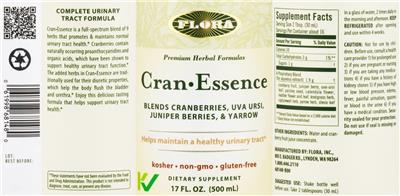
Complete urinary tract formula Cran-Essence is a full-spectrum blend of 9 herbs that promotes & maintains normal urinary tract health. Cranberries contain naturally occurring proanthocyanidins and organic acids, which have been shown to support healthy urinary tract function. The added herbs in Cran-Essence are traditionally used for their diuretic properties, which help the body flush the bladder and urethra. Enjoy this delicious tasting formula that helps support urinary tract health.
Blends cranberries, uva ursi, juniper berries, & yarrow
Kosher
FDA Disclaimer Statement
These statements have not been evaluated by the Food and Drug Administration. This product is not intended to diagnose, treat, cure, or prevent any disease.
Formulation
Premium herbal formulas
Helps maintain a healthy urinary tract
Non-GMO Gluten-free
Seals/Symbols
Kosher Check
FDA Statement of Identity
Dietary Supplement
Suggested/Recommended/Usage/Directions
Suggested use: Shake bottle well before use. Take 2 tablespoons (30 mL) in a glass of water, 2 times daily in the morning and afternoon.
Storage
Keep refrigerated after opening and use within 4 weeks.
Precautions
Caution: Not for use by children.
Before use, consult a health care provider 1) for prolonged use 2) if you are pregnant or nursing 3) if you are taking any medications 4) if you have a history of kidney stones 5) if you have high or low blood pressure, edema, fever, painful urination, spasms or blood in the urine 6) if you have a medical condition.
Security sealed for your protection. Do not use if seal is missing or damaged.
Is this label outdated? Report a formula or label change and our pharmacy team will review it.
Cran-Essence by Flora label
The label scan from the NIH Dietary Supplement Label Database. Tap to enlarge.
Label images are published by the NIH Dietary Supplement Label Database for the version of this product on file. Always read your actual product label.
View the full label (PDF)The Ingredients in Cran-Essence by Flora
These are the 11 active ingredients this product is made of. Select any to open its full monograph.
Serving size30 mL Dosage formLiquid Servings per container16 Amounts shown are per serving.
Most supplement products combine several ingredients, and a medication can interact with the product through any one of them. Each ingredient below shows whether it has known drug interactions.
Sugar
Proprietary Blend
- › Cranberry Fruit Extract, Aqueous
- › Juniper Berry Extract, Aqueous
- › Uva Ursi Leaf Extract, Aqueous
- › Parsley Seed Extract, Aqueous
- › Calendula Flower Extract, Aqueous
- › Heather Flower, Leaf Extract, Aqueous
- › Knotgrass Herb Extract, Aqueous
- › Rupturewort Herb Extract, Aqueous
- › Yarrow Herb Extract, Aqueous
- › Stevia Leaf Extract, Aqueous
Other (inactive) ingredients: Water, Cranberry fruit juice concentrate. These complete the product’s ingredient list but are not active constituents.
Cran-Essence by Flora Drug Interactions
HelloPharmacist Interaction Report
Cran-Essence by Flora is a liquid supplement with 10 ingredients, several of which interact with medications.
The most serious interaction involves cranberry fruit extract and CYP3A4 substrates (drugs metabolized by a liver enzyme) — a Moderate severity concern. One case reported muscle breakdown, back pain, and liver problems in someone taking atorvastatin (a cholesterol drug) alongside cranberry juice at high doses.
Cranberry also interacts Moderately with nifedipine (a blood pressure medication) and warfarin (a blood thinner), though warfarin data are conflicting.
Read the full breakdown — every affected drug type, severity by severity
Uva ursi leaf extract carries several Moderate interactions: CYP3A4 and CYP2C19 substrates (a large group of medications), drugs processed by glucuronidation, lithium, and urinary acidifying agents. Parsley seed extract has Moderate interactions with blood thinners and anticoagulants, blood sugar drugs, diuretics, warfarin, and a few others; it also carries a Minor interaction with aspirin.
Juniper berry, stevia, rupturewort, and yarrow all interact Moderately with lithium. Stevia and juniper berry also affect blood sugar and blood pressure medications at Minor to Moderate severity.
Calendula flower extract has one Minor interaction with CNS depressants (sedatives, sleeping pills). Heather flower and knotgrass herb were not checked against our interaction database — we hold no data for knotgrass and heather's safety profile is very limited.
Altogether, these interactions span 1,237 individual medications.
Use the medication checker below to verify your exact prescriptions before starting this product.
Check your own medications below · Editorial policy · How we use AI
Want to check YOUR meds against Cran-Essence?
Ask about interactions with your drugs in plain English — “Can I take it with lisinopril?” — and we find you the answer in seconds, ingredient by ingredient.
Go to the checkerIngredients driving the most interactions
Individual Drug Interactions
The ingredients in Cran-Essence interact with 1,252 drugs. Click any drug to see the details.
8 of the 11 ingredients in Cran-Essence interact with drugs. Each result below shows which ingredient is responsible. Uva Ursi Leaf Extract, Aqueous Cranberry Fruit Extract, Aqueous Parsley Seed Extract, Aqueous Stevia Leaf Extract, Aqueous Calendula Flower Extract, Aqueous Juniper Berry Extract, Aqueous Rupturewort Herb Extract, Aqueous Yarrow Herb Extract, Aqueous
Ado-trastuzumab EmtansineKadcyla
How Ado-trastuzumab Emtansine interacts with Cran-Essence — through 2 ingredients. Tap an ingredient for the detail:
Cranberry Fruit Extract, AqueousCytochrome P450 3a4 (cyp3a4) Substrates Moderate
Interaction Summary
Theoretically, cranberry might increase the levels and adverse effects of CYP3A4 substrates.
Read the full Cranberry Fruit Extract, Aqueous + Ado-trastuzumab Emtansine interactionUva Ursi Leaf Extract, AqueousCytochrome P450 3a4 (cyp3a4) Substrates Moderate
Interaction Summary
Theoretically, uva ursi may decrease the metabolism of CYP3A4 substrates.
Read the full Uva Ursi Leaf Extract, Aqueous + Ado-trastuzumab Emtansine interactionAbciximabReoPro
How Abciximab interacts with Cran-Essence — through 1 ingredient. Tap an ingredient for the detail:
Parsley Seed Extract, AqueousAnticoagulant/antiplatelet Drugs Moderate
Interaction Summary
Theoretically, parsley might increase the risk of bleeding when taken with anticoagulant or antiplatelet drugs.
Read the full Parsley Seed Extract, Aqueous + Abciximab interactionAbemaciclibVerzenio
How Abemaciclib interacts with Cran-Essence — through 2 ingredients. Tap an ingredient for the detail:
Uva Ursi Leaf Extract, AqueousCytochrome P450 3a4 (cyp3a4) Substrates Moderate
Interaction Summary
Theoretically, uva ursi may decrease the metabolism of CYP3A4 substrates.
Read the full Uva Ursi Leaf Extract, Aqueous + Abemaciclib interactionCranberry Fruit Extract, AqueousCytochrome P450 3a4 (cyp3a4) Substrates Moderate
Interaction Summary
Theoretically, cranberry might increase the levels and adverse effects of CYP3A4 substrates.
Read the full Cranberry Fruit Extract, Aqueous + Abemaciclib interactionAbiraterone
How Abiraterone interacts with Cran-Essence — through 2 ingredients. Tap an ingredient for the detail:
Uva Ursi Leaf Extract, AqueousCytochrome P450 3a4 (cyp3a4) Substrates Moderate
Interaction Summary
Theoretically, uva ursi may decrease the metabolism of CYP3A4 substrates.
Read the full Uva Ursi Leaf Extract, Aqueous + Abiraterone interactionCranberry Fruit Extract, AqueousCytochrome P450 3a4 (cyp3a4) Substrates Moderate
Interaction Summary
Theoretically, cranberry might increase the levels and adverse effects of CYP3A4 substrates.
Read the full Cranberry Fruit Extract, Aqueous + Abiraterone interactionAbiraterone AcetateYonsa, Zytiga
How Abiraterone Acetate interacts with Cran-Essence — through 2 ingredients. Tap an ingredient for the detail:
Cranberry Fruit Extract, AqueousCytochrome P450 3a4 (cyp3a4) Substrates Moderate
Interaction Summary
Theoretically, cranberry might increase the levels and adverse effects of CYP3A4 substrates.
Read the full Cranberry Fruit Extract, Aqueous + Abiraterone Acetate interactionUva Ursi Leaf Extract, AqueousCytochrome P450 3a4 (cyp3a4) Substrates Moderate
Interaction Summary
Theoretically, uva ursi may decrease the metabolism of CYP3A4 substrates.
Read the full Uva Ursi Leaf Extract, Aqueous + Abiraterone Acetate interactionAbrocitinibCibinqo
How Abrocitinib interacts with Cran-Essence — through 3 ingredients. Tap an ingredient for the detail:
Parsley Seed Extract, AqueousAnticoagulant/antiplatelet Drugs Moderate
Interaction Summary
Theoretically, parsley might increase the risk of bleeding when taken with anticoagulant or antiplatelet drugs.
Read the full Parsley Seed Extract, Aqueous + Abrocitinib interactionUva Ursi Leaf Extract, AqueousCytochrome P450 2c19 (cyp2c19) Substrates Moderate
Interaction Summary
Theoretically, uva ursi may decrease the metabolism of CYP2C19 substrates.
Read the full Uva Ursi Leaf Extract, Aqueous + Abrocitinib interactionCranberry Fruit Extract, AqueousCytochrome P450 2c9 (cyp2c9) Substrates Minor
Interaction Summary
Theoretically, cranberry might increase the levels and adverse effects of CYP2C9 substrates.
Read the full Cranberry Fruit Extract, Aqueous + Abrocitinib interactionAcalabrutinibCalquence
How Acalabrutinib interacts with Cran-Essence — through 2 ingredients. Tap an ingredient for the detail:
Uva Ursi Leaf Extract, AqueousCytochrome P450 3a4 (cyp3a4) Substrates, P-glycoprotein Substrates Moderate
Interaction Summary
Theoretically, uva ursi may decrease the metabolism of CYP3A4 substrates.
Read the full Uva Ursi Leaf Extract, Aqueous + Acalabrutinib interactionCranberry Fruit Extract, AqueousCytochrome P450 3a4 (cyp3a4) Substrates Moderate
Interaction Summary
Theoretically, cranberry might increase the levels and adverse effects of CYP3A4 substrates.
Read the full Cranberry Fruit Extract, Aqueous + Acalabrutinib interactionAcarboseGlucobay, Prandase, Precose
How Acarbose interacts with Cran-Essence — through 3 ingredients. Tap an ingredient for the detail:
Parsley Seed Extract, AqueousAntidiabetes Drugs Moderate
Interaction Summary
Theoretically, parsley might increase the risk of hypoglycemia when taken with antidiabetes drugs.
Read the full Parsley Seed Extract, Aqueous + Acarbose interactionJuniper Berry Extract, AqueousAntidiabetes Drugs Moderate
Interaction Summary
Theoretically, taking juniper berry with antidiabetes medications might cause additive hypoglycemia.
Read the full Juniper Berry Extract, Aqueous + Acarbose interactionStevia Leaf Extract, AqueousAntidiabetes Drugs Minor
Interaction Summary
Theoretically, stevia might increase the risk for hypoglycemia when combined with antidiabetes drugs.
Read the full Stevia Leaf Extract, Aqueous + Acarbose interactionAcenocoumarolSintrom
How Acenocoumarol interacts with Cran-Essence — through 1 ingredient. Tap an ingredient for the detail:
Parsley Seed Extract, AqueousAnticoagulant/antiplatelet Drugs Moderate
Interaction Summary
Theoretically, parsley might increase the risk of bleeding when taken with anticoagulant or antiplatelet drugs.
Read the full Parsley Seed Extract, Aqueous + Acenocoumarol interactionAcetaminophenChildren's Tylenol, Children's Tylenol Meltaways, Tylenol, Tylenol Ex Strength
How Acetaminophen interacts with Cran-Essence — through 2 ingredients. Tap an ingredient for the detail:
Parsley Seed Extract, AqueousCytochrome P450 1a2 (cyp1a2) Substrates Moderate
Interaction Summary
Theoretically, parsley might increase serum levels of CYP1A2 substrates.
Read the full Parsley Seed Extract, Aqueous + Acetaminophen interactionUva Ursi Leaf Extract, AqueousGlucuronidated Drugs Moderate
Interaction Summary
Theoretically, uva ursi may increase levels of drugs metabolized by glucuronidation.
Read the full Uva Ursi Leaf Extract, Aqueous + Acetaminophen interactionAcetaminophen, AspirinGemnisyn
How Acetaminophen, Aspirin interacts with Cran-Essence — through 2 ingredients. Tap an ingredient for the detail:
Uva Ursi Leaf Extract, AqueousGlucuronidated Drugs Moderate
Interaction Summary
Theoretically, uva ursi may increase levels of drugs metabolized by glucuronidation.
Read the full Uva Ursi Leaf Extract, Aqueous + Acetaminophen, Aspirin interactionParsley Seed Extract, AqueousAnticoagulant/antiplatelet Drugs, Aspirin +1 Moderate
Interaction Summary
Theoretically, parsley might increase the risk of bleeding when taken with anticoagulant or antiplatelet drugs.
Read the full Parsley Seed Extract, Aqueous + Acetaminophen, Aspirin interactionAcetaminophen, Aspirin, CaffeineExcedrin, Excedrin Extra Strength, Excedrin Migraine
How Acetaminophen, Aspirin, Caffeine interacts with Cran-Essence — through 3 ingredients. Tap an ingredient for the detail:
Parsley Seed Extract, AqueousCytochrome P450 1a2 (cyp1a2) Substrates, Anticoagulant/antiplatelet Drugs +1 Moderate
Interaction Summary
Theoretically, parsley might increase serum levels of CYP1A2 substrates.
Read the full Parsley Seed Extract, Aqueous + Acetaminophen, Aspirin, Caffeine interactionUva Ursi Leaf Extract, AqueousGlucuronidated Drugs, Cytochrome P450 3a4 (cyp3a4) Substrates Moderate
Interaction Summary
Theoretically, uva ursi may increase levels of drugs metabolized by glucuronidation.
Read the full Uva Ursi Leaf Extract, Aqueous + Acetaminophen, Aspirin, Caffeine interactionCranberry Fruit Extract, AqueousCytochrome P450 3a4 (cyp3a4) Substrates Moderate
Interaction Summary
Theoretically, cranberry might increase the levels and adverse effects of CYP3A4 substrates.
Read the full Cranberry Fruit Extract, Aqueous + Acetaminophen, Aspirin, Caffeine interactionAcetaminophen, Brompheniramine, PhenylpropanolamineDimetapp Cold and Flu
How Acetaminophen, Brompheniramine, Phenylpropanolamine interacts with Cran-Essence — through 2 ingredients. Tap an ingredient for the detail:
Uva Ursi Leaf Extract, AqueousGlucuronidated Drugs Moderate
Interaction Summary
Theoretically, uva ursi may increase levels of drugs metabolized by glucuronidation.
Read the full Uva Ursi Leaf Extract, Aqueous + Acetaminophen, Brompheniramine, Phenylpropanolamine interactionParsley Seed Extract, AqueousCytochrome P450 1a2 (cyp1a2) Substrates Moderate
Interaction Summary
Theoretically, parsley might increase serum levels of CYP1A2 substrates.
Read the full Parsley Seed Extract, Aqueous + Acetaminophen, Brompheniramine, Phenylpropanolamine interactionAcetaminophen, ButalbitalAxocet, Bancap, Bucet, Butex Forte, Esgic CF, Orbivan CF +5 more
How Acetaminophen, Butalbital interacts with Cran-Essence — through 2 ingredients. Tap an ingredient for the detail:
Parsley Seed Extract, AqueousCytochrome P450 1a2 (cyp1a2) Substrates Moderate
Interaction Summary
Theoretically, parsley might increase serum levels of CYP1A2 substrates.
Read the full Parsley Seed Extract, Aqueous + Acetaminophen, Butalbital interactionUva Ursi Leaf Extract, AqueousGlucuronidated Drugs Moderate
Interaction Summary
Theoretically, uva ursi may increase levels of drugs metabolized by glucuronidation.
Read the full Uva Ursi Leaf Extract, Aqueous + Acetaminophen, Butalbital interactionAcetaminophen, Butalbital, CaffeineEsgic, Esgic Plus, Fiogesic, Fioricet, Repan, Tecnal +1 more
How Acetaminophen, Butalbital, Caffeine interacts with Cran-Essence — through 3 ingredients. Tap an ingredient for the detail:
Uva Ursi Leaf Extract, AqueousGlucuronidated Drugs, Cytochrome P450 3a4 (cyp3a4) Substrates Moderate
Interaction Summary
Theoretically, uva ursi may increase levels of drugs metabolized by glucuronidation.
Read the full Uva Ursi Leaf Extract, Aqueous + Acetaminophen, Butalbital, Caffeine interactionParsley Seed Extract, AqueousCytochrome P450 1a2 (cyp1a2) Substrates Moderate
Interaction Summary
Theoretically, parsley might increase serum levels of CYP1A2 substrates.
Read the full Parsley Seed Extract, Aqueous + Acetaminophen, Butalbital, Caffeine interactionCranberry Fruit Extract, AqueousCytochrome P450 3a4 (cyp3a4) Substrates Moderate
Interaction Summary
Theoretically, cranberry might increase the levels and adverse effects of CYP3A4 substrates.
Read the full Cranberry Fruit Extract, Aqueous + Acetaminophen, Butalbital, Caffeine interactionAcetaminophen, Butalbital, Caffeine, CodeineEsgic with Codeine, Fioricet w/ Codeine
How Acetaminophen, Butalbital, Caffeine, Codeine interacts with Cran-Essence — through 4 ingredients. Tap an ingredient for the detail:
Cranberry Fruit Extract, AqueousCytochrome P450 3a4 (cyp3a4) Substrates Moderate
Interaction Summary
Theoretically, cranberry might increase the levels and adverse effects of CYP3A4 substrates.
Read the full Cranberry Fruit Extract, Aqueous + Acetaminophen, Butalbital, Caffeine, Codeine interactionParsley Seed Extract, AqueousCytochrome P450 1a2 (cyp1a2) Substrates Moderate
Interaction Summary
Theoretically, parsley might increase serum levels of CYP1A2 substrates.
Read the full Parsley Seed Extract, Aqueous + Acetaminophen, Butalbital, Caffeine, Codeine interactionUva Ursi Leaf Extract, AqueousGlucuronidated Drugs, Cytochrome P450 3a4 (cyp3a4) Substrates Moderate
Interaction Summary
Theoretically, uva ursi may increase levels of drugs metabolized by glucuronidation.
Read the full Uva Ursi Leaf Extract, Aqueous + Acetaminophen, Butalbital, Caffeine, Codeine interactionCalendula Flower Extract, AqueousCns Depressants Minor
Interaction Summary
Theoretically, calendula might have additive effects when used with CNS depressants, although this appears to be unlikely.
Read the full Calendula Flower Extract, Aqueous + Acetaminophen, Butalbital, Caffeine, Codeine interactionAcetaminophen, Butalbital, CodeineBancap w/ Codeine
How Acetaminophen, Butalbital, Codeine interacts with Cran-Essence — through 3 ingredients. Tap an ingredient for the detail:
Parsley Seed Extract, AqueousCytochrome P450 1a2 (cyp1a2) Substrates Moderate
Interaction Summary
Theoretically, parsley might increase serum levels of CYP1A2 substrates.
Read the full Parsley Seed Extract, Aqueous + Acetaminophen, Butalbital, Codeine interactionUva Ursi Leaf Extract, AqueousGlucuronidated Drugs Moderate
Interaction Summary
Theoretically, uva ursi may increase levels of drugs metabolized by glucuronidation.
Read the full Uva Ursi Leaf Extract, Aqueous + Acetaminophen, Butalbital, Codeine interactionCalendula Flower Extract, AqueousCns Depressants Minor
Interaction Summary
Theoretically, calendula might have additive effects when used with CNS depressants, although this appears to be unlikely.
Read the full Calendula Flower Extract, Aqueous + Acetaminophen, Butalbital, Codeine interactionAcetaminophen, Butalbital, Codeine PhosphatePhrenilin #3
How Acetaminophen, Butalbital, Codeine Phosphate interacts with Cran-Essence — through 3 ingredients. Tap an ingredient for the detail:
Uva Ursi Leaf Extract, AqueousGlucuronidated Drugs Moderate
Interaction Summary
Theoretically, uva ursi may increase levels of drugs metabolized by glucuronidation.
Read the full Uva Ursi Leaf Extract, Aqueous + Acetaminophen, Butalbital, Codeine Phosphate interactionParsley Seed Extract, AqueousCytochrome P450 1a2 (cyp1a2) Substrates Moderate
Interaction Summary
Theoretically, parsley might increase serum levels of CYP1A2 substrates.
Read the full Parsley Seed Extract, Aqueous + Acetaminophen, Butalbital, Codeine Phosphate interactionCalendula Flower Extract, AqueousCns Depressants Minor
Interaction Summary
Theoretically, calendula might have additive effects when used with CNS depressants, although this appears to be unlikely.
Read the full Calendula Flower Extract, Aqueous + Acetaminophen, Butalbital, Codeine Phosphate interactionAcetaminophen, Caffeine, Chlorpheniramine, Hydrocodone, PhenylephrineHycomine Compound
How Acetaminophen, Caffeine, Chlorpheniramine, Hydrocodone, Phenylephrine interacts with Cran-Essence — through 4 ingredients. Tap an ingredient for the detail:
Parsley Seed Extract, AqueousCytochrome P450 1a2 (cyp1a2) Substrates Moderate
Interaction Summary
Theoretically, parsley might increase serum levels of CYP1A2 substrates.
Read the full Parsley Seed Extract, Aqueous + Acetaminophen, Caffeine, Chlorpheniramine, Hydrocodone, Phenylephrine interactionUva Ursi Leaf Extract, AqueousGlucuronidated Drugs, Cytochrome P450 3a4 (cyp3a4) Substrates Moderate
Interaction Summary
Theoretically, uva ursi may increase levels of drugs metabolized by glucuronidation.
Read the full Uva Ursi Leaf Extract, Aqueous + Acetaminophen, Caffeine, Chlorpheniramine, Hydrocodone, Phenylephrine interactionCranberry Fruit Extract, AqueousCytochrome P450 3a4 (cyp3a4) Substrates Moderate
Interaction Summary
Theoretically, cranberry might increase the levels and adverse effects of CYP3A4 substrates.
Read the full Cranberry Fruit Extract, Aqueous + Acetaminophen, Caffeine, Chlorpheniramine, Hydrocodone, Phenylephrine interactionCalendula Flower Extract, AqueousCns Depressants Minor
Interaction Summary
Theoretically, calendula might have additive effects when used with CNS depressants, although this appears to be unlikely.
Read the full Calendula Flower Extract, Aqueous + Acetaminophen, Caffeine, Chlorpheniramine, Hydrocodone, Phenylephrine interactionAcetaminophen, Caffeine, CodeineGesic C15, Gesic C30, Gesic C8, Lenoltec 1, Lenoltec 2, Lenoltec 3 +1 more
How Acetaminophen, Caffeine, Codeine interacts with Cran-Essence — through 4 ingredients. Tap an ingredient for the detail:
Cranberry Fruit Extract, AqueousCytochrome P450 3a4 (cyp3a4) Substrates Moderate
Interaction Summary
Theoretically, cranberry might increase the levels and adverse effects of CYP3A4 substrates.
Read the full Cranberry Fruit Extract, Aqueous + Acetaminophen, Caffeine, Codeine interactionParsley Seed Extract, AqueousCytochrome P450 1a2 (cyp1a2) Substrates Moderate
Interaction Summary
Theoretically, parsley might increase serum levels of CYP1A2 substrates.
Read the full Parsley Seed Extract, Aqueous + Acetaminophen, Caffeine, Codeine interactionUva Ursi Leaf Extract, AqueousGlucuronidated Drugs, Cytochrome P450 3a4 (cyp3a4) Substrates Moderate
Interaction Summary
Theoretically, uva ursi may increase levels of drugs metabolized by glucuronidation.
Read the full Uva Ursi Leaf Extract, Aqueous + Acetaminophen, Caffeine, Codeine interactionCalendula Flower Extract, AqueousCns Depressants Minor
Interaction Summary
Theoretically, calendula might have additive effects when used with CNS depressants, although this appears to be unlikely.
Read the full Calendula Flower Extract, Aqueous + Acetaminophen, Caffeine, Codeine interactionAcetaminophen, Caffeine, Codeine, SalicylamideCodalan No.1, Codalan No.2, Codalan No.3
How Acetaminophen, Caffeine, Codeine, Salicylamide interacts with Cran-Essence — through 4 ingredients. Tap an ingredient for the detail:
Uva Ursi Leaf Extract, AqueousCytochrome P450 3a4 (cyp3a4) Substrates, Glucuronidated Drugs Moderate
Interaction Summary
Theoretically, uva ursi may decrease the metabolism of CYP3A4 substrates.
Read the full Uva Ursi Leaf Extract, Aqueous + Acetaminophen, Caffeine, Codeine, Salicylamide interactionParsley Seed Extract, AqueousCytochrome P450 1a2 (cyp1a2) Substrates Moderate
Interaction Summary
Theoretically, parsley might increase serum levels of CYP1A2 substrates.
Read the full Parsley Seed Extract, Aqueous + Acetaminophen, Caffeine, Codeine, Salicylamide interactionCranberry Fruit Extract, AqueousCytochrome P450 3a4 (cyp3a4) Substrates Moderate
Interaction Summary
Theoretically, cranberry might increase the levels and adverse effects of CYP3A4 substrates.
Read the full Cranberry Fruit Extract, Aqueous + Acetaminophen, Caffeine, Codeine, Salicylamide interactionCalendula Flower Extract, AqueousCns Depressants Minor
Interaction Summary
Theoretically, calendula might have additive effects when used with CNS depressants, although this appears to be unlikely.
Read the full Calendula Flower Extract, Aqueous + Acetaminophen, Caffeine, Codeine, Salicylamide interactionAcetaminophen, Caffeine, DihydrocodeineDHC Plus, Panlor DC, Panlor SS
How Acetaminophen, Caffeine, Dihydrocodeine interacts with Cran-Essence — through 4 ingredients. Tap an ingredient for the detail:
Uva Ursi Leaf Extract, AqueousGlucuronidated Drugs, Cytochrome P450 3a4 (cyp3a4) Substrates Moderate
Interaction Summary
Theoretically, uva ursi may increase levels of drugs metabolized by glucuronidation.
Read the full Uva Ursi Leaf Extract, Aqueous + Acetaminophen, Caffeine, Dihydrocodeine interactionParsley Seed Extract, AqueousCytochrome P450 1a2 (cyp1a2) Substrates Moderate
Interaction Summary
Theoretically, parsley might increase serum levels of CYP1A2 substrates.
Read the full Parsley Seed Extract, Aqueous + Acetaminophen, Caffeine, Dihydrocodeine interactionCranberry Fruit Extract, AqueousCytochrome P450 3a4 (cyp3a4) Substrates Moderate
Interaction Summary
Theoretically, cranberry might increase the levels and adverse effects of CYP3A4 substrates.
Read the full Cranberry Fruit Extract, Aqueous + Acetaminophen, Caffeine, Dihydrocodeine interactionCalendula Flower Extract, AqueousCns Depressants Minor
Interaction Summary
Theoretically, calendula might have additive effects when used with CNS depressants, although this appears to be unlikely.
Read the full Calendula Flower Extract, Aqueous + Acetaminophen, Caffeine, Dihydrocodeine interactionAcetaminophen, Caffeine, IsomethepteneMigralam
How Acetaminophen, Caffeine, Isometheptene interacts with Cran-Essence — through 3 ingredients. Tap an ingredient for the detail:
Cranberry Fruit Extract, AqueousCytochrome P450 3a4 (cyp3a4) Substrates Moderate
Interaction Summary
Theoretically, cranberry might increase the levels and adverse effects of CYP3A4 substrates.
Read the full Cranberry Fruit Extract, Aqueous + Acetaminophen, Caffeine, Isometheptene interactionUva Ursi Leaf Extract, AqueousCytochrome P450 3a4 (cyp3a4) Substrates, Glucuronidated Drugs Moderate
Interaction Summary
Theoretically, uva ursi may decrease the metabolism of CYP3A4 substrates.
Read the full Uva Ursi Leaf Extract, Aqueous + Acetaminophen, Caffeine, Isometheptene interactionParsley Seed Extract, AqueousCytochrome P450 1a2 (cyp1a2) Substrates Moderate
Interaction Summary
Theoretically, parsley might increase serum levels of CYP1A2 substrates.
Read the full Parsley Seed Extract, Aqueous + Acetaminophen, Caffeine, Isometheptene interactionAcetaminophen, Caffeine, PyrilamineMidol Max Strength Menstrual
How Acetaminophen, Caffeine, Pyrilamine interacts with Cran-Essence — through 4 ingredients. Tap an ingredient for the detail:
Parsley Seed Extract, AqueousCytochrome P450 1a2 (cyp1a2) Substrates, Diuretic Drugs Moderate
Interaction Summary
Theoretically, parsley might increase serum levels of CYP1A2 substrates.
Read the full Parsley Seed Extract, Aqueous + Acetaminophen, Caffeine, Pyrilamine interactionUva Ursi Leaf Extract, AqueousCytochrome P450 3a4 (cyp3a4) Substrates, Glucuronidated Drugs Moderate
Interaction Summary
Theoretically, uva ursi may decrease the metabolism of CYP3A4 substrates.
Read the full Uva Ursi Leaf Extract, Aqueous + Acetaminophen, Caffeine, Pyrilamine interactionCranberry Fruit Extract, AqueousCytochrome P450 3a4 (cyp3a4) Substrates Moderate
Interaction Summary
Theoretically, cranberry might increase the levels and adverse effects of CYP3A4 substrates.
Read the full Cranberry Fruit Extract, Aqueous + Acetaminophen, Caffeine, Pyrilamine interactionJuniper Berry Extract, AqueousDiuretic Drugs Minor
Interaction Summary
Theoretically, juniper berry might increase the risk of adverse effects from diuretic drugs.
Read the full Juniper Berry Extract, Aqueous + Acetaminophen, Caffeine, Pyrilamine interactionAcetaminophen, Chlorpheniramine Maleate, Dextromethorphan HbrVicks Formula 44M Cough, Cold & Flu Relief
How Acetaminophen, Chlorpheniramine Maleate, Dextromethorphan Hbr interacts with Cran-Essence — through 3 ingredients. Tap an ingredient for the detail:
Uva Ursi Leaf Extract, AqueousGlucuronidated Drugs, Cytochrome P450 3a4 (cyp3a4) Substrates Moderate
Interaction Summary
Theoretically, uva ursi may increase levels of drugs metabolized by glucuronidation.
Read the full Uva Ursi Leaf Extract, Aqueous + Acetaminophen, Chlorpheniramine Maleate, Dextromethorphan Hbr interactionParsley Seed Extract, AqueousCytochrome P450 1a2 (cyp1a2) Substrates Moderate
Interaction Summary
Theoretically, parsley might increase serum levels of CYP1A2 substrates.
Read the full Parsley Seed Extract, Aqueous + Acetaminophen, Chlorpheniramine Maleate, Dextromethorphan Hbr interactionCranberry Fruit Extract, AqueousCytochrome P450 3a4 (cyp3a4) Substrates Moderate
Interaction Summary
Theoretically, cranberry might increase the levels and adverse effects of CYP3A4 substrates.
Read the full Cranberry Fruit Extract, Aqueous + Acetaminophen, Chlorpheniramine Maleate, Dextromethorphan Hbr interactionAcetaminophen, Chlorpheniramine, Codeine, PhenylephrineColrex
How Acetaminophen, Chlorpheniramine, Codeine, Phenylephrine interacts with Cran-Essence — through 4 ingredients. Tap an ingredient for the detail:
Uva Ursi Leaf Extract, AqueousGlucuronidated Drugs, Cytochrome P450 3a4 (cyp3a4) Substrates Moderate
Interaction Summary
Theoretically, uva ursi may increase levels of drugs metabolized by glucuronidation.
Read the full Uva Ursi Leaf Extract, Aqueous + Acetaminophen, Chlorpheniramine, Codeine, Phenylephrine interactionParsley Seed Extract, AqueousCytochrome P450 1a2 (cyp1a2) Substrates Moderate
Interaction Summary
Theoretically, parsley might increase serum levels of CYP1A2 substrates.
Read the full Parsley Seed Extract, Aqueous + Acetaminophen, Chlorpheniramine, Codeine, Phenylephrine interactionCranberry Fruit Extract, AqueousCytochrome P450 3a4 (cyp3a4) Substrates Moderate
Interaction Summary
Theoretically, cranberry might increase the levels and adverse effects of CYP3A4 substrates.
Read the full Cranberry Fruit Extract, Aqueous + Acetaminophen, Chlorpheniramine, Codeine, Phenylephrine interactionCalendula Flower Extract, AqueousCns Depressants Minor
Interaction Summary
Theoretically, calendula might have additive effects when used with CNS depressants, although this appears to be unlikely.
Read the full Calendula Flower Extract, Aqueous + Acetaminophen, Chlorpheniramine, Codeine, Phenylephrine interactionAcetaminophen, Chlorpheniramine, DextromethorphanCoricidin II Extra Strength Cold and Flu
How Acetaminophen, Chlorpheniramine, Dextromethorphan interacts with Cran-Essence — through 3 ingredients. Tap an ingredient for the detail:
Cranberry Fruit Extract, AqueousCytochrome P450 3a4 (cyp3a4) Substrates Moderate
Interaction Summary
Theoretically, cranberry might increase the levels and adverse effects of CYP3A4 substrates.
Read the full Cranberry Fruit Extract, Aqueous + Acetaminophen, Chlorpheniramine, Dextromethorphan interactionUva Ursi Leaf Extract, AqueousGlucuronidated Drugs, Cytochrome P450 3a4 (cyp3a4) Substrates Moderate
Interaction Summary
Theoretically, uva ursi may increase levels of drugs metabolized by glucuronidation.
Read the full Uva Ursi Leaf Extract, Aqueous + Acetaminophen, Chlorpheniramine, Dextromethorphan interactionParsley Seed Extract, AqueousCytochrome P450 1a2 (cyp1a2) Substrates Moderate
Interaction Summary
Theoretically, parsley might increase serum levels of CYP1A2 substrates.
Read the full Parsley Seed Extract, Aqueous + Acetaminophen, Chlorpheniramine, Dextromethorphan interactionAcetaminophen, Chlorpheniramine, Dextromethorphan HydrobromideCoricidin HBP Maximum Strength Flu
How Acetaminophen, Chlorpheniramine, Dextromethorphan Hydrobromide interacts with Cran-Essence — through 3 ingredients. Tap an ingredient for the detail:
Parsley Seed Extract, AqueousCytochrome P450 1a2 (cyp1a2) Substrates Moderate
Interaction Summary
Theoretically, parsley might increase serum levels of CYP1A2 substrates.
Read the full Parsley Seed Extract, Aqueous + Acetaminophen, Chlorpheniramine, Dextromethorphan Hydrobromide interactionCranberry Fruit Extract, AqueousCytochrome P450 3a4 (cyp3a4) Substrates Moderate
Interaction Summary
Theoretically, cranberry might increase the levels and adverse effects of CYP3A4 substrates.
Read the full Cranberry Fruit Extract, Aqueous + Acetaminophen, Chlorpheniramine, Dextromethorphan Hydrobromide interactionUva Ursi Leaf Extract, AqueousCytochrome P450 3a4 (cyp3a4) Substrates, Glucuronidated Drugs Moderate
Interaction Summary
Theoretically, uva ursi may decrease the metabolism of CYP3A4 substrates.
Read the full Uva Ursi Leaf Extract, Aqueous + Acetaminophen, Chlorpheniramine, Dextromethorphan Hydrobromide interactionAcetaminophen, Chlorpheniramine, Dextromethorphan, PhenylpropanolamineMulti Symptom Cold Relief
How Acetaminophen, Chlorpheniramine, Dextromethorphan, Phenylpropanolamine interacts with Cran-Essence — through 3 ingredients. Tap an ingredient for the detail:
Uva Ursi Leaf Extract, AqueousGlucuronidated Drugs, Cytochrome P450 3a4 (cyp3a4) Substrates Moderate
Interaction Summary
Theoretically, uva ursi may increase levels of drugs metabolized by glucuronidation.
Read the full Uva Ursi Leaf Extract, Aqueous + Acetaminophen, Chlorpheniramine, Dextromethorphan, Phenylpropanolamine interactionCranberry Fruit Extract, AqueousCytochrome P450 3a4 (cyp3a4) Substrates Moderate
Interaction Summary
Theoretically, cranberry might increase the levels and adverse effects of CYP3A4 substrates.
Read the full Cranberry Fruit Extract, Aqueous + Acetaminophen, Chlorpheniramine, Dextromethorphan, Phenylpropanolamine interactionParsley Seed Extract, AqueousCytochrome P450 1a2 (cyp1a2) Substrates Moderate
Interaction Summary
Theoretically, parsley might increase serum levels of CYP1A2 substrates.
Read the full Parsley Seed Extract, Aqueous + Acetaminophen, Chlorpheniramine, Dextromethorphan, Phenylpropanolamine interactionAcetaminophen, Chlorpheniramine, Dextromethorphan, PseudoephedrineChildren's Tylenol Cold Plus Cough, Tylenol Cold Ex Strength
How Acetaminophen, Chlorpheniramine, Dextromethorphan, Pseudoephedrine interacts with Cran-Essence — through 3 ingredients. Tap an ingredient for the detail:
Parsley Seed Extract, AqueousCytochrome P450 1a2 (cyp1a2) Substrates Moderate
Interaction Summary
Theoretically, parsley might increase serum levels of CYP1A2 substrates.
Read the full Parsley Seed Extract, Aqueous + Acetaminophen, Chlorpheniramine, Dextromethorphan, Pseudoephedrine interactionCranberry Fruit Extract, AqueousCytochrome P450 3a4 (cyp3a4) Substrates Moderate
Interaction Summary
Theoretically, cranberry might increase the levels and adverse effects of CYP3A4 substrates.
Read the full Cranberry Fruit Extract, Aqueous + Acetaminophen, Chlorpheniramine, Dextromethorphan, Pseudoephedrine interactionUva Ursi Leaf Extract, AqueousCytochrome P450 3a4 (cyp3a4) Substrates, Glucuronidated Drugs Moderate
Interaction Summary
Theoretically, uva ursi may decrease the metabolism of CYP3A4 substrates.
Read the full Uva Ursi Leaf Extract, Aqueous + Acetaminophen, Chlorpheniramine, Dextromethorphan, Pseudoephedrine interactionEach ingredient & the kinds of drugs it affects
For each ingredient in Cran-Essence with known interactions, here are the types of medications they can affect. Open any type for the detail — or search your exact drug in the checker above.
Uva Ursi Leaf Extract, Aqueous
Cytochrome P450 2C19 (Cyp2C19) Substrates
Theoretically, uva ursi may decrease the metabolism of CYP2C19 substrates.
In vitro, uva ursi appears to inhibit cytochrome CYP2C19. This effect has not been reported in humans.
Cytochrome P450 3A4 (Cyp3A4) Substrates
Theoretically, uva ursi may decrease the metabolism of CYP3A4 substrates.
In vitro, uva ursi appears to inhibit CYP3A4. This effect has not been reported in humans.
Glucuronidated Drugs
Theoretically, uva ursi may increase levels of drugs metabolized by glucuronidation.
In vitro, uva ursi extract appears to strongly inhibit UDP-glucuronosyltransferase (UGT) 1A1 (UGT1A1). However, uva ursi extract does not appear to inhibit UGT1A1 in animal models. This effect has not been reported in humans.
Lithium
Theoretically, uva ursi may increase lithium levels, necessitating a decrease in dose.
Uva ursi may have diuretic properties. Diuretics may increase lithium reabsorption with sodium in the proximal tubule of the kidney. Theoretically, uva ursi might reduce excretion and increase levels of lithium.
Urinary Acidifying Agents
Effects of uva ursi in the urinary tract may be reduced by urinary acidifying agents.
Uva ursi seems to work best in alkaline urine. Theoretically, taking uva ursi with medications known to acidify the urine may decrease any effects of uva ursi on the urinary tract.
P-Glycoprotein Substrates
Theoretically, uva ursi may alter the levels of drugs transported by P-glycoprotein.
In vitro, uva ursi appears to inhibit the multi-drug transporter protein, P-glycoprotein. This effect has not been reported in humans.
Cranberry Fruit Extract, Aqueous
Atorvastatin (Lipitor)
Theoretically, cranberry might increase levels and adverse effects of atorvastatin.
In one case report, a patient taking atorvastatin experienced upper back pain, rhabdomyolysis, and abnormal liver function after drinking cranberry juice 16 ounces daily for 2 weeks. Theoretically, this may have been caused by inhibition of cytochrome P450 3A4 (CYP3A4) enzymes by cranberry juice, as atorvastatin is a CYP3A4 substrate. Creatinine kinase and liver enzymes normalized within 2 weeks of stopping cranberry juice. Patients taking atorvastatin should avoid large quantities of cranberry juice.
Cytochrome P450 3A4 (Cyp3A4) Substrates
Theoretically, cranberry might increase the levels and adverse effects of CYP3A4 substrates.
A case of upper back pain, rhabdomyolysis, and abnormal liver function has been reported for a patient taking atorvastatin, a CYP3A4 substrate, in combination with cranberry juice 16 ounces daily for 2 weeks. Creatinine kinase and liver enzymes normalized within 2 weeks of stopping cranberry juice. Also, animal research suggests that cranberry juice, administered intraduodenally 30 minutes prior to nifedipine, a CYP3A4 substrate, inhibits nifedipine metabolism and increases the area under the concentration-time curve by 1.6-fold compared to control.
Nifedipine (Procardia)
Theoretically, cranberry might increase the levels and adverse effects of nifedipine.
Animal research suggests that cranberry juice, administered intraduodenally 30 minutes prior to nifedipine treatment, inhibits nifedipine metabolism and increases the area under the concentration-time curve by 1.6-fold compared to control. This interaction has not been reported in humans.
Warfarin (Coumadin)
Theoretically, cranberry might increase the levels and adverse effects of warfarin. However, research is conflicting.
There is contradictory evidence about the effect of cranberry juice on warfarin. Case reports have linked cranberry juice consumption to increases in the international normalized ratio (INR) in patients taking warfarin, resulting in severe spontaneous bleeding and excessive postoperative bleeding. Daily consumption of cranberry sauce for one week has also been linked to an increase in INR in one case report. In a small study in healthy young males, taking a high dose of 3 grams of cranberry juice concentrate capsules, equivalent to 57 grams of fruit daily, for 2 weeks produced a 30% increase in the area under the INR-time curve after a single 25-mg dose of warfarin. However, 3 very small clinical studies in patients stabilized on warfarin reported that cranberry juice 250 mL once or twice daily for 7 days (27% cranberry juice or pure cranberry juice) or 240 mL once daily for 14 days does not significantly increase INR or affect plasma warfarin levels. The reasons for these discrepant findings are unclear. It is possible that the form and dose of cranberry may play a role, as cranberry extracts and juices contain different constituents. Additionally, an in vitro study evaluating 5 different cranberry juices found varying effects, with only a cranberry concentrate, and not diluted cranberry juices, inhibiting CYP2C9. However, this concentrate did not inhibit CYP2C9 activity in humans.
Cytochrome P450 2C9 (Cyp2C9) Substrates
Theoretically, cranberry might increase the levels and adverse effects of CYP2C9 substrates. However, research is conflicting.
There is contradictory evidence about the effect of cranberry on CYP2C9 enzymes. In vitro evidence suggests that flavonoids in cranberry inhibit CYP2C9 enzymes. However, clinical research shows that cranberry juice does not significantly affect the levels, metabolism, or elimination of the CYP2C9 substrates flurbiprofen or diclofenac. Also, in patients stabilized on warfarin, drinking cranberry juice 250 mL daily for 7 days does not significantly increase the anticoagulant activity of warfarin, a CYP2C9 substrate. Additional pharmacokinetic research shows that cranberry juice does not increase peak plasma concentrations or area under the concentration-time curve of warfarin.
Diclofenac (Voltaren, Others)
Theoretically, cranberry might modestly increase the levels and adverse effects of diclofenac.
In vitro evidence suggests that cranberry juice inhibits diclofenac metabolism by human liver microsomes. However, drinking cranberry juice does not seem to affect diclofenac metabolism in humans.
Parsley Seed Extract, Aqueous
Anticoagulant/Antiplatelet Drugs
Theoretically, parsley might increase the risk of bleeding when taken with anticoagulant or antiplatelet drugs.
Animal research suggests that parsley has antiplatelet effects.
Antidiabetes Drugs
Theoretically, parsley might increase the risk of hypoglycemia when taken with antidiabetes drugs.
Animal research suggests that parsley might decrease blood glucose. Monitor blood glucose levels closely. Dose adjustments might be necessary.
Cytochrome P450 1A2 (Cyp1A2) Substrates
Theoretically, parsley might increase serum levels of CYP1A2 substrates.
Laboratory research suggests that parsley can inhibit CYP1A2.
Diuretic Drugs
Theoretically, parsley might enhance or interfere with the effects of diuretic drugs.
Animal research suggests that parsley seed extract increases urine elimination. Parsley leaf and root might also interfere with diuretic therapy due their purported aquaretic effects.
Pentobarbital (Nembutal)
Theoretically, parsley might increase the duration of pentobarbital effects.
Animal research suggests that parsley juice prolongs the action of pentobarbital, perhaps by decreasing cytochrome P450 levels. It is not known if this occurs in humans or if this applies to other barbiturates or sedatives.
Sirolimus (Rapamune)
Theoretically, large quantities of parsley might increase sirolimus levels.
In one case report, an adult female with a history of kidney transplant presented with elevated blood sirolimus levels, approximately 4-7 times greater than previous measures, after daily consumption of a juice containing approximately 30 grams of parsley for 7 days. Sirolimus levels returned to normal a week after the parsley juice was discontinued.
Warfarin (Coumadin)
Theoretically, large amounts of parsley leaf and root might decrease the effects of warfarin.
Parlsey contains vitamin K.
Aspirin
Theoretically, aspirin might increase the severity of allergic reactions to parsley.
In one case, severe urticaria and swelling were reported after taking aspirin with parsley in an individual with a known mild parsley allergy.
Stevia Leaf Extract, Aqueous
Lithium
Theoretically, stevia might decrease clearance and increase levels of lithium.
Animal research suggests that stevia extracts might have diuretic activity. Theoretically, increased reabsorption of lithium along with sodium might reduce excretion and increase levels of lithium.
Antidiabetes Drugs
Theoretically, stevia might increase the risk for hypoglycemia when combined with antidiabetes drugs.
Preliminary clinical research in patients with type 2 diabetes suggests that taking a single dose of stevia extract 1000 mg reduces postprandial blood glucose levels when taken with a meal. However, other clinical research in patients with type 1 or type 2 diabetes suggests that taking stevioside 250 mg three times daily does not significantly affect blood glucose levels or glycated hemoglobin (HbA1C) after three months of treatment.
Antihypertensive Drugs
Theoretically, combining stevia or stevia constituents with antihypertensive agents might increase the risk of hypotension.
Stevia extract and stevioside might lower blood pressure in patients with hypertension. However, other clinical research suggests that stevioside does not significantly lower blood pressure in patients with hypertension.
Calendula Flower Extract, Aqueous
Cns Depressants
Theoretically, calendula might have additive effects when used with CNS depressants, although this appears to be unlikely.
Although some animal research has suggested that a saponoside constituent in calendula may have sedative effects, calendula has been used for over 30 years without reports of sedation in humans.
Juniper Berry Extract, Aqueous
Antidiabetes Drugs
Theoretically, taking juniper berry with antidiabetes medications might cause additive hypoglycemia.
Animal research shows that juniper berry can lower blood glucose.
Diuretic Drugs
Theoretically, juniper berry might increase the risk of adverse effects from diuretic drugs.
Juniper berry is thought to have mild diuretic effects.
Lithium
Theoretically, juniper berry might reduce lithium excretion and increase serum levels of lithium.
Juniper berry is thought to have mild diuretic effects.
Rupturewort Herb Extract, Aqueous
Lithium
Theoretically, rupturewort might increase the levels and clinical effects of lithium.
Animal research shows that rupturewort may have diuretic effects, increasing the excretion of sodium, potassium, and chloride. Theoretically, due to these effects, rupturewort might reduce excretion and increase levels of lithium.
Yarrow Herb Extract, Aqueous
Lithium
Theoretically, taking yarrow with lithium might increase the levels and adverse effects of lithium.
Animal research shows that yarrow has diuretic activity. Theoretically, due to these potential diuretic effects, yarrow might reduce excretion and increase levels of lithium. The dose of lithium might need to be decreased.
Brand information
Manufacturer and brand details for Cran-Essence, from the product label.
Flora
See all Flora products- Name
- Flora, Inc.
- Street Address
- 805 E. Badger Rd.
- City
- Lynden
- State
- WA
- ZipCode
- 98264
- Phone Number
- 1.800.446.2110
Cran-Essence by Flora: Common Questions
Does Cran-Essence by Flora interact with any medications?
How can one product interact with so many drugs?
Where does this information come from?
Is this safe to take during pregnancy?
What is cranberry fruit extract supposed to do?
Will this cause side effects?
Can I take this if I'm on a blood thinner like warfarin?
Is concentrated herbal extract safer than juice?
What ingredients did you NOT check for drug interactions?
Written and reviewed by the HelloPharmacist editorial staff. Our editorial policy
Not sure if Cran-Essence is safe with your meds?
Our pharmacists answer your medication & supplement questions — free.
Label information is sourced from the NIH Dietary Supplement Label Database and reflects the product version on file; always read your actual product label. This page is for education only and is not a substitute for professional medical advice. Confirm with your pharmacist or doctor before combining supplements and medications.
The Full Monographs Behind Cran-Essence’s Ingredients
Every ingredient we hold a full HelloPharmacist monograph for — uses, evidence, safety, and the complete interaction list.
Cranberry
Interacts with 712 drugsCranberry is best known for helping to prevent repeated urinary tract infections (UTIs) in some people, and the evidence here is moderate but mixed. It is not a reliable treatment for an act...
Read the full Cranberry monograph → Herb & supplement monographJuniper
Interacts with 162 drugsJuniper berry is a traditional herb best known for flavoring gin and for its folk use as a diuretic and digestive aid. Solid human evidence for its health benefits is limited, and it can irr...
Read the full Juniper monograph → Herb & supplement monographUva Ursi
Interacts with 803 drugsUva ursi is a traditional herb used mainly for urinary tract infections, and its leaves contain a compound called arbutin that may have antimicrobial effects in the urine. Evidence in people...
Read the full Uva Ursi monograph → Herb & supplement monographParsley
Interacts with 443 drugsParsley is a popular culinary herb that is safe to eat in normal food amounts and is a good source of vitamins K and C. It is traditionally used as a diuretic and for digestion, but solid hu...
Read the full Parsley monograph → Herb & supplement monographCalendula
Interacts with 248 drugsCalendula is a flowering plant whose petals are used mainly in skin creams, oils, and ointments to soothe minor irritation and support wound healing. Some early research is promising for ski...
Read the full Calendula monograph → Herb & supplement monographHeather
Heather (Calluna vulgaris) is a traditional European herb used mainly as a tea for urinary and minor inflammatory complaints, but high-quality human studies are lacking. It is generally cons...
Read the full Heather monograph → Herb & supplement monographRupturewort
Interacts with 1 drugRupturewort is a traditional European herb mainly used as a mild diuretic and for urinary complaints. Solid human research is very limited, so its true benefits and long-term safety are not...
Read the full Rupturewort monograph → Herb & supplement monographYarrow
Interacts with 1 drugYarrow is a traditional herb long used for wounds, digestive complaints, and colds, but high-quality human studies are very limited, so its benefits are not well proven. It is generally used...
Read the full Yarrow monograph → Herb & supplement monographStevia
Interacts with 259 drugsStevia is a plant-based, calorie-free sweetener that is widely used as a sugar alternative and is considered safe in normal food amounts by major regulators. Purified stevia extracts have a...
Read the full Stevia monograph →Sources & How We Checked
Cran-Essence's label data comes from the NIH Dietary Supplement Label Database; the ingredient interaction data is from the Natural Medicines database, reviewed by our pharmacists.
- NIH Dietary Supplement Label Database (DSLD) — The official product label on file for this supplement.
- Natural Medicines (Therapeutic Research Center) — Evidence-graded clinical reference behind the ingredient interaction data.
Content is written and reviewed by licensed HelloPharmacist pharmacists. See our data sources and editorial standards for how this information is built and checked.
The 99 references behind this product’s interaction data
Every citation that drives the interaction findings for this product’s ingredients, from the evidence-graded Natural Medicines (TRC Healthcare) database. Open an ingredient to browse its citations — links open the study on PubMed or the publisher’s site.
Cranberry 33 references
- Anon. Possible interaction between warfarin and cranberry juice. Current Problems in Pharmacovigilance 2003;29:8. PubMed
- Greenblatt DJ, von Moltke LL, Perloff ES, et al. Interaction of flurbiprofen with cranberry juice, grape juice, tea, and fluconazole: in vitro and clinical studies. Clin Pharmacol Ther 2006;79:125-33. PubMed
- Hodek P, Trefil P, Stiborova M. Flavonoids-potent and versatile biologically active compounds interacting with cytochromes P450. Chem Biol Interact 2002;139:1-21.. PubMed
- Grant P. Warfarin and cranberry juice: An interaction? J Heart Valve Dis 2004;13:25-6.
- Suvarna R, Pirmohamed M, Henderson L. Possible interaction between warfarin and cranberry juice. BMJ 2003;327:1454. PubMed
- Li Z, Seeram NP, Carpenter CL, et al. Cranberry does not affect prothrombin time in male subjects on warfarin. J Am Diet Assoc 2006;106:2057-61. PubMed
- Lilja JJ, Backman JT, Neuvonen PJ. Effects of daily ingestion of cranberry juice on the pharmacokinetics of warfarin, tizanidine, and midazolam - probes of CYP2C9, CYP1A2 and CYP3A4. Clin Pharmacol The 2007:81:833-9. PubMed
- Wing DA, Rumney PJ, Preslicka CW, Chung JH. Daily cranberry juice for the prevention of asymptomatic bacteriuria in pregnancy: a randomized, controlled pilot study. J Urol 2008;180:1367-72. PubMed
- Mohammed Abdul MI, Jiang X, Williams KM, et al. Pharmacodynamic interaction of warfarin with cranberry but not with garlic in healthy subjects. Br J Pharmacol 2008;154:1691-700. PubMed
- McMurdo MET, Argo I, Phillips G, et al. Cranberry or trimethoprim for the prevention of recurrently urinary tract infections? A randomized controlled trial in older women. J Antimicrob Chemother 2009;63:389-95.
- Mergenhagen KA, Sherman O. Elevated International Normalized Ratio after concurrent ingestion of cranberry sauce and warfarin. Am J Health-Syst Pharm 2008;65:2113-6. PubMed
- Ansell J, McDonough M, Zhao Y, et al. The absence of an interaction between warfarin and cranberry juice: a randomized, double-blind trial. J Clin Pharmacol 2009;49:824-30. PubMed
- Haber SL, Cauthon KA, Raney EC. Cranberry and warfarin interaction: a case report and review of the literature. Consult Pharm 2012;27:58-65. PubMed
- Hamann GL, Campbell JD, George CM. Warfarin-cranberry juice interaction. Ann Pharmacother 2011;45:e17. PubMed
- Roberts D, Flanagan P. Case report: Cranberry juice and warfarin. Home Healthc Nurse 2011;29:92-7.
- Garcia-Calatayud, S., Larreina Cordoba, J. J., and Lozano De La Torre MJ. [Severe cranberry juice poisoning]. An.Esp.Pediatr. 2002;56(1):72-73.
- Patel, D. A., Gillespie, B., Sobel, J. D., Leaman, D., Nyirjesy, P., Weitz, M. V., and Foxman, B. Risk factors for recurrent vulvovaginal candidiasis in women receiving maintenance antifungal therapy: results of a prospective cohort study. Am J Obstet.Gy PubMed
- Isele, H. [Fatal bleeding under warfarin plus cranberry juice. Is it due to salicylic acid?]. MMW.Fortschr.Med 3-11-2004;146(11):13.
- Linsenmeyer, T. A., Harrison, B., Oakley, A., Kirshblum, S., Stock, J. A., and Millis, S. R. Evaluation of cranberry supplement for reduction of urinary tract infections in individuals with neurogenic bladders secondary to spinal cord injury. A prospecti
- McMurdo, M. E., Bissett, L. Y., Price, R. J., Phillips, G., and Crombie, I. K. Does ingestion of cranberry juice reduce symptomatic urinary tract infections in older people in hospital? A double-blind, placebo-controlled trial. Age Ageing 2005;34(3):256- PubMed
- Sylvan, L. and Justice, N. P. Possible interaction between warfarin and cranberry juice. Am Fam.Physician 9-15-2005;72(6):1000.
- Niklasson, A. and Andren, L. [Interaction between Waran and cranberry juice]. Lakartidningen 3-15-2006;103(11):853-854.
- Rindone, J. P. and Murphy, T. W. Warfarin-cranberry juice interaction resulting in profound hypoprothrombinemia and bleeding. Am J Ther 2006;13(3):283-284. PubMed
- Uesawa, Y. and Mohri, K. Effects of cranberry juice on nifedipine pharmacokinetics in rats. J Pharm Pharmacol 2006;58(8):1067-1072. PubMed
- Valentova, K., Stejskal, D., Bednar, P., Vostalova, J., Cihalik, C., Vecerova, R., Koukalova, D., Kolar, M., Reichenbach, R., Sknouril, L., Ulrichova, J., and Simanek, V. Biosafety, antioxidant status, and metabolites in urine after consumption of dried
- Royer, D. J., George, J. N., and Terrell, D. R. Thrombocytopenia as an adverse effect of complementary and alternative medicines, herbal remedies, nutritional supplements, foods, and beverages. Eur J Haematol 2010;84(5):421-429. PubMed
- Stapleton, A. E., Dziura, J., Hooton, T. M., Cox, M. E., Yarova-Yarovaya, Y., Chen, S., and Gupta, K. Recurrent urinary tract infection and urinary Escherichia coli in women ingesting cranberry juice daily: a randomized controlled trial. Mayo.Clin.Proc. PubMed
- Doad GJ, Kabange W. Cranberry juice, atorvastatin and back pain. J Med Assoc Ga 2014;103(1):14.
- Griffiths AP, Beddall A, Pegler S. Fatal haemopericardium and gastrointestinal haemorrhage due to possible interaction of cranberry juice with warfarin. J R Soc Promot Health 2008;128(6):324-6. PubMed
- Mellen CK, Ford M, Rindone JP. Effect of high-dose cranberry juice on the pharmacodynamics of warfarin in patients. Br J Clin Pharmacol 2010;70(1):139-42. PubMed
- Ushijima K, Tsuruoka S, Tsuda H, Hasegawa G, Obi Y, Kaneda T, Takahashi M, Maekawa T, Sasaki T, Koshimizu TA, Fujimura A. Cranberry juice suppressed the diclofenac metabolism by human liver microsomes, but not in healthy human subjects. Br J Clin Pharmaco PubMed
- Ngo N, Brantley SJ, Carrizosa DR, et al. The warfarin-cranberry juice interaction revisited: A systematic in vitro-in vivo evaluation. J Exp Pharmacol. 2010;2010(2):83-91.
- Williams G, Stothart CI, Hahn D, Stephens JH, Craig JC, Hodson EM. Cranberries for preventing urinary tract infections. Cochrane Database Syst Rev 2023;11(11):CD001321. PubMed
Juniper 7 references
- Newall CA, Anderson LA, Philpson JD. Herbal Medicine: A Guide for Healthcare Professionals. London, UK: The Pharmaceutical Press, 1996.
- The Review of Natural Products by Facts and Comparisons. St. Louis, MO: Wolters Kluwer Co., 1999.
- Brinker F. Herb Contraindications and Drug Interactions. 2nd ed. Sandy, OR: Eclectic Medical Publications, 1998.
- Robbers JE, Tyler VE. Tyler's Herbs of Choice: The Therapeutic Use of Phytomedicinals. New York, NY: The Haworth Herbal Press, 1999.
- Sanchez de Medina F, Gamez MJ, Jimenez I, et al. Hypoglycemic activity of juniper "berries." Planta Med 1994;60:197-200. PubMed
- Swanston-Flatt SK, Day C, Bailey CJ, Flatt PR. Traditional plant treatments for diabetes. Studies in normal and streptozotocin diabetic mice. Diabetologia 1990;33:462-4. PubMed
- Tammaro A, Adebanjo GAR, Chello C, et al. Bullous dermatitis caused by common juniper. Contact Dermatitis. 2020. PubMed
Uva Ursi 8 references
- Newall CA, Anderson LA, Philpson JD. Herbal Medicine: A Guide for Healthcare Professionals. London, UK: The Pharmaceutical Press, 1996.
- Schulz V, Hansel R, Tyler VE. Rational Phytotherapy: A Physician's Guide to Herbal Medicine. Terry C. Telger, transl. 3rd ed. Berlin, GER: Springer, 1998.
- Brinker F. Herb Contraindications and Drug Interactions. 2nd ed. Sandy, OR: Eclectic Medical Publications, 1998.
- Wang L, Del Priore LV. Bull's-eye maculopathy secondary to herbal toxicity from uva ursi. Am J Ophthalmol 2004;137:1135-7. PubMed
- Beaux, D., Fleurentin, J., and Mortier, F. Effect of extracts of Orthosiphon stamineus Benth, Hieracium pilosella L., Sambucus nigra L. and Arctostaphylos uva-ursi (L.) Spreng. in rats. Phytother.Res 1999;13(3):222-225.
- de Arriba SG, Naser B, Nolte KU. Risk assessment of free hydroquinone derived from Arctostaphylos Uva-ursi folium herbal preparations. Int J Toxicol. 2013;32(6):442-453.
- Park JB, Kim D, Min JS, et al. Identification and characterization of in vitro inhibitors against UDP-glucuronosyltransferase 1A1 in uva-ursi extracts and evaluation of in vivo uva-ursi-drug interactions. Food Chem Toxicol. 2018;120:651-661. PubMed
- Chauhan B, Yu C, Krantis A, et al. In vitro activity of uva-ursi against cytochrome P450 isoenzymes and P-glycoprotein. Can J Physiol Pharmacol. 2007;85(11):1099-107.
Parsley 21 references
- Newall CA, Anderson LA, Philpson JD. Herbal Medicine: A Guide for Healthcare Professionals. London, UK: The Pharmaceutical Press, 1996.
- Leung AY, Foster S. Encyclopedia of Common Natural Ingredients Used in Food, Drugs and Cosmetics. 2nd ed. New York, NY: John Wiley & Sons, 1996.
- McGuffin M, Hobbs C, Upton R, Goldberg A, eds. American Herbal Products Association's Botanical Safety Handbook. Boca Raton, FL: CRC Press, LLC 1997.
- Brinker F. Herb Contraindications and Drug Interactions. 2nd ed. Sandy, OR: Eclectic Medical Publications, 1998.
- Robbers JE, Tyler VE. Tyler's Herbs of Choice: The Therapeutic Use of Phytomedicinals. New York, NY: The Haworth Herbal Press, 1999.
- Foster S, Tyler VE. Tyler's Honest Herbal, 4th ed., Binghamton, NY: Haworth Herbal Press, 1999. DOI
- Eberhard P, Gall HM, Muller I, Moller R. Dramatic augmentation of a food allergy by acetylsalicylic acid. J Allergy Clin Immunol 2000;105:844 PubMed
- Tunali T, Yarat A, Yanardag R, et al. Effect of parsley (Petroselinum crispum) on the skin of STZ induced diabetic rats. Phytother Res 1999;13:138-41.. DOI
- Chuang CH, Doyle P, Wang JD, et al. Herbal medicines used during the first trimester and major congenital malformations: an analysis of data from a pregnancy cohort study. Drug Saf 2006;29:537-48. PubMed
- Ciganda C, and Laborde A. Herbal infusions used for induced abortion. J Toxicol.Clin Toxicol. 2003;41:235-239. PubMed
- Jakovljevic, V., Raskovic, A., Popovic, M., and Sabo, J. The effect of celery and parsley juices on pharmacodynamic activity of drugs involving cytochrome P450 in their metabolism. Eur.J Drug Metab Pharmacokinet. 2002;27(3):153-156. PubMed
- Kreydiyyeh, S. I. and Usta, J. Diuretic effect and mechanism of action of parsley. J Ethnopharmacol 2002;79(3):353-357. PubMed
- Yanardag, R., Bolkent, S., Tabakoglu-Oguz, A., and Ozsoy-Sacan, O. Effects of Petroselinum crispum extract on pancreatic B cells and blood glucose of streptozotocin-induced diabetic rats. Biol Pharm Bull. 2003;26(8):1206-1210. PubMed
- Bolkent, S., Yanardag, R., Ozsoy-Sacan, O., and Karabulut-Bulan, O. Effects of parsley (Petroselinum crispum) on the liver of diabetic rats: a morphological and biochemical study. Phytother.Res 2004;18(12):996-999.
- Ozsoy-Sacan, O., Yanardag, R., Orak, H., Ozgey, Y., Yarat, A., and Tunali, T. Effects of parsley (Petroselinum crispum) extract versus glibornuride on the liver of streptozotocin-induced diabetic rats. J Ethnopharmacol 3-8-2006;104(1-2):175-181. PubMed
- Peterson, S., Lampe, J. W., Bammler, T. K., Gross-Steinmeyer, K., and Eaton, D. L. Apiaceous vegetable constituents inhibit human cytochrome P-450 1A2 (hCYP1A2) activity and hCYP1A2-mediated mutagenicity of aflatoxin B1. Food Chem.Toxicol. 2006;44(9):147 PubMed
- Gadi, D., Bnouham, M., Aziz, M., Ziyyat, A., Legssyer, A., Legrand, C., Lafeve, F. F., and Mekhfi, H. Parsley extract inhibits in vitro and ex vivo platelet aggregation and prolongs bleeding time in rats. J Ethnopharmacol 8-17-2009;125(1):170-174. PubMed
- Arslan S, Ucar R, Caliskaner AZ. A Cases of Near-fatal Anaphylaxis: Parsley "Over-use" as an Herbal Remedy. Med Arch. 2014;68(6):426-7.
- Foti C, Cassano N, Mistrello G, Amato S, Romita P, Vena GA. Contact urticaria to raw arugula and parsley. Ann Allergy Asthma Immunol. 2011 May;106(5):447-8. PubMed
- Farzaei MH, Abbasabadi Z, Ardekani MR, Rahimi R, Farzaei F. Parsley: a review of ethnopharmacology, phytochemistry and biological activities. J Tradit Chin Med. 2013;33(6):815-26. PubMed
- Kurtaran M, Koc NS, Aksun MS, Yildirim T, Yilmaz SR, Erdem Y. Petroselinum crispum, a commonly consumed food, affects sirolimus level in a renal transplant recipient: a case report. Ther Adv Drug Saf 2021;12:20420986211009358.
Calendula 9 references
- Newall CA, Anderson LA, Philpson JD. Herbal Medicine: A Guide for Healthcare Professionals. London, UK: The Pharmaceutical Press, 1996.
- Reider N, Komericki P, Hausen BM, et al. The seamy side of natural medicines: contact sensitization to arnica (Arnica montana L.) and marigold (Calendula officinalis L.). Contact Dermatitis 2001;45:269-72..
- Gol'dman II. [Anaphylactic shock after gargling with an infusion of Calendula]. Klin Med (Mosk) 1974;52:142-3.
- Paulsen E. Contact sensitization from Compositae-containing herbal remedies and cosmetics. Contact Dermatitis 2002;47:189-98. PubMed
- Bojadjiev C. On the sedative and hypotensive effect of preparations from the plant Calendula officinalis. Nauch Trud Visshi Med Inst Sof 1964;43:15-20.
- Samochowiec L. Pharmacological study of saponosides from Aralia mandshurica Rupr. et Maxim and Calendula officinalis L. Herba Pol. 1983;29:151-155.
- Madisetti M, Kelechi TJ, Mueller M, Amella EJ, Prentice MA. Feasibility, acceptability, and tolerability of RGN107 in the palliative wound care management of chronic wound symptoms. J Wound Care. 2017;26(Sup1):S25-S34. PubMed
- Final Assessment report on Calendula officinalis L., flos. European Medicines Agency: Committee on Herbal Medicinal Products (HMPC). 2018. EMA/HMPC/603409/2017. Available at: https://www.ema.europa.eu/en/documents/herbal-report/final-assessment-report-cal
- Puaratanaarunkon T, Washrawirul C, Chuenboonngarm N, Noppakun N, Asawanonda P, Kumtornrut C. Efficacy and safety of a facial serum containing snail secretion filtrate, Calendula officinalis, and Glycyrrhiza glaba root extract in the treatment of maskne: A
Heather 2 references
Rupturewort 1 reference
- Hakim EM, Sivak KV, Kaukhova IE. Evaluation of the diuretic effect of crude ethanol and saponin-rich extracts of Herniaria glabra L. in rats. J Ethnopharmacol. 2021 Jun 12;273:113942. PubMed
Yarrow 8 references
- McGuffin M, Hobbs C, Upton R, Goldberg A, eds. American Herbal Products Association's Botanical Safety Handbook. Boca Raton, FL: CRC Press, LLC 1997.
- Uter, W., Nohle, M., Randerath, B., and Schwanitz, H. J. Occupational contact urticaria and late-phase bronchial asthma caused by compositae pollen in a florist. Am J Contact Dermat. 2001;12(3):182-184. DOI
- Schempp, C. M., Schopf, E., and Simon, J. C. [Plant-induced toxic and allergic dermatitis (phytodermatitis)]. Hautarzt 2002;53(2):93-97.
- Jovanovic, M., Poljacki, M., Duran, V., Vujanovic, L., Sente, R., and Stojanovic, S. Contact allergy to Compositae plants in patients with atopic dermatitis. Med Pregl. 2004;57(5-6):209-218. PubMed
- Becker LC, Bergfeld WF, Belsito DV, et al. Safety assessment of Achillea millefolium as used in cosmetics. Int J Toxicol. 2016;35(3 suppl):5S-15S.
- Zakeri S, Esmaeilzadeh S, Gorji N, Memariani Z, Moeini R, Bijani A. The effect of Achillea millefolium L. on vulvovaginal candidiasis compared with clotrimazole: A randomized controlled trial. Complement Ther Med. 2020;52:102483. PubMed
- de Souza P, Crestani S, da Silva Rde C, et al. Involvement of bradykinin and prostaglandins in the diuretic effects of Achillea millefolium L. (Asteraceae). J Ethnopharmacol. 2013 Aug 26;149(1):157-61. PubMed
- Miranzadeh S, Adib-Hajbaghery M, Soleymanpoor L, Ehsani M. Effect of adding the herb Achillea millefolium on mouthwash on chemotherapy induced oral mucositis in cancer patients: A double-blind randomized controlled trial. Eur J Oncol Nurs. 2015;19(3):207- PubMed
Stevia 10 references
- Chan P, Xu DY, Liu JC, et al. The effect of stevioside on blood pressure and plasma catecholamines in spontaneously hypertensive rats. Life Sci 1998;63:1679-84. PubMed
- Melis MS. A crude extract of Stevia rebaudiana increases the renal plasma flow of normal and hypertensive rats. Braz J Med Biol Res 1996;29:669-75.
- Melis MS. Chronic administration of aqueous extract of Stevia rebaudiana in rats: renal effects. J Ethnopharmacol 1995;47:129-34. PubMed
- Melis MS, Sainati AR. Effect of calcium and verapamil on renal function of rats during treatment with stevioside. J Ethnopharmacol 1991;33:257-622. PubMed
- Hsieh MH, Chan P, Sue YM, et al. Efficacy and tolerability of oral stevioside in patients with mild essential hypertension: a two-year, randomized, placebo-controlled study. Clin Ther 2003;25:2797-808. PubMed
- Chan P, Tomlinson B, Chen YJ, et al. A double-blind placebo-controlled study of the effectiveness and tolerability of oral stevioside in human hypertension. Br J Clin Pharmacol 2000;50:215-20. PubMed
- Gregersen S, Jeppesen PB, Holst JJ, Hermansen K. Antihyperglycemic effects of stevioside in type 2 diabetic subjects. Metabolism 2004;53:73-6. PubMed
- Barriocanal LA, Palacios M, Benitez G, et al. Apparent lack of pharmacological effect of steviol glycosides used as sweeteners in humans. A pilot study of repeated exposures in some normotensive and hypotensive individuals and in Type 1 and Type 2 diabeti
- Ferri LA, Alves-Do-Prado W, Yamada SS, et al. Investigation of the antihypertensive effect of oral crude stevioside in patients with mild essential hypertension. Phytother Res 2006;20:732-6. PubMed
- Almiron-Roig E, Navas-Carretero S, Castelnuovo G, et al. Impact of acute consumption of beverages containing plant-based or alternative sweetener blends on postprandial appetite, food intake, metabolism, and gastro-intestinal symptoms: Results of the SWEE
Parts of this content are provided by the Therapeutic Research Center, LLC.
DISCLAIMER: Currently this does not check for drug-drug interactions. This is not an all-inclusive comprehensive list of potential interactions and is for informational purposes only. Not all interactions are known or well-reported in the scientific literature, and new interactions are continually being reported. Input is needed from a qualified healthcare provider including a pharmacist before starting any therapy. Application of clinical judgment is necessary.
© 2021 Therapeutic Research Center, LLC