
Erase Pro+ by PEScience Ingredients, Side Effects and Drug Interactions
Dietary Supplement Capsule Other Combinations
UPC 0 40232 19910 3 Match it to the barcode on your bottle

Medically reviewed by Dr. Brian Staiger, PharmD, BCPS
Also reviewed by the HelloPharmacist Editorial Team
Updated Details about this page
- Label on file from the NIH Dietary Supplement Label Database, dated Sep 25, 2024.
- The interaction, evidence and safety records come from the Natural Medicines database, which we license, read against this label by our own system; the pharmacy team’s sections are written from those records.
- Dr. Brian Staiger, PharmD, BCPS, is a clinical pharmacist and pharmacotherapy specialist.
- Editorial policy Our sources
AI is used only to summarize verified clinical information, never the open internet. Our AI policy
Summary: The HelloPharmacist Team’s Take
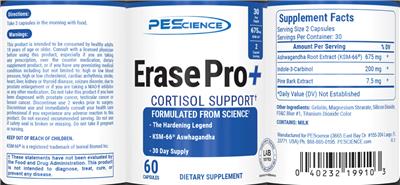
- Form
- Capsule
- Serving Size
- 2 Capsules
- Servings
- 30 per container
- Container Holds
- 60 Capsules
What’s in it, whether it interacts with your drugs, its side effects, whether it works, and what our pharmacists would want you to know before you start it.
- What is Erase Pro+?A supplement from PEScience with three active ingredients, in capsule form.
- Active Ingredients KSM-66 675 mgIndole-3-Carbinol 200 mgPine Bark Extract 7.5 mg Three active ingredients. Each one can interact with drugs or cause side effects on its own, so we check every one. The full Supplement Facts
- Drug Interactions 1,435 drugs have a documented interaction with this supplement; the most serious is rated moderate. Of those, 1,007 are single drugs and 428 are combination products (two or more drugs in one), each listed under its own name. Ask your pharmacist first if you take a drug in any of these categories, the most serious of the 12 on record:
- Moderate · 372 drugs
- Moderate · 248 drugs
- Moderate · 186 drugs
- Moderate · 172 drugs
- Possible Side EffectsNausea 3 ingredientsUpset stomach 3 ingredientsHeadache 2 ingredientsDiarrheaChanges in bowel habitsDizziness +6 moreReported for its three active ingredients, Ashwagandha, Indole-3-carbinol and Maritime Pine. Not studied in this exact product.
- Well documented Why
Does Erase Pro+ work?
Limited This product doesn't appear to be marketed for a specific use, so we graded its ingredients' overall clinical evidence instead.It is not marketed for one specific use, so this is what its ingredients have been studied for, strongest research first:
- Ashwagandha
- Maritime Pine
- Ashwagandha
- Maritime Pine
- Ashwagandha
- Maritime Pine
These grades are for each ingredient, not this exact product, and never a promise it will work for you.
What the research says- Full Why
- AllergensThe label says it contains milk
- Barcode (UPC)0 40232 19910 3Match it to the barcode on your bottle to be sure this is your product. Not your product? Search for it here
Who Might Consider It
- People who want it for insomnia, osteoarthritis, stress, asthma or another graded use: the uses with research behind them. See each grade
- Erase Pro+ may be worth a conversation for adults looking into one of these three ingredients for a specific use, though the evidence is mixed.
Who Should Be Careful
- Anyone who is pregnant or breastfeeding, takes blood thinners, diabetes medicine, sedatives, thyroid hormone, or estrogen, or has a thyroid, liver, or autoimmune condition should be careful.
- Please talk it over with your own doctor or pharmacist before you start.
More Before You Take It Show all three answersHide Its Ingredient Amounts vs. Other Supplements Pregnancy and Breastfeeding The Label’s Directions
-
How do its ingredient amounts compare with other supplements?
- KSM-66675 mgMore than 9 in 10 of the 344 recent Ashwagandha products in our database that state an amount; 600 mg is the most common.
- Indole-3-Carbinol200 mgThe most common amount among the 96 recent Indole-3-carbinol products in our database that state an amount.
- Pine Bark Extract7.5 mgLess than most of the 203 recent Maritime Pine products in our database that state an amount; 50 mg is the most common.
A label’s amount is what the product holds, not a recommended dose.
See each comparison -
Pregnant or breastfeeding?
- Pregnancy Ashwagandha
- There is insufficient reliable information available about the safety of oral ashwagandha when used during pregnancy.
- Breastfeeding Ashwagandha
- Insufficient reliable information available; avoid using.
- Pregnancy and Breastfeeding Indole-3-carbinol
- There is insufficient reliable information available about the safety of indole-3-carbinol when used during pregnancy and lactation; avoid using.
- Pregnancy Maritime Pine
- When used orally during the third trimester of pregnancy.
- Breastfeeding Maritime Pine
- There is insufficient reliable information available regarding the safety of maritime pine when used during lactation; avoid using.
-
How does the label say to take it?
“Directions: Take 2 capsules in the morning with food. 2 Capsule serving”
The maker’s words. Your pharmacist or doctor may advise differently.
Everything the label says
From the label dated Sep 25, 2024: all three of its active ingredients were checked against our records. A summary of what is known, not a grade or a test of the product. How these ratings are computed
Ask Anything About This Supplement
Name a drug you take, or ask about side effects, ingredients or pregnancy.
AI answers come from this label and our own records, never the open internet. AI can make mistakes, so always check with your doctor or pharmacist. How we use AI
Ask the Pharmacist
A licensed pharmacist will answer your question by email — free, usually within 24 hours.
Got it — thank you!
A licensed pharmacist will answer within 24 hours. Keep an eye on your email (worth checking spam, just in case).
What’s Inside Erase Pro+ by PEScience
Three Active Ingredients, Each Checked on Its Own
A supplement is often several ingredients in one bottle, and each one can interact with drugs or cause side effects on its own. We check every one of them against our records.
Why this rating?
The label gives an exact amount for every one of its three active ingredients, so you know how much of each you get in each serving. This rates what the label tells you, not the quality of the product.
Supplement Facts
| Amount Per Serving | % Daily Value | |
|---|---|---|
| KSM-66 | 675 mg | † |
| Indole-3-Carbinol | 200 mg | † |
| Pine Bark Extract | 7.5 mg | † |
Other ingredients: Gelatin, Magnesium Stearate, Silicon Dioxide, FD&C Blue #1, Titanium Dioxide
† Daily Value not established.
Daily Values for adults and children 4 or more years of age.
As the label prints it, from the NIH Dietary Supplement Label Database.
Each Ingredient and Its Drug Interactions
Tap one for more about it and its full guide. A drug can interact with this supplement through any one of them.
Erase Pro+ contains three active ingredients: pine bark extract from maritime pine, indole-3-carbinol, and KSM-66, which our data links to ashwagandha.
- Pine bark extract and ashwagandha each have some ratings for specific uses, while indole-3-carbinol has none rated above insufficient evidence.
-
KSM-66 675 mg Interacts with 1,373 drugs
Form on the label: Ashwagandha Root Extract
Ashwagandha is an Ayurvedic herb most often taken to help with stress, anxiety, and sleep, and some small studies suggest it may help, though the evidence is still limited.
- It is generally well tolerated for short-term use in healthy adults, but it should be avoided in pregnancy and used cautiously by people with thyroid or liver problems.
- Talk with your pharmacist or doctor before starting it.
The full Ashwagandha guide: uses, dosage and safety Every Ashwagandha drug interaction
-
Indole-3-Carbinol 200 mg Interacts with 294 drugs
Indole-3-carbinol (I3C) is a compound formed when you eat cruciferous vegetables like broccoli and cabbage, and it is sold as a supplement mainly for hormone-related and cell-protective effects.
- Most human evidence is preliminary or comes from lab and animal studies, so it should not be relied on to prevent or treat any disease.
- Talk to your pharmacist or doctor before using it, and avoid it in pregnancy and breastfeeding.
The full Indole-3-carbinol guide: uses, dosage and safety Every Indole-3-carbinol drug interaction
-
Pine Bark Extract 7.5 mg Interacts with 327 drugs
Maritime pine bark extract (often sold as Pycnogenol) is a plant-based antioxidant most studied for circulation, vein, and skin health.
- Some research is promising, but many studies are small or industry-funded, so benefits are not firmly proven.
- It is generally well tolerated, but talk to your pharmacist or doctor before starting it.
The full Maritime Pine guide: uses, dosage and safety Every Maritime Pine drug interaction
How Much of Each Ingredient Is in It, Compared With Other Supplements
Each bar is an amount that other recent supplements list for the same ingredient. The taller the bar, the more of them state it.
-
675 mg in a serving of this product
More than 9 in 10 products
- Most common amount
- 600 mg (about 11 in 100 products)
- Most products state
- 65 mg to 600 mg
- Compared with
- 344 recent products
-
200 mg in a serving of this product
The most common amount
- Most common amount
- 200 mg (about 29 in 100 products)
- Most products state
- 5 mg to 200 mg
- Compared with
- 96 recent products
-
7.5 mg in a serving of this product
Less than most products
- Most common amount
- 50 mg (about 22 in 100 products)
- Most products state
- 3 mg to 150 mg
- Compared with
- 203 recent products
Other Ingredients (Inactive)
The capsule or tablet itself, fillers, coatings and flavors. Not part of the drug interaction check; the allergen check below reads them.
- Gelatin
- Magnesium Stearate
- Silicon Dioxide
- FD&C Blue #1
- Titanium Dioxide
Allergens in Erase Pro+
The label says it contains milk.
Named on this label
- MilkThe label says it contains it
- Gelatin (animal-derived)In the ingredients: Gelatin
Not named in the ingredients
- Egg
- Fish
- Shellfish
- Tree nuts
- Peanuts
- Wheat or other gluten grains
- Soy
- Sesame
- The label’s allergen statement“Contains: Milk”
From the label text and ingredient names on file; we do not test products. With a serious allergy, check your bottle and ask the maker or your pharmacist.
What the Label Says
The maker’s own words, from the label. We do not verify or endorse them.
- Brand IP Statement(s)
-
“KSM-66 is a registered trademark of Ixoreal Biomed Inc.”
- General statements
-
“30 Day supply”
- Formulation
-
“Cortisol support Formulated from science The hardening legend”
“675 mg KSM-66”
“KSM-66 Ashwagandha”
- FDA Statement of Identity
-
“Dietary Supplement”
- Seals and symbols
-
“Lab Tested Third Party Tested for Quality and Purity pescience.com/difference”
The Erase Pro+ Label on File
The label scan on file at the NIH Dietary Supplement Label Database, dated September 2024. Always read the label on the bottle you have.
Product Facts
- Brand
- PEScience
- Barcode (UPC)
- 040232199103
- Net contents
- 60 Capsules
- Market status
- On market
- Date entered into DSLD
- Sep 25, 2024
- DSLD ID
- 318591
- Product type
- Other Combinations
- Supplement form
- Capsule
- Dietary claims / uses
- All Other, Structure/Function
- Intended target group(s)
- Adult (18 - 50 Years), Women (not pregnant or lactating)
Is this label outdated? Report a formula or label change and our pharmacy team will review it.
Erase Pro+ by PEScience Side Effects
Why this rating?
We look for three kinds of safety information on each ingredient: side effects reported in studies, a pregnancy and breastfeeding rating, and a safety write-up from our pharmacy team. All three are on file for each of the three ingredients we could check.
So this rates how much is known, not whether Erase Pro+ is right for you.
Reported with Ashwagandha, Indole-3-carbinol and Maritime Pine
- Most often
- Nausea, upset stomach, headache, diarrhea, changes in bowel habits and dizziness
- !Rare but serious
- Liver problems, possible changes in thyroid function and hepatic encephalopathy See details
HelloPharmacist Team Summary of Side Effects
Erase Pro+ is generally well tolerated, but the side effects you are most likely to notice are stomach upset and nausea, which can come from more than one of its ingredients, along with dizziness from pine bark extract and drowsiness from ashwagandha.
- If drowsiness or dizziness shows up, you may want to see how Erase Pro+ affects you before you drive.
- The rare but serious effect worth knowing about is liver problems with ashwagandha, so call your doctor promptly if you notice anything unusual.
- Anyone who is pregnant or breastfeeding, has a thyroid, autoimmune, or hormone-sensitive condition, or is scheduled for surgery should talk with their own doctor or pharmacist before starting.
Side Effects, Ingredient by Ingredient
A supplement’s side effects come from its ingredients. Here is what is reported with each one.
Ashwagandha
Most reported
- Upset stomach, nausea, or diarrhea
- Drowsiness or sleepiness
- Headache
Indole-3-carbinol
Most reported
- Stomach upset
- Nausea
- Changes in bowel habits
Maritime Pine
Most reported
- Stomach upset
- Nausea
- Dizziness
- Headache
Erase Pro+ Warnings: Who Should Be Careful
Erase Pro+ has three active ingredients, and each can carry warnings of its own. We checked all three, and each warning below names the ingredient it comes from. If any of these apply to you, talk to your doctor or pharmacist before you start it.
- Ashwagandha2 warnings below
- Indole-3-carbinol3 warnings below
- Maritime Pine1 warning below
-
Bleeding Problems or Surgery
- AshwagandhaPeople with autoimmune conditions or those scheduled for surgery should also check with their doctor first.
-
Diabetes or Low Blood Sugar
- Maritime PinePeople with autoimmune conditions or those taking medicines that affect the immune system or blood sugar should be cautious and check with a healthcare provider first.
-
Liver Disease
- Indole-3-carbinolAnyone with a thyroid condition or liver problems should also check with a healthcare provider first.
-
Thyroid Conditions
- AshwagandhaUse caution if you have a thyroid condition, since ashwagandha may affect thyroid hormone levels.
-
Hormone-Sensitive Conditions
- Indole-3-carbinolPeople with hormone-sensitive conditions (such as certain breast, uterine, or prostate conditions) should be especially careful, because I3C may affect estrogen activity.
-
Other Cautions
- Indole-3-carbinolGetting these nutrients from normal amounts of food is fine, but concentrated pills are not recommended.
-
What the Label Warns
- “Warnings: This product is intended to be consumed by healthy adults 18 years of age or older.”
- “Consult with a licensed physician before using this product, especially if you are taking any prescription, over the counter medication, dietary supplement product, or if you have any preexisting medical condition including but not limited to: high or low blood pressure, high or low cholesterol, cardiac arrhythmia, stroke, heart, liver, kidney or thyroid disease, seizure disorder, due to prostate enlargement or if you are taking a MAO-B inhibitor or any other medication.”
- “Do not take this product if you have been diagnosed with prostate cancer, testicular cancer or breast cancer. Discontinue use 2 weeks prior to surgery. Discontinue use and immediately consult your health care professional if you experience any adverse reaction to this product. Do not exceed recommended serving. Do not use if safety seal is broken or missing.”
- “Do not take if pregnant or nursing.”
- “Keep out of reach of children.”
The maker’s wording, from the product label.
-
Pregnant or Breastfeeding
Each ingredient’s rating for pregnancy and for breastfeeding, and what it covers.
Pregnancy
-
There is insufficient reliable information available about the safety of oral ashwagandha when used during pregnancy.
Historically, ashwagandha has been linked to abortifacient effects; however, there are no reliable case reports of harm in pregnancy.
2 more points on this rating
- Although one clinical study in pregnant females in their second trimester reported no adverse events with use of ashwagandha 300 mg twice daily for 12 weeks, abortifacient activity, developmental outcomes, and fetal toxicity were not assessed.
- Until more is known about the safety of ashwagandha, avoid using during pregnancy.
Breastfeeding
-
Insufficient reliable information available; avoid using.
Pregnancy and Breastfeeding The record rates both the same
-
There is insufficient reliable information available about the safety of indole-3-carbinol when used during pregnancy and lactation; avoid using.
Pregnancy
-
When used orally during the third trimester of pregnancy.
In one small clinical study, a standardized extract of maritime pine bark (Pycnogenol, Horphag Research) has been used at a dose of 30 mg daily with apparent safety during the third trimester of pregnancy.
However, more evidence is needed; use cautiously or avoid using.
Breastfeeding
-
There is insufficient reliable information available regarding the safety of maritime pine when used during lactation; avoid using.
Our pharmacy team’s notes
- AshwagandhaFor ashwagandha, the safety note says it is traditionally thought to risk miscarriage and should be avoided during pregnancy, and it also advises avoiding it while breastfeeding.
- Pregnancy and breastfeeding need extra care.
Ratings and the words beside them are from the Natural Medicines database, which we license.
-
Rare but Serious Side Effects
-
!
Ashwagandha
Rare but serious effects include liver problems and possible changes in thyroid function.
Orally: Some case reports raise concerns about acute hepatitis, acute liver failure, hepatic encephalopathy, the need for liver transplantation, and death due to liver failure with ashwagandha treatment.
-
!
Maritime Pine
Allergic reactions are possible, especially in people sensitive to pine or related plants.
When to get help: a serious allergic reaction, with trouble breathing or swelling of the face, lips or throat, needs emergency care: call 911. For any other side effect that worries you, call your doctor or pharmacist.
These reports describe each ingredient, not studies of this exact product. Not medical advice: a side effect you notice after starting a supplement is worth a word with your pharmacist or doctor.
Erase Pro+ by PEScience Drug Interactions
We checked all three active ingredients in this supplement against every drug in our records. A drug can interact with it through any one of them.
A moderate interaction on record
2 of 3, on a scale from Minor or none to Major.Why this rating?
We rate this by the most serious interaction on record, not by how many there are. For Ashwagandha, Maritime Pine and Indole-3-carbinol, the most serious is rated moderate, which means it calls for caution, and sometimes monitoring or a change in timing or dose. Some involve kinds of drugs where a small change can matter, such as blood thinners, transplant drugs and diabetes drugs.
1,436 drugs are on the full list. What matters is whether one you take is on it, so check yours with the interaction checker on this page.
All three of its active ingredients have drug interactions on record: Ashwagandha, Indole-3-carbinol and Maritime Pine.
- Interacts with
- 1,373 drugs
- Most serious
- Moderate
- The most serious one we list is ashwagandha's possible risk of liver damage when combined with hepatotoxic drugs (medicines that can harm the liver), rated Moderate.
- Ashwagandha also carries Moderate interactions with CNS depressants (sedatives), benzodiazepines, blood pressure medicines (antihypertensives), and thyroid hormone, where it may add to sedation, lower blood pressure, or increase thyroid effects.
- Interacts with
- 327 drugs
- Most serious
- Moderate
- Most of its records involve Anticoagulant/Antiplatelet Drugs, Immunosuppressants and Antidiabetes Drugs.
- Interacts with
- 294 drugs
- Most serious
- Moderate
- Most of its records involve Cytochrome P450 1A2 (CYP1A2) Substrates, Anticoagulant/Antiplatelet Drugs and Estrogens.
From the HelloPharmacist Team
A few things worth knowing about the supplement as a whole.
- Erase Pro+ from PEScience does interact with medications.
- Three of its ingredients carry documented interactions: maritime pine bark extract, indole-3-carbinol, and KSM-66 (ashwagandha).
- The other Moderate interactions cover blood thinners (anticoagulant and antiplatelet drugs), where pine bark extract and indole-3-carbinol may raise bleeding risk.
Summarized by the HelloPharmacist pharmacy team from the interaction records below. How it is written How we use AI
Why Erase Pro+ Interacts, Ingredient by Ingredient
A product interacts through its ingredients. Each card: how many drugs, the most serious rating, and the kinds of drugs it affects most (tap a kind for what it means).
The ingredients driving the most interactions
-
KSM-66 1,373 drugs
Most serious: Moderate10 interaction records on file
The kinds of drugs it affects most
- 645 drugs
- 372 drugs
- 248 drugs
- 186 drugs
Every Ashwagandha drug interaction, 10 records The Ashwagandha records cite 32 references, listed in the Ashwagandha guide.
-
Pine Bark Extract 327 drugs
Most serious: Moderate3 interaction records on file
The kinds of drugs it affects most
- 122 drugs
- 121 drugs
- 86 drugs
Every Maritime Pine drug interaction, 3 records The Maritime Pine records cite 14 references, listed in the Maritime Pine guide.
-
Indole-3-Carbinol 294 drugs
Most serious: Moderate3 interaction records on file
The kinds of drugs it affects most
- 186 drugs
- 122 drugs
- 41 drugs
Every Indole-3-carbinol drug interaction, 3 records The Indole-3-carbinol records cite 9 references, listed in the Indole-3-carbinol guide.
The Breakdown by Severity
Each drug counted once, at its most serious rating. Tap a tile to list those drugs.
Find Your Drug
Type a drug or brand name to see whether it is on the list.
- Only drugs with a documented interaction are listed, the most serious first.
- A drug with no known interaction is not listed, but searching its name tells you so.
- Open a drug to see which ingredient is responsible. Of those, 1,007 are single drugs and 428 are combination products (two or more drugs in one), each listed under its own name.
-
ApixabanEliquis Moderate
The 3 ingredients responsible:
-
Indole-3-carbinol Moderate Apixaban is in the Anticoagulant/Antiplatelet Drugs category.
Theoretically, indole-3-carbinol might increase the risk of bleeding when used with antiplatelet or anticoagulant drugs.
The full Indole-3-carbinol + Apixaban interaction -
Pine Bark Extract Moderate Apixaban is in the Anticoagulant/Antiplatelet Drugs category.
Theoretically, maritime pine bark extract might increase the risk of bleeding when used with antiplatelet or anticoagulant drugs.
The full Pine Bark Extract + Apixaban interaction -
Ksm-66 Minor Apixaban is in the Cytochrome P450 3A4 (CYP3A4) Substrates category.
Theoretically, ashwagandha might decrease the levels and clinical effects of CYP3A4 substrates.
The full Ksm-66 + Apixaban interaction
-
-
LevothyroxineEltroxin, Estre, Euthyrox, Levo-T, Levolet and 6 more Moderate
The ingredient responsible:
-
Ksm-66 Moderate Levothyroxine is in the Thyroid Hormone category.
Ashwagandha might increase the effects and adverse effects of thyroid hormone.
The full Ksm-66 + Levothyroxine interaction
-
-
WarfarinWarfarin Moderate
The 3 ingredients responsible:
-
Pine Bark Extract Moderate Warfarin is in the Anticoagulant/Antiplatelet Drugs category.
Theoretically, maritime pine bark extract might increase the risk of bleeding when used with antiplatelet or anticoagulant drugs.
The full Pine Bark Extract + Warfarin interaction -
Indole-3-carbinol Moderate Warfarin is in these Cytochrome P450 1A2 (CYP1A2) Substrates, Anticoagulant/Antiplatelet Drugs categories.
Theoretically, indole-3-carbinol might increase the metabolism of CYP1A2 substrates and lower serum concentrations.
The full Indole-3-carbinol + Warfarin interaction -
Ksm-66 Minor Warfarin is in these Cytochrome P450 3A4 (CYP3A4) Substrates, Cytochrome P450 1A2 (CYP1A2) Substrates categories.
Theoretically, ashwagandha might decrease the levels and clinical effects of CYP3A4 substrates.
The full Ksm-66 + Warfarin interaction
-
-
AmlodipineNorliqva Moderate
The ingredient responsible:
-
Ksm-66 Moderate Amlodipine is in these Cytochrome P450 3A4 (CYP3A4) Substrates, Antihypertensive Drugs categories.
Theoretically, ashwagandha might decrease the levels and clinical effects of CYP3A4 substrates.
The full Ksm-66 + Amlodipine interaction
-
-
ClopidogrelPlavix Moderate
The 3 ingredients responsible:
-
Indole-3-carbinol Moderate Clopidogrel is in these Cytochrome P450 1A2 (CYP1A2) Substrates, Anticoagulant/Antiplatelet Drugs categories.
Theoretically, indole-3-carbinol might increase the metabolism of CYP1A2 substrates and lower serum concentrations.
The full Indole-3-carbinol + Clopidogrel interaction -
Pine Bark Extract Moderate Clopidogrel is in the Anticoagulant/Antiplatelet Drugs category.
Theoretically, maritime pine bark extract might increase the risk of bleeding when used with antiplatelet or anticoagulant drugs.
The full Pine Bark Extract + Clopidogrel interaction -
Ksm-66 Minor Clopidogrel is in these Cytochrome P450 3A4 (CYP3A4) Substrates, Cytochrome P450 1A2 (CYP1A2) Substrates categories.
Theoretically, ashwagandha might decrease the levels and clinical effects of CYP3A4 substrates.
The full Ksm-66 + Clopidogrel interaction
-
-
RosuvastatinCrestor, Ezallor Moderate
The ingredient responsible:
-
Ksm-66 Moderate Rosuvastatin is in the Hepatotoxic Drugs category.
Theoretically, taking ashwagandha with hepatotoxic drugs might increase the risk of liver damage.
The full Ksm-66 + Rosuvastatin interaction
-
-
AspirinAngettes 75, ASA, Asaphen, Aspirin, Caprin and 9 more Moderate
The 2 ingredients responsible:
-
Pine Bark Extract Moderate Aspirin is in the Anticoagulant/Antiplatelet Drugs category.
Theoretically, maritime pine bark extract might increase the risk of bleeding when used with antiplatelet or anticoagulant drugs.
The full Pine Bark Extract + Aspirin interaction -
Indole-3-carbinol Moderate Aspirin is in the Anticoagulant/Antiplatelet Drugs category.
Theoretically, indole-3-carbinol might increase the risk of bleeding when used with antiplatelet or anticoagulant drugs.
The full Indole-3-carbinol + Aspirin interaction
-
-
Losartan PotassiumCozaar Moderate
The ingredient responsible:
-
Ksm-66 Moderate Losartan Potassium is in these Cytochrome P450 3A4 (CYP3A4) Substrates, Antihypertensive Drugs categories.
Theoretically, ashwagandha might decrease the levels and clinical effects of CYP3A4 substrates.
The full Ksm-66 + Losartan Potassium interaction
-
-
AtorvastatinAtorvaliq Moderate
The ingredient responsible:
-
Ksm-66 Moderate Atorvastatin is in these Cytochrome P450 3A4 (CYP3A4) Substrates, Hepatotoxic Drugs categories.
Theoretically, ashwagandha might decrease the levels and clinical effects of CYP3A4 substrates.
The full Ksm-66 + Atorvastatin interaction
-
-
RivaroxabanXarelto Moderate
The 3 ingredients responsible:
-
Pine Bark Extract Moderate Rivaroxaban is in the Anticoagulant/Antiplatelet Drugs category.
Theoretically, maritime pine bark extract might increase the risk of bleeding when used with antiplatelet or anticoagulant drugs.
The full Pine Bark Extract + Rivaroxaban interaction -
Indole-3-carbinol Moderate Rivaroxaban is in the Anticoagulant/Antiplatelet Drugs category.
Theoretically, indole-3-carbinol might increase the risk of bleeding when used with antiplatelet or anticoagulant drugs.
The full Indole-3-carbinol + Rivaroxaban interaction -
Ksm-66 Minor Rivaroxaban is in the Cytochrome P450 3A4 (CYP3A4) Substrates category.
Theoretically, ashwagandha might decrease the levels and clinical effects of CYP3A4 substrates.
The full Ksm-66 + Rivaroxaban interaction
-
-
MetforminGlucophage, Metformin Moderate
The 2 ingredients responsible:
-
Ksm-66 Moderate Metformin is in the Antidiabetes Drugs category.
Theoretically, taking ashwagandha with antidiabetes drugs might increase the risk of hypoglycemia.
The full Ksm-66 + Metformin interaction -
Pine Bark Extract Moderate Metformin is in the Antidiabetes Drugs category.
Theoretically, maritime pine bark extract might increase the risk of hypoglycemia when used with antidiabetes drugs.
The full Pine Bark Extract + Metformin interaction
-
-
Warfarin SodiumCoumadin, Panwarfin, Sofarin Moderate
The 3 ingredients responsible:
-
Indole-3-carbinol Moderate Warfarin Sodium is in these Anticoagulant/Antiplatelet Drugs, Cytochrome P450 1A2 (CYP1A2) Substrates categories.
Theoretically, indole-3-carbinol might increase the risk of bleeding when used with antiplatelet or anticoagulant drugs.
The full Indole-3-carbinol + Warfarin Sodium interaction -
Pine Bark Extract Moderate Warfarin Sodium is in the Anticoagulant/Antiplatelet Drugs category.
Theoretically, maritime pine bark extract might increase the risk of bleeding when used with antiplatelet or anticoagulant drugs.
The full Pine Bark Extract + Warfarin Sodium interaction -
Ksm-66 Minor Warfarin Sodium is in these Cytochrome P450 1A2 (CYP1A2) Substrates, Cytochrome P450 3A4 (CYP3A4) Substrates categories.
Theoretically, ashwagandha might decrease the levels and clinical effects of CYP1A2 substrates.
The full Ksm-66 + Warfarin Sodium interaction
-
-
TirzepatideMounjaro, Zepbound Moderate
The 2 ingredients responsible:
-
Ksm-66 Moderate Tirzepatide is in the Antidiabetes Drugs category.
Theoretically, taking ashwagandha with antidiabetes drugs might increase the risk of hypoglycemia.
The full Ksm-66 + Tirzepatide interaction -
Pine Bark Extract Moderate Tirzepatide is in the Antidiabetes Drugs category.
Theoretically, maritime pine bark extract might increase the risk of hypoglycemia when used with antidiabetes drugs.
The full Pine Bark Extract + Tirzepatide interaction
-
-
MetoprololLopressor, Toprol XL Moderate
The ingredient responsible:
-
Ksm-66 Moderate Metoprolol is in the Antihypertensive Drugs category.
Theoretically, taking ashwagandha with antihypertensive drugs might increase the risk of hypotension.
The full Ksm-66 + Metoprolol interaction
-
-
IbuprofenAdvil, Arthrofen, Brufen, Brufen Retard, Calodor and 15 more Moderate
The 2 ingredients responsible:
-
Pine Bark Extract Moderate Ibuprofen is in the Anticoagulant/Antiplatelet Drugs category.
Theoretically, maritime pine bark extract might increase the risk of bleeding when used with antiplatelet or anticoagulant drugs.
The full Pine Bark Extract + Ibuprofen interaction -
Indole-3-carbinol Moderate Ibuprofen is in the Anticoagulant/Antiplatelet Drugs category.
Theoretically, indole-3-carbinol might increase the risk of bleeding when used with antiplatelet or anticoagulant drugs.
The full Indole-3-carbinol + Ibuprofen interaction
-
-
SemaglutideOzempic, Rybelsus, Wegovy Moderate
The 2 ingredients responsible:
-
Pine Bark Extract Moderate Semaglutide is in the Antidiabetes Drugs category.
Theoretically, maritime pine bark extract might increase the risk of hypoglycemia when used with antidiabetes drugs.
The full Pine Bark Extract + Semaglutide interaction -
Ksm-66 Moderate Semaglutide is in the Antidiabetes Drugs category.
Theoretically, taking ashwagandha with antidiabetes drugs might increase the risk of hypoglycemia.
The full Ksm-66 + Semaglutide interaction
-
-
AmoxicillinAmix, Amoram, Amoxident, Amoxil Capsules, Amoxil Injection and 4 more Moderate
The ingredient responsible:
-
Ksm-66 Moderate Amoxicillin is in the Hepatotoxic Drugs category.
Theoretically, taking ashwagandha with hepatotoxic drugs might increase the risk of liver damage.
The full Ksm-66 + Amoxicillin interaction
-
-
TestosteroneAndrogel, Andropatch, Delatestryl, Intrinsa, Natesto and 4 more Moderate
The ingredient responsible:
-
Ksm-66 Moderate Testosterone is in these Hepatotoxic Drugs, Cytochrome P450 3A4 (CYP3A4) Substrates categories.
Theoretically, taking ashwagandha with hepatotoxic drugs might increase the risk of liver damage.
The full Ksm-66 + Testosterone interaction
-
-
PrednisoneCortan, Deltasone, Meticorten, Orasone, Prednicen-M and 3 more Moderate
The 2 ingredients responsible:
-
Ksm-66 Moderate Prednisone is in these Immunosuppressants, Cytochrome P450 3A4 (CYP3A4) Substrates categories.
Theoretically, taking ashwagandha might decrease the effects of immunosuppressants.
The full Ksm-66 + Prednisone interaction -
Pine Bark Extract Moderate Prednisone is in the Immunosuppressants category.
Theoretically, maritime pine bark extract might decrease the effectiveness of immunosuppressant therapy.
The full Pine Bark Extract + Prednisone interaction
-
-
AcetaminophenChildren's Tylenol, Children's Tylenol Meltaways, Tylenol, Tylenol Ex Strength Moderate
The 2 ingredients responsible:
-
Ksm-66 Moderate Acetaminophen is in these Hepatotoxic Drugs, Cytochrome P450 1A2 (CYP1A2) Substrates categories.
Theoretically, taking ashwagandha with hepatotoxic drugs might increase the risk of liver damage.
The full Ksm-66 + Acetaminophen interaction -
Indole-3-carbinol Moderate Acetaminophen is in the Cytochrome P450 1A2 (CYP1A2) Substrates category.
Theoretically, indole-3-carbinol might increase the metabolism of CYP1A2 substrates and lower serum concentrations.
The full Indole-3-carbinol + Acetaminophen interaction
-
-
MethotrexateOtrexup, Rasuvo, Reditrex, Rheumatrex Moderate
The ingredient responsible:
-
Ksm-66 Moderate Methotrexate is in the Hepatotoxic Drugs category.
Theoretically, taking ashwagandha with hepatotoxic drugs might increase the risk of liver damage.
The full Ksm-66 + Methotrexate interaction
-
-
PregabalinLyrica, Lyrica CR Moderate
The ingredient responsible:
-
Ksm-66 Moderate Pregabalin is in the CNS Depressants category.
Theoretically, taking ashwagandha might increase the sedative effects of CNS depressants.
The full Ksm-66 + Pregabalin interaction
-
-
PropranololAngilol, Bedranol SR, Beta Prograne, Half Beta Prograne, Half-Inderal LA and 7 more Moderate
The 2 ingredients responsible:
-
Indole-3-carbinol Moderate Propranolol is in the Cytochrome P450 1A2 (CYP1A2) Substrates category.
Theoretically, indole-3-carbinol might increase the metabolism of CYP1A2 substrates and lower serum concentrations.
The full Indole-3-carbinol + Propranolol interaction -
Ksm-66 Moderate Propranolol is in these Antihypertensive Drugs, Cytochrome P450 1A2 (CYP1A2) Substrates categories.
Theoretically, taking ashwagandha with antihypertensive drugs might increase the risk of hypotension.
The full Ksm-66 + Propranolol interaction
-
-
LamotrigineLamictal Moderate
The ingredient responsible:
-
Ksm-66 Moderate Lamotrigine is in the CNS Depressants category.
Theoretically, taking ashwagandha might increase the sedative effects of CNS depressants.
The full Ksm-66 + Lamotrigine interaction
-
-
NaproxenAleve, Anaprox, Anaprox DS, Arthroxen, EC-Naprosyn and 8 more Moderate
The 3 ingredients responsible:
-
Indole-3-carbinol Moderate Naproxen is in these Cytochrome P450 1A2 (CYP1A2) Substrates, Anticoagulant/Antiplatelet Drugs categories.
Theoretically, indole-3-carbinol might increase the metabolism of CYP1A2 substrates and lower serum concentrations.
The full Indole-3-carbinol + Naproxen interaction -
Pine Bark Extract Moderate Naproxen is in the Anticoagulant/Antiplatelet Drugs category.
Theoretically, maritime pine bark extract might increase the risk of bleeding when used with antiplatelet or anticoagulant drugs.
The full Pine Bark Extract + Naproxen interaction -
Ksm-66 Minor Naproxen is in the Cytochrome P450 1A2 (CYP1A2) Substrates category.
Theoretically, ashwagandha might decrease the levels and clinical effects of CYP1A2 substrates.
The full Ksm-66 + Naproxen interaction
-
-
LisinoprilPrinivil, Qbrelis, Zestril Moderate
The ingredient responsible:
-
Ksm-66 Moderate Lisinopril is in the Antihypertensive Drugs category.
Theoretically, taking ashwagandha with antihypertensive drugs might increase the risk of hypotension.
The full Ksm-66 + Lisinopril interaction
-
-
ClonazepamCeberclon, Klonopin, Rivotril Moderate
The ingredient responsible:
-
Ksm-66 Moderate Clonazepam is in these Cytochrome P450 3A4 (CYP3A4) Substrates, Benzodiazepines, CNS Depressants categories.
Theoretically, ashwagandha might decrease the levels and clinical effects of CYP3A4 substrates.
The full Ksm-66 + Clonazepam interaction
-
-
AmitriptylineElavil Moderate
The 2 ingredients responsible:
-
Ksm-66 Moderate Amitriptyline is in these Cytochrome P450 1A2 (CYP1A2) Substrates, Cytochrome P450 3A4 (CYP3A4) Substrates, CNS Depressants and 1 more categories.
Theoretically, ashwagandha might decrease the levels and clinical effects of CYP1A2 substrates.
The full Ksm-66 + Amitriptyline interaction -
Indole-3-carbinol Moderate Amitriptyline is in the Cytochrome P450 1A2 (CYP1A2) Substrates category.
Theoretically, indole-3-carbinol might increase the metabolism of CYP1A2 substrates and lower serum concentrations.
The full Indole-3-carbinol + Amitriptyline interaction
-
-
DoxycyclineDoryx, Doxy, Doxy-D, Doxycin, Doxycycline Injection and 7 more Moderate
The ingredient responsible:
-
Ksm-66 Moderate Doxycycline is in the Hepatotoxic Drugs category.
Theoretically, taking ashwagandha with hepatotoxic drugs might increase the risk of liver damage.
The full Ksm-66 + Doxycycline interaction
-
-
GabapentinGralise, Neurontin Moderate
The ingredient responsible:
-
Ksm-66 Moderate Gabapentin is in the CNS Depressants category.
Theoretically, taking ashwagandha might increase the sedative effects of CNS depressants.
The full Ksm-66 + Gabapentin interaction
-
Does It Work? Erase Pro+ by PEScience
How it rates in the research so far, then each ingredient on its own. A grade is the research so far, never an endorsement.
This product doesn't appear to be marketed for a specific use, so we graded its ingredients' overall clinical evidence instead.
Why this rating?
It is not marketed for one specific use, so we looked at what its ingredients have been studied for instead.
The strongest: Ashwagandha is graded “Possibly Effective” for generalized anxiety disorder (GAD). That means some studies support it, but the evidence isn’t conclusive.
Our pharmacy team’s notes on this supplement
- That means the data we have is not strong enough to say whether it helps for any of these.
The Evidence, Ingredient by Ingredient
Each card holds our notes on one ingredient, then its uses graded effective, likely effective or possibly effective.
Ashwagandha
From our Ashwagandha guide
- People take ashwagandha for many reasons, but for most of these the evidence is limited or early.
Research suggests a benefit for
- Insomnia, stress and generalized anxiety disorder (GAD)
Indole-3-carbinol
Our pharmacy team’s notes on Indole-3-carbinol
- Indole-3-carbinol has insufficient reliable evidence to rate for breast cancer, nonmelanoma skin cancer, cervical dysplasia, liver disease, colorectal cancer, and fibromyalgia.
No use is graded effective, likely effective or possibly effective for it yet.
Every graded use, in the Indole-3-carbinol guideMaritime Pine
Our pharmacy team’s notes on Maritime Pine
- Pine bark extract is rated possibly effective for osteoarthritis, chronic venous insufficiency (CVI), and asthma, and possibly ineffective for hyperlipidemia (high blood fats).
Research suggests a benefit for
- Osteoarthritis, asthma and chronic venous insufficiency (CVI)
The grades are the Natural Medicines database’s, which we license; tap a grade for what it means. They are about each ingredient, not this exact product.
About PEScience
Manufacturer and brand details for Erase Pro+, from the product label.
PEScience has 115 products in our supplement database, 113 of them on the market, with labels on file since 2016. Our database is built from the NIH’s Dietary Supplement Label Database and our pharmacy team’s own additions, so it covers the labels filed there, not every product the brand sells.
- Name
- PEScience LLC
- Street Address
- 3665 East Bay Dr #204-155
- City
- Largo
- State
- FL
- ZipCode
- 33771
- Phone Number
- 888-885-0195
Erase Pro+ by PEScience: Common Questions
Does Erase Pro+ by PEScience interact with any drugs?
What are the side effects of Erase Pro+ by PEScience?
Who should be careful taking Erase Pro+ by PEScience?
Can Erase Pro+ by PEScience affect the liver?
Does Erase Pro+ by PEScience contain any common allergens?
How can Erase Pro+ by PEScience interact with so many drugs?
Where does the information about Erase Pro+ by PEScience come from?
Does Erase Pro+ by PEScience work for insomnia?
Is Erase Pro+ by PEScience safe to take during pregnancy?
What is indole-3-carbinol used for?
Can pine bark extract cause dizziness?
Does pine bark extract help lower cholesterol?
Written and reviewed by the HelloPharmacist Editorial Team. Our editorial policy
Still Have a Question About Erase Pro+?
Our pharmacists answer drug and supplement questions, free, by email.
Label information is sourced from the NIH Dietary Supplement Label Database and reflects the product version on file; always read your actual product label. This page is for education only and is not a substitute for professional medical advice. Confirm with your pharmacist or doctor before combining supplements and drugs.
Who Reviews This Page
The pharmacist behind it, and how it is checked.
Dr. Brian Staiger, PharmD, BCPS
Clinical pharmacist and founder of HelloPharmacist
A licensed pharmacist for more than 13 years, he built the system behind this page: it reads the label on file, matches each active ingredient to its record in the Natural Medicines database, checks those records against every drug we cover, and our pharmacy team writes the take and the interaction summary from those records.
- 13+ Years in PharmacyRetail and clinical pharmacy, medication safety and healthcare administration.
- Board Certified (BCPS)A pharmacotherapy specialist, certified by the Board of Pharmacy Specialties.
- Herbalist TrainingCertificates in medical ethnobotany, for the herbs and supplements people take.
Where This Page Comes From
Erase Pro+’s label data comes from the NIH Dietary Supplement Label Database; the ingredient interaction data is from the Natural Medicines database, reviewed by our pharmacists.
- NIH Dietary Supplement Label Database (DSLD)
- The official product label on file for this supplement.
- Natural Medicines (Therapeutic Research Center)
- The evidence-graded clinical reference behind the ingredient interaction, evidence and safety records, which we license.
- HelloPharmacist Editorial Team
- Content is reviewed by the HelloPharmacist Editorial Team, the pharmacists on our staff and those we contract. See our data sources and editorial standards for how this information is built and checked.
- The Pharmacy Team’s Take and Summaries
- Generated from HelloPharmacist’s pharmacist-curated databases and editorial rules. Clinical methodology reviewed by Dr. Brian Staiger, PharmD, BCPS. Last generated Oct 30, 2026. How we use AI
- The ratings in the Quick Summary
- They summarize available label information, ingredient evidence and known drug-safety records: a summary of what is known, not a grade of the product itself. They do not verify product identity, purity, potency, contamination or manufacturing quality. How these ratings are computed
The References Behind the Interaction Records
Every citation the ingredients’ records rest on is listed in that ingredient’s guide, in context: Ashwagandha, 32 references; Indole-3-carbinol, 9 references; Maritime Pine, 14 references .
Parts of this content are provided by the Therapeutic Research Center, LLC.
DISCLAIMER: Currently this does not check for drug-drug interactions. This is not an all-inclusive comprehensive list of potential interactions and is for informational purposes only. Not all interactions are known or well-reported in the scientific literature, and new interactions are continually being reported. Input is needed from a qualified healthcare provider including a pharmacist before starting any therapy. Application of clinical judgment is necessary.
© 2021 Therapeutic Research Center, LLC
Keep Exploring
- Supplement interaction checkerCheck any supplement or product against your drugs
- Drug–drug interactionsCheck two or more of your drugs against each other
- Browse drugs A to ZEvery drug we have checked against herbs and supplements
- NDC and pricing lookupFind a drug’s NDCs, packaging and costs
- Ask a pharmacistA free, personal answer from our licensed team