
Less Is More by Love Me Nutrition Ingredients, Side Effects and Drug Interactions
Dietary Supplement Capsule Other Combinations
UPC 6 55043 98044 6 Match it to the barcode on your bottle

Medically reviewed by Dr. Brian Staiger, PharmD, BCPS
Also reviewed by the HelloPharmacist Editorial Team
Updated Details about this page
- Label on file from the NIH Dietary Supplement Label Database, dated May 23, 2024.
- The interaction, evidence and safety records come from the Natural Medicines database, which we license, read against this label by our own system; the pharmacy team’s sections are written from those records.
- Dr. Brian Staiger, PharmD, BCPS, is a clinical pharmacist and pharmacotherapy specialist.
- Editorial policy Our sources
AI is used only to summarize verified clinical information, never the open internet. Our AI policy
Summary: The HelloPharmacist Team’s Take
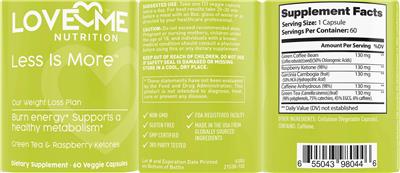
- Form
- Capsule
- Serving Size
- 1 Veggie Capsule
- Servings
- 60 per container
- Container Holds
- 60 Veggie Capsules
What’s in it, whether it interacts with your drugs, its side effects, whether it works, and what our pharmacists would want you to know before you start it.
- What is Less Is More?A supplement from Love Me Nutrition with five active ingredients, in capsule form.
- Active Ingredients Green Coffee Bean 130 mgRaspberry Ketone 130 mgGarcinia cambogia 130 mgCaffeine Anhydrous 130 mgGreen Tea 130 mg Five active ingredients. Each one can interact with drugs or cause side effects on its own, so we check every one. The full Supplement Facts
- Drug Interactions 1,368 drugs have a documented interaction with this supplement; the most serious is rated major. Of those, 913 are single drugs and 455 are combination products (two or more drugs in one), each listed under its own name. Ask your pharmacist first if you take a drug in any of these categories, the most serious of the 65 on record:
- EphedrineMajor · 8 drugs
- Atorvastatin (Lipitor)Major · 3 drugs
- Nadolol (Corgard)Major · 2 drugs
- Moderate · 372 drugs
- Possible Side EffectsTrouble sleeping 3 ingredientsHeadache 2 ingredientsJitteriness 2 ingredientsNausea 2 ingredientsNervousness 2 ingredientsDigestive upset +8 moreReported for all five of its active ingredients. Not studied in this exact product.
- Well documented Why
Does Less Is More work?
What It Is Marketed For
Weight loss and healthy metabolism support
From the claims on the product’s label.
The Closest Use the Research Grades
Caffeine
Some studies support it, but the evidence isn’t conclusive.
Its ingredients have stronger research for other uses:
- Mental alertness Coffee
- Caffeine
- Mental alertness Caffeine
- Green Tea
- Coffee
- Cardiovascular disease (CVD) Green Tea
These grades are for each ingredient, not this exact product, and never a promise it will work for you.
And 6 more graded uses, in what the research says- Full Why
- AllergensNone of its ingredient names point to a major food allergen
- Barcode (UPC)6 55043 98044 6Match it to the barcode on your bottle to be sure this is your product. Not your product? Search for it here
Who Might Consider It
- People looking for weight loss and healthy metabolism support, which is what it is marketed for. The closest use the research grades is obesity, rated Possibly Effective.
- People who want it for mental alertness, athletic performance, hyperlipidemia, diabetes or another graded use: the other uses with research behind them. See each grade
Who Should Be Careful
- If you're considering Less Is More, talk it over with your own doctor or pharmacist before starting, especially if you take any of the medications named above.
- People with heart conditions, high blood pressure, liver disease, diabetes, or mood disorders should be extra careful.
- Children should not use this product, and if you are pregnant or breastfeeding, your own doctor can help you weigh the options.
More Before You Take It Show both answersHide Pregnancy and Breastfeeding The Label’s Directions
-
Pregnant or breastfeeding?
- Pregnancy Coffee
- ! When caffeinated coffee providing more than 300 mg of caffeine daily is consumed orally.
- Breastfeeding Coffee
- ! When used orally in large amounts.
- Pregnancy Caffeine
- ! When used orally in amounts over 300 mg daily.
- Breastfeeding Caffeine
- ! When used orally in large amounts.
- Pregnancy Green Tea
- ! When used orally in amounts providing more than 300 mg caffeine daily.
- Breastfeeding Green Tea
- ! When used orally in large amounts.
-
How does the label say to take it?
“Suggested use: Take one (1) veggie capsule twice a day. For best results take 20-30 min before a meal with an 8 oz. glass of water or as directed by your healthcare professional.”
The maker’s words. Your pharmacist or doctor may advise differently.
Everything the label says
From the label dated May 23, 2024: all five of its active ingredients were checked against our records. A summary of what is known, not a grade or a test of the product. How these ratings are computed
Ask Anything About This Supplement
Name a drug you take, or ask about side effects, ingredients or pregnancy.
AI answers come from this label and our own records, never the open internet. AI can make mistakes, so always check with your doctor or pharmacist. How we use AI
Ask the Pharmacist
A licensed pharmacist will answer your question by email — free, usually within 24 hours.
Got it — thank you!
A licensed pharmacist will answer within 24 hours. Keep an eye on your email (worth checking spam, just in case).
What’s Inside Less Is More by Love Me Nutrition
Five Active Ingredients, Each Checked on Its Own
A supplement is often several ingredients in one bottle, and each one can interact with drugs or cause side effects on its own. We check every one of them against our records.
- Green Coffee BeanDrug interactions on record, most serious: Major
- Raspberry KetoneDrug interactions on record, most serious: Moderate
- Garcinia cambogiaDrug interactions on record, most serious: Moderate
- Caffeine AnhydrousDrug interactions on record, most serious: Major
- Green TeaDrug interactions on record, most serious: Major
Why this rating?
The label gives an exact amount for every one of its five active ingredients, so you know how much of each you get in each serving. This rates what the label tells you, not the quality of the product.
Supplement Facts
| Amount Per Serving | % Daily Value | |
|---|---|---|
| Green Coffee Bean | 130 mg | † |
| Raspberry Ketone | 130 mg | † |
| Garcinia cambogia | 130 mg | † |
| Caffeine Anhydrous | 130 mg | † |
| Green Tea | 130 mg | † |
Other ingredients: Cellulose
† Daily Value not established.
Daily Values for adults and children 4 or more years of age.
As the label prints it, from the NIH Dietary Supplement Label Database.
Each Ingredient and Its Drug Interactions
Tap one for more about it and its full guide. A drug can interact with this supplement through any one of them.
Less Is More contains five active ingredients: raspberry ketone, caffeine anhydrous, garcinia cambogia, green coffee bean, and green tea.
- Caffeine is the active stimulant in the product, and green coffee bean and green tea also contain caffeine.
-
Green Coffee Bean 130 mg Interacts with 591 drugs
Form on the label: Chlorogenic Acids
Coffee is a widely consumed beverage made from roasted coffee beans, valued mainly for its caffeine, which boosts alertness and energy.
- For most healthy adults, moderate coffee intake is generally safe and may have some health benefits, but too much can cause jitteriness, poor sleep, and a faster heartbeat.
- People who are pregnant, breastfeeding, or sensitive to caffeine should limit their intake and check with a doctor or pharmacist.
The full Coffee guide: uses, dosage and safety Every Coffee drug interaction
-
Raspberry Ketone 130 mg Raspberry ketone is structurally similar to synephrine, a known stimulant. Interacts with 174 drugs
Raspberry ketone is a natural aroma compound found in red raspberries that is heavily marketed for weight loss, but there is no good human evidence that it helps people lose weight.
- Most claims come from lab and animal studies using doses far higher than what you could get from food or typical supplements.
- If you choose to try it, talk to your pharmacist or doctor first.
The full Raspberry Ketone guide: uses, dosage and safety Every Raspberry Ketone drug interaction
-
Garcinia cambogia 130 mg Garcinia's main active ingredient is hydroxycitric acid (HCA). Interacts with 1,135 drugs
Form on the label: Hydroxycitric Acid
Garcinia is a tropical fruit whose rind contains hydroxycitric acid (HCA), widely marketed for weight loss and appetite control.
- The scientific evidence is weak and mixed, with most studies showing only small or no meaningful weight effects, and rare reports of liver problems raise safety concerns.
- Talk to a pharmacist or doctor before trying it, especially if you have liver issues, are pregnant, or are breastfeeding.
The full Garcinia guide: uses, dosage and safety Every Garcinia drug interaction
-
Caffeine Anhydrous 130 mg Interacts with 655 drugs
Caffeine is a natural stimulant found in coffee, tea, and many other plants and products.
- In moderate amounts it can boost alertness and reduce tiredness for most healthy adults, but too much can cause jitteriness, a racing heart, and sleep problems.
- Pregnant women and people with heart conditions or anxiety should be especially careful and check with a doctor or pharmacist.
The full Caffeine guide: uses, dosage and safety Every Caffeine drug interaction
-
Green Tea 130 mg Interacts with 1,294 drugs
Form on the label: Caffeine, Catechins, Epigallocatechin Gallate, Polyphenols
Green tea is a popular beverage rich in antioxidants called catechins, and drinking it in normal amounts is considered safe for most people.
- Concentrated green tea extracts are a different story—they may help modestly with weight or heart health for some, but high doses have been linked to rare liver problems.
- Talk to your pharmacist or doctor before taking green tea supplements, especially if you have liver concerns or are pregnant.
The full Green Tea guide: uses, dosage and safety Every Green Tea drug interaction
Other Ingredients (Inactive)
The capsule or tablet itself, fillers, coatings and flavors. Not part of the drug interaction check; the allergen check below reads them.
- Cellulose
Allergens in Less Is More
None of its ingredient names point to a major food allergen.
Not named in the ingredients
- Milk
- Egg
- Fish
- Shellfish
- Tree nuts
- Peanuts
- Wheat or other gluten grains
- Soy
- Sesame
- Made without, the label says“Non-GMO · Gluten free”
From the label text and ingredient names on file; we do not test products. With a serious allergy, check your bottle and ask the maker or your pharmacist.
What the Label Says
The maker’s own words, from the label. We do not verify or endorse them.
- Formulation
-
“Our weight loss plan Burn energy supports a healthy metabolism”
“Non-GMO Gluten free”
2 more from the label
“GMP certified 3rd party tested FDA registered facility Made in the USA from globally sourced ingredients”
“Green tea & raspberry ketones”
- FDA Statement of Identity
-
“Dietary Supplement”
- Storage
-
“Store in a cool, dry place.”
The Less Is More Label on File
The label scan on file at the NIH Dietary Supplement Label Database, dated May 2024. Always read the label on the bottle you have.
Product Facts
- Brand
- Love Me Nutrition
- Barcode (UPC)
- 655043980446
- Net contents
- 60 Veggie Capsules
- Market status
- On market
- Date entered into DSLD
- May 23, 2024
- DSLD ID
- 306600
- Product type
- Other Combinations
- Supplement form
- Capsule
- Dietary claims / uses
- All Other, Structure/Function
- Intended target group(s)
- Adult (18 - 50 Years), Gluten Free
Is this label outdated? Report a formula or label change and our pharmacy team will review it.
Less Is More by Love Me Nutrition Side Effects
Why this rating?
We look for three kinds of safety information on each ingredient: side effects reported in studies, a pregnancy and breastfeeding rating, and a safety write-up from our pharmacy team. All three are on file for each of the five ingredients we could check.
So this rates how much is known, not whether Less Is More is right for you.
Reported with five of its ingredients
- Most often
- Trouble sleeping, headache, jitteriness, nausea, nervousness and digestive upset
- !Rare but serious
- Reported with Coffee, Raspberry Ketone, Garcinia, Caffeine and Green Tea See details
HelloPharmacist Team Summary of Side Effects
Less Is More is generally well tolerated in the short term, but you are most likely to notice jitteriness or nervousness, trouble sleeping, and an upset stomach, which mostly come from its caffeine, green tea, and garcinia.
- A faster or pounding heartbeat is also reported, so pay attention to it.
- Liver damage is the rare but serious concern, and if you notice yellowing skin, dark urine, or unusual tiredness, call your doctor right away, and allergic reactions are possible with any supplement.
- If you have heart problems, high blood pressure, diabetes, liver disease, or a mood disorder, talk with your own doctor or pharmacist before you start.
Side Effects, Ingredient by Ingredient
A supplement’s side effects come from its ingredients. Here is what is reported with each one.
Coffee
Most reported
- Jitteriness
- Nervousness
- Fast or pounding heartbeat
- Trouble sleeping
Raspberry Ketone
Most reported
- Jitteriness
- Faster heartbeat
Garcinia
Most reported
- Digestive upset
- Nausea
- Stomach discomfort
- Headache
Caffeine
Most reported
- Feeling jittery, nervous, or anxious
- Racing or pounding heartbeat
- Trouble sleeping
- Upset stomach or heartburn
Green Tea
Most reported
- Trouble sleeping or feeling jittery
- Nervousness or anxiety
- Upset stomach or nausea, especially on an empty stomach
- Headache
Less Is More Warnings: Who Should Be Careful
Less Is More has five active ingredients, and each can carry warnings of its own. We checked all five, and each warning below names the ingredient it comes from. If any of these apply to you, talk to your doctor or pharmacist before you start it.
- Coffee3 warnings below
- Raspberry Ketone3 warnings below
- Garcinia2 warnings below
- Caffeine2 warnings below
- Green Tea3 warnings below
-
Bleeding Problems or Surgery
- Green TeaThe same goes for people with bleeding disorders or those preparing for surgery.
-
Diabetes or Low Blood Sugar
- Raspberry KetonePeople with heart conditions, high blood pressure, diabetes, or other chronic illnesses should be especially cautious and check with a healthcare provider first.
- GarciniaBecause Garcinia may affect blood sugar and brain chemicals like serotonin, people with diabetes or mood disorders should be cautious and check with a healthcare provider first.
-
Blood Pressure
- CoffeeBe cautious if you have heart problems, high blood pressure, anxiety disorders, acid reflux, or trouble sleeping.
- Raspberry KetoneBecause of its structure, there has been some concern that it could affect heart rate or blood pressure, similar to other stimulant-like compounds, though this is not well proven.
- CaffeineBe cautious if you: have heart problems, high blood pressure, an irregular heartbeat, anxiety, panic attacks, trouble sleeping, stomach ulcers, or seizure disorders.
-
Liver Disease
- GarciniaPeople with liver disease should avoid Garcinia.
- Green TeaPeople with liver disease should be especially careful and check with a healthcare provider first.
-
Heart Conditions
- Green TeaBecause green tea contains caffeine, people who are sensitive to caffeine, have heart rhythm problems, anxiety, or trouble sleeping should be cautious.
-
Children
- CoffeeChildren and teens should also limit caffeine.
- Raspberry KetoneChildren should not use it.
- CaffeineChildren and teens should limit caffeine.
-
Older Adults
- CoffeeOlder adults and people taking certain medications should also be careful.
-
What the Label Warns
- “Caution: Do not exceed recommended dose.”
- “Pregnant or nursing mothers, children under the age of 18, and individuals with a known medical condition should consult a physician before using this or any dietary supplement.”
- “Pregnant or nursing mothers, children under the age of 18, and individuals with a known medical condition should consult a physician before using this or any dietary supplement. Keep out of reach of children.”
- “Do not use if safety seal is damaged or missing.”
- “Contains: Caffeine.”
The maker’s wording, from the product label.
-
Pregnant or Breastfeeding
Each ingredient’s rating for pregnancy and for breastfeeding, and what it covers.
Pregnancy
-
When used orally in moderate amounts.
Intake of caffeine from coffee and other sources should be monitored during pregnancy.
12 more points on this rating
- Caffeine crosses the human placenta, but is not considered a teratogen.
- Fetal blood and tissue levels are similar to maternal concentrations.
- The use of caffeine during pregnancy is controversial; however, moderate consumption has not been associated with clinically important adverse fetal effects.
- However, some research has also found that intrauterine exposure to even modest amounts of caffeine, based on maternal blood levels during the first trimester, is associated with a shorter stature in children ages 4-8 years.
- In some studies, consuming amounts over 200 mg daily has been associated with a significantly increased risk of miscarriage.
- This increased risk may be most likely to occur in people with genotypes that confer a slow rate of caffeine metabolism.
- According to a review by Health Canada, and a subsequent large meta-analysis conducted in the US, most healthy pregnant patients can safely consume caffeine in doses up to 300 mg daily without an increased risk of spontaneous abortion, stillbirth, preterm birth, fetal growth retardation, or congenital malformations.
- Advise patients to keep caffeine consumption below 300 mg daily during pregnancy.
- This is similar to the amount of caffeine in about 3 cups of coffee.
- Keep in mind that only the amount of ADDED caffeine must be stated on product labels.
- The amount of caffeine found in ingredients such as coffee, which naturally contains caffeine, does not need to be provided.
- This can make it difficult to determine the total amount of caffeine in a given product.
-
When caffeinated coffee providing more than 300 mg of caffeine daily is consumed orally.
Caffeine from coffee crosses the placenta, producing fetal blood concentrations similar to maternal levels.
7 more points on this rating
- Consumption of caffeine in amounts over 300 mg daily is associated with a significantly increased risk of miscarriage in some studies.
- Advise patients to keep caffeine consumption from all sources below 300 mg daily during pregnancy.
- This is similar to the amount of caffeine in about 3 cups of coffee.
- High doses of caffeine throughout pregnancy have resulted in symptoms of caffeine withdrawal in newborn infants.
- High doses of caffeine have also been associated with spontaneous abortion, premature delivery, and low birth weight.
- Drinking more than 6 cups of coffee daily increases the risk of spontaneous abortion.
- Drinking 8 or more cups of coffee daily doubles the risk of stillbirth when compared with those who do not drink coffee during pregnancy.
Breastfeeding
-
When used orally.
Drinking one or two caffeine-containing beverages daily during lactation is not associated with unacceptable levels of caffeine in human milk.
-
When used orally in large amounts.
Caffeine from coffee can cause wakefulness or irritability in breast-fed infants.
Caffeine can also cause feeding intolerance and gastrointestinal irritation in infants.
Pregnancy
-
When used orally in amounts commonly found in foods.
Intakes of caffeine should be monitored during pregnancy.
10 more points on this rating
- Caffeine crosses the human placenta, but is not considered a teratogen.
- Fetal blood and tissue levels are similar to maternal concentrations.
- The use of caffeine during pregnancy is controversial; however, moderate consumption has not been associated with clinically important adverse fetal effects.
- In some studies consuming amounts over 200 mg daily is associated with a significantly increased risk of miscarriage.
- This increased risk seems to occur in those with genotypes that confer a slow rate of caffeine metabolism.
- According to a review by Health Canada, and a subsequent large meta-analysis conducted in the US, up to 300 mg daily can be consumed during pregnancy without an increased risk of spontaneous abortion, stillbirth, preterm birth, fetal growth retardation, or congenital malformations.
- However, observational research in a Norwegian cohort found that caffeine consumption is associated with a 16% increased odds of the baby being born small for gestational age when compared with no consumption.
- The same Norwegian cohort found that low to moderate caffeine consumption during pregnancy is not associated with changes in neurodevelopment in children up to 8 years of age.
- Advise patients to keep caffeine consumption below 300 mg daily during pregnancy.
- This is similar to the amount of caffeine in about 3 cups of coffee or tea.
-
When used orally in amounts over 300 mg daily.
Caffeine crosses the placenta, producing fetal blood concentrations similar to maternal levels.
8 more points on this rating
- Consumption of caffeine in amounts over 300 mg daily is associated with a significantly increased risk of miscarriage in some studies.
- Advise patients to keep caffeine consumption below 300 mg daily during pregnancy.
- This is similar to the amount of caffeine in about 3 cups of coffee or tea.
- Additionally, high doses of caffeine throughout pregnancy have resulted in symptoms of caffeine withdrawal in newborn infants.
- High doses of caffeine have also been associated with spontaneous abortion, premature delivery, and low birth weight.
- In a cohort of mother/infant pairs with a median maternal plasma caffeine level of 168.5 ng/mL (range 29.5-650.5 ng/mL) during pregnancy, birth weights and lengths were lower in the 4th quartile of caffeine intake compared with the 1st.
- By age 7, heights and weights were lower by 1.5 cm and 1.1 kg respectively.
- In another cohort of mother/infant pairs with higher maternal pregnancy plasma caffeine levels, median 625.5 ng/mL (range 86.2 to 1994.7 ng/mL), heights at age 8 were 2.2 cm lower, but there was no difference in weights.
Breastfeeding
-
When used orally in amounts commonly found in foods.
Caffeine intake should be closely monitored while breast-feeding.
During lactation, breast milk concentrations of caffeine are thought to be approximately 50% of serum concentrations and caffeine peaks in breastmilk approximately 1-2 hours after consumption.
-
When used orally in large amounts.
Caffeine is excreted slowly in infants and may accumulate.
Caffeine can cause sleep disturbances, irritability, and increased bowel activity in breast-fed infants exposed to caffeine.
Show 3 more ingredients
Pregnancy
-
When used orally in moderate amounts.
Due to the caffeine content of green tea, pregnant patients should closely monitor their intake to ensure moderate consumption.
12 more points on this rating
- Fetal blood concentrations of caffeine approximate maternal concentrations.
- The use of caffeine during pregnancy is controversial; however, moderate consumption has not been associated with clinically important adverse fetal effects.
- In some studies consuming amounts over 200 mg daily is associated with a significantly increased risk of miscarriage.
- This increased risk may be most likely to occur in those with genotypes that confer a slow rate of caffeine metabolism.
- According to a review by Health Canada, and a subsequent large meta-analysis conducted in the US, most healthy pregnant patients can safely consume doses up to 300 mg daily without an increased risk of spontaneous abortion, stillbirth, preterm birth, fetal growth retardation, or congenital malformations.
- Advise keeping caffeine consumption below 300 mg daily.
- This is similar to the amount of caffeine in about 6 cups of green tea.
- Keep in mind that only the amount of ADDED caffeine must be stated on product labels.
- The amount of caffeine found in ingredients such as green tea, which naturally contains caffeine, does not need to be provided.
- This can make it difficult to determine the total amount of caffeine in a given product.
- Based on animal models, green tea extract catechins are also transferred to the fetus, but in amounts 50-100 times less than maternal concentrations.
- The potential impact of these catechins on the human fetus is not known, but animal models suggest that the catechins are not teratogenic.
-
When used orally in amounts providing more than 300 mg caffeine daily.
Caffeine from green tea crosses the placenta, producing fetal blood concentrations similar to maternal levels.
16 more points on this rating
- Consumption of caffeine in amounts over 300 mg daily is associated with a significantly increased risk of miscarriage in some studies.
- Advise keeping caffeine consumption from all sources below 300 mg daily.
- This is similar to the amount of caffeine in about 6 cups of green tea.
- High maternal doses of caffeine throughout pregnancy have also resulted in symptoms of caffeine withdrawal in newborn infants.
- High doses of caffeine have also been associated with spontaneous abortion, premature delivery, and low birth weight.
- However, some research has also found that intrauterine exposure to even modest amounts of caffeine, based on maternal blood levels during the first trimester, is associated with a shorter stature in children ages 4-8 years.
- Keep in mind that only the amount of ADDED caffeine must be stated on product labels.
- The amount of caffeine found in ingredients such as green tea, which naturally contains caffeine, does not need to be provided.
- This can make it difficult to determine the total amount of caffeine in a given product.
- There is also concern that consuming large amounts of green tea might have antifolate activity and potentially increase the risk of folic acid deficiency-related birth defects.
- Catechins in green tea inhibit the enzyme dihydrofolate reductase in vitro.
- This enzyme is responsible for converting folic acid to its active form.
- Preliminary evidence suggests that increasing maternal green tea consumption is associated with increased risk of spina bifida.
- Also, evidence from epidemiological research suggests that serum folate levels in pregnant patients with high green tea intake (57.3 mL per 1000 kcal) are decreased compared to participants who consume moderate or low amounts of green tea.
- More evidence is needed to determine the safety of using green tea during pregnancy.
- For now, advise pregnant patients to avoid consuming large quantities of green tea.
Breastfeeding
-
When used orally in moderate amounts.
Due to the caffeine content of green tea, nursing parents should closely monitor caffeine intake.
Breast milk concentrations of caffeine are thought to be approximately 50% of maternal serum concentrations.
-
When used orally in large amounts.
Consumption of green tea might cause irritability and increased bowel activity in nursing infants.
There is insufficient reliable information available about the safety of green tea extracts when applied topically during breast-feeding.
Pregnancy and Breastfeeding The record rates both the same
-
There is insufficient reliable information available about the safety of raspberry ketone; avoid using.
Pregnancy and Breastfeeding The record rates both the same
-
Insufficient reliable information available; avoid using.
Our pharmacy team’s notes
- Our pharmacists advise against concentrated raspberry ketone and garcinia supplements during pregnancy and while breastfeeding, because there isn't enough safety data.
Ratings and the words beside them are from the Natural Medicines database, which we license.
-
Rare but Serious Side Effects
-
!
Coffee
Very high doses of caffeine, especially from concentrated supplements or energy products, can cause more serious problems such as a very rapid or irregular heartbeat, vomiting, and in rare cases dangerous reactions.
-
!
Raspberry Ketone
Allergic reactions are possible with any supplement.
-
!
Garcinia
The most serious concern is liver damage, which is uncommon but has been reported with Garcinia-containing products.
Garcinia is generally tolerated short-term, but rare reports of liver injury warrant caution.
Orally: Garcinia has been linked with cases of hepatotoxicity and liver failure. There have also been rare cases of mania and pancreatitis.
-
!
Caffeine
Serious effects are rare but can happen with very high doses.
Caffeine is generally well tolerated in moderate amounts, but high doses can cause serious side effects.
Orally: Stroke has been reported rarely.
-
!
Green Tea
A rare but serious concern with concentrated green tea extract supplements is liver damage.
Green tea is generally well tolerated as a beverage, though concentrated extracts have been linked to rare liver injury.
Orally: Hepatotoxicity, hypokalemia, and thrombotic thrombocytopenic purpura have been reported rarely.
When to get help: a serious allergic reaction, with trouble breathing or swelling of the face, lips or throat, needs emergency care: call 911. For any other side effect that worries you, call your doctor or pharmacist.
These reports describe each ingredient, not studies of this exact product. Not medical advice: a side effect you notice after starting a supplement is worth a word with your pharmacist or doctor.
Less Is More by Love Me Nutrition Drug Interactions
We checked all five active ingredients in this supplement against every drug in our records. A drug can interact with it through any one of them.
A major interaction on record
3 of 3, on a scale from Minor or none to Major.Why this rating?
We rate this by the most serious interaction on record, not by how many there are. For Garcinia, Green Tea, Caffeine, Coffee and Raspberry Ketone, the most serious is rated major, which means the combination is best avoided, or used only under close supervision. Some involve kinds of drugs where a small change can matter, such as blood thinners, diabetes drugs and lithium.
1,369 drugs are on the full list. What matters is whether one you take is on it, so check yours with the interaction checker on this page.
All five of its active ingredients have drug interactions on record: Coffee, Raspberry Ketone, Garcinia, Caffeine and Green Tea.
- Interacts with
- 1,135 drugs
- Most serious
- Moderate
- Antidiabetes drugs carry a Minor rating for low blood sugar (hypoglycemia) from garcinia.
- Interacts with
- 1,294 drugs
- Most serious
- Major
- Green tea also carries Major ratings for nadolol and atorvastatin.
- Interacts with
- 655 drugs
- Most serious
- Major
- Most of its records involve Stimulant Drugs, Anticoagulant/Antiplatelet Drugs and Cytochrome P450 1A2 (CYP1A2) Inhibitors.
Show two more ingredients
- Interacts with
- 591 drugs
- Most serious
- Major
- Most of its records involve Stimulant Drugs, Anticoagulant/Antiplatelet Drugs and Antidiabetes Drugs.
- Interacts with
- 174 drugs
- Most serious
- Moderate
- Most of its records involve Stimulant Drugs and Warfarin (Coumadin).
From the HelloPharmacist Team
Stepping back from the single ingredients, here is the picture across the whole supplement.
- Less Is More by Love Me Nutrition does interact with several medications.
- All five of its active ingredients (raspberry ketone, caffeine, garcinia, green coffee bean, and green tea) have documented interactions.
- The most serious is with ephedrine, a stimulant, which carries a Major rating from caffeine, green coffee bean, and green tea.
Summarized by the HelloPharmacist pharmacy team from the interaction records below. How it is written How we use AI
Why Less Is More Interacts, Ingredient by Ingredient
A product interacts through its ingredients. Each card: how many drugs, the most serious rating, and the kinds of drugs it affects most (tap a kind for what it means).
The ingredients driving the most interactions
-
Green Tea 1,294 drugs
Most serious: Major58 interaction records on file
The kinds of drugs it affects most
- 645 drugs
- 372 drugs
- 202 drugs
- 172 drugs
Every Green Tea drug interaction, 58 records The Green Tea records cite 219 references, listed in the Green Tea guide.
-
Garcinia cambogia 1,135 drugs
Most serious: Moderate7 interaction records on file
The kinds of drugs it affects most
- 645 drugs
- 372 drugs
- 186 drugs
- 184 drugs
Every Garcinia drug interaction, 7 records The Garcinia records cite 51 references, listed in the Garcinia guide.
-
Caffeine Anhydrous 655 drugs
Most serious: Major41 interaction records on file
The kinds of drugs it affects most
- 172 drugs
- 122 drugs
- 90 drugs
- 86 drugs
Every Caffeine drug interaction, 41 records The Caffeine records cite 235 references, listed in the Caffeine guide.
-
Green Coffee Bean 591 drugs
Most serious: Major33 interaction records on file
The kinds of drugs it affects most
- 172 drugs
- 122 drugs
- 86 drugs
- 75 drugs
Every Coffee drug interaction, 33 records The Coffee records cite 174 references, listed in the Coffee guide.
-
Raspberry Ketone 174 drugs
Most serious: Moderate2 interaction records on file
The kinds of drugs it affects most
- 172 drugs
- 2 drugs
Every Raspberry Ketone drug interaction, 2 records The Raspberry Ketone records cite 4 references, listed in the Raspberry Ketone guide.
The Breakdown by Severity
Each drug counted once, at its most serious rating. Tap a tile to list those drugs.
Find Your Drug
Type a drug or brand name to see whether it is on the list.
- Only drugs with a documented interaction are listed, the most serious first.
- A drug with no known interaction is not listed, but searching its name tells you so.
- Open a drug to see which ingredient is responsible. Of those, 913 are single drugs and 455 are combination products (two or more drugs in one), each listed under its own name.
-
AtorvastatinAtorvaliq Major
The 2 ingredients responsible:
-
Green Tea Major Atorvastatin is in these Cytochrome P450 3A4 (CYP3A4) Substrates, Organic Anion-transporting Polypeptide Substrates (OATP), Hepatotoxic Drugs categories.
Green tea extract seems to reduce the levels and clinical effects of atorvastatin.
The full Green Tea + Atorvastatin interaction -
Garcinia Cambogia Moderate Atorvastatin is in these Cytochrome P450 3A4 (CYP3A4) Substrates, Hepatotoxic Drugs categories.
Theoretically, garcinia might decrease the levels and clinical effects of CYP3A4 substrates.
The full Garcinia Cambogia + Atorvastatin interaction
-
-
Atorvastatin CalciumLipitor Major
The 2 ingredients responsible:
-
Green Tea Major Atorvastatin Calcium is in these Organic Anion-transporting Polypeptide Substrates (OATP), Hepatotoxic Drugs, Cytochrome P450 3A4 (CYP3A4) Substrates categories.
Green tea extract seems to reduce the levels and clinical effects of atorvastatin.
The full Green Tea + Atorvastatin Calcium interaction -
Garcinia Cambogia Moderate Atorvastatin Calcium is in these Cytochrome P450 3A4 (CYP3A4) Substrates, Hepatotoxic Drugs categories.
Theoretically, garcinia might decrease the levels and clinical effects of CYP3A4 substrates.
The full Garcinia Cambogia + Atorvastatin Calcium interaction
-
-
NadololCorgard, Nadolol Major
The ingredient responsible:
-
Green Tea Major
Green tea seems to reduce the levels and clinical effects of nadolol.
The full Green Tea + Nadolol interaction
-
-
Ezetimibe and AtorvastatinLiptruzet Major
The 2 ingredients responsible:
-
Green Tea Major It contains atorvastatin, the drug this record is about. Ezetimibe and Atorvastatin is in these Organic Anion-transporting Polypeptide Substrates (OATP), Hepatotoxic Drugs, Cytochrome P450 3A4 (CYP3A4) Substrates categories.
Theoretically, green tea might reduce the absorption of organic anion-transporting polypeptide (OATP) substrates.
The full Green Tea + Ezetimibe and Atorvastatin interaction -
Garcinia Cambogia Moderate Ezetimibe and Atorvastatin is in these Hepatotoxic Drugs, Cytochrome P450 3A4 (CYP3A4) Substrates categories.
Theoretically, concomitant use with other potentially hepatotoxic drugs might increase the risk of developing liver damage.
The full Garcinia Cambogia + Ezetimibe and Atorvastatin interaction
-
-
Aminophylline, Amobarbital, and EphedrineAmesec Major
The 4 ingredients responsible:
-
Green Coffee Bean Major Aminophylline, Amobarbital, and Ephedrine is in these Stimulant Drugs, Ephedrine categories.
Theoretically, concomitant use might increase stimulant adverse effects.
The full Green Coffee Bean + Aminophylline, Amobarbital, and Ephedrine interaction -
Caffeine Anhydrous Major Aminophylline, Amobarbital, and Ephedrine is in these Stimulant Drugs, Ephedrine categories.
Theoretically, concomitant use might increase stimulant adverse effects.
The full Caffeine Anhydrous + Aminophylline, Amobarbital, and Ephedrine interaction -
Green Tea Major Aminophylline, Amobarbital, and Ephedrine is in these Stimulant Drugs, Ephedrine categories.
Theoretically, concomitant use might increase stimulant adverse effects.
The full Green Tea + Aminophylline, Amobarbital, and Ephedrine interaction -
Raspberry Ketone Moderate Aminophylline, Amobarbital, and Ephedrine is in the Stimulant Drugs category.
Theoretically, raspberry ketone might increase the risk of adverse cardiovascular effects with stimulant drugs.
The full Raspberry Ketone + Aminophylline, Amobarbital, and Ephedrine interaction
-
-
Ephedrine, Phenobarbital, and TheophyllineTedral Major
The 4 ingredients responsible:
-
Green Tea Major It contains phenobarbital and ephedrine, the drugs these records are about. Ephedrine, Phenobarbital, and Theophylline is in these Stimulant Drugs, Theophylline categories.
Theoretically, green tea might reduce the effects of phenobarbital and increase the risk for convulsions.
The full Green Tea + Ephedrine, Phenobarbital, and Theophylline interaction -
Caffeine Anhydrous Major It contains phenobarbital and ephedrine, the drugs these records are about. Ephedrine, Phenobarbital, and Theophylline is in these Stimulant Drugs, Theophylline categories.
Theoretically, concomitant use might increase stimulant adverse effects.
The full Caffeine Anhydrous + Ephedrine, Phenobarbital, and Theophylline interaction -
Green Coffee Bean Major It contains ephedrine, the drug this record is about. Ephedrine, Phenobarbital, and Theophylline is in these Stimulant Drugs, Theophylline categories.
Theoretically, concomitant use might increase stimulant adverse effects.
The full Green Coffee Bean + Ephedrine, Phenobarbital, and Theophylline interaction -
Raspberry Ketone Moderate Ephedrine, Phenobarbital, and Theophylline is in the Stimulant Drugs category.
Theoretically, raspberry ketone might increase the risk of adverse cardiovascular effects with stimulant drugs.
The full Raspberry Ketone + Ephedrine, Phenobarbital, and Theophylline interaction
-
-
Ephedrine, Phenobarbital, Potassium Iodide, and TheophyllineMudrane, Quadrinal Major
The 4 ingredients responsible:
-
Green Coffee Bean Major It contains ephedrine, the drug this record is about. Ephedrine, Phenobarbital, Potassium Iodide, and Theophylline is in these Stimulant Drugs, Theophylline categories.
Theoretically, concomitant use might increase stimulant adverse effects.
The full Green Coffee Bean + Ephedrine, Phenobarbital, Potassium Iodide, and Theophylline interaction -
Green Tea Major It contains phenobarbital and ephedrine, the drugs these records are about. Ephedrine, Phenobarbital, Potassium Iodide, and Theophylline is in these Stimulant Drugs, Theophylline categories.
Theoretically, concomitant use might increase stimulant adverse effects.
The full Green Tea + Ephedrine, Phenobarbital, Potassium Iodide, and Theophylline interaction -
Caffeine Anhydrous Major It contains phenobarbital and ephedrine, the drugs these records are about. Ephedrine, Phenobarbital, Potassium Iodide, and Theophylline is in these Stimulant Drugs, Theophylline categories.
Theoretically, concomitant use might increase stimulant adverse effects.
The full Caffeine Anhydrous + Ephedrine, Phenobarbital, Potassium Iodide, and Theophylline interaction -
Raspberry Ketone Moderate Ephedrine, Phenobarbital, Potassium Iodide, and Theophylline is in the Stimulant Drugs category.
Theoretically, raspberry ketone might increase the risk of adverse cardiovascular effects with stimulant drugs.
The full Raspberry Ketone + Ephedrine, Phenobarbital, Potassium Iodide, and Theophylline interaction
-
-
Carbetapentane Tannate, Chlorpheniramine Tannate, Ephedrine Tannate, and Phenylephrine TannateQuadratuss, Ry Tuss, Rynatuss, Tri Tannate Plus Major
The 5 ingredients responsible:
-
Green Tea Major Carbetapentane Tannate, Chlorpheniramine Tannate, Ephedrine Tannate, and Phenylephrine Tannate is in these Cytochrome P450 3A4 (CYP3A4) Substrates, Ephedrine, Stimulant Drugs categories.
Green tea is unlikely to produce clinically significant changes in the levels and clinical effects of CYP3A4 substrates.
The full Green Tea + Carbetapentane Tannate, Chlorpheniramine Tannate, Ephedrine Tannate, and Phenylephrine Tannate interaction -
Caffeine Anhydrous Major Carbetapentane Tannate, Chlorpheniramine Tannate, Ephedrine Tannate, and Phenylephrine Tannate is in these Ephedrine, Stimulant Drugs categories.
Theoretically, concomitant use might increase the risk for stimulant adverse effects.
The full Caffeine Anhydrous + Carbetapentane Tannate, Chlorpheniramine Tannate, Ephedrine Tannate, and Phenylephrine Tannate interaction -
Green Coffee Bean Major Carbetapentane Tannate, Chlorpheniramine Tannate, Ephedrine Tannate, and Phenylephrine Tannate is in these Stimulant Drugs, Ephedrine categories.
Theoretically, concomitant use might increase stimulant adverse effects.
The full Green Coffee Bean + Carbetapentane Tannate, Chlorpheniramine Tannate, Ephedrine Tannate, and Phenylephrine Tannate interaction -
Raspberry Ketone Moderate Carbetapentane Tannate, Chlorpheniramine Tannate, Ephedrine Tannate, and Phenylephrine Tannate is in the Stimulant Drugs category.
Theoretically, raspberry ketone might increase the risk of adverse cardiovascular effects with stimulant drugs.
The full Raspberry Ketone + Carbetapentane Tannate, Chlorpheniramine Tannate, Ephedrine Tannate, and Phenylephrine Tannate interaction -
Garcinia Cambogia Moderate Carbetapentane Tannate, Chlorpheniramine Tannate, Ephedrine Tannate, and Phenylephrine Tannate is in these Serotonergic Drugs, Cytochrome P450 3A4 (CYP3A4) Substrates categories.
Theoretically, combining garcinia with other serotonergic drugs might increase the risk of serotonergic side effects, including serotonin syndrome.
The full Garcinia Cambogia + Carbetapentane Tannate, Chlorpheniramine Tannate, Ephedrine Tannate, and Phenylephrine Tannate interaction
-
-
Bendroflumethiazide and NadololCorzide Major
The 3 ingredients responsible:
-
Green Tea Major It contains nadolol, the drug this record is about. Bendroflumethiazide and Nadolol is in the Diuretic Drugs category.
Theoretically, using green tea with diuretic drugs might increase the risk of hypokalemia.
The full Green Tea + Bendroflumethiazide and Nadolol interaction -
Green Coffee Bean Moderate Bendroflumethiazide and Nadolol is in the Diuretic Drugs category.
Theoretically, concomitant use might increase the risk of hypokalemia.
The full Green Coffee Bean + Bendroflumethiazide and Nadolol interaction -
Caffeine Anhydrous Moderate Bendroflumethiazide and Nadolol is in the Diuretic Drugs category.
Theoretically, using caffeine with diuretic drugs might increase the risk of hypokalemia.
The full Caffeine Anhydrous + Bendroflumethiazide and Nadolol interaction
-
-
Ephedrine, Hydroxyzine, and TheophyllineAmi Rax, Marax Major
The 5 ingredients responsible:
-
Caffeine Anhydrous Major It contains ephedrine, the drug this record is about. Ephedrine, Hydroxyzine, and Theophylline is in these Stimulant Drugs, Theophylline categories.
Theoretically, concomitant use might increase stimulant adverse effects.
The full Caffeine Anhydrous + Ephedrine, Hydroxyzine, and Theophylline interaction -
Green Tea Major It contains ephedrine, the drug this record is about. Ephedrine, Hydroxyzine, and Theophylline is in these Stimulant Drugs, Theophylline categories.
Theoretically, concomitant use might increase the risk for stimulant adverse effects.
The full Green Tea + Ephedrine, Hydroxyzine, and Theophylline interaction -
Green Coffee Bean Major It contains ephedrine, the drug this record is about. Ephedrine, Hydroxyzine, and Theophylline is in these Stimulant Drugs, Theophylline categories.
Theoretically, concomitant use might increase stimulant adverse effects.
The full Green Coffee Bean + Ephedrine, Hydroxyzine, and Theophylline interaction -
Raspberry Ketone Moderate Ephedrine, Hydroxyzine, and Theophylline is in the Stimulant Drugs category.
Theoretically, raspberry ketone might increase the risk of adverse cardiovascular effects with stimulant drugs.
The full Raspberry Ketone + Ephedrine, Hydroxyzine, and Theophylline interaction -
Garcinia Cambogia Minor Ephedrine, Hydroxyzine, and Theophylline is in the Cytochrome P450 1A2 (CYP1A2) Substrates category.
Theoretically, garcinia might decrease the levels and clinical effects of CYP1A2 substrates.
The full Garcinia Cambogia + Ephedrine, Hydroxyzine, and Theophylline interaction
-
-
Ephedrine, Guaifenesin, Phenobarbital, and TheophyllineMudrane GG Major
The 5 ingredients responsible:
-
Green Coffee Bean Major It contains ephedrine, the drug this record is about. Ephedrine, Guaifenesin, Phenobarbital, and Theophylline is in these Stimulant Drugs, Theophylline categories.
Theoretically, concomitant use might increase stimulant adverse effects.
The full Green Coffee Bean + Ephedrine, Guaifenesin, Phenobarbital, and Theophylline interaction -
Green Tea Major It contains phenobarbital and ephedrine, the drugs these records are about. Ephedrine, Guaifenesin, Phenobarbital, and Theophylline is in these Stimulant Drugs, Theophylline categories.
Theoretically, green tea might reduce the effects of phenobarbital and increase the risk for convulsions.
The full Green Tea + Ephedrine, Guaifenesin, Phenobarbital, and Theophylline interaction -
Caffeine Anhydrous Major It contains phenobarbital and ephedrine, the drugs these records are about. Ephedrine, Guaifenesin, Phenobarbital, and Theophylline is in these Stimulant Drugs, Theophylline categories.
Theoretically, concomitant use might increase stimulant adverse effects.
The full Caffeine Anhydrous + Ephedrine, Guaifenesin, Phenobarbital, and Theophylline interaction -
Raspberry Ketone Moderate Ephedrine, Guaifenesin, Phenobarbital, and Theophylline is in the Stimulant Drugs category.
Theoretically, raspberry ketone might increase the risk of adverse cardiovascular effects with stimulant drugs.
The full Raspberry Ketone + Ephedrine, Guaifenesin, Phenobarbital, and Theophylline interaction -
Garcinia Cambogia Minor Ephedrine, Guaifenesin, Phenobarbital, and Theophylline is in the Cytochrome P450 1A2 (CYP1A2) Substrates category.
Theoretically, garcinia might decrease the levels and clinical effects of CYP1A2 substrates.
The full Garcinia Cambogia + Ephedrine, Guaifenesin, Phenobarbital, and Theophylline interaction
-
-
Dyphylline, Ephedrine, Guaifenesin, and PhenobarbitalLufyllin-EPG Major
The 4 ingredients responsible:
-
Green Coffee Bean Major Dyphylline, Ephedrine, Guaifenesin, and Phenobarbital is in these Stimulant Drugs, Ephedrine categories.
Theoretically, concomitant use might increase stimulant adverse effects.
The full Green Coffee Bean + Dyphylline, Ephedrine, Guaifenesin, and Phenobarbital interaction -
Caffeine Anhydrous Major It contains phenobarbital, the drug this record is about. Dyphylline, Ephedrine, Guaifenesin, and Phenobarbital is in these Stimulant Drugs, Ephedrine categories.
Theoretically, concomitant use might increase stimulant adverse effects.
The full Caffeine Anhydrous + Dyphylline, Ephedrine, Guaifenesin, and Phenobarbital interaction -
Green Tea Major It contains phenobarbital, the drug this record is about. Dyphylline, Ephedrine, Guaifenesin, and Phenobarbital is in these Stimulant Drugs, Ephedrine categories.
Theoretically, concomitant use might increase stimulant adverse effects.
The full Green Tea + Dyphylline, Ephedrine, Guaifenesin, and Phenobarbital interaction -
Raspberry Ketone Moderate Dyphylline, Ephedrine, Guaifenesin, and Phenobarbital is in the Stimulant Drugs category.
Theoretically, raspberry ketone might increase the risk of adverse cardiovascular effects with stimulant drugs.
The full Raspberry Ketone + Dyphylline, Ephedrine, Guaifenesin, and Phenobarbital interaction
-
-
Ephedrine and Guaifenesin (otc Drug)Ephedrine Formula 400, Ephedrine Plus Tabs Major
The 4 ingredients responsible:
-
Caffeine Anhydrous Major Ephedrine and Guaifenesin (otc Drug) is in the Stimulant Drugs category.
Theoretically, concomitant use might increase stimulant adverse effects.
The full Caffeine Anhydrous + Ephedrine and Guaifenesin (otc Drug) interaction -
Green Tea Major Ephedrine and Guaifenesin (otc Drug) is in the Stimulant Drugs category.
Theoretically, concomitant use might increase stimulant adverse effects.
The full Green Tea + Ephedrine and Guaifenesin (otc Drug) interaction -
Green Coffee Bean Major Ephedrine and Guaifenesin (otc Drug) is in the Stimulant Drugs category.
Theoretically, concomitant use might increase stimulant adverse effects.
The full Green Coffee Bean + Ephedrine and Guaifenesin (otc Drug) interaction -
Raspberry Ketone Moderate Ephedrine and Guaifenesin (otc Drug) is in the Stimulant Drugs category.
Theoretically, raspberry ketone might increase the risk of adverse cardiovascular effects with stimulant drugs.
The full Raspberry Ketone + Ephedrine and Guaifenesin (otc Drug) interaction
-
-
ApixabanEliquis Moderate
The 4 ingredients responsible:
-
Garcinia Cambogia Moderate Apixaban is in these Cytochrome P450 3A4 (CYP3A4) Substrates, Anticoagulant/Antiplatelet Drugs categories.
Theoretically, garcinia might decrease the levels and clinical effects of CYP3A4 substrates.
The full Garcinia Cambogia + Apixaban interaction -
Caffeine Anhydrous Moderate Apixaban is in the Anticoagulant/Antiplatelet Drugs category.
Theoretically, caffeine may increase the risk of bleeding if used with anticoagulant or antiplatelet drugs.
The full Caffeine Anhydrous + Apixaban interaction -
Green Coffee Bean Moderate Apixaban is in the Anticoagulant/Antiplatelet Drugs category.
Theoretically, coffee may increase the risk of bleeding if used with anticoagulant or antiplatelet drugs.
The full Green Coffee Bean + Apixaban interaction -
Green Tea Moderate Apixaban is in these P-glycoprotein Substrates, Cytochrome P450 3A4 (CYP3A4) Substrates, Anticoagulant/Antiplatelet Drugs categories.
Green tea might increase the levels and adverse effects of P-glycoprotein (P-gp) substrates.
The full Green Tea + Apixaban interaction
-
-
LevothyroxineEltroxin, Estre, Euthyrox, Levo-T, Levolet and 6 more Moderate
The ingredient responsible:
-
Green Coffee Bean Moderate
Coffee can reduce the absorption of levothyroxine.
The full Green Coffee Bean + Levothyroxine interaction
-
-
WarfarinWarfarin Moderate
The 5 ingredients responsible:
-
Green Tea Moderate Warfarin is in these Anticoagulant/Antiplatelet Drugs, Cytochrome P450 3A4 (CYP3A4) Substrates categories.
Theoretically, green tea may increase the risk of bleeding if used with anticoagulant or antiplatelet drugs.
The full Green Tea + Warfarin interaction -
Caffeine Anhydrous Moderate Warfarin is in the Anticoagulant/Antiplatelet Drugs category.
Theoretically, caffeine may increase the risk of bleeding if used with anticoagulant or antiplatelet drugs.
The full Caffeine Anhydrous + Warfarin interaction -
Green Coffee Bean Moderate Warfarin is in the Anticoagulant/Antiplatelet Drugs category.
Theoretically, coffee may increase the risk of bleeding if used with anticoagulant or antiplatelet drugs.
The full Green Coffee Bean + Warfarin interaction -
Raspberry Ketone Moderate
Theoretically, raspberry ketone might increase warfarin dose requirements.
The full Raspberry Ketone + Warfarin interaction -
Garcinia Cambogia Moderate Warfarin is in these Anticoagulant/Antiplatelet Drugs, Cytochrome P450 3A4 (CYP3A4) Substrates, Cytochrome P450 1A2 (CYP1A2) Substrates categories.
Theoretically, hydroxycitric acid (HCA), the main active ingredient in garcinia, might increase the risk of bleeding when used with antiplatelet or anticoagulant drugs.
The full Garcinia Cambogia + Warfarin interaction
-
-
SertralineZoloft Moderate
The 2 ingredients responsible:
-
Garcinia Cambogia Moderate Sertraline is in these Serotonergic Drugs, Cytochrome P450 3A4 (CYP3A4) Substrates categories.
Theoretically, combining garcinia with other serotonergic drugs might increase the risk of serotonergic side effects, including serotonin syndrome.
The full Garcinia Cambogia + Sertraline interaction -
Green Tea Minor Sertraline is in the Cytochrome P450 3A4 (CYP3A4) Substrates category.
Green tea is unlikely to produce clinically significant changes in the levels and clinical effects of CYP3A4 substrates.
The full Green Tea + Sertraline interaction
-
-
ClopidogrelPlavix Moderate
The 4 ingredients responsible:
-
Green Tea Moderate Clopidogrel is in these Cytochrome P450 3A4 (CYP3A4) Substrates, Anticoagulant/Antiplatelet Drugs categories.
Green tea is unlikely to produce clinically significant changes in the levels and clinical effects of CYP3A4 substrates.
The full Green Tea + Clopidogrel interaction -
Garcinia Cambogia Moderate Clopidogrel is in these Cytochrome P450 3A4 (CYP3A4) Substrates, Cytochrome P450 1A2 (CYP1A2) Substrates, Anticoagulant/Antiplatelet Drugs categories.
Theoretically, garcinia might decrease the levels and clinical effects of CYP3A4 substrates.
The full Garcinia Cambogia + Clopidogrel interaction -
Green Coffee Bean Moderate Clopidogrel is in the Anticoagulant/Antiplatelet Drugs category.
Theoretically, coffee may increase the risk of bleeding if used with anticoagulant or antiplatelet drugs.
The full Green Coffee Bean + Clopidogrel interaction -
Caffeine Anhydrous Moderate Clopidogrel is in the Anticoagulant/Antiplatelet Drugs category.
Theoretically, caffeine may increase the risk of bleeding if used with anticoagulant or antiplatelet drugs.
The full Caffeine Anhydrous + Clopidogrel interaction
-
-
RosuvastatinCrestor, Ezallor Moderate
The 2 ingredients responsible:
-
Green Tea Moderate Rosuvastatin is in the Hepatotoxic Drugs category.
Theoretically, concomitant use might have additive adverse hepatotoxic effects.
The full Green Tea + Rosuvastatin interaction -
Garcinia Cambogia Moderate Rosuvastatin is in the Hepatotoxic Drugs category.
Theoretically, concomitant use with other potentially hepatotoxic drugs might increase the risk of developing liver damage.
The full Garcinia Cambogia + Rosuvastatin interaction
-
-
EscitalopramLexapro Moderate
The 3 ingredients responsible:
-
Green Tea Moderate Escitalopram is in these Cytochrome P450 1A2 (CYP1A2) Inhibitors, Cytochrome P450 3A4 (CYP3A4) Substrates categories.
Theoretically, concomitant use might increase the levels and adverse effects of caffeine.
The full Green Tea + Escitalopram interaction -
Garcinia Cambogia Moderate Escitalopram is in these Cytochrome P450 3A4 (CYP3A4) Substrates, Serotonergic Drugs categories.
Theoretically, garcinia might decrease the levels and clinical effects of CYP3A4 substrates.
The full Garcinia Cambogia + Escitalopram interaction -
Caffeine Anhydrous Minor Escitalopram is in the Cytochrome P450 1A2 (CYP1A2) Inhibitors category.
Theoretically, concomitant use might increase the levels and adverse effects of caffeine.
The full Caffeine Anhydrous + Escitalopram interaction
-
-
AspirinAngettes 75, ASA, Asaphen, Aspirin, Caprin and 9 more Moderate
The 4 ingredients responsible:
-
Green Tea Moderate Aspirin is in the Anticoagulant/Antiplatelet Drugs category.
Theoretically, green tea may increase the risk of bleeding if used with anticoagulant or antiplatelet drugs.
The full Green Tea + Aspirin interaction -
Garcinia Cambogia Moderate Aspirin is in the Anticoagulant/Antiplatelet Drugs category.
Theoretically, hydroxycitric acid (HCA), the main active ingredient in garcinia, might increase the risk of bleeding when used with antiplatelet or anticoagulant drugs.
The full Garcinia Cambogia + Aspirin interaction -
Green Coffee Bean Moderate Aspirin is in the Anticoagulant/Antiplatelet Drugs category.
Theoretically, coffee may increase the risk of bleeding if used with anticoagulant or antiplatelet drugs.
The full Green Coffee Bean + Aspirin interaction -
Caffeine Anhydrous Moderate Aspirin is in the Anticoagulant/Antiplatelet Drugs category.
Theoretically, caffeine may increase the risk of bleeding if used with anticoagulant or antiplatelet drugs.
The full Caffeine Anhydrous + Aspirin interaction
-
-
RivaroxabanXarelto Moderate
The 4 ingredients responsible:
-
Garcinia Cambogia Moderate Rivaroxaban is in these Cytochrome P450 3A4 (CYP3A4) Substrates, Anticoagulant/Antiplatelet Drugs categories.
Theoretically, garcinia might decrease the levels and clinical effects of CYP3A4 substrates.
The full Garcinia Cambogia + Rivaroxaban interaction -
Green Tea Moderate Rivaroxaban is in these Cytochrome P450 3A4 (CYP3A4) Substrates, Anticoagulant/Antiplatelet Drugs, P-glycoprotein Substrates categories.
Green tea is unlikely to produce clinically significant changes in the levels and clinical effects of CYP3A4 substrates.
The full Green Tea + Rivaroxaban interaction -
Caffeine Anhydrous Moderate Rivaroxaban is in the Anticoagulant/Antiplatelet Drugs category.
Theoretically, caffeine may increase the risk of bleeding if used with anticoagulant or antiplatelet drugs.
The full Caffeine Anhydrous + Rivaroxaban interaction -
Green Coffee Bean Moderate Rivaroxaban is in the Anticoagulant/Antiplatelet Drugs category.
Theoretically, coffee may increase the risk of bleeding if used with anticoagulant or antiplatelet drugs.
The full Green Coffee Bean + Rivaroxaban interaction
-
-
Warfarin SodiumCoumadin, Panwarfin, Sofarin Moderate
The 5 ingredients responsible:
-
Garcinia Cambogia Moderate Warfarin Sodium is in these Cytochrome P450 3A4 (CYP3A4) Substrates, Cytochrome P450 1A2 (CYP1A2) Substrates, Anticoagulant/Antiplatelet Drugs categories.
Theoretically, garcinia might decrease the levels and clinical effects of CYP3A4 substrates.
The full Garcinia Cambogia + Warfarin Sodium interaction -
Green Coffee Bean Moderate Warfarin Sodium is in the Anticoagulant/Antiplatelet Drugs category.
Theoretically, coffee may increase the risk of bleeding if used with anticoagulant or antiplatelet drugs.
The full Green Coffee Bean + Warfarin Sodium interaction -
Caffeine Anhydrous Moderate Warfarin Sodium is in the Anticoagulant/Antiplatelet Drugs category.
Theoretically, caffeine may increase the risk of bleeding if used with anticoagulant or antiplatelet drugs.
The full Caffeine Anhydrous + Warfarin Sodium interaction -
Green Tea Moderate Warfarin Sodium is in these Cytochrome P450 3A4 (CYP3A4) Substrates, Anticoagulant/Antiplatelet Drugs categories.
Theoretically, green tea may increase the risk of bleeding if used with warfarin.
The full Green Tea + Warfarin Sodium interaction -
Raspberry Ketone Moderate
Theoretically, raspberry ketone might increase warfarin dose requirements.
The full Raspberry Ketone + Warfarin Sodium interaction
-
-
MethylphenidateAptensio XR, Concerta, Cotempla XR-ODT, Jornay PM, Metadate and 8 more Moderate
The 5 ingredients responsible:
-
Garcinia Cambogia Moderate Methylphenidate is in the Serotonergic Drugs category.
Theoretically, combining garcinia with other serotonergic drugs might increase the risk of serotonergic side effects, including serotonin syndrome.
The full Garcinia Cambogia + Methylphenidate interaction -
Green Coffee Bean Moderate Methylphenidate is in the Stimulant Drugs category.
Theoretically, concomitant use might increase stimulant adverse effects.
The full Green Coffee Bean + Methylphenidate interaction -
Raspberry Ketone Moderate Methylphenidate is in the Stimulant Drugs category.
Theoretically, raspberry ketone might increase the risk of adverse cardiovascular effects with stimulant drugs.
The full Raspberry Ketone + Methylphenidate interaction -
Caffeine Anhydrous Moderate Methylphenidate is in the Stimulant Drugs category.
Theoretically, concomitant use might increase stimulant adverse effects.
The full Caffeine Anhydrous + Methylphenidate interaction -
Green Tea Moderate Methylphenidate is in the Stimulant Drugs category.
Theoretically, concomitant use might increase stimulant adverse effects.
The full Green Tea + Methylphenidate interaction
-
-
IbuprofenAdvil, Arthrofen, Brufen, Brufen Retard, Calodor and 15 more Moderate
The 4 ingredients responsible:
-
Green Coffee Bean Moderate Ibuprofen is in the Anticoagulant/Antiplatelet Drugs category.
Theoretically, coffee may increase the risk of bleeding if used with anticoagulant or antiplatelet drugs.
The full Green Coffee Bean + Ibuprofen interaction -
Caffeine Anhydrous Moderate Ibuprofen is in the Anticoagulant/Antiplatelet Drugs category.
Theoretically, caffeine may increase the risk of bleeding if used with anticoagulant or antiplatelet drugs.
The full Caffeine Anhydrous + Ibuprofen interaction -
Garcinia Cambogia Moderate Ibuprofen is in the Anticoagulant/Antiplatelet Drugs category.
Theoretically, hydroxycitric acid (HCA), the main active ingredient in garcinia, might increase the risk of bleeding when used with antiplatelet or anticoagulant drugs.
The full Garcinia Cambogia + Ibuprofen interaction -
Green Tea Moderate Ibuprofen is in the Anticoagulant/Antiplatelet Drugs category.
Theoretically, green tea may increase the risk of bleeding if used with anticoagulant or antiplatelet drugs.
The full Green Tea + Ibuprofen interaction
-
-
IvermectinMectizan, Sklice, Soolantra, Stromectol Moderate
The ingredient responsible:
-
Green Tea Moderate Ivermectin is in the P-glycoprotein Substrates category.
Green tea might increase the levels and adverse effects of P-glycoprotein (P-gp) substrates.
The full Green Tea + Ivermectin interaction
-
-
AmoxicillinAmix, Amoram, Amoxident, Amoxil Capsules, Amoxil Injection and 4 more Moderate
The 2 ingredients responsible:
-
Green Tea Moderate Amoxicillin is in the Hepatotoxic Drugs category.
Theoretically, concomitant use might have additive adverse hepatotoxic effects.
The full Green Tea + Amoxicillin interaction -
Garcinia Cambogia Moderate Amoxicillin is in the Hepatotoxic Drugs category.
Theoretically, concomitant use with other potentially hepatotoxic drugs might increase the risk of developing liver damage.
The full Garcinia Cambogia + Amoxicillin interaction
-
-
TestosteroneAndrogel, Andropatch, Delatestryl, Intrinsa, Natesto and 4 more Moderate
The 2 ingredients responsible:
-
Garcinia Cambogia Moderate Testosterone is in these Hepatotoxic Drugs, Cytochrome P450 3A4 (CYP3A4) Substrates categories.
Theoretically, concomitant use with other potentially hepatotoxic drugs might increase the risk of developing liver damage.
The full Garcinia Cambogia + Testosterone interaction -
Green Tea Moderate Testosterone is in these Hepatotoxic Drugs, Cytochrome P450 3A4 (CYP3A4) Substrates categories.
Theoretically, concomitant use might have additive adverse hepatotoxic effects.
The full Green Tea + Testosterone interaction
-
-
PrednisoneCortan, Deltasone, Meticorten, Orasone, Prednicen-M and 3 more Moderate
The 2 ingredients responsible:
-
Green Tea Moderate Prednisone is in these Cytochrome P450 3A4 (CYP3A4) Substrates, P-glycoprotein Substrates categories.
Green tea is unlikely to produce clinically significant changes in the levels and clinical effects of CYP3A4 substrates.
The full Green Tea + Prednisone interaction -
Garcinia Cambogia Minor Prednisone is in the Cytochrome P450 3A4 (CYP3A4) Substrates category.
Theoretically, garcinia might decrease the levels and clinical effects of CYP3A4 substrates.
The full Garcinia Cambogia + Prednisone interaction
-
-
FluoxetineProzac, Sarafem Moderate
The ingredient responsible:
-
Garcinia Cambogia Moderate Fluoxetine is in the Serotonergic Drugs category.
Theoretically, combining garcinia with other serotonergic drugs might increase the risk of serotonergic side effects, including serotonin syndrome.
The full Garcinia Cambogia + Fluoxetine interaction
-
Does It Work? Less Is More by Love Me Nutrition
How it rates in the research so far, then each ingredient on its own. A grade is the research so far, never an endorsement.
What It Is Marketed For
Weight loss and healthy metabolism support
From the claims on the product’s label.
Closest match for what it is marketed for
Caffeine for obesity
Some studies support it, but the evidence isn’t conclusive.
Our pharmacy team’s notes on this supplement
- Ratings vary by ingredient.
- Raspberry ketone and garcinia are rated insufficient reliable evidence to rate for obesity, and raspberry ketone is also rated that way for androgenic alopecia.
The Evidence, Ingredient by Ingredient
Each card holds our notes on one ingredient, then its uses graded effective, likely effective or possibly effective.
Coffee
From our Coffee guide
- The most well-established effect of coffee comes from its caffeine, which can improve alertness, reduce tiredness, and help with mental focus.
- Many people also report that caffeine helps with certain headaches, and it is found in some over-the-counter headache products.
Research suggests a benefit for
- Mental alertness
- Diabetes, athletic performance, Parkinson disease and overall mortality
Not counted here: two graded uses are for conditions treated by a doctor or in a hospital (heart failure and postoperative ileus).
Every graded use, in the Coffee guideRaspberry Ketone
From our Raspberry Ketone guide
- Raspberry ketone is mainly marketed for weight loss, fat burning, and boosting metabolism.
- Despite the popular hype, the scientific evidence in humans is very weak.
No use is graded effective, likely effective or possibly effective for it yet.
Every graded use, in the Raspberry Ketone guideGarcinia
Our pharmacy team’s notes on Garcinia
- Garcinia is also rated that way for nonalcoholic fatty liver disease, periodontitis, and dyslipidemia.
No use is graded effective, likely effective or possibly effective for it yet.
Every graded use, in the Garcinia guideCaffeine
From our Caffeine guide
- Alertness and fatigue: There is good evidence that caffeine can help you feel more awake and reduce the feeling of being tired, at least for a while.
- This is its most well-known and supported use.
Research suggests a benefit for
- Athletic performance and mental alertness
- Obesity (the use on its label), diabetes, memory and postdural puncture headache
Not counted here: one graded use is for Caffeine injected or put on the skin (bronchopulmonary dysplasia), not for a product like this one. Two more are for conditions treated by a doctor or in a hospital (neonatal apnea and postoperative headache).
Every graded use, in the Caffeine guideGreen Tea
From our Green Tea guide
- People use green tea for a wide range of reasons, but the strength of the evidence varies a lot depending on the use.
Research suggests a benefit for
- Hyperlipidemia and cardiovascular disease (CVD)
Not counted here: one graded use is for Green Tea injected or put on the skin (human papillomavirus (HPV)), not for a product like this one. Two more are for conditions treated by a doctor or in a hospital (endometrial cancer and ovarian cancer).
Every graded use, in the Green Tea guideThe grades are the Natural Medicines database’s, which we license; tap a grade for what it means. They are about each ingredient, not this exact product.
About Love Me Nutrition
Manufacturer and brand details for Less Is More, from the product label.
Love Me Nutrition has 13 products in our supplement database, all of them on the market, with labels on file since 2022. Our database is built from the NIH’s Dietary Supplement Label Database and our pharmacy team’s own additions, so it covers the labels filed there, not every product the brand sells.
- Name
- Love Me Nutrition
- Street Address
- 9200 Sunset Blvd. STE 600
- City
- West Hollywood
- State
- CA
- ZipCode
- 90069
- Web Address
- LoveMeNutrition.com
Less Is More by Love Me Nutrition: Common Questions
Does Less Is More by Love Me Nutrition interact with any drugs?
What are the side effects of Less Is More by Love Me Nutrition?
Who should be careful taking Less Is More by Love Me Nutrition?
Can Less Is More by Love Me Nutrition affect the liver?
Can Less Is More by Love Me Nutrition affect the kidneys?
Does Less Is More by Love Me Nutrition contain any common allergens?
Is Less Is More by Love Me Nutrition gluten free?
How can Less Is More by Love Me Nutrition interact with so many drugs?
Where does the information about Less Is More by Love Me Nutrition come from?
Does Less Is More by Love Me Nutrition help with weight loss?
What is raspberry ketone supposed to do?
Can I take Less Is More by Love Me Nutrition while pregnant?
Can children take Less Is More by Love Me Nutrition?
Does caffeine help with mental alertness?
What else is in Less Is More by Love Me Nutrition?
Written and reviewed by the HelloPharmacist Editorial Team. Our editorial policy
Still Have a Question About Less Is More?
Our pharmacists answer drug and supplement questions, free, by email.
Label information is sourced from the NIH Dietary Supplement Label Database and reflects the product version on file; always read your actual product label. This page is for education only and is not a substitute for professional medical advice. Confirm with your pharmacist or doctor before combining supplements and drugs.
Who Reviews This Page
The pharmacist behind it, and how it is checked.
Dr. Brian Staiger, PharmD, BCPS
Clinical pharmacist and founder of HelloPharmacist
A licensed pharmacist for more than 13 years, he built the system behind this page: it reads the label on file, matches each active ingredient to its record in the Natural Medicines database, checks those records against every drug we cover, and our pharmacy team writes the take and the interaction summary from those records.
- 13+ Years in PharmacyRetail and clinical pharmacy, medication safety and healthcare administration.
- Board Certified (BCPS)A pharmacotherapy specialist, certified by the Board of Pharmacy Specialties.
- Herbalist TrainingCertificates in medical ethnobotany, for the herbs and supplements people take.
Where This Page Comes From
Less Is More’s label data comes from the NIH Dietary Supplement Label Database; the ingredient interaction data is from the Natural Medicines database, reviewed by our pharmacists.
- NIH Dietary Supplement Label Database (DSLD)
- The official product label on file for this supplement.
- Natural Medicines (Therapeutic Research Center)
- The evidence-graded clinical reference behind the ingredient interaction, evidence and safety records, which we license.
- HelloPharmacist Editorial Team
- Content is reviewed by the HelloPharmacist Editorial Team, the pharmacists on our staff and those we contract. See our data sources and editorial standards for how this information is built and checked.
- The Pharmacy Team’s Take and Summaries
- Generated from HelloPharmacist’s pharmacist-curated databases and editorial rules. Clinical methodology reviewed by Dr. Brian Staiger, PharmD, BCPS. Last generated Oct 30, 2026. How we use AI
- The ratings in the Quick Summary
- They summarize available label information, ingredient evidence and known drug-safety records: a summary of what is known, not a grade of the product itself. They do not verify product identity, purity, potency, contamination or manufacturing quality. How these ratings are computed
The References Behind the Interaction Records
Every citation the ingredients’ records rest on is listed in that ingredient’s guide, in context: Coffee, 174 references; Raspberry Ketone, 4 references; Garcinia, 51 references; Caffeine, 235 references; Green Tea, 219 references .
Parts of this content are provided by the Therapeutic Research Center, LLC.
DISCLAIMER: Currently this does not check for drug-drug interactions. This is not an all-inclusive comprehensive list of potential interactions and is for informational purposes only. Not all interactions are known or well-reported in the scientific literature, and new interactions are continually being reported. Input is needed from a qualified healthcare provider including a pharmacist before starting any therapy. Application of clinical judgment is necessary.
© 2021 Therapeutic Research Center, LLC
Keep Exploring
- Supplement interaction checkerCheck any supplement or product against your drugs
- Drug–drug interactionsCheck two or more of your drugs against each other
- Browse drugs A to ZEvery drug we have checked against herbs and supplements
- NDC and pricing lookupFind a drug’s NDCs, packaging and costs
- Ask a pharmacistA free, personal answer from our licensed team