
Lung Tonic by Herbs Etc. Ingredients, Side Effects and Drug Interactions
Dietary Supplement Softgel Capsule Botanical
Lung Tonic by Herbs Etc. is a dietary supplement with eleven active ingredients, including Proprietary Blend (Herb/Botanical), mullein and White Horehound. It is marketed for long-term respiratory and lung function support.

Medically reviewed by Dr. Brian Staiger, PharmD, BCPS
Also reviewed by the HelloPharmacist Editorial Team
Updated Details about this page
- Label on file from the NIH Dietary Supplement Label Database, dated Sep 25, 2015.
- The interaction, evidence and safety records come from the Natural Medicines database, which we license, read against this label by our own system; the pharmacy team’s sections are written from those records.
- Dr. Brian Staiger, PharmD, BCPS, is a clinical pharmacist and pharmacotherapy specialist.
- Editorial policy Our sources
AI is used only to summarize verified clinical information, never the open internet. Our AI policy
Summary: The HelloPharmacist Team’s Take
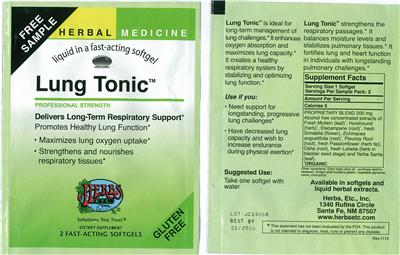
This summary is for Lung Tonic by Herbs Etc.
- Form
- Softgel Capsule
- Serving Size
- 1 Softgel
- Servings
- 2 per container
- Container Holds
- 2 Fast-Acting Softgels
- What is Lung Tonic?A supplement from Herbs Etc. with eleven active ingredients, in softgel form.
- Active Ingredients Proprietary Blend (Herb/Botanical) 200 mgfresh MulleinHorehoundElecampanefresh GrindeliaEchinacea angustifoliaPleurisy Rootfresh PassionflowerOshafresh LobeliaYerba Santa Eleven active ingredients. Each one can interact with drugs or cause side effects on its own, so we check every one. The full Supplement Facts
- Drug Interactions 1,269 drugs have a documented interaction with this supplement; the most serious is rated major. Of those, 866 are single drugs and 403 are combination products (two or more drugs in one), each listed under its own name. Based on the 9 of its 11 ingredients we could check. Ask your pharmacist first if you take a drug in any of these categories, the most serious of the 21 on record:
- Major · 1 drug
- Moderate · 645 drugs
- Moderate · 248 drugs
- Moderate · 186 drugs
- Possible Side EffectsNausea 3 ingredientsStomach upset 3 ingredientsDiarrhea 2 ingredientsVomiting 2 ingredientsThroatDrowsiness +10 moreCombined from seven of its eleven active ingredients. Not studied in this exact product.
- Well documented Why
Does Lung Tonic work?
What It Is Marketed For
Long-term respiratory and lung function support
From the claims on the product’s label.
The Closest Use the Research Grades
Echinacea
There isn’t enough good research to say either way.
Passion Flower has stronger research for other uses:
These grades are for the ingredient, not this exact product, and never a promise it will work for you.
What the research says- AllergensNone of its ingredient names point to a major food allergen
Who Might Consider It
- People looking for long-term respiratory and lung function support, which is what it is marketed for. For upper respiratory tract infection (URTI), the closest use the research grades, there is not enough good research to say either way.
- People who want it for insomnia: the other use with research behind it. See the grade
Who Should Be Careful
- This product may be of interest to adults looking into a multi-herb respiratory supplement who have reviewed the ingredient details.
- People taking heart medicines, lithium, blood thinners, blood pressure or diabetes medicines, sedatives, or immunosuppressants, and anyone who is pregnant, breastfeeding, or giving it to children, should be especially careful.
- Please talk it over with your own doctor or pharmacist before starting.
More Before You Take It Show both answersHide Pregnancy and Breastfeeding The Label’s Directions
-
Pregnant or breastfeeding?
- Pregnancy White Horehound
- ! When used orally; white horehound might have abortifacient effect, or stimulate menstrual flow and the uterus.
- Breastfeeding White Horehound
- There is insufficient reliable information available about the safety of oral use during lactation; avoid amounts greater than those commonly found in foods.
- Pregnancy and Breastfeeding Elecampane
- ! When used orally; avoid using.
- Pregnancy Pleurisy Root
- ! Traditionally used to stimulate the uterus and considered unsafe in pregnancy.
- Breastfeeding Pleurisy Root
- ! When used orally; avoid using.
-
How does the label say to take it?
“Suggested Use: Take one softgel with water.”
The maker’s words. Your pharmacist or doctor may advise differently.
Everything the label says
From the label dated Sep 25, 2015: 9 of its 11 active ingredients were checked against our records; the other two are not in them yet. A summary of what is known, not a grade or a test of the product. How these ratings are computed
Ask Anything About This Supplement
Name a drug you take, or ask about side effects, ingredients or pregnancy.
There’s a lot of information about this supplement on this page! Ask anything in plain English for a quick answer drawn from it.
AI answers come from this label and our own records, never the open internet. AI can make mistakes, so always check with your doctor or pharmacist. How we use AI
Ask the Pharmacist
A licensed pharmacist will answer your question by email — free, as soon as they can.
Got it — thank you!
A licensed pharmacist will answer as soon as they can. Keep an eye on your email (worth checking spam, just in case).
What’s Inside Lung Tonic by Herbs Etc.
Eleven Active Ingredients
In the order the label lists them, each with its own card below.
The label gives an exact amount for 1 of its 11 active ingredients. fresh Mullein, Horehound, Elecampane and 7 more are listed with no amount at all.
- 1 state an exact amount
- 10 have no amount of their own
This rates what the label tells you, not the quality of the product.
Supplement Facts
| Amount Per Serving | % Daily Value | |
|---|---|---|
| Calories | 5 {Calories} | † |
| Proprietary Blend (Herb/Botanical) | 200 mg | † |
| fresh Mullein | † | |
| Horehound | † | |
| Elecampane | † | |
| fresh Grindelia | † | |
| Echinacea angustifolia | † | |
| Pleurisy Root | † | |
| fresh Passionflower | † | |
| Osha | † | |
| fresh Lobelia | † | |
| Yerba Santa | † | |
Other ingredients: extra virgin Olive Oil, Sunflower Lecithin, Beeswax, Softgel Shell
† Daily Value not established.
Daily Values for adults and children 4 or more years of age.
As the label prints it, from the NIH Dietary Supplement Label Database.
Each Ingredient and Its Drug Interactions
Tap one for more about it and its full guide. A drug can interact with this supplement through any one of them.
Lung Tonic is a softgel capsule with 11 active ingredients: a proprietary herb blend, yerba santa, horehound, osha, elecampane, fresh mullein, fresh grindelia, fresh passionflower, echinacea angustifolia, fresh lobelia, and pleurisy root.
- Passionflower is known for its sedative effects, echinacea for its immune-stimulating activity, and mullein contains triterpenoid saponins, which may give it mild blood-thinning effects in lab tests.
- We have no information on a clear role for every ingredient.
-
Proprietary Blend (Herb/Botanical) 200 mg A blend: its ingredients are checked one by one where the label lists them
-
Fresh Mullein Interacts with 122 drugs
Mullein is a traditional herbal remedy most often used as a tea or syrup to soothe coughs, sore throats, and respiratory irritation.
- High-quality human studies are lacking, so its benefits are not well proven, but it is generally considered low-risk for short-term use in healthy adults.
- Talk to your pharmacist or doctor before using it, especially if you are pregnant, breastfeeding, or have a medical condition.
The full Mullein guide: uses, dosage and safety Every Mullein drug interaction
-
Horehound Interacts with 258 drugs
White horehound is a traditional bitter herb used mainly for coughs, sore throats, and mild digestive complaints, and it is a common flavoring in old-fashioned cough drops.
- Solid human evidence supporting these uses is limited, so view it as a folk remedy rather than a proven treatment.
- Talk to your pharmacist or doctor before using it, and avoid it during pregnancy.
The full White Horehound guide: uses, dosage and safety Every White Horehound drug interaction
-
Elecampane Interacts with 248 drugs
Elecampane is a traditional herb used mainly for coughs and other respiratory complaints, and as a bitter for digestion.
- Modern human evidence is very limited, so it should be seen as a folk remedy rather than a proven treatment.
- Talk to your pharmacist or doctor before using it, and avoid it during pregnancy and breastfeeding.
The full Elecampane guide: uses, dosage and safety Every Elecampane drug interaction
-
Fresh Grindelia We know this ingredient, but hold no drug interaction record for it yet, so it was not checked
-
Echinacea angustifolia Interacts with 818 drugs
Echinacea is a popular herb taken to help prevent or shorten the common cold, but study results are mixed and the overall benefit appears small at best.
- It is generally well tolerated for short-term use in most healthy adults, though people with allergies to daisy-family plants and those who are pregnant or breastfeeding should be cautious and talk to a pharmacist or doctor first.
The full Echinacea guide: uses, dosage and safety Every Echinacea drug interaction
-
Pleurisy Root Interacts with 117 drugs
Pleurisy root is the dried root of Asclepias tuberosa (butterfly weed), a plant used in traditional North American and herbal medicine mainly for respiratory complaints.
- There is very little modern scientific evidence that it works for any condition, and it contains compounds that can be toxic, so caution is strongly advised.
- Pregnant and breastfeeding people should avoid it, and anyone considering it should check with a pharmacist or doctor first.
The full Pleurisy Root guide: uses, dosage and safety Every Pleurisy Root drug interaction
-
Fresh Passionflower Interacts with 838 drugs
Passion flower is a traditional calming herb that many people use for anxiety and sleep.
- Early studies hint it may help with mild anxiety and restlessness, but the evidence is limited and more research is needed.
- It is generally well tolerated short-term, but should be avoided in pregnancy and discussed with your pharmacist or doctor first.
The full Passion Flower guide: uses, dosage and safety Every Passion Flower drug interaction
-
Osha No known drug interactions
Osha is a root from a wild mountain plant native to the western United States and Mexico, traditionally used by Native American and Hispanic communities for coughs, colds, and sore throats.
- Solid human research is lacking, so its benefits remain unproven, and it should be avoided during pregnancy and breastfeeding.
- Talk to your pharmacist or doctor before trying it.
-
Fresh Lobelia Interacts with 1 drug
Lobelia is a traditional herb once used for breathing problems and to help people quit smoking, but reliable evidence supporting these uses is lacking.
- It can be toxic in higher amounts, causing serious side effects, so it should be used with great caution and only under professional guidance.
The full Lobelia guide: uses, dosage and safety Every Lobelia drug interaction
-
Yerba Santa Interacts with 1 drug
Yerba Santa is an aromatic shrub from the western United States and Mexico that has long been used in folk medicine for coughs, congestion, and other respiratory complaints.
- Modern scientific evidence supporting these uses is very limited, with most data coming from laboratory studies rather than human trials.
- It is best known today as a flavoring agent that helps mask the bitter taste of medicines; talk to a pharmacist or doctor before using it for health purposes.
The full Yerba Santa guide: uses, dosage and safety Every Yerba Santa drug interaction
Other Ingredients (Inactive)
The capsule or tablet itself, fillers, coatings and flavors. Not part of the drug interaction check; the allergen check below reads them.
- Extra virgin Olive Oil
- Sunflower Lecithin
- Beeswax
- Softgel Shell
Allergens in Lung Tonic
None of its ingredient names point to a major food allergen.
Named on this label
- Gelatin (animal-derived)In the ingredients: Softgel Shell (Carob, Chlorophyll, Gelatin)
Not named in the ingredients
- Milk
- Egg
- Fish
- Shellfish
- Tree nuts
- Peanuts
- Wheat or other gluten grains
- Soy
- Sesame
- Made without, the label says“Gluten Free”
From the label text and ingredient names on file; we do not test products. With a serious allergy, check your bottle and ask the maker or your pharmacist.
What the Label Says
The maker’s own words, from the label. We do not verify or endorse them.
- General statements
-
“Free Sample Herbal Medicine liquid in a fast-acting softgel Professional strength”
“Delivers long-term respiratory support* Promotes health lung function* - Maximizes lung oxygen uptake* - Strengthens and nourishes respiratory tissues*”
4 more from the label
“It enhances oxygen absorption and maximizes lung capacity.* It creates a healthy respiratory system by stabilizing and optimizing lung function.*”
“Use if you: - Need support for longstanding, progressive lung challenges* - Have decreased lung capacity and with to increase endurance during physical exertion*”
“It balances moisture levels and stabilizes pulmonary tissues.* It fortifies lung and heart function in individuals with longstanding pulmonary challenges.*”
“Available in softgels and liquid herbal extracts.”
- Brand IP Statement(s)
-
“Solutions You Trust”
“Lung Tonic is ideal for long-term management of lung challenges.*”
2 more from the label
“Ideal formula for long-term management of lung challenges.”
“Lung Tonic strengthens the respiratory passages.*”
- FDA Statement of Identity
-
“Dietary Supplement”
The Lung Tonic Label on File
The label scan on file at the NIH Dietary Supplement Label Database, dated September 2015. Always read the label on the bottle you have.
Product Facts
- Brand
- Herbs Etc.
- Net contents
- 2 Fast-Acting Softgels
- Market status
- On market
- Date entered into DSLD
- Sep 25, 2015
- DSLD ID
- 50450
- Product type
- Botanical
- Supplement form
- Softgel Capsule
- Dietary claims / uses
- Structure/Function
- Intended target group(s)
- Adult (18 - 50 Years), Gluten Free
Is this label outdated? Report a formula or label change and our pharmacy team will review it.
HelloPharmacist Score Lung Tonic by Herbs Etc.
Up to 10 points for research, amount, label and outside testing. Not a safety rating. How this one adds up
for respiratory tract infections
It is marketed for long-term respiratory and lung function support. There is no graded research on that exact use, so we scored the closest one: there is too little good research to say whether echinacea, one of its ingredients, helps with respiratory tract infections.
- Research0 of 5 points
- Amount0 of 2 points
- Label0 of 2 points
- Outside testing0 of 1 point
Major drug interactions. The score does not count drug interactions. Check them against any drugs you take. See them
How It Earns Its 0
Score: 0 out of 10. Unproven for respiratory tract infections.
Too little research on echinacea for respiratory tract infections.
Graded “Insufficient Reliable Evidence to Rate” in the Natural Medicines database, which we license. A related use, not the one it is marketed for, counts for at most 3 of 5 research points.
0 of 5 points
Amount
The label does not say how much echinacea is in it.
0 of 2 points
Label
It states the amount of one of its 11 active ingredients; the rest give no amount.
0 of 2 points
Outside testing
We found no mark from an outside testing program, such as USP Verified or NSF Certified, on the label we have on file.
0 of 1 point
Lung Tonic by Herbs Etc. Side Effects
Why this rating?
We look for three kinds of safety information on each ingredient: side effects reported in studies, a pregnancy and breastfeeding rating, and a safety write-up from our pharmacy team. Of the nine ingredients we could check, seven have side-effect reports, all nine have a pregnancy rating and all nine have a safety write-up.
So this rates how much is known, not whether Lung Tonic is right for you.
Reported with nine of its ingredients
- Most often
- Nausea, stomach upset, diarrhea, vomiting, throat and drowsiness
- !Rare but serious
- Diarrhea, vomiting and spasms See details
HelloPharmacist Team Summary: Lung Tonic by Herbs Etc. Side Effects
You'll likely find this product generally well tolerated in the short term, though the ingredients vary.
- The side effects most people notice are stomach upset, nausea, and diarrhea, which can come from elecampane, echinacea, or pleurisy root, and drowsiness or dizziness, which is linked to passionflower.
- If you feel drowsy, see how the product affects you before you drive.
- Allergic reactions such as rash, itching, or trouble breathing are the rare but serious concern, and if one happens, call your doctor right away.
- Talk with your own doctor or pharmacist before starting if you have a chronic condition, are pregnant or breastfeeding, or are giving it to a child.
Side Effects, Ingredient by Ingredient
A supplement’s side effects come from its ingredients. Here is what is reported with each one.
Mullein
Most reported
- Throat
- Skin irritation
- Stomach upset
Elecampane
Most reported
- Nausea
- Vomiting
- Cramping
- Diarrhea
Echinacea
Most reported
- Stomach upset
- Nausea
- Unpleasant taste
Pleurisy Root
Most reported
- Nausea
- Vomiting
- Diarrhea
Passion Flower
Most reported
- Drowsiness
- Dizziness
- Confusion or grogginess
Osha
Most reported
- Stomach upset
- Allergic reactions
Yerba Santa
Most reported
- Skin rash
- Itching
White Horehound and Lobelia have side-effect reports, but no list of the most common ones. Read them in each guide: White Horehound, Lobelia.
Lung Tonic Warnings: Who Should Be Careful
Lung Tonic has eleven active ingredients, and each can carry warnings of its own. We checked the nine in our ingredient guides, and each warning below names the ingredient it comes from. Proprietary Blend (Herb/Botanical) and fresh Grindelia are not in our guides yet, so ask your pharmacist about them. If any of these apply to you, talk to your doctor or pharmacist before you start it.
- Mullein2 warnings below
- White Horehound3 warnings below
- Elecampane3 warnings below
- Echinacea3 warnings below
- Pleurisy Root3 warnings below
- Passion Flower2 warnings below
- Osha1 warning below
- Lobelia3 warnings below
- Yerba Santa2 warnings below
- Proprietary Blend (Herb/Botanical)Not in our guides yet
- fresh GrindeliaNot in our guides yet
-
Bleeding Problems or Surgery
- OshaPeople with liver problems, kidney problems, or bleeding concerns should be cautious and check with a healthcare provider first.
-
Diabetes or Low Blood Sugar
- White HorehoundPeople with diabetes should be cautious, since the herb may affect blood sugar.
-
Blood Pressure
- LobeliaPeople with heart disease, high blood pressure, a history of seizures, breathing problems, or stomach conditions should be especially careful and talk to a healthcare provider first.
-
Liver Disease
- Pleurisy RootChildren, older adults, and anyone with kidney or liver problems should not use it without medical advice.
-
Heart Conditions
- White HorehoundPeople with heart rhythm problems, stomach or intestinal ulcers, or any chronic condition should check with a healthcare provider first.
- Pleurisy RootPeople with heart conditions should be especially careful because of the cardiac glycoside content.
-
Autoimmune Conditions
- EchinaceaPeople with autoimmune conditions or weakened immune systems should talk to their doctor before using echinacea, since its effects on the immune system are not well understood.
-
Allergies
- MulleinPeople with allergies to plants in the same family may be more likely to react.
- ElecampanePeople who are allergic to ragweed, marigolds, chrysanthemums, daisies, or related plants may also react to elecampane and should avoid it.
- EchinaceaPeople with asthma or a history of allergies should be especially careful.
- Yerba SantaPeople with allergies to plants in the borage family, and anyone with a chronic medical condition, should be cautious and check with a healthcare professional first.
-
Children
- MulleinChildren, older adults, and people with chronic health conditions should check with a pharmacist or doctor before using it.
- ElecampaneIt is also best to avoid giving it to young children unless directed by a healthcare professional.
- EchinaceaSafety in young children is also uncertain, so check with a pediatrician first.
- LobeliaChildren should not take lobelia.
- Yerba SantaAlso avoid giving it to infants or young children unless a doctor advises it.
-
If You Take Other Drugs
- Passion FlowerAnyone with a medical condition or who takes regular medications should talk with a pharmacist or doctor first.
-
Other Cautions
- ElecampaneBecause reliable safety data are limited, people with chronic health conditions should check with a healthcare provider before using it.
- Passion FlowerBecause it can cause drowsiness, you should not drive or operate machinery until you know how it affects you, and you should be careful combining it with anything else that makes you sleepy.
- LobeliaFor this reason, many experts recommend using lobelia only with caution and professional guidance.
-
Pregnant or Breastfeeding
Each ingredient’s rating for pregnancy and for breastfeeding, and what it covers.
Pregnancy
-
When used orally; white horehound might have abortifacient effect, or stimulate menstrual flow and the uterus.
There is insufficient reliable information available about the safety of topical use during pregnancy; avoid using.
Breastfeeding
-
There is insufficient reliable information available about the safety of oral use during lactation; avoid amounts greater than those commonly found in foods.
There is insufficient reliable information available about the safety of topical use during lactation; avoid using.
Pregnancy and Breastfeeding The record rates both the same
-
When used orally; avoid using.
Show 7 more ingredients
Pregnancy
-
Traditionally used to stimulate the uterus and considered unsafe in pregnancy.
Breastfeeding
-
When used orally; avoid using.
Pregnancy
-
When used orally.
Osha has been used to stimulate menstruation and is reported to have abortifacient activity; contraindicated.
Breastfeeding
-
Insufficient reliable information available; avoid using.
Pregnancy and Breastfeeding The record rates both the same
-
When used orally due to its emetic effects.
There is insufficient reliable information available about the safety of lobelia when used topically during pregnancy and lactation.
Pregnancy
-
When used orally.
Some case reports suggest that passion flower use during the first and second trimesters of pregnancy may be associated with an increased risk for premature rupture of membranes and meconium aspiration syndrome; however, causality has not been confirmed.
2 more points on this rating
- The alkaloids harman and harmaline, which are sometimes found in passion flower, have been reported to have uterine stimulant activity.
- It is not known whether these constituents are present in sufficient quantities to have an effect.
Breastfeeding
-
Insufficient reliable information available; avoid using.
Pregnancy and Breastfeeding The record rates both the same
-
Insufficient reliable information available; avoid using.
Pregnancy
-
When used orally, short-term.
There is preliminary evidence that mothers can safely use echinacea in the form of E. purpurea or E. angustifolia solid dosage forms, 250-1000 mg daily, or tinctures, up to 30 drops daily, for 5 days to 7 days during the first trimester without adversely affecting the fetus.
There is insufficient reliable information available about the safety of echinacea when used for longer than 7 days.
Breastfeeding
-
Insufficient reliable information available; avoid using.
Pregnancy and Breastfeeding The record rates both the same
-
Insufficient reliable information available; avoid using.
Our pharmacy team’s notes
- EchinaceaEchinacea is rated possibly safe in pregnancy.
- For pregnancy, horehound, osha, elecampane, and lobelia are rated likely unsafe, and passionflower is rated possibly unsafe, so their safety data advises against them.
- For ingredients without a pregnancy rating, there isn't enough data to know either way, so talk with your doctor or pharmacist for personalized advice.
Ratings and the words beside them are from the Natural Medicines database, which we license. Where it has no rating, the rating and note are our pharmacy team’s.
-
Rare but Serious Side Effects
-
!
Mullein
Allergic reactions are possible but uncommon.
-
!
White Horehound
Allergic reactions are possible, especially in people sensitive to plants in the mint family.
-
!
Elecampane
More serious allergic reactions are possible in people sensitive to plants in the daisy family.
Orally: Diarrhea, vomiting, spasms, and symptoms of paralysis at high doses.
-
!
Echinacea
The most important risk is an allergic reaction, which can include rash, itching, swelling, or trouble breathing.
Orally: Severe allergic reactions and hepatitis have been reported.
-
!
Pleurisy Root
Because it contains cardiac glycoside–type compounds, large amounts could in theory cause serious heart rhythm problems or other signs of poisoning.
-
!
Passion Flower
Rare but more serious effects, such as fast heartbeat or unusual mental changes, have been reported in isolated cases.
-
!
Osha
Reported or possible effects include stomach upset and allergic reactions, especially in people sensitive to related plants.
-
!
Lobelia
At higher or toxic doses, lobelia can cause more serious problems such as very low blood pressure, difficulty breathing, confusion, seizures, and in extreme cases, coma.
-
!
Yerba Santa
Possible effects include mild stomach upset and allergic reactions in sensitive people, such as skin rash or itching.
When to get help: a serious allergic reaction, with trouble breathing or swelling of the face, lips or throat, needs emergency care: call 911. For any other side effect that worries you, call your doctor or pharmacist.
These reports describe each ingredient, not studies of this exact product. Not medical advice: a side effect you notice after starting a supplement is worth a word with your pharmacist or doctor.
Lung Tonic by Herbs Etc. Drug Interactions
We checked all eleven active ingredients in this supplement against every drug in our records. A drug can interact with it through any one of them. Proprietary Blend (Herb/Botanical) and fresh Grindelia are not in our interaction records yet.
A major interaction on record
3 of 3, on a scale from Minor or none to Major.Why this rating?
We rate this by the most serious interaction on record, not by how many there are. For Elecampane, Lobelia, Yerba Santa, Pleurisy Root and Mullein, the most serious is rated major, which means the combination is best avoided, or used only under close supervision. Some involve kinds of drugs where a small change can matter, such as blood thinners, transplant drugs and diabetes drugs.
1,270 drugs are on the full list. What matters is whether one you take is on it, so check yours with the interaction checker on this page.
From the HelloPharmacist Team
Our pharmacy team’s read on the supplement as a whole.
- Lung Tonic from Herbs Etc. can interact with several medications, through its yerba santa, horehound, elecampane, mullein, passionflower, echinacea, lobelia, and pleurisy root content.
- Lithium (Moderate), a mood-stabilizing medicine, may build up with yerba santa and lobelia, so a lithium dose might need lowering.
- Minor interactions involve anticoagulants (blood thinners) with mullein (Minor), warfarin with echinacea (Minor), lopinavir/ritonavir and midazolam with echinacea (Minor), and OATP and CYP3A4-cleared drugs with passionflower (Minor).
Eight of its eleven active ingredients have drug interactions on record. The ones below matter most. We have no interaction records for Proprietary Blend (Herb/Botanical), fresh Grindelia and Osha.
- Interacts with
- 258 drugs
- Most serious
- Moderate
- Horehound (Moderate) may add to blood pressure medicines (antihypertensives) and diabetes medicines (antidiabetes drugs), since it can lower blood pressure and blood sugar.
- Interacts with
- 248 drugs
- Most serious
- Moderate
- Sedating medicines (CNS depressants, Moderate) may add to the drowsiness from elecampane and passionflower.
- Interacts with
- 818 drugs
- Most serious
- Moderate
- Echinacea (Moderate) may interfere with immunosuppressants and raises levels of caffeine and etoposide.
Show three more ingredients
- Interacts with
- 117 drugs
- Most serious
- Major
- The most serious interaction is Major: pleurisy root may add to the effects of digoxin (Lanoxin), a heart medication, which could raise the risk of side effects and toxicity.
- Pleurisy root (Moderate) may also interfere with hormone therapy (estrogens) and, with potassium-lowering water pills (diuretics), increase the risk of heart toxicity.
- Interacts with
- 838 drugs
- Most serious
- Moderate
- Most of its records involve Cytochrome P450 3A4 (CYP3A4) Substrates, CNS Depressants and Organic Anion-transporting Polypeptide Substrates (OATP).
- Interacts with
- 122 drugs
- Most serious
- Minor
- Most of its records involve Anticoagulant/Antiplatelet Drugs.
And two more ingredients with records, each in the cards below.
Summarized by the HelloPharmacist pharmacy team from the interaction records below. How it is written How we use AI
Why Lung Tonic Interacts, Ingredient by Ingredient
A product interacts through its ingredients. Each card: how many drugs, the most serious rating, and the kinds of drugs it affects most (tap a kind for what it means).
The ingredients driving the most interactions
-
fresh Passionflower 838 drugs
Most serious: Moderate3 interaction records on file
The kinds of drugs it affects most
- 645 drugs
- 248 drugs
- 47 drugs
Every Passion Flower drug interaction, 3 records The Passion Flower records cite 19 references, listed in the Passion Flower guide.
-
Echinacea angustifolia 818 drugs
Most serious: Moderate12 interaction records on file
The kinds of drugs it affects most
- 645 drugs
- 186 drugs
- 121 drugs
- 29 drugs
Every Echinacea drug interaction, 12 records The Echinacea records cite 51 references, listed in the Echinacea guide.
-
Horehound 258 drugs
Most serious: Moderate2 interaction records on file
The kinds of drugs it affects most
- 172 drugs
- 86 drugs
Every White Horehound drug interaction, 2 records The White Horehound records cite 8 references, listed in the White Horehound guide.
-
Elecampane 248 drugs
Most serious: Moderate1 interaction record on file
The kinds of drugs it affects most
- 248 drugs
Every Elecampane drug interaction, 1 record The Elecampane records cite 5 references, listed in the Elecampane guide.
-
fresh Mullein 122 drugs
Most serious: Minor1 interaction record on file
The kinds of drugs it affects most
- 122 drugs
Every Mullein drug interaction, 1 record The Mullein records cite 2 references, listed in the Mullein guide.
-
Pleurisy Root 117 drugs
Most serious: Major3 interaction records on file
The kinds of drugs it affects most
- 75 drugs
- 41 drugs
- 1 drug
Every Pleurisy Root drug interaction, 3 records The Pleurisy Root records cite 7 references, listed in the Pleurisy Root guide.
-
fresh Lobelia 1 drug
Most serious: Moderate1 interaction record on file
The kinds of drugs it affects most
- 1 drug
Every Lobelia drug interaction, 1 record The Lobelia records cite 6 references, listed in the Lobelia guide.
-
Yerba Santa 1 drug
Most serious: Moderate1 interaction record on file
The kinds of drugs it affects most
- 1 drug
The Breakdown by Severity
Each drug counted once, at its most serious rating. Tap a tile to list those drugs.
Find Your Drug
Type a drug or brand name to see whether it is on the list.
- Only drugs with a documented interaction are listed, the most serious first.
- A drug with no known interaction is not listed, but searching its name tells you so.
- Open a drug to see which ingredient is responsible. Of those, 866 are single drugs and 403 are combination products (two or more drugs in one), each listed under its own name.
-
DigoxinDigitek, Lanoxicaps, Lanoxin Major
The ingredient responsible:
-
Pleurisy Root Major
Pleurisy root contains digitalis-like cardenolide glycosides.
The full Pleurisy Root + Digoxin interaction
-
-
ApixabanEliquis Moderate
The 3 ingredients responsible:
-
Echinacea Angustifolia Moderate Apixaban is in the Cytochrome P450 3A4 (CYP3A4) Substrates category.
Echinacea may induce hepatic CYP3A4 and inhibit intestinal CYP3A4.
The full Echinacea Angustifolia + Apixaban interaction -
Fresh Passionflower Minor Apixaban is in the Cytochrome P450 3A4 (CYP3A4) Substrates category.
Theoretically, passion flower might decrease the effects of CYP3A4 substrates.
The full Fresh Passionflower + Apixaban interaction -
Fresh Mullein Minor Apixaban is in the Anticoagulant/Antiplatelet Drugs category.
Lab tests on extracts from different parts of common and dense-flowered mullein plants show that they do have some blood-thinning effects, as they increase the time it takes for blood to clot.
The full Fresh Mullein + Apixaban interaction
-
-
WarfarinWarfarin Moderate
The 3 ingredients responsible:
-
Echinacea Angustifolia Moderate Warfarin is in these Cytochrome P450 3A4 (CYP3A4) Substrates, Cytochrome P450 1A2 (CYP1A2) Substrates categories.
Echinacea seems to increase the clearance of warfarin, although the effect may not be clinically significant.
The full Echinacea Angustifolia + Warfarin interaction -
Fresh Mullein Minor Warfarin is in the Anticoagulant/Antiplatelet Drugs category.
Lab tests on extracts from different parts of common and dense-flowered mullein plants show that they do have some blood-thinning effects, as they increase the time it takes for blood to clot.
The full Fresh Mullein + Warfarin interaction -
Fresh Passionflower Minor Warfarin is in the Cytochrome P450 3A4 (CYP3A4) Substrates category.
Theoretically, passion flower might decrease the effects of CYP3A4 substrates.
The full Fresh Passionflower + Warfarin interaction
-
-
AmlodipineNorliqva Moderate
The 3 ingredients responsible:
-
Horehound Moderate Amlodipine is in the Antihypertensive Drugs category.
Evidence from animal research suggests that taking white horehound extract lowers blood pressure.
The full Horehound + Amlodipine interaction -
Echinacea Angustifolia Moderate Amlodipine is in the Cytochrome P450 3A4 (CYP3A4) Substrates category.
Echinacea may induce hepatic CYP3A4 and inhibit intestinal CYP3A4.
The full Echinacea Angustifolia + Amlodipine interaction -
Fresh Passionflower Minor Amlodipine is in the Cytochrome P450 3A4 (CYP3A4) Substrates category.
Theoretically, passion flower might decrease the effects of CYP3A4 substrates.
The full Fresh Passionflower + Amlodipine interaction
-
-
SertralineZoloft Moderate
The 2 ingredients responsible:
-
Echinacea Angustifolia Moderate Sertraline is in the Cytochrome P450 3A4 (CYP3A4) Substrates category.
Echinacea may induce hepatic CYP3A4 and inhibit intestinal CYP3A4.
The full Echinacea Angustifolia + Sertraline interaction -
Fresh Passionflower Minor Sertraline is in the Cytochrome P450 3A4 (CYP3A4) Substrates category.
Theoretically, passion flower might decrease the effects of CYP3A4 substrates.
The full Fresh Passionflower + Sertraline interaction
-
-
ClopidogrelPlavix Moderate
The 3 ingredients responsible:
-
Echinacea Angustifolia Moderate Clopidogrel is in these Cytochrome P450 1A2 (CYP1A2) Substrates, Cytochrome P450 3A4 (CYP3A4) Substrates categories.
Echinacea might inhibit the metabolism of CYP1A2 and increase plasma levels of some drugs.
The full Echinacea Angustifolia + Clopidogrel interaction -
Fresh Mullein Minor Clopidogrel is in the Anticoagulant/Antiplatelet Drugs category.
Lab tests on extracts from different parts of common and dense-flowered mullein plants show that they do have some blood-thinning effects, as they increase the time it takes for blood to clot.
The full Fresh Mullein + Clopidogrel interaction -
Fresh Passionflower Minor Clopidogrel is in the Cytochrome P450 3A4 (CYP3A4) Substrates category.
Theoretically, passion flower might decrease the effects of CYP3A4 substrates.
The full Fresh Passionflower + Clopidogrel interaction
-
-
Losartan PotassiumCozaar Moderate
The 3 ingredients responsible:
-
Echinacea Angustifolia Moderate Losartan Potassium is in the Cytochrome P450 3A4 (CYP3A4) Substrates category.
Echinacea may induce hepatic CYP3A4 and inhibit intestinal CYP3A4.
The full Echinacea Angustifolia + Losartan Potassium interaction -
Horehound Moderate Losartan Potassium is in the Antihypertensive Drugs category.
Evidence from animal research suggests that taking white horehound extract lowers blood pressure.
The full Horehound + Losartan Potassium interaction -
Fresh Passionflower Minor Losartan Potassium is in the Cytochrome P450 3A4 (CYP3A4) Substrates category.
Theoretically, passion flower might decrease the effects of CYP3A4 substrates.
The full Fresh Passionflower + Losartan Potassium interaction
-
-
AtorvastatinAtorvaliq Moderate
The 2 ingredients responsible:
-
Echinacea Angustifolia Moderate Atorvastatin is in the Cytochrome P450 3A4 (CYP3A4) Substrates category.
Echinacea may induce hepatic CYP3A4 and inhibit intestinal CYP3A4.
The full Echinacea Angustifolia + Atorvastatin interaction -
Fresh Passionflower Minor Atorvastatin is in these Cytochrome P450 3A4 (CYP3A4) Substrates, Organic Anion-transporting Polypeptide Substrates (OATP) categories.
Theoretically, passion flower might decrease the effects of CYP3A4 substrates.
The full Fresh Passionflower + Atorvastatin interaction
-
-
EscitalopramLexapro Moderate
The 2 ingredients responsible:
-
Echinacea Angustifolia Moderate Escitalopram is in the Cytochrome P450 3A4 (CYP3A4) Substrates category.
Echinacea may induce hepatic CYP3A4 and inhibit intestinal CYP3A4.
The full Echinacea Angustifolia + Escitalopram interaction -
Fresh Passionflower Minor Escitalopram is in the Cytochrome P450 3A4 (CYP3A4) Substrates category.
Theoretically, passion flower might decrease the effects of CYP3A4 substrates.
The full Fresh Passionflower + Escitalopram interaction
-
-
Warfarin SodiumCoumadin, Panwarfin, Sofarin Moderate
The 3 ingredients responsible:
-
Echinacea Angustifolia Moderate Warfarin Sodium is in these Cytochrome P450 3A4 (CYP3A4) Substrates, Cytochrome P450 1A2 (CYP1A2) Substrates categories.
Echinacea may induce hepatic CYP3A4 and inhibit intestinal CYP3A4.
The full Echinacea Angustifolia + Warfarin Sodium interaction -
Fresh Passionflower Minor Warfarin Sodium is in the Cytochrome P450 3A4 (CYP3A4) Substrates category.
Theoretically, passion flower might decrease the effects of CYP3A4 substrates.
The full Fresh Passionflower + Warfarin Sodium interaction -
Fresh Mullein Minor Warfarin Sodium is in the Anticoagulant/Antiplatelet Drugs category.
Lab tests on extracts from different parts of common and dense-flowered mullein plants show that they do have some blood-thinning effects, as they increase the time it takes for blood to clot.
The full Fresh Mullein + Warfarin Sodium interaction
-
-
RivaroxabanXarelto Moderate
The 3 ingredients responsible:
-
Echinacea Angustifolia Moderate Rivaroxaban is in the Cytochrome P450 3A4 (CYP3A4) Substrates category.
Echinacea may induce hepatic CYP3A4 and inhibit intestinal CYP3A4.
The full Echinacea Angustifolia + Rivaroxaban interaction -
Fresh Passionflower Minor Rivaroxaban is in the Cytochrome P450 3A4 (CYP3A4) Substrates category.
Theoretically, passion flower might decrease the effects of CYP3A4 substrates.
The full Fresh Passionflower + Rivaroxaban interaction -
Fresh Mullein Minor Rivaroxaban is in the Anticoagulant/Antiplatelet Drugs category.
Lab tests on extracts from different parts of common and dense-flowered mullein plants show that they do have some blood-thinning effects, as they increase the time it takes for blood to clot.
The full Fresh Mullein + Rivaroxaban interaction
-
-
MetforminGlucophage, Metformin Moderate
The ingredient responsible:
-
Horehound Moderate Metformin is in the Antidiabetes Drugs category.
Evidence from animal research suggests that white horehound might lower blood glucose.
The full Horehound + Metformin interaction
-
-
MetoprololLopressor, Toprol XL Moderate
The ingredient responsible:
-
Horehound Moderate Metoprolol is in the Antihypertensive Drugs category.
Evidence from animal research suggests that taking white horehound extract lowers blood pressure.
The full Horehound + Metoprolol interaction
-
-
TirzepatideMounjaro, Zepbound Moderate
The ingredient responsible:
-
Horehound Moderate Tirzepatide is in the Antidiabetes Drugs category.
Evidence from animal research suggests that white horehound might lower blood glucose.
The full Horehound + Tirzepatide interaction
-
-
TadalafilCialis, Tadliq Moderate
The 2 ingredients responsible:
-
Echinacea Angustifolia Moderate Tadalafil is in the Cytochrome P450 3A4 (CYP3A4) Substrates category.
Echinacea may induce hepatic CYP3A4 and inhibit intestinal CYP3A4.
The full Echinacea Angustifolia + Tadalafil interaction -
Fresh Passionflower Minor Tadalafil is in the Cytochrome P450 3A4 (CYP3A4) Substrates category.
Theoretically, passion flower might decrease the effects of CYP3A4 substrates.
The full Fresh Passionflower + Tadalafil interaction
-
-
TestosteroneAndrogel, Andropatch, Delatestryl, Intrinsa, Natesto and 4 more Moderate
The 2 ingredients responsible:
-
Echinacea Angustifolia Moderate Testosterone is in the Cytochrome P450 3A4 (CYP3A4) Substrates category.
Echinacea may induce hepatic CYP3A4 and inhibit intestinal CYP3A4.
The full Echinacea Angustifolia + Testosterone interaction -
Fresh Passionflower Minor Testosterone is in the Cytochrome P450 3A4 (CYP3A4) Substrates category.
Theoretically, passion flower might decrease the effects of CYP3A4 substrates.
The full Fresh Passionflower + Testosterone interaction
-
-
SemaglutideOzempic, Rybelsus, Wegovy Moderate
The ingredient responsible:
-
Horehound Moderate Semaglutide is in the Antidiabetes Drugs category.
Evidence from animal research suggests that white horehound might lower blood glucose.
The full Horehound + Semaglutide interaction
-
-
PrednisoneCortan, Deltasone, Meticorten, Orasone, Prednicen-M and 3 more Moderate
The 2 ingredients responsible:
-
Echinacea Angustifolia Moderate Prednisone is in these Cytochrome P450 3A4 (CYP3A4) Substrates, Immunosuppressants categories.
Echinacea may induce hepatic CYP3A4 and inhibit intestinal CYP3A4.
The full Echinacea Angustifolia + Prednisone interaction -
Fresh Passionflower Minor Prednisone is in the Cytochrome P450 3A4 (CYP3A4) Substrates category.
Theoretically, passion flower might decrease the effects of CYP3A4 substrates.
The full Fresh Passionflower + Prednisone interaction
-
-
AcetaminophenChildren's Tylenol, Children's Tylenol Meltaways, Tylenol, Tylenol Ex Strength Moderate
The ingredient responsible:
-
Echinacea Angustifolia Moderate Acetaminophen is in the Cytochrome P450 1A2 (CYP1A2) Substrates category.
Echinacea might inhibit the metabolism of CYP1A2 and increase plasma levels of some drugs.
The full Echinacea Angustifolia + Acetaminophen interaction
-
-
PregabalinLyrica, Lyrica CR Moderate
The 2 ingredients responsible:
-
Elecampane Moderate Pregabalin is in the CNS Depressants category.
Theoretically, elecampane may cause additive sedative effects when taken with CNS depressants.
The full Elecampane + Pregabalin interaction -
Fresh Passionflower Moderate Pregabalin is in the CNS Depressants category.
Concomitant use of passion flower with sedative drugs might cause additive effects and side effects.
The full Fresh Passionflower + Pregabalin interaction
-
-
AmitriptylineElavil Moderate
The 3 ingredients responsible:
-
Fresh Passionflower Moderate Amitriptyline is in these Cytochrome P450 3A4 (CYP3A4) Substrates, CNS Depressants categories.
Theoretically, passion flower might decrease the effects of CYP3A4 substrates.
The full Fresh Passionflower + Amitriptyline interaction -
Echinacea Angustifolia Moderate Amitriptyline is in these Cytochrome P450 3A4 (CYP3A4) Substrates, Cytochrome P450 1A2 (CYP1A2) Substrates categories.
Echinacea may induce hepatic CYP3A4 and inhibit intestinal CYP3A4.
The full Echinacea Angustifolia + Amitriptyline interaction -
Elecampane Moderate Amitriptyline is in the CNS Depressants category.
Theoretically, elecampane may cause additive sedative effects when taken with CNS depressants.
The full Elecampane + Amitriptyline interaction
-
-
PropranololAngilol, Bedranol SR, Beta Prograne, Half Beta Prograne, Half-Inderal LA and 7 more Moderate
The 2 ingredients responsible:
-
Horehound Moderate Propranolol is in the Antihypertensive Drugs category.
Evidence from animal research suggests that taking white horehound extract lowers blood pressure.
The full Horehound + Propranolol interaction -
Echinacea Angustifolia Moderate Propranolol is in the Cytochrome P450 1A2 (CYP1A2) Substrates category.
Echinacea might inhibit the metabolism of CYP1A2 and increase plasma levels of some drugs.
The full Echinacea Angustifolia + Propranolol interaction
-
-
AbemaciclibVerzenio Moderate
The 2 ingredients responsible:
-
Echinacea Angustifolia Moderate Abemaciclib is in the Cytochrome P450 3A4 (CYP3A4) Substrates category.
Echinacea may induce hepatic CYP3A4 and inhibit intestinal CYP3A4.
The full Echinacea Angustifolia + Abemaciclib interaction -
Fresh Passionflower Minor Abemaciclib is in the Cytochrome P450 3A4 (CYP3A4) Substrates category.
Theoretically, passion flower might decrease the effects of CYP3A4 substrates.
The full Fresh Passionflower + Abemaciclib interaction
-
-
LisinoprilPrinivil, Qbrelis, Zestril Moderate
The ingredient responsible:
-
Horehound Moderate Lisinopril is in the Antihypertensive Drugs category.
Evidence from animal research suggests that taking white horehound extract lowers blood pressure.
The full Horehound + Lisinopril interaction
-
-
LamotrigineLamictal Moderate
The 2 ingredients responsible:
-
Fresh Passionflower Moderate Lamotrigine is in the CNS Depressants category.
Concomitant use of passion flower with sedative drugs might cause additive effects and side effects.
The full Fresh Passionflower + Lamotrigine interaction -
Elecampane Moderate Lamotrigine is in the CNS Depressants category.
Theoretically, elecampane may cause additive sedative effects when taken with CNS depressants.
The full Elecampane + Lamotrigine interaction
-
-
LetrozoleFemara Moderate
The 2 ingredients responsible:
-
Echinacea Angustifolia Moderate Letrozole is in the Cytochrome P450 3A4 (CYP3A4) Substrates category.
Echinacea may induce hepatic CYP3A4 and inhibit intestinal CYP3A4.
The full Echinacea Angustifolia + Letrozole interaction -
Fresh Passionflower Minor Letrozole is in the Cytochrome P450 3A4 (CYP3A4) Substrates category.
Theoretically, passion flower might decrease the effects of CYP3A4 substrates.
The full Fresh Passionflower + Letrozole interaction
-
-
CitalopramCelexa Moderate
The 2 ingredients responsible:
-
Echinacea Angustifolia Moderate Citalopram is in the Cytochrome P450 3A4 (CYP3A4) Substrates category.
Echinacea may induce hepatic CYP3A4 and inhibit intestinal CYP3A4.
The full Echinacea Angustifolia + Citalopram interaction -
Fresh Passionflower Minor Citalopram is in the Cytochrome P450 3A4 (CYP3A4) Substrates category.
Theoretically, passion flower might decrease the effects of CYP3A4 substrates.
The full Fresh Passionflower + Citalopram interaction
-
-
GabapentinGralise, Neurontin Moderate
The 2 ingredients responsible:
-
Fresh Passionflower Moderate Gabapentin is in the CNS Depressants category.
Concomitant use of passion flower with sedative drugs might cause additive effects and side effects.
The full Fresh Passionflower + Gabapentin interaction -
Elecampane Moderate Gabapentin is in the CNS Depressants category.
Theoretically, elecampane may cause additive sedative effects when taken with CNS depressants.
The full Elecampane + Gabapentin interaction
-
-
NaproxenAleve, Anaprox, Anaprox DS, Arthroxen, EC-Naprosyn and 8 more Moderate
The 2 ingredients responsible:
-
Echinacea Angustifolia Moderate Naproxen is in the Cytochrome P450 1A2 (CYP1A2) Substrates category.
Echinacea might inhibit the metabolism of CYP1A2 and increase plasma levels of some drugs.
The full Echinacea Angustifolia + Naproxen interaction -
Fresh Mullein Minor Naproxen is in the Anticoagulant/Antiplatelet Drugs category.
Lab tests on extracts from different parts of common and dense-flowered mullein plants show that they do have some blood-thinning effects, as they increase the time it takes for blood to clot.
The full Fresh Mullein + Naproxen interaction
-
-
ClonazepamCeberclon, Klonopin, Rivotril Moderate
The 3 ingredients responsible:
-
Elecampane Moderate Clonazepam is in the CNS Depressants category.
Theoretically, elecampane may cause additive sedative effects when taken with CNS depressants.
The full Elecampane + Clonazepam interaction -
Echinacea Angustifolia Moderate Clonazepam is in the Cytochrome P450 3A4 (CYP3A4) Substrates category.
Echinacea may induce hepatic CYP3A4 and inhibit intestinal CYP3A4.
The full Echinacea Angustifolia + Clonazepam interaction -
Fresh Passionflower Moderate Clonazepam is in these Cytochrome P450 3A4 (CYP3A4) Substrates, CNS Depressants categories.
Theoretically, passion flower might decrease the effects of CYP3A4 substrates.
The full Fresh Passionflower + Clonazepam interaction
-
Does It Work? Lung Tonic by Herbs Etc.
What its ingredients have research behind, strongest first, then each ingredient on its own. A grade is the research so far, never an endorsement.
What the Research Supports
Each use one or more of its ingredients is graded for, strongest research first.
- Passion Flower
HelloPharmacist Team Summary: Does Lung Tonic by Herbs Etc. Work?
Our ratings are per ingredient, not for the product as a whole.
- Lobelia is rated possibly ineffective for smoking cessation.
- Yerba santa (obesity), horehound (diabetes), osha (dyspepsia and HIV/AIDS), elecampane (acne and cough), mullein (several uses), and echinacea (several uses) are all rated insufficient reliable evidence to rate.
- We have no effectiveness rating for pleurisy root, the proprietary blend, or fresh grindelia.
The Evidence, Ingredient by Ingredient
The detail behind the list above: our notes on each ingredient and its graded uses.
Mullein
From our Mullein guide
- Mullein is most popular as a remedy for coughs, chest congestion, sore throat, and bronchitis.
- It is also used traditionally for earaches (often combined with garlic in ear-drop oils) and applied to the skin for minor irritation.
No use is graded effective, likely effective or possibly effective for it yet.
Every graded use, in the Mullein guideWhite Horehound
From our White Horehound guide
- White horehound is most often used as a remedy for coughs, sore throats, and chest congestion.
- It is thought to act as an expectorant, meaning it may help loosen mucus so it is easier to cough up.
No use is graded effective, likely effective or possibly effective for it yet.
Every graded use, in the White Horehound guideElecampane
From our Elecampane guide
- Elecampane is most often used for respiratory complaints such as coughs, bronchitis, and to help loosen and clear mucus.
- It is also taken as a digestive bitter and was historically used to expel intestinal worms.
No use is graded effective, likely effective or possibly effective for it yet.
Every graded use, in the Elecampane guideEchinacea
From our Echinacea guide
- The most common reason people use echinacea is for the common cold and other upper respiratory infections.
- Research on this has been done for many years, but the results are mixed and not very strong.
No use is graded effective, likely effective or possibly effective for it yet.
Every graded use, in the Echinacea guidePleurisy Root
From our Pleurisy Root guide
- People have traditionally used pleurisy root for chest congestion, coughs, bronchitis, pleurisy, and to encourage sweating during fevers.
- These uses come from folk and traditional practice, not from strong clinical research.
No use is graded effective, likely effective or possibly effective for it yet.
Every graded use, in the Pleurisy Root guidePassion Flower
From our Passion Flower guide
- Passion flower is most commonly used for anxiety, stress, restlessness, and trouble sleeping.
- Some small studies suggest it may ease mild anxiety, including nervousness before surgery or dental work, and may modestly improve sleep quality.
Research suggests a benefit for
- Insomnia
Not counted here: one graded use is for a condition treated by a doctor or in a hospital (pre-procedural anxiety).
Every graded use, in the Passion Flower guideOsha
From our Osha guide
- Most of what we know about osha comes from traditional use, not from high-quality human studies.
- People commonly take it for coughs, sore throats, colds, the flu, bronchitis, and general immune support.
No use is graded effective, likely effective or possibly effective for it yet.
Every graded use, in the Osha guideLobelia
From our Lobelia guide
- People have traditionally used lobelia for asthma, coughs, bronchitis, and to help quit smoking.
- Despite this long history of use, high-quality human studies are very limited, and the scientific evidence does not clearly support these uses.
No use is graded effective, likely effective or possibly effective for it yet.
Every graded use, in the Lobelia guideYerba Santa
From our Yerba Santa guide
- Yerba Santa is most commonly used as a traditional remedy for respiratory problems such as coughs, colds, chest congestion, bronchitis, and asthma.
- People also use it for sore throats and as an expectorant, meaning it is believed to help loosen and bring up mucus.
No use is graded effective, likely effective or possibly effective for it yet.
Every graded use, in the Yerba Santa guideThe grades are the Natural Medicines database’s, which we license; tap a grade for what it means. They are about each ingredient, not this exact product.
About Herbs Etc.
Manufacturer and brand details for Lung Tonic, from the product label.
- Name
- Herbs, Etc.
- Street Address
- 1340 Rufina Circle
- City
- Santa Fe
- State
- NM
- ZipCode
- 87507
- Web Address
- www.herbsetc.com
Lung Tonic by Herbs Etc.: Common Questions
Does Lung Tonic by Herbs Etc. interact with any drugs?
What are the side effects of Lung Tonic by Herbs Etc.?
Who should be careful taking Lung Tonic by Herbs Etc.?
Can Lung Tonic by Herbs Etc. affect the liver?
Can Lung Tonic by Herbs Etc. affect the kidneys?
Does Lung Tonic by Herbs Etc. contain any common allergens?
Is Lung Tonic by Herbs Etc. gluten free?
How can Lung Tonic by Herbs Etc. interact with so many drugs?
Where does the information about Lung Tonic by Herbs Etc. come from?
Does the passionflower in Lung Tonic by Herbs Etc. help with sleep?
Will lobelia help me quit smoking?
Is Lung Tonic by Herbs Etc. safe to take during pregnancy?
Written and reviewed by the HelloPharmacist Editorial Team. Our editorial policy
Still Have a Question About Lung Tonic?
Our pharmacists answer drug and supplement questions, free, by email.
Label information is sourced from the NIH Dietary Supplement Label Database and reflects the product version on file; always read your actual product label. This page is for education only and is not a substitute for professional medical advice. Confirm with your pharmacist or doctor before combining supplements and drugs.
Who Reviews This Page
The pharmacist behind it, and how it is checked.
Dr. Brian Staiger, PharmD, BCPS
Clinical pharmacist and founder of HelloPharmacist
A licensed pharmacist for more than 13 years, he built the system behind this page: it reads the label on file, matches each active ingredient to its record in the Natural Medicines database, checks those records against every drug we cover, and our pharmacy team writes the take and the interaction summary from those records.
- 13+ Years in PharmacyRetail and clinical pharmacy, medication safety and healthcare administration.
- Board Certified (BCPS)A pharmacotherapy specialist, certified by the Board of Pharmacy Specialties.
- Herbalist TrainingCertificates in medical ethnobotany, for the herbs and supplements people take.
Where This Page Comes From
Lung Tonic’s label data comes from the NIH Dietary Supplement Label Database; the ingredient interaction data is from the Natural Medicines database, reviewed by our pharmacists.
- NIH Dietary Supplement Label Database (DSLD)
- The official product label on file for this supplement.
- Natural Medicines (Therapeutic Research Center)
- The evidence-graded clinical reference behind the ingredient interaction, evidence and safety records, which we license.
- HelloPharmacist Editorial Team
- Content is reviewed by the HelloPharmacist Editorial Team, the pharmacists on our staff and those we contract. See our data sources and editorial standards for how this information is built and checked.
- The Pharmacy Team’s Take and Summaries
- Generated from HelloPharmacist’s pharmacist-curated databases and editorial rules. Clinical methodology reviewed by Dr. Brian Staiger, PharmD, BCPS. Last generated Oct 30, 2026. How we use AI
- The ratings in the Quick Summary
- They summarize available label information, ingredient evidence and known drug-safety records: a summary of what is known, not a grade of the product itself. They do not verify product identity, purity, potency, contamination or manufacturing quality. How these ratings are computed
The References Behind the Interaction Records
Every citation the ingredients’ records rest on is listed in that ingredient’s guide, in context: Mullein, 2 references; White Horehound, 8 references; Elecampane, 5 references; Echinacea, 51 references; Pleurisy Root, 7 references; Passion Flower, 19 references; Osha, 2 references; Lobelia, 6 references .
Parts of this content are provided by the Therapeutic Research Center, LLC.
DISCLAIMER: Currently this does not check for drug-drug interactions. This is not an all-inclusive comprehensive list of potential interactions and is for informational purposes only. Not all interactions are known or well-reported in the scientific literature, and new interactions are continually being reported. Input is needed from a qualified healthcare provider including a pharmacist before starting any therapy. Application of clinical judgment is necessary.
© 2021 Therapeutic Research Center, LLC
Keep Exploring
- Supplement interaction checkerCheck any supplement or product against your drugs
- Drug–drug interactionsCheck two or more of your drugs against each other
- Browse drugs A to ZEvery drug we have checked against herbs and supplements
- NDC and pricing lookupFind a drug’s NDCs, packaging and costs
- Ask a pharmacistA free, personal answer from our licensed team