
NeuroFuzion Ingredients & Drug Interactions
What is this page for?
First and foremost: checking NeuroFuzion against your medications. The heart of this page is the interaction checker and the full interaction report — how this product’s ingredients may interact with prescription and over-the-counter medicines you may be taking.
Around that, we add a pharmacist’s high-level view of the product as a whole — what’s inside, the evidence for its stated use, how transparent the label is, and what safety data exists — so you can see the full picture in one place. It’s educational information from our licensed clinical databases and the clinical staff at HelloPharmacist — not medical advice — and we don’t sell or endorse products. Our editorial policy
NeuroFuzion is a dietary supplement by Global Healing Center with 8 active ingredients. Its ingredients are commonly taken for zinc deficiency, immune support, cold symptoms.Based on those ingredients, 1,626 medications have a known interaction with it, the most serious rated major. The ingredients most likely to interact are organic Rhodiola rosea (root) extract, St. John's Wort (herb) extract, Bacopa monnieri extract. Use the checker below to test your specific medication, or read the full HelloPharmacist Interaction Report.
Check Your Meds Against NeuroFuzion by Global Healing Center
Ask about any prescription or over-the-counter medication and we check it for interactions with NeuroFuzion by Global Healing Center — and tell you which ingredient is responsible.
AI summaries are generated from our interaction database for education only — always confirm with your pharmacist. How we use AI
Ask the Pharmacist
A licensed pharmacist will answer your question by email — free, usually within 24 hours.
Got it — thank you!
A licensed pharmacist will answer within 24 hours. Keep an eye on your email (worth checking spam, just in case).
HelloPharmacist Scorecard of NeuroFuzion by Global Healing Center
Our pharmacy team’s full take, with four database checks built into the cards below — a summary of what is known, not a grade of the product itself.
What’s inside
Low disclosure
NeuroFuzion contains eight active ingredients. Zinc orotate is a form of zinc, an essential mineral.
Lithium orotate is a low-dose lithium compound. Mucuna pruriens (cowhage) is a tropical plant containing levodopa, a dopamine precursor.
St. John's Wort is an herb extract traditionally used for mood support.
Bacopa monnieri extract and passionflower herb extract are botanical agents. Rhodiola rosea root extract is an adaptogenic herb, and saffron extract comes from the crocus flower stigma.
The product is filled into vegetarian capsules with organic rice as inactive ingredients.
Does it work?
Strong evidence
The product facts show effectiveness ratings for only a few of these ingredients and only for specific conditions. Zinc is effective for zinc deficiency and likely effective for Wilson disease; it's possibly effective for acne, acrodermatitis enteropathica, age-related macular degeneration, and diabetes.
St. John's Wort is likely effective for depression and possibly effective for somatic symptom disorder and menopausal symptoms.
Passionflower is possibly effective for insomnia and pre-procedural anxiety. Saffron extract is possibly effective for chemotherapy-induced peripheral neuropathy and Alzheimer disease.
For lithium orotate, Mucuna pruriens, bacopa, and rhodiola, the evidence on file is rated insufficient to establish their effectiveness for the purposes listed.
How safe is it?
Well-documented data
Zinc is generally well tolerated in recommended doses below the upper limit of 40 mg daily for adults, though doses above this can raise the risk of copper deficiency over time. Common side effects are abdominal cramps, diarrhea, nausea, and a metallic taste.
Lithium orotate has a narrow safety margin and prescription forms require blood monitoring; the supplement form is not well studied. Common side effects include tremor, fatigue, muscle weakness, and weight gain.
Mucuna pruriens contains levodopa and carries a caution label due to its active-drug-like nature; adverse effects are generally rare but include diarrhea and flatulence. St.
John's Wort can cause diarrhea, dizziness, dry mouth, headache, and insomnia; it also increases sun sensitivity at higher doses. Bacopa is generally well tolerated in studies but can cause gastrointestinal upset (12–30% of users), diarrhea, and drowsiness.
Passionflower is generally well tolerated short-term and can cause dizziness and sedation. Rhodiola is generally well tolerated for short-term use and may cause dizziness or changes in saliva production.
Saffron is likely safe in food amounts but supplement doses can cause drowsiness, nausea, and vomiting; high doses can be toxic.
Meds to double-check
Major interaction found
Before taking NeuroFuzion, check with your doctor or pharmacist if you take serotonergic drugs (SSRIs, SNRIs, or antidepressants), diuretics, blood-pressure medications, seizure drugs, cancer medications, antibiotics, heart medications, diabetes drugs, or HIV medications. St.
John's Wort and lithium orotate carry major interactions with many of these classes, and zinc can reduce absorption of certain antibiotics and HIV drugs. The levodopa in Mucuna pruriens poses serious risks with MAOIs and blood-pressure medications.
The bottom line
Scorecard at a glanceFormula with limited ingredient disclosure with clinical evidence supporting its stated purpose. Major medication interactions have been identified, and safety information is well characterized.
NeuroFuzion is a multi-ingredient botanical and mineral product intended to support cognitive or neurological function. Because it contains St.
John's Wort (a potent enzyme inducer), lithium orotate, and levodopa-containing Mucuna pruriens, it carries substantial medication interaction risks—especially for anyone taking antidepressants, blood-pressure drugs, diabetes medications, seizure drugs, or cancer treatments. If you take any prescription medications, check each one against this product's ingredient list or use the interaction tool on this page before you start.
Talk with your doctor or pharmacist about whether it's right for you.
Educational only — not medical advice; always confirm with your pharmacist. Our editorial policy · How we use AI
Assessment coverage: 8 of 8 active ingredients matched to our full ingredient reviews (monographs). Based on the product label dated Jul 24, 2019.
This Scorecard evaluates available label information, ingredient evidence, and known medication-safety considerations. It does not independently verify product identity, purity, potency, contamination, or manufacturing quality. How these ratings are computed
General information
Key facts about NeuroFuzion, straight from the product label.
| Brand | Global Healing Center |
|---|---|
| Barcode (UPC) | 718122405954 |
| Net contents | 120 Capsule(s) |
| Market status | On market |
| Date entered into DSLD | Jul 24, 2019 |
| DSLD ID | 204492 |
| Product type | Botanical With Nutrients |
| Supplement form | Capsule |
| Dietary claims / uses | All Other, Structure/Function |
| Intended target group(s) | Vegan, Vegetarian, Adult (18 - 50 Years), Gluten Free |
Everything in this section is reproduced from the manufacturer’s own product label — it’s the label speaking, not HelloPharmacist. We show it so you can see exactly what the maker states; we don’t verify or endorse those statements.
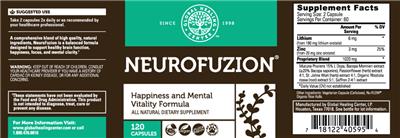
Supplement Facts
The label details for NeuroFuzion by Global Healing Center, sourced from the NIH Dietary Supplement Label Database.
Supplement Facts
| Ingredient | Amount | % DV |
|---|---|---|
| Zinc | 3 mg | 25% |
| Proprietary Blend | 1020 mg | -- |
| Lithium | 6 mg | -- |
| Zinc Orotate | 20 mg | -- |
| Lithium Orotate | 180 mg | -- |
| Mucuna pruriens | 0 NP | -- |
| St. John's Wort (herb) extract | 0 NP | -- |
| Bacopa monnieri extract | 0 NP | -- |
| Passionflower herb extract | 0 NP | -- |
| organic Rhodiola rosea (root) extract | 0 NP | -- |
| Saffron extract | 0 NP | -- |
Other ingredients: Vegetarian Capsule, organic Rice
Tap any ingredient to jump to its full detail below.
These statements are the manufacturer’s wording, reproduced from the product label — the label is saying it, not HelloPharmacist. We don’t verify or endorse them.
Suggested/Recommended/Usage/Directions
Suggested use Take 2 capsules 2x daily or as recommended by your healthcare professional.
Formulation
A comprehensive blend of high quality, natural ingredients, NeuroFuzion is a balanced formula designed to support healthy brain function, happiness, focus, and mental clarity.
GMO Free Gluten Free
Vegan
Precautions
Warning: Keep out of reach of children.
Consult your healthcare provider if you have a history of cardiac or kidney disease, or for any additional concerns.
FDA Disclaimer Statement
These statements have not been evaluated by the Food and Drug Administration. This product is not intended to diagnose, treat, cure or prevent any disease.
General Statements
Since 1998
Happiness and mental vitality formula
FDA Statement of Identity
All Natural Dietary Supplement
Seals/Symbols
GMO Free Gluten Free No Animal Testing Vegan
Is this label outdated? Report a formula or label change and our pharmacy team will review it.
NeuroFuzion by Global Healing Center label
The label scan from the NIH Dietary Supplement Label Database. Tap to enlarge.
Label images are published by the NIH Dietary Supplement Label Database for the version of this product on file. Always read your actual product label.
View the full label (PDF)The Ingredients in NeuroFuzion by Global Healing Center
These are the 8 active ingredients this product is made of. Select any to open its full monograph.
Serving size2 Capsule(s) Dosage formCapsule Servings per container60 Amounts shown are per serving.
Most supplement products combine several ingredients, and a medication can interact with the product through any one of them. Each ingredient below shows whether it has known drug interactions.
Zinc
Interacts with67 drugs
Zinc is an essential mineral that your body needs for immune function, wound healing, taste, and smell. Most people get enough from food, but suppleme...
Zinc monograph & interactionsProprietary Blend
Lithium
Interacts with515 drugs
Lithium is a naturally occurring metal that, in prescription form (lithium carbonate or citrate), is an FDA-approved, well-proven treatment for bipola...
Lithium monograph & interactionsOther (inactive) ingredients: Vegetarian Capsule, Organic Rice. These complete the product’s ingredient list but are not active constituents.
NeuroFuzion by Global Healing Center Drug Interactions
HelloPharmacist Interaction Report
NeuroFuzion by Global Healing Center contains eight ingredients, several of which interact with medications.
Through its zinc orotate, lithium orotate, Mucuna pruriens (cowhage), St. John's Wort, bacopa, passionflower, rhodiola, and saffron content, this product has documented interactions with numerous drug classes.
The most serious interaction is lithium orotate with serotonergic drugs (such as SSRIs and SNRIs), which theoretically increases the risk of serotonin syndrome—a potentially life-threatening condition.
Read the full breakdown — every affected drug type, severity by severity
Zinc orotate moderately interacts with quinolone and tetracycline antibiotics, cephalexin, penicillamine, and several HIV medications (ritonavir and integrase inhibitors), reducing their absorption and effectiveness. St.
John's Wort carries major interactions with heart medications (digoxin), seizure drugs (phenytoin, phenobarbital, mephenytoin), cancer drugs (irinotecan, docetaxel), and HIV protease inhibitors—all involving reduced drug levels. Lithium orotate also theoretically interacts with diuretics, NSAIDs, blood-pressure medications, and antipsychotics at moderate severity.
Mucuna pruriens (which contains levodopa) has major interactions with blood-pressure medications (methyldopa, guanethidine) and monoamine oxidase inhibitors (MAOIs), posing risks of dangerous changes in blood pressure. It moderately interacts with diabetes drugs, antipsychotics, tricyclic antidepressants, and certain anesthetics.
Bacopa, passionflower, rhodiola, and saffron carry moderate interactions with sedatives, blood-pressure drugs, diabetes medications, and various enzyme-metabolized drugs.
Altogether, these interactions span 1,627 individual medications. We could not check interaction data for the Zinc, Proprietary Blend, and Lithium components listed as containers—their individual contents are detailed above.
Check your exact medications with the tool below before taking this product.
Check your own medications below · Editorial policy · How we use AI
Want to check YOUR meds against NeuroFuzion?
Ask about interactions with your drugs in plain English — “Can I take it with lisinopril?” — and we find you the answer in seconds, ingredient by ingredient.
Go to the checkerIngredients driving the most interactions
Individual Drug Interactions
The ingredients in NeuroFuzion interact with 1,626 drugs. Click any drug to see the details.
8 of the 8 ingredients in NeuroFuzion interact with drugs. Each result below shows which ingredient is responsible. organic Rhodiola rosea (root) extract St. John's Wort (herb) extract Bacopa monnieri extract Passionflower herb extract Saffron extract Lithium Mucuna pruriens Zinc
Ado-trastuzumab EmtansineKadcyla
How Ado-trastuzumab Emtansine interacts with NeuroFuzion — through 4 ingredients. Tap an ingredient for the detail:
St. John's Wort (herb) ExtractCytochrome P450 3a4 (cyp3a4) Substrates Major
Interaction Summary
St.
Read the full St. John's Wort (herb) Extract + Ado-trastuzumab Emtansine interactionBacopa Monnieri ExtractCytochrome P450 3a4 (cyp3a4) Substrates Moderate
Interaction Summary
Theoretically, bacopa might increase the levels and adverse effects of CYP3A4 substrates.
Read the full Bacopa Monnieri Extract + Ado-trastuzumab Emtansine interactionOrganic Rhodiola Rosea (root) ExtractCytochrome P450 3a4 (cyp3a4) Substrates Minor
Interaction Summary
Theoretically, rhodiola might increase levels of drugs metabolized by CYP3A4.
Read the full Organic Rhodiola Rosea (root) Extract + Ado-trastuzumab Emtansine interactionPassionflower Herb ExtractCytochrome P450 3a4 (cyp3a4) Substrates Minor
Interaction Summary
Theoretically, passion flower might decrease the effects of CYP3A4 substrates.
Read the full Passionflower Herb Extract + Ado-trastuzumab Emtansine interactionAbemaciclibVerzenio
How Abemaciclib interacts with NeuroFuzion — through 4 ingredients. Tap an ingredient for the detail:
St. John's Wort (herb) ExtractCytochrome P450 3a4 (cyp3a4) Substrates Major
Bacopa Monnieri ExtractCytochrome P450 3a4 (cyp3a4) Substrates Moderate
Interaction Summary
Theoretically, bacopa might increase the levels and adverse effects of CYP3A4 substrates.
Read the full Bacopa Monnieri Extract + Abemaciclib interactionOrganic Rhodiola Rosea (root) ExtractCytochrome P450 3a4 (cyp3a4) Substrates Minor
Interaction Summary
Theoretically, rhodiola might increase levels of drugs metabolized by CYP3A4.
Read the full Organic Rhodiola Rosea (root) Extract + Abemaciclib interactionPassionflower Herb ExtractCytochrome P450 3a4 (cyp3a4) Substrates Minor
Interaction Summary
Theoretically, passion flower might decrease the effects of CYP3A4 substrates.
Read the full Passionflower Herb Extract + Abemaciclib interactionAbiraterone
How Abiraterone interacts with NeuroFuzion — through 4 ingredients. Tap an ingredient for the detail:
St. John's Wort (herb) ExtractCytochrome P450 3a4 (cyp3a4) Substrates Major
Bacopa Monnieri ExtractCytochrome P450 3a4 (cyp3a4) Substrates Moderate
Interaction Summary
Theoretically, bacopa might increase the levels and adverse effects of CYP3A4 substrates.
Read the full Bacopa Monnieri Extract + Abiraterone interactionPassionflower Herb ExtractCytochrome P450 3a4 (cyp3a4) Substrates Minor
Interaction Summary
Theoretically, passion flower might decrease the effects of CYP3A4 substrates.
Read the full Passionflower Herb Extract + Abiraterone interactionOrganic Rhodiola Rosea (root) ExtractCytochrome P450 3a4 (cyp3a4) Substrates Minor
Interaction Summary
Theoretically, rhodiola might increase levels of drugs metabolized by CYP3A4.
Read the full Organic Rhodiola Rosea (root) Extract + Abiraterone interactionAbiraterone AcetateYonsa, Zytiga
How Abiraterone Acetate interacts with NeuroFuzion — through 4 ingredients. Tap an ingredient for the detail:
St. John's Wort (herb) ExtractCytochrome P450 3a4 (cyp3a4) Substrates Major
Interaction Summary
St.
Read the full St. John's Wort (herb) Extract + Abiraterone Acetate interactionBacopa Monnieri ExtractCytochrome P450 3a4 (cyp3a4) Substrates Moderate
Interaction Summary
Theoretically, bacopa might increase the levels and adverse effects of CYP3A4 substrates.
Read the full Bacopa Monnieri Extract + Abiraterone Acetate interactionPassionflower Herb ExtractCytochrome P450 3a4 (cyp3a4) Substrates Minor
Interaction Summary
Theoretically, passion flower might decrease the effects of CYP3A4 substrates.
Read the full Passionflower Herb Extract + Abiraterone Acetate interactionOrganic Rhodiola Rosea (root) ExtractCytochrome P450 3a4 (cyp3a4) Substrates Minor
Interaction Summary
Theoretically, rhodiola might increase levels of drugs metabolized by CYP3A4.
Read the full Organic Rhodiola Rosea (root) Extract + Abiraterone Acetate interactionAcalabrutinibCalquence
How Acalabrutinib interacts with NeuroFuzion — through 4 ingredients. Tap an ingredient for the detail:
St. John's Wort (herb) ExtractP-glycoprotein Substrates, Cytochrome P450 3a4 (cyp3a4) Substrates Major
Bacopa Monnieri ExtractCytochrome P450 3a4 (cyp3a4) Substrates Moderate
Interaction Summary
Theoretically, bacopa might increase the levels and adverse effects of CYP3A4 substrates.
Read the full Bacopa Monnieri Extract + Acalabrutinib interactionOrganic Rhodiola Rosea (root) ExtractP-glycoprotein Substrates, Cytochrome P450 3a4 (cyp3a4) Substrates Moderate
Interaction Summary
Theoretically, rhodiola might increase levels of P-glycoprotein substrates.
Read the full Organic Rhodiola Rosea (root) Extract + Acalabrutinib interactionPassionflower Herb ExtractCytochrome P450 3a4 (cyp3a4) Substrates Minor
Interaction Summary
Theoretically, passion flower might decrease the effects of CYP3A4 substrates.
Read the full Passionflower Herb Extract + Acalabrutinib interactionAcetaminophen, Aspirin, CaffeineExcedrin, Excedrin Extra Strength, Excedrin Migraine
How Acetaminophen, Aspirin, Caffeine interacts with NeuroFuzion — through 6 ingredients. Tap an ingredient for the detail:
St. John's Wort (herb) ExtractCytochrome P450 1a2 (cyp1a2) Substrates, Cytochrome P450 3a4 (cyp3a4) Substrates Major
Interaction Summary
St.
Read the full St. John's Wort (herb) Extract + Acetaminophen, Aspirin, Caffeine interactionBacopa Monnieri ExtractCytochrome P450 3a4 (cyp3a4) Substrates, Cytochrome P450 1a2 (cyp1a2) Substrates Moderate
Interaction Summary
Theoretically, bacopa might increase the levels and adverse effects of CYP3A4 substrates.
Read the full Bacopa Monnieri Extract + Acetaminophen, Aspirin, Caffeine interactionSaffron ExtractCaffeine Moderate
Interaction Summary
Theoretically, saffron might inhibit the metabolism of caffeine.
Read the full Saffron Extract + Acetaminophen, Aspirin, Caffeine interactionLithium OrotateNonsteroidal Anti-inflammatory Drugs (nsaids), Methylxanthines Moderate
Interaction Summary
Theoretically, taking lithium supplements with NSAIDs might increase lithium levels and adverse effects.
Read the full Lithium Orotate + Acetaminophen, Aspirin, Caffeine interactionOrganic Rhodiola Rosea (root) ExtractCytochrome P450 1a2 (cyp1a2) Substrates, Cytochrome P450 3a4 (cyp3a4) Substrates Minor
Interaction Summary
Theoretically, rhodiola might increase levels of drugs metabolized by CYP1A2.
Read the full Organic Rhodiola Rosea (root) Extract + Acetaminophen, Aspirin, Caffeine interactionPassionflower Herb ExtractCytochrome P450 3a4 (cyp3a4) Substrates Minor
Interaction Summary
Theoretically, passion flower might decrease the effects of CYP3A4 substrates.
Read the full Passionflower Herb Extract + Acetaminophen, Aspirin, Caffeine interactionAcetaminophen, Butalbital, CaffeineEsgic, Esgic Plus, Fiogesic, Fioricet, Repan, Tecnal +1 more
How Acetaminophen, Butalbital, Caffeine interacts with NeuroFuzion — through 6 ingredients. Tap an ingredient for the detail:
St. John's Wort (herb) ExtractCytochrome P450 1a2 (cyp1a2) Substrates, Cytochrome P450 3a4 (cyp3a4) Substrates Major
Interaction Summary
St.
Read the full St. John's Wort (herb) Extract + Acetaminophen, Butalbital, Caffeine interactionBacopa Monnieri ExtractCytochrome P450 1a2 (cyp1a2) Substrates, Cytochrome P450 3a4 (cyp3a4) Substrates Moderate
Interaction Summary
Theoretically, bacopa might increase the levels and adverse effects of CYP1A2 substrates.
Read the full Bacopa Monnieri Extract + Acetaminophen, Butalbital, Caffeine interactionSaffron ExtractCaffeine Moderate
Interaction Summary
Theoretically, saffron might inhibit the metabolism of caffeine.
Read the full Saffron Extract + Acetaminophen, Butalbital, Caffeine interactionLithium OrotateMethylxanthines Moderate
Interaction Summary
Theoretically, taking lithium supplements with methylxanthines might decrease lithium levels.
Read the full Lithium Orotate + Acetaminophen, Butalbital, Caffeine interactionPassionflower Herb ExtractCytochrome P450 3a4 (cyp3a4) Substrates Minor
Interaction Summary
Theoretically, passion flower might decrease the effects of CYP3A4 substrates.
Read the full Passionflower Herb Extract + Acetaminophen, Butalbital, Caffeine interactionOrganic Rhodiola Rosea (root) ExtractCytochrome P450 1a2 (cyp1a2) Substrates, Cytochrome P450 3a4 (cyp3a4) Substrates Minor
Interaction Summary
Theoretically, rhodiola might increase levels of drugs metabolized by CYP1A2.
Read the full Organic Rhodiola Rosea (root) Extract + Acetaminophen, Butalbital, Caffeine interactionAcetaminophen, Butalbital, Caffeine, CodeineEsgic with Codeine, Fioricet w/ Codeine
How Acetaminophen, Butalbital, Caffeine, Codeine interacts with NeuroFuzion — through 6 ingredients. Tap an ingredient for the detail:
St. John's Wort (herb) ExtractCytochrome P450 3a4 (cyp3a4) Substrates, Cytochrome P450 1a2 (cyp1a2) Substrates Major
Saffron ExtractCaffeine, Cns Depressants Moderate
Interaction Summary
Theoretically, saffron might inhibit the metabolism of caffeine.
Read the full Saffron Extract + Acetaminophen, Butalbital, Caffeine, Codeine interactionPassionflower Herb ExtractCns Depressants, Cytochrome P450 3a4 (cyp3a4) Substrates Moderate
Interaction Summary
Concomitant use of passion flower with sedative drugs might cause additive effects and side effects.
Read the full Passionflower Herb Extract + Acetaminophen, Butalbital, Caffeine, Codeine interactionBacopa Monnieri ExtractCytochrome P450 3a4 (cyp3a4) Substrates, Cytochrome P450 1a2 (cyp1a2) Substrates Moderate
Interaction Summary
Theoretically, bacopa might increase the levels and adverse effects of CYP3A4 substrates.
Read the full Bacopa Monnieri Extract + Acetaminophen, Butalbital, Caffeine, Codeine interactionLithium OrotateMethylxanthines Moderate
Interaction Summary
Theoretically, taking lithium supplements with methylxanthines might decrease lithium levels.
Read the full Lithium Orotate + Acetaminophen, Butalbital, Caffeine, Codeine interactionOrganic Rhodiola Rosea (root) ExtractCytochrome P450 3a4 (cyp3a4) Substrates, Cns Depressants +1 Minor
Interaction Summary
Theoretically, rhodiola might increase levels of drugs metabolized by CYP3A4.
Read the full Organic Rhodiola Rosea (root) Extract + Acetaminophen, Butalbital, Caffeine, Codeine interactionAcetaminophen, Caffeine, Chlorpheniramine, Hydrocodone, PhenylephrineHycomine Compound
How Acetaminophen, Caffeine, Chlorpheniramine, Hydrocodone, Phenylephrine interacts with NeuroFuzion — through 6 ingredients. Tap an ingredient for the detail:
St. John's Wort (herb) ExtractCytochrome P450 1a2 (cyp1a2) Substrates, Cytochrome P450 3a4 (cyp3a4) Substrates +1 Major
Saffron ExtractCns Depressants, Caffeine Moderate
Interaction Summary
Theoretically, concomitant use of saffron and CNS depressants might have additive sedative effects.
Read the full Saffron Extract + Acetaminophen, Caffeine, Chlorpheniramine, Hydrocodone, Phenylephrine interactionPassionflower Herb ExtractCns Depressants, Cytochrome P450 3a4 (cyp3a4) Substrates Moderate
Interaction Summary
Concomitant use of passion flower with sedative drugs might cause additive effects and side effects.
Read the full Passionflower Herb Extract + Acetaminophen, Caffeine, Chlorpheniramine, Hydrocodone, Phenylephrine interactionLithium OrotateMethylxanthines Moderate
Interaction Summary
Theoretically, taking lithium supplements with methylxanthines might decrease lithium levels.
Read the full Lithium Orotate + Acetaminophen, Caffeine, Chlorpheniramine, Hydrocodone, Phenylephrine interactionBacopa Monnieri ExtractCytochrome P450 3a4 (cyp3a4) Substrates, Anticholinergic Drugs +1 Moderate
Interaction Summary
Theoretically, bacopa might increase the levels and adverse effects of CYP3A4 substrates.
Read the full Bacopa Monnieri Extract + Acetaminophen, Caffeine, Chlorpheniramine, Hydrocodone, Phenylephrine interactionOrganic Rhodiola Rosea (root) ExtractCns Depressants, Cytochrome P450 3a4 (cyp3a4) Substrates +1 Minor
Interaction Summary
Theoretically, rhodiola might increase the risk of adverse effects when taken with CNS depressants.
Read the full Organic Rhodiola Rosea (root) Extract + Acetaminophen, Caffeine, Chlorpheniramine, Hydrocodone, Phenylephrine interactionAcetaminophen, Caffeine, CodeineGesic C15, Gesic C30, Gesic C8, Lenoltec 1, Lenoltec 2, Lenoltec 3 +1 more
How Acetaminophen, Caffeine, Codeine interacts with NeuroFuzion — through 6 ingredients. Tap an ingredient for the detail:
St. John's Wort (herb) ExtractCytochrome P450 1a2 (cyp1a2) Substrates, Cytochrome P450 3a4 (cyp3a4) Substrates Major
Interaction Summary
St.
Read the full St. John's Wort (herb) Extract + Acetaminophen, Caffeine, Codeine interactionBacopa Monnieri ExtractCytochrome P450 1a2 (cyp1a2) Substrates, Cytochrome P450 3a4 (cyp3a4) Substrates Moderate
Interaction Summary
Theoretically, bacopa might increase the levels and adverse effects of CYP1A2 substrates.
Read the full Bacopa Monnieri Extract + Acetaminophen, Caffeine, Codeine interactionLithium OrotateMethylxanthines Moderate
Interaction Summary
Theoretically, taking lithium supplements with methylxanthines might decrease lithium levels.
Read the full Lithium Orotate + Acetaminophen, Caffeine, Codeine interactionPassionflower Herb ExtractCytochrome P450 3a4 (cyp3a4) Substrates, Cns Depressants Moderate
Interaction Summary
Theoretically, passion flower might decrease the effects of CYP3A4 substrates.
Read the full Passionflower Herb Extract + Acetaminophen, Caffeine, Codeine interactionSaffron ExtractCns Depressants, Caffeine Moderate
Interaction Summary
Theoretically, concomitant use of saffron and CNS depressants might have additive sedative effects.
Read the full Saffron Extract + Acetaminophen, Caffeine, Codeine interactionOrganic Rhodiola Rosea (root) ExtractCytochrome P450 1a2 (cyp1a2) Substrates, Cns Depressants +1 Minor
Interaction Summary
Theoretically, rhodiola might increase levels of drugs metabolized by CYP1A2.
Read the full Organic Rhodiola Rosea (root) Extract + Acetaminophen, Caffeine, Codeine interactionAcetaminophen, Caffeine, Codeine, SalicylamideCodalan No.1, Codalan No.2, Codalan No.3
How Acetaminophen, Caffeine, Codeine, Salicylamide interacts with NeuroFuzion — through 6 ingredients. Tap an ingredient for the detail:
St. John's Wort (herb) ExtractCytochrome P450 3a4 (cyp3a4) Substrates, Cytochrome P450 1a2 (cyp1a2) Substrates Major
Saffron ExtractCaffeine, Cns Depressants Moderate
Interaction Summary
Theoretically, saffron might inhibit the metabolism of caffeine.
Read the full Saffron Extract + Acetaminophen, Caffeine, Codeine, Salicylamide interactionPassionflower Herb ExtractCytochrome P450 3a4 (cyp3a4) Substrates, Cns Depressants Moderate
Interaction Summary
Theoretically, passion flower might decrease the effects of CYP3A4 substrates.
Read the full Passionflower Herb Extract + Acetaminophen, Caffeine, Codeine, Salicylamide interactionBacopa Monnieri ExtractCytochrome P450 3a4 (cyp3a4) Substrates, Cytochrome P450 1a2 (cyp1a2) Substrates Moderate
Interaction Summary
Theoretically, bacopa might increase the levels and adverse effects of CYP3A4 substrates.
Read the full Bacopa Monnieri Extract + Acetaminophen, Caffeine, Codeine, Salicylamide interactionLithium OrotateMethylxanthines Moderate
Interaction Summary
Theoretically, taking lithium supplements with methylxanthines might decrease lithium levels.
Read the full Lithium Orotate + Acetaminophen, Caffeine, Codeine, Salicylamide interactionOrganic Rhodiola Rosea (root) ExtractCns Depressants, Cytochrome P450 3a4 (cyp3a4) Substrates +1 Minor
Interaction Summary
Theoretically, rhodiola might increase the risk of adverse effects when taken with CNS depressants.
Read the full Organic Rhodiola Rosea (root) Extract + Acetaminophen, Caffeine, Codeine, Salicylamide interactionAcetaminophen, Caffeine, DihydrocodeineDHC Plus, Panlor DC, Panlor SS
How Acetaminophen, Caffeine, Dihydrocodeine interacts with NeuroFuzion — through 6 ingredients. Tap an ingredient for the detail:
St. John's Wort (herb) ExtractCytochrome P450 3a4 (cyp3a4) Substrates, Cytochrome P450 1a2 (cyp1a2) Substrates Major
Bacopa Monnieri ExtractCytochrome P450 3a4 (cyp3a4) Substrates, Cytochrome P450 1a2 (cyp1a2) Substrates Moderate
Interaction Summary
Theoretically, bacopa might increase the levels and adverse effects of CYP3A4 substrates.
Read the full Bacopa Monnieri Extract + Acetaminophen, Caffeine, Dihydrocodeine interactionSaffron ExtractCns Depressants, Caffeine Moderate
Interaction Summary
Theoretically, concomitant use of saffron and CNS depressants might have additive sedative effects.
Read the full Saffron Extract + Acetaminophen, Caffeine, Dihydrocodeine interactionPassionflower Herb ExtractCytochrome P450 3a4 (cyp3a4) Substrates, Cns Depressants Moderate
Interaction Summary
Theoretically, passion flower might decrease the effects of CYP3A4 substrates.
Read the full Passionflower Herb Extract + Acetaminophen, Caffeine, Dihydrocodeine interactionLithium OrotateMethylxanthines Moderate
Interaction Summary
Theoretically, taking lithium supplements with methylxanthines might decrease lithium levels.
Read the full Lithium Orotate + Acetaminophen, Caffeine, Dihydrocodeine interactionOrganic Rhodiola Rosea (root) ExtractCytochrome P450 3a4 (cyp3a4) Substrates, Cytochrome P450 1a2 (cyp1a2) Substrates +1 Minor
Interaction Summary
Theoretically, rhodiola might increase levels of drugs metabolized by CYP3A4.
Read the full Organic Rhodiola Rosea (root) Extract + Acetaminophen, Caffeine, Dihydrocodeine interactionAcetaminophen, Caffeine, IsomethepteneMigralam
How Acetaminophen, Caffeine, Isometheptene interacts with NeuroFuzion — through 6 ingredients. Tap an ingredient for the detail:
St. John's Wort (herb) ExtractCytochrome P450 1a2 (cyp1a2) Substrates, Cytochrome P450 3a4 (cyp3a4) Substrates Major
Lithium OrotateMethylxanthines Moderate
Interaction Summary
Theoretically, taking lithium supplements with methylxanthines might decrease lithium levels.
Read the full Lithium Orotate + Acetaminophen, Caffeine, Isometheptene interactionBacopa Monnieri ExtractCytochrome P450 1a2 (cyp1a2) Substrates, Cytochrome P450 3a4 (cyp3a4) Substrates Moderate
Interaction Summary
Theoretically, bacopa might increase the levels and adverse effects of CYP1A2 substrates.
Read the full Bacopa Monnieri Extract + Acetaminophen, Caffeine, Isometheptene interactionSaffron ExtractCaffeine Moderate
Interaction Summary
Theoretically, saffron might inhibit the metabolism of caffeine.
Read the full Saffron Extract + Acetaminophen, Caffeine, Isometheptene interactionOrganic Rhodiola Rosea (root) ExtractCytochrome P450 3a4 (cyp3a4) Substrates, Cytochrome P450 1a2 (cyp1a2) Substrates Minor
Interaction Summary
Theoretically, rhodiola might increase levels of drugs metabolized by CYP3A4.
Read the full Organic Rhodiola Rosea (root) Extract + Acetaminophen, Caffeine, Isometheptene interactionPassionflower Herb ExtractCytochrome P450 3a4 (cyp3a4) Substrates Minor
Interaction Summary
Theoretically, passion flower might decrease the effects of CYP3A4 substrates.
Read the full Passionflower Herb Extract + Acetaminophen, Caffeine, Isometheptene interactionAcetaminophen, Caffeine, PyrilamineMidol Max Strength Menstrual
How Acetaminophen, Caffeine, Pyrilamine interacts with NeuroFuzion — through 6 ingredients. Tap an ingredient for the detail:
Lithium OrotateMethylxanthines, Diuretic Drugs Major
Interaction Summary
Theoretically, taking lithium supplements with methylxanthines might decrease lithium levels.
Read the full Lithium Orotate + Acetaminophen, Caffeine, Pyrilamine interactionSt. John's Wort (herb) ExtractCytochrome P450 3a4 (cyp3a4) Substrates, Cytochrome P450 1a2 (cyp1a2) Substrates Major
Interaction Summary
St.
Read the full St. John's Wort (herb) Extract + Acetaminophen, Caffeine, Pyrilamine interactionSaffron ExtractCaffeine Moderate
Interaction Summary
Theoretically, saffron might inhibit the metabolism of caffeine.
Read the full Saffron Extract + Acetaminophen, Caffeine, Pyrilamine interactionBacopa Monnieri ExtractCytochrome P450 3a4 (cyp3a4) Substrates, Cytochrome P450 1a2 (cyp1a2) Substrates +1 Moderate
Interaction Summary
Theoretically, bacopa might increase the levels and adverse effects of CYP3A4 substrates.
Read the full Bacopa Monnieri Extract + Acetaminophen, Caffeine, Pyrilamine interactionPassionflower Herb ExtractCytochrome P450 3a4 (cyp3a4) Substrates Minor
Interaction Summary
Theoretically, passion flower might decrease the effects of CYP3A4 substrates.
Read the full Passionflower Herb Extract + Acetaminophen, Caffeine, Pyrilamine interactionOrganic Rhodiola Rosea (root) ExtractCytochrome P450 1a2 (cyp1a2) Substrates, Cytochrome P450 3a4 (cyp3a4) Substrates Minor
Interaction Summary
Theoretically, rhodiola might increase levels of drugs metabolized by CYP1A2.
Read the full Organic Rhodiola Rosea (root) Extract + Acetaminophen, Caffeine, Pyrilamine interactionAcetaminophen, Chlorpheniramine Maleate, Dextromethorphan HbrVicks Formula 44M Cough, Cold & Flu Relief
How Acetaminophen, Chlorpheniramine Maleate, Dextromethorphan Hbr interacts with NeuroFuzion — through 5 ingredients. Tap an ingredient for the detail:
Lithium OrotateSerotonergic Drugs Major
Interaction Summary
Theoretically, taking lithium supplements with serotonergic drugs might both mask and increase the risk of serotonin syndrome.
Read the full Lithium Orotate + Acetaminophen, Chlorpheniramine Maleate, Dextromethorphan Hbr interactionSt. John's Wort (herb) ExtractPhotosensitizing Drugs, Cytochrome P450 1a2 (cyp1a2) Substrates +2 Major
Interaction Summary
Theoretically, St.
Read the full St. John's Wort (herb) Extract + Acetaminophen, Chlorpheniramine Maleate, Dextromethorphan Hbr interactionBacopa Monnieri ExtractCytochrome P450 1a2 (cyp1a2) Substrates, Cytochrome P450 3a4 (cyp3a4) Substrates +1 Moderate
Interaction Summary
Theoretically, bacopa might increase the levels and adverse effects of CYP1A2 substrates.
Read the full Bacopa Monnieri Extract + Acetaminophen, Chlorpheniramine Maleate, Dextromethorphan Hbr interactionPassionflower Herb ExtractCytochrome P450 3a4 (cyp3a4) Substrates Minor
Interaction Summary
Theoretically, passion flower might decrease the effects of CYP3A4 substrates.
Read the full Passionflower Herb Extract + Acetaminophen, Chlorpheniramine Maleate, Dextromethorphan Hbr interactionOrganic Rhodiola Rosea (root) ExtractCytochrome P450 1a2 (cyp1a2) Substrates, Cytochrome P450 3a4 (cyp3a4) Substrates Minor
Interaction Summary
Theoretically, rhodiola might increase levels of drugs metabolized by CYP1A2.
Read the full Organic Rhodiola Rosea (root) Extract + Acetaminophen, Chlorpheniramine Maleate, Dextromethorphan Hbr interactionAcetaminophen, Chlorpheniramine, Codeine, PhenylephrineColrex
How Acetaminophen, Chlorpheniramine, Codeine, Phenylephrine interacts with NeuroFuzion — through 6 ingredients. Tap an ingredient for the detail:
St. John's Wort (herb) ExtractCytochrome P450 1a2 (cyp1a2) Substrates, Serotonergic Drugs +2 Major
Lithium OrotateSerotonergic Drugs Major
Interaction Summary
Theoretically, taking lithium supplements with serotonergic drugs might both mask and increase the risk of serotonin syndrome.
Read the full Lithium Orotate + Acetaminophen, Chlorpheniramine, Codeine, Phenylephrine interactionPassionflower Herb ExtractCns Depressants, Cytochrome P450 3a4 (cyp3a4) Substrates Moderate
Interaction Summary
Concomitant use of passion flower with sedative drugs might cause additive effects and side effects.
Read the full Passionflower Herb Extract + Acetaminophen, Chlorpheniramine, Codeine, Phenylephrine interactionSaffron ExtractCns Depressants Moderate
Interaction Summary
Theoretically, concomitant use of saffron and CNS depressants might have additive sedative effects.
Read the full Saffron Extract + Acetaminophen, Chlorpheniramine, Codeine, Phenylephrine interactionBacopa Monnieri ExtractCytochrome P450 3a4 (cyp3a4) Substrates, Anticholinergic Drugs +1 Moderate
Interaction Summary
Theoretically, bacopa might increase the levels and adverse effects of CYP3A4 substrates.
Read the full Bacopa Monnieri Extract + Acetaminophen, Chlorpheniramine, Codeine, Phenylephrine interactionOrganic Rhodiola Rosea (root) ExtractCns Depressants, Cytochrome P450 3a4 (cyp3a4) Substrates +1 Minor
Interaction Summary
Theoretically, rhodiola might increase the risk of adverse effects when taken with CNS depressants.
Read the full Organic Rhodiola Rosea (root) Extract + Acetaminophen, Chlorpheniramine, Codeine, Phenylephrine interactionAcetaminophen, Chlorpheniramine, DextromethorphanCoricidin II Extra Strength Cold and Flu
How Acetaminophen, Chlorpheniramine, Dextromethorphan interacts with NeuroFuzion — through 5 ingredients. Tap an ingredient for the detail:
St. John's Wort (herb) ExtractCytochrome P450 3a4 (cyp3a4) Substrates, Cytochrome P450 1a2 (cyp1a2) Substrates +2 Major
Lithium OrotateSerotonergic Drugs Major
Interaction Summary
Theoretically, taking lithium supplements with serotonergic drugs might both mask and increase the risk of serotonin syndrome.
Read the full Lithium Orotate + Acetaminophen, Chlorpheniramine, Dextromethorphan interactionBacopa Monnieri ExtractCytochrome P450 1a2 (cyp1a2) Substrates, Cytochrome P450 3a4 (cyp3a4) Substrates +1 Moderate
Interaction Summary
Theoretically, bacopa might increase the levels and adverse effects of CYP1A2 substrates.
Read the full Bacopa Monnieri Extract + Acetaminophen, Chlorpheniramine, Dextromethorphan interactionOrganic Rhodiola Rosea (root) ExtractCytochrome P450 1a2 (cyp1a2) Substrates, Cytochrome P450 3a4 (cyp3a4) Substrates Minor
Interaction Summary
Theoretically, rhodiola might increase levels of drugs metabolized by CYP1A2.
Read the full Organic Rhodiola Rosea (root) Extract + Acetaminophen, Chlorpheniramine, Dextromethorphan interactionPassionflower Herb ExtractCytochrome P450 3a4 (cyp3a4) Substrates Minor
Interaction Summary
Theoretically, passion flower might decrease the effects of CYP3A4 substrates.
Read the full Passionflower Herb Extract + Acetaminophen, Chlorpheniramine, Dextromethorphan interactionAcetaminophen, Chlorpheniramine, Dextromethorphan HydrobromideCoricidin HBP Maximum Strength Flu
How Acetaminophen, Chlorpheniramine, Dextromethorphan Hydrobromide interacts with NeuroFuzion — through 5 ingredients. Tap an ingredient for the detail:
Lithium OrotateSerotonergic Drugs Major
Interaction Summary
Theoretically, taking lithium supplements with serotonergic drugs might both mask and increase the risk of serotonin syndrome.
Read the full Lithium Orotate + Acetaminophen, Chlorpheniramine, Dextromethorphan Hydrobromide interactionSt. John's Wort (herb) ExtractPhotosensitizing Drugs, Cytochrome P450 3a4 (cyp3a4) Substrates +2 Major
Interaction Summary
Theoretically, St.
Read the full St. John's Wort (herb) Extract + Acetaminophen, Chlorpheniramine, Dextromethorphan Hydrobromide interactionBacopa Monnieri ExtractCytochrome P450 3a4 (cyp3a4) Substrates, Cytochrome P450 1a2 (cyp1a2) Substrates +1 Moderate
Interaction Summary
Theoretically, bacopa might increase the levels and adverse effects of CYP3A4 substrates.
Read the full Bacopa Monnieri Extract + Acetaminophen, Chlorpheniramine, Dextromethorphan Hydrobromide interactionOrganic Rhodiola Rosea (root) ExtractCytochrome P450 3a4 (cyp3a4) Substrates, Cytochrome P450 1a2 (cyp1a2) Substrates Minor
Interaction Summary
Theoretically, rhodiola might increase levels of drugs metabolized by CYP3A4.
Read the full Organic Rhodiola Rosea (root) Extract + Acetaminophen, Chlorpheniramine, Dextromethorphan Hydrobromide interactionPassionflower Herb ExtractCytochrome P450 3a4 (cyp3a4) Substrates Minor
Interaction Summary
Theoretically, passion flower might decrease the effects of CYP3A4 substrates.
Read the full Passionflower Herb Extract + Acetaminophen, Chlorpheniramine, Dextromethorphan Hydrobromide interactionAcetaminophen, Chlorpheniramine, Dextromethorphan, PhenylpropanolamineMulti Symptom Cold Relief
How Acetaminophen, Chlorpheniramine, Dextromethorphan, Phenylpropanolamine interacts with NeuroFuzion — through 5 ingredients. Tap an ingredient for the detail:
Lithium OrotateSerotonergic Drugs Major
Interaction Summary
Theoretically, taking lithium supplements with serotonergic drugs might both mask and increase the risk of serotonin syndrome.
Read the full Lithium Orotate + Acetaminophen, Chlorpheniramine, Dextromethorphan, Phenylpropanolamine interactionSt. John's Wort (herb) ExtractCytochrome P450 1a2 (cyp1a2) Substrates, Photosensitizing Drugs +2 Major
Bacopa Monnieri ExtractCytochrome P450 3a4 (cyp3a4) Substrates, Cytochrome P450 1a2 (cyp1a2) Substrates +1 Moderate
Interaction Summary
Theoretically, bacopa might increase the levels and adverse effects of CYP3A4 substrates.
Read the full Bacopa Monnieri Extract + Acetaminophen, Chlorpheniramine, Dextromethorphan, Phenylpropanolamine interactionPassionflower Herb ExtractCytochrome P450 3a4 (cyp3a4) Substrates Minor
Interaction Summary
Theoretically, passion flower might decrease the effects of CYP3A4 substrates.
Read the full Passionflower Herb Extract + Acetaminophen, Chlorpheniramine, Dextromethorphan, Phenylpropanolamine interactionOrganic Rhodiola Rosea (root) ExtractCytochrome P450 1a2 (cyp1a2) Substrates, Cytochrome P450 3a4 (cyp3a4) Substrates Minor
Interaction Summary
Theoretically, rhodiola might increase levels of drugs metabolized by CYP1A2.
Read the full Organic Rhodiola Rosea (root) Extract + Acetaminophen, Chlorpheniramine, Dextromethorphan, Phenylpropanolamine interactionAcetaminophen, Chlorpheniramine, Dextromethorphan, PseudoephedrineChildren's Tylenol Cold Plus Cough, Tylenol Cold Ex Strength
How Acetaminophen, Chlorpheniramine, Dextromethorphan, Pseudoephedrine interacts with NeuroFuzion — through 5 ingredients. Tap an ingredient for the detail:
Lithium OrotateSerotonergic Drugs Major
Interaction Summary
Theoretically, taking lithium supplements with serotonergic drugs might both mask and increase the risk of serotonin syndrome.
Read the full Lithium Orotate + Acetaminophen, Chlorpheniramine, Dextromethorphan, Pseudoephedrine interactionSt. John's Wort (herb) ExtractSerotonergic Drugs, Photosensitizing Drugs +2 Major
Interaction Summary
Theoretically, St.
Read the full St. John's Wort (herb) Extract + Acetaminophen, Chlorpheniramine, Dextromethorphan, Pseudoephedrine interactionBacopa Monnieri ExtractAnticholinergic Drugs, Cytochrome P450 3a4 (cyp3a4) Substrates +1 Moderate
Interaction Summary
Theoretically, concurrent use might decrease the effectiveness of both agents.
Read the full Bacopa Monnieri Extract + Acetaminophen, Chlorpheniramine, Dextromethorphan, Pseudoephedrine interactionPassionflower Herb ExtractCytochrome P450 3a4 (cyp3a4) Substrates Minor
Interaction Summary
Theoretically, passion flower might decrease the effects of CYP3A4 substrates.
Read the full Passionflower Herb Extract + Acetaminophen, Chlorpheniramine, Dextromethorphan, Pseudoephedrine interactionOrganic Rhodiola Rosea (root) ExtractCytochrome P450 3a4 (cyp3a4) Substrates, Cytochrome P450 1a2 (cyp1a2) Substrates Minor
Interaction Summary
Theoretically, rhodiola might increase levels of drugs metabolized by CYP3A4.
Read the full Organic Rhodiola Rosea (root) Extract + Acetaminophen, Chlorpheniramine, Dextromethorphan, Pseudoephedrine interactionAcetaminophen, Chlorpheniramine, Guaifenesin, Phenylephrine, SalicylamideRhinogesic GG
How Acetaminophen, Chlorpheniramine, Guaifenesin, Phenylephrine, Salicylamide interacts with NeuroFuzion — through 5 ingredients. Tap an ingredient for the detail:
St. John's Wort (herb) ExtractCytochrome P450 3a4 (cyp3a4) Substrates, Photosensitizing Drugs +2 Major
Lithium OrotateSerotonergic Drugs Major
Interaction Summary
Theoretically, taking lithium supplements with serotonergic drugs might both mask and increase the risk of serotonin syndrome.
Read the full Lithium Orotate + Acetaminophen, Chlorpheniramine, Guaifenesin, Phenylephrine, Salicylamide interactionBacopa Monnieri ExtractCytochrome P450 1a2 (cyp1a2) Substrates, Cytochrome P450 3a4 (cyp3a4) Substrates +1 Moderate
Interaction Summary
Theoretically, bacopa might increase the levels and adverse effects of CYP1A2 substrates.
Read the full Bacopa Monnieri Extract + Acetaminophen, Chlorpheniramine, Guaifenesin, Phenylephrine, Salicylamide interactionPassionflower Herb ExtractCytochrome P450 3a4 (cyp3a4) Substrates Minor
Interaction Summary
Theoretically, passion flower might decrease the effects of CYP3A4 substrates.
Read the full Passionflower Herb Extract + Acetaminophen, Chlorpheniramine, Guaifenesin, Phenylephrine, Salicylamide interactionOrganic Rhodiola Rosea (root) ExtractCytochrome P450 1a2 (cyp1a2) Substrates, Cytochrome P450 3a4 (cyp3a4) Substrates Minor
Interaction Summary
Theoretically, rhodiola might increase levels of drugs metabolized by CYP1A2.
Read the full Organic Rhodiola Rosea (root) Extract + Acetaminophen, Chlorpheniramine, Guaifenesin, Phenylephrine, Salicylamide interactionAcetaminophen, Chlorpheniramine, PhenylephrineAlka-Seltzer PLUS, Histex SR, Protid
How Acetaminophen, Chlorpheniramine, Phenylephrine interacts with NeuroFuzion — through 5 ingredients. Tap an ingredient for the detail:
St. John's Wort (herb) ExtractSerotonergic Drugs, Cytochrome P450 3a4 (cyp3a4) Substrates +2 Major
Interaction Summary
Theoretically, St.
Read the full St. John's Wort (herb) Extract + Acetaminophen, Chlorpheniramine, Phenylephrine interactionLithium OrotateSerotonergic Drugs Major
Interaction Summary
Theoretically, taking lithium supplements with serotonergic drugs might both mask and increase the risk of serotonin syndrome.
Read the full Lithium Orotate + Acetaminophen, Chlorpheniramine, Phenylephrine interactionBacopa Monnieri ExtractAnticholinergic Drugs, Cytochrome P450 3a4 (cyp3a4) Substrates +1 Moderate
Interaction Summary
Theoretically, concurrent use might decrease the effectiveness of both agents.
Read the full Bacopa Monnieri Extract + Acetaminophen, Chlorpheniramine, Phenylephrine interactionOrganic Rhodiola Rosea (root) ExtractCytochrome P450 3a4 (cyp3a4) Substrates, Cytochrome P450 1a2 (cyp1a2) Substrates Minor
Interaction Summary
Theoretically, rhodiola might increase levels of drugs metabolized by CYP3A4.
Read the full Organic Rhodiola Rosea (root) Extract + Acetaminophen, Chlorpheniramine, Phenylephrine interactionPassionflower Herb ExtractCytochrome P450 3a4 (cyp3a4) Substrates Minor
Interaction Summary
Theoretically, passion flower might decrease the effects of CYP3A4 substrates.
Read the full Passionflower Herb Extract + Acetaminophen, Chlorpheniramine, Phenylephrine interactionAcetaminophen, Chlorpheniramine, Phenylephrine, SalicylamideRhinogesic, Rhinogesic JR
How Acetaminophen, Chlorpheniramine, Phenylephrine, Salicylamide interacts with NeuroFuzion — through 5 ingredients. Tap an ingredient for the detail:
Lithium OrotateSerotonergic Drugs Major
Interaction Summary
Theoretically, taking lithium supplements with serotonergic drugs might both mask and increase the risk of serotonin syndrome.
Read the full Lithium Orotate + Acetaminophen, Chlorpheniramine, Phenylephrine, Salicylamide interactionSt. John's Wort (herb) ExtractCytochrome P450 3a4 (cyp3a4) Substrates, Cytochrome P450 1a2 (cyp1a2) Substrates +2 Major
Bacopa Monnieri ExtractCytochrome P450 1a2 (cyp1a2) Substrates, Cytochrome P450 3a4 (cyp3a4) Substrates +1 Moderate
Interaction Summary
Theoretically, bacopa might increase the levels and adverse effects of CYP1A2 substrates.
Read the full Bacopa Monnieri Extract + Acetaminophen, Chlorpheniramine, Phenylephrine, Salicylamide interactionOrganic Rhodiola Rosea (root) ExtractCytochrome P450 3a4 (cyp3a4) Substrates, Cytochrome P450 1a2 (cyp1a2) Substrates Minor
Interaction Summary
Theoretically, rhodiola might increase levels of drugs metabolized by CYP3A4.
Read the full Organic Rhodiola Rosea (root) Extract + Acetaminophen, Chlorpheniramine, Phenylephrine, Salicylamide interactionPassionflower Herb ExtractCytochrome P450 3a4 (cyp3a4) Substrates Minor
Interaction Summary
Theoretically, passion flower might decrease the effects of CYP3A4 substrates.
Read the full Passionflower Herb Extract + Acetaminophen, Chlorpheniramine, Phenylephrine, Salicylamide interactionAcetaminophen, Chlorpheniramine, PhenylpropanolamineAlumadrine, Conex, Sinadrin Max Strength, Sinulin
How Acetaminophen, Chlorpheniramine, Phenylpropanolamine interacts with NeuroFuzion — through 5 ingredients. Tap an ingredient for the detail:
Lithium OrotateSerotonergic Drugs Major
Interaction Summary
Theoretically, taking lithium supplements with serotonergic drugs might both mask and increase the risk of serotonin syndrome.
Read the full Lithium Orotate + Acetaminophen, Chlorpheniramine, Phenylpropanolamine interactionSt. John's Wort (herb) ExtractCytochrome P450 1a2 (cyp1a2) Substrates, Cytochrome P450 3a4 (cyp3a4) Substrates +2 Major
Bacopa Monnieri ExtractAnticholinergic Drugs, Cytochrome P450 3a4 (cyp3a4) Substrates +1 Moderate
Interaction Summary
Theoretically, concurrent use might decrease the effectiveness of both agents.
Read the full Bacopa Monnieri Extract + Acetaminophen, Chlorpheniramine, Phenylpropanolamine interactionPassionflower Herb ExtractCytochrome P450 3a4 (cyp3a4) Substrates Minor
Interaction Summary
Theoretically, passion flower might decrease the effects of CYP3A4 substrates.
Read the full Passionflower Herb Extract + Acetaminophen, Chlorpheniramine, Phenylpropanolamine interactionOrganic Rhodiola Rosea (root) ExtractCytochrome P450 1a2 (cyp1a2) Substrates, Cytochrome P450 3a4 (cyp3a4) Substrates Minor
Interaction Summary
Theoretically, rhodiola might increase levels of drugs metabolized by CYP1A2.
Read the full Organic Rhodiola Rosea (root) Extract + Acetaminophen, Chlorpheniramine, Phenylpropanolamine interactionAcetaminophen, Chlorpheniramine, Phenylpropanolamine, OpiumHista-Derfule
How Acetaminophen, Chlorpheniramine, Phenylpropanolamine, Opium interacts with NeuroFuzion — through 6 ingredients. Tap an ingredient for the detail:
Lithium OrotateSerotonergic Drugs Major
Interaction Summary
Theoretically, taking lithium supplements with serotonergic drugs might both mask and increase the risk of serotonin syndrome.
Read the full Lithium Orotate + Acetaminophen, Chlorpheniramine, Phenylpropanolamine, Opium interactionSt. John's Wort (herb) ExtractSerotonergic Drugs, Cytochrome P450 1a2 (cyp1a2) Substrates +2 Major
Interaction Summary
Theoretically, St.
Read the full St. John's Wort (herb) Extract + Acetaminophen, Chlorpheniramine, Phenylpropanolamine, Opium interactionBacopa Monnieri ExtractAnticholinergic Drugs, Cytochrome P450 1a2 (cyp1a2) Substrates +1 Moderate
Interaction Summary
Theoretically, concurrent use might decrease the effectiveness of both agents.
Read the full Bacopa Monnieri Extract + Acetaminophen, Chlorpheniramine, Phenylpropanolamine, Opium interactionPassionflower Herb ExtractCytochrome P450 3a4 (cyp3a4) Substrates, Cns Depressants Moderate
Interaction Summary
Theoretically, passion flower might decrease the effects of CYP3A4 substrates.
Read the full Passionflower Herb Extract + Acetaminophen, Chlorpheniramine, Phenylpropanolamine, Opium interactionSaffron ExtractCns Depressants Moderate
Interaction Summary
Theoretically, concomitant use of saffron and CNS depressants might have additive sedative effects.
Read the full Saffron Extract + Acetaminophen, Chlorpheniramine, Phenylpropanolamine, Opium interactionOrganic Rhodiola Rosea (root) ExtractCytochrome P450 3a4 (cyp3a4) Substrates, Cytochrome P450 1a2 (cyp1a2) Substrates +1 Minor
Interaction Summary
Theoretically, rhodiola might increase levels of drugs metabolized by CYP3A4.
Read the full Organic Rhodiola Rosea (root) Extract + Acetaminophen, Chlorpheniramine, Phenylpropanolamine, Opium interactionAcetaminophen, Chlorpheniramine, Phenylpropanolamine, PhenyltoloxamineNorel Plus
How Acetaminophen, Chlorpheniramine, Phenylpropanolamine, Phenyltoloxamine interacts with NeuroFuzion — through 5 ingredients. Tap an ingredient for the detail:
St. John's Wort (herb) ExtractCytochrome P450 3a4 (cyp3a4) Substrates, Cytochrome P450 1a2 (cyp1a2) Substrates +2 Major
Lithium OrotateSerotonergic Drugs Major
Interaction Summary
Theoretically, taking lithium supplements with serotonergic drugs might both mask and increase the risk of serotonin syndrome.
Read the full Lithium Orotate + Acetaminophen, Chlorpheniramine, Phenylpropanolamine, Phenyltoloxamine interactionBacopa Monnieri ExtractCytochrome P450 3a4 (cyp3a4) Substrates, Anticholinergic Drugs +1 Moderate
Interaction Summary
Theoretically, bacopa might increase the levels and adverse effects of CYP3A4 substrates.
Read the full Bacopa Monnieri Extract + Acetaminophen, Chlorpheniramine, Phenylpropanolamine, Phenyltoloxamine interactionPassionflower Herb ExtractCytochrome P450 3a4 (cyp3a4) Substrates Minor
Interaction Summary
Theoretically, passion flower might decrease the effects of CYP3A4 substrates.
Read the full Passionflower Herb Extract + Acetaminophen, Chlorpheniramine, Phenylpropanolamine, Phenyltoloxamine interactionOrganic Rhodiola Rosea (root) ExtractCytochrome P450 3a4 (cyp3a4) Substrates, Cytochrome P450 1a2 (cyp1a2) Substrates Minor
Interaction Summary
Theoretically, rhodiola might increase levels of drugs metabolized by CYP3A4.
Read the full Organic Rhodiola Rosea (root) Extract + Acetaminophen, Chlorpheniramine, Phenylpropanolamine, Phenyltoloxamine interactionAcetaminophen, Chlorpheniramine, PseudoephedrineAlka-Seltzer PLUS Liquid Gels, Children's Tylenol Cold, Codimal, Comtrex, Extra Strength Tylenol Allergy Sinus, Lorsin +3 more
How Acetaminophen, Chlorpheniramine, Pseudoephedrine interacts with NeuroFuzion — through 5 ingredients. Tap an ingredient for the detail:
St. John's Wort (herb) ExtractSerotonergic Drugs, Photosensitizing Drugs +2 Major
Interaction Summary
Theoretically, St.
Read the full St. John's Wort (herb) Extract + Acetaminophen, Chlorpheniramine, Pseudoephedrine interactionLithium OrotateSerotonergic Drugs Major
Interaction Summary
Theoretically, taking lithium supplements with serotonergic drugs might both mask and increase the risk of serotonin syndrome.
Read the full Lithium Orotate + Acetaminophen, Chlorpheniramine, Pseudoephedrine interactionBacopa Monnieri ExtractCytochrome P450 1a2 (cyp1a2) Substrates, Anticholinergic Drugs +1 Moderate
Interaction Summary
Theoretically, bacopa might increase the levels and adverse effects of CYP1A2 substrates.
Read the full Bacopa Monnieri Extract + Acetaminophen, Chlorpheniramine, Pseudoephedrine interactionOrganic Rhodiola Rosea (root) ExtractCytochrome P450 1a2 (cyp1a2) Substrates, Cytochrome P450 3a4 (cyp3a4) Substrates Minor
Interaction Summary
Theoretically, rhodiola might increase levels of drugs metabolized by CYP1A2.
Read the full Organic Rhodiola Rosea (root) Extract + Acetaminophen, Chlorpheniramine, Pseudoephedrine interactionPassionflower Herb ExtractCytochrome P450 3a4 (cyp3a4) Substrates Minor
Interaction Summary
Theoretically, passion flower might decrease the effects of CYP3A4 substrates.
Read the full Passionflower Herb Extract + Acetaminophen, Chlorpheniramine, Pseudoephedrine interactionAcetaminophen, DextromethorphanTylenol Cough Ex Strength
How Acetaminophen, Dextromethorphan interacts with NeuroFuzion — through 5 ingredients. Tap an ingredient for the detail:
St. John's Wort (herb) ExtractCytochrome P450 3a4 (cyp3a4) Substrates, Serotonergic Drugs +1 Major
Interaction Summary
St.
Read the full St. John's Wort (herb) Extract + Acetaminophen, Dextromethorphan interactionLithium OrotateSerotonergic Drugs Major
Interaction Summary
Theoretically, taking lithium supplements with serotonergic drugs might both mask and increase the risk of serotonin syndrome.
Read the full Lithium Orotate + Acetaminophen, Dextromethorphan interactionBacopa Monnieri ExtractCytochrome P450 1a2 (cyp1a2) Substrates, Cytochrome P450 3a4 (cyp3a4) Substrates Moderate
Interaction Summary
Theoretically, bacopa might increase the levels and adverse effects of CYP1A2 substrates.
Read the full Bacopa Monnieri Extract + Acetaminophen, Dextromethorphan interactionOrganic Rhodiola Rosea (root) ExtractCytochrome P450 1a2 (cyp1a2) Substrates, Cytochrome P450 3a4 (cyp3a4) Substrates Minor
Interaction Summary
Theoretically, rhodiola might increase levels of drugs metabolized by CYP1A2.
Read the full Organic Rhodiola Rosea (root) Extract + Acetaminophen, Dextromethorphan interactionPassionflower Herb ExtractCytochrome P450 3a4 (cyp3a4) Substrates Minor
Interaction Summary
Theoretically, passion flower might decrease the effects of CYP3A4 substrates.
Read the full Passionflower Herb Extract + Acetaminophen, Dextromethorphan interactionAcetaminophen, Dextromethorphan, Doxylamine, PseudoephedrineVicks NyQuil
How Acetaminophen, Dextromethorphan, Doxylamine, Pseudoephedrine interacts with NeuroFuzion — through 5 ingredients. Tap an ingredient for the detail:
St. John's Wort (herb) ExtractCytochrome P450 3a4 (cyp3a4) Substrates, Cytochrome P450 1a2 (cyp1a2) Substrates +1 Major
Lithium OrotateSerotonergic Drugs Major
Interaction Summary
Theoretically, taking lithium supplements with serotonergic drugs might both mask and increase the risk of serotonin syndrome.
Read the full Lithium Orotate + Acetaminophen, Dextromethorphan, Doxylamine, Pseudoephedrine interactionBacopa Monnieri ExtractCytochrome P450 1a2 (cyp1a2) Substrates, Cytochrome P450 3a4 (cyp3a4) Substrates +1 Moderate
Interaction Summary
Theoretically, bacopa might increase the levels and adverse effects of CYP1A2 substrates.
Read the full Bacopa Monnieri Extract + Acetaminophen, Dextromethorphan, Doxylamine, Pseudoephedrine interactionPassionflower Herb ExtractCytochrome P450 3a4 (cyp3a4) Substrates Minor
Interaction Summary
Theoretically, passion flower might decrease the effects of CYP3A4 substrates.
Read the full Passionflower Herb Extract + Acetaminophen, Dextromethorphan, Doxylamine, Pseudoephedrine interactionOrganic Rhodiola Rosea (root) ExtractCytochrome P450 3a4 (cyp3a4) Substrates, Cytochrome P450 1a2 (cyp1a2) Substrates Minor
Interaction Summary
Theoretically, rhodiola might increase levels of drugs metabolized by CYP3A4.
Read the full Organic Rhodiola Rosea (root) Extract + Acetaminophen, Dextromethorphan, Doxylamine, Pseudoephedrine interactionAcetaminophen, Dextromethorphan, Guaifenesin, PhenylephrineConar-A
How Acetaminophen, Dextromethorphan, Guaifenesin, Phenylephrine interacts with NeuroFuzion — through 5 ingredients. Tap an ingredient for the detail:
Lithium OrotateSerotonergic Drugs Major
Interaction Summary
Theoretically, taking lithium supplements with serotonergic drugs might both mask and increase the risk of serotonin syndrome.
Read the full Lithium Orotate + Acetaminophen, Dextromethorphan, Guaifenesin, Phenylephrine interactionSt. John's Wort (herb) ExtractSerotonergic Drugs, Cytochrome P450 3a4 (cyp3a4) Substrates +1 Major
Interaction Summary
Theoretically, St.
Read the full St. John's Wort (herb) Extract + Acetaminophen, Dextromethorphan, Guaifenesin, Phenylephrine interactionBacopa Monnieri ExtractCytochrome P450 3a4 (cyp3a4) Substrates, Cytochrome P450 1a2 (cyp1a2) Substrates Moderate
Interaction Summary
Theoretically, bacopa might increase the levels and adverse effects of CYP3A4 substrates.
Read the full Bacopa Monnieri Extract + Acetaminophen, Dextromethorphan, Guaifenesin, Phenylephrine interactionPassionflower Herb ExtractCytochrome P450 3a4 (cyp3a4) Substrates Minor
Interaction Summary
Theoretically, passion flower might decrease the effects of CYP3A4 substrates.
Read the full Passionflower Herb Extract + Acetaminophen, Dextromethorphan, Guaifenesin, Phenylephrine interactionOrganic Rhodiola Rosea (root) ExtractCytochrome P450 1a2 (cyp1a2) Substrates, Cytochrome P450 3a4 (cyp3a4) Substrates Minor
Interaction Summary
Theoretically, rhodiola might increase levels of drugs metabolized by CYP1A2.
Read the full Organic Rhodiola Rosea (root) Extract + Acetaminophen, Dextromethorphan, Guaifenesin, Phenylephrine interactionEach ingredient & the kinds of drugs it affects
For each ingredient in NeuroFuzion with known interactions, here are the types of medications they can affect. Open any type for the detail — or search your exact drug in the checker above.
organic Rhodiola rosea (root) extract
Antidiabetes Drugs
Theoretically, taking rhodiola with antidiabetes drugs might increase the risk of hypoglycemia.
In vitro and animal research shows that rhodiola extract can decrease blood glucose due to alpha-glucosidase activity.
Antihypertensive Drugs
Theoretically, taking rhodiola with antihypertensive drugs might increase the risk of hypotension.
In vitro and animal research shows that rhodiola extract inhibits angiotensin-converting enzyme (ACE) and might lower blood pressure.
Cytochrome P450 2C9 (Cyp2C9) Substrates
Theoretically, rhodiola might increase levels of drugs metabolized by CYP2C9.
In vitro research shows that rhodiola inhibits CYP2C9. This effect is highly variable and appears to be dependent on the rhodiola product studied. Also, a clinical study in healthy young males found that taking rhodiola extract 290 mg daily for 14 days reduces the metabolism of losartan, a CYP2C9 substrate, by 21% after 4 hours.
Immunosuppressants
Theoretically, rhodiola use might interfere with immunosuppressive therapy.
In vitro and animal research show that rhodiola has immunostimulatory effects.
Losartan (Cozaar)
Rhodiola might increase the levels and adverse effects of losartan.
A clinical study in healthy young males found that taking rhodiola extract 290 mg daily for 14 days reduces the metabolism of losartan, a CYP2C9 substrate, by 21% after 4 hours.
P-Glycoprotein Substrates
Theoretically, rhodiola might increase levels of P-glycoprotein substrates.
In vitro research shows that rhodiola inhibits P-glycoprotein. Theoretically, using rhodiola with P-glycoprotein substrates might increase drug levels and potentially increase the risk of adverse effects.
Antidepressant Drugs
Theoretically, rhodiola might increase the risk of adverse effects when taken with antidepressants.
A review of adverse event reports in Poland identified cases of tachyarrhythmias, myalgia, arthralgia, gum pain, restless leg syndrome, swallowing disorders, and changes in consciousness when rhodiola was taken in combination with paroxetine, escitalopram, fluoxetine, sertraline, trazodone, and/or duloxetine.
Cns Depressants
Theoretically, rhodiola might increase the risk of adverse effects when taken with CNS depressants.
A review of adverse event reports in Poland identified cases of excessive sedation, myoclonus, hypotension, and hallucinations when rhodiola was taken with haloperidol, diazepam, or alprazolam.
Cytochrome P450 1A2 (Cyp1A2) Substrates
Theoretically, rhodiola might increase levels of drugs metabolized by CYP1A2.
In vitro research shows that rhodiola inhibits CYP1A2. This effect is highly variable and appears to be dependent on the rhodiola product studied. However, a clinical study in healthy young males found that taking rhodiola extract 290 mg daily for 14 days does not inhibit the metabolism of caffeine, a CYP1A2 substrate.
Cytochrome P450 3A4 (Cyp3A4) Substrates
Theoretically, rhodiola might increase levels of drugs metabolized by CYP3A4.
In vitro research shows that rhodiola inhibits CYP3A4. This effect is highly variable and appears to be dependent on the rhodiola product studied. However, a clinical study in healthy young males found that taking rhodiola extract 290 mg daily for 14 days does not inhibit the metabolism of midazolam, a CYP3A4 substrate.
St. John's Wort (herb) extract
Alprazolam (Xanax)
St. John's wort increases the clearance of alprazolam and decreases its effects.
Alprazolam, which is used as a probe for cytochrome P450 3A4 (CYP3A4) activity, has a two-fold increase in clearance when given with St. John's wort. St. John's wort reduces the half-life of alprazolam from 12.4 hours to 6 hours.
Contraceptive Drugs
St. John's wort increases the clearance of contraceptive drugs and reduces their clinical effects.
Females taking St. John's wort and oral contraceptives concurrently should use an additional or alternative form of birth control. St. John's wort can decrease norethindrone and ethinyl estradiol levels by 13% to 15%, resulting in breakthrough bleeding, irregular menstrual bleeding, or unplanned pregnancy. Bleeding irregularities usually occur within a week of starting St. John's wort and regular cycles usually return when St. John's wort is discontinued. Unplanned pregnancy has occurred with concurrent use of oral contraceptives and St. John's wort extract. St. John's wort is thought to induce the cytochrome P450 1A2 (CYP1A2), 2C9 (CYP2C9), and 3A4 (CYP3A4) enzymes, which are responsible for metabolism of progestins and estrogens in contraceptives.
Cyclosporine (Neoral, Sandimmune)
St. John's wort reduces the levels and clinical effects of cyclosporine.
Concomitant use can decrease plasma cyclosporine levels by 30% to 70%. Using St. John's wort with cyclosporine in patients with heart, kidney, or liver transplants can cause subtherapeutic cyclosporine levels and acute transplant rejection. This interaction has occurred with a St. John's wort extract standardized to 0.3% hypericin and dosed at 300-600 mg per day. Withdrawal of St. John's wort can result in a 64% increase in cyclosporine levels. St. John's wort induces cytochrome P450 3A4 (CYP3A4) and the multi-drug transporter, P-glycoprotein/MDR-1, which increases cyclosporine clearance.
Cytochrome P450 3A4 (Cyp3A4) Substrates
St. John's wort increases the metabolism and reduces the levels of CYP3A4 substrates.
St. John's wort induces CYP3A4 enzymes and increases metabolism of CYP3A4 substrates. Clinically significant interactions have been reported with St. John's wort products containing hyperforin 1 mg or more.
Digoxin (Lanoxin)
St. John's wort reduces the levels and clinical effects of digoxin.
St. John's wort can reduce the bioavailability, serum levels, and therapeutic effects of digoxin. Taking an extract of St. John's wort 900 mg, containing hyperforin 7.5 mg or more, daily for 10-14 days, can reduce serum digoxin levels by 25% in healthy people. St. John's wort is thought to affect the multidrug transporter, P-glycoprotein, which mediates the absorption and elimination of digoxin and other drugs. St. John's wort products providing less than 7.5 mg of hyperforin daily do not appear to affect digoxin levels.
Docetaxel (Taxotere)
St. John's wort reduces the levels and clinical effects of docetaxel.
Clinical research shows that taking a specific St. John's wort product (Hyperiplant, VSM) 300 mg three times daily for 14 days increases docetaxel clearance by about 14%, resulting in decreased plasma concentrations of docetaxel in cancer patients. This is most likely due to induction of cytochrome P450 3A4 (CYP3A4) by St. John's wort.
Imatinib (Gleevec)
St. John's wort reduces the levels and clinical effects of imatinib.
Taking St. John's wort 900 mg daily for 2 weeks reduces the bioavailability and half-life of a single dose of imatinib and decreases its serum levels by 30% in healthy volunteers. This is most likely due to induction of cytochrome P450 3A4 (CYP3A4) by St. John's wort, which increases clearance of imatinib.
Irinotecan (Camptosar)
St. John's wort reduces the levels and clinical effects of irinotecan.
St. John's wort 900 mg daily for 18 days decreases serum levels of irinotecan by at least 50%. Clearance of the active metabolite of irinotecan, SN-38, is also increased, resulting in a 42% decrease in the area under the concentration-time curve. This is thought to be due to induction of cytochrome P450 3A4 (CYP3A4) by St. John's wort.
Mephenytoin (Mesantoin)
St. John's wort reduces the levels and clinical effects of mephenytoin.
Preliminary clinical research in healthy males shows that taking St. John's wort for 14 days induces cytochrome P450 2C19 (CYP2C19) and significantly increases metabolism of mephenytoin (Mesantoin). In people with wild-type 2C19, metabolism was almost 4-fold greater in subjects who received St. John's wort compared to placebo. In contrast, patients with 2C19*2/*2 and *2/*3 genotypes did not demonstrate a similar increase in metabolism.
Non-Nucleoside Reverse Transcriptase Inhibitors (Nnrtis)
St. John's wort decreases the levels and clinical effects of NNRTIs.
St. John's wort increases the oral clearance of nevirapine (Viramune) by 35%. Subtherapeutic concentrations are associated with therapeutic failure, development of viral resistance, and development of drug class resistance. St. John's wort induces intestinal and hepatic cytochrome P450 3A4 (CYP3A4) and intestinal P-glycoprotein/MDR-1, a drug transporter.
Omeprazole (Prilosec)
St. John's wort decreases the levels and clinical effects of omeprazole.
Taking St. John's wort, 300 mg orally three times daily for 14 days, reduces serum concentrations of omeprazole by inducing its metabolism via cytochrome P450 (CYP) 2C19 and 3A4. The reduction of omeprazole serum levels is dependent on CYP2C19 genotype, with reductions up to 50% in extensive metabolizers and 38% in poor metabolizers.
Oxycodone (Oxycontin)
St. John's wort decreases the levels and clinical effects of oxycodone.
St. John's wort can increase oxycodone metabolism by inducing cytochrome P450 3A4 (CYP3A4), reducing plasma levels and analgesic activity.
P-Glycoprotein Substrates
St. John's wort decreases the levels and clinical effects of P-glycoprotein substrates.
St. John's wort induces P-glycoprotein. P-glycoprotein is a carrier mechanism responsible for transporting drugs and other substances across cell membranes. When P-glycoprotein is induced in the gastrointestinal (GI) tract, it can prevent the absorption of some medications. In addition, induction of p-glycoprotein can decrease entry of drugs into the central nervous system (CNS) and decrease access to other sites of action.
Phenobarbital (Luminal)
St. John's wort decreases the levels and clinical effects of phenobarbital.
St. John's wort may increase the metabolism of phenobarbital. Plasma concentrations of phenobarbital should be monitored carefully. The dose of phenobarbital may need to be increased when St. John's wort is started and decreased when it is stopped.
Phenprocoumon (Marcoumar, Others)
St. John's wort decreases the levels and clinical effects of phenprocoumon.
St. John's wort appears to increase the metabolism of phenprocoumon (an anticoagulant that is not available in the US) by increasing the activity of the cytochrome P450 2C9 (CYP2C9) enzyme. This may result in decreases in the anticoagulant effect and international normalized ratio (INR).
Phenytoin (Dilantin)
St. John's wort decreases the levels and clinical effects of phenytoin.
St. John's wort may increase the metabolism of phenytoin. Plasma concentrations of phenytoin should be monitored closely. The dose of phenytoin may need to be increased when St. John's wort is started and decreased when it is stopped.
Protease Inhibitors (Pis)
St. John's wort reduces the levels and clinical effects of PIs.
In healthy volunteers, St. John's wort can reduce the plasma concentrations of indinavir (Crixivan) by inducing cytochrome P450 3A4 (CYP3A4). This might result in treatment failure and viral resistance. St. John's wort also induces P-glycoprotein, which can result in decreased intracellular protease inhibitor concentrations and increased elimination.
Rivaroxaban (Xarelto)
St. John's wort decreases the levels and clinical effects of rivaroxaban.
A small pharmacokinetic study in healthy volunteers shows that taking a single dose of rivaroxaban 20 mg after using a specific St. John's wort extract (Jarsin, Vifor SA) 450 mg orally twice daily for 14 days reduces the bioavailability of rivaroxaban by 24% and reduces rivaroxaban's therapeutic inhibition of factor Xa by 20%.
Tacrolimus (Prograf)
St. John's wort decreases the levels and clinical effects of tacrolimus.
Taking a St. John's wort extract (Jarsin) 600 mg daily significantly decreases tacrolimus serum levels. Dose increases of 60% may be required to maintain therapeutic tacrolimus levels in patients taking St. John's wort. St. John's wort is thought to lower tacrolimus levels by inducing cytochrome P450 3A4 (CYP3A4) enzymes. A small clinical study in healthy adults also shows that taking St. John's wort 300 mg three times daily for 10 days decreases the total systemic exposure to tacrolimus by 27% and 33% after taking a single 5 mg dose of immediate-release or prolonged-release tacrolimus, respectively.
Warfarin (Coumadin)
St. John's wort decreases the levels and clinical effects of warfarin.
Taking St. John's wort significantly increases clearance of warfarin, including both its R- and S-isomers. This is likely due to induction of cytochrome P450 (CYP) 1A2 and CYP3A4. St. John's wort can also significantly decrease International Normalized Ratio (INR) in people taking warfarin. In addition, taking warfarin at the same time as St. John's wort might reduce warfarin bioavailability. When a dried extract is mixed with warfarin in an aqueous medium, up to 30% of warfarin is bound to particles, reducing its absorption.
Aminolevulinic Acid
St. John's wort might have additive phototoxic effects with aminolevulinic acid.
Concomitant use with St. John's wort extract may cause synergistic phototoxicity. Delta-aminolevulinic acid can cause a burning erythematous rash and severe swelling of the face, neck, and hands when taken with St. John's wort.
Bupropion (Wellbutrin)
St. John's wort might reduce the levels and effects of bupropion.
Clinical research shows that taking St. John's wort 325 mg three times daily for 14 days along with bupropion reduces the area under the concentration-time curve by approximately 14% and increases the clearance of bupropion by approximately 20%. This effect is attributed to the induction of cytochrome P450 2B6 (CYP2B6) by St. John's wort.
Clopidogrel (Plavix)
St. John's wort might increase the levels and effects of clopidogrel.
Taking St. John's wort with clopidogrel seems to increase the activity of clopidogrel. In clopidogrel non-responders, taking St. John's wort seems to induce metabolism of clopidogrel to its active metabolite by cytochrome P450 enzymes 3A4 and 2C19. This leads to increased antiplatelet activity. Theoretically, this might lead to an increased risk of bleeding in clopidogrel responders.
Clozapine (Clozaril)
St. John's wort might decrease the levels and clinical effects of clozapine.
A case report describes a female with schizophrenia controlled on clozapine who had a return of symptoms when she started taking St. John's wort. The plasma concentration of clozapine was reduced, likely because its clearance was increased due to induction of the cytochrome P450 enzymes 3A4, 1A2, 2C9, and 2C19 by St. John's wort.
Cytochrome P450 1A2 (Cyp1A2) Substrates
St. John's wort may increase the metabolism and reduce the levels of CYP1A2 substrates.
Clinical and in vitro research shows that St. John's wort induces CYP1A2, but to a lesser extent than CYP3A4.
Bacopa monnieri extract
Anticholinergic Drugs
Theoretically, concurrent use might decrease the effectiveness of both agents.
Bacopa seems to inhibit acetylcholinesterase and might increase acetylcholine levels, which could counteract the effects of anticholinergic drugs. Similarly, anticholinergic drugs might counteract the cholinergic effects of bacopa.
Cevimeline (Evoxac)
Theoretically, bacopa might increase the effects and adverse effects of cevimeline.
In one case, a 58-year-old female taking cevimeline long-term for Sjogren syndrome experienced hyperhidrosis, malaise, nausea, and tachycardia shortly after taking a single dose of bacopa. Symptoms resolved after two days. Cevimeline is metabolized by cytochrome P450 (CYP) 2D6 and CYP3A4, and researchers theorize that bacopa may have inhibited these isoenzymes. However, it is unclear if bacopa causes clinically significant inhibition of either CYP2D6 or CYP3A4.
Cholinergic Drugs
Theoretically, concurrent use of bacopa with other cholinergic drugs might have additive effects.
Bacopa seems to inhibit acetylcholinesterase and might increase acetylcholine levels. Theoretically, this could result in additive cholinergic effects when used with cholinergic drugs.
Cytochrome P450 1A2 (Cyp1A2) Substrates
Theoretically, bacopa might increase the levels and adverse effects of CYP1A2 substrates.
Research on the effects of bacopa extracts on CYP1A2 enzymes is conflicting. Some in vitro evidence shows that bacopa extract can moderately and non-competitively inhibit CYP1A2, while other in vitro evidence suggests that any effect is unlikely to be clinically significant.
Cytochrome P450 2C19 (Cyp2C19) Substrates
Theoretically, bacopa might increase the levels and adverse effects of CYP2C19 substrates.
In vitro evidence suggests that bacopa extract can moderately and non-competitively inhibit CYP2C19 enzymes. It is not known whether this is clinically significant.
Cytochrome P450 2C9 (Cyp2C9) Substrates
Theoretically, bacopa might increase the levels and adverse effects of CYP2C9 substrates.
Research on the effect of bacopa extracts on CYP2C9 enzymes is conflicting. Some in vitro evidence suggests that bacopa extract can moderately and non-competitively inhibit CYP2C9, while other in vitro evidence suggests that any effect is unlikely to be clinically significant.
Cytochrome P450 3A4 (Cyp3A4) Substrates
Theoretically, bacopa might increase the levels and adverse effects of CYP3A4 substrates.
Research on the effects of bacopa extracts on CYP3A4 enzymes is conflicting. Some in vitro evidence suggests that bacopa extract can moderately and competitively inhibit CYP3A4, while other in vitro evidence suggests that any effect is unlikely to be clinically significant.
Thyroid Hormone
Theoretically, bacopa might have additive effects when used with thyroid hormone.
Animal research suggests that bacopa increases thyroxine (T4) levels in mice by about 40%.
Passionflower herb extract
Cns Depressants
Concomitant use of passion flower with sedative drugs might cause additive effects and side effects.
Research in animals and humans shows that passion flower has sedative effects which can be additive when used with sedative medications like lorazepam.
Cytochrome P450 3A4 (Cyp3A4) Substrates
Theoretically, passion flower might decrease the effects of CYP3A4 substrates.
In vitro research suggests that passion flower can induce CYP3A4 enzymes, albeit to a much lower degree than rifampin, a known CYP3A4 inducer.
Organic Anion-Transporting Polypeptide Substrates (Oatp)
Theoretically, passion flower might reduce the bioavailability of OATP2B1 and OATP1A2 substrates.
In vitro research shows that the passion flower constituents apigenin and vitexin inhibit OATP2B1 and OATP1A2. This inhibition may be dose-dependent. One specific high-flavonoid passion flower extract (Valverde) seems to inhibit OATP2B1 and OATP1A2, while another extract with a lower flavonoid concentration (Arkocaps) shows less potent inhibition. OATPs are responsible for the uptake of drugs and other compounds into the body; however, the specific activities of OATP2B1 and OATP1A2 are not well characterized.
Saffron extract
Antidiabetes Drugs
Theoretically, concomitant use of saffron with antidiabetes drugs might increase the risk of hypoglycemia.
Some clinical research shows that taking saffron extract reduces fasting levels of glucose when used in addition to hypoglycemic agents. However, saffron powder itself has not been shown to reduce fasting glucose levels.
Antihypertensive Drugs
Theoretically, concomitant use of saffron with antihypertensive drugs might have additive effects.
Animal and human research suggests that saffron extract can decrease blood pressure.
Caffeine
Theoretically, saffron might inhibit the metabolism of caffeine.
A small clinical study suggests that taking saffron powder 300 mg in 150 mL water daily for 5 days and then taking caffeine 200 mg seems to reduce caffeine metabolite levels in the saliva and urine in males, but not females. Theoretically, this may be due to the inhibition of cytochrome P450 1A2 by saffron.
Cns Depressants
Theoretically, concomitant use of saffron and CNS depressants might have additive sedative effects.
Clinical research shows that taking saffron extract 60 mg orally daily for 26 weeks can cause drowsiness and sedation. Animal research suggests that adding saffron to hexobarbital further increases sleeping and slows motor activity.
Lithium
Diuretic Drugs
Theoretically, taking lithium supplements with loop diuretics might increase lithium levels and adverse effects.
Thiazide diuretics and loop diuretics might reduce lithium excretion, particularly in sodium-restricted patients. If lithium is clinically indicated and other treatment options are unavailable or inadequate in patients using diuretics, lithium treatment can be initiated with extreme caution. Serum lithium should be measured frequently and the doses used should be the lowest dose ordinarily tolerated. It is unclear if this interaction would be clinically significant with the smaller doses found in lithium supplements.
Serotonergic Drugs
Theoretically, taking lithium supplements with serotonergic drugs might both mask and increase the risk of serotonin syndrome.
In a case report, a 67-year-old female with depression and bipolar disorder using lithium in combination with selective serotonin reuptake inhibitors (SSRIs) and other medications developed serotonin syndrome with symptoms of deep tendon hyperreflexia, muscle rigidity, tremor, and hyperthermia. However, agitation, one classical symptom of serotonin syndrome, was lacking. This was thought to be due to masking by lithium toxicity. Lithium can increase serotonin levels, thus, combining serotonergic drugs with lithium might increase the risk of serotonergic side effects including serotonin syndrome and cerebral vasoconstrictive disorders. It is unclear if this interaction would occur with the smaller doses found in lithium supplements.
Ace Inhibitors (Aceis)
Theoretically, taking lithium supplements with ACEIs might increase levels and adverse effects of lithium.
Concomitant administration of ACEIs with lithium may increase lithium concentrations. It is unclear if this interaction would be clinically significant with the smaller doses found in lithium supplements.
Anticonvulsants
Theoretically, taking lithium supplements with anticonvulsants might increase the risk of neurotoxicity.
Drugs such as carbamazepine and phenytoin seem to increase the risk of neurotoxicity. It is unclear if this interaction would occur with the smaller doses found in lithium supplements.
Antipsychotic Drugs
Theoretically, taking lithium supplements with antipsychotic drugs might increase the risk of encephalopathic syndrome.
Encephalopathic syndrome has been reported in multiple patients taking prescription lithium and antipsychotics concomitantly. Symptoms have included weakness and lethargy, fever, confusion, and extrapyramidal symptoms. In some patients, resulting brain damage was irreversible. Although there is no established causal relationship between these symptoms and the combination of lithium and antipsychotic medications, there is a theoretical relationship. It is unclear if this interaction would occur with the smaller doses found in lithium supplements.
Calcium Channel Blockers
Theoretically, taking lithium supplements with calcium channel blockers might reduce lithium levels and might also increase the risk of certain adverse effects.
Calcium channel blockers might reduce lithium concentrations. Monitor lithium levels with concurrent use. Calcium channel blockers might also increase the adverse neurological and gastrointestinal adverse effects of lithium. It is unclear if these interactions would occur with the smaller doses found in lithium supplements.
Methyldopa (Aldomet)
Theoretically, taking lithium supplements with methyldopa might increase the risk of lithium toxicity.
Concurrent use of methyldopa with lithium increases the risk of lithium toxicity. It is unclear if this interaction would be clinically significant with the smaller doses found in lithium supplements.
Methylxanthines
Theoretically, taking lithium supplements with methylxanthines might decrease lithium levels.
Xanthines such as aminophylline, caffeine, and theophylline (Theo-Dur, Theo-24, others) might increase the clearance of lithium. It is unclear if this interaction would be clinically significant with the smaller doses found in lithium supplements.
Nonsteroidal Anti-Inflammatory Drugs (Nsaids)
Theoretically, taking lithium supplements with NSAIDs might increase lithium levels and adverse effects.
NSAIDs can decrease the renal clearance of lithium and increase lithium levels. It is unclear if this interaction would be clinically significant with the smaller doses found in lithium supplements.
Phenothiazines
Theoretically, taking lithium supplements with phenothiazines might decrease the levels and clinical effects of phenothiazines.
Concomitant use of lithium with phenothiazines might reduce lithium concentrations. Lithium might also reduce phenothiazine concentrations, making the pharmacokinetic effect unpredictable. It is unclear if these interactions would occur with the smaller doses found in lithium supplements.
Skeletal Muscle Relaxants
Theoretically, taking lithium supplements with skeletal muscle relaxants might prolong neuromuscular blockade.
Lithium might prolong neuromuscular blockade. It is unclear if this interaction would occur with the smaller doses found in lithium supplements.
Mucuna pruriens
Levodopa
Concomitant use can increase the risk of levodopa-related adverse effects.
Cowhage contains levodopa. Some cowhage products have been standardized to contain 75-400 mg of levodopa per dose.
Methyldopa (Aldomet)
Theoretically, concomitant use of cowhage and methyldopa might increase the risk of hypotension.
Cowhage contains levodopa. Use of levodopa with methyldopa might cause additive hypotension. In addition, methyldopa may inhibit peripheral decarboxylation of levodopa and increase levodopa levels in the central nervous system; avoid using.
Monoamine Oxidase Inhibitors (Maois)
Theoretically, concomitant use of cowhage and non-selective MAOIs might increase the risk of hypertensive crisis.
Cowhage contains levodopa. Use of levodopa with non-selective MAOIs might cause hypertensive crisis. However, this interaction has not been reported with MAO-B selective inhibitors such as selegiline.
Anesthesia
Theoretically, concomitant use of cowhage and anesthesia might increase the risk of arrhythmias.
Cowhage contains levodopa. Use of levodopa with cyclopropane or halogenated hydrocarbon anesthesia has led to arrhythmias. Other anesthetics have not been implicated. Use other anesthetics in patients taking cowhage or tell patients to stop taking cowhage at least 2 weeks before surgery.
Antidiabetes Drugs
Theoretically, concomitant use of cowhage and antidiabetes drugs might increase the risk of hypoglycemia.
Animal research shows that cowhage might have hypoglycemic effects.
Antipsychotic Drugs
Theoretically, use of cowhage might decrease the clinical effects of antipsychotic drugs.
Cowhage contains levodopa. Use of levodopa might counteract the antidopaminergic effects of antipsychotic medications.
Guanethidine (Ismelin)
Theoretically, concomitant use of cowhage and guanethidine might increase the risk of hypotension.
Cowhage contains levodopa. Use of levodopa with guanethidine might cause additive hypotension; avoid using.
Tricyclic Antidepressants (Tcas)
Theoretically, use of TCAs might reduce the levels and clinical effects of cowhage.
Cowhage contains levodopa. Use of TCAs might reduce the absorption of levodopa. Some case reports describe patients that developed hypertension and dyskinesia when taking both levodopa and TCAs.
Zinc
Bictegravir/Emtricitabine/Tenofovir Alafenamide (Biktarvy)
Theoretically, zinc might decrease levels of bictegravir/emtricitabine/tenofovir alafenamide by reducing its absorption.
Advise patients that bictegravir/emtricitabine/tenofovir alafenamide should be taken at least 2 hours before or 6 hours after zinc containing products.
Cephalexin (Keflex)
Zinc might decrease cephalexin levels by chelating with cephalexin in the gut and preventing its absorption.
A pharmacokinetic study shows that zinc sulfate 250 mg taken concomitantly with cephalexin 500 mg decreases peak levels of cephalexin by 31% and reduces the exposure to cephalexin by 27%. Also, taking zinc sulfate 3 hours before cephalexin decreases peak levels of cephalexin by 11% and reduces the exposure to cephalexin by 18%. By decreasing cephalexin levels, zinc might increase the risk of treatment failure. This effect does not occur when zinc is taken 3 hours after the cephalexin dose. To avoid an interaction, advise patients take zinc sulfate 3 hours after taking cephalexin.
Cisplatin (Platinol-Aq)
Theoretically, zinc might interfere with the therapeutic effects of cisplatin.
Animal research suggests that zinc stimulates tumor cell production of the protein metallothionein, which binds and inactivates cisplatin. It is not known whether zinc supplements or high dietary zinc intake can cause clinically significant interference with cisplatin therapy. Cisplatin might also increase zinc excretion.
Integrase Inhibitors
Theoretically, taking zinc along with integrase inhibitors might decrease the levels and clinical effects of these drugs.
Zinc is a divalent cation. Pharmacokinetic studies have shown that other divalent cations such as calcium and iron can decrease blood levels of the integrase inhibitor dolutegravir through chelation.
Penicillamine (Cuprimine, Depen)
Zinc might reduce the levels and clinical effects of penicillamine.
By forming an insoluble complex with penicillamine, zinc interferes with penicillamine absorption and activity. Zinc supplements reduce the efficacy of low-dose penicillamine (0.5-1 gram/day), but do not seem to affect higher doses (1-2.75 gram/day), provided dosing times are separated. Advise patients to take zinc and penicillamine at least 2 hours apart.
Quinolone Antibiotics
Zinc can decrease the levels and clinical effects of quinolones antibiotics.
Quinolones form complexes with zinc in the gastrointestinal tract, reducing absorption of both the quinolone and zinc if taken at the same time. Advise patients to take these drugs at least 2 hours before, or 4-6 hours after, zinc supplements.
Ritonavir (Norvir)
Zinc modestly reduces levels of ritonavir.
Clinical research shows that zinc might reduce serum ritonavir levels by chelating with ritonavir in the gut and preventing its absorption. In patients with HIV, ritonavir is taken with atazanavir to prevent the metabolism and increase the effects of atazanavir. A pharmacokinetic study shows that, in patients being treated with atazanavir/ritonavir, co-administration of zinc sulfate (Solvazinc tablets) 125 mg as a single dose or as multiple daily doses for 2 weeks reduces plasma levels of ritonavir by about 16%. However, atazanavir levels still remains high enough to prevent HIV virus replication. Therefore, the decrease in ritonavir levels is not likely to be clinically significant.
Tetracycline Antibiotics
Zinc might reduce levels of tetracycline antibiotics.
Tetracyclines form complexes with zinc in the gastrointestinal tract, which can reduce absorption of both the tetracycline and zinc when taken at the same time. Taking zinc sulfate 200 mg with tetracycline reduces absorption of the antibiotic by 30% to 40%. Demeclocycline and minocycline cause a similar interaction. However, doxycycline does not seem to interact significantly with zinc. Advise patients to take tetracyclines at least 2 hours before, or 4-6 hours after, zinc supplements to avoid any interactions.
Amiloride (Midamor)
Amiloride can modestly reduce zinc excretion and increase zinc levels.
Clinical research shows that amiloride can reduce urinary zinc excretion, especially at doses of 10 mg per day or more. This zinc-sparing effect can help to counteract zinc losses caused by thiazide diuretics, but it is unlikely to cause zinc toxicity at usual amiloride doses. The other potassium-sparing diuretics, spironolactone (Aldactone) and triamterene (Dyrenium), do not seem to have a zinc-sparing effect.
Atazanavir (Reyataz)
Zinc modestly reduces levels of atazanavir, although this effect does not seem to be clinically significant.
Clinical research shows that zinc might decrease serum atazanavir levels by chelating with atazanavir in the gut and preventing its absorption. Although a single dose of zinc sulfate (Solvazinc tablets) 125 mg orally does not affect atazanavir concentrations in patients being treated with atazanavir/ritonavir, co-administration of zinc sulfate 125 mg daily for 2 weeks reduces plasma levels of atazanavir by about 22% in these patients. However, despite this decrease, atazanavir levels still remain at high enough concentrations for the prevention of HIV virus replication.
Brand information
Manufacturer and brand details for NeuroFuzion, from the product label.
Global Healing Center
See all Global Healing Center products- Name
- Global Healing Center, LP.
- City
- Houston
- State
- Texas
- ZipCode
- 77018
- Phone Number
- 1.800.476.0016
- Web Address
- www.globalhealingcenter.com
NeuroFuzion by Global Healing Center: Common Questions
Does NeuroFuzion by Global Healing Center interact with any medications?
How can one product interact with so many drugs?
Where does this information come from?
Is it safe to take NeuroFuzion if I'm pregnant?
Can I take NeuroFuzion while breastfeeding?
What are the most common side effects?
Does this product work for cognitive function?
Why does this product have so many interactions?
Should I take zinc supplements separately from antibiotics?
Written and reviewed by the HelloPharmacist editorial staff. Our editorial policy
Not sure if NeuroFuzion is safe with your meds?
Our pharmacists answer your medication & supplement questions — free.
Label information is sourced from the NIH Dietary Supplement Label Database and reflects the product version on file; always read your actual product label. This page is for education only and is not a substitute for professional medical advice. Confirm with your pharmacist or doctor before combining supplements and medications.
The Full Monographs Behind NeuroFuzion’s Ingredients
Every ingredient we hold a full HelloPharmacist monograph for — uses, evidence, safety, and the complete interaction list.
Zinc
Interacts with 67 drugsZinc is an essential mineral that your body needs for immune function, wound healing, taste, and smell. Most people get enough from food, but supplements can help correct or prevent a defici...
Read the full Zinc monograph → Herb & supplement monographCowhage
Interacts with 193 drugsCowhage (Mucuna pruriens) is a tropical legume best known as a natural source of L-dopa, the compound the body turns into dopamine. It is most studied for Parkinson's disease symptoms and ma...
Read the full Cowhage monograph → Herb & supplement monographSt. John's Wort
Interacts with 1,143 drugsSt. John's wort is a well-studied herb most often used for mild to moderate depression, and some research suggests it may help with this. However, it has many serious interactions with presc...
Read the full St. John's Wort monograph → Herb & supplement monographBacopa
Interacts with 932 drugsBacopa is an Ayurvedic herb most often used for memory and thinking. Some small studies suggest it may modestly help memory when taken regularly for several weeks, but the evidence is limite...
Read the full Bacopa monograph → Herb & supplement monographPassion Flower
Interacts with 838 drugsPassion flower is a traditional calming herb that many people use for anxiety and sleep. Early studies hint it may help with mild anxiety and restlessness, but the evidence is limited and mo...
Read the full Passion Flower monograph → Herb & supplement monographRhodiola
Interacts with 1,271 drugsRhodiola is an herb traditionally used to fight fatigue and help the body cope with stress. Some small studies suggest it may modestly reduce fatigue and improve mood, but the evidence is li...
Read the full Rhodiola monograph → Herb & supplement monographSaffron
Interacts with 521 drugsSaffron is a costly spice that has shown promise in early studies for mild-to-moderate depression and some mood and PMS symptoms, but most research uses small trials, so results are not defi...
Read the full Saffron monograph → Herb & supplement monographLithium
Interacts with 515 drugsLithium is a naturally occurring metal that, in prescription form (lithium carbonate or citrate), is an FDA-approved, well-proven treatment for bipolar disorder. Low-dose supplement forms li...
Read the full Lithium monograph →Sources & How We Checked
NeuroFuzion's label data comes from the NIH Dietary Supplement Label Database; the ingredient interaction data is from the Natural Medicines database, reviewed by our pharmacists.
- NIH Dietary Supplement Label Database (DSLD) — The official product label on file for this supplement.
- Natural Medicines (Therapeutic Research Center) — Evidence-graded clinical reference behind the ingredient interaction data.
Content is written and reviewed by licensed HelloPharmacist pharmacists. See our data sources and editorial standards for how this information is built and checked.
The 344 references behind this product’s interaction data
Every citation that drives the interaction findings for this product’s ingredients, from the evidence-graded Natural Medicines (TRC Healthcare) database. Open an ingredient to browse its citations — links open the study on PubMed or the publisher’s site.
Zinc 88 references
- Barceloux DG. Zinc. J Toxicol Clin Toxicol 1999;37:279-92.
- Eby GA, Davis DR, Halcomb WW. Reduction in duration of common colds by zinc gluconate lozenges in a double-blind study. Antimicrob Agents Chemother 1984;25:20-4. DOI
- Smith DS, Helzner EC, Nuttall CE Jr, et al. Failure of zinc gluconate in treatment of acute upper respiratory tract infections. Antimicrob Agents Chemother 1989;33:646-8. PubMed
- Blondeau JM. Expanded activity and utility of the new fluoroquinolones: a review. Clin Ther 1999;21:3-40. PubMed
- Reyes AJ, Olhaberry JV, Leary WP, et al. Urinary zinc excretion, diuretics, zinc deficiency and some side-effects of diuretics. S Afr Med J 1983;64:936-41.
- Kugelmas M. Preliminary observation: oral zinc sulfate replacement is effective in treating muscle cramps in cirrhotic patients. J Am Coll Nutr 2000;19:13-5. PubMed
- Hebel SK, ed. Drug Facts and Comparisons. 52nd ed. St. Louis: Facts and Comparisons, 1998.
- Chan S, Gerson B, Subramaniam S. The role of copper, molybdenum, selenium, and zinc in nutrition and health. Clin Lab Med 1998;18:673-85. DOI
- Brewer GJ, Yuzbasiyan-Gurkan V, Johnson V, et al. Treatment of Wilson's disease with zinc: XI. Interaction with other anticopper agents. J Am Coll Nutr 1993;12:26-30. PubMed
- Fosmire GJ. Zinc toxicity. Am J Clin Nutr 1990;51:225-7.
- Lomaestro BM, Bailie GR. Absorption interactions with fluoroquinolones. 1995 update. Drug Saf 1995;12:314-33. PubMed
- Hansten PD, Horn JR. Drug Interactions Analysis and Management. Vancouver, WA: Applied Therapeutics Inc., 1997 and updates.
- Seelig MS. Auto-immune complications of D-penicillamine - A possible result of zinc and magnesium depletion and of pyridoxine inactivation. J Am Coll Nutr 1982;1:207-14. PubMed
- Neuvonen PJ. Interactions with the absorption of tetracyclines. Drugs 1976;11:45-54.. PubMed
- Hirt M, Nobel S, Barron E. Zinc nasal gel for the treatment of common cold symptoms: A double-blind, placebo-controlled trial. Ear Nose Throat J 2000;79:778-82.. DOI
- Simkin PA. Oral zinc sulphate in rheumatoid arthritis. Lancet 1976;2:539-42. PubMed
- Wray D. A double-blind trial of systemic zinc sulfate in recurrent aphthous stomatitis. Oral Surg Oral Med Oral Pathol 1982;53:469-72. PubMed
- Douglas RM, Miles HB, Moore BW, et al. Failure of effervescent zinc acetate lozenges to alter the course of upper respiratory tract infections in Australian adults. Antimicrob Agents Chemother 1987;31:1263-5. PubMed
- Lagiou P, Wuu J, Trichopoulou A, et al. Diet and benign prostatic hyperplasia: a study in Greece. Urology 1999;54:284-90. PubMed
- Ewing CI, Gibbs AC, Ashcroft C, David TJ. Failure of oral zinc supplementation in atopic eczema. Eur J Clin Nutr 1991;45:507-10.
- Food and Nutrition Board, Institute of Medicine. Dietary Reference Intakes for Vitamin A, Vitamin K, Arsenic, Boron, Chromium, Copper, Iodine, Iron, Manganese, Molybdenum, Nickel, Silicon, Vanadium, and Zinc. Washington, DC: National Academy Press, 2002.
- Age-Related Eye Disease Study Research Group. A randomized, placebo-controlled, clinical trial of high-dose supplementation with vitamins C and E, beta carotene, and zinc for age-related macular degeneration and vision loss. AREDS report no. 8. Arch Oph
- Greenberg JE, Lynn M, Kirsner RS, et al. Mucocutaneous pigmented macule as a result of zinc deposition. J Cutan Pathol 2002;29:613-5. PubMed
- Godfrey HR, Godfrey NJ, Godfrey JC, Riley D. A randomized clinical trial on the treatment of oral herpes with topical zinc oxide/glycine. Altern Ther Health Med 2001;7:49-56.
- Turner RB. Ineffectiveness of intranasal zinc gluconate for prevention of experimental rhinovirus colds. Clin Infect Dis 2001;33:1865-70. PubMed
- Belongia EA, Berg R, Liu K. A randomized trial of zinc nasal spray for the treatment of upper respiratory illness in adults. Am J Med 2001;111:103-8. PubMed
- Mossad SB. Effect of zincum gluconicum nasal gel on the duration and symptom severity of the common cold in otherwise healthy adults. QJM 2003;96:35-43. DOI
- Leitzmann MF, Stampfer MJ, Wu K, et al. Zinc supplement use and risk of prostate cancer. J Natl Cancer Inst 2003;95:1004-7.. PubMed
- Jafek BW, Linschoten M, Murrow BW. Zicam Induced Anosmia. American Rhinologic Society 49th Annual Fall Scientific Meeting abstract. Orlando, Florida. September 20, 2003. http://app.american-rhinologic.org/programs/2003ARSFallProgram071503.pdf (Accessed 24
- Uebayashi H, Hatanaka T, Kanemura F, Tonosaki K. Acute anosmia in the mouse: behavioral discrimination among the four basic taste substances. Physiol Behav 2001;72:291-6.. PubMed
- Barrett S. Zicam Marketers Sued. United States District Court Western District of Michigan Southern Division, Filed October 14, 2003, Case No. 4:03CV0146.
- Bilici M, Yildirim F, Kandil S, et al. Double-blind, placebo-controlled study of zinc sulfate in the treatment of attention deficit hyperactivity disorder. Prog Neuropsychopharmacol Biol Psychiatry 2004;28:181-90.. PubMed
- Polk RE, Healy DP, Sahai J, et al. Effect of ferrous sulfate and multivitamins with zinc on absorption of ciprofloxacin in normal volunteers. Antimicrob Agents Chemother 1989;33:1841-4. PubMed
- Mery C, Delrieu F, Ghozlan R, et al. Controlled trial of D-penicillamine in rheumatoid arthritis. Dose effect and the role of zinc. Scand J Rheumatol 1976;5:241-7. PubMed
- Penttila O, Hurme H, Neuvonen PJ. Effect of zinc sulfate on the absorption of tetracycline and doxycycline in man. Eur J Clin Pharmacol 1975;9:131-4.
- Kondo Y, Yamagata K, Satoh M, et al. Optimal administration schedule of cisplatin for bladder tumor with minimal induction of metallothionein. J Urol 2003;170:2467-70. PubMed
- Doz F, Berens ME, Deschepper CF, et al. Experimental basis for increasing the therapeutic index of cis-diamminedicarboxylatocyclobutaneplatinum(II) in brain tumor therapy by a high-zinc diet. Cancer Chemother Pharmacol 1992;29:219-26.
- Wester PO. Urinary zinc excretion during treatment with different diuretics. Acta Med Scand 1980;208:209-12. PubMed
- Golik A, Modai D, Weissgarten J, et al. Hydrochlorothiazide-amiloride causes excessive urinary zinc excretion. Clin Pharmacol Ther 1987;42:42-4. PubMed
- Leary WP, Reyes AJ, Van der Byl K. Urinary magnesium and zinc excretion after two different single doses of amiloride in healthy adults. Curr Ther Res 1983;34:205-16.
- McBride K, Slotnick B, Margolis FL. Does intranasal application of zinc sulfate produce anosmia in the mouse? An olfactometric and anatomical study. Chem Senses 2003;28:659-70. PubMed
- Burd GD. Morphological study of the effects of intranasal zinc sulfate irrigation on the mouse olfactory epithelium and olfactory bulb. Microsc Res Tech 1993;24:195-213. PubMed
- Ducray A, Bondier JR, Michel G, et al. Recovery following peripheral destruction of olfactory neurons in young and adult mice. Eur J Neurosci 2002;15:1907-17. PubMed
- Mayer AD, Rosenblatt JS. Peripheral olfactory deafferentation of the primary olfactory system in rats using ZnSO4 nasal spray with special reference to maternal behavior. Physiol Behav 1993;53:587-92. PubMed
- DeCook CA, Hirsch AR. Anosmia due to inhalational zinc: a case report (abstract). Chem Senses 2000;25:659.
- Tisdall FF, Brown A, Defries RD. Persistent anosmia following zinc sulfate nasal spraying. JPed 1938;18:60-2. DOI
- Lawson KA, Wright ME, Subar A, et al. Multivitamin use and risk of prostate cancer in the National Institutes of Health-AARP Diet and Health Study. J Natl Cancer Inst 2007;99:754-64. PubMed
- Public Health Advisory. Loss of sense of smell with intranasal cold remedies containing zinc. U.S. Food and Drug Administration, June 16, 2009. Available at: http://www.fda.gov/Drugs/DrugSafety/PublicHealthAdvisories/ucm166059.htm (Accessed 16 June 2009)
- Dooren JC. FDA warns against use of Zicam. The Wall Street Journal, June 16, 2009. Available at: http://online.wsj.com/article/SB124516778692319231.html#mod=djemHL?mg=com-wsj (Accessed 16 June 2009).
- Alexander TH, Davidson TM. Intranasal zinc and anosmia: the zinc-induced anosmia syndrome. Laryngoscope 2006;116:217-20.
- Health Canada / GlaxoSmithKline Consumer Healthcare. Association of long-term, excessive use of zinc-containing Poli-Grip products with myeloneuropathy and blood dyscrasias. February 18, 2010. Available at: http://hc-sc.gc.ca/dhp-mps/alt_formats/pdf/medef
- GlaxoSmithKline Consumer Advisory. GlaxoSmithKline (GSK) warns about a potential health risk associated with long-term, excessive use of GSK's zinc-containing denture adhesives Super Polygrip Original, Ultra Fresh and Extra Care. February 18, 2010. Availa
- Science M, Johnstone J, Roth DE, et al. Zinc for the treatment of the common cold: a systematic review and meta-analysis of randomized controlled trials. CMAJ 2012;184:E551-61. PubMed
- Castilla-Higuero, L., Romero-Gomez, M., Suarez, E., and Castro, M. Acute hepatitis after starting zinc therapy in a patient with presymptomatic Wilson's disease. Hepatology 2000;32(4 Pt 1):877. PubMed
- Sharquie, K. E., Najim, R. A., Farjou, I. B., and Al Timimi, D. J. Oral zinc sulphate in the treatment of acute cutaneous leishmaniasis. Clin.Exp.Dermatol. 2001;26(1):21-26. PubMed
- Dreno, B., Moyse, D., Alirezai, M., Amblard, P., Auffret, N., Beylot, C., Bodokh, I., Chivot, M., Daniel, F., Humbert, P., Meynadier, J., and Poli, F. Multicenter randomized comparative double-blind controlled clinical trial of the safety and efficacy of
- Moore, R. Bleeding gastric erosion after oral zinc sulphate. Br.Med J 3-25-1978;1(6115):754. PubMed
- Jafek, B. W., Linschoten, M. R., and Murrow, B. W. Anosmia after intranasal zinc gluconate use. Am J Rhinol. 2004;18(3):137-141. DOI
- Simonart, T. and de, Maertelaer, V. Systemic treatments for cutaneous warts: a systematic review. J Dermatolog.Treat. 2012;23(1):72-77. PubMed
- Cochran, R. J., Tucker, S. B., and Flannigan, S. A. Topical zinc therapy for acne vulgaris. Int.J Dermatol. 1985;24(3):188-190. DOI
- Morgan, A. A. Bleeding gastric erosion after oral zinc sulphate. Br.Med.J. 5-13-1978;1(6122):1283-1284. PubMed
- Murphy, J. V. Intoxication following ingestion of elemental zinc. JAMA 6-22-1970;212(12):2119-2120.
- Lang, C. J., Rabas-Kolominsky, P., Engelhardt, A., Kobras, G., and Konig, H. J. Fatal deterioration of Wilson's disease after institution of oral zinc therapy. Arch Neurol. 1993;50(10):1007-1008. PubMed
- Fjellner, B. Drug-induced lupus erythematosus aggravated by oral zinc therapy. Acta Derm.Venereol. 1979;59(4):368-370. DOI
- Varas Lorenzo, M. J. Zinc acexamate and ranitidine in the short- and mid-term management of gastroduodenal ulcers. Curr Ther Res 21986;39:19-29.
- Bosch, F. and Jimenez, E. Post-marketing surveillance of zinc acexamate in peptic ulcer treatment. Clin Trials J 1990;27:301-312.
- DeCook, C. A. and Hirsch, A. R. Anosmia due to inhalational zinc: a case report (abstract). Chem Senses 2000;25:659.
- Crown LA, May JA. Zinc toxicity: denture adhesives, bone marrow failure and polyneuropathy. Tenn Med. 2012 Feb;105(2):39-40, 42.
- Dadamio J, Van Tournout M, Teughels W, Dekeyser C, Coucke W, Quirynen M. Efficacy of different mouthrinse formulations in reducing oral malodour: a randomized clinical trial. J Clin Periodontol. 2013 May;40(5):505-13. PubMed
- Moyle G, Else L, Jackson A, Back D, Yapa MH, Seymour N, Ringner-Nackter L, Karolia Z, Gazzard B, Boffito M. Coadministration of atazanavir-ritonavir and zinc sulfate: impact on hyperbilirubinemia and pharmacokinetics. Antimicrob Agents Chemother. 2013 Aug PubMed
- Zittel S, Ufer F, Gerloff C, Münchau A, Rosenkranz M. Severe myelopathy after denture cream use--is copper deficiency or excess zinc the cause? Clin Neurol Neurosurg. 2014 Jun;121:17-8. PubMed
- Jalloh MA, Gregory PJ, Hein D, et al. Dietary supplement interactions with antiretrovirals: a systematic review. Int J STD AIDS. 2017 Jan;28(1):4-15. PubMed
- Guidelines for the Use of Antiretroviral Agents in HIV-1-Infected Adults and Adolescents: Drug Interactions between Integrase Inhibitors and Other Drugs. AIDSinfo. July 14, 2016. Available at: https://aidsinfo.nih.gov/guidelines/html/1/adult-and-adolescen
- Ding Y, Jia YY, Li F, et al. The effect of staggered administration of zinc sulfate on the pharmacokinetics of oral cephalexin. Br J Clin Pharmacol. 2012 Mar;73(3):422-7. PubMed
- Fallah R, Sabbaghzadegan S, Karbasi SA, Binesh F. Efficacy of zinc sulfate supplement on febrile seizure recurrence prevention in children with normal serum zinc level: A randomised clinical trial. Nutrition. 2015;31(11-12):1358-61. PubMed
- Lazzerini M, Wanzira H. Oral zinc for treating diarrhoea in children. Cochrane Database Syst Rev. 2016;12:CD005436. PubMed
- Mahmoud AM, Al-Alem U, Dabbous F, et al. Zinc intake and risk of prostate cancer: Case-control study and meta-analysis. PLoS One. 2016;11(11):e0165956. PubMed
- Nagraj SK, George RP, Shetty N, Levenson D, Ferraiolo DM, Shrestha A. Interventions for managing taste disturbances. Cochrane Database Syst Rev. 2017 Dec 20;12(12):CD010470. PubMed
- Yee BE, Richards P, Sui JY, Marsch AF. Serum zinc levels and efficacy of zinc treatment in acne vulgaris: A systematic review and meta-analysis. Dermatol Ther. 2020:e14252. PubMed
- Janyajirawong R, Vilaichone RK, Sethasine S. Efficacy of zinc supplement in minimal hepatic encephalopathy: A prospective, randomized controlled study (Zinc-MHE Trial). Asian Pac J Cancer Prev 2021;22(9):2879-2887. PubMed
- Nakano M, Nakamura Y, Miyazaki A, Takahashi J. Zinc pharmacotherapy for elderly osteoporotic patients with zinc deficiency in a clinical setting. Nutrients 2021;13(6):1814. PubMed
- Tolino E, Skroza N, Mambrin A, et al. An open-label study comparing oral zinc to lymecycline in the treatment of acne vulgaris. J Clin Aesthet Dermatol 2021;14(5):56-58.
- Hunter J, Arentz S, Goldenberg J, et al. Zinc for the prevention or treatment of acute viral respiratory tract infections in adults: a rapid systematic review and meta-analysis of randomised controlled trials. BMJ Open. 2021;11(11):e047474. PubMed
- Yamazaki K, Kageyama H, Fujiyama T, Ito T, Urano S, Honda T. A case of systemic contact dermatitis due to zinc supplements. Int J Dermatol 2022. PubMed
- Magham K, Han J, Eilbert W, Bunney EB. Severe copper deficiency anemia caused by zinc supplement use. Am J Emerg Med 2023;72:222. PubMed
- Sivakumar RR, Chinnaiah Govindareddy D, Sahoo J, Bobby Z, Chinnakali P. Effect of daily zinc supplementation for 12 weeks on serum thyroid auto-antibody levels in children and adolescents with autoimmune thyroiditis - a randomized controlled trial. J Pedi PubMed
- AlDhasee O, AlMalki H, AlKharashi N, AlJeraisy N, Al Deeb M. Acute zinc sulfate overdose: clinical presentation and management. BMJ Case Rep 2025;18(1):e263899. PubMed
- US Food and Drug Administration (FDA). Biktarvy Prescribing Information. October 2024. Available at: https://www.accessdata.fda.gov/drugsatfda_docs/label/2024/210251Orig1s020lbl.pdf. Accessed July 16, 2025.
Lithium 26 references
- Martindale W. Martindale the Extra Pharmacopoeia. Pharmaceutical Press, 1999.
- McEvoy GK, ed. AHFS Drug Information. Bethesda, MD: American Society of Health-System Pharmacists, 1998.
- Perlis RH, Sachs GS, Lafer B, et al. Effect of abrupt change from standard to low serum levels of lithium: a reanalysis of double-blind lithium maintenance data. Am J Psychiatry 2002;159:1155-9.. PubMed
- Pinelli JM, Symington AJ, Cunningham KA, Paes BA. Case report and review of the perinatal implications of maternal lithium use. Am J Obstet Gynecol 2002;187:245-9.. PubMed
- Sawagashira R, Sasagawa Y, Matsukura M, Takamaru Y. Case of myxedema coma induced by lithium carbonate in a patient with schizophrenia. Psychiatry Clin Neurosci. 2018;72(2):131. PubMed
- Foulser P, Abbasi Y, Mathilakath A, Nilforooshan R. Do not treat the numbers: lithium toxicity. BMJ Case Rep. 2017;2017. pii: bcr-2017-220079. PubMed
- https://www.accessdata.fda.gov/drugsatfda_docs/label/2011/017812s028,018421s027lbl.pdf. Accessed Nov. 21, 2018
- Fornaro M, Maritan E, Ferranti R, et al. Lithium Exposure During Pregnancy and the Postpartum Period: A Systematic Review and Meta-Analysis of Safety and Efficacy Outcomes. Am J Psychiatry. 2020;177(1):76-92. DOI
- Rauf A, Gul S, Nasir M, Arif U, Oyenuga M. A Rare Case of Lithium-induced Partial Nephrogenic Diabetes Insipidus. Cureus. 2020;12(4):e7877. PubMed
- Hanna RM, Hasnain H, Sangalang MD, et al. Three Patients with Lithium-Associated Hyperparathyroidism: Literature Review Regarding Medical and Surgical Management. Case Rep Nephrol Dial. 2019;9(2):108-118. PubMed
- Rana P, Alba Aponte P, Babar G. An Adolescent Female with Bipolar Disorder Presenting with Lithium-Induced Hyperthyroidism. Case Rep Endocrinol. 2020;2020:1283464. PubMed
- Nwabufor PC, Omoniyi ON, Oyibo SO. A Case of Lithium-Associated Hypocalciuric Hypercalcemia. Cureus. 2020;12(9):e10606. PubMed
- Landa E, Wagner S, Makkar A, Liu A, Jung D. An atypical presentation of serotonin syndrome. Cureus. 2021;13(2):e13377. PubMed
- Benjelloun R, Motaib I, Otheman Y. Lithium-associated hypercalcemia presenting with neuropsychiatric manifestations in a patient with bipolar disorder. Case Rep Psychiatry. 2020;2020:6630838. PubMed
- Nombora O, Samico A, Venâncio Â. Lithium-Induced Dysgeusia and Hyposmia: A Case Report and a Literature Review. Clin Neuropharmacol 2023;46(1):31-33. PubMed
- Zhang P, Gandhi H, Kassis N. Lithium-induced nephropathy; One medication with multiple side effects: a case report. BMC Nephrol 2022;23(1):309. PubMed
- Kawada T. Lithium use and the risk of chronic kidney disease. Basic Clin Pharmacol Toxicol 2023;132(4):295-296. PubMed
- Yang Q, Cheng X, Su Z, Sun L, Li M. Electroconvulsive therapy combined with lithium developed reversible pure anomic aphasia: a case report. BMC Psychiatry 2022;22(1):663. PubMed
- Itoh M, Fukuya Y, Endo C, et al. Lithium carbonate-induced Stevens-Johnson syndrome: the first case report. Int J Dermatol 2023;62(3):e165-e167. PubMed
- Ono R, Nishiguchi S, Kitagawa I. Lithium intoxication-associated mild encephalitis/encephalopathy with a reversible splenial lesion: A case report. Bipolar Disord 2022;24(5):551-552. PubMed
- Li JJ, Tan S, Kawashita T, Tagle CA, Farmand F. Central Diabetes Insipidus in the Background of Lithium Use: Consider Central Causes Despite Nephrogenic as the Most Common. Am J Case Rep 2023;24:e939034. PubMed
- Yamada Y, Fujiwara M, Tsujino S, et al. Late-Onset Neutropenia With Clozapine Associated With Lithium Carbonate-Related Hyperthyroidism: A Case Report. J Clin Psychopharmacol 2023;43(1):76-77. PubMed
- Bocchetta A, Ambrosiani L, Sanna F, et al. Renal function at follow-up in a cohort of patients who had shown reduced glomerular filtration rate during long-term treatment with lithium. J Nephrol 2023;36(4):1079-1081. PubMed
- Sarangi A, Javed S, Paul T, Amor W. Lithium-Induced Sinoatrial Node Dysfunction. Cureus 2021;13(7):e16778. PubMed
- Aydin D, Tural Hesapcioglu S, Ceylan MF. Oropharyngeal Dysphagia as a Clinical Presentation of Lithium Intoxication: A Case Report. J Am Acad Child Adolesc Psychiatry 2021;60(12):1443-1445. PubMed
- Sogawa R, Tobita S, Monji A, et al. Deep Vein Thrombosis after Lithium Toxicity: A Report of Two Cases and Literature Review. Case Rep Psychiatry 2021;2021:9934037. PubMed
Cowhage 12 references
- McEvoy GK, ed. AHFS Drug Information. Bethesda, MD: American Society of Health-System Pharmacists, 1998.
- Gruenwald J, Brendler T, Jaenicke C. PDR for Herbal Medicines. 1st ed. Montvale, NJ: Medical Economics Company, Inc., 1998.
- Anon. Epidemiological notes and reports: Mucuna pruriens-associated pruritus--New Jersey. MMWR Morb Mortal Wkly Rep 1985;34:732-3.
- HP-200 in Parkinson's Disease study group. An alternative medicine treatment for Parkinson's disease: Results of a multicenter clinical trial. J Alt Comp Med 1995;1:249-55. DOI
- Infante ME, Perez AM, Simao MR, et al. Outbreak of acute toxic psychosis attributed to Mucuna pruriens. Lancet 1990;336:1129. PubMed
- Vaidya AB, Rajagopalan TG, Mankodi NA, et al. Treatment of Parkinson's disease with the cowhage plant-Mucuna pruriens Bak. Neurol India 1978;26:171-6.
- Vadivel V, Janardhanan K. Nutritional and anti-nutritional composition of velvet bean: an under-utilized food legume in south India. Int J Food Sci Nutr 2000;51:279-87. PubMed
- Akhtar MS, Qureshi AQ, Iqbal J. Antidiabetic evaluation of Mucuna pruriens, Linn seeds. J Pak Med Assoc 1990;40:147-50.
- Prakash, D., Niranjan, A., and Tewari, S. K. Some nutritional properties of the seeds of three Mucuna species. Int.J.Food Sci.Nutr. 2001;52(1):79-82.
- Vadivel, V. and Janardhanan, K. Nutritional and antinutritional characteristics of seven South Indian wild legumes. Plant Foods Hum.Nutr 2005;60(2):69-75. PubMed
- Creapure (Creatine Monohydrate). Toxicological Datasheet. Degussa BioActives. Available at: https://www.fda.gov/ohrms/DOCKETS/.../95s-0316-rpt0154-54-Ref-50-vol112.pdf.
- Pulikkalpura H, Kurup R, Mathew PJ, Baby S. Levodopa in Mucuna pruriens and its degradation. Sci Rep 2015;5:11078. PubMed
St. John's Wort 152 references
- Miller LG. Herbal Medicinals: Selected clinical considerations focusing on known or potential drug-herb interactions. Arch Intern Med 1998;158:2200-11.
- Gulick RM, McAuliffe V, Holden-Wiltse J, et al. Phase I studies of hypericin, the active compound in St. John's Wort, as an antiretroviral agent in HIV-infected adults. AIDS Clinical Trials Group Protocols 150 and 258. Ann Intern Med 1999;130:510-4. PubMed
- O'Breasail AM, Argouarch S. Hypomania and St John's wort. Can J Psychiatry 1998;43:746-7.
- Johne A, Brockmoller J, Bauer S, et al. Pharmacokinetic interaction of digoxin with an herbal extract from St John's wort (Hypericum perforatum). Clin Pharmacol Ther 1999;66:338-45.
- Gordon JB. SSRIs and St. John's Wort: possible toxicity? Am Fam Physician 1998;57:950, 953.
- Golsch S, Vocks E, Rakoski J, et al. [Reversible increase in photosensitivity to UV-B caused by St. John's wort extract]. Hautarzt 1997;48:249-52.
- Bove GM. Acute neuropathy after exposure to sun in a patient treated with St. John's Wort. Lancet 1998;352:1121-2. PubMed
- Brockmoller J, Reum T, Bauer S, et al. Hypericin and pseudohypericin: pharmacokinetics and effects on photosensitivity in humans. Pharmacopsychiatry 1997;30:94-101. PubMed
- Upton R, ed. St. John's wort, Hypericum perforatum: Quality control, analytical and therapeutic monograph. Santa Cruz, CA: American Herbal Pharmacopoeia 1997;1-32.
- Muller WE, Singer A, Wonnemann M, et al. Hyperforin represents the neurotransmitter reuptake inhibiting constituent of hypericum extract. Pharmacopsychiatry 1998;31:16-21.
- Abul-Ezz SR, Barone GW, Gurley BJ, et al. Effect of herbal supplements on cyclosporine blood levels and associated acute rejection. Am Soc of Nephrol Ann Mtg, Toronto, CAN 2000;Oct. 11-16:abstract A3754.
- Piscitelli SC, Burstein AH, Chaitt D, et al. Indinavir concentrations and St John's wort. Lancet 2000;355:547-8. PubMed
- Yue QY, Bergquist C, Gerden B. Safety of St. John's wort (Hypericum perforatum). Lancet 2000;355:576-7. PubMed
- Ruschitzka F, Meier PJ, Turina M, et al. Acute heart transplant rejection due to Saint John's wort. Lancet 2000;355:548-9. PubMed
- Roberts JE, Wang RH, Tan IP, et al. Hypericin (active ingredient in St. John's wort) photo-oxidation of lens proteins. Photochem Photobiol 1999;69:42S.
- Gurley BJ, Barone GW. Herb-drug interaction involving St. John's wort and cyclosporine. AAPS Ann Mtg & Expo Indianapolis, IN:2000;Oct 29- Nov 2: presentation #3443.
- Durr D, Stieger B, Kullak-Ublick GA, et al. St. John's Wort induces intestinal P-glycoprotein/MDR1 and intestinal and hepatic CYP3A4. Clin Pharmacol Ther 2000;68:598-604. PubMed
- Lee A, Minhas R, Ito S, et al. Safety of St. John's wort during breastfeeding. Clin Pharmacol Ther 2000;67:130, abstract PII-64.
- Schneck C. St. John's wort and hypomania. J Clin Psychiatry 1998;59:689. PubMed
- Nierenberg AA, Burt T, Matthews J, et al. Mania associated with St. John's wort. Biol Psychiatry 1999;46:1707-8. PubMed
- Nebel A, Schneider BJ, Baker RA, et al. Potential metabolic interaction between St. John's wort and theophylline. Ann Pharmacother 1999;33:502. PubMed
- Moses EL, Mallinger AG. St. John's wort: Three cases of possible mania induction. J Clin Psychopharmacol 2000;20:115-7. PubMed
- Beckman SE, Sommi RW, Switzer J. Consumer use of St. John's wort: A survey of effectiveness, safety, and tolerability. Pharmacotherapy 2000;20:568-74.
- Peirce A. The American Pharmaceutical Association Practical Guide to Natural Medicines. New York, NY: William Morrow and Co., 1999.
- Mai I, Kruger H, Budde K, et al. Hazardous pharmacokinetic interaction of Saint John's wort (Hypericum perforatum) with the immunosuppressant cyclosporin. Int J Clin Pharmacol Ther 2000;38:500-2. PubMed
- Schempp CM, Muller K, Winghofer B, et al. Single-dose and steady-state administration of Hypericum perfotatum extract (St. John's wort) does not influence skin sensitivity to UV radiation, visible light, and solar-stimulated radiation. Arch Dermatol 2001;
- Schempp CM, Ludtke R, Winghofer B, Simon JC. Effect of topical application of hypericum perforatum extract on skin sensitivity to solar simulated radiation. Photodermatol Photoimmunol Photomed 2000;16:125-8.
- Jacobson JM, Feinman L, Liebes L, et al. Pharmacokinetics, safety, and antiviral effects of hypericin, a derivative of St. John's Wort plant, in patients with chronic hepatitis C virus infection. Antimicrob Agents Chemother 2001;45:517-24. PubMed
- Moschella C, Jaber BL. Interaction between cyclosporine and Hypericum perforatum (St. John's wort) after organ transplantation. Amer J Kidney Dis 2001;38:1105-7. PubMed
- Karliova M, Treichel U, Malago M, et al. Interaction of Hypericum perforatum (SJW) with cyclosporin A metabolism in a patient after liver transplantation. J Hepatol 2000;33:853-5.
- Mandelbaum A, Pertzborn F, Martin-Facklam M, Wiesel M. Unexplained decrease of cyclosporin trough levels in a compliant renal transplant patient. Nephrol Dial Transplant 2000;15:1473-4. PubMed
- Assalian P. Sildenafil for SJW-induced sexual dysfunction. J Sex Marital Ther 2000;26:357-8.
- de Maat M, Hoetelmans R, Mathot R, et al. Drug interaction between St. John's wort and nevirapine. AIDS 2001;15:420-1. PubMed
- Schrader E. Equivalence of St. John's wort extract (Ze 117) and fluoxetine: a randomized, controlled study in mild-moderate depression. Int Clin Psychopharmacol 2000;15:61-8.
- Ernst E, Rand JI, Barnes J, Stevinson C. Adverse effects profile of the herbal antidepressant St. John's wort (Hypericum perforatum L.). Eur J Clin Pharmacol 1998;54:589-94. PubMed
- Shelton RC, Keller MB, Gelenberg A, et al. Effectiveness of St. John's wort in major depression: A randomized, placebo-controlled trial. JAMA 2001;285:1978-86. DOI
- Breidenbach T, Hoffmann MW, Becker T, et al. Drug interaction of St. John's wort with cyclosporin. Lancet 2000;355:1912.
- Brown TM. Acute St. John's wort toxicity. Am J Emerg Med 2000;18:231-2. PubMed
- Kleber E, Obry T, Hippeli S, et al. Biochemical activities of extracts from Hypericum perforatum L. 1st Communication: inhibition of dopamine-beta-hydroxylase. Arzneimittelforschung 1999;49:106-9.
- Barone GW, Gurley BJ, Ketel BL, et al. Drug interaction between St. John's wort and cyclosporin. Ann Pharmacother 2000;34:1013-6.
- Cheng TO. St. John's wort interaction with digoxin [letter]. Arch Intern Med 2000;160:2548. PubMed
- Lane-Brown MM. Photosensitivity associated with herbal preparations of St. John's wort (Hypericum perforatum). Med J Aust 2000;172:302.
- Mathijssen RHJ, Verweij J, De Bruijn P, et al. Modulation of irinotecan (CPT-11) metabolism by St. John's wort in cancer patients. American Association for Cancer Research Annual Meeting, San Francisco, April 2002. Abstract 2443.
- Mai I, Bauer S, Krueger H, et al. Wechselwirkungen von Johaniskraut mit tacrolismus bei nierentransplantierten patienten. Symposium Phytopharmaka VII. Forschung und Klinische Anwendung, Berlin, October, 2001.
- Bhopal JS. St John's wort-induced sexual dysfunction. Can J Psychiatry 2001;46:456-457. PubMed
- Schulz V. Incidence and clinical relevance of the interactions and side effects of Hypericum preparations. Phytomedicine 2001;8:152-60.
- Gorski JC, Hamman MA, Wang Z, et al. The effect of St. John's wort on the efficacy of oral contraceptives (abstract MPI-80). Clin Pharmacol Ther 2001;71:P25.
- Hennessy M, Kelleher D, Spiers JP, et al. St Johns wort increases expression of P-glycoprotein: implications for drug interactions. Br J Clin Pharmacol 2002;53:75-82.
- Parker V, Wong AH, Boon HS, Seeman MV. Adverse reactions to St John's Wort. Can J Psychiatry 2001;46:77-9. PubMed
- Patel S, Robinson R, Burk M. Hypertensive crisis associated with St. John's Wort. Am J Med 2002;112:507-8. PubMed
- Singhal AB, Caviness VS, Begleiter AF, et al. Cerebral vasoconstriction and stroke after use of serotonergic drugs. Neurology 2002;58:130-3. PubMed
- Holme SA, Roberts DL. Erythroderma associated with St John's wort. Br J Dermatol 2000;143:1127-8. PubMed
- Irefin S, Sprung J. A possible cause of cardiovascular collapse during anesthesia: long-term use of St. John's Wort. J Clin Anesth 2000;12:498-9. PubMed
- Calapai G, Crupi A, Firenzuoli F, et al. Serotonin, norepinephrine and dopamine involvement in the antidepressant action of hypericum perforatum. Pharmacopsychiatry 2001;34:45-9. PubMed
- Henderson L, Yue QY, Bergquist C, et al. St John's wort (Hypericum perforatum): drug interactions and clinical outcomes. Br J Clin Pharmacol 2002;54:349-56..
- Mathijssen RH, Verweij J, de Bruijn P, et al. Effects of St. John's wort on irinotecan metabolism. J Natl Cancer Inst 2002;94:1247-9.. PubMed
- Ladner DP, Klein SD, Steiner RA, Walt H. Synergistic toxicity of delta-aminolaevulinic acid-induced protoporphyrin IX used for photodiagnosis and hypericum extract, a herbal antidepressant. Br J Dermatol 2001;144:916-8. PubMed
- Ernst E. St. John's Wort supplements endanger the success of organ transplantation. Arch Surg 2002;137:316-9. PubMed
- Wang Z, Hamman MA, Huang SM, et al. Effect of St. John's wort on the pharmacokinetics of fexofenadine. Clin Pharmacol Ther 2002;71:414-20.. PubMed
- Chan LY, Chiu PY, Lau TK. A study of hypericin-induced teratogenicity during organogenesis using a whole rat embryo culture model. Fertil Steril 2001;76:1073-4. PubMed
- Schwarz UI, Buschel B, Kirch W. Unwanted pregnancy on self-medication with St John's wort despite hormonal contraception. Br J Clin Pharmacol 2003;55:112-3. PubMed
- Logan JL, Ahmed J. Critical hypokalemic renal tubular acidosis due to Sjogren's syndrome: association with the purported immune stimulant echinacea. Clin Rheumatol 2003;22:158-9.
- Mai I, Stormer E, Bauer S, et al. Impact of St John's wort treatment on the pharmacokinetics of tacrolimus and mycophenolic acid in renal transplant patients. Nephrol Dial Transplant 2003;18:819-22.. PubMed
- Groning R, Breitkreutz J, Muller RS. Physico-chemical interactions between extracts of Hypericum perforatum L. and drugs. Eur J Pharm Biopharm 2003;56:231-6.. PubMed
- Sugimoto K, Ohmori M, Tsuruoka S, et al. Different effects of St John's wort on the pharmacokinetics of simvastatin and pravastatin. Clin Pharmacol Ther 2001;70:518-24.. DOI
- Bauer S, Stormer E, Johne A, et al. Alterations in cyclosporin A pharmacokinetics and metabolism during treatment with St John's wort in renal transplant patients. Br J Clin Pharmacol 2003;55:203-11.. PubMed
- Markowitz JS, Donovan JL, DeVane CL, et al. Effect of St. John's wort on drug metabolism by induction of cytochrome P450 3A4 enzyme. JAMA 2003;290:1500-4.. PubMed
- Hypericum Depression Trial Study Group. Effect of Hypericum perforatum (St. John's wort) in major depressive disorder: a randomized controlled trial. JAMA 2002;287:1807-14. PubMed
- Hammerness P, Basch E, Ulbricht C, et al. St. John's wort: a systematic review of adverse effects and drug interactions for the consultation psychiatrist. Psychosomatics 2003;44:271-82. PubMed
- Gurley BJ, Gardner SF, Hubbard MA, et al. Cytochrome P450 phenotypic ratios for predicting herb-drug interactions in humans. Clin Pharmacol Ther 2002;72:276-87.. PubMed
- Foster BC, Vandenhoek S, Hana J, et al. In vitro inhibition of human cytochrome P450-mediated metabolism of marker substrates by natural products. Phytomedicine 2003;10:334-42.. PubMed
- Kim RB. Drugs as P-glycoprotein substrates, inhibitors, and inducers. Drug Metab Rev 2002;34:47-54. PubMed
- Dean AJ, Moses GM, Vernon JM. Suspected withdrawal syndrome after cessation of St. John's wort. Ann Pharmacother 2003;37:150. PubMed
- Morimoto T, Kotegawa T, Tsutsumi K, et al. Effect of St. John's wort on the pharmacokinetics of theophylline in healthy volunteers. J Clin Pharmacol 2004;44:95-101. PubMed
- Pfrunder A, Schiesser M, Gerber S, et al. Interaction of St John's wort with low-dose oral contraceptive therapy: a randomized controlled trial. Br J Clin Pharmacol 2003;56:683-90. PubMed
- Hall SD, Wang Z, Huang SM, et al. The interaction between St John's wort and an oral contraceptive. Clin Pharmacol Ther 2003;74:525-35. PubMed
- Frye RF, Fitzgerald SM, Lagattuta TT, et al. Effect of St. John's wort on imatinib mesylate pharmacokinetics. Clin Pharmacol Ther 2004;76:323-9. PubMed
- Komoroski BJ, Zhang S, Cai H, et al. Induction and inhibition of cytochromes P450 by the St. John's wort constituent hyperforin in human hepatocyte cultures. Drug Metab Dispos 2004;32:512-8. PubMed
- Jiang X, Williams KM, Liauw WS, et al. Effect of St John's wort and ginseng on the pharmacokinetics and pharmacodynamics of warfarin in healthy subjects. Br J Clin Pharmacol 2004;57:592-9. PubMed
- Shimizu K, Nakamura M, Isse K, Nathan PJ. First-episode psychosis after taking an extract of Hypericum perforatum (St John's Wort). Hum Psychopharmacol 2004;19:275-6.
- Szegedi A, Kohnen R, Dienel A, Kieser M. Acute treatment of moderate to severe depression with hypericum extract WS 5570 (St John's wort): randomised controlled double blind non-inferiority trial versus paroxetine. BMJ 2005;330:503. PubMed
- Lau WC, Carville DGM, Guyer KE, et al. St. John's Wort Enhances the Platelet Inhibitory Effect of Clopidogrel in Clopidogrel "Resistant" Healthy Volunteers. American College of Cardiology Annual Meeting, Orlando, FL 2005: Presentation 1043-129.
- Murphy PA, Kern SE, Stanczyk FZ, Westhoff CL. Interaction of St. John's Wort with oral contraceptives: effects on the pharmacokinetics of norethindrone and ethinyl estradiol, ovarian activity and breakthrough bleeding. Contraception 2005;71:402-8. PubMed
- Linde K, Knuppel L. Large-scale observational studies of hypericum extracts in patients with depressive disorders - a systematic review. Phytomedicine 2005;12:148-57. PubMed
- Dasgupta A, Hovanetz M, Olsen M, et al. Drug-herb interaction: effect of St John's wort on bioavailability and metabolism of procainamide in mice. Arch Pathol Lab Med 2007;131:1094-8. PubMed
- Dugoua JJ, Mills E, Perri D, Koren G. Safety and efficacy of St. John's wort (hypericum) during pregnancy and lactation. Can J Clin Pharmacol 2006;13:e268-76.
- Jiang X, Blair EY, McLachlan AJ. Investigation of the effects of herbal medicines on warfarin response in healthy subjects: a population pharmacokinetic-pharmacodynamic modeling approach. J Clin Pharmacol 2006;46:1370-8. PubMed
- Niederhofer H. St. John's wort may diminish methylphenidate's efficacy in treating patients suffering from attention deficit hyperactivity disorder. Med Hypotheses 2007;68:1189. PubMed
- Bell EC, Ravis WR, Lloyd KB, Stokes TJ. Effects of St. John's wort supplementation on ibuprofen pharmacokinetics. Ann Pharmacother 2007;41:229-34. PubMed
- Booth JN, McGwin G. The association between self-reported cataracts and St. John's Wort. Curr Eye Res 2009;34:863-6. PubMed
- Samadi S, Khadivzadeh T, Emami A, et al. The effect of Hypericum perforatum on the wound healing and scar of cesarean. J Altern Complement Med 2010;16:113-7.
- Wang LS, Zhu B, Abd El-Aty A, et al. The influence of St. John's wort on CYP2C19 activity with respect to genotype. J Clin Pharmacol 2004;44:577-81. PubMed
- Weber W, Vander Stoep A, McCarty RL, et al. Hypericum perforatum (St John's wort) for attention-deficit/hyperactivity disorder in children and adolescents: a randomized controlled trial. JAMA 2008;299:2633-41. PubMed
- Lee, A., Minhas, R., Matsuda, N., Lam, M., and Ito, S. The safety of St. John's wort (Hypericum perforatum) during breastfeeding. J Clin Psychiatry 2003;64(8):966-968.
- Eich-Hochli, D., Oppliger, R., Golay, K. P., Baumann, P., and Eap, C. B. Methadone maintenance treatment and St. John's Wort - a case report. Pharmacopsychiatry 2003;36(1):35-37. PubMed
- Smith M, Lin KM, and Zheng YP. PIII-89 an open trial of nifedipine-herb interactions: Nifedipine with St. John's wort, ginseng or ginkgo biloba. Clin Pharm Ther 2001;69:P86.
- Kawaguchi, A., Ohmori, M., Tsuruoka, S., Nishiki, K., Harada, K., Miyamori, I., Yano, R., Nakamura, T., Masada, M., and Fujimura, A. Drug interaction between St John's Wort and quazepam. Br.J.Clin Pharmacol. 2004;58(4):403-410. PubMed
- Dresser, G. K., Schwarz, U. I., Wilkinson, G. R., and Kim, R. B. Coordinate induction of both cytochrome P4503A and MDR1 by St John's wort in healthy subjects. Clin Pharmacol Ther 2003;73(1):41-50. PubMed
- Patel, J., Buddha, B., Dey, S., Pal, D., and Mitra, A. K. In vitro interaction of the HIV protease inhibitor ritonavir with herbal constituents: changes in P-gp and CYP3A4 activity. Am.J.Ther. 2004;11(4):262-277. PubMed
- Xu, H., Williams, K. M., Liauw, W. S., Murray, M., Day, R. O., and McLachlan, A. J. Effects of St John's wort and CYP2C9 genotype on the pharmacokinetics and pharmacodynamics of gliclazide. Br.J.Pharmacol. 2008;153(7):1579-1586.
- Wang, L. S., Zhou, G., Zhu, B., Wu, J., Wang, J. G., Abd El-Aty, A. M., Li, T., Liu, J., Yang, T. L., Wang, D., Zhong, X. Y., and Zhou, H. H. St John's wort induces both cytochrome P450 3A4-catalyzed sulfoxidation and 2C19-dependent hydroxylation of omepr
- Hojo, Y., Echizenya, M., Ohkubo, T., and Shimizu, T. Drug interaction between St John's wort and zolpidem in healthy subjects. J.Clin.Pharm.Ther. 2011;36(6):711-715. PubMed
- Izzo, A. A. and Ernst, E. Interactions between herbal medicines and prescribed drugs: an updated systematic review. Drugs 2009;69(13):1777-1798. PubMed
- Barbenel, D. M., Yusufi, B., O'Shea, D., and Bench, C. J. Mania in a patient receiving testosterone replacement postorchidectomy taking St John's wort and sertraline. J Psychopharmacol 2000;14(1):84-86.
- Ratz, A. E., von Moos, M., and Drewe, J. [St. John's wort: a pharmaceutical with potentially dangerous interactions]. Schweiz Rundsch.Med Prax. 5-10-2001;90(19):843-849.
- Guzelcan, Y., Scholte, W. F., Assies, J., and Becker, H. E. [Mania during the use of a combination preparation with St. John's wort (Hypericum perforatum)]. Ned.Tijdschr.Geneeskd. 10-6-2001;145(40):1943-1945.
- van Gurp, G., Meterissian, G. B., Haiek, L. N., McCusker, J., and Bellavance, F. St John's wort or sertraline? Randomized controlled trial in primary care. Can Fam Physician 2002;48:905-912.
- Lecrubier, Y., Clerc, G., Didi, R., and Kieser, M. Efficacy of St. John's wort extract WS 5570 in major depression: a double-blind, placebo-controlled trial. Am J Psychiatry 2002;159(8):1361-1366. PubMed
- Schempp, C. M., Winghofer, B., Muller, K., Schulte-Monting, J., Mannel, M., Schopf, E., and Simon, J. C. Effect of oral administration of Hypericum perforatum extract (St. John's Wort) on skin erythema and pigmentation induced by UVB, UVA, visible light
- Zullino, D. and Borgeat, F. Hypertension induced by St. John's Wort - a case report. Pharmacopsychiatry 2003;36(1):32. PubMed
- Nanayakkara, P. W., Meijboom, M., and Schouten, J. A. [Suicidal and aggressive thoughts as a result of taking a Hypericum preparation (St. John's wort)]. Ned.Tijdschr.Geneeskd. 6-11-2005;149(24):1347-1349.
- Fava, M., Alpert, J., Nierenberg, A. A., Mischoulon, D., Otto, M. W., Zajecka, J., Murck, H., and Rosenbaum, J. F. A Double-blind, randomized trial of St John's wort, fluoxetine, and placebo in major depressive disorder. J.Clin.Psychopharmacol. 2005;25(5 PubMed
- Gastpar, M., Singer, A., and Zeller, K. Comparative efficacy and safety of a once-daily dosage of hypericum extract STW3-VI and citalopram in patients with moderate depression: a double-blind, randomised, multicentre, placebo-controlled study. Pharmacops PubMed
- Cappuzzo, K. A. Herbal product use in a patient with polypharmacy. Consult Pharm. 2006;21(11):911-915. PubMed
- Papakostas, G. I., Crawford, C. M., Scalia, M. J., and Fava, M. Timing of clinical improvement and symptom resolution in the treatment of major depressive disorder. A replication of findings with the use of a double-blind, placebo-controlled trial of Hyp DOI
- Sardella, A., Lodi, G., Demarosi, F., Tarozzi, M., Canegallo, L., and Carrassi, A. Hypericum perforatum extract in burning mouth syndrome: a randomized placebo-controlled study. J.Oral Pathol.Med. 2008;37(7):395-401.
- Etogo-Asse, F., Boemer, F., Sempoux, C., and Geubel, A. Acute hepatitis with prolonged cholestasis and disappearance of interlobular bile ducts following tibolone and Hypericum perforatum (St. John's wort). Case of drug interaction? Acta Gastroenterol.Be
- Andreescu, C., Mulsant, B. H., and Emanuel, J. E. Complementary and alternative medicine in the treatment of bipolar disorder--a review of the evidence. J.Affect.Disord. 2008;110(1-2):16-26. PubMed
- Kasper, S., Volz, H. P., Moller, H. J., Dienel, A., and Kieser, M. Continuation and long-term maintenance treatment with Hypericum extract WS 5570 after recovery from an acute episode of moderate depression--a double-blind, randomized, placebo controlled
- Al-Akoum, M., Maunsell, E., Verreault, R., Provencher, L., Otis, H., and Dodin, S. Effects of Hypericum perforatum (St. John's wort) on hot flashes and quality of life in perimenopausal women: a randomized pilot trial. Menopause. 2009;16(2):307-314. PubMed
- Brattstrom, A. Long-term effects of St. John's wort (Hypericum perforatum) treatment: a 1-year safety study in mild to moderate depression. Phytomedicine. 2009;16(4):277-283. PubMed
- Canning, S., Waterman, M., Orsi, N., Ayres, J., Simpson, N., and Dye, L. The efficacy of Hypericum perforatum (St John's wort) for the treatment of premenstrual syndrome: a randomized, double-blind, placebo-controlled trial. CNS.Drugs 2010;24(3):207-225. PubMed
- Van Strater, A. C. and Bogers, J. P. Interaction of St John's wort (Hypericum perforatum) with clozapine. Int.Clin.Psychopharmacol. 2012;27(2):121-124. PubMed
- Sultana D, Peindl KS Wisner KL. Rash associated with St. John's wort treatment in premenstrual dysphoric disorder. Arch Women Ment Health 2000;3:99-101. DOI
- Bernd A, Ramirez-Bosca A, Kippenberger S, and et al. Phototoxic effects of Hypericum extract in cultures of human keratinocytes compared with those of psoralen. Photochem Photobiol 1999;2(69):218-221.
- Woelk H, Burkard G, and Grunwald J. Nutzen und Risikobewertung des Hypericum-extraktes LI 160 auf der Basis einer Drug-Monitoring-Studie mit 3250 patienten. Nervenheilkunde 1993;12:308-313.
- Schakau D, Hiller K, Schultz-Zehden W, and et al. Risk/benefit profile of St.John's wort extract: STEI 300 in 2404 patients with various degrees of psychiatric disturbance. Psychopharmakotherapie 1996;3:116-122.
- Laird RD and Webb M. Psychotic episode during use of St John's wort. J Herbal Pharmacother 2001;1(2):81-87. DOI
- Schrader E, Meier B, and Brattstrom A. Hypericum treatment of mild-moderate depression in a placebo-controlled study. A prospective, double-blind, randomized, placebo-controlled, multicentre study. Human Psychopharm 1998;13:163-169. DOI
- Dolton MJ, Mikus G, Weiss J, et al. Understanding variability with voriconazole using a population pharmacokinetic approach: implications for optimal dosing. J Antimicrob Chemother 2014;69(6):1633-41. PubMed
- Goey AK, Meijerman I, Rosing H, et al. The effect of St John's wort on the pharmacokinetics of docetaxel. Clin Pharmacokinet 2014;53(1):103-10. PubMed
- Lei HP, Yu XY, Xie HT, et al. Effect of St. John's wort supplementation on the pharmacokinetics of bupropion in healthy male Chinese volunteers. Xenobiotica 2010;40(4):275-81. PubMed
- Gurok MG, Mermi O, Kilic F, et al. Psychotic episode induced by St. John's wort (Hypericum perforatum): a case report. J Mood Dis 2014;4(1):38-40. DOI
- Yildirim O, Canan F. A case of panic attack induced by St John's wort. Prim Care Companion CNS Disord 2013;15(1). pii: PCC.12l01453. PubMed
- Abdali K, Khajehei M, Tabatabaee HR. Effect of St John's wort on severity, frequency, and duration of hot flashes in premenopausal, perimenopausal and postmenopausal women: a randomized, double-blind, placebo-controlled study. Menopause 2010;17(2):326-31. PubMed
- Trana C, Toth G, Wijns W, Barbato E. St. John's Wort in patients non-responders to clopidogrel undergoing percutaneous coronary intervention: a single-center randomized open-label trial (St. John's Trial). J Cardiovasc Transl Res 2013;6(3):411-4. PubMed
- Agollo MC, Miszputen SJ, Diament J. Hypericum perforatum-induced hepatotoxicity with possible association with copaiba (copaifera langsdorffii desf): a case report. Einstein (Sao Paulo) 2014;12(3):355-7.
- Hohmann N, Maus A, CarlsA, Haefeli WE, Mikus G. St. John's wort treatment in women bears risks beyond pharmacokinetic drug interactions. Arch Toxico. 2016;90(4):1013-15. doi:10.1007/s00204-015-1532-7. PubMed
- Jackson A, D'Avolio A, Moyle G, et al. Pharmacokinetics of the co-administration of boceprevir and St. John's wort to male and female healthy volunteers. J Antimicrob Chemother 2014;69:1911-1915. PubMed
- Jones D. Tourian LT, Margolese H. Possible association of syndrome of Inappropriate secretion of antidiuretic hormone with St. John's wort use. J of Clin Psychopharmacol 2014:34(6):759-60. PubMed
- Soleymani S, Bahramsoltani R, Rahimi R, Abdollahi M. Clinical risks of St John's Wort (Hypericum perforatum) co-administration. Expert Opin Drug Metab Toxicol. 2017;13(10):1047-62.
- Chrubasik-Hausmann S, Vlachojannis J, McLachlan AJ. Understanding drug interactions with St John's wort (Hypericum perforatum L.): impact of hyperforin content. J Pharm Pharmacol. 2018.
- Market C, Kastner IM, Hellwig, et al. The effect of induction of CYP3A4 by St. John's wort on ambrisentan plasma kinetics in volunteers of known CY2C19 genotype. Basic & Clinical Pharmacology & Toxicology 2015;116:423-428.
- Loughren MJ, Kharasch ED, Kelton-Rehkopf MC, Syrjala KL, Shen DD. Influence of St. John's wort on intravenous fentanyl pharmacokinetics, pharmacodynamics, and clinical effects: a randomized clinical trial. Anesthesiology 2020;132(3):491-503. PubMed
- Scholz I, Liakoni E, Hammann F, et al. Effects of Hypericum perforatum (St. John's wort) on the pharmacokinetics and pharmacodynamics of rivaroxaban in humans. Br J Clin Pharmacol. 2020. doi: 10.1111/bcp.14553.
- Fisher KA, Patel P, Abualula S, Concepion L. St. John's Wort-Induced Supraventricular Tachycardia. Cureus. 2021 Apr 7;13(4):e14356. PubMed
- Schäfer W, Wentzell N, Schink T, Haug U. Characterization of pregnancies exposed to St. John's wort and their outcomes: A claims data analysis. Reprod Toxicol. 2021 Jun;102:90-97. PubMed
- Adibelli Z, Karacay I, Demir M, Duran C. St. John's Wort (Hypericum perforatum)-related acute kidney injury. Blood Purif. 2021 Aug 24:1-3. doi: 10.1159/000518349.
- Sarris J, Ravindran A, Yatham LN, et al. Clinician guidelines for the treatment of psychiatric disorders with nutraceuticals and phytoceuticals: The World Federation of Societies of Biological Psychiatry (WFSBP) and Canadian Network for Mood and Anxiety T
- Haron MH, Dale O, Martin K, et al. Evaluation of the Herb-Drug Interaction Potential of Commonly Used Botanicals on the US Market with Regard to PXR- and AhR-Mediated Influences on CYP3A4 and CYP1A2. J Diet Suppl 2022. PubMed
- Pochet S, Lechon AS, Lescrainier C, et al. Herb-anticancer drug interactions in real life based on VigiBase, the WHO global database. Sci Rep 2022;12(1):14178. PubMed
- Gümüs KS, Teegelbekkers A, Sauter M, et al. Effect of Tacrolimus Formulation (Prolonged-Release vs Immediate-Release) on Its Susceptibility to Drug-Drug Interactions with St. John's Wort. Clin Pharmacol Drug Dev 2024. PubMed
Bacopa 12 references
- Stough C, Lloyd J, Clarke J, et al. The chronic effects of an extract of Bacopa monniera (Brahmi) on cognitive function in healthy human subjects. Psychopharmacology 2001;156:481-4..
- Yadav SK, Jain AK, Tripathi SN, Gupta JP. Irritable bowel syndrome: therapeutic evaluation of indigenous drugs. Indian J Med Res 1989;90:496-503..
- Morgan A, Stevens J. Does Bacopa monnieri improve memory performance in older persons? Results of a randomized, placebo-controlled, double-blind trial. J Altern Complement Med 2010;16:753-9.
- Kar, A., Panda, S., and Bharti, S. Relative efficacy of three medicinal plant extracts in the alteration of thyroid hormone concentrations in male mice. J Ethnopharmacol. 2002;81(2):281-285. PubMed
- Mukherjee, G. D. and Dey, C. D. Clinical trial on Brahmi. I. J.Exp.Med.Sci. 1966;10(1):5-11.
- Kar A, Pandit S, Mukherjee K, Bahadur S, Mukherjee PK. Safety assessment of selected medicinal food plants used in Ayurveda through CYP450 enzyme inhibition study. J Sci Food Agric 2017;97(1):333-40. doi: 10.1002/jsfa.7739. PubMed
- Kongkeaw C, Dilokthornsakul P, Thanarangsarit P, et al. Meta-analysis of randomized controlled trials on cognitive effects of Bacopa monnieri extract. J Ethnopharmacol 2014;151(1):528-35. PubMed
- Ramasamy S, Kiew LV, Chung LY. Inhibition of human cytochrome P450 enzymes by Bacopa monnieri standardized extract and constituents. Molecules 2014;19(2):2588-601. PubMed
- Prabhakar S, Vishnu VY, Modi M, et al. Efficacy of Bacopa monnieri (Brahmi) and donepezil in Alzheimer's disease and mild cognitive impairment: a randomized double-blind parallel phase 2b study. Ann Indian Acad Neurol 2020;23(6):767-73. PubMed
- Acquarulo B, Tandon P, Macica CM. Suspected cholinergic toxicity due to cevimeline hydrochloride and Bacopa monnieri interaction: a case report. J Med Case Rep 2022;16(1):253. PubMed
- Keegan AP, Stough C, Paris D, et al. Bacopa monnieri supplementation has no effect on serum brain-derived neurotrophic factor levels but beneficially modulates nuclear factor kappa B and cyclic AMP response element-binding protein levels in healthy elderl
- Yaworski AM, Blyumin M, Chang T, Mammen AL, Greene M. Necrotizing myopathy with elevated anti-HMGCR antibodies following exposure to the supplement Bacopa. Muscle Nerve 2023;67(2):E1-E3.
Passion Flower 19 references
- Newall CA, Anderson LA, Philpson JD. Herbal Medicine: A Guide for Healthcare Professionals. London, UK: The Pharmaceutical Press, 1996.
- The Review of Natural Products by Facts and Comparisons. St. Louis, MO: Wolters Kluwer Co., 1999.
- Fisher AA, Purcell P, Le Couteur DG. Toxicity of Passiflora incarnata L. J Toxicol Clin Toxicol 2000;38:63-6.
- Akhondzadeh S, Naghavi HR, Shayeganpour A, et al. Passionflower in the treatment of generalized anxiety: a pilot double-blind randomized controlled trial with oxazepam. J Clin Pharm Ther 2001;26:363-7. PubMed
- Farnsworth N, Bingel A, Cordell G, et al. Potential value of plants as sources of new antifertility agents I. J Pharm Sci 1975;64:535-98. DOI
- Mori A, Hasegawa K, Murasaki M, et al. Clinical evaluation of Passiflamin (passiflora extract) on neurosis - multicenter double blind study in comparison with mexazolam. Rinsho Hyoka (Clinical Evaluation) 1993;21:383-440.
- Miyasaka LS, Atallah AN, Soares BG. Passiflora for anxiety disorder. Cochrane Database Syst Rev 2007;(1):CD004518. DOI
- Speroni E., Minghetti A. Neuropharmacological activity of extracts from Passiflora incarnata. Planta Med. 1988;54:488-91.
- Capasso A., Sorrentino L. Pharmacological studies on the sedative and hypnotic effect of Kava kava and Passiflora extracts combination. Phytomedicine. 2005;12:39-45. PubMed
- Carrasco MC, Vallejo JR, Pardo-de-Santayana M, et al. Interactions of Valeriana officinalis L. and Passiflora incarnata L. in a patient treated with lorazepam. Phytother Res. 2009 Dec;23:1795-6.
- Smith, G. W., Chalmers, T. M., and Nuki, G. Vasculitis associated with herbal preparation containing Passiflora extract. Br J Rheumatol. 1993;32(1):87-88.
- Soulimani, R., Younos, C., Jarmouni, S., Bousta, D., Misslin, R., and Mortier, F. Behavioural effects of Passiflora incarnata L. and its indole alkaloid and flavonoid derivatives and maltol in the mouse. J Ethnopharmacol. 1997;57(1):11-20. PubMed
- Nojoumi M, Ghaeli P, Salimi S, Sharifi A, Raisi F. Effects of Passion Flower Extract, as an Add-On Treatment to Sertraline, on Reaction Time in Patients ?with Generalized Anxiety Disorder: A Double-Blind Placebo-Controlled Study. Iran J Psychiatry. 2016;1
- Rokhtabnak F, Ghodraty MR, Kholdebarin A, et al. Comparing the Effect of Preoperative Administration of Melatonin and Passiflora incarnata on Postoperative Cognitive Disorders in Adult Patients Undergoing Elective Surgery. Anesth Pain Med. 2016;7(1):e4123 PubMed
- Dantas LP, de Oliveira-Ribeiro A, de Almeida-Souza LM, Groppo FC. Effects of passiflora incarnata and midazolam for control of anxiety in patients undergoing dental extraction. Med Oral Patol Oral Cir Bucal. 2017;22(1):e95-e101. PubMed
- Ozturk Z, Kalayci CC. Pregnancy outcomes in psychiatric patients treated with passiflora incarnata. Complement Ther Med. 2018 Feb;36:30-32. PubMed
- da Cunha RS, Amorim KS, Gercina AC, et al. Herbal medicines as anxiolytics prior to third molar surgical extraction. A randomized controlled clinical trial. Clin Oral Investig. 2020. PubMed
- Schäfer AM, Gilgen PM, Spirgi C, et al. Constituents of Passiflora incarnata, but Not of Valeriana officinalis, Interact with the Organic Anion Transporting Polypeptides (OATP)2B1 and OATP1A2. Planta Med. 2021. PubMed
- Mazzari ALDA, Lacerda MG, Milton FA, et al. In vitro effects of European and Latin-American medicinal plants in CYP3A4 gene expression, glutathione levels, and P-glycoprotein activity. Front Pharmacol 2022;13:826395. PubMed
Rhodiola 13 references
- Kim SH, Hyun SH, Choung SY. Antioxidative effects of Cinnamomi cassiae and Rhodiola rosea extracts in liver of diabetic mice. Biofactors 2006;26:209-19.
- Kwon YI, Jang HD, Shetty K. Evaluation of Rhodiola crenulata and Rhodiola rosea for management of type II diabetes and hypertension. Asia Pac J Clin Nutr 2006;15:425-32.
- Bystritsky A, Kerwin L, Feusner JD. A pilot study of Rhodiola rosea (Rhodax) for generalized anxiety disorder (GAD). J Altern Complement Med 2008;14:175-80.
- Shevtsov VA, Zholus BI, Shervarly VI, et al. A randomized trial of two different doses of a SHR-5 Rhodiola rosea extract versus placebo and control of capacity for mental work. Phytomedicine 2003;10:95-105. PubMed
- Apostolidis E, Kwon YI, Shetty K. Potential of cranberry-based herbal synergies for diabetes and hypertension management. Asia Pac J Clin Nutr 2006;15:433-41.
- Hellum BH, Tosse A, Hoybakk K, et al. Potent in vitro inhibition of CYP3A4 and P-glycoprotein by Rhodiola rosea. Planta Med 2010;76:331-8.
- Skopriska-Rozewska E, Wojcik R, Siwicki AK, et al. The effect of Rhodiola quadrifida extracts on cellular immunity in mice and rats. Pol J Vet Sci 2008;11:105-11.
- Mishra KP, Chanda S, Shukla K, Ganju L. Adjuvant effect of aqueous extract of Rhodiola imbricate rhizome on the immune responses to tetanus toxoid and ovalbumin in rats. Immunopharmacol Immunotoxicol 2010;32:141-6.
- Li HX, Sze SC, Tong Y, Ng TB. Production of Th1- and Th2-dependent cytokines induced by the Chinese medicine herb, Rhodiola algida, on human peripheral blood monocytes. J Ethnopharmacol 2009;123:257-66. PubMed
- Mishra KP, Ganju L, Chanda S, et al. Aqueous extract of Rhodiola imbricate rhizome stimulates Toll-like receptor 4, granzyme-B and Th1 cytokines in vitro. Immunobiology 2009;214:27-31.
- Thu OK, Nilsen OG, Hellum B. In vitro inhibition of cytochrome P-450 activities and quantification of constituents in a selection of commercial Rhodiola rosea products. Pharm Bio. 2016 Dec;54(12):3249-3256.
- Thu OK, Spigset O, Nilsen OG, Hellum B. Effect of commercial Rhodiola rosea on CYP enzyme activity in humans. Eur J Clin Pharmacol. 2016 Mar;72(3):295-300. PubMed
- Woron J, Siwek M. Unwanted effects of psychotropic drug interactions with medicinal products and diet supplements containing plant extracts. Psychiatr Pol 2018;52(6):983-96. PubMed
Saffron 22 references
- Blumenthal M, ed. The Complete German Commission E Monographs: Therapeutic Guide to Herbal Medicines. Trans. S. Klein. Boston, MA: American Botanical Council, 1998.
- Leung AY, Foster S. Encyclopedia of Common Natural Ingredients Used in Food, Drugs and Cosmetics. 2nd ed. New York, NY: John Wiley & Sons, 1996.
- Gruenwald J, Brendler T, Jaenicke C. PDR for Herbal Medicines. 1st ed. Montvale, NJ: Medical Economics Company, Inc., 1998.
- Feo F, Martinez J, Martinez A, et al. Occupational allergy in saffron workers. Allergy 1997;52:633-41. PubMed
- Wuthrich B, Schmid-Grendelmeyer P, Lundberg M. Anaphylaxis to saffron. Allergy 1997;52:476-7. PubMed
- Akhondzadeh S, Tahmacebi-Pour N, Noorbala AA, et al. Crocus sativus L. in the treatment of mild to moderate depression: a double-blind, randomized and placebo-controlled trial. Phytother Res 2005;19:148-51.
- Safarinejad MR, Shafiei N, Safarinejad S. A prospective double-blind randomized placebo-controlled study of the effect of saffron (Crocus sativus Linn.) on semen parameters and seminal plasma antioxidant capacity in infertile men with idiopathic oligoasth
- Fatehi, M., Rashidabady, T., and Fatehi-Hassanabad, Z. Effects of Crocus sativus petals' extract on rat blood pressure and on responses induced by electrical field stimulation in the rat isolated vas deferens and guinea-pig ileum. J Ethnopharmacol. 2003; PubMed
- Modaghegh, M. H., Shahabian, M., Esmaeili, H. A., Rajbai, O., and Hosseinzadeh, H. Safety evaluation of saffron (Crocus sativus) tablets in healthy volunteers. Phytomedicine. 2008;15(12):1032-1037. PubMed
- Imenshahidi, M., Hosseinzadeh, H., and Javadpour, Y. Hypotensive effect of aqueous saffron extract (Crocus sativus L.) and its constituents, safranal and crocin, in normotensive and hypertensive rats. Phytother.Res 12-9-2009;
- Zhang, Y., Shoyama, Y., Sugiura, M., and Saito, H. Effects of Crocus sativus L. on the ethanol-induced impairment of passive avoidance performances in mice. Biol.Pharm Bull. 1994;17(2):217-221. PubMed
- Wuthrich, B., Schmid-Grendelmeyer, P., and Lundberg, M. Anaphylaxis to saffron. Allergy 1997;52(4):476-477. PubMed
- Akhondzadeh S, Sabet MS, Harirchian MH, Togha M, Cheraghmakani H, Razeghi S, Hejazi SSh, Yousefi MH, Alimardani R, Jamshidi A, Zare F, Moradi A. Saffron in the treatment of patients with mild to moderate Alzheimer's disease: a 16-week, randomized and plac
- Kashani L, Eslatmanesh S, Saedi N, Niroomand N, Ebrahimi M, Hosseinian M, Foroughifar T, Salimi S, Akhondzadeh S. Comparison of Saffron versus Fluoxetine in Treatment of Mild to Moderate Postpartum Depression: A Double-Blind, Randomized Clinical Trial. Ph PubMed
- Kianbakht S, Ghazavi A. Immunomodulatory effects of saffron: a randomized double-blind placebo-controlled clinical trial. Phytother Res. 2011 Dec;25(12):1801-5. PubMed
- Mazidi M, Shemshian M, Mousavi SH, Norouzy A, Kermani T, Moghiman T, Sadeghi A, Mokhber N, Ghayour-Mobarhan M, Ferns GA. A double-blind, randomized and placebo-controlled trial of Saffron (Crocus sativus L.) in the treatment of anxiety and depression. J C
- Safarinejad MR, Shafiei N, Safarinejad S. An open label, randomized, fixed-dose, crossover study comparing efficacy and safety of sildenafil citrate and saffron (Crocus sativus Linn.) for treating erectile dysfunction in men naïve to treatment. Int J Impo PubMed
- Talaei A, Hassanpour Moghadam M, Sajadi Tabassi SA, Mohajeri SA. Crocin, the main active saffron constituent, as an adjunctive treatment in major depressive disorder: a randomized, double-blind, placebo-controlled, pilot clinical trial. J Affect Disord. 2 PubMed
- Azimi P, Ghiasvand R Feizi A, Hariri M, Abbasi B. Effects of cinnamon, cardamom, saffron, and ginger consumption on markers of glycemic control, lipid profile, oxidative stress, and inflammation in type 2 diabetes. Rev Diabet Stud. 2014 Fall-Winter;11(3-4
- Begas E, Bounitsi M, Kilindris T, et al. Effects of short-term saffron (Crocus sativus L.) intake on the in vivo activities of xenobiotic metabolizing enzymes in healthy volunteers. Food Chem Toxicol. 2019;130:32-43. PubMed
- Moravej Aleali A, Amani R, Shahbazian H, Namjooyan F, Latifi SM, Cheraghian B. The effect of hydroalcoholic Saffron (Crocus sativus L.) extract on fasting plasma glucose, HbA1c, lipid profile, liver, and renal function tests in patients with type 2 diabet
- Abbaszadeh-Mashkani S, Hoque SS, Banafshe HR, Ghaderi A. The effect of crocin (the main active saffron constituent) on the cognitive functions, craving, and withdrawal syndrome in opioid patients under methadone maintenance treatment. Phytother Res. 2021; PubMed
Parts of this content are provided by the Therapeutic Research Center, LLC.
DISCLAIMER: Currently this does not check for drug-drug interactions. This is not an all-inclusive comprehensive list of potential interactions and is for informational purposes only. Not all interactions are known or well-reported in the scientific literature, and new interactions are continually being reported. Input is needed from a qualified healthcare provider including a pharmacist before starting any therapy. Application of clinical judgment is necessary.
© 2021 Therapeutic Research Center, LLC