
Razor Maximum Strength by Slimquick Ingredients, Side Effects and Drug Interactions
Dietary Supplement Caplet Other Combinations
Razor Maximum Strength by Slimquick is a dietary supplement with 17 active ingredients: 1 vitamin, 1 mineral, 11 plant ingredients such as Green Tea, Green Tea Phytosome and Capsicum, 1 amino acid and 3 others. It is marketed for weight loss.
UPC 8 11568 00385 9 Match it to the barcode on your bottle

Medically reviewed by Dr. Brian Staiger, PharmD, BCPS
Also reviewed by the HelloPharmacist Editorial Team
Updated Details about this page
- Label on file from the NIH Dietary Supplement Label Database, dated Dec 23, 2011.
- The interaction, evidence and safety records come from the Natural Medicines database, which we license, read against this label by our own system; the pharmacy team’s sections are written from those records.
- Dr. Brian Staiger, PharmD, BCPS, is a clinical pharmacist and pharmacotherapy specialist.
- Editorial policy Our sources
AI is used only to summarize verified clinical information, never the open internet. Our AI policy
Summary: The HelloPharmacist Team’s Take
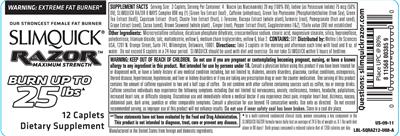
This summary is for Razor Maximum Strength by Slimquick
- Form
- Caplet
- Serving Size
- 3 Caplets
- Servings
- 4 per container
- Container Holds
- 12 Caplets
- What is Razor Maximum Strength?A supplement from Slimquick with 17 active ingredients, in caplet form.
- Active Ingredients 1 vitamin, 1 mineral, 11 plant ingredients such as Green Tea, Green Tea Phytosome and Capsicum, 1 amino acid and 3 others: Niacin 20 mgIodine 75 mcgGreen Tea extractCaffeineGreen Tea PhytosomeCapsicum extractChaste Tree extractL-TyrosineBacopa extractTurmericPomegranateGrape extract 17 active ingredients. Each one can interact with drugs or cause side effects on its own, so we check every one. And 5 more, in the Supplement Facts
- Drug Interactions 1,585 drugs have a documented interaction with this supplement; the most serious is rated major. Of those, 1,103 are single drugs and 482 are combination products (two or more drugs in one), each listed under its own name. Based on the 16 of its 17 ingredients we could check. Ask your pharmacist first if you take a drug in any of these categories, the most serious of the 113 on record:
- EphedrineMajor · 8 drugs
- Atorvastatin (Lipitor)Major · 3 drugs
- Nadolol (Corgard)Major · 2 drugs
- Moderate · 645 drugs
- Possible Side EffectsStomach upset 7 ingredientsNausea 5 ingredientsHeadache 4 ingredientsBloating 3 ingredientsBurning 3 ingredientsDiarrhea 3 ingredients +34 moreCombined from 15 of its 17 active ingredients. Not studied in this exact product.
- Well documented Why
Does Razor Maximum Strength work?
What It Is Marketed For
Weight loss
From the claims on the product’s label.
The Closest Use the Research Grades
Caffeine
Some studies support it, but the evidence isn’t conclusive.
Its ingredients have stronger research for other uses:
- Caffeine
- Mental alertness Caffeine
- Niacin
- Iodine
- Green Tea
- Fibrocystic breast disease Iodine
These grades are for each ingredient, not this exact product, and never a promise it will work for you.
And 4 more graded uses, in what the research says- AllergensThe label says it contains soy
- Barcode (UPC)8 11568 00385 9Match it to the barcode on your bottle to be sure this is your product. Not your product? Search for it here
Who Might Consider It
- People looking for weight loss, which is what it is marketed for. The closest use the research grades is obesity, rated Possibly Effective.
- People who want it for athletic performance, mental alertness, metabolic syndrome, periodontitis or another graded use: the other uses with research behind them. See each grade
- Adults who want a caffeinated tea blend and take no medicines that interact with it may find this product appealing.
Who Should Be Careful
- People with heart or blood pressure conditions, thyroid problems, or those taking blood thinners, diabetes drugs, or statins should be careful.
- If you are pregnant or breastfeeding, talk it over with your own doctor or pharmacist before starting.
More Before You Take It Show both answersHide Pregnancy and Breastfeeding The Label’s Directions
-
Pregnant or breastfeeding?
- Pregnancy Turmeric
- ! When used orally in medicinal amounts; turmeric might stimulate the uterus and increase menstrual flow.
- Breastfeeding Turmeric
- When used orally in amounts commonly found in food.
- Pregnancy Black Pepper
- ! When used orally in large amounts.
- Breastfeeding Black Pepper
- When used orally in amounts commonly found in foods.
- Pregnancy and Breastfeeding Iodine
- ! When used orally in doses exceeding the UL.
-
How does the label say to take it?
“Directions: Take 3 caplets in the morning and afternoon each time with food and 8 oz. of water. Do not exceed 6 caplets in a 24-hour period. SLIMQUICK should be used with diet and exercise. Do not take SLIMQUICK within 5 hours of bedtime.”
The maker’s words. Your pharmacist or doctor may advise differently.
Everything the label says
From the label dated Dec 23, 2011: 16 of its 17 active ingredients were checked against our records; the other one is not in them yet. A summary of what is known, not a grade or a test of the product. How these ratings are computed
Ask Anything About This Supplement
Name a drug you take, or ask about side effects, ingredients or pregnancy.
There’s a lot of information about this supplement on this page! Ask anything in plain English for a quick answer drawn from it.
AI answers come from this label and our own records, never the open internet. AI can make mistakes, so always check with your doctor or pharmacist. How we use AI
Ask the Pharmacist
A licensed pharmacist will answer your question by email — free, as soon as they can.
Got it — thank you!
A licensed pharmacist will answer as soon as they can. Keep an eye on your email (worth checking spam, just in case).
What’s Inside Razor Maximum Strength by Slimquick
17 Active Ingredients
In the order the label lists them, each with its own card below.
- Niacin
- Iodine
- Green Tea extract
- Caffeine
- Green Tea Phytosome
- Capsicum extract
- Chaste Tree extract
- L-Tyrosine
- Bacopa extract
- Turmeric
- Pomegranate
- Grape extract
And 5 more, each with its own card below.
The label gives an exact amount for 2 of its 17 active ingredients. The other 15 are inside one proprietary blend, “Slimquick Razor 6 Ways Complex”, and the label gives one total for it, not how much of each ingredient is in it.
- 2 state an exact amount
- 15 have no amount of their own
- Slimquick Razor 6 Ways Complex 808 mg in total · 15 ingredients, no amount for each
This rates what the label tells you, not the quality of the product.
Supplement Facts
| Amount Per Serving | % Daily Value | |
|---|---|---|
| Niacin | 20 mg | 100% |
| Iodine | 75 mcg | 50% |
| Slimquick Razor 6 Ways Complex | 808 mg | † |
| Green Tea extract | † | |
| Caffeine | † | |
| Green Tea Phytosome | † | |
| Phosphatidylcholine | † | |
| Capsicum extract | † | |
| Chaste Tree extract | † | |
| L-Tyrosine | † | |
| Bacopa extract | † | |
| Turmeric | † | |
| Pomegranate | † | |
| Grape extract | † | |
| Cocoa | † | |
| Brown Seaweed | † | |
| Ginger | † | |
| Pepper extract | † | |
| Gugglesterones E&Z | † | |
Other ingredients: Microcrystalline Cellulose, Dicalcium Phosphate Dihydrate, Croscarmellose Sodium, Stearic Acid, Magnesium Stearate, Silica, Hypromellose, Polydextrose, Titanium Dioxide, Talc, Maltodextrin, Yellow 5, Medium Chain Triglycerides, Yellow 6, Blue 2
† Daily Value not established.
Daily Values for adults and children 4 or more years of age.
As the label prints it, from the NIH Dietary Supplement Label Database.
Each Ingredient and Its Drug Interactions
Tap one for more about it and its full guide. A drug can interact with this supplement through any one of them.
This tea bag blend contains active ingredients including caffeine, a stimulant, and green tea extract and cocoa, which also contain caffeine.
- Other actives are L-tyrosine, which the body uses to make thyroid hormone, niacin, iodine, grape extract, turmeric, ginger, phosphatidylcholine, pepper extract, chaste tree extract, bacopa extract, capsicum extract, pomegranate, and brown seaweed.
- Two blends and Gugglesterones E&Z are also listed among the ingredients.
-
Niacin 20 mg Interacts with 729 drugs
Form on the label: Niacinamide
Niacin (vitamin B3) is an essential nutrient your body needs for energy and metabolism, and deficiency is uncommon in most developed countries.
- Prescription-strength niacin has been used to adjust cholesterol levels, but high doses can cause flushing and other side effects and should only be taken under medical supervision.
- Always talk with a pharmacist or doctor before using high-dose niacin supplements.
The full Niacin guide: uses, dosage and safety Every Niacin drug interaction
-
Iodine 75 mcg Interacts with 23 drugs
Form on the label: Potassium Iodide
Iodine is an essential mineral your body needs to make thyroid hormones, and most people get enough from iodized salt, dairy, and seafood.
- Supplements help when you are truly deficient, but taking too much can harm the thyroid, so high-dose products should only be used under medical supervision.
The full Iodine guide: uses, dosage and safety Every Iodine drug interaction
-
Slimquick Razor 6 Ways Complex 808 mg 15 ingredients inside it, each checked on its own
- Green Tea extract 1,294 drugs
- Caffeine 655 drugs
- Green Tea Phytosome 1,294 drugs
- Capsicum extract 239 drugs
- Chaste Tree extract 121 drugs
- L-Tyrosine 21 drugs
- Bacopa extract 932 drugs
- Turmeric 1,134 drugs
- Pomegranate 924 drugs
- Grape extract 912 drugs
- Cocoa 661 drugs
- Brown Seaweed 22 drugs
- Ginger 1,008 drugs
- Pepper extract 1,020 drugs
- Gugglesterones E&Z
Other Ingredients (Inactive)
The capsule or tablet itself, fillers, coatings and flavors. Not part of the drug interaction check; the allergen check below reads them.
- Microcrystalline Cellulose
- Dicalcium Phosphate Dihydrate
- Croscarmellose Sodium
- Stearic Acid
- Magnesium Stearate
- Silica
- Hypromellose
- Polydextrose
- Titanium Dioxide
- Talc
- Maltodextrin
- Yellow 5
- Medium Chain Triglycerides
- Yellow 6
- Blue 2
Allergens in Razor Maximum Strength
The label says it contains soy.
Named on this label
- SoyThe label says it contains it
Not named in the ingredients
- Milk
- Egg
- Fish
- Shellfish
- Tree nuts
- Peanuts
- Wheat or other gluten grains
- Sesame
- The label’s allergen statement“CONTAINS: SOY.”
From the label text and ingredient names on file; we do not test products. With a serious allergy, check your bottle and ask the maker or your pharmacist.
What the Label Says
The maker’s own words, from the label. We do not verify or endorse them.
- FDA Statement of Identity
-
“Dietary Supplement”
- Storage
-
“Store in a cool dry place.”
- General statements
-
“?In a multi-centered randomized clinical study, women consuming a key component in the SLIMQUICK RAZOR formula twice daily lost an average of 24.6 lbs of weight vs. 8.1 lbs with diet alone in 90 days! Both groups consumed a reduced calorie diet of 1350 calories per day.”
“BURN UP TO 25lbs”
3 more from the label
“Manufactured in the United States from foreign and domestic ingredients.”
“OUR STRONGEST FEMALE FAT BURNER”
“WARNING: EXTREME FAT BURNER*”
- General
-
“US-09-11 LBL-SQRAZ12-U88-A”
The Razor Maximum Strength Label on File
The label scan on file at the NIH Dietary Supplement Label Database, dated December 2011. Always read the label on the bottle you have.
Product Facts
- Brand
- Slimquick
- Barcode (UPC)
- 811568003859
- Net contents
- 12 Caplets
- Market status
- On market
- Date entered into DSLD
- Dec 23, 2011
- DSLD ID
- 3547
- Product type
- Other Combinations
- Supplement form
- Caplet
- Dietary claims / uses
- All Other, Structure/Function
- Intended target group(s)
- Adult Female (18 - 50 Years)
Is this label outdated? Report a formula or label change and our pharmacy team will review it.
HelloPharmacist Score Razor Maximum Strength by Slimquick
Up to 10 points for research, amount, label and outside testing. Not a safety rating. How this one adds up
No Score for This Product
The label does not say how much caffeine is in it.
That is not a judgment of the product. It means our score cannot speak for it.
What’s inside itIts drug interactionsIts possible side effects
Razor Maximum Strength by Slimquick Side Effects
Why this rating?
We look for three kinds of safety information on each ingredient: side effects reported in studies, a pregnancy and breastfeeding rating, and a safety write-up from our pharmacy team. All three are on file for each of the 16 ingredients we could check.
So this rates how much is known, not whether Razor Maximum Strength is right for you.
Reported with 15 of its ingredients
- Most often
- Stomach upset, nausea, headache, bloating, burning and diarrhea
- !Rare but serious
- Liver injury, myopathy and low platelets See details
HelloPharmacist Team Summary: Razor Maximum Strength by Slimquick Side Effects
Razor Maximum Strength is generally well tolerated, but the effects you are most likely to notice are jitteriness or nervousness, upset stomach or nausea, and trouble sleeping, mainly from its caffeine and green tea content.
- Upset stomach and nausea can also come from iodine and niacin.
- A rare but serious concern is liver injury, reported with concentrated green tea extract and turmeric.
- If you notice yellowing skin or eyes, dark urine, or severe stomach pain, call your doctor right away.
- If you are pregnant, breastfeeding, or take prescription medicines, talk with your own doctor or pharmacist before starting.
Side Effects, Ingredient by Ingredient
A supplement’s side effects come from its ingredients. Here is what is reported with each one.
Niacin
Most reported
- Red
- Tingling
Iodine
Most reported
- Metallic taste in the mouth
- Stomach upset, nausea, or diarrhea
- Burning in the mouth, throat, or stomach with strong liquid forms
- Headache
Green Tea
Most reported
- Trouble sleeping or feeling jittery
- Nervousness or anxiety
- Upset stomach or nausea, especially on an empty stomach
- Headache
Caffeine
Most reported
- Feeling jittery, nervous, or anxious
- Racing or pounding heartbeat
- Trouble sleeping
- Upset stomach or heartburn
Capsicum
Most reported
- Burning
- Stinging
- Itching
- Redness at the application site
Vitex Agnus-castus
Most reported
- Rash
- Itching
Tyrosine
Most reported
- Nausea
- Upset stomach
- Headache
- Fatigue
Bacopa
Most reported
- Nausea
- Stomach cramps
- Bloating
- Increased bowel movements
Turmeric
Most reported
- Nausea
- Upset stomach
- Diarrhea
- Bloating
Pomegranate
Most reported
- Diarrhea
- Flatulence
From the Natural Medicines database, which we license.
Every reported effect, in the Pomegranate guideGrape
Most reported
- Headache
- Dizziness
- Upset stomach
- Nausea
Cocoa
Most reported
- Jitteriness
- Fast heartbeat
- Anxiety
- Trouble sleeping
Ascophyllum Nodosum
Most reported
- Stomach upset
- Bloating
- Digestive changes
Ginger
Most reported
- Heartburn
- Stomach discomfort
- Gas
- Burping
Black Pepper
Most reported
- Burning aftertaste
- Dyspepsia
- Reduced taste perception
From the Natural Medicines database, which we license.
Every reported effect, in the Black Pepper guideRazor Maximum Strength Warnings: Who Should Be Careful
Razor Maximum Strength has 17 active ingredients, and each can carry warnings of its own. We checked the 16 in our ingredient guides, and each warning below names the ingredient it comes from. Gugglesterones E&Z is not in our guides yet, so ask your pharmacist about it. If any of these apply to you, talk to your doctor or pharmacist before you start it.
- Niacin2 warnings below
- Iodine2 warnings below
- Green Tea3 warnings below
- Caffeine2 warnings below
- Capsicum3 warnings below
- Vitex Agnus-castus3 warnings below
- Tyrosine2 warnings below
- Bacopa3 warnings below
- Turmeric2 warnings below
- Pomegranate3 warnings below
- Grape2 warnings below
- Cocoa3 warnings below
- Ascophyllum Nodosum3 warnings below
- Ginger2 warnings below
- Black Pepper2 warnings below
- Gugglesterones E&ZNot in our guides yet
-
Bleeding Problems or Surgery
- Green TeaThe same goes for people with bleeding disorders or those preparing for surgery.
- BacopaAnyone scheduled for surgery should also speak with their doctor.
- TurmericPeople who have gallbladder disease or gallstones, who are prone to kidney stones, or who have bleeding disorders should be cautious and check with a healthcare provider first.
- GrapeWho should be cautious: People with bleeding disorders, those taking blood-thinning medicines, and anyone scheduled for surgery should talk to a healthcare provider before using concentrated grape supplements, since some grape compounds may affect blood clotting.
- GingerUse extra caution if you have a bleeding disorder or are scheduled for surgery, since ginger may slightly affect blood clotting.
-
Diabetes or Low Blood Sugar
- NiacinPeople with liver disease, stomach ulcers, gout, diabetes, low blood pressure, or a history of heart problems should be especially careful and talk to a healthcare provider first.
- CocoaChocolate products are often high in sugar, fat, and calories, which can be a concern for people managing weight, diabetes, or heart disease.
-
Blood Pressure
- CaffeineBe cautious if you: have heart problems, high blood pressure, an irregular heartbeat, anxiety, panic attacks, trouble sleeping, stomach ulcers, or seizure disorders.
-
Liver Disease
- Green TeaPeople with liver disease should be especially careful and check with a healthcare provider first.
-
Kidney Disease or Kidney Stones
- Ascophyllum NodosumTalk to your pharmacist or doctor before starting, especially if you have a thyroid condition, kidney disease, or take any medicines.
-
Gallbladder Problems
- GingerPeople with gallstones should also check with a doctor, because ginger can increase the flow of bile.
-
Heart Conditions
- Green TeaBecause green tea contains caffeine, people who are sensitive to caffeine, have heart rhythm problems, anxiety, or trouble sleeping should be cautious.
- BacopaPeople with a slow heart rate, gastrointestinal conditions, ulcers, lung conditions like asthma, or thyroid problems should be cautious and check with a healthcare provider first, since bacopa may affect these conditions.
- CocoaBecause cocoa contains caffeine and theobromine, people who are sensitive to stimulants, who have heart rhythm problems, anxiety, or trouble sleeping should be cautious, especially with large amounts.
-
Stomach or Bowel Problems
- CapsicumPeople with sensitive stomachs, acid reflux, ulcers, or irritable bowel symptoms may find that oral capsicum worsens their symptoms.
- Black PepperPeople with stomach ulcers, acid reflux, or gut sensitivity may find that pepper worsens irritation.
-
Thyroid Conditions
- IodinePeople with existing thyroid conditions such as Hashimoto's disease, Graves' disease, thyroid nodules, or thyroid cancer should be especially careful and only take iodine under a doctor's guidance.
- IodineAlways talk to a pharmacist or doctor before starting an iodine supplement, especially if you take high doses or have a thyroid condition.
- TyrosineBe extra cautious if you have a thyroid condition (such as overactive thyroid or Graves' disease), because tyrosine is used to make thyroid hormones and could in theory affect thyroid levels.
- Ascophyllum NodosumToo much iodine may trigger or worsen thyroid problems, including both underactive and overactive thyroid.
- Ascophyllum NodosumPeople with thyroid disease should be especially careful.
-
Hormone-Sensitive Conditions
- Vitex Agnus-castusBecause it may affect hormone levels, people with hormone-sensitive conditions (such as certain breast, uterine, or ovarian conditions) should be cautious and check with a healthcare professional before using it.
-
Allergies
- PomegranatePeople with allergies to pomegranate should avoid it.
-
Children
- CaffeineChildren and teens should limit caffeine.
-
If You Take Other Drugs
- NiacinAlways check with a pharmacist or doctor before starting high-dose niacin, especially if you take other medicines or have a chronic health condition.
- Vitex Agnus-castusAlways talk with a pharmacist or doctor before starting vitex, especially if you have a medical condition or take other medicines.
- TyrosinePeople with a history of migraines or those taking medications that affect brain chemicals should also check with a professional first.
- BacopaAlways talk with your pharmacist or doctor before starting bacopa, especially if you take prescription medications or have a chronic health condition.
Show 4 more
- TurmericAlways talk to your pharmacist or doctor before starting a supplement, especially if you take other medicines or have a health condition.
- PomegranateIf you have a chronic health condition or take prescription medications, talk with your pharmacist or doctor before using pomegranate supplements.
- GrapeAlways check with your pharmacist or doctor before starting any new supplement, especially if you have a health condition or take other medicines.
- Black PepperBecause piperine can increase absorption of medications and other supplements, anyone taking prescription drugs should talk to a pharmacist before using a piperine supplement.
-
Other Cautions
- CapsicumAvoid getting it in your eyes, nose, mouth, or on broken or irritated skin, and wash your hands well after use.
- CapsicumUse caution if you have these conditions.
- Vitex Agnus-castusPeople taking hormone-related treatments, those with a history of certain mental health conditions, or anyone with a pituitary disorder should also use caution.
- PomegranateThese parts should not be used in concentrated forms without professional guidance.
- CocoaAvoid concentrated cocoa supplements unless your doctor approves.
-
What the Label Warns
- “WARNING: KEEP OUT OF REACH OF CHILDREN.”
- “Do not use if you are pregnant or contemplating becoming pregnant, nursing, or have a known allergy to any ingredient in this product.”
- “Consult a physician before using this product if you have been treated for or diagnosed with, or have a family history of any medical condition including, but not limited to, diabetes, anxiety disorders, glaucoma, cardiac conditions, osteoporosis, thyroid disease, hypertension, hypotension, and liver or kidney disorders or if you are taking any prescription drug or over the counter medication.”
- “Do not use if inner safety seal has been broken.”
- “Not intended for use by persons under 18.”
- “One serving of this product contains the amount of caffeine equivalent to two and a half cups of coffee. Do not combine with other caffeine containing sources such as coffee, tea or energy drinks. Caffeine sensitive individuals may experience the following symptoms including (but not limited to) nervousness, anxiety, restlessness, tremors, headache, palpitations, increased heart rate, or difficulty sleeping. Discontinue use and immediately inform a medical doctor if you experience chest pain, irregular heart beat, dizziness, nausea, abdominal pain, dark urine, jaundice or other comparable symptoms. Consult a physician for use beyond 16 consecutive weeks.”
- “Use only as directed. Do not exceed recommended serving, as improper use of this product will not enhance results.”
The maker’s wording, from the product label.
-
Pregnant or Breastfeeding
Each ingredient’s rating for pregnancy and for breastfeeding, and what it covers.
Pregnancy
-
When used orally in amounts commonly found in food.
-
When used orally in medicinal amounts; turmeric might stimulate the uterus and increase menstrual flow.
Breastfeeding
-
When used orally in amounts commonly found in food.
There is insufficient reliable information available about the safety of using turmeric in medicinal amounts during lactation.
Pregnancy
-
When used orally in amounts commonly found in foods.
-
When used orally in large amounts.
Black pepper might have abortifacient effects; contraindicated.
There is insufficient reliable information available about the safety of topical pepper when used during pregnancy.
Breastfeeding
-
When used orally in amounts commonly found in foods.
There is insufficient reliable information available about the safety of black pepper when used in medicinal amounts during breast-feeding.
Show 13 more ingredients
Pregnancy and Breastfeeding The record rates both the same
-
When used orally and appropriately.
Iodine is safe in amounts that do not exceed the tolerable upper intake level (UL) of 1100 mcg daily in those 18 years and older or 900 mcg daily in those 14-18 years of age.
Iodine needs increase during pregnancy and lactation and adequate intakes should begin as soon as a patient is aware of the pregnancy, or earlier in areas of potential deficiency.
-
When used orally in doses exceeding the UL.
Higher intake can cause thyroid dysfunction.
2 more points on this rating
- Also, higher intakes during pregnancy cause increased iodine levels in breast milk and infant blood samples.
- Higher iodine intake during pregnancy has also been associated with an increased risk of congenital hypothyroidism and reduced mental and physical development in the offspring.
1 more rating for Iodine used another way
This supplement is taken by mouth. This rating is for Iodine given another way.
-
When used topically as a 2% solution.
Iodine is an FDA-approved prescription product.
Pregnancy
-
When used orally in moderate amounts.
Due to the caffeine content of green tea, pregnant patients should closely monitor their intake to ensure moderate consumption.
12 more points on this rating
- Fetal blood concentrations of caffeine approximate maternal concentrations.
- The use of caffeine during pregnancy is controversial; however, moderate consumption has not been associated with clinically important adverse fetal effects.
- In some studies consuming amounts over 200 mg daily is associated with a significantly increased risk of miscarriage.
- This increased risk may be most likely to occur in those with genotypes that confer a slow rate of caffeine metabolism.
- According to a review by Health Canada, and a subsequent large meta-analysis conducted in the US, most healthy pregnant patients can safely consume doses up to 300 mg daily without an increased risk of spontaneous abortion, stillbirth, preterm birth, fetal growth retardation, or congenital malformations.
- Advise keeping caffeine consumption below 300 mg daily.
- This is similar to the amount of caffeine in about 6 cups of green tea.
- Keep in mind that only the amount of ADDED caffeine must be stated on product labels.
- The amount of caffeine found in ingredients such as green tea, which naturally contains caffeine, does not need to be provided.
- This can make it difficult to determine the total amount of caffeine in a given product.
- Based on animal models, green tea extract catechins are also transferred to the fetus, but in amounts 50-100 times less than maternal concentrations.
- The potential impact of these catechins on the human fetus is not known, but animal models suggest that the catechins are not teratogenic.
-
When used orally in amounts providing more than 300 mg caffeine daily.
Caffeine from green tea crosses the placenta, producing fetal blood concentrations similar to maternal levels.
16 more points on this rating
- Consumption of caffeine in amounts over 300 mg daily is associated with a significantly increased risk of miscarriage in some studies.
- Advise keeping caffeine consumption from all sources below 300 mg daily.
- This is similar to the amount of caffeine in about 6 cups of green tea.
- High maternal doses of caffeine throughout pregnancy have also resulted in symptoms of caffeine withdrawal in newborn infants.
- High doses of caffeine have also been associated with spontaneous abortion, premature delivery, and low birth weight.
- However, some research has also found that intrauterine exposure to even modest amounts of caffeine, based on maternal blood levels during the first trimester, is associated with a shorter stature in children ages 4-8 years.
- Keep in mind that only the amount of ADDED caffeine must be stated on product labels.
- The amount of caffeine found in ingredients such as green tea, which naturally contains caffeine, does not need to be provided.
- This can make it difficult to determine the total amount of caffeine in a given product.
- There is also concern that consuming large amounts of green tea might have antifolate activity and potentially increase the risk of folic acid deficiency-related birth defects.
- Catechins in green tea inhibit the enzyme dihydrofolate reductase in vitro.
- This enzyme is responsible for converting folic acid to its active form.
- Preliminary evidence suggests that increasing maternal green tea consumption is associated with increased risk of spina bifida.
- Also, evidence from epidemiological research suggests that serum folate levels in pregnant patients with high green tea intake (57.3 mL per 1000 kcal) are decreased compared to participants who consume moderate or low amounts of green tea.
- More evidence is needed to determine the safety of using green tea during pregnancy.
- For now, advise pregnant patients to avoid consuming large quantities of green tea.
Breastfeeding
-
When used orally in moderate amounts.
Due to the caffeine content of green tea, nursing parents should closely monitor caffeine intake.
Breast milk concentrations of caffeine are thought to be approximately 50% of maternal serum concentrations.
-
When used orally in large amounts.
Consumption of green tea might cause irritability and increased bowel activity in nursing infants.
There is insufficient reliable information available about the safety of green tea extracts when applied topically during breast-feeding.
Pregnancy
-
When used orally in amounts commonly found in foods.
Intakes of caffeine should be monitored during pregnancy.
10 more points on this rating
- Caffeine crosses the human placenta, but is not considered a teratogen.
- Fetal blood and tissue levels are similar to maternal concentrations.
- The use of caffeine during pregnancy is controversial; however, moderate consumption has not been associated with clinically important adverse fetal effects.
- In some studies consuming amounts over 200 mg daily is associated with a significantly increased risk of miscarriage.
- This increased risk seems to occur in those with genotypes that confer a slow rate of caffeine metabolism.
- According to a review by Health Canada, and a subsequent large meta-analysis conducted in the US, up to 300 mg daily can be consumed during pregnancy without an increased risk of spontaneous abortion, stillbirth, preterm birth, fetal growth retardation, or congenital malformations.
- However, observational research in a Norwegian cohort found that caffeine consumption is associated with a 16% increased odds of the baby being born small for gestational age when compared with no consumption.
- The same Norwegian cohort found that low to moderate caffeine consumption during pregnancy is not associated with changes in neurodevelopment in children up to 8 years of age.
- Advise patients to keep caffeine consumption below 300 mg daily during pregnancy.
- This is similar to the amount of caffeine in about 3 cups of coffee or tea.
-
When used orally in amounts over 300 mg daily.
Caffeine crosses the placenta, producing fetal blood concentrations similar to maternal levels.
8 more points on this rating
- Consumption of caffeine in amounts over 300 mg daily is associated with a significantly increased risk of miscarriage in some studies.
- Advise patients to keep caffeine consumption below 300 mg daily during pregnancy.
- This is similar to the amount of caffeine in about 3 cups of coffee or tea.
- Additionally, high doses of caffeine throughout pregnancy have resulted in symptoms of caffeine withdrawal in newborn infants.
- High doses of caffeine have also been associated with spontaneous abortion, premature delivery, and low birth weight.
- In a cohort of mother/infant pairs with a median maternal plasma caffeine level of 168.5 ng/mL (range 29.5-650.5 ng/mL) during pregnancy, birth weights and lengths were lower in the 4th quartile of caffeine intake compared with the 1st.
- By age 7, heights and weights were lower by 1.5 cm and 1.1 kg respectively.
- In another cohort of mother/infant pairs with higher maternal pregnancy plasma caffeine levels, median 625.5 ng/mL (range 86.2 to 1994.7 ng/mL), heights at age 8 were 2.2 cm lower, but there was no difference in weights.
Breastfeeding
-
When used orally in amounts commonly found in foods.
Caffeine intake should be closely monitored while breast-feeding.
During lactation, breast milk concentrations of caffeine are thought to be approximately 50% of serum concentrations and caffeine peaks in breastmilk approximately 1-2 hours after consumption.
-
When used orally in large amounts.
Caffeine is excreted slowly in infants and may accumulate.
Caffeine can cause sleep disturbances, irritability, and increased bowel activity in breast-fed infants exposed to caffeine.
Pregnancy
-
When used orally and appropriately, short-term.
Capsicum 5 mg daily has been used for up to 28 days during the latter half of the second trimester and the third trimester.
1 more rating for Capsicum used another way
This supplement is taken by mouth. This rating is for Capsicum given another way.
-
When used topically and appropriately.
Breastfeeding
-
When used orally.
Dermatitis can sometimes occur in infants when foods heavily spiced with capsicum peppers are ingested during lactation.
Also, observational research suggests that intake of raw capsicum peppers during pregnancy is associated with an increased risk of sensitization to inhalant allergens in children by the age of 2 years.
1 more rating for Capsicum used another way
This supplement is taken by mouth. This rating is for Capsicum given another way.
-
When used topically and appropriately.
Pregnancy and Breastfeeding The record rates both the same
-
When used orally.
Theoretically, the hormonal effects of vitex agnus-castus might adversely affect pregnancy or lactation.
Animal research shows that taking vitex agnus-castus fruit extract when planning to become pregnant or during pregnancy may increase the risk of infertility, low fetal body weight, abortion, and stillbirth; avoid using.
Pregnancy
-
When used orally in moderate amounts.
However, due to the caffeine content of cocoa preparations, intake should be closely monitored during pregnancy to ensure moderate consumption.
8 more points on this rating
- Fetal blood concentrations of caffeine approximate maternal concentrations.
- Some research has found that intrauterine exposure to even modest amounts of caffeine, based on maternal blood levels during the first trimester, is associated with a shorter stature in children ages 4-8 years.
- While many cocoa products contain only small amounts of caffeine (about 2-35 mg per serving), unsweetened, dry cocoa powder can contain up to 198 mg of caffeine per cup.
- According to a review by Health Canada, and a subsequent large meta-analysis conducted in the US, doses of up to 300 mg daily can be consumed during pregnancy without an increased risk of spontaneous abortion, still birth, preterm birth, fetal growth retardation, or congenital malformations.
- To be on the safe side, cocoa should be used in amounts that provide less than 300 mg of caffeine daily.
- Keep in mind that only the amount of ADDED caffeine must be stated on product labels.
- The amount of caffeine found in ingredients such as cocoa, which naturally contains caffeine, does not need to be provided.
- This can make it difficult to determine the total amount of caffeine in a given product.
-
When used orally in large amounts.
Caffeine found in cocoa crosses the placenta producing fetal blood concentrations similar to maternal levels.
10 more points on this rating
- Consumption of caffeine in amounts over 300 mg daily is associated with a significantly increased risk of miscarriage in some studies.
- Additionally, high intake of caffeine during pregnancy have been associated with premature delivery, low birth weight, and loss of the fetus.
- While many cocoa products contain only small amounts of caffeine (about 2-35 mg per serving), unsweetened, dry cocoa powder can contain up to 198 mg of caffeine per cup.
- To be on the safe side, cocoa should be used in amounts that provide less than 300 mg of caffeine daily.
- Keep in mind that only the amount of ADDED caffeine must be stated on product labels.
- The amount of caffeine found in ingredients such as cocoa, which naturally contains caffeine, does not need to be provided.
- This can make it difficult to determine the total amount of caffeine in a given product.
- Cocoa and dark chocolate products worldwide also contain heavy metals such as lead and cadmium.
- In the US, one ounce (approximately 28 grams) of most commercially available dark chocolate products tested contained levels of lead and/or cadmium above the maximum allowable dose level for California, with cadmium levels generally increasing with the percentage of cocoa.
- Large doses or excessive intake of cocoa should be avoided during pregnancy.
Breastfeeding
-
When used in moderate amounts or in amounts commonly found in foods.
Due to the caffeine content of cocoa preparations, intake should be closely monitored while breastfeeding.
5 more points on this rating
- During lactation, breast milk concentrations of caffeine are thought to be approximately 50% of serum concentrations.
- Moderate consumption of cocoa would likely result in very small amounts of caffeine exposure to a nursing infant.
- Keep in mind that only the amount of ADDED caffeine must be stated on product labels.
- The amount of caffeine found in ingredients such as cocoa, which naturally contains caffeine, does not need to be provided.
- This can make it difficult to determine the total amount of caffeine in a given product.
-
When used orally in large amounts.
Consumption of excess chocolate (16 oz per day) may cause irritability and increased bowel activity in the infant.
3 more points on this rating
- Cocoa and dark chocolate products worldwide also contain heavy metals such as lead and cadmium.
- In the US, one ounce (approximately 28 grams) of most commercially available dark chocolate products tested contained levels of lead and/or cadmium above the maximum allowable dose level for California, with cadmium levels generally increasing with the percentage of cocoa.
- Large doses or excessive intake of cocoa should be avoided during lactation.
Pregnancy and Breastfeeding The record rates both the same
-
There is insufficient reliable information available about the safety of tyrosine during pregnancy and lactation when used in medicinal amounts.
Some pharmacokinetic research shows that taking a single dose of tyrosine 2-10 grams orally can modestly increase levels of free tyrosine in breast milk.
2 more points on this rating
- However, total levels are not affected, and levels remain within the range found in infant formulas.
- Therefore, it is not clear if the increase in free tyrosine is a concern.
Pregnancy and Breastfeeding The record rates both the same
-
Insufficient reliable information available; avoid using.
Pregnancy and Breastfeeding The record rates both the same
-
Insufficient reliable information available; avoid using amounts greater than those found in food.
Pregnancy and Breastfeeding The record rates both the same
-
When used orally in amounts that do not exceed the tolerable upper intake level (UL).
The UL of niacin during pregnancy and lactation is 30 mg daily for 14-18 years of age and 35 mg daily for 19 years and older.
There is insufficient reliable information available about the safety of larger oral doses of niacin during pregnancy or lactation; avoid using.
Pregnancy and Breastfeeding The record rates both the same
-
When the fruit or fruit juice is consumed orally and appropriately.
There is insufficient reliable information available regarding the safety of using other forms of pomegranate or other parts of the plant during pregnancy or lactation; avoid using.
Pregnancy and Breastfeeding The record rates both the same
-
When used orally in amounts commonly found in foods.
There is insufficient reliable information available about the safety of medicinal amounts during pregnancy and breast-feeding; avoid using in amounts greater than what is commonly found in foods.
Pregnancy
-
When consumed in the amounts typically found in foods.
Ginger is considered a first-line nonpharmacological treatment option for nausea in pregnancy by the American College of Obstetrics and Gynecology (ACOG).
However, it should not be used long-term or without medical supervision and close monitoring.
-
When used for medicinal purposes.
Despite some early reports of adverse effects and one observational study suggesting that taking dried ginger and other herbal supplements during the first 20 weeks of pregnancy marginally increased the chance of stillbirth, most research shows that ginger is unlikely to cause harm to the baby.
3 more points on this rating
- The risk for major malformations in infants of parents who took ginger when pregnant does not appear to be higher than the baseline rate of 1% to 3%.
- Also, other research suggests that ginger intake during various trimesters does not significantly affect the risk of spontaneous abortion, congenital malformations, stillbirth, perinatal death, preterm birth, low birth weight, or low Apgar scores.
- Ginger use has been associated with an increase in non-severe vaginal bleeding, including spotting, after week 17 of pregnancy.
Breastfeeding
-
When consumed in the amounts typically found in foods.
There is insufficient reliable information available about the safety of ginger when used for medicinal purposes; avoid amounts greater than those found in foods.
Our pharmacy team’s notes
- BacopaOur pregnancy data for bacopa isn’t available.
- For pregnancy, turmeric is rated likely unsafe and chaste tree is rated possibly unsafe, so the safety data advises against those two.
Ratings and the words beside them are from the Natural Medicines database, which we license.
-
Rare but Serious Side Effects
-
!
Niacin
Higher doses can sometimes cause more serious problems, such as liver injury, increased blood sugar, gout flares, and changes in vision.
Orally: Hepatotoxicity, myopathy, thrombocytopenia, and vision changes.
-
!
Iodine
More serious effects from too much iodine include thyroid problems (either overactive or underactive thyroid), thyroid swelling, and rarely allergic reactions.
Hypersensitivity reactions such as anaphylaxis and angioedema.
-
!
Green Tea
A rare but serious concern with concentrated green tea extract supplements is liver damage.
Orally: Hepatotoxicity, hypokalemia, and thrombotic thrombocytopenic purpura have been reported rarely.
-
!
Caffeine
Serious effects are rare but can happen with very high doses.
Caffeine can cause serious effects at very high doses.
Orally: Stroke has been reported rarely.
-
!
Capsicum
Rarely, severe irritation, allergic reactions, or breathing problems from inhaling the powder can occur.
Orally: Cases of myocardial infarction and hypertensive crisis have been reported.
-
!
Vitex Agnus-castus
Serious side effects appear to be uncommon, but allergic reactions are possible.
-
!
Tyrosine
Serious side effects are uncommon at typical supplement doses.
-
!
Turmeric
Signs that need medical attention include yellowing skin or eyes, dark urine, severe stomach pain, or an allergic reaction such as rash, swelling, or trouble breathing.
-
!
Pomegranate
Allergic reactions are uncommon but can happen and may include itching, swelling, hives, or trouble breathing.
-
!
Grape
Some people may have an allergic reaction to grapes or grape products, which can rarely be serious.
Orally: Anaphylaxis to grape skin has been reported.
-
!
Cocoa
Allergic reactions to cocoa are uncommon but possible.
Orally: Tachycardia.
-
!
Ascophyllum Nodosum
Allergic reactions to seaweed are also possible.
-
!
Ginger
Rarely, some people may have an allergic reaction.
-
!
Black Pepper
Orally: Allergic reaction in sensitive individuals.
-
!
Our pharmacy team on Razor Maximum Strength
Liver injury has been reported with concentrated green tea extract and with turmeric.
When to get help: a serious allergic reaction, with trouble breathing or swelling of the face, lips or throat, needs emergency care: call 911. For any other side effect that worries you, call your doctor or pharmacist.
These reports describe each ingredient, not studies of this exact product. Not medical advice: a side effect you notice after starting a supplement is worth a word with your pharmacist or doctor.
Razor Maximum Strength by Slimquick Drug Interactions
We checked all 17 active ingredients in this supplement against every drug in our records. A drug can interact with it through any one of them. Gugglesterones E&Z is not in our interaction records yet.
A major interaction on record
3 of 3, on a scale from Minor or none to Major.Why this rating?
We rate this by the most serious interaction on record, not by how many there are. For Iodine, Pomegranate, Grape, Turmeric and Bacopa, the most serious is rated major, which means the combination is best avoided, or used only under close supervision. Some involve kinds of drugs where a small change can matter, such as blood thinners, transplant drugs and cancer treatments.
1,586 drugs are on the full list. What matters is whether one you take is on it, so check yours with the interaction checker on this page.
From the HelloPharmacist Team
What matters most when you look at everything in the bottle at once.
- Razor Maximum Strength from Slimquick can interact with a number of medications, and the main concern is its caffeine and green tea extract.
- Other ingredients with documented interactions are tyrosine, niacin, iodine, grape extract, turmeric, ginger, cocoa, pepper extract, chaste tree, bacopa, capsicum, pomegranate, and brown seaweed.
- The most serious interaction is Major: caffeine and green tea extract can raise the risk of stimulant effects when taken with ephedrine (a stimulant decongestant), including high blood pressure, heart attack, stroke, and seizures.
15 of its 17 active ingredients have drug interactions on record. The ones below matter most. We have no interaction records for Gugglesterones E&Z.
- Interacts with
- 1,294 drugs
- Most serious
- Major
- Green tea extract has two more Major interactions: it can lower the levels and effects of nadolol (a beta blocker) and atorvastatin (a statin).
- The blends Green Tea Phytosome and Slimquick Razor 6 Ways Complex are listed only as groups, so we check their component ingredients instead.
- Interacts with
- 932 drugs
- Most serious
- Moderate
- Bacopa carries a Minor interaction with thyroid hormone.
- Interacts with
- 1,134 drugs
- Most serious
- Moderate
- Most of its records involve Cytochrome P450 3A4 (CYP3A4) Substrates, Hepatotoxic Drugs and P-glycoprotein Substrates.
Show three more ingredients
- Interacts with
- 1,020 drugs
- Most serious
- Moderate
- Most of its records involve Cytochrome P450 3A4 (CYP3A4) Substrates, P-glycoprotein Substrates and Cytochrome P450 2D6 (CYP2D6) Substrates.
- Interacts with
- 1,008 drugs
- Most serious
- Moderate
- Most of its records involve Cytochrome P450 3A4 (CYP3A4) Substrates, P-glycoprotein Substrates and Cytochrome P450 1A2 (CYP1A2) Substrates.
- Interacts with
- 924 drugs
- Most serious
- Moderate
- Most of its records involve Cytochrome P450 3A4 (CYP3A4) Substrates, Cytochrome P450 2D6 (CYP2D6) Substrates and Antihypertensive Drugs.
And nine more ingredients with records, each in the cards below.
Summarized by the HelloPharmacist pharmacy team from the interaction records below. How it is written How we use AI
Why Razor Maximum Strength Interacts, Ingredient by Ingredient
A product interacts through its ingredients. Each card: how many drugs, the most serious rating, and the kinds of drugs it affects most (tap a kind for what it means).
The ingredients driving the most interactions
-
Green Tea extract 1,294 drugs
Most serious: Major58 interaction records on file
The kinds of drugs it affects most
- 645 drugs
- 372 drugs
- 202 drugs
- 172 drugs
Every Green Tea drug interaction, 58 records The Green Tea records cite 219 references, listed in the Green Tea guide.
-
Turmeric 1,134 drugs
Most serious: Moderate24 interaction records on file
The kinds of drugs it affects most
- 645 drugs
- 372 drugs
- 202 drugs
- 186 drugs
Every Turmeric drug interaction, 24 records The Turmeric records cite 105 references, listed in the Turmeric guide.
-
Pepper extract 1,020 drugs
Most serious: Moderate17 interaction records on file
The kinds of drugs it affects most
- 645 drugs
- 202 drugs
- 193 drugs
- 186 drugs
Every Black Pepper drug interaction, 17 records The Black Pepper records cite 29 references, listed in the Black Pepper guide.
-
Ginger 1,008 drugs
Most serious: Moderate14 interaction records on file
The kinds of drugs it affects most
- 645 drugs
- 202 drugs
- 186 drugs
- 122 drugs
Every Ginger drug interaction, 14 records The Ginger records cite 65 references, listed in the Ginger guide.
-
Bacopa extract 932 drugs
Most serious: Moderate8 interaction records on file
The kinds of drugs it affects most
- 645 drugs
- 195 drugs
- 186 drugs
- 112 drugs
Every Bacopa drug interaction, 8 records The Bacopa records cite 12 references, listed in the Bacopa guide.
-
Pomegranate 924 drugs
Most serious: Moderate9 interaction records on file
The kinds of drugs it affects most
- 645 drugs
- 193 drugs
- 172 drugs
- 112 drugs
Every Pomegranate drug interaction, 9 records The Pomegranate records cite 27 references, listed in the Pomegranate guide.
-
Grape extract 912 drugs
Most serious: Moderate10 interaction records on file
The kinds of drugs it affects most
- 645 drugs
- 193 drugs
- 186 drugs
- 122 drugs
Every Grape drug interaction, 10 records The Grape records cite 35 references, listed in the Grape guide.
-
Niacin 729 drugs
Most serious: Moderate15 interaction records on file
The kinds of drugs it affects most
- 372 drugs
- 172 drugs
- 122 drugs
- 86 drugs
Every Niacin drug interaction, 15 records The Niacin records cite 66 references, listed in the Niacin guide.
-
Cocoa 661 drugs
Most serious: Moderate37 interaction records on file
The kinds of drugs it affects most
- 172 drugs
- 172 drugs
- 122 drugs
- 90 drugs
Every Cocoa drug interaction, 37 records The Cocoa records cite 119 references, listed in the Cocoa guide.
-
Caffeine 655 drugs
Most serious: Major41 interaction records on file
The kinds of drugs it affects most
- 172 drugs
- 122 drugs
- 90 drugs
- 86 drugs
Every Caffeine drug interaction, 41 records The Caffeine records cite 235 references, listed in the Caffeine guide.
-
Capsicum extract 239 drugs
Most serious: Moderate6 interaction records on file
The kinds of drugs it affects most
- 122 drugs
- 86 drugs
- 35 drugs
- 23 drugs
Every Capsicum drug interaction, 6 records The Capsicum records cite 89 references, listed in the Capsicum guide.
-
Chaste Tree extract 121 drugs
Most serious: Moderate5 interaction records on file
The kinds of drugs it affects most
- 45 drugs
- 41 drugs
- 30 drugs
- Dopamine Agonists 23 drugs
Every Vitex Agnus-castus drug interaction, 5 records The Vitex Agnus-castus records cite 23 references, listed in the Vitex Agnus-castus guide.
-
Iodine 23 drugs
Most serious: Moderate4 interaction records on file
The kinds of drugs it affects most
- 16 drugs
- Antithyroid Drugs 5 drugs
- Amiodarone (Cordarone) 1 drug
- 1 drug
Every Iodine drug interaction, 4 records The Iodine records cite 29 references, listed in the Iodine guide.
-
Brown Seaweed 22 drugs
Most serious: Moderate3 interaction records on file
The kinds of drugs it affects most
- 16 drugs
- Antithyroid Drugs 5 drugs
- Amiodarone (Cordarone) 1 drug
Every Ascophyllum Nodosum drug interaction, 3 records The Ascophyllum Nodosum records cite 5 references, listed in the Ascophyllum Nodosum guide.
-
L-Tyrosine 21 drugs
Most serious: Moderate2 interaction records on file
The kinds of drugs it affects most
- 16 drugs
- 5 drugs
Every Tyrosine drug interaction, 2 records The Tyrosine records cite 4 references, listed in the Tyrosine guide.
The Breakdown by Severity
Each drug counted once, at its most serious rating. Tap a tile to list those drugs.
Find Your Drug
Type a drug or brand name to see whether it is on the list.
- Only drugs with a documented interaction are listed, the most serious first.
- A drug with no known interaction is not listed, but searching its name tells you so.
- Open a drug to see which ingredient is responsible. Of those, 1,103 are single drugs and 482 are combination products (two or more drugs in one), each listed under its own name.
-
ThioridazineMellaril Moderate
The 8 ingredients responsible:
-
Chaste Tree Extract Moderate Thioridazine is in the Antipsychotic Drugs category.
Theoretically, vitex agnus-castus could interfere with the activity of antipsychotic drugs.
The full Chaste Tree Extract + Thioridazine interaction -
Bacopa Extract Moderate Thioridazine is in these Cytochrome P450 2C19 (CYP2C19) Substrates, Anticholinergic Drugs categories.
Theoretically, bacopa might increase the levels and adverse effects of CYP2C19 substrates.
The full Bacopa Extract + Thioridazine interaction -
Pomegranate Moderate Thioridazine is in the Cytochrome P450 2D6 (CYP2D6) Substrates category.
Theoretically, pomegranate might increase levels of drugs metabolized by CYP2D6.
The full Pomegranate + Thioridazine interaction -
Grape Extract Moderate Thioridazine is in the Cytochrome P450 2D6 (CYP2D6) Substrates category.
Theoretically, grape seed extract may increase the levels of CYP2D6 substrates.
The full Grape Extract + Thioridazine interaction -
Pepper Extract Moderate Thioridazine is in the Cytochrome P450 2D6 (CYP2D6) Substrates category.
Theoretically, black pepper might increase levels of drugs metabolized by CYP2D6.
The full Pepper Extract + Thioridazine interaction -
Caffeine Minor Thioridazine is in the Phenothiazines category.
Theoretically, phenothiazines might increase the levels and adverse effects of caffeine.
The full Caffeine + Thioridazine interaction -
Green Tea Phytosome Minor Thioridazine is in the Phenothiazines category.
Theoretically, phenothiazines might increase the levels and adverse effects of caffeine.
The full Green Tea Phytosome + Thioridazine interaction -
Cocoa Minor Thioridazine is in the Phenothiazines category.
Theoretically, phenothiazines might increase the levels and adverse effects of caffeine.
The full Cocoa + Thioridazine interaction
-
-
TiclopidineTiclid, Ticlopidine Moderate
The 9 ingredients responsible:
-
Caffeine Moderate Ticlopidine is in these Anticoagulant/Antiplatelet Drugs, Cytochrome P450 1A2 (CYP1A2) Inhibitors categories.
Theoretically, caffeine may increase the risk of bleeding if used with anticoagulant or antiplatelet drugs.
The full Caffeine + Ticlopidine interaction -
Capsicum Extract Moderate Ticlopidine is in the Anticoagulant/Antiplatelet Drugs category.
Theoretically, capsicum may increase the risk of bleeding if used with anticoagulant or antiplatelet drugs.
The full Capsicum Extract + Ticlopidine interaction -
Cocoa Moderate Ticlopidine is in these Cytochrome P450 1A2 (CYP1A2) Inhibitors, Anticoagulant/Antiplatelet Drugs categories.
Theoretically, ticlopidine might increase the levels and adverse effects of caffeine.
The full Cocoa + Ticlopidine interaction -
Niacin Moderate Ticlopidine is in the Anticoagulant/Antiplatelet Drugs category.
Theoretically, niacin may have additive effects when used with anticoagulant or antiplatelet drugs.
The full Niacin + Ticlopidine interaction -
Green Tea Phytosome Moderate Ticlopidine is in these Cytochrome P450 1A2 (CYP1A2) Inhibitors, Anticoagulant/Antiplatelet Drugs categories.
Theoretically, concomitant use might increase the levels and adverse effects of caffeine.
The full Green Tea Phytosome + Ticlopidine interaction -
Pepper Extract Moderate Ticlopidine is in the Anticoagulant/Antiplatelet Drugs category.
Theoretically, black pepper might increase the risk of bleeding when taken with antiplatelet or anticoagulant drugs.
The full Pepper Extract + Ticlopidine interaction -
Ginger Moderate Ticlopidine is in the Anticoagulant/Antiplatelet Drugs category.
Ginger may have antiplatelet effects and may increase the risk of bleeding if used with anticoagulant or antiplatelet drugs.
The full Ginger + Ticlopidine interaction -
Grape Extract Moderate Ticlopidine is in the Anticoagulant/Antiplatelet Drugs category.
Theoretically, grape extracts may have antiplatelet effects and may increase the risk of bleeding if used with anticoagulant or antiplatelet drugs.
The full Grape Extract + Ticlopidine interaction
And through 1 more ingredient, each with its own page:
- Turmeric Moderate
-
-
SiponimodMayzent Moderate
The 7 ingredients responsible:
-
Bacopa Extract Moderate Siponimod is in these Cytochrome P450 2C9 (CYP2C9) Substrates, Cytochrome P450 3A4 (CYP3A4) Substrates categories.
Theoretically, bacopa might increase the levels and adverse effects of CYP2C9 substrates.
The full Bacopa Extract + Siponimod interaction -
Turmeric Moderate Siponimod is in the Cytochrome P450 3A4 (CYP3A4) Substrates category.
Turmeric might increase or decrease levels of drugs metabolized by CYP3A4.
The full Turmeric + Siponimod interaction -
Pepper Extract Moderate Siponimod is in the Cytochrome P450 3A4 (CYP3A4) Substrates category.
Theoretically, black pepper might increase levels of drugs metabolized by CYP3A4.
The full Pepper Extract + Siponimod interaction -
Grape Extract Moderate Siponimod is in these Cytochrome P450 2C9 (CYP2C9) Substrates, Cytochrome P450 3A4 (CYP3A4) Substrates categories.
It is unclear if grape juice or grape seed extract inhibits CYP2C9; research is conflicting.
The full Grape Extract + Siponimod interaction -
Ginger Moderate Siponimod is in these Cytochrome P450 3A4 (CYP3A4) Substrates, Cytochrome P450 2C9 (CYP2C9) Substrates categories.
Ginger might increase or decrease the levels of CYP3A4 substrates.
The full Ginger + Siponimod interaction -
Pomegranate Minor Siponimod is in these Cytochrome P450 2C9 (CYP2C9) Substrates, Cytochrome P450 3A4 (CYP3A4) Substrates categories.
Theoretically, pomegranate might increase levels of drugs metabolized by CYP2C9.
The full Pomegranate + Siponimod interaction -
Green Tea Phytosome Minor Siponimod is in the Cytochrome P450 3A4 (CYP3A4) Substrates category.
Green tea is unlikely to produce clinically significant changes in the levels and clinical effects of CYP3A4 substrates.
The full Green Tea Phytosome + Siponimod interaction
-
-
NilotinibTasigna Moderate
The 8 ingredients responsible:
-
Ginger Moderate Nilotinib is in the Cytochrome P450 3A4 (CYP3A4) Substrates category.
Ginger might increase or decrease the levels of CYP3A4 substrates.
The full Ginger + Nilotinib interaction -
Grape Extract Moderate Nilotinib is in the Cytochrome P450 3A4 (CYP3A4) Substrates category.
It is unclear if grape seed extract inhibits or induces CYP3A4; research is conflicting.
The full Grape Extract + Nilotinib interaction -
Turmeric Moderate Nilotinib is in these Hepatotoxic Drugs, Cytochrome P450 3A4 (CYP3A4) Substrates categories.
Theoretically, turmeric might increase the risk of liver damage when taken with hepatotoxic drugs.
The full Turmeric + Nilotinib interaction -
Green Tea Phytosome Moderate Nilotinib is in these Hepatotoxic Drugs, Cytochrome P450 3A4 (CYP3A4) Substrates categories.
Theoretically, concomitant use might have additive adverse hepatotoxic effects.
The full Green Tea Phytosome + Nilotinib interaction -
Niacin Moderate Nilotinib is in the Hepatotoxic Drugs category.
Theoretically, concomitant use of niacin and hepatotoxic drugs might increase the risk of hepatotoxicity.
The full Niacin + Nilotinib interaction -
Bacopa Extract Moderate Nilotinib is in the Cytochrome P450 3A4 (CYP3A4) Substrates category.
Theoretically, bacopa might increase the levels and adverse effects of CYP3A4 substrates.
The full Bacopa Extract + Nilotinib interaction -
Pepper Extract Moderate Nilotinib is in the Cytochrome P450 3A4 (CYP3A4) Substrates category.
Theoretically, black pepper might increase levels of drugs metabolized by CYP3A4.
The full Pepper Extract + Nilotinib interaction -
Pomegranate Minor Nilotinib is in the Cytochrome P450 3A4 (CYP3A4) Substrates category.
Theoretically, pomegranate might increase levels of drugs metabolized by CYP3A4, but most research suggests this interaction is unlikely to be clinically significant.
The full Pomegranate + Nilotinib interaction
-
-
LapatinibTykerb Moderate
The 7 ingredients responsible:
-
Grape Extract Moderate Lapatinib is in the Cytochrome P450 3A4 (CYP3A4) Substrates category.
It is unclear if grape seed extract inhibits or induces CYP3A4; research is conflicting.
The full Grape Extract + Lapatinib interaction -
Ginger Moderate Lapatinib is in the Cytochrome P450 3A4 (CYP3A4) Substrates category.
Ginger might increase or decrease the levels of CYP3A4 substrates.
The full Ginger + Lapatinib interaction -
Turmeric Moderate Lapatinib is in the Cytochrome P450 3A4 (CYP3A4) Substrates category.
Turmeric might increase or decrease levels of drugs metabolized by CYP3A4.
The full Turmeric + Lapatinib interaction -
Pepper Extract Moderate Lapatinib is in the Cytochrome P450 3A4 (CYP3A4) Substrates category.
Theoretically, black pepper might increase levels of drugs metabolized by CYP3A4.
The full Pepper Extract + Lapatinib interaction -
Bacopa Extract Moderate Lapatinib is in the Cytochrome P450 3A4 (CYP3A4) Substrates category.
Theoretically, bacopa might increase the levels and adverse effects of CYP3A4 substrates.
The full Bacopa Extract + Lapatinib interaction -
Pomegranate Minor Lapatinib is in the Cytochrome P450 3A4 (CYP3A4) Substrates category.
Theoretically, pomegranate might increase levels of drugs metabolized by CYP3A4, but most research suggests this interaction is unlikely to be clinically significant.
The full Pomegranate + Lapatinib interaction -
Green Tea Phytosome Minor Lapatinib is in the Cytochrome P450 3A4 (CYP3A4) Substrates category.
Green tea is unlikely to produce clinically significant changes in the levels and clinical effects of CYP3A4 substrates.
The full Green Tea Phytosome + Lapatinib interaction
-
-
CyproheptadinePeriactin Moderate
The ingredient responsible:
-
Bacopa Extract Moderate Cyproheptadine is in the Anticholinergic Drugs category.
Theoretically, concurrent use might decrease the effectiveness of both agents.
The full Bacopa Extract + Cyproheptadine interaction
-
-
AprocitentanTryvio Moderate
The 5 ingredients responsible:
-
Pomegranate Moderate Aprocitentan is in the Antihypertensive Drugs category.
Theoretically, taking pomegranate with antihypertensive drugs might increase the risk of hypotension.
The full Pomegranate + Aprocitentan interaction -
Turmeric Moderate Aprocitentan is in the Hepatotoxic Drugs category.
Theoretically, turmeric might increase the risk of liver damage when taken with hepatotoxic drugs.
The full Turmeric + Aprocitentan interaction -
Niacin Moderate Aprocitentan is in these Hepatotoxic Drugs, Antihypertensive Drugs categories.
Theoretically, concomitant use of niacin and hepatotoxic drugs might increase the risk of hepatotoxicity.
The full Niacin + Aprocitentan interaction -
Green Tea Phytosome Moderate Aprocitentan is in the Hepatotoxic Drugs category.
Theoretically, concomitant use might have additive adverse hepatotoxic effects.
The full Green Tea Phytosome + Aprocitentan interaction -
Cocoa Moderate Aprocitentan is in the Antihypertensive Drugs category.
Theoretically, taking cocoa with antihypertensive drugs might increase the risk of hypotension.
The full Cocoa + Aprocitentan interaction
-
-
IvacaftorKalydeco Moderate
The 7 ingredients responsible:
-
Turmeric Moderate Ivacaftor is in the Cytochrome P450 3A4 (CYP3A4) Substrates category.
Turmeric might increase or decrease levels of drugs metabolized by CYP3A4.
The full Turmeric + Ivacaftor interaction -
Pepper Extract Moderate Ivacaftor is in the Cytochrome P450 3A4 (CYP3A4) Substrates category.
Theoretically, black pepper might increase levels of drugs metabolized by CYP3A4.
The full Pepper Extract + Ivacaftor interaction -
Ginger Moderate Ivacaftor is in the Cytochrome P450 3A4 (CYP3A4) Substrates category.
Ginger might increase or decrease the levels of CYP3A4 substrates.
The full Ginger + Ivacaftor interaction -
Bacopa Extract Moderate Ivacaftor is in the Cytochrome P450 3A4 (CYP3A4) Substrates category.
Theoretically, bacopa might increase the levels and adverse effects of CYP3A4 substrates.
The full Bacopa Extract + Ivacaftor interaction -
Grape Extract Moderate Ivacaftor is in the Cytochrome P450 3A4 (CYP3A4) Substrates category.
It is unclear if grape seed extract inhibits or induces CYP3A4; research is conflicting.
The full Grape Extract + Ivacaftor interaction -
Pomegranate Minor Ivacaftor is in the Cytochrome P450 3A4 (CYP3A4) Substrates category.
Theoretically, pomegranate might increase levels of drugs metabolized by CYP3A4, but most research suggests this interaction is unlikely to be clinically significant.
The full Pomegranate + Ivacaftor interaction -
Green Tea Phytosome Minor Ivacaftor is in the Cytochrome P450 3A4 (CYP3A4) Substrates category.
Green tea is unlikely to produce clinically significant changes in the levels and clinical effects of CYP3A4 substrates.
The full Green Tea Phytosome + Ivacaftor interaction
-
-
LidocaineDilocaine, Duo-Trach Kit, Lidoderm, Lidoject-1, Lidoject-2 and 5 more Moderate
The 7 ingredients responsible:
-
Grape Extract Moderate Lidocaine is in these Cytochrome P450 2D6 (CYP2D6) Substrates, Cytochrome P450 3A4 (CYP3A4) Substrates categories.
Theoretically, grape seed extract may increase the levels of CYP2D6 substrates.
The full Grape Extract + Lidocaine interaction -
Pomegranate Moderate Lidocaine is in these Cytochrome P450 3A4 (CYP3A4) Substrates, Cytochrome P450 2D6 (CYP2D6) Substrates categories.
Theoretically, pomegranate might increase levels of drugs metabolized by CYP3A4, but most research suggests this interaction is unlikely to be clinically significant.
The full Pomegranate + Lidocaine interaction -
Pepper Extract Moderate Lidocaine is in these Cytochrome P450 2D6 (CYP2D6) Substrates, Cytochrome P450 3A4 (CYP3A4) Substrates categories.
Theoretically, black pepper might increase levels of drugs metabolized by CYP2D6.
The full Pepper Extract + Lidocaine interaction -
Bacopa Extract Moderate Lidocaine is in the Cytochrome P450 3A4 (CYP3A4) Substrates category.
Theoretically, bacopa might increase the levels and adverse effects of CYP3A4 substrates.
The full Bacopa Extract + Lidocaine interaction -
Turmeric Moderate Lidocaine is in the Cytochrome P450 3A4 (CYP3A4) Substrates category.
Turmeric might increase or decrease levels of drugs metabolized by CYP3A4.
The full Turmeric + Lidocaine interaction -
Ginger Moderate Lidocaine is in the Cytochrome P450 3A4 (CYP3A4) Substrates category.
Ginger might increase or decrease the levels of CYP3A4 substrates.
The full Ginger + Lidocaine interaction -
Green Tea Phytosome Minor Lidocaine is in the Cytochrome P450 3A4 (CYP3A4) Substrates category.
Green tea is unlikely to produce clinically significant changes in the levels and clinical effects of CYP3A4 substrates.
The full Green Tea Phytosome + Lidocaine interaction
-
-
AcetylcholineMiochol-E Moderate
The ingredient responsible:
-
Bacopa Extract Moderate Acetylcholine is in the Cholinergic Drugs category.
Theoretically, concurrent use of bacopa with other cholinergic drugs might have additive effects.
The full Bacopa Extract + Acetylcholine interaction
-
-
RanolazineAspruzyo, Ranexa Moderate
The 7 ingredients responsible:
-
Ginger Moderate Ranolazine is in these P-glycoprotein Substrates, Cytochrome P450 3A4 (CYP3A4) Substrates categories.
Ginger might increase the absorption and blood levels of P-glycoprotein (P-gp) substrates.
The full Ginger + Ranolazine interaction -
Turmeric Moderate Ranolazine is in these P-glycoprotein Substrates, Cytochrome P450 3A4 (CYP3A4) Substrates categories.
Theoretically, turmeric might increase the absorption of P-glycoprotein substrates.
The full Turmeric + Ranolazine interaction -
Grape Extract Moderate Ranolazine is in the Cytochrome P450 3A4 (CYP3A4) Substrates category.
It is unclear if grape seed extract inhibits or induces CYP3A4; research is conflicting.
The full Grape Extract + Ranolazine interaction -
Pepper Extract Moderate Ranolazine is in these P-glycoprotein Substrates, Cytochrome P450 3A4 (CYP3A4) Substrates categories.
Theoretically, black pepper might increase levels of P-glycoprotein substrates.
The full Pepper Extract + Ranolazine interaction -
Bacopa Extract Moderate Ranolazine is in the Cytochrome P450 3A4 (CYP3A4) Substrates category.
Theoretically, bacopa might increase the levels and adverse effects of CYP3A4 substrates.
The full Bacopa Extract + Ranolazine interaction -
Green Tea Phytosome Moderate Ranolazine is in these P-glycoprotein Substrates, Cytochrome P450 3A4 (CYP3A4) Substrates categories.
Green tea might increase the levels and adverse effects of P-glycoprotein (P-gp) substrates.
The full Green Tea Phytosome + Ranolazine interaction -
Pomegranate Minor Ranolazine is in the Cytochrome P450 3A4 (CYP3A4) Substrates category.
Theoretically, pomegranate might increase levels of drugs metabolized by CYP3A4, but most research suggests this interaction is unlikely to be clinically significant.
The full Pomegranate + Ranolazine interaction
-
-
ZiprasidoneGeodon Moderate
The 8 ingredients responsible:
-
Ginger Moderate Ziprasidone is in the Cytochrome P450 3A4 (CYP3A4) Substrates category.
Ginger might increase or decrease the levels of CYP3A4 substrates.
The full Ginger + Ziprasidone interaction -
Pepper Extract Moderate Ziprasidone is in the Cytochrome P450 3A4 (CYP3A4) Substrates category.
Theoretically, black pepper might increase levels of drugs metabolized by CYP3A4.
The full Pepper Extract + Ziprasidone interaction -
Bacopa Extract Moderate Ziprasidone is in the Cytochrome P450 3A4 (CYP3A4) Substrates category.
Theoretically, bacopa might increase the levels and adverse effects of CYP3A4 substrates.
The full Bacopa Extract + Ziprasidone interaction -
Chaste Tree Extract Moderate Ziprasidone is in the Antipsychotic Drugs category.
Theoretically, vitex agnus-castus could interfere with the activity of antipsychotic drugs.
The full Chaste Tree Extract + Ziprasidone interaction -
Grape Extract Moderate Ziprasidone is in the Cytochrome P450 3A4 (CYP3A4) Substrates category.
It is unclear if grape seed extract inhibits or induces CYP3A4; research is conflicting.
The full Grape Extract + Ziprasidone interaction -
Turmeric Moderate Ziprasidone is in the Cytochrome P450 3A4 (CYP3A4) Substrates category.
Turmeric might increase or decrease levels of drugs metabolized by CYP3A4.
The full Turmeric + Ziprasidone interaction -
Green Tea Phytosome Minor Ziprasidone is in the Cytochrome P450 3A4 (CYP3A4) Substrates category.
Green tea is unlikely to produce clinically significant changes in the levels and clinical effects of CYP3A4 substrates.
The full Green Tea Phytosome + Ziprasidone interaction -
Pomegranate Minor Ziprasidone is in the Cytochrome P450 3A4 (CYP3A4) Substrates category.
Theoretically, pomegranate might increase levels of drugs metabolized by CYP3A4, but most research suggests this interaction is unlikely to be clinically significant.
The full Pomegranate + Ziprasidone interaction
-
-
AvacopanTavneos Moderate
The 8 ingredients responsible:
-
Ginger Moderate Avacopan is in the Cytochrome P450 3A4 (CYP3A4) Substrates category.
Ginger might increase or decrease the levels of CYP3A4 substrates.
The full Ginger + Avacopan interaction -
Pepper Extract Moderate Avacopan is in the Cytochrome P450 3A4 (CYP3A4) Substrates category.
Theoretically, black pepper might increase levels of drugs metabolized by CYP3A4.
The full Pepper Extract + Avacopan interaction -
Turmeric Moderate Avacopan is in these Cytochrome P450 3A4 (CYP3A4) Substrates, Hepatotoxic Drugs categories.
Turmeric might increase or decrease levels of drugs metabolized by CYP3A4.
The full Turmeric + Avacopan interaction -
Grape Extract Moderate Avacopan is in the Cytochrome P450 3A4 (CYP3A4) Substrates category.
It is unclear if grape seed extract inhibits or induces CYP3A4; research is conflicting.
The full Grape Extract + Avacopan interaction -
Bacopa Extract Moderate Avacopan is in the Cytochrome P450 3A4 (CYP3A4) Substrates category.
Theoretically, bacopa might increase the levels and adverse effects of CYP3A4 substrates.
The full Bacopa Extract + Avacopan interaction -
Green Tea Phytosome Moderate Avacopan is in these Cytochrome P450 3A4 (CYP3A4) Substrates, Hepatotoxic Drugs categories.
Green tea is unlikely to produce clinically significant changes in the levels and clinical effects of CYP3A4 substrates.
The full Green Tea Phytosome + Avacopan interaction -
Niacin Moderate Avacopan is in the Hepatotoxic Drugs category.
Theoretically, concomitant use of niacin and hepatotoxic drugs might increase the risk of hepatotoxicity.
The full Niacin + Avacopan interaction -
Pomegranate Minor Avacopan is in the Cytochrome P450 3A4 (CYP3A4) Substrates category.
Theoretically, pomegranate might increase levels of drugs metabolized by CYP3A4, but most research suggests this interaction is unlikely to be clinically significant.
The full Pomegranate + Avacopan interaction
-
-
KetoconazoleNizoral Moderate
The 10 ingredients responsible:
-
Ginger Moderate Ketoconazole is in the Cytochrome P450 3A4 (CYP3A4) Substrates category.
Ginger might increase or decrease the levels of CYP3A4 substrates.
The full Ginger + Ketoconazole interaction -
Green Tea Phytosome Moderate Ketoconazole is in these Cytochrome P450 3A4 (CYP3A4) Substrates, Cytochrome P450 1A2 (CYP1A2) Inhibitors, Hepatotoxic Drugs categories.
Green tea is unlikely to produce clinically significant changes in the levels and clinical effects of CYP3A4 substrates.
The full Green Tea Phytosome + Ketoconazole interaction -
Bacopa Extract Moderate Ketoconazole is in the Cytochrome P450 3A4 (CYP3A4) Substrates category.
Theoretically, bacopa might increase the levels and adverse effects of CYP3A4 substrates.
The full Bacopa Extract + Ketoconazole interaction -
Pepper Extract Moderate Ketoconazole is in the Cytochrome P450 3A4 (CYP3A4) Substrates category.
Theoretically, black pepper might increase levels of drugs metabolized by CYP3A4.
The full Pepper Extract + Ketoconazole interaction -
Grape Extract Moderate Ketoconazole is in the Cytochrome P450 3A4 (CYP3A4) Substrates category.
It is unclear if grape seed extract inhibits or induces CYP3A4; research is conflicting.
The full Grape Extract + Ketoconazole interaction -
Turmeric Moderate Ketoconazole is in these Hepatotoxic Drugs, Cytochrome P450 3A4 (CYP3A4) Substrates categories.
Theoretically, turmeric might increase the risk of liver damage when taken with hepatotoxic drugs.
The full Turmeric + Ketoconazole interaction -
Niacin Moderate Ketoconazole is in the Hepatotoxic Drugs category.
Theoretically, concomitant use of niacin and hepatotoxic drugs might increase the risk of hepatotoxicity.
The full Niacin + Ketoconazole interaction -
Cocoa Moderate Ketoconazole is in the Cytochrome P450 1A2 (CYP1A2) Inhibitors category.
Theoretically, concomitant use might increase the levels and adverse effects of caffeine.
The full Cocoa + Ketoconazole interaction
And through 2 more ingredients, each with its own page:
- Caffeine Minor
- Pomegranate Minor
-
-
SalmeterolSerevent Moderate
The 9 ingredients responsible:
-
Cocoa Moderate Salmeterol is in the Beta-adrenergic Agonists category.
Theoretically, large amounts of cocoa might increase the cardiac inotropic effects of beta-agonists.
The full Cocoa + Salmeterol interaction -
Green Tea Phytosome Moderate Salmeterol is in these Beta-adrenergic Agonists, Cytochrome P450 3A4 (CYP3A4) Substrates categories.
Green tea contains caffeine.
The full Green Tea Phytosome + Salmeterol interaction -
Turmeric Moderate Salmeterol is in the Cytochrome P450 3A4 (CYP3A4) Substrates category.
Turmeric might increase or decrease levels of drugs metabolized by CYP3A4.
The full Turmeric + Salmeterol interaction -
Grape Extract Moderate Salmeterol is in the Cytochrome P450 3A4 (CYP3A4) Substrates category.
It is unclear if grape seed extract inhibits or induces CYP3A4; research is conflicting.
The full Grape Extract + Salmeterol interaction -
Caffeine Moderate Salmeterol is in the Beta-adrenergic Agonists category.
Theoretically, large amounts of caffeine might increase the cardiac inotropic effects of beta-agonists.
The full Caffeine + Salmeterol interaction -
Ginger Moderate Salmeterol is in the Cytochrome P450 3A4 (CYP3A4) Substrates category.
Ginger might increase or decrease the levels of CYP3A4 substrates.
The full Ginger + Salmeterol interaction -
Pepper Extract Moderate Salmeterol is in the Cytochrome P450 3A4 (CYP3A4) Substrates category.
Theoretically, black pepper might increase levels of drugs metabolized by CYP3A4.
The full Pepper Extract + Salmeterol interaction -
Bacopa Extract Moderate Salmeterol is in the Cytochrome P450 3A4 (CYP3A4) Substrates category.
Theoretically, bacopa might increase the levels and adverse effects of CYP3A4 substrates.
The full Bacopa Extract + Salmeterol interaction
And through 1 more ingredient, each with its own page:
- Pomegranate Minor
-
-
BelzutifanWelireg Moderate
The ingredient responsible:
-
Bacopa Extract Moderate Belzutifan is in the Cytochrome P450 2C19 (CYP2C19) Substrates category.
Theoretically, bacopa might increase the levels and adverse effects of CYP2C19 substrates.
The full Bacopa Extract + Belzutifan interaction
-
-
Galantamine Extended ReleaseRazadyne ER Moderate
The 7 ingredients responsible:
-
Ginger Moderate Galantamine Extended Release is in the Cytochrome P450 3A4 (CYP3A4) Substrates category.
Ginger might increase or decrease the levels of CYP3A4 substrates.
The full Ginger + Galantamine Extended Release interaction -
Pomegranate Moderate Galantamine Extended Release is in these Cytochrome P450 2D6 (CYP2D6) Substrates, Cytochrome P450 3A4 (CYP3A4) Substrates categories.
Theoretically, pomegranate might increase levels of drugs metabolized by CYP2D6.
The full Pomegranate + Galantamine Extended Release interaction -
Grape Extract Moderate Galantamine Extended Release is in these Cytochrome P450 2D6 (CYP2D6) Substrates, Cytochrome P450 3A4 (CYP3A4) Substrates categories.
Theoretically, grape seed extract may increase the levels of CYP2D6 substrates.
The full Grape Extract + Galantamine Extended Release interaction -
Turmeric Moderate Galantamine Extended Release is in the Cytochrome P450 3A4 (CYP3A4) Substrates category.
Turmeric might increase or decrease levels of drugs metabolized by CYP3A4.
The full Turmeric + Galantamine Extended Release interaction -
Bacopa Extract Moderate Galantamine Extended Release is in these Cytochrome P450 3A4 (CYP3A4) Substrates, Cholinergic Drugs categories.
Theoretically, bacopa might increase the levels and adverse effects of CYP3A4 substrates.
The full Bacopa Extract + Galantamine Extended Release interaction -
Pepper Extract Moderate Galantamine Extended Release is in these Cytochrome P450 2D6 (CYP2D6) Substrates, Cytochrome P450 3A4 (CYP3A4) Substrates categories.
Theoretically, black pepper might increase levels of drugs metabolized by CYP2D6.
The full Pepper Extract + Galantamine Extended Release interaction -
Green Tea Phytosome Minor Galantamine Extended Release is in the Cytochrome P450 3A4 (CYP3A4) Substrates category.
Green tea is unlikely to produce clinically significant changes in the levels and clinical effects of CYP3A4 substrates.
The full Green Tea Phytosome + Galantamine Extended Release interaction
-
-
IdelalisibZydelig Moderate
The 7 ingredients responsible:
-
Turmeric Moderate Idelalisib is in the Cytochrome P450 3A4 (CYP3A4) Substrates category.
Turmeric might increase or decrease levels of drugs metabolized by CYP3A4.
The full Turmeric + Idelalisib interaction -
Bacopa Extract Moderate Idelalisib is in the Cytochrome P450 3A4 (CYP3A4) Substrates category.
Theoretically, bacopa might increase the levels and adverse effects of CYP3A4 substrates.
The full Bacopa Extract + Idelalisib interaction -
Ginger Moderate Idelalisib is in the Cytochrome P450 3A4 (CYP3A4) Substrates category.
Ginger might increase or decrease the levels of CYP3A4 substrates.
The full Ginger + Idelalisib interaction -
Pepper Extract Moderate Idelalisib is in the Cytochrome P450 3A4 (CYP3A4) Substrates category.
Theoretically, black pepper might increase levels of drugs metabolized by CYP3A4.
The full Pepper Extract + Idelalisib interaction -
Grape Extract Moderate Idelalisib is in the Cytochrome P450 3A4 (CYP3A4) Substrates category.
It is unclear if grape seed extract inhibits or induces CYP3A4; research is conflicting.
The full Grape Extract + Idelalisib interaction -
Green Tea Phytosome Minor Idelalisib is in the Cytochrome P450 3A4 (CYP3A4) Substrates category.
Green tea is unlikely to produce clinically significant changes in the levels and clinical effects of CYP3A4 substrates.
The full Green Tea Phytosome + Idelalisib interaction -
Pomegranate Minor Idelalisib is in the Cytochrome P450 3A4 (CYP3A4) Substrates category.
Theoretically, pomegranate might increase levels of drugs metabolized by CYP3A4, but most research suggests this interaction is unlikely to be clinically significant.
The full Pomegranate + Idelalisib interaction
-
-
Insulin Lispro-aabcLyumjev Moderate
The 7 ingredients responsible:
-
Capsicum Extract Moderate Insulin Lispro-aabc is in the Antidiabetes Drugs category.
Theoretically, taking capsicum with antidiabetes drugs might increase the risk of hypoglycemia.
The full Capsicum Extract + Insulin Lispro-aabc interaction -
Niacin Moderate Insulin Lispro-aabc is in the Antidiabetes Drugs category.
Niacin can increase blood glucose levels and may diminish the effects of antidiabetes drugs.
The full Niacin + Insulin Lispro-aabc interaction -
Ginger Moderate Insulin Lispro-aabc is in the Antidiabetes Drugs category.
Theoretically, taking ginger with antidiabetes drugs might increase the risk of hypoglycemia.
The full Ginger + Insulin Lispro-aabc interaction -
Turmeric Moderate Insulin Lispro-aabc is in the Antidiabetes Drugs category.
Theoretically, taking turmeric with antidiabetes drugs might increase the risk of hypoglycemia.
The full Turmeric + Insulin Lispro-aabc interaction -
Pepper Extract Moderate Insulin Lispro-aabc is in the Antidiabetes Drugs category.
Theoretically, black pepper might increase the risk of hypoglycemia when taken with antidiabetes drugs.
The full Pepper Extract + Insulin Lispro-aabc interaction -
Green Tea Phytosome Minor Insulin Lispro-aabc is in the Antidiabetes Drugs category.
Theoretically, taking green tea with antidiabetes drugs might interfere with blood glucose control.
The full Green Tea Phytosome + Insulin Lispro-aabc interaction -
Caffeine Minor Insulin Lispro-aabc is in the Antidiabetes Drugs category.
Theoretically, taking caffeine with antidiabetes drugs might interfere with blood glucose control.
The full Caffeine + Insulin Lispro-aabc interaction
-
-
Niacin (prescription Drug)Niacor, Niaspan Moderate
The 3 ingredients responsible:
-
Green Tea Phytosome Moderate Niacin (prescription Drug) is in the Hepatotoxic Drugs category.
Theoretically, concomitant use might have additive adverse hepatotoxic effects.
The full Green Tea Phytosome + Niacin (prescription Drug) interaction -
Niacin Moderate Niacin (prescription Drug) is in the Hepatotoxic Drugs category.
Theoretically, concomitant use of niacin and hepatotoxic drugs might increase the risk of hepatotoxicity.
The full Niacin + Niacin (prescription Drug) interaction -
Turmeric Moderate Niacin (prescription Drug) is in the Hepatotoxic Drugs category.
Theoretically, turmeric might increase the risk of liver damage when taken with hepatotoxic drugs.
The full Turmeric + Niacin (prescription Drug) interaction
-
-
RifampinRifadin, Rifadin Injection, Rimactane, Rofactor Moderate
The 8 ingredients responsible:
-
Green Tea Phytosome Moderate Rifampin is in these Cytochrome P450 3A4 (CYP3A4) Substrates, Organic Anion-transporting Polypeptide Substrates (OATP), Hepatotoxic Drugs categories.
Green tea is unlikely to produce clinically significant changes in the levels and clinical effects of CYP3A4 substrates.
The full Green Tea Phytosome + Rifampin interaction -
Pepper Extract Moderate Rifampin is in the Cytochrome P450 3A4 (CYP3A4) Substrates category.
Theoretically, black pepper might increase levels of drugs metabolized by CYP3A4.
The full Pepper Extract + Rifampin interaction -
Bacopa Extract Moderate Rifampin is in the Cytochrome P450 3A4 (CYP3A4) Substrates category.
Theoretically, bacopa might increase the levels and adverse effects of CYP3A4 substrates.
The full Bacopa Extract + Rifampin interaction -
Ginger Moderate Rifampin is in the Cytochrome P450 3A4 (CYP3A4) Substrates category.
Ginger might increase or decrease the levels of CYP3A4 substrates.
The full Ginger + Rifampin interaction -
Grape Extract Moderate Rifampin is in the Cytochrome P450 3A4 (CYP3A4) Substrates category.
It is unclear if grape seed extract inhibits or induces CYP3A4; research is conflicting.
The full Grape Extract + Rifampin interaction -
Turmeric Moderate Rifampin is in these Hepatotoxic Drugs, Cytochrome P450 3A4 (CYP3A4) Substrates, Organic Anion-transporting Polypeptide Substrates (OATP) categories.
Theoretically, turmeric might increase the risk of liver damage when taken with hepatotoxic drugs.
The full Turmeric + Rifampin interaction -
Niacin Moderate Rifampin is in the Hepatotoxic Drugs category.
Theoretically, concomitant use of niacin and hepatotoxic drugs might increase the risk of hepatotoxicity.
The full Niacin + Rifampin interaction -
Pomegranate Minor Rifampin is in the Cytochrome P450 3A4 (CYP3A4) Substrates category.
Theoretically, pomegranate might increase levels of drugs metabolized by CYP3A4, but most research suggests this interaction is unlikely to be clinically significant.
The full Pomegranate + Rifampin interaction
-
-
CimetidineCimetidine Injection, Tagamet, Tagamet HB Moderate
The 6 ingredients responsible:
-
Green Tea Phytosome Moderate Cimetidine is in these P-glycoprotein Substrates, Cytochrome P450 1A2 (CYP1A2) Inhibitors categories.
Theoretically, concomitant use might increase the effects and adverse effects of caffeine in green tea.
The full Green Tea Phytosome + Cimetidine interaction -
Cocoa Moderate Cimetidine is in the Cytochrome P450 1A2 (CYP1A2) Inhibitors category.
Theoretically, concomitant use might increase the levels and adverse effects of caffeine.
The full Cocoa + Cimetidine interaction -
Ginger Moderate Cimetidine is in the P-glycoprotein Substrates category.
Ginger might increase the absorption and blood levels of P-glycoprotein (P-gp) substrates.
The full Ginger + Cimetidine interaction -
Caffeine Moderate Cimetidine is in the Cytochrome P450 1A2 (CYP1A2) Inhibitors category.
Theoretically, concomitant use might increase the levels and adverse effects of caffeine.
The full Caffeine + Cimetidine interaction -
Pepper Extract Moderate Cimetidine is in the P-glycoprotein Substrates category.
Theoretically, black pepper might increase levels of P-glycoprotein substrates.
The full Pepper Extract + Cimetidine interaction -
Turmeric Minor Cimetidine is in the P-glycoprotein Substrates category.
Theoretically, turmeric might increase the absorption of P-glycoprotein substrates.
The full Turmeric + Cimetidine interaction
-
-
Belumosudil MesylateRezurock Moderate
The 7 ingredients responsible:
-
Ginger Moderate Belumosudil Mesylate is in the Cytochrome P450 3A4 (CYP3A4) Substrates category.
Ginger might increase or decrease the levels of CYP3A4 substrates.
The full Ginger + Belumosudil Mesylate interaction -
Grape Extract Moderate Belumosudil Mesylate is in the Cytochrome P450 3A4 (CYP3A4) Substrates category.
It is unclear if grape seed extract inhibits or induces CYP3A4; research is conflicting.
The full Grape Extract + Belumosudil Mesylate interaction -
Bacopa Extract Moderate Belumosudil Mesylate is in the Cytochrome P450 3A4 (CYP3A4) Substrates category.
Theoretically, bacopa might increase the levels and adverse effects of CYP3A4 substrates.
The full Bacopa Extract + Belumosudil Mesylate interaction -
Turmeric Moderate Belumosudil Mesylate is in the Cytochrome P450 3A4 (CYP3A4) Substrates category.
Turmeric might increase or decrease levels of drugs metabolized by CYP3A4.
The full Turmeric + Belumosudil Mesylate interaction -
Pepper Extract Moderate Belumosudil Mesylate is in the Cytochrome P450 3A4 (CYP3A4) Substrates category.
Theoretically, black pepper might increase levels of drugs metabolized by CYP3A4.
The full Pepper Extract + Belumosudil Mesylate interaction -
Pomegranate Minor Belumosudil Mesylate is in the Cytochrome P450 3A4 (CYP3A4) Substrates category.
Theoretically, pomegranate might increase levels of drugs metabolized by CYP3A4, but most research suggests this interaction is unlikely to be clinically significant.
The full Pomegranate + Belumosudil Mesylate interaction -
Green Tea Phytosome Minor Belumosudil Mesylate is in the Cytochrome P450 3A4 (CYP3A4) Substrates category.
Green tea is unlikely to produce clinically significant changes in the levels and clinical effects of CYP3A4 substrates.
The full Green Tea Phytosome + Belumosudil Mesylate interaction
-
-
Insulin Glargine RecombinantToujeo Solostar Moderate
The 7 ingredients responsible:
-
Turmeric Moderate Insulin Glargine Recombinant is in the Antidiabetes Drugs category.
Theoretically, taking turmeric with antidiabetes drugs might increase the risk of hypoglycemia.
The full Turmeric + Insulin Glargine Recombinant interaction -
Pepper Extract Moderate Insulin Glargine Recombinant is in the Antidiabetes Drugs category.
Theoretically, black pepper might increase the risk of hypoglycemia when taken with antidiabetes drugs.
The full Pepper Extract + Insulin Glargine Recombinant interaction -
Ginger Moderate Insulin Glargine Recombinant is in the Antidiabetes Drugs category.
Theoretically, taking ginger with antidiabetes drugs might increase the risk of hypoglycemia.
The full Ginger + Insulin Glargine Recombinant interaction -
Capsicum Extract Moderate Insulin Glargine Recombinant is in the Antidiabetes Drugs category.
Theoretically, taking capsicum with antidiabetes drugs might increase the risk of hypoglycemia.
The full Capsicum Extract + Insulin Glargine Recombinant interaction -
Niacin Moderate Insulin Glargine Recombinant is in the Antidiabetes Drugs category.
Niacin can increase blood glucose levels and may diminish the effects of antidiabetes drugs.
The full Niacin + Insulin Glargine Recombinant interaction -
Caffeine Minor Insulin Glargine Recombinant is in the Antidiabetes Drugs category.
Theoretically, taking caffeine with antidiabetes drugs might interfere with blood glucose control.
The full Caffeine + Insulin Glargine Recombinant interaction -
Green Tea Phytosome Minor Insulin Glargine Recombinant is in the Antidiabetes Drugs category.
Theoretically, taking green tea with antidiabetes drugs might interfere with blood glucose control.
The full Green Tea Phytosome + Insulin Glargine Recombinant interaction
-
-
PalbociclibIbrance Moderate
The 7 ingredients responsible:
-
Ginger Moderate Palbociclib is in the Cytochrome P450 3A4 (CYP3A4) Substrates category.
Ginger might increase or decrease the levels of CYP3A4 substrates.
The full Ginger + Palbociclib interaction -
Grape Extract Moderate Palbociclib is in the Cytochrome P450 3A4 (CYP3A4) Substrates category.
It is unclear if grape seed extract inhibits or induces CYP3A4; research is conflicting.
The full Grape Extract + Palbociclib interaction -
Turmeric Moderate Palbociclib is in the Cytochrome P450 3A4 (CYP3A4) Substrates category.
Turmeric might increase or decrease levels of drugs metabolized by CYP3A4.
The full Turmeric + Palbociclib interaction -
Pepper Extract Moderate Palbociclib is in the Cytochrome P450 3A4 (CYP3A4) Substrates category.
Theoretically, black pepper might increase levels of drugs metabolized by CYP3A4.
The full Pepper Extract + Palbociclib interaction -
Bacopa Extract Moderate Palbociclib is in the Cytochrome P450 3A4 (CYP3A4) Substrates category.
Theoretically, bacopa might increase the levels and adverse effects of CYP3A4 substrates.
The full Bacopa Extract + Palbociclib interaction -
Pomegranate Minor Palbociclib is in the Cytochrome P450 3A4 (CYP3A4) Substrates category.
Theoretically, pomegranate might increase levels of drugs metabolized by CYP3A4, but most research suggests this interaction is unlikely to be clinically significant.
The full Pomegranate + Palbociclib interaction -
Green Tea Phytosome Minor Palbociclib is in the Cytochrome P450 3A4 (CYP3A4) Substrates category.
Green tea is unlikely to produce clinically significant changes in the levels and clinical effects of CYP3A4 substrates.
The full Green Tea Phytosome + Palbociclib interaction
-
-
MedroxyprogesteroneAmen, Depo-Provera, Depo-subQ Provera 104, Provera Moderate
The 7 ingredients responsible:
-
Pepper Extract Moderate Medroxyprogesterone is in the Cytochrome P450 3A4 (CYP3A4) Substrates category.
Theoretically, black pepper might increase levels of drugs metabolized by CYP3A4.
The full Pepper Extract + Medroxyprogesterone interaction -
Bacopa Extract Moderate Medroxyprogesterone is in the Cytochrome P450 3A4 (CYP3A4) Substrates category.
Theoretically, bacopa might increase the levels and adverse effects of CYP3A4 substrates.
The full Bacopa Extract + Medroxyprogesterone interaction -
Turmeric Moderate Medroxyprogesterone is in the Cytochrome P450 3A4 (CYP3A4) Substrates category.
Turmeric might increase or decrease levels of drugs metabolized by CYP3A4.
The full Turmeric + Medroxyprogesterone interaction -
Grape Extract Moderate Medroxyprogesterone is in the Cytochrome P450 3A4 (CYP3A4) Substrates category.
It is unclear if grape seed extract inhibits or induces CYP3A4; research is conflicting.
The full Grape Extract + Medroxyprogesterone interaction -
Ginger Moderate Medroxyprogesterone is in the Cytochrome P450 3A4 (CYP3A4) Substrates category.
Ginger might increase or decrease the levels of CYP3A4 substrates.
The full Ginger + Medroxyprogesterone interaction -
Green Tea Phytosome Minor Medroxyprogesterone is in the Cytochrome P450 3A4 (CYP3A4) Substrates category.
Green tea is unlikely to produce clinically significant changes in the levels and clinical effects of CYP3A4 substrates.
The full Green Tea Phytosome + Medroxyprogesterone interaction -
Pomegranate Minor Medroxyprogesterone is in the Cytochrome P450 3A4 (CYP3A4) Substrates category.
Theoretically, pomegranate might increase levels of drugs metabolized by CYP3A4, but most research suggests this interaction is unlikely to be clinically significant.
The full Pomegranate + Medroxyprogesterone interaction
-
-
LixisenatideAdlyxin Moderate
The 7 ingredients responsible:
-
Pepper Extract Moderate Lixisenatide is in the Antidiabetes Drugs category.
Theoretically, black pepper might increase the risk of hypoglycemia when taken with antidiabetes drugs.
The full Pepper Extract + Lixisenatide interaction -
Capsicum Extract Moderate Lixisenatide is in the Antidiabetes Drugs category.
Theoretically, taking capsicum with antidiabetes drugs might increase the risk of hypoglycemia.
The full Capsicum Extract + Lixisenatide interaction -
Niacin Moderate Lixisenatide is in the Antidiabetes Drugs category.
Niacin can increase blood glucose levels and may diminish the effects of antidiabetes drugs.
The full Niacin + Lixisenatide interaction -
Turmeric Moderate Lixisenatide is in the Antidiabetes Drugs category.
Theoretically, taking turmeric with antidiabetes drugs might increase the risk of hypoglycemia.
The full Turmeric + Lixisenatide interaction -
Ginger Moderate Lixisenatide is in the Antidiabetes Drugs category.
Theoretically, taking ginger with antidiabetes drugs might increase the risk of hypoglycemia.
The full Ginger + Lixisenatide interaction -
Caffeine Minor Lixisenatide is in the Antidiabetes Drugs category.
Theoretically, taking caffeine with antidiabetes drugs might interfere with blood glucose control.
The full Caffeine + Lixisenatide interaction -
Green Tea Phytosome Minor Lixisenatide is in the Antidiabetes Drugs category.
Theoretically, taking green tea with antidiabetes drugs might interfere with blood glucose control.
The full Green Tea Phytosome + Lixisenatide interaction
-
-
MaribavirLivtencity Moderate
The 7 ingredients responsible:
-
Turmeric Moderate Maribavir is in the Cytochrome P450 3A4 (CYP3A4) Substrates category.
Turmeric might increase or decrease levels of drugs metabolized by CYP3A4.
The full Turmeric + Maribavir interaction -
Ginger Moderate Maribavir is in the Cytochrome P450 3A4 (CYP3A4) Substrates category.
Ginger might increase or decrease the levels of CYP3A4 substrates.
The full Ginger + Maribavir interaction -
Pepper Extract Moderate Maribavir is in the Cytochrome P450 3A4 (CYP3A4) Substrates category.
Theoretically, black pepper might increase levels of drugs metabolized by CYP3A4.
The full Pepper Extract + Maribavir interaction -
Bacopa Extract Moderate Maribavir is in the Cytochrome P450 3A4 (CYP3A4) Substrates category.
Theoretically, bacopa might increase the levels and adverse effects of CYP3A4 substrates.
The full Bacopa Extract + Maribavir interaction -
Grape Extract Moderate Maribavir is in the Cytochrome P450 3A4 (CYP3A4) Substrates category.
It is unclear if grape seed extract inhibits or induces CYP3A4; research is conflicting.
The full Grape Extract + Maribavir interaction -
Pomegranate Minor Maribavir is in the Cytochrome P450 3A4 (CYP3A4) Substrates category.
Theoretically, pomegranate might increase levels of drugs metabolized by CYP3A4, but most research suggests this interaction is unlikely to be clinically significant.
The full Pomegranate + Maribavir interaction -
Green Tea Phytosome Minor Maribavir is in the Cytochrome P450 3A4 (CYP3A4) Substrates category.
Green tea is unlikely to produce clinically significant changes in the levels and clinical effects of CYP3A4 substrates.
The full Green Tea Phytosome + Maribavir interaction
-
-
Ethacrynic AcidEdecrin Moderate
The 5 ingredients responsible:
-
Pomegranate Moderate Ethacrynic Acid is in the Antihypertensive Drugs category.
Theoretically, taking pomegranate with antihypertensive drugs might increase the risk of hypotension.
The full Pomegranate + Ethacrynic Acid interaction -
Caffeine Moderate Ethacrynic Acid is in the Diuretic Drugs category.
Theoretically, using caffeine with diuretic drugs might increase the risk of hypokalemia.
The full Caffeine + Ethacrynic Acid interaction -
Niacin Moderate Ethacrynic Acid is in the Antihypertensive Drugs category.
Theoretically, niacin may increase the risk of hypotension when used with antihypertensive drugs.
The full Niacin + Ethacrynic Acid interaction -
Green Tea Phytosome Moderate Ethacrynic Acid is in the Diuretic Drugs category.
Theoretically, using green tea with diuretic drugs might increase the risk of hypokalemia.
The full Green Tea Phytosome + Ethacrynic Acid interaction -
Cocoa Moderate Ethacrynic Acid is in these Antihypertensive Drugs, Diuretic Drugs categories.
Theoretically, taking cocoa with antihypertensive drugs might increase the risk of hypotension.
The full Cocoa + Ethacrynic Acid interaction
-
-
PromethazinePhenergan Moderate
The 4 ingredients responsible:
-
Bacopa Extract Moderate Promethazine is in the Anticholinergic Drugs category.
Theoretically, concurrent use might decrease the effectiveness of both agents.
The full Bacopa Extract + Promethazine interaction -
Caffeine Minor Promethazine is in the Phenothiazines category.
Theoretically, phenothiazines might increase the levels and adverse effects of caffeine.
The full Caffeine + Promethazine interaction -
Green Tea Phytosome Minor Promethazine is in the Phenothiazines category.
Theoretically, phenothiazines might increase the levels and adverse effects of caffeine.
The full Green Tea Phytosome + Promethazine interaction -
Cocoa Minor Promethazine is in the Phenothiazines category.
Theoretically, phenothiazines might increase the levels and adverse effects of caffeine.
The full Cocoa + Promethazine interaction
-
Does It Work? Razor Maximum Strength by Slimquick
What the research says for what it is marketed for, then its ingredients’ other uses and each ingredient on its own. A grade is the research so far, never an endorsement.
What the Research Supports
First for what it is marketed for, then the other uses its ingredients are graded for, strongest research first.
Marketed for weight loss
- Caffeine
Other uses its ingredients are graded for
- Phenylketonuria (PKU) Tyrosine
- Caffeine
- Mental alertness Caffeine
- Green Tea and Turmeric
- Cardiovascular disease (CVD) Green Tea and Cocoa
- Caffeine and Tyrosine
- Turmeric and Ginger
- Niacin
- Iodine
- Fibrocystic breast disease Iodine
- Thyroid nodules Iodine
- Caffeine
- Vitex Agnus-castus
- Mastalgia Vitex Agnus-castus
- Tyrosine
- Turmeric
- Turmeric
- Metabolic dysfunction-associated steatotic liver disease (MASLD) Turmeric
- Pruritus Turmeric
- Pomegranate
- Grape
- Ginger
- Pregnancy-induced nausea and vomiting Ginger
HelloPharmacist Team Summary: Does Razor Maximum Strength by Slimquick Work?
Several ingredients carry useful ratings.
- Evidence for weight-related use is weaker.
The Evidence, Ingredient by Ingredient
The detail behind the list above: our notes on each ingredient and its graded uses.
Niacin
From our Niacin guide
- Preventing and treating deficiency: Niacin clearly works to prevent and treat its deficiency disease, called pellagra.
- This is its most well-established use.
Research suggests a benefit for
- Pellagra
- Metabolic syndrome
Not counted here: one graded use is for a condition treated by a doctor or in a hospital (HIV/AIDS-related dyslipidemia).
Every graded use, in the Niacin guideIodine
From our Iodine guide
- The strongest and best-proven use of iodine is to prevent and treat iodine deficiency.
- When people do not get enough iodine, supplements clearly help restore healthy thyroid function and support normal brain development in children.
Research suggests a benefit for
- Iodine deficiency
- Periodontitis, fibrocystic breast disease and thyroid nodules
Not counted here: four graded uses are for Iodine injected or put on the skin (venous leg ulcers, diabetic foot ulcers, conjunctivitis and others), not for a product like this one. Three more are for conditions treated by a doctor or in a hospital (postoperative infection, thyroid storm and radiation exposure).
Every graded use, in the Iodine guideGreen Tea
From our Green Tea guide
- People use green tea for a wide range of reasons, but the strength of the evidence varies a lot depending on the use.
Research suggests a benefit for
- Hyperlipidemia and cardiovascular disease (CVD)
Not counted here: one graded use is for Green Tea injected or put on the skin (human papillomavirus (HPV)), not for a product like this one. Two more are for conditions treated by a doctor or in a hospital (endometrial cancer and ovarian cancer).
Every graded use, in the Green Tea guideCaffeine
From our Caffeine guide
- Alertness and fatigue: There is good evidence that caffeine can help you feel more awake and reduce the feeling of being tired, at least for a while.
- This is its most well-known and supported use.
Research suggests a benefit for
- Athletic performance and mental alertness
- Obesity (the use on its label), diabetes and memory
Not counted here: one graded use is for Caffeine injected or put on the skin (bronchopulmonary dysplasia), not for a product like this one. Three more are for conditions treated by a doctor or in a hospital (neonatal apnea, postdural puncture headache and postoperative headache).
Every graded use, in the Caffeine guideCapsicum
From our Capsicum guide
- The strongest evidence for capsicum is for topical capsaicin used for pain.
Not counted here: eight graded uses are for Capsicum injected or put on the skin (back pain, cluster headache, diabetic neuropathy and others), not for a product like this one.
Every graded use, in the Capsicum guideVitex Agnus-castus
From our Vitex Agnus-castus guide
- People most commonly take vitex for PMS, including symptoms like irritability, mood changes, breast tenderness, and bloating.
- Several studies suggest it may help reduce some PMS symptoms, and this is the use with the most supporting research.
Research suggests a benefit for
- Premenstrual syndrome (PMS) and mastalgia
Tyrosine
From our Tyrosine guide
- People commonly take tyrosine for mental sharpness, focus, mood, and stress.
- The most promising research looks at situations where the brain is under physical or mental strain, such as sleep deprivation, cold exposure, or demanding multitasking.
Research suggests a benefit for
- Phenylketonuria (PKU)
- Cognitive function and memory
Bacopa
From our Bacopa guide
- Bacopa is most popular for memory and cognitive support.
- Several small human studies suggest it may produce modest improvements in some memory and thinking tasks when taken daily for about 8 to 12 weeks.
No use is graded effective, likely effective or possibly effective for it yet.
Every graded use, in the Bacopa guideTurmeric
From our Turmeric guide
- People take turmeric for many reasons, but for most uses the scientific evidence is still limited or mixed.
Research suggests a benefit for
- Hyperlipidemia, osteoarthritis, allergic rhinitis (hay fever), dyspepsia, metabolic dysfunction-associated steatotic liver disease (MASLD) and pruritus
Not counted here: one graded use is for a condition treated by a doctor or in a hospital (oral mucositis).
Every graded use, in the Turmeric guidePomegranate
From our Pomegranate guide
- Pomegranate has been studied for several health conditions, but for most uses the evidence is limited or mixed.
- It should not be thought of as a proven treatment for any disease.
Research suggests a benefit for
- Hypertension
Grape
From our Grape guide
- People use grape and grape seed extract for many reasons, but the strength of the scientific evidence varies a lot depending on the use.
Research suggests a benefit for
- Chronic venous insufficiency (CVI)
Cocoa
From our Cocoa guide
- The most studied area for cocoa is heart and blood vessel health.
- Some research suggests that cocoa flavanols may help blood vessels relax and may cause small reductions in blood pressure.
Research suggests a benefit for
- Cardiovascular disease (CVD)
Ascophyllum Nodosum
From our Ascophyllum Nodosum guide
- Ascophyllum nodosum is marketed for several health goals, but the human evidence behind most claims is limited or preliminary.
No use is graded effective, likely effective or possibly effective for it yet.
Every graded use, in the Ascophyllum Nodosum guideGinger
From our Ginger guide
- The best-supported use of ginger is for nausea and vomiting.
- Several studies suggest it may help with motion sickness, nausea after surgery, nausea from chemotherapy (usually as an add-on to standard medicines), and morning sickness during pregnancy.
Research suggests a benefit for
- Osteoarthritis, dysmenorrhea and pregnancy-induced nausea and vomiting
Black Pepper
From our Black Pepper guide
- People use black pepper and piperine for digestion, inflammation, coughs and congestion, and as an antioxidant.
- Much of the support for these uses comes from traditional practice plus laboratory and animal studies rather than large, high-quality human trials.
No use is graded effective, likely effective or possibly effective for it yet.
Every graded use, in the Black Pepper guideThe grades are the Natural Medicines database’s, which we license; tap a grade for what it means. They are about each ingredient, not this exact product.
About Slimquick
Manufacturer and brand details for Razor Maximum Strength, from the product label.
Slimquick has 3 products in our supplement database, all of them on the market, with labels on file since 2011. Our database is built from the NIH’s Dietary Supplement Label Database and our pharmacy team’s own additions, so it covers the labels filed there, not every product the brand sells.
- Name
- Wellnx Life Sciences USA
- Street Address
- 1201 N. Orange Street, Suite 741
- City
- Wilmington
- State
- Delaware
- ZipCode
- 19801
- Web Address
- myslimquick.com
Razor Maximum Strength by Slimquick: Common Questions
Does Razor Maximum Strength by Slimquick interact with any drugs?
What are the side effects of Razor Maximum Strength by Slimquick?
Who should be careful taking Razor Maximum Strength by Slimquick?
Can Razor Maximum Strength by Slimquick affect the liver?
Can Razor Maximum Strength by Slimquick affect the kidneys?
Does Razor Maximum Strength by Slimquick contain any common allergens?
How can Razor Maximum Strength by Slimquick interact with so many drugs?
Where does the information about Razor Maximum Strength by Slimquick come from?
Can I take Razor Maximum Strength by Slimquick while pregnant?
Does Razor Maximum Strength by Slimquick help with weight loss?
Does phosphatidylcholine interact with medications?
What is caffeine rated effective for?
Written and reviewed by the HelloPharmacist Editorial Team. Our editorial policy
Still Have a Question About Razor Maximum Strength?
Our pharmacists answer drug and supplement questions, free, by email.
Label information is sourced from the NIH Dietary Supplement Label Database and reflects the product version on file; always read your actual product label. This page is for education only and is not a substitute for professional medical advice. Confirm with your pharmacist or doctor before combining supplements and drugs.
Who Reviews This Page
The pharmacist behind it, and how it is checked.
Dr. Brian Staiger, PharmD, BCPS
Clinical pharmacist and founder of HelloPharmacist
A licensed pharmacist for more than 13 years, he built the system behind this page: it reads the label on file, matches each active ingredient to its record in the Natural Medicines database, checks those records against every drug we cover, and our pharmacy team writes the take and the interaction summary from those records.
- 13+ Years in PharmacyRetail and clinical pharmacy, medication safety and healthcare administration.
- Board Certified (BCPS)A pharmacotherapy specialist, certified by the Board of Pharmacy Specialties.
- Herbalist TrainingCertificates in medical ethnobotany, for the herbs and supplements people take.
Where This Page Comes From
Razor Maximum Strength’s label data comes from the NIH Dietary Supplement Label Database; the ingredient interaction data is from the Natural Medicines database, reviewed by our pharmacists.
- NIH Dietary Supplement Label Database (DSLD)
- The official product label on file for this supplement.
- Natural Medicines (Therapeutic Research Center)
- The evidence-graded clinical reference behind the ingredient interaction, evidence and safety records, which we license.
- HelloPharmacist Editorial Team
- Content is reviewed by the HelloPharmacist Editorial Team, the pharmacists on our staff and those we contract. See our data sources and editorial standards for how this information is built and checked.
- The Pharmacy Team’s Take and Summaries
- Generated from HelloPharmacist’s pharmacist-curated databases and editorial rules. Clinical methodology reviewed by Dr. Brian Staiger, PharmD, BCPS. Last generated Oct 31, 2026. How we use AI
- The ratings in the Quick Summary
- They summarize available label information, ingredient evidence and known drug-safety records: a summary of what is known, not a grade of the product itself. They do not verify product identity, purity, potency, contamination or manufacturing quality. How these ratings are computed
The References Behind the Interaction Records
Every citation the ingredients’ records rest on is listed in that ingredient’s guide, in context: Niacin, 66 references; Iodine, 29 references; Green Tea, 219 references; Caffeine, 235 references; Phosphatidylcholine, 15 references; Capsicum, 89 references; Vitex Agnus-castus, 23 references; Tyrosine, 4 references; Bacopa, 12 references; Turmeric, 105 references; Pomegranate, 27 references; Grape, 35 references; Cocoa, 119 references; Ascophyllum Nodosum, 5 references; Ginger, 65 references; Black Pepper, 29 references .
Parts of this content are provided by the Therapeutic Research Center, LLC.
DISCLAIMER: Currently this does not check for drug-drug interactions. This is not an all-inclusive comprehensive list of potential interactions and is for informational purposes only. Not all interactions are known or well-reported in the scientific literature, and new interactions are continually being reported. Input is needed from a qualified healthcare provider including a pharmacist before starting any therapy. Application of clinical judgment is necessary.
© 2021 Therapeutic Research Center, LLC
Keep Exploring
- Supplement interaction checkerCheck any supplement or product against your drugs
- Drug–drug interactionsCheck two or more of your drugs against each other
- Browse drugs A to ZEvery drug we have checked against herbs and supplements
- NDC and pricing lookupFind a drug’s NDCs, packaging and costs
- Ask a pharmacistA free, personal answer from our licensed team