
Cloves Ingredients & Drug Interactions
by Pure Herbs
What is this page for?
First and foremost: checking Cloves against your medications. The heart of this page is the interaction checker and the full interaction report — how this product’s ingredients may interact with prescription and over-the-counter medicines you may be taking.
Around that, we add a pharmacist’s high-level view of the product as a whole — what’s inside, the evidence for its stated use, how transparent the label is, and what safety data exists — so you can see the full picture in one place. It’s educational information from our licensed clinical databases and the clinical staff at HelloPharmacist — not medical advice — and we don’t sell or endorse products. Our editorial policy
Cloves is a dietary supplement by Pure Herbs with 1 active ingredient. Its ingredients are commonly taken for toothache and oral pain, digestive upset, antimicrobial and antifungal.Based on those ingredients, 979 medications have a known interaction with it, the most serious rated moderate. The ingredients most likely to interact are Clove Flower Bud Extract. Use the checker below to test your specific medication, or read the full HelloPharmacist Interaction Report.
Check Your Meds Against Cloves by Pure Herbs
Ask about any prescription or over-the-counter medication and we check it for interactions with Cloves by Pure Herbs — and tell you which ingredient is responsible.
AI summaries are generated from our interaction database for education only — always confirm with your pharmacist. How we use AI
Ask the Pharmacist
A licensed pharmacist will answer your question by email — free, usually within 24 hours.
Got it — thank you!
A licensed pharmacist will answer within 24 hours. Keep an eye on your email (worth checking spam, just in case).
HelloPharmacist Scorecard of Cloves by Pure Herbs
Our pharmacy team’s full take, with four database checks built into the cards below — a summary of what is known, not a grade of the product itself.
What’s inside
Full disclosure
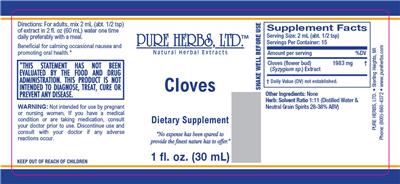
This product contains one active ingredient: Clove Flower Bud Extract, a liquid concentrate of clove buds. There are no other inactive ingredients listed.
Does it work?
Not established
The evidence we hold shows clove as possibly effective for ventilator-associated pneumonia (VAP), a serious lung infection in hospitalized patients on breathing machines. For cough, acute pain, and indigestion (dyspepsia), the evidence isn't established in our data — we don't have enough reliable research to rate it either way.
How safe is it?
Well-documented data
Clove is well tolerated when you use it as a food spice. The concern comes with concentrated clove oil and medicinal supplements: doses as small as 5–10 mL of clove oil can be toxic in children.
Food amounts are likely fine, but medicinal or essential-oil doses should be cleared with your doctor first. When applied to skin, clove is generally well tolerated, though burning, contact dermatitis, and mucous membrane irritation can occur.
Inhaling clove or using it intravenously may be unsafe. Rare serious side effects from swallowing clove oil include liver failure; a small number of case reports describe CNS depression and seizures in young children who accidentally ingested it.
Clove cigarettes carry additional risks from nicotine, tar, and carbon monoxide. During pregnancy and lactation, clove is rated likely safe based on available data.
Meds to double-check
Moderate interaction found
Before taking this product, double-check with your doctor or pharmacist if you take antidiabetes drugs (insulin or oral blood-sugar medications), any anticoagulant or antiplatelet drugs (blood thinners like warfarin), or medications broken down by your liver's CYP2D6, CYP1A2, CYP3A4, or CYP2C9 enzymes — a broad group that includes many common prescriptions. Clove may raise their levels or lower your blood sugar.
The bottom line
Scorecard at a glanceFully disclosed formula with no established evidence rating for its marketed use. Moderate medication interactions have been identified, and safety information is well characterized.
Clove extract may be worth considering if you're interested in its traditional uses, but it's not something to start if you take blood-sugar medications, blood thinners, or any drug metabolized by the liver without checking first. Stay within food amounts unless your doctor has cleared a medicinal dose.
Talk with your own doctor or pharmacist before combining this with any of your medications.
Educational only — not medical advice; always confirm with your pharmacist. Our editorial policy · How we use AI
Assessment coverage: 1 of 1 active ingredient matched to our full ingredient reviews (monographs). Based on the product label dated Dec 13, 2022.
This Scorecard evaluates available label information, ingredient evidence, and known medication-safety considerations. It does not independently verify product identity, purity, potency, contamination, or manufacturing quality. How these ratings are computed
General information
Key facts about Cloves, straight from the product label.
| Brand | Pure Herbs |
|---|---|
| Net contents | 1 Fluid Ounce(s); 30 mL |
| Market status | On market |
| Date entered into DSLD | Dec 13, 2022 |
| DSLD ID | 278766 |
| Product type | Botanical |
| Supplement form | Liquid |
| Dietary claims / uses | All Other, Structure/Function |
| Intended target group(s) | Adult (18 - 50 Years), Women (not pregnant or lactating) |
Everything in this section is reproduced from the manufacturer’s own product label — it’s the label speaking, not HelloPharmacist. We show it so you can see exactly what the maker states; we don’t verify or endorse those statements.
Supplement Facts
The label details for Cloves by Pure Herbs, sourced from the NIH Dietary Supplement Label Database.
Tap any ingredient to jump to its full detail below.
These statements are the manufacturer’s wording, reproduced from the product label — the label is saying it, not HelloPharmacist. We don’t verify or endorse them.
Suggested/Recommended/Usage/Directions
Directions: For adults, mix 2 mL (abt. 1/2 tsp) of extract in 2 fl. oz (60 mL) water one time daily preferably with a meal.
Shake well before use
Formulation
Beneficial for calming occasional nausea and promoting oral health.
FDA Disclaimer Statement
This statement has not been evaluated by the Food and Drug Administration. This product is not intended to diagnose, treat, cure or prevent any disease.
Precautions
Warning: Not intended for use by pregnant or nursing women. If you have a medical condition or are taking medication, consult your doctor prior to use.
Discontinue use and consult with your doctor if any adverse reactions occur.
Keep out of reach of children
Brand IP Statement(s)
Pure Herbs, Ltd. Natural Herbal Extracts
FDA Statement of Identity
Dietary Supplement
General Statements
"No expense has been spared to provide the finest nature has to offer."
Is this label outdated? Report a formula or label change and our pharmacy team will review it.
Cloves by Pure Herbs label
The label scan from the NIH Dietary Supplement Label Database. Tap to enlarge.
Label images are published by the NIH Dietary Supplement Label Database for the version of this product on file. Always read your actual product label.
View the full label (PDF)The Ingredients in Cloves by Pure Herbs
This is the 1 active ingredient this product is made of. Select it to open its full monograph.
Serving size2 mL Dosage formLiquid Servings per container15 Amounts shown are per serving.
Clove Flower Bud Extract
Interacts with979 drugs
Clove is a common cooking spice that is also used in traditional medicine, especially as a topical numbing agent for tooth pain thanks to its main com...
Clove Flower Bud Extract monograph & interactionsOther (inactive) ingredients: None. These complete the product’s ingredient list but are not active constituents.
Cloves by Pure Herbs Drug Interactions
HelloPharmacist Interaction Report
Pure Herbs Cloves is a single-ingredient liquid extract that interacts with several medication types.
The most serious interaction is with antidiabetes drugs (insulin and oral blood-sugar medications). Clove extract may lower your blood glucose, which could increase the risk of low blood sugar (hypoglycemia) — your doses might need adjusting, and you'll want to monitor your blood sugar closely if you combine them.
Read the full breakdown — every affected drug type, severity by severity
Clove also theoretically affects how your liver breaks down a broad range of medications through multiple enzyme pathways (CYP2D6, CYP1A2, CYP3A4, and CYP2C9 substrates). Lab research shows that eugenol, clove's main active compound, can inhibit these pathways in a dose-dependent way, which could raise levels of those drugs in your bloodstream.
These effects haven't been confirmed in people yet, but the concern is real enough to warrant checking. Additionally, clove oil may increase the risk of bleeding if you take anticoagulant or antiplatelet drugs (blood thinners), and topical clove oil may boost the absorption of topical ibuprofen — both Minor interactions not yet reported in humans.
Altogether, these interactions span 978 individual medications. Use the interaction checker below with your exact medication list before you start.
Check your own medications below · Editorial policy · How we use AI
Want to check YOUR meds against Cloves?
Ask about interactions with your drugs in plain English — “Can I take it with lisinopril?” — and we find you the answer in seconds, ingredient by ingredient.
Go to the checkerIngredients driving the most interactions
Individual Drug Interactions
The ingredients in Cloves interact with 979 drugs. Click any drug to see the details.
1 of the 1 ingredient in Cloves interact with drugs. Each result below shows which ingredient is responsible. Clove Flower Bud Extract
Ado-trastuzumab EmtansineKadcyla
How Ado-trastuzumab Emtansine interacts with Cloves — through 1 ingredient. Tap an ingredient for the detail:
Clove Flower Bud ExtractCytochrome P450 3a4 (cyp3a4) Substrates Moderate
Interaction Summary
Theoretically, concomitant use of clove may increase levels of drugs metabolized by CYP3A4.
Read the full Clove Flower Bud Extract + Ado-trastuzumab Emtansine interactionAbemaciclibVerzenio
How Abemaciclib interacts with Cloves — through 1 ingredient. Tap an ingredient for the detail:
Clove Flower Bud ExtractCytochrome P450 3a4 (cyp3a4) Substrates Moderate
Interaction Summary
Theoretically, concomitant use of clove may increase levels of drugs metabolized by CYP3A4.
Read the full Clove Flower Bud Extract + Abemaciclib interactionAbiraterone
How Abiraterone interacts with Cloves — through 1 ingredient. Tap an ingredient for the detail:
Clove Flower Bud ExtractCytochrome P450 3a4 (cyp3a4) Substrates Moderate
Interaction Summary
Theoretically, concomitant use of clove may increase levels of drugs metabolized by CYP3A4.
Read the full Clove Flower Bud Extract + Abiraterone interactionAbiraterone AcetateYonsa, Zytiga
How Abiraterone Acetate interacts with Cloves — through 1 ingredient. Tap an ingredient for the detail:
Clove Flower Bud ExtractCytochrome P450 3a4 (cyp3a4) Substrates Moderate
Interaction Summary
Theoretically, concomitant use of clove may increase levels of drugs metabolized by CYP3A4.
Read the full Clove Flower Bud Extract + Abiraterone Acetate interactionAbrocitinibCibinqo
How Abrocitinib interacts with Cloves — through 1 ingredient. Tap an ingredient for the detail:
Clove Flower Bud ExtractAnticoagulant/antiplatelet Drugs, Cytochrome P450 2c9 (cyp2c9) Substrates Moderate
Interaction Summary
Theoretically, clove oil may increase the risk of bleeding if used with anticoagulant or antiplatelet drugs.
Read the full Clove Flower Bud Extract + Abrocitinib interactionAcalabrutinibCalquence
How Acalabrutinib interacts with Cloves — through 1 ingredient. Tap an ingredient for the detail:
Clove Flower Bud ExtractCytochrome P450 3a4 (cyp3a4) Substrates Moderate
Interaction Summary
Theoretically, concomitant use of clove may increase levels of drugs metabolized by CYP3A4.
Read the full Clove Flower Bud Extract + Acalabrutinib interactionAcarboseGlucobay, Prandase, Precose
How Acarbose interacts with Cloves — through 1 ingredient. Tap an ingredient for the detail:
Clove Flower Bud ExtractAntidiabetes Drugs Moderate
Interaction Summary
Theoretically, concomitant use of clove extracts with antidiabetes drugs might increase the risk of hypoglycemia.
Read the full Clove Flower Bud Extract + Acarbose interactionAcetaminophenChildren's Tylenol, Children's Tylenol Meltaways, Tylenol, Tylenol Ex Strength
How Acetaminophen interacts with Cloves — through 1 ingredient. Tap an ingredient for the detail:
Clove Flower Bud ExtractCytochrome P450 1a2 (cyp1a2) Substrates Moderate
Interaction Summary
Theoretically, concomitant use of clove may increase levels of drugs metabolized by CYP1A2.
Read the full Clove Flower Bud Extract + Acetaminophen interactionAcetaminophen, AspirinGemnisyn
How Acetaminophen, Aspirin interacts with Cloves — through 1 ingredient. Tap an ingredient for the detail:
Clove Flower Bud ExtractCytochrome P450 1a2 (cyp1a2) Substrates, Anticoagulant/antiplatelet Drugs Moderate
Interaction Summary
Theoretically, concomitant use of clove may increase levels of drugs metabolized by CYP1A2.
Read the full Clove Flower Bud Extract + Acetaminophen, Aspirin interactionAcetaminophen, Aspirin, CaffeineExcedrin, Excedrin Extra Strength, Excedrin Migraine
How Acetaminophen, Aspirin, Caffeine interacts with Cloves — through 1 ingredient. Tap an ingredient for the detail:
Clove Flower Bud ExtractAnticoagulant/antiplatelet Drugs, Cytochrome P450 1a2 (cyp1a2) Substrates +1 Moderate
Interaction Summary
Theoretically, clove oil may increase the risk of bleeding if used with anticoagulant or antiplatelet drugs.
Read the full Clove Flower Bud Extract + Acetaminophen, Aspirin, Caffeine interactionAcetaminophen, Brompheniramine, PhenylpropanolamineDimetapp Cold and Flu
How Acetaminophen, Brompheniramine, Phenylpropanolamine interacts with Cloves — through 1 ingredient. Tap an ingredient for the detail:
Clove Flower Bud ExtractCytochrome P450 1a2 (cyp1a2) Substrates Moderate
Interaction Summary
Theoretically, concomitant use of clove may increase levels of drugs metabolized by CYP1A2.
Read the full Clove Flower Bud Extract + Acetaminophen, Brompheniramine, Phenylpropanolamine interactionAcetaminophen, ButalbitalAxocet, Bancap, Bucet, Butex Forte, Esgic CF, Orbivan CF +5 more
How Acetaminophen, Butalbital interacts with Cloves — through 1 ingredient. Tap an ingredient for the detail:
Clove Flower Bud ExtractCytochrome P450 1a2 (cyp1a2) Substrates Moderate
Interaction Summary
Theoretically, concomitant use of clove may increase levels of drugs metabolized by CYP1A2.
Read the full Clove Flower Bud Extract + Acetaminophen, Butalbital interactionAcetaminophen, Butalbital, CaffeineEsgic, Esgic Plus, Fiogesic, Fioricet, Repan, Tecnal +1 more
How Acetaminophen, Butalbital, Caffeine interacts with Cloves — through 1 ingredient. Tap an ingredient for the detail:
Clove Flower Bud ExtractCytochrome P450 1a2 (cyp1a2) Substrates, Cytochrome P450 3a4 (cyp3a4) Substrates Moderate
Interaction Summary
Theoretically, concomitant use of clove may increase levels of drugs metabolized by CYP1A2.
Read the full Clove Flower Bud Extract + Acetaminophen, Butalbital, Caffeine interactionAcetaminophen, Butalbital, Caffeine, CodeineEsgic with Codeine, Fioricet w/ Codeine
How Acetaminophen, Butalbital, Caffeine, Codeine interacts with Cloves — through 1 ingredient. Tap an ingredient for the detail:
Clove Flower Bud ExtractCytochrome P450 3a4 (cyp3a4) Substrates, Cytochrome P450 2d6 (cyp2d6) Substrates +1 Moderate
Interaction Summary
Theoretically, concomitant use of clove may increase levels of drugs metabolized by CYP3A4.
Read the full Clove Flower Bud Extract + Acetaminophen, Butalbital, Caffeine, Codeine interactionAcetaminophen, Butalbital, CodeineBancap w/ Codeine
How Acetaminophen, Butalbital, Codeine interacts with Cloves — through 1 ingredient. Tap an ingredient for the detail:
Clove Flower Bud ExtractCytochrome P450 2d6 (cyp2d6) Substrates, Cytochrome P450 1a2 (cyp1a2) Substrates Moderate
Interaction Summary
Theoretically, concomitant use of clove may increase levels of drugs metabolized by CYP2D6.
Read the full Clove Flower Bud Extract + Acetaminophen, Butalbital, Codeine interactionAcetaminophen, Butalbital, Codeine PhosphatePhrenilin #3
How Acetaminophen, Butalbital, Codeine Phosphate interacts with Cloves — through 1 ingredient. Tap an ingredient for the detail:
Clove Flower Bud ExtractCytochrome P450 2d6 (cyp2d6) Substrates, Cytochrome P450 1a2 (cyp1a2) Substrates Moderate
Interaction Summary
Theoretically, concomitant use of clove may increase levels of drugs metabolized by CYP2D6.
Read the full Clove Flower Bud Extract + Acetaminophen, Butalbital, Codeine Phosphate interactionAcetaminophen, Caffeine, Chlorpheniramine, Hydrocodone, PhenylephrineHycomine Compound
How Acetaminophen, Caffeine, Chlorpheniramine, Hydrocodone, Phenylephrine interacts with Cloves — through 1 ingredient. Tap an ingredient for the detail:
Clove Flower Bud ExtractCytochrome P450 2d6 (cyp2d6) Substrates, Cytochrome P450 1a2 (cyp1a2) Substrates +1 Moderate
Interaction Summary
Theoretically, concomitant use of clove may increase levels of drugs metabolized by CYP2D6.
Read the full Clove Flower Bud Extract + Acetaminophen, Caffeine, Chlorpheniramine, Hydrocodone, Phenylephrine interactionAcetaminophen, Caffeine, CodeineGesic C15, Gesic C30, Gesic C8, Lenoltec 1, Lenoltec 2, Lenoltec 3 +1 more
How Acetaminophen, Caffeine, Codeine interacts with Cloves — through 1 ingredient. Tap an ingredient for the detail:
Clove Flower Bud ExtractCytochrome P450 3a4 (cyp3a4) Substrates, Cytochrome P450 2d6 (cyp2d6) Substrates +1 Moderate
Interaction Summary
Theoretically, concomitant use of clove may increase levels of drugs metabolized by CYP3A4.
Read the full Clove Flower Bud Extract + Acetaminophen, Caffeine, Codeine interactionAcetaminophen, Caffeine, Codeine, SalicylamideCodalan No.1, Codalan No.2, Codalan No.3
How Acetaminophen, Caffeine, Codeine, Salicylamide interacts with Cloves — through 1 ingredient. Tap an ingredient for the detail:
Clove Flower Bud ExtractCytochrome P450 2d6 (cyp2d6) Substrates, Cytochrome P450 1a2 (cyp1a2) Substrates +1 Moderate
Interaction Summary
Theoretically, concomitant use of clove may increase levels of drugs metabolized by CYP2D6.
Read the full Clove Flower Bud Extract + Acetaminophen, Caffeine, Codeine, Salicylamide interactionAcetaminophen, Caffeine, DihydrocodeineDHC Plus, Panlor DC, Panlor SS
How Acetaminophen, Caffeine, Dihydrocodeine interacts with Cloves — through 1 ingredient. Tap an ingredient for the detail:
Clove Flower Bud ExtractCytochrome P450 3a4 (cyp3a4) Substrates, Cytochrome P450 2d6 (cyp2d6) Substrates +1 Moderate
Interaction Summary
Theoretically, concomitant use of clove may increase levels of drugs metabolized by CYP3A4.
Read the full Clove Flower Bud Extract + Acetaminophen, Caffeine, Dihydrocodeine interactionAcetaminophen, Caffeine, IsomethepteneMigralam
How Acetaminophen, Caffeine, Isometheptene interacts with Cloves — through 1 ingredient. Tap an ingredient for the detail:
Clove Flower Bud ExtractCytochrome P450 1a2 (cyp1a2) Substrates, Cytochrome P450 3a4 (cyp3a4) Substrates Moderate
Interaction Summary
Theoretically, concomitant use of clove may increase levels of drugs metabolized by CYP1A2.
Read the full Clove Flower Bud Extract + Acetaminophen, Caffeine, Isometheptene interactionAcetaminophen, Caffeine, PyrilamineMidol Max Strength Menstrual
How Acetaminophen, Caffeine, Pyrilamine interacts with Cloves — through 1 ingredient. Tap an ingredient for the detail:
Clove Flower Bud ExtractCytochrome P450 3a4 (cyp3a4) Substrates, Cytochrome P450 1a2 (cyp1a2) Substrates Moderate
Interaction Summary
Theoretically, concomitant use of clove may increase levels of drugs metabolized by CYP3A4.
Read the full Clove Flower Bud Extract + Acetaminophen, Caffeine, Pyrilamine interactionAcetaminophen, Chlorpheniramine Maleate, Dextromethorphan HbrVicks Formula 44M Cough, Cold & Flu Relief
How Acetaminophen, Chlorpheniramine Maleate, Dextromethorphan Hbr interacts with Cloves — through 1 ingredient. Tap an ingredient for the detail:
Clove Flower Bud ExtractCytochrome P450 2d6 (cyp2d6) Substrates, Cytochrome P450 1a2 (cyp1a2) Substrates +1 Moderate
Interaction Summary
Theoretically, concomitant use of clove may increase levels of drugs metabolized by CYP2D6.
Read the full Clove Flower Bud Extract + Acetaminophen, Chlorpheniramine Maleate, Dextromethorphan Hbr interactionAcetaminophen, Chlorpheniramine, Codeine, PhenylephrineColrex
How Acetaminophen, Chlorpheniramine, Codeine, Phenylephrine interacts with Cloves — through 1 ingredient. Tap an ingredient for the detail:
Clove Flower Bud ExtractCytochrome P450 1a2 (cyp1a2) Substrates, Cytochrome P450 3a4 (cyp3a4) Substrates +1 Moderate
Interaction Summary
Theoretically, concomitant use of clove may increase levels of drugs metabolized by CYP1A2.
Read the full Clove Flower Bud Extract + Acetaminophen, Chlorpheniramine, Codeine, Phenylephrine interactionAcetaminophen, Chlorpheniramine, DextromethorphanCoricidin II Extra Strength Cold and Flu
How Acetaminophen, Chlorpheniramine, Dextromethorphan interacts with Cloves — through 1 ingredient. Tap an ingredient for the detail:
Clove Flower Bud ExtractCytochrome P450 2d6 (cyp2d6) Substrates, Cytochrome P450 1a2 (cyp1a2) Substrates +1 Moderate
Interaction Summary
Theoretically, concomitant use of clove may increase levels of drugs metabolized by CYP2D6.
Read the full Clove Flower Bud Extract + Acetaminophen, Chlorpheniramine, Dextromethorphan interactionAcetaminophen, Chlorpheniramine, Dextromethorphan HydrobromideCoricidin HBP Maximum Strength Flu
How Acetaminophen, Chlorpheniramine, Dextromethorphan Hydrobromide interacts with Cloves — through 1 ingredient. Tap an ingredient for the detail:
Clove Flower Bud ExtractCytochrome P450 3a4 (cyp3a4) Substrates, Cytochrome P450 1a2 (cyp1a2) Substrates +1 Moderate
Interaction Summary
Theoretically, concomitant use of clove may increase levels of drugs metabolized by CYP3A4.
Read the full Clove Flower Bud Extract + Acetaminophen, Chlorpheniramine, Dextromethorphan Hydrobromide interactionAcetaminophen, Chlorpheniramine, Dextromethorphan, PhenylpropanolamineMulti Symptom Cold Relief
How Acetaminophen, Chlorpheniramine, Dextromethorphan, Phenylpropanolamine interacts with Cloves — through 1 ingredient. Tap an ingredient for the detail:
Clove Flower Bud ExtractCytochrome P450 2d6 (cyp2d6) Substrates, Cytochrome P450 1a2 (cyp1a2) Substrates +1 Moderate
Interaction Summary
Theoretically, concomitant use of clove may increase levels of drugs metabolized by CYP2D6.
Read the full Clove Flower Bud Extract + Acetaminophen, Chlorpheniramine, Dextromethorphan, Phenylpropanolamine interactionAcetaminophen, Chlorpheniramine, Dextromethorphan, PseudoephedrineChildren's Tylenol Cold Plus Cough, Tylenol Cold Ex Strength
How Acetaminophen, Chlorpheniramine, Dextromethorphan, Pseudoephedrine interacts with Cloves — through 1 ingredient. Tap an ingredient for the detail:
Clove Flower Bud ExtractCytochrome P450 3a4 (cyp3a4) Substrates, Cytochrome P450 2d6 (cyp2d6) Substrates +1 Moderate
Interaction Summary
Theoretically, concomitant use of clove may increase levels of drugs metabolized by CYP3A4.
Read the full Clove Flower Bud Extract + Acetaminophen, Chlorpheniramine, Dextromethorphan, Pseudoephedrine interactionAcetaminophen, Chlorpheniramine, Guaifenesin, Phenylephrine, SalicylamideRhinogesic GG
How Acetaminophen, Chlorpheniramine, Guaifenesin, Phenylephrine, Salicylamide interacts with Cloves — through 1 ingredient. Tap an ingredient for the detail:
Clove Flower Bud ExtractCytochrome P450 1a2 (cyp1a2) Substrates, Cytochrome P450 3a4 (cyp3a4) Substrates Moderate
Interaction Summary
Theoretically, concomitant use of clove may increase levels of drugs metabolized by CYP1A2.
Read the full Clove Flower Bud Extract + Acetaminophen, Chlorpheniramine, Guaifenesin, Phenylephrine, Salicylamide interactionAcetaminophen, Chlorpheniramine, PhenylephrineAlka-Seltzer PLUS, Histex SR, Protid
How Acetaminophen, Chlorpheniramine, Phenylephrine interacts with Cloves — through 1 ingredient. Tap an ingredient for the detail:
Clove Flower Bud ExtractCytochrome P450 3a4 (cyp3a4) Substrates, Cytochrome P450 1a2 (cyp1a2) Substrates Moderate
Interaction Summary
Theoretically, concomitant use of clove may increase levels of drugs metabolized by CYP3A4.
Read the full Clove Flower Bud Extract + Acetaminophen, Chlorpheniramine, Phenylephrine interactionEach ingredient & the kinds of drugs it affects
For each ingredient in Cloves with known interactions, here are the types of medications it can affect. Open any type for the detail — or search your exact drug in the checker above.
Clove Flower Bud Extract
Antidiabetes Drugs
Theoretically, concomitant use of clove extracts with antidiabetes drugs might increase the risk of hypoglycemia.
Clinical and laboratory research suggest that polyphenol extracts from clove flower buds might lower blood glucose levels. Dosing adjustments for insulin or oral hypoglycemic agents may be necessary when taken with clove. Monitor blood glucose levels closely.
Cytochrome P450 1A2 (Cyp1A2) Substrates
Theoretically, concomitant use of clove may increase levels of drugs metabolized by CYP1A2.
In vitro research shows that eugenol, the principal constituent of clove, can inhibit CYP1A2 in a dose-dependent manner,. This effect has not been reported in humans.
Cytochrome P450 2C9 (Cyp2C9) Substrates
Theoretically, concomitant use of clove may increase levels of drugs metabolized by CYP2C9.
In vitro research shows that eugenol, the principal constituent of clove, inhibits CYP2C9 in a dose-dependent manner. This effect has not been reported in humans.
Cytochrome P450 2D6 (Cyp2D6) Substrates
Theoretically, concomitant use of clove may increase levels of drugs metabolized by CYP2D6.
In vitro research shows that eugenol, the principal constituent of clove, can inhibit CYP2D6 in a dose-dependent manner. This effect has not been reported in humans.
Cytochrome P450 3A4 (Cyp3A4) Substrates
Theoretically, concomitant use of clove may increase levels of drugs metabolized by CYP3A4.
In vitro research shows that eugenol, the principal constituent of clove, can inhibit CYP3A4 in a dose-dependent manner. This effect has not been reported in humans.
Anticoagulant/Antiplatelet Drugs
Theoretically, clove oil may increase the risk of bleeding if used with anticoagulant or antiplatelet drugs.
Laboratory research suggests that eugenol, a constituent of clove, has antiplatelet activity. This interaction has not been reported in humans.
Ibuprofen (Advil, Others)
Theoretically, topical application of clove oil with ibuprofen might increase the absorption and side effects of topical ibuprofen.
Laboratory research shows that topical application of clove oil increases the absorption of topical ibuprofen. This interaction has not been reported in humans.
Brand information
Manufacturer and brand details for Cloves, from the product label.
Pure Herbs
See all Pure Herbs products- Name
- Pure Herbs, Ltd.
- City
- Sterling Heights
- State
- MI
- Phone Number
- (800) 860-4372
- Web Address
- www.pureherbs.com
Cloves by Pure Herbs: Common Questions
Does Cloves by Pure Herbs interact with any medications?
How can one product interact with so many drugs?
Where does this information come from?
Is clove safe to use while I'm pregnant or breastfeeding?
What's eugenol, and why does it matter for this product?
Can I use clove oil topically, or is it only for swallowing?
Is clove effective for cough or sore throat?
What dose of clove is safe?
Written and reviewed by the HelloPharmacist editorial staff. Our editorial policy
Not sure if Cloves is safe with your meds?
Our pharmacists answer your medication & supplement questions — free.
Label information is sourced from the NIH Dietary Supplement Label Database and reflects the product version on file; always read your actual product label. This page is for education only and is not a substitute for professional medical advice. Confirm with your pharmacist or doctor before combining supplements and medications.
The Full Monographs Behind Cloves’s Ingredients
Every ingredient we hold a full HelloPharmacist monograph for — uses, evidence, safety, and the complete interaction list.
Sources & How We Checked
Cloves's label data comes from the NIH Dietary Supplement Label Database; the ingredient interaction data is from the Natural Medicines database, reviewed by our pharmacists.
- NIH Dietary Supplement Label Database (DSLD) — The official product label on file for this supplement.
- Natural Medicines (Therapeutic Research Center) — Evidence-graded clinical reference behind the ingredient interaction data.
Content is written and reviewed by licensed HelloPharmacist pharmacists. See our data sources and editorial standards for how this information is built and checked.
The 26 references behind this product’s interaction data
Every citation that drives the interaction findings for this product’s ingredients, from the evidence-graded Natural Medicines (TRC Healthcare) database. Open an ingredient to browse its citations — links open the study on PubMed or the publisher’s site.
Clove 26 references
- The Review of Natural Products by Facts and Comparisons. St. Louis, MO: Wolters Kluwer Co., 1999.
- Electronic Code of Federal Regulations. Title 21. Part 182 -- Substances Generally Recognized As Safe. Available at: https://www.accessdata.fda.gov/scripts/cdrh/cfdocs/cfcfr/CFRSearch.cfm?CFRPart=182
- Kanerva L, Estlander T, Jolanki R. Occupational allergic contact dermatitis from spices. Contact Dermatitis 1996;35:157-62. PubMed
- Chen SJ, Wang MH, Chen IJ. Antiplatelet and calcium inhibitory properties of eugenol and sodium eugenol acetate. Gen Pharmacol 1996;27:629-33. PubMed
- Malson JL, Lee EM, Murty R, et al. Clove cigarette smoking: biochemical, physiological, and subjective effects. Pharmacol Biochem Behav 2003;74:739-45. PubMed
- Kirsch CM, Yenokida GG, Jensen WA, et al. Non-cardiogenic pulmonary oedema due to the intravenous administration of clove oil. Thorax 1990;45:235-6. PubMed
- Pallares, D. E. Link between clove cigarettes and urticaria? Postgrad.Med 10-1-1999;106(4):153. PubMed
- Barnard, D. R. Repellency of essential oils to mosquitoes (Diptera: Culicidae). J Med Entomol. 1999;36(5):625-629. PubMed
- Sanchez-Perez, J. and Garcia-Diez, A. Occupational allergic contact dermatitis from eugenol, oil of cinnamon and oil of cloves in a physiotherapist. Contact Dermatitis 1999;41(6):346-347. PubMed
- Andersen, K. E., Johansen, J. D., Bruze, M., Frosch, P. J., Goossens, A., Lepoittevin, J. P., Rastogi, S., White, I., and Menne, T. The time-dose-response relationship for elicitation of contact dermatitis in isoeugenol allergic individuals. Toxicol.Appl PubMed
- Alqareer, A., Alyahya, A., and Andersson, L. The effect of clove and benzocaine versus placebo as topical anesthetics. J Dent 2006;34(10):747-750. PubMed
- Lane, B. W., Ellenhorn, M. J., Hulbert, T. V., and McCarron, M. Clove oil ingestion in an infant. Hum.Exp Toxicol. 1991;10(4):291-294. PubMed
- Quirce, S., Fernandez-Nieto, M., del, Pozo, V, Sastre, B., and Sastre, J. Occupational asthma and rhinitis caused by eugenol in a hairdresser. Allergy 2008;63(1):137-138. PubMed
- Srivastava, K. C. and Malhotra, N. Acetyl eugenol, a component of oil of cloves (Syzygium aromaticum L.) inhibits aggregation and alters arachidonic acid metabolism in human blood platelets. Prostaglandins Leukot.Essent.Fatty Acids 1991;42(1):73-81. PubMed
- Dyrbye, B. A., Dubois, L., Vink, R., and Horn, J. A patient with clove oil intoxication. Anaesth.Intensive Care 2012;40(2):365-366.
- Guidotti, T. L., Laing, L., and Prakash, U. B. Clove cigarettes. The basis for concern regarding health effects. West J Med 1989;151(2):220-228.
- Anonymous. Evaluation of the health hazard of clove cigarettes. Council on Scientific Affairs. JAMA 12-23-1988;260(24):3641-3644. DOI
- Romaguera, C., Alomar, A., Camarasa, J. M., Garcia, Bravo B., Garcia, Perez A., Grimalt, F., Guerra, P., Lopez, Gorretcher B., Pascual, A. M., Miranda, A., and . Contact dermatitis in children. Contact Dermatitis 1985;12(5):283-284. PubMed
- Hackett, P. H., Rodriguez, G., and Roach, R. C. Clove cigarettes and high-altitude pulmonary edema. JAMA 6-28-1985;253(24):3551-3552. DOI
- Isaacs, G. Permanent local anaesthesia and anhidrosis after clove oil spillage. Lancet 4-16-1983;1(8329):882. PubMed
- Saeed, S. A. and Gilani, A. H. Antithrombotic activity of clove oil. J Pak Med Assoc 1994;44(5):112-115.
- Hartnoll, G., Moore, D., and Douek, D. Near fatal ingestion of oil of cloves. Arch.Dis Child 1993;69(3):392-393. PubMed
- Srivastava, K. C. Antiplatelet principles from a food spice clove (Syzygium aromaticum L) [corrected]. Prostaglandins Leukot.Essent.Fatty Acids 1993;48(5):363-372.
- Jiang Q, Wu Y, Zhang H, et al. Development of essential oils as skin permeation enhancers: penetration enhancement effect and mechanism of action. Pharmaceutical Biol. 2017;55(1):1592-1600. PubMed
- Mohan R, Jose S, Mulakkal J, Karpinsky-Semper D, Swick AG, Krishnakumar IM. Water-soluble polyphenol-rich clove extract lowers pre- and post-prandial blood glucose levels in healthy and prediabetic volunteers: an open label pilot study. BMC Complement Alt PubMed
- Alharbi NFM, Ahad A, Bin Jardan YA, Al-Jenoobi FI. Effect of eugenol on cytochrome P450 1A2, 2C9, 2D6, and 3A4 activity in human liver microsomes. Saudi Pharm J 2024;32(7):102118. PubMed
Parts of this content are provided by the Therapeutic Research Center, LLC.
DISCLAIMER: Currently this does not check for drug-drug interactions. This is not an all-inclusive comprehensive list of potential interactions and is for informational purposes only. Not all interactions are known or well-reported in the scientific literature, and new interactions are continually being reported. Input is needed from a qualified healthcare provider including a pharmacist before starting any therapy. Application of clinical judgment is necessary.
© 2021 Therapeutic Research Center, LLC