
Colon Detox+ Ingredients & Drug Interactions
by Herbs SRA
What is this page for?
First and foremost: checking Colon Detox+ against your medications. The heart of this page is the interaction checker and the full interaction report — how this product’s ingredients may interact with prescription and over-the-counter medicines you may be taking.
Around that, we add a pharmacist’s high-level view of the product as a whole — what’s inside, the evidence for its stated use, how transparent the label is, and what safety data exists — so you can see the full picture in one place. It’s educational information from our licensed clinical databases and the clinical staff at HelloPharmacist — not medical advice — and we don’t sell or endorse products. Our editorial policy
Colon Detox+ is a dietary supplement by Herbs SRA with 4 active ingredients. Its ingredients are commonly taken for constipation, bowel cleansing before procedures, hemorrhoids.Based on those ingredients, 1,073 medications have a known interaction with it, the most serious rated moderate. The ingredients most likely to interact are Clove, Cascara Sagrada Extract, Senna Extract. Use the checker below to test your specific medication, or read the full HelloPharmacist Interaction Report.
Check Your Meds Against Colon Detox+ by Herbs SRA
Ask about any prescription or over-the-counter medication and we check it for interactions with Colon Detox+ by Herbs SRA — and tell you which ingredient is responsible.
AI summaries are generated from our interaction database for education only — always confirm with your pharmacist. How we use AI
Ask the Pharmacist
A licensed pharmacist will answer your question by email — free, usually within 24 hours.
Got it — thank you!
A licensed pharmacist will answer within 24 hours. Keep an eye on your email (worth checking spam, just in case).
HelloPharmacist Scorecard of Colon Detox+ by Herbs SRA
Our pharmacy team’s full take, with four database checks built into the cards below — a summary of what is known, not a grade of the product itself.
What’s inside
Full disclosure
Colon Detox+ contains four ingredients: cascara sagrada extract, clove, psyllium, and senna extract. Cascara sagrada and senna are both stimulant laxatives—they work by prompting your colon to contract and move stool along more quickly.
Clove is an herbal ingredient sometimes used for digestive comfort. Psyllium is a soluble fiber that absorbs water to bulk up stool.
The capsule also contains cellulose as an inactive filler.
Does it work?
Strong evidence
According to the data we hold, senna extract is likely effective for constipation and possibly effective for bowel preparation. Cascara sagrada, however, is rated possibly ineffective for bowel preparation, and the evidence for it in constipation is insufficient to rate.
Clove's effectiveness in any digestive condition relevant to this product is not established in our data—we hold ratings only for ventilator-associated pneumonia and cough, neither of which applies here. For psyllium, no effectiveness data is on file.
How safe is it?
Well-documented data
Cascara sagrada is generally well tolerated for short-term use—the most common side effect is mild abdominal cramping. However, long-term daily use carries real risks: it can lead to potassium loss, liver damage (rare), and over months or years, muscle wasting (cachexia).
The safety data advises against cascara during pregnancy and nursing. Senna extract is also generally well tolerated short-term and is often considered acceptable under medical guidance, with common side effects including cramping, diarrhea, and nausea.
Senna in pregnancy is rated possibly safe and possibly safe while nursing, though it is not recommended for long-term daily use without a doctor's input. Clove is likely safe in pregnancy and nursing when used in food amounts, but concentrated supplements or essential oils carry risks—clove oil in doses as small as 5–10 mL can be toxic in children.
No safety data is on file for psyllium.
Meds to double-check
Moderate interaction found
Before taking Colon Detox+, double-check with your doctor or pharmacist if you take water pills (diuretics), steroids (corticosteroids), or cardiac glycosides like digoxin—cascara sagrada and senna both increase the risk of dangerously low potassium with these. If you take blood thinners like warfarin, both cascara and senna raise your bleeding risk through diarrhea.
If you take birth control pills (estrogens), senna may reduce how well they work. If you take diabetes medications, clove may increase the risk of low blood sugar.
Additionally, if you take medications processed by your liver through CYP2D6, CYP1A2, CYP3A4, or CYP2C9 enzymes, clove may raise their blood levels—ask your pharmacist if any of your drugs fit these categories. Check each medication on this page before you start.
The bottom line
Scorecard at a glanceFully disclosed formula with strong clinical evidence behind its ingredients' uses. Moderate medication interactions have been identified, and safety information is well characterized.
This product is designed for short-term occasional constipation relief under medical guidance, not for daily long-term use. If you take any prescription medications—especially blood thinners, heart medication, water pills, steroids, diabetes drugs, or birth control—you need to check each one with your pharmacist or doctor before starting.
Cascara and senna both work but carry real risks with long-term use, so talk with your own healthcare provider about whether this is right for your situation and how long it's safe to take.
Educational only — not medical advice; always confirm with your pharmacist. Our editorial policy · How we use AI
Assessment coverage: 3 of 4 active ingredients matched to our full ingredient reviews (monographs). Based on the product label dated Aug 22, 2024.
This Scorecard evaluates available label information, ingredient evidence, and known medication-safety considerations. It does not independently verify product identity, purity, potency, contamination, or manufacturing quality. How these ratings are computed
General information
Key facts about Colon Detox+, straight from the product label.
Everything in this section is reproduced from the manufacturer’s own product label — it’s the label speaking, not HelloPharmacist. We show it so you can see exactly what the maker states; we don’t verify or endorse those statements.
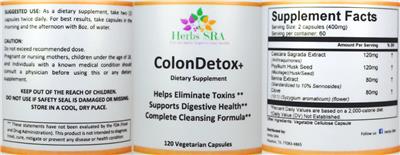
Supplement Facts
The label details for Colon Detox+ by Herbs SRA, sourced from the NIH Dietary Supplement Label Database.
Supplement Facts
| Ingredient | Amount | % DV |
|---|---|---|
| Cascara Sagrada Extract | 120 mg | -- |
| Clove | 80 mg | -- |
| Psyllium | 120 mg | -- |
| Senna Extract | 80 mg | -- |
Other ingredients: Cellulose
Tap any ingredient to jump to its full detail below.
These statements are the manufacturer’s wording, reproduced from the product label — the label is saying it, not HelloPharmacist. We don’t verify or endorse them.
Suggested/Recommended/Usage/Directions
Suggested use: As a dietary supplement, take two (2) capsules twice daily. For best results, take capsules in the morning and afternoon with 8 oz. of water.
Precautions
Caution: Do not exceed recommended dose. Do not use if safety seal is damaged or missing.
Pregnant or nursing mothers, children under the age of 18, and individuals with a known medical condition should consult a physician before using this or any dietary supplement.
Pregnant or nursing mothers, children under the age of 18, and individuals with a known medical condition should consult a physician before using this or any dietary supplement. Keep out of the reach of children.
Storage
Store in a cool, dry place.
FDA Disclaimer Statement
These statements have not been evaluated by the FDA (Food and Drug Administration). This product is not intended to diagnose, treat, cure, mitigate or prevent any disease or health condition.
General Statements
Let the herbs improve your health
Follow us: Facebook Herbs SRA
FDA Statement of Identity
Dietary Supplement
Formulation
Helps eliminate toxins Supports digestive health Complete cleansing formula
Is this label outdated? Report a formula or label change and our pharmacy team will review it.
Colon Detox+ by Herbs SRA label
The label scan from the NIH Dietary Supplement Label Database. Tap to enlarge.
Label images are published by the NIH Dietary Supplement Label Database for the version of this product on file. Always read your actual product label.
View the full label (PDF)The Ingredients in Colon Detox+ by Herbs SRA
These are the 4 active ingredients this product is made of. Select any to open its full monograph.
Serving size2 Capsule(s) Dosage formCapsule Servings per container60 Amounts shown are per serving.
Most supplement products combine several ingredients, and a medication can interact with the product through any one of them. Each ingredient below shows whether it has known drug interactions.
Cascara Sagrada Extract
Interacts with747 drugs
Cascara sagrada is a stimulant laxative made from the aged bark of a Pacific Northwest tree, used mainly for short-term relief of constipation. Becaus...
Cascara Sagrada Extract monograph & interactionsClove
Interacts with979 drugs
Clove is a common cooking spice that is also used in traditional medicine, especially as a topical numbing agent for tooth pain thanks to its main com...
Clove monograph & interactionsPsyllium
Senna Extract
Interacts with140 drugs
Senna is a plant-based stimulant laxative that is widely used and generally effective for short-term relief of constipation. It is best used occasiona...
Senna Extract monograph & interactionsOther (inactive) ingredients: Cellulose. These complete the product’s ingredient list but are not active constituents.
Colon Detox+ by Herbs SRA Drug Interactions
HelloPharmacist Interaction Report
Colon Detox+ by Herbs SRA interacts with medications through its cascara sagrada, clove, and senna extract content.
The most serious interactions are Moderate-severity risks of low potassium (hypokalemia) when cascara sagrada or senna extract are taken with water pills (diuretics) or steroids (corticosteroids), which can lead to serious heart or muscle problems if potassium drops too far.
Read the full breakdown — every affected drug type, severity by severity
Cascara sagrada and senna extract both carry Moderate-severity risks with blood thinners like warfarin—their laxative effects can trigger diarrhea, which increases how strongly warfarin works and raises bleeding risk. Both also pose Moderate risk with heart medication (digoxin), again through potassium loss.
Senna extract can interfere with birth control pills (estrogens) by speeding up how fast they move through your gut, potentially lowering their effectiveness. Cascara sagrada may slightly reduce how your liver clears certain medications (CYP3A4 substrates), a Minor-severity concern.
Clove brings several Moderate-severity enzyme interactions: it can raise blood levels of drugs broken down by your liver through five different enzyme systems (CYP2D6, CYP1A2, CYP3A4, and CYP2C9 substrates), and it may increase the risk of low blood sugar (hypoglycemia) if you take diabetes medications. Clove also carries Minor-severity risks of increased bleeding with blood thinners and higher absorption of topical ibuprofen.
Altogether, these interactions span 1,072 individual medications. We could not check psyllium for interactions—no data is on file for it.
Before you start, run your exact medications through the search tool on this page.
Check your own medications below · Editorial policy · How we use AI
Want to check YOUR meds against Colon Detox+?
Ask about interactions with your drugs in plain English — “Can I take it with lisinopril?” — and we find you the answer in seconds, ingredient by ingredient.
Go to the checkerIngredients driving the most interactions
Individual Drug Interactions
The ingredients in Colon Detox+ interact with 1,073 drugs. Click any drug to see the details.
3 of the 4 ingredients in Colon Detox+ interact with drugs. Each result below shows which ingredient is responsible. Clove Cascara Sagrada Extract Senna Extract
Ado-trastuzumab EmtansineKadcyla
How Ado-trastuzumab Emtansine interacts with Colon Detox+ — through 2 ingredients. Tap an ingredient for the detail:
CloveCytochrome P450 3a4 (cyp3a4) Substrates Moderate
Interaction Summary
Theoretically, concomitant use of clove may increase levels of drugs metabolized by CYP3A4.
Read the full Clove + Ado-trastuzumab Emtansine interactionCascara Sagrada ExtractCytochrome P450 3a4 (cyp3a4) Substrates Minor
Interaction Summary
Theoretically, cascara sagrada might decrease the effects of CYP3A4 substrates.
Read the full Cascara Sagrada Extract + Ado-trastuzumab Emtansine interactionAbemaciclibVerzenio
How Abemaciclib interacts with Colon Detox+ — through 2 ingredients. Tap an ingredient for the detail:
CloveCytochrome P450 3a4 (cyp3a4) Substrates Moderate
Interaction Summary
Theoretically, concomitant use of clove may increase levels of drugs metabolized by CYP3A4.
Read the full Clove + Abemaciclib interactionCascara Sagrada ExtractCytochrome P450 3a4 (cyp3a4) Substrates Minor
Interaction Summary
Theoretically, cascara sagrada might decrease the effects of CYP3A4 substrates.
Read the full Cascara Sagrada Extract + Abemaciclib interactionAbiraterone
How Abiraterone interacts with Colon Detox+ — through 2 ingredients. Tap an ingredient for the detail:
CloveCytochrome P450 3a4 (cyp3a4) Substrates Moderate
Interaction Summary
Theoretically, concomitant use of clove may increase levels of drugs metabolized by CYP3A4.
Read the full Clove + Abiraterone interactionCascara Sagrada ExtractCytochrome P450 3a4 (cyp3a4) Substrates Minor
Interaction Summary
Theoretically, cascara sagrada might decrease the effects of CYP3A4 substrates.
Read the full Cascara Sagrada Extract + Abiraterone interactionAbiraterone AcetateYonsa, Zytiga
How Abiraterone Acetate interacts with Colon Detox+ — through 2 ingredients. Tap an ingredient for the detail:
CloveCytochrome P450 3a4 (cyp3a4) Substrates Moderate
Interaction Summary
Theoretically, concomitant use of clove may increase levels of drugs metabolized by CYP3A4.
Read the full Clove + Abiraterone Acetate interactionCascara Sagrada ExtractCytochrome P450 3a4 (cyp3a4) Substrates Minor
Interaction Summary
Theoretically, cascara sagrada might decrease the effects of CYP3A4 substrates.
Read the full Cascara Sagrada Extract + Abiraterone Acetate interactionAbrocitinibCibinqo
How Abrocitinib interacts with Colon Detox+ — through 1 ingredient. Tap an ingredient for the detail:
CloveCytochrome P450 2c9 (cyp2c9) Substrates, Anticoagulant/antiplatelet Drugs Moderate
Interaction Summary
Theoretically, concomitant use of clove may increase levels of drugs metabolized by CYP2C9.
Read the full Clove + Abrocitinib interactionAcalabrutinibCalquence
How Acalabrutinib interacts with Colon Detox+ — through 2 ingredients. Tap an ingredient for the detail:
CloveCytochrome P450 3a4 (cyp3a4) Substrates Moderate
Interaction Summary
Theoretically, concomitant use of clove may increase levels of drugs metabolized by CYP3A4.
Read the full Clove + Acalabrutinib interactionCascara Sagrada ExtractCytochrome P450 3a4 (cyp3a4) Substrates Minor
Interaction Summary
Theoretically, cascara sagrada might decrease the effects of CYP3A4 substrates.
Read the full Cascara Sagrada Extract + Acalabrutinib interactionAcarboseGlucobay, Prandase, Precose
How Acarbose interacts with Colon Detox+ — through 1 ingredient. Tap an ingredient for the detail:
CloveAntidiabetes Drugs Moderate
Interaction Summary
Theoretically, concomitant use of clove extracts with antidiabetes drugs might increase the risk of hypoglycemia.
Read the full Clove + Acarbose interactionAcetaminophenChildren's Tylenol, Children's Tylenol Meltaways, Tylenol, Tylenol Ex Strength
How Acetaminophen interacts with Colon Detox+ — through 1 ingredient. Tap an ingredient for the detail:
CloveCytochrome P450 1a2 (cyp1a2) Substrates Moderate
Interaction Summary
Theoretically, concomitant use of clove may increase levels of drugs metabolized by CYP1A2.
Read the full Clove + Acetaminophen interactionAcetaminophen, AspirinGemnisyn
How Acetaminophen, Aspirin interacts with Colon Detox+ — through 1 ingredient. Tap an ingredient for the detail:
CloveCytochrome P450 1a2 (cyp1a2) Substrates, Anticoagulant/antiplatelet Drugs Moderate
Interaction Summary
Theoretically, concomitant use of clove may increase levels of drugs metabolized by CYP1A2.
Read the full Clove + Acetaminophen, Aspirin interactionAcetaminophen, Aspirin, CaffeineExcedrin, Excedrin Extra Strength, Excedrin Migraine
How Acetaminophen, Aspirin, Caffeine interacts with Colon Detox+ — through 2 ingredients. Tap an ingredient for the detail:
CloveAnticoagulant/antiplatelet Drugs, Cytochrome P450 1a2 (cyp1a2) Substrates +1 Moderate
Interaction Summary
Theoretically, clove oil may increase the risk of bleeding if used with anticoagulant or antiplatelet drugs.
Read the full Clove + Acetaminophen, Aspirin, Caffeine interactionCascara Sagrada ExtractCytochrome P450 3a4 (cyp3a4) Substrates Minor
Interaction Summary
Theoretically, cascara sagrada might decrease the effects of CYP3A4 substrates.
Read the full Cascara Sagrada Extract + Acetaminophen, Aspirin, Caffeine interactionAcetaminophen, Brompheniramine, PhenylpropanolamineDimetapp Cold and Flu
How Acetaminophen, Brompheniramine, Phenylpropanolamine interacts with Colon Detox+ — through 1 ingredient. Tap an ingredient for the detail:
CloveCytochrome P450 1a2 (cyp1a2) Substrates Moderate
Interaction Summary
Theoretically, concomitant use of clove may increase levels of drugs metabolized by CYP1A2.
Read the full Clove + Acetaminophen, Brompheniramine, Phenylpropanolamine interactionAcetaminophen, ButalbitalAxocet, Bancap, Bucet, Butex Forte, Esgic CF, Orbivan CF +5 more
How Acetaminophen, Butalbital interacts with Colon Detox+ — through 1 ingredient. Tap an ingredient for the detail:
CloveCytochrome P450 1a2 (cyp1a2) Substrates Moderate
Interaction Summary
Theoretically, concomitant use of clove may increase levels of drugs metabolized by CYP1A2.
Read the full Clove + Acetaminophen, Butalbital interactionAcetaminophen, Butalbital, CaffeineEsgic, Esgic Plus, Fiogesic, Fioricet, Repan, Tecnal +1 more
How Acetaminophen, Butalbital, Caffeine interacts with Colon Detox+ — through 2 ingredients. Tap an ingredient for the detail:
CloveCytochrome P450 1a2 (cyp1a2) Substrates, Cytochrome P450 3a4 (cyp3a4) Substrates Moderate
Interaction Summary
Theoretically, concomitant use of clove may increase levels of drugs metabolized by CYP1A2.
Read the full Clove + Acetaminophen, Butalbital, Caffeine interactionCascara Sagrada ExtractCytochrome P450 3a4 (cyp3a4) Substrates Minor
Interaction Summary
Theoretically, cascara sagrada might decrease the effects of CYP3A4 substrates.
Read the full Cascara Sagrada Extract + Acetaminophen, Butalbital, Caffeine interactionAcetaminophen, Butalbital, Caffeine, CodeineEsgic with Codeine, Fioricet w/ Codeine
How Acetaminophen, Butalbital, Caffeine, Codeine interacts with Colon Detox+ — through 2 ingredients. Tap an ingredient for the detail:
CloveCytochrome P450 2d6 (cyp2d6) Substrates, Cytochrome P450 3a4 (cyp3a4) Substrates +1 Moderate
Interaction Summary
Theoretically, concomitant use of clove may increase levels of drugs metabolized by CYP2D6.
Read the full Clove + Acetaminophen, Butalbital, Caffeine, Codeine interactionCascara Sagrada ExtractCytochrome P450 3a4 (cyp3a4) Substrates Minor
Interaction Summary
Theoretically, cascara sagrada might decrease the effects of CYP3A4 substrates.
Read the full Cascara Sagrada Extract + Acetaminophen, Butalbital, Caffeine, Codeine interactionAcetaminophen, Butalbital, CodeineBancap w/ Codeine
How Acetaminophen, Butalbital, Codeine interacts with Colon Detox+ — through 1 ingredient. Tap an ingredient for the detail:
CloveCytochrome P450 1a2 (cyp1a2) Substrates, Cytochrome P450 2d6 (cyp2d6) Substrates Moderate
Interaction Summary
Theoretically, concomitant use of clove may increase levels of drugs metabolized by CYP1A2.
Read the full Clove + Acetaminophen, Butalbital, Codeine interactionAcetaminophen, Butalbital, Codeine PhosphatePhrenilin #3
How Acetaminophen, Butalbital, Codeine Phosphate interacts with Colon Detox+ — through 1 ingredient. Tap an ingredient for the detail:
CloveCytochrome P450 2d6 (cyp2d6) Substrates, Cytochrome P450 1a2 (cyp1a2) Substrates Moderate
Interaction Summary
Theoretically, concomitant use of clove may increase levels of drugs metabolized by CYP2D6.
Read the full Clove + Acetaminophen, Butalbital, Codeine Phosphate interactionAcetaminophen, Caffeine, Chlorpheniramine, Hydrocodone, PhenylephrineHycomine Compound
How Acetaminophen, Caffeine, Chlorpheniramine, Hydrocodone, Phenylephrine interacts with Colon Detox+ — through 2 ingredients. Tap an ingredient for the detail:
CloveCytochrome P450 1a2 (cyp1a2) Substrates, Cytochrome P450 3a4 (cyp3a4) Substrates +1 Moderate
Interaction Summary
Theoretically, concomitant use of clove may increase levels of drugs metabolized by CYP1A2.
Read the full Clove + Acetaminophen, Caffeine, Chlorpheniramine, Hydrocodone, Phenylephrine interactionCascara Sagrada ExtractCytochrome P450 3a4 (cyp3a4) Substrates Minor
Interaction Summary
Theoretically, cascara sagrada might decrease the effects of CYP3A4 substrates.
Read the full Cascara Sagrada Extract + Acetaminophen, Caffeine, Chlorpheniramine, Hydrocodone, Phenylephrine interactionAcetaminophen, Caffeine, CodeineGesic C15, Gesic C30, Gesic C8, Lenoltec 1, Lenoltec 2, Lenoltec 3 +1 more
How Acetaminophen, Caffeine, Codeine interacts with Colon Detox+ — through 2 ingredients. Tap an ingredient for the detail:
CloveCytochrome P450 2d6 (cyp2d6) Substrates, Cytochrome P450 1a2 (cyp1a2) Substrates +1 Moderate
Interaction Summary
Theoretically, concomitant use of clove may increase levels of drugs metabolized by CYP2D6.
Read the full Clove + Acetaminophen, Caffeine, Codeine interactionCascara Sagrada ExtractCytochrome P450 3a4 (cyp3a4) Substrates Minor
Interaction Summary
Theoretically, cascara sagrada might decrease the effects of CYP3A4 substrates.
Read the full Cascara Sagrada Extract + Acetaminophen, Caffeine, Codeine interactionAcetaminophen, Caffeine, Codeine, SalicylamideCodalan No.1, Codalan No.2, Codalan No.3
How Acetaminophen, Caffeine, Codeine, Salicylamide interacts with Colon Detox+ — through 2 ingredients. Tap an ingredient for the detail:
CloveCytochrome P450 1a2 (cyp1a2) Substrates, Cytochrome P450 2d6 (cyp2d6) Substrates +1 Moderate
Interaction Summary
Theoretically, concomitant use of clove may increase levels of drugs metabolized by CYP1A2.
Read the full Clove + Acetaminophen, Caffeine, Codeine, Salicylamide interactionCascara Sagrada ExtractCytochrome P450 3a4 (cyp3a4) Substrates Minor
Interaction Summary
Theoretically, cascara sagrada might decrease the effects of CYP3A4 substrates.
Read the full Cascara Sagrada Extract + Acetaminophen, Caffeine, Codeine, Salicylamide interactionAcetaminophen, Caffeine, DihydrocodeineDHC Plus, Panlor DC, Panlor SS
How Acetaminophen, Caffeine, Dihydrocodeine interacts with Colon Detox+ — through 2 ingredients. Tap an ingredient for the detail:
CloveCytochrome P450 2d6 (cyp2d6) Substrates, Cytochrome P450 1a2 (cyp1a2) Substrates +1 Moderate
Interaction Summary
Theoretically, concomitant use of clove may increase levels of drugs metabolized by CYP2D6.
Read the full Clove + Acetaminophen, Caffeine, Dihydrocodeine interactionCascara Sagrada ExtractCytochrome P450 3a4 (cyp3a4) Substrates Minor
Interaction Summary
Theoretically, cascara sagrada might decrease the effects of CYP3A4 substrates.
Read the full Cascara Sagrada Extract + Acetaminophen, Caffeine, Dihydrocodeine interactionAcetaminophen, Caffeine, IsomethepteneMigralam
How Acetaminophen, Caffeine, Isometheptene interacts with Colon Detox+ — through 2 ingredients. Tap an ingredient for the detail:
CloveCytochrome P450 1a2 (cyp1a2) Substrates, Cytochrome P450 3a4 (cyp3a4) Substrates Moderate
Interaction Summary
Theoretically, concomitant use of clove may increase levels of drugs metabolized by CYP1A2.
Read the full Clove + Acetaminophen, Caffeine, Isometheptene interactionCascara Sagrada ExtractCytochrome P450 3a4 (cyp3a4) Substrates Minor
Interaction Summary
Theoretically, cascara sagrada might decrease the effects of CYP3A4 substrates.
Read the full Cascara Sagrada Extract + Acetaminophen, Caffeine, Isometheptene interactionAcetaminophen, Caffeine, PyrilamineMidol Max Strength Menstrual
How Acetaminophen, Caffeine, Pyrilamine interacts with Colon Detox+ — through 3 ingredients. Tap an ingredient for the detail:
CloveCytochrome P450 3a4 (cyp3a4) Substrates, Cytochrome P450 1a2 (cyp1a2) Substrates Moderate
Interaction Summary
Theoretically, concomitant use of clove may increase levels of drugs metabolized by CYP3A4.
Read the full Clove + Acetaminophen, Caffeine, Pyrilamine interactionCascara Sagrada ExtractCytochrome P450 3a4 (cyp3a4) Substrates, Diuretic Drugs Moderate
Interaction Summary
Theoretically, cascara sagrada might decrease the effects of CYP3A4 substrates.
Read the full Cascara Sagrada Extract + Acetaminophen, Caffeine, Pyrilamine interactionSenna ExtractDiuretic Drugs Moderate
Interaction Summary
Theoretically, senna might increase the risk of hypokalemia when taken with diuretic drugs.
Read the full Senna Extract + Acetaminophen, Caffeine, Pyrilamine interactionAcetaminophen, Chlorpheniramine Maleate, Dextromethorphan HbrVicks Formula 44M Cough, Cold & Flu Relief
How Acetaminophen, Chlorpheniramine Maleate, Dextromethorphan Hbr interacts with Colon Detox+ — through 2 ingredients. Tap an ingredient for the detail:
CloveCytochrome P450 1a2 (cyp1a2) Substrates, Cytochrome P450 3a4 (cyp3a4) Substrates +1 Moderate
Interaction Summary
Theoretically, concomitant use of clove may increase levels of drugs metabolized by CYP1A2.
Read the full Clove + Acetaminophen, Chlorpheniramine Maleate, Dextromethorphan Hbr interactionCascara Sagrada ExtractCytochrome P450 3a4 (cyp3a4) Substrates Minor
Interaction Summary
Theoretically, cascara sagrada might decrease the effects of CYP3A4 substrates.
Read the full Cascara Sagrada Extract + Acetaminophen, Chlorpheniramine Maleate, Dextromethorphan Hbr interactionAcetaminophen, Chlorpheniramine, Codeine, PhenylephrineColrex
How Acetaminophen, Chlorpheniramine, Codeine, Phenylephrine interacts with Colon Detox+ — through 2 ingredients. Tap an ingredient for the detail:
CloveCytochrome P450 2d6 (cyp2d6) Substrates, Cytochrome P450 1a2 (cyp1a2) Substrates +1 Moderate
Interaction Summary
Theoretically, concomitant use of clove may increase levels of drugs metabolized by CYP2D6.
Read the full Clove + Acetaminophen, Chlorpheniramine, Codeine, Phenylephrine interactionCascara Sagrada ExtractCytochrome P450 3a4 (cyp3a4) Substrates Minor
Interaction Summary
Theoretically, cascara sagrada might decrease the effects of CYP3A4 substrates.
Read the full Cascara Sagrada Extract + Acetaminophen, Chlorpheniramine, Codeine, Phenylephrine interactionAcetaminophen, Chlorpheniramine, DextromethorphanCoricidin II Extra Strength Cold and Flu
How Acetaminophen, Chlorpheniramine, Dextromethorphan interacts with Colon Detox+ — through 2 ingredients. Tap an ingredient for the detail:
CloveCytochrome P450 2d6 (cyp2d6) Substrates, Cytochrome P450 1a2 (cyp1a2) Substrates +1 Moderate
Interaction Summary
Theoretically, concomitant use of clove may increase levels of drugs metabolized by CYP2D6.
Read the full Clove + Acetaminophen, Chlorpheniramine, Dextromethorphan interactionCascara Sagrada ExtractCytochrome P450 3a4 (cyp3a4) Substrates Minor
Interaction Summary
Theoretically, cascara sagrada might decrease the effects of CYP3A4 substrates.
Read the full Cascara Sagrada Extract + Acetaminophen, Chlorpheniramine, Dextromethorphan interactionAcetaminophen, Chlorpheniramine, Dextromethorphan HydrobromideCoricidin HBP Maximum Strength Flu
How Acetaminophen, Chlorpheniramine, Dextromethorphan Hydrobromide interacts with Colon Detox+ — through 2 ingredients. Tap an ingredient for the detail:
CloveCytochrome P450 3a4 (cyp3a4) Substrates, Cytochrome P450 2d6 (cyp2d6) Substrates +1 Moderate
Interaction Summary
Theoretically, concomitant use of clove may increase levels of drugs metabolized by CYP3A4.
Read the full Clove + Acetaminophen, Chlorpheniramine, Dextromethorphan Hydrobromide interactionCascara Sagrada ExtractCytochrome P450 3a4 (cyp3a4) Substrates Minor
Interaction Summary
Theoretically, cascara sagrada might decrease the effects of CYP3A4 substrates.
Read the full Cascara Sagrada Extract + Acetaminophen, Chlorpheniramine, Dextromethorphan Hydrobromide interactionAcetaminophen, Chlorpheniramine, Dextromethorphan, PhenylpropanolamineMulti Symptom Cold Relief
How Acetaminophen, Chlorpheniramine, Dextromethorphan, Phenylpropanolamine interacts with Colon Detox+ — through 2 ingredients. Tap an ingredient for the detail:
CloveCytochrome P450 1a2 (cyp1a2) Substrates, Cytochrome P450 3a4 (cyp3a4) Substrates +1 Moderate
Interaction Summary
Theoretically, concomitant use of clove may increase levels of drugs metabolized by CYP1A2.
Read the full Clove + Acetaminophen, Chlorpheniramine, Dextromethorphan, Phenylpropanolamine interactionCascara Sagrada ExtractCytochrome P450 3a4 (cyp3a4) Substrates Minor
Interaction Summary
Theoretically, cascara sagrada might decrease the effects of CYP3A4 substrates.
Read the full Cascara Sagrada Extract + Acetaminophen, Chlorpheniramine, Dextromethorphan, Phenylpropanolamine interactionAcetaminophen, Chlorpheniramine, Dextromethorphan, PseudoephedrineChildren's Tylenol Cold Plus Cough, Tylenol Cold Ex Strength
How Acetaminophen, Chlorpheniramine, Dextromethorphan, Pseudoephedrine interacts with Colon Detox+ — through 2 ingredients. Tap an ingredient for the detail:
CloveCytochrome P450 2d6 (cyp2d6) Substrates, Cytochrome P450 1a2 (cyp1a2) Substrates +1 Moderate
Interaction Summary
Theoretically, concomitant use of clove may increase levels of drugs metabolized by CYP2D6.
Read the full Clove + Acetaminophen, Chlorpheniramine, Dextromethorphan, Pseudoephedrine interactionCascara Sagrada ExtractCytochrome P450 3a4 (cyp3a4) Substrates Minor
Interaction Summary
Theoretically, cascara sagrada might decrease the effects of CYP3A4 substrates.
Read the full Cascara Sagrada Extract + Acetaminophen, Chlorpheniramine, Dextromethorphan, Pseudoephedrine interactionAcetaminophen, Chlorpheniramine, Guaifenesin, Phenylephrine, SalicylamideRhinogesic GG
How Acetaminophen, Chlorpheniramine, Guaifenesin, Phenylephrine, Salicylamide interacts with Colon Detox+ — through 2 ingredients. Tap an ingredient for the detail:
CloveCytochrome P450 3a4 (cyp3a4) Substrates, Cytochrome P450 1a2 (cyp1a2) Substrates Moderate
Interaction Summary
Theoretically, concomitant use of clove may increase levels of drugs metabolized by CYP3A4.
Read the full Clove + Acetaminophen, Chlorpheniramine, Guaifenesin, Phenylephrine, Salicylamide interactionCascara Sagrada ExtractCytochrome P450 3a4 (cyp3a4) Substrates Minor
Interaction Summary
Theoretically, cascara sagrada might decrease the effects of CYP3A4 substrates.
Read the full Cascara Sagrada Extract + Acetaminophen, Chlorpheniramine, Guaifenesin, Phenylephrine, Salicylamide interactionAcetaminophen, Chlorpheniramine, PhenylephrineAlka-Seltzer PLUS, Histex SR, Protid
How Acetaminophen, Chlorpheniramine, Phenylephrine interacts with Colon Detox+ — through 2 ingredients. Tap an ingredient for the detail:
CloveCytochrome P450 3a4 (cyp3a4) Substrates, Cytochrome P450 1a2 (cyp1a2) Substrates Moderate
Interaction Summary
Theoretically, concomitant use of clove may increase levels of drugs metabolized by CYP3A4.
Read the full Clove + Acetaminophen, Chlorpheniramine, Phenylephrine interactionCascara Sagrada ExtractCytochrome P450 3a4 (cyp3a4) Substrates Minor
Interaction Summary
Theoretically, cascara sagrada might decrease the effects of CYP3A4 substrates.
Read the full Cascara Sagrada Extract + Acetaminophen, Chlorpheniramine, Phenylephrine interactionEach ingredient & the kinds of drugs it affects
For each ingredient in Colon Detox+ with known interactions, here are the types of medications they can affect. Open any type for the detail — or search your exact drug in the checker above.
Clove
Antidiabetes Drugs
Theoretically, concomitant use of clove extracts with antidiabetes drugs might increase the risk of hypoglycemia.
Clinical and laboratory research suggest that polyphenol extracts from clove flower buds might lower blood glucose levels. Dosing adjustments for insulin or oral hypoglycemic agents may be necessary when taken with clove. Monitor blood glucose levels closely.
Cytochrome P450 1A2 (Cyp1A2) Substrates
Theoretically, concomitant use of clove may increase levels of drugs metabolized by CYP1A2.
In vitro research shows that eugenol, the principal constituent of clove, can inhibit CYP1A2 in a dose-dependent manner,. This effect has not been reported in humans.
Cytochrome P450 2C9 (Cyp2C9) Substrates
Theoretically, concomitant use of clove may increase levels of drugs metabolized by CYP2C9.
In vitro research shows that eugenol, the principal constituent of clove, inhibits CYP2C9 in a dose-dependent manner. This effect has not been reported in humans.
Cytochrome P450 2D6 (Cyp2D6) Substrates
Theoretically, concomitant use of clove may increase levels of drugs metabolized by CYP2D6.
In vitro research shows that eugenol, the principal constituent of clove, can inhibit CYP2D6 in a dose-dependent manner. This effect has not been reported in humans.
Cytochrome P450 3A4 (Cyp3A4) Substrates
Theoretically, concomitant use of clove may increase levels of drugs metabolized by CYP3A4.
In vitro research shows that eugenol, the principal constituent of clove, can inhibit CYP3A4 in a dose-dependent manner. This effect has not been reported in humans.
Anticoagulant/Antiplatelet Drugs
Theoretically, clove oil may increase the risk of bleeding if used with anticoagulant or antiplatelet drugs.
Laboratory research suggests that eugenol, a constituent of clove, has antiplatelet activity. This interaction has not been reported in humans.
Ibuprofen (Advil, Others)
Theoretically, topical application of clove oil with ibuprofen might increase the absorption and side effects of topical ibuprofen.
Laboratory research shows that topical application of clove oil increases the absorption of topical ibuprofen. This interaction has not been reported in humans.
Cascara Sagrada Extract
Corticosteroids
Theoretically, cascara sagrada might increase the risk of hypokalemia when taken with corticosteroids.
Cascara sagrada has stimulant laxative effects, and long-term use has been associated with hypokalemia.
Digoxin (Lanoxin)
Theoretically, cascara sagrada might cause hypokalemia, potentially increasing the risk of digoxin toxicity.
Cascara sagrada has stimulant laxative effects, and long-term use has been associated with hypokalemia.
Diuretic Drugs
Theoretically, cascara sagrada might increase the risk of hypokalemia when taken with diuretic drugs.
Cascara sagrada has stimulant laxative effects, and long-term use has been associated with hypokalemia.
Stimulant Laxatives
Theoretically, cascara sagrada might have additive adverse effects when taken with stimulant laxatives.
Cascara sagrada has stimulant laxative effects and might compound fluid and electrolyte losses when taken with stimulant laxatives.
Warfarin (Coumadin)
Theoretically, cascara sagrada might increase the risk of bleeding when taken with warfarin.
Cascara sagrada has stimulant laxative effects. In some people, cascara sagrada can cause diarrhea. Diarrhea can increase the effects of warfarin, increase international normalized ratio (INR), and increase the risk of bleeding.
Cytochrome P450 3A4 (Cyp3A4) Substrates
Theoretically, cascara sagrada might decrease the effects of CYP3A4 substrates.
In vitro research suggests that cascara sagrada can induce CYP3A4 enzymes, albeit to a much lower degree than rifampin, a known CYP3A4 inducer.
Senna Extract
Digoxin (Lanoxin)
Theoretically, senna might increase the risk of adverse effects when taken with digoxin.
Overuse/abuse of senna increases the risk of adverse effects from cardiac glycosides, such as digoxin, due to potassium depletion.
Diuretic Drugs
Theoretically, senna might increase the risk of hypokalemia when taken with diuretic drugs.
Overuse of senna might compound diuretic-induced potassium loss and increase the risk for hypokalemia.
Estrogens
Theoretically, taking senna may interfere with the absorption of exogenous estrogens.
Some preliminary clinical evidence suggests that senna reduces the absorption of estradiol and decreases serum concentrations of estrone and estrone sulfate by decreasing intestinal transit time.
Stimulant Laxatives
Theoretically, senna might increase the risk for fluid and electrolyte loss when taken with other stimulant laxatives.
Senna is a stimulant laxative; concomitant use with other stimulant laxatives might compound fluid and electrolyte loss.
Warfarin (Coumadin)
Theoretically, excessive use of senna might increase the effects of warfarin.
Senna has stimulant laxative effects and can cause diarrhea. Diarrhea can increase the effects of warfarin, increase international normalized ratio (INR), and increase the risk of bleeding. In one case report, excessive use of senna for 3 weeks resulted in diarrhea, bloody stools, and an elevated INR of 11.9.
Brand information
Manufacturer and brand details for Colon Detox+, from the product label.
Colon Detox+ by Herbs SRA: Common Questions
Does Colon Detox+ by Herbs SRA interact with any medications?
How can one product interact with so many drugs?
Where does this information come from?
Can I take this while I'm pregnant?
Can I take this while I'm nursing?
How long can I safely use this product?
What are the most common side effects?
Will this product help my constipation?
Is psyllium in this product safe?
Written and reviewed by the HelloPharmacist editorial staff. Our editorial policy
Not sure if Colon Detox+ is safe with your meds?
Our pharmacists answer your medication & supplement questions — free.
Label information is sourced from the NIH Dietary Supplement Label Database and reflects the product version on file; always read your actual product label. This page is for education only and is not a substitute for professional medical advice. Confirm with your pharmacist or doctor before combining supplements and medications.
The Full Monographs Behind Colon Detox+’s Ingredients
Every ingredient we hold a full HelloPharmacist monograph for — uses, evidence, safety, and the complete interaction list.
Cascara Sagrada
Interacts with 747 drugsCascara sagrada is a stimulant laxative made from the aged bark of a Pacific Northwest tree, used mainly for short-term relief of constipation. Because it can cause cramping, dehydration, an...
Read the full Cascara Sagrada monograph → Herb & supplement monographClove
Interacts with 979 drugsClove is a common cooking spice that is also used in traditional medicine, especially as a topical numbing agent for tooth pain thanks to its main compound, eugenol. Food amounts are general...
Read the full Clove monograph → Herb & supplement monographSenna
Interacts with 140 drugsSenna is a plant-based stimulant laxative that is widely used and generally effective for short-term relief of constipation. It is best used occasionally and for only a few days at a time, s...
Read the full Senna monograph →Sources & How We Checked
Colon Detox+'s label data comes from the NIH Dietary Supplement Label Database; the ingredient interaction data is from the Natural Medicines database, reviewed by our pharmacists.
- NIH Dietary Supplement Label Database (DSLD) — The official product label on file for this supplement.
- Natural Medicines (Therapeutic Research Center) — Evidence-graded clinical reference behind the ingredient interaction data.
Content is written and reviewed by licensed HelloPharmacist pharmacists. See our data sources and editorial standards for how this information is built and checked.
The 77 references behind this product’s interaction data
Every citation that drives the interaction findings for this product’s ingredients, from the evidence-graded Natural Medicines (TRC Healthcare) database. Open an ingredient to browse its citations — links open the study on PubMed or the publisher’s site.
Cascara Sagrada 9 references
- Blumenthal M, ed. The Complete German Commission E Monographs: Therapeutic Guide to Herbal Medicines. Trans. S. Klein. Boston, MA: American Botanical Council, 1998.
- Newall CA, Anderson LA, Philpson JD. Herbal Medicine: A Guide for Healthcare Professionals. London, UK: The Pharmaceutical Press, 1996.
- Brinker F. Herb Contraindications and Drug Interactions. 2nd ed. Sandy, OR: Eclectic Medical Publications, 1998.
- Covington TR, et al. Handbook of Nonprescription Drugs. 11th ed. Washington, DC: American Pharmaceutical Association, 1996.
- Nusko G, Schneider B, Schneider I, et al. Anthranoid laxative use is not a risk factor for colorectal neoplasia: results of a prospective case control study. Gut 2000;46:651-5. PubMed
- Nadir A, Reddy D, Van Thiel DH. Cascara-sagrada induced intrahepatic cholestasis causing portal hypertension: case report and review of herbal hepatotoxicity. Am J Gastroenterol 2000;95:3634-7. PubMed
- Nakasone ES, Tokeshi J. A serendipitous find: a case of cholangiocarcinoma identified incidentally after acute liver injury due to cascara sagrada ingestion. Hawaii J Med Public Health 2015;74(6):200-2.
- Cirillo C, Capasso R. Constipation and botanical medicines: an overview. Phytother Res 2015;29(10):1488-93. PubMed
- Mazzari ALDA, Lacerda MG, Milton FA, et al. In vitro effects of European and Latin-American medicinal plants in CYP3A4 gene expression, glutathione levels, and P-glycoprotein activity. Front Pharmacol 2022;13:826395. PubMed
Clove 26 references
- The Review of Natural Products by Facts and Comparisons. St. Louis, MO: Wolters Kluwer Co., 1999.
- Electronic Code of Federal Regulations. Title 21. Part 182 -- Substances Generally Recognized As Safe. Available at: https://www.accessdata.fda.gov/scripts/cdrh/cfdocs/cfcfr/CFRSearch.cfm?CFRPart=182
- Kanerva L, Estlander T, Jolanki R. Occupational allergic contact dermatitis from spices. Contact Dermatitis 1996;35:157-62. PubMed
- Chen SJ, Wang MH, Chen IJ. Antiplatelet and calcium inhibitory properties of eugenol and sodium eugenol acetate. Gen Pharmacol 1996;27:629-33. PubMed
- Malson JL, Lee EM, Murty R, et al. Clove cigarette smoking: biochemical, physiological, and subjective effects. Pharmacol Biochem Behav 2003;74:739-45. PubMed
- Kirsch CM, Yenokida GG, Jensen WA, et al. Non-cardiogenic pulmonary oedema due to the intravenous administration of clove oil. Thorax 1990;45:235-6. PubMed
- Pallares, D. E. Link between clove cigarettes and urticaria? Postgrad.Med 10-1-1999;106(4):153. PubMed
- Barnard, D. R. Repellency of essential oils to mosquitoes (Diptera: Culicidae). J Med Entomol. 1999;36(5):625-629. PubMed
- Sanchez-Perez, J. and Garcia-Diez, A. Occupational allergic contact dermatitis from eugenol, oil of cinnamon and oil of cloves in a physiotherapist. Contact Dermatitis 1999;41(6):346-347. PubMed
- Andersen, K. E., Johansen, J. D., Bruze, M., Frosch, P. J., Goossens, A., Lepoittevin, J. P., Rastogi, S., White, I., and Menne, T. The time-dose-response relationship for elicitation of contact dermatitis in isoeugenol allergic individuals. Toxicol.Appl PubMed
- Alqareer, A., Alyahya, A., and Andersson, L. The effect of clove and benzocaine versus placebo as topical anesthetics. J Dent 2006;34(10):747-750. PubMed
- Lane, B. W., Ellenhorn, M. J., Hulbert, T. V., and McCarron, M. Clove oil ingestion in an infant. Hum.Exp Toxicol. 1991;10(4):291-294. PubMed
- Quirce, S., Fernandez-Nieto, M., del, Pozo, V, Sastre, B., and Sastre, J. Occupational asthma and rhinitis caused by eugenol in a hairdresser. Allergy 2008;63(1):137-138. PubMed
- Srivastava, K. C. and Malhotra, N. Acetyl eugenol, a component of oil of cloves (Syzygium aromaticum L.) inhibits aggregation and alters arachidonic acid metabolism in human blood platelets. Prostaglandins Leukot.Essent.Fatty Acids 1991;42(1):73-81. PubMed
- Dyrbye, B. A., Dubois, L., Vink, R., and Horn, J. A patient with clove oil intoxication. Anaesth.Intensive Care 2012;40(2):365-366.
- Guidotti, T. L., Laing, L., and Prakash, U. B. Clove cigarettes. The basis for concern regarding health effects. West J Med 1989;151(2):220-228.
- Anonymous. Evaluation of the health hazard of clove cigarettes. Council on Scientific Affairs. JAMA 12-23-1988;260(24):3641-3644. DOI
- Romaguera, C., Alomar, A., Camarasa, J. M., Garcia, Bravo B., Garcia, Perez A., Grimalt, F., Guerra, P., Lopez, Gorretcher B., Pascual, A. M., Miranda, A., and . Contact dermatitis in children. Contact Dermatitis 1985;12(5):283-284. PubMed
- Hackett, P. H., Rodriguez, G., and Roach, R. C. Clove cigarettes and high-altitude pulmonary edema. JAMA 6-28-1985;253(24):3551-3552. DOI
- Isaacs, G. Permanent local anaesthesia and anhidrosis after clove oil spillage. Lancet 4-16-1983;1(8329):882. PubMed
- Saeed, S. A. and Gilani, A. H. Antithrombotic activity of clove oil. J Pak Med Assoc 1994;44(5):112-115.
- Hartnoll, G., Moore, D., and Douek, D. Near fatal ingestion of oil of cloves. Arch.Dis Child 1993;69(3):392-393. PubMed
- Srivastava, K. C. Antiplatelet principles from a food spice clove (Syzygium aromaticum L) [corrected]. Prostaglandins Leukot.Essent.Fatty Acids 1993;48(5):363-372.
- Jiang Q, Wu Y, Zhang H, et al. Development of essential oils as skin permeation enhancers: penetration enhancement effect and mechanism of action. Pharmaceutical Biol. 2017;55(1):1592-1600. PubMed
- Mohan R, Jose S, Mulakkal J, Karpinsky-Semper D, Swick AG, Krishnakumar IM. Water-soluble polyphenol-rich clove extract lowers pre- and post-prandial blood glucose levels in healthy and prediabetic volunteers: an open label pilot study. BMC Complement Alt PubMed
- Alharbi NFM, Ahad A, Bin Jardan YA, Al-Jenoobi FI. Effect of eugenol on cytochrome P450 1A2, 2C9, 2D6, and 3A4 activity in human liver microsomes. Saudi Pharm J 2024;32(7):102118. PubMed
Senna 42 references
- McGuffin M, Hobbs C, Upton R, Goldberg A, eds. American Herbal Products Association's Botanical Safety Handbook. Boca Raton, FL: CRC Press, LLC 1997.
- Brinker F. Herb Contraindications and Drug Interactions. 2nd ed. Sandy, OR: Eclectic Medical Publications, 1998.
- American Academy of Pediatrics. The transfer of drugs and other chemicals into human milk. Pediatrics 2001;108:776-89. PubMed
- Nusko G, Schneider B, Schneider I, et al. Anthranoid laxative use is not a risk factor for colorectal neoplasia: results of a prospective case control study. Gut 2000;46:651-5. PubMed
- Seybold U, Landauer N, Hillebrand S, Goebel FD. Senna-induced hepatitis in a poor metabolizer. Ann Intern Med 2004;141:650-1. PubMed
- Vanderperren B, Rizzo M, Angenot L, et al. Acute liver failure with renal impairment related to the abuse of senna anthraquinone glycosides. Ann Pharmacother 2005;39:1353-7. PubMed
- Xing JH, Soffer EE. Adverse effects of laxatives. Dis Colon Rectum 2001;44:1201-9. PubMed
- Prior J, White I. Tetany and clubbing in patient who ingested large quantities of senna. Lancet 1978;2:947. PubMed
- Langmead L, Rampton DS. Review article: herbal treatment in gastrointestinal and liver disease--benefits and dangers. Aliment Pharmacol Ther 2001;15:1239-52. PubMed
- Joo JS, Ehrenpreis ED, Gonzalez L, et al. Alterations in colonic anatomy induced by chronic stimulant laxatives: the cathartic colon revisited. J Clin Gastroenterol 1998;26:283-6. PubMed
- Godding EW. Laxatives and the special role of senna. Pharmacology 1988;36:230-6. PubMed
- van Os FH. Anthraquinone derivatives in vegetable laxatives. Pharmacology 1976;14:7-17. PubMed
- Sondheimer JM, Gervaise EP. Lubricant versus laxative in the treatment of chronic functional constipation of children: a comparative study. J Pediatr Gastroenterol Nutr 1982;1:223-6. DOI
- Perkin JM. Constipation in childhood: a controlled comparison between lactulose and standardized senna. Curr Med Res Opin 1977;4:540-3. PubMed
- Shelton MG. Standardized senna in the management of constipation in the puerperium: A clinical trial. S Afr Med J 1980;57:78-80.
- [No authors listed] Senna in the puerperium. Pharmacology 1992;44:23-5. PubMed
- Passmore AP, Davies KW, Flanagan PG, et al. A comparison of Agiolax and lactulose in elderly patients with chronic constipation. Pharmacology 1993;47:249-52. PubMed
- Passmore AP, Wilson-Davies K, Stoker C, Scott ME. Chronic constipation in long stay elderly patients: a comparison of lactulose and a senna-fibre combination. BMJ 1993;307:769-71. PubMed
- MacLennan WJ, Pooler AFWM. A comparison of sodium picosulphate ("Laxoberal") with standardised senna ("Senokot") in geriatric patients. Curr Med Res Opin. 1974;2:641-7. PubMed
- Kittisupamongkol W, Nilaratanakul V, Kulwichit W. Near-fatal bleeding, senna, and the opposite of lettuce. Lancet 2008;371:784. PubMed
- Prather CM. Pregnancy-related constipation. Curr Gastroenterol Rep 2004;6:402-4. PubMed
- Werthmann WM Jr, Krees SV. Quantitative excretion of Senokot in human breast milk. Med Ann Dist Columbia 1973;42:4-5.
- Hagemann TM. Gastrointestinal medications and breastfeeding. J Hum Lact 1998;14:259-62. PubMed
- Faber P, Strenge-Hesse A. Senna-containing laxatives: excretion in the breast milk? Geburtshilfe Frauenheilkd 1989;49:958-62.
- Faber P, Strenge-Hesse A. Relevance of rhein excretion into breast milk. Pharmacology 1988;36 Suppl 1:212-20. PubMed
- Duncan AS. Standardized senna as a laxative in the puerperium; a clinical assessment. Br Med J 1957;1:439-41. PubMed
- Stickel, F. and Schuppan, D. Herbal medicine in the treatment of liver diseases. Dig.Liver Dis. 2007;39(4):293-304. PubMed
- BALDWIN, W. F. CLINICAL STUDY OF SENNA ADMINISTRATION TO NURSING MOTHERS: ASSESSMENT OF EFFECTS ON INFANT BOWEL HABITS. Can.Med Assoc.J 9-14-1963;89:566-568. DOI
- Sonmez, A., Yilmaz, M. I., Mas, R., Ozcan, A., Celasun, B., Dogru, T., Taslipinar, A., and Kocar, I. H. Subacute cholestatic hepatitis likely related to the use of senna for chronic constipation. Acta Gastroenterol.Belg. 2005;68(3):385-387.
- Beuers, U., Spengler, U., and Pape, G. R. Hepatitis after chronic abuse of senna. Lancet 2-9-1991;337(8737):372-373. PubMed
- Lim, A. K., Hooke, D. H., and Kerr, P. G. Anorexia nervosa and senna misuse: nephrocalcinosis, digital clubbing and hypertrophic osteoarthropathy. Med J Aust. 1-21-2008;188(2):121-122. PubMed
- McLaughlin, A. F. Anorexia nervosa and senna misuse: nephrocalcinosis, digital clubbing and hypertrophic osteoarthropathy. Med J Aust. 9-15-2008;189(6):348. PubMed
- Soyuncu, S., Cete, Y., and Nokay, A. E. Portal vein thrombosis related to Cassia angustifolia. Clin.Toxicol.(Phila) 2008;46(8):774-777.
- Levine, D., Goode, A. W., and Wingate, D. L. Purgative abuse associated with reversible cachexia, hypogammaglobulinaemia, and finger clubbing. Lancet 4-25-1981;1(8226):919-920. PubMed
- Malmquist, J., Ericsson, B., Hulten-Nosslin, M. B., Jeppsson, J. O., and Ljungberg, O. Finger clubbing and aspartylglucosamine excretion in a laxative-abusing patient. Postgrad.Med J 1980;56(662):862-864. PubMed
- Lewis, S. J., Heaton, K. W., Oakey, R. E., and McGarrigle, H. H. Lower serum oestrogen concentrations associated with faster intestinal transit. Br.J Cancer 1997;76(3):395-400. PubMed
- Lewis, S. J., Oakey, R. E., and Heaton, K. W. Intestinal absorption of oestrogen: the effect of altering transit-time. Eur.J Gastroenterol.Hepatol. 1998;10(1):33-39. PubMed
- Vilanova-Sanchez A, Gasior AC, Toocheck N, et al. Are Senna based laxatives safe when used as long term treatment for constipation in children? J Pediatr Surg 2018;53(4):722-7. PubMed
- Cogley K, Echevarria A, Correa C, De la Torre-Mondragón L. Contact Burn with Blister Formation in Children Treated with Sennosides. Pediatr Dermatol 2017;34(2):e85-e88. PubMed
- Coskun Y, Yuksel I. Polyethylene glycol versus split high-dose senna for bowel preparation: A comparative prospective randomized study. J Gastroenterol Hepatol 2020;35(11):1923-1929.
- Haoudar A, Chekhlabi N, El Kettani C, Dini N. Acute Hepatitis and Pancytopenia in a Child With Chronic Abuse of Senna. Cureus 2021;13(1):e12436. PubMed
- Irazábal B, Sánchez de Vicente J, Galán C, et al. Anaphylaxis Due to Senna (Cassia angustifolia). J Investig Allergol Clin Immunol 2021;31(1):71-73. PubMed
Parts of this content are provided by the Therapeutic Research Center, LLC.
DISCLAIMER: Currently this does not check for drug-drug interactions. This is not an all-inclusive comprehensive list of potential interactions and is for informational purposes only. Not all interactions are known or well-reported in the scientific literature, and new interactions are continually being reported. Input is needed from a qualified healthcare provider including a pharmacist before starting any therapy. Application of clinical judgment is necessary.
© 2021 Therapeutic Research Center, LLC