
Mulleincom Ingredients & Drug Interactions
by Energique
What is this page for?
First and foremost: checking Mulleincom against your medications. The heart of this page is the interaction checker and the full interaction report — how this product’s ingredients may interact with prescription and over-the-counter medicines you may be taking.
Around that, we add a pharmacist’s high-level view of the product as a whole — what’s inside, the evidence for its stated use, how transparent the label is, and what safety data exists — so you can see the full picture in one place. It’s educational information from our licensed clinical databases and the clinical staff at HelloPharmacist — not medical advice — and we don’t sell or endorse products. Our editorial policy
Mulleincom is a dietary supplement by Energique with 8 active ingredients. Its ingredients are commonly taken for loss of appetite, indigestion and bloating, digestive bitter tonic.Based on those ingredients, 2,094 medications have a known interaction with it, the most serious rated moderate. The ingredients most likely to interact are Marshmallow, Coltsfoot, Calendula. Use the checker below to test your specific medication, or read the full HelloPharmacist Interaction Report.
Check Your Meds Against Mulleincom by Energique
Ask about any prescription or over-the-counter medication and we check it for interactions with Mulleincom by Energique — and tell you which ingredient is responsible.
AI summaries are generated from our interaction database for education only — always confirm with your pharmacist. How we use AI
Ask the Pharmacist
A licensed pharmacist will answer your question by email — free, usually within 24 hours.
Got it — thank you!
A licensed pharmacist will answer within 24 hours. Keep an eye on your email (worth checking spam, just in case).
HelloPharmacist Scorecard of Mulleincom by Energique
Our pharmacy team’s full take, with four database checks built into the cards below — a summary of what is known, not a grade of the product itself.
What’s inside
Low disclosure
Mulleincom contains 8 ingredients in a proprietary blend delivered as a liquid. The active herbal components include gentian root, coltsfoot leaf or flower, calendula (marigold), marshmallow root or flower, myrrh resin, mullein leaf, European elder flower, and European pennyroyal — each traditionally used in herbal practice for various respiratory and digestive purposes.
The product also contains inactive ingredients: purified water and ethanol (the liquid base that preserves and extracts the herbs).
Does it work?
Not established
The evidence supporting these herbs is limited. Gentian, calendula, marshmallow, myrrh, and mullein all lack sufficient reliable evidence to rate their effectiveness for the conditions they're traditionally used for — wound healing, burns, respiratory infections, cough, and diarrhea are all listed as insufficient evidence.
Myrrh is actually rated likely ineffective for schistosomiasis. We hold no effectiveness ratings for European Elder Flower or European Pennyroyal in our data.
How safe is it?
Well-documented data
Coltsfoot is the largest safety concern — it may contain liver-toxic compounds (pyrrolizidine alkaloids) that can damage your liver and lungs, even at recommended doses. Only certified PA-free versions are considered safer, though even those are not well established in humans.
Gentian is generally tolerated in small amounts but can upset your stomach, and trial data showed nausea, vomiting, diarrhea, and bloating in some patients taking it with other herbs. Myrrh may cause diarrhea at higher doses and dermatitis if used on skin.
Calendula can trigger allergic reactions, especially in people sensitive to ragweed or related plants. Marshmallow and mullein are generally well tolerated for short-term use, but human safety data are sparse.
None of these herbs — gentian, coltsfoot, calendula, marshmallow, myrrh, or mullein — have adequate safety data for pregnancy; the safety data advises against use during pregnancy for coltsfoot and myrrh specifically. Coltsfoot and myrrh should also be avoided while breastfeeding due to potential toxic compounds passing into breast milk.
Meds to double-check
Moderate interaction found
Check with your pharmacist before taking this if you're on blood thinners (like warfarin, aspirin, or heparin) — coltsfoot and mullein may increase bleeding risk. Blood pressure medications may have additive effects with gentian or coltsfoot.
Diabetes medications might combine with myrrh to lower your blood sugar too much. Warfarin specifically: myrrh may make it less effective.
Lithium levels may build up if you take marshmallow. And if you take seizure or tuberculosis medications that induce CYP3A4 (like phenytoin or rifampin), coltsfoot's toxic alkaloids may be converted to more harmful forms.
The bottom line
Scorecard at a glanceFormula with limited ingredient disclosure with no established evidence rating for its marketed use. Moderate medication interactions have been identified, and safety information is well characterized.
This product is best avoided if you take blood thinners, blood pressure medications, diabetes drugs, lithium, or seizure medications — speak with your pharmacist first. If you're pregnant or breastfeeding, talk with your doctor or pharmacist before use, as several ingredients lack safe-use data and two are advised against.
The herb blends here lack strong evidence of effectiveness for their traditional uses.
Educational only — not medical advice; always confirm with your pharmacist. Our editorial policy · How we use AI
Assessment coverage: 6 of 8 active ingredients matched to our full ingredient reviews (monographs). Based on the product label dated Aug 22, 2024.
This Scorecard evaluates available label information, ingredient evidence, and known medication-safety considerations. It does not independently verify product identity, purity, potency, contamination, or manufacturing quality. How these ratings are computed
General information
Key facts about Mulleincom, straight from the product label.
Everything in this section is reproduced from the manufacturer’s own product label — it’s the label speaking, not HelloPharmacist. We show it so you can see exactly what the maker states; we don’t verify or endorse those statements.
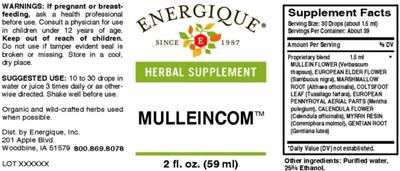
Supplement Facts
The label details for Mulleincom by Energique, sourced from the NIH Dietary Supplement Label Database.
Supplement Facts
| Ingredient | Amount | % DV |
|---|---|---|
| Proprietary Blend | 1.5 mL | -- |
| Gentian | 0 NP | -- |
| Coltsfoot | 0 NP | -- |
| Calendula | 0 NP | -- |
| Marshmallow | 0 NP | -- |
| Myrrh | 0 NP | -- |
| Mullein | 0 NP | -- |
| European Elder Flower | 0 NP | -- |
| European Pennyroyal | 0 NP | -- |
Other ingredients: Water, Purified, Ethanol
Tap any ingredient to jump to its full detail below.
These statements are the manufacturer’s wording, reproduced from the product label — the label is saying it, not HelloPharmacist. We don’t verify or endorse them.
Precautions
Warnings: If pregnant or breast-feeding, ask a health professional before use.
Consult a physician for use in children under 12 years of age. Keep out of reach of children.
Do not use if tamper evident seal is broken or missing.
Storage
Store in a cool, dry place.
Suggested/Recommended/Usage/Directions
Suggested Use: 10 to 30 drops in water or juice 3 times daily or as otherwise directed. Shake well before use.
Formulation
Organic and wild-crafted herbs used when possible.
Organic and wild-crafted herbs used when possible.
Brand IP Statement(s)
Energique Since E 1987
FDA Statement of Identity
Herbal Supplement
Is this label outdated? Report a formula or label change and our pharmacy team will review it.
Mulleincom by Energique label
The label scan from the NIH Dietary Supplement Label Database. Tap to enlarge.
Label images are published by the NIH Dietary Supplement Label Database for the version of this product on file. Always read your actual product label.
View the full label (PDF)The Ingredients in Mulleincom by Energique
These are the 8 active ingredients this product is made of. Select any to open its full monograph.
Serving size0.5 mL Dosage formLiquid Servings per container39 Amounts shown are per serving.
Most supplement products combine several ingredients, and a medication can interact with the product through any one of them. Each ingredient below shows whether it has known drug interactions.
Other (inactive) ingredients: Water, Purified, Ethanol. These complete the product’s ingredient list but are not active constituents.
Mulleincom by Energique Drug Interactions
HelloPharmacist Interaction Report
Mulleincom by Energique is a liquid herbal blend with documented interactions affecting multiple medication types.
The most serious concern is coltsfoot, which carries Moderate-severity interactions with blood thinners (anticoagulant/antiplatelet drugs) like warfarin, aspirin, and heparin — it may increase bleeding risk by reducing how your blood clots.
Read the full breakdown — every affected drug type, severity by severity
Additionally, coltsfoot interacts Moderately with blood pressure medications (antihypertensive drugs), potentially lowering your blood pressure further. It also has a Moderate interaction with certain seizure and tuberculosis medications (CYP3A4 inducers like phenytoin and rifampin) that may increase conversion of coltsfoot's liver-toxic compounds to harmful forms.
Gentian carries a Moderate interaction with blood pressure drugs, similar to coltsfoot. Myrrh has Moderate interactions with diabetes medications — it may increase the risk of low blood sugar (hypoglycemia) — and with warfarin specifically, potentially making it less effective.
Marshmallow carries Minor interactions with lithium (a mood stabilizer that may accumulate to toxic levels), with most oral medications (it may reduce how well they're absorbed), and theoretically with blood thinners.
Mullein has a Minor interaction with blood thinners. Calendula shows a Minor interaction with sedating drugs (CNS depressants).
We could not check European Elder Flower or European Pennyroyal for interactions — we hold no data for them.
Altogether, these interactions span 2,075 individual medications. Please use the checker below to verify your exact prescriptions before starting.
Check your own medications below · Editorial policy · How we use AI
Want to check YOUR meds against Mulleincom?
Ask about interactions with your drugs in plain English — “Can I take it with lisinopril?” — and we find you the answer in seconds, ingredient by ingredient.
Go to the checkerIngredients driving the most interactions
Individual Drug Interactions
The ingredients in Mulleincom interact with 2,094 drugs. Click any drug to see the details.
6 of the 8 ingredients in Mulleincom interact with drugs. Each result below shows which ingredient is responsible. Marshmallow Coltsfoot Calendula Gentian Mullein Myrrh
AbciximabReoPro
How Abciximab interacts with Mulleincom — through 3 ingredients. Tap an ingredient for the detail:
ColtsfootAnticoagulant/antiplatelet Drugs Moderate
Interaction Summary
Concomitant use might increase the risk of bleeding due to decreased platelet aggregation.
Read the full Coltsfoot + Abciximab interactionMulleinAnticoagulant/antiplatelet Drugs Minor
Interaction Summary
Lab tests on extracts from different parts of common and dense-flowered mullein plants show that they do have some blood-thinning effects, as they increase the time it takes for blood to clot.
Read the full Mullein + Abciximab interactionMarshmallowOral Drugs, Anticoagulant/antiplatelet Drugs Minor
Interaction Summary
Theoretically, mucilage in marshmallow might impair absorption of oral drugs.
Read the full Marshmallow + Abciximab interactionAbrocitinibCibinqo
How Abrocitinib interacts with Mulleincom — through 3 ingredients. Tap an ingredient for the detail:
ColtsfootAnticoagulant/antiplatelet Drugs Moderate
Interaction Summary
Concomitant use might increase the risk of bleeding due to decreased platelet aggregation.
Read the full Coltsfoot + Abrocitinib interactionMarshmallowOral Drugs, Anticoagulant/antiplatelet Drugs Minor
Interaction Summary
Theoretically, mucilage in marshmallow might impair absorption of oral drugs.
Read the full Marshmallow + Abrocitinib interactionMulleinAnticoagulant/antiplatelet Drugs Minor
Interaction Summary
Lab tests on extracts from different parts of common and dense-flowered mullein plants show that they do have some blood-thinning effects, as they increase the time it takes for blood to clot.
Read the full Mullein + Abrocitinib interactionAcarboseGlucobay, Prandase, Precose
How Acarbose interacts with Mulleincom — through 2 ingredients. Tap an ingredient for the detail:
MyrrhAntidiabetes Drugs Moderate
Interaction Summary
Theoretically, myrrh might increase the risk of hypoglycemia when taken with antidiabetes drugs.
Read the full Myrrh + Acarbose interactionMarshmallowOral Drugs Minor
Interaction Summary
Theoretically, mucilage in marshmallow might impair absorption of oral drugs.
Read the full Marshmallow + Acarbose interactionAcebutololRhotral, Sectral
How Acebutolol interacts with Mulleincom — through 3 ingredients. Tap an ingredient for the detail:
GentianAntihypertensive Drugs Moderate
Interaction Summary
Theoretically, taking gentian with antihypertensive drugs might increase the risk of hypotension.
Read the full Gentian + Acebutolol interactionColtsfootAntihypertensive Drugs Moderate
Interaction Summary
Theoretically, excessive doses of coltsfoot may interfere with antihypertensive or cardiovascular therapy.
Read the full Coltsfoot + Acebutolol interactionMarshmallowOral Drugs Minor
Interaction Summary
Theoretically, mucilage in marshmallow might impair absorption of oral drugs.
Read the full Marshmallow + Acebutolol interactionAcenocoumarolSintrom
How Acenocoumarol interacts with Mulleincom — through 3 ingredients. Tap an ingredient for the detail:
ColtsfootAnticoagulant/antiplatelet Drugs Moderate
Interaction Summary
Concomitant use might increase the risk of bleeding due to decreased platelet aggregation.
Read the full Coltsfoot + Acenocoumarol interactionMarshmallowOral Drugs, Anticoagulant/antiplatelet Drugs Minor
Interaction Summary
Theoretically, mucilage in marshmallow might impair absorption of oral drugs.
Read the full Marshmallow + Acenocoumarol interactionMulleinAnticoagulant/antiplatelet Drugs Minor
Interaction Summary
Lab tests on extracts from different parts of common and dense-flowered mullein plants show that they do have some blood-thinning effects, as they increase the time it takes for blood to clot.
Read the full Mullein + Acenocoumarol interactionAcetaminophen, AspirinGemnisyn
How Acetaminophen, Aspirin interacts with Mulleincom — through 3 ingredients. Tap an ingredient for the detail:
ColtsfootAnticoagulant/antiplatelet Drugs Moderate
Interaction Summary
Concomitant use might increase the risk of bleeding due to decreased platelet aggregation.
Read the full Coltsfoot + Acetaminophen, Aspirin interactionMarshmallowAnticoagulant/antiplatelet Drugs, Oral Drugs Minor
Interaction Summary
Theoretically, marshmallow flower might have antiplatelet effects.
Read the full Marshmallow + Acetaminophen, Aspirin interactionMulleinAnticoagulant/antiplatelet Drugs Minor
Interaction Summary
Lab tests on extracts from different parts of common and dense-flowered mullein plants show that they do have some blood-thinning effects, as they increase the time it takes for blood to clot.
Read the full Mullein + Acetaminophen, Aspirin interactionAcetaminophen, Aspirin, CaffeineExcedrin, Excedrin Extra Strength, Excedrin Migraine
How Acetaminophen, Aspirin, Caffeine interacts with Mulleincom — through 3 ingredients. Tap an ingredient for the detail:
ColtsfootAnticoagulant/antiplatelet Drugs Moderate
Interaction Summary
Concomitant use might increase the risk of bleeding due to decreased platelet aggregation.
Read the full Coltsfoot + Acetaminophen, Aspirin, Caffeine interactionMarshmallowOral Drugs, Anticoagulant/antiplatelet Drugs Minor
Interaction Summary
Theoretically, mucilage in marshmallow might impair absorption of oral drugs.
Read the full Marshmallow + Acetaminophen, Aspirin, Caffeine interactionMulleinAnticoagulant/antiplatelet Drugs Minor
Interaction Summary
Lab tests on extracts from different parts of common and dense-flowered mullein plants show that they do have some blood-thinning effects, as they increase the time it takes for blood to clot.
Read the full Mullein + Acetaminophen, Aspirin, Caffeine interactionAcetaminophen, IbuprofenCombogesic
How Acetaminophen, Ibuprofen interacts with Mulleincom — through 3 ingredients. Tap an ingredient for the detail:
ColtsfootAnticoagulant/antiplatelet Drugs Moderate
Interaction Summary
Concomitant use might increase the risk of bleeding due to decreased platelet aggregation.
Read the full Coltsfoot + Acetaminophen, Ibuprofen interactionMulleinAnticoagulant/antiplatelet Drugs Minor
Interaction Summary
Lab tests on extracts from different parts of common and dense-flowered mullein plants show that they do have some blood-thinning effects, as they increase the time it takes for blood to clot.
Read the full Mullein + Acetaminophen, Ibuprofen interactionMarshmallowOral Drugs, Anticoagulant/antiplatelet Drugs Minor
Interaction Summary
Theoretically, mucilage in marshmallow might impair absorption of oral drugs.
Read the full Marshmallow + Acetaminophen, Ibuprofen interactionAcetazolamideAk-Zol, Diamox
How Acetazolamide interacts with Mulleincom — through 4 ingredients. Tap an ingredient for the detail:
GentianAntihypertensive Drugs Moderate
Interaction Summary
Theoretically, taking gentian with antihypertensive drugs might increase the risk of hypotension.
Read the full Gentian + Acetazolamide interactionColtsfootAntihypertensive Drugs Moderate
Interaction Summary
Theoretically, excessive doses of coltsfoot may interfere with antihypertensive or cardiovascular therapy.
Read the full Coltsfoot + Acetazolamide interactionCalendulaCns Depressants Minor
Interaction Summary
Theoretically, calendula might have additive effects when used with CNS depressants, although this appears to be unlikely.
Read the full Calendula + Acetazolamide interactionMarshmallowOral Drugs Minor
Interaction Summary
Theoretically, mucilage in marshmallow might impair absorption of oral drugs.
Read the full Marshmallow + Acetazolamide interactionAcetohexamideDymelor
How Acetohexamide interacts with Mulleincom — through 2 ingredients. Tap an ingredient for the detail:
MyrrhAntidiabetes Drugs Moderate
Interaction Summary
Theoretically, myrrh might increase the risk of hypoglycemia when taken with antidiabetes drugs.
Read the full Myrrh + Acetohexamide interactionMarshmallowOral Drugs Minor
Interaction Summary
Theoretically, mucilage in marshmallow might impair absorption of oral drugs.
Read the full Marshmallow + Acetohexamide interactionAcetylsalicylic AcidEntrophen
How Acetylsalicylic Acid interacts with Mulleincom — through 3 ingredients. Tap an ingredient for the detail:
ColtsfootAnticoagulant/antiplatelet Drugs Moderate
Interaction Summary
Concomitant use might increase the risk of bleeding due to decreased platelet aggregation.
Read the full Coltsfoot + Acetylsalicylic Acid interactionMarshmallowOral Drugs, Anticoagulant/antiplatelet Drugs Minor
Interaction Summary
Theoretically, mucilage in marshmallow might impair absorption of oral drugs.
Read the full Marshmallow + Acetylsalicylic Acid interactionMulleinAnticoagulant/antiplatelet Drugs Minor
Interaction Summary
Lab tests on extracts from different parts of common and dense-flowered mullein plants show that they do have some blood-thinning effects, as they increase the time it takes for blood to clot.
Read the full Mullein + Acetylsalicylic Acid interactionAlbiglutideTanzeum
How Albiglutide interacts with Mulleincom — through 1 ingredient. Tap an ingredient for the detail:
MyrrhAntidiabetes Drugs Moderate
Interaction Summary
Theoretically, myrrh might increase the risk of hypoglycemia when taken with antidiabetes drugs.
Read the full Myrrh + Albiglutide interactionAliskirenTekturna
How Aliskiren interacts with Mulleincom — through 3 ingredients. Tap an ingredient for the detail:
ColtsfootAntihypertensive Drugs Moderate
Interaction Summary
Theoretically, excessive doses of coltsfoot may interfere with antihypertensive or cardiovascular therapy.
Read the full Coltsfoot + Aliskiren interactionGentianAntihypertensive Drugs Moderate
Interaction Summary
Theoretically, taking gentian with antihypertensive drugs might increase the risk of hypotension.
Read the full Gentian + Aliskiren interactionMarshmallowOral Drugs Minor
Interaction Summary
Theoretically, mucilage in marshmallow might impair absorption of oral drugs.
Read the full Marshmallow + Aliskiren interactionAlogliptinNesina
How Alogliptin interacts with Mulleincom — through 2 ingredients. Tap an ingredient for the detail:
MyrrhAntidiabetes Drugs Moderate
Interaction Summary
Theoretically, myrrh might increase the risk of hypoglycemia when taken with antidiabetes drugs.
Read the full Myrrh + Alogliptin interactionMarshmallowOral Drugs Minor
Interaction Summary
Theoretically, mucilage in marshmallow might impair absorption of oral drugs.
Read the full Marshmallow + Alogliptin interactionAlogliptin, MetforminKazano
How Alogliptin, Metformin interacts with Mulleincom — through 2 ingredients. Tap an ingredient for the detail:
MyrrhAntidiabetes Drugs Moderate
Interaction Summary
Theoretically, myrrh might increase the risk of hypoglycemia when taken with antidiabetes drugs.
Read the full Myrrh + Alogliptin, Metformin interactionMarshmallowOral Drugs Minor
Interaction Summary
Theoretically, mucilage in marshmallow might impair absorption of oral drugs.
Read the full Marshmallow + Alogliptin, Metformin interactionAlogliptin, PioglitazoneOseni
How Alogliptin, Pioglitazone interacts with Mulleincom — through 2 ingredients. Tap an ingredient for the detail:
MyrrhAntidiabetes Drugs Moderate
Interaction Summary
Theoretically, myrrh might increase the risk of hypoglycemia when taken with antidiabetes drugs.
Read the full Myrrh + Alogliptin, Pioglitazone interactionMarshmallowOral Drugs Minor
Interaction Summary
Theoretically, mucilage in marshmallow might impair absorption of oral drugs.
Read the full Marshmallow + Alogliptin, Pioglitazone interactionAlteplase, TpaActilyse, Activase
How Alteplase, Tpa interacts with Mulleincom — through 3 ingredients. Tap an ingredient for the detail:
ColtsfootAnticoagulant/antiplatelet Drugs Moderate
Interaction Summary
Concomitant use might increase the risk of bleeding due to decreased platelet aggregation.
Read the full Coltsfoot + Alteplase, Tpa interactionMarshmallowAnticoagulant/antiplatelet Drugs, Oral Drugs Minor
Interaction Summary
Theoretically, marshmallow flower might have antiplatelet effects.
Read the full Marshmallow + Alteplase, Tpa interactionMulleinAnticoagulant/antiplatelet Drugs Minor
Interaction Summary
Lab tests on extracts from different parts of common and dense-flowered mullein plants show that they do have some blood-thinning effects, as they increase the time it takes for blood to clot.
Read the full Mullein + Alteplase, Tpa interactionAluminum Hydroxide, Aspirin, Codeine Phosphate, Magnesium HydroxideAscriptin Codeine #2
How Aluminum Hydroxide, Aspirin, Codeine Phosphate, Magnesium Hydroxide interacts with Mulleincom — through 4 ingredients. Tap an ingredient for the detail:
ColtsfootAnticoagulant/antiplatelet Drugs Moderate
Interaction Summary
Concomitant use might increase the risk of bleeding due to decreased platelet aggregation.
Read the full Coltsfoot + Aluminum Hydroxide, Aspirin, Codeine Phosphate, Magnesium Hydroxide interactionMarshmallowOral Drugs, Anticoagulant/antiplatelet Drugs Minor
Interaction Summary
Theoretically, mucilage in marshmallow might impair absorption of oral drugs.
Read the full Marshmallow + Aluminum Hydroxide, Aspirin, Codeine Phosphate, Magnesium Hydroxide interactionCalendulaCns Depressants Minor
Interaction Summary
Theoretically, calendula might have additive effects when used with CNS depressants, although this appears to be unlikely.
Read the full Calendula + Aluminum Hydroxide, Aspirin, Codeine Phosphate, Magnesium Hydroxide interactionMulleinAnticoagulant/antiplatelet Drugs Minor
Interaction Summary
Lab tests on extracts from different parts of common and dense-flowered mullein plants show that they do have some blood-thinning effects, as they increase the time it takes for blood to clot.
Read the full Mullein + Aluminum Hydroxide, Aspirin, Codeine Phosphate, Magnesium Hydroxide interactionAluminum Hydroxide, Aspirin, Magnesium HydroxideAscriptin
How Aluminum Hydroxide, Aspirin, Magnesium Hydroxide interacts with Mulleincom — through 3 ingredients. Tap an ingredient for the detail:
ColtsfootAnticoagulant/antiplatelet Drugs Moderate
Interaction Summary
Concomitant use might increase the risk of bleeding due to decreased platelet aggregation.
Read the full Coltsfoot + Aluminum Hydroxide, Aspirin, Magnesium Hydroxide interactionMulleinAnticoagulant/antiplatelet Drugs Minor
Interaction Summary
Lab tests on extracts from different parts of common and dense-flowered mullein plants show that they do have some blood-thinning effects, as they increase the time it takes for blood to clot.
Read the full Mullein + Aluminum Hydroxide, Aspirin, Magnesium Hydroxide interactionMarshmallowOral Drugs, Anticoagulant/antiplatelet Drugs Minor
Interaction Summary
Theoretically, mucilage in marshmallow might impair absorption of oral drugs.
Read the full Marshmallow + Aluminum Hydroxide, Aspirin, Magnesium Hydroxide interactionAmbrisentanLetairis, Volibris
How Ambrisentan interacts with Mulleincom — through 3 ingredients. Tap an ingredient for the detail:
GentianAntihypertensive Drugs Moderate
Interaction Summary
Theoretically, taking gentian with antihypertensive drugs might increase the risk of hypotension.
Read the full Gentian + Ambrisentan interactionColtsfootAntihypertensive Drugs Moderate
Interaction Summary
Theoretically, excessive doses of coltsfoot may interfere with antihypertensive or cardiovascular therapy.
Read the full Coltsfoot + Ambrisentan interactionMarshmallowOral Drugs Minor
Interaction Summary
Theoretically, mucilage in marshmallow might impair absorption of oral drugs.
Read the full Marshmallow + Ambrisentan interactionAmilorideAmilamont, Midamor
How Amiloride interacts with Mulleincom — through 3 ingredients. Tap an ingredient for the detail:
GentianAntihypertensive Drugs Moderate
Interaction Summary
Theoretically, taking gentian with antihypertensive drugs might increase the risk of hypotension.
Read the full Gentian + Amiloride interactionColtsfootAntihypertensive Drugs Moderate
Interaction Summary
Theoretically, excessive doses of coltsfoot may interfere with antihypertensive or cardiovascular therapy.
Read the full Coltsfoot + Amiloride interactionMarshmallowOral Drugs Minor
Interaction Summary
Theoretically, mucilage in marshmallow might impair absorption of oral drugs.
Read the full Marshmallow + Amiloride interactionAmiloride, HydrochlorothiazideAmil-Co, Amilzide, Moduret 25, Moduretic
How Amiloride, Hydrochlorothiazide interacts with Mulleincom — through 3 ingredients. Tap an ingredient for the detail:
GentianAntihypertensive Drugs Moderate
Interaction Summary
Theoretically, taking gentian with antihypertensive drugs might increase the risk of hypotension.
Read the full Gentian + Amiloride, Hydrochlorothiazide interactionColtsfootAntihypertensive Drugs Moderate
Interaction Summary
Theoretically, excessive doses of coltsfoot may interfere with antihypertensive or cardiovascular therapy.
Read the full Coltsfoot + Amiloride, Hydrochlorothiazide interactionMarshmallowOral Drugs Minor
Interaction Summary
Theoretically, mucilage in marshmallow might impair absorption of oral drugs.
Read the full Marshmallow + Amiloride, Hydrochlorothiazide interactionAminoglutethimideCytadren
How Aminoglutethimide interacts with Mulleincom — through 3 ingredients. Tap an ingredient for the detail:
ColtsfootCytochrome P450 3a4 (cyp3a4) Inducers Moderate
Interaction Summary
Hepatotoxic pyrrolizidine alkaloids (PA) are substrates of cytochrome P450 3A4 (CYP3A4).
Read the full Coltsfoot + Aminoglutethimide interactionMarshmallowOral Drugs Minor
Interaction Summary
Theoretically, mucilage in marshmallow might impair absorption of oral drugs.
Read the full Marshmallow + Aminoglutethimide interactionCalendulaCns Depressants Minor
Interaction Summary
Theoretically, calendula might have additive effects when used with CNS depressants, although this appears to be unlikely.
Read the full Calendula + Aminoglutethimide interactionAmlodipineNorliqva
How Amlodipine interacts with Mulleincom — through 3 ingredients. Tap an ingredient for the detail:
ColtsfootAntihypertensive Drugs Moderate
Interaction Summary
Theoretically, excessive doses of coltsfoot may interfere with antihypertensive or cardiovascular therapy.
Read the full Coltsfoot + Amlodipine interactionGentianAntihypertensive Drugs Moderate
Interaction Summary
Theoretically, taking gentian with antihypertensive drugs might increase the risk of hypotension.
Read the full Gentian + Amlodipine interactionMarshmallowOral Drugs Minor
Interaction Summary
Theoretically, mucilage in marshmallow might impair absorption of oral drugs.
Read the full Marshmallow + Amlodipine interactionAmlodipine BenzoateKaterzia
How Amlodipine Benzoate interacts with Mulleincom — through 3 ingredients. Tap an ingredient for the detail:
GentianAntihypertensive Drugs Moderate
Interaction Summary
Theoretically, taking gentian with antihypertensive drugs might increase the risk of hypotension.
Read the full Gentian + Amlodipine Benzoate interactionColtsfootAntihypertensive Drugs Moderate
Interaction Summary
Theoretically, excessive doses of coltsfoot may interfere with antihypertensive or cardiovascular therapy.
Read the full Coltsfoot + Amlodipine Benzoate interactionMarshmallowOral Drugs Minor
Interaction Summary
Theoretically, mucilage in marshmallow might impair absorption of oral drugs.
Read the full Marshmallow + Amlodipine Benzoate interactionAmlodipine BesilateIstin
How Amlodipine Besilate interacts with Mulleincom — through 3 ingredients. Tap an ingredient for the detail:
GentianAntihypertensive Drugs Moderate
Interaction Summary
Theoretically, taking gentian with antihypertensive drugs might increase the risk of hypotension.
Read the full Gentian + Amlodipine Besilate interactionColtsfootAntihypertensive Drugs Moderate
Interaction Summary
Theoretically, excessive doses of coltsfoot may interfere with antihypertensive or cardiovascular therapy.
Read the full Coltsfoot + Amlodipine Besilate interactionMarshmallowOral Drugs Minor
Interaction Summary
Theoretically, mucilage in marshmallow might impair absorption of oral drugs.
Read the full Marshmallow + Amlodipine Besilate interactionAmlodipine BesylateNorvasc
How Amlodipine Besylate interacts with Mulleincom — through 3 ingredients. Tap an ingredient for the detail:
GentianAntihypertensive Drugs Moderate
Interaction Summary
Theoretically, taking gentian with antihypertensive drugs might increase the risk of hypotension.
Read the full Gentian + Amlodipine Besylate interactionColtsfootAntihypertensive Drugs Moderate
Interaction Summary
Theoretically, excessive doses of coltsfoot may interfere with antihypertensive or cardiovascular therapy.
Read the full Coltsfoot + Amlodipine Besylate interactionMarshmallowOral Drugs Minor
Interaction Summary
Theoretically, mucilage in marshmallow might impair absorption of oral drugs.
Read the full Marshmallow + Amlodipine Besylate interactionAmlodipine Besylate, BenazeprilLotrel
How Amlodipine Besylate, Benazepril interacts with Mulleincom — through 3 ingredients. Tap an ingredient for the detail:
GentianAntihypertensive Drugs Moderate
Interaction Summary
Theoretically, taking gentian with antihypertensive drugs might increase the risk of hypotension.
Read the full Gentian + Amlodipine Besylate, Benazepril interactionColtsfootAntihypertensive Drugs Moderate
Interaction Summary
Theoretically, excessive doses of coltsfoot may interfere with antihypertensive or cardiovascular therapy.
Read the full Coltsfoot + Amlodipine Besylate, Benazepril interactionMarshmallowOral Drugs Minor
Interaction Summary
Theoretically, mucilage in marshmallow might impair absorption of oral drugs.
Read the full Marshmallow + Amlodipine Besylate, Benazepril interactionAmlodipine, CelecoxibConsensi
How Amlodipine, Celecoxib interacts with Mulleincom — through 3 ingredients. Tap an ingredient for the detail:
GentianAntihypertensive Drugs Moderate
Interaction Summary
Theoretically, taking gentian with antihypertensive drugs might increase the risk of hypotension.
Read the full Gentian + Amlodipine, Celecoxib interactionColtsfootAntihypertensive Drugs Moderate
Interaction Summary
Theoretically, excessive doses of coltsfoot may interfere with antihypertensive or cardiovascular therapy.
Read the full Coltsfoot + Amlodipine, Celecoxib interactionMarshmallowOral Drugs Minor
Interaction Summary
Theoretically, mucilage in marshmallow might impair absorption of oral drugs.
Read the full Marshmallow + Amlodipine, Celecoxib interactionAmmonium ChlorideAmmonium Chloride
How Ammonium Chloride interacts with Mulleincom — through 3 ingredients. Tap an ingredient for the detail:
ColtsfootAntihypertensive Drugs Moderate
Interaction Summary
Theoretically, excessive doses of coltsfoot may interfere with antihypertensive or cardiovascular therapy.
Read the full Coltsfoot + Ammonium Chloride interactionGentianAntihypertensive Drugs Moderate
Interaction Summary
Theoretically, taking gentian with antihypertensive drugs might increase the risk of hypotension.
Read the full Gentian + Ammonium Chloride interactionMarshmallowOral Drugs Minor
Interaction Summary
Theoretically, mucilage in marshmallow might impair absorption of oral drugs.
Read the full Marshmallow + Ammonium Chloride interactionEach ingredient & the kinds of drugs it affects
For each ingredient in Mulleincom with known interactions, here are the types of medications they can affect. Open any type for the detail — or search your exact drug in the checker above.
Marshmallow
Lithium
Theoretically, due to potential diuretic effects, marshmallow might reduce excretion and increase levels of lithium.
Marshmallow is thought to have diuretic properties. To avoid lithium toxicity, the dose of lithium might need to be decreased when used with marshmallow.
Anticoagulant/Antiplatelet Drugs
Theoretically, marshmallow flower might have antiplatelet effects.
Animal research suggests that marshmallow flower extract has antiplatelet effects. However, the root and leaf of marshmallow, not the flower, are the plant parts most commonly found in dietary supplements. Theoretically, use of marshmallow flower with anticoagulant/antiplatelet drugs can have additive effects, and might increase the risk for bleeding in some patients.
Oral Drugs
Theoretically, mucilage in marshmallow might impair absorption of oral drugs.
Marshmallow contains mucilage which can affect oral drug absorption. To avoid changes in absorption, take marshmallow 30-60 minutes after oral medications.
Coltsfoot
Anticoagulant/Antiplatelet Drugs
Concomitant use might increase the risk of bleeding due to decreased platelet aggregation. Coltsfoot has been reported to inhibit platelet aggregation; avoid concomitant use. Some of these drugs include aspirin, clopidogrel (Plavix), dalteparin (Fragmin), enoxaparin (Lovenox), heparin, ticlopidine (Ticlid), warfarin (Coumadin), and others.
Antihypertensive Drugs
Theoretically, excessive doses of coltsfoot may interfere with antihypertensive or cardiovascular therapy.
Cytochrome P450 3A4 (Cyp3A4) Inducers
Hepatotoxic pyrrolizidine alkaloids (PA) are substrates of cytochrome P450 3A4 (CYP3A4). Theoretically, drugs that induce CYP3A4 might increase the conversion of PAs to toxic metabolites. Some drugs that induce CYP3A4 include carbamazepine (Tegretol), phenobarbital, phenytoin (Dilantin), rifampin, rifabutin (Mycobutin), and others.
Calendula
Cns Depressants
Theoretically, calendula might have additive effects when used with CNS depressants, although this appears to be unlikely.
Although some animal research has suggested that a saponoside constituent in calendula may have sedative effects, calendula has been used for over 30 years without reports of sedation in humans.
Gentian
Antihypertensive Drugs
Theoretically, taking gentian with antihypertensive drugs might increase the risk of hypotension.
In vitro research shows that gentian can cause vasodilation and lower blood pressure.
Mullein
Anticoagulant/Antiplatelet Drugs
Lab tests on extracts from different parts of common and dense-flowered mullein plants show that they do have some blood-thinning effects, as they increase the time it takes for blood to clot. This is likely due to at least one of the known constituents of muellein, triterpenoid saponins. However, the effects appear to be mild and results have been inconsistent. Extracts from different plant parts have been show to have varying anticoagulant strengths, with water-based ones being more potent than alcohol-based extracts.
Myrrh
Antidiabetes Drugs
Theoretically, myrrh might increase the risk of hypoglycemia when taken with antidiabetes drugs.
In vitro and animal research suggests that myrrh has hypoglycemic effects.
Warfarin (Coumadin)
Theoretically, myrrh might decrease the effectiveness of warfarin.
In one case, a patient who was previously stable on warfarin had a significant decline in international normalized ratio (INR) following consumption of an aqueous extract of myrrh.
Brand information
Manufacturer and brand details for Mulleincom, from the product label.
Energique
See all Energique products- Name
- Energique, Inc.
- Street Address
- 201 Apple Blvd.
- City
- Woodbine
- State
- IA
- ZipCode
- 51579
- Phone Number
- 800.869.8078
Mulleincom by Energique: Common Questions
Does Mulleincom by Energique interact with any medications?
How can one product interact with so many drugs?
Where does this information come from?
Is coltsfoot safe to use at all?
Can I take this if I'm pregnant?
Can I take this while breastfeeding?
What is myrrh supposed to do in this blend?
Does this product have any fillers or just herbs?
Can I take this with my seizure medication?
Written and reviewed by the HelloPharmacist editorial staff. Our editorial policy
Not sure if Mulleincom is safe with your meds?
Our pharmacists answer your medication & supplement questions — free.
Label information is sourced from the NIH Dietary Supplement Label Database and reflects the product version on file; always read your actual product label. This page is for education only and is not a substitute for professional medical advice. Confirm with your pharmacist or doctor before combining supplements and medications.
The Full Monographs Behind Mulleincom’s Ingredients
Every ingredient we hold a full HelloPharmacist monograph for — uses, evidence, safety, and the complete interaction list.
Gentian
Interacts with 172 drugsGentian is a very bitter root traditionally used to stimulate appetite and ease mild digestive complaints, often as part of "bitters" before meals. The evidence is mostly traditional and pre...
Read the full Gentian monograph → Herb & supplement monographColtsfoot
Interacts with 374 drugsColtsfoot is a traditional herb long used to soothe coughs and clear mucus, but solid human evidence for these uses is lacking. More importantly, the raw plant can contain liver-toxic pyrrol...
Read the full Coltsfoot monograph → Herb & supplement monographCalendula
Interacts with 248 drugsCalendula is a flowering plant whose petals are used mainly in skin creams, oils, and ointments to soothe minor irritation and support wound healing. Some early research is promising for ski...
Read the full Calendula monograph → Herb & supplement monographMarshmallow
Interacts with 2,040 drugsMarshmallow root is a traditional herb rich in soothing, gel-like fibers called mucilage, which is why it has long been used for coughs, sore throats, and stomach irritation. Evidence for th...
Read the full Marshmallow monograph → Herb & supplement monographMyrrh
Interacts with 88 drugsMyrrh is a fragrant gum resin from Commiphora trees that has long been used in mouthwashes, throat remedies, and skin care. Modern evidence for most of its uses is limited and comes mostly f...
Read the full Myrrh monograph → Herb & supplement monographMullein
Interacts with 122 drugsMullein is a traditional herbal remedy most often used as a tea or syrup to soothe coughs, sore throats, and respiratory irritation. High-quality human studies are lacking, so its benefits a...
Read the full Mullein monograph →Sources & How We Checked
Mulleincom's label data comes from the NIH Dietary Supplement Label Database; the ingredient interaction data is from the Natural Medicines database, reviewed by our pharmacists.
- NIH Dietary Supplement Label Database (DSLD) — The official product label on file for this supplement.
- Natural Medicines (Therapeutic Research Center) — Evidence-graded clinical reference behind the ingredient interaction data.
Content is written and reviewed by licensed HelloPharmacist pharmacists. See our data sources and editorial standards for how this information is built and checked.
The 37 references behind this product’s interaction data
Every citation that drives the interaction findings for this product’s ingredients, from the evidence-graded Natural Medicines (TRC Healthcare) database. Open an ingredient to browse its citations — links open the study on PubMed or the publisher’s site.
Gentian 5 references
- Neubauer N, Marz RW. Placebo-controlled, randomized, double-blind, clincal trial with Sinupret sugar coated tablets on the basis of a therapy with antibiotics and decongestant nasal drops in acute sinusitis. Phytomedicine 1994;1:177-81.
- Marz RW, Ismail C, Popp MA. Action profile and efficacy of a herbal combination preparation for the treatment of sinusitis. Wien Med Wochenschr 1999;149:202-8.
- Uncini Manganelli RE, Chericoni S, Baragatti B. Ethnopharmacobotany in Tuscany: plants used as antihypertensives. Fitoterapia 2000;71:S95-100. PubMed
- Baragatti B, Calderone V, Testai L, et al. Vasodilator activity of crude methanolic extract of Gentiana kokiana Perr. et Song. (Gentianaceae). J Ethnopharmacol 2002;79:369-72. PubMed
- Sanatani M, Younus J, Stitt L, et al. Tolerability of the combination of ginger (Zingiber officinalis), gentian (Gentiana lutea) and turmeric (Curcuma longa) in patients with cancer-associated anorexia. J Complement Integr Med. 2015;12(1):57-60.
Coltsfoot 8 references
- Roulet M, Laurini R, Rivier L, Calame A. Hepatic veno-occlusive disease in newborn infant of a woman drinking herbal tea. J Pediatr 1988;112:433-6. PubMed
- WHO working group. Pyrrolizidine alkaloids. Environmental Health Criteria, 80. WHO: Geneva, 1988.
- Chojkier M. Hepatic sinusoidal-obstruction syndrome: toxicity of pyrrolizidine alkaloids. J Hepatol 2003;39:437-46. PubMed
- Roeder E. Medicinal plants in Europe containing pyrrolizidine alkaloids. Pharmazie 1995;50:83-98.
- Wilson BE, Hobbs WN. Case report: pseudoephedrine-associated thyroid storm: thyroid hormone-catecholamine interactions. Am J Med Sci 1993;306:317-9. PubMed
- Wang YP, Yan J, Fu PP, Chou MW. Human liver microsomal reduction of pyrrolizidine alkaloid N-oxides to form the corresponding carcinogenic parent alkaloid. Toxicol Lett 2005;155:411-20. PubMed
- Hwang SB, Chang MN, Garcia ML, et al. L-652,469--a dual receptor antagonist of platelet activating factor and dihydropyridines from Tussilago farfara L. Eur J Pharmacol 1987;141:269-81. PubMed
- Freshour JE, Odle B, Rikhye S, Stewart DW. Coltsfoot as a potential cause of deep vein thrombosis and pulmonary embolism in a patient also consuming kava and blue vervain. J Diet Suppl 2012;9:149-54. PubMed
Calendula 9 references
- Newall CA, Anderson LA, Philpson JD. Herbal Medicine: A Guide for Healthcare Professionals. London, UK: The Pharmaceutical Press, 1996.
- Reider N, Komericki P, Hausen BM, et al. The seamy side of natural medicines: contact sensitization to arnica (Arnica montana L.) and marigold (Calendula officinalis L.). Contact Dermatitis 2001;45:269-72..
- Gol'dman II. [Anaphylactic shock after gargling with an infusion of Calendula]. Klin Med (Mosk) 1974;52:142-3.
- Paulsen E. Contact sensitization from Compositae-containing herbal remedies and cosmetics. Contact Dermatitis 2002;47:189-98. PubMed
- Bojadjiev C. On the sedative and hypotensive effect of preparations from the plant Calendula officinalis. Nauch Trud Visshi Med Inst Sof 1964;43:15-20.
- Samochowiec L. Pharmacological study of saponosides from Aralia mandshurica Rupr. et Maxim and Calendula officinalis L. Herba Pol. 1983;29:151-155.
- Madisetti M, Kelechi TJ, Mueller M, Amella EJ, Prentice MA. Feasibility, acceptability, and tolerability of RGN107 in the palliative wound care management of chronic wound symptoms. J Wound Care. 2017;26(Sup1):S25-S34. PubMed
- Final Assessment report on Calendula officinalis L., flos. European Medicines Agency: Committee on Herbal Medicinal Products (HMPC). 2018. EMA/HMPC/603409/2017. Available at: https://www.ema.europa.eu/en/documents/herbal-report/final-assessment-report-cal
- Puaratanaarunkon T, Washrawirul C, Chuenboonngarm N, Noppakun N, Asawanonda P, Kumtornrut C. Efficacy and safety of a facial serum containing snail secretion filtrate, Calendula officinalis, and Glycyrrhiza glaba root extract in the treatment of maskne: A
Marshmallow 5 references
- Monographs on the medicinal uses of plant drugs. Exeter, UK: European Scientific Co-op Phytother, 1997.
- Leung AY, Foster S. Encyclopedia of Common Natural Ingredients Used in Food, Drugs and Cosmetics. 2nd ed. New York, NY: John Wiley & Sons, 1996.
- McGuffin M, Hobbs C, Upton R, Goldberg A, eds. American Herbal Products Association's Botanical Safety Handbook. Boca Raton, FL: CRC Press, LLC 1997.
- Brinker F. Herb Contraindications and Drug Interactions. 2nd ed. Sandy, OR: Eclectic Medical Publications, 1998.
- Hage-Sleiman R, Mroueh M, Daher CF. Pharmacological evaluation of aqueous extract of Althaea officinalis flower grown in Lebanon. Pharm Biol 2011;49(3):327-33.
Myrrh 8 references
- Newall CA, Anderson LA, Philpson JD. Herbal Medicine: A Guide for Healthcare Professionals. London, UK: The Pharmaceutical Press, 1996.
- The Review of Natural Products by Facts and Comparisons. St. Louis, MO: Wolters Kluwer Co., 1999.
- McGuffin M, Hobbs C, Upton R, Goldberg A, eds. American Herbal Products Association's Botanical Safety Handbook. Boca Raton, FL: CRC Press, LLC 1997.
- Brinker F. Herb Contraindications and Drug Interactions. 2nd ed. Sandy, OR: Eclectic Medical Publications, 1998.
- Al Faraj S. Antagonism of the anticoagulant effect of warfarin caused by the use of Commiphora molmol as a herbal medication: a case report. Ann Trop Med Parasitol 2005;99:219-20.
- Al-Jaroudi D, Kaddour O, Al-Amin N. Risks of myrrh use in pregnancy. JBRA Assist Reprod 2016;20(4):257-8.
- Xu YY, Li L, Xuan L, Guan K. Patch test diagnosis of non-immediate cutaneous reaction to myrrh following oral intake of a traditional Chinese medicine decoction. Contact Dermatitis. 2019;80(2):135-136. PubMed
- Al-Romaiyan A, Huang GC, Jones P, Persaud S. Commiphora myrrha stimulates insulin secretion from mouse and human islets of Langerhans. J Ethnopharmacol. 2021 Jan 10;264:113075. PubMed
Mullein 2 references
- Castro AI, Carmona JB, Gonzales FG, Nestar OB. Occupational airborne dermatitis from gordolobo (Verbascum densiflorum). Contact Dermatitis 2006;55(5):301.
- Flores Echaiz C, Al Ali A, Cao AQ, Sasseville D. Simultaneous contact dermatitis caused by Asteraceae and Verbascum thapsus. Contact Dermatitis 2017;76(5):316-8.
Parts of this content are provided by the Therapeutic Research Center, LLC.
DISCLAIMER: Currently this does not check for drug-drug interactions. This is not an all-inclusive comprehensive list of potential interactions and is for informational purposes only. Not all interactions are known or well-reported in the scientific literature, and new interactions are continually being reported. Input is needed from a qualified healthcare provider including a pharmacist before starting any therapy. Application of clinical judgment is necessary.
© 2021 Therapeutic Research Center, LLC