
Papaya Complex Natural Peppermint Flavor by DC Ingredients, Side Effects and Drug Interactions
Dietary Supplement Tablet or Pill Other Combinations
Papaya Complex Natural Peppermint Flavor by DC is a papaya supplement with eight other active ingredients.

Medically reviewed by Dr. Brian Staiger, PharmD, BCPS
Also reviewed by the HelloPharmacist Editorial Team
Updated Details about this page
- Label on file from the NIH Dietary Supplement Label Database, dated Jun 16, 2022.
- The interaction, evidence and safety records come from the Natural Medicines database, which we license, read against this label by our own system; the pharmacy team’s sections are written from those records.
- Dr. Brian Staiger, PharmD, BCPS, is a clinical pharmacist and pharmacotherapy specialist.
- Editorial policy Our sources
AI is used only to summarize verified clinical information, never the open internet. Our AI policy
Summary: The HelloPharmacist Team’s Take
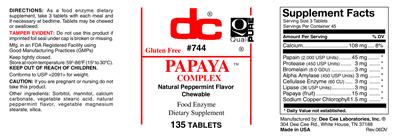
This summary is for Papaya Complex Natural Peppermint Flavor by DC
- Form
- Tablet or Pill
- Serving Size
- 3 Tablets
- Servings
- 45 per container
- Container Holds
- 135 Tablets
- What it isA papaya supplement from DC with eight other active ingredients, in tablet form.
- Active Ingredients 1 mineral, 1 plant ingredient, 6 enzymes and 1 other: Calcium 108 mgPapain 45 mgProtease 3 mgBromelain 3 mgAlpha-Amylase 3 mgCellulase 3 mgLipase 3 mgPapaya 15 mgSodium Copper Chlorophyll 1.5 mg Nine active ingredients. Each one can interact with drugs or cause side effects on its own, so we check every one. The full Supplement Facts
- Drug Interactions 586 drugs have a documented interaction with this supplement; the most serious is rated major. Of those, 352 are single drugs and 234 are combination products (two or more drugs in one), each listed under its own name. Based on the 7 of its 9 ingredients we could check. Ask your pharmacist first if you take a drug in any of these categories, the most serious of the 23 on record:
- Dolutegravir (Tivicay)Major · 3 drugs
- Elvitegravir (Vitekta)Major · 3 drugs
- Ceftriaxone (Rocephin)Major · 1 drug
- Moderate · 335 drugs
- Possible Side EffectsDiarrhea 4 ingredientsNausea 4 ingredientsBloating 2 ingredientsCramping 2 ingredientsGas 2 ingredientsStomach upset 2 ingredients +8 moreCombined from seven of its nine active ingredients. Not studied in this exact product.
- Well documented Why
Does Papaya Complex Natural Peppermint Flavor work?
It is not marketed for one specific use, so this is what Calcium has been studied for, strongest research first:
These grades are for the ingredient, not this exact product, and never a promise it will work for you.
And 3 more graded uses, in what the research says- AllergensNone of its ingredient names point to a major food allergen
Who Might Consider It
- People who want it for dyspepsia, osteoporosis, premenstrual syndrome (PMS) or another graded use: the uses with research behind them. See each grade
Who Should Be Careful
- If you take HIV medicines, blood thinners, heart medicines, diabetes medicines, or thyroid hormone, or if you are pregnant, breastfeeding, allergic to papaya or pineapple, or have kidney stones or a bleeding disorder, talk it over with your own doctor or pharmacist before deciding.
More Before You Take It Show both answersHide Pregnancy and Breastfeeding The Label’s Directions
-
Pregnant or breastfeeding?
- Pregnancy Papaya
- ! When the unripe fruit containing papaya latex is used orally; avoid using.
- Breastfeeding Papaya
- When the ripe fruit is consumed in amounts commonly found in foods.
- Pregnancy and Breastfeeding Calcium
- ! When used orally in excessive doses.
- Pregnancy Papain
- ! When used orally.
- Breastfeeding Papain
- Insufficient reliable information available; avoid using.
-
How does the label say to take it?
“Directions: As a food enzyme dietary supplement, take 3 tablets with each meal and if necessary at bedtime. Tablets may be chewed or swallowed.”
The maker’s words. Your pharmacist or doctor may advise differently.
Everything the label says
A Note From the HelloPharmacist Team
This product is not marketed for one specific use, but most of its ingredients have been studied for dyspepsia (indigestion), where calcium is the one ingredient with an effective grade. Expect constipation, gas, or bloating from its calcium, plus stomach upset or diarrhea from its enzymes. The key interaction is calcium with HIV medicines such as dolutegravir (Tivicay), which may lower how much of that drug gets into your blood. Papaya may also intensify the effects of blood thinners such as warfarin (Coumadin).
From the label dated Jun 16, 2022: 7 of its 9 active ingredients were checked against our records; the other two are not in them yet. A summary of what is known, not a grade or a test of the product. How these ratings are computed
Ask Anything About This Supplement
Name a drug you take, or ask about side effects, ingredients or pregnancy.
There’s a lot of information about this supplement on this page! Ask anything in plain English for a quick answer drawn from it.
AI answers come from this label and our own records, never the open internet. AI can make mistakes, so always check with your doctor or pharmacist. How we use AI
Ask the Pharmacist
A licensed pharmacist will answer your question by email — free, as soon as they can.
Got it — thank you!
A licensed pharmacist will answer as soon as they can. Keep an eye on your email (worth checking spam, just in case).
What’s Inside Papaya Complex Natural Peppermint Flavor by DC
Nine Active Ingredients
In the order the label lists them, each with its own card below.
Why this rating?
The label gives an exact amount for every one of its nine active ingredients, so you know how much of each you get in each serving. This rates what the label tells you, not the quality of the product.
Supplement Facts
| Amount Per Serving | % Daily Value | |
|---|---|---|
| Calcium | 108 mg | 8% |
| Papain | 45 mg | † |
| Protease | 3 mg | † |
| Bromelain | 3 mg | † |
| Alpha-Amylase | 3 mg | † |
| Cellulase | 3 mg | † |
| Lipase | 3 mg | † |
| Papaya | 15 mg | † |
| Sodium Copper Chlorophyll | 1.5 mg | † |
Other ingredients: Sorbitol, Mannitol, Calcium Carbonate, Stearic Acid, natural Peppermint flavor, Vegetable Magnesium Stearate, Silica
† Daily Value not established.
Daily Values for adults and children 4 or more years of age.
As the label prints it, from the NIH Dietary Supplement Label Database.
Each Ingredient and Its Drug Interactions
Tap one for more about it and its full guide. A drug can interact with this supplement through any one of them.
Calcium is the mineral, and the rest are digestive enzymes from papaya and other sources, along with papaya itself.
-
Calcium 108 mg Interacts with 168 drugs
Calcium is an essential mineral your body needs for strong bones, nerve signaling, and muscle function, and supplements can help fill gaps when diet falls short.
- Most people do best getting calcium from food, and supplements should be used at the lowest dose needed.
- Talk to your pharmacist or doctor before starting, especially if you have kidney problems or take other medicines.
The full Calcium guide: uses, dosage and safety Every Calcium drug interaction
-
Papain 45 mg Interacts with 2 drugs
Papain is a protein-digesting enzyme from the papaya plant that is used in digestive supplements and some topical products.
- While it has clear food and laboratory uses, strong human evidence for most health claims is limited, and it can cause allergic reactions or throat irritation.
- Check with a pharmacist or doctor before using it, especially if you have a latex or papaya allergy.
The full Papain guide: uses, dosage and safety Every Papain drug interaction
-
Protease 3 mg No known drug interactions
Proteolytic enzymes are proteins that help break down other proteins, and common examples include bromelain (from pineapple), papain (from papaya), trypsin, chymotrypsin, and pancreatin.
- People take them for digestion, inflammation, and muscle recovery, but the evidence is mixed and stronger for some uses (like aiding digestion in people who lack natural enzymes) than others.
- They are generally well tolerated, but talk with a pharmacist or doctor before use, especially if you have allergies, a bleeding risk, or are pregnant.
The full Proteolytic Enzymes (Proteases) guide: uses, dosage and safety
-
Bromelain 3 mg Interacts with 141 drugs
Bromelain is a group of protein-digesting enzymes from pineapple that people take mainly for inflammation, swelling, and sinus problems.
- Some early studies are promising, but the overall evidence is limited and far from conclusive.
- It is generally well tolerated short-term, but pregnant and breastfeeding people should avoid it, and anyone with a pineapple allergy or bleeding concerns should check with a pharmacist first.
The full Bromelain guide: uses, dosage and safety Every Bromelain drug interaction
-
Alpha-Amylase 3 mg We know this ingredient, but hold no drug interaction record for it yet, so it was not checked
-
Cellulase 3 mg We know this ingredient, but hold no drug interaction record for it yet, so it was not checked
-
Lipase 3 mg No known drug interactions
Lipase is a digestive enzyme that helps your body break down dietary fats.
- It is well established as part of prescription pancreatic enzyme therapy for people who cannot make enough of their own, but over-the-counter lipase supplements for everyday digestion or weight loss have much weaker evidence.
- Talk with your pharmacist or doctor before using it, especially if you have a known digestive condition.
-
Papaya 15 mg Interacts with 92 drugs
Papaya is a tropical fruit that is nutritious and generally safe to eat as food, and it contains an enzyme called papain used as a digestive aid and meat tenderizer.
- Papaya leaf extract is being studied for raising platelet counts in dengue fever, but most other supplement uses have limited human evidence.
- Talk to your pharmacist or doctor before using concentrated papaya supplements, and avoid unripe (green) papaya and papaya seed products in pregnancy.
The full Papaya guide: uses, dosage and safety Every Papaya drug interaction
-
Sodium Copper Chlorophyll 1.5 mg Sodium copper chlorophyll is a semi-synthetic derivative of chlorophyll, the green plant pigment. Interacts with 335 drugs
Chlorophyllin is a water-soluble, semi-synthetic form of chlorophyll most often used to help control body and fecal odor and to support wound healing.
- The best evidence is for its use as a deodorizing agent, while many popular claims like detoxification and digestive benefits are not well proven.
- It is generally considered safe for short-term use, but talk to your pharmacist or doctor before starting it, especially during pregnancy or breastfeeding.
The full Chlorophyllin guide: uses, dosage and safety Every Chlorophyllin drug interaction
Other Ingredients (Inactive)
The capsule or tablet itself, fillers, coatings and flavors. Not part of the drug interaction check; the allergen check below reads them.
- Sorbitol
- Mannitol
- Calcium Carbonate
- Stearic Acid
- Natural Peppermint flavor
- Vegetable Magnesium Stearate
- Silica
Allergens in Papaya Complex Natural Peppermint Flavor
None of its ingredient names point to a major food allergen.
Not named in the ingredients
- Milk
- Egg
- Fish
- Shellfish
- Tree nuts
- Peanuts
- Wheat or other gluten grains
- Soy
- Sesame
- Made without, the label says“Gluten free”
From the label text and ingredient names on file; we do not test products. With a serious allergy, check your bottle and ask the maker or your pharmacist.
What the Label Says
The maker’s own words, from the label. We do not verify or endorse them.
- Formulation
-
“Mfg. in an FDA Registered Facility using Good Manufacturing Practices (GMPs)”
“Conforms to USP <2091> for weight.”
3 more from the label
“Natural peppermint flavor chewable”
“Food Enzyme”
“Made in USA”
- Storage
-
“Keep tightly closed. Store at room temperature: 59 degrees - 86 degrees F (15 degrees to 30 degrees C).”
- Seals and symbols
-
“Quali Pure”
- FDA Statement of Identity
-
“Dietary Supplement”
The Papaya Complex Natural Peppermint Flavor Label on File
The label scan on file at the NIH Dietary Supplement Label Database, dated June 2022. Always read the label on the bottle you have.
Product Facts
Is this label outdated? Report a formula or label change and our pharmacy team will review it.
HelloPharmacist Score Papaya Complex Natural Peppermint Flavor by DC
Up to 10 points for research, amount, label and outside testing. Not a safety rating. How this one adds up
It is not marketed for one specific use, and papaya has no graded benefit yet.
- Research0 of 5 points
- Amount2 of 2 points
- Label2 of 2 points
- Outside testing0 of 1 point
Major drug interactions. The score does not count drug interactions. Check them against any drugs you take. See them
There is too little research to score papaya for diabetes, dengue fever, aging skin, androgenic alopecia, human papillomavirus (HPV) and intestinal parasite infection.
How It Earns Its 4
Score: 4 out of 10. Unproven.
It is not marketed for one use, and its ingredients have no graded benefit to point to.
0 of 5 points
Amount
Its 15 mg is a normal amount: most of the 193 papaya products in our database that state an amount hold 15 mg to 970 mg.
2 of 2 points
Label
It states the amount of all nine of its active ingredients.
2 of 2 points
Outside testing
We found no mark from an outside testing program, such as USP Verified or NSF Certified, on the label we have on file.
0 of 1 point
Where It Sits on the Papaya Shelf
The 126 papaya products we have scored so far, lined up by their scores. The dark bottle is this one. Each bottle stands for up to 4 products. Tap a score to see the products on it.
68 papaya products score 4 out of 10
- Papaya Complex Natural Peppermint Flavor by DC this one
- Papaya Enzymes Chewable by Sunshine Naturals
- Papaya 400 mg by Signature Supplements
- Papaya Seed Powder 500 mg by BulkSupplements.com
- Papaya Seed Powder 500 mg by BulkSupplements.com
- Papaya Seed Powder 500 mg by BulkSupplements.com
- Papaya Fruit Powder 3.5 g by BulkSupplements.com
- Papaya Fruit Powder 3.5 g by BulkSupplements.com
- Papaya Fruit Powder 3.5 g by BulkSupplements.com
- Tropical Papaya by Country Life
- Papaya Fruit Powder 3.5 g by BulkSupplements.com
- Papaya Complex Natural Peppermint Flavor by Wonder Laboratories
And 56 more.
41 papaya products score 3 out of 10
- Papaya Enzyme Chewables Natural Pineapple Flavor by Solaray
- Papaya by Herbal Terra
- Papaya Fruit Extract Powder 1000 mg by BulkSupplements.com
- Papaya Fruit Extract Powder 1000 mg by BulkSupplements.com
- Papaya Fruit Extract Powder 1000 mg by BulkSupplements.com
- Papaya Fruit Extract 1000 mg Veg Capsules by BulkSupplements.com
- Papaya Alcohol Free by Herbal Terra
- Chewable Papaya Enzyme with Chlorophyll by American Health
- Papaya Fruit Extract Veg Capsules 1000 mg by BulkSupplements.com
- Papaya Fruit Extract by BulkSupplements.com
- Chewable Papaya Enzyme by Nature's Blend
- Zygest Papaya Enzyme by Vitamin World
And 29 more.
12 papaya products score 0 out of 10
- Papaya Digestive Support Pineapple Papaya Flavor by Country Life
- Papaya Mints by Pure Herbs
- Papaya Mints by Pure Herbs
- Papaya Mint by Nature's Sunshine
- Papaya Leaf Tea by Bio Nutrition
- Papaya Leaf Blood Support Formula by Herbal Goodness
- Papaya Digestive Support Pineapple Papaya Flavor by Country Life
- Organic Papaya Leaf Tea With Mint by Herbal Papaya
- Organic Papaya Leaf Tea by Herbal Goodness
- Chewable Super Papaya Enzyme Plus by Puritan's Pride
- Body Detox + by Herbal Goodness
- Blood Support Papaya Leaf Formula by Herbal Goodness
1 papaya product scores 1 out of 10
- Men's Multivitamin Gummies Papaya Orange by Mary Ruth’s
4 papaya products score 2 out of 10
- Chewable Natural Papaya Tropical Fruit Flavor by Woodstock Vitamins
- Chewable Natural Papaya plus Plant Enzymes Tropical Fruit Flavor by Woodstock Vitamins
- Chewable Natural Papaya Natural Tropical Fruit Flavor by Village Vitality
- Chewable Natural Papaya Natural Tropical Fruit Flavor by Natural Nutra
This One Next to Most Papaya Products
| What | This one | Most of the other 125 |
|---|---|---|
| What it is marketed for | No one use | Many different uses |
| How much papaya | 15 mg a serving | 15 mg to 1,000 mg |
| Form | Not named | Papaya |
| The label | Every amount stated | Every amount stated on 108 of 125 |
| Outside testing seal | None on file | 0 of 125 have one |
| Score | 4, Unproven | 3 to 4 |
Papaya Complex Natural Peppermint Flavor by DC Side Effects
Why this rating?
We look for three kinds of safety information on each ingredient: side effects reported in studies, a pregnancy and breastfeeding rating, and a safety write-up from our pharmacy team. All three are on file for each of the seven ingredients we could check.
So this rates how much is known, not whether Papaya Complex Natural Peppermint Flavor is right for you.
Reported with seven of its ingredients
- Most often
- Diarrhea, nausea, bloating, cramping, gas and stomach upset
- !Rare but serious
- Esophageal perforation, severe gastritis with high doses and severe allergic reactions See details
HelloPharmacist Team Summary: Papaya Complex Natural Peppermint Flavor by DC Side Effects
Papaya Complex Natural Peppermint Flavor from DC is generally well tolerated, though you may notice constipation, gas, or bloating from its calcium, and stomach upset, nausea, or diarrhea from its digestive enzymes.
- Green discoloration of your urine, stool, or tongue is reported from its chlorophyll ingredient and is harmless.
- Serious reactions are uncommon, but allergic reactions can occur, especially in people sensitive to papaya, pineapple, or latex, and kidney stones or high blood calcium are rare but possible with heavy calcium intake.
- If you notice a serious allergic reaction, or signs of too much calcium such as nausea, confusion, or an irregular heartbeat, call your doctor right away.
Side Effects, Ingredient by Ingredient
A supplement’s side effects come from its ingredients. Here is what is reported with each one.
Calcium
Most reported
- Constipation
- Gas
- Bloating
Papain
Most reported
- Allergic reactions in sensitive individuals
From the Natural Medicines database, which we license.
Every reported effect, in the Papain guideProteolytic Enzymes (Proteases)
Most reported
- Nausea
- Stomach upset
- Diarrhea
- Bloating
Bromelain
Most reported
- Nausea or upset stomach
- Diarrhea
- Vomiting
Lipase
Most reported
- Nausea or stomach upset
- Cramping or abdominal discomfort
- Diarrhea or changes in bowel habits
- Bloating or gas
Papaya
Most reported
- Nausea
- Vomiting from papaya leaf extract
From the Natural Medicines database, which we license.
Every reported effect, in the Papaya guideChlorophyllin
Most reported
- Green discoloration of the stool, urine, or tongue (this is harmless)
- Mild stomach upset, diarrhea, or cramping
- Skin irritation when topical products are used
Papaya Complex Natural Peppermint Flavor Warnings: Who Should Be Careful
HelloPharmacist Team Summary: Papaya Complex Natural Peppermint Flavor by DC Warnings
Pregnant and breastfeeding people should take the most care here, since papain, bromelain, and chlorophyllin are best avoided in pregnancy and breastfeeding, unripe papaya is best avoided in pregnancy, and protease and lipase call for medical guidance.
- People with kidney disease, kidney stones, parathyroid problems, or high blood calcium should be careful with the calcium.
- People with allergies to papaya, pineapple, pork, or latex should be careful with the enzyme and papaya ingredients, and those with a bleeding disorder, an upcoming surgery, or stomach ulcers should be cautious with the enzymes.
- If you have gout or kidney problems, ask your doctor before using pancreatic-type enzymes, and talk it over with your own doctor or pharmacist before deciding.
Papaya Complex Natural Peppermint Flavor has nine active ingredients, and each can carry warnings of its own. We checked the seven in our ingredient guides, and each warning below names the ingredient it comes from. Alpha-Amylase and Cellulase are not in our guides yet, so ask your pharmacist about them.
- Calcium4 warnings below
- Papain1 warning below
- Proteolytic Enzymes (Proteases)3 warnings below
- Bromelain3 warnings below
- Lipase3 warnings below
- Papaya2 warnings below
- Chlorophyllin2 warnings below
- Alpha-AmylaseNot in our guides yet
- CellulaseNot in our guides yet
-
Bleeding Problems or Surgery
- Proteolytic Enzymes (Proteases)Use caution if you have a bleeding disorder, are scheduled for surgery, or have stomach ulcers, since enzymes may irritate the gut or affect clotting.
- BromelainBleeding risk: Bromelain may affect how the blood clots.
- PapayaAlways tell your pharmacist or doctor about any supplements you take, especially before surgery or if you have a medical condition.
-
Kidney Disease or Kidney Stones
- CalciumTaking very high amounts over a long time can raise the risk of kidney stones in some people and may cause too much calcium in the blood.
- CalciumPeople with kidney disease, kidney stones, parathyroid problems, or high blood calcium should talk with a doctor before taking calcium supplements.
- LipaseIf you have gout or kidney problems, ask your doctor before using pancreatic enzymes, as they may affect uric acid levels.
- CalciumCalcium is generally well tolerated at recommended amounts, but very high amounts over a long time can raise the risk of kidney stones and high blood calcium, which may cause nausea, confusion, excessive thirst, frequent urination, and an irregular heartbeat.
-
Heart Conditions
- CalciumSome research has raised questions about whether high-dose calcium supplements could affect heart health, so it is wise to avoid taking more than you need and to favor calcium from food when possible.
-
Stomach or Bowel Problems
- LipaseHowever, if you have a known digestive or pancreatic condition, you should use lipase only under the guidance of a doctor, since the type and dose matter a great deal.
-
Allergies
- Proteolytic Enzymes (Proteases)People with allergies to pineapple, papaya, or pork should avoid the related enzymes, and those with latex allergy may react to papaya-based products.
- BromelainAllergies: People allergic to pineapple should avoid bromelain.
- LipasePeople who are allergic to pork should be cautious with animal-derived (pancreatic) enzyme products, and may prefer fungal or plant-based versions.
- PapayaPeople who are allergic to papaya, papain, or latex (there can be cross-reactions with latex allergy) should avoid it.
-
If You Take Other Drugs
- PapainAlways talk with a pharmacist or doctor before starting papain, especially if you take other medicines or have a health condition.
- ChlorophyllinIf you have a chronic health condition or take other medicines, check with your pharmacist or doctor first.
-
Other Cautions
- Proteolytic Enzymes (Proteases)Still, some people should be more careful.
- BromelainStill, some people should be careful.
- ChlorophyllinPeople who are sensitive to copper or who have conditions affecting copper handling should be cautious, since the common form contains copper.
-
What the Label Warns
- “Tamper Evident: Do not use this product if imprinted foil seal under cap is broken or missing.”
- “Keep out of reach of children.”
- “Caution: If you are pregnant or nursing do not take this product.”
The maker’s wording, from the product label.
-
Pregnant or Breastfeeding
Each ingredient’s rating for pregnancy and for breastfeeding, and what it covers.
Pregnancy
-
When the ripe fruit is consumed in amounts commonly found in foods.
-
When the unripe fruit containing papaya latex is used orally; avoid using.
There is some concern that crude papain, a constituent of papaya latex, is teratogenic and embryotoxic; however, this might be due to extraneous substances rather than papain.
2 more points on this rating
- Some evidence also suggests that high doses of papaya seed extract have abortifacient activity and can adversely affect fetal development.
- Theoretically, eating large amounts of papaya seeds may have similar effects.
Breastfeeding
-
When the ripe fruit is consumed in amounts commonly found in foods.
There is insufficient reliable information available about the safety of using papaya medicinally; avoid using.
Pregnancy and Breastfeeding The record rates both the same
-
When used orally and appropriately.
The World Health Organization (WHO) recommends prescribing oral calcium supplementation 1.5-2 grams daily during pregnancy to those with low dietary calcium intake to prevent pre-eclampsia.
-
When used orally in excessive doses.
The Institute of Medicine sets the same daily tolerable upper intake level (UL) for calcium according to age independent of pregnancy status: 9-18 years, 3000 mg; 19-50 years, 2500 mg.
2 more points on this rating
- Doses over these amounts might increase the risk of neonatal hypocalcemia-induced seizures possibly caused by transient neonatal hypoparathyroidism in the setting of excessive calcium supplementation during pregnancy, especially during the third trimester.
- Neonatal hypocalcemia is a risk factor for neonatal seizures.
Show 5 more ingredients
Pregnancy
-
When used orally.
There is some concern that crude papain is teratogenic and embryotoxic.
Breastfeeding
-
Insufficient reliable information available; avoid using.
Proteolytic Enzymes (Proteases)
Pregnancy and Breastfeeding The record rates both the same
-
Insufficient reliable information available; avoid using.
Pregnancy and Breastfeeding The record rates both the same
-
Insufficient reliable information available; avoid using.
Pregnancy and Breastfeeding The record rates both the same
-
Insufficient reliable information available; avoid using.
Pregnancy and Breastfeeding The record rates both the same
-
Insufficient reliable information available; avoid using.
Our pharmacy team’s notes
- PapayaPapaya is best avoided in pregnancy in its unripe form and seeds.
- In pregnancy, papain, bromelain, and chlorophyllin are best avoided, protease is best avoided unless prescribed, and lipase should be used only if your doctor advises it.
- While breastfeeding, papain, bromelain, and chlorophyllin are best avoided.
- Calcium needs can be met with recommended amounts in both pregnancy and breastfeeding, so talk with your own doctor or pharmacist about your situation.
Ratings and the words beside them are from the Natural Medicines database, which we license.
-
Rare but Serious Side Effects
-
!
Calcium
Taking too much calcium can lead to more serious problems such as kidney stones or high blood calcium (hypercalcemia), which can cause nausea, confusion, excessive thirst, frequent urination, and an irregular heartbeat.
Orally: Case reports have raised concerns about calciphylaxis and kidney stones.
-
!
Papain
Allergic reactions are possible, particularly in people sensitive to papaya or latex.
Papain at high oral doses may be unsafe, and esophageal perforation and severe gastritis have been reported with high doses.
Orally: Esophageal perforation and severe gastritis with high doses.
-
!
Proteolytic Enzymes (Proteases)
Allergic reactions can happen, especially in people sensitive to pineapple, papaya, or animal-source products.
-
!
Bromelain
Less commonly, people may notice changes in heart rate or, rarely, allergic reactions.
-
!
Lipase
Rarely, people may have an allergic reaction, especially to animal-derived products.
Orally: Gastrointestinal adverse effects, such as necrotizing enterocolitis, when recombinant human bile salt-stimulated lipase is used in premature infants.
-
!
Papaya
Allergic reactions can occur, ranging from itching and rash to, rarely, more serious reactions.
Orally: Severe allergic reactions.
-
!
Chlorophyllin
Serious reactions are uncommon.
When to get help: a serious allergic reaction, with trouble breathing or swelling of the face, lips or throat, needs emergency care: call 911. For any other side effect that worries you, call your doctor or pharmacist.
These reports describe each ingredient, not studies of this exact product. Not medical advice: a side effect you notice after starting a supplement is worth a word with your pharmacist or doctor.
Papaya Complex Natural Peppermint Flavor by DC Drug Interactions
We checked all nine active ingredients in this supplement against every drug in our records. A drug can interact with it through any one of them. Alpha-Amylase and Cellulase are not in our interaction records yet.
A major interaction on record
3 of 3, on a scale from Minor or none to Major.Why this rating?
We rate this by the most serious interaction on record, not by how many there are. For Papain, Papaya, Chlorophyllin, Calcium and Bromelain, the most serious is rated major, which means the combination is best avoided, or used only under close supervision. Some involve kinds of drugs where a small change can matter, such as blood thinners, diabetes drugs and heart-rhythm drugs.
586 drugs are on the full list. What matters is whether one you take is on it, so check yours with the interaction checker on this page.
From the HelloPharmacist Team
Put every ingredient together and a few things stand out.
- Papaya Complex Natural Peppermint Flavor from DC does interact with several medications, through its calcium, papaya, and bromelain content, and several of its other ingredients.
- Moderate interactions cover the HIV medicines bictegravir with emtricitabine and tenofovir (Biktarvy) and raltegravir (Isentress), the heart medicine diltiazem (Cardizem), the heart rhythm drug sotalol (Betapace), and the psoriasis vitamin D cream calcipotriene (Dovonex).
- They also carry Moderate interactions with diabetes medicines, which may add to blood sugar lowering, amiodarone (Cordarone) for heart rhythm, levothyroxine (Synthroid) for thyroid, and photosensitizing drugs, which make skin more sensitive to sunlight.
Five of its nine active ingredients have drug interactions on record: Calcium, Papain, Bromelain, Papaya and Chlorophyllin. We have no interaction records for Proteolytic Enzymes (Proteases), Alpha-Amylase, Cellulase and Lipase.
- Interacts with
- 168 drugs
- Most serious
- Major
- The most serious interaction, rated Major, is calcium with HIV integrase inhibitors such as dolutegravir (Tivicay), which may lower how much of that medicine reaches your blood.
- Calcium also carries a Major rating for elvitegravir (Vitekta), another HIV medicine, and for the antibiotic ceftriaxone (Rocephin).
- That ceftriaxone warning is written for calcium given by IV, not oral supplements.
- Interacts with
- 92 drugs
- Most serious
- Moderate
- Papaya and its enzymes carry Moderate interactions with blood thinners such as warfarin (Coumadin) and anticoagulant or antiplatelet drugs, which may raise bleeding risk.
- Interacts with
- 335 drugs
- Most serious
- Moderate
- Most of its records involve Photosensitizing Drugs.
Show two more ingredients
Summarized by the HelloPharmacist pharmacy team from the interaction records below. How it is written How we use AI
Why Papaya Complex Natural Peppermint Flavor Interacts, Ingredient by Ingredient
A product interacts through its ingredients. Each card: how many drugs, the most serious rating, and the kinds of drugs it affects most (tap a kind for what it means).
The ingredients driving the most interactions
-
Sodium Copper Chlorophyll 335 drugs
Most serious: Moderate1 interaction record on file
The kinds of drugs it affects most
- 335 drugs
Every Chlorophyllin drug interaction, 1 record The Chlorophyllin records cite 6 references, listed in the Chlorophyllin guide.
-
Calcium 168 drugs
Most serious: Major18 interaction records on file
The kinds of drugs it affects most
- 56 drugs
- 22 drugs
- 21 drugs
- 20 drugs
Every Calcium drug interaction, 18 records The Calcium records cite 62 references, listed in the Calcium guide.
-
Bromelain 141 drugs
Most serious: Moderate2 interaction records on file
The kinds of drugs it affects most
- 122 drugs
- 20 drugs
Every Bromelain drug interaction, 2 records The Bromelain records cite 19 references, listed in the Bromelain guide.
-
Papaya 92 drugs
Most serious: Moderate4 interaction records on file
The kinds of drugs it affects most
- 86 drugs
- 3 drugs
- 2 drugs
- Amiodarone (Cordarone) 1 drug
Every Papaya drug interaction, 4 records The Papaya records cite 14 references, listed in the Papaya guide.
-
Papain 2 drugs
Most serious: Moderate1 interaction record on file
The kinds of drugs it affects most
- 2 drugs
Every Papain drug interaction, 1 record The Papain records cite 11 references, listed in the Papain guide.
The Breakdown by Severity
Each drug counted once, at its most serious rating. Tap a tile to list those drugs.
Find Your Drug
Type a drug or brand name to see whether it is on the list.
- Only drugs with a documented interaction are listed, the most serious first.
- A drug with no known interaction is not listed, but searching its name tells you so.
- Open a drug to see which ingredient is responsible. Of those, 352 are single drugs and 234 are combination products (two or more drugs in one), each listed under its own name.
-
CeftriaxoneRocephin Major
The ingredient responsible:
-
Calcium Major
Co-administration of intravenous calcium and ceftriaxone can result in precipitation of a ceftriaxone-calcium salt in the lungs and kidneys.
The full Calcium + Ceftriaxone interaction
-
-
DolutegravirTivicay Major
The ingredient responsible:
-
Calcium Major
Calcium seems to reduce levels of dolutegravir.
The full Calcium + Dolutegravir interaction
-
-
ElvitegravirVitekta Major
The ingredient responsible:
-
Calcium Major
Calcium seems to reduce levels of elvitegravir.
The full Calcium + Elvitegravir interaction
-
-
Elvitegravir, Cobicistat, Emtricitabine, and Tenofovir Disoproxil FumarateStribild Major
The ingredient responsible:
-
Calcium Major It contains elvitegravir, the drug this record is about.
Calcium seems to reduce levels of elvitegravir.
The full Calcium + Elvitegravir, Cobicistat, Emtricitabine, and Tenofovir Disoproxil Fumarate interaction
-
-
Cobicistat, Elvitegravir, Emtricitabine, and Tenofovir Alafenamide FumarateGenvoya Major
The ingredient responsible:
-
Calcium Major It contains elvitegravir, the drug this record is about.
Calcium seems to reduce levels of elvitegravir.
The full Calcium + Cobicistat, Elvitegravir, Emtricitabine, and Tenofovir Alafenamide Fumarate interaction
-
-
Dolutegravir and RilpivirineJuluca Major
The ingredient responsible:
-
Calcium Major
Calcium seems to reduce levels of dolutegravir.
The full Calcium + Dolutegravir and Rilpivirine interaction
-
-
Dolutegravir, Emtricitabine, and Tenofovir AlafenamideDolutegravir, Emtricitabine, Tenofovir Alafenamide Major
The ingredient responsible:
-
Calcium Major It contains dolutegravir, the drug this record is about.
Calcium seems to reduce levels of dolutegravir.
The full Calcium + Dolutegravir, Emtricitabine, and Tenofovir Alafenamide interaction
-
-
ApixabanEliquis Moderate
The ingredient responsible:
-
Bromelain Moderate Apixaban is in the Anticoagulant/Antiplatelet Drugs category.
Bromelain may have antiplatelet effects and may increase the risk of bleeding if used with anticoagulant or antiplatelet drugs.
The full Bromelain + Apixaban interaction
-
-
WarfarinWarfarin Moderate
The 3 ingredients responsible:
-
Bromelain Moderate Warfarin is in the Anticoagulant/Antiplatelet Drugs category.
Bromelain may have antiplatelet effects and may increase the risk of bleeding if used with anticoagulant or antiplatelet drugs.
The full Bromelain + Warfarin interaction -
Papain Moderate
Theoretically, papain might increase the effects and side effects of warfarin.
The full Papain + Warfarin interaction -
Papaya Moderate
Theoretically, concomitant use of warfarin with papain-containing papaya extract might increase the effects and side effects of warfarin.
The full Papaya + Warfarin interaction
-
-
LevothyroxineEltroxin, Estre, Euthyrox, Levo-T, Levolet and 6 more Moderate
The 2 ingredients responsible:
-
Calcium Moderate
Calcium seems to reduce the absorption and effectiveness of levothyroxine.
The full Calcium + Levothyroxine interaction -
Papaya Moderate
Theoretically, consuming large quantities of papaya fruit can reduce the clinical effects of levothyroxine.
The full Papaya + Levothyroxine interaction
-
-
SertralineZoloft Moderate
The ingredient responsible:
-
Sodium Copper Chlorophyll Moderate Sertraline is in the Photosensitizing Drugs category.
Theoretically, concomitant use of chlorophyllin with photosensitizing drugs may have additive effects.
The full Sodium Copper Chlorophyll + Sertraline interaction
-
-
ClopidogrelPlavix Moderate
The ingredient responsible:
-
Bromelain Moderate Clopidogrel is in the Anticoagulant/Antiplatelet Drugs category.
Bromelain may have antiplatelet effects and may increase the risk of bleeding if used with anticoagulant or antiplatelet drugs.
The full Bromelain + Clopidogrel interaction
-
-
Losartan PotassiumCozaar Moderate
The ingredient responsible:
-
Sodium Copper Chlorophyll Moderate Losartan Potassium is in the Photosensitizing Drugs category.
Theoretically, concomitant use of chlorophyllin with photosensitizing drugs may have additive effects.
The full Sodium Copper Chlorophyll + Losartan Potassium interaction
-
-
AspirinAngettes 75, ASA, Asaphen, Aspirin, Caprin and 9 more Moderate
The ingredient responsible:
-
Bromelain Moderate Aspirin is in the Anticoagulant/Antiplatelet Drugs category.
Bromelain may have antiplatelet effects and may increase the risk of bleeding if used with anticoagulant or antiplatelet drugs.
The full Bromelain + Aspirin interaction
-
-
Warfarin SodiumCoumadin, Panwarfin, Sofarin Moderate
The 3 ingredients responsible:
-
Papain Moderate
Theoretically, papain might increase the effects and side effects of warfarin.
The full Papain + Warfarin Sodium interaction -
Papaya Moderate
Theoretically, concomitant use of warfarin with papain-containing papaya extract might increase the effects and side effects of warfarin.
The full Papaya + Warfarin Sodium interaction -
Bromelain Moderate Warfarin Sodium is in the Anticoagulant/Antiplatelet Drugs category.
Bromelain may have antiplatelet effects and may increase the risk of bleeding if used with anticoagulant or antiplatelet drugs.
The full Bromelain + Warfarin Sodium interaction
-
-
RivaroxabanXarelto Moderate
The ingredient responsible:
-
Bromelain Moderate Rivaroxaban is in the Anticoagulant/Antiplatelet Drugs category.
Bromelain may have antiplatelet effects and may increase the risk of bleeding if used with anticoagulant or antiplatelet drugs.
The full Bromelain + Rivaroxaban interaction
-
-
MetforminGlucophage, Metformin Moderate
The ingredient responsible:
-
Papaya Moderate Metformin is in the Antidiabetes Drugs category.
Concomitant use of antidiabetic drugs with fermented papaya can produce additive effects.
The full Papaya + Metformin interaction
-
-
TirzepatideMounjaro, Zepbound Moderate
The ingredient responsible:
-
Papaya Moderate Tirzepatide is in the Antidiabetes Drugs category.
Concomitant use of antidiabetic drugs with fermented papaya can produce additive effects.
The full Papaya + Tirzepatide interaction
-
-
IbuprofenAdvil, Arthrofen, Brufen, Brufen Retard, Calodor and 15 more Moderate
The 2 ingredients responsible:
-
Sodium Copper Chlorophyll Moderate Ibuprofen is in the Photosensitizing Drugs category.
Theoretically, concomitant use of chlorophyllin with photosensitizing drugs may have additive effects.
The full Sodium Copper Chlorophyll + Ibuprofen interaction -
Bromelain Moderate Ibuprofen is in the Anticoagulant/Antiplatelet Drugs category.
Bromelain may have antiplatelet effects and may increase the risk of bleeding if used with anticoagulant or antiplatelet drugs.
The full Bromelain + Ibuprofen interaction
-
-
FluoxetineProzac, Sarafem Moderate
The ingredient responsible:
-
Sodium Copper Chlorophyll Moderate Fluoxetine is in the Photosensitizing Drugs category.
Theoretically, concomitant use of chlorophyllin with photosensitizing drugs may have additive effects.
The full Sodium Copper Chlorophyll + Fluoxetine interaction
-
-
SemaglutideOzempic, Rybelsus, Wegovy Moderate
The ingredient responsible:
-
Papaya Moderate Semaglutide is in the Antidiabetes Drugs category.
Concomitant use of antidiabetic drugs with fermented papaya can produce additive effects.
The full Papaya + Semaglutide interaction
-
-
AzithromycinAzasite, Zithromax, Zmax Moderate
The ingredient responsible:
-
Sodium Copper Chlorophyll Moderate Azithromycin is in the Photosensitizing Drugs category.
Theoretically, concomitant use of chlorophyllin with photosensitizing drugs may have additive effects.
The full Sodium Copper Chlorophyll + Azithromycin interaction
-
-
IsotretinoinAbsorica, Accutane, Amnesteem, Claravis, Roaccutane and 1 more Moderate
The ingredient responsible:
-
Sodium Copper Chlorophyll Moderate Isotretinoin is in the Photosensitizing Drugs category.
Theoretically, concomitant use of chlorophyllin with photosensitizing drugs may have additive effects.
The full Sodium Copper Chlorophyll + Isotretinoin interaction
-
-
AmitriptylineElavil Moderate
The ingredient responsible:
-
Sodium Copper Chlorophyll Moderate Amitriptyline is in the Photosensitizing Drugs category.
Theoretically, concomitant use of chlorophyllin with photosensitizing drugs may have additive effects.
The full Sodium Copper Chlorophyll + Amitriptyline interaction
-
-
LisinoprilPrinivil, Qbrelis, Zestril Moderate
The ingredient responsible:
-
Sodium Copper Chlorophyll Moderate Lisinopril is in the Photosensitizing Drugs category.
Theoretically, concomitant use of chlorophyllin with photosensitizing drugs may have additive effects.
The full Sodium Copper Chlorophyll + Lisinopril interaction
-
-
CitalopramCelexa Moderate
The ingredient responsible:
-
Sodium Copper Chlorophyll Moderate Citalopram is in the Photosensitizing Drugs category.
Theoretically, concomitant use of chlorophyllin with photosensitizing drugs may have additive effects.
The full Sodium Copper Chlorophyll + Citalopram interaction
-
-
NaproxenAleve, Anaprox, Anaprox DS, Arthroxen, EC-Naprosyn and 8 more Moderate
The 2 ingredients responsible:
-
Bromelain Moderate Naproxen is in the Anticoagulant/Antiplatelet Drugs category.
Bromelain may have antiplatelet effects and may increase the risk of bleeding if used with anticoagulant or antiplatelet drugs.
The full Bromelain + Naproxen interaction -
Sodium Copper Chlorophyll Moderate Naproxen is in the Photosensitizing Drugs category.
Theoretically, concomitant use of chlorophyllin with photosensitizing drugs may have additive effects.
The full Sodium Copper Chlorophyll + Naproxen interaction
-
-
DoxycyclineDoryx, Doxy, Doxy-D, Doxycin, Doxycycline Injection and 7 more Moderate
The 3 ingredients responsible:
-
Sodium Copper Chlorophyll Moderate Doxycycline is in the Photosensitizing Drugs category.
Theoretically, concomitant use of chlorophyllin with photosensitizing drugs may have additive effects.
The full Sodium Copper Chlorophyll + Doxycycline interaction -
Calcium Moderate Doxycycline is in the Tetracycline Antibiotics category.
Calcium seems to reduce the absorption of tetracycline antibiotics.
The full Calcium + Doxycycline interaction -
Bromelain Minor Doxycycline is in the Tetracycline Antibiotics category.
Theoretically, bromelain might increase levels of tetracycline antibiotics.
The full Bromelain + Doxycycline interaction
-
-
QuetiapineDopaquel, Seroquel Moderate
The ingredient responsible:
-
Sodium Copper Chlorophyll Moderate Quetiapine is in the Photosensitizing Drugs category.
Theoretically, concomitant use of chlorophyllin with photosensitizing drugs may have additive effects.
The full Sodium Copper Chlorophyll + Quetiapine interaction
-
-
Levothyroxine SodiumErmez, Thyquidity, Tirosint-Sol Moderate
The 2 ingredients responsible:
-
Papaya Moderate
Theoretically, consuming large quantities of papaya fruit can reduce the clinical effects of levothyroxine.
The full Papaya + Levothyroxine Sodium interaction -
Calcium Moderate
Calcium seems to reduce the absorption and effectiveness of levothyroxine.
The full Calcium + Levothyroxine Sodium interaction
-
Does It Work? Papaya Complex Natural Peppermint Flavor by DC
What its ingredients have research behind, strongest first, then each ingredient on its own. A grade is the research so far, never an endorsement.
What the Research Supports
Each use one or more of its ingredients is graded for, strongest research first.
- Calcium
- Calcium
- Calcium
- Corticosteroid-induced osteoporosis Calcium
- Tooth retention Calcium
- Fetal bone mineralization Calcium
HelloPharmacist Team Summary: Does Papaya Complex Natural Peppermint Flavor by DC Work?
This product is not marketed for one specific use, so the best place to start is what its ingredients are most studied for, which centers on dyspepsia (indigestion).
- Calcium is the one ingredient with a strong grade there, rated effective for dyspepsia, and it is also rated likely effective for osteoporosis and premenstrual syndrome.
- Its other ingredients have insufficient reliable evidence for the uses they have been studied for, so there isn't enough research to say they help.
- These grades apply to each ingredient on its own, not to this combination of nine ingredients.
The Evidence, Ingredient by Ingredient
The detail behind the list above: our notes on each ingredient and its graded uses.
Papaya
From our Papaya guide
- Papaya is popular for many uses, but the strength of the scientific evidence varies a lot, and for most uses it is limited.
No use is graded effective, likely effective or possibly effective for it yet.
Every graded use, in the Papaya guideCalcium
From our Calcium guide
- Calcium is most strongly supported for preventing and treating calcium deficiency and for supporting bone health.
- Getting enough calcium, often along with vitamin D, is widely recommended to help maintain bone strength and lower the risk of bone thinning (osteoporosis), especially in older adults and postmenopausal women.
Research suggests a benefit for
- Dyspepsia
- Osteoporosis, premenstrual syndrome (PMS) and corticosteroid-induced osteoporosis
- Rickets, osteomalacia, tooth retention and fetal bone mineralization
Not counted here: one graded use is for Calcium injected or put on the skin (hyperkalemia), not for a product like this one. Six more are for conditions treated by a doctor or in a hospital (colorectal cancer, hyperparathyroidism, pregnancy-induced hypertension and others).
Every graded use, in the Calcium guidePapain
From our Papain guide
- People use papain for several reasons, but the strength of the scientific evidence varies a lot and is limited for most uses.
No use is graded effective, likely effective or possibly effective for it yet.
Every graded use, in the Papain guideProteolytic Enzymes (Proteases)
From our Proteolytic Enzymes (Proteases) guide
- The strongest, most accepted use is for people who cannot make enough of their own digestive enzymes.
- For example, pancreatic enzyme replacement (a prescription product) is well established for conditions like cystic fibrosis and chronic pancreatitis.
No use is graded effective, likely effective or possibly effective for it yet.
Every graded use, in the Proteolytic Enzymes (Proteases) guideBromelain
From our Bromelain guide
- Bromelain is popularly used for a range of conditions, but the scientific evidence behind most of these uses is limited or mixed.
- More high-quality research is needed before strong conclusions can be made.
No use is graded effective, likely effective or possibly effective for it yet.
Every graded use, in the Bromelain guideLipase
From our Lipase guide
- The strongest evidence for lipase is as part of prescription pancreatic enzyme replacement therapy.
- People with conditions like cystic fibrosis, chronic pancreatitis, or pancreatic cancer may not make enough digestive enzymes.
No use is graded effective, likely effective or possibly effective for it yet.
Every graded use, in the Lipase guideChlorophyllin
From our Chlorophyllin guide
- The use with the most support is as a deodorizing agent.
- Chlorophyllin has long been used to help reduce odors from the body, breath, urine, and stool, including for people with colostomies or incontinence.
No use is graded effective, likely effective or possibly effective for it yet.
Every graded use, in the Chlorophyllin guideThe grades are the Natural Medicines database’s, which we license; tap a grade for what it means. They are about each ingredient, not this exact product.
About DC
Manufacturer and brand details for Papaya Complex Natural Peppermint Flavor, from the product label.
DC has 501 products in our supplement database, 498 of them on the market, with labels on file since 2020. Our database is built from the NIH’s Dietary Supplement Label Database and our pharmacy team’s own additions, so it covers the labels filed there, not every product the brand sells.
- Name
- Dee Cee Laboratories, Inc.
- Street Address
- 304 Dee Cee Rd.
- City
- White House
- State
- TN
- ZipCode
- 37188
Papaya Complex Natural Peppermint Flavor by DC: Common Questions
Does Papaya Complex Natural Peppermint Flavor by DC interact with any drugs?
What are the side effects of Papaya Complex Natural Peppermint Flavor by DC?
Who should be careful taking Papaya Complex Natural Peppermint Flavor by DC?
Can Papaya Complex Natural Peppermint Flavor by DC affect the kidneys?
Is Papaya Complex Natural Peppermint Flavor by DC gluten free?
How can Papaya Complex Natural Peppermint Flavor by DC interact with so many drugs?
Where does the information about Papaya Complex Natural Peppermint Flavor by DC come from?
Can I take Papaya Complex Natural Peppermint Flavor by DC while pregnant?
Does the calcium in this help with bone loss?
Why is my urine green?
I'm allergic to pineapple. Can I use Papaya Complex Natural Peppermint Flavor by DC?
Written and reviewed by the HelloPharmacist Editorial Team. Our editorial policy
Still Have a Question About Papaya Complex Natural Peppermint Flavor?
Our pharmacists answer drug and supplement questions, free, by email.
Label information is sourced from the NIH Dietary Supplement Label Database and reflects the product version on file; always read your actual product label. This page is for education only and is not a substitute for professional medical advice. Confirm with your pharmacist or doctor before combining supplements and drugs.
Who Reviews This Page
The pharmacist behind it, and how it is checked.
Dr. Brian Staiger, PharmD, BCPS
Clinical pharmacist and founder of HelloPharmacist
A licensed pharmacist for more than 13 years, he built the system behind this page: it reads the label on file, matches each active ingredient to its record in the Natural Medicines database, checks those records against every drug we cover, and our pharmacy team writes the take and the interaction summary from those records.
- 13+ Years in PharmacyRetail and clinical pharmacy, medication safety and healthcare administration.
- Board Certified (BCPS)A pharmacotherapy specialist, certified by the Board of Pharmacy Specialties.
- Herbalist TrainingCertificates in medical ethnobotany, for the herbs and supplements people take.
Where This Page Comes From
Papaya Complex Natural Peppermint Flavor’s label data comes from the NIH Dietary Supplement Label Database; the ingredient interaction data is from the Natural Medicines database, reviewed by our pharmacists.
- NIH Dietary Supplement Label Database (DSLD)
- The official product label on file for this supplement.
- Natural Medicines (Therapeutic Research Center)
- The evidence-graded clinical reference behind the ingredient interaction, evidence and safety records, which we license.
- HelloPharmacist Editorial Team
- Content is reviewed by the HelloPharmacist Editorial Team, the pharmacists on our staff and those we contract. See our data sources and editorial standards for how this information is built and checked.
- The Pharmacy Team’s Take and Summaries
- Generated from HelloPharmacist’s pharmacist-curated databases and editorial rules. Clinical methodology reviewed by Dr. Brian Staiger, PharmD, BCPS. Last generated Nov 26, 2026. How we use AI
- The ratings in the Quick Summary
- They summarize available label information, ingredient evidence and known drug-safety records: a summary of what is known, not a grade of the product itself. They do not verify product identity, purity, potency, contamination or manufacturing quality. How these ratings are computed
The References Behind the Interaction Records
Every citation the ingredients’ records rest on is listed in that ingredient’s guide, in context: Calcium, 62 references; Papain, 11 references; Proteolytic Enzymes (Proteases), 3 references; Bromelain, 19 references; Lipase, 1 reference; Papaya, 14 references; Chlorophyllin, 6 references .
Parts of this content are provided by the Therapeutic Research Center, LLC.
DISCLAIMER: Currently this does not check for drug-drug interactions. This is not an all-inclusive comprehensive list of potential interactions and is for informational purposes only. Not all interactions are known or well-reported in the scientific literature, and new interactions are continually being reported. Input is needed from a qualified healthcare provider including a pharmacist before starting any therapy. Application of clinical judgment is necessary.
© 2021 Therapeutic Research Center, LLC
Keep Exploring
- Supplement interaction checkerCheck any supplement or product against your drugs
- Drug–drug interactionsCheck two or more of your drugs against each other
- Browse drugs A to ZEvery drug we have checked against herbs and supplements
- NDC and pricing lookupFind a drug’s NDCs, packaging and costs
- Ask a pharmacistA free, personal answer from our licensed team