
Ripped Fast by Universal Ingredients, Side Effects and Drug Interactions
Dietary Supplement Capsule Other Combinations
Ripped Fast by Universal is a dietary supplement with twelve active ingredients: 2 vitamins, 1 mineral, 6 plant ingredients such as Green Tea leaf, Alfalfa and Dandelion, 1 fat or oil and 2 others. It is marketed for fat burning, water weight loss and cutting.
UPC 0 39442 04631 4 Match it to the barcode on your bottle

Medically reviewed by Dr. Brian Staiger, PharmD, BCPS
Also reviewed by the HelloPharmacist Editorial Team
Updated Details about this page
- Label on file from the NIH Dietary Supplement Label Database, dated Oct 24, 2022.
- The interaction, evidence and safety records come from the Natural Medicines database, which we license, read against this label by our own system; the pharmacy team’s sections are written from those records.
- Dr. Brian Staiger, PharmD, BCPS, is a clinical pharmacist and pharmacotherapy specialist.
- Editorial policy Our sources
AI is used only to summarize verified clinical information, never the open internet. Our AI policy
Summary: The HelloPharmacist Team’s Take
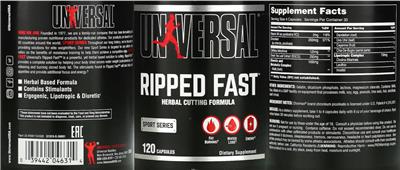
This summary is for Ripped Fast by Universal
- Form
- Capsule
- Serving Size
- 1 Capsule
- Servings
- 30 per container
- Container Holds
- 120 Capsules
- What is Ripped Fast?A supplement from Universal with twelve active ingredients, in capsule form.
- Active Ingredients 2 vitamins, 1 mineral, 6 plant ingredients such as Green Tea leaf, Alfalfa and Dandelion, 1 fat or oil and 2 others: Vitamin B6 2 mgChromium 200 mcgCaffeine Anhydrous 125 mgGreen Tea leaf extract 250 mgAlfalfaDandelionUva UrsiCayenneCha-De-BugreCholine BitartrateLecithinInositol Twelve active ingredients. Each one can interact with drugs or cause side effects on its own, so we check every one. The full Supplement Facts
- Drug Interactions 1,566 drugs have a documented interaction with this supplement; the most serious is rated major. Of those, 1,087 are single drugs and 479 are combination products (two or more drugs in one), each listed under its own name. Ask your pharmacist first if you take a drug in any of these categories, the most serious of the 75 on record:
- EphedrineMajor · 8 drugs
- Atorvastatin (Lipitor)Major · 3 drugs
- Nadolol (Corgard)Major · 2 drugs
- Major · 2 drugs
- Possible Side EffectsNausea 7 ingredientsStomach upset 6 ingredientsDiarrhea 4 ingredientsHeadache 4 ingredientsHeartburn 3 ingredientsAnxiety 2 ingredients +27 moreCombined from all twelve of its active ingredients. Not studied in this exact product.
- Well documented Why
Does Ripped Fast work?
What It Is Marketed For
- Fat burning
- Water weight loss
- Cutting
From the claims on the product’s label.
The Closest Use the Research Grades
Caffeine
Some studies support it, but the evidence isn’t conclusive.
Its ingredients have stronger research for other uses:
- Hyperhomocysteinemia Vitamin B6
- Caffeine
- Mental alertness Caffeine
- Chromium
- Caffeine
- Green Tea
These grades are for each ingredient, not this exact product, and never a promise it will work for you.
And 5 more graded uses, in what the research says- AllergensThe label says it contains milk and soy
- Barcode (UPC)0 39442 04631 4Match it to the barcode on your bottle to be sure this is your product. Not your product? Search for it here
Who Might Consider It
- People looking for fat burning, water weight loss and cutting, which is what it is marketed for. The closest use the research grades is obesity, rated Possibly Effective.
- People who want it for hyperhomocysteinemia, athletic performance, mental alertness, diabetes or another graded use: the other uses with research behind them. See each grade
- Ripped Fast may be worth a look for adults who want to weigh a caffeine-containing blend with mixed evidence.
Who Should Be Careful
- People who take ephedrine, warfarin, nadolol, atorvastatin, blood thinners, diabetes medicines, or insulin should be especially careful, as should anyone who is pregnant, breastfeeding, or has heart problems, high blood pressure, anxiety, or kidney or liver disease.
- Talk it over with your own doctor or pharmacist before starting.
More Before You Take It Show both answersHide Pregnancy and Breastfeeding The Label’s Directions
-
Pregnant or breastfeeding?
- Pregnancy Uva Ursi
- ! When used orally.
- Breastfeeding Uva Ursi
- Insufficient reliable information available; avoid using.
- Pregnancy Vitamin B6
- ! When used orally in excessive doses.
- Breastfeeding Vitamin B6
- When used orally in doses not exceeding the tolerable upper intake level (UL) of vitamin B6 in the form of pyridoxine 80 mg daily for those aged 14-18 years and 100 mg daily for those 19 years and older.
- Pregnancy Caffeine
- ! When used orally in amounts over 300 mg daily.
- Breastfeeding Caffeine
- ! When used orally in large amounts.
-
How does the label say to take it?
“Dosage: As a dietary supplement, take 1 to 4 capsules daily with 8 oz. of your beverage of choice. Best when taken 30 minutes before working out.”
The maker’s words. Your pharmacist or doctor may advise differently.
Everything the label says
From the label dated Oct 24, 2022: all twelve of its active ingredients were checked against our records. A summary of what is known, not a grade or a test of the product. How these ratings are computed
Ask Anything About This Supplement
Name a drug you take, or ask about side effects, ingredients or pregnancy.
There’s a lot of information about this supplement on this page! Ask anything in plain English for a quick answer drawn from it.
AI answers come from this label and our own records, never the open internet. AI can make mistakes, so always check with your doctor or pharmacist. How we use AI
Ask the Pharmacist
A licensed pharmacist will answer your question by email — free, as soon as they can.
Got it — thank you!
A licensed pharmacist will answer as soon as they can. Keep an eye on your email (worth checking spam, just in case).
What’s Inside Ripped Fast by Universal
Twelve Active Ingredients
In the order the label lists them, each with its own card below.
The label gives an exact amount for 4 of its 12 active ingredients. The other eight are inside two proprietary blends, and the label gives one total for each, not how much of each ingredient is in it.
- 4 state an exact amount
- 8 have no amount of their own
- Diuretic and Metabolic Complex 1,000 mg in total · 5 ingredients, no amount for each
- Lipotropic Complex 750 mg in total · 3 ingredients, no amount for each
This rates what the label tells you, not the quality of the product.
Supplement Facts
| Amount Per Serving | % Daily Value | |
|---|---|---|
| Vitamin B6 | 2 mg | 118% |
| Chromium | 200 mcg | 571% |
| Caffeine Anhydrous | 125 mg | † |
| Green Tea leaf extract | 250 mg | † |
| Diuretic and Metabolic Complex | 1000 mg | † |
| Alfalfa | † | |
| Dandelion | † | |
| Uva Ursi | † | |
| Cayenne | † | |
| Cha-De-Bugre | † | |
| Lipotropic Complex | 750 mg | † |
| Choline Bitartrate | † | |
| Lecithin | † | |
| Inositol | † | |
Other ingredients: Gelatin, Dicalcium Phosphate, Lactose, Magnesium Stearate
† Daily Value not established.
Daily Values for adults and children 4 or more years of age.
As the label prints it, from the NIH Dietary Supplement Label Database.
Each Ingredient and Its Drug Interactions
Tap one for more about it and its full guide. A drug can interact with this supplement through any one of them.
Ripped Fast is a capsule blend of stimulants, herbs, and nutrients.
- Caffeine anhydrous and green tea leaf extract supply caffeine, and cayenne (capsicum) and cha-de-bugre are also described as containing stimulant-like compounds.
- The nutrient actives include inositol, lecithin, choline bitartrate, vitamin B6, and chromium.
Show 1 more point
- Lecithin and choline are sources of choline, a nutrient the body uses for cell membranes and nerve signaling.
-
Vitamin B6 2 mg Interacts with 210 drugs
Form on the label: Pyridoxine Hydrochloride
Vitamin B6 (pyridoxine) is an essential water-soluble vitamin that your body needs for metabolism, brain function, and making red blood cells.
- It is best known for helping with pregnancy-related nausea and may help some people with PMS, but taking very high doses for long periods can cause nerve damage.
- Get most of your B6 from food, and check with a pharmacist or doctor before taking high-dose supplements.
The full Vitamin B6 guide: uses, dosage and safety Every Vitamin B6 drug interaction
-
Chromium 200 mcg Interacts with 178 drugs
Form on the label: Chromium Chloride, Chromium Picolinate
Chromium is an essential trace mineral involved in how the body handles sugar and fat.
- Some studies suggest it may modestly help blood sugar control in certain people with type 2 diabetes, but results are mixed and the effect on weight loss is small and uncertain.
- For most healthy people who eat a varied diet, supplements are not needed; check with your pharmacist or doctor before starting.
The full Chromium guide: uses, dosage and safety Every Chromium drug interaction
-
Caffeine Anhydrous 125 mg Interacts with 655 drugs
Caffeine is a natural stimulant found in coffee, tea, and many other plants and products.
- In moderate amounts it can boost alertness and reduce tiredness for most healthy adults, but too much can cause jitteriness, a racing heart, and sleep problems.
- Pregnant women and people with heart conditions or anxiety should be especially careful and check with a doctor or pharmacist.
The full Caffeine guide: uses, dosage and safety Every Caffeine drug interaction
-
Green Tea leaf extract 250 mg Interacts with 1,294 drugs
Form on the label: EGCG
Green tea is a popular beverage rich in antioxidants called catechins, and drinking it in normal amounts is considered safe for most people.
- Concentrated green tea extracts are a different story—they may help modestly with weight or heart health for some, but high doses have been linked to rare liver problems.
- Talk to your pharmacist or doctor before taking green tea supplements, especially if you have liver concerns or are pregnant.
The full Green Tea guide: uses, dosage and safety Every Green Tea drug interaction
-
Diuretic and Metabolic Complex 1000 mg Dandelion and uva ursi are herbs with possible diuretic (fluid-clearing) effects, and alfalfa is an herb rich in vitamin K and plant estrogens. Five ingredients inside it, each checked on its own
- Alfalfa 583 drugs
- Dandelion 457 drugs
- Uva Ursi 804 drugs
- Cayenne 239 drugs
- Cha-De-Bugre
-
Lipotropic Complex 750 mg Three ingredients inside it, each checked on its own
- Choline Bitartrate 16 drugs
- Lecithin
- Inositol 86 drugs
Other Ingredients (Inactive)
The capsule or tablet itself, fillers, coatings and flavors. Not part of the drug interaction check; the allergen check below reads them.
- Gelatin
- Dicalcium Phosphate
- Lactose
- Magnesium Stearate
Allergens in Ripped Fast
The label says it contains milk and soy.
Named on this label
- MilkThe label says it contains it; in the ingredients: Lactose
- SoyThe label says it contains it
- Gelatin (animal-derived)In the ingredients: Gelatin
Not named in the ingredients
- Egg
- Fish
- Shellfish
- Tree nuts
- Peanuts
- Wheat or other gluten grains
- Sesame
- The label’s allergen statement“Contains: Milk, soy. Made in a GMP facility on equipment that processes milk, soy, egg, peanuts, tree nuts, fish, shellfish, and wheat.”
From the label text and ingredient names on file; we do not test products. With a serious allergy, check your bottle and ask the maker or your pharmacist.
What the Label Says
The maker’s own words, from the label. We do not verify or endorse them.
- General statements
-
“YouTube.com Facebook.com Instagram.com Twitter.com @UniversalUSA Who We Are Founded in 1977, we are a family-run company that has been formulating and manufacturing proven nutritional products for dedicated athletes. Our products are found in over 90 countries around the world. Sports Series Throughout our long history, we've focused on providing solutions for elite weightlifters. Our new Sports Series is targeted for any athlete who relies on the benefits of resistance training to help them achieve a competitive edge.”
“Plant US-#300104580”
- Formulation
-
“Ripped Fast Universal's Ripped Fast is a powerful, yet herbal based solution to cutting. Ripped Fast provides a complete solution by helping your body shed excess water weight (subcutaneous), and releasing and burning stored body fat. The stimulants found in Ripped Fast will also help curb appetites and provide additional focus and energy. Herbal based formula Ergogenic, lipotropic & diuretic”
“Herbal cutting formula Fat burning Water loss Energy”
“Contains stimulants”
- Seals and symbols
-
“EAC (Eurasian Union)”
- Brand IP Statement(s)
-
“Universal Starts With U”
“Ingredient notes: Chromax brand chromium picolinate is licensed under U.S. Patent #4,315,927.”
- FDA Statement of Identity
-
“Dietary Supplement”
- Storage
-
“Store product in a cool, dry place, away from heat, moisture and sunlight.”
The Ripped Fast Label on File
The label scan on file at the NIH Dietary Supplement Label Database, dated October 2022. Always read the label on the bottle you have.
Product Facts
- Brand
- Universal
- Barcode (UPC)
- 039442046314
- Net contents
- 120 Capsules
- Market status
- On market
- Date entered into DSLD
- Oct 24, 2022
- DSLD ID
- 275413
- Product type
- Other Combinations
- Supplement form
- Capsule
- Dietary claims / uses
- All Other, Structure/Function
- Intended target group(s)
- Adult (18 - 50 Years), Pregnant Women
Is this label outdated? Report a formula or label change and our pharmacy team will review it.
HelloPharmacist Score Ripped Fast by Universal
Up to 10 points for research, amount, label and outside testing. Not a safety rating. How this one adds up
for obesity
It is marketed for fat burning, water weight loss and cutting. There is no graded research on that exact use, so we scored the closest one: some research suggests caffeine, one of its ingredients, may help with obesity.
- Research3 of 5 points
- Amount2 of 2 points
- Label1 of 2 points
- Outside testing0 of 1 point
Major drug interactions. The score does not count drug interactions. Check them against any drugs you take. See them
How It Earns Its 6
Score: 6 out of 10. Preliminary for obesity.
Some research on caffeine for obesity.
Graded “Possibly Effective” in the Natural Medicines database, which we license. A related use, not the one it is marketed for, counts for at most 3 of 5 research points.
3 of 5 points
Amount
Its 125 mg is a normal amount: most of the 380 caffeine products in our database that state an amount hold 50 mg to 350 mg.
2 of 2 points
Label
It states the amount of four of its 12 active ingredients; eight are inside blends that give only a total.
1 of 2 points
Outside testing
We found no mark from an outside testing program, such as USP Verified or NSF Certified, on the label we have on file.
0 of 1 point
Ripped Fast by Universal Side Effects
Why this rating?
We look for three kinds of safety information on each ingredient: side effects reported in studies, a pregnancy and breastfeeding rating, and a safety write-up from our pharmacy team. Of the twelve ingredients we could check, eleven have side-effect reports, all twelve have a pregnancy rating and all twelve have a safety write-up.
So this rates how much is known, not whether Ripped Fast is right for you.
Reported with twelve of its ingredients
- Most often
- Nausea, stomach upset, diarrhea, headache, heartburn and anxiety
- !Rare but serious
- Sensory neuropathy (high doses), liver cirrhosis and anaphylaxis in sensitive individuals See details
HelloPharmacist Team Summary: Ripped Fast by Universal Side Effects
Ripped Fast is a blend, so you may notice stomach upset, nausea, diarrhea, or gas, most likely from lecithin, inositol, green tea, and cayenne.
- Because it contains caffeine, jitteriness, trouble sleeping, and a racing or pounding heartbeat are the effects people most often report.
- The rare but serious reactions are allergic reactions, which lecithin's data links to egg and soy allergies, and liver injury, which has been linked to concentrated green tea extract.
- If you notice an allergic reaction or any unusual symptom, call your doctor right away, and talk with your own doctor or pharmacist before starting if you are pregnant, breastfeeding, have diabetes or heart problems, or take any medication.
Side Effects, Ingredient by Ingredient
A supplement’s side effects come from its ingredients. Here is what is reported with each one.
Vitamin B6
Most reported
- Abdominal pain
- Allergic reactions
- Headache
- Heartburn
- Loss of appetite
- Nausea
- Somnolence
- Vomiting
From the Natural Medicines database, which we license.
Every reported effect, in the Vitamin B6 guideChromium
Most reported
- Headache
- Dizziness
- Nausea
- Stomach upset
Caffeine
Most reported
- Feeling jittery, nervous, or anxious
- Racing or pounding heartbeat
- Trouble sleeping
- Upset stomach or heartburn
Green Tea
Most reported
- Trouble sleeping or feeling jittery
- Nervousness or anxiety
- Upset stomach or nausea, especially on an empty stomach
- Headache
Alfalfa
Most reported
- Abdominal discomfort
- Diarrhea
- Flatulence
From the Natural Medicines database, which we license.
Every reported effect, in the Alfalfa guideDandelion
Most reported
- Stomach upset, heartburn, or diarrhea
- Increased urination (from its possible diuretic effect)
Uva Ursi
Most reported
- Nausea
- Vomiting
- Stomach upset
Capsicum
Most reported
- Burning
- Stinging
- Itching
- Redness at the application site
Cha De Bugre
Most reported
- Restlessness
- Fast or pounding heartbeat
- Anxiety
- Headache
Choline
Most reported
- A fishy body odor
- Nausea, stomach upset, or diarrhea
- Sweating
- Drop in blood pressure or dizziness (mainly at very high doses)
Lecithin
Most reported
- Upset stomach or stomach pain
- Diarrhea or loose stools
- Nausea
- Feeling full or bloated
Inositol
Most reported
- Nausea
- Gas
- Bloating
- Stomach upset
Ripped Fast Warnings: Who Should Be Careful
Ripped Fast has twelve active ingredients, and each can carry warnings of its own. We checked all twelve, and each warning below names the ingredient it comes from. If any of these apply to you, talk to your doctor or pharmacist before you start it.
- Vitamin B62 warnings below
- Chromium3 warnings below
- Caffeine2 warnings below
- Green Tea3 warnings below
- Alfalfa3 warnings below
- Dandelion2 warnings below
- Uva Ursi3 warnings below
- Capsicum3 warnings below
- Cha De Bugre3 warnings below
- Choline2 warnings below
- Lecithin4 warnings below
- Inositol2 warnings below
-
Bleeding Problems or Surgery
- Green TeaThe same goes for people with bleeding disorders or those preparing for surgery.
-
Diabetes or Low Blood Sugar
- ChromiumPeople with diabetes should monitor their blood sugar closely, since chromium may affect blood sugar levels.
- InositolBecause it can affect insulin and blood sugar signaling, people with diabetes or blood sugar problems should monitor closely and talk with their healthcare provider.
-
Blood Pressure
- CaffeineBe cautious if you: have heart problems, high blood pressure, an irregular heartbeat, anxiety, panic attacks, trouble sleeping, stomach ulcers, or seizure disorders.
- Cha De BugreUse extra caution if you have heart problems, high blood pressure, anxiety, or sleep difficulties.
-
Liver Disease
- ChromiumStill, taking high doses or using it for a long time may carry risks, and some case reports have linked very high intakes to kidney or liver problems.
- ChromiumPeople with kidney disease or liver disease should be especially careful and talk to a doctor before using chromium.
- Green TeaPeople with liver disease should be especially careful and check with a healthcare provider first.
- Uva UrsiDo not use uva ursi if you have kidney disease or liver disease.
- CholinePeople with liver or kidney conditions, or certain rare metabolic disorders, should talk to a healthcare provider before taking choline supplements.
-
Kidney Disease or Kidney Stones
- Vitamin B6People with kidney problems or other chronic conditions should talk to a clinician before using supplements.
- DandelionWho should be cautious: People with gallbladder problems, blocked bile ducts, or kidney disease should talk to a doctor first, since dandelion may affect bile flow and fluid balance.
- Cha De BugrePeople with kidney conditions should also be careful because of its possible diuretic effect.
-
Heart Conditions
- Green TeaBecause green tea contains caffeine, people who are sensitive to caffeine, have heart rhythm problems, anxiety, or trouble sleeping should be cautious.
- Cha De BugreBecause it may contain caffeine-like stimulants, people who are sensitive to caffeine may notice effects such as a faster heartbeat, jitteriness, or trouble sleeping.
-
Stomach or Bowel Problems
- CapsicumPeople with sensitive stomachs, acid reflux, ulcers, or irritable bowel symptoms may find that oral capsicum worsens their symptoms.
-
Autoimmune Conditions
- AlfalfaPeople with autoimmune diseases such as lupus should avoid alfalfa supplements.
-
Hormone-Sensitive Conditions
- AlfalfaBecause of its phytoestrogens, people with hormone-sensitive conditions (such as certain breast, uterine, or ovarian conditions) should be cautious and talk to their doctor first.
-
Allergies
- LecithinPeople with soy or egg allergies should choose a product made from a source they can tolerate, such as sunflower lecithin, or avoid it altogether.
- LecithinLecithin can cause allergic skin reactions in people with egg or soy allergies.
-
Children
- CaffeineChildren and teens should limit caffeine.
- Uva UrsiChildren should not take it.
-
If You Take Other Drugs
- LecithinAs with any supplement, talk to your pharmacist or doctor before taking lecithin, especially if you have a medical condition or take other medicines.
-
Other Cautions
- Vitamin B6Avoid high doses.
- AlfalfaPeople who are immunosuppressed should also avoid alfalfa.
- DandelionBecause it may act as a mild diuretic, use caution if you are already taking water pills or have conditions affected by fluid loss.
- Uva UrsiPeople with conditions sensitive to its astringent or irritant effects should also be cautious.
Show 4 more
- CapsicumAvoid getting it in your eyes, nose, mouth, or on broken or irritated skin, and wash your hands well after use.
- CapsicumUse caution if you have these conditions.
- CholineAnyone with a known body odor (fishy smell) reaction to choline should avoid high doses.
- InositolAs with any supplement, choose reputable brands, and let your pharmacist or doctor know what you are taking, especially if you have an existing health condition.
-
What the Label Warns
- “Warning: Not for use by those under the age of 18.”
- “Consult a physician before using this product.”
- “Do not use if pregnant or nursing.”
- “Contains caffeine: Do not exceed recommended dose; Do not use in combination with other caffeinated products or stimulants. Discontinue use and consult your healthcare professional if dizziness, sleeplessness, tremors, nervousness, headache or heart palpitations occur. Use of this product may be banned by some athletic associations. Athletes should consult with their sanctioning authority before use. California Residents: Warning: Reproductive harm - www.P65Warnings.ca.gov.”
The maker’s wording, from the product label.
-
Pregnant or Breastfeeding
Each ingredient’s rating for pregnancy and for breastfeeding, and what it covers.
Pregnancy
-
When used orally.
Uva ursi can have oxytocic effects, increasing the speed of labor; avoid using.
Breastfeeding
-
Insufficient reliable information available; avoid using.
Pregnancy
-
When used orally and appropriately.
A special sustained-release product providing vitamin B6 (pyridoxine) 75 mg daily is FDA-approved for use in pregnancy.
3 more points on this rating
- Vitamin B6 (pyridoxine) is also considered a first-line treatment for nausea and vomiting in pregnancy by the American College of Obstetrics and Gynecology.
- However, it should not be used long-term or without medical supervision and close monitoring.
- The tolerable upper intake level (UL) refers to vitamin B6 in the form of pyridoxine and is 80 mg daily for those aged 14-18 years and 100 mg daily for 19 years and older.
-
When used orally in excessive doses.
There is some concern that high-dose maternal vitamin B6 (pyridoxine) can cause neonatal seizures.
Breastfeeding
-
When used orally in doses not exceeding the tolerable upper intake level (UL) of vitamin B6 in the form of pyridoxine 80 mg daily for those aged 14-18 years and 100 mg daily for those 19 years and older.
The recommended dietary allowance (RDA) in lactating women is 2 mg daily.
There is insufficient reliable information available about the safety of vitamin B6 when used in higher doses in breast-feeding women.
Show 10 more ingredients
Pregnancy
-
When used orally in amounts commonly found in foods.
Intakes of caffeine should be monitored during pregnancy.
10 more points on this rating
- Caffeine crosses the human placenta, but is not considered a teratogen.
- Fetal blood and tissue levels are similar to maternal concentrations.
- The use of caffeine during pregnancy is controversial; however, moderate consumption has not been associated with clinically important adverse fetal effects.
- In some studies consuming amounts over 200 mg daily is associated with a significantly increased risk of miscarriage.
- This increased risk seems to occur in those with genotypes that confer a slow rate of caffeine metabolism.
- According to a review by Health Canada, and a subsequent large meta-analysis conducted in the US, up to 300 mg daily can be consumed during pregnancy without an increased risk of spontaneous abortion, stillbirth, preterm birth, fetal growth retardation, or congenital malformations.
- However, observational research in a Norwegian cohort found that caffeine consumption is associated with a 16% increased odds of the baby being born small for gestational age when compared with no consumption.
- The same Norwegian cohort found that low to moderate caffeine consumption during pregnancy is not associated with changes in neurodevelopment in children up to 8 years of age.
- Advise patients to keep caffeine consumption below 300 mg daily during pregnancy.
- This is similar to the amount of caffeine in about 3 cups of coffee or tea.
-
When used orally in amounts over 300 mg daily.
Caffeine crosses the placenta, producing fetal blood concentrations similar to maternal levels.
8 more points on this rating
- Consumption of caffeine in amounts over 300 mg daily is associated with a significantly increased risk of miscarriage in some studies.
- Advise patients to keep caffeine consumption below 300 mg daily during pregnancy.
- This is similar to the amount of caffeine in about 3 cups of coffee or tea.
- Additionally, high doses of caffeine throughout pregnancy have resulted in symptoms of caffeine withdrawal in newborn infants.
- High doses of caffeine have also been associated with spontaneous abortion, premature delivery, and low birth weight.
- In a cohort of mother/infant pairs with a median maternal plasma caffeine level of 168.5 ng/mL (range 29.5-650.5 ng/mL) during pregnancy, birth weights and lengths were lower in the 4th quartile of caffeine intake compared with the 1st.
- By age 7, heights and weights were lower by 1.5 cm and 1.1 kg respectively.
- In another cohort of mother/infant pairs with higher maternal pregnancy plasma caffeine levels, median 625.5 ng/mL (range 86.2 to 1994.7 ng/mL), heights at age 8 were 2.2 cm lower, but there was no difference in weights.
Breastfeeding
-
When used orally in amounts commonly found in foods.
Caffeine intake should be closely monitored while breast-feeding.
During lactation, breast milk concentrations of caffeine are thought to be approximately 50% of serum concentrations and caffeine peaks in breastmilk approximately 1-2 hours after consumption.
-
When used orally in large amounts.
Caffeine is excreted slowly in infants and may accumulate.
Caffeine can cause sleep disturbances, irritability, and increased bowel activity in breast-fed infants exposed to caffeine.
Pregnancy
-
When used orally in moderate amounts.
Due to the caffeine content of green tea, pregnant patients should closely monitor their intake to ensure moderate consumption.
12 more points on this rating
- Fetal blood concentrations of caffeine approximate maternal concentrations.
- The use of caffeine during pregnancy is controversial; however, moderate consumption has not been associated with clinically important adverse fetal effects.
- In some studies consuming amounts over 200 mg daily is associated with a significantly increased risk of miscarriage.
- This increased risk may be most likely to occur in those with genotypes that confer a slow rate of caffeine metabolism.
- According to a review by Health Canada, and a subsequent large meta-analysis conducted in the US, most healthy pregnant patients can safely consume doses up to 300 mg daily without an increased risk of spontaneous abortion, stillbirth, preterm birth, fetal growth retardation, or congenital malformations.
- Advise keeping caffeine consumption below 300 mg daily.
- This is similar to the amount of caffeine in about 6 cups of green tea.
- Keep in mind that only the amount of ADDED caffeine must be stated on product labels.
- The amount of caffeine found in ingredients such as green tea, which naturally contains caffeine, does not need to be provided.
- This can make it difficult to determine the total amount of caffeine in a given product.
- Based on animal models, green tea extract catechins are also transferred to the fetus, but in amounts 50-100 times less than maternal concentrations.
- The potential impact of these catechins on the human fetus is not known, but animal models suggest that the catechins are not teratogenic.
-
When used orally in amounts providing more than 300 mg caffeine daily.
Caffeine from green tea crosses the placenta, producing fetal blood concentrations similar to maternal levels.
16 more points on this rating
- Consumption of caffeine in amounts over 300 mg daily is associated with a significantly increased risk of miscarriage in some studies.
- Advise keeping caffeine consumption from all sources below 300 mg daily.
- This is similar to the amount of caffeine in about 6 cups of green tea.
- High maternal doses of caffeine throughout pregnancy have also resulted in symptoms of caffeine withdrawal in newborn infants.
- High doses of caffeine have also been associated with spontaneous abortion, premature delivery, and low birth weight.
- However, some research has also found that intrauterine exposure to even modest amounts of caffeine, based on maternal blood levels during the first trimester, is associated with a shorter stature in children ages 4-8 years.
- Keep in mind that only the amount of ADDED caffeine must be stated on product labels.
- The amount of caffeine found in ingredients such as green tea, which naturally contains caffeine, does not need to be provided.
- This can make it difficult to determine the total amount of caffeine in a given product.
- There is also concern that consuming large amounts of green tea might have antifolate activity and potentially increase the risk of folic acid deficiency-related birth defects.
- Catechins in green tea inhibit the enzyme dihydrofolate reductase in vitro.
- This enzyme is responsible for converting folic acid to its active form.
- Preliminary evidence suggests that increasing maternal green tea consumption is associated with increased risk of spina bifida.
- Also, evidence from epidemiological research suggests that serum folate levels in pregnant patients with high green tea intake (57.3 mL per 1000 kcal) are decreased compared to participants who consume moderate or low amounts of green tea.
- More evidence is needed to determine the safety of using green tea during pregnancy.
- For now, advise pregnant patients to avoid consuming large quantities of green tea.
Breastfeeding
-
When used orally in moderate amounts.
Due to the caffeine content of green tea, nursing parents should closely monitor caffeine intake.
Breast milk concentrations of caffeine are thought to be approximately 50% of maternal serum concentrations.
-
When used orally in large amounts.
Consumption of green tea might cause irritability and increased bowel activity in nursing infants.
There is insufficient reliable information available about the safety of green tea extracts when applied topically during breast-feeding.
Pregnancy and Breastfeeding The record rates both the same
-
When used orally in medicinal amounts.
Alfalfa contains constituents with possible estrogenic activity.
Pregnancy
-
When used orally and appropriately, short-term.
Capsicum 5 mg daily has been used for up to 28 days during the latter half of the second trimester and the third trimester.
1 more rating for Capsicum used another way
This supplement is taken by mouth. This rating is for Capsicum given another way.
-
When used topically and appropriately.
Breastfeeding
-
When used orally.
Dermatitis can sometimes occur in infants when foods heavily spiced with capsicum peppers are ingested during lactation.
Also, observational research suggests that intake of raw capsicum peppers during pregnancy is associated with an increased risk of sensitization to inhalant allergens in children by the age of 2 years.
1 more rating for Capsicum used another way
This supplement is taken by mouth. This rating is for Capsicum given another way.
-
When used topically and appropriately.
Pregnancy and Breastfeeding The record rates both the same
-
Insufficient reliable information available; avoid using amounts greater than those in foods.
Pregnancy and Breastfeeding The record rates both the same
-
Insufficient reliable information available; avoid using.
Pregnancy
-
When used orally and appropriately, short-term.
Myo-inositol has been used with apparent safety in amounts up to 4000 mg daily during pregnancy.
Breastfeeding
-
Insufficient reliable information available; avoid using.
Breast milk is rich in endogenous inositol; however, the effects of exogenously administered inositol are not known.
Pregnancy
-
When used orally and appropriately in amounts not exceeding adequate intake (AI) levels.
The AI for pregnancy is 28 mcg daily for those 14-18 years of age and 30 mcg daily for those 19-50 years of age.
-
When used orally in amounts exceeding the adequate intake (AI) levels.
There is some evidence that patients with gestational diabetes can safely use chromium in doses of 4-8 mcg/kg; however, patients should not take chromium supplements during pregnancy without medical supervision.
Breastfeeding
-
When used orally and appropriately in amounts not exceeding adequate intake (AI) levels.
The AI for lactation is 44 mcg daily for those 14-18 years of age and 45 mcg daily for those 19-50 years of age.
2 more points on this rating
- Chromium supplements do not seem to increase normal chromium concentration in human breast milk.
- There is insufficient reliable information available about the safety of chromium when used in higher amounts while breast-feeding.
Pregnancy and Breastfeeding The record rates both the same
-
When used orally and appropriately.
Choline is safe when taken in doses below the tolerable upper intake level (UL), which is 3 grams daily during pregnancy and lactation in those up to 18 years of age and 3.5 grams daily for those 19 years and older.
There is insufficient reliable information available about the safety of choline used in higher doses during pregnancy and lactation.
Pregnancy and Breastfeeding The record rates both the same
-
When used orally in food amounts.
Lecithin has Generally Recognized As Safe (GRAS) status in the US.
There is insufficient reliable information available about the safety of medicinal amounts of lecithin during pregnancy or lactation; avoid using.
Our pharmacy team’s notes
- Pregnancy ratings differ by ingredient.
- Lecithin and choline are rated likely safe in pregnancy, while cayenne and chromium carry both likely and possibly safe ratings.
- Uva ursi is rated likely unsafe, and alfalfa and caffeine are rated possibly unsafe, so they are best avoided in pregnancy.
Ratings and the words beside them are from the Natural Medicines database, which we license.
-
Rare but Serious Side Effects
-
!
Vitamin B6
Orally or by injection: Sensory neuropathy (high doses).
Orally: Liver cirrhosis, hepatocellular carcinoma (high doses of pyridoxal-5'-phosphate).
-
!
Chromium
Rare but more serious problems, such as kidney or liver injury, have been reported mostly with high doses.
Orally: Rare cases of kidney and liver damage, rhabdomyolysis, and thrombocytopenia have been reported.
-
!
Caffeine
Serious effects are rare but can happen with very high doses.
Orally: Stroke has been reported rarely.
-
!
Green Tea
A rare but serious concern with concentrated green tea extract supplements is liver damage.
Orally: Hepatotoxicity, hypokalemia, and thrombotic thrombocytopenic purpura have been reported rarely.
-
!
Alfalfa
More serious concerns are mostly tied to supplements or large amounts.
Orally: Lupus-like syndrome after chronic ingestion of alfalfa.
-
!
Dandelion
Rarely, serious allergic reactions can occur.
Orally: Anaphylaxis in sensitive individuals.
-
!
Uva Ursi
More serious concerns come with high doses or long-term use.
Orally: At high doses (20 grams of dried herb), uva ursi has been reported to cause collapse, convulsions, cyanosis, delirium, shortness of breath, and tinnitus. Very high doses of 30 grams or more may be fatal.
-
!
Capsicum
Rarely, severe irritation, allergic reactions, or breathing problems from inhaling the powder can occur.
Orally: Cases of myocardial infarction and hypertensive crisis have been reported.
-
!
Lecithin
Allergic reactions are possible, particularly in people sensitive to soy or eggs.
-
!
Our pharmacy team on Ripped Fast
Concentrated green tea extract has been linked to rare liver injury, and uva ursi carries risks at high doses or with long-term use.
When to get help: a serious allergic reaction, with trouble breathing or swelling of the face, lips or throat, needs emergency care: call 911. For any other side effect that worries you, call your doctor or pharmacist.
These reports describe each ingredient, not studies of this exact product. Not medical advice: a side effect you notice after starting a supplement is worth a word with your pharmacist or doctor.
Ripped Fast by Universal Drug Interactions
We checked all twelve active ingredients in this supplement against every drug in our records. A drug can interact with it through any one of them.
A major interaction on record
3 of 3, on a scale from Minor or none to Major.Why this rating?
We rate this by the most serious interaction on record, not by how many there are. For Alfalfa, Inositol, Uva Ursi, Choline and Dandelion, the most serious is rated major, which means the combination is best avoided, or used only under close supervision. Some involve kinds of drugs where a small change can matter, such as blood thinners, transplant drugs and diabetes drugs.
1,567 drugs are on the full list. What matters is whether one you take is on it, so check yours with the interaction checker on this page.
From the HelloPharmacist Team
What matters most when you look at everything in the bottle at once.
- Ripped Fast by Universal does interact with several medications, through its caffeine, green tea, cayenne, inositol, dandelion, alfalfa, uva ursi, chromium, choline, and vitamin B6 content.
- The most serious interaction on record is Major: caffeine and green tea combined with ephedrine, a drug type, can raise the risk of serious stimulant effects such as high blood pressure, heart attack, stroke, and seizures.
- Other Major interactions involve warfarin, a blood thinner (anticoagulant), where alfalfa may reduce its effect; nadolol, a beta blocker, whose levels green tea may lower; and atorvastatin, a cholesterol-lowering statin, whose levels green tea extract may lower.
Ten of its twelve active ingredients have drug interactions on record. The ones below matter most. We have no interaction records for Cha De Bugre and Lecithin.
- Interacts with
- 1,294 drugs
- Most serious
- Major
- Most of its records involve Cytochrome P450 3A4 (CYP3A4) Substrates, Hepatotoxic Drugs and P-glycoprotein Substrates.
- Interacts with
- 804 drugs
- Most serious
- Moderate
- Most of its records involve Cytochrome P450 3A4 (CYP3A4) Substrates, P-glycoprotein Substrates and Glucuronidated Drugs.
- Interacts with
- 655 drugs
- Most serious
- Major
- Most of its records involve Stimulant Drugs, Anticoagulant/Antiplatelet Drugs and Cytochrome P450 1A2 (CYP1A2) Inhibitors.
Show three more ingredients
- Interacts with
- 583 drugs
- Most serious
- Major
- Most of its records involve Photosensitizing Drugs, Immunosuppressants and Antidiabetes Drugs.
- Interacts with
- 457 drugs
- Most serious
- Moderate
- Most of its records involve Cytochrome P450 1A2 (CYP1A2) Substrates, Glucuronidated Drugs and Anticoagulant/Antiplatelet Drugs.
- Interacts with
- 239 drugs
- Most serious
- Moderate
- Most of its records involve Anticoagulant/Antiplatelet Drugs, Antidiabetes Drugs and Aspirin.
And four more ingredients with records, each in the cards below.
Summarized by the HelloPharmacist pharmacy team from the interaction records below. How it is written How we use AI
Why Ripped Fast Interacts, Ingredient by Ingredient
A product interacts through its ingredients. Each card: how many drugs, the most serious rating, and the kinds of drugs it affects most (tap a kind for what it means).
The ingredients driving the most interactions
-
Green Tea leaf extract 1,294 drugs
Most serious: Major58 interaction records on file
The kinds of drugs it affects most
- 645 drugs
- 372 drugs
- 202 drugs
- 172 drugs
Every Green Tea drug interaction, 58 records The Green Tea records cite 219 references, listed in the Green Tea guide.
-
Uva Ursi 804 drugs
Most serious: Moderate6 interaction records on file
The kinds of drugs it affects most
- 645 drugs
- 202 drugs
- 124 drugs
- 72 drugs
Every Uva Ursi drug interaction, 6 records The Uva Ursi records cite 8 references, listed in the Uva Ursi guide.
-
Caffeine Anhydrous 655 drugs
Most serious: Major41 interaction records on file
The kinds of drugs it affects most
- 172 drugs
- 122 drugs
- 90 drugs
- 86 drugs
Every Caffeine drug interaction, 41 records The Caffeine records cite 235 references, listed in the Caffeine guide.
-
Alfalfa 583 drugs
Most serious: Major6 interaction records on file
The kinds of drugs it affects most
- 335 drugs
- 121 drugs
- 86 drugs
- 41 drugs
Every Alfalfa drug interaction, 6 records The Alfalfa records cite 32 references, listed in the Alfalfa guide.
-
Dandelion 457 drugs
Most serious: Moderate7 interaction records on file
The kinds of drugs it affects most
- 186 drugs
- 124 drugs
- 122 drugs
- 86 drugs
Every Dandelion drug interaction, 7 records The Dandelion records cite 27 references, listed in the Dandelion guide.
-
Cayenne 239 drugs
Most serious: Moderate6 interaction records on file
The kinds of drugs it affects most
- 122 drugs
- 86 drugs
- 35 drugs
- 23 drugs
Every Capsicum drug interaction, 6 records The Capsicum records cite 89 references, listed in the Capsicum guide.
-
Vitamin B6 210 drugs
Most serious: Moderate5 interaction records on file
The kinds of drugs it affects most
- 172 drugs
- Phenobarbital (Luminal) 28 drugs
- Phenytoin (Dilantin) 5 drugs
- 5 drugs
Every Vitamin B6 drug interaction, 5 records The Vitamin B6 records cite 33 references, listed in the Vitamin B6 guide.
-
Chromium 178 drugs
Most serious: Moderate5 interaction records on file
The kinds of drugs it affects most
- 89 drugs
- 86 drugs
- 35 drugs
- 13 drugs
Every Chromium drug interaction, 5 records The Chromium records cite 54 references, listed in the Chromium guide.
-
Inositol 86 drugs
Most serious: Moderate1 interaction record on file
The kinds of drugs it affects most
- 86 drugs
Every Inositol drug interaction, 1 record The Inositol records cite 14 references, listed in the Inositol guide.
-
Choline Bitartrate 16 drugs
Most serious: Minor1 interaction record on file
The kinds of drugs it affects most
- Atropine 16 drugs
Every Choline drug interaction, 1 record The Choline records cite 15 references, listed in the Choline guide.
The Breakdown by Severity
Each drug counted once, at its most serious rating. Tap a tile to list those drugs.
Find Your Drug
Type a drug or brand name to see whether it is on the list.
- Only drugs with a documented interaction are listed, the most serious first.
- A drug with no known interaction is not listed, but searching its name tells you so.
- Open a drug to see which ingredient is responsible. Of those, 1,087 are single drugs and 479 are combination products (two or more drugs in one), each listed under its own name.
-
IbuprofenAdvil, Arthrofen, Brufen, Brufen Retard, Calodor and 15 more Moderate
The 6 ingredients responsible:
-
Dandelion Moderate Ibuprofen is in the Anticoagulant/Antiplatelet Drugs category.
Theoretically, taking dandelion root along with anticoagulant or antiplatelet drugs might increase the risk of bruising and bleeding.
The full Dandelion + Ibuprofen interaction -
Cayenne Moderate Ibuprofen is in the Anticoagulant/Antiplatelet Drugs category.
Theoretically, capsicum may increase the risk of bleeding if used with anticoagulant or antiplatelet drugs.
The full Cayenne + Ibuprofen interaction -
Green Tea Leaf Extract Moderate Ibuprofen is in the Anticoagulant/Antiplatelet Drugs category.
Theoretically, green tea may increase the risk of bleeding if used with anticoagulant or antiplatelet drugs.
The full Green Tea Leaf Extract + Ibuprofen interaction -
Alfalfa Moderate Ibuprofen is in the Photosensitizing Drugs category.
Theoretically, concomitant use of alfalfa with photosensitizing drugs might have additive effects.
The full Alfalfa + Ibuprofen interaction -
Caffeine Anhydrous Moderate Ibuprofen is in the Anticoagulant/Antiplatelet Drugs category.
Theoretically, caffeine may increase the risk of bleeding if used with anticoagulant or antiplatelet drugs.
The full Caffeine Anhydrous + Ibuprofen interaction -
Chromium Minor Ibuprofen is in the Nonsteroidal Anti-inflammatory Drugs (NSAIDs) category.
NSAIDs might increase chromium levels in the body.
The full Chromium + Ibuprofen interaction
-
-
IvermectinMectizan, Sklice, Soolantra, Stromectol Moderate
The 2 ingredients responsible:
-
Green Tea Leaf Extract Moderate Ivermectin is in the P-glycoprotein Substrates category.
Green tea might increase the levels and adverse effects of P-glycoprotein (P-gp) substrates.
The full Green Tea Leaf Extract + Ivermectin interaction -
Uva Ursi Minor Ivermectin is in the P-glycoprotein Substrates category.
Theoretically, uva ursi may alter the levels of drugs transported by P-glycoprotein.
The full Uva Ursi + Ivermectin interaction
-
-
SemaglutideOzempic, Rybelsus, Wegovy Moderate
The 7 ingredients responsible:
-
Inositol Moderate Semaglutide is in the Antidiabetes Drugs category.
Theoretically, taking inositol with antidiabetes drugs might increase the risk of hypoglycemia.
The full Inositol + Semaglutide interaction -
Alfalfa Moderate Semaglutide is in the Antidiabetes Drugs category.
Theoretically, alfalfa might increase the risk of hypoglycemia when taken with antidiabetes drugs.
The full Alfalfa + Semaglutide interaction -
Chromium Moderate Semaglutide is in the Antidiabetes Drugs category.
Theoretically, chromium may have additive effects with antidiabetic agents and increase the risk of hypoglycemia.
The full Chromium + Semaglutide interaction -
Cayenne Moderate Semaglutide is in the Antidiabetes Drugs category.
Theoretically, taking capsicum with antidiabetes drugs might increase the risk of hypoglycemia.
The full Cayenne + Semaglutide interaction -
Dandelion Moderate Semaglutide is in the Antidiabetes Drugs category.
Theoretically, dandelion might increase the risk for hypoglycemia when used with antidiabetes drugs.
The full Dandelion + Semaglutide interaction -
Green Tea Leaf Extract Minor Semaglutide is in the Antidiabetes Drugs category.
Theoretically, taking green tea with antidiabetes drugs might interfere with blood glucose control.
The full Green Tea Leaf Extract + Semaglutide interaction -
Caffeine Anhydrous Minor Semaglutide is in the Antidiabetes Drugs category.
Theoretically, taking caffeine with antidiabetes drugs might interfere with blood glucose control.
The full Caffeine Anhydrous + Semaglutide interaction
-
-
TestosteroneAndrogel, Andropatch, Delatestryl, Intrinsa, Natesto and 4 more Moderate
The 2 ingredients responsible:
-
Green Tea Leaf Extract Moderate Testosterone is in these Hepatotoxic Drugs, Cytochrome P450 3A4 (CYP3A4) Substrates categories.
Theoretically, concomitant use might have additive adverse hepatotoxic effects.
The full Green Tea Leaf Extract + Testosterone interaction -
Uva Ursi Moderate Testosterone is in the Cytochrome P450 3A4 (CYP3A4) Substrates category.
Theoretically, uva ursi may decrease the metabolism of CYP3A4 substrates.
The full Uva Ursi + Testosterone interaction
-
-
FluoxetineProzac, Sarafem Moderate
The ingredient responsible:
-
Alfalfa Moderate Fluoxetine is in the Photosensitizing Drugs category.
Theoretically, concomitant use of alfalfa with photosensitizing drugs might have additive effects.
The full Alfalfa + Fluoxetine interaction
-
-
AmoxicillinAmix, Amoram, Amoxident, Amoxil Capsules, Amoxil Injection and 4 more Moderate
The ingredient responsible:
-
Green Tea Leaf Extract Moderate Amoxicillin is in the Hepatotoxic Drugs category.
Theoretically, concomitant use might have additive adverse hepatotoxic effects.
The full Green Tea Leaf Extract + Amoxicillin interaction
-
-
PrednisoneCortan, Deltasone, Meticorten, Orasone, Prednicen-M and 3 more Moderate
The 3 ingredients responsible:
-
Green Tea Leaf Extract Moderate Prednisone is in these Cytochrome P450 3A4 (CYP3A4) Substrates, P-glycoprotein Substrates categories.
Green tea is unlikely to produce clinically significant changes in the levels and clinical effects of CYP3A4 substrates.
The full Green Tea Leaf Extract + Prednisone interaction -
Uva Ursi Moderate Prednisone is in these P-glycoprotein Substrates, Cytochrome P450 3A4 (CYP3A4) Substrates categories.
Theoretically, uva ursi may alter the levels of drugs transported by P-glycoprotein.
The full Uva Ursi + Prednisone interaction -
Alfalfa Moderate Prednisone is in the Immunosuppressants category.
Theoretically, alfalfa might decrease the efficacy of immunosuppressive therapy.
The full Alfalfa + Prednisone interaction
-
-
AcetaminophenChildren's Tylenol, Children's Tylenol Meltaways, Tylenol, Tylenol Ex Strength Moderate
The 3 ingredients responsible:
-
Dandelion Moderate Acetaminophen is in these Glucuronidated Drugs, Cytochrome P450 1A2 (CYP1A2) Substrates categories.
Theoretically, dandelion might increase the clearance of drugs that are UDP-glucuronosyltransferase substrates.
The full Dandelion + Acetaminophen interaction -
Green Tea Leaf Extract Moderate Acetaminophen is in the Hepatotoxic Drugs category.
Theoretically, concomitant use might have additive adverse hepatotoxic effects.
The full Green Tea Leaf Extract + Acetaminophen interaction -
Uva Ursi Moderate Acetaminophen is in the Glucuronidated Drugs category.
Theoretically, uva ursi may increase levels of drugs metabolized by glucuronidation.
The full Uva Ursi + Acetaminophen interaction
-
-
AmphetamineAdensys XR-ODT, Adzenys ER, Dyanavel XR, Mydayis Moderate
The 2 ingredients responsible:
-
Green Tea Leaf Extract Moderate Amphetamine is in these Stimulant Drugs, Monoamine Oxidase Inhibitors (MAOIs) categories.
Theoretically, concomitant use might increase stimulant adverse effects.
The full Green Tea Leaf Extract + Amphetamine interaction -
Caffeine Anhydrous Moderate Amphetamine is in these Stimulant Drugs, Monoamine Oxidase Inhibitors (MAOIs) categories.
Theoretically, concomitant use might increase stimulant adverse effects.
The full Caffeine Anhydrous + Amphetamine interaction
-
-
AzithromycinAzasite, Zithromax, Zmax Moderate
The ingredient responsible:
-
Alfalfa Moderate Azithromycin is in the Photosensitizing Drugs category.
Theoretically, concomitant use of alfalfa with photosensitizing drugs might have additive effects.
The full Alfalfa + Azithromycin interaction
-
-
LisdexamfetamineVyvanse Moderate
The 2 ingredients responsible:
-
Green Tea Leaf Extract Moderate Lisdexamfetamine is in the Stimulant Drugs category.
Theoretically, concomitant use might increase stimulant adverse effects.
The full Green Tea Leaf Extract + Lisdexamfetamine interaction -
Caffeine Anhydrous Moderate Lisdexamfetamine is in the Stimulant Drugs category.
Theoretically, concomitant use might increase stimulant adverse effects.
The full Caffeine Anhydrous + Lisdexamfetamine interaction
-
-
IsotretinoinAbsorica, Accutane, Amnesteem, Claravis, Roaccutane and 1 more Moderate
The ingredient responsible:
-
Alfalfa Moderate Isotretinoin is in the Photosensitizing Drugs category.
Theoretically, concomitant use of alfalfa with photosensitizing drugs might have additive effects.
The full Alfalfa + Isotretinoin interaction
-
-
MethotrexateOtrexup, Rasuvo, Reditrex, Rheumatrex Moderate
The ingredient responsible:
-
Green Tea Leaf Extract Moderate Methotrexate is in these Hepatotoxic Drugs, Organic Anion-transporting Polypeptide Substrates (OATP) categories.
Theoretically, concomitant use might have additive adverse hepatotoxic effects.
The full Green Tea Leaf Extract + Methotrexate interaction
-
-
AbemaciclibVerzenio Moderate
The 2 ingredients responsible:
-
Uva Ursi Moderate Abemaciclib is in the Cytochrome P450 3A4 (CYP3A4) Substrates category.
Theoretically, uva ursi may decrease the metabolism of CYP3A4 substrates.
The full Uva Ursi + Abemaciclib interaction -
Green Tea Leaf Extract Minor Abemaciclib is in the Cytochrome P450 3A4 (CYP3A4) Substrates category.
Green tea is unlikely to produce clinically significant changes in the levels and clinical effects of CYP3A4 substrates.
The full Green Tea Leaf Extract + Abemaciclib interaction
-
-
PropranololAngilol, Bedranol SR, Beta Prograne, Half Beta Prograne, Half-Inderal LA and 7 more Moderate
The 3 ingredients responsible:
-
Dandelion Moderate Propranolol is in the Cytochrome P450 1A2 (CYP1A2) Substrates category.
Theoretically, dandelion might increase levels of drugs metabolized by CYP1A2.
The full Dandelion + Propranolol interaction -
Vitamin B6 Moderate Propranolol is in the Antihypertensive Drugs category.
Theoretically, vitamin B6 may have additive effects when used with antihypertensive drugs.
The full Vitamin B6 + Propranolol interaction -
Uva Ursi Moderate Propranolol is in the Cytochrome P450 2C19 (CYP2C19) Substrates category.
Theoretically, uva ursi may decrease the metabolism of CYP2C19 substrates.
The full Uva Ursi + Propranolol interaction
-
-
AmitriptylineElavil Moderate
The 4 ingredients responsible:
-
Dandelion Moderate Amitriptyline is in the Cytochrome P450 1A2 (CYP1A2) Substrates category.
Theoretically, dandelion might increase levels of drugs metabolized by CYP1A2.
The full Dandelion + Amitriptyline interaction -
Alfalfa Moderate Amitriptyline is in the Photosensitizing Drugs category.
Theoretically, concomitant use of alfalfa with photosensitizing drugs might have additive effects.
The full Alfalfa + Amitriptyline interaction -
Uva Ursi Moderate Amitriptyline is in these Cytochrome P450 2C19 (CYP2C19) Substrates, Cytochrome P450 3A4 (CYP3A4) Substrates categories.
Theoretically, uva ursi may decrease the metabolism of CYP2C19 substrates.
The full Uva Ursi + Amitriptyline interaction -
Green Tea Leaf Extract Minor Amitriptyline is in the Cytochrome P450 3A4 (CYP3A4) Substrates category.
Green tea is unlikely to produce clinically significant changes in the levels and clinical effects of CYP3A4 substrates.
The full Green Tea Leaf Extract + Amitriptyline interaction
-
-
LisinoprilPrinivil, Qbrelis, Zestril Moderate
The 4 ingredients responsible:
-
Vitamin B6 Moderate Lisinopril is in the Antihypertensive Drugs category.
Theoretically, vitamin B6 may have additive effects when used with antihypertensive drugs.
The full Vitamin B6 + Lisinopril interaction -
Alfalfa Moderate Lisinopril is in the Photosensitizing Drugs category.
Theoretically, concomitant use of alfalfa with photosensitizing drugs might have additive effects.
The full Alfalfa + Lisinopril interaction -
Green Tea Leaf Extract Moderate
Theoretically, green tea might reduce the levels and clinical effects of lisinopril.
The full Green Tea Leaf Extract + Lisinopril interaction -
Cayenne Minor Lisinopril is in the ACE Inhibitors (ACEIs) category.
Theoretically, using topical capsaicin may increase the risk of ACE inhibitor-induced cough.
The full Cayenne + Lisinopril interaction
-
-
LamotrigineLamictal Moderate
The 2 ingredients responsible:
-
Uva Ursi Moderate Lamotrigine is in the Glucuronidated Drugs category.
Theoretically, uva ursi may increase levels of drugs metabolized by glucuronidation.
The full Uva Ursi + Lamotrigine interaction -
Dandelion Moderate Lamotrigine is in the Glucuronidated Drugs category.
Theoretically, dandelion might increase the clearance of drugs that are UDP-glucuronosyltransferase substrates.
The full Dandelion + Lamotrigine interaction
-
-
LetrozoleFemara Moderate
The 2 ingredients responsible:
-
Uva Ursi Moderate Letrozole is in the Cytochrome P450 3A4 (CYP3A4) Substrates category.
Theoretically, uva ursi may decrease the metabolism of CYP3A4 substrates.
The full Uva Ursi + Letrozole interaction -
Green Tea Leaf Extract Minor Letrozole is in the Cytochrome P450 3A4 (CYP3A4) Substrates category.
Green tea is unlikely to produce clinically significant changes in the levels and clinical effects of CYP3A4 substrates.
The full Green Tea Leaf Extract + Letrozole interaction
-
-
CitalopramCelexa Moderate
The 4 ingredients responsible:
-
Uva Ursi Moderate Citalopram is in these Cytochrome P450 2C19 (CYP2C19) Substrates, Cytochrome P450 3A4 (CYP3A4) Substrates categories.
Theoretically, uva ursi may decrease the metabolism of CYP2C19 substrates.
The full Uva Ursi + Citalopram interaction -
Alfalfa Moderate Citalopram is in the Photosensitizing Drugs category.
Theoretically, concomitant use of alfalfa with photosensitizing drugs might have additive effects.
The full Alfalfa + Citalopram interaction -
Green Tea Leaf Extract Moderate Citalopram is in these Cytochrome P450 1A2 (CYP1A2) Inhibitors, Cytochrome P450 3A4 (CYP3A4) Substrates categories.
Theoretically, concomitant use might increase the levels and adverse effects of caffeine.
The full Green Tea Leaf Extract + Citalopram interaction -
Caffeine Anhydrous Minor Citalopram is in the Cytochrome P450 1A2 (CYP1A2) Inhibitors category.
Theoretically, concomitant use might increase the levels and adverse effects of caffeine.
The full Caffeine Anhydrous + Citalopram interaction
-
-
NaproxenAleve, Anaprox, Anaprox DS, Arthroxen, EC-Naprosyn and 8 more Moderate
The 6 ingredients responsible:
-
Green Tea Leaf Extract Moderate Naproxen is in the Anticoagulant/Antiplatelet Drugs category.
Theoretically, green tea may increase the risk of bleeding if used with anticoagulant or antiplatelet drugs.
The full Green Tea Leaf Extract + Naproxen interaction -
Dandelion Moderate Naproxen is in these Cytochrome P450 1A2 (CYP1A2) Substrates, Anticoagulant/Antiplatelet Drugs categories.
Theoretically, dandelion might increase levels of drugs metabolized by CYP1A2.
The full Dandelion + Naproxen interaction -
Cayenne Moderate Naproxen is in the Anticoagulant/Antiplatelet Drugs category.
Theoretically, capsicum may increase the risk of bleeding if used with anticoagulant or antiplatelet drugs.
The full Cayenne + Naproxen interaction -
Caffeine Anhydrous Moderate Naproxen is in the Anticoagulant/Antiplatelet Drugs category.
Theoretically, caffeine may increase the risk of bleeding if used with anticoagulant or antiplatelet drugs.
The full Caffeine Anhydrous + Naproxen interaction -
Alfalfa Moderate Naproxen is in the Photosensitizing Drugs category.
Theoretically, concomitant use of alfalfa with photosensitizing drugs might have additive effects.
The full Alfalfa + Naproxen interaction -
Chromium Minor Naproxen is in the Nonsteroidal Anti-inflammatory Drugs (NSAIDs) category.
NSAIDs might increase chromium levels in the body.
The full Chromium + Naproxen interaction
-
-
ClonazepamCeberclon, Klonopin, Rivotril Moderate
The 2 ingredients responsible:
-
Uva Ursi Moderate Clonazepam is in the Cytochrome P450 3A4 (CYP3A4) Substrates category.
Theoretically, uva ursi may decrease the metabolism of CYP3A4 substrates.
The full Uva Ursi + Clonazepam interaction -
Green Tea Leaf Extract Minor Clonazepam is in the Cytochrome P450 3A4 (CYP3A4) Substrates category.
Green tea is unlikely to produce clinically significant changes in the levels and clinical effects of CYP3A4 substrates.
The full Green Tea Leaf Extract + Clonazepam interaction
-
-
DoxycyclineDoryx, Doxy, Doxy-D, Doxycin, Doxycycline Injection and 7 more Moderate
The 3 ingredients responsible:
-
Green Tea Leaf Extract Moderate Doxycycline is in these P-glycoprotein Substrates, Hepatotoxic Drugs categories.
Green tea might increase the levels and adverse effects of P-glycoprotein (P-gp) substrates.
The full Green Tea Leaf Extract + Doxycycline interaction -
Alfalfa Moderate Doxycycline is in the Photosensitizing Drugs category.
Theoretically, concomitant use of alfalfa with photosensitizing drugs might have additive effects.
The full Alfalfa + Doxycycline interaction -
Uva Ursi Minor Doxycycline is in the P-glycoprotein Substrates category.
Theoretically, uva ursi may alter the levels of drugs transported by P-glycoprotein.
The full Uva Ursi + Doxycycline interaction
-
-
OmeprazoleLosec, Prilosec, Zegerid Moderate
The 3 ingredients responsible:
-
Green Tea Leaf Extract Moderate Omeprazole is in these Cytochrome P450 1A2 (CYP1A2) Inhibitors, Cytochrome P450 3A4 (CYP3A4) Substrates categories.
Theoretically, concomitant use might increase the levels and adverse effects of caffeine.
The full Green Tea Leaf Extract + Omeprazole interaction -
Uva Ursi Moderate Omeprazole is in these Cytochrome P450 2C19 (CYP2C19) Substrates, Cytochrome P450 3A4 (CYP3A4) Substrates categories.
Theoretically, uva ursi may decrease the metabolism of CYP2C19 substrates.
The full Uva Ursi + Omeprazole interaction -
Caffeine Anhydrous Minor Omeprazole is in the Cytochrome P450 1A2 (CYP1A2) Inhibitors category.
Theoretically, concomitant use might increase the levels and adverse effects of caffeine.
The full Caffeine Anhydrous + Omeprazole interaction
-
-
BuspironeBuSpar Moderate
The 2 ingredients responsible:
-
Uva Ursi Moderate Buspirone is in the Cytochrome P450 3A4 (CYP3A4) Substrates category.
Theoretically, uva ursi may decrease the metabolism of CYP3A4 substrates.
The full Uva Ursi + Buspirone interaction -
Green Tea Leaf Extract Minor Buspirone is in the Cytochrome P450 3A4 (CYP3A4) Substrates category.
Green tea is unlikely to produce clinically significant changes in the levels and clinical effects of CYP3A4 substrates.
The full Green Tea Leaf Extract + Buspirone interaction
-
-
QuetiapineDopaquel, Seroquel Moderate
The 3 ingredients responsible:
-
Alfalfa Moderate Quetiapine is in the Photosensitizing Drugs category.
Theoretically, concomitant use of alfalfa with photosensitizing drugs might have additive effects.
The full Alfalfa + Quetiapine interaction -
Uva Ursi Moderate Quetiapine is in the Cytochrome P450 3A4 (CYP3A4) Substrates category.
Theoretically, uva ursi may decrease the metabolism of CYP3A4 substrates.
The full Uva Ursi + Quetiapine interaction -
Green Tea Leaf Extract Minor Quetiapine is in the Cytochrome P450 3A4 (CYP3A4) Substrates category.
Green tea is unlikely to produce clinically significant changes in the levels and clinical effects of CYP3A4 substrates.
The full Green Tea Leaf Extract + Quetiapine interaction
-
-
Levothyroxine SodiumErmez, Thyquidity, Tirosint-Sol Moderate
The ingredient responsible:
-
Chromium Moderate
Chromium might bind levothyroxine in the intestinal tract and decrease levothyroxine absorption.
The full Chromium + Levothyroxine Sodium interaction
-
-
EstrogenEstrogen Moderate
The 5 ingredients responsible:
-
Green Tea Leaf Extract Moderate Estrogen is in these P-glycoprotein Substrates, Cytochrome P450 1A2 (CYP1A2) Inhibitors, Estrogens and 1 more categories.
Green tea might increase the levels and adverse effects of P-glycoprotein (P-gp) substrates.
The full Green Tea Leaf Extract + Estrogen interaction -
Caffeine Anhydrous Moderate Estrogen is in these Cytochrome P450 1A2 (CYP1A2) Inhibitors, Estrogens categories.
Theoretically, concomitant use might increase the levels and adverse effects of caffeine.
The full Caffeine Anhydrous + Estrogen interaction -
Dandelion Moderate Estrogen is in the Cytochrome P450 1A2 (CYP1A2) Substrates category.
Theoretically, dandelion might increase levels of drugs metabolized by CYP1A2.
The full Dandelion + Estrogen interaction -
Uva Ursi Moderate Estrogen is in these P-glycoprotein Substrates, Cytochrome P450 3A4 (CYP3A4) Substrates categories.
Theoretically, uva ursi may alter the levels of drugs transported by P-glycoprotein.
The full Uva Ursi + Estrogen interaction -
Alfalfa Moderate Estrogen is in the Estrogens category.
Theoretically, alfalfa might interfere with hormone therapy.
The full Alfalfa + Estrogen interaction
-
-
MethamphetamineDesoxyn Moderate
The 2 ingredients responsible:
-
Caffeine Anhydrous Moderate Methamphetamine is in the Stimulant Drugs category.
Theoretically, concomitant use might increase stimulant adverse effects.
The full Caffeine Anhydrous + Methamphetamine interaction -
Green Tea Leaf Extract Moderate Methamphetamine is in the Stimulant Drugs category.
Theoretically, concomitant use might increase stimulant adverse effects.
The full Green Tea Leaf Extract + Methamphetamine interaction
-
-
Amlodipine BesylateNorvasc Moderate
The 3 ingredients responsible:
-
Vitamin B6 Moderate Amlodipine Besylate is in the Antihypertensive Drugs category.
Theoretically, vitamin B6 may have additive effects when used with antihypertensive drugs.
The full Vitamin B6 + Amlodipine Besylate interaction -
Uva Ursi Moderate Amlodipine Besylate is in the Cytochrome P450 3A4 (CYP3A4) Substrates category.
Theoretically, uva ursi may decrease the metabolism of CYP3A4 substrates.
The full Uva Ursi + Amlodipine Besylate interaction -
Green Tea Leaf Extract Minor Amlodipine Besylate is in the Cytochrome P450 3A4 (CYP3A4) Substrates category.
Green tea is unlikely to produce clinically significant changes in the levels and clinical effects of CYP3A4 substrates.
The full Green Tea Leaf Extract + Amlodipine Besylate interaction
-
Does It Work? Ripped Fast by Universal
What the research says for what it is marketed for, then its ingredients’ other uses and each ingredient on its own. A grade is the research so far, never an endorsement.
What the Research Supports
First for what it is marketed for, then the other uses its ingredients are graded for, strongest research first.
Marketed for fat burning, water weight loss and cutting
- Caffeine
Other uses its ingredients are graded for
- Hyperhomocysteinemia Vitamin B6
- Caffeine
- Mental alertness Caffeine
- Chromium and Caffeine
- Vitamin B6
- Vitamin B6
- Pregnancy-induced nausea and vomiting Vitamin B6
- Caffeine
- Green Tea
- Cardiovascular disease (CVD) Green Tea
- Inositol
- Inositol
HelloPharmacist Team Summary: Does Ripped Fast by Universal Work?
Effectiveness ratings are given per ingredient, and the blend as a whole has no rating.
- Chromium is likely effective for chromium deficiency and possibly effective for diabetes.
- Lecithin is likely ineffective for Alzheimer disease, and uva ursi is possibly ineffective for urinary tract infections.
- Dandelion and alfalfa are rated insufficient reliable evidence to rate, and for cha-de-bugre the evidence isn't established.
The Evidence, Ingredient by Ingredient
The detail behind the list above: our notes on each ingredient and its graded uses.
Vitamin B6
From our Vitamin B6 guide
- Morning sickness (nausea and vomiting in pregnancy): This is one of the better-supported uses.
- Vitamin B6 is commonly recommended by doctors, sometimes combined with the medication doxylamine, to help reduce nausea.
Research suggests a benefit for
- Vitamin B6 deficiency
- Hyperhomocysteinemia
- Premenstrual syndrome (PMS), kidney stones (nephrolithiasis) and pregnancy-induced nausea and vomiting
Not counted here: one graded use is for Vitamin B6 injected or put on the skin (pyridoxine-dependent epilepsy), not for a product like this one. Two more are for conditions treated by a doctor or in a hospital (sideroblastic anemia and antipsychotic-induced hyperprolactinemia).
Every graded use, in the Vitamin B6 guideChromium
From our Chromium guide
- The most studied use of chromium is for blood sugar control in type 2 diabetes.
- Some studies suggest it may modestly improve blood sugar levels or insulin sensitivity, especially in people who are low in chromium or have poorly controlled diabetes.
Research suggests a benefit for
- Chromium deficiency
- Diabetes
Caffeine
From our Caffeine guide
- Alertness and fatigue: There is good evidence that caffeine can help you feel more awake and reduce the feeling of being tired, at least for a while.
- This is its most well-known and supported use.
Research suggests a benefit for
- Athletic performance and mental alertness
- Obesity (the use on its label), diabetes and memory
Not counted here: one graded use is for Caffeine injected or put on the skin (bronchopulmonary dysplasia), not for a product like this one. Three more are for conditions treated by a doctor or in a hospital (neonatal apnea, postdural puncture headache and postoperative headache).
Every graded use, in the Caffeine guideGreen Tea
From our Green Tea guide
- People use green tea for a wide range of reasons, but the strength of the evidence varies a lot depending on the use.
Research suggests a benefit for
- Hyperlipidemia and cardiovascular disease (CVD)
Not counted here: one graded use is for Green Tea injected or put on the skin (human papillomavirus (HPV)), not for a product like this one. Two more are for conditions treated by a doctor or in a hospital (endometrial cancer and ovarian cancer).
Every graded use, in the Green Tea guideAlfalfa
From our Alfalfa guide
- Overall, the human evidence for alfalfa is limited.
- Most claims come from traditional use, laboratory studies, or small or older studies that are not strong enough to draw firm conclusions.
No use is graded effective, likely effective or possibly effective for it yet.
Every graded use, in the Alfalfa guideDandelion
From our Dandelion guide
- Despite its long history, high-quality human evidence for dandelion is limited.
- Most claims come from traditional use, laboratory studies, or small animal experiments rather than large, well-designed trials in people.
No use is graded effective, likely effective or possibly effective for it yet.
Every graded use, in the Dandelion guideUva Ursi
From our Uva Ursi guide
- The most common use for uva ursi is for urinary tract infections (UTIs) and urinary discomfort.
- Laboratory studies suggest that compounds from the plant can have antibacterial effects in the urine, and it has a long history of traditional use for this purpose.
No use is graded effective, likely effective or possibly effective for it yet.
Every graded use, in the Uva Ursi guideCapsicum
From our Capsicum guide
- The strongest evidence for capsicum is for topical capsaicin used for pain.
Not counted here: eight graded uses are for Capsicum injected or put on the skin (back pain, cluster headache, diabetic neuropathy and others), not for a product like this one.
Every graded use, in the Capsicum guideCha De Bugre
From our Cha De Bugre guide
- People most commonly use Cha De Bugre to try to lose weight, reduce appetite, and decrease water retention.
- It is also used in some products aimed at reducing the appearance of cellulite and boosting energy.
No use is graded effective, likely effective or possibly effective for it yet.
Every graded use, in the Cha De Bugre guideCholine
From our Choline guide
- Choline is best understood as a nutrient your body genuinely needs.
- Getting too little over time can harm the liver and other organs.
No use is graded effective, likely effective or possibly effective for it yet.
Every graded use, in the Choline guideLecithin
From our Lecithin guide
- People take lecithin for many reasons, but the scientific evidence behind most of these uses is limited or mixed.
No use is graded effective, likely effective or possibly effective for it yet.
Every graded use, in the Lecithin guideInositol
From our Inositol guide
- PCOS: This is the use with the most supporting research.
- Several studies suggest myo-inositol may help improve some markers tied to PCOS, such as insulin sensitivity, hormone balance, and menstrual regularity.
Research suggests a benefit for
- Metabolic syndrome and polycystic ovary syndrome (PCOS)
Not counted here: one graded use is for a condition treated by a doctor or in a hospital (preterm labor).
Every graded use, in the Inositol guideThe grades are the Natural Medicines database’s, which we license; tap a grade for what it means. They are about each ingredient, not this exact product.
About Universal
Manufacturer and brand details for Ripped Fast, from the product label.
Universal has 121 products in our supplement database, 120 of them on the market, with labels on file since 2012. Our database is built from the NIH’s Dietary Supplement Label Database and our pharmacy team’s own additions, so it covers the labels filed there, not every product the brand sells.
- Name
- Universal Nutrition
- City
- New Brunswick
- State
- New Jersey
- ZipCode
- 08901
- Phone Number
- 800-872-0101
- Web Address
- www.UniversalUSA.com
Ripped Fast by Universal: Common Questions
Does Ripped Fast by Universal interact with any drugs?
What are the side effects of Ripped Fast by Universal?
Who should be careful taking Ripped Fast by Universal?
Can Ripped Fast by Universal affect the liver?
Can Ripped Fast by Universal affect the kidneys?
How can Ripped Fast by Universal interact with so many drugs?
Where does the information about Ripped Fast by Universal come from?
Can I take Ripped Fast by Universal while pregnant?
Does the caffeine in it work for focus or athletic performance?
Does the chromium in it help with blood sugar?
Can lecithin cause allergic reactions?
Written and reviewed by the HelloPharmacist Editorial Team. Our editorial policy
Still Have a Question About Ripped Fast?
Our pharmacists answer drug and supplement questions, free, by email.
Label information is sourced from the NIH Dietary Supplement Label Database and reflects the product version on file; always read your actual product label. This page is for education only and is not a substitute for professional medical advice. Confirm with your pharmacist or doctor before combining supplements and drugs.
Who Reviews This Page
The pharmacist behind it, and how it is checked.
Dr. Brian Staiger, PharmD, BCPS
Clinical pharmacist and founder of HelloPharmacist
A licensed pharmacist for more than 13 years, he built the system behind this page: it reads the label on file, matches each active ingredient to its record in the Natural Medicines database, checks those records against every drug we cover, and our pharmacy team writes the take and the interaction summary from those records.
- 13+ Years in PharmacyRetail and clinical pharmacy, medication safety and healthcare administration.
- Board Certified (BCPS)A pharmacotherapy specialist, certified by the Board of Pharmacy Specialties.
- Herbalist TrainingCertificates in medical ethnobotany, for the herbs and supplements people take.
Where This Page Comes From
Ripped Fast’s label data comes from the NIH Dietary Supplement Label Database; the ingredient interaction data is from the Natural Medicines database, reviewed by our pharmacists.
- NIH Dietary Supplement Label Database (DSLD)
- The official product label on file for this supplement.
- Natural Medicines (Therapeutic Research Center)
- The evidence-graded clinical reference behind the ingredient interaction, evidence and safety records, which we license.
- HelloPharmacist Editorial Team
- Content is reviewed by the HelloPharmacist Editorial Team, the pharmacists on our staff and those we contract. See our data sources and editorial standards for how this information is built and checked.
- The Pharmacy Team’s Take and Summaries
- Generated from HelloPharmacist’s pharmacist-curated databases and editorial rules. Clinical methodology reviewed by Dr. Brian Staiger, PharmD, BCPS. Last generated Oct 30, 2026. How we use AI
- The ratings in the Quick Summary
- They summarize available label information, ingredient evidence and known drug-safety records: a summary of what is known, not a grade of the product itself. They do not verify product identity, purity, potency, contamination or manufacturing quality. How these ratings are computed
The References Behind the Interaction Records
Every citation the ingredients’ records rest on is listed in that ingredient’s guide, in context: Vitamin B6, 33 references; Chromium, 54 references; Caffeine, 235 references; Green Tea, 219 references; Alfalfa, 32 references; Dandelion, 27 references; Uva Ursi, 8 references; Capsicum, 89 references; Choline, 15 references; Lecithin, 9 references; Inositol, 14 references .
Parts of this content are provided by the Therapeutic Research Center, LLC.
DISCLAIMER: Currently this does not check for drug-drug interactions. This is not an all-inclusive comprehensive list of potential interactions and is for informational purposes only. Not all interactions are known or well-reported in the scientific literature, and new interactions are continually being reported. Input is needed from a qualified healthcare provider including a pharmacist before starting any therapy. Application of clinical judgment is necessary.
© 2021 Therapeutic Research Center, LLC
Keep Exploring
- Supplement interaction checkerCheck any supplement or product against your drugs
- Drug–drug interactionsCheck two or more of your drugs against each other
- Browse drugs A to ZEvery drug we have checked against herbs and supplements
- NDC and pricing lookupFind a drug’s NDCs, packaging and costs
- Ask a pharmacistA free, personal answer from our licensed team