
Funga-Stop Formula Ingredients & Drug Interactions
What is this page for?
First and foremost: checking Funga-Stop Formula against your medications. The heart of this page is the interaction checker and the full interaction report — how this product’s ingredients may interact with prescription and over-the-counter medicines you may be taking.
Around that, we add a pharmacist’s high-level view of the product as a whole — what’s inside, the evidence for its stated use, how transparent the label is, and what safety data exists — so you can see the full picture in one place. It’s educational information from our licensed clinical databases and the clinical staff at HelloPharmacist — not medical advice — and we don’t sell or endorse products. Our editorial policy
Funga-Stop Formula is a dietary supplement by Woodstock Herbal Products with 12 active ingredients. Its ingredients are commonly taken for water retention (diuretic), digestive upset, liver and gallbladder support.Based on those ingredients, 1,582 medications have a known interaction with it, the most serious rated moderate. The ingredients most likely to interact are Goldenseal root extract, Barberry root bark extract, Neem leaf extract. Use the checker below to test your specific medication, or read the full HelloPharmacist Interaction Report.
Check Your Meds Against Funga-Stop Formula by Woodstock Herbal Products
Ask about any prescription or over-the-counter medication and we check it for interactions with Funga-Stop Formula by Woodstock Herbal Products — and tell you which ingredient is responsible.
AI summaries are generated from our interaction database for education only — always confirm with your pharmacist. How we use AI
Ask the Pharmacist
A licensed pharmacist will answer your question by email — free, usually within 24 hours.
Got it — thank you!
A licensed pharmacist will answer within 24 hours. Keep an eye on your email (worth checking spam, just in case).
HelloPharmacist Scorecard of Funga-Stop Formula by Woodstock Herbal Products
Our pharmacy team’s full take, with four database checks built into the cards below — a summary of what is known, not a grade of the product itself.
What’s inside
Low disclosure
Funga-Stop Formula contains 12 ingredients, including dandelion root extract, olive leaf extract, oregano leaf extract, goldenseal root extract, neem leaf extract, pau d'arco bark extract, red clover flowering tops extract, black walnut husk extract, and chaparral aerial parts extract. The product also lists white willow bark extract, barberry root bark extract, and a proprietary extract blend.
Alcohol is included as an inactive ingredient. These herbs have been traditionally used for various purposes, though the formula is marketed as a fungal support supplement.
Most are available in food or herbal preparations, but this product concentrates them into supplement form, which changes how much active compound you're getting compared to culinary use.
Does it work?
Not established
The evidence on these ingredients' effectiveness for any condition is limited. Neem leaf extract has been rated possibly effective for gingivitis, lice, and dental plaque, based on clinical research.
For all other uses listed in the formula—joint pain, postoperative swelling and pain, tonsillitis, acne, bronchitis, asthma, headache, upper respiratory infections, osteoporosis, dysmenorrhea, and heart disease—the available evidence is insufficient to establish whether these ingredients work. Goldenseal was rated possibly ineffective for urine drug tests.
None of the ingredients carry a rating of "effective" or "likely effective" for fungal conditions.
How safe is it?
Well-documented data
Most of these ingredients are generally well tolerated at food amounts, but supplement-strength doses are less studied. Dandelion and oregano can cause stomach upset, diarrhea, or heartburn in some people, and both carry a rare risk of serious allergic reactions including anaphylaxis in sensitive individuals.
Goldenseal use is typically short-term because long-term safety data are limited; berberine (a constituent) can cause digestive complaints like nausea, constipation, or diarrhea. Neem leaf extracts are likely safe short-term, but neem oil can be toxic if swallowed.
Red clover is well tolerated but may cause nausea, muscle pain, or vaginal spotting. Chaparral presents the greatest safety concern and is not recommended—it has been linked to serious liver and kidney damage, including cases requiring liver transplant.
Black walnut hull and bark contain tannins that may cause digestive upset and skin irritation. Olive leaf, condurango, and pau d'arco have limited safety data.
None of the ingredients are recommended during pregnancy due to lack of reliable safety data or potential harm to the developing baby; oregano in supplement amounts should be avoided, and neem and goldenseal are specifically flagged as unsafe. Safety during breastfeeding is uncertain for most ingredients.
Meds to double-check
Moderate interaction found
Check with your pharmacist before using this product if you take blood thinners or antiplatelet drugs (such as warfarin, clopidogrel, or aspirin), diabetes medications, medications that are broken down by your liver's cytochrome P450 enzymes (especially CYP1A2, 2C9, 2D6, or 3A4), lithium, fluoroquinolone antibiotics, potassium-sparing diuretics, estrogen or hormone therapy, methotrexate, tamoxifen, or immunosuppressants. Chaparral's interaction with hepatotoxic drugs is particularly serious.
We could not check white willow bark, barberry root bark, or condurango for interactions; ask your pharmacist about those as well.
The bottom line
Scorecard at a glanceFormula with limited ingredient disclosure with no established evidence rating for its marketed use. Moderate medication interactions have been identified, and safety information is well characterized.
If you take blood thinners, diabetes medications, or liver-metabolized drugs, you'll need to check this product with your pharmacist or use the interaction tool below before starting it. The chaparral content is concerning—it carries serious liver toxicity risk and isn't recommended at all.
Women who are pregnant or breastfeeding should talk to their healthcare provider first, as safety data are limited or unfavorable across most ingredients. None of the individual ingredients have strong evidence that they work for fungal issues specifically.
Educational only — not medical advice; always confirm with your pharmacist. Our editorial policy · How we use AI
Assessment coverage: 11 of 12 active ingredients matched to our full ingredient reviews (monographs). Based on the product label dated Sep 25, 2025.
This Scorecard evaluates available label information, ingredient evidence, and known medication-safety considerations. It does not independently verify product identity, purity, potency, contamination, or manufacturing quality. How these ratings are computed
General information
Key facts about Funga-Stop Formula, straight from the product label.
| Brand | Woodstock Herbal Products |
|---|---|
| Barcode (UPC) | 854245005203 |
| Net contents | 1 Fluid Ounce(s); 30 mL |
| Market status | On market |
| Date entered into DSLD | Sep 25, 2025 |
| DSLD ID | 335072 |
| Product type | Botanical |
| Supplement form | Liquid |
| Dietary claims / uses | All Other, Structure/Function |
| Intended target group(s) | Vegan, Vegetarian, Adult (18 - 50 Years), Kosher, Gluten Free, Dairy Free |
Everything in this section is reproduced from the manufacturer’s own product label — it’s the label speaking, not HelloPharmacist. We show it so you can see exactly what the maker states; we don’t verify or endorse those statements.
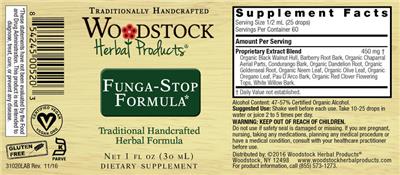
Supplement Facts
The label details for Funga-Stop Formula by Woodstock Herbal Products, sourced from the NIH Dietary Supplement Label Database.
Supplement Facts
| Ingredient | Amount | % DV |
|---|---|---|
| Dandelion root extract | 0 NP | -- |
| White WIllow bark extract | 0 NP | -- |
| Proprietary Extract Blend | 450 mg | -- |
| Olive leaf extract | 0 NP | -- |
| Barberry root bark extract | 0 NP | -- |
| Oregano Leaf Extract | 0 NP | -- |
| Goldenseal root extract | 0 NP | -- |
| Neem leaf extract | 0 NP | -- |
| Pau d'Arco bark extract | 0 NP | -- |
| Condurango bark extract | 0 NP | -- |
| Red Clover flowering tops extract | 0 NP | -- |
| Black Walnut Husk Extract | 0 NP | -- |
| Chaparral Aerial Parts Extract | 0 NP | -- |
Other ingredients: Alcohol
Tap any ingredient to jump to its full detail below.
These statements are the manufacturer’s wording, reproduced from the product label — the label is saying it, not HelloPharmacist. We don’t verify or endorse them.
FDA Disclaimer Statement
These statements have not been evaluated by the Food and Drug Administration. This product is not intended to diagnose, treat, cure, or prevent any disease.
Seals/Symbols
Certified Vegan V Vegan.org KOF-K (Kosher) Parve
Formulation
Certified Vegan V Vegan.org
Gluten Free
Traditionally Handcrafted Traditional Handcrafted Herbal Formula
Formula
KOF-K (Kosher) Parve
FDA Statement of Identity
Dietary Supplement
Suggested/Recommended/Usage/Directions
Suggested Use: Shake well before each use. Take 10-25 drops in water or juice 2 to 5 times per day.
Precautions
Warning: Keep out of reach of children.
Do not use if safety seal is damaged or missing.
If you are pregnant, nursing, taking any medications, planning any medical procedure or have a medical condition, consult with your healthcare practitioner before use.
Brand IP Statement(s)
Copyright 2016 Woodstock Herbal Products
General Statements
For product information, call (855) 573-1273.
Is this label outdated? Report a formula or label change and our pharmacy team will review it.
Funga-Stop Formula by Woodstock Herbal Products label
The label scan from the NIH Dietary Supplement Label Database. Tap to enlarge.
Label images are published by the NIH Dietary Supplement Label Database for the version of this product on file. Always read your actual product label.
View the full label (PDF)The Ingredients in Funga-Stop Formula by Woodstock Herbal Products
These are the 12 active ingredients this product is made of. Select any to open its full monograph.
Serving size0.2 mL Dosage formLiquid Servings per container60 Amounts shown are per serving.
Most supplement products combine several ingredients, and a medication can interact with the product through any one of them. Each ingredient below shows whether it has known drug interactions.
Proprietary Extract Blend
- › Dandelion root extract
- › White WIllow bark extract
- › Olive leaf extract
- › Barberry root bark extract
- › Oregano Leaf Extract
- › Goldenseal root extract
- › Neem leaf extract
- › Pau d'Arco bark extract
- › Condurango bark extract
- › Red Clover flowering tops extract
- › Black Walnut Husk Extract
- › Chaparral Aerial Parts Extract
Other (inactive) ingredients: Alcohol. These complete the product’s ingredient list but are not active constituents.
Funga-Stop Formula by Woodstock Herbal Products Drug Interactions
HelloPharmacist Interaction Report
Funga-Stop Formula by Woodstock Herbal Products contains multiple ingredients with documented interactions with medications.
The most serious concern is chaparral, which theoretically has additive effects on the liver when combined with hepatotoxic drugs (medications that can harm the liver). This is particularly important because chaparral itself carries serious liver and kidney toxicity risks.
Read the full breakdown — every affected drug type, severity by severity
Dandelion root, goldenseal, neem leaf, and oregano all interact with blood thinners and blood sugar medications (anticoagulants, antiplatelet drugs, and antidiabetes drugs). These are Moderate-severity interactions.
Dandelion may also affect how your liver processes certain medications metabolized by CYP1A2 enzymes, potassium-sparing water pills, lithium, and fluoroquinolone antibiotics. Goldenseal can raise levels of several drug-metabolizing enzymes (CYP2D6, CYP2C9, and CYP3A4 substrates) and theoretically increase sedation from CNS depressants and lower blood pressure with antihypertensive drugs.
Neem leaf similarly affects multiple enzyme systems (CYP1A2, CYP2C8, CYP2C9, CYP3A4), P-glycoprotein substrates, and immunosuppressants. Red clover interacts with estrogen therapy, tamoxifen, methotrexate, and several drug-metabolizing enzymes, though some clinical data suggest weaker effects than theory predicts.
We could not check white willow bark, barberry root bark, pau d'arco (one Moderate interaction with blood thinners documented), condurango, and black walnut for additional interactions. Olive leaf extract and condurango showed no documented interactions in our data.
Altogether, these interactions span 1,465 individual medications.
Before taking this product with any prescription or over-the-counter medication, use the interaction checker below with your exact drug names.
Check your own medications below · Editorial policy · How we use AI
Want to check YOUR meds against Funga-Stop Formula?
Ask about interactions with your drugs in plain English — “Can I take it with lisinopril?” — and we find you the answer in seconds, ingredient by ingredient.
Go to the checkerIngredients driving the most interactions
Individual Drug Interactions
The ingredients in Funga-Stop Formula interact with 1,582 drugs. Click any drug to see the details.
8 of the 12 ingredients in Funga-Stop Formula interact with drugs. Each result below shows which ingredient is responsible. Goldenseal root extract Barberry root bark extract Neem leaf extract Red Clover flowering tops extract Dandelion root extract Chaparral Aerial Parts Extract Oregano Leaf Extract Pau d'Arco bark extract
6-mercaptopurinePurinethol
How 6-mercaptopurine interacts with Funga-Stop Formula — through 2 ingredients. Tap an ingredient for the detail:
Chaparral Aerial Parts ExtractHepatotoxic Drugs Moderate
Interaction Summary
Theoretically, chaparral might have additive adverse effects on the liver when used with hepatotoxic drugs.
Read the full Chaparral Aerial Parts Extract + 6-mercaptopurine interactionNeem Leaf ExtractImmunosuppressants Moderate
Interaction Summary
Theoretically, neem might decrease the effectiveness of immunosuppressants.
Read the full Neem Leaf Extract + 6-mercaptopurine interactionAdo-trastuzumab EmtansineKadcyla
How Ado-trastuzumab Emtansine interacts with Funga-Stop Formula — through 4 ingredients. Tap an ingredient for the detail:
Neem Leaf ExtractCytochrome P450 3a4 (cyp3a4) Substrates Moderate
Interaction Summary
Theoretically, neem leaf extract might increase the levels and clinical effects of CYP3A4 substrates.
Read the full Neem Leaf Extract + Ado-trastuzumab Emtansine interactionBarberry Root Bark ExtractCytochrome P450 3a4 (cyp3a4) Substrates Moderate
Interaction Summary
Theoretically, European barberry might increase the levels and clinical effects of CYP3A4 substrates.
Read the full Barberry Root Bark Extract + Ado-trastuzumab Emtansine interactionGoldenseal Root ExtractCytochrome P450 3a4 (cyp3a4) Substrates Moderate
Interaction Summary
Goldenseal might increase serum levels of drugs metabolized by CYP3A4.
Read the full Goldenseal Root Extract + Ado-trastuzumab Emtansine interactionRed Clover Flowering Tops ExtractCytochrome P450 3a4 (cyp3a4) Substrates Minor
Interaction Summary
Theoretically, red clover might increase levels of drugs metabolized by CYP3A4; however, a small clinical study found no effect.
Read the full Red Clover Flowering Tops Extract + Ado-trastuzumab Emtansine interactionAbacavir Sulfate, Dolutegravir, LamivudineTriumeq
How Abacavir Sulfate, Dolutegravir, Lamivudine interacts with Funga-Stop Formula — through 1 ingredient. Tap an ingredient for the detail:
Chaparral Aerial Parts ExtractHepatotoxic Drugs Moderate
Interaction Summary
Theoretically, chaparral might have additive adverse effects on the liver when used with hepatotoxic drugs.
Read the full Chaparral Aerial Parts Extract + Abacavir Sulfate, Dolutegravir, Lamivudine interactionAbacavir, LamivudineEpzicom
How Abacavir, Lamivudine interacts with Funga-Stop Formula — through 1 ingredient. Tap an ingredient for the detail:
Chaparral Aerial Parts ExtractHepatotoxic Drugs Moderate
Interaction Summary
Theoretically, chaparral might have additive adverse effects on the liver when used with hepatotoxic drugs.
Read the full Chaparral Aerial Parts Extract + Abacavir, Lamivudine interactionAbciximabReoPro
How Abciximab interacts with Funga-Stop Formula — through 6 ingredients. Tap an ingredient for the detail:
Oregano Leaf ExtractAnticoagulant/antiplatelet Drugs Moderate
Interaction Summary
Theoretically, oregano might increase the risk of bleeding when taken with anticoagulant or antiplatelet drugs.
Read the full Oregano Leaf Extract + Abciximab interactionDandelion Root ExtractAnticoagulant/antiplatelet Drugs Moderate
Interaction Summary
Theoretically, taking dandelion root along with anticoagulant or antiplatelet drugs might increase the risk of bruising and bleeding.
Read the full Dandelion Root Extract + Abciximab interactionPau D'arco Bark ExtractAnticoagulant/antiplatelet Drugs Moderate
Interaction Summary
Theoretically, pau d'arco might increase the risk of bleeding when taken with anticoagulant or antiplatelet drugs.
Read the full Pau D'arco Bark Extract + Abciximab interactionGoldenseal Root ExtractAnticoagulant/antiplatelet Drugs Moderate
Interaction Summary
Theoretically, goldenseal might increase the risk of bleeding when used with anticoagulant or antiplatelet drugs.
Read the full Goldenseal Root Extract + Abciximab interactionBarberry Root Bark ExtractAnticoagulant/antiplatelet Drugs Moderate
Interaction Summary
Theoretically, European barberry may increase the risk of bleeding if used with anticoagulant or antiplatelet drugs.
Read the full Barberry Root Bark Extract + Abciximab interactionRed Clover Flowering Tops ExtractAnticoagulant/antiplatelet Drugs Minor
Interaction Summary
Although some laboratory research suggests that red clover may have anticoagulant and antiplatelet activity, clinical research has not shown this effect.
Read the full Red Clover Flowering Tops Extract + Abciximab interactionAbemaciclibVerzenio
How Abemaciclib interacts with Funga-Stop Formula — through 4 ingredients. Tap an ingredient for the detail:
Barberry Root Bark ExtractCytochrome P450 3a4 (cyp3a4) Substrates Moderate
Interaction Summary
Theoretically, European barberry might increase the levels and clinical effects of CYP3A4 substrates.
Read the full Barberry Root Bark Extract + Abemaciclib interactionNeem Leaf ExtractCytochrome P450 3a4 (cyp3a4) Substrates Moderate
Interaction Summary
Theoretically, neem leaf extract might increase the levels and clinical effects of CYP3A4 substrates.
Read the full Neem Leaf Extract + Abemaciclib interactionGoldenseal Root ExtractCytochrome P450 3a4 (cyp3a4) Substrates Moderate
Interaction Summary
Goldenseal might increase serum levels of drugs metabolized by CYP3A4.
Read the full Goldenseal Root Extract + Abemaciclib interactionRed Clover Flowering Tops ExtractCytochrome P450 3a4 (cyp3a4) Substrates Minor
Interaction Summary
Theoretically, red clover might increase levels of drugs metabolized by CYP3A4; however, a small clinical study found no effect.
Read the full Red Clover Flowering Tops Extract + Abemaciclib interactionAbiraterone
How Abiraterone interacts with Funga-Stop Formula — through 5 ingredients. Tap an ingredient for the detail:
Goldenseal Root ExtractCytochrome P450 3a4 (cyp3a4) Substrates Moderate
Interaction Summary
Goldenseal might increase serum levels of drugs metabolized by CYP3A4.
Read the full Goldenseal Root Extract + Abiraterone interactionChaparral Aerial Parts ExtractHepatotoxic Drugs Moderate
Interaction Summary
Theoretically, chaparral might have additive adverse effects on the liver when used with hepatotoxic drugs.
Read the full Chaparral Aerial Parts Extract + Abiraterone interactionBarberry Root Bark ExtractCytochrome P450 3a4 (cyp3a4) Substrates Moderate
Interaction Summary
Theoretically, European barberry might increase the levels and clinical effects of CYP3A4 substrates.
Read the full Barberry Root Bark Extract + Abiraterone interactionNeem Leaf ExtractCytochrome P450 3a4 (cyp3a4) Substrates Moderate
Interaction Summary
Theoretically, neem leaf extract might increase the levels and clinical effects of CYP3A4 substrates.
Read the full Neem Leaf Extract + Abiraterone interactionRed Clover Flowering Tops ExtractCytochrome P450 3a4 (cyp3a4) Substrates Minor
Interaction Summary
Theoretically, red clover might increase levels of drugs metabolized by CYP3A4; however, a small clinical study found no effect.
Read the full Red Clover Flowering Tops Extract + Abiraterone interactionAbiraterone AcetateYonsa, Zytiga
How Abiraterone Acetate interacts with Funga-Stop Formula — through 5 ingredients. Tap an ingredient for the detail:
Neem Leaf ExtractCytochrome P450 3a4 (cyp3a4) Substrates Moderate
Interaction Summary
Theoretically, neem leaf extract might increase the levels and clinical effects of CYP3A4 substrates.
Read the full Neem Leaf Extract + Abiraterone Acetate interactionChaparral Aerial Parts ExtractHepatotoxic Drugs Moderate
Interaction Summary
Theoretically, chaparral might have additive adverse effects on the liver when used with hepatotoxic drugs.
Read the full Chaparral Aerial Parts Extract + Abiraterone Acetate interactionGoldenseal Root ExtractCytochrome P450 3a4 (cyp3a4) Substrates Moderate
Interaction Summary
Goldenseal might increase serum levels of drugs metabolized by CYP3A4.
Read the full Goldenseal Root Extract + Abiraterone Acetate interactionBarberry Root Bark ExtractCytochrome P450 3a4 (cyp3a4) Substrates Moderate
Interaction Summary
Theoretically, European barberry might increase the levels and clinical effects of CYP3A4 substrates.
Read the full Barberry Root Bark Extract + Abiraterone Acetate interactionRed Clover Flowering Tops ExtractCytochrome P450 3a4 (cyp3a4) Substrates Minor
Interaction Summary
Theoretically, red clover might increase levels of drugs metabolized by CYP3A4; however, a small clinical study found no effect.
Read the full Red Clover Flowering Tops Extract + Abiraterone Acetate interactionAbrocitinibCibinqo
How Abrocitinib interacts with Funga-Stop Formula — through 7 ingredients. Tap an ingredient for the detail:
Barberry Root Bark ExtractAnticoagulant/antiplatelet Drugs Moderate
Interaction Summary
Theoretically, European barberry may increase the risk of bleeding if used with anticoagulant or antiplatelet drugs.
Read the full Barberry Root Bark Extract + Abrocitinib interactionGoldenseal Root ExtractAnticoagulant/antiplatelet Drugs, Cytochrome P450 2c9 (cyp2c9) Substrates Moderate
Interaction Summary
Theoretically, goldenseal might increase the risk of bleeding when used with anticoagulant or antiplatelet drugs.
Read the full Goldenseal Root Extract + Abrocitinib interactionNeem Leaf ExtractImmunosuppressants, Cytochrome P450 2c9 (cyp2c9) Substrates Moderate
Interaction Summary
Theoretically, neem might decrease the effectiveness of immunosuppressants.
Read the full Neem Leaf Extract + Abrocitinib interactionPau D'arco Bark ExtractAnticoagulant/antiplatelet Drugs Moderate
Interaction Summary
Theoretically, pau d'arco might increase the risk of bleeding when taken with anticoagulant or antiplatelet drugs.
Read the full Pau D'arco Bark Extract + Abrocitinib interactionOregano Leaf ExtractAnticoagulant/antiplatelet Drugs Moderate
Interaction Summary
Theoretically, oregano might increase the risk of bleeding when taken with anticoagulant or antiplatelet drugs.
Read the full Oregano Leaf Extract + Abrocitinib interactionDandelion Root ExtractAnticoagulant/antiplatelet Drugs Moderate
Interaction Summary
Theoretically, taking dandelion root along with anticoagulant or antiplatelet drugs might increase the risk of bruising and bleeding.
Read the full Dandelion Root Extract + Abrocitinib interactionRed Clover Flowering Tops ExtractCytochrome P450 2c19 (cyp2c19) Substrates, Cytochrome P450 2c9 (cyp2c9) Substrates +1 Minor
Interaction Summary
Theoretically, red clover might increase the levels and clinical effects of drugs metabolized by CYP2C19.
Read the full Red Clover Flowering Tops Extract + Abrocitinib interactionAcalabrutinibCalquence
How Acalabrutinib interacts with Funga-Stop Formula — through 4 ingredients. Tap an ingredient for the detail:
Neem Leaf ExtractCytochrome P450 3a4 (cyp3a4) Substrates, P-glycoprotein Substrates Moderate
Interaction Summary
Theoretically, neem leaf extract might increase the levels and clinical effects of CYP3A4 substrates.
Read the full Neem Leaf Extract + Acalabrutinib interactionBarberry Root Bark ExtractCytochrome P450 3a4 (cyp3a4) Substrates Moderate
Interaction Summary
Theoretically, European barberry might increase the levels and clinical effects of CYP3A4 substrates.
Read the full Barberry Root Bark Extract + Acalabrutinib interactionGoldenseal Root ExtractCytochrome P450 3a4 (cyp3a4) Substrates, P-glycoprotein Substrates Moderate
Interaction Summary
Goldenseal might increase serum levels of drugs metabolized by CYP3A4.
Read the full Goldenseal Root Extract + Acalabrutinib interactionRed Clover Flowering Tops ExtractCytochrome P450 3a4 (cyp3a4) Substrates Minor
Interaction Summary
Theoretically, red clover might increase levels of drugs metabolized by CYP3A4; however, a small clinical study found no effect.
Read the full Red Clover Flowering Tops Extract + Acalabrutinib interactionAcarboseGlucobay, Prandase, Precose
How Acarbose interacts with Funga-Stop Formula — through 6 ingredients. Tap an ingredient for the detail:
Goldenseal Root ExtractAntidiabetes Drugs Moderate
Interaction Summary
Theoretically, goldenseal might increase the risk of hypoglycemia when used with antidiabetes drugs.
Read the full Goldenseal Root Extract + Acarbose interactionBarberry Root Bark ExtractAntidiabetes Drugs Moderate
Interaction Summary
Theoretically, taking European barberry with antidiabetes drugs might increase the risk of hypoglycemia.
Read the full Barberry Root Bark Extract + Acarbose interactionOregano Leaf ExtractAntidiabetes Drugs Moderate
Interaction Summary
Theoretically, oregano might increase the risk for hypoglycemia when taken with antidiabetes drugs.
Read the full Oregano Leaf Extract + Acarbose interactionNeem Leaf ExtractAntidiabetes Drugs Moderate
Interaction Summary
Neem might increase the risk of hypoglycemia when taken with antidiabetes drugs.
Read the full Neem Leaf Extract + Acarbose interactionDandelion Root ExtractAntidiabetes Drugs Moderate
Interaction Summary
Theoretically, dandelion might increase the risk for hypoglycemia when used with antidiabetes drugs.
Read the full Dandelion Root Extract + Acarbose interactionChaparral Aerial Parts ExtractHepatotoxic Drugs Moderate
Interaction Summary
Theoretically, chaparral might have additive adverse effects on the liver when used with hepatotoxic drugs.
Read the full Chaparral Aerial Parts Extract + Acarbose interactionAcebutololRhotral, Sectral
How Acebutolol interacts with Funga-Stop Formula — through 3 ingredients. Tap an ingredient for the detail:
Chaparral Aerial Parts ExtractHepatotoxic Drugs Moderate
Interaction Summary
Theoretically, chaparral might have additive adverse effects on the liver when used with hepatotoxic drugs.
Read the full Chaparral Aerial Parts Extract + Acebutolol interactionGoldenseal Root ExtractAntihypertensive Drugs Moderate
Interaction Summary
Theoretically, goldenseal might increase the risk of hypotension when taken with antihypertensive drugs.
Read the full Goldenseal Root Extract + Acebutolol interactionBarberry Root Bark ExtractAntihypertensive Drugs Moderate
Interaction Summary
Theoretically, taking European barberry with antihypertensive drugs might increase the risk of hypotension.
Read the full Barberry Root Bark Extract + Acebutolol interactionAcenocoumarolSintrom
How Acenocoumarol interacts with Funga-Stop Formula — through 6 ingredients. Tap an ingredient for the detail:
Barberry Root Bark ExtractAnticoagulant/antiplatelet Drugs Moderate
Interaction Summary
Theoretically, European barberry may increase the risk of bleeding if used with anticoagulant or antiplatelet drugs.
Read the full Barberry Root Bark Extract + Acenocoumarol interactionGoldenseal Root ExtractAnticoagulant/antiplatelet Drugs Moderate
Interaction Summary
Theoretically, goldenseal might increase the risk of bleeding when used with anticoagulant or antiplatelet drugs.
Read the full Goldenseal Root Extract + Acenocoumarol interactionOregano Leaf ExtractAnticoagulant/antiplatelet Drugs Moderate
Interaction Summary
Theoretically, oregano might increase the risk of bleeding when taken with anticoagulant or antiplatelet drugs.
Read the full Oregano Leaf Extract + Acenocoumarol interactionDandelion Root ExtractAnticoagulant/antiplatelet Drugs Moderate
Interaction Summary
Theoretically, taking dandelion root along with anticoagulant or antiplatelet drugs might increase the risk of bruising and bleeding.
Read the full Dandelion Root Extract + Acenocoumarol interactionPau D'arco Bark ExtractAnticoagulant/antiplatelet Drugs Moderate
Interaction Summary
Theoretically, pau d'arco might increase the risk of bleeding when taken with anticoagulant or antiplatelet drugs.
Read the full Pau D'arco Bark Extract + Acenocoumarol interactionRed Clover Flowering Tops ExtractAnticoagulant/antiplatelet Drugs Minor
Interaction Summary
Although some laboratory research suggests that red clover may have anticoagulant and antiplatelet activity, clinical research has not shown this effect.
Read the full Red Clover Flowering Tops Extract + Acenocoumarol interactionAcepromazineAtravet
How Acepromazine interacts with Funga-Stop Formula — through 2 ingredients. Tap an ingredient for the detail:
Barberry Root Bark ExtractAnticholinergic Drugs, Cns Depressants Moderate
Interaction Summary
Theoretically, taking European barberry with anticholinergic drugs might cause additive effects.
Read the full Barberry Root Bark Extract + Acepromazine interactionGoldenseal Root ExtractCns Depressants Moderate
Interaction Summary
Theoretically, goldenseal might increase the sedative effects of CNS depressants.
Read the full Goldenseal Root Extract + Acepromazine interactionAcetaminophenChildren's Tylenol, Children's Tylenol Meltaways, Tylenol, Tylenol Ex Strength
How Acetaminophen interacts with Funga-Stop Formula — through 5 ingredients. Tap an ingredient for the detail:
Chaparral Aerial Parts ExtractHepatotoxic Drugs Moderate
Interaction Summary
Theoretically, chaparral might have additive adverse effects on the liver when used with hepatotoxic drugs.
Read the full Chaparral Aerial Parts Extract + Acetaminophen interactionDandelion Root ExtractGlucuronidated Drugs, Cytochrome P450 1a2 (cyp1a2) Substrates Moderate
Interaction Summary
Theoretically, dandelion might increase the clearance of drugs that are UDP-glucuronosyltransferase substrates.
Read the full Dandelion Root Extract + Acetaminophen interactionNeem Leaf ExtractCytochrome P450 1a2 (cyp1a2) Substrates Moderate
Interaction Summary
Theoretically, neem leaf extract might increase the levels and clinical effects of CYP1A2 substrates.
Read the full Neem Leaf Extract + Acetaminophen interactionGoldenseal Root ExtractCytochrome P450 2e1 (cyp2e1) Substrates Moderate
Interaction Summary
Theoretically, goldenseal might increase serum levels of drugs metabolized by CYP2E1.
Read the full Goldenseal Root Extract + Acetaminophen interactionRed Clover Flowering Tops ExtractCytochrome P450 1a2 (cyp1a2) Substrates Minor
Interaction Summary
Theoretically, red clover might increase levels of drugs metabolized by CYP1A2; however, a small clinical study found no effect.
Read the full Red Clover Flowering Tops Extract + Acetaminophen interactionAcetaminophen, AspirinGemnisyn
How Acetaminophen, Aspirin interacts with Funga-Stop Formula — through 8 ingredients. Tap an ingredient for the detail:
Goldenseal Root ExtractAnticoagulant/antiplatelet Drugs, Cytochrome P450 2e1 (cyp2e1) Substrates Moderate
Interaction Summary
Theoretically, goldenseal might increase the risk of bleeding when used with anticoagulant or antiplatelet drugs.
Read the full Goldenseal Root Extract + Acetaminophen, Aspirin interactionPau D'arco Bark ExtractAnticoagulant/antiplatelet Drugs Moderate
Interaction Summary
Theoretically, pau d'arco might increase the risk of bleeding when taken with anticoagulant or antiplatelet drugs.
Read the full Pau D'arco Bark Extract + Acetaminophen, Aspirin interactionDandelion Root ExtractCytochrome P450 1a2 (cyp1a2) Substrates, Anticoagulant/antiplatelet Drugs +1 Moderate
Interaction Summary
Theoretically, dandelion might increase levels of drugs metabolized by CYP1A2.
Read the full Dandelion Root Extract + Acetaminophen, Aspirin interactionOregano Leaf ExtractAnticoagulant/antiplatelet Drugs Moderate
Interaction Summary
Theoretically, oregano might increase the risk of bleeding when taken with anticoagulant or antiplatelet drugs.
Read the full Oregano Leaf Extract + Acetaminophen, Aspirin interactionChaparral Aerial Parts ExtractHepatotoxic Drugs Moderate
Interaction Summary
Theoretically, chaparral might have additive adverse effects on the liver when used with hepatotoxic drugs.
Read the full Chaparral Aerial Parts Extract + Acetaminophen, Aspirin interactionNeem Leaf ExtractCytochrome P450 1a2 (cyp1a2) Substrates Moderate
Interaction Summary
Theoretically, neem leaf extract might increase the levels and clinical effects of CYP1A2 substrates.
Read the full Neem Leaf Extract + Acetaminophen, Aspirin interactionBarberry Root Bark ExtractAnticoagulant/antiplatelet Drugs Moderate
Interaction Summary
Theoretically, European barberry may increase the risk of bleeding if used with anticoagulant or antiplatelet drugs.
Read the full Barberry Root Bark Extract + Acetaminophen, Aspirin interactionRed Clover Flowering Tops ExtractCytochrome P450 1a2 (cyp1a2) Substrates, Anticoagulant/antiplatelet Drugs Minor
Interaction Summary
Theoretically, red clover might increase levels of drugs metabolized by CYP1A2; however, a small clinical study found no effect.
Read the full Red Clover Flowering Tops Extract + Acetaminophen, Aspirin interactionAcetaminophen, Aspirin, CaffeineExcedrin, Excedrin Extra Strength, Excedrin Migraine
How Acetaminophen, Aspirin, Caffeine interacts with Funga-Stop Formula — through 8 ingredients. Tap an ingredient for the detail:
Barberry Root Bark ExtractAnticoagulant/antiplatelet Drugs, Cytochrome P450 3a4 (cyp3a4) Substrates Moderate
Interaction Summary
Theoretically, European barberry may increase the risk of bleeding if used with anticoagulant or antiplatelet drugs.
Read the full Barberry Root Bark Extract + Acetaminophen, Aspirin, Caffeine interactionNeem Leaf ExtractCytochrome P450 1a2 (cyp1a2) Substrates, Cytochrome P450 3a4 (cyp3a4) Substrates Moderate
Interaction Summary
Theoretically, neem leaf extract might increase the levels and clinical effects of CYP1A2 substrates.
Read the full Neem Leaf Extract + Acetaminophen, Aspirin, Caffeine interactionGoldenseal Root ExtractAnticoagulant/antiplatelet Drugs, Cytochrome P450 2e1 (cyp2e1) Substrates +1 Moderate
Interaction Summary
Theoretically, goldenseal might increase the risk of bleeding when used with anticoagulant or antiplatelet drugs.
Read the full Goldenseal Root Extract + Acetaminophen, Aspirin, Caffeine interactionOregano Leaf ExtractAnticoagulant/antiplatelet Drugs Moderate
Interaction Summary
Theoretically, oregano might increase the risk of bleeding when taken with anticoagulant or antiplatelet drugs.
Read the full Oregano Leaf Extract + Acetaminophen, Aspirin, Caffeine interactionDandelion Root ExtractAnticoagulant/antiplatelet Drugs, Cytochrome P450 1a2 (cyp1a2) Substrates +1 Moderate
Interaction Summary
Theoretically, taking dandelion root along with anticoagulant or antiplatelet drugs might increase the risk of bruising and bleeding.
Read the full Dandelion Root Extract + Acetaminophen, Aspirin, Caffeine interactionPau D'arco Bark ExtractAnticoagulant/antiplatelet Drugs Moderate
Interaction Summary
Theoretically, pau d'arco might increase the risk of bleeding when taken with anticoagulant or antiplatelet drugs.
Read the full Pau D'arco Bark Extract + Acetaminophen, Aspirin, Caffeine interactionChaparral Aerial Parts ExtractHepatotoxic Drugs Moderate
Interaction Summary
Theoretically, chaparral might have additive adverse effects on the liver when used with hepatotoxic drugs.
Read the full Chaparral Aerial Parts Extract + Acetaminophen, Aspirin, Caffeine interactionRed Clover Flowering Tops ExtractAnticoagulant/antiplatelet Drugs, Cytochrome P450 1a2 (cyp1a2) Substrates +2 Minor
Interaction Summary
Although some laboratory research suggests that red clover may have anticoagulant and antiplatelet activity, clinical research has not shown this effect.
Read the full Red Clover Flowering Tops Extract + Acetaminophen, Aspirin, Caffeine interactionAcetaminophen, Brompheniramine, PhenylpropanolamineDimetapp Cold and Flu
How Acetaminophen, Brompheniramine, Phenylpropanolamine interacts with Funga-Stop Formula — through 5 ingredients. Tap an ingredient for the detail:
Dandelion Root ExtractGlucuronidated Drugs, Cytochrome P450 1a2 (cyp1a2) Substrates Moderate
Interaction Summary
Theoretically, dandelion might increase the clearance of drugs that are UDP-glucuronosyltransferase substrates.
Read the full Dandelion Root Extract + Acetaminophen, Brompheniramine, Phenylpropanolamine interactionChaparral Aerial Parts ExtractHepatotoxic Drugs Moderate
Interaction Summary
Theoretically, chaparral might have additive adverse effects on the liver when used with hepatotoxic drugs.
Read the full Chaparral Aerial Parts Extract + Acetaminophen, Brompheniramine, Phenylpropanolamine interactionGoldenseal Root ExtractCytochrome P450 2e1 (cyp2e1) Substrates Moderate
Interaction Summary
Theoretically, goldenseal might increase serum levels of drugs metabolized by CYP2E1.
Read the full Goldenseal Root Extract + Acetaminophen, Brompheniramine, Phenylpropanolamine interactionNeem Leaf ExtractCytochrome P450 1a2 (cyp1a2) Substrates Moderate
Interaction Summary
Theoretically, neem leaf extract might increase the levels and clinical effects of CYP1A2 substrates.
Read the full Neem Leaf Extract + Acetaminophen, Brompheniramine, Phenylpropanolamine interactionRed Clover Flowering Tops ExtractCytochrome P450 1a2 (cyp1a2) Substrates Minor
Interaction Summary
Theoretically, red clover might increase levels of drugs metabolized by CYP1A2; however, a small clinical study found no effect.
Read the full Red Clover Flowering Tops Extract + Acetaminophen, Brompheniramine, Phenylpropanolamine interactionAcetaminophen, ButalbitalAxocet, Bancap, Bucet, Butex Forte, Esgic CF, Orbivan CF +5 more
How Acetaminophen, Butalbital interacts with Funga-Stop Formula — through 5 ingredients. Tap an ingredient for the detail:
Dandelion Root ExtractCytochrome P450 1a2 (cyp1a2) Substrates, Glucuronidated Drugs Moderate
Interaction Summary
Theoretically, dandelion might increase levels of drugs metabolized by CYP1A2.
Read the full Dandelion Root Extract + Acetaminophen, Butalbital interactionNeem Leaf ExtractCytochrome P450 1a2 (cyp1a2) Substrates Moderate
Interaction Summary
Theoretically, neem leaf extract might increase the levels and clinical effects of CYP1A2 substrates.
Read the full Neem Leaf Extract + Acetaminophen, Butalbital interactionChaparral Aerial Parts ExtractHepatotoxic Drugs Moderate
Interaction Summary
Theoretically, chaparral might have additive adverse effects on the liver when used with hepatotoxic drugs.
Read the full Chaparral Aerial Parts Extract + Acetaminophen, Butalbital interactionGoldenseal Root ExtractCytochrome P450 2e1 (cyp2e1) Substrates Moderate
Interaction Summary
Theoretically, goldenseal might increase serum levels of drugs metabolized by CYP2E1.
Read the full Goldenseal Root Extract + Acetaminophen, Butalbital interactionRed Clover Flowering Tops ExtractCytochrome P450 1a2 (cyp1a2) Substrates Minor
Interaction Summary
Theoretically, red clover might increase levels of drugs metabolized by CYP1A2; however, a small clinical study found no effect.
Read the full Red Clover Flowering Tops Extract + Acetaminophen, Butalbital interactionAcetaminophen, Butalbital, CaffeineEsgic, Esgic Plus, Fiogesic, Fioricet, Repan, Tecnal +1 more
How Acetaminophen, Butalbital, Caffeine interacts with Funga-Stop Formula — through 6 ingredients. Tap an ingredient for the detail:
Dandelion Root ExtractGlucuronidated Drugs, Cytochrome P450 1a2 (cyp1a2) Substrates Moderate
Interaction Summary
Theoretically, dandelion might increase the clearance of drugs that are UDP-glucuronosyltransferase substrates.
Read the full Dandelion Root Extract + Acetaminophen, Butalbital, Caffeine interactionChaparral Aerial Parts ExtractHepatotoxic Drugs Moderate
Interaction Summary
Theoretically, chaparral might have additive adverse effects on the liver when used with hepatotoxic drugs.
Read the full Chaparral Aerial Parts Extract + Acetaminophen, Butalbital, Caffeine interactionGoldenseal Root ExtractCytochrome P450 3a4 (cyp3a4) Substrates, Cytochrome P450 2e1 (cyp2e1) Substrates Moderate
Interaction Summary
Goldenseal might increase serum levels of drugs metabolized by CYP3A4.
Read the full Goldenseal Root Extract + Acetaminophen, Butalbital, Caffeine interactionNeem Leaf ExtractCytochrome P450 3a4 (cyp3a4) Substrates, Cytochrome P450 1a2 (cyp1a2) Substrates Moderate
Interaction Summary
Theoretically, neem leaf extract might increase the levels and clinical effects of CYP3A4 substrates.
Read the full Neem Leaf Extract + Acetaminophen, Butalbital, Caffeine interactionBarberry Root Bark ExtractCytochrome P450 3a4 (cyp3a4) Substrates Moderate
Interaction Summary
Theoretically, European barberry might increase the levels and clinical effects of CYP3A4 substrates.
Read the full Barberry Root Bark Extract + Acetaminophen, Butalbital, Caffeine interactionRed Clover Flowering Tops ExtractCytochrome P450 1a2 (cyp1a2) Substrates, Caffeine +1 Minor
Interaction Summary
Theoretically, red clover might increase levels of drugs metabolized by CYP1A2; however, a small clinical study found no effect.
Read the full Red Clover Flowering Tops Extract + Acetaminophen, Butalbital, Caffeine interactionAcetaminophen, Butalbital, Caffeine, CodeineEsgic with Codeine, Fioricet w/ Codeine
How Acetaminophen, Butalbital, Caffeine, Codeine interacts with Funga-Stop Formula — through 6 ingredients. Tap an ingredient for the detail:
Goldenseal Root ExtractCytochrome P450 2e1 (cyp2e1) Substrates, Cytochrome P450 3a4 (cyp3a4) Substrates +2 Moderate
Interaction Summary
Theoretically, goldenseal might increase serum levels of drugs metabolized by CYP2E1.
Read the full Goldenseal Root Extract + Acetaminophen, Butalbital, Caffeine, Codeine interactionNeem Leaf ExtractCytochrome P450 3a4 (cyp3a4) Substrates, Cytochrome P450 1a2 (cyp1a2) Substrates Moderate
Interaction Summary
Theoretically, neem leaf extract might increase the levels and clinical effects of CYP3A4 substrates.
Read the full Neem Leaf Extract + Acetaminophen, Butalbital, Caffeine, Codeine interactionDandelion Root ExtractCytochrome P450 1a2 (cyp1a2) Substrates, Glucuronidated Drugs Moderate
Interaction Summary
Theoretically, dandelion might increase levels of drugs metabolized by CYP1A2.
Read the full Dandelion Root Extract + Acetaminophen, Butalbital, Caffeine, Codeine interactionBarberry Root Bark ExtractCns Depressants, Cytochrome P450 3a4 (cyp3a4) Substrates Moderate
Interaction Summary
Theoretically, concomitant use with drugs that have sedative properties may cause additive effects.
Read the full Barberry Root Bark Extract + Acetaminophen, Butalbital, Caffeine, Codeine interactionChaparral Aerial Parts ExtractHepatotoxic Drugs Moderate
Interaction Summary
Theoretically, chaparral might have additive adverse effects on the liver when used with hepatotoxic drugs.
Read the full Chaparral Aerial Parts Extract + Acetaminophen, Butalbital, Caffeine, Codeine interactionRed Clover Flowering Tops ExtractCytochrome P450 3a4 (cyp3a4) Substrates, Caffeine +1 Minor
Interaction Summary
Theoretically, red clover might increase levels of drugs metabolized by CYP3A4; however, a small clinical study found no effect.
Read the full Red Clover Flowering Tops Extract + Acetaminophen, Butalbital, Caffeine, Codeine interactionAcetaminophen, Butalbital, CodeineBancap w/ Codeine
How Acetaminophen, Butalbital, Codeine interacts with Funga-Stop Formula — through 6 ingredients. Tap an ingredient for the detail:
Neem Leaf ExtractCytochrome P450 1a2 (cyp1a2) Substrates Moderate
Interaction Summary
Theoretically, neem leaf extract might increase the levels and clinical effects of CYP1A2 substrates.
Read the full Neem Leaf Extract + Acetaminophen, Butalbital, Codeine interactionBarberry Root Bark ExtractCns Depressants Moderate
Interaction Summary
Theoretically, concomitant use with drugs that have sedative properties may cause additive effects.
Read the full Barberry Root Bark Extract + Acetaminophen, Butalbital, Codeine interactionGoldenseal Root ExtractCytochrome P450 2e1 (cyp2e1) Substrates, Cns Depressants +1 Moderate
Interaction Summary
Theoretically, goldenseal might increase serum levels of drugs metabolized by CYP2E1.
Read the full Goldenseal Root Extract + Acetaminophen, Butalbital, Codeine interactionDandelion Root ExtractCytochrome P450 1a2 (cyp1a2) Substrates, Glucuronidated Drugs Moderate
Interaction Summary
Theoretically, dandelion might increase levels of drugs metabolized by CYP1A2.
Read the full Dandelion Root Extract + Acetaminophen, Butalbital, Codeine interactionChaparral Aerial Parts ExtractHepatotoxic Drugs Moderate
Interaction Summary
Theoretically, chaparral might have additive adverse effects on the liver when used with hepatotoxic drugs.
Read the full Chaparral Aerial Parts Extract + Acetaminophen, Butalbital, Codeine interactionRed Clover Flowering Tops ExtractCytochrome P450 1a2 (cyp1a2) Substrates Minor
Interaction Summary
Theoretically, red clover might increase levels of drugs metabolized by CYP1A2; however, a small clinical study found no effect.
Read the full Red Clover Flowering Tops Extract + Acetaminophen, Butalbital, Codeine interactionAcetaminophen, Butalbital, Codeine PhosphatePhrenilin #3
How Acetaminophen, Butalbital, Codeine Phosphate interacts with Funga-Stop Formula — through 6 ingredients. Tap an ingredient for the detail:
Goldenseal Root ExtractCytochrome P450 2d6 (cyp2d6) Substrates, Cns Depressants +1 Moderate
Interaction Summary
Goldenseal might increase serum levels of drugs metabolized by CYP2D6.
Read the full Goldenseal Root Extract + Acetaminophen, Butalbital, Codeine Phosphate interactionDandelion Root ExtractGlucuronidated Drugs, Cytochrome P450 1a2 (cyp1a2) Substrates Moderate
Interaction Summary
Theoretically, dandelion might increase the clearance of drugs that are UDP-glucuronosyltransferase substrates.
Read the full Dandelion Root Extract + Acetaminophen, Butalbital, Codeine Phosphate interactionChaparral Aerial Parts ExtractHepatotoxic Drugs Moderate
Interaction Summary
Theoretically, chaparral might have additive adverse effects on the liver when used with hepatotoxic drugs.
Read the full Chaparral Aerial Parts Extract + Acetaminophen, Butalbital, Codeine Phosphate interactionNeem Leaf ExtractCytochrome P450 1a2 (cyp1a2) Substrates Moderate
Interaction Summary
Theoretically, neem leaf extract might increase the levels and clinical effects of CYP1A2 substrates.
Read the full Neem Leaf Extract + Acetaminophen, Butalbital, Codeine Phosphate interactionBarberry Root Bark ExtractCns Depressants Moderate
Interaction Summary
Theoretically, concomitant use with drugs that have sedative properties may cause additive effects.
Read the full Barberry Root Bark Extract + Acetaminophen, Butalbital, Codeine Phosphate interactionRed Clover Flowering Tops ExtractCytochrome P450 1a2 (cyp1a2) Substrates Minor
Interaction Summary
Theoretically, red clover might increase levels of drugs metabolized by CYP1A2; however, a small clinical study found no effect.
Read the full Red Clover Flowering Tops Extract + Acetaminophen, Butalbital, Codeine Phosphate interactionAcetaminophen, Caffeine, Chlorpheniramine, Hydrocodone, PhenylephrineHycomine Compound
How Acetaminophen, Caffeine, Chlorpheniramine, Hydrocodone, Phenylephrine interacts with Funga-Stop Formula — through 6 ingredients. Tap an ingredient for the detail:
Dandelion Root ExtractCytochrome P450 1a2 (cyp1a2) Substrates, Glucuronidated Drugs Moderate
Interaction Summary
Theoretically, dandelion might increase levels of drugs metabolized by CYP1A2.
Read the full Dandelion Root Extract + Acetaminophen, Caffeine, Chlorpheniramine, Hydrocodone, Phenylephrine interactionNeem Leaf ExtractCytochrome P450 3a4 (cyp3a4) Substrates, Cytochrome P450 1a2 (cyp1a2) Substrates Moderate
Interaction Summary
Theoretically, neem leaf extract might increase the levels and clinical effects of CYP3A4 substrates.
Read the full Neem Leaf Extract + Acetaminophen, Caffeine, Chlorpheniramine, Hydrocodone, Phenylephrine interactionBarberry Root Bark ExtractCytochrome P450 3a4 (cyp3a4) Substrates, Anticholinergic Drugs +1 Moderate
Interaction Summary
Theoretically, European barberry might increase the levels and clinical effects of CYP3A4 substrates.
Read the full Barberry Root Bark Extract + Acetaminophen, Caffeine, Chlorpheniramine, Hydrocodone, Phenylephrine interactionGoldenseal Root ExtractCytochrome P450 2d6 (cyp2d6) Substrates, Cns Depressants +2 Moderate
Interaction Summary
Goldenseal might increase serum levels of drugs metabolized by CYP2D6.
Read the full Goldenseal Root Extract + Acetaminophen, Caffeine, Chlorpheniramine, Hydrocodone, Phenylephrine interactionChaparral Aerial Parts ExtractHepatotoxic Drugs Moderate
Interaction Summary
Theoretically, chaparral might have additive adverse effects on the liver when used with hepatotoxic drugs.
Read the full Chaparral Aerial Parts Extract + Acetaminophen, Caffeine, Chlorpheniramine, Hydrocodone, Phenylephrine interactionRed Clover Flowering Tops ExtractCytochrome P450 1a2 (cyp1a2) Substrates, Cytochrome P450 3a4 (cyp3a4) Substrates +1 Minor
Interaction Summary
Theoretically, red clover might increase levels of drugs metabolized by CYP1A2; however, a small clinical study found no effect.
Read the full Red Clover Flowering Tops Extract + Acetaminophen, Caffeine, Chlorpheniramine, Hydrocodone, Phenylephrine interactionAcetaminophen, Caffeine, CodeineGesic C15, Gesic C30, Gesic C8, Lenoltec 1, Lenoltec 2, Lenoltec 3 +1 more
How Acetaminophen, Caffeine, Codeine interacts with Funga-Stop Formula — through 6 ingredients. Tap an ingredient for the detail:
Barberry Root Bark ExtractCns Depressants, Cytochrome P450 3a4 (cyp3a4) Substrates Moderate
Interaction Summary
Theoretically, concomitant use with drugs that have sedative properties may cause additive effects.
Read the full Barberry Root Bark Extract + Acetaminophen, Caffeine, Codeine interactionDandelion Root ExtractGlucuronidated Drugs, Cytochrome P450 1a2 (cyp1a2) Substrates Moderate
Interaction Summary
Theoretically, dandelion might increase the clearance of drugs that are UDP-glucuronosyltransferase substrates.
Read the full Dandelion Root Extract + Acetaminophen, Caffeine, Codeine interactionGoldenseal Root ExtractCns Depressants, Cytochrome P450 2d6 (cyp2d6) Substrates +2 Moderate
Interaction Summary
Theoretically, goldenseal might increase the sedative effects of CNS depressants.
Read the full Goldenseal Root Extract + Acetaminophen, Caffeine, Codeine interactionChaparral Aerial Parts ExtractHepatotoxic Drugs Moderate
Interaction Summary
Theoretically, chaparral might have additive adverse effects on the liver when used with hepatotoxic drugs.
Read the full Chaparral Aerial Parts Extract + Acetaminophen, Caffeine, Codeine interactionNeem Leaf ExtractCytochrome P450 3a4 (cyp3a4) Substrates, Cytochrome P450 1a2 (cyp1a2) Substrates Moderate
Interaction Summary
Theoretically, neem leaf extract might increase the levels and clinical effects of CYP3A4 substrates.
Read the full Neem Leaf Extract + Acetaminophen, Caffeine, Codeine interactionRed Clover Flowering Tops ExtractCaffeine, Cytochrome P450 1a2 (cyp1a2) Substrates +1 Minor
Interaction Summary
Theoretically, soy might reduce the clearance of caffeine; however, a small clinical study found no effect.
Read the full Red Clover Flowering Tops Extract + Acetaminophen, Caffeine, Codeine interactionAcetaminophen, Caffeine, Codeine, SalicylamideCodalan No.1, Codalan No.2, Codalan No.3
How Acetaminophen, Caffeine, Codeine, Salicylamide interacts with Funga-Stop Formula — through 6 ingredients. Tap an ingredient for the detail:
Goldenseal Root ExtractCytochrome P450 2e1 (cyp2e1) Substrates, Cytochrome P450 3a4 (cyp3a4) Substrates +2 Moderate
Interaction Summary
Theoretically, goldenseal might increase serum levels of drugs metabolized by CYP2E1.
Read the full Goldenseal Root Extract + Acetaminophen, Caffeine, Codeine, Salicylamide interactionNeem Leaf ExtractCytochrome P450 3a4 (cyp3a4) Substrates, Cytochrome P450 1a2 (cyp1a2) Substrates Moderate
Interaction Summary
Theoretically, neem leaf extract might increase the levels and clinical effects of CYP3A4 substrates.
Read the full Neem Leaf Extract + Acetaminophen, Caffeine, Codeine, Salicylamide interactionDandelion Root ExtractCytochrome P450 1a2 (cyp1a2) Substrates, Glucuronidated Drugs Moderate
Interaction Summary
Theoretically, dandelion might increase levels of drugs metabolized by CYP1A2.
Read the full Dandelion Root Extract + Acetaminophen, Caffeine, Codeine, Salicylamide interactionBarberry Root Bark ExtractCns Depressants, Cytochrome P450 3a4 (cyp3a4) Substrates Moderate
Interaction Summary
Theoretically, concomitant use with drugs that have sedative properties may cause additive effects.
Read the full Barberry Root Bark Extract + Acetaminophen, Caffeine, Codeine, Salicylamide interactionChaparral Aerial Parts ExtractHepatotoxic Drugs Moderate
Interaction Summary
Theoretically, chaparral might have additive adverse effects on the liver when used with hepatotoxic drugs.
Read the full Chaparral Aerial Parts Extract + Acetaminophen, Caffeine, Codeine, Salicylamide interactionRed Clover Flowering Tops ExtractCaffeine, Cytochrome P450 1a2 (cyp1a2) Substrates +1 Minor
Interaction Summary
Theoretically, soy might reduce the clearance of caffeine; however, a small clinical study found no effect.
Read the full Red Clover Flowering Tops Extract + Acetaminophen, Caffeine, Codeine, Salicylamide interactionAcetaminophen, Caffeine, DihydrocodeineDHC Plus, Panlor DC, Panlor SS
How Acetaminophen, Caffeine, Dihydrocodeine interacts with Funga-Stop Formula — through 6 ingredients. Tap an ingredient for the detail:
Barberry Root Bark ExtractCytochrome P450 3a4 (cyp3a4) Substrates, Cns Depressants Moderate
Interaction Summary
Theoretically, European barberry might increase the levels and clinical effects of CYP3A4 substrates.
Read the full Barberry Root Bark Extract + Acetaminophen, Caffeine, Dihydrocodeine interactionNeem Leaf ExtractCytochrome P450 1a2 (cyp1a2) Substrates, Cytochrome P450 3a4 (cyp3a4) Substrates Moderate
Interaction Summary
Theoretically, neem leaf extract might increase the levels and clinical effects of CYP1A2 substrates.
Read the full Neem Leaf Extract + Acetaminophen, Caffeine, Dihydrocodeine interactionGoldenseal Root ExtractCytochrome P450 2e1 (cyp2e1) Substrates, Cns Depressants +2 Moderate
Interaction Summary
Theoretically, goldenseal might increase serum levels of drugs metabolized by CYP2E1.
Read the full Goldenseal Root Extract + Acetaminophen, Caffeine, Dihydrocodeine interactionDandelion Root ExtractCytochrome P450 1a2 (cyp1a2) Substrates, Glucuronidated Drugs Moderate
Interaction Summary
Theoretically, dandelion might increase levels of drugs metabolized by CYP1A2.
Read the full Dandelion Root Extract + Acetaminophen, Caffeine, Dihydrocodeine interactionChaparral Aerial Parts ExtractHepatotoxic Drugs Moderate
Interaction Summary
Theoretically, chaparral might have additive adverse effects on the liver when used with hepatotoxic drugs.
Read the full Chaparral Aerial Parts Extract + Acetaminophen, Caffeine, Dihydrocodeine interactionRed Clover Flowering Tops ExtractCytochrome P450 3a4 (cyp3a4) Substrates, Cytochrome P450 1a2 (cyp1a2) Substrates +1 Minor
Interaction Summary
Theoretically, red clover might increase levels of drugs metabolized by CYP3A4; however, a small clinical study found no effect.
Read the full Red Clover Flowering Tops Extract + Acetaminophen, Caffeine, Dihydrocodeine interactionAcetaminophen, Caffeine, IsomethepteneMigralam
How Acetaminophen, Caffeine, Isometheptene interacts with Funga-Stop Formula — through 6 ingredients. Tap an ingredient for the detail:
Dandelion Root ExtractGlucuronidated Drugs, Cytochrome P450 1a2 (cyp1a2) Substrates Moderate
Interaction Summary
Theoretically, dandelion might increase the clearance of drugs that are UDP-glucuronosyltransferase substrates.
Read the full Dandelion Root Extract + Acetaminophen, Caffeine, Isometheptene interactionGoldenseal Root ExtractCytochrome P450 3a4 (cyp3a4) Substrates, Cytochrome P450 2e1 (cyp2e1) Substrates Moderate
Interaction Summary
Goldenseal might increase serum levels of drugs metabolized by CYP3A4.
Read the full Goldenseal Root Extract + Acetaminophen, Caffeine, Isometheptene interactionChaparral Aerial Parts ExtractHepatotoxic Drugs Moderate
Interaction Summary
Theoretically, chaparral might have additive adverse effects on the liver when used with hepatotoxic drugs.
Read the full Chaparral Aerial Parts Extract + Acetaminophen, Caffeine, Isometheptene interactionNeem Leaf ExtractCytochrome P450 1a2 (cyp1a2) Substrates, Cytochrome P450 3a4 (cyp3a4) Substrates Moderate
Interaction Summary
Theoretically, neem leaf extract might increase the levels and clinical effects of CYP1A2 substrates.
Read the full Neem Leaf Extract + Acetaminophen, Caffeine, Isometheptene interactionBarberry Root Bark ExtractCytochrome P450 3a4 (cyp3a4) Substrates Moderate
Interaction Summary
Theoretically, European barberry might increase the levels and clinical effects of CYP3A4 substrates.
Read the full Barberry Root Bark Extract + Acetaminophen, Caffeine, Isometheptene interactionRed Clover Flowering Tops ExtractCaffeine, Cytochrome P450 1a2 (cyp1a2) Substrates +1 Minor
Interaction Summary
Theoretically, soy might reduce the clearance of caffeine; however, a small clinical study found no effect.
Read the full Red Clover Flowering Tops Extract + Acetaminophen, Caffeine, Isometheptene interactionAcetaminophen, Caffeine, PyrilamineMidol Max Strength Menstrual
How Acetaminophen, Caffeine, Pyrilamine interacts with Funga-Stop Formula — through 6 ingredients. Tap an ingredient for the detail:
Neem Leaf ExtractCytochrome P450 3a4 (cyp3a4) Substrates, Cytochrome P450 1a2 (cyp1a2) Substrates Moderate
Interaction Summary
Theoretically, neem leaf extract might increase the levels and clinical effects of CYP3A4 substrates.
Read the full Neem Leaf Extract + Acetaminophen, Caffeine, Pyrilamine interactionDandelion Root ExtractCytochrome P450 1a2 (cyp1a2) Substrates, Glucuronidated Drugs Moderate
Interaction Summary
Theoretically, dandelion might increase levels of drugs metabolized by CYP1A2.
Read the full Dandelion Root Extract + Acetaminophen, Caffeine, Pyrilamine interactionBarberry Root Bark ExtractCytochrome P450 3a4 (cyp3a4) Substrates, Anticholinergic Drugs Moderate
Interaction Summary
Theoretically, European barberry might increase the levels and clinical effects of CYP3A4 substrates.
Read the full Barberry Root Bark Extract + Acetaminophen, Caffeine, Pyrilamine interactionChaparral Aerial Parts ExtractHepatotoxic Drugs Moderate
Interaction Summary
Theoretically, chaparral might have additive adverse effects on the liver when used with hepatotoxic drugs.
Read the full Chaparral Aerial Parts Extract + Acetaminophen, Caffeine, Pyrilamine interactionGoldenseal Root ExtractCytochrome P450 3a4 (cyp3a4) Substrates, Cytochrome P450 2e1 (cyp2e1) Substrates Moderate
Interaction Summary
Goldenseal might increase serum levels of drugs metabolized by CYP3A4.
Read the full Goldenseal Root Extract + Acetaminophen, Caffeine, Pyrilamine interactionRed Clover Flowering Tops ExtractCytochrome P450 3a4 (cyp3a4) Substrates, Cytochrome P450 1a2 (cyp1a2) Substrates +1 Minor
Interaction Summary
Theoretically, red clover might increase levels of drugs metabolized by CYP3A4; however, a small clinical study found no effect.
Read the full Red Clover Flowering Tops Extract + Acetaminophen, Caffeine, Pyrilamine interactionAcetaminophen, Chlorpheniramine Maleate, Dextromethorphan HbrVicks Formula 44M Cough, Cold & Flu Relief
How Acetaminophen, Chlorpheniramine Maleate, Dextromethorphan Hbr interacts with Funga-Stop Formula — through 6 ingredients. Tap an ingredient for the detail:
Chaparral Aerial Parts ExtractHepatotoxic Drugs Moderate
Interaction Summary
Theoretically, chaparral might have additive adverse effects on the liver when used with hepatotoxic drugs.
Read the full Chaparral Aerial Parts Extract + Acetaminophen, Chlorpheniramine Maleate, Dextromethorphan Hbr interactionGoldenseal Root ExtractCytochrome P450 2d6 (cyp2d6) Substrates, Cytochrome P450 2e1 (cyp2e1) Substrates +2 Moderate
Interaction Summary
Goldenseal might increase serum levels of drugs metabolized by CYP2D6.
Read the full Goldenseal Root Extract + Acetaminophen, Chlorpheniramine Maleate, Dextromethorphan Hbr interactionDandelion Root ExtractGlucuronidated Drugs, Cytochrome P450 1a2 (cyp1a2) Substrates Moderate
Interaction Summary
Theoretically, dandelion might increase the clearance of drugs that are UDP-glucuronosyltransferase substrates.
Read the full Dandelion Root Extract + Acetaminophen, Chlorpheniramine Maleate, Dextromethorphan Hbr interactionNeem Leaf ExtractCytochrome P450 3a4 (cyp3a4) Substrates, Cytochrome P450 1a2 (cyp1a2) Substrates Moderate
Interaction Summary
Theoretically, neem leaf extract might increase the levels and clinical effects of CYP3A4 substrates.
Read the full Neem Leaf Extract + Acetaminophen, Chlorpheniramine Maleate, Dextromethorphan Hbr interactionBarberry Root Bark ExtractAnticholinergic Drugs, Cytochrome P450 3a4 (cyp3a4) Substrates Moderate
Interaction Summary
Theoretically, taking European barberry with anticholinergic drugs might cause additive effects.
Read the full Barberry Root Bark Extract + Acetaminophen, Chlorpheniramine Maleate, Dextromethorphan Hbr interactionRed Clover Flowering Tops ExtractCytochrome P450 1a2 (cyp1a2) Substrates, Cytochrome P450 3a4 (cyp3a4) Substrates Minor
Interaction Summary
Theoretically, red clover might increase levels of drugs metabolized by CYP1A2; however, a small clinical study found no effect.
Read the full Red Clover Flowering Tops Extract + Acetaminophen, Chlorpheniramine Maleate, Dextromethorphan Hbr interactionEach ingredient & the kinds of drugs it affects
For each ingredient in Funga-Stop Formula with known interactions, here are the types of medications they can affect. Open any type for the detail — or search your exact drug in the checker above.
Goldenseal root extract
Anticoagulant/Antiplatelet Drugs
Theoretically, goldenseal might increase the risk of bleeding when used with anticoagulant or antiplatelet drugs.
Goldenseal contains berberine. In vitro and animal research shows that berberine can inhibit platelet aggregation. However, this effect has not been reported in humans.
Antidiabetes Drugs
Theoretically, goldenseal might increase the risk of hypoglycemia when used with antidiabetes drugs.
Goldenseal contains berberine. Clinical research shows that berberine can lower blood glucose levels. However, this effect has not been reported with goldenseal.
Antihypertensive Drugs
Theoretically, goldenseal might increase the risk of hypotension when taken with antihypertensive drugs.
Goldenseal contains berberine. Animal research shows that berberine can have hypotensive effects. Also, an analysis of clinical research shows that taking berberine in combination with amlodipine can lower systolic and diastolic blood pressure when compared with amlodipine alone. However, this effect has not been reported with goldenseal.
Cns Depressants
Theoretically, goldenseal might increase the sedative effects of CNS depressants.
Goldenseal contains berberine. Animal research shows that berberine can have sedative effects. However, this effect has not been reported in humans.
Cytochrome P450 2C9 (Cyp2C9) Substrates
Theoretically, goldenseal might increase serum levels of drugs metabolized by CYP2C9.
In vitro research shows that goldenseal root extract can modestly inhibit CYP2C9. This effect may be due to its alkaloid constituents, hydrastine and berberine. However, this effect has not been reported in humans.
Cytochrome P450 2D6 (Cyp2D6) Substrates
Goldenseal might increase serum levels of drugs metabolized by CYP2D6.
Clinical and in vitro research shows that goldenseal can significantly inhibit CYP2D6 enzymes, potentially increasing levels of drugs metabolized by CYP2D6.
Cytochrome P450 2E1 (Cyp2E1) Substrates
Theoretically, goldenseal might increase serum levels of drugs metabolized by CYP2E1.
In vitro research shows that goldenseal root extract can inhibit the activity of CYP2E1. However, this effect has not been reported in humans.
Cytochrome P450 3A4 (Cyp3A4) Substrates
Goldenseal might increase serum levels of drugs metabolized by CYP3A4.
Most clinical and in vitro research shows that goldenseal inhibits CYP3A4 enzyme activity and increases serum levels of CYP3A4 substrates, such as midazolam. However, in one small clinical study, goldenseal did not affect the levels of indinavir, a CYP3A4 substrate, in healthy volunteers. This is likely due to the fact that indinavir has a high oral bioavailability, making it an inadequate probe for CYP3A4 interactions and/or that it is primarily metabolized by hepatic CYP3A, while goldenseal has more potential to inhibit intestinal CYP3A enzyme activity. Both goldenseal extract and its isolated constituents berberine and hydrastine inhibit CYP3A, with hydrastine possibly having more inhibitory potential than berberine.
Dextromethorphan (Robitussin Dm, Others)
Theoretically, goldenseal might increase serum levels of dextromethorphan.
Goldenseal contains berberine. A small clinical study shows that berberine can inhibit cytochrome P450 2D6 (CYP2D6) activity and reduce the metabolism of dextromethorphan.
Digoxin (Lanoxin)
Goldenseal might increase serum levels of digoxin, although this effect is unlikely to be clinically significant.
Clinical research shows that goldenseal modestly increases digoxin peak levels by about 14% in healthy volunteers. However, goldenseal does not seem to affect other pharmacokinetic parameters such as area under the curve (AUC). This suggests that goldenseal does not cause a clinically significant interaction with digoxin. Digoxin is a P-glycoprotein substrate. Some evidence suggests that goldenseal constituents might affect P-glycoprotein; however, it is unclear whether these constituents inhibit or induce P-glycoprotein.
Losartan (Cozaar)
Theoretically, goldenseal might decrease the conversion of losartan to its active form.
Goldenseal contains berberine. A small clinical study shows that berberine inhibits cytochrome P450 2C9 (CYP2C9) activity and reduces the metabolism of losartan. However, this effect has not been reported with goldenseal.
Metformin (Glucophage)
Theoretically, goldenseal might reduce blood levels of metformin.
In vitro research shows that goldenseal extract decreases the bioavailability of metformin, likely by interfering with transport, intestinal permeability, or other processes involved in metformin absorption. It is unclear which, if any, of metformin's transporters are inhibited by goldenseal. Goldenseal does not appear to alter the clearance or half-life of metformin.
P-Glycoprotein Substrates
Theoretically, goldenseal might increase or decrease serum levels of P-glycoprotein (P-gp) substrates.
There is conflicting evidence about the effect of goldenseal on P-gp. In vitro research suggests that berberine, a constituent of goldenseal, modestly inhibits P-gp efflux. Other evidence suggests that berberine induces P-gp. In healthy volunteers, goldenseal modestly increases peak levels of the P-gp substrate digoxin by about 14%. However, it does not seem to affect other pharmacokinetic parameters such as area under the curve (AUC). This suggests that goldenseal is not a potent inhibitor of P-gp-mediated drug efflux. Until more is known, goldenseal should be used cautiously with P-gp substrates.
Pentobarbital (Nembutal)
Theoretically, goldenseal might increase the sedative effects of pentobarbital.
Animal research shows that berberine, a constituent of goldenseal, can prolong pentobarbital-induced sleeping time. However, this effect has not been reported with goldenseal.
Tacrolimus (Prograf)
Theoretically, goldenseal might increase serum levels of tacrolimus.
Goldenseal contains berberine. In a 16-year-old patient with idiopathic nephrotic syndrome who was being treated with tacrolimus 6.5 mg twice daily, intake of berberine 200 mg three times daily increased the blood concentration of tacrolimus from 8 to 22 ng/mL. Following a reduction of tacrolimus dosing to 3 mg daily, blood levels of tacrolimus decreased to 12 ng/mL.
Oseltamivir (Tamiflu)
Theoretically, goldenseal might reduce the therapeutic effects of oseltamivir by decreasing its conversion to its active form.
In vitro evidence suggests that goldenseal reduces the formation of the active compound from the prodrug oseltamivir. The mechanism of action and clinical relevance is unclear.
Barberry root bark extract
Anticholinergic Drugs
Theoretically, taking European barberry with anticholinergic drugs might cause additive effects.
In vitro evidence suggests that European barberry might have anticholinergic properties.
Anticoagulant/Antiplatelet Drugs
Theoretically, European barberry may increase the risk of bleeding if used with anticoagulant or antiplatelet drugs.
In vitro and animal evidence suggest that berberine, a constituent of European barberry, might inhibit platelet aggregation. Theoretically, European barberry might have a similar effect.
Antidiabetes Drugs
Theoretically, taking European barberry with antidiabetes drugs might increase the risk of hypoglycemia.
Preliminary clinical evidence suggests that European barberry juice reduces fasting glucose levels in patients with type 2 diabetes who are also taking antidiabetes drugs. Additionally, some animal studies show that berberine, a constituent of European barberry, has antiglycemic potential. Monitor blood glucose levels closely.
Antihypertensive Drugs
Theoretically, taking European barberry with antihypertensive drugs might increase the risk of hypotension.
Animal and human research suggests that European barberry extracts can have hypotensive effects.
Cholinergic Drugs
Theoretically, taking European barberry with cholinergic drugs might decrease the effects of cholinergic drugs.
In vitro evidence suggests that European barberry might have anticholinergic properties.
Cns Depressants
Theoretically, concomitant use with drugs that have sedative properties may cause additive effects.
Animal research suggests that berberine, a constituent of European barberry, might have sedative effects. Theoretically, European barberry might have a similar effect.
Cyclosporine (Neoral, Sandimmune)
Theoretically, concomitant use with cyclosporine may cause additive effects.
Berberine, a constituent of European barberry, can reduce the metabolism and increase serum levels of cyclosporine. This effect is attributed to the ability of berberine to inhibit cytochrome P450 3A4 (CYP3A4), which metabolizes cyclosporine. Theoretically, European barberry might have a similar effect.
Cytochrome P450 3A4 (Cyp3A4) Substrates
Theoretically, European barberry might increase the levels and clinical effects of CYP3A4 substrates.
There is very preliminary evidence suggesting that berberine, a constituent of European barberry, might inhibit the CYP3A4 enzyme. Theoretically, European barberry might have a similar effect.
Neem leaf extract
Antidiabetes Drugs
Neem might increase the risk of hypoglycemia when taken with antidiabetes drugs.
Some clinical research shows that neem can lower blood glucose levels in adults with type 2 diabetes, including those already taking metformin.
Cytochrome P450 1A2 (Cyp1A2) Substrates
Theoretically, neem leaf extract might increase the levels and clinical effects of CYP1A2 substrates.
In vitro research shows that neem leaf extract inhibits CYP1A2 enzymes. So far, this reaction has not been reported in humans.
Cytochrome P450 2C8 (Cyp2C8) Substrates
Theoretically, neem leaf extract might increase the levels and clinical effects of CYP2C8 substrates.
In vitro research shows that neem leaf methanol extract inhibits CYP2C8 enzymes. So far, this reaction has not been reported in humans.
Cytochrome P450 2C9 (Cyp2C9) Substrates
Theoretically, neem leaf extract might increase the levels and clinical effects of CYP2C9 substrates.
In vitro research shows that neem leaf methanol extract inhibits CYP2C9 enzymes. So far, this reaction has not been reported in humans.
Cytochrome P450 3A4 (Cyp3A4) Substrates
Theoretically, neem leaf extract might increase the levels and clinical effects of CYP3A4 substrates.
In vitro research shows that neem leaf methanol extract inhibits CYP3A4 enzymes. So far, this reaction has not been reported in humans.
Immunosuppressants
Theoretically, neem might decrease the effectiveness of immunosuppressants.
Animal research suggests that neem might have immunostimulant effects.
P-Glycoprotein Substrates
Theoretically, neem leaf extract might increase the levels and clinical effects of P-glycoprotein substrates.
In vitro research shows that neem leaf methanol extract inhibits renal P-glycoprotein transport activity. So far, this reaction has not been reported in humans.
Red Clover flowering tops extract
Estrogens
Theoretically, concomitant use of large amounts of red clover might interfere with estrogen therapy.
Red clover contains phytoestrogens which might have estrogenic activity in some people. Theoretically, red clover might compete for estrogen receptors and interfere with estrogen-containing drug therapy.
Methotrexate (Trexall, Others)
Theoretically, red clover might increase the risk of methotrexate toxicity.
In a case report, a 52-year-old female receiving weekly methotrexate injections for psoriasis developed symptoms of methotrexate toxicity, including severe vomiting and epigastric pain, after three days of taking red clover 430 mg daily. Toxicity resolved after red clover was discontinued. However, no liver function tests or methotrexate levels were reported.
Tamoxifen (Nolvadex)
Theoretically, the phytoestrogens in red clover might interfere with tamoxifen.
In vitro and animal research suggests that genistein, a constituent of red clover, might antagonize the antitumor effects of tamoxifen. However, there is some evidence from an animal study that red clover does not reduce the efficacy of tamoxifen. Until more is known, tell patients taking tamoxifen to avoid red clover.
Anticoagulant/Antiplatelet Drugs
Although some laboratory research suggests that red clover may have anticoagulant and antiplatelet activity, clinical research has not shown this effect.
In vitro research suggests that genistein in red clover has antiplatelet effects, and historically, red clover was thought to have anticoagulant effects due to its coumarin content. However, some experts state that this is unlikely as most natural coumarins have not been shown to have anticoagulant effects, and their content in red clover is low. Additionally, some clinical research in postmenopausal patients found no effect on coagulation or prothrombin time with the use of red clover flowering tops 378 mg daily for 12 months or red clover isoflavone (Rimostil) 50 mg daily for 2 years.
Caffeine
Theoretically, soy might reduce the clearance of caffeine; however, a small clinical study found no effect.
Red clover contains genistein. Taking genistein 1 gram daily for 14 days seems to inhibit caffeine clearance and metabolism in healthy females. However, this effect does not seem to occur with the lower amounts of genistein found in red clover. A clinical study in healthy postmenopausal individuals shows that taking red clover capsules standardized to contain 60 mg isoflavones twice daily for 14 days does not affect the pharmacokinetics of caffeine.
Cytochrome P450 1A2 (Cyp1A2) Substrates
Theoretically, red clover might increase levels of drugs metabolized by CYP1A2; however, a small clinical study found no effect.
In vitro evidence shows that red clover inhibits CYP1A2. However, a clinical study in healthy postmenopausal individuals shows that taking red clover capsules standardized to contain 60 mg isoflavones twice daily for 14 days does not affect the pharmacokinetics of caffeine, a CYP1A2 probe substrate.
Cytochrome P450 2C19 (Cyp2C19) Substrates
Theoretically, red clover might increase the levels and clinical effects of drugs metabolized by CYP2C19.
In vitro evidence suggests that red clover weakly inhibits CYP2C19. This interaction has not been reported in humans.
Cytochrome P450 2C9 (Cyp2C9) Substrates
Theoretically, red clover might increase levels of drugs metabolized by CYP2C9; however, a small clinical study found no effect.
In vitro evidence suggests that red clover might inhibit CYP2C9. However, a clinical study in healthy postmenopausal individuals shows that taking red clover capsules standardized to contain 60 mg isoflavones twice daily for 14 days does not affect the pharmacokinetics of tolbutamide, a CYP2C9 probe substrate.
Cytochrome P450 3A4 (Cyp3A4) Substrates
Theoretically, red clover might increase levels of drugs metabolized by CYP3A4; however, a small clinical study found no effect.
In vitro evidence shows that red clover might inhibit CYP3A4 isoenzymes. However, a clinical study in healthy postmenopausal individuals shows that taking red clover capsules standardized to contain 60 mg isoflavones twice daily for 14 days does not affect the pharmacokinetics of alprazolam, a CYP3A4 probe substrate.
Dandelion root extract
Anticoagulant/Antiplatelet Drugs
Theoretically, taking dandelion root along with anticoagulant or antiplatelet drugs might increase the risk of bruising and bleeding.
In vitro research suggests that dandelion root inhibits platelet aggregation.
Antidiabetes Drugs
Theoretically, dandelion might increase the risk for hypoglycemia when used with antidiabetes drugs.
Laboratory research suggests that dandelion extract may have moderate alpha-glucosidase inhibitor activity and might also increase insulin secretion. Also, in a case report, a 58-year-old woman with type 2 diabetes who was being treated with insulin developed hypoglycemia 2 weeks after beginning to eat salads containing dandelion.
Cytochrome P450 1A2 (Cyp1A2) Substrates
Theoretically, dandelion might increase levels of drugs metabolized by CYP1A2.
Laboratory research suggests that dandelion might inhibit CYP1A2. So far, this interaction has not been reported in humans. However, until more is known, watch for an increase in the levels of drugs metabolized by CYP1A2 in patients taking dandelion.
Glucuronidated Drugs
Theoretically, dandelion might increase the clearance of drugs that are UDP-glucuronosyltransferase substrates.
There is some preliminary evidence that dandelion might induce UDP-glucuronosyltransferase, a phase II enzyme.
Lithium
Theoretically, through diuretic effects, dandelion might reduce excretion and increase levels of lithium.
Animal research suggests that dandelion has diuretic properties. As diuretics can increase serum lithium levels, the dose of lithium might need to be decreased when taken with dandelion.
Potassium-Sparing Diuretics
Theoretically, dandelion might increase the risk of hyperkalemia when taken with potassium-sparing diuretics.
Dandelion contains significant amounts of potassium.
Quinolone Antibiotics
Theoretically, dandelion might lower fluoroquinolone levels.
Animal research shows that dandelion reduces absorption of ciprofloxacin and can lower levels by 73%. However, this effect has not been reported in humans.
Chaparral Aerial Parts Extract
Hepatotoxic Drugs
Theoretically, chaparral might have additive adverse effects on the liver when used with hepatotoxic drugs.
Oregano Leaf Extract
Anticoagulant/Antiplatelet Drugs
Theoretically, oregano might increase the risk of bleeding when taken with anticoagulant or antiplatelet drugs.
In vitro research shows that aristolochic acid isolated from oregano leaves has antithrombin activity. It has also been reported that oregano oil inhibits arachidonic acid-induced, and ADP-induced, platelet aggregation.
Antidiabetes Drugs
Theoretically, oregano might increase the risk for hypoglycemia when taken with antidiabetes drugs.
In vitro and animal research shows that oregano extracts might lower blood glucose levels.
Pau d'Arco bark extract
Anticoagulant/Antiplatelet Drugs
Theoretically, pau d'arco might increase the risk of bleeding when taken with anticoagulant or antiplatelet drugs.
In vitro research shows that pau d'arco reduces platelet aggregation and may interfere with vitamin K. One clinical study shows that taking the lapachol constituent of pau d'arco in doses above 1.5 grams daily increases the risk of bleeding. The effects of whole pau d'arco or pau d'arco extract in humans are unclear.
Brand information
Manufacturer and brand details for Funga-Stop Formula, from the product label.
Woodstock Herbal Products
See all Woodstock Herbal Products products- Name
- Woodstock Herbal Products LLC
- City
- Woodstock
- State
- NY
- ZipCode
- 12498
- Phone Number
- 855-573-1273
- Web Address
- www.woodstockherbalproducts.com
Funga-Stop Formula by Woodstock Herbal Products: Common Questions
Does Funga-Stop Formula by Woodstock Herbal Products interact with any medications?
How can one product interact with so many drugs?
Where does this information come from?
Does dandelion in this formula interact with blood thinners?
Is this safe if I'm pregnant or breastfeeding?
What side effects might I experience?
Does this product actually work for fungal issues?
Should I be concerned about the chaparral in this formula?
Can dandelion affect my blood sugar medication?
Written and reviewed by the HelloPharmacist editorial staff. Our editorial policy
Not sure if Funga-Stop Formula is safe with your meds?
Our pharmacists answer your medication & supplement questions — free.
Label information is sourced from the NIH Dietary Supplement Label Database and reflects the product version on file; always read your actual product label. This page is for education only and is not a substitute for professional medical advice. Confirm with your pharmacist or doctor before combining supplements and medications.
The Full Monographs Behind Funga-Stop Formula’s Ingredients
Every ingredient we hold a full HelloPharmacist monograph for — uses, evidence, safety, and the complete interaction list.
Dandelion
Interacts with 457 drugsDandelion is a common plant used in food and traditional medicine, often promoted as a natural 'water pill' and digestive aid. Human evidence for these uses is very limited, so its benefits...
Read the full Dandelion monograph → Herb & supplement monographOlive
Olive comes from the same tree that gives us olives and olive oil, and its leaf and fruit contain antioxidant compounds like oleuropein and hydroxytyrosol. Olive oil as part of a Mediterrane...
Read the full Olive monograph → Herb & supplement monographEuropean Barberry
Interacts with 1,212 drugsEuropean barberry is a shrub whose root, bark, and berries contain berberine, a bitter plant alkaloid that has been studied mostly in isolated form. Some early research on berberine is promi...
Read the full European Barberry monograph → Herb & supplement monographOregano
Interacts with 208 drugsOregano is a common Mediterranean cooking herb that is also sold as a concentrated oil or supplement, often standardized for a compound called carvacrol. While lab studies suggest it may hav...
Read the full Oregano monograph → Herb & supplement monographGoldenseal
Interacts with 1,238 drugsGoldenseal is a popular North American herb that contains berberine, a compound studied for antimicrobial effects. However, strong human evidence for its many traditional uses is largely lac...
Read the full Goldenseal monograph → Herb & supplement monographNeem
Interacts with 1,014 drugsNeem is a tree from India used for centuries in traditional medicine, especially for skin, dental, and antimicrobial purposes. Some small studies are promising for oral health and skin, but...
Read the full Neem monograph → Herb & supplement monographPau D'arco
Interacts with 122 drugsPau d'arco is a South American tree bark traditionally used for infections and inflammation, and it contains compounds like lapachol that show activity in lab studies. However, strong human...
Read the full Pau D'arco monograph → Herb & supplement monographCondurango
Condurango is the bark of a South American vine traditionally used as a bitter to stimulate appetite and ease digestive complaints. Modern scientific evidence supporting any of these uses is...
Read the full Condurango monograph → Herb & supplement monographRed Clover
Interacts with 869 drugsRed clover is a plant rich in isoflavones (plant compounds with weak estrogen-like activity) that is most often used for menopause symptoms like hot flashes. The evidence is mixed and genera...
Read the full Red Clover monograph → Herb & supplement monographBlack Walnut
Black walnut is a tree whose green hulls are traditionally used as a natural antiparasitic and digestive remedy, but solid human evidence for these uses is lacking. It contains a compound ca...
Read the full Black Walnut monograph → Herb & supplement monographChaparral
Interacts with 372 drugsChaparral is a desert shrub long used in traditional medicine, but there is no reliable proof it treats any condition. It has been linked to serious and sometimes irreversible liver and kidn...
Read the full Chaparral monograph →Sources & How We Checked
Funga-Stop Formula's label data comes from the NIH Dietary Supplement Label Database; the ingredient interaction data is from the Natural Medicines database, reviewed by our pharmacists.
- NIH Dietary Supplement Label Database (DSLD) — The official product label on file for this supplement.
- Natural Medicines (Therapeutic Research Center) — Evidence-graded clinical reference behind the ingredient interaction data.
Content is written and reviewed by licensed HelloPharmacist pharmacists. See our data sources and editorial standards for how this information is built and checked.
The 168 references behind this product’s interaction data
Every citation that drives the interaction findings for this product’s ingredients, from the evidence-graded Natural Medicines (TRC Healthcare) database. Open an ingredient to browse its citations — links open the study on PubMed or the publisher’s site.
Dandelion 27 references
- Maliakal PP, Wanwimolruk S. Effect of herbal teas on hepatic drug metabolizing enzymes in rats. J Pharm Pharmacol 2001;53:1323-9. PubMed
- Williams CA, Goldstone F, Greenham J. Flavonoids, cinnamic acids and coumarins from the different tissues and medicinal preparations of Taraxacum officinale. Phytochemistry 1996;42:121-7. PubMed
- Hussain Z, Waheed A, Qureshi RA, et al. The effect of medicinal plants of Islamabad and Murree region of Pakistan on insulin secretion from INS-1 cells. Phytother Res 2004;18:73-7. PubMed
- Racz-Kotilla E, Racz G, Solomon A. The action of Taraxacum officinale extracts on the body weight and diuresis of laboratory animals. Planta Med 1974;26:212-7. PubMed
- Zhu M, Wong PY, Li RC. Effects of taraxacum mongolicum on the bioavailability and disposition of ciprofloxacin in rats. J Pharm Sci 1999;88:632-4. PubMed
- Jovanovic M, Mimica-Dukic N, Poljacki M, Boza P. Erythema multiforme due to contact with weeds: a recurrence after patch testing. Contact Dermatitis 2003;48:17-25. PubMed
- Chivato T, Juan F, Montoro A, Laguna R. Anaphylaxis induced by ingestion of a pollen compound. J Investig Allergol Clin Immunol 1996;6:208-9.
- Cohen SH, Yunginger JW, Rosenberg N, Fink JN. Acute allergic reaction after composite pollen ingestion. J Allergy Clin Immunol 1979;64:270-4. PubMed
- Lovell CR, Rowan M. Dandelion dermatitis. Contact Dermatitis 1991;25:185-8. PubMed
- Agarwal SC, Crook JR, Pepper CB. Herbal remedies -- how safe are they? A case report of polymorphic ventricular tachycardia/ventricular fibrillation induced by herbal medication used for obesity. Int J Cardiol 2006;106:260-1. PubMed
- Martín-Muñoz MF, Bartolome B, Caminoa M, et al. Bee pollen: a dangerous food for allergic children. Identification of responsible allergens. Allergol Immunopathol (Madr) 2010;38:263-5. PubMed
- Neef H, Cilli F, Declerck PJ, et al. Platelet anti-aggregating activity of Taraxacum officinale Weber. Phytotherapy Research 1996;10:s138-s140.
- Cuzzolin L, Zaffani S, and Benoni G. Safety implications regarding use of phytomedicines. Eur.J Clin Pharmacol. 2006;62:37-42. PubMed
- Posadzki, P., Watson, L. K., and Ernst, E. Adverse effects of herbal medicines: an overview of systematic reviews. Clin Med 2013;13(1):7-12. PubMed
- Wakelin, S. H., Marren, P., Young, E., and Shaw, S. Compositae sensitivity and chronic hand dermatitis in a seven-year-old boy. Br J Dermatol 1997;137(2):289-291. PubMed
- Ingber, A. Seasonal allergic contact dermatitis from Taraxacum officinale (dandelion) in an Israeli florist. Contact Dermatitis 2000;43(1):49.
- Rodriguez, B., Rodriguez, A., de Barrio, M., Tornero, P., and Baeza, M. L. Asthma induced by canary food mix. Allergy Asthma Proc. 2003;24(4):265-268.
- Syhaieva, I. A. [Efficiency of specific immunotherapy in treatment of patients with seasonal allergic rhinitis]. Lik.Sprava. 2006;(1-2):51-53.
- Catania, M. A., Oteri, A., Caiello, P., Russo, A., Salvo, F., Giustini, E. S., Caputi, A. P., and Polimeni, G. Hemorrhagic cystitis induced by an herbal mixture. South.Med.J. 2010;103(1):90-92. PubMed
- Goksu, E., Eken, C., Karadeniz, O., and Kucukyilmaz, O. First report of hypoglycemia secondary to dandelion (Taraxacum officinale) ingestion. Am J Emerg.Med 2010;28(1):111-112. PubMed
- Fernandez-Gonzalez, D., Gonzalez-Parrado, Z., Vega-Maray, A. M., Valencia-Barrera, R. M., Camazon-Izquierdo, B., De, Nuntiis P., and Mandrioli, P. Platanus pollen allergen, Pla a 1: quantification in the atmosphere and influence on a sensitizing populati
- Liang, K. L., Su, M. C., Shiao, J. Y., Wu, S. H., Li, Y. H., and Jiang, R. S. Role of pollen allergy in Taiwanese patients with allergic rhinitis. J Formos.Med Assoc. 2010;109(12):879-885. PubMed
- Yang, Y., Zhao, Y., Wang, C. S., Wang, X. D., and Zhang, L. [Prevalence of sensitization to aeroallergens in 10 030 patients with allergic rhinitis]. Zhonghua Er.Bi Yan.Hou Tou.Jing.Wai Ke Za Zhi 2011;46(11):914-920.
- Davies, M. G. and Kersey, P. J. Contact allergy to yarrow and dandelion. Contact Dermatitis 1986;14(4):256-257. PubMed
- Collins JM and Miller DR. Dandelion green bezoar following antrectomy and vagotomy - case report. J Kansas Med Soc 1966;67(6):303-304.
- Moriarty B, Pinney JH, Owen-Casey MP, Rustin MH, Deroide F, Laing C, Davenport A. Digital necrosis from dandelion tea. Br J Dermatol. 2013 Jul;169(1):227-30. PubMed
- Onal S, Timur S, Okutucu B, Zihnioglu F. Inhibition of alphaglucosidase by aqueous extracts of some potent antidiabetic medicinal herbs. Prep Biochem Biotechnol 2005;35:29-36.
Olive 2 references
- Liccardi G, D'Amato M, D'Amato G. Oleaceae pollinosis: a review. Int Arch Allergy Immunol 1996;111:210-7. PubMed
- Somerville V, Moore R, Braakhuis A. The effect of olive leaf extract on upper respiratory illness in high school athletes: A randomised control trial. Nutrients. 2019;11(2). pii: E358. PubMed
European Barberry 15 references
- Chan E. Displacement of bilirubin from albumin by berberine. Biol Neonate 1993;63:201-8. PubMed
- Wu X, Li Q, Xin H, Yu A, Zhong M. Effects of berberine on the blood concentration of cyclosporin A in renal transplanted recipients: clinical and pharmacokinetic study. Eur J Clin Pharmacol 2005;61:567-72. PubMed
- Shamsa F, Ahmadiani A, Khosrokhavar R. Antihistaminic and anticholinergic activity of barberry fruit (Berberis vulgaris) in the guinea-pig ileum. J Ethnopharmacol 1999;64:161-6. PubMed
- Fatehi M, Saleh TM, Fatehi-Hassanabad Z, et al. A pharmacological study on Berberis vulgaris fruit extract. J Ethnopharmacol 2005;102:46-52. PubMed
- Kostalova, D., Bukovsky, M., Koscova, H., and Kardosova, A. [Anticomplement activity of Mahonia aquifolium bisbenzylisoquinoline alkaloids and berberine extract]. Ceska.Slov.Farm 2001;50(6):286-289.
- Fatehi-Hassanabad, Z., Jafarzadeh, M., Tarhini, A., and Fatehi, M. The antihypertensive and vasodilator effects of aqueous extract from Berberis vulgaris fruit on hypertensive rats. Phytother Res 2005;19(3):222-225.
- Singh, J. and Kakkar, P. Antihyperglycemic and antioxidant effect of Berberis aristata root extract and its role in regulating carbohydrate metabolism in diabetic rats. J Ethnopharmacol. 5-4-2009;123(1):22-26. PubMed
- Shanbhag, S. M., Kulkarni, H. J., and Gaitonde, B. B. Pharmacological actions of berberine on the central nervous system. Jpn.J Pharmacol 1970;20(4):482-487. PubMed
- Wu, J. F. and Liu, T. P. [Effects of berberine on platelet aggregation and plasma levels of TXB2 and 6-keto-PGF1 alpha in rats with reversible middle cerebral artery occlusion]. Yao Xue.Xue.Bao. 1995;30(2):98-102.
- Xuan, B., Wang, W., and Li, D. X. Inhibitory effect of tetrahydroberberine on platelet aggregation and thrombosis. Zhongguo Yao Li Xue.Bao. 1994;15(2):133-135.
- Gao, C. R., Zhang, J. Q., and Huang, Q. L. [Experimental study on berberin raised insulin sensitivity in insulin resistance rat models]. Zhongguo Zhong.Xi.Yi.Jie.He.Za Zhi. 1997;17(3):162-164. DOI
- Sabir M and Bhide NK. Study of some pharmacological actions of berberine. Ind J Physiol & Pharmac 1971;15(3):111-132.
- Tripathi YB and Shukla SD. Berberis artistata inhibits PAF induced aggregation of rabbit platelets. Phytotherapy Research 1996;10:628-630.
- Lazavi F, Mirmiran P, Sohrab G, Nikpayam O, Angoorani P, Hedayati M. The barberry juice effects on metabolic factors and oxidative stress in patients with type 2 diabetes: A randomized clinical trial. Complement Ther Clin Pract. 2018;31:170-174. PubMed
- Philips CA, Theruvath AH, Ravindran R. Toxic hepatitis-associated aplastic anaemia after dual homeopathic remedies and Gymnema sylvestre use. BMJ Case Rep 2022;15(3):e247867. PubMed
Oregano 12 references
- Brinker F. Herb Contraindications and Drug Interactions. 2nd ed. Sandy, OR: Eclectic Medical Publications, 1998.
- Benito M, Jorro G, Morales C, et al. Labiatae allergy: systemic reactions due to ingestion of oregano and thyme. Ann Allergy Asthma Immunol 1996;76:416-8. PubMed
- Chevallier A. Encyclopedia of Herbal Medicine. 2nd ed. New York, NY: DK Publ, Inc., 2000.
- Ciganda C, and Laborde A. Herbal infusions used for induced abortion. J Toxicol.Clin Toxicol. 2003;41:235-239. PubMed
- Futrell, J. M. and Rietschel, R. L. Spice allergy evaluated by results of patch tests. Cutis 1993;52(5):288-290.
- Tognolini, M., Barocelli, E., Ballabeni, V., Bruni, R., Bianchi, A., Chiavarini, M., and Impicciatore, M. Comparative screening of plant essential oils: phenylpropanoid moiety as basic core for antiplatelet activity. Life Sci. 2-23-2006;78(13):1419-1432. PubMed
- Goun, E., Cunningham, G., Solodnikov, S., Krasnykch, O., and Miles, H. Antithrombin activity of some constituents from Origanum vulgare. Fitoterapia 2002;73(7-8):692-694. PubMed
- Lemhadri, A., Zeggwagh, N. A., Maghrani, M., Jouad, H., and Eddouks, M. Anti-hyperglycaemic activity of the aqueous extract of Origanum vulgare growing wild in Tafilalet region. J Ethnopharmacol. 2004;92(2-3):251-256. PubMed
- McCue, P., Vattem, D., and Shetty, K. Inhibitory effect of clonal oregano extracts against porcine pancreatic amylase in vitro. Asia Pac.J Clin.Nutr. 2004;13(4):401-408.
- Ragi, J., Pappert, A., Rao, B., Havkin-Frenkel, D., and Milgraum, S. Oregano extract ointment for wound healing: a randomized, double-blind, petrolatum-controlled study evaluating efficacy. J.Drugs Dermatol. 2011;10(10):1168-1172.
- Singletary K. Oregano: overview of the literature on health benefits. Nutrition Today 2010;45(3):129-38.
- Silva MLAE, Lucarini R, Dos Santos FF, et al. Hypoglycemic effect of rosmarinic acid-rich infusion (RosCE) from Origanum vulgare in alloxan-induced diabetic rats. Nat Prod Res 2022;36(17):4525-4531.
Goldenseal 34 references
- Chan E. Displacement of bilirubin from albumin by berberine. Biol Neonate 1993;63:201-8. PubMed
- Budzinski JW, Foster BC, Vandenhoek S, Arnason JT. An in vitro evaluation of human cytochrome P450 3A4 inhibition by selected commercial herbal extracts and tinctures. Phytomedicine 2000;7:273-82. PubMed
- Sandhu RS, Prescilla RP, Simonelli TM, Edwards DJ. Influence of goldenseal root on the pharmacokinetics of indinavir. J Clin Pharmacol 2003;43:1283-8.. PubMed
- Janbaz KH, Gilani AH. Studies on preventive and curative effects of berberine on chemical-induced hepatotoxicity in rodents. Fitoterapia 2000;71:25-33.. PubMed
- Gurley BJ, Gardner SF, Hubbard MA, et al. In vivo effects of goldenseal, kava kava, black cohosh, and valerian on human cytochrome P450 1A2, 2D6, 2E1, and 3A4/5 phenotypes. Clin Pharmacol Ther 2005;77:415-26. PubMed
- Gurley BJ, Swain A, Barone GW, et al. Effect of goldenseal (Hydrastis canadensis) and kava kava (Piper methysticum) supplementation on digoxin pharmacokinetics in humans. Drug Metab Dispos 2007;35:240-5. PubMed
- Gurley BJ, Swain A, Hubbard MA, et al. Clinical assessement of CYP2D6-mediated herb-drug interactions in humans: Effects of milk-thistle, black cohosh, goldenseal, kava kava, St. John's wort, and Echinacea. Mol Nutr Food Res 2008;52:755-63.
- Zhang Y, Li X, Zou D, et al. Treatment of type 2 diabetes and dyslipidemia with the natural plant alkaloid berberine. J Clin Endocrinol Metab 2008;93:2559-65. PubMed
- Chatterjee P, Franklin MR. Human cytochrome p450 inhibition and metabolic-intermediate complex formation by goldenseal extract and its methylenedioxyphenyl components. Drug Metab Dispos 2003;31:1391-7. PubMed
- Choudhry, V. P., Sabir, M., and Bhide, V. N. Berberine in giardiasis. Indian Pediatr. 1972;9(3):143-146.
- Shanbhag, S. M., Kulkarni, H. J., and Gaitonde, B. B. Pharmacological actions of berberine on the central nervous system. Jpn.J Pharmacol 1970;20(4):482-487. PubMed
- Wu, J. F. and Liu, T. P. [Effects of berberine on platelet aggregation and plasma levels of TXB2 and 6-keto-PGF1 alpha in rats with reversible middle cerebral artery occlusion]. Yao Xue.Xue.Bao. 1995;30(2):98-102.
- Peng, W. H., Hsieh, M. T., and Wu, C. R. Effect of long-term administration of berberine on scopolamine-induced amnesia in rats. Jpn J Pharmacol 1997;74(3):261-266. DOI
- Sharda DC. Berberine in the treatment of diarrhoea of infancy and childhood. J Indian M A 1970;54(1):22-24.
- Sabir M and Bhide NK. Study of some pharmacological actions of berberine. Ind J Physiol & Pharmac 1971;15(3):111-132.
- Tripathi YB and Shukla SD. Berberis artistata inhibits PAF induced aggregation of rabbit platelets. Phytotherapy Research 1996;10:628-630.
- Zhang, Y., Li, X., Zou, D., Liu, W., Yang, J., Zhu, N., Huo, L., Wang, M., Hong, J., Wu, P., Ren, G., and Ning, G. Treatment of type 2 diabetes and dyslipidemia with the natural plant alkaloid berberine. J Clin Endocrinol.Metab 2008;93(7):2559-2565. PubMed
- Yin, J., Xing, H., and Ye, J. Efficacy of berberine in patients with type 2 diabetes mellitus. Metabolism 2008;57(5):712-717. PubMed
- Zhang, H., Wei, J., Xue, R., Wu, J. D., Zhao, W., Wang, Z. Z., Wang, S. K., Zhou, Z. X., Song, D. Q., Wang, Y. M., Pan, H. N., Kong, W. J., and Jiang, J. D. Berberine lowers blood glucose in type 2 diabetes mellitus patients through increasing insulin re
- Guo, Y., Chen, Y., Tan, Z. R., Klaassen, C. D., and Zhou, H. H. Repeated administration of berberine inhibits cytochromes P450 in humans. Eur J Clin Pharmacol 2012;68(2):213-217. PubMed
- Wei, W., Zhao, H., Wang, A., Sui, M., Liang, K., Deng, H., Ma, Y., Zhang, Y., Zhang, H., and Guan, Y. A clinical study on the short-term effect of berberine in comparison to metformin on the metabolic characteristics of women with polycystic ovary syndro
- Meng, S., Wang, L. S., Huang, Z. Q., Zhou, Q., Sun, Y. G., Cao, J. T., Li, Y. G., and Wang, C. Q. Berberine ameliorates inflammation in patients with acute coronary syndrome following percutaneous coronary intervention. Clin Exp.Pharmacol Physiol 2012;39 PubMed
- Chun YT, Yip TT, Lau KL, and et al. A biochemical study on the hypotensive effect of berberine in rats. Gen Pharmac 1979;10:177-182. PubMed
- Sevior, D. K., Hokkanen, J., Tolonen, A., Abass, K., Tursas, L., Pelkonen, O., and Ahokas, J. T. Rapid screening of commercially available herbal products for the inhibition of major human hepatic cytochrome P450 enzymes using the N-in-one cocktail. Xeno PubMed
- Bhowmick, S. K., Hundley, O. T., and Rettig, K. R. Severe hypernatremia and hyperosmolality exacerbated by an herbal preparation in a patient with diabetic ketoacidosis. Clin Pediatr (Phila) 2007;46(9):831-834. PubMed
- Gurley BJ, et al. Supplementation with goldenseal (Hydrastis canadensis), but not kava kava (Piper methysticum), inhibits human CYP3A activitiy In Vivo. Clin Pharmacol Ther. 2008;83(1):61-69.
- Dong H, Zhao Y, Zhao L, Lu F. The effects of berberine on blood lipids: a systemic review and meta-analysis of randomized controlled trials. Planta Med 2013;79(6):437-46. PubMed
- Hou Q, Han W, Fu X. Pharmacokinetic interaction between tacrolimus and berberine in a child with idiopathic nephrotic syndrome. Eur J Clin Pharmacol 2013;69(10):1861-2. PubMed
- Lan J, Zhao Y, Dong F, et al. Meta-analysis of the effect and safety of berberine in the treatment of type 2 diabetes mellitus, hyperlipemia and hypertension. J Ethnopharmacol. 2015;161:69-81. PubMed
- Jalloh MA, Gregory PJ, Hein D, et al. Dietary supplement interactions with antiretrovirals: a systematic review. Int J STD AIDS. 2017 Jan;28(1):4-15. PubMed
- Yamaura K, Shimada M, Nakayama N, Ueno K. Protective effects of goldenseal (Hydrastis canadensis L.) on acetaminophen-induced hepatotoxicity through inhibition of CYP2E1 in rats. Pharmacognosy Res. 2011;3(4):250-5. PubMed
- Nguyen JT, Tian DD, Tanna RS, et al. Assessing transporter-mediated natural product-drug interactions via in vitro-in vivo extrapolation: clinical evaluation with a probe cocktail. Clin Pharmacol Ther 2021;109(5):1342-52.
- Liu R, Tam TW, Mao J, et al. The effect of natural health products and traditional medicines on the activity of human hepatic microsomal-mediated metabolism of oseltamivir. J Pharm Pharm Sci 2010;13(1):43-55. PubMed
- Nguyen JT, Tian DD, Tanna RS, et al. An Integrative Approach to Elucidate Mechanisms Underlying the Pharmacokinetic Goldenseal-Midazolam Interaction: Application of In Vitro Assays and Physiologically Based Pharmacokinetic Models to Understand Clinical Ob
Neem 28 references
- Sinniah D, Baskaran G. Margosa oil poisoning as a cause of Reye's syndrome. Lancet 1981;1:487-9. PubMed
- Sinniah D, Baskaran G, Looi LM, Leong KL. Reye-like syndrome due to margosa oil poisoning: report of a case with postmortem findings. Am J Gastroenterol 1982;77:158-61.
- Sinniah R, Sinniah D, Chia LS, Baskaran G. Animal model of margosa oil ingestion with Reye-like syndrome. Pathogenesis of microvesicular fatty liver. J Pathol 1989;159:255-64. PubMed
- Lai SM, Lim KW, Cheng HK. Margosa oil poisoning as a cause of toxic encephalopathy. Singapore Med J 1990;31:463-5.
- Biswas K, Chattopadhyay I, Banerjee RK, Bandyopadhyay U. Biological activities and medicinal properties of neem (Azadirachta indica). Curr Sci 2002;82:1336-45.
- Upadhyay SN, Dhawan S, Garg S, Talwar GP. Immunomodulatory effects of neem (Azadirachta indica) oil. Int J Immunopharmacol 1992;14:1187-93. PubMed
- Ibrahim IA, Khalid SA, Omer SA, Adam SE. On the toxicology of Azadirachta indica leaves. J Ethnopharmacol 1992;35:267-73. PubMed
- Ali BH. Toxicology of Azadirachta indica. J Ethnopharmacol 1994;42:71-2. PubMed
- Boeke SJ, Boersma MG, Alink GM, et al. Safety evaluation of neem (Azadirachta indica) derived pesticides. J Ethnopharmacol 2004;94:25-41. PubMed
- Abdel-Ghaffar, F. and Semmler, M. Efficacy of neem seed extract shampoo on head lice of naturally infected humans in Egypt. Parasitol.Res 2007;100(2):329-332. PubMed
- Reutemann, P. and Ehrlich, A. Neem oil: an herbal therapy for alopecia causes dermatitis. Dermatitis 2008;19(3):E12-E15.
- Senanayake, M. P., Rupasinghe, S., and Dissanayake, P. V. Margosa (Kohomba) oil induced toxic encephalopathy following home remedy for intestinal worms. Ceylon Med.J 2009;54(4):140. PubMed
- Bhaskar, M. V., Pramod, S. J., Jeevika, M. U., Chandan, P. K., and Shetteppa, G. MR imaging findings of neem oil poisoning. AJNR Am J Neuroradiol. 2010;31(7):E60-E61.
- Iyyadurai, R., Surekha, V., Sathyendra, S., Paul, Wilson B., and Gopinath, K. G. Azadirachtin poisoning: a case report. Clin Toxicol.(Phila) 2010;48(8):857-858. PubMed
- Sinniah, D., Sinniah, R., Baskaran, G., Pathmanathan, R., Yamashita, F., and Yoshino, M. Evaluation of the possible role of glucose, carnitine, coenzyme Q10 and steroids in the treatment of Reye's syndrome using the margosa oil animal model. Acta Paediat PubMed
- Balakrishnan, V., Pillai, N. R., and Santhakumari, G. Ventricular fibrillation and cardiac arrest due to neem leaf poisoning. J.Assoc.Physicians India 1986;34(7):536.
- Sivashanmugham, R., Bhaskar, N., and Banumathi, N. Ventricular fibrillation and cardiac arrest due to neem leaf poisoning. J.Assoc.Physicians India 1984;32(7):610-611.
- Mukherjee, S. and Talwar, G. P. Termination of pregnancy in rodents by oral administration of praneem, a purified neem seed extract. Am J Reprod.Immunol. 1996;35(1):51-56. PubMed
- Talwar, G. P., Pal, R., Singh, O., Garg, S., Taluja, V., Upadhyay, S. N., Gopalan, S., Jain, V., Kaur, J., and Sehgal, S. Safety of intrauterine administration of purified neem seed oil (Praneem Vilci) in women & effect of its co-administration with the
- Talwar, G. P., Shah, S., Mukherjee, S., and Chabra, R. Induced termination of pregnancy by purified extracts of Azadirachta Indica (Neem): mechanisms involved. Am J Reprod.Immunol. 1997;37(6):485-491. PubMed
- Greenblatt DT, Banerjee P, White JM. Allergic contact dermatitis caused by neem oil. Contact Dermatitis. 2012;67(4):242-3. PubMed
- Page C, Hawes EM. Haemolytic anaemia after ingestion of Neem (Azadirachta indica) tea. BMJ Case Rep. 2013. pii: bcr2013200890.
- Braidy N, Berg J, Clement J, et al. Role of nicotinamide dinucleotide and related precursors as therapeutic targets for age-related degenerative diseases: rationale, biochemistry, pharmacokinetics, and outcomes. Antiox Redox Signal 2018.
- Jadhav PB. Leucoderma on the lips induced by neem (Azadirachta indica): case series. Clin Exp Dermatol. 2018;43(8):943-6.
- Giuggioli D, Lumetti F, Spinella A, et al. Use of Neem oil and Hypericum perforatum for treatment of calcinosis-related skin ulcers in systemic sclerosis. J Int Med Res 2019:300060519882176. Online ahead of print.
- Pingali U, Ali MA, Gundagani S, Nutalapati C. Evaluation of the effect of an aqueous extract of Azadirachta indica (neem) leaves and twigs on glycemic control, endothelial dysfunction and systemic inflammation in subjects with type 2 diabetes mellitus - a
- Amaeze O, Marques ES, Wei W, et al. Evaluation of Nigerian Medicinal Plants Extract on Human P-glycoprotein and Cytochrome P450 Enzyme Induction: Implications for Herb-drug Interaction. Curr Drug Metab. 2021;22(14):1103-1113. PubMed
- Amaeze O, Eng H, Horlbogen L, Varma MVS, Slitt A. Cytochrome P450 Enzyme Inhibition and Herb-Drug Interaction Potential of Medicinal Plant Extracts Used for Management of Diabetes in Nigeria. Eur J Drug Metab Pharmacokinet. 2021;46(3):437-450. PubMed
Pau D'arco 6 references
- Gómez Castellanos JR, Prieto JM, Heinrich M. Red Lapacho (Tabebuia impetiginosa)--a global ethnopharmacological commodity? J Ethnopharmacol 2009;121:1-13. PubMed
- Guerra, Mde O., Mazoni, A. S., Brandao, M. A., and Peters, V. M. Toxicology of Lapachol in rats: embryolethality. Braz.J Biol. 2001;61(1):171-174. PubMed
- Felicio, A. C., Chang, C. V., Brandao, M. A., Peters, V. M., and Guerra, Mde O. Fetal growth in rats treated with lapachol. Contraception 2002;66(4):289-293. PubMed
- Son, D. J., Lim, Y., Park, Y. H., Chang, S. K., Yun, Y. P., Hong, J. T., Takeoka, G. R., Lee, K. G., Lee, S. E., Kim, M. R., Kim, J. H., and Park, B. S. Inhibitory effects of Tabebuia impetiginosa inner bark extract on platelet aggregation and vascular s
- Block JB, Serpick AA, Miller W, Wiernik PH. Early clinical studies with lapachol (NSC-11905). Cancer Chemother Rep 2. 1974;4(4):27-8.
- Algranti E, Mendonça EM, Ali SA, Kokron CM, Raile V. Occupational asthma caused by Ipe (Tabebuia spp) dust. J Investig Allergol Clin Immunol 2005;15(1):81-3.
Condurango 1 reference
- Herbs at a Glance — NIH NCCIH Source
Red Clover 24 references
- Kurzer MS, Xu X. Dietary phytoestrogens. Annu Rev Nutr 1997;17:353-81. PubMed
- Electronic Code of Federal Regulations. Title 21. Part 182 -- Substances Generally Recognized As Safe. Available at: https://www.accessdata.fda.gov/scripts/cdrh/cfdocs/cfcfr/CFRSearch.cfm?CFRPart=182
- Budzinski JW, Foster BC, Vandenhoek S, Arnason JT. An in vitro evaluation of human cytochrome P450 3A4 inhibition by selected commercial herbal extracts and tinctures. Phytomedicine 2000;7:273-82. PubMed
- This P, De La Rochefordiere A, Clough K, et al. Phytoestrogens after breast cancer. Endocr Relat Cancer 2001;8:129-34. PubMed
- Tice J, Cummings SR, Ettinger B, et al. Few adverse effects of two red clover extracts rich in phytoestrogens: a multicenter, placebo-controlled trial. Alt Ther 2001;7:S33.
- Ingram DM, Hickling C, West L, et al. A double-blind randomized controlled trial of isoflavones in the treatment of cyclical mastalgia. The Breast 2002;11:170-4. PubMed
- Unger M, Frank A. Simultaneous determination of the inhibitory potency of herbal extracts on the activity of six major cytochrome P450 enzymes using liquid chromatography/mass spectrometry and automated online extraction. Rapid Commun Mass Spectrom 2004;1 PubMed
- Cheong JL, Bucknall R. Retinal vein thrombosis associated with a herbal phytoestrogen preparation in a susceptible patient. Postgrad Med J 2005;81:266-7.. PubMed
- Geller SE, Shulman LP, van Breemen RB, et al. Safety and efficacy of black cohosh and red clover for the management of vasomotor symptoms: a randomized controlled trial. Menopause 2009;16:1156-66. PubMed
- Hidalgo LA, Chedraui PA, Morocho N, et al. The effect of red clover isoflavones on menopausal symptoms, lipids and vaginal cytology in menopausal women: a randomized, double-blind, placebo-controlled study. Gynecol Endocrinol 2005;21(5):257-264. PubMed
- Campbell MJ, Woodside JV, Honour JW, et al. Effect of red clover-derived isoflavone supplementation on insulin-like growth factor, lipid and antioxidant status in healthy female volunteers: a pilot study. Eur J Clin Nutr 2004;58(1):173-179. PubMed
- Guerrero JA, Lozano ML, Castillo J, et al. Flavonoids inhibit platelet function through binding to the thromboxane A2 receptor. J Thromb Haemost 2005;3(2):369-376. PubMed
- Kondo K, Suzuki Y, Ikeda Y, Umemura K. Genistein, an isoflavone included in soy, inhibits thrombotic vessel occlusion in the mouse femoral artery and in vitro platelet aggregation. Eur J Pharmacol 2002;455(1):53-57. PubMed
- Polini N, Rauschemberger MB, Mendiberri J, et al. Effect of genistein and raloxifene on vascular dependent platelet aggregation. Mol Cell Endocrinol 2007;267(1-2):55-62. PubMed
- Wuttke W, Jarry H, Seidlova-Wuttke D. Plant-derived alternative treatments for the aging male: facts and myths. Aging Male 2010;13(2):75-81. PubMed
- Villaseca P. Non-estrogen conventional and phytochemical treatments for vasomotor symptoms: what needs to be known for practice. Climacteric 2012;15(2):115-124. PubMed
- Chen, Y., Xiao, C. Q., He, Y. J., Chen, B. L., Wang, G., Zhou, G., Zhang, W., Tan, Z. R., Cao, S., Wang, L. P., and Zhou, H. H. Genistein alters caffeine exposure in healthy female volunteers. Eur.J Clin.Pharmacol. 2011;67(4):347-353. PubMed
- Friedman, J. A., Taylor, S. A., McDermott, W., and Alikhani, P. Multifocal and recurrent subarachnoid hemorrhage due to an herbal supplement containing natural coumarins. Neurocrit.Care 2007;7(1):76-80. PubMed
- Hooper, L., Madhavan, G., Tice, J. A., Leinster, S. J., and Cassidy, A. Effects of isoflavones on breast density in pre- and post-menopausal women: a systematic review and meta-analysis of randomized controlled trials. Hum.Reprod.Update. 2010;16(6):745-7 PubMed
- Orr A and Parker R. Red clover causing symptoms suggestive of methotrexate toxicity in a patient on high-dose methotrexate. Menopause Int. 2013;19(3):133-134. PubMed
- Clifton-Bligh PB, et al. Red cover isoflavones enriched with formononetin lower serum LDL cholesterol- a randomized, double-blind, placebo-controlled trial. Eur J Clin Nutr. 2015;69(1):134-142.
- Risk assessment for peri- and post-menopausal women taking food supplements containing isolated isoflavones. EFSA Panel on Food Additives and Nutrient Sources added to Food (ANS). 2015. DOI
- Ferraris C, Ballestra B, Listorti C, et al. Red clover and lifestyle changes to contrast menopausal symptoms in premenopausal patients with hormone-sensitive breast cancer receiving tamoxifen. Breast Cancer Res Treat 2020;180(1):157-65. doi: 10.1007/s1054 PubMed
- Chen L, Choi J, Leonard SW, et al. No Clinically Relevant Pharmacokinetic Interactions of a Red Clover Dietary Supplement with Cytochrome P450 Enzymes in Women. J Agric Food Chem. 2020;68(47):13929-13939. PubMed
Black Walnut 3 references
- Blumenthal M, ed. The Complete German Commission E Monographs: Therapeutic Guide to Herbal Medicines. Trans. S. Klein. Boston, MA: American Botanical Council, 1998.
- McGuffin M, Hobbs C, Upton R, Goldberg A, eds. American Herbal Products Association's Botanical Safety Handbook. Boca Raton, FL: CRC Press, LLC 1997.
- Food and Drug Administration. Food Allergen Labeling and Consumer Protection Act of 2004 (FALCPA); Public Law 108-282, Title II. Accessed on May 19, 2021. Available at: https://www.fda.gov/food/food-allergensgluten-free-guidance-documents-regulatory-infor
Chaparral 16 references
- Smith BC, Desmond PV. Acute hepatitis induced by ingestion of the herbal medication chaparral. Aust N Z J Med 1993;23:526.. PubMed
- Gordon DW, Rosenthal G, Hart J, et al. Chaparral ingestion: the broadening spectrum of liver injury caused by herbal medications. JAMA 1995;273:489-90.
- Batchelor WB, Heathcote J, Wanless IR. Chaparral-induced hepatic injury. Am J Gastroenterol 1995;90:831-3.
- Katz M, Saibil F. Herbal hepatitis: subacute hepatic necrosis secondary to chaparral leaf. J Clin Gastroenterol 1990;12:203-6.
- Klepser TB, Klepser ME. Unsafe and potentially safe herbal therapies. Am J Health Syst Pharm 1999;56:125-38. PubMed
- Sheikh NM, Philen RM, Love LA. Chaparral-associated hepatotoxicity. Arch Intern Med 1997;157:913-9. DOI
- Heron S, Yarnell E. The safety of low-dose Larrea tridentata (DC) Coville (creosote bush or chaparral): a retrospective clinical study. J Altern Complement Med 2001;7:175-85..
- Chaparral-induced toxic hepatitis-California and Texas, 1992. MMWR Morb Mortal Wkly Rep 1992;41:812-4.. DOI
- Estes JD, Stolpman D, Olyaei A, et al. High prevalence of potentially hepatotoxic herbal supplement use in patients with fulminant hepatic failure. Arch Surg 2003;138:852-8.. PubMed
- Lambert JD, Zhao D, Meyers RO, et al. Nordihydroguaiaretic acid: hepatotoxicity and detoxification in the mouse. Toxicon 2002;40:1701-8.. PubMed
- Shasky DR. Contact dermatitis from Larrea tridentata (creosote bush). J Am Acad Dermatol 1986;15:302.. PubMed
- Smith AY, Feddersen RM, Gardner KD Jr, Davis CJ Jr. Cystic renal cell carcinoma and acquired renal cystic disease associated with consumption of chaparral tea: a case report. J Urol 1994;152:2089-91.. PubMed
- Kauma, H., Koskela, R., Makisalo, H., Autio-Harmainen, H., Lehtola, J., and Hockerstedt, K. Toxic acute hepatitis and hepatic fibrosis after consumption of chaparral tablets. Scand.J Gastroenterol. 2004;39(11):1168-1171. PubMed
- Leonforte, J. F. Contact dermatitis from Larrea (creosote bush). J Am Acad.Dermatol. 1986;14(2 Pt 1):202-207. PubMed
- Alderman, S., Kailas, S., Goldfarb, S., Singaram, C., and Malone, D. G. Cholestatic hepatitis after ingestion of chaparral leaf: confirmation by endoscopic retrograde cholangiopancreatography and liver biopsy. J Clin.Gastroenterol. 1994;19(3):242-247.
- Clark, F. Chaparral-induced toxic hepatitis: California and Texas, 1992. MMWR Morb Mortal Wkly Rep. 1992;41:812-814. DOI
Parts of this content are provided by the Therapeutic Research Center, LLC.
DISCLAIMER: Currently this does not check for drug-drug interactions. This is not an all-inclusive comprehensive list of potential interactions and is for informational purposes only. Not all interactions are known or well-reported in the scientific literature, and new interactions are continually being reported. Input is needed from a qualified healthcare provider including a pharmacist before starting any therapy. Application of clinical judgment is necessary.
© 2021 Therapeutic Research Center, LLC