
Long Life Ingredients & Drug Interactions
What is this page for?
First and foremost: checking Long Life against your medications. The heart of this page is the interaction checker and the full interaction report — how this product’s ingredients may interact with prescription and over-the-counter medicines you may be taking.
Around that, we add a pharmacist’s high-level view of the product as a whole — what’s inside, the evidence for its stated use, how transparent the label is, and what safety data exists — so you can see the full picture in one place. It’s educational information from our licensed clinical databases and the clinical staff at HelloPharmacist — not medical advice — and we don’t sell or endorse products. Our editorial policy
Long Life is a dietary supplement by Red Moon Herbs with 3 active ingredients. Its ingredients are commonly taken for immune support, colds and flu, upper respiratory infections.Based on those ingredients, 495 medications have a known interaction with it, the most serious rated moderate. The ingredients most likely to interact are Reishi Mushroom, Astragalus, Burdock. Use the checker below to test your specific medication, or read the full HelloPharmacist Interaction Report.
Check Your Meds Against Long Life by Red Moon Herbs
Ask about any prescription or over-the-counter medication and we check it for interactions with Long Life by Red Moon Herbs — and tell you which ingredient is responsible.
AI summaries are generated from our interaction database for education only — always confirm with your pharmacist. How we use AI
Ask the Pharmacist
A licensed pharmacist will answer your question by email — free, usually within 24 hours.
Got it — thank you!
A licensed pharmacist will answer within 24 hours. Keep an eye on your email (worth checking spam, just in case).
HelloPharmacist Scorecard of Long Life by Red Moon Herbs
Our pharmacy team’s full take, with four database checks built into the cards below — a summary of what is known, not a grade of the product itself.
What’s inside
Low disclosure
Long Life contains three active herbal ingredients: astragalus, burdock root, and reishi mushroom, delivered in a liquid form. The product also contains water and alcohol as inactive ingredients.
Astragalus is traditionally used to support immune health. Burdock is a root plant with a long history in traditional herbal medicine.
Reishi mushroom is a fungus believed to promote relaxation and wellness. The product is formulated as a liquid blend, which may aid absorption.
Does it work?
Not established
The evidence supporting these ingredients is limited. For astragalus, the data we hold rates effectiveness as insufficient for conditions like hay fever, anemia, angina, asthma, and others.
Burdock's effectiveness is similarly insufficient for acne, aging skin, breast cancer, common cold, and eczema. Reishi mushroom shows possibly ineffective evidence for lowering cholesterol, and insufficient evidence for altitude sickness, Alzheimer's disease, and athletic performance.
In short, solid human research backing these ingredients for specific health goals isn't established in the data we have.
How safe is it?
Well-documented data
Short-term use of these herbs appears generally well tolerated in healthy adults, though long-term safety data are limited, especially for reishi mushroom. The most commonly reported side effects with reishi include dizziness, dry mouth, itching, nausea, rash, and stomach upset; astragalus may cause dizziness or palpitations; burdock is well tolerated when eaten as food but can rarely trigger allergic reactions or contact dermatitis.
During pregnancy, the safety data advises against all three ingredients—there isn't enough information to know they're safe. The same applies to breastfeeding.
Talk to your doctor or pharmacist before using this product if you're pregnant, planning to become pregnant, or breastfeeding.
Meds to double-check
Moderate interaction found
Before you take Long Life, check whether you're on immunosuppressants (used after transplant or for severe autoimmune conditions), blood thinners or antiplatelet drugs like warfarin or aspirin, antidiabetes medications, antihypertensive (blood pressure) drugs, cyclophosphamide (a chemotherapy drug), or lithium. These all have documented Moderate interactions with one or more of the ingredients in this blend.
Use the medication checker below to verify your specific drugs.
The bottom line
Scorecard at a glanceFormula with limited ingredient disclosure with no established evidence rating for its marketed use. Moderate medication interactions have been identified, and safety information is well characterized.
Long Life is best considered by adults looking to support general wellness with traditional herbal blends, but only after checking your medications with the tool on this page. If you take immunosuppressants, blood thinners, diabetes drugs, blood pressure meds, or lithium, you need to run this past your pharmacist before starting.
Pregnant or breastfeeding individuals should avoid it. If you have any questions about whether it fits your health picture, come talk to us.
Educational only — not medical advice; always confirm with your pharmacist. Our editorial policy · How we use AI
Assessment coverage: 3 of 3 active ingredients matched to our full ingredient reviews (monographs). Based on the product label dated Dec 21, 2024.
This Scorecard evaluates available label information, ingredient evidence, and known medication-safety considerations. It does not independently verify product identity, purity, potency, contamination, or manufacturing quality. How these ratings are computed
General information
Key facts about Long Life, straight from the product label.
| Brand | Red Moon Herbs |
|---|---|
| Barcode (UPC) | 857999002092 |
| Net contents | 1 Fluid Ounce(s); 30 mL |
| Market status | On market |
| Date entered into DSLD | Dec 21, 2024 |
| DSLD ID | 319296 |
| Product type | Botanical |
| Supplement form | Liquid |
| Dietary claims / uses | All Other |
| Intended target group(s) | Adult (18 - 50 Years), Children (All), Infants/Baby (0 - 1 Year), Seniors/Mature (>50 Years) |
Everything in this section is reproduced from the manufacturer’s own product label — it’s the label speaking, not HelloPharmacist. We show it so you can see exactly what the maker states; we don’t verify or endorse those statements.
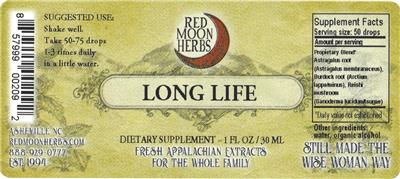
Supplement Facts
The label details for Long Life by Red Moon Herbs, sourced from the NIH Dietary Supplement Label Database.
Supplement Facts
| Ingredient | Amount | % DV |
|---|---|---|
| Proprietary Blend | 0 NP | -- |
| Astragalus | 0 NP | -- |
| Burdock | 0 NP | -- |
| Reishi Mushroom | 0 NP | -- |
Other ingredients: Water, Alcohol
Tap any ingredient to jump to its full detail below.
These statements are the manufacturer’s wording, reproduced from the product label — the label is saying it, not HelloPharmacist. We don’t verify or endorse them.
Suggested/Recommended/Usage/Directions
Suggested use: Shake well. Take 50-75 drops 1-3 times daily in a little water.
General Statements
Red Moon Herbs Est. 1994 Still made the wise woman way
FDA Statement of Identity
Dietary Supplement
Formula
Fresh Appalachian extracts for the whole family
Formulation
Fresh Appalachian extracts for the whole family
Is this label outdated? Report a formula or label change and our pharmacy team will review it.
Long Life by Red Moon Herbs label
The label scan from the NIH Dietary Supplement Label Database. Tap to enlarge.
Label images are published by the NIH Dietary Supplement Label Database for the version of this product on file. Always read your actual product label.
View the full label (PDF)The Ingredients in Long Life by Red Moon Herbs
These are the 3 active ingredients this product is made of. Select any to open its full monograph.
Serving size50 Drop(s) Dosage formLiquid Amounts shown are per serving.
Most supplement products combine several ingredients, and a medication can interact with the product through any one of them. Each ingredient below shows whether it has known drug interactions.
Proprietary Blend
- › Astragalus
- › Burdock
- › Reishi Mushroom
Other (inactive) ingredients: Water, Alcohol. These complete the product’s ingredient list but are not active constituents.
Long Life by Red Moon Herbs Drug Interactions
HelloPharmacist Interaction Report
Long Life by Red Moon Herbs is a liquid blend containing astragalus, burdock, and reishi mushroom, and it does interact with several common medications.
The most serious concern involves astragalus and immunosuppressants (drugs that weaken your immune system on purpose, like those used after transplant or for severe autoimmune disease). Astragalus seems to rev up your immune response, which could theoretically undermine what these drugs are trying to do.
Read the full breakdown — every affected drug type, severity by severity
Astragalus also carries Moderate-severity interactions with lithium (a mood stabilizer), cyclophosphamide (a chemotherapy drug), and antidiabetes drugs. With lithium, astragalus may increase its levels in your body and raise the risk of side effects.
With cyclophosphamide, the research is mixed—some studies suggest astragalus might reverse its intended immunosuppressive effect. With antidiabetes drugs, astragalus might lower your blood sugar too much.
Burdock and reishi mushroom each have documented Moderate interactions with blood thinners (anticoagulants and antiplatelet drugs like aspirin or warfarin). Burdock's lignans may reduce platelet clumping, and reishi mushroom at higher doses may thin the blood further, increasing bleeding risk.
Reishi mushroom also interacts with blood pressure medications and antidiabetes drugs in a similar way.
Altogether, these interactions span 488 individual medications. Use the medication checker on this page to look up your exact drugs before you start.
Check your own medications below · Editorial policy · How we use AI
Want to check YOUR meds against Long Life?
Ask about interactions with your drugs in plain English — “Can I take it with lisinopril?” — and we find you the answer in seconds, ingredient by ingredient.
Go to the checkerIngredients driving the most interactions
Individual Drug Interactions
The ingredients in Long Life interact with 495 drugs. Click any drug to see the details.
3 of the 3 ingredients in Long Life interact with drugs. Each result below shows which ingredient is responsible. Reishi Mushroom Astragalus Burdock
6-mercaptopurinePurinethol
How 6-mercaptopurine interacts with Long Life — through 1 ingredient. Tap an ingredient for the detail:
AstragalusImmunosuppressants Moderate
Interaction Summary
Theoretically, astragalus might interfere with immunosuppressive therapy.
Read the full Astragalus + 6-mercaptopurine interactionAbciximabReoPro
How Abciximab interacts with Long Life — through 2 ingredients. Tap an ingredient for the detail:
BurdockAnticoagulant/antiplatelet Drugs Moderate
Interaction Summary
Theoretically, taking burdock with anticoagulant or antiplatelet drugs might increase the risk of bleeding.
Read the full Burdock + Abciximab interactionReishi MushroomAnticoagulant/antiplatelet Drugs Moderate
Interaction Summary
Theoretically, high doses of reishi mushroom might increase the risk of bleeding.
Read the full Reishi Mushroom + Abciximab interactionAbrocitinibCibinqo
How Abrocitinib interacts with Long Life — through 3 ingredients. Tap an ingredient for the detail:
Reishi MushroomAnticoagulant/antiplatelet Drugs Moderate
Interaction Summary
Theoretically, high doses of reishi mushroom might increase the risk of bleeding.
Read the full Reishi Mushroom + Abrocitinib interactionAstragalusImmunosuppressants Moderate
Interaction Summary
Theoretically, astragalus might interfere with immunosuppressive therapy.
Read the full Astragalus + Abrocitinib interactionBurdockAnticoagulant/antiplatelet Drugs Moderate
Interaction Summary
Theoretically, taking burdock with anticoagulant or antiplatelet drugs might increase the risk of bleeding.
Read the full Burdock + Abrocitinib interactionAcarboseGlucobay, Prandase, Precose
How Acarbose interacts with Long Life — through 2 ingredients. Tap an ingredient for the detail:
Reishi MushroomAntidiabetes Drugs Moderate
Interaction Summary
Theoretically, reishi mushroom might have additive effects with antidiabetes drugs.
Read the full Reishi Mushroom + Acarbose interactionAstragalusAntidiabetes Drugs Moderate
Interaction Summary
Theoretically, taking astragalus with antidiabetes drugs might increase the risk of hypoglycemia.
Read the full Astragalus + Acarbose interactionAcebutololRhotral, Sectral
How Acebutolol interacts with Long Life — through 1 ingredient. Tap an ingredient for the detail:
Reishi MushroomAntihypertensive Drugs Moderate
Interaction Summary
Theoretically, concurrent use of reishi mushroom with antihypertensive drugs might increase the risk of hypotension.
Read the full Reishi Mushroom + Acebutolol interactionAcenocoumarolSintrom
How Acenocoumarol interacts with Long Life — through 2 ingredients. Tap an ingredient for the detail:
BurdockAnticoagulant/antiplatelet Drugs Moderate
Interaction Summary
Theoretically, taking burdock with anticoagulant or antiplatelet drugs might increase the risk of bleeding.
Read the full Burdock + Acenocoumarol interactionReishi MushroomAnticoagulant/antiplatelet Drugs Moderate
Interaction Summary
Theoretically, high doses of reishi mushroom might increase the risk of bleeding.
Read the full Reishi Mushroom + Acenocoumarol interactionAcetaminophen, AspirinGemnisyn
How Acetaminophen, Aspirin interacts with Long Life — through 2 ingredients. Tap an ingredient for the detail:
Reishi MushroomAnticoagulant/antiplatelet Drugs Moderate
Interaction Summary
Theoretically, high doses of reishi mushroom might increase the risk of bleeding.
Read the full Reishi Mushroom + Acetaminophen, Aspirin interactionBurdockAnticoagulant/antiplatelet Drugs Moderate
Interaction Summary
Theoretically, taking burdock with anticoagulant or antiplatelet drugs might increase the risk of bleeding.
Read the full Burdock + Acetaminophen, Aspirin interactionAcetaminophen, Aspirin, CaffeineExcedrin, Excedrin Extra Strength, Excedrin Migraine
How Acetaminophen, Aspirin, Caffeine interacts with Long Life — through 2 ingredients. Tap an ingredient for the detail:
BurdockAnticoagulant/antiplatelet Drugs Moderate
Interaction Summary
Theoretically, taking burdock with anticoagulant or antiplatelet drugs might increase the risk of bleeding.
Read the full Burdock + Acetaminophen, Aspirin, Caffeine interactionReishi MushroomAnticoagulant/antiplatelet Drugs Moderate
Interaction Summary
Theoretically, high doses of reishi mushroom might increase the risk of bleeding.
Read the full Reishi Mushroom + Acetaminophen, Aspirin, Caffeine interactionAcetaminophen, IbuprofenCombogesic
How Acetaminophen, Ibuprofen interacts with Long Life — through 2 ingredients. Tap an ingredient for the detail:
Reishi MushroomAnticoagulant/antiplatelet Drugs Moderate
Interaction Summary
Theoretically, high doses of reishi mushroom might increase the risk of bleeding.
Read the full Reishi Mushroom + Acetaminophen, Ibuprofen interactionBurdockAnticoagulant/antiplatelet Drugs Moderate
Interaction Summary
Theoretically, taking burdock with anticoagulant or antiplatelet drugs might increase the risk of bleeding.
Read the full Burdock + Acetaminophen, Ibuprofen interactionAcetazolamideAk-Zol, Diamox
How Acetazolamide interacts with Long Life — through 1 ingredient. Tap an ingredient for the detail:
Reishi MushroomAntihypertensive Drugs Moderate
Interaction Summary
Theoretically, concurrent use of reishi mushroom with antihypertensive drugs might increase the risk of hypotension.
Read the full Reishi Mushroom + Acetazolamide interactionAcetohexamideDymelor
How Acetohexamide interacts with Long Life — through 2 ingredients. Tap an ingredient for the detail:
AstragalusAntidiabetes Drugs Moderate
Interaction Summary
Theoretically, taking astragalus with antidiabetes drugs might increase the risk of hypoglycemia.
Read the full Astragalus + Acetohexamide interactionReishi MushroomAntidiabetes Drugs Moderate
Interaction Summary
Theoretically, reishi mushroom might have additive effects with antidiabetes drugs.
Read the full Reishi Mushroom + Acetohexamide interactionAcetylsalicylic AcidEntrophen
How Acetylsalicylic Acid interacts with Long Life — through 2 ingredients. Tap an ingredient for the detail:
Reishi MushroomAnticoagulant/antiplatelet Drugs Moderate
Interaction Summary
Theoretically, high doses of reishi mushroom might increase the risk of bleeding.
Read the full Reishi Mushroom + Acetylsalicylic Acid interactionBurdockAnticoagulant/antiplatelet Drugs Moderate
Interaction Summary
Theoretically, taking burdock with anticoagulant or antiplatelet drugs might increase the risk of bleeding.
Read the full Burdock + Acetylsalicylic Acid interactionAdalimumabHumira
How Adalimumab interacts with Long Life — through 1 ingredient. Tap an ingredient for the detail:
AstragalusImmunosuppressants Moderate
Interaction Summary
Theoretically, astragalus might interfere with immunosuppressive therapy.
Read the full Astragalus + Adalimumab interactionAdalimumab-adazHyrimoz
How Adalimumab-adaz interacts with Long Life — through 1 ingredient. Tap an ingredient for the detail:
AstragalusImmunosuppressants Moderate
Interaction Summary
Theoretically, astragalus might interfere with immunosuppressive therapy.
Read the full Astragalus + Adalimumab-adaz interactionAdalimumab-adbmCyltezo
How Adalimumab-adbm interacts with Long Life — through 1 ingredient. Tap an ingredient for the detail:
AstragalusImmunosuppressants Moderate
Interaction Summary
Theoretically, astragalus might interfere with immunosuppressive therapy.
Read the full Astragalus + Adalimumab-adbm interactionAdalimumab-afzbAbrilada
How Adalimumab-afzb interacts with Long Life — through 1 ingredient. Tap an ingredient for the detail:
AstragalusImmunosuppressants Moderate
Interaction Summary
Theoretically, astragalus might interfere with immunosuppressive therapy.
Read the full Astragalus + Adalimumab-afzb interactionAdalimumab-attoAmjevita
How Adalimumab-atto interacts with Long Life — through 1 ingredient. Tap an ingredient for the detail:
AstragalusImmunosuppressants Moderate
Interaction Summary
Theoretically, astragalus might interfere with immunosuppressive therapy.
Read the full Astragalus + Adalimumab-atto interactionAdalimumab-bwwdHadlima
How Adalimumab-bwwd interacts with Long Life — through 1 ingredient. Tap an ingredient for the detail:
AstragalusImmunosuppressants Moderate
Interaction Summary
Theoretically, astragalus might interfere with immunosuppressive therapy.
Read the full Astragalus + Adalimumab-bwwd interactionAdalimumab-fkjpHulio
How Adalimumab-fkjp interacts with Long Life — through 1 ingredient. Tap an ingredient for the detail:
AstragalusImmunosuppressants Moderate
Interaction Summary
Theoretically, astragalus might interfere with immunosuppressive therapy.
Read the full Astragalus + Adalimumab-fkjp interactionAlbiglutideTanzeum
How Albiglutide interacts with Long Life — through 2 ingredients. Tap an ingredient for the detail:
Reishi MushroomAntidiabetes Drugs Moderate
Interaction Summary
Theoretically, reishi mushroom might have additive effects with antidiabetes drugs.
Read the full Reishi Mushroom + Albiglutide interactionAstragalusAntidiabetes Drugs Moderate
Interaction Summary
Theoretically, taking astragalus with antidiabetes drugs might increase the risk of hypoglycemia.
Read the full Astragalus + Albiglutide interactionAlefaceptAmevive
How Alefacept interacts with Long Life — through 1 ingredient. Tap an ingredient for the detail:
AstragalusImmunosuppressants Moderate
Interaction Summary
Theoretically, astragalus might interfere with immunosuppressive therapy.
Read the full Astragalus + Alefacept interactionAlemtuzumabCampath
How Alemtuzumab interacts with Long Life — through 1 ingredient. Tap an ingredient for the detail:
AstragalusImmunosuppressants Moderate
Interaction Summary
Theoretically, astragalus might interfere with immunosuppressive therapy.
Read the full Astragalus + Alemtuzumab interactionAliskirenTekturna
How Aliskiren interacts with Long Life — through 1 ingredient. Tap an ingredient for the detail:
Reishi MushroomAntihypertensive Drugs Moderate
Interaction Summary
Theoretically, concurrent use of reishi mushroom with antihypertensive drugs might increase the risk of hypotension.
Read the full Reishi Mushroom + Aliskiren interactionAlogliptinNesina
How Alogliptin interacts with Long Life — through 2 ingredients. Tap an ingredient for the detail:
Reishi MushroomAntidiabetes Drugs Moderate
Interaction Summary
Theoretically, reishi mushroom might have additive effects with antidiabetes drugs.
Read the full Reishi Mushroom + Alogliptin interactionAstragalusAntidiabetes Drugs Moderate
Interaction Summary
Theoretically, taking astragalus with antidiabetes drugs might increase the risk of hypoglycemia.
Read the full Astragalus + Alogliptin interactionAlogliptin, MetforminKazano
How Alogliptin, Metformin interacts with Long Life — through 2 ingredients. Tap an ingredient for the detail:
Reishi MushroomAntidiabetes Drugs Moderate
Interaction Summary
Theoretically, reishi mushroom might have additive effects with antidiabetes drugs.
Read the full Reishi Mushroom + Alogliptin, Metformin interactionAstragalusAntidiabetes Drugs Moderate
Interaction Summary
Theoretically, taking astragalus with antidiabetes drugs might increase the risk of hypoglycemia.
Read the full Astragalus + Alogliptin, Metformin interactionAlogliptin, PioglitazoneOseni
How Alogliptin, Pioglitazone interacts with Long Life — through 2 ingredients. Tap an ingredient for the detail:
Reishi MushroomAntidiabetes Drugs Moderate
Interaction Summary
Theoretically, reishi mushroom might have additive effects with antidiabetes drugs.
Read the full Reishi Mushroom + Alogliptin, Pioglitazone interactionAstragalusAntidiabetes Drugs Moderate
Interaction Summary
Theoretically, taking astragalus with antidiabetes drugs might increase the risk of hypoglycemia.
Read the full Astragalus + Alogliptin, Pioglitazone interactionAlteplase, TpaActilyse, Activase
How Alteplase, Tpa interacts with Long Life — through 2 ingredients. Tap an ingredient for the detail:
Reishi MushroomAnticoagulant/antiplatelet Drugs Moderate
Interaction Summary
Theoretically, high doses of reishi mushroom might increase the risk of bleeding.
Read the full Reishi Mushroom + Alteplase, Tpa interactionBurdockAnticoagulant/antiplatelet Drugs Moderate
Interaction Summary
Theoretically, taking burdock with anticoagulant or antiplatelet drugs might increase the risk of bleeding.
Read the full Burdock + Alteplase, Tpa interactionAluminum Hydroxide, Aspirin, Codeine Phosphate, Magnesium HydroxideAscriptin Codeine #2
How Aluminum Hydroxide, Aspirin, Codeine Phosphate, Magnesium Hydroxide interacts with Long Life — through 2 ingredients. Tap an ingredient for the detail:
BurdockAnticoagulant/antiplatelet Drugs Moderate
Interaction Summary
Theoretically, taking burdock with anticoagulant or antiplatelet drugs might increase the risk of bleeding.
Read the full Burdock + Aluminum Hydroxide, Aspirin, Codeine Phosphate, Magnesium Hydroxide interactionReishi MushroomAnticoagulant/antiplatelet Drugs Moderate
Interaction Summary
Theoretically, high doses of reishi mushroom might increase the risk of bleeding.
Read the full Reishi Mushroom + Aluminum Hydroxide, Aspirin, Codeine Phosphate, Magnesium Hydroxide interactionAluminum Hydroxide, Aspirin, Magnesium HydroxideAscriptin
How Aluminum Hydroxide, Aspirin, Magnesium Hydroxide interacts with Long Life — through 2 ingredients. Tap an ingredient for the detail:
Reishi MushroomAnticoagulant/antiplatelet Drugs Moderate
Interaction Summary
Theoretically, high doses of reishi mushroom might increase the risk of bleeding.
Read the full Reishi Mushroom + Aluminum Hydroxide, Aspirin, Magnesium Hydroxide interactionBurdockAnticoagulant/antiplatelet Drugs Moderate
Interaction Summary
Theoretically, taking burdock with anticoagulant or antiplatelet drugs might increase the risk of bleeding.
Read the full Burdock + Aluminum Hydroxide, Aspirin, Magnesium Hydroxide interactionAmbrisentanLetairis, Volibris
How Ambrisentan interacts with Long Life — through 1 ingredient. Tap an ingredient for the detail:
Reishi MushroomAntihypertensive Drugs Moderate
Interaction Summary
Theoretically, concurrent use of reishi mushroom with antihypertensive drugs might increase the risk of hypotension.
Read the full Reishi Mushroom + Ambrisentan interactionEach ingredient & the kinds of drugs it affects
For each ingredient in Long Life with known interactions, here are the types of medications they can affect. Open any type for the detail — or search your exact drug in the checker above.
Reishi Mushroom
Anticoagulant/Antiplatelet Drugs
Theoretically, high doses of reishi mushroom might increase the risk of bleeding.
A dose of 1.5 grams daily of reishi mushroom does not seem to decrease platelet aggregation, but a higher dose of 3 grams daily does.
Antidiabetes Drugs
Theoretically, reishi mushroom might have additive effects with antidiabetes drugs.
Animal research suggests that reishi mushroom decreases blood sugar. However, in patients with type 2 diabetes, taking reishi mushroom does not reduce fasting glucose levels, and its effects on glycated hemoglobin are inconsistent.
Antihypertensive Drugs
Theoretically, concurrent use of reishi mushroom with antihypertensive drugs might increase the risk of hypotension.
Reishi mushroom has shown hypotensive activity in animal research. Clinical evidence suggests that reishi mushroom reduces blood pressure in some, but not all, patients with hypertension.
Astragalus
Antidiabetes Drugs
Theoretically, taking astragalus with antidiabetes drugs might increase the risk of hypoglycemia.
Clinical research in humans shows that astragalus might have hypoglycemic effects. Theoretically, taking astragalus, especially in combination with other hypoglycemic agents, might increase the risk of hypoglycemia.
Cyclophosphamide
Theoretically, astragalus might interfere with cyclophosphamide therapy.
Evidence regarding the effect of astragalus on immunosuppression caused by cyclophosphamide is conflicting. Some animal research suggests that astragalus reverses cyclophosphamide-induced immunosuppression. However, other animal research shows no effect.
Immunosuppressants
Theoretically, astragalus might interfere with immunosuppressive therapy.
Astragalus seems to stimulate immune function. Theoretically, taking astragalus might decrease the effects of immunosuppressive therapy.
Lithium
Theoretically, astragalus might increase levels and adverse effects of lithium.
Animal research suggests that astragalus has diuretic properties. Theoretically, due to this diuretic effect, astragalus might reduce excretion and increase levels of lithium.
Burdock
Anticoagulant/Antiplatelet Drugs
Theoretically, taking burdock with anticoagulant or antiplatelet drugs might increase the risk of bleeding.
In vitro research shows that lignans from burdock reduce rabbit platelet aggregation by inhibiting platelet activating factor. This interaction has not been reported in humans.
Brand information
Manufacturer and brand details for Long Life, from the product label.
Red Moon Herbs
See all Red Moon Herbs products- Name
- Red Moon Herbs
- City
- Asheville
- State
- NC
- Phone Number
- 888-929-0777
- Web Address
- redmoonherbs.com
Long Life by Red Moon Herbs: Common Questions
Does Long Life by Red Moon Herbs interact with any medications?
How can one product interact with so many drugs?
Where does this information come from?
Can I take Long Life if I'm pregnant or breastfeeding?
What are the most common side effects I might notice?
Does this product actually work for immune health or other conditions?
Why are there so many medication interactions?
Is Long Life safe for long-term use?
What exactly are these three ingredients?
Written and reviewed by the HelloPharmacist editorial staff. Our editorial policy
Not sure if Long Life is safe with your meds?
Our pharmacists answer your medication & supplement questions — free.
Label information is sourced from the NIH Dietary Supplement Label Database and reflects the product version on file; always read your actual product label. This page is for education only and is not a substitute for professional medical advice. Confirm with your pharmacist or doctor before combining supplements and medications.
The Full Monographs Behind Long Life’s Ingredients
Every ingredient we hold a full HelloPharmacist monograph for — uses, evidence, safety, and the complete interaction list.
Astragalus
Interacts with 208 drugsAstragalus is a root used for centuries in traditional Chinese medicine, mainly to support the immune system and help the body cope with stress. While early studies are interesting, strong h...
Read the full Astragalus monograph → Herb & supplement monographBurdock
Interacts with 122 drugsBurdock is a traditional herb most often used for skin problems and as a so-called 'blood purifier,' but high-quality human studies are lacking and most claims are not well proven. It is wid...
Read the full Burdock monograph → Herb & supplement monographReishi Mushroom
Interacts with 375 drugsReishi is a traditional Asian mushroom widely used to support the immune system and overall wellness. Human evidence for most of its claimed benefits is limited or low-quality, so it should...
Read the full Reishi Mushroom monograph →Sources & How We Checked
Long Life's label data comes from the NIH Dietary Supplement Label Database; the ingredient interaction data is from the Natural Medicines database, reviewed by our pharmacists.
- NIH Dietary Supplement Label Database (DSLD) — The official product label on file for this supplement.
- Natural Medicines (Therapeutic Research Center) — Evidence-graded clinical reference behind the ingredient interaction data.
Content is written and reviewed by licensed HelloPharmacist pharmacists. See our data sources and editorial standards for how this information is built and checked.
The 41 references behind this product’s interaction data
Every citation that drives the interaction findings for this product’s ingredients, from the evidence-graded Natural Medicines (TRC Healthcare) database. Open an ingredient to browse its citations — links open the study on PubMed or the publisher’s site.
Astragalus 13 references
- Upton R, ed. Astragalus Root: Analytical, quality control, and therapeutic monograph. Santa Cruz, CA: American Herbal Pharmacopoeia. 1999:1-25.
- Khoo KS, Ang PT. Extract of astragalus membranaceus and ligustrum lucidum does not prevent cyclophosphamide-induced myelosuppression. Singapore Med J 1995;36:387-90.
- Chu DT, Wong WL, Mavligit GM. Immunotherapy with Chinese medicinal herbs. II. Reversal of cyclophosphamide-induced immune suppression by administration of fractionated Astragalus membranaceus in vivo. J Clin Lab Immunol 1988;25:125-9.
- Sun Y, Hersh EM, Lee SL, et al. Preliminary observations on the effects of the Chinese medicinal herbs Astragalus membranaceus and Ligustrum lucidum on lymphocyte blastogenic responses. J Biol Response Mod 1983;2:227-37..
- Ma J, Peng A, Lin S. Mechanisms of the therapeutic effect of astragalus membranaceus on sodium and water retention in experimental heart failure. Chin Med J (Engl) 1998;111:17-23.
- Matkovic Z, Zivkovic V, Korica M, et al. Efficacy and safety of Astragalus membranaceus in the treatment of patients with seasonal allergic rhinitis. Phytother Res 2010;24:175-81.
- Zhang, J. G., Yang, N., He, H., Wei, G. H., Gao, D. S., Wang, X. L., Wang, X. Z., and Song, G. Y. [Effect of Astragalus injection on plasma levels of apoptosis-related factors in aged patients with chronic heart failure.]. Chin J Integr.Med 2005;11(3):18 PubMed
- Chen, H. W., Lin, I. H., Chen, Y. J., Chang, K. H., Wu, M. H., Su, W. H., Huang, G. C., and Lai, Y. L. A novel infusible botanically-derived drug, PG2, for cancer-related fatigue: a phase II double-blind, randomized placebo-controlled study. Clin Invest PubMed
- Tian H, Lu J, He H, et al.The effect of Astragalus as an adjuvant treatment in type 2 diabetes mellitus: A (preliminary) meta-analysis. J Ethnopharmacol. 2016;191:206-215. doi: 10.1016/j.jep.2016.05.062. PubMed
- Hong KF, Liu PY, Zhang W, Gui DK, Xu YH. The Efficacy and Safety of Astragalus as an Adjuvant Treatment for Type 2 Diabetes Mellitus: A Systematic Review and Meta-Analysis. J Integr Complement Med 2023. PubMed
- Chan KW, Kwong ASK, Tsui PN, et al. Add-on astragalus in type 2 diabetes and chronic kidney disease: A multi-center, assessor-blind, randomized controlled trial. Phytomedicine 2024;130:155457. PubMed
- Han X, Yu T, Chen X, Du Z, Yu M, Xiong J. Effect of Astragalus membranaceus on left ventricular remodeling in HFrEF: a systematic review and meta-analysis. Front Pharmacol 2024;15:1345797. PubMed
- Jing P, Hongzheng H, Zhenqi WU, Meijuan Z, Zuojing LI, Gang C. Long-term efficacy and safety of Huangqi ()-based Traditional Chinese Medicine in diabetic peripheral neuropathy: a Meta-analysis of randomized controlled trials. J Tradit Chin Med 2024;44(2):
Burdock 11 references
- Iwakami S, Wu JB, Ebizuka Y, Sankawa U. Platelet activating factor (PAF) antagonists contained in medicinal plants: lignans and sesquiterpenes. Chem Pharm Bull (Tokyo) 1992;40:1196-8. PubMed
- Sasaki Y, Kimura Y, Tsunoda T, Tagami H. Anaphylaxis due to burdock. Int J Dermatol 2003;42:472-3. PubMed
- Rhoads PM, Tong TG, Banner W Jr, Anderson R. Anticholinergic poisonings associated with commercial burdock root tea. J Toxicol Clin Toxicol 1984-85;22:581-4. PubMed
- Rodriguez P, Blanco J, Juste S, et al. Allergic contact dermatitis due to burdock (Arctium lappa). Contact Dermatitis 1995;33:134-5.
- Kassler, W. J., Blanc, P., and Greenblatt, R. The use of medicinal herbs by human immunodeficiency virus-infected patients. Arch Intern Med 1991;151(11):2281-2288. DOI
- Chan, Y. S., Cheng, L. N., Wu, J. H., Chan, E., Kwan, Y. W., Lee, S. M., Leung, G. P., Yu, P. H., and Chan, S. W. A review of the pharmacological effects of Arctium lappa (burdock). Inflammopharmacology. 2011;19(5):245-254. PubMed
- Breed, F. B. and Kuwabara, T. Burdock ophthalmia. Arch Ophthalmol 1966;75(1):16-20.
- Bryson, P. D., Watanabe, A. S., Rumack, B. H., and Murphy, R. C. Burdock root tea poisoning. Case report involving a commercial preparation. JAMA 5-19-1978;239(20):2157. DOI
- <p>Fletcher GF<span>, </span>Cantwell JD. Burdock root tea poisoning. JAMA <span>1978 Oct 6;240(15):1586.</span></p> DOI
- Latif A, Fichadiya H, Abid F, Capo G. Herbal Teas and Thrombocytopenia: A Curious Case of Yellow Dock and Burdock-Induced Thrombocytopenia. Eur J Case Rep Intern Med 2022;9(3):003247. PubMed
- Niazi B, Ahmed K, Ahmed M, Ali S, Song K, Elias S. Drug-Induced Liver Injury from Herbal Liver Detoxification Tea. Case Rep Gastroenterol 2022;16(3):612-617. PubMed
Reishi Mushroom 17 references
- McGuffin M, Hobbs C, Upton R, Goldberg A, eds. American Herbal Products Association's Botanical Safety Handbook. Boca Raton, FL: CRC Press, LLC 1997.
- Tao J, Feng KY. Experimental and clinical studies on inhibitory effect of ganoderma lucidum on platelet aggregation. J Tongji Med Univ 1990;10:240-3. PubMed
- Singh AB, Gupta SK, Pereira BM, Prakash D. Sensitization to Ganoderma lucidum in patients with respiratory allergy in India. Clin Exp Allergy 1995;25:440-7.
- Lee SY, Rhee HM. Cardiovascular effects of mycelium extract of Ganoderma lucidum: inhibition of sympathetic outflow as a mechanism of its hypotensive action. Chem Pharm Bull (Tokyo) 1990;38:1359-64. PubMed
- Kwok Y, Ng KFJ, Li, CCF, et al. A prospective, randomized, double-blind, placebo-controlled study of the platelet and global hemostatic effects of Ganoderma lucidum (Ling-Zhi) in healthy volunteers. Anesth Analg 2005;101:423-6. PubMed
- Wanmuang, H., Leopairut, J., Kositchaiwat, C., Wananukul, W., and Bunyaratvej, S. Fatal fulminant hepatitis associated with Ganoderma lucidum (Lingzhi) mushroom powder. J Med Assoc Thai. 2007;90(1):179-181.
- Seto, S. W., Lam, T. Y., Tam, H. L., Au, A. L., Chan, S. W., Wu, J. H., Yu, P. H., Leung, G. P., Ngai, S. M., Yeung, J. H., Leung, P. S., Lee, S. M., and Kwan, Y. W. Novel hypoglycemic effects of Ganoderma lucidum water-extract in obese/diabetic (+db/+db
- Chu, T. T., Benzie, I. F., Lam, C. W., Fok, B. S., Lee, K. K., and Tomlinson, B. Study of potential cardioprotective effects of Ganoderma lucidum (Lingzhi): results of a controlled human intervention trial. Br.J.Nutr. 2012;107(7):1017-1027.
- Jin, X., Ruiz, Beguerie J., Sze, D. M., and Chan, G. C. Ganoderma lucidum (Reishi mushroom) for cancer treatment. Cochrane.Database.Syst.Rev. 2012;6:CD007731.
- Kabir, Y., Kimura, S., and Tamura, T. Dietary effect of Ganoderma lucidum mushroom on blood pressure and lipid levels in spontaneously hypertensive rats (SHR). J Nutr Sci Vitaminol.(Tokyo) 1988;34(4):433-438. PubMed
- Kanmatsuse, K., Kajiwara, N., Hayashi, K., Shimogaichi, S., Fukinbara, I., Ishikawa, H., and Tamura, T. [Studies on Ganoderma lucidum. I. Efficacy against hypertension and side effects]. Yakugaku Zasshi 1985;105(10):942-947. PubMed
- Gao, Y., Lan, J., Dai, X., Ye, J., and Zhou, S. A Phase I/II Study of Ling Zhi Mushroom Ganoderma lucidum(W.Curt: Fr.) Lloyd (Aphyllophoromycetideae) Extract in Patients with Type II Diabetes Mellitus. International Journal of Medicinal Mushrooms 2004;6. DOI
- Jin H, Zhang G, Cao X, and et al. Treatment of hypertension by linzhi combined with hypotensor and its effects on arterial, arteriolar and capillary pressure and microcirculation. In: Niimi H, Xiu RJ, Sawada T, and et al. Microcirculatory Approach to Asi
- Klupp NL, Chang D, Hawke F, Kiat H, Cao H, Grant SJ, Bensoussan A. Ganoderma lucidum mushroom for the treatment of cardiovascular risk factors. Cochrane Database Syst Rev. 2015 Feb 17;2:CD007259. PubMed
- Zhao H, Zhang Q, Zhao L, Huang X, Wang J, Kang X. Spore Powder of Ganoderma lucidum Improves Cancer-Related Fatigue in Breast Cancer Patients Undergoing Endocrine Therapy: A Pilot Clinical Trial. Evid Based Complement Alternat Med. 2012;2012:809614.
- Pazzi F, Adsuar JC, Domínguez-Muñoz FJ, García-Gordillo MA, Gusi N, Collado-Mateo D. Ganoderma lucidum effects on mood and health-related quality of life in women with fibromyalgia. Healthcare (Basel) 2020;8(4):520. PubMed
- Kogure T, Koiwai A, Fukushi D, et al. Hypereosinophilia with hepatic nodule formation caused by Ganoderma lucidum. Intern Med 2021;60(24):3897-3903.
Parts of this content are provided by the Therapeutic Research Center, LLC.
DISCLAIMER: Currently this does not check for drug-drug interactions. This is not an all-inclusive comprehensive list of potential interactions and is for informational purposes only. Not all interactions are known or well-reported in the scientific literature, and new interactions are continually being reported. Input is needed from a qualified healthcare provider including a pharmacist before starting any therapy. Application of clinical judgment is necessary.
© 2021 Therapeutic Research Center, LLC