
Max Care Probiotics by NatureWise Ingredients, Side Effects and Drug Interactions
Dietary Supplement Capsule Other Combinations
UPC 8 58081 00627 1 Match it to the barcode on your bottle

Medically reviewed by Dr. Brian Staiger, PharmD, BCPS
Also reviewed by the HelloPharmacist Editorial Team
Updated Details about this page
- Label on file from the NIH Dietary Supplement Label Database, dated Apr 24, 2025.
- The interaction, evidence and safety records come from the Natural Medicines database, which we license, read against this label by our own system; the pharmacy team’s sections are written from those records.
- Dr. Brian Staiger, PharmD, BCPS, is a clinical pharmacist and pharmacotherapy specialist.
- Editorial policy Our sources
AI is used only to summarize verified clinical information, never the open internet. Our AI policy
Summary: The HelloPharmacist Team’s Take
- Form
- Capsule
- Serving Size
- 1 Capsule
- Servings
- 60 per container
- Container Holds
- 60 Capsules
What’s in it, whether it interacts with your drugs, its side effects, whether it works, and what our pharmacists would want you to know before you start it.
- What is Max Care Probiotics?A supplement from NatureWise with 19 active ingredients, in capsule form.
- Active Ingredients 18 probiotics and 1 source of fiber: L. acidophilusL. plantarumL. caseiL. paracaseiL. bulgaricusL. brevisL. reuteriL. salivariusL. fermentumL. gasseriL. rhamnosusB. animalis lactis 19 active ingredients. Each one can interact with drugs or cause side effects on its own, so we check every one. And 7 more, in the Supplement Facts
- Drug Interactions 268 drugs have a documented interaction with this supplement; the most serious is rated moderate. Of those, 207 are single drugs and 61 are combination products (two or more drugs in one), each listed under its own name. Based on the 8 of its 19 ingredients we could check. Ask your pharmacist first if you take a drug in any of these categories:
- Moderate · 182 drugs
- Minor · 86 drugs
- Possible Side EffectsGas 6 ingredientsBloating 4 ingredientsStomach discomfort 4 ingredientsAbdominal cramping or discomfortMinor changes in bowel habitsChanges in bowel movements +4 moreReported for six of its 19 active ingredients. Not studied in this exact product.
- Well documented Why
Does Max Care Probiotics work?
What It Is Marketed For
Digestive, immune, and skin health
From the claims on the product’s label.
The Closest Use the Research Grades
Antibiotic-associated diarrhea Lactobacillus Acidophilus
Some studies support it, but the evidence isn’t conclusive.
Its ingredients have research behind other uses too:
- Lactobacillus Acidophilus
- Respiratory tract infections Bifidobacterium Bifidum
- Bacillus Coagulans
- Inulin
- Helicobacter pylori Lactobacillus Acidophilus
- Bifidobacterium Bifidum
These grades are for each ingredient, not this exact product, and never a promise it will work for you.
And 3 more graded uses, in what the research says- Low Why
- AllergensNone of its ingredient names point to a major food allergen
- Barcode (UPC)8 58081 00627 1Match it to the barcode on your bottle to be sure this is your product. Not your product? Search for it here
Who Might Consider It
- People looking for digestive, immune, and skin health, which is what it is marketed for. The closest use the research grades is antibiotic-associated diarrhea, rated Possibly Effective.
- People who want it for irritable bowel syndrome (IBS), respiratory tract infections, constipation, diabetes or another graded use: the other uses with research behind them. See each grade
- You might consider discussing this product with your doctor if you are looking for ingredients rated possibly effective for IBS or constipation.
Who Should Be Careful
- Anyone who is seriously ill, has a weakened immune system, has a central venous catheter, takes antibiotics or diabetes medication, or is pregnant or breastfeeding should be careful.
- Talk it over with your own doctor or pharmacist before starting.
More Before You Take It Show both answersHide Pregnancy and Breastfeeding The Label’s Directions
-
Pregnant or breastfeeding?
- Pregnancy Lactobacillus Delbrueckii
- ! Probiotics in food are likely fine, but supplement safety in pregnancy is not well studied, so check with your doctor.
- Breastfeeding Lactobacillus Delbrueckii
- There is insufficient reliable information available about the safety of Lactobacillus delbrueckii during pregnancy and lactation.
- Pregnancy Lactobacillus Acidophilus
- When used orally and appropriately.
- Breastfeeding Lactobacillus Acidophilus
- There is insufficient reliable information available about the safety of Lactobacillus acidophilus during lactation.
- Pregnancy and Breastfeeding Lactobacillus Gasseri
- There is insufficient reliable information available about the safety of Lactobacillus gasseri during pregnancy and lactation.
-
How does the label say to take it?
“Suggested use: Adults take 1 capsule daily with food or as recommended by your healthcare provider. NatureWise Maximum Care Probiotics should always be taken in conjunction with a healthy diet and regular exercise program.”
The maker’s words. Your pharmacist or doctor may advise differently.
Everything the label says
From the label dated Apr 24, 2025: 8 of its 19 active ingredients were checked against our records; the other eleven are not in them yet. A summary of what is known, not a grade or a test of the product. How these ratings are computed
Ask Anything About This Supplement
Name a drug you take, or ask about side effects, ingredients or pregnancy.
AI answers come from this label and our own records, never the open internet. AI can make mistakes, so always check with your doctor or pharmacist. How we use AI
Ask the Pharmacist
A licensed pharmacist will answer your question by email — free, usually within 24 hours.
Got it — thank you!
A licensed pharmacist will answer within 24 hours. Keep an eye on your email (worth checking spam, just in case).
What’s Inside Max Care Probiotics by NatureWise
19 Active Ingredients, Each Checked on Its Own
A supplement is often several ingredients in one bottle, and each one can interact with drugs or cause side effects on its own. We check every one of them against our records.
- L. acidophilusDrug interactions on record, most serious: Moderate
- L. plantarumNot in our interaction records yet
- L. caseiNot in our interaction records yet
- L. paracaseiNot in our interaction records yet
- L. bulgaricusDrug interactions on record, most serious: Moderate
- L. brevisNot in our interaction records yet
- L. reuteriNot in our interaction records yet
- L. salivariusNot in our interaction records yet
And 11 more, each with its own card below.
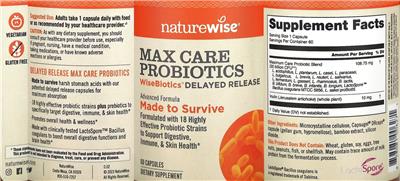
The label gives an exact amount for 1 of its 19 active ingredients. The other 18 are inside one proprietary blend, “Maximum Care Probiotic Blend”, and the label gives one total for it, not how much of each ingredient is in it.
- 1 state an exact amount
- 18 have no amount of their own
- Maximum Care Probiotic Blend 108.75 mg in total · 18 ingredients, no amount for each
This rates what the label tells you, not the quality of the product.
Supplement Facts
| Amount Per Serving | % Daily Value | |
|---|---|---|
| Maximum Care Probiotic Blend | 108.75 mg | † |
| L. acidophilus | † | |
| L. plantarum | † | |
| L. casei | † | |
| L. paracasei | † | |
| L. bulgaricus | † | |
| L. brevis | † | |
| L. reuteri | † | |
| L. salivarius | † | |
| L. fermentum | † | |
| L. gasseri | † | |
| L. rhamnosus | † | |
| B. animalis lactis | † | |
| B. bifidum | † | |
| B. breve | † | |
| B. longum infantis | † | |
| B. longum | † | |
| LactoSpore | † | |
| proBio65 | † | |
| Inulin | 10 mg | † |
Other ingredients: Microcrystalline Cellulose, Gellan Gum, Hypromellose, Bamboo Extract, Silicon Dioxide
† Daily Value not established.
Daily Values for adults and children 4 or more years of age.
As the label prints it, from the NIH Dietary Supplement Label Database.
Each Ingredient and Its Drug Interactions
Tap one for more about it and its full guide. A drug can interact with this supplement through any one of them.
-
Maximum Care Probiotic Blend 108.75 mg Some of the listed strains also appear in a blended group, the Maximum Care Probiotic Blend, which has no separate interaction data of its own. 18 ingredients inside it, each checked on its own
- L. acidophilus 182 drugs
- L. plantarum
- L. casei
- L. paracasei
- L. bulgaricus 182 drugs
- L. brevis
- L. reuteri
- L. salivarius
- L. fermentum
- L. gasseri 182 drugs
- L. rhamnosus
- B. animalis lactis
- B. bifidum 182 drugs
- B. breve 182 drugs
- B. longum infantis
- B. longum 182 drugs
- LactoSpore 182 drugs
- ProBio65
-
Inulin 10 mg Max Care Probiotics contains 19 active ingredients, mostly probiotic bacteria from the Lactobacillus, Bifidobacterium, and Bacillus groups, along with inulin, a fermentable fiber. Interacts with 86 drugs
Form on the label: Jerusalem Artichoke
Inulin is a type of plant fiber (a prebiotic) found naturally in foods like chicory root, onions, and garlic, and it is widely added to supplements and processed foods.
- It may help with regularity and feeding healthy gut bacteria, but it commonly causes gas and bloating, especially at higher doses.
- Start low, increase slowly, and check with your pharmacist or doctor if you have gut conditions.
The full Inulin guide: uses, dosage and safety Every Inulin drug interaction
Other Ingredients (Inactive)
The capsule or tablet itself, fillers, coatings and flavors. Not part of the drug interaction check; the allergen check below reads them.
- Microcrystalline Cellulose
- Gellan Gum
- Hypromellose
- Bamboo Extract
- Silicon Dioxide
Allergens in Max Care Probiotics
None of its ingredient names point to a major food allergen.
Not named in the ingredients
- Milk
- Egg
- Fish
- Shellfish
- Tree nuts
- Peanuts
- Wheat or other gluten grains
- Soy
- Sesame
- The label’s allergen statement“May contain trace amount of milk protein from the fermentation process.”
- Made without, the label says“Vegetarian”
- Made without, the label says“Gluten free”
- Made without, the label says“This product does not contain: wheat, gluten, soy, eggs, tree nuts, peanuts, fish, or shellfish.”
From the label text and ingredient names on file; we do not test products. With a serious allergy, check your bottle and ask the maker or your pharmacist.
What the Label Says
The maker’s own words, from the label. We do not verify or endorse them.
- Formulation
-
“Made to survive harsh stomach acids with our patented delayed release capsules for maximum absorption”
“Promotes overall health & wellness”
6 more from the label
“WiseBiotics Delayed Release Advanced formula Made to survive”
“Delayed release max care probiotics”
“18 highly effective probiotic strains plus prebiotics to specifically target digestive, immune, & skin health”
“Made with clinically tested LactoSpore Bacillus coagulans to boost overall digestive functions and brain health”
“Formulated with 18 highly effective probiotic strains to support digestive, immune, & skin health”
“LactoSpore Stable Probiotic”
- Brand IP Statement(s)
-
“Copyright 2023 NatureWise. All Rights Reserved.”
“LactoSpore Bacillus coagulans is a registered trademark of Sabinsa.”
- FDA Statement of Identity
-
“Dietary Supplement”
- Storage
-
“Store in a cool, dry place. Best if refrigerated.”
The Max Care Probiotics Label on File
The label scan on file at the NIH Dietary Supplement Label Database, dated April 2025. Always read the label on the bottle you have.
Product Facts
- Brand
- NatureWise
- Barcode (UPC)
- 858081006271
- Net contents
- 60 Capsules
- Market status
- On market
- Date entered into DSLD
- Apr 24, 2025
- DSLD ID
- 327755
- Product type
- Other Combinations
- Supplement form
- Capsule
- Dietary claims / uses
- All Other, Structure/Function
- Intended target group(s)
- Vegetarian, Adult (18 - 50 Years), Gluten Free
Is this label outdated? Report a formula or label change and our pharmacy team will review it.
Max Care Probiotics by NatureWise Side Effects
Why this rating?
We look for three kinds of safety information on each ingredient: side effects reported in studies, a pregnancy and breastfeeding rating, and a safety write-up from our pharmacy team. All three are on file for each of the eight ingredients we could check.
So this rates how much is known, not whether Max Care Probiotics is right for you.
Reported with eight of its ingredients
- Most often
- Gas, bloating, stomach discomfort, abdominal cramping or discomfort, minor changes in bowel habits and changes in bowel movements
- !Rare but serious
- Reported with Lactobacillus Acidophilus, Lactobacillus Delbrueckii, Lactobacillus Gasseri, Bifidobacterium Bifidum, Bifidobacterium Breve, Bifidobacterium Longum, Bacillus Coagulans and Inulin See details
HelloPharmacist Team Summary of Side Effects
For Max Care Probiotics, most people are likely to notice gas, bloating, or mild stomach discomfort, which are reported across several of the strains and the inulin.
- Changes in bowel movements are also reported, and inulin can cause loose stools.
- No drowsiness or dizziness is reported, so no driving precautions apply.
- Rare but serious bloodstream infections have been reported, mostly in people who are critically ill or severely immunocompromised, so call your doctor promptly if you notice signs of a serious infection.
- If you have a weakened immune system, are seriously ill, have a central venous catheter, or recently had major surgery, talk with your own doctor or pharmacist before starting.
Side Effects, Ingredient by Ingredient
A supplement’s side effects come from its ingredients. Here is what is reported with each one.
Lactobacillus Delbrueckii
Most reported
- Gas
- Bloating
- Stomach discomfort
Lactobacillus Gasseri
Most reported
- Gas
- Bloating
- Stomach discomfort
Bifidobacterium Bifidum
Most reported
- Gas
- Bloating
- Minor changes in bowel habits
Bifidobacterium Breve
Most reported
- Gas or bloating
- Mild stomach discomfort
- Changes in bowel movements
Bifidobacterium Longum
Most reported
- Gas
- Bloating
- Stomach discomfort
Inulin
Most reported
- Gas and bloating
- Abdominal cramping or discomfort
- Loose stools or, less often, diarrhea
- A feeling of fullness or rumbling in the belly
Lactobacillus Acidophilus and Bacillus Coagulans have side-effect reports on file, but no list of the most common ones. Read them in each guide: Lactobacillus Acidophilus, Bacillus Coagulans.
Max Care Probiotics Warnings: Who Should Be Careful
Max Care Probiotics has 19 active ingredients, and each can carry warnings of its own. We checked the eight in our ingredient guides, and each warning below names the ingredient it comes from. L. plantarum, L. casei and L. paracasei and eight more are not in our guides yet, so ask your pharmacist about them. If any of these apply to you, talk to your doctor or pharmacist before you start it.
- Lactobacillus Acidophilus1 warning below
- Lactobacillus Delbrueckii2 warnings below
- Lactobacillus Gasseri2 warnings below
- Bifidobacterium Bifidum2 warnings below
- Bifidobacterium Breve3 warnings below
- Bifidobacterium Longum2 warnings below
- Bacillus Coagulans3 warnings below
- Inulin2 warnings below
- L. plantarumNot in our guides yet
- L. caseiNot in our guides yet
- L. paracaseiNot in our guides yet
- L. brevisNot in our guides yet
- L. reuteriNot in our guides yet
- L. salivariusNot in our guides yet
- L. fermentumNot in our guides yet
- L. rhamnosusNot in our guides yet
- B. animalis lactisNot in our guides yet
- B. longum infantisNot in our guides yet
- proBio65Not in our guides yet
-
Bleeding Problems or Surgery
- Bifidobacterium BreveUse caution or avoid if you have a weakened immune system, are seriously ill, have a central venous catheter, or are recovering from major surgery.
-
Stomach or Bowel Problems
- Bifidobacterium BifidumIf you have ongoing digestive symptoms, see a healthcare provider rather than relying on a supplement.
- InulinUse extra caution if you have irritable bowel syndrome (IBS) or other sensitive gut conditions, since inulin is a fermentable fiber (a FODMAP) that can worsen gas, bloating, and discomfort.
-
Children
- Lactobacillus AcidophilusFor most healthy adults and children, L. acidophilus is considered safe and is widely used in foods and supplements.
- Bacillus CoagulansTalk to your pharmacist or doctor before starting, especially for children or anyone with a chronic health condition.
-
Other Cautions
- Lactobacillus DelbrueckiiStill, supplements are more concentrated, and certain people should be more careful.
- Lactobacillus DelbrueckiiIn rare cases, live bacteria have caused infections in people who are seriously immunocompromised.
- Lactobacillus GasseriHowever, certain people should be more careful.
- Lactobacillus GasseriWe default to caution when safety is not clearly established.
Show 8 more
- Bifidobacterium BifidumHowever, people who are seriously ill, have weakened immune systems (for example from chemotherapy, HIV, or organ transplant), or who have central venous catheters should not take probiotics without medical supervision.
- Bifidobacterium BreveHowever, a few groups should be more careful.
- Bifidobacterium BreveIn rare cases, live bacteria can cause infections in people who are very vulnerable.
- Bifidobacterium LongumHowever, some groups should be more careful.
- Bifidobacterium LongumAlways choose products from reputable manufacturers, and check with your pharmacist if you are unsure whether it is right for you.
- Bacillus CoagulansUse extra caution if you have a weakened immune system — for example, from chemotherapy, organ transplant, advanced illness, or HIV — or if you are seriously ill or hospitalized.
- InulinPeople following a low-FODMAP diet are usually advised to avoid it.
- Several ingredients are generally well tolerated in healthy people, but caution is advised for those who are very ill or have weakened immune systems.
-
What the Label Warns
- “Caution: As with any dietary supplement, you should consult your healthcare provider before use, especially if pregnant, nursing, have a medical condition, taking medications, or have known adverse reactions or allergies.”
- “Caution: As with any dietary supplement, you should consult your healthcare provider before use, especially if pregnant, nursing, have a medical condition, taking medications, or have known adverse reactions or allergies.”
- “Keep out of the reach of children.”
- “Do not use if safety seal is damaged or missing.”
The maker’s wording, from the product label.
-
Pregnant or Breastfeeding
Each ingredient’s rating for pregnancy and for breastfeeding, and what it covers.
Pregnancy
-
Probiotics in food are likely fine, but supplement safety in pregnancy is not well studied, so check with your doctor.
Breastfeeding
-
There is insufficient reliable information available about the safety of Lactobacillus delbrueckii during pregnancy and lactation.
However, there are currently no reasons to expect safety concerns when used appropriately.
Pregnancy
-
When used orally and appropriately.
A combination of Lactobacillus acidophilus, Lacticaseibacillus casei, and Bifidobacterium bifidum has been used with apparent safety for 6 weeks, starting at 24-28 weeks' gestation.
Breastfeeding
-
There is insufficient reliable information available about the safety of Lactobacillus acidophilus during lactation.
However, there are currently no reasons to expect safety concerns when used appropriately.
Show 6 more ingredients
Pregnancy and Breastfeeding The record rates both the same
-
There is insufficient reliable information available about the safety of Lactobacillus gasseri during pregnancy and lactation.
However, there are currently no reasons to expect safety concerns when used appropriately.
Pregnancy
-
When Bifidobacterium bifidum is used orally and appropriately, short-term.
A combination of B. bifidum, Lactobacillus acidophilus, and Lacticaseibacillus casei has been used with apparent safety for 6 weeks starting at 24-28 weeks' gestation.
Breastfeeding
-
There is insufficient reliable information available about the safety of Bifidobacterium bifidum during lactation.
However, there are currently no reasons to expect safety concerns when used appropriately.
Pregnancy
-
When used orally and appropriately.
In clinical research, Bifidobacterium breve has been used safely beginning from 16 weeks gestation and continued into the postpartum period.
Breastfeeding
-
There is insufficient reliable information available about the safety of Bifidobacterium breve during lactation.
However, there are currently no reasons to expect safety concerns when used appropriately.
Pregnancy and Breastfeeding The record rates both the same
-
Insufficient reliable information available; avoid using.
Pregnancy and Breastfeeding The record rates both the same
-
When used orally and appropriately, short-term.
B. longum 1714 has been used with apparent safety from 16-20 weeks gestation until delivery.
3 more points on this rating
- A combination of Bifidobacterium longum and Lacticaseibacillus rhamnosus has been used with apparent safety throughout pregnancy.
- A combination of B. longum BB536 and Bifidobacterium breve M-16V has been used with apparent safety from about 4 weeks before the expected due date until delivery.
- Also, a combination of B. longum and Lacticaseibacillus paracasei has been used with apparent safety from 2 months prior to delivery until 2 months after delivery during lactation.
Pregnancy and Breastfeeding The record rates both the same
-
When used orally in amounts commonly found in foods.
There is insufficient reliable information available about using inulin in medicinal amounts during pregnancy or lactation; avoid use.
Our pharmacy team’s notes
- For pregnancy, B. breve, L. acidophilus, B. longum, and B. bifidum are rated possibly safe, which is a limited rating, and inulin is rated likely safe.
- For breastfeeding, there isn't enough data to know either way for most ingredients.
Ratings and the words beside them are from the Natural Medicines database, which we license. Where it has no rating, the rating and note are our pharmacy team’s.
-
Rare but Serious Side Effects
-
!
Lactobacillus Acidophilus
Serious side effects are rare.
-
!
Lactobacillus Delbrueckii
Serious side effects are rare.
-
!
Lactobacillus Gasseri
Serious side effects are rare.
-
!
Bifidobacterium Bifidum
Serious side effects are rare in healthy people.
-
!
Bifidobacterium Breve
Rare but serious problems, such as bloodstream infections, have been reported mostly in people who are critically ill or severely immunocompromised.
-
!
Bifidobacterium Longum
Serious side effects are rare.
-
!
Bacillus Coagulans
Serious side effects are rare in healthy people.
-
!
Inulin
Rare anaphylaxis has been reported with foods high in inulin.
Orally: Anaphylaxis has occurred following consumption of foods high in inulin.
-
!
Our pharmacy team on Max Care Probiotics
Rarely, bloodstream infections (bacteremia) have been reported in critically ill patients.
When to get help: a serious allergic reaction, with trouble breathing or swelling of the face, lips or throat, needs emergency care: call 911. For any other side effect that worries you, call your doctor or pharmacist.
These reports describe each ingredient, not studies of this exact product. Not medical advice: a side effect you notice after starting a supplement is worth a word with your pharmacist or doctor.
Max Care Probiotics by NatureWise Drug Interactions
We checked all 19 active ingredients in this supplement against every drug in our records. A drug can interact with it through any one of them. Eleven of them are not in our interaction records yet.
A moderate interaction on record
2 of 3, on a scale from Minor or none to Major.Why this rating?
We rate this by the most serious interaction on record, not by how many there are. For Lactobacillus Acidophilus, Inulin, Bacillus Coagulans, Bifidobacterium Breve and Bifidobacterium Bifidum, the most serious is rated moderate, which means it calls for caution, and sometimes monitoring or a change in timing or dose. Some involve kinds of drugs where a small change can matter, such as diabetes drugs.
268 drugs are on the full list. What matters is whether one you take is on it, so check yours with the interaction checker on this page.
Eight of its 19 active ingredients have drug interactions on record. The ones below matter most.
- Interacts with
- 182 drugs
- Most serious
- Moderate
- Most of its records involve Antibiotic Drugs.
- Interacts with
- 182 drugs
- Most serious
- Moderate
- Most of its records involve Antibiotic Drugs.
- Interacts with
- 182 drugs
- Most serious
- Moderate
- Most of its records involve Antibiotic Drugs.
Show three more ingredients
- Interacts with
- 182 drugs
- Most serious
- Moderate
- Most of its records involve Antibiotic Drugs.
- Interacts with
- 182 drugs
- Most serious
- Moderate
- Most of its records involve Antibiotic Drugs.
- Interacts with
- 182 drugs
- Most serious
- Moderate
- Most of its records involve Antibiotic Drugs.
And two more ingredients with records, each in the cards below.
From the HelloPharmacist Team
Put every ingredient together and a few things stand out.
- Max Care Probiotics by NatureWise can interact with medications, and the main concern is antibiotics.
- Eight of its ingredients have documented interactions: B. breve, L. acidophilus, B. longum, B. bifidum, L. gasseri, L. bulgaricus, LactoSpore, and inulin.
- The most serious severity we list for this product is Moderate.
Summarized by the HelloPharmacist pharmacy team from the interaction records below. How it is written How we use AI
Why Max Care Probiotics Interacts, Ingredient by Ingredient
A product interacts through its ingredients. Each card: how many drugs, the most serious rating, and the kinds of drugs it affects most (tap a kind for what it means).
The ingredients driving the most interactions
-
L. acidophilus 182 drugs
Most serious: Moderate1 interaction record on file
The kinds of drugs it affects most
- 182 drugs
Every Lactobacillus Acidophilus drug interaction, 1 record The Lactobacillus Acidophilus records cite 18 references, listed in the Lactobacillus Acidophilus guide.
-
L. bulgaricus 182 drugs
Most serious: Moderate1 interaction record on file
The kinds of drugs it affects most
- 182 drugs
Every Lactobacillus Delbrueckii drug interaction, 1 record The Lactobacillus Delbrueckii records cite 9 references, listed in the Lactobacillus Delbrueckii guide.
-
L. gasseri 182 drugs
Most serious: Moderate1 interaction record on file
The kinds of drugs it affects most
- 182 drugs
Every Lactobacillus Gasseri drug interaction, 1 record The Lactobacillus Gasseri records cite 14 references, listed in the Lactobacillus Gasseri guide.
-
B. bifidum 182 drugs
Most serious: Moderate1 interaction record on file
The kinds of drugs it affects most
- 182 drugs
Every Bifidobacterium Bifidum drug interaction, 1 record The Bifidobacterium Bifidum records cite 7 references, listed in the Bifidobacterium Bifidum guide.
-
B. breve 182 drugs
Most serious: Moderate1 interaction record on file
The kinds of drugs it affects most
- 182 drugs
Every Bifidobacterium Breve drug interaction, 1 record The Bifidobacterium Breve records cite 12 references, listed in the Bifidobacterium Breve guide.
-
B. longum 182 drugs
Most serious: Moderate1 interaction record on file
The kinds of drugs it affects most
- 182 drugs
Every Bifidobacterium Longum drug interaction, 1 record The Bifidobacterium Longum records cite 23 references, listed in the Bifidobacterium Longum guide.
-
LactoSpore 182 drugs
Most serious: Moderate1 interaction record on file
The kinds of drugs it affects most
- 182 drugs
Every Bacillus Coagulans drug interaction, 1 record The Bacillus Coagulans records cite 30 references, listed in the Bacillus Coagulans guide.
-
Inulin 86 drugs
Most serious: Minor1 interaction record on file
The kinds of drugs it affects most
- 86 drugs
Every Inulin drug interaction, 1 record The Inulin records cite 20 references, listed in the Inulin guide.
The Breakdown by Severity
Each drug counted once, at its most serious rating. Tap a tile to list those drugs.
Find Your Drug
Type a drug or brand name to see whether it is on the list.
- Only drugs with a documented interaction are listed, the most serious first.
- A drug with no known interaction is not listed, but searching its name tells you so.
- Open a drug to see which ingredient is responsible. Of those, 207 are single drugs and 61 are combination products (two or more drugs in one), each listed under its own name.
-
AmoxicillinAmix, Amoram, Amoxident, Amoxil Capsules, Amoxil Injection and 4 more Moderate
The 7 ingredients responsible:
-
B. Breve Moderate Amoxicillin is in the Antibiotic Drugs category.
Theoretically, taking Bifidobacterium breve with antibiotic drugs might decrease the effectiveness of B.
The full B. Breve + Amoxicillin interaction -
B. Bifidum Moderate Amoxicillin is in the Antibiotic Drugs category.
Theoretically, taking Bifidobacterium.
The full B. Bifidum + Amoxicillin interaction -
B. Longum Moderate Amoxicillin is in the Antibiotic Drugs category.
Theoretically, taking Bifidobacterium longum with antibiotic drugs might decrease the effectiveness of B.
The full B. Longum + Amoxicillin interaction -
Lactospore Moderate Amoxicillin is in the Antibiotic Drugs category.
Theoretically, taking antibiotics with Bacillus coagulans might decrease the effectiveness of B.
The full Lactospore + Amoxicillin interaction -
L. Acidophilus Moderate Amoxicillin is in the Antibiotic Drugs category.
Theoretically, taking Lactobacillus acidophilus with antibiotic drugs might decrease the effectiveness of L.
The full L. Acidophilus + Amoxicillin interaction -
L. Gasseri Moderate Amoxicillin is in the Antibiotic Drugs category.
Theoretically, taking Lactobacillus gasseri with antibiotic drugs might decrease the effectiveness of L.
The full L. Gasseri + Amoxicillin interaction -
L. Bulgaricus Moderate Amoxicillin is in the Antibiotic Drugs category.
Theoretically, taking Lactobacillus delbrueckii with antibiotic drugs might decrease the effectiveness of L.
The full L. Bulgaricus + Amoxicillin interaction
-
-
AzithromycinAzasite, Zithromax, Zmax Moderate
The 7 ingredients responsible:
-
B. Longum Moderate Azithromycin is in the Antibiotic Drugs category.
Theoretically, taking Bifidobacterium longum with antibiotic drugs might decrease the effectiveness of B.
The full B. Longum + Azithromycin interaction -
B. Breve Moderate Azithromycin is in the Antibiotic Drugs category.
Theoretically, taking Bifidobacterium breve with antibiotic drugs might decrease the effectiveness of B.
The full B. Breve + Azithromycin interaction -
Lactospore Moderate Azithromycin is in the Antibiotic Drugs category.
Theoretically, taking antibiotics with Bacillus coagulans might decrease the effectiveness of B.
The full Lactospore + Azithromycin interaction -
L. Bulgaricus Moderate Azithromycin is in the Antibiotic Drugs category.
Theoretically, taking Lactobacillus delbrueckii with antibiotic drugs might decrease the effectiveness of L.
The full L. Bulgaricus + Azithromycin interaction -
L. Gasseri Moderate Azithromycin is in the Antibiotic Drugs category.
Theoretically, taking Lactobacillus gasseri with antibiotic drugs might decrease the effectiveness of L.
The full L. Gasseri + Azithromycin interaction -
B. Bifidum Moderate Azithromycin is in the Antibiotic Drugs category.
Theoretically, taking Bifidobacterium.
The full B. Bifidum + Azithromycin interaction -
L. Acidophilus Moderate Azithromycin is in the Antibiotic Drugs category.
Theoretically, taking Lactobacillus acidophilus with antibiotic drugs might decrease the effectiveness of L.
The full L. Acidophilus + Azithromycin interaction
-
-
DoxycyclineDoryx, Doxy, Doxy-D, Doxycin, Doxycycline Injection and 7 more Moderate
The 7 ingredients responsible:
-
Lactospore Moderate Doxycycline is in the Antibiotic Drugs category.
Theoretically, taking antibiotics with Bacillus coagulans might decrease the effectiveness of B.
The full Lactospore + Doxycycline interaction -
B. Breve Moderate Doxycycline is in the Antibiotic Drugs category.
Theoretically, taking Bifidobacterium breve with antibiotic drugs might decrease the effectiveness of B.
The full B. Breve + Doxycycline interaction -
B. Bifidum Moderate Doxycycline is in the Antibiotic Drugs category.
Theoretically, taking Bifidobacterium.
The full B. Bifidum + Doxycycline interaction -
L. Gasseri Moderate Doxycycline is in the Antibiotic Drugs category.
Theoretically, taking Lactobacillus gasseri with antibiotic drugs might decrease the effectiveness of L.
The full L. Gasseri + Doxycycline interaction -
B. Longum Moderate Doxycycline is in the Antibiotic Drugs category.
Theoretically, taking Bifidobacterium longum with antibiotic drugs might decrease the effectiveness of B.
The full B. Longum + Doxycycline interaction -
L. Bulgaricus Moderate Doxycycline is in the Antibiotic Drugs category.
Theoretically, taking Lactobacillus delbrueckii with antibiotic drugs might decrease the effectiveness of L.
The full L. Bulgaricus + Doxycycline interaction -
L. Acidophilus Moderate Doxycycline is in the Antibiotic Drugs category.
Theoretically, taking Lactobacillus acidophilus with antibiotic drugs might decrease the effectiveness of L.
The full L. Acidophilus + Doxycycline interaction
-
-
CiprofloxacinCiloxan, Cipro, Cipro IV, Cipro XR, Ciprobay and 1 more Moderate
The 7 ingredients responsible:
-
B. Breve Moderate Ciprofloxacin is in the Antibiotic Drugs category.
Theoretically, taking Bifidobacterium breve with antibiotic drugs might decrease the effectiveness of B.
The full B. Breve + Ciprofloxacin interaction -
B. Bifidum Moderate Ciprofloxacin is in the Antibiotic Drugs category.
Theoretically, taking Bifidobacterium.
The full B. Bifidum + Ciprofloxacin interaction -
L. Bulgaricus Moderate Ciprofloxacin is in the Antibiotic Drugs category.
Theoretically, taking Lactobacillus delbrueckii with antibiotic drugs might decrease the effectiveness of L.
The full L. Bulgaricus + Ciprofloxacin interaction -
Lactospore Moderate Ciprofloxacin is in the Antibiotic Drugs category.
Theoretically, taking antibiotics with Bacillus coagulans might decrease the effectiveness of B.
The full Lactospore + Ciprofloxacin interaction -
B. Longum Moderate Ciprofloxacin is in the Antibiotic Drugs category.
Theoretically, taking Bifidobacterium longum with antibiotic drugs might decrease the effectiveness of B.
The full B. Longum + Ciprofloxacin interaction -
L. Acidophilus Moderate Ciprofloxacin is in the Antibiotic Drugs category.
Theoretically, taking Lactobacillus acidophilus with antibiotic drugs might decrease the effectiveness of L.
The full L. Acidophilus + Ciprofloxacin interaction -
L. Gasseri Moderate Ciprofloxacin is in the Antibiotic Drugs category.
Theoretically, taking Lactobacillus gasseri with antibiotic drugs might decrease the effectiveness of L.
The full L. Gasseri + Ciprofloxacin interaction
-
-
CephalexinCephalex, Keflex, Keftab, Lexin Moderate
The 7 ingredients responsible:
-
Lactospore Moderate Cephalexin is in the Antibiotic Drugs category.
Theoretically, taking antibiotics with Bacillus coagulans might decrease the effectiveness of B.
The full Lactospore + Cephalexin interaction -
L. Bulgaricus Moderate Cephalexin is in the Antibiotic Drugs category.
Theoretically, taking Lactobacillus delbrueckii with antibiotic drugs might decrease the effectiveness of L.
The full L. Bulgaricus + Cephalexin interaction -
B. Breve Moderate Cephalexin is in the Antibiotic Drugs category.
Theoretically, taking Bifidobacterium breve with antibiotic drugs might decrease the effectiveness of B.
The full B. Breve + Cephalexin interaction -
B. Bifidum Moderate Cephalexin is in the Antibiotic Drugs category.
Theoretically, taking Bifidobacterium.
The full B. Bifidum + Cephalexin interaction -
L. Acidophilus Moderate Cephalexin is in the Antibiotic Drugs category.
Theoretically, taking Lactobacillus acidophilus with antibiotic drugs might decrease the effectiveness of L.
The full L. Acidophilus + Cephalexin interaction -
B. Longum Moderate Cephalexin is in the Antibiotic Drugs category.
Theoretically, taking Bifidobacterium longum with antibiotic drugs might decrease the effectiveness of B.
The full B. Longum + Cephalexin interaction -
L. Gasseri Moderate Cephalexin is in the Antibiotic Drugs category.
Theoretically, taking Lactobacillus gasseri with antibiotic drugs might decrease the effectiveness of L.
The full L. Gasseri + Cephalexin interaction
-
-
Doxycycline HyclateActiclate, Acticlate Cap, Lymepak Moderate
The 7 ingredients responsible:
-
L. Acidophilus Moderate Doxycycline Hyclate is in the Antibiotic Drugs category.
Theoretically, taking Lactobacillus acidophilus with antibiotic drugs might decrease the effectiveness of L.
The full L. Acidophilus + Doxycycline Hyclate interaction -
B. Breve Moderate Doxycycline Hyclate is in the Antibiotic Drugs category.
Theoretically, taking Bifidobacterium breve with antibiotic drugs might decrease the effectiveness of B.
The full B. Breve + Doxycycline Hyclate interaction -
Lactospore Moderate Doxycycline Hyclate is in the Antibiotic Drugs category.
Theoretically, taking antibiotics with Bacillus coagulans might decrease the effectiveness of B.
The full Lactospore + Doxycycline Hyclate interaction -
B. Longum Moderate Doxycycline Hyclate is in the Antibiotic Drugs category.
Theoretically, taking Bifidobacterium longum with antibiotic drugs might decrease the effectiveness of B.
The full B. Longum + Doxycycline Hyclate interaction -
L. Bulgaricus Moderate Doxycycline Hyclate is in the Antibiotic Drugs category.
Theoretically, taking Lactobacillus delbrueckii with antibiotic drugs might decrease the effectiveness of L.
The full L. Bulgaricus + Doxycycline Hyclate interaction -
L. Gasseri Moderate Doxycycline Hyclate is in the Antibiotic Drugs category.
Theoretically, taking Lactobacillus gasseri with antibiotic drugs might decrease the effectiveness of L.
The full L. Gasseri + Doxycycline Hyclate interaction -
B. Bifidum Moderate Doxycycline Hyclate is in the Antibiotic Drugs category.
Theoretically, taking Bifidobacterium.
The full B. Bifidum + Doxycycline Hyclate interaction
-
-
MetronidazoleAnabact, Flagyl, Flagyl IV, Flagyl IV RTU, Likmez and 13 more Moderate
The 7 ingredients responsible:
-
Lactospore Moderate Metronidazole is in the Antibiotic Drugs category.
Theoretically, taking antibiotics with Bacillus coagulans might decrease the effectiveness of B.
The full Lactospore + Metronidazole interaction -
L. Bulgaricus Moderate Metronidazole is in the Antibiotic Drugs category.
Theoretically, taking Lactobacillus delbrueckii with antibiotic drugs might decrease the effectiveness of L.
The full L. Bulgaricus + Metronidazole interaction -
L. Gasseri Moderate Metronidazole is in the Antibiotic Drugs category.
Theoretically, taking Lactobacillus gasseri with antibiotic drugs might decrease the effectiveness of L.
The full L. Gasseri + Metronidazole interaction -
B. Bifidum Moderate Metronidazole is in the Antibiotic Drugs category.
Theoretically, taking Bifidobacterium.
The full B. Bifidum + Metronidazole interaction -
B. Longum Moderate Metronidazole is in the Antibiotic Drugs category.
Theoretically, taking Bifidobacterium longum with antibiotic drugs might decrease the effectiveness of B.
The full B. Longum + Metronidazole interaction -
L. Acidophilus Moderate Metronidazole is in the Antibiotic Drugs category.
Theoretically, taking Lactobacillus acidophilus with antibiotic drugs might decrease the effectiveness of L.
The full L. Acidophilus + Metronidazole interaction -
B. Breve Moderate Metronidazole is in the Antibiotic Drugs category.
Theoretically, taking Bifidobacterium breve with antibiotic drugs might decrease the effectiveness of B.
The full B. Breve + Metronidazole interaction
-
-
Doxycycline MonohydrateErfacea Moderate
The 7 ingredients responsible:
-
B. Bifidum Moderate Doxycycline Monohydrate is in the Antibiotic Drugs category.
Theoretically, taking Bifidobacterium.
The full B. Bifidum + Doxycycline Monohydrate interaction -
B. Breve Moderate Doxycycline Monohydrate is in the Antibiotic Drugs category.
Theoretically, taking Bifidobacterium breve with antibiotic drugs might decrease the effectiveness of B.
The full B. Breve + Doxycycline Monohydrate interaction -
L. Acidophilus Moderate Doxycycline Monohydrate is in the Antibiotic Drugs category.
Theoretically, taking Lactobacillus acidophilus with antibiotic drugs might decrease the effectiveness of L.
The full L. Acidophilus + Doxycycline Monohydrate interaction -
L. Bulgaricus Moderate Doxycycline Monohydrate is in the Antibiotic Drugs category.
Theoretically, taking Lactobacillus delbrueckii with antibiotic drugs might decrease the effectiveness of L.
The full L. Bulgaricus + Doxycycline Monohydrate interaction -
L. Gasseri Moderate Doxycycline Monohydrate is in the Antibiotic Drugs category.
Theoretically, taking Lactobacillus gasseri with antibiotic drugs might decrease the effectiveness of L.
The full L. Gasseri + Doxycycline Monohydrate interaction -
Lactospore Moderate Doxycycline Monohydrate is in the Antibiotic Drugs category.
Theoretically, taking antibiotics with Bacillus coagulans might decrease the effectiveness of B.
The full Lactospore + Doxycycline Monohydrate interaction -
B. Longum Moderate Doxycycline Monohydrate is in the Antibiotic Drugs category.
Theoretically, taking Bifidobacterium longum with antibiotic drugs might decrease the effectiveness of B.
The full B. Longum + Doxycycline Monohydrate interaction
-
-
NitrofurantoinFuradantin, Furatoin, Macrobid, Macrodantin Moderate
The 7 ingredients responsible:
-
L. Gasseri Moderate Nitrofurantoin is in the Antibiotic Drugs category.
Theoretically, taking Lactobacillus gasseri with antibiotic drugs might decrease the effectiveness of L.
The full L. Gasseri + Nitrofurantoin interaction -
L. Bulgaricus Moderate Nitrofurantoin is in the Antibiotic Drugs category.
Theoretically, taking Lactobacillus delbrueckii with antibiotic drugs might decrease the effectiveness of L.
The full L. Bulgaricus + Nitrofurantoin interaction -
Lactospore Moderate Nitrofurantoin is in the Antibiotic Drugs category.
Theoretically, taking antibiotics with Bacillus coagulans might decrease the effectiveness of B.
The full Lactospore + Nitrofurantoin interaction -
B. Breve Moderate Nitrofurantoin is in the Antibiotic Drugs category.
Theoretically, taking Bifidobacterium breve with antibiotic drugs might decrease the effectiveness of B.
The full B. Breve + Nitrofurantoin interaction -
L. Acidophilus Moderate Nitrofurantoin is in the Antibiotic Drugs category.
Theoretically, taking Lactobacillus acidophilus with antibiotic drugs might decrease the effectiveness of L.
The full L. Acidophilus + Nitrofurantoin interaction -
B. Bifidum Moderate Nitrofurantoin is in the Antibiotic Drugs category.
Theoretically, taking Bifidobacterium.
The full B. Bifidum + Nitrofurantoin interaction -
B. Longum Moderate Nitrofurantoin is in the Antibiotic Drugs category.
Theoretically, taking Bifidobacterium longum with antibiotic drugs might decrease the effectiveness of B.
The full B. Longum + Nitrofurantoin interaction
-
-
ClindamycinCleocin, Cleocin T Gel, ClindaMax, Clindesse, Dalacin C Moderate
The 7 ingredients responsible:
-
L. Acidophilus Moderate Clindamycin is in the Antibiotic Drugs category.
Theoretically, taking Lactobacillus acidophilus with antibiotic drugs might decrease the effectiveness of L.
The full L. Acidophilus + Clindamycin interaction -
L. Bulgaricus Moderate Clindamycin is in the Antibiotic Drugs category.
Theoretically, taking Lactobacillus delbrueckii with antibiotic drugs might decrease the effectiveness of L.
The full L. Bulgaricus + Clindamycin interaction -
B. Longum Moderate Clindamycin is in the Antibiotic Drugs category.
Theoretically, taking Bifidobacterium longum with antibiotic drugs might decrease the effectiveness of B.
The full B. Longum + Clindamycin interaction -
B. Breve Moderate Clindamycin is in the Antibiotic Drugs category.
Theoretically, taking Bifidobacterium breve with antibiotic drugs might decrease the effectiveness of B.
The full B. Breve + Clindamycin interaction -
B. Bifidum Moderate Clindamycin is in the Antibiotic Drugs category.
Theoretically, taking Bifidobacterium.
The full B. Bifidum + Clindamycin interaction -
L. Gasseri Moderate Clindamycin is in the Antibiotic Drugs category.
Theoretically, taking Lactobacillus gasseri with antibiotic drugs might decrease the effectiveness of L.
The full L. Gasseri + Clindamycin interaction -
Lactospore Moderate Clindamycin is in the Antibiotic Drugs category.
Theoretically, taking antibiotics with Bacillus coagulans might decrease the effectiveness of B.
The full Lactospore + Clindamycin interaction
-
-
DapsoneAczone, Avlosulfon, Dapsone Moderate
The 7 ingredients responsible:
-
Lactospore Moderate Dapsone is in the Antibiotic Drugs category.
Theoretically, taking antibiotics with Bacillus coagulans might decrease the effectiveness of B.
The full Lactospore + Dapsone interaction -
B. Breve Moderate Dapsone is in the Antibiotic Drugs category.
Theoretically, taking Bifidobacterium breve with antibiotic drugs might decrease the effectiveness of B.
The full B. Breve + Dapsone interaction -
B. Bifidum Moderate Dapsone is in the Antibiotic Drugs category.
Theoretically, taking Bifidobacterium.
The full B. Bifidum + Dapsone interaction -
L. Bulgaricus Moderate Dapsone is in the Antibiotic Drugs category.
Theoretically, taking Lactobacillus delbrueckii with antibiotic drugs might decrease the effectiveness of L.
The full L. Bulgaricus + Dapsone interaction -
B. Longum Moderate Dapsone is in the Antibiotic Drugs category.
Theoretically, taking Bifidobacterium longum with antibiotic drugs might decrease the effectiveness of B.
The full B. Longum + Dapsone interaction -
L. Acidophilus Moderate Dapsone is in the Antibiotic Drugs category.
Theoretically, taking Lactobacillus acidophilus with antibiotic drugs might decrease the effectiveness of L.
The full L. Acidophilus + Dapsone interaction -
L. Gasseri Moderate Dapsone is in the Antibiotic Drugs category.
Theoretically, taking Lactobacillus gasseri with antibiotic drugs might decrease the effectiveness of L.
The full L. Gasseri + Dapsone interaction
-
-
MinocyclineAcnamino MR, Aknemin, Amzeeq, Arestin Miscrosperes, Dynacin and 7 more Moderate
The 7 ingredients responsible:
-
L. Acidophilus Moderate Minocycline is in the Antibiotic Drugs category.
Theoretically, taking Lactobacillus acidophilus with antibiotic drugs might decrease the effectiveness of L.
The full L. Acidophilus + Minocycline interaction -
L. Bulgaricus Moderate Minocycline is in the Antibiotic Drugs category.
Theoretically, taking Lactobacillus delbrueckii with antibiotic drugs might decrease the effectiveness of L.
The full L. Bulgaricus + Minocycline interaction -
B. Bifidum Moderate Minocycline is in the Antibiotic Drugs category.
Theoretically, taking Bifidobacterium.
The full B. Bifidum + Minocycline interaction -
B. Longum Moderate Minocycline is in the Antibiotic Drugs category.
Theoretically, taking Bifidobacterium longum with antibiotic drugs might decrease the effectiveness of B.
The full B. Longum + Minocycline interaction -
Lactospore Moderate Minocycline is in the Antibiotic Drugs category.
Theoretically, taking antibiotics with Bacillus coagulans might decrease the effectiveness of B.
The full Lactospore + Minocycline interaction -
B. Breve Moderate Minocycline is in the Antibiotic Drugs category.
Theoretically, taking Bifidobacterium breve with antibiotic drugs might decrease the effectiveness of B.
The full B. Breve + Minocycline interaction -
L. Gasseri Moderate Minocycline is in the Antibiotic Drugs category.
Theoretically, taking Lactobacillus gasseri with antibiotic drugs might decrease the effectiveness of L.
The full L. Gasseri + Minocycline interaction
-
-
CefiximeSuprax Moderate
The 7 ingredients responsible:
-
Lactospore Moderate Cefixime is in the Antibiotic Drugs category.
Theoretically, taking antibiotics with Bacillus coagulans might decrease the effectiveness of B.
The full Lactospore + Cefixime interaction -
L. Bulgaricus Moderate Cefixime is in the Antibiotic Drugs category.
Theoretically, taking Lactobacillus delbrueckii with antibiotic drugs might decrease the effectiveness of L.
The full L. Bulgaricus + Cefixime interaction -
B. Breve Moderate Cefixime is in the Antibiotic Drugs category.
Theoretically, taking Bifidobacterium breve with antibiotic drugs might decrease the effectiveness of B.
The full B. Breve + Cefixime interaction -
B. Bifidum Moderate Cefixime is in the Antibiotic Drugs category.
Theoretically, taking Bifidobacterium.
The full B. Bifidum + Cefixime interaction -
L. Acidophilus Moderate Cefixime is in the Antibiotic Drugs category.
Theoretically, taking Lactobacillus acidophilus with antibiotic drugs might decrease the effectiveness of L.
The full L. Acidophilus + Cefixime interaction -
B. Longum Moderate Cefixime is in the Antibiotic Drugs category.
Theoretically, taking Bifidobacterium longum with antibiotic drugs might decrease the effectiveness of B.
The full B. Longum + Cefixime interaction -
L. Gasseri Moderate Cefixime is in the Antibiotic Drugs category.
Theoretically, taking Lactobacillus gasseri with antibiotic drugs might decrease the effectiveness of L.
The full L. Gasseri + Cefixime interaction
-
-
DaptomycinCubicin, Dapzura RT Moderate
The 7 ingredients responsible:
-
L. Bulgaricus Moderate Daptomycin is in the Antibiotic Drugs category.
Theoretically, taking Lactobacillus delbrueckii with antibiotic drugs might decrease the effectiveness of L.
The full L. Bulgaricus + Daptomycin interaction -
L. Gasseri Moderate Daptomycin is in the Antibiotic Drugs category.
Theoretically, taking Lactobacillus gasseri with antibiotic drugs might decrease the effectiveness of L.
The full L. Gasseri + Daptomycin interaction -
B. Breve Moderate Daptomycin is in the Antibiotic Drugs category.
Theoretically, taking Bifidobacterium breve with antibiotic drugs might decrease the effectiveness of B.
The full B. Breve + Daptomycin interaction -
Lactospore Moderate Daptomycin is in the Antibiotic Drugs category.
Theoretically, taking antibiotics with Bacillus coagulans might decrease the effectiveness of B.
The full Lactospore + Daptomycin interaction -
L. Acidophilus Moderate Daptomycin is in the Antibiotic Drugs category.
Theoretically, taking Lactobacillus acidophilus with antibiotic drugs might decrease the effectiveness of L.
The full L. Acidophilus + Daptomycin interaction -
B. Longum Moderate Daptomycin is in the Antibiotic Drugs category.
Theoretically, taking Bifidobacterium longum with antibiotic drugs might decrease the effectiveness of B.
The full B. Longum + Daptomycin interaction -
B. Bifidum Moderate Daptomycin is in the Antibiotic Drugs category.
Theoretically, taking Bifidobacterium.
The full B. Bifidum + Daptomycin interaction
-
-
LevofloxacinLeva-pak, Levaquin, Levaquin Injection Moderate
The 7 ingredients responsible:
-
L. Gasseri Moderate Levofloxacin is in the Antibiotic Drugs category.
Theoretically, taking Lactobacillus gasseri with antibiotic drugs might decrease the effectiveness of L.
The full L. Gasseri + Levofloxacin interaction -
B. Longum Moderate Levofloxacin is in the Antibiotic Drugs category.
Theoretically, taking Bifidobacterium longum with antibiotic drugs might decrease the effectiveness of B.
The full B. Longum + Levofloxacin interaction -
L. Acidophilus Moderate Levofloxacin is in the Antibiotic Drugs category.
Theoretically, taking Lactobacillus acidophilus with antibiotic drugs might decrease the effectiveness of L.
The full L. Acidophilus + Levofloxacin interaction -
B. Breve Moderate Levofloxacin is in the Antibiotic Drugs category.
Theoretically, taking Bifidobacterium breve with antibiotic drugs might decrease the effectiveness of B.
The full B. Breve + Levofloxacin interaction -
B. Bifidum Moderate Levofloxacin is in the Antibiotic Drugs category.
Theoretically, taking Bifidobacterium.
The full B. Bifidum + Levofloxacin interaction -
L. Bulgaricus Moderate Levofloxacin is in the Antibiotic Drugs category.
Theoretically, taking Lactobacillus delbrueckii with antibiotic drugs might decrease the effectiveness of L.
The full L. Bulgaricus + Levofloxacin interaction -
Lactospore Moderate Levofloxacin is in the Antibiotic Drugs category.
Theoretically, taking antibiotics with Bacillus coagulans might decrease the effectiveness of B.
The full Lactospore + Levofloxacin interaction
-
-
VancomycinVancocin, Vancoled Moderate
The 7 ingredients responsible:
-
B. Breve Moderate Vancomycin is in the Antibiotic Drugs category.
Theoretically, taking Bifidobacterium breve with antibiotic drugs might decrease the effectiveness of B.
The full B. Breve + Vancomycin interaction -
L. Gasseri Moderate Vancomycin is in the Antibiotic Drugs category.
Theoretically, taking Lactobacillus gasseri with antibiotic drugs might decrease the effectiveness of L.
The full L. Gasseri + Vancomycin interaction -
B. Longum Moderate Vancomycin is in the Antibiotic Drugs category.
Theoretically, taking Bifidobacterium longum with antibiotic drugs might decrease the effectiveness of B.
The full B. Longum + Vancomycin interaction -
L. Bulgaricus Moderate Vancomycin is in the Antibiotic Drugs category.
Theoretically, taking Lactobacillus delbrueckii with antibiotic drugs might decrease the effectiveness of L.
The full L. Bulgaricus + Vancomycin interaction -
B. Bifidum Moderate Vancomycin is in the Antibiotic Drugs category.
Theoretically, taking Bifidobacterium.
The full B. Bifidum + Vancomycin interaction -
L. Acidophilus Moderate Vancomycin is in the Antibiotic Drugs category.
Theoretically, taking Lactobacillus acidophilus with antibiotic drugs might decrease the effectiveness of L.
The full L. Acidophilus + Vancomycin interaction -
Lactospore Moderate Vancomycin is in the Antibiotic Drugs category.
Theoretically, taking antibiotics with Bacillus coagulans might decrease the effectiveness of B.
The full Lactospore + Vancomycin interaction
-
-
DirithromycinDynabac Moderate
The 7 ingredients responsible:
-
L. Bulgaricus Moderate Dirithromycin is in the Antibiotic Drugs category.
Theoretically, taking Lactobacillus delbrueckii with antibiotic drugs might decrease the effectiveness of L.
The full L. Bulgaricus + Dirithromycin interaction -
B. Breve Moderate Dirithromycin is in the Antibiotic Drugs category.
Theoretically, taking Bifidobacterium breve with antibiotic drugs might decrease the effectiveness of B.
The full B. Breve + Dirithromycin interaction -
B. Bifidum Moderate Dirithromycin is in the Antibiotic Drugs category.
Theoretically, taking Bifidobacterium.
The full B. Bifidum + Dirithromycin interaction -
B. Longum Moderate Dirithromycin is in the Antibiotic Drugs category.
Theoretically, taking Bifidobacterium longum with antibiotic drugs might decrease the effectiveness of B.
The full B. Longum + Dirithromycin interaction -
Lactospore Moderate Dirithromycin is in the Antibiotic Drugs category.
Theoretically, taking antibiotics with Bacillus coagulans might decrease the effectiveness of B.
The full Lactospore + Dirithromycin interaction -
L. Acidophilus Moderate Dirithromycin is in the Antibiotic Drugs category.
Theoretically, taking Lactobacillus acidophilus with antibiotic drugs might decrease the effectiveness of L.
The full L. Acidophilus + Dirithromycin interaction -
L. Gasseri Moderate Dirithromycin is in the Antibiotic Drugs category.
Theoretically, taking Lactobacillus gasseri with antibiotic drugs might decrease the effectiveness of L.
The full L. Gasseri + Dirithromycin interaction
-
-
TelithromycinKetek Moderate
The 7 ingredients responsible:
-
B. Breve Moderate Telithromycin is in the Antibiotic Drugs category.
Theoretically, taking Bifidobacterium breve with antibiotic drugs might decrease the effectiveness of B.
The full B. Breve + Telithromycin interaction -
B. Bifidum Moderate Telithromycin is in the Antibiotic Drugs category.
Theoretically, taking Bifidobacterium.
The full B. Bifidum + Telithromycin interaction -
Lactospore Moderate Telithromycin is in the Antibiotic Drugs category.
Theoretically, taking antibiotics with Bacillus coagulans might decrease the effectiveness of B.
The full Lactospore + Telithromycin interaction -
L. Acidophilus Moderate Telithromycin is in the Antibiotic Drugs category.
Theoretically, taking Lactobacillus acidophilus with antibiotic drugs might decrease the effectiveness of L.
The full L. Acidophilus + Telithromycin interaction -
B. Longum Moderate Telithromycin is in the Antibiotic Drugs category.
Theoretically, taking Bifidobacterium longum with antibiotic drugs might decrease the effectiveness of B.
The full B. Longum + Telithromycin interaction -
L. Bulgaricus Moderate Telithromycin is in the Antibiotic Drugs category.
Theoretically, taking Lactobacillus delbrueckii with antibiotic drugs might decrease the effectiveness of L.
The full L. Bulgaricus + Telithromycin interaction -
L. Gasseri Moderate Telithromycin is in the Antibiotic Drugs category.
Theoretically, taking Lactobacillus gasseri with antibiotic drugs might decrease the effectiveness of L.
The full L. Gasseri + Telithromycin interaction
-
-
ClarithromycinBiaxin, Biaxin XL Moderate
The 7 ingredients responsible:
-
L. Gasseri Moderate Clarithromycin is in the Antibiotic Drugs category.
Theoretically, taking Lactobacillus gasseri with antibiotic drugs might decrease the effectiveness of L.
The full L. Gasseri + Clarithromycin interaction -
L. Bulgaricus Moderate Clarithromycin is in the Antibiotic Drugs category.
Theoretically, taking Lactobacillus delbrueckii with antibiotic drugs might decrease the effectiveness of L.
The full L. Bulgaricus + Clarithromycin interaction -
B. Breve Moderate Clarithromycin is in the Antibiotic Drugs category.
Theoretically, taking Bifidobacterium breve with antibiotic drugs might decrease the effectiveness of B.
The full B. Breve + Clarithromycin interaction -
B. Bifidum Moderate Clarithromycin is in the Antibiotic Drugs category.
Theoretically, taking Bifidobacterium.
The full B. Bifidum + Clarithromycin interaction -
L. Acidophilus Moderate Clarithromycin is in the Antibiotic Drugs category.
Theoretically, taking Lactobacillus acidophilus with antibiotic drugs might decrease the effectiveness of L.
The full L. Acidophilus + Clarithromycin interaction -
Lactospore Moderate Clarithromycin is in the Antibiotic Drugs category.
Theoretically, taking antibiotics with Bacillus coagulans might decrease the effectiveness of B.
The full Lactospore + Clarithromycin interaction -
B. Longum Moderate Clarithromycin is in the Antibiotic Drugs category.
Theoretically, taking Bifidobacterium longum with antibiotic drugs might decrease the effectiveness of B.
The full B. Longum + Clarithromycin interaction
-
-
DoxycylineDoxychel Moderate
The 7 ingredients responsible:
-
B. Longum Moderate Doxycyline is in the Antibiotic Drugs category.
Theoretically, taking Bifidobacterium longum with antibiotic drugs might decrease the effectiveness of B.
The full B. Longum + Doxycyline interaction -
B. Breve Moderate Doxycyline is in the Antibiotic Drugs category.
Theoretically, taking Bifidobacterium breve with antibiotic drugs might decrease the effectiveness of B.
The full B. Breve + Doxycyline interaction -
B. Bifidum Moderate Doxycyline is in the Antibiotic Drugs category.
Theoretically, taking Bifidobacterium.
The full B. Bifidum + Doxycyline interaction -
Lactospore Moderate Doxycyline is in the Antibiotic Drugs category.
Theoretically, taking antibiotics with Bacillus coagulans might decrease the effectiveness of B.
The full Lactospore + Doxycyline interaction -
L. Acidophilus Moderate Doxycyline is in the Antibiotic Drugs category.
Theoretically, taking Lactobacillus acidophilus with antibiotic drugs might decrease the effectiveness of L.
The full L. Acidophilus + Doxycyline interaction -
L. Bulgaricus Moderate Doxycyline is in the Antibiotic Drugs category.
Theoretically, taking Lactobacillus delbrueckii with antibiotic drugs might decrease the effectiveness of L.
The full L. Bulgaricus + Doxycyline interaction -
L. Gasseri Moderate Doxycyline is in the Antibiotic Drugs category.
Theoretically, taking Lactobacillus gasseri with antibiotic drugs might decrease the effectiveness of L.
The full L. Gasseri + Doxycyline interaction
-
-
BacampicillinPenglobe Moderate
The 7 ingredients responsible:
-
L. Gasseri Moderate Bacampicillin is in the Antibiotic Drugs category.
Theoretically, taking Lactobacillus gasseri with antibiotic drugs might decrease the effectiveness of L.
The full L. Gasseri + Bacampicillin interaction -
B. Breve Moderate Bacampicillin is in the Antibiotic Drugs category.
Theoretically, taking Bifidobacterium breve with antibiotic drugs might decrease the effectiveness of B.
The full B. Breve + Bacampicillin interaction -
B. Bifidum Moderate Bacampicillin is in the Antibiotic Drugs category.
Theoretically, taking Bifidobacterium.
The full B. Bifidum + Bacampicillin interaction -
L. Acidophilus Moderate Bacampicillin is in the Antibiotic Drugs category.
Theoretically, taking Lactobacillus acidophilus with antibiotic drugs might decrease the effectiveness of L.
The full L. Acidophilus + Bacampicillin interaction -
Lactospore Moderate Bacampicillin is in the Antibiotic Drugs category.
Theoretically, taking antibiotics with Bacillus coagulans might decrease the effectiveness of B.
The full Lactospore + Bacampicillin interaction -
L. Bulgaricus Moderate Bacampicillin is in the Antibiotic Drugs category.
Theoretically, taking Lactobacillus delbrueckii with antibiotic drugs might decrease the effectiveness of L.
The full L. Bulgaricus + Bacampicillin interaction -
B. Longum Moderate Bacampicillin is in the Antibiotic Drugs category.
Theoretically, taking Bifidobacterium longum with antibiotic drugs might decrease the effectiveness of B.
The full B. Longum + Bacampicillin interaction
-
-
CefadroxilCef-Tab, Duricef, Ultracef Moderate
The 7 ingredients responsible:
-
B. Longum Moderate Cefadroxil is in the Antibiotic Drugs category.
Theoretically, taking Bifidobacterium longum with antibiotic drugs might decrease the effectiveness of B.
The full B. Longum + Cefadroxil interaction -
B. Breve Moderate Cefadroxil is in the Antibiotic Drugs category.
Theoretically, taking Bifidobacterium breve with antibiotic drugs might decrease the effectiveness of B.
The full B. Breve + Cefadroxil interaction -
B. Bifidum Moderate Cefadroxil is in the Antibiotic Drugs category.
Theoretically, taking Bifidobacterium.
The full B. Bifidum + Cefadroxil interaction -
L. Acidophilus Moderate Cefadroxil is in the Antibiotic Drugs category.
Theoretically, taking Lactobacillus acidophilus with antibiotic drugs might decrease the effectiveness of L.
The full L. Acidophilus + Cefadroxil interaction -
Lactospore Moderate Cefadroxil is in the Antibiotic Drugs category.
Theoretically, taking antibiotics with Bacillus coagulans might decrease the effectiveness of B.
The full Lactospore + Cefadroxil interaction -
L. Gasseri Moderate Cefadroxil is in the Antibiotic Drugs category.
Theoretically, taking Lactobacillus gasseri with antibiotic drugs might decrease the effectiveness of L.
The full L. Gasseri + Cefadroxil interaction -
L. Bulgaricus Moderate Cefadroxil is in the Antibiotic Drugs category.
Theoretically, taking Lactobacillus delbrueckii with antibiotic drugs might decrease the effectiveness of L.
The full L. Bulgaricus + Cefadroxil interaction
-
-
TetracyclineAchromycin, Achromycin V, Nor-Tet, Robitet, Sumycin and 7 more Moderate
The 7 ingredients responsible:
-
L. Acidophilus Moderate Tetracycline is in the Antibiotic Drugs category.
Theoretically, taking Lactobacillus acidophilus with antibiotic drugs might decrease the effectiveness of L.
The full L. Acidophilus + Tetracycline interaction -
B. Bifidum Moderate Tetracycline is in the Antibiotic Drugs category.
Theoretically, taking Bifidobacterium.
The full B. Bifidum + Tetracycline interaction -
L. Gasseri Moderate Tetracycline is in the Antibiotic Drugs category.
Theoretically, taking Lactobacillus gasseri with antibiotic drugs might decrease the effectiveness of L.
The full L. Gasseri + Tetracycline interaction -
Lactospore Moderate Tetracycline is in the Antibiotic Drugs category.
Theoretically, taking antibiotics with Bacillus coagulans might decrease the effectiveness of B.
The full Lactospore + Tetracycline interaction -
B. Breve Moderate Tetracycline is in the Antibiotic Drugs category.
Theoretically, taking Bifidobacterium breve with antibiotic drugs might decrease the effectiveness of B.
The full B. Breve + Tetracycline interaction -
B. Longum Moderate Tetracycline is in the Antibiotic Drugs category.
Theoretically, taking Bifidobacterium longum with antibiotic drugs might decrease the effectiveness of B.
The full B. Longum + Tetracycline interaction -
L. Bulgaricus Moderate Tetracycline is in the Antibiotic Drugs category.
Theoretically, taking Lactobacillus delbrueckii with antibiotic drugs might decrease the effectiveness of L.
The full L. Bulgaricus + Tetracycline interaction
-
-
CefaclorCeclor, Ceclor CD Moderate
The 7 ingredients responsible:
-
L. Acidophilus Moderate Cefaclor is in the Antibiotic Drugs category.
Theoretically, taking Lactobacillus acidophilus with antibiotic drugs might decrease the effectiveness of L.
The full L. Acidophilus + Cefaclor interaction -
B. Breve Moderate Cefaclor is in the Antibiotic Drugs category.
Theoretically, taking Bifidobacterium breve with antibiotic drugs might decrease the effectiveness of B.
The full B. Breve + Cefaclor interaction -
B. Bifidum Moderate Cefaclor is in the Antibiotic Drugs category.
Theoretically, taking Bifidobacterium.
The full B. Bifidum + Cefaclor interaction -
L. Gasseri Moderate Cefaclor is in the Antibiotic Drugs category.
Theoretically, taking Lactobacillus gasseri with antibiotic drugs might decrease the effectiveness of L.
The full L. Gasseri + Cefaclor interaction -
L. Bulgaricus Moderate Cefaclor is in the Antibiotic Drugs category.
Theoretically, taking Lactobacillus delbrueckii with antibiotic drugs might decrease the effectiveness of L.
The full L. Bulgaricus + Cefaclor interaction -
Lactospore Moderate Cefaclor is in the Antibiotic Drugs category.
Theoretically, taking antibiotics with Bacillus coagulans might decrease the effectiveness of B.
The full Lactospore + Cefaclor interaction -
B. Longum Moderate Cefaclor is in the Antibiotic Drugs category.
Theoretically, taking Bifidobacterium longum with antibiotic drugs might decrease the effectiveness of B.
The full B. Longum + Cefaclor interaction
-
-
AztreonamAzactam Moderate
The 7 ingredients responsible:
-
L. Acidophilus Moderate Aztreonam is in the Antibiotic Drugs category.
Theoretically, taking Lactobacillus acidophilus with antibiotic drugs might decrease the effectiveness of L.
The full L. Acidophilus + Aztreonam interaction -
B. Breve Moderate Aztreonam is in the Antibiotic Drugs category.
Theoretically, taking Bifidobacterium breve with antibiotic drugs might decrease the effectiveness of B.
The full B. Breve + Aztreonam interaction -
B. Longum Moderate Aztreonam is in the Antibiotic Drugs category.
Theoretically, taking Bifidobacterium longum with antibiotic drugs might decrease the effectiveness of B.
The full B. Longum + Aztreonam interaction -
L. Bulgaricus Moderate Aztreonam is in the Antibiotic Drugs category.
Theoretically, taking Lactobacillus delbrueckii with antibiotic drugs might decrease the effectiveness of L.
The full L. Bulgaricus + Aztreonam interaction -
B. Bifidum Moderate Aztreonam is in the Antibiotic Drugs category.
Theoretically, taking Bifidobacterium.
The full B. Bifidum + Aztreonam interaction -
Lactospore Moderate Aztreonam is in the Antibiotic Drugs category.
Theoretically, taking antibiotics with Bacillus coagulans might decrease the effectiveness of B.
The full Lactospore + Aztreonam interaction -
L. Gasseri Moderate Aztreonam is in the Antibiotic Drugs category.
Theoretically, taking Lactobacillus gasseri with antibiotic drugs might decrease the effectiveness of L.
The full L. Gasseri + Aztreonam interaction
-
-
ErythromycinE-Mycin, Ery-Tab, Eryc, EryPed Chewable, Erythro Base and 7 more Moderate
The 7 ingredients responsible:
-
Lactospore Moderate Erythromycin is in the Antibiotic Drugs category.
Theoretically, taking antibiotics with Bacillus coagulans might decrease the effectiveness of B.
The full Lactospore + Erythromycin interaction -
B. Breve Moderate Erythromycin is in the Antibiotic Drugs category.
Theoretically, taking Bifidobacterium breve with antibiotic drugs might decrease the effectiveness of B.
The full B. Breve + Erythromycin interaction -
B. Bifidum Moderate Erythromycin is in the Antibiotic Drugs category.
Theoretically, taking Bifidobacterium.
The full B. Bifidum + Erythromycin interaction -
L. Acidophilus Moderate Erythromycin is in the Antibiotic Drugs category.
Theoretically, taking Lactobacillus acidophilus with antibiotic drugs might decrease the effectiveness of L.
The full L. Acidophilus + Erythromycin interaction -
L. Gasseri Moderate Erythromycin is in the Antibiotic Drugs category.
Theoretically, taking Lactobacillus gasseri with antibiotic drugs might decrease the effectiveness of L.
The full L. Gasseri + Erythromycin interaction -
L. Bulgaricus Moderate Erythromycin is in the Antibiotic Drugs category.
Theoretically, taking Lactobacillus delbrueckii with antibiotic drugs might decrease the effectiveness of L.
The full L. Bulgaricus + Erythromycin interaction -
B. Longum Moderate Erythromycin is in the Antibiotic Drugs category.
Theoretically, taking Bifidobacterium longum with antibiotic drugs might decrease the effectiveness of B.
The full B. Longum + Erythromycin interaction
-
-
PiperacillinPipracil Moderate
The 7 ingredients responsible:
-
L. Acidophilus Moderate Piperacillin is in the Antibiotic Drugs category.
Theoretically, taking Lactobacillus acidophilus with antibiotic drugs might decrease the effectiveness of L.
The full L. Acidophilus + Piperacillin interaction -
B. Longum Moderate Piperacillin is in the Antibiotic Drugs category.
Theoretically, taking Bifidobacterium longum with antibiotic drugs might decrease the effectiveness of B.
The full B. Longum + Piperacillin interaction -
L. Bulgaricus Moderate Piperacillin is in the Antibiotic Drugs category.
Theoretically, taking Lactobacillus delbrueckii with antibiotic drugs might decrease the effectiveness of L.
The full L. Bulgaricus + Piperacillin interaction -
Lactospore Moderate Piperacillin is in the Antibiotic Drugs category.
Theoretically, taking antibiotics with Bacillus coagulans might decrease the effectiveness of B.
The full Lactospore + Piperacillin interaction -
L. Gasseri Moderate Piperacillin is in the Antibiotic Drugs category.
Theoretically, taking Lactobacillus gasseri with antibiotic drugs might decrease the effectiveness of L.
The full L. Gasseri + Piperacillin interaction -
B. Breve Moderate Piperacillin is in the Antibiotic Drugs category.
Theoretically, taking Bifidobacterium breve with antibiotic drugs might decrease the effectiveness of B.
The full B. Breve + Piperacillin interaction -
B. Bifidum Moderate Piperacillin is in the Antibiotic Drugs category.
Theoretically, taking Bifidobacterium.
The full B. Bifidum + Piperacillin interaction
-
-
CephapirinCefadyl Moderate
The 7 ingredients responsible:
-
L. Gasseri Moderate Cephapirin is in the Antibiotic Drugs category.
Theoretically, taking Lactobacillus gasseri with antibiotic drugs might decrease the effectiveness of L.
The full L. Gasseri + Cephapirin interaction -
B. Longum Moderate Cephapirin is in the Antibiotic Drugs category.
Theoretically, taking Bifidobacterium longum with antibiotic drugs might decrease the effectiveness of B.
The full B. Longum + Cephapirin interaction -
L. Bulgaricus Moderate Cephapirin is in the Antibiotic Drugs category.
Theoretically, taking Lactobacillus delbrueckii with antibiotic drugs might decrease the effectiveness of L.
The full L. Bulgaricus + Cephapirin interaction -
Lactospore Moderate Cephapirin is in the Antibiotic Drugs category.
Theoretically, taking antibiotics with Bacillus coagulans might decrease the effectiveness of B.
The full Lactospore + Cephapirin interaction -
B. Bifidum Moderate Cephapirin is in the Antibiotic Drugs category.
Theoretically, taking Bifidobacterium.
The full B. Bifidum + Cephapirin interaction -
B. Breve Moderate Cephapirin is in the Antibiotic Drugs category.
Theoretically, taking Bifidobacterium breve with antibiotic drugs might decrease the effectiveness of B.
The full B. Breve + Cephapirin interaction -
L. Acidophilus Moderate Cephapirin is in the Antibiotic Drugs category.
Theoretically, taking Lactobacillus acidophilus with antibiotic drugs might decrease the effectiveness of L.
The full L. Acidophilus + Cephapirin interaction
-
-
CefoxitinMefoxin Moderate
The 7 ingredients responsible:
-
L. Gasseri Moderate Cefoxitin is in the Antibiotic Drugs category.
Theoretically, taking Lactobacillus gasseri with antibiotic drugs might decrease the effectiveness of L.
The full L. Gasseri + Cefoxitin interaction -
B. Longum Moderate Cefoxitin is in the Antibiotic Drugs category.
Theoretically, taking Bifidobacterium longum with antibiotic drugs might decrease the effectiveness of B.
The full B. Longum + Cefoxitin interaction -
L. Bulgaricus Moderate Cefoxitin is in the Antibiotic Drugs category.
Theoretically, taking Lactobacillus delbrueckii with antibiotic drugs might decrease the effectiveness of L.
The full L. Bulgaricus + Cefoxitin interaction -
Lactospore Moderate Cefoxitin is in the Antibiotic Drugs category.
Theoretically, taking antibiotics with Bacillus coagulans might decrease the effectiveness of B.
The full Lactospore + Cefoxitin interaction -
B. Bifidum Moderate Cefoxitin is in the Antibiotic Drugs category.
Theoretically, taking Bifidobacterium.
The full B. Bifidum + Cefoxitin interaction -
B. Breve Moderate Cefoxitin is in the Antibiotic Drugs category.
Theoretically, taking Bifidobacterium breve with antibiotic drugs might decrease the effectiveness of B.
The full B. Breve + Cefoxitin interaction -
L. Acidophilus Moderate Cefoxitin is in the Antibiotic Drugs category.
Theoretically, taking Lactobacillus acidophilus with antibiotic drugs might decrease the effectiveness of L.
The full L. Acidophilus + Cefoxitin interaction
-
-
Dalbavancin HydrochlorideDalvance Moderate
The 7 ingredients responsible:
-
Lactospore Moderate Dalbavancin Hydrochloride is in the Antibiotic Drugs category.
Theoretically, taking antibiotics with Bacillus coagulans might decrease the effectiveness of B.
The full Lactospore + Dalbavancin Hydrochloride interaction -
B. Longum Moderate Dalbavancin Hydrochloride is in the Antibiotic Drugs category.
Theoretically, taking Bifidobacterium longum with antibiotic drugs might decrease the effectiveness of B.
The full B. Longum + Dalbavancin Hydrochloride interaction -
L. Acidophilus Moderate Dalbavancin Hydrochloride is in the Antibiotic Drugs category.
Theoretically, taking Lactobacillus acidophilus with antibiotic drugs might decrease the effectiveness of L.
The full L. Acidophilus + Dalbavancin Hydrochloride interaction -
L. Bulgaricus Moderate Dalbavancin Hydrochloride is in the Antibiotic Drugs category.
Theoretically, taking Lactobacillus delbrueckii with antibiotic drugs might decrease the effectiveness of L.
The full L. Bulgaricus + Dalbavancin Hydrochloride interaction -
L. Gasseri Moderate Dalbavancin Hydrochloride is in the Antibiotic Drugs category.
Theoretically, taking Lactobacillus gasseri with antibiotic drugs might decrease the effectiveness of L.
The full L. Gasseri + Dalbavancin Hydrochloride interaction -
B. Bifidum Moderate Dalbavancin Hydrochloride is in the Antibiotic Drugs category.
Theoretically, taking Bifidobacterium.
The full B. Bifidum + Dalbavancin Hydrochloride interaction -
B. Breve Moderate Dalbavancin Hydrochloride is in the Antibiotic Drugs category.
Theoretically, taking Bifidobacterium breve with antibiotic drugs might decrease the effectiveness of B.
The full B. Breve + Dalbavancin Hydrochloride interaction
-
Does It Work? Max Care Probiotics by NatureWise
How it rates in the research so far, then each ingredient on its own. A grade is the research so far, never an endorsement.
What It Is Marketed For
Digestive, immune, and skin health
From the claims on the product’s label.
Closest match for what it is marketed for
Lactobacillus Acidophilus for antibiotic-associated diarrhea
Some studies support it, but the evidence isn’t conclusive.
One use we did not count
- Aging skin: the research is for the ingredient used a different way than this product, such as by injection.
Our pharmacy team’s notes on this supplement
- Ratings differ by ingredient.
- Most other ratings are insufficient reliable evidence to rate, which means the evidence for those uses is not established.
The Evidence, Ingredient by Ingredient
Each card holds our notes on one ingredient, then its uses graded effective, likely effective or possibly effective.
Lactobacillus Acidophilus
From our Lactobacillus Acidophilus guide
- The evidence for L. acidophilus varies depending on the condition, and results can also depend on the exact strain and dose used.
Research suggests a benefit for
- Antibiotic-associated diarrhea (the use on its label), irritable bowel syndrome (IBS) and helicobacter pylori
Not counted here: one graded use is for Lactobacillus Acidophilus injected or put on the skin (bacterial vaginosis), not for a product like this one.
Every graded use, in the Lactobacillus Acidophilus guideLactobacillus Delbrueckii
From our Lactobacillus Delbrueckii guide
- People most often use Lactobacillus delbrueckii for digestive health, including help with diarrhea, general gut comfort, and breaking down lactose (the sugar in milk).
- Because it produces lactase-related activity during fermentation, yogurt made with this bacterium may be easier for some people with lactose intolerance to tolerate.
No use is graded effective, likely effective or possibly effective for it yet.
Every graded use, in the Lactobacillus Delbrueckii guideLactobacillus Gasseri
From our Lactobacillus Gasseri guide
- The science behind L. gasseri is still developing, and for most uses the evidence is limited or preliminary.
No use is graded effective, likely effective or possibly effective for it yet.
Every graded use, in the Lactobacillus Gasseri guideBifidobacterium Bifidum
Our pharmacy team’s notes on Bifidobacterium Bifidum
- B. bifidum is rated possibly effective for IBS and respiratory tract infections.
Research suggests a benefit for
- Respiratory tract infections and irritable bowel syndrome (IBS)
Bifidobacterium Breve
Our pharmacy team’s notes on Bifidobacterium Breve
- B. breve is rated possibly ineffective for age-related cognitive decline and sepsis.
No use is graded effective, likely effective or possibly effective for it yet.
Every graded use, in the Bifidobacterium Breve guideBifidobacterium Longum
From our Bifidobacterium Longum guide
- Research on Bifidobacterium longum is ongoing, and the strength of evidence varies a lot depending on the condition.
No use is graded effective, likely effective or possibly effective for it yet.
Every graded use, in the Bifidobacterium Longum guideBacillus Coagulans
Our pharmacy team’s notes on Bacillus Coagulans
- LactoSpore is rated possibly effective for irritable bowel syndrome (IBS) and constipation.
Research suggests a benefit for
- Constipation and irritable bowel syndrome (IBS)
Inulin
Our pharmacy team’s notes on Inulin
- Inulin is rated possibly effective for obesity, diabetes, and constipation.
Research suggests a benefit for
- Diabetes, obesity and constipation
The grades are the Natural Medicines database’s, which we license; tap a grade for what it means. They are about each ingredient, not this exact product.
About NatureWise
Manufacturer and brand details for Max Care Probiotics, from the product label.
NatureWise has 56 products in our supplement database, 52 of them on the market, with labels on file since 2012. Our database is built from the NIH’s Dietary Supplement Label Database and our pharmacy team’s own additions, so it covers the labels filed there, not every product the brand sells.
- Name
- NatureWise
- City
- Costa Mesa
- State
- CA
- ZipCode
- 92626
- Phone Number
- 800-510-7207
- Web Address
- naturewise.com
Max Care Probiotics by NatureWise: Common Questions
Does Max Care Probiotics by NatureWise interact with any drugs?
What are the side effects of Max Care Probiotics by NatureWise?
Who should be careful taking Max Care Probiotics by NatureWise?
Does Max Care Probiotics by NatureWise contain any common allergens?
Is Max Care Probiotics by NatureWise gluten free?
How can Max Care Probiotics by NatureWise interact with so many drugs?
Where does the information about Max Care Probiotics by NatureWise come from?
Is Max Care Probiotics by NatureWise safe to take during pregnancy?
Does Max Care Probiotics by NatureWise help with irritable bowel syndrome (IBS)?
What is inulin in Max Care Probiotics by NatureWise?
Does Max Care Probiotics by NatureWise cause gas or bloating?
Does Max Care Probiotics by NatureWise help with age-related memory decline?
Written and reviewed by the HelloPharmacist Editorial Team. Our editorial policy
Still Have a Question About Max Care Probiotics?
Our pharmacists answer drug and supplement questions, free, by email.
Label information is sourced from the NIH Dietary Supplement Label Database and reflects the product version on file; always read your actual product label. This page is for education only and is not a substitute for professional medical advice. Confirm with your pharmacist or doctor before combining supplements and drugs.
Who Reviews This Page
The pharmacist behind it, and how it is checked.
Dr. Brian Staiger, PharmD, BCPS
Clinical pharmacist and founder of HelloPharmacist
A licensed pharmacist for more than 13 years, he built the system behind this page: it reads the label on file, matches each active ingredient to its record in the Natural Medicines database, checks those records against every drug we cover, and our pharmacy team writes the take and the interaction summary from those records.
- 13+ Years in PharmacyRetail and clinical pharmacy, medication safety and healthcare administration.
- Board Certified (BCPS)A pharmacotherapy specialist, certified by the Board of Pharmacy Specialties.
- Herbalist TrainingCertificates in medical ethnobotany, for the herbs and supplements people take.
Where This Page Comes From
Max Care Probiotics’s label data comes from the NIH Dietary Supplement Label Database; the ingredient interaction data is from the Natural Medicines database, reviewed by our pharmacists.
- NIH Dietary Supplement Label Database (DSLD)
- The official product label on file for this supplement.
- Natural Medicines (Therapeutic Research Center)
- The evidence-graded clinical reference behind the ingredient interaction, evidence and safety records, which we license.
- HelloPharmacist Editorial Team
- Content is reviewed by the HelloPharmacist Editorial Team, the pharmacists on our staff and those we contract. See our data sources and editorial standards for how this information is built and checked.
- The Pharmacy Team’s Take and Summaries
- Generated from HelloPharmacist’s pharmacist-curated databases and editorial rules. Clinical methodology reviewed by Dr. Brian Staiger, PharmD, BCPS. Last generated Oct 31, 2026. How we use AI
- The ratings in the Quick Summary
- They summarize available label information, ingredient evidence and known drug-safety records: a summary of what is known, not a grade of the product itself. They do not verify product identity, purity, potency, contamination or manufacturing quality. How these ratings are computed
The References Behind the Interaction Records
Every citation the ingredients’ records rest on is listed in that ingredient’s guide, in context: Lactobacillus Acidophilus, 18 references; Lactobacillus Delbrueckii, 9 references; Lactobacillus Gasseri, 14 references; Bifidobacterium Bifidum, 7 references; Bifidobacterium Breve, 12 references; Bifidobacterium Longum, 23 references; Bacillus Coagulans, 30 references; Inulin, 20 references .
Parts of this content are provided by the Therapeutic Research Center, LLC.
DISCLAIMER: Currently this does not check for drug-drug interactions. This is not an all-inclusive comprehensive list of potential interactions and is for informational purposes only. Not all interactions are known or well-reported in the scientific literature, and new interactions are continually being reported. Input is needed from a qualified healthcare provider including a pharmacist before starting any therapy. Application of clinical judgment is necessary.
© 2021 Therapeutic Research Center, LLC
Keep Exploring
- Supplement interaction checkerCheck any supplement or product against your drugs
- Drug–drug interactionsCheck two or more of your drugs against each other
- Browse drugs A to ZEvery drug we have checked against herbs and supplements
- NDC and pricing lookupFind a drug’s NDCs, packaging and costs
- Ask a pharmacistA free, personal answer from our licensed team