
Raw Vitamin D3+ by Codeage Ingredients, Side Effects and Drug Interactions
Dietary Supplement Capsule Other Combinations
UPC 8 50049 60940 1 Match it to the barcode on your bottle

Medically reviewed by Dr. Brian Staiger, PharmD, BCPS
Also reviewed by the HelloPharmacist Editorial Team
Updated Details about this page
- Label on file from the NIH Dietary Supplement Label Database, dated Sep 25, 2025.
- The interaction, evidence and safety records come from the Natural Medicines database, which we license, read against this label by our own system; the pharmacy team’s sections are written from those records.
- Dr. Brian Staiger, PharmD, BCPS, is a clinical pharmacist and pharmacotherapy specialist.
- Editorial policy Our sources
AI is used only to summarize verified clinical information, never the open internet. Our AI policy
Summary: The HelloPharmacist Team’s Take
- Form
- Capsule
- Serving Size
- 1 Capsule
- Servings
- 60 per container
- Container Holds
- 60 Vegetable Capsules
What’s in it, whether it interacts with your drugs, its side effects, whether it works, and what our pharmacists would want you to know before you start it.
- What is Raw Vitamin D3+?A Vitamin D supplement from Codeage with 39 other active ingredients, in capsule form.
- Active Ingredients 1 vitamin, 24 plant ingredients such as Chlorella, Apple, Raw and Beet, Raw, 2 probiotics and 13 enzymes: Vitamin D 125 mcgChlorella 250 mgApple, RawBeet, RawBroccoli, RawCarrot, RawSpinach, RawTomato, RawStrawberry, RawTart Cherry, RawGreen Bell Pepper, RawBlackberry, Raw 40 active ingredients. Each one can interact with drugs or cause side effects on its own, so we check every one. And 28 more, in the Supplement Facts
- Drug Interactions 1,298 drugs have a documented interaction with this supplement; the most serious is rated major. Of those, 862 are single drugs and 436 are combination products (two or more drugs in one), each listed under its own name. Based on the 29 of its 40 ingredients we could check. Ask your pharmacist first if you take a drug in any of these categories, the most serious of the 51 on record:
- Major · 47 drugs
- Moderate · 645 drugs
- Moderate · 335 drugs
- Moderate · 202 drugs
- Possible Side EffectsGas 7 ingredientsStomach upset 7 ingredientsBloating 6 ingredientsHeartburn 4 ingredientsNausea 4 ingredientsDiarrhea 3 ingredients +43 moreReported for 20 of its 40 active ingredients. Not studied in this exact product.
- Well documented Why
Does Raw Vitamin D3+ work?
Strong This product doesn't appear to be marketed for a specific use, so we graded its ingredients' overall clinical evidence instead.It is not marketed for one specific use, so this is what its ingredients have been studied for, starting with Vitamin D, its main ingredient:
- Rickets Vitamin D
- Vitamin D
- Osteomalacia Vitamin D
- Pregnancy-related iron deficiency Chlorella
- Beet
- Vitamin A deficiency Carrot
These grades are for each ingredient, not this exact product, and never a promise it will work for you.
And 8 more graded uses, in what the research says- Low Why
- AllergensNone of its ingredient names point to a major food allergen
- Barcode (UPC)8 50049 60940 1Match it to the barcode on your bottle to be sure this is your product. Not your product? Search for it here
Who Might Consider It
- People who want Vitamin D, its main ingredient, for rickets, vitamin D deficiency, osteomalacia or another graded use: the uses with research behind it. See each grade
- This product may appeal to people who want vitamin D alongside a fruit and vegetable blend.
Who Should Be Careful
- Be especially careful if you take blood thinners, diabetes medicines, blood pressure drugs, heart rhythm drugs like digoxin or verapamil, or lithium, or if you have kidney disease or high blood calcium.
- Talk it over with your own doctor or pharmacist before starting, since they know your full medication list.
More Before You Take It Show both answersHide Pregnancy and Breastfeeding The Label’s Directions
-
Pregnant or breastfeeding?
- Pregnancy Vitamin D
- ! When used orally in excessive amounts.
- Breastfeeding Vitamin D
- ! When used orally in excessive amounts.
- Pregnancy Parsley
- ! When used orally in medicinal amounts.
- Breastfeeding Parsley
- Insufficient reliable information available; avoid using.
- Pregnancy Celery
- ! When celery oil or seeds are used orally in larger amounts; celery might have uterine stimulant or abortifacient effects.
- Breastfeeding Celery
- There is insufficient reliable information available about the safety of medicinal amounts of celery during lactation; avoid using.
-
How does the label say to take it?
“Suggested use: Adults take 1 capsule daily, or as recommended by your healthcare practitioner, with 8 ounces of water or your favorite beverage. May be taken with or without food. …”
The maker’s words. Your pharmacist or doctor may advise differently.
Everything the label says
From the label dated Sep 25, 2025: 29 of its 40 active ingredients were checked against our records; the other eleven are not in them yet. A summary of what is known, not a grade or a test of the product. How these ratings are computed
Ask Anything About This Supplement
Name a drug you take, or ask about side effects, ingredients or pregnancy.
AI answers come from this label and our own records, never the open internet. AI can make mistakes, so always check with your doctor or pharmacist. How we use AI
Ask the Pharmacist
A licensed pharmacist will answer your question by email — free, usually within 24 hours.
Got it — thank you!
A licensed pharmacist will answer within 24 hours. Keep an eye on your email (worth checking spam, just in case).
What’s Inside Raw Vitamin D3+ by Codeage
40 Active Ingredients, Each Checked on Its Own
A supplement is often several ingredients in one bottle, and each one can interact with drugs or cause side effects on its own. We check every one of them against our records.
- Vitamin DDrug interactions on record, most serious: Moderate
- ChlorellaDrug interactions on record, most serious: Moderate
- Apple, RawDrug interactions on record, most serious: Major
- Beet, RawDrug interactions on record, most serious: Moderate
- Broccoli, RawDrug interactions on record, most serious: Moderate
- Carrot, RawNo drug interactions on record
- Spinach, RawDrug interactions on record, most serious: Moderate
- Tomato, RawNo drug interactions on record
And 32 more, each with its own card below.
The label gives an exact amount for 2 of its 40 active ingredients. The other 38 are inside two proprietary blends, and the label gives one total for each, not how much of each ingredient is in it.
- 2 state an exact amount
- 38 have no amount of their own
- Raw Organic Fruit & Vegetable Blend 150 mg in total · 23 ingredients, no amount for each
- Raw Probiotic & Enzyme Blend 75 mg in total · 15 ingredients, no amount for each
This rates what the label tells you, not the quality of the product.
Supplement Facts
Other ingredients: Methylcellulose, Rice Husk
† Daily Value not established.
Daily Values for adults and children 4 or more years of age.
As the label prints it, from the NIH Dietary Supplement Label Database.
Each Ingredient and Its Drug Interactions
Tap one for more about it and its full guide. A drug can interact with this supplement through any one of them.
Raw Vitamin D3+ is a capsule with 40 ingredients in total.
-
Vitamin D 125 mcg Its main active ingredient is vitamin D, and the rest are raw fruits, vegetables, a raw probiotic and enzyme blend, and a raw fruit and vegetable blend, each listed individually. Interacts with 717 drugs
Form on the label: Vitamin D3
Vitamin D is a fat-soluble vitamin that helps your body absorb calcium and is important for healthy bones, muscles, and immune function.
- Many people, especially those with low sun exposure, benefit from supplementation, but more is not always better and very high doses can be harmful.
- Ask your pharmacist or doctor whether a blood test and supplement make sense for you.
The full Vitamin D guide: uses, dosage and safety Every Vitamin D drug interaction
-
Chlorella 250 mg Interacts with 337 drugs
Chlorella is a nutrient-rich freshwater green algae taken as a supplement for general wellness, immune support, and 'detox.' Some small studies suggest possible benefits for cholesterol, blood pressure, and immune markers, but the overall evidence is limited and not strong.
- It is generally well tolerated, but quality varies and it should be avoided during pregnancy and breastfeeding unless a doctor approves.
The full Chlorella guide: uses, dosage and safety Every Chlorella drug interaction
-
Raw Organic Fruit & Vegetable Blend 150 mg 23 ingredients inside it, each checked on its own
- Apple, Raw 300 drugs
- Beet, Raw 863 drugs
- Broccoli, Raw 187 drugs
- Carrot, Raw
- Spinach, Raw 88 drugs
- Tomato, Raw
- Strawberry, Raw 317 drugs
- Tart Cherry, Raw
- Green Bell Pepper, Raw 239 drugs
- Blackberry, Raw
- Brussels Sprout, Raw
- Ginger, Raw 1,008 drugs
- Garlic, Raw 991 drugs
- Green Onion, Raw 275 drugs
- Blueberry, Raw 88 drugs
- Parsley, Raw 443 drugs
- Cauliflower, Raw 186 drugs
- Raspberry, Raw
- Red Cabbage, Raw 325 drugs
- Kale, Raw
- Cucumber, Raw 86 drugs
- Celery, Raw 651 drugs
- Asparagus, Raw 76 drugs
-
Raw Probiotic & Enzyme Blend 75 mg 15 ingredients inside it, each checked on its own
- Lipase, Raw
- Protease, Raw
- Aspergillopepsin, Raw
- Beta-Glucanase, Raw
- Cellulase, Raw
- Bromelain, Raw 141 drugs
- Phytase, Raw
- Lactase, Raw
- Papain, Raw 2 drugs
- Peptidase, Raw
- Pectinase, Raw
- Hemicellulase, Raw
- Xylanase, Raw
- Lactobacillus bulgaricus, Raw
- Lactobacillus plantarum, Raw
Other Ingredients (Inactive)
The capsule or tablet itself, fillers, coatings and flavors. Not part of the drug interaction check; the allergen check below reads them.
- Methylcellulose
- Rice Husk
Allergens in Raw Vitamin D3+
None of its ingredient names point to a major food allergen.
Not named in the ingredients
- Milk
- Egg
- Fish
- Shellfish
- Tree nuts
- Peanuts
- Wheat or other gluten grains
- Soy
- Sesame
- Made without, the label says“Non-GMO · Soy-free · Dairy-free · Gluten-free”
From the label text and ingredient names on file; we do not test products. With a serious allergy, check your bottle and ask the maker or your pharmacist.
What the Label Says
The maker’s own words, from the label. We do not verify or endorse them.
- Formulation
-
“Non-GMO Soy-free Dairy-free Gluten-free”
“cGMP Certified Manufacturing”
2 more from the label
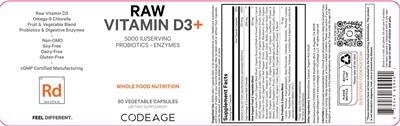
“Raw Vitamin D3 Omega-9 Chlorella Fruit & vegetable blend Probiotics & digestive enzymes”
“Raw Vitamin D3+ 5000 IU/serving Probiotics - enzymes Whole food nutrition”
- General statements
-
“Feel Different.”
“Please recycle bottle & cap Please take off the label Questions? Codeage.com Scan for info”
- FDA Statement of Identity
-
“Dietary Supplement”
- Directions
-
“Suggested use: Adults take 1 capsule daily, or as recommended by your healthcare practitioner, with 8 ounces of water or your favorite beverage. May be taken with or without food. Capsules may be opened, and contents may be added to water or juice.”
- Brand IP Statement(s)
-
“Copyright Codeage LLC. All rights reserved.”
- Storage
-
“Store in a cool, dry place.”
The Raw Vitamin D3+ Label on File
The label scan on file at the NIH Dietary Supplement Label Database, dated September 2025. Always read the label on the bottle you have.
Product Facts
- Brand
- Codeage
- Barcode (UPC)
- 850049609401
- Net contents
- 60 Vegetable Capsules
- Market status
- On market
- Date entered into DSLD
- Sep 25, 2025
- DSLD ID
- 333442
- Product type
- Other Combinations
- Supplement form
- Capsule
- Dietary claims / uses
- Nutrient, All Other, Structure/Function
- Intended target group(s)
- Adult (18 - 50 Years), Gluten Free, Dairy Free
Is this label outdated? Report a formula or label change and our pharmacy team will review it.
Raw Vitamin D3+ by Codeage Side Effects
Why this rating?
We look for three kinds of safety information on each ingredient: side effects reported in studies, a pregnancy and breastfeeding rating, and a safety write-up from our pharmacy team. Of the 29 ingredients we could check, 26 have side-effect reports, all 29 have a pregnancy rating and all 29 have a safety write-up.
So this rates how much is known, not whether Raw Vitamin D3+ is right for you.
Reported with 28 of its ingredients
- Most often
- Gas, stomach upset, bloating, heartburn, nausea and diarrhea
- !Rare but serious
- Severe allergic reaction, including anaphylaxis and hypocalcemia See details
HelloPharmacist Team Summary of Side Effects
Raw Vitamin D3+ is generally well tolerated in food amounts, and the side effects reported for its ingredients are mostly mild digestive ones.
- You are most likely to notice bloating or gas, which comes up with blueberry, and heartburn, which comes up with ginger and garlic.
- The rare but serious reaction to know about is an allergic reaction, including swelling of the face or throat or trouble breathing, and if that happens, call your doctor or seek emergency care right away.
- If you are pregnant, breastfeeding, or take any of the medications listed above, talk with your own doctor or pharmacist before starting.
Side Effects, Ingredient by Ingredient
A supplement’s side effects come from its ingredients. Here is what is reported with each one.
Chlorella
Most reported
- Nausea
- Gas
- Bloating
- Stomach cramps
Apple
Most reported
- Bloating
- Flatulence
From the Natural Medicines database, which we license.
Every reported effect, in the Apple guideBeet
Most reported
- Pink urine
- Sometimes red stools after eating beets
Tomato
Most reported
- Heartburn or acid reflux due to acidity
- Digestive upset with very large amounts
Strawberry
Most reported
- Allergic reactions
- Digestive upset
Sour Cherry
Most reported
- Abdominal pain
- Asthenia
- Gastrointestinal upset
- Loose stools
From the Natural Medicines database, which we license.
Every reported effect, in the Sour Cherry guideCapsicum
Most reported
- Burning
- Stinging
- Itching
- Redness at the application site
Ginger
Most reported
- Heartburn
- Stomach discomfort
- Gas
- Burping
Garlic
Most reported
- Bad breath
- Body odor
- Heartburn
- Upset stomach
Onion
Most reported
- Abdominal pain
- Heartburn
From the Natural Medicines database, which we license.
Every reported effect, in the Onion guideBlueberry
Most reported
- Gas
- Bloating
- Loose stools
Parsley
Most reported
- Stomach upset
- Increased urination
Cucumber
Most reported
- Mild bloating, gas, or burping
- Mouth or throat itching in those with related allergies
- Stomach upset from very bitter cucumbers
Celery
Most reported
- Stomach upset or digestive discomfort
- Increased urination
- Skin rash or sun sensitivity
Asparagus
Most reported
- Gas
- Bloating
- Stomach upset
Lipase
Most reported
- Nausea or stomach upset
- Cramping or abdominal discomfort
- Diarrhea or changes in bowel habits
- Bloating or gas
Proteolytic Enzymes (Proteases)
Most reported
- Nausea
- Stomach upset
- Diarrhea
- Bloating
Bromelain
Most reported
- Nausea or upset stomach
- Diarrhea
- Vomiting
Lactase
Most reported
- Stomach upset
- Cramps
Papain
Most reported
- Allergic reactions in sensitive individuals
From the Natural Medicines database, which we license.
Every reported effect, in the Papain guideVitamin D, Broccoli, Carrot, Spinach, Cabbage and Phytase have side-effect reports on file, but no list of the most common ones. Read them in each guide: Vitamin D, Broccoli, Carrot, Spinach, Cabbage, Phytase.
We have no side-effect reports on file for Cauliflower.
Raw Vitamin D3+ Warnings: Who Should Be Careful
Raw Vitamin D3+ has 40 active ingredients, and each can carry warnings of its own. We checked the 29 in our ingredient guides, and each warning below names the ingredient it comes from. Brussels Sprout, Raw, Raspberry, Raw and Aspergillopepsin, Raw and eight more are not in our guides yet, so ask your pharmacist about them. If any of these apply to you, talk to your doctor or pharmacist before you start it.
- Vitamin D2 warnings below
- Chlorella3 warnings below
- Apple2 warnings below
- Beet2 warnings below
- Broccoli3 warnings below
- Carrot2 warnings below
- Spinach1 warning below
- Tomato1 warning below
- Strawberry3 warnings below
- Sour Cherry3 warnings below
- Capsicum3 warnings below
- Blackberry2 warnings below
- Ginger2 warnings below
- Garlic3 warnings below
- Onion3 warnings below
- Blueberry2 warnings below
- Parsley2 warnings below
- Cauliflower3 warnings below
- Cabbage3 warnings below
- Kale3 warnings below
- Cucumber1 warning below
- Celery2 warnings below
- Asparagus3 warnings below
- Lipase3 warnings below
- Proteolytic Enzymes (Proteases)3 warnings below
- Bromelain3 warnings below
- Phytase2 warnings below
- Lactase3 warnings below
- Papain1 warning below
- Brussels Sprout, RawNot in our guides yet
- Raspberry, RawNot in our guides yet
- Aspergillopepsin, RawNot in our guides yet
- Beta-Glucanase, RawNot in our guides yet
- Cellulase, RawNot in our guides yet
- Peptidase, RawNot in our guides yet
- Pectinase, RawNot in our guides yet
- Hemicellulase, RawNot in our guides yet
- Xylanase, RawNot in our guides yet
- Lactobacillus bulgaricus, RawNot in our guides yet
- Lactobacillus plantarum, RawNot in our guides yet
-
Bleeding Problems or Surgery
- ChlorellaPeople who are sensitive to vitamin K changes (for example, those on blood thinners) should talk to a pharmacist first.
- GingerUse extra caution if you have a bleeding disorder or are scheduled for surgery, since ginger may slightly affect blood clotting.
- GarlicBecause garlic may slow blood clotting, use caution if you have a bleeding disorder or are scheduled for surgery.
- GarlicIf you are taking blood thinners or other medicines, check with your pharmacist before starting a garlic supplement.
Show 6 more
- OnionPeople scheduled for surgery may want to limit large medicinal doses beforehand because of possible effects on bleeding.
- BlueberryIf you have a medical condition or take medicine that affects blood sugar or blood clotting, talk with your pharmacist or doctor before using blueberry supplements.
- CauliflowerPeople who take blood thinners or who have been told to watch their vitamin K intake should keep their cauliflower consumption fairly steady from day to day, since cruciferous vegetables contain vitamin K.
- KalePeople who take certain blood thinners need to keep their vitamin K intake steady rather than suddenly eating much more or less (your pharmacist or doctor can guide you on this).
- Proteolytic Enzymes (Proteases)Use caution if you have a bleeding disorder, are scheduled for surgery, or have stomach ulcers, since enzymes may irritate the gut or affect clotting.
- BromelainBleeding risk: Bromelain may affect how the blood clots.
-
Diabetes or Low Blood Sugar
- Sour CherryPeople with diabetes should remember that cherry juice and concentrate can contain a lot of natural sugar.
-
Blood Pressure
- BeetPeople with low blood pressure should be aware that beets may lower it further.
-
Kidney Disease or Kidney Stones
- Vitamin DPeople with certain conditions should be careful, including those with high blood calcium, kidney disease, kidney stones, or sarcoidosis.
- BeetPeople with a history of kidney stones may want to be careful, because beets contain oxalates, which can contribute to certain types of stones.
- Sour CherryThose prone to kidney stones or who must watch potassium or oxalate intake may want to check with a healthcare provider.
- ParsleyPeople with kidney disease should be cautious because of parsley's potential diuretic effect and its content of oxalates, which may matter for those prone to kidney stones.
Show 5 more
- KaleKale also contains oxalates, which can contribute to kidney stones in people who are prone to them.
- CeleryKidney problems: Because of its diuretic effect and mineral content, people with kidney disease should talk to a doctor first.
- AsparagusBecause asparagus may have a mild diuretic effect, people with kidney problems or those on fluid-restricted diets should be cautious with large medicinal amounts and check with their doctor.
- AsparagusPeople prone to kidney stones may also want to be careful, since asparagus contains compounds called purines.
- LipaseIf you have gout or kidney problems, ask your doctor before using pancreatic enzymes, as they may affect uric acid levels.
-
Gallbladder Problems
- GingerPeople with gallstones should also check with a doctor, because ginger can increase the flow of bile.
-
Stomach or Bowel Problems
- CapsicumPeople with sensitive stomachs, acid reflux, ulcers, or irritable bowel symptoms may find that oral capsicum worsens their symptoms.
- GarlicPeople with stomach or digestive problems may find garlic irritating.
- CucumberPeople who are very sensitive to cucurbitacins may find some cucumbers taste bitter and can cause stomach upset.
- LipaseHowever, if you have a known digestive or pancreatic condition, you should use lipase only under the guidance of a doctor, since the type and dose matter a great deal.
- LactaseThe enzyme acts mostly in the digestive tract, so the risk is likely low, but to be safe you should check with your doctor or pharmacist before using it regularly.
-
Thyroid Conditions
- BroccoliPeople with thyroid problems may want to be mindful, since very large amounts of cruciferous vegetables contain compounds (goitrogens) that could affect the thyroid, especially if iodine intake is low.
- CauliflowerPeople with thyroid problems sometimes worry about cruciferous vegetables, but normal food amounts are generally fine; talk with your doctor if you have a thyroid condition and eat large quantities.
- CabbagePeople with thyroid conditions should be aware that large amounts of raw cruciferous vegetables contain goitrogens, substances that may affect thyroid function, especially if iodine intake is low.
- KaleKale is a goitrogenic vegetable, meaning very large amounts—especially raw—may affect thyroid function in people who are prone to thyroid problems or are low in iodine.
-
Autoimmune Conditions
- ChlorellaPeople with autoimmune conditions should be cautious, since chlorella may affect the immune system.
-
Allergies
- ChlorellaThose who are sensitive to iodine, mold, or who have a history of allergies should also be careful.
- ApplePeople with a known apple or birch pollen allergy should be careful, as apples can trigger oral allergy symptoms in sensitive individuals.
- CarrotPeople who are allergic to plants in the carrot family (such as celery, parsley, or mugwort pollen) may also react to carrots.
- StrawberryPeople with pollen allergies sometimes notice mouth itching when eating fresh strawberries.
Show 11 more
- StrawberryIf you have a known allergy to strawberries or other berries, avoid them.
- BlackberryPeople with known allergies to berries or to other plants in the rose family should be cautious.
- OnionPeople who are allergic to onion or other allium plants (like garlic) should avoid it.
- BlueberryPeople with allergies to blueberries or related berries should avoid them.
- AsparagusSome people are allergic to it and should avoid it.
- LipasePeople who are allergic to pork should be cautious with animal-derived (pancreatic) enzyme products, and may prefer fungal or plant-based versions.
- Proteolytic Enzymes (Proteases)People with allergies to pineapple, papaya, or pork should avoid the related enzymes, and those with latex allergy may react to papaya-based products.
- BromelainAllergies: People allergic to pineapple should avoid bromelain.
- PhytasePeople with known allergies to the source of the enzyme (for example, fungal or wheat-derived products) should be cautious.
- LactasePeople with a known allergy to molds, yeasts, or fungi should be careful, since the enzyme is often made from these sources.
- LactaseIf you have any allergy to the product ingredients, do not use it.
-
If You Take Other Drugs
- TomatoIf you have a medical condition or take medications, check with a healthcare professional before using supplements.
- CauliflowerAs always, check with a pharmacist or doctor before using concentrated cauliflower supplements, especially if you have a health condition or take medication.
- PhytaseIf you have a chronic health condition or take medication, check with a pharmacist or doctor first.
- PapainAlways talk with a pharmacist or doctor before starting papain, especially if you take other medicines or have a health condition.
-
Other Cautions
- Vitamin DIf you have any of these, talk to your doctor before supplementing.
- AppleSwallowing a few whole seeds by accident is generally harmless, but you should not chew or eat large amounts of apple seeds.
- BroccoliThe safety of concentrated extracts is not established, so caution is advised.
- SpinachConcentrated supplements and extracts are less studied, so use them with more caution and follow product labels.
Show 10 more
- StrawberryAlways talk to your pharmacist or doctor before starting any new supplement, especially if you have a health condition.
- Sour CherryTo be cautious, avoid supplement-strength products unless your doctor or pharmacist approves.
- CapsicumAvoid getting it in your eyes, nose, mouth, or on broken or irritated skin, and wash your hands well after use.
- CapsicumUse caution if you have these conditions.
- OnionConcentrated supplement doses have not been well studied, so it is safest to avoid them unless your doctor or pharmacist approves.
- CabbageConcentrated supplements or large medicinal doses have not been well studied, so it is best to avoid them unless your provider approves.
- CabbageChilled cabbage leaves are sometimes applied to the breasts for engorgement, but check with a lactation consultant or doctor first, since overuse has been reported to reduce milk supply in some cases.
- CeleryAlways check with your pharmacist or doctor before starting a celery supplement, especially if you have a medical condition.
- Proteolytic Enzymes (Proteases)Still, some people should be more careful.
- BromelainStill, some people should be careful.
-
What the Label Warns
- “Caution: Do not exceed recommended dose.”
- “Consult your physician prior to using this product if you are pregnant, nursing, taking medication, or have a medical condition.”
- “Please use caution if you have allergies or sensitivities to any of the listed ingredients.”
- “Not intended for those under the age of 18.”
- “Do not use if product has been opened or tampered with in any way.”
- “Keep out of reach of children and pets.”
The maker’s wording, from the product label.
-
Pregnant or Breastfeeding
Each ingredient’s rating for pregnancy and for breastfeeding, and what it covers.
Pregnancy
-
When used orally and appropriately.
Vitamin D is safe when used in doses below the tolerable upper intake level (UL) of 4000 IU (100 mcg) daily.
-
When used orally in excessive amounts.
Tell patients not to use doses above the tolerable upper intake level (UL) of 4000 IU (100 mcg) daily.
Hypercalcemia during pregnancy due to excessive vitamin D intake can lead to several fetal adverse effects, including suppression of parathyroid hormone, hypocalcemia, tetany, seizures, aortic valve stenosis, retinopathy, and mental and/or physical developmental delay.
Breastfeeding
-
When used orally and appropriately.
Vitamin D is safe when used in doses below the tolerable upper intake level (UL) of 4000 IU (100 mcg) daily.
-
When used orally in excessive amounts.
Tell patients not to use doses above the tolerable upper intake level (UL) of 4000 IU (100 mcg) daily.
Pregnancy
-
When used orally in medicinal amounts.
Parsley has been used orally as an abortifacient and to stimulate menstrual flow.
Population evidence suggests that maternal intake of An-Tai-Yin, an herbal combination product containing parsley and dong quai, during the first trimester increases the risk of congenital malformations of the musculoskeletal system, connective tissue, and eyes.
Breastfeeding
-
Insufficient reliable information available; avoid using.
Show 27 more ingredients
Pregnancy
-
When celery oil or seeds are used orally in larger amounts; celery might have uterine stimulant or abortifacient effects.
Breastfeeding
-
There is insufficient reliable information available about the safety of medicinal amounts of celery during lactation; avoid using.
Pregnancy
-
Beet as a food is fine, but concentrated supplements lack safety data, so use caution.
Breastfeeding
-
There is insufficient reliable information available about the safety of beets used medicinally during pregnancy and breast-feeding.
Pregnancy
-
When used orally and appropriately, short-term.
Capsicum 5 mg daily has been used for up to 28 days during the latter half of the second trimester and the third trimester.
1 more rating for Capsicum used another way
This supplement is taken by mouth. This rating is for Capsicum given another way.
-
When used topically and appropriately.
Breastfeeding
-
When used orally.
Dermatitis can sometimes occur in infants when foods heavily spiced with capsicum peppers are ingested during lactation.
Also, observational research suggests that intake of raw capsicum peppers during pregnancy is associated with an increased risk of sensitization to inhalant allergens in children by the age of 2 years.
1 more rating for Capsicum used another way
This supplement is taken by mouth. This rating is for Capsicum given another way.
-
When used topically and appropriately.
Pregnancy
-
When used orally in amounts commonly found in foods.
-
When used orally in medicinal amounts.
Garlic is reported to have abortifacient activity.
4 more points on this rating
- One study also suggests that garlic constituents are distributed to the amniotic fluid after a single dose of garlic.
- However, there are no published reports of garlic adversely affecting pregnancy.
- In clinical research, garlic 800 mg daily was used during the third trimester of pregnancy with no reported adverse outcomes.
- There is insufficient reliable information available about the safety of topical garlic during pregnancy.
Breastfeeding
-
When used orally in amounts commonly found in foods.
-
When used orally in amounts greater than those found in foods.
Several small studies suggest that garlic constituents are secreted in breast milk, and that nursing infants of mothers consuming garlic are prone to extended nursing.
There is insufficient reliable information available about the safety of topical garlic during lactation.
Pregnancy
-
When used in amounts commonly found in foods.
-
When used in larger amounts for medicinal purposes.
Asparagus extracts may have contraceptive effects; avoid using.
Breastfeeding
-
When used in amounts commonly found in foods.
There is insufficient reliable information available about the safety of asparagus when used in medicinal amounts during lactation.
Pregnancy
-
When used orally.
There is some concern that crude papain is teratogenic and embryotoxic.
Breastfeeding
-
Insufficient reliable information available; avoid using.
Pregnancy
-
When used orally and appropriately in medicinal amounts for up to approximately 28 weeks.
A commercially available chlorella supplement (Sun Chlorella A, Sun Chlorella Corp.) has been safely used in doses of 6 grams daily, starting during the 12-18th week of gestation and continuing until delivery.
Breastfeeding
-
Insufficient reliable information available; avoid using.
Pregnancy and Breastfeeding The record rates both the same
-
There is insufficient reliable information available about the safety of apple in amounts greater than those found in foods during pregnancy and lactation; avoid using.
Pregnancy and Breastfeeding The record rates both the same
-
Insufficient reliable information available; avoid using in amounts greater than those found in foods.
Pregnancy and Breastfeeding The record rates both the same
-
Insufficient reliable information available; avoid using in amounts greater than used in foods.
Pregnancy and Breastfeeding The record rates both the same
-
Insufficient reliable information available; avoid using in greater amounts than found in foods.
Pregnancy
-
There is insufficient reliable information available about using cabbage in medicinal amounts during pregnancy; avoid using.
Breastfeeding
-
When used topically and appropriately, short-term.
Significant adverse effects have not been reported in short-term studies.
There is insufficient reliable information available about using cabbage orally in medicinal amounts during lactation; avoid using.
Pregnancy and Breastfeeding The record rates both the same
-
There is insufficient reliable information available about the safety of cucumber in amounts greater than those found in foods; avoid using.
Pregnancy and Breastfeeding The record rates both the same
-
Insufficient reliable information available; avoid using.
Proteolytic Enzymes (Proteases)
Pregnancy and Breastfeeding The record rates both the same
-
Insufficient reliable information available; avoid using.
Pregnancy and Breastfeeding The record rates both the same
-
Insufficient reliable information available; avoid using.
Pregnancy and Breastfeeding The record rates both the same
-
Insufficient reliable information is available; avoid using.
Pregnancy and Breastfeeding The record rates both the same
-
When used orally in food amounts.
There is insufficient reliable information available about the safety of broccoli when used in medicinal amounts during pregnancy and lactation; avoid using.
Pregnancy and Breastfeeding The record rates both the same
-
When used orally in amounts commonly found in food.
Carrot essential oil, extracts, and food additives have Generally Recognized as Safe (GRAS) status in the US.
There is insufficient reliable information available about the safety of carrot when used in medicinal amounts during pregnancy and lactation.
Pregnancy and Breastfeeding The record rates both the same
-
When used in amounts commonly found in foods; avoid medicinal amounts.
Pregnancy and Breastfeeding The record rates both the same
-
When the tomato fruit or its products are consumed in typical food amounts.
There is insufficient reliable information available about the safety of tomato extracts when used during pregnancy or lactation; avoid using.
Pregnancy and Breastfeeding The record rates both the same
-
When used orally in food amounts.
There is insufficient reliable information available about the safety of strawberry for medicinal use in pregnancy and lactation; avoid using.
Pregnancy and Breastfeeding The record rates both the same
-
When the fruit is consumed in typical food amounts.
There is insufficient reliable information available about the safety of tart cherry fruit or stem when used in medicinal amounts; avoid using.
Pregnancy
-
When consumed in the amounts typically found in foods.
Ginger is considered a first-line nonpharmacological treatment option for nausea in pregnancy by the American College of Obstetrics and Gynecology (ACOG).
However, it should not be used long-term or without medical supervision and close monitoring.
-
When used for medicinal purposes.
Despite some early reports of adverse effects and one observational study suggesting that taking dried ginger and other herbal supplements during the first 20 weeks of pregnancy marginally increased the chance of stillbirth, most research shows that ginger is unlikely to cause harm to the baby.
3 more points on this rating
- The risk for major malformations in infants of parents who took ginger when pregnant does not appear to be higher than the baseline rate of 1% to 3%.
- Also, other research suggests that ginger intake during various trimesters does not significantly affect the risk of spontaneous abortion, congenital malformations, stillbirth, perinatal death, preterm birth, low birth weight, or low Apgar scores.
- Ginger use has been associated with an increase in non-severe vaginal bleeding, including spotting, after week 17 of pregnancy.
Breastfeeding
-
When consumed in the amounts typically found in foods.
There is insufficient reliable information available about the safety of ginger when used for medicinal purposes; avoid amounts greater than those found in foods.
Pregnancy and Breastfeeding The record rates both the same
-
When used orally in amounts commonly found in foods.
There is insufficient reliable information available about the safety of blueberry for medicinal use; avoid using.
Pregnancy and Breastfeeding The record rates both the same
-
When used orally in amounts commonly found in foods.
There is insufficient reliable information available about the safety of kale when used orally in medicinal amounts; avoid use.
Pregnancy and Breastfeeding The record rates both the same
-
When used orally and appropriately with lactose-containing foods.
Our pharmacy team’s notes
- Vitamin DIts lactation rating is likely safe.
- Parsley and celery are each rated likely unsafe in pregnancy, so the safety data advises against those ingredients during pregnancy.
Ratings and the words beside them are from the Natural Medicines database, which we license. Where it has no rating, the rating and note are our pharmacy team’s.
-
Rare but Serious Side Effects
-
!
Vitamin D
In severe cases, very high calcium can harm the kidneys and heart.
Orally or intramuscularly: Excessive doses can lead to vitamin D toxicity with symptoms of hypercalcemia, and also sometimes azotemia and anemia.
-
!
Chlorella
Some people may have allergic reactions, including skin rash or, rarely, more serious breathing problems.
Orally: Anaphylaxis.
-
!
Apple
Serious allergic reactions are rare but possible.
Orally: Allergic reactions, including anaphylaxis. Ingestion of large amounts of apple seeds may cause cyanide poisoning, leading to death.
-
!
Beet
Orally: Hypocalcemia and kidney damage when ingested in large amounts.
-
!
Broccoli
Allergic reactions to broccoli are uncommon but possible.
-
!
Carrot
Some people may have an allergic reaction, especially those sensitive to related plants or certain pollens.
-
!
Spinach
Orally: In infants under 4 months of age, methemoglobinemia has been reported.
Allergies in sensitive individuals.
-
!
Tomato
Orally: Bradycardia, diarrhea, respiratory disturbances, spasms, vomiting, and death with excessive consumption of tomatine, a glycoalkaloid found in tomato leaves and unripe green tomatoes.
-
!
Strawberry
Possible issues include allergic reactions (itching, hives, swelling), mild digestive upset, or mouth tingling in sensitive people.
Orally: Allergic reactions in susceptible individuals.
-
!
Sour Cherry
Allergic reactions are uncommon but possible in people sensitive to fruits in the rose (Rosaceae) family.
-
!
Capsicum
Rarely, severe irritation, allergic reactions, or breathing problems from inhaling the powder can occur.
Orally: Cases of myocardial infarction and hypertensive crisis have been reported.
-
!
Blackberry
Allergic reactions are uncommon but possible.
-
!
Ginger
Rarely, some people may have an allergic reaction.
-
!
Garlic
Some people develop skin irritation or a rash when handling raw garlic, and allergic reactions are possible.
Orally: Some case reports raise concerns about increased risk of bleeding with garlic.
-
!
Onion
True onion allergy is uncommon but possible, and serious allergic reactions are rare.
Anaphylaxis in sensitive individuals.
-
!
Blueberry
Allergic reactions are uncommon but possible.
-
!
Parsley
Some people can have allergic reactions, and parsley may make the skin more sensitive to sunlight (photosensitivity), leading to rashes after sun exposure.
Orally, Hallucinations, hemolytic anemia, hypotension, hepatic impairment, kidney impairment, nephrotic syndrome, paralysis, and thrombocytopenia purpura when taken in very high doses (200 grams parsley oil or 10 grams or more of parsley's apiole or myristicin constituents).
-
!
Cabbage
Allergic reactions to cabbage are uncommon but possible.
-
!
Kale
Allergic reactions are rare.
-
!
Cucumber
Serious reactions are uncommon.
Orally: Anaphylaxis.
-
!
Celery
Seek emergency care if you have signs of a serious allergic reaction, such as swelling of the face or throat, or difficulty breathing.
Orally: Anaphylaxis in sensitive individuals.
-
!
Asparagus
Allergic reactions can occur in sensitive people and may include itching, hives, or in rare cases more serious symptoms.
-
!
Lipase
Rarely, people may have an allergic reaction, especially to animal-derived products.
Orally: Gastrointestinal adverse effects, such as necrotizing enterocolitis, when recombinant human bile salt-stimulated lipase is used in premature infants.
-
!
Proteolytic Enzymes (Proteases)
Allergic reactions can happen, especially in people sensitive to pineapple, papaya, or animal-source products.
-
!
Bromelain
Less commonly, people may notice changes in heart rate or, rarely, allergic reactions.
-
!
Phytase
Allergic reactions are possible, especially in people sensitive to the source the enzyme is made from (such as fungal or grain-derived material).
-
!
Lactase
Allergic reactions are rare but possible, since the enzyme comes from yeast or fungi.
-
!
Papain
Allergic reactions are possible, particularly in people sensitive to papaya or latex.
Orally: Esophageal perforation and severe gastritis with high doses.
When to get help: a serious allergic reaction, with trouble breathing or swelling of the face, lips or throat, needs emergency care: call 911. For any other side effect that worries you, call your doctor or pharmacist.
These reports describe each ingredient, not studies of this exact product. Not medical advice: a side effect you notice after starting a supplement is worth a word with your pharmacist or doctor.
Raw Vitamin D3+ by Codeage Drug Interactions
We checked all 40 active ingredients in this supplement against every drug in our records. A drug can interact with it through any one of them. Eleven of them are not in our interaction records yet.
A major interaction on record
3 of 3, on a scale from Minor or none to Major.Why this rating?
We rate this by the most serious interaction on record, not by how many there are. For Papain, Cabbage, Asparagus, Apple and Garlic, the most serious is rated major, which means the combination is best avoided, or used only under close supervision. Some involve kinds of drugs where a small change can matter, such as blood thinners, transplant drugs and diabetes drugs.
1,299 drugs are on the full list. What matters is whether one you take is on it, so check yours with the interaction checker on this page.
20 of its 40 active ingredients have drug interactions on record. The ones below matter most.
- Interacts with
- 717 drugs
- Most serious
- Moderate
- Vitamin D can raise calcium levels, which matters with thiazide diuretics (water pills), verapamil, diltiazem, and digoxin, and it may lower atorvastatin levels.
- Interacts with
- 300 drugs
- Most serious
- Major
- The most serious interaction is a Major one from apple, though our data for it concerns apple juice.
- Apple can sharply lower absorption of drugs cleared by OATP transporters, such as fexofenadine (an antihistamine) and atenolol (a blood pressure drug), so those drugs may work less well.
- Interacts with
- 1,008 drugs
- Most serious
- Moderate
- Most of its records involve Cytochrome P450 3A4 (CYP3A4) Substrates, P-glycoprotein Substrates and Cytochrome P450 1A2 (CYP1A2) Substrates.
Show three more ingredients
- Interacts with
- 991 drugs
- Most serious
- Moderate
- Most of its records involve Cytochrome P450 3A4 (CYP3A4) Substrates, Antihypertensive Drugs and Anticoagulant/Antiplatelet Drugs.
- Interacts with
- 863 drugs
- Most serious
- Moderate
- Most of its records involve Cytochrome P450 3A4 (CYP3A4) Substrates, Cytochrome P450 1A2 (CYP1A2) Substrates and Antihypertensive Drugs.
- Interacts with
- 651 drugs
- Most serious
- Moderate
- Most of its records involve Photosensitizing Drugs, Cytochrome P450 1A2 (CYP1A2) Substrates and Antihypertensive Drugs.
And 14 more ingredients with records, each in the cards below.
From the HelloPharmacist Team
What matters most when you look at everything in the bottle at once.
- Raw Vitamin D3+ by Codeage can interact with medications, through its vitamin D and several fruit and vegetable ingredients: apple, beet, broccoli, spinach, strawberry, green bell pepper, blueberry, ginger, garlic, green onion, parsley, cauliflower, red cabbage, cucumber, and celery.
- Moderate interactions cover most of the rest.
- Blood thinners (anticoagulants and antiplatelet drugs, including warfarin) may increase bleeding risk, and antidiabetes drugs may push blood sugar too low (hypoglycemia).
Summarized by the HelloPharmacist pharmacy team from the interaction records below. How it is written How we use AI
Why Raw Vitamin D3+ Interacts, Ingredient by Ingredient
A product interacts through its ingredients. Each card: how many drugs, the most serious rating, and the kinds of drugs it affects most (tap a kind for what it means).
The ingredients driving the most interactions
-
Ginger, Raw 1,008 drugs
Most serious: Moderate14 interaction records on file
The kinds of drugs it affects most
- 645 drugs
- 202 drugs
- 186 drugs
- 122 drugs
Every Ginger drug interaction, 14 records The Ginger records cite 65 references, listed in the Ginger guide.
-
Garlic, Raw 991 drugs
Most serious: Moderate12 interaction records on file
The kinds of drugs it affects most
- 645 drugs
- 172 drugs
- 122 drugs
- 86 drugs
Every Garlic drug interaction, 12 records The Garlic records cite 154 references, listed in the Garlic guide.
-
Beet, Raw 863 drugs
Most serious: Moderate3 interaction records on file
The kinds of drugs it affects most
- 645 drugs
- 186 drugs
- 172 drugs
Every Beet drug interaction, 3 records The Beet records cite 11 references, listed in the Beet guide.
-
Vitamin D 717 drugs
Most serious: Moderate8 interaction records on file
The kinds of drugs it affects most
- 645 drugs
- 56 drugs
- Aluminum 14 drugs
- Atorvastatin (Lipitor) 3 drugs
Every Vitamin D drug interaction, 8 records The Vitamin D records cite 25 references, listed in the Vitamin D guide.
-
Celery, Raw 651 drugs
Most serious: Moderate8 interaction records on file
The kinds of drugs it affects most
- 335 drugs
- 186 drugs
- 172 drugs
- 122 drugs
Every Celery drug interaction, 8 records The Celery records cite 48 references, listed in the Celery guide.
-
Parsley, Raw 443 drugs
Most serious: Moderate8 interaction records on file
The kinds of drugs it affects most
- 186 drugs
- 122 drugs
- 86 drugs
- 75 drugs
Every Parsley drug interaction, 8 records The Parsley records cite 21 references, listed in the Parsley guide.
-
Chlorella 337 drugs
Most serious: Moderate2 interaction records on file
The kinds of drugs it affects most
- 335 drugs
- 2 drugs
Every Chlorella drug interaction, 2 records The Chlorella records cite 13 references, listed in the Chlorella guide.
-
Red Cabbage, Raw 325 drugs
Most serious: Moderate6 interaction records on file
The kinds of drugs it affects most
- 186 drugs
- 124 drugs
- 86 drugs
- 69 drugs
Every Cabbage drug interaction, 6 records The Cabbage records cite 15 references, listed in the Cabbage guide.
-
Strawberry, Raw 317 drugs
Most serious: Moderate2 interaction records on file
The kinds of drugs it affects most
- 202 drugs
- 122 drugs
Every Strawberry drug interaction, 2 records The Strawberry records cite 11 references, listed in the Strawberry guide.
-
Apple, Raw 300 drugs
Most serious: Major7 interaction records on file
The kinds of drugs it affects most
- 172 drugs
- 86 drugs
- 47 drugs
- Atenolol (Tenormin) 3 drugs
Every Apple drug interaction, 7 records The Apple records cite 16 references, listed in the Apple guide.
-
Green Onion, Raw 275 drugs
Most serious: Moderate5 interaction records on file
The kinds of drugs it affects most
- 122 drugs
- 86 drugs
- 70 drugs
- 35 drugs
Every Onion drug interaction, 5 records The Onion records cite 26 references, listed in the Onion guide.
-
Green Bell Pepper, Raw 239 drugs
Most serious: Moderate6 interaction records on file
The kinds of drugs it affects most
- 122 drugs
- 86 drugs
- 35 drugs
- 23 drugs
Every Capsicum drug interaction, 6 records The Capsicum records cite 89 references, listed in the Capsicum guide.
-
Broccoli, Raw 187 drugs
Most serious: Moderate2 interaction records on file
The kinds of drugs it affects most
- 186 drugs
- 1 drug
Every Broccoli drug interaction, 2 records The Broccoli records cite 5 references, listed in the Broccoli guide.
-
Cauliflower, Raw 186 drugs
Most serious: Moderate1 interaction record on file
The kinds of drugs it affects most
- 186 drugs
Every Cauliflower drug interaction, 1 record The Cauliflower records cite 9 references, listed in the Cauliflower guide.
-
Bromelain, Raw 141 drugs
Most serious: Moderate2 interaction records on file
The kinds of drugs it affects most
- 122 drugs
- 20 drugs
Every Bromelain drug interaction, 2 records The Bromelain records cite 19 references, listed in the Bromelain guide.
-
Spinach, Raw 88 drugs
Most serious: Moderate2 interaction records on file
The kinds of drugs it affects most
- 86 drugs
- 2 drugs
Every Spinach drug interaction, 2 records The Spinach records cite 6 references, listed in the Spinach guide.
-
Blueberry, Raw 88 drugs
Most serious: Minor3 interaction records on file
The kinds of drugs it affects most
- 86 drugs
- Buspirone (BuSpar) 1 drug
- Flurbiprofen (Ansaid, others) 1 drug
Every Blueberry drug interaction, 3 records The Blueberry records cite 7 references, listed in the Blueberry guide.
-
Cucumber, Raw 86 drugs
Most serious: Moderate1 interaction record on file
The kinds of drugs it affects most
- 86 drugs
Every Cucumber drug interaction, 1 record The Cucumber records cite 4 references, listed in the Cucumber guide.
-
Asparagus, Raw 76 drugs
Most serious: Moderate2 interaction records on file
The kinds of drugs it affects most
- 75 drugs
- 1 drug
Every Asparagus drug interaction, 2 records The Asparagus records cite 14 references, listed in the Asparagus guide.
-
Papain, Raw 2 drugs
Most serious: Moderate1 interaction record on file
The kinds of drugs it affects most
- 2 drugs
Every Papain drug interaction, 1 record The Papain records cite 11 references, listed in the Papain guide.
The Breakdown by Severity
Each drug counted once, at its most serious rating. Tap a tile to list those drugs.
Find Your Drug
Type a drug or brand name to see whether it is on the list.
- Only drugs with a documented interaction are listed, the most serious first.
- A drug with no known interaction is not listed, but searching its name tells you so.
- Open a drug to see which ingredient is responsible. Of those, 862 are single drugs and 436 are combination products (two or more drugs in one), each listed under its own name.
-
AtorvastatinAtorvaliq Major
The 6 ingredients responsible:
-
Apple, Raw Major Atorvastatin is in the Organic Anion-transporting Polypeptide Substrates (OATP) category.
Concomitant consumption of apple juice can significantly decrease oral absorption and blood levels of OATP substrates.
The full Apple, Raw + Atorvastatin interaction -
Garlic, Raw Moderate Atorvastatin is in the Cytochrome P450 3A4 (CYP3A4) Substrates category.
Theoretically, garlic products containing allicin might induce intestinal CYP3A4 and inhibit hepatic CYP3A4.
The full Garlic, Raw + Atorvastatin interaction -
Beet, Raw Moderate Atorvastatin is in the Cytochrome P450 3A4 (CYP3A4) Substrates category.
Theoretically, beet might increase the levels of CYP3A4 substrates.
The full Beet, Raw + Atorvastatin interaction -
Vitamin D Moderate Atorvastatin is in the Cytochrome P450 3A4 (CYP3A4) Substrates category.
Vitamin D might induce CYP3A4 enzymes and reduce the bioavailability of CYP3A4 substrates.
The full Vitamin D + Atorvastatin interaction -
Ginger, Raw Moderate Atorvastatin is in the Cytochrome P450 3A4 (CYP3A4) Substrates category.
Ginger might increase or decrease the levels of CYP3A4 substrates.
The full Ginger, Raw + Atorvastatin interaction -
Red Cabbage, Raw Moderate Atorvastatin is in the Glucuronidated Drugs category.
Theoretically, cabbage might increase clearance and decrease the effects of drugs metabolized through glucuronide conjugation.
The full Red Cabbage, Raw + Atorvastatin interaction
-
-
MethotrexateOtrexup, Rasuvo, Reditrex, Rheumatrex Major
The ingredient responsible:
-
Apple, Raw Major Methotrexate is in the Organic Anion-transporting Polypeptide Substrates (OATP) category.
Concomitant consumption of apple juice can significantly decrease oral absorption and blood levels of OATP substrates.
The full Apple, Raw + Methotrexate interaction
-
-
CiprofloxacinCiloxan, Cipro, Cipro IV, Cipro XR, Ciprobay and 1 more Major
The 4 ingredients responsible:
-
Apple, Raw Major Ciprofloxacin is in the Organic Anion-transporting Polypeptide Substrates (OATP) category.
Concomitant consumption of apple juice can significantly decrease oral absorption and blood levels of OATP substrates.
The full Apple, Raw + Ciprofloxacin interaction -
Chlorella Moderate Ciprofloxacin is in the Photosensitizing Drugs category.
Theoretically, chlorella might have additive effects with photosensitizing drugs.
The full Chlorella + Ciprofloxacin interaction -
Celery, Raw Minor Ciprofloxacin is in the Photosensitizing Drugs category.
Theoretically, celery might increase the risk of photosensitivity reactions when taken with photosensitizing drugs.
The full Celery, Raw + Ciprofloxacin interaction -
Green Bell Pepper, Raw Minor
Theoretically, taking capsicum with ciprofloxacin might increase levels and adverse effects of ciprofloxacin.
The full Green Bell Pepper, Raw + Ciprofloxacin interaction
-
-
Atorvastatin CalciumLipitor Major
The 6 ingredients responsible:
-
Apple, Raw Major Atorvastatin Calcium is in the Organic Anion-transporting Polypeptide Substrates (OATP) category.
Concomitant consumption of apple juice can significantly decrease oral absorption and blood levels of OATP substrates.
The full Apple, Raw + Atorvastatin Calcium interaction -
Red Cabbage, Raw Moderate Atorvastatin Calcium is in the Glucuronidated Drugs category.
Theoretically, cabbage might increase clearance and decrease the effects of drugs metabolized through glucuronide conjugation.
The full Red Cabbage, Raw + Atorvastatin Calcium interaction -
Garlic, Raw Moderate Atorvastatin Calcium is in the Cytochrome P450 3A4 (CYP3A4) Substrates category.
Theoretically, garlic products containing allicin might induce intestinal CYP3A4 and inhibit hepatic CYP3A4.
The full Garlic, Raw + Atorvastatin Calcium interaction -
Beet, Raw Moderate Atorvastatin Calcium is in the Cytochrome P450 3A4 (CYP3A4) Substrates category.
Theoretically, beet might increase the levels of CYP3A4 substrates.
The full Beet, Raw + Atorvastatin Calcium interaction -
Ginger, Raw Moderate Atorvastatin Calcium is in the Cytochrome P450 3A4 (CYP3A4) Substrates category.
Ginger might increase or decrease the levels of CYP3A4 substrates.
The full Ginger, Raw + Atorvastatin Calcium interaction -
Vitamin D Moderate Atorvastatin Calcium is in the Cytochrome P450 3A4 (CYP3A4) Substrates category.
Vitamin D might reduce absorption of atorvastatin.
The full Vitamin D + Atorvastatin Calcium interaction
-
-
SimvastatinZocor Major
The 6 ingredients responsible:
-
Apple, Raw Major Simvastatin is in the Organic Anion-transporting Polypeptide Substrates (OATP) category.
Concomitant consumption of apple juice can significantly decrease oral absorption and blood levels of OATP substrates.
The full Apple, Raw + Simvastatin interaction -
Beet, Raw Moderate Simvastatin is in the Cytochrome P450 3A4 (CYP3A4) Substrates category.
Theoretically, beet might increase the levels of CYP3A4 substrates.
The full Beet, Raw + Simvastatin interaction -
Garlic, Raw Moderate Simvastatin is in the Cytochrome P450 3A4 (CYP3A4) Substrates category.
Theoretically, garlic products containing allicin might induce intestinal CYP3A4 and inhibit hepatic CYP3A4.
The full Garlic, Raw + Simvastatin interaction -
Red Cabbage, Raw Moderate Simvastatin is in the Glucuronidated Drugs category.
Theoretically, cabbage might increase clearance and decrease the effects of drugs metabolized through glucuronide conjugation.
The full Red Cabbage, Raw + Simvastatin interaction -
Ginger, Raw Moderate Simvastatin is in the Cytochrome P450 3A4 (CYP3A4) Substrates category.
Ginger might increase or decrease the levels of CYP3A4 substrates.
The full Ginger, Raw + Simvastatin interaction -
Vitamin D Minor Simvastatin is in the Cytochrome P450 3A4 (CYP3A4) Substrates category.
Vitamin D might induce CYP3A4 enzymes and reduce the bioavailability of CYP3A4 substrates.
The full Vitamin D + Simvastatin interaction
-
-
Methotrexate SodiumXatmep Major
The ingredient responsible:
-
Apple, Raw Major Methotrexate Sodium is in the Organic Anion-transporting Polypeptide Substrates (OATP) category.
Concomitant consumption of apple juice can significantly decrease oral absorption and blood levels of OATP substrates.
The full Apple, Raw + Methotrexate Sodium interaction
-
-
GlyburideAlbert Glyburide, Diabeta, Glycron, Glynase, Glynase PresTab and 2 more Major
The 12 ingredients responsible:
-
Apple, Raw Major Glyburide is in these Antidiabetes Drugs, Organic Anion-transporting Polypeptide Substrates (OATP) categories.
Theoretically, consuming apple juice with antidiabetes drugs might interfere with blood glucose control.
The full Apple, Raw + Glyburide interaction -
Red Cabbage, Raw Moderate Glyburide is in the Antidiabetes Drugs category.
Theoretically, cabbage might increase the risk of hypoglycemia when taken with antidiabetes drugs.
The full Red Cabbage, Raw + Glyburide interaction -
Garlic, Raw Moderate Glyburide is in the Antidiabetes Drugs category.
Theoretically, taking garlic with antidiabetes drugs might increase the risk of hypoglycemia.
The full Garlic, Raw + Glyburide interaction -
Cucumber, Raw Moderate Glyburide is in the Antidiabetes Drugs category.
Theoretically, cucumber seed might have additive effects with antidiabetes drugs and may increase the risk of hypoglycemia.
The full Cucumber, Raw + Glyburide interaction -
Chlorella Moderate Glyburide is in the Photosensitizing Drugs category.
Theoretically, chlorella might have additive effects with photosensitizing drugs.
The full Chlorella + Glyburide interaction -
Ginger, Raw Moderate Glyburide is in these Antidiabetes Drugs, Cytochrome P450 2C9 (CYP2C9) Substrates categories.
Theoretically, taking ginger with antidiabetes drugs might increase the risk of hypoglycemia.
The full Ginger, Raw + Glyburide interaction -
Green Bell Pepper, Raw Moderate Glyburide is in the Antidiabetes Drugs category.
Theoretically, taking capsicum with antidiabetes drugs might increase the risk of hypoglycemia.
The full Green Bell Pepper, Raw + Glyburide interaction -
Spinach, Raw Moderate Glyburide is in the Antidiabetes Drugs category.
There are claims that spinach leaves have hypoglycemic effects.
The full Spinach, Raw + Glyburide interaction
And through 4 more ingredients, each with its own page:
- Green Onion, Raw Moderate
- Parsley, Raw Moderate
- Blueberry, Raw Minor
- Celery, Raw Minor
-
-
Simvastatin/ezetimibeVytorin Major
The 6 ingredients responsible:
-
Apple, Raw Major Simvastatin/ezetimibe is in the Organic Anion-transporting Polypeptide Substrates (OATP) category.
Concomitant consumption of apple juice can significantly decrease oral absorption and blood levels of OATP substrates.
The full Apple, Raw + Simvastatin/ezetimibe interaction -
Ginger, Raw Moderate Simvastatin/ezetimibe is in the Cytochrome P450 3A4 (CYP3A4) Substrates category.
Ginger might increase or decrease the levels of CYP3A4 substrates.
The full Ginger, Raw + Simvastatin/ezetimibe interaction -
Red Cabbage, Raw Moderate Simvastatin/ezetimibe is in the Glucuronidated Drugs category.
Theoretically, cabbage might increase clearance and decrease the effects of drugs metabolized through glucuronide conjugation.
The full Red Cabbage, Raw + Simvastatin/ezetimibe interaction -
Garlic, Raw Moderate Simvastatin/ezetimibe is in the Cytochrome P450 3A4 (CYP3A4) Substrates category.
Theoretically, garlic products containing allicin might induce intestinal CYP3A4 and inhibit hepatic CYP3A4.
The full Garlic, Raw + Simvastatin/ezetimibe interaction -
Beet, Raw Moderate Simvastatin/ezetimibe is in the Cytochrome P450 3A4 (CYP3A4) Substrates category.
Theoretically, beet might increase the levels of CYP3A4 substrates.
The full Beet, Raw + Simvastatin/ezetimibe interaction -
Vitamin D Minor Simvastatin/ezetimibe is in the Cytochrome P450 3A4 (CYP3A4) Substrates category.
Vitamin D might induce CYP3A4 enzymes and reduce the bioavailability of CYP3A4 substrates.
The full Vitamin D + Simvastatin/ezetimibe interaction
-
-
LevofloxacinLeva-pak, Levaquin, Levaquin Injection Major
The 3 ingredients responsible:
-
Apple, Raw Major Levofloxacin is in the Organic Anion-transporting Polypeptide Substrates (OATP) category.
Concomitant consumption of apple juice can significantly decrease oral absorption and blood levels of OATP substrates.
The full Apple, Raw + Levofloxacin interaction -
Chlorella Moderate Levofloxacin is in the Photosensitizing Drugs category.
Theoretically, chlorella might have additive effects with photosensitizing drugs.
The full Chlorella + Levofloxacin interaction -
Celery, Raw Minor Levofloxacin is in the Photosensitizing Drugs category.
Theoretically, celery might increase the risk of photosensitivity reactions when taken with photosensitizing drugs.
The full Celery, Raw + Levofloxacin interaction
-
-
FexofenadineAllegra Major
The 6 ingredients responsible:
-
Apple, Raw Major Fexofenadine is in the Organic Anion-transporting Polypeptide Substrates (OATP) category.
Concomitant consumption of apple juice can significantly decrease oral absorption and blood levels of OATP substrates.
The full Apple, Raw + Fexofenadine interaction -
Ginger, Raw Moderate Fexofenadine is in these P-glycoprotein Substrates, Cytochrome P450 3A4 (CYP3A4) Substrates categories.
Ginger might increase the absorption and blood levels of P-glycoprotein (P-gp) substrates.
The full Ginger, Raw + Fexofenadine interaction -
Strawberry, Raw Moderate Fexofenadine is in the P-glycoprotein Substrates category.
Theoretically, strawberry might increase levels of p-glycoprotein substrates.
The full Strawberry, Raw + Fexofenadine interaction -
Beet, Raw Moderate Fexofenadine is in the Cytochrome P450 3A4 (CYP3A4) Substrates category.
Theoretically, beet might increase the levels of CYP3A4 substrates.
The full Beet, Raw + Fexofenadine interaction -
Garlic, Raw Moderate Fexofenadine is in the Cytochrome P450 3A4 (CYP3A4) Substrates category.
Theoretically, garlic products containing allicin might induce intestinal CYP3A4 and inhibit hepatic CYP3A4.
The full Garlic, Raw + Fexofenadine interaction -
Vitamin D Minor Fexofenadine is in the Cytochrome P450 3A4 (CYP3A4) Substrates category.
Vitamin D might induce CYP3A4 enzymes and reduce the bioavailability of CYP3A4 substrates.
The full Vitamin D + Fexofenadine interaction
-
-
TorsemideDemadex, Soaanz Major
The 7 ingredients responsible:
-
Apple, Raw Major Torsemide is in these Organic Anion-transporting Polypeptide Substrates (OATP), Antihypertensive Drugs categories.
Concomitant consumption of apple juice can significantly decrease oral absorption and blood levels of OATP substrates.
The full Apple, Raw + Torsemide interaction -
Garlic, Raw Moderate Torsemide is in the Antihypertensive Drugs category.
Theoretically, taking garlic with antihypertensive drugs might increase the risk of hypotension.
The full Garlic, Raw + Torsemide interaction -
Asparagus, Raw Moderate Torsemide is in the Diuretic Drugs category.
Theoretically, asparagus root might increase diuresis and electrolyte loss when used with diuretic drugs.
The full Asparagus, Raw + Torsemide interaction -
Celery, Raw Moderate Torsemide is in the Antihypertensive Drugs category.
Theoretically, celery seed extract might have additive effects with antihypertensive drugs.
The full Celery, Raw + Torsemide interaction -
Parsley, Raw Moderate Torsemide is in the Diuretic Drugs category.
Theoretically, parsley might enhance or interfere with the effects of diuretic drugs.
The full Parsley, Raw + Torsemide interaction -
Beet, Raw Minor Torsemide is in the Antihypertensive Drugs category.
Beet and beetroot contain nitrates, which can cause vasodilation, potentially leading to lower blood pressure.
The full Beet, Raw + Torsemide interaction -
Ginger, Raw Minor Torsemide is in the Cytochrome P450 2C9 (CYP2C9) Substrates category.
Theoretically, ginger might increase the levels of CYP2C9 substrates.
The full Ginger, Raw + Torsemide interaction
-
-
CeliprololCelicard Major
The 6 ingredients responsible:
-
Apple, Raw Major Celiprolol is in these Antihypertensive Drugs, Organic Anion-transporting Polypeptide Substrates (OATP) categories.
Consuming apple juice with antihypertensive drugs might interfere with blood pressure control.
The full Apple, Raw + Celiprolol interaction -
Ginger, Raw Moderate Celiprolol is in the P-glycoprotein Substrates category.
Ginger might increase the absorption and blood levels of P-glycoprotein (P-gp) substrates.
The full Ginger, Raw + Celiprolol interaction -
Celery, Raw Moderate Celiprolol is in the Antihypertensive Drugs category.
Theoretically, celery seed extract might have additive effects with antihypertensive drugs.
The full Celery, Raw + Celiprolol interaction -
Strawberry, Raw Moderate Celiprolol is in the P-glycoprotein Substrates category.
Theoretically, strawberry might increase levels of p-glycoprotein substrates.
The full Strawberry, Raw + Celiprolol interaction -
Garlic, Raw Moderate Celiprolol is in the Antihypertensive Drugs category.
Theoretically, taking garlic with antihypertensive drugs might increase the risk of hypotension.
The full Garlic, Raw + Celiprolol interaction -
Beet, Raw Minor Celiprolol is in the Antihypertensive Drugs category.
Beet and beetroot contain nitrates, which can cause vasodilation, potentially leading to lower blood pressure.
The full Beet, Raw + Celiprolol interaction
-
-
LovastatinAltocor, Mevacor Major
The 6 ingredients responsible:
-
Apple, Raw Major Lovastatin is in the Organic Anion-transporting Polypeptide Substrates (OATP) category.
Concomitant consumption of apple juice can significantly decrease oral absorption and blood levels of OATP substrates.
The full Apple, Raw + Lovastatin interaction -
Beet, Raw Moderate Lovastatin is in the Cytochrome P450 3A4 (CYP3A4) Substrates category.
Theoretically, beet might increase the levels of CYP3A4 substrates.
The full Beet, Raw + Lovastatin interaction -
Red Cabbage, Raw Moderate Lovastatin is in the Glucuronidated Drugs category.
Theoretically, cabbage might increase clearance and decrease the effects of drugs metabolized through glucuronide conjugation.
The full Red Cabbage, Raw + Lovastatin interaction -
Garlic, Raw Moderate Lovastatin is in the Cytochrome P450 3A4 (CYP3A4) Substrates category.
Theoretically, garlic products containing allicin might induce intestinal CYP3A4 and inhibit hepatic CYP3A4.
The full Garlic, Raw + Lovastatin interaction -
Ginger, Raw Moderate Lovastatin is in the Cytochrome P450 3A4 (CYP3A4) Substrates category.
Ginger might increase or decrease the levels of CYP3A4 substrates.
The full Ginger, Raw + Lovastatin interaction -
Vitamin D Minor Lovastatin is in the Cytochrome P450 3A4 (CYP3A4) Substrates category.
Vitamin D might induce CYP3A4 enzymes and reduce the bioavailability of CYP3A4 substrates.
The full Vitamin D + Lovastatin interaction
-
-
Pravastatin SodiumPravachol Major
The ingredient responsible:
-
Apple, Raw Major Pravastatin Sodium is in the Organic Anion-transporting Polypeptide Substrates (OATP) category.
Concomitant consumption of apple juice can significantly decrease oral absorption and blood levels of OATP substrates.
The full Apple, Raw + Pravastatin Sodium interaction
-
-
RifampinRifadin, Rifadin Injection, Rimactane, Rofactor Major
The 5 ingredients responsible:
-
Apple, Raw Major Rifampin is in the Organic Anion-transporting Polypeptide Substrates (OATP) category.
Concomitant consumption of apple juice can significantly decrease oral absorption and blood levels of OATP substrates.
The full Apple, Raw + Rifampin interaction -
Garlic, Raw Moderate Rifampin is in the Cytochrome P450 3A4 (CYP3A4) Substrates category.
Theoretically, garlic products containing allicin might induce intestinal CYP3A4 and inhibit hepatic CYP3A4.
The full Garlic, Raw + Rifampin interaction -
Ginger, Raw Moderate Rifampin is in the Cytochrome P450 3A4 (CYP3A4) Substrates category.
Ginger might increase or decrease the levels of CYP3A4 substrates.
The full Ginger, Raw + Rifampin interaction -
Beet, Raw Moderate Rifampin is in the Cytochrome P450 3A4 (CYP3A4) Substrates category.
Theoretically, beet might increase the levels of CYP3A4 substrates.
The full Beet, Raw + Rifampin interaction -
Vitamin D Minor Rifampin is in the Cytochrome P450 3A4 (CYP3A4) Substrates category.
Vitamin D might induce CYP3A4 enzymes and reduce the bioavailability of CYP3A4 substrates.
The full Vitamin D + Rifampin interaction
-
-
EnoxacinPenetrex Major
The 3 ingredients responsible:
-
Apple, Raw Major Enoxacin is in the Organic Anion-transporting Polypeptide Substrates (OATP) category.
Concomitant consumption of apple juice can significantly decrease oral absorption and blood levels of OATP substrates.
The full Apple, Raw + Enoxacin interaction -
Chlorella Moderate Enoxacin is in the Photosensitizing Drugs category.
Theoretically, chlorella might have additive effects with photosensitizing drugs.
The full Chlorella + Enoxacin interaction -
Celery, Raw Minor Enoxacin is in the Photosensitizing Drugs category.
Theoretically, celery might increase the risk of photosensitivity reactions when taken with photosensitizing drugs.
The full Celery, Raw + Enoxacin interaction
-
-
MoxifloxacinAvelox Major
The 3 ingredients responsible:
-
Apple, Raw Major Moxifloxacin is in the Organic Anion-transporting Polypeptide Substrates (OATP) category.
Concomitant consumption of apple juice can significantly decrease oral absorption and blood levels of OATP substrates.
The full Apple, Raw + Moxifloxacin interaction -
Chlorella Moderate Moxifloxacin is in the Photosensitizing Drugs category.
Theoretically, chlorella might have additive effects with photosensitizing drugs.
The full Chlorella + Moxifloxacin interaction -
Celery, Raw Minor Moxifloxacin is in the Photosensitizing Drugs category.
Theoretically, celery might increase the risk of photosensitivity reactions when taken with photosensitizing drugs.
The full Celery, Raw + Moxifloxacin interaction
-
-
BosentanTracleer Major
The 6 ingredients responsible:
-
Apple, Raw Major Bosentan is in these Antihypertensive Drugs, Organic Anion-transporting Polypeptide Substrates (OATP) categories.
Consuming apple juice with antihypertensive drugs might interfere with blood pressure control.
The full Apple, Raw + Bosentan interaction -
Ginger, Raw Moderate Bosentan is in these Cytochrome P450 3A4 (CYP3A4) Substrates, Cytochrome P450 2C9 (CYP2C9) Substrates categories.
Ginger might increase or decrease the levels of CYP3A4 substrates.
The full Ginger, Raw + Bosentan interaction -
Beet, Raw Moderate Bosentan is in these Cytochrome P450 3A4 (CYP3A4) Substrates, Antihypertensive Drugs categories.
Theoretically, beet might increase the levels of CYP3A4 substrates.
The full Beet, Raw + Bosentan interaction -
Celery, Raw Moderate Bosentan is in the Antihypertensive Drugs category.
Theoretically, celery seed extract might have additive effects with antihypertensive drugs.
The full Celery, Raw + Bosentan interaction -
Garlic, Raw Moderate Bosentan is in these Antihypertensive Drugs, Cytochrome P450 3A4 (CYP3A4) Substrates categories.
Theoretically, taking garlic with antihypertensive drugs might increase the risk of hypotension.
The full Garlic, Raw + Bosentan interaction -
Vitamin D Minor Bosentan is in the Cytochrome P450 3A4 (CYP3A4) Substrates category.
Vitamin D might induce CYP3A4 enzymes and reduce the bioavailability of CYP3A4 substrates.
The full Vitamin D + Bosentan interaction
-
-
PaclitaxelAbraxane, Taxol Major
The 6 ingredients responsible:
-
Apple, Raw Major Paclitaxel is in the Organic Anion-transporting Polypeptide Substrates (OATP) category.
Concomitant consumption of apple juice can significantly decrease oral absorption and blood levels of OATP substrates.
The full Apple, Raw + Paclitaxel interaction -
Ginger, Raw Moderate Paclitaxel is in these P-glycoprotein Substrates, Cytochrome P450 3A4 (CYP3A4) Substrates categories.
Ginger might increase the absorption and blood levels of P-glycoprotein (P-gp) substrates.
The full Ginger, Raw + Paclitaxel interaction -
Garlic, Raw Moderate Paclitaxel is in the Cytochrome P450 3A4 (CYP3A4) Substrates category.
Theoretically, garlic products containing allicin might induce intestinal CYP3A4 and inhibit hepatic CYP3A4.
The full Garlic, Raw + Paclitaxel interaction -
Strawberry, Raw Moderate Paclitaxel is in the P-glycoprotein Substrates category.
Theoretically, strawberry might increase levels of p-glycoprotein substrates.
The full Strawberry, Raw + Paclitaxel interaction -
Beet, Raw Moderate Paclitaxel is in the Cytochrome P450 3A4 (CYP3A4) Substrates category.
Theoretically, beet might increase the levels of CYP3A4 substrates.
The full Beet, Raw + Paclitaxel interaction -
Vitamin D Minor Paclitaxel is in the Cytochrome P450 3A4 (CYP3A4) Substrates category.
Vitamin D might induce CYP3A4 enzymes and reduce the bioavailability of CYP3A4 substrates.
The full Vitamin D + Paclitaxel interaction
-
-
BrincidofovirTembexa Major
The ingredient responsible:
-
Apple, Raw Major Brincidofovir is in the Organic Anion-transporting Polypeptide Substrates (OATP) category.
Concomitant consumption of apple juice can significantly decrease oral absorption and blood levels of OATP substrates.
The full Apple, Raw + Brincidofovir interaction
-
-
FluvastatinLescol, Lescol XL Major
The 2 ingredients responsible:
-
Apple, Raw Major Fluvastatin is in the Organic Anion-transporting Polypeptide Substrates (OATP) category.
Concomitant consumption of apple juice can significantly decrease oral absorption and blood levels of OATP substrates.
The full Apple, Raw + Fluvastatin interaction -
Ginger, Raw Minor Fluvastatin is in the Cytochrome P450 2C9 (CYP2C9) Substrates category.
Theoretically, ginger might increase the levels of CYP2C9 substrates.
The full Ginger, Raw + Fluvastatin interaction
-
-
GatifloxacinTequin, Tequin Injection Major
The 3 ingredients responsible:
-
Apple, Raw Major Gatifloxacin is in the Organic Anion-transporting Polypeptide Substrates (OATP) category.
Concomitant consumption of apple juice can significantly decrease oral absorption and blood levels of OATP substrates.
The full Apple, Raw + Gatifloxacin interaction -
Chlorella Moderate Gatifloxacin is in the Photosensitizing Drugs category.
Theoretically, chlorella might have additive effects with photosensitizing drugs.
The full Chlorella + Gatifloxacin interaction -
Celery, Raw Minor Gatifloxacin is in the Photosensitizing Drugs category.
Theoretically, celery might increase the risk of photosensitivity reactions when taken with photosensitizing drugs.
The full Celery, Raw + Gatifloxacin interaction
-
-
Nalidixic AcidNegGram Major
The 3 ingredients responsible:
-
Apple, Raw Major Nalidixic Acid is in the Organic Anion-transporting Polypeptide Substrates (OATP) category.
Concomitant consumption of apple juice can significantly decrease oral absorption and blood levels of OATP substrates.
The full Apple, Raw + Nalidixic Acid interaction -
Chlorella Moderate Nalidixic Acid is in the Photosensitizing Drugs category.
Theoretically, chlorella might have additive effects with photosensitizing drugs.
The full Chlorella + Nalidixic Acid interaction -
Celery, Raw Minor Nalidixic Acid is in the Photosensitizing Drugs category.
Theoretically, celery might increase the risk of photosensitivity reactions when taken with photosensitizing drugs.
The full Celery, Raw + Nalidixic Acid interaction
-
-
IrinotecanCamptosar, Onivyde Major
The 6 ingredients responsible:
-
Apple, Raw Major Irinotecan is in the Organic Anion-transporting Polypeptide Substrates (OATP) category.
Concomitant consumption of apple juice can significantly decrease oral absorption and blood levels of OATP substrates.
The full Apple, Raw + Irinotecan interaction -
Ginger, Raw Moderate Irinotecan is in the Cytochrome P450 3A4 (CYP3A4) Substrates category.
Ginger might increase or decrease the levels of CYP3A4 substrates.
The full Ginger, Raw + Irinotecan interaction -
Red Cabbage, Raw Moderate Irinotecan is in the Glucuronidated Drugs category.
Theoretically, cabbage might increase clearance and decrease the effects of drugs metabolized through glucuronide conjugation.
The full Red Cabbage, Raw + Irinotecan interaction -
Garlic, Raw Moderate Irinotecan is in the Cytochrome P450 3A4 (CYP3A4) Substrates category.
Theoretically, garlic products containing allicin might induce intestinal CYP3A4 and inhibit hepatic CYP3A4.
The full Garlic, Raw + Irinotecan interaction -
Beet, Raw Moderate Irinotecan is in the Cytochrome P450 3A4 (CYP3A4) Substrates category.
Theoretically, beet might increase the levels of CYP3A4 substrates.
The full Beet, Raw + Irinotecan interaction -
Vitamin D Minor Irinotecan is in the Cytochrome P450 3A4 (CYP3A4) Substrates category.
Vitamin D might induce CYP3A4 enzymes and reduce the bioavailability of CYP3A4 substrates.
The full Vitamin D + Irinotecan interaction
-
-
GemifloxacinFactive Major
The ingredient responsible:
-
Apple, Raw Major Gemifloxacin is in the Organic Anion-transporting Polypeptide Substrates (OATP) category.
Concomitant consumption of apple juice can significantly decrease oral absorption and blood levels of OATP substrates.
The full Apple, Raw + Gemifloxacin interaction
-
-
OfloxacinFloxin, Floxin Injection, Floxin Otic, Oflox Major
The 3 ingredients responsible:
-
Apple, Raw Major Ofloxacin is in the Organic Anion-transporting Polypeptide Substrates (OATP) category.
Concomitant consumption of apple juice can significantly decrease oral absorption and blood levels of OATP substrates.
The full Apple, Raw + Ofloxacin interaction -
Chlorella Moderate Ofloxacin is in the Photosensitizing Drugs category.
Theoretically, chlorella might have additive effects with photosensitizing drugs.
The full Chlorella + Ofloxacin interaction -
Celery, Raw Minor Ofloxacin is in the Photosensitizing Drugs category.
Theoretically, celery might increase the risk of photosensitivity reactions when taken with photosensitizing drugs.
The full Celery, Raw + Ofloxacin interaction
-
-
CinoxacinCinobac Major
The 3 ingredients responsible:
-
Apple, Raw Major Cinoxacin is in the Organic Anion-transporting Polypeptide Substrates (OATP) category.
Concomitant consumption of apple juice can significantly decrease oral absorption and blood levels of OATP substrates.
The full Apple, Raw + Cinoxacin interaction -
Chlorella Moderate Cinoxacin is in the Photosensitizing Drugs category.
Theoretically, chlorella might have additive effects with photosensitizing drugs.
The full Chlorella + Cinoxacin interaction -
Celery, Raw Minor Cinoxacin is in the Photosensitizing Drugs category.
Theoretically, celery might increase the risk of photosensitivity reactions when taken with photosensitizing drugs.
The full Celery, Raw + Cinoxacin interaction
-
-
EtoposideEtopophos, VePesid, VP16 Major
The 6 ingredients responsible:
-
Apple, Raw Major Etoposide is in the Organic Anion-transporting Polypeptide Substrates (OATP) category.
Concomitant consumption of apple juice can significantly decrease oral absorption and blood levels of OATP substrates.
The full Apple, Raw + Etoposide interaction -
Ginger, Raw Moderate Etoposide is in these Cytochrome P450 3A4 (CYP3A4) Substrates, P-glycoprotein Substrates categories.
Ginger might increase or decrease the levels of CYP3A4 substrates.
The full Ginger, Raw + Etoposide interaction -
Garlic, Raw Moderate Etoposide is in the Cytochrome P450 3A4 (CYP3A4) Substrates category.
Theoretically, garlic products containing allicin might induce intestinal CYP3A4 and inhibit hepatic CYP3A4.
The full Garlic, Raw + Etoposide interaction -
Strawberry, Raw Moderate Etoposide is in the P-glycoprotein Substrates category.
Theoretically, strawberry might increase levels of p-glycoprotein substrates.
The full Strawberry, Raw + Etoposide interaction -
Beet, Raw Moderate Etoposide is in the Cytochrome P450 3A4 (CYP3A4) Substrates category.
Theoretically, beet might increase the levels of CYP3A4 substrates.
The full Beet, Raw + Etoposide interaction -
Vitamin D Minor Etoposide is in the Cytochrome P450 3A4 (CYP3A4) Substrates category.
Vitamin D might induce CYP3A4 enzymes and reduce the bioavailability of CYP3A4 substrates.
The full Vitamin D + Etoposide interaction
-
-
SparfloxacinZagam Major
The 5 ingredients responsible:
-
Apple, Raw Major Sparfloxacin is in the Organic Anion-transporting Polypeptide Substrates (OATP) category.
Concomitant consumption of apple juice can significantly decrease oral absorption and blood levels of OATP substrates.
The full Apple, Raw + Sparfloxacin interaction -
Chlorella Moderate Sparfloxacin is in the Photosensitizing Drugs category.
Theoretically, chlorella might have additive effects with photosensitizing drugs.
The full Chlorella + Sparfloxacin interaction -
Ginger, Raw Moderate Sparfloxacin is in the P-glycoprotein Substrates category.
Ginger might increase the absorption and blood levels of P-glycoprotein (P-gp) substrates.
The full Ginger, Raw + Sparfloxacin interaction -
Strawberry, Raw Moderate Sparfloxacin is in the P-glycoprotein Substrates category.
Theoretically, strawberry might increase levels of p-glycoprotein substrates.
The full Strawberry, Raw + Sparfloxacin interaction -
Celery, Raw Minor Sparfloxacin is in the Photosensitizing Drugs category.
Theoretically, celery might increase the risk of photosensitivity reactions when taken with photosensitizing drugs.
The full Celery, Raw + Sparfloxacin interaction
-
-
GrepafloxacinRaxar Major
The 8 ingredients responsible:
-
Apple, Raw Major Grepafloxacin is in the Organic Anion-transporting Polypeptide Substrates (OATP) category.
Concomitant consumption of apple juice can significantly decrease oral absorption and blood levels of OATP substrates.
The full Apple, Raw + Grepafloxacin interaction -
Red Cabbage, Raw Moderate Grepafloxacin is in the Cytochrome P450 1A2 (CYP1A2) Substrates category.
Theoretically, cabbage might decrease levels of drugs metabolized by CYP1A2.
The full Red Cabbage, Raw + Grepafloxacin interaction -
Celery, Raw Moderate Grepafloxacin is in the Cytochrome P450 1A2 (CYP1A2) Substrates category.
Theoretically, celery might increase levels of drugs metabolized by CYP1A2.
The full Celery, Raw + Grepafloxacin interaction -
Parsley, Raw Moderate Grepafloxacin is in the Cytochrome P450 1A2 (CYP1A2) Substrates category.
Theoretically, parsley might increase serum levels of CYP1A2 substrates.
The full Parsley, Raw + Grepafloxacin interaction -
Broccoli, Raw Moderate Grepafloxacin is in the Cytochrome P450 1A2 (CYP1A2) Substrates category.
Theoretically, broccoli might reduce the levels and effects of drugs metabolized by CYP1A2.
The full Broccoli, Raw + Grepafloxacin interaction -
Cauliflower, Raw Moderate Grepafloxacin is in the Cytochrome P450 1A2 (CYP1A2) Substrates category.
Preliminary clinical evidence suggests that eating cruciferous vegetables, including broccoli, cauliflower, daikon radish sprouts, and cabbage, can increase cytochrome P450 1A2 (CYP1A2) activity by 14% to 27%.
The full Cauliflower, Raw + Grepafloxacin interaction -
Beet, Raw Minor Grepafloxacin is in the Cytochrome P450 1A2 (CYP1A2) Substrates category.
Theoretically, beet might decrease the levels and clinical effects of CYP1A2 substrates.
The full Beet, Raw + Grepafloxacin interaction -
Ginger, Raw Minor Grepafloxacin is in the Cytochrome P450 1A2 (CYP1A2) Substrates category.
Theoretically, ginger might increase the levels of CYP1A2 substrates.
The full Ginger, Raw + Grepafloxacin interaction
-
Does It Work? Raw Vitamin D3+ by Codeage
How it rates in the research so far, then each ingredient on its own. A grade is the research so far, never an endorsement.
This product doesn't appear to be marketed for a specific use, so we graded its ingredients' overall clinical evidence instead.
Why this rating?
It is not marketed for one specific use, so we looked at what its ingredients have been studied for instead.
The strongest: Vitamin D is graded “Effective” for vitamin D deficiency. That means strong studies support it.
We did not count familial hypophosphatemia, renal osteodystrophy and hypoparathyroidism: they are treated by a doctor or in a hospital. Nor psoriasis: the research there is for the ingredient used a different way than this product, such as by injection.
Our pharmacy team’s notes on this supplement
- For those, the evidence is not established.
The Evidence, Ingredient by Ingredient
Each card holds our notes on one ingredient, then its uses graded effective, likely effective or possibly effective.
Vitamin D
From our Vitamin D guide
- The strongest and clearest reason to take vitamin D is to prevent or correct a deficiency.
- People with low blood levels can develop soft or weak bones (rickets in children, osteomalacia in adults), and supplements clearly help in these cases.
Research suggests a benefit for
- Rickets, vitamin D deficiency and osteomalacia
- Osteoporosis and corticosteroid-induced osteoporosis
- Allergic rhinitis (hay fever), coronavirus disease 2019 (COVID-19) and dental caries
Not counted here: one graded use is for Vitamin D injected or put on the skin (psoriasis), not for a product like this one. Four more are for conditions treated by a doctor or in a hospital (heart failure, familial hypophosphatemia, renal osteodystrophy and others).
And 2 more graded uses, in the Vitamin D guideChlorella
From our Chlorella guide
- Chlorella is popular, but solid scientific proof for most of its uses is limited.
- Many studies are small, short, or of low quality, so results should be viewed with caution.
Research suggests a benefit for
- Pregnancy-related iron deficiency
Apple
From our Apple guide
- People eat apples and take apple-based products for many reasons, but it is important to separate the benefits of apples as a healthy food from claims made about concentrated supplements.
No use is graded effective, likely effective or possibly effective for it yet.
Every graded use, in the Apple guideBeet
From our Beet guide
- Blood pressure: This is the most studied use.
- Some research suggests that beetroot juice may cause a small, short-term drop in blood pressure, likely from its nitrate content.
Research suggests a benefit for
- Athletic performance and exercise-induced muscle soreness
Broccoli
From our Broccoli guide
- Broccoli is a healthy food that provides fiber, vitamin C, vitamin K, folate, and beneficial plant compounds.
- Diets high in vegetables, including cruciferous vegetables like broccoli, are linked with better overall health.
Not counted here: one graded use is for a condition treated by a doctor or in a hospital (colorectal cancer).
Every graded use, in the Broccoli guideCarrot
From our Carrot guide
- The strongest reason to eat carrots is simply good nutrition.
- They reliably provide beta-carotene, fiber, potassium, and other nutrients as part of a healthy diet.
Research suggests a benefit for
- Vitamin A deficiency
Spinach
From our Spinach guide
- Spinach is most valued as a nutritious food.
- As part of a diet high in vegetables, it can contribute to overall health.
No use is graded effective, likely effective or possibly effective for it yet.
Every graded use, in the Spinach guideTomato
From our Tomato guide
- People use tomato and tomato-based supplements for several reasons, but the strength of the evidence varies a lot.
No use is graded effective, likely effective or possibly effective for it yet.
Every graded use, in the Tomato guideStrawberry
From our Strawberry guide
- People commonly eat strawberries or take strawberry products for heart health, blood sugar support, antioxidant benefits, and skin or oral care.
- It is important to be honest about the evidence: most strong research looks at diets rich in fruits and berries overall, not at strawberry supplements by themselves.
No use is graded effective, likely effective or possibly effective for it yet.
Every graded use, in the Strawberry guideSour Cherry
From our Sour Cherry guide
- Sour cherry is most studied for muscle soreness and recovery after exercise.
- Several small studies suggest it may help reduce soreness and speed recovery, but the results are mixed and the studies are small, so the evidence is considered preliminary.
Research suggests a benefit for
- Athletic performance
Capsicum
From our Capsicum guide
- The strongest evidence for capsicum is for topical capsaicin used for pain.
Research suggests a benefit for
- Postherpetic neuralgia
Not counted here: seven graded uses are for Capsicum injected or put on the skin (back pain, cluster headache, diabetic neuropathy and others), not for a product like this one.
Every graded use, in the Capsicum guideBlackberry
From our Blackberry guide
- Blackberry is best known and valued as a nutritious food.
- The fruit is a good source of vitamin C, fiber, vitamin K, manganese, and antioxidant pigments called anthocyanins.
No use is graded effective, likely effective or possibly effective for it yet.
Every graded use, in the Blackberry guideGinger
From our Ginger guide
- The best-supported use of ginger is for nausea and vomiting.
- Several studies suggest it may help with motion sickness, nausea after surgery, nausea from chemotherapy (usually as an add-on to standard medicines), and morning sickness during pregnancy.
Research suggests a benefit for
- Osteoarthritis, dysmenorrhea and pregnancy-induced nausea and vomiting
Garlic
From our Garlic guide
- Garlic is one of the most studied herbal supplements, but the results are mixed and most benefits appear modest.
Research suggests a benefit for
- Diabetes, hypertension, metabolic dysfunction-associated steatotic liver disease (MASLD), periodontitis, atherosclerosis and endometriosis
Onion
From our Onion guide
- Onion is popularly used for colds, coughs, heart health, blood sugar, and skin care.
- It is important to know that popular use does not mean proven.
Not counted here: one graded use is for Onion injected or put on the skin (scarring), not for a product like this one.
Every graded use, in the Onion guideBlueberry
Our pharmacy team’s notes on Blueberry
- Most other ingredients are rated Insufficient Reliable Evidence To Rate for their listed uses, and a few are rated Possibly Ineffective, such as blueberry for hypertension.
No use is graded effective, likely effective or possibly effective for it yet.
Every graded use, in the Blueberry guideParsley
From our Parsley guide
- Parsley is popularly used as a natural diuretic (a "water pill") to ease bloating and fluid retention, and for urinary or bladder discomfort.
- It is also used for upset stomach, gas, and to freshen breath.
No use is graded effective, likely effective or possibly effective for it yet.
Every graded use, in the Parsley guideCauliflower
From our Cauliflower guide
- People mainly value cauliflower as a healthy, low-calorie food rather than as a medicine.
- As part of a diet rich in vegetables, it can help you get vitamin C, fiber, vitamin K, folate, and antioxidants.
No use is graded effective, likely effective or possibly effective for it yet.
Every graded use, in the Cauliflower guideCabbage
From our Cabbage guide
- People use cabbage for many reasons, but the scientific evidence behind most medicinal uses is limited.
Research suggests a benefit for
- Breast engorgement
Kale
From our Kale guide
- Most of the interest in kale comes from it being a very nutrient-dense food.
- It is a good source of vitamin K, vitamin C, vitamin A (as beta-carotene), folate, fiber, calcium, and potassium.
No use is graded effective, likely effective or possibly effective for it yet.
Every graded use, in the Kale guideCucumber
From our Cucumber guide
- People use cucumber for a wide range of reasons, but it is important to separate popular use from proven benefit.
- As a food, cucumber provides water, fiber, vitamin K, and small amounts of other vitamins and minerals.
No use is graded effective, likely effective or possibly effective for it yet.
Every graded use, in the Cucumber guideCelery
From our Celery guide
- Celery has a long history in traditional medicine, but strong human research on celery supplements is limited.
No use is graded effective, likely effective or possibly effective for it yet.
Every graded use, in the Celery guideAsparagus
From our Asparagus guide
- Asparagus is used both as a healthy food and as a traditional remedy.
- People most often take it for mild fluid retention (as a natural diuretic), urinary tract health, and digestive support from its fiber content.
No use is graded effective, likely effective or possibly effective for it yet.
Every graded use, in the Asparagus guideLipase
From our Lipase guide
- The strongest evidence for lipase is as part of prescription pancreatic enzyme replacement therapy.
- People with conditions like cystic fibrosis, chronic pancreatitis, or pancreatic cancer may not make enough digestive enzymes.
No use is graded effective, likely effective or possibly effective for it yet.
Every graded use, in the Lipase guideProteolytic Enzymes (Proteases)
From our Proteolytic Enzymes (Proteases) guide
- The strongest, most accepted use is for people who cannot make enough of their own digestive enzymes.
- For example, pancreatic enzyme replacement (a prescription product) is well established for conditions like cystic fibrosis and chronic pancreatitis.
No use is graded effective, likely effective or possibly effective for it yet.
Every graded use, in the Proteolytic Enzymes (Proteases) guideBromelain
From our Bromelain guide
- Bromelain is popularly used for a range of conditions, but the scientific evidence behind most of these uses is limited or mixed.
- More high-quality research is needed before strong conclusions can be made.
No use is graded effective, likely effective or possibly effective for it yet.
Every graded use, in the Bromelain guidePhytase
From our Phytase guide
- Most of what we know about phytase comes from food science and animal nutrition rather than human supplement trials.
- In these settings, phytase clearly breaks down phytate and can improve the availability of minerals such as iron, zinc, calcium, and phosphorus.
No use is graded effective, likely effective or possibly effective for it yet.
Every graded use, in the Phytase guideLactase
From our Lactase guide
- The main reason people use lactase is to manage lactose intolerance.
- Taking a lactase supplement with dairy foods can help reduce symptoms like gas, bloating, cramping, and diarrhea in people who do not make enough of their own lactase.
Research suggests a benefit for
- Lactose intolerance
Papain
From our Papain guide
- People use papain for several reasons, but the strength of the scientific evidence varies a lot and is limited for most uses.
No use is graded effective, likely effective or possibly effective for it yet.
Every graded use, in the Papain guideThe grades are the Natural Medicines database’s, which we license; tap a grade for what it means. They are about each ingredient, not this exact product.
About Codeage
Manufacturer and brand details for Raw Vitamin D3+, from the product label.
Codeage has 176 products in our supplement database, 153 of them on the market, with labels on file since 2020. Our database is built from the NIH’s Dietary Supplement Label Database and our pharmacy team’s own additions, so it covers the labels filed there, not every product the brand sells.
- Name
- Codeage LLC
- Street Address
- 5628 Washington Blvd
- City
- Los Angeles
- State
- CA
- ZipCode
- 90016
- Web Address
- www.codeage.com
Raw Vitamin D3+ by Codeage: Common Questions
Does Raw Vitamin D3+ by Codeage interact with any drugs?
What are the side effects of Raw Vitamin D3+ by Codeage?
Who should be careful taking Raw Vitamin D3+ by Codeage?
Can Raw Vitamin D3+ by Codeage affect the kidneys?
Does Raw Vitamin D3+ by Codeage contain any common allergens?
Is Raw Vitamin D3+ by Codeage gluten free?
How can Raw Vitamin D3+ by Codeage interact with so many drugs?
Where does the information about Raw Vitamin D3+ by Codeage come from?
Does vitamin D work for bone conditions?
Is Raw Vitamin D3+ by Codeage okay during pregnancy?
Can apple seeds in Raw Vitamin D3+ by Codeage cause harm?
What is capsicum used for?
Written and reviewed by the HelloPharmacist Editorial Team. Our editorial policy
Still Have a Question About Raw Vitamin D3+?
Our pharmacists answer drug and supplement questions, free, by email.
Label information is sourced from the NIH Dietary Supplement Label Database and reflects the product version on file; always read your actual product label. This page is for education only and is not a substitute for professional medical advice. Confirm with your pharmacist or doctor before combining supplements and drugs.
Who Reviews This Page
The pharmacist behind it, and how it is checked.
Dr. Brian Staiger, PharmD, BCPS
Clinical pharmacist and founder of HelloPharmacist
A licensed pharmacist for more than 13 years, he built the system behind this page: it reads the label on file, matches each active ingredient to its record in the Natural Medicines database, checks those records against every drug we cover, and our pharmacy team writes the take and the interaction summary from those records.
- 13+ Years in PharmacyRetail and clinical pharmacy, medication safety and healthcare administration.
- Board Certified (BCPS)A pharmacotherapy specialist, certified by the Board of Pharmacy Specialties.
- Herbalist TrainingCertificates in medical ethnobotany, for the herbs and supplements people take.
Where This Page Comes From
Raw Vitamin D3+’s label data comes from the NIH Dietary Supplement Label Database; the ingredient interaction data is from the Natural Medicines database, reviewed by our pharmacists.
- NIH Dietary Supplement Label Database (DSLD)
- The official product label on file for this supplement.
- Natural Medicines (Therapeutic Research Center)
- The evidence-graded clinical reference behind the ingredient interaction, evidence and safety records, which we license.
- HelloPharmacist Editorial Team
- Content is reviewed by the HelloPharmacist Editorial Team, the pharmacists on our staff and those we contract. See our data sources and editorial standards for how this information is built and checked.
- The Pharmacy Team’s Take and Summaries
- Generated from HelloPharmacist’s pharmacist-curated databases and editorial rules. Clinical methodology reviewed by Dr. Brian Staiger, PharmD, BCPS. Last generated Oct 31, 2026. How we use AI
- The ratings in the Quick Summary
- They summarize available label information, ingredient evidence and known drug-safety records: a summary of what is known, not a grade of the product itself. They do not verify product identity, purity, potency, contamination or manufacturing quality. How these ratings are computed
The References Behind the Interaction Records
Every citation the ingredients’ records rest on is listed in that ingredient’s guide, in context: Vitamin D, 25 references; Chlorella, 13 references; Apple, 16 references; Beet, 11 references; Broccoli, 5 references; Carrot, 14 references; Spinach, 6 references; Tomato, 3 references; Strawberry, 11 references; Sour Cherry, 4 references; Capsicum, 89 references; Blackberry, 1 reference; Ginger, 65 references; Garlic, 154 references; Onion, 26 references; Blueberry, 7 references; Parsley, 21 references; Cauliflower, 9 references; Cabbage, 15 references; Kale, 2 references; Cucumber, 4 references; Celery, 48 references; Asparagus, 14 references; Lipase, 1 reference; Proteolytic Enzymes (Proteases), 3 references; Bromelain, 19 references; Phytase, 7 references; Lactase, 1 reference; Papain, 11 references .
Parts of this content are provided by the Therapeutic Research Center, LLC.
DISCLAIMER: Currently this does not check for drug-drug interactions. This is not an all-inclusive comprehensive list of potential interactions and is for informational purposes only. Not all interactions are known or well-reported in the scientific literature, and new interactions are continually being reported. Input is needed from a qualified healthcare provider including a pharmacist before starting any therapy. Application of clinical judgment is necessary.
© 2021 Therapeutic Research Center, LLC
Keep Exploring
- Supplement interaction checkerCheck any supplement or product against your drugs
- Drug–drug interactionsCheck two or more of your drugs against each other
- Browse drugs A to ZEvery drug we have checked against herbs and supplements
- NDC and pricing lookupFind a drug’s NDCs, packaging and costs
- Ask a pharmacistA free, personal answer from our licensed team