
Swedish Bitters by NatureWorks Ingredients, Side Effects and Drug Interactions
Dietary Supplement Liquid Botanical

Medically reviewed by Dr. Brian Staiger, PharmD, BCPS
Also reviewed by the HelloPharmacist Editorial Team
Updated Details about this page
- Label on file from the NIH Dietary Supplement Label Database, dated Dec 22, 2017.
- The interaction, evidence and safety records come from the Natural Medicines database, which we license, read against this label by our own system; the pharmacy team’s sections are written from those records.
- Dr. Brian Staiger, PharmD, BCPS, is a clinical pharmacist and pharmacotherapy specialist.
- Editorial policy Our sources
AI is used only to summarize verified clinical information, never the open internet. Our AI policy
Summary: The HelloPharmacist Team’s Take
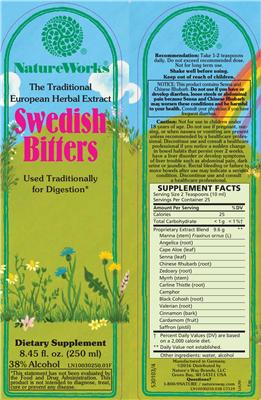
- Form
- Liquid
- Serving Size
- 1 tsp
- Servings
- 25 per container
- Container Holds
- 8.45 fl. Oz.; 250 mL
- Status
- No longer sold, per the NIH record
What’s in it, whether it interacts with your drugs, its side effects, whether it works, and what our pharmacists would want you to know before you start it.
- What is Swedish Bitters?A supplement from NatureWorks with 14 active ingredients, in liquid form.
- Active Ingredients MannaAngelicaCape AloeSennaChinese RhubarbZedoaryMyrrhCarline ThistleCamphorBlack CohoshValerianCinnamon 14 active ingredients. Each one can interact with drugs or cause side effects on its own, so we check every one. And 2 more, in the Supplement Facts
- Drug Interactions 1,511 drugs have a documented interaction with this supplement; the most serious is rated major. Of those, 1,054 are single drugs and 457 are combination products (two or more drugs in one), each listed under its own name. Ask your pharmacist first if you take a drug in any of these categories, the most serious of the 24 on record:
- Major · 1 drug
- Moderate · 645 drugs
- Moderate · 372 drugs
- Moderate · 355 drugs
- Possible Side EffectsStomach upset 6 ingredientsDiarrhea 4 ingredientsDizziness 3 ingredientsHeadache 3 ingredientsAllergic reactions 2 ingredientsBloating 2 ingredients +16 moreCombined from ten of its 14 active ingredients. Not studied in this exact product.
- Well documented Why
Does Swedish Bitters work?
What It Is Marketed For
Traditional digestive support
From the claims on the product’s label.
The Closest Use the Research Grades
Senna
Good studies support it.
Its ingredients have research behind other uses too:
- Aloe
- Rhubarb
- Black Cohosh
- Aloe
- Rhubarb
- Aloe
These grades are for each ingredient, not this exact product, and never a promise it will work for you.
And 2 more graded uses, in what the research says- Low Why
- AllergensNone of its ingredient names point to a major food allergen, and the label text we have carries no allergen statement
Who Might Consider It
- People looking for traditional digestive support, which is what it is marketed for. The closest use the research grades is constipation, rated Likely Effective.
- People who want it for diabetes, menopausal symptoms, obesity, pancreatitis or another graded use: the other uses with research behind them. See each grade
- This is a traditional herbal bitter formula with laxative and digestive properties, but it's not a simple supplement.
- It's best used short-term and under guidance, not as a daily routine.
Who Should Be Careful
- If you take any heart, blood pressure, blood-thinning, diabetes, or psychiatric medications, or if you're pregnant or nursing, talk to your pharmacist or doctor before starting.
More Before You Take It Show both answersHide Pregnancy and Breastfeeding The Label’s Directions
-
Pregnant or breastfeeding?
- Pregnancy Zedoary
- ! When used orally.
- Breastfeeding Zedoary
- Insufficient reliable information available; avoid using.
- Pregnancy Myrrh
- ! When used orally.
- Breastfeeding Myrrh
- Insufficient reliable information available; avoid using.
- Pregnancy and Breastfeeding Camphor
- ! When used orally.
-
How does the label say to take it?
“Recommendation: Take 1-2 teaspoons daily. Do not exceed recommended dose. Not for long term use. Shake well before using.”
The maker’s words. Your pharmacist or doctor may advise differently.
Everything the label says
From the label dated Dec 22, 2017: all 14 of its active ingredients were checked against our records. A summary of what is known, not a grade or a test of the product. How these ratings are computed
Ask Anything About This Supplement
Name a drug you take, or ask about side effects, ingredients or pregnancy.
AI answers come from this label and our own records, never the open internet. AI can make mistakes, so always check with your doctor or pharmacist. How we use AI
Ask the Pharmacist
A licensed pharmacist will answer your question by email — free, usually within 24 hours.
Got it — thank you!
A licensed pharmacist will answer within 24 hours. Keep an eye on your email (worth checking spam, just in case).
What’s Inside Swedish Bitters by NatureWorks
14 Active Ingredients, Each Checked on Its Own
A supplement is often several ingredients in one bottle, and each one can interact with drugs or cause side effects on its own. We check every one of them against our records.
- MannaDrug interactions on record, most serious: Moderate
- AngelicaDrug interactions on record, most serious: Moderate
- Cape AloeDrug interactions on record, most serious: Major
- SennaDrug interactions on record, most serious: Moderate
- Chinese RhubarbDrug interactions on record, most serious: Moderate
- ZedoaryDrug interactions on record, most serious: Moderate
- MyrrhDrug interactions on record, most serious: Moderate
- Carline ThistleNo drug interactions on record
And 6 more, each with its own card below.
The label gives an exact amount for 0 of its 14 active ingredients. 14 are inside one proprietary blend, “Proprietary Extract Blend”, and the label gives one total for it, not how much of each ingredient is in it.
- 0 state an exact amount
- 14 have no amount of their own
- Proprietary Extract Blend 9.60 g in total · 14 ingredients, no amount for each
This rates what the label tells you, not the quality of the product.
Supplement Facts
| Amount Per Serving | % Daily Value | |
|---|---|---|
| Calories | 25 Calories | † |
| Total Carbohydrates | 1 g | 1% |
| Proprietary Extract Blend | 9.6 g | † |
| Manna | † | |
| Angelica | † | |
| Cape Aloe | † | |
| Senna | † | |
| Chinese Rhubarb | † | |
| Zedoary | † | |
| Myrrh | † | |
| Carline Thistle | † | |
| Camphor | † | |
| Black Cohosh | † | |
| Valerian | † | |
| Cinnamon | † | |
| Cardamom | † | |
| Saffron | † | |
Other ingredients: Water, Alcohol
† Daily Value not established.
Daily Values for adults and children 4 or more years of age.
As the label prints it, from the NIH Dietary Supplement Label Database.
Each Ingredient and Its Drug Interactions
Tap one for more about it and its full guide. A drug can interact with this supplement through any one of them.
Swedish Bitters contains 14 active ingredients in a liquid form with water and alcohol as inactive carriers.
- The formula blends traditional bitter herbs: Senna and Cape Aloe (both stimulant laxatives), Chinese Rhubarb (also a laxative), Valerian (a sedative herb), Black Cohosh (traditionally used for menopausal symptoms), plus Cinnamon, Cardamom, Zedoary, Camphor, Carline Thistle, Manna, Myrrh, and Saffron.
- One ingredient, Angelica, is listed but we could not check its data.
-
Proprietary Extract Blend 9.6 g 14 ingredients inside it, each checked on its own
- Manna 99 drugs
- Angelica 186 drugs
- Cape Aloe 461 drugs
- Senna 140 drugs
- Chinese Rhubarb 660 drugs
- Zedoary 645 drugs
- Myrrh 88 drugs
- Carline Thistle
- Camphor 372 drugs
- Black Cohosh 654 drugs
- Valerian 904 drugs
- Cinnamon 444 drugs
- Cardamom
- Saffron 612 drugs
Other Ingredients (Inactive)
The capsule or tablet itself, fillers, coatings and flavors. Not part of the drug interaction check; the allergen check below reads them.
- Water
- Alcohol
Allergens in Swedish Bitters
None of its ingredient names point to a major food allergen, and the label text we have carries no allergen statement.
Not named in the ingredients
- Milk
- Egg
- Fish
- Shellfish
- Tree nuts
- Peanuts
- Wheat or other gluten grains
- Soy
- Sesame
From the label text and ingredient names on file; we do not test products. With a serious allergy, check your bottle and ask the maker or your pharmacist.
What the Label Says
The maker’s own words, from the label. We do not verify or endorse them.
- General statements
-
“The traditional European herbal extract Used traditionally for digestion”
“Manufactured in Germany”
- FDA Statement of Identity
-
“Dietary Supplement”
- Brand IP Statement(s)
-
“2016”
- General
-
“530103/4 LN10030250.01 C7519”
- Formulation
-
“38% Alcohol”
“Notice: This product contains senna and Chinese rhubarb.”
The Swedish Bitters Label on File
The label scan on file at the NIH Dietary Supplement Label Database, dated December 2017. Always read the label on the bottle you have.
Product Facts
- Brand
- NatureWorks
- Net contents
- 8.45 fl. Oz.; 250 mL
- Market status
- Off market
- Date entered into DSLD
- Dec 22, 2017
- DSLD ID
- 77301
- Product type
- Botanical
- Supplement form
- Liquid
- Dietary claims / uses
- All Other, Structure/Function
- Intended target group(s)
- Adult (18 - 50 Years)
Is this label outdated? Report a formula or label change and our pharmacy team will review it.
Swedish Bitters by NatureWorks Side Effects
Why this rating?
We look for three kinds of safety information on each ingredient: side effects reported in studies, a pregnancy and breastfeeding rating, and a safety write-up from our pharmacy team. Of the 14 ingredients we could check, eleven have side-effect reports, all 14 have a pregnancy rating and all 14 have a safety write-up.
So this rates how much is known, not whether Swedish Bitters is right for you.
Reported with 14 of its ingredients
- Most often
- Stomach upset, diarrhea, dizziness, headache, allergic reactions and bloating
- !Rare but serious
- Skin eruptions, severe allergic reaction and valerian-containing multi-ingredient dietary supplements See details
HelloPharmacist Team Summary: Swedish Bitters by NatureWorks Side Effects
Most ingredients are generally well tolerated at typical doses in the short term, but several carry cautions for long-term use.
- Common mild side effects include abdominal cramping, diarrhea, nausea, and headache.
Side Effects, Ingredient by Ingredient
A supplement’s side effects come from its ingredients. Here is what is reported with each one.
Manna
Most reported
- Loose stools
- Diarrhea
- Gas
- Bloating
Ashitaba
Most reported
- Stomach upset
- Digestive discomfort
Senna
Most reported
- Stomach cramps
- Bloating
- Diarrhea
Rhubarb
Most reported
- Abdominal cramping
- Diarrhea
- Stomach upset
Myrrh
Most reported
- Stomach upset
- Diarrhea
- Skin irritation
Carlina
Most reported
- Stomach upset
- Allergic reactions
Camphor
Most reported
- Skin redness, warmth, or irritation
- Burning or stinging where applied
- Allergic skin reactions in some people
Our pharmacy team’s notes
- Camphor is unsafe if swallowed.
Black Cohosh
Most reported
- Stomach upset
- Headache
- Dizziness
- Feeling of heaviness
Valerian
Most reported
- Drowsiness
- Dizziness
- Headache
- Stomach upset
Saffron
Most reported
- Nausea
- Dry mouth
- Headache
- Dizziness
Aloe, Cassia Cinnamon and Cardamom have side-effect reports, but no list of the most common ones. Read them in each guide: Aloe, Cassia Cinnamon, Cardamom.
Swedish Bitters Warnings: Who Should Be Careful
Swedish Bitters has 14 active ingredients, and each can carry warnings of its own. We checked all 14, and each warning below names the ingredient it comes from. If any of these apply to you, talk to your doctor or pharmacist before you start it.
- Manna3 warnings below
- Ashitaba3 warnings below
- Aloe1 warning below
- Senna3 warnings below
- Rhubarb3 warnings below
- Zedoary1 warning below
- Myrrh3 warnings below
- Carlina3 warnings below
- Camphor3 warnings below
- Black Cohosh2 warnings below
- Valerian3 warnings below
- Cassia Cinnamon2 warnings below
- Cardamom2 warnings below
- Saffron2 warnings below
-
Bleeding Problems or Surgery
- ZedoaryPeople with gallbladder problems, bleeding disorders, or who are scheduled for surgery should be cautious and check with a healthcare provider first.
- ValerianPeople with liver problems should be cautious, and anyone scheduled for surgery should tell their doctor, since valerian may add to the effects of anesthesia and sedatives.
- SaffronThose with low blood pressure or bleeding disorders should also check with a healthcare provider first.
-
Diabetes or Low Blood Sugar
- MannaThose with diabetes should know that manna contains sugars and sugar alcohols.
- AloePeople with kidney problems, bowel conditions, or diabetes should be especially careful and check with a doctor or pharmacist before taking aloe by mouth.
- MyrrhPeople with diabetes should be cautious, as some reports suggest myrrh may affect blood sugar.
- Cassia CinnamonPeople with diabetes who take blood-sugar-lowering medicine should monitor their levels and check with a pharmacist before adding cinnamon supplements.
-
Liver Disease
- CarlinaChildren, older adults, and people with chronic illness or kidney or liver problems should also be cautious and check with a healthcare provider first.
- Black CohoshPeople with liver disease should avoid black cohosh unless a doctor approves.
- Cassia CinnamonPeople with liver disease should be especially careful and should talk to a healthcare provider before using cinnamon supplements.
-
Kidney Disease or Kidney Stones
- SennaPeople with heart problems, kidney problems, or electrolyte imbalances should be especially careful.
- RhubarbPeople who should be cautious or avoid medicinal rhubarb include those with kidney stones (because of its oxalate content), inflammatory bowel disease, intestinal blockage, or unexplained belly pain.
- MyrrhThose with heart problems, kidney issues, or a history of allergic skin reactions should also use care.
-
Gallbladder Problems
- CardamomIf you have gallstones, talk to your doctor before using medicinal amounts, since some sources advise caution.
-
Stomach or Bowel Problems
- MannaPeople with ongoing belly pain, blockage symptoms, or unexplained changes in bowel habits should see a doctor before using any laxative.
- AshitabaThe plant's coumarin and sap content may also make some people more sensitive, so use care if you have a sensitive stomach or known plant allergies.
- SennaDo not use senna if you have unexplained stomach pain, nausea, vomiting, signs of a bowel blockage, appendicitis, or inflammatory bowel conditions unless your doctor tells you to.
-
Hormone-Sensitive Conditions
- Black CohoshThose with hormone-sensitive conditions (such as certain breast cancers) should also check with their doctor first, since the plant's effects on hormones are not fully understood.
-
Seizure Disorders
- CamphorSwallowing camphor — especially by children — can cause seizures and can be deadly.
-
Mental Health Conditions
- SaffronPeople with bipolar disorder should be cautious, since saffron may affect mood.
-
Allergies
- AshitabaPeople with allergies to plants in the carrot and celery family (Apiaceae) should be cautious, as cross-reactions are possible.
- CarlinaBecause it is a member of the daisy/aster family, people who are allergic to plants like ragweed, marigolds, daisies, or chrysanthemums may be more likely to react to it.
- CardamomPeople with a known allergy to cardamom or related plants should avoid it.
-
Children
- MannaManna is generally considered mild, which is one reason it has been used in children and the elderly.
- SennaSenna should not be given to children unless directed by a healthcare provider.
- RhubarbChildren should not use rhubarb laxatives without medical advice.
- CamphorKeep all camphor products well out of reach of children.
- ValerianValerian is also not recommended for children unless a doctor advises it.
-
If You Take Other Drugs
- AshitabaAlways tell your pharmacist or doctor about any supplement you take, especially if you have a medical condition or take prescription medicines.
- MyrrhAs always, check with your pharmacist or doctor before starting myrrh, especially if you take regular medications or have a chronic condition.
-
Other Cautions
- RhubarbEating normal amounts of cooked stalks as food is generally considered acceptable, but talk to your doctor or pharmacist if unsure.
- CamphorLimited topical use of a regulated product may be acceptable, but talk to your doctor first and never swallow it.
- ValerianBecause valerian can make you feel drowsy, use caution before driving or operating machinery, especially when you first try it.
- Senna, Rhubarb, and Manna should not be used daily without medical guidance; overuse increases the risk of potassium loss and electrolyte imbalances.
-
What the Label Warns
- “Do not exceed recommended dose. Not for long term use.”
- “Keep out of reach of children.”
- “Notice: This product contains senna and Chinese rhubarb. Do not use if you have or develop diarrhea, loose stools or abdominal pain because senna and Chinese rhubarb may worsen these conditions and be harmful to your health. Consult your physician if you have frequent diarrhea.”
- “Caution: Not for use in children under 18 years of age.”
- “Do not use if pregnant, nursing, or when nausea or vomiting are present unless recommended by a healthcare professional.”
- “Discontinue use and consult a healthcare professional if you notice a sudden change in bowel habits that persist over 2 weeks, have a liver disorder or develop symptoms of liver trouble such as abdominal pain, dark urine or jaundice. Rectal bleeding or failure to move bowels after use may indicate a serious condition. Discontinue use and consult a healthcare professional.”
The maker’s wording, from the product label.
-
Pregnant or Breastfeeding
Each ingredient’s rating for pregnancy and for breastfeeding, and what it covers.
Pregnancy
-
When used orally.
Zedoary is thought to have abortifacient effects; avoid using.
Breastfeeding
-
Insufficient reliable information available; avoid using.
Pregnancy
-
When used orally.
Myrrh stimulates uterine tone and blood flow and may have an abortifacient effect.
There is insufficient reliable information available about the safety of the topical use of myrrh during pregnancy.
Breastfeeding
-
Insufficient reliable information available; avoid using.
Show 12 more ingredients
Pregnancy and Breastfeeding The record rates both the same
-
When used orally.
Ingestion of camphor can cause serious toxicity including death.
There is insufficient reliable information available about the safety of using camphor topically during pregnancy and lactation.
Pregnancy
-
When used orally in amounts exceeding those commonly found in foods.
Larger amounts of saffron have uterine stimulant and abortifacient effects; avoid using.
Breastfeeding
-
Insufficient reliable information available; avoid using.
Pregnancy
-
When used orally.
Anthraquinones present in aloe latex and aloe whole leaf extracts have irritant, cathartic, and possible mutagenic effects.
There are also anecdotal reports and evidence from animal research that anthraquinones or aloe whole leaf extracts might induce abortion and stimulate menstruation; avoid using.
Breastfeeding
-
When aloe preparations are used orally.
Cathartic and mutagenic anthraquinones present in aloe latex and aloe whole leaf extracts might pass into milk; avoid using.
Pregnancy and Breastfeeding The record rates both the same
-
When used in medicinal amounts, rhubarb root is a stimulant laxative; avoid using.
Pregnancy
-
When used orally in pregnant patients who are not at term.
Black cohosh might have hormonal effects and menstrual and uterine stimulant effects.
2 more points on this rating
- Theoretically, this might increase the risk of miscarriage; avoid using during pregnancy.
- There is insufficient reliable information available about the safety of black cohosh when used to induce labor.
Breastfeeding
-
When used orally.
Black cohosh might have hormonal effects.
2 more points on this rating
- Theoretically, maternal intake of black cohosh might adversely affect a nursing child.
- Until more is known, nursing patients should avoid taking black cohosh.
Pregnancy
-
Food amounts are likely fine, but avoid concentrated supplement or essential oil doses without medical advice.
Breastfeeding
-
When used orally in amounts commonly found in foods.
There is insufficient reliable information available about the safety of cardamom when used in medicinal amounts.
Avoid using amounts greater than those used in food.
Pregnancy and Breastfeeding The record rates both the same
-
Insufficient reliable information available; avoid using.
Pregnancy and Breastfeeding The record rates both the same
-
Insufficient reliable information available; avoid using.
Pregnancy and Breastfeeding The record rates both the same
-
Insufficient reliable information available; avoid using.
Pregnancy and Breastfeeding The record rates both the same
-
Insufficient reliable information available; avoid using.
Pregnancy
-
When used orally and appropriately, short-term.
POSSIBLY UNSAFE...when used orally long-term or in high doses.
Long-term, frequent use, or use of high doses has been linked to serious side effects including laxative dependence and liver toxicity.
Breastfeeding
-
When used orally and appropriately, short term.
Although small amounts of constituents of senna cross into breast milk, senna has been taken while breast-feeding with apparent safety.
Senna does not cause changes in the frequency or consistency of infants' stools..
Pregnancy and Breastfeeding The record rates both the same
-
When consumed in amounts commonly found in foods.
There is insufficient reliable information available about the safety of cassia cinnamon when used in medicinal amounts during pregnancy and breast-feeding.
Stay on the safe side and stick to food amounts.
Our pharmacy team’s notes
- During pregnancy, avoid Cape Aloe, Black Cohosh, Zedoary, Myrrh, and Saffron (possibly or likely unsafe); Senna and Rhubarb are possibly safe but should be used only under medical advice.
- Avoid medicinal amounts while breastfeeding for most ingredients; safety data are limited or absent.
Ratings and the words beside them are from the Natural Medicines database, which we license. Where it has no rating, the rating and note are our pharmacy team’s.
-
Rare but Serious Side Effects
-
!
Manna
Overuse of any laxative can cause dehydration and changes in body salts (electrolytes), which can be serious.
-
!
Ashitaba
Because Ashitaba contains coumarins and other plant compounds, some people may experience skin sensitivity or allergic reactions, particularly those allergic to related plants like carrot, celery, or parsley.
-
!
Aloe
Long-term use of oral aloe latex has been linked to more serious harms and is generally discouraged.
Orally: Aloe latex is associated with serious adverse effects when taken in high doses or long-term. Cases of acute hepatitis due to a hypersensitivity reaction to aloe leaf extract has been reported.
-
!
Senna
With long-term use, more serious problems can occur, including dehydration, low potassium and other electrolyte imbalances, and dependence on laxatives.
Orally: Skin eruptions.
-
!
Rhubarb
Serious poisoning is associated with eating the toxic leaves, not the stalks or properly used root.
Orally: Anaphylaxis.
-
!
Zedoary
Allergic reactions are possible, especially in people sensitive to ginger or turmeric.
-
!
Myrrh
Some people may have an allergic reaction such as rash or itching.
-
!
Carlina
Possible problems include stomach upset and allergic reactions, especially in people sensitive to other plants in the daisy family.
-
!
Camphor
Serious problems usually happen when camphor is swallowed, used in very large amounts, or applied to broken skin.
Systemically absorbed camphor can lead to seizures, respiratory depression, coma, and death.
-
!
Black Cohosh
The most serious concern, though rare, is possible liver injury.
Orally: Endometrial hyperplasia and hepatotoxicity, although data are conflicting for both.
-
!
Valerian
Serious side effects are uncommon.
Orally: Several case reports raise concerns about hepatotoxicity after the use of valerian and valerian-containing multi-ingredient dietary supplements. Withdrawal from chronic valerian use has been associated with cases of cardiac failure and hallucinations.
-
!
Cassia Cinnamon
Some people may have mouth or lip irritation, an allergic reaction, or stomach upset.
-
!
Cardamom
Allergic reactions are possible but uncommon.
-
!
Saffron
Very large amounts (well above typical supplement doses) can be toxic and may cause vomiting, bleeding, yellowing of the skin, and other serious effects.
Orally: Anaphylaxis.
-
!
Our pharmacy team on Swedish Bitters
Cape Aloe, Black Cohosh, Camphor, and Valerian all have rare but documented serious side effects—from skin reactions to liver concerns—so medical supervision is wise.
When to get help: a serious allergic reaction, with trouble breathing or swelling of the face, lips or throat, needs emergency care: call 911. For any other side effect that worries you, call your doctor or pharmacist.
These reports describe each ingredient, not studies of this exact product. Not medical advice: a side effect you notice after starting a supplement is worth a word with your pharmacist or doctor.
Swedish Bitters by NatureWorks Drug Interactions
We checked all 14 active ingredients in this supplement against every drug in our records. A drug can interact with it through any one of them.
A major interaction on record
3 of 3, on a scale from Minor or none to Major.Why this rating?
We rate this by the most serious interaction on record, not by how many there are. For Manna, Rhubarb, Zedoary, Myrrh and Aloe, the most serious is rated major, which means the combination is best avoided, or used only under close supervision. Some involve kinds of drugs where a small change can matter, such as blood thinners, transplant drugs and diabetes drugs.
1,512 drugs are on the full list. What matters is whether one you take is on it, so check yours with the interaction checker on this page.
Twelve of its 14 active ingredients have drug interactions on record. The ones below matter most. We have no interaction records for Carlina and Cardamom.
- Interacts with
- 186 drugs
- Most serious
- Moderate
- We could not check Angelica; we have no information for it.
- Interacts with
- 904 drugs
- Most serious
- Moderate
- Most of its records involve Cytochrome P450 3A4 (CYP3A4) Substrates, CNS Depressants and Cytochrome P450 2D6 (CYP2D6) Substrates.
- Interacts with
- 660 drugs
- Most serious
- Moderate
- Most of its records involve Hepatotoxic Drugs, Nephrotoxic Drugs and Diuretic Drugs.
Show three more ingredients
- Interacts with
- 654 drugs
- Most serious
- Moderate
- Most of its records involve Hepatotoxic Drugs, Cytochrome P450 2D6 (CYP2D6) Substrates and Serotonergic Drugs.
- Interacts with
- 645 drugs
- Most serious
- Moderate
- Most of its records involve Cytochrome P450 3A4 (CYP3A4) Substrates.
- Interacts with
- 612 drugs
- Most serious
- Moderate
- Most of its records involve CNS Depressants, Antihypertensive Drugs and Anticoagulant/Antiplatelet Drugs.
And six more ingredients with records, each in the cards below.
From the HelloPharmacist Team
Here is how the interactions add up across the whole label.
- Swedish Bitters by NatureWorks is a 14-ingredient liquid blend that carries multiple documented interactions with common medications.
- The most serious concern is with digoxin (Lanoxin), a heart medication: Cape Aloe poses a Major risk of toxicity due to potassium depletion, and Senna, Rhubarb, and Manna each pose Moderate risks through the same mechanism.
- Several ingredients interact with blood thinners.
Summarized by the HelloPharmacist pharmacy team from the interaction records below. How it is written How we use AI
Why Swedish Bitters Interacts, Ingredient by Ingredient
A product interacts through its ingredients. Each card: how many drugs, the most serious rating, and the kinds of drugs it affects most (tap a kind for what it means).
The ingredients driving the most interactions
-
Valerian 904 drugs
Most serious: Moderate6 interaction records on file
The kinds of drugs it affects most
- 645 drugs
- 248 drugs
- 193 drugs
- 124 drugs
Every Valerian drug interaction, 6 records The Valerian records cite 40 references, listed in the Valerian guide.
-
Chinese Rhubarb 660 drugs
Most serious: Moderate8 interaction records on file
The kinds of drugs it affects most
- 372 drugs
- 355 drugs
- 75 drugs
- 23 drugs
Every Rhubarb drug interaction, 8 records The Rhubarb records cite 20 references, listed in the Rhubarb guide.
-
Black Cohosh 654 drugs
Most serious: Moderate7 interaction records on file
The kinds of drugs it affects most
- 372 drugs
- 193 drugs
- 184 drugs
- 47 drugs
Every Black Cohosh drug interaction, 7 records The Black Cohosh records cite 68 references, listed in the Black Cohosh guide.
-
Zedoary 645 drugs
Most serious: Moderate1 interaction record on file
The kinds of drugs it affects most
- 645 drugs
Every Zedoary drug interaction, 1 record The Zedoary records cite 5 references, listed in the Zedoary guide.
-
Saffron 612 drugs
Most serious: Moderate5 interaction records on file
The kinds of drugs it affects most
- 248 drugs
- 172 drugs
- 122 drugs
- 86 drugs
Every Saffron drug interaction, 5 records The Saffron records cite 29 references, listed in the Saffron guide.
-
Cape Aloe 461 drugs
Most serious: Major7 interaction records on file
The kinds of drugs it affects most
- 186 drugs
- 122 drugs
- 86 drugs
- 75 drugs
Every Aloe drug interaction, 7 records The Aloe records cite 41 references, listed in the Aloe guide.
-
Cinnamon 444 drugs
Most serious: Moderate2 interaction records on file
The kinds of drugs it affects most
- 372 drugs
- 86 drugs
Every Cassia Cinnamon drug interaction, 2 records The Cassia Cinnamon records cite 20 references, listed in the Cassia Cinnamon guide.
-
Camphor 372 drugs
Most serious: Moderate1 interaction record on file
The kinds of drugs it affects most
- 372 drugs
Every Camphor drug interaction, 1 record The Camphor records cite 20 references, listed in the Camphor guide.
-
Angelica 186 drugs
Most serious: Moderate1 interaction record on file
The kinds of drugs it affects most
- 186 drugs
Every Ashitaba drug interaction, 1 record The Ashitaba records cite 2 references, listed in the Ashitaba guide.
-
Senna 140 drugs
Most serious: Moderate5 interaction records on file
The kinds of drugs it affects most
- 75 drugs
- 41 drugs
- 21 drugs
- 2 drugs
Every Senna drug interaction, 5 records The Senna records cite 42 references, listed in the Senna guide.
-
Manna 99 drugs
Most serious: Moderate4 interaction records on file
The kinds of drugs it affects most
- 75 drugs
- 21 drugs
- 2 drugs
- 1 drug
Every Manna drug interaction, 4 records The Manna records cite 3 references, listed in the Manna guide.
-
Myrrh 88 drugs
Most serious: Moderate2 interaction records on file
The kinds of drugs it affects most
- 86 drugs
- 2 drugs
Every Myrrh drug interaction, 2 records The Myrrh records cite 8 references, listed in the Myrrh guide.
The Breakdown by Severity
Each drug counted once, at its most serious rating. Tap a tile to list those drugs.
Find Your Drug
Type a drug or brand name to see whether it is on the list.
- Only drugs with a documented interaction are listed, the most serious first.
- A drug with no known interaction is not listed, but searching its name tells you so.
- Open a drug to see which ingredient is responsible. Of those, 1,054 are single drugs and 457 are combination products (two or more drugs in one), each listed under its own name.
-
DigoxinDigitek, Lanoxicaps, Lanoxin Major
The 5 ingredients responsible:
-
Cape Aloe Major
Theoretically, aloe latex might increase the risk of adverse effects when taken with cardiac glycosides.
The full Cape Aloe + Digoxin interaction -
Manna Moderate
Theoretically, manna might increase the risk of adverse effects when taken with cardiac glycosides.
The full Manna + Digoxin interaction -
Chinese Rhubarb Moderate
Theoretically, overuse of rhubarb might increase the risk of adverse effects when taken with digoxin.
The full Chinese Rhubarb + Digoxin interaction -
Valerian Moderate Digoxin is in the Glucuronidated Drugs category.
Valerian might weakly inhibit glucuronidation and increase concentrations of drugs metabolized by UGT1A1 and UGT2B7.
The full Valerian + Digoxin interaction -
Senna Moderate
Theoretically, senna might increase the risk of adverse effects when taken with digoxin.
The full Senna + Digoxin interaction
-
-
ApixabanEliquis Moderate
The 4 ingredients responsible:
-
Zedoary Moderate Apixaban is in the Cytochrome P450 3A4 (CYP3A4) Substrates category.
Theoretically, zedoary might increase levels of drugs metabolized by CYP3A4.
The full Zedoary + Apixaban interaction -
Saffron Moderate Apixaban is in the Anticoagulant/Antiplatelet Drugs category.
Saffron might increase the risk of bleeding when taken with anticoagulant or antiplatelet drugs.
The full Saffron + Apixaban interaction -
Cape Aloe Moderate Apixaban is in the Anticoagulant/Antiplatelet Drugs category.
Theoretically, aloe gel might increase the risk of bleeding when taken with anticoagulant or antiplatelet drugs.
The full Cape Aloe + Apixaban interaction -
Valerian Minor Apixaban is in the Cytochrome P450 3A4 (CYP3A4) Substrates category.
Valerian does not seem to have a clinically relevant effect on levels of drugs metabolized by CYP3A4.
The full Valerian + Apixaban interaction
-
-
WarfarinWarfarin Moderate
The 9 ingredients responsible:
-
Manna Moderate
Theoretically, manna might increase the risk of bleeding when taken with warfarin.
The full Manna + Warfarin interaction -
Chinese Rhubarb Moderate
Theoretically, excessive use of rhubarb might increase the risk of bleeding when taken with warfarin.
The full Chinese Rhubarb + Warfarin interaction -
Zedoary Moderate Warfarin is in the Cytochrome P450 3A4 (CYP3A4) Substrates category.
Theoretically, zedoary might increase levels of drugs metabolized by CYP3A4.
The full Zedoary + Warfarin interaction -
Angelica Moderate Warfarin is in the Cytochrome P450 1A2 (CYP1A2) Substrates category.
In vitro research shows that ashitaba extract inhibits cytochrome P450 (CYP) 1A2.
The full Angelica + Warfarin interaction -
Saffron Moderate Warfarin is in the Anticoagulant/Antiplatelet Drugs category.
Saffron might increase the risk of bleeding when taken with anticoagulant or antiplatelet drugs.
The full Saffron + Warfarin interaction -
Senna Moderate
Theoretically, excessive use of senna might increase the effects of warfarin.
The full Senna + Warfarin interaction -
Cape Aloe Moderate Warfarin is in these Cytochrome P450 1A2 (CYP1A2) Substrates, Anticoagulant/Antiplatelet Drugs categories.
Theoretically, aloe latex might increase the risk of bleeding when taken with warfarin.
The full Cape Aloe + Warfarin interaction -
Myrrh Moderate
Theoretically, myrrh might decrease the effectiveness of warfarin.
The full Myrrh + Warfarin interaction
And through 1 more ingredient, each with its own page:
- Valerian Minor
-
-
AmlodipineNorliqva Moderate
The 3 ingredients responsible:
-
Zedoary Moderate Amlodipine is in the Cytochrome P450 3A4 (CYP3A4) Substrates category.
Theoretically, zedoary might increase levels of drugs metabolized by CYP3A4.
The full Zedoary + Amlodipine interaction -
Saffron Moderate Amlodipine is in the Antihypertensive Drugs category.
Theoretically, concomitant use of saffron with antihypertensive drugs might have additive effects.
The full Saffron + Amlodipine interaction -
Valerian Minor Amlodipine is in the Cytochrome P450 3A4 (CYP3A4) Substrates category.
Valerian does not seem to have a clinically relevant effect on levels of drugs metabolized by CYP3A4.
The full Valerian + Amlodipine interaction
-
-
SertralineZoloft Moderate
The 3 ingredients responsible:
-
Black Cohosh Moderate Sertraline is in the Serotonergic Drugs category.
Combining serotonergic drugs with black cohosh might cause additive serotonergic effects.
The full Black Cohosh + Sertraline interaction -
Zedoary Moderate Sertraline is in the Cytochrome P450 3A4 (CYP3A4) Substrates category.
Theoretically, zedoary might increase levels of drugs metabolized by CYP3A4.
The full Zedoary + Sertraline interaction -
Valerian Minor Sertraline is in the Cytochrome P450 3A4 (CYP3A4) Substrates category.
Valerian does not seem to have a clinically relevant effect on levels of drugs metabolized by CYP3A4.
The full Valerian + Sertraline interaction
-
-
ClopidogrelPlavix Moderate
The 5 ingredients responsible:
-
Cape Aloe Moderate Clopidogrel is in these Anticoagulant/Antiplatelet Drugs, Cytochrome P450 1A2 (CYP1A2) Substrates categories.
Theoretically, aloe gel might increase the risk of bleeding when taken with anticoagulant or antiplatelet drugs.
The full Cape Aloe + Clopidogrel interaction -
Zedoary Moderate Clopidogrel is in the Cytochrome P450 3A4 (CYP3A4) Substrates category.
Theoretically, zedoary might increase levels of drugs metabolized by CYP3A4.
The full Zedoary + Clopidogrel interaction -
Saffron Moderate Clopidogrel is in the Anticoagulant/Antiplatelet Drugs category.
Saffron might increase the risk of bleeding when taken with anticoagulant or antiplatelet drugs.
The full Saffron + Clopidogrel interaction -
Angelica Moderate Clopidogrel is in the Cytochrome P450 1A2 (CYP1A2) Substrates category.
In vitro research shows that ashitaba extract inhibits cytochrome P450 (CYP) 1A2.
The full Angelica + Clopidogrel interaction -
Valerian Minor Clopidogrel is in the Cytochrome P450 3A4 (CYP3A4) Substrates category.
Valerian does not seem to have a clinically relevant effect on levels of drugs metabolized by CYP3A4.
The full Valerian + Clopidogrel interaction
-
-
RosuvastatinCrestor, Ezallor Moderate
The 4 ingredients responsible:
-
Cinnamon Moderate Rosuvastatin is in the Hepatotoxic Drugs category.
Theoretically, large doses of cassia cinnamon might cause additive effects when used with hepatotoxic drugs.
The full Cinnamon + Rosuvastatin interaction -
Camphor Moderate Rosuvastatin is in the Hepatotoxic Drugs category.
Theoretically, concomitant use of camphor with other hepatotoxic drugs might increase the risk of liver damage.
The full Camphor + Rosuvastatin interaction -
Chinese Rhubarb Moderate Rosuvastatin is in the Hepatotoxic Drugs category.
Theoretically, concomitant use of rhubarb with potentially hepatotoxic drugs might increase the risk of developing liver damage.
The full Chinese Rhubarb + Rosuvastatin interaction -
Black Cohosh Moderate Rosuvastatin is in the Hepatotoxic Drugs category.
Theoretically, taking black cohosh with hepatotoxic drugs may increase the risk of liver damage.
The full Black Cohosh + Rosuvastatin interaction
-
-
AspirinAngettes 75, ASA, Asaphen, Aspirin, Caprin and 9 more Moderate
The 3 ingredients responsible:
-
Chinese Rhubarb Moderate Aspirin is in the Nephrotoxic Drugs category.
Theoretically, long-term use of anthraquinones from rhubarb might increase the risk of nephrotoxicity when used with nephrotoxic drugs.
The full Chinese Rhubarb + Aspirin interaction -
Cape Aloe Moderate Aspirin is in the Anticoagulant/Antiplatelet Drugs category.
Theoretically, aloe gel might increase the risk of bleeding when taken with anticoagulant or antiplatelet drugs.
The full Cape Aloe + Aspirin interaction -
Saffron Moderate Aspirin is in the Anticoagulant/Antiplatelet Drugs category.
Saffron might increase the risk of bleeding when taken with anticoagulant or antiplatelet drugs.
The full Saffron + Aspirin interaction
-
-
Losartan PotassiumCozaar Moderate
The 3 ingredients responsible:
-
Zedoary Moderate Losartan Potassium is in the Cytochrome P450 3A4 (CYP3A4) Substrates category.
Theoretically, zedoary might increase levels of drugs metabolized by CYP3A4.
The full Zedoary + Losartan Potassium interaction -
Saffron Moderate Losartan Potassium is in the Antihypertensive Drugs category.
Theoretically, concomitant use of saffron with antihypertensive drugs might have additive effects.
The full Saffron + Losartan Potassium interaction -
Valerian Minor Losartan Potassium is in the Cytochrome P450 3A4 (CYP3A4) Substrates category.
Valerian does not seem to have a clinically relevant effect on levels of drugs metabolized by CYP3A4.
The full Valerian + Losartan Potassium interaction
-
-
EscitalopramLexapro Moderate
The 3 ingredients responsible:
-
Zedoary Moderate Escitalopram is in the Cytochrome P450 3A4 (CYP3A4) Substrates category.
Theoretically, zedoary might increase levels of drugs metabolized by CYP3A4.
The full Zedoary + Escitalopram interaction -
Black Cohosh Moderate Escitalopram is in the Serotonergic Drugs category.
Combining serotonergic drugs with black cohosh might cause additive serotonergic effects.
The full Black Cohosh + Escitalopram interaction -
Valerian Minor Escitalopram is in the Cytochrome P450 3A4 (CYP3A4) Substrates category.
Valerian does not seem to have a clinically relevant effect on levels of drugs metabolized by CYP3A4.
The full Valerian + Escitalopram interaction
-
-
AtorvastatinAtorvaliq Moderate
The 6 ingredients responsible:
-
Black Cohosh Moderate Atorvastatin is in these Hepatotoxic Drugs, Organic Anion-transporting Polypeptide Substrates (OATP) categories.
Theoretically, taking black cohosh with hepatotoxic drugs may increase the risk of liver damage.
The full Black Cohosh + Atorvastatin interaction -
Valerian Moderate Atorvastatin is in these Cytochrome P450 3A4 (CYP3A4) Substrates, Glucuronidated Drugs categories.
Valerian does not seem to have a clinically relevant effect on levels of drugs metabolized by CYP3A4.
The full Valerian + Atorvastatin interaction -
Cinnamon Moderate Atorvastatin is in the Hepatotoxic Drugs category.
Theoretically, large doses of cassia cinnamon might cause additive effects when used with hepatotoxic drugs.
The full Cinnamon + Atorvastatin interaction -
Camphor Moderate Atorvastatin is in the Hepatotoxic Drugs category.
Theoretically, concomitant use of camphor with other hepatotoxic drugs might increase the risk of liver damage.
The full Camphor + Atorvastatin interaction -
Zedoary Moderate Atorvastatin is in the Cytochrome P450 3A4 (CYP3A4) Substrates category.
Theoretically, zedoary might increase levels of drugs metabolized by CYP3A4.
The full Zedoary + Atorvastatin interaction -
Chinese Rhubarb Moderate Atorvastatin is in the Hepatotoxic Drugs category.
Theoretically, concomitant use of rhubarb with potentially hepatotoxic drugs might increase the risk of developing liver damage.
The full Chinese Rhubarb + Atorvastatin interaction
-
-
RivaroxabanXarelto Moderate
The 4 ingredients responsible:
-
Zedoary Moderate Rivaroxaban is in the Cytochrome P450 3A4 (CYP3A4) Substrates category.
Theoretically, zedoary might increase levels of drugs metabolized by CYP3A4.
The full Zedoary + Rivaroxaban interaction -
Saffron Moderate Rivaroxaban is in the Anticoagulant/Antiplatelet Drugs category.
Saffron might increase the risk of bleeding when taken with anticoagulant or antiplatelet drugs.
The full Saffron + Rivaroxaban interaction -
Cape Aloe Moderate Rivaroxaban is in the Anticoagulant/Antiplatelet Drugs category.
Theoretically, aloe gel might increase the risk of bleeding when taken with anticoagulant or antiplatelet drugs.
The full Cape Aloe + Rivaroxaban interaction -
Valerian Minor Rivaroxaban is in the Cytochrome P450 3A4 (CYP3A4) Substrates category.
Valerian does not seem to have a clinically relevant effect on levels of drugs metabolized by CYP3A4.
The full Valerian + Rivaroxaban interaction
-
-
Warfarin SodiumCoumadin, Panwarfin, Sofarin Moderate
The 9 ingredients responsible:
-
Myrrh Moderate
Theoretically, myrrh might decrease the effectiveness of warfarin.
The full Myrrh + Warfarin Sodium interaction -
Cape Aloe Moderate Warfarin Sodium is in these Anticoagulant/Antiplatelet Drugs, Cytochrome P450 1A2 (CYP1A2) Substrates categories.
Theoretically, aloe gel might increase the risk of bleeding when taken with anticoagulant or antiplatelet drugs.
The full Cape Aloe + Warfarin Sodium interaction -
Senna Moderate
Theoretically, excessive use of senna might increase the effects of warfarin.
The full Senna + Warfarin Sodium interaction -
Angelica Moderate Warfarin Sodium is in the Cytochrome P450 1A2 (CYP1A2) Substrates category.
In vitro research shows that ashitaba extract inhibits cytochrome P450 (CYP) 1A2.
The full Angelica + Warfarin Sodium interaction -
Manna Moderate
Theoretically, manna might increase the risk of bleeding when taken with warfarin.
The full Manna + Warfarin Sodium interaction -
Chinese Rhubarb Moderate
Theoretically, excessive use of rhubarb might increase the risk of bleeding when taken with warfarin.
The full Chinese Rhubarb + Warfarin Sodium interaction -
Zedoary Moderate Warfarin Sodium is in the Cytochrome P450 3A4 (CYP3A4) Substrates category.
Theoretically, zedoary might increase levels of drugs metabolized by CYP3A4.
The full Zedoary + Warfarin Sodium interaction -
Saffron Moderate Warfarin Sodium is in the Anticoagulant/Antiplatelet Drugs category.
Saffron might increase the risk of bleeding when taken with anticoagulant or antiplatelet drugs.
The full Saffron + Warfarin Sodium interaction
And through 1 more ingredient, each with its own page:
- Valerian Minor
-
-
MetforminGlucophage, Metformin Moderate
The 4 ingredients responsible:
-
Cinnamon Moderate Metformin is in the Antidiabetes Drugs category.
Theoretically, cassia cinnamon may have additive effects with antidiabetes drugs.
The full Cinnamon + Metformin interaction -
Myrrh Moderate Metformin is in the Antidiabetes Drugs category.
Theoretically, myrrh might increase the risk of hypoglycemia when taken with antidiabetes drugs.
The full Myrrh + Metformin interaction -
Cape Aloe Moderate Metformin is in the Antidiabetes Drugs category.
Aloe might increase the risk of hypoglycemia when taken with antidiabetes drugs.
The full Cape Aloe + Metformin interaction -
Saffron Moderate Metformin is in the Antidiabetes Drugs category.
Theoretically, concomitant use of saffron with antidiabetes drugs might increase the risk of hypoglycemia.
The full Saffron + Metformin interaction
-
-
MetoprololLopressor, Toprol XL Moderate
The 3 ingredients responsible:
-
Black Cohosh Moderate Metoprolol is in the Cytochrome P450 2D6 (CYP2D6) Substrates category.
Some research suggests that black cohosh might inhibit CYP2D6, but there is conflicting evidence.
The full Black Cohosh + Metoprolol interaction -
Saffron Moderate Metoprolol is in the Antihypertensive Drugs category.
Theoretically, concomitant use of saffron with antihypertensive drugs might have additive effects.
The full Saffron + Metoprolol interaction -
Valerian Minor Metoprolol is in the Cytochrome P450 2D6 (CYP2D6) Substrates category.
Valerian does not seem to have a clinically relevant effect on levels of drugs metabolized by CYP2D6.
The full Valerian + Metoprolol interaction
-
-
TirzepatideMounjaro, Zepbound Moderate
The 4 ingredients responsible:
-
Saffron Moderate Tirzepatide is in the Antidiabetes Drugs category.
Theoretically, concomitant use of saffron with antidiabetes drugs might increase the risk of hypoglycemia.
The full Saffron + Tirzepatide interaction -
Myrrh Moderate Tirzepatide is in the Antidiabetes Drugs category.
Theoretically, myrrh might increase the risk of hypoglycemia when taken with antidiabetes drugs.
The full Myrrh + Tirzepatide interaction -
Cape Aloe Moderate Tirzepatide is in the Antidiabetes Drugs category.
Aloe might increase the risk of hypoglycemia when taken with antidiabetes drugs.
The full Cape Aloe + Tirzepatide interaction -
Cinnamon Moderate Tirzepatide is in the Antidiabetes Drugs category.
Theoretically, cassia cinnamon may have additive effects with antidiabetes drugs.
The full Cinnamon + Tirzepatide interaction
-
-
MethylphenidateAptensio XR, Concerta, Cotempla XR-ODT, Jornay PM, Metadate and 8 more Moderate
The ingredient responsible:
-
Black Cohosh Moderate Methylphenidate is in the Serotonergic Drugs category.
Combining serotonergic drugs with black cohosh might cause additive serotonergic effects.
The full Black Cohosh + Methylphenidate interaction
-
-
SemaglutideOzempic, Rybelsus, Wegovy Moderate
The 4 ingredients responsible:
-
Myrrh Moderate Semaglutide is in the Antidiabetes Drugs category.
Theoretically, myrrh might increase the risk of hypoglycemia when taken with antidiabetes drugs.
The full Myrrh + Semaglutide interaction -
Saffron Moderate Semaglutide is in the Antidiabetes Drugs category.
Theoretically, concomitant use of saffron with antidiabetes drugs might increase the risk of hypoglycemia.
The full Saffron + Semaglutide interaction -
Cape Aloe Moderate Semaglutide is in the Antidiabetes Drugs category.
Aloe might increase the risk of hypoglycemia when taken with antidiabetes drugs.
The full Cape Aloe + Semaglutide interaction -
Cinnamon Moderate Semaglutide is in the Antidiabetes Drugs category.
Theoretically, cassia cinnamon may have additive effects with antidiabetes drugs.
The full Cinnamon + Semaglutide interaction
-
-
TadalafilCialis, Tadliq Moderate
The 2 ingredients responsible:
-
Zedoary Moderate Tadalafil is in the Cytochrome P450 3A4 (CYP3A4) Substrates category.
Theoretically, zedoary might increase levels of drugs metabolized by CYP3A4.
The full Zedoary + Tadalafil interaction -
Valerian Minor Tadalafil is in the Cytochrome P450 3A4 (CYP3A4) Substrates category.
Valerian does not seem to have a clinically relevant effect on levels of drugs metabolized by CYP3A4.
The full Valerian + Tadalafil interaction
-
-
IbuprofenAdvil, Arthrofen, Brufen, Brufen Retard, Calodor and 15 more Moderate
The 3 ingredients responsible:
-
Chinese Rhubarb Moderate Ibuprofen is in the Nephrotoxic Drugs category.
Theoretically, long-term use of anthraquinones from rhubarb might increase the risk of nephrotoxicity when used with nephrotoxic drugs.
The full Chinese Rhubarb + Ibuprofen interaction -
Cape Aloe Moderate Ibuprofen is in the Anticoagulant/Antiplatelet Drugs category.
Theoretically, aloe gel might increase the risk of bleeding when taken with anticoagulant or antiplatelet drugs.
The full Cape Aloe + Ibuprofen interaction -
Saffron Moderate Ibuprofen is in the Anticoagulant/Antiplatelet Drugs category.
Saffron might increase the risk of bleeding when taken with anticoagulant or antiplatelet drugs.
The full Saffron + Ibuprofen interaction
-
-
TestosteroneAndrogel, Andropatch, Delatestryl, Intrinsa, Natesto and 4 more Moderate
The 6 ingredients responsible:
-
Black Cohosh Moderate Testosterone is in the Hepatotoxic Drugs category.
Theoretically, taking black cohosh with hepatotoxic drugs may increase the risk of liver damage.
The full Black Cohosh + Testosterone interaction -
Cinnamon Moderate Testosterone is in the Hepatotoxic Drugs category.
Theoretically, large doses of cassia cinnamon might cause additive effects when used with hepatotoxic drugs.
The full Cinnamon + Testosterone interaction -
Chinese Rhubarb Moderate Testosterone is in the Hepatotoxic Drugs category.
Theoretically, concomitant use of rhubarb with potentially hepatotoxic drugs might increase the risk of developing liver damage.
The full Chinese Rhubarb + Testosterone interaction -
Zedoary Moderate Testosterone is in the Cytochrome P450 3A4 (CYP3A4) Substrates category.
Theoretically, zedoary might increase levels of drugs metabolized by CYP3A4.
The full Zedoary + Testosterone interaction -
Camphor Moderate Testosterone is in the Hepatotoxic Drugs category.
Theoretically, concomitant use of camphor with other hepatotoxic drugs might increase the risk of liver damage.
The full Camphor + Testosterone interaction -
Valerian Minor Testosterone is in the Cytochrome P450 3A4 (CYP3A4) Substrates category.
Valerian does not seem to have a clinically relevant effect on levels of drugs metabolized by CYP3A4.
The full Valerian + Testosterone interaction
-
-
AmoxicillinAmix, Amoram, Amoxident, Amoxil Capsules, Amoxil Injection and 4 more Moderate
The 4 ingredients responsible:
-
Black Cohosh Moderate Amoxicillin is in the Hepatotoxic Drugs category.
Theoretically, taking black cohosh with hepatotoxic drugs may increase the risk of liver damage.
The full Black Cohosh + Amoxicillin interaction -
Camphor Moderate Amoxicillin is in the Hepatotoxic Drugs category.
Theoretically, concomitant use of camphor with other hepatotoxic drugs might increase the risk of liver damage.
The full Camphor + Amoxicillin interaction -
Chinese Rhubarb Moderate Amoxicillin is in these Hepatotoxic Drugs, Nephrotoxic Drugs categories.
Theoretically, concomitant use of rhubarb with potentially hepatotoxic drugs might increase the risk of developing liver damage.
The full Chinese Rhubarb + Amoxicillin interaction -
Cinnamon Moderate Amoxicillin is in the Hepatotoxic Drugs category.
Theoretically, large doses of cassia cinnamon might cause additive effects when used with hepatotoxic drugs.
The full Cinnamon + Amoxicillin interaction
-
-
FluoxetineProzac, Sarafem Moderate
The 2 ingredients responsible:
-
Black Cohosh Moderate Fluoxetine is in these Cytochrome P450 2D6 (CYP2D6) Substrates, Serotonergic Drugs categories.
Some research suggests that black cohosh might inhibit CYP2D6, but there is conflicting evidence.
The full Black Cohosh + Fluoxetine interaction -
Valerian Minor Fluoxetine is in the Cytochrome P450 2D6 (CYP2D6) Substrates category.
Valerian does not seem to have a clinically relevant effect on levels of drugs metabolized by CYP2D6.
The full Valerian + Fluoxetine interaction
-
-
PrednisoneCortan, Deltasone, Meticorten, Orasone, Prednicen-M and 3 more Moderate
The 3 ingredients responsible:
-
Zedoary Moderate Prednisone is in the Cytochrome P450 3A4 (CYP3A4) Substrates category.
Theoretically, zedoary might increase levels of drugs metabolized by CYP3A4.
The full Zedoary + Prednisone interaction -
Chinese Rhubarb Moderate Prednisone is in the Corticosteroids category.
Theoretically, frequent and high doses of rhubarb might increase the risk of hypokalemia when taken with corticosteroids.
The full Chinese Rhubarb + Prednisone interaction -
Valerian Minor Prednisone is in the Cytochrome P450 3A4 (CYP3A4) Substrates category.
Valerian does not seem to have a clinically relevant effect on levels of drugs metabolized by CYP3A4.
The full Valerian + Prednisone interaction
-
-
AcetaminophenChildren's Tylenol, Children's Tylenol Meltaways, Tylenol, Tylenol Ex Strength Moderate
The 7 ingredients responsible:
-
Camphor Moderate Acetaminophen is in the Hepatotoxic Drugs category.
Theoretically, concomitant use of camphor with other hepatotoxic drugs might increase the risk of liver damage.
The full Camphor + Acetaminophen interaction -
Black Cohosh Moderate Acetaminophen is in the Hepatotoxic Drugs category.
Theoretically, taking black cohosh with hepatotoxic drugs may increase the risk of liver damage.
The full Black Cohosh + Acetaminophen interaction -
Valerian Moderate Acetaminophen is in the Glucuronidated Drugs category.
Valerian might weakly inhibit glucuronidation and increase concentrations of drugs metabolized by UGT1A1 and UGT2B7.
The full Valerian + Acetaminophen interaction -
Cinnamon Moderate Acetaminophen is in the Hepatotoxic Drugs category.
Theoretically, large doses of cassia cinnamon might cause additive effects when used with hepatotoxic drugs.
The full Cinnamon + Acetaminophen interaction -
Angelica Moderate Acetaminophen is in the Cytochrome P450 1A2 (CYP1A2) Substrates category.
In vitro research shows that ashitaba extract inhibits cytochrome P450 (CYP) 1A2.
The full Angelica + Acetaminophen interaction -
Chinese Rhubarb Moderate Acetaminophen is in these Hepatotoxic Drugs, Nephrotoxic Drugs categories.
Theoretically, concomitant use of rhubarb with potentially hepatotoxic drugs might increase the risk of developing liver damage.
The full Chinese Rhubarb + Acetaminophen interaction -
Cape Aloe Minor Acetaminophen is in the Cytochrome P450 1A2 (CYP1A2) Substrates category.
Theoretically, aloe might decrease the levels and clinical effects of CYP1A2 substrates.
The full Cape Aloe + Acetaminophen interaction
-
-
AmphetamineAdensys XR-ODT, Adzenys ER, Dyanavel XR, Mydayis Moderate
The 2 ingredients responsible:
-
Black Cohosh Moderate Amphetamine is in the Cytochrome P450 2D6 (CYP2D6) Substrates category.
Some research suggests that black cohosh might inhibit CYP2D6, but there is conflicting evidence.
The full Black Cohosh + Amphetamine interaction -
Valerian Minor Amphetamine is in the Cytochrome P450 2D6 (CYP2D6) Substrates category.
Valerian does not seem to have a clinically relevant effect on levels of drugs metabolized by CYP2D6.
The full Valerian + Amphetamine interaction
-
-
LisdexamfetamineVyvanse Moderate
The 2 ingredients responsible:
-
Black Cohosh Moderate Lisdexamfetamine is in these Cytochrome P450 2D6 (CYP2D6) Substrates, Serotonergic Drugs categories.
Some research suggests that black cohosh might inhibit CYP2D6, but there is conflicting evidence.
The full Black Cohosh + Lisdexamfetamine interaction -
Valerian Minor Lisdexamfetamine is in the Cytochrome P450 2D6 (CYP2D6) Substrates category.
Valerian does not seem to have a clinically relevant effect on levels of drugs metabolized by CYP2D6.
The full Valerian + Lisdexamfetamine interaction
-
-
AbemaciclibVerzenio Moderate
The 2 ingredients responsible:
-
Zedoary Moderate Abemaciclib is in the Cytochrome P450 3A4 (CYP3A4) Substrates category.
Theoretically, zedoary might increase levels of drugs metabolized by CYP3A4.
The full Zedoary + Abemaciclib interaction -
Valerian Minor Abemaciclib is in the Cytochrome P450 3A4 (CYP3A4) Substrates category.
Valerian does not seem to have a clinically relevant effect on levels of drugs metabolized by CYP3A4.
The full Valerian + Abemaciclib interaction
-
-
MethotrexateOtrexup, Rasuvo, Reditrex, Rheumatrex Moderate
The 4 ingredients responsible:
-
Cinnamon Moderate Methotrexate is in the Hepatotoxic Drugs category.
Theoretically, large doses of cassia cinnamon might cause additive effects when used with hepatotoxic drugs.
The full Cinnamon + Methotrexate interaction -
Camphor Moderate Methotrexate is in the Hepatotoxic Drugs category.
Theoretically, concomitant use of camphor with other hepatotoxic drugs might increase the risk of liver damage.
The full Camphor + Methotrexate interaction -
Black Cohosh Moderate Methotrexate is in these Organic Anion-transporting Polypeptide Substrates (OATP), Hepatotoxic Drugs categories.
Black cohosh may inhibit one form of OATP, OATP2B1, which could reduce the bioavailability and clinical effects of OATP2B1 substrates.
The full Black Cohosh + Methotrexate interaction -
Chinese Rhubarb Moderate Methotrexate is in the Hepatotoxic Drugs category.
Theoretically, concomitant use of rhubarb with potentially hepatotoxic drugs might increase the risk of developing liver damage.
The full Chinese Rhubarb + Methotrexate interaction
-
-
PropranololAngilol, Bedranol SR, Beta Prograne, Half Beta Prograne, Half-Inderal LA and 7 more Moderate
The 5 ingredients responsible:
-
Angelica Moderate Propranolol is in the Cytochrome P450 1A2 (CYP1A2) Substrates category.
In vitro research shows that ashitaba extract inhibits cytochrome P450 (CYP) 1A2.
The full Angelica + Propranolol interaction -
Saffron Moderate Propranolol is in the Antihypertensive Drugs category.
Theoretically, concomitant use of saffron with antihypertensive drugs might have additive effects.
The full Saffron + Propranolol interaction -
Black Cohosh Moderate Propranolol is in the Cytochrome P450 2D6 (CYP2D6) Substrates category.
Some research suggests that black cohosh might inhibit CYP2D6, but there is conflicting evidence.
The full Black Cohosh + Propranolol interaction -
Cape Aloe Minor Propranolol is in the Cytochrome P450 1A2 (CYP1A2) Substrates category.
Theoretically, aloe might decrease the levels and clinical effects of CYP1A2 substrates.
The full Cape Aloe + Propranolol interaction -
Valerian Minor Propranolol is in the Cytochrome P450 2D6 (CYP2D6) Substrates category.
Valerian does not seem to have a clinically relevant effect on levels of drugs metabolized by CYP2D6.
The full Valerian + Propranolol interaction
-
Does It Work? Swedish Bitters by NatureWorks
How it rates in the research so far, then each ingredient on its own. A grade is the research so far, never an endorsement.
What It Is Marketed For
Traditional digestive support
From the claims on the product’s label.
Closest match for what it is marketed for
Senna for constipation
Good studies support it.
One use we did not count
- Rotaviral diarrhea: the research is for the ingredient used a different way than this product, such as by injection.
Our pharmacy team’s notes on this supplement
- The evidence is mixed and incomplete.
- Cinnamon, Black Cohosh (for menopausal symptoms), and Valerian (for insomnia) are each possibly effective for their traditional uses.
The Evidence, Ingredient by Ingredient
Each card holds our notes on one ingredient, then its uses graded effective, likely effective or possibly effective.
Manna
From our Manna guide
- The most common and time-honored use of manna is as a mild laxative for occasional constipation.
- This use is based on its content of mannitol, a sugar alcohol that pulls water into the bowel and softens stool.
No use is graded effective, likely effective or possibly effective for it yet.
Every graded use, in the Manna guideAshitaba
From our Ashitaba guide
- People use Ashitaba for many reasons, including general wellness, antioxidant support, heart and cholesterol health, blood sugar, digestion, and inflammation.
- It is important to know that most of these uses are based on tradition or on early laboratory and animal research, not on strong human studies.
No use is graded effective, likely effective or possibly effective for it yet.
Every graded use, in the Ashitaba guideAloe
From our Aloe guide
- Aloe is used for many conditions, but the strength of the evidence varies a lot depending on the use.
Research suggests a benefit for
- Diabetes, obesity, constipation, oral submucous fibrosis and traumatic oral ulcers
Not counted here: five graded uses are for Aloe injected or put on the skin (acne, burns, psoriasis and others), not for a product like this one.
Every graded use, in the Aloe guideSenna
From our Senna guide
- The main and best-supported use of senna is short-term relief of constipation.
- Health authorities and over-the-counter drug labels recognize senna as an effective stimulant laxative for occasional constipation, and it is one of the more well-studied herbal laxatives.
Research suggests a benefit for
- Constipation (the use on its label)
Not counted here: one graded use is for a condition treated by a doctor or in a hospital (bowel preparation).
Every graded use, in the Senna guideRhubarb
From our Rhubarb guide
- The best-known traditional use of rhubarb root is as a laxative for short-term constipation.
- It contains natural compounds that stimulate the bowel, and this effect is well recognized, though it is not gentle and can cause cramping.
Research suggests a benefit for
- Menopausal symptoms and pancreatitis
Zedoary
From our Zedoary guide
- People have traditionally used zedoary for digestive complaints such as bloating, gas, poor appetite, and stomach upset.
No use is graded effective, likely effective or possibly effective for it yet.
Every graded use, in the Zedoary guideMyrrh
From our Myrrh guide
- Myrrh is most often used for mouth and throat care.
- It is a traditional ingredient in mouthwashes and gargles for sore gums, mouth sores, and sore throat.
No use is graded effective, likely effective or possibly effective for it yet.
Every graded use, in the Myrrh guideCarlina
From our Carlina guide
- People have traditionally used Carlina for digestive problems, poor appetite, increasing urine flow, and skin issues.
- Some folk traditions also used it as a mild laxative or a wound and skin remedy.
No use is graded effective, likely effective or possibly effective for it yet.
Every graded use, in the Carlina guideCamphor
From our Camphor guide
- Camphor is mostly used on the skin as a counterirritant.
Not counted here: three graded uses are for Camphor injected or put on the skin (cough, pain (acute) and pruritus), not for a product like this one.
Every graded use, in the Camphor guideBlack Cohosh
From our Black Cohosh guide
- The most studied use of black cohosh is for menopause symptoms, especially hot flashes and night sweats.
- Research results have been mixed.
Research suggests a benefit for
- Menopausal symptoms
Valerian
From our Valerian guide
- The most popular use for valerian is as a sleep aid for people with insomnia.
- Some studies suggest it may help people fall asleep a little faster or feel that their sleep quality is better, but the research is mixed.
Research suggests a benefit for
- Insomnia
Cassia Cinnamon
From our Cassia Cinnamon guide
- The most studied use is blood sugar support in people with type 2 diabetes or prediabetes.
- Some small studies suggest cinnamon may slightly lower fasting blood sugar, but results are inconsistent and the effect, when present, is usually modest.
No use is graded effective, likely effective or possibly effective for it yet.
Every graded use, in the Cassia Cinnamon guideCardamom
From our Cardamom guide
- Cardamom is most popular as a flavoring spice, but it is also taken for several health reasons.
- It is important to know that strong human evidence for these uses is limited.
No use is graded effective, likely effective or possibly effective for it yet.
Every graded use, in the Cardamom guideSaffron
From our Saffron guide
- Saffron is most studied for mood and mental health.
- Several small clinical trials suggest that saffron supplements may help with mild-to-moderate depression, and some studies have compared it to standard antidepressants.
Not counted here: one graded use is for a condition treated by a doctor or in a hospital (Alzheimer disease).
Every graded use, in the Saffron guideThe grades are the Natural Medicines database’s, which we license; tap a grade for what it means. They are about each ingredient, not this exact product.
About NatureWorks
Manufacturer and brand details for Swedish Bitters, from the product label.
NatureWorks has 11 products in our supplement database, 4 of them on the market, with labels on file since 2015. Our database is built from the NIH’s Dietary Supplement Label Database and our pharmacy team’s own additions, so it covers the labels filed there, not every product the brand sells.
- Name
- Nature's Way Brands, LLC
- City
- Green Bay
- State
- WI
- ZipCode
- 54311
- Phone Number
- 1-800-962-8873
- Web Address
- naturesway.com
Swedish Bitters by NatureWorks: Common Questions
Does Swedish Bitters by NatureWorks interact with any drugs?
What are the side effects of Swedish Bitters by NatureWorks?
Who should be careful taking Swedish Bitters by NatureWorks?
Can Swedish Bitters by NatureWorks affect the liver?
Can Swedish Bitters by NatureWorks affect the kidneys?
How can Swedish Bitters by NatureWorks interact with so many drugs?
Where does the information about Swedish Bitters by NatureWorks come from?
Is Swedish Bitters by NatureWorks safe to take every day?
Can I take Swedish Bitters by NatureWorks if I'm pregnant?
What does Swedish Bitters by NatureWorks actually do?
Will Swedish Bitters by NatureWorks interfere with my heart medication?
Can I take Swedish Bitters by NatureWorks with my blood thinner?
Written and reviewed by the HelloPharmacist Editorial Team. Our editorial policy
Still Have a Question About Swedish Bitters?
Our pharmacists answer drug and supplement questions, free, by email.
Label information is sourced from the NIH Dietary Supplement Label Database and reflects the product version on file; always read your actual product label. This page is for education only and is not a substitute for professional medical advice. Confirm with your pharmacist or doctor before combining supplements and drugs.
Who Reviews This Page
The pharmacist behind it, and how it is checked.
Dr. Brian Staiger, PharmD, BCPS
Clinical pharmacist and founder of HelloPharmacist
A licensed pharmacist for more than 13 years, he built the system behind this page: it reads the label on file, matches each active ingredient to its record in the Natural Medicines database, checks those records against every drug we cover, and our pharmacy team writes the take and the interaction summary from those records.
- 13+ Years in PharmacyRetail and clinical pharmacy, medication safety and healthcare administration.
- Board Certified (BCPS)A pharmacotherapy specialist, certified by the Board of Pharmacy Specialties.
- Herbalist TrainingCertificates in medical ethnobotany, for the herbs and supplements people take.
Where This Page Comes From
Swedish Bitters’s label data comes from the NIH Dietary Supplement Label Database; the ingredient interaction data is from the Natural Medicines database, reviewed by our pharmacists.
- NIH Dietary Supplement Label Database (DSLD)
- The official product label on file for this supplement.
- Natural Medicines (Therapeutic Research Center)
- The evidence-graded clinical reference behind the ingredient interaction, evidence and safety records, which we license.
- HelloPharmacist Editorial Team
- Content is reviewed by the HelloPharmacist Editorial Team, the pharmacists on our staff and those we contract. See our data sources and editorial standards for how this information is built and checked.
- The Pharmacy Team’s Take and Summaries
- Generated from HelloPharmacist’s pharmacist-curated databases and editorial rules. Clinical methodology reviewed by Dr. Brian Staiger, PharmD, BCPS. Last generated Jul 11, 2026. How we use AI
- The ratings in the Quick Summary
- They summarize available label information, ingredient evidence and known drug-safety records: a summary of what is known, not a grade of the product itself. They do not verify product identity, purity, potency, contamination or manufacturing quality. How these ratings are computed
The References Behind the Interaction Records
Every citation the ingredients’ records rest on is listed in that ingredient’s guide, in context: Manna, 3 references; Ashitaba, 2 references; Aloe, 41 references; Senna, 42 references; Rhubarb, 20 references; Zedoary, 5 references; Myrrh, 8 references; Carlina, 2 references; Camphor, 20 references; Black Cohosh, 68 references; Valerian, 40 references; Cassia Cinnamon, 20 references; Cardamom, 2 references; Saffron, 29 references .
Parts of this content are provided by the Therapeutic Research Center, LLC.
DISCLAIMER: Currently this does not check for drug-drug interactions. This is not an all-inclusive comprehensive list of potential interactions and is for informational purposes only. Not all interactions are known or well-reported in the scientific literature, and new interactions are continually being reported. Input is needed from a qualified healthcare provider including a pharmacist before starting any therapy. Application of clinical judgment is necessary.
© 2021 Therapeutic Research Center, LLC
Keep Exploring
- Supplement interaction checkerCheck any supplement or product against your drugs
- Drug–drug interactionsCheck two or more of your drugs against each other
- Browse drugs A to ZEvery drug we have checked against herbs and supplements
- NDC and pricing lookupFind a drug’s NDCs, packaging and costs
- Ask a pharmacistA free, personal answer from our licensed team