
Trace-Mins by Nature's Plus Ingredients, Side Effects and Drug Interactions
Dietary Supplement Tablet or Pill Other Combinations
UPC 0 97467 03550 8 Match it to the barcode on your bottle

Medically reviewed by Dr. Brian Staiger, PharmD, BCPS
Also reviewed by the HelloPharmacist Editorial Team
Updated Details about this page
- Label on file from the NIH Dietary Supplement Label Database, dated Aug 25, 2015.
- The interaction, evidence and safety records come from the Natural Medicines database, which we license, read against this label by our own system; the pharmacy team’s sections are written from those records.
- Dr. Brian Staiger, PharmD, BCPS, is a clinical pharmacist and pharmacotherapy specialist.
- Editorial policy Our sources
AI is used only to summarize verified clinical information, never the open internet. Our AI policy
Summary: The HelloPharmacist Team’s Take
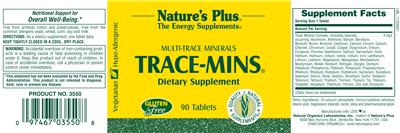
- Form
- Tablet or Pill
- Serving Size
- 1 Tablet
- Container Holds
- 90 Tablets
- Status
- No longer sold, per the NIH record
What’s in it, whether it interacts with your drugs, its side effects, whether it works, and what our pharmacists would want you to know before you start it.
- What is Trace-Mins?A supplement from Nature's Plus with 72 active ingredients, in tablet form.
- Drug Interactions 1,190 drugs have a documented interaction with this supplement; the most serious is rated major. Of those, 804 are single drugs and 386 are combination products (two or more drugs in one), each listed under its own name. Based on the 25 of its 72 ingredients we could check. Ask your pharmacist first if you take a drug in any of these categories, the most serious of the 71 on record:
- Major · 184 drugs
- Major · 161 drugs
- Major · 75 drugs
- Levodopa/
Carbidopa (Sinemet) Major · 6 drugs
- Possible Side EffectsNausea 11 ingredientsDiarrhea 8 ingredientsStomach upset 5 ingredientsHeadache 4 ingredientsVomiting 4 ingredientsGas 3 ingredients +48 moreReported for 17 of its 72 active ingredients. Not studied in this exact product.
- Well documented Why
Does Trace-Mins work?
Strong This product doesn't appear to be marketed for a specific use, so we graded its ingredients' overall clinical evidence instead.It is not marketed for one specific use, so this is what its ingredients have been studied for, strongest research first:
- Calcium
- Travelers' diarrhea Bismuth
- Boron deficiency Boron
- Chromium deficiency Chromium
- Calcium
- Calcium
These grades are for each ingredient, not this exact product, and never a promise it will work for you.
And 10 more graded uses, in what the research says- Low Why
- AllergensNone of its ingredient names point to a major food allergen
- Barcode (UPC)0 97467 03550 8Match it to the barcode on your bottle to be sure this is your product. Not your product? Search for it here
Who Might Consider It
- People who want it for dyspepsia, travelers' diarrhea, boron deficiency, chromium deficiency or another graded use: the uses with research behind them. See each grade
- Trace-Mins may be worth a conversation for someone who has been told they are low in one of the minerals it contains.
Who Should Be Careful
- People who take medications should be most careful, especially those on lithium, diuretics, antidepressants, levodopa, HIV drugs, blood thinners, or thyroid medicine.
- Talk it over with your own doctor or pharmacist before starting, and let them know about all your medicines.
More Before You Take It Show both answersHide Pregnancy and Breastfeeding The Label’s Directions
-
Pregnant or breastfeeding?
- Pregnancy and Breastfeeding Germanium
- ! When used orally due to reported toxicity; avoid using.
- Pregnancy and Breastfeeding Iron
- ! When used orally in high doses.
- Pregnancy Lithium
- ! When lithium carbonate and lithium citrate are used orally.
- Breastfeeding Lithium
- ! When used orally.
-
How does the label say to take it?
“Directions: As a dietary supplement, one tablet daily.”
The maker’s words. Your pharmacist or doctor may advise differently.
Everything the label says
From the label dated Aug 25, 2015: 25 of its 72 active ingredients were checked against our records; the other 47 are not in them yet. A summary of what is known, not a grade or a test of the product. How these ratings are computed
Ask Anything About This Supplement
Name a drug you take, or ask about side effects, ingredients or pregnancy.
AI answers come from this label and our own records, never the open internet. AI can make mistakes, so always check with your doctor or pharmacist. How we use AI
Ask the Pharmacist
A licensed pharmacist will answer your question by email — free, usually within 24 hours.
Got it — thank you!
A licensed pharmacist will answer within 24 hours. Keep an eye on your email (worth checking spam, just in case).
What’s Inside Trace-Mins by Nature's Plus
72 Active Ingredients, Each Checked on Its Own
A supplement is often several ingredients in one bottle, and each one can interact with drugs or cause side effects on its own. We check every one of them against our records.
- AluminumNot in our interaction records yet
- AntimonyNot in our interaction records yet
- BariumNot in our interaction records yet
- BerylliumNot in our interaction records yet
- BismuthDrug interactions on record, most serious: Moderate
- BoronNo drug interactions on record
- BromineNot in our interaction records yet
- CadmiumNot in our interaction records yet
And 64 more, each with its own card below.
The label gives an exact amount for 0 of its 72 active ingredients. 72 are inside one proprietary blend, “Trace Mineral Complex”, and the label gives one total for it, not how much of each ingredient is in it.
- 0 state an exact amount
- 72 have no amount of their own
- Trace Mineral Complex 4 mg in total · 72 ingredients, no amount for each
This rates what the label tells you, not the quality of the product.
Supplement Facts
| Amount Per Serving | % Daily Value | |
|---|---|---|
| Trace Mineral Complex | 4 mg | † |
| Aluminum | † | |
| Antimony | † | |
| Barium | † | |
| Beryllium | † | |
| Bismuth | † | |
| Boron | † | |
| Bromine | † | |
| Cadmium | † | |
| Calcium | † | |
| Cerium | † | |
| Cesium | † | |
| Chlorine | † | |
| Chromium | † | |
| Cobalt | † | |
| Copper | † | |
| Dysprosium | † | |
| Erbium | † | |
| Europium | † | |
| Fluorine | † | |
| Gadolinium | † | |
| Gallium | † | |
| Germanium | † | |
| Gold | † | |
| Hafnium | † | |
| Holmium | † | |
| Indium | † | |
| Iodine | † | |
| Iridium | † | |
| Iron | † | |
| Lanthanum | † | |
| Lithium | † | |
| Lutetium | † | |
| Magnesium | † | |
| Manganese | † | |
| Molybdenum | † | |
| Neodymium | † | |
| Nickel | † | |
| Niobium | † | |
| Nitrogen | † | |
| Oxygen | † | |
| Osmium | † | |
| Palladium | † | |
| Phosphorus | † | |
| Platinum | † | |
| Potassium | † | |
| Praseodymium | † | |
| Rhenium | † | |
| Rhodium | † | |
| Rubidium | † | |
| Ruthenium | † | |
| Samarium | † | |
| Scandium | † | |
| Selenium | † | |
| Silicon | † | |
| Silver | † | |
| Sodium | † | |
| Strontium | † | |
| Sulfur | † | |
| Tantalum | † | |
| Tellurium | † | |
| Terbium | † | |
| Thallium | † | |
| Thorium | † | |
| Thulium | † | |
| Tin | † | |
| Titanium | † | |
| Tungsten | † | |
| Vanadium | † | |
| Ytterbium | † | |
| Yttrium | † | |
| Zinc | † | |
| Zirconium | † | |
Other ingredients: Di-Calcium Phosphate, Microcrystalline Cellulose, Stearic Acid, Magnesium Stearate, Carob, Silica, Pharmaceutical Glaze
† Daily Value not established.
Daily Values for adults and children 4 or more years of age.
As the label prints it, from the NIH Dietary Supplement Label Database.
Each Ingredient and Its Drug Interactions
Tap one for more about it and its full guide. A drug can interact with this supplement through any one of them.
Trace-Mins is a tablet with 72 active ingredients, mostly minerals.
- The list includes copper, zinc, calcium, iron, magnesium, iodine, selenium, chromium, and manganese, plus trace minerals such as boron, molybdenum, and vanadium.
- Each one has a role in the body, and the ratings below describe what the evidence says about them.
-
Trace Mineral Complex 4 mg 72 ingredients inside it, each checked on its own
- Aluminum
- Antimony
- Barium
- Beryllium
- Bismuth 125 drugs
- Boron
- Bromine
- Cadmium
- Calcium 168 drugs
- Cerium
- Cesium 255 drugs
- Chlorine
- Chromium 178 drugs
- Cobalt
- Copper 31 drugs
- Dysprosium
- Erbium
- Europium
- Fluorine
- Gadolinium
- Gallium
- Germanium
- Gold
- Hafnium
- Holmium
- Indium
- Iodine 23 drugs
- Iridium
- Iron 80 drugs
- Lanthanum
- Lithium 515 drugs
- Lutetium
- Magnesium 298 drugs
- Manganese 83 drugs
- Molybdenum
- Neodymium
- Nickel 1 drug
- Niobium
- Nitrogen
- Oxygen
- Osmium
- Palladium
- Phosphorus
- Platinum
- Potassium 62 drugs
- Praseodymium
- Rhenium
- Rhodium
- Rubidium
- Ruthenium
- Samarium
- Scandium
- Selenium 321 drugs
- Silicon
- Silver
- Sodium 205 drugs
- Strontium 101 drugs
- Sulfur
- Tantalum
- Tellurium
- Terbium
- Thallium
- Thorium
- Thulium
- Tin
- Titanium
- Tungsten
- Vanadium 208 drugs
- Ytterbium
- Yttrium
- Zinc 67 drugs
- Zirconium
Other Ingredients (Inactive)
The capsule or tablet itself, fillers, coatings and flavors. Not part of the drug interaction check; the allergen check below reads them.
- Di-Calcium Phosphate
- Microcrystalline Cellulose
- Stearic Acid
- Magnesium Stearate
- Carob
- Silica
- Pharmaceutical Glaze
Allergens in Trace-Mins
None of its ingredient names point to a major food allergen.
Not named in the ingredients
- Milk
- Egg
- Fish
- Shellfish
- Tree nuts
- Peanuts
- Wheat or other gluten grains
- Soy
- Sesame
- Made without, the label says“Free from artificial colors and preservatives. Free from the common allergens yeast, wheat, corn, soy and milk.”
- Made without, the label says“Vegetarian”
- Made without, the label says“GLUTEN Free”
From the label text and ingredient names on file; we do not test products. With a serious allergy, check your bottle and ask the maker or your pharmacist.
What the Label Says
The maker’s own words, from the label. We do not verify or endorse them.
- Storage
-
“Keep tightly closed in a cool, dry place.”
- General
-
“Product No. 3550 LBL. 1133521”
- Brand IP Statement(s)
-
“The Energy Supplements(R)”
“(C)NATURAL ORGANICS(R)”
- FDA Statement of Identity
-
“Dietary Supplement”
- Seals and symbols
-
“QUALITY NATURAL SUPPLEMENTS(R)”
- General statements
-
“Nutritional Support for Overall Well-Being.*”
- Formulation
-
“Hypo-Allergenic”
“Multi-Trace Minerals”
The Trace-Mins Label on File
The label scan on file at the NIH Dietary Supplement Label Database, dated August 2015. Always read the label on the bottle you have.
Product Facts
- Brand
- Nature's Plus
- Barcode (UPC)
- 097467035508
- Net contents
- 90 Tablets
- Market status
- Off market
- Date entered into DSLD
- Aug 25, 2015
- DSLD ID
- 49368
- Product type
- Other Combinations
- Supplement form
- Tablet or Pill
- Dietary claims / uses
- All Other, Structure/Function
- Intended target group(s)
- Vegetarian, Adult (18 - 50 Years), No Allergies, Gluten Free, Dairy Free
Is this label outdated? Report a formula or label change and our pharmacy team will review it.
Trace-Mins by Nature's Plus Side Effects
Why this rating?
We look for three kinds of safety information on each ingredient: side effects reported in studies, a pregnancy and breastfeeding rating, and a safety write-up from our pharmacy team. All three are on file for each of the 25 ingredients we could check.
So this rates how much is known, not whether Trace-Mins is right for you.
Reported with 22 of its ingredients
- Most often
- Nausea, diarrhea, stomach upset, headache, vomiting and gas
- !Rare but serious
- Irregular heartbeat, including QT prolongation and torsades de pointes See details
HelloPharmacist Team Summary of Side Effects
Most of the minerals are generally well tolerated at recommended amounts, but high doses are the main concern.
- Excess iron can be toxic, and high-dose calcium has been linked in some studies to prostate cancer and heart concerns.
Side Effects, Ingredient by Ingredient
A supplement’s side effects come from its ingredients. Here is what is reported with each one.
Bismuth
Most reported
- Temporary darkening of the stool
- Sometimes the tongue
Boron
Most reported
- Anorexia
- Dermatitis
- Erythema
- Indigestion
From the Natural Medicines database, which we license.
Every reported effect, in the Boron guideCalcium
Most reported
- Constipation
- Gas
- Bloating
Cesium
Most reported
- Low potassium levels
- Nausea, vomiting, and diarrhea
- Numbness or tingling, often around the mouth
- Fainting and seizures
Chromium
Most reported
- Headache
- Dizziness
- Nausea
- Stomach upset
Germanium
Most reported
- Kidney injury and kidney failure (sometimes permanent or fatal)
- Anemia and changes in blood counts
- Muscle weakness and nerve problems
- Nausea, vomiting, diarrhea, and weight loss
Iodine
Most reported
- Metallic taste in the mouth
- Stomach upset, nausea, or diarrhea
- Burning in the mouth, throat, or stomach with strong liquid forms
- Headache
Iron
Most reported
- Nausea
- Stomach cramps
- Constipation
- Diarrhea
Lithium
Most reported
- Nausea
- Stomach upset
- Diarrhea
- Increased thirst
Our pharmacy team’s notes
- Lithium needs particular care.
- Prescription lithium needs blood monitoring, and stopping it suddenly can bring back bipolar symptoms, so it should be tapered gradually.
Magnesium
Most reported
- Diarrhea
- Nausea
- Stomach cramping
- Bloating
Nickel
Most reported
- Contact dermatitis
From the Natural Medicines database, which we license.
Every reported effect, in the Nickel guidePotassium
Most reported
- Stomach upset
- Nausea
- Vomiting
- Gas
Selenium
Most reported
- Gastric discomfort
- Headache
- Rash
From the Natural Medicines database, which we license.
Every reported effect, in the Selenium guideStrontium
Most reported
- Nausea
- Diarrhea
- Headache
- Skin irritation
Sulfur
Most reported
- Dryness, redness, or peeling of the skin
- Itching or mild burning
- An unpleasant rotten-egg or sulfur smell
- Staining of clothing or skin (with some products)
Vanadium
Most reported
- Gastrointestinal adverse effects
- Including abdominal discomfort
- Diarrhea
- Flatulence
- Nausea
From the Natural Medicines database, which we license.
Every reported effect, in the Vanadium guideZinc
Most reported
- Nausea
- Stomach upset
- Vomiting
- Metallic taste
Cobalt, Copper, Indium, Manganese, Molybdenum, Silicon, Sodium and Tin have side-effect reports on file, but no list of the most common ones. Read them in each guide: Cobalt, Copper, Indium, Manganese, Molybdenum, Silicon, Sodium, Tin.
Trace-Mins Warnings: Who Should Be Careful
Trace-Mins has 72 active ingredients, and each can carry warnings of its own. We checked the 25 in our ingredient guides, and each warning below names the ingredient it comes from. Aluminum, Antimony and Barium and 44 more are not in our guides yet, so ask your pharmacist about them. If any of these apply to you, talk to your doctor or pharmacist before you start it.
- Bismuth2 warnings below
- Boron3 warnings below
- Calcium3 warnings below
- Cesium2 warnings below
- Chromium3 warnings below
- Cobalt2 warnings below
- Copper3 warnings below
- Germanium1 warning below
- Indium2 warnings below
- Iodine2 warnings below
- Iron1 warning below
- Lithium3 warnings below
- Magnesium3 warnings below
- Manganese3 warnings below
- Molybdenum3 warnings below
- Nickel3 warnings below
- Potassium2 warnings below
- Selenium1 warning below
- Silicon2 warnings below
- Sodium3 warnings below
- Strontium3 warnings below
- Sulfur3 warnings below
- Tin3 warnings below
- Vanadium3 warnings below
- Zinc2 warnings below
- AluminumNot in our guides yet
- AntimonyNot in our guides yet
- BariumNot in our guides yet
- BerylliumNot in our guides yet
- BromineNot in our guides yet
- CadmiumNot in our guides yet
- CeriumNot in our guides yet
- ChlorineNot in our guides yet
- DysprosiumNot in our guides yet
- ErbiumNot in our guides yet
- EuropiumNot in our guides yet
- FluorineNot in our guides yet
- GadoliniumNot in our guides yet
- GalliumNot in our guides yet
- GoldNot in our guides yet
- HafniumNot in our guides yet
- HolmiumNot in our guides yet
- IridiumNot in our guides yet
- LanthanumNot in our guides yet
- LutetiumNot in our guides yet
- NeodymiumNot in our guides yet
- NiobiumNot in our guides yet
- NitrogenNot in our guides yet
- OxygenNot in our guides yet
- OsmiumNot in our guides yet
- PalladiumNot in our guides yet
- PhosphorusNot in our guides yet
- PlatinumNot in our guides yet
- PraseodymiumNot in our guides yet
- RheniumNot in our guides yet
- RhodiumNot in our guides yet
- RubidiumNot in our guides yet
- RutheniumNot in our guides yet
- SamariumNot in our guides yet
- ScandiumNot in our guides yet
- SilverNot in our guides yet
- TantalumNot in our guides yet
- TelluriumNot in our guides yet
- TerbiumNot in our guides yet
- ThalliumNot in our guides yet
- ThoriumNot in our guides yet
- ThuliumNot in our guides yet
- TitaniumNot in our guides yet
- TungstenNot in our guides yet
- YtterbiumNot in our guides yet
- YttriumNot in our guides yet
- ZirconiumNot in our guides yet
-
Bleeding Problems or Surgery
- BismuthPeople with a salicylate or aspirin allergy, bleeding disorders, kidney problems, or a history of stomach bleeding should avoid bismuth subsalicylate unless a doctor approves.
-
Diabetes or Low Blood Sugar
- ChromiumPeople with diabetes should monitor their blood sugar closely, since chromium may affect blood sugar levels.
- VanadiumPeople with diabetes should be especially careful, since vanadium may affect blood sugar and is often combined with other treatments.
-
Blood Pressure
- PotassiumPeople who should be especially careful or avoid potassium supplements unless a doctor directs them include those with kidney disease, people taking certain blood pressure or heart medicines that raise potassium, and those with conditions affecting adrenal or hormone function.
- SodiumYou should be especially cautious with added sodium if you have high blood pressure, heart failure, kidney disease, or liver disease, or if your doctor has told you to follow a low-salt diet.
-
Liver Disease
- ChromiumStill, taking high doses or using it for a long time may carry risks, and some case reports have linked very high intakes to kidney or liver problems.
- ChromiumPeople with kidney disease or liver disease should be especially careful and talk to a doctor before using chromium.
- CopperPeople with liver disease should also be cautious, since the liver handles copper.
- IndiumChildren, people with kidney or liver disease, and anyone with a chronic health condition should not use it without medical guidance.
Show 2 more
- ManganesePeople who should be especially careful include those with liver disease (the liver helps clear manganese), people receiving long-term intravenous (IV) nutrition, and anyone with high environmental exposure, such as certain industrial or welding work.
- TinPeople who should be especially careful include children, older adults, people with kidney or liver problems, and anyone with a known sensitivity to metals.
-
Kidney Disease or Kidney Stones
- BoronPeople with kidney problems should be especially careful, because the kidneys clear boron from the body.
- CalciumTaking very high amounts over a long time can raise the risk of kidney stones in some people and may cause too much calcium in the blood.
- CalciumPeople with kidney disease, kidney stones, parathyroid problems, or high blood calcium should talk with a doctor before taking calcium supplements.
- CesiumPeople with heart disease, low potassium, kidney problems, or those taking medicines that affect the heart are at especially high risk.
Show 12 more
- CobaltPeople with heart disease, thyroid disease, or kidney problems should be especially cautious and should avoid cobalt supplements.
- GermaniumPeople with any kidney problems are at especially high risk, but harm has occurred even in people without prior kidney disease.
- LithiumWith prescription lithium, doctors regularly check blood levels along with kidney and thyroid function.
- LithiumPeople with kidney problems, thyroid disease, heart conditions, or those who are dehydrated should be especially careful.
- MagnesiumThe biggest safety concern is in people with kidney disease, because damaged kidneys cannot remove extra magnesium, which can build up to dangerous levels.
- MagnesiumIf you have kidney problems, do not take magnesium supplements unless your doctor tells you to.
- MolybdenumPeople with kidney problems should be especially cautious, since the kidneys help remove excess molybdenum from the body.
- NickelPeople with kidney problems, nickel allergy, or a history of metal sensitivity should also be especially cautious.
- SiliconPeople with kidney problems should be especially careful, since the kidneys clear silicon from the body, and damaged kidneys may not handle it well.
- StrontiumPeople with kidney problems should be careful, since strontium is cleared by the kidneys.
- SulfurPeople with kidney problems, or those who take many medications, should be especially careful and check with a healthcare provider before use.
- VanadiumPeople with kidney problems should avoid supplements, since the kidneys clear vanadium from the body.
-
Heart Conditions
- CalciumSome research has raised questions about whether high-dose calcium supplements could affect heart health, so it is wise to avoid taking more than you need and to favor calcium from food when possible.
- MagnesiumPeople with heart conduction problems or certain bowel conditions should also be cautious.
- StrontiumBecause of this, regulators in some countries restricted or removed it from use, especially in people with heart disease, circulation problems, or a history of blood clots.
-
Stomach or Bowel Problems
- ZincPeople with digestive disorders, those who drink heavily, and people on restrictive diets are more likely to be low in zinc and may need supplements.
-
Thyroid Conditions
- IodinePeople with existing thyroid conditions such as Hashimoto's disease, Graves' disease, thyroid nodules, or thyroid cancer should be especially careful and only take iodine under a doctor's guidance.
- IodineAlways talk to a pharmacist or doctor before starting an iodine supplement, especially if you take high doses or have a thyroid condition.
-
Allergies
- NickelPeople who are allergic to nickel may react to higher nickel intake, and some can develop a skin rash even from eating nickel-rich foods.
-
Iron Deficiency or Anemia
- IronPeople with conditions that cause iron overload, such as hemochromatosis, should not take iron unless a doctor directs it.
- ManganeseChildren and people with iron deficiency may also absorb more manganese.
-
Children
- SulfurUse only with guidance from your healthcare provider, and avoid applying sulfur products to the breast or nipple area where a baby could ingest them.
-
If You Take Other Drugs
- MolybdenumAlways talk with a pharmacist or doctor before starting a molybdenum supplement, especially if you have a health condition or take other medicines.
- VanadiumAlways talk to your pharmacist or doctor before starting vanadium, especially if you have a health condition or take other medicines.
-
Other Cautions
- BoronHowever, boron can be toxic at high doses, so it should not be taken in large amounts.
- BoronStaying within that limit is important, and you should not take more than the product label recommends without medical advice.
- CesiumIf you are considering any supplement, talk with your doctor or pharmacist first, and never replace proven medical treatment with cesium.
- CobaltIf you need cobalt for nutrition, get it as vitamin B12 from food or a B12 supplement, and talk with your doctor or pharmacist about the right choice for you.
Show 9 more
- CopperPeople with Wilson's disease, a genetic condition that causes copper to build up in the body, must avoid copper supplements and may need to limit copper in their diet.
- MolybdenumPeople with gout or high uric acid levels should also be careful, because very high intakes have been linked to increased uric acid in some reports.
- NickelSafety has not been established, and getting more than the small amounts in food is not recommended.
- PotassiumSupplements are different and require more caution, because they can raise blood potassium quickly.
- SiliconAnyone with a chronic health condition should check with a doctor or pharmacist first.
- StrontiumStrontium needs to be used with caution.
- SulfurPeople with sensitive skin should test a small area first.
- TinHowever, taking tin on purpose as a supplement offers no proven benefit and carries possible risks, so it is not recommended without guidance from a healthcare professional.
- ZincAnyone considering high-dose or long-term zinc should talk to a pharmacist or doctor first.
-
What the Label Warns
- “Warning: Accidental overdose of iron-containing products is a leading cause of fatal poisoning in children under 6. Keep this product out of reach of children. In case of accidental overdose, call a physician or poison control center immediately.”
The maker’s wording, from the product label.
-
Pregnant or Breastfeeding
Each ingredient’s rating for pregnancy and for breastfeeding, and what it covers.
Pregnancy and Breastfeeding The record rates both the same
-
When used orally due to reported toxicity; avoid using.
Pregnancy and Breastfeeding The record rates both the same
-
When used orally and appropriately.
Iron is safe during pregnancy and breast-feeding in patients with adequate iron stores when used in doses below the tolerable upper intake level (UL) of 45 mg daily of elemental iron.
-
When used orally in high doses.
Tell patients who are not iron deficient to avoid exceeding the tolerable upper intake level (UL) of 45 mg daily of elemental iron.
2 more points on this rating
- Higher doses frequently cause gastrointestinal side effects such as nausea and vomiting and might increase the risk of preterm labor.
- High hemoglobin concentrations at the time of delivery are associated with adverse pregnancy outcomes.
Show 23 more ingredients
Pregnancy
-
When lithium carbonate and lithium citrate are used orally.
Lithium can cause fetal toxicity and increases the risk for cardiac and other abnormalities, including neural tube and urethral defects.
6 more points on this rating
- However, it does not seem to increase the risk for preterm birth or low birth rate.
- Some research suggests lithium might increase the risk for spontaneous abortion.
- Based on a meta-analysis of 2 population studies, taking lithium during pregnancy may increase the risk for spontaneous abortion when compared with the general population, but not when compared with patients with affective disorders not taking lithium during pregnancy.
- This suggests that it may be the presence of affective disorder itself, or the possible associated use of other teratogenic drugs or substances during pregnancy, which may increase the risk for spontaneous abortion.
- When the potential benefits to the mother and child outweigh the possible risk to the fetus, prescription lithium may be used with close monitoring by a healthcare professional.
- The safety of lithium supplements during pregnancy is unknown.
Breastfeeding
-
When used orally.
Lithium is secreted into breast milk and may cause adverse effects in the nursing infant.
2 more points on this rating
- Prescription lithium may be used in circumstances when the potential maternal benefits outweigh the possible risk to the infant.
- The infant should be closely monitored for signs of lithium toxicity.
Pregnancy
-
Amounts in foods and prenatal vitamins are appropriate, but avoid extra high-dose supplements unless advised.
Breastfeeding
-
When used orally and appropriately.
Manganese is safe when used in doses below the tolerable upper intake level (UL) of 11 mg daily during pregnancy or lactation in those aged 19 or older.
However, those under 19 years of age should limit doses to less than 9 mg daily.
-
When used orally in excessive doses.
Doses over the UL are associated with a greater risk of toxicity.
Additionally, observational research shows that adults with higher blood manganese levels have greater odds of delivering low birth weight or small for gestational age (SGA) male, but not female, infants.
1 more rating for Manganese used another way
This supplement is taken by mouth. This rating is for Manganese given another way.
-
When inhaled at moderate doses, long-term.
Manganese salts can cross the placenta, and animal research suggests that large amounts of manganese may be teratogenic.
Pregnancy and Breastfeeding The record rates both the same
-
When consumed orally in food amounts.
Strontium has not been linked to toxicity when consumed in dietary amounts, which are typically about 0.5 mg to 1.5 mg/day.
-
When strontium-89 chloride is used during pregnancy or lactation.
Strontium-89 chloride is a radioactive isotope which may cause fetal harm.
3 more points on this rating
- It is FDA pregnancy risk category D; avoid using.
- Since strontium behaves similarly to calcium in the body, strontium-89 is likely to be excreted into breast milk; avoid using during lactation.
- There is insufficient reliable information about the safety of oral strontium when used in amounts exceeding typical dietary intake during pregnancy or lactation; avoid using.
1 more rating for Strontium used another way
This supplement is taken by mouth. This rating is for Strontium given another way.
-
When strontium chloride is used topically and appropriately as a toothpaste.
Strontium chloride hexahydrate (Sensodyne-SC) is an FDA approved product.
Pregnancy
-
When used orally and appropriately.
Zinc is safe in amounts that do not exceed the tolerable upper intake level (UL) of 34 mg daily during pregnancy in those 14-18 years of age and 40 mg daily in those 19-50 years of age.
-
When used orally in doses exceeding the UL.
Breastfeeding
-
When used orally and appropriately.
Zinc is safe in amounts that do not exceed the tolerable upper intake level (UL) of 34 mg daily during lactation in those 14-18 years of age, and 40 mg daily for those 19-50 years of age.
-
When used orally in doses exceeding the UL.
Higher doses can cause zinc-induced copper deficiency in nursing infants.
Pregnancy and Breastfeeding The record rates both the same
-
When used orally and appropriately.
Boron is safe in amounts that do not exceed the UL during pregnancy or lactation, which is 20 mg daily in those 19-50 years of age or 17 mg daily for those 14-18 years of age.
-
When used orally in doses exceeding the UL.
Higher doses might impair growth and cause adverse effects in the developing fetus.
1 more rating for Boron used another way
This supplement is taken by mouth. This rating is for Boron given another way.
-
When used vaginally.
Intravaginal boric acid has been associated with a 2.7- to 2.8-fold increased risk of birth defects when used during the first 4 months of pregnancy.
Pregnancy and Breastfeeding The record rates both the same
-
When used orally and appropriately.
The World Health Organization (WHO) recommends prescribing oral calcium supplementation 1.5-2 grams daily during pregnancy to those with low dietary calcium intake to prevent pre-eclampsia.
-
When used orally in excessive doses.
The Institute of Medicine sets the same daily tolerable upper intake level (UL) for calcium according to age independent of pregnancy status: 9-18 years, 3000 mg; 19-50 years, 2500 mg.
2 more points on this rating
- Doses over these amounts might increase the risk of neonatal hypocalcemia-induced seizures possibly caused by transient neonatal hypoparathyroidism in the setting of excessive calcium supplementation during pregnancy, especially during the third trimester.
- Neonatal hypocalcemia is a risk factor for neonatal seizures.
Pregnancy and Breastfeeding The record rates both the same
-
When used orally and appropriately.
Copper is safe in amounts that do not exceed the tolerable upper intake level (UL) of 8 mg daily for those 14-18 years of age or 10 mg daily for those 19 years and older.
-
When used orally in doses exceeding the UL.
Higher intake can cause liver damage.
Pregnancy and Breastfeeding The record rates both the same
-
When used orally.
The effect of indium on the fetus or breast-feeding newborn is not known; however, indium compounds are thought to be toxic to many organ systems; avoid using.
1 more rating for Indium used another way
This supplement is taken by mouth. This rating is for Indium given another way.
-
When indium (In-111) pentetreotide is used intravenously.
It is not known if it can harm the fetus, or if it is excreted in breast milk.
Pregnancy and Breastfeeding The record rates both the same
-
When used orally and appropriately.
Iodine is safe in amounts that do not exceed the tolerable upper intake level (UL) of 1100 mcg daily in those 18 years and older or 900 mcg daily in those 14-18 years of age.
Iodine needs increase during pregnancy and lactation and adequate intakes should begin as soon as a patient is aware of the pregnancy, or earlier in areas of potential deficiency.
-
When used orally in doses exceeding the UL.
Higher intake can cause thyroid dysfunction.
2 more points on this rating
- Also, higher intakes during pregnancy cause increased iodine levels in breast milk and infant blood samples.
- Higher iodine intake during pregnancy has also been associated with an increased risk of congenital hypothyroidism and reduced mental and physical development in the offspring.
1 more rating for Iodine used another way
This supplement is taken by mouth. This rating is for Iodine given another way.
-
When used topically as a 2% solution.
Iodine is an FDA-approved prescription product.
Pregnancy and Breastfeeding The record rates both the same
-
When used orally and appropriately.
Magnesium is safe for those pregnant and breast-feeding when used in doses below the tolerable upper intake level (UL) of 350 mg daily.
-
When used orally in excessive doses.
Tell patients to avoid exceeding the tolerable upper intake level (UL) of 350 mg daily.
Taking magnesium orally in higher doses can cause diarrhea.
2 more ratings for Magnesium used another way
This supplement is taken by mouth. These ratings are for Magnesium given another way.
-
When prescription magnesium sulfate is given intramuscularly and intravenously prior to delivery for up to 5 days.
However, due to potential adverse effects associated with intravenous and intramuscular magnesium, use during pregnancy is limited to patients with specific conditions such as severe pre-eclampsia or eclampsia.
5 more points on this rating
- There is some evidence that intravenous magnesium can increase fetal mortality and adversely affect neurological and skeletal development.
- However, a more recent analysis of clinical research shows that increased risk of fetal mortality seems to occur only in the studies where antenatal magnesium is used for tocolysis and not for fetal neuroprotection or pre-eclampsia/eclampsia.
- Furthermore, antenatal magnesium does not seem to be associated with increased risk of necrotizing enterocolitis in preterm infants.
- There is also concern that magnesium increases the risk of maternal adverse events.
- A meta-analysis of clinical research shows that magnesium sulfate might increase the risk of maternal adverse events, especially in Hispanic mothers compared to other racial and ethnic groups.
-
When prescription magnesium sulfate is given intramuscularly and intravenously prior to delivery for longer than 5 days.
Maternal exposure to magnesium for longer than 5-7 days is associated with an increase in neonatal bone abnormalities such as osteopenia and fractures.
The U.S. Food and Drug Administration (FDA) recommends that magnesium injection not be given for longer than 5-7 days.
Pregnancy
-
When used orally and appropriately.
Molybdenum crosses the placenta by passive diffusion and is exchanged freely between the mother and fetus.
However, molybdenum is safe when used in amounts that do not exceed the Tolerable Upper Intake Level (UL) of 1.7 mg/day for women 14 to 18 years, or 2 mg/day for women 19 years of age and older.
-
When used orally in high doses.
Molybdenum might not be safe during pregnancy when used in doses exceeding the UL of 1.7 mg/day for women 14 to 18 years, or 2 mg/day for women 19 and older.
Breastfeeding
-
When used orally and appropriately.
Molybdenum is safe when used in amounts that do not exceed the Tolerable Upper Intake Level (UL) of 2 mg/day for breast-feeding women 19 years of age or older, or 1.7 mg/day for breast-feeding women ages 14 to 18 years.
-
When used orally in high doses.
Molybdenum might not be safe when used in doses exceeding the UL of 2 mg/day for breast-feeding women 19 or older, or 1.7 mg/day for breast-feeding women ages 14 to 18 years.
Pregnancy
-
When used orally and appropriately.
Selenium appears to be safe when used short-term in amounts that do not exceed the tolerable upper intake level (UL) of 400 mcg daily; however, there is concern that long-term use might not be safe.
-
When used orally in excessive doses.
Doses above 400 mcg daily may cause significant toxicity.
Breastfeeding
-
When used orally and appropriately.
Selenium appears to be safe when used short-term in amounts that do not exceed the tolerable upper intake level (UL) of 400 mcg daily when taken short-term; however, there is concern that long-term use might not be safe.
-
When used orally in excessive doses.
Doses above 400 mcg daily may cause significant toxicity.
-
When used orally in HIV-positive women.
Selenium supplementation in HIV-positive women not taking highly active antiretroviral therapy may increase HIV-1 levels in breast milk.
Pregnancy and Breastfeeding The record rates both the same
-
When used orally and appropriately.
Sodium is safe in amounts that do not exceed the CDRR intake level of 2.3 grams daily.
-
When used orally in higher doses.
Higher intake can cause hypertension.
Also, both the highest and the lowest pre-pregnancy sodium quintile intakes are associated with an increased risk of hypertensive disorders of pregnancy, including gestational hypertension and pre-eclampsia, and the delivery of small for gestational age (SGA) infants when compared to the middle intake quintile.
Pregnancy
-
When used orally in amounts found in foods.
-
When used orally in medicinal amounts.
Epidemiological research has found that increased urinary levels of vanadium are associated with an increased risk of both term and preterm premature rupture of membranes (PROM).
4 more points on this rating
- When comparing tertiles of urinary vanadium levels, patients in the middle tertile had 1.66 times the risk of term PROM when compared with the lowest tertile, and those in the highest tertile had 3.75 times the risk.
- For preterm PROM (rupture prior to 37 weeks' gestation), those in the highest tertile had an 8.14 times increased risk when compared with those in the lowest tertile.
- Epidemiological research has also found that higher prenatal serum levels of vanadium are associated with impaired fetal growth, particularly in male newborns.
- The risk appears greatest with vanadium exposure in the second trimester.
Breastfeeding
-
When used orally in amounts found in foods.
There is insufficient reliable information available about the safety of vanadium when used in amounts greater than those typically found in foods; avoid using.
Pregnancy and Breastfeeding The record rates both the same
-
Insufficient reliable information available; avoid using.
Pregnancy and Breastfeeding The record rates both the same
-
Insufficient reliable information available; avoid using.
Pregnancy and Breastfeeding The record rates both the same
-
Insufficient reliable information available; avoid using.
Pregnancy and Breastfeeding The record rates both the same
-
Insufficient reliable information available; avoid using.
Pregnancy
-
When used orally and appropriately in amounts not exceeding adequate intake (AI) levels.
The AI for pregnancy is 28 mcg daily for those 14-18 years of age and 30 mcg daily for those 19-50 years of age.
-
When used orally in amounts exceeding the adequate intake (AI) levels.
There is some evidence that patients with gestational diabetes can safely use chromium in doses of 4-8 mcg/kg; however, patients should not take chromium supplements during pregnancy without medical supervision.
Breastfeeding
-
When used orally and appropriately in amounts not exceeding adequate intake (AI) levels.
The AI for lactation is 44 mcg daily for those 14-18 years of age and 45 mcg daily for those 19-50 years of age.
2 more points on this rating
- Chromium supplements do not seem to increase normal chromium concentration in human breast milk.
- There is insufficient reliable information available about the safety of chromium when used in higher amounts while breast-feeding.
Pregnancy and Breastfeeding The record rates both the same
-
When used orally and appropriately.
Nickel is safe to use during pregnancy and lactation in doses below the tolerable upper intake level (UL) of 1 mg daily.
There is insufficient reliable information available about the safety of nickel when taken in doses above the UL during pregnancy and lactation.
Pregnancy and Breastfeeding The record rates both the same
-
When used orally in dietary amounts of 40-80 mEq daily.
A tolerable upper intake level (UL) has not been established for healthy individuals.
Pregnancy and Breastfeeding The record rates both the same
-
When used orally in amounts commonly found in foods.
It is estimated that the average dietary intake of silicon is 20-50 mg daily.
There is insufficient reliable information available about the safety of silicon when used in larger, medicinal amounts; avoid using.
Pregnancy and Breastfeeding The record rates both the same
-
When applied topically and appropriately, short-term.
Topical products containing sulfur in concentrations up to 6% have been safely applied nightly for up to 6 nights.
There is insufficient reliable information available about the safety of sulfur when used orally; avoid using.
Our pharmacy team’s notes
- Pregnancy and breastfeeding notes vary by ingredient, and the details are in the FAQs below.
Ratings and the words beside them are from the Natural Medicines database, which we license. Where it has no rating, the rating and note are our pharmacy team’s.
-
Rare but Serious Side Effects
-
!
Bismuth
Allergic reactions are uncommon but possible.
Orally: After large doses or chronic use, kidney failure and encephalopathy have been reported. Salicylate toxicity is also possible with use of bismuth subsalicylate specifically.
-
!
Boron
Very high or toxic amounts of boron can lead to more serious problems such as headache, restlessness, tremors, and other signs of poisoning.
-
!
Calcium
Taking too much calcium can lead to more serious problems such as kidney stones or high blood calcium (hypercalcemia), which can cause nausea, confusion, excessive thirst, frequent urination, and an irregular heartbeat.
Orally: Case reports have raised concerns about calciphylaxis and kidney stones.
-
!
Cesium
Serious cases have led to hospitalization and death.
Arrhythmia, including QT prolongation and torsades de pointes, cardiac arrest, hypokalemia, loss of consciousness, seizures.
-
!
Chromium
Rare but more serious problems, such as kidney or liver injury, have been reported mostly with high doses.
Chromium supplements have been linked to rare kidney and liver problems in case reports.
Orally: Rare cases of kidney and liver damage, rhabdomyolysis, and thrombocytopenia have been reported.
-
!
Cobalt
At high or repeated doses, cobalt can cause serious problems, including heart damage, an enlarged thyroid (goiter) or thyroid dysfunction, nerve damage, and hearing or vision loss.
-
!
Copper
Very large single doses can cause serious copper poisoning, which is a medical emergency.
-
!
Germanium
Long-term use of both inorganic germanium and so-called "organic" germanium products has been linked to serious kidney damage (kidney failure), and some cases have been fatal.
-
!
Iodine
More serious effects from too much iodine include thyroid problems (either overactive or underactive thyroid), thyroid swelling, and rarely allergic reactions.
Hypersensitivity reactions such as anaphylaxis and angioedema.
-
!
Iron
Serious but rare: Taking very large amounts of iron, especially accidental overdose in children, can cause severe and even life-threatening poisoning.
Orally: Case reports have raised concerns about oral or gastric ulcerations.
-
!
Lithium
Warning signs include severe tremor, confusion, slurred speech, vomiting, severe diarrhea, unsteady walking, drowsiness, or seizures.
-
!
Magnesium
Rare but serious side effects happen mostly with very high doses or in people with poor kidney function.
With toxic doses, loss of reflexes and respiratory depression can occur. High doses in pregnancy can increase risk of neonatal mortality and neurological defects.
-
!
Manganese
Very high or prolonged intake of manganese can cause a serious condition affecting the brain and nervous system called manganism, with symptoms that can resemble Parkinson's disease—such as tremor, muscle stiffness, slowed movement, balance problems, and mood or memory changes.
Neurotoxicity, including Parkinson-like extrapyramidal symptoms, when used in high doses.
-
!
Nickel
Higher intakes can cause more serious problems, including stomach and intestinal irritation and effects on the kidneys or other organs.
Orally: Chronic consumption of large quantities of nickel might increase the risk of cancers of the lung, nose, larynx, and prostate.
-
!
Potassium
The most serious risk is high blood potassium (hyperkalemia).
High potassium levels can cause arrhythmia, heart block, hypotension, and mental confusion.
-
!
Selenium
In severe cases of overdose, more serious effects on the nervous system, kidneys, and heart can occur.
Orally: Excessive ingestion has led to cases of multi-organ failure and death.
-
!
Silicon
Serious side effects from oral silicon supplements are not commonly reported, but high-quality long-term safety data are limited.
-
!
Sodium
Rarely, a sudden large intake of salt—or a rapid change in blood sodium during treatment—can be very serious and even life-threatening.
Orally: Worsened cardiovascular disease, hypertension, kidney disease.
-
!
Strontium
More serious but less common risks include blood clots, heart-related events, and rare severe allergic reactions that can affect the skin and internal organs.
Orally: Myocardial infarction, osteomalacia, venous thromboembolism.
-
!
Sulfur
Serious reactions are uncommon.
-
!
Vanadium
Higher doses or long-term use may lead to more serious problems, and very high intakes can be toxic, possibly affecting the kidneys and other organs.
Orally: Kidney damage, when taken long-term at high doses.
-
!
Zinc
Very high single doses can cause more serious stomach symptoms.
Orally: There have been cases of acute renal tubular necrosis, interstitial nephritis, neurological complications, severe vomiting, and sideroblastic anemia after zinc overdose.
When to get help: a serious allergic reaction, with trouble breathing or swelling of the face, lips or throat, needs emergency care: call 911. For any other side effect that worries you, call your doctor or pharmacist.
These reports describe each ingredient, not studies of this exact product. Not medical advice: a side effect you notice after starting a supplement is worth a word with your pharmacist or doctor.
Trace-Mins by Nature's Plus Drug Interactions
We checked all 72 active ingredients in this supplement against every drug in our records. A drug can interact with it through any one of them. 47 of them are not in our interaction records yet.
A major interaction on record
3 of 3, on a scale from Minor or none to Major.Why this rating?
We rate this by the most serious interaction on record, not by how many there are. For Iodine, Manganese, Vanadium, Calcium and Potassium, the most serious is rated major, which means the combination is best avoided, or used only under close supervision. Some involve kinds of drugs where a small change can matter, such as blood thinners, seizure drugs and transplant drugs.
1,190 drugs are on the full list. What matters is whether one you take is on it, so check yours with the interaction checker on this page.
17 of its 72 active ingredients have drug interactions on record. The ones below matter most.
- Interacts with
- 515 drugs
- Most serious
- Major
- Most of its records involve Serotonergic Drugs, Nonsteroidal Anti-inflammatory Drugs (NSAIDs) and Diuretic Drugs.
- Interacts with
- 321 drugs
- Most serious
- Moderate
- Most of its records involve Anticoagulant/Antiplatelet Drugs, Immunosuppressants and Barbiturates.
- Interacts with
- 298 drugs
- Most serious
- Major
- Most of its records involve Anticoagulant/Antiplatelet Drugs, Skeletal Muscle Relaxants and Potassium-sparing Diuretics.
Show three more ingredients
- Interacts with
- 255 drugs
- Most serious
- Major
- Most of its records involve QT Interval-prolonging Drugs, Diuretic Drugs and Corticosteroids.
- Interacts with
- 208 drugs
- Most serious
- Moderate
- Most of its records involve Anticoagulant/Antiplatelet Drugs and Antidiabetes Drugs.
- Interacts with
- 205 drugs
- Most serious
- Moderate
- Most of its records involve Antihypertensive Drugs, Corticosteroids and Sodium-containing Drugs.
And eleven more ingredients with records, each in the cards below.
From the HelloPharmacist Team
The big picture, once every ingredient is counted together.
- Trace-Mins by Nature's Plus does interact with some medications, and its lithium content carries the most serious rating.
- Lithium carries a Major severity rating for serotonergic drugs (medications that raise serotonin, such as some antidepressants), where it may both mask and increase the risk of serotonin syndrome (a potentially dangerous reaction to excess serotonin).
- Other ingredients with documented interactions include copper, sodium, potassium, zinc, calcium, iron, magnesium, iodine, manganese, chromium, selenium, bismuth, nickel, and vanadium.
Summarized by the HelloPharmacist pharmacy team from the interaction records below. How it is written How we use AI
Why Trace-Mins Interacts, Ingredient by Ingredient
A product interacts through its ingredients. Each card: how many drugs, the most serious rating, and the kinds of drugs it affects most (tap a kind for what it means).
The ingredients driving the most interactions
-
Lithium 515 drugs
Most serious: Major11 interaction records on file
The kinds of drugs it affects most
- 184 drugs
- 89 drugs
- 75 drugs
- 50 drugs
Every Lithium drug interaction, 11 records The Lithium records cite 26 references, listed in the Lithium guide.
-
Selenium 321 drugs
Most serious: Moderate6 interaction records on file
The kinds of drugs it affects most
- 122 drugs
- 121 drugs
- 49 drugs
- 30 drugs
Every Selenium drug interaction, 6 records The Selenium records cite 36 references, listed in the Selenium guide.
-
Magnesium 298 drugs
Most serious: Major16 interaction records on file
The kinds of drugs it affects most
- 122 drugs
- Skeletal Muscle Relaxants 36 drugs
- 23 drugs
- 22 drugs
Every Magnesium drug interaction, 16 records The Magnesium records cite 84 references, listed in the Magnesium guide.
-
Cesium 255 drugs
Most serious: Major3 interaction records on file
The kinds of drugs it affects most
- 161 drugs
- 75 drugs
- 23 drugs
Every Cesium drug interaction, 3 records The Cesium records cite 9 references, listed in the Cesium guide.
-
Vanadium 208 drugs
Most serious: Moderate2 interaction records on file
The kinds of drugs it affects most
- 122 drugs
- 86 drugs
Every Vanadium drug interaction, 2 records The Vanadium records cite 15 references, listed in the Vanadium guide.
-
Sodium 205 drugs
Most serious: Moderate7 interaction records on file
The kinds of drugs it affects most
- 172 drugs
- 23 drugs
- Sodium-containing Drugs 7 drugs
- Sodium Phosphates 2 drugs
Every Sodium drug interaction, 7 records The Sodium records cite 43 references, listed in the Sodium guide.
-
Chromium 178 drugs
Most serious: Moderate5 interaction records on file
The kinds of drugs it affects most
- 89 drugs
- 86 drugs
- 35 drugs
- 13 drugs
Every Chromium drug interaction, 5 records The Chromium records cite 54 references, listed in the Chromium guide.
-
Calcium 168 drugs
Most serious: Major18 interaction records on file
The kinds of drugs it affects most
- 56 drugs
- 22 drugs
- 21 drugs
- 20 drugs
Every Calcium drug interaction, 18 records The Calcium records cite 62 references, listed in the Calcium guide.
-
Bismuth 125 drugs
Most serious: Moderate4 interaction records on file
The kinds of drugs it affects most
- 122 drugs
- 35 drugs
- Omeprazole (Prilosec) 4 drugs
- 2 drugs
Every Bismuth drug interaction, 4 records The Bismuth records cite 36 references, listed in the Bismuth guide.
-
Strontium 101 drugs
Most serious: Moderate5 interaction records on file
The kinds of drugs it affects most
- 41 drugs
- 21 drugs
- 20 drugs
- 16 drugs
Every Strontium drug interaction, 5 records The Strontium records cite 22 references, listed in the Strontium guide.
-
Manganese 83 drugs
Most serious: Moderate3 interaction records on file
The kinds of drugs it affects most
- 45 drugs
- 21 drugs
- 20 drugs
Every Manganese drug interaction, 3 records The Manganese records cite 21 references, listed in the Manganese guide.
-
Iron 80 drugs
Most serious: Moderate13 interaction records on file
The kinds of drugs it affects most
- 21 drugs
- 20 drugs
- Bictegravir/Emtricitabine/Tenofovir Alafenamide (Biktarvy) 13 drugs
- 10 drugs
Every Iron drug interaction, 13 records The Iron records cite 72 references, listed in the Iron guide.
-
Zinc 67 drugs
Most serious: Moderate10 interaction records on file
The kinds of drugs it affects most
- 21 drugs
- 20 drugs
- Bictegravir/Emtricitabine/Tenofovir Alafenamide (Biktarvy) 13 drugs
- Ritonavir (Norvir) 7 drugs
Every Zinc drug interaction, 10 records The Zinc records cite 88 references, listed in the Zinc guide.
-
Potassium 62 drugs
Most serious: Moderate3 interaction records on file
The kinds of drugs it affects most
- 23 drugs
- 23 drugs
- 17 drugs
Every Potassium drug interaction, 3 records The Potassium records cite 12 references, listed in the Potassium guide.
-
Copper 31 drugs
Most serious: Moderate2 interaction records on file
The kinds of drugs it affects most
- 30 drugs
- Penicillamine (Cuprimine, Depen) 1 drug
Every Copper drug interaction, 2 records The Copper records cite 11 references, listed in the Copper guide.
-
Iodine 23 drugs
Most serious: Moderate4 interaction records on file
The kinds of drugs it affects most
- 16 drugs
- Antithyroid Drugs 5 drugs
- Amiodarone (Cordarone) 1 drug
- 1 drug
Every Iodine drug interaction, 4 records The Iodine records cite 29 references, listed in the Iodine guide.
-
Nickel 1 drug
Most serious: Moderate1 interaction record on file
The kinds of drugs it affects most
- Disulfiram (Antabuse) 1 drug
Every Nickel drug interaction, 1 record The Nickel records cite 85 references, listed in the Nickel guide.
The Breakdown by Severity
Each drug counted once, at its most serious rating. Tap a tile to list those drugs.
Find Your Drug
Type a drug or brand name to see whether it is on the list.
- Only drugs with a documented interaction are listed, the most serious first.
- A drug with no known interaction is not listed, but searching its name tells you so.
- Open a drug to see which ingredient is responsible. Of those, 804 are single drugs and 386 are combination products (two or more drugs in one), each listed under its own name.
-
SertralineZoloft Major
The 2 ingredients responsible:
-
Cesium Major Sertraline is in the QT Interval-prolonging Drugs category.
Theoretically, taking cesium concomitantly with other drugs that prolong the QT interval may increase the risk of ventricular arrhythmias and death.
The full Cesium + Sertraline interaction -
Lithium Major Sertraline is in the Serotonergic Drugs category.
Theoretically, taking lithium supplements with serotonergic drugs might both mask and increase the risk of serotonin syndrome.
The full Lithium + Sertraline interaction
-
-
EscitalopramLexapro Major
The ingredient responsible:
-
Lithium Major Escitalopram is in the Serotonergic Drugs category.
Theoretically, taking lithium supplements with serotonergic drugs might both mask and increase the risk of serotonin syndrome.
The full Lithium + Escitalopram interaction
-
-
MethylphenidateAptensio XR, Concerta, Cotempla XR-ODT, Jornay PM, Metadate and 8 more Major
The ingredient responsible:
-
Lithium Major Methylphenidate is in the Serotonergic Drugs category.
Theoretically, taking lithium supplements with serotonergic drugs might both mask and increase the risk of serotonin syndrome.
The full Lithium + Methylphenidate interaction
-
-
FluoxetineProzac, Sarafem Major
The 2 ingredients responsible:
-
Lithium Major Fluoxetine is in the Serotonergic Drugs category.
Theoretically, taking lithium supplements with serotonergic drugs might both mask and increase the risk of serotonin syndrome.
The full Lithium + Fluoxetine interaction -
Cesium Major Fluoxetine is in the QT Interval-prolonging Drugs category.
Theoretically, taking cesium concomitantly with other drugs that prolong the QT interval may increase the risk of ventricular arrhythmias and death.
The full Cesium + Fluoxetine interaction
-
-
AzithromycinAzasite, Zithromax, Zmax Major
The ingredient responsible:
-
Cesium Major Azithromycin is in the QT Interval-prolonging Drugs category.
Theoretically, taking cesium concomitantly with other drugs that prolong the QT interval may increase the risk of ventricular arrhythmias and death.
The full Cesium + Azithromycin interaction
-
-
LisdexamfetamineVyvanse Major
The ingredient responsible:
-
Lithium Major Lisdexamfetamine is in the Serotonergic Drugs category.
Theoretically, taking lithium supplements with serotonergic drugs might both mask and increase the risk of serotonin syndrome.
The full Lithium + Lisdexamfetamine interaction
-
-
AmitriptylineElavil Major
The 2 ingredients responsible:
-
Cesium Major Amitriptyline is in the QT Interval-prolonging Drugs category.
Theoretically, taking cesium concomitantly with other drugs that prolong the QT interval may increase the risk of ventricular arrhythmias and death.
The full Cesium + Amitriptyline interaction -
Lithium Major Amitriptyline is in the Serotonergic Drugs category.
Theoretically, taking lithium supplements with serotonergic drugs might both mask and increase the risk of serotonin syndrome.
The full Lithium + Amitriptyline interaction
-
-
CitalopramCelexa Major
The ingredient responsible:
-
Lithium Major Citalopram is in the Serotonergic Drugs category.
Theoretically, taking lithium supplements with serotonergic drugs might both mask and increase the risk of serotonin syndrome.
The full Lithium + Citalopram interaction
-
-
BuspironeBuSpar Major
The ingredient responsible:
-
Lithium Major Buspirone is in the Serotonergic Drugs category.
Theoretically, taking lithium supplements with serotonergic drugs might both mask and increase the risk of serotonin syndrome.
The full Lithium + Buspirone interaction
-
-
QuetiapineDopaquel, Seroquel Major
The 3 ingredients responsible:
-
Lithium Major Quetiapine is in these Serotonergic Drugs, Antipsychotic Drugs categories.
Theoretically, taking lithium supplements with serotonergic drugs might both mask and increase the risk of serotonin syndrome.
The full Lithium + Quetiapine interaction -
Cesium Major Quetiapine is in the QT Interval-prolonging Drugs category.
Theoretically, taking cesium concomitantly with other drugs that prolong the QT interval may increase the risk of ventricular arrhythmias and death.
The full Cesium + Quetiapine interaction -
Manganese Moderate Quetiapine is in the Antipsychotic Drugs category.
Theoretically, the risk for manganese toxicity might increase when taken with antipsychotic drugs.
The full Manganese + Quetiapine interaction
-
-
MethamphetamineDesoxyn Major
The ingredient responsible:
-
Lithium Major Methamphetamine is in the Serotonergic Drugs category.
Theoretically, taking lithium supplements with serotonergic drugs might both mask and increase the risk of serotonin syndrome.
The full Lithium + Methamphetamine interaction
-
-
Methylene BlueProvayblue, Urolene Blue Major
The ingredient responsible:
-
Lithium Major Methylene Blue is in the Serotonergic Drugs category.
Theoretically, taking lithium supplements with serotonergic drugs might both mask and increase the risk of serotonin syndrome.
The full Lithium + Methylene Blue interaction
-
-
DuloxetineCymbalta, Drizalma Sprinkle, Irenka Major
The ingredient responsible:
-
Lithium Major Duloxetine is in the Serotonergic Drugs category.
Theoretically, taking lithium supplements with serotonergic drugs might both mask and increase the risk of serotonin syndrome.
The full Lithium + Duloxetine interaction
-
-
SumatriptanTosymra Major
The 2 ingredients responsible:
-
Cesium Major Sumatriptan is in the QT Interval-prolonging Drugs category.
Theoretically, taking cesium concomitantly with other drugs that prolong the QT interval may increase the risk of ventricular arrhythmias and death.
The full Cesium + Sumatriptan interaction -
Lithium Major Sumatriptan is in the Serotonergic Drugs category.
Theoretically, taking lithium supplements with serotonergic drugs might both mask and increase the risk of serotonin syndrome.
The full Lithium + Sumatriptan interaction
-
-
DextroamphetamineDexedrine Major
The ingredient responsible:
-
Lithium Major Dextroamphetamine is in the Serotonergic Drugs category.
Theoretically, taking lithium supplements with serotonergic drugs might both mask and increase the risk of serotonin syndrome.
The full Lithium + Dextroamphetamine interaction
-
-
HydroxychloroquinePlaquenil Major
The ingredient responsible:
-
Cesium Major Hydroxychloroquine is in the QT Interval-prolonging Drugs category.
Theoretically, taking cesium concomitantly with other drugs that prolong the QT interval may increase the risk of ventricular arrhythmias and death.
The full Cesium + Hydroxychloroquine interaction
-
-
Tamoxifen CitrateNolvadex, Soltamox Major
The ingredient responsible:
-
Cesium Major Tamoxifen Citrate is in the QT Interval-prolonging Drugs category.
Theoretically, taking cesium concomitantly with other drugs that prolong the QT interval may increase the risk of ventricular arrhythmias and death.
The full Cesium + Tamoxifen Citrate interaction
-
-
SpironolactoneAldactone, Carospir, Spiroton Major
The 5 ingredients responsible:
-
Lithium Major Spironolactone is in the Diuretic Drugs category.
Theoretically, taking lithium supplements with loop diuretics might increase lithium levels and adverse effects.
The full Lithium + Spironolactone interaction -
Magnesium Moderate Spironolactone is in the Potassium-sparing Diuretics category.
Potassium-sparing diuretics decrease excretion of magnesium, possibly increasing magnesium levels.
The full Magnesium + Spironolactone interaction -
Sodium Moderate Spironolactone is in the Antihypertensive Drugs category.
Theoretically, a high intake of dietary sodium might reduce the effectiveness of antihypertensive drugs.
The full Sodium + Spironolactone interaction -
Cesium Moderate Spironolactone is in the Diuretic Drugs category.
Theoretically, taking cesium concomitantly with other drugs that deplete potassium, such as diuretics, may increase the risk of hypokalemia.
The full Cesium + Spironolactone interaction -
Potassium Moderate Spironolactone is in the Potassium-sparing Diuretics category.
Concomitant use increases the risk of hyperkalemia.
The full Potassium + Spironolactone interaction
-
-
VenlafaxineEffexor, Effexor XR Major
The 2 ingredients responsible:
-
Cesium Major Venlafaxine is in the QT Interval-prolonging Drugs category.
Theoretically, taking cesium concomitantly with other drugs that prolong the QT interval may increase the risk of ventricular arrhythmias and death.
The full Cesium + Venlafaxine interaction -
Lithium Major Venlafaxine is in the Serotonergic Drugs category.
Theoretically, taking lithium supplements with serotonergic drugs might both mask and increase the risk of serotonin syndrome.
The full Lithium + Venlafaxine interaction
-
-
MirtazapineRemeron Major
The ingredient responsible:
-
Lithium Major Mirtazapine is in the Serotonergic Drugs category.
Theoretically, taking lithium supplements with serotonergic drugs might both mask and increase the risk of serotonin syndrome.
The full Lithium + Mirtazapine interaction
-
-
TacrolimusAstagraf XL, Envarsus XR, Prograf (capsule), Prograf (injectable), Prograf XL and 1 more Major
The 2 ingredients responsible:
-
Cesium Major Tacrolimus is in the QT Interval-prolonging Drugs category.
Theoretically, taking cesium concomitantly with other drugs that prolong the QT interval may increase the risk of ventricular arrhythmias and death.
The full Cesium + Tacrolimus interaction -
Selenium Moderate Tacrolimus is in the Immunosuppressants category.
Theoretically, selenium supplementation may reduce the effectiveness of immunosuppressant therapy.
The full Selenium + Tacrolimus interaction
-
-
CarbamazepineCarbatrol, Carnexiv, Equetro, Tegretol, Tegretol XR Major
The ingredient responsible:
-
Lithium Major Carbamazepine is in these Anticonvulsants, Serotonergic Drugs categories.
Theoretically, taking lithium supplements with anticonvulsants might increase the risk of neurotoxicity.
The full Lithium + Carbamazepine interaction
-
-
AripiprazoleAbilify, Abilify Maintena, Abilify Mycite Major
The 3 ingredients responsible:
-
Lithium Major Aripiprazole is in these Serotonergic Drugs, Antipsychotic Drugs categories.
Theoretically, taking lithium supplements with serotonergic drugs might both mask and increase the risk of serotonin syndrome.
The full Lithium + Aripiprazole interaction -
Cesium Major Aripiprazole is in the QT Interval-prolonging Drugs category.
Theoretically, taking cesium concomitantly with other drugs that prolong the QT interval may increase the risk of ventricular arrhythmias and death.
The full Cesium + Aripiprazole interaction -
Manganese Moderate Aripiprazole is in the Antipsychotic Drugs category.
Theoretically, the risk for manganese toxicity might increase when taken with antipsychotic drugs.
The full Manganese + Aripiprazole interaction
-
-
MetronidazoleAnabact, Flagyl, Flagyl IV, Flagyl IV RTU, Likmez and 13 more Major
The ingredient responsible:
-
Cesium Major Metronidazole is in the QT Interval-prolonging Drugs category.
Theoretically, taking cesium concomitantly with other drugs that prolong the QT interval may increase the risk of ventricular arrhythmias and death.
The full Cesium + Metronidazole interaction
-
-
AcetazolamideAk-Zol, Diamox Major
The 3 ingredients responsible:
-
Lithium Major Acetazolamide is in these Diuretic Drugs, Anticonvulsants categories.
Theoretically, taking lithium supplements with loop diuretics might increase lithium levels and adverse effects.
The full Lithium + Acetazolamide interaction -
Sodium Moderate Acetazolamide is in the Antihypertensive Drugs category.
Theoretically, a high intake of dietary sodium might reduce the effectiveness of antihypertensive drugs.
The full Sodium + Acetazolamide interaction -
Cesium Moderate Acetazolamide is in the Diuretic Drugs category.
Theoretically, taking cesium concomitantly with other drugs that deplete potassium, such as diuretics, may increase the risk of hypokalemia.
The full Cesium + Acetazolamide interaction
-
-
HydrochlorothiazideAquazide, Aquazide H, Esidrix, HCTZ, Hydro and 4 more Major
The 4 ingredients responsible:
-
Lithium Major Hydrochlorothiazide is in the Diuretic Drugs category.
Theoretically, taking lithium supplements with loop diuretics might increase lithium levels and adverse effects.
The full Lithium + Hydrochlorothiazide interaction -
Sodium Moderate Hydrochlorothiazide is in the Antihypertensive Drugs category.
Theoretically, a high intake of dietary sodium might reduce the effectiveness of antihypertensive drugs.
The full Sodium + Hydrochlorothiazide interaction -
Cesium Moderate Hydrochlorothiazide is in the Diuretic Drugs category.
Theoretically, taking cesium concomitantly with other drugs that deplete potassium, such as diuretics, may increase the risk of hypokalemia.
The full Cesium + Hydrochlorothiazide interaction -
Calcium Moderate Hydrochlorothiazide is in the Thiazide Diuretics category.
Taking calcium along with thiazides might increase the risk of hypercalcemia and renal failure.
The full Calcium + Hydrochlorothiazide interaction
-
-
RisperidonePerseris, Risperdal Major
The 3 ingredients responsible:
-
Cesium Major Risperidone is in the QT Interval-prolonging Drugs category.
Theoretically, taking cesium concomitantly with other drugs that prolong the QT interval may increase the risk of ventricular arrhythmias and death.
The full Cesium + Risperidone interaction -
Lithium Major Risperidone is in these Antipsychotic Drugs, Serotonergic Drugs categories.
Theoretically, taking lithium supplements with antipsychotic drugs might increase the risk of encephalopathic syndrome.
The full Lithium + Risperidone interaction -
Manganese Moderate Risperidone is in the Antipsychotic Drugs category.
Theoretically, the risk for manganese toxicity might increase when taken with antipsychotic drugs.
The full Manganese + Risperidone interaction
-
-
Methylphenidate HydrochlorideAdhansia XR, Quillichew Major
The ingredient responsible:
-
Lithium Major Methylphenidate Hydrochloride is in the Serotonergic Drugs category.
Theoretically, taking lithium supplements with serotonergic drugs might both mask and increase the risk of serotonin syndrome.
The full Lithium + Methylphenidate Hydrochloride interaction
-
-
Lithium Carbonate (prescription Drug)Eskalith, Lithium Carbonate Major
The 5 ingredients responsible:
-
Lithium Major Lithium Carbonate (prescription Drug) is in these Antipsychotic Drugs, Serotonergic Drugs categories.
Theoretically, taking lithium supplements with antipsychotic drugs might increase the risk of encephalopathic syndrome.
The full Lithium + Lithium Carbonate (prescription Drug) interaction -
Calcium Moderate
Theoretically, concomitant use of calcium and lithium may increase this risk of hypercalcemia.
The full Calcium + Lithium Carbonate (prescription Drug) interaction -
Iodine Moderate
Combining iodine with lithium might have additive hypothyroid effects.
The full Iodine + Lithium Carbonate (prescription Drug) interaction -
Manganese Moderate Lithium Carbonate (prescription Drug) is in the Antipsychotic Drugs category.
Theoretically, the risk for manganese toxicity might increase when taken with antipsychotic drugs.
The full Manganese + Lithium Carbonate (prescription Drug) interaction -
Sodium Moderate
Altering dietary intake of sodium might alter the levels and clinical effects of lithium.
The full Sodium + Lithium Carbonate (prescription Drug) interaction
-
-
LevodopaInbrija, Larodopa Major
The 2 ingredients responsible:
-
Magnesium Major
Magnesium can reduce the bioavailability of levodopa/carbidopa.
The full Magnesium + Levodopa interaction -
Iron Moderate
Iron might decrease levodopa levels by reducing its absorption.
The full Iron + Levodopa interaction
-
Does It Work? Trace-Mins by Nature's Plus
How it rates in the research so far, then each ingredient on its own. A grade is the research so far, never an endorsement.
This product doesn't appear to be marketed for a specific use, so we graded its ingredients' overall clinical evidence instead.
Why this rating?
It is not marketed for one specific use, so we looked at what its ingredients have been studied for instead.
The strongest: Calcium is graded “Effective” for dyspepsia. That means strong studies support it.
We did not count hypocalcemia, kidney failure and hypokalemia: they are treated by a doctor or in a hospital. Nor hyperkalemia: the research there is for the ingredient used a different way than this product, such as by injection.
Our pharmacy team’s notes on this supplement
- The strongest evidence is for deficiency.
- Copper, zinc, iron, calcium, magnesium, potassium, iodine, selenium, chromium, manganese, molybdenum, boron, vanadium, and nickel are each rated effective or likely effective for treating a deficiency of that mineral.
- For other uses, the picture is weaker.
Show two more notes
- Zinc is possibly effective for acne, and iron is effective for iron deficiency anemia.
- Chromium is possibly ineffective for prediabetes and hypertension, and selenium is possibly ineffective for dyslipidemia.
The Evidence, Ingredient by Ingredient
Each card holds our notes on one ingredient, then its uses graded effective, likely effective or possibly effective.
Bismuth
From our Bismuth guide
- Bismuth subsalicylate has fairly good evidence for short-term relief of common digestive problems such as upset stomach, heartburn, nausea, and mild diarrhea.
- It is also supported for helping prevent and treat traveler's diarrhea.
Research suggests a benefit for
- Travelers' diarrhea
- Peptic ulcers and helicobacter pylori
Boron
From our Boron guide
- Boron is popularly used for several conditions, but for most of them the evidence in humans is limited or preliminary.
Research suggests a benefit for
- Boron deficiency
Not counted here: two graded uses are for Boron injected or put on the skin (radiation dermatitis and vaginal candidiasis), not for a product like this one.
Every graded use, in the Boron guideCalcium
From our Calcium guide
- Calcium is most strongly supported for preventing and treating calcium deficiency and for supporting bone health.
- Getting enough calcium, often along with vitamin D, is widely recommended to help maintain bone strength and lower the risk of bone thinning (osteoporosis), especially in older adults and postmenopausal women.
Research suggests a benefit for
- Dyspepsia
- Osteoporosis, premenstrual syndrome (PMS), corticosteroid-induced osteoporosis and hyperparathyroidism
- Pregnancy-induced hypertension, rickets and osteomalacia
Not counted here: one graded use is for Calcium injected or put on the skin (hyperkalemia), not for a product like this one. Four more are for conditions treated by a doctor or in a hospital (colorectal cancer, hypocalcemia, pre-eclampsia and others).
And 2 more graded uses, in the Calcium guideCesium
From our Cesium guide
- People most often use cesium chloride hoping to treat or prevent cancer.
- The idea behind "high pH therapy" is that raising the pH inside cancer cells will kill them.
No use is graded effective, likely effective or possibly effective for it yet.
Every graded use, in the Cesium guideChromium
From our Chromium guide
- The most studied use of chromium is for blood sugar control in type 2 diabetes.
- Some studies suggest it may modestly improve blood sugar levels or insulin sensitivity, especially in people who are low in chromium or have poorly controlled diabetes.
Research suggests a benefit for
- Chromium deficiency
- Diabetes
Cobalt
From our Cobalt guide
- People sometimes see cobalt marketed for energy, anemia, or athletic performance.
- The honest summary is that there is no good evidence that taking inorganic cobalt supplements helps with any of these.
No use is graded effective, likely effective or possibly effective for it yet.
Every graded use, in the Cobalt guideCopper
From our Copper guide
- The clearest, best-supported use of copper supplements is to treat or prevent copper deficiency.
- Deficiency is rare but can occur in people with certain digestive conditions, those who have had weight-loss (bariatric) surgery, people fed only through an IV for long periods, or people taking very high doses of zinc, which can lower copper levels.
Research suggests a benefit for
- Copper deficiency
Germanium
From our Germanium guide
- People have used germanium supplements hoping to boost the immune system, fight cancer, relieve pain, and slow aging.
No use is graded effective, likely effective or possibly effective for it yet.
Every graded use, in the Germanium guideIndium
From our Indium guide
- Indium is a soft, silvery metallic chemical element (symbol In).
- It is not an herb or a plant; it is a metal mostly used in industry, such as in electronics, screens, and solders.
Not counted here: one graded use is for Indium injected or put on the skin (cancer diagnosis), not for a product like this one.
Every graded use, in the Indium guideIodine
From our Iodine guide
- The strongest and best-proven use of iodine is to prevent and treat iodine deficiency.
- When people do not get enough iodine, supplements clearly help restore healthy thyroid function and support normal brain development in children.
Research suggests a benefit for
- Radiation exposure and iodine deficiency
- Periodontitis, fibrocystic breast disease, thyroid nodules and thyroid storm
Not counted here: four graded uses are for Iodine injected or put on the skin (venous leg ulcers, diabetic foot ulcers, conjunctivitis and others), not for a product like this one. One more is for a condition treated by a doctor or in a hospital (postoperative infection).
Every graded use, in the Iodine guideIron
From our Iron guide
- The strongest evidence supports iron for treating and preventing iron-deficiency anemia.
- When a blood test shows low iron, supplements reliably help raise iron levels and improve symptoms like tiredness, weakness, and pale skin.
Research suggests a benefit for
- Iron deficiency anemia, anemia of chronic disease and pregnancy-related iron deficiency
- Cognitive function, restless legs syndrome (RLS) and breath-holding attacks
Not counted here: one graded use is for Iron injected or put on the skin (heart failure), not for a product like this one.
Every graded use, in the Iron guideLithium
Our pharmacy team’s notes on Lithium
- Lithium's listed uses, including alcohol use disorder and Alzheimer disease, are rated insufficient reliable evidence to rate.
No use is graded effective, likely effective or possibly effective for it yet.
Every graded use, in the Lithium guideMagnesium
From our Magnesium guide
- The strongest reason to take magnesium is to prevent or correct a deficiency.
- People at higher risk include those with poorly controlled diabetes, long-term alcohol use, certain digestive diseases, or those taking medicines that lower magnesium.
Research suggests a benefit for
- Constipation and dyspepsia
- Diabetes, hypercholesterolemia, metabolic syndrome, osteoporosis and premenstrual syndrome (PMS)
Not counted here: five graded uses are for Magnesium injected or put on the skin (vasospastic angina, asthma, seizures and others), not for a product like this one. Six more are for conditions treated by a doctor or in a hospital (arrhythmia, cerebral palsy, colorectal cancer and others).
Every graded use, in the Magnesium guideManganese
From our Manganese guide
- Manganese is clearly necessary for health because it helps run several important enzymes in the body.
- Correcting a true manganese deficiency is the one situation where supplementing is genuinely useful—but real deficiency is rare in people eating a normal diet.
Research suggests a benefit for
- Manganese deficiency
Molybdenum
From our Molybdenum guide
- The clearest and best-supported use of molybdenum is to treat or prevent molybdenum deficiency, which is uncommon and usually only seen in specific medical situations, such as long-term nutrition given through a vein (total parenteral nutrition) or certain rare genetic disorders.
Research suggests a benefit for
- Molybdenum deficiency
Nickel
From our Nickel guide
- Nickel is occasionally marketed as part of broad trace-mineral supplements, with vague claims about supporting metabolism, bones, or hormones.
- The evidence to support taking nickel as a supplement is very limited.
Research suggests a benefit for
- Nickel deficiency
Potassium
From our Potassium guide
- This can happen with certain water pills (diuretics), prolonged vomiting or diarrhea, or some medical conditions.
Research suggests a benefit for
- Hypertension and kidney stones (nephrolithiasis)
- Cardiovascular disease (CVD)
Not counted here: two graded uses are for conditions treated by a doctor or in a hospital (hypokalemia and stroke).
Every graded use, in the Potassium guideSelenium
From our Selenium guide
- Selenium is best known and best supported as a treatment for true selenium deficiency.
- When someone is genuinely low in selenium, supplementing clearly helps restore healthy levels.
Not counted here: one graded use is for a condition treated by a doctor or in a hospital (pre-eclampsia).
Every graded use, in the Selenium guideSilicon
From our Silicon guide
- Silicon is popular for hair, skin, and nail health.
- A few small studies, including some on choline-stabilized orthosilicic acid, suggest it might improve skin elasticity and the strength of hair and nails in some people.
No use is graded effective, likely effective or possibly effective for it yet.
Every graded use, in the Silicon guideSodium
From our Sodium guide
- Sodium is genuinely needed for normal body function, so the question is usually about how much, not whether it works.
Not counted here: one graded use is for Sodium injected or put on the skin (cystic fibrosis), not for a product like this one.
Every graded use, in the Sodium guideStrontium
From our Strontium guide
- The main reason people use strontium is for bone health and osteoporosis.
- The prescription form, strontium ranelate, was studied in large clinical trials in postmenopausal women and was shown to lower the risk of spine and hip fractures.
Not counted here: three graded uses are for Strontium injected or put on the skin (prostate cancer, dental hypersensitivity and painful bony metastases), not for a product like this one.
Every graded use, in the Strontium guideSulfur
From our Sulfur guide
- Sulfur has a long history in dermatology, and there is some clinical support for a few skin uses.
Not counted here: two graded uses are for Sulfur injected or put on the skin (scabies and dandruff), not for a product like this one.
Every graded use, in the Sulfur guideTin
From our Tin guide
- Tin is sometimes sold as a trace mineral, with vague claims about supporting overall mineral balance, skin, or hair.
- There is no reliable human evidence that taking tin improves any health condition.
Not counted here: one graded use is for Tin injected or put on the skin (gingivitis), not for a product like this one.
Every graded use, in the Tin guideVanadium
From our Vanadium guide
- People take vanadium for several reasons, but the evidence is generally weak.
No use is graded effective, likely effective or possibly effective for it yet.
Every graded use, in the Vanadium guideZinc
From our Zinc guide
- The strongest reason to take zinc is to treat or prevent a zinc deficiency.
- Deficiency is well documented and clearly responds to zinc, so this use is supported by good evidence.
Not counted here: three graded uses are for Zinc injected or put on the skin (gingivitis, herpes labialis (cold sores) and pressure ulcers), not for a product like this one. Five more are for conditions treated by a doctor or in a hospital (acrodermatitis enteropathica, low birth weight, sickle cell disease and others).
Every graded use, in the Zinc guideThe grades are the Natural Medicines database’s, which we license; tap a grade for what it means. They are about each ingredient, not this exact product.
About Nature's Plus
Manufacturer and brand details for Trace-Mins, from the product label.
Nature's Plus has 271 products in our supplement database, 49 of them on the market, with labels on file since 2012. Our database is built from the NIH’s Dietary Supplement Label Database and our pharmacy team’s own additions, so it covers the labels filed there, not every product the brand sells.
- Name
- Natural Organics Laboratories, Inc. makers of Nature's Plus
- Street Address
- 9500 New Horizons Blvd.
- City
- Amityville
- State
- New York
- ZipCode
- 11701
- Web Address
- www.naturesplus.com
Trace-Mins by Nature's Plus: Common Questions
Does Trace-Mins by Nature's Plus interact with any drugs?
What are the side effects of Trace-Mins by Nature's Plus?
Who should be careful taking Trace-Mins by Nature's Plus?
Can Trace-Mins by Nature's Plus affect the liver?
Can Trace-Mins by Nature's Plus affect the kidneys?
Does Trace-Mins by Nature's Plus contain any common allergens?
Is Trace-Mins by Nature's Plus gluten free?
How can Trace-Mins by Nature's Plus interact with so many drugs?
Where does the information about Trace-Mins by Nature's Plus come from?
Is Trace-Mins by Nature's Plus safe to take during pregnancy?
Does Trace-Mins by Nature's Plus help with hair loss?
What is lithium doing in Trace-Mins by Nature's Plus?
Does zinc help with acne?
Written and reviewed by the HelloPharmacist Editorial Team. Our editorial policy
Still Have a Question About Trace-Mins?
Our pharmacists answer drug and supplement questions, free, by email.
Label information is sourced from the NIH Dietary Supplement Label Database and reflects the product version on file; always read your actual product label. This page is for education only and is not a substitute for professional medical advice. Confirm with your pharmacist or doctor before combining supplements and drugs.
Who Reviews This Page
The pharmacist behind it, and how it is checked.
Dr. Brian Staiger, PharmD, BCPS
Clinical pharmacist and founder of HelloPharmacist
A licensed pharmacist for more than 13 years, he built the system behind this page: it reads the label on file, matches each active ingredient to its record in the Natural Medicines database, checks those records against every drug we cover, and our pharmacy team writes the take and the interaction summary from those records.
- 13+ Years in PharmacyRetail and clinical pharmacy, medication safety and healthcare administration.
- Board Certified (BCPS)A pharmacotherapy specialist, certified by the Board of Pharmacy Specialties.
- Herbalist TrainingCertificates in medical ethnobotany, for the herbs and supplements people take.
Where This Page Comes From
Trace-Mins’s label data comes from the NIH Dietary Supplement Label Database; the ingredient interaction data is from the Natural Medicines database, reviewed by our pharmacists.
- NIH Dietary Supplement Label Database (DSLD)
- The official product label on file for this supplement.
- Natural Medicines (Therapeutic Research Center)
- The evidence-graded clinical reference behind the ingredient interaction, evidence and safety records, which we license.
- HelloPharmacist Editorial Team
- Content is reviewed by the HelloPharmacist Editorial Team, the pharmacists on our staff and those we contract. See our data sources and editorial standards for how this information is built and checked.
- The Pharmacy Team’s Take and Summaries
- Generated from HelloPharmacist’s pharmacist-curated databases and editorial rules. Clinical methodology reviewed by Dr. Brian Staiger, PharmD, BCPS. Last generated Oct 13, 2026. How we use AI
- The ratings in the Quick Summary
- They summarize available label information, ingredient evidence and known drug-safety records: a summary of what is known, not a grade of the product itself. They do not verify product identity, purity, potency, contamination or manufacturing quality. How these ratings are computed
The References Behind the Interaction Records
Every citation the ingredients’ records rest on is listed in that ingredient’s guide, in context: Bismuth, 36 references; Boron, 6 references; Calcium, 62 references; Cesium, 9 references; Chromium, 54 references; Cobalt, 17 references; Copper, 11 references; Germanium, 30 references; Indium, 5 references; Iodine, 29 references; Iron, 72 references; Lithium, 26 references; Magnesium, 84 references; Manganese, 21 references; Molybdenum, 8 references; Nickel, 85 references; Potassium, 12 references; Selenium, 36 references; Silicon, 19 references; Sodium, 43 references; Strontium, 22 references; Sulfur, 17 references; Tin, 8 references; Vanadium, 15 references; Zinc, 88 references .
Parts of this content are provided by the Therapeutic Research Center, LLC.
DISCLAIMER: Currently this does not check for drug-drug interactions. This is not an all-inclusive comprehensive list of potential interactions and is for informational purposes only. Not all interactions are known or well-reported in the scientific literature, and new interactions are continually being reported. Input is needed from a qualified healthcare provider including a pharmacist before starting any therapy. Application of clinical judgment is necessary.
© 2021 Therapeutic Research Center, LLC
Keep Exploring
- Supplement interaction checkerCheck any supplement or product against your drugs
- Drug–drug interactionsCheck two or more of your drugs against each other
- Browse drugs A to ZEvery drug we have checked against herbs and supplements
- NDC and pricing lookupFind a drug’s NDCs, packaging and costs
- Ask a pharmacistA free, personal answer from our licensed team