
Gut Complex by Healths Harmony Ingredients, Side Effects and Drug Interactions
Dietary Supplement Capsule Other Combinations

Medically reviewed by Dr. Brian Staiger, PharmD, BCPS
Also reviewed by the HelloPharmacist Editorial Team
Updated Details about this page
- Label on file from the NIH Dietary Supplement Label Database, dated Nov 22, 2022.
- The interaction, evidence and safety records come from the Natural Medicines database, which we license, read against this label by our own system; the pharmacy team’s sections are written from those records.
- Dr. Brian Staiger, PharmD, BCPS, is a clinical pharmacist and pharmacotherapy specialist.
- Editorial policy Our sources
AI is used only to summarize verified clinical information, never the open internet. Our AI policy
Summary: The HelloPharmacist Team’s Take
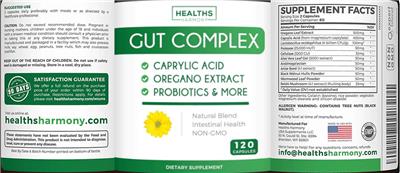
- Form
- Capsule
- Serving Size
- 2 Capsules
- Servings
- 60 per container
- Container Holds
- 120 Capsules
What’s in it, whether it interacts with your drugs, its side effects, whether it works, and what our pharmacists would want you to know before you start it.
- What is Gut Complex?A supplement from Healths Harmony with eleven active ingredients, in capsule form.
- Active Ingredients 5 plant ingredients such as Oregano Leaf, Aloe vera leaf gel and Anise Seed, 1 probiotic, 2 enzymes, 1 fatty acid, 1 source of fiber and 1 other: Oregano Leaf Extract 500 mgCaprylic Acid 400 mgLactobacillus acidophilus 100 mgProtease 50 mgCellulase 32 mgAloe vera leaf gel extract 50 mgArabinogalactan 50 mgAnise Seed Extract 50 mgBlack Walnut hull powder 50 mgWormwood, Powder 50 mgReishi Mushroom 25 mg Eleven active ingredients. Each one can interact with drugs or cause side effects on its own, so we check every one. The full Supplement Facts
- Drug Interactions 1,377 drugs have a documented interaction with this supplement; the most serious is rated major. Of those, 958 are single drugs and 419 are combination products (two or more drugs in one), each listed under its own name. Based on the 10 of its 11 ingredients we could check. Ask your pharmacist first if you take a drug in any of these categories, the most serious of the 23 on record:
- Major · 1 drug
- Moderate · 182 drugs
- Moderate · 172 drugs
- Moderate · 122 drugs
- Possible Side EffectsNausea 6 ingredientsStomach upset 5 ingredientsBloating 3 ingredientsLoose stools 2 ingredientsStomach crampsGas +14 moreReported for eight of its eleven active ingredients. Not studied in this exact product.
- Well documented Why
Does Gut Complex work?
What It Is Marketed For
Gut health and digestion
From the claims on the product’s label.
The Closest Use the Research Grades
Aloe
Some studies support it, but the evidence isn’t conclusive.
Its ingredients have research behind other uses too:
- Lactobacillus Acidophilus
- Aloe
- Helicobacter pylori Lactobacillus Acidophilus
- Aloe
- Antibiotic-associated diarrhea Lactobacillus Acidophilus
These grades are for each ingredient, not this exact product, and never a promise it will work for you.
And 2 more graded uses, in what the research says- Full Why
- AllergensThe label says it contains tree nuts
Who Might Consider It
- People looking for gut health and digestion, which is what it is marketed for. The closest use the research grades is constipation, rated Possibly Effective.
- People who want it for irritable bowel syndrome (IBS), diabetes, helicobacter pylori, obesity or another graded use: the other uses with research behind them. See each grade
- This blend may suit people who want a multi-ingredient digestive product and are comfortable with mostly limited evidence.
Who Should Be Careful
- Anyone taking digoxin, warfarin, blood thinners, diabetes medicines, or blood pressure medicines should be especially careful, as should people who are pregnant or breastfeeding, have a bleeding disorder or stomach ulcers, or have plant allergies.
- Talk it over with your own doctor or pharmacist before starting.
More Before You Take It Show both answersHide Pregnancy and Breastfeeding The Label’s Directions
-
Pregnant or breastfeeding?
- Pregnancy Oregano
- ! When used orally in medicinal amounts.
- Breastfeeding Oregano
- There is insufficient reliable information available about the safety of oregano when used in medicinal amounts; avoid amounts greater than those found in food.
- Pregnancy Aloe
- ! When used orally.
- Breastfeeding Aloe
- ! When aloe preparations are used orally.
- Pregnancy and Breastfeeding Black Walnut
- ! When the bark is used orally or topically; avoid using.
-
How does the label say to take it?
“Suggested use: 2 capsules daily preferably with meals or as directed by a healthcare professional.”
The maker’s words. Your pharmacist or doctor may advise differently.
Everything the label says
From the label dated Nov 22, 2022: 10 of its 11 active ingredients were checked against our records; the other one is not in them yet. A summary of what is known, not a grade or a test of the product. How these ratings are computed
Ask Anything About This Supplement
Name a drug you take, or ask about side effects, ingredients or pregnancy.
AI answers come from this label and our own records, never the open internet. AI can make mistakes, so always check with your doctor or pharmacist. How we use AI
Ask the Pharmacist
A licensed pharmacist will answer your question by email — free, usually within 24 hours.
Got it — thank you!
A licensed pharmacist will answer within 24 hours. Keep an eye on your email (worth checking spam, just in case).
What’s Inside Gut Complex by Healths Harmony
Eleven Active Ingredients, Each Checked on Its Own
A supplement is often several ingredients in one bottle, and each one can interact with drugs or cause side effects on its own. We check every one of them against our records.
- Oregano Leaf ExtractDrug interactions on record, most serious: Moderate
- Caprylic AcidDrug interactions on record, most serious: Moderate
- Lactobacillus acidophilusDrug interactions on record, most serious: Moderate
- ProteaseNo drug interactions on record
- CellulaseNot in our interaction records yet
- Aloe vera leaf gel extractDrug interactions on record, most serious: Major
- ArabinogalactanDrug interactions on record, most serious: Moderate
- Anise Seed ExtractDrug interactions on record, most serious: Moderate
And 3 more, each with its own card below.
Why this rating?
The label gives an exact amount for every one of its eleven active ingredients, so you know how much of each you get in each serving. This rates what the label tells you, not the quality of the product.
Supplement Facts
| Amount Per Serving | % Daily Value | |
|---|---|---|
| Oregano Leaf Extract | 500 mg | † |
| Caprylic Acid | 400 mg | † |
| Lactobacillus acidophilus | 100 mg | † |
| Protease | 50 mg | † |
| Cellulase | 32 mg | † |
| Aloe vera leaf gel extract | 50 mg | † |
| Arabinogalactan | 50 mg | † |
| Anise Seed Extract | 50 mg | † |
| Black Walnut hull powder | 50 mg | † |
| Wormwood, Powder | 50 mg | † |
| Reishi Mushroom | 25 mg | † |
Other ingredients: Gelatin, Rice powder, Vegetable Magnesium Stearate, Silicon Dioxide
† Daily Value not established.
Daily Values for adults and children 4 or more years of age.
As the label prints it, from the NIH Dietary Supplement Label Database.
Each Ingredient and Its Drug Interactions
Tap one for more about it and its full guide. A drug can interact with this supplement through any one of them.
Gut Complex contains 11 active ingredients.
- Protease and cellulase are enzymes, and Lactobacillus acidophilus is a live probiotic bacterium.
- Anise seed extract, oregano leaf extract, wormwood powder, aloe vera leaf gel extract, black walnut hull powder, and reishi mushroom are plant or fungal materials, and caprylic acid is a medium-chain fat.
-
Oregano Leaf Extract 500 mg Interacts with 881 drugs
Oregano is a common Mediterranean cooking herb that is also sold as a concentrated oil or supplement, often standardized for a compound called carvacrol.
- While lab studies suggest it may have antimicrobial and antioxidant properties, strong human evidence for treating any specific health condition is limited.
- Used as a food, oregano is very safe; concentrated oregano oil supplements should be used cautiously and discussed with your pharmacist or doctor.
The full Oregano guide: uses, dosage and safety Every Oregano drug interaction
-
Caprylic Acid 400 mg Interacts with 262 drugs
Form on the label: Magnesium Caprylate
Caprylic acid is a medium-chain fatty acid found in coconut oil and palm kernel oil that is popularly used for yeast overgrowth and gut health.
- While laboratory studies show it has antimicrobial activity, strong human evidence for most supplement claims is limited.
- It is generally considered safe in food amounts, but talk with your pharmacist or doctor before using concentrated supplements.
The full Caprylic Acid guide: uses, dosage and safety Every Caprylic Acid drug interaction
-
Lactobacillus acidophilus 100 mg Interacts with 182 drugs
Lactobacillus acidophilus is a 'friendly' bacterium used as a probiotic to support gut and vaginal health.
- It is generally well tolerated in healthy people, and there is reasonable evidence it may help with certain types of diarrhea, but proof for many other uses is limited.
- People with weakened immune systems or serious illness should check with a doctor before using it.
The full Lactobacillus Acidophilus guide: uses, dosage and safety Every Lactobacillus Acidophilus drug interaction
-
Protease 50 mg No known drug interactions
Proteolytic enzymes are proteins that help break down other proteins, and common examples include bromelain (from pineapple), papain (from papaya), trypsin, chymotrypsin, and pancreatin.
- People take them for digestion, inflammation, and muscle recovery, but the evidence is mixed and stronger for some uses (like aiding digestion in people who lack natural enzymes) than others.
- They are generally well tolerated, but talk with a pharmacist or doctor before use, especially if you have allergies, a bleeding risk, or are pregnant.
The full Proteolytic Enzymes (Proteases) guide: uses, dosage and safety
-
Cellulase 32 mg We know this ingredient, but hold no drug interaction record for it yet, so it was not checked
-
Aloe vera leaf gel extract 50 mg Interacts with 461 drugs
Aloe vera gel is widely used on the skin for minor burns and irritation, and some research suggests it may help.
- Aloe latex (the yellow part) is a strong laxative that can cause cramping and is not considered safe for regular use.
- Talk to your pharmacist or doctor before taking aloe by mouth, and avoid oral aloe during pregnancy.
The full Aloe guide: uses, dosage and safety Every Aloe drug interaction
-
Arabinogalactan 50 mg Arabinogalactan is a fiber from larch trees. Interacts with 121 drugs
Larch arabinogalactan is a soluble fiber from larch trees that is mainly used as a prebiotic and for immune support.
- Early research is interesting but limited, and most claims are not yet firmly proven.
- It is generally well tolerated, but pregnant and breastfeeding people should be cautious and check with a healthcare provider first.
The full Larch Arabinogalactan guide: uses, dosage and safety Every Larch Arabinogalactan drug interaction
-
Anise Seed Extract 50 mg Interacts with 245 drugs
Anise is a fragrant, licorice-flavored seed used for centuries to ease digestion and soothe coughs.
- Most of its health claims are based on tradition and small or laboratory studies rather than strong human research, so evidence is limited.
- It is generally safe as a food and tea for most adults, but the concentrated essential oil should be used carefully and avoided in pregnancy.
The full Anise guide: uses, dosage and safety Every Anise drug interaction
-
Black Walnut hull powder 50 mg No known drug interactions
Black walnut is a tree whose green hulls are traditionally used as a natural antiparasitic and digestive remedy, but solid human evidence for these uses is lacking.
- It contains a compound called juglone that may be irritating, so use it cautiously, avoid long-term use, and check with your pharmacist or doctor first.
-
Wormwood, Powder 50 mg Interacts with 50 drugs
Wormwood is a very bitter herb traditionally used to stimulate appetite and ease digestion, and it has early research interest in Crohn's disease.
- It contains thujone, which can be toxic in large amounts, so it should only be used short-term in controlled doses.
- Talk to a pharmacist or doctor before using it, and avoid it if you are pregnant or breastfeeding.
The full Wormwood guide: uses, dosage and safety Every Wormwood drug interaction
-
Reishi Mushroom 25 mg Interacts with 375 drugs
Reishi is a traditional Asian mushroom widely used to support the immune system and overall wellness.
- Human evidence for most of its claimed benefits is limited or low-quality, so it should not replace proven treatments.
- It is generally well tolerated for short-term use, but check with your pharmacist or doctor before starting, especially if you are pregnant, nursing, or take other medicines.
The full Reishi Mushroom guide: uses, dosage and safety Every Reishi Mushroom drug interaction
Other Ingredients (Inactive)
The capsule or tablet itself, fillers, coatings and flavors. Not part of the drug interaction check; the allergen check below reads them.
- Gelatin
- Rice powder
- Vegetable Magnesium Stearate
- Silicon Dioxide
Allergens in Gut Complex
The label says it contains tree nuts.
Named on this label
- Tree nutsThe label says it contains it; in the ingredients: Black Walnut hull powder
- Gelatin (animal-derived)In the ingredients: Gelatin (Bovine)
Not named in the ingredients
- Milk
- Egg
- Fish
- Shellfish
- Peanuts
- Wheat or other gluten grains
- Soy
- Sesame
- The label’s allergen statement“This product is manufactured and packaged in a facility which may also process milk, soy, wheat, egg, peanuts, tree nuts, fish and crustacean shellfish.”
- The label’s allergen statement“Allergen warning: Contains tree nuts (black walnut).”
From the label text and ingredient names on file; we do not test products. With a serious allergy, check your bottle and ask the maker or your pharmacist.
What the Label Says
The maker’s own words, from the label. We do not verify or endorse them.
- Storage
-
“Store in a cool, dry place.”
- General statements
-
“Satisfaction guarantee We offer a full refund on the purchase price of your order within 90 days of purchase. Restrictions apply. Full details: healthsharmony.com/returns Visit us online at: healthsharmony.com”
“We're here to help! For any questions or refunds: [email protected]”
- Formulation
-
“Natural blend Intestinal health”
“Non-GMO”
3 more from the label
“Sourced from a GMP Facility Made In USA With Global Ingredients”
“Expert blend”
“Caprylic acid Oregano extract Probiotics & more”
- FDA Statement of Identity
-
“Dietary Supplement”
- Seals and symbols
-
“Sourced from a GMP Facility Made In USA With Global Ingredients”
The Gut Complex Label on File
The label scan on file at the NIH Dietary Supplement Label Database, dated November 2022. Always read the label on the bottle you have.
Product Facts
- Brand
- Healths Harmony
- Net contents
- 120 Capsules
- Market status
- On market
- Date entered into DSLD
- Nov 22, 2022
- DSLD ID
- 277513
- Product type
- Other Combinations
- Supplement form
- Capsule
- Dietary claims / uses
- All Other, Structure/Function
- Intended target group(s)
- Adult (18 - 50 Years)
Is this label outdated? Report a formula or label change and our pharmacy team will review it.
Gut Complex by Healths Harmony Side Effects
Why this rating?
We look for three kinds of safety information on each ingredient: side effects reported in studies, a pregnancy and breastfeeding rating, and a safety write-up from our pharmacy team. All three are on file for each of the ten ingredients we could check.
So this rates how much is known, not whether Gut Complex is right for you.
Reported with ten of its ingredients
- Most often
- Nausea, stomach upset, bloating, loose stools, stomach cramps and gas
- !Rare but serious
- Systemic allergic reactions, including anaphylaxis and in sensitive individuals See details
HelloPharmacist Team Summary of Side Effects
You may most often notice stomach upset, nausea, and bloating or gas, with bloating linked to arabinogalactan and digestive upset linked to protease.
- Dizziness has been reported with reishi mushroom, so you may want to see how it affects you before driving.
- Serious allergic reactions are rare but possible, especially if you are sensitive to pineapple, papaya, tree nuts, or plants in the mint or carrot families, and if a severe reaction happens, call your doctor right away.
- Talk with your own doctor or pharmacist before starting, especially if you have a bleeding disorder, stomach ulcers, kidney problems, or diabetes, or take prescription medicines.
Side Effects, Ingredient by Ingredient
A supplement’s side effects come from its ingredients. Here is what is reported with each one.
Oregano
Most reported
- Stomach upset, nausea, or heartburn
- Mouth or throat irritation
- Skin irritation or rash if applied undiluted to the skin
Caprylic Acid
Most reported
- Nausea
- Stomach cramps
- Bloating
- Loose stools
Proteolytic Enzymes (Proteases)
Most reported
- Nausea
- Stomach upset
- Diarrhea
- Bloating
Larch Arabinogalactan
Most reported
- Bloating
- Gas
- Stomach discomfort
Anise
Most reported
- Nausea or
- Rarely
Black Walnut
Most reported
- Nausea
- Stomach upset
- Loose stools
Wormwood
Most reported
- Nausea
- Stomach upset
- Vomiting
- Strong bitter aftertaste
Reishi Mushroom
Most reported
- Upset stomach
- Dizziness
- Dry mouth
- Nosebleeds
Lactobacillus Acidophilus and Aloe have side-effect reports on file, but no list of the most common ones. Read them in each guide: Lactobacillus Acidophilus, Aloe.
Gut Complex Warnings: Who Should Be Careful
Gut Complex has eleven active ingredients, and each can carry warnings of its own. We checked the ten in our ingredient guides, and each warning below names the ingredient it comes from. Cellulase is not in our guides yet, so ask your pharmacist about it. If any of these apply to you, talk to your doctor or pharmacist before you start it.
- Oregano2 warnings below
- Caprylic Acid2 warnings below
- Lactobacillus Acidophilus1 warning below
- Proteolytic Enzymes (Proteases)3 warnings below
- Aloe1 warning below
- Larch Arabinogalactan3 warnings below
- Anise3 warnings below
- Black Walnut3 warnings below
- Wormwood2 warnings below
- Reishi Mushroom2 warnings below
- CellulaseNot in our guides yet
-
Bleeding Problems or Surgery
- OreganoPeople with bleeding disorders or those scheduled for surgery should be cautious and tell their healthcare team.
- Proteolytic Enzymes (Proteases)Use caution if you have a bleeding disorder, are scheduled for surgery, or have stomach ulcers, since enzymes may irritate the gut or affect clotting.
- Reishi MushroomPeople with bleeding disorders or who are scheduled for surgery should be cautious, since reishi may affect blood clotting.
-
Diabetes or Low Blood Sugar
- AloePeople with kidney problems, bowel conditions, or diabetes should be especially careful and check with a doctor or pharmacist before taking aloe by mouth.
-
Blood Pressure
- Reishi MushroomThose with low blood pressure should also use care.
-
Liver Disease
- Caprylic AcidPeople with liver problems should be cautious, since medium-chain fats are processed by the liver.
-
Kidney Disease or Kidney Stones
- Black WalnutPeople with digestive conditions, kidney problems, or those taking multiple medications should talk to a pharmacist or doctor first.
- WormwoodPeople with seizure disorders or kidney problems should be especially careful and should not use it without medical advice.
-
Stomach or Bowel Problems
- Larch ArabinogalactanPeople with bowel conditions, those prone to bloating, or anyone with a weakened immune system should talk to a healthcare provider before starting it.
-
Hormone-Sensitive Conditions
- AniseBecause anise may have mild estrogen-like activity, people with hormone-sensitive conditions (such as certain breast, uterine, or ovarian conditions) should check with their doctor before using it medicinally.
-
Allergies
- OreganoPeople who are allergic to other plants in the mint family (such as basil, sage, mint, lavender, or marjoram) may also react to oregano.
- Proteolytic Enzymes (Proteases)People with allergies to pineapple, papaya, or pork should avoid the related enzymes, and those with latex allergy may react to papaya-based products.
- Larch ArabinogalactanIf you have allergies to plant or tree products, introduce it cautiously.
- AnisePeople with allergies to plants in the carrot family (such as celery, fennel, dill, or caraway) may also react to anise.
- Black WalnutPeople with a tree nut allergy should be cautious or avoid black walnut, since it comes from a true tree nut.
-
Children
- Lactobacillus AcidophilusFor most healthy adults and children, L. acidophilus is considered safe and is widely used in foods and supplements.
- AniseKeep essential oils out of reach of children.
- WormwoodWormwood is also not recommended for children.
-
If You Take Other Drugs
- Larch ArabinogalactanAlways check with a pharmacist or doctor before adding any new supplement, especially if you have a medical condition or take other medicines.
-
Other Cautions
- Caprylic AcidIf you have any chronic health condition, check with your pharmacist or doctor first.
- Proteolytic Enzymes (Proteases)Still, some people should be more careful.
- Black WalnutBecause of its tannin and juglone content, long-term or high-dose use is not recommended and has not been well studied for safety.
- Where data is insufficient, there is not enough information to know either way, so talk with your doctor or pharmacist for advice on your situation.
-
What the Label Warns
- “Caution: Do not exceed recommended dose.”
- “Pregnant or nursing mothers, children under the age of 18, and individuals with a known medical condition should consult a physician before using this or any dietary supplement.”
- “Pregnant or nursing mothers, children under the age of 18, and individuals with a known medical condition should consult a physician before using this or any dietary supplement.”
- “Keep out of the reach of children.”
- “Do not use if safety seal is damaged or missing.”
The maker’s wording, from the product label.
-
Pregnant or Breastfeeding
Each ingredient’s rating for pregnancy and for breastfeeding, and what it covers.
Pregnancy
-
When used orally in medicinal amounts.
Oregano is thought to have abortifacient and emmenagogue effects.
Breastfeeding
-
There is insufficient reliable information available about the safety of oregano when used in medicinal amounts; avoid amounts greater than those found in food.
Pregnancy
-
When used orally.
Anthraquinones present in aloe latex and aloe whole leaf extracts have irritant, cathartic, and possible mutagenic effects.
There are also anecdotal reports and evidence from animal research that anthraquinones or aloe whole leaf extracts might induce abortion and stimulate menstruation; avoid using.
Breastfeeding
-
When aloe preparations are used orally.
Cathartic and mutagenic anthraquinones present in aloe latex and aloe whole leaf extracts might pass into milk; avoid using.
Show 8 more ingredients
Pregnancy and Breastfeeding The record rates both the same
-
When the fruit (nut) is consumed in amounts normally found in foods.
-
When the bark is used orally or topically; avoid using.
There is insufficient reliable information available about the safety of black walnut leaf or hull when used orally in medicinal amounts during pregnancy or lactation; avoid using.
Pregnancy and Breastfeeding The record rates both the same
-
Insufficient reliable information available; avoid using in amounts greater than those found in foods.
Pregnancy
-
When used orally and appropriately.
A combination of Lactobacillus acidophilus, Lacticaseibacillus casei, and Bifidobacterium bifidum has been used with apparent safety for 6 weeks, starting at 24-28 weeks' gestation.
Breastfeeding
-
There is insufficient reliable information available about the safety of Lactobacillus acidophilus during lactation.
However, there are currently no reasons to expect safety concerns when used appropriately.
Proteolytic Enzymes (Proteases)
Pregnancy and Breastfeeding The record rates both the same
-
Insufficient reliable information available; avoid using.
Pregnancy and Breastfeeding The record rates both the same
-
Insufficient reliable information available; avoid using.
Pregnancy
-
LIKELY UNSAFE ..when used orally in amounts greater than those found in foods.
Some wormwood products contain thujone, a neurotoxin.
2 more points on this rating
- Theoretically, thujone also has potential uterine and menstrual stimulant effects.
- There is insufficient reliable information available about the safety of wormwood when used topically during pregnancy.
Breastfeeding
-
Insufficient reliable information available; avoid using.
Pregnancy and Breastfeeding The record rates both the same
-
Insufficient reliable information available; avoid using
Pregnancy and Breastfeeding The record rates both the same
-
When used orally in amounts commonly found in food.
Anise and anise oil have Generally Recognized as Safe (GRAS) status in the US.
There is insufficient reliable information available about the safety of anise when taken orally in medicinal amounts during pregnancy or breast-feeding.
Our pharmacy team’s notes
- AloeIts pregnancy and breastfeeding ratings are possibly unsafe, so it is best avoided in those situations.
- For pregnancy, anise is rated Likely Safe and Lactobacillus acidophilus is rated Possibly Safe, while oregano is rated Possibly Unsafe, so the safety data advises against oregano during pregnancy.
Ratings and the words beside them are from the Natural Medicines database, which we license.
-
Rare but Serious Side Effects
-
!
Oregano
Allergic reactions are possible, especially in people sensitive to mint-family plants.
Orally: Systemic allergic reactions, including anaphylaxis, in sensitive individuals.
-
!
Lactobacillus Acidophilus
Serious side effects are rare.
-
!
Proteolytic Enzymes (Proteases)
Allergic reactions can happen, especially in people sensitive to pineapple, papaya, or animal-source products.
-
!
Aloe
Long-term use of oral aloe latex has been linked to more serious harms and is generally discouraged.
Oral aloe latex carries serious risks, especially at high or long-term doses.
Orally: Aloe latex is associated with serious adverse effects when taken in high doses or long-term. Cases of acute hepatitis due to a hypersensitivity reaction to aloe leaf extract has been reported.
-
!
Larch Arabinogalactan
Serious side effects appear to be uncommon, but allergic reactions are always possible with any supplement.
-
!
Anise
Possible side effects include allergic reactions (skin rash, itching, or swelling), especially in people sensitive to related plants.
Orally: Anaphylaxis in sensitive individuals.
-
!
Black Walnut
People allergic to tree nuts could have an allergic reaction, which in rare cases can be serious.
Orally: The bark may increase the risk for tongue cancer or lip leukoplakia when used long-term.
Allergic reactions, including anaphylaxis.
-
!
Wormwood
More serious reactions are mainly linked to thujone from large doses, concentrated oil, or long-term use.
Orally: The oil from wormwood leaves can cause acute kidney toxicity, rhabdomyolysis, and seizures.
-
!
Reishi Mushroom
There have been rare reports of liver problems, especially with powdered reishi products.
When to get help: a serious allergic reaction, with trouble breathing or swelling of the face, lips or throat, needs emergency care: call 911. For any other side effect that worries you, call your doctor or pharmacist.
These reports describe each ingredient, not studies of this exact product. Not medical advice: a side effect you notice after starting a supplement is worth a word with your pharmacist or doctor.
Gut Complex by Healths Harmony Drug Interactions
We checked all eleven active ingredients in this supplement against every drug in our records. A drug can interact with it through any one of them. Cellulase is not in our interaction records yet.
A major interaction on record
3 of 3, on a scale from Minor or none to Major.Why this rating?
We rate this by the most serious interaction on record, not by how many there are. For Anise, Aloe, Oregano, Wormwood and Lactobacillus Acidophilus, the most serious is rated major, which means the combination is best avoided, or used only under close supervision. Some involve kinds of drugs where a small change can matter, such as blood thinners, seizure drugs and transplant drugs.
1,378 drugs are on the full list. What matters is whether one you take is on it, so check yours with the interaction checker on this page.
Eight of its eleven active ingredients have drug interactions on record. The ones below matter most. We have no interaction records for Proteolytic Enzymes (Proteases), Cellulase and Black Walnut.
- Interacts with
- 461 drugs
- Most serious
- Major
- The most serious interaction is rated Major and involves aloe latex and digoxin (Lanoxin), a heart medication (cardiac glycoside).
- Overusing oral aloe latex can deplete potassium and raise the risk of digoxin toxicity.
- Diuretics and stimulant laxatives could see added fluid and electrolyte loss from aloe.
- Interacts with
- 121 drugs
- Most serious
- Moderate
- Immunosuppressants may be affected by the immune-stimulating effects of arabinogalactan.
- Interacts with
- 881 drugs
- Most serious
- Moderate
- Most of its records involve Cytochrome P450 3A4 (CYP3A4) Substrates, Cytochrome P450 1A2 (CYP1A2) Substrates and Anticoagulant/Antiplatelet Drugs.
Show three more ingredients
- Interacts with
- 375 drugs
- Most serious
- Moderate
- Most of its records involve Antihypertensive Drugs, Anticoagulant/Antiplatelet Drugs and Antidiabetes Drugs.
- Interacts with
- 262 drugs
- Most serious
- Moderate
- Most of its records involve Antihypertensive Drugs, Nonsteroidal Anti-inflammatory Drugs (NSAIDs) and Warfarin (Coumadin).
- Interacts with
- 245 drugs
- Most serious
- Moderate
- Most of its records involve Antidiabetes Drugs, Acetaminophen (Tylenol, others) and Estrogens.
And two more ingredients with records, each in the cards below.
From the HelloPharmacist Team
A few things worth knowing about the supplement as a whole.
- Gut Complex from Healths Harmony can interact with several medications, through its aloe, anise, oregano, caprylic acid, reishi, wormwood, arabinogalactan, and Lactobacillus acidophilus content.
- Other drug types are rated Moderate.
- Blood thinners (anticoagulants and antiplatelets) and warfarin could see added bleeding risk from oregano, reishi, and aloe.
Summarized by the HelloPharmacist pharmacy team from the interaction records below. How it is written How we use AI
Why Gut Complex Interacts, Ingredient by Ingredient
A product interacts through its ingredients. Each card: how many drugs, the most serious rating, and the kinds of drugs it affects most (tap a kind for what it means).
The ingredients driving the most interactions
-
Oregano Leaf Extract 881 drugs
Most serious: Moderate4 interaction records on file
The kinds of drugs it affects most
- 645 drugs
- 186 drugs
- 122 drugs
- 86 drugs
Every Oregano drug interaction, 4 records The Oregano records cite 13 references, listed in the Oregano guide.
-
Aloe vera leaf gel extract 461 drugs
Most serious: Major7 interaction records on file
The kinds of drugs it affects most
- 186 drugs
- 122 drugs
- 86 drugs
- 75 drugs
Every Aloe drug interaction, 7 records The Aloe records cite 41 references, listed in the Aloe guide.
-
Reishi Mushroom 375 drugs
Most serious: Moderate3 interaction records on file
The kinds of drugs it affects most
- 172 drugs
- 122 drugs
- 86 drugs
Every Reishi Mushroom drug interaction, 3 records The Reishi Mushroom records cite 17 references, listed in the Reishi Mushroom guide.
-
Caprylic Acid 262 drugs
Most serious: Moderate3 interaction records on file
The kinds of drugs it affects most
- 172 drugs
- 89 drugs
- 2 drugs
Every Caprylic Acid drug interaction, 3 records The Caprylic Acid records cite 5 references, listed in the Caprylic Acid guide.
-
Anise Seed Extract 245 drugs
Most serious: Moderate11 interaction records on file
The kinds of drugs it affects most
- 86 drugs
- 69 drugs
- 41 drugs
- 30 drugs
Every Anise drug interaction, 11 records The Anise records cite 12 references, listed in the Anise guide.
-
Lactobacillus acidophilus 182 drugs
Most serious: Moderate1 interaction record on file
The kinds of drugs it affects most
- 182 drugs
Every Lactobacillus Acidophilus drug interaction, 1 record The Lactobacillus Acidophilus records cite 18 references, listed in the Lactobacillus Acidophilus guide.
-
Arabinogalactan 121 drugs
Most serious: Moderate1 interaction record on file
The kinds of drugs it affects most
- 121 drugs
Every Larch Arabinogalactan drug interaction, 1 record The Larch Arabinogalactan records cite 8 references, listed in the Larch Arabinogalactan guide.
-
Wormwood, Powder 50 drugs
Most serious: Moderate1 interaction record on file
The kinds of drugs it affects most
- 50 drugs
Every Wormwood drug interaction, 1 record The Wormwood records cite 10 references, listed in the Wormwood guide.
The Breakdown by Severity
Each drug counted once, at its most serious rating. Tap a tile to list those drugs.
Find Your Drug
Type a drug or brand name to see whether it is on the list.
- Only drugs with a documented interaction are listed, the most serious first.
- A drug with no known interaction is not listed, but searching its name tells you so.
- Open a drug to see which ingredient is responsible. Of those, 958 are single drugs and 419 are combination products (two or more drugs in one), each listed under its own name.
-
DigoxinDigitek, Lanoxicaps, Lanoxin Major
The ingredient responsible:
-
Aloe Vera Leaf Gel Extract Major
Theoretically, aloe latex might increase the risk of adverse effects when taken with cardiac glycosides.
The full Aloe Vera Leaf Gel Extract + Digoxin interaction
-
-
ApixabanEliquis Moderate
The 3 ingredients responsible:
-
Reishi Mushroom Moderate Apixaban is in the Anticoagulant/Antiplatelet Drugs category.
Theoretically, high doses of reishi mushroom might increase the risk of bleeding.
The full Reishi Mushroom + Apixaban interaction -
Oregano Leaf Extract Moderate Apixaban is in these Anticoagulant/Antiplatelet Drugs, Cytochrome P450 3A4 (CYP3A4) Substrates categories.
Theoretically, oregano might increase the risk of bleeding when taken with anticoagulant or antiplatelet drugs.
The full Oregano Leaf Extract + Apixaban interaction -
Aloe Vera Leaf Gel Extract Moderate Apixaban is in the Anticoagulant/Antiplatelet Drugs category.
Theoretically, aloe gel might increase the risk of bleeding when taken with anticoagulant or antiplatelet drugs.
The full Aloe Vera Leaf Gel Extract + Apixaban interaction
-
-
WarfarinWarfarin Moderate
The 4 ingredients responsible:
-
Oregano Leaf Extract Moderate Warfarin is in these Cytochrome P450 3A4 (CYP3A4) Substrates, Anticoagulant/Antiplatelet Drugs, Cytochrome P450 1A2 (CYP1A2) Substrates categories.
Theoretically, oregano might decrease the levels and clinical effects of CYP3A4 substrates.
The full Oregano Leaf Extract + Warfarin interaction -
Aloe Vera Leaf Gel Extract Moderate Warfarin is in these Cytochrome P450 1A2 (CYP1A2) Substrates, Anticoagulant/Antiplatelet Drugs categories.
Theoretically, aloe might decrease the levels and clinical effects of CYP1A2 substrates.
The full Aloe Vera Leaf Gel Extract + Warfarin interaction -
Reishi Mushroom Moderate Warfarin is in the Anticoagulant/Antiplatelet Drugs category.
Theoretically, high doses of reishi mushroom might increase the risk of bleeding.
The full Reishi Mushroom + Warfarin interaction -
Caprylic Acid Moderate
Theoretically, caprylic acid might increase plasma concentrations of warfarin.
The full Caprylic Acid + Warfarin interaction
-
-
AmlodipineNorliqva Moderate
The 3 ingredients responsible:
-
Reishi Mushroom Moderate Amlodipine is in the Antihypertensive Drugs category.
Theoretically, concurrent use of reishi mushroom with antihypertensive drugs might increase the risk of hypotension.
The full Reishi Mushroom + Amlodipine interaction -
Caprylic Acid Moderate Amlodipine is in the Antihypertensive Drugs category.
Theoretically, caprylic acid might increase the risk of hypotension when used with antihypertensive drugs.
The full Caprylic Acid + Amlodipine interaction -
Oregano Leaf Extract Minor Amlodipine is in the Cytochrome P450 3A4 (CYP3A4) Substrates category.
Theoretically, oregano might decrease the levels and clinical effects of CYP3A4 substrates.
The full Oregano Leaf Extract + Amlodipine interaction
-
-
ClopidogrelPlavix Moderate
The 3 ingredients responsible:
-
Oregano Leaf Extract Moderate Clopidogrel is in these Cytochrome P450 3A4 (CYP3A4) Substrates, Anticoagulant/Antiplatelet Drugs, Cytochrome P450 1A2 (CYP1A2) Substrates categories.
Theoretically, oregano might decrease the levels and clinical effects of CYP3A4 substrates.
The full Oregano Leaf Extract + Clopidogrel interaction -
Aloe Vera Leaf Gel Extract Moderate Clopidogrel is in these Cytochrome P450 1A2 (CYP1A2) Substrates, Anticoagulant/Antiplatelet Drugs categories.
Theoretically, aloe might decrease the levels and clinical effects of CYP1A2 substrates.
The full Aloe Vera Leaf Gel Extract + Clopidogrel interaction -
Reishi Mushroom Moderate Clopidogrel is in the Anticoagulant/Antiplatelet Drugs category.
Theoretically, high doses of reishi mushroom might increase the risk of bleeding.
The full Reishi Mushroom + Clopidogrel interaction
-
-
AspirinAngettes 75, ASA, Asaphen, Aspirin, Caprin and 9 more Moderate
The 4 ingredients responsible:
-
Oregano Leaf Extract Moderate Aspirin is in the Anticoagulant/Antiplatelet Drugs category.
Theoretically, oregano might increase the risk of bleeding when taken with anticoagulant or antiplatelet drugs.
The full Oregano Leaf Extract + Aspirin interaction -
Aloe Vera Leaf Gel Extract Moderate Aspirin is in the Anticoagulant/Antiplatelet Drugs category.
Theoretically, aloe gel might increase the risk of bleeding when taken with anticoagulant or antiplatelet drugs.
The full Aloe Vera Leaf Gel Extract + Aspirin interaction -
Caprylic Acid Moderate Aspirin is in the Nonsteroidal Anti-inflammatory Drugs (NSAIDs) category.
Theoretically, caprylic acid might increase plasma concentrations of NSAIDs.
The full Caprylic Acid + Aspirin interaction -
Reishi Mushroom Moderate Aspirin is in the Anticoagulant/Antiplatelet Drugs category.
Theoretically, high doses of reishi mushroom might increase the risk of bleeding.
The full Reishi Mushroom + Aspirin interaction
-
-
Losartan PotassiumCozaar Moderate
The 3 ingredients responsible:
-
Caprylic Acid Moderate Losartan Potassium is in the Antihypertensive Drugs category.
Theoretically, caprylic acid might increase the risk of hypotension when used with antihypertensive drugs.
The full Caprylic Acid + Losartan Potassium interaction -
Reishi Mushroom Moderate Losartan Potassium is in the Antihypertensive Drugs category.
Theoretically, concurrent use of reishi mushroom with antihypertensive drugs might increase the risk of hypotension.
The full Reishi Mushroom + Losartan Potassium interaction -
Oregano Leaf Extract Minor Losartan Potassium is in the Cytochrome P450 3A4 (CYP3A4) Substrates category.
Theoretically, oregano might decrease the levels and clinical effects of CYP3A4 substrates.
The full Oregano Leaf Extract + Losartan Potassium interaction
-
-
RivaroxabanXarelto Moderate
The 3 ingredients responsible:
-
Reishi Mushroom Moderate Rivaroxaban is in the Anticoagulant/Antiplatelet Drugs category.
Theoretically, high doses of reishi mushroom might increase the risk of bleeding.
The full Reishi Mushroom + Rivaroxaban interaction -
Oregano Leaf Extract Moderate Rivaroxaban is in these Cytochrome P450 3A4 (CYP3A4) Substrates, Anticoagulant/Antiplatelet Drugs categories.
Theoretically, oregano might decrease the levels and clinical effects of CYP3A4 substrates.
The full Oregano Leaf Extract + Rivaroxaban interaction -
Aloe Vera Leaf Gel Extract Moderate Rivaroxaban is in the Anticoagulant/Antiplatelet Drugs category.
Theoretically, aloe gel might increase the risk of bleeding when taken with anticoagulant or antiplatelet drugs.
The full Aloe Vera Leaf Gel Extract + Rivaroxaban interaction
-
-
MetforminGlucophage, Metformin Moderate
The 4 ingredients responsible:
-
Anise Seed Extract Moderate Metformin is in the Antidiabetes Drugs category.
Theoretically, anise seed might increase the risk of hypoglycemia when taken with antidiabetes drugs.
The full Anise Seed Extract + Metformin interaction -
Oregano Leaf Extract Moderate Metformin is in the Antidiabetes Drugs category.
Theoretically, oregano might increase the risk for hypoglycemia when taken with antidiabetes drugs.
The full Oregano Leaf Extract + Metformin interaction -
Aloe Vera Leaf Gel Extract Moderate Metformin is in the Antidiabetes Drugs category.
Aloe might increase the risk of hypoglycemia when taken with antidiabetes drugs.
The full Aloe Vera Leaf Gel Extract + Metformin interaction -
Reishi Mushroom Moderate Metformin is in the Antidiabetes Drugs category.
Theoretically, reishi mushroom might have additive effects with antidiabetes drugs.
The full Reishi Mushroom + Metformin interaction
-
-
Warfarin SodiumCoumadin, Panwarfin, Sofarin Moderate
The 4 ingredients responsible:
-
Caprylic Acid Moderate
Theoretically, caprylic acid might increase plasma concentrations of warfarin.
The full Caprylic Acid + Warfarin Sodium interaction -
Oregano Leaf Extract Moderate Warfarin Sodium is in these Cytochrome P450 1A2 (CYP1A2) Substrates, Anticoagulant/Antiplatelet Drugs, Cytochrome P450 3A4 (CYP3A4) Substrates categories.
Theoretically, oregano might decrease the levels and clinical effects of CYP1A2 substrates.
The full Oregano Leaf Extract + Warfarin Sodium interaction -
Aloe Vera Leaf Gel Extract Moderate Warfarin Sodium is in these Cytochrome P450 1A2 (CYP1A2) Substrates, Anticoagulant/Antiplatelet Drugs categories.
Theoretically, aloe latex might increase the risk of bleeding when taken with warfarin.
The full Aloe Vera Leaf Gel Extract + Warfarin Sodium interaction -
Reishi Mushroom Moderate Warfarin Sodium is in the Anticoagulant/Antiplatelet Drugs category.
Theoretically, high doses of reishi mushroom might increase the risk of bleeding.
The full Reishi Mushroom + Warfarin Sodium interaction
-
-
TirzepatideMounjaro, Zepbound Moderate
The 4 ingredients responsible:
-
Reishi Mushroom Moderate Tirzepatide is in the Antidiabetes Drugs category.
Theoretically, reishi mushroom might have additive effects with antidiabetes drugs.
The full Reishi Mushroom + Tirzepatide interaction -
Oregano Leaf Extract Moderate Tirzepatide is in the Antidiabetes Drugs category.
Theoretically, oregano might increase the risk for hypoglycemia when taken with antidiabetes drugs.
The full Oregano Leaf Extract + Tirzepatide interaction -
Anise Seed Extract Moderate Tirzepatide is in the Antidiabetes Drugs category.
Theoretically, anise seed might increase the risk of hypoglycemia when taken with antidiabetes drugs.
The full Anise Seed Extract + Tirzepatide interaction -
Aloe Vera Leaf Gel Extract Moderate Tirzepatide is in the Antidiabetes Drugs category.
Aloe might increase the risk of hypoglycemia when taken with antidiabetes drugs.
The full Aloe Vera Leaf Gel Extract + Tirzepatide interaction
-
-
MetoprololLopressor, Toprol XL Moderate
The 2 ingredients responsible:
-
Reishi Mushroom Moderate Metoprolol is in the Antihypertensive Drugs category.
Theoretically, concurrent use of reishi mushroom with antihypertensive drugs might increase the risk of hypotension.
The full Reishi Mushroom + Metoprolol interaction -
Caprylic Acid Moderate Metoprolol is in the Antihypertensive Drugs category.
Theoretically, caprylic acid might increase the risk of hypotension when used with antihypertensive drugs.
The full Caprylic Acid + Metoprolol interaction
-
-
IbuprofenAdvil, Arthrofen, Brufen, Brufen Retard, Calodor and 15 more Moderate
The 4 ingredients responsible:
-
Aloe Vera Leaf Gel Extract Moderate Ibuprofen is in the Anticoagulant/Antiplatelet Drugs category.
Theoretically, aloe gel might increase the risk of bleeding when taken with anticoagulant or antiplatelet drugs.
The full Aloe Vera Leaf Gel Extract + Ibuprofen interaction -
Oregano Leaf Extract Moderate Ibuprofen is in the Anticoagulant/Antiplatelet Drugs category.
Theoretically, oregano might increase the risk of bleeding when taken with anticoagulant or antiplatelet drugs.
The full Oregano Leaf Extract + Ibuprofen interaction -
Caprylic Acid Moderate Ibuprofen is in the Nonsteroidal Anti-inflammatory Drugs (NSAIDs) category.
Theoretically, caprylic acid might increase plasma concentrations of NSAIDs.
The full Caprylic Acid + Ibuprofen interaction -
Reishi Mushroom Moderate Ibuprofen is in the Anticoagulant/Antiplatelet Drugs category.
Theoretically, high doses of reishi mushroom might increase the risk of bleeding.
The full Reishi Mushroom + Ibuprofen interaction
-
-
SemaglutideOzempic, Rybelsus, Wegovy Moderate
The 4 ingredients responsible:
-
Reishi Mushroom Moderate Semaglutide is in the Antidiabetes Drugs category.
Theoretically, reishi mushroom might have additive effects with antidiabetes drugs.
The full Reishi Mushroom + Semaglutide interaction -
Aloe Vera Leaf Gel Extract Moderate Semaglutide is in the Antidiabetes Drugs category.
Aloe might increase the risk of hypoglycemia when taken with antidiabetes drugs.
The full Aloe Vera Leaf Gel Extract + Semaglutide interaction -
Anise Seed Extract Moderate Semaglutide is in the Antidiabetes Drugs category.
Theoretically, anise seed might increase the risk of hypoglycemia when taken with antidiabetes drugs.
The full Anise Seed Extract + Semaglutide interaction -
Oregano Leaf Extract Moderate Semaglutide is in the Antidiabetes Drugs category.
Theoretically, oregano might increase the risk for hypoglycemia when taken with antidiabetes drugs.
The full Oregano Leaf Extract + Semaglutide interaction
-
-
AmoxicillinAmix, Amoram, Amoxident, Amoxil Capsules, Amoxil Injection and 4 more Moderate
The ingredient responsible:
-
Lactobacillus Acidophilus Moderate Amoxicillin is in the Antibiotic Drugs category.
Theoretically, taking Lactobacillus acidophilus with antibiotic drugs might decrease the effectiveness of L.
The full Lactobacillus Acidophilus + Amoxicillin interaction
-
-
PrednisoneCortan, Deltasone, Meticorten, Orasone, Prednicen-M and 3 more Moderate
The 2 ingredients responsible:
-
Arabinogalactan Moderate Prednisone is in the Immunosuppressants category.
Theoretically, larch arabinogalactan might interfere with immunosuppression therapy due to immunostimulant effects.
The full Arabinogalactan + Prednisone interaction -
Oregano Leaf Extract Minor Prednisone is in the Cytochrome P450 3A4 (CYP3A4) Substrates category.
Theoretically, oregano might decrease the levels and clinical effects of CYP3A4 substrates.
The full Oregano Leaf Extract + Prednisone interaction
-
-
FluoxetineProzac, Sarafem Moderate
The ingredient responsible:
-
Anise Seed Extract Moderate
Theoretically, anise oil might decrease the efficacy of fluoxetine.
The full Anise Seed Extract + Fluoxetine interaction
-
-
AzithromycinAzasite, Zithromax, Zmax Moderate
The ingredient responsible:
-
Lactobacillus Acidophilus Moderate Azithromycin is in the Antibiotic Drugs category.
Theoretically, taking Lactobacillus acidophilus with antibiotic drugs might decrease the effectiveness of L.
The full Lactobacillus Acidophilus + Azithromycin interaction
-
-
PropranololAngilol, Bedranol SR, Beta Prograne, Half Beta Prograne, Half-Inderal LA and 7 more Moderate
The 4 ingredients responsible:
-
Reishi Mushroom Moderate Propranolol is in the Antihypertensive Drugs category.
Theoretically, concurrent use of reishi mushroom with antihypertensive drugs might increase the risk of hypotension.
The full Reishi Mushroom + Propranolol interaction -
Caprylic Acid Moderate Propranolol is in the Antihypertensive Drugs category.
Theoretically, caprylic acid might increase the risk of hypotension when used with antihypertensive drugs.
The full Caprylic Acid + Propranolol interaction -
Oregano Leaf Extract Minor Propranolol is in the Cytochrome P450 1A2 (CYP1A2) Substrates category.
Theoretically, oregano might decrease the levels and clinical effects of CYP1A2 substrates.
The full Oregano Leaf Extract + Propranolol interaction -
Aloe Vera Leaf Gel Extract Minor Propranolol is in the Cytochrome P450 1A2 (CYP1A2) Substrates category.
Theoretically, aloe might decrease the levels and clinical effects of CYP1A2 substrates.
The full Aloe Vera Leaf Gel Extract + Propranolol interaction
-
-
LamotrigineLamictal Moderate
The ingredient responsible:
-
Wormwood, Powder Moderate Lamotrigine is in the Anticonvulsants category.
Theoretically, taking wormwood might interfere with the effects of anticonvulsant drugs.
The full Wormwood, Powder + Lamotrigine interaction
-
-
NaproxenAleve, Anaprox, Anaprox DS, Arthroxen, EC-Naprosyn and 8 more Moderate
The 4 ingredients responsible:
-
Aloe Vera Leaf Gel Extract Moderate Naproxen is in these Cytochrome P450 1A2 (CYP1A2) Substrates, Anticoagulant/Antiplatelet Drugs categories.
Theoretically, aloe might decrease the levels and clinical effects of CYP1A2 substrates.
The full Aloe Vera Leaf Gel Extract + Naproxen interaction -
Oregano Leaf Extract Moderate Naproxen is in these Anticoagulant/Antiplatelet Drugs, Cytochrome P450 1A2 (CYP1A2) Substrates categories.
Theoretically, oregano might increase the risk of bleeding when taken with anticoagulant or antiplatelet drugs.
The full Oregano Leaf Extract + Naproxen interaction -
Caprylic Acid Moderate Naproxen is in the Nonsteroidal Anti-inflammatory Drugs (NSAIDs) category.
Theoretically, caprylic acid might increase plasma concentrations of NSAIDs.
The full Caprylic Acid + Naproxen interaction -
Reishi Mushroom Moderate Naproxen is in the Anticoagulant/Antiplatelet Drugs category.
Theoretically, high doses of reishi mushroom might increase the risk of bleeding.
The full Reishi Mushroom + Naproxen interaction
-
-
LisinoprilPrinivil, Qbrelis, Zestril Moderate
The 2 ingredients responsible:
-
Reishi Mushroom Moderate Lisinopril is in the Antihypertensive Drugs category.
Theoretically, concurrent use of reishi mushroom with antihypertensive drugs might increase the risk of hypotension.
The full Reishi Mushroom + Lisinopril interaction -
Caprylic Acid Moderate Lisinopril is in the Antihypertensive Drugs category.
Theoretically, caprylic acid might increase the risk of hypotension when used with antihypertensive drugs.
The full Caprylic Acid + Lisinopril interaction
-
-
ClonazepamCeberclon, Klonopin, Rivotril Moderate
The 2 ingredients responsible:
-
Wormwood, Powder Moderate Clonazepam is in the Anticonvulsants category.
Theoretically, taking wormwood might interfere with the effects of anticonvulsant drugs.
The full Wormwood, Powder + Clonazepam interaction -
Oregano Leaf Extract Minor Clonazepam is in the Cytochrome P450 3A4 (CYP3A4) Substrates category.
Theoretically, oregano might decrease the levels and clinical effects of CYP3A4 substrates.
The full Oregano Leaf Extract + Clonazepam interaction
-
-
DoxycyclineDoryx, Doxy, Doxy-D, Doxycin, Doxycycline Injection and 7 more Moderate
The ingredient responsible:
-
Lactobacillus Acidophilus Moderate Doxycycline is in the Antibiotic Drugs category.
Theoretically, taking Lactobacillus acidophilus with antibiotic drugs might decrease the effectiveness of L.
The full Lactobacillus Acidophilus + Doxycycline interaction
-
-
GabapentinGralise, Neurontin Moderate
The ingredient responsible:
-
Wormwood, Powder Moderate Gabapentin is in the Anticonvulsants category.
Theoretically, taking wormwood might interfere with the effects of anticonvulsant drugs.
The full Wormwood, Powder + Gabapentin interaction
-
-
Amlodipine BesylateNorvasc Moderate
The 3 ingredients responsible:
-
Caprylic Acid Moderate Amlodipine Besylate is in the Antihypertensive Drugs category.
Theoretically, caprylic acid might increase the risk of hypotension when used with antihypertensive drugs.
The full Caprylic Acid + Amlodipine Besylate interaction -
Reishi Mushroom Moderate Amlodipine Besylate is in the Antihypertensive Drugs category.
Theoretically, concurrent use of reishi mushroom with antihypertensive drugs might increase the risk of hypotension.
The full Reishi Mushroom + Amlodipine Besylate interaction -
Oregano Leaf Extract Minor Amlodipine Besylate is in the Cytochrome P450 3A4 (CYP3A4) Substrates category.
Theoretically, oregano might decrease the levels and clinical effects of CYP3A4 substrates.
The full Oregano Leaf Extract + Amlodipine Besylate interaction
-
-
CiprofloxacinCiloxan, Cipro, Cipro IV, Cipro XR, Ciprobay and 1 more Moderate
The ingredient responsible:
-
Lactobacillus Acidophilus Moderate Ciprofloxacin is in the Antibiotic Drugs category.
Theoretically, taking Lactobacillus acidophilus with antibiotic drugs might decrease the effectiveness of L.
The full Lactobacillus Acidophilus + Ciprofloxacin interaction
-
-
EstrogenEstrogen Moderate
The 3 ingredients responsible:
-
Anise Seed Extract Moderate Estrogen is in the Estrogens category.
Theoretically, anise might interfere with estrogen-based hormone replacement therapy.
The full Anise Seed Extract + Estrogen interaction -
Aloe Vera Leaf Gel Extract Minor Estrogen is in the Cytochrome P450 1A2 (CYP1A2) Substrates category.
Theoretically, aloe might decrease the levels and clinical effects of CYP1A2 substrates.
The full Aloe Vera Leaf Gel Extract + Estrogen interaction -
Oregano Leaf Extract Minor Estrogen is in these Cytochrome P450 1A2 (CYP1A2) Substrates, Cytochrome P450 3A4 (CYP3A4) Substrates categories.
Theoretically, oregano might decrease the levels and clinical effects of CYP1A2 substrates.
The full Oregano Leaf Extract + Estrogen interaction
-
-
BisoprololZebeta Moderate
The 2 ingredients responsible:
-
Reishi Mushroom Moderate Bisoprolol is in the Antihypertensive Drugs category.
Theoretically, concurrent use of reishi mushroom with antihypertensive drugs might increase the risk of hypotension.
The full Reishi Mushroom + Bisoprolol interaction -
Caprylic Acid Moderate Bisoprolol is in the Antihypertensive Drugs category.
Theoretically, caprylic acid might increase the risk of hypotension when used with antihypertensive drugs.
The full Caprylic Acid + Bisoprolol interaction
-
-
DiazepamDiastat AcuDial, Valium, Valium injection, Valtoco Moderate
The 4 ingredients responsible:
-
Wormwood, Powder Moderate Diazepam is in the Anticonvulsants category.
Theoretically, taking wormwood might interfere with the effects of anticonvulsant drugs.
The full Wormwood, Powder + Diazepam interaction -
Anise Seed Extract Moderate
Theoretically, anise oil might increase the effects and adverse effects of diazepam.
The full Anise Seed Extract + Diazepam interaction -
Oregano Leaf Extract Minor Diazepam is in these Cytochrome P450 3A4 (CYP3A4) Substrates, Cytochrome P450 1A2 (CYP1A2) Substrates categories.
Theoretically, oregano might decrease the levels and clinical effects of CYP3A4 substrates.
The full Oregano Leaf Extract + Diazepam interaction -
Aloe Vera Leaf Gel Extract Minor Diazepam is in the Cytochrome P450 1A2 (CYP1A2) Substrates category.
Theoretically, aloe might decrease the levels and clinical effects of CYP1A2 substrates.
The full Aloe Vera Leaf Gel Extract + Diazepam interaction
-
Does It Work? Gut Complex by Healths Harmony
How it rates in the research so far, then each ingredient on its own. A grade is the research so far, never an endorsement.
What It Is Marketed For
Gut health and digestion
From the claims on the product’s label.
Closest match for what it is marketed for
Aloe for constipation
Some studies support it, but the evidence isn’t conclusive.
Our pharmacy team’s notes on this supplement
- Most ratings are insufficient.
- Arabinogalactan, anise, oregano, wormwood, caprylic acid, black walnut hull powder, and reishi mushroom are all rated insufficient reliable evidence to rate for their listed uses.
The Evidence, Ingredient by Ingredient
Each card holds our notes on one ingredient, then its uses graded effective, likely effective or possibly effective.
Oregano
From our Oregano guide
- People use oregano and oregano oil for many reasons, but it is important to understand that most of the evidence is preliminary.
- A lot of the research has been done in test tubes or on animals rather than in well-designed human studies.
No use is graded effective, likely effective or possibly effective for it yet.
Every graded use, in the Oregano guideCaprylic Acid
From our Caprylic Acid guide
- Caprylic acid is best known for its antimicrobial properties.
- In laboratory studies, it can slow the growth of certain bacteria, fungi, and yeasts such as Candida.
No use is graded effective, likely effective or possibly effective for it yet.
Every graded use, in the Caprylic Acid guideLactobacillus Acidophilus
Our pharmacy team’s notes on Lactobacillus Acidophilus
- It is rated possibly ineffective for atopic disease and has insufficient reliable evidence for infant mortality.
Research suggests a benefit for
- Irritable bowel syndrome (IBS), helicobacter pylori and antibiotic-associated diarrhea
Not counted here: one graded use is for Lactobacillus Acidophilus injected or put on the skin (bacterial vaginosis), not for a product like this one.
Every graded use, in the Lactobacillus Acidophilus guideProteolytic Enzymes (Proteases)
Our pharmacy team’s notes on Proteolytic Enzymes (Proteases)
- Protease has no effectiveness ratings, and we have no rating for cellulase.
No use is graded effective, likely effective or possibly effective for it yet.
Every graded use, in the Proteolytic Enzymes (Proteases) guideAloe
From our Aloe guide
- Aloe is used for many conditions, but the strength of the evidence varies a lot depending on the use.
Research suggests a benefit for
- Constipation (the use on its label), diabetes, obesity, oral submucous fibrosis and traumatic oral ulcers
Not counted here: five graded uses are for Aloe injected or put on the skin (acne, burns, psoriasis and others), not for a product like this one.
Every graded use, in the Aloe guideLarch Arabinogalactan
From our Larch Arabinogalactan guide
- Larch arabinogalactan is most often used as a source of soluble fiber and as a prebiotic, meaning it may feed helpful gut bacteria.
- Some small studies suggest it can be fermented in the colon and may increase certain beneficial bacteria, but the evidence is still limited.
No use is graded effective, likely effective or possibly effective for it yet.
Every graded use, in the Larch Arabinogalactan guideAnise
From our Anise guide
- People most commonly use anise for digestive complaints such as gas, bloating, and stomach upset, and as a traditional remedy for cough and sore throat.
- It is also used for menstrual discomfort and, in some traditions, to support milk production or sleep.
No use is graded effective, likely effective or possibly effective for it yet.
Every graded use, in the Anise guideBlack Walnut
From our Black Walnut guide
- Black walnut is most commonly promoted for intestinal parasites and worms.
- This use is based mostly on tradition and on laboratory studies showing that compounds in the hull can affect certain microbes and parasites in a test tube.
No use is graded effective, likely effective or possibly effective for it yet.
Every graded use, in the Black Walnut guideWormwood
From our Wormwood guide
- Most uses of wormwood are based on tradition rather than strong scientific proof.
- As a bitter herb, it has long been used to stimulate appetite and ease indigestion, and bitter plants in general can promote digestive secretions, but high-quality human studies are limited.
No use is graded effective, likely effective or possibly effective for it yet.
Every graded use, in the Wormwood guideReishi Mushroom
From our Reishi Mushroom guide
- Reishi is popular for boosting immunity, easing fatigue, reducing stress, supporting heart health, and as a general wellness tonic.
- Some people also use it alongside cancer treatment in hopes of improving quality of life or immune function.
No use is graded effective, likely effective or possibly effective for it yet.
Every graded use, in the Reishi Mushroom guideThe grades are the Natural Medicines database’s, which we license; tap a grade for what it means. They are about each ingredient, not this exact product.
About Healths Harmony
Manufacturer and brand details for Gut Complex, from the product label.
Healths Harmony has 50 products in our supplement database, 48 of them on the market, with labels on file since 2021. Our database is built from the NIH’s Dietary Supplement Label Database and our pharmacy team’s own additions, so it covers the labels filed there, not every product the brand sells.
- Name
- Healths Harmony USA Supplements LLC
- Street Address
- 30 N. Gould St. Ste 6594
- City
- Sheridan
- State
- WY
- ZipCode
- 82801
- Web Address
- healthsharmony.com
Gut Complex by Healths Harmony: Common Questions
Does Gut Complex by Healths Harmony interact with any drugs?
What are the side effects of Gut Complex by Healths Harmony?
Who should be careful taking Gut Complex by Healths Harmony?
Can Gut Complex by Healths Harmony affect the liver?
Can Gut Complex by Healths Harmony affect the kidneys?
Does Gut Complex by Healths Harmony contain any common allergens?
How can Gut Complex by Healths Harmony interact with so many drugs?
Where does the information about Gut Complex by Healths Harmony come from?
Can I take Gut Complex by Healths Harmony while pregnant?
Does Gut Complex by Healths Harmony help with IBS?
Why might it cause bloating?
What is reishi mushroom in Gut Complex by Healths Harmony for?
Written and reviewed by the HelloPharmacist Editorial Team. Our editorial policy
Still Have a Question About Gut Complex?
Our pharmacists answer drug and supplement questions, free, by email.
Label information is sourced from the NIH Dietary Supplement Label Database and reflects the product version on file; always read your actual product label. This page is for education only and is not a substitute for professional medical advice. Confirm with your pharmacist or doctor before combining supplements and drugs.
Who Reviews This Page
The pharmacist behind it, and how it is checked.
Dr. Brian Staiger, PharmD, BCPS
Clinical pharmacist and founder of HelloPharmacist
A licensed pharmacist for more than 13 years, he built the system behind this page: it reads the label on file, matches each active ingredient to its record in the Natural Medicines database, checks those records against every drug we cover, and our pharmacy team writes the take and the interaction summary from those records.
- 13+ Years in PharmacyRetail and clinical pharmacy, medication safety and healthcare administration.
- Board Certified (BCPS)A pharmacotherapy specialist, certified by the Board of Pharmacy Specialties.
- Herbalist TrainingCertificates in medical ethnobotany, for the herbs and supplements people take.
Where This Page Comes From
Gut Complex’s label data comes from the NIH Dietary Supplement Label Database; the ingredient interaction data is from the Natural Medicines database, reviewed by our pharmacists.
- NIH Dietary Supplement Label Database (DSLD)
- The official product label on file for this supplement.
- Natural Medicines (Therapeutic Research Center)
- The evidence-graded clinical reference behind the ingredient interaction, evidence and safety records, which we license.
- HelloPharmacist Editorial Team
- Content is reviewed by the HelloPharmacist Editorial Team, the pharmacists on our staff and those we contract. See our data sources and editorial standards for how this information is built and checked.
- The Pharmacy Team’s Take and Summaries
- Generated from HelloPharmacist’s pharmacist-curated databases and editorial rules. Clinical methodology reviewed by Dr. Brian Staiger, PharmD, BCPS. Last generated Oct 31, 2026. How we use AI
- The ratings in the Quick Summary
- They summarize available label information, ingredient evidence and known drug-safety records: a summary of what is known, not a grade of the product itself. They do not verify product identity, purity, potency, contamination or manufacturing quality. How these ratings are computed
The References Behind the Interaction Records
Every citation the ingredients’ records rest on is listed in that ingredient’s guide, in context: Oregano, 13 references; Caprylic Acid, 5 references; Lactobacillus Acidophilus, 18 references; Proteolytic Enzymes (Proteases), 3 references; Aloe, 41 references; Larch Arabinogalactan, 8 references; Anise, 12 references; Black Walnut, 3 references; Wormwood, 10 references; Reishi Mushroom, 17 references .
Parts of this content are provided by the Therapeutic Research Center, LLC.
DISCLAIMER: Currently this does not check for drug-drug interactions. This is not an all-inclusive comprehensive list of potential interactions and is for informational purposes only. Not all interactions are known or well-reported in the scientific literature, and new interactions are continually being reported. Input is needed from a qualified healthcare provider including a pharmacist before starting any therapy. Application of clinical judgment is necessary.
© 2021 Therapeutic Research Center, LLC
Keep Exploring
- Supplement interaction checkerCheck any supplement or product against your drugs
- Drug–drug interactionsCheck two or more of your drugs against each other
- Browse drugs A to ZEvery drug we have checked against herbs and supplements
- NDC and pricing lookupFind a drug’s NDCs, packaging and costs
- Ask a pharmacistA free, personal answer from our licensed team