
Mitochondrial Recharge by NuMedica Ingredients, Side Effects and Drug Interactions
Dietary Supplement Capsule Other Combinations
UPC 8 12527 01302 5 Match it to the barcode on your bottle

Medically reviewed by Dr. Brian Staiger, PharmD, BCPS
Also reviewed by the HelloPharmacist Editorial Team
Updated Details about this page
- Label on file from the NIH Dietary Supplement Label Database, dated Jan 23, 2025.
- The interaction, evidence and safety records come from the Natural Medicines database, which we license, read against this label by our own system; the pharmacy team’s sections are written from those records.
- Dr. Brian Staiger, PharmD, BCPS, is a clinical pharmacist and pharmacotherapy specialist.
- Editorial policy Our sources
AI is used only to summarize verified clinical information, never the open internet. Our AI policy
Summary: The HelloPharmacist Team’s Take
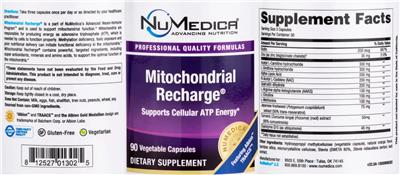
- Form
- Capsule
- Serving Size
- 3 Capsules
- Servings
- 30 per container
- Container Holds
- 90 Vegetable Capsules
What’s in it, whether it interacts with your drugs, its side effects, whether it works, and what our pharmacists would want you to know before you start it.
- What is Mitochondrial Recharge?A supplement from NuMedica with 13 active ingredients, in capsule form.
- Active Ingredients 1 vitamin, 1 mineral, 2 plant ingredients, 3 amino acids and 6 others: Biotin 200 mcgZinc 35 mgAcetyl-L-Carnitine Hydrochloride 300 mgL-Ornithine Hydrochloride 300 mgAlpha-Lipoic Acid 200 mgN-Acetyl L-Cysteine 200 mgQuercetin Dihydrate 200 mgL-Arginine Alpha Ketoglutarate 100 mgL-Citrulline 100 mgL-Methionine 100 mgJapanese Knotweed Extract 75 mgTurmeric Rhizome, Root Extract 50 mg 13 active ingredients. Each one can interact with drugs or cause side effects on its own, so we check every one. And 1 more, in the Supplement Facts
- Drug Interactions 1,476 drugs have a documented interaction with this supplement; the most serious is rated major. Of those, 1,049 are single drugs and 427 are combination products (two or more drugs in one), each listed under its own name. Ask your pharmacist first if you take a drug in any of these categories, the most serious of the 65 on record:
- NitroglycerinMajor · 1 drug
- Moderate · 645 drugs
- Moderate · 372 drugs
- Moderate · 202 drugs
- Possible Side EffectsStomach upset 11 ingredientsNausea 9 ingredientsDiarrhea 7 ingredientsVomiting 4 ingredientsBloating 3 ingredientsHeadache 3 ingredients +13 moreCombined from all 13 of its active ingredients. Not studied in this exact product.
- Well documented Why
Does Mitochondrial Recharge work?
What It Is Marketed For
Support mitochondrial function
From the claims on the product’s label.
The Closest Use the Research Grades
Metabolic dysfunction-associated steatotic liver disease (MASLD) Turmeric
Some studies support it, but the evidence isn’t conclusive.
Its ingredients have research behind other uses too:
- Acetyl-L-Carnitine
- Ornithine
- Alpha-lipoic Acid
- N-Acetyl Cysteine (NAC)
- Age-related cognitive decline Acetyl-L-Carnitine
- Alpha-lipoic Acid
These grades are for each ingredient, not this exact product, and never a promise it will work for you.
And 7 more graded uses, in what the research says- Full Why
- AllergensNone of its ingredient names point to a major food allergen
- Barcode (UPC)8 12527 01302 5Match it to the barcode on your bottle to be sure this is your product. Not your product? Search for it here
Who Might Consider It
- People looking for support mitochondrial function, which is what it is marketed for. The closest use the research grades is metabolic dysfunction-associated steatotic liver disease (MASLD), rated Possibly Effective.
- People who want it for depression, athletic performance, obesity, hyperlipidemia or another graded use: the other uses with research behind them. See each grade
- This product may suit someone comfortable with a multi-ingredient supplement who has reviewed each ingredient against their own medicine list.
Who Should Be Careful
- Anyone taking blood thinners, blood pressure medicines, nitroglycerin, thyroid medicine, or diabetes medicine should be careful, as should anyone who is pregnant, breastfeeding, or has liver or kidney disease.
- Talk it over with your own doctor or pharmacist before you start.
More Before You Take It Show both answersHide Pregnancy and Breastfeeding The Label’s Directions
-
Pregnant or breastfeeding?
- Pregnancy Zinc
- ! When used orally in doses exceeding the UL.
- Breastfeeding Zinc
- ! When used orally in doses exceeding the UL.
- Pregnancy Alpha-lipoic Acid
- ! There is not enough reliable safety information, so it is best to avoid during pregnancy.
- Breastfeeding Alpha-lipoic Acid
- Insufficient reliable information available; avoid using.
- Pregnancy Turmeric
- ! When used orally in medicinal amounts; turmeric might stimulate the uterus and increase menstrual flow.
- Breastfeeding Turmeric
- When used orally in amounts commonly found in food.
-
How does the label say to take it?
“Directions: Take three capsules once per day or as directed by your healthcare practitioner.”
The maker’s words. Your pharmacist or doctor may advise differently.
Everything the label says
From the label dated Jan 23, 2025: all 13 of its active ingredients were checked against our records. A summary of what is known, not a grade or a test of the product. How these ratings are computed
Ask Anything About This Supplement
Name a drug you take, or ask about side effects, ingredients or pregnancy.
AI answers come from this label and our own records, never the open internet. AI can make mistakes, so always check with your doctor or pharmacist. How we use AI
Ask the Pharmacist
A licensed pharmacist will answer your question by email — free, as soon as they can.
Got it — thank you!
A licensed pharmacist will answer as soon as they can. Keep an eye on your email (worth checking spam, just in case).
What’s Inside Mitochondrial Recharge by NuMedica
13 Active Ingredients, Each Checked on Its Own
A supplement is often several ingredients in one bottle, and each one can interact with drugs or cause side effects on its own. We check every one of them against our records.
- BiotinNo drug interactions on record
- ZincDrug interactions on record, most serious: Moderate
- Acetyl-L-Carnitine HydrochlorideDrug interactions on record, most serious: Moderate
- L-Ornithine HydrochlorideNo drug interactions on record
- Alpha-Lipoic AcidDrug interactions on record, most serious: Moderate
- N-Acetyl L-CysteineDrug interactions on record, most serious: Major
- Quercetin DihydrateDrug interactions on record, most serious: Moderate
- L-Arginine Alpha KetoglutarateDrug interactions on record, most serious: Moderate
And 5 more, each with its own card below.
Why this rating?
The label gives an exact amount for every one of its 13 active ingredients, so you know how much of each you get in each serving. This rates what the label tells you, not the quality of the product.
Supplement Facts
| Amount Per Serving | % Daily Value | |
|---|---|---|
| Biotin | 200 mcg | 667% |
| Zinc | 35 mg | 318% |
| Acetyl-L-Carnitine Hydrochloride | 300 mg | † |
| L-Ornithine Hydrochloride | 300 mg | † |
| Alpha-Lipoic Acid | 200 mg | † |
| N-Acetyl L-Cysteine | 200 mg | † |
| Quercetin Dihydrate | 200 mg | † |
| L-Arginine Alpha Ketoglutarate | 100 mg | † |
| L-Citrulline | 100 mg | † |
| L-Methionine | 100 mg | † |
| Japanese Knotweed Extract | 75 mg | † |
| Turmeric Rhizome, Root Extract | 50 mg | † |
| Coenzyme Q-10 | 45 mg | † |
Other ingredients: Hydroxypropyl Methylcellulose, Orange Flavor, Natural, Bamboo Silica, Microcrystalline Cellulose, Stevia Leaf Extract
† Daily Value not established.
Daily Values for adults and children 4 or more years of age.
As the label prints it, from the NIH Dietary Supplement Label Database.
Each Ingredient and Its Drug Interactions
Tap one for more about it and its full guide. A drug can interact with this supplement through any one of them.
Mitochondrial Recharge contains 13 active ingredients: biotin, L-methionine, L-citrulline, L-ornithine hydrochloride, alpha-lipoic acid, acetyl-L-carnitine hydrochloride, N-acetyl L-cysteine, coenzyme Q10, quercetin dihydrate, L-arginine alpha ketoglutarate, zinc, Japanese knotweed extract, and turmeric rhizome root extract.
- Our data describes coenzyme Q10 and alpha-lipoic acid as having antioxidant effects, and acetyl-L-carnitine as a form of carnitine.
-
Biotin 200 mcg No known drug interactions
Biotin (vitamin B7) is a water-soluble vitamin your body needs to turn food into energy and to support healthy hair, skin, and nails.
- Most people get plenty from a normal diet, and true deficiency is rare.
- Supplements are widely sold for hair and nail health, but solid evidence for these benefits is limited in people who are not deficient, and high doses can interfere with certain lab tests.
-
Zinc 35 mg Interacts with 67 drugs
Form on the label: Albion Zinc Bisglycinate Chelate
Zinc is an essential mineral that your body needs for immune function, wound healing, taste, and smell.
- Most people get enough from food, but supplements can help correct or prevent a deficiency.
- Taking too much zinc for too long can cause harm, so check with a pharmacist or doctor before using high-dose supplements.
The full Zinc guide: uses, dosage and safety Every Zinc drug interaction
-
Acetyl-L-Carnitine Hydrochloride 300 mg Interacts with 203 drugs
Acetyl-L-carnitine is a form of the amino acid carnitine that the body uses to help produce energy in cells.
- It is most studied for nerve pain and memory-related conditions, though the evidence is mixed and often limited.
- It is generally well tolerated for short-term use, but you should talk with your pharmacist or doctor before starting it.
The full Acetyl-L-Carnitine guide: uses, dosage and safety Every Acetyl-L-Carnitine drug interaction
-
L-Ornithine Hydrochloride 300 mg No known drug interactions
Ornithine is a non-essential amino acid your body makes naturally as part of the urea cycle, which helps remove ammonia.
- It is sold as a supplement for fatigue, exercise recovery, and sleep, but human evidence is limited and mixed.
- Talk to your pharmacist or doctor before using it, especially if you have a medical condition.
-
Alpha-Lipoic Acid 200 mg Interacts with 263 drugs
Alpha-lipoic acid (ALA) is an antioxidant made naturally by the body and found in small amounts in foods.
- It is most studied for diabetic nerve pain, where some evidence suggests it may help, but evidence for most other uses is limited.
- It is generally well tolerated, but talk to your pharmacist or doctor before using it, especially if you have diabetes or thyroid problems.
The full Alpha-lipoic Acid guide: uses, dosage and safety Every Alpha-lipoic Acid drug interaction
-
N-Acetyl L-Cysteine 200 mg Interacts with 294 drugs
N-acetyl cysteine (NAC) is a supplement form of the amino acid cysteine and a building block for the antioxidant glutathione.
- It has well-established prescription uses for acetaminophen overdose and thinning mucus, but evidence for many over-the-counter uses is still limited.
- It is generally well tolerated, but you should check with a pharmacist or doctor before starting it.
The full N-Acetyl Cysteine (NAC) guide: uses, dosage and safety Every N-Acetyl Cysteine (NAC) drug interaction
-
Quercetin Dihydrate 200 mg Interacts with 1,172 drugs
Quercetin is a plant flavonoid with antioxidant and anti-inflammatory properties found in many common foods and sold as a supplement.
- While early research is interesting for allergies, blood pressure, and inflammation, strong human evidence is limited for most uses.
- It is generally well tolerated in food amounts, but talk to your pharmacist or doctor before taking high-dose supplements.
The full Quercetin guide: uses, dosage and safety Every Quercetin drug interaction
-
L-Arginine Alpha Ketoglutarate 100 mg Interacts with 403 drugs
L-arginine is an amino acid that the body uses to make nitric oxide, a substance that helps blood vessels relax and widen.
- It is popularly used for blood pressure, erectile dysfunction, and exercise, but the evidence is mixed and stronger for some uses than others.
- It is generally well tolerated in healthy adults, but talk with a pharmacist or doctor before using it, especially if you have heart problems or take other medicines.
The full L-Arginine guide: uses, dosage and safety Every L-Arginine drug interaction
-
L-Citrulline 100 mg Interacts with 178 drugs
L-citrulline is an amino acid that the body turns into L-arginine to help make nitric oxide, which relaxes blood vessels and may improve blood flow.
- It is popular for exercise performance and circulation, but the evidence is mixed and most benefits are modest.
- It appears generally well tolerated, but talk to your pharmacist or doctor before starting, especially if you have a health condition or are pregnant.
The full L-Citrulline guide: uses, dosage and safety Every L-Citrulline drug interaction
-
L-Methionine 100 mg No known drug interactions
Methionine is an essential amino acid that your body needs for protein building and many basic chemical reactions.
- Most people get enough from a normal diet, and supplements are generally not needed unless directed by a healthcare provider.
- High doses can cause side effects, so talk to your pharmacist or doctor before using methionine supplements.
-
Japanese Knotweed Extract 75 mg Interacts with 828 drugs
Form on the label: Polygonum cuspidatum extract
Hu Zhang (Japanese knotweed root) is a traditional Chinese herb that is one of the richest natural sources of resveratrol and emodin.
- Some lab and early human research looks interesting for inflammation and heart health, but high-quality evidence in people is limited.
- Talk to your pharmacist or doctor before using it, and avoid it during pregnancy and breastfeeding.
The full Hu Zhang guide: uses, dosage and safety Every Hu Zhang drug interaction
-
Turmeric Rhizome, Root Extract 50 mg Interacts with 1,134 drugs
Form on the label: Curcuma longa Rhizome Extract, Curcuma longa Root Extract
Turmeric is a popular spice whose main active compounds, curcuminoids, are studied mostly for inflammation and joint pain.
- Some research is promising, but quality is mixed and curcumin is poorly absorbed on its own.
- For most people, dietary amounts are safe, but talk to your pharmacist or doctor before taking concentrated supplements, especially if you are pregnant, nursing, or have a medical condition.
The full Turmeric guide: uses, dosage and safety Every Turmeric drug interaction
-
Coenzyme Q-10 45 mg Interacts with 198 drugs
Form on the label: Ubiquinone
CoQ10 is a vitamin-like substance your body makes naturally that helps cells produce energy and acts as an antioxidant.
- It is generally well tolerated and is most studied for heart conditions, statin-related muscle symptoms, and migraine prevention, though the strength of the evidence varies.
- Talk with your pharmacist or doctor before starting it, especially if you take heart or blood pressure medicines.
The full Coenzyme Q10 guide: uses, dosage and safety Every Coenzyme Q10 drug interaction
Other Ingredients (Inactive)
The capsule or tablet itself, fillers, coatings and flavors. Not part of the drug interaction check; the allergen check below reads them.
- Hydroxypropyl Methylcellulose
- Orange Flavor, Natural
- Bamboo Silica
- Microcrystalline Cellulose
- Stevia Leaf Extract
Allergens in Mitochondrial Recharge
None of its ingredient names point to a major food allergen.
Not named in the ingredients
- Milk
- Egg
- Fish
- Shellfish
- Tree nuts
- Peanuts
- Wheat or other gluten grains
- Soy
- Sesame
- Made without, the label says“Does not contain: milk, eggs, fish, shellfish, tree nuts, peanuts, wheat, soy. · Sourced from non-GMO ingredients. · GF Gluten-free”
- Made without, the label says“Vegetarian”
From the label text and ingredient names on file; we do not test products. With a serious allergy, check your bottle and ask the maker or your pharmacist.
What the Label Says
The maker’s own words, from the label. We do not verify or endorse them.
- Formulation
-
“Mitochondrial Recharge is a part of NuMedica's Neuro-Immune Program and is used to support mitochondrial function. Mitochondria are responsible for producing energy as adenosine triphosphate (ATP), which is needed by cells to function properly. Methylation deficiency, toxic exposure and poor nutritional delivery can initiate functional deficiency in the mitochondria.”
“Does not contain: milk, eggs, fish, shellfish, tree nuts, peanuts, wheat, soy. Sourced from non-GMO ingredients. GF Gluten-free”
4 more from the label
“Professional Quality Formulas Supports cellular ATP energy”
“Mitochondrial Recharge contains powerful, targeted ingredients, including super antioxidants, minerals and amino acids, to support the optimal function of the mitochondria.”
“Albion Minerals”
“Featuring Albion TRAACS”
- Storage
-
“Storage: Keep tightly closed in a cool, dry place.”
- Brand IP Statement(s)
-
“Albion and TRAACS and the Albion Gold Medallion design are trademarks of Balchem Corp. or Albion Labs.”
“NuMedica Advancing Nutrition”
- Seals and symbols
-
“cGMP Third-Party Certified Facility”
- FDA Statement of Identity
-
“Dietary Supplement”
The Mitochondrial Recharge Label on File
The label scan on file at the NIH Dietary Supplement Label Database, dated January 2025. Always read the label on the bottle you have.
Product Facts
- Brand
- NuMedica
- Barcode (UPC)
- 812527013025
- Net contents
- 90 Vegetable Capsules
- Market status
- On market
- Date entered into DSLD
- Jan 23, 2025
- DSLD ID
- 323618
- Product type
- Other Combinations
- Supplement form
- Capsule
- Dietary claims / uses
- Nutrient, All Other, Structure/Function
- Intended target group(s)
- Vegetarian, Adult (18 - 50 Years), Gluten Free, Dairy Free
Is this label outdated? Report a formula or label change and our pharmacy team will review it.
Mitochondrial Recharge by NuMedica Side Effects
Why this rating?
We look for three kinds of safety information on each ingredient: side effects reported in studies, a pregnancy and breastfeeding rating, and a safety write-up from our pharmacy team. Of the 13 ingredients we could check, eleven have side-effect reports, all 13 have a pregnancy rating and all 13 have a safety write-up.
So this rates how much is known, not whether Mitochondrial Recharge is right for you.
Reported with 13 of its ingredients
- Most often
- Stomach upset, nausea, diarrhea, vomiting, bloating and headache
- !Rare but serious
- Cerebral edema and hepatic encephalopathy See details
HelloPharmacist Team Summary: Mitochondrial Recharge by NuMedica Side Effects
This product is generally well tolerated, though its many ingredients mean several possible side effects.
- You are most likely to notice stomach upset and nausea, which are reported across several ingredients, and headache, mainly linked to L-citrulline and coenzyme Q10.
- Loose stools and diarrhea are also reported, with L-ornithine and zinc.
- Serious side effects are rare, but if you notice yellowing of the skin or eyes, dark urine, or severe stomach pain, call your doctor right away.
- If you have liver or kidney disease, take blood thinners or blood pressure medicine, or are pregnant or breastfeeding, talk with your own doctor or pharmacist first, and if you feel dizzy or drowsy, see how it affects you before driving.
Side Effects, Ingredient by Ingredient
A supplement’s side effects come from its ingredients. Here is what is reported with each one.
Biotin
Most reported
- Stomach upset
- Nausea
- Digestive discomfort
Zinc
Most reported
- Nausea
- Stomach upset
- Vomiting
- Metallic taste
Acetyl-L-Carnitine
Most reported
- Nausea
- Stomach upset or cramping
- Vomiting
- Diarrhea
Ornithine
Most reported
- Stomach upset
- Cramping
- Nausea
- Loose stools or diarrhea
Alpha-lipoic Acid
Most reported
- Nausea or upset stomach
- Heartburn
- Skin rash or itching
- A change in body odor
N-Acetyl Cysteine (NAC)
Most reported
- Nausea
- Vomiting
- Diarrhea
- Stomach upset
Quercetin
Most reported
- Headache
- Upset stomach
- Tingling sensations
L-Arginine
Most reported
- Stomach upset
- Bloating
- Nausea
- Diarrhea
L-Citrulline
Most reported
- Stomach upset
- Bloating
- Headache
Methionine
Most reported
- Nausea
- Vomiting
- Drowsiness
- Irritability
Hu Zhang
Most reported
- Loose stools
- Diarrhea
- Stomach cramps
- Nausea
Turmeric
Most reported
- Nausea
- Upset stomach
- Diarrhea
- Bloating
Coenzyme Q10
Most reported
- Upset stomach or nausea
- Diarrhea or loss of appetite
- Heartburn
- Headache or dizziness
Mitochondrial Recharge Warnings: Who Should Be Careful
Mitochondrial Recharge has 13 active ingredients, and each can carry warnings of its own. We checked all 13, and each warning below names the ingredient it comes from. If any of these apply to you, talk to your doctor or pharmacist before you start it.
- Biotin1 warning below
- Zinc2 warnings below
- Acetyl-L-Carnitine3 warnings below
- Ornithine2 warnings below
- Alpha-lipoic Acid3 warnings below
- N-Acetyl Cysteine (NAC)3 warnings below
- Quercetin2 warnings below
- L-Arginine3 warnings below
- L-Citrulline1 warning below
- Methionine3 warnings below
- Hu Zhang3 warnings below
- Turmeric2 warnings below
- Coenzyme Q102 warnings below
-
Bleeding Problems or Surgery
- N-Acetyl Cysteine (NAC)Those with a history of stomach ulcers or bleeding disorders should also use care.
- QuercetinIf you have a medical condition, take prescription medicines, or are scheduled for surgery, check with your pharmacist or doctor before starting quercetin.
- TurmericPeople who have gallbladder disease or gallstones, who are prone to kidney stones, or who have bleeding disorders should be cautious and check with a healthcare provider first.
- Coenzyme Q10People with low blood pressure, those scheduled for surgery, or anyone with a chronic health condition should talk with a healthcare provider before starting CoQ10.
-
Diabetes or Low Blood Sugar
- Alpha-lipoic AcidBecause ALA may lower blood sugar, people with diabetes or those taking blood-sugar-lowering medicines should monitor closely and talk to their healthcare provider.
- Alpha-lipoic AcidPeople with a history of low blood sugar should be cautious.
- Coenzyme Q10Because it may affect blood pressure or blood sugar in some people, monitoring may be needed.
-
Blood Pressure
- L-ArginineBecause L-arginine can widen blood vessels and lower blood pressure, use caution if you already have low blood pressure.
- L-CitrullineBecause it can lower blood pressure and affect blood flow, people who take blood pressure medicines, have low blood pressure, or have heart or kidney problems should talk with a healthcare provider before using it.
-
Liver Disease
- OrnithinePeople with kidney or liver disease should be especially careful and talk to a doctor first, since these organs handle amino acid and ammonia processing.
- MethionineThose with liver or kidney disease should also be careful and check with a doctor first.
- Hu ZhangPeople with liver disease, gallbladder problems, chronic diarrhea, or bowel disorders should be cautious, since anthraquinone compounds can affect the gut and liver.
-
Kidney Disease or Kidney Stones
- Acetyl-L-CarnitineIf you have kidney disease, talk to your doctor first.
- QuercetinVery high amounts taken over long periods have raised concerns about possible effects on the kidneys, so people with kidney problems should be especially cautious and talk to a doctor first.
-
Heart Conditions
- L-ArgininePeople with heart disease, especially those who have recently had a heart attack, should avoid using it unless a doctor recommends it, since some research suggested possible harm in that group.
-
Stomach or Bowel Problems
- ZincPeople with digestive disorders, those who drink heavily, and people on restrictive diets are more likely to be low in zinc and may need supplements.
-
Thyroid Conditions
- Acetyl-L-CarnitinePeople with thyroid problems should be cautious, since carnitine may interfere with thyroid hormone activity.
-
Hormone-Sensitive Conditions
- Hu ZhangAnyone with a hormone-sensitive condition may also want to be careful because resveratrol can have mild estrogen-like activity in lab studies.
-
Seizure Disorders
- Acetyl-L-CarnitinePeople with a history of seizures should also use caution, as carnitine products have been linked to more frequent seizures in some reports.
-
If You Take Other Drugs
- N-Acetyl Cysteine (NAC)However, you should talk with a pharmacist or doctor before starting it, especially if you have a health condition or take other medicines.
- MethionineAlways talk with a pharmacist or doctor before starting methionine, especially if you take other medicines or have a health condition.
- Hu ZhangAlways check with a pharmacist or doctor before starting Hu Zhang, especially if you take prescription medicines or have a chronic health condition.
- TurmericAlways talk to your pharmacist or doctor before starting a supplement, especially if you take other medicines or have a health condition.
-
Other Cautions
- BiotinAnyone with an existing medical condition, or who is having lab work done, should check with a pharmacist or doctor first.
- ZincAnyone considering high-dose or long-term zinc should talk to a pharmacist or doctor first.
- OrnithineIf you have any chronic health condition, check with your pharmacist or doctor before starting.
- Alpha-lipoic AcidStill, several groups should be careful.
Show 3 more
- N-Acetyl Cysteine (NAC)People with asthma should be cautious, as inhaled forms can sometimes trigger airway tightening.
- L-ArgininePeople with herpes (cold sores or genital herpes) sometimes worry that arginine may trigger outbreaks; this is not well proven but worth discussing with your provider.
- MethioninePeople with certain inherited disorders that affect how the body handles amino acids (such as homocystinuria) should avoid methionine supplements.
-
What the Label Warns
- “Caution: Keep out of reach of children.”
- “This product not labeled for sale in the State of California.”
The maker’s wording, from the product label.
-
Pregnant or Breastfeeding
Each ingredient’s rating for pregnancy and for breastfeeding, and what it covers.
Pregnancy
-
When used orally and appropriately.
Zinc is safe in amounts that do not exceed the tolerable upper intake level (UL) of 34 mg daily during pregnancy in those 14-18 years of age and 40 mg daily in those 19-50 years of age.
-
When used orally in doses exceeding the UL.
Breastfeeding
-
When used orally and appropriately.
Zinc is safe in amounts that do not exceed the tolerable upper intake level (UL) of 34 mg daily during lactation in those 14-18 years of age, and 40 mg daily for those 19-50 years of age.
-
When used orally in doses exceeding the UL.
Higher doses can cause zinc-induced copper deficiency in nursing infants.
Pregnancy
-
There is not enough reliable safety information, so it is best to avoid during pregnancy.
Breastfeeding
-
Insufficient reliable information available; avoid using.
Show 11 more ingredients
Pregnancy
-
When used orally in amounts commonly found in food.
-
When used orally in medicinal amounts; turmeric might stimulate the uterus and increase menstrual flow.
Breastfeeding
-
When used orally in amounts commonly found in food.
There is insufficient reliable information available about the safety of using turmeric in medicinal amounts during lactation.
Pregnancy
-
There is not enough reliable safety data, so it is best to avoid unless your doctor advises otherwise.
Breastfeeding
-
Insufficient reliable information available; avoid using.
Pregnancy and Breastfeeding The record rates both the same
-
Insufficient reliable information available; avoid using.
Pregnancy and Breastfeeding The record rates both the same
-
Insufficient reliable information available; avoid using.
Pregnancy
-
When used orally, intratracheally, intravenously, or by inhalation.
N-acetyl cysteine crosses the placenta, but has not been associated with adverse effects to the fetus.
However, N-acetyl cysteine should only be used in pregnancy when clearly indicated, such as in cases of acetaminophen toxicity.
Breastfeeding
-
Insufficient reliable information available; avoid using.
Pregnancy and Breastfeeding The record rates both the same
-
Insufficient reliable information available; avoid using.
Pregnancy
-
When used orally and appropriately, short-term.
L-arginine 12 grams daily for 2 days has been used with apparent safety in pregnancy during the third trimester.
L-arginine 3 grams daily has been taken safely during the second and/or third trimesters.
1 more rating for L-Arginine used another way
This supplement is taken by mouth. This rating is for L-Arginine given another way.
-
When used intravenously and appropriately, short-term.
Intravenous L-arginine 20-30 grams daily has been used safely in pregnancy for up to 5 days.
Breastfeeding
-
Insufficient reliable information available; avoid using.
Pregnancy and Breastfeeding The record rates both the same
-
Insufficient reliable information available; avoid using.
Pregnancy and Breastfeeding The record rates both the same
-
Insufficient reliable information available; avoid using.
Pregnancy and Breastfeeding The record rates both the same
-
When used orally and appropriately.
Biotin has been safely used at the adequate intake (AI) dose of 30 mcg daily during pregnancy and 35 mcg daily during lactation.
2 more points on this rating
- It has also been used in supplemental doses of up to 300 mcg daily.
- A tolerable upper intake level (UL) has not been established.
Pregnancy and Breastfeeding The record rates both the same
-
When used orally in amounts commonly found in food.
There is insufficient reliable information available about the safety of methionine in medical doses during pregnancy and lactation; avoid using.
Our pharmacy team’s notes
- Pregnancy data is ingredient-specific.
- Biotin and L-methionine are rated Likely Safe in pregnancy and lactation.
- Zinc and turmeric list both Likely Safe and Likely Unsafe in pregnancy, so talk with your doctor.
- Our pregnancy and breastfeeding records are blank for several other ingredients, so there isn't enough data to know either way.
Ratings and the words beside them are from the Natural Medicines database, which we license. Where it has no rating, the rating and note are our pharmacy team’s.
-
Rare but Serious Side Effects
-
!
Biotin
Serious side effects are rare.
-
!
Zinc
Very high single doses can cause more serious stomach symptoms.
Orally: There have been cases of acute renal tubular necrosis, interstitial nephritis, neurological complications, severe vomiting, and sideroblastic anemia after zinc overdose.
-
!
Ornithine
Serious side effects are not commonly reported, but because long-term and high-dose use is not well studied, the full safety picture is unknown.
-
!
Alpha-lipoic Acid
More serious effects are rare.
Orally: Case reports have raised concerns about insulin autoimmune syndrome (IAS).
-
!
N-Acetyl Cysteine (NAC)
Orally: Chest tightness, hemoptysis, and palpitations have been reported.
-
!
Quercetin
Higher doses taken by injection (not the usual supplement form) have been linked in some reports to more serious effects, which is one reason very high doses are not recommended.
-
!
L-Arginine
Allergic reactions are possible but uncommon.
-
!
L-Citrulline
Serious side effects appear to be rare.
-
!
Methionine
Cerebral edema, hepatic encephalopathy. In infants, intravenous methionine has been linked to liver toxicity.
-
!
Hu Zhang
Allergic reactions are possible with any plant product.
-
!
Turmeric
Signs that need medical attention include yellowing skin or eyes, dark urine, severe stomach pain, or an allergic reaction such as rash, swelling, or trouble breathing.
Turmeric is generally well tolerated as a food, but concentrated supplements have been linked to rare liver problems, with at least 70 liver injury reports.
-
!
Coenzyme Q10
Serious side effects are rare.
Coenzyme Q10 is generally well tolerated, and no serious adverse effects were reported in clinical studies.
When to get help: a serious allergic reaction, with trouble breathing or swelling of the face, lips or throat, needs emergency care: call 911. For any other side effect that worries you, call your doctor or pharmacist.
These reports describe each ingredient, not studies of this exact product. Not medical advice: a side effect you notice after starting a supplement is worth a word with your pharmacist or doctor.
Mitochondrial Recharge by NuMedica Drug Interactions
We checked all 13 active ingredients in this supplement against every drug in our records. A drug can interact with it through any one of them.
A major interaction on record
3 of 3, on a scale from Minor or none to Major.Why this rating?
We rate this by the most serious interaction on record, not by how many there are. For Quercetin, Turmeric, Alpha-lipoic Acid, Acetyl-L-Carnitine and L-Arginine, the most serious is rated major, which means the combination is best avoided, or used only under close supervision. Some involve kinds of drugs where a small change can matter, such as blood thinners, transplant drugs and cancer treatments.
1,477 drugs are on the full list. What matters is whether one you take is on it, so check yours with the interaction checker on this page.
Ten of its 13 active ingredients have drug interactions on record. The ones below matter most. We have no interaction records for Biotin, Ornithine and Methionine.
- Interacts with
- 294 drugs
- Most serious
- Major
- Its most serious finding is N-acetyl cysteine, which can raise the risk of low blood pressure and severe headaches when combined with nitroglycerin (rated Major).
- Interacts with
- 1,172 drugs
- Most serious
- Moderate
- Most of its records involve Cytochrome P450 3A4 (CYP3A4) Substrates, P-glycoprotein Substrates and Cytochrome P450 2D6 (CYP2D6) Substrates.
- Interacts with
- 1,134 drugs
- Most serious
- Moderate
- Most of its records involve Cytochrome P450 3A4 (CYP3A4) Substrates, Hepatotoxic Drugs and P-glycoprotein Substrates.
Show three more ingredients
- Interacts with
- 828 drugs
- Most serious
- Moderate
- Most of its records involve Cytochrome P450 3A4 (CYP3A4) Substrates, Cytochrome P450 1A2 (CYP1A2) Substrates and Anticoagulant/Antiplatelet Drugs.
- Interacts with
- 403 drugs
- Most serious
- Moderate
- Most of its records involve Antihypertensive Drugs, Anticoagulant/Antiplatelet Drugs and Antidiabetes Drugs.
- Interacts with
- 263 drugs
- Most serious
- Moderate
- Most of its records involve Anticoagulant/Antiplatelet Drugs, Antidiabetes Drugs and Alkylating Agents.
And four more ingredients with records, each in the cards below.
From the HelloPharmacist Team
Here is how the interactions add up across the whole label.
- Mitochondrial Recharge from NuMedica does interact with several medications.
- Other ingredients with documented interactions are L-citrulline, alpha-lipoic acid, acetyl-L-carnitine, coenzyme Q10, quercetin, L-arginine, zinc, Japanese knotweed extract, and turmeric.
- Rated Moderate: blood pressure medicines of several kinds, PDE-5 inhibitors such as sildenafil, blood thinners like warfarin, thyroid hormone drugs, serotonin-affecting drugs, several chemotherapy and antibiotic classes, immunosuppressants, statins, and diabetes medicines.
Summarized by the HelloPharmacist pharmacy team from the interaction records below. How it is written How we use AI
Why Mitochondrial Recharge Interacts, Ingredient by Ingredient
A product interacts through its ingredients. Each card: how many drugs, the most serious rating, and the kinds of drugs it affects most (tap a kind for what it means).
The ingredients driving the most interactions
-
Quercetin Dihydrate 1,172 drugs
Most serious: Moderate23 interaction records on file
The kinds of drugs it affects most
- 645 drugs
- 202 drugs
- 193 drugs
- 172 drugs
Every Quercetin drug interaction, 23 records The Quercetin records cite 30 references, listed in the Quercetin guide.
-
Turmeric Rhizome, Root Extract 1,134 drugs
Most serious: Moderate24 interaction records on file
The kinds of drugs it affects most
- 645 drugs
- 372 drugs
- 202 drugs
- 186 drugs
Every Turmeric drug interaction, 24 records The Turmeric records cite 105 references, listed in the Turmeric guide.
-
Japanese Knotweed Extract 828 drugs
Most serious: Moderate7 interaction records on file
The kinds of drugs it affects most
- 645 drugs
- 186 drugs
- 122 drugs
- 72 drugs
Every Hu Zhang drug interaction, 7 records The Hu Zhang records cite 19 references, listed in the Hu Zhang guide.
-
L-Arginine Alpha Ketoglutarate 403 drugs
Most serious: Moderate9 interaction records on file
The kinds of drugs it affects most
- 172 drugs
- 122 drugs
- 86 drugs
- 23 drugs
Every L-Arginine drug interaction, 9 records The L-Arginine records cite 66 references, listed in the L-Arginine guide.
-
N-Acetyl L-Cysteine 294 drugs
Most serious: Major5 interaction records on file
The kinds of drugs it affects most
- 172 drugs
- 122 drugs
- Activated Charcoal 2 drugs
- Chloroquine (Aralen) 2 drugs
Every N-Acetyl Cysteine (NAC) drug interaction, 5 records The N-Acetyl Cysteine (NAC) records cite 86 references, listed in the N-Acetyl Cysteine (NAC) guide.
-
Alpha-Lipoic Acid 263 drugs
Most serious: Moderate5 interaction records on file
The kinds of drugs it affects most
- 122 drugs
- 86 drugs
- 24 drugs
- 16 drugs
Every Alpha-lipoic Acid drug interaction, 5 records The Alpha-lipoic Acid records cite 48 references, listed in the Alpha-lipoic Acid guide.
-
Acetyl-L-Carnitine Hydrochloride 203 drugs
Most serious: Moderate4 interaction records on file
The kinds of drugs it affects most
- 184 drugs
- 16 drugs
- 2 drugs
- Acenocoumarol (Sintrom) 1 drug
Every Acetyl-L-Carnitine drug interaction, 4 records The Acetyl-L-Carnitine records cite 22 references, listed in the Acetyl-L-Carnitine guide.
-
Coenzyme Q-10 198 drugs
Most serious: Moderate3 interaction records on file
The kinds of drugs it affects most
- 172 drugs
- 24 drugs
- 2 drugs
Every Coenzyme Q10 drug interaction, 3 records The Coenzyme Q10 records cite 40 references, listed in the Coenzyme Q10 guide.
-
L-Citrulline 178 drugs
Most serious: Moderate2 interaction records on file
The kinds of drugs it affects most
- 172 drugs
- PHOSPHODIESTERASE-5 Inhibitors 7 drugs
Every L-Citrulline drug interaction, 2 records The L-Citrulline records cite 9 references, listed in the L-Citrulline guide.
-
Zinc 67 drugs
Most serious: Moderate10 interaction records on file
The kinds of drugs it affects most
- 21 drugs
- 20 drugs
- Bictegravir/Emtricitabine/Tenofovir Alafenamide (Biktarvy) 13 drugs
- Ritonavir (Norvir) 7 drugs
Every Zinc drug interaction, 10 records The Zinc records cite 88 references, listed in the Zinc guide.
The Breakdown by Severity
Each drug counted once, at its most serious rating. Tap a tile to list those drugs.
Find Your Drug
Type a drug or brand name to see whether it is on the list.
- Only drugs with a documented interaction are listed, the most serious first.
- A drug with no known interaction is not listed, but searching its name tells you so.
- Open a drug to see which ingredient is responsible. Of those, 1,049 are single drugs and 427 are combination products (two or more drugs in one), each listed under its own name.
-
NitroglycerinGonitro, Nitro Time, Nitro-Bid, Nitrocine Timecaps, Nitrogard and 8 more Major
The ingredient responsible:
-
N-Acetyl L-Cysteine Major
N-acetyl cysteine can increase the risk for hypotension and headaches when taken with intravenous or transdermal nitroglycerin.
The full N-Acetyl L-Cysteine + Nitroglycerin interaction
-
-
ApixabanEliquis Moderate
The 6 ingredients responsible:
-
Turmeric Rhizome, Root Extract Moderate Apixaban is in these Cytochrome P450 3A4 (CYP3A4) Substrates, Anticoagulant/Antiplatelet Drugs, P-glycoprotein Substrates categories.
Turmeric might increase or decrease levels of drugs metabolized by CYP3A4.
The full Turmeric Rhizome, Root Extract + Apixaban interaction -
Japanese Knotweed Extract Moderate Apixaban is in these Cytochrome P450 3A4 (CYP3A4) Substrates, Anticoagulant/Antiplatelet Drugs categories.
Theoretically, hu zhang might increase levels of drugs metabolized by CYP3A4.
The full Japanese Knotweed Extract + Apixaban interaction -
N-Acetyl L-Cysteine Moderate Apixaban is in the Anticoagulant/Antiplatelet Drugs category.
Theoretically, N-acetyl cysteine might increase the risk of bleeding when taken with anticoagulant or antiplatelet drugs.
The full N-Acetyl L-Cysteine + Apixaban interaction -
Alpha-lipoic Acid Moderate Apixaban is in the Anticoagulant/Antiplatelet Drugs category.
Theoretically, alpha-lipoic acid may have antiplatelet effects and may increase the risk of bleeding if used with anticoagulant or antiplatelet drugs.
The full Alpha-lipoic Acid + Apixaban interaction -
L-Arginine Alpha Ketoglutarate Moderate Apixaban is in the Anticoagulant/Antiplatelet Drugs category.
Theoretically, concomitant use of L-arginine with anticoagulant and antiplatelet drugs might have additive effects and increase the risk of bleeding.
The full L-Arginine Alpha Ketoglutarate + Apixaban interaction -
Quercetin Dihydrate Moderate Apixaban is in these Cytochrome P450 3A4 (CYP3A4) Substrates, P-glycoprotein Substrates categories.
Theoretically, concomitant use might alter the effects and adverse effects of CYP3A4 substrates.
The full Quercetin Dihydrate + Apixaban interaction
-
-
WarfarinWarfarin Moderate
The 8 ingredients responsible:
-
Turmeric Rhizome, Root Extract Moderate Warfarin is in these Cytochrome P450 3A4 (CYP3A4) Substrates, Cytochrome P450 1A2 (CYP1A2) Substrates, Anticoagulant/Antiplatelet Drugs categories.
Turmeric might increase or decrease levels of drugs metabolized by CYP3A4.
The full Turmeric Rhizome, Root Extract + Warfarin interaction -
Quercetin Dihydrate Moderate Warfarin is in these Cytochrome P450 2C8 (CYP2C8) Substrates, Cytochrome P450 2C9 (CYP2C9) Substrates, Cytochrome P450 3A4 (CYP3A4) Substrates categories.
Theoretically, concomitant use might increase the levels and adverse effects of CYP2C8 substrates.
The full Quercetin Dihydrate + Warfarin interaction -
Japanese Knotweed Extract Moderate Warfarin is in these Cytochrome P450 1A2 (CYP1A2) Substrates, Cytochrome P450 2C19 (CYP2C19) Substrates, Anticoagulant/Antiplatelet Drugs and 1 more categories.
Theoretically, hu zhang might increase levels of drugs metabolized by CYP1A2.
The full Japanese Knotweed Extract + Warfarin interaction -
N-Acetyl L-Cysteine Moderate Warfarin is in the Anticoagulant/Antiplatelet Drugs category.
Theoretically, N-acetyl cysteine might increase the risk of bleeding when taken with anticoagulant or antiplatelet drugs.
The full N-Acetyl L-Cysteine + Warfarin interaction -
Coenzyme Q-10 Moderate
Coenzyme Q10 is chemically similar to menaquinone and might have vitamin K-like procoagulant effects, which could decrease the effects of warfarin.
The full Coenzyme Q-10 + Warfarin interaction -
Alpha-lipoic Acid Moderate Warfarin is in the Anticoagulant/Antiplatelet Drugs category.
Theoretically, alpha-lipoic acid may have antiplatelet effects and may increase the risk of bleeding if used with anticoagulant or antiplatelet drugs.
The full Alpha-lipoic Acid + Warfarin interaction -
L-Arginine Alpha Ketoglutarate Moderate Warfarin is in the Anticoagulant/Antiplatelet Drugs category.
Theoretically, concomitant use of L-arginine with anticoagulant and antiplatelet drugs might have additive effects and increase the risk of bleeding.
The full L-Arginine Alpha Ketoglutarate + Warfarin interaction -
Acetyl-L-Carnitine Hydrochloride Moderate
Theoretically, acetyl-L-carnitine might increase the anticoagulant effects of warfarin.
The full Acetyl-L-Carnitine Hydrochloride + Warfarin interaction
-
-
LevothyroxineEltroxin, Estre, Euthyrox, Levo-T, Levolet and 6 more Moderate
The 2 ingredients responsible:
-
Acetyl-L-Carnitine Hydrochloride Moderate Levothyroxine is in the Thyroid Hormone category.
Theoretically, acetyl-L-carnitine might decrease the effectiveness of thyroid hormone replacement.
The full Acetyl-L-Carnitine Hydrochloride + Levothyroxine interaction -
Alpha-lipoic Acid Moderate Levothyroxine is in the Thyroid Hormone category.
Theoretically, alpha-lipoic acid might decrease the effects of thyroid hormone drugs.
The full Alpha-lipoic Acid + Levothyroxine interaction
-
-
AmlodipineNorliqva Moderate
The 7 ingredients responsible:
-
Quercetin Dihydrate Moderate Amlodipine is in these Antihypertensive Drugs, Cytochrome P450 3A4 (CYP3A4) Substrates categories.
Theoretically, taking quercetin with antihypertensive drugs might increase the risk of hypotension.
The full Quercetin Dihydrate + Amlodipine interaction -
Turmeric Rhizome, Root Extract Moderate Amlodipine is in the Cytochrome P450 3A4 (CYP3A4) Substrates category.
Turmeric might increase or decrease levels of drugs metabolized by CYP3A4.
The full Turmeric Rhizome, Root Extract + Amlodipine interaction -
L-Arginine Alpha Ketoglutarate Moderate Amlodipine is in the Antihypertensive Drugs category.
Theoretically, concomitant use of L-arginine and antihypertensive drugs may increase the risk of hypotension.
The full L-Arginine Alpha Ketoglutarate + Amlodipine interaction -
Japanese Knotweed Extract Moderate Amlodipine is in the Cytochrome P450 3A4 (CYP3A4) Substrates category.
Theoretically, hu zhang might increase levels of drugs metabolized by CYP3A4.
The full Japanese Knotweed Extract + Amlodipine interaction -
L-Citrulline Moderate Amlodipine is in the Antihypertensive Drugs category.
Theoretically, concomitant use of L-citrulline with antihypertensive drugs might have additive effects and increase the chance of hypotension.
The full L-Citrulline + Amlodipine interaction -
N-Acetyl L-Cysteine Moderate Amlodipine is in the Antihypertensive Drugs category.
Theoretically, N-acetyl cysteine might increase the risk of hypotension when taken with antihypertensive drugs.
The full N-Acetyl L-Cysteine + Amlodipine interaction -
Coenzyme Q-10 Minor Amlodipine is in the Antihypertensive Drugs category.
Theoretically, coenzyme Q10 might have additive effects with antihypertensive drugs.
The full Coenzyme Q-10 + Amlodipine interaction
-
-
SertralineZoloft Moderate
The 4 ingredients responsible:
-
Acetyl-L-Carnitine Hydrochloride Moderate Sertraline is in the Serotonergic Drugs category.
Theoretically, acetyl-L-carnitine might increase the risk of serotonergic side effects, including serotonin syndrome and cerebral vasoconstrictive disorders, when taken with serotonergic drugs.
The full Acetyl-L-Carnitine Hydrochloride + Sertraline interaction -
Quercetin Dihydrate Moderate Sertraline is in the Cytochrome P450 3A4 (CYP3A4) Substrates category.
Theoretically, concomitant use might alter the effects and adverse effects of CYP3A4 substrates.
The full Quercetin Dihydrate + Sertraline interaction -
Japanese Knotweed Extract Moderate Sertraline is in the Cytochrome P450 3A4 (CYP3A4) Substrates category.
Theoretically, hu zhang might increase levels of drugs metabolized by CYP3A4.
The full Japanese Knotweed Extract + Sertraline interaction -
Turmeric Rhizome, Root Extract Moderate Sertraline is in the Cytochrome P450 3A4 (CYP3A4) Substrates category.
Turmeric might increase or decrease levels of drugs metabolized by CYP3A4.
The full Turmeric Rhizome, Root Extract + Sertraline interaction
-
-
ClopidogrelPlavix Moderate
The 6 ingredients responsible:
-
Quercetin Dihydrate Moderate Clopidogrel is in these Cytochrome P450 3A4 (CYP3A4) Substrates, Cytochrome P450 2C9 (CYP2C9) Substrates categories.
Theoretically, concomitant use might alter the effects and adverse effects of CYP3A4 substrates.
The full Quercetin Dihydrate + Clopidogrel interaction -
Japanese Knotweed Extract Moderate Clopidogrel is in these Anticoagulant/Antiplatelet Drugs, Cytochrome P450 3A4 (CYP3A4) Substrates, Cytochrome P450 1A2 (CYP1A2) Substrates categories.
Theoretically, hu zhang might increase the risk of bleeding when taken with anticoagulant or antiplatelet drugs.
The full Japanese Knotweed Extract + Clopidogrel interaction -
N-Acetyl L-Cysteine Moderate Clopidogrel is in the Anticoagulant/Antiplatelet Drugs category.
Theoretically, N-acetyl cysteine might increase the risk of bleeding when taken with anticoagulant or antiplatelet drugs.
The full N-Acetyl L-Cysteine + Clopidogrel interaction -
Turmeric Rhizome, Root Extract Moderate Clopidogrel is in these Cytochrome P450 3A4 (CYP3A4) Substrates, Cytochrome P450 1A2 (CYP1A2) Substrates, Anticoagulant/Antiplatelet Drugs categories.
Turmeric might increase or decrease levels of drugs metabolized by CYP3A4.
The full Turmeric Rhizome, Root Extract + Clopidogrel interaction -
Alpha-lipoic Acid Moderate Clopidogrel is in the Anticoagulant/Antiplatelet Drugs category.
Theoretically, alpha-lipoic acid may have antiplatelet effects and may increase the risk of bleeding if used with anticoagulant or antiplatelet drugs.
The full Alpha-lipoic Acid + Clopidogrel interaction -
L-Arginine Alpha Ketoglutarate Moderate Clopidogrel is in the Anticoagulant/Antiplatelet Drugs category.
Theoretically, concomitant use of L-arginine with anticoagulant and antiplatelet drugs might have additive effects and increase the risk of bleeding.
The full L-Arginine Alpha Ketoglutarate + Clopidogrel interaction
-
-
RosuvastatinCrestor, Ezallor Moderate
The 2 ingredients responsible:
-
Quercetin Dihydrate Moderate
Theoretically, concomitant use might increase the effects and adverse effects of rosuvastatin.
The full Quercetin Dihydrate + Rosuvastatin interaction -
Turmeric Rhizome, Root Extract Moderate Rosuvastatin is in the Hepatotoxic Drugs category.
Theoretically, turmeric might increase the risk of liver damage when taken with hepatotoxic drugs.
The full Turmeric Rhizome, Root Extract + Rosuvastatin interaction
-
-
Losartan PotassiumCozaar Moderate
The 7 ingredients responsible:
-
Quercetin Dihydrate Moderate Losartan Potassium is in these Cytochrome P450 2C9 (CYP2C9) Substrates, Antihypertensive Drugs, Cytochrome P450 3A4 (CYP3A4) Substrates categories.
Theoretically, concomitant use might increase the levels and adverse effects of CYP2C9 substrates.
The full Quercetin Dihydrate + Losartan Potassium interaction -
Turmeric Rhizome, Root Extract Moderate Losartan Potassium is in the Cytochrome P450 3A4 (CYP3A4) Substrates category.
Turmeric might increase or decrease levels of drugs metabolized by CYP3A4.
The full Turmeric Rhizome, Root Extract + Losartan Potassium interaction -
L-Arginine Alpha Ketoglutarate Moderate Losartan Potassium is in these Antihypertensive Drugs, Angiotensin Receptor Blockers (ARBs) categories.
Theoretically, concomitant use of L-arginine and antihypertensive drugs may increase the risk of hypotension.
The full L-Arginine Alpha Ketoglutarate + Losartan Potassium interaction -
Japanese Knotweed Extract Moderate Losartan Potassium is in the Cytochrome P450 3A4 (CYP3A4) Substrates category.
Theoretically, hu zhang might increase levels of drugs metabolized by CYP3A4.
The full Japanese Knotweed Extract + Losartan Potassium interaction -
N-Acetyl L-Cysteine Moderate Losartan Potassium is in the Antihypertensive Drugs category.
Theoretically, N-acetyl cysteine might increase the risk of hypotension when taken with antihypertensive drugs.
The full N-Acetyl L-Cysteine + Losartan Potassium interaction -
L-Citrulline Moderate Losartan Potassium is in the Antihypertensive Drugs category.
Theoretically, concomitant use of L-citrulline with antihypertensive drugs might have additive effects and increase the chance of hypotension.
The full L-Citrulline + Losartan Potassium interaction -
Coenzyme Q-10 Minor Losartan Potassium is in the Antihypertensive Drugs category.
Theoretically, coenzyme Q10 might have additive effects with antihypertensive drugs.
The full Coenzyme Q-10 + Losartan Potassium interaction
-
-
AspirinAngettes 75, ASA, Asaphen, Aspirin, Caprin and 9 more Moderate
The 6 ingredients responsible:
-
Turmeric Rhizome, Root Extract Moderate Aspirin is in the Anticoagulant/Antiplatelet Drugs category.
Turmeric may have antiplatelet effects and may increase the risk of bleeding if used with anticoagulant or antiplatelet drugs.
The full Turmeric Rhizome, Root Extract + Aspirin interaction -
L-Arginine Alpha Ketoglutarate Moderate Aspirin is in the Anticoagulant/Antiplatelet Drugs category.
Theoretically, concomitant use of L-arginine with anticoagulant and antiplatelet drugs might have additive effects and increase the risk of bleeding.
The full L-Arginine Alpha Ketoglutarate + Aspirin interaction -
Alpha-lipoic Acid Moderate Aspirin is in the Anticoagulant/Antiplatelet Drugs category.
Theoretically, alpha-lipoic acid may have antiplatelet effects and may increase the risk of bleeding if used with anticoagulant or antiplatelet drugs.
The full Alpha-lipoic Acid + Aspirin interaction -
Quercetin Dihydrate Moderate Aspirin is in these Organic Anion Transporter 3 (OAT3) Substrates, Organic Anion Transporter 1 (OAT1) Substrates categories.
Theoretically, concomitant use might increase the effects and adverse effects of OAT3 substrates.
The full Quercetin Dihydrate + Aspirin interaction -
Japanese Knotweed Extract Moderate Aspirin is in the Anticoagulant/Antiplatelet Drugs category.
Theoretically, hu zhang might increase the risk of bleeding when taken with anticoagulant or antiplatelet drugs.
The full Japanese Knotweed Extract + Aspirin interaction -
N-Acetyl L-Cysteine Moderate Aspirin is in the Anticoagulant/Antiplatelet Drugs category.
Theoretically, N-acetyl cysteine might increase the risk of bleeding when taken with anticoagulant or antiplatelet drugs.
The full N-Acetyl L-Cysteine + Aspirin interaction
-
-
AtorvastatinAtorvaliq Moderate
The 3 ingredients responsible:
-
Turmeric Rhizome, Root Extract Moderate Atorvastatin is in these Organic Anion-transporting Polypeptide Substrates (OATP), Cytochrome P450 3A4 (CYP3A4) Substrates, Hepatotoxic Drugs categories.
Theoretically, turmeric might increase blood levels of OATP4C1 substrates.
The full Turmeric Rhizome, Root Extract + Atorvastatin interaction -
Japanese Knotweed Extract Moderate Atorvastatin is in the Cytochrome P450 3A4 (CYP3A4) Substrates category.
Theoretically, hu zhang might increase levels of drugs metabolized by CYP3A4.
The full Japanese Knotweed Extract + Atorvastatin interaction -
Quercetin Dihydrate Moderate Atorvastatin is in these Organic Anion-transporting Polypeptide Substrates (OATP), Cytochrome P450 3A4 (CYP3A4) Substrates categories.
Theoretically, concomitant use might increase the effects and adverse effects of OATP substrates.
The full Quercetin Dihydrate + Atorvastatin interaction
-
-
EscitalopramLexapro Moderate
The 4 ingredients responsible:
-
Japanese Knotweed Extract Moderate Escitalopram is in these Cytochrome P450 2C19 (CYP2C19) Substrates, Cytochrome P450 3A4 (CYP3A4) Substrates categories.
Theoretically, hu zhang might increase levels of drugs metabolized by CYP2C19.
The full Japanese Knotweed Extract + Escitalopram interaction -
Acetyl-L-Carnitine Hydrochloride Moderate Escitalopram is in the Serotonergic Drugs category.
Theoretically, acetyl-L-carnitine might increase the risk of serotonergic side effects, including serotonin syndrome and cerebral vasoconstrictive disorders, when taken with serotonergic drugs.
The full Acetyl-L-Carnitine Hydrochloride + Escitalopram interaction -
Quercetin Dihydrate Moderate Escitalopram is in the Cytochrome P450 3A4 (CYP3A4) Substrates category.
Theoretically, concomitant use might alter the effects and adverse effects of CYP3A4 substrates.
The full Quercetin Dihydrate + Escitalopram interaction -
Turmeric Rhizome, Root Extract Moderate Escitalopram is in the Cytochrome P450 3A4 (CYP3A4) Substrates category.
Turmeric might increase or decrease levels of drugs metabolized by CYP3A4.
The full Turmeric Rhizome, Root Extract + Escitalopram interaction
-
-
Warfarin SodiumCoumadin, Panwarfin, Sofarin Moderate
The 8 ingredients responsible:
-
Quercetin Dihydrate Moderate Warfarin Sodium is in these Cytochrome P450 3A4 (CYP3A4) Substrates, Cytochrome P450 2C9 (CYP2C9) Substrates, Cytochrome P450 2C8 (CYP2C8) Substrates categories.
Theoretically, concomitant use might alter the effects and adverse effects of CYP3A4 substrates.
The full Quercetin Dihydrate + Warfarin Sodium interaction -
Coenzyme Q-10 Moderate
Coenzyme Q10 is chemically similar to menaquinone and might have vitamin K-like procoagulant effects, which could decrease the effects of warfarin.
The full Coenzyme Q-10 + Warfarin Sodium interaction -
N-Acetyl L-Cysteine Moderate Warfarin Sodium is in the Anticoagulant/Antiplatelet Drugs category.
Theoretically, N-acetyl cysteine might increase the risk of bleeding when taken with anticoagulant or antiplatelet drugs.
The full N-Acetyl L-Cysteine + Warfarin Sodium interaction -
Japanese Knotweed Extract Moderate Warfarin Sodium is in these Cytochrome P450 1A2 (CYP1A2) Substrates, Cytochrome P450 2C19 (CYP2C19) Substrates, Cytochrome P450 3A4 (CYP3A4) Substrates and 1 more categories.
Theoretically, hu zhang might increase levels of drugs metabolized by CYP1A2.
The full Japanese Knotweed Extract + Warfarin Sodium interaction -
Turmeric Rhizome, Root Extract Moderate Warfarin Sodium is in these Cytochrome P450 1A2 (CYP1A2) Substrates, Cytochrome P450 3A4 (CYP3A4) Substrates, Anticoagulant/Antiplatelet Drugs categories.
Theoretically, turmeric might increase levels of drugs metabolized by CYP1A2.
The full Turmeric Rhizome, Root Extract + Warfarin Sodium interaction -
Acetyl-L-Carnitine Hydrochloride Moderate
Theoretically, acetyl-L-carnitine might increase the anticoagulant effects of warfarin.
The full Acetyl-L-Carnitine Hydrochloride + Warfarin Sodium interaction -
Alpha-lipoic Acid Moderate Warfarin Sodium is in the Anticoagulant/Antiplatelet Drugs category.
Theoretically, alpha-lipoic acid may have antiplatelet effects and may increase the risk of bleeding if used with anticoagulant or antiplatelet drugs.
The full Alpha-lipoic Acid + Warfarin Sodium interaction -
L-Arginine Alpha Ketoglutarate Moderate Warfarin Sodium is in the Anticoagulant/Antiplatelet Drugs category.
Theoretically, concomitant use of L-arginine with anticoagulant and antiplatelet drugs might have additive effects and increase the risk of bleeding.
The full L-Arginine Alpha Ketoglutarate + Warfarin Sodium interaction
-
-
RivaroxabanXarelto Moderate
The 6 ingredients responsible:
-
Quercetin Dihydrate Moderate Rivaroxaban is in these P-glycoprotein Substrates, Cytochrome P450 3A4 (CYP3A4) Substrates categories.
Theoretically, concomitant use might alter the effects and adverse effects of P-glycoprotein substrates.
The full Quercetin Dihydrate + Rivaroxaban interaction -
N-Acetyl L-Cysteine Moderate Rivaroxaban is in the Anticoagulant/Antiplatelet Drugs category.
Theoretically, N-acetyl cysteine might increase the risk of bleeding when taken with anticoagulant or antiplatelet drugs.
The full N-Acetyl L-Cysteine + Rivaroxaban interaction -
Japanese Knotweed Extract Moderate Rivaroxaban is in these Anticoagulant/Antiplatelet Drugs, Cytochrome P450 3A4 (CYP3A4) Substrates categories.
Theoretically, hu zhang might increase the risk of bleeding when taken with anticoagulant or antiplatelet drugs.
The full Japanese Knotweed Extract + Rivaroxaban interaction -
Turmeric Rhizome, Root Extract Moderate Rivaroxaban is in these Cytochrome P450 3A4 (CYP3A4) Substrates, P-glycoprotein Substrates, Anticoagulant/Antiplatelet Drugs categories.
Turmeric might increase or decrease levels of drugs metabolized by CYP3A4.
The full Turmeric Rhizome, Root Extract + Rivaroxaban interaction -
Alpha-lipoic Acid Moderate Rivaroxaban is in the Anticoagulant/Antiplatelet Drugs category.
Theoretically, alpha-lipoic acid may have antiplatelet effects and may increase the risk of bleeding if used with anticoagulant or antiplatelet drugs.
The full Alpha-lipoic Acid + Rivaroxaban interaction -
L-Arginine Alpha Ketoglutarate Moderate Rivaroxaban is in the Anticoagulant/Antiplatelet Drugs category.
Theoretically, concomitant use of L-arginine with anticoagulant and antiplatelet drugs might have additive effects and increase the risk of bleeding.
The full L-Arginine Alpha Ketoglutarate + Rivaroxaban interaction
-
-
MetforminGlucophage, Metformin Moderate
The 4 ingredients responsible:
-
Turmeric Rhizome, Root Extract Moderate Metformin is in the Antidiabetes Drugs category.
Theoretically, taking turmeric with antidiabetes drugs might increase the risk of hypoglycemia.
The full Turmeric Rhizome, Root Extract + Metformin interaction -
L-Arginine Alpha Ketoglutarate Moderate Metformin is in the Antidiabetes Drugs category.
Theoretically, concomitant use of L-arginine might have additive effects with antidiabetes drugs.
The full L-Arginine Alpha Ketoglutarate + Metformin interaction -
Quercetin Dihydrate Moderate Metformin is in the Antidiabetes Drugs category.
Theoretically, concomitant use of quercetin and antidiabetes drugs might increase the risk of hypoglycemia.
The full Quercetin Dihydrate + Metformin interaction -
Alpha-lipoic Acid Minor Metformin is in the Antidiabetes Drugs category.
Theoretically, taking alpha-lipoic acid with antidiabetes drugs might increase the risk of hypoglycemia.
The full Alpha-lipoic Acid + Metformin interaction
-
-
MetoprololLopressor, Toprol XL Moderate
The 5 ingredients responsible:
-
N-Acetyl L-Cysteine Moderate Metoprolol is in the Antihypertensive Drugs category.
Theoretically, N-acetyl cysteine might increase the risk of hypotension when taken with antihypertensive drugs.
The full N-Acetyl L-Cysteine + Metoprolol interaction -
L-Citrulline Moderate Metoprolol is in the Antihypertensive Drugs category.
Theoretically, concomitant use of L-citrulline with antihypertensive drugs might have additive effects and increase the chance of hypotension.
The full L-Citrulline + Metoprolol interaction -
Quercetin Dihydrate Moderate Metoprolol is in these Antihypertensive Drugs, Cytochrome P450 2D6 (CYP2D6) Substrates categories.
Theoretically, taking quercetin with antihypertensive drugs might increase the risk of hypotension.
The full Quercetin Dihydrate + Metoprolol interaction -
L-Arginine Alpha Ketoglutarate Moderate Metoprolol is in the Antihypertensive Drugs category.
Theoretically, concomitant use of L-arginine and antihypertensive drugs may increase the risk of hypotension.
The full L-Arginine Alpha Ketoglutarate + Metoprolol interaction -
Coenzyme Q-10 Minor Metoprolol is in the Antihypertensive Drugs category.
Theoretically, coenzyme Q10 might have additive effects with antihypertensive drugs.
The full Coenzyme Q-10 + Metoprolol interaction
-
-
TirzepatideMounjaro, Zepbound Moderate
The 4 ingredients responsible:
-
L-Arginine Alpha Ketoglutarate Moderate Tirzepatide is in the Antidiabetes Drugs category.
Theoretically, concomitant use of L-arginine might have additive effects with antidiabetes drugs.
The full L-Arginine Alpha Ketoglutarate + Tirzepatide interaction -
Turmeric Rhizome, Root Extract Moderate Tirzepatide is in the Antidiabetes Drugs category.
Theoretically, taking turmeric with antidiabetes drugs might increase the risk of hypoglycemia.
The full Turmeric Rhizome, Root Extract + Tirzepatide interaction -
Quercetin Dihydrate Moderate Tirzepatide is in the Antidiabetes Drugs category.
Theoretically, concomitant use of quercetin and antidiabetes drugs might increase the risk of hypoglycemia.
The full Quercetin Dihydrate + Tirzepatide interaction -
Alpha-lipoic Acid Minor Tirzepatide is in the Antidiabetes Drugs category.
Theoretically, taking alpha-lipoic acid with antidiabetes drugs might increase the risk of hypoglycemia.
The full Alpha-lipoic Acid + Tirzepatide interaction
-
-
MethylphenidateAptensio XR, Concerta, Cotempla XR-ODT, Jornay PM, Metadate and 8 more Moderate
The ingredient responsible:
-
Acetyl-L-Carnitine Hydrochloride Moderate Methylphenidate is in the Serotonergic Drugs category.
Theoretically, acetyl-L-carnitine might increase the risk of serotonergic side effects, including serotonin syndrome and cerebral vasoconstrictive disorders, when taken with serotonergic drugs.
The full Acetyl-L-Carnitine Hydrochloride + Methylphenidate interaction
-
-
TadalafilCialis, Tadliq Moderate
The 4 ingredients responsible:
-
Japanese Knotweed Extract Moderate Tadalafil is in the Cytochrome P450 3A4 (CYP3A4) Substrates category.
Theoretically, hu zhang might increase levels of drugs metabolized by CYP3A4.
The full Japanese Knotweed Extract + Tadalafil interaction -
L-Citrulline Moderate Tadalafil is in the PHOSPHODIESTERASE-5 Inhibitors category.
Theoretically, concurrent use of phosphodiesterase-5 (PDE-5) inhibitors and L-citrulline might result in additive vasodilation.
The full L-Citrulline + Tadalafil interaction -
Quercetin Dihydrate Moderate Tadalafil is in the Cytochrome P450 3A4 (CYP3A4) Substrates category.
Theoretically, concomitant use might alter the effects and adverse effects of CYP3A4 substrates.
The full Quercetin Dihydrate + Tadalafil interaction -
Turmeric Rhizome, Root Extract Moderate Tadalafil is in the Cytochrome P450 3A4 (CYP3A4) Substrates category.
Turmeric might increase or decrease levels of drugs metabolized by CYP3A4.
The full Turmeric Rhizome, Root Extract + Tadalafil interaction
-
-
IbuprofenAdvil, Arthrofen, Brufen, Brufen Retard, Calodor and 15 more Moderate
The 6 ingredients responsible:
-
Quercetin Dihydrate Moderate Ibuprofen is in these Organic Anion Transporter 3 (OAT3) Substrates, Organic Anion Transporter 1 (OAT1) Substrates, Cytochrome P450 2C9 (CYP2C9) Substrates categories.
Theoretically, concomitant use might increase the effects and adverse effects of OAT3 substrates.
The full Quercetin Dihydrate + Ibuprofen interaction -
N-Acetyl L-Cysteine Moderate Ibuprofen is in the Anticoagulant/Antiplatelet Drugs category.
Theoretically, N-acetyl cysteine might increase the risk of bleeding when taken with anticoagulant or antiplatelet drugs.
The full N-Acetyl L-Cysteine + Ibuprofen interaction -
Japanese Knotweed Extract Moderate Ibuprofen is in the Anticoagulant/Antiplatelet Drugs category.
Theoretically, hu zhang might increase the risk of bleeding when taken with anticoagulant or antiplatelet drugs.
The full Japanese Knotweed Extract + Ibuprofen interaction -
L-Arginine Alpha Ketoglutarate Moderate Ibuprofen is in the Anticoagulant/Antiplatelet Drugs category.
Theoretically, concomitant use of L-arginine with anticoagulant and antiplatelet drugs might have additive effects and increase the risk of bleeding.
The full L-Arginine Alpha Ketoglutarate + Ibuprofen interaction -
Alpha-lipoic Acid Moderate Ibuprofen is in the Anticoagulant/Antiplatelet Drugs category.
Theoretically, alpha-lipoic acid may have antiplatelet effects and may increase the risk of bleeding if used with anticoagulant or antiplatelet drugs.
The full Alpha-lipoic Acid + Ibuprofen interaction -
Turmeric Rhizome, Root Extract Moderate Ibuprofen is in the Anticoagulant/Antiplatelet Drugs category.
Turmeric may have antiplatelet effects and may increase the risk of bleeding if used with anticoagulant or antiplatelet drugs.
The full Turmeric Rhizome, Root Extract + Ibuprofen interaction
-
-
SemaglutideOzempic, Rybelsus, Wegovy Moderate
The 4 ingredients responsible:
-
Quercetin Dihydrate Moderate Semaglutide is in the Antidiabetes Drugs category.
Theoretically, concomitant use of quercetin and antidiabetes drugs might increase the risk of hypoglycemia.
The full Quercetin Dihydrate + Semaglutide interaction -
L-Arginine Alpha Ketoglutarate Moderate Semaglutide is in the Antidiabetes Drugs category.
Theoretically, concomitant use of L-arginine might have additive effects with antidiabetes drugs.
The full L-Arginine Alpha Ketoglutarate + Semaglutide interaction -
Turmeric Rhizome, Root Extract Moderate Semaglutide is in the Antidiabetes Drugs category.
Theoretically, taking turmeric with antidiabetes drugs might increase the risk of hypoglycemia.
The full Turmeric Rhizome, Root Extract + Semaglutide interaction -
Alpha-lipoic Acid Minor Semaglutide is in the Antidiabetes Drugs category.
Theoretically, taking alpha-lipoic acid with antidiabetes drugs might increase the risk of hypoglycemia.
The full Alpha-lipoic Acid + Semaglutide interaction
-
-
IvermectinMectizan, Sklice, Soolantra, Stromectol Moderate
The 2 ingredients responsible:
-
Quercetin Dihydrate Moderate Ivermectin is in the P-glycoprotein Substrates category.
Theoretically, concomitant use might alter the effects and adverse effects of P-glycoprotein substrates.
The full Quercetin Dihydrate + Ivermectin interaction -
Turmeric Rhizome, Root Extract Minor Ivermectin is in the P-glycoprotein Substrates category.
Theoretically, turmeric might increase the absorption of P-glycoprotein substrates.
The full Turmeric Rhizome, Root Extract + Ivermectin interaction
-
-
TestosteroneAndrogel, Andropatch, Delatestryl, Intrinsa, Natesto and 4 more Moderate
The 4 ingredients responsible:
-
Turmeric Rhizome, Root Extract Moderate Testosterone is in these Hepatotoxic Drugs, Cytochrome P450 3A4 (CYP3A4) Substrates categories.
Theoretically, turmeric might increase the risk of liver damage when taken with hepatotoxic drugs.
The full Turmeric Rhizome, Root Extract + Testosterone interaction -
Quercetin Dihydrate Moderate Testosterone is in the Cytochrome P450 3A4 (CYP3A4) Substrates category.
Theoretically, concomitant use might alter the effects and adverse effects of CYP3A4 substrates.
The full Quercetin Dihydrate + Testosterone interaction -
Japanese Knotweed Extract Moderate Testosterone is in the Cytochrome P450 3A4 (CYP3A4) Substrates category.
Theoretically, hu zhang might increase levels of drugs metabolized by CYP3A4.
The full Japanese Knotweed Extract + Testosterone interaction -
L-Arginine Alpha Ketoglutarate Minor
Theoretically, concomitant use of L-arginine and testosterone might have additive effects.
The full L-Arginine Alpha Ketoglutarate + Testosterone interaction
-
-
FluoxetineProzac, Sarafem Moderate
The 2 ingredients responsible:
-
Quercetin Dihydrate Moderate Fluoxetine is in these Cytochrome P450 2C9 (CYP2C9) Substrates, Cytochrome P450 2D6 (CYP2D6) Substrates categories.
Theoretically, concomitant use might increase the levels and adverse effects of CYP2C9 substrates.
The full Quercetin Dihydrate + Fluoxetine interaction -
Acetyl-L-Carnitine Hydrochloride Moderate Fluoxetine is in the Serotonergic Drugs category.
Theoretically, acetyl-L-carnitine might increase the risk of serotonergic side effects, including serotonin syndrome and cerebral vasoconstrictive disorders, when taken with serotonergic drugs.
The full Acetyl-L-Carnitine Hydrochloride + Fluoxetine interaction
-
-
AmoxicillinAmix, Amoram, Amoxident, Amoxil Capsules, Amoxil Injection and 4 more Moderate
The ingredient responsible:
-
Turmeric Rhizome, Root Extract Moderate Amoxicillin is in the Hepatotoxic Drugs category.
Theoretically, turmeric might increase the risk of liver damage when taken with hepatotoxic drugs.
The full Turmeric Rhizome, Root Extract + Amoxicillin interaction
-
-
PrednisoneCortan, Deltasone, Meticorten, Orasone, Prednicen-M and 3 more Moderate
The 3 ingredients responsible:
-
Quercetin Dihydrate Moderate Prednisone is in these P-glycoprotein Substrates, Cytochrome P450 3A4 (CYP3A4) Substrates categories.
Theoretically, concomitant use might alter the effects and adverse effects of P-glycoprotein substrates.
The full Quercetin Dihydrate + Prednisone interaction -
Turmeric Rhizome, Root Extract Moderate Prednisone is in these P-glycoprotein Substrates, Cytochrome P450 3A4 (CYP3A4) Substrates categories.
Theoretically, turmeric might increase the absorption of P-glycoprotein substrates.
The full Turmeric Rhizome, Root Extract + Prednisone interaction -
Japanese Knotweed Extract Moderate Prednisone is in the Cytochrome P450 3A4 (CYP3A4) Substrates category.
Theoretically, hu zhang might increase levels of drugs metabolized by CYP3A4.
The full Japanese Knotweed Extract + Prednisone interaction
-
-
AcetaminophenChildren's Tylenol, Children's Tylenol Meltaways, Tylenol, Tylenol Ex Strength Moderate
The 2 ingredients responsible:
-
Japanese Knotweed Extract Moderate Acetaminophen is in these Cytochrome P450 1A2 (CYP1A2) Substrates, Cytochrome P450 2E1 (CYP2E1) Substrates categories.
Theoretically, hu zhang might increase levels of drugs metabolized by CYP1A2.
The full Japanese Knotweed Extract + Acetaminophen interaction -
Turmeric Rhizome, Root Extract Moderate Acetaminophen is in these Hepatotoxic Drugs, Cytochrome P450 1A2 (CYP1A2) Substrates categories.
Theoretically, turmeric might increase the risk of liver damage when taken with hepatotoxic drugs.
The full Turmeric Rhizome, Root Extract + Acetaminophen interaction
-
-
AmphetamineAdensys XR-ODT, Adzenys ER, Dyanavel XR, Mydayis Moderate
The ingredient responsible:
-
Quercetin Dihydrate Moderate Amphetamine is in the Cytochrome P450 2D6 (CYP2D6) Substrates category.
Theoretically, concomitant use might increase the levels and adverse effects of CYP2D6 substrates.
The full Quercetin Dihydrate + Amphetamine interaction
-
-
IsotretinoinAbsorica, Accutane, Amnesteem, Claravis, Roaccutane and 1 more Moderate
The ingredient responsible:
-
Quercetin Dihydrate Moderate Isotretinoin is in the Cytochrome P450 2C8 (CYP2C8) Substrates category.
Theoretically, concomitant use might increase the levels and adverse effects of CYP2C8 substrates.
The full Quercetin Dihydrate + Isotretinoin interaction
-
-
LisdexamfetamineVyvanse Moderate
The 2 ingredients responsible:
-
Acetyl-L-Carnitine Hydrochloride Moderate Lisdexamfetamine is in the Serotonergic Drugs category.
Theoretically, acetyl-L-carnitine might increase the risk of serotonergic side effects, including serotonin syndrome and cerebral vasoconstrictive disorders, when taken with serotonergic drugs.
The full Acetyl-L-Carnitine Hydrochloride + Lisdexamfetamine interaction -
Quercetin Dihydrate Moderate Lisdexamfetamine is in the Cytochrome P450 2D6 (CYP2D6) Substrates category.
Theoretically, concomitant use might increase the levels and adverse effects of CYP2D6 substrates.
The full Quercetin Dihydrate + Lisdexamfetamine interaction
-
Does It Work? Mitochondrial Recharge by NuMedica
How it rates in the research so far, then each ingredient on its own. A grade is the research so far, never an endorsement.
What It Is Marketed For
Support mitochondrial function
From the claims on the product’s label.
Closest match for what it is marketed for
Turmeric for metabolic dysfunction-associated steatotic liver disease (MASLD)
Some studies support it, but the evidence isn’t conclusive.
One use we did not count
- Mitochondrial myopathies: the research is for the ingredient used a different way than this product, such as by injection.
Our pharmacy team’s notes on this supplement
- Ratings vary by ingredient and condition.
- Coenzyme Q10 is rated Likely Effective for coenzyme Q10 deficiency, and biotin is rated Likely Effective for biotin deficiency.
- Ratings are not a promise that the product will work for you, so talk over your goals with your own doctor.
The Evidence, Ingredient by Ingredient
Each card holds our notes on one ingredient, then its uses graded effective, likely effective or possibly effective.
Acetyl-L-Carnitine
From our Acetyl-L-Carnitine guide
- Acetyl-L-carnitine has been studied for several conditions, but the strength of the evidence varies and is often limited or mixed.
Research suggests a benefit for
- Depression, age-related cognitive decline and diabetic neuropathy
Not counted here: one graded use is for Acetyl-L-Carnitine injected or put on the skin (alcohol use disorder), not for a product like this one. One more is for a condition treated by a doctor or in a hospital (Alzheimer disease).
Every graded use, in the Acetyl-L-Carnitine guideOrnithine
From our Ornithine guide
- Ornithine is popularly used for sports performance, fatigue, and sleep, but the human research is limited and not consistent.
Research suggests a benefit for
- Athletic performance
Alpha-lipoic Acid
From our Alpha-lipoic Acid guide
- The strongest evidence for ALA is for diabetic neuropathy (nerve pain, tingling, and numbness caused by diabetes).
- Several studies, including some using injectable forms, suggest it may reduce these symptoms.
Research suggests a benefit for
- Obesity, hyperlipidemia and diabetic neuropathy
N-Acetyl Cysteine (NAC)
From our N-Acetyl Cysteine (NAC) guide
- The strongest evidence for NAC comes from its prescription uses.
- It is a proven, life-saving treatment for acetaminophen overdose when given quickly, and it is well established as a medicine that helps break up thick mucus in some breathing conditions.
Research suggests a benefit for
- Hyperlipidemia, influenza, chronic obstructive pulmonary disease (COPD), autism spectrum disorder, contrast induced nephropathy and hyperhomocysteinemia
Not counted here: five graded uses are for N-Acetyl Cysteine (NAC) injected or put on the skin (bronchitis, atelectasis, myocardial infarction (MI) and others), not for a product like this one. Four more are for conditions treated by a doctor or in a hospital (acetaminophen poisoning, angina, ifosfamide (Ifex) toxicity and others).
Every graded use, in the N-Acetyl Cysteine (NAC) guideQuercetin
Our pharmacy team’s notes on Quercetin
- Quercetin is rated Possibly Ineffective for athletic performance.
No use is graded effective, likely effective or possibly effective for it yet.
Every graded use, in the Quercetin guideL-Arginine
From our L-Arginine guide
- People take L-arginine for many reasons, but the strength of the evidence varies a lot depending on the use.
Research suggests a benefit for
- Erectile dysfunction (ED), peripheral arterial disease (PAD) and necrotizing enterocolitis (NEC)
Not counted here: two graded uses are for L-Arginine injected or put on the skin (pre-eclampsia and pregnancy-induced hypertension), not for a product like this one. One more is for a condition treated by a doctor or in a hospital (angina).
Every graded use, in the L-Arginine guideL-Citrulline
From our L-Citrulline guide
- L-citrulline is best known as a workout supplement.
- Some studies suggest it may modestly improve exercise performance and reduce muscle soreness after intense activity, but results are mixed and the effects tend to be small.
Research suggests a benefit for
- Athletic performance
Methionine
From our Methionine guide
- People take methionine for several reasons, but the strength of the evidence varies a lot depending on the use.
Research suggests a benefit for
- Neural tube birth defects
Hu Zhang
From our Hu Zhang guide
- People use Hu Zhang for a wide range of reasons, but it is important to know that strong human evidence is lacking for most of them.
No use is graded effective, likely effective or possibly effective for it yet.
Every graded use, in the Hu Zhang guideTurmeric
From our Turmeric guide
- People take turmeric for many reasons, but for most uses the scientific evidence is still limited or mixed.
- The most studied area is joint pain and osteoarthritis.
Research suggests a benefit for
- Metabolic dysfunction-associated steatotic liver disease (MASLD) (the use on its label), hyperlipidemia, osteoarthritis, allergic rhinitis (hay fever), dyspepsia, oral mucositis and pruritus
Coenzyme Q10
From our Coenzyme Q10 guide
- People take CoQ10 for many reasons, but the strength of the evidence differs from one use to another.
Research suggests a benefit for
- Coenzyme Q10 deficiency
- Migraine headache, diabetic neuropathy, multiple sclerosis (MS), fibromyalgia, muscular dystrophy, Peyronie disease and ischemia-reperfusion injury
Not counted here: two graded uses are for conditions treated by a doctor or in a hospital (congestive heart failure (CHF) and myocardial infarction (MI)).
Every graded use, in the Coenzyme Q10 guideZinc
From our Zinc guide
- The strongest reason to take zinc is to treat or prevent a zinc deficiency.
- Deficiency is well documented and clearly responds to zinc, so this use is supported by good evidence.
Research suggests a benefit for
- Zinc deficiency
- Diabetes, coronavirus disease 2019 (COVID-19), acne, peptic ulcers, pneumonia, age-related macular degeneration (AMD) and child growth
Not counted here: three graded uses are for Zinc injected or put on the skin (gingivitis, herpes labialis (cold sores) and pressure ulcers), not for a product like this one. Five more are for conditions treated by a doctor or in a hospital (acrodermatitis enteropathica, low birth weight, sickle cell disease and others).
And 5 more graded uses, in the Zinc guideBiotin
Our pharmacy team’s notes on Biotin
- Biotin is rated Possibly Ineffective for multiple sclerosis.
Research suggests a benefit for
- Biotin deficiency
The grades are the Natural Medicines database’s, which we license; tap a grade for what it means. They are about each ingredient, not this exact product.
About NuMedica
Manufacturer and brand details for Mitochondrial Recharge, from the product label.
NuMedica has 152 products in our supplement database, all of them on the market, with labels on file since 2018. Our database is built from the NIH’s Dietary Supplement Label Database and our pharmacy team’s own additions, so it covers the labels filed there, not every product the brand sells.
- Name
- NuMedica LLC
- Street Address
- 9503 E. 55th Place
- City
- Tulsa
- State
- OK
- ZipCode
- 74145
- Phone Number
- 800.869.8100
- Web Address
- www.numedica.com
Mitochondrial Recharge by NuMedica: Common Questions
Does Mitochondrial Recharge by NuMedica interact with any drugs?
What are the side effects of Mitochondrial Recharge by NuMedica?
Who should be careful taking Mitochondrial Recharge by NuMedica?
Can Mitochondrial Recharge by NuMedica affect the liver?
Can Mitochondrial Recharge by NuMedica affect the kidneys?
Does Mitochondrial Recharge by NuMedica contain any common allergens?
Is Mitochondrial Recharge by NuMedica gluten free?
How can Mitochondrial Recharge by NuMedica interact with so many drugs?
Where does the information about Mitochondrial Recharge by NuMedica come from?
Is biotin safe at high doses?
What is zinc used for?
Does quercetin help with athletic performance?
Is L-arginine safe during pregnancy?
What is coenzyme Q10 for?
Written and reviewed by the HelloPharmacist Editorial Team. Our editorial policy
Still Have a Question About Mitochondrial Recharge?
Our pharmacists answer drug and supplement questions, free, by email.
Label information is sourced from the NIH Dietary Supplement Label Database and reflects the product version on file; always read your actual product label. This page is for education only and is not a substitute for professional medical advice. Confirm with your pharmacist or doctor before combining supplements and drugs.
Who Reviews This Page
The pharmacist behind it, and how it is checked.
Dr. Brian Staiger, PharmD, BCPS
Clinical pharmacist and founder of HelloPharmacist
A licensed pharmacist for more than 13 years, he built the system behind this page: it reads the label on file, matches each active ingredient to its record in the Natural Medicines database, checks those records against every drug we cover, and our pharmacy team writes the take and the interaction summary from those records.
- 13+ Years in PharmacyRetail and clinical pharmacy, medication safety and healthcare administration.
- Board Certified (BCPS)A pharmacotherapy specialist, certified by the Board of Pharmacy Specialties.
- Herbalist TrainingCertificates in medical ethnobotany, for the herbs and supplements people take.
Where This Page Comes From
Mitochondrial Recharge’s label data comes from the NIH Dietary Supplement Label Database; the ingredient interaction data is from the Natural Medicines database, reviewed by our pharmacists.
- NIH Dietary Supplement Label Database (DSLD)
- The official product label on file for this supplement.
- Natural Medicines (Therapeutic Research Center)
- The evidence-graded clinical reference behind the ingredient interaction, evidence and safety records, which we license.
- HelloPharmacist Editorial Team
- Content is reviewed by the HelloPharmacist Editorial Team, the pharmacists on our staff and those we contract. See our data sources and editorial standards for how this information is built and checked.
- The Pharmacy Team’s Take and Summaries
- Generated from HelloPharmacist’s pharmacist-curated databases and editorial rules. Clinical methodology reviewed by Dr. Brian Staiger, PharmD, BCPS. Last generated Oct 31, 2026. How we use AI
- The ratings in the Quick Summary
- They summarize available label information, ingredient evidence and known drug-safety records: a summary of what is known, not a grade of the product itself. They do not verify product identity, purity, potency, contamination or manufacturing quality. How these ratings are computed
The References Behind the Interaction Records
Every citation the ingredients’ records rest on is listed in that ingredient’s guide, in context: Biotin, 4 references; Zinc, 88 references; Acetyl-L-Carnitine, 22 references; Ornithine, 1 reference; Alpha-lipoic Acid, 48 references; N-Acetyl Cysteine (NAC), 86 references; Quercetin, 30 references; L-Arginine, 66 references; L-Citrulline, 9 references; Methionine, 12 references; Hu Zhang, 19 references; Turmeric, 105 references; Coenzyme Q10, 40 references .
Parts of this content are provided by the Therapeutic Research Center, LLC.
DISCLAIMER: Currently this does not check for drug-drug interactions. This is not an all-inclusive comprehensive list of potential interactions and is for informational purposes only. Not all interactions are known or well-reported in the scientific literature, and new interactions are continually being reported. Input is needed from a qualified healthcare provider including a pharmacist before starting any therapy. Application of clinical judgment is necessary.
© 2021 Therapeutic Research Center, LLC
Keep Exploring
- Supplement interaction checkerCheck any supplement or product against your drugs
- Drug–drug interactionsCheck two or more of your drugs against each other
- Browse drugs A to ZEvery drug we have checked against herbs and supplements
- NDC and pricing lookupFind a drug’s NDCs, packaging and costs
- Ask a pharmacistA free, personal answer from our licensed team