
Yogaraj Guggul Ingredients & Drug Interactions
What is this page for?
First and foremost: checking Yogaraj Guggul against your medications. The heart of this page is the interaction checker and the full interaction report — how this product’s ingredients may interact with prescription and over-the-counter medicines you may be taking.
Around that, we add a pharmacist’s high-level view of the product as a whole — what’s inside, the evidence for its stated use, how transparent the label is, and what safety data exists — so you can see the full picture in one place. It’s educational information from our licensed clinical databases and the clinical staff at HelloPharmacist — not medical advice — and we don’t sell or endorse products. Our editorial policy
Yogaraj Guggul is a dietary supplement by Harmony Nutraceuticals with 20 active ingredients. Its ingredients are commonly taken for nausea and vomiting, motion sickness, morning sickness in pregnancy.Based on those ingredients, 1,405 medications have a known interaction with it, the most serious rated moderate. The ingredients most likely to interact are Chitrak, Ginger, Haritaki. Use the checker below to test your specific medication, or read the full HelloPharmacist Interaction Report.
Check Your Meds Against Yogaraj Guggul by Harmony Nutraceuticals
Ask about any prescription or over-the-counter medication and we check it for interactions with Yogaraj Guggul by Harmony Nutraceuticals — and tell you which ingredient is responsible.
AI summaries are generated from our interaction database for education only — always confirm with your pharmacist. How we use AI
Ask the Pharmacist
A licensed pharmacist will answer your question by email — free, usually within 24 hours.
Got it — thank you!
A licensed pharmacist will answer within 24 hours. Keep an eye on your email (worth checking spam, just in case).
HelloPharmacist Scorecard of Yogaraj Guggul by Harmony Nutraceuticals
Our pharmacy team’s full take, with four database checks built into the cards below — a summary of what is known, not a grade of the product itself.
What’s inside
Low disclosure
Yogaraj Guggul is a 20-ingredient Ayurvedic formula. The main active ingredients are ginger (used traditionally for nausea and digestion), guggul resin (traditionally used in Ayurveda for joint and metabolic health), celery seed, cumin, Chitrak (Ceylon leadwort), Haritaki, Bibhitaki, and Amalaki (the latter three are components of triphala, used in traditional Ayurvedic medicine), Vidanga, Kutki (Picrorhiza), Indian long pepper, Tribulus (Gokshura), and several others — Chavya, Murva, Bharangi, Sarshapa, Hingu Exudate, Renuka, Musta, and Rasna — along with a vegetarian capsule.
The product also contains one inactive ingredient: the capsule material itself.
Does it work?
Moderate evidence
The evidence we hold shows mixed results. Ginger is possibly effective for pregnancy-related nausea and vomiting, menstrual cramps (dysmenorrhea), and osteoarthritis, but possibly ineffective for exercise-related muscle soreness and chemotherapy-related nausea.
For the other main ingredients — guggul, celery, cumin, Haritaki, Amalaki, Kutki, Indian long pepper, and Tribulus — the evidence in our data is either insufficient to rate (meaning human studies are lacking or conflicting) or possibly ineffective. We hold no effectiveness ratings for Bibhitaki, Vidanga, Chavya, Murva, Bharangi, Sarshapa, Hingu Exudate, Renuka, Musta, or Rasna.
How safe is it?
Well-documented data
Ginger is generally well tolerated at typical food and supplement amounts, though doses above 5 grams per day increase the risk of gastrointestinal side effects (heartburn, diarrhea, burping, abdominal discomfort) and in rare cases mild heart rhythm changes. Celery is generally well tolerated but can cause allergic reactions ranging from oral itching and throat irritation to anaphylaxis in sensitive people; photosensitivity is also possible.
Guggul may cause digestive upset (belching, bloating, diarrhea, nausea), headache, and skin reactions (rash, itching) — the risk of skin reactions is dose-dependent. Amalaki may cause mild digestive upset (epigastric discomfort) in some people.
Kutki (Picrorhiza) may cause vomiting, rash, loss of appetite, diarrhea, and itching. Cumin used as a spice is safe, but medicinal doses lack strong safety data; rare allergic reactions including anaphylaxis are possible.
Indian long pepper as a food spice is likely fine, but concentrated supplement safety is less studied. Tribulus is often well tolerated short-term but rare serious effects (liver and kidney injury, seizures) have been reported.
Regarding pregnancy: Guggul should be avoided (traditionally used to stimulate the uterus; safety not established); Chitrak should be avoided (traditionally used to cause abortion); Haritaki, Amalaki, and Kutki lack sufficient safety data and should be avoided in pregnancy. Celery seed in medicinal amounts should be avoided in pregnancy, though food amounts are likely fine.
For breastfeeding, guggul, Haritaki, Amalaki, Kutki, and Indian long pepper lack sufficient safety information — the data advises against them.
Meds to double-check
Moderate interaction found
Check your medications if you take blood thinners (anticoagulants or antiplatelet drugs like warfarin, aspirin, clopidogrel), diabetes medications, blood pressure drugs, thyroid hormone, birth control pills, estrogen therapy, tamoxifen, heart medications (especially propranolol, diltiazem, nifedipine), lithium, cancer drugs, or asthma or sedative medications. These are the drug classes most likely to interact with ingredients in this formula.
The bottom line
Scorecard at a glanceFormula with limited ingredient disclosure with some supporting evidence for its stated purpose. Moderate medication interactions have been identified, and safety information is well characterized.
This is a traditional Ayurvedic formula with ingredients that have real interactions with common medications, especially blood thinners, diabetes drugs, blood pressure medications, and drugs processed by the liver. If you take any prescription medication — or especially if you take warfarin, clopidogrel, insulin, metformin, heart medications, or cancer drugs — talk with your pharmacist before starting Yogaraj Guggul.
Pregnant or breastfeeding people should avoid this product.
Educational only — not medical advice; always confirm with your pharmacist. Our editorial policy · How we use AI
Assessment coverage: 11 of 20 active ingredients matched to our full ingredient reviews (monographs). Based on the product label dated Aug 22, 2025.
This Scorecard evaluates available label information, ingredient evidence, and known medication-safety considerations. It does not independently verify product identity, purity, potency, contamination, or manufacturing quality. How these ratings are computed
General information
Key facts about Yogaraj Guggul, straight from the product label.
| Brand | Harmony Nutraceuticals |
|---|---|
| Barcode (UPC) | 817339020742 |
| Net contents | 120 Vegetarian Capsule(s) |
| Market status | On market |
| Date entered into DSLD | Aug 22, 2025 |
| DSLD ID | 333389 |
| Product type | Botanical |
| Supplement form | Capsule |
| Dietary claims / uses | All Other, Structure/Function |
| Intended target group(s) | Adult (18 - 50 Years), Kosher, Halal, Gluten Free, Dairy Free, Sugar Free |
Everything in this section is reproduced from the manufacturer’s own product label — it’s the label speaking, not HelloPharmacist. We show it so you can see exactly what the maker states; we don’t verify or endorse those statements.
Supplement Facts
The label details for Yogaraj Guggul by Harmony Nutraceuticals, sourced from the NIH Dietary Supplement Label Database.
Supplement Facts
| Ingredient | Amount | % DV |
|---|---|---|
| Blend | 700 mg | -- |
| Ginger | 0 NP | -- |
| Celery | 0 NP | -- |
| Guggul | 0 NP | -- |
| Cumin | 0 NP | -- |
| Chitrak | 0 NP | -- |
| Haritaki | 0 NP | -- |
| Bibhitaki | 0 NP | -- |
| Amalaki | 0 NP | -- |
| Vidanga | 0 NP | -- |
| Kutki | 0 NP | -- |
| Long Pepper | 0 NP | -- |
| Gokshura | 0 NP | -- |
| Chavya | 0 NP | -- |
| Murva | 0 NP | -- |
| Bharangi | 0 NP | -- |
| Sarshapa | 0 NP | -- |
| Hingu Exudate | 0 NP | -- |
| Renuka | 0 NP | -- |
| Musta | 0 NP | -- |
| Rasna | 0 NP | -- |
Other ingredients: Vegetarian Capsule
Tap any ingredient to jump to its full detail below.
These statements are the manufacturer’s wording, reproduced from the product label — the label is saying it, not HelloPharmacist. We don’t verify or endorse them.
Formula
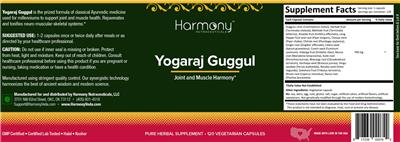
Yogaraj Guggul is the prized formula of classical Ayurvedic medicine for used millenniums to support joint and muscle health. Rejuvenates and tonifies neuro-muscular-skeletal systems.
Halal
Kosher
Suggested/Recommended/Usage/Directions
Suggested use: 1-2 capsules once or twice daily after meals or as directed by your healthcare professional.
Precautions
Caution: Do not use if inner seal is missing or broken.
Keep out of reach of children.
Consult healthcare professional before using this product if you are pregnant or nursing, taking medication or have a health condition.
Storage
Protect from heat, light and moisutre.
Formulation
Manufactured using stringent quality control. Our synergistic technology harmonizes the best ancient wisdom and modern science. GMP Certified Certified lab tested
Joint and muscle harmony
No: soy, dairy, egg, nuts, gluten, salt, sugar, artificial colors, artificial flavors, artificial sweeteners. Not genetically modified through the use of modern biotechnology.
Not genetically modified through the use of modern biotechnology.
Made with love in the USA
FDA Statement of Identity
Pure Herbal Supplement
FDA Disclaimer Statement
These statements have not been evaluated by the Food and Drug Administration. This product is not intended to diagnose, treat, cure or prevent any disease.
Is this label outdated? Report a formula or label change and our pharmacy team will review it.
Yogaraj Guggul by Harmony Nutraceuticals label
The label scan from the NIH Dietary Supplement Label Database. Tap to enlarge.
Label images are published by the NIH Dietary Supplement Label Database for the version of this product on file. Always read your actual product label.
View the full label (PDF)The Ingredients in Yogaraj Guggul by Harmony Nutraceuticals
These are the 20 active ingredients this product is made of. Select any to open its full monograph.
Serving size1 Capsule(s) Dosage formCapsule Servings per container120 Amounts shown are per serving.
Most supplement products combine several ingredients, and a medication can interact with the product through any one of them. Each ingredient below shows whether it has known drug interactions.
Other (inactive) ingredients: Vegetarian Capsule. These complete the product’s ingredient list but are not active constituents.
Yogaraj Guggul by Harmony Nutraceuticals Drug Interactions
HelloPharmacist Interaction Report
Yogaraj Guggul by Harmony Nutraceuticals contains several ingredients with documented interactions with medications.
The most serious concern is with blood thinners (anticoagulants) and antiplatelet drugs like warfarin, clopidogrel, and aspirin — ginger, celery, guggul, cumin, Haritaki (Terminalia), Amalaki (Indian gooseberry), and Indian long pepper all may increase bleeding risk, a Moderate severity finding.
Read the full breakdown — every affected drug type, severity by severity
Several ingredients interact with drugs that lower blood sugar (antidiabetes medications): ginger, celery, cumin, Chitrak (Ceylon leadwort), Haritaki, Amalaki, Kutki (Picrorhiza), Indian long pepper, and Tribulus (Gokshura) may increase hypoglycemia risk. Additionally, ginger and celery may interact with blood pressure drugs; guggul may reduce the effects of certain heart and cancer medications through effects on liver enzyme systems; and multiple ingredients (ginger, celery, Chitrak, Haritaki, Indian long pepper) may increase levels of drugs processed through the liver (CYP3A4, CYP2D6, and related pathways), raising the risk of side effects.
Celery seed may decrease thyroid medication (levothyroxine) effectiveness, and celery may interact with lithium used for mood disorders. Guggul may interact with birth control pills, estrogen therapy, tamoxifen (breast cancer), and thyroid medication.
Indian long pepper may increase levels of the asthma drug theophylline and the sedative pentobarbital. Tribulus (Gokshura) may interact with blood pressure and diabetes medications and lithium.
Altogether, these interactions span 1,374 individual medications.
We could not check Bibhitaki, Vidanga, Chavya, Murva, Bharangi, Sarshapa, Hingu Exudate, Renuka, Musta, or Rasna for interactions. Please search your exact medications below before starting this product.
Check your own medications below · Editorial policy · How we use AI
Want to check YOUR meds against Yogaraj Guggul?
Ask about interactions with your drugs in plain English — “Can I take it with lisinopril?” — and we find you the answer in seconds, ingredient by ingredient.
Go to the checkerIngredients driving the most interactions
Individual Drug Interactions
The ingredients in Yogaraj Guggul interact with 1,405 drugs. Click any drug to see the details.
11 of the 20 ingredients in Yogaraj Guggul interact with drugs. Each result below shows which ingredient is responsible. Chitrak Ginger Haritaki Long Pepper Guggul Celery Gokshura Cumin Amalaki Kutki Rasna
AmphetamineAdensys XR-ODT, Adzenys ER, Dyanavel XR, Mydayis
How Amphetamine interacts with Yogaraj Guggul — through 2 ingredients. Tap an ingredient for the detail:
HaritakiCytochrome P450 2d6 (cyp2d6) Substrates Moderate
Interaction Summary
Theoretically, use of Terminalia arjuna may increase the levels and clinical effects of CYP2D6 substrates.
Read the full Haritaki + Amphetamine interactionChitrakCytochrome P450 2d6 (cyp2d6) Substrates Moderate
Interaction Summary
Plumbagin, a constituent of Ceylon leadwort, has been shown to inhibit cytochrome P450 2D6 (CYP2D6) in vitro.
Read the full Chitrak + Amphetamine interactionAmphetamine Aspartate, Amphetamine Sulfate, Dextroamphetamine Saccharate, Dextroamphetamine SulfateAdderall, Adderall XR
How Amphetamine Aspartate, Amphetamine Sulfate, Dextroamphetamine Saccharate, Dextroamphetamine Sulfate interacts with Yogaraj Guggul — through 2 ingredients. Tap an ingredient for the detail:
ChitrakCytochrome P450 2d6 (cyp2d6) Substrates Moderate
Interaction Summary
Plumbagin, a constituent of Ceylon leadwort, has been shown to inhibit cytochrome P450 2D6 (CYP2D6) in vitro.
Read the full Chitrak + Amphetamine Aspartate, Amphetamine Sulfate, Dextroamphetamine Saccharate, Dextroamphetamine Sulfate interactionHaritakiCytochrome P450 2d6 (cyp2d6) Substrates Moderate
Interaction Summary
Theoretically, use of Terminalia arjuna may increase the levels and clinical effects of CYP2D6 substrates.
Read the full Haritaki + Amphetamine Aspartate, Amphetamine Sulfate, Dextroamphetamine Saccharate, Dextroamphetamine Sulfate interactionAmphetamine SulfateBenzedrine, Evekeo ODT
How Amphetamine Sulfate interacts with Yogaraj Guggul — through 2 ingredients. Tap an ingredient for the detail:
HaritakiCytochrome P450 2d6 (cyp2d6) Substrates Moderate
Interaction Summary
Theoretically, use of Terminalia arjuna may increase the levels and clinical effects of CYP2D6 substrates.
Read the full Haritaki + Amphetamine Sulfate interactionChitrakCytochrome P450 2d6 (cyp2d6) Substrates Moderate
Interaction Summary
Plumbagin, a constituent of Ceylon leadwort, has been shown to inhibit cytochrome P450 2D6 (CYP2D6) in vitro.
Read the full Chitrak + Amphetamine Sulfate interactionAmphotericin, TetracyclineMysteclin-F
How Amphotericin, Tetracycline interacts with Yogaraj Guggul — through 3 ingredients. Tap an ingredient for the detail:
GingerP-glycoprotein Substrates Moderate
Interaction Summary
Ginger might increase the absorption and blood levels of P-glycoprotein (P-gp) substrates.
Read the full Ginger + Amphotericin, Tetracycline interactionLong PepperP-glycoprotein Substrates Moderate
Interaction Summary
Theoretically, Indian long pepper might increase levels of P-glycoprotein substrates.
Read the full Long Pepper + Amphotericin, Tetracycline interactionCeleryPhotosensitizing Drugs Minor
Interaction Summary
Theoretically, celery might increase the risk of photosensitivity reactions when taken with photosensitizing drugs.
Read the full Celery + Amphotericin, Tetracycline interactionAmprenavirAgenerase
How Amprenavir interacts with Yogaraj Guggul — through 5 ingredients. Tap an ingredient for the detail:
Long PepperP-glycoprotein Substrates, Cytochrome P450 3a4 (cyp3a4) Substrates Moderate
Interaction Summary
Theoretically, Indian long pepper might increase levels of P-glycoprotein substrates.
Read the full Long Pepper + Amprenavir interactionGuggulCytochrome P450 3a4 (cyp3a4) Substrates Moderate
Interaction Summary
Theoretically, guggul might reduce the effects of CYP3A4 substrates.
Read the full Guggul + Amprenavir interactionChitrakCytochrome P450 3a4 (cyp3a4) Substrates Moderate
Interaction Summary
Plumbagin, a constituent of Ceylon leadwort, has been shown to inhibit cytochrome P450 3A4 (CYP3A4) in vitro.
Read the full Chitrak + Amprenavir interactionGingerP-glycoprotein Substrates, Cytochrome P450 3a4 (cyp3a4) Substrates Moderate
Interaction Summary
Ginger might increase the absorption and blood levels of P-glycoprotein (P-gp) substrates.
Read the full Ginger + Amprenavir interactionHaritakiCytochrome P450 3a4 (cyp3a4) Substrates Moderate
Interaction Summary
Theoretically, use of Terminalia arjuna may increase the levels and clinical effects of CYP3A4 substrates.
Read the full Haritaki + Amprenavir interactionAnacaulase-bcdbNexoBrid
How Anacaulase-bcdb interacts with Yogaraj Guggul — through 8 ingredients. Tap an ingredient for the detail:
AmalakiAnticoagulant/antiplatelet Drugs Moderate
Interaction Summary
Theoretically, Indian gooseberry may increase the risk of bleeding if used with anticoagulant or antiplatelet drugs; however, research is conflicting.
Read the full Amalaki + Anacaulase-bcdb interactionCuminAnticoagulant/antiplatelet Drugs Moderate
Interaction Summary
Theoretically, cumin might increase the risk of bleeding when used with antiplatelet or anticoagulant drugs.
Read the full Cumin + Anacaulase-bcdb interactionGuggulAnticoagulant/antiplatelet Drugs Moderate
Interaction Summary
Theoretically, guggul might increase the risk of bleeding when taken with anticoagulant/antiplatelet drugs.
Read the full Guggul + Anacaulase-bcdb interactionChitrakAnticoagulant/antiplatelet Drugs Moderate
Interaction Summary
There is some concern that Ceylon leadwort might potentiate the effects of anticoagulant and antiplatelet drugs and possibly increase the risk of bleeding.
Read the full Chitrak + Anacaulase-bcdb interactionHaritakiAnticoagulant/antiplatelet Drugs Moderate
Interaction Summary
Theoretically, concomitant use of Terminalia arjuna with anticoagulant or antiplatelet drugs may increase the risk of bleeding in some patients.
Read the full Haritaki + Anacaulase-bcdb interactionCeleryAnticoagulant/antiplatelet Drugs Moderate
Interaction Summary
Theoretically, celery root might increase the risk of bleeding when taken with anticoagulant/antiplatelet drugs.
Read the full Celery + Anacaulase-bcdb interactionLong PepperAnticoagulant/antiplatelet Drugs Moderate
Interaction Summary
Theoretically, Indian long pepper might increase the risk of bleeding when taken with anticoagulant/antiplatelet drugs.
Read the full Long Pepper + Anacaulase-bcdb interactionGingerAnticoagulant/antiplatelet Drugs Moderate
Interaction Summary
Ginger may have antiplatelet effects and may increase the risk of bleeding if used with anticoagulant or antiplatelet drugs.
Read the full Ginger + Anacaulase-bcdb interactionAnagrelideAgrylin
How Anagrelide interacts with Yogaraj Guggul — through 8 ingredients. Tap an ingredient for the detail:
GingerAnticoagulant/antiplatelet Drugs, Cytochrome P450 1a2 (cyp1a2) Substrates Moderate
Interaction Summary
Ginger may have antiplatelet effects and may increase the risk of bleeding if used with anticoagulant or antiplatelet drugs.
Read the full Ginger + Anagrelide interactionCeleryCytochrome P450 1a2 (cyp1a2) Substrates, Anticoagulant/antiplatelet Drugs Moderate
Interaction Summary
Theoretically, celery might increase levels of drugs metabolized by CYP1A2.
Read the full Celery + Anagrelide interactionHaritakiAnticoagulant/antiplatelet Drugs Moderate
Interaction Summary
Theoretically, concomitant use of Terminalia arjuna with anticoagulant or antiplatelet drugs may increase the risk of bleeding in some patients.
Read the full Haritaki + Anagrelide interactionGuggulAnticoagulant/antiplatelet Drugs Moderate
Interaction Summary
Theoretically, guggul might increase the risk of bleeding when taken with anticoagulant/antiplatelet drugs.
Read the full Guggul + Anagrelide interactionCuminAnticoagulant/antiplatelet Drugs Moderate
Interaction Summary
Theoretically, cumin might increase the risk of bleeding when used with antiplatelet or anticoagulant drugs.
Read the full Cumin + Anagrelide interactionAmalakiAnticoagulant/antiplatelet Drugs Moderate
Interaction Summary
Theoretically, Indian gooseberry may increase the risk of bleeding if used with anticoagulant or antiplatelet drugs; however, research is conflicting.
Read the full Amalaki + Anagrelide interactionChitrakCytochrome P450 1a2 (cyp1a2) Substrates, Anticoagulant/antiplatelet Drugs Moderate
Interaction Summary
Plumbagin, a constituent of Ceylon leadwort, has been shown to inhibit cytochrome P450 1A2 (CYP1A2) in vitro.
Read the full Chitrak + Anagrelide interactionLong PepperAnticoagulant/antiplatelet Drugs Moderate
Interaction Summary
Theoretically, Indian long pepper might increase the risk of bleeding when taken with anticoagulant/antiplatelet drugs.
Read the full Long Pepper + Anagrelide interactionAnifrolumab-fniaSaphnelo
How Anifrolumab-fnia interacts with Yogaraj Guggul — through 2 ingredients. Tap an ingredient for the detail:
KutkiImmunosuppressants Moderate
Interaction Summary
Picrorhiza seems to have immunostimulating activity.
Read the full Kutki + Anifrolumab-fnia interactionChitrakImmunosuppressants Moderate
Interaction Summary
Plumbagin, a constituent of Ceylon leadwort, has demonstrated immunosuppressant activity in animal research.
Read the full Chitrak + Anifrolumab-fnia interactionAnisindioneMiradon
How Anisindione interacts with Yogaraj Guggul — through 8 ingredients. Tap an ingredient for the detail:
ChitrakAnticoagulant/antiplatelet Drugs Moderate
Interaction Summary
There is some concern that Ceylon leadwort might potentiate the effects of anticoagulant and antiplatelet drugs and possibly increase the risk of bleeding.
Read the full Chitrak + Anisindione interactionLong PepperAnticoagulant/antiplatelet Drugs Moderate
Interaction Summary
Theoretically, Indian long pepper might increase the risk of bleeding when taken with anticoagulant/antiplatelet drugs.
Read the full Long Pepper + Anisindione interactionCuminAnticoagulant/antiplatelet Drugs Moderate
Interaction Summary
Theoretically, cumin might increase the risk of bleeding when used with antiplatelet or anticoagulant drugs.
Read the full Cumin + Anisindione interactionAmalakiAnticoagulant/antiplatelet Drugs Moderate
Interaction Summary
Theoretically, Indian gooseberry may increase the risk of bleeding if used with anticoagulant or antiplatelet drugs; however, research is conflicting.
Read the full Amalaki + Anisindione interactionGuggulAnticoagulant/antiplatelet Drugs Moderate
Interaction Summary
Theoretically, guggul might increase the risk of bleeding when taken with anticoagulant/antiplatelet drugs.
Read the full Guggul + Anisindione interactionHaritakiAnticoagulant/antiplatelet Drugs Moderate
Interaction Summary
Theoretically, concomitant use of Terminalia arjuna with anticoagulant or antiplatelet drugs may increase the risk of bleeding in some patients.
Read the full Haritaki + Anisindione interactionCeleryAnticoagulant/antiplatelet Drugs Moderate
Interaction Summary
Theoretically, celery root might increase the risk of bleeding when taken with anticoagulant/antiplatelet drugs.
Read the full Celery + Anisindione interactionGingerAnticoagulant/antiplatelet Drugs Moderate
Interaction Summary
Ginger may have antiplatelet effects and may increase the risk of bleeding if used with anticoagulant or antiplatelet drugs.
Read the full Ginger + Anisindione interactionAntidiabetes, Dipeptidyl Peptidase-4 (dpp-iv) InhibitorGlyxambi
How Antidiabetes, Dipeptidyl Peptidase-4 (dpp-iv) Inhibitor interacts with Yogaraj Guggul — through 8 ingredients. Tap an ingredient for the detail:
HaritakiAntidiabetes Drugs Moderate
Interaction Summary
Theoretically, concomitant use of Terminalia bellirica or Terminalia chebula with antidiabetes drugs could affect blood sugar control and increase the risk of hypoglycemia.
Read the full Haritaki + Antidiabetes, Dipeptidyl Peptidase-4 (dpp-iv) Inhibitor interactionChitrakAntidiabetes Drugs Moderate
Interaction Summary
Ceylon leadwort root extract has been shown to both increase and decrease blood glucose levels in animal research.
Read the full Chitrak + Antidiabetes, Dipeptidyl Peptidase-4 (dpp-iv) Inhibitor interactionKutkiAntidiabetes Drugs Moderate
Interaction Summary
Evidence from animal research suggests that an extract of picrorhiza can reduce fasting and non-fasting blood sugar levels.
Read the full Kutki + Antidiabetes, Dipeptidyl Peptidase-4 (dpp-iv) Inhibitor interactionGingerAntidiabetes Drugs, P-glycoprotein Substrates Moderate
Interaction Summary
Theoretically, taking ginger with antidiabetes drugs might increase the risk of hypoglycemia.
Read the full Ginger + Antidiabetes, Dipeptidyl Peptidase-4 (dpp-iv) Inhibitor interactionAmalakiAntidiabetes Drugs Moderate
Interaction Summary
Taking Indian gooseberry with antidiabetes drugs might increase the risk of hypoglycemia.
Read the full Amalaki + Antidiabetes, Dipeptidyl Peptidase-4 (dpp-iv) Inhibitor interactionCuminAntidiabetes Drugs Moderate
Interaction Summary
Theoretically, cumin might increase the risk of hypoglycemia when taken with antidiabetes drugs.
Read the full Cumin + Antidiabetes, Dipeptidyl Peptidase-4 (dpp-iv) Inhibitor interactionLong PepperAntidiabetes Drugs, P-glycoprotein Substrates Moderate
Interaction Summary
Theoretically, Indian long pepper might increase the risk of hypoglycemia when taken with antidiabetes drugs.
Read the full Long Pepper + Antidiabetes, Dipeptidyl Peptidase-4 (dpp-iv) Inhibitor interactionGokshuraAntidiabetes Drugs Moderate
Interaction Summary
Taking tribulus with antidiabetes drugs might increase the risk of hypoglycemia.
Read the full Gokshura + Antidiabetes, Dipeptidyl Peptidase-4 (dpp-iv) Inhibitor interactionAntithrombin IiiThrombate III
How Antithrombin Iii interacts with Yogaraj Guggul — through 8 ingredients. Tap an ingredient for the detail:
Long PepperAnticoagulant/antiplatelet Drugs Moderate
Interaction Summary
Theoretically, Indian long pepper might increase the risk of bleeding when taken with anticoagulant/antiplatelet drugs.
Read the full Long Pepper + Antithrombin Iii interactionGingerAnticoagulant/antiplatelet Drugs Moderate
Interaction Summary
Ginger may have antiplatelet effects and may increase the risk of bleeding if used with anticoagulant or antiplatelet drugs.
Read the full Ginger + Antithrombin Iii interactionHaritakiAnticoagulant/antiplatelet Drugs Moderate
Interaction Summary
Theoretically, concomitant use of Terminalia arjuna with anticoagulant or antiplatelet drugs may increase the risk of bleeding in some patients.
Read the full Haritaki + Antithrombin Iii interactionCeleryAnticoagulant/antiplatelet Drugs Moderate
Interaction Summary
Theoretically, celery root might increase the risk of bleeding when taken with anticoagulant/antiplatelet drugs.
Read the full Celery + Antithrombin Iii interactionChitrakAnticoagulant/antiplatelet Drugs Moderate
Interaction Summary
There is some concern that Ceylon leadwort might potentiate the effects of anticoagulant and antiplatelet drugs and possibly increase the risk of bleeding.
Read the full Chitrak + Antithrombin Iii interactionCuminAnticoagulant/antiplatelet Drugs Moderate
Interaction Summary
Theoretically, cumin might increase the risk of bleeding when used with antiplatelet or anticoagulant drugs.
Read the full Cumin + Antithrombin Iii interactionAmalakiAnticoagulant/antiplatelet Drugs Moderate
Interaction Summary
Theoretically, Indian gooseberry may increase the risk of bleeding if used with anticoagulant or antiplatelet drugs; however, research is conflicting.
Read the full Amalaki + Antithrombin Iii interactionGuggulAnticoagulant/antiplatelet Drugs Moderate
Interaction Summary
Theoretically, guggul might increase the risk of bleeding when taken with anticoagulant/antiplatelet drugs.
Read the full Guggul + Antithrombin Iii interactionAntithymocyte GlobulinThymoglobulin
How Antithymocyte Globulin interacts with Yogaraj Guggul — through 2 ingredients. Tap an ingredient for the detail:
KutkiImmunosuppressants Moderate
Interaction Summary
Picrorhiza seems to have immunostimulating activity.
Read the full Kutki + Antithymocyte Globulin interactionChitrakImmunosuppressants Moderate
Interaction Summary
Plumbagin, a constituent of Ceylon leadwort, has demonstrated immunosuppressant activity in animal research.
Read the full Chitrak + Antithymocyte Globulin interactionApalutamideErleada
How Apalutamide interacts with Yogaraj Guggul — through 5 ingredients. Tap an ingredient for the detail:
ChitrakCytochrome P450 3a4 (cyp3a4) Substrates Moderate
Interaction Summary
Plumbagin, a constituent of Ceylon leadwort, has been shown to inhibit cytochrome P450 3A4 (CYP3A4) in vitro.
Read the full Chitrak + Apalutamide interactionGuggulCytochrome P450 3a4 (cyp3a4) Substrates Moderate
Interaction Summary
Theoretically, guggul might reduce the effects of CYP3A4 substrates.
Read the full Guggul + Apalutamide interactionLong PepperCytochrome P450 3a4 (cyp3a4) Substrates Moderate
Interaction Summary
Theoretically, Indian long pepper might increase the effects and adverse effects of CYP3A4 substrates.
Read the full Long Pepper + Apalutamide interactionHaritakiCytochrome P450 3a4 (cyp3a4) Substrates Moderate
Interaction Summary
Theoretically, use of Terminalia arjuna may increase the levels and clinical effects of CYP3A4 substrates.
Read the full Haritaki + Apalutamide interactionGingerCytochrome P450 3a4 (cyp3a4) Substrates Moderate
Interaction Summary
Ginger might increase or decrease the levels of CYP3A4 substrates.
Read the full Ginger + Apalutamide interactionApixabanEliquis
How Apixaban interacts with Yogaraj Guggul — through 8 ingredients. Tap an ingredient for the detail:
GingerCytochrome P450 3a4 (cyp3a4) Substrates, Anticoagulant/antiplatelet Drugs +1 Moderate
Interaction Summary
Ginger might increase or decrease the levels of CYP3A4 substrates.
Read the full Ginger + Apixaban interactionLong PepperCytochrome P450 3a4 (cyp3a4) Substrates, Anticoagulant/antiplatelet Drugs +1 Moderate
Interaction Summary
Theoretically, Indian long pepper might increase the effects and adverse effects of CYP3A4 substrates.
Read the full Long Pepper + Apixaban interactionChitrakCytochrome P450 3a4 (cyp3a4) Substrates, Anticoagulant/antiplatelet Drugs Moderate
Interaction Summary
Plumbagin, a constituent of Ceylon leadwort, has been shown to inhibit cytochrome P450 3A4 (CYP3A4) in vitro.
Read the full Chitrak + Apixaban interactionGuggulCytochrome P450 3a4 (cyp3a4) Substrates, Anticoagulant/antiplatelet Drugs Moderate
Interaction Summary
Theoretically, guggul might reduce the effects of CYP3A4 substrates.
Read the full Guggul + Apixaban interactionAmalakiAnticoagulant/antiplatelet Drugs Moderate
Interaction Summary
Theoretically, Indian gooseberry may increase the risk of bleeding if used with anticoagulant or antiplatelet drugs; however, research is conflicting.
Read the full Amalaki + Apixaban interactionCuminAnticoagulant/antiplatelet Drugs Moderate
Interaction Summary
Theoretically, cumin might increase the risk of bleeding when used with antiplatelet or anticoagulant drugs.
Read the full Cumin + Apixaban interactionHaritakiCytochrome P450 3a4 (cyp3a4) Substrates, Anticoagulant/antiplatelet Drugs Moderate
Interaction Summary
Theoretically, use of Terminalia arjuna may increase the levels and clinical effects of CYP3A4 substrates.
Read the full Haritaki + Apixaban interactionCeleryAnticoagulant/antiplatelet Drugs Moderate
Interaction Summary
Theoretically, celery root might increase the risk of bleeding when taken with anticoagulant/antiplatelet drugs.
Read the full Celery + Apixaban interactionApomorphineAPO-go, APO-go Pen, APO-go PFS, Apokyn, Uprima
How Apomorphine interacts with Yogaraj Guggul — through 2 ingredients. Tap an ingredient for the detail:
GingerP-glycoprotein Substrates Moderate
Interaction Summary
Ginger might increase the absorption and blood levels of P-glycoprotein (P-gp) substrates.
Read the full Ginger + Apomorphine interactionLong PepperP-glycoprotein Substrates Moderate
Interaction Summary
Theoretically, Indian long pepper might increase levels of P-glycoprotein substrates.
Read the full Long Pepper + Apomorphine interactionApomorphine HydrochlorideKynmobi
How Apomorphine Hydrochloride interacts with Yogaraj Guggul — through 2 ingredients. Tap an ingredient for the detail:
Long PepperP-glycoprotein Substrates Moderate
Interaction Summary
Theoretically, Indian long pepper might increase levels of P-glycoprotein substrates.
Read the full Long Pepper + Apomorphine Hydrochloride interactionGingerP-glycoprotein Substrates Moderate
Interaction Summary
Ginger might increase the absorption and blood levels of P-glycoprotein (P-gp) substrates.
Read the full Ginger + Apomorphine Hydrochloride interactionApremilastOtezla
How Apremilast interacts with Yogaraj Guggul — through 5 ingredients. Tap an ingredient for the detail:
GingerCytochrome P450 3a4 (cyp3a4) Substrates Moderate
Interaction Summary
Ginger might increase or decrease the levels of CYP3A4 substrates.
Read the full Ginger + Apremilast interactionLong PepperCytochrome P450 3a4 (cyp3a4) Substrates Moderate
Interaction Summary
Theoretically, Indian long pepper might increase the effects and adverse effects of CYP3A4 substrates.
Read the full Long Pepper + Apremilast interactionChitrakCytochrome P450 3a4 (cyp3a4) Substrates Moderate
Interaction Summary
Plumbagin, a constituent of Ceylon leadwort, has been shown to inhibit cytochrome P450 3A4 (CYP3A4) in vitro.
Read the full Chitrak + Apremilast interactionHaritakiCytochrome P450 3a4 (cyp3a4) Substrates Moderate
Interaction Summary
Theoretically, use of Terminalia arjuna may increase the levels and clinical effects of CYP3A4 substrates.
Read the full Haritaki + Apremilast interactionGuggulCytochrome P450 3a4 (cyp3a4) Substrates Moderate
Interaction Summary
Theoretically, guggul might reduce the effects of CYP3A4 substrates.
Read the full Guggul + Apremilast interactionAprepitantCinvanti, Emend
How Aprepitant interacts with Yogaraj Guggul — through 5 ingredients. Tap an ingredient for the detail:
GuggulCytochrome P450 3a4 (cyp3a4) Substrates Moderate
Interaction Summary
Theoretically, guggul might reduce the effects of CYP3A4 substrates.
Read the full Guggul + Aprepitant interactionChitrakCytochrome P450 3a4 (cyp3a4) Substrates Moderate
Interaction Summary
Plumbagin, a constituent of Ceylon leadwort, has been shown to inhibit cytochrome P450 3A4 (CYP3A4) in vitro.
Read the full Chitrak + Aprepitant interactionGingerCytochrome P450 3a4 (cyp3a4) Substrates Moderate
Interaction Summary
Ginger might increase or decrease the levels of CYP3A4 substrates.
Read the full Ginger + Aprepitant interactionLong PepperCytochrome P450 3a4 (cyp3a4) Substrates Moderate
Interaction Summary
Theoretically, Indian long pepper might increase the effects and adverse effects of CYP3A4 substrates.
Read the full Long Pepper + Aprepitant interactionHaritakiCytochrome P450 3a4 (cyp3a4) Substrates Moderate
Interaction Summary
Theoretically, use of Terminalia arjuna may increase the levels and clinical effects of CYP3A4 substrates.
Read the full Haritaki + Aprepitant interactionAprobarbital, Butabarbital, PhenobarbitalTriple Barbital
How Aprobarbital, Butabarbital, Phenobarbital interacts with Yogaraj Guggul — through 2 ingredients. Tap an ingredient for the detail:
ChitrakCytochrome P450 2b6 (cyp2b6) Substrates Moderate
Interaction Summary
Plumbagin, a constituent of Ceylon leadwort, has been shown to inhibit cytochrome P450 2B6 (CYP2B6) in vitro.
Read the full Chitrak + Aprobarbital, Butabarbital, Phenobarbital interactionGingerCytochrome P450 2b6 (cyp2b6) Substrates Minor
Interaction Summary
Theoretically, ginger might increase the levels of CYP2B6 substrates.
Read the full Ginger + Aprobarbital, Butabarbital, Phenobarbital interactionAprocitentanTryvio
How Aprocitentan interacts with Yogaraj Guggul — through 2 ingredients. Tap an ingredient for the detail:
CeleryAntihypertensive Drugs Moderate
Interaction Summary
Theoretically, celery seed extract might have additive effects with antihypertensive drugs.
Read the full Celery + Aprocitentan interactionGokshuraAntihypertensive Drugs Moderate
Interaction Summary
Theoretically, taking tribulus with antihypertensive drugs might increase the risk of hypotension.
Read the full Gokshura + Aprocitentan interactionArgatrobanArgatroban
How Argatroban interacts with Yogaraj Guggul — through 8 ingredients. Tap an ingredient for the detail:
Long PepperAnticoagulant/antiplatelet Drugs Moderate
Interaction Summary
Theoretically, Indian long pepper might increase the risk of bleeding when taken with anticoagulant/antiplatelet drugs.
Read the full Long Pepper + Argatroban interactionChitrakAnticoagulant/antiplatelet Drugs Moderate
Interaction Summary
There is some concern that Ceylon leadwort might potentiate the effects of anticoagulant and antiplatelet drugs and possibly increase the risk of bleeding.
Read the full Chitrak + Argatroban interactionCuminAnticoagulant/antiplatelet Drugs Moderate
Interaction Summary
Theoretically, cumin might increase the risk of bleeding when used with antiplatelet or anticoagulant drugs.
Read the full Cumin + Argatroban interactionAmalakiAnticoagulant/antiplatelet Drugs Moderate
Interaction Summary
Theoretically, Indian gooseberry may increase the risk of bleeding if used with anticoagulant or antiplatelet drugs; however, research is conflicting.
Read the full Amalaki + Argatroban interactionGuggulAnticoagulant/antiplatelet Drugs Moderate
Interaction Summary
Theoretically, guggul might increase the risk of bleeding when taken with anticoagulant/antiplatelet drugs.
Read the full Guggul + Argatroban interactionHaritakiAnticoagulant/antiplatelet Drugs Moderate
Interaction Summary
Theoretically, concomitant use of Terminalia arjuna with anticoagulant or antiplatelet drugs may increase the risk of bleeding in some patients.
Read the full Haritaki + Argatroban interactionCeleryAnticoagulant/antiplatelet Drugs Moderate
Interaction Summary
Theoretically, celery root might increase the risk of bleeding when taken with anticoagulant/antiplatelet drugs.
Read the full Celery + Argatroban interactionGingerAnticoagulant/antiplatelet Drugs Moderate
Interaction Summary
Ginger may have antiplatelet effects and may increase the risk of bleeding if used with anticoagulant or antiplatelet drugs.
Read the full Ginger + Argatroban interactionAripiprazoleAbilify, Abilify Maintena, Abilify Mycite
How Aripiprazole interacts with Yogaraj Guggul — through 6 ingredients. Tap an ingredient for the detail:
GingerCytochrome P450 3a4 (cyp3a4) Substrates Moderate
Interaction Summary
Ginger might increase or decrease the levels of CYP3A4 substrates.
Read the full Ginger + Aripiprazole interactionGuggulCytochrome P450 3a4 (cyp3a4) Substrates Moderate
Interaction Summary
Theoretically, guggul might reduce the effects of CYP3A4 substrates.
Read the full Guggul + Aripiprazole interactionHaritakiCytochrome P450 2d6 (cyp2d6) Substrates, Cytochrome P450 3a4 (cyp3a4) Substrates Moderate
Interaction Summary
Theoretically, use of Terminalia arjuna may increase the levels and clinical effects of CYP2D6 substrates.
Read the full Haritaki + Aripiprazole interactionLong PepperCytochrome P450 3a4 (cyp3a4) Substrates Moderate
Interaction Summary
Theoretically, Indian long pepper might increase the effects and adverse effects of CYP3A4 substrates.
Read the full Long Pepper + Aripiprazole interactionChitrakCytochrome P450 3a4 (cyp3a4) Substrates, Cytochrome P450 2d6 (cyp2d6) Substrates Moderate
Interaction Summary
Plumbagin, a constituent of Ceylon leadwort, has been shown to inhibit cytochrome P450 3A4 (CYP3A4) in vitro.
Read the full Chitrak + Aripiprazole interactionCeleryPhotosensitizing Drugs Minor
Interaction Summary
Theoretically, celery might increase the risk of photosensitivity reactions when taken with photosensitizing drugs.
Read the full Celery + Aripiprazole interactionAripiprazole LauroxilAristada, Aristada Initio Kit
How Aripiprazole Lauroxil interacts with Yogaraj Guggul — through 6 ingredients. Tap an ingredient for the detail:
HaritakiCytochrome P450 3a4 (cyp3a4) Substrates, Cytochrome P450 2d6 (cyp2d6) Substrates Moderate
Interaction Summary
Theoretically, use of Terminalia arjuna may increase the levels and clinical effects of CYP3A4 substrates.
Read the full Haritaki + Aripiprazole Lauroxil interactionLong PepperCytochrome P450 3a4 (cyp3a4) Substrates Moderate
Interaction Summary
Theoretically, Indian long pepper might increase the effects and adverse effects of CYP3A4 substrates.
Read the full Long Pepper + Aripiprazole Lauroxil interactionGingerCytochrome P450 3a4 (cyp3a4) Substrates Moderate
Interaction Summary
Ginger might increase or decrease the levels of CYP3A4 substrates.
Read the full Ginger + Aripiprazole Lauroxil interactionGuggulCytochrome P450 3a4 (cyp3a4) Substrates Moderate
Interaction Summary
Theoretically, guggul might reduce the effects of CYP3A4 substrates.
Read the full Guggul + Aripiprazole Lauroxil interactionChitrakCytochrome P450 2d6 (cyp2d6) Substrates, Cytochrome P450 3a4 (cyp3a4) Substrates Moderate
Interaction Summary
Plumbagin, a constituent of Ceylon leadwort, has been shown to inhibit cytochrome P450 2D6 (CYP2D6) in vitro.
Read the full Chitrak + Aripiprazole Lauroxil interactionCeleryPhotosensitizing Drugs Minor
Interaction Summary
Theoretically, celery might increase the risk of photosensitivity reactions when taken with photosensitizing drugs.
Read the full Celery + Aripiprazole Lauroxil interactionArmodafinilNuvigil
How Armodafinil interacts with Yogaraj Guggul — through 5 ingredients. Tap an ingredient for the detail:
ChitrakCytochrome P450 3a4 (cyp3a4) Substrates Moderate
Interaction Summary
Plumbagin, a constituent of Ceylon leadwort, has been shown to inhibit cytochrome P450 3A4 (CYP3A4) in vitro.
Read the full Chitrak + Armodafinil interactionGingerCytochrome P450 3a4 (cyp3a4) Substrates, P-glycoprotein Substrates Moderate
Interaction Summary
Ginger might increase or decrease the levels of CYP3A4 substrates.
Read the full Ginger + Armodafinil interactionHaritakiCytochrome P450 3a4 (cyp3a4) Substrates Moderate
Interaction Summary
Theoretically, use of Terminalia arjuna may increase the levels and clinical effects of CYP3A4 substrates.
Read the full Haritaki + Armodafinil interactionLong PepperCytochrome P450 3a4 (cyp3a4) Substrates, P-glycoprotein Substrates Moderate
Interaction Summary
Theoretically, Indian long pepper might increase the effects and adverse effects of CYP3A4 substrates.
Read the full Long Pepper + Armodafinil interactionGuggulCytochrome P450 3a4 (cyp3a4) Substrates Moderate
Interaction Summary
Theoretically, guggul might reduce the effects of CYP3A4 substrates.
Read the full Guggul + Armodafinil interactionAsenapineSaphris, Secuado
How Asenapine interacts with Yogaraj Guggul — through 3 ingredients. Tap an ingredient for the detail:
CeleryCytochrome P450 1a2 (cyp1a2) Substrates Moderate
Interaction Summary
Theoretically, celery might increase levels of drugs metabolized by CYP1A2.
Read the full Celery + Asenapine interactionChitrakCytochrome P450 1a2 (cyp1a2) Substrates Moderate
Interaction Summary
Plumbagin, a constituent of Ceylon leadwort, has been shown to inhibit cytochrome P450 1A2 (CYP1A2) in vitro.
Read the full Chitrak + Asenapine interactionGingerCytochrome P450 1a2 (cyp1a2) Substrates Minor
Interaction Summary
Theoretically, ginger might increase the levels of CYP1A2 substrates.
Read the full Ginger + Asenapine interactionAspirinAngettes 75, ASA, Asaphen, Aspirin, Caprin, Cartia +8 more
How Aspirin interacts with Yogaraj Guggul — through 8 ingredients. Tap an ingredient for the detail:
GingerAnticoagulant/antiplatelet Drugs Moderate
Interaction Summary
Ginger may have antiplatelet effects and may increase the risk of bleeding if used with anticoagulant or antiplatelet drugs.
Read the full Ginger + Aspirin interactionChitrakAnticoagulant/antiplatelet Drugs Moderate
Interaction Summary
There is some concern that Ceylon leadwort might potentiate the effects of anticoagulant and antiplatelet drugs and possibly increase the risk of bleeding.
Read the full Chitrak + Aspirin interactionGuggulAnticoagulant/antiplatelet Drugs Moderate
Interaction Summary
Theoretically, guggul might increase the risk of bleeding when taken with anticoagulant/antiplatelet drugs.
Read the full Guggul + Aspirin interactionAmalakiAnticoagulant/antiplatelet Drugs, Aspirin Moderate
Interaction Summary
Theoretically, Indian gooseberry may increase the risk of bleeding if used with anticoagulant or antiplatelet drugs; however, research is conflicting.
Read the full Amalaki + Aspirin interactionCuminAnticoagulant/antiplatelet Drugs Moderate
Interaction Summary
Theoretically, cumin might increase the risk of bleeding when used with antiplatelet or anticoagulant drugs.
Read the full Cumin + Aspirin interactionCeleryAnticoagulant/antiplatelet Drugs Moderate
Interaction Summary
Theoretically, celery root might increase the risk of bleeding when taken with anticoagulant/antiplatelet drugs.
Read the full Celery + Aspirin interactionHaritakiAnticoagulant/antiplatelet Drugs Moderate
Interaction Summary
Theoretically, concomitant use of Terminalia arjuna with anticoagulant or antiplatelet drugs may increase the risk of bleeding in some patients.
Read the full Haritaki + Aspirin interactionLong PepperAnticoagulant/antiplatelet Drugs Moderate
Interaction Summary
Theoretically, Indian long pepper might increase the risk of bleeding when taken with anticoagulant/antiplatelet drugs.
Read the full Long Pepper + Aspirin interactionAspirin, Aluminum Hydroxide, Codeine Phosphate, Magnesium HydroxideAscriptin Codeine #3
How Aspirin, Aluminum Hydroxide, Codeine Phosphate, Magnesium Hydroxide interacts with Yogaraj Guggul — through 9 ingredients. Tap an ingredient for the detail:
Long PepperAnticoagulant/antiplatelet Drugs Moderate
Interaction Summary
Theoretically, Indian long pepper might increase the risk of bleeding when taken with anticoagulant/antiplatelet drugs.
Read the full Long Pepper + Aspirin, Aluminum Hydroxide, Codeine Phosphate, Magnesium Hydroxide interactionCuminAnticoagulant/antiplatelet Drugs Moderate
Interaction Summary
Theoretically, cumin might increase the risk of bleeding when used with antiplatelet or anticoagulant drugs.
Read the full Cumin + Aspirin, Aluminum Hydroxide, Codeine Phosphate, Magnesium Hydroxide interactionHaritakiCytochrome P450 2d6 (cyp2d6) Substrates, Anticoagulant/antiplatelet Drugs Moderate
Interaction Summary
Theoretically, use of Terminalia arjuna may increase the levels and clinical effects of CYP2D6 substrates.
Read the full Haritaki + Aspirin, Aluminum Hydroxide, Codeine Phosphate, Magnesium Hydroxide interactionAmalakiAnticoagulant/antiplatelet Drugs, Aspirin Moderate
Interaction Summary
Theoretically, Indian gooseberry may increase the risk of bleeding if used with anticoagulant or antiplatelet drugs; however, research is conflicting.
Read the full Amalaki + Aspirin, Aluminum Hydroxide, Codeine Phosphate, Magnesium Hydroxide interactionGuggulAnticoagulant/antiplatelet Drugs Moderate
Interaction Summary
Theoretically, guggul might increase the risk of bleeding when taken with anticoagulant/antiplatelet drugs.
Read the full Guggul + Aspirin, Aluminum Hydroxide, Codeine Phosphate, Magnesium Hydroxide interactionGingerAnticoagulant/antiplatelet Drugs Moderate
Interaction Summary
Ginger may have antiplatelet effects and may increase the risk of bleeding if used with anticoagulant or antiplatelet drugs.
Read the full Ginger + Aspirin, Aluminum Hydroxide, Codeine Phosphate, Magnesium Hydroxide interactionChitrakAnticoagulant/antiplatelet Drugs, Cytochrome P450 2d6 (cyp2d6) Substrates Moderate
Interaction Summary
There is some concern that Ceylon leadwort might potentiate the effects of anticoagulant and antiplatelet drugs and possibly increase the risk of bleeding.
Read the full Chitrak + Aspirin, Aluminum Hydroxide, Codeine Phosphate, Magnesium Hydroxide interactionCeleryAnticoagulant/antiplatelet Drugs Moderate
Interaction Summary
Theoretically, celery root might increase the risk of bleeding when taken with anticoagulant/antiplatelet drugs.
Read the full Celery + Aspirin, Aluminum Hydroxide, Codeine Phosphate, Magnesium Hydroxide interactionRasnaAntacids Minor
Interaction Summary
Theoretically, alpinia might decrease the effectiveness of antacids.
Read the full Rasna + Aspirin, Aluminum Hydroxide, Codeine Phosphate, Magnesium Hydroxide interactionAspirin, ButalbitalAxotal
How Aspirin, Butalbital interacts with Yogaraj Guggul — through 8 ingredients. Tap an ingredient for the detail:
CeleryAnticoagulant/antiplatelet Drugs Moderate
Interaction Summary
Theoretically, celery root might increase the risk of bleeding when taken with anticoagulant/antiplatelet drugs.
Read the full Celery + Aspirin, Butalbital interactionHaritakiAnticoagulant/antiplatelet Drugs Moderate
Interaction Summary
Theoretically, concomitant use of Terminalia arjuna with anticoagulant or antiplatelet drugs may increase the risk of bleeding in some patients.
Read the full Haritaki + Aspirin, Butalbital interactionGingerAnticoagulant/antiplatelet Drugs Moderate
Interaction Summary
Ginger may have antiplatelet effects and may increase the risk of bleeding if used with anticoagulant or antiplatelet drugs.
Read the full Ginger + Aspirin, Butalbital interactionLong PepperAnticoagulant/antiplatelet Drugs Moderate
Interaction Summary
Theoretically, Indian long pepper might increase the risk of bleeding when taken with anticoagulant/antiplatelet drugs.
Read the full Long Pepper + Aspirin, Butalbital interactionGuggulAnticoagulant/antiplatelet Drugs Moderate
Interaction Summary
Theoretically, guggul might increase the risk of bleeding when taken with anticoagulant/antiplatelet drugs.
Read the full Guggul + Aspirin, Butalbital interactionCuminAnticoagulant/antiplatelet Drugs Moderate
Interaction Summary
Theoretically, cumin might increase the risk of bleeding when used with antiplatelet or anticoagulant drugs.
Read the full Cumin + Aspirin, Butalbital interactionAmalakiAnticoagulant/antiplatelet Drugs, Aspirin Moderate
Interaction Summary
Theoretically, Indian gooseberry may increase the risk of bleeding if used with anticoagulant or antiplatelet drugs; however, research is conflicting.
Read the full Amalaki + Aspirin, Butalbital interactionChitrakAnticoagulant/antiplatelet Drugs Moderate
Interaction Summary
There is some concern that Ceylon leadwort might potentiate the effects of anticoagulant and antiplatelet drugs and possibly increase the risk of bleeding.
Read the full Chitrak + Aspirin, Butalbital interactionAspirin, Butalbital, CaffeineFiorinal
How Aspirin, Butalbital, Caffeine interacts with Yogaraj Guggul — through 8 ingredients. Tap an ingredient for the detail:
ChitrakAnticoagulant/antiplatelet Drugs, Cytochrome P450 1a2 (cyp1a2) Substrates +1 Moderate
Interaction Summary
There is some concern that Ceylon leadwort might potentiate the effects of anticoagulant and antiplatelet drugs and possibly increase the risk of bleeding.
Read the full Chitrak + Aspirin, Butalbital, Caffeine interactionLong PepperAnticoagulant/antiplatelet Drugs, Cytochrome P450 3a4 (cyp3a4) Substrates Moderate
Interaction Summary
Theoretically, Indian long pepper might increase the risk of bleeding when taken with anticoagulant/antiplatelet drugs.
Read the full Long Pepper + Aspirin, Butalbital, Caffeine interactionGuggulCytochrome P450 3a4 (cyp3a4) Substrates, Anticoagulant/antiplatelet Drugs Moderate
Interaction Summary
Theoretically, guggul might reduce the effects of CYP3A4 substrates.
Read the full Guggul + Aspirin, Butalbital, Caffeine interactionHaritakiAnticoagulant/antiplatelet Drugs, Cytochrome P450 3a4 (cyp3a4) Substrates Moderate
Interaction Summary
Theoretically, concomitant use of Terminalia arjuna with anticoagulant or antiplatelet drugs may increase the risk of bleeding in some patients.
Read the full Haritaki + Aspirin, Butalbital, Caffeine interactionCeleryAnticoagulant/antiplatelet Drugs, Cytochrome P450 1a2 (cyp1a2) Substrates Moderate
Interaction Summary
Theoretically, celery root might increase the risk of bleeding when taken with anticoagulant/antiplatelet drugs.
Read the full Celery + Aspirin, Butalbital, Caffeine interactionGingerAnticoagulant/antiplatelet Drugs, Cytochrome P450 3a4 (cyp3a4) Substrates +1 Moderate
Interaction Summary
Ginger may have antiplatelet effects and may increase the risk of bleeding if used with anticoagulant or antiplatelet drugs.
Read the full Ginger + Aspirin, Butalbital, Caffeine interactionAmalakiAnticoagulant/antiplatelet Drugs, Aspirin Moderate
Interaction Summary
Theoretically, Indian gooseberry may increase the risk of bleeding if used with anticoagulant or antiplatelet drugs; however, research is conflicting.
Read the full Amalaki + Aspirin, Butalbital, Caffeine interactionCuminAnticoagulant/antiplatelet Drugs Moderate
Interaction Summary
Theoretically, cumin might increase the risk of bleeding when used with antiplatelet or anticoagulant drugs.
Read the full Cumin + Aspirin, Butalbital, Caffeine interactionAspirin, Butalbital, Caffeine, Codeine PhosphateFiorinal w/ Codeine
How Aspirin, Butalbital, Caffeine, Codeine Phosphate interacts with Yogaraj Guggul — through 8 ingredients. Tap an ingredient for the detail:
CuminAnticoagulant/antiplatelet Drugs Moderate
Interaction Summary
Theoretically, cumin might increase the risk of bleeding when used with antiplatelet or anticoagulant drugs.
Read the full Cumin + Aspirin, Butalbital, Caffeine, Codeine Phosphate interactionGuggulAnticoagulant/antiplatelet Drugs, Cytochrome P450 3a4 (cyp3a4) Substrates Moderate
Interaction Summary
Theoretically, guggul might increase the risk of bleeding when taken with anticoagulant/antiplatelet drugs.
Read the full Guggul + Aspirin, Butalbital, Caffeine, Codeine Phosphate interactionAmalakiAnticoagulant/antiplatelet Drugs, Aspirin Moderate
Interaction Summary
Theoretically, Indian gooseberry may increase the risk of bleeding if used with anticoagulant or antiplatelet drugs; however, research is conflicting.
Read the full Amalaki + Aspirin, Butalbital, Caffeine, Codeine Phosphate interactionHaritakiCytochrome P450 3a4 (cyp3a4) Substrates, Cytochrome P450 2d6 (cyp2d6) Substrates +1 Moderate
Interaction Summary
Theoretically, use of Terminalia arjuna may increase the levels and clinical effects of CYP3A4 substrates.
Read the full Haritaki + Aspirin, Butalbital, Caffeine, Codeine Phosphate interactionCeleryCytochrome P450 1a2 (cyp1a2) Substrates, Anticoagulant/antiplatelet Drugs Moderate
Interaction Summary
Theoretically, celery might increase levels of drugs metabolized by CYP1A2.
Read the full Celery + Aspirin, Butalbital, Caffeine, Codeine Phosphate interactionChitrakCytochrome P450 3a4 (cyp3a4) Substrates, Anticoagulant/antiplatelet Drugs +2 Moderate
Interaction Summary
Plumbagin, a constituent of Ceylon leadwort, has been shown to inhibit cytochrome P450 3A4 (CYP3A4) in vitro.
Read the full Chitrak + Aspirin, Butalbital, Caffeine, Codeine Phosphate interactionLong PepperAnticoagulant/antiplatelet Drugs, Cytochrome P450 3a4 (cyp3a4) Substrates Moderate
Interaction Summary
Theoretically, Indian long pepper might increase the risk of bleeding when taken with anticoagulant/antiplatelet drugs.
Read the full Long Pepper + Aspirin, Butalbital, Caffeine, Codeine Phosphate interactionGingerCytochrome P450 1a2 (cyp1a2) Substrates, Anticoagulant/antiplatelet Drugs +1 Moderate
Interaction Summary
Theoretically, ginger might increase the levels of CYP1A2 substrates.
Read the full Ginger + Aspirin, Butalbital, Caffeine, Codeine Phosphate interactionEach ingredient & the kinds of drugs it affects
For each ingredient in Yogaraj Guggul with known interactions, here are the types of medications they can affect. Open any type for the detail — or search your exact drug in the checker above.
Chitrak
Anticoagulant/Antiplatelet Drugs
There is some concern that Ceylon leadwort might potentiate the effects of anticoagulant and antiplatelet drugs and possibly increase the risk of bleeding. Ceylon leadwort root extract has been shown to decrease platelet adhesion and prolong bleeding in animals. However, this effect has not yet been demonstrated in humans. Until more is known, use cautiously in patients taking anticoagulant or antiplatelet drugs. Some of these drugs include aspirin, clopidogrel (Plavix), dalteparin (Fragmin), enoxaparin (Lovenox), heparin, ticlopidine (Ticlid), warfarin (Coumadin), and others.
Antidiabetes Drugs
Ceylon leadwort root extract has been shown to both increase and decrease blood glucose levels in animal research. This effect has not yet been demonstrated in humans. Theoretically, Ceylon leadwort might reduce or potentiate the effects of antidiabetes drugs. Monitor blood glucose levels closely. Medication dose adjustments may be necessary. Some antidiabetes drugs include glimepiride (Amaryl), glyburide (Diabeta, Glynase PresTab, Micronase), insulin, pioglitazone (Actos), rosiglitazone (Avandia), and others.
Cytochrome P450 1A2 (Cyp1A2) Substrates
Plumbagin, a constituent of Ceylon leadwort, has been shown to inhibit cytochrome P450 1A2 (CYP1A2) in vitro. So far, this interaction has not been reported in humans. Theoretically, Ceylon leadwort might increase the levels of drugs metabolized by CYP1A2. Some substrates of CYP1A2 include clozapine (Clozaril), cyclobenzaprine (Flexeril), fluvoxamine (Luvox), haloperidol (Haldol), imipramine (Tofranil), mexiletine (Mexitil), olanzapine (Zyprexa), pentazocine (Talwin), propranolol (Inderal), tacrine (Cognex), zileuton (Zyflo), zolmitriptan (Zomig), and others.
Cytochrome P450 2B6 (Cyp2B6) Substrates
Plumbagin, a constituent of Ceylon leadwort, has been shown to inhibit cytochrome P450 2B6 (CYP2B6) in vitro. So far, this interaction has not been reported in humans. Theoretically, Ceylon leadwort might increase the levels of drugs metabolized by CYP2B6. Drugs that are metabolized by CYP2B6 include ketamine (Ketalar), phenobarbital, orphenadrine (Norflex), secobarbital (Seconal), and dexamethasone (Decadron).
Cytochrome P450 2C9 (Cyp2C9) Substrates
Plumbagin, a constituent of Ceylon leadwort, has been shown to inhibit cytochrome P450 2C9 (CYP2C9) in vitro. So far, this interaction has not been reported in humans. Theoretically, Ceylon leadwort might increase the levels of drugs metabolized by CYP2C9. Drugs that are metabolized by CYP2C9 include celecoxib (Celebrex), diclofenac (Voltaren), fluvastatin (Lescol), glipizide (Glucotrol), ibuprofen (Advil, Motrin), irbesartan (Avapro), losartan (Cozaar), phenytoin (Dilantin), piroxicam (Feldene), tamoxifen (Nolvadex), tolbutamide (Tolinase), torsemide (Demadex), and S-warfarin (Coumadin).
Cytochrome P450 2D6 (Cyp2D6) Substrates
Plumbagin, a constituent of Ceylon leadwort, has been shown to inhibit cytochrome P450 2D6 (CYP2D6) in vitro. So far, this interaction has not been reported in humans. Theoretically, Ceylon leadwort might increase the levels of drugs metabolized by CYP2D6. Some drugs metabolized by CYP2D6 include amitriptyline (Elavil), codeine, desipramine (Norpramin), flecainide (Tambocor), fluoxetine (Prozac), ondansetron (Zofran), tramadol (Ultram), and others.
Cytochrome P450 2E1 (Cyp2E1) Substrates
Plumbagin, a constituent of Ceylon leadwort, has been shown to inhibit cytochrome P450 2E1 (CYP2E1) in vitro. So far, this interaction has not been reported in humans. Theoretically, Ceylon leadwort might increase the levels of drugs metabolized by CYP2E1. Some drugs metabolized by CYP2E1 include acetaminophen, chlorzoxazone (Parafon Forte), ethanol, theophylline, and anesthetics such as enflurane (Ethrane), halothane (Fluothane), isoflurane (Forane), methoxyflurane (Penthrane).
Cytochrome P450 3A4 (Cyp3A4) Substrates
Plumbagin, a constituent of Ceylon leadwort, has been shown to inhibit cytochrome P450 3A4 (CYP3A4) in vitro. So far, this interaction has not been reported in humans. Theoretically, Ceylon leadwort might increase the levels of drugs metabolized by CYP3A4. Some drugs metabolized by CYP3A4 include lovastatin (Mevacor), clarithromycin (Biaxin), indinavir (Crixivan), sildenafil (Viagra), triazolam (Halcion), and numerous others.
Estrogens
Laboratory research suggests that Ceylon leadwort root extract has anti-estrogenic activity. Theoretically, Ceylon leadwort may interfere with hormone therapy.
Immunosuppressants
Plumbagin, a constituent of Ceylon leadwort, has demonstrated immunosuppressant activity in animal research. Theoretically, Ceylon leadwort might interfere with immunosuppressive therapy. Immunosuppressant drugs include azathioprine (Imuran), basiliximab (Simulect), cyclosporine (Neoral, Sandimmune), daclizumab (Zenapax), muromonab-CD3 (OKT3, Orthoclone OKT3), mycophenolate (CellCept), tacrolimus (FK506, Prograf), sirolimus (Rapamune), prednisone (Deltasone, Orasone), corticosteroids (glucocorticoids), and others.
Ginger
Anticoagulant/Antiplatelet Drugs
Ginger may have antiplatelet effects and may increase the risk of bleeding if used with anticoagulant or antiplatelet drugs. However, research is conflicting.
Laboratory research suggests that ginger inhibits thromboxane synthetase and decreases platelet aggregation. However, this has not been demonstrated unequivocally in humans, with mixed results from clinical trials. Theoretically, excessive amounts of ginger might increase the risk of bleeding when used with anticoagulant/antiplatelet drugs.
Antidiabetes Drugs
Theoretically, taking ginger with antidiabetes drugs might increase the risk of hypoglycemia.
Animal and human research suggests that ginger might increase insulin levels and/or decrease blood glucose levels.
Cytochrome P450 3A4 (Cyp3A4) Substrates
Ginger might increase or decrease the levels of CYP3A4 substrates.
In vitro research and some case reports suggest that ginger inhibits CYP3A4 activity. Three case reports from the World Health Organization (WHO) adverse drug reaction database describe increased toxicity in patients taking ginger and cancer medications that are CYP3A4 substrates (imatinib, dabrafenib, and crizotinib). However, the causality of this interaction is unclear due to the presence of multiple interacting drugs and routes of administration.
Conversely, other in vitro research suggests that ginger induces CYP3A4 activity, leading to reduced levels of CYP3A4 substrates. However, this interaction has not been reported in humans.
Losartan (Cozaar)
Theoretically, ginger might increase levels of losartan and the risk of hypotension.
In animal research, ginger increased the levels and hypotensive effects of a single dose of losartan. It is not clear if ginger alters the concentration or effects of losartan when taken continuously. Additionally, this interaction has not been shown in humans.
Nifedipine (Procardia)
Ginger may have antiplatelet effects and increase the risk of bleeding if used with nifedipine.
Clinical research shows that combined treatment with ginger 1 gram plus nifedipine 10 mg significantly inhibits platelet aggregation when compared to nifedipine or ginger alone.
P-Glycoprotein Substrates
Ginger might increase the absorption and blood levels of P-glycoprotein (P-gp) substrates.
In vitro research and case reports suggest that ginger inhibits drug efflux by P-gp, potentially increasing absorption and serum levels of P-gp substrates. Two case reports from the World Health Organization (WHO) adverse drug reaction database describe increased toxicity in patients taking ginger and cancer medications that are P-gp substrates (trametinib, crizotinib). However, the causality of this interaction is unclear due to the presence of multiple interacting drugs and routes of administration.
Phenprocoumon (Marcoumar, Others)
Ginger might increase the risk of bleeding with phenprocoumon.
Phenprocoumon, a warfarin-related anticoagulant, might increase the international normalized ratio (INR) when taken with ginger. There is one case report of a 76-year-old woman with a stable INR on phenprocoumon that increased to greater than 10 when she began consuming dried ginger and ginger tea.
Warfarin (Coumadin)
Ginger might increase the risk of bleeding with warfarin.
Laboratory research suggests that ginger might inhibit thromboxane synthetase and decrease platelet aggregation. In one case report, ginger increased the INR when taken with phenprocoumon, which has similar pharmacological effects as warfarin. In another case report, ginger increased the INR when taken with a combination of warfarin, hydrochlorothiazide, and acetaminophen. A longitudinal analysis suggests that taking ginger increases the risk of bleeding in patients taking warfarin for at least 4 months. However, research in healthy people suggests that ginger has no effect on INR, or the pharmacokinetics or pharmacodynamics of warfarin. Until more is known, monitor INRs closely in patients taking large amounts of ginger.
Calcium Channel Blockers
Theoretically, taking ginger with calcium channel blockers might increase the risk of hypotension.
Some animal and in vitro research suggests that ginger has hypotensive and calcium channel-blocking effects. Another animal study shows that concomitant administration of ginger and the calcium channel blocker amlodipine leads to greater reductions in blood pressure when compared with amlodipine alone.
Cyclosporine (Neoral, Sandimmune)
Theoretically, when taken prior to cyclosporine, ginger might decrease cyclosporine levels.
In an animal model, ginger juice taken 2 hours prior to cyclosporine administration reduced the maximum concentration and area under the curve of cyclosporine by 51% and 40%, respectively. This effect was not observed when ginger juice and cyclosporine were administered at the same time.
Cytochrome P450 1A2 (Cyp1A2) Substrates
Theoretically, ginger might increase the levels of CYP1A2 substrates.
In vitro research shows that ginger inhibits CYP1A2 activity. However, this interaction has not been reported in humans.
Cytochrome P450 2B6 (Cyp2B6) Substrates
Theoretically, ginger might increase the levels of CYP2B6 substrates.
In vitro research shows that ginger inhibits CYP2B6 activity. However, this interaction has not been reported in humans.
Cytochrome P450 2C9 (Cyp2C9) Substrates
Theoretically, ginger might increase the levels of CYP2C9 substrates.
In vitro research shows that ginger inhibits CYP2C9 activity. However, this interaction has not been reported in humans.
Metronidazole (Flagyl)
Theoretically, ginger might increase levels of metronidazole.
In an animal model, ginger increased the absorption and plasma half-life of metronidazole. In addition, the elimination rate and clearance of metronidazole was significantly reduced.
Haritaki
Anticoagulant/Antiplatelet Drugs
Theoretically, concomitant use of Terminalia arjuna with anticoagulant or antiplatelet drugs may increase the risk of bleeding in some patients.
In vitro, Terminalia arjuna bark extract inhibits platelet aggregation, decreases platelet activation, and shows antithrombotic properties.
Antidiabetes Drugs
Theoretically, concomitant use of Terminalia bellirica or Terminalia chebula with antidiabetes drugs could affect blood sugar control and increase the risk of hypoglycemia.
Animal and in vitro research shows that Terminalia bellirica and Terminalia chebula fruit and seed extract have hypoglycemic effects.
Chlorzoxazone (Parafon Forte, Paraflex)
Theoretically, use of Terminalia chebula may increase the risk of adverse effects from chlorzoxazone.
Animal research shows that enteral administration of Terminalia chebula for 15 days prior to administration of chlorzoxazone increases blood levels of chlorzoxazone and decreases chlorzoxazone clearance. It is speculated that Terminalia chebula reduces the metabolism of chlorzoxazone by inhibiting cytochrome P450 2E1.
Cytochrome P450 2C9 (Cyp2C9) Substrates
Theoretically, use of Terminalia arjuna may increase the levels and clinical effects of CYP2C9 substrates.
In vitro research shows that Terminalia arjuna extract inhibits CYP2C9 enzymes and reduces CYP2C9 substrate metabolism.
Cytochrome P450 2D6 (Cyp2D6) Substrates
Theoretically, use of Terminalia arjuna may increase the levels and clinical effects of CYP2D6 substrates.
In vitro research shows that Terminalia arjuna extract inhibits CYP2D6 enzymes and reduces CYP2D6 substrate metabolism.
Cytochrome P450 3A4 (Cyp3A4) Substrates
Theoretically, use of Terminalia arjuna may increase the levels and clinical effects of CYP3A4 substrates.
In vitro research shows that Terminalia arjuna extract inhibits CYP3A4 enzymes and reduces CYP3A4 substrate metabolism.
Omeprazole (Prilosec)
Theoretically, use of Terminalia chebula may increase the risk of adverse effects from omeprazole.
Animal research shows that enteral administration of Terminalia chebula for 15 days prior to administration of omeprazole increases blood levels of omeprazole and decreases omeprazole clearance. It is speculated that Terminalia chebula reduces the metabolism of omeprazole by inhibiting cytochrome P450 2C19.
Long Pepper
Anticoagulant/Antiplatelet Drugs
Theoretically, Indian long pepper might increase the risk of bleeding when taken with anticoagulant/antiplatelet drugs.
In vitro research shows that Indian long pepper extract inhibits platelet aggregation.
Antidiabetes Drugs
Theoretically, Indian long pepper might increase the risk of hypoglycemia when taken with antidiabetes drugs.
Animal research shows that piperine, a constituent of Indian long pepper, can reduce blood glucose levels. Monitor blood glucose levels closely. Dose adjustments might be necessary.
Cyclosporine (Neoral, Sandimmune)
Theoretically, Indian long pepper might increase the effects and adverse effects of cyclosporine.
In vitro research shows that piperine, a constituent of Indian long pepper, increases the bioavailability of cyclosporine.
Cytochrome P450 3A4 (Cyp3A4) Substrates
Theoretically, Indian long pepper might increase the effects and adverse effects of CYP3A4 substrates.
In vitro research shows that piperine, a constituent of Indian long pepper, inhibits CYP3A4.
Nevirapine (Viramune)
Theoretically, Indian long pepper might increase blood levels of nevirapine.
A small pharmacokinetic study shows that piperine, a constituent of Indian long pepper, increases the plasma concentration and systemic exposure of nevirapine. However, no adverse effects were associated with the elevated plasma levels of nevirapine.
P-Glycoprotein Substrates
Theoretically, Indian long pepper might increase levels of P-glycoprotein substrates.
In vitro research shows that piperine, a constituent of Indian long pepper, can inhibit P-glycoprotein.
Pentobarbital (Nembutal)
Theoretically, Indian long pepper might increase the sedative effects of pentobarbital.
Animal research shows that piperine, a constituent of Indian long pepper, can increase pentobarbitone-induced sleeping time.
Phenytoin (Dilantin)
Theoretically, Indian long pepper might increase blood levels of phenytoin.
A small pharmacokinetic study shows that piperine, a constituent of Indian long pepper, increases phenytoin serum levels and slows its elimination.
Propranolol (Inderal)
Theoretically, Indian long pepper might increase blood levels of propranolol.
A small pharmacokinetic study shows that piperine, a constituent of Indian long pepper, accelerates absorption and increases serum concentrations of propranolol.
Rifampin (Rifadin)
Theoretically, Indian long pepper might increase blood levels of rifampin.
Piperine, a constituent of Indian long pepper, seems to increase absorption and serum levels of rifampin.
Theophylline
Indian long pepper might increase blood levels of theophylline.
A small pharmacokinetic study shows that piperine, a constituent of Indian long pepper, increases serum concentrations and slows elimination of theophylline.
Amoxicillin (Amoxil, Trimox)
Theoretically, Indian long pepper might increase the effects and adverse effects of amoxicillin.
Evidence from animal research shows that piperine, a constituent of Indian long pepper, increases the plasma levels of amoxicillin when taken concomitantly.
Carbamazepine (Tegretol)
Theoretically, Indian long pepper might increase blood levels of carbamazepine.
A small pharmacokinetic study in patients taking carbamazepine 300 mg or 500 mg twice daily shows that a single 20 mg dose of purified piperine, which is a constituent of Indian long pepper, increases carbamazepine levels. Piperine may increase absorption by increasing blood flow to the GI tract, increasing the surface area of the small intestine, or by cytochrome P450 3A4 (CYP3A4) inhibition in the gut wall. Absorption was significantly increased by 7-10 mcg/mL/hour. The time to eliminate carbamazepine was also increased by 4-8 hours. Although carbamazepine levels were increased, this did not appear to increase side effects.
Cefotaxime (Claforan)
Theoretically, Indian long pepper might increase the effects and adverse effects of cefotaxime.
Animal research shows that piperine, a constituent of Indian long pepper, increases the plasma levels of cefotaxime when taken concomitantly.
Guggul
Anticoagulant/Antiplatelet Drugs
Theoretically, guggul might increase the risk of bleeding when taken with anticoagulant/antiplatelet drugs.
In vitro research and preliminary clinical studies suggest that guggul might have antiplatelet and anticoagulant effects.
Contraceptive Drugs
Theoretically, guggul might increase the risk of adverse effects when taken with contraceptive drugs.
In vitro research shows that guggul has estrogen-alpha receptor agonist activity.
Cytochrome P450 3A4 (Cyp3A4) Substrates
Theoretically, guggul might reduce the effects of CYP3A4 substrates.
In vitro research shows that guggul constituents known as guggulsterones can induce CYP3A4.
Diltiazem (Cardizem, Others)
Guggul might reduce the effects of diltiazem.
A small pharmacokinetic study shows that concomitant use of guggul with diltiazem reduces the bioavailability of diltiazem.
Estrogens
Theoretically, guggul might increase the risk of adverse effects when taken with estrogens.
In vitro research shows that guggul constituents known as guggulsterones have estrogen-alpha receptor agonist activity.
Propranolol (Inderal)
Guggul might reduce the effects of propranolol.
A small pharmacokinetic study shows that concomitant use of guggul with propranolol reduces the bioavailability of propranolol.
Rosuvastatin (Crestor)
Theoretically, guggul might increase the effects and adverse effects of rosuvastatin.
Animal research shows that guggul increases the bioavailability and hypolipidemic effects of rosuvastatin. The mechanism of this interaction is unclear.
Tamoxifen (Nolvadex)
Theoretically, guggul might interfere with tamoxifen therapy.
In vitro research shows that guggul has estrogen-alpha receptor agonist activity.
Thyroid Hormone
Theoretically, guggul might increase the risk for adverse effects when taken with thyroid hormone therapy.
Animal research suggests that guggul has thyroid-stimulating effects.
Celery
Anticoagulant/Antiplatelet Drugs
Theoretically, celery root might increase the risk of bleeding when taken with anticoagulant/antiplatelet drugs.
Celery root contains the constituents falcarinol and falcarindiol. Laboratory research suggests that these constituents can inhibit platelet aggregation. This effect has not been reported in humans.
Antihypertensive Drugs
Theoretically, celery seed extract might have additive effects with antihypertensive drugs.
Clinical research suggests that taking celery seed extract may reduce daytime systolic blood pressure by about 12 mmHg compared to less than 1 mmHg with placebo.
Cytochrome P450 1A2 (Cyp1A2) Substrates
Theoretically, celery might increase levels of drugs metabolized by CYP1A2.
In vitro and animal research suggests that constituents of celery can inhibit CYP1A2. This effect has not been reported in humans.
Levothyroxine (Synthroid, Others)
Theoretically, celery seed might decrease the effects of levothyroxine.
Several cases of hypothyroidism with low T4 levels have been reported in people who were previously stabilized on levothyroxine and then started taking celery seed tablets. They presented with symptoms such as lethargy, bloating, and dry skin, and recovered when celery seed was stopped. However, celery stem and leaf has been associated with case reports of hyperthyroidism in patients with no pre-existing thyroid disorders.
Lithium
Theoretically, celery might reduce excretion and increase levels of lithium due to potential diuretic effects.
Celery is thought to have diuretic properties. However, this effect has not been confirmed in humans.
Venlafaxine (Effexor)
Theoretically, celery root extract might increase blood levels of venlafaxine.
There is one case report of a patient who experienced medication-induced bipolar disorder after beginning to take celery root extract 1000 mg daily along with venlafaxine 75 mg and St. John's wort 600 mg daily. Symptoms included confusion, speech abnormalities, manic affect, and visual hallucinations. The plasma level of venlafaxine was 476.8 ng/mL (normal range 195-400 ng/mL). It is theorized that celery root increased venlafaxine levels by inhibiting cytochrome P450 2D6.
Acetaminophen (Tylenol, Others)
Theoretically, celery juice might increase the effects and side effects of acetaminophen.
Animal research suggests that concomitant use of celery juice plus acetaminophen prolongs the effects of acetaminophen. This effect has been attributed to a decrease in hepatic cytochrome P450 activity. However, other animal research shows that pretreatment with celery root extract protects against acetaminophen-induced acute liver failure. These effects have not been reported in humans.
Photosensitizing Drugs
Theoretically, celery might increase the risk of photosensitivity reactions when taken with photosensitizing drugs.
Laboratory research shows that celery contains photosensitizing agents such as phenols and psoralens.
Gokshura
Antidiabetes Drugs
Taking tribulus with antidiabetes drugs might increase the risk of hypoglycemia.
Clinical research shows that Tribulus can lower blood glucose levels in adults with type 2 diabetes who are taking antidiabetes medications.
Antihypertensive Drugs
Theoretically, taking tribulus with antihypertensive drugs might increase the risk of hypotension.
Animal research shows that tribulus can lower blood pressure by inhibiting angiotensin-converting enzyme (ACE). Tribulus has also demonstrated hypotensive effects in pre-hypertensive adults.
Lithium
Theoretically, tribulus might increase the levels and clinical effects of lithium.
Tribulus is thought to have diuretic properties. Due to these potential diuretic effects, tribulus might reduce excretion and increase levels of lithium. The dose of lithium might need to be decreased.
Cumin
Anticoagulant/Antiplatelet Drugs
Theoretically, cumin might increase the risk of bleeding when used with antiplatelet or anticoagulant drugs.
In vitro evidence suggests that cumin can inhibit platelet aggregation. Theoretically, cumin might increase the risk of bleeding when used with antiplatelet or anticoagulant drugs.
Antidiabetes Drugs
Theoretically, cumin might increase the risk of hypoglycemia when taken with antidiabetes drugs.
Animal research suggests that cumin can lower blood sugar in diabetic animals. However, research in humans with and without diabetes has found conflicting results.
Rifampin (Rifadin)
Theoretically, cumin might increase the effects and adverse effects of rifampin.
Animal research suggests that an aqueous extract of cumin containing a specific flavonoid glycoside can increase the bioavailability and plasma levels of rifampin.
Amalaki
Anticoagulant/Antiplatelet Drugs
Theoretically, Indian gooseberry may increase the risk of bleeding if used with anticoagulant or antiplatelet drugs; however, research is conflicting.
Clinical research shows that taking Indian gooseberry 500 mg as a single dose or twice daily for 10 days reduces platelet aggregation by about 24% to 36%, increases bleeding time by about 3.8-5.9 seconds, and increases clotting time by about 9.8-12.7 seconds when compared to baseline. However, taking Indian gooseberry 500 mg along with clopidogrel 75 mg or ecosprin 75 mg, as a single dose or for 10 days, does not significantly reduce platelet aggregation or increase bleeding time or clotting time when compared with clopidogrel 75 mg or ecosprin 75 mg alone. Until more is known, use caution when taking Indian gooseberry in combination with anticoagulant/antiplatelet drugs.
Antidiabetes Drugs
Taking Indian gooseberry with antidiabetes drugs might increase the risk of hypoglycemia.
Clinical research shows that taking Indian gooseberry fruit or fruit extract alone or in conjunction with antidiabetes medications can lower blood glucose levels. Dose adjustments to diabetes medications might be necessary.
Aspirin
Theoretically, Indian gooseberry may increase the risk of bleeding if used with aspirin; however, research is conflicting.
Clinical research shows that taking Indian gooseberry 500 mg as a single dose or twice daily for 10 days reduces platelet aggregation by about 24% to 36%, increases bleeding time by about 3.8-5.9 seconds, and increases clotting time by about 9.8-12.7 seconds when compared to baseline. However, taking a single dose of Indian gooseberry 500 mg along with ecosprin 75 mg, or taking a combination of Indian gooseberry 500 mg twice daily plus ecosprin 75 mg once daily for 10 days, does not significantly reduce platelet aggregation or increase bleeding time or clotting time when compared with ecosprin 75 mg alone.
Clopidogrel (Plavix)
Theoretically, Indian gooseberry may increase the risk of bleeding if used with clopidogrel; however, research is conflicting.
Clinical research shows that taking Indian gooseberry 500 mg as a single dose or twice daily for 10 days reduces platelet aggregation by about 24% to 36%, increases bleeding time by about 3.8-5.9 seconds, and increases clotting time by about 9.8-12.7 seconds when compared to baseline. However, taking a single dose of Indian gooseberry 500 mg along with clopidogrel 75 mg, or taking a combination of Indian gooseberry 500 mg twice daily plus clopidogrel 75 mg once daily for 10 days, does not significantly reduce platelet aggregation or increase bleeding time or clotting time when compared with clopidogrel 75 mg alone.
Kutki
Antidiabetes Drugs
Evidence from animal research suggests that an extract of picrorhiza can reduce fasting and non-fasting blood sugar levels. Theoretically, picrorhiza might have additive effects with antidiabetes drugs and increase the risk of hypoglycemia. Monitor blood glucose levels closely. Dose adjustments might be necessary. Some antidiabetes drugs include glimepiride (Amaryl), glyburide (DiaBeta, Glynase PresTab, Micronase), insulin, pioglitazone (Actos), rosiglitazone (Avandia), and others.
Immunosuppressants
Picrorhiza seems to have immunostimulating activity. Theoretically, picrorhiza may interfere with immunosuppressant therapy. Immunosuppressant drugs include azathioprine (Imuran), basiliximab (Simulect), cyclosporine (Neoral, Sandimmune), daclizumab (Zenapax), muromonab-CD3 (OKT3, Orthoclone OKT3), mycophenolate (CellCept), tacrolimus (FK506, Prograf), sirolimus (Rapamune), prednisone (Deltasone, Orasone), and other corticosteroids (glucocorticoids).
Rasna
Antacids
Theoretically, alpinia might decrease the effectiveness of antacids.
There are some reports suggesting that alpinia increases stomach acid.
H2-Blockers
Theoretically, alpinia might decrease the effectiveness of H2-blockers.
There are some reports suggesting that alpinia increases stomach acid.
Indomethacin (Tivorbex)
Theoretically, alpinia might reduce the levels and clinical effects of indomethacin.
In animals, giving an alpinia extract orally reduces systemic exposure to indomethacin, reduces its retention time in plasma, and accelerates its elimination in the bile and feces. This interaction has not been reported in humans.
Proton Pump Inhibitors (Ppis)
Theoretically, alpinia might decrease the effectiveness of PPIs.
There are some reports suggesting that alpinia increases stomach acid.
Brand information
Manufacturer and brand details for Yogaraj Guggul, from the product label.
Harmony Nutraceuticals
See all Harmony Nutraceuticals products- Name
- Harmony Nutraceuticals, LLC
- Street Address
- 3701 NW 62nd Street
- City
- OKC
- State
- OK
- ZipCode
- 73112
- Phone Number
- (405) 601-4518
- Web Address
- www.HarmonyVeda.com
Yogaraj Guggul by Harmony Nutraceuticals: Common Questions
Does Yogaraj Guggul by Harmony Nutraceuticals interact with any medications?
How can one product interact with so many drugs?
Where does this information come from?
Can I take Yogaraj Guggul if I'm pregnant?
What does ginger in this product do?
Can this product make me bleed more easily?
Will Yogaraj Guggul lower my blood sugar?
Are there side effects from the ingredients?
Can I take this while breastfeeding?
Written and reviewed by the HelloPharmacist editorial staff. Our editorial policy
Not sure if Yogaraj Guggul is safe with your meds?
Our pharmacists answer your medication & supplement questions — free.
Label information is sourced from the NIH Dietary Supplement Label Database and reflects the product version on file; always read your actual product label. This page is for education only and is not a substitute for professional medical advice. Confirm with your pharmacist or doctor before combining supplements and medications.
The Full Monographs Behind Yogaraj Guggul’s Ingredients
Every ingredient we hold a full HelloPharmacist monograph for — uses, evidence, safety, and the complete interaction list.
Ginger
Interacts with 1,007 drugsGinger is a widely used culinary spice with a long history in traditional medicine, and it has the strongest evidence for helping with nausea and vomiting, including from motion sickness, pr...
Read the full Ginger monograph → Herb & supplement monographCelery
Interacts with 651 drugsCelery is a common vegetable that is also taken as a seed extract or oil supplement, mainly for blood pressure, fluid retention, and joint discomfort. Human evidence for these supplement use...
Read the full Celery monograph → Herb & supplement monographGuggul
Interacts with 757 drugsGuggul is a gum resin from the Commiphora wightii tree, long used in Ayurvedic medicine for cholesterol, joint, and skin problems. Modern studies are mixed and often low-quality, and it can...
Read the full Guggul monograph → Herb & supplement monographCumin
Interacts with 211 drugsCumin is a common cooking spice that has a long history in traditional medicine for digestion and other complaints. Food amounts are generally safe for most people, but the evidence for medi...
Read the full Cumin monograph → Herb & supplement monographCeylon Leadwort
Interacts with 1,097 drugsCeylon Leadwort (Plumbago zeylanica) is a plant long used in Ayurvedic and other traditional medicine systems, mainly for digestion, skin problems, and pain. Solid human studies are lacking,...
Read the full Ceylon Leadwort monograph → Herb & supplement monographTerminalia
Interacts with 933 drugsTerminalia is a group of traditional Ayurvedic tree species (most notably Terminalia arjuna) used for heart, digestive, and general wellness purposes. Some small studies suggest possible ben...
Read the full Terminalia monograph → Herb & supplement monographIndian Gooseberry
Interacts with 208 drugsIndian gooseberry (amla) is a vitamin C-rich fruit used in Ayurvedic medicine for many purposes, from antioxidant support to cholesterol and digestion. Early research is promising for some u...
Read the full Indian Gooseberry monograph → Herb & supplement monographPicrorhiza
Interacts with 207 drugsPicrorhiza (Picrorhiza kurroa) is a bitter Himalayan herb used in Ayurvedic medicine, mainly for liver and digestive complaints. Early lab and small human studies suggest possible liver-prot...
Read the full Picrorhiza monograph → Herb & supplement monographIndian Long Pepper
Interacts with 896 drugsIndian long pepper (pippali) is a spice long used in Ayurvedic medicine and is best known for its piperine content, which may increase how well the body absorbs certain other substances. Mod...
Read the full Indian Long Pepper monograph → Herb & supplement monographTribulus
Interacts with 259 drugsTribulus is a plant supplement most often marketed to boost libido, testosterone, and athletic performance, but the human evidence behind these claims is weak and inconsistent. It is general...
Read the full Tribulus monograph → Herb & supplement monographAlpinia
Interacts with 37 drugsAlpinia (lesser galangal) is a ginger-family root long used in Asian cooking and traditional medicine, mainly for digestive and inflammatory complaints. Most of its proposed health benefits...
Read the full Alpinia monograph →Sources & How We Checked
Yogaraj Guggul's label data comes from the NIH Dietary Supplement Label Database; the ingredient interaction data is from the Natural Medicines database, reviewed by our pharmacists.
- NIH Dietary Supplement Label Database (DSLD) — The official product label on file for this supplement.
- Natural Medicines (Therapeutic Research Center) — Evidence-graded clinical reference behind the ingredient interaction data.
Content is written and reviewed by licensed HelloPharmacist pharmacists. See our data sources and editorial standards for how this information is built and checked.
The 200 references behind this product’s interaction data
Every citation that drives the interaction findings for this product’s ingredients, from the evidence-graded Natural Medicines (TRC Healthcare) database. Open an ingredient to browse its citations — links open the study on PubMed or the publisher’s site.
Ginger 64 references
- Fischer-Rasmussen W, Kjaer SK, Dahl C, Asping U. Ginger treatment of hyperemesis gravidarum. Eur J Obstet Gynecol Reprod Biol 1991;38:19-24. PubMed
- Jewell D, Young G. Interventions for nausea and vomiting in early pregnancy. Cochrane Database Syst Rev 2000;(2):CD000145. PubMed
- Vutyavanich T, Kraisarin T, Ruangsri R. Ginger for nausea and vomiting in pregnancy: randomized, double-masked, placebo-controlled trial. Obstet Gynecol 2001;97:577-82. DOI
- Backon J. Ginger in preventing nausea and vomiting of pregnancy; a caveat due to its thromboxane synthetase activity and effect on testosterone binding. Eur J Obstet Gynecol Reprod Biol 1991;42:163-4. PubMed
- Srivastava KC. Effect of onion and ginger consumption on platelet thromboxane production in humans. Prostaglandins Leukot Essent Fatty Acids 1989;35:183-5. PubMed
- Stewart JJ, Wood MJ, Wood CD, Mims ME. Effects of ginger on motion sickness susceptibility and gastric function. Pharmacology 1991;42:111-20. PubMed
- Smith C, Crowther C, Willson K, et al. A randomized controlled trial of ginger to treat nausea and vomiting in pregnancy. Obstet Gynecol 2004;103:639-45. PubMed
- Portnoi G, Chng LA, Karimi-Tabesh L, et al. Prospective comparative study of the safety and effectiveness of ginger for the treatment of nausea and vomiting in pregnancy. Am J Obstet Gynecol 2003;189:1374-7.. PubMed
- Wigler I, Grotto I, Caspi D, Yaron M. The effects of Zintona EC (a ginger extract) on symptomatic gonarthritis. Osteoarthritis Cartilage 2003;11:783-9. PubMed
- Ghayur MN, Gilani AH. Ginger lowers blood pressure through blockade of voltage-dependent calcium channels. J Cardiovasc Pharmacol 2005;45:74-80. PubMed
- Thomson M, Al-Qattan KK, Al-Sawan SM, et al. The use of ginger (Zingiber officinale Rosc.) as a potential anti-inflammatory and antithrombotic agent. Prostaglandins Leukot Essent Fatty Acids 2002;67:475-8. PubMed
- Kanerva L, Estlander T, Jolanki R. Occupational allergic contact dermatitis from spices. Contact Dermatitis 1996;35:157-62. PubMed
- Akhani SP, Vishwakarma SL, Goyal RK. Anti-diabetic activity of Zingiber officinale in streptozotocin-induced type I diabetic rats. J Pharm Pharmacol 2004;56:101-5.
- Kruth P, Brosi E, Fux R, et al. Ginger-associated overanticoagulation by phenprocoumon. Ann Pharmacother 2004;38:257-60. PubMed
- Jiang X, Williams KM, Liauw WS, et al. Effect of ginkgo and ginger on the pharmacokinetics and pharmacodynamics of warfarin in healthy subjects. Br J Clin Pharmacol 2005;59:425-32. PubMed
- Borrelli F, Capasso R, Aviello G, et al. Effectiveness and safety of ginger in the treatment of pregnancy-induced nausea and vomiting. Obstet Gynecol 2005;105:849-56. PubMed
- Smith C, Crowther C, Wilson K et al. A randomized controlled trial of ginger to treat nausea and vomiting in pregnancy. Obstet Gynecol 2004;103:639-45. PubMed
- Jiang X, Blair EY, McLachlan AJ. Investigation of the effects of herbal medicines on warfarin response in healthy subjects: a population pharmacokinetic-pharmacodynamic modeling approach. J Clin Pharmacol 2006;46:1370-8. PubMed
- Chittumma P, Kaewkiattikun K, Wiriyasiriwach B. Comparison of the effectiveness of ginger and vitamin B6 for treatment of nausea and vomiting in early pregnancy: a randomized double-blind controlled trial. J Med Assoc Thai 2007;90:15-20.
- Ozgoli G, Goli M, Moattar F. Comparison of effects of ginger, mefenamic acid, and ibuprofen on pain in women with primary dysmenorrhea. J Altern Complement Med 2009;15:129-32. PubMed
- Black CD, Herring MP, Hurley DJ, O'Connor PJ. Ginger (Zingiber officinale) reduces muscle pain caused by eccentric exercise. J Pain 2010;11:894-903. PubMed
- Heitmann K, Nordeng H, Holst L. Safety of ginger use in pregnancy: results from a large population-based cohort study. Eur J Clin Pharmacol 2012 Jun 17. PubMed
- Ryan JL, Heckler CE, Roscoe JA, et al. Ginger (Zingiber officinale) reduces acute chemotherapy-induced nausea: a URCC CCOP study of 576 patients. Support Care Cancer. 2012;20:1479-89. PubMed
- Backon J. Ginger as an antiemetic: possible side effects due to its thromboxane synthetase activity. Anaesthesia. 1991;46(8):705-6.. PubMed
- Abebe W. Herbal medication: potential for adverse interactions with analgesic drugs. J Clin Pharm Ther. 2002;27:391-401. PubMed
- Argento A, Tiraferri E, Marzaloni M. [Oral anticoagulants and medicinal plants. An emerging interaction]. Ann Ital Med Int. 2000;15:139-43.
- Young HY, Liao JC, Chang YS, et al. Synergistic effect of ginger and nifedipine on human platelet aggregation: a study in hypertensive patients and normal volunteers. Am J Chin Med. 2006;34:545-51. PubMed
- Greenway FL, Liu Z, Martin CK, et al. Safety and efficacy of NT, an herbal supplement, in treating human obesity. Int J Obes (Lond). 2006;30:1737-41. PubMed
- Shalansky S, Lynd L, Richardson K, et al. Risk of warfarin-related bleeding events and supratherapeutic international normalized ratios associated with complementary and alternative medicine: a longitudinal analysis. Pharmacotherapy. 2007;27:1237-47. PubMed
- Lesho EP, Saullo L, Udvari-Nagy S. A 76-year-old woman with erratic anticoagulation. Cleve Clin J Med. 2004;71:651-6. PubMed
- Okonta JM, Uboh M, Obonga WO. Herb-Drug Interaction: A Case Study of Effect of Ginger on the Pharmacokinetic of Metronidazole in Rabbit. Indian Journal of Pharmaceutical Sciences (India) 2008;70(230):232. PubMed
- Chiang HM, Chao PD, Hsiu SL, et al. Ginger significantly decreased the oral bioavailability of cyclosporine in rats. Am J Chin Med. 2006;34:845-55. PubMed
- Bhandari U, Kanojia R, Pillai KK. Effect of ethanolic extract of Zingiber officinale on dyslipidaemia in diabetic rats. J Ethnopharmacol. 2005;97:227-30. PubMed
- Ojewole JA. Analgesic, antiinflammatory and hypoglycaemic effects of ethanol extract of Zingiber officinale (Roscoe) rhizomes (Zingiberaceae) in mice and rats. Phytother Res. 2006;20:764-72.
- Al-Amin ZM, Thomson M, Al-Qattan KK, et al. Anti-diabetic and hypolipidaemic properties of ginger (Zingiber officinale) in streptozotocin-induced diabetic rats. Br J Nutr. 2006;96:660-6.
- Islam MS, Choi H. Comparative effects of dietary ginger (Zingiber officinale) and garlic (Allium sativum) investigated in a type 2 diabetes model of rats. J Med Food. 2008;11:152-9.
- Cady RK, Goldstein J, Nett R, et al. A double-blind placebo-controlled pilot study of sublingual feverfew and ginger (LipiGesic M) in the treatment of migraine. Headache 2011;51:1078-86.
- Futrell, J. M. and Rietschel, R. L. Spice allergy evaluated by results of patch tests. Cutis 1993;52(5):288-290.
- Sripramote, M. and Lekhyananda, N. A randomized comparison of ginger and vitamin B6 in the treatment of nausea and vomiting of pregnancy. J Med Assoc.Thai. 2003;86(9):846-853.
- Lohsiriwat, S., Rukkiat, M., Chaikomin, R., and Leelakusolvong, S. Effect of ginger on lower esophageal sphincter pressure. J.Med.Assoc.Thai. 2010;93(3):366-372.
- Liu, P. H. and Ho, H. L. Ginger and drug bezoar induced small bowel obstruction. J R.Coll.Surg.Edinb. 1983;28(6):397-398.
- Maghbooli M, Golipour F, Moghimi Esfandabadi A, Yousefi M. Comparison between the efficacy of ginger and sumatriptan in the ablative treatment of the common migraine. Phytother Res 2014;28(3):412-5. PubMed
- Mahluji S, Attari VE, Mobasseri M, Payahoo L, Ostadrahimi A, Golzari SE. Effects of ginger (Zingiber officinale) on plasma glucose level, HbA1c and insulin sensitivity in type 2 diabetic patients. Int J Food Sci Nutr 2013;64(6):682-6.
- Mozaffari-Khosravi H, Talaei B, Jalali BA, Najarzadeh A, Mozayan MR. The effect of ginger powder supplementation on insulin resistance and glycemic indices in patients with type 2 diabetes: a randomized, double-blind, placebo-controlled trial. Complement PubMed
- Paramdeep G. Efficacy and tolerability of ginger (Zingiber officinale) in patients of osteoarthritis of knee. Indian J Physiol Pharmacol 2013;57(2):177-83.
- Rahnama P, Montazeri A, Huseini HF, Kianbakht S, Naseri M. Effect of Zingiber officinale R. rhizomes (ginger) on pain relief in primary dysmenorrhea: a placebo randomized trial. BMC Complement Altern Med 2012;12:92. PubMed
- Viljoen E, Visser J, Koen N, Musekiwa A. A systematic review and meta-analysis of the effect and safety of ginger in the treatment of pregnancy-associated nausea and vomiting. Nutr J 2014;13:20. PubMed
- Bartels EM, Folmer VN, Bliddal H, et al. Efficacy and safety of ginger in osteoarthritis patients: a meta-analysis of randomized placebo-controlled trials. Osteoarthritis Cartilage. 2015;23(1):13-21. PubMed
- Choi JS, Han JY, Ahn HK, et al. Assessment of fetal and neonatal outcomes in the offspring of women who had been treated with dried ginger (Zingiberis rhizoma siccus) for a variety of illnesses during pregnancy. J Obstet Gynaecol. 2015;35(2):125-30.
- Marx W, McKavanagh D, McCarthy AL, Bird R, Ried K, Chan A, Isenring L. The effect of ginger (Zingiber officinale) on platelet aggregation: A systematic literature review. PLoS One. 2015;10(10):e0141119. PubMed
- Crichton M, Marshall S, Marx W, McCarthy AL, Isenring E. Efficacy of ginger (Zingiber officinale) in ameliorating chemotherapy-induced nausea and vomiting and chemotherapy-related outcomes: A systematic review update and meta-analysis. J Acad Nutr Diet. 2 PubMed
- Martins LB, Rodrigues AMDS, Monteze NM, et al. Double-blind placebo-controlled randomized clinical trial of ginger (Zingiber officinale Rosc.) in the prophylactic treatment of migraine. Cephalalgia. 2020;40(1):88-95.
- Martins LB, Rodrigues AMDS, Rodrigues DF, Dos Santos LC, Teixeira AL, Ferreira AVM. Double-blind placebo-controlled randomized clinical trial of ginger (Zingiber officinale Rosc.) addition in migraine acute treatment. Cephalalgia. 2019;39(1):68-76.
- Ahad A, Raish M, Bin Jardan YA, Alam MA, Al-Mohizea AM, Al-Jenoobi FI. Effect of Hibiscus sabdariffa and Zingiber officinale on the antihypertensive activity and pharmacokinetic of losartan in hypertensive rats. Xenobiotica. 2020:1-11.
- Okuhira H, Nakatani Y, Furukawa F, Kanazawa N. Anaphylaxis to ginger induced by herbal medicine. Allergol Int. 2020;69(1):159-160. PubMed
- Yamprasert R, Chanvimalueng W, Mukkasombut N, Itharat A. Ginger extract versus Loratadine in the treatment of allergic rhinitis: a randomized controlled trial. BMC Complement Med Ther. 2020;20(1):116. PubMed
- Ebrahimzadeh A, Ebrahimzadeh A, Mirghazanfari SM, Hazrati E, Hadi S, Milajerdi A. The effect of ginger supplementation on metabolic profiles in patients with type 2 diabetes mellitus: a systematic review and meta-analysis of randomized controlled trials. PubMed
- Alam MA, Bin Jardan YA, Alzenaidy B, et al. Effect of Hibiscus sabdariffa and Zingiber officinale on pharmacokinetics and pharmacodynamics of amlodipine. J Pharm Pharmacol 2021;73(9):1151-60.
- Akbarzadeh E, Heydari M, Atarzadeh F, Jaladat AM. Chronic dysuria following ginger (Zingiber officinale) use: a case report. Galen Med J 2018;7:e1086. DOI
- Haron MH, Dale O, Martin K, et al. Evaluation of the Herb-Drug Interaction Potential of Commonly Used Botanicals on the US Market with Regard to PXR- and AhR-Mediated Influences on CYP3A4 and CYP1A2. J Diet Suppl 2022. PubMed
- Rostamkhani H, Veisi P, Niknafs B, Jafarabadi MA, Ghoreishi Z. The effect of zingiber officinale on prooxidant-antioxidant balance and glycemic control in diabetic patients with ESRD undergoing hemodialysis: a double-blind randomized control trial. BMC Co PubMed
- Husain I, Dale OR, Idrisi M, et al. Evaluation of the Herb-Drug Interaction (HDI) Potential of Zingiber officinale and Its Major Phytoconstituents. J Agric Food Chem. 2023;71(19):7521-7534.
- Committee on Practice Bulletins-Obstetrics. ACOG Practice Bulletin No. 189: Nausea And Vomiting Of Pregnancy. Obstet Gynecol. 2018;131(1):e15-e30. PubMed
- Pochet S, Lechon AS, Lescrainier C, et al. Herb-anticancer drug interactions in real life based on VigiBase, the WHO global database. Sci Rep 2022;12(1):14178. PubMed
Celery 48 references
- Newall CA, Anderson LA, Philpson JD. Herbal Medicine: A Guide for Healthcare Professionals. London, UK: The Pharmaceutical Press, 1996.
- The Review of Natural Products by Facts and Comparisons. St. Louis, MO: Wolters Kluwer Co., 1999.
- Brinker F. Herb Contraindications and Drug Interactions. 2nd ed. Sandy, OR: Eclectic Medical Publications, 1998.
- Heck AM, DeWitt BA, Lukes AL. Potential interactions between alternative therapies and warfarin. Am J Health Syst Pharm 2000;57:1221-7. DOI
- Gral N, Beani JC, Bonnot D, et al. [Plasma levels of psoralens after celery ingestion]. Ann Dermatol Venereol 1993;120:599-603.
- Moses, G. Thyroxine interacts with celery seed tablets? Australian Prescriber 2001;24:6-7. DOI
- Ciganda C, and Laborde A. Herbal infusions used for induced abortion. J Toxicol.Clin Toxicol. 2003;41:235-239. PubMed
- Jakovljevic, V., Raskovic, A., Popovic, M., and Sabo, J. The effect of celery and parsley juices on pharmacodynamic activity of drugs involving cytochrome P450 in their metabolism. Eur.J Drug Metab Pharmacokinet. 2002;27(3):153-156. PubMed
- Wang, L., Sterling, B., and Don, P. Berloque dermatitis induced by "Florida water". Cutis 2002;70(1):29-30.
- Weber, I. C., Davis, C. P., and Greeson, D. M. Phytophotodermatitis: the other "lime" disease. J Emerg.Med 1999;17(2):235-237. PubMed
- Rueff, F., Eberlein-Konig, B., and Przybilla, B. Oral hyposensitization with celery juice. Allergy 2001;56(1):82-83. PubMed
- Lombaert, G. A., Siemens, K. H., Pellaers, P., Mankotia, M., and Ng, W. Furanocoumarins in celery and parsnips: method and multiyear Canadian survey. J AOAC Int 2001;84(4):1135-1143. DOI
- Ballmer-Weber, B. K., Hoffmann, A., Wuthrich, B., Luttkopf, D., Pompei, C., Wangorsch, A., Kastner, M., and Vieths, S. Influence of food processing on the allergenicity of celery: DBPCFC with celery spice and cooked celery in patients with celery allergy PubMed
- Hoerler, S. and Ukiwe, J. Laryngeal edema from celery allergic reaction. Am.J.Emerg.Med. 1992;10(6):613. PubMed
- DeLeo, V. A. Photocontact dermatitis. Dermatol Ther 2004;17(4):279-288. PubMed
- Groot, B. J., Belinfante-van Gelder, M. E., and Jans, H. W. [An epidemic of dermatitis caused by blanched celery]. Ned.Tijdschr.Geneeskd. 6-20-1992;136(25):1210-1213.
- Erdmann, S. M., Sachs, B., Schmidt, A., Merk, H. F., Scheiner, O., Moll-Slodowy, S., Sauer, I., Kwiecien, R., Maderegger, B., and Hoffmann-Sommergruber, K. In vitro analysis of birch-pollen-associated food allergy by use of recombinant allergens in the b
- Jeanmougin, M., Varroud-Vial, C., and Dubertret, L. [Phototoxic side-effect following celery ingestion during puvatherapy]. Ann.Dermatol Venereol 2005;132(6-7 Pt 1):566-567.
- Christensen, L. P. and Brandt, K. Bioactive polyacetylenes in food plants of the Apiaceae family: occurrence, bioactivity and analysis. J Pharm.Biomed.Anal. 6-7-2006;41(3):683-693. PubMed
- Gorgus, E., Lohr, C., Raquet, N., Guth, S., and Schrenk, D. Limettin and furocoumarins in beverages containing citrus juices or extracts. Food Chem.Toxicol. 2010;48(1):93-98. PubMed
- Maso, M. J., Ruszkowski, A. M., Bauerle, J., DeLeo, V. A., and Gasparro, F. P. Celery phytophotodermatitis in a chef. Arch.Dermatol. 1991;127(6):912-913. DOI
- Ljunggren, B. Severe phototoxic burn following celery ingestion. Arch.Dermatol. 1990;126(10):1334-1336. DOI
- Held, J. L. Phytophotodermatitis. Am Fam.Physician 1989;39(4):143-146.
- Silverstein, S. R., Frommer, D. A., Dobozin, B., and Rosen, P. Celery-dependent exercise-induced anaphylaxis. J.Emerg.Med. 1986;4(3):195-199. PubMed
- Rose, M. H. and Altman, L. C. Anaphylaxis after ingestion of raw celery. Ann.Allergy 1985;54(2):166.
- Forsbeck, M. and Ros, A. M. Anaphylactoid reaction to celery. Contact Dermatitis 1979;5(3):191. PubMed
- DeChamp, C., Michel, J., Deviller, P., and Perrin, L. F. [Anaphylactic shock to celery and sensitization to ragweed and mugwort. Crossed or concomitant allergy?]. Presse Med. 3-31-1984;13(14):871-874.
- Johansson, S. G., Dannaeus, A., and Lilja, G. The relevance of anti-food antibodies for the diagnosis of food allergy. Ann.Allergy 1984;53(6 Pt 2):665-672.
- Beier, R. C., Ivie, G. W., Oertli, E. H., and Holt, D. L. HPLC analysis of linear furocoumarins (psoralens) in healthy celery (Apium graveolens). Food Chem.Toxicol. 1983;21(2):163-165. PubMed
- Kidd, J. M., III, Cohen, S. H., Sosman, A. J., and Fink, J. N. Food-dependent exercise-induced anaphylaxis. J Allergy Clin Immunol 1983;71(4):407-411. PubMed
- Moneret-Vautrin, D. A. and Kanny, G. [Food-induced anaphylaxis. A new French multicenter survey]. Ann.Gastroenterol Hepatol (Paris) 1995;31(4):256-263.
- Bonnin, J. P., Grezard, P., Colin, L., and Perrot, H. [A very significant case of allergy to celery]. Allerg.Immunol.(Paris) 1995;27(6):209.
- Bonnin, J. P., Grezard, P., Colin, L., and Perrot, H. [A very significant case of allergy to celery cross-reacting with ragweed]. Allerg.Immunol.(Paris) 1995;27(3):91-93.
- Moneret-Vautrin, D. A. and Kanny, G. [Food-induced anaphylaxis. A new French multicenter study]. Bull.Acad.Natl.Med 1995;179(1):161-184.
- Puig, L. and de Moragas, J. M. Enhancement of PUVA phototoxic effects following celery ingestion: cool broth also can burn. Arch.Dermatol. 1994;130(6):809-810. DOI
- Egan, C. L. and Sterling, G. Phytophotodermatitis: a visit to Margaritaville. Cutis 1993;51(1):41-42.
- Boffa, M. J., Gilmour, E., and Ead, R. D. Celery soup causing severe phototoxicity during PUVA therapy. Br.J.Dermatol. 1996;135(2):334.
- Wuthrich, B., Borga, A., and Yman, L. Oral allergy syndrome to a jackfruit (Artocarpus integrifolia). Allergy 1997;52(4):428-431.
- Peterson, S., Lampe, J. W., Bammler, T. K., Gross-Steinmeyer, K., and Eaton, D. L. Apiaceous vegetable constituents inhibit human cytochrome P-450 1A2 (hCYP1A2) activity and hCYP1A2-mediated mutagenicity of aflatoxin B1. Food Chem.Toxicol. 2006;44(9):147 PubMed
- Baek CH, Bae YJ, Cho YS, Moon HB, Kim TB. Food-dependent exercise-induced anaphylaxis in the celery-mugwort-birch-spice syndrome. Allergy. 2010;65(6):792-3. PubMed
- Khalid Z, Osuagwu FC, Shah B, Roy N, Dillon JE, Bradley R. Celery root extract as an inducer of mania induction in a patient on venlafaxine and St John's Wort. Postgrad Med. 2016;128(7):682-3. PubMed
- Palgan K, Götz-Zbikowska M, Tykwinska M, Napiórkowska K, Bartuzi Z. Celery-cause of severe anaphylactic shock. Postepy Hig Med Dosw (Online). 2012;66:132-4.
- Maljaei MB, Moosavian SP, Mirmosayyeb O, Rouhani MH, Namjoo I, Bahreini A. Effect of celery extract on thyroid function; is herbal therapy safe in obesity? Int J Prev Med 2019;10:55. doi: 10.4103/ijpvm.IJPVM_209_17. PubMed
- Rouhi-Boroujeni H, Hosseini M, Gharipour M, Rouhi-Boroujeni H. Is herbal therapy safe in obesity? A case of Apium graveolens (Celery) induced hyperthyroidism. ARYA Atheroscler 2016;12(5):248-9.
- Emad AM, Ali SF, Abdel-Rahman EA, et al. Anti-inflammatory and antioxidant effects of Apium graveolens L. extracts mitigate against fatal acetaminophen-induced acute liver toxicity. J Food Biochem 2020:e13399. Online ahead of print.
- Shayani Rad M, Moohebati M, Mohajeri SA. Effect of celery (Apium graveolens) seed extract on hypertension: A randomized, triple-blind, placebo-controlled, cross-over, clinical trial. Phytother Res 2022.
- Azimi M, Zahedi MJ, Raeiszadeh M, Iraji A, Cramer H, Pasalar M. Efficacy and Safety of a Persian Medicine Formula on Functional Dyspepsia Symptoms: A Randomized Double-Blind Active-Control Clinical Trial. Complement Med Res 2023;30(3):238-247. PubMed
- Ukleja-Sokolowska N, Lis K, Graczyk M, Bartuzi M, Bartuzi Z. The use of inhibition assay in Api g 7 suspected allergy in a female patient with anaphylaxis: A case report. Int J Immunopathol Pharmacol 2024;38:3946320231223004. PubMed
Guggul 21 references
- McGuffin M, Hobbs C, Upton R, Goldberg A, eds. American Herbal Products Association's Botanical Safety Handbook. Boca Raton, FL: CRC Press, LLC 1997.
- Dalvi SS, Nayak VK, Pohujani SM, et al. Effect of gugulipid on bioavailability of diltiazem and propranolol. J Assoc Phys India 1994;42:454-5.
- Singh RB, Niaz MA, Ghosh S. Hypolipidemic and antioxidant effects of Commiphora mukul as an adjunct to dietary therapy in patients with hypercholesterolemia. Cardiovasc Drugs Ther 1994;8:659-64. PubMed
- Tripathi YB, Tripathi P, Malhotra OP, Tripathi SN. Thyroid stimulatory action of (Z)-guggulsterone: mechanism of action. Planta Med 1988;54:271-7.
- Agarwal RC, Singh SP, Saran RK, et al. Clinical trial of gugulipid – a new hypolipidemic agent of plant origin in primary hyperlipidemia. Ind J Med Res 1986;84:626-34.
- Malhotra SC, Ahuja MM, Sundaram KR. Long term clinical studies on the hypolipidaemic effect of Commiphora mukul (Guggulu) and clofibrate. Indian J Med Res 1977;65:390-5.
- Mester L, Mester M, Nityanand S. Inhibition of platelet aggregation by "guggulu" steroids. Planta Med 1979;37:367-9. PubMed
- Szapary PO, Wolfe ML, Bloedon LT, et al. Guggulipid for treatment of hypercholesterolemia: a randomized controlled trial. JAMA 2003;290:765-72.
- Brobst DE, Ding X, Creech KL, et al. Guggulsterone activates multiple nuclear receptors and induces CYP3A gene expression through the pregnane X receptor. J Pharmacol Exp Ther 2004;310:528-35. PubMed
- Bianchi A, Cantu P, Firenzuoli F, et al. Rhabdomyolysis caused by Commiphora mukul, a natural lipid-lowering agent. Ann Pharmacother 2004;38:1222-5.
- Gelfand JM, Crawford GH, Brod BA, Szazpary PO. Adverse cutaneous reactions to guggulipid. J Am Acad Dermatol 2005;52:533-4 PubMed
- Nohr, L. A., Rasmussen, L. B., and Straand, J. Resin from the mukul myrrh tree, guggul, can it be used for treating hypercholesterolemia? A randomized, controlled study. Complement Ther.Med. 2009;17(1):16-22. PubMed
- Gelfand, J. M., Crawford, G. H., Brod, B. A., and Szazpary, P. O. Adverse cutaneous reactions to guggulipid. J.Am.Acad.Dermatol. 2005;52(3 Pt 1):533-534. PubMed
- Kolonte, A., Guillot, B., and Raison-Peyron, N. Allergic contact dermatitis to guggul extract contained in an anticellulite gel-cream. Contact Dermatitis 2006;54(4):226-227. PubMed
- Salavert, M., Amarger, S., Le Bouedec, M. C., Roger, H., Souteyrand, P., and D'incan, M. Allergic contact dermatitis to guggul in a slimming cream. Contact Dermatitis 2007;56(5):286-287. PubMed
- Malhotra SC, Ahuja MM. Comparative hypolipidaemic effectiveness of gum guggulu (Commiphora mukul) fraction 'A', ethyl-P-chlorophenoxyisobutyrate and Ciba-13437-Su. Indian J Med Res 1971;59:1621-1632.
- Gaur SP, Garg RK, Kar AM, et al. Gugulipid, a new hypolipidaemic agent, in patients of acute ischaemic stroke: effect on clinical outcome, platelet function and serum lipids. Asia Pacif J Pharm 1997;12:65-69.
- Baldwa VS, Sharma RC, Ranka PC, et al. Effect of Commiphora mukul (guggul) on fibrinolytic activity and platelet aggregation in coronary artery disease. Rajas Med J 1980;19:84-86.
- Donato F, Raffetti E, Toninelli G, Festa A, Scarcella C, Castellano M; TRIGU Project Working Group. Guggulu and Triphala for the Treatment of Hypercholesterolaemia: A Placebo-Controlled, Double-Blind, Randomised Trial. Complement Med Res 2021;28(3):216-22 PubMed
- Mehdi Z, Fatemeh P, Roja R, et al. Efficacy and safety of Hemoheal cream in patients with hemorrhoids: a randomized double-blind placebo controlled clinical trial. J Tradit Chin Med 2021;41(2):301-307.
- Asad M, Asdaq SMB, Mohzari Y, et al. Pharmacokinetic and pharmacodynamic interaction of Rosuvastatin calcium with guggulipid extract in rats. Saudi J Biol Sci 2021;28(6):3490-3496. PubMed
Cumin 10 references
- Brinker F. Herb Contraindications and Drug Interactions. 2nd ed. Sandy, OR: Eclectic Medical Publications, 1998.
- Anliker, M. D., Borelli, S., and Wuthrich, B. Occupational protein contact dermatitis from spices in a butcher: a new presentation of the mugwort-spice syndrome. Contact Dermatitis 2002;46(2):72-74. PubMed
- Dhandapani, S., Subramanian, V. R., Rajagopal, S., and Namasivayam, N. Hypolipidemic effect of Cuminum cyminum L. on alloxan-induced diabetic rats. Pharmacol.Res 2002;46(3):251-255. PubMed
- Sachin, B. S., Sharma, S. C., Sethi, S., Tasduq, S. A., Tikoo, M. K., Tikoo, A. K., Satti, N. K., Gupta, B. D., Suri, K. A., Johri, R. K., and Qazi, G. N. Herbal modulation of drug bioavailability: enhancement of rifampicin levels in plasma by herbal pro
- Jagtap, A. G. and Patil, P. B. Antihyperglycemic activity and inhibition of advanced glycation end product formation by Cuminum cyminum in streptozotocin induced diabetic rats. Food Chem.Toxicol. 5-6-2010; PubMed
- Srivastava, K. C. Extracts from two frequently consumed spices--cumin (Cuminum cyminum) and turmeric (Curcuma longa)--inhibit platelet aggregation and alter eicosanoid biosynthesis in human blood platelets. Prostaglandins Leukot.Essent.Fatty Acids 1989;3 PubMed
- Futrell, J. M. and Rietschel, R. L. Spice allergy evaluated by results of patch tests. Cutis 1993;52(5):288-290.
- Boxer, M., Roberts, M., and Grammer, L. Cumin anaphylaxis: a case report. J.Allergy Clin.Immunol. 1997;99(5):722-723. PubMed
- Karimian J, Farrokhzad A, Jalili C. The effect of cumin (Cuminum cyminum L.) supplementation on glycemic indices: A systematic review and meta-analysis of randomized controlled trials. Phytother Res 2021;35(8):4127-4135.
- Tavakoli-Rouzbehani OM, Faghfouri AH, Anbari M, et al. The effects of Cuminum cyminum on glycemic parameters: a systematic review and meta-analysis of controlled clinical trials. J Ethnopharmacol 2021;281:114510. PubMed
Ceylon Leadwort 10 references
- Mandavkar, YD, Jalalpure, SS. A comprehensive review on Plumbago zeylanica Linn. African J. Pharmacy and Pharmacology. 2011;5(25):2738-2747. DOI
- Kumar SS, Shanmugasundaram KR. Amrita Bindu-an antioxidant inducer therapy in asthma children. J. Ethnopharmacol. 2004;90:105-114. PubMed
- Sandeep G, Dheeraj A, Sharma NK, Jhade D, Bharti A. Effect of plumbagin free alcohol extract of Plumbago zeylanica Linn. root on reproductive system of female Wistar rats. Asian Pac J Trop Med. 2011 Dec;4(12):978-84. PubMed
- Vijayakumar R, Senthilvelan M, Ravindran R, Devi RS. Plumbago zeylanica action on blood coagulation profile with and without blood volume reduction. Vascul Pharmacol. 2006 Aug;45(2):86-90. PubMed
- Olagunju JA, Jobi AA, Oyedapo OO. An investigation into the biochemical basis of the observed hyperglycaemia in rats treated with ethanol root extract of plumbago zeylanica. Phytother Res. 1999 Jun;13(4):346-8.
- Chen A, Zhou X, Tang S, Liu M, Wang X. Evaluation of the inhibition potential of plumbagin against cytochrome P450 using LC-MS/MS and cocktail approach. Sci Rep. 2016 Jun 22;6:28482. PubMed
- Sunil C, Duraipandiyan V, Agastian P, Ignacimuthu S. Antidiabetic effect of plumbagin isolated from Plumbago zeylanica L. root and its effect on GLUT4 translocation in streptozotocin-induced diabetic rats. Food Chem Toxicol. 2012 Dec;50(12):4356-63. PubMed
- Checker R, Sharma D, Sandur SK, Khanam S, Poduval TB. Anti-inflammatory effects of plumbagin are mediated by inhibition of NF-kappaB activation in lymphocytes. Int Immunopharmacol. 2009 Jul;9(7-8):949-58. PubMed
- Jia Y, Jing J, Bai Y, Li Z, Liu L, Luo J, Liu M, Chen H. Amelioration of experimental autoimmune encephalomyelitis by plumbagin through down-regulation of JAK-STAT and NF-?B signaling pathways. PLoS One. 2011;6(10):e27006. PubMed
- Poosarla A, D N R, Athota RR, Sunkara VG. Modulation of T cell proliferation and cytokine response by Plumbagin, extracted from Plumbago zeylanica in collagen induced arthritis. BMC Complement Altern Med. 2011 Nov 16;11:114. PubMed
Terminalia 9 references
- Sabu, M. C. and Kuttan, R. Anti-diabetic activity of medicinal plants and its relationship with their antioxidant property. J Ethnopharmacol. 2002;81(2):155-160. PubMed
- Rao, N. K. and Nammi, S. Antidiabetic and renoprotective effects of the chloroform extract of Terminalia chebula Retz. seeds in streptozotocin-induced diabetic rats. BMC.Complement Altern.Med 2006;6:17. PubMed
- Murali, Y. K., Anand, P., Tandon, V., Singh, R., Chandra, R., and Murthy, P. S. Long-term effects of Terminalia chebula Retz. on hyperglycemia and associated hyperlipidemia, tissue glycogen content and in vitro release of insulin in streptozotocin induced
- Senthilkumar, G. P. and Subramanian, S. Evaluation of antioxidant potential of Terminalia chebula fruits studies in streptozotocin-induced diabetic rats. Pharmaceutical Biology (Netherlands) 2007;45:511-518.
- Malik N, Dhawan V, Bahl A, Kaul D. Inihbitory effects of Terminalia arjuna on platelet activation in vitro in healthy subjects and patients with coronary artery disease. Platelets. 2009;20(3):183-1190.
- Varghese A, Savai J, Pandita N, Gaud RS. In vitro modulatory effects of Terminalia arjuna, arjunic acid, arjunetin, and arjungenin on CYP3A4, CYP2D6, and CYP2C9 enzyme activity in human liver microsomes. Toxicology Reports. 2015(2):806-16. PubMed
- Wu G, Dong Z, Dong J, et al. Effects of mongolian medicine Terminalia chebula Retz. on 6 CYP450 enzymes in rats. Int J Clin Exp Pathol 2020;13(12):3128-3138.
- Das A, Naveen J, Sreerama YN, Gnanesh Kumar BS, Baskaran V. Low-glycemic foods with wheat, barley and herbs (Terminalia chebula, Terminalia bellerica and Emblica officinalis) inhibit a-amylase, a-glucosidase and DPP-IV activity in high fat and low dose st
- Eltimamy M, Elshamarka M, Aboelsaad M, Sayed M, Moawad H. Effects of alcoholic extract of Terminalia Chebula dried fruit on blood biochemical profile in diabetic rats. J Diabetes Metab Disord 2022;21(1):159-170. PubMed
Indian Gooseberry 6 references
- Sabu, M. C. and Kuttan, R. Anti-diabetic activity of medicinal plants and its relationship with their antioxidant property. J Ethnopharmacol. 2002;81(2):155-160. PubMed
- Fatima N, Pingali U, Muralidhar N. Study of pharmacodynamic interaction of Phyllanthus emblica extract with clopidogrel and ecosprin in patients with type II diabetes mellitus. Phytomedicine. 2014;21(5):579-85. PubMed
- Shanmugarajan D, Girish C, Harivenkatesh N, Chanaveerappa B, Prasanna Lakshmi NC. Antihypertensive and pleiotropic effects of Phyllanthus emblica extract as an add-on therapy in patients with essential hypertension-A randomized double-blind placebo-contro
- Akhtar MS, Ramzan A, Ali A, Ahmad M. Effect of amla fruit (Emblica officinalis Gaertn.) on blood glucose and lipid profile of normal subjects and type 2 diabetic patients. Int J Food Sci Nutr. 2011;62(6):609-16.
- Usharani P, Fatima N, Muralidhar N. Effects of Phyllanthus emblica extract on endothelial dysfunction and biomarkers of oxidative stress in patients with type 2 diabetes mellitus: a randomized, double-blind, controlled study. Diabetes Metab Syndr Obes. 20 PubMed
- Majeed M, Mundkur L, Paulose S, Nagabhushanam K. Novel Emblica officinalis extract containing ß-glucogallin vs. metformin: a randomized, open-label, comparative efficacy study in newly diagnosed type 2 diabetes mellitus patients with dyslipidemia. Food Fu
Picrorhiza 7 references
- Sharma ML, Rao CS, Duda PL. Immunostimulatory activity of Picrorhiza kurroa leaf extract. J Ethnopharmacol 1994;41:185-92. PubMed
- Bedi KL, Zutshi U, Chopra CL, Amla V. Picrorhiza kurroa, an ayurvedic herb, may potentiate photochemotherapy in vitiligo. J Ethnopharmacol 1989;27:347-52. PubMed
- Vaidya AB, Antarkar DS, Doshi JC, et al. Picrorhiza kurroa (Kutaki) Royle ex Benth as a hepatoprotective agent--experimental & clinical studies. J Postgrad Med 1996;42:105-8.
- Baruah CC, Gupta PP, Nath A, et al. Anti-allergic and anti-anaphylactic activity of picroliv--a standardised iridoid glycoside fraction of Picrorhiza kurroa. Pharmacol Res 1998;38:487-92.
- Doshi VB, Shetye VM, Mahashur AA, Kamat SR. Picrorrhiza kurroa in bronchial asthma. J Postgrad Med 1983;29:89-95.
- Joy, K. L. and Kuttan, R. Anti-diabetic activity of Picrorrhiza kurroa extract. J Ethnopharmacol 11-1-1999;67(2):143-148. PubMed
- Brockwell C, Ampikaipakan S, Sexton DW, Price D, Freeman D, Thomas M, Ali M, Wilson AM. Adjunctive treatment with oral AKL1, a botanical nutraceutical, in chronic obstructive pulmonary disease. Int J Chron Obstruct Pulmon Dis 2014;9:715-21. PubMed
Indian Long Pepper 12 references
- Bano G, Amla V, Raina RK, et al. The effect of piperine on pharmacokinetics of phenytoin in healthy volunteers. Planta Med 1987;53:568-9. PubMed
- Bano G, et al. Effect of piperine on bioavailability and pharmacokinetics of propranolol and theophylline in healthy volunteers. Eur J Clin Pharmacol 1991;41;615-7. PubMed
- Bhardwaj RK, Glaeser H, Becquemont L, et al. Piperine, a major constituent of black pepper, inhibits human P-glycoprotein and CYP3A4. J Pharmacol Exp Ther 2002;302:645-50. PubMed
- Pattanaik S, Hota D, Prabhakar S, et al. Pharmacokinetic interaction of a single dose of piperine with steady-state carbamazepine in epilepsy patients. Phytother Res 2009;23:1281-6.
- Kasibhatta, R. and Naidu, M. U. Influence of piperine on the pharmacokinetics of nevirapine under fasting conditions: a randomised, crossover, placebo-controlled study. Drugs R.D. 2007;8(6):383-391. PubMed
- Mujumdar, A. M., Dhuley, J. N., Deshmukh, V. K., Raman, P. H., Thorat, S. L., and Naik, S. R. Effect of piperine on pentobarbitone induced hypnosis in rats. Indian J Exp.Biol. 1990;28(5):486-487.
- Panda, S. and Kar, A. Piperine lowers the serum concentrations of thyroid hormones, glucose and hepatic 5'D activity in adult male mice. Horm.Metab Res. 2003;35(9):523-526. PubMed
- Hiwale, A. R., Dhuley, J. N., and Naik, S. R. Effect of co-administration of piperine on pharmacokinetics of beta-lactam antibiotics in rats. Indian J Exp.Biol. 2002;40(3):277-281.
- Han, Y., Chin Tan, T. M., and Lim, L. Y. In vitro and in vivo evaluation of the effects of piperine on P-gp function and expression. Toxicol.Appl.Pharmacol. 8-1-2008;230(3):283-289. PubMed
- Sharma, P., Varma, M. V., Chawla, H. P., and Panchagnula, R. In situ and in vivo efficacy of peroral absorption enhancers in rats and correlation to in vitro mechanistic studies. Farmaco 2005;60(11-12):874-883. PubMed
- Zutshi, R. K., Singh, R., Zutshi, U., Johri, R. K., and Atal, C. K. Influence of piperine on rifampicin blood levels in patients of pulmonary tuberculosis. J Assoc.Physicians India 1985;33(3):223-224.
- Yadav V, Krishnan A, Vohora D. A systematic review on Piper longum L.: Bridging traditional knowledge and pharmacological evidence for future translational research. J Ethnopharmacol. 2020;247:112255. PubMed
Tribulus 10 references
- Sharifi AM, Darabi R, Akbarloo N. Study of antihypertensive mechanism of Tribulus terrestris in 2K1C hypertensive rats: role of tissue ACE activity. Life Sci 2003;73:2963-71. PubMed
- Walker D, Bird A, Flora T, O'Sullivan B. Some effects of feeding Tribulus terrestris, Ipomoea lonchophylla and the seed of Abelmoschus ficulneus on fetal development and the outcome of pregnancy in sheep. Reprod Fertil Dev 1992;4:135-44. PubMed
- Al-Ali M, Wahbi S, Twaij H, Al-Badr A. Tribulus terrestris: preliminary study of its diuretic and contractile effects and comparison with Zea mays. J Ethnopharmacol 2003;85:257-60. PubMed
- Tabakova, P., Dimitrov, M., Ognyanov, K., and et al. Clinical study of Tribestan in females with endocrine sterility. Documentation for Registration (unpublished) 1999.
- Akhtari E, Raisi F, Keshavarz M, et al. Tribulus terrestris for treatment of sexual dysfunction in women: randomized double-blind placebo-controlled study. Daru 2014;22:40. PubMed
- Ryan M, Lazar I, Nadasdy GM, et al. Acute kidney injury and hyperbilirubinemia in a young male after ingestion of Tribulus terrestris. Clin Nephrol 2015;83(3):177-83. PubMed
- Postigo S, Lima SM, Yamada SS, et al. Assessment of the effects of Tribulus terrestris on sexual function of menopausal women. Rev Bras Ginecol Obstet 2016;38(3):140-6. PubMed
- Talasaz AH, Abbasi MR, Abkhiz S, Dashti-Khavidaki S. Tribulus terrestris-induced severe nephrotoxicity in a young healthy male. Nephrol Dial Tranplant 2010;25(11):3792-3. PubMed
- Samani NB, Jokar A, Soveid M, Heydari M, Mosavat SH. Efficacy of the hydroalcoholic extract of Tribulus terrestris on the serum glucose and lipid profile of women with diabetes mellitus: a double-blind randomized placebo-controlled clinical trial. J Evid
- Siddiqui MA, Itrat M, Mobeen A, Khan MI. Efficacy of khar-i-khasak (Tribulus terrestris Linn.) in prehypertension: a randomized, double-blind, placebo-controlled trial. J Complement Integr Med. 2021.
Alpinia 3 references
- Brinker F. Herb Contraindications and Drug Interactions. 2nd ed. Sandy, OR: Eclectic Medical Publications, 1998.
- Kolangi F, Shafi H, Memariani Z, et al. Effect of Alpinia officinarum Hance rhizome extract on spermatogram factors in men with idiopathic infertility: a prospective double-blinded randomised clinical trial. Andrologia 2019;51(1):e13172.
- Zhang X, Xie Z, Chen X, et al. Herb-drug interaction in the protective effect of Alpinia officinarum against gastric injury induced by indomethacin based on pharmacokinetic, tissue distribution and excretion studies in rats. J Pharm Anal. 2021;11(2):200-9 PubMed
Parts of this content are provided by the Therapeutic Research Center, LLC.
DISCLAIMER: Currently this does not check for drug-drug interactions. This is not an all-inclusive comprehensive list of potential interactions and is for informational purposes only. Not all interactions are known or well-reported in the scientific literature, and new interactions are continually being reported. Input is needed from a qualified healthcare provider including a pharmacist before starting any therapy. Application of clinical judgment is necessary.
© 2021 Therapeutic Research Center, LLC