
Mega Shield Ingredients & Drug Interactions
What is this page for?
First and foremost: checking Mega Shield against your medications. The heart of this page is the interaction checker and the full interaction report — how this product’s ingredients may interact with prescription and over-the-counter medicines you may be taking.
Around that, we add a pharmacist’s high-level view of the product as a whole — what’s inside, the evidence for its stated use, how transparent the label is, and what safety data exists — so you can see the full picture in one place. It’s educational information from our licensed clinical databases and the clinical staff at HelloPharmacist — not medical advice — and we don’t sell or endorse products. Our editorial policy
Mega Shield is a dietary supplement by Harmony Nutraceuticals with 39 active ingredients. Its ingredients are commonly taken for cough and bronchitis, asthma symptoms, loosening mucus (expectorant).Based on those ingredients, 1,538 medications have a known interaction with it, the most serious rated major. The ingredients most likely to interact are Daru Haldi, Chitrak, Mulethi. Use the checker below to test your specific medication, or read the full HelloPharmacist Interaction Report.
Check Your Meds Against Mega Shield by Harmony Nutraceuticals
Ask about any prescription or over-the-counter medication and we check it for interactions with Mega Shield by Harmony Nutraceuticals — and tell you which ingredient is responsible.
AI summaries are generated from our interaction database for education only — always confirm with your pharmacist. How we use AI
Ask the Pharmacist
A licensed pharmacist will answer your question by email — free, usually within 24 hours.
Got it — thank you!
A licensed pharmacist will answer within 24 hours. Keep an eye on your email (worth checking spam, just in case).
HelloPharmacist Scorecard of Mega Shield by Harmony Nutraceuticals
Our pharmacy team’s full take, with four database checks built into the cards below — a summary of what is known, not a grade of the product itself.
What’s inside
Low disclosure
Mega Shield contains 39 ingredients total. The active botanical ingredients include pushkarmool (elecampane), ajwain (bishop's weed), pippali (Indian long pepper), guduchi (tinospora cordifolia), amlaki (Indian gooseberry), neem, mulethi (licorice), kalmegh (andrographis), daru haldi (tree turmeric), sunth (ginger), kali mirch (black pepper), and dalchini (cassia cinnamon), among others.
Several other ingredients in the blend could not be checked for interactions because we hold no data on them. The capsule itself is vegan.
This is a complex polyherbal blend—a traditional formulation approach—rather than a single active compound. The inactive ingredient list contains only the vegan capsule material.
Does it work?
Not established
The evidence for Mega Shield's ingredients is mixed. Guduchi shows possibly effective evidence for diabetes.
Amlaki is possibly effective for GERD and dyslipidemia. Neem is possibly effective for gingivitis, dental plaque, and lice.
Licorice is possibly effective for atopic dermatitis (eczema) and canker sores. Andrographis is possibly effective for ulcerative colitis, tonsillopharyngitis, and osteoarthritis.
Ginger is possibly effective for pregnancy-induced nausea, dysmenorrhea, and osteoarthritis. Most of the other ingredients—pushkarmool, ajwain, pippali, amlaki for androgenic alopecia, and cassia cinnamon—have insufficient reliable evidence to rate their effectiveness for their traditional uses.
No single ingredient in this product is rated as well-established for a major health claim.
How safe is it?
Well-documented data
Several ingredients carry pregnancy warnings. Pushkarmool, ajwain, guduchi, amlaki, neem, daru haldi, and andrographis should be avoided during pregnancy according to the safety data.
Licorice is rated unsafe in pregnancy. For breastfeeding, the safety data advises against pushkarmool, ajwain, pippali, guduchi, amlaki, neem, licorice, andrographis, and daru haldi due to insufficient data or theoretical concerns.
Adverse effects are generally mild when these herbs are used in appropriate amounts. Common side effects reported include headache (elecampane, tinospora, andrographis), nausea (bishop's weed, licorice, andrographis), diarrhea (elecampane, andrographis, ginger), rash (andrographis, cassia cinnamon), and abdominal discomfort (andrographis, ginger).
Rare but serious effects include liver injury with tinospora cordifolia—case reports describe autoimmune or acute hepatitis in 49 patients, with 2 requiring transplant and 4 deaths. Neem oil can be toxic if swallowed, especially in children.
Meds to double-check
Major interaction found
Before taking Mega Shield, check whether you take any blood thinners or antiplatelet drugs (warfarin, aspirin, clopidogrel, heparin)—multiple ingredients may increase bleeding risk at Moderate severity. If you take tacrolimus or cyclosporine (immunosuppressants after transplant), daru haldi can dangerously raise their blood levels (Major severity).
Check any diabetes medications, blood pressure medications, sedating drugs, digoxin, theophylline, and drugs metabolized by your liver's cytochrome P450 system—multiple ingredients interact with these at Moderate severity. No interactions are documented for nagarmotha, haritaki, kutaja, murva, vidanga, pitpapra, baheda, bari katari, kachoor, tramana, bharangi, and sahjan because we hold no data on them.
The bottom line
Scorecard at a glanceFormula with limited ingredient disclosure with no established evidence rating for its marketed use. Major medication interactions have been identified, and safety information is well characterized.
This is a traditional polyherbal blend with a wide ingredient list and correspondingly broad interaction potential. If you take any prescription medications—especially blood thinners, diabetes drugs, blood pressure medications, immunosuppressants, or drugs metabolized by your liver—you'll want to check each one against our interaction tool before starting.
Pregnant or breastfeeding people should talk with their doctor or pharmacist first. The evidence supporting specific health claims is limited or mixed for most ingredients, so know what you're taking this for and discuss that with your healthcare provider.
Educational only — not medical advice; always confirm with your pharmacist. Our editorial policy · How we use AI
Assessment coverage: 18 of 39 active ingredients matched to our full ingredient reviews (monographs). Based on the product label dated Jul 24, 2025.
This Scorecard evaluates available label information, ingredient evidence, and known medication-safety considerations. It does not independently verify product identity, purity, potency, contamination, or manufacturing quality. How these ratings are computed
General information
Key facts about Mega Shield, straight from the product label.
| Brand | Harmony Nutraceuticals |
|---|---|
| Barcode (UPC) | 817339021039 |
| Net contents | 120 Vegan Capsule(s) |
| Market status | On market |
| Date entered into DSLD | Jul 24, 2025 |
| DSLD ID | 333369 |
| Product type | Botanical |
| Supplement form | Capsule |
| Dietary claims / uses | All Other, Structure/Function |
| Intended target group(s) | Vegan, Vegetarian, Adult (18 - 50 Years), Kosher, Halal, Dairy Free |
Everything in this section is reproduced from the manufacturer’s own product label — it’s the label speaking, not HelloPharmacist. We show it so you can see exactly what the maker states; we don’t verify or endorse those statements.
Supplement Facts
The label details for Mega Shield by Harmony Nutraceuticals, sourced from the NIH Dietary Supplement Label Database.
Supplement Facts
| Ingredient | Amount | % DV |
|---|---|---|
| Pushkarmool | 0 NP | -- |
| Ajwain | 0 NP | -- |
| Pippali | 0 NP | -- |
| Nagarmotha | 0 NP | -- |
| Guduchi | 0 NP | -- |
| Amlaki | 0 NP | -- |
| Haritaki | 0 NP | -- |
| Neem | 0 NP | -- |
| Mulethi | 0 NP | -- |
| Kalmegh | 0 NP | -- |
| Kutaja | 0 NP | -- |
| Murva | 0 NP | -- |
| Vidanga | 0 NP | -- |
| Mega Shield | 1400 mg | -- |
| Pitpapra | 0 NP | -- |
| Baheda | 0 NP | -- |
| Daru Haldi | 0 NP | -- |
| Bari Katari | 0 NP | -- |
| Kachoor | 0 NP | -- |
| Sunth | 0 NP | -- |
| Kali Mirch | 0 NP | -- |
| Tramana | 0 NP | -- |
| Bharangi | 0 NP | -- |
| Sahjan | 0 NP | -- |
| Dalchini | 0 NP | -- |
| Padmakh | 0 NP | -- |
| Dev Daar | 0 NP | -- |
| Chavya | 0 NP | -- |
| Chhal Parni | 0 NP | -- |
| Prishniparni | 0 NP | -- |
| Tagar | 0 NP | -- |
| Chitrak | 0 NP | -- |
| Patol Patra | 0 NP | -- |
| Kamal | 0 NP | -- |
| Vanshlochan | 0 NP | -- |
| Khas | 0 NP | -- |
| Lavang | 0 NP | -- |
| Javitri | 0 NP | -- |
| Talispattar | 0 NP | -- |
| Chirayta | 0 NP | -- |
Other ingredients: Vegan Capsule
Tap any ingredient to jump to its full detail below.
These statements are the manufacturer’s wording, reproduced from the product label — the label is saying it, not HelloPharmacist. We don’t verify or endorse them.
Formulation
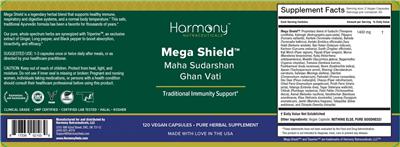
Mega Shield is a legendary herbal blend that supports healthy immune, respiratory and digestive systems, and a normal body temperature. This safe, traditional Ayurvedic formula has been a favorite for thousands of years.
Harmonious and Sustainable Eco-Friendly Clinical Grade GMP Certified Certified Lab Tested
Vegan
Traditional immunity support Made with love in the USA
Nothing else, pure goodness!
Suggested/Recommended/Usage/Directions
Suggested use: 1-3 capsules once or twice daily after meals, or as directed by your healthcare practitioner.
Precautions
Caution: Keep out of reach of children.
Do not use if inner seal is missing or broken: Pregnant and nursing women, individuals taking medications, or persons with a health condition should consult their healthcare professional before using this product.
Do not use if inner seal is missing or broken: Pregnant and nursing women, individuals taking medications, or persons with a health condition should consult their healthcare professional before using this product.
Storage
Protect from heat, light, and moisture.
Seals/Symbols
GMP Certified GMP Manufacturing GMP Certified Facility Vegan O-K!
Formula
Halal
Kosher
Maha Sudarshan Ghan Vati
Our pure, whole spectrum herbs and synergized with Triperine, an exclusive extract of ginger, long pepper, and black pepper to boost absorption, bioactivity, and efficacy.
FDA Statement of Identity
Pure Herbal Supplement
FDA Disclaimer Statement
These statements have not been evaluated by the Food and Drug Administration. This product is not intended to diagnose, treat, cure or prevent any disease.
Brand IP Statement(s)
Mega Shield and Triperine are trademarks of Harmony Nutraceuticals, LLC
Is this label outdated? Report a formula or label change and our pharmacy team will review it.
Mega Shield by Harmony Nutraceuticals label
The label scan from the NIH Dietary Supplement Label Database. Tap to enlarge.
Label images are published by the NIH Dietary Supplement Label Database for the version of this product on file. Always read your actual product label.
View the full label (PDF)The Ingredients in Mega Shield by Harmony Nutraceuticals
These are the 39 active ingredients this product is made of. Select any to open its full monograph.
Serving size1 Vegan Capsule(s) Dosage formCapsule Servings per container60 Amounts shown are per serving.
Most supplement products combine several ingredients, and a medication can interact with the product through any one of them. Each ingredient below shows whether it has known drug interactions.
Mega Shield
- › Pushkarmool
- › Ajwain
- › Pippali
- › Nagarmotha
- › Guduchi
- › Amlaki
- › Haritaki
- › Neem
- › Mulethi
- › Kalmegh
- › Kutaja
- › Murva
- › Vidanga
- › Pitpapra
- › Baheda
- › Daru Haldi
- › Bari Katari
- › Kachoor
- › Sunth
- › Kali Mirch
- › Tramana
- › Bharangi
- › Sahjan
- › Dalchini
- › Padmakh
- › Dev Daar
- › Chavya
- › Chhal Parni
- › Prishniparni
- › Tagar
- › Chitrak
- › Patol Patra
- › Kamal
- › Vanshlochan
- › Khas
- › Lavang
- › Javitri
- › Talispattar
- › Chirayta
Other (inactive) ingredients: Vegan Capsule. These complete the product’s ingredient list but are not active constituents.
Mega Shield by Harmony Nutraceuticals Drug Interactions
HelloPharmacist Interaction Report
Mega Shield by Harmony Nutraceuticals contains 39 ingredients, several of which interact with medications.
Altogether, these interactions span 1,505 individual medications.
Read the full breakdown — every affected drug type, severity by severity
The most serious interaction involves daru haldi (tree turmeric), which contains berberine. This ingredient can significantly raise blood levels of tacrolimus and cyclosporine, immunosuppressants used after organ transplants—these are Major-severity interactions.
Berberine inhibits the enzyme your liver uses to clear these drugs, potentially causing toxicity.
Several ingredients affect drugs metabolized by your liver's cytochrome P450 system (CYP3A4, CYP2D6, CYP2C9, and others): ajwain, pippali, guduchi, neem, daru haldi, and ginger all interact with substrates of these pathways at Moderate severity. This means they may raise blood levels of medications like certain antidepressants, some statins, and other common drugs.
Additionally, multiple ingredients—ajwain, pippali, guduchi, amlaki, neem, and ginger—may increase bleeding risk if you take blood thinners or antiplatelet drugs like warfarin, aspirin, or clopidogrel (Moderate severity). Pippali, guduchi, amlaki, neem, and ginger may also worsen low blood sugar (hypoglycemia) if you take diabetes medications.
Other Moderate-severity interactions include pushkarmool with sedating drugs, daru haldi and licorice with blood pressure medications, licorice with warfarin and digoxin, and ginger with nifedipine and losartan. We could not check nagarmotha, haritaki, kutaja, murva, vidanga, pitpapra, baheda, bari katari, kachoor, tramana, bharangi, and sahjan—no interaction data are on file for these ingredients.
Please use the medication checker on this page to look up your exact prescriptions before starting this product.
Check your own medications below · Editorial policy · How we use AI
Want to check YOUR meds against Mega Shield?
Ask about interactions with your drugs in plain English — “Can I take it with lisinopril?” — and we find you the answer in seconds, ingredient by ingredient.
Go to the checkerIngredients driving the most interactions
Individual Drug Interactions
The ingredients in Mega Shield interact with 1,538 drugs. Click any drug to see the details.
17 of the 39 ingredients in Mega Shield interact with drugs. Each result below shows which ingredient is responsible. Daru Haldi Chitrak Mulethi Kali Mirch Neem Sunth Lavang Ajwain Baheda Tagar Pippali Guduchi Dalchini Kalmegh Pushkarmool Kamal Amlaki
CyclosporineCequa, Ciclosporine, Gengraf, Neoral, Sandimmune, Verkazia +1 more
How Cyclosporine interacts with Mega Shield — through 14 ingredients. Tap an ingredient for the detail:
Daru HaldiCytochrome P450 3a4 (cyp3a4) Substrates, Cyclosporine (neoral, Sandimmune) Major
Interaction Summary
Theoretically, tree turmeric might increase the levels and clinical effects of drugs that are substrates of CYP3A4.
Read the full Daru Haldi + Cyclosporine interactionLavangCytochrome P450 3a4 (cyp3a4) Substrates Moderate
Interaction Summary
Theoretically, concomitant use of clove may increase levels of drugs metabolized by CYP3A4.
Read the full Lavang + Cyclosporine interactionNeemImmunosuppressants, Cytochrome P450 3a4 (cyp3a4) Substrates +1 Moderate
Interaction Summary
Theoretically, neem might decrease the effectiveness of immunosuppressants.
Read the full Neem + Cyclosporine interactionKali MirchCytochrome P450 3a4 (cyp3a4) Substrates, P-glycoprotein Substrates +1 Moderate
Interaction Summary
Theoretically, black pepper might increase levels of drugs metabolized by CYP3A4.
Read the full Kali Mirch + Cyclosporine interactionPippaliP-glycoprotein Substrates, Cyclosporine (neoral, Sandimmune) +1 Moderate
Interaction Summary
Theoretically, Indian long pepper might increase levels of P-glycoprotein substrates.
Read the full Pippali + Cyclosporine interactionChitrakCytochrome P450 3a4 (cyp3a4) Substrates, Immunosuppressants Moderate
Interaction Summary
Plumbagin, a constituent of Ceylon leadwort, has been shown to inhibit cytochrome P450 3A4 (CYP3A4) in vitro.
Read the full Chitrak + Cyclosporine interactionAjwainCytochrome P450 3a4 (cyp3a4) Substrates Moderate
Interaction Summary
Bergapten, a constituent of bishop's weed, has been shown to inhibit cytochrome P450 3A4 (CYP3A4) in vitro.
Read the full Ajwain + Cyclosporine interactionMulethiP-glycoprotein Substrates, Cytochrome P450 3a4 (cyp3a4) Substrates Moderate
Interaction Summary
Theoretically, licorice might decrease the absorption of P-glycoprotein substrates.
Read the full Mulethi + Cyclosporine interactionKalmeghImmunosuppressants Moderate
Interaction Summary
Theoretically, andrographis might interfere with the effects of immunosuppressive drugs.
Read the full Kalmegh + Cyclosporine interactionDalchiniHepatotoxic Drugs Moderate
Interaction Summary
Theoretically, large doses of cassia cinnamon might cause additive effects when used with hepatotoxic drugs.
Read the full Dalchini + Cyclosporine interactionSunthCytochrome P450 3a4 (cyp3a4) Substrates, P-glycoprotein Substrates +1 Moderate
Interaction Summary
Ginger might increase or decrease the levels of CYP3A4 substrates.
Read the full Sunth + Cyclosporine interactionGuduchiImmunosuppressants Moderate
Interaction Summary
Theoretically, Tinospora cordifolia might reduce the effectiveness of immunosuppressants.
Read the full Guduchi + Cyclosporine interactionBahedaCytochrome P450 3a4 (cyp3a4) Substrates Moderate
Interaction Summary
Theoretically, use of Terminalia arjuna may increase the levels and clinical effects of CYP3A4 substrates.
Read the full Baheda + Cyclosporine interactionTagarCytochrome P450 3a4 (cyp3a4) Substrates Minor
Interaction Summary
Valerian does not seem to have a clinically relevant effect on levels of drugs metabolized by CYP3A4.
Read the full Tagar + Cyclosporine interactionTacrolimusAstagraf XL, Envarsus XR, Prograf (capsule), Prograf (injectable), Prograf XL, Protopic
How Tacrolimus interacts with Mega Shield — through 13 ingredients. Tap an ingredient for the detail:
Daru HaldiCytochrome P450 3a4 (cyp3a4) Substrates, Tacrolimus (prograf) Major
Interaction Summary
Theoretically, tree turmeric might increase the levels and clinical effects of drugs that are substrates of CYP3A4.
Read the full Daru Haldi + Tacrolimus interactionChitrakImmunosuppressants, Cytochrome P450 3a4 (cyp3a4) Substrates Moderate
Interaction Summary
Plumbagin, a constituent of Ceylon leadwort, has demonstrated immunosuppressant activity in animal research.
Read the full Chitrak + Tacrolimus interactionGuduchiImmunosuppressants Moderate
Interaction Summary
Theoretically, Tinospora cordifolia might reduce the effectiveness of immunosuppressants.
Read the full Guduchi + Tacrolimus interactionSunthCytochrome P450 3a4 (cyp3a4) Substrates Moderate
Interaction Summary
Ginger might increase or decrease the levels of CYP3A4 substrates.
Read the full Sunth + Tacrolimus interactionMulethiCytochrome P450 3a4 (cyp3a4) Substrates Moderate
Interaction Summary
Theoretically, licorice might increase or decrease levels of drugs metabolized by CYP3A4.
Read the full Mulethi + Tacrolimus interactionBahedaCytochrome P450 3a4 (cyp3a4) Substrates Moderate
Interaction Summary
Theoretically, use of Terminalia arjuna may increase the levels and clinical effects of CYP3A4 substrates.
Read the full Baheda + Tacrolimus interactionNeemImmunosuppressants, Cytochrome P450 3a4 (cyp3a4) Substrates Moderate
Interaction Summary
Theoretically, neem might decrease the effectiveness of immunosuppressants.
Read the full Neem + Tacrolimus interactionKali MirchCytochrome P450 3a4 (cyp3a4) Substrates Moderate
Interaction Summary
Theoretically, black pepper might increase levels of drugs metabolized by CYP3A4.
Read the full Kali Mirch + Tacrolimus interactionAjwainCytochrome P450 3a4 (cyp3a4) Substrates Moderate
Interaction Summary
Bergapten, a constituent of bishop's weed, has been shown to inhibit cytochrome P450 3A4 (CYP3A4) in vitro.
Read the full Ajwain + Tacrolimus interactionPippaliCytochrome P450 3a4 (cyp3a4) Substrates Moderate
Interaction Summary
Theoretically, Indian long pepper might increase the effects and adverse effects of CYP3A4 substrates.
Read the full Pippali + Tacrolimus interactionKalmeghImmunosuppressants Moderate
Interaction Summary
Theoretically, andrographis might interfere with the effects of immunosuppressive drugs.
Read the full Kalmegh + Tacrolimus interactionLavangCytochrome P450 3a4 (cyp3a4) Substrates Moderate
Interaction Summary
Theoretically, concomitant use of clove may increase levels of drugs metabolized by CYP3A4.
Read the full Lavang + Tacrolimus interactionTagarCytochrome P450 3a4 (cyp3a4) Substrates Minor
Interaction Summary
Valerian does not seem to have a clinically relevant effect on levels of drugs metabolized by CYP3A4.
Read the full Tagar + Tacrolimus interaction6-mercaptopurinePurinethol
How 6-mercaptopurine interacts with Mega Shield — through 5 ingredients. Tap an ingredient for the detail:
ChitrakImmunosuppressants Moderate
Interaction Summary
Plumbagin, a constituent of Ceylon leadwort, has demonstrated immunosuppressant activity in animal research.
Read the full Chitrak + 6-mercaptopurine interactionGuduchiImmunosuppressants Moderate
Interaction Summary
Theoretically, Tinospora cordifolia might reduce the effectiveness of immunosuppressants.
Read the full Guduchi + 6-mercaptopurine interactionDalchiniHepatotoxic Drugs Moderate
Interaction Summary
Theoretically, large doses of cassia cinnamon might cause additive effects when used with hepatotoxic drugs.
Read the full Dalchini + 6-mercaptopurine interactionKalmeghImmunosuppressants Moderate
Interaction Summary
Theoretically, andrographis might interfere with the effects of immunosuppressive drugs.
Read the full Kalmegh + 6-mercaptopurine interactionNeemImmunosuppressants Moderate
Interaction Summary
Theoretically, neem might decrease the effectiveness of immunosuppressants.
Read the full Neem + 6-mercaptopurine interactionAdo-trastuzumab EmtansineKadcyla
How Ado-trastuzumab Emtansine interacts with Mega Shield — through 11 ingredients. Tap an ingredient for the detail:
Daru HaldiCytochrome P450 3a4 (cyp3a4) Substrates Moderate
Interaction Summary
Theoretically, tree turmeric might increase the levels and clinical effects of drugs that are substrates of CYP3A4.
Read the full Daru Haldi + Ado-trastuzumab Emtansine interactionMulethiCytochrome P450 3a4 (cyp3a4) Substrates Moderate
Interaction Summary
Theoretically, licorice might increase or decrease levels of drugs metabolized by CYP3A4.
Read the full Mulethi + Ado-trastuzumab Emtansine interactionLavangCytochrome P450 3a4 (cyp3a4) Substrates Moderate
Interaction Summary
Theoretically, concomitant use of clove may increase levels of drugs metabolized by CYP3A4.
Read the full Lavang + Ado-trastuzumab Emtansine interactionAjwainCytochrome P450 3a4 (cyp3a4) Substrates Moderate
Interaction Summary
Bergapten, a constituent of bishop's weed, has been shown to inhibit cytochrome P450 3A4 (CYP3A4) in vitro.
Read the full Ajwain + Ado-trastuzumab Emtansine interactionNeemCytochrome P450 3a4 (cyp3a4) Substrates Moderate
Interaction Summary
Theoretically, neem leaf extract might increase the levels and clinical effects of CYP3A4 substrates.
Read the full Neem + Ado-trastuzumab Emtansine interactionKali MirchCytochrome P450 3a4 (cyp3a4) Substrates Moderate
Interaction Summary
Theoretically, black pepper might increase levels of drugs metabolized by CYP3A4.
Read the full Kali Mirch + Ado-trastuzumab Emtansine interactionBahedaCytochrome P450 3a4 (cyp3a4) Substrates Moderate
Interaction Summary
Theoretically, use of Terminalia arjuna may increase the levels and clinical effects of CYP3A4 substrates.
Read the full Baheda + Ado-trastuzumab Emtansine interactionSunthCytochrome P450 3a4 (cyp3a4) Substrates Moderate
Interaction Summary
Ginger might increase or decrease the levels of CYP3A4 substrates.
Read the full Sunth + Ado-trastuzumab Emtansine interactionChitrakCytochrome P450 3a4 (cyp3a4) Substrates Moderate
Interaction Summary
Plumbagin, a constituent of Ceylon leadwort, has been shown to inhibit cytochrome P450 3A4 (CYP3A4) in vitro.
Read the full Chitrak + Ado-trastuzumab Emtansine interactionPippaliCytochrome P450 3a4 (cyp3a4) Substrates Moderate
Interaction Summary
Theoretically, Indian long pepper might increase the effects and adverse effects of CYP3A4 substrates.
Read the full Pippali + Ado-trastuzumab Emtansine interactionTagarCytochrome P450 3a4 (cyp3a4) Substrates Minor
Interaction Summary
Valerian does not seem to have a clinically relevant effect on levels of drugs metabolized by CYP3A4.
Read the full Tagar + Ado-trastuzumab Emtansine interactionAbacavir Sulfate, Dolutegravir, LamivudineTriumeq
How Abacavir Sulfate, Dolutegravir, Lamivudine interacts with Mega Shield — through 1 ingredient. Tap an ingredient for the detail:
DalchiniHepatotoxic Drugs Moderate
Interaction Summary
Theoretically, large doses of cassia cinnamon might cause additive effects when used with hepatotoxic drugs.
Read the full Dalchini + Abacavir Sulfate, Dolutegravir, Lamivudine interactionAbacavir, LamivudineEpzicom
How Abacavir, Lamivudine interacts with Mega Shield — through 1 ingredient. Tap an ingredient for the detail:
DalchiniHepatotoxic Drugs Moderate
Interaction Summary
Theoretically, large doses of cassia cinnamon might cause additive effects when used with hepatotoxic drugs.
Read the full Dalchini + Abacavir, Lamivudine interactionAbciximabReoPro
How Abciximab interacts with Mega Shield — through 11 ingredients. Tap an ingredient for the detail:
ChitrakAnticoagulant/antiplatelet Drugs Moderate
Interaction Summary
There is some concern that Ceylon leadwort might potentiate the effects of anticoagulant and antiplatelet drugs and possibly increase the risk of bleeding.
Read the full Chitrak + Abciximab interactionDaru HaldiAnticoagulant/antiplatelet Drugs Moderate
Interaction Summary
Theoretically, tree turmeric might have additive effects when used with anticoagulant and antiplatelet drugs and increase the risk of bleeding.
Read the full Daru Haldi + Abciximab interactionSunthAnticoagulant/antiplatelet Drugs Moderate
Interaction Summary
Ginger may have antiplatelet effects and may increase the risk of bleeding if used with anticoagulant or antiplatelet drugs.
Read the full Sunth + Abciximab interactionKamalAnticoagulant/antiplatelet Drugs Moderate
Interaction Summary
Theoretically, concurrent use of lotus with other antiplatelet drugs might reduce platelet aggregation and increase the risk of bleeding.
Read the full Kamal + Abciximab interactionKali MirchAnticoagulant/antiplatelet Drugs Moderate
Interaction Summary
Theoretically, black pepper might increase the risk of bleeding when taken with antiplatelet or anticoagulant drugs.
Read the full Kali Mirch + Abciximab interactionAmlakiAnticoagulant/antiplatelet Drugs Moderate
Interaction Summary
Theoretically, Indian gooseberry may increase the risk of bleeding if used with anticoagulant or antiplatelet drugs; however, research is conflicting.
Read the full Amlaki + Abciximab interactionPippaliAnticoagulant/antiplatelet Drugs Moderate
Interaction Summary
Theoretically, Indian long pepper might increase the risk of bleeding when taken with anticoagulant/antiplatelet drugs.
Read the full Pippali + Abciximab interactionKalmeghAnticoagulant/antiplatelet Drugs Moderate
Interaction Summary
Theoretically, andrographis might increase the risk of bleeding when used with anticoagulant or antiplatelet drugs.
Read the full Kalmegh + Abciximab interactionBahedaAnticoagulant/antiplatelet Drugs Moderate
Interaction Summary
Theoretically, concomitant use of Terminalia arjuna with anticoagulant or antiplatelet drugs may increase the risk of bleeding in some patients.
Read the full Baheda + Abciximab interactionAjwainAnticoagulant/antiplatelet Drugs Moderate
Interaction Summary
Bergapten, a constituent of bishop's weed, has antiplatelet activity.
Read the full Ajwain + Abciximab interactionLavangAnticoagulant/antiplatelet Drugs Minor
Interaction Summary
Theoretically, clove oil may increase the risk of bleeding if used with anticoagulant or antiplatelet drugs.
Read the full Lavang + Abciximab interactionAbemaciclibVerzenio
How Abemaciclib interacts with Mega Shield — through 11 ingredients. Tap an ingredient for the detail:
AjwainCytochrome P450 3a4 (cyp3a4) Substrates Moderate
Interaction Summary
Bergapten, a constituent of bishop's weed, has been shown to inhibit cytochrome P450 3A4 (CYP3A4) in vitro.
Read the full Ajwain + Abemaciclib interactionPippaliCytochrome P450 3a4 (cyp3a4) Substrates Moderate
Interaction Summary
Theoretically, Indian long pepper might increase the effects and adverse effects of CYP3A4 substrates.
Read the full Pippali + Abemaciclib interactionSunthCytochrome P450 3a4 (cyp3a4) Substrates Moderate
Interaction Summary
Ginger might increase or decrease the levels of CYP3A4 substrates.
Read the full Sunth + Abemaciclib interactionChitrakCytochrome P450 3a4 (cyp3a4) Substrates Moderate
Interaction Summary
Plumbagin, a constituent of Ceylon leadwort, has been shown to inhibit cytochrome P450 3A4 (CYP3A4) in vitro.
Read the full Chitrak + Abemaciclib interactionDaru HaldiCytochrome P450 3a4 (cyp3a4) Substrates Moderate
Interaction Summary
Theoretically, tree turmeric might increase the levels and clinical effects of drugs that are substrates of CYP3A4.
Read the full Daru Haldi + Abemaciclib interactionNeemCytochrome P450 3a4 (cyp3a4) Substrates Moderate
Interaction Summary
Theoretically, neem leaf extract might increase the levels and clinical effects of CYP3A4 substrates.
Read the full Neem + Abemaciclib interactionLavangCytochrome P450 3a4 (cyp3a4) Substrates Moderate
Interaction Summary
Theoretically, concomitant use of clove may increase levels of drugs metabolized by CYP3A4.
Read the full Lavang + Abemaciclib interactionKali MirchCytochrome P450 3a4 (cyp3a4) Substrates Moderate
Interaction Summary
Theoretically, black pepper might increase levels of drugs metabolized by CYP3A4.
Read the full Kali Mirch + Abemaciclib interactionBahedaCytochrome P450 3a4 (cyp3a4) Substrates Moderate
Interaction Summary
Theoretically, use of Terminalia arjuna may increase the levels and clinical effects of CYP3A4 substrates.
Read the full Baheda + Abemaciclib interactionMulethiCytochrome P450 3a4 (cyp3a4) Substrates Moderate
Interaction Summary
Theoretically, licorice might increase or decrease levels of drugs metabolized by CYP3A4.
Read the full Mulethi + Abemaciclib interactionTagarCytochrome P450 3a4 (cyp3a4) Substrates Minor
Interaction Summary
Valerian does not seem to have a clinically relevant effect on levels of drugs metabolized by CYP3A4.
Read the full Tagar + Abemaciclib interactionAbiraterone
How Abiraterone interacts with Mega Shield — through 12 ingredients. Tap an ingredient for the detail:
MulethiCytochrome P450 3a4 (cyp3a4) Substrates Moderate
Interaction Summary
Theoretically, licorice might increase or decrease levels of drugs metabolized by CYP3A4.
Read the full Mulethi + Abiraterone interactionSunthCytochrome P450 3a4 (cyp3a4) Substrates Moderate
Interaction Summary
Ginger might increase or decrease the levels of CYP3A4 substrates.
Read the full Sunth + Abiraterone interactionLavangCytochrome P450 3a4 (cyp3a4) Substrates Moderate
Interaction Summary
Theoretically, concomitant use of clove may increase levels of drugs metabolized by CYP3A4.
Read the full Lavang + Abiraterone interactionAjwainCytochrome P450 3a4 (cyp3a4) Substrates Moderate
Interaction Summary
Bergapten, a constituent of bishop's weed, has been shown to inhibit cytochrome P450 3A4 (CYP3A4) in vitro.
Read the full Ajwain + Abiraterone interactionPippaliCytochrome P450 3a4 (cyp3a4) Substrates Moderate
Interaction Summary
Theoretically, Indian long pepper might increase the effects and adverse effects of CYP3A4 substrates.
Read the full Pippali + Abiraterone interactionNeemCytochrome P450 3a4 (cyp3a4) Substrates Moderate
Interaction Summary
Theoretically, neem leaf extract might increase the levels and clinical effects of CYP3A4 substrates.
Read the full Neem + Abiraterone interactionChitrakCytochrome P450 3a4 (cyp3a4) Substrates Moderate
Interaction Summary
Plumbagin, a constituent of Ceylon leadwort, has been shown to inhibit cytochrome P450 3A4 (CYP3A4) in vitro.
Read the full Chitrak + Abiraterone interactionDaru HaldiCytochrome P450 3a4 (cyp3a4) Substrates Moderate
Interaction Summary
Theoretically, tree turmeric might increase the levels and clinical effects of drugs that are substrates of CYP3A4.
Read the full Daru Haldi + Abiraterone interactionBahedaCytochrome P450 3a4 (cyp3a4) Substrates Moderate
Interaction Summary
Theoretically, use of Terminalia arjuna may increase the levels and clinical effects of CYP3A4 substrates.
Read the full Baheda + Abiraterone interactionDalchiniHepatotoxic Drugs Moderate
Interaction Summary
Theoretically, large doses of cassia cinnamon might cause additive effects when used with hepatotoxic drugs.
Read the full Dalchini + Abiraterone interactionKali MirchCytochrome P450 3a4 (cyp3a4) Substrates Moderate
Interaction Summary
Theoretically, black pepper might increase levels of drugs metabolized by CYP3A4.
Read the full Kali Mirch + Abiraterone interactionTagarCytochrome P450 3a4 (cyp3a4) Substrates Minor
Interaction Summary
Valerian does not seem to have a clinically relevant effect on levels of drugs metabolized by CYP3A4.
Read the full Tagar + Abiraterone interactionAbiraterone AcetateYonsa, Zytiga
How Abiraterone Acetate interacts with Mega Shield — through 12 ingredients. Tap an ingredient for the detail:
Kali MirchCytochrome P450 3a4 (cyp3a4) Substrates Moderate
Interaction Summary
Theoretically, black pepper might increase levels of drugs metabolized by CYP3A4.
Read the full Kali Mirch + Abiraterone Acetate interactionChitrakCytochrome P450 3a4 (cyp3a4) Substrates Moderate
Interaction Summary
Plumbagin, a constituent of Ceylon leadwort, has been shown to inhibit cytochrome P450 3A4 (CYP3A4) in vitro.
Read the full Chitrak + Abiraterone Acetate interactionSunthCytochrome P450 3a4 (cyp3a4) Substrates Moderate
Interaction Summary
Ginger might increase or decrease the levels of CYP3A4 substrates.
Read the full Sunth + Abiraterone Acetate interactionLavangCytochrome P450 3a4 (cyp3a4) Substrates Moderate
Interaction Summary
Theoretically, concomitant use of clove may increase levels of drugs metabolized by CYP3A4.
Read the full Lavang + Abiraterone Acetate interactionMulethiCytochrome P450 3a4 (cyp3a4) Substrates Moderate
Interaction Summary
Theoretically, licorice might increase or decrease levels of drugs metabolized by CYP3A4.
Read the full Mulethi + Abiraterone Acetate interactionNeemCytochrome P450 3a4 (cyp3a4) Substrates Moderate
Interaction Summary
Theoretically, neem leaf extract might increase the levels and clinical effects of CYP3A4 substrates.
Read the full Neem + Abiraterone Acetate interactionAjwainCytochrome P450 3a4 (cyp3a4) Substrates Moderate
Interaction Summary
Bergapten, a constituent of bishop's weed, has been shown to inhibit cytochrome P450 3A4 (CYP3A4) in vitro.
Read the full Ajwain + Abiraterone Acetate interactionPippaliCytochrome P450 3a4 (cyp3a4) Substrates Moderate
Interaction Summary
Theoretically, Indian long pepper might increase the effects and adverse effects of CYP3A4 substrates.
Read the full Pippali + Abiraterone Acetate interactionDalchiniHepatotoxic Drugs Moderate
Interaction Summary
Theoretically, large doses of cassia cinnamon might cause additive effects when used with hepatotoxic drugs.
Read the full Dalchini + Abiraterone Acetate interactionDaru HaldiCytochrome P450 3a4 (cyp3a4) Substrates Moderate
Interaction Summary
Theoretically, tree turmeric might increase the levels and clinical effects of drugs that are substrates of CYP3A4.
Read the full Daru Haldi + Abiraterone Acetate interactionBahedaCytochrome P450 3a4 (cyp3a4) Substrates Moderate
Interaction Summary
Theoretically, use of Terminalia arjuna may increase the levels and clinical effects of CYP3A4 substrates.
Read the full Baheda + Abiraterone Acetate interactionTagarCytochrome P450 3a4 (cyp3a4) Substrates Minor
Interaction Summary
Valerian does not seem to have a clinically relevant effect on levels of drugs metabolized by CYP3A4.
Read the full Tagar + Abiraterone Acetate interactionAbrocitinibCibinqo
How Abrocitinib interacts with Mega Shield — through 14 ingredients. Tap an ingredient for the detail:
BahedaAnticoagulant/antiplatelet Drugs, Cytochrome P450 2c9 (cyp2c9) Substrates Moderate
Interaction Summary
Theoretically, concomitant use of Terminalia arjuna with anticoagulant or antiplatelet drugs may increase the risk of bleeding in some patients.
Read the full Baheda + Abrocitinib interactionAjwainAnticoagulant/antiplatelet Drugs Moderate
Interaction Summary
Bergapten, a constituent of bishop's weed, has antiplatelet activity.
Read the full Ajwain + Abrocitinib interactionLavangCytochrome P450 2c9 (cyp2c9) Substrates, Anticoagulant/antiplatelet Drugs Moderate
Interaction Summary
Theoretically, concomitant use of clove may increase levels of drugs metabolized by CYP2C9.
Read the full Lavang + Abrocitinib interactionSunthAnticoagulant/antiplatelet Drugs, Cytochrome P450 2c9 (cyp2c9) Substrates Moderate
Interaction Summary
Ginger may have antiplatelet effects and may increase the risk of bleeding if used with anticoagulant or antiplatelet drugs.
Read the full Sunth + Abrocitinib interactionKali MirchAnticoagulant/antiplatelet Drugs Moderate
Interaction Summary
Theoretically, black pepper might increase the risk of bleeding when taken with antiplatelet or anticoagulant drugs.
Read the full Kali Mirch + Abrocitinib interactionChitrakCytochrome P450 2c9 (cyp2c9) Substrates, Anticoagulant/antiplatelet Drugs +1 Moderate
Interaction Summary
Plumbagin, a constituent of Ceylon leadwort, has been shown to inhibit cytochrome P450 2C9 (CYP2C9) in vitro.
Read the full Chitrak + Abrocitinib interactionNeemImmunosuppressants, Cytochrome P450 2c9 (cyp2c9) Substrates Moderate
Interaction Summary
Theoretically, neem might decrease the effectiveness of immunosuppressants.
Read the full Neem + Abrocitinib interactionAmlakiAnticoagulant/antiplatelet Drugs Moderate
Interaction Summary
Theoretically, Indian gooseberry may increase the risk of bleeding if used with anticoagulant or antiplatelet drugs; however, research is conflicting.
Read the full Amlaki + Abrocitinib interactionKamalAnticoagulant/antiplatelet Drugs Moderate
Interaction Summary
Theoretically, concurrent use of lotus with other antiplatelet drugs might reduce platelet aggregation and increase the risk of bleeding.
Read the full Kamal + Abrocitinib interactionMulethiCytochrome P450 2c19 (cyp2c19) Substrates, Cytochrome P450 2c9 (cyp2c9) Substrates Moderate
Interaction Summary
Theoretically, licorice might increase levels of drugs metabolized by CYP2C19.
Read the full Mulethi + Abrocitinib interactionDaru HaldiAnticoagulant/antiplatelet Drugs, Cytochrome P450 2c9 (cyp2c9) Substrates Moderate
Interaction Summary
Theoretically, tree turmeric might have additive effects when used with anticoagulant and antiplatelet drugs and increase the risk of bleeding.
Read the full Daru Haldi + Abrocitinib interactionGuduchiCytochrome P450 2c9 (cyp2c9) Substrates, Immunosuppressants +1 Moderate
Interaction Summary
Theoretically, Tinospora cordifolia might increase levels of drugs metabolized by CYP2C9.
Read the full Guduchi + Abrocitinib interactionPippaliAnticoagulant/antiplatelet Drugs Moderate
Interaction Summary
Theoretically, Indian long pepper might increase the risk of bleeding when taken with anticoagulant/antiplatelet drugs.
Read the full Pippali + Abrocitinib interactionKalmeghAnticoagulant/antiplatelet Drugs, Immunosuppressants Moderate
Interaction Summary
Theoretically, andrographis might increase the risk of bleeding when used with anticoagulant or antiplatelet drugs.
Read the full Kalmegh + Abrocitinib interactionAcalabrutinibCalquence
How Acalabrutinib interacts with Mega Shield — through 11 ingredients. Tap an ingredient for the detail:
LavangCytochrome P450 3a4 (cyp3a4) Substrates Moderate
Interaction Summary
Theoretically, concomitant use of clove may increase levels of drugs metabolized by CYP3A4.
Read the full Lavang + Acalabrutinib interactionSunthCytochrome P450 3a4 (cyp3a4) Substrates, P-glycoprotein Substrates Moderate
Interaction Summary
Ginger might increase or decrease the levels of CYP3A4 substrates.
Read the full Sunth + Acalabrutinib interactionBahedaCytochrome P450 3a4 (cyp3a4) Substrates Moderate
Interaction Summary
Theoretically, use of Terminalia arjuna may increase the levels and clinical effects of CYP3A4 substrates.
Read the full Baheda + Acalabrutinib interactionAjwainCytochrome P450 3a4 (cyp3a4) Substrates Moderate
Interaction Summary
Bergapten, a constituent of bishop's weed, has been shown to inhibit cytochrome P450 3A4 (CYP3A4) in vitro.
Read the full Ajwain + Acalabrutinib interactionNeemCytochrome P450 3a4 (cyp3a4) Substrates, P-glycoprotein Substrates Moderate
Interaction Summary
Theoretically, neem leaf extract might increase the levels and clinical effects of CYP3A4 substrates.
Read the full Neem + Acalabrutinib interactionKali MirchP-glycoprotein Substrates, Cytochrome P450 3a4 (cyp3a4) Substrates Moderate
Interaction Summary
Theoretically, black pepper might increase levels of P-glycoprotein substrates.
Read the full Kali Mirch + Acalabrutinib interactionChitrakCytochrome P450 3a4 (cyp3a4) Substrates Moderate
Interaction Summary
Plumbagin, a constituent of Ceylon leadwort, has been shown to inhibit cytochrome P450 3A4 (CYP3A4) in vitro.
Read the full Chitrak + Acalabrutinib interactionPippaliCytochrome P450 3a4 (cyp3a4) Substrates, P-glycoprotein Substrates Moderate
Interaction Summary
Theoretically, Indian long pepper might increase the effects and adverse effects of CYP3A4 substrates.
Read the full Pippali + Acalabrutinib interactionMulethiCytochrome P450 3a4 (cyp3a4) Substrates, P-glycoprotein Substrates Moderate
Interaction Summary
Theoretically, licorice might increase or decrease levels of drugs metabolized by CYP3A4.
Read the full Mulethi + Acalabrutinib interactionDaru HaldiCytochrome P450 3a4 (cyp3a4) Substrates Moderate
Interaction Summary
Theoretically, tree turmeric might increase the levels and clinical effects of drugs that are substrates of CYP3A4.
Read the full Daru Haldi + Acalabrutinib interactionTagarCytochrome P450 3a4 (cyp3a4) Substrates Minor
Interaction Summary
Valerian does not seem to have a clinically relevant effect on levels of drugs metabolized by CYP3A4.
Read the full Tagar + Acalabrutinib interactionAcarboseGlucobay, Prandase, Precose
How Acarbose interacts with Mega Shield — through 12 ingredients. Tap an ingredient for the detail:
GuduchiAntidiabetes Drugs Moderate
Interaction Summary
Theoretically, Tinospora cordifolia might increase the risk of hypoglycemia when taken with antidiabetes drugs.
Read the full Guduchi + Acarbose interactionDaru HaldiAntidiabetes Drugs Moderate
Interaction Summary
Theoretically, tree turmeric, taken alone or in combination with milk thistle, might increase the risk of hypoglycemia in patients taking antidiabetes drugs.
Read the full Daru Haldi + Acarbose interactionKali MirchAntidiabetes Drugs Moderate
Interaction Summary
Theoretically, black pepper might increase the risk of hypoglycemia when taken with antidiabetes drugs.
Read the full Kali Mirch + Acarbose interactionSunthAntidiabetes Drugs Moderate
Interaction Summary
Theoretically, taking ginger with antidiabetes drugs might increase the risk of hypoglycemia.
Read the full Sunth + Acarbose interactionDalchiniAntidiabetes Drugs, Hepatotoxic Drugs Moderate
Interaction Summary
Theoretically, cassia cinnamon may have additive effects with antidiabetes drugs.
Read the full Dalchini + Acarbose interactionLavangAntidiabetes Drugs Moderate
Interaction Summary
Theoretically, concomitant use of clove extracts with antidiabetes drugs might increase the risk of hypoglycemia.
Read the full Lavang + Acarbose interactionKamalAntidiabetes Drugs Moderate
Interaction Summary
Theoretically, lotus might have additive effects with antidiabetes drugs and increase the risk of hypoglycemia.
Read the full Kamal + Acarbose interactionNeemAntidiabetes Drugs Moderate
Interaction Summary
Neem might increase the risk of hypoglycemia when taken with antidiabetes drugs.
Read the full Neem + Acarbose interactionAmlakiAntidiabetes Drugs Moderate
Interaction Summary
Taking Indian gooseberry with antidiabetes drugs might increase the risk of hypoglycemia.
Read the full Amlaki + Acarbose interactionBahedaAntidiabetes Drugs Moderate
Interaction Summary
Theoretically, concomitant use of Terminalia bellirica or Terminalia chebula with antidiabetes drugs could affect blood sugar control and increase the risk of hypoglycemia.
Read the full Baheda + Acarbose interactionChitrakAntidiabetes Drugs Moderate
Interaction Summary
Ceylon leadwort root extract has been shown to both increase and decrease blood glucose levels in animal research.
Read the full Chitrak + Acarbose interactionPippaliAntidiabetes Drugs Moderate
Interaction Summary
Theoretically, Indian long pepper might increase the risk of hypoglycemia when taken with antidiabetes drugs.
Read the full Pippali + Acarbose interactionAcebutololRhotral, Sectral
How Acebutolol interacts with Mega Shield — through 4 ingredients. Tap an ingredient for the detail:
KalmeghAntihypertensive Drugs Moderate
Interaction Summary
Theoretically, andrographis might increase the risk of hypotension when used with antihypertensive drugs.
Read the full Kalmegh + Acebutolol interactionDalchiniHepatotoxic Drugs Moderate
Interaction Summary
Theoretically, large doses of cassia cinnamon might cause additive effects when used with hepatotoxic drugs.
Read the full Dalchini + Acebutolol interactionDaru HaldiAntihypertensive Drugs Moderate
Interaction Summary
Theoretically, taking tree turmeric along with antihypertensive drugs might have additive effects and increase the risk of hypotension.
Read the full Daru Haldi + Acebutolol interactionMulethiAntihypertensive Drugs Moderate
Interaction Summary
Theoretically, licorice might reduce the effects of antihypertensive drugs.
Read the full Mulethi + Acebutolol interactionAcenocoumarolSintrom
How Acenocoumarol interacts with Mega Shield — through 11 ingredients. Tap an ingredient for the detail:
SunthAnticoagulant/antiplatelet Drugs Moderate
Interaction Summary
Ginger may have antiplatelet effects and may increase the risk of bleeding if used with anticoagulant or antiplatelet drugs.
Read the full Sunth + Acenocoumarol interactionAmlakiAnticoagulant/antiplatelet Drugs Moderate
Interaction Summary
Theoretically, Indian gooseberry may increase the risk of bleeding if used with anticoagulant or antiplatelet drugs; however, research is conflicting.
Read the full Amlaki + Acenocoumarol interactionDaru HaldiAnticoagulant/antiplatelet Drugs Moderate
Interaction Summary
Theoretically, tree turmeric might have additive effects when used with anticoagulant and antiplatelet drugs and increase the risk of bleeding.
Read the full Daru Haldi + Acenocoumarol interactionKali MirchAnticoagulant/antiplatelet Drugs Moderate
Interaction Summary
Theoretically, black pepper might increase the risk of bleeding when taken with antiplatelet or anticoagulant drugs.
Read the full Kali Mirch + Acenocoumarol interactionPippaliAnticoagulant/antiplatelet Drugs Moderate
Interaction Summary
Theoretically, Indian long pepper might increase the risk of bleeding when taken with anticoagulant/antiplatelet drugs.
Read the full Pippali + Acenocoumarol interactionKamalAnticoagulant/antiplatelet Drugs Moderate
Interaction Summary
Theoretically, concurrent use of lotus with other antiplatelet drugs might reduce platelet aggregation and increase the risk of bleeding.
Read the full Kamal + Acenocoumarol interactionAjwainAnticoagulant/antiplatelet Drugs Moderate
Interaction Summary
Bergapten, a constituent of bishop's weed, has antiplatelet activity.
Read the full Ajwain + Acenocoumarol interactionKalmeghAnticoagulant/antiplatelet Drugs Moderate
Interaction Summary
Theoretically, andrographis might increase the risk of bleeding when used with anticoagulant or antiplatelet drugs.
Read the full Kalmegh + Acenocoumarol interactionChitrakAnticoagulant/antiplatelet Drugs Moderate
Interaction Summary
There is some concern that Ceylon leadwort might potentiate the effects of anticoagulant and antiplatelet drugs and possibly increase the risk of bleeding.
Read the full Chitrak + Acenocoumarol interactionBahedaAnticoagulant/antiplatelet Drugs Moderate
Interaction Summary
Theoretically, concomitant use of Terminalia arjuna with anticoagulant or antiplatelet drugs may increase the risk of bleeding in some patients.
Read the full Baheda + Acenocoumarol interactionLavangAnticoagulant/antiplatelet Drugs Minor
Interaction Summary
Theoretically, clove oil may increase the risk of bleeding if used with anticoagulant or antiplatelet drugs.
Read the full Lavang + Acenocoumarol interactionAcepromazineAtravet
How Acepromazine interacts with Mega Shield — through 4 ingredients. Tap an ingredient for the detail:
TagarCns Depressants Moderate
Interaction Summary
Valerian can have additive sedative effects when used concomitantly with CNS depressant drugs.
Read the full Tagar + Acepromazine interactionPushkarmoolCns Depressants Moderate
Interaction Summary
Theoretically, elecampane may cause additive sedative effects when taken with CNS depressants.
Read the full Pushkarmool + Acepromazine interactionAjwainPhotosensitizing Drugs Moderate
Interaction Summary
Bishop's weed constituents seem to cause photosensitivity.
Read the full Ajwain + Acepromazine interactionDaru HaldiCns Depressants Moderate
Interaction Summary
Theoretically, use of tree turmeric along with CNS depressants might increase the risk of additive therapeutic and adverse effects.
Read the full Daru Haldi + Acepromazine interactionAcetaminophenChildren's Tylenol, Children's Tylenol Meltaways, Tylenol, Tylenol Ex Strength
How Acetaminophen interacts with Mega Shield — through 9 ingredients. Tap an ingredient for the detail:
DalchiniHepatotoxic Drugs Moderate
Interaction Summary
Theoretically, large doses of cassia cinnamon might cause additive effects when used with hepatotoxic drugs.
Read the full Dalchini + Acetaminophen interactionTagarGlucuronidated Drugs Moderate
Interaction Summary
Valerian might weakly inhibit glucuronidation and increase concentrations of drugs metabolized by UGT1A1 and UGT2B7.
Read the full Tagar + Acetaminophen interactionNeemCytochrome P450 1a2 (cyp1a2) Substrates Moderate
Interaction Summary
Theoretically, neem leaf extract might increase the levels and clinical effects of CYP1A2 substrates.
Read the full Neem + Acetaminophen interactionGuduchiCytochrome P450 1a2 (cyp1a2) Substrates Moderate
Interaction Summary
Theoretically, Tinospora cordifolia might increase levels of drugs metabolized by CYP1A2.
Read the full Guduchi + Acetaminophen interactionChitrakCytochrome P450 2e1 (cyp2e1) Substrates, Cytochrome P450 1a2 (cyp1a2) Substrates Moderate
Interaction Summary
Plumbagin, a constituent of Ceylon leadwort, has been shown to inhibit cytochrome P450 2E1 (CYP2E1) in vitro.
Read the full Chitrak + Acetaminophen interactionLavangCytochrome P450 1a2 (cyp1a2) Substrates Moderate
Interaction Summary
Theoretically, concomitant use of clove may increase levels of drugs metabolized by CYP1A2.
Read the full Lavang + Acetaminophen interactionMulethiCytochrome P450 1a2 (cyp1a2) Substrates Minor
Interaction Summary
Theoretically, licorice might decrease the levels and clinical effects of CYP1A2 substrates.
Read the full Mulethi + Acetaminophen interactionSunthCytochrome P450 1a2 (cyp1a2) Substrates Minor
Interaction Summary
Theoretically, ginger might increase the levels of CYP1A2 substrates.
Read the full Sunth + Acetaminophen interactionKali MirchCytochrome P450 1a2 (cyp1a2) Substrates Minor
Interaction Summary
Theoretically, black pepper might decrease levels and clinical effects of drugs metabolized by CYP1A2.
Read the full Kali Mirch + Acetaminophen interactionAcetaminophen, AspirinGemnisyn
How Acetaminophen, Aspirin interacts with Mega Shield — through 16 ingredients. Tap an ingredient for the detail:
LavangCytochrome P450 1a2 (cyp1a2) Substrates, Anticoagulant/antiplatelet Drugs Moderate
Interaction Summary
Theoretically, concomitant use of clove may increase levels of drugs metabolized by CYP1A2.
Read the full Lavang + Acetaminophen, Aspirin interactionKamalAnticoagulant/antiplatelet Drugs Moderate
Interaction Summary
Theoretically, concurrent use of lotus with other antiplatelet drugs might reduce platelet aggregation and increase the risk of bleeding.
Read the full Kamal + Acetaminophen, Aspirin interactionGuduchiCytochrome P450 1a2 (cyp1a2) Substrates Moderate
Interaction Summary
Theoretically, Tinospora cordifolia might increase levels of drugs metabolized by CYP1A2.
Read the full Guduchi + Acetaminophen, Aspirin interactionDaru HaldiAnticoagulant/antiplatelet Drugs Moderate
Interaction Summary
Theoretically, tree turmeric might have additive effects when used with anticoagulant and antiplatelet drugs and increase the risk of bleeding.
Read the full Daru Haldi + Acetaminophen, Aspirin interactionTagarGlucuronidated Drugs Moderate
Interaction Summary
Valerian might weakly inhibit glucuronidation and increase concentrations of drugs metabolized by UGT1A1 and UGT2B7.
Read the full Tagar + Acetaminophen, Aspirin interactionBahedaAnticoagulant/antiplatelet Drugs Moderate
Interaction Summary
Theoretically, concomitant use of Terminalia arjuna with anticoagulant or antiplatelet drugs may increase the risk of bleeding in some patients.
Read the full Baheda + Acetaminophen, Aspirin interactionAmlakiAnticoagulant/antiplatelet Drugs, Aspirin Moderate
Interaction Summary
Theoretically, Indian gooseberry may increase the risk of bleeding if used with anticoagulant or antiplatelet drugs; however, research is conflicting.
Read the full Amlaki + Acetaminophen, Aspirin interactionDalchiniHepatotoxic Drugs Moderate
Interaction Summary
Theoretically, large doses of cassia cinnamon might cause additive effects when used with hepatotoxic drugs.
Read the full Dalchini + Acetaminophen, Aspirin interactionKalmeghAnticoagulant/antiplatelet Drugs Moderate
Interaction Summary
Theoretically, andrographis might increase the risk of bleeding when used with anticoagulant or antiplatelet drugs.
Read the full Kalmegh + Acetaminophen, Aspirin interactionPippaliAnticoagulant/antiplatelet Drugs Moderate
Interaction Summary
Theoretically, Indian long pepper might increase the risk of bleeding when taken with anticoagulant/antiplatelet drugs.
Read the full Pippali + Acetaminophen, Aspirin interactionNeemCytochrome P450 1a2 (cyp1a2) Substrates Moderate
Interaction Summary
Theoretically, neem leaf extract might increase the levels and clinical effects of CYP1A2 substrates.
Read the full Neem + Acetaminophen, Aspirin interactionSunthCytochrome P450 1a2 (cyp1a2) Substrates, Anticoagulant/antiplatelet Drugs Moderate
Interaction Summary
Theoretically, ginger might increase the levels of CYP1A2 substrates.
Read the full Sunth + Acetaminophen, Aspirin interactionChitrakCytochrome P450 1a2 (cyp1a2) Substrates, Anticoagulant/antiplatelet Drugs +1 Moderate
Interaction Summary
Plumbagin, a constituent of Ceylon leadwort, has been shown to inhibit cytochrome P450 1A2 (CYP1A2) in vitro.
Read the full Chitrak + Acetaminophen, Aspirin interactionAjwainAnticoagulant/antiplatelet Drugs Moderate
Interaction Summary
Bergapten, a constituent of bishop's weed, has antiplatelet activity.
Read the full Ajwain + Acetaminophen, Aspirin interactionKali MirchAnticoagulant/antiplatelet Drugs, Cytochrome P450 1a2 (cyp1a2) Substrates Moderate
Interaction Summary
Theoretically, black pepper might increase the risk of bleeding when taken with antiplatelet or anticoagulant drugs.
Read the full Kali Mirch + Acetaminophen, Aspirin interactionMulethiCytochrome P450 1a2 (cyp1a2) Substrates Minor
Interaction Summary
Theoretically, licorice might decrease the levels and clinical effects of CYP1A2 substrates.
Read the full Mulethi + Acetaminophen, Aspirin interactionAcetaminophen, Aspirin, CaffeineExcedrin, Excedrin Extra Strength, Excedrin Migraine
How Acetaminophen, Aspirin, Caffeine interacts with Mega Shield — through 16 ingredients. Tap an ingredient for the detail:
Kali MirchAnticoagulant/antiplatelet Drugs, Cytochrome P450 1a2 (cyp1a2) Substrates +1 Moderate
Interaction Summary
Theoretically, black pepper might increase the risk of bleeding when taken with antiplatelet or anticoagulant drugs.
Read the full Kali Mirch + Acetaminophen, Aspirin, Caffeine interactionBahedaCytochrome P450 3a4 (cyp3a4) Substrates, Anticoagulant/antiplatelet Drugs Moderate
Interaction Summary
Theoretically, use of Terminalia arjuna may increase the levels and clinical effects of CYP3A4 substrates.
Read the full Baheda + Acetaminophen, Aspirin, Caffeine interactionMulethiCytochrome P450 1a2 (cyp1a2) Substrates, Cytochrome P450 3a4 (cyp3a4) Substrates Moderate
Interaction Summary
Theoretically, licorice might decrease the levels and clinical effects of CYP1A2 substrates.
Read the full Mulethi + Acetaminophen, Aspirin, Caffeine interactionTagarCytochrome P450 3a4 (cyp3a4) Substrates, Glucuronidated Drugs Moderate
Interaction Summary
Valerian does not seem to have a clinically relevant effect on levels of drugs metabolized by CYP3A4.
Read the full Tagar + Acetaminophen, Aspirin, Caffeine interactionKamalAnticoagulant/antiplatelet Drugs Moderate
Interaction Summary
Theoretically, concurrent use of lotus with other antiplatelet drugs might reduce platelet aggregation and increase the risk of bleeding.
Read the full Kamal + Acetaminophen, Aspirin, Caffeine interactionLavangCytochrome P450 1a2 (cyp1a2) Substrates, Cytochrome P450 3a4 (cyp3a4) Substrates +1 Moderate
Interaction Summary
Theoretically, concomitant use of clove may increase levels of drugs metabolized by CYP1A2.
Read the full Lavang + Acetaminophen, Aspirin, Caffeine interactionDaru HaldiAnticoagulant/antiplatelet Drugs, Cytochrome P450 3a4 (cyp3a4) Substrates Moderate
Interaction Summary
Theoretically, tree turmeric might have additive effects when used with anticoagulant and antiplatelet drugs and increase the risk of bleeding.
Read the full Daru Haldi + Acetaminophen, Aspirin, Caffeine interactionGuduchiCytochrome P450 1a2 (cyp1a2) Substrates Moderate
Interaction Summary
Theoretically, Tinospora cordifolia might increase levels of drugs metabolized by CYP1A2.
Read the full Guduchi + Acetaminophen, Aspirin, Caffeine interactionPippaliAnticoagulant/antiplatelet Drugs, Cytochrome P450 3a4 (cyp3a4) Substrates Moderate
Interaction Summary
Theoretically, Indian long pepper might increase the risk of bleeding when taken with anticoagulant/antiplatelet drugs.
Read the full Pippali + Acetaminophen, Aspirin, Caffeine interactionNeemCytochrome P450 1a2 (cyp1a2) Substrates, Cytochrome P450 3a4 (cyp3a4) Substrates Moderate
Interaction Summary
Theoretically, neem leaf extract might increase the levels and clinical effects of CYP1A2 substrates.
Read the full Neem + Acetaminophen, Aspirin, Caffeine interactionAmlakiAnticoagulant/antiplatelet Drugs, Aspirin Moderate
Interaction Summary
Theoretically, Indian gooseberry may increase the risk of bleeding if used with anticoagulant or antiplatelet drugs; however, research is conflicting.
Read the full Amlaki + Acetaminophen, Aspirin, Caffeine interactionKalmeghAnticoagulant/antiplatelet Drugs Moderate
Interaction Summary
Theoretically, andrographis might increase the risk of bleeding when used with anticoagulant or antiplatelet drugs.
Read the full Kalmegh + Acetaminophen, Aspirin, Caffeine interactionDalchiniHepatotoxic Drugs Moderate
Interaction Summary
Theoretically, large doses of cassia cinnamon might cause additive effects when used with hepatotoxic drugs.
Read the full Dalchini + Acetaminophen, Aspirin, Caffeine interactionAjwainAnticoagulant/antiplatelet Drugs, Cytochrome P450 3a4 (cyp3a4) Substrates Moderate
Interaction Summary
Bergapten, a constituent of bishop's weed, has antiplatelet activity.
Read the full Ajwain + Acetaminophen, Aspirin, Caffeine interactionSunthAnticoagulant/antiplatelet Drugs, Cytochrome P450 1a2 (cyp1a2) Substrates +1 Moderate
Interaction Summary
Ginger may have antiplatelet effects and may increase the risk of bleeding if used with anticoagulant or antiplatelet drugs.
Read the full Sunth + Acetaminophen, Aspirin, Caffeine interactionChitrakCytochrome P450 2e1 (cyp2e1) Substrates, Cytochrome P450 1a2 (cyp1a2) Substrates +2 Moderate
Interaction Summary
Plumbagin, a constituent of Ceylon leadwort, has been shown to inhibit cytochrome P450 2E1 (CYP2E1) in vitro.
Read the full Chitrak + Acetaminophen, Aspirin, Caffeine interactionAcetaminophen, Brompheniramine, PhenylpropanolamineDimetapp Cold and Flu
How Acetaminophen, Brompheniramine, Phenylpropanolamine interacts with Mega Shield — through 10 ingredients. Tap an ingredient for the detail:
ChitrakCytochrome P450 2e1 (cyp2e1) Substrates, Cytochrome P450 1a2 (cyp1a2) Substrates Moderate
Interaction Summary
Plumbagin, a constituent of Ceylon leadwort, has been shown to inhibit cytochrome P450 2E1 (CYP2E1) in vitro.
Read the full Chitrak + Acetaminophen, Brompheniramine, Phenylpropanolamine interactionTagarGlucuronidated Drugs Moderate
Interaction Summary
Valerian might weakly inhibit glucuronidation and increase concentrations of drugs metabolized by UGT1A1 and UGT2B7.
Read the full Tagar + Acetaminophen, Brompheniramine, Phenylpropanolamine interactionNeemCytochrome P450 1a2 (cyp1a2) Substrates Moderate
Interaction Summary
Theoretically, neem leaf extract might increase the levels and clinical effects of CYP1A2 substrates.
Read the full Neem + Acetaminophen, Brompheniramine, Phenylpropanolamine interactionLavangCytochrome P450 1a2 (cyp1a2) Substrates Moderate
Interaction Summary
Theoretically, concomitant use of clove may increase levels of drugs metabolized by CYP1A2.
Read the full Lavang + Acetaminophen, Brompheniramine, Phenylpropanolamine interactionGuduchiCytochrome P450 1a2 (cyp1a2) Substrates Moderate
Interaction Summary
Theoretically, Tinospora cordifolia might increase levels of drugs metabolized by CYP1A2.
Read the full Guduchi + Acetaminophen, Brompheniramine, Phenylpropanolamine interactionDalchiniHepatotoxic Drugs Moderate
Interaction Summary
Theoretically, large doses of cassia cinnamon might cause additive effects when used with hepatotoxic drugs.
Read the full Dalchini + Acetaminophen, Brompheniramine, Phenylpropanolamine interactionAjwainPhotosensitizing Drugs Moderate
Interaction Summary
Bishop's weed constituents seem to cause photosensitivity.
Read the full Ajwain + Acetaminophen, Brompheniramine, Phenylpropanolamine interactionKali MirchCytochrome P450 1a2 (cyp1a2) Substrates Minor
Interaction Summary
Theoretically, black pepper might decrease levels and clinical effects of drugs metabolized by CYP1A2.
Read the full Kali Mirch + Acetaminophen, Brompheniramine, Phenylpropanolamine interactionMulethiCytochrome P450 1a2 (cyp1a2) Substrates Minor
Interaction Summary
Theoretically, licorice might decrease the levels and clinical effects of CYP1A2 substrates.
Read the full Mulethi + Acetaminophen, Brompheniramine, Phenylpropanolamine interactionSunthCytochrome P450 1a2 (cyp1a2) Substrates Minor
Interaction Summary
Theoretically, ginger might increase the levels of CYP1A2 substrates.
Read the full Sunth + Acetaminophen, Brompheniramine, Phenylpropanolamine interactionAcetaminophen, ButalbitalAxocet, Bancap, Bucet, Butex Forte, Esgic CF, Orbivan CF +5 more
How Acetaminophen, Butalbital interacts with Mega Shield — through 9 ingredients. Tap an ingredient for the detail:
LavangCytochrome P450 1a2 (cyp1a2) Substrates Moderate
Interaction Summary
Theoretically, concomitant use of clove may increase levels of drugs metabolized by CYP1A2.
Read the full Lavang + Acetaminophen, Butalbital interactionTagarGlucuronidated Drugs Moderate
Interaction Summary
Valerian might weakly inhibit glucuronidation and increase concentrations of drugs metabolized by UGT1A1 and UGT2B7.
Read the full Tagar + Acetaminophen, Butalbital interactionChitrakCytochrome P450 1a2 (cyp1a2) Substrates, Cytochrome P450 2e1 (cyp2e1) Substrates Moderate
Interaction Summary
Plumbagin, a constituent of Ceylon leadwort, has been shown to inhibit cytochrome P450 1A2 (CYP1A2) in vitro.
Read the full Chitrak + Acetaminophen, Butalbital interactionNeemCytochrome P450 1a2 (cyp1a2) Substrates Moderate
Interaction Summary
Theoretically, neem leaf extract might increase the levels and clinical effects of CYP1A2 substrates.
Read the full Neem + Acetaminophen, Butalbital interactionDalchiniHepatotoxic Drugs Moderate
Interaction Summary
Theoretically, large doses of cassia cinnamon might cause additive effects when used with hepatotoxic drugs.
Read the full Dalchini + Acetaminophen, Butalbital interactionGuduchiCytochrome P450 1a2 (cyp1a2) Substrates Moderate
Interaction Summary
Theoretically, Tinospora cordifolia might increase levels of drugs metabolized by CYP1A2.
Read the full Guduchi + Acetaminophen, Butalbital interactionKali MirchCytochrome P450 1a2 (cyp1a2) Substrates Minor
Interaction Summary
Theoretically, black pepper might decrease levels and clinical effects of drugs metabolized by CYP1A2.
Read the full Kali Mirch + Acetaminophen, Butalbital interactionMulethiCytochrome P450 1a2 (cyp1a2) Substrates Minor
Interaction Summary
Theoretically, licorice might decrease the levels and clinical effects of CYP1A2 substrates.
Read the full Mulethi + Acetaminophen, Butalbital interactionSunthCytochrome P450 1a2 (cyp1a2) Substrates Minor
Interaction Summary
Theoretically, ginger might increase the levels of CYP1A2 substrates.
Read the full Sunth + Acetaminophen, Butalbital interactionAcetaminophen, Butalbital, CaffeineEsgic, Esgic Plus, Fiogesic, Fioricet, Repan, Tecnal +1 more
How Acetaminophen, Butalbital, Caffeine interacts with Mega Shield — through 13 ingredients. Tap an ingredient for the detail:
SunthCytochrome P450 1a2 (cyp1a2) Substrates, Cytochrome P450 3a4 (cyp3a4) Substrates Moderate
Interaction Summary
Theoretically, ginger might increase the levels of CYP1A2 substrates.
Read the full Sunth + Acetaminophen, Butalbital, Caffeine interactionKali MirchCytochrome P450 1a2 (cyp1a2) Substrates, Cytochrome P450 3a4 (cyp3a4) Substrates Moderate
Interaction Summary
Theoretically, black pepper might decrease levels and clinical effects of drugs metabolized by CYP1A2.
Read the full Kali Mirch + Acetaminophen, Butalbital, Caffeine interactionBahedaCytochrome P450 3a4 (cyp3a4) Substrates Moderate
Interaction Summary
Theoretically, use of Terminalia arjuna may increase the levels and clinical effects of CYP3A4 substrates.
Read the full Baheda + Acetaminophen, Butalbital, Caffeine interactionLavangCytochrome P450 1a2 (cyp1a2) Substrates, Cytochrome P450 3a4 (cyp3a4) Substrates Moderate
Interaction Summary
Theoretically, concomitant use of clove may increase levels of drugs metabolized by CYP1A2.
Read the full Lavang + Acetaminophen, Butalbital, Caffeine interactionPippaliCytochrome P450 3a4 (cyp3a4) Substrates Moderate
Interaction Summary
Theoretically, Indian long pepper might increase the effects and adverse effects of CYP3A4 substrates.
Read the full Pippali + Acetaminophen, Butalbital, Caffeine interactionAjwainCytochrome P450 3a4 (cyp3a4) Substrates Moderate
Interaction Summary
Bergapten, a constituent of bishop's weed, has been shown to inhibit cytochrome P450 3A4 (CYP3A4) in vitro.
Read the full Ajwain + Acetaminophen, Butalbital, Caffeine interactionNeemCytochrome P450 3a4 (cyp3a4) Substrates, Cytochrome P450 1a2 (cyp1a2) Substrates Moderate
Interaction Summary
Theoretically, neem leaf extract might increase the levels and clinical effects of CYP3A4 substrates.
Read the full Neem + Acetaminophen, Butalbital, Caffeine interactionTagarGlucuronidated Drugs, Cytochrome P450 3a4 (cyp3a4) Substrates Moderate
Interaction Summary
Valerian might weakly inhibit glucuronidation and increase concentrations of drugs metabolized by UGT1A1 and UGT2B7.
Read the full Tagar + Acetaminophen, Butalbital, Caffeine interactionChitrakCytochrome P450 2e1 (cyp2e1) Substrates, Cytochrome P450 3a4 (cyp3a4) Substrates +1 Moderate
Interaction Summary
Plumbagin, a constituent of Ceylon leadwort, has been shown to inhibit cytochrome P450 2E1 (CYP2E1) in vitro.
Read the full Chitrak + Acetaminophen, Butalbital, Caffeine interactionGuduchiCytochrome P450 1a2 (cyp1a2) Substrates Moderate
Interaction Summary
Theoretically, Tinospora cordifolia might increase levels of drugs metabolized by CYP1A2.
Read the full Guduchi + Acetaminophen, Butalbital, Caffeine interactionDaru HaldiCytochrome P450 3a4 (cyp3a4) Substrates Moderate
Interaction Summary
Theoretically, tree turmeric might increase the levels and clinical effects of drugs that are substrates of CYP3A4.
Read the full Daru Haldi + Acetaminophen, Butalbital, Caffeine interactionMulethiCytochrome P450 1a2 (cyp1a2) Substrates, Cytochrome P450 3a4 (cyp3a4) Substrates Moderate
Interaction Summary
Theoretically, licorice might decrease the levels and clinical effects of CYP1A2 substrates.
Read the full Mulethi + Acetaminophen, Butalbital, Caffeine interactionDalchiniHepatotoxic Drugs Moderate
Interaction Summary
Theoretically, large doses of cassia cinnamon might cause additive effects when used with hepatotoxic drugs.
Read the full Dalchini + Acetaminophen, Butalbital, Caffeine interactionAcetaminophen, Butalbital, Caffeine, CodeineEsgic with Codeine, Fioricet w/ Codeine
How Acetaminophen, Butalbital, Caffeine, Codeine interacts with Mega Shield — through 14 ingredients. Tap an ingredient for the detail:
DalchiniHepatotoxic Drugs Moderate
Interaction Summary
Theoretically, large doses of cassia cinnamon might cause additive effects when used with hepatotoxic drugs.
Read the full Dalchini + Acetaminophen, Butalbital, Caffeine, Codeine interactionDaru HaldiCns Depressants, Cytochrome P450 2d6 (cyp2d6) Substrates +1 Moderate
Interaction Summary
Theoretically, use of tree turmeric along with CNS depressants might increase the risk of additive therapeutic and adverse effects.
Read the full Daru Haldi + Acetaminophen, Butalbital, Caffeine, Codeine interactionTagarCytochrome P450 3a4 (cyp3a4) Substrates, Glucuronidated Drugs +2 Moderate
Interaction Summary
Valerian does not seem to have a clinically relevant effect on levels of drugs metabolized by CYP3A4.
Read the full Tagar + Acetaminophen, Butalbital, Caffeine, Codeine interactionLavangCytochrome P450 1a2 (cyp1a2) Substrates, Cytochrome P450 2d6 (cyp2d6) Substrates +1 Moderate
Interaction Summary
Theoretically, concomitant use of clove may increase levels of drugs metabolized by CYP1A2.
Read the full Lavang + Acetaminophen, Butalbital, Caffeine, Codeine interactionPushkarmoolCns Depressants Moderate
Interaction Summary
Theoretically, elecampane may cause additive sedative effects when taken with CNS depressants.
Read the full Pushkarmool + Acetaminophen, Butalbital, Caffeine, Codeine interactionSunthCytochrome P450 3a4 (cyp3a4) Substrates, Cytochrome P450 1a2 (cyp1a2) Substrates Moderate
Interaction Summary
Ginger might increase or decrease the levels of CYP3A4 substrates.
Read the full Sunth + Acetaminophen, Butalbital, Caffeine, Codeine interactionBahedaCytochrome P450 3a4 (cyp3a4) Substrates, Cytochrome P450 2d6 (cyp2d6) Substrates Moderate
Interaction Summary
Theoretically, use of Terminalia arjuna may increase the levels and clinical effects of CYP3A4 substrates.
Read the full Baheda + Acetaminophen, Butalbital, Caffeine, Codeine interactionKali MirchCytochrome P450 1a2 (cyp1a2) Substrates, Cytochrome P450 3a4 (cyp3a4) Substrates +1 Moderate
Interaction Summary
Theoretically, black pepper might decrease levels and clinical effects of drugs metabolized by CYP1A2.
Read the full Kali Mirch + Acetaminophen, Butalbital, Caffeine, Codeine interactionNeemCytochrome P450 1a2 (cyp1a2) Substrates, Cytochrome P450 3a4 (cyp3a4) Substrates Moderate
Interaction Summary
Theoretically, neem leaf extract might increase the levels and clinical effects of CYP1A2 substrates.
Read the full Neem + Acetaminophen, Butalbital, Caffeine, Codeine interactionAjwainCytochrome P450 3a4 (cyp3a4) Substrates Moderate
Interaction Summary
Bergapten, a constituent of bishop's weed, has been shown to inhibit cytochrome P450 3A4 (CYP3A4) in vitro.
Read the full Ajwain + Acetaminophen, Butalbital, Caffeine, Codeine interactionPippaliCytochrome P450 3a4 (cyp3a4) Substrates Moderate
Interaction Summary
Theoretically, Indian long pepper might increase the effects and adverse effects of CYP3A4 substrates.
Read the full Pippali + Acetaminophen, Butalbital, Caffeine, Codeine interactionMulethiCytochrome P450 3a4 (cyp3a4) Substrates, Cytochrome P450 1a2 (cyp1a2) Substrates Moderate
Interaction Summary
Theoretically, licorice might increase or decrease levels of drugs metabolized by CYP3A4.
Read the full Mulethi + Acetaminophen, Butalbital, Caffeine, Codeine interactionChitrakCytochrome P450 1a2 (cyp1a2) Substrates, Cytochrome P450 2e1 (cyp2e1) Substrates +2 Moderate
Interaction Summary
Plumbagin, a constituent of Ceylon leadwort, has been shown to inhibit cytochrome P450 1A2 (CYP1A2) in vitro.
Read the full Chitrak + Acetaminophen, Butalbital, Caffeine, Codeine interactionGuduchiCytochrome P450 2d6 (cyp2d6) Substrates, Cytochrome P450 1a2 (cyp1a2) Substrates Moderate
Interaction Summary
Theoretically, Tinospora cordifolia might increase levels of drugs metabolized by CYP2D6.
Read the full Guduchi + Acetaminophen, Butalbital, Caffeine, Codeine interactionAcetaminophen, Butalbital, CodeineBancap w/ Codeine
How Acetaminophen, Butalbital, Codeine interacts with Mega Shield — through 12 ingredients. Tap an ingredient for the detail:
GuduchiCytochrome P450 1a2 (cyp1a2) Substrates, Cytochrome P450 2d6 (cyp2d6) Substrates Moderate
Interaction Summary
Theoretically, Tinospora cordifolia might increase levels of drugs metabolized by CYP1A2.
Read the full Guduchi + Acetaminophen, Butalbital, Codeine interactionKali MirchCytochrome P450 2d6 (cyp2d6) Substrates, Cytochrome P450 1a2 (cyp1a2) Substrates Moderate
Interaction Summary
Theoretically, black pepper might increase levels of drugs metabolized by CYP2D6.
Read the full Kali Mirch + Acetaminophen, Butalbital, Codeine interactionLavangCytochrome P450 1a2 (cyp1a2) Substrates, Cytochrome P450 2d6 (cyp2d6) Substrates Moderate
Interaction Summary
Theoretically, concomitant use of clove may increase levels of drugs metabolized by CYP1A2.
Read the full Lavang + Acetaminophen, Butalbital, Codeine interactionPushkarmoolCns Depressants Moderate
Interaction Summary
Theoretically, elecampane may cause additive sedative effects when taken with CNS depressants.
Read the full Pushkarmool + Acetaminophen, Butalbital, Codeine interactionDaru HaldiCytochrome P450 2d6 (cyp2d6) Substrates, Cns Depressants Moderate
Interaction Summary
Theoretically, tree turmeric might increase the levels and clinical effects of drugs metabolized by CYP2D6.
Read the full Daru Haldi + Acetaminophen, Butalbital, Codeine interactionDalchiniHepatotoxic Drugs Moderate
Interaction Summary
Theoretically, large doses of cassia cinnamon might cause additive effects when used with hepatotoxic drugs.
Read the full Dalchini + Acetaminophen, Butalbital, Codeine interactionTagarCytochrome P450 2d6 (cyp2d6) Substrates, Glucuronidated Drugs +1 Moderate
Interaction Summary
Valerian does not seem to have a clinically relevant effect on levels of drugs metabolized by CYP2D6.
Read the full Tagar + Acetaminophen, Butalbital, Codeine interactionNeemCytochrome P450 1a2 (cyp1a2) Substrates Moderate
Interaction Summary
Theoretically, neem leaf extract might increase the levels and clinical effects of CYP1A2 substrates.
Read the full Neem + Acetaminophen, Butalbital, Codeine interactionBahedaCytochrome P450 2d6 (cyp2d6) Substrates Moderate
Interaction Summary
Theoretically, use of Terminalia arjuna may increase the levels and clinical effects of CYP2D6 substrates.
Read the full Baheda + Acetaminophen, Butalbital, Codeine interactionChitrakCytochrome P450 2e1 (cyp2e1) Substrates, Cytochrome P450 1a2 (cyp1a2) Substrates +1 Moderate
Interaction Summary
Plumbagin, a constituent of Ceylon leadwort, has been shown to inhibit cytochrome P450 2E1 (CYP2E1) in vitro.
Read the full Chitrak + Acetaminophen, Butalbital, Codeine interactionSunthCytochrome P450 1a2 (cyp1a2) Substrates Minor
Interaction Summary
Theoretically, ginger might increase the levels of CYP1A2 substrates.
Read the full Sunth + Acetaminophen, Butalbital, Codeine interactionMulethiCytochrome P450 1a2 (cyp1a2) Substrates Minor
Interaction Summary
Theoretically, licorice might decrease the levels and clinical effects of CYP1A2 substrates.
Read the full Mulethi + Acetaminophen, Butalbital, Codeine interactionAcetaminophen, Butalbital, Codeine PhosphatePhrenilin #3
How Acetaminophen, Butalbital, Codeine Phosphate interacts with Mega Shield — through 12 ingredients. Tap an ingredient for the detail:
PushkarmoolCns Depressants Moderate
Interaction Summary
Theoretically, elecampane may cause additive sedative effects when taken with CNS depressants.
Read the full Pushkarmool + Acetaminophen, Butalbital, Codeine Phosphate interactionLavangCytochrome P450 2d6 (cyp2d6) Substrates, Cytochrome P450 1a2 (cyp1a2) Substrates Moderate
Interaction Summary
Theoretically, concomitant use of clove may increase levels of drugs metabolized by CYP2D6.
Read the full Lavang + Acetaminophen, Butalbital, Codeine Phosphate interactionGuduchiCytochrome P450 1a2 (cyp1a2) Substrates, Cytochrome P450 2d6 (cyp2d6) Substrates Moderate
Interaction Summary
Theoretically, Tinospora cordifolia might increase levels of drugs metabolized by CYP1A2.
Read the full Guduchi + Acetaminophen, Butalbital, Codeine Phosphate interactionKali MirchCytochrome P450 2d6 (cyp2d6) Substrates, Cytochrome P450 1a2 (cyp1a2) Substrates Moderate
Interaction Summary
Theoretically, black pepper might increase levels of drugs metabolized by CYP2D6.
Read the full Kali Mirch + Acetaminophen, Butalbital, Codeine Phosphate interactionNeemCytochrome P450 1a2 (cyp1a2) Substrates Moderate
Interaction Summary
Theoretically, neem leaf extract might increase the levels and clinical effects of CYP1A2 substrates.
Read the full Neem + Acetaminophen, Butalbital, Codeine Phosphate interactionDaru HaldiCns Depressants, Cytochrome P450 2d6 (cyp2d6) Substrates Moderate
Interaction Summary
Theoretically, use of tree turmeric along with CNS depressants might increase the risk of additive therapeutic and adverse effects.
Read the full Daru Haldi + Acetaminophen, Butalbital, Codeine Phosphate interactionDalchiniHepatotoxic Drugs Moderate
Interaction Summary
Theoretically, large doses of cassia cinnamon might cause additive effects when used with hepatotoxic drugs.
Read the full Dalchini + Acetaminophen, Butalbital, Codeine Phosphate interactionTagarGlucuronidated Drugs, Cns Depressants +1 Moderate
Interaction Summary
Valerian might weakly inhibit glucuronidation and increase concentrations of drugs metabolized by UGT1A1 and UGT2B7.
Read the full Tagar + Acetaminophen, Butalbital, Codeine Phosphate interactionChitrakCytochrome P450 2d6 (cyp2d6) Substrates, Cytochrome P450 2e1 (cyp2e1) Substrates +1 Moderate
Interaction Summary
Plumbagin, a constituent of Ceylon leadwort, has been shown to inhibit cytochrome P450 2D6 (CYP2D6) in vitro.
Read the full Chitrak + Acetaminophen, Butalbital, Codeine Phosphate interactionBahedaCytochrome P450 2d6 (cyp2d6) Substrates Moderate
Interaction Summary
Theoretically, use of Terminalia arjuna may increase the levels and clinical effects of CYP2D6 substrates.
Read the full Baheda + Acetaminophen, Butalbital, Codeine Phosphate interactionMulethiCytochrome P450 1a2 (cyp1a2) Substrates Minor
Interaction Summary
Theoretically, licorice might decrease the levels and clinical effects of CYP1A2 substrates.
Read the full Mulethi + Acetaminophen, Butalbital, Codeine Phosphate interactionSunthCytochrome P450 1a2 (cyp1a2) Substrates Minor
Interaction Summary
Theoretically, ginger might increase the levels of CYP1A2 substrates.
Read the full Sunth + Acetaminophen, Butalbital, Codeine Phosphate interactionAcetaminophen, Caffeine, Chlorpheniramine, Hydrocodone, PhenylephrineHycomine Compound
How Acetaminophen, Caffeine, Chlorpheniramine, Hydrocodone, Phenylephrine interacts with Mega Shield — through 14 ingredients. Tap an ingredient for the detail:
BahedaCytochrome P450 2d6 (cyp2d6) Substrates, Cytochrome P450 3a4 (cyp3a4) Substrates Moderate
Interaction Summary
Theoretically, use of Terminalia arjuna may increase the levels and clinical effects of CYP2D6 substrates.
Read the full Baheda + Acetaminophen, Caffeine, Chlorpheniramine, Hydrocodone, Phenylephrine interactionKali MirchCytochrome P450 1a2 (cyp1a2) Substrates, Cytochrome P450 2d6 (cyp2d6) Substrates +1 Moderate
Interaction Summary
Theoretically, black pepper might decrease levels and clinical effects of drugs metabolized by CYP1A2.
Read the full Kali Mirch + Acetaminophen, Caffeine, Chlorpheniramine, Hydrocodone, Phenylephrine interactionDalchiniHepatotoxic Drugs Moderate
Interaction Summary
Theoretically, large doses of cassia cinnamon might cause additive effects when used with hepatotoxic drugs.
Read the full Dalchini + Acetaminophen, Caffeine, Chlorpheniramine, Hydrocodone, Phenylephrine interactionDaru HaldiCns Depressants, Cytochrome P450 2d6 (cyp2d6) Substrates +1 Moderate
Interaction Summary
Theoretically, use of tree turmeric along with CNS depressants might increase the risk of additive therapeutic and adverse effects.
Read the full Daru Haldi + Acetaminophen, Caffeine, Chlorpheniramine, Hydrocodone, Phenylephrine interactionLavangCytochrome P450 1a2 (cyp1a2) Substrates, Cytochrome P450 3a4 (cyp3a4) Substrates +1 Moderate
Interaction Summary
Theoretically, concomitant use of clove may increase levels of drugs metabolized by CYP1A2.
Read the full Lavang + Acetaminophen, Caffeine, Chlorpheniramine, Hydrocodone, Phenylephrine interactionPushkarmoolCns Depressants Moderate
Interaction Summary
Theoretically, elecampane may cause additive sedative effects when taken with CNS depressants.
Read the full Pushkarmool + Acetaminophen, Caffeine, Chlorpheniramine, Hydrocodone, Phenylephrine interactionMulethiCytochrome P450 1a2 (cyp1a2) Substrates, Cytochrome P450 3a4 (cyp3a4) Substrates Moderate
Interaction Summary
Theoretically, licorice might decrease the levels and clinical effects of CYP1A2 substrates.
Read the full Mulethi + Acetaminophen, Caffeine, Chlorpheniramine, Hydrocodone, Phenylephrine interactionSunthCytochrome P450 1a2 (cyp1a2) Substrates, Cytochrome P450 3a4 (cyp3a4) Substrates Moderate
Interaction Summary
Theoretically, ginger might increase the levels of CYP1A2 substrates.
Read the full Sunth + Acetaminophen, Caffeine, Chlorpheniramine, Hydrocodone, Phenylephrine interactionNeemCytochrome P450 3a4 (cyp3a4) Substrates, Cytochrome P450 1a2 (cyp1a2) Substrates Moderate
Interaction Summary
Theoretically, neem leaf extract might increase the levels and clinical effects of CYP3A4 substrates.
Read the full Neem + Acetaminophen, Caffeine, Chlorpheniramine, Hydrocodone, Phenylephrine interactionGuduchiCytochrome P450 2d6 (cyp2d6) Substrates, Cytochrome P450 1a2 (cyp1a2) Substrates Moderate
Interaction Summary
Theoretically, Tinospora cordifolia might increase levels of drugs metabolized by CYP2D6.
Read the full Guduchi + Acetaminophen, Caffeine, Chlorpheniramine, Hydrocodone, Phenylephrine interactionChitrakCytochrome P450 1a2 (cyp1a2) Substrates, Cytochrome P450 2d6 (cyp2d6) Substrates +2 Moderate
Interaction Summary
Plumbagin, a constituent of Ceylon leadwort, has been shown to inhibit cytochrome P450 1A2 (CYP1A2) in vitro.
Read the full Chitrak + Acetaminophen, Caffeine, Chlorpheniramine, Hydrocodone, Phenylephrine interactionPippaliCytochrome P450 3a4 (cyp3a4) Substrates Moderate
Interaction Summary
Theoretically, Indian long pepper might increase the effects and adverse effects of CYP3A4 substrates.
Read the full Pippali + Acetaminophen, Caffeine, Chlorpheniramine, Hydrocodone, Phenylephrine interactionAjwainPhotosensitizing Drugs, Cytochrome P450 3a4 (cyp3a4) Substrates Moderate
Interaction Summary
Bishop's weed constituents seem to cause photosensitivity.
Read the full Ajwain + Acetaminophen, Caffeine, Chlorpheniramine, Hydrocodone, Phenylephrine interactionTagarCytochrome P450 2d6 (cyp2d6) Substrates, Cytochrome P450 3a4 (cyp3a4) Substrates +2 Moderate
Interaction Summary
Valerian does not seem to have a clinically relevant effect on levels of drugs metabolized by CYP2D6.
Read the full Tagar + Acetaminophen, Caffeine, Chlorpheniramine, Hydrocodone, Phenylephrine interactionAcetaminophen, Caffeine, CodeineGesic C15, Gesic C30, Gesic C8, Lenoltec 1, Lenoltec 2, Lenoltec 3 +1 more
How Acetaminophen, Caffeine, Codeine interacts with Mega Shield — through 14 ingredients. Tap an ingredient for the detail:
TagarGlucuronidated Drugs, Cns Depressants +2 Moderate
Interaction Summary
Valerian might weakly inhibit glucuronidation and increase concentrations of drugs metabolized by UGT1A1 and UGT2B7.
Read the full Tagar + Acetaminophen, Caffeine, Codeine interactionGuduchiCytochrome P450 1a2 (cyp1a2) Substrates, Cytochrome P450 2d6 (cyp2d6) Substrates Moderate
Interaction Summary
Theoretically, Tinospora cordifolia might increase levels of drugs metabolized by CYP1A2.
Read the full Guduchi + Acetaminophen, Caffeine, Codeine interactionDaru HaldiCytochrome P450 3a4 (cyp3a4) Substrates, Cytochrome P450 2d6 (cyp2d6) Substrates +1 Moderate
Interaction Summary
Theoretically, tree turmeric might increase the levels and clinical effects of drugs that are substrates of CYP3A4.
Read the full Daru Haldi + Acetaminophen, Caffeine, Codeine interactionPushkarmoolCns Depressants Moderate
Interaction Summary
Theoretically, elecampane may cause additive sedative effects when taken with CNS depressants.
Read the full Pushkarmool + Acetaminophen, Caffeine, Codeine interactionLavangCytochrome P450 2d6 (cyp2d6) Substrates, Cytochrome P450 1a2 (cyp1a2) Substrates +1 Moderate
Interaction Summary
Theoretically, concomitant use of clove may increase levels of drugs metabolized by CYP2D6.
Read the full Lavang + Acetaminophen, Caffeine, Codeine interactionBahedaCytochrome P450 3a4 (cyp3a4) Substrates, Cytochrome P450 2d6 (cyp2d6) Substrates Moderate
Interaction Summary
Theoretically, use of Terminalia arjuna may increase the levels and clinical effects of CYP3A4 substrates.
Read the full Baheda + Acetaminophen, Caffeine, Codeine interactionKali MirchCytochrome P450 1a2 (cyp1a2) Substrates, Cytochrome P450 3a4 (cyp3a4) Substrates +1 Moderate
Interaction Summary
Theoretically, black pepper might decrease levels and clinical effects of drugs metabolized by CYP1A2.
Read the full Kali Mirch + Acetaminophen, Caffeine, Codeine interactionDalchiniHepatotoxic Drugs Moderate
Interaction Summary
Theoretically, large doses of cassia cinnamon might cause additive effects when used with hepatotoxic drugs.
Read the full Dalchini + Acetaminophen, Caffeine, Codeine interactionNeemCytochrome P450 1a2 (cyp1a2) Substrates, Cytochrome P450 3a4 (cyp3a4) Substrates Moderate
Interaction Summary
Theoretically, neem leaf extract might increase the levels and clinical effects of CYP1A2 substrates.
Read the full Neem + Acetaminophen, Caffeine, Codeine interactionMulethiCytochrome P450 3a4 (cyp3a4) Substrates, Cytochrome P450 1a2 (cyp1a2) Substrates Moderate
Interaction Summary
Theoretically, licorice might increase or decrease levels of drugs metabolized by CYP3A4.
Read the full Mulethi + Acetaminophen, Caffeine, Codeine interactionSunthCytochrome P450 3a4 (cyp3a4) Substrates, Cytochrome P450 1a2 (cyp1a2) Substrates Moderate
Interaction Summary
Ginger might increase or decrease the levels of CYP3A4 substrates.
Read the full Sunth + Acetaminophen, Caffeine, Codeine interactionAjwainCytochrome P450 3a4 (cyp3a4) Substrates Moderate
Interaction Summary
Bergapten, a constituent of bishop's weed, has been shown to inhibit cytochrome P450 3A4 (CYP3A4) in vitro.
Read the full Ajwain + Acetaminophen, Caffeine, Codeine interactionPippaliCytochrome P450 3a4 (cyp3a4) Substrates Moderate
Interaction Summary
Theoretically, Indian long pepper might increase the effects and adverse effects of CYP3A4 substrates.
Read the full Pippali + Acetaminophen, Caffeine, Codeine interactionChitrakCytochrome P450 2e1 (cyp2e1) Substrates, Cytochrome P450 2d6 (cyp2d6) Substrates +2 Moderate
Interaction Summary
Plumbagin, a constituent of Ceylon leadwort, has been shown to inhibit cytochrome P450 2E1 (CYP2E1) in vitro.
Read the full Chitrak + Acetaminophen, Caffeine, Codeine interactionAcetaminophen, Caffeine, Codeine, SalicylamideCodalan No.1, Codalan No.2, Codalan No.3
How Acetaminophen, Caffeine, Codeine, Salicylamide interacts with Mega Shield — through 14 ingredients. Tap an ingredient for the detail:
ChitrakCytochrome P450 2d6 (cyp2d6) Substrates, Cytochrome P450 3a4 (cyp3a4) Substrates +2 Moderate
Interaction Summary
Plumbagin, a constituent of Ceylon leadwort, has been shown to inhibit cytochrome P450 2D6 (CYP2D6) in vitro.
Read the full Chitrak + Acetaminophen, Caffeine, Codeine, Salicylamide interactionMulethiCytochrome P450 1a2 (cyp1a2) Substrates, Cytochrome P450 3a4 (cyp3a4) Substrates Moderate
Interaction Summary
Theoretically, licorice might decrease the levels and clinical effects of CYP1A2 substrates.
Read the full Mulethi + Acetaminophen, Caffeine, Codeine, Salicylamide interactionLavangCytochrome P450 1a2 (cyp1a2) Substrates, Cytochrome P450 3a4 (cyp3a4) Substrates +1 Moderate
Interaction Summary
Theoretically, concomitant use of clove may increase levels of drugs metabolized by CYP1A2.
Read the full Lavang + Acetaminophen, Caffeine, Codeine, Salicylamide interactionPushkarmoolCns Depressants Moderate
Interaction Summary
Theoretically, elecampane may cause additive sedative effects when taken with CNS depressants.
Read the full Pushkarmool + Acetaminophen, Caffeine, Codeine, Salicylamide interactionTagarCytochrome P450 2d6 (cyp2d6) Substrates, Cytochrome P450 3a4 (cyp3a4) Substrates +2 Moderate
Interaction Summary
Valerian does not seem to have a clinically relevant effect on levels of drugs metabolized by CYP2D6.
Read the full Tagar + Acetaminophen, Caffeine, Codeine, Salicylamide interactionDaru HaldiCytochrome P450 3a4 (cyp3a4) Substrates, Cns Depressants +1 Moderate
Interaction Summary
Theoretically, tree turmeric might increase the levels and clinical effects of drugs that are substrates of CYP3A4.
Read the full Daru Haldi + Acetaminophen, Caffeine, Codeine, Salicylamide interactionGuduchiCytochrome P450 1a2 (cyp1a2) Substrates, Cytochrome P450 2d6 (cyp2d6) Substrates Moderate
Interaction Summary
Theoretically, Tinospora cordifolia might increase levels of drugs metabolized by CYP1A2.
Read the full Guduchi + Acetaminophen, Caffeine, Codeine, Salicylamide interactionNeemCytochrome P450 1a2 (cyp1a2) Substrates, Cytochrome P450 3a4 (cyp3a4) Substrates Moderate
Interaction Summary
Theoretically, neem leaf extract might increase the levels and clinical effects of CYP1A2 substrates.
Read the full Neem + Acetaminophen, Caffeine, Codeine, Salicylamide interactionBahedaCytochrome P450 3a4 (cyp3a4) Substrates, Cytochrome P450 2d6 (cyp2d6) Substrates Moderate
Interaction Summary
Theoretically, use of Terminalia arjuna may increase the levels and clinical effects of CYP3A4 substrates.
Read the full Baheda + Acetaminophen, Caffeine, Codeine, Salicylamide interactionKali MirchCytochrome P450 1a2 (cyp1a2) Substrates, Cytochrome P450 2d6 (cyp2d6) Substrates +1 Moderate
Interaction Summary
Theoretically, black pepper might decrease levels and clinical effects of drugs metabolized by CYP1A2.
Read the full Kali Mirch + Acetaminophen, Caffeine, Codeine, Salicylamide interactionDalchiniHepatotoxic Drugs Moderate
Interaction Summary
Theoretically, large doses of cassia cinnamon might cause additive effects when used with hepatotoxic drugs.
Read the full Dalchini + Acetaminophen, Caffeine, Codeine, Salicylamide interactionSunthCytochrome P450 1a2 (cyp1a2) Substrates, Cytochrome P450 3a4 (cyp3a4) Substrates Moderate
Interaction Summary
Theoretically, ginger might increase the levels of CYP1A2 substrates.
Read the full Sunth + Acetaminophen, Caffeine, Codeine, Salicylamide interactionPippaliCytochrome P450 3a4 (cyp3a4) Substrates Moderate
Interaction Summary
Theoretically, Indian long pepper might increase the effects and adverse effects of CYP3A4 substrates.
Read the full Pippali + Acetaminophen, Caffeine, Codeine, Salicylamide interactionAjwainCytochrome P450 3a4 (cyp3a4) Substrates Moderate
Interaction Summary
Bergapten, a constituent of bishop's weed, has been shown to inhibit cytochrome P450 3A4 (CYP3A4) in vitro.
Read the full Ajwain + Acetaminophen, Caffeine, Codeine, Salicylamide interactionAcetaminophen, Caffeine, DihydrocodeineDHC Plus, Panlor DC, Panlor SS
How Acetaminophen, Caffeine, Dihydrocodeine interacts with Mega Shield — through 14 ingredients. Tap an ingredient for the detail:
PippaliCytochrome P450 3a4 (cyp3a4) Substrates Moderate
Interaction Summary
Theoretically, Indian long pepper might increase the effects and adverse effects of CYP3A4 substrates.
Read the full Pippali + Acetaminophen, Caffeine, Dihydrocodeine interactionAjwainCytochrome P450 3a4 (cyp3a4) Substrates Moderate
Interaction Summary
Bergapten, a constituent of bishop's weed, has been shown to inhibit cytochrome P450 3A4 (CYP3A4) in vitro.
Read the full Ajwain + Acetaminophen, Caffeine, Dihydrocodeine interactionBahedaCytochrome P450 2d6 (cyp2d6) Substrates, Cytochrome P450 3a4 (cyp3a4) Substrates Moderate
Interaction Summary
Theoretically, use of Terminalia arjuna may increase the levels and clinical effects of CYP2D6 substrates.
Read the full Baheda + Acetaminophen, Caffeine, Dihydrocodeine interactionKali MirchCytochrome P450 1a2 (cyp1a2) Substrates, Cytochrome P450 3a4 (cyp3a4) Substrates +1 Moderate
Interaction Summary
Theoretically, black pepper might decrease levels and clinical effects of drugs metabolized by CYP1A2.
Read the full Kali Mirch + Acetaminophen, Caffeine, Dihydrocodeine interactionPushkarmoolCns Depressants Moderate
Interaction Summary
Theoretically, elecampane may cause additive sedative effects when taken with CNS depressants.
Read the full Pushkarmool + Acetaminophen, Caffeine, Dihydrocodeine interactionLavangCytochrome P450 3a4 (cyp3a4) Substrates, Cytochrome P450 2d6 (cyp2d6) Substrates +1 Moderate
Interaction Summary
Theoretically, concomitant use of clove may increase levels of drugs metabolized by CYP3A4.
Read the full Lavang + Acetaminophen, Caffeine, Dihydrocodeine interactionChitrakCytochrome P450 1a2 (cyp1a2) Substrates, Cytochrome P450 3a4 (cyp3a4) Substrates +2 Moderate
Interaction Summary
Plumbagin, a constituent of Ceylon leadwort, has been shown to inhibit cytochrome P450 1A2 (CYP1A2) in vitro.
Read the full Chitrak + Acetaminophen, Caffeine, Dihydrocodeine interactionMulethiCytochrome P450 3a4 (cyp3a4) Substrates, Cytochrome P450 1a2 (cyp1a2) Substrates Moderate
Interaction Summary
Theoretically, licorice might increase or decrease levels of drugs metabolized by CYP3A4.
Read the full Mulethi + Acetaminophen, Caffeine, Dihydrocodeine interactionNeemCytochrome P450 3a4 (cyp3a4) Substrates, Cytochrome P450 1a2 (cyp1a2) Substrates Moderate
Interaction Summary
Theoretically, neem leaf extract might increase the levels and clinical effects of CYP3A4 substrates.
Read the full Neem + Acetaminophen, Caffeine, Dihydrocodeine interactionTagarGlucuronidated Drugs, Cytochrome P450 2d6 (cyp2d6) Substrates +2 Moderate
Interaction Summary
Valerian might weakly inhibit glucuronidation and increase concentrations of drugs metabolized by UGT1A1 and UGT2B7.
Read the full Tagar + Acetaminophen, Caffeine, Dihydrocodeine interactionGuduchiCytochrome P450 2d6 (cyp2d6) Substrates, Cytochrome P450 1a2 (cyp1a2) Substrates Moderate
Interaction Summary
Theoretically, Tinospora cordifolia might increase levels of drugs metabolized by CYP2D6.
Read the full Guduchi + Acetaminophen, Caffeine, Dihydrocodeine interactionDaru HaldiCytochrome P450 3a4 (cyp3a4) Substrates, Cns Depressants +1 Moderate
Interaction Summary
Theoretically, tree turmeric might increase the levels and clinical effects of drugs that are substrates of CYP3A4.
Read the full Daru Haldi + Acetaminophen, Caffeine, Dihydrocodeine interactionSunthCytochrome P450 3a4 (cyp3a4) Substrates, Cytochrome P450 1a2 (cyp1a2) Substrates Moderate
Interaction Summary
Ginger might increase or decrease the levels of CYP3A4 substrates.
Read the full Sunth + Acetaminophen, Caffeine, Dihydrocodeine interactionDalchiniHepatotoxic Drugs Moderate
Interaction Summary
Theoretically, large doses of cassia cinnamon might cause additive effects when used with hepatotoxic drugs.
Read the full Dalchini + Acetaminophen, Caffeine, Dihydrocodeine interactionAcetaminophen, Caffeine, IsomethepteneMigralam
How Acetaminophen, Caffeine, Isometheptene interacts with Mega Shield — through 13 ingredients. Tap an ingredient for the detail:
Kali MirchCytochrome P450 3a4 (cyp3a4) Substrates, Cytochrome P450 1a2 (cyp1a2) Substrates Moderate
Interaction Summary
Theoretically, black pepper might increase levels of drugs metabolized by CYP3A4.
Read the full Kali Mirch + Acetaminophen, Caffeine, Isometheptene interactionTagarGlucuronidated Drugs, Cytochrome P450 3a4 (cyp3a4) Substrates Moderate
Interaction Summary
Valerian might weakly inhibit glucuronidation and increase concentrations of drugs metabolized by UGT1A1 and UGT2B7.
Read the full Tagar + Acetaminophen, Caffeine, Isometheptene interactionLavangCytochrome P450 1a2 (cyp1a2) Substrates, Cytochrome P450 3a4 (cyp3a4) Substrates Moderate
Interaction Summary
Theoretically, concomitant use of clove may increase levels of drugs metabolized by CYP1A2.
Read the full Lavang + Acetaminophen, Caffeine, Isometheptene interactionAjwainCytochrome P450 3a4 (cyp3a4) Substrates Moderate
Interaction Summary
Bergapten, a constituent of bishop's weed, has been shown to inhibit cytochrome P450 3A4 (CYP3A4) in vitro.
Read the full Ajwain + Acetaminophen, Caffeine, Isometheptene interactionPippaliCytochrome P450 3a4 (cyp3a4) Substrates Moderate
Interaction Summary
Theoretically, Indian long pepper might increase the effects and adverse effects of CYP3A4 substrates.
Read the full Pippali + Acetaminophen, Caffeine, Isometheptene interactionBahedaCytochrome P450 3a4 (cyp3a4) Substrates Moderate
Interaction Summary
Theoretically, use of Terminalia arjuna may increase the levels and clinical effects of CYP3A4 substrates.
Read the full Baheda + Acetaminophen, Caffeine, Isometheptene interactionNeemCytochrome P450 3a4 (cyp3a4) Substrates, Cytochrome P450 1a2 (cyp1a2) Substrates Moderate
Interaction Summary
Theoretically, neem leaf extract might increase the levels and clinical effects of CYP3A4 substrates.
Read the full Neem + Acetaminophen, Caffeine, Isometheptene interactionChitrakCytochrome P450 2e1 (cyp2e1) Substrates, Cytochrome P450 3a4 (cyp3a4) Substrates +1 Moderate
Interaction Summary
Plumbagin, a constituent of Ceylon leadwort, has been shown to inhibit cytochrome P450 2E1 (CYP2E1) in vitro.
Read the full Chitrak + Acetaminophen, Caffeine, Isometheptene interactionMulethiCytochrome P450 1a2 (cyp1a2) Substrates, Cytochrome P450 3a4 (cyp3a4) Substrates Moderate
Interaction Summary
Theoretically, licorice might decrease the levels and clinical effects of CYP1A2 substrates.
Read the full Mulethi + Acetaminophen, Caffeine, Isometheptene interactionDalchiniHepatotoxic Drugs Moderate
Interaction Summary
Theoretically, large doses of cassia cinnamon might cause additive effects when used with hepatotoxic drugs.
Read the full Dalchini + Acetaminophen, Caffeine, Isometheptene interactionDaru HaldiCytochrome P450 3a4 (cyp3a4) Substrates Moderate
Interaction Summary
Theoretically, tree turmeric might increase the levels and clinical effects of drugs that are substrates of CYP3A4.
Read the full Daru Haldi + Acetaminophen, Caffeine, Isometheptene interactionGuduchiCytochrome P450 1a2 (cyp1a2) Substrates Moderate
Interaction Summary
Theoretically, Tinospora cordifolia might increase levels of drugs metabolized by CYP1A2.
Read the full Guduchi + Acetaminophen, Caffeine, Isometheptene interactionSunthCytochrome P450 1a2 (cyp1a2) Substrates, Cytochrome P450 3a4 (cyp3a4) Substrates Moderate
Interaction Summary
Theoretically, ginger might increase the levels of CYP1A2 substrates.
Read the full Sunth + Acetaminophen, Caffeine, Isometheptene interactionEach ingredient & the kinds of drugs it affects
For each ingredient in Mega Shield with known interactions, here are the types of medications they can affect. Open any type for the detail — or search your exact drug in the checker above.
Daru Haldi
Cyclosporine (Neoral, Sandimmune)
Berberine, a constituent of tree turmeric, can reduce metabolism of cyclosporine and increase serum levels.
Some clinical evidence suggests that berberine inhibits cytochrome P450 3A4 (CYP3A4), which metabolizes cyclosporine.
Tacrolimus (Prograf)
Berberine, a constituent of tree turmeric, can inhibit metabolism of tacrolimus and increase plasma levels.
Some clinical evidence suggests that berberine inhibits cytochrome P450 3A4 (CYP3A4), which metabolizes tacrolimus. In a 16-year-old patient with idiopathic nephrotic syndrome who was being treated with prednisone 40 mg/m2 and tacrolimus 6.5 mg twice daily, concomitant use of berberine, a constituent of tree turmeric, 200 mg three times daily increased plasma levels of tacrolimus from 8 to 22 ng/mL and increased serum creatinine levels from 0.7 to 1.2 mg/dL. Following a reduction of tacrolimus dosing to 3 mg daily, the blood concentration of tacrolimus decreased to 12 ng/mL and the serum concentration of creatinine decreased to 0.9 mg/dL.
Anticoagulant/Antiplatelet Drugs
Theoretically, tree turmeric might have additive effects when used with anticoagulant and antiplatelet drugs and increase the risk of bleeding.
In vitro and animal research suggest that berberine, a constituent of tree turmeric, can inhibit platelet aggregation.
Antidiabetes Drugs
Theoretically, tree turmeric, taken alone or in combination with milk thistle, might increase the risk of hypoglycemia in patients taking antidiabetes drugs.
Clinical research shows that taking a product containing tree turmeric and milk thistle extracts can lower blood glucose levels, glycated hemoglobin (HbA1c), and insulin resistance in patients with type 2 diabetes, including those on antidiabetic agents. Additionally, clinical research suggests that berberine, a constituent of tree turmeric, can lower blood glucose levels.
Antihypertensive Drugs
Theoretically, taking tree turmeric along with antihypertensive drugs might have additive effects and increase the risk of hypotension.
Animal research suggests that berberine, a constituent of tree turmeric, can have hypotensive effects. Also, a meta-analysis of clinical research suggests that taking berberine in combination with amlodipine (Norvasc) can lower systolic and diastolic blood pressure when compared with taking amlodipine alone.
Cns Depressants
Theoretically, use of tree turmeric along with CNS depressants might increase the risk of additive therapeutic and adverse effects.
Animal research suggests that berberine, a constituent of tree turmeric, can have sedative effects.
Cytochrome P450 2C9 (Cyp2C9) Substrates
Theoretically, tree turmeric might increase the levels and clinical effects of drugs metabolized by CYP2C9.
Preliminary clinical evidence suggests that berberine, a constituent of tree turmeric, can inhibit CYP2C9.
Cytochrome P450 2D6 (Cyp2D6) Substrates
Theoretically, tree turmeric might increase the levels and clinical effects of drugs metabolized by CYP2D6.
In vitro research and preliminary clinical evidence suggest that berberine, a constituent of tree turmeric, can inhibit CYP2D6.
Cytochrome P450 3A4 (Cyp3A4) Substrates
Theoretically, tree turmeric might increase the levels and clinical effects of drugs that are substrates of CYP3A4.
In vitro research and preliminary clinical evidence suggest that berberine, a constituent of tree turmeric, moderately inhibits CYP3A4.
Dextromethorphan (Robitussin Dm, Others)
Theoretically, tree turmeric might increase levels of dextromethorphan and potentially increase the risk of adverse effects including drowsiness, confusion, and irritability.
Preliminary clinical research suggests that berberine, a constituent of tree turmeric, can inhibit cytochrome P450 2D6 (CYP2D6) activity and reduce the metabolism of dextromethorphan.
Midazolam (Versed)
Theoretically, tree turmeric might increase levels of midazolam and potentially increase the risk of adverse effects including sedation and respiratory depression.
Preliminary clinical evidence suggests that berberine, a constituent of tree turmeric, can inhibit cytochrome P450 3A4 (CYP3A4) activity and reduce metabolism of midazolam.
Pentobarbital (Nembutal)
Theoretically, tree turmeric might increase the sedative effects of pentobarbital.
Animal research suggests that berberine, a constituent of tree turmeric, can prolong pentobarbital-induced sleeping time.
Chitrak
Anticoagulant/Antiplatelet Drugs
There is some concern that Ceylon leadwort might potentiate the effects of anticoagulant and antiplatelet drugs and possibly increase the risk of bleeding. Ceylon leadwort root extract has been shown to decrease platelet adhesion and prolong bleeding in animals. However, this effect has not yet been demonstrated in humans. Until more is known, use cautiously in patients taking anticoagulant or antiplatelet drugs. Some of these drugs include aspirin, clopidogrel (Plavix), dalteparin (Fragmin), enoxaparin (Lovenox), heparin, ticlopidine (Ticlid), warfarin (Coumadin), and others.
Antidiabetes Drugs
Ceylon leadwort root extract has been shown to both increase and decrease blood glucose levels in animal research. This effect has not yet been demonstrated in humans. Theoretically, Ceylon leadwort might reduce or potentiate the effects of antidiabetes drugs. Monitor blood glucose levels closely. Medication dose adjustments may be necessary. Some antidiabetes drugs include glimepiride (Amaryl), glyburide (Diabeta, Glynase PresTab, Micronase), insulin, pioglitazone (Actos), rosiglitazone (Avandia), and others.
Cytochrome P450 1A2 (Cyp1A2) Substrates
Plumbagin, a constituent of Ceylon leadwort, has been shown to inhibit cytochrome P450 1A2 (CYP1A2) in vitro. So far, this interaction has not been reported in humans. Theoretically, Ceylon leadwort might increase the levels of drugs metabolized by CYP1A2. Some substrates of CYP1A2 include clozapine (Clozaril), cyclobenzaprine (Flexeril), fluvoxamine (Luvox), haloperidol (Haldol), imipramine (Tofranil), mexiletine (Mexitil), olanzapine (Zyprexa), pentazocine (Talwin), propranolol (Inderal), tacrine (Cognex), zileuton (Zyflo), zolmitriptan (Zomig), and others.
Cytochrome P450 2B6 (Cyp2B6) Substrates
Plumbagin, a constituent of Ceylon leadwort, has been shown to inhibit cytochrome P450 2B6 (CYP2B6) in vitro. So far, this interaction has not been reported in humans. Theoretically, Ceylon leadwort might increase the levels of drugs metabolized by CYP2B6. Drugs that are metabolized by CYP2B6 include ketamine (Ketalar), phenobarbital, orphenadrine (Norflex), secobarbital (Seconal), and dexamethasone (Decadron).
Cytochrome P450 2C9 (Cyp2C9) Substrates
Plumbagin, a constituent of Ceylon leadwort, has been shown to inhibit cytochrome P450 2C9 (CYP2C9) in vitro. So far, this interaction has not been reported in humans. Theoretically, Ceylon leadwort might increase the levels of drugs metabolized by CYP2C9. Drugs that are metabolized by CYP2C9 include celecoxib (Celebrex), diclofenac (Voltaren), fluvastatin (Lescol), glipizide (Glucotrol), ibuprofen (Advil, Motrin), irbesartan (Avapro), losartan (Cozaar), phenytoin (Dilantin), piroxicam (Feldene), tamoxifen (Nolvadex), tolbutamide (Tolinase), torsemide (Demadex), and S-warfarin (Coumadin).
Cytochrome P450 2D6 (Cyp2D6) Substrates
Plumbagin, a constituent of Ceylon leadwort, has been shown to inhibit cytochrome P450 2D6 (CYP2D6) in vitro. So far, this interaction has not been reported in humans. Theoretically, Ceylon leadwort might increase the levels of drugs metabolized by CYP2D6. Some drugs metabolized by CYP2D6 include amitriptyline (Elavil), codeine, desipramine (Norpramin), flecainide (Tambocor), fluoxetine (Prozac), ondansetron (Zofran), tramadol (Ultram), and others.
Cytochrome P450 2E1 (Cyp2E1) Substrates
Plumbagin, a constituent of Ceylon leadwort, has been shown to inhibit cytochrome P450 2E1 (CYP2E1) in vitro. So far, this interaction has not been reported in humans. Theoretically, Ceylon leadwort might increase the levels of drugs metabolized by CYP2E1. Some drugs metabolized by CYP2E1 include acetaminophen, chlorzoxazone (Parafon Forte), ethanol, theophylline, and anesthetics such as enflurane (Ethrane), halothane (Fluothane), isoflurane (Forane), methoxyflurane (Penthrane).
Cytochrome P450 3A4 (Cyp3A4) Substrates
Plumbagin, a constituent of Ceylon leadwort, has been shown to inhibit cytochrome P450 3A4 (CYP3A4) in vitro. So far, this interaction has not been reported in humans. Theoretically, Ceylon leadwort might increase the levels of drugs metabolized by CYP3A4. Some drugs metabolized by CYP3A4 include lovastatin (Mevacor), clarithromycin (Biaxin), indinavir (Crixivan), sildenafil (Viagra), triazolam (Halcion), and numerous others.
Estrogens
Laboratory research suggests that Ceylon leadwort root extract has anti-estrogenic activity. Theoretically, Ceylon leadwort may interfere with hormone therapy.
Immunosuppressants
Plumbagin, a constituent of Ceylon leadwort, has demonstrated immunosuppressant activity in animal research. Theoretically, Ceylon leadwort might interfere with immunosuppressive therapy. Immunosuppressant drugs include azathioprine (Imuran), basiliximab (Simulect), cyclosporine (Neoral, Sandimmune), daclizumab (Zenapax), muromonab-CD3 (OKT3, Orthoclone OKT3), mycophenolate (CellCept), tacrolimus (FK506, Prograf), sirolimus (Rapamune), prednisone (Deltasone, Orasone), corticosteroids (glucocorticoids), and others.
Mulethi
Antihypertensive Drugs
Theoretically, licorice might reduce the effects of antihypertensive drugs.
In human research, licorice increases blood pressure in a dose-dependent manner.
Cisplatin (Platinol-Aq)
Theoretically, licorice might reduce the effects of cisplatin.
In animal research, licorice diminished the therapeutic efficacy of cisplatin.
Corticosteroids
Theoretically, concomitant use of licorice and corticosteroids might increase the side effects of corticosteroids.
Case reports suggest that concomitant use of licorice and oral corticosteroids, such as hydrocortisone, can potentiate the duration of activity and increase blood levels of corticosteroids. Additionally, in one case report, a patient with neurogenic orthostatic hypertension stabilized on fludrocortisone 0.1 mg twice daily developed pseudohyperaldosteronism after recent consumption of large amounts of black licorice.
Cytochrome P450 2B6 (Cyp2B6) Substrates
Theoretically, licorice might increase levels of drugs metabolized by CYP2B6.
In vitro research shows that licorice extract and glabridin, a licorice constituent, inhibit CYP2B6 isoenzymes. Licorice extract from the species G. uralensis seems to inhibit CYP2B6 isoenzymes to a greater degree than G. glabra extract in vitro. Theoretically, these species of licorice might increase levels of drugs metabolized by CYP2B6; however, these interactions have not yet been reported in humans.
Cytochrome P450 2C19 (Cyp2C19) Substrates
Theoretically, licorice might increase levels of drugs metabolized by CYP2C19.
In vitro, licorice extracts from the species G. glabra and G. uralensis inhibit CYP2C19 isoenzymes in vitro. Theoretically, these species of licorice might increase levels of drugs metabolized by CYP2C19; however, this interaction has not yet been reported in humans.
Cytochrome P450 2C8 (Cyp2C8) Substrates
Theoretically, licorice might increase levels of drugs metabolized by CYP2C8.
In vitro, licorice extract from the species G. glabra and G. uralensis inhibits CYP2C8 isoenzymes. Theoretically, these species of licorice might increase levels of drugs metabolized by CYP2C8; however, this interaction has not yet been reported in humans.
Cytochrome P450 2C9 (Cyp2C9) Substrates
Theoretically, licorice might increase or decrease levels of drugs metabolized by CYP2C9.
There is conflicting evidence about the effect of licorice on CYP2C9 enzyme activity. In vitro research shows that extracts from the licorice species G. glabra and G. uralensis moderately inhibit CYP2C9 isoenzymes. However, evidence from an animal model shows that licorice extract from the species G. uralensis can induce hepatic CYP2C9 activity. Until more is known, licorice should be used cautiously in people taking CYP2C9 substrates.
Cytochrome P450 3A4 (Cyp3A4) Substrates
Theoretically, licorice might increase or decrease levels of drugs metabolized by CYP3A4.
Pharmacokinetic research shows that the licorice constituent glycyrrhizin, taken in a dosage of 150 mg orally twice daily for 14 days, modestly decreases the area under the concentration-time curve of midazolam by about 20%. Midazolam is a substrate of CYP3A4, suggesting that glycyrrhizin modestly induces CYP3A4 activity. Animal research also shows that licorice extract from the species G. uralensis induces CYP3A4 activity. However, licorice extract from G. glabra species appear to inhibit CYP3A4-induced metabolism of testosterone in vitro. It is thought that the G. glabra inhibits CYP3A4 due to its constituent glabridin, which is a moderate CYP3A4 inhibitor in vitro and not present in other licorice species. Until more is known, licorice should be used cautiously in people taking CYP3A4 substrates.
Digoxin (Lanoxin)
Theoretically, concomitant use of licorice with digoxin might increase the risk of cardiac toxicity.
Overuse or misuse of licorice with cardiac glycoside therapy might increase the risk of cardiac toxicity due to potassium loss.
Diuretic Drugs
Theoretically, concomitant use of licorice with diuretic drugs might increase the risk of hypokalemia.
Overuse of licorice might compound diuretic-induced potassium loss. In one case report, a 72-year-old male with a past medical history of hypertension, type 2 diabetes, hyperlipidemia, arrhythmia, stroke, and hepatic dysfunction was hospitalized with severe hypokalemia and uncontrolled hypertension due to pseudohyperaldosteronism. This was thought to be provoked by concomitant daily consumption of a product containing 225 mg of glycyrrhizin, a constituent of licorice, and hydrochlorothiazide 12.5 mg for 1 month.
Estrogens
Theoretically, licorice might increase or decrease the effects of estrogen therapy.
Theoretically, licorice might interfere with estrogen therapy due to estrogenic and anti-estrogenic effects.
Loop Diuretics
Theoretically, loop diuretics might increase the mineralocorticoid effects of licorice.
Theoretically, loop diuretics might enhance the mineralocorticoid effects of licorice by inhibiting the enzyme that converts cortisol to cortisone; however, bumetanide (Bumex) does not appear to have this effect.
Midazolam (Versed)
Theoretically, licorice might decrease levels of midazolam.
In humans, the licorice constituent glycyrrhizin appears to moderately induce the metabolism of midazolam. This is likely due to induction of cytochrome P450 3A4 by licorice. Until more is known, licorice should be used cautiously in people taking midazolam.
P-Glycoprotein Substrates
Theoretically, licorice might decrease the absorption of P-glycoprotein substrates.
In vitro research shows that licorice can increase P-glycoprotein activity.
Paclitaxel (Abraxane, Onxol)
Theoretically, licorice might decrease plasma levels and clinical effects of paclitaxel.
Multiple doses of licorice taken concomitantly with paclitaxel might reduce the effectiveness of paclitaxel. Animal research shows that licorice 3 grams/kg given orally for 14 days before intravenous administration of paclitaxel decreases the exposure to paclitaxel and increases its clearance. Theoretically, this occurs because licorice induces cytochrome P450 3A4 enzymes, which metabolize paclitaxel. Notably, a single dose of licorice did not affect exposure or clearance of paclitaxel.
Warfarin (Coumadin)
Theoretically, licorice might decrease plasma levels and clinical effects of warfarin.
Licorice seems to increase metabolism and decrease levels of warfarin in animal models. This is likely due to induction of cytochrome P450 2C9 (CYP2C9) metabolism by licorice. Advise patients taking warfarin to avoid taking licorice.
Cytochrome P450 1A2 (Cyp1A2) Substrates
Theoretically, licorice might decrease the levels and clinical effects of CYP1A2 substrates.
In vitro research shows that licorice induces CYP1A2 enzymes.
Methotrexate (Trexall, Others)
Theoretically, licorice might increase levels of methotrexate.
Animal research suggests that intravenous administration of glycyrrhizin, a licorice constituent, and high-dose methotrexate may delay methotrexate excretion and increase systemic exposure, leading to transient elevations in liver enzymes and total bilirubin. This interaction has not yet been reported in humans.
Kali Mirch
Anticoagulant/Antiplatelet Drugs
Theoretically, black pepper might increase the risk of bleeding when taken with antiplatelet or anticoagulant drugs.
In vitro research shows that piperine, a constituent of black pepper, seems to inhibit platelet aggregation. This has not been reported in humans.
Antidiabetes Drugs
Theoretically, black pepper might increase the risk of hypoglycemia when taken with antidiabetes drugs.
Animal research shows that piperine, a constituent of black pepper, can reduce blood glucose levels. Monitor blood glucose levels closely. Dose adjustments might be necessary.
Atorvastatin (Lipitor)
Theoretically, black pepper might increase blood levels of atorvastatin.
Animal research shows that taking piperine, a constituent of black pepper, 35 mg/kg can increase the maximum serum concentration of atorvastatin three-fold. This has not been reported in humans.
Cyclosporine (Neoral, Sandimmune)
Theoretically, black pepper might increase the effects and side effects of cyclosporine.
In vitro research shows that piperine, a constituent of black pepper, increases the bioavailability of cyclosporine. This has not been reported in humans.
Cytochrome P450 2D6 (Cyp2D6) Substrates
Theoretically, black pepper might increase levels of drugs metabolized by CYP2D6.
In vitro research suggests that some constituents of black pepper inhibit CYP2D6. This has not been reported in humans.
Cytochrome P450 3A4 (Cyp3A4) Substrates
Theoretically, black pepper might increase levels of drugs metabolized by CYP3A4.
In vitro research and pharmacokinetic simulation data suggest that piperine, a constituent of black pepper, as well as the pepper fruit seem to inhibit CYP3A4. This has not been reported in humans.
Lithium
Theoretically, black pepper might increase blood levels of lithium due to its diuretic effects. The dose of lithium might need to be reduced.
Black pepper is thought to have diuretic properties.
Nevirapine (Viramune)
Black pepper might increase blood levels of nevirapine.
Clinical research shows that piperine, a constituent of black pepper, increases the plasma concentration of nevirapine. However, no adverse effects were observed in this study.
P-Glycoprotein Substrates
Theoretically, black pepper might increase levels of P-glycoprotein substrates.
In vitro research shows that piperine, a constituent of black pepper, seems to inhibit P-glycoprotein.
Pentobarbital (Nembutal)
Theoretically, black pepper might increase the sedative effects of pentobarbital.
Animal research shows that piperine, a constituent of black pepper, increases pentobarbital-induced sleeping time.
Phenytoin (Dilantin)
Black pepper might increase blood levels of phenytoin.
Clinical research shows that piperine, a constituent of black pepper, seems to increase absorption, slow elimination, and increase levels of phenytoin. Taking a single dose of black pepper 1 gram along with phenytoin seems to double the serum concentration of phenytoin. Consuming a soup with black pepper providing piperine 44 mg/200 mL of soup along with phenytoin also seems to increase phenytoin levels when compared with consuming the same soup without black pepper.
Propranolol (Inderal)
Black pepper might increase blood levels of propranolol.
Clinical research shows that piperine, a constituent of black pepper, seems to increase absorption and slow elimination of propranolol.
Rifampin (Rifadin)
Black pepper might increase blood levels of rifampin.
Clinical research shows that piperine, a constituent of black pepper, seems to increase absorption and serum levels of rifampin.
Theophylline
Black pepper might increase blood levels of theophylline.
Clinical research shows that piperine, a constituent of black pepper, seems to increase absorption and slow elimination of theophylline.
Amoxicillin (Amoxil, Trimox)
Theoretically, black pepper might increase the effects and side effects of amoxicillin.
Animal research shows that taking piperine, a constituent of black pepper, with amoxicillin increases plasma levels of amoxicillin. This has not been reported in humans.
Carbamazepine (Tegretol)
Theoretically, black pepper might increase blood levels of carbamazepine, potentially increasing the effects and side effects of carbamazepine.
One clinical study in patients taking carbamazepine 300 mg or 500 mg twice daily shows that taking a single 20 mg dose of purified piperine, a constituent of black pepper, increases carbamazepine levels. Piperine may increase carbamazepine absorption by increasing blood flow to the GI tract, increasing the surface area of the small intestine, or inhibiting cytochrome P450 3A4 (CYP3A4) in the gut wall. Absorption was significantly increased by 7-10 mcg/mL/hour. The time to eliminate carbamazepine was also increased by 4-8 hours. Although carbamazepine levels were increased, this did not appear to increase side effects. In vitro research also shows that piperine can increase carbamazepine levels by 11% in a time-dependent manner.
Cytochrome P450 1A2 (Cyp1A2) Substrates
Theoretically, black pepper might decrease levels and clinical effects of drugs metabolized by CYP1A2.
In vitro research suggests that black pepper induces CYP1A2. This has not been reported in humans.
Neem
Antidiabetes Drugs
Neem might increase the risk of hypoglycemia when taken with antidiabetes drugs.
Some clinical research shows that neem can lower blood glucose levels in adults with type 2 diabetes, including those already taking metformin.
Cytochrome P450 1A2 (Cyp1A2) Substrates
Theoretically, neem leaf extract might increase the levels and clinical effects of CYP1A2 substrates.
In vitro research shows that neem leaf extract inhibits CYP1A2 enzymes. So far, this reaction has not been reported in humans.
Cytochrome P450 2C8 (Cyp2C8) Substrates
Theoretically, neem leaf extract might increase the levels and clinical effects of CYP2C8 substrates.
In vitro research shows that neem leaf methanol extract inhibits CYP2C8 enzymes. So far, this reaction has not been reported in humans.
Cytochrome P450 2C9 (Cyp2C9) Substrates
Theoretically, neem leaf extract might increase the levels and clinical effects of CYP2C9 substrates.
In vitro research shows that neem leaf methanol extract inhibits CYP2C9 enzymes. So far, this reaction has not been reported in humans.
Cytochrome P450 3A4 (Cyp3A4) Substrates
Theoretically, neem leaf extract might increase the levels and clinical effects of CYP3A4 substrates.
In vitro research shows that neem leaf methanol extract inhibits CYP3A4 enzymes. So far, this reaction has not been reported in humans.
Immunosuppressants
Theoretically, neem might decrease the effectiveness of immunosuppressants.
Animal research suggests that neem might have immunostimulant effects.
P-Glycoprotein Substrates
Theoretically, neem leaf extract might increase the levels and clinical effects of P-glycoprotein substrates.
In vitro research shows that neem leaf methanol extract inhibits renal P-glycoprotein transport activity. So far, this reaction has not been reported in humans.
Sunth
Anticoagulant/Antiplatelet Drugs
Ginger may have antiplatelet effects and may increase the risk of bleeding if used with anticoagulant or antiplatelet drugs. However, research is conflicting.
Laboratory research suggests that ginger inhibits thromboxane synthetase and decreases platelet aggregation. However, this has not been demonstrated unequivocally in humans, with mixed results from clinical trials. Theoretically, excessive amounts of ginger might increase the risk of bleeding when used with anticoagulant/antiplatelet drugs.
Antidiabetes Drugs
Theoretically, taking ginger with antidiabetes drugs might increase the risk of hypoglycemia.
Animal and human research suggests that ginger might increase insulin levels and/or decrease blood glucose levels.
Cytochrome P450 3A4 (Cyp3A4) Substrates
Ginger might increase or decrease the levels of CYP3A4 substrates.
In vitro research and some case reports suggest that ginger inhibits CYP3A4 activity. Three case reports from the World Health Organization (WHO) adverse drug reaction database describe increased toxicity in patients taking ginger and cancer medications that are CYP3A4 substrates (imatinib, dabrafenib, and crizotinib). However, the causality of this interaction is unclear due to the presence of multiple interacting drugs and routes of administration.
Conversely, other in vitro research suggests that ginger induces CYP3A4 activity, leading to reduced levels of CYP3A4 substrates. However, this interaction has not been reported in humans.
Losartan (Cozaar)
Theoretically, ginger might increase levels of losartan and the risk of hypotension.
In animal research, ginger increased the levels and hypotensive effects of a single dose of losartan. It is not clear if ginger alters the concentration or effects of losartan when taken continuously. Additionally, this interaction has not been shown in humans.
Nifedipine (Procardia)
Ginger may have antiplatelet effects and increase the risk of bleeding if used with nifedipine.
Clinical research shows that combined treatment with ginger 1 gram plus nifedipine 10 mg significantly inhibits platelet aggregation when compared to nifedipine or ginger alone.
P-Glycoprotein Substrates
Ginger might increase the absorption and blood levels of P-glycoprotein (P-gp) substrates.
In vitro research and case reports suggest that ginger inhibits drug efflux by P-gp, potentially increasing absorption and serum levels of P-gp substrates. Two case reports from the World Health Organization (WHO) adverse drug reaction database describe increased toxicity in patients taking ginger and cancer medications that are P-gp substrates (trametinib, crizotinib). However, the causality of this interaction is unclear due to the presence of multiple interacting drugs and routes of administration.
Phenprocoumon (Marcoumar, Others)
Ginger might increase the risk of bleeding with phenprocoumon.
Phenprocoumon, a warfarin-related anticoagulant, might increase the international normalized ratio (INR) when taken with ginger. There is one case report of a 76-year-old woman with a stable INR on phenprocoumon that increased to greater than 10 when she began consuming dried ginger and ginger tea.
Warfarin (Coumadin)
Ginger might increase the risk of bleeding with warfarin.
Laboratory research suggests that ginger might inhibit thromboxane synthetase and decrease platelet aggregation. In one case report, ginger increased the INR when taken with phenprocoumon, which has similar pharmacological effects as warfarin. In another case report, ginger increased the INR when taken with a combination of warfarin, hydrochlorothiazide, and acetaminophen. A longitudinal analysis suggests that taking ginger increases the risk of bleeding in patients taking warfarin for at least 4 months. However, research in healthy people suggests that ginger has no effect on INR, or the pharmacokinetics or pharmacodynamics of warfarin. Until more is known, monitor INRs closely in patients taking large amounts of ginger.
Calcium Channel Blockers
Theoretically, taking ginger with calcium channel blockers might increase the risk of hypotension.
Some animal and in vitro research suggests that ginger has hypotensive and calcium channel-blocking effects. Another animal study shows that concomitant administration of ginger and the calcium channel blocker amlodipine leads to greater reductions in blood pressure when compared with amlodipine alone.
Cyclosporine (Neoral, Sandimmune)
Theoretically, when taken prior to cyclosporine, ginger might decrease cyclosporine levels.
In an animal model, ginger juice taken 2 hours prior to cyclosporine administration reduced the maximum concentration and area under the curve of cyclosporine by 51% and 40%, respectively. This effect was not observed when ginger juice and cyclosporine were administered at the same time.
Cytochrome P450 1A2 (Cyp1A2) Substrates
Theoretically, ginger might increase the levels of CYP1A2 substrates.
In vitro research shows that ginger inhibits CYP1A2 activity. However, this interaction has not been reported in humans.
Cytochrome P450 2B6 (Cyp2B6) Substrates
Theoretically, ginger might increase the levels of CYP2B6 substrates.
In vitro research shows that ginger inhibits CYP2B6 activity. However, this interaction has not been reported in humans.
Cytochrome P450 2C9 (Cyp2C9) Substrates
Theoretically, ginger might increase the levels of CYP2C9 substrates.
In vitro research shows that ginger inhibits CYP2C9 activity. However, this interaction has not been reported in humans.
Metronidazole (Flagyl)
Theoretically, ginger might increase levels of metronidazole.
In an animal model, ginger increased the absorption and plasma half-life of metronidazole. In addition, the elimination rate and clearance of metronidazole was significantly reduced.
Lavang
Antidiabetes Drugs
Theoretically, concomitant use of clove extracts with antidiabetes drugs might increase the risk of hypoglycemia.
Clinical and laboratory research suggest that polyphenol extracts from clove flower buds might lower blood glucose levels. Dosing adjustments for insulin or oral hypoglycemic agents may be necessary when taken with clove. Monitor blood glucose levels closely.
Cytochrome P450 1A2 (Cyp1A2) Substrates
Theoretically, concomitant use of clove may increase levels of drugs metabolized by CYP1A2.
In vitro research shows that eugenol, the principal constituent of clove, can inhibit CYP1A2 in a dose-dependent manner,. This effect has not been reported in humans.
Cytochrome P450 2C9 (Cyp2C9) Substrates
Theoretically, concomitant use of clove may increase levels of drugs metabolized by CYP2C9.
In vitro research shows that eugenol, the principal constituent of clove, inhibits CYP2C9 in a dose-dependent manner. This effect has not been reported in humans.
Cytochrome P450 2D6 (Cyp2D6) Substrates
Theoretically, concomitant use of clove may increase levels of drugs metabolized by CYP2D6.
In vitro research shows that eugenol, the principal constituent of clove, can inhibit CYP2D6 in a dose-dependent manner. This effect has not been reported in humans.
Cytochrome P450 3A4 (Cyp3A4) Substrates
Theoretically, concomitant use of clove may increase levels of drugs metabolized by CYP3A4.
In vitro research shows that eugenol, the principal constituent of clove, can inhibit CYP3A4 in a dose-dependent manner. This effect has not been reported in humans.
Anticoagulant/Antiplatelet Drugs
Theoretically, clove oil may increase the risk of bleeding if used with anticoagulant or antiplatelet drugs.
Laboratory research suggests that eugenol, a constituent of clove, has antiplatelet activity. This interaction has not been reported in humans.
Ibuprofen (Advil, Others)
Theoretically, topical application of clove oil with ibuprofen might increase the absorption and side effects of topical ibuprofen.
Laboratory research shows that topical application of clove oil increases the absorption of topical ibuprofen. This interaction has not been reported in humans.
Ajwain
Anticoagulant/Antiplatelet Drugs
Bergapten, a constituent of bishop's weed, has antiplatelet activity. Theoretically, bishop's weed might have additive effects with anticoagulant or antiplatelet drugs and possibly increase the risk of bleeding.
Some anticoagulant or antiplatelet drugs include aspirin, clopidogrel (Plavix), dalteparin (Fragmin), enoxaparin (Lovenox), heparin, ticlopidine (Ticlid), warfarin (Coumadin), and others.
Cytochrome P450 3A4 (Cyp3A4) Substrates
Bergapten, a constituent of bishop's weed, has been shown to inhibit cytochrome P450 3A4 (CYP3A4) in vitro. Theoretically, bishop's weed might inhibit elimination and increase blood levels of drugs metabolized by CYP3A4.
Some drugs metabolized by CYP3A4 include alprazolam (Xanax), amitriptyline (Elavil), amiodarone (Cordarone), buspirone (Buspar), cerivastatin (Baycol), citalopram (Celexa), felodipine (Plendil), fexofenadine (Allegra), itraconazole (Sporanox), ketoconazole (Nizoral), lansoprazole (Prevacid), losartan (Cozaar), lovastatin (Mevacor), ondansetron (Zofran), prednisone (Deltasone, Orasone), sertraline (Zoloft), sibutramine (Meridia), sildenafil (Viagra), simvastatin (Zocor), verapamil (Calan, Covera-HS, Isoptin), and many others.
Photosensitizing Drugs
Bishop's weed constituents seem to cause photosensitivity. Theoretically, concomitant use of bishop's weed with photosensitizing drugs might result in increased photosensitivity.
Some drugs that cause photosensitivity include amitriptyline (Elavil), quinolones (Ciprofloxacin, others), sulfa drugs (Septra, Bactrim, others), and tetracycline.
Baheda
Anticoagulant/Antiplatelet Drugs
Theoretically, concomitant use of Terminalia arjuna with anticoagulant or antiplatelet drugs may increase the risk of bleeding in some patients.
In vitro, Terminalia arjuna bark extract inhibits platelet aggregation, decreases platelet activation, and shows antithrombotic properties.
Antidiabetes Drugs
Theoretically, concomitant use of Terminalia bellirica or Terminalia chebula with antidiabetes drugs could affect blood sugar control and increase the risk of hypoglycemia.
Animal and in vitro research shows that Terminalia bellirica and Terminalia chebula fruit and seed extract have hypoglycemic effects.
Chlorzoxazone (Parafon Forte, Paraflex)
Theoretically, use of Terminalia chebula may increase the risk of adverse effects from chlorzoxazone.
Animal research shows that enteral administration of Terminalia chebula for 15 days prior to administration of chlorzoxazone increases blood levels of chlorzoxazone and decreases chlorzoxazone clearance. It is speculated that Terminalia chebula reduces the metabolism of chlorzoxazone by inhibiting cytochrome P450 2E1.
Cytochrome P450 2C9 (Cyp2C9) Substrates
Theoretically, use of Terminalia arjuna may increase the levels and clinical effects of CYP2C9 substrates.
In vitro research shows that Terminalia arjuna extract inhibits CYP2C9 enzymes and reduces CYP2C9 substrate metabolism.
Cytochrome P450 2D6 (Cyp2D6) Substrates
Theoretically, use of Terminalia arjuna may increase the levels and clinical effects of CYP2D6 substrates.
In vitro research shows that Terminalia arjuna extract inhibits CYP2D6 enzymes and reduces CYP2D6 substrate metabolism.
Cytochrome P450 3A4 (Cyp3A4) Substrates
Theoretically, use of Terminalia arjuna may increase the levels and clinical effects of CYP3A4 substrates.
In vitro research shows that Terminalia arjuna extract inhibits CYP3A4 enzymes and reduces CYP3A4 substrate metabolism.
Omeprazole (Prilosec)
Theoretically, use of Terminalia chebula may increase the risk of adverse effects from omeprazole.
Animal research shows that enteral administration of Terminalia chebula for 15 days prior to administration of omeprazole increases blood levels of omeprazole and decreases omeprazole clearance. It is speculated that Terminalia chebula reduces the metabolism of omeprazole by inhibiting cytochrome P450 2C19.
Tagar
Alcohol (Ethanol)
Valerian can have additive sedative effects when used concomitantly with alcohol.
Valerian has sedative effects. Theoretically, valerian might have an additive sedative effect when combined with alcohol. Excessive sedation has been reported in an alcohol-abusing individual who took valerian and Gingko biloba. However, the potential interaction between valerian and alcohol has been disputed in other research. Limited evidence suggests that a combination of valerian 160 mg and lemon balm 80 mg (Euvegal) does not cause further deterioration in reaction ability and reaction rate when taken with alcohol as compared to the effects of alcohol alone.
Alprazolam (Xanax)
Valerian can have additive sedative effects when used with alprazolam. Also, valerian in high doses might modestly increase alprazolam levels, though this is not likely to be clinically significant.
Valerian has sedative effects. Theoretically, valerian might cause additive sedation when combined with alprazolam. Also, a small pharmacokinetic study shows that taking valerian extract 1000 mg daily (providing 11 mg valerenic acid) might increase alprazolam levels by about 19%. This might be due to valerian's mild inhibition of cytochrome P450 3A4 (CYP3A4). Despite being statistically significant, this increase is not likely to be clinically significant.
Cns Depressants
Valerian can have additive sedative effects when used concomitantly with CNS depressant drugs.
Theoretically, concomitant use of valerian and drugs with sedative and anesthetic properties may cause additive therapeutic and adverse effects.
Glucuronidated Drugs
Valerian might weakly inhibit glucuronidation and increase concentrations of drugs metabolized by UGT1A1 and UGT2B7.
In vitro research shows that methanolic valerian extract and valerenic acid might competitively inhibit UDP-glucuronosyltransferase (UGT) 1A1 (UGT1A1) and UGT2B7.
Cytochrome P450 2D6 (Cyp2D6) Substrates
Valerian does not seem to have a clinically relevant effect on levels of drugs metabolized by CYP2D6.
Although some in vitro evidence suggests that valerian affects CYP2D6, clinical pharmacokinetic (PK) studies show that valerian is unlikely to affect the CYP2D6 enzyme. In one PK study, taking valerian 1000 mg (providing about 11 mg valerenic acid) nightly for 14 days did not affect the metabolism of dextromethorphan, a CYP2D6 substrate. In another PK study, taking valerian 125 mg three times daily for 28 days did not affect metabolism of debrisoquine, an accepted CYP2D6 probe-substrate.
Cytochrome P450 3A4 (Cyp3A4) Substrates
Valerian does not seem to have a clinically relevant effect on levels of drugs metabolized by CYP3A4.
Although some in vitro evidence suggests that valerian extract might inhibit or induce CYP3A4, clinical pharmacokinetic (PK) studies show that valerian does not have a clinically significant effect on the CYP3A4 enzyme. In one PK study, taking valerian 125 mg three times daily for 28 days did not affect metabolism of midazolam, an accepted CYP3A4 probe-substrate. In another PK study, taking valerian 1000 mg (providing about 11 mg valerenic acid) nightly for 14 days modestly increases levels of alprazolam, a CYP3A4 substrate, suggesting mild inhibition of CYP3A4. However, this mild inhibition is unlikely to be clinically relevant.
Pippali
Anticoagulant/Antiplatelet Drugs
Theoretically, Indian long pepper might increase the risk of bleeding when taken with anticoagulant/antiplatelet drugs.
In vitro research shows that Indian long pepper extract inhibits platelet aggregation.
Antidiabetes Drugs
Theoretically, Indian long pepper might increase the risk of hypoglycemia when taken with antidiabetes drugs.
Animal research shows that piperine, a constituent of Indian long pepper, can reduce blood glucose levels. Monitor blood glucose levels closely. Dose adjustments might be necessary.
Cyclosporine (Neoral, Sandimmune)
Theoretically, Indian long pepper might increase the effects and adverse effects of cyclosporine.
In vitro research shows that piperine, a constituent of Indian long pepper, increases the bioavailability of cyclosporine.
Cytochrome P450 3A4 (Cyp3A4) Substrates
Theoretically, Indian long pepper might increase the effects and adverse effects of CYP3A4 substrates.
In vitro research shows that piperine, a constituent of Indian long pepper, inhibits CYP3A4.
Nevirapine (Viramune)
Theoretically, Indian long pepper might increase blood levels of nevirapine.
A small pharmacokinetic study shows that piperine, a constituent of Indian long pepper, increases the plasma concentration and systemic exposure of nevirapine. However, no adverse effects were associated with the elevated plasma levels of nevirapine.
P-Glycoprotein Substrates
Theoretically, Indian long pepper might increase levels of P-glycoprotein substrates.
In vitro research shows that piperine, a constituent of Indian long pepper, can inhibit P-glycoprotein.
Pentobarbital (Nembutal)
Theoretically, Indian long pepper might increase the sedative effects of pentobarbital.
Animal research shows that piperine, a constituent of Indian long pepper, can increase pentobarbitone-induced sleeping time.
Phenytoin (Dilantin)
Theoretically, Indian long pepper might increase blood levels of phenytoin.
A small pharmacokinetic study shows that piperine, a constituent of Indian long pepper, increases phenytoin serum levels and slows its elimination.
Propranolol (Inderal)
Theoretically, Indian long pepper might increase blood levels of propranolol.
A small pharmacokinetic study shows that piperine, a constituent of Indian long pepper, accelerates absorption and increases serum concentrations of propranolol.
Rifampin (Rifadin)
Theoretically, Indian long pepper might increase blood levels of rifampin.
Piperine, a constituent of Indian long pepper, seems to increase absorption and serum levels of rifampin.
Theophylline
Indian long pepper might increase blood levels of theophylline.
A small pharmacokinetic study shows that piperine, a constituent of Indian long pepper, increases serum concentrations and slows elimination of theophylline.
Amoxicillin (Amoxil, Trimox)
Theoretically, Indian long pepper might increase the effects and adverse effects of amoxicillin.
Evidence from animal research shows that piperine, a constituent of Indian long pepper, increases the plasma levels of amoxicillin when taken concomitantly.
Carbamazepine (Tegretol)
Theoretically, Indian long pepper might increase blood levels of carbamazepine.
A small pharmacokinetic study in patients taking carbamazepine 300 mg or 500 mg twice daily shows that a single 20 mg dose of purified piperine, which is a constituent of Indian long pepper, increases carbamazepine levels. Piperine may increase absorption by increasing blood flow to the GI tract, increasing the surface area of the small intestine, or by cytochrome P450 3A4 (CYP3A4) inhibition in the gut wall. Absorption was significantly increased by 7-10 mcg/mL/hour. The time to eliminate carbamazepine was also increased by 4-8 hours. Although carbamazepine levels were increased, this did not appear to increase side effects.
Cefotaxime (Claforan)
Theoretically, Indian long pepper might increase the effects and adverse effects of cefotaxime.
Animal research shows that piperine, a constituent of Indian long pepper, increases the plasma levels of cefotaxime when taken concomitantly.
Guduchi
Antidiabetes Drugs
Theoretically, Tinospora cordifolia might increase the risk of hypoglycemia when taken with antidiabetes drugs.
Clinical research in adults with type 2 diabetes shows that Tinospora cordifolia can reduce fasting blood glucose and glycated hemoglobin. Additionally, animal research shows that Tinospora cordifolia has hypoglycemic effects.
Cytochrome P450 1A2 (Cyp1A2) Substrates
Theoretically, Tinospora cordifolia might increase levels of drugs metabolized by CYP1A2.
In vitro research shows that Tinospora cordifolia extract inhibits CYP1A2 at high concentrations. However, this interaction has not been reported in humans.
Cytochrome P450 2C19 (Cyp2C19) Substrates
Theoretically, Tinospora cordifolia might increase levels of drugs metabolized by CYP2C19.
In vitro research shows that Tinospora cordifolia extract inhibits CYP2C19 at high concentrations. However, this interaction has not been reported in humans.
Cytochrome P450 2C9 (Cyp2C9) Substrates
Theoretically, Tinospora cordifolia might increase levels of drugs metabolized by CYP2C9.
In vitro research shows that Tinospora cordifolia extract inhibits CYP2C9. Animal research shows that Tinospora cordifolia extract 400 mg/kg twice daily for 14 days reduces the clearance and increases plasma levels of glyburide, a CYP2C9 substrate. However, this interaction has not been reported in humans.
Cytochrome P450 2D6 (Cyp2D6) Substrates
Theoretically, Tinospora cordifolia might increase levels of drugs metabolized by CYP2D6.
In vitro research shows that Tinospora cordifolia extract inhibits CYP2D6 at high concentrations. However, this interaction has not been reported in humans.
Immunosuppressants
Theoretically, Tinospora cordifolia might reduce the effectiveness of immunosuppressants.
In vitro and animal research shows that Tinospora cordifolia has immunostimulant effects.
Dalchini
Antidiabetes Drugs
Theoretically, cassia cinnamon may have additive effects with antidiabetes drugs.
Cassia cinnamon may lower blood glucose levels, and have additive effects in patients treated with antidiabetic agents. Dose adjustments to diabetes medications might be necessary.
Hepatotoxic Drugs
Theoretically, large doses of cassia cinnamon might cause additive effects when used with hepatotoxic drugs.
There is some concern that ingesting large amounts of cassia cinnamon for an extended duration might cause hepatotoxicity in some people. Cassia cinnamon contains coumarin, which can cause hepatotoxicity in animal models. In humans, very high doses of coumarin from 50-7000 mg/day can result in hepatotoxicity that resolves when coumarin use is discontinued. Lower amounts might also cause liver problems in sensitive people, such as those with liver disease or those taking potentially hepatotoxic agents.
Kalmegh
Anticoagulant/Antiplatelet Drugs
Theoretically, andrographis might increase the risk of bleeding when used with anticoagulant or antiplatelet drugs.
Animal and laboratory studies suggest that andrographis has antiplatelet effects.
Antihypertensive Drugs
Theoretically, andrographis might increase the risk of hypotension when used with antihypertensive drugs.
Animal research suggests that andrographis has hypotensive effects.
Immunosuppressants
Theoretically, andrographis might interfere with the effects of immunosuppressive drugs.
Laboratory research suggests that andrographolide has immunostimulant activity.
Celecoxib (Celebrex)
Theoretically, andrographis extract might increase the maximum concentration and time to peak concentration of celecoxib. The clinical significance of these changes is unclear.
Animal research suggests that andrographis extract taken orally increases the maximum concentration and time to peak concentration of celecoxib but does not appear to impact the area under the curve.
Etoricoxib (Arcoxia)
Theoretically, andrographis might decrease the absorption of etoricoxib, although the clinical significance is unclear.
Animal research shows that andrographis extract, or the constituent andrographolide, taken orally with etoricoxib decreases the bioavailability of etoricoxib. However, this reduced bioavailability is not correlated with a reduction in the anti-inflammatory effects of etoricoxib in arthritic mice models. The clinical significance of this interaction is unclear.
Glipizide (Glucotrol)
Theoretically, andrographis extract might increase the maximum concentration and area under the curve of glipizide; however, opposite effects are seen with the constituent, andrographolide. The clinical significance of this interaction is unclear.
Animal research suggests that andrographis extract taken orally with glipizide in diabetes-induced rats increases the maximum concentration and area under the curve of glipizide. However, the opposite effect is seen with the constituent, andrographolide, in which the maximum concentration and area under the curve are decreased when taken with glipizide.
Pushkarmool
Cns Depressants
Theoretically, elecampane may cause additive sedative effects when taken with CNS depressants.
Elecampane might have sedative effects.
Kamal
Anticoagulant/Antiplatelet Drugs
Theoretically, concurrent use of lotus with other antiplatelet drugs might reduce platelet aggregation and increase the risk of bleeding.
Neferine and isoliensinine, constituents of lotus, have been shown to inhibit platelet aggregation, in vitro. These constituents can inhibit the production of pro-aggregating factors like prostaglandins.
Antidiabetes Drugs
Theoretically, lotus might have additive effects with antidiabetes drugs and increase the risk of hypoglycemia.
Animal research shows that the ethanolic extract of lotus reduces blood glucose levels and potentiates the effects of injected insulin. Monitor blood glucose levels closely. Dose adjustments might be necessary.
Pentobarbital (Nembutal)
Theoretically, taking lotus concomitantly with pentobarbital might increase sedation.
Animal research shows that lotus extract increases pentobarbitone-induced sleeping time. It is not known if this occurs in humans or if this effect occurs with other barbiturates or sedatives.
Amlaki
Anticoagulant/Antiplatelet Drugs
Theoretically, Indian gooseberry may increase the risk of bleeding if used with anticoagulant or antiplatelet drugs; however, research is conflicting.
Clinical research shows that taking Indian gooseberry 500 mg as a single dose or twice daily for 10 days reduces platelet aggregation by about 24% to 36%, increases bleeding time by about 3.8-5.9 seconds, and increases clotting time by about 9.8-12.7 seconds when compared to baseline. However, taking Indian gooseberry 500 mg along with clopidogrel 75 mg or ecosprin 75 mg, as a single dose or for 10 days, does not significantly reduce platelet aggregation or increase bleeding time or clotting time when compared with clopidogrel 75 mg or ecosprin 75 mg alone. Until more is known, use caution when taking Indian gooseberry in combination with anticoagulant/antiplatelet drugs.
Antidiabetes Drugs
Taking Indian gooseberry with antidiabetes drugs might increase the risk of hypoglycemia.
Clinical research shows that taking Indian gooseberry fruit or fruit extract alone or in conjunction with antidiabetes medications can lower blood glucose levels. Dose adjustments to diabetes medications might be necessary.
Aspirin
Theoretically, Indian gooseberry may increase the risk of bleeding if used with aspirin; however, research is conflicting.
Clinical research shows that taking Indian gooseberry 500 mg as a single dose or twice daily for 10 days reduces platelet aggregation by about 24% to 36%, increases bleeding time by about 3.8-5.9 seconds, and increases clotting time by about 9.8-12.7 seconds when compared to baseline. However, taking a single dose of Indian gooseberry 500 mg along with ecosprin 75 mg, or taking a combination of Indian gooseberry 500 mg twice daily plus ecosprin 75 mg once daily for 10 days, does not significantly reduce platelet aggregation or increase bleeding time or clotting time when compared with ecosprin 75 mg alone.
Clopidogrel (Plavix)
Theoretically, Indian gooseberry may increase the risk of bleeding if used with clopidogrel; however, research is conflicting.
Clinical research shows that taking Indian gooseberry 500 mg as a single dose or twice daily for 10 days reduces platelet aggregation by about 24% to 36%, increases bleeding time by about 3.8-5.9 seconds, and increases clotting time by about 9.8-12.7 seconds when compared to baseline. However, taking a single dose of Indian gooseberry 500 mg along with clopidogrel 75 mg, or taking a combination of Indian gooseberry 500 mg twice daily plus clopidogrel 75 mg once daily for 10 days, does not significantly reduce platelet aggregation or increase bleeding time or clotting time when compared with clopidogrel 75 mg alone.
Brand information
Manufacturer and brand details for Mega Shield, from the product label.
Harmony Nutraceuticals
See all Harmony Nutraceuticals products- Name
- Harmony Nutraceuticals, LLC
- Street Address
- 3701 NW 62nd Street
- City
- OKC
- State
- OK
- ZipCode
- 73112
- Phone Number
- (405) 601-4518
- Web Address
- www.HarmonyVeda.com
Mega Shield by Harmony Nutraceuticals: Common Questions
Does Mega Shield by Harmony Nutraceuticals interact with any medications?
How can one product interact with so many drugs?
Where does this information come from?
Can I take this if I'm pregnant or breastfeeding?
Does this actually work for anything?
What are the most common side effects?
Is this safe if I take blood thinners?
Can this product raise blood levels of my medications?
What's in this product?
Written and reviewed by the HelloPharmacist editorial staff. Our editorial policy
Not sure if Mega Shield is safe with your meds?
Our pharmacists answer your medication & supplement questions — free.
Label information is sourced from the NIH Dietary Supplement Label Database and reflects the product version on file; always read your actual product label. This page is for education only and is not a substitute for professional medical advice. Confirm with your pharmacist or doctor before combining supplements and medications.
The Full Monographs Behind Mega Shield’s Ingredients
Every ingredient we hold a full HelloPharmacist monograph for — uses, evidence, safety, and the complete interaction list.
Elecampane
Interacts with 248 drugsElecampane is a traditional herb used mainly for coughs and other respiratory complaints, and as a bitter for digestion. Modern human evidence is very limited, so it should be seen as a folk...
Read the full Elecampane monograph → Herb & supplement monographBishop's Weed
Interacts with 954 drugsBishop's Weed (Ammi majus) is a flowering plant whose seeds contain natural light-sensitizing compounds called psoralens, which have been studied mainly for skin conditions like vitiligo and...
Read the full Bishop's Weed monograph → Herb & supplement monographIndian Long Pepper
Interacts with 896 drugsIndian long pepper (pippali) is a spice long used in Ayurvedic medicine and is best known for its piperine content, which may increase how well the body absorbs certain other substances. Mod...
Read the full Indian Long Pepper monograph → Herb & supplement monographTinospora Cordifolia
Interacts with 612 drugsTinospora cordifolia, known as Guduchi or Giloy in Ayurvedic medicine, is a climbing plant traditionally used to support immunity and treat fevers. Early laboratory and small human studies s...
Read the full Tinospora Cordifolia monograph → Herb & supplement monographIndian Gooseberry
Interacts with 208 drugsIndian gooseberry (amla) is a vitamin C-rich fruit used in Ayurvedic medicine for many purposes, from antioxidant support to cholesterol and digestion. Early research is promising for some u...
Read the full Indian Gooseberry monograph → Herb & supplement monographNeem
Interacts with 1,013 drugsNeem is a tree from India used for centuries in traditional medicine, especially for skin, dental, and antimicrobial purposes. Some small studies are promising for oral health and skin, but...
Read the full Neem monograph → Herb & supplement monographLicorice
Interacts with 1,040 drugsLicorice root is a traditional remedy used for sore throats, coughs, and digestive complaints, but solid human evidence is limited for most uses. Regular licorice contains glycyrrhizin, whic...
Read the full Licorice monograph → Herb & supplement monographAndrographis
Interacts with 413 drugsAndrographis is a bitter Asian herb traditionally used for colds, flu, and infections, and some studies suggest it may ease cold symptoms and shorten how long they last. The evidence is limi...
Read the full Andrographis monograph → Herb & supplement monographTerminalia
Interacts with 933 drugsTerminalia is a group of traditional Ayurvedic tree species (most notably Terminalia arjuna) used for heart, digestive, and general wellness purposes. Some small studies suggest possible ben...
Read the full Terminalia monograph → Herb & supplement monographTree Turmeric
Interacts with 1,160 drugsTree turmeric (Berberis aristata) is a shrub used in traditional Indian (Ayurvedic) medicine, valued mainly for its berberine content. Early research suggests possible benefits for blood sug...
Read the full Tree Turmeric monograph → Herb & supplement monographGinger
Interacts with 1,007 drugsGinger is a widely used culinary spice with a long history in traditional medicine, and it has the strongest evidence for helping with nausea and vomiting, including from motion sickness, pr...
Read the full Ginger monograph → Herb & supplement monographBlack Pepper
Interacts with 1,019 drugsBlack pepper is a common kitchen spice that is generally safe in the amounts used in food. Its extract, piperine, is mostly added to supplements to help the body absorb other ingredients (li...
Read the full Black Pepper monograph → Herb & supplement monographCassia Cinnamon
Interacts with 442 drugsCassia cinnamon is the common, inexpensive cinnamon used in cooking, and it is also taken as a supplement, most often for blood sugar support. The evidence for its health benefits is mixed a...
Read the full Cassia Cinnamon monograph → Herb & supplement monographValerian
Interacts with 902 drugsValerian is an herb whose root is widely used as a natural sleep aid and for calming nerves. The evidence is mixed and often weak, so it may help some people sleep but does not work reliably...
Read the full Valerian monograph → Herb & supplement monographCeylon Leadwort
Interacts with 1,097 drugsCeylon Leadwort (Plumbago zeylanica) is a plant long used in Ayurvedic and other traditional medicine systems, mainly for digestion, skin problems, and pain. Solid human studies are lacking,...
Read the full Ceylon Leadwort monograph → Herb & supplement monographLotus
Interacts with 212 drugsLotus is an edible aquatic plant used in food and traditional medicine across Asia, with parts like the seeds, leaves, and flowers taken for digestion, calm, and overall wellness. Most healt...
Read the full Lotus monograph → Herb & supplement monographVetiver
Vetiver is a fragrant grass whose roots produce an essential oil widely used in perfumes and aromatherapy for relaxation. Human evidence for any health benefit is very limited, so it is best...
Read the full Vetiver monograph → Herb & supplement monographClove
Interacts with 977 drugsClove is a common cooking spice that is also used in traditional medicine, especially as a topical numbing agent for tooth pain thanks to its main compound, eugenol. Food amounts are general...
Read the full Clove monograph →Sources & How We Checked
Mega Shield's label data comes from the NIH Dietary Supplement Label Database; the ingredient interaction data is from the Natural Medicines database, reviewed by our pharmacists.
- NIH Dietary Supplement Label Database (DSLD) — The official product label on file for this supplement.
- Natural Medicines (Therapeutic Research Center) — Evidence-graded clinical reference behind the ingredient interaction data.
Content is written and reviewed by licensed HelloPharmacist pharmacists. See our data sources and editorial standards for how this information is built and checked.
The 419 references behind this product’s interaction data
Every citation that drives the interaction findings for this product’s ingredients, from the evidence-graded Natural Medicines (TRC Healthcare) database. Open an ingredient to browse its citations — links open the study on PubMed or the publisher’s site.
Elecampane 5 references
- Newall CA, Anderson LA, Philpson JD. Herbal Medicine: A Guide for Healthcare Professionals. London, UK: The Pharmaceutical Press, 1996.
- McGuffin M, Hobbs C, Upton R, Goldberg A, eds. American Herbal Products Association's Botanical Safety Handbook. Boca Raton, FL: CRC Press, LLC 1997.
- Lamminpaa A, Estlander T, Jolanki R, Kanerva L. Occupational allergic contact dermatitis caused by decorative plants. Contact Dermatitis 1996;34:330-5. PubMed
- Pazzaglia, M., Venturo, N., Borda, G., and Tosti, A. Contact dermatitis due to a massage liniment containing Inula helenium extract. Contact Dermatitis 1995;33(4):267.
- Aalto-Korte, K., Alanko, K., Kuuliala, O., and Jolanki, R. Late reactions in patch tests: a 4-year review from a clinic of occupational dermatology. Contact Dermatitis 2007;56(2):81-86. PubMed
Bishop's Weed 8 references
- Brinker F. Herb Contraindications and Drug Interactions. 2nd ed. Sandy, OR: Eclectic Medical Publications, 1998.
- Kiistala R, Makinen-Kiljunen S, Heikkinen K, et al. Occupational allergic rhinitis and contact urticaria caused by bishop's weed (Ammi majus). Allergy 1999;54:635-9.
- Ossenkoppele PM, van der Sluis WG, van Vloten WA. [Phototoxic dermatitis following the use of Ammi majus fruit for vitiligo]. Ned Tijdschr Geneeskd 1991;135:478-80.
- Malhotra S, Bailey DG, Paine MF, Watkins PB. Seville orange juice-felodipine interaction: comparison with dilute grapefruit juice and involvement of furocoumarins. Clin Pharmacol Ther 2001;69:14-23. PubMed
- Chevallier A. Encyclopedia of Herbal Medicine. 2nd ed. New York, NY: DK Publ, Inc., 2000.
- Dr. Duke's Phytochemical and Ethnobotanical Databases. Available at: http://www.ars-grin.gov/duke/.
- Dollahite, J. W., Younger, R. L., and Hoffman, G. O. Photosensitization in cattle and sheep caused by feeding Ammi majus (greater Ammi; Bishop's-Weed). Am J Vet.Res 1978;39(1):193-197. DOI
- Kavli, G. and Volden, G. Phytophotodermatitis. Photodermatol. 1984;1(2):65-75.
Indian Long Pepper 12 references
- Bano G, Amla V, Raina RK, et al. The effect of piperine on pharmacokinetics of phenytoin in healthy volunteers. Planta Med 1987;53:568-9. PubMed
- Bano G, et al. Effect of piperine on bioavailability and pharmacokinetics of propranolol and theophylline in healthy volunteers. Eur J Clin Pharmacol 1991;41;615-7. PubMed
- Bhardwaj RK, Glaeser H, Becquemont L, et al. Piperine, a major constituent of black pepper, inhibits human P-glycoprotein and CYP3A4. J Pharmacol Exp Ther 2002;302:645-50. PubMed
- Pattanaik S, Hota D, Prabhakar S, et al. Pharmacokinetic interaction of a single dose of piperine with steady-state carbamazepine in epilepsy patients. Phytother Res 2009;23:1281-6.
- Kasibhatta, R. and Naidu, M. U. Influence of piperine on the pharmacokinetics of nevirapine under fasting conditions: a randomised, crossover, placebo-controlled study. Drugs R.D. 2007;8(6):383-391. PubMed
- Mujumdar, A. M., Dhuley, J. N., Deshmukh, V. K., Raman, P. H., Thorat, S. L., and Naik, S. R. Effect of piperine on pentobarbitone induced hypnosis in rats. Indian J Exp.Biol. 1990;28(5):486-487.
- Panda, S. and Kar, A. Piperine lowers the serum concentrations of thyroid hormones, glucose and hepatic 5'D activity in adult male mice. Horm.Metab Res. 2003;35(9):523-526. PubMed
- Hiwale, A. R., Dhuley, J. N., and Naik, S. R. Effect of co-administration of piperine on pharmacokinetics of beta-lactam antibiotics in rats. Indian J Exp.Biol. 2002;40(3):277-281.
- Han, Y., Chin Tan, T. M., and Lim, L. Y. In vitro and in vivo evaluation of the effects of piperine on P-gp function and expression. Toxicol.Appl.Pharmacol. 8-1-2008;230(3):283-289. PubMed
- Sharma, P., Varma, M. V., Chawla, H. P., and Panchagnula, R. In situ and in vivo efficacy of peroral absorption enhancers in rats and correlation to in vitro mechanistic studies. Farmaco 2005;60(11-12):874-883. PubMed
- Zutshi, R. K., Singh, R., Zutshi, U., Johri, R. K., and Atal, C. K. Influence of piperine on rifampicin blood levels in patients of pulmonary tuberculosis. J Assoc.Physicians India 1985;33(3):223-224.
- Yadav V, Krishnan A, Vohora D. A systematic review on Piper longum L.: Bridging traditional knowledge and pharmacological evidence for future translational research. J Ethnopharmacol. 2020;247:112255. PubMed
Tinospora Cordifolia 16 references
- Stanely Mainzen Prince P, Menon VP. Hypoglycaemic and hypolipidaemic action of alcohol extract of Tinospora cordifolia roots in chemical induced diabetes in rats. Phytother Res 2003;17:410-3.
- Grover JK, Vats V, Rathi SS. Anti-hyperglycemic effect of Eugenia jambolana and Tinospora cordifolia in experimental diabetes and their effects on key metabolic enzymes involved in carbohydrate metabolism. J Ethnopharmacol 2000;73:461-70. PubMed
- Manjrekar PN, Jolly CI, Narayanan S. Comparative studies of the immunomodulatory activity of Tinospora cordifolia and Tinospora sinensis. Fitoterapia 2000;71:254-7. PubMed
- Prince PS, Menon VP. Antioxidant activity of Tinospora cordifolia roots in experimental diabetes. J Ethnopharmacol 1999;65:277-81. PubMed
- Stanely Mainzen Prince P, Menon VP, Gunasekaran G. Hypolipidaemic action of Tinospora cordifolia roots in alloxan diabetic rats. J Ethnopharmacol 1999;64:53-7. PubMed
- Badar VA, Thawani VR, Wakode PT, et al. Efficacy of Tinospora cordifolia in allergic rhinitis. J Ethnopharmacol 2005;96:445-9. PubMed
- Kapil A, Sharma S. Immunopotentiating compounds from Tinospora cordifolia. J Ethnopharmacol 1997;58:89-95. PubMed
- Nair PK, Rodriguez S, Ramachandran R, et al. Immune stimulating properties of a novel polysaccharide from the medicinal plant Tinospora cordifolia. Int Immunopharmacol 2004;4:1645-59. PubMed
- Castillo AL, Osi MO, Ramos JD, De Francia JL, Dujunco MU, Quilala PF. Efficacy and safety of Tinospora cordifolia lotion in Sarcoptes scabiei var hominis-infected pediatric patients: A single blind, randomized controlled trial. J Pharmacol Pharmacother. 2 PubMed
- Sahu R, Ahmed T, Sangana R, Punde R, Subudhi BB. Effect of Tinospora cordifolia aqua-alcoholic extract on pharmacokinetic of glibenclamide in rat: an herb-drug interaction study. J Pharm Biomed Anal. 2018;151:310-6. doi: 10.1016/j.jpba.2018.01.010. PubMed
- Patial V, Katoch S, Chhimwal J, Singh PP, Suresh PS, Padwad Y. Tinospora cordifolia activates PPAR? pathway and mitigates glomerular and tubular cell injury in diabetic kidney disease. Phytomedicine 2021;91:153663. PubMed
- Kulkarni AV, Hanchanale P, Prakash V, et al. Tinospora Cordifolia (Giloy)-Induced Liver Injury During the COVID-19 Pandemic-Multicenter Nationwide Study From India. Hepatol Commun 2022;6(6):1289-1300. PubMed
- Nagral A, Adhyaru K, Rudra OS, Gharat A, Bhandare S. Herbal Immune Booster-Induced Liver Injury in the COVID-19 Pandemic - A Case Series. J Clin Exp Hepatol. 2021;11(6):732-738. PubMed
- Chattopadhyay K, Wang H, Kaur J, et al. Effectiveness and Safety of Ayurvedic Medicines in Type 2 Diabetes Mellitus Management: A Systematic Review and Meta-Analysis. Front Pharmacol. 2022;13:821810. Published 2022 Jun 8. PubMed
- Nnamani I, Tolu-Akinnawo O, Dufera RR, Akintunde A, Maliakkal B. Tinospora cordifolia (Guduchi/Giloy)-Induced Liver Injury: A Case Review. Cureus 2023;15(5):e39793. PubMed
- May K, Jeitler M, Murthy V, Stapelfeldt E, Kessler CS. A Case Report of Acute Hepatitis Involving the Medicinal Herb Tinospora cordifolia Along with Other Variables. J Integr Complement Med 2023;29(5):327-333.
See these in context on the Tinospora Cordifolia monograph →
Indian Gooseberry 6 references
- Sabu, M. C. and Kuttan, R. Anti-diabetic activity of medicinal plants and its relationship with their antioxidant property. J Ethnopharmacol. 2002;81(2):155-160. PubMed
- Fatima N, Pingali U, Muralidhar N. Study of pharmacodynamic interaction of Phyllanthus emblica extract with clopidogrel and ecosprin in patients with type II diabetes mellitus. Phytomedicine. 2014;21(5):579-85. PubMed
- Shanmugarajan D, Girish C, Harivenkatesh N, Chanaveerappa B, Prasanna Lakshmi NC. Antihypertensive and pleiotropic effects of Phyllanthus emblica extract as an add-on therapy in patients with essential hypertension-A randomized double-blind placebo-contro
- Akhtar MS, Ramzan A, Ali A, Ahmad M. Effect of amla fruit (Emblica officinalis Gaertn.) on blood glucose and lipid profile of normal subjects and type 2 diabetic patients. Int J Food Sci Nutr. 2011;62(6):609-16.
- Usharani P, Fatima N, Muralidhar N. Effects of Phyllanthus emblica extract on endothelial dysfunction and biomarkers of oxidative stress in patients with type 2 diabetes mellitus: a randomized, double-blind, controlled study. Diabetes Metab Syndr Obes. 20 PubMed
- Majeed M, Mundkur L, Paulose S, Nagabhushanam K. Novel Emblica officinalis extract containing ß-glucogallin vs. metformin: a randomized, open-label, comparative efficacy study in newly diagnosed type 2 diabetes mellitus patients with dyslipidemia. Food Fu
Neem 28 references
- Sinniah D, Baskaran G. Margosa oil poisoning as a cause of Reye's syndrome. Lancet 1981;1:487-9. PubMed
- Sinniah D, Baskaran G, Looi LM, Leong KL. Reye-like syndrome due to margosa oil poisoning: report of a case with postmortem findings. Am J Gastroenterol 1982;77:158-61.
- Sinniah R, Sinniah D, Chia LS, Baskaran G. Animal model of margosa oil ingestion with Reye-like syndrome. Pathogenesis of microvesicular fatty liver. J Pathol 1989;159:255-64. PubMed
- Lai SM, Lim KW, Cheng HK. Margosa oil poisoning as a cause of toxic encephalopathy. Singapore Med J 1990;31:463-5.
- Biswas K, Chattopadhyay I, Banerjee RK, Bandyopadhyay U. Biological activities and medicinal properties of neem (Azadirachta indica). Curr Sci 2002;82:1336-45.
- Upadhyay SN, Dhawan S, Garg S, Talwar GP. Immunomodulatory effects of neem (Azadirachta indica) oil. Int J Immunopharmacol 1992;14:1187-93. PubMed
- Ibrahim IA, Khalid SA, Omer SA, Adam SE. On the toxicology of Azadirachta indica leaves. J Ethnopharmacol 1992;35:267-73. PubMed
- Ali BH. Toxicology of Azadirachta indica. J Ethnopharmacol 1994;42:71-2. PubMed
- Boeke SJ, Boersma MG, Alink GM, et al. Safety evaluation of neem (Azadirachta indica) derived pesticides. J Ethnopharmacol 2004;94:25-41. PubMed
- Abdel-Ghaffar, F. and Semmler, M. Efficacy of neem seed extract shampoo on head lice of naturally infected humans in Egypt. Parasitol.Res 2007;100(2):329-332. PubMed
- Reutemann, P. and Ehrlich, A. Neem oil: an herbal therapy for alopecia causes dermatitis. Dermatitis 2008;19(3):E12-E15.
- Senanayake, M. P., Rupasinghe, S., and Dissanayake, P. V. Margosa (Kohomba) oil induced toxic encephalopathy following home remedy for intestinal worms. Ceylon Med.J 2009;54(4):140. PubMed
- Bhaskar, M. V., Pramod, S. J., Jeevika, M. U., Chandan, P. K., and Shetteppa, G. MR imaging findings of neem oil poisoning. AJNR Am J Neuroradiol. 2010;31(7):E60-E61.
- Iyyadurai, R., Surekha, V., Sathyendra, S., Paul, Wilson B., and Gopinath, K. G. Azadirachtin poisoning: a case report. Clin Toxicol.(Phila) 2010;48(8):857-858. PubMed
- Sinniah, D., Sinniah, R., Baskaran, G., Pathmanathan, R., Yamashita, F., and Yoshino, M. Evaluation of the possible role of glucose, carnitine, coenzyme Q10 and steroids in the treatment of Reye's syndrome using the margosa oil animal model. Acta Paediat PubMed
- Balakrishnan, V., Pillai, N. R., and Santhakumari, G. Ventricular fibrillation and cardiac arrest due to neem leaf poisoning. J.Assoc.Physicians India 1986;34(7):536.
- Sivashanmugham, R., Bhaskar, N., and Banumathi, N. Ventricular fibrillation and cardiac arrest due to neem leaf poisoning. J.Assoc.Physicians India 1984;32(7):610-611.
- Mukherjee, S. and Talwar, G. P. Termination of pregnancy in rodents by oral administration of praneem, a purified neem seed extract. Am J Reprod.Immunol. 1996;35(1):51-56. PubMed
- Talwar, G. P., Pal, R., Singh, O., Garg, S., Taluja, V., Upadhyay, S. N., Gopalan, S., Jain, V., Kaur, J., and Sehgal, S. Safety of intrauterine administration of purified neem seed oil (Praneem Vilci) in women & effect of its co-administration with the
- Talwar, G. P., Shah, S., Mukherjee, S., and Chabra, R. Induced termination of pregnancy by purified extracts of Azadirachta Indica (Neem): mechanisms involved. Am J Reprod.Immunol. 1997;37(6):485-491. PubMed
- Greenblatt DT, Banerjee P, White JM. Allergic contact dermatitis caused by neem oil. Contact Dermatitis. 2012;67(4):242-3. PubMed
- Page C, Hawes EM. Haemolytic anaemia after ingestion of Neem (Azadirachta indica) tea. BMJ Case Rep. 2013. pii: bcr2013200890.
- Braidy N, Berg J, Clement J, et al. Role of nicotinamide dinucleotide and related precursors as therapeutic targets for age-related degenerative diseases: rationale, biochemistry, pharmacokinetics, and outcomes. Antiox Redox Signal 2018.
- Jadhav PB. Leucoderma on the lips induced by neem (Azadirachta indica): case series. Clin Exp Dermatol. 2018;43(8):943-6.
- Giuggioli D, Lumetti F, Spinella A, et al. Use of Neem oil and Hypericum perforatum for treatment of calcinosis-related skin ulcers in systemic sclerosis. J Int Med Res 2019:300060519882176. Online ahead of print.
- Pingali U, Ali MA, Gundagani S, Nutalapati C. Evaluation of the effect of an aqueous extract of Azadirachta indica (neem) leaves and twigs on glycemic control, endothelial dysfunction and systemic inflammation in subjects with type 2 diabetes mellitus - a
- Amaeze O, Marques ES, Wei W, et al. Evaluation of Nigerian Medicinal Plants Extract on Human P-glycoprotein and Cytochrome P450 Enzyme Induction: Implications for Herb-drug Interaction. Curr Drug Metab. 2021;22(14):1103-1113. PubMed
- Amaeze O, Eng H, Horlbogen L, Varma MVS, Slitt A. Cytochrome P450 Enzyme Inhibition and Herb-Drug Interaction Potential of Medicinal Plant Extracts Used for Management of Diabetes in Nigeria. Eur J Drug Metab Pharmacokinet. 2021;46(3):437-450. PubMed
Licorice 92 references
- Farese RV Jr, Biglieri EG, Shackleton CH, et al. Licorice-induced hypermineralocorticoidism. N Engl J Med 1991;325:1223-7. PubMed
- Sigurjonsdottir HA, Ragnarsson J, Franzson L, Sigurdsson G. Is blood pressure commonly raised by moderate consumption of liquorice? J Hum Hypertens 1995;9:345-8.
- Armanini D, Lewicka S, Pratesi C, et al. Further studies on the mechanism of the mineralocorticoid action of licorice in humans. J Endocrinol Invest 1996;19:624-9. PubMed
- Zhang YD, Lorenzo B, Reidenberg MM. Inhibition of 11 beta hydroxysteroid dehydrogenase obtained from guinea pig kidney by furosemide, naringenin and some other compounds. J Steroid Biochem Mol Biol 1994;49:81-5.
- Strandberg TE, Jarvenpaa AL, Vanhanen H, McKeigue PM. Birth outcome in relation to licorice consumption during pregnancy. Am J Epidemiol 2001;153:1085-8. PubMed
- Sigurjonsdottir HA, Franzson L, Manhem K, et al. Liquorice-induced rise in blood pressure: a linear dose-response relationship. J Hum Hypertens 2001;15:549-52. PubMed
- Amato P, Christophe S, Mellon PL. Estrogenic activity of herbs commonly used as remedies for menopausal symptoms. Menopause 2002;9:145-50. PubMed
- Kent UM, Aviram M, Rosenblat M, Hollenberg PF. The licorice root derived isoflavan glabridin inhibits the activities of human cytochrome P450S 3A4, 2B6, and 2C9. Drug Metab Dispos 2002;30:709-15.. PubMed
- Yoshida S, Takayama Y. Licorice-induced hypokalemia as a treatable cause of dropped head syndrome. Clin Neurol Neurosurg 2003;105:286-7.. PubMed
- Strandberg TE, Andersson S, Jarvenpaa AL, et al. Preterm birth and licorice consumption during pregnancy. Am J Epidemiol 2002;156:803-5.. PubMed
- Hussain RM. The sweet cake that reaches parts other cakes can't! Postgrad Med J 2003;79:115-6.. PubMed
- Morris DJ, Davis E, Latif SA. Licorice, tobacco chewing, and hypertension. N Engl J Med 1990;322:849-50. PubMed
- Quinkler M, Stewart PM. Hypertension and the cortisol-cortisone shuttle. J Clin Endocrinol Metab 2003;88:2384-92. PubMed
- Westman EC, Guthrie GP. Licorice, tobacco chewing, and hypertension. N Engl J Med 1990;322:850. PubMed
- Mu Y, Zhang J, Zhang S, et al. Traditional Chinese medicines Wu Wei Zi (Schisandra chinensis Baill) and Gan Cao (Glycyrrhiza uralensis Fisch) activate pregnane X receptor and increase warfarin clearance in rats. J Pharmacol Exp Ther 2006;316:1369-77. PubMed
- Yasue H, Itoh T, Mizuno Y, Harada E. Severe hypokalemia, rhabdomyolysis, muscle paralysis, and respiratory impairment in a hypertensive patient taking herbal medicines containing licorice. Intern Med 2007;46:575-8. PubMed
- Brayley J, Jones J. Life-threatening hypokalemia associated with excessive licorice ingestion (letter). Am J Psychiatry 1994;151:617-8. PubMed
- de Klerk GJ, Nieuwenhuis G, Beutler JJ. Hypokalaemia and hypertension associated with use of liquorice flavoured chewing gum. BMJ 1997;314:731-2.
- Dellow EL, Unwin RJ, Honour JW. Pontefract cakes can be bad for you: refractory hypertension and liquorice excess. Nephol Dial Transplant 1999;14:218-20. PubMed
- Elinav E, Chajek-Shaul T. Licorice consumption causing severe hypokalemic paralysis. Mayo Clin Proc 2003;78:767-8. PubMed
- Eriksson JW, Carlberg B, Hillom V. Life-threatening ventricular tachycardia due to liquorice-induced hypokalemia. J Intern Med 1999;245:307-10.
- Janse A, van Iersel M, Hoefnagels WH, Olde Rikker MG. The old lady who liked liquorice: hypertension due to chronic intoxication in a memory-impaired patient. Neth J Med 2005;63:149-50.
- Lin SH, Yang SS, Chau T, Halperin ML. An unusual cause of hypokalemic paralysis: chronic licorice ingestion. Am J Med Sci 2003;325:153-6. PubMed
- van den Bosch AE, van der Klooster JM, Zuidgeest DM, et al. Severe hypokalemic paralysis and rhabdomyolysis due to ingestion of liquorice. Neth J Med 2005;63:146-8.
- van Uum SH. Liquorice and hypertension. Neth J Med 2005;63:119-20.
- Russo S, Mastropasqua M, Mosetti MA, et al. Low doses of liquorice can induce hypertension encephalopathy. Am J Nephrol 2000;20:145-8. PubMed
- Stormer FC, Reistad R, Alexander J. Glycyrrhizic acid in liquorice - evaluation of health hazard. Food Chem Toxicol 1993;31:303-12. PubMed
- Sontia B, Mooney J, Gaudet L, Touyz RM. Pseudohyperaldosteronism, liquorice, and hypertension. J Clin Hypertens (Greenwich) 2008;10:153-7. PubMed
- Francini-Pesenti F, Puato M, Piccoli A, Brocadello F. Liquorice-induced hypokalaemia and water retention in the absence of hypertension. Phytother Res 2008;22:563-5. PubMed
- Lapi F, Gallo E, Bernasconi S, et al. Myopathies associated with red yeast rice and liquorice: spontaneous reports from the Italian Surveillance System of Natural Health Products. Br J Clin Pharmacol 2008;66:572-4. PubMed
- Chen MF, Shimada F, Kato H, Yano S, Kanaoka M. Effect of glycyrrhizin on the pharmacokinetics of prednisolone following low dosage of prednisolone hemisuccinate. Endocrinol Jpn 1990;37:331-41. PubMed
- Teelucksingh S, Mackie AD, Burt D, McIntyre MA, Brett L, Edwards CR. Potentiation of hydrocortisone activity in skin by glycyrrhetinic acid. Lancet 1990;335(8697):1060-3. PubMed
- Heidemann HT, Kreuzfelder E. Hypokalemic rhabdomyolysis with myoglobinuria due to licorice ingestion and diuretic treatment. Klin Wochenschr 1983;61:303-5. PubMed
- Hukkanen J, Ukkola O, Savolainen MJ. Effects of low-dose liquorice alone or in combination with hydrochlorothiazide on the plasma potassium in healthy volunteers. Blood Press 2009;18:192-5. PubMed
- Bisogni V, Rossi GP, Calò LA. Apparent mineralcorticoid excess syndrome, an often forgotten or unrecognized cause of hypokalemia and hypertension: case report and appraisal of the pathophysiology. Blood Press. 2014 Jun;23(3):189-92. PubMed
- Dehours E, Vallé B, Rougé-Bugat ME, Florent B, Bounes V, Franchitto N. Suspected hypokalaemia following liquorice ingestion on board ship. J Telemed Telecare. 2013 Jun;19(4):227-8. PubMed
- Kormann R, Languille E, Amiot HM, Hertig A. Dying for a cup of tea. BMJ Case Rep. 2012 Oct 19;2012. PubMed
- Panduranga P, Al-Rawahi N. Licorice-induced severe hypokalemia with recurrent torsade de pointes. Ann Noninvasive Electrocardiol. 2013 Nov;18(6):593-6. PubMed
- Räikkönen K, Seckl JR, Heinonen K, Pyhälä R, Feldt K, Jones A, Pesonen AK, Phillips DI, Lahti J, Järvenpää AL, Eriksson JG, Matthews KA, Strandberg TE, Kajantie E. Maternal prenatal licorice consumption alters hypothalamic-pituitary-adrenocortical axis fu
- Robles BJ, Sandoval AR, Dardon JD, Blas CA. Lethal liquorice lollies (liquorice abuse causing pseudohyperaldosteronism). BMJ Case Rep. 2013 Sep 19;2013. PubMed
- Chamberlain, J. J. and Abolnik, I. Z. Pulmonary edema following a licorice binge. West J Med 1997;167(3):184-185.
- Barrella, M., Lauria, G., Quatrale, R., and Paolino, E. Hypokaliemic rhabdomyolysis associated with liquorice ingestion: report of an atypical case. Ital.J Neurol.Sci 1997;18(4):217-220. PubMed
- Fugh-Berman, A. Herb-drug interactions. Lancet 2000;355(9198):134-138. PubMed
- Hasegawa, J., Suyama, Y., Kinugawa, T., Morisawa, T., and Kishimoto, Y. Echocardiographic findings of the heart resembling dilated cardiomyopathy during hypokalemic myopathy due to licorice-induced pseudoaldosteronism. Cardiovasc.Drugs Ther 1998;12(6):59 PubMed
- van Rossum, T. G., Vulto, A. G., Hop, W. C., Brouwer, J. T., Niesters, H. G., and Schalm, S. W. Intravenous glycyrrhizin for the treatment of chronic hepatitis C: a double-blind, randomized, placebo-controlled phase I/II trial. J Gastroenterol Hepatol 199 PubMed
- Lozano, P., Flores, D., Martinez, S., Artigues, I., Rimbau, E. M., and Gomez, F. Upper limb ischemia induced by chronic licorice ingestion. J Cardiovasc.Surg (Torino) 2000;41(4):631-632.
- Brouwers, A. J. and van der, Meulen J. ['Licorice hypertension' also caused by licorice tea]. Ned.Tijdschr Geneeskd. 4-14-2001;145(15):744-747.
- van Rossum, T. G., Vulto, A. G., Hop, W. C., and Schalm, S. W. Glycyrrhizin-induced reduction of ALT in European patients with chronic hepatitis C. Am J Gastroenterol 2001;96(8):2432-2437. PubMed
- Sigurjonsdottir, H. A., Manhem, K., Axelson, M., and Wallerstedt, S. Subjects with essential hypertension are more sensitive to the inhibition of 11 beta-HSD by liquorice. J Hum Hypertens 2003;17(2):125-131.
- Shintani, S., Murase, H., Tsukagoshi, H., and Shiigai, T. Glycyrrhizin (licorice)-induced hypokalemic myopathy. Report of 2 cases and review of the literature. Eur Neurol 1992;32(1):44-51. PubMed
- Chen, M. F., Shimada, F., Kato, H., Yano, S., and Kanaoka, M. Effect of oral administration of glycyrrhizin on the pharmacokinetics of prednisolone. Endocrinol Jpn 1991;38(2):167-174. PubMed
- Lee, C. K., Park, K. K., Lim, S. S., Park, J. H., and Chung, W. Y. Effects of the licorice extract against tumor growth and cisplatin-induced toxicity in a mouse xenograft model of colon cancer. Biol Pharm Bull 2007;30(11):2191-2195. PubMed
- Isaia, G. C., Pellissetto, C., Ravazzoli, M., and Tamone, C. Acute adrenal crisis and hypercalcemia in a patient assuming high liquorice doses. Minerva Med 2008;99(1):91-94.
- Bocker, D. and Breithardt, G. [Induction of arrhythmia by licorice abuse]. Z Kardiol 1991;80(6):389-391.
- Tacconi, P., Paribello, A., Cannas, A., and Marrosu, M. G. Carpal tunnel syndrome triggered by excessive licorice consumption. J Peripher.Nerv.Syst. 2009;14(1):64-65. PubMed
- Tu, J. H., He, Y. J., Chen, Y., Fan, L., Zhang, W., Tan, Z. R., Huang, Y. F., Guo, D., Hu, D. L., Wang, D., and Hong-Hao Zhou. Effect of glycyrrhizin on the activity of CYP3A enzyme in humans. Eur J Clin Pharmacol 2010;66(8):805-810. PubMed
- Goultschin, J., Palmon, S., Shapira, L., Brayer, L., and Gedalia, I. Effect of glycyrrhizin-containing toothpaste on dental plaque reduction and gingival health in humans. A pilot study. J Clin Periodontol 1991;18(3):210-212. PubMed
- Scali, M., Pratesi, C., Zennaro, M. C., Zampollo, V., and Armanini, D. Pseudohyperaldosteronism from liquorice-containing laxatives. J Endocrinol Invest 1990;13(10):847-848. PubMed
- Chatterjee, N., Domoto-Reilly, K., Fecci, P. E., Schwamm, L. H., and Singhal, A. B. Licorice-associated reversible cerebral vasoconstriction with PRES. Neurology 2010;75(21):1939-1941. PubMed
- Imtiaz, K. E. Sweet root, bitter pill: liquorice-induced hyperaldosteronism. QJM 2011;104(12):1093-1095. PubMed
- van Beers, E. J., Stam, J., and van den Bergh, W. M. Licorice consumption as a cause of posterior reversible encephalopathy syndrome: a case report. Crit Care 2011;15(1):R64. PubMed
- MacKenzie, M. A., Hoefnagels, W. H., Jansen, R. W., Benraad, T. J., and Kloppenborg, P. W. The influence of glycyrrhetinic acid on plasma cortisol and cortisone in healthy young volunteers. J Clin Endocrinol Metab 1990;70(6):1637-1643. PubMed
- Bardhan, K. D., Cumberland, D. C., Dixon, R. A., and Holdsworth, C. D. Clinical trial of deglycyrrhizinised liquorice in gastric ulcer. Gut 1978;19(9):779-782. PubMed
- Koster, M. and David, G. K. Reversible severe hypertension due to licorice ingestion. N Engl J Med 1968;278(25):1381-1383. PubMed
- Corse, F. M., Galgani, S., Gasparini, C., Giacanelli, M., and Piazza, G. Acute hypokalemic myopathy due to chronic licorice ingestion: report of a case. Ital J Neurol Sci 1983;4(4):493-497. PubMed
- Berlango Jimenez A., Jimenez Murillo L., Montero Perez F. J., Munoz Avila J. A., Torres Murillo J., and Calderon de la Barca Gazquez J. M. [Acute rhabdomyolysis and tetraparesis secondary to hypokalemia due to ingested licorice]. An Med Interna 1995;12(1)
- Bernardi, M., D'Intino, P. E., Trevisani, F., Cantelli-Forti, G., Raggi, M. A., Turchetto, E., and Gasbarrini, G. Effects of prolonged ingestion of graded doses of licorice by healthy volunteers. Life Sci 1994;55(11):863-872. PubMed
- van der Zwan A. Hypertension encephalopathy after liquorice ingestion. Clin Neurol Neurosurg 1993;95(1):35-37. PubMed
- Werner, S., Brismar, K., and Olsson, S. Hyperprolactinaemia and liquorice. Lancet 2-10-1979;1(8111):319.
- Nishioka, K. and Seguchi, T. Contact allergy due to oil-soluble licorice extracts in cosmetic products. Contact Dermatitis 1999;40(1):56. PubMed
- Yoshino T, Yanagawa T, Watanabe K. Risk factors for pseudoaldosteronism with rhabdomyolysis caused by consumption of drugs containing licorice and differences between incidence of these conditions in Japan and other countries: case report and literature r
- Li G, Simmler C, Chen L, et al. Cytochrome P450 inhibition by three licorice species and fourteen licorice constituents. Eur J Pharm Sci. 2017;109:182-190. PubMed
- Li J, Fan X, Wang Q. Hypertensive crisis with 2 target organ impairment induced by glycyrrhizin: a case report. Medicine (Baltimore) 2018;97(11):e0073. PubMed
- Foster CA, Church KS, Poddar M, Van Uum SH, Spaic T. Licorice-induced hypertension: a case of pseudohyperaldosteronism due to jelly bean ingestion. Postgrad Med 2017;129(3):329-31. PubMed
- Gallacher SD, Tsokolas G, Dimitropoulos I. Liquorice-induced apparent mineralocorticoid excess presenting in the emergency department. Clin Med (Lond) 2017;17(1):43-5. PubMed
- Dai DW, Singh I, Hershman JM. Lozenge-induced hypermineralcorticoid state--a unique case of licorice lozenges resulting in hypertension and hypokalemia. J Clin Hypertens (Greenwich) 2016;18(2):159-60.
- O'Connell K, Kinsella J, McMahon C, Holian J, O'Riordan S. Posterior reversible encephalopathy syndrome (PRES) associated with liquorice consumption. Ir J Med Sci 2016;185(4):945-7. PubMed
- Hataya Y, Oba A, Yamashita T, Komatsu Y. Hyponatremia in an elderly patient due to isolated hypoaldosteronism occurring after licorice withdrawal. Intern Med 2017;56(2):175-9. PubMed
- Ha Y, Wang T, Li J, et al. Herb-Drug Interaction Potential of Licorice Extract and Paclitaxel: A Pharmacokinetic Study in Rats. Eur J Drug Metab Pharmacokinet. 2020;45(2):257-264. PubMed
- Edelman ER, Butala NM, Avery LL, Lundquist AL, Dighe AS. Case 30-2020: A 54-Year-Old Man with Sudden Cardiac Arrest. N Engl J Med. 2020;383(13):1263-1275. PubMed
- Wang H, Dong L, Qu F, et al. Effects of glycyrrhizin on the pharmacokinetics of nobiletin in rats and its potential mechanism. Pharm Biol. 2020 Dec;58(1):352-356. PubMed
- Attou R, Redant S, Honore PM, Preseau T, Hantson P, De Bels D. Liquorice intoxication can lead to cardiac arrest! Case Rep Emerg Med. 2020;2020:3727682. PubMed
- Benge E, Shah P, Yamaguchi L, Josef V. Trick or Treat? Licorice-Induced Hypokalemia: A Case Report. Cureus 2020;12(11):e11656. PubMed
- Abe K, Higurashi T, Takahashi M, et al. Concomitant Use of High-dose Methotrexate and Glycyrrhizin Affects Pharmacokinetics of Methotrexate, Resulting in Hepatic Toxicity. In Vivo 2021;35(4):2163-2169. PubMed
- Awad N, Makar G, Burroughs V, Ravi P, Burroughs SR. Licorice-induced apparent mineralocorticoid excess causing persistent hypertension and hypokalemia. Acta Endocrinol (Buchar) 2020;16(4):508-510. PubMed
- Patel P, Aknouk M, Dawson A, et al. How Much Is Too Much? Exploring Pseudohyperaldosteronism in Glycyrrhizic Acid Toxicity From Chronic Licorice Root Consumption. Cureus 2021;13(7):e16454. PubMed
- Fan ZJ, Liu JM, Li XX, et al. Glycyrrhizin-Induced Pseudohyperaldosteronism: A Case Report. Chin J Integr Med 2022. PubMed
- Gatica-Ortega ME, Pastor-Nieto MA. Allergic contact dermatitis to Glycyrrhiza inflata root extract in an anti-acne cosmetic product. Contact Dermatitis 2021;85(4):454-455.
- Wang JB, Huang A, Wang Y, et al. Corticosteroid plus glycyrrhizin therapy for chronic drug- or herb-induced liver injury achieves biochemical and histological improvements: a randomised open-label trial. Aliment Pharmacol Ther 2022;55(10):1297-1310. PubMed
- Puaratanaarunkon T, Washrawirul C, Chuenboonngarm N, Noppakun N, Asawanonda P, Kumtornrut C. Efficacy and safety of a facial serum containing snail secretion filtrate, Calendula officinalis, and Glycyrrhiza glaba root extract in the treatment of maskne: A
- Haron MH, Dale O, Martin K, et al. Evaluation of the Herb-Drug Interaction Potential of Commonly Used Botanicals on the US Market with Regard to PXR- and AhR-Mediated Influences on CYP3A4 and CYP1A2. J Diet Suppl 2022. PubMed
- Han EJ, Park JS. Lethal Arrhythmia Induced by Licorice. J Korean Med Sci 2023;38(12):e107. PubMed
Andrographis 26 references
- McGuffin M, Hobbs C, Upton R, Goldberg A, eds. American Herbal Products Association's Botanical Safety Handbook. Boca Raton, FL: CRC Press, LLC 1997.
- Thamlikitkul V, Dechatiwongse T, Theerapong S, et al. Efficacy of Andrographis paniculata, Nees for pharyngotonsillitis in adults. J Med Assoc Thai 1991;74:437-42.
- Zhang CY, Tan BK. Mechanisms of cardiovascular activity of Andrographis paniculata in the anaesthetized rat. J Ethnopharmacol 1997;56:97-101. PubMed
- Zhao HY, Fang WY. Antithrombotic effects of Andrographis paniculata nees in preventing myocardial infarction. Chin Med J (Engl) 1991;104:770-5.
- Amroyan E, Gabrielian E, Panossian A, et al. Inhibitory effect of andrographolide from Andrographis paniculata on PAF-induced platelet aggregation. Phytomedicine 1999;6:27-31. PubMed
- Zhang C, Kuroyangi M, Tan BK. Cardiovascular activity of 14-deoxy-11,12-didehydroandrographolide in the anaesthetised rat and isolated right atria. Pharmacol Res 1998;38:413-7. PubMed
- Puri A, Saxena R, Saxena RP, et al. Immunostimulant agents from Andrographis paniculata. J Nat Prod 1993;56:995-9. PubMed
- Melchoir J, Spasov AA, Ostrovskij OV, et al. Double-blind, placebo-controlled pilot and phase III study of activity of standardized Andrographis paniculata Herba Nees extract fixed combination (Kan Jang) in the treatment of uncomplicated upper-respirator
- Calabrese C, Berman SH, Babish JG, et al. A phase I trial of andrographolide in HIV positive patients and normal volunteers. Phytother Res 2000;14:333-8. PubMed
- Gabrielian ES, Shukarian AK, Goukasova GI, et al. A double blind, placebo-controlled study of Andrographis paniculata fixed combination Kan Jang in the treatment of acute upper respiratory tract infections including sinusitis. Phytomedicine 2002;9:589-97 PubMed
- Poolsup N, Suthisisang C, Prathanturarug S, et al. Andrographis paniculata in the symptomatic treatment of uncomplicated upper respiratory tract infection: systematic review of randomized controlled trials. J Clin Pharm Ther 2004;29:37-45. PubMed
- Coon JT, Ernst E. Andrographis paniculata in the treatment of upper respiratory tract infections: a systematic review of safety and efficacy. Planta Med 2004;70:293-8.
- Kligler, B., Ulbricht, C., Basch, E., Kirkwood, C. D., Abrams, T. R., Miranda, M., Singh Khalsa, K. P., Giles, M., Boon, H., and Woods, J. Andrographis paniculata for the treatment of upper respiratory infection: a systematic review by the natural standa
- Burgos, R. A., Hancke, J. L., Bertoglio, J. C., Aguirre, V., Arriagada, S., Calvo, M., and Caceres, D. D. Efficacy of an Andrographis paniculata composition for the relief of rheumatoid arthritis symptoms: a prospective randomized placebo-controlled tria
- Saxena, R. C., Singh, R., Kumar, P., Yadav, S. C., Negi, M. P., Saxena, V. S., Joshua, A. J., Vijayabalaji, V., Goudar, K. S., Venkateshwarlu, K., and Amit, A. A randomized double blind placebo controlled clinical evaluation of extract of Andrographis pa
- Tang, T., Targan, S. R., Li, Z. S., Xu, C., Byers, V. S., and Sandborn, W. J. Randomised clinical trial: herbal extract HMPL-004 in active ulcerative colitis - a double-blind comparison with sustained release mesalazine. Aliment.Pharmacol Ther 2011;33(2) PubMed
- Sandborn, W. J., Targan, S. R., Byers, V. S., Rutty, D. A., Mu, H., Zhang, X., and Tang, T. Andrographis paniculata extract (HMPL-004) for active ulcerative colitis. Am J Gastroenterol. 2013;108(1):90-98. PubMed
- Melchior, J., Palm, S., and Wikman, G. Controlled clinical study of standardized Andrographis paniculata extract in common cold - a pilot trial. Phytomedicine. 1997;3(4):315-318. PubMed
- Balap A, Atre B, Lohidasan S, et al. Pharmacokinetic and pharmacodynamic herb-drug interaction of Andrographis paniculata (Nees) extract and andrographolide with etoricoxib after oral administration in rats. J Ethnopharmacol. 2016 May 13;183:9-17. PubMed
- Bertoglio JC, Baumgartner M, Palma R, et al. Andrographis paniculata decreases fatigue in patients with relapsing-remitting multiple sclerosis: a 12-month double-blind placebo-controlled pilot study. BMC Neurol. 2016; 16(1):77. PubMed
- Suwankesawong W, Saokaew S, Permsuwan U, et al. Characterization of hypersensitivity reactions reported among Andrographis paniculata users in Thailand using Health Product Vigilance Center (HPVC) database. BMC Complement Altern Med. 2014; 14:515. PubMed
- Ciampi E, Uribe-San-Martin R, Cárcamo C, et al. Efficacy of andrographolide in not active progressive multiple sclerosis: a prospective exploratory double-blind, parallel-group, randomized, placebo-controlled trial. BMC Neurol 2020;20(1):173. PubMed
- Worakunphanich W, Thavorncharoensap M, Youngkong S, Thadanipon K, Thakkinstian A. Safety of Andrographis paniculata: A systematic review and meta-analysis. Pharmacoepidemiol Drug Saf 2021;30(6):727-739.
- More SJ, Tandulwadkar SS, Balap AR, Lohidasan S, Sinnathambi A, Mahadik KR. Effect of Andrographis paniculata extract and Andrographolide on the pharmacokinetics of Aceclofenac and Celecoxib in rats. Futur J Pharm Sci. 2023;9(1):1. PubMed
- Sundhani E, Nugroho AE, Nurrochmad A, Puspitasari I, Amalia Prihati D, Lukitaningsih E. Pharmacokinetic Herb-Drug Interactions of Glipizide with Andrographis paniculata (Burm. f.) and Andrographolide in Normal and Diabetic Rats by Validated HPLC Method. M PubMed
- Shang YX, Shen C, Stub T, et al. Adverse Effects of Andrographolide Derivative Medications Compared to the Safe use of Herbal Preparations of Andrographis paniculata: Results of a Systematic Review and Meta-Analysis of Clinical Studies. Front Pharmacol 20 PubMed
Terminalia 9 references
- Sabu, M. C. and Kuttan, R. Anti-diabetic activity of medicinal plants and its relationship with their antioxidant property. J Ethnopharmacol. 2002;81(2):155-160. PubMed
- Rao, N. K. and Nammi, S. Antidiabetic and renoprotective effects of the chloroform extract of Terminalia chebula Retz. seeds in streptozotocin-induced diabetic rats. BMC.Complement Altern.Med 2006;6:17. PubMed
- Murali, Y. K., Anand, P., Tandon, V., Singh, R., Chandra, R., and Murthy, P. S. Long-term effects of Terminalia chebula Retz. on hyperglycemia and associated hyperlipidemia, tissue glycogen content and in vitro release of insulin in streptozotocin induced
- Senthilkumar, G. P. and Subramanian, S. Evaluation of antioxidant potential of Terminalia chebula fruits studies in streptozotocin-induced diabetic rats. Pharmaceutical Biology (Netherlands) 2007;45:511-518.
- Malik N, Dhawan V, Bahl A, Kaul D. Inihbitory effects of Terminalia arjuna on platelet activation in vitro in healthy subjects and patients with coronary artery disease. Platelets. 2009;20(3):183-1190.
- Varghese A, Savai J, Pandita N, Gaud RS. In vitro modulatory effects of Terminalia arjuna, arjunic acid, arjunetin, and arjungenin on CYP3A4, CYP2D6, and CYP2C9 enzyme activity in human liver microsomes. Toxicology Reports. 2015(2):806-16. PubMed
- Wu G, Dong Z, Dong J, et al. Effects of mongolian medicine Terminalia chebula Retz. on 6 CYP450 enzymes in rats. Int J Clin Exp Pathol 2020;13(12):3128-3138.
- Das A, Naveen J, Sreerama YN, Gnanesh Kumar BS, Baskaran V. Low-glycemic foods with wheat, barley and herbs (Terminalia chebula, Terminalia bellerica and Emblica officinalis) inhibit a-amylase, a-glucosidase and DPP-IV activity in high fat and low dose st
- Eltimamy M, Elshamarka M, Aboelsaad M, Sayed M, Moawad H. Effects of alcoholic extract of Terminalia Chebula dried fruit on blood biochemical profile in diabetic rats. J Diabetes Metab Disord 2022;21(1):159-170. PubMed
Tree Turmeric 25 references
- Chan E. Displacement of bilirubin from albumin by berberine. Biol Neonate 1993;63:201-8. PubMed
- Janbaz KH, Gilani AH. Studies on preventive and curative effects of berberine on chemical-induced hepatotoxicity in rodents. Fitoterapia 2000;71:25-33.. PubMed
- Wu X, Li Q, Xin H, Yu A, Zhong M. Effects of berberine on the blood concentration of cyclosporin A in renal transplanted recipients: clinical and pharmacokinetic study. Eur J Clin Pharmacol 2005;61:567-72. PubMed
- Zhang Y, Li X, Zou D, et al. Treatment of type 2 diabetes and dyslipidemia with the natural plant alkaloid berberine. J Clin Endocrinol Metab 2008;93:2559-65. PubMed
- Huang XS, Yang GF, Pan YC. Effect of berberin hydrochloride on blood concentration of cyclosporine A in cardiac transplanted patients. Zhongguo Zhong Xi Yi Jie He Za Zhi 2008;28:702-4.
- Budzinski JW, Foster BC, Vandenhoek S, Arnason JT. An in vitro evaluation of human cytochrome P450 3A4 inhibition by selected commercial herbal extracts and tinctures. Phytomedicine 2000;7:273-82. PubMed
- Chatterjee P, Franklin MR. Human cytochrome p450 inhibition and metabolic-intermediate complex formation by goldenseal extract and its methylenedioxyphenyl components. Drug Metab Dispos 2003;31:1391-7. PubMed
- Shanbhag, S. M., Kulkarni, H. J., and Gaitonde, B. B. Pharmacological actions of berberine on the central nervous system. Jpn.J Pharmacol 1970;20(4):482-487. PubMed
- Wu, J. F. and Liu, T. P. [Effects of berberine on platelet aggregation and plasma levels of TXB2 and 6-keto-PGF1 alpha in rats with reversible middle cerebral artery occlusion]. Yao Xue.Xue.Bao. 1995;30(2):98-102.
- Peng, W. H., Hsieh, M. T., and Wu, C. R. Effect of long-term administration of berberine on scopolamine-induced amnesia in rats. Jpn J Pharmacol 1997;74(3):261-266. DOI
- Sabir M and Bhide NK. Study of some pharmacological actions of berberine. Ind J Physiol & Pharmac 1971;15(3):111-132.
- Tripathi YB and Shukla SD. Berberis artistata inhibits PAF induced aggregation of rabbit platelets. Phytotherapy Research 1996;10:628-630.
- Xin, H. W., Wu, X. C., Li, Q., Yu, A. R., Zhong, M. Y., and Liu, Y. Y. The effects of berberine on the pharmacokinetics of cyclosporin A in healthy volunteers. Methods Find.Exp.Clin Pharmacol 2006;28(1):25-29.
- Yin, J., Xing, H., and Ye, J. Efficacy of berberine in patients with type 2 diabetes mellitus. Metabolism 2008;57(5):712-717. PubMed
- Zhang, H., Wei, J., Xue, R., Wu, J. D., Zhao, W., Wang, Z. Z., Wang, S. K., Zhou, Z. X., Song, D. Q., Wang, Y. M., Pan, H. N., Kong, W. J., and Jiang, J. D. Berberine lowers blood glucose in type 2 diabetes mellitus patients through increasing insulin re
- Guo, Y., Chen, Y., Tan, Z. R., Klaassen, C. D., and Zhou, H. H. Repeated administration of berberine inhibits cytochromes P450 in humans. Eur J Clin Pharmacol 2012;68(2):213-217. PubMed
- Wei, W., Zhao, H., Wang, A., Sui, M., Liang, K., Deng, H., Ma, Y., Zhang, Y., Zhang, H., and Guan, Y. A clinical study on the short-term effect of berberine in comparison to metformin on the metabolic characteristics of women with polycystic ovary syndro
- Hermann, R. and von, Richter O. Clinical evidence of herbal drugs as perpetrators of pharmacokinetic drug interactions. Planta Med 2012;78(13):1458-1477. PubMed
- Chun YT, Yip TT, Lau KL, and et al. A biochemical study on the hypotensive effect of berberine in rats. Gen Pharmac 1979;10:177-182. PubMed
- Hou Q, Han W, Fu X. Pharmacokinetic interaction between tacrolimus and berberine in a child with idiopathic nephrotic syndrome. Eur J Clin Pharmacol 2013;69(10):1861-2. PubMed
- Lan J, Zhao Y, Dong F, et al. Meta-analysis of the effect and safety of berberine in the treatment of type 2 diabetes mellitus, hyperlipemia and hypertension. J Ethnopharmacol. 2015;161:69-81. PubMed
- Derosa G, Romano D, D'Angelo A, Maffioli P. Berberis aristata/Silybum marianum fixed combination (Berberol(®)) effects on lipid profile in dyslipidemic patients intolerant to statins at high dosages: a randomized, placebo-controlled, clinical trial. Phyto PubMed
- Di Pierro F, Bellone I, Rapacioli G, Putignano P. Clinical role of a fixed combination of standardized Berberis aristata and Silybum marianum extracts in diabetic and hypercholesterolemic patients intolerant to statins. Diabetes Metab Syndr Obes. 2015;8:8 PubMed
- Di Pierro F, Villanova N, Agostini F, Marzocchi R, Soverini V, Marchesini G. Pilot study on the additive effects of berberine and oral type 2 diabetes agents for patients with suboptimal glycemic control. Diabetes Metab Syndr Obes. 2012;5:213-7. PubMed
- Derosa G, D'Angelo A, Maffioli P. The role of a fixed Berberis aristata/Silybum marianum combination in the treatment of type 1 diabetes mellitus. Clin Nutr. 2016;35(5):1091-5. PubMed
Ginger 64 references
- Fischer-Rasmussen W, Kjaer SK, Dahl C, Asping U. Ginger treatment of hyperemesis gravidarum. Eur J Obstet Gynecol Reprod Biol 1991;38:19-24. PubMed
- Jewell D, Young G. Interventions for nausea and vomiting in early pregnancy. Cochrane Database Syst Rev 2000;(2):CD000145. PubMed
- Vutyavanich T, Kraisarin T, Ruangsri R. Ginger for nausea and vomiting in pregnancy: randomized, double-masked, placebo-controlled trial. Obstet Gynecol 2001;97:577-82. DOI
- Backon J. Ginger in preventing nausea and vomiting of pregnancy; a caveat due to its thromboxane synthetase activity and effect on testosterone binding. Eur J Obstet Gynecol Reprod Biol 1991;42:163-4. PubMed
- Srivastava KC. Effect of onion and ginger consumption on platelet thromboxane production in humans. Prostaglandins Leukot Essent Fatty Acids 1989;35:183-5. PubMed
- Stewart JJ, Wood MJ, Wood CD, Mims ME. Effects of ginger on motion sickness susceptibility and gastric function. Pharmacology 1991;42:111-20. PubMed
- Smith C, Crowther C, Willson K, et al. A randomized controlled trial of ginger to treat nausea and vomiting in pregnancy. Obstet Gynecol 2004;103:639-45. PubMed
- Portnoi G, Chng LA, Karimi-Tabesh L, et al. Prospective comparative study of the safety and effectiveness of ginger for the treatment of nausea and vomiting in pregnancy. Am J Obstet Gynecol 2003;189:1374-7.. PubMed
- Wigler I, Grotto I, Caspi D, Yaron M. The effects of Zintona EC (a ginger extract) on symptomatic gonarthritis. Osteoarthritis Cartilage 2003;11:783-9. PubMed
- Ghayur MN, Gilani AH. Ginger lowers blood pressure through blockade of voltage-dependent calcium channels. J Cardiovasc Pharmacol 2005;45:74-80. PubMed
- Thomson M, Al-Qattan KK, Al-Sawan SM, et al. The use of ginger (Zingiber officinale Rosc.) as a potential anti-inflammatory and antithrombotic agent. Prostaglandins Leukot Essent Fatty Acids 2002;67:475-8. PubMed
- Kanerva L, Estlander T, Jolanki R. Occupational allergic contact dermatitis from spices. Contact Dermatitis 1996;35:157-62. PubMed
- Akhani SP, Vishwakarma SL, Goyal RK. Anti-diabetic activity of Zingiber officinale in streptozotocin-induced type I diabetic rats. J Pharm Pharmacol 2004;56:101-5.
- Kruth P, Brosi E, Fux R, et al. Ginger-associated overanticoagulation by phenprocoumon. Ann Pharmacother 2004;38:257-60. PubMed
- Jiang X, Williams KM, Liauw WS, et al. Effect of ginkgo and ginger on the pharmacokinetics and pharmacodynamics of warfarin in healthy subjects. Br J Clin Pharmacol 2005;59:425-32. PubMed
- Borrelli F, Capasso R, Aviello G, et al. Effectiveness and safety of ginger in the treatment of pregnancy-induced nausea and vomiting. Obstet Gynecol 2005;105:849-56. PubMed
- Smith C, Crowther C, Wilson K et al. A randomized controlled trial of ginger to treat nausea and vomiting in pregnancy. Obstet Gynecol 2004;103:639-45. PubMed
- Jiang X, Blair EY, McLachlan AJ. Investigation of the effects of herbal medicines on warfarin response in healthy subjects: a population pharmacokinetic-pharmacodynamic modeling approach. J Clin Pharmacol 2006;46:1370-8. PubMed
- Chittumma P, Kaewkiattikun K, Wiriyasiriwach B. Comparison of the effectiveness of ginger and vitamin B6 for treatment of nausea and vomiting in early pregnancy: a randomized double-blind controlled trial. J Med Assoc Thai 2007;90:15-20.
- Ozgoli G, Goli M, Moattar F. Comparison of effects of ginger, mefenamic acid, and ibuprofen on pain in women with primary dysmenorrhea. J Altern Complement Med 2009;15:129-32. PubMed
- Black CD, Herring MP, Hurley DJ, O'Connor PJ. Ginger (Zingiber officinale) reduces muscle pain caused by eccentric exercise. J Pain 2010;11:894-903. PubMed
- Heitmann K, Nordeng H, Holst L. Safety of ginger use in pregnancy: results from a large population-based cohort study. Eur J Clin Pharmacol 2012 Jun 17. PubMed
- Ryan JL, Heckler CE, Roscoe JA, et al. Ginger (Zingiber officinale) reduces acute chemotherapy-induced nausea: a URCC CCOP study of 576 patients. Support Care Cancer. 2012;20:1479-89. PubMed
- Backon J. Ginger as an antiemetic: possible side effects due to its thromboxane synthetase activity. Anaesthesia. 1991;46(8):705-6.. PubMed
- Abebe W. Herbal medication: potential for adverse interactions with analgesic drugs. J Clin Pharm Ther. 2002;27:391-401. PubMed
- Argento A, Tiraferri E, Marzaloni M. [Oral anticoagulants and medicinal plants. An emerging interaction]. Ann Ital Med Int. 2000;15:139-43.
- Young HY, Liao JC, Chang YS, et al. Synergistic effect of ginger and nifedipine on human platelet aggregation: a study in hypertensive patients and normal volunteers. Am J Chin Med. 2006;34:545-51. PubMed
- Greenway FL, Liu Z, Martin CK, et al. Safety and efficacy of NT, an herbal supplement, in treating human obesity. Int J Obes (Lond). 2006;30:1737-41. PubMed
- Shalansky S, Lynd L, Richardson K, et al. Risk of warfarin-related bleeding events and supratherapeutic international normalized ratios associated with complementary and alternative medicine: a longitudinal analysis. Pharmacotherapy. 2007;27:1237-47. PubMed
- Lesho EP, Saullo L, Udvari-Nagy S. A 76-year-old woman with erratic anticoagulation. Cleve Clin J Med. 2004;71:651-6. PubMed
- Okonta JM, Uboh M, Obonga WO. Herb-Drug Interaction: A Case Study of Effect of Ginger on the Pharmacokinetic of Metronidazole in Rabbit. Indian Journal of Pharmaceutical Sciences (India) 2008;70(230):232. PubMed
- Chiang HM, Chao PD, Hsiu SL, et al. Ginger significantly decreased the oral bioavailability of cyclosporine in rats. Am J Chin Med. 2006;34:845-55. PubMed
- Bhandari U, Kanojia R, Pillai KK. Effect of ethanolic extract of Zingiber officinale on dyslipidaemia in diabetic rats. J Ethnopharmacol. 2005;97:227-30. PubMed
- Ojewole JA. Analgesic, antiinflammatory and hypoglycaemic effects of ethanol extract of Zingiber officinale (Roscoe) rhizomes (Zingiberaceae) in mice and rats. Phytother Res. 2006;20:764-72.
- Al-Amin ZM, Thomson M, Al-Qattan KK, et al. Anti-diabetic and hypolipidaemic properties of ginger (Zingiber officinale) in streptozotocin-induced diabetic rats. Br J Nutr. 2006;96:660-6.
- Islam MS, Choi H. Comparative effects of dietary ginger (Zingiber officinale) and garlic (Allium sativum) investigated in a type 2 diabetes model of rats. J Med Food. 2008;11:152-9.
- Cady RK, Goldstein J, Nett R, et al. A double-blind placebo-controlled pilot study of sublingual feverfew and ginger (LipiGesic M) in the treatment of migraine. Headache 2011;51:1078-86.
- Futrell, J. M. and Rietschel, R. L. Spice allergy evaluated by results of patch tests. Cutis 1993;52(5):288-290.
- Sripramote, M. and Lekhyananda, N. A randomized comparison of ginger and vitamin B6 in the treatment of nausea and vomiting of pregnancy. J Med Assoc.Thai. 2003;86(9):846-853.
- Lohsiriwat, S., Rukkiat, M., Chaikomin, R., and Leelakusolvong, S. Effect of ginger on lower esophageal sphincter pressure. J.Med.Assoc.Thai. 2010;93(3):366-372.
- Liu, P. H. and Ho, H. L. Ginger and drug bezoar induced small bowel obstruction. J R.Coll.Surg.Edinb. 1983;28(6):397-398.
- Maghbooli M, Golipour F, Moghimi Esfandabadi A, Yousefi M. Comparison between the efficacy of ginger and sumatriptan in the ablative treatment of the common migraine. Phytother Res 2014;28(3):412-5. PubMed
- Mahluji S, Attari VE, Mobasseri M, Payahoo L, Ostadrahimi A, Golzari SE. Effects of ginger (Zingiber officinale) on plasma glucose level, HbA1c and insulin sensitivity in type 2 diabetic patients. Int J Food Sci Nutr 2013;64(6):682-6.
- Mozaffari-Khosravi H, Talaei B, Jalali BA, Najarzadeh A, Mozayan MR. The effect of ginger powder supplementation on insulin resistance and glycemic indices in patients with type 2 diabetes: a randomized, double-blind, placebo-controlled trial. Complement PubMed
- Paramdeep G. Efficacy and tolerability of ginger (Zingiber officinale) in patients of osteoarthritis of knee. Indian J Physiol Pharmacol 2013;57(2):177-83.
- Rahnama P, Montazeri A, Huseini HF, Kianbakht S, Naseri M. Effect of Zingiber officinale R. rhizomes (ginger) on pain relief in primary dysmenorrhea: a placebo randomized trial. BMC Complement Altern Med 2012;12:92. PubMed
- Viljoen E, Visser J, Koen N, Musekiwa A. A systematic review and meta-analysis of the effect and safety of ginger in the treatment of pregnancy-associated nausea and vomiting. Nutr J 2014;13:20. PubMed
- Bartels EM, Folmer VN, Bliddal H, et al. Efficacy and safety of ginger in osteoarthritis patients: a meta-analysis of randomized placebo-controlled trials. Osteoarthritis Cartilage. 2015;23(1):13-21. PubMed
- Choi JS, Han JY, Ahn HK, et al. Assessment of fetal and neonatal outcomes in the offspring of women who had been treated with dried ginger (Zingiberis rhizoma siccus) for a variety of illnesses during pregnancy. J Obstet Gynaecol. 2015;35(2):125-30.
- Marx W, McKavanagh D, McCarthy AL, Bird R, Ried K, Chan A, Isenring L. The effect of ginger (Zingiber officinale) on platelet aggregation: A systematic literature review. PLoS One. 2015;10(10):e0141119. PubMed
- Crichton M, Marshall S, Marx W, McCarthy AL, Isenring E. Efficacy of ginger (Zingiber officinale) in ameliorating chemotherapy-induced nausea and vomiting and chemotherapy-related outcomes: A systematic review update and meta-analysis. J Acad Nutr Diet. 2 PubMed
- Martins LB, Rodrigues AMDS, Monteze NM, et al. Double-blind placebo-controlled randomized clinical trial of ginger (Zingiber officinale Rosc.) in the prophylactic treatment of migraine. Cephalalgia. 2020;40(1):88-95.
- Martins LB, Rodrigues AMDS, Rodrigues DF, Dos Santos LC, Teixeira AL, Ferreira AVM. Double-blind placebo-controlled randomized clinical trial of ginger (Zingiber officinale Rosc.) addition in migraine acute treatment. Cephalalgia. 2019;39(1):68-76.
- Ahad A, Raish M, Bin Jardan YA, Alam MA, Al-Mohizea AM, Al-Jenoobi FI. Effect of Hibiscus sabdariffa and Zingiber officinale on the antihypertensive activity and pharmacokinetic of losartan in hypertensive rats. Xenobiotica. 2020:1-11.
- Okuhira H, Nakatani Y, Furukawa F, Kanazawa N. Anaphylaxis to ginger induced by herbal medicine. Allergol Int. 2020;69(1):159-160. PubMed
- Yamprasert R, Chanvimalueng W, Mukkasombut N, Itharat A. Ginger extract versus Loratadine in the treatment of allergic rhinitis: a randomized controlled trial. BMC Complement Med Ther. 2020;20(1):116. PubMed
- Ebrahimzadeh A, Ebrahimzadeh A, Mirghazanfari SM, Hazrati E, Hadi S, Milajerdi A. The effect of ginger supplementation on metabolic profiles in patients with type 2 diabetes mellitus: a systematic review and meta-analysis of randomized controlled trials. PubMed
- Alam MA, Bin Jardan YA, Alzenaidy B, et al. Effect of Hibiscus sabdariffa and Zingiber officinale on pharmacokinetics and pharmacodynamics of amlodipine. J Pharm Pharmacol 2021;73(9):1151-60.
- Akbarzadeh E, Heydari M, Atarzadeh F, Jaladat AM. Chronic dysuria following ginger (Zingiber officinale) use: a case report. Galen Med J 2018;7:e1086. DOI
- Haron MH, Dale O, Martin K, et al. Evaluation of the Herb-Drug Interaction Potential of Commonly Used Botanicals on the US Market with Regard to PXR- and AhR-Mediated Influences on CYP3A4 and CYP1A2. J Diet Suppl 2022. PubMed
- Rostamkhani H, Veisi P, Niknafs B, Jafarabadi MA, Ghoreishi Z. The effect of zingiber officinale on prooxidant-antioxidant balance and glycemic control in diabetic patients with ESRD undergoing hemodialysis: a double-blind randomized control trial. BMC Co PubMed
- Husain I, Dale OR, Idrisi M, et al. Evaluation of the Herb-Drug Interaction (HDI) Potential of Zingiber officinale and Its Major Phytoconstituents. J Agric Food Chem. 2023;71(19):7521-7534.
- Committee on Practice Bulletins-Obstetrics. ACOG Practice Bulletin No. 189: Nausea And Vomiting Of Pregnancy. Obstet Gynecol. 2018;131(1):e15-e30. PubMed
- Pochet S, Lechon AS, Lescrainier C, et al. Herb-anticancer drug interactions in real life based on VigiBase, the WHO global database. Sci Rep 2022;12(1):14178. PubMed
Black Pepper 29 references
- Leung AY, Foster S. Encyclopedia of Common Natural Ingredients Used in Food, Drugs and Cosmetics. 2nd ed. New York, NY: John Wiley & Sons, 1996.
- Brinker F. Herb Contraindications and Drug Interactions. 2nd ed. Sandy, OR: Eclectic Medical Publications, 1998.
- Bano G, Amla V, Raina RK, et al. The effect of piperine on pharmacokinetics of phenytoin in healthy volunteers. Planta Med 1987;53:568-9. PubMed
- Bano G, et al. Effect of piperine on bioavailability and pharmacokinetics of propranolol and theophylline in healthy volunteers. Eur J Clin Pharmacol 1991;41;615-7. PubMed
- Cohle SD, Trestrail JD III, Graham MA, et al. Fatal pepper aspiration. Am J Dis Child 1988;142:633-6. PubMed
- Bhardwaj RK, Glaeser H, Becquemont L, et al. Piperine, a major constituent of black pepper, inhibits human P-glycoprotein and CYP3A4. J Pharmacol Exp Ther 2002;302:645-50. PubMed
- Velpandian T, Jasuja R, Bhardwaj RK, et al. Piperine in food: interference in the pharmacokinetics of phenytoin. Eur J Drug Metab Pharmacokinet 2001;26:241-7. PubMed
- Pattanaik S, Hota D, Prabhakar S, et al. Pharmacokinetic interaction of a single dose of piperine with steady-state carbamazepine in epilepsy patients. Phytother Res 2009;23:1281-6.
- Munakata, M., Kobayashi, K., Niisato-Nezu, J., Tanaka, S., Kakisaka, Y., Ebihara, T., Ebihara, S., Haginoya, K., Tsuchiya, S., and Onuma, A. Olfactory stimulation using black pepper oil facilitates oral feeding in pediatric patients receiving long-term en
- Myers, B. M., Smith, J. L., and Graham, D. Y. Effect of red pepper and black pepper on the stomach. Am J Gastroenterol 1987;82(3):211-214.
- Raghavendra, R. H. and Naidu, K. A. Spice active principles as the inhibitors of human platelet aggregation and thromboxane biosynthesis. Prostaglandins Leukot.Essent.Fatty Acids 2009;81(1):73-78. PubMed
- Subehan, Usia, T., Kadota, S., and Tezuka, Y. Mechanism-based inhibition of human liver microsomal cytochrome P450 2D6 (CYP2D6) by alkamides of Piper nigrum. Planta Med 2006;72(6):527-532.
- Kasibhatta, R. and Naidu, M. U. Influence of piperine on the pharmacokinetics of nevirapine under fasting conditions: a randomised, crossover, placebo-controlled study. Drugs R.D. 2007;8(6):383-391. PubMed
- Usia, T., Iwata, H., Hiratsuka, A., Watabe, T., Kadota, S., and Tezuka, Y. CYP3A4 and CYP2D6 inhibitory activities of Indonesian medicinal plants. Phytomedicine. 2006;13(1-2):67-73. PubMed
- Mujumdar, A. M., Dhuley, J. N., Deshmukh, V. K., Raman, P. H., Thorat, S. L., and Naik, S. R. Effect of piperine on pentobarbitone induced hypnosis in rats. Indian J Exp.Biol. 1990;28(5):486-487.
- Panda, S. and Kar, A. Piperine lowers the serum concentrations of thyroid hormones, glucose and hepatic 5'D activity in adult male mice. Horm.Metab Res. 2003;35(9):523-526. PubMed
- Lawless, H. and Stevens, D. A. Effects of oral chemical irritation on taste. Physiol Behav. 1984;32(6):995-998. PubMed
- Hiwale, A. R., Dhuley, J. N., and Naik, S. R. Effect of co-administration of piperine on pharmacokinetics of beta-lactam antibiotics in rats. Indian J Exp.Biol. 2002;40(3):277-281.
- Han, Y., Chin Tan, T. M., and Lim, L. Y. In vitro and in vivo evaluation of the effects of piperine on P-gp function and expression. Toxicol.Appl.Pharmacol. 8-1-2008;230(3):283-289. PubMed
- Sharma, P., Varma, M. V., Chawla, H. P., and Panchagnula, R. In situ and in vivo efficacy of peroral absorption enhancers in rats and correlation to in vitro mechanistic studies. Farmaco 2005;60(11-12):874-883. PubMed
- Aher, S., Biradar, S., Gopu, C. L., and Paradkar, A. Novel pepper extract for enhanced P-glycoprotein inhibition. J Pharm.Pharmacol. 2009;61(9):1179-1186. PubMed
- Zutshi, R. K., Singh, R., Zutshi, U., Johri, R. K., and Atal, C. K. Influence of piperine on rifampicin blood levels in patients of pulmonary tuberculosis. J Assoc.Physicians India 1985;33(3):223-224.
- Marotta, R. B. and Floch, M. H. Diet and nutrition in ulcer disease. Med Clin North Am 1991;75(4):967-979. PubMed
- Subehan, Usia, T., Iwata, H., Kadota, S., and Tezuka, Y. Mechanism-based inhibition of CYP3A4 and CYP2D6 by Indonesian medicinal plants. J Ethnopharmacol. 5-24-2006;105(3):449-455. PubMed
- Gimenez L, Zacharisen M. Severe pepper allergy in a young child. WMJ. 2011 Jun;110(3):138-9.
- Ren T, Yang M, Xiao M, Zhu J, Xie W, Zuo Z. Time-dependent inhibition of carbamazepine metabolism by piperine in anti-epileptic treatment. Life Sci. 2019;218:314-323. PubMed
- Thomas AB, Choudhary DC, Raje A, Nagrik SS. Pharmacokinetics and pharmacodynamic herb-drug interaction of piperine with atorvastatin in rats. J Chromatogr Sci 2021;59(4):371-80. PubMed
- Haron MH, Dale O, Martin K, et al. Evaluation of the Herb-Drug Interaction Potential of Commonly Used Botanicals on the US Market with Regard to PXR- and AhR-Mediated Influences on CYP3A4 and CYP1A2. J Diet Suppl 2022. PubMed
- Lin F, Hu Y, Zhang Y, Zhao L, Zhong D, Liu J. Predicting Food-Drug Interactions between Piperine and CYP3A4 Substrate Drugs Using PBPK Modeling. Int J Mol Sci 2024;25(20):10955. PubMed
Cassia Cinnamon 20 references
- Electronic Code of Federal Regulations. Title 21. Part 182 -- Substances Generally Recognized As Safe. Available at: https://www.accessdata.fda.gov/scripts/cdrh/cfdocs/cfcfr/CFRSearch.cfm?CFRPart=182
- Khan A, Safdar M, Ali Khan M, et al. Cinnamon improves glucose and lipids of people with type 2 diabetes. Diabetes Care 2003;26:3215-8. PubMed
- De Benito V, Alzaga R. Occupational allergic contact dermatitis from cassia (Chinese cinnamon) as a flavouring agent in coffee. Contact Dermatitis 1999;40:165. PubMed
- Drake TE, Maibach HI. Allergic contact dermatitis and stomatitis caused by a cinnamic aldehyde-flavored toothpaste. Arch Dermatol 1976;112:202-3.
- Press release. Cinnamon capsules to reduce blood sugar are medicinal products! Efficacy has not been scientifically proven - some products contain high levels of coumarin. Federal Institute of Risk Assessment (BfM), Germany, November 11, 2006. Available a
- Felter SP, Vassallo JD, Carlton BD, Daston GP. A safety assessment of coumarin taking into account species-specificity of toxicokinetics. Food Chem Toxicol 2006;44:462-75. PubMed
- Crawford P. Effectiveness of cinnamon for lowering hemoglobin A1C in patients with type 2 diabetes: a randomized, controlled trial. J Am Board Fam Med 2009;22:507-12. PubMed
- Akilen, R., Tsiami, A., Devendra, D., and Robinson, N. Glycated haemoglobin and blood pressure-lowering effect of cinnamon in multi-ethnic Type 2 diabetic patients in the UK: a randomized, placebo-controlled, double-blind clinical trial. Diabet.Med. 2010; PubMed
- Lu T, Sheng H Wu J Cheng Y Zhu J Chen Y. Cinnamon extract improves fasting blood glucose and glycosylated hemoglobin level in Chinese patients with type 2 diabetes. Nutr Res. 2012;32(6):408-412. PubMed
- Choi, J., Lee, K. T., Ka, H., Jung, W. T., Jung, H. J., and Park, H. J. Constituents of the essential oil of the Cinnamomum cassia stem bark and the biological properties. Arch Pharm Res 2001;24(5):418-423.
- Altschuler JA, Casella SJ, MacKenzie TA, Curtis KM. The effect of cinnamon on A1C among adolescents with type 1 diabetes. Diabetes Care 2007;30(4):813-6. PubMed
- Stoecker BR, Zhan Z, Luo R, et al. Cinnamon extract lowers blood glucose in hyperglycemic subjects. FASEB J. 2010;22:722.1 (Abstract only). DOI
- Admani S, Hill H, Jacob SE. Cinnamon Sugar Scrub Dermatitis: "Natural" Is Not Always Best. Pediatr Dermatol. 2017;34(1):e42-e43. PubMed
- Isaac-Renton M, Li MK, Parsons LM. Cinnamon spice and everything not nice: many features of intraoral allergy to cinnamic aldehyde. Dermatitis. 2015;26(3):116-21. PubMed
- Vandersall A, Katta R. Eyelid dermatitis as a manifestation of systemic contact dermatitis to cinnamon. Dermatitis. 2015 Jul-Aug;26(4):189. PubMed
- Wickenberg J, Lindstedt S, Nilsson J, Hlebowicz J. Cassia cinnamon does not change the insulin sensitivity or the liver enzymes in subjects with impaired glucose tolerance. Nutr J 2014 Sep 24;13:96. PubMed
- Brancheau D, Patel B, Zughaib M. Do cinnamon supplements cause acute hepatitis? Am J Case Rep 2015;16:250-4. PubMed
- Shekarchizadeh-Esfahani P, Heydarpour F, Izadi F, Jalili C. The effect of cinnamon supplementation on liver enzymes in adults: A systematic review and meta-analysis of randomized controlled trials. Complement Ther Med 2021;58:102699. PubMed
- Bernaola J, Valverde-Monge M, Otal-Buesa M, Cullen D, Heras-Mendaza F. Cinnamon allergic contact cheilitis. Contact Dermatitis 2023;88(5):418-419. PubMed
- Patel K, Howard M, Tate B. Cheilitis caused by allergic contact dermatitis to cinnamon in chai tea: A case report. Contact Dermatitis 2023;88(3):239-240. PubMed
Valerian 37 references
- Willey LB, Mady SP, Cobaugh DJ, Wax PM. Valerian overdose: a case report. Vet Hum Toxicol 1995;37:364-5.
- Kuhlmann J, Berger W, Podzuweit H, Schmidt U. The influence of valerian treatment on "reaction time, alertness and concentration" in volunteers. Pharmacopsychiatry 1999;32:235-41. PubMed
- Klepser TB, Klepser ME. Unsafe and potentially safe herbal therapies. Am J Health Syst Pharm 1999;56:125-38. PubMed
- Houghton PJ. The scientific basis for the reputed activity of Valerian. J Pharm Pharmacol 1999;51:505-12. PubMed
- Garges HP, Varia I, Doraiswamy PM. Cardiac complications and delirium associated with Valerian root withdrawal. [Letter to the Editor]. JAMA 1998;280:1566-7. PubMed
- Budzinski JW, Foster BC, Vandenhoek S, Arnason JT. An in vitro evaluation of human cytochrome P450 3A4 inhibition by selected commercial herbal extracts and tinctures. Phytomedicine 2000;7:273-82. PubMed
- MacGregor FB, Abernethy VE, Dahabra S, et al. Hepatotoxicity of herbal remedies. BMJ 1989;299:1156-7. PubMed
- Leathwood PD, Chauffard F. Aqueous extract of valerian reduces latency to fall asleep in man. Planta Med 1985;2:144-8. PubMed
- Hadley S, Petry JJ. Valerian. Am Fam Physician 2003;67:1755-8..
- Glass JR, Sproule BA, Herrmann N, et al. Acute pharmacological effects of temazepam, diphenhydramine, and valerian in healthy elderly subjects. J Clin Psychopharmacol 2003;23:260-8. PubMed
- Lefebvre T, Foster BC, Drouin CE, et al. In vitro activity of commercial valerian root extracts against human cytochrome P450 3A4. J Pharm Pharmaceut Sci 2004;7:265-73.
- Yuan CS, Mehendale S, Xiao Y, et al. The gamma-aminobutyric acidergic effects of valerian and valerenic acid on rat brainstem neuronal activity. Anesth Analg 2004;98:353-8. PubMed
- Donovan JL, DeVane CL, Chavin KD, et al. Multiple night-time doses of valerian (Valeriana officinalis) had minimal effects on CYP3A4 activity and no effect on CYP2D6 activity in healthy volunteers. Drug Metab Dispos 2004;32:1333-6. PubMed
- Gurley BJ, Gardner SF, Hubbard MA, et al. In vivo effects of goldenseal, kava kava, black cohosh, and valerian on human cytochrome P450 1A2, 2D6, 2E1, and 3A4/5 phenotypes. Clin Pharmacol Ther 2005;77:415-26. PubMed
- Gutierrez S, Ang-Lee MK, Walker DJ, Zacny JP. Assessing subjective and psychomotor effects of the herbal medication valerian in healthy volunteers. Pharmacol Biochem Behav 2004;78:57-64. PubMed
- Jacobs BP, Bent S, Tice JA, et al. An internet-based randomized, placebo-controlled trial of kava and valerian for anxiety and insomnia. Medicine (Baltimore) 2005;84:197-207. PubMed
- National Toxicology Program, US Department of Health and Human Services. Chemical Information Review Document for Valerian (Valeriana officinalis L.) [CAS No. 8057-49-6] and Oils [CAS No. 8008-88-6]. Supporting Nomination for Toxicological Evaluation by t
- Fernández-San-Martín MI, Masa-Font R, Palacios-Soler L, et al. Effectiveness of Valerian on insomnia: a meta-analysis of randomized placebo-controlled trials. Sleep Med. 2010 Jun;11:505-11. PubMed
- Coxeter PD, Schluter PJ, Eastwood HL, et al. Valerian does not appear to reduce symptoms for patients with chronic insomnia in general practice using a series of randomised n-of-1 trials. Complement Ther Med. 2003 Dec;11:215-22. PubMed
- Diaper A, Hindmarch I. A double-blind, placebo-controlled investigation of the effects of two doses of a valerian preparation on the sleep, cognitive and psychomotor function of sleep-disturbed older adults. Phytother Res. 2004 Oct;18:831-6. PubMed
- Cuellar NG, Ratcliffe SJ. Does valerian improve sleepiness and symptom severity in people with restless legs syndrome? Altern Ther Health Med 2009;15:22-8.
- Chen D, Klesmer J, Giovanniello A, et al. Mental status changes in an alcohol abuser taking valerian and gingko biloba. Am J Addict. 2002 Winter;11:75-7. PubMed
- Albrecht M, Berger W, Laux P, Schmidt U, et al. Psychopharmaka und Verkehrssicherheit. Der Einfluß von Euvegal® - Dragees forte auf die Fahrtüchtigkeit und Kombinationswirkungen mit Alkohol Z Allg Med 1995;71:1215-25.
- Carrasco MC, Vallejo JR, Pardo-de-Santayana M, et al. Interactions of Valeriana officinalis L. and Passiflora incarnata L. in a patient treated with lorazepam. Phytother Res. 2009 Dec;23:1795-6.
- Hellum BH, Nilsen OG. The in vitro inhibitory potential of trade herbal products on human CYP2D6-mediated metabolism and the influence of ethanol. Basic Clin Pharmacol Toxicol. 2007 Nov;101:350-8.
- Hellum BH, Hu Z, Nilsen OG. The induction of CYP1A2, CYP2D6 and CYP3A4 by six trade herbal products in cultured primary human hepatocytes. Basic Clin Pharmacol Toxicol. 2007 Jan;100:23-30. PubMed
- Alkharfy, K. M. and Frye, R. F. Effect of valerian, valerian/hops extracts, and valerenic acid on glucuronidation in vitro. Xenobiotica 2007;37(2):113-123.
- Vassiliadis, T., Anagnostis, P., Patsiaoura, K., Giouleme, O., Katsinelos, P., Mpoumponaris, A., and Eugenidis, N. Valeriana hepatotoxicity. Sleep Med 2009;10(8):935. PubMed
- Muller, Z., Sarkany, A., Altorjay, A., Szilagyi, A., Tura, T., and Ozsvar, Z. [Liver failure a la Eastern Europe]. Orv.Hetil. 3-22-2009;150(12):555-557. PubMed
- National Toxicology Program, US Department of Health and Human Services. Chemical Information Review Document for Valerian (Valeriana officinalis L.) [CAS No. 8057-49-6] and Oils [CAS No. 8008-88-6]. 2009;
- Wells SR. International intravenous administration of a crude valerian root extract. NACCT 1995;33:542.
- Aydinoglu U, Özcan H, Yücel A, Yücel N, Mutlu M. Valerian induced hypomania: a case report. Bull Clin Psychopharma 2012;22(Suppl. 1):S63.
- Mirabi P, Mojab F. The effects of valerian root on hot flashes in menopausal women. Iran J Pharm Res 2013;12(1):217-22.
- Thomas K, Canedo J, Perry PJ, et al. Effects of valerian on subjective sedation, field sobriety testing and driving simulator performance. Accid Anal Prev. 2016 Jul;92:240-4. PubMed
- Kia YH, Alexander S, Dowling D, Standish R. A case of steroid-responsive valerian-associated hepatitis. Intern Med J. 2016 Jan;46(1):118-9. PubMed
- Burke H, Jiang S, Chatham P, Stern TA. Delirium After Withdrawal From Valerian Root: A Case Report. Psychosomatics. 2020;61(6):787-790. PubMed
- Hajizadeh I, Jamshidi M, Kazemi M, Kargar H, Sadeghi T. Comparison the effect of valerian and gabapentin on RLS and sleep quality in hemodialysis patients: A randomized clinical trial. Ther Apher Dial 2023.
Ceylon Leadwort 10 references
- Mandavkar, YD, Jalalpure, SS. A comprehensive review on Plumbago zeylanica Linn. African J. Pharmacy and Pharmacology. 2011;5(25):2738-2747. DOI
- Kumar SS, Shanmugasundaram KR. Amrita Bindu-an antioxidant inducer therapy in asthma children. J. Ethnopharmacol. 2004;90:105-114. PubMed
- Sandeep G, Dheeraj A, Sharma NK, Jhade D, Bharti A. Effect of plumbagin free alcohol extract of Plumbago zeylanica Linn. root on reproductive system of female Wistar rats. Asian Pac J Trop Med. 2011 Dec;4(12):978-84. PubMed
- Vijayakumar R, Senthilvelan M, Ravindran R, Devi RS. Plumbago zeylanica action on blood coagulation profile with and without blood volume reduction. Vascul Pharmacol. 2006 Aug;45(2):86-90. PubMed
- Olagunju JA, Jobi AA, Oyedapo OO. An investigation into the biochemical basis of the observed hyperglycaemia in rats treated with ethanol root extract of plumbago zeylanica. Phytother Res. 1999 Jun;13(4):346-8.
- Chen A, Zhou X, Tang S, Liu M, Wang X. Evaluation of the inhibition potential of plumbagin against cytochrome P450 using LC-MS/MS and cocktail approach. Sci Rep. 2016 Jun 22;6:28482. PubMed
- Sunil C, Duraipandiyan V, Agastian P, Ignacimuthu S. Antidiabetic effect of plumbagin isolated from Plumbago zeylanica L. root and its effect on GLUT4 translocation in streptozotocin-induced diabetic rats. Food Chem Toxicol. 2012 Dec;50(12):4356-63. PubMed
- Checker R, Sharma D, Sandur SK, Khanam S, Poduval TB. Anti-inflammatory effects of plumbagin are mediated by inhibition of NF-kappaB activation in lymphocytes. Int Immunopharmacol. 2009 Jul;9(7-8):949-58. PubMed
- Jia Y, Jing J, Bai Y, Li Z, Liu L, Luo J, Liu M, Chen H. Amelioration of experimental autoimmune encephalomyelitis by plumbagin through down-regulation of JAK-STAT and NF-?B signaling pathways. PLoS One. 2011;6(10):e27006. PubMed
- Poosarla A, D N R, Athota RR, Sunkara VG. Modulation of T cell proliferation and cytokine response by Plumbagin, extracted from Plumbago zeylanica in collagen induced arthritis. BMC Complement Altern Med. 2011 Nov 16;11:114. PubMed
Lotus 5 references
- Yu, J. and Hu, W. S. [Effects of neferine on platelet aggregation in rabbits]. Yao Xue.Xue.Bao. 1997;32(1):1-4.
- Yang, J. and Zhou, K. NMR spectroscopic analysis of neferine and isoliensinine. Magn Reson.Chem 2004;42(11):994-997. PubMed
- Mukherjee, P. K., Saha, K., Balasubramanian, R., Pal, M., and Saha, B. P. Studies on psychopharmacological effects of Nelumbo nucifera Gaertn. rhizome extract. J Ethnopharmacol. 1996;54(2-3):63-67. PubMed
- Mukherjee, P. K., Saha, K., Pal, M., and Saha, B. P. Effect of Nelumbo nucifera rhizome extract on blood sugar level in rats. J Ethnopharmacol. 1997;58(3):207-213. PubMed
- Hiraguchi Y, Tokuda R, Gen M, et al. Identification of a novel food allergen in lotus root. Allergol Int. 2018;67(1):141-143. PubMed
Vetiver 1 reference
- McGuffin M, Hobbs C, Upton R, Goldberg A, eds. American Herbal Products Association's Botanical Safety Handbook. Boca Raton, FL: CRC Press, LLC 1997.
Clove 26 references
- The Review of Natural Products by Facts and Comparisons. St. Louis, MO: Wolters Kluwer Co., 1999.
- Electronic Code of Federal Regulations. Title 21. Part 182 -- Substances Generally Recognized As Safe. Available at: https://www.accessdata.fda.gov/scripts/cdrh/cfdocs/cfcfr/CFRSearch.cfm?CFRPart=182
- Kanerva L, Estlander T, Jolanki R. Occupational allergic contact dermatitis from spices. Contact Dermatitis 1996;35:157-62. PubMed
- Chen SJ, Wang MH, Chen IJ. Antiplatelet and calcium inhibitory properties of eugenol and sodium eugenol acetate. Gen Pharmacol 1996;27:629-33. PubMed
- Malson JL, Lee EM, Murty R, et al. Clove cigarette smoking: biochemical, physiological, and subjective effects. Pharmacol Biochem Behav 2003;74:739-45. PubMed
- Kirsch CM, Yenokida GG, Jensen WA, et al. Non-cardiogenic pulmonary oedema due to the intravenous administration of clove oil. Thorax 1990;45:235-6. PubMed
- Pallares, D. E. Link between clove cigarettes and urticaria? Postgrad.Med 10-1-1999;106(4):153. PubMed
- Barnard, D. R. Repellency of essential oils to mosquitoes (Diptera: Culicidae). J Med Entomol. 1999;36(5):625-629. PubMed
- Sanchez-Perez, J. and Garcia-Diez, A. Occupational allergic contact dermatitis from eugenol, oil of cinnamon and oil of cloves in a physiotherapist. Contact Dermatitis 1999;41(6):346-347. PubMed
- Andersen, K. E., Johansen, J. D., Bruze, M., Frosch, P. J., Goossens, A., Lepoittevin, J. P., Rastogi, S., White, I., and Menne, T. The time-dose-response relationship for elicitation of contact dermatitis in isoeugenol allergic individuals. Toxicol.Appl PubMed
- Alqareer, A., Alyahya, A., and Andersson, L. The effect of clove and benzocaine versus placebo as topical anesthetics. J Dent 2006;34(10):747-750. PubMed
- Lane, B. W., Ellenhorn, M. J., Hulbert, T. V., and McCarron, M. Clove oil ingestion in an infant. Hum.Exp Toxicol. 1991;10(4):291-294. PubMed
- Quirce, S., Fernandez-Nieto, M., del, Pozo, V, Sastre, B., and Sastre, J. Occupational asthma and rhinitis caused by eugenol in a hairdresser. Allergy 2008;63(1):137-138. PubMed
- Srivastava, K. C. and Malhotra, N. Acetyl eugenol, a component of oil of cloves (Syzygium aromaticum L.) inhibits aggregation and alters arachidonic acid metabolism in human blood platelets. Prostaglandins Leukot.Essent.Fatty Acids 1991;42(1):73-81. PubMed
- Dyrbye, B. A., Dubois, L., Vink, R., and Horn, J. A patient with clove oil intoxication. Anaesth.Intensive Care 2012;40(2):365-366.
- Guidotti, T. L., Laing, L., and Prakash, U. B. Clove cigarettes. The basis for concern regarding health effects. West J Med 1989;151(2):220-228.
- Anonymous. Evaluation of the health hazard of clove cigarettes. Council on Scientific Affairs. JAMA 12-23-1988;260(24):3641-3644. DOI
- Romaguera, C., Alomar, A., Camarasa, J. M., Garcia, Bravo B., Garcia, Perez A., Grimalt, F., Guerra, P., Lopez, Gorretcher B., Pascual, A. M., Miranda, A., and . Contact dermatitis in children. Contact Dermatitis 1985;12(5):283-284. PubMed
- Hackett, P. H., Rodriguez, G., and Roach, R. C. Clove cigarettes and high-altitude pulmonary edema. JAMA 6-28-1985;253(24):3551-3552. DOI
- Isaacs, G. Permanent local anaesthesia and anhidrosis after clove oil spillage. Lancet 4-16-1983;1(8329):882. PubMed
- Saeed, S. A. and Gilani, A. H. Antithrombotic activity of clove oil. J Pak Med Assoc 1994;44(5):112-115.
- Hartnoll, G., Moore, D., and Douek, D. Near fatal ingestion of oil of cloves. Arch.Dis Child 1993;69(3):392-393. PubMed
- Srivastava, K. C. Antiplatelet principles from a food spice clove (Syzygium aromaticum L) [corrected]. Prostaglandins Leukot.Essent.Fatty Acids 1993;48(5):363-372.
- Jiang Q, Wu Y, Zhang H, et al. Development of essential oils as skin permeation enhancers: penetration enhancement effect and mechanism of action. Pharmaceutical Biol. 2017;55(1):1592-1600. PubMed
- Mohan R, Jose S, Mulakkal J, Karpinsky-Semper D, Swick AG, Krishnakumar IM. Water-soluble polyphenol-rich clove extract lowers pre- and post-prandial blood glucose levels in healthy and prediabetic volunteers: an open label pilot study. BMC Complement Alt PubMed
- Alharbi NFM, Ahad A, Bin Jardan YA, Al-Jenoobi FI. Effect of eugenol on cytochrome P450 1A2, 2C9, 2D6, and 3A4 activity in human liver microsomes. Saudi Pharm J 2024;32(7):102118. PubMed
Parts of this content are provided by the Therapeutic Research Center, LLC.
DISCLAIMER: Currently this does not check for drug-drug interactions. This is not an all-inclusive comprehensive list of potential interactions and is for informational purposes only. Not all interactions are known or well-reported in the scientific literature, and new interactions are continually being reported. Input is needed from a qualified healthcare provider including a pharmacist before starting any therapy. Application of clinical judgment is necessary.
© 2021 Therapeutic Research Center, LLC