
Tri-Phase Lemon Lime by GNC AMP Advanced Muscle Performance Ingredients, Side Effects and Drug Interactions
Dietary Supplement Powder Other Combinations
UPC 0 48107 24459 0 Match it to the barcode on your bottle

Medically reviewed by Dr. Brian Staiger, PharmD, BCPS
Also reviewed by the HelloPharmacist Editorial Team
Updated Details about this page
- Label on file from the NIH Dietary Supplement Label Database, dated Dec 21, 2024.
- The interaction, evidence and safety records come from the Natural Medicines database, which we license, read against this label by our own system; the pharmacy team’s sections are written from those records.
- Dr. Brian Staiger, PharmD, BCPS, is a clinical pharmacist and pharmacotherapy specialist.
- Editorial policy Our sources
AI is used only to summarize verified clinical information, never the open internet. Our AI policy
Summary: The HelloPharmacist Team’s Take
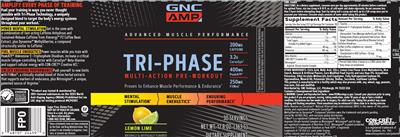
- Form
- Powder
- Serving Size
- 12.1 g
- Servings
- 30 per container
- Container Holds
- 12.8 Ounces; 363 g
What’s in it, whether it interacts with your drugs, its side effects, whether it works, and what our pharmacists would want you to know before you start it.
- What is Tri-Phase Lemon Lime?A supplement from GNC AMP Advanced Muscle Performance with eleven active ingredients, in powder form.
- Active Ingredients 2 minerals, 1 plant ingredient, 1 amino acid and 7 others: Sodium 40 mgPotassium 100 mgBeta-Alanine 3.2 gCon-Cret 2 gNitrosigine 1.5 gL-Taurine 1 gAdenosine 5'-Triphosphate Disodium 400 mgFitNox 250 mgCaffeine Anhydrous 150 mgCoffee Bean Extract 83 mgMethylliberine 75 mg Eleven active ingredients. Each one can interact with drugs or cause side effects on its own, so we check every one. The full Supplement Facts
- Drug Interactions 1,347 drugs have a documented interaction with this supplement; the most serious is rated major. Of those, 889 are single drugs and 458 are combination products (two or more drugs in one), each listed under its own name. Based on the 8 of its 11 ingredients we could check. Ask your pharmacist first if you take a drug in any of these categories, the most serious of the 71 on record:
- EphedrineMajor · 8 drugs
- Dipyridamole (Persantine)Major · 2 drugs
- Moderate · 645 drugs
- Moderate · 202 drugs
- Possible Side EffectsGas 3 ingredientsStomach upset 3 ingredientsDiarrhea 2 ingredientsFlushing 2 ingredientsNausea 2 ingredientsTrouble sleeping 2 ingredients +22 moreReported for nine of its eleven active ingredients. Not studied in this exact product.
- Well documented Why
Does Tri-Phase Lemon Lime work?
What It Is Marketed For
Workout performance and mental stimulation
From the claims on the product’s label.
The Closest Use the Research Grades
Caffeine
Good studies support it.
Its ingredients have research behind other uses too:
- Mental alertness Caffeine
- Potassium
- Potassium
- Beta-alanine
- Hepatitis Taurine
- Physical performance Beta-alanine
These grades are for each ingredient, not this exact product, and never a promise it will work for you.
And 5 more graded uses, in what the research says- Full Why
- AllergensIts ingredient list names soy
- Barcode (UPC)0 48107 24459 0Match it to the barcode on your bottle to be sure this is your product. Not your product? Search for it here
Who Might Consider It
- People looking for workout performance and mental stimulation, which is what it is marketed for. The closest use the research grades is athletic performance, rated Likely Effective.
- People who want it for mental alertness, hypertension, kidney stones (nephrolithiasis), athletic performance or another graded use: the other uses with research behind them. See each grade
- This powder may suit adults who are looking for a caffeine-based pre-workout and who have no relevant medical conditions or medications.
Who Should Be Careful
- Anyone with heart or kidney problems, high blood pressure, a seizure disorder, or who takes any of the medications above should be careful.
- Talk it over with your own doctor or pharmacist before starting, especially if you are pregnant, breastfeeding, or planning surgery.
More Before You Take It Show both answersHide Pregnancy and Breastfeeding The Label’s Directions
-
Pregnant or breastfeeding?
- Pregnancy and Breastfeeding Sodium
- ! When used orally in higher doses.
- Pregnancy Moringa
- ! When the root, bark, or flower are used orally.
- Breastfeeding Moringa
- When moringa leaf is used orally, short-term.
- Pregnancy Caffeine
- ! When used orally in amounts over 300 mg daily.
- Breastfeeding Caffeine
- ! When used orally in large amounts.
-
How does the label say to take it?
“Directions: As a dietary supplement, consume once per day approximately 30 minutes before a workout. For optimal flavor, mix one scoop in 8-10 fl. oz. of cold water and shake vigorously. …”
The maker’s words. Your pharmacist or doctor may advise differently.
Everything the label says
From the label dated Dec 21, 2024: 8 of its 11 active ingredients were checked against our records; the other three are not in them yet. A summary of what is known, not a grade or a test of the product. How these ratings are computed
Ask Anything About This Supplement
Name a drug you take, or ask about side effects, ingredients or pregnancy.
AI answers come from this label and our own records, never the open internet. AI can make mistakes, so always check with your doctor or pharmacist. How we use AI
Ask the Pharmacist
A licensed pharmacist will answer your question by email — free, usually within 24 hours.
Got it — thank you!
A licensed pharmacist will answer within 24 hours. Keep an eye on your email (worth checking spam, just in case).
What’s Inside Tri-Phase Lemon Lime by GNC AMP Advanced Muscle Performance
Eleven Active Ingredients, Each Checked on Its Own
A supplement is often several ingredients in one bottle, and each one can interact with drugs or cause side effects on its own. We check every one of them against our records.
- SodiumDrug interactions on record, most serious: Moderate
- PotassiumDrug interactions on record, most serious: Moderate
- Beta-AlanineNo drug interactions on record
- Con-CretNot in our interaction records yet
- NitrosigineNot in our interaction records yet
- L-TaurineDrug interactions on record, most serious: Moderate
- Adenosine 5'-Triphosphate DisodiumDrug interactions on record, most serious: Major
- FitNoxNot in our interaction records yet
And 3 more, each with its own card below.
Why this rating?
The label gives an exact amount for every one of its eleven active ingredients, so you know how much of each you get in each serving. This rates what the label tells you, not the quality of the product.
Supplement Facts
| Amount Per Serving | % Daily Value | |
|---|---|---|
| Calories | 10 Calories | † |
| Total Carbohydrates | 2 g | 1% |
| Total Sugars | † | |
| Added Sugars | † | |
| Sodium | 40 mg | 2% |
| Potassium | 100 mg | 2% |
| Beta-Alanine | 3.2 g | † |
| Con-Cret | 2 g | † |
| Nitrosigine | 1.5 g | † |
| L-Taurine | 1 g | † |
| Adenosine 5'-Triphosphate Disodium | 400 mg | † |
| FitNox | 250 mg | † |
| Horseradish Tree Leaf Extract | † | |
| Pomegranate peel extract | † | |
| Black Ginger Rhizome Extract | † | |
| Caffeine Anhydrous | 150 mg | † |
| Coffee Bean Extract | 83 mg | † |
| Caffeine | 50 mg | † |
| Methylliberine | 75 mg | † |
Other ingredients: Citric Acid, Malic Acid, Silica, Corn Maltodextrin, Rice Starch, Natural & Artificial Flavors, Corn Starch, Modified, Acesulfame Potassium, Ethyl Acrylate-Methacrylic Acid Polymer, Soybean Oil, Hydrogenated, Hypromellose, Mineral Oil, Potassium Silicate, Shellac, Sucralose, Sunflower Lecithin
† Daily Value not established.
Daily Values for adults and children 4 or more years of age.
As the label prints it, from the NIH Dietary Supplement Label Database.
Each Ingredient and Its Drug Interactions
Tap one for more about it and its full guide. A drug can interact with this supplement through any one of them.
This powder contains 13 active ingredients, including sodium and potassium (electrolyte minerals), caffeine anhydrous and caffeine (stimulants), beta-alanine, L-taurine, adenosine 5'-triphosphate disodium, pomegranate peel extract, horseradish tree leaf extract (moringa), and black ginger rhizome extract.
- Several others, including Nitrosigine, Con-Cret, Methylliberine, FitNox, and Coffee Bean Extract, are listed as ingredients, but we do not hold full data on them.
- These are non-active additives that help make and flavor the powder.
-
Sodium 40 mg Interacts with 205 drugs
Sodium is an essential mineral and electrolyte your body needs to balance fluids, support nerves, and help muscles work.
- Most people in modern diets get more than enough—often too much—from food, so supplements are rarely needed except for specific medical reasons like dehydration or low blood sodium.
- Talk to your doctor or pharmacist before deliberately adding sodium, especially if you have high blood pressure, heart, or kidney problems.
The full Sodium guide: uses, dosage and safety Every Sodium drug interaction
-
Potassium 100 mg Interacts with 62 drugs
Potassium is an essential mineral your body needs for nerve signals, muscle function, and a steady heartbeat, and most people get enough from a balanced diet rich in fruits and vegetables.
- Potassium supplements can help when blood levels are truly low, but too much potassium can be dangerous, especially for people with kidney problems.
- Always talk with your pharmacist or doctor before taking a potassium supplement.
The full Potassium guide: uses, dosage and safety Every Potassium drug interaction
-
Beta-Alanine 3.2 g No known drug interactions
Beta-alanine is an amino acid taken mostly by athletes to raise muscle carnosine, which may help buffer acid and reduce fatigue during short, high-intensity exercise.
- The evidence is moderate for performance in certain activities, but harmless tingling of the skin is common, and it is not well studied for pregnancy or any medical condition.
-
Con-Cret 2 g We know this ingredient, but hold no drug interaction record for it yet, so it was not checked
Form on the label: Creatine Hydrochloride
-
Nitrosigine 1.5 g We know this ingredient, but hold no drug interaction record for it yet, so it was not checked
-
L-Taurine 1 g Interacts with 173 drugs
Taurine is an amino acid your body makes naturally and that you also get from animal foods.
- It is widely used in energy drinks and sports supplements, and short-term use appears generally safe for most adults, though the evidence for many claimed benefits is mixed or limited.
- Talk with your pharmacist or doctor before taking it regularly, especially if you have a health condition or take medications.
The full Taurine guide: uses, dosage and safety Every Taurine drug interaction
-
Adenosine 5'-Triphosphate Disodium 400 mg Interacts with 47 drugs
Adenosine is a natural building block your body uses for energy and cell signaling, and a prescription injectable version is used by doctors to treat certain fast heart rhythms.
- As an over-the-counter supplement (often sold as AMP or ATP), there is little strong evidence that swallowing it boosts energy or performance, and quality can vary.
- Talk to your pharmacist before using adenosine supplements, especially if you have a heart condition.
The full Adenosine guide: uses, dosage and safety Every Adenosine drug interaction
-
FitNox 250 mg Three ingredients inside it, each checked on its own
- Horseradish Tree Leaf Extract 870 drugs
- Pomegranate peel extract 924 drugs
- Black Ginger Rhizome Extract 1,008 drugs
-
Caffeine Anhydrous 150 mg Interacts with 655 drugs
Caffeine is a natural stimulant found in coffee, tea, and many other plants and products.
- In moderate amounts it can boost alertness and reduce tiredness for most healthy adults, but too much can cause jitteriness, a racing heart, and sleep problems.
- Pregnant women and people with heart conditions or anxiety should be especially careful and check with a doctor or pharmacist.
The full Caffeine guide: uses, dosage and safety Every Caffeine drug interaction
-
Coffee Bean Extract 83 mg Interacts with 591 drugs
Form on the label: Coffea canephora var. robusta bean Extract
Coffee is a widely consumed beverage made from roasted coffee beans, valued mainly for its caffeine, which boosts alertness and energy.
- For most healthy adults, moderate coffee intake is generally safe and may have some health benefits, but too much can cause jitteriness, poor sleep, and a faster heartbeat.
- People who are pregnant, breastfeeding, or sensitive to caffeine should limit their intake and check with a doctor or pharmacist.
The full Coffee guide: uses, dosage and safety Every Coffee drug interaction
- Caffeine 50 mg 655 drugs
-
Methylliberine 75 mg We know this ingredient, but hold no drug interaction record for it yet, so it was not checked
Other Ingredients (Inactive)
The capsule or tablet itself, fillers, coatings and flavors. Not part of the drug interaction check; the allergen check below reads them.
- Citric Acid
- Malic Acid
- Silica
- Corn Maltodextrin
- Rice Starch
- Natural & Artificial Flavors
- Corn Starch, Modified
- Acesulfame Potassium
- Ethyl Acrylate-Methacrylic Acid Polymer
- Soybean Oil, Hydrogenated
- Hypromellose
- Mineral Oil
- Potassium Silicate
- Shellac
- Sucralose
- Sunflower Lecithin
Allergens in Tri-Phase Lemon Lime
Its ingredient list names soy.
Named on this label
- SoyIn the ingredients: Soybean Oil, Hydrogenated
Not named in the ingredients
- Milk
- Egg
- Fish
- Shellfish
- Tree nuts
- Peanuts
- Wheat or other gluten grains
- Sesame
- The label’s allergen statement“This product is manufactured in a facility which may also process milk, soy, wheat, egg, peanuts, tree nuts, fish and shellfish. · Contains a bioengineered food ingredient.”
- Made without, the label says“Sugar free, gluten free. · Gf Gluten free”
From the label text and ingredient names on file; we do not test products. With a serious allergy, check your bottle and ask the maker or your pharmacist.
What the Label Says
The maker’s own words, from the label. We do not verify or endorse them.
- Formulation
-
“Amplify every phase of training Fuel your training in ways you never thought possible with Tri-Phase Technology, a uniquely designed blend to target the body's energy systems throughout your workout.”
“Product was tested & monitored for 285+ banned substances on the 2023 World Anti-Doping Agency (WADA) Prohibited List via LGC skip lot testing protocol #ICP0307.”
4 more from the label
“Sugar free, gluten free. Gf Gluten free”
“Multi-Action Pre-Workout Proven to enhance muscle performance & endurance Mental stimulation Muscle energetics Enduring performance”
“Power Mental Stimulation Get in the zone with a combination of fast-acting caffeine anhydrous and sustained-release caffeine from Xtenergy P2 Coffee Bean Extract, plus Dynamine Methylliberine, a compound structurally similar to caffeine. Fuel Muscle Energetics Power muscles while you train with Peak ATP Adenosine 5'-Triphosphate Disodium, increase a critical muscle fatigue-controlling factor with CarnoSyn Beta-Alanine and support cellular energy with CON-CRET Creatine HCI. Unlock Enduring Performance Push yourself to new limits with FitNox, a clinically studied blend of three herbal extracts that supports markers of endurance, plus Nitrosigine, a unique, patented source of Arginine.”
“200mg Caffeine 3.2g CarnoSyn 400mg PeakATP 250mg FitNox Lemon Lime Naturally & Artificially Flavored”
- Seals and symbols
-
“Informed Choice We Test - You Trust Regularly Tested for Banned Substances”
- Storage
-
“Store in a cool, dry place.”
- General statements
-
“FPO For more information: 1-888-462-2548”
- FDA Statement of Identity
-
“Dietary Supplement”
- Directions
-
“Directions: As a dietary supplement, consume once per day approximately 30 minutes before a workout. For optimal flavor, mix one scoop in 8-10 fl. oz. of cold water and shake vigorously. Do not consume less than 3 hours before attempting sleep. Start by taking half a scoop and work up to a full scoop once you've assessed your tolerance. Consume ample amounts of water while taking this product.”
- Brand IP Statement(s)
-
“Beta-Alanine as CarnoSyn. Natural Alternatives International (NAI) is the owner of the patent estate and registered trademark CarnoSyn. Methylliberine as Dynamine. Compound Solutions owns the trademark and patents pending (serial No. 61/903,362), with exclusive global distribution. FitNox is a registered trademark of Aurea Biolabs Pvt. Ltd. Arginine Silicate Inositol Complex as Nitrosigine. Nitrosigine and its logo are registered trademarks of Nutrition 21 LLC. Nitrosigine is patent protected. Adenosine 5'-Triphosphate Disodium as PEAK ATP, a registered trademark of TSI USA LLC used under license. Coffea robusta seed extract as Xtenergy P2, a trademark of OmniActive Health Technologies LTD.”
“Con-cret Reinforced is a registered trademark of Vireo Systems, Inc. Pat: www.vireosystems.com/patents”
The Tri-Phase Lemon Lime Label on File
The label scan on file at the NIH Dietary Supplement Label Database, dated December 2024. Always read the label on the bottle you have.
Product Facts
- Barcode (UPC)
- 048107244590
- Net contents
- 12.8 Ounces; 363 g
- Market status
- On market
- Date entered into DSLD
- Dec 21, 2024
- DSLD ID
- 319386
- Product type
- Other Combinations
- Supplement form
- Powder
- Dietary claims / uses
- Nutrient, All Other, Structure/Function
- Intended target group(s)
- Adult (18 - 50 Years), Gluten Free, Sugar Free
Is this label outdated? Report a formula or label change and our pharmacy team will review it.
Tri-Phase Lemon Lime by GNC AMP Advanced Muscle Performance Side Effects
Why this rating?
We look for three kinds of safety information on each ingredient: side effects reported in studies, a pregnancy and breastfeeding rating, and a safety write-up from our pharmacy team. All three are on file for each of the ten ingredients we could check.
So this rates how much is known, not whether Tri-Phase Lemon Lime is right for you.
Reported with ten of its ingredients
- Most often
- Gas, stomach upset, diarrhea, flushing, nausea and trouble sleeping
- !Rare but serious
- Worsened cardiovascular disease, high blood pressure and hypersensitivity reactions in sensitive individuals See details
HelloPharmacist Team Summary of Side Effects
Most people tolerate the ingredients in this product reasonably well, but you are most likely to notice the tingling and flushing from beta-alanine, jitteriness, racing heartbeat, or trouble sleeping from the caffeine, and stomach upset from the potassium and taurine.
- Rarely, a large sudden intake of sodium or very high potassium can be serious, so if you have chest pain, an irregular heartbeat, or severe weakness, call your doctor right away.
- If you have heart disease, high blood pressure, kidney disease, or are pregnant, talk with your doctor or pharmacist before starting this product.
Side Effects, Ingredient by Ingredient
A supplement’s side effects come from its ingredients. Here is what is reported with each one.
Potassium
Most reported
- Stomach upset
- Nausea
- Vomiting
- Gas
Beta-alanine
Most reported
- Flushing
- Prickling sensation
- Neck
- Scalp
Taurine
Most reported
- Stomach upset
- Nausea
- Headache
Adenosine
Most reported
- Flushing
- Chest discomfort or pressure
- Shortness of breath
- Lightheadedness
Moringa
Most reported
- Transient diarrhea
From the Natural Medicines database, which we license.
Every reported effect, in the Moringa guidePomegranate
Most reported
- Diarrhea
- Flatulence
From the Natural Medicines database, which we license.
Every reported effect, in the Pomegranate guideGinger
Most reported
- Heartburn
- Stomach discomfort
- Gas
- Burping
Caffeine
Most reported
- Feeling jittery, nervous, or anxious
- Racing or pounding heartbeat
- Trouble sleeping
- Upset stomach or heartburn
Coffee
Most reported
- Jitteriness
- Nervousness
- Fast or pounding heartbeat
- Trouble sleeping
Sodium has side-effect reports on file, but no list of the most common ones. Read them in the Sodium guide
Tri-Phase Lemon Lime Warnings: Who Should Be Careful
Tri-Phase Lemon Lime has eleven active ingredients, and each can carry warnings of its own. We checked the seven in our ingredient guides, and each warning below names the ingredient it comes from. Con-Cret, Nitrosigine and FitNox and one more are not in our guides yet, so ask your pharmacist about them. If any of these apply to you, talk to your doctor or pharmacist before you start it.
- Sodium3 warnings below
- Potassium3 warnings below
- Beta-alanine2 warnings below
- Taurine1 warning below
- Adenosine3 warnings below
- Moringa2 warnings below
- Pomegranate3 warnings below
- Ginger2 warnings below
- Caffeine2 warnings below
- Coffee3 warnings below
- Con-CretNot in our guides yet
- NitrosigineNot in our guides yet
- FitNoxNot in our guides yet
- MethylliberineNot in our guides yet
-
Bleeding Problems or Surgery
- MoringaIf you have a medical condition, take prescription medicines, or are planning surgery, talk with your pharmacist or doctor before using moringa.
- GingerUse extra caution if you have a bleeding disorder or are scheduled for surgery, since ginger may slightly affect blood clotting.
-
Blood Pressure
- SodiumYou should be especially cautious with added sodium if you have high blood pressure, heart failure, kidney disease, or liver disease, or if your doctor has told you to follow a low-salt diet.
- PotassiumPeople who should be especially careful or avoid potassium supplements unless a doctor directs them include those with kidney disease, people taking certain blood pressure or heart medicines that raise potassium, and those with conditions affecting adrenal or hormone function.
- AdenosinePeople with heart conditions, including abnormal heart rhythms, low blood pressure, or a history of heart disease, should be especially careful and speak with a doctor first, since adenosine can affect the heart and blood vessels.
- CaffeineBe cautious if you: have heart problems, high blood pressure, an irregular heartbeat, anxiety, panic attacks, trouble sleeping, stomach ulcers, or seizure disorders.
- CoffeeBe cautious if you have heart problems, high blood pressure, anxiety disorders, acid reflux, or trouble sleeping.
-
Kidney Disease or Kidney Stones
- Beta-alaninePeople with kidney problems or other chronic health conditions should talk to a doctor or pharmacist before using it, since long-term safety and effects in these groups are not well studied.
- TaurinePeople with kidney problems, heart conditions, or other health issues should check with a doctor first, since their bodies may handle taurine differently.
- PotassiumPotassium is generally well tolerated from food, but supplements can cause dangerously high blood potassium, especially in people with kidney disease.
-
Gallbladder Problems
- GingerPeople with gallstones should also check with a doctor, because ginger can increase the flow of bile.
-
Allergies
- PomegranatePeople with allergies to pomegranate should avoid it.
-
Children
- Beta-alanineChildren and teens have not been well studied either.
- CaffeineChildren and teens should limit caffeine.
- CoffeeChildren and teens should also limit caffeine.
-
Older Adults
- CoffeeOlder adults and people taking certain medications should also be careful.
-
If You Take Other Drugs
- PomegranateIf you have a chronic health condition or take prescription medications, talk with your pharmacist or doctor before using pomegranate supplements.
-
Other Cautions
- PotassiumSupplements are different and require more caution, because they can raise blood potassium quickly.
- AdenosineStill, because high-quality safety studies of supplements are lacking, caution is wise.
- AdenosinePeople with asthma or breathing problems should also use caution.
- PomegranateThese parts should not be used in concentrated forms without professional guidance.
-
What the Label Warns
- “Keep out of reach of children.”
- “This product is manufactured in a facility which may also process milk, soy, wheat, egg, peanuts, tree nuts, fish and shellfish. Contains a bioengineered food ingredient.”
- “Warning: Cancer and Reproductive Harm - www.P65Warnings.ca.gov. Discontinue use two weeks prior to surgery. Taking this product may cause tingling and flushing sensations. These sensations may be enhanced if taken close to or during exercise.”
- “Consult your physician prior to using this product if you are pregnant, nursing, taking medication, under 18 years of age or have a medical condition.”
- “Consult your physician prior to using this product if you are pregnant, nursing, taking medication, under 18 years of age or have a medical condition. For adult use only.”
The maker’s wording, from the product label.
-
Pregnant or Breastfeeding
Each ingredient’s rating for pregnancy and for breastfeeding, and what it covers.
Pregnancy and Breastfeeding The record rates both the same
-
When used orally and appropriately.
Sodium is safe in amounts that do not exceed the CDRR intake level of 2.3 grams daily.
-
When used orally in higher doses.
Higher intake can cause hypertension.
Also, both the highest and the lowest pre-pregnancy sodium quintile intakes are associated with an increased risk of hypertensive disorders of pregnancy, including gestational hypertension and pre-eclampsia, and the delivery of small for gestational age (SGA) infants when compared to the middle intake quintile.
Pregnancy
-
When the leaf is used orally during the second or third trimesters, short-term.
Moringa leaf powder or extract 500 mg daily for up to 4 months has been used with apparent safety during the second and third trimesters.
There is insufficient reliable information available about the safety of using moringa leaf by mouth during the first trimester.
-
When the root, bark, or flower are used orally.
Traditionally, moringa root bark and gum from moringa trunk bark have been used to induce abortion.
3 more points on this rating
- When taken orally along with black peppercorns to induce abortion, moringa root bark may cause fatality.
- Animal research shows that moringa flower can cause uterine contractions; however, this has not been assessed in humans.
- There is insufficient reliable information about the safety of using moringa seed during pregnancy; avoid using.
Breastfeeding
-
When moringa leaf is used orally, short-term.
Moringa leaf powder or extract 2 grams daily has been used during lactation with apparent safety for up to 4 months.
There is insufficient reliable information available about the safety of using other parts of moringa during lactation; avoid using.
Show 8 more ingredients
Pregnancy
-
When used orally in amounts commonly found in foods.
Intakes of caffeine should be monitored during pregnancy.
10 more points on this rating
- Caffeine crosses the human placenta, but is not considered a teratogen.
- Fetal blood and tissue levels are similar to maternal concentrations.
- The use of caffeine during pregnancy is controversial; however, moderate consumption has not been associated with clinically important adverse fetal effects.
- In some studies consuming amounts over 200 mg daily is associated with a significantly increased risk of miscarriage.
- This increased risk seems to occur in those with genotypes that confer a slow rate of caffeine metabolism.
- According to a review by Health Canada, and a subsequent large meta-analysis conducted in the US, up to 300 mg daily can be consumed during pregnancy without an increased risk of spontaneous abortion, stillbirth, preterm birth, fetal growth retardation, or congenital malformations.
- However, observational research in a Norwegian cohort found that caffeine consumption is associated with a 16% increased odds of the baby being born small for gestational age when compared with no consumption.
- The same Norwegian cohort found that low to moderate caffeine consumption during pregnancy is not associated with changes in neurodevelopment in children up to 8 years of age.
- Advise patients to keep caffeine consumption below 300 mg daily during pregnancy.
- This is similar to the amount of caffeine in about 3 cups of coffee or tea.
-
When used orally in amounts over 300 mg daily.
Caffeine crosses the placenta, producing fetal blood concentrations similar to maternal levels.
8 more points on this rating
- Consumption of caffeine in amounts over 300 mg daily is associated with a significantly increased risk of miscarriage in some studies.
- Advise patients to keep caffeine consumption below 300 mg daily during pregnancy.
- This is similar to the amount of caffeine in about 3 cups of coffee or tea.
- Additionally, high doses of caffeine throughout pregnancy have resulted in symptoms of caffeine withdrawal in newborn infants.
- High doses of caffeine have also been associated with spontaneous abortion, premature delivery, and low birth weight.
- In a cohort of mother/infant pairs with a median maternal plasma caffeine level of 168.5 ng/mL (range 29.5-650.5 ng/mL) during pregnancy, birth weights and lengths were lower in the 4th quartile of caffeine intake compared with the 1st.
- By age 7, heights and weights were lower by 1.5 cm and 1.1 kg respectively.
- In another cohort of mother/infant pairs with higher maternal pregnancy plasma caffeine levels, median 625.5 ng/mL (range 86.2 to 1994.7 ng/mL), heights at age 8 were 2.2 cm lower, but there was no difference in weights.
Breastfeeding
-
When used orally in amounts commonly found in foods.
Caffeine intake should be closely monitored while breast-feeding.
During lactation, breast milk concentrations of caffeine are thought to be approximately 50% of serum concentrations and caffeine peaks in breastmilk approximately 1-2 hours after consumption.
-
When used orally in large amounts.
Caffeine is excreted slowly in infants and may accumulate.
Caffeine can cause sleep disturbances, irritability, and increased bowel activity in breast-fed infants exposed to caffeine.
Pregnancy
-
When used orally in moderate amounts.
Intake of caffeine from coffee and other sources should be monitored during pregnancy.
12 more points on this rating
- Caffeine crosses the human placenta, but is not considered a teratogen.
- Fetal blood and tissue levels are similar to maternal concentrations.
- The use of caffeine during pregnancy is controversial; however, moderate consumption has not been associated with clinically important adverse fetal effects.
- However, some research has also found that intrauterine exposure to even modest amounts of caffeine, based on maternal blood levels during the first trimester, is associated with a shorter stature in children ages 4-8 years.
- In some studies, consuming amounts over 200 mg daily has been associated with a significantly increased risk of miscarriage.
- This increased risk may be most likely to occur in people with genotypes that confer a slow rate of caffeine metabolism.
- According to a review by Health Canada, and a subsequent large meta-analysis conducted in the US, most healthy pregnant patients can safely consume caffeine in doses up to 300 mg daily without an increased risk of spontaneous abortion, stillbirth, preterm birth, fetal growth retardation, or congenital malformations.
- Advise patients to keep caffeine consumption below 300 mg daily during pregnancy.
- This is similar to the amount of caffeine in about 3 cups of coffee.
- Keep in mind that only the amount of ADDED caffeine must be stated on product labels.
- The amount of caffeine found in ingredients such as coffee, which naturally contains caffeine, does not need to be provided.
- This can make it difficult to determine the total amount of caffeine in a given product.
-
When caffeinated coffee providing more than 300 mg of caffeine daily is consumed orally.
Caffeine from coffee crosses the placenta, producing fetal blood concentrations similar to maternal levels.
7 more points on this rating
- Consumption of caffeine in amounts over 300 mg daily is associated with a significantly increased risk of miscarriage in some studies.
- Advise patients to keep caffeine consumption from all sources below 300 mg daily during pregnancy.
- This is similar to the amount of caffeine in about 3 cups of coffee.
- High doses of caffeine throughout pregnancy have resulted in symptoms of caffeine withdrawal in newborn infants.
- High doses of caffeine have also been associated with spontaneous abortion, premature delivery, and low birth weight.
- Drinking more than 6 cups of coffee daily increases the risk of spontaneous abortion.
- Drinking 8 or more cups of coffee daily doubles the risk of stillbirth when compared with those who do not drink coffee during pregnancy.
Breastfeeding
-
When used orally.
Drinking one or two caffeine-containing beverages daily during lactation is not associated with unacceptable levels of caffeine in human milk.
-
When used orally in large amounts.
Caffeine from coffee can cause wakefulness or irritability in breast-fed infants.
Caffeine can also cause feeding intolerance and gastrointestinal irritation in infants.
Pregnancy and Breastfeeding The record rates both the same
-
Insufficient reliable information available; avoid using in medicinal amounts.
Pregnancy and Breastfeeding The record rates both the same
-
Insufficient reliable information available; avoid using.
Pregnancy and Breastfeeding The record rates both the same
-
When used orally in dietary amounts of 40-80 mEq daily.
A tolerable upper intake level (UL) has not been established for healthy individuals.
Pregnancy and Breastfeeding The record rates both the same
-
When used in amounts found in foods.
There is insufficient reliable information available about the safety of taurine when used in medicinal amounts during pregnancy and lactation; avoid using.
Pregnancy and Breastfeeding The record rates both the same
-
When the fruit or fruit juice is consumed orally and appropriately.
There is insufficient reliable information available regarding the safety of using other forms of pomegranate or other parts of the plant during pregnancy or lactation; avoid using.
Pregnancy
-
When consumed in the amounts typically found in foods.
Ginger is considered a first-line nonpharmacological treatment option for nausea in pregnancy by the American College of Obstetrics and Gynecology (ACOG).
However, it should not be used long-term or without medical supervision and close monitoring.
-
When used for medicinal purposes.
Despite some early reports of adverse effects and one observational study suggesting that taking dried ginger and other herbal supplements during the first 20 weeks of pregnancy marginally increased the chance of stillbirth, most research shows that ginger is unlikely to cause harm to the baby.
3 more points on this rating
- The risk for major malformations in infants of parents who took ginger when pregnant does not appear to be higher than the baseline rate of 1% to 3%.
- Also, other research suggests that ginger intake during various trimesters does not significantly affect the risk of spontaneous abortion, congenital malformations, stillbirth, perinatal death, preterm birth, low birth weight, or low Apgar scores.
- Ginger use has been associated with an increase in non-severe vaginal bleeding, including spotting, after week 17 of pregnancy.
Breastfeeding
-
When consumed in the amounts typically found in foods.
There is insufficient reliable information available about the safety of ginger when used for medicinal purposes; avoid amounts greater than those found in foods.
Our pharmacy team’s notes
- MoringaMoringa is rated Possibly Unsafe in pregnancy, and its safety data advises against medicinal amounts.
- Sodium and caffeine each have a Possibly Unsafe rating, which means they are best avoided in pregnancy.
- Potassium, taurine, and ginger carry Likely Safe pregnancy ratings, but potassium supplements should be used only under medical guidance.
Ratings and the words beside them are from the Natural Medicines database, which we license.
-
Rare but Serious Side Effects
-
!
Sodium
Rarely, a sudden large intake of salt—or a rapid change in blood sodium during treatment—can be very serious and even life-threatening.
Sodium is generally well tolerated in moderation, but very high intakes are linked to high blood pressure and heart strain, and rare, serious effects include worsened cardiovascular or kidney disease.
Orally: Worsened cardiovascular disease, hypertension, kidney disease.
-
!
Potassium
The most serious risk is high blood potassium (hyperkalemia).
High potassium levels can cause arrhythmia, heart block, hypotension, and mental confusion.
-
!
Beta-alanine
Serious side effects have not been clearly reported in healthy users, but long-term, high-dose use has not been thoroughly studied.
-
!
Taurine
Serious side effects are uncommon with taurine alone.
Orally: Hypersensitivity reactions in sensitive individuals. Case reports raise concerns for serious cardiovascular adverse effects, but these reports have involved energy drinks containing taurine and other ingredients. It is unclear if these adverse effects are due to taurine, other ingredients, or the combination.
-
!
Moringa
Orally: Allergic reactions, including anaphylaxis, have been reported.
-
!
Pomegranate
Allergic reactions are uncommon but can happen and may include itching, swelling, hives, or trouble breathing.
-
!
Ginger
Rarely, some people may have an allergic reaction.
-
!
Caffeine
Serious effects are rare but can happen with very high doses.
Caffeine is typically well tolerated in moderate amounts, and high doses can cause serious effects.
Orally: Stroke has been reported rarely.
-
!
Coffee
Very high doses of caffeine, especially from concentrated supplements or energy products, can cause more serious problems such as a very rapid or irregular heartbeat, vomiting, and in rare cases dangerous reactions.
When to get help: a serious allergic reaction, with trouble breathing or swelling of the face, lips or throat, needs emergency care: call 911. For any other side effect that worries you, call your doctor or pharmacist.
These reports describe each ingredient, not studies of this exact product. Not medical advice: a side effect you notice after starting a supplement is worth a word with your pharmacist or doctor.
Tri-Phase Lemon Lime by GNC AMP Advanced Muscle Performance Drug Interactions
We checked all eleven active ingredients in this supplement against every drug in our records. A drug can interact with it through any one of them. Four of them are not in our interaction records yet.
A major interaction on record
3 of 3, on a scale from Minor or none to Major.Why this rating?
We rate this by the most serious interaction on record, not by how many there are. For Pomegranate, Potassium, Ginger, Caffeine and Coffee, the most serious is rated major, which means the combination is best avoided, or used only under close supervision. Some involve kinds of drugs where a small change can matter, such as blood thinners, transplant drugs and diabetes drugs.
1,348 drugs are on the full list. What matters is whether one you take is on it, so check yours with the interaction checker on this page.
Six of its eleven active ingredients have drug interactions on record: Sodium, Potassium, Taurine, Adenosine, Caffeine and Coffee.
- Interacts with
- 62 drugs
- Most serious
- Moderate
- Moderate ratings cover blood pressure medicines (antihypertensives, ACE inhibitors, ARBs, nifedipine, and losartan), potassium-sparing diuretics, lithium, warfarin, phenprocoumon, rosuvastatin, levothyroxine, clozapine, and several seizure and sedative drugs (carbamazepine, phenobarbital, pentobarbital).
- Interacts with
- 47 drugs
- Most serious
- Major
- Adenosine also carries a Major rating with dipyridamole, a clot-preventing drug, which can intensify adenosine's effects, including dizziness and a slow heartbeat.
- Interacts with
- 655 drugs
- Most serious
- Major
- The most serious rating is Major, for caffeine combined with ephedrine, which can increase the risk of serious, potentially life-threatening effects such as high blood pressure.
Show three more ingredients
- Interacts with
- 591 drugs
- Most serious
- Major
- Most of its records involve Stimulant Drugs, Anticoagulant/Antiplatelet Drugs and Antidiabetes Drugs.
- Interacts with
- 205 drugs
- Most serious
- Moderate
- Most of its records involve Antihypertensive Drugs, Corticosteroids and Sodium-containing Drugs.
- Interacts with
- 173 drugs
- Most serious
- Moderate
- Most of its records involve Antihypertensive Drugs and Lithium.
From the HelloPharmacist Team
What matters most when you look at everything in the bottle at once.
- Tri-Phase Lemon Lime from GNC AMP Advanced Muscle Performance does interact with a number of medications.
- The interactions run through several ingredients: sodium, potassium, caffeine (both caffeine anhydrous and caffeine), L-taurine, adenosine 5'-triphosphate disodium, pomegranate peel extract, horseradish tree leaf extract (moringa), and black ginger rhizome extract.
- Blood thinners (anticoagulants and antiplatelets) and diabetes medicines are also Moderate, though moringa's diabetes rating is Minor.
Summarized by the HelloPharmacist pharmacy team from the interaction records below. How it is written How we use AI
Why Tri-Phase Lemon Lime Interacts, Ingredient by Ingredient
A product interacts through its ingredients. Each card: how many drugs, the most serious rating, and the kinds of drugs it affects most (tap a kind for what it means).
The ingredients driving the most interactions
-
Caffeine Anhydrous 655 drugs
Most serious: Major41 interaction records on file
The kinds of drugs it affects most
- 172 drugs
- 122 drugs
- 90 drugs
- 86 drugs
Every Caffeine drug interaction, 41 records The Caffeine records cite 235 references, listed in the Caffeine guide.
-
Coffee Bean Extract 591 drugs
Most serious: Major33 interaction records on file
The kinds of drugs it affects most
- 172 drugs
- 122 drugs
- 86 drugs
- 75 drugs
Every Coffee drug interaction, 33 records The Coffee records cite 174 references, listed in the Coffee guide.
-
Sodium 205 drugs
Most serious: Moderate7 interaction records on file
The kinds of drugs it affects most
- 172 drugs
- 23 drugs
- Sodium-containing Drugs 7 drugs
- Sodium Phosphates 2 drugs
Every Sodium drug interaction, 7 records The Sodium records cite 43 references, listed in the Sodium guide.
-
L-Taurine 173 drugs
Most serious: Moderate2 interaction records on file
The kinds of drugs it affects most
- 172 drugs
- 1 drug
Every Taurine drug interaction, 2 records The Taurine records cite 21 references, listed in the Taurine guide.
-
Potassium 62 drugs
Most serious: Moderate3 interaction records on file
The kinds of drugs it affects most
- 23 drugs
- 23 drugs
- 17 drugs
Every Potassium drug interaction, 3 records The Potassium records cite 12 references, listed in the Potassium guide.
-
Adenosine 5'-Triphosphate Disodium 47 drugs
Most serious: Major3 interaction records on file
The kinds of drugs it affects most
- Methylxanthines 44 drugs
- Dipyridamole (Persantine) 2 drugs
- Carbamazepine (Tegretol) 1 drug
Every Adenosine drug interaction, 3 records The Adenosine records cite 10 references, listed in the Adenosine guide.
The Breakdown by Severity
Each drug counted once, at its most serious rating. Tap a tile to list those drugs.
Find Your Drug
Type a drug or brand name to see whether it is on the list.
- Only drugs with a documented interaction are listed, the most serious first.
- A drug with no known interaction is not listed, but searching its name tells you so.
- Open a drug to see which ingredient is responsible. Of those, 889 are single drugs and 458 are combination products (two or more drugs in one), each listed under its own name.
-
DipyridamoleDipyridamole, Persantin, Persantin Injection, Persantin Retard, Persantine Major
The 4 ingredients responsible:
-
Adenosine 5'-triphosphate Disodium Major
Dipyridamole can increase the therapeutic and toxic effects of adenosine.
The full Adenosine 5'-triphosphate Disodium + Dipyridamole interaction -
Coffee Bean Extract Moderate Dipyridamole is in the Anticoagulant/Antiplatelet Drugs category.
Theoretically, coffee might decrease the vasodilatory effects of dipyridamole and interfere with its use prior to stress testing.
The full Coffee Bean Extract + Dipyridamole interaction -
Caffeine Moderate Dipyridamole is in the Anticoagulant/Antiplatelet Drugs category.
Theoretically, caffeine might decrease the vasodilatory effects of dipyridamole and interfere with its use prior to stress testing.
The full Caffeine + Dipyridamole interaction -
Black Ginger Rhizome Extract Moderate Dipyridamole is in the Anticoagulant/Antiplatelet Drugs category.
Ginger may have antiplatelet effects and may increase the risk of bleeding if used with anticoagulant or antiplatelet drugs.
The full Black Ginger Rhizome Extract + Dipyridamole interaction
-
-
Aspirin and DipyridamoleAggrenox, Asasantin Retard Major
The 4 ingredients responsible:
-
Adenosine 5'-triphosphate Disodium Major It contains dipyridamole, the drug this record is about.
Dipyridamole can increase the therapeutic and toxic effects of adenosine.
The full Adenosine 5'-triphosphate Disodium + Aspirin and Dipyridamole interaction -
Black Ginger Rhizome Extract Moderate Aspirin and Dipyridamole is in the Anticoagulant/Antiplatelet Drugs category.
Ginger may have antiplatelet effects and may increase the risk of bleeding if used with anticoagulant or antiplatelet drugs.
The full Black Ginger Rhizome Extract + Aspirin and Dipyridamole interaction -
Caffeine Moderate It contains dipyridamole, the drug this record is about. Aspirin and Dipyridamole is in the Anticoagulant/Antiplatelet Drugs category.
Theoretically, caffeine might decrease the vasodilatory effects of dipyridamole and interfere with its use prior to stress testing.
The full Caffeine + Aspirin and Dipyridamole interaction -
Coffee Bean Extract Moderate It contains dipyridamole, the drug this record is about. Aspirin and Dipyridamole is in the Anticoagulant/Antiplatelet Drugs category.
Theoretically, coffee may increase the risk of bleeding if used with anticoagulant or antiplatelet drugs.
The full Coffee Bean Extract + Aspirin and Dipyridamole interaction
-
-
Aminophylline, Amobarbital, and EphedrineAmesec Major
The 3 ingredients responsible:
-
Coffee Bean Extract Major Aminophylline, Amobarbital, and Ephedrine is in these Ephedrine, Stimulant Drugs categories.
Theoretically, concomitant use might increase the risk of stimulant adverse effects.
The full Coffee Bean Extract + Aminophylline, Amobarbital, and Ephedrine interaction -
Caffeine Major Aminophylline, Amobarbital, and Ephedrine is in these Ephedrine, Stimulant Drugs categories.
Theoretically, concomitant use might increase the risk for stimulant adverse effects.
The full Caffeine + Aminophylline, Amobarbital, and Ephedrine interaction -
Adenosine 5'-triphosphate Disodium Minor Aminophylline, Amobarbital, and Ephedrine is in the Methylxanthines category.
Methylxanthines are competitive antagonists of adenosine and can block its pharmacologic effects.
The full Adenosine 5'-triphosphate Disodium + Aminophylline, Amobarbital, and Ephedrine interaction
-
-
Ephedrine, Phenobarbital, and TheophyllineTedral Major
The 3 ingredients responsible:
-
Caffeine Major It contains phenobarbital and ephedrine, the drugs these records are about. Ephedrine, Phenobarbital, and Theophylline is in these Stimulant Drugs, Theophylline categories.
Theoretically, caffeine might reduce the effects of phenobarbital and increase the risk for convulsions.
The full Caffeine + Ephedrine, Phenobarbital, and Theophylline interaction -
Coffee Bean Extract Major It contains ephedrine, the drug this record is about. Ephedrine, Phenobarbital, and Theophylline is in these Stimulant Drugs, Theophylline categories.
Theoretically, concomitant use might increase stimulant adverse effects.
The full Coffee Bean Extract + Ephedrine, Phenobarbital, and Theophylline interaction -
Adenosine 5'-triphosphate Disodium Minor Ephedrine, Phenobarbital, and Theophylline is in the Methylxanthines category.
Methylxanthines are competitive antagonists of adenosine and can block its pharmacologic effects.
The full Adenosine 5'-triphosphate Disodium + Ephedrine, Phenobarbital, and Theophylline interaction
-
-
Ephedrine, Phenobarbital, Potassium Iodide, and TheophyllineMudrane, Quadrinal Major
The 3 ingredients responsible:
-
Caffeine Major It contains phenobarbital and ephedrine, the drugs these records are about. Ephedrine, Phenobarbital, Potassium Iodide, and Theophylline is in these Stimulant Drugs, Theophylline categories.
Theoretically, concomitant use might increase stimulant adverse effects.
The full Caffeine + Ephedrine, Phenobarbital, Potassium Iodide, and Theophylline interaction -
Coffee Bean Extract Major It contains ephedrine, the drug this record is about. Ephedrine, Phenobarbital, Potassium Iodide, and Theophylline is in these Stimulant Drugs, Theophylline categories.
Theoretically, concomitant use might increase stimulant adverse effects.
The full Coffee Bean Extract + Ephedrine, Phenobarbital, Potassium Iodide, and Theophylline interaction -
Adenosine 5'-triphosphate Disodium Minor Ephedrine, Phenobarbital, Potassium Iodide, and Theophylline is in the Methylxanthines category.
Methylxanthines are competitive antagonists of adenosine and can block its pharmacologic effects.
The full Adenosine 5'-triphosphate Disodium + Ephedrine, Phenobarbital, Potassium Iodide, and Theophylline interaction
-
-
Carbetapentane Tannate, Chlorpheniramine Tannate, Ephedrine Tannate, and Phenylephrine TannateQuadratuss, Ry Tuss, Rynatuss, Tri Tannate Plus Major
The 5 ingredients responsible:
-
Caffeine Major Carbetapentane Tannate, Chlorpheniramine Tannate, Ephedrine Tannate, and Phenylephrine Tannate is in these Ephedrine, Stimulant Drugs categories.
Theoretically, concomitant use might increase the risk for stimulant adverse effects.
The full Caffeine + Carbetapentane Tannate, Chlorpheniramine Tannate, Ephedrine Tannate, and Phenylephrine Tannate interaction -
Coffee Bean Extract Major Carbetapentane Tannate, Chlorpheniramine Tannate, Ephedrine Tannate, and Phenylephrine Tannate is in these Stimulant Drugs, Ephedrine categories.
Theoretically, concomitant use might increase stimulant adverse effects.
The full Coffee Bean Extract + Carbetapentane Tannate, Chlorpheniramine Tannate, Ephedrine Tannate, and Phenylephrine Tannate interaction -
Black Ginger Rhizome Extract Moderate Carbetapentane Tannate, Chlorpheniramine Tannate, Ephedrine Tannate, and Phenylephrine Tannate is in the Cytochrome P450 3A4 (CYP3A4) Substrates category.
Ginger might increase or decrease the levels of CYP3A4 substrates.
The full Black Ginger Rhizome Extract + Carbetapentane Tannate, Chlorpheniramine Tannate, Ephedrine Tannate, and Phenylephrine Tannate interaction -
Horseradish Tree Leaf Extract Moderate Carbetapentane Tannate, Chlorpheniramine Tannate, Ephedrine Tannate, and Phenylephrine Tannate is in the Cytochrome P450 3A4 (CYP3A4) Substrates category.
Theoretically, moringa might increase or decrease levels of CYP3A4 substrates.
The full Horseradish Tree Leaf Extract + Carbetapentane Tannate, Chlorpheniramine Tannate, Ephedrine Tannate, and Phenylephrine Tannate interaction -
Pomegranate Peel Extract Minor Carbetapentane Tannate, Chlorpheniramine Tannate, Ephedrine Tannate, and Phenylephrine Tannate is in the Cytochrome P450 3A4 (CYP3A4) Substrates category.
Theoretically, pomegranate might increase levels of drugs metabolized by CYP3A4, but most research suggests this interaction is unlikely to be clinically significant.
The full Pomegranate Peel Extract + Carbetapentane Tannate, Chlorpheniramine Tannate, Ephedrine Tannate, and Phenylephrine Tannate interaction
-
-
Ephedrine, Hydroxyzine, and TheophyllineAmi Rax, Marax Major
The 5 ingredients responsible:
-
Coffee Bean Extract Major It contains ephedrine, the drug this record is about. Ephedrine, Hydroxyzine, and Theophylline is in these Stimulant Drugs, Theophylline categories.
Theoretically, concomitant use might increase stimulant adverse effects.
The full Coffee Bean Extract + Ephedrine, Hydroxyzine, and Theophylline interaction -
Caffeine Major It contains ephedrine, the drug this record is about. Ephedrine, Hydroxyzine, and Theophylline is in these Stimulant Drugs, Theophylline categories.
Theoretically, concomitant use might increase the risk for stimulant adverse effects.
The full Caffeine + Ephedrine, Hydroxyzine, and Theophylline interaction -
Horseradish Tree Leaf Extract Minor Ephedrine, Hydroxyzine, and Theophylline is in the Cytochrome P450 1A2 (CYP1A2) Substrates category.
Theoretically, moringa might decrease the levels and clinical effects of CYP1A2 substrates.
The full Horseradish Tree Leaf Extract + Ephedrine, Hydroxyzine, and Theophylline interaction -
Black Ginger Rhizome Extract Minor Ephedrine, Hydroxyzine, and Theophylline is in the Cytochrome P450 1A2 (CYP1A2) Substrates category.
Theoretically, ginger might increase the levels of CYP1A2 substrates.
The full Black Ginger Rhizome Extract + Ephedrine, Hydroxyzine, and Theophylline interaction -
Adenosine 5'-triphosphate Disodium Minor Ephedrine, Hydroxyzine, and Theophylline is in the Methylxanthines category.
Methylxanthines are competitive antagonists of adenosine and can block its pharmacologic effects.
The full Adenosine 5'-triphosphate Disodium + Ephedrine, Hydroxyzine, and Theophylline interaction
-
-
Ephedrine, Guaifenesin, Phenobarbital, and TheophyllineMudrane GG Major
The 5 ingredients responsible:
-
Caffeine Major It contains ephedrine and phenobarbital, the drugs these records are about. Ephedrine, Guaifenesin, Phenobarbital, and Theophylline is in these Theophylline, Stimulant Drugs categories.
Theoretically, concomitant use might increase the risk for stimulant adverse effects.
The full Caffeine + Ephedrine, Guaifenesin, Phenobarbital, and Theophylline interaction -
Coffee Bean Extract Major It contains ephedrine, the drug this record is about. Ephedrine, Guaifenesin, Phenobarbital, and Theophylline is in these Stimulant Drugs, Theophylline categories.
Theoretically, concomitant use might increase stimulant adverse effects.
The full Coffee Bean Extract + Ephedrine, Guaifenesin, Phenobarbital, and Theophylline interaction -
Adenosine 5'-triphosphate Disodium Minor Ephedrine, Guaifenesin, Phenobarbital, and Theophylline is in the Methylxanthines category.
Methylxanthines are competitive antagonists of adenosine and can block its pharmacologic effects.
The full Adenosine 5'-triphosphate Disodium + Ephedrine, Guaifenesin, Phenobarbital, and Theophylline interaction -
Black Ginger Rhizome Extract Minor Ephedrine, Guaifenesin, Phenobarbital, and Theophylline is in the Cytochrome P450 1A2 (CYP1A2) Substrates category.
Theoretically, ginger might increase the levels of CYP1A2 substrates.
The full Black Ginger Rhizome Extract + Ephedrine, Guaifenesin, Phenobarbital, and Theophylline interaction -
Horseradish Tree Leaf Extract Minor Ephedrine, Guaifenesin, Phenobarbital, and Theophylline is in the Cytochrome P450 1A2 (CYP1A2) Substrates category.
Theoretically, moringa might decrease the levels and clinical effects of CYP1A2 substrates.
The full Horseradish Tree Leaf Extract + Ephedrine, Guaifenesin, Phenobarbital, and Theophylline interaction
-
-
Dyphylline, Ephedrine, Guaifenesin, and PhenobarbitalLufyllin-EPG Major
The 3 ingredients responsible:
-
Caffeine Major It contains phenobarbital, the drug this record is about. Dyphylline, Ephedrine, Guaifenesin, and Phenobarbital is in these Ephedrine, Stimulant Drugs categories.
Theoretically, caffeine might reduce the effects of phenobarbital and increase the risk for convulsions.
The full Caffeine + Dyphylline, Ephedrine, Guaifenesin, and Phenobarbital interaction -
Coffee Bean Extract Major Dyphylline, Ephedrine, Guaifenesin, and Phenobarbital is in these Stimulant Drugs, Ephedrine categories.
Theoretically, concomitant use might increase stimulant adverse effects.
The full Coffee Bean Extract + Dyphylline, Ephedrine, Guaifenesin, and Phenobarbital interaction -
Adenosine 5'-triphosphate Disodium Minor Dyphylline, Ephedrine, Guaifenesin, and Phenobarbital is in the Methylxanthines category.
Methylxanthines are competitive antagonists of adenosine and can block its pharmacologic effects.
The full Adenosine 5'-triphosphate Disodium + Dyphylline, Ephedrine, Guaifenesin, and Phenobarbital interaction
-
-
Ephedrine and Guaifenesin (otc Drug)Ephedrine Formula 400, Ephedrine Plus Tabs Major
The 2 ingredients responsible:
-
Caffeine Major Ephedrine and Guaifenesin (otc Drug) is in the Stimulant Drugs category.
Theoretically, concomitant use might increase stimulant adverse effects.
The full Caffeine + Ephedrine and Guaifenesin (otc Drug) interaction -
Coffee Bean Extract Major Ephedrine and Guaifenesin (otc Drug) is in the Stimulant Drugs category.
Theoretically, concomitant use might increase stimulant adverse effects.
The full Coffee Bean Extract + Ephedrine and Guaifenesin (otc Drug) interaction
-
-
ApixabanEliquis Moderate
The 5 ingredients responsible:
-
Black Ginger Rhizome Extract Moderate Apixaban is in these Cytochrome P450 3A4 (CYP3A4) Substrates, P-glycoprotein Substrates, Anticoagulant/Antiplatelet Drugs categories.
Ginger might increase or decrease the levels of CYP3A4 substrates.
The full Black Ginger Rhizome Extract + Apixaban interaction -
Caffeine Moderate Apixaban is in the Anticoagulant/Antiplatelet Drugs category.
Theoretically, caffeine may increase the risk of bleeding if used with anticoagulant or antiplatelet drugs.
The full Caffeine + Apixaban interaction -
Coffee Bean Extract Moderate Apixaban is in the Anticoagulant/Antiplatelet Drugs category.
Theoretically, coffee may increase the risk of bleeding if used with anticoagulant or antiplatelet drugs.
The full Coffee Bean Extract + Apixaban interaction -
Horseradish Tree Leaf Extract Moderate Apixaban is in these Cytochrome P450 3A4 (CYP3A4) Substrates, P-glycoprotein Substrates categories.
Theoretically, moringa might increase or decrease levels of CYP3A4 substrates.
The full Horseradish Tree Leaf Extract + Apixaban interaction -
Pomegranate Peel Extract Minor Apixaban is in the Cytochrome P450 3A4 (CYP3A4) Substrates category.
Theoretically, pomegranate might increase levels of drugs metabolized by CYP3A4, but most research suggests this interaction is unlikely to be clinically significant.
The full Pomegranate Peel Extract + Apixaban interaction
-
-
LevothyroxineEltroxin, Estre, Euthyrox, Levo-T, Levolet and 6 more Moderate
The 2 ingredients responsible:
-
Coffee Bean Extract Moderate
Coffee can reduce the absorption of levothyroxine.
The full Coffee Bean Extract + Levothyroxine interaction -
Horseradish Tree Leaf Extract Moderate
Theoretically, moringa leaf can antagonize the effects of levothyroxine.
The full Horseradish Tree Leaf Extract + Levothyroxine interaction
-
-
WarfarinWarfarin Moderate
The 5 ingredients responsible:
-
Horseradish Tree Leaf Extract Moderate Warfarin is in these Cytochrome P450 1A2 (CYP1A2) Substrates, Cytochrome P450 3A4 (CYP3A4) Substrates categories.
Theoretically, moringa might decrease the levels and clinical effects of CYP1A2 substrates.
The full Horseradish Tree Leaf Extract + Warfarin interaction -
Black Ginger Rhizome Extract Moderate Warfarin is in these Cytochrome P450 1A2 (CYP1A2) Substrates, Cytochrome P450 2C9 (CYP2C9) Substrates, Cytochrome P450 3A4 (CYP3A4) Substrates and 1 more categories.
Theoretically, ginger might increase the levels of CYP1A2 substrates.
The full Black Ginger Rhizome Extract + Warfarin interaction -
Caffeine Moderate Warfarin is in the Anticoagulant/Antiplatelet Drugs category.
Theoretically, caffeine may increase the risk of bleeding if used with anticoagulant or antiplatelet drugs.
The full Caffeine + Warfarin interaction -
Pomegranate Peel Extract Moderate Warfarin is in these Cytochrome P450 2C9 (CYP2C9) Substrates, Cytochrome P450 3A4 (CYP3A4) Substrates categories.
Theoretically, pomegranate might increase levels of drugs metabolized by CYP2C9.
The full Pomegranate Peel Extract + Warfarin interaction -
Coffee Bean Extract Moderate Warfarin is in the Anticoagulant/Antiplatelet Drugs category.
Theoretically, coffee may increase the risk of bleeding if used with anticoagulant or antiplatelet drugs.
The full Coffee Bean Extract + Warfarin interaction
-
-
AmlodipineNorliqva Moderate
The 5 ingredients responsible:
-
L-Taurine Moderate Amlodipine is in the Antihypertensive Drugs category.
Theoretically, taurine might increase the risk of hypotension when taken with antihypertensive drugs.
The full L-Taurine + Amlodipine interaction -
Black Ginger Rhizome Extract Moderate Amlodipine is in these Cytochrome P450 3A4 (CYP3A4) Substrates, Calcium Channel Blockers categories.
Ginger might increase or decrease the levels of CYP3A4 substrates.
The full Black Ginger Rhizome Extract + Amlodipine interaction -
Horseradish Tree Leaf Extract Moderate Amlodipine is in the Cytochrome P450 3A4 (CYP3A4) Substrates category.
Theoretically, moringa might increase or decrease levels of CYP3A4 substrates.
The full Horseradish Tree Leaf Extract + Amlodipine interaction -
Sodium Moderate Amlodipine is in the Antihypertensive Drugs category.
Theoretically, a high intake of dietary sodium might reduce the effectiveness of antihypertensive drugs.
The full Sodium + Amlodipine interaction -
Pomegranate Peel Extract Moderate Amlodipine is in these Antihypertensive Drugs, Cytochrome P450 3A4 (CYP3A4) Substrates categories.
Theoretically, taking pomegranate with antihypertensive drugs might increase the risk of hypotension.
The full Pomegranate Peel Extract + Amlodipine interaction
-
-
SertralineZoloft Moderate
The 3 ingredients responsible:
-
Horseradish Tree Leaf Extract Moderate Sertraline is in the Cytochrome P450 3A4 (CYP3A4) Substrates category.
Theoretically, moringa might increase or decrease levels of CYP3A4 substrates.
The full Horseradish Tree Leaf Extract + Sertraline interaction -
Black Ginger Rhizome Extract Moderate Sertraline is in the Cytochrome P450 3A4 (CYP3A4) Substrates category.
Ginger might increase or decrease the levels of CYP3A4 substrates.
The full Black Ginger Rhizome Extract + Sertraline interaction -
Pomegranate Peel Extract Minor Sertraline is in the Cytochrome P450 3A4 (CYP3A4) Substrates category.
Theoretically, pomegranate might increase levels of drugs metabolized by CYP3A4, but most research suggests this interaction is unlikely to be clinically significant.
The full Pomegranate Peel Extract + Sertraline interaction
-
-
ClopidogrelPlavix Moderate
The 5 ingredients responsible:
-
Horseradish Tree Leaf Extract Moderate Clopidogrel is in these Cytochrome P450 1A2 (CYP1A2) Substrates, Cytochrome P450 3A4 (CYP3A4) Substrates categories.
Theoretically, moringa might decrease the levels and clinical effects of CYP1A2 substrates.
The full Horseradish Tree Leaf Extract + Clopidogrel interaction -
Black Ginger Rhizome Extract Moderate Clopidogrel is in these Cytochrome P450 1A2 (CYP1A2) Substrates, Anticoagulant/Antiplatelet Drugs, Cytochrome P450 3A4 (CYP3A4) Substrates and 1 more categories.
Theoretically, ginger might increase the levels of CYP1A2 substrates.
The full Black Ginger Rhizome Extract + Clopidogrel interaction -
Coffee Bean Extract Moderate Clopidogrel is in the Anticoagulant/Antiplatelet Drugs category.
Theoretically, coffee may increase the risk of bleeding if used with anticoagulant or antiplatelet drugs.
The full Coffee Bean Extract + Clopidogrel interaction -
Caffeine Moderate Clopidogrel is in the Anticoagulant/Antiplatelet Drugs category.
Theoretically, caffeine may increase the risk of bleeding if used with anticoagulant or antiplatelet drugs.
The full Caffeine + Clopidogrel interaction -
Pomegranate Peel Extract Minor Clopidogrel is in these Cytochrome P450 2C9 (CYP2C9) Substrates, Cytochrome P450 3A4 (CYP3A4) Substrates categories.
Theoretically, pomegranate might increase levels of drugs metabolized by CYP2C9.
The full Pomegranate Peel Extract + Clopidogrel interaction
-
-
RosuvastatinCrestor, Ezallor Moderate
The ingredient responsible:
-
Pomegranate Peel Extract Moderate
Theoretically, taking pomegranate with rosuvastatin might increase the risk of adverse effects.
The full Pomegranate Peel Extract + Rosuvastatin interaction
-
-
EscitalopramLexapro Moderate
The 4 ingredients responsible:
-
Black Ginger Rhizome Extract Moderate Escitalopram is in the Cytochrome P450 3A4 (CYP3A4) Substrates category.
Ginger might increase or decrease the levels of CYP3A4 substrates.
The full Black Ginger Rhizome Extract + Escitalopram interaction -
Horseradish Tree Leaf Extract Moderate Escitalopram is in the Cytochrome P450 3A4 (CYP3A4) Substrates category.
Theoretically, moringa might increase or decrease levels of CYP3A4 substrates.
The full Horseradish Tree Leaf Extract + Escitalopram interaction -
Pomegranate Peel Extract Minor Escitalopram is in the Cytochrome P450 3A4 (CYP3A4) Substrates category.
Theoretically, pomegranate might increase levels of drugs metabolized by CYP3A4, but most research suggests this interaction is unlikely to be clinically significant.
The full Pomegranate Peel Extract + Escitalopram interaction -
Caffeine Minor Escitalopram is in the Cytochrome P450 1A2 (CYP1A2) Inhibitors category.
Theoretically, concomitant use might increase the levels and adverse effects of caffeine.
The full Caffeine + Escitalopram interaction
-
-
AspirinAngettes 75, ASA, Asaphen, Aspirin, Caprin and 9 more Moderate
The 3 ingredients responsible:
-
Caffeine Moderate Aspirin is in the Anticoagulant/Antiplatelet Drugs category.
Theoretically, caffeine may increase the risk of bleeding if used with anticoagulant or antiplatelet drugs.
The full Caffeine + Aspirin interaction -
Black Ginger Rhizome Extract Moderate Aspirin is in the Anticoagulant/Antiplatelet Drugs category.
Ginger may have antiplatelet effects and may increase the risk of bleeding if used with anticoagulant or antiplatelet drugs.
The full Black Ginger Rhizome Extract + Aspirin interaction -
Coffee Bean Extract Moderate Aspirin is in the Anticoagulant/Antiplatelet Drugs category.
Theoretically, coffee may increase the risk of bleeding if used with anticoagulant or antiplatelet drugs.
The full Coffee Bean Extract + Aspirin interaction
-
-
Losartan PotassiumCozaar Moderate
The 6 ingredients responsible:
-
Black Ginger Rhizome Extract Moderate Losartan Potassium is in these Cytochrome P450 3A4 (CYP3A4) Substrates, Cytochrome P450 2C9 (CYP2C9) Substrates categories.
Ginger might increase or decrease the levels of CYP3A4 substrates.
The full Black Ginger Rhizome Extract + Losartan Potassium interaction -
Pomegranate Peel Extract Moderate Losartan Potassium is in these Antihypertensive Drugs, Cytochrome P450 3A4 (CYP3A4) Substrates, Cytochrome P450 2C9 (CYP2C9) Substrates categories.
Theoretically, taking pomegranate with antihypertensive drugs might increase the risk of hypotension.
The full Pomegranate Peel Extract + Losartan Potassium interaction -
Potassium Moderate Losartan Potassium is in the Angiotensin Receptor Blockers (ARBs) category.
Using ARBs with high doses of potassium increases the risk of hyperkalemia.
The full Potassium + Losartan Potassium interaction -
Horseradish Tree Leaf Extract Moderate Losartan Potassium is in the Cytochrome P450 3A4 (CYP3A4) Substrates category.
Theoretically, moringa might increase or decrease levels of CYP3A4 substrates.
The full Horseradish Tree Leaf Extract + Losartan Potassium interaction -
L-Taurine Moderate Losartan Potassium is in the Antihypertensive Drugs category.
Theoretically, taurine might increase the risk of hypotension when taken with antihypertensive drugs.
The full L-Taurine + Losartan Potassium interaction -
Sodium Moderate Losartan Potassium is in the Antihypertensive Drugs category.
Theoretically, a high intake of dietary sodium might reduce the effectiveness of antihypertensive drugs.
The full Sodium + Losartan Potassium interaction
-
-
AtorvastatinAtorvaliq Moderate
The 3 ingredients responsible:
-
Horseradish Tree Leaf Extract Moderate Atorvastatin is in the Cytochrome P450 3A4 (CYP3A4) Substrates category.
Theoretically, moringa might increase or decrease levels of CYP3A4 substrates.
The full Horseradish Tree Leaf Extract + Atorvastatin interaction -
Black Ginger Rhizome Extract Moderate Atorvastatin is in the Cytochrome P450 3A4 (CYP3A4) Substrates category.
Ginger might increase or decrease the levels of CYP3A4 substrates.
The full Black Ginger Rhizome Extract + Atorvastatin interaction -
Pomegranate Peel Extract Minor Atorvastatin is in the Cytochrome P450 3A4 (CYP3A4) Substrates category.
Theoretically, pomegranate might increase levels of drugs metabolized by CYP3A4, but most research suggests this interaction is unlikely to be clinically significant.
The full Pomegranate Peel Extract + Atorvastatin interaction
-
-
RivaroxabanXarelto Moderate
The 5 ingredients responsible:
-
Horseradish Tree Leaf Extract Moderate Rivaroxaban is in these Cytochrome P450 3A4 (CYP3A4) Substrates, P-glycoprotein Substrates categories.
Theoretically, moringa might increase or decrease levels of CYP3A4 substrates.
The full Horseradish Tree Leaf Extract + Rivaroxaban interaction -
Coffee Bean Extract Moderate Rivaroxaban is in the Anticoagulant/Antiplatelet Drugs category.
Theoretically, coffee may increase the risk of bleeding if used with anticoagulant or antiplatelet drugs.
The full Coffee Bean Extract + Rivaroxaban interaction -
Caffeine Moderate Rivaroxaban is in the Anticoagulant/Antiplatelet Drugs category.
Theoretically, caffeine may increase the risk of bleeding if used with anticoagulant or antiplatelet drugs.
The full Caffeine + Rivaroxaban interaction -
Black Ginger Rhizome Extract Moderate Rivaroxaban is in these P-glycoprotein Substrates, Cytochrome P450 3A4 (CYP3A4) Substrates, Anticoagulant/Antiplatelet Drugs categories.
Ginger might increase the absorption and blood levels of P-glycoprotein (P-gp) substrates.
The full Black Ginger Rhizome Extract + Rivaroxaban interaction -
Pomegranate Peel Extract Minor Rivaroxaban is in the Cytochrome P450 3A4 (CYP3A4) Substrates category.
Theoretically, pomegranate might increase levels of drugs metabolized by CYP3A4, but most research suggests this interaction is unlikely to be clinically significant.
The full Pomegranate Peel Extract + Rivaroxaban interaction
-
-
MetforminGlucophage, Metformin Moderate
The 4 ingredients responsible:
-
Black Ginger Rhizome Extract Moderate Metformin is in the Antidiabetes Drugs category.
Theoretically, taking ginger with antidiabetes drugs might increase the risk of hypoglycemia.
The full Black Ginger Rhizome Extract + Metformin interaction -
Coffee Bean Extract Minor Metformin is in the Antidiabetes Drugs category.
Theoretically, concomitant use of coffee and antidiabetes drugs might interfere with blood glucose control.
The full Coffee Bean Extract + Metformin interaction -
Caffeine Minor Metformin is in the Antidiabetes Drugs category.
Theoretically, taking caffeine with antidiabetes drugs might interfere with blood glucose control.
The full Caffeine + Metformin interaction -
Horseradish Tree Leaf Extract Minor Metformin is in the Antidiabetes Drugs category.
Theoretically, moringa might have additive effects when used with antidiabetes drugs; however, research is conflicting.
The full Horseradish Tree Leaf Extract + Metformin interaction
-
-
Warfarin SodiumCoumadin, Panwarfin, Sofarin Moderate
The 5 ingredients responsible:
-
Horseradish Tree Leaf Extract Moderate Warfarin Sodium is in these Cytochrome P450 3A4 (CYP3A4) Substrates, Cytochrome P450 1A2 (CYP1A2) Substrates categories.
Theoretically, moringa might increase or decrease levels of CYP3A4 substrates.
The full Horseradish Tree Leaf Extract + Warfarin Sodium interaction -
Coffee Bean Extract Moderate Warfarin Sodium is in the Anticoagulant/Antiplatelet Drugs category.
Theoretically, coffee may increase the risk of bleeding if used with anticoagulant or antiplatelet drugs.
The full Coffee Bean Extract + Warfarin Sodium interaction -
Caffeine Moderate Warfarin Sodium is in the Anticoagulant/Antiplatelet Drugs category.
Theoretically, caffeine may increase the risk of bleeding if used with anticoagulant or antiplatelet drugs.
The full Caffeine + Warfarin Sodium interaction -
Black Ginger Rhizome Extract Moderate Warfarin Sodium is in these Cytochrome P450 2C9 (CYP2C9) Substrates, Cytochrome P450 3A4 (CYP3A4) Substrates, Anticoagulant/Antiplatelet Drugs and 1 more categories.
Theoretically, ginger might increase the levels of CYP2C9 substrates.
The full Black Ginger Rhizome Extract + Warfarin Sodium interaction -
Pomegranate Peel Extract Moderate Warfarin Sodium is in these Cytochrome P450 2C9 (CYP2C9) Substrates, Cytochrome P450 3A4 (CYP3A4) Substrates categories.
Theoretically, pomegranate might increase warfarin levels and increase the risk of bleeding.
The full Pomegranate Peel Extract + Warfarin Sodium interaction
-
-
TirzepatideMounjaro, Zepbound Moderate
The 4 ingredients responsible:
-
Black Ginger Rhizome Extract Moderate Tirzepatide is in the Antidiabetes Drugs category.
Theoretically, taking ginger with antidiabetes drugs might increase the risk of hypoglycemia.
The full Black Ginger Rhizome Extract + Tirzepatide interaction -
Caffeine Minor Tirzepatide is in the Antidiabetes Drugs category.
Theoretically, taking caffeine with antidiabetes drugs might interfere with blood glucose control.
The full Caffeine + Tirzepatide interaction -
Coffee Bean Extract Minor Tirzepatide is in the Antidiabetes Drugs category.
Theoretically, concomitant use of coffee and antidiabetes drugs might interfere with blood glucose control.
The full Coffee Bean Extract + Tirzepatide interaction -
Horseradish Tree Leaf Extract Minor Tirzepatide is in the Antidiabetes Drugs category.
Theoretically, moringa might have additive effects when used with antidiabetes drugs; however, research is conflicting.
The full Horseradish Tree Leaf Extract + Tirzepatide interaction
-
-
MethylphenidateAptensio XR, Concerta, Cotempla XR-ODT, Jornay PM, Metadate and 8 more Moderate
The 2 ingredients responsible:
-
Coffee Bean Extract Moderate Methylphenidate is in the Stimulant Drugs category.
Theoretically, concomitant use might increase stimulant adverse effects.
The full Coffee Bean Extract + Methylphenidate interaction -
Caffeine Moderate Methylphenidate is in the Stimulant Drugs category.
Theoretically, concomitant use might increase stimulant adverse effects.
The full Caffeine + Methylphenidate interaction
-
-
MetoprololLopressor, Toprol XL Moderate
The 3 ingredients responsible:
-
Sodium Moderate Metoprolol is in the Antihypertensive Drugs category.
Theoretically, a high intake of dietary sodium might reduce the effectiveness of antihypertensive drugs.
The full Sodium + Metoprolol interaction -
Pomegranate Peel Extract Moderate Metoprolol is in these Antihypertensive Drugs, Cytochrome P450 2D6 (CYP2D6) Substrates categories.
Theoretically, taking pomegranate with antihypertensive drugs might increase the risk of hypotension.
The full Pomegranate Peel Extract + Metoprolol interaction -
L-Taurine Moderate Metoprolol is in the Antihypertensive Drugs category.
Theoretically, taurine might increase the risk of hypotension when taken with antihypertensive drugs.
The full L-Taurine + Metoprolol interaction
-
-
IbuprofenAdvil, Arthrofen, Brufen, Brufen Retard, Calodor and 15 more Moderate
The 4 ingredients responsible:
-
Coffee Bean Extract Moderate Ibuprofen is in the Anticoagulant/Antiplatelet Drugs category.
Theoretically, coffee may increase the risk of bleeding if used with anticoagulant or antiplatelet drugs.
The full Coffee Bean Extract + Ibuprofen interaction -
Black Ginger Rhizome Extract Moderate Ibuprofen is in these Anticoagulant/Antiplatelet Drugs, Cytochrome P450 2C9 (CYP2C9) Substrates categories.
Ginger may have antiplatelet effects and may increase the risk of bleeding if used with anticoagulant or antiplatelet drugs.
The full Black Ginger Rhizome Extract + Ibuprofen interaction -
Caffeine Moderate Ibuprofen is in the Anticoagulant/Antiplatelet Drugs category.
Theoretically, caffeine may increase the risk of bleeding if used with anticoagulant or antiplatelet drugs.
The full Caffeine + Ibuprofen interaction -
Pomegranate Peel Extract Minor Ibuprofen is in the Cytochrome P450 2C9 (CYP2C9) Substrates category.
Theoretically, pomegranate might increase levels of drugs metabolized by CYP2C9.
The full Pomegranate Peel Extract + Ibuprofen interaction
-
-
SemaglutideOzempic, Rybelsus, Wegovy Moderate
The 4 ingredients responsible:
-
Black Ginger Rhizome Extract Moderate Semaglutide is in the Antidiabetes Drugs category.
Theoretically, taking ginger with antidiabetes drugs might increase the risk of hypoglycemia.
The full Black Ginger Rhizome Extract + Semaglutide interaction -
Horseradish Tree Leaf Extract Minor Semaglutide is in the Antidiabetes Drugs category.
Theoretically, moringa might have additive effects when used with antidiabetes drugs; however, research is conflicting.
The full Horseradish Tree Leaf Extract + Semaglutide interaction -
Caffeine Minor Semaglutide is in the Antidiabetes Drugs category.
Theoretically, taking caffeine with antidiabetes drugs might interfere with blood glucose control.
The full Caffeine + Semaglutide interaction -
Coffee Bean Extract Minor Semaglutide is in the Antidiabetes Drugs category.
Theoretically, concomitant use of coffee and antidiabetes drugs might interfere with blood glucose control.
The full Coffee Bean Extract + Semaglutide interaction
-
-
IvermectinMectizan, Sklice, Soolantra, Stromectol Moderate
The 2 ingredients responsible:
-
Horseradish Tree Leaf Extract Moderate Ivermectin is in the P-glycoprotein Substrates category.
Theoretically, moringa leaf extract might increase the levels and clinical effects of P-glycoprotein substrates.
The full Horseradish Tree Leaf Extract + Ivermectin interaction -
Black Ginger Rhizome Extract Moderate Ivermectin is in the P-glycoprotein Substrates category.
Ginger might increase the absorption and blood levels of P-glycoprotein (P-gp) substrates.
The full Black Ginger Rhizome Extract + Ivermectin interaction
-
Does It Work? Tri-Phase Lemon Lime by GNC AMP Advanced Muscle Performance
How it rates in the research so far, then each ingredient on its own. A grade is the research so far, never an endorsement.
What It Is Marketed For
Workout performance and mental stimulation
From the claims on the product’s label.
Closest match for what it is marketed for
Caffeine for athletic performance
Good studies support it.
Our pharmacy team’s notes on this supplement
- Ratings differ by ingredient and by condition.
- Other ratings are weaker.
- For several ingredients, including the blends and the ones we could not check, the evidence is not established.
The Evidence, Ingredient by Ingredient
Each card holds our notes on one ingredient, then its uses graded effective, likely effective or possibly effective.
Beta-alanine
From our Beta-alanine guide
- The most studied use of beta-alanine is to improve exercise performance, especially during short, intense efforts lasting roughly one to several minutes (such as sprinting, rowing, or repeated high-effort sets).
- Several studies suggest it may give a small benefit in these kinds of activities by raising muscle carnosine over time.
Research suggests a benefit for
- Athletic performance and physical performance
Taurine
From our Taurine guide
- Taurine is popular, but the science behind many of its uses is still developing.
Research suggests a benefit for
- Hepatitis
Not counted here: one graded use is for a condition treated by a doctor or in a hospital (congestive heart failure (CHF)).
Every graded use, in the Taurine guideAdenosine
From our Adenosine guide
- People take adenosine supplements (often labeled AMP or ATP) hoping to boost energy, improve exercise performance, or support circulation.
- Despite these popular claims, the scientific evidence for oral supplements is limited and not convincing.
Not counted here: three graded uses are for Adenosine injected or put on the skin (cachexia, cardiovascular disease diagnosis and paroxysmal supraventricular tachycardia), not for a product like this one.
Every graded use, in the Adenosine guideCaffeine
Our pharmacy team’s notes on Caffeine
- Caffeine is rated Likely Effective for mental alertness and for athletic performance.
Research suggests a benefit for
- Athletic performance (the use on its label) and mental alertness
- Diabetes, obesity, memory and postdural puncture headache
Not counted here: one graded use is for Caffeine injected or put on the skin (bronchopulmonary dysplasia), not for a product like this one. Two more are for conditions treated by a doctor or in a hospital (neonatal apnea and postoperative headache).
Every graded use, in the Caffeine guidePotassium
From our Potassium guide
- This can happen with certain water pills (diuretics), prolonged vomiting or diarrhea, or some medical conditions.
Research suggests a benefit for
- Hypertension and kidney stones (nephrolithiasis)
- Cardiovascular disease (CVD)
Not counted here: two graded uses are for conditions treated by a doctor or in a hospital (hypokalemia and stroke).
Every graded use, in the Potassium guideCoffee
From our Coffee guide
- The most well-established effect of coffee comes from its caffeine, which can improve alertness, reduce tiredness, and help with mental focus.
- Many people also report that caffeine helps with certain headaches, and it is found in some over-the-counter headache products.
Research suggests a benefit for
- Mental alertness
- Diabetes, athletic performance, Parkinson disease and overall mortality
Not counted here: two graded uses are for conditions treated by a doctor or in a hospital (heart failure and postoperative ileus).
Every graded use, in the Coffee guideSodium
From our Sodium guide
- Sodium is genuinely needed for normal body function, so the question is usually about how much, not whether it works.
Research suggests a benefit for
- Amphotericin B nephrotoxicity
Not counted here: one graded use is for Sodium injected or put on the skin (cystic fibrosis), not for a product like this one.
Every graded use, in the Sodium guideMoringa
Our pharmacy team’s notes on Moringa
- Moringa has insufficient reliable evidence for every condition we have.
No use is graded effective, likely effective or possibly effective for it yet.
Every graded use, in the Moringa guidePomegranate
Our pharmacy team’s notes on Pomegranate
- Pomegranate is rated Possibly Effective for hypertension but Possibly Ineffective for hyperlipidemia.
Research suggests a benefit for
- Hypertension
Ginger
Our pharmacy team’s notes on Ginger
- Ginger is rated Possibly Effective for dysmenorrhea and osteoarthritis, and Possibly Ineffective for exercise-induced muscle soreness.
Research suggests a benefit for
- Osteoarthritis, dysmenorrhea and pregnancy-induced nausea and vomiting
The grades are the Natural Medicines database’s, which we license; tap a grade for what it means. They are about each ingredient, not this exact product.
About GNC AMP Advanced Muscle Performance
Manufacturer and brand details for Tri-Phase Lemon Lime, from the product label.
GNC AMP Advanced Muscle Performance has 221 products in our supplement database, 210 of them on the market, with labels on file since 2018. Our database is built from the NIH’s Dietary Supplement Label Database and our pharmacy team’s own additions, so it covers the labels filed there, not every product the brand sells.
- Name
- GNC Holdings, LLC
- City
- Pittsburgh
- State
- PA
- ZipCode
- 15222
- Phone Number
- 1-888-462-2548
- Web Address
- GNC.com
Tri-Phase Lemon Lime by GNC AMP Advanced Muscle Performance: Common Questions
Does Tri-Phase Lemon Lime by GNC AMP Advanced Muscle Performance interact with any drugs?
What are the side effects of Tri-Phase Lemon Lime by GNC AMP Advanced Muscle Performance?
Who should be careful taking Tri-Phase Lemon Lime by GNC AMP Advanced Muscle Performance?
Can Tri-Phase Lemon Lime by GNC AMP Advanced Muscle Performance affect the kidneys?
Does Tri-Phase Lemon Lime by GNC AMP Advanced Muscle Performance contain any common allergens?
Is Tri-Phase Lemon Lime by GNC AMP Advanced Muscle Performance gluten free?
How can Tri-Phase Lemon Lime by GNC AMP Advanced Muscle Performance interact with so many drugs?
Where does the information about Tri-Phase Lemon Lime by GNC AMP Advanced Muscle Performance come from?
Is the tingling from beta-alanine harmful?
Does caffeine in Tri-Phase Lemon Lime by GNC AMP Advanced Muscle Performance actually help with performance?
Can I take Tri-Phase Lemon Lime by GNC AMP Advanced Muscle Performance during pregnancy?
What does potassium do in Tri-Phase Lemon Lime by GNC AMP Advanced Muscle Performance?
Written and reviewed by the HelloPharmacist Editorial Team. Our editorial policy
Still Have a Question About Tri-Phase Lemon Lime?
Our pharmacists answer drug and supplement questions, free, by email.
Label information is sourced from the NIH Dietary Supplement Label Database and reflects the product version on file; always read your actual product label. This page is for education only and is not a substitute for professional medical advice. Confirm with your pharmacist or doctor before combining supplements and drugs.
Who Reviews This Page
The pharmacist behind it, and how it is checked.
Dr. Brian Staiger, PharmD, BCPS
Clinical pharmacist and founder of HelloPharmacist
A licensed pharmacist for more than 13 years, he built the system behind this page: it reads the label on file, matches each active ingredient to its record in the Natural Medicines database, checks those records against every drug we cover, and our pharmacy team writes the take and the interaction summary from those records.
- 13+ Years in PharmacyRetail and clinical pharmacy, medication safety and healthcare administration.
- Board Certified (BCPS)A pharmacotherapy specialist, certified by the Board of Pharmacy Specialties.
- Herbalist TrainingCertificates in medical ethnobotany, for the herbs and supplements people take.
Where This Page Comes From
Tri-Phase Lemon Lime’s label data comes from the NIH Dietary Supplement Label Database; the ingredient interaction data is from the Natural Medicines database, reviewed by our pharmacists.
- NIH Dietary Supplement Label Database (DSLD)
- The official product label on file for this supplement.
- Natural Medicines (Therapeutic Research Center)
- The evidence-graded clinical reference behind the ingredient interaction, evidence and safety records, which we license.
- HelloPharmacist Editorial Team
- Content is reviewed by the HelloPharmacist Editorial Team, the pharmacists on our staff and those we contract. See our data sources and editorial standards for how this information is built and checked.
- The Pharmacy Team’s Take and Summaries
- Generated from HelloPharmacist’s pharmacist-curated databases and editorial rules. Clinical methodology reviewed by Dr. Brian Staiger, PharmD, BCPS. Last generated Nov 1, 2026. How we use AI
- The ratings in the Quick Summary
- They summarize available label information, ingredient evidence and known drug-safety records: a summary of what is known, not a grade of the product itself. They do not verify product identity, purity, potency, contamination or manufacturing quality. How these ratings are computed
The References Behind the Interaction Records
Every citation the ingredients’ records rest on is listed in that ingredient’s guide, in context: Sodium, 43 references; Potassium, 12 references; Beta-alanine, 13 references; Taurine, 21 references; Adenosine, 10 references; Moringa, 23 references; Pomegranate, 27 references; Ginger, 65 references; Caffeine, 235 references; Coffee, 174 references .
Parts of this content are provided by the Therapeutic Research Center, LLC.
DISCLAIMER: Currently this does not check for drug-drug interactions. This is not an all-inclusive comprehensive list of potential interactions and is for informational purposes only. Not all interactions are known or well-reported in the scientific literature, and new interactions are continually being reported. Input is needed from a qualified healthcare provider including a pharmacist before starting any therapy. Application of clinical judgment is necessary.
© 2021 Therapeutic Research Center, LLC
Keep Exploring
- Supplement interaction checkerCheck any supplement or product against your drugs
- Drug–drug interactionsCheck two or more of your drugs against each other
- Browse drugs A to ZEvery drug we have checked against herbs and supplements
- NDC and pricing lookupFind a drug’s NDCs, packaging and costs
- Ask a pharmacistA free, personal answer from our licensed team