
Bog Labrador Tea Drug Interactions, Uses, Safety & More
What is this page for?
First and foremost: how Bog Labrador Tea interacts with medications. The heart of this page is the interaction list — every drug Bog Labrador Tea is known to interact with, and how serious each one is.
But these pages have grown well beyond that into a full monograph — what Bog Labrador Tea is, what people use it for and how strong the evidence is, its safety and side effects, and answers to the questions we’re asked most — written and reviewed by the clinical staff at HelloPharmacist. It’s educational information from our licensed clinical databases, not medical advice, and we don’t sell or endorse products. Our editorial policy
Check Bog Labrador Tea against your medication
Add one medicationBog Labrador Tea Drug Interactions: The Bottom Line
From the HelloPharmacist Editorial Team · Updated July 2026Based on the available evidence, the overall risk of a clinically significant Bog Labrador Tea drug interaction appears low for most people, since every listed concern rests on lab research rather than proof in humans. All of the interactions are rated moderate, but each one traces back to a single laboratory finding that has not been confirmed in people.
The one concern in the data involves medications cleared by the CYP3A4 enzyme, a pathway the body uses to break down many common drugs. Lab studies found that Bog Labrador tea leaf extracts can boost this enzyme, which in theory could speed up how the body clears these medicines and weaken their effect. Cholesterol drugs such as lovastatin are one example of medicines processed this way.
The long list of affected medications reflects a single shared pathway, not hundreds of separate proven problems. Because this enzyme handles so many drugs, one lab finding sweeps in a very large number of medicines. No human studies have shown that Bog Labrador tea actually changes drug levels in people, and extracts from different regions varied in strength, which adds to the uncertainty.
Based on HelloPharmacist’s Bog Labrador Tea interaction data and reviewed under our editorial standards.
Drugs that interact with Bog Labrador Tea
645 medications have a known interaction with Bog Labrador Tea, graded by severity. Select any drug for the full evidence-based detail.
Don’t want to scroll the list? Just ask.
Tell us the medications you take and we’ll check each one against Bog Labrador Tea using our pharmacist-reviewed interaction data.
AI summaries are generated from our Bog Labrador Tea interaction data for education only — always confirm with your pharmacist. How we use AI
No drugs match “”.
What Severity, Likelihood & Evidence Mean
Severity — How Serious It Can Be
- Major. Clinically significant; generally best avoided, or used only under direct professional supervision.
- Moderate. May need monitoring, a dose adjustment, or separating the times you take each one.
- Minor. Generally not clinically significant, but still worth noting and mentioning to your pharmacist.
- No known interaction. Checked against our sources with nothing documented — not the same as proven safety.
Likelihood — How Well It’s Documented
- Likely. Well-controlled human studies have demonstrated the likely existence of this interaction
- Probable. Interaction has not been documented in well-controlled studies, however, the interaction has been demonstrated in some small human studies or in controlled animal studies in conjunction with multiple case reports.
- Possible. Interaction has been documented in animal or in lab research, or the interaction has been documented in humans but is limited to case reports or conflicting clinical research exists
- Unlikely. Interaction has been demonstrated in animal or in lab research but has been shown not to occur in humans.
Where This Data Comes From
- Interaction records are evidence-graded and sourced from the Natural Medicines database (TRC Healthcare), the same reference used by pharmacists and hospitals.
- Each drug listed above links to the full report for that exact Bog Labrador Tea combination — clinical detail, likelihood, evidence level, and citations.
- Content is reviewed by licensed HelloPharmacist pharmacists — see our data sources and editorial standards.
The kinds of drugs Bog Labrador Tea affects
Every type of medication (drug category) Bog Labrador Tea is known to interact with. Open any category for the detail — or search your exact drug in the checker above.
Cytochrome P450 3A4 (Cyp3A4) Substrates
In vitro research shows that aqueous and ethanolic extracts of Bog Labrador tea leaves can increase the concentration of cytochrome P450 3A4 (CYP3A4) enzymes. Extracts obtained from different geographical regions in Quebec resulted in differing potency of CYP3A4 induction. Bog Labrador tea might increase the metabolism of CYP3A4 substrates.
Drugs metabolized by CYP3A4 include lovastatin (Mevacor), clarithromycin (Biaxin), cyclosporine (Neoral, Sandimmune), diltiazem (Cardizem), estrogens, indinavir (Crixivan), amiodarone (Cordarone), ticagrelor (Brilinta), triazolam (Halcion), and others.
Bog Labrador Tea: Uses, Safety & Side Effects
Bog Labrador tea is a wetland shrub whose leaves have long been brewed as a traditional beverage and folk remedy, especially among Indigenous peoples of North America. There is very little human research to confirm any health benefit, and the plant is closely related to species that contain toxic compounds, so it should be used cautiously and in moderation. Pregnant or breastfeeding people should avoid it, and anyone considering it should talk with a pharmacist or doctor first.
- Scientific name
- Rhododendron groenlandicum
- Family
- Ericaceae
- Part used
- Leaves (used for tea); essential oil from leaves
- Common forms
- Dried leaf tea, infusions, tinctures, essential oil
- Coughs and respiratory complaints
- Digestive upset and diarrhea
- Anxiety and stress
- As a warm beverage
- Aches and pains (traditional use)
Popular and traditional uses — not proof it works. See “Uses & effectiveness” below for the evidence.
Generally used as a mild tea, but it can contain potentially toxic compounds, so use small amounts and avoid strong or prolonged brews.
When used orally; bog Labrador tea might induce abortion.
Read the full pregnancy detailInsufficient reliable information available; avoid using.
Read the full breastfeeding detailPregnancy & breastfeeding ratings are from Natural Medicines (Therapeutic Research Center). Safety guidance is general; always confirm with your pharmacist or doctor for your situation.
Overview
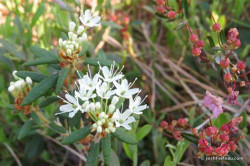
Bog Labrador tea (Rhododendron groenlandicum, formerly called Ledum groenlandicum) is a low evergreen shrub in the heath family (Ericaceae). It grows in cold, wet places like bogs, muskeg, and tundra across northern North America. The plant has leathery, dark green leaves with a rusty, fuzzy underside, and it produces clusters of small white flowers.
For generations, Indigenous peoples and early settlers brewed the dried leaves into a fragrant tea, which is the origin of names like Hudson's Bay tea, Muskeg tea, and Settler's tea. People drank it as a warm beverage and used it in folk medicine for coughs, colds, stomach trouble, and minor aches.
Today it is sold mostly as a loose-leaf herbal tea and sometimes as a tincture or essential oil. It remains far more a traditional and cultural drink than a well-studied supplement.
Uses & effectiveness
Most uses of Bog Labrador tea come from traditional practice rather than solid clinical research. People have used it for coughs and chest congestion, sore throats, digestive complaints like diarrhea and indigestion, and as a calming drink for stress.
The scientific evidence behind these uses is very limited. Some laboratory and animal studies suggest the plant's extracts have antioxidant and antimicrobial activity, and a few have looked at effects on blood sugar in cell or animal models. However, these early findings do not prove that drinking the tea treats any disease in people.
In short, there is currently not enough good human evidence to say Bog Labrador tea works for any specific medical condition. It can still be enjoyed as a traditional beverage in moderation, but it should not replace proven treatments.
How it works
The leaves contain aromatic essential oils, flavonoids, and other plant compounds (polyphenols) that may have antioxidant effects in laboratory tests. These compounds are thought to be behind the tea's strong, resinous smell and its proposed antimicrobial actions.
One ingredient of concern is ledol (and related terpenes), a compound found in some Labrador tea species that can be toxic in larger amounts and may cause drowsiness, cramps, or other unpleasant effects. The amount varies by species, plant part, and how strongly the tea is brewed.
It is important to understand that most proposed mechanisms come from test-tube or animal research. We do not have good data showing how these compounds behave in the human body at the amounts found in a typical cup of tea.
Safety & precautions
When made into a light, traditional tea and consumed in small amounts, Bog Labrador tea has been used for a long time. However, because the plant is in the rhododendron family and can contain potentially toxic terpenes, it is best to use small amounts, steep it gently, and not drink large quantities or very strong brews.
Be careful not to confuse it with other rhododendron or azalea species, some of which contain grayanotoxins that can be dangerous. Correct plant identification matters.
Pregnancy and breastfeeding: Avoid Bog Labrador tea if you are pregnant or breastfeeding. There is not enough safety information, and some compounds in the plant have been linked to uterine or toxic effects. People with liver or kidney problems and those taking medications should also check with a pharmacist or doctor before using it.
Side effects
In small amounts, the tea is usually well tolerated. Drinking strong, concentrated, or large amounts may cause drowsiness, headache, nausea, stomach cramps, or dizziness, which are thought to be linked to the plant's terpene content.
Allergic reactions are possible, especially in people sensitive to plants in the heath family. Stop using it and seek medical care if you notice rash, swelling, trouble breathing, or other serious symptoms.
Bog Labrador Tea: Reported Adverse Effects
Documented safety reports on Bog Labrador Tea from the evidence-graded Natural Medicines (TRC Healthcare) database, shown word-for-word from the licensed record.
Orally, bog Labrador tea seems to be generally well tolerated when consumed in small amounts. However, frequent consumption of bog Labrador tea in large quantities can cause vomiting, gastroenteritis, diarrhea, diuresis, and central nervous system depression including symptoms of dizziness, drowsiness, and exhaustion. Conversely, bog Labrador tea containing large quantities of the constituent ledol can cause central nervous system excitation, spasms, paralysis, and death in a dose-dependent manner. However, the content of ledol in bog Labrador tea is much lower than marsh Labrador tea and is often undetectable.
- The Review of Natural Products by Facts and Comparisons. St. Louis, MO: Wolters Kluwer Co., 1999.
- Gruenwald J, Brendler T, Jaenicke C. PDR for Herbal Medicines. 1st ed. Montvale, NJ: Medical Economics Company, Inc., 1998.
- Dampc A, Luczkiewicz M. Bog Labrador tea--the aromatic beverage and spice: a review of origin, processing and safety. J Sci Food Agric. 2015;95(8):1577-83.
Depression Neurologic/CNS
Orally, frequent consumption of bog Labrador tea in large quantities can cause mild central nervous system depression, including symptoms of dizziness, drowsiness and exhaustion. Conversely, bog Labrador tea containing large quantities of the constituent ledol can cause central nervous system excitation in a dose-dependent manner. For example, small amounts of ledol can lead to mild stimulating effects similar to caffeine, while larger doses can cause spasms, seizures, paralysis, and even death. However, the content of ledol in bog Labrador tea is much lower than marsh Labrador tea, and is often undetectable.
- The Review of Natural Products by Facts and Comparisons. St. Louis, MO: Wolters Kluwer Co., 1999.
- Gruenwald J, Brendler T, Jaenicke C. PDR for Herbal Medicines. 1st ed. Montvale, NJ: Medical Economics Company, Inc., 1998.
- Dampc A, Luczkiewicz M. Bog Labrador tea--the aromatic beverage and spice: a review of origin, processing and safety. J Sci Food Agric. 2015;95(8):1577-83.
Diarrhea Gastrointestinal
Orally, bog Labrador tea can cause gastrointestinal irritation resulting in vomiting, gastroenteritis, and diarrhea.
- The Review of Natural Products by Facts and Comparisons. St. Louis, MO: Wolters Kluwer Co., 1999.
- Gruenwald J, Brendler T, Jaenicke C. PDR for Herbal Medicines. 1st ed. Montvale, NJ: Medical Economics Company, Inc., 1998.
- Dampc A, Luczkiewicz M. Bog Labrador tea--the aromatic beverage and spice: a review of origin, processing and safety. J Sci Food Agric. 2015;95(8):1577-83.
Adverse-effects data: Natural Medicines, Therapeutic Research Center
Dosing
There is no established or standardized dose for Bog Labrador tea. Traditionally, a small amount of dried leaves is steeped in hot water to make a light beverage, and overly strong or long-steeped brews are avoided because of possible toxic compounds.
If you choose to use a commercial product, follow the directions on the label and do not exceed them. Because potency and safety can vary, it is wise to start with a small amount and to check with a pharmacist or doctor before regular use, especially if you have health conditions or take other medicines.
Bog Labrador Tea & Pregnancy
Bog Labrador Tea & Breastfeeding
© 2026 Therapeutic Research Center
Pregnancy & lactation ratings: Natural Medicines, Therapeutic Research Center
References & further reading
The 4 references that drive our Bog Labrador Tea monograph and interaction data, from the evidence-graded Natural Medicines (TRC Healthcare) database. Citations with a link open the study on PubMed or the publisher’s site.
- The Review of Natural Products by Facts and Comparisons. St. Louis, MO: Wolters Kluwer Co., 1999.
- Gruenwald J, Brendler T, Jaenicke C. PDR for Herbal Medicines. 1st ed. Montvale, NJ: Medical Economics Company, Inc., 1998.
- Dampc A, Luczkiewicz M. Bog Labrador tea--the aromatic beverage and spice: a review of origin, processing and safety. J Sci Food Agric. 2015;95(8):1577-83. PubMed
- Tam TW, Liu R, Saleem A, et al. The effect of Cree traditional medicinal teas on the activity of human cytochrome P450-mediated metabolism. J Ethnopharmacol. 2014;155(1):841-6. PubMed
This information is for education only and is not a substitute for professional medical advice. Always check with your pharmacist or doctor before starting, stopping, or combining supplements and medications.
Parts of this content are provided by the Therapeutic Research Center, LLC.
DISCLAIMER: Currently this does not check for drug-drug interactions. This is not an all-inclusive comprehensive list of potential interactions and is for informational purposes only. Not all interactions are known or well-reported in the scientific literature, and new interactions are continually being reported. Input is needed from a qualified healthcare provider including a pharmacist before starting any therapy. Application of clinical judgment is necessary.
© 2021 Therapeutic Research Center, LLC
Bog Labrador Tea: Common Questions
Does Bog Labrador Tea interact with prescription medications?
How are Bog Labrador Tea interactions rated?
Is it safe to take Bog Labrador Tea with my medications?
Where does this Bog Labrador Tea interaction information come from?
What is Bog Labrador Tea used for?
Is Bog Labrador Tea safe to drink?
Can I drink it while pregnant or breastfeeding?
Is Labrador tea the same as regular tea?
Written and reviewed by the HelloPharmacist editorial staff. Our editorial policy
Have a question about Bog Labrador Tea?
Our pharmacists answer your medication & supplement questions — free.