
Life Source by New Sun Ingredients, Side Effects and Drug Interactions
Dietary Supplement Capsule Other Combinations
Life Source by New Sun is a dietary supplement with 24 active ingredients: 17 plant ingredients such as Spirulina, Chlorella and Alfalfa, 1 probiotic, 1 enzyme, 1 source of fiber and 4 others. It is marketed for immune system and mental clarity support.

Medically reviewed by Dr. Brian Staiger, PharmD, BCPS
Also reviewed by the HelloPharmacist Editorial Team
Updated Details about this page
- Label on file from the NIH Dietary Supplement Label Database, dated Jun 20, 2024.
- The interaction, evidence and safety records come from the Natural Medicines database, which we license, read against this label by our own system; the pharmacy team’s sections are written from those records.
- Dr. Brian Staiger, PharmD, BCPS, is a clinical pharmacist and pharmacotherapy specialist.
- Editorial policy Our sources
AI is used only to summarize verified clinical information, never the open internet. Our AI policy
Summary: The HelloPharmacist Team’s Take
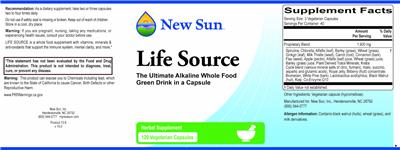
This summary is for Life Source by New Sun
- Form
- Capsule
- Serving Size
- 2 Vegetarian Capsules
- Servings
- 40 per container
- Container Holds
- 120 Vegetarian Capsules
- What is Life Source?A supplement from New Sun with 24 active ingredients, in capsule form.
- Active Ingredients 17 plant ingredients such as Spirulina, Chlorella and Alfalfa, 1 probiotic, 1 enzyme, 1 source of fiber and 4 others: SpirulinaChlorellaAlfalfaBarleyWheatGinkgoMilk ThistleCarrotCinnamonFlaxApple PectinAlfalfa juice 24 active ingredients. Each one can interact with drugs or cause side effects on its own, so we check every one. And 12 more, in the Supplement Facts
- Drug Interactions 1,732 drugs have a documented interaction with this supplement; the most serious is rated major. Of those, 1,246 are single drugs and 486 are combination products (two or more drugs in one), each listed under its own name. Based on the 21 of its 24 ingredients we could check. Ask your pharmacist first if you take a drug in any of these categories, the most serious of the 54 on record:
- Major · 2 drugs
- TalinololMajor · 1 drug
- Moderate · 645 drugs
- Moderate · 418 drugs
- Possible Side EffectsNausea 8 ingredientsDiarrhea 7 ingredientsBloating 6 ingredientsGas 6 ingredientsStomach upset 6 ingredientsHeadache 3 ingredients +24 moreCombined from 15 of its 24 active ingredients. Not studied in this exact product.
- Well documented Why
Does Life Source work?
What It Is Marketed For
Immune system and mental clarity support
From the claims on the product’s label.
The Closest Use the Research Grades
Age-related cognitive decline Ginkgo
The studies lean against a benefit.
Its ingredients have stronger research for other uses:
- Barley
- Barley
- Blue-green Algae
- Ginkgo
- Milk Thistle
- Ginkgo
These grades are for each ingredient, not this exact product, and never a promise it will work for you.
And 1 more graded use, in what the research says- AllergensIts ingredient list names tree nuts and wheat or other gluten grains
Who Might Consider It
- People looking for immune system and mental clarity support, which is what it is marketed for. For age-related cognitive decline, the closest use the research grades, the studies lean against a benefit.
- People who want it for hypercholesterolemia, coronary heart disease (CHD), hypertension, anxiety or another graded use: the other uses with research behind them. See each grade
Who Should Be Careful
- Life Source is a broad-spectrum supplement with mixed evidence of effectiveness and substantial medication interaction potential—particularly concerning with blood thinners, diabetes drugs, and thyroid medications.
- If you take any prescription or over-the-counter drugs, use the interaction checker on this page to screen your specific medications before starting.
- Those with asthma, atopy, or bleeding disorders, and anyone pregnant or breastfeeding, should talk with their doctor or pharmacist before taking it.
More Before You Take It Show both answersHide Pregnancy and Breastfeeding The Label’s Directions
-
Pregnant or breastfeeding?
- Pregnancy and Breastfeeding Alfalfa
- ! When used orally in medicinal amounts.
- Pregnancy Barley
- ! When barley sprouts are consumed in relatively high doses.
- Breastfeeding Barley
- Insufficient reliable information available; avoid using.
- Pregnancy Ginkgo
- ! When used orally.
- Breastfeeding Ginkgo
- Insufficient reliable information available; avoid using.
-
How does the label say to take it?
“Recommendation: As a dietary supplement, take two or three capsules two to four times daily.”
The maker’s words. Your pharmacist or doctor may advise differently.
Everything the label says
From the label dated Jun 20, 2024: 21 of its 24 active ingredients were checked against our records; the other three are not in them yet. A summary of what is known, not a grade or a test of the product. How these ratings are computed
Ask Anything About This Supplement
Name a drug you take, or ask about side effects, ingredients or pregnancy.
There’s a lot of information about this supplement on this page! Ask anything in plain English for a quick answer drawn from it.
AI answers come from this label and our own records, never the open internet. AI can make mistakes, so always check with your doctor or pharmacist. How we use AI
Ask the Pharmacist
A licensed pharmacist will answer your question by email — free, as soon as they can.
Got it — thank you!
A licensed pharmacist will answer as soon as they can. Keep an eye on your email (worth checking spam, just in case).
What’s Inside Life Source by New Sun
24 Active Ingredients
In the order the label lists them, each with its own card below.
- Spirulina
- Chlorella
- Alfalfa
- Barley
- Wheat
- Ginkgo
- Milk Thistle
- Carrot
- Cinnamon
- Flax
- Apple Pectin
- Alfalfa juice
And 12 more, each with its own card below.
The label gives an exact amount for 0 of its 24 active ingredients. 24 are inside one proprietary blend, “Proprietary Blend”, and the label gives one total for it, not how much of each ingredient is in it.
- 0 state an exact amount
- 24 have no amount of their own
- Proprietary Blend 1,900 mg in total · 24 ingredients, no amount for each
This rates what the label tells you, not the quality of the product.
Supplement Facts
| Amount Per Serving | % Daily Value | |
|---|---|---|
| Proprietary Blend | 1900 mg | † |
| Spirulina | † | |
| Chlorella | † | |
| Alfalfa | † | |
| Barley | † | |
| Wheat | † | |
| Ginkgo | † | |
| Milk Thistle | † | |
| Carrot | † | |
| Cinnamon | † | |
| Flax | † | |
| Apple Pectin | † | |
| Alfalfa juice | † | |
| Wheat Grass Juice | † | |
| Barley grass juice | † | |
| Trace Minerals | † | |
| Krebs Cycle | † | |
| Royal Jelly | † | |
| Bilberry Concentrate | † | |
| Bromelain | † | |
| White Pine | † | |
| Lactobacillus acidophilus | † | |
| Black Walnut | † | |
| Kelp | † | |
| Coenzyme Q-10 | † | |
Other ingredients: Hypromellose
† Daily Value not established.
Daily Values for adults and children 4 or more years of age.
As the label prints it, from the NIH Dietary Supplement Label Database.
Each Ingredient and Its Drug Interactions
Tap one for more about it and its full guide. A drug can interact with this supplement through any one of them.
The key components are bromelain (a protein-digesting enzyme from pineapple), Lactobacillus acidophilus (a probiotic bacteria), and a range of plant-derived substances: royal jelly, alfalfa, spirulina, coenzyme Q-10, pectin, chlorella, carrot, ginkgo, kelp, wheat grass, barley, milk thistle, flax, cinnamon, black walnut, and bilberry concentrate.
- The product also contains coenzyme Q-10 for energy support and several whole-food ingredients like barley grass juice and cinnamon.
-
Proprietary Blend 1900 mg Life Source contains 24 ingredients, including a proprietary blend alongside individual actives. 24 ingredients inside it, each checked on its own
- Spirulina 327 drugs
- Chlorella 337 drugs
- Alfalfa 583 drugs
- Barley 1 drug
- Wheat 272 drugs
- Ginkgo 1,267 drugs
- Milk Thistle 955 drugs
- Carrot
- Cinnamon 444 drugs
- Flax 597 drugs
- Apple Pectin 23 drugs
- Alfalfa juice 583 drugs
- Wheat Grass Juice
- Barley grass juice 1 drug
- Trace Minerals
- Krebs Cycle
- Royal Jelly 174 drugs
- Bilberry Concentrate 275 drugs
- Bromelain 141 drugs
- White Pine
- Lactobacillus acidophilus 182 drugs
- Black Walnut
- Kelp 893 drugs
- Coenzyme Q-10 198 drugs
Other Ingredients (Inactive)
The capsule or tablet itself, fillers, coatings and flavors. Not part of the drug interaction check; the allergen check below reads them.
- Hypromellose
Allergens in Life Source
Its ingredient list names tree nuts and wheat or other gluten grains.
Named on this label
- Tree nutsIn the ingredients: Black Walnut
- Wheat or other gluten grainsIn the ingredients: Barley, Wheat, Wheat Grass Juice, Barley grass juice
Not named in the ingredients
- Milk
- Egg
- Fish
- Shellfish
- Peanuts
- Soy
- Sesame
- The label’s allergen statement“Allergen information: Contains black walnut (hulls), wheat (grass), and milk derivatives.”
From the label text and ingredient names on file; we do not test products. With a serious allergy, check your bottle and ask the maker or your pharmacist.
What the Label Says
The maker’s own words, from the label. We do not verify or endorse them.
- Storage
-
“Store in a cool, dry place.”
- FDA Statement of Identity
-
“Herbal Supplement”
- Formulation
-
“Life Source is a whole food supplement with vitamins, minerals & anti-oxidants that support the immune system, mental clarity, and more.”
“The ultimate alkaline whole food green drink in a capsule”
The Life Source Label on File
The label scan on file at the NIH Dietary Supplement Label Database, dated June 2024. Always read the label on the bottle you have.
Product Facts
- Brand
- New Sun
- Barcode (UPC)
- 72-8
- Net contents
- 120 Vegetarian Capsules
- Market status
- On market
- Date entered into DSLD
- Jun 20, 2024
- DSLD ID
- 313656
- Product type
- Other Combinations
- Supplement form
- Capsule
- Dietary claims / uses
- Nutrient, All Other, Structure/Function
- Intended target group(s)
- Adult (18 - 50 Years)
Is this label outdated? Report a formula or label change and our pharmacy team will review it.
HelloPharmacist Score Life Source by New Sun
Up to 10 points for research, amount, label and outside testing. Not a safety rating. How this one adds up
for age-related cognitive decline
It is marketed for immune system and mental clarity support. There is no graded research on that exact use, so we scored the closest one: there is too little good research to say whether bilberry, one of its ingredients, helps with age-related cognitive decline.
- Research0 of 5 points
- Amount0 of 2 points
- Label0 of 2 points
- Outside testing0 of 1 point
Major drug interactions. The score does not count drug interactions. Check them against any drugs you take. See them
How It Earns Its 0
Score: 0 out of 10. Unproven for age-related cognitive decline.
Too little research on bilberry for age-related cognitive decline.
Graded “Insufficient Reliable Evidence to Rate” in the Natural Medicines database, which we license. A related use, not the one it is marketed for, counts for at most 3 of 5 research points.
0 of 5 points
Amount
The label does not say how much bilberry is in it.
0 of 2 points
Label
It states the amount of none of its 24 active ingredients; 24 are inside blends that give only a total.
0 of 2 points
Outside testing
We found no mark from an outside testing program, such as USP Verified or NSF Certified, on the label we have on file.
0 of 1 point
Life Source by New Sun Side Effects
Why this rating?
We look for three kinds of safety information on each ingredient: side effects reported in studies, a pregnancy and breastfeeding rating, and a safety write-up from our pharmacy team. Of the 19 ingredients we could check, 18 have side-effect reports, all 19 have a pregnancy rating and all 19 have a safety write-up.
So this rates how much is known, not whether Life Source is right for you.
Reported with 19 of its ingredients
- Most often
- Nausea, diarrhea, bloating, gas, stomach upset and headache
- !Rare but serious
- Severe allergic reaction, irregular heartbeat and bleeding See details
HelloPharmacist Team Summary: Life Source by New Sun Side Effects
Most ingredients in Life Source are generally well tolerated, but several carry cautions.
- Milk thistle and flaxseed have hormone-like activity.
Side Effects, Ingredient by Ingredient
A supplement’s side effects come from its ingredients. Here is what is reported with each one.
Blue-green Algae
Most reported
- Nausea
- Stomach upset
- Diarrhea
- Headache
Our pharmacy team’s notes
- Spirulina quality varies and may contain contaminants or heavy metals.
Chlorella
Most reported
- Nausea
- Gas
- Bloating
- Stomach cramps
Alfalfa
Most reported
- Abdominal discomfort
- Diarrhea
- Flatulence
From the Natural Medicines database, which we license.
Our pharmacy team’s notes
- Alfalfa may cause a lupus-like syndrome with chronic use.
Barley
Most reported
- Gas
- Bloating
- Changes in bowel habits
Wheatgrass
Most reported
- Nausea
- Upset stomach
- Bloating
- Loss of appetite
Ginkgo
Most reported
- Headache
- Upset stomach or nausea
- Dizziness
- Constipation or diarrhea
Milk Thistle
Most reported
- Nausea
- Diarrhea
- Bloating
- Gas
Flaxseed
Most reported
- Bloating, gas, and stomach cramps
- Loose stools or, if you don't drink enough water, constipation
Pectin
Most reported
- Gas
- Bloating
- Cramping
- Loose stools or diarrhea
Royal Jelly
Most reported
- Stomach upset or digestive discomfort
- Skin reactions such as rash or itching, especially with creams
- Worsening of asthma in people who have it
Bilberry
Most reported
- Stomach upset
- Digestive discomfort
Bromelain
Most reported
- Nausea or upset stomach
- Diarrhea
- Vomiting
Black Walnut
Most reported
- Nausea
- Stomach upset
- Loose stools
Fucus Vesiculosus
Most reported
- Changes in thyroid function
- Metallic taste
- Increased saliva
- Stomach upset
Our pharmacy team’s notes
- Kelp's high iodine content can disrupt thyroid function.
Coenzyme Q10
Most reported
- Upset stomach or nausea
- Diarrhea or loss of appetite
- Heartburn
- Headache or dizziness
Carrot, Cassia Cinnamon and Lactobacillus Acidophilus have side-effect reports, but no list of the most common ones. Read them in each guide: Carrot, Cassia Cinnamon, Lactobacillus Acidophilus.
Life Source Warnings: Who Should Be Careful
Life Source has 24 active ingredients, and each can carry warnings of its own. We checked the 21 in our ingredient guides, and each warning below names the ingredient it comes from. Trace Minerals, Krebs Cycle and White Pine are not in our guides yet, so ask your pharmacist about them. If any of these apply to you, talk to your doctor or pharmacist before you start it.
- Blue-green Algae3 warnings below
- Chlorella3 warnings below
- Alfalfa3 warnings below
- Barley3 warnings below
- Wheatgrass3 warnings below
- Ginkgo3 warnings below
- Milk Thistle1 warning below
- Carrot2 warnings below
- Cassia Cinnamon2 warnings below
- Flaxseed1 warning below
- Pectin2 warnings below
- Couch Grass3 warnings below
- Royal Jelly1 warning below
- Bilberry2 warnings below
- Bromelain3 warnings below
- Lactobacillus Acidophilus1 warning below
- Black Walnut3 warnings below
- Fucus Vesiculosus3 warnings below
- Coenzyme Q102 warnings below
- Trace MineralsNot in our guides yet
- Krebs CycleNot in our guides yet
- White PineNot in our guides yet
-
Bleeding Problems or Surgery
- ChlorellaPeople who are sensitive to vitamin K changes (for example, those on blood thinners) should talk to a pharmacist first.
- BilberryPeople with bleeding disorders, those scheduled for surgery, or people with diabetes should be cautious and speak with a healthcare provider, since bilberry may affect bleeding or blood sugar.
- BromelainBleeding risk: Bromelain may affect how the blood clots.
- Fucus VesiculosusPeople with kidney disease, those allergic to iodine or seafood, and anyone scheduled for surgery or thyroid testing should also be cautious.
Show 2 more
- Coenzyme Q10People with low blood pressure, those scheduled for surgery, or anyone with a chronic health condition should talk with a healthcare provider before starting CoQ10.
- GinkgoGinkgo increases bleeding risk and can cause cardiac arrhythmias.
-
Diabetes or Low Blood Sugar
- BarleyBecause barley fiber can lower blood sugar, people with diabetes should monitor their levels.
- Milk ThistleIf you have a liver condition, a hormone-sensitive condition, diabetes, or any chronic illness, talk with your doctor or pharmacist before using milk thistle.
- Cassia CinnamonPeople with diabetes who take blood-sugar-lowering medicine should monitor their levels and check with a pharmacist before adding cinnamon supplements.
- Coenzyme Q10Because it may affect blood pressure or blood sugar in some people, monitoring may be needed.
-
Liver Disease
- Blue-green AlgaePeople with autoimmune conditions, liver disease, or a metabolic disorder called phenylketonuria (PKU) should be especially cautious and check with a doctor first.
- Cassia CinnamonPeople with liver disease should be especially careful and should talk to a healthcare provider before using cinnamon supplements.
-
Kidney Disease or Kidney Stones
- Couch GrassBecause it may act as a diuretic, people who take water pills or who have heart or kidney disease should be cautious and check with a healthcare professional first.
- Black WalnutPeople with digestive conditions, kidney problems, or those taking multiple medications should talk to a pharmacist or doctor first.
-
Stomach or Bowel Problems
- PectinBecause pectin absorbs water and forms a gel, take it with plenty of fluid to lower the risk of it swelling and causing a blockage, particularly if you have trouble swallowing or have a narrowed digestive tract.
- PectinPeople with bowel conditions should talk to a doctor before using fiber supplements.
-
Thyroid Conditions
- Fucus VesiculosusDifferent products can contain very different amounts, and too much iodine can cause both underactive (hypothyroid) and overactive (hyperthyroid) thyroid problems.
- Fucus VesiculosusPeople with any thyroid condition should avoid it unless a doctor specifically advises otherwise.
-
Autoimmune Conditions
- ChlorellaPeople with autoimmune conditions should be cautious, since chlorella may affect the immune system.
- AlfalfaPeople with autoimmune diseases such as lupus should avoid alfalfa supplements.
-
Hormone-Sensitive Conditions
- AlfalfaBecause of its phytoestrogens, people with hormone-sensitive conditions (such as certain breast, uterine, or ovarian conditions) should be cautious and talk to their doctor first.
-
Seizure Disorders
- GinkgoPeople with a history of seizures should be careful, as some reports suggest ginkgo could lower the seizure threshold, especially if a product is contaminated with ginkgo seeds.
-
Allergies
- ChlorellaThose who are sensitive to iodine, mold, or who have a history of allergies should also be careful.
- BarleyPeople with celiac disease, gluten sensitivity, or a wheat/barley allergy should avoid it.
- WheatgrassPeople with a wheat allergy should be cautious, as reactions are possible.
- CarrotPeople who are allergic to plants in the carrot family (such as celery, parsley, or mugwort pollen) may also react to carrots.
Show 3 more
- Royal JellyAlways tell your pharmacist or doctor about any supplements you take, especially if you have allergies or a chronic health condition.
- BromelainAllergies: People allergic to pineapple should avoid bromelain.
- Black WalnutPeople with a tree nut allergy should be cautious or avoid black walnut, since it comes from a true tree nut.
-
Children
- Blue-green AlgaeChildren should not take these supplements unless a healthcare provider recommends it.
- GinkgoNever eat raw or roasted ginkgo seeds (nuts), which can be toxic, especially in children.
- Couch GrassDo not give couch grass to children without medical advice.
- Lactobacillus AcidophilusFor most healthy adults and children, L. acidophilus is considered safe and is widely used in foods and supplements.
-
If You Take Other Drugs
- WheatgrassAlways tell your pharmacist or doctor about any supplements you take, especially if you have a health condition or take medications.
-
Other Cautions
- AlfalfaPeople who are immunosuppressed should also avoid alfalfa.
- WheatgrassWheatgrass is harvested before the grain forms, so it usually contains little or no gluten, but cross-contamination can occur—people with celiac disease or gluten sensitivity should choose products clearly labeled and tested gluten-free, and check with their provider.
- FlaxseedAvoid raw or unripe flaxseed, which may contain natural compounds that release small amounts of cyanide.
- Couch GrassPeople with conditions where extra fluid intake must be limited should also be careful.
Show 3 more
- BilberryBilberry leaf products, especially in high doses or used long-term, are not recommended because of possible toxicity.
- BromelainStill, some people should be careful.
- Black WalnutBecause of its tannin and juglone content, long-term or high-dose use is not recommended and has not been well studied for safety.
-
What the Label Warns
- “Do not use if safety seal is missing or broken.”
- “Keep out of reach of children.”
- “Warning: If you are pregnant, nursing, taking any medications, or experiencing health issues, consult your doctor before use.”
- “Warning: This product can expose you to chemicals including lead, which are known to the State of California to cause cancer, birth defects or other reproductive harm. www.P65Warnings.ca.gov”
The maker’s wording, from the product label.
-
Pregnant or Breastfeeding
Each ingredient’s rating for pregnancy and for breastfeeding, and what it covers.
Pregnancy and Breastfeeding The record rates both the same
-
When used orally in medicinal amounts.
Alfalfa contains constituents with possible estrogenic activity.
Pregnancy
-
When used orally in amounts commonly found in foods.
-
When barley sprouts are consumed in relatively high doses.
Excessive amounts of barley sprouts should not be consumed during pregnancy.
Breastfeeding
-
Insufficient reliable information available; avoid using.
Show 17 more ingredients
Pregnancy
-
When used orally.
There is concern that ginkgo might have labor-inducing and hormonal effects.
2 more points on this rating
- There is also concern that the antiplatelet effects of ginkgo could prolong bleeding time if taken around the time of labor and delivery.
- Theoretically, ginkgo might adversely affect pregnancy outcome; avoid using during pregnancy.
Breastfeeding
-
Insufficient reliable information available; avoid using.
Pregnancy
-
When used orally.
Flaxseed can have mild estrogenic effects.
Theoretically, this might adversely affect pregnancy; however, there is no reliable clinical evidence about the effects of flaxseed on pregnancy outcomes.
Breastfeeding
-
Insufficient reliable information available; avoid using.
Pregnancy and Breastfeeding The record rates both the same
-
When the fruit (nut) is consumed in amounts normally found in foods.
-
When the bark is used orally or topically; avoid using.
There is insufficient reliable information available about the safety of black walnut leaf or hull when used orally in medicinal amounts during pregnancy or lactation; avoid using.
Pregnancy and Breastfeeding The record rates both the same
-
When used orally because it may contain iodine and heavy metals; avoid using.
Pregnancy
-
There is not enough reliable safety data, so it is best to avoid unless your doctor advises otherwise.
Breastfeeding
-
Insufficient reliable information available; avoid using.
Pregnancy and Breastfeeding The record rates both the same
-
Insufficient reliable information available; avoid using.
Some blue-green algae products, specifically those of the species Aphanizomenon flos-aquae, have been found to contain low amounts of beta-methylamino-L-alanine (BMAA).
BMAA is associated with neurodegenerative diseases, and breast milk has been shown to be a potential source of BMAA exposure in infants.
Pregnancy
-
When used orally and appropriately in medicinal amounts for up to approximately 28 weeks.
A commercially available chlorella supplement (Sun Chlorella A, Sun Chlorella Corp.) has been safely used in doses of 6 grams daily, starting during the 12-18th week of gestation and continuing until delivery.
Breastfeeding
-
Insufficient reliable information available; avoid using.
Pregnancy and Breastfeeding The record rates both the same
-
Insufficient reliable information available; avoid using.
Pregnancy and Breastfeeding The record rates both the same
-
While research in an animal model shows that taking milk thistle during pregnancy and lactation does not adversely impact infant development, there is insufficient reliable information available about its safety during pregnancy or lactation in humans; avoid using.
Pregnancy and Breastfeeding The record rates both the same
-
Insufficient reliable information available; avoid using.
Pregnancy and Breastfeeding The record rates both the same
-
Insufficient reliable information available; avoid using.
Pregnancy and Breastfeeding The record rates both the same
-
Insufficient reliable information available; avoid using.
Pregnancy
-
When used orally and appropriately.
A combination of Lactobacillus acidophilus, Lacticaseibacillus casei, and Bifidobacterium bifidum has been used with apparent safety for 6 weeks, starting at 24-28 weeks' gestation.
Breastfeeding
-
There is insufficient reliable information available about the safety of Lactobacillus acidophilus during lactation.
However, there are currently no reasons to expect safety concerns when used appropriately.
Pregnancy and Breastfeeding The record rates both the same
-
When used orally in amounts commonly found in food.
Carrot essential oil, extracts, and food additives have Generally Recognized as Safe (GRAS) status in the US.
There is insufficient reliable information available about the safety of carrot when used in medicinal amounts during pregnancy and lactation.
Pregnancy and Breastfeeding The record rates both the same
-
When consumed in amounts commonly found in foods.
There is insufficient reliable information available about the safety of cassia cinnamon when used in medicinal amounts during pregnancy and breast-feeding.
Stay on the safe side and stick to food amounts.
Pregnancy and Breastfeeding The record rates both the same
-
When used in amounts commonly found in foods.
Pectin has Generally Recognized as Safe (GRAS) status in the US.
-
When used orally in medicinal amounts.
Pregnancy and Breastfeeding The record rates both the same
-
When used orally in the amounts commonly found in foods.
However, there is insufficient reliable information available about the safety of bilberry when used in medicinal amounts during pregnancy and lactation; avoid using.
Our pharmacy team’s notes
- Pregnancy and breastfeeding data are limited or absent for most ingredients; several are rated possibly unsafe or unsafe in pregnancy (bromelain, royal jelly, alfalfa, chlorella, ginkgo, kelp), and many lack breastfeeding safety information.
Ratings and the words beside them are from the Natural Medicines database, which we license. Where it has no rating, the rating and note are our pharmacy team’s.
-
Rare but Serious Side Effects
-
!
Blue-green Algae
More serious problems are usually linked to contaminated products.
-
!
Chlorella
Some people may have allergic reactions, including skin rash or, rarely, more serious breathing problems.
Orally: Anaphylaxis.
-
!
Alfalfa
More serious concerns are mostly tied to supplements or large amounts.
Orally: Lupus-like syndrome after chronic ingestion of alfalfa.
-
!
Barley
Seek emergency care for any signs of a serious allergic reaction.
-
!
Wheatgrass
Allergic reactions are possible, particularly in people sensitive to wheat or grasses; signs can include swelling, hives, or trouble breathing.
-
!
Ginkgo
More serious but rare concerns include increased bleeding or bruising.
Orally: Arrhythmia, bleeding, Stevens-Johnson syndrome.
-
!
Milk Thistle
Less commonly, people may have allergic reactions, especially if they are sensitive to ragweed or related plants.
Orally: Allergic reactions, including anaphylaxis, have been reported.
-
!
Carrot
Some people may have an allergic reaction, especially those sensitive to related plants or certain pollens.
-
!
Cassia Cinnamon
Some people may have mouth or lip irritation, an allergic reaction, or stomach upset.
-
!
Flaxseed
Rarely, some people are allergic to flaxseed and could have a serious reaction.
Orally: Severe allergic reactions such as and anaphylaxis.
-
!
Pectin
Allergic reactions are rare but possible, especially in people allergic to the fruit source.
Allergic reactions, including anaphylaxis, in sensitive individuals.
-
!
Couch Grass
As with many herbs, some people could experience stomach upset or an allergic reaction, especially those sensitive to grasses.
-
!
Royal Jelly
The most serious concern is a severe allergic reaction (anaphylaxis), which can cause trouble breathing, swelling of the throat or face, hives, and a sudden drop in blood pressure.
Royal jelly poses high allergic risk in those with asthma or atopy—it can cause anaphylaxis, status asthmaticus, and death.
Orally: Anaphylaxis, status asthmaticus, and death in people with a history of asthma or atopy.
-
!
Bilberry
As with any supplement, allergic reactions are possible.
-
!
Bromelain
Less commonly, people may notice changes in heart rate or, rarely, allergic reactions.
Bromelain may cause gastrointestinal upset (diarrhea, flatulence, nausea) and, in people with asthma or atopy, can trigger serious allergic reactions including anaphylaxis.
-
!
Lactobacillus Acidophilus
Serious side effects are rare.
-
!
Black Walnut
People allergic to tree nuts could have an allergic reaction, which in rare cases can be serious.
Orally: The bark may increase the risk for tongue cancer or lip leukoplakia when used long-term.
Allergic reactions, including anaphylaxis.
-
!
Fucus Vesiculosus
Allergic reactions are possible, particularly in people sensitive to iodine or seafood.
Orally: Thyroid cancer.
-
!
Coenzyme Q10
Serious side effects are rare.
When to get help: a serious allergic reaction, with trouble breathing or swelling of the face, lips or throat, needs emergency care: call 911. For any other side effect that worries you, call your doctor or pharmacist.
These reports describe each ingredient, not studies of this exact product. Not medical advice: a side effect you notice after starting a supplement is worth a word with your pharmacist or doctor.
Life Source by New Sun Drug Interactions
We checked all 24 active ingredients in this supplement against every drug in our records. A drug can interact with it through any one of them. Trace Minerals, Krebs Cycle and White Pine are not in our interaction records yet.
A major interaction on record
3 of 3, on a scale from Minor or none to Major.Why this rating?
We rate this by the most serious interaction on record, not by how many there are. For Alfalfa, Milk Thistle, Bilberry, Ginkgo and Pectin, the most serious is rated major, which means the combination is best avoided, or used only under close supervision. Some involve kinds of drugs where a small change can matter, such as blood thinners, seizure drugs and transplant drugs.
1,733 drugs are on the full list. What matters is whether one you take is on it, so check yours with the interaction checker on this page.
From the HelloPharmacist Team
Put every ingredient together and a few things stand out.
- Life Source by New Sun has interactions documented for many of its ingredients.
- Beyond alfalfa's effects, this product's other ingredients interact with additional medications.
- Royal jelly, spirulina, coenzyme Q-10, flaxseed, and bilberry all interact with blood thinners and diabetes drugs.
16 of its 24 active ingredients have drug interactions on record. The ones below matter most.
- Interacts with
- 583 drugs
- Most serious
- Major
- The most serious interaction involves alfalfa and alfalfa juice with warfarin (a blood thinner), where the vitamin K content can reduce warfarin's effectiveness — this is a Major-severity effect.
- Alfalfa and alfalfa juice also interact with several other drug types at Moderate severity: photosensitizing drugs, birth control pills, hormone therapy, immunosuppressants, and diabetes medications.
- Interacts with
- 272 drugs
- Most serious
- Moderate
- Carrot and Wheat Grass Juice were checked and no interactions are documented, though this does not guarantee none exist.
- Interacts with
- 1,267 drugs
- Most serious
- Major
- Ginkgo carries Moderate interactions with several heart and psychiatric medications (simvastatin, alprazolam, trazodone, efavirenz, rosiglitazone, tacrolimus), plus a Major interaction with talinolol.
Show three more ingredients
- Interacts with
- 955 drugs
- Most serious
- Moderate
- Milk thistle affects multiple drug-metabolizing pathways and diabetes control.
- Interacts with
- 141 drugs
- Most serious
- Moderate
- Bromelain may increase bleeding risk with blood thinners and antiplatelet drugs, and may theoretically raise tetracycline antibiotic levels.
- Interacts with
- 893 drugs
- Most serious
- Moderate
- Kelp (Fucus vesiculosus) interacts with lithium, antithyroid drugs, amiodarone, and thyroid hormone.
And ten more ingredients with records, each in the cards below.
Summarized by the HelloPharmacist pharmacy team from the interaction records below. How it is written How we use AI
Why Life Source Interacts, Ingredient by Ingredient
A product interacts through its ingredients. Each card: how many drugs, the most serious rating, and the kinds of drugs it affects most (tap a kind for what it means).
The ingredients driving the most interactions
-
Ginkgo 1,267 drugs
Most serious: Major23 interaction records on file
The kinds of drugs it affects most
- 645 drugs
- 418 drugs
- 202 drugs
- 186 drugs
Every Ginkgo drug interaction, 23 records The Ginkgo records cite 97 references, listed in the Ginkgo guide.
-
Milk Thistle 955 drugs
Most serious: Moderate17 interaction records on file
The kinds of drugs it affects most
- 645 drugs
- 202 drugs
- 124 drugs
- 112 drugs
Every Milk Thistle drug interaction, 17 records The Milk Thistle records cite 69 references, listed in the Milk Thistle guide.
-
Kelp 893 drugs
Most serious: Moderate9 interaction records on file
The kinds of drugs it affects most
- 645 drugs
- 193 drugs
- 122 drugs
- 112 drugs
Every Fucus Vesiculosus drug interaction, 9 records The Fucus Vesiculosus records cite 15 references, listed in the Fucus Vesiculosus guide.
-
Flax 597 drugs
Most serious: Moderate5 interaction records on file
The kinds of drugs it affects most
- 182 drugs
- 172 drugs
- 122 drugs
- 86 drugs
Every Flaxseed drug interaction, 5 records The Flaxseed records cite 37 references, listed in the Flaxseed guide.
-
Alfalfa 583 drugs
Most serious: Major6 interaction records on file
The kinds of drugs it affects most
- 335 drugs
- 121 drugs
- 86 drugs
- 41 drugs
Every Alfalfa drug interaction, 6 records The Alfalfa records cite 32 references, listed in the Alfalfa guide.
-
Cinnamon 444 drugs
Most serious: Moderate2 interaction records on file
The kinds of drugs it affects most
- 372 drugs
- 86 drugs
Every Cassia Cinnamon drug interaction, 2 records The Cassia Cinnamon records cite 20 references, listed in the Cassia Cinnamon guide.
-
Chlorella 337 drugs
Most serious: Moderate2 interaction records on file
The kinds of drugs it affects most
- 335 drugs
- 2 drugs
Every Chlorella drug interaction, 2 records The Chlorella records cite 13 references, listed in the Chlorella guide.
-
Spirulina 327 drugs
Most serious: Moderate3 interaction records on file
The kinds of drugs it affects most
- 122 drugs
- 121 drugs
- 86 drugs
Every Blue-green Algae drug interaction, 3 records The Blue-green Algae records cite 22 references, listed in the Blue-green Algae guide.
-
Bilberry Concentrate 275 drugs
Most serious: Moderate4 interaction records on file
The kinds of drugs it affects most
- 122 drugs
- 86 drugs
- 70 drugs
- Erlotinib (Tarceva) 1 drug
Every Bilberry drug interaction, 4 records The Bilberry records cite 14 references, listed in the Bilberry guide.
-
Wheat 272 drugs
Most serious: Moderate2 interaction records on file
The kinds of drugs it affects most
- 186 drugs
- 86 drugs
Every Wheatgrass drug interaction, 2 records The Wheatgrass records cite 5 references, listed in the Wheatgrass guide.
-
Coenzyme Q-10 198 drugs
Most serious: Moderate3 interaction records on file
The kinds of drugs it affects most
- 172 drugs
- 24 drugs
- 2 drugs
Every Coenzyme Q10 drug interaction, 3 records The Coenzyme Q10 records cite 40 references, listed in the Coenzyme Q10 guide.
-
Lactobacillus acidophilus 182 drugs
Most serious: Moderate1 interaction record on file
The kinds of drugs it affects most
- 182 drugs
Every Lactobacillus Acidophilus drug interaction, 1 record The Lactobacillus Acidophilus records cite 18 references, listed in the Lactobacillus Acidophilus guide.
-
Royal Jelly 174 drugs
Most serious: Moderate2 interaction records on file
The kinds of drugs it affects most
- 172 drugs
- 2 drugs
Every Royal Jelly drug interaction, 2 records The Royal Jelly records cite 14 references, listed in the Royal Jelly guide.
-
Bromelain 141 drugs
Most serious: Moderate2 interaction records on file
The kinds of drugs it affects most
- 122 drugs
- 20 drugs
Every Bromelain drug interaction, 2 records The Bromelain records cite 19 references, listed in the Bromelain guide.
-
Apple Pectin 23 drugs
Most serious: Moderate3 interaction records on file
The kinds of drugs it affects most
- 20 drugs
- Lovastatin (Mevacor) 2 drugs
- 1 drug
Every Pectin drug interaction, 3 records The Pectin records cite 11 references, listed in the Pectin guide.
-
Barley 1 drug
Most serious: Moderate1 interaction record on file
The kinds of drugs it affects most
- Triclabendazole (Egaten) 1 drug
Every Barley drug interaction, 1 record The Barley records cite 15 references, listed in the Barley guide.
The Breakdown by Severity
Each drug counted once, at its most serious rating. Tap a tile to list those drugs.
Find Your Drug
Type a drug or brand name to see whether it is on the list.
- Only drugs with a documented interaction are listed, the most serious first.
- A drug with no known interaction is not listed, but searching its name tells you so.
- Open a drug to see which ingredient is responsible. Of those, 1,246 are single drugs and 486 are combination products (two or more drugs in one), each listed under its own name.
-
WarfarinWarfarin Major
The 12 ingredients responsible:
-
Alfalfa Juice Major
Theoretically, alfalfa might reduce the anticoagulant activity of warfarin.
The full Alfalfa Juice + Warfarin interaction -
Bromelain Moderate Warfarin is in the Anticoagulant/Antiplatelet Drugs category.
Bromelain may have antiplatelet effects and may increase the risk of bleeding if used with anticoagulant or antiplatelet drugs.
The full Bromelain + Warfarin interaction -
Chlorella Moderate
Theoretically, chlorella might reduce the clinical effects of warfarin.
The full Chlorella + Warfarin interaction -
Spirulina Moderate Warfarin is in the Anticoagulant/Antiplatelet Drugs category.
Theoretically, spirulina blue-green algae might increase the risk of bleeding if used with other anticoagulant or antiplatelet drugs.
The full Spirulina + Warfarin interaction -
Ginkgo Moderate Warfarin is in these Anticoagulant/Antiplatelet Drugs, Cytochrome P450 3A4 (CYP3A4) Substrates, Cytochrome P450 1A2 (CYP1A2) Substrates and 2 more categories.
Ginkgo has been shown to increase the risk of bleeding in some people when taken with warfarin.
The full Ginkgo + Warfarin interaction -
Royal Jelly Moderate
Royal jelly might increase the risk of bleeding when taken with warfarin.
The full Royal Jelly + Warfarin interaction -
Milk Thistle Moderate Warfarin is in these Cytochrome P450 3A4 (CYP3A4) Substrates, Cytochrome P450 2C9 (CYP2C9) Substrates categories.
It is unclear if milk thistle inhibits CYP3A4; research is conflicting.
The full Milk Thistle + Warfarin interaction -
Wheat Moderate Warfarin is in the Cytochrome P450 1A2 (CYP1A2) Substrates category.
Theoretically, wheatgrass might decrease the levels and clinical effects of CYP1A2 substrates.
The full Wheat + Warfarin interaction
And through 4 more ingredients, each with its own page:
- Coenzyme Q-10 Moderate
- Flax Moderate
- Bilberry Concentrate Moderate
- Kelp Minor
-
-
Warfarin SodiumCoumadin, Panwarfin, Sofarin Major
The 12 ingredients responsible:
-
Alfalfa Juice Major
Theoretically, alfalfa might reduce the anticoagulant activity of warfarin.
The full Alfalfa Juice + Warfarin Sodium interaction -
Ginkgo Moderate Warfarin Sodium is in these Cytochrome P450 3A4 (CYP3A4) Substrates, Cytochrome P450 1A2 (CYP1A2) Substrates, Cytochrome P450 2C9 (CYP2C9) Substrates and 2 more categories.
Theoretically, ginkgo might decrease levels of drugs metabolized by CYP3A4.
The full Ginkgo + Warfarin Sodium interaction -
Milk Thistle Moderate Warfarin Sodium is in these Cytochrome P450 2C9 (CYP2C9) Substrates, Cytochrome P450 3A4 (CYP3A4) Substrates categories.
Theoretically, milk thistle might increase the effects of warfarin.
The full Milk Thistle + Warfarin Sodium interaction -
Bilberry Concentrate Moderate Warfarin Sodium is in the Anticoagulant/Antiplatelet Drugs category.
Theoretically, bilberry fruit extract might increase the risk of bleeding when taken with anticoagulant or antiplatelet drugs.
The full Bilberry Concentrate + Warfarin Sodium interaction -
Chlorella Moderate
Theoretically, chlorella might reduce the clinical effects of warfarin.
The full Chlorella + Warfarin Sodium interaction -
Spirulina Moderate Warfarin Sodium is in the Anticoagulant/Antiplatelet Drugs category.
Theoretically, spirulina blue-green algae might increase the risk of bleeding if used with other anticoagulant or antiplatelet drugs.
The full Spirulina + Warfarin Sodium interaction -
Bromelain Moderate Warfarin Sodium is in the Anticoagulant/Antiplatelet Drugs category.
Bromelain may have antiplatelet effects and may increase the risk of bleeding if used with anticoagulant or antiplatelet drugs.
The full Bromelain + Warfarin Sodium interaction -
Royal Jelly Moderate
Royal jelly might increase the risk of bleeding when taken with warfarin.
The full Royal Jelly + Warfarin Sodium interaction
And through 4 more ingredients, each with its own page:
- Flax Moderate
- Wheat Moderate
- Coenzyme Q-10 Moderate
- Kelp Minor
-
-
TalinololTalinolol Major
The 4 ingredients responsible:
-
Ginkgo Major
Taking ginkgo with talinolol seems to increase blood levels of talinolol.
The full Ginkgo + Talinolol interaction -
Royal Jelly Moderate Talinolol is in the Antihypertensive Drugs category.
Theoretically, royal jelly might increase the risk of hypotension when taken with antihypertensive drugs.
The full Royal Jelly + Talinolol interaction -
Flax Moderate Talinolol is in the Antihypertensive Drugs category.
Theoretically, flaxseed might have additive effects when used with antihypertensive drugs and increase the risk of hypotension.
The full Flax + Talinolol interaction -
Coenzyme Q-10 Minor Talinolol is in the Antihypertensive Drugs category.
Theoretically, coenzyme Q10 might have additive effects with antihypertensive drugs.
The full Coenzyme Q-10 + Talinolol interaction
-
-
ApixabanEliquis Moderate
The 7 ingredients responsible:
-
Ginkgo Moderate Apixaban is in these Cytochrome P450 3A4 (CYP3A4) Substrates, Anticoagulant/Antiplatelet Drugs, P-glycoprotein Substrates categories.
Theoretically, ginkgo might decrease levels of drugs metabolized by CYP3A4.
The full Ginkgo + Apixaban interaction -
Spirulina Moderate Apixaban is in the Anticoagulant/Antiplatelet Drugs category.
Theoretically, spirulina blue-green algae might increase the risk of bleeding if used with other anticoagulant or antiplatelet drugs.
The full Spirulina + Apixaban interaction -
Bromelain Moderate Apixaban is in the Anticoagulant/Antiplatelet Drugs category.
Bromelain may have antiplatelet effects and may increase the risk of bleeding if used with anticoagulant or antiplatelet drugs.
The full Bromelain + Apixaban interaction -
Flax Moderate Apixaban is in the Anticoagulant/Antiplatelet Drugs category.
Theoretically, using flaxseed in combination with anticoagulant or antiplatelet drugs might have additive effects and increase the risk of bleeding.
The full Flax + Apixaban interaction -
Bilberry Concentrate Moderate Apixaban is in the Anticoagulant/Antiplatelet Drugs category.
Theoretically, bilberry fruit extract might increase the risk of bleeding when taken with anticoagulant or antiplatelet drugs.
The full Bilberry Concentrate + Apixaban interaction -
Kelp Minor Apixaban is in these Cytochrome P450 3A4 (CYP3A4) Substrates, Anticoagulant/Antiplatelet Drugs categories.
Theoretically, concomitant use of Fucus vesiculosus with CYP3A4 substrates might increase the risk for adverse effects.
The full Kelp + Apixaban interaction -
Milk Thistle Minor Apixaban is in these P-glycoprotein Substrates, Cytochrome P450 3A4 (CYP3A4) Substrates categories.
Theoretically, milk thistle might increase the absorption of P-glycoprotein substrates.
The full Milk Thistle + Apixaban interaction
-
-
LevothyroxineEltroxin, Estre, Euthyrox, Levo-T, Levolet and 6 more Moderate
The ingredient responsible:
-
Kelp Moderate Levothyroxine is in the Thyroid Hormone category.
Due to its iodine content, Fucus vesiculosus might alter the effects of thyroid hormone.
The full Kelp + Levothyroxine interaction
-
-
AmlodipineNorliqva Moderate
The 6 ingredients responsible:
-
Royal Jelly Moderate Amlodipine is in the Antihypertensive Drugs category.
Theoretically, royal jelly might increase the risk of hypotension when taken with antihypertensive drugs.
The full Royal Jelly + Amlodipine interaction -
Ginkgo Moderate Amlodipine is in the Cytochrome P450 3A4 (CYP3A4) Substrates category.
Theoretically, ginkgo might decrease levels of drugs metabolized by CYP3A4.
The full Ginkgo + Amlodipine interaction -
Flax Moderate Amlodipine is in the Antihypertensive Drugs category.
Theoretically, flaxseed might have additive effects when used with antihypertensive drugs and increase the risk of hypotension.
The full Flax + Amlodipine interaction -
Milk Thistle Minor Amlodipine is in the Cytochrome P450 3A4 (CYP3A4) Substrates category.
It is unclear if milk thistle inhibits CYP3A4; research is conflicting.
The full Milk Thistle + Amlodipine interaction -
Kelp Minor Amlodipine is in the Cytochrome P450 3A4 (CYP3A4) Substrates category.
Theoretically, concomitant use of Fucus vesiculosus with CYP3A4 substrates might increase the risk for adverse effects.
The full Kelp + Amlodipine interaction -
Coenzyme Q-10 Minor Amlodipine is in the Antihypertensive Drugs category.
Theoretically, coenzyme Q10 might have additive effects with antihypertensive drugs.
The full Coenzyme Q-10 + Amlodipine interaction
-
-
SertralineZoloft Moderate
The 5 ingredients responsible:
-
Ginkgo Moderate Sertraline is in these Seizure Threshold Lowering Drugs, Cytochrome P450 3A4 (CYP3A4) Substrates categories.
Theoretically, taking ginkgo with drugs that lower the seizure threshold might increase the risk for convulsions.
The full Ginkgo + Sertraline interaction -
Alfalfa Juice Moderate Sertraline is in the Photosensitizing Drugs category.
Theoretically, concomitant use of alfalfa with photosensitizing drugs might have additive effects.
The full Alfalfa Juice + Sertraline interaction -
Chlorella Moderate Sertraline is in the Photosensitizing Drugs category.
Theoretically, chlorella might have additive effects with photosensitizing drugs.
The full Chlorella + Sertraline interaction -
Milk Thistle Minor Sertraline is in the Cytochrome P450 3A4 (CYP3A4) Substrates category.
It is unclear if milk thistle inhibits CYP3A4; research is conflicting.
The full Milk Thistle + Sertraline interaction -
Kelp Minor Sertraline is in the Cytochrome P450 3A4 (CYP3A4) Substrates category.
Theoretically, concomitant use of Fucus vesiculosus with CYP3A4 substrates might increase the risk for adverse effects.
The full Kelp + Sertraline interaction
-
-
ClopidogrelPlavix Moderate
The 8 ingredients responsible:
-
Wheat Moderate Clopidogrel is in the Cytochrome P450 1A2 (CYP1A2) Substrates category.
Theoretically, wheatgrass might decrease the levels and clinical effects of CYP1A2 substrates.
The full Wheat + Clopidogrel interaction -
Flax Moderate Clopidogrel is in the Anticoagulant/Antiplatelet Drugs category.
Theoretically, using flaxseed in combination with anticoagulant or antiplatelet drugs might have additive effects and increase the risk of bleeding.
The full Flax + Clopidogrel interaction -
Ginkgo Moderate Clopidogrel is in these Anticoagulant/Antiplatelet Drugs, Cytochrome P450 3A4 (CYP3A4) Substrates, Cytochrome P450 1A2 (CYP1A2) Substrates and 1 more categories.
Ginkgo has been shown to increase the risk of bleeding in some people when taken with warfarin.
The full Ginkgo + Clopidogrel interaction -
Bilberry Concentrate Moderate Clopidogrel is in the Anticoagulant/Antiplatelet Drugs category.
Theoretically, bilberry fruit extract might increase the risk of bleeding when taken with anticoagulant or antiplatelet drugs.
The full Bilberry Concentrate + Clopidogrel interaction -
Spirulina Moderate Clopidogrel is in the Anticoagulant/Antiplatelet Drugs category.
Theoretically, spirulina blue-green algae might increase the risk of bleeding if used with other anticoagulant or antiplatelet drugs.
The full Spirulina + Clopidogrel interaction -
Bromelain Moderate Clopidogrel is in the Anticoagulant/Antiplatelet Drugs category.
Bromelain may have antiplatelet effects and may increase the risk of bleeding if used with anticoagulant or antiplatelet drugs.
The full Bromelain + Clopidogrel interaction -
Kelp Minor Clopidogrel is in these Cytochrome P450 2C9 (CYP2C9) Substrates, Cytochrome P450 3A4 (CYP3A4) Substrates, Anticoagulant/Antiplatelet Drugs categories.
Theoretically, concomitant use of Fucus vesiculosus with CYP2C9 substrates might increase the risk for adverse effects.
The full Kelp + Clopidogrel interaction -
Milk Thistle Minor Clopidogrel is in these Cytochrome P450 3A4 (CYP3A4) Substrates, Cytochrome P450 2C9 (CYP2C9) Substrates categories.
It is unclear if milk thistle inhibits CYP3A4; research is conflicting.
The full Milk Thistle + Clopidogrel interaction
-
-
RosuvastatinCrestor, Ezallor Moderate
The 2 ingredients responsible:
-
Cinnamon Moderate Rosuvastatin is in the Hepatotoxic Drugs category.
Theoretically, large doses of cassia cinnamon might cause additive effects when used with hepatotoxic drugs.
The full Cinnamon + Rosuvastatin interaction -
Milk Thistle Minor Rosuvastatin is in the HMG-CoA REDUCTASE INHIBITORS ("Statins") category.
Theoretically, milk thistle might interfere with statin therapy by decreasing the activity of organic anion transporting polypeptide 1B1 (OATB1B1) and inhibiting breast cancer resistance protein (BCRP).
The full Milk Thistle + Rosuvastatin interaction
-
-
Losartan PotassiumCozaar Moderate
The 8 ingredients responsible:
-
Chlorella Moderate Losartan Potassium is in the Photosensitizing Drugs category.
Theoretically, chlorella might have additive effects with photosensitizing drugs.
The full Chlorella + Losartan Potassium interaction -
Ginkgo Moderate Losartan Potassium is in these Cytochrome P450 3A4 (CYP3A4) Substrates, Cytochrome P450 2C9 (CYP2C9) Substrates categories.
Theoretically, ginkgo might decrease levels of drugs metabolized by CYP3A4.
The full Ginkgo + Losartan Potassium interaction -
Royal Jelly Moderate Losartan Potassium is in the Antihypertensive Drugs category.
Theoretically, royal jelly might increase the risk of hypotension when taken with antihypertensive drugs.
The full Royal Jelly + Losartan Potassium interaction -
Flax Moderate Losartan Potassium is in the Antihypertensive Drugs category.
Theoretically, flaxseed might have additive effects when used with antihypertensive drugs and increase the risk of hypotension.
The full Flax + Losartan Potassium interaction -
Alfalfa Juice Moderate Losartan Potassium is in the Photosensitizing Drugs category.
Theoretically, concomitant use of alfalfa with photosensitizing drugs might have additive effects.
The full Alfalfa Juice + Losartan Potassium interaction -
Kelp Minor Losartan Potassium is in these Cytochrome P450 3A4 (CYP3A4) Substrates, Cytochrome P450 2C9 (CYP2C9) Substrates categories.
Theoretically, concomitant use of Fucus vesiculosus with CYP3A4 substrates might increase the risk for adverse effects.
The full Kelp + Losartan Potassium interaction -
Coenzyme Q-10 Minor Losartan Potassium is in the Antihypertensive Drugs category.
Theoretically, coenzyme Q10 might have additive effects with antihypertensive drugs.
The full Coenzyme Q-10 + Losartan Potassium interaction -
Milk Thistle Minor Losartan Potassium is in these Cytochrome P450 3A4 (CYP3A4) Substrates, Cytochrome P450 2C9 (CYP2C9) Substrates categories.
It is unclear if milk thistle inhibits CYP3A4; research is conflicting.
The full Milk Thistle + Losartan Potassium interaction
-
-
AtorvastatinAtorvaliq Moderate
The 4 ingredients responsible:
-
Ginkgo Moderate Atorvastatin is in the Cytochrome P450 3A4 (CYP3A4) Substrates category.
Theoretically, ginkgo might decrease levels of drugs metabolized by CYP3A4.
The full Ginkgo + Atorvastatin interaction -
Milk Thistle Moderate Atorvastatin is in these Glucuronidated Drugs, HMG-CoA REDUCTASE INHIBITORS ("Statins"), Organic Anion-transporting Polypeptide Substrates (OATP) and 1 more categories.
Theoretically, milk thistle might affect the clearance of drugs that undergo glucuronidation.
The full Milk Thistle + Atorvastatin interaction -
Cinnamon Moderate Atorvastatin is in the Hepatotoxic Drugs category.
Theoretically, large doses of cassia cinnamon might cause additive effects when used with hepatotoxic drugs.
The full Cinnamon + Atorvastatin interaction -
Kelp Minor Atorvastatin is in the Cytochrome P450 3A4 (CYP3A4) Substrates category.
Theoretically, concomitant use of Fucus vesiculosus with CYP3A4 substrates might increase the risk for adverse effects.
The full Kelp + Atorvastatin interaction
-
-
AspirinAngettes 75, ASA, Asaphen, Aspirin, Caprin and 9 more Moderate
The 6 ingredients responsible:
-
Flax Moderate Aspirin is in the Anticoagulant/Antiplatelet Drugs category.
Theoretically, using flaxseed in combination with anticoagulant or antiplatelet drugs might have additive effects and increase the risk of bleeding.
The full Flax + Aspirin interaction -
Bromelain Moderate Aspirin is in the Anticoagulant/Antiplatelet Drugs category.
Bromelain may have antiplatelet effects and may increase the risk of bleeding if used with anticoagulant or antiplatelet drugs.
The full Bromelain + Aspirin interaction -
Spirulina Moderate Aspirin is in the Anticoagulant/Antiplatelet Drugs category.
Theoretically, spirulina blue-green algae might increase the risk of bleeding if used with other anticoagulant or antiplatelet drugs.
The full Spirulina + Aspirin interaction -
Ginkgo Moderate Aspirin is in the Anticoagulant/Antiplatelet Drugs category.
Ginkgo has been shown to increase the risk of bleeding in some people when taken with warfarin.
The full Ginkgo + Aspirin interaction -
Bilberry Concentrate Moderate Aspirin is in the Anticoagulant/Antiplatelet Drugs category.
Theoretically, bilberry fruit extract might increase the risk of bleeding when taken with anticoagulant or antiplatelet drugs.
The full Bilberry Concentrate + Aspirin interaction -
Kelp Minor Aspirin is in the Anticoagulant/Antiplatelet Drugs category.
Theoretically, taking Fucus vesiculosus with antiplatelet or anticoagulant drugs might increase the risk of bruising and bleeding.
The full Kelp + Aspirin interaction
-
-
EscitalopramLexapro Moderate
The 3 ingredients responsible:
-
Ginkgo Moderate Escitalopram is in these Cytochrome P450 2C19 (CYP2C19) Substrates, Cytochrome P450 3A4 (CYP3A4) Substrates categories.
Theoretically, ginkgo might decrease levels of drugs metabolized by CYP2C19.
The full Ginkgo + Escitalopram interaction -
Kelp Minor Escitalopram is in the Cytochrome P450 3A4 (CYP3A4) Substrates category.
Theoretically, concomitant use of Fucus vesiculosus with CYP3A4 substrates might increase the risk for adverse effects.
The full Kelp + Escitalopram interaction -
Milk Thistle Minor Escitalopram is in the Cytochrome P450 3A4 (CYP3A4) Substrates category.
It is unclear if milk thistle inhibits CYP3A4; research is conflicting.
The full Milk Thistle + Escitalopram interaction
-
-
RivaroxabanXarelto Moderate
The 7 ingredients responsible:
-
Flax Moderate Rivaroxaban is in the Anticoagulant/Antiplatelet Drugs category.
Theoretically, using flaxseed in combination with anticoagulant or antiplatelet drugs might have additive effects and increase the risk of bleeding.
The full Flax + Rivaroxaban interaction -
Bromelain Moderate Rivaroxaban is in the Anticoagulant/Antiplatelet Drugs category.
Bromelain may have antiplatelet effects and may increase the risk of bleeding if used with anticoagulant or antiplatelet drugs.
The full Bromelain + Rivaroxaban interaction -
Spirulina Moderate Rivaroxaban is in the Anticoagulant/Antiplatelet Drugs category.
Theoretically, spirulina blue-green algae might increase the risk of bleeding if used with other anticoagulant or antiplatelet drugs.
The full Spirulina + Rivaroxaban interaction -
Bilberry Concentrate Moderate Rivaroxaban is in the Anticoagulant/Antiplatelet Drugs category.
Theoretically, bilberry fruit extract might increase the risk of bleeding when taken with anticoagulant or antiplatelet drugs.
The full Bilberry Concentrate + Rivaroxaban interaction -
Ginkgo Moderate Rivaroxaban is in these Cytochrome P450 3A4 (CYP3A4) Substrates, P-glycoprotein Substrates, Anticoagulant/Antiplatelet Drugs categories.
Theoretically, ginkgo might decrease levels of drugs metabolized by CYP3A4.
The full Ginkgo + Rivaroxaban interaction -
Milk Thistle Minor Rivaroxaban is in these P-glycoprotein Substrates, Cytochrome P450 3A4 (CYP3A4) Substrates categories.
Theoretically, milk thistle might increase the absorption of P-glycoprotein substrates.
The full Milk Thistle + Rivaroxaban interaction -
Kelp Minor Rivaroxaban is in these Cytochrome P450 3A4 (CYP3A4) Substrates, Anticoagulant/Antiplatelet Drugs categories.
Theoretically, concomitant use of Fucus vesiculosus with CYP3A4 substrates might increase the risk for adverse effects.
The full Kelp + Rivaroxaban interaction
-
-
MetforminGlucophage, Metformin Moderate
The 8 ingredients responsible:
-
Ginkgo Moderate Metformin is in the Antidiabetes Drugs category.
Theoretically, taking ginkgo with antidiabetes drugs might alter the response to antidiabetes drugs.
The full Ginkgo + Metformin interaction -
Milk Thistle Moderate Metformin is in the Antidiabetes Drugs category.
Taking milk thistle with antidiabetes drugs may increase the risk of hypoglycemia.
The full Milk Thistle + Metformin interaction -
Bilberry Concentrate Moderate Metformin is in the Antidiabetes Drugs category.
Theoretically, bilberry leaf or fruit extract may increase the risk of hypoglycemia when taken with antidiabetes drugs.
The full Bilberry Concentrate + Metformin interaction -
Alfalfa Juice Moderate Metformin is in the Antidiabetes Drugs category.
Theoretically, alfalfa might increase the risk of hypoglycemia when taken with antidiabetes drugs.
The full Alfalfa Juice + Metformin interaction -
Flax Moderate Metformin is in the Antidiabetes Drugs category.
Theoretically, flaxseed might have additive effects when used with antidiabetes drugs and increase the risk for hypoglycemia.
The full Flax + Metformin interaction -
Spirulina Moderate Metformin is in the Antidiabetes Drugs category.
Theoretically, taking blue-green algae with antidiabetes drugs might increase the risk of hypoglycemia.
The full Spirulina + Metformin interaction -
Cinnamon Moderate Metformin is in the Antidiabetes Drugs category.
Theoretically, cassia cinnamon may have additive effects with antidiabetes drugs.
The full Cinnamon + Metformin interaction -
Wheat Moderate Metformin is in the Antidiabetes Drugs category.
Theoretically, taking wheatgrass with antidiabetes drugs might lower blood glucose levels and increase the risk of hypoglycemia.
The full Wheat + Metformin interaction
-
-
MetoprololLopressor, Toprol XL Moderate
The 5 ingredients responsible:
-
Flax Moderate Metoprolol is in the Antihypertensive Drugs category.
Theoretically, flaxseed might have additive effects when used with antihypertensive drugs and increase the risk of hypotension.
The full Flax + Metoprolol interaction -
Royal Jelly Moderate Metoprolol is in the Antihypertensive Drugs category.
Theoretically, royal jelly might increase the risk of hypotension when taken with antihypertensive drugs.
The full Royal Jelly + Metoprolol interaction -
Ginkgo Moderate Metoprolol is in the Seizure Threshold Lowering Drugs category.
Theoretically, taking ginkgo with drugs that lower the seizure threshold might increase the risk for convulsions.
The full Ginkgo + Metoprolol interaction -
Coenzyme Q-10 Minor Metoprolol is in the Antihypertensive Drugs category.
Theoretically, coenzyme Q10 might have additive effects with antihypertensive drugs.
The full Coenzyme Q-10 + Metoprolol interaction -
Kelp Minor Metoprolol is in the Cytochrome P450 2D6 (CYP2D6) Substrates category.
Theoretically, concomitant use of Fucus vesiculosus with CYP2D6 substrates might alter the effects of these substrates.
The full Kelp + Metoprolol interaction
-
-
MethylphenidateAptensio XR, Concerta, Cotempla XR-ODT, Jornay PM, Metadate and 8 more Moderate
The ingredient responsible:
-
Ginkgo Moderate Methylphenidate is in the Seizure Threshold Lowering Drugs category.
Theoretically, taking ginkgo with drugs that lower the seizure threshold might increase the risk for convulsions.
The full Ginkgo + Methylphenidate interaction
-
-
TirzepatideMounjaro, Zepbound Moderate
The 8 ingredients responsible:
-
Milk Thistle Moderate Tirzepatide is in the Antidiabetes Drugs category.
Taking milk thistle with antidiabetes drugs may increase the risk of hypoglycemia.
The full Milk Thistle + Tirzepatide interaction -
Bilberry Concentrate Moderate Tirzepatide is in the Antidiabetes Drugs category.
Theoretically, bilberry leaf or fruit extract may increase the risk of hypoglycemia when taken with antidiabetes drugs.
The full Bilberry Concentrate + Tirzepatide interaction -
Alfalfa Juice Moderate Tirzepatide is in the Antidiabetes Drugs category.
Theoretically, alfalfa might increase the risk of hypoglycemia when taken with antidiabetes drugs.
The full Alfalfa Juice + Tirzepatide interaction -
Ginkgo Moderate Tirzepatide is in the Antidiabetes Drugs category.
Theoretically, taking ginkgo with antidiabetes drugs might alter the response to antidiabetes drugs.
The full Ginkgo + Tirzepatide interaction -
Spirulina Moderate Tirzepatide is in the Antidiabetes Drugs category.
Theoretically, taking blue-green algae with antidiabetes drugs might increase the risk of hypoglycemia.
The full Spirulina + Tirzepatide interaction -
Flax Moderate Tirzepatide is in the Antidiabetes Drugs category.
Theoretically, flaxseed might have additive effects when used with antidiabetes drugs and increase the risk for hypoglycemia.
The full Flax + Tirzepatide interaction -
Cinnamon Moderate Tirzepatide is in the Antidiabetes Drugs category.
Theoretically, cassia cinnamon may have additive effects with antidiabetes drugs.
The full Cinnamon + Tirzepatide interaction -
Wheat Moderate Tirzepatide is in the Antidiabetes Drugs category.
Theoretically, taking wheatgrass with antidiabetes drugs might lower blood glucose levels and increase the risk of hypoglycemia.
The full Wheat + Tirzepatide interaction
-
-
TadalafilCialis, Tadliq Moderate
The 3 ingredients responsible:
-
Ginkgo Moderate Tadalafil is in the Cytochrome P450 3A4 (CYP3A4) Substrates category.
Theoretically, ginkgo might decrease levels of drugs metabolized by CYP3A4.
The full Ginkgo + Tadalafil interaction -
Kelp Minor Tadalafil is in the Cytochrome P450 3A4 (CYP3A4) Substrates category.
Theoretically, concomitant use of Fucus vesiculosus with CYP3A4 substrates might increase the risk for adverse effects.
The full Kelp + Tadalafil interaction -
Milk Thistle Minor Tadalafil is in the Cytochrome P450 3A4 (CYP3A4) Substrates category.
It is unclear if milk thistle inhibits CYP3A4; research is conflicting.
The full Milk Thistle + Tadalafil interaction
-
-
IbuprofenAdvil, Arthrofen, Brufen, Brufen Retard, Calodor and 15 more Moderate
The 9 ingredients responsible:
-
Alfalfa Juice Moderate Ibuprofen is in the Photosensitizing Drugs category.
Theoretically, concomitant use of alfalfa with photosensitizing drugs might have additive effects.
The full Alfalfa Juice + Ibuprofen interaction -
Flax Moderate Ibuprofen is in the Anticoagulant/Antiplatelet Drugs category.
Theoretically, using flaxseed in combination with anticoagulant or antiplatelet drugs might have additive effects and increase the risk of bleeding.
The full Flax + Ibuprofen interaction -
Ginkgo Moderate Ibuprofen is in these Anticoagulant/Antiplatelet Drugs, Cytochrome P450 2C9 (CYP2C9) Substrates categories.
Ginkgo has been shown to increase the risk of bleeding in some people when taken with warfarin.
The full Ginkgo + Ibuprofen interaction -
Spirulina Moderate Ibuprofen is in the Anticoagulant/Antiplatelet Drugs category.
Theoretically, spirulina blue-green algae might increase the risk of bleeding if used with other anticoagulant or antiplatelet drugs.
The full Spirulina + Ibuprofen interaction -
Bromelain Moderate Ibuprofen is in the Anticoagulant/Antiplatelet Drugs category.
Bromelain may have antiplatelet effects and may increase the risk of bleeding if used with anticoagulant or antiplatelet drugs.
The full Bromelain + Ibuprofen interaction -
Chlorella Moderate Ibuprofen is in the Photosensitizing Drugs category.
Theoretically, chlorella might have additive effects with photosensitizing drugs.
The full Chlorella + Ibuprofen interaction -
Bilberry Concentrate Moderate Ibuprofen is in the Anticoagulant/Antiplatelet Drugs category.
Theoretically, bilberry fruit extract might increase the risk of bleeding when taken with anticoagulant or antiplatelet drugs.
The full Bilberry Concentrate + Ibuprofen interaction -
Milk Thistle Minor Ibuprofen is in the Cytochrome P450 2C9 (CYP2C9) Substrates category.
It is unclear if milk thistle inhibits CYP2C9; research is conflicting.
The full Milk Thistle + Ibuprofen interaction
And through 1 more ingredient, each with its own page:
- Kelp Minor
-
-
IvermectinMectizan, Sklice, Soolantra, Stromectol Moderate
The 2 ingredients responsible:
-
Ginkgo Moderate Ivermectin is in the P-glycoprotein Substrates category.
Theoretically, taking ginkgo with P-glycoprotein substrates might increase the levels and adverse effects of these substrates.
The full Ginkgo + Ivermectin interaction -
Milk Thistle Minor Ivermectin is in the P-glycoprotein Substrates category.
Theoretically, milk thistle might increase the absorption of P-glycoprotein substrates.
The full Milk Thistle + Ivermectin interaction
-
-
SemaglutideOzempic, Rybelsus, Wegovy Moderate
The 8 ingredients responsible:
-
Ginkgo Moderate Semaglutide is in the Antidiabetes Drugs category.
Theoretically, taking ginkgo with antidiabetes drugs might alter the response to antidiabetes drugs.
The full Ginkgo + Semaglutide interaction -
Bilberry Concentrate Moderate Semaglutide is in the Antidiabetes Drugs category.
Theoretically, bilberry leaf or fruit extract may increase the risk of hypoglycemia when taken with antidiabetes drugs.
The full Bilberry Concentrate + Semaglutide interaction -
Milk Thistle Moderate Semaglutide is in the Antidiabetes Drugs category.
Taking milk thistle with antidiabetes drugs may increase the risk of hypoglycemia.
The full Milk Thistle + Semaglutide interaction -
Spirulina Moderate Semaglutide is in the Antidiabetes Drugs category.
Theoretically, taking blue-green algae with antidiabetes drugs might increase the risk of hypoglycemia.
The full Spirulina + Semaglutide interaction -
Cinnamon Moderate Semaglutide is in the Antidiabetes Drugs category.
Theoretically, cassia cinnamon may have additive effects with antidiabetes drugs.
The full Cinnamon + Semaglutide interaction -
Wheat Moderate Semaglutide is in the Antidiabetes Drugs category.
Theoretically, taking wheatgrass with antidiabetes drugs might lower blood glucose levels and increase the risk of hypoglycemia.
The full Wheat + Semaglutide interaction -
Flax Moderate Semaglutide is in the Antidiabetes Drugs category.
Theoretically, flaxseed might have additive effects when used with antidiabetes drugs and increase the risk for hypoglycemia.
The full Flax + Semaglutide interaction -
Alfalfa Juice Moderate Semaglutide is in the Antidiabetes Drugs category.
Theoretically, alfalfa might increase the risk of hypoglycemia when taken with antidiabetes drugs.
The full Alfalfa Juice + Semaglutide interaction
-
-
TestosteroneAndrogel, Andropatch, Delatestryl, Intrinsa, Natesto and 4 more Moderate
The 4 ingredients responsible:
-
Cinnamon Moderate Testosterone is in the Hepatotoxic Drugs category.
Theoretically, large doses of cassia cinnamon might cause additive effects when used with hepatotoxic drugs.
The full Cinnamon + Testosterone interaction -
Ginkgo Moderate Testosterone is in the Cytochrome P450 3A4 (CYP3A4) Substrates category.
Theoretically, ginkgo might decrease levels of drugs metabolized by CYP3A4.
The full Ginkgo + Testosterone interaction -
Kelp Minor Testosterone is in the Cytochrome P450 3A4 (CYP3A4) Substrates category.
Theoretically, concomitant use of Fucus vesiculosus with CYP3A4 substrates might increase the risk for adverse effects.
The full Kelp + Testosterone interaction -
Milk Thistle Minor Testosterone is in the Cytochrome P450 3A4 (CYP3A4) Substrates category.
It is unclear if milk thistle inhibits CYP3A4; research is conflicting.
The full Milk Thistle + Testosterone interaction
-
-
FluoxetineProzac, Sarafem Moderate
The 5 ingredients responsible:
-
Alfalfa Juice Moderate Fluoxetine is in the Photosensitizing Drugs category.
Theoretically, concomitant use of alfalfa with photosensitizing drugs might have additive effects.
The full Alfalfa Juice + Fluoxetine interaction -
Chlorella Moderate Fluoxetine is in the Photosensitizing Drugs category.
Theoretically, chlorella might have additive effects with photosensitizing drugs.
The full Chlorella + Fluoxetine interaction -
Ginkgo Moderate Fluoxetine is in these Seizure Threshold Lowering Drugs, Cytochrome P450 2C9 (CYP2C9) Substrates categories.
Theoretically, taking ginkgo with drugs that lower the seizure threshold might increase the risk for convulsions.
The full Ginkgo + Fluoxetine interaction -
Milk Thistle Minor Fluoxetine is in the Cytochrome P450 2C9 (CYP2C9) Substrates category.
It is unclear if milk thistle inhibits CYP2C9; research is conflicting.
The full Milk Thistle + Fluoxetine interaction -
Kelp Minor Fluoxetine is in these Cytochrome P450 2D6 (CYP2D6) Substrates, Cytochrome P450 2C9 (CYP2C9) Substrates categories.
Theoretically, concomitant use of Fucus vesiculosus with CYP2D6 substrates might alter the effects of these substrates.
The full Kelp + Fluoxetine interaction
-
-
AmoxicillinAmix, Amoram, Amoxident, Amoxil Capsules, Amoxil Injection and 4 more Moderate
The 4 ingredients responsible:
-
Lactobacillus Acidophilus Moderate Amoxicillin is in the Antibiotic Drugs category.
Theoretically, taking Lactobacillus acidophilus with antibiotic drugs might decrease the effectiveness of L.
The full Lactobacillus Acidophilus + Amoxicillin interaction -
Ginkgo Moderate Amoxicillin is in the Seizure Threshold Lowering Drugs category.
Theoretically, taking ginkgo with drugs that lower the seizure threshold might increase the risk for convulsions.
The full Ginkgo + Amoxicillin interaction -
Cinnamon Moderate Amoxicillin is in the Hepatotoxic Drugs category.
Theoretically, large doses of cassia cinnamon might cause additive effects when used with hepatotoxic drugs.
The full Cinnamon + Amoxicillin interaction -
Flax Moderate Amoxicillin is in the Antibiotic Drugs category.
Theoretically, antibiotics might interfere with the metabolism of flaxseed constituents, which could potentially alter the effects of flaxseed.
The full Flax + Amoxicillin interaction
-
-
PrednisoneCortan, Deltasone, Meticorten, Orasone, Prednicen-M and 3 more Moderate
The 5 ingredients responsible:
-
Ginkgo Moderate Prednisone is in these P-glycoprotein Substrates, Cytochrome P450 3A4 (CYP3A4) Substrates categories.
Theoretically, taking ginkgo with P-glycoprotein substrates might increase the levels and adverse effects of these substrates.
The full Ginkgo + Prednisone interaction -
Alfalfa Juice Moderate Prednisone is in the Immunosuppressants category.
Theoretically, alfalfa might decrease the efficacy of immunosuppressive therapy.
The full Alfalfa Juice + Prednisone interaction -
Spirulina Moderate Prednisone is in the Immunosuppressants category.
Theoretically, concurrent use of blue-green algae might interfere with immunosuppressive therapy.
The full Spirulina + Prednisone interaction -
Kelp Minor Prednisone is in the Cytochrome P450 3A4 (CYP3A4) Substrates category.
Theoretically, concomitant use of Fucus vesiculosus with CYP3A4 substrates might increase the risk for adverse effects.
The full Kelp + Prednisone interaction -
Milk Thistle Minor Prednisone is in these P-glycoprotein Substrates, Cytochrome P450 3A4 (CYP3A4) Substrates categories.
Theoretically, milk thistle might increase the absorption of P-glycoprotein substrates.
The full Milk Thistle + Prednisone interaction
-
-
AcetaminophenChildren's Tylenol, Children's Tylenol Meltaways, Tylenol, Tylenol Ex Strength Moderate
The 5 ingredients responsible:
-
Wheat Moderate Acetaminophen is in the Cytochrome P450 1A2 (CYP1A2) Substrates category.
Theoretically, wheatgrass might decrease the levels and clinical effects of CYP1A2 substrates.
The full Wheat + Acetaminophen interaction -
Cinnamon Moderate Acetaminophen is in the Hepatotoxic Drugs category.
Theoretically, large doses of cassia cinnamon might cause additive effects when used with hepatotoxic drugs.
The full Cinnamon + Acetaminophen interaction -
Milk Thistle Moderate Acetaminophen is in the Glucuronidated Drugs category.
Theoretically, milk thistle might affect the clearance of drugs that undergo glucuronidation.
The full Milk Thistle + Acetaminophen interaction -
Bilberry Concentrate Moderate Acetaminophen is in the Cytochrome P450 2E1 (CYP2E1) Substrates category.
Theoretically, bilberry fruit extract might decrease levels of drugs metabolized by CYP2E1.
The full Bilberry Concentrate + Acetaminophen interaction -
Ginkgo Moderate Acetaminophen is in the Cytochrome P450 1A2 (CYP1A2) Substrates category.
Theoretically, ginkgo might increase levels of drugs metabolized by CYP1A2.
The full Ginkgo + Acetaminophen interaction
-
-
AmphetamineAdensys XR-ODT, Adzenys ER, Dyanavel XR, Mydayis Moderate
The 2 ingredients responsible:
-
Ginkgo Moderate Amphetamine is in the Seizure Threshold Lowering Drugs category.
Theoretically, taking ginkgo with drugs that lower the seizure threshold might increase the risk for convulsions.
The full Ginkgo + Amphetamine interaction -
Kelp Minor Amphetamine is in the Cytochrome P450 2D6 (CYP2D6) Substrates category.
Theoretically, concomitant use of Fucus vesiculosus with CYP2D6 substrates might alter the effects of these substrates.
The full Kelp + Amphetamine interaction
-
-
AzithromycinAzasite, Zithromax, Zmax Moderate
The 4 ingredients responsible:
-
Chlorella Moderate Azithromycin is in the Photosensitizing Drugs category.
Theoretically, chlorella might have additive effects with photosensitizing drugs.
The full Chlorella + Azithromycin interaction -
Lactobacillus Acidophilus Moderate Azithromycin is in the Antibiotic Drugs category.
Theoretically, taking Lactobacillus acidophilus with antibiotic drugs might decrease the effectiveness of L.
The full Lactobacillus Acidophilus + Azithromycin interaction -
Alfalfa Juice Moderate Azithromycin is in the Photosensitizing Drugs category.
Theoretically, concomitant use of alfalfa with photosensitizing drugs might have additive effects.
The full Alfalfa Juice + Azithromycin interaction -
Flax Moderate Azithromycin is in the Antibiotic Drugs category.
Theoretically, antibiotics might interfere with the metabolism of flaxseed constituents, which could potentially alter the effects of flaxseed.
The full Flax + Azithromycin interaction
-
-
IsotretinoinAbsorica, Accutane, Amnesteem, Claravis, Roaccutane and 1 more Moderate
The 3 ingredients responsible:
-
Chlorella Moderate Isotretinoin is in the Photosensitizing Drugs category.
Theoretically, chlorella might have additive effects with photosensitizing drugs.
The full Chlorella + Isotretinoin interaction -
Alfalfa Juice Moderate Isotretinoin is in the Photosensitizing Drugs category.
Theoretically, concomitant use of alfalfa with photosensitizing drugs might have additive effects.
The full Alfalfa Juice + Isotretinoin interaction -
Kelp Minor Isotretinoin is in the Cytochrome P450 2C8 (CYP2C8) Substrates category.
Theoretically, concomitant use of Fucus vesiculosus with CYP2C8 substrates might increase the risk for adverse effects.
The full Kelp + Isotretinoin interaction
-
Does It Work? Life Source by New Sun
What its ingredients have research behind, strongest first, then each ingredient on its own. A grade is the research so far, never an endorsement.
What the Research Supports
Each use one or more of its ingredients is graded for, strongest research first.
- Barley
- Barley
- Blue-green Algae and Flaxseed
- Milk Thistle and Flaxseed
- Ginkgo
- Ginkgo
- Vertigo Ginkgo
- Flaxseed
- Flaxseed
- Systemic lupus erythematosus (SLE) nephritis Flaxseed
- Mastalgia Flaxseed
- Royal Jelly
- Lactobacillus Acidophilus
- Helicobacter pylori Lactobacillus Acidophilus
- Antibiotic-associated diarrhea Lactobacillus Acidophilus
- Migraine headache Coenzyme Q10
- Coenzyme Q10
- Coenzyme Q10
- Muscular dystrophy Coenzyme Q10
- Peyronie disease Coenzyme Q10
- Ischemia-reperfusion injury Coenzyme Q10
HelloPharmacist Team Summary: Does Life Source by New Sun Work?
The evidence for Life Source's ingredients is mixed and often limited.
- Barley and barley grass juice are likely effective for high cholesterol and heart disease.
The Evidence, Ingredient by Ingredient
The detail behind the list above: our notes on each ingredient and its graded uses.
Blue-green Algae
From our Blue-green Algae guide
- People use blue-green algae for many reasons, including general nutrition, more energy, antioxidant support, immune health, cholesterol and blood sugar control, and weight management.
- It is important to know that popular use does not mean a benefit is proven.
Research suggests a benefit for
- Hypertension
Chlorella
From our Chlorella guide
- Chlorella is popular, but solid scientific proof for most of its uses is limited.
- Many studies are small, short, or of low quality, so results should be viewed with caution.
Research suggests a benefit for
- Pregnancy-related iron deficiency
Alfalfa
From our Alfalfa guide
- Overall, the human evidence for alfalfa is limited.
- Most claims come from traditional use, laboratory studies, or small or older studies that are not strong enough to draw firm conclusions.
No use is graded effective, likely effective or possibly effective for it yet.
Every graded use, in the Alfalfa guideBarley
From our Barley guide
- The strongest evidence for barley is for lowering cholesterol.
- The soluble fiber (beta-glucan) in barley can modestly reduce total and LDL ('bad') cholesterol when eaten regularly as part of a healthy diet.
Research suggests a benefit for
- Hypercholesterolemia and coronary heart disease (CHD)
Wheatgrass
From our Wheatgrass guide
- Wheatgrass is popularly used for general nutrition, digestion, energy, "detox" or cleansing routines, and to ease symptoms of conditions like arthritis and inflammation.
- Many of these uses come from tradition and marketing rather than strong research.
No use is graded effective, likely effective or possibly effective for it yet.
Every graded use, in the Wheatgrass guideGinkgo
From our Ginkgo guide
- Ginkgo is widely marketed for memory and brain function, but the research is mixed.
Research suggests a benefit for
- Anxiety, premenstrual syndrome (PMS) and vertigo
Not counted here: one graded use is for Ginkgo injected or put on the skin (hearing loss), not for a product like this one. Four more are for conditions treated by a doctor or in a hospital (dementia, schizophrenia, stroke and others).
Every graded use, in the Ginkgo guideMilk Thistle
From our Milk Thistle guide
- People most often take milk thistle hoping to protect or support the liver.
- It has been studied in conditions such as hepatitis, cirrhosis, fatty liver disease, and liver damage from alcohol or medicines.
Research suggests a benefit for
- Diabetes
Carrot
From our Carrot guide
- The strongest reason to eat carrots is simply good nutrition.
- They reliably provide beta-carotene, fiber, potassium, and other nutrients as part of a healthy diet.
Research suggests a benefit for
- Vitamin A deficiency
Cassia Cinnamon
From our Cassia Cinnamon guide
- The most studied use is blood sugar support in people with type 2 diabetes or prediabetes.
- Some small studies suggest cinnamon may slightly lower fasting blood sugar, but results are inconsistent and the effect, when present, is usually modest.
No use is graded effective, likely effective or possibly effective for it yet.
Every graded use, in the Cassia Cinnamon guideFlaxseed
From our Flaxseed guide
- Flaxseed is used for many reasons, but the strength of the evidence varies a lot depending on the use.
Research suggests a benefit for
- Diabetes, obesity, hypercholesterolemia, hypertension, constipation, systemic lupus erythematosus (SLE) nephritis and mastalgia
Pectin
From our Pectin guide
- Pectin is a soluble fiber, and like other soluble fibers it has some support for certain uses.
- There is moderate evidence that soluble fibers, including pectin, can help lower LDL ("bad") cholesterol modestly when taken regularly as part of the diet.
Research suggests a benefit for
- Hypercholesterolemia
Couch Grass
From our Couch Grass guide
- People most often use couch grass for urinary tract complaints, such as mild irritation of the bladder, frequent urination, and to help 'flush' the urinary system.
- It has also been used traditionally for kidney 'gravel' or stones, and sometimes for coughs and sore throats.
No use is graded effective, likely effective or possibly effective for it yet.
Every graded use, in the Couch Grass guideRoyal Jelly
From our Royal Jelly guide
- Royal jelly is promoted for many conditions, but for most of them the human evidence is limited, mixed, or low quality.
- It is important to view marketing claims with caution.
Research suggests a benefit for
- Menopausal symptoms
Bilberry
From our Bilberry guide
- Bilberry is best known for its traditional use in supporting eye and vision health, including night vision.
- However, well-designed human studies have not clearly proven that it improves night vision or prevents eye disease.
No use is graded effective, likely effective or possibly effective for it yet.
Every graded use, in the Bilberry guideBromelain
From our Bromelain guide
- Bromelain is popularly used for a range of conditions, but the scientific evidence behind most of these uses is limited or mixed.
- More high-quality research is needed before strong conclusions can be made.
No use is graded effective, likely effective or possibly effective for it yet.
Every graded use, in the Bromelain guideLactobacillus Acidophilus
From our Lactobacillus Acidophilus guide
- The evidence for L. acidophilus varies depending on the condition, and results can also depend on the exact strain and dose used.
Research suggests a benefit for
- Irritable bowel syndrome (IBS), helicobacter pylori and antibiotic-associated diarrhea
Not counted here: one graded use is for Lactobacillus Acidophilus injected or put on the skin (bacterial vaginosis), not for a product like this one.
Every graded use, in the Lactobacillus Acidophilus guideBlack Walnut
From our Black Walnut guide
- Black walnut is most commonly promoted for intestinal parasites and worms.
- This use is based mostly on tradition and on laboratory studies showing that compounds in the hull can affect certain microbes and parasites in a test tube.
No use is graded effective, likely effective or possibly effective for it yet.
Every graded use, in the Black Walnut guideFucus Vesiculosus
From our Fucus Vesiculosus guide
- Bladderwrack is most commonly used for thyroid support because of its iodine content.
- Iodine is a nutrient the thyroid needs, but more is not better.
No use is graded effective, likely effective or possibly effective for it yet.
Every graded use, in the Fucus Vesiculosus guideCoenzyme Q10
From our Coenzyme Q10 guide
- People take CoQ10 for many reasons, but the strength of the evidence differs from one use to another.
Research suggests a benefit for
- Migraine headache, diabetic neuropathy, fibromyalgia, muscular dystrophy, Peyronie disease and ischemia-reperfusion injury
Not counted here: four graded uses are for conditions treated by a doctor or in a hospital (coenzyme Q10 deficiency, congestive heart failure (CHF), multiple sclerosis (MS) and others).
Every graded use, in the Coenzyme Q10 guideThe grades are the Natural Medicines database’s, which we license; tap a grade for what it means. They are about each ingredient, not this exact product.
About New Sun
Manufacturer and brand details for Life Source, from the product label.
New Sun has 279 products in our supplement database, 246 of them on the market, with labels on file since 2012. Our database is built from the NIH’s Dietary Supplement Label Database and our pharmacy team’s own additions, so it covers the labels filed there, not every product the brand sells.
- Name
- New Sun, Inc.
- City
- Hendersonville
- State
- NC
- ZipCode
- 28792
- Phone Number
- (800) 544-0777
- Web Address
- www.mynewsun.com
Life Source by New Sun: Common Questions
Does Life Source by New Sun interact with any drugs?
What are the side effects of Life Source by New Sun?
Who should be careful taking Life Source by New Sun?
Can Life Source by New Sun affect the liver?
Can Life Source by New Sun affect the kidneys?
Does Life Source by New Sun contain any common allergens?
How can Life Source by New Sun interact with so many drugs?
Where does the information about Life Source by New Sun come from?
Does Life Source by New Sun contain any ingredients I should avoid if I take warfarin?
Can I take Life Source by New Sun if I have diabetes and take diabetes medication?
Is bromelain safe if I have asthma?
Is Life Source by New Sun safe during pregnancy?
Does royal jelly really work for menopausal symptoms?
Written and reviewed by the HelloPharmacist Editorial Team. Our editorial policy
Still Have a Question About Life Source?
Our pharmacists answer drug and supplement questions, free, by email.
Label information is sourced from the NIH Dietary Supplement Label Database and reflects the product version on file; always read your actual product label. This page is for education only and is not a substitute for professional medical advice. Confirm with your pharmacist or doctor before combining supplements and drugs.
Who Reviews This Page
The pharmacist behind it, and how it is checked.
Dr. Brian Staiger, PharmD, BCPS
Clinical pharmacist and founder of HelloPharmacist
A licensed pharmacist for more than 13 years, he built the system behind this page: it reads the label on file, matches each active ingredient to its record in the Natural Medicines database, checks those records against every drug we cover, and our pharmacy team writes the take and the interaction summary from those records.
- 13+ Years in PharmacyRetail and clinical pharmacy, medication safety and healthcare administration.
- Board Certified (BCPS)A pharmacotherapy specialist, certified by the Board of Pharmacy Specialties.
- Herbalist TrainingCertificates in medical ethnobotany, for the herbs and supplements people take.
Where This Page Comes From
Life Source’s label data comes from the NIH Dietary Supplement Label Database; the ingredient interaction data is from the Natural Medicines database, reviewed by our pharmacists.
- NIH Dietary Supplement Label Database (DSLD)
- The official product label on file for this supplement.
- Natural Medicines (Therapeutic Research Center)
- The evidence-graded clinical reference behind the ingredient interaction, evidence and safety records, which we license.
- HelloPharmacist Editorial Team
- Content is reviewed by the HelloPharmacist Editorial Team, the pharmacists on our staff and those we contract. See our data sources and editorial standards for how this information is built and checked.
- The Pharmacy Team’s Take and Summaries
- Generated from HelloPharmacist’s pharmacist-curated databases and editorial rules. Clinical methodology reviewed by Dr. Brian Staiger, PharmD, BCPS. Last generated Oct 1, 2026. How we use AI
- The ratings in the Quick Summary
- They summarize available label information, ingredient evidence and known drug-safety records: a summary of what is known, not a grade of the product itself. They do not verify product identity, purity, potency, contamination or manufacturing quality. How these ratings are computed
The References Behind the Interaction Records
Every citation the ingredients’ records rest on is listed in that ingredient’s guide, in context: Blue-green Algae, 22 references; Chlorella, 13 references; Alfalfa, 32 references; Barley, 15 references; Wheatgrass, 5 references; Ginkgo, 97 references; Milk Thistle, 69 references; Carrot, 14 references; Cassia Cinnamon, 20 references; Flaxseed, 37 references; Pectin, 11 references; Royal Jelly, 14 references; Bilberry, 14 references; Bromelain, 19 references; Lactobacillus Acidophilus, 18 references; Black Walnut, 3 references; Fucus Vesiculosus, 15 references; Coenzyme Q10, 40 references .
Parts of this content are provided by the Therapeutic Research Center, LLC.
DISCLAIMER: Currently this does not check for drug-drug interactions. This is not an all-inclusive comprehensive list of potential interactions and is for informational purposes only. Not all interactions are known or well-reported in the scientific literature, and new interactions are continually being reported. Input is needed from a qualified healthcare provider including a pharmacist before starting any therapy. Application of clinical judgment is necessary.
© 2021 Therapeutic Research Center, LLC
Keep Exploring
- Supplement interaction checkerCheck any supplement or product against your drugs
- Drug–drug interactionsCheck two or more of your drugs against each other
- Browse drugs A to ZEvery drug we have checked against herbs and supplements
- NDC and pricing lookupFind a drug’s NDCs, packaging and costs
- Ask a pharmacistA free, personal answer from our licensed team