
Essential Detox Ingredients & Drug Interactions
What is this page for?
First and foremost: checking Essential Detox against your medications. The heart of this page is the interaction checker and the full interaction report — how this product’s ingredients may interact with prescription and over-the-counter medicines you may be taking.
Around that, we add a pharmacist’s high-level view of the product as a whole — what’s inside, the evidence for its stated use, how transparent the label is, and what safety data exists — so you can see the full picture in one place. It’s educational information from our licensed clinical databases and the clinical staff at HelloPharmacist — not medical advice — and we don’t sell or endorse products. Our editorial policy
Essential Detox is a dietary supplement by AN American Nutriceuticals with 25 active ingredients. Its ingredients are commonly taken for cough and sore throat, dry mouth and throat irritation, digestive upset and heartburn.Based on those ingredients, 2,198 medications have a known interaction with it, the most serious rated major. The ingredients most likely to interact are Marshmallow, Sage, German Chamomile. Use the checker below to test your specific medication, or read the full HelloPharmacist Interaction Report.
Check Your Meds Against Essential Detox by AN American Nutriceuticals
Ask about any prescription or over-the-counter medication and we check it for interactions with Essential Detox by AN American Nutriceuticals — and tell you which ingredient is responsible.
AI summaries are generated from our interaction database for education only — always confirm with your pharmacist. How we use AI
Ask the Pharmacist
A licensed pharmacist will answer your question by email — free, usually within 24 hours.
Got it — thank you!
A licensed pharmacist will answer within 24 hours. Keep an eye on your email (worth checking spam, just in case).
HelloPharmacist Scorecard of Essential Detox by AN American Nutriceuticals
Our pharmacy team’s full take, with four database checks built into the cards below — a summary of what is known, not a grade of the product itself.
What’s inside
Low disclosure
Essential Detox contains 25 active ingredients, mainly traditional herbs. The main ones include Marshmallow (root and leaf), Sage, Fenugreek seed, Elecampane, Hyssop, Peppermint, Eyebright, German Chamomile, English Hawthorn, Quince fruit, Coltsfoot, Cowslip, Cinchona bark, Aconite, Hempnettle, Maidenhair Fern, and Sumbul root — plus several others we cannot fully evaluate.
The product also lists a Proprietary Herbal Blend (ingredients listed separately) and contains one inactive ingredient, vegetable cellulose, as the capsule material.
Does it work?
Not established
The evidence for most of these herbs is weak or absent in our data. Peppermint is likely effective for irritable bowel syndrome and possibly effective for indigestion and nausea.
Sage is possibly effective for hot flashes, cholesterol, and thinking clarity. Fenugreek is possibly effective for sexual function, period pain, and blood sugar control.
Quince is possibly effective for heartburn. For the rest — Marshmallow, Elecampane, Hyssop, Eyebright, German Chamomile, Hawthorn, Coltsfoot, Cowslip, Cinchona, Aconite, Hempnettle, Maidenhair Fern, and Sumbul — we either have no evidence of effectiveness or insufficient data to rate them.
How safe is it?
Well-documented data
Many ingredients carry safety warnings. Aconite is extremely toxic even in tiny doses and can be fatal — it should not be used at all, especially not during pregnancy or breastfeeding.
Cinchona contains quinine, which poses serious risks including cardiac arrhythmias and low blood platelets; avoid it in pregnancy and while nursing. Coltsfoot may contain liver-toxic alkaloids and should be avoided in pregnancy and lactation.
Sage, in medicinal amounts, is unsafe in pregnancy due to thujone content and possibly unsafe while breastfeeding. Fenugreek and Elecampane are likely unsafe in pregnancy.
Hyssop and Marshmallow are best avoided during pregnancy due to insufficient safety data. Peppermint tea in food amounts is likely safe in pregnancy, but concentrated supplements should be checked with your provider first.
Several ingredients — Eyebright, German Chamomile, Hawthorn, Cowslip, and Hempnettle — lack enough pregnancy safety data; talk to your doctor before use. Most ingredients are generally well tolerated in short-term use, but adverse effects can include abdominal pain, nausea, diarrhea, dizziness, allergic reactions, and in rare cases, seizures or cardiac problems.
Meds to double-check
Major interaction found
Double-check these medication types before starting: blood thinners and antiplatelet drugs (warfarin, clopidogrel, aspirin), nitrates for chest pain, drugs for erectile dysfunction (sildenafil), heart medications including beta-blockers, calcium channel blockers, and digoxin, blood pressure drugs, diabetes medications, sedatives and CNS depressants, antidepressants, birth control pills and hormone therapy, theophylline (asthma), and seizure medications (phenytoin, carbamazepine, phenobarbital). The severity ranges from Major (hawthorn with nitrates and ED drugs, cinchona with quinidine and quinine) to Moderate across many classes.
If you take any of these, discuss this product with your pharmacist first.
The bottom line
Scorecard at a glanceFormula with limited ingredient disclosure with no established evidence rating for its marketed use. Major medication interactions have been identified, and safety information is well characterized.
This is a complex herbal blend with a high drug-interaction burden. If you take any prescription medications — especially blood thinners, heart drugs, diabetes medications, or antidepressants — you must check each one against the tool below before taking this product.
The presence of aconite is a major red flag; avoid this product entirely unless you've reviewed it with your pharmacist or doctor and they've cleared it. Pregnant or nursing people should not use this without professional guidance, and several ingredients are unsafe at any dose during these times.
Educational only — not medical advice; always confirm with your pharmacist. Our editorial policy · How we use AI
Assessment coverage: 19 of 25 active ingredients matched to our full ingredient reviews (monographs). Based on the product label dated Jul 25, 2024.
This Scorecard evaluates available label information, ingredient evidence, and known medication-safety considerations. It does not independently verify product identity, purity, potency, contamination, or manufacturing quality. How these ratings are computed
General information
Key facts about Essential Detox, straight from the product label.
| Brand | AN American Nutriceuticals |
|---|---|
| Barcode (UPC) | 859658002030 |
| Net contents | 60 Vegetarian Capsule(s) |
| Market status | On market |
| Date entered into DSLD | Jul 25, 2024 |
| DSLD ID | 315860 |
| Product type | Botanical |
| Supplement form | Capsule |
| Dietary claims / uses | All Other, Structure/Function |
| Intended target group(s) | Vegan, Vegetarian, Adult (18 - 50 Years), Women (not pregnant or lactating), Gluten Free, Dairy Free |
Everything in this section is reproduced from the manufacturer’s own product label — it’s the label speaking, not HelloPharmacist. We show it so you can see exactly what the maker states; we don’t verify or endorse those statements.
Supplement Facts
The label details for Essential Detox by AN American Nutriceuticals, sourced from the NIH Dietary Supplement Label Database.
Supplement Facts
| Ingredient | Amount | % DV |
|---|---|---|
| Marshmallow | 0 NP | -- |
| Sage | 0 NP | -- |
| Fenugreek | 0 NP | -- |
| Elecampane | 0 NP | -- |
| Hyssop | 0 NP | -- |
| Proprietary Herbal Blend | 540 mg | -- |
| Peppermint | 0 NP | -- |
| Eyebright | 0 NP | -- |
| Angelica | 0 NP | -- |
| European Elder | 0 NP | -- |
| German Chamomile | 0 NP | -- |
| Tropical Almond | 0 NP | -- |
| Melia azadirachta | 0 NP | -- |
| English Hawthorn | 0 NP | -- |
| Pyrus cydonia | 0 NP | -- |
| Sunflower | 0 NP | -- |
| Coltsfoot | 0 NP | -- |
| Cowslip | 0 NP | -- |
| Cinchona succirubra | 0 NP | -- |
| Salix purpurea | 0 NP | -- |
| Aconitum napellus | 0 NP | -- |
| Galeopsis ochroleuca | 0 NP | -- |
| Adiantum capillus-veneris | 0 NP | -- |
| Robinia pseudoacacia | 0 NP | -- |
| Ferula sumbul | 0 NP | -- |
| Gentian | 0 NP | -- |
Other ingredients: Vegetable Cellulose
Tap any ingredient to jump to its full detail below.
These statements are the manufacturer’s wording, reproduced from the product label — the label is saying it, not HelloPharmacist. We don’t verify or endorse them.
Formula
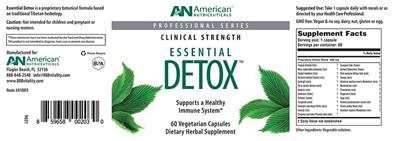
Essential Detox is a proprietary botanical formula based on traditional Tibetan herbology.
Precautions
Caution: Not intended for children and pregnant or nursing women.
Caution: Not intended for children and pregnant or nursing women.
FDA Disclaimer Statement
These statements have not been evaluated by the Food and Drug Administration. This product is not intended to diagnose, treat, cure or prevent any disease.
General Statements
Please recycle
Professional Series
Formulation
BPA free
Clinical strength Supports a healthy immune system
GMO free. Vegan & no soy, dairy, nut, gluten or egg.
GMO free. Vegan & no soy, dairy, nut, gluten or egg.
FDA Statement of Identity
Dietary Herbal Supplement
Suggested/Recommended/Usage/Directions
Suggested use: Take 1 capsule daily with meals or as directed by your health care professional.
Is this label outdated? Report a formula or label change and our pharmacy team will review it.
Essential Detox by AN American Nutriceuticals label
The label scan from the NIH Dietary Supplement Label Database. Tap to enlarge.
Label images are published by the NIH Dietary Supplement Label Database for the version of this product on file. Always read your actual product label.
View the full label (PDF)The Ingredients in Essential Detox by AN American Nutriceuticals
These are the 25 active ingredients this product is made of. Select any to open its full monograph.
Serving size1 Capsule(s) Dosage formCapsule Servings per container60 Amounts shown are per serving.
Most supplement products combine several ingredients, and a medication can interact with the product through any one of them. Each ingredient below shows whether it has known drug interactions.
Proprietary Herbal Blend
- › Marshmallow
- › Sage
- › Fenugreek
- › Elecampane
- › Hyssop
- › Peppermint
- › Eyebright
- › Angelica
- › European Elder
- › German Chamomile
- › Tropical Almond
- › Melia azadirachta
- › English Hawthorn
- › Pyrus cydonia
- › Sunflower
- › Coltsfoot
- › Cowslip
- › Cinchona succirubra
- › Salix purpurea
- › Aconitum napellus
- › Galeopsis ochroleuca
- › Adiantum capillus-veneris
- › Robinia pseudoacacia
- › Ferula sumbul
- › Gentian
Other (inactive) ingredients: Vegetable Cellulose. These complete the product’s ingredient list but are not active constituents.
Essential Detox by AN American Nutriceuticals Drug Interactions
HelloPharmacist Interaction Report
Essential Detox by AN American Nutriceuticals contains 25 ingredients, many of which interact with medications.
The most serious concern is English Hawthorn, which carries Major-severity interactions with nitrates (used for chest pain) and phosphodiesterase-5 inhibitors like sildenafil (Viagra) — both can cause dangerous drops in blood pressure when combined.
Read the full breakdown — every affected drug type, severity by severity
Several ingredients affect how your liver processes drugs. Sage, peppermint, German chamomile, and cinchona all inhibit liver enzymes (CYP2D6, CYP2C9, CYP2C19, CYP3A4), potentially raising levels of medications metabolized by these pathways.
Cinchona is particularly concerning because it contains quinidine and quinine, both Major-severity issues that can cause irregular heartbeats and bleeding risk. Fenugreek interacts with blood thinners (warfarin, clopidogrel), diabetes drugs, and several others.
Coltsfoot also increases bleeding risk with anticoagulants and blood thinners.
Other Moderate interactions include: Marshmallow with lithium (a mood-stabilizing drug), sage with blood pressure and CNS depressant drugs, elecampane and German chamomile with sedatives, eyebright with diabetes drugs, hawthorn with beta-blockers and calcium channel blockers, and aconite with blood thinners and stimulants. Aconite is extremely toxic even in small amounts and should not be used.
Additionally, we could not check Angelica, European Elder, Tropical Almond, Melia azadirachta, Sunflower, Salix purpurea, Robinia pseudoacacia — we hold no data for these. Altogether, these interactions span 2,178 individual medications.
Before starting this product, use the medication checker below with every prescription and over-the-counter drug you take.
Check your own medications below · Editorial policy · How we use AI
Want to check YOUR meds against Essential Detox?
Ask about interactions with your drugs in plain English — “Can I take it with lisinopril?” — and we find you the answer in seconds, ingredient by ingredient.
Go to the checkerIngredients driving the most interactions
Individual Drug Interactions
The ingredients in Essential Detox interact with 2,198 drugs. Click any drug to see the details.
13 of the 25 ingredients in Essential Detox interact with drugs. Each result below shows which ingredient is responsible. Marshmallow Sage German Chamomile Peppermint Cinchona succirubra Fenugreek Coltsfoot Aconitum napellus Elecampane English Hawthorn Angelica Gentian Eyebright
AvanafilStendra
How Avanafil interacts with Essential Detox — through 5 ingredients. Tap an ingredient for the detail:
English HawthornPhosphodiesterase-5 Inhibitors Major
Interaction Summary
Theoretically, concomitant use might result in additive vasodilation and hypotension.
Read the full English Hawthorn + Avanafil interactionPeppermintCytochrome P450 3a4 (cyp3a4) Substrates Moderate
Interaction Summary
Theoretically, peppermint might increase the levels of CYP3A4 substrates.
Read the full Peppermint + Avanafil interactionGerman ChamomileCytochrome P450 3a4 (cyp3a4) Substrates Moderate
Interaction Summary
Theoretically, German chamomile might inhibit CYP3A4 and increase levels of drugs metabolized by these enzymes.
Read the full German Chamomile + Avanafil interactionSageCytochrome P450 3a4 (cyp3a4) Substrates Moderate
Interaction Summary
Theoretically, sage might increase the levels and clinical effects of drugs metabolized by CYP3A4.
Read the full Sage + Avanafil interactionMarshmallowOral Drugs Minor
Interaction Summary
Theoretically, mucilage in marshmallow might impair absorption of oral drugs.
Read the full Marshmallow + Avanafil interactionFinasteride, TadalafilEntadfi
How Finasteride, Tadalafil interacts with Essential Detox — through 5 ingredients. Tap an ingredient for the detail:
English HawthornPhosphodiesterase-5 Inhibitors Major
Interaction Summary
Theoretically, concomitant use might result in additive vasodilation and hypotension.
Read the full English Hawthorn + Finasteride, Tadalafil interactionPeppermintCytochrome P450 3a4 (cyp3a4) Substrates Moderate
Interaction Summary
Theoretically, peppermint might increase the levels of CYP3A4 substrates.
Read the full Peppermint + Finasteride, Tadalafil interactionGerman ChamomileCytochrome P450 3a4 (cyp3a4) Substrates Moderate
Interaction Summary
Theoretically, German chamomile might inhibit CYP3A4 and increase levels of drugs metabolized by these enzymes.
Read the full German Chamomile + Finasteride, Tadalafil interactionSageCytochrome P450 3a4 (cyp3a4) Substrates Moderate
Interaction Summary
Theoretically, sage might increase the levels and clinical effects of drugs metabolized by CYP3A4.
Read the full Sage + Finasteride, Tadalafil interactionMarshmallowOral Drugs Minor
Interaction Summary
Theoretically, mucilage in marshmallow might impair absorption of oral drugs.
Read the full Marshmallow + Finasteride, Tadalafil interactionGlyceryl TrinitrateNitronal
How Glyceryl Trinitrate interacts with Essential Detox — through 1 ingredient. Tap an ingredient for the detail:
English HawthornNitrates Major
Interaction Summary
Theoretically, concomitant use might cause additive coronary vasodilatory effects.
Read the full English Hawthorn + Glyceryl Trinitrate interactionIsosorbide DinitrateAngitak, Cedocard Retard, Isoket, Isoket Retard, Isordil
How Isosorbide Dinitrate interacts with Essential Detox — through 2 ingredients. Tap an ingredient for the detail:
English HawthornNitrates Major
Interaction Summary
Theoretically, concomitant use might cause additive coronary vasodilatory effects.
Read the full English Hawthorn + Isosorbide Dinitrate interactionMarshmallowOral Drugs Minor
Interaction Summary
Theoretically, mucilage in marshmallow might impair absorption of oral drugs.
Read the full Marshmallow + Isosorbide Dinitrate interactionIsosorbide Dinitrate, HydralazineBiDil
How Isosorbide Dinitrate, Hydralazine interacts with Essential Detox — through 6 ingredients. Tap an ingredient for the detail:
English HawthornNitrates Major
Interaction Summary
Theoretically, concomitant use might cause additive coronary vasodilatory effects.
Read the full English Hawthorn + Isosorbide Dinitrate, Hydralazine interactionColtsfootAntihypertensive Drugs Moderate
Interaction Summary
Theoretically, excessive doses of coltsfoot may interfere with antihypertensive or cardiovascular therapy.
Read the full Coltsfoot + Isosorbide Dinitrate, Hydralazine interactionGentianAntihypertensive Drugs Moderate
Interaction Summary
Theoretically, taking gentian with antihypertensive drugs might increase the risk of hypotension.
Read the full Gentian + Isosorbide Dinitrate, Hydralazine interactionSageAntihypertensive Drugs Moderate
Interaction Summary
Theoretically, sage might increase or decrease the effects of antihypertensive drugs.
Read the full Sage + Isosorbide Dinitrate, Hydralazine interactionFenugreekAntihypertensive Drugs Minor
Interaction Summary
Fenugreek may also have an additive effect on blood pressure-lowering medications.
Read the full Fenugreek + Isosorbide Dinitrate, Hydralazine interactionMarshmallowOral Drugs Minor
Interaction Summary
Theoretically, mucilage in marshmallow might impair absorption of oral drugs.
Read the full Marshmallow + Isosorbide Dinitrate, Hydralazine interactionIsosorbide MononitrateAngeze, Angeze SR, Chemydur 60XL, Dynamin, Elantan, Elantan LA +13 more
How Isosorbide Mononitrate interacts with Essential Detox — through 2 ingredients. Tap an ingredient for the detail:
English HawthornNitrates Major
Interaction Summary
Theoretically, concomitant use might cause additive coronary vasodilatory effects.
Read the full English Hawthorn + Isosorbide Mononitrate interactionMarshmallowOral Drugs Minor
Interaction Summary
Theoretically, mucilage in marshmallow might impair absorption of oral drugs.
Read the full Marshmallow + Isosorbide Mononitrate interactionMacitentan, TadalafilOpsynvi
How Macitentan, Tadalafil interacts with Essential Detox — through 8 ingredients. Tap an ingredient for the detail:
English HawthornPhosphodiesterase-5 Inhibitors Major
Interaction Summary
Theoretically, concomitant use might result in additive vasodilation and hypotension.
Read the full English Hawthorn + Macitentan, Tadalafil interactionGerman ChamomileCytochrome P450 2c9 (cyp2c9) Substrates, Cytochrome P450 3a4 (cyp3a4) Substrates Moderate
Interaction Summary
Theoretically, German chamomile might inhibit CYP2C9 and increase levels of drugs metabolized by these enzymes.
Read the full German Chamomile + Macitentan, Tadalafil interactionColtsfootAntihypertensive Drugs Moderate
Interaction Summary
Theoretically, excessive doses of coltsfoot may interfere with antihypertensive or cardiovascular therapy.
Read the full Coltsfoot + Macitentan, Tadalafil interactionSageAntihypertensive Drugs, Cytochrome P450 2c9 (cyp2c9) Substrates +1 Moderate
Interaction Summary
Theoretically, sage might increase or decrease the effects of antihypertensive drugs.
Read the full Sage + Macitentan, Tadalafil interactionGentianAntihypertensive Drugs Moderate
Interaction Summary
Theoretically, taking gentian with antihypertensive drugs might increase the risk of hypotension.
Read the full Gentian + Macitentan, Tadalafil interactionPeppermintCytochrome P450 3a4 (cyp3a4) Substrates, Cytochrome P450 2c9 (cyp2c9) Substrates Moderate
Interaction Summary
Theoretically, peppermint might increase the levels of CYP3A4 substrates.
Read the full Peppermint + Macitentan, Tadalafil interactionFenugreekAntihypertensive Drugs Minor
Interaction Summary
Fenugreek may also have an additive effect on blood pressure-lowering medications.
Read the full Fenugreek + Macitentan, Tadalafil interactionMarshmallowOral Drugs Minor
Interaction Summary
Theoretically, mucilage in marshmallow might impair absorption of oral drugs.
Read the full Marshmallow + Macitentan, Tadalafil interactionNicorandilAprior, Dancor, Ikorel, Sigmart, Zynicor
How Nicorandil interacts with Essential Detox — through 2 ingredients. Tap an ingredient for the detail:
English HawthornNitrates Major
Interaction Summary
Theoretically, concomitant use might cause additive coronary vasodilatory effects.
Read the full English Hawthorn + Nicorandil interactionMarshmallowOral Drugs Minor
Interaction Summary
Theoretically, mucilage in marshmallow might impair absorption of oral drugs.
Read the full Marshmallow + Nicorandil interactionNitroglycerinGonitro, Nitro Time, Nitro-Bid, Nitrocine Timecaps, Nitrogard, Nitrogard SR +7 more
How Nitroglycerin interacts with Essential Detox — through 2 ingredients. Tap an ingredient for the detail:
English HawthornNitrates Major
Interaction Summary
Theoretically, concomitant use might cause additive coronary vasodilatory effects.
Read the full English Hawthorn + Nitroglycerin interactionMarshmallowOral Drugs Minor
Interaction Summary
Theoretically, mucilage in marshmallow might impair absorption of oral drugs.
Read the full Marshmallow + Nitroglycerin interactionPentaerythritol TetranitratePeritrate, Peritrate SA
How Pentaerythritol Tetranitrate interacts with Essential Detox — through 2 ingredients. Tap an ingredient for the detail:
English HawthornNitrates Major
Interaction Summary
Theoretically, concomitant use might cause additive coronary vasodilatory effects.
Read the full English Hawthorn + Pentaerythritol Tetranitrate interactionMarshmallowOral Drugs Minor
Interaction Summary
Theoretically, mucilage in marshmallow might impair absorption of oral drugs.
Read the full Marshmallow + Pentaerythritol Tetranitrate interactionQuinidineCardioquin, Cin-Quin, Duraquin, Lin-Qin, Quinova, Quinaglute, Quinaglute Duratabs +2 more
How Quinidine interacts with Essential Detox — through 5 ingredients. Tap an ingredient for the detail:
Cinchona SuccirubraQt Interval-prolonging Drugs, Quinidine Major
Interaction Summary
Theoretically, taking cinchona with other QT interval-prolonging drugs might cause an additive effect and increase the risk of ventricular arrhythmias.
Read the full Cinchona Succirubra + Quinidine interactionSageP-glycoprotein Substrates, Cytochrome P450 3a4 (cyp3a4) Substrates Moderate
Interaction Summary
Theoretically, sage might increase levels of drugs transported by P-glycoprotein.
Read the full Sage + Quinidine interactionPeppermintCytochrome P450 3a4 (cyp3a4) Substrates Moderate
Interaction Summary
Theoretically, peppermint might increase the levels of CYP3A4 substrates.
Read the full Peppermint + Quinidine interactionGerman ChamomileCytochrome P450 3a4 (cyp3a4) Substrates Moderate
Interaction Summary
Theoretically, German chamomile might inhibit CYP3A4 and increase levels of drugs metabolized by these enzymes.
Read the full German Chamomile + Quinidine interactionMarshmallowOral Drugs Minor
Interaction Summary
Theoretically, mucilage in marshmallow might impair absorption of oral drugs.
Read the full Marshmallow + Quinidine interactionQuinineQualaquin
How Quinine interacts with Essential Detox — through 5 ingredients. Tap an ingredient for the detail:
Cinchona SuccirubraQuinine Major
Interaction Summary
Theoretically, taking cinchona might increase plasma levels and adverse effects of quinine.
Read the full Cinchona Succirubra + Quinine interactionGerman ChamomileCytochrome P450 3a4 (cyp3a4) Substrates Moderate
Interaction Summary
Theoretically, German chamomile might inhibit CYP3A4 and increase levels of drugs metabolized by these enzymes.
Read the full German Chamomile + Quinine interactionSageCytochrome P450 3a4 (cyp3a4) Substrates Moderate
Interaction Summary
Theoretically, sage might increase the levels and clinical effects of drugs metabolized by CYP3A4.
Read the full Sage + Quinine interactionPeppermintCytochrome P450 3a4 (cyp3a4) Substrates Moderate
Interaction Summary
Theoretically, peppermint might increase the levels of CYP3A4 substrates.
Read the full Peppermint + Quinine interactionMarshmallowOral Drugs Minor
Interaction Summary
Theoretically, mucilage in marshmallow might impair absorption of oral drugs.
Read the full Marshmallow + Quinine interactionQuinine SulfateQuinamm, Quinine Sulfate
How Quinine Sulfate interacts with Essential Detox — through 5 ingredients. Tap an ingredient for the detail:
Cinchona SuccirubraQuinine Major
Interaction Summary
Theoretically, taking cinchona might increase plasma levels and adverse effects of quinine.
Read the full Cinchona Succirubra + Quinine Sulfate interactionSageCytochrome P450 3a4 (cyp3a4) Substrates Moderate
Interaction Summary
Theoretically, sage might increase the levels and clinical effects of drugs metabolized by CYP3A4.
Read the full Sage + Quinine Sulfate interactionGerman ChamomileCytochrome P450 3a4 (cyp3a4) Substrates Moderate
Interaction Summary
Theoretically, German chamomile might inhibit CYP3A4 and increase levels of drugs metabolized by these enzymes.
Read the full German Chamomile + Quinine Sulfate interactionPeppermintCytochrome P450 3a4 (cyp3a4) Substrates Moderate
Interaction Summary
Theoretically, peppermint might increase the levels of CYP3A4 substrates.
Read the full Peppermint + Quinine Sulfate interactionMarshmallowOral Drugs Minor
Interaction Summary
Theoretically, mucilage in marshmallow might impair absorption of oral drugs.
Read the full Marshmallow + Quinine Sulfate interactionSildenafilRevatio
How Sildenafil interacts with Essential Detox — through 6 ingredients. Tap an ingredient for the detail:
English HawthornPhosphodiesterase-5 Inhibitors Major
Interaction Summary
Theoretically, concomitant use might result in additive vasodilation and hypotension.
Read the full English Hawthorn + Sildenafil interactionGerman ChamomileCytochrome P450 3a4 (cyp3a4) Substrates, Cytochrome P450 2c9 (cyp2c9) Substrates Moderate
Interaction Summary
Theoretically, German chamomile might inhibit CYP3A4 and increase levels of drugs metabolized by these enzymes.
Read the full German Chamomile + Sildenafil interactionSageCytochrome P450 3a4 (cyp3a4) Substrates, Cytochrome P450 2c9 (cyp2c9) Substrates Moderate
Interaction Summary
Theoretically, sage might increase the levels and clinical effects of drugs metabolized by CYP3A4.
Read the full Sage + Sildenafil interactionPeppermintCytochrome P450 3a4 (cyp3a4) Substrates, Cytochrome P450 2c9 (cyp2c9) Substrates Moderate
Interaction Summary
Theoretically, peppermint might increase the levels of CYP3A4 substrates.
Read the full Peppermint + Sildenafil interactionFenugreekSildenafil (viagra) Moderate
Interaction Summary
Theoretically, concurrent use of sildenafil and fenugreek might reduce levels and therapeutic effects of sildenafil.
Read the full Fenugreek + Sildenafil interactionMarshmallowOral Drugs Minor
Interaction Summary
Theoretically, mucilage in marshmallow might impair absorption of oral drugs.
Read the full Marshmallow + Sildenafil interactionSildenafil CitrateViagra
How Sildenafil Citrate interacts with Essential Detox — through 6 ingredients. Tap an ingredient for the detail:
English HawthornPhosphodiesterase-5 Inhibitors Major
Interaction Summary
Theoretically, concomitant use might result in additive vasodilation and hypotension.
Read the full English Hawthorn + Sildenafil Citrate interactionFenugreekSildenafil (viagra) Moderate
Interaction Summary
Theoretically, concurrent use of sildenafil and fenugreek might reduce levels and therapeutic effects of sildenafil.
Read the full Fenugreek + Sildenafil Citrate interactionSageCytochrome P450 2c9 (cyp2c9) Substrates, Cytochrome P450 3a4 (cyp3a4) Substrates Moderate
Interaction Summary
Theoretically, sage might increase the levels and clinical effects of drugs metabolized by CYP2C9.
Read the full Sage + Sildenafil Citrate interactionGerman ChamomileCytochrome P450 2c9 (cyp2c9) Substrates, Cytochrome P450 3a4 (cyp3a4) Substrates Moderate
Interaction Summary
Theoretically, German chamomile might inhibit CYP2C9 and increase levels of drugs metabolized by these enzymes.
Read the full German Chamomile + Sildenafil Citrate interactionPeppermintCytochrome P450 2c9 (cyp2c9) Substrates, Cytochrome P450 3a4 (cyp3a4) Substrates Moderate
Interaction Summary
Theoretically, peppermint might increase the levels of CYP2C9 substrates.
Read the full Peppermint + Sildenafil Citrate interactionMarshmallowOral Drugs Minor
Interaction Summary
Theoretically, mucilage in marshmallow might impair absorption of oral drugs.
Read the full Marshmallow + Sildenafil Citrate interactionTadalafilCialis, Tadliq
How Tadalafil interacts with Essential Detox — through 5 ingredients. Tap an ingredient for the detail:
English HawthornPhosphodiesterase-5 Inhibitors Major
Interaction Summary
Theoretically, concomitant use might result in additive vasodilation and hypotension.
Read the full English Hawthorn + Tadalafil interactionGerman ChamomileCytochrome P450 3a4 (cyp3a4) Substrates Moderate
Interaction Summary
Theoretically, German chamomile might inhibit CYP3A4 and increase levels of drugs metabolized by these enzymes.
Read the full German Chamomile + Tadalafil interactionSageCytochrome P450 3a4 (cyp3a4) Substrates Moderate
Interaction Summary
Theoretically, sage might increase the levels and clinical effects of drugs metabolized by CYP3A4.
Read the full Sage + Tadalafil interactionPeppermintCytochrome P450 3a4 (cyp3a4) Substrates Moderate
Interaction Summary
Theoretically, peppermint might increase the levels of CYP3A4 substrates.
Read the full Peppermint + Tadalafil interactionMarshmallowOral Drugs Minor
Interaction Summary
Theoretically, mucilage in marshmallow might impair absorption of oral drugs.
Read the full Marshmallow + Tadalafil interactionVardenafilLevitra, Staxyn
How Vardenafil interacts with Essential Detox — through 5 ingredients. Tap an ingredient for the detail:
English HawthornPhosphodiesterase-5 Inhibitors Major
Interaction Summary
Theoretically, concomitant use might result in additive vasodilation and hypotension.
Read the full English Hawthorn + Vardenafil interactionGerman ChamomileCytochrome P450 3a4 (cyp3a4) Substrates Moderate
Interaction Summary
Theoretically, German chamomile might inhibit CYP3A4 and increase levels of drugs metabolized by these enzymes.
Read the full German Chamomile + Vardenafil interactionPeppermintCytochrome P450 3a4 (cyp3a4) Substrates Moderate
Interaction Summary
Theoretically, peppermint might increase the levels of CYP3A4 substrates.
Read the full Peppermint + Vardenafil interactionSageCytochrome P450 3a4 (cyp3a4) Substrates Moderate
Interaction Summary
Theoretically, sage might increase the levels and clinical effects of drugs metabolized by CYP3A4.
Read the full Sage + Vardenafil interactionMarshmallowOral Drugs Minor
Interaction Summary
Theoretically, mucilage in marshmallow might impair absorption of oral drugs.
Read the full Marshmallow + Vardenafil interactionAdo-trastuzumab EmtansineKadcyla
How Ado-trastuzumab Emtansine interacts with Essential Detox — through 3 ingredients. Tap an ingredient for the detail:
German ChamomileCytochrome P450 3a4 (cyp3a4) Substrates Moderate
Interaction Summary
Theoretically, German chamomile might inhibit CYP3A4 and increase levels of drugs metabolized by these enzymes.
Read the full German Chamomile + Ado-trastuzumab Emtansine interactionSageCytochrome P450 3a4 (cyp3a4) Substrates Moderate
Interaction Summary
Theoretically, sage might increase the levels and clinical effects of drugs metabolized by CYP3A4.
Read the full Sage + Ado-trastuzumab Emtansine interactionPeppermintCytochrome P450 3a4 (cyp3a4) Substrates Moderate
Interaction Summary
Theoretically, peppermint might increase the levels of CYP3A4 substrates.
Read the full Peppermint + Ado-trastuzumab Emtansine interactionAbciximabReoPro
How Abciximab interacts with Essential Detox — through 6 ingredients. Tap an ingredient for the detail:
FenugreekAnticoagulant/antiplatelet Drugs Moderate
Interaction Summary
Theoretically, fenugreek might have additive effects when used with anticoagulant or antiplatelet drugs.
Read the full Fenugreek + Abciximab interactionColtsfootAnticoagulant/antiplatelet Drugs Moderate
Interaction Summary
Concomitant use might increase the risk of bleeding due to decreased platelet aggregation.
Read the full Coltsfoot + Abciximab interactionCinchona SuccirubraAnticoagulant/antiplatelet Drugs Moderate
Interaction Summary
Theoretically, taking cinchona might increase the drug effects and risk of bleeding with anticoagulant and antiplatelet drugs.
Read the full Cinchona Succirubra + Abciximab interactionAconitum NapellusAnticoagulant/antiplatelet Drugs Moderate
Interaction Summary
Theoretically, combining aconite with other antiplatelet or anticoagulant drugs might increase the risk of bruising and bleeding.
Read the full Aconitum Napellus + Abciximab interactionEnglish HawthornAnticoagulant/antiplatelet Drugs Moderate
Interaction Summary
Theoretically, hawthorn may increase the risk of bleeding if used with anticoagulant or antiplatelet drugs.
Read the full English Hawthorn + Abciximab interactionMarshmallowOral Drugs, Anticoagulant/antiplatelet Drugs Minor
Interaction Summary
Theoretically, mucilage in marshmallow might impair absorption of oral drugs.
Read the full Marshmallow + Abciximab interactionAbemaciclibVerzenio
How Abemaciclib interacts with Essential Detox — through 4 ingredients. Tap an ingredient for the detail:
SageCytochrome P450 3a4 (cyp3a4) Substrates Moderate
Interaction Summary
Theoretically, sage might increase the levels and clinical effects of drugs metabolized by CYP3A4.
Read the full Sage + Abemaciclib interactionPeppermintCytochrome P450 3a4 (cyp3a4) Substrates Moderate
Interaction Summary
Theoretically, peppermint might increase the levels of CYP3A4 substrates.
Read the full Peppermint + Abemaciclib interactionGerman ChamomileCytochrome P450 3a4 (cyp3a4) Substrates Moderate
Interaction Summary
Theoretically, German chamomile might inhibit CYP3A4 and increase levels of drugs metabolized by these enzymes.
Read the full German Chamomile + Abemaciclib interactionMarshmallowOral Drugs Minor
Interaction Summary
Theoretically, mucilage in marshmallow might impair absorption of oral drugs.
Read the full Marshmallow + Abemaciclib interactionAbiraterone
How Abiraterone interacts with Essential Detox — through 4 ingredients. Tap an ingredient for the detail:
German ChamomileCytochrome P450 3a4 (cyp3a4) Substrates Moderate
Interaction Summary
Theoretically, German chamomile might inhibit CYP3A4 and increase levels of drugs metabolized by these enzymes.
Read the full German Chamomile + Abiraterone interactionSageCytochrome P450 3a4 (cyp3a4) Substrates Moderate
Interaction Summary
Theoretically, sage might increase the levels and clinical effects of drugs metabolized by CYP3A4.
Read the full Sage + Abiraterone interactionPeppermintCytochrome P450 3a4 (cyp3a4) Substrates Moderate
Interaction Summary
Theoretically, peppermint might increase the levels of CYP3A4 substrates.
Read the full Peppermint + Abiraterone interactionMarshmallowOral Drugs Minor
Interaction Summary
Theoretically, mucilage in marshmallow might impair absorption of oral drugs.
Read the full Marshmallow + Abiraterone interactionAbiraterone AcetateYonsa, Zytiga
How Abiraterone Acetate interacts with Essential Detox — through 4 ingredients. Tap an ingredient for the detail:
German ChamomileCytochrome P450 3a4 (cyp3a4) Substrates Moderate
Interaction Summary
Theoretically, German chamomile might inhibit CYP3A4 and increase levels of drugs metabolized by these enzymes.
Read the full German Chamomile + Abiraterone Acetate interactionPeppermintCytochrome P450 3a4 (cyp3a4) Substrates Moderate
Interaction Summary
Theoretically, peppermint might increase the levels of CYP3A4 substrates.
Read the full Peppermint + Abiraterone Acetate interactionSageCytochrome P450 3a4 (cyp3a4) Substrates Moderate
Interaction Summary
Theoretically, sage might increase the levels and clinical effects of drugs metabolized by CYP3A4.
Read the full Sage + Abiraterone Acetate interactionMarshmallowOral Drugs Minor
Interaction Summary
Theoretically, mucilage in marshmallow might impair absorption of oral drugs.
Read the full Marshmallow + Abiraterone Acetate interactionAbrocitinibCibinqo
How Abrocitinib interacts with Essential Detox — through 9 ingredients. Tap an ingredient for the detail:
SageCytochrome P450 2c9 (cyp2c9) Substrates, Cytochrome P450 2c19 (cyp2c19) Substrates Moderate
Interaction Summary
Theoretically, sage might increase the levels and clinical effects of drugs metabolized by CYP2C9.
Read the full Sage + Abrocitinib interactionEnglish HawthornAnticoagulant/antiplatelet Drugs Moderate
Interaction Summary
Theoretically, hawthorn may increase the risk of bleeding if used with anticoagulant or antiplatelet drugs.
Read the full English Hawthorn + Abrocitinib interactionCinchona SuccirubraAnticoagulant/antiplatelet Drugs Moderate
Interaction Summary
Theoretically, taking cinchona might increase the drug effects and risk of bleeding with anticoagulant and antiplatelet drugs.
Read the full Cinchona Succirubra + Abrocitinib interactionColtsfootAnticoagulant/antiplatelet Drugs Moderate
Interaction Summary
Concomitant use might increase the risk of bleeding due to decreased platelet aggregation.
Read the full Coltsfoot + Abrocitinib interactionFenugreekAnticoagulant/antiplatelet Drugs Moderate
Interaction Summary
Theoretically, fenugreek might have additive effects when used with anticoagulant or antiplatelet drugs.
Read the full Fenugreek + Abrocitinib interactionPeppermintCytochrome P450 2c9 (cyp2c9) Substrates, Cytochrome P450 2c19 (cyp2c19) Substrates Moderate
Interaction Summary
Theoretically, peppermint might increase the levels of CYP2C9 substrates.
Read the full Peppermint + Abrocitinib interactionAconitum NapellusAnticoagulant/antiplatelet Drugs Moderate
Interaction Summary
Theoretically, combining aconite with other antiplatelet or anticoagulant drugs might increase the risk of bruising and bleeding.
Read the full Aconitum Napellus + Abrocitinib interactionGerman ChamomileCytochrome P450 2c9 (cyp2c9) Substrates Moderate
Interaction Summary
Theoretically, German chamomile might inhibit CYP2C9 and increase levels of drugs metabolized by these enzymes.
Read the full German Chamomile + Abrocitinib interactionMarshmallowOral Drugs, Anticoagulant/antiplatelet Drugs Minor
Interaction Summary
Theoretically, mucilage in marshmallow might impair absorption of oral drugs.
Read the full Marshmallow + Abrocitinib interactionAcalabrutinibCalquence
How Acalabrutinib interacts with Essential Detox — through 4 ingredients. Tap an ingredient for the detail:
German ChamomileCytochrome P450 3a4 (cyp3a4) Substrates Moderate
Interaction Summary
Theoretically, German chamomile might inhibit CYP3A4 and increase levels of drugs metabolized by these enzymes.
Read the full German Chamomile + Acalabrutinib interactionSageCytochrome P450 3a4 (cyp3a4) Substrates, P-glycoprotein Substrates Moderate
Interaction Summary
Theoretically, sage might increase the levels and clinical effects of drugs metabolized by CYP3A4.
Read the full Sage + Acalabrutinib interactionPeppermintCytochrome P450 3a4 (cyp3a4) Substrates Moderate
Interaction Summary
Theoretically, peppermint might increase the levels of CYP3A4 substrates.
Read the full Peppermint + Acalabrutinib interactionMarshmallowOral Drugs Minor
Interaction Summary
Theoretically, mucilage in marshmallow might impair absorption of oral drugs.
Read the full Marshmallow + Acalabrutinib interactionAcarboseGlucobay, Prandase, Precose
How Acarbose interacts with Essential Detox — through 4 ingredients. Tap an ingredient for the detail:
SageAntidiabetes Drugs Moderate
Interaction Summary
Theoretically, taking sage with antidiabetes drugs might increase the risk of hypoglycemia.
Read the full Sage + Acarbose interactionEyebrightAntidiabetes Drugs Moderate
Interaction Summary
Theoretically, eyebright might increase the risk of hypoglycemia when taken with antidiabetes drugs.
Read the full Eyebright + Acarbose interactionFenugreekAntidiabetes Drugs Moderate
Interaction Summary
Theoretically, fenugreek seed might have additive hypoglycemic effects when used with antidiabetes drugs.
Read the full Fenugreek + Acarbose interactionMarshmallowOral Drugs Minor
Interaction Summary
Theoretically, mucilage in marshmallow might impair absorption of oral drugs.
Read the full Marshmallow + Acarbose interactionAcebutololRhotral, Sectral
How Acebutolol interacts with Essential Detox — through 6 ingredients. Tap an ingredient for the detail:
English HawthornBeta-blockers Moderate
Interaction Summary
Theoretically, concomitant use might cause additive effects on blood pressure and heart rate.
Read the full English Hawthorn + Acebutolol interactionSageAntihypertensive Drugs Moderate
Interaction Summary
Theoretically, sage might increase or decrease the effects of antihypertensive drugs.
Read the full Sage + Acebutolol interactionGentianAntihypertensive Drugs Moderate
Interaction Summary
Theoretically, taking gentian with antihypertensive drugs might increase the risk of hypotension.
Read the full Gentian + Acebutolol interactionColtsfootAntihypertensive Drugs Moderate
Interaction Summary
Theoretically, excessive doses of coltsfoot may interfere with antihypertensive or cardiovascular therapy.
Read the full Coltsfoot + Acebutolol interactionMarshmallowOral Drugs Minor
Interaction Summary
Theoretically, mucilage in marshmallow might impair absorption of oral drugs.
Read the full Marshmallow + Acebutolol interactionFenugreekAntihypertensive Drugs Minor
Interaction Summary
Fenugreek may also have an additive effect on blood pressure-lowering medications.
Read the full Fenugreek + Acebutolol interactionAcenocoumarolSintrom
How Acenocoumarol interacts with Essential Detox — through 6 ingredients. Tap an ingredient for the detail:
Aconitum NapellusAnticoagulant/antiplatelet Drugs Moderate
Interaction Summary
Theoretically, combining aconite with other antiplatelet or anticoagulant drugs might increase the risk of bruising and bleeding.
Read the full Aconitum Napellus + Acenocoumarol interactionFenugreekAnticoagulant/antiplatelet Drugs Moderate
Interaction Summary
Theoretically, fenugreek might have additive effects when used with anticoagulant or antiplatelet drugs.
Read the full Fenugreek + Acenocoumarol interactionColtsfootAnticoagulant/antiplatelet Drugs Moderate
Interaction Summary
Concomitant use might increase the risk of bleeding due to decreased platelet aggregation.
Read the full Coltsfoot + Acenocoumarol interactionCinchona SuccirubraAnticoagulant/antiplatelet Drugs Moderate
Interaction Summary
Theoretically, taking cinchona might increase the drug effects and risk of bleeding with anticoagulant and antiplatelet drugs.
Read the full Cinchona Succirubra + Acenocoumarol interactionEnglish HawthornAnticoagulant/antiplatelet Drugs Moderate
Interaction Summary
Theoretically, hawthorn may increase the risk of bleeding if used with anticoagulant or antiplatelet drugs.
Read the full English Hawthorn + Acenocoumarol interactionMarshmallowAnticoagulant/antiplatelet Drugs, Oral Drugs Minor
Interaction Summary
Theoretically, marshmallow flower might have antiplatelet effects.
Read the full Marshmallow + Acenocoumarol interactionAcepromazineAtravet
How Acepromazine interacts with Essential Detox — through 4 ingredients. Tap an ingredient for the detail:
SageAnticholinergic Drugs, Cns Depressants Moderate
Interaction Summary
Theoretically, sage might decrease the clinical effects of anticholinergic drugs.
Read the full Sage + Acepromazine interactionElecampaneCns Depressants Moderate
Interaction Summary
Theoretically, elecampane may cause additive sedative effects when taken with CNS depressants.
Read the full Elecampane + Acepromazine interactionGerman ChamomileCns Depressants Moderate
Interaction Summary
Theoretically, German chamomile might have additive effects when used with CNS depressants.
Read the full German Chamomile + Acepromazine interactionMarshmallowOral Drugs Minor
Interaction Summary
Theoretically, mucilage in marshmallow might impair absorption of oral drugs.
Read the full Marshmallow + Acepromazine interactionAcetaminophenChildren's Tylenol, Children's Tylenol Meltaways, Tylenol, Tylenol Ex Strength
How Acetaminophen interacts with Essential Detox — through 5 ingredients. Tap an ingredient for the detail:
SageCytochrome P450 2e1 (cyp2e1) Substrates Moderate
Interaction Summary
Theoretically, sage might decrease the levels and clinical effects of drugs metabolized by CYP2E1.
Read the full Sage + Acetaminophen interactionAngelicaCytochrome P450 1a2 (cyp1a2) Substrates Moderate
Interaction Summary
In vitro research shows that ashitaba extract inhibits cytochrome P450 (CYP) 1A2.
Read the full Angelica + Acetaminophen interactionPeppermintCytochrome P450 1a2 (cyp1a2) Substrates Minor
Interaction Summary
Theoretically, peppermint might increase the levels of CYP1A2 substrates.
Read the full Peppermint + Acetaminophen interactionGerman ChamomileCytochrome P450 1a2 (cyp1a2) Substrates Minor
Interaction Summary
Theoretically, German chamomile might inhibit CYP1A2 and increase levels of drugs metabolized by these enzymes.
Read the full German Chamomile + Acetaminophen interactionMarshmallowOral Drugs Minor
Interaction Summary
Theoretically, mucilage in marshmallow might impair absorption of oral drugs.
Read the full Marshmallow + Acetaminophen interactionAcetaminophen, AspirinGemnisyn
How Acetaminophen, Aspirin interacts with Essential Detox — through 10 ingredients. Tap an ingredient for the detail:
FenugreekAnticoagulant/antiplatelet Drugs Moderate
Interaction Summary
Theoretically, fenugreek might have additive effects when used with anticoagulant or antiplatelet drugs.
Read the full Fenugreek + Acetaminophen, Aspirin interactionColtsfootAnticoagulant/antiplatelet Drugs Moderate
Interaction Summary
Concomitant use might increase the risk of bleeding due to decreased platelet aggregation.
Read the full Coltsfoot + Acetaminophen, Aspirin interactionAconitum NapellusAnticoagulant/antiplatelet Drugs Moderate
Interaction Summary
Theoretically, combining aconite with other antiplatelet or anticoagulant drugs might increase the risk of bruising and bleeding.
Read the full Aconitum Napellus + Acetaminophen, Aspirin interactionSageCytochrome P450 2e1 (cyp2e1) Substrates Moderate
Interaction Summary
Theoretically, sage might decrease the levels and clinical effects of drugs metabolized by CYP2E1.
Read the full Sage + Acetaminophen, Aspirin interactionEnglish HawthornAnticoagulant/antiplatelet Drugs Moderate
Interaction Summary
Theoretically, hawthorn may increase the risk of bleeding if used with anticoagulant or antiplatelet drugs.
Read the full English Hawthorn + Acetaminophen, Aspirin interactionAngelicaCytochrome P450 1a2 (cyp1a2) Substrates Moderate
Interaction Summary
In vitro research shows that ashitaba extract inhibits cytochrome P450 (CYP) 1A2.
Read the full Angelica + Acetaminophen, Aspirin interactionCinchona SuccirubraAnticoagulant/antiplatelet Drugs Moderate
Interaction Summary
Theoretically, taking cinchona might increase the drug effects and risk of bleeding with anticoagulant and antiplatelet drugs.
Read the full Cinchona Succirubra + Acetaminophen, Aspirin interactionMarshmallowOral Drugs, Anticoagulant/antiplatelet Drugs Minor
Interaction Summary
Theoretically, mucilage in marshmallow might impair absorption of oral drugs.
Read the full Marshmallow + Acetaminophen, Aspirin interactionPeppermintCytochrome P450 1a2 (cyp1a2) Substrates Minor
Interaction Summary
Theoretically, peppermint might increase the levels of CYP1A2 substrates.
Read the full Peppermint + Acetaminophen, Aspirin interactionGerman ChamomileCytochrome P450 1a2 (cyp1a2) Substrates Minor
Interaction Summary
Theoretically, German chamomile might inhibit CYP1A2 and increase levels of drugs metabolized by these enzymes.
Read the full German Chamomile + Acetaminophen, Aspirin interactionEach ingredient & the kinds of drugs it affects
For each ingredient in Essential Detox with known interactions, here are the types of medications they can affect. Open any type for the detail — or search your exact drug in the checker above.
Marshmallow
Lithium
Theoretically, due to potential diuretic effects, marshmallow might reduce excretion and increase levels of lithium.
Marshmallow is thought to have diuretic properties. To avoid lithium toxicity, the dose of lithium might need to be decreased when used with marshmallow.
Anticoagulant/Antiplatelet Drugs
Theoretically, marshmallow flower might have antiplatelet effects.
Animal research suggests that marshmallow flower extract has antiplatelet effects. However, the root and leaf of marshmallow, not the flower, are the plant parts most commonly found in dietary supplements. Theoretically, use of marshmallow flower with anticoagulant/antiplatelet drugs can have additive effects, and might increase the risk for bleeding in some patients.
Oral Drugs
Theoretically, mucilage in marshmallow might impair absorption of oral drugs.
Marshmallow contains mucilage which can affect oral drug absorption. To avoid changes in absorption, take marshmallow 30-60 minutes after oral medications.
Sage
Anticholinergic Drugs
Theoretically, sage might decrease the clinical effects of anticholinergic drugs.
In vitro evidence suggests that common sage (Salvia officinalis) and Spanish sage (Salvia lavandulaefolia) can inhibit acetylcholinesterase and might increase acetylcholine levels.
Anticonvulsants
Theoretically, sage might interfere with the clinical effects of anticonvulsant drugs.
Some species of sage can cause convulsions when consumed in large quantities.
Antidiabetes Drugs
Theoretically, taking sage with antidiabetes drugs might increase the risk of hypoglycemia.
In patients with polycystic ovary syndrome (PCOS) or inadequately controlled type 2 diabetes, common sage (Salvia officinalis) has demonstrated hypoglycemic activity. However, other clinical research in patients with inadequately controlled type 2 diabetes shows that common sage extract does not lower fasting blood glucose levels.
Antihypertensive Drugs
Theoretically, sage might increase or decrease the effects of antihypertensive drugs.
Animal research suggests that common sage (Salvia officinalis) can cause prolonged blood pressure reduction. However, clinical research suggests that Spanish sage (Salvia lavandulaefolia) can increase blood pressure in some people with hypertension. Until more is known, use with caution.
Benzodiazepines
Theoretically, taking sage might increase the sedative and adverse effects of benzodiazepines.
In vitro evidence suggests that certain components of common sage (Salvia officinalis) can bind to benzodiazepine receptors. This effect has not been reported in humans.
Cholinergic Drugs
Theoretically, sage might have additive effects when used with cholinergic drugs.
In vitro evidence suggests that common sage (Salvia officinalis) and Spanish sage (Salvia lavandulaefolia) can inhibit acetylcholinesterase and might increase acetylcholine levels.
Cns Depressants
Theoretically, taking sage might increase the sedative and adverse effects of CNS depressants.
Some constituents of sage have CNS depressant activity.
Cytochrome P450 2C19 (Cyp2C19) Substrates
Theoretically, sage might increase the levels and clinical effects of drugs metabolized by CYP2C19.
In vitro evidence suggests that aqueous extracts of sage can inhibit CYP2C19. So far, this interaction has not been reported in humans.
Cytochrome P450 2C9 (Cyp2C9) Substrates
Theoretically, sage might increase the levels and clinical effects of drugs metabolized by CYP2C9.
In vitro evidence suggests that aqueous extracts of sage can inhibit CYP2C9. So far, this interaction has not been reported in humans.
Cytochrome P450 2D6 (Cyp2D6) Substrates
Theoretically, sage might increase the levels and clinical effects of drugs metabolized by CYP2D6.
In vitro evidence suggests that aqueous extracts of sage can inhibit CYP2D6. So far, this interaction has not been reported in humans.
Cytochrome P450 2E1 (Cyp2E1) Substrates
Theoretically, sage might decrease the levels and clinical effects of drugs metabolized by CYP2E1.
Animal research suggests that drinking common sage (Salvia officinalis) tea increases the expression of CYP2E1. So far, this interaction has not been reported in humans.
Cytochrome P450 3A4 (Cyp3A4) Substrates
Theoretically, sage might increase the levels and clinical effects of drugs metabolized by CYP3A4.
In vitro evidence suggests that aqueous extracts of sage can inhibit CYP3A4. So far, this interaction has not been reported in humans.
Estrogens
Theoretically, sage might interfere with hormone therapy.
In vitro evidence suggests that geraniol, a constituent of Spanish sage (Salvia lavandulaefolia), exerts estrogenic activity. The clinical significance of this effect is unclear.
P-Glycoprotein Substrates
Theoretically, sage might increase levels of drugs transported by P-glycoprotein.
In vitro research suggests that common sage (Salvia officinalis) can inhibit the multi-drug transporter protein, P-glycoprotein. This effect has not been reported in humans.
German Chamomile
Cns Depressants
Theoretically, German chamomile might have additive effects when used with CNS depressants.
German chamomile has mild sedative effects. Theoretically, concomitant use with drugs with sedative properties can cause additive effects and side effects.
Contraceptive Drugs
Theoretically, large amounts of German chamomile might reduce the effectiveness of oral contraceptives.
In vitro, German chamomile has demonstrated antiestrogenic activity. Theoretically, concomitant use of large amounts of German chamomile might interfere with contraceptive drugs through competition for estrogen receptors.
Cytochrome P450 2C9 (Cyp2C9) Substrates
Theoretically, German chamomile might inhibit CYP2C9 and increase levels of drugs metabolized by these enzymes.
In vitro evidence shows that German chamomile might inhibit CYP2C9. So far, this interaction has not been reported in humans. However, there might be an increase in the levels of drugs metabolized by CYP2C9 in patients taking German chamomile.
Cytochrome P450 2D6 (Cyp2D6) Substrates
Theoretically, German chamomile might inhibit CYP2D6 and increase levels of drugs metabolized by these enzymes.
In vitro evidence shows that German chamomile might inhibit CYP2D6. So far, this interaction has not been reported in humans. However, there might be an increase in the levels of drugs metabolized by CYP2D6 in patients taking German chamomile.
Cytochrome P450 3A4 (Cyp3A4) Substrates
Theoretically, German chamomile might inhibit CYP3A4 and increase levels of drugs metabolized by these enzymes.
In vitro evidence shows that German chamomile might inhibit CYP3A4. So far, this interaction has not been reported in humans. However, there might be an increase in the levels of drugs metabolized by CYP3A4 in patients taking German chamomile.
Estrogens
Theoretically, large amounts of German chamomile might reduce the effectiveness of estrogens.
In vitro, German chamomile has demonstrated antiestrogenic activity. Theoretically, large amounts of German chamomile might interfere with hormone replacement therapy through competition for estrogen receptors.
Tamoxifen (Nolvadex)
Theoretically, large amounts of German chamomile might interfere with the activity of tamoxifen.
In vitro, German chamomile has demonstrated antiestrogenic activity.
Warfarin (Coumadin)
German chamomile might increase the effects of warfarin and increase the risk of bleeding.
In one case, a 70-year-old female taking warfarin developed retroperitoneal hematoma and bilateral recti muscle bleeding along with an INR of 7.9 following ingestion of German chamomile tea 4-5 cups daily and use of a topical chamomile-based lotion applied 4-5 times daily.
Cytochrome P450 1A2 (Cyp1A2) Substrates
Theoretically, German chamomile might inhibit CYP1A2 and increase levels of drugs metabolized by these enzymes.
In vitro and animal research shows that German chamomile might inhibit CYP1A2. So far, this interaction has not been reported in humans. However, there might be an increase in the levels of drugs metabolized by CYP1A2 in patients taking German chamomile.
Peppermint
Cyclosporine (Neoral, Sandimmune)
Theoretically, peppermint oil might increase the levels and adverse effects of cyclosporine.
In animal research, peppermint oil inhibits cyclosporine metabolism and increases cyclosporine levels. Inhibition of cytochrome P450 3A4 (CYP3A4) may be partially responsible for this interaction. An interaction between peppermint oil and cyclosporine has not been reported in humans.
Cytochrome P450 2C19 (Cyp2C19) Substrates
Theoretically, peppermint might increase the levels of CYP2C19 substrates.
In vitro research shows that peppermint oil inhibits CYP2C19. So far, this interaction has not been reported in humans.
Cytochrome P450 2C9 (Cyp2C9) Substrates
Theoretically, peppermint might increase the levels of CYP2C9 substrates.
In vitro research shows that peppermint oil inhibits CYP2C9. So far, this interaction has not been reported in humans.
Cytochrome P450 3A4 (Cyp3A4) Substrates
Theoretically, peppermint might increase the levels of CYP3A4 substrates.
Clinical research in healthy volunteers shows that a single dose of peppermint oil 600 mg inhibits CYP3A4 enzymes and increases the AUC of felodipine, a CYP3A4 substrate. However, in vitro research suggests that peppermint oil only inhibits CYP3A4 at very high concentrations.
Cytochrome P450 1A2 (Cyp1A2) Substrates
Theoretically, peppermint might increase the levels of CYP1A2 substrates.
In vitro and animal research shows that peppermint oil and peppermint leaf inhibit CYP1A2. However, in clinical research, peppermint tea did not significantly affect the metabolism of caffeine, a CYP1A2 substrate. It is possible that the 6-day duration of treatment may have been too short to identify a difference.
Cinchona succirubra
Quinidine
Theoretically, taking cinchona might increase plasma levels and adverse effects of quinidine.
Cinchona contains quinidine.
Quinine
Theoretically, taking cinchona might increase plasma levels and adverse effects of quinine.
Cinchona contains quinine.
Antacids
Theoretically, taking cinchona might decrease the effectiveness of antacids. Theoretically, taking antacids might also increase the risk of adverse effects from cinchona.
Some research shows that taking cinchona lowers stomach acid pH. In addition, some research shows that taking antacids might increase urinary pH. Theoretically, this may increase the amount of quinidine, a constituent of cinchona, reabsorbed in the renal tubules and increase the risk of quinidine toxicity.
Anticoagulant/Antiplatelet Drugs
Theoretically, taking cinchona might increase the drug effects and risk of bleeding with anticoagulant and antiplatelet drugs.
In vitro evidence shows that the alkaloids quinine, quinidine, and cinchonine, constituents of cinchona, inhibit platelet aggregation.
Carbamazepine (Tegretol)
Theoretically, taking cinchona might increase the adverse effects of carbamazepine.
Clinical research shows that taking quinine, a constituent of cinchona, increases the peak plasma concentration and area under the curve of carbamazepine.
Cytochrome P450 2D6 (Cyp2D6) Substrates
Theoretically, taking cinchona might inhibit cytochrome P450 2D6 (CYP2D6) and increase levels of drugs metabolized by this enzyme.
Quinidine, a constituent of cinchona, inhibits CYP2D6-mediated metabolism in humans.
Digoxin (Lanoxin)
Theoretically, taking cinchona might increase serum levels of digoxin.
Quinine and quinidine, which are constituents of cinchona, decrease clearance of digoxin and increase serum digoxin levels in humans.
Phenobarbital (Luminal)
Theoretically, taking cinchona might increase the adverse effects of phenobarbital.
Clinical research shows that taking quinine, a constituent of cinchona, increases the peak plasma concentration and area under the curve of phenobarbital.
Qt Interval-Prolonging Drugs
Theoretically, taking cinchona with other QT interval-prolonging drugs might cause an additive effect and increase the risk of ventricular arrhythmias.
Quinidine and quinine, which are constituents of cinchona, prolong the QT interval.
H2-Blockers
Theoretically, taking cinchona might decrease the effectiveness of H2-blockers.
Some research shows that taking cinchona lowers stomach acid pH.
Proton Pump Inhibitors (Ppis)
Theoretically, taking cinchona might decrease the effectiveness of PPIs.
Some research shows that taking cinchona lowers stomach acid pH.
Fenugreek
Anticoagulant/Antiplatelet Drugs
Theoretically, fenugreek might have additive effects when used with anticoagulant or antiplatelet drugs.
Some of the constituents in fenugreek have antiplatelet effects in animal and in vitro research. However, common fenugreek products might not contain sufficient concentrations of these constituents for clinical effects. A clinical study in patients with coronary artery disease or diabetes shows that taking fenugreek seed powder 2.5 grams twice daily for 3 months does not affect platelet aggregation, fibrinolytic activity, or fibrinogen levels .
Antidiabetes Drugs
Theoretically, fenugreek seed might have additive hypoglycemic effects when used with antidiabetes drugs.
Clinical research shows that fenugreek seed can reduce fasting blood glucose and 2-hour postprandial glucose levels in adults with type 2 diabetes.
Clopidogrel (Plavix)
Theoretically, fenugreek seed might alter the clinical effects of clopidogrel by inhibiting its conversion to the active form.
Animal research shows that fenugreek seed 200 mg/kg daily for 14 days increases the maximum serum concentration of clopidogrel by 21%. It is unclear how this affects the pharmacokinetics of the active metabolite of clopidogrel; however, this study found that concomitant use of fenugreek seed and clopidogrel prolonged bleeding time by an additional 11%.
Metoprolol (Toprol)
Theoretically, fenugreek seed might have additive hypotensive effects when used with metoprolol.
Animal research shows that fenugreek seed 300 mg/kg daily for 2 weeks decreases systolic and diastolic blood pressure by 9% and 11%, respectively, when administered alone, and by 15% and 22%, respectively, when given with metoprolol 10 mg/kg.
Phenytoin (Dilantin)
Theoretically, fenugreek might decrease plasma levels of phenytoin.
Animal research shows that taking fenugreek seeds for 1 week decreases maximum concentrations and the area under the curve of a single dose of phenytoin by 44% and 72%, respectively. This seems to be related to increased clearance. So far, this interaction has not been reported in humans.
Sildenafil (Viagra)
Theoretically, concurrent use of sildenafil and fenugreek might reduce levels and therapeutic effects of sildenafil.
Animal research shows that taking fenugreek seeds for 1 week reduces maximum concentrations and the area under the curve of a single dose of sildenafil by 27% and 48%, respectively. So far, this interaction has not been reported in humans.
Theophylline
Theoretically, fenugreek may reduce the levels and clinical effects of theophylline.
Animal research shows that fenugreek 50 grams daily for 7 days reduces the maximum serum concentration (Cmax) of theophylline by 28% and the area under the plasma drug concentration-time curve (AUC) by 22%.
Warfarin (Coumadin)
Theoretically, fenugreek might have additive effects with warfarin and increase the international normalized ratio (INR).
Some fenugreek constituents have antiplatelet effects, although these might not be present in concentrations that are clinically significant. In one case report, a patient taking warfarin experienced an increased INR when starting to take fenugreek in combination with boldo.
Antihypertensive Drugs
Fenugreek may also have an additive effect on blood pressure-lowering medications. Studies on animals have shown that fenugreek seed can decrease both systolic and diastolic blood pressure by up to 22% when combined with metoprolol. Therefore, it is essential to monitor your blood pressure regularly if you are taking fenugreek and metoprolol together or any other antihypertensive drugs.
Coltsfoot
Anticoagulant/Antiplatelet Drugs
Concomitant use might increase the risk of bleeding due to decreased platelet aggregation. Coltsfoot has been reported to inhibit platelet aggregation; avoid concomitant use. Some of these drugs include aspirin, clopidogrel (Plavix), dalteparin (Fragmin), enoxaparin (Lovenox), heparin, ticlopidine (Ticlid), warfarin (Coumadin), and others.
Antihypertensive Drugs
Theoretically, excessive doses of coltsfoot may interfere with antihypertensive or cardiovascular therapy.
Cytochrome P450 3A4 (Cyp3A4) Inducers
Hepatotoxic pyrrolizidine alkaloids (PA) are substrates of cytochrome P450 3A4 (CYP3A4). Theoretically, drugs that induce CYP3A4 might increase the conversion of PAs to toxic metabolites. Some drugs that induce CYP3A4 include carbamazepine (Tegretol), phenobarbital, phenytoin (Dilantin), rifampin, rifabutin (Mycobutin), and others.
Aconitum napellus
Anticoagulant/Antiplatelet Drugs
Theoretically, combining aconite with other antiplatelet or anticoagulant drugs might increase the risk of bruising and bleeding.
Higenamine, a constituent of aconite, is thought to have antiplatelet and antithrombotic effects. In an animal model of thrombosis, higenamine inhibited platelet aggregation and reduced the size of thrombus formation.
Stimulant Drugs
Theoretically, combining aconite with other stimulant drugs might alter the effects of the stimulant drug or increase the risk of cardiovascular toxicity.
Aconite and its constituents have stimulant effects due to agonist activity at beta-2-adrenoreceptors. In cardiac muscle, aconite appears to have a positive inotropic effect and increases heart rate and blood pressure. However, some constituents of aconite can reduce heart rate and blood pressure.
Elecampane
Cns Depressants
Theoretically, elecampane may cause additive sedative effects when taken with CNS depressants.
Elecampane might have sedative effects.
English Hawthorn
Nitrates
Theoretically, concomitant use might cause additive coronary vasodilatory effects.
Some evidence shows that hawthorn might lower blood pressure due to vasodilatory effects.
Phosphodiesterase-5 Inhibitors
Theoretically, concomitant use might result in additive vasodilation and hypotension.
Hawthorn might inhibit PDE-5 and cause vasodilation.
Anticoagulant/Antiplatelet Drugs
Theoretically, hawthorn may increase the risk of bleeding if used with anticoagulant or antiplatelet drugs.
In vitro and animal research shows that hawthorn can inhibit platelet aggregation. However, its effect in humans is unclear. One observational study shows that patients taking hawthorn shortly before undergoing coronary artery bypass graft (CABG) surgery or valve replacement surgery have a 10% incidence of postoperative bleeding, compared with 1% in those who never consumed hawthorn extract. However, clinical research shows that taking a specific preparation of dried hawthorn leaves and flowers (Crataesor, Soria Natural Lab) 800 mg three times daily for 15 days does not affect platelet aggregation or levels of thromboxane B2, the metabolite of thromboxane A2, in healthy humans.
Beta-Blockers
Theoretically, concomitant use might cause additive effects on blood pressure and heart rate.
Some evidence shows that hawthorn might lower blood pressure and heart rate.
Calcium Channel Blockers
Theoretically, concomitant use might cause additive coronary vasodilation and hypotensive effects.
Some evidence shows that hawthorn might lower blood pressure due to vasodilatory effects.
Digoxin (Lanoxin)
Theoretically, hawthorn might potentiate the effects and adverse effects of digoxin.
Hawthorn appears to improve cardiac output; however, hawthorn does not appear to affect digoxin pharmacokinetics. Case reports suggest that at least one species of hawthorn root extract (Crataegus mexicana) may produce adverse effects similar to digoxin and can cross-react with digoxin assays, leading to falsely elevated plasma digoxin levels.
Angelica
Cytochrome P450 1A2 (Cyp1A2) Substrates
In vitro research shows that ashitaba extract inhibits cytochrome P450 (CYP) 1A2. Theoretically, concomitant use of ashitaba with CYP1A2 substrates might decrease the clearance of these substrates and increase the risk for adverse effects. However, this interaction has yet to be reported in humans. Until more is known, use with caution.
Gentian
Antihypertensive Drugs
Theoretically, taking gentian with antihypertensive drugs might increase the risk of hypotension.
In vitro research shows that gentian can cause vasodilation and lower blood pressure.
Eyebright
Antidiabetes Drugs
Theoretically, eyebright might increase the risk of hypoglycemia when taken with antidiabetes drugs.
Animal research suggests that eyebright lowers blood glucose levels.
Brand information
Manufacturer and brand details for Essential Detox, from the product label.
AN American Nutriceuticals
See all AN American Nutriceuticals products- Name
- AN American Nutriceuticals
- City
- Flagler Beach
- State
- FL
- ZipCode
- 32136
- Phone Number
- 888-848-2548
- Web Address
- www.888vitality.com
Essential Detox by AN American Nutriceuticals: Common Questions
Does Essential Detox by AN American Nutriceuticals interact with any medications?
How can one product interact with so many drugs?
Where does this information come from?
Is this safe to take while pregnant?
Can I take this while breastfeeding?
Does peppermint in this product really help with digestion?
What's the biggest safety concern with this product?
Will this product affect my blood pressure or heart medications?
Why does this product have so many ingredients?
Written and reviewed by the HelloPharmacist editorial staff. Our editorial policy
Not sure if Essential Detox is safe with your meds?
Our pharmacists answer your medication & supplement questions — free.
Label information is sourced from the NIH Dietary Supplement Label Database and reflects the product version on file; always read your actual product label. This page is for education only and is not a substitute for professional medical advice. Confirm with your pharmacist or doctor before combining supplements and medications.
The Full Monographs Behind Essential Detox’s Ingredients
Every ingredient we hold a full HelloPharmacist monograph for — uses, evidence, safety, and the complete interaction list.
Marshmallow
Interacts with 2,040 drugsMarshmallow root is a traditional herb rich in soothing, gel-like fibers called mucilage, which is why it has long been used for coughs, sore throats, and stomach irritation. Evidence for th...
Read the full Marshmallow monograph → Herb & supplement monographSage
Interacts with 1,297 drugsSage is a common kitchen herb that is generally safe in food amounts and is traditionally used for sore throats, digestion, sweating, and memory. Some early research is encouraging for sore...
Read the full Sage monograph → Herb & supplement monographFenugreek
Interacts with 389 drugsFenugreek is a common kitchen spice that is also taken as a supplement, mainly for blood sugar, cholesterol, and to support breast milk production. Some early research is encouraging for blo...
Read the full Fenugreek monograph → Herb & supplement monographElecampane
Interacts with 248 drugsElecampane is a traditional herb used mainly for coughs and other respiratory complaints, and as a bitter for digestion. Modern human evidence is very limited, so it should be seen as a folk...
Read the full Elecampane monograph → Herb & supplement monographHyssop
Hyssop is a Mediterranean mint-family herb traditionally used for coughs, colds, and digestive complaints, but solid human evidence for these uses is lacking. The dried herb in tea is genera...
Read the full Hyssop monograph → Herb & supplement monographPeppermint
Interacts with 798 drugsPeppermint is a popular herb with the best evidence supporting enteric-coated peppermint oil for easing IBS symptoms. It is generally well tolerated for most adults, but it can cause heartbu...
Read the full Peppermint monograph → Herb & supplement monographEyebright
Interacts with 86 drugsEyebright is a traditional herb long used for minor eye irritation, redness, and allergy symptoms, but high-quality human studies are very limited. There is not enough reliable evidence to c...
Read the full Eyebright monograph → Herb & supplement monographAshitaba
Interacts with 186 drugsAshitaba is a leafy plant from Japan that is eaten as a vegetable and taken as a supplement for general health, antioxidant, and heart benefits. Most of the supporting research comes from la...
Read the full Ashitaba monograph → Herb & supplement monographGerman Chamomile
Interacts with 962 drugsGerman chamomile is a widely used herbal remedy taken mainly as a tea for calming, sleep, and digestive complaints. Early research suggests possible benefits for mild anxiety and some skin o...
Read the full German Chamomile monograph → Herb & supplement monographHawthorn
Interacts with 191 drugsHawthorn is a plant traditionally used for heart-related complaints, and some studies suggest it may modestly help symptoms of mild heart failure when added to standard care. However, the ev...
Read the full Hawthorn monograph → Herb & supplement monographQuince
Quince is a tart, apple-like fruit traditionally used for digestive complaints, reflux, and soothing the throat and skin. Early research is interesting but limited, so quince should not repl...
Read the full Quince monograph → Herb & supplement monographColtsfoot
Interacts with 374 drugsColtsfoot is a traditional herb long used to soothe coughs and clear mucus, but solid human evidence for these uses is lacking. More importantly, the raw plant can contain liver-toxic pyrrol...
Read the full Coltsfoot monograph → Herb & supplement monographCowslip
Cowslip is a traditional European herb whose flowers and roots have long been used as a tea or syrup, mainly for coughs and congestion. Solid human studies are very limited, so its benefits...
Read the full Cowslip monograph → Herb & supplement monographCinchona
Interacts with 492 drugsCinchona bark is the natural source of quinine and has been used for centuries to treat malaria and fever, but the bark itself is not standardized and can be unpredictable and risky. Modern...
Read the full Cinchona monograph → Herb & supplement monographAconite
Interacts with 278 drugsAconite is a highly poisonous plant, and even small amounts of the raw or improperly processed root can cause severe, life-threatening reactions. There is no good scientific evidence that it...
Read the full Aconite monograph → Herb & supplement monographHempnettle
Hempnettle is a traditional European herb that has been used as a tea for coughs and minor respiratory complaints, but there is very little modern scientific research to support these uses....
Read the full Hempnettle monograph → Herb & supplement monographMaidenhair Fern
Maidenhair fern is a traditional herb used mainly in teas and syrups for coughs and respiratory complaints, but high-quality human studies are lacking. Because its safety has not been well s...
Read the full Maidenhair Fern monograph → Herb & supplement monographSumbul
Sumbul is a musky-smelling root from a Ferula plant that has been used in traditional medicine mainly as a calming, antispasmodic remedy. There is very little modern scientific research to c...
Read the full Sumbul monograph → Herb & supplement monographGentian
Interacts with 172 drugsGentian is a very bitter root traditionally used to stimulate appetite and ease mild digestive complaints, often as part of "bitters" before meals. The evidence is mostly traditional and pre...
Read the full Gentian monograph →Sources & How We Checked
Essential Detox's label data comes from the NIH Dietary Supplement Label Database; the ingredient interaction data is from the Natural Medicines database, reviewed by our pharmacists.
- NIH Dietary Supplement Label Database (DSLD) — The official product label on file for this supplement.
- Natural Medicines (Therapeutic Research Center) — Evidence-graded clinical reference behind the ingredient interaction data.
Content is written and reviewed by licensed HelloPharmacist pharmacists. See our data sources and editorial standards for how this information is built and checked.
The 224 references behind this product’s interaction data
Every citation that drives the interaction findings for this product’s ingredients, from the evidence-graded Natural Medicines (TRC Healthcare) database. Open an ingredient to browse its citations — links open the study on PubMed or the publisher’s site.
Marshmallow 5 references
- Monographs on the medicinal uses of plant drugs. Exeter, UK: European Scientific Co-op Phytother, 1997.
- Leung AY, Foster S. Encyclopedia of Common Natural Ingredients Used in Food, Drugs and Cosmetics. 2nd ed. New York, NY: John Wiley & Sons, 1996.
- McGuffin M, Hobbs C, Upton R, Goldberg A, eds. American Herbal Products Association's Botanical Safety Handbook. Boca Raton, FL: CRC Press, LLC 1997.
- Brinker F. Herb Contraindications and Drug Interactions. 2nd ed. Sandy, OR: Eclectic Medical Publications, 1998.
- Hage-Sleiman R, Mroueh M, Daher CF. Pharmacological evaluation of aqueous extract of Althaea officinalis flower grown in Lebanon. Pharm Biol 2011;49(3):327-33.
Sage 27 references
- Brinker F. Herb Contraindications and Drug Interactions. 2nd ed. Sandy, OR: Eclectic Medical Publications, 1998.
- Todorov S, Philianos S, Petkov V, et al. Experimental pharmacological study of three species from genus Salvia. Acta Physiol Pharmacol (Bulg) 1984;10:13-20.
- Perry NS, Bollen C, Perry EK, Ballard C. Salvia for dementia therapy: review of pharmacological activity and pilot tolerability clinical trial. Pharmacol Biochem Behav 2003;75:651-9.. PubMed
- Saller R, Buechi S, Meyrat R, Schmidhauser C. Combined herbal preparation for topical treatment of Herpes labialis. Forsch Komplementarmed Klass Naturheilkd 2001;8:373-82. PubMed
- Akhondzadeh S, Noroozian M, Mohammadi M, et al. Salvia officinalis extract in the treatment of patients with mild to moderate Alzheimer's disease: a double blind, randomized and placebo-controlled trial. J Clin Pharm Ther 2003;28:53-9.
- Perry NB, Anderson RE, Brennan NJ, et al. Essential oils from dalmatian sage (Salvia officinalis l.): variations among individuals, plant parts, seasons, and sites. J Agric Food Chem 1999;47:2048-54..
- Foster BC, Vandenhoek S, Hana J, et al. In vitro inhibition of human cytochrome P450-mediated metabolism of marker substrates by natural products. Phytomedicine 2003;10:334-42.. PubMed
- Burkhard PR, Burkhardt K, Haenggeli CA, Landis T. Plant-induced seizures: reappearance of an old problem. J Neurol 1999;246:667-70. PubMed
- Bommer S, Klein P, Suter A. First time proof of sage's tolerability and efficacy in menopausal women with hot flushes. Adv Ther 2011;28:490-500. PubMed
- Hellum BH, Nilsen OG. The in vitro inhibitory potential of trade herbal products on human CYP2D6-mediated metabolism and the influence of ethanol. Basic Clin Pharmacol Toxicol. 2007 Nov;101:350-8.
- Orhan, I., Kartal, M., Kan, Y., and Sener, B. Activity of essential oils and individual components against acetyl- and butyrylcholinesterase. Z.Naturforsch.C. 2008;63(7-8):547-553.
- Perry, N. S., Houghton, P. J., Theobald, A., Jenner, P., and Perry, E. K. In-vitro inhibition of human erythrocyte acetylcholinesterase by salvia lavandulaefolia essential oil and constituent terpenes. J Pharm Pharmacol 2000;52(7):895-902.
- Perry, N. S., Houghton, P. J., Sampson, J., Theobald, A. E., Hart, S., Lis-Balchin, M., Hoult, J. R., Evans, P., Jenner, P., Milligan, S., and Perry, E. K. In-vitro activity of S. lavandulaefolia (Spanish sage) relevant to treatment of Alzheimer's diseas
- Futrell, J. M. and Rietschel, R. L. Spice allergy evaluated by results of patch tests. Cutis 1993;52(5):288-290.
- Kavvadias, D., Monschein, V., Sand, P., Riederer, P., and Schreier, P. Constituents of sage (Salvia officinalis) with in vitro affinity to human brain benzodiazepine receptor. Planta Med. 2003;69(2):113-117.
- Savelev, S. U., Okello, E. J., and Perry, E. K. Butyryl- and acetyl-cholinesterase inhibitory activities in essential oils of Salvia species and their constituents. Phytother Res 2004;18(4):315-324.
- Kennedy, D. O., Pace, S., Haskell, C., Okello, E. J., Milne, A., and Scholey, A. B. Effects of cholinesterase inhibiting sage (Salvia officinalis) on mood, anxiety and performance on a psychological stressor battery. Neuropsychopharmacology 2006;31(4):84 PubMed
- Hubbert, M., Sievers, H., Lehnfeld, R., and Kehrl, W. Efficacy and tolerability of a spray with Salvia officinalis in the treatment of acute pharyngitis - a randomised, double-blind, placebo-controlled study with adaptive design and interim analysis. Eur
- Lima, C. F., Fernandes-Ferreira, M., and Pereira-Wilson, C. Drinking of Salvia officinalis tea increases CCl(4)-induced hepatotoxicity in mice. Food Chem.Toxicol. 2007;45(3):456-464.
- Hellum, B. H. and Nilsen, O. G. In vitro inhibition of CYP3A4 metabolism and P-glycoprotein-mediated transport by trade herbal products. Basic Clin Pharmacol Toxicol. 2008;102(5):466-475.
- Mayer, E., Gescheidt-Shoshany, H., and Weltfriend, S. Allergic contact dermatitis caused by Salvia officinalis extract. Contact Dermatitis 2011;64(4):237-238. PubMed
- Halicioglu, O., Astarcioglu, G., Yaprak, I., and Aydinlioglu, H. Toxicity of Salvia officinalis in a newborn and a child: an alarming report. Pediatr.Neurol. 2011;45(4):259-260. PubMed
- Sertoli, A., Fabbri, P., Campolmi, P., and Panconesi, E. Allergic contact dermatitis to Salvia Officinalis, Inula Viscosa and Conyza Bonariensis. Contact Dermatitis 1978;4(5):314-315.
- Vandecasteele K, Ost P, Oosterlinck W, et al. Evaluation of the efficacy and safety of Salvia officinalis in controlling hot flashes in prostate cancer patients treated with androgen deprivation. Phytother Res. 2012;26(2):208-13.
- Kianbakht S, Dabaghian FH. Improved glycemic control and lipid profile in hyperlipidemic type 2 diabetic patients consuming Salvia officinalis L. leaf extract: a randomized placebo. Controlled clinical trial. Complement Ther Med. 2013;21(5):441-6. PubMed
- Amini L, Mojab F, Jahanfar S, Sepidarkish M, Raoofi Z, Maleki-Hajiagha A. Efficacy of Salvia officinalis extract on the prevention of insulin resistance in euglycemic patients with polycystic ovary syndrome: A double-blinded placebo-controlled clinical tr
- Behradmanesh S, Derees F, Rafieian-Kopaei M. Effect of Salvia officinalis on diabetic patients. J Renal Inj Prev. 2013;2(2):51-4.
Fenugreek 30 references
- Madar Z, Thorne R. Dietary fiber. Prog Food Nutr Sci 1987;11:153-74.
- Sharma RD, Raghuram TC, Rao NS. Effect of fenugreek seeds on blood glucose and serum lipids in type I diabetes. Eur J Clin Nutr 1990;44:301-6.
- Patil SP, Niphadkar PV, Bapat MM. Allergy to fenugreek (Trigonella foenum graecum). Ann Allergy Asthma Immunol 1997;78:297-300. PubMed
- Lambert J, Cormier J. Potential interaction between warfarin and boldo-fenugreek. Pharmacotherapy 2001;21:509-12. PubMed
- Bordia A, Verma SK, Srivastava KC. Effect of ginger (Zingiber officinale Rosc.) and fenugreek (Trigonella foenumgraecum L.) on blood lipids, blood sugar and platelet aggregation in patients with coronary artery disease. Prostaglandins Leukot Essent Fatty PubMed
- Yalcin SS, Tekinalp G, Ozalp I. Peculiar odor of traditional food and maple syrup urine disease. Pediatr Int 1999;41:108-9. PubMed
- Sewell AC, Mosandl A, Bohles H. False diagnosis of maple syrup urine disease owing to ingestion of herbal tea. N Engl J Med 1999;341:769.. PubMed
- Abdo MS, al-Kafawi AA. Experimental studies on the effect of Trigonella foenum-graecum (abstract). Planta Med 1969;17:14-8.
- Gupta A, Gupta R, Lal B. Effect of Trigonella foenum-graecum (fenugreek) seeds on glycaemic control and insulin resistance in type 2 diabetes mellitus: a double blind placebo controlled study. J Assoc Physicians India 2001;49:1057-61.
- Gabay MP. Galactogogues: medications that induce lactation. J Hum Lact 2002;18:274-9. PubMed
- Chevassus H, Gaillard JB, Farret A, et al. A fenugreek seed extract selectively reduces spontaneous fat intake in overweight subjects. Eur J Clin Pharmacol 2010;66(5):449-55. PubMed
- Turkyilmaz C, Onal E, Hirfanoglu IM, et al. The effect of galactagogue herbal tea on breast milk production and short-term catch-up of birth weight in the first week of life. J Altern Complement Med 2011;17(2):139-42. PubMed
- Swafford S, Berens P. Effect of fenugreek on breast milk volume. Abstract presented at: 5th International Meeting of the Academy of Breastfeeding Medicine; September 11-13,2000, Tucson, Arizona.
- Abdel-Barry, J. A., Abdel-Hassan, I. A., Jawad, A. M., and al Hakiem, M. H. Hypoglycaemic effect of aqueous extract of the leaves of Trigonella foenum-graecum in healthy volunteers. East Mediterr.Health J 2000;6(1):83-88. DOI
- Parvizpur, A., Ahmadiani, A., and Kamalinejad, M. Probable role of spinal purinoceptors in the analgesic effect of Trigonella foenum (TFG) leaves extract. J Ethnopharmacol 3-8-2006;104(1-2):108-112. PubMed
- Mora, A., Herrrera, A., Lopez, C., Dahbi, G., Mamani, R., Pita, J. M., Alonso, M. P., Llovo, J., Bernardez, M. I., Blanco, J. E., Blanco, M., and Blanco, J. Characteristics of the Shiga-toxin-producing enteroaggregative Escherichia coli O104:H4 German ou
- Blanco, J. [Stx2a-producing enteroaggregative Escherichia coli O104:H4-ST678. Microbiological diagnostic already, for this and other STEC/VTEC serotypes!]. Enferm.Infecc.Microbiol.Clin. 2012;30(2):84-89.
- Beutin, L. and Martin, A. Outbreak of Shiga toxin-producing Escherichia coli (STEC) O104:H4 infection in Germany causes a paradigm shift with regard to human pathogenicity of STEC strains. J Food Prot. 2012;75(2):408-418. PubMed
- King LA, Nogareda F, Weill FX, Mariani-Kurkdjian P, Loukiadis E, Gault G, Jourdan-DaSilva N, Bingen E, Macé M, Thevenot D, Ong N, Castor C, Noël H, Van Cauteren D, Charron M, Vaillant V, Aldabe B, Goulet V, Delmas G, Couturier E, Le Strat Y, Combe C, Delm
- Reeder C, Legrand A, O'Connor-Von SK. The Effect of Fenugreek on Milk Production and Prolactin Levels in Mothers of Preterm Infants. Clinical Lactation 2013;4(4):159-165. DOI
- Al-Jenoobi FI, Ahad A, Mahrous GM, Al-Mohizea AM, AlKharfy KM, Al-Suwayeh SA. Effects of fenugreek, garden cress, and black seed on theophylline pharmacokinetics in beagle dogs. Pharm Biol 2015;53(2):296-300. PubMed
- Rao A, Steels E, Inder WJ, Abraham S, Vitetta L. Testofen, a specialised Trigonella foenum-graecum seed extract reduces age-related symptoms of androgen decrease, increases testosterone levels and improves sexual function in healthy aging males in a doubl
- Steels E, Rao A, Vitetta L. Physiological aspects of male libido enhanced by standardized Trigonella foenum-graecum extract and mineral formulation. Phytother Res. 2011 Sep;25(9):1294-300.
- Gong J, Fang K, Dong H, Wang D, Hu M, Lu F. Effect of fenugreek on hyperglycaemia and hyperlipidemia in diabetes and prediabetes: A meta-analysis. J Ethnopharmacol. 2016 Dec 24;194:260-268. PubMed
- Ouzir M, El Bairi K, Amzazi S. Toxicological properties of fenugreek (Trigonella foenum graecum). Food Chem Toxicol. 2016 Oct;96:145-54. PubMed
- Khodamoradi K, Khosropanah MH, Ayati Z, et al. The Effects of Fenugreek on Cardiometabolic Risk Factors in Adults: A Systematic Review and Meta-analysis. Complement Ther Med. 2020;52:102416. PubMed
- Alkharfy K, Jan B, Alotaibi K, et al. Clopidogrel-herb Interactions: A Pharmacokinetic and Pharmacodynamic Assessment in a Rat Model. Curr Drug Metab 2021;22(12):969-977. PubMed
- Bin Jardan YA, Ahad A, Raish M, Alam MA, Al-Mohizea AM, Al-Jenoobi FI. Effects of garden cress, fenugreek and black seed on the pharmacodynamics of metoprolol: an herb-drug interaction study in rats with hypertension. Pharm Biol 2021;59(1):1088-1097. PubMed
- Al-Mohizea AM, Ahad A, El-Maghraby GM, et al. Effects of Nigella sativa, Lepidium sativum and Trigonella foenum-graecum on sildenafil disposition in beagle dogs. Eur J Drug Metab Pharmacokinet. 2015;40(2):219-24. PubMed
- Alkharfy KM, Al-Jenoobi FI, Al-Mohizea AM, et al. Effects of Lepidium sativum, Nigella sativa and Trigonella foenum-graceum on phenytoin pharmacokinetics in beagle dogs. Phytother Res. 2013;27(12):1800-4.
Elecampane 5 references
- Newall CA, Anderson LA, Philpson JD. Herbal Medicine: A Guide for Healthcare Professionals. London, UK: The Pharmaceutical Press, 1996.
- McGuffin M, Hobbs C, Upton R, Goldberg A, eds. American Herbal Products Association's Botanical Safety Handbook. Boca Raton, FL: CRC Press, LLC 1997.
- Lamminpaa A, Estlander T, Jolanki R, Kanerva L. Occupational allergic contact dermatitis caused by decorative plants. Contact Dermatitis 1996;34:330-5. PubMed
- Pazzaglia, M., Venturo, N., Borda, G., and Tosti, A. Contact dermatitis due to a massage liniment containing Inula helenium extract. Contact Dermatitis 1995;33(4):267.
- Aalto-Korte, K., Alanko, K., Kuuliala, O., and Jolanki, R. Late reactions in patch tests: a 4-year review from a clinic of occupational dermatology. Contact Dermatitis 2007;56(2):81-86. PubMed
Hyssop 1 reference
- McGuffin M, Hobbs C, Upton R, Goldberg A, eds. American Herbal Products Association's Botanical Safety Handbook. Boca Raton, FL: CRC Press, LLC 1997.
Peppermint 41 references
- Liu JH, Chen GH, Yeh HZ, et al. Enteric-coated peppermint-oil capsules in the treatment of irritable bowel syndrome: a prospective, randomized trial. J Gastroenterol 1997;32:765-8. PubMed
- Pittler MH, Ernst E. Peppermint oil for irritable bowel syndrome: a critical review and metaanalysis. Am J Gastroenterol 1998;93:1131-5. PubMed
- Kline RM, Kline JJ, Di Palma J, Barbero GJ. Enteric-coated, pH-dependent peppermint oil capsules for the treatment of irritable bowel syndrome in children. J Pediatr 2001;138:125-8. PubMed
- Madisch A, Heydenreich CJ, Wieland V, et al. Treatment of functional dyspepsia with a fixed peppermint oil and caraway oil combination preparation as compared to cisapride. A multicenter, reference-controlled, double-blind equivalence study. Arzneimittel
- May B, Kuntz HD, Kieser M, Kohler S. Efficacy of a fixed peppermint oil/caraway oil combination in non-ulcer dyspepsia. Arzneimittelforschung 1996;46:1149-53.
- Micklefield GH, Greving I, May B. Effects of peppermint oil and caraway oil on gastroduodenal motility. Phytother Res 2000;14:20-3. DOI
- Morton CA, Garioch J, Todd P, et al. Contact sensitivity to menthol and peppermint in patients with intra-oral symptoms. Contact Dermatitis 1995;32:281-4. PubMed
- May B, Kohler S, Schneider B. Efficacy and tolerability of a fixed combination of peppermint oil and caraway oil in patients suffering from functional dyspepsia. Aliment Pharmacol Ther 2000;14:1671-7. PubMed
- Nash P, Gould SR, Bernardo DE. Peppermint oil does not relieve the pain of irritable bowel syndrome. Br J Clin Pract 1986;40:292-3. DOI
- Rees WD, Evans BK, Rhodes J. Treating irritable bowel syndrome with peppermint oil. Br Med J 1979;2:835-6. PubMed
- Davies SJ, Harding LM, Baranowski AP. A novel treatment of postherpetic neuralgia using peppermint oil. Clin J Pain 2002;18:200-2. PubMed
- Weston CF. Anal burning and peppermint oil. Postgrad Med J 1987;63:717. PubMed
- Dresser GK, Wacher V, Wong S, et al. Evaluation of peppermint oil and ascorbyl palmitate as inhibitors of cytochrome P4503A4 activity in vitro and in vivo. Clin Pharmacol Ther 2002;72:247-55. PubMed
- Wacher VJ, Wong S, Wong HT. Peppermint oil enhances cyclosporine oral bioavailability in rats: comparison with D-alpha-tocopheryl poly(ethylene glycol 1000) succinate (TPGS) and ketoconazole. J Pharm Sci 2002;91:77-90.
- Lawson MJ, Knight RE, Tran K, et al. Failure of enteric-coated peppermint oil in the irritable bowel syndrome: a randomized double-blind crossover study. J Gastroenterol Hepatol 1988;3:235-8. DOI
- Unger M, Frank A. Simultaneous determination of the inhibitory potency of herbal extracts on the activity of six major cytochrome P450 enzymes using liquid chromatography/mass spectrometry and automated online extraction. Rapid Commun Mass Spectrom 2004;1 PubMed
- Maliakal PP, Wanwimolruk S. Effect of herbal teas on hepatic drug metabolizing enzymes in rats. J Pharm Pharmacol 2001;53:1323-9. PubMed
- Rogers SN, Pahor AL. A form of stomatitis induced by excessive peppermint consumption. Dent Update 1995;22:36-7.
- Cappello G, Spezzaferro M, Grossi L, et al. Peppermint oil (Mintoil) in the treatment of irritable bowel syndrome: a prospective double blind placebo-controlled randomized trial. Dig Liver Dis 2007;39:530-6. PubMed
- Moghadam BK, Gier R, and Thurlow T. Extensive oral mucosal ulcerations caused by misuse of a commercial mouthwash. Cutis 1999;64:131-134.
- Andersen, K. E. Contact allergy to toothpaste flavors. Contact Dermatitis 1978;4(4):195-198. PubMed
- Barnard, D. R. Repellency of essential oils to mosquitoes (Diptera: Culicidae). J Med Entomol. 1999;36(5):625-629. PubMed
- Tamir, S., Davidovich, Z., Attal, P., and Eliashar, R. Peppermint oil chemical burn. Otolaryngol.Head Neck Surg. 2005;133(5):801-802. PubMed
- Kalavala, M., Hughes, T. M., Goodwin, R. G., Anstey, A. V., and Stone, N. M. Allergic contact dermatitis to peppermint foot spray. Contact Dermatitis 2007;57(1):57-58. PubMed
- Vermaat, H., van Meurs, T., Rustemeyer, T., Bruynzeel, D. P., and Kirtschig, G. Vulval allergic contact dermatitis due to peppermint oil in herbal tea. Contact Dermatitis 2008;58(6):364-365. PubMed
- Merat, S., Khalili, S., Mostajabi, P., Ghorbani, A., Ansari, R., and Malekzadeh, R. The effect of enteric-coated, delayed-release peppermint oil on irritable bowel syndrome. Dig.Dis.Sci. 2010;55(5):1385-1390. PubMed
- Tran, A., Pratt, M., and DeKoven, J. Acute allergic contact dermatitis of the lips from peppermint oil in a lip balm. Dermatitis 2010;21(2):111-115. DOI
- Hitz, Lindenmuller, I and Lambrecht, J. T. Oral care. Curr Probl.Dermatol 2011;40:107-115.
- Shavakhi, A., Ardestani, S. K., Taki, M., Goli, M., and Keshteli, A. H. Premedication with peppermint oil capsules in colonoscopy: a double blind placebo-controlled randomized trial study. Acta Gastroenterol Belg 2012;75(3):349-353.
- Lech, Y., Olesen, K. M., Hey, H., Rask-Pedersen, E., Vilien, M., and Ostergaard, O. [Treatment of irritable bowel syndrome with peppermint oil. A double- blind study with a placebo]. Ugeskr.Laeger 10-3-1988;150(40):2388-2389.
- Parys, B. T. Chemical burns resulting from contact with peppermint oil mar: a case report. Burns Incl.Therm.Inj. 1983;9(5):374-375. PubMed
- Bayat R, Borici-Mazi R. A case of anaphylaxis to peppermint. Allergy Asthma Clin Immunol. 2014;10(1):6. PubMed
- Rich G, Shah A, Koloski N, et al. A randomized placebo-controlled trial on the effects of Menthacarin, a proprietary peppermint- and caraway-oil-preparation, on symptoms and quality of life in patients with functional dyspepsia. Neurogastroenterol Motil 2 PubMed
- Douros A, Bronder E, Andersohn F, et al. Herb-Induced Liver Injury in the Berlin Case-Control Surveillance Study. Int J Mol Sci 2016;17(1). PubMed
- Begas E, Tsioutsiouliti A, Kouvaras E, et al. Effects of peppermint tea consumption on the activities of CYP1A2, CYP2A6, Xanthine Oxidase, N-acetyltranferase-2 and UDP-glucuronosyltransferases-1A1/1A6 in healthy volunteers. Food Chem Toxicol 2017;100:80-9 PubMed
- Cash BD, Epstein MS, Shah SM. A Novel Delivery System of Peppermint Oil Is an Effective Therapy for Irritable Bowel Syndrome Symptoms. Dig Dis Sci 2016;61(2):560-71. PubMed
- Elsaie LT, El Mohsen AM, Ibrahim IM, Mohey-Eddin MH, Elsaie ML. Effectiveness of topical peppermint oil on symptomatic treatment of chronic pruritus. Clin Cosmet Investig Dermatol 2016;9:333-8. PubMed
- Wu J, Xu R, Zhan R, et al. Effective symptomatic treatment for severe and intractable pruritus associated with severe burn-induced hypertrophic scars: A prospective, multicenter, controlled trial. Burns 2016;42(5):1059-66. PubMed
- Weerts ZZRM, Masclee AAM, Witteman BJM, et al. Efficacy and safety of peppermint oil in a randomized, double-blind trial of patients with irritable bowel syndrome. Gastroenterology. 2020;158(1):123-136. PubMed
- Nee J, Ballou S, Kelley JM, et al. Peppermint Oil Treatment for Irritable Bowel Syndrome: A Randomized Placebo-Controlled Trial. Am J Gastroenterol 2021;116(11):2279-2285. PubMed
- Ingrosso MR, Ianiro G, Nee J, et al. Systematic review and meta-analysis: efficacy of peppermint oil in irritable bowel syndrome. Aliment Pharmacol Ther 2022;56(6):932-41. PubMed
Eyebright 4 references
- Newall CA, Anderson LA, Philpson JD. Herbal Medicine: A Guide for Healthcare Professionals. London, UK: The Pharmaceutical Press, 1996.
- Wichtl MW. Herbal Drugs and Phytopharmaceuticals. Ed. N.M. Bisset. Stuttgart: Medpharm GmbH Scientific Publishers, 1994.
- Leung AY, Foster S. Encyclopedia of Common Natural Ingredients Used in Food, Drugs and Cosmetics. 2nd ed. New York, NY: John Wiley & Sons, 1996.
- Porchezhian, E., Ansari, S. H., and Shreedharan, N. K. Antihyperglycemic activity of Euphrasia officinale leaves. Fitoterapia 2000;71(5):522-526. PubMed
Ashitaba 2 references
- Kwon D, Yoon S, Carter O, Bailey GS, Dashwood RH. Antioxidant and antigenotoxic activities of Angelica keiskei, Oenanthe javanica and Brassica oleracea in the Salmonella mutagenicity assay and in HCT116 human colon cancer cells. Biofactors. 2006;26(4):231
- Noh HM, Ahn EM, Yun JM, Cho BL, Paek YJ. Angelica keiskei Koidzumi extracts improve some markers of liver function in habitual alcohol drinkers: a randomized double-blind clinical trial. J Med Food. 2015;18(2):166-72.
German Chamomile 15 references
- Subiza J, Subiza JL, Hinojosa M, et al. Anaphylactic reaction after the ingestion of chamomile tea; a study of cross-reactivity with other composite pollens. J Allergy Clin Immunol 1989;84:353-8. PubMed
- Budzinski JW, Foster BC, Vandenhoek S, Arnason JT. An in vitro evaluation of human cytochrome P450 3A4 inhibition by selected commercial herbal extracts and tinctures. Phytomedicine 2000;7:273-82. PubMed
- Viola H, Wasowski C, Levi de Stein M, et al. Apigenin, a component of Matricaria recutita flowers, is a central benzodiazepine receptors-ligand with anxiolytic effects. Planta Med 1995;61:213-6.
- van Ketel WG. Allergy to Matricaria chamomilla. Contact Dermatitis 1982;8:143. PubMed
- van Ketel WG. Allergy to Matricaria chamomilla. Contact Dermatitis 1987;16:50-1. PubMed
- Hormann HP, Korting HC. Evidence for the efficacy and safety of topical herbal drugs in dermatology: part I: anti-inflammatory agents. Phytomedicine 1994;1:161-71. PubMed
- Avallone R, Zanoli P, Puia G, et al. Pharmacological profile of apigenin, a flavonoid isolated from Matricaria chamomilla. Biochem Pharmacol 2000;59:1387-94. PubMed
- Kassi E, Papoutsi Z, Fokialakis N, et al. Greek plant extracts exhibit selective estrogen receptor modulator (SERM)-like properties. J Agric Food Chem 2004;52:6956-61. PubMed
- Maliakal PP, Wanwimolruk S. Effect of herbal teas on hepatic drug metabolizing enzymes in rats. J Pharm Pharmacol 2001;53:1323-9. PubMed
- Segal R, Pilote L. Warfarin interaction with Matricaria chamomilla. CMAJ 2006;174:1281-2. PubMed
- Loggia RD, Traversa U, Scarcia V, et al. Depressive effects of Chamomilla recutita (L.) Rausch, tubular flowers, on central nervous system in mice. Pharmacol Res Commun 1982;14(2):153-162. PubMed
- Ganzera M, Schneider P, Stuppner H. Inhibitory effects of the essential oil of chamomile (Matricaria recutita L.) and its major constituents on human cytochrome P450 enzymes. Life Sci 2006;78(8):856-861. PubMed
- Benito P, Rodríguez-Perez R, García F, Juste S, Moneo I, Caballero ML. Occupational allergic rhinoconjunctivitis induced by Matricaria chamomilla with tolerance of chamomile tea. J Investig Allergol Clin Immunol. 2014;24(5):369-70. No abstract available.
- Braga FT, Santos AC, Bueno PC, et al. Use of Chamomilla recutita in the prevention and treatment of oral mucositis in patients undergoing hematopoietic stem cell transplantation: a randomized, controlled, phase II clinical trial. Cancer Nurs 2015;38(4):32 PubMed
- Sarris J, Ravindran A, Yatham LN, et al. Clinician guidelines for the treatment of psychiatric disorders with nutraceuticals and phytoceuticals: The World Federation of Societies of Biological Psychiatry (WFSBP) and Canadian Network for Mood and Anxiety T
Hawthorn 25 references
- Tauchert M. Efficacy and safety of crataegus extract WS 1442 in comparison with placebo in patients with chronic stable New York Heart Association class-III heart failure. Am Heart J 2002;143:910-5. PubMed
- Pittler MH, Schmidt K, Ernst E. Hawthorn extract for treating chronic heart failure: meta-analysis of randomized trials. Am J Med 2003;114:665-74.. PubMed
- Chang Q, Zuo Z, Harrison F, Chow MS. Hawthorn. J Clin Pharmacol 2002;42:605-12.
- Holubarsch CJ, Colucci WS, Meinertz T, et al. The efficacy and safety of Crataegus extract WS 1442 in patients with heart failure: the SPICE trial. Eur J Heart Fail 2008;10:1255-63. PubMed
- Pittler MH, Guo R, and Ernst E. Hawthorn extract for treating chronic heart failure. Cochrane.Database.Syst Rev 2008:CD005312. PubMed
- Zick SM, Vautaw BM, Gillespie B, Aaronson KD. Hawthorn Extract Randomized Blinded Chronic Heart Failure (HERB CHF) trial. Eur J Heart Fail. 2009;11:990-99. PubMed
- Werner NS, Duschek S, and Schandry R. D-camphor-crataegus berry extract combination increases blood pressure and cognitive functioning in the elderly - a randomized, placebo controlled double blind study. Phytomedicine. 2009;16:1077-82. PubMed
- Dalli E, Colomer E, Tormos MC, et al. Crataegus laevigata decreases neutrophil elastase and has hypolipidemic effect: a randomized, double-blind, placebo-controlled trial. Phytomedicine. 6-15-2011;18:769-75. PubMed
- Maek-a-nantawat W, Phonrat B, Dhitavat J, et al. Safety and efficacy of CKBM-A01, a Chinese herbal medicine, among asymptomatic HIV patients. Southeast Asian J Trop.Med Public Health 2009;40:494-501.
- Asher GN, Viera AJ, Weaver MA, et al. Effect of hawthorn standardized extract on flow mediated dilation in prehypertensive and mildly hypertensive adults: a randomized, controlled cross-over trial. BMC.Complement Altern.Med 2012;12:26. PubMed
- Walker AF, Marakis G, Simpson E, et al. Hypotensive effects of hawthorn for patients with diabetes taking prescription drugs: a randomised controlled trial. Br J Gen.Pract 2006;56:437-43.
- Daniele C, Mazzanti G, Pittler MH, et al. Adverse-event profile of Crataegus spp.: a systematic review. Drug Saf 2006;29:523-35. PubMed
- Tankanow R, Tamer HR, Streetman DS, et al. Interaction study between digoxin and a preparation of hawthorn (Crataegus oxyacantha). J.Clin.Pharmacol. 2003;43:637-42. DOI
- Tauchert, M., Gildor, A., and Lipinski, J. [High-dose Crataegus extract WS 1442 in the treatment of NYHA stage II heart failure]. Herz 1999;24(6):465-474.
- Horoz, M., Gok, E., Genctoy, G., Ozcan, T., Olmaz, R., Akca, M., Kiykim, A., and Gurses, I. Crataegus orientalis associated multiorgan hypersensitivity reaction and acute renal failure. Intern.Med 2008;47(23):2039-2042. PubMed
- Dalli, E., Valles, J., Cosin-Sales, J., Santos, M. T., Moscardo, A., Milara, J., and Sotillo, J. F. Effects of hawthorn (Crataegus laevigata) on platelet aggregation in healthy volunteers. Thromb.Res 2011;128(4):398-400. PubMed
- Rogov VD. [Toxiderma due to the fruits of the hawthorn]. Vestn Dermatol Venerol 1984;7(7):46-47.
- Loew D, Albrecht M, and Podzuweit H. Efficacy and tolerability of a Hawthorn preparation in patients with heart failure Stage I and II according to NYHA - a surveillance study. Phytomedicine 1996;3(Suppl 1):92.
- Rababa'h AM, Altarabsheh SE, Haddad O, Deo SV, Obeidat Y, Al-Azzam S. Hawthorn Herb Increases the Risk of Bleeding after Cardiac Surgery: An Evidence-Based Approach. Heart Surg Forum 2016;19(4):E175-9. PubMed
- Shatoor AS, Soliman H, Al-Hashem F, Gamal BE, Othman A, El-Menshaw N. Effect of hawthorn (Crataegus aronia syn. Azarolus (L)) on platelet function in albino wistar rats. Thromb Res 2012;130(1):75-80. PubMed
- Vibes J, Lasserre B, Gleye J, Declume C. Inhibition of thromboxane A2 biosynthesis in vitro by the main components of Crataegus oxyacantha (hawthorn) flower heads. Prostaglandins Leukot Essent Fatty Acids 1994;50(4):173-5. PubMed
- Rogers KL, Grice ID, Griffiths LR. Inhibition of platelet aggregation and 5-HT release by extracts of Australian plants used traditionally as headache treatments. Eur J Pharm Sci 2000;9(4):355-63. PubMed
- Zhou CC, Huang XX, Gao PY, et al. Two new compounds from Crataegus pinnatifida and their antithrombotic activities. J Asian Nat Prod Res 2014;16(2):169-74.
- Palmer KG, Lebin JA, Cronin MT, Mazor SS, Burns RA. Crataegus mexicana (Tejocote) Exposure Associated with Cardiotoxicity and a Falsely Elevated Digoxin Level. J Med Toxicol. 2019;15(4):295-298. PubMed
- Espinosa J, Bassett R, Lucerna A, Finn D. Hawthorne root (Crataegus mexicana) toxicity. Am J Emerg Med. 2024;78:242.e5-242.e6. PubMed
Coltsfoot 8 references
- Roulet M, Laurini R, Rivier L, Calame A. Hepatic veno-occlusive disease in newborn infant of a woman drinking herbal tea. J Pediatr 1988;112:433-6. PubMed
- WHO working group. Pyrrolizidine alkaloids. Environmental Health Criteria, 80. WHO: Geneva, 1988.
- Chojkier M. Hepatic sinusoidal-obstruction syndrome: toxicity of pyrrolizidine alkaloids. J Hepatol 2003;39:437-46. PubMed
- Roeder E. Medicinal plants in Europe containing pyrrolizidine alkaloids. Pharmazie 1995;50:83-98.
- Wilson BE, Hobbs WN. Case report: pseudoephedrine-associated thyroid storm: thyroid hormone-catecholamine interactions. Am J Med Sci 1993;306:317-9. PubMed
- Wang YP, Yan J, Fu PP, Chou MW. Human liver microsomal reduction of pyrrolizidine alkaloid N-oxides to form the corresponding carcinogenic parent alkaloid. Toxicol Lett 2005;155:411-20. PubMed
- Hwang SB, Chang MN, Garcia ML, et al. L-652,469--a dual receptor antagonist of platelet activating factor and dihydropyridines from Tussilago farfara L. Eur J Pharmacol 1987;141:269-81. PubMed
- Freshour JE, Odle B, Rikhye S, Stewart DW. Coltsfoot as a potential cause of deep vein thrombosis and pulmonary embolism in a patient also consuming kava and blue vervain. J Diet Suppl 2012;9:149-54. PubMed
Cowslip 3 references
- Neubauer N, Marz RW. Placebo-controlled, randomized, double-blind, clincal trial with Sinupret sugar coated tablets on the basis of a therapy with antibiotics and decongestant nasal drops in acute sinusitis. Phytomedicine 1994;1:177-81.
- Marz RW, Ismail C, Popp MA. Action profile and efficacy of a herbal combination preparation for the treatment of sinusitis. Wien Med Wochenschr 1999;149:202-8.
- Peric A, Kovacevic SV, Gacesa D, Peric AV. Efficacy and safety of combined treatment of acute rhinosinusitis by herbal medicinal product Sinupret and mometasone furoate nasal spray. ENT Updates 2017;7(2):68-74. DOI
Cinchona 15 references
- The Review of Natural Products by Facts and Comparisons. St. Louis, MO: Wolters Kluwer Co., 1999.
- Wichtl MW. Herbal Drugs and Phytopharmaceuticals. Ed. N.M. Bisset. Stuttgart: Medpharm GmbH Scientific Publishers, 1994.
- Leung AY, Foster S. Encyclopedia of Common Natural Ingredients Used in Food, Drugs and Cosmetics. 2nd ed. New York, NY: John Wiley & Sons, 1996.
- McGuffin M, Hobbs C, Upton R, Goldberg A, eds. American Herbal Products Association's Botanical Safety Handbook. Boca Raton, FL: CRC Press, LLC 1997.
- Gruenwald J, Brendler T, Jaenicke C. PDR for Herbal Medicines. 1st ed. Montvale, NJ: Medical Economics Company, Inc., 1998.
- Brinker F. Herb Contraindications and Drug Interactions. 2nd ed. Sandy, OR: Eclectic Medical Publications, 1998.
- Holt GA. Food & Possible Interactions with Drugs: Revised and Expanded Ed. Chicago, IL: Precept Press, 1998.
- Hardman JG, Limbird LL, Molinoff PB, eds. Goodman and Gillman's The Pharmacological Basis of Therapeutics, 9th ed. New York, NY: McGraw-Hill, 1996.
- Hansten PD, Horn JR. Drug Interactions Analysis and Management. Vancouver, WA: Applied Therapeutics Inc., 1997 and updates.
- Amabeoku GJ, Chikuni O, Akino C, Mutetwa S. Pharmacokinetic interaction of single doses of quinine and carbamazepine, phenobarbitone and phenytoin in healthy volunteers. East Afr Med J 1993;70:90-3.
- Shah BH, Nawaz Z, Virani SS, Ali IQ, Saeed SA, Gilani AH.The inhibitory effect of cinchonine on human platelet aggregation due to blockade of calcium influx. Biochem Pharmacol 1998;56:955-60. PubMed
- US Food and Drug Administration notice: Drug products containing quinine - enforcement action dates. Docket # 2006N-0476. Federal Register 2006 (December 15);71 (241): 75557-60.
- FDA Drug Safety Communication: New risk management plan and patient medication guide for Qualaquin (quinine sulfate). 07-08-2010. https://www.fda.gov/Drugs/DrugSafety/PostmarketDrugSafetyInformationforPatientsandProviders/ucm218202 (accessed 02/18/17).
- Dooms-Goossens A, Deveylder H, Duron C, et al. Airborne contact urticaria due to cinchona. Contact Dermatitis 1986;15(4):258. PubMed
- Bramer SL, Suri A. Inhibition of CYP2D6 by quinidine and its effects on the metabolism of cilostazol. Clin Pharmacokinet. 1999;37 Suppl 2:41-51. PubMed
Aconite 33 references
- Tai YT. Adverse effects from traditional Chinese medicine. Lancet 1993;341:892.
- Tai YT, But PP, Young K, et al. Cardiotoxicity after accidental herb-induced aconite poisoning. Lancet 1992;340:1254-6. PubMed
- Fatovich DM. Aconite: a lethal Chinese herb. Ann Emerg Med 1992;21:309-11. PubMed
- Tomlinson B, Chan TY, Chan JC, Critchley JA. Herb-induced aconite poisoning. Lancet 1993;341:370-1. .
- Chan TY, Tomlinson B, Critchley JA. Aconitine poisoning following the ingestion of Chinese herbal medicines: a report of eight cases. Aust N Z J Med 1993;23:268-71. PubMed
- Yeih DF, Chiang FT, Huang SKS. Successful treatment of aconitine induced life threatening ventricular tachyarrhythmia with amiodarone. Heart 2000;84:E8. PubMed
- But PP, Tai YT, Young K. Three fatal cases of herbal aconite poisoning. Vet Hum Toxicol 1994;36:212-5.
- Feldkamp A, Koster B, Weber HP. [Fatal poisoning caused by aconite monk's hood]. Monatsschr Kinderheilkd 1991;139:366-7.
- Lin CC, Chan TY, Deng JF. Clinical features and management of herb-induced aconitine poisoning. Ann Emerg Med 2004;43:574-9. PubMed
- Poon WT, Lai CK, Ching CK, et al. Aconite poisoning in camouflage. Hong Kong Med J 2006;12:456-9.
- Guha, S., Dawn, B., Dutta, G., Chakraborty, T., and Pain, S. Bradycardia, reversible panconduction defect and syncope following self-medication with a homeopathic medicine. Cardiology 1999;91(4):268-271. PubMed
- Imazio, M., Belli, R., Pomari, F., Cecchi, E., Chinaglia, A., Gaschino, G., Ghisio, A., Trinchero, R., and Brusca, A. Malignant ventricular arrhythmias due to Aconitum napellus seeds. Circulation 12-5-2000;102(23):2907-2908.
- Telang, B. V. and Ng'ang'a, J. N. Involvement of Central adrenergic mechanisms in the induction of cardiac arrhythmias by aconitine nitrate administered intraventricularly. Indian J Physiol Pharmacol. 1975;19(1):1-10.
- Lin, C. C., Chou, H. L., and Lin, J. L. Acute aconitine poisoned patients with ventricular arrhythmias successfully reversed by charcoal hemoperfusion. Am J Emerg.Med 2002;20(1):66-67. PubMed
- Gaibazzi, N., Gelmini, G. P., Montresor, G., Canel, D., Comini, T., Fracalossi, C., Martinetti, C., Poeta, M. L., and Ziacchi, V. [Long QRS tachycardia secondary to Aconitum napellus alkaloid ingestion]. Ital.Heart J.Suppl 2002;3(8):874-877.
- Sorensen, B. [Poisoning with Aconitum napellus (monkshood)]. Ugeskr.Laeger 5-12-2003;165(20):2109-2110.
- Tai, Y. T., Lau, C. P., But, P. P., Fong, P. C., and Li, J. P. Bidirectional tachycardia induced by herbal aconite poisoning. Pacing Clin.Electrophysiol. 1992;15(5):831-839. PubMed
- Agarwal, B. L., Agarwal, R. K., and Misra, D. N. Malignant Arrhythmias Induced by Accidental Aconite Poisoning. Indian Heart J 1977;29(5):246-248.
- Dickens, P., Tai, Y. T., But, P. P., Tomlinson, B., Ng, H. K., and Yan, K. W. Fatal accidental aconitine poisoning following ingestion of Chinese herbal medicine: a report of two cases. Forensic Sci Int 6-28-1994;67(1):55-58. PubMed
- Chan, T. Y., Tomlinson, B., Critchley, J. A., and Cockram, C. S. Herb-induced aconitine poisoning presenting as tetraplegia. Vet.Hum.Toxicol. 1994;36(2):133-134. PubMed
- Chan, T. Y., Tomlinson, B., Chan, W. W., Yeung, V. T., and Tse, L. K. A case of acute aconitine poisoning caused by chuanwu and caowu. J Trop.Med Hyg. 1993;96(1):62-63.
- Yoshioka, N., Gonmori, K., Tagashira, A., Boonhooi, O., Hayashi, M., Saito, Y., and Mizugaki, M. A case of aconitine poisoning with analysis of aconitine alkaloids by GC/SIM. Forensic Sci.Int. 8-15-1996;81(2-3):117-123. PubMed
- Kimura, I., Takada, M., and Nojima, H. Aconitine induces bradycardia through a transmission pathway including the anterior hypothalamus in conscious mice. Biol.Pharm Bull. 1997;20(8):856-860. PubMed
- Chan TY. Aconite poisoning following the percutaneous absorption of Aconitum alkaloids. Forensic Sci Int. 2012 Nov 30;223(1-3):25-7. PubMed
- Chan TY. Aconitum Alkaloid Poisoning Because of Contamination of Herbs by Aconite Roots. Phytother Res. 2016 Jan;30(1):3-8.
- Li H, Liu L, Zhu S, Liu Q. Case reports of aconite poisoning in mainland China from 2004 to 2015: A retrospective analysis. J Forensic Leg Med. 2016 May 25;42:68-73. PubMed
- Zhao D, Wang J, Cui Y, Wu X. Pharmacological effects of Chinese herb aconite (fuzi) on cardiovascular system. J Tradit Chin Med. 2012 Sep;32(3):308-13. PubMed
- Wood C, Coulson J, Thompson J, Bonner S. An intentional aconite overdose: a case report. J Crit Care Med (Targu Mures) 2020;6(2):124-9. PubMed
- Bonanno G, Ippolito M, Moscarelli A, et al. Accidental poisoning with aconitum: case report and review of the literature. Clin Case Rep 2020;8(4):696-8. PubMed
- Blasco Mariño R, Pacheco Reyes A, Canel Micheloud C, Soteras Martínez I. Cardiac Arrest by Aconite Poisoning. Wilderness Environ Med 2021;32(3):415-417. PubMed
- Zhou C, Luo S, Tang J, Quick L, Liu H, Zhao Y. Poisoning Associated with Consumption of a Homemade Medicinal Liquor - Chongqing, China, 2018. MMWR Morb Mortal Wkly Rep 2022;71(16):569-573. PubMed
- Loo G, Yong TH, Yeo C. A case report of bidirectional ventricular tachycardia secondary to aconitum toxicity. J Arrhythm 2022;38(3):451-453. PubMed
- Majumder MI, Mahadi AR, Rahman OU, Roy BK, Shihab HM. Accidental poisoning with aconite overdose: A case report and resuscitative emergency management in a tertiary level hospital of Bangladesh. Clin Case Rep 2023;11(9):e7845. PubMed
Hempnettle 2 references
Maidenhair Fern 2 references
- McGuffin M, Hobbs C, Upton R, Goldberg A, eds. American Herbal Products Association's Botanical Safety Handbook. Boca Raton, FL: CRC Press, LLC 1997.
- Gruenwald J, Brendler T, Jaenicke C. PDR for Herbal Medicines. 1st ed. Montvale, NJ: Medical Economics Company, Inc., 1998.
Sumbul 1 reference
- Derin H, Yildirim G, Çaksen H. Intoxication from Ferula sumbul leaves in a mother and her infant. J Pediatr Intensive Care 2013;2(4):193-4.
Gentian 5 references
- Neubauer N, Marz RW. Placebo-controlled, randomized, double-blind, clincal trial with Sinupret sugar coated tablets on the basis of a therapy with antibiotics and decongestant nasal drops in acute sinusitis. Phytomedicine 1994;1:177-81.
- Marz RW, Ismail C, Popp MA. Action profile and efficacy of a herbal combination preparation for the treatment of sinusitis. Wien Med Wochenschr 1999;149:202-8.
- Uncini Manganelli RE, Chericoni S, Baragatti B. Ethnopharmacobotany in Tuscany: plants used as antihypertensives. Fitoterapia 2000;71:S95-100. PubMed
- Baragatti B, Calderone V, Testai L, et al. Vasodilator activity of crude methanolic extract of Gentiana kokiana Perr. et Song. (Gentianaceae). J Ethnopharmacol 2002;79:369-72. PubMed
- Sanatani M, Younus J, Stitt L, et al. Tolerability of the combination of ginger (Zingiber officinalis), gentian (Gentiana lutea) and turmeric (Curcuma longa) in patients with cancer-associated anorexia. J Complement Integr Med. 2015;12(1):57-60.
Parts of this content are provided by the Therapeutic Research Center, LLC.
DISCLAIMER: Currently this does not check for drug-drug interactions. This is not an all-inclusive comprehensive list of potential interactions and is for informational purposes only. Not all interactions are known or well-reported in the scientific literature, and new interactions are continually being reported. Input is needed from a qualified healthcare provider including a pharmacist before starting any therapy. Application of clinical judgment is necessary.
© 2021 Therapeutic Research Center, LLC