
Immune Mushroom Complex by ProCaps Ingredients, Side Effects and Drug Interactions
Dietary Supplement Capsule Botanical
Immune Mushroom Complex by ProCaps is a dietary supplement with seven active ingredients, including Turkey Tail, Reishi Mushroom and chaga. It is marketed for immune system function and health.
UPC 812792 Match it to the barcode on your bottle

Medically reviewed by Dr. Brian Staiger, PharmD, BCPS
Also reviewed by the HelloPharmacist Editorial Team
Updated Details about this page
- Label on file from the NIH Dietary Supplement Label Database, dated Jun 25, 2025.
- The interaction, evidence and safety records come from the Natural Medicines database, which we license, read against this label by our own system; the pharmacy team’s sections are written from those records.
- Dr. Brian Staiger, PharmD, BCPS, is a clinical pharmacist and pharmacotherapy specialist.
- Editorial policy Our sources
AI is used only to summarize verified clinical information, never the open internet. Our AI policy
Summary: The HelloPharmacist Team’s Take
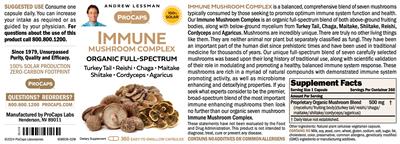
This summary is for Immune Mushroom Complex by ProCaps
- Form
- Capsule
- Serving Size
- 1 Capsule
- Servings
- 360 per container
- Container Holds
- 360 Easy-To-Swallow Capsules
- What is Immune Mushroom Complex?A supplement from ProCaps with seven active ingredients, in capsule form.
- Active Ingredients Turkey TailReishiChagaMaitakeShiitakeCordycepsAgaricus Seven active ingredients. Each one can interact with drugs or cause side effects on its own, so we check every one. The full Supplement Facts
- Drug Interactions 662 drugs have a documented interaction with this supplement; the most serious is rated moderate. Of those, 450 are single drugs and 212 are combination products (two or more drugs in one), each listed under its own name. Based on the 6 of its 7 ingredients we could check. Ask your pharmacist first if you take a drug in any of these categories, the most serious of the 7 on record:
- Moderate · 193 drugs
- Moderate · 172 drugs
- Moderate · 122 drugs
- Moderate · 121 drugs
- Possible Side EffectsNausea 5 ingredientsUpset stomach 4 ingredientsDiarrhea 3 ingredientsDry mouth 2 ingredientsAbdominal discomfortDizziness +8 moreCombined from six of its seven active ingredients. Not studied in this exact product.
- Well documented Why
Does Immune Mushroom Complex work?
What It Is Marketed For
Immune system function and health
From the claims on the product’s label.
The Closest Use the Research Grades
Shiitake Mushroom
There isn’t enough good research to say either way.
These grades are for the ingredient, not this exact product, and never a promise it will work for you.
What the research says- AllergensNone of its ingredient names point to a major food allergen
- Barcode (UPC)812792Match it to the barcode on your bottle to be sure this is your product. Not your product? Search for it here
Who Might Consider It
- People looking for immune system function and health, which is what it is marketed for. For common cold, the closest use the research grades, there is not enough good research to say either way. See the grade
- This product may be of interest to adults who want to learn more about medicinal mushroom ingredients and their limited evidence.
Who Should Be Careful
- People taking blood thinners, diabetes medications, blood pressure medications, or immune-suppressing drugs, as well as anyone with a mushroom allergy, an autoimmune condition, or upcoming surgery, should be careful.
- Please talk it over with your own doctor or pharmacist before starting.
More Before You Take It Show both answersHide Pregnancy and Breastfeeding The Label’s Directions
-
Pregnant or breastfeeding?
- Pregnancy Agaricus Mushroom
- ! Not enough safety data, so it is best to avoid supplement doses during pregnancy.
- Breastfeeding Agaricus Mushroom
- Insufficient reliable information available; avoid using.
- Pregnancy and Breastfeeding Reishi Mushroom
- Insufficient reliable information available; avoid using
- Pregnancy and Breastfeeding Chaga
- Insufficient reliable information available; avoid using.
-
How does the label say to take it?
“Suggested use Consume one capsule daily. You can increase your intake as required or as guided by your physician.”
The maker’s words. Your pharmacist or doctor may advise differently.
Everything the label says
From the label dated Jun 25, 2025: 6 of its 7 active ingredients were checked against our records; the other one is not in them yet. A summary of what is known, not a grade or a test of the product. How these ratings are computed
Ask Anything About This Supplement
Name a drug you take, or ask about side effects, ingredients or pregnancy.
There’s a lot of information about this supplement on this page! Ask anything in plain English for a quick answer drawn from it.
AI answers come from this label and our own records, never the open internet. AI can make mistakes, so always check with your doctor or pharmacist. How we use AI
Ask the Pharmacist
A licensed pharmacist will answer your question by email — free, as soon as they can.
Got it — thank you!
A licensed pharmacist will answer as soon as they can. Keep an eye on your email (worth checking spam, just in case).
What’s Inside Immune Mushroom Complex by ProCaps
The label gives an exact amount for 0 of its 7 active ingredients. Seven are inside one proprietary blend, “Proprietary Organic Mushroom Blend”, and the label gives one total for it, not how much of each ingredient is in it.
- 0 state an exact amount
- 7 have no amount of their own
- Proprietary Organic Mushroom Blend 500 mg in total · 7 ingredients, no amount for each
This rates what the label tells you, not the quality of the product.
Supplement Facts
| Amount Per Serving | % Daily Value | |
|---|---|---|
| Proprietary Organic Mushroom Blend | 500 mg | † |
| Turkey Tail | † | |
| Reishi | † | |
| Chaga | † | |
| Maitake | † | |
| Shiitake | † | |
| Cordyceps | † | |
| Agaricus | † | |
Other ingredients: Cellulose, Natural
† Daily Value not established.
Daily Values for adults and children 4 or more years of age.
As the label prints it, from the NIH Dietary Supplement Label Database.
Each Ingredient and Its Drug Interactions
Tap one for more about it and its full guide. A drug can interact with this supplement through any one of them.
ProCaps Immune Mushroom Complex is a capsule built from several medicinal mushroom ingredients.
-
Proprietary Organic Mushroom Blend 500 mg These include chaga, cordyceps, reishi, shiitake, turkey tail, maitake, and agaricus, along with a proprietary organic mushroom blend whose components are listed individually. Seven ingredients inside it, each checked on its own
Other Ingredients (Inactive)
The capsule or tablet itself, fillers, coatings and flavors. Not part of the drug interaction check; the allergen check below reads them.
- Cellulose, Natural
Allergens in Immune Mushroom Complex
None of its ingredient names point to a major food allergen.
Not named in the ingredients
- Milk
- Egg
- Fish
- Shellfish
- Tree nuts
- Peanuts
- Wheat or other gluten grains
- Soy
- Sesame
- Made without, the label says“Contains no additives or common allergens · Contains no Milk, soy, yeast, corn, wheat, gluten, sodium, salt, sugar, fat, cholesterol, color, preservative, common allergens, genetically modified (GMO) ingredients or manufacturing additives.”
From the label text and ingredient names on file; we do not test products. With a serious allergy, check your bottle and ask the maker or your pharmacist.
What the Label Says
The maker’s own words, from the label. We do not verify or endorse them.
- Formulation
-
“Since 1979, unsurpassed purity, quality, and efficacy. 100% Solar production Zero-Carbon footprint 100% solar”
“Organic full-spectrum”
3 more from the label
“Contains no additives or common allergens Contains no Milk, soy, yeast, corn, wheat, gluten, sodium, salt, sugar, fat, cholesterol, color, preservative, common allergens, genetically modified (GMO) ingredients or manufacturing additives.”
“Turkey tail Reishi Chaga Maitake Shiitake Cordyceps Agaricus”
“Immune Mushroom Complex is a balanced, comprehensive blend of seven mushrooms typically consumed by those seeking to promote optimum immune system function and health. Our Immune Mushroom Complex is an organic full-spectrum blend of both above ground fruiting bodies, along with below-ground mycelium from Turkey Tail, Chaga, Maitake, Shiitake, Reishi, Cordyceps and Agaricus. Mushrooms are incredibly unique. There are truly no other living things like them. They are neither animal nor plant but separately classified as fungi. They have been an important part of the human diet since prehistoric times and have been used in traditional medicine for thousands of years. Our unique full-spectrum blend of seven carefully selected mushrooms was based upon their long history of traditional use, along with scientific validation of their role in modulating and promoting a healthy, balanced immune system response. These mushrooms are rich in a myriad of natural compounds with demonstrated immune system promoting activity, as well as microbiome enhancing and detoxifying properties. If you seek what experts consider to be the premier, broad-spectrum blend of the most important immune enhancing mushrooms then look no further than our organic seven mushroom Immune Mushroom Complex.”
- General statements
-
“For questions about the use of this product call 800.800.1200. Questions? Reorders? 800.800.1200 Procaps.com Andrew Lessman”
- Brand IP Statement(s)
-
“Copyright 2024 ProCaps Laboratories”
- FDA Statement of Identity
-
“Dietary Supplement”
The Immune Mushroom Complex Label on File
The label scan on file at the NIH Dietary Supplement Label Database, dated June 2025. Always read the label on the bottle you have.
Product Facts
- Brand
- ProCaps
- Barcode (UPC)
- 812792
- Net contents
- 360 Easy-To-Swallow Capsules
- Market status
- On market
- Date entered into DSLD
- Jun 25, 2025
- DSLD ID
- 333697
- Product type
- Botanical
- Supplement form
- Capsule
- Dietary claims / uses
- All Other, Structure/Function
- Intended target group(s)
- Adult (18 - 50 Years), Organic, No Allergies, Gluten Free, Dairy Free, Sugar Free
Is this label outdated? Report a formula or label change and our pharmacy team will review it.
HelloPharmacist Score Immune Mushroom Complex by ProCaps
Up to 10 points for research, amount, label and outside testing. Not a safety rating. How this one adds up
for common cold
It is marketed for immune system function and health. There is no graded research on that exact use, so we scored the closest one: there is too little good research to say whether shiitake mushroom, one of its ingredients, helps with common cold.
- Research0 of 5 points
- Amount0 of 2 points
- Label0 of 2 points
- Outside testing0 of 1 point
Moderate drug interactions. The score does not count drug interactions. Check them against any drugs you take. See them
How It Earns Its 0
Score: 0 out of 10. Unproven for common cold.
Too little research on shiitake mushroom for common cold.
Graded “Insufficient Reliable Evidence to Rate” in the Natural Medicines database, which we license. A related use, not the one it is marketed for, counts for at most 3 of 5 research points.
0 of 5 points
Amount
The label does not say how much shiitake mushroom is in it.
0 of 2 points
Label
It states the amount of none of its seven active ingredients; seven are inside blends that give only a total.
0 of 2 points
Outside testing
We found no mark from an outside testing program, such as USP Verified or NSF Certified, on the label we have on file.
0 of 1 point
Immune Mushroom Complex by ProCaps Side Effects
Why this rating?
We look for three kinds of safety information on each ingredient: side effects reported in studies, a pregnancy and breastfeeding rating, and a safety write-up from our pharmacy team. All three are on file for each of the six ingredients we could check.
So this rates how much is known, not whether Immune Mushroom Complex is right for you.
Reported with six of its ingredients
- Most often
- Nausea, upset stomach, diarrhea, dry mouth, abdominal discomfort and dizziness
- !Rare but serious
- Allergic reactions, liver injury and interstitial lung disease (ILD) See details
HelloPharmacist Team Summary: Immune Mushroom Complex by ProCaps Side Effects
You are most likely to notice stomach upset, nausea, and diarrhea, which have been reported with several of these mushroom ingredients, and dry mouth, which has been reported with cordyceps.
- Reishi has also been linked to dizziness, so see how you feel before driving.
- The rare but serious concern is liver problems, which have been reported with reishi and agaricus, so call your doctor right away if you notice yellowing of the skin or eyes.
- Please talk with your own doctor or pharmacist before starting if you have a bleeding disorder, an autoimmune condition, diabetes, or an upcoming surgery, or if you are pregnant or breastfeeding.
Side Effects, Ingredient by Ingredient
A supplement’s side effects come from its ingredients. Here is what is reported with each one.
Reishi Mushroom
Most reported
- Upset stomach
- Dizziness
- Dry mouth
- Nosebleeds
Chaga
Most reported
- Digestive upset, such as nausea
Maitake Mushroom
Most reported
- Upset stomach
- Nausea
- Digestive discomfort
Shiitake Mushroom
Most reported
- Abdominal discomfort
- Bloating
- Diarrhea
- Nausea
- Vomiting
From the Natural Medicines database, which we license.
Every reported effect, in the Shiitake Mushroom guideCordyceps
Most reported
- Stomach upset
- Nausea
- Diarrhea
- Dry mouth
Agaricus Mushroom
Most reported
- Nausea
- Stomach upset
- Diarrhea
- Itching
Immune Mushroom Complex Warnings: Who Should Be Careful
Immune Mushroom Complex has seven active ingredients, and each can carry warnings of its own. We checked the six in our ingredient guides, and each warning below names the ingredient it comes from. Turkey Tail is not in our guides yet, so ask your pharmacist about it. If any of these apply to you, talk to your doctor or pharmacist before you start it.
- Reishi Mushroom2 warnings below
- Chaga2 warnings below
- Maitake Mushroom3 warnings below
- Shiitake Mushroom3 warnings below
- Cordyceps2 warnings below
- Agaricus Mushroom2 warnings below
- Turkey TailNot in our guides yet
-
Bleeding Problems or Surgery
- Reishi MushroomPeople with bleeding disorders or who are scheduled for surgery should be cautious, since reishi may affect blood clotting.
- Shiitake MushroomIf you have an autoimmune condition or are scheduled for surgery, talk to your healthcare provider before using shiitake supplements.
- CordycepsBe cautious if you: have an autoimmune condition (because cordyceps may affect the immune system), have a bleeding disorder, are scheduled for surgery, or have any chronic medical condition.
-
Diabetes or Low Blood Sugar
- Maitake MushroomBecause maitake may lower blood sugar, people with diabetes or low blood sugar should use caution and monitor closely.
-
Blood Pressure
- Reishi MushroomThose with low blood pressure should also use care.
- Maitake MushroomIt may also affect blood pressure, so those with blood pressure concerns should be careful.
-
Kidney Disease or Kidney Stones
- ChagaChaga is generally used in foods and teas, but human safety data are limited, and two cases of kidney failure and one case of acute nephropathy have been linked to excessive chaga consumption.
-
Autoimmune Conditions
- Agaricus MushroomPeople with autoimmune conditions should also use caution, since the mushroom may affect the immune system.
-
Allergies
- Maitake MushroomPeople with mushroom allergies should avoid it.
- Shiitake MushroomPeople with mushroom allergies should avoid shiitake.
-
If You Take Other Drugs
- Agaricus MushroomIf you have any health condition or take medication, check with your pharmacist or doctor first.
-
Other Cautions
- Shiitake MushroomTo be safe, avoid supplement doses unless your doctor approves.
-
Pregnant or Breastfeeding
Each ingredient’s rating for pregnancy and for breastfeeding, and what it covers.
Pregnancy
-
Not enough safety data, so it is best to avoid supplement doses during pregnancy.
Breastfeeding
-
Insufficient reliable information available; avoid using.
Pregnancy and Breastfeeding The record rates both the same
-
Insufficient reliable information available; avoid using
Show 4 more ingredients
Pregnancy and Breastfeeding The record rates both the same
-
Insufficient reliable information available; avoid using.
Pregnancy and Breastfeeding The record rates both the same
-
Insufficient reliable information available; avoid using.
Pregnancy and Breastfeeding The record rates both the same
-
Insufficient reliable information available; avoid consuming greater than food amounts.
Pregnancy and Breastfeeding The record rates both the same
-
Insufficient reliable information available; avoid using.
Our pharmacy team’s notes
- Safety notes for chaga, cordyceps, reishi, maitake, and agaricus advise against supplement use during pregnancy and breastfeeding because there is not enough safety data.
Ratings and the words beside them are from the Natural Medicines database, which we license. Where it has no rating, the rating and note are our pharmacy team’s.
-
Rare but Serious Side Effects
-
!
Reishi Mushroom
There have been rare reports of liver problems, especially with powdered reishi products.
-
!
Maitake Mushroom
Allergic reactions are possible, particularly in people sensitive to mushrooms.
-
!
Shiitake Mushroom
Allergic reactions are possible.
Orally: Consumption of raw shiitake mushroom can cause shiitake dermatitis, a skin eruption resembling whiplash marks which can be accompanied by systemic symptoms. Large pieces that have been inadequately chewed can cause intestinal blockage, occasionally requiring surgery.
-
!
Cordyceps
Allergic reactions are possible, especially in people who are sensitive to molds or fungi.
-
!
Agaricus Mushroom
Allergic reactions are possible, especially in people sensitive to mushrooms.
Orally: Allergic reactions, hepatotoxicity, interstitial lung disease (ILD).
-
!
Our pharmacy team on Immune Mushroom Complex
Cordyceps is generally well tolerated short term, though product quality varies widely, and one case report links a cordyceps-containing product to acute liver inflammation (hepatitis), which may have been caused by a contaminant.
When to get help: a serious allergic reaction, with trouble breathing or swelling of the face, lips or throat, needs emergency care: call 911. For any other side effect that worries you, call your doctor or pharmacist.
These reports describe each ingredient, not studies of this exact product. Not medical advice: a side effect you notice after starting a supplement is worth a word with your pharmacist or doctor.
Immune Mushroom Complex by ProCaps Drug Interactions
We checked all seven active ingredients in this supplement against every drug in our records. A drug can interact with it through any one of them. Turkey Tail is not in our interaction records yet.
A moderate interaction on record
2 of 3, on a scale from Minor or none to Major.Why this rating?
We rate this by the most serious interaction on record, not by how many there are. For Maitake Mushroom, Cordyceps, Shiitake Mushroom, Reishi Mushroom and Agaricus Mushroom, the most serious is rated moderate, which means it calls for caution, and sometimes monitoring or a change in timing or dose. Some involve kinds of drugs where a small change can matter, such as blood thinners, transplant drugs and diabetes drugs.
662 drugs are on the full list. What matters is whether one you take is on it, so check yours with the interaction checker on this page.
From the HelloPharmacist Team
Here is how the interactions add up across the whole label.
- ProCaps Immune Mushroom Complex can interact with several medications through its chaga, cordyceps, reishi, shiitake, maitake, and agaricus content.
- The most serious severity we list is Moderate, and the interactions are theoretical, with much of the supporting evidence coming from lab and animal research.
- Blood thinners (anticoagulants and antiplatelet drugs), at Moderate severity, may raise the risk of bleeding with chaga, cordyceps, and reishi.
Six of its seven active ingredients have drug interactions on record: Reishi Mushroom, Chaga, Maitake Mushroom, Shiitake Mushroom, Cordyceps and Agaricus Mushroom. We have no interaction records for Turkey Tail.
- Interacts with
- 260 drugs
- Most serious
- Moderate
- Warfarin (Coumadin, Moderate) may have stronger effects with maitake, based on limited evidence and one case report.
- Interacts with
- 375 drugs
- Most serious
- Moderate
- Most of its records involve Antihypertensive Drugs, Anticoagulant/Antiplatelet Drugs and Antidiabetes Drugs.
- Interacts with
- 327 drugs
- Most serious
- Moderate
- Most of its records involve Anticoagulant/Antiplatelet Drugs, Immunosuppressants and Antidiabetes Drugs.
Show three more ingredients
- Interacts with
- 312 drugs
- Most serious
- Moderate
- Most of its records involve Cytochrome P450 2D6 (CYP2D6) Substrates and Immunosuppressants.
- Interacts with
- 249 drugs
- Most serious
- Moderate
- Most of its records involve Anticoagulant/Antiplatelet Drugs, Immunosuppressants and Testosterone.
- Interacts with
- 86 drugs
- Most serious
- Moderate
- Most of its records involve Antidiabetes Drugs.
Summarized by the HelloPharmacist pharmacy team from the interaction records below. How it is written How we use AI
Why Immune Mushroom Complex Interacts, Ingredient by Ingredient
A product interacts through its ingredients. Each card: how many drugs, the most serious rating, and the kinds of drugs it affects most (tap a kind for what it means).
The ingredients driving the most interactions
-
Reishi 375 drugs
Most serious: Moderate3 interaction records on file
The kinds of drugs it affects most
- 172 drugs
- 122 drugs
- 86 drugs
Every Reishi Mushroom drug interaction, 3 records The Reishi Mushroom records cite 17 references, listed in the Reishi Mushroom guide.
-
Chaga 327 drugs
Most serious: Moderate3 interaction records on file
The kinds of drugs it affects most
- 122 drugs
- 121 drugs
- 86 drugs
Every Chaga drug interaction, 3 records The Chaga records cite 9 references, listed in the Chaga guide.
-
Shiitake 312 drugs
Most serious: Moderate2 interaction records on file
The kinds of drugs it affects most
- 193 drugs
- 121 drugs
Every Shiitake Mushroom drug interaction, 2 records The Shiitake Mushroom records cite 67 references, listed in the Shiitake Mushroom guide.
-
Maitake 260 drugs
Most serious: Moderate3 interaction records on file
The kinds of drugs it affects most
- 172 drugs
- 86 drugs
- 2 drugs
Every Maitake Mushroom drug interaction, 3 records The Maitake Mushroom records cite 8 references, listed in the Maitake Mushroom guide.
-
Cordyceps 249 drugs
Most serious: Moderate3 interaction records on file
The kinds of drugs it affects most
- 122 drugs
- 121 drugs
- Testosterone 8 drugs
Every Cordyceps drug interaction, 3 records The Cordyceps records cite 14 references, listed in the Cordyceps guide.
-
Agaricus 86 drugs
Most serious: Moderate1 interaction record on file
The kinds of drugs it affects most
- 86 drugs
Every Agaricus Mushroom drug interaction, 1 record The Agaricus Mushroom records cite 5 references, listed in the Agaricus Mushroom guide.
The Breakdown by Severity
Each drug counted once, at its most serious rating. Tap a tile to list those drugs.
Find Your Drug
Type a drug or brand name to see whether it is on the list.
- Only drugs with a documented interaction are listed, the most serious first.
- A drug with no known interaction is not listed, but searching its name tells you so.
- Open a drug to see which ingredient is responsible. Of those, 450 are single drugs and 212 are combination products (two or more drugs in one), each listed under its own name.
-
ApixabanEliquis Moderate
The 3 ingredients responsible:
-
Reishi Moderate Apixaban is in the Anticoagulant/Antiplatelet Drugs category.
Theoretically, high doses of reishi mushroom might increase the risk of bleeding.
The full Reishi + Apixaban interaction -
Cordyceps Moderate Apixaban is in the Anticoagulant/Antiplatelet Drugs category.
Theoretically, cordyceps may increase the risk of bleeding when used with antiplatelet or anticoagulant drugs.
The full Cordyceps + Apixaban interaction -
Chaga Moderate Apixaban is in the Anticoagulant/Antiplatelet Drugs category.
Theoretically, chaga may increase the risk of bleeding if used with anticoagulant or antiplatelet drugs.
The full Chaga + Apixaban interaction
-
-
WarfarinWarfarin Moderate
The 4 ingredients responsible:
-
Reishi Moderate Warfarin is in the Anticoagulant/Antiplatelet Drugs category.
Theoretically, high doses of reishi mushroom might increase the risk of bleeding.
The full Reishi + Warfarin interaction -
Chaga Moderate Warfarin is in the Anticoagulant/Antiplatelet Drugs category.
Theoretically, chaga may increase the risk of bleeding if used with anticoagulant or antiplatelet drugs.
The full Chaga + Warfarin interaction -
Maitake Moderate
There is limited evidence that maitake mushroom may increase the anticoagulant effects of warfarin.
The full Maitake + Warfarin interaction -
Cordyceps Moderate Warfarin is in the Anticoagulant/Antiplatelet Drugs category.
Theoretically, cordyceps may increase the risk of bleeding when used with antiplatelet or anticoagulant drugs.
The full Cordyceps + Warfarin interaction
-
-
AmlodipineNorliqva Moderate
The 2 ingredients responsible:
-
Maitake Moderate Amlodipine is in the Antihypertensive Drugs category.
Theoretically, combining maitake mushroom with antihypertensive drugs might increase the risk of hypotension.
The full Maitake + Amlodipine interaction -
Reishi Moderate Amlodipine is in the Antihypertensive Drugs category.
Theoretically, concurrent use of reishi mushroom with antihypertensive drugs might increase the risk of hypotension.
The full Reishi + Amlodipine interaction
-
-
ClopidogrelPlavix Moderate
The 3 ingredients responsible:
-
Cordyceps Moderate Clopidogrel is in the Anticoagulant/Antiplatelet Drugs category.
Theoretically, cordyceps may increase the risk of bleeding when used with antiplatelet or anticoagulant drugs.
The full Cordyceps + Clopidogrel interaction -
Chaga Moderate Clopidogrel is in the Anticoagulant/Antiplatelet Drugs category.
Theoretically, chaga may increase the risk of bleeding if used with anticoagulant or antiplatelet drugs.
The full Chaga + Clopidogrel interaction -
Reishi Moderate Clopidogrel is in the Anticoagulant/Antiplatelet Drugs category.
Theoretically, high doses of reishi mushroom might increase the risk of bleeding.
The full Reishi + Clopidogrel interaction
-
-
Losartan PotassiumCozaar Moderate
The 2 ingredients responsible:
-
Maitake Moderate Losartan Potassium is in the Antihypertensive Drugs category.
Theoretically, combining maitake mushroom with antihypertensive drugs might increase the risk of hypotension.
The full Maitake + Losartan Potassium interaction -
Reishi Moderate Losartan Potassium is in the Antihypertensive Drugs category.
Theoretically, concurrent use of reishi mushroom with antihypertensive drugs might increase the risk of hypotension.
The full Reishi + Losartan Potassium interaction
-
-
AspirinAngettes 75, ASA, Asaphen, Aspirin, Caprin and 9 more Moderate
The 3 ingredients responsible:
-
Chaga Moderate Aspirin is in the Anticoagulant/Antiplatelet Drugs category.
Theoretically, chaga may increase the risk of bleeding if used with anticoagulant or antiplatelet drugs.
The full Chaga + Aspirin interaction -
Cordyceps Moderate Aspirin is in the Anticoagulant/Antiplatelet Drugs category.
Theoretically, cordyceps may increase the risk of bleeding when used with antiplatelet or anticoagulant drugs.
The full Cordyceps + Aspirin interaction -
Reishi Moderate Aspirin is in the Anticoagulant/Antiplatelet Drugs category.
Theoretically, high doses of reishi mushroom might increase the risk of bleeding.
The full Reishi + Aspirin interaction
-
-
Warfarin SodiumCoumadin, Panwarfin, Sofarin Moderate
The 4 ingredients responsible:
-
Maitake Moderate
There is limited evidence that maitake mushroom may increase the anticoagulant effects of warfarin.
The full Maitake + Warfarin Sodium interaction -
Cordyceps Moderate Warfarin Sodium is in the Anticoagulant/Antiplatelet Drugs category.
Theoretically, cordyceps may increase the risk of bleeding when used with antiplatelet or anticoagulant drugs.
The full Cordyceps + Warfarin Sodium interaction -
Chaga Moderate Warfarin Sodium is in the Anticoagulant/Antiplatelet Drugs category.
Theoretically, chaga may increase the risk of bleeding if used with anticoagulant or antiplatelet drugs.
The full Chaga + Warfarin Sodium interaction -
Reishi Moderate Warfarin Sodium is in the Anticoagulant/Antiplatelet Drugs category.
Theoretically, high doses of reishi mushroom might increase the risk of bleeding.
The full Reishi + Warfarin Sodium interaction
-
-
RivaroxabanXarelto Moderate
The 3 ingredients responsible:
-
Chaga Moderate Rivaroxaban is in the Anticoagulant/Antiplatelet Drugs category.
Theoretically, chaga may increase the risk of bleeding if used with anticoagulant or antiplatelet drugs.
The full Chaga + Rivaroxaban interaction -
Cordyceps Moderate Rivaroxaban is in the Anticoagulant/Antiplatelet Drugs category.
Theoretically, cordyceps may increase the risk of bleeding when used with antiplatelet or anticoagulant drugs.
The full Cordyceps + Rivaroxaban interaction -
Reishi Moderate Rivaroxaban is in the Anticoagulant/Antiplatelet Drugs category.
Theoretically, high doses of reishi mushroom might increase the risk of bleeding.
The full Reishi + Rivaroxaban interaction
-
-
MetforminGlucophage, Metformin Moderate
The 4 ingredients responsible:
-
Reishi Moderate Metformin is in the Antidiabetes Drugs category.
Theoretically, reishi mushroom might have additive effects with antidiabetes drugs.
The full Reishi + Metformin interaction -
Agaricus Moderate Metformin is in the Antidiabetes Drugs category.
Theoretically, taking agaricus mushroom with antidiabetes drugs might increase the risk of hypoglycemia.
The full Agaricus + Metformin interaction -
Chaga Moderate Metformin is in the Antidiabetes Drugs category.
Theoretically, taking chaga with antidiabetes drugs might increase the risk of hypoglycemia.
The full Chaga + Metformin interaction -
Maitake Moderate Metformin is in the Antidiabetes Drugs category.
Theoretically, combining maitake mushroom with antidiabetes drugs might increase the risk of hypoglycemia.
The full Maitake + Metformin interaction
-
-
MetoprololLopressor, Toprol XL Moderate
The 3 ingredients responsible:
-
Maitake Moderate Metoprolol is in the Antihypertensive Drugs category.
Theoretically, combining maitake mushroom with antihypertensive drugs might increase the risk of hypotension.
The full Maitake + Metoprolol interaction -
Reishi Moderate Metoprolol is in the Antihypertensive Drugs category.
Theoretically, concurrent use of reishi mushroom with antihypertensive drugs might increase the risk of hypotension.
The full Reishi + Metoprolol interaction -
Shiitake Moderate Metoprolol is in the Cytochrome P450 2D6 (CYP2D6) Substrates category.
Theoretically, shiitake mushroom might decrease levels of drugs metabolized by CYP2D6.
The full Shiitake + Metoprolol interaction
-
-
TirzepatideMounjaro, Zepbound Moderate
The 4 ingredients responsible:
-
Maitake Moderate Tirzepatide is in the Antidiabetes Drugs category.
Theoretically, combining maitake mushroom with antidiabetes drugs might increase the risk of hypoglycemia.
The full Maitake + Tirzepatide interaction -
Chaga Moderate Tirzepatide is in the Antidiabetes Drugs category.
Theoretically, taking chaga with antidiabetes drugs might increase the risk of hypoglycemia.
The full Chaga + Tirzepatide interaction -
Reishi Moderate Tirzepatide is in the Antidiabetes Drugs category.
Theoretically, reishi mushroom might have additive effects with antidiabetes drugs.
The full Reishi + Tirzepatide interaction -
Agaricus Moderate Tirzepatide is in the Antidiabetes Drugs category.
Theoretically, taking agaricus mushroom with antidiabetes drugs might increase the risk of hypoglycemia.
The full Agaricus + Tirzepatide interaction
-
-
IbuprofenAdvil, Arthrofen, Brufen, Brufen Retard, Calodor and 15 more Moderate
The 3 ingredients responsible:
-
Chaga Moderate Ibuprofen is in the Anticoagulant/Antiplatelet Drugs category.
Theoretically, chaga may increase the risk of bleeding if used with anticoagulant or antiplatelet drugs.
The full Chaga + Ibuprofen interaction -
Reishi Moderate Ibuprofen is in the Anticoagulant/Antiplatelet Drugs category.
Theoretically, high doses of reishi mushroom might increase the risk of bleeding.
The full Reishi + Ibuprofen interaction -
Cordyceps Moderate Ibuprofen is in the Anticoagulant/Antiplatelet Drugs category.
Theoretically, cordyceps may increase the risk of bleeding when used with antiplatelet or anticoagulant drugs.
The full Cordyceps + Ibuprofen interaction
-
-
SemaglutideOzempic, Rybelsus, Wegovy Moderate
The 4 ingredients responsible:
-
Maitake Moderate Semaglutide is in the Antidiabetes Drugs category.
Theoretically, combining maitake mushroom with antidiabetes drugs might increase the risk of hypoglycemia.
The full Maitake + Semaglutide interaction -
Reishi Moderate Semaglutide is in the Antidiabetes Drugs category.
Theoretically, reishi mushroom might have additive effects with antidiabetes drugs.
The full Reishi + Semaglutide interaction -
Agaricus Moderate Semaglutide is in the Antidiabetes Drugs category.
Theoretically, taking agaricus mushroom with antidiabetes drugs might increase the risk of hypoglycemia.
The full Agaricus + Semaglutide interaction -
Chaga Moderate Semaglutide is in the Antidiabetes Drugs category.
Theoretically, taking chaga with antidiabetes drugs might increase the risk of hypoglycemia.
The full Chaga + Semaglutide interaction
-
-
FluoxetineProzac, Sarafem Moderate
The ingredient responsible:
-
Shiitake Moderate Fluoxetine is in the Cytochrome P450 2D6 (CYP2D6) Substrates category.
Theoretically, shiitake mushroom might decrease levels of drugs metabolized by CYP2D6.
The full Shiitake + Fluoxetine interaction
-
-
PrednisoneCortan, Deltasone, Meticorten, Orasone, Prednicen-M and 3 more Moderate
The 3 ingredients responsible:
-
Cordyceps Moderate Prednisone is in the Immunosuppressants category.
Theoretically, concurrent use of cordyceps might interfere with immunosuppressive therapy.
The full Cordyceps + Prednisone interaction -
Shiitake Moderate Prednisone is in the Immunosuppressants category.
Theoretically, taking shiitake mushroom might decrease the effects of immunosuppressive therapy.
The full Shiitake + Prednisone interaction -
Chaga Moderate Prednisone is in the Immunosuppressants category.
Theoretically, chaga might interfere with immunosuppressive therapy.
The full Chaga + Prednisone interaction
-
-
AmphetamineAdensys XR-ODT, Adzenys ER, Dyanavel XR, Mydayis Moderate
The ingredient responsible:
-
Shiitake Moderate Amphetamine is in the Cytochrome P450 2D6 (CYP2D6) Substrates category.
Theoretically, shiitake mushroom might decrease levels of drugs metabolized by CYP2D6.
The full Shiitake + Amphetamine interaction
-
-
LisdexamfetamineVyvanse Moderate
The ingredient responsible:
-
Shiitake Moderate Lisdexamfetamine is in the Cytochrome P450 2D6 (CYP2D6) Substrates category.
Theoretically, shiitake mushroom might decrease levels of drugs metabolized by CYP2D6.
The full Shiitake + Lisdexamfetamine interaction
-
-
PropranololAngilol, Bedranol SR, Beta Prograne, Half Beta Prograne, Half-Inderal LA and 7 more Moderate
The 3 ingredients responsible:
-
Reishi Moderate Propranolol is in the Antihypertensive Drugs category.
Theoretically, concurrent use of reishi mushroom with antihypertensive drugs might increase the risk of hypotension.
The full Reishi + Propranolol interaction -
Shiitake Moderate Propranolol is in the Cytochrome P450 2D6 (CYP2D6) Substrates category.
Theoretically, shiitake mushroom might decrease levels of drugs metabolized by CYP2D6.
The full Shiitake + Propranolol interaction -
Maitake Moderate Propranolol is in the Antihypertensive Drugs category.
Theoretically, combining maitake mushroom with antihypertensive drugs might increase the risk of hypotension.
The full Maitake + Propranolol interaction
-
-
AmitriptylineElavil Moderate
The ingredient responsible:
-
Shiitake Moderate Amitriptyline is in the Cytochrome P450 2D6 (CYP2D6) Substrates category.
Theoretically, shiitake mushroom might decrease levels of drugs metabolized by CYP2D6.
The full Shiitake + Amitriptyline interaction
-
-
LisinoprilPrinivil, Qbrelis, Zestril Moderate
The 2 ingredients responsible:
-
Reishi Moderate Lisinopril is in the Antihypertensive Drugs category.
Theoretically, concurrent use of reishi mushroom with antihypertensive drugs might increase the risk of hypotension.
The full Reishi + Lisinopril interaction -
Maitake Moderate Lisinopril is in the Antihypertensive Drugs category.
Theoretically, combining maitake mushroom with antihypertensive drugs might increase the risk of hypotension.
The full Maitake + Lisinopril interaction
-
-
NaproxenAleve, Anaprox, Anaprox DS, Arthroxen, EC-Naprosyn and 8 more Moderate
The 3 ingredients responsible:
-
Reishi Moderate Naproxen is in the Anticoagulant/Antiplatelet Drugs category.
Theoretically, high doses of reishi mushroom might increase the risk of bleeding.
The full Reishi + Naproxen interaction -
Chaga Moderate Naproxen is in the Anticoagulant/Antiplatelet Drugs category.
Theoretically, chaga may increase the risk of bleeding if used with anticoagulant or antiplatelet drugs.
The full Chaga + Naproxen interaction -
Cordyceps Moderate Naproxen is in the Anticoagulant/Antiplatelet Drugs category.
Theoretically, cordyceps may increase the risk of bleeding when used with antiplatelet or anticoagulant drugs.
The full Cordyceps + Naproxen interaction
-
-
QuetiapineDopaquel, Seroquel Moderate
The ingredient responsible:
-
Shiitake Moderate Quetiapine is in the Cytochrome P450 2D6 (CYP2D6) Substrates category.
Theoretically, shiitake mushroom might decrease levels of drugs metabolized by CYP2D6.
The full Shiitake + Quetiapine interaction
-
-
MethamphetamineDesoxyn Moderate
The ingredient responsible:
-
Shiitake Moderate Methamphetamine is in the Cytochrome P450 2D6 (CYP2D6) Substrates category.
Theoretically, shiitake mushroom might decrease levels of drugs metabolized by CYP2D6.
The full Shiitake + Methamphetamine interaction
-
-
Amlodipine BesylateNorvasc Moderate
The 2 ingredients responsible:
-
Reishi Moderate Amlodipine Besylate is in the Antihypertensive Drugs category.
Theoretically, concurrent use of reishi mushroom with antihypertensive drugs might increase the risk of hypotension.
The full Reishi + Amlodipine Besylate interaction -
Maitake Moderate Amlodipine Besylate is in the Antihypertensive Drugs category.
Theoretically, combining maitake mushroom with antihypertensive drugs might increase the risk of hypotension.
The full Maitake + Amlodipine Besylate interaction
-
-
DuloxetineCymbalta, Drizalma Sprinkle, Irenka Moderate
The ingredient responsible:
-
Shiitake Moderate Duloxetine is in the Cytochrome P450 2D6 (CYP2D6) Substrates category.
Theoretically, shiitake mushroom might decrease levels of drugs metabolized by CYP2D6.
The full Shiitake + Duloxetine interaction
-
-
BisoprololZebeta Moderate
The 3 ingredients responsible:
-
Shiitake Moderate Bisoprolol is in the Cytochrome P450 2D6 (CYP2D6) Substrates category.
Theoretically, shiitake mushroom might decrease levels of drugs metabolized by CYP2D6.
The full Shiitake + Bisoprolol interaction -
Reishi Moderate Bisoprolol is in the Antihypertensive Drugs category.
Theoretically, concurrent use of reishi mushroom with antihypertensive drugs might increase the risk of hypotension.
The full Reishi + Bisoprolol interaction -
Maitake Moderate Bisoprolol is in the Antihypertensive Drugs category.
Theoretically, combining maitake mushroom with antihypertensive drugs might increase the risk of hypotension.
The full Maitake + Bisoprolol interaction
-
-
Omega-3 Fatty Acids (prescription Drug)Lovaza Moderate
The 3 ingredients responsible:
-
Chaga Moderate Omega-3 Fatty Acids (prescription Drug) is in the Anticoagulant/Antiplatelet Drugs category.
Theoretically, chaga may increase the risk of bleeding if used with anticoagulant or antiplatelet drugs.
The full Chaga + Omega-3 Fatty Acids (prescription Drug) interaction -
Reishi Moderate Omega-3 Fatty Acids (prescription Drug) is in the Anticoagulant/Antiplatelet Drugs category.
Theoretically, high doses of reishi mushroom might increase the risk of bleeding.
The full Reishi + Omega-3 Fatty Acids (prescription Drug) interaction -
Cordyceps Moderate Omega-3 Fatty Acids (prescription Drug) is in the Anticoagulant/Antiplatelet Drugs category.
Theoretically, cordyceps may increase the risk of bleeding when used with antiplatelet or anticoagulant drugs.
The full Cordyceps + Omega-3 Fatty Acids (prescription Drug) interaction
-
-
ValsartanDiovan, Prexxartan Moderate
The 2 ingredients responsible:
-
Reishi Moderate Valsartan is in the Antihypertensive Drugs category.
Theoretically, concurrent use of reishi mushroom with antihypertensive drugs might increase the risk of hypotension.
The full Reishi + Valsartan interaction -
Maitake Moderate Valsartan is in the Antihypertensive Drugs category.
Theoretically, combining maitake mushroom with antihypertensive drugs might increase the risk of hypotension.
The full Maitake + Valsartan interaction
-
-
TelmisartanMicardis Moderate
The 2 ingredients responsible:
-
Reishi Moderate Telmisartan is in the Antihypertensive Drugs category.
Theoretically, concurrent use of reishi mushroom with antihypertensive drugs might increase the risk of hypotension.
The full Reishi + Telmisartan interaction -
Maitake Moderate Telmisartan is in the Antihypertensive Drugs category.
Theoretically, combining maitake mushroom with antihypertensive drugs might increase the risk of hypotension.
The full Maitake + Telmisartan interaction
-
-
SpironolactoneAldactone, Carospir, Spiroton Moderate
The 2 ingredients responsible:
-
Reishi Moderate Spironolactone is in the Antihypertensive Drugs category.
Theoretically, concurrent use of reishi mushroom with antihypertensive drugs might increase the risk of hypotension.
The full Reishi + Spironolactone interaction -
Maitake Moderate Spironolactone is in the Antihypertensive Drugs category.
Theoretically, combining maitake mushroom with antihypertensive drugs might increase the risk of hypotension.
The full Maitake + Spironolactone interaction
-
Does It Work? Immune Mushroom Complex by ProCaps
How it rates in the research so far, then each ingredient on its own. A grade is the research so far, never an endorsement.
HelloPharmacist Team Summary: Does Immune Mushroom Complex by ProCaps Work?
Most of the ingredients here have insufficient reliable evidence to rate for the conditions we track.
- For example, chaga has insufficient evidence for cardiovascular disease, diabetes, and COVID-19, and reishi has insufficient evidence for bronchitis, Alzheimer disease, and asthma.
- Two ratings are more specific.
- Cordyceps is rated possibly ineffective for athletic performance, and shiitake is rated possibly ineffective for dental plaque.
The Evidence, Ingredient by Ingredient
Each card holds our notes on one ingredient, then its uses graded effective, likely effective or possibly effective.
Reishi Mushroom
From our Reishi Mushroom guide
- Reishi is popular for boosting immunity, easing fatigue, reducing stress, supporting heart health, and as a general wellness tonic.
- Some people also use it alongside cancer treatment in hopes of improving quality of life or immune function.
No use is graded effective, likely effective or possibly effective for it yet.
Every graded use, in the Reishi Mushroom guideChaga
From our Chaga guide
- People take Chaga for many reasons, but it is important to know that the science behind most of these uses is limited and early.
- Much of the research has been done in test tubes or in animals, not in well-designed human studies.
No use is graded effective, likely effective or possibly effective for it yet.
Every graded use, in the Chaga guideMaitake Mushroom
From our Maitake Mushroom guide
- People commonly take maitake hoping to support the immune system, help control blood sugar, lower blood pressure, or improve cholesterol.
- Some of these uses come from traditional medicine, and some come from early scientific interest in mushroom beta-glucans.
No use is graded effective, likely effective or possibly effective for it yet.
Every graded use, in the Maitake Mushroom guideShiitake Mushroom
From our Shiitake Mushroom guide
- Shiitake is most reliably valued as a nutritious food.
- It provides fiber, B vitamins, and other nutrients, and can be part of a healthy diet.
No use is graded effective, likely effective or possibly effective for it yet.
Every graded use, in the Shiitake Mushroom guideCordyceps
From our Cordyceps guide
- People use cordyceps for many reasons, but the scientific evidence is limited and often low quality.
- Many studies are small, short, or done in animals or test tubes rather than in people.
No use is graded effective, likely effective or possibly effective for it yet.
Every graded use, in the Cordyceps guideAgaricus Mushroom
From our Agaricus Mushroom guide
- Agaricus mushroom is popularly used for immune support, as a general antioxidant, and as an add-on during cancer treatment.
- Some people also use it hoping to help with blood sugar or cholesterol.
No use is graded effective, likely effective or possibly effective for it yet.
Every graded use, in the Agaricus Mushroom guideThe grades are the Natural Medicines database’s, which we license; tap a grade for what it means. They are about each ingredient, not this exact product.
About ProCaps
Manufacturer and brand details for Immune Mushroom Complex, from the product label.
ProCaps has 119 products in our supplement database, 113 of them on the market, with labels on file since 2020. Our database is built from the NIH’s Dietary Supplement Label Database and our pharmacy team’s own additions, so it covers the labels filed there, not every product the brand sells.
- Name
- ProCaps Labs
- City
- Henderson
- State
- NV
- ZipCode
- 89011
- Phone Number
- 800.800.1200
- Web Address
- ProCaps.com
Immune Mushroom Complex by ProCaps: Common Questions
Does Immune Mushroom Complex by ProCaps interact with any drugs?
What are the side effects of Immune Mushroom Complex by ProCaps?
Who should be careful taking Immune Mushroom Complex by ProCaps?
Can Immune Mushroom Complex by ProCaps affect the liver?
Can Immune Mushroom Complex by ProCaps affect the kidneys?
Does Immune Mushroom Complex by ProCaps contain any common allergens?
Is Immune Mushroom Complex by ProCaps gluten free?
How can Immune Mushroom Complex by ProCaps interact with so many drugs?
Where does the information about Immune Mushroom Complex by ProCaps come from?
Does cordyceps help with athletic performance?
Does shiitake work for dental plaque?
Can I take Immune Mushroom Complex by ProCaps while pregnant?
What is chaga used for?
Written and reviewed by the HelloPharmacist Editorial Team. Our editorial policy
Still Have a Question About Immune Mushroom Complex?
Our pharmacists answer drug and supplement questions, free, by email.
Label information is sourced from the NIH Dietary Supplement Label Database and reflects the product version on file; always read your actual product label. This page is for education only and is not a substitute for professional medical advice. Confirm with your pharmacist or doctor before combining supplements and drugs.
Who Reviews This Page
The pharmacist behind it, and how it is checked.
Dr. Brian Staiger, PharmD, BCPS
Clinical pharmacist and founder of HelloPharmacist
A licensed pharmacist for more than 13 years, he built the system behind this page: it reads the label on file, matches each active ingredient to its record in the Natural Medicines database, checks those records against every drug we cover, and our pharmacy team writes the take and the interaction summary from those records.
- 13+ Years in PharmacyRetail and clinical pharmacy, medication safety and healthcare administration.
- Board Certified (BCPS)A pharmacotherapy specialist, certified by the Board of Pharmacy Specialties.
- Herbalist TrainingCertificates in medical ethnobotany, for the herbs and supplements people take.
Where This Page Comes From
Immune Mushroom Complex’s label data comes from the NIH Dietary Supplement Label Database; the ingredient interaction data is from the Natural Medicines database, reviewed by our pharmacists.
- NIH Dietary Supplement Label Database (DSLD)
- The official product label on file for this supplement.
- Natural Medicines (Therapeutic Research Center)
- The evidence-graded clinical reference behind the ingredient interaction, evidence and safety records, which we license.
- HelloPharmacist Editorial Team
- Content is reviewed by the HelloPharmacist Editorial Team, the pharmacists on our staff and those we contract. See our data sources and editorial standards for how this information is built and checked.
- The Pharmacy Team’s Take and Summaries
- Generated from HelloPharmacist’s pharmacist-curated databases and editorial rules. Clinical methodology reviewed by Dr. Brian Staiger, PharmD, BCPS. Last generated Oct 31, 2026. How we use AI
- The ratings in the Quick Summary
- They summarize available label information, ingredient evidence and known drug-safety records: a summary of what is known, not a grade of the product itself. They do not verify product identity, purity, potency, contamination or manufacturing quality. How these ratings are computed
The References Behind the Interaction Records
Every citation the ingredients’ records rest on is listed in that ingredient’s guide, in context: Reishi Mushroom, 17 references; Chaga, 9 references; Maitake Mushroom, 8 references; Shiitake Mushroom, 67 references; Cordyceps, 14 references; Agaricus Mushroom, 5 references .
Parts of this content are provided by the Therapeutic Research Center, LLC.
DISCLAIMER: Currently this does not check for drug-drug interactions. This is not an all-inclusive comprehensive list of potential interactions and is for informational purposes only. Not all interactions are known or well-reported in the scientific literature, and new interactions are continually being reported. Input is needed from a qualified healthcare provider including a pharmacist before starting any therapy. Application of clinical judgment is necessary.
© 2021 Therapeutic Research Center, LLC
Keep Exploring
- Supplement interaction checkerCheck any supplement or product against your drugs
- Drug–drug interactionsCheck two or more of your drugs against each other
- Browse drugs A to ZEvery drug we have checked against herbs and supplements
- NDC and pricing lookupFind a drug’s NDCs, packaging and costs
- Ask a pharmacistA free, personal answer from our licensed team