
Think-Rite Advanced by NewtonEverett Ingredients, Side Effects and Drug Interactions
Dietary Supplement Capsule Other Combinations
Think-Rite Advanced by NewtonEverett is a dietary supplement with eight active ingredients: 3 plant ingredients, 1 amino acid, 1 fat or oil and 3 others. It is marketed for thinking, memory and cognitive support.
UPC 6 89076 01791 6 Match it to the barcode on your bottle

Medically reviewed by Dr. Brian Staiger, PharmD, BCPS
Also reviewed by the HelloPharmacist Editorial Team
Updated Details about this page
- Label on file from the NIH Dietary Supplement Label Database, dated Nov 21, 2016.
- The interaction, evidence and safety records come from the Natural Medicines database, which we license, read against this label by our own system; the pharmacy team’s sections are written from those records.
- Dr. Brian Staiger, PharmD, BCPS, is a clinical pharmacist and pharmacotherapy specialist.
- Editorial policy Our sources
AI is used only to summarize verified clinical information, never the open internet. Our AI policy
Summary: The HelloPharmacist Team’s Take
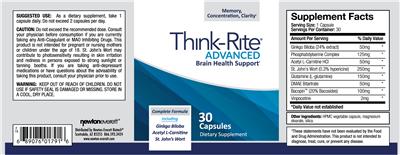
This summary is for Think-Rite Advanced by NewtonEverett
- Form
- Capsule
- Serving Size
- 1 Capsule
- Servings
- 30 per container
- Container Holds
- 30 Capsules
- What is Think-Rite Advanced?A supplement from NewtonEverett with eight active ingredients, in capsule form.
- Active Ingredients 3 plant ingredients, 1 amino acid, 1 fat or oil and 3 others: Ginkgo biloba 50 mgPhosphatidylserine Complex 125 mgAcetyl L-Carnitine HCl 50 mgSt. John's Wort 250 mgGlutamine 150 mgDMAE Bitartrate 50 mgBacopin 100 mgVinpocetine 2 mg Eight active ingredients. Each one can interact with drugs or cause side effects on its own, so we check every one. The full Supplement Facts
- Drug Interactions 1,541 drugs have a documented interaction with this supplement; the most serious is rated major. Of those, 1,051 are single drugs and 490 are combination products (two or more drugs in one), each listed under its own name. Ask your pharmacist first if you take a drug in any of these categories, the most serious of the 68 on record:
- Major · 645 drugs
- Major · 202 drugs
- Major · 30 drugs
- Phenobarbital (Luminal)Major · 28 drugs
- Possible Side EffectsUpset stomach 6 ingredientsNausea 4 ingredientsDizziness 3 ingredientsHeadache 3 ingredientsBloating 2 ingredientsDiarrhea 2 ingredients +14 moreCombined from all eight of its active ingredients. Not studied in this exact product.
- Well documented Why
Does Think-Rite Advanced work?
What It Is Marketed For
Thinking, memory and cognitive support
From the claims on the product’s label.
The Closest Use the Research Grades
Age-related cognitive decline Acetyl-L-Carnitine
Some studies support it, but the evidence isn’t conclusive.
Its ingredients have stronger research for other uses:
- St. John's Wort
- Age-related cognitive decline Phosphatidylserine
- Ginkgo
- Acetyl-L-Carnitine
- St. John's Wort
- Ginkgo
These grades are for each ingredient, not this exact product, and never a promise it will work for you.
And 3 more graded uses, in what the research says- AllergensNone of its ingredient names point to a major food allergen, and the label text we have carries no allergen statement
- Barcode (UPC)6 89076 01791 6Match it to the barcode on your bottle to be sure this is your product. Not your product? Search for it here
Who Might Consider It
- People looking for thinking, memory and cognitive support, which is what it is marketed for. The closest use the research grades is age-related cognitive decline, rated Possibly Effective.
- People who want it for depression, age-related cognitive decline, anxiety, menopausal symptoms or another graded use: the other uses with research behind them. See each grade
- Think-Rite Advanced may interest people who are reviewing the research on its individual ingredients, especially where a rating is Possibly or likely effective.
Who Should Be Careful
- People taking blood thinners, digoxin, seizure medicines, HIV medicines, thyroid medicines, or antidepressants should be especially careful.
- Anyone who is pregnant, breastfeeding, or has bipolar disorder should also be cautious.
- Talk it over with your own doctor or pharmacist before you start.
More Before You Take It Show both answersHide Pregnancy and Breastfeeding The Label’s Directions
-
Pregnant or breastfeeding?
- Pregnancy Ginkgo
- ! When used orally.
- Breastfeeding Ginkgo
- Insufficient reliable information available; avoid using.
- Pregnancy St. John's Wort
- ! When used orally.
- Breastfeeding St. John's Wort
- ! When used orally.
- Pregnancy Vinpocetine
- ! When used orally.
- Breastfeeding Vinpocetine
- Insufficient reliable information available; avoid using.
-
How does the label say to take it?
“Suggested Use: As a dietary supplement, take 1 capsule daily. Do not exceed 2 capsules per day.”
The maker’s words. Your pharmacist or doctor may advise differently.
Everything the label says
From the label dated Nov 21, 2016: all eight of its active ingredients were checked against our records. A summary of what is known, not a grade or a test of the product. How these ratings are computed
Ask Anything About This Supplement
Name a drug you take, or ask about side effects, ingredients or pregnancy.
There’s a lot of information about this supplement on this page! Ask anything in plain English for a quick answer drawn from it.
AI answers come from this label and our own records, never the open internet. AI can make mistakes, so always check with your doctor or pharmacist. How we use AI
Ask the Pharmacist
A licensed pharmacist will answer your question by email — free, as soon as they can.
Got it — thank you!
A licensed pharmacist will answer as soon as they can. Keep an eye on your email (worth checking spam, just in case).
What’s Inside Think-Rite Advanced by NewtonEverett
Eight Active Ingredients
In the order the label lists them, each with its own card below.
Why this rating?
The label gives an exact amount for every one of its eight active ingredients, so you know how much of each you get in each serving. This rates what the label tells you, not the quality of the product.
Supplement Facts
| Amount Per Serving | % Daily Value | |
|---|---|---|
| Ginkgo biloba | 50 mg | † |
| Phosphatidylserine Complex | 125 mg | † |
| Acetyl L-Carnitine HCl | 50 mg | † |
| St. John's Wort | 250 mg | † |
| Glutamine | 150 mg | † |
| DMAE Bitartrate | 50 mg | † |
| Bacopin | 100 mg | † |
| Vinpocetine | 2 mg | † |
Other ingredients: HPMC Vegetable Capsule, Magnesium Stearate, Silica
† Daily Value not established.
Daily Values for adults and children 4 or more years of age.
As the label prints it, from the NIH Dietary Supplement Label Database.
Each Ingredient and Its Drug Interactions
Tap one for more about it and its full guide. A drug can interact with this supplement through any one of them.
John's wort, bacopa, phosphatidylserine complex, and glutamine.
- DMAE bitartrate is thought to raise acetylcholine levels, and acetyl-L-carnitine is a form of carnitine.
-
Ginkgo biloba 50 mg Interacts with 1,267 drugs
Ginkgo is one of the world's most popular herbal supplements, mostly taken to support memory and circulation.
- The evidence for these uses is mixed and generally weak, and it is not proven to prevent memory loss or dementia.
- It is usually well tolerated in healthy adults, but it can thin the blood, so talk to your pharmacist or doctor before using it.
The full Ginkgo guide: uses, dosage and safety Every Ginkgo drug interaction
-
Phosphatidylserine Complex 125 mg Interacts with 219 drugs
Phosphatidylserine is a natural fat-like compound found in cell membranes, especially in the brain, and it is sold mainly to support memory and thinking.
- Some research suggests possible benefits for age-related memory problems, but the evidence is limited and far from conclusive.
- It is generally well tolerated, but check with your pharmacist or doctor before using it, especially during pregnancy or breastfeeding.
The full Phosphatidylserine guide: uses, dosage and safety Every Phosphatidylserine drug interaction
-
Acetyl L-Carnitine HCl 50 mg Interacts with 203 drugs
Acetyl-L-carnitine is a form of the amino acid carnitine that the body uses to help produce energy in cells.
- It is most studied for nerve pain and memory-related conditions, though the evidence is mixed and often limited.
- It is generally well tolerated for short-term use, but you should talk with your pharmacist or doctor before starting it.
The full Acetyl-L-Carnitine guide: uses, dosage and safety Every Acetyl-L-Carnitine drug interaction
-
St. John's Wort 250 mg Interacts with 1,146 drugs
Form on the label: Hypericine
St. John's wort is a well-studied herb most often used for mild to moderate depression, and some research suggests it may help with this.
- However, it has many serious interactions with prescription medicines and is not safe for everyone, so always talk to your pharmacist or doctor before taking it.
The full St. John's Wort guide: uses, dosage and safety Every St. John's Wort drug interaction
-
Glutamine 150 mg Glutamine is an amino acid that is metabolized to glutamate. Interacts with 50 drugs
Form on the label: L-Glutamine
Glutamine is the most abundant amino acid in the body and is usually made in your muscles.
- A prescription form is FDA-approved to help reduce sickle cell disease complications, but for most popular uses such as muscle building, gut health, and immunity the evidence is limited or mixed.
- It is generally well tolerated in healthy people, but anyone with serious liver or kidney problems should check with a doctor first.
The full Glutamine guide: uses, dosage and safety Every Glutamine drug interaction
-
DMAE Bitartrate 50 mg Interacts with 219 drugs
Deanol (DMAE) is a compound related to choline that is marketed for memory, focus, and mood, but solid human evidence for most of these uses is limited or mixed.
- It can cause side effects in some people, and it should be avoided in pregnancy and breastfeeding because its safety is not established.
- Talk to your pharmacist or doctor before trying it.
The full Deanol guide: uses, dosage and safety Every Deanol drug interaction
-
Bacopin 100 mg Interacts with 932 drugs
Form on the label: Bacosides
Bacopa is an Ayurvedic herb most often used for memory and thinking.
- Some small studies suggest it may modestly help memory when taken regularly for several weeks, but the evidence is limited and quality varies.
- It is generally well tolerated but can cause stomach upset, and it should be avoided in pregnancy and breastfeeding due to a lack of safety data.
The full Bacopa guide: uses, dosage and safety Every Bacopa drug interaction
-
Vinpocetine 2 mg Vinpocetine is studied mainly for dementia. Interacts with 209 drugs
Vinpocetine is a lab-made compound based on a chemical from the periwinkle plant, and it is marketed mainly for memory and brain health.
- The evidence behind these uses is limited and not strong, and U.S. regulators have warned that it should be avoided by people who are pregnant or could become pregnant.
- Talk with your pharmacist or doctor before trying it.
The full Vinpocetine guide: uses, dosage and safety Every Vinpocetine drug interaction
Other Ingredients (Inactive)
The capsule or tablet itself, fillers, coatings and flavors. Not part of the drug interaction check; the allergen check below reads them.
- HPMC Vegetable Capsule
- Magnesium Stearate
- Silica
Allergens in Think-Rite Advanced
None of its ingredient names point to a major food allergen, and the label text we have carries no allergen statement.
Not named in the ingredients
- Milk
- Egg
- Fish
- Shellfish
- Tree nuts
- Peanuts
- Wheat or other gluten grains
- Soy
- Sesame
From the label text and ingredient names on file; we do not test products. With a serious allergy, check your bottle and ask the maker or your pharmacist.
What the Label Says
The maker’s own words, from the label. We do not verify or endorse them.
- Storage
-
“Store in a cool, dry place.”
- General
-
“F15”
- General statements
-
“Memory, concentration, clarity”
“Brain health support”
- FDA Statement of Identity
-
“Dietary Supplement”
- Formulation
-
“Complete formula including Ginkgo Biloba acetyl L-Carnitine St. John's Wort”
The Think-Rite Advanced Label on File
The label scan on file at the NIH Dietary Supplement Label Database, dated November 2016. Always read the label on the bottle you have.
Product Facts
- Brand
- NewtonEverett
- Barcode (UPC)
- 689076017916
- Net contents
- 30 Capsules
- Market status
- On market
- Date entered into DSLD
- Nov 21, 2016
- DSLD ID
- 66719
- Product type
- Other Combinations
- Supplement form
- Capsule
- Dietary claims / uses
- All Other, Structure/Function
- Intended target group(s)
- Adult (18 - 50 Years)
Is this label outdated? Report a formula or label change and our pharmacy team will review it.
HelloPharmacist Score Think-Rite Advanced by NewtonEverett
Up to 10 points for research, amount, label and outside testing. Not a safety rating. How this one adds up
for memory
There is too little good research to say whether vinpocetine, one of its ingredients, helps with memory, which is what it is marketed for.
- Research0 of 5 points
- Amount2 of 2 points
- Label2 of 2 points
- Outside testing0 of 1 point
Major drug interactions. The score does not count drug interactions. Check them against any drugs you take. See them
How It Earns Its 4
Score: 4 out of 10. Unproven for memory.
2 of its ingredients have research for what it is marketed for or a use close to it. The best graded use of each:
- Acetyl-L-carnitine: Possibly Effective for age-related cognitive decline
- Phosphatidylserine: Possibly Effective for age-related cognitive decline
Grades come from the Natural Medicines database, which we license. The combination itself is not studied, so research counts for at most 3 of 5 points.
0 of 5 points
Amount
Its 2 mg is a normal amount: most of the 159 vinpocetine products in our database that state an amount hold 2 mg to 20 mg.
2 of 2 points
Label
It states the amount of all eight of its active ingredients.
2 of 2 points
Outside testing
We found no mark from an outside testing program, such as USP Verified or NSF Certified, on the label we have on file.
0 of 1 point
Think-Rite Advanced by NewtonEverett Side Effects
Why this rating?
We look for three kinds of safety information on each ingredient: side effects reported in studies, a pregnancy and breastfeeding rating, and a safety write-up from our pharmacy team. All three are on file for each of the eight ingredients we could check.
So this rates how much is known, not whether Think-Rite Advanced is right for you.
Reported with eight of its ingredients
- Most often
- Upset stomach, nausea, dizziness, headache, bloating and diarrhea
- !Rare but serious
- Irregular heartbeat, bleeding and Stevens-Johnson syndrome See details
HelloPharmacist Team Summary: Think-Rite Advanced by NewtonEverett Side Effects
Taking Think-Rite Advanced is most likely to bring stomach-related effects such as upset stomach, nausea, and bloating, which are reported across several of its ingredients.
- Headache and dizziness are also reported with some of them.
- The rarer serious concerns are increased bleeding or bruising, which is linked to ginkgo, and serotonin syndrome, which is linked to St. John's wort.
- If you notice either, call your doctor right away.
- If you are pregnant, breastfeeding, or have bipolar disorder, talk with your own doctor or pharmacist before starting.
Side Effects, Ingredient by Ingredient
A supplement’s side effects come from its ingredients. Here is what is reported with each one.
Ginkgo
Most reported
- Headache
- Upset stomach or nausea
- Dizziness
- Constipation or diarrhea
Phosphatidylserine
Most reported
- Upset stomach
- Trouble sleeping
Acetyl-L-Carnitine
Most reported
- Nausea
- Stomach upset or cramping
- Vomiting
- Diarrhea
St. John's Wort
Most reported
- Stomach upset
- Dizziness
- Dry mouth
- Tiredness
Glutamine
Most reported
- Stomach upset
- Nausea
- Bloating
- Gas
Deanol
Most reported
- Headache
- Trouble sleeping
- Vivid dreams
- Muscle tension
Bacopa
Most reported
- Nausea
- Stomach cramps
- Bloating
- Increased bowel movements
Vinpocetine
Most reported
- Stomach upset
- Nausea
- Headache
- Dizziness
Think-Rite Advanced Warnings: Who Should Be Careful
Think-Rite Advanced has eight active ingredients, and each can carry warnings of its own. We checked all eight, and each warning below names the ingredient it comes from. If any of these apply to you, talk to your doctor or pharmacist before you start it.
- Ginkgo2 warnings below
- Phosphatidylserine3 warnings below
- Acetyl-L-Carnitine3 warnings below
- St. John's Wort1 warning below
- Glutamine3 warnings below
- Deanol2 warnings below
- Bacopa3 warnings below
- Vinpocetine2 warnings below
-
Bleeding Problems or Surgery
- PhosphatidylserineAnyone with a bleeding disorder or who is preparing for surgery should talk with a healthcare provider before use.
- BacopaAnyone scheduled for surgery should also speak with their doctor.
- VinpocetinePeople with bleeding disorders, those scheduled for surgery, people with low blood pressure, and anyone with a weakened immune system should be cautious because of possible effects on blood and immune cells.
-
Liver Disease
- GlutamineUse extra caution if you have kidney disease or liver disease, since these organs are involved in processing amino acids and the byproducts of protein.
-
Kidney Disease or Kidney Stones
- Acetyl-L-CarnitineIf you have kidney disease, talk to your doctor first.
-
Heart Conditions
- BacopaPeople with a slow heart rate, gastrointestinal conditions, ulcers, lung conditions like asthma, or thyroid problems should be cautious and check with a healthcare provider first, since bacopa may affect these conditions.
-
Thyroid Conditions
- Acetyl-L-CarnitinePeople with thyroid problems should be cautious, since carnitine may interfere with thyroid hormone activity.
-
Seizure Disorders
- GinkgoPeople with a history of seizures should be careful, as some reports suggest ginkgo could lower the seizure threshold, especially if a product is contaminated with ginkgo seeds.
- Acetyl-L-CarnitinePeople with a history of seizures should also use caution, as carnitine products have been linked to more frequent seizures in some reports.
- GlutaminePeople with a history of seizures or certain mental health conditions should also talk to a doctor first, because glutamine is related to glutamate, a chemical messenger in the brain.
- DeanolPeople with seizure disorders, bipolar disorder, or other mental health conditions should be especially cautious, as stimulating supplements can sometimes worsen symptoms.
-
Mental Health Conditions
- St. John's WortPeople with bipolar disorder should be cautious, as it may trigger mood swings or mania.
-
Allergies
- PhosphatidylserinePeople with soy allergy should check the source, since many products are made from soy; sunflower-based versions may be an alternative.
-
Children
- GinkgoNever eat raw or roasted ginkgo seeds (nuts), which can be toxic, especially in children.
- PhosphatidylserineAlways talk with a pharmacist or doctor before giving it to a child.
-
If You Take Other Drugs
- DeanolAlways check with your pharmacist or doctor before starting deanol, especially if you take other medicines or have a health condition.
- BacopaAlways talk with your pharmacist or doctor before starting bacopa, especially if you take prescription medications or have a chronic health condition.
-
Other Cautions
- GlutaminePeople with these conditions should only take glutamine under the supervision of a healthcare provider.
-
What the Label Warns
- “Caution: Do not exceed the recommended dose.”
- “Consult your physician before consumption if you are currently taking any Anti-Coagulant or MAO inhibiting Drugs. This product is not intended for pregnant or nursing mothers or children under the age of 18.”
- “This product is not intended for pregnant or nursing mothers or children under the age of 18.”
- “St. John's Wort may contribute to photosensitivity resulting in skin irritation and redness in persons exposed to strong sunlight or tanning booths.”
- “If you are taking anti-depressant medications or have questions about the advisability of taking this product, consult your physician prior to use.”
- “Warning: Keep out of reach of children.”
- “Do not use if safety seal is damaged or missing.”
- “Do not exceed 2 capsules per day.”
The maker’s wording, from the product label.
-
Pregnant or Breastfeeding
Each ingredient’s rating for pregnancy and for breastfeeding, and what it covers.
Pregnancy
-
When used orally.
There is concern that ginkgo might have labor-inducing and hormonal effects.
2 more points on this rating
- There is also concern that the antiplatelet effects of ginkgo could prolong bleeding time if taken around the time of labor and delivery.
- Theoretically, ginkgo might adversely affect pregnancy outcome; avoid using during pregnancy.
Breastfeeding
-
Insufficient reliable information available; avoid using.
Pregnancy
-
When used orally.
Preliminary population research has found that taking St. John's wort while pregnant is associated with offspring that develop neural tube, urinary, and cardiovascular malformations.
4 more points on this rating
- Subgroup analyses suggest that these risks may be higher when taking St. John's wort during the first trimester when compared with the second or third trimester.
- However, more research is needed to confirm these findings.
- Animal-model research also shows that constituents of St. John's wort might have teratogenic effects.
- Until more is known, St. John's wort should not be taken during pregnancy.
Breastfeeding
-
When used orally.
Nursing infants of mothers who take St. John's wort have a greater chance of experiencing colic, drowsiness, and lethargy; avoid using.
Show 6 more ingredients
Pregnancy
-
When used orally.
In June 2019, the US Food and Drug Administration (FDA) issued a statement of warning that those who are pregnant or who could become pregnant should avoid vinpocetine.
2 more points on this rating
- In rats, vinpocetine has been associated with an increased risk of miscarriage at a dose of 60 mg/kg daily and with reduced fetal weight and increased incidence of birth defects at a dose of 5-20 mg/kg.
- Based on pharmacokinetic analyses, a daily vinpocetine dose of 10 mg in humans is comparable to a daily dose of 5 mg/kg in rats.
Breastfeeding
-
Insufficient reliable information available; avoid using.
Pregnancy and Breastfeeding The record rates both the same
-
Insufficient reliable information available; avoid using.
Pregnancy and Breastfeeding The record rates both the same
-
Insufficient reliable information available; avoid using.
Pregnancy and Breastfeeding The record rates both the same
-
Insufficient reliable information available; avoid using.
Pregnancy and Breastfeeding The record rates both the same
-
Insufficient reliable information available; avoid using.
Pregnancy and Breastfeeding The record rates both the same
-
When consumed in amounts commonly found in foods.
There is insufficient reliable information available about the safety of glutamine when used in larger amounts as medicine during pregnancy or lactation.
Our pharmacy team’s notes
- VinpocetineVinpocetine is rated Possibly Unsafe in pregnancy, and it is best avoided.
- Ginkgo and St. John's wort are also rated Possibly Unsafe in pregnancy, and St. John's wort is rated Possibly Unsafe for lactation as well.
- Pregnancy and lactation data isn’t available for DMAE bitartrate, acetyl-L-carnitine, bacopa, or phosphatidylserine, so there is not enough data to know either way.
- Glutamine is rated Likely Safe in pregnancy, but its lactation data isn’t available, and our pharmacists advise caution with supplement doses while breastfeeding unless a clinician advises.
Ratings and the words beside them are from the Natural Medicines database, which we license.
-
Rare but Serious Side Effects
-
!
Ginkgo
More serious but rare concerns include increased bleeding or bruising.
Orally: Arrhythmia, bleeding, Stevens-Johnson syndrome.
-
!
Phosphatidylserine
Serious side effects are not commonly reported, but because supplements are not tightly regulated, product quality can vary.
-
!
St. John's Wort
A rare but serious risk is serotonin syndrome, a condition caused by too much serotonin in the body.
Orally: There have been rare case reports of suicidal ideation and psychosis after taking St. John's wort.
-
!
Glutamine
Serious reactions are uncommon.
-
!
Vinpocetine
Orally: Agranulocytosis, arrhythmias, and seizures.
When to get help: a serious allergic reaction, with trouble breathing or swelling of the face, lips or throat, needs emergency care: call 911. For any other side effect that worries you, call your doctor or pharmacist.
These reports describe each ingredient, not studies of this exact product. Not medical advice: a side effect you notice after starting a supplement is worth a word with your pharmacist or doctor.
Think-Rite Advanced by NewtonEverett Drug Interactions
We checked all eight active ingredients in this supplement against every drug in our records. A drug can interact with it through any one of them.
A major interaction on record
3 of 3, on a scale from Minor or none to Major.Why this rating?
We rate this by the most serious interaction on record, not by how many there are. For Vinpocetine, St. John's Wort, Ginkgo, Deanol and Bacopa, the most serious is rated major, which means the combination is best avoided, or used only under close supervision. Some involve kinds of drugs where a small change can matter, such as blood thinners, seizure drugs and transplant drugs.
1,542 drugs are on the full list. What matters is whether one you take is on it, so check yours with the interaction checker on this page.
From the HelloPharmacist Team
Put every ingredient together and a few things stand out.
- Think-Rite Advanced from NewtonEverett has documented interactions with medications through several of its ingredients: St. John's wort, ginkgo, vinpocetine, DMAE bitartrate, acetyl-L-carnitine, bacopa, phosphatidylserine, and glutamine.
- This is a Major interaction.
- Moderate-rated types include warfarin and acenocoumarol (blood thinners), anticoagulant and antiplatelet drugs, serotonergic drugs (a risk of serotonin syndrome), thyroid hormone, anticonvulsants, simvastatin, alprazolam, trazodone, efavirenz, rosiglitazone, and cevimeline.
All eight of its active ingredients have drug interactions on record. The ones below matter most.
- Interacts with
- 1,267 drugs
- Most serious
- Major
- Other Major-rated drug types include phenobarbital, phenytoin, and mephenytoin (anticonvulsants), irinotecan, protease inhibitors (HIV medicines), tacrolimus, docetaxel, and talinolol, where ginkgo can raise talinolol levels.
- Interacts with
- 1,146 drugs
- Most serious
- Major
- The most serious is St. John's wort's effect on digoxin, which can lower digoxin levels and clinical effects.
- Interacts with
- 209 drugs
- Most serious
- Moderate
- Minor-rated entries include vinpocetine with warfarin and DMAE's anticholinergic and cholinergic entries.
Show three more ingredients
- Interacts with
- 932 drugs
- Most serious
- Moderate
- Most of its records involve Cytochrome P450 3A4 (CYP3A4) Substrates, Anticholinergic Drugs and Cytochrome P450 1A2 (CYP1A2) Substrates.
- Interacts with
- 219 drugs
- Most serious
- Moderate
- Most of its records involve Anticholinergic Drugs and Cholinergic Drugs.
- Interacts with
- 219 drugs
- Most serious
- Minor
- Most of its records involve Anticholinergic Drugs and Cholinergic Drugs.
And two more ingredients with records, each in the cards below.
Summarized by the HelloPharmacist pharmacy team from the interaction records below. How it is written How we use AI
Why Think-Rite Advanced Interacts, Ingredient by Ingredient
A product interacts through its ingredients. Each card: how many drugs, the most serious rating, and the kinds of drugs it affects most (tap a kind for what it means).
The ingredients driving the most interactions
-
Ginkgo biloba 1,267 drugs
Most serious: Major23 interaction records on file
The kinds of drugs it affects most
- 645 drugs
- 418 drugs
- 202 drugs
- 186 drugs
Every Ginkgo drug interaction, 23 records The Ginkgo records cite 97 references, listed in the Ginkgo guide.
-
St. John's Wort 1,146 drugs
Most serious: Major49 interaction records on file
The kinds of drugs it affects most
- 645 drugs
- 335 drugs
- 202 drugs
- 186 drugs
Every St. John's Wort drug interaction, 49 records The St. John's Wort records cite 144 references, listed in the St. John's Wort guide.
-
Bacopin 932 drugs
Most serious: Moderate8 interaction records on file
The kinds of drugs it affects most
- 645 drugs
- 195 drugs
- 186 drugs
- 112 drugs
Every Bacopa drug interaction, 8 records The Bacopa records cite 12 references, listed in the Bacopa guide.
-
Phosphatidylserine Complex 219 drugs
Most serious: Moderate2 interaction records on file
The kinds of drugs it affects most
- 195 drugs
- 25 drugs
Every Phosphatidylserine drug interaction, 2 records The Phosphatidylserine records cite 9 references, listed in the Phosphatidylserine guide.
-
DMAE Bitartrate 219 drugs
Most serious: Minor2 interaction records on file
The kinds of drugs it affects most
- 195 drugs
- 25 drugs
Every Deanol drug interaction, 2 records The Deanol records cite 15 references, listed in the Deanol guide.
-
Vinpocetine 209 drugs
Most serious: Moderate3 interaction records on file
The kinds of drugs it affects most
- 122 drugs
- 112 drugs
- 2 drugs
Every Vinpocetine drug interaction, 3 records The Vinpocetine records cite 27 references, listed in the Vinpocetine guide.
-
Acetyl L-Carnitine HCl 203 drugs
Most serious: Moderate4 interaction records on file
The kinds of drugs it affects most
- 184 drugs
- 16 drugs
- 2 drugs
- Acenocoumarol (Sintrom) 1 drug
Every Acetyl-L-Carnitine drug interaction, 4 records The Acetyl-L-Carnitine records cite 22 references, listed in the Acetyl-L-Carnitine guide.
-
Glutamine 50 drugs
Most serious: Moderate1 interaction record on file
The kinds of drugs it affects most
- 50 drugs
Every Glutamine drug interaction, 1 record The Glutamine records cite 11 references, listed in the Glutamine guide.
The Breakdown by Severity
Each drug counted once, at its most serious rating. Tap a tile to list those drugs.
Find Your Drug
Type a drug or brand name to see whether it is on the list.
- Only drugs with a documented interaction are listed, the most serious first.
- A drug with no known interaction is not listed, but searching its name tells you so.
- Open a drug to see which ingredient is responsible. Of those, 1,051 are single drugs and 490 are combination products (two or more drugs in one), each listed under its own name.
-
ApixabanEliquis Major
The 4 ingredients responsible:
-
St. John's Wort Major Apixaban is in these Cytochrome P450 3A4 (CYP3A4) Substrates, P-glycoprotein Substrates categories.
St.
The full St. John's Wort + Apixaban interaction -
Bacopin Moderate Apixaban is in the Cytochrome P450 3A4 (CYP3A4) Substrates category.
Theoretically, bacopa might increase the levels and adverse effects of CYP3A4 substrates.
The full Bacopin + Apixaban interaction -
Ginkgo Biloba Moderate Apixaban is in these Cytochrome P450 3A4 (CYP3A4) Substrates, Anticoagulant/Antiplatelet Drugs, P-glycoprotein Substrates categories.
Theoretically, ginkgo might decrease levels of drugs metabolized by CYP3A4.
The full Ginkgo Biloba + Apixaban interaction -
Vinpocetine Moderate Apixaban is in the Anticoagulant/Antiplatelet Drugs category.
Vinpocetine might increase the risk of bleeding when taken with anticoagulant or antiplatelet drugs.
The full Vinpocetine + Apixaban interaction
-
-
WarfarinWarfarin Major
The 5 ingredients responsible:
-
St. John's Wort Major Warfarin is in these Cytochrome P450 1A2 (CYP1A2) Substrates, Cytochrome P450 2C9 (CYP2C9) Substrates, Cytochrome P450 3A4 (CYP3A4) Substrates and 1 more categories.
St.
The full St. John's Wort + Warfarin interaction -
Ginkgo Biloba Moderate Warfarin is in these Cytochrome P450 1A2 (CYP1A2) Substrates, Cytochrome P450 2C19 (CYP2C19) Substrates, Cytochrome P450 2C9 (CYP2C9) Substrates and 2 more categories.
Theoretically, ginkgo might increase levels of drugs metabolized by CYP1A2.
The full Ginkgo Biloba + Warfarin interaction -
Acetyl L-Carnitine Hcl Moderate
Theoretically, acetyl-L-carnitine might increase the anticoagulant effects of warfarin.
The full Acetyl L-Carnitine Hcl + Warfarin interaction -
Bacopin Moderate Warfarin is in these Cytochrome P450 3A4 (CYP3A4) Substrates, Cytochrome P450 1A2 (CYP1A2) Substrates, Cytochrome P450 2C19 (CYP2C19) Substrates and 1 more categories.
Theoretically, bacopa might increase the levels and adverse effects of CYP3A4 substrates.
The full Bacopin + Warfarin interaction -
Vinpocetine Moderate Warfarin is in these Cytochrome P450 2C9 (CYP2C9) Substrates, Anticoagulant/Antiplatelet Drugs categories.
Vinpocetine might modestly increase the risk of bleeding when taken with warfarin.
The full Vinpocetine + Warfarin interaction
-
-
AmlodipineNorliqva Major
The 3 ingredients responsible:
-
St. John's Wort Major Amlodipine is in the Cytochrome P450 3A4 (CYP3A4) Substrates category.
St.
The full St. John's Wort + Amlodipine interaction -
Bacopin Moderate Amlodipine is in the Cytochrome P450 3A4 (CYP3A4) Substrates category.
Theoretically, bacopa might increase the levels and adverse effects of CYP3A4 substrates.
The full Bacopin + Amlodipine interaction -
Ginkgo Biloba Moderate Amlodipine is in the Cytochrome P450 3A4 (CYP3A4) Substrates category.
Theoretically, ginkgo might decrease levels of drugs metabolized by CYP3A4.
The full Ginkgo Biloba + Amlodipine interaction
-
-
SertralineZoloft Major
The 4 ingredients responsible:
-
St. John's Wort Major Sertraline is in these Serotonergic Drugs, Photosensitizing Drugs, Cytochrome P450 3A4 (CYP3A4) Substrates categories.
Theoretically, St.
The full St. John's Wort + Sertraline interaction -
Acetyl L-Carnitine Hcl Moderate Sertraline is in the Serotonergic Drugs category.
Theoretically, acetyl-L-carnitine might increase the risk of serotonergic side effects, including serotonin syndrome and cerebral vasoconstrictive disorders, when taken with serotonergic drugs.
The full Acetyl L-Carnitine Hcl + Sertraline interaction -
Bacopin Moderate Sertraline is in the Cytochrome P450 3A4 (CYP3A4) Substrates category.
Theoretically, bacopa might increase the levels and adverse effects of CYP3A4 substrates.
The full Bacopin + Sertraline interaction -
Ginkgo Biloba Moderate Sertraline is in these Cytochrome P450 3A4 (CYP3A4) Substrates, Seizure Threshold Lowering Drugs categories.
Theoretically, ginkgo might decrease levels of drugs metabolized by CYP3A4.
The full Ginkgo Biloba + Sertraline interaction
-
-
ClopidogrelPlavix Major
The 4 ingredients responsible:
-
St. John's Wort Major Clopidogrel is in these Cytochrome P450 3A4 (CYP3A4) Substrates, Cytochrome P450 1A2 (CYP1A2) Substrates, Cytochrome P450 2C9 (CYP2C9) Substrates categories.
St.
The full St. John's Wort + Clopidogrel interaction -
Bacopin Moderate Clopidogrel is in these Cytochrome P450 3A4 (CYP3A4) Substrates, Cytochrome P450 2C9 (CYP2C9) Substrates, Cytochrome P450 1A2 (CYP1A2) Substrates categories.
Theoretically, bacopa might increase the levels and adverse effects of CYP3A4 substrates.
The full Bacopin + Clopidogrel interaction -
Ginkgo Biloba Moderate Clopidogrel is in these Anticoagulant/Antiplatelet Drugs, Cytochrome P450 3A4 (CYP3A4) Substrates, Cytochrome P450 1A2 (CYP1A2) Substrates and 1 more categories.
Ginkgo has been shown to increase the risk of bleeding in some people when taken with warfarin.
The full Ginkgo Biloba + Clopidogrel interaction -
Vinpocetine Moderate Clopidogrel is in these Cytochrome P450 2C9 (CYP2C9) Substrates, Anticoagulant/Antiplatelet Drugs categories.
Theoretically, vinpocetine might increase levels of drugs metabolized by CYP2C9.
The full Vinpocetine + Clopidogrel interaction
-
-
Losartan PotassiumCozaar Major
The 4 ingredients responsible:
-
St. John's Wort Major Losartan Potassium is in these Cytochrome P450 3A4 (CYP3A4) Substrates, Cytochrome P450 2C9 (CYP2C9) Substrates, Photosensitizing Drugs categories.
St.
The full St. John's Wort + Losartan Potassium interaction -
Ginkgo Biloba Moderate Losartan Potassium is in these Cytochrome P450 3A4 (CYP3A4) Substrates, Cytochrome P450 2C9 (CYP2C9) Substrates categories.
Theoretically, ginkgo might decrease levels of drugs metabolized by CYP3A4.
The full Ginkgo Biloba + Losartan Potassium interaction -
Bacopin Moderate Losartan Potassium is in these Cytochrome P450 2C9 (CYP2C9) Substrates, Cytochrome P450 3A4 (CYP3A4) Substrates categories.
Theoretically, bacopa might increase the levels and adverse effects of CYP2C9 substrates.
The full Bacopin + Losartan Potassium interaction -
Vinpocetine Moderate Losartan Potassium is in the Cytochrome P450 2C9 (CYP2C9) Substrates category.
Theoretically, vinpocetine might increase levels of drugs metabolized by CYP2C9.
The full Vinpocetine + Losartan Potassium interaction
-
-
AtorvastatinAtorvaliq Major
The 3 ingredients responsible:
-
St. John's Wort Major Atorvastatin is in these Cytochrome P450 3A4 (CYP3A4) Substrates, HMG-CoA REDUCTASE INHIBITORS ("Statins") categories.
St.
The full St. John's Wort + Atorvastatin interaction -
Bacopin Moderate Atorvastatin is in the Cytochrome P450 3A4 (CYP3A4) Substrates category.
Theoretically, bacopa might increase the levels and adverse effects of CYP3A4 substrates.
The full Bacopin + Atorvastatin interaction -
Ginkgo Biloba Moderate Atorvastatin is in the Cytochrome P450 3A4 (CYP3A4) Substrates category.
Theoretically, ginkgo might decrease the levels and clinical effects of atorvastatin.
The full Ginkgo Biloba + Atorvastatin interaction
-
-
EscitalopramLexapro Major
The 4 ingredients responsible:
-
St. John's Wort Major Escitalopram is in these Cytochrome P450 3A4 (CYP3A4) Substrates, Cytochrome P450 2C19 (CYP2C19) Substrates, Serotonergic Drugs categories.
St.
The full St. John's Wort + Escitalopram interaction -
Acetyl L-Carnitine Hcl Moderate Escitalopram is in the Serotonergic Drugs category.
Theoretically, acetyl-L-carnitine might increase the risk of serotonergic side effects, including serotonin syndrome and cerebral vasoconstrictive disorders, when taken with serotonergic drugs.
The full Acetyl L-Carnitine Hcl + Escitalopram interaction -
Bacopin Moderate Escitalopram is in these Cytochrome P450 3A4 (CYP3A4) Substrates, Cytochrome P450 2C19 (CYP2C19) Substrates categories.
Theoretically, bacopa might increase the levels and adverse effects of CYP3A4 substrates.
The full Bacopin + Escitalopram interaction -
Ginkgo Biloba Moderate Escitalopram is in these Cytochrome P450 2C19 (CYP2C19) Substrates, Cytochrome P450 3A4 (CYP3A4) Substrates categories.
Theoretically, ginkgo might decrease levels of drugs metabolized by CYP2C19.
The full Ginkgo Biloba + Escitalopram interaction
-
-
Warfarin SodiumCoumadin, Panwarfin, Sofarin Major
The 5 ingredients responsible:
-
St. John's Wort Major Warfarin Sodium is in these Cytochrome P450 2C19 (CYP2C19) Substrates, Cytochrome P450 1A2 (CYP1A2) Substrates, Cytochrome P450 2C9 (CYP2C9) Substrates and 1 more categories.
St.
The full St. John's Wort + Warfarin Sodium interaction -
Bacopin Moderate Warfarin Sodium is in these Cytochrome P450 2C19 (CYP2C19) Substrates, Cytochrome P450 2C9 (CYP2C9) Substrates, Cytochrome P450 1A2 (CYP1A2) Substrates and 1 more categories.
Theoretically, bacopa might increase the levels and adverse effects of CYP2C19 substrates.
The full Bacopin + Warfarin Sodium interaction -
Ginkgo Biloba Moderate Warfarin Sodium is in these Anticoagulant/Antiplatelet Drugs, Cytochrome P450 3A4 (CYP3A4) Substrates, Cytochrome P450 2C19 (CYP2C19) Substrates and 2 more categories.
Ginkgo has been shown to increase the risk of bleeding in some people when taken with warfarin.
The full Ginkgo Biloba + Warfarin Sodium interaction -
Acetyl L-Carnitine Hcl Moderate
Theoretically, acetyl-L-carnitine might increase the anticoagulant effects of warfarin.
The full Acetyl L-Carnitine Hcl + Warfarin Sodium interaction -
Vinpocetine Moderate Warfarin Sodium is in these Cytochrome P450 2C9 (CYP2C9) Substrates, Anticoagulant/Antiplatelet Drugs categories.
Vinpocetine might modestly increase the risk of bleeding when taken with warfarin.
The full Vinpocetine + Warfarin Sodium interaction
-
-
RivaroxabanXarelto Major
The 4 ingredients responsible:
-
St. John's Wort Major Rivaroxaban is in these Cytochrome P450 3A4 (CYP3A4) Substrates, P-glycoprotein Substrates categories.
St.
The full St. John's Wort + Rivaroxaban interaction -
Vinpocetine Moderate Rivaroxaban is in the Anticoagulant/Antiplatelet Drugs category.
Vinpocetine might increase the risk of bleeding when taken with anticoagulant or antiplatelet drugs.
The full Vinpocetine + Rivaroxaban interaction -
Ginkgo Biloba Moderate Rivaroxaban is in these Cytochrome P450 3A4 (CYP3A4) Substrates, Anticoagulant/Antiplatelet Drugs, P-glycoprotein Substrates categories.
Theoretically, ginkgo might decrease levels of drugs metabolized by CYP3A4.
The full Ginkgo Biloba + Rivaroxaban interaction -
Bacopin Moderate Rivaroxaban is in the Cytochrome P450 3A4 (CYP3A4) Substrates category.
Theoretically, bacopa might increase the levels and adverse effects of CYP3A4 substrates.
The full Bacopin + Rivaroxaban interaction
-
-
TadalafilCialis, Tadliq Major
The 3 ingredients responsible:
-
St. John's Wort Major Tadalafil is in the Cytochrome P450 3A4 (CYP3A4) Substrates category.
St.
The full St. John's Wort + Tadalafil interaction -
Ginkgo Biloba Moderate Tadalafil is in the Cytochrome P450 3A4 (CYP3A4) Substrates category.
Theoretically, ginkgo might decrease levels of drugs metabolized by CYP3A4.
The full Ginkgo Biloba + Tadalafil interaction -
Bacopin Moderate Tadalafil is in the Cytochrome P450 3A4 (CYP3A4) Substrates category.
Theoretically, bacopa might increase the levels and adverse effects of CYP3A4 substrates.
The full Bacopin + Tadalafil interaction
-
-
IvermectinMectizan, Sklice, Soolantra, Stromectol Major
The 2 ingredients responsible:
-
St. John's Wort Major Ivermectin is in the P-glycoprotein Substrates category.
St.
The full St. John's Wort + Ivermectin interaction -
Ginkgo Biloba Moderate Ivermectin is in the P-glycoprotein Substrates category.
Theoretically, taking ginkgo with P-glycoprotein substrates might increase the levels and adverse effects of these substrates.
The full Ginkgo Biloba + Ivermectin interaction
-
-
TestosteroneAndrogel, Andropatch, Delatestryl, Intrinsa, Natesto and 4 more Major
The 3 ingredients responsible:
-
St. John's Wort Major Testosterone is in the Cytochrome P450 3A4 (CYP3A4) Substrates category.
St.
The full St. John's Wort + Testosterone interaction -
Ginkgo Biloba Moderate Testosterone is in the Cytochrome P450 3A4 (CYP3A4) Substrates category.
Theoretically, ginkgo might decrease levels of drugs metabolized by CYP3A4.
The full Ginkgo Biloba + Testosterone interaction -
Bacopin Moderate Testosterone is in the Cytochrome P450 3A4 (CYP3A4) Substrates category.
Theoretically, bacopa might increase the levels and adverse effects of CYP3A4 substrates.
The full Bacopin + Testosterone interaction
-
-
PrednisoneCortan, Deltasone, Meticorten, Orasone, Prednicen-M and 3 more Major
The 3 ingredients responsible:
-
St. John's Wort Major Prednisone is in these Cytochrome P450 3A4 (CYP3A4) Substrates, P-glycoprotein Substrates categories.
St.
The full St. John's Wort + Prednisone interaction -
Ginkgo Biloba Moderate Prednisone is in these P-glycoprotein Substrates, Cytochrome P450 3A4 (CYP3A4) Substrates categories.
Theoretically, taking ginkgo with P-glycoprotein substrates might increase the levels and adverse effects of these substrates.
The full Ginkgo Biloba + Prednisone interaction -
Bacopin Moderate Prednisone is in the Cytochrome P450 3A4 (CYP3A4) Substrates category.
Theoretically, bacopa might increase the levels and adverse effects of CYP3A4 substrates.
The full Bacopin + Prednisone interaction
-
-
AbemaciclibVerzenio Major
The 3 ingredients responsible:
-
St. John's Wort Major Abemaciclib is in the Cytochrome P450 3A4 (CYP3A4) Substrates category.
St.
The full St. John's Wort + Abemaciclib interaction -
Bacopin Moderate Abemaciclib is in the Cytochrome P450 3A4 (CYP3A4) Substrates category.
Theoretically, bacopa might increase the levels and adverse effects of CYP3A4 substrates.
The full Bacopin + Abemaciclib interaction -
Ginkgo Biloba Moderate Abemaciclib is in the Cytochrome P450 3A4 (CYP3A4) Substrates category.
Theoretically, ginkgo might decrease levels of drugs metabolized by CYP3A4.
The full Ginkgo Biloba + Abemaciclib interaction
-
-
AmitriptylineElavil Major
The 7 ingredients responsible:
-
St. John's Wort Major Amitriptyline is in these Cytochrome P450 3A4 (CYP3A4) Substrates, Cytochrome P450 2C19 (CYP2C19) Substrates, Cytochrome P450 1A2 (CYP1A2) Substrates and 3 more categories.
St.
The full St. John's Wort + Amitriptyline interaction -
Bacopin Moderate Amitriptyline is in these Cytochrome P450 3A4 (CYP3A4) Substrates, Anticholinergic Drugs, Cytochrome P450 2C19 (CYP2C19) Substrates and 2 more categories.
Theoretically, bacopa might increase the levels and adverse effects of CYP3A4 substrates.
The full Bacopin + Amitriptyline interaction -
Phosphatidylserine Complex Moderate Amitriptyline is in the Anticholinergic Drugs category.
Theoretically, phosphatidylserine might decrease the effectiveness anticholinergic drugs.
The full Phosphatidylserine Complex + Amitriptyline interaction -
Acetyl L-Carnitine Hcl Moderate Amitriptyline is in the Serotonergic Drugs category.
Theoretically, acetyl-L-carnitine might increase the risk of serotonergic side effects, including serotonin syndrome and cerebral vasoconstrictive disorders, when taken with serotonergic drugs.
The full Acetyl L-Carnitine Hcl + Amitriptyline interaction -
Ginkgo Biloba Moderate Amitriptyline is in these Cytochrome P450 3A4 (CYP3A4) Substrates, Cytochrome P450 2C19 (CYP2C19) Substrates, Cytochrome P450 1A2 (CYP1A2) Substrates and 1 more categories.
Theoretically, ginkgo might decrease levels of drugs metabolized by CYP3A4.
The full Ginkgo Biloba + Amitriptyline interaction -
Vinpocetine Moderate Amitriptyline is in the Cytochrome P450 2C9 (CYP2C9) Substrates category.
Theoretically, vinpocetine might increase levels of drugs metabolized by CYP2C9.
The full Vinpocetine + Amitriptyline interaction -
DMAE Bitartrate Minor Amitriptyline is in the Anticholinergic Drugs category.
Theoretically, deanol might decrease the effectiveness of anticholinergic drugs.
The full DMAE Bitartrate + Amitriptyline interaction
-
-
LetrozoleFemara Major
The 3 ingredients responsible:
-
St. John's Wort Major Letrozole is in the Cytochrome P450 3A4 (CYP3A4) Substrates category.
St.
The full St. John's Wort + Letrozole interaction -
Bacopin Moderate Letrozole is in the Cytochrome P450 3A4 (CYP3A4) Substrates category.
Theoretically, bacopa might increase the levels and adverse effects of CYP3A4 substrates.
The full Bacopin + Letrozole interaction -
Ginkgo Biloba Moderate Letrozole is in the Cytochrome P450 3A4 (CYP3A4) Substrates category.
Theoretically, ginkgo might decrease levels of drugs metabolized by CYP3A4.
The full Ginkgo Biloba + Letrozole interaction
-
-
CitalopramCelexa Major
The 4 ingredients responsible:
-
St. John's Wort Major Citalopram is in these Cytochrome P450 3A4 (CYP3A4) Substrates, Serotonergic Drugs, Photosensitizing Drugs and 1 more categories.
St.
The full St. John's Wort + Citalopram interaction -
Bacopin Moderate Citalopram is in these Cytochrome P450 2C19 (CYP2C19) Substrates, Cytochrome P450 3A4 (CYP3A4) Substrates categories.
Theoretically, bacopa might increase the levels and adverse effects of CYP2C19 substrates.
The full Bacopin + Citalopram interaction -
Ginkgo Biloba Moderate Citalopram is in these Cytochrome P450 3A4 (CYP3A4) Substrates, Seizure Threshold Lowering Drugs, Cytochrome P450 2C19 (CYP2C19) Substrates categories.
Theoretically, ginkgo might decrease levels of drugs metabolized by CYP3A4.
The full Ginkgo Biloba + Citalopram interaction -
Acetyl L-Carnitine Hcl Moderate Citalopram is in the Serotonergic Drugs category.
Theoretically, acetyl-L-carnitine might increase the risk of serotonergic side effects, including serotonin syndrome and cerebral vasoconstrictive disorders, when taken with serotonergic drugs.
The full Acetyl L-Carnitine Hcl + Citalopram interaction
-
-
ClonazepamCeberclon, Klonopin, Rivotril Major
The 4 ingredients responsible:
-
St. John's Wort Major Clonazepam is in the Cytochrome P450 3A4 (CYP3A4) Substrates category.
St.
The full St. John's Wort + Clonazepam interaction -
Ginkgo Biloba Moderate Clonazepam is in these Cytochrome P450 3A4 (CYP3A4) Substrates, Anticonvulsants categories.
Theoretically, ginkgo might decrease levels of drugs metabolized by CYP3A4.
The full Ginkgo Biloba + Clonazepam interaction -
Glutamine Moderate Clonazepam is in the Anticonvulsants category.
Theoretically, glutamine might antagonize the effects of anticonvulsant medications.
The full Glutamine + Clonazepam interaction -
Bacopin Moderate Clonazepam is in the Cytochrome P450 3A4 (CYP3A4) Substrates category.
Theoretically, bacopa might increase the levels and adverse effects of CYP3A4 substrates.
The full Bacopin + Clonazepam interaction
-
-
BuspironeBuSpar Major
The 4 ingredients responsible:
-
St. John's Wort Major Buspirone is in these Serotonergic Drugs, Cytochrome P450 3A4 (CYP3A4) Substrates categories.
Theoretically, St.
The full St. John's Wort + Buspirone interaction -
Bacopin Moderate Buspirone is in the Cytochrome P450 3A4 (CYP3A4) Substrates category.
Theoretically, bacopa might increase the levels and adverse effects of CYP3A4 substrates.
The full Bacopin + Buspirone interaction -
Acetyl L-Carnitine Hcl Moderate Buspirone is in the Serotonergic Drugs category.
Theoretically, acetyl-L-carnitine might increase the risk of serotonergic side effects, including serotonin syndrome and cerebral vasoconstrictive disorders, when taken with serotonergic drugs.
The full Acetyl L-Carnitine Hcl + Buspirone interaction -
Ginkgo Biloba Moderate Buspirone is in the Cytochrome P450 3A4 (CYP3A4) Substrates category.
Theoretically, ginkgo might decrease levels of drugs metabolized by CYP3A4.
The full Ginkgo Biloba + Buspirone interaction
-
-
DoxycyclineDoryx, Doxy, Doxy-D, Doxycin, Doxycycline Injection and 7 more Major
The 2 ingredients responsible:
-
St. John's Wort Major Doxycycline is in these P-glycoprotein Substrates, Photosensitizing Drugs categories.
St.
The full St. John's Wort + Doxycycline interaction -
Ginkgo Biloba Moderate Doxycycline is in these Seizure Threshold Lowering Drugs, P-glycoprotein Substrates categories.
Theoretically, taking ginkgo with drugs that lower the seizure threshold might increase the risk for convulsions.
The full Ginkgo Biloba + Doxycycline interaction
-
-
OmeprazoleLosec, Prilosec, Zegerid Major
The 4 ingredients responsible:
-
St. John's Wort Major Omeprazole is in these Cytochrome P450 2C19 (CYP2C19) Substrates, Cytochrome P450 3A4 (CYP3A4) Substrates, Cytochrome P450 2C9 (CYP2C9) Substrates categories.
St.
The full St. John's Wort + Omeprazole interaction -
Vinpocetine Moderate Omeprazole is in the Cytochrome P450 2C9 (CYP2C9) Substrates category.
Theoretically, vinpocetine might increase levels of drugs metabolized by CYP2C9.
The full Vinpocetine + Omeprazole interaction -
Bacopin Moderate Omeprazole is in these Cytochrome P450 3A4 (CYP3A4) Substrates, Cytochrome P450 2C19 (CYP2C19) Substrates, Cytochrome P450 2C9 (CYP2C9) Substrates categories.
Theoretically, bacopa might increase the levels and adverse effects of CYP3A4 substrates.
The full Bacopin + Omeprazole interaction -
Ginkgo Biloba Moderate Omeprazole is in these Cytochrome P450 2C9 (CYP2C9) Substrates, Cytochrome P450 2C19 (CYP2C19) Substrates, Cytochrome P450 3A4 (CYP3A4) Substrates categories.
Theoretically, ginkgo might increase levels of drugs metabolized by CYP2C9.
The full Ginkgo Biloba + Omeprazole interaction
-
-
QuetiapineDopaquel, Seroquel Major
The 4 ingredients responsible:
-
St. John's Wort Major Quetiapine is in these Serotonergic Drugs, Photosensitizing Drugs, Cytochrome P450 3A4 (CYP3A4) Substrates categories.
Theoretically, St.
The full St. John's Wort + Quetiapine interaction -
Ginkgo Biloba Moderate Quetiapine is in these Cytochrome P450 3A4 (CYP3A4) Substrates, Seizure Threshold Lowering Drugs categories.
Theoretically, ginkgo might decrease levels of drugs metabolized by CYP3A4.
The full Ginkgo Biloba + Quetiapine interaction -
Acetyl L-Carnitine Hcl Moderate Quetiapine is in the Serotonergic Drugs category.
Theoretically, acetyl-L-carnitine might increase the risk of serotonergic side effects, including serotonin syndrome and cerebral vasoconstrictive disorders, when taken with serotonergic drugs.
The full Acetyl L-Carnitine Hcl + Quetiapine interaction -
Bacopin Moderate Quetiapine is in the Cytochrome P450 3A4 (CYP3A4) Substrates category.
Theoretically, bacopa might increase the levels and adverse effects of CYP3A4 substrates.
The full Bacopin + Quetiapine interaction
-
-
Amlodipine BesylateNorvasc Major
The 3 ingredients responsible:
-
St. John's Wort Major Amlodipine Besylate is in the Cytochrome P450 3A4 (CYP3A4) Substrates category.
St.
The full St. John's Wort + Amlodipine Besylate interaction -
Bacopin Moderate Amlodipine Besylate is in the Cytochrome P450 3A4 (CYP3A4) Substrates category.
Theoretically, bacopa might increase the levels and adverse effects of CYP3A4 substrates.
The full Bacopin + Amlodipine Besylate interaction -
Ginkgo Biloba Moderate Amlodipine Besylate is in the Cytochrome P450 3A4 (CYP3A4) Substrates category.
Theoretically, ginkgo might decrease levels of drugs metabolized by CYP3A4.
The full Ginkgo Biloba + Amlodipine Besylate interaction
-
-
EstrogenEstrogen Major
The 3 ingredients responsible:
-
St. John's Wort Major Estrogen is in these P-glycoprotein Substrates, Cytochrome P450 1A2 (CYP1A2) Substrates, Cytochrome P450 3A4 (CYP3A4) Substrates categories.
St.
The full St. John's Wort + Estrogen interaction -
Ginkgo Biloba Moderate Estrogen is in these Cytochrome P450 1A2 (CYP1A2) Substrates, Cytochrome P450 3A4 (CYP3A4) Substrates, P-glycoprotein Substrates categories.
Theoretically, ginkgo might increase levels of drugs metabolized by CYP1A2.
The full Ginkgo Biloba + Estrogen interaction -
Bacopin Moderate Estrogen is in these Cytochrome P450 1A2 (CYP1A2) Substrates, Cytochrome P450 3A4 (CYP3A4) Substrates categories.
Theoretically, bacopa might increase the levels and adverse effects of CYP1A2 substrates.
The full Bacopin + Estrogen interaction
-
-
FinasteridePropecia, Proscar Major
The 3 ingredients responsible:
-
St. John's Wort Major Finasteride is in the Cytochrome P450 3A4 (CYP3A4) Substrates category.
St.
The full St. John's Wort + Finasteride interaction -
Ginkgo Biloba Moderate Finasteride is in the Cytochrome P450 3A4 (CYP3A4) Substrates category.
Theoretically, ginkgo might decrease levels of drugs metabolized by CYP3A4.
The full Ginkgo Biloba + Finasteride interaction -
Bacopin Moderate Finasteride is in the Cytochrome P450 3A4 (CYP3A4) Substrates category.
Theoretically, bacopa might increase the levels and adverse effects of CYP3A4 substrates.
The full Bacopin + Finasteride interaction
-
-
AlprazolamNiravam, Xanax Major
The 3 ingredients responsible:
-
St. John's Wort Major Alprazolam is in the Cytochrome P450 3A4 (CYP3A4) Substrates category.
St.
The full St. John's Wort + Alprazolam interaction -
Ginkgo Biloba Moderate Alprazolam is in the Cytochrome P450 3A4 (CYP3A4) Substrates category.
Theoretically, ginkgo might decrease levels of drugs metabolized by CYP3A4.
The full Ginkgo Biloba + Alprazolam interaction -
Bacopin Moderate Alprazolam is in the Cytochrome P450 3A4 (CYP3A4) Substrates category.
Theoretically, bacopa might increase the levels and adverse effects of CYP3A4 substrates.
The full Bacopin + Alprazolam interaction
-
-
DiazepamDiastat AcuDial, Valium, Valium injection, Valtoco Major
The 5 ingredients responsible:
-
St. John's Wort Major Diazepam is in these Cytochrome P450 3A4 (CYP3A4) Substrates, Cytochrome P450 2C19 (CYP2C19) Substrates, Cytochrome P450 1A2 (CYP1A2) Substrates and 1 more categories.
St.
The full St. John's Wort + Diazepam interaction -
Ginkgo Biloba Moderate Diazepam is in these Cytochrome P450 2C19 (CYP2C19) Substrates, Cytochrome P450 1A2 (CYP1A2) Substrates, Cytochrome P450 2C9 (CYP2C9) Substrates and 2 more categories.
Theoretically, ginkgo might decrease levels of drugs metabolized by CYP2C19.
The full Ginkgo Biloba + Diazepam interaction -
Vinpocetine Moderate Diazepam is in the Cytochrome P450 2C9 (CYP2C9) Substrates category.
Theoretically, vinpocetine might increase levels of drugs metabolized by CYP2C9.
The full Vinpocetine + Diazepam interaction -
Bacopin Moderate Diazepam is in these Cytochrome P450 1A2 (CYP1A2) Substrates, Cytochrome P450 2C19 (CYP2C19) Substrates, Cytochrome P450 2C9 (CYP2C9) Substrates and 1 more categories.
Theoretically, bacopa might increase the levels and adverse effects of CYP1A2 substrates.
The full Bacopin + Diazepam interaction -
Glutamine Moderate Diazepam is in the Anticonvulsants category.
Theoretically, glutamine might antagonize the effects of anticonvulsant medications.
The full Glutamine + Diazepam interaction
-
-
Birth Control PillsBirth control pills Major
The ingredient responsible:
-
St. John's Wort Major Birth Control Pills is in the Contraceptive Drugs category.
St.
The full St. John's Wort + Birth Control Pills interaction
-
-
Tamoxifen CitrateNolvadex, Soltamox Major
The 4 ingredients responsible:
-
St. John's Wort Major Tamoxifen Citrate is in these P-glycoprotein Substrates, Cytochrome P450 3A4 (CYP3A4) Substrates, Cytochrome P450 2C9 (CYP2C9) Substrates categories.
St.
The full St. John's Wort + Tamoxifen Citrate interaction -
Bacopin Moderate Tamoxifen Citrate is in these Cytochrome P450 2C9 (CYP2C9) Substrates, Cytochrome P450 3A4 (CYP3A4) Substrates categories.
Theoretically, bacopa might increase the levels and adverse effects of CYP2C9 substrates.
The full Bacopin + Tamoxifen Citrate interaction -
Ginkgo Biloba Moderate Tamoxifen Citrate is in these Cytochrome P450 3A4 (CYP3A4) Substrates, P-glycoprotein Substrates, Cytochrome P450 2C9 (CYP2C9) Substrates categories.
Theoretically, ginkgo might decrease levels of drugs metabolized by CYP3A4.
The full Ginkgo Biloba + Tamoxifen Citrate interaction -
Vinpocetine Moderate Tamoxifen Citrate is in the Cytochrome P450 2C9 (CYP2C9) Substrates category.
Theoretically, vinpocetine might increase levels of drugs metabolized by CYP2C9.
The full Vinpocetine + Tamoxifen Citrate interaction
-
Does It Work? Think-Rite Advanced by NewtonEverett
What the research says for what it is marketed for, then its ingredients’ other uses and each ingredient on its own. A grade is the research so far, never an endorsement.
What the Research Supports
First for what it is marketed for, then the other uses its ingredients are graded for, strongest research first.
Marketed for thinking, memory and cognitive support
- Age-related cognitive decline Phosphatidylserine and Acetyl-L-Carnitine
Other uses its ingredients are graded for
- St. John's Wort
- St. John's Wort
- Somatic symptom disorder St. John's Wort
- Ginkgo
- Ginkgo
- Vertigo Ginkgo
- Acetyl-L-Carnitine
HelloPharmacist Team Summary: Does Think-Rite Advanced by NewtonEverett Work?
Ratings differ by ingredient.
- The evidence for the product as a whole is mixed, and it does not establish that it works for any one purpose.
The Evidence, Ingredient by Ingredient
The detail behind the list above: our notes on each ingredient and its graded uses.
St. John's Wort
From our St. John's Wort guide
- The use with the strongest evidence is mild to moderate depression.
- Several studies suggest that standardized St. John's wort extracts may work better than a placebo and may be about as helpful as some standard antidepressants for this type of depression.
Research suggests a benefit for
- Depression
- Menopausal symptoms and somatic symptom disorder
Glutamine
From our Glutamine guide
- People use glutamine for many reasons, but the strength of the evidence varies a lot depending on the use.
Not counted here: five graded uses are for conditions treated by a doctor or in a hospital (HIV/AIDS-related wasting, sickle cell disease, critical illness (trauma) and others).
Every graded use, in the Glutamine guidePhosphatidylserine
From our Phosphatidylserine guide
- Phosphatidylserine is best known for its possible role in brain and memory health.
- Some studies in older adults with age-related memory complaints have suggested modest benefits, but many of these studies were small, older, or used the bovine-brain form that is no longer sold.
Research suggests a benefit for
- Age-related cognitive decline
Not counted here: one graded use is for a condition treated by a doctor or in a hospital (Alzheimer disease).
Every graded use, in the Phosphatidylserine guideBacopa
From our Bacopa guide
- Bacopa is most popular for memory and cognitive support.
- Several small human studies suggest it may produce modest improvements in some memory and thinking tasks when taken daily for about 8 to 12 weeks.
No use is graded effective, likely effective or possibly effective for it yet.
Every graded use, in the Bacopa guideGinkgo
From our Ginkgo guide
- Ginkgo is widely marketed for memory and brain function, but the research is mixed.
Research suggests a benefit for
- Anxiety, premenstrual syndrome (PMS) and vertigo
Not counted here: one graded use is for Ginkgo injected or put on the skin (hearing loss), not for a product like this one. Four more are for conditions treated by a doctor or in a hospital (dementia, schizophrenia, stroke and others).
Every graded use, in the Ginkgo guideAcetyl-L-Carnitine
From our Acetyl-L-Carnitine guide
- Acetyl-L-carnitine has been studied for several conditions, but the strength of the evidence varies and is often limited or mixed.
Research suggests a benefit for
- Age-related cognitive decline (the use on its label), depression and diabetic neuropathy
Not counted here: one graded use is for Acetyl-L-Carnitine injected or put on the skin (alcohol use disorder), not for a product like this one. One more is for a condition treated by a doctor or in a hospital (Alzheimer disease).
Every graded use, in the Acetyl-L-Carnitine guideDeanol
From our Deanol guide
- Deanol is popularly used for memory, concentration, mood, and ADHD-type symptoms, and topically for skin firmness.
- However, the human evidence behind these uses is generally weak, mixed, or outdated.
No use is graded effective, likely effective or possibly effective for it yet.
Every graded use, in the Deanol guideVinpocetine
From our Vinpocetine guide
- Vinpocetine is most commonly used for memory, mental sharpness, and age-related cognitive decline.
Not counted here: one graded use is for a condition treated by a doctor or in a hospital (dementia).
Every graded use, in the Vinpocetine guideThe grades are the Natural Medicines database’s, which we license; tap a grade for what it means. They are about each ingredient, not this exact product.
About NewtonEverett
Manufacturer and brand details for Think-Rite Advanced, from the product label.
NewtonEverett has 248 products in our supplement database, 235 of them on the market, with labels on file since 2014. Our database is built from the NIH’s Dietary Supplement Label Database and our pharmacy team’s own additions, so it covers the labels filed there, not every product the brand sells.
- Name
- Newton-Everett Biotech
- City
- Scottsdale
- State
- AZ
- ZipCode
- 85255
- Phone Number
- 866.593.3424
- Web Address
- www.newton-everett.com
Think-Rite Advanced by NewtonEverett: Common Questions
Does Think-Rite Advanced by NewtonEverett interact with any drugs?
What are the side effects of Think-Rite Advanced by NewtonEverett?
Who should be careful taking Think-Rite Advanced by NewtonEverett?
Can Think-Rite Advanced by NewtonEverett affect the liver?
Can Think-Rite Advanced by NewtonEverett affect the kidneys?
How can Think-Rite Advanced by NewtonEverett interact with so many drugs?
Where does the information about Think-Rite Advanced by NewtonEverett come from?
Can I take Think-Rite Advanced by NewtonEverett while pregnant?
Does Think-Rite Advanced by NewtonEverett work for memory?
What is DMAE for?
Written and reviewed by the HelloPharmacist Editorial Team. Our editorial policy
Still Have a Question About Think-Rite Advanced?
Our pharmacists answer drug and supplement questions, free, by email.
Label information is sourced from the NIH Dietary Supplement Label Database and reflects the product version on file; always read your actual product label. This page is for education only and is not a substitute for professional medical advice. Confirm with your pharmacist or doctor before combining supplements and drugs.
Who Reviews This Page
The pharmacist behind it, and how it is checked.
Dr. Brian Staiger, PharmD, BCPS
Clinical pharmacist and founder of HelloPharmacist
A licensed pharmacist for more than 13 years, he built the system behind this page: it reads the label on file, matches each active ingredient to its record in the Natural Medicines database, checks those records against every drug we cover, and our pharmacy team writes the take and the interaction summary from those records.
- 13+ Years in PharmacyRetail and clinical pharmacy, medication safety and healthcare administration.
- Board Certified (BCPS)A pharmacotherapy specialist, certified by the Board of Pharmacy Specialties.
- Herbalist TrainingCertificates in medical ethnobotany, for the herbs and supplements people take.
Where This Page Comes From
Think-Rite Advanced’s label data comes from the NIH Dietary Supplement Label Database; the ingredient interaction data is from the Natural Medicines database, reviewed by our pharmacists.
- NIH Dietary Supplement Label Database (DSLD)
- The official product label on file for this supplement.
- Natural Medicines (Therapeutic Research Center)
- The evidence-graded clinical reference behind the ingredient interaction, evidence and safety records, which we license.
- HelloPharmacist Editorial Team
- Content is reviewed by the HelloPharmacist Editorial Team, the pharmacists on our staff and those we contract. See our data sources and editorial standards for how this information is built and checked.
- The Pharmacy Team’s Take and Summaries
- Generated from HelloPharmacist’s pharmacist-curated databases and editorial rules. Clinical methodology reviewed by Dr. Brian Staiger, PharmD, BCPS. Last generated Oct 29, 2026. How we use AI
- The ratings in the Quick Summary
- They summarize available label information, ingredient evidence and known drug-safety records: a summary of what is known, not a grade of the product itself. They do not verify product identity, purity, potency, contamination or manufacturing quality. How these ratings are computed
The References Behind the Interaction Records
Every citation the ingredients’ records rest on is listed in that ingredient’s guide, in context: Ginkgo, 97 references; Phosphatidylserine, 9 references; Acetyl-L-Carnitine, 22 references; St. John's Wort, 144 references; Glutamine, 11 references; Deanol, 15 references; Bacopa, 12 references; Vinpocetine, 27 references .
Parts of this content are provided by the Therapeutic Research Center, LLC.
DISCLAIMER: Currently this does not check for drug-drug interactions. This is not an all-inclusive comprehensive list of potential interactions and is for informational purposes only. Not all interactions are known or well-reported in the scientific literature, and new interactions are continually being reported. Input is needed from a qualified healthcare provider including a pharmacist before starting any therapy. Application of clinical judgment is necessary.
© 2021 Therapeutic Research Center, LLC
Keep Exploring
- Supplement interaction checkerCheck any supplement or product against your drugs
- Drug–drug interactionsCheck two or more of your drugs against each other
- Browse drugs A to ZEvery drug we have checked against herbs and supplements
- NDC and pricing lookupFind a drug’s NDCs, packaging and costs
- Ask a pharmacistA free, personal answer from our licensed team