
Immuno Complete by Herbal Nutrition Ingredients, Side Effects and Drug Interactions
Dietary Supplement Capsule Other Combinations
UPC 7 59528 50444 5 Match it to the barcode on your bottle

Medically reviewed by Dr. Brian Staiger, PharmD, BCPS
Also reviewed by the HelloPharmacist Editorial Team
Updated Details about this page
- Label on file from the NIH Dietary Supplement Label Database, dated Aug 22, 2025.
- The interaction, evidence and safety records come from the Natural Medicines database, which we license, read against this label by our own system; the pharmacy team’s sections are written from those records.
- Dr. Brian Staiger, PharmD, BCPS, is a clinical pharmacist and pharmacotherapy specialist.
- Editorial policy Our sources
AI is used only to summarize verified clinical information, never the open internet. Our AI policy
Summary: The HelloPharmacist Team’s Take
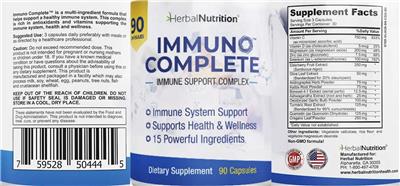
- Form
- Capsule
- Serving Size
- 3 Capsules
- Servings
- 30 per container
- Container Holds
- 90 Capsules
What’s in it, whether it interacts with your drugs, its side effects, whether it works, and what our pharmacists would want you to know before you start it.
- What is Immuno Complete?A supplement from Herbal Nutrition with 15 active ingredients, in capsule form.
- Active Ingredients 2 vitamins, 3 minerals, 9 plant ingredients such as Elderberry Fruit, Olive Leaf and Andrographis and 1 other: Vitamin C 750 mgVitamin D 5 mcgMagnesium 200 mgZinc 7.5 mgSelenium 100 mcgElderberry Fruit Extract 250 mgOlive Leaf Extract 50 mgAndrographis, Powder 75 mgKudzu, Powder 75 mgBoneset aerial parts extract 12.5 mgAshwagandha Herb, Root Extract 25 mgGarlic, Powder 100 mg 15 active ingredients. Each one can interact with drugs or cause side effects on its own, so we check every one. And 3 more, in the Supplement Facts
- Drug Interactions 1,698 drugs have a documented interaction with this supplement; the most serious is rated major. Of those, 1,226 are single drugs and 472 are combination products (two or more drugs in one), each listed under its own name. Ask your pharmacist first if you take a drug in any of these categories, the most serious of the 93 on record:
- Levodopa/
Carbidopa (Sinemet) Major · 6 drugs - Moderate · 645 drugs
- Moderate · 372 drugs
- Moderate · 248 drugs
- Levodopa/
- Possible Side EffectsUpset stomach 10 ingredientsNausea 9 ingredientsDiarrhea 5 ingredientsHeadache 5 ingredientsHeartburn 3 ingredientsBloating 2 ingredients +22 moreReported for twelve of its 15 active ingredients. Not studied in this exact product.
- Well documented Why
Does Immuno Complete work?
No graded research for the use on its labelWhat It Is Marketed For
Immune system support
From the claims on the product’s label.
There is no graded research for that use. What it does grade for its ingredients, strongest first:
- Vitamin C deficiency Vitamin C
- Magnesium
- Magnesium
- Turmeric
- Garlic
- Vitamin C
These grades are for each ingredient, not this exact product, and never a promise it will work for you.
And 22 more graded uses, in what the research says- Full Why
- AllergensNone of its ingredient names point to a major food allergen
- Barcode (UPC)7 59528 50444 5Match it to the barcode on your bottle to be sure this is your product. Not your product? Search for it here
Who Might Consider It
- People looking for immune system support, which is what it is marketed for. There is no graded research for that use.
- People who want it for vitamin C deficiency, constipation, dyspepsia, hyperlipidemia or another graded use: the uses with research behind them. See each grade
- Immuno Complete may appeal to those seeking broad immune support through a mix of vitamins, minerals, and herbs.
Who Should Be Careful
- However, if you take prescription medications—especially for the heart, blood thinning, thyroid, diabetes, blood pressure, anxiety, seizures, or any transplant or immune condition—you need to check your specific drugs with the tool on this page before starting.
- Pregnant or breastfeeding women should discuss this product with their pharmacist or doctor first.
More Before You Take It Show both answersHide Pregnancy and Breastfeeding The Label’s Directions
-
Pregnant or breastfeeding?
- Pregnancy Zinc
- ! When used orally in doses exceeding the UL.
- Breastfeeding Zinc
- ! When used orally in doses exceeding the UL.
- Pregnancy Turmeric
- ! When used orally in medicinal amounts; turmeric might stimulate the uterus and increase menstrual flow.
- Breastfeeding Turmeric
- When used orally in amounts commonly found in food.
- Pregnancy and Breastfeeding Vitamin C
- ! When used orally in excessive doses.
-
How does the label say to take it?
“Suggested use: 3 capsules daily preferably with meals or as directed by a healthcare professional.”
The maker’s words. Your pharmacist or doctor may advise differently.
Everything the label says
From the label dated Aug 22, 2025: all 15 of its active ingredients were checked against our records. A summary of what is known, not a grade or a test of the product. How these ratings are computed
Ask Anything About This Supplement
Name a drug you take, or ask about side effects, ingredients or pregnancy.
AI answers come from this label and our own records, never the open internet. AI can make mistakes, so always check with your doctor or pharmacist. How we use AI
Ask the Pharmacist
A licensed pharmacist will answer your question by email — free, usually within 24 hours.
Got it — thank you!
A licensed pharmacist will answer within 24 hours. Keep an eye on your email (worth checking spam, just in case).
What’s Inside Immuno Complete by Herbal Nutrition
15 Active Ingredients, Each Checked on Its Own
A supplement is often several ingredients in one bottle, and each one can interact with drugs or cause side effects on its own. We check every one of them against our records.
- Vitamin CDrug interactions on record, most serious: Moderate
- Vitamin DDrug interactions on record, most serious: Moderate
- MagnesiumDrug interactions on record, most serious: Major
- ZincDrug interactions on record, most serious: Moderate
- SeleniumDrug interactions on record, most serious: Moderate
- Elderberry Fruit ExtractDrug interactions on record, most serious: Moderate
- Olive Leaf ExtractNo drug interactions on record
- Andrographis, PowderDrug interactions on record, most serious: Moderate
And 7 more, each with its own card below.
Why this rating?
The label gives an exact amount for every one of its 15 active ingredients, so you know how much of each you get in each serving. This rates what the label tells you, not the quality of the product.
Supplement Facts
| Amount Per Serving | % Daily Value | |
|---|---|---|
| Vitamin C | 750 mg | 833% |
| Vitamin D | 5 mcg | 25% |
| Magnesium | 200 mg | 48% |
| Zinc | 7.5 mg | 68% |
| Selenium | 100 mcg | 182% |
| Elderberry Fruit Extract | 250 mg | † |
| Olive Leaf Extract | 50 mg | † |
| Andrographis, Powder | 75 mg | † |
| Kudzu, Powder | 75 mg | † |
| Boneset aerial parts extract | 12.5 mg | † |
| Ashwagandha Herb, Root Extract | 25 mg | † |
| Garlic, Powder | 100 mg | † |
| Turmeric Root Extract | 125 mg | † |
| Quercetin | 125 mg | † |
| Oregano, Powder | 250 mg | † |
Other ingredients: Vegetable Capsule, Rice Flour, Magnesium Stearate
† Daily Value not established.
Daily Values for adults and children 4 or more years of age.
As the label prints it, from the NIH Dietary Supplement Label Database.
Each Ingredient and Its Drug Interactions
Tap one for more about it and its full guide. A drug can interact with this supplement through any one of them.
Immuno Complete contains 15 active ingredients chosen to support immune function.
- They include vitamins (D and C), minerals (zinc, selenium, magnesium), herbal extracts (turmeric, elderberry, garlic, olive leaf, ashwagandha, andrographis, boneset, kudzu, oregano), and the plant compound quercetin.
- Each ingredient brings a different role: some are well-established nutrients (vitamin D for bone and immune health, zinc for immune response), while others are traditional herbal preparations with varying degrees of research support.
Show 1 more point
- The formula combines conventional supplemental vitamins and minerals with plant-based constituents.
-
Vitamin C 750 mg Interacts with 207 drugs
Form on the label: Ascorbic Acid
Vitamin C (ascorbic acid) is an essential nutrient your body needs but cannot make, so you must get it from food or supplements.
- It's important for immune function, collagen, and acts as an antioxidant, but taking large doses doesn't prevent colds for most people and may cause stomach upset.
- Most people get enough from a balanced diet, so check with your pharmacist or doctor before taking high-dose supplements.
The full Vitamin C guide: uses, dosage and safety Every Vitamin C drug interaction
-
Vitamin D 5 mcg Interacts with 717 drugs
Form on the label: Cholecalciferol
Vitamin D is a fat-soluble vitamin that helps your body absorb calcium and is important for healthy bones, muscles, and immune function.
- Many people, especially those with low sun exposure, benefit from supplementation, but more is not always better and very high doses can be harmful.
- Ask your pharmacist or doctor whether a blood test and supplement make sense for you.
The full Vitamin D guide: uses, dosage and safety Every Vitamin D drug interaction
-
Magnesium 200 mg Interacts with 298 drugs
Form on the label: Magnesium Oxide
Magnesium is an essential mineral your body needs for muscles, nerves, blood pressure, and many other functions, and supplements are useful for preventing or correcting deficiency.
- Some other uses, like easing constipation or preventing migraines, have reasonable support, while uses for sleep and anxiety are less proven.
- It is generally safe for most healthy people at recommended amounts, but talk to your pharmacist or doctor before starting, especially if you have kidney problems.
The full Magnesium guide: uses, dosage and safety Every Magnesium drug interaction
-
Zinc 7.5 mg Interacts with 67 drugs
Form on the label: Zinc Gluconate
Zinc is an essential mineral that your body needs for immune function, wound healing, taste, and smell.
- Most people get enough from food, but supplements can help correct or prevent a deficiency.
- Taking too much zinc for too long can cause harm, so check with a pharmacist or doctor before using high-dose supplements.
The full Zinc guide: uses, dosage and safety Every Zinc drug interaction
-
Selenium 100 mcg Interacts with 321 drugs
Form on the label: L-Selenomethionine
Selenium is an essential trace mineral your body needs in small amounts for thyroid function, antioxidant defense, and immune health.
- Most people who eat a varied diet get enough, and supplements are mainly useful for those who are deficient.
- Because too much selenium can be toxic, stick to recommended amounts and check with your pharmacist or doctor before supplementing.
The full Selenium guide: uses, dosage and safety Every Selenium drug interaction
-
Elderberry Fruit Extract 250 mg Interacts with 121 drugs
Form on the label: Sambucus nigra Fruit Extract
Elderberry is a popular herbal supplement, mainly taken to help with colds and flu.
- Some small studies suggest it may modestly shorten cold or flu symptoms, but the evidence is limited and not conclusive.
- Cooked berries and properly prepared products are generally well tolerated, but raw or unripe parts can cause nausea and should be avoided.
The full Elderberry guide: uses, dosage and safety Every Elderberry drug interaction
-
Olive Leaf Extract 50 mg No known drug interactions
Form on the label: Oleuropein
Olive comes from the same tree that gives us olives and olive oil, and its leaf and fruit contain antioxidant compounds like oleuropein and hydroxytyrosol.
- Olive oil as part of a Mediterranean diet is well-studied for heart health, but supplements made from olive leaf or fruit extract have less solid evidence.
- Talk to your pharmacist or doctor before starting any supplement, especially if you have health conditions or take medications.
-
Andrographis, Powder 75 mg Interacts with 413 drugs
Andrographis is a bitter Asian herb traditionally used for colds, flu, and infections, and some studies suggest it may ease cold symptoms and shorten how long they last.
- The evidence is limited and the quality of studies varies, so it should not replace standard care.
- Talk to your pharmacist or doctor before using it, and avoid it during pregnancy.
The full Andrographis guide: uses, dosage and safety Every Andrographis drug interaction
-
Kudzu, Powder 75 mg Interacts with 586 drugs
Kudzu is a fast-growing vine whose root has long been used in traditional Chinese medicine and is now studied mostly for reducing alcohol intake.
- Early research is promising for cutting back on drinking, but evidence for most other uses is weak.
- Talk with your pharmacist or doctor before trying it, and avoid it during pregnancy and breastfeeding.
The full Kudzu guide: uses, dosage and safety Every Kudzu drug interaction
-
Boneset aerial parts extract 12.5 mg Interacts with 87 drugs
Boneset is a traditional North American herb long used in teas for fevers, colds, and flu, but modern human studies are very limited.
- It contains compounds (pyrrolizidine alkaloids) that may harm the liver, so it should be used cautiously and avoided during pregnancy and breastfeeding.
The full Boneset guide: uses, dosage and safety Every Boneset drug interaction
-
Ashwagandha Herb, Root Extract 25 mg Interacts with 1,373 drugs
Form on the label: Ashwagandha Herb Extract, Ashwagandha Root Extract
Ashwagandha is an Ayurvedic herb most often taken to help with stress, anxiety, and sleep, and some small studies suggest it may help, though the evidence is still limited.
- It is generally well tolerated for short-term use in healthy adults, but it should be avoided in pregnancy and used cautiously by people with thyroid or liver problems.
- Talk with your pharmacist or doctor before starting it.
The full Ashwagandha guide: uses, dosage and safety Every Ashwagandha drug interaction
-
Garlic, Powder 100 mg Interacts with 991 drugs
Garlic is a common food and supplement that may modestly help with blood pressure and cholesterol, though the evidence is mixed and effects are usually small.
- It is generally safe in food amounts, but concentrated supplements can cause stomach upset, breath and body odor, and a higher risk of bleeding.
- Talk with your pharmacist or doctor before taking garlic supplements, especially if you take other medicines.
The full Garlic guide: uses, dosage and safety Every Garlic drug interaction
-
Turmeric Root Extract 125 mg Interacts with 1,134 drugs
Form on the label: Curcuminoids
Turmeric is a popular spice whose main active compounds, curcuminoids, are studied mostly for inflammation and joint pain.
- Some research is promising, but quality is mixed and curcumin is poorly absorbed on its own.
- For most people, dietary amounts are safe, but talk to your pharmacist or doctor before taking concentrated supplements, especially if you are pregnant, nursing, or have a medical condition.
The full Turmeric guide: uses, dosage and safety Every Turmeric drug interaction
-
Quercetin 125 mg Interacts with 1,172 drugs
Form on the label: Quercetin Dihydrate
Quercetin is a plant flavonoid with antioxidant and anti-inflammatory properties found in many common foods and sold as a supplement.
- While early research is interesting for allergies, blood pressure, and inflammation, strong human evidence is limited for most uses.
- It is generally well tolerated in food amounts, but talk to your pharmacist or doctor before taking high-dose supplements.
The full Quercetin guide: uses, dosage and safety Every Quercetin drug interaction
-
Oregano, Powder 250 mg Interacts with 881 drugs
Oregano is a common Mediterranean cooking herb that is also sold as a concentrated oil or supplement, often standardized for a compound called carvacrol.
- While lab studies suggest it may have antimicrobial and antioxidant properties, strong human evidence for treating any specific health condition is limited.
- Used as a food, oregano is very safe; concentrated oregano oil supplements should be used cautiously and discussed with your pharmacist or doctor.
The full Oregano guide: uses, dosage and safety Every Oregano drug interaction
Other Ingredients (Inactive)
The capsule or tablet itself, fillers, coatings and flavors. Not part of the drug interaction check; the allergen check below reads them.
- Vegetable Capsule
- Rice Flour
- Magnesium Stearate
Allergens in Immuno Complete
None of its ingredient names point to a major food allergen.
Not named in the ingredients
- Milk
- Egg
- Fish
- Shellfish
- Tree nuts
- Peanuts
- Wheat or other gluten grains
- Soy
- Sesame
- The label’s allergen statement“This product is manufactured and packaged in a facility which may also process milk, soy, wheat, egg, peanuts, tree nuts, fish and crustacean shellfish.”
From the label text and ingredient names on file; we do not test products. With a serious allergy, check your bottle and ask the maker or your pharmacist.
What the Label Says
The maker’s own words, from the label. We do not verify or endorse them.
- Formulation
-
“Immuno Complete is a multi-ingredient formula that helps support a healthy immune system. This complex is rich in antioxidants and vitamins supporting the immune system, health and wellness.”
“Immune support complex Immune system support Supports health & wellness 15 Powerful ingredients”
“Non-GMO formula!”
- Storage
-
“Store in a cool, dry place.”
- FDA Statement of Identity
-
“Dietary Supplement”
- Seals and symbols
-
“Sourced from a GMP Certified Facility Formulated in the USA”
The Immuno Complete Label on File
The label scan on file at the NIH Dietary Supplement Label Database, dated August 2025. Always read the label on the bottle you have.
Product Facts
- Brand
- Herbal Nutrition
- Barcode (UPC)
- 759528504445
- Net contents
- 90 Capsules
- Market status
- On market
- Date entered into DSLD
- Aug 22, 2025
- DSLD ID
- 336690
- Product type
- Other Combinations
- Supplement form
- Capsule
- Dietary claims / uses
- All Other, Structure/Function
- Intended target group(s)
- Adult (18 - 50 Years), Women (not pregnant or lactating)
Is this label outdated? Report a formula or label change and our pharmacy team will review it.
Immuno Complete by Herbal Nutrition Side Effects
Why this rating?
We look for three kinds of safety information on each ingredient: side effects reported in studies, a pregnancy and breastfeeding rating, and a safety write-up from our pharmacy team. All three are on file for each of the 15 ingredients we could check.
So this rates how much is known, not whether Immuno Complete is right for you.
Reported with 15 of its ingredients
- Most often
- Upset stomach, nausea, diarrhea, headache, heartburn and bloating
- !Rare but serious
- Liver problems, possible changes in thyroid function and severe allergic reactions See details
HelloPharmacist Team Summary of Side Effects
The individual ingredients are generally well tolerated at recommended doses, but there are important cautions.
- Several ingredients carry stronger safety warnings.
Side Effects, Ingredient by Ingredient
A supplement’s side effects come from its ingredients. Here is what is reported with each one.
Vitamin C
Most reported
- Upset stomach, nausea, or stomach cramps
- Diarrhea
- Heartburn
- Headache
Vitamin D
Our pharmacy team’s notes
- Vitamin D can cause toxicity at very high doses, leading to dangerously high blood calcium.
Magnesium
Most reported
- Diarrhea
- Nausea
- Stomach cramping
- Bloating
Our pharmacy team’s notes
- Magnesium commonly causes diarrhea at higher intakes.
Zinc
Most reported
- Nausea
- Stomach upset
- Vomiting
- Metallic taste
Our pharmacy team’s notes
- Zinc at high doses above 40 mg daily may increase copper deficiency risk.
Selenium
Most reported
- Gastric discomfort
- Headache
- Rash
From the Natural Medicines database, which we license.
Our pharmacy team’s notes
- Selenium toxicity can cause hair loss, nail changes, and nausea.
Olive
Most reported
- Stomach upset
- Nausea
- Headache
Andrographis
Most reported
- Upset stomach
- Nausea
- Diarrhea
- Loss of appetite
Kudzu
Most reported
- Stomach upset
- Nausea
- Dizziness
Ashwagandha
Most reported
- Upset stomach, nausea, or diarrhea
- Drowsiness or sleepiness
- Headache
Garlic
Most reported
- Bad breath
- Body odor
- Heartburn
- Upset stomach
Turmeric
Most reported
- Nausea
- Upset stomach
- Diarrhea
- Bloating
Quercetin
Most reported
- Headache
- Upset stomach
- Tingling sensations
Oregano
Most reported
- Stomach upset, nausea, or heartburn
- Mouth or throat irritation
- Skin irritation or rash if applied undiluted to the skin
Elderberry and Boneset have side-effect reports on file, but no list of the most common ones. Read them in each guide: Elderberry, Boneset.
Immuno Complete Warnings: Who Should Be Careful
Immuno Complete has 15 active ingredients, and each can carry warnings of its own. We checked all 15, and each warning below names the ingredient it comes from. If any of these apply to you, talk to your doctor or pharmacist before you start it.
- Vitamin C3 warnings below
- Vitamin D2 warnings below
- Magnesium3 warnings below
- Zinc2 warnings below
- Selenium1 warning below
- Elderberry2 warnings below
- Olive2 warnings below
- Andrographis3 warnings below
- Kudzu3 warnings below
- Boneset3 warnings below
- Ashwagandha2 warnings below
- Garlic4 warnings below
- Turmeric2 warnings below
- Quercetin2 warnings below
- Oregano2 warnings below
-
Bleeding Problems or Surgery
- AndrographisThose with liver problems, bleeding disorders, or low blood pressure should check with a healthcare provider first.
- AndrographisAnyone scheduled for surgery should mention its use to their care team.
- KudzuAlways tell your pharmacist or doctor about any supplement you are taking, especially before surgery or if you have an ongoing health condition.
- AshwagandhaPeople with autoimmune conditions or those scheduled for surgery should also check with their doctor first.
Show 6 more
- GarlicBecause garlic may slow blood clotting, use caution if you have a bleeding disorder or are scheduled for surgery.
- GarlicIf you are taking blood thinners or other medicines, check with your pharmacist before starting a garlic supplement.
- TurmericPeople who have gallbladder disease or gallstones, who are prone to kidney stones, or who have bleeding disorders should be cautious and check with a healthcare provider first.
- QuercetinIf you have a medical condition, take prescription medicines, or are scheduled for surgery, check with your pharmacist or doctor before starting quercetin.
- OreganoPeople with bleeding disorders or those scheduled for surgery should be cautious and tell their healthcare team.
- GarlicGarlic may increase bleeding risk and cause body odor or stomach upset.
-
Diabetes or Low Blood Sugar
- OliveIf you have low blood pressure or take medicine that lowers blood pressure or blood sugar, use caution, since olive supplements might add to those effects.
-
Liver Disease
- KudzuPeople with liver disease should also check with a doctor first, since the supplement is processed by the liver.
- BonesetPeople with liver disease should avoid boneset.
-
Kidney Disease or Kidney Stones
- Vitamin CVery high doses (often several grams a day) are more likely to cause side effects and may raise the risk of kidney stones in some people.
- Vitamin CPeople with kidney disease, a history of kidney stones, or a condition called hemochromatosis (iron overload) should be cautious and talk to a doctor before taking high doses.
- Vitamin DPeople with certain conditions should be careful, including those with high blood calcium, kidney disease, kidney stones, or sarcoidosis.
- MagnesiumThe biggest safety concern is in people with kidney disease, because damaged kidneys cannot remove extra magnesium, which can build up to dangerous levels.
Show 2 more
- MagnesiumIf you have kidney problems, do not take magnesium supplements unless your doctor tells you to.
- QuercetinVery high amounts taken over long periods have raised concerns about possible effects on the kidneys, so people with kidney problems should be especially cautious and talk to a doctor first.
-
Heart Conditions
- MagnesiumPeople with heart conduction problems or certain bowel conditions should also be cautious.
-
Stomach or Bowel Problems
- ZincPeople with digestive disorders, those who drink heavily, and people on restrictive diets are more likely to be low in zinc and may need supplements.
- GarlicPeople with stomach or digestive problems may find garlic irritating.
-
Thyroid Conditions
- AshwagandhaUse caution if you have a thyroid condition, since ashwagandha may affect thyroid hormone levels.
-
Autoimmune Conditions
- ElderberryPeople with autoimmune conditions should talk to their doctor before use, since elderberry may affect the immune system.
- AndrographisPeople with autoimmune conditions may want to be cautious, since Andrographis may affect immune activity.
-
Hormone-Sensitive Conditions
- KudzuPeople with hormone-sensitive conditions, such as certain breast, uterine, or ovarian cancers, should be cautious because the isoflavones in kudzu have estrogen-like activity.
-
Allergies
- BonesetThose allergic to plants in the daisy/ragweed family (Asteraceae), such as ragweed, marigolds, or chamomile, may also react to boneset and should be careful.
- OreganoPeople who are allergic to other plants in the mint family (such as basil, sage, mint, lavender, or marjoram) may also react to oregano.
-
Children
- ElderberryAlways check with a pharmacist or doctor before giving elderberry to children or before starting it if you have a health condition or take other medicines.
-
If You Take Other Drugs
- OliveAlways talk with a pharmacist or doctor before adding a new supplement, especially if you have a health condition or take regular medications.
- TurmericAlways talk to your pharmacist or doctor before starting a supplement, especially if you take other medicines or have a health condition.
-
Other Cautions
- Vitamin CPeople with a rare condition called G6PD deficiency should also use caution with very high doses.
- Vitamin DIf you have any of these, talk to your doctor before supplementing.
- ZincAnyone considering high-dose or long-term zinc should talk to a pharmacist or doctor first.
- BonesetFor this reason, many experts advise against prolonged use and recommend caution overall.
-
What the Label Warns
- “Caution: Do not exceed recommended dose. Do not use if safety seal is damaged or missing.”
- “This product is not intended for pregnant or nursing mothers or children under 18. If you have a known medical condition or have questions about the advisability of taking this product, consult a physician before using this or any dietary supplement.”
- “This product is not intended for pregnant or nursing mothers or children under 18. Keep out of reach of children.”
The maker’s wording, from the product label.
-
Pregnant or Breastfeeding
Each ingredient’s rating for pregnancy and for breastfeeding, and what it covers.
Pregnancy
-
When used orally and appropriately.
Zinc is safe in amounts that do not exceed the tolerable upper intake level (UL) of 34 mg daily during pregnancy in those 14-18 years of age and 40 mg daily in those 19-50 years of age.
-
When used orally in doses exceeding the UL.
Breastfeeding
-
When used orally and appropriately.
Zinc is safe in amounts that do not exceed the tolerable upper intake level (UL) of 34 mg daily during lactation in those 14-18 years of age, and 40 mg daily for those 19-50 years of age.
-
When used orally in doses exceeding the UL.
Higher doses can cause zinc-induced copper deficiency in nursing infants.
Pregnancy
-
When used orally in amounts commonly found in food.
-
When used orally in medicinal amounts; turmeric might stimulate the uterus and increase menstrual flow.
Breastfeeding
-
When used orally in amounts commonly found in food.
There is insufficient reliable information available about the safety of using turmeric in medicinal amounts during lactation.
Show 13 more ingredients
Pregnancy and Breastfeeding The record rates both the same
-
When used orally and appropriately.
-
When used orally in excessive doses.
Tell patients over age 19 not to use doses exceeding the UL of 2000 mg daily when pregnant or breast-feeding and for those 14-18 years of age not to use doses exceeding 1800 mg daily when pregnant or breast-feeding.
2 more points on this rating
- Higher doses can cause osmotic diarrhea and gastrointestinal upset.
- Large doses of vitamin C during pregnancy can also cause newborn scurvy; avoid using.
Pregnancy
-
When used orally and appropriately.
Vitamin D is safe when used in doses below the tolerable upper intake level (UL) of 4000 IU (100 mcg) daily.
-
When used orally in excessive amounts.
Tell patients not to use doses above the tolerable upper intake level (UL) of 4000 IU (100 mcg) daily.
Hypercalcemia during pregnancy due to excessive vitamin D intake can lead to several fetal adverse effects, including suppression of parathyroid hormone, hypocalcemia, tetany, seizures, aortic valve stenosis, retinopathy, and mental and/or physical developmental delay.
Breastfeeding
-
When used orally and appropriately.
Vitamin D is safe when used in doses below the tolerable upper intake level (UL) of 4000 IU (100 mcg) daily.
-
When used orally in excessive amounts.
Tell patients not to use doses above the tolerable upper intake level (UL) of 4000 IU (100 mcg) daily.
Pregnancy and Breastfeeding The record rates both the same
-
When used orally and appropriately.
Magnesium is safe for those pregnant and breast-feeding when used in doses below the tolerable upper intake level (UL) of 350 mg daily.
-
When used orally in excessive doses.
Tell patients to avoid exceeding the tolerable upper intake level (UL) of 350 mg daily.
Taking magnesium orally in higher doses can cause diarrhea.
2 more ratings for Magnesium used another way
This supplement is taken by mouth. These ratings are for Magnesium given another way.
-
When prescription magnesium sulfate is given intramuscularly and intravenously prior to delivery for up to 5 days.
However, due to potential adverse effects associated with intravenous and intramuscular magnesium, use during pregnancy is limited to patients with specific conditions such as severe pre-eclampsia or eclampsia.
5 more points on this rating
- There is some evidence that intravenous magnesium can increase fetal mortality and adversely affect neurological and skeletal development.
- However, a more recent analysis of clinical research shows that increased risk of fetal mortality seems to occur only in the studies where antenatal magnesium is used for tocolysis and not for fetal neuroprotection or pre-eclampsia/eclampsia.
- Furthermore, antenatal magnesium does not seem to be associated with increased risk of necrotizing enterocolitis in preterm infants.
- There is also concern that magnesium increases the risk of maternal adverse events.
- A meta-analysis of clinical research shows that magnesium sulfate might increase the risk of maternal adverse events, especially in Hispanic mothers compared to other racial and ethnic groups.
-
When prescription magnesium sulfate is given intramuscularly and intravenously prior to delivery for longer than 5 days.
Maternal exposure to magnesium for longer than 5-7 days is associated with an increase in neonatal bone abnormalities such as osteopenia and fractures.
The U.S. Food and Drug Administration (FDA) recommends that magnesium injection not be given for longer than 5-7 days.
Pregnancy
-
When used orally and appropriately.
Selenium appears to be safe when used short-term in amounts that do not exceed the tolerable upper intake level (UL) of 400 mcg daily; however, there is concern that long-term use might not be safe.
-
When used orally in excessive doses.
Doses above 400 mcg daily may cause significant toxicity.
Breastfeeding
-
When used orally and appropriately.
Selenium appears to be safe when used short-term in amounts that do not exceed the tolerable upper intake level (UL) of 400 mcg daily when taken short-term; however, there is concern that long-term use might not be safe.
-
When used orally in excessive doses.
Doses above 400 mcg daily may cause significant toxicity.
-
When used orally in HIV-positive women.
Selenium supplementation in HIV-positive women not taking highly active antiretroviral therapy may increase HIV-1 levels in breast milk.
Pregnancy
-
When used orally.
Andrographis is thought to have abortifacient effects; avoid using.
Breastfeeding
-
Insufficient reliable information available; avoid using.
Pregnancy and Breastfeeding The record rates both the same
-
When used orally.
Hepatotoxic PAs are common in this genus of plants; however, the alkaloids in boneset have not been adequately characterized to determine their toxic potential.
Hepatotoxic PAs might be teratogenic; avoid using.
Pregnancy
-
When used orally in amounts commonly found in foods.
-
When used orally in medicinal amounts.
Garlic is reported to have abortifacient activity.
4 more points on this rating
- One study also suggests that garlic constituents are distributed to the amniotic fluid after a single dose of garlic.
- However, there are no published reports of garlic adversely affecting pregnancy.
- In clinical research, garlic 800 mg daily was used during the third trimester of pregnancy with no reported adverse outcomes.
- There is insufficient reliable information available about the safety of topical garlic during pregnancy.
Breastfeeding
-
When used orally in amounts commonly found in foods.
-
When used orally in amounts greater than those found in foods.
Several small studies suggest that garlic constituents are secreted in breast milk, and that nursing infants of mothers consuming garlic are prone to extended nursing.
There is insufficient reliable information available about the safety of topical garlic during lactation.
Pregnancy
-
When used orally in medicinal amounts.
Oregano is thought to have abortifacient and emmenagogue effects.
Breastfeeding
-
There is insufficient reliable information available about the safety of oregano when used in medicinal amounts; avoid amounts greater than those found in food.
Pregnancy and Breastfeeding The record rates both the same
-
Insufficient reliable information available; stick with amounts commonly found in foods.
Pregnancy and Breastfeeding The record rates both the same
-
Insufficient reliable information available; avoid using.
Pregnancy
-
There is insufficient reliable information available about the safety of oral ashwagandha when used during pregnancy.
Historically, ashwagandha has been linked to abortifacient effects; however, there are no reliable case reports of harm in pregnancy.
2 more points on this rating
- Although one clinical study in pregnant females in their second trimester reported no adverse events with use of ashwagandha 300 mg twice daily for 12 weeks, abortifacient activity, developmental outcomes, and fetal toxicity were not assessed.
- Until more is known about the safety of ashwagandha, avoid using during pregnancy.
Breastfeeding
-
Insufficient reliable information available; avoid using.
Pregnancy and Breastfeeding The record rates both the same
-
Insufficient reliable information available; avoid using.
Pregnancy and Breastfeeding The record rates both the same
-
When consumed in the amounts typically found in foods.
There is insufficient reliable information available about the safety of elderberry when used for medicinal purposes; avoid using in amounts greater than those found in foods.
Our pharmacy team’s notes
- ElderberryElderberry supplements should be avoided in pregnancy and breastfeeding (although ripe, cooked elderberry as food is likely safe).
- AshwagandhaAshwagandha has been linked to rare cases of liver damage and should not be used in pregnancy.
- Boneset, kudzu, and andrographis should be avoided during pregnancy and breastfeeding due to insufficient safety data and theoretical concerns.
- No pregnancy or breastfeeding data is on file for vitamin C, magnesium, zinc, selenium, garlic, quercetin, or oregano—talk with your doctor or pharmacist before taking this product if you're pregnant or nursing.
Ratings and the words beside them are from the Natural Medicines database, which we license.
-
Rare but Serious Side Effects
-
!
Vitamin C
Rare but more serious concerns with very high or long-term high doses include kidney stones and, in people with iron-overload conditions, too much iron buildup.
Orally: There have been rare case reports of carotid inner wall thickening after large doses of vitamin C.
-
!
Vitamin D
In severe cases, very high calcium can harm the kidneys and heart.
Orally or intramuscularly: Excessive doses can lead to vitamin D toxicity with symptoms of hypercalcemia, and also sometimes azotemia and anemia.
-
!
Magnesium
Rare but serious side effects happen mostly with very high doses or in people with poor kidney function.
With toxic doses, loss of reflexes and respiratory depression can occur. High doses in pregnancy can increase risk of neonatal mortality and neurological defects.
-
!
Zinc
Very high single doses can cause more serious stomach symptoms.
Orally: There have been cases of acute renal tubular necrosis, interstitial nephritis, neurological complications, severe vomiting, and sideroblastic anemia after zinc overdose.
-
!
Selenium
In severe cases of overdose, more serious effects on the nervous system, kidneys, and heart can occur.
Orally: Excessive ingestion has led to cases of multi-organ failure and death.
-
!
Elderberry
More serious symptoms—such as significant nausea, vomiting, weakness, or dizziness—can occur if someone consumes raw or unripe berries or other parts of the plant.
-
!
Olive
Allergic reactions are rare but possible, especially in people sensitive to olive tree pollen.
-
!
Andrographis
Less commonly, some people may have allergic reactions, such as rash, hives, or itching.
Orally: Severe allergic reactions, including anaphylaxis.
-
!
Kudzu
Rarely, allergic reactions can occur.
-
!
Boneset
More serious concerns relate to its possible pyrrolizidine alkaloid content, which over time could cause liver damage.
-
!
Ashwagandha
Rare but serious effects include liver problems and possible changes in thyroid function.
Orally: Some case reports raise concerns about acute hepatitis, acute liver failure, hepatic encephalopathy, the need for liver transplantation, and death due to liver failure with ashwagandha treatment.
-
!
Garlic
Some people develop skin irritation or a rash when handling raw garlic, and allergic reactions are possible.
Orally: Some case reports raise concerns about increased risk of bleeding with garlic.
-
!
Turmeric
Signs that need medical attention include yellowing skin or eyes, dark urine, severe stomach pain, or an allergic reaction such as rash, swelling, or trouble breathing.
Turmeric supplements carry rare reports of liver injury with long-term use.
-
!
Quercetin
Higher doses taken by injection (not the usual supplement form) have been linked in some reports to more serious effects, which is one reason very high doses are not recommended.
-
!
Oregano
Allergic reactions are possible, especially in people sensitive to mint-family plants.
Orally: Systemic allergic reactions, including anaphylaxis, in sensitive individuals.
When to get help: a serious allergic reaction, with trouble breathing or swelling of the face, lips or throat, needs emergency care: call 911. For any other side effect that worries you, call your doctor or pharmacist.
These reports describe each ingredient, not studies of this exact product. Not medical advice: a side effect you notice after starting a supplement is worth a word with your pharmacist or doctor.
Immuno Complete by Herbal Nutrition Drug Interactions
We checked all 15 active ingredients in this supplement against every drug in our records. A drug can interact with it through any one of them.
A major interaction on record
3 of 3, on a scale from Minor or none to Major.Why this rating?
We rate this by the most serious interaction on record, not by how many there are. For Quercetin, Garlic, Elderberry, Boneset and Oregano, the most serious is rated major, which means the combination is best avoided, or used only under close supervision. Some involve kinds of drugs where a small change can matter, such as blood thinners, transplant drugs and cancer treatments.
1,699 drugs are on the full list. What matters is whether one you take is on it, so check yours with the interaction checker on this page.
14 of its 15 active ingredients have drug interactions on record. The ones below matter most. We have no interaction records for Olive.
- Interacts with
- 207 drugs
- Most serious
- Moderate
- Vitamin C in high doses may reduce warfarin effectiveness and can interfere with certain chemotherapy drugs.
- Interacts with
- 717 drugs
- Most serious
- Moderate
- Vitamin D can raise blood calcium to unsafe levels if you're taking thiazide diuretics, heart rhythm drugs like verapamil or diltiazem, or the heart glycoside digoxin.
- Interacts with
- 298 drugs
- Most serious
- Major
- The most serious interaction we've documented is magnesium with levodopa/carbidopa (a Parkinson's medication)—magnesium can reduce levodopa levels by about 35%, which could worsen symptom control.
Show three more ingredients
- Interacts with
- 67 drugs
- Most serious
- Moderate
- Zinc reduces absorption of quinolone and tetracycline antibiotics, and can decrease levels of HIV protease inhibitors and integrase inhibitors.
- Interacts with
- 321 drugs
- Most serious
- Moderate
- Selenium may increase bleeding risk with anticoagulants like warfarin, and theoretically interferes with immunosuppressants.
- Interacts with
- 586 drugs
- Most serious
- Moderate
- Kudzu can increase caffeine levels and theoretically raises bleeding risk.
And eight more ingredients with records, each in the cards below.
From the HelloPharmacist Team
A few things worth knowing about the supplement as a whole.
- This is rated Major severity.
- Beyond that, several ingredients interact with common drug types.
- Elderberry and andrographis may interfere with immunosuppressant therapy.
Summarized by the HelloPharmacist pharmacy team from the interaction records below. How it is written How we use AI
Why Immuno Complete Interacts, Ingredient by Ingredient
A product interacts through its ingredients. Each card: how many drugs, the most serious rating, and the kinds of drugs it affects most (tap a kind for what it means).
The ingredients driving the most interactions
-
Ashwagandha Herb, Root Extract 1,373 drugs
Most serious: Moderate10 interaction records on file
The kinds of drugs it affects most
- 645 drugs
- 372 drugs
- 248 drugs
- 186 drugs
Every Ashwagandha drug interaction, 10 records The Ashwagandha records cite 32 references, listed in the Ashwagandha guide.
-
Quercetin 1,172 drugs
Most serious: Moderate23 interaction records on file
The kinds of drugs it affects most
- 645 drugs
- 202 drugs
- 193 drugs
- 172 drugs
Every Quercetin drug interaction, 23 records The Quercetin records cite 30 references, listed in the Quercetin guide.
-
Turmeric Root Extract 1,134 drugs
Most serious: Moderate24 interaction records on file
The kinds of drugs it affects most
- 645 drugs
- 372 drugs
- 202 drugs
- 186 drugs
Every Turmeric drug interaction, 24 records The Turmeric records cite 105 references, listed in the Turmeric guide.
-
Garlic, Powder 991 drugs
Most serious: Moderate12 interaction records on file
The kinds of drugs it affects most
- 645 drugs
- 172 drugs
- 122 drugs
- 86 drugs
Every Garlic drug interaction, 12 records The Garlic records cite 154 references, listed in the Garlic guide.
-
Oregano, Powder 881 drugs
Most serious: Moderate4 interaction records on file
The kinds of drugs it affects most
- 645 drugs
- 186 drugs
- 122 drugs
- 86 drugs
Every Oregano drug interaction, 4 records The Oregano records cite 13 references, listed in the Oregano guide.
-
Vitamin D 717 drugs
Most serious: Moderate8 interaction records on file
The kinds of drugs it affects most
- 645 drugs
- 56 drugs
- Aluminum 14 drugs
- Atorvastatin (Lipitor) 3 drugs
Every Vitamin D drug interaction, 8 records The Vitamin D records cite 25 references, listed in the Vitamin D guide.
-
Kudzu, Powder 586 drugs
Most serious: Moderate7 interaction records on file
The kinds of drugs it affects most
- 372 drugs
- 122 drugs
- 86 drugs
- 41 drugs
Every Kudzu drug interaction, 7 records The Kudzu records cite 21 references, listed in the Kudzu guide.
-
Andrographis, Powder 413 drugs
Most serious: Moderate6 interaction records on file
The kinds of drugs it affects most
- 172 drugs
- 122 drugs
- 121 drugs
- Celecoxib (Celebrex) 3 drugs
Every Andrographis drug interaction, 6 records The Andrographis records cite 29 references, listed in the Andrographis guide.
-
Selenium 321 drugs
Most serious: Moderate6 interaction records on file
The kinds of drugs it affects most
- 122 drugs
- 121 drugs
- 49 drugs
- 30 drugs
Every Selenium drug interaction, 6 records The Selenium records cite 36 references, listed in the Selenium guide.
-
Magnesium 298 drugs
Most serious: Major16 interaction records on file
The kinds of drugs it affects most
- 122 drugs
- Skeletal Muscle Relaxants 36 drugs
- 23 drugs
- 22 drugs
Every Magnesium drug interaction, 16 records The Magnesium records cite 84 references, listed in the Magnesium guide.
-
Vitamin C 207 drugs
Most serious: Moderate13 interaction records on file
The kinds of drugs it affects most
- 69 drugs
- 41 drugs
- 35 drugs
- 24 drugs
Every Vitamin C drug interaction, 13 records The Vitamin C records cite 51 references, listed in the Vitamin C guide.
-
Elderberry Fruit Extract 121 drugs
Most serious: Moderate2 interaction records on file
The kinds of drugs it affects most
- 121 drugs
- Pazopanib (Votrient) 1 drug
Every Elderberry drug interaction, 2 records The Elderberry records cite 6 references, listed in the Elderberry guide.
-
Boneset aerial parts extract 87 drugs
Most serious: Moderate1 interaction record on file
The kinds of drugs it affects most
- 87 drugs
Every Boneset drug interaction, 1 record The Boneset records cite 5 references, listed in the Boneset guide.
-
Zinc 67 drugs
Most serious: Moderate10 interaction records on file
The kinds of drugs it affects most
- 21 drugs
- 20 drugs
- Bictegravir/Emtricitabine/Tenofovir Alafenamide (Biktarvy) 13 drugs
- Ritonavir (Norvir) 7 drugs
Every Zinc drug interaction, 10 records The Zinc records cite 88 references, listed in the Zinc guide.
The Breakdown by Severity
Each drug counted once, at its most serious rating. Tap a tile to list those drugs.
Find Your Drug
Type a drug or brand name to see whether it is on the list.
- Only drugs with a documented interaction are listed, the most serious first.
- A drug with no known interaction is not listed, but searching its name tells you so.
- Open a drug to see which ingredient is responsible. Of those, 1,226 are single drugs and 472 are combination products (two or more drugs in one), each listed under its own name.
-
LevodopaInbrija, Larodopa Major
The ingredient responsible:
-
Magnesium Major
Magnesium can reduce the bioavailability of levodopa/carbidopa.
The full Magnesium + Levodopa interaction
-
-
CarbidopaLodosyn Major
The ingredient responsible:
-
Magnesium Major
Magnesium can reduce the bioavailability of levodopa/carbidopa.
The full Magnesium + Carbidopa interaction
-
-
Carbidopa and LevodopaDhivy, Rytary, Sinemet, Sinemet CR Major
The ingredient responsible:
-
Magnesium Major
Magnesium can reduce the bioavailability of levodopa/carbidopa.
The full Magnesium + Carbidopa and Levodopa interaction
-
-
Benserazide and LevodopaMadopar, Prolopa Major
The ingredient responsible:
-
Magnesium Major
Magnesium can reduce the bioavailability of levodopa/carbidopa.
The full Magnesium + Benserazide and Levodopa interaction
-
-
Levodopa and CarbidopaDuodopa Major
The ingredient responsible:
-
Magnesium Major
Magnesium can reduce the bioavailability of levodopa/carbidopa.
The full Magnesium + Levodopa and Carbidopa interaction
-
-
Carbidopa, Levodopa, and EntacaponeStalevo Major
The ingredient responsible:
-
Magnesium Major
Magnesium can reduce the bioavailability of levodopa/carbidopa.
The full Magnesium + Carbidopa, Levodopa, and Entacapone interaction
-
-
ApixabanEliquis Moderate
The 10 ingredients responsible:
-
Oregano, Powder Moderate Apixaban is in these Anticoagulant/Antiplatelet Drugs, Cytochrome P450 3A4 (CYP3A4) Substrates categories.
Theoretically, oregano might increase the risk of bleeding when taken with anticoagulant or antiplatelet drugs.
The full Oregano, Powder + Apixaban interaction -
Quercetin Moderate Apixaban is in these Cytochrome P450 3A4 (CYP3A4) Substrates, P-glycoprotein Substrates categories.
Theoretically, concomitant use might alter the effects and adverse effects of CYP3A4 substrates.
The full Quercetin + Apixaban interaction -
Andrographis, Powder Moderate Apixaban is in the Anticoagulant/Antiplatelet Drugs category.
Theoretically, andrographis might increase the risk of bleeding when used with anticoagulant or antiplatelet drugs.
The full Andrographis, Powder + Apixaban interaction -
Selenium Moderate Apixaban is in the Anticoagulant/Antiplatelet Drugs category.
Selenium may have antiplatelet effects and may increase the risk of bleeding if used with anticoagulant or antiplatelet drugs.
The full Selenium + Apixaban interaction -
Garlic, Powder Moderate Apixaban is in these Anticoagulant/Antiplatelet Drugs, Cytochrome P450 3A4 (CYP3A4) Substrates categories.
Garlic may have antiplatelet effects and may increase the risk of bleeding if used with anticoagulant or antiplatelet drugs.
The full Garlic, Powder + Apixaban interaction -
Turmeric Root Extract Moderate Apixaban is in these Anticoagulant/Antiplatelet Drugs, Cytochrome P450 3A4 (CYP3A4) Substrates, P-glycoprotein Substrates categories.
Turmeric may have antiplatelet effects and may increase the risk of bleeding if used with anticoagulant or antiplatelet drugs.
The full Turmeric Root Extract + Apixaban interaction -
Kudzu, Powder Moderate Apixaban is in the Anticoagulant/Antiplatelet Drugs category.
Theoretically, kudzu may increase the risk of bleeding if used with antiplatelet or anticoagulant drugs.
The full Kudzu, Powder + Apixaban interaction -
Magnesium Minor Apixaban is in the Anticoagulant/Antiplatelet Drugs category.
Theoretically, magnesium may have antiplatelet effects, but the evidence is conflicting.
The full Magnesium + Apixaban interaction
And through 2 more ingredients, each with its own page:
- Ashwagandha Herb, Root Extract Minor
- Vitamin D Minor
-
-
LevothyroxineEltroxin, Estre, Euthyrox, Levo-T, Levolet and 6 more Moderate
The 3 ingredients responsible:
-
Ashwagandha Herb, Root Extract Moderate Levothyroxine is in the Thyroid Hormone category.
Ashwagandha might increase the effects and adverse effects of thyroid hormone.
The full Ashwagandha Herb, Root Extract + Levothyroxine interaction -
Magnesium Moderate
Magnesium might decrease levothyroxine levels by reducing its absorption.
The full Magnesium + Levothyroxine interaction -
Vitamin C Moderate
Vitamin C can increase levothyroxine absorption.
The full Vitamin C + Levothyroxine interaction
-
-
WarfarinWarfarin Moderate
The 11 ingredients responsible:
-
Kudzu, Powder Moderate Warfarin is in the Anticoagulant/Antiplatelet Drugs category.
Theoretically, kudzu may increase the risk of bleeding if used with antiplatelet or anticoagulant drugs.
The full Kudzu, Powder + Warfarin interaction -
Quercetin Moderate Warfarin is in these Cytochrome P450 2C8 (CYP2C8) Substrates, Cytochrome P450 2C9 (CYP2C9) Substrates, Cytochrome P450 3A4 (CYP3A4) Substrates categories.
Theoretically, concomitant use might increase the levels and adverse effects of CYP2C8 substrates.
The full Quercetin + Warfarin interaction -
Garlic, Powder Moderate Warfarin is in these Cytochrome P450 3A4 (CYP3A4) Substrates, Anticoagulant/Antiplatelet Drugs categories.
Theoretically, garlic products containing allicin might induce intestinal CYP3A4 and inhibit hepatic CYP3A4.
The full Garlic, Powder + Warfarin interaction -
Turmeric Root Extract Moderate Warfarin is in these Cytochrome P450 1A2 (CYP1A2) Substrates, Cytochrome P450 3A4 (CYP3A4) Substrates, Anticoagulant/Antiplatelet Drugs categories.
Theoretically, turmeric might increase levels of drugs metabolized by CYP1A2.
The full Turmeric Root Extract + Warfarin interaction -
Oregano, Powder Moderate Warfarin is in these Cytochrome P450 1A2 (CYP1A2) Substrates, Cytochrome P450 3A4 (CYP3A4) Substrates, Anticoagulant/Antiplatelet Drugs categories.
Theoretically, oregano might decrease the levels and clinical effects of CYP1A2 substrates.
The full Oregano, Powder + Warfarin interaction -
Andrographis, Powder Moderate Warfarin is in the Anticoagulant/Antiplatelet Drugs category.
Theoretically, andrographis might increase the risk of bleeding when used with anticoagulant or antiplatelet drugs.
The full Andrographis, Powder + Warfarin interaction -
Selenium Moderate Warfarin is in the Anticoagulant/Antiplatelet Drugs category.
Theoretically, selenium might interfere with warfarin activity.
The full Selenium + Warfarin interaction -
Vitamin C Moderate
High-dose vitamin C might reduce the levels and effectiveness of warfarin.
The full Vitamin C + Warfarin interaction
And through 3 more ingredients, each with its own page:
- Vitamin D Minor
- Ashwagandha Herb, Root Extract Minor
- Magnesium Minor
-
-
AmlodipineNorliqva Moderate
The 8 ingredients responsible:
-
Quercetin Moderate Amlodipine is in these Antihypertensive Drugs, Cytochrome P450 3A4 (CYP3A4) Substrates categories.
Theoretically, taking quercetin with antihypertensive drugs might increase the risk of hypotension.
The full Quercetin + Amlodipine interaction -
Ashwagandha Herb, Root Extract Moderate Amlodipine is in these Antihypertensive Drugs, Cytochrome P450 3A4 (CYP3A4) Substrates categories.
Theoretically, taking ashwagandha with antihypertensive drugs might increase the risk of hypotension.
The full Ashwagandha Herb, Root Extract + Amlodipine interaction -
Andrographis, Powder Moderate Amlodipine is in the Antihypertensive Drugs category.
Theoretically, andrographis might increase the risk of hypotension when used with antihypertensive drugs.
The full Andrographis, Powder + Amlodipine interaction -
Magnesium Moderate Amlodipine is in the Calcium Channel Blockers category.
Magnesium can have additive effects with calcium channel blockers, although evidence is conflicting.
The full Magnesium + Amlodipine interaction -
Garlic, Powder Moderate Amlodipine is in these Antihypertensive Drugs, Cytochrome P450 3A4 (CYP3A4) Substrates categories.
Theoretically, taking garlic with antihypertensive drugs might increase the risk of hypotension.
The full Garlic, Powder + Amlodipine interaction -
Turmeric Root Extract Moderate Amlodipine is in the Cytochrome P450 3A4 (CYP3A4) Substrates category.
Taking turmeric with amlodipine may increase levels of amlodipine.
The full Turmeric Root Extract + Amlodipine interaction -
Oregano, Powder Minor Amlodipine is in the Cytochrome P450 3A4 (CYP3A4) Substrates category.
Theoretically, oregano might decrease the levels and clinical effects of CYP3A4 substrates.
The full Oregano, Powder + Amlodipine interaction -
Vitamin D Minor Amlodipine is in the Cytochrome P450 3A4 (CYP3A4) Substrates category.
Vitamin D might induce CYP3A4 enzymes and reduce the bioavailability of CYP3A4 substrates.
The full Vitamin D + Amlodipine interaction
-
-
SertralineZoloft Moderate
The 6 ingredients responsible:
-
Garlic, Powder Moderate Sertraline is in the Cytochrome P450 3A4 (CYP3A4) Substrates category.
Theoretically, garlic products containing allicin might induce intestinal CYP3A4 and inhibit hepatic CYP3A4.
The full Garlic, Powder + Sertraline interaction -
Turmeric Root Extract Moderate Sertraline is in the Cytochrome P450 3A4 (CYP3A4) Substrates category.
Turmeric might increase or decrease levels of drugs metabolized by CYP3A4.
The full Turmeric Root Extract + Sertraline interaction -
Quercetin Moderate Sertraline is in the Cytochrome P450 3A4 (CYP3A4) Substrates category.
Theoretically, concomitant use might alter the effects and adverse effects of CYP3A4 substrates.
The full Quercetin + Sertraline interaction -
Ashwagandha Herb, Root Extract Minor Sertraline is in these Serotonergic Drugs, Cytochrome P450 3A4 (CYP3A4) Substrates categories.
Some animal studies have reported that ashwagandha can enhance serotonergic transmission by altering certain serotonin (5-HT) receptors.
The full Ashwagandha Herb, Root Extract + Sertraline interaction -
Vitamin D Minor Sertraline is in the Cytochrome P450 3A4 (CYP3A4) Substrates category.
Vitamin D might induce CYP3A4 enzymes and reduce the bioavailability of CYP3A4 substrates.
The full Vitamin D + Sertraline interaction -
Oregano, Powder Minor Sertraline is in the Cytochrome P450 3A4 (CYP3A4) Substrates category.
Theoretically, oregano might decrease the levels and clinical effects of CYP3A4 substrates.
The full Oregano, Powder + Sertraline interaction
-
-
ClopidogrelPlavix Moderate
The 10 ingredients responsible:
-
Quercetin Moderate Clopidogrel is in these Cytochrome P450 3A4 (CYP3A4) Substrates, Cytochrome P450 2C9 (CYP2C9) Substrates categories.
Theoretically, concomitant use might alter the effects and adverse effects of CYP3A4 substrates.
The full Quercetin + Clopidogrel interaction -
Andrographis, Powder Moderate Clopidogrel is in the Anticoagulant/Antiplatelet Drugs category.
Theoretically, andrographis might increase the risk of bleeding when used with anticoagulant or antiplatelet drugs.
The full Andrographis, Powder + Clopidogrel interaction -
Selenium Moderate Clopidogrel is in the Anticoagulant/Antiplatelet Drugs category.
Selenium may have antiplatelet effects and may increase the risk of bleeding if used with anticoagulant or antiplatelet drugs.
The full Selenium + Clopidogrel interaction -
Turmeric Root Extract Moderate Clopidogrel is in these Cytochrome P450 3A4 (CYP3A4) Substrates, Anticoagulant/Antiplatelet Drugs, Cytochrome P450 1A2 (CYP1A2) Substrates categories.
Turmeric might increase or decrease levels of drugs metabolized by CYP3A4.
The full Turmeric Root Extract + Clopidogrel interaction -
Kudzu, Powder Moderate Clopidogrel is in the Anticoagulant/Antiplatelet Drugs category.
Theoretically, kudzu may increase the risk of bleeding if used with antiplatelet or anticoagulant drugs.
The full Kudzu, Powder + Clopidogrel interaction -
Garlic, Powder Moderate Clopidogrel is in these Anticoagulant/Antiplatelet Drugs, Cytochrome P450 3A4 (CYP3A4) Substrates categories.
Garlic may have antiplatelet effects and may increase the risk of bleeding if used with anticoagulant or antiplatelet drugs.
The full Garlic, Powder + Clopidogrel interaction -
Oregano, Powder Moderate Clopidogrel is in these Cytochrome P450 3A4 (CYP3A4) Substrates, Anticoagulant/Antiplatelet Drugs, Cytochrome P450 1A2 (CYP1A2) Substrates categories.
Theoretically, oregano might decrease the levels and clinical effects of CYP3A4 substrates.
The full Oregano, Powder + Clopidogrel interaction -
Magnesium Minor Clopidogrel is in the Anticoagulant/Antiplatelet Drugs category.
Theoretically, magnesium may have antiplatelet effects, but the evidence is conflicting.
The full Magnesium + Clopidogrel interaction
And through 2 more ingredients, each with its own page:
- Vitamin D Minor
- Ashwagandha Herb, Root Extract Minor
-
-
EscitalopramLexapro Moderate
The 6 ingredients responsible:
-
Quercetin Moderate Escitalopram is in the Cytochrome P450 3A4 (CYP3A4) Substrates category.
Theoretically, concomitant use might alter the effects and adverse effects of CYP3A4 substrates.
The full Quercetin + Escitalopram interaction -
Garlic, Powder Moderate Escitalopram is in the Cytochrome P450 3A4 (CYP3A4) Substrates category.
Theoretically, garlic products containing allicin might induce intestinal CYP3A4 and inhibit hepatic CYP3A4.
The full Garlic, Powder + Escitalopram interaction -
Turmeric Root Extract Moderate Escitalopram is in the Cytochrome P450 3A4 (CYP3A4) Substrates category.
Turmeric might increase or decrease levels of drugs metabolized by CYP3A4.
The full Turmeric Root Extract + Escitalopram interaction -
Oregano, Powder Minor Escitalopram is in the Cytochrome P450 3A4 (CYP3A4) Substrates category.
Theoretically, oregano might decrease the levels and clinical effects of CYP3A4 substrates.
The full Oregano, Powder + Escitalopram interaction -
Vitamin D Minor Escitalopram is in the Cytochrome P450 3A4 (CYP3A4) Substrates category.
Vitamin D might induce CYP3A4 enzymes and reduce the bioavailability of CYP3A4 substrates.
The full Vitamin D + Escitalopram interaction -
Ashwagandha Herb, Root Extract Minor Escitalopram is in these Cytochrome P450 3A4 (CYP3A4) Substrates, Serotonergic Drugs categories.
Theoretically, ashwagandha might decrease the levels and clinical effects of CYP3A4 substrates.
The full Ashwagandha Herb, Root Extract + Escitalopram interaction
-
-
RosuvastatinCrestor, Ezallor Moderate
The 4 ingredients responsible:
-
Ashwagandha Herb, Root Extract Moderate Rosuvastatin is in the Hepatotoxic Drugs category.
Theoretically, taking ashwagandha with hepatotoxic drugs might increase the risk of liver damage.
The full Ashwagandha Herb, Root Extract + Rosuvastatin interaction -
Quercetin Moderate
Theoretically, concomitant use might increase the effects and adverse effects of rosuvastatin.
The full Quercetin + Rosuvastatin interaction -
Kudzu, Powder Moderate Rosuvastatin is in the Hepatotoxic Drugs category.
Theoretically, concomitant use might have additive hepatotoxic effects.
The full Kudzu, Powder + Rosuvastatin interaction -
Turmeric Root Extract Moderate Rosuvastatin is in the Hepatotoxic Drugs category.
Theoretically, turmeric might increase the risk of liver damage when taken with hepatotoxic drugs.
The full Turmeric Root Extract + Rosuvastatin interaction
-
-
AspirinAngettes 75, ASA, Asaphen, Aspirin, Caprin and 9 more Moderate
The 9 ingredients responsible:
-
Kudzu, Powder Moderate Aspirin is in the Anticoagulant/Antiplatelet Drugs category.
Theoretically, kudzu may increase the risk of bleeding if used with antiplatelet or anticoagulant drugs.
The full Kudzu, Powder + Aspirin interaction -
Oregano, Powder Moderate Aspirin is in the Anticoagulant/Antiplatelet Drugs category.
Theoretically, oregano might increase the risk of bleeding when taken with anticoagulant or antiplatelet drugs.
The full Oregano, Powder + Aspirin interaction -
Selenium Moderate Aspirin is in the Anticoagulant/Antiplatelet Drugs category.
Selenium may have antiplatelet effects and may increase the risk of bleeding if used with anticoagulant or antiplatelet drugs.
The full Selenium + Aspirin interaction -
Andrographis, Powder Moderate Aspirin is in the Anticoagulant/Antiplatelet Drugs category.
Theoretically, andrographis might increase the risk of bleeding when used with anticoagulant or antiplatelet drugs.
The full Andrographis, Powder + Aspirin interaction -
Quercetin Moderate Aspirin is in these Organic Anion Transporter 3 (OAT3) Substrates, Organic Anion Transporter 1 (OAT1) Substrates categories.
Theoretically, concomitant use might increase the effects and adverse effects of OAT3 substrates.
The full Quercetin + Aspirin interaction -
Turmeric Root Extract Moderate Aspirin is in the Anticoagulant/Antiplatelet Drugs category.
Turmeric may have antiplatelet effects and may increase the risk of bleeding if used with anticoagulant or antiplatelet drugs.
The full Turmeric Root Extract + Aspirin interaction -
Garlic, Powder Moderate Aspirin is in the Anticoagulant/Antiplatelet Drugs category.
Garlic may have antiplatelet effects and may increase the risk of bleeding if used with anticoagulant or antiplatelet drugs.
The full Garlic, Powder + Aspirin interaction -
Vitamin C Minor
Acidification of the urine by vitamin C might increase aspirin levels.
The full Vitamin C + Aspirin interaction
And through 1 more ingredient, each with its own page:
- Magnesium Minor
-
-
Losartan PotassiumCozaar Moderate
The 7 ingredients responsible:
-
Garlic, Powder Moderate Losartan Potassium is in these Cytochrome P450 3A4 (CYP3A4) Substrates, Antihypertensive Drugs categories.
Theoretically, garlic products containing allicin might induce intestinal CYP3A4 and inhibit hepatic CYP3A4.
The full Garlic, Powder + Losartan Potassium interaction -
Quercetin Moderate Losartan Potassium is in these Cytochrome P450 2C9 (CYP2C9) Substrates, Antihypertensive Drugs, Cytochrome P450 3A4 (CYP3A4) Substrates categories.
Theoretically, concomitant use might increase the effects and adverse effects of losartan and decrease the effects of its active metabolite.
The full Quercetin + Losartan Potassium interaction -
Ashwagandha Herb, Root Extract Moderate Losartan Potassium is in these Antihypertensive Drugs, Cytochrome P450 3A4 (CYP3A4) Substrates categories.
Theoretically, taking ashwagandha with antihypertensive drugs might increase the risk of hypotension.
The full Ashwagandha Herb, Root Extract + Losartan Potassium interaction -
Andrographis, Powder Moderate Losartan Potassium is in the Antihypertensive Drugs category.
Theoretically, andrographis might increase the risk of hypotension when used with antihypertensive drugs.
The full Andrographis, Powder + Losartan Potassium interaction -
Turmeric Root Extract Moderate Losartan Potassium is in the Cytochrome P450 3A4 (CYP3A4) Substrates category.
Turmeric might increase or decrease levels of drugs metabolized by CYP3A4.
The full Turmeric Root Extract + Losartan Potassium interaction -
Vitamin D Minor Losartan Potassium is in the Cytochrome P450 3A4 (CYP3A4) Substrates category.
Vitamin D might induce CYP3A4 enzymes and reduce the bioavailability of CYP3A4 substrates.
The full Vitamin D + Losartan Potassium interaction -
Oregano, Powder Minor Losartan Potassium is in the Cytochrome P450 3A4 (CYP3A4) Substrates category.
Theoretically, oregano might decrease the levels and clinical effects of CYP3A4 substrates.
The full Oregano, Powder + Losartan Potassium interaction
-
-
AtorvastatinAtorvaliq Moderate
The 7 ingredients responsible:
-
Quercetin Moderate Atorvastatin is in these Cytochrome P450 3A4 (CYP3A4) Substrates, Organic Anion-transporting Polypeptide Substrates (OATP) categories.
Theoretically, concomitant use might alter the effects and adverse effects of CYP3A4 substrates.
The full Quercetin + Atorvastatin interaction -
Garlic, Powder Moderate Atorvastatin is in the Cytochrome P450 3A4 (CYP3A4) Substrates category.
Theoretically, garlic products containing allicin might induce intestinal CYP3A4 and inhibit hepatic CYP3A4.
The full Garlic, Powder + Atorvastatin interaction -
Vitamin D Moderate Atorvastatin is in the Cytochrome P450 3A4 (CYP3A4) Substrates category.
Vitamin D might induce CYP3A4 enzymes and reduce the bioavailability of CYP3A4 substrates.
The full Vitamin D + Atorvastatin interaction -
Kudzu, Powder Moderate Atorvastatin is in the Hepatotoxic Drugs category.
Theoretically, concomitant use might have additive hepatotoxic effects.
The full Kudzu, Powder + Atorvastatin interaction -
Ashwagandha Herb, Root Extract Moderate Atorvastatin is in these Cytochrome P450 3A4 (CYP3A4) Substrates, Hepatotoxic Drugs categories.
Theoretically, ashwagandha might decrease the levels and clinical effects of CYP3A4 substrates.
The full Ashwagandha Herb, Root Extract + Atorvastatin interaction -
Turmeric Root Extract Moderate Atorvastatin is in these Hepatotoxic Drugs, Cytochrome P450 3A4 (CYP3A4) Substrates, Organic Anion-transporting Polypeptide Substrates (OATP) categories.
Theoretically, turmeric might increase the risk of liver damage when taken with hepatotoxic drugs.
The full Turmeric Root Extract + Atorvastatin interaction -
Oregano, Powder Minor Atorvastatin is in the Cytochrome P450 3A4 (CYP3A4) Substrates category.
Theoretically, oregano might decrease the levels and clinical effects of CYP3A4 substrates.
The full Oregano, Powder + Atorvastatin interaction
-
-
RivaroxabanXarelto Moderate
The 10 ingredients responsible:
-
Garlic, Powder Moderate Rivaroxaban is in these Anticoagulant/Antiplatelet Drugs, Cytochrome P450 3A4 (CYP3A4) Substrates categories.
Garlic may have antiplatelet effects and may increase the risk of bleeding if used with anticoagulant or antiplatelet drugs.
The full Garlic, Powder + Rivaroxaban interaction -
Quercetin Moderate Rivaroxaban is in these P-glycoprotein Substrates, Cytochrome P450 3A4 (CYP3A4) Substrates categories.
Theoretically, concomitant use might alter the effects and adverse effects of P-glycoprotein substrates.
The full Quercetin + Rivaroxaban interaction -
Kudzu, Powder Moderate Rivaroxaban is in the Anticoagulant/Antiplatelet Drugs category.
Theoretically, kudzu may increase the risk of bleeding if used with antiplatelet or anticoagulant drugs.
The full Kudzu, Powder + Rivaroxaban interaction -
Andrographis, Powder Moderate Rivaroxaban is in the Anticoagulant/Antiplatelet Drugs category.
Theoretically, andrographis might increase the risk of bleeding when used with anticoagulant or antiplatelet drugs.
The full Andrographis, Powder + Rivaroxaban interaction -
Selenium Moderate Rivaroxaban is in the Anticoagulant/Antiplatelet Drugs category.
Selenium may have antiplatelet effects and may increase the risk of bleeding if used with anticoagulant or antiplatelet drugs.
The full Selenium + Rivaroxaban interaction -
Turmeric Root Extract Moderate Rivaroxaban is in these P-glycoprotein Substrates, Anticoagulant/Antiplatelet Drugs, Cytochrome P450 3A4 (CYP3A4) Substrates categories.
Theoretically, turmeric might increase the absorption of P-glycoprotein substrates.
The full Turmeric Root Extract + Rivaroxaban interaction -
Oregano, Powder Moderate Rivaroxaban is in these Cytochrome P450 3A4 (CYP3A4) Substrates, Anticoagulant/Antiplatelet Drugs categories.
Theoretically, oregano might decrease the levels and clinical effects of CYP3A4 substrates.
The full Oregano, Powder + Rivaroxaban interaction -
Ashwagandha Herb, Root Extract Minor Rivaroxaban is in the Cytochrome P450 3A4 (CYP3A4) Substrates category.
Theoretically, ashwagandha might decrease the levels and clinical effects of CYP3A4 substrates.
The full Ashwagandha Herb, Root Extract + Rivaroxaban interaction
And through 2 more ingredients, each with its own page:
The Rivaroxaban drug page: uses, dosage and side effects -
-
TirzepatideMounjaro, Zepbound Moderate
The 6 ingredients responsible:
-
Turmeric Root Extract Moderate Tirzepatide is in the Antidiabetes Drugs category.
Theoretically, taking turmeric with antidiabetes drugs might increase the risk of hypoglycemia.
The full Turmeric Root Extract + Tirzepatide interaction -
Ashwagandha Herb, Root Extract Moderate Tirzepatide is in the Antidiabetes Drugs category.
Theoretically, taking ashwagandha with antidiabetes drugs might increase the risk of hypoglycemia.
The full Ashwagandha Herb, Root Extract + Tirzepatide interaction -
Garlic, Powder Moderate Tirzepatide is in the Antidiabetes Drugs category.
Theoretically, taking garlic with antidiabetes drugs might increase the risk of hypoglycemia.
The full Garlic, Powder + Tirzepatide interaction -
Quercetin Moderate Tirzepatide is in the Antidiabetes Drugs category.
Theoretically, concomitant use of quercetin and antidiabetes drugs might increase the risk of hypoglycemia.
The full Quercetin + Tirzepatide interaction -
Oregano, Powder Moderate Tirzepatide is in the Antidiabetes Drugs category.
Theoretically, oregano might increase the risk for hypoglycemia when taken with antidiabetes drugs.
The full Oregano, Powder + Tirzepatide interaction -
Kudzu, Powder Minor Tirzepatide is in the Antidiabetes Drugs category.
Theoretically, taking kudzu with antidiabetes drugs might increase the risk of hypoglycemia.
The full Kudzu, Powder + Tirzepatide interaction
-
-
MetforminGlucophage, Metformin Moderate
The 6 ingredients responsible:
-
Ashwagandha Herb, Root Extract Moderate Metformin is in the Antidiabetes Drugs category.
Theoretically, taking ashwagandha with antidiabetes drugs might increase the risk of hypoglycemia.
The full Ashwagandha Herb, Root Extract + Metformin interaction -
Quercetin Moderate Metformin is in the Antidiabetes Drugs category.
Theoretically, concomitant use of quercetin and antidiabetes drugs might increase the risk of hypoglycemia.
The full Quercetin + Metformin interaction -
Garlic, Powder Moderate Metformin is in the Antidiabetes Drugs category.
Theoretically, taking garlic with antidiabetes drugs might increase the risk of hypoglycemia.
The full Garlic, Powder + Metformin interaction -
Oregano, Powder Moderate Metformin is in the Antidiabetes Drugs category.
Theoretically, oregano might increase the risk for hypoglycemia when taken with antidiabetes drugs.
The full Oregano, Powder + Metformin interaction -
Turmeric Root Extract Moderate Metformin is in the Antidiabetes Drugs category.
Theoretically, taking turmeric with antidiabetes drugs might increase the risk of hypoglycemia.
The full Turmeric Root Extract + Metformin interaction -
Kudzu, Powder Minor Metformin is in the Antidiabetes Drugs category.
Theoretically, taking kudzu with antidiabetes drugs might increase the risk of hypoglycemia.
The full Kudzu, Powder + Metformin interaction
-
-
Warfarin SodiumCoumadin, Panwarfin, Sofarin Moderate
The 11 ingredients responsible:
-
Turmeric Root Extract Moderate Warfarin Sodium is in these Cytochrome P450 3A4 (CYP3A4) Substrates, Anticoagulant/Antiplatelet Drugs, Cytochrome P450 1A2 (CYP1A2) Substrates categories.
Turmeric might increase the risk of bleeding with warfarin.
The full Turmeric Root Extract + Warfarin Sodium interaction -
Quercetin Moderate Warfarin Sodium is in these Cytochrome P450 3A4 (CYP3A4) Substrates, Cytochrome P450 2C9 (CYP2C9) Substrates, Cytochrome P450 2C8 (CYP2C8) Substrates categories.
Theoretically, concomitant use might alter the effects and adverse effects of CYP3A4 substrates.
The full Quercetin + Warfarin Sodium interaction -
Kudzu, Powder Moderate Warfarin Sodium is in the Anticoagulant/Antiplatelet Drugs category.
Theoretically, kudzu may increase the risk of bleeding if used with antiplatelet or anticoagulant drugs.
The full Kudzu, Powder + Warfarin Sodium interaction -
Garlic, Powder Moderate Warfarin Sodium is in these Anticoagulant/Antiplatelet Drugs, Cytochrome P450 3A4 (CYP3A4) Substrates categories.
Theoretically, garlic might increase the risk of bleeding with warfarin.
The full Garlic, Powder + Warfarin Sodium interaction -
Vitamin C Moderate
High-dose vitamin C might reduce the levels and effectiveness of warfarin.
The full Vitamin C + Warfarin Sodium interaction -
Selenium Moderate Warfarin Sodium is in the Anticoagulant/Antiplatelet Drugs category.
Selenium may have antiplatelet effects and may increase the risk of bleeding if used with anticoagulant or antiplatelet drugs.
The full Selenium + Warfarin Sodium interaction -
Andrographis, Powder Moderate Warfarin Sodium is in the Anticoagulant/Antiplatelet Drugs category.
Theoretically, andrographis might increase the risk of bleeding when used with anticoagulant or antiplatelet drugs.
The full Andrographis, Powder + Warfarin Sodium interaction -
Oregano, Powder Moderate Warfarin Sodium is in these Anticoagulant/Antiplatelet Drugs, Cytochrome P450 1A2 (CYP1A2) Substrates, Cytochrome P450 3A4 (CYP3A4) Substrates categories.
Theoretically, oregano might increase the risk of bleeding when taken with anticoagulant or antiplatelet drugs.
The full Oregano, Powder + Warfarin Sodium interaction
And through 3 more ingredients, each with its own page:
- Vitamin D Minor
- Magnesium Minor
- Ashwagandha Herb, Root Extract Minor
-
-
IbuprofenAdvil, Arthrofen, Brufen, Brufen Retard, Calodor and 15 more Moderate
The 8 ingredients responsible:
-
Kudzu, Powder Moderate Ibuprofen is in the Anticoagulant/Antiplatelet Drugs category.
Theoretically, kudzu may increase the risk of bleeding if used with antiplatelet or anticoagulant drugs.
The full Kudzu, Powder + Ibuprofen interaction -
Andrographis, Powder Moderate Ibuprofen is in the Anticoagulant/Antiplatelet Drugs category.
Theoretically, andrographis might increase the risk of bleeding when used with anticoagulant or antiplatelet drugs.
The full Andrographis, Powder + Ibuprofen interaction -
Selenium Moderate Ibuprofen is in the Anticoagulant/Antiplatelet Drugs category.
Selenium may have antiplatelet effects and may increase the risk of bleeding if used with anticoagulant or antiplatelet drugs.
The full Selenium + Ibuprofen interaction -
Turmeric Root Extract Moderate Ibuprofen is in the Anticoagulant/Antiplatelet Drugs category.
Turmeric may have antiplatelet effects and may increase the risk of bleeding if used with anticoagulant or antiplatelet drugs.
The full Turmeric Root Extract + Ibuprofen interaction -
Quercetin Moderate Ibuprofen is in these Organic Anion Transporter 3 (OAT3) Substrates, Organic Anion Transporter 1 (OAT1) Substrates, Cytochrome P450 2C9 (CYP2C9) Substrates categories.
Theoretically, concomitant use might increase the effects and adverse effects of OAT3 substrates.
The full Quercetin + Ibuprofen interaction -
Garlic, Powder Moderate Ibuprofen is in the Anticoagulant/Antiplatelet Drugs category.
Garlic may have antiplatelet effects and may increase the risk of bleeding if used with anticoagulant or antiplatelet drugs.
The full Garlic, Powder + Ibuprofen interaction -
Oregano, Powder Moderate Ibuprofen is in the Anticoagulant/Antiplatelet Drugs category.
Theoretically, oregano might increase the risk of bleeding when taken with anticoagulant or antiplatelet drugs.
The full Oregano, Powder + Ibuprofen interaction -
Magnesium Minor Ibuprofen is in the Anticoagulant/Antiplatelet Drugs category.
Theoretically, magnesium may have antiplatelet effects, but the evidence is conflicting.
The full Magnesium + Ibuprofen interaction
-
-
MetoprololLopressor, Toprol XL Moderate
The 4 ingredients responsible:
-
Garlic, Powder Moderate Metoprolol is in the Antihypertensive Drugs category.
Theoretically, taking garlic with antihypertensive drugs might increase the risk of hypotension.
The full Garlic, Powder + Metoprolol interaction -
Andrographis, Powder Moderate Metoprolol is in the Antihypertensive Drugs category.
Theoretically, andrographis might increase the risk of hypotension when used with antihypertensive drugs.
The full Andrographis, Powder + Metoprolol interaction -
Quercetin Moderate Metoprolol is in these Antihypertensive Drugs, Cytochrome P450 2D6 (CYP2D6) Substrates categories.
Theoretically, taking quercetin with antihypertensive drugs might increase the risk of hypotension.
The full Quercetin + Metoprolol interaction -
Ashwagandha Herb, Root Extract Moderate Metoprolol is in the Antihypertensive Drugs category.
Theoretically, taking ashwagandha with antihypertensive drugs might increase the risk of hypotension.
The full Ashwagandha Herb, Root Extract + Metoprolol interaction
-
-
SemaglutideOzempic, Rybelsus, Wegovy Moderate
The 6 ingredients responsible:
-
Garlic, Powder Moderate Semaglutide is in the Antidiabetes Drugs category.
Theoretically, taking garlic with antidiabetes drugs might increase the risk of hypoglycemia.
The full Garlic, Powder + Semaglutide interaction -
Quercetin Moderate Semaglutide is in the Antidiabetes Drugs category.
Theoretically, concomitant use of quercetin and antidiabetes drugs might increase the risk of hypoglycemia.
The full Quercetin + Semaglutide interaction -
Ashwagandha Herb, Root Extract Moderate Semaglutide is in the Antidiabetes Drugs category.
Theoretically, taking ashwagandha with antidiabetes drugs might increase the risk of hypoglycemia.
The full Ashwagandha Herb, Root Extract + Semaglutide interaction -
Turmeric Root Extract Moderate Semaglutide is in the Antidiabetes Drugs category.
Theoretically, taking turmeric with antidiabetes drugs might increase the risk of hypoglycemia.
The full Turmeric Root Extract + Semaglutide interaction -
Oregano, Powder Moderate Semaglutide is in the Antidiabetes Drugs category.
Theoretically, oregano might increase the risk for hypoglycemia when taken with antidiabetes drugs.
The full Oregano, Powder + Semaglutide interaction -
Kudzu, Powder Minor Semaglutide is in the Antidiabetes Drugs category.
Theoretically, taking kudzu with antidiabetes drugs might increase the risk of hypoglycemia.
The full Kudzu, Powder + Semaglutide interaction
-
-
IvermectinMectizan, Sklice, Soolantra, Stromectol Moderate
The 2 ingredients responsible:
-
Quercetin Moderate Ivermectin is in the P-glycoprotein Substrates category.
Theoretically, concomitant use might alter the effects and adverse effects of P-glycoprotein substrates.
The full Quercetin + Ivermectin interaction -
Turmeric Root Extract Minor Ivermectin is in the P-glycoprotein Substrates category.
Theoretically, turmeric might increase the absorption of P-glycoprotein substrates.
The full Turmeric Root Extract + Ivermectin interaction
-
-
TadalafilCialis, Tadliq Moderate
The 6 ingredients responsible:
-
Turmeric Root Extract Moderate Tadalafil is in the Cytochrome P450 3A4 (CYP3A4) Substrates category.
Turmeric might increase or decrease levels of drugs metabolized by CYP3A4.
The full Turmeric Root Extract + Tadalafil interaction -
Quercetin Moderate Tadalafil is in the Cytochrome P450 3A4 (CYP3A4) Substrates category.
Theoretically, concomitant use might alter the effects and adverse effects of CYP3A4 substrates.
The full Quercetin + Tadalafil interaction -
Garlic, Powder Moderate Tadalafil is in the Cytochrome P450 3A4 (CYP3A4) Substrates category.
Theoretically, garlic products containing allicin might induce intestinal CYP3A4 and inhibit hepatic CYP3A4.
The full Garlic, Powder + Tadalafil interaction -
Ashwagandha Herb, Root Extract Minor Tadalafil is in the Cytochrome P450 3A4 (CYP3A4) Substrates category.
Theoretically, ashwagandha might decrease the levels and clinical effects of CYP3A4 substrates.
The full Ashwagandha Herb, Root Extract + Tadalafil interaction -
Vitamin D Minor Tadalafil is in the Cytochrome P450 3A4 (CYP3A4) Substrates category.
Vitamin D might induce CYP3A4 enzymes and reduce the bioavailability of CYP3A4 substrates.
The full Vitamin D + Tadalafil interaction -
Oregano, Powder Minor Tadalafil is in the Cytochrome P450 3A4 (CYP3A4) Substrates category.
Theoretically, oregano might decrease the levels and clinical effects of CYP3A4 substrates.
The full Oregano, Powder + Tadalafil interaction
-
-
FluoxetineProzac, Sarafem Moderate
The 2 ingredients responsible:
-
Quercetin Moderate Fluoxetine is in these Cytochrome P450 2C9 (CYP2C9) Substrates, Cytochrome P450 2D6 (CYP2D6) Substrates categories.
Theoretically, concomitant use might increase the levels and adverse effects of CYP2C9 substrates.
The full Quercetin + Fluoxetine interaction -
Ashwagandha Herb, Root Extract Minor Fluoxetine is in the Serotonergic Drugs category.
Some animal studies have reported that ashwagandha can enhance serotonergic transmission by altering certain serotonin (5-HT) receptors.
The full Ashwagandha Herb, Root Extract + Fluoxetine interaction
-
-
PrednisoneCortan, Deltasone, Meticorten, Orasone, Prednicen-M and 3 more Moderate
The 9 ingredients responsible:
-
Ashwagandha Herb, Root Extract Moderate Prednisone is in these Cytochrome P450 3A4 (CYP3A4) Substrates, Immunosuppressants categories.
Theoretically, ashwagandha might decrease the levels and clinical effects of CYP3A4 substrates.
The full Ashwagandha Herb, Root Extract + Prednisone interaction -
Selenium Moderate Prednisone is in the Immunosuppressants category.
Theoretically, selenium supplementation may reduce the effectiveness of immunosuppressant therapy.
The full Selenium + Prednisone interaction -
Andrographis, Powder Moderate Prednisone is in the Immunosuppressants category.
Theoretically, andrographis might interfere with the effects of immunosuppressive drugs.
The full Andrographis, Powder + Prednisone interaction -
Turmeric Root Extract Moderate Prednisone is in these Cytochrome P450 3A4 (CYP3A4) Substrates, P-glycoprotein Substrates categories.
Turmeric might increase or decrease levels of drugs metabolized by CYP3A4.
The full Turmeric Root Extract + Prednisone interaction -
Quercetin Moderate Prednisone is in these P-glycoprotein Substrates, Cytochrome P450 3A4 (CYP3A4) Substrates categories.
Theoretically, concomitant use might alter the effects and adverse effects of P-glycoprotein substrates.
The full Quercetin + Prednisone interaction -
Elderberry Fruit Extract Moderate Prednisone is in the Immunosuppressants category.
Theoretically, elderberry might interfere with immunosuppressant therapy due to its immunostimulant activity.
The full Elderberry Fruit Extract + Prednisone interaction -
Garlic, Powder Moderate Prednisone is in the Cytochrome P450 3A4 (CYP3A4) Substrates category.
Theoretically, garlic products containing allicin might induce intestinal CYP3A4 and inhibit hepatic CYP3A4.
The full Garlic, Powder + Prednisone interaction -
Oregano, Powder Minor Prednisone is in the Cytochrome P450 3A4 (CYP3A4) Substrates category.
Theoretically, oregano might decrease the levels and clinical effects of CYP3A4 substrates.
The full Oregano, Powder + Prednisone interaction
And through 1 more ingredient, each with its own page:
- Vitamin D Minor
-
-
AmoxicillinAmix, Amoram, Amoxident, Amoxil Capsules, Amoxil Injection and 4 more Moderate
The 3 ingredients responsible:
-
Ashwagandha Herb, Root Extract Moderate Amoxicillin is in the Hepatotoxic Drugs category.
Theoretically, taking ashwagandha with hepatotoxic drugs might increase the risk of liver damage.
The full Ashwagandha Herb, Root Extract + Amoxicillin interaction -
Turmeric Root Extract Moderate Amoxicillin is in the Hepatotoxic Drugs category.
Theoretically, turmeric might increase the risk of liver damage when taken with hepatotoxic drugs.
The full Turmeric Root Extract + Amoxicillin interaction -
Kudzu, Powder Moderate Amoxicillin is in the Hepatotoxic Drugs category.
Theoretically, concomitant use might have additive hepatotoxic effects.
The full Kudzu, Powder + Amoxicillin interaction
-
-
TestosteroneAndrogel, Andropatch, Delatestryl, Intrinsa, Natesto and 4 more Moderate
The 7 ingredients responsible:
-
Ashwagandha Herb, Root Extract Moderate Testosterone is in these Hepatotoxic Drugs, Cytochrome P450 3A4 (CYP3A4) Substrates categories.
Theoretically, taking ashwagandha with hepatotoxic drugs might increase the risk of liver damage.
The full Ashwagandha Herb, Root Extract + Testosterone interaction -
Kudzu, Powder Moderate Testosterone is in the Hepatotoxic Drugs category.
Theoretically, concomitant use might have additive hepatotoxic effects.
The full Kudzu, Powder + Testosterone interaction -
Turmeric Root Extract Moderate Testosterone is in these Cytochrome P450 3A4 (CYP3A4) Substrates, Hepatotoxic Drugs categories.
Turmeric might increase or decrease levels of drugs metabolized by CYP3A4.
The full Turmeric Root Extract + Testosterone interaction -
Garlic, Powder Moderate Testosterone is in the Cytochrome P450 3A4 (CYP3A4) Substrates category.
Theoretically, garlic products containing allicin might induce intestinal CYP3A4 and inhibit hepatic CYP3A4.
The full Garlic, Powder + Testosterone interaction -
Quercetin Moderate Testosterone is in the Cytochrome P450 3A4 (CYP3A4) Substrates category.
Theoretically, concomitant use might alter the effects and adverse effects of CYP3A4 substrates.
The full Quercetin + Testosterone interaction -
Oregano, Powder Minor Testosterone is in the Cytochrome P450 3A4 (CYP3A4) Substrates category.
Theoretically, oregano might decrease the levels and clinical effects of CYP3A4 substrates.
The full Oregano, Powder + Testosterone interaction -
Vitamin D Minor Testosterone is in the Cytochrome P450 3A4 (CYP3A4) Substrates category.
Vitamin D might induce CYP3A4 enzymes and reduce the bioavailability of CYP3A4 substrates.
The full Vitamin D + Testosterone interaction
-
Does It Work? Immuno Complete by Herbal Nutrition
How it rates in the research so far, then each ingredient on its own. A grade is the research so far, never an endorsement.
What It Is Marketed For
Immune system support
From the claims on the product’s label.
Why this rating?
We hold no graded evidence on that for its ingredients.
Our pharmacy team’s notes on this supplement
- The evidence for Immuno Complete's ingredients is mixed.
- Other ingredients show more limited support.
- Garlic, turmeric, and ashwagandha are possibly effective for various conditions—garlic for hypertension and diabetes, turmeric for depression and high cholesterol, ashwagandha for anxiety and insomnia.
The Evidence, Ingredient by Ingredient
Each card holds our notes on one ingredient, then its uses graded effective, likely effective or possibly effective.
Vitamin C
Our pharmacy team’s notes on Vitamin C
- Vitamin C is possibly effective for certain types of anemia and respiratory infections.
Research suggests a benefit for
- Vitamin C deficiency
- Hypercholesterolemia, hypertension, cataracts, exercise-induced respiratory infections, anemia of chronic disease, complex regional pain syndrome and nitrate tolerance
Not counted here: two graded uses are for Vitamin C injected or put on the skin (wrinkled skin and laser skin resurfacing), not for a product like this one. Four more are for conditions treated by a doctor or in a hospital (atrial fibrillation, lead toxicity, bowel preparation and others).
Every graded use, in the Vitamin C guideElderberry
From our Elderberry guide
- Elderberry is most often used in hopes of preventing or shortening colds and the flu and for general immune support.
- Some small studies have suggested that elderberry products might modestly reduce the length or severity of cold and flu symptoms when started early.
No use is graded effective, likely effective or possibly effective for it yet.
Every graded use, in the Elderberry guideOregano
From our Oregano guide
- People use oregano and oregano oil for many reasons, but it is important to understand that most of the evidence is preliminary.
- A lot of the research has been done in test tubes or on animals rather than in well-designed human studies.
No use is graded effective, likely effective or possibly effective for it yet.
Every graded use, in the Oregano guideMagnesium
Our pharmacy team’s notes on Magnesium
- Magnesium is effective for constipation and dyspepsia.
Research suggests a benefit for
- Constipation and dyspepsia
- Diabetes, hypercholesterolemia, metabolic syndrome, osteoporosis and premenstrual syndrome (PMS)
Not counted here: five graded uses are for Magnesium injected or put on the skin (vasospastic angina, asthma, seizures and others), not for a product like this one. Six more are for conditions treated by a doctor or in a hospital (arrhythmia, cerebral palsy, colorectal cancer and others).
Every graded use, in the Magnesium guideTurmeric
From our Turmeric guide
- People take turmeric for many reasons, but for most uses the scientific evidence is still limited or mixed.
- The most studied area is joint pain and osteoarthritis.
Research suggests a benefit for
- Hyperlipidemia, osteoarthritis, allergic rhinitis (hay fever), dyspepsia, metabolic dysfunction-associated steatotic liver disease (MASLD), oral mucositis and pruritus
Quercetin
From our Quercetin guide
- Quercetin has been studied for many conditions, but for most of them the evidence in humans is limited or preliminary.
- Much of the excitement comes from laboratory and animal research, which does not always translate into real benefits for people.
No use is graded effective, likely effective or possibly effective for it yet.
Every graded use, in the Quercetin guideGarlic
From our Garlic guide
- Garlic is one of the most studied herbal supplements, but the results are mixed and most benefits appear modest.
Research suggests a benefit for
- Diabetes, hypertension, metabolic dysfunction-associated steatotic liver disease (MASLD), periodontitis, atherosclerosis and endometriosis
Andrographis
From our Andrographis guide
- The most studied use of Andrographis is for upper respiratory infections like the common cold.
- Some clinical studies suggest it may modestly reduce the severity and length of cold symptoms, such as sore throat, cough, and runny nose, especially when taken soon after symptoms begin.
Research suggests a benefit for
- Osteoarthritis, ulcerative colitis and tonsillopharyngitis
Kudzu
From our Kudzu guide
- The most studied use of kudzu is for reducing alcohol intake.
- Some small human studies suggest that a kudzu root extract may help people drink less in a single sitting and reduce cravings.
Research suggests a benefit for
- Alcohol use disorder
Olive
From our Olive guide
- The strongest evidence for olive is actually for olive oil as part of a healthy diet.
- A Mediterranean-style diet rich in olive oil has been linked in many studies to better heart health, including healthier cholesterol and blood pressure.
No use is graded effective, likely effective or possibly effective for it yet.
Every graded use, in the Olive guideAshwagandha
From our Ashwagandha guide
- People take ashwagandha for many reasons, but for most of these the evidence is limited or early.
Research suggests a benefit for
- Insomnia, stress and generalized anxiety disorder (GAD)
Boneset
From our Boneset guide
- People most commonly use boneset for colds, flu, fevers, and body aches.
- It is also used traditionally to encourage sweating and to loosen congestion.
No use is graded effective, likely effective or possibly effective for it yet.
Every graded use, in the Boneset guideZinc
From our Zinc guide
- The strongest reason to take zinc is to treat or prevent a zinc deficiency.
- Deficiency is well documented and clearly responds to zinc, so this use is supported by good evidence.
Research suggests a benefit for
- Zinc deficiency
- Diabetes, coronavirus disease 2019 (COVID-19), acne, peptic ulcers, pneumonia, age-related macular degeneration (AMD) and child growth
Not counted here: three graded uses are for Zinc injected or put on the skin (gingivitis, herpes labialis (cold sores) and pressure ulcers), not for a product like this one. Five more are for conditions treated by a doctor or in a hospital (acrodermatitis enteropathica, low birth weight, sickle cell disease and others).
And 5 more graded uses, in the Zinc guideSelenium
Our pharmacy team’s notes on Selenium
- Selenium is likely effective for selenium deficiency.
Research suggests a benefit for
- Selenium deficiency
- Autoimmune thyroiditis and kashin-Beck disease
Not counted here: one graded use is for a condition treated by a doctor or in a hospital (pre-eclampsia).
Every graded use, in the Selenium guideVitamin D
Our pharmacy team’s notes on Vitamin D
- Vitamin D is effective for bone health conditions like rickets and osteomalacia, and likely effective for vitamin D deficiency.
Research suggests a benefit for
- Rickets, vitamin D deficiency and osteomalacia
- Osteoporosis and corticosteroid-induced osteoporosis
- Allergic rhinitis (hay fever), coronavirus disease 2019 (COVID-19) and dental caries
Not counted here: one graded use is for Vitamin D injected or put on the skin (psoriasis), not for a product like this one. Four more are for conditions treated by a doctor or in a hospital (heart failure, familial hypophosphatemia, renal osteodystrophy and others).
And 2 more graded uses, in the Vitamin D guideThe grades are the Natural Medicines database’s, which we license; tap a grade for what it means. They are about each ingredient, not this exact product.
About Herbal Nutrition
Manufacturer and brand details for Immuno Complete, from the product label.
Herbal Nutrition has 26 products in our supplement database, all of them on the market, with labels on file since 2015. Our database is built from the NIH’s Dietary Supplement Label Database and our pharmacy team’s own additions, so it covers the labels filed there, not every product the brand sells.
- Name
- Herbal Nutrition, L.L.C.
- City
- Alpharetta
- State
- GA
- ZipCode
- 30005
- Phone Number
- 1-800-497-4709
- Web Address
- www.herbalnutritionhealth.com
Immuno Complete by Herbal Nutrition: Common Questions
Does Immuno Complete by Herbal Nutrition interact with any drugs?
What are the side effects of Immuno Complete by Herbal Nutrition?
Who should be careful taking Immuno Complete by Herbal Nutrition?
Can Immuno Complete by Herbal Nutrition affect the liver?
Can Immuno Complete by Herbal Nutrition affect the kidneys?
How can Immuno Complete by Herbal Nutrition interact with so many drugs?
Where does the information about Immuno Complete by Herbal Nutrition come from?
Does Immuno Complete by Herbal Nutrition have any ingredients that are proven to work?
Is Immuno Complete by Herbal Nutrition safe to take long-term?
Can I take Immuno Complete by Herbal Nutrition if I'm pregnant?
Does Immuno Complete by Herbal Nutrition have fillers?
Why does Immuno Complete by Herbal Nutrition interact with so many medications?
Written and reviewed by the HelloPharmacist Editorial Team. Our editorial policy
Still Have a Question About Immuno Complete?
Our pharmacists answer drug and supplement questions, free, by email.
Label information is sourced from the NIH Dietary Supplement Label Database and reflects the product version on file; always read your actual product label. This page is for education only and is not a substitute for professional medical advice. Confirm with your pharmacist or doctor before combining supplements and drugs.
Who Reviews This Page
The pharmacist behind it, and how it is checked.
Dr. Brian Staiger, PharmD, BCPS
Clinical pharmacist and founder of HelloPharmacist
A licensed pharmacist for more than 13 years, he built the system behind this page: it reads the label on file, matches each active ingredient to its record in the Natural Medicines database, checks those records against every drug we cover, and our pharmacy team writes the take and the interaction summary from those records.
- 13+ Years in PharmacyRetail and clinical pharmacy, medication safety and healthcare administration.
- Board Certified (BCPS)A pharmacotherapy specialist, certified by the Board of Pharmacy Specialties.
- Herbalist TrainingCertificates in medical ethnobotany, for the herbs and supplements people take.
Where This Page Comes From
Immuno Complete’s label data comes from the NIH Dietary Supplement Label Database; the ingredient interaction data is from the Natural Medicines database, reviewed by our pharmacists.
- NIH Dietary Supplement Label Database (DSLD)
- The official product label on file for this supplement.
- Natural Medicines (Therapeutic Research Center)
- The evidence-graded clinical reference behind the ingredient interaction, evidence and safety records, which we license.
- HelloPharmacist Editorial Team
- Content is reviewed by the HelloPharmacist Editorial Team, the pharmacists on our staff and those we contract. See our data sources and editorial standards for how this information is built and checked.
- The Pharmacy Team’s Take and Summaries
- Generated from HelloPharmacist’s pharmacist-curated databases and editorial rules. Clinical methodology reviewed by Dr. Brian Staiger, PharmD, BCPS. Last generated Jul 11, 2026. How we use AI
- The ratings in the Quick Summary
- They summarize available label information, ingredient evidence and known drug-safety records: a summary of what is known, not a grade of the product itself. They do not verify product identity, purity, potency, contamination or manufacturing quality. How these ratings are computed
The References Behind the Interaction Records
Every citation the ingredients’ records rest on is listed in that ingredient’s guide, in context: Vitamin C, 51 references; Vitamin D, 25 references; Magnesium, 84 references; Zinc, 88 references; Selenium, 36 references; Elderberry, 6 references; Olive, 2 references; Andrographis, 29 references; Kudzu, 21 references; Boneset, 5 references; Ashwagandha, 32 references; Garlic, 154 references; Turmeric, 105 references; Quercetin, 30 references; Oregano, 13 references .
Parts of this content are provided by the Therapeutic Research Center, LLC.
DISCLAIMER: Currently this does not check for drug-drug interactions. This is not an all-inclusive comprehensive list of potential interactions and is for informational purposes only. Not all interactions are known or well-reported in the scientific literature, and new interactions are continually being reported. Input is needed from a qualified healthcare provider including a pharmacist before starting any therapy. Application of clinical judgment is necessary.
© 2021 Therapeutic Research Center, LLC
Keep Exploring
- Supplement interaction checkerCheck any supplement or product against your drugs
- Drug–drug interactionsCheck two or more of your drugs against each other
- Browse drugs A to ZEvery drug we have checked against herbs and supplements
- NDC and pricing lookupFind a drug’s NDCs, packaging and costs
- Ask a pharmacistA free, personal answer from our licensed team